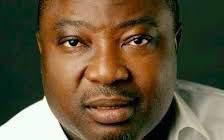
ADC Only Viable Alternative for Nigerians, Says Atiku, Insists APC, PDP Have Failed
Wole Ayodele in Jalingo Former Vice President
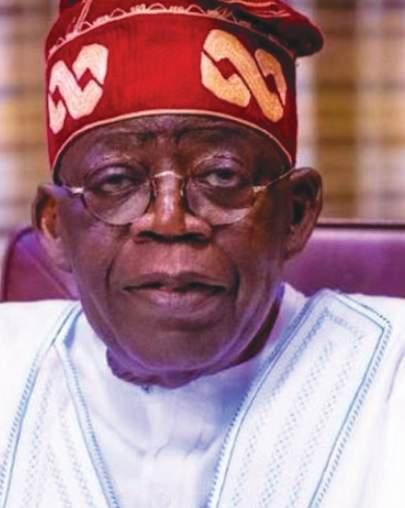
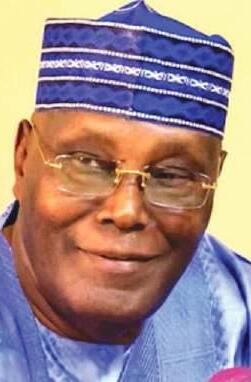
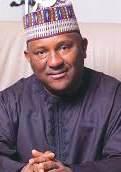
Atiku Abubakar has said the African Democratic Congress (ADC) is the only political party that can salvage Nigeria from its current economic and security woes. Atiku spoke at the inauguration of the ADC's
Taraba State office in Jalingo, the state capital. According to the former vice president, he and other politicians have tasted
President Vows to Work Tirelessly to Tackle Insecurity
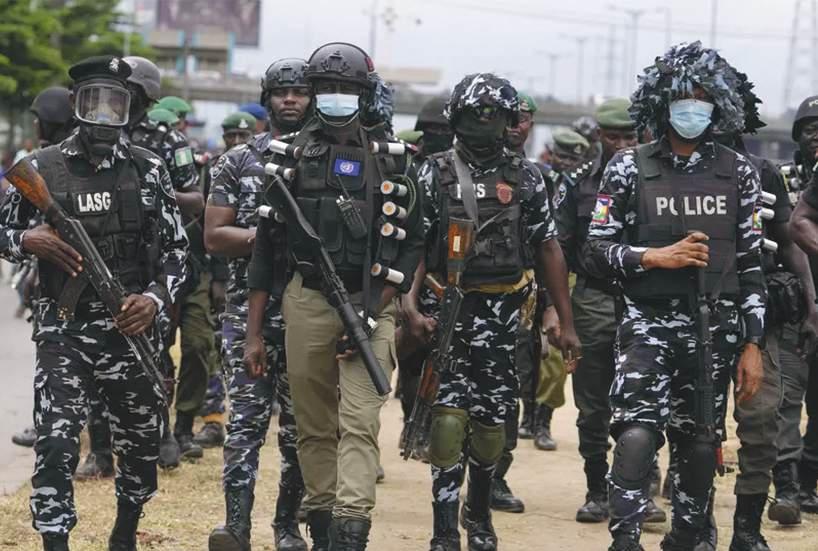
Badaru, Uba Sani, others call for decentralised security approach in North-west Porous borders, drug crisis fueling region’s violence, says Kaduna gov
John Shiklam in Kaduna and Ahmad Sorondinki in Kano
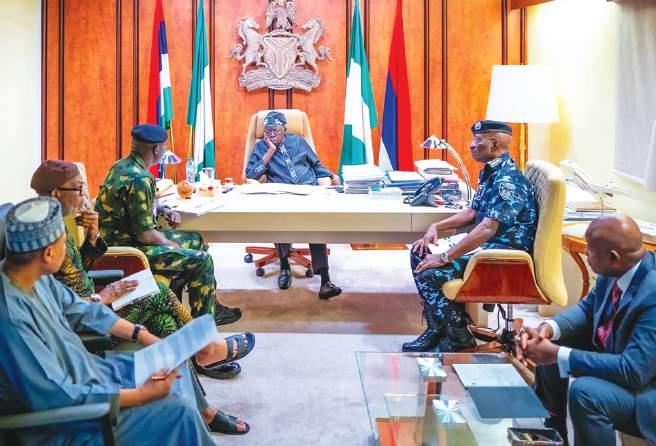
President Bola Tinubu has reiterated his administration’s
commitment to work tirelessly to address the root causes of insecurity bedevilling the country.
Tinubu said this yesterday at
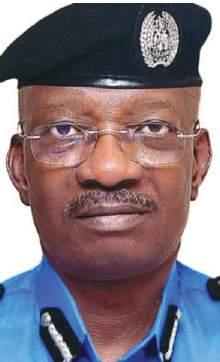
the passing-out parade of 1,187 cadets newly commissioned as Assistant Superintendents of Police (ASP) at the Nigerian Police Academy, Wudil, in
Kano State.
This is just as Governor Uba Sani of Kaduna State, Minister of Defence, Mohammed Badaru Abubakar, and
other leaders of the Northwest renewed the call for a decentralised security architecture to confront the worsening insecurity in the region. The governor blamed Nigeria’s poorly secured
Continued on page 14
Tinubu Sends 32 Additional Ambassadorialnominees’ List to Senate for Confirmation
President Bola Ahmed Tinubu has sent names of 32 additional ambassadorial nominees to the Senate for confirmation, days after submitting the first batch of three.
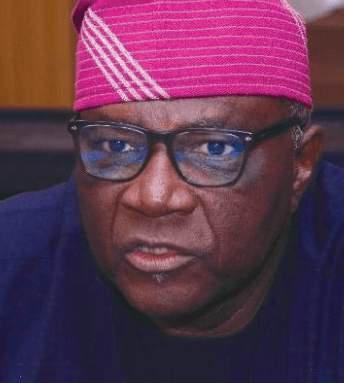
Immediate-past Chairman of the Independent National Electoral Commission (INEC), Prof. Mahmood Yakubu; exgovernors Ifeanyi Ugwuanyi of Enugu State and Okezie Ikpeazu of Abia State; former
Deputy Governor of Lagos State, Mr. Femi Pedro; Senator Jimoh Ibrahim; and the wife of the late governor of Oyo State, Abiola Ajimobi, Florence, are some of the prominent names on the list of the 32 ambassadorial nominees.
Meanwhile, the Peoples Democratic Party (PDP) has demanded the withdrawal of the list of the nominees, describing the selections as “reprehensible and scandalous.”
Continued on page 5
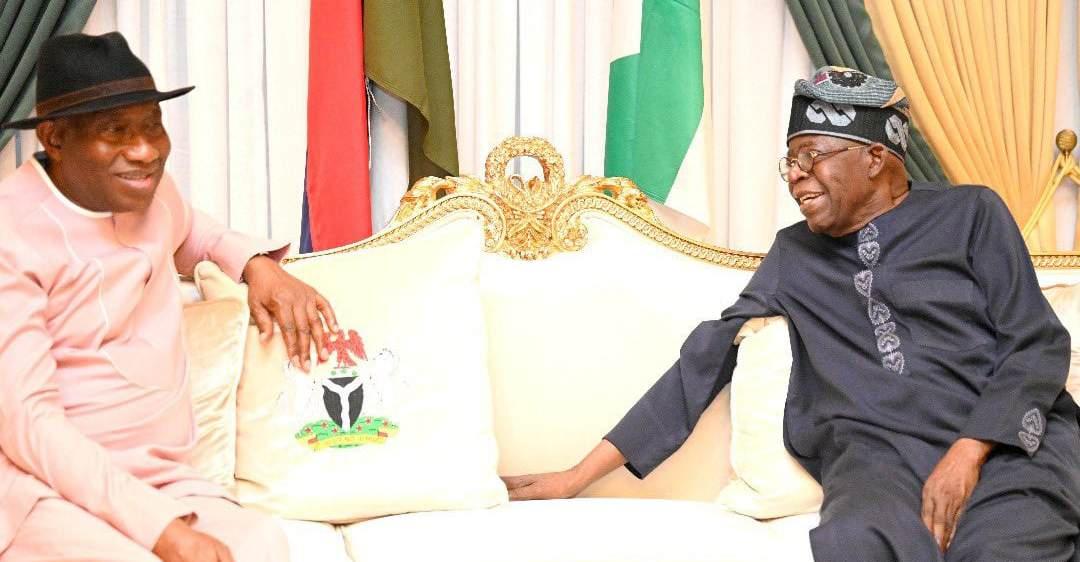
GUINEA-BISSAU CRISIS ON THEIR MINDS…
Former President Goodluck Jonathan (left), being received by President Bola Tinubu, at the Presidential Villa following his return from Guinea‑Bissau…yesterday
Reforms to Stabilise Economy, Nigerian Stock Market Gains
Nigeria’s daily petrol consumption rose to 56.7m in October, says NMDPRA
Kayode Tokede
The Nigerian stock market gained N28.52 trillion in the first 11 months of 2025, buoyed by the reforms in the foreign exchange market and other measures by the federal government to stabilise the nation's economy.
The stock market section of the Nigerian Exchange Limited (NGX), which closed trading in 2024 at N62.763 trillion, gained 45.45 per cent, or N28.52
trillion, to close at N91.286 trillion as of November 28, 2025.
The NGX All-Share Index closed November 28, 2025, at 143,520.53 basis points, up 40,94.13 basis points, or 39.44 per cent, from the 102,926.40 basis points, the index's closing level in 2024.
At the just-concluded November 2025 closing of trading activities, the market capitalisation, however, depreciated by N6.54 trillion, or
6.7 per cent, from the N97.829 trillion it closed at in October 2025, down to N91.286 trillion on November 28, 2025.
Consequently, the NGX ASI declined by 10,05.93 basis points, or nearly 6.88, to 143,520.53 basis points from 154,126.46 basis points when the primary NGX index closed for trading in October 2025.
In November 2025, Nigeria's stock market suffered one of its most significant one-day losses, dropping by N4.6
trillion amid investors’ profittaking in highly capitalised listed companies on the Exchange.
Capital market analysts attributed the downward movement in the stock market to investor sentiments driven by President Donald Trump’s threat of military action in Nigeria and the federal government’s implementation of the Capital Gains Tax (CGT).
In a post on Truth Social, Trump said he had instructed
the Pentagon to “prepare for possible action” and also threatened immediate suspension of U.S. aid to Nigeria.
President Bola Tinubu rejected Trump’s allegation of Christian genocide and designation of Nigeria as a country of particular concern (CPC), calling them a misrepresentation of Nigeria’s “consistent and sincere efforts to safeguard freedom of religion and belief for all
Nigerians”.
Speaking with THISDAY, Investment Banker & Stockbroker, Tajudeen Olayinka, said the N4.6 trillion drop in market capitalisation was against the backdrop of Trump’s threat and introduction of CGT by 2026. Olayinka stated: ‘’The combination of these two factors has played a significant role in investors’ profit-taking in highly capitalised stocks on the NGX.
TINUBU SENDS 32 ADDITIONAL AMBASSADORIAL-NOMINEES' LIST TO SENATE FOR CONFIRMATION
In two separate letters to the President of the Senate, Godswill Akpabio, President Tinubu asked the Senate to consider and confirm 15 nominees as career ambassadors and 17 nominees as non-career ambassadors expeditiously.
There are four women on the career ambassadors' list and six women on the non-career ambassadors' list.
According to a statement issued yesterday by presidential spokesperson, Bayo Onanuga, the non-career ambassador designates include the former chairman of the INEC, Yakubu; former Ekiti State first lady, Erelu Angela Adebayo; former Enugu State Governor, Ugwuanyi; Ogbonnaya Kalu from Abia, and a former presidential aide, Reno Omokri (Delta).
Others are the former Speaker of the Katsina House of Assembly, Tasiu Musa Maigari; a former Commissioner in Plateau State and former deputy executive secretary of the Universal Basic Education Commission (UBEC), Yakubu N. Gambo. A former senator from Plateau State, Professor Nora Ladi Daduut; a former deputy governor of Lagos State, Otunba Pedro; a former aviation minister from Osun State, Chief Femi Fani-Kayode; and Nkechi Linda Ufochukwu from Anambra State are on the nomination list.
Also on the list are former First Lady of Oyo State, Fatima Florence Ajimobi; former Lagos Commissioner, Lola
membership of the All Progressives Congress (APC), the Peoples Democratic Party (PDP), and other political parties and realised that these parties do not have what it takes to take Nigeria out of its current quagmire.
He made the claims following his official defection to the party on Monday, just 17 months before the 2027 general elections.
Before joining the coalition, Atiku was a high-profile member of the PDP.
Akande; former Adamawa State Senator, Grace Bent; former Governor of Abia State, Ikpeazu; businessman, lawyer and Senator from Ondo State, Senator Ibrahim, and the former ambassador of Nigeria to the Holy See, Ambassador Paul Oga Adikwu from Benue State.
Among the nominees for career ambassador and high commissioner-designates are: Enebechi Monica Okwuchukwu (Abia), Yakubu Nyaku Danladi (Taraba), Miamuna Ibrahim Besto (Adamawa), Musa Musa Abubakar (Kebbi), Syndoph Paebi Endoni (Bayelsa), Chima Geoffrey Lioma David (Ebonyi), and Mopelola Adeola-Ibrahim (Ogun).
The other nominees are Abimbola Samuel Reuben (Ondo), Yvonne Ehinosen Odumah (Edo), Hamza Mohammed Salau (Niger), Ambassador Shehu Barde (Katsina), Ambassador Ahmed Mohammed Monguno (Borno), Ambassador Muhammad Saidu Dahiru (Kaduna), Ambassador Olatunji Ahmed Sulu Gambari (Kwara), and Ambassador Wahab Adekola Akande (Osun).
The statement noted that the new nominees are expected to be posted to countries with which Nigeria maintains excellent and strategic bilateral relations, such as China, India, South Korea, Canada, Mexico, the United Arab Emirates, Qatar, South Africa, Kenya, and to Permanent Missions such as the United Nations, UNESCO, and the African
He, however, left the opposition party on July 16, citing irreconcilable differences that had emerged within the former ruling party.
He also called on Taraba residents to come out in their numbers and register in the ongoing continuous voter registration if they genuinely want to save themselves from the current economic and security woes of the country.
"I am in Taraba to inaugurate our new party
Union.
The statement added that all the nominees will know their diplomatic assignments after their confirmation by the Senate.
President Tinubu had sent three ambassadorial nominees for screening and confirmation last week.
The nominees were Ambassador Ayodele Oke (Oyo), Ambassador Amin Mohammed Dalhatu (Jigawa), and Retired Colonel Lateef Kayode Are (Ogun). All three will be posted to the UK, USA, or France after their confirmation.
The president had said more nominees for ambassadorial positions would be announced soon.
PDP Faults List, Demands Withdrawal
Meanwhile, the PDP has condemned the list of ambassadorial nominees, describing the selections as “reprehensible and scandalous.”
In a statement issued yesterday by its National Publicity Secretary, Ini Ememobong, the PDP said the list includes individuals perceived negatively by Nigerians and the international community due to “integrity deficits and notable antidemocratic activities.”
“While most Nigerians are seriously appalled by the inclusion of most of the nominees, they are not totally surprised, given the history and disposition of
office of the ADC, and I want you to hold the party with integrity."
"Do not allow anybody to deceive you with any other party, because we have tasted other political parties and they brought nothing but insecurity, hunger, poverty, and unemployment."
"The youths and women should know that we are doing this for them to have a better future, and I am holding on to their promise."
"ADC will win Taraba state, win Nigeria as the
this administration.
“Furthermore, it is an incontestable fact that a nominee is a clear and direct reflection of the values and estimation of the nominator.
“By making these nominations, the President has shown Nigerians that these are the best people he has to represent our country in the countries where they will be posted.”
The PDP specifically criticised the nomination of the immediate past INEC Chairman, Yakubu.
“To offer him an ambassadorial appointment at a time like this is an excellent example of a skewed reward system, which we suspect is designed as an incentive to the new INEC chairman, to also deliver flawed elections in 2027, in expectation of future rewards.
“This is absolutely scandalous and completely unacceptable,” PDP added.
The party demanded that Tinubu withdraw the current list and renominate individuals with “stellar democratic credentials and high moral standing, capable of commanding global respect” for their ambassadorial assignments.
“Appointing and sending ambassadors with tainted political profiles is not only a great disservice to Nigeria but a setup for a diplomatic all-time low,” the PDP said, stressing that the respect a country commands internationally is tied to the integrity of its ambassadors and leadership.
only reliable political party."
Following Atiku's defection, the Senator representing Edo North, Adams Oshiomhole, said Atiku lacks the capacity to fix Nigeria.
Speaking during a recent television interview, the exEdo State Governor claimed the former vice president's long struggle to stabilise the PDP weakens his claim to be able to turn the country around.
According to the former APC National Chairman,
FULL LIST OF AMBASSADORS
NON-CAREER AMBASSADORS
Reno Omokri (Delta)
Prof. Mahmood Yakubu (Bauchi)
Erelu Bisi Angela Adebayo (Ekiti)
Ifeanyi Ugwuanyi (Enugu)
Tasiu Musa Maigari (Katsina)
Yakubu N. Gambo (Plateau)
Prof. Nora Ladi Daduut (Plateau)
Otunba Femi Pedro (Lagos)
Chief Femi Fani-Kayode (Osun)
Nkechi Linda Ufochukwu (Anambra)
Fatima Florence Ajimobi (Oyo)
Lola Akande (Lagos)
Grace Bent (Adamawa)
Dr. Victor Okezie Ikpeazu (Abia)
Senator Jimoh Ibrahim (Ondo)
Ambassador Paul Oga Adikwu (Benue)
CAREER AMBASSADORS
Enebechi Monica Okwuchukwu (Abia)
Yakubu Nyaku Danladi (Taraba)
Miamuna Ibrahim Besto (Adamawa)
Musa Musa Abubakar (Kebbi)
Syndoph Paebi Endoni (Bayelsa)
Chima Geoffrey Lioma David (Ebonyi)
Mopelola Adeola-Ibrahim (Ogun)
Abimbola Samuel Reuben (Ondo)
Yvonne Ehinosen Odumah (Edo)
Hamza Mohammed Salau (Niger)
Ambassador Shehu Barde (Katsina)
Ambassador Ahmed Mohammed Monguno (Borno)
Ambassador Muhammad Saidu Dahiru (Kaduna)
Ambassador Olatunji Ahmed Sulu Gambari (Kwara)
Ambassador Wahab Adekola Akande (Osun).
Atiku had not shown the capacity to provide direction within the PDP despite his long-standing influence in the party.
"If Atiku, as a former vice-president under PDP, could not fix PDP, he could not reconstruct it, and he could not provide leadership and use his influence, which he had built, how can you lay claim to fix Nigeria?"
Oshiomhole queried.
The Senator called Atiku's exit from the APC, saying the former vice-president
only left the ruling party because he failed to clinch its presidential ticket.
"He was once a member of the APC. He left because he lost the party's presidential ticket," he said.
"He went back to the PDP. He's so much in love with the PDP, at least for the purpose of contesting elections. He could not build PDP.
"So, if Atiku can't build the PDP that made him vice-president, he can't fix Nigeria," he added.
ACCEPT OUR CONDOLENCES…
PDP’s Crises Deepen as Lamido, Bature Insist Damagum,
Anyanwu Still National Chairman, Secretary
Turaki’s leadership dismisses the claim
A former governor of Jigawa State, Sule Lamido, and the immediate past National Organising Secretary of the Peoples Democratic Party (PDP), Umar Bature, have appealed to the former National Chairman of the party, Ambassador Illya Damagum, and the former National Secretary, Senator Samuel Anyanwu, to save the PDP before their tenure expires on December 8.
Speaking separately to THISDAY, they said only Damagum and Anyanwu could save the PDP before
December 8, as only their signatures are acceptable to the Independent National Electoral Commission (INEC) before the expiration of the Damagum-led executive.
But in a quick response, the newly elected National Publicity Secretary, Ini Ememobong, said the concerns of both Lamido and Bature were belated because the ship of the party has left the harbour as they are now in the Court of Appeal.
He said the views of Lamido and Bature are indeed late because, as elders of the party, they were part and parcel of the crisis, as they took the
DisCos Collected N196.26bn in September, NERC’s Commercial Performance Report Reveals
Peter Uzoho
The Nigerian Electricity Regulatory Commission (NERC) yesterday said the 12 electricity Distribution Companies (DisCos) collected N192.26 billion in September 2025 out of the N241.54 billion total energy bills issued in the period under review.
It was an indication that the DisCos could not collect N49.28 billion of the bills.
This was contained in the Commercial Performance of Nigeria’s Distribution Companies in September 2025 factsheet.
The performance factsheet which was in the commission’s X handle, noted that in the month under review, N279.45 billion total energy was received by the Discos.
NERC said while 86.43 per cent billing efficiency was recorded in September, it was
up by 2.58 per cent from the previous month.
According to him, “Energy Billed & Billing Efficiency
N279.45bn total energy received N241.54bn total energy billed Billing efficiency: 86.43% (2.58% from August) Revenue Collection & Collection Efficiency N241.54bn total billings N196.26bn revenue collected (2.69%) Collection efficiency: 81.25% (1.18%).”
On Revenue Recovery Performance, NERC said N116.34/kWh was the allowed average tariff while N97.09/kWh was the actual average collection.
The factsheet added that there was 83.45 per cent recovery efficiency, with (3.67 per cent) rise over the August record.
NERC said DisCo Eko, Abuja, and Ikeja remained strong performers across billing, collections, and recovery efficiency.
party to court without using the PDP internal mechanism to address it at the budding stage.
Lamido told THISDAY that only Damagum and Anyanwu could save the PDP from its predicament because only their signatures are still recognised before the Election Management Board.
According to him, ''as far as the constitution of the PDP is concerned, Damagum and Anyanwu’s tenure are
subsisting till December 8 this year. The NWC, led by Damagum, was elected four years ago, and, under the circumstances, only two of them can write to INEC to call for a national executive committee (NEC) meeting to usher in an interim national executive committee; otherwise, the party is in deep trouble.
''Do we have to wait for the Court of Appeal and probably the Supreme Court to decide
this leadership crisis? Elections are fast approaching. Do you know how this crisis could be resolved?” he queried.
The immediate past National Organising Secretary, Bature, echoed the same position, saying, "First and foremost, I am still the National Organising Secretary. Our tenure will end by December 8, 2025. We were sworn in exactly on that day, four years ago.
So, my appeal is that the
two signatories still recognised by INEC should act to save the party. This is because, after December 8, INEC will no longer listen to anyone. If we say that we are waiting for the courts, how soon would that be coming?”
But the PDP’s newly elected National Publicity Secretary also told THISDAY that Lamido's and Bature's concerns are coming relatively late, as the ship has already left the harbour.
Nenadi Usman-led Faction of LP Submits Leadership List to New INEC Boss, Amupitan
Chuks Okocha in Abuja
The Senator Nenadi Usman-led faction of the Labour Party (LP) has submitted a 34-member Interim National Working Committee (INWC) list to the Independent National Electoral Commission (INEC).
The list, which was jointly signed by Usman and the interim National Secretary of the party, Darlington Nwokocha, as Interim National Chairman and Secretary, respectively, and dated November 27, was addressed to INEC Chairman Prof. Joash Amupitan.
It was stamped ‘received’ by the commission on Friday, November 28, 2025.
According to a cover letter, the Usman-led leadership cited the party’s constitution and a July 18, 2025, National Executive Council (NEC) resolution, empowering them to constitute the interim national leadership.
They urged INEC to recognise the submitted names as the legitimate leadership of the Labour Party.
The move was a sequel to a rival NEC meeting convened by Julius Abure on Friday, which reaffirmed him as national
chairman of the party. Usman and Nwochocha’s leadership enjoys the support of Abia State Governor, Alex Otti; the party’s 2023 presidential candidate, Peter Obi, and other stakeholders.
The list, which was signed by Usman and Nwokocha, noted that the new names “superseded” an earlier abridged list submitted in August and the ones recently submitted by Abure to the commission.
In the cover letter, the Usman-led leadership reminded the commission that the
committee arose from the “statutory NEC resolutions of Friday, 18 July, 2025” and was in line with the Labour Party constitution.
“We are pleased to forward herewith the names and designations of the reconstituted members of the Interim National Leadership in line with the LP constitution and the statutory NEC resolutions of July 18, 2025, already forwarded to the commission in the party’s correspondence and acknowledged by the commission on July 21, 2025,” Usman wrote.
NMDPRA Says Nigeria’s Daily Petrol Consumption Rose
Peter Uzoho
The Nigerian Midstream and Downstream Petroleum Regulatory Authority (NMDPRA) has Nigeria’s daily petrol consumption rose to an average of 56.7 million litres in October 2025.
The authority announced the increase in its October 2025 ‘State of the Midstream
and Downstream Fact Sheet’.
According to the NMDPRA, the average daily consumption increased by 31.86 percent from 43 million litres in September.
Between October 2024 and October 2025, the authority said Nigeria consumed an average of 661.5 million litres of petrol each month
Delinating the contribution of petrol in the national
to 56.7m in October
supply, the authority said 27.6 million litres were imported, while 17.08 million litres were provided by local refineries in October.
NMDPRA said in October, Nigerians consumed an average of 17.13 million litres of diesel and 2.61 million litres of aviation fuel.
According to the report, Dangote refinery supplied
an average of 18.03 million litres of petrol per day between October 2024 and October 2025.
In contrast, NMDPRA said the three refineries run by the Nigerian National Petroleum Company (NNPC) Limited produced no petrol during the period, as they were undergoing rehabilitation or maintenance.
Chuks Okocha in Abuja
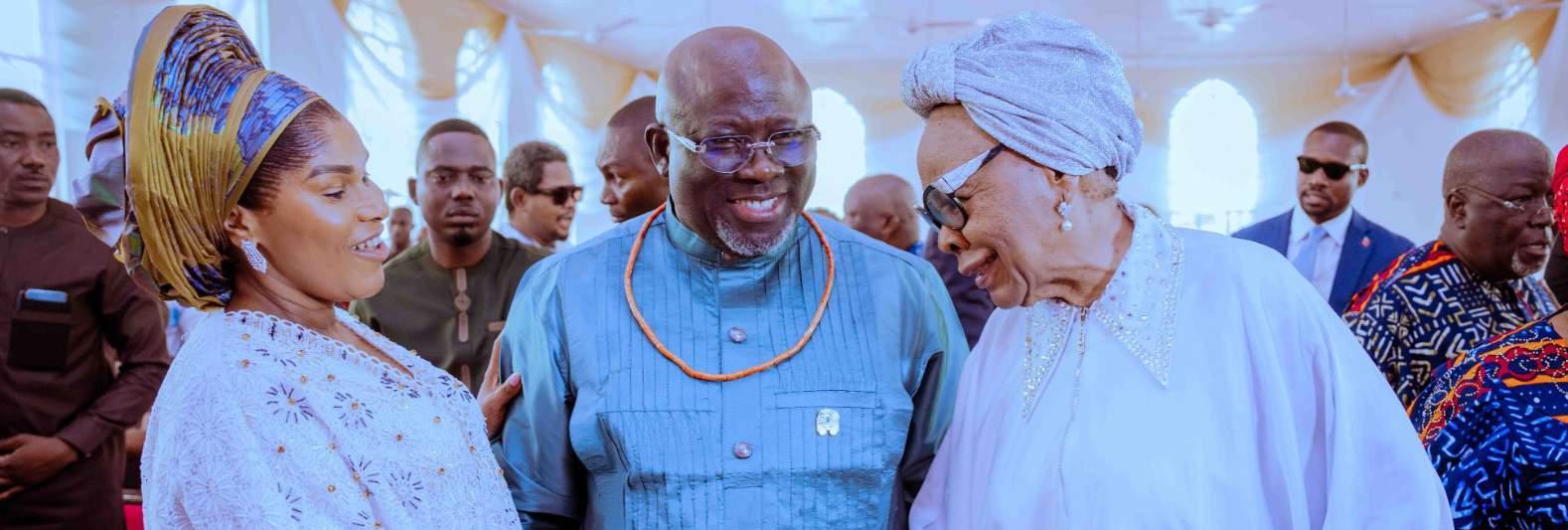
Wife of the Delta State Governor, Deaconess Tobore Oborevwori; Governor Sheriff Oborevwori; and widow of the late Major General Paul Omu (rtd.), Senator Stella Omu, during the funeral service of the late General at St. Andrew's Anglican Church, Igbide, Isoko South Local Government…yesterday
PROMOTING FREE AND FAIR ELECTIONS…
Shettima: Improved Investment in Education Reflects Renewed
Deji Elumoye in Abuja
Vice President Kashim Shettima has declared that the improved investment in Nigeria's education sector by the administration of President Bola Tinubu reflects the renewed vigour to properly situate the nation in the global knowledge economy.
He warned that Nigeria cannot compete globally if its universities remain underfunded, stressing that sustained investment in education is now a core pillar of national development and security under President Tinubu’s administration.
The vice president reaffirmed
Vigour Under Tinubu’s Administration
the federal government's commitment to transforming Nigeria's education sector through increased funding and comprehensive reforms.
Shettima, who spoke yesterday in Maiduguri, Borno State, at a ceremony to mark the 50th anniversary of the University of Maiduguri, said: "Today, there is a shared national understanding that education is the most reliable vehicle to development. It is the immune system of the nation. It fuels economic mobility, lifts families out of poverty, strengthens social cohesion, deepens democratic culture, and fortifies national security. It sustains every
modern endeavour, from the construction of strong institutions to the building of a strong economy".
Speaking on the focus of the administration of President Tinubu, Shettima said: "We have made it clear that we do not come to pay lip service to education. We recognise that the soul of national development lies in what our citizens know, what they can imagine, and what they can create. Because we understand the transformative power of learning, our budgetary commitments have been deliberately aligned with the broader goals of national progress."
He disclosed: "In the 2025 Budget, education received a total of 3.5 trillion naira, amounting to 7.3 per cent of the national budget, an increase from the previous year. For the first time in many years, our universities are being supported to develop mechanised farming programmes.
“We are preparing our young people for a knowledgedriven world, not with the tools of yesterday, but with the skills of tomorrow,” he added.
The vice president, however, acknowledged indeed the challenges that have persisted, noting that "International
Tinubu Hails Nigeria’s Return to IMO Council, Says It’s Affirmation of the Country’s Growing Maritime Influence
Deji Elumoye in Abuja
President Bola Tinubu has described Nigeria's election to the Council of the International Maritime Organisation (IMO) for the 2026–2027 biennium as a strong affirmation of the country's growing maritime influence and its constructive role in global shipping governance.
Nigeria was re-elected
to Category C of the IMO Council at the organisation's General Assembly in London on Friday, November 28, after a 14-year absenc.
While welcoming Nigeria's success, the President, in a statement issued yesterday by his Adviser on Information and Strategy, Bayo Onanuga, said it reflected the international community's confidence in the nation's commitment to
safety, security, environmental stewardship, and rules-based maritime operations.
Tinubu applauded the Minister of Marine and Blue Economy, Dr Adegboyega Oyetola; the staff of the Ministry of Marine and Blue Economy; the Nigerian Maritime Administration and Safety Agency (NIMASA), and Nigeria's diplomatic team for their dedication, strategic engagement, and
professionalism throughout the election process.
The president noted that the new IMO Council’s mandate aligned with his administration's drive to unlock the full potential of Nigeria's blue economy, expand maritime infrastructure, strengthen anti-piracy initiatives, and improve the nation's standing as a regional shipping hub.
Stop Politicising Insecurity, Focus on Challenges Facing Kano, Jibrin Tells Governor Yusuf
The Deputy President of the Senate, Senator Barau Jibrin, has urged Governor Abba
instead focus on addressing the numerous problems
bedevilling the state under his watch.
Responding to the state government's allegation that his statement could undermine ongoing security efforts in the state, Barau stated that the country's insecurity challenges, including the incursion into parts of the
state by marauding bandits, require the collaboration and support of all stakeholders to address them.
Jibrin, in a statement by his media aide, Ismail Mudashir, faulted the state government's claims and challenged them to produce the clip in which he made a statement that
could aggravate insecurity in the state.
Jibrin described the claims by the state Commissioner for Information, Ibrahim Abdullahi Waiya, as false, reckless, and malicious, stating that he made a statement capable of undermining the state's security efforts.
benchmarks recommend that between 15 and 20 per cent of national budgets be devoted to education, yet we have often fallen short. We have fallen short because we are compelled to balance competing national priorities such as security, healthcare, and infrastructure."
Reflecting on the impact of insecurity on education in the North-east, Shettima recalled that over 500 schools were attacked in Borno State between 2009 and 2021, with thousands of classrooms destroyed and teachers killed or displaced.
“When terrorists attacked our schools, they were trying to kill the future. But Borno
chose hope over fear and education over darkness,” he said.
Tracing the roots of the University of Maiduguri to the Third National Development Plan of 1975–1980, the Vice President described the institution as a symbol of Nigeria’s commitment to development through knowledge, despite decades of security challenges.
Earlier, Governor of Borno State, Prof. Babagana Zulum, said the state government was proud of the legacies of the University of Maiduguri and announced the award of scholarships for further studies to 200 lecturers from the institution.
Ganduje Dismisses Kano
Govt’s Call for His Arrest, Says It’s Baseless, Reckless
hmad Sorondinki in Kano
A former national chairman of the All Progressives Congress (APC), Dr. Abdullahi Umar Ganduje, has dismissed as baseless and reckless the recent call by the Kano State Government for his arrest over alleged comments linked to the formation of a militia group.
In a statement issued yesterday by his Chief Press Secretary, Edwin Olofu, in Abuja, Ganduje also described the call for his arrest as a reflection of Governor Abba Kabir Yusuf’s desperation and incompetence.
The immediate past governor of Kano State said the allegation amounted to an abdication of responsibility by an administration that has repeatedly failed to secure the lives and property of residents.
“It is deeply unfortunate
that rather than addressing the escalating insecurity ravaging the state, Governor Yusuf has chosen to chase shadows while searching for scapegoats to conceal his glaring failures,” he said.
Ganduje lamented that communities such as Bagwai, Shanono, Tsanyawa and others were living in fear, yet the governor had neither visited the affected areas nor shown empathy to victims.
“His continued absence in moments that require leadership speaks volumes of his disconnect from the people he claims to serve,” he added.
Ganduje, who is also the Chairman of the Federal Aviation Authority of Nigeria (FAAN) stressed that he had never been associated with violence or any act capable of undermining peace in Kano.
Ahmad Sorondinki in Kano
Kabir Yusuf of Kano State to refrain from politicising the challenges of insecurity and
L-R: Country Director, Kenya, International Foundation for Electoral Systems, Mr. Obaje Ukeh; Programme Manager, Judith Abiem; Chairman, Independent National Electoral Commission, Prof. Joash Amupitan (SAN); Regional Director, Africa, Mr. Seray Jah; and Director, Finance and Administration, Mr. Salami Babatunde, during a visit to the INEC headquarters in Abuja...recently
STRATEGIC PARTNERSHIP THAT WORKS…
L-R: Chief Executive Officer, Pure Fitness Africa, Ekemini Ekerette; Special Adviser to Lagos State Governor on Tourism, Arts and Culture, Idris Aregbe; Group Head, Mobility Business, Access Bank, Ishmael Nwokocha; and Nigerian Radio Personality, Olisa Adibua, at the unveiling of Access Bank Detty Fusion Platform and Announcement of the Strategic Partnership between Access Bank and the Lagos State Government for Detty December Celebrations in Lagos…recently
Northern Nigeria Faces Education Collapse with Thousands of Schools Shut, Amnesty Raises the Alarm
Wale Igbintade
Amnesty International (AI) has warned that Nigeria is on the verge of losing an entire generation to insecurity following the indefinite closure of 20,468 schools across seven northern states in the aftermath of last week’s mass abduction of more than 300 children and teachers in Niger State.
In a statement issued by the Director of Amnesty International Nigeria, Isa Sanusi, the global human rights body said the Nigerian government’s persistent failure to prevent or adequately respond to the repeated abductions of schoolchildren and teachers is
putting the future of millions of young people in jeopardy.
According to Amnesty, since the kidnapping of the Chibok schoolgirls in 2014, the organisation has documented at least 15 mass abductions targeting schools in the northern region.
Sanusi said the abductions were evidence of a consistent and dangerous pattern of security lapses and the government’s inaction.
“What we are witnessing right now in the northern part of Nigeria is an assault on childhood. The authorities are utterly failing to guarantee the safety and security of schoolchildren and teachers. Hundreds of towns and villages have for years
Economic Hardship, Others Deepening Mental Health Crisis, Say Psychiatrists
Sunday Ehigiator
The Association of Psychiatrists in Nigeria (APN) has raised concerns over the state of the country’s mental health system, warning that widespread neglect, economic hardship, and structural barriers are worsening mental health conditions.
The association said this in a communiqué signed by its President, Prof. Taiwo Obindo, and Secretary-General, Dr. Olajide Abayomi, at the end of its 56th Annual General and Scientific Meeting in Benin City, themed ‘Nigeria Mental Health System: Gaps, Opportunities, and Prospects.’
The communiqué, made available to journalists yesterday, noted that the association lamented that mental health remains severely underprioritized
despite its growing burden.
The psychiatrists highlighted lack of access to care, high treatment costs, absence of insurance coverage, rising substance abuse among youths, and limited awareness as pressing threats to public health.
Recent findings by the World Health Organisation (WHO) show that mental health conditions affect nearly 150 million people across Africa. Yet, care services remain severely under-resourced, fragmented, and largely inaccessible, especially in rural and underserved areas.
WHO warns that despite the widespread need, most African countries allocate less than $1 per person per year to mental health, resulting in a chronic shortage of trained professionals and limited infrastructure for prevention, treatment, and psychosocial support.
endured frequent attacks by gunmen,” Sanusi stated.
He added that the ongoing crisis constitutes a gross violation of Nigeria’s constitutional and international human rights obligations, including the responsibility to safeguard the rights to life and education under the Nigerian Constitution and the African Charter on Human and Peoples’ Rights.
Sanusi warned that the mass closure of schools, which state governments in Bauchi, Benue, Kwara, Plateau, Niger, Yobe, and Katsina say is a temporary measure to prevent attacks, could have long-term devastating consequences.
He noted that the organisation’s investigations revealed that many schools shut down following abductions in 2021 were
never reopened, and thousands of affected children were not provided alternatives.
“Many schools closed to prevent abductions remain shut indefinitely because security is not improving.
As a result, thousands of children are forced into working to support their families,” Sanusi said, noting that these closures come on top of existing barriers
that already limit access to education in northern Nigeria.
Amnesty added that the climate of fear is also driving families to withdraw their children, especially girls, from school.
He added that in many cases, underage girls are being married off early as families view marriage as a means of protecting them from kidnappers.
NIS Decries Attack on Border Patrol Formation, Killing of Three Personnel by Lakurawa Terrorists in Kebbi
Michael Olugbode in Abuja
The Comptroller General of the Nigerian Immigration Service (NIS), Kemi Nandap, has decried the violent attack and killing of three personnel of the National immigration Service (NIS) and destruction of assets at the border patrol formation in Kebbi State.
Three officers of the NIS were killed in a terrorist attack on their camp in the Bagudo Local Government Area (LGA) of Kebbi State.
The CGI, in a statement
signed yesterday by the Service Public Relations Officer, ACI Akinsola Akinlabi, confirmed the violent and coordinated attack carried out by unidentified armed men on the Bakin Ruwa Checkpoint, under the Tuga Border Patrol Formation in the state.
She said the incident occurred on Thursday, 27 November 2025, at approximately 22:00 hours.
She lamented that three gallant NIS personnel lost their lives in the line of duty, and several operational assets
and facilities at the location were destroyed. Akinlabi, in the statement, said: “The Service extends its heartfelt condolences and unwavering support to the families, colleagues, and loved ones of the fallen personnel, honouring their selfless sacrifice and commitment to safeguarding Nigeria’s Borders.”
He said: “The Comptroller General has ordered an immediate tactical response, deploying reinforcements to the affected formation,
intensified joint operations with other security agencies, enhanced intelligence-gathering along the entire Tuga axis, and heightened patrols to deter further threats and restore full security control of the area.”
He added that: “The Nigeria Immigration Service remains resolute in its mandate to secure the nation’s Borders and will not be deterred by acts of criminality. We urge the public to remain calm and continue to cooperate with security agencies in their efforts to secure the nation.”
Linking Neighbouring Countries in Digital Connectivity Drive Needed to Curb Nigeria’s Insecurity, Says Minister
Oghenevwede Ohwovoriole in Abuja
The Minister of Communications, Innovation, and Digital Economy, Dr. Bosun Tijani, has stated that linking Nigeria’s neighbours digitally is needed as part of the country’s digital connectivity drive to secure the nation.
The minister stated this at the minister, regulator, and telecoms executives’ forum and awards ceremony for 2025, organised by the Association of
Telecommunications Companies of Nigeria (ATCON) in Abuja.
Tijani said: "If we must secure our country digitally, we must connect our neighbours.
"We understand that Nigeria cannot be prosperous without the work we do. We can't fix food security in this country without connectivity. We cannot fix this insecurity issue that we have without ubiquitous connectivity.
"If you look at the map of West Africa, you have Benin, Burkina Faso, Niger, Chad, in
the corner, then Cameroon. If you look at all those countries, free flow is also a significant problem for us. We don't have security.
"We just need to do the work that we need to enable some of these things to be corrected. So, it's part of our dream. Can our investment also ensure that we can seamlessly connect our borders and connect those countries? So, nobody can ask the question as to whether we're truly the heart of connectivity in Africa."
The Executive Vice Chairman (EVC) of the Nigerian Communications Commission (NCC), Dr. Aminu Maida, in his presentation, said broadband deployment must be faster and cheaper.
Maida, who was represented by the Executive Commissioner, Stakeholder Management, NCC, Rimini Makama, said, "Deployment must be made faster, cheaper, and more efficiently if we are to reach communities where commercial returns are fragile.
THIRTY-NINE HEARTY CHEERS...
Shettima Canvasses Deeper Executive-Legislative Ties, Says Tinubu Will Never Take Lawmakers for Granted
First Lady, Akpabio, Abbas, Uzodimma seek support for more women participation in governance
Deji Elumoye in Abuja
Vice President Kashim Shettima has sought deeper collaboration between the executive and legislature, saying the two arms of government must work to align their purposes and maintain an unshakable resolve to build a Nigeria that works for all citizens.
Tinubu had "been a harmony rooted in leadership, foresight, and collective resolve."
Shettima noted that this explains why the relationship between the two arms of government under the administration of President Bola
This is just as the First Lady, Senator Oluremi Tinubu; Senate President, Senator Godswill Akpabio; Speaker of the House of Representatives, Tajudeen
Abbas, and the Chairman of the All Progressives Governors' Forum and Imo State Governor, Hope Uzodimma, have solicited more support for women's participation in governance.
Speaking in Abuja at the
Jonathan Briefs Tinubu on Political Situation in GuineaBissau, Says Ousted President Masterminded Coup
Deji Elumoye in Abuja
Former President Goodluck
Jonathan yesterday evening briefed President Bola Tinubu on the political impasse in Guinea Bissau.
Jonathan, who served as the head of the West African Elders Forum (WAEF) Election Observer Mission to Guinea-Bissau, was at the State House, Abuja, to give the president a first-hand account of the developments in the country, following the military takeover that led to the abrupt suspension of the electoral
border corridors for the rising violence across the North-west, warning that the region has become the ultimate test of the country’s commitment to protect its citizens.
Meanwhile, President Tinubu, represented by the Secretary to the Government of the Federation (SGF), Senator George Akume, told the police officers that the nation had entrusted its security to them and expected them to serve selflessly and be prepared to make the ultimate sacrifice for the country if the need arose.
He restated his determination to strengthen the nation’s security architecture through sustained investment in modern equipment, enhanced training, and improved logistics for the Nigeria Police and other security agencies.
process and the subsequent military intervention that has drawn global condemnation.
Speaking with journalists after the closed-door meeting, Jonathan said he came to brief the president about recent political developments in Guinea Bissau.
He said: "I came this evening to brief Mr. President what happened that is the tradition for former President, all these regional and continental issues whenever you are involved when you get back home you have to brief the president because likewise leaders will
Tinubu added that the administration expects every officer to treat Nigerians with respect, uphold the rule of law, and conduct themselves with exemplary conduct at all times. Reassuring the cadets of government support, President Tinubu emphasized that “Your welfare and professional development shall remain a priority of the Federal Government.”
According to him, the government’s approach to security extends beyond equipping agencies and includes tackling the socioeconomic drivers of crime.
He noted that the administration is promoting economic growth, social cohesion, and inclusive development to address the underlying causes of insecurity.
meet, I will not be there, so he will be able to get first-hand information".
The former president stressed that what happened in the West African country was not a military coup but a ceremonial coup masterminded by ousted President, Umaro Sissoco Embalo.
According to him: "What happened in Guinea Bissau is not what some people would call a palace coup, it was not a palace coup, we know, we know real coups, palace coups we know in Nigeria.
"This was not even a palace
He commended the police academy for providing worldclass training and education that empowers the officers to serve with integrity, courage, and compassion.
According to him, “We will work tirelessly to address the root causes of insecurity and promote economic development, social cohesion, and inclusivity.
“Our administration is committed to supporting the Nigeria Police Academy, the police, and other security agencies with the resources, training, and equipment they need to excel.
“I am impressed by the progress made by the Academy since its establishment. The infrastructure and training quality have improved significantly.
coup; I was looking for the appropriate word to describe it. I could not get it; that is why I called it a ceremonial coup. It was a ceremony conducted by the Head of State himself, that is why I say it was a ceremonial coup".
He stated that moving forward leadership of the Economic Community of West African States (ECOWAS) needs to reach out to the military junta on the need for them to release results of the concluded presidential poll and possibly inaugurate the winner as President.
“The Nigeria Police Academy has risen to this challenge, providing worldclass training and education that empowers our officers to serve with integrity, courage, and compassion.
“As we stand at the threshold of a new era, it is imperative that our police force is equipped with the skills, knowledge, and values necessary to tackle the complex challenges of our future and our time.
“To our passing off cadets, as you embark on this noble journey, remember that you are not just enforcers of the law, you are guardians of our collective security and wellbeing. Your role is pivotal in maintaining peace, stability, and trust in our communities.
Earlier, the Commandant of
weekend during a dinner with members of the National Assembly organised by the wife of the president, Senator Tinubu, at the Banquet Hall of the State House, Shettima stated that under Tinubu’s administration, the nation is currently enjoying the best working relationship between the executive and legislative arms of government since the return of democratic rule.
The vice president, however, called for a deeper collaboration between the two arms of government, stating that "the true essence of democracy manifests not only in respecting the legislature, but in appreciating the indispensable role each arm plays in the architecture of governance.”
On the need to deepen cooperation between the two arms of government, Shettima said it is evident that "the entire architecture of the Presidency today is anchored by proud alumni of the National Assembly,"
the Nigeria Police Academy, Wudil, AIG Patrick Atayero, urged the officers to remain committed to the values of discipline, integrity, and service instilled in them during training.
“Remember that you are not just officers; you are guardians of peace, protectors of the innocent, and defenders of justice. As you prepare to step out into the field of service, always remember the sacred trust that has been placed upon your shoulders,” he added.
Badaru, Uba Sani, Others Call for Decentralised Security Approach in North-west
Meanwhile, at the Senate Ad-hoc Committee on National Security Summit held yesterday in Kaduna for the North-west Zone, Governor Sani Badaru and
He pointed out that President Tinubu, the First Lady, the Chief of Staff to the President, Hon. Femi Gbajabiamila, the Deputy Chief of Staff to the President, Senator Ibrahim Hassan Hadejia, the Secretary to the Government of the Federation, Senator George Akume, and himself are alumni of the federal legislature.
"Democracy does not flourish in the chaos of discord. It thrives where there is understanding. It survives where there is familiarity with what each arm is designed to achieve. It blossoms where each recognises the intersection between power and responsibility—between authority and accountability," he explained.
"This occasion, in every sense, reaffirms that commitment. You are not taken for granted. You have never been taken for granted. And you will never be taken for granted," he observed.
other North-west leaders called for a decentralized approach in tackling insecurity in the region.
The summit, themed “Building Robust Regional Collaboration to Tackle Insecurity: Pathways for Securing the Future,” brought together senators, governors, traditional rulers, academics, and security experts to review the escalating threats of banditry, kidnappings, and cross-border criminality in the zone.
Governor Sani, who blamed Nigeria’s poorly secured border corridors for the rising violence across the North-west, pushed for the establishment of a North-west Theatre Command to unify all military and security operations under a single operational structure.
L-R: Ogun State Deputy Governor, Noimot Salako-Oyedele; Governor Dapo Abiodun; Wife of the Governor, Mrs. Bamidele Abiodun; Chairman, 2025 Akesan Day, Chief Solomon Onafowokan; Akarigbo of Remoland, Oba Babatunde Ajayi; and Senator Representing Ogun West, Senator Solomon Olamilekan Adeola, at the 39th Akesan Day celebration held at the Christ Apostolic Church Grammar School, Iperu…yesterday
PRESIDENT VOWS TO WORK TIRELESSLY TO TACKLE INSECURITY
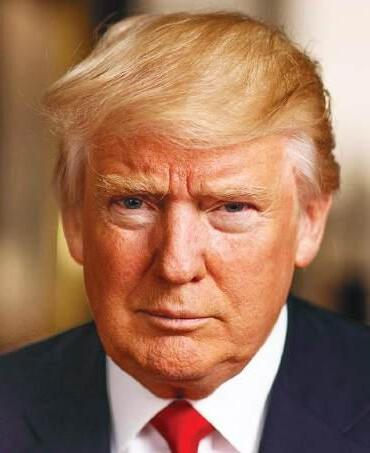
THE WORDS OF THE KING OF MAR A LAGO
I think Nigeria is a disgrace. The whole thing is a disgrace. They are killing people by the thousands. It is a genocide and I am really angry about it. The Government
has done nothing. They are very ineffective and they are killing Christians at will. We will come in guns ablazing and it will be short, vicious and sweet
–President Donald Trump, 21st November 2025.
Is it not strange that each time this ill-bred, ill-informed, racist and recalcitrant war-monger opens his foul mouth more attacks, killings and abductions take place in Nigeria? Has it not occurred to anyone that he is actually fuelling the insurgency with his words and constant denigration of our people, our Armed Forces and our Government?
Is this not an attempt to create a clear justification for what they really wish to do to us: namely invade and bomb us to kingdom come and then divide our country. This is the same way they demonised the Government of Sudan before unleashing the UAE-funded Janjaweed militia known as the RSF on them and creating carnage in Darfur.
This is what they did to Congo DRC too before releasing the Rwandafunded M23 militia and the butchery started.
Is it not strange to you that the man that says he wants to deliver and protect Christians in Nigeria welcomed into the White House with open arms the greatest butcher of Christians on earth by the name of Ahmed Al Sharaa (AKA Julani) who is the newly-installed President of Syria, only the other day and even gave him and his wife a bottle of “sweet” perfume in the full glare of the media.
Apparently he loves the Christians of Nigeria but hates the Christians of Syria. He also hates the Christians of Gaza and the Palestinian West Bank who have suffered immensely in the hands of Benjamin Netanyahu’s Zionist State of Israel. What an interesting paradox and contradiction this is and only a village idiot will be fooled by it
Claiming that the King of Mar A Lago cares about Nigerian Christians is like claiming that the proverbial “big bad wolf” cares about Little Red Riding Hood or that Count Dracula cares about beautiful women. Believe such balderdash and poppycock at your own peril.
The Orange Man’s motivation for expressing concern about the plight of Christians at the hands of the terrorists in Nigeria is gain and not love and as for the plight of the Muslims he couldn’t care less.
The script is clear: stoke, provoke and fund chaos, discredit and weaken the sitting Government, incite the people, engender regime change and spark off a civil war which will enable you to pick up the spoils and plunder the nation dry.
Their evil eye is now on Nigeria. They say we have done nothing to
stop the killing but they won’t tell you what they have done to stop supporting, enhancing and encouraging it for the last fifteen years? They won’t tell you why they do not sell us the arms we need to fight the war or share the necessary intelligence with us. They won’t tell you why they refused to designate Boko Haram as a terrorist organisation until 2015. They won’t tell you why they imposed an arms embargo on Nigeria.
They won’t tell you why they have refused to offer even the smallest assistance to our Armed Forces in this war over the last few years and up till now. They won’t tell you why USAID was funding ISWAP and Boko Haram.
They won’t tell you that they covertly established and utilised Al Qaeda, ISIS, Boko Haram, the Taliban, Al Shabab, Al Nusra, Ansaru, ISWAP and Lakurawa right from the outset whilst pretending to fight them. They won’t tell you the carnage that they unleashed on Libya, Iraq, Syria, Egypt, Congo, Sudan, Lebanon, Afghanistan, Yugoslavia, Somalia, Gaza, Yemen, Palestine, Ukraine, Central African Republic, Venezuela, Mali, Chad, Niger, Burkina Faso and elsewhere either directly or through their local proxies and sponsored militias. They won’t tell you why they have now focused on Nigeria and why they are attempting to do same to South Africa. Nigeria’s case is even more pitiful and alarming and we are clearly being set up for the kill. Every time we make progress economically those that do not wish us well from outside our shores undermine the efforts of our Government and they do so in collaboration with members of the opposition.
It happened when President Olusegun Obasanjo, President Umaru Yar’Adua, President Goodluck Jonathan and President Muhammadu Buhari were in power and now it is happening under President Bola Ahmed Tinubu.
These dark and sinister forces which are led and supported by what the Holy Bible describes as “bloodthirsty and evil men” have no loyalty and offer no fidelity to any African nation or leader. As a matter of fact they hate us with what the Holy Bible describes as “a perfect hatred”.
Consequently, for the last 65 years Nigeria has been the victim and target of a vicious, well-planned, well-funded, well-orchestrated international conspiracy and the ugly events of the last fifteen years and particularly the last few weeks and months prove that.
During Obasanjo’s time when I was in Government, the American State Department even went as far as to publicly and boastfully proclaim that by 2015 we would no longer be one nation. That was their projection, hope and aspiration and they did everything in their power to achieve it but God, in His infinite wisdom and mercy, kept us together and put them to shame.
Today as we attempt to cosy up to them despite their threats and insults my advice and counsel is that we guard our hearts jealously for we trust them at our own peril. Men of blood and violence are incapable of honoring agreements and reciprocating friendship. And when they do they cannot sustain it.
In this respect the words of Ayatollah Ali Khamenei, the leader of the Islamic Republic of Iran, are instructive.
A few days ago he said, “the war in Ukraine started because of U.S. interference and now they are imposing a 28-article plan on the country they themselves dragged into the war. The Americans BETRAY even their own friends. They support the Zionist criminal regime, are ready to ignite wars anywhere in the world for oil and underground resources and today this war has reached Latin America. Undoubtedly, such a state is unworthy of having a Government like the Islamic Republic seek ties and cooperation with it.”
Can anyone dispute the veracity of Khamenei’s words? The truth is that the Americans are pathologically unreliable and unscrupulously treacherous.
What this means is that if, God forbid, things get out of hand in our country they may end up supporting the head of Boko Haram and ISWAP as our President. As far as they are concerned today’s terrorist is tomorrow’s leader. It really is that bad and if anyone doubts it they should find out what happened in Syria and Afghanistan!
Yet no leader has encapsulated the American disease better than President Gustavo Petro of Colombia when he said, “A clan of pedophiles wants to destroy our democracy. To keep Epstein’s list from coming out they send warships to kill fishermen and threaten our neighbor with invasion for their oil. They want to turn the region into another Libya, full of slaves.”
This insightful and incisive contribution cannot be dismissed or ignored because it is rooted in truth. To those that still trust the Americans despite all these observations I say “caveat emptor” which, for those who never had the privilege of learning or studying Latin, means “buyer beware”. For the record I am aware of the formation of the U.S./Nigeria Working Group which was established a few days ago.
I have implicit confidence in the National Security Advisor, Malam Nuhu Ribadu, who leads it and it’s other members who, in my estimation, are loyal and distinguished patriots like my old friend and brother and our Foreign Minister, Ambassador Yusuf Tuggar.
Despite the confidence I have in them I urge them, for all our sakes, to be cautious of those they are working and collaborating with from the American side. As they say, when you dine with the devil it is wise to do so with a long fork and knife.
Again as the Roman poet Virgil wrote in his literary masterpiece thousands of years ago titled ‘The Aeniad’, “beware of the Greeks, especially when they bring gifts”. The Trojans learnt that lesson the hard way: let us hope that we do not.
What makes it worse is that now that they are reviewing the ‘Green Cards’ of nationals of all the ‘Countries of Concern’ as a result of the tragic shooting of two National Guard officers (one of whom has died) by Afghan nationals near the White House, this makes the matter even more dicey and complicated.
The Americans are now literally foaming at the mouth and looking for who to blame for their many self-inflicted woes so we must be cautious.
The bitter truth is that every time we take ten steps forward they band together with their local co-conspirators and take us twenty steps back because their greatest nightmare is a strong, independent, united, flourishing Nigeria that brings pride and dignity to Africa and the black race.
Any Nigerian that takes pleasure in the security challenges we are facing in our country today is either a sadist, a masochist, insane or simply naive and unpatriotic. This is not about Tinubu but about our country.
The terrorists are being funded and supported by a dark, sinister and relentless foreign force that seeks to tear us apart, destroy us, humiliate us, rob us, occupy our land, steal our resources, pillage our rare earth minerals, erase our identity, distort our heritage, re-define our history and control the entire globe.
They are doing the same thing in Europe, the Middle East, Africa, Latin America, the Caribbean, Asia, South East Asia and much of the world.
Those that applaud that evil force and encourage it to enter our shores “guns-ablazing” and bomb us in the name of trying to help us fight the terrorists that they themselves are funding do not understand world politics and have no knowledge of modern history.
There is not one country that the Americans have entered with bullets, bombs and violence and left better than the way they found it. Outside of that once we lose our sovereignty we will never get it back.
Once we rely on another country to fight our battles for us we are no longer a nation but a vassal state of cowardly slaves. The solution to
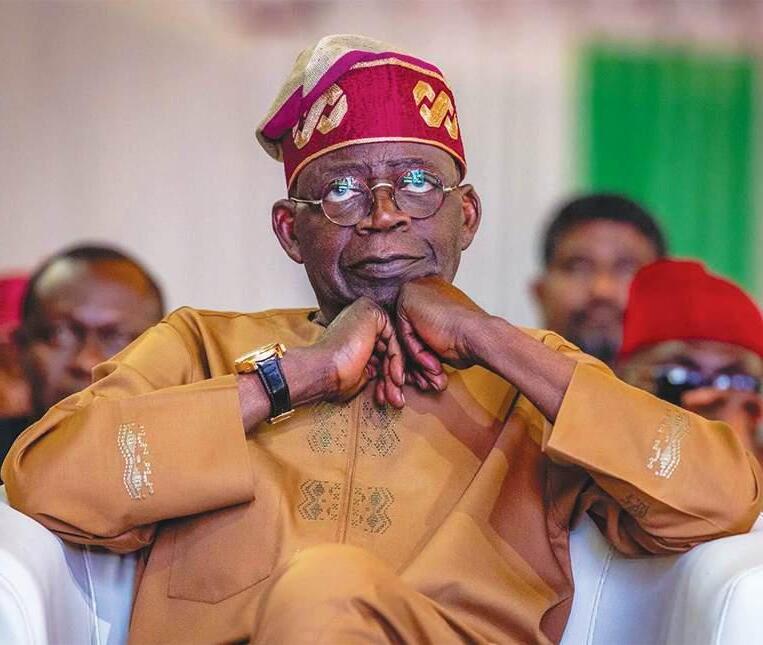
President Bola Ahmed Tinubu
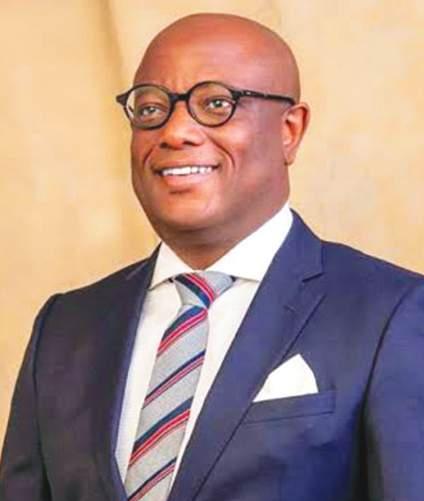
President Donald Trump
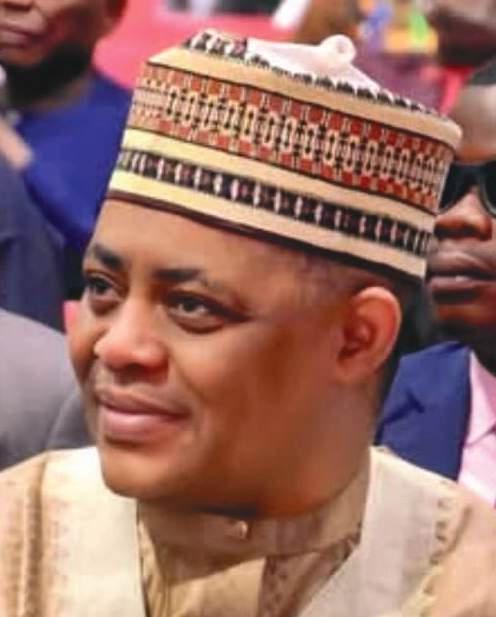
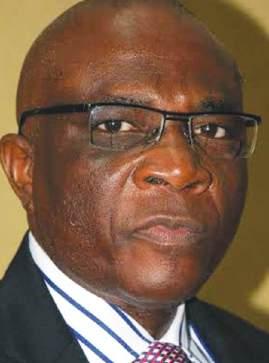
Chief Femi Fani-Kayode
the problem is to support and encourage our Government and Armed Forces to face the challenge squarely and win this war.
Whatever it takes it is their obligation and duty to do this and with our support and understanding they surely will.
There is room for criticism and even anger but there is no room for disloyalty to the national cause or betrayal and collaboration with those that want to bring our country to her knees.
Things are tough and the enemy appears to be gaining ground but we must keep faith with God and have confidence that our President can and will turn things around. This is a time to pray for Nigeria and to pray for our leaders and Armed Forces and not to gloat or cheer on those who mock, despise, undermine and insult us and seek to subvert their efforts.
This is a time to show those that have described us as being “a disgrace” that we are more than able to handle our own affairs and solve our problems despite their obvious malice and acts of sabotage.
This is a time to have faith in our country and our people and remember God’s promise and word that Nigeria shall be great again. This is a time to line up behind our President and let him know that despite all that is happening we still have confidence in him and that he is not alone.
Thankfully there is light on the horizon. For example it is great news that the 24 female students that were abducted by terrorists from Government Girl’s Comprehensive Secondary School in Maga, Kebbi state have all been rescued. Kudos to President Tinubu, our Armed Forces and our security agencies.
When we couple this with the fact that just a few days earlier every single one of the 33 worshippers that were abducted by terrorists from a Church in Eruku, Kwara state were also rescued and 50 of the 303 male and female students that were abducted from St. Mary’s school in Papiri, Niger State regained their freedom it rekindles our joy and gives cause for hope.
We still have a long way to go and our joy cannot be full until every single person that has been abducted is rescued and regains their freedom and until every terrorist has been killed but these efforts are promising and noteworthy and put a lie to the tactless assertion by Trump that we are a “disgraced country” which should be shamed, insulted, threatened and brought to her knees before the entire world.
Anyone that believes that a man like that who violates international law and all the norms of decency and civilisation by bombing and blowing small fishing boats out of the Atlantic ocean and murdering innocent, defenceless and faceless Venezuelan fishermen in cold blood on the grounds that they are supposedly carrying hard drugs into his country, is sane or capable of fighting for Christians in Nigeria is uninformed and unintelligent.
Again anyone that believes that if and when Trump starts dropping bombs on Northern Nigeria in the name of delivering Christians from terrorism and persecution that he will make a distinction between Christians and Muslims when those bombs start flying is a dullard.
A few days ago Professor Wole Soyinka, the literary giant and Nobel Laureate, described him as a “mad man”. He went further by saying “Trump said he would come to Nigeria ‘guns ablazing’ and that it would be ‘fast, vicious and sweet’”.
He concluded by asking, “do these words sound like those of a sane person to you?” On another occasion he referred to him as “a petty dictator” and “a white version of Idi Amin”. Soyinka is absolutely right.
On his part Professor Bolaji Akinyemi, a respected former Minister of Foreign Affairs said,“when the most powerful man in the world threatens
you with his own troops the devil is at the door knocking. We don’t want that devil to come in.” I concur.
To compound the point one of the few intelligent and rational American commentators left on earth, Professor Jeffrey Sachs of Colombia University, in his reaction to Trump not turning up to the G20 meeting in South Africa, said the following to a South African audience the day before the meeting started.
He said, “why isn’t Donald Trump coming tomorrow? Because he has a four year old mentality and he is having a tantrum”. This is apt.
Imagine a man with a “four year old mentality” that is given to “tantrums” having control over the worlds largest arsenal of nuclear weapons and being the Commander in Chief of the most powerful army in human history.
Only God can save us from such a creature.
If anyone has any doubts about the accuracy of Sachs’ categorisation of Donald Trump’s infantile and fragile state of mind I urge them to consider the following words which he posted on his X handle on November 28th, after few days after the successful conclusion of the G20 meeting in South Africa, and which graphically reflects his vindictive, petty and puerile disposition. He wrote, “The United States did not attend the G20 in South Africa, because the South African Government refuses to acknowledge or address the horrific Human Right Abuses endured by Afrikaners, and other descendants of Dutch, French, and German settlers.
To put it more bluntly, they are killing white people, and randomly allowing their farms to be taken from them. Perhaps, worst of all, the soon to be out of business New York Times and the Fake News Media won’t issue a word against this genocide. That’s why all the Liars and Pretenders of the Radical Left Media are going out of business! At the conclusion of the G20, South Africa refused to hand off the G20 Presidency to a Senior Representative from our U.S. Embassy, who attended the Closing Ceremony. Therefore, at my direction, South Africa will NOT be receiving an invitation to the 2026 G20, which will be hosted in the Great City of Miami, Florida next year. South Africa has demonstrated to the World they are not a country worthy of Membership anywhere, and we are going to stop all payments and subsidies to them, effective immediately. Thank you for your attention to this matter!”
If this vile, disrespectful and nonsensical verbiage does not betray the mindset of a spoilt, ill-bred and delusional four year old brat whose toys have been taken away from him then I don’t know what will.
Jeffrey Sachs, together with men and women like Colonel Douglas Macgregor, Lt. Colonel Scott Ritter, Chris Hedges, Abby Martin and Candace Owens are amongst the few that have the courage to call out Trump and his MAGA movement and still speak truth in America today. They are the saving grace and redeeming factor of the American intellectual space.
The rest are mostly Yankee cowboys and cowgirls with little or no intelligence that are only interested in extending the boundaries of American hegemony and that present a very real danger to the peace and stability of the civilised world.
Recent events in Gaza, Darfur, Congo, Syria, Yemen, Lebanon and Venezuela prove that. When it comes to his threats against Nigeria we must consider the fact that such is the level of Trump’s utter depravity that he is quite capable of blowing up a whole town with ALL the people in it, both Christian and Muslim, in the name of targetting and killing terrorists and saving Nigeria’s Christians.
His agenda is not hidden. Trump is attempting to demonise and dehumanise us ALL so that he can come in and slaughter us without
consequence. That is what we are toying with when we urge him to come and have his wicked way with us.
In case anyone is in any doubt about this I urge them to consider his words, spoken on the 5th of November. He said, “we don’t lose wars. Sometimes, we don’t fight to win. We’ll stay around a country for 15 years, just bomb the hell out of everybody, make everybody miserable. Nobody knows why we’re there. You know the wars that never end — that wasn’t me. That was the stupidity of the people before me”.
He says that wasn’t him and describes the people that were in power before him as “stupid” but frankly none of them has been as brutal and brazen as he has been when it comes to killing innocent people and deploying military force and economic coercion against not just his own people but also the rest of the world.
Even his countries’ traditional allies have not been spared of his insults, threats, mockery and blackmail. Those that believe his “that wasn’t me” mantra do so at their own peril.
Those that are praying for Trump to come and “save us” in Nigeria remind me of the proverbial turkey that is praying for Christmas and the proverbial ram that is praying for Sallah. In the end, after their prayers have been answered, they will be slaughtered and devoured on that day but due to their low intelligence quotient they don’t see it coming despite all the evidence.
There is a reason that Rev. (Dr.) Munther Isaac of the Orthodox Church, Bethlehem in the West Bank said, “we Palestinians prefer to die and be martyred than to have someone like Trump defending us”.
I urge every Nigerian Christian, especially the excitable ones that claim to love Trump, that see him as their saviour and that insist on calling themselves Biafrans, to ponder on this. You do not invite satan in to solve your problems. You do not invoke a demon to provide a solution for your challenges.
It is better for us to solve our problems ourselves and fight our own battles as Christians than to rely on Trump and the Americans to come and fight them for us. A word is enough for the wise.
Before ending this contribution permit me to address the fundamental issues. The question is whether we really do have a Christian genocide problem in Nigeria and the answer is ‘yes, we do’. Again the question is whether we have a Muslim genocide problem in Nigeria and again the answer is ‘yes we do!’ Both Christians and Muslims are the victims of the terrorists and anyone that says otherwise is a pernicious and specious liar. Any assertion that seeks to deny this incontrovertible fact is nothing but perfidy and deceit. The final question is what can we do to solve these problems and the answer is as follows.
Firstly, we must resolve to kill every single terrorist and make it a criminal offence punishable by death to assist, collaborate, encourage, support, negotiate or pay ransoms to them.
Secondly we must resist every attempt by the Americans or any other group of foreigners and their local collaborators to drive a wedge between Christians and Muslims in our country.
Thirdly we must get the Federal Government to provide the necessary security, do their job properly, keep them on their toes and hold them to account.
Fourthly we must inspire, motivate, encourage and equip our soldiers and security agencies and give them all the weaponry, resources and support that they need to do the job.
Fifthly we must urge our President to reach Lt. Colonel Eebyn Barlow, the highly acclaimed, celebrated, experienced and respected retired South African Special Forces officer that scored great successes against Boko Haram when President Goodluck Jonathan brought him and his company, Executive Outcomes, into our country in 2014 to assist and support our Armed Forces.
And finally we must get President Tinubu to reach out to President Vladimer Putin, enter a defence pact with the Russian Federation and urge the Russians to assist our Armed Forces in our fight against the terrorists.
We must also build greater, deeper and stronger economic ties with China and consolidate our friendship and diplomatic ties with the United Kingdom, Germany, France and the European Union. What we must NOT do is trust the Americans or rely on them for ANYTHING.
We cannot trust a nation whose President has publicly referred to ours as “a shithole” and “a disgrace”, who has contempt for us, who constantly threatens us and says he will withdraw all the aid they have been giving us and who has a clear and distinct psychopathic disposition. This seems to me to be basic logic. Let us hope that someone is listening.
Permit me to end this contribution with the words of Trump himself which will give even his greatest and most ardent supporters in Nigeria and indeed throughout Africa and the Global South pause for thought and an insight into just how dark and sinister the inner recesses of his complex mind really are.
In a long post on his X page on Thanksgiving Day he wrote, inter alia, “even as we have progressed technologically, Immigration Policy has eroded those gains and living conditions for many. I will permanently pause migration from all Third World Countries to allow the U.S. system to fully recover, terminate all of the millions of Biden illegal admissions, including those signed by Sleepy Joe Biden’s Autopen, and remove anyone who is not a net asset to the United States, or is incapable of loving our Country, end all Federal benefits and subsidies to noncitizens of our Country, denaturalize migrants who undermine domestic tranquility, and deport any Foreign National who is a public charge, security risk, or non-compatible with Western Civilization. These goals will be pursued with the aim of achieving a major reduction in illegal and disruptive populations, including those admitted through an unauthorized and illegal Autopen approval process. Only REVERSE MIGRATION can fully cure this situation. Other than that, HAPPY THANKSGIVING TO ALL, except those that hate, steal, murder, and destroy everything that America stands for: you won’t be here for long!”
After reading this if you still believe that Donald Trump is our friend I wish you luck!
May the Lord defend and protect the Federal Republic of Nigeria!
•Chief Femi Fani-Kayode is a former Minister of Culture and Tourism, a former Minister of Aviation, the Sadaukin Shinkafi, the Wakilin Doka Potiskum, the Otunba of Joga Orile, the Aare Ajagunla of Otun Ekiti and a former Senior Special Assistant on Public Affairs to President Olusegun Obasanjo
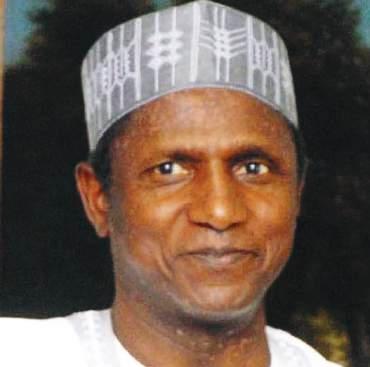
Late former President Umaru Yar’Adua
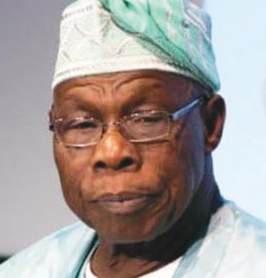
Former President Olusegun Obasanjo
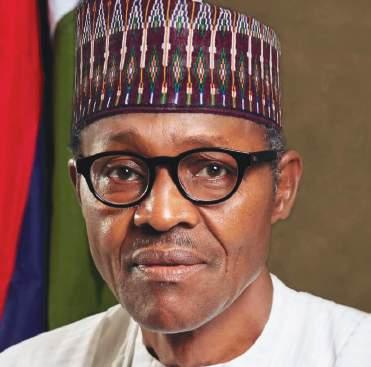
Late former President Muhammadu Buhari
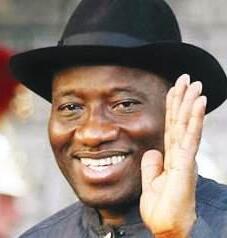
Former President Goodluck Jonathan
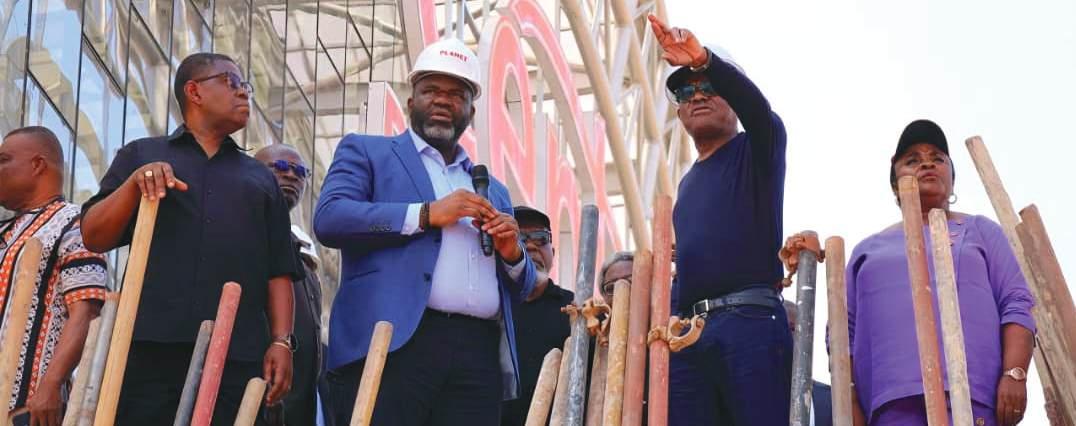
PROJECT INSPECTION…
L-R: FCTA Permanent Secretary, Transportation, Mrs Okonkwo Florence Nonubari; Minister of the Federal Capital Territory, Mr. Nyesom Wike; Managing Director, Planet Projects Limited,
and Mandate Secretary, Transportation, Dr. Chinedum Elechi, during an inspection of the Central Business District Bus Terminal in Abuja…yesterday
Anxiety Grips Families of Freed 38 Eruku Worshippers over Non-release to Their Families by Kwara Government
Hammed Shittu in Ilorin
Anxiety has continued to grip the families of the freed 38 worshippers of the Eruku Christ Apostolic Church (CAC) in Ekiti Local Government Area of Kwara State over the nonrelease of the victims to their families in the town.
The worshippers were kidnapped by bandits on November 18 during a special thanksgiving service in Eruku and were later freed last Sunday and moved to Ilorin by government officials.
During the attack, three persons were killed and one other injured.
The anxiety according to THISDAY checks might not
be unconnected with the fact that after the completion of their medical attention by the state government, they are yet to be released to their families days after their rescue.
Sources close to one of the families who spoke on condition of anonymity to THISDAY in Eruku yesterday said: “We are seriously disturbed that the government is yet to release the freed victims to their families”.
She added: “I want to tell you that at least I have three of the worshippers that were freed and after their medical attention by the state government, they are yet to release them to us.
“We are seriously worried
Group Calls for Inclusive Leadership Balanced Representation in Kwara
The Kwara Inclusion Advocates (KIA), a broad coalition of Kwarans at home and in the diaspora, has called for urgent political inclusion as the state heads into the 2027 election cycle. The group made the call during a virtual media parley held on Saturday in Lagos.
KIA, made up of Kwarans of various ethnic and religious backgrounds, including a significant membership base in the United States, said its concerns are shaped by ongoing global reviews of insecurity in Nigeria. Many diaspora members, the group noted, have closely followed U.S. Congressional attention on rising insecurity in Kwara and other Middle Belt states.
According to the conveners, Mr. Fola Abiodun Adekeye and Barr. Tunji Adeyemi, political exclusion has become a core driver of distrust, tension, and vulnerability in the state.
“Kwara is one of Nigeria’s most cosmopolitan and plural states. Yet, this diversity has not been reflected in its political leadership configuration in recent years,” the statement said.
“This imbalance is not sustainable. Exclusion—especially when weaponised—creates fertile ground for insecurity.’’
The group referenced the recent
viral intervention by respected politician and lawyer Chief Iyiola Oyedepo, who warned that some political actors exploit religious sentiment to retain influence.
KIA described his comments as “a timely reminder that Kwara cannot afford divisive politics disguised as tradition.”
KIA also acknowledged the growing public conversation across the state about the possibility of producing a Christian governor in 2027, stressing that the agitation is not about religion but about balance, fairness, and the recognition of Kwara’s true plural identity.
“This conversation is philosophical, not sectional. It reflects the desire of many Kwarans for a political culture that mirrors our diversity and strengthens social cohesion,” the group added.
The organisation cautioned that with Nigeria currently under increased international scrutiny over religious mistrust and insecurity, especially in Middle Belt states, Kwara must avoid any perception of exclusionary politics.
“The world is watching Nigeria closely. A peaceful, diverse state like Kwara must not fall into the pattern of divisiveness that is destabilising neighbouring states,” the statement warned.
and disturbed and we don’t know what is happening with our people as at the time of talking to you.
“We want the state government to release our people to us so as to take care of them more because we don’t know their health status now.
“We learnt that they have been keeping them in one of the hotels in Ilorin and we
don’t know the reason behind this,” she added.
But, a senior government official told journalists yesterday that the rescue worshippers were still undergoing medical and psychological evaluation.
“They went through trauma, especially the young ones and the elderly. The government wants to give them the best care before returning them
home,” the source said.
He also added that no ransom was paid. Some residents of Eruku said while they appreciated the government’s intervention, they were eager to receive the worshippers back for proper community healing.
Governor AbdulRahman AbdulRazaq had recently announced the release of the
kidnapped victims of Eruku CAC in a statement issued by his Chief Press Secretary, Rafiu Ajakaye. Although the statement did not disclose how the victims were freed.
The Special Adviser to the President on Information and Strategy, Bayo Onanuga, also said no ransom was paid, insisting the government only negotiated with the captors.
Resident Doctors Suspend Nationwide Strike
Onyebuch Ezigbo in Abuja
The National Executive Council, NEC, of the Nigerian Association of Resident Doctors (NARD), yesterday night suspended its total, indefinite and comprehensive strike (TICS) for a period of four weeks following a series of conciliatory meetings with the federal government and the signing of a Memorandum of Understanding (MoU).
President of NARD, Dr Mohammad Suleiman, who confirmed this last night, said the immediate suspension was a “gesture of good faith” intended to give the government room to implement the unresolved components of the association’s 19-point demand.
“NEC, in its wisdom, has resolved to suspend the strike for four weeks to allow room for implementation. This decision reflects our commitment to continue negotiations without compromising the welfare of
our members,” he said.
Suleiman explained that although the MoU captured significant progress, several key issues remain at the implementation stage.
He listed some of the pending issues to include the payment of promotion arrears, for which CMDs and MDs are still compiling data, with the government committing to a four-week deadline.
“Salary arrears have also been given a four-week deadline.
On the specialist allowance, the Office of the Head of Civil Service of the Federation has issued a clear directive, while the National Salaries, Incomes and Wages Commission is expected to take the necessary steps to actualise it,” he said.
Also, in a message to his members tagged: “NARD TICS: The Journey Thus Far”, made available to Vanguard, Suleiman said: “The long-standing case of the Lokoja 5 is expected to
be fully resolved within two weeks following a committee recommendation for their reabsorption into the Federal Teaching Hospital, Lokoja.”
The NARD President further noted that a number of longstanding issues had already been addressed.
These include the correction of failed payments on the 25/35 percent allowance and accoutrement allowance, the release of the Postgraduate Training Allowance (PAT), and the resolution of the skipping/entry level dispute.
He added that matters affecting house officers had been concluded.
He disclosed that CMDs and MDs have already been directed to halt all “obnoxious clauses” in locum contracts, while advisories on limiting call hours and ensuring adequate rest for resident doctors have been circulated nationwide.
“Committees on locum engagement and work-hour regulation are also to produce working policies
within two months.
“In addition, the Collective Bargaining Agreement process is set to resume shortly, while discussions on the consultant cadre for other health professionals and the reconvening of the special pensions committee are expected to follow,” he said.
Despite acknowledging what he described as “significant progress,” the NARD President admitted the struggle had not been without errors. To his colleagues, he said: “Progress has been made, significantly. This is because of the courage and conviction of NARDites across the country. Mistakes were made along the way. Please place those solely on my shoulders as president.” He vowed to use the fourweek suspension window to intensify advocacy and engage both Nigerians and the federal government to ensure full implementation of all pending items.
Terrorists Now Target Crowds, Not Religions, MURIC Raises the Alarm
Wale Igbintade
The Muslim Rights Concern (MURIC) has warned that terrorists are no longer targeting specific religious groups but are instead focusing on attacking large crowds.
The alert was issued in a statement signed by MURIC’s Executive Director, Professor Ishaq Akintola, and made available to journalists yesterday.
Akintola explained that current findings show terrorists are not
deliberately targeting Muslims and their mosques or Christians and their churches. Instead, he said, they have developed what he described as a “crowd mentality.”
He noted that this crowd-driven approach stems from the belief that people often feel safer or more comfortable in crowded spaces—whether for worship, social activities, or entertainment—making such places easy targets.
According to him, terrorists
now strike locations with large gatherings to maximise casualties or orchestrate mass kidnappings for higher ransom payments.
Akintola stressed that this pattern explains why schools, churches, and mosques are frequently attacked, emphasizing that the motive is primarily economic rather than religious.
“In the midst of a prolonged and extensive national conversation on the controversial Christian genocide narrative, we find it apt
to propound a theory of ‘crowd mentality’ to further enrich the national thought process.
“Having engaged in debates severally on the subject matter and deliberated on the motivation for attacks on mosques, churches and schools, we have come to the conclusion that terrorists and bandits are not actually targeting Muslims and their mosques or going after Christians and their churches, they have only developed a ‘crowd mentality.
Mr. Biodun Otunola;
The Promise We Make to Tomorrow
No heritage is greater than the gift of education, for we are the children of a civilisation built by words, refined by books, and elevated by ideas. We are products of generations of scholars and thinkers who lit the path before us, men and women whose quiet labour laid the foundation for every aspiration to progress and development in our society. Their contributions would not have endured without institutions that inspired their thoughts, debated their convictions, and preserved their wisdom in libraries for generations yet unborn. This is what the University of Maiduguri has meant to us, a cradle of intellect, a place of inquiry, and a custodian of the ideals that shape our world. And so, it is with profound honour that I join you today to celebrate the history of its excellence and the legacy it continues to build across time. Every institution is defined not only by the strength of its research outputs but by the quality of the students it moulds. On this front, we have been fortunate to count the University of Maiduguri as a place where minds are empowered to imagine better futures. This is the true meaning of education, the belief that we are what becomes of our children, for they carry the light that guides us into tomorrow. No society that neglects education survives the attrition of time, for knowledge remains the only inheritance that grows in value through use. And so, as we gather to celebrate half a century of this distinguished institution, we are affirming the immortality of an idea, the idea that human beings, regardless of birth or class, can rise to their fullest potential through the power of learning. We gather to honour an institution that took root in the Sahelian sands and blossomed into a home for all, nurturing generations who now serve as contributors to the engines of our nation’s development and as torchbearers beyond our borders.
As an alumnus of this great institution, I feel the weight of those humble beginnings and the soaring ambitions that followed. I arrived here as a young man convinced that education is the brick with which a purposeful life is built, and I learned that truth within these walls, beneath the fine Sahelian skies of Maiduguri. But this education was never a pastime of cramming for exams; it was a calling. It was an invitation to use knowledge as the most potent tool in the service of humanity. Today, I return home with a heart full of gratitude for every lecture hall that shaped our thinking, for every laboratory that refined our curiosity, for every library that awakened our intellectual appetites, and for every challenge that sharpened our character.
I was trained here to believe that the greatest heritage one can inherit is knowledge and the greatest duty one can undertake is to pass it on. And no matter the office I occupy, I remain first and forever a student of this institution. For you, I will always be the boy who walked into these classrooms with nothing but a dream, leaving with a mission to serve. It is one of the quiet prides of my life that I stand before you not in violation of any code of conduct, not as one summoned to defend a failure in character, but as one who has tried, earnestly and consistently, to deploy his education in the service of the society that nurtured him.
That this institution still stands despite the storms of violence we have witnessed is owed to our collective belief in what truly matters, the conviction that nothing must come between us and our education. Perhaps it is this stubborn refusal to surrender the classroom to the merchants of fear, this insistence on preaching and promoting learning in a land where those who oppose it have waged a war against enlightenment, that defines the magnitude of your sacrifice. You have kept faith with the sanctity of knowledge in a place where doing so demanded uncommon courage. And in choosing to keep these gates open, you have proclaimed loudly that education is sacred, that it is non negotiable, and that its message must continue to echo across our communities no matter the darkness that seeks to silence it. As individuals, we also owe it to ourselves to become symbols of the possibilities that well tailored education offers. Unless we strive to become the reference points for why this institution exists and why our teachers labour to prepare us for the uncertainty of tomorrow, we risk leaving the stage to the anarchists. We will not let them drag us back into the darkness that our ancestors devoted their lives to end, because we know the
road that leads to damnation and the one that leads to redemption. We choose education because it is the antidote to the fear that fuels extremism. We choose it because it is the light that exposes the fake glamour of violence. Education is the shield that protects communities from forces determined to roll back centuries of progress. That is why we must be the light of humanity, the hope of the downtrodden, and the rhetorical motivation of the sceptics who doubt whether this nation can rise to its promise.
Distinguished ladies and gentlemen, fifty years in the life of an institution is enough time to test the quality of its products. It is enough time to see whether knowledge handed down in classrooms has been translated into innovation, into responsible leadership, and into lives devoted to service. Whether as economists or biologists, as computer programmers or medical doctors, as lawyers or engineers, our obligation extends beyond excelling in our careers. Without purpose, education becomes a grand exercise in self stimulation, a trophy polished only for personal admiration. Yet this university has never lacked purpose. The University of Maiduguri has paid its dues. It has produced scholars and specialists who have injected knowledge, competence, and moral character into the labour market and into communities far and near. This Jubilee is therefore a celebration of impact.
And although fifty years is young compared to ancient institutions such as al Qarawiyyin, the University of Bologna, and even the University of Oxford whose origins stretch into the mists of the ninth and eleventh centuries, we are reminded that purpose matters far more than age. Since 1975, when this university was conceived under the Third National Development Plan and began its academic programmes the following year, it has stood shoulder to shoulder with institutions twice its age and has shone with distinction. The journey of every alumnus gathered here today is proof that relevance is not measured in centuries but in the depth of vision that guided its founding fathers and the quality of minds that have sustained this legacy across time.
It is on the strength of this legacy and on the confidence it inspires that we turn our thoughts to the theme of this celebration, Education, Leadership, and National Development. It is an invitation for us to reflect on the connection between what we learn and the nation we aspire to build. It calls us to rethink the boundary between the knowledge we acquire and the measure of progress we hope to achieve. In societies like ours, true development depends on our ability to understand the relationship between what we teach, how we lead, and the collective vision we pursue as a people.
Today, there is a shared national understanding that education is the most reliable vehicle to development. It is the immune system of the nation. It fuels economic mobility, lifts families out of poverty, strengthens social cohesion, deepens democratic culture, and fortifies national security. It sustains every modern endeavour, from the construction of strong institutions to the building of a strong economy.An educated citizenry is more prepared to participate in civic life, to champion democratic values, to hold leaders accountable, to demand competence and fairness, and to stand as pillars of national stability.
This is why we have made it clear that we do not come to pay lip service to education. We recognise that the soul of national development lies in what our citizens know, what they can imagine, and
what they can create. Because we understand the transformative power of learning, our budgetary commitments have been deliberately aligned with the broader goals of national progress. In the 2025 Budget, education received a total of 3.5 trillion naira, amounting to 7.3 percent of the national budget, an increase from the previous year. For the first time in many years, our universities are being supported to develop mechanised farming programmes. Grants have been introduced to strengthen medical education, and entrepreneurial initiatives have been expanded to equip students for the realities of a modern economy.
There is no doubt that a vision for a competitive and globally relevant education sector is beginning to take shape. The world is changing at a pace that leaves no room for complacency. Nations no longer rise or fall on natural resources but on the quality of their human capital. Nigeria cannot aspire to compete on the global stage while its universities remain underfunded, its teachers underpaid, and its classrooms ill equipped. We cannot hope to thrive in a knowledge driven world while preparing our young people with the tools of a bygone age. The 2025 allocation is therefore a declaration of intent and a clear acknowledgement that the future belongs to those who invest in their people.
Indeed, we are not blind to the challenges that have persisted. For decades, underfunding has weakened the foundations of our education system. International benchmarks recommend that between fifteen and twenty percent of national budgets be devoted to education, yet we have often fallen short. We have fallen short because we are compelled to balance competing national priorities such as security, healthcare, and infrastructure. The consequences confront us daily in the form of inadequate infrastructure, outdated learning materials, poorly motivated teachers, opaque management of funds, frequent strikes, and academic calendars that struggle to hold their rhythm. And for us in the Northeast, the most painful challenge has been the violence inflicted by insurgency. Our classrooms became frontline casualties in a senseless war against civilisation.
Between 2009 and 2021 in Borno State alone, more than five hundred schools were attacked. Between two thousand two hundred and forty six and five thousand classrooms were destroyed. Two thousand two hundred and ninety five teachers were killed, and nineteen thousand others were displaced. Children lost years of learning. Libraries were burned. Laboratories were shattered. Aspirations were silenced. These attacks were ideological in nature. They were designed to extinguish the light of knowledge that generations before us had struggled to keep alive. The attackers understood that an educated population cannot be manipulated, cannot be enslaved, and cannot be compelled to bow to tyranny. They understood that education is liberation, and that is precisely why they targeted it. When terrorists attacked schools, they were attempting to kill the future.
Yet the story of Borno is not the story of defeat. It is the story of a people who refused to let darkness define them. By March 2025, public schools in Borno State had registered 877,777 learners.
Education received 70 billion Naira out of a 585 billion Naira state budget, while basic education received 12 billion Naira. More than 10 billion Naira in counterpart funding unlocked an additional 17 billion Naira for the sector. The state paid 530 million Naira in West African Senior School Certificate Examination fees for over 26,000 public school students, ensuring that no child missed examinations for financial reasons. The daily investment in school feeding stands at approximately 122 million Naira. These are evidence that even in adversity, leadership can rebuild, restructure, and reimagine society. Yet challenges persist, particularly in the availability of qualified teachers, in infrastructure deficits, and in enrolment gaps. These challenges mirror patterns across many northern states and remind us that regional disparities in education require systemic, sustained, and equitable interventions.
We also understand that our tertiary institutions continue to grapple with inadequate funding, poor infrastructure, staff shortages, high student to teacher ratios, limited research opportunities, outdated curricula, and the painful haemorrhaging of talent through brain drain. We know that many of our finest academics have relocated in search of better opportunities, leaving behind overburdened departments and students deprived of the mentorship they deserve. The consequences have been unmistakable.
We recognise these constraints, and it is in response to them that we are pursuing reforms to modernise the sector. The National Education Repository and Database has strengthened coordination across institutions. The Nigerian Education Loan Fund, which provides interest free loans for tuition and upkeep, has already disbursed 110 billion naira to over three hundred and twenty eight thousand students. Digital transformation initiatives are expanding e learning and access to modern teaching tools. The Fourth Industrial Revolution programme is equipping students with competencies in artificial intelligence, robotics, and data analytics. Skills based learning reforms are shifting education away from rote memorisation toward critical thinking, emotional intelligence, problem solving, creativity, and enterprise. Curriculum reviews are embedding digital literacy, entrepreneurship, and citizenship education into the heart of learning. Leadership is a responsibility to imagine, to inspire, and to build. More than ever, we are reminded that at the centre of every nation’s progress is the quality of investment it makes in its people. Education remains the womb of national transformation. Around the world, history affirms this truth. India under Jawaharlal Nehru built its scientific and technological identity on the foundation of education. Malaysia under Mahathir Mohammed rose to global relevance through deliberate investment in human capital. Botswana under Seretse Khama moved from poverty into stability through visionary governance. South Africa under Nelson Mandela reinvented itself by placing dignity, justice, and institutional strength at the heart of its national renewal. What these leaders understood is what we have equally embraced, that education shapes leadership and leadership in turn strengthens education. Our own history bears testimony to this. The Third National Development Plan from 1975 to 1980, which midwifed this very institution, was a distinguished example of forward thinking leadership. It gave birth not only to the University of Maiduguri but also to the Universities of Calabar, Ilorin, Jos, Port Harcourt, and Bayero University. It demonstrated that a nation can only rise to the height of the educational ambitions it sets for itself, and it is a vision that continues to guide our steps today. For Nigeria to reach its full potential, we must build a genuine synergy across all stakeholders. Government cannot do it alone. The private sector, universities, alumni communities, civil society, international partners, and host communities must work together to create centres of excellence. The world has become a single interconnected labour market. Talent moves to where opportunities exist, and opportunities gravitate to where talent is nurtured. Our responsibility is to ensure that Nigeria is not merely a participant in this global contest but a competitive and confident player. This requires increased investment in education, the modernisation of infrastructure, the strengthening of research capacity, the continuous training of teachers, the adoption of new technologies, and a determined fight against corruption in educational administration. It requires systems that outlive individual tenures.Above all, it requires leaders with integrity and imagination, leaders who understand that nation building is an act of intergenerational responsibility.
Education is the foundation of human capital development. It is the engine that drives economic growth. It is the pathway to social mobility. It is the shield against inequality. It is the soil in which innovation grows. It is the thread that weaves national unity. It is the antidote to poverty. It is the armour of democracy. It is the womb in which the future is conceived. Yet for education to fulfil its mission, we must address persistent problems such as limited access in rural and conflict affected areas, poor teacher training, inadequate facilities, outdated curricula, and low investment in technology and research. We must accept the truth that the future belongs to nations that build schools, not prisons, that train teachers, not soldiers, that encourage inquiry, not conformity, and that see every child as a national asset, not a demographic burden.
Kashim Shettima
Shettima
Editor: Festus Akanbi
08038588469 Email:festus.akanbi@thisdaylive.com
The Battle to Rescue Nigeria’s Food Economy
As President bola Tinubu declares a state of emergency on security, Nigerians are watching closely to see whether stronger protection can coax farmers back to their fields. restored confidence and higher crop output are expected to ease the relentless pressure of rising food prices, writes Festus Akanbi
President bola Tinubu’s November 27 statement featured strong language, calling for confronting criminals. Yet, the most consequential line authorised the ministry of Finance to release funds immediately to recruit 20,000 new police officers and redeploy thousands more from vIP duties.
This was more than a security order. by approving an exceptional charge against a fragile balance sheet, the administration signalled its intent to defend the country’s most critical but vulnerable economic pillar: the food system, which generates roughly N12 trillion annually at the farm gate. violence has turned farmland into a hazard, and the success of this fiscal move hinges on influencing three areas that drive Nigeria’s food economy: cultivation costs, the speed of produce from farm to market, and the integrity of price formation in commodity markets.
Silent Squeeze on Farmers Across the North
The first and most painful pressure is the cost of cultivation. In much of the North, farmers must negotiate with armed groups before planting. What should be routine fieldwork has evolved into an informal levy known as the bandit tax.
In Zamfara, Katsina, and southern Kaduna, surveys show farmers pay between N8,000 and N12,000 per hectare to plant, while harvesting costs N6,000 to N10,000 per tonne. In benue and Plateau, where herder-farmer conflicts dominate, commercial maize growers set aside roughly N75,000 per season for private security or grazing access.
Analysts estimate the tax at N420 billion annually, nearly two per cent of GDP and more than a quarter of the federal agricultural budget. This hidden cost explains a strange market contradiction: yields barely change, yet prices soar. Paddy rice producer prices have risen by almost 50% since early 2023, while consumer prices have climbed by over 60%, reflecting the risk premium built into every step of the value chain.
The government plans to reduce the bandit tax by deploying fresh security personnel. Twenty thousand new officers may seem thin nationwide, but with roughly 8,500 operatives withdrawn from vIP duties, rural coverage becomes meaningful. Farmers said if strictly deployed to cultivation belts and harvest
corridors, this force could cut extortionary levies by a third within two planting seasons. Even modest improvement yields significant benefits. A one-naira reduction in security cost per kilogram of maize lowers the retail price of a fifty-kilogram bag by seventy kobo. A 30% cut in the bandit tax could soften cereal prices by almost ten per cent and trim headline food inflation by more than one percentage point. Given that food inflation dominates Nigeria’s Consumer Price Index, the macroeconomic impact would be immediate.
Arduous Journey from Field to Market even if farmers return safely, analysts argued that the economic dividend is lost if the produce cannot reach markets efficiently.
Apart from the deplorable state of the roads, access from the North to the South has been crippled by insecurity.
The Lagos Chamber of Commerce’s Logistics Performance Index shows that the average truck journey from Kano to Lagos, which took 42 hours in 2019, now stretches to 68 hours. Nearly 40% of this delay stems from bandit checkpoints, ransom negotiations, and road insecurity. each extra day adds about N42,000 to a 30-tonne truckload, or roughly N28 to a 50-kilogram bag. over a marketing season, this adds N58 billion in costs, mostly passed to consumers.
Tinubu’s directive for the DSS to deploy
trained forest guards to clear bush corridors is both a security and economic intervention. reopening routes shortens travel by almost a full day, saving about N900 per bag and potentially reducing cereal inflation by over one percentage point.
Faster production movement also boosts government revenue. Efficient transport firms earn higher taxable profits, while increased truck activity raises vAT from diesel, tyres, and spare parts. Analysts estimate that improved haulage in 2025 could net federal and state governments over N4 billion in extra revenue.
How Fear Corrupted Nigeria’s Commodity Markets
The third pillar of the food economy is price formation in commodity exchanges. markets like Dawanau, bodija, and mile-12 once signalled nationwide crop availability. but formal trading volumes have fallen by over a third since 2021 as traders shift to informal, phone-based deals to avoid risk. This retreat created a damaging liquidity discount. Farmers now earn roughly 15% below published spot prices, while urban retailers pay nearly 20% more through intermediaries who add costs and biases. Shadow brokers capture the spread, pricing fear rather than fundamentals. Futures markets also reflect this: millers quote flour at fixed premiums months ahead, entrenching
inflation expectations.
A credible security intervention could restore confidence in formal trading. After the maiduguri-Damaturu road reopened in 2017, cereal turnover at Dawanau rose almost 30% within six months, while bid-ask spreads narrowed sharply. A similar recovery today could reduce the shadow premium by N500 per bag, cutting food inflation by more than 2% and increasing household purchasing power by over N100 billion, boosting GDP growth.
Fiscal Tightrope Behind the Security Gamble
However, economic watchers have begun to ask some questions. one of these is whether the government can fund this security push without worsening fiscal vulnerability. The 2024 budget already has a deficit exceeding N6 trillion, with borrowing limited by law. The operation needs at least N162 billion for recruitment, training, allowances, logistics, and assets.
Additional borrowing could breach fiscal thresholds, leaving internal reallocation as the main option. Sweeping the contingency reserve and trimming allocations to public housing and school feeding are politically feasible but involve a trade-off. The operation must yield higher returns than the programmes it displaces. economic modelling shows that a 3.5 percentage-point drop in food inflation could boost household income by nearly N200 billion, exceeding the cost and generating a net fiscal gain.
How Corporate Nigeria Interprets the New Landscape
The private sector is adjusting. Agro-allied companies are repricing risk. Flour mills of Nigeria expects improved security in the sorghum belt to significantly lower input costs in 2025. okomu oil, facing attacks on its plantations in edo State, anticipates sharply reduced security spending as stability improves.
banks watch closely, holding nearly N2 trillion in commodity-backed loans. Lower food prices reduce defaults. Central bank simulations indicate that a 10% decline in food prices lowers agricultural non-performing loans by over 1%, freeing additional capital for lending.
What the Next Nine Months Will Reveal Success depends on execution. Deployment speed is critical. If the first recruits do not reach rural flashpoints within three months, expectations remain unchanged.
vIP convoy withdrawals are equally important. Continued heavy security for politically exposed individuals while rural areas remain vulnerable will erode confidence. The Ministry of Agriculture’s N50 billion ranching loan scheme must achieve meaningful disbursement before the next planting season to reduce herder-farmer conflict.
Transport data will serve as another measure. Sustained north-south grain movement by Q2 2025 would confirm logistics improvements. Finally, the National bureau of Statistics’ inflation reports in early and mid-2025 will show whether the intervention delivered economic relief.
A Strategic Gamble with High Economic Stakes Nigeria has effectively taken a leveraged position on its food economy, borrowing fiscal space today to secure future returns. The logic is straightforward: safer farms, open roads, and transparent markets make food cheaper and strengthen the economy. Conditions for success are strict. Swift deployment, withdrawal of vIP escorts, strengthened rural security, and free movement of produce are essential. If these align, the 2025 harvest could restore stability. If not, food prices will remain dictated not by supply and demand but by the dangerous kilometres separating farm from market.
Farmers on duty
Security men on the trail of insurgents
Mohammed Marwa’s reappointment as boss of the NDLEA will enhance the crusade against illicit substances, reckons MITCHELL OFOYEJU
ABIODUN OLUWADARE
meditates on Nigeria’s present moments
WHEN A NATION WALKS THROUGH FIRE MARWA’S WAR AGAINST DRUGS
President Bola Ahmed Tinubu’s reappointment of BrigadierGeneral Mohammed Buba Marwa (retd) as the Chairman of the National Drug Law Enforcement Agency (NDLEA) has ignited a swell of optimism within the agency and beyond. Undisputably, his first tenure was glaringly marked by an extraordinary commitment to uplifting the agency and tackling Nigeria’s drug problems with outstanding achievements. His renewed mandate of another five years sets the stage for a greater agenda that will ultimately extend the trajectory of accomplishments in the counter-narcotics campaign.
Riding on his enviable track record as a former military administrator of Lagos and Borno States, Marwa’s experience and expertise have been instrumental in shaping NDLEA’s strategic direction. With an impressive career cutting across pivotal roles within the military and diplomatic service, Marwa embodies a blend of discipline, strategy, and innovation. Equally fascinating are his esteemed educational qualifications from prestigious ivory towers such as Harvard and the University of Pittsburgh.
Marwa’s message on his first day in office at the NDLEA headquarters was inspirational. It was an assurance of hope for better welfare and unfettered career progression of officers. Besides, he also sent a clear warning to drug trafficking cartels that the country will be inclement for their atrocious activities. It is clear to even his critics that he never minced words.
Today, he has led theAgency on a relentless crusade against drug trafficking, exemplified by the staggering statistics of over 73,000 drug offenders, including the barons and kingpins arrested, and the seizure of over 15 million kilogrammes of various hard drugs. Some remarkable seizures include the 1,800 kg cocaine bust at Ikorodu in September 2022 and the recent 1,000 kg cocaine seizure at Tincan Island Port. Others are the discovered tramadol warehouses and the dismantled clandestine laboratories for the production of methamphetamine.
Under Marwa’s stewardship, the NDLEA has undergone a transformation characterised not only by innovation but also by a renewed sense of purpose. His strategies have terminated the career stagnation that had plagued many officers for years. Marwa conducted the highest number of recruitments in the agency, thus empowering the officers to combat the drug war across various local government areas.
The reorganisation of the NDLEA’s structure is perhaps one of his most notable achievements. Apart from expanding the number of directorates, he regularised promotions, which are held annually, thereby enhancing professionalism. This realignment not only invigorated the spirit within the ranks but also significantly improved operational efficiency.
Marwa’s reign has also seen a strengthening of local and international collaboration, a vital endeavour in an age where drug cartels operate across borders. His proactive approach led to the signing of several memorandums of understanding (MOUs) with foreign law enforcement agencies, opening avenues for intelligence sharing, joint operations, and capacity building. Such collaborations have fortified Nigeria’s position in the global fight against drug trafficking, showcasing the NDLEA as a formidable player on the world stage.
A hallmark of Marwa’s first term is the ongoing effort to provide necessary infrastructure and support for officers dedicated to the drug war. With the annual construction of barracks across the country, officers now serve in improved conditions that enhance their performance and morale. The
robust periodic commendation of officers who excel in narcotic interdiction has injected a culture of recognition that motivates personnel to strive for excellence daily.
One of Marwa’s most innovative undertakings has been the acquisition and distribution of operational and staff vehicles for directors and commanders, a move that has substantially raised the agency’s profile as well as aided operational mobility and responsiveness during critical drug enforcement operations. Additionally, the deployment of drone technology represents a forward-thinking approach to surveillance and intelligence-gathering, enhancing the agency’s capabilities.
Furthermore, the expansion of the NDLEA’s sniffer dog unit signifies Marwa’s understanding of modern techniques in drug interdiction. These highly trained dogs play a crucial role in detecting narcotics, making them indispensable assets in the fight against drug trafficking. Marwa is the first chairman with a record high of over ninety per cent implementation of the National Drug Control Master Plan (NDCMP).
In an era where corruption could easily seep into the ranks of any narcotic enforcement agency, Marwa established a robust internal anti-corruption unit. This initiative not only safeguards the integrity of the NDLEA but also reinforces public trust in the agency’s commitment to fighting drug-related crime without compromise.
Noticeably, Marwa’s approach extends beyond enforcement to a comprehensive strategy that incorporates demand reduction and community engagement.
His War Against Drug Abuse (WADA) campaign, launched in June 2021 by former President Muhammadu Buhari, has galvanised nationwide awareness and education, underscoring the importance of preventative measures in combating drug abuse. Under his leadership, the NDLEA has not only arrested drug barons but has also implemented programmes to rehabilitate affected individuals, emphasising the public health dimension of drug trafficking.
Another significant innovation by the Marwa-led administration was the introduction of the drug integrity test and 24/7 toll-free call line - 080010203040. The implementation of drug integrity tests within schools, workplaces, and other institutions is crucial in deterring drug use. Championing targeted educational outreach programmes has equally fostered community diligence, cultivating an environment that collectively rejects drug use.
On the other hand, the toll-free centre has opened up opportunity for persons with drug use disorders to access counselling services from the comfort of their houses. There are qualified psychiatrists, social workers, psychotherapists and other experts at the centre to attend to callers.
There are epochs in a nation’s life when the weight of reality grows so immense that the present appears almost mythical, larger than life, heavier than time, and louder than the voices of those who must endure it. Nigeria stands in such an epoch today. To think about Nigeria is to wrestle with a paradox: abundance in potential yet scarcity in fulfilment, unity in theory yet fragmentation in experience, promise in speeches yet hardship in streets and markets.
But philosophy invites us to look beyond the headlines, beyond the clamour of competing narratives, and to interrogate the spirit of the age. What, truly, is the meaning of this moment? What does hardship reveal about the character of a nation? And what truth about ourselves might this turbulence be trying to teach?
Nigeria, today, is a traveller passing through fire yet refusing to surrender the flame of hope. That, in itself, is profound.
Modern Nigeria is a nation being tested, economically, politically, socially, and spiritually. The struggles are not abstract. They manifest in the rising cost of food, in the shrinking middle class, and in the palpable insecurity that intrudes into communities and reshapes daily life.
But to understand this moment, we must resist the temptation to treat these challenges as isolated crises. They are not. They are interconnected, mutually reinforcing, and deeply historical. The economic turmoil feeds frustration; insecurity erodes trust; political tension magnifies social anxieties. It is a web, not a chain.
Yet even within this turbulence, the heart of Nigeria continues to beat with astonishing resilience. Markets open. Schools operate. Art is created. Elections are contested. Families laugh. Churches pray. Mosques chant. Life moves on, not because it is easy, but because Nigerians refuse to surrender their right to tomorrow. This refusal is the deepest philosophy of all.
Indeed, one of philosophy’s oldest insights is that a society collapses not when it runs out of wealth, but when it runs out of meaning. Nigeria’s most profound crisis is therefore not monetary; it is moral and existential.
“It is the widening distance between public office and public service.
It is the erosion of trust between citizen and institution. It is the fatigue of a people who have given far more to their country than their country has returned.
This is the crisis beneath the crises.
And it is this crisis that demands reflection”.
A nation cannot be secure if its people are afraid, not only of criminals, but of inflation, neglect, and the unpredictable whims of governance. And a nation cannot prosper if its citizens lose faith in the possibility of justice.
Thus, the present darkness is not merely an economic night; it is a philosophical night. The questions confronting Nigeria today are questions of meaning, responsibility, leadership, citizenship, and destiny.
History is a merciless but honest teacher. Societies do not leap from disorder to harmony; they journey through storms. Greece rose from ruins. The United States survived the Civil War. Rwanda turned tragedy into transformation. South Korea emerged from ashes into innovation.
Nigeria’s storm, while painful, may yet be formative. For every nation blessed with destiny must first wrestle with adversity. The philosopher Hegel argued that progress often hides itself within contradiction; a society becomes what it ought to be only after confronting what it should never have become. This moment is Nigeria’s confrontation with itself.
The discomfort we feel today is not proof of failure. It is evidence of awakening. Citizens are asking sharper questions. Civic consciousness is rising. Youth activism is deeper. Debates are
richer. Even the loudness of criticism is a sign of engagement, not defeat. Nations are not transformed by silence but by agitation of the spirit.
Despite everything, something remarkable endures in the Nigerian psyche, a stubborn refusal to die. Hope in Nigeria does not wear a suit; it wears dust. It is not polite; it is persistent. It is the market woman who prays over garri. It is the teacher who shows up without pay. It is the student who studies by candlelight. It is the farmer who plants in fear but plants nonetheless.
“Everywhere one looks, the Nigerian spirit resists despair. There is a quiet philosophy embedded in this resilience: Life insists on itself, even when circumstances conspire against it”. That resilience, raw, unadorned, unyielding, is the fire Nigeria must harness, not extinguish. For nations are not built by perfect conditions; they are built by imperfect people who refuse to surrender to their imperfections.
If these times are to become a turning point rather than a tombstone, leadership, both political and civic, must embrace responsibility with a new seriousness. Government must govern with empathy, not aloofness. Policies must be grounded in justice, not technocracy. Institutions must treat citizens not as subjects, but as partners. And citizens must demand more, not through violence, but through voice, vigilance, and virtue.
The Nigeria we dream of will not come from a single leader or a single administration; it will come from a collective shift in values. From the strengthening of institutions. From the courage to discipline ourselves even as we discipline our leaders.
Above all, it will come from a rediscovery of the idea of the common good, a moral space where tribe, religion, party, and class do not overshadow nationhood.
The storms of the present do not erase the promise of the future. Nigeria is not a failed nation; it is a struggling one. She is not dying; she is in labour. The pain we feel is real, but so is the possibility embedded within it.
If philosophy allows us one sentence to inscribe on the marble of history, let it be this:
“A nation does not fall because it stumbles; it falls only when it refuses to rise again.”
Nigeria has stumbled many times, but she has never refused to rise.
And as long as her people continue to rise each morning with courage in their hearts and faith in their hands, Nigeria will continue to rise with them.
Her story is not finished.
Her strength is not spent.
Her destiny is not lost.
Her tomorrow is still possible.
Oluwadare is a Professor of Political Science, Nigerian Defence Academy, Kaduna
Commander Ofoyeju, PhD, writes from Benin City, Edo State
Editor, Editorial Page PETER ISHAKA
Email peter.ishaka@thisdaylive.com
EMERGENCY IN THE SECURITY SECTOR
There is chance for improved security if the presidential measures are acted upon
In Nigeria today, the spate of abductions of school children for ransom is frightening, inordinate killings are rife while many people in rural communities now live in terror spaces. A presidential declaration of emergency in the security sector is thus a step in the right direction. But there are questions as to whether the measures announced last week by President Bola Tinubu are far reaching enough, or implementable. There are also mixed messages and incoherence in some of the key policies with senior government officials saying different things depending on their audience.
Part of the new measures announced by the president include calling on the army and the police to recruit more men, with the latter further charged to withdraw and retrain their personnel serving guard duties with political office holders and private citizens. The president has also directed the Department of State Services (DSS) to immediately deploy forest guards to flush out terrorists who inhabit the several ungoverned spaces across the country while charging the National Assembly to put necessary machinery in motion to amend the laws to allow willing states to establish their respective police units. Through their associations, herders are also asked to surrender their illegal arms and end open grazing, with ranching proclaimed as the way forward for sustainable livestock farming and national harmony.
other such critical information. In addition, the states where these forest guards will be deployed were also not specified.
ezeibe.aguwa@thisdaylive.com 08093842953
Rather than serve as sanctuaries for endangered plant and animal species, our forests and forests reserves have become the operational headquarters for criminals
Although the speech touched on the contentious issue of open grazing, there is no clarity on the position of the government, especially the deadline to end the practice which is at the heart of the frequent clashes between settler farmers and migrant herders. In recent years, Plateau and Benue States have not only been in constant turmoil but also a graveyard of innocent children, women, and indeed men—victims of incessant conflict and attacks by suspected herders. In the latest of such violence on June 13, suspected armed herders stormed Yelewata village in Guma local government to unleash one of the deadliest assaults that resulted in the death of no fewer than a hundred people. We have made this point several times: In the history of humanity, the stage of development at which man wandered for a livelihood belongs to the stone age.
Ordinarily, state police are an extension of true federalism where each of the units is supposed to have control of its security apparatus. Since there is already a national consensus on the issue with the endorsement of all the 36 governors, what remains is for the National Assembly to speed up the process of constitutional amendment. Another aspect of the emergency declaration has to do with the deployment of forest guards. Rather than serve as sanctuaries for endangered plant and animal species, our forests and forests reserves have become the operational headquarters for criminals. But beyond the presidential directive to the DSS, Nigerians know little about this special security unit, especially regarding their standard operating procedures, recruitment of their personnel and
SUNDAY NEWSPAPER
editor DAViDSON iRiEkpEN
deputy editors FESTUS AkANBi, EJiOFOR ALikE
Managing director ENiOLA BELLO
deputy Managing director iSRAEL iwEgBU
chairMan editorial Board OLUSEgUN ADENiYi
editor nation s capital iYOBOSA UwUgiAREN the oMBudsMan kAYODE kOMOLAFE
THISDAY NEWSPAPERS LIMITED
editor-in-chief/chairMan NDUkA OBAigBENA
group executive directors ENiOLA BELLO kAYODE kOMOLAFE iSRAEL iwEgBU divisional directors SHAkA MOMODU, pETER iwEgBU ANTHONY OgEDENgBE
deputy divisional director OJOgUN ViCTOR DANBOYi snr. associate director ERiC OJEH
associate director pATRiCk EiMiUHi
controllers ABiMBOLA TAiwO, UCHENNA DiBiAgwU, NDUkA MOSERi director, printing production CHUkS ONwUDiNJO to send eMail: first name.surname@thisdaylive.com
On the fresh recruitment ordered in both the police and the army, the presidential security emergency declaration is fraught with some obstacles. The president spoke as though the involvement of the armed forces in internal security operations is axiomatic. We subscribe to strengthening the Nigeria police to be effective and efficient–both in terms of its professionalism and structure, so that it sustains the capacity to carry out its constitutional responsibility of maintaining law and order. An additional 50,000 police officers will certainly help, but will still fall short of the required manpower by international standards.
In his inauguration speech on 29th May 2023, the president had promised to make security a top priority and to “effectively tackle this menace, we shall reform both our security doctrine and its architecture.” For this to happen, there must be a change in strategies to keep abreast of the sophistication in the methods of the agents of insecurity. The security emergency declaration is a good political body movement. It is a decisive marching order from the Commander-in-Chief. But translating the wishes in the declaration into practical measures will require commitment and hard work.
Letters in response to specific publications in THiSDAY should be brief(150-200 words) and straight to the point. interested readers may send such letters along with their contact details to opinion@thisdaylive.com. we also welcome comments and opinions on topical local, national and international issues provided they are well-written and should also not be longer than (950- 1000 words). They should be sent to opinion@thisdaylive. com along with the email address and phone numbers of the writer
LETTERS
AFRICA, AI AND CLEAN ENERGY
Artificial Intelligence (AI) has transformed the way modern societies operate, from healthcare delivery and engineering innovation to architectural design, military intelligence, creative writing, finance, communication, and countless other sectors. It is rapidly becoming the foundation of global competitiveness and national development.
However, the true backbone of AI lies in two strategic pillars: data centers and energy. Data centers provide the computational power needed for AI training, storage, and deployment, while stable and affordable energy sustains these massive systems.
Without these two elements, AI cannot function at scale. They are the vital lubricants that keep the entire ecosystem running.
At the heart of these technologies are critical minerals. Without key minerals used to manufacture semiconductors, microchips, batteries, smartphones, electric vehicles (EVs), solar panels, and display systems, modern technology simply cannot exist. These minerals, such as copper, cobalt, lithium, rare earth elements (REEs), tantalum, tin, nickel, graphite, gold, and platinum group metals, are indispensable in building everything from semiconductors’chips to the batteries that power data centers and
renewable energy systems.
Africa is one of the richest sources of these minerals globally, and Nigeria hosts many of them in commercially viable quantities. As the world races toward AI-driven economies, electric mobility, and renewable energy transitions, these minerals are becoming more valuable than oil.
Today, AI, EVs, and advanced batteries are among the world’s hottest and most sought-after technological commodities. But the global supply chain depends entirely on two things:One, data centers and energy, without which AI cannot operate. Two, critical minerals , without which
data centers, energy systems, and AI hardware cannot be built.
This is where Nigeria and Africa hold a strategic advantage. The continent possesses what the world desperately needs for the next industrial revolution.
The challenge and opportunity now lie with African leadership: to recognize, harness, and strategically leverage these critical minerals to drive economic transformation, negotiate better global partnerships, and position Africa as an indispensable player in the AI and clean-energy future.
Zayyad I. Muhammad, Abuja
Adekunle Hassan: The Ophthalmic Surgeon Who Wants to Mount Awujale Throne
Oladapo Adedeji
Choosing the next Awujale of Ijebuland has set off a quiet contest within royal families and among kingmakers. While the process remains rooted in tradition, changing interests are shaping the race. Attention is now on a leading contender whose name and background are now at the centre of the conversation.
The stool of the Awujale is one of the most respected traditional positions in Nigeria. The late Oba Sikiru Kayode Adetona, who reigned for 65 years, transformed it into a symbol of dignity, reform, and modern governance. His legacy of education, institutional development, and cultural promotion has set a high standard that many believe only a well-prepared, well-exposed, and deeply rooted successor can maintain.
Now, as the Fusengbuwa Ruling House begins internal consultations, the political and traditional temperature across Ijebuland is rising. With multiple interests aligning and colliding, the race is no longer a quiet family affair. It has become a matter of broad public conversation across Ijebu and the diaspora.
Recently, the race took a significant turn when one of Ijebu’s most prominent sons, Otunba Dr Adekunle Olubola Hassan, formally declared his intention to contest for the stool.
His declaration has drawn unprecedented attention to the process, prompting questions about tradition, merit, public service, and what the future Awujale must represent in a rapidly evolving world.
A Declaration That Raised the Stake
On Sunday, November 9, 2025, the Judiara Hall in Odedina Compound, Igboburo, Ijebu-Ode, was packed with princes, princesses, chiefs, and community leaders as Dr Hassan made his formal declaration before the Judiara royal family. The gathering was packed with symbolism, royalty, age-long history, and a visible yearning for stability after the transition of the late Oba Adetona.
From the Aladeken of Oke Ako, Oba Adenola Osunsanmi, to the Baagbimo of Ijebuland, Professor Fassy Yusuf, and the head of the Jadiara royal family, Prince Akinola Odedina, the hall reflected both tradition and a cautious hope for continuity.
Prince Odedina saluted the “courage and unity” of the family during the sensitive period following the transition of the late monarch. He reminded the gathering that the turn of his family, Jadiara, within the Fusengbuwa ruling cycle had come, urging members to intensify prayers and remain united as the process unfolds.
In his speech, Dr Hassan began with a request for a minute of silence in honour of Oba Adetona, noting the late monarch’s monumental contributions to Ijebuland and Nigeria. He spoke about his long relationship with the palace, his work within the Council of Otunbas, and his desire to build on the foundation laid by the late Awujale.
“I present myself for the highest royal stool in Ijebuland to consolidate on the achievements of the immediate past Awujale and serve humanity,” he said, promising to bring transformational leadership, attract global partnerships, and maintain the cultural dignity of the throne.
Endorsements followed his declaration. Both Professor Fassy Yusuf and Prince Odedina described him as “most qualified,” highlighting his global exposure, professional accomplishments, and community service.
The declaration made Hassan the first Ijebu prince to formally announce his interest, giving him a strong early presence in a race still taking shape.
A Delicate Selection Process Under Watchful Eyes
The contest is currently unfolding among the seven families that make up the Fusengbuwa Ruling House. According to Professor Fassy Yusuf, the Ogun State Government recently directed that the three Olori-Ebis previously heading separate branches of the ruling house fuse into one body to ensure order and transparency. Following the merger, Otunba Abdul-Lateef
Owoyemi emerged as chairman, while Otunba Adedokun Ajidagba became deputy chairman.
The government also mandated the refund of all funds previously collected from applicants who had bought expression-of-interest forms from former factional heads. This move was seen as an attempt to sanitise the process and ensure fairness.
The stool of the Awujale, though deeply rooted in tradition, often attracts strong political interest. The late Oba Adetona was known for standing his ground against political interference, a legacy that the Ijebu public now expects to continue.
Many believe that the strength, independence, and stature of the next Awujale will play a significant role in how Ijebuland navigates future cultural, economic, and political realities. This is why the candidacy of Dr Hassan is drawing strong attention: he is entering the race not as a businessman seeking a throne but as a global professional with decades of service behind him.
The Ophthalmic Surgeon Who Wants to Be Awujale
If the contest for the Awujale stool were based on professional accomplishments alone, Dr Adekunle Hassan would stand above most contenders. But the race also weighs tradition, lineage, palace experience, and community service.
Dr Hassan is an internationallyrecognised consultant ophthalmic surgeon with specialities in vitreo-retina, glaucoma, anterior segment, cataract, and oculo-plastic surgery. He founded the Eye Foundation Hospital Group, the
first group-practice eye care system in Nigeria, and one of the most widely respected in Africa. He was the first African to receive the ICO Mark Tso Golden Apple Award, one of the highest global recognitions in ophthalmic education.
Dr Hassan was born on January 26, 1951, he attended Ilesa Grammar School, Muslim College Ijebu-Ode, and later the College of Medicine, University of Lagos, where he graduated in 1976. His postgraduate training took him across Europe, the Middle East, and the United States, including the renowned Tennent Institute of Ophthalmology in Glasgow under Professor Wallace Foulds.
His institutions have provided eye care to more than two million Nigerians, performed more than 200,000 surgeries, and trained over 60 ophthalmologists. Eye Foundation was also Nigeria’s first accredited centre for the prestigious IJCHAPO examination.
Beyond medicine, Dr Hassan has held leadership positions in multiple international medical associations, including serving eight years as president of the Africa Ophthalmological Council. He has also served on corporate boards, including a decade on the board of Diamond Bank (now Access Bank).
In the Ijebu traditional system, Dr. Hassan holds the title of Otunba Obaruwa Baa Imole of Ijebuland, conferred by the late Awujale in 2009. He has served as first vice chairman of the Council of Otunbas and chairs committees connected to the Ijebu Development Initiative and major cultural events.
Balancing Heritage and LeadershipToday
The race for the next Awujale goes beyond individual personalities. It raises a bigger question: what should a modern Awujale be?
Many Ijebu people remember the late Oba Adetona for raising the standard. His reforms, support for education, and protection of tradition created a vision of a monarch who could lead
with modern ideas while preserving cultural values.
Now, the next Awujale is expected to combine diplomacy, cultural leadership, community influence, and the ability to engage both government and international partners.
Within Ijebuland, people often talk about the qualities they want: Honesty and integrity; Deep understanding of Ijebu traditions; Ability to attract development; Strong global connections; Accessibility to the people; Firmness and moral authority.
These expectations are shaping how communities view the candidates. Many want someone who can build on Oba Adetona’s legacy but also bring new energy and direction.
For them, the ideal leader is someone who understands modern leadership, can represent Ijebu culture internationally, and will protect the dignity of the stool from political interference.
Ijebu People Watch as the Race Unfolds Across Ijebuland, the contest for the Awujale stool has become a topic of interest. Conversations now dominate town halls, market squares, social gatherings, and online platforms. From age-grade associations to diaspora organisations, everyone seems keen to follow each announcement, each royal meeting, and every gesture from the aspirants.
Some members of the community are optimistic that the process will be orderly. They see the recent restructuring within the ruling house and the fusion of the Olori-Ebis of Fusenguwa ruling house as evidence that the succession framework is now more transparent and coordinated. These changes, they say, could help reduce disputes and ensure that the process reflects both tradition and fairness.
Yet, others remain cautious. They worry that external influences from political actors, wealthy elites, and business interests might complicate the selection, risking delays or disputes that could overshadow the integrity of the process. Despite the uncertainties, one thing is unanimous: the people of Ijebuland are looking for a leader who embodies the values of the kingdom. They want a monarch who will safeguard tradition, ensure justice is served, and elevate Ijebuland’s profile not just within Nigeria, but on the international stage.
Dr Hassan’s Pitch: Continuity, Development, and Global Partnerships
In his declaration speech, Dr Hassan made a bold case for why he believes he is the right man for the throne. He highlighted the achievements of the late monarch, describing him as “the best thing that ever happened to Ijebuland”, and emphasised that the next Awujale must be one who can consolidate on such a strong legacy.
He reminded his audience of his closeness to the palace during the late Awujale’s reign, his leadership in various Ijebu institutions, and his global exposure.
He promised that, if chosen, he would offer: Transformational leadership built on tradition, Global partnerships that attract investments to Ijebuland, Continuity of cultural values, Transparency and accountability and Support for education and healthcare.
He ended his speech by confirming that he had submitted his expression of interest forms and completed the required application processes.
What the Selection Means for the Future of Ijebuland
The stool of the Awujale has always shaped the identity and influence of Ijebuland. Under Oba Adetona, Ijebu became a centre of cultural excellence, economic aspiration, and political clarity. His reign defined a generation and set a standard that will be difficult to surpass.
The selection of the next Awujale will determine how Ijebuland navigates the next decades, whether the region strengthens its cultural heritage, expands its influence, attracts greater development, or loses momentum. Whether tradition, merit, lineage, public service, or palace politics ultimately determine the outcome, the next Awujale will inherit one of Nigeria’s most influential stools and carry the expectations of millions. For now, the race continues. And Ijebuland waits.
Adedeji writes from Ijebo-Ode, Ogun State.
Hassan
National Insecurity and Recidivist Coup in Guinea Bissau: Strategic Autonomy Ambassadors as an Antidote
In his address to Nigeria’s plenipotentiaries inAbuja on 29 July 2023, President BolaAhmed Tinubu (PBAT) noted that ‘our diplomacy must translate into tangible benefits for the Nigerian people – jobs, security, and dignity.’ This statement is consistent withAmbassador Oluyemi Adeniji’s postulation of constructive and beneficial concentricism in Nigeria’s foreign policy. In addition to Professor Ibrahim Agboola Gambari’s foreign policy concentric circles that defined Nigeria’s foreign policy implementation on the basis of four concentric circles – innermost circle, West Africa circle, Africa circle, and the whole world – Ambassador Adeniji, CON, argued that, in each circle of implementation, foreign policy must be constructive in approach and beneficial to all Nigerians in outcome. Consequently, translating Nigeria’s diplomacy into tangible benefits for the Nigerian people cannot but be a most welcome development.
It is against this background that ‘strategic autonomy’ has not only been made the fulcrum of the administration of PBAT, but also why the Ministry of Foreign Affairs has also been working tooth and nail to make the pursuit of strategic autonomy a foreign policy objective. True, strategic autonomy is about self-reliance, self-capacity building to ensure security, to innovate and create new jobs, as well as promote national dignity, diplomatic strength, and respect for the people of Nigeria.
However, since 2023, the objective of job creation has not been easy to achieve. The polity has been fraught with increasing insecurity. National self-respect and dignity has been far-fetched. While efforts are strenuously been made to contain boko haramism on the one hand, coup-making is also threatening national security, not only in Nigeria, but also in the sub-region, on the other. And true enough, Nigeria, under PBAT, chaired the ECOWAS Authority of Heads of State in 2023 when the elected President Mohammed Bazoum of Niger Republic was ousted by General Abdourahamane Tchiani, his Commander of Presidential Guard. The crisis led to the issuance of a military threat to Niger and the eventual withdrawal of membership of Niger, Burkina Faso and Mali from the ECOWAS because of its zero tolerance for unconstitutional change of government. Now, Guinea Bissau plays host to another coup. What is the future of unconstitutional change of government in Africa?
Recidivist Coup in Guinea Bissau
The coup that ousted the administration of President Umaro Sissoco Embaló in Guinea Bissau last week Wednesday, 26 November, 2025 was led by Brigadier-General Denis N’Canha, the Head of the Presidential Guard. The coup came on the heels of the presidential and legislations elections held on Sunday, 23rd November, 2025 and the results of which were scheduled to be released on Thursday, 27 November, 2025. Thus the organisation of the coup was meant to prevent the release of the election results.
The coupists established the High Military Command for the Restoration of Order which is headed by Army General Horta N’Tam. The establishment of the High Military Command apparently ignored the fact that the ECOWAS Commission had deployed a Medium-Term Election Observation Mission (MTEOM) from 14 to 28 November 2028 to Guinea Bissau. The Election Observation Mission (EOM) comprised seasoned professionals: election experts, political analysts, legal experts, media specialists, conflict prevention experts, gender experts and security analysts. The high-level EOM has the objective of not only monitoring the conduct of the election processes, especially in the context of its consistency with the electoral regulations, but also to be able to attest to the legitimacy and credibility of the election. Most unfortunately, however, the determination of the legitimacy and credibility was cut short by the coup d’état.
Why the coup? How do we explain the fact that the ousted President Embaló was not only a victim of coup attempts in 2022 and 2023 but also in October 2025? Why has Guinea Bissau been politically unstable since the time of its independence in 1974? With the last week coup, Guinea Bissau has had nine coups d’états, failed and successful. The first coup took place in November 1980 when Prime Minister Joao Bernando Vieira ousted President Luis
Cabral in a bloodless coup. This was followed in 1985 with an alleged coup against President Vieira and several senior military officers who were arrested and six of whom were executed or died in detention.
There was a reported coup attempt in 1998 that prompted a civil war, especially following the dismissal of Brigadier-General Ansumane Mane by President Vieira. Expectedly, Brigadier General Ansumane Mane led a counter-military revolt against President Vieira in May 1999 which compelled President Vieira to resign from power after one year-long civil war. Without doubt, Guinea Bissau is a terra cognita for political power struggle. President Kumba Yala was elected President in 2003 but had violent relationship with General Mane who lost his life in one of the clashes. In that same year, President Yala was ousted in a bloodless coup led by General Verissimo Correia Seabra in September 2003. General Seabra was also killed during an army revolt.
Even though Henrique Rosa temporarily took over power after the demise of General Seabra, President Vieira, after surviving many coup attempts, was killed on March 2, 2009 ‘by a group of soldiers allegedly loyal to his main rival, army Chief of Staff, General Batista Tagme Na Waie, who had been killed in a bomb blast the previous day (Reuters, “What to know about GuineaBissau’s history of coups and instability,” November 27, 2025). The implicative interpretation of this quotation is that President Vieira might have engineered the bombing of his opponent and the supporters of his opponents revenged by killing Vieira the following day. In this regard, why are African leaders using ‘killing’ of opponents as an instrument of self-survival? What type of democracy is this?
Thus, in the calculations of Ambassador Yusuf Tuggar, strategic autonomy is conceptualised to be an endogenous, rather than an exogenous solution to likely future global challenges that Nigeria might be failed with in an emerging multipolar setting. It is a foreign policy quest, a foreign policy objective, not simply to seek autonomy or an independentist status. It is to first acquire capacity, self-reliance in the various levels of national creativity and productivity. It is to lay the foundations for self-reliance beginning from the nuclear family level, to the extended family level, then to the community or local government level, and then to the state and national levels. When individuals are self-reliant in education, in technological know-how, in industry and production, in agriculture and indigenous culture, in security and defence, if there is any threat of whatever kind, the Government of the nation cannot but find it easier to mobilise nationally to ensure peace and security at home, to defend the country against external threats, and to foster national unity. The implicative requirement is to take all necessary steps to create national awareness about the need for strategic autonomy at all facets of national life. Many scholars have wrongly interpreted Abubakar Tafawa Balewa’s meaning of non-alignment which was never meant to say that Nigeria could not align. Nigeria could align or not align but the decision to do so or not to do is left to Nigeria’s national interest to determine at the time of decision-taking. Consequently, what PBAT should underscore in the appointment of ambassadors-designate is usefulness and capacity to promote strategic autonomy in their host countries. Nigeria needs Strategic Autonomy Ambassadors at this critical stage of her life
After President Vieira came Raimundo Pereira who occupied the presidential seat until the election of Malam Bacai Sanha in September. Bacai Sanha was president from 8 September 2009 until his death on 9 January 2012. In April 2012 the military took over power and detained Raimundo Pereira, the election front-runner Carlos Gomes Junior, and his challenger, Kumba Yala. February 2022 was the time for another coup against President Umaro Sissoco Embaló who survived it. He experienced another coup attempt in December 2023 around the NationalAssembly. This is why Guinea Bissau is specially recognised for coup making and for being a transit hub for drug. Drug cartels, at times from Latin America, have been identified as sponsors of coups in Guinea Bissau. As a result of the coup attempt of 2023, President Embaló had to dissolve the Parliament. It should be recalled here that, on 30 November to 1 December 2023, there were clashes between government forces and some units of the National Guard who reportedly released two ministers accused of corruption from detention. The National Guard Commander, Colonel Victor Tchongo, was arrested. In the eyes of Embaló, it was a coup attempt. Consequently, he not only dissolved the National Assembly, but also opted to govern by decree. This prompted the opposition elements to accuse him of fabricating crises as a justification to crack down on the opposition. In a democratic setting, how do we justify political governance by decree? Was the 26 November coup meant to disrupt democratic governance? Was it truly orchestrated by President Embaló, knowing fully well that he actually lost the election to his main rival but was not prepared to concede defeat? This was one of the arguments of the opposition who claimed victory even before the contemplation of the release of the election results. President Embaló is also claiming victory? Most curiously, he was the one who first told the world of a military coup against his administration before the military came in.
In this regard, the coup d’état can also be explained and understood against the background of President Embaló’s efforts at building a sort of self-survivalist political system that would sustain his continued stay in power. In his first two years in power, he dissolved the National Assembly twice, allegedly in reaction to coup attempts. His tenure reportedly came to an end on 27 February 2025 but he reportedly manipulated the Supreme Court to shift the date to 4 September 2025. This prompted the opposition elements to capitalise on the alleged manipulation and to sustain campaigns against it which is considered as illegality.
And true enough again, President Embaló replaced his Prime Minister, Rui Duarté de Barros, with Braima Camara, a former opposition figure, in August 2025. Additionally, the major and lead political party in the country, the PAIGC (African Party for the Independence of Guine and Cape Verde), was excluded from participating in the 2025 presidential and legislative election as a result of a Court ruling. The main candidate of the PAIGC, Domingos Simões Pereira (alias DSP) was disqualified allegedly for submitting his candidacy late. In the eyes of the opposition elements, all these developments were consciously enabled to ensure the continuity of stay in power of President Embaloó. Some unconfirmed sources have alleged that in the first round of election that President Embaló actually did not win the election. Whatever is the case, what future has Guinea Bissau of coup d’états? What future has the African Union and the ECOWAS’ policy of zero tolerance for unconstitutional change of government in Africa? To what extent can the ECOWAS be able to sanction the coupists in Bissau? Can Guinea Bissau be forced into withdrawing from the ECOWAS if need be? Africa, quo vadis?
Strategic Autonomy Ambassadors as Antidote
One possible antidote to coup making is the rigorous pursuit of the policy of strategic autonomy by Nigeria. Africa truly needs a giant worth the name. Africa needs a self-reliant leader that can be respected and relied upon. Africa needs a country like Nigeria that can be strategically autonomous. This is because strategic autonomy is about acquiring the ability or capacity to make sovereign decisions to do and undo. It is about mobilising internal resources to act without undue external dependence on any foreign power.
Strategic autonomy is a security mechanism to reduce vulnerability to unwanted external shocks. There is no disputing the fact that reliance on external powers for critical infrastructure, technology, food, energy, etc. cannot but be an exposition to coercion, geo-political manipulation, and supply disruptions. Strategic autonomy helps to reduce the challenges of insecurity, especially through the diversification of strategic partnership, building domestic industrial and technological capacity, as well as strengthening national resilience against threats of insecurity. The pursuit of strategic autonomy also has the potential to enhance indigenous defence production, modernisation of military doctrine, professionalization of security institutions and intelligence selfreliance. Internal sources of insecurity cannot but be also addressed through institutional capacity-building, economic sovereignty, and local content development. More importantly, Foreign Minister Yusuf Maitama Tuggar noted at the closing ceremony of the 26th Regular Course of the Foreign Service Academy in late October 2025 in Abuja that ‘the neglect of the Foreign Service Academy is emblematic of the diminishing role of diplomacy and diplomats in governance.
•Sissoco Embaló
On television, she’s lively, playful, and ready for drama. Off camera, Mariam Timmer is equally captivating, a housewife whose life, work, and wisdom go far beyond the spotlight. In a recent encounter, The Real Housewives of Lagos star tells Vanessa Obioha about her journey to reality TV
From Reel to Real Life
H“ello, everybody.”
Those were the bubbly words of Mariam Timmer, the PR expert and entrepreneur, as she waltzed into the set where Chioma Ikokwu was hosting a pyjama party for the housewives and their friends in Abuja. Episode five of the first season of The Real Housewives of Lagos (RHOL) would mark the first time viewers saw her interact with the rest of the cast. In the previous episode, she briefly appeared during her former friend Toyin Lawani’s 40th birthday photoshoot, but it was episode five that truly introduced Mariam’s playful, lively, and never shy of drama persona.
Three seasons later, Mariam remains a source of entertainment. Whether she is teasing her fellow housewives or giving “energy for energy,” her infectious demeanour is impossible to ignore.
In person, she is no different. One recent afternoon in a café in Ikoyi, dressed in white and radiating her signature cheerfulness, Mariam was candid,
This December marks their 10th anniversary. Ideally, they would have celebrated in Marrakech with 30 couples renewing their vows, but schedules didn’t align. For now, a vow renewal in Vegas in the summer of 2026 will do.
“It is the thought that counts.”
Beyond her personal life, Mariam continues to expand her footprint across the Real Housewives universe. Recently, she appeared in the first continental iteration of The Real Housewives Ultimate Girls Trip Africa, becoming the only RHOL cast member selected. When the call came in during season three filming, she initially dismissed it as a scam.
“Because The Real Housewives Ultimate Girls Trip Africa has never been done before. Only South Africa.”
Her doubts vanished once producers confirmed the project. The show premiered on Showmax last Friday.
“I have always wanted to do the Ultimate Girls Trip,” she said. “It was part of the things I prophesied for the year. I told myself that I don’t know how they are going to do it, but Showmax has to do either the Ultimate Girls Trip Nigeria or globally, and I have to be part of it.”
The Ultimate Girls Trip, introduced in 2021, is a spinoff of The Real Housewives franchise. It brings housewives from various cities together for a luxurious, drama-filled getaway.
For the Africa iteration, Mariam and Princess Jecoco from The Real Housewives of Abuja represented Nigeria. Other featured housewives from the continent include Annie Mthembu, Angel Ndlela and Jojo Robinson from The Real Housewives of Durban; Madam Evodia Mogase and Christall Kay from The Real Housewives of Johannesburg; and from The Real Housewives of Nairobi are Dr. Catherine Masitsa, known as Dr C, and Zena Nyambu.
Their glamorous adventure took them to Brazil — Mariam’s first time in the country. It was also the first time she was meeting other housemates apart from Jojo. They met during the South African premiere of RHOL.
“Others, I have not really watched their show.”
However, most of them knew her from RHOL.
“They know me, so when I got into the scene, nobody really wanted to do drama with me because they know me, I don’t look for trouble, but if you look for mine, I will give it to you,” she said, laughing.
She later earned another degree in Public Relations and Political Science from the National Open University, along with certifications in accountancy, digital media marketing, and more. In the United States, she qualified as a certified nurse assistant and BLS provider.
Her business interests reflect her versatility: a PR firm (Six Sixteen Agency Limited), a beauty brand (LURÉ), and ventures in oil and gas. She also runs the Nova Pearl Initiative, launched in Los Angeles in 2022 to encourage Nigerians and Africans in the diaspora to make a meaningful impact back home.
Before RHOL, she served as a judge at various beauty and fashion events and appeared on the TV show Gidi Culture. But RHOL transformed her visibility. Sometimes her voice alone gives her away in public.
A longtime fan of reality TV, Mariam recalled her mother’s playful warning that she might one day become like the Kardashians. She laughed it off then. Fate had other plans.
RHOL, she said, has helped her embrace herself fully.
“From the show, I was able to embrace who I am as a person. Obviously, we all have flaws, and one of the flaws I thought I had was speaking very fast. But I don’t want people to focus on how fast I talk, but on my message,” she explained.
“At some point, I had to embrace myself, like this is who you are. Just take it. The show allowed me to reflect on who I am as a person and how I speak and how I behave as well, because sometimes you see what you see, you might not like everything.”
Upon reflection, Mariam said she has little or no regrets for her actions on the show.
“Do I regret some of my actions? I would say probably like 1%, because I try not to dwell on the things that are gone. I believe in moving forward, and those mistakes have brought me to where I am today. And can we all improve in our lives? Can I improve? Absolutely!”
When discussing cast dynamics, Mariam was clear: consistency matters.
“Cast coming and leaving is not good for the show. Let’s be clear. People want consistency. People want to see the same people and see how they evolve over the seasons. I want cast members to come and stay. In season 3 of RHOL, I intentionally took a step back for the new cast members, and I supported all of them until towards the end.”
The show, she added, can be overwhelming — alliances, conflicts, and personalities all in constant flux.
humorous as she fielded questions viewers have long wanted answers to.
Her friendship with Toyin following their fallout in season 2?
“I’ve forgiven her. I want the best for her, but I just don’t want to be her friend anymore.”
Her struggle with fertility?
“It was a deliberate choice to discuss it on the show because a lot of people are going through this, but our culture does not allow them to speak up. The girls found out about it on the show.”
The storyline was cut off when it was discovered that she had thyroid issues.
“Am I still gonna try? Yes. Is it top of my priority? No. The process can be emotionally and mentally depressing, and I don’t want to fall back into depression and lose myself. If God wants to give me only one child, it’s fine. He should give me money, peace of mind and the help to train this child. I don’t want to be in a situation where I miss out on the life of my first child because I’m trying to have another child.”
When the topic shifted to her marriage to John Henry Timmer, her tone softened.
“I have one of the best marriages out there.”
Even so, at least one cast member later admitted they expected a fight with her but ended up liking her.
“I’m a very nice person. But what you see on TV, you think that’s who I am as a whole. Is that who I am? Absolutely! I’m not hiding that. Ninety-nine per cent of me. I’m a happy person. I’m alive. You can’t be around me and be sad.”
Still, Mariam has her low moments. Being the friend people lean on can be draining.
“I’m the kind of person that people dump their emotions on because I’m always happy, people don’t feel the need to ask me if I’m okay. When I get overstimulated, I just cut off everybody and be on my own. I need my space.”
Sometimes, she said, even expressing her feelings isn’t enough.
“People don’t validate it because I always care for everybody else.”
Away from the spotlight, Mariam’s life story reveals a woman shaped by grit and independence. Born on December 21, 1986 and raised by her mother after her parents separated early, she developed a strong entrepreneurial spirit. She began working at 19 and continued through her years studying Political Science at the University of Abuja. “Not that I have to because an allowance was coming in every week.”
“But I tried as much as possible to give them time to shine, because I know my personality can be very overwhelming as well. When I start talking, I can overpower people’s voices. So I tried. It was a conscious effort.”
While she may not be friends with many of the housewives, she disclosed that she respects and admires Iyabo Ojo and found a sister in Sophia Momodu.
RHOL to Mariam is more than just fame. It is a job. “I don’t see this as a pastime. It’s my job. I get paid for it. I don’t do anything that I don’t like. I take the job seriously, and I don’t think I have any issues with the Showmax team.”
Showmax PR Manager Jennifer UkohOsamwonyi, who joined our conversation briefly, affirmed this: “She is always efficient. Responds quickly to messages.”
“I just love my job, and I hope the project will last. Because whether we like it or not, we set something on the map being the first in Lagos to do it, and that’s why I don’t want to quit a show like that. If I had to quit, it has to do something greater, or it is affecting my livelihood,” said Mariam.
Looking back, she credits her secondary school, Mayflower School, for shaping her resilience. Leaving a comfortable home for a school that stripped away such comforts strengthened her, she said.
“Mayflower shaped my work ethics, persistence and self-reliance. I didn’t know how smart I was until I attended that school. It literally prepared me for life.”
Timmer5
HighLife ...Amazing
Ooni Ogunwusi: A Decade on the Throne
Royal anniversaries are measured in drums, processions, and how many people still believe in the crown. By December 4 in Ile Ife, Ooni Adeyeye Enitan Ogunwusi will mark 10 years since taking his oath of office. Recently, the palace released an invitation that read like a royal itinerary: thanksgiving, chieftaincy titles, university launch, grand finale.
Ogunwusi became Ooni in 2015, selected from the Giesi ruling house. As the 51st monarch of Ife, his duty stretched beyond ceremony. He positioned the throne as a modern force for culture, youth empowerment, and diplomacy. The crown faced forward instead of simply observing history.
Youth development became his loudest message. Factories, textile hubs, and agricultural projects emerged under his watch, creating employment for thousands. A cocowood factory turned local materials into an opportunity. Adire workshops gave women and young people skills that could take them around the world.
Culture remained his diplomatic language. He reached toward the African diaspora, especially in the Caribbean and the Americas, strengthening roots across oceans. Festivals were encouraged. Tradition found a stage and an audience.
He also stitched peace where rivalry once stood. Early in his reign, Ogunwusi met the Alaafin of Oyo to ease long-standing tensions. The gesture signalled unity. Yoruba leaders began to speak with less distance and more collaboration.
Education followed. Ojaja University took shape in Kwara State; its curriculum leaned toward entrepreneurship and problem-solving. Health care received its own response through the Equity Health Group, fighting medical tourism with local diagnostics.
His lineage stretches back to Oduduwa. His public life stretches across business, philanthropy, tourism, and real estate. Six marriages brought whispers, yet his reform projects drew louder conversations.
This December’s celebration spans four days across palace grounds and the newly built Ojaja Arena. 10 years on the throne can be counted by ceremonies. His decade seems easier to measure by the jobs that did not exist before he wore the crown.
Bayo Ojulari Smiles to the Bank
The number on the balance sheet did not just rise. It leapt like it had been waiting for someone to notice it. NNPC Limited announced a Profit After Tax of N5.4 trillion for 2024. The report arrived with confidence and a calm voice from its Group CEO, Bayo Ojulari. Revenue stood at N45.1 trillion. Stakeholders listened closely.
The company spoke of a decade-long vision. A plan to lift crude production to three million barrels per day by 2030; to deepen gas output; to complete longdelayed pipelines that could finally connect regions instead of merely supplying them. The AKK and OB3 corridors were suddenly back on the national map.
Numbers alone do not explain the applause. Several refineries resumed their rehabilitation path, led by efforts to make Nigerian products meet global standards. Port Harcourt refinery was mentioned often. It had become the symbol of a country tired of importing what it once
produced.
Ojulari sounded like a man guarding momentum. He framed the results as part of a wider transformation: commercial discipline since the Petroleum Industry Act turned NNPC into a profit-driven entity in 2022. He sounded prepared for questions about sustainability and growth.
His career helps that preparation. Over three decades across Shell, SNEPCo, and foreign assignments gave him a view of the industry from several continents. His reforms at NNPC have focused on transparency and accountability. Investors have taken note. International energy conferences now feature Nigeria with less apology.
2025 carried the momentum forward. Oil production reached its highest level in five years. CNG stations and mini LNG plants gained traction. Partnerships with global majors returned after a decade of caution. The balance sheet proved it, but the strategy explained why.
Nigeria tends to celebrate figures without asking who made them possible. This time, the figure has a face. And the face has a plan.
Ronke Ademiluyi-Ogunwusi: Changing The Narrative with AFWN
Fashion in Lagos used to arrive one runway at a time. This December, it plans to take the whole city out to dance.
Africa Fashion Week Nigeria will return on December 20 and 21 with a theme built for Lagos in holiday mood: The Naija December Experience. Plans hinted at a festival more than a show. Guests were promised masterclasses, pop-ups, music sets and after parties.
The event is free. The ambition is not. Over 3,000 designers have passed through AFWN since its inception, many finding their first audience there. Organisers said this year could deepen that impact through visibility and real commercial links. It aimed for energy, but it also aimed for earnings.
At the centre stood Olori Aderonke Ademiluyi-Ogunwusi. British-born. Nigerian-rooted. A law graduate who had studied briefs and chose instead to build runways. She founded Africa Fashion Week London in 2011 and brought the model home
Remi Makanjuola: Back to the Drawing Board
Success can go quiet when numbers begin to speak.
Caverton Offshore Support Group, founded by Aderemi Makanjuola, spent most of 2024 repairing the damage from a 36 million dollar loss. By now, the company is seeing some success from when it began a groupwide overhaul to cut costs, sharpen strategy, and reassure wary investors.
The eldest son, CEO Olabode Makanjuola, said recovery was already visible. Ninemonth results showed a net loss of just over three million dollars, a steep climb from the 28 million recorded the year before. Marine projects kept moving. Passenger boats were delivered to Lagos State. A 30-seater electric ferry reached completion.
Remi, as he is widely known, has spent decades investing in infrastructure that rarely trends online. Caverton Helicopters began in 2002 and grew into a group that built hangars, simulator centres, and maintenance hubs. Nigeria’s airspace gained hardware while
headlines looked elsewhere.
His style has been consistent. Philanthropy went into lecture theatres and diagnostic laboratories. The Lagos State Security Trust Fund received its oversight for eight years. Edo University chose him as chancellor. The national honour of OON arrived in 2022. A public life carried out mostly offstage.
The latest restructuring shows why character sometimes beats charisma. High debt and currency swings created pressure, yet Caverton kept building. By 2025, it reported a return to profit in the first half of the year. Government officials praised its role in aviation development. No speech followed from the chairman.
Partnerships also widened the company’s reach. Caverton Marine entered a joint venture with NNPC Shipping and Stena of Sweden, due to start operations in the third quarter of 2025. Innovation remained part of the rhythm: that electric ferry marked a national first.
There were a few interviews. No victory
in 2014. Her vision rarely stayed indoors. Her record explains the weight behind her ideas. She developed mentoring schemes with universities in Nigeria and the United Kingdom. She partnered with global fashion schools and turned them toward African creativity. She coauthored books and produced documentaries on indigenous fabric. She treated heritage like a living resource.
Meanwhile, Ile Ife gained its own textile training hub. Women learned Adire techniques and found work from it. Queen Moremi The Musical drew audiences in the thousands. A leadership program for young women followed. She treated culture as curriculum and enterprise at once.
AFWN said the 2025 edition would show fashion as economic power and cultural diplomacy. Lagos appeared ready. The city understands movement, after all. It trades in it. Olori Ronke seemed to trust that one runway can shift how a country imagines itself. If people wear identity for long enough, perhaps it begins to wear them back.
lap. Yet inside the recovery effort sits a lesson. In tough markets, silence can function like a strategy.
Ezra Olubi: A Scandal on the Edge of a Case Study
Normally, reputation in tech moves faster than code, and Ezra Olubi just learned how quickly it can unravel.
Paystack confirmed it had terminated its co-founder and former chief technology officer after allegations of inappropriate conduct toward a subordinate. The decision followed nearly two weeks of suspension while an internal investigation was underway. Olubi claimed the process was cut short.
In a public blog post on November 23, he said his contract ended before he was allowed to defend himself. He insisted the procedure ignored standards he helped set when the company established its governance policies. A legal challenge could
follow, although neither Paystack nor Stripe has issued any fresh statement.
Olubi’s removal arrived in the middle of rising conversations about workplace accountability within Africa’s startup ecosystem. Paystack, founded in 2015 and acquired by Stripe for 200 million dollars, had become one of the continent’s most successful tech exports. Suddenly, its own internal culture became part of the story.
The company had earlier confirmed that a formal review was in progress. The case soon widened when past posts from Olubi’s social media resurfaced. Many were graphic, explicit, or joked about topics widely seen as taboo. They sparked online outrage and forced the question of whether personal history can discredit professional achievement.
Supporters called those posts “cruise.” Critics
asked why someone at the top of a major payment platform treated public space like a diary. His androgynous style, open advocacy for LGBTQ rights, and deliberately provocative online persona made him a visible figure even before the recent allegations.
The controversy showed how leadership now depends on more than technical expertise. Startups that process millions of transactions also process public trust. Founders discovered that governance is no longer a backroom structure. It is a front-page demand.
Olubi said his legal team would respond. Until they do so, it should be knocked into the heads of everyone who cares that the internet never forgets, even when companies try to move on.
ojulari
olubi
gunwusi
Ademiluyi-ogunwusi
Makanjuola
Remi Tinubu Speaks, The Country Listens
On November 25, the First Lady, Oluremi Tinubu, urged Nigerians to push back against misinformation, which she described as a rising threat to national stability. She said altered videos and fabricated reports were being used to twist insecurity into political sabotage.
Her remarks came a day before President Bola Tinubu declared a nationwide security emergency that included massive recruitment across the armed forces, withdrawal of police from VIP duty, and retraining for frontline deployment. The tone was different. His message was forceful. Hers asked for restraint. Yet both pointed to a country on edge.
The numbers were severe. According to reports, more people were killed by banditry and insurgency in the frst half of 2025 than in all of 2024. July alone recorded 606 deaths. Multiple states reported kidnappings, mass abductions, and fresh waves of displacement. Forests turned into hiding places, and ransom became a billion-dollar market.
Mrs. Tinubu called for verifcation and responsible sharing. She said fake news accelerates panic and weakens public trust.
Bago’s Temper and the Weight of
The governor arrived for a security meeting in Minna and used his first words to call his protocol officer stupid. Phones were recording; the table might have been crooked, but the tone was perfectly clear.
The video circled the internet: Umar Bago, governor of Niger State, scolding Abdullahi Yarima in Hausa before the meeting had even begun. Neither an apology nor an explanation followed. It joined a long list of troubles that have shaped his frst year in offce.
Each controversy carried its own weather system.
Bago once denied that students were abducted from St Mary’s Catholic Missionary School; critics said the state was becoming allergic to facts. He accused the Christian Association of Nigeria (CAN) of spreading false numbers, raising suspicions instead of calm.
Freedom of speech appeared on his list of negotiable values. He shut down a private radio station and tried to profile its owner. At a party
Power
meeting, journalists were told to leave since there was no freedom of speech in the room. A student was arrested after criticising him online.
Bago’s style blurs the line between policy and mood. There was that one time that he ordered security agents to shave youths with dreadlocks in Minna; outrage followed. He later clarifed it was targeted at cult groups, though the public had already heard the warning loud and clear.
Money matters have not fared better. He admitted lying about payments to graduates. Workers said the much-publicised minimum wage never really arrived. At one point, he was flmed throwing cash from his vehicle; cheers turned to chaos.
A full cabinet was dissolved in September after a performance appraisal. Some said it was a reset. Others saw exhaustion. Every move has carried a growing question: is governance a tool or a reaction?
The latest video of that public insult added a new piece to the puzzle. The table
Critics quietly noted that her plea seemed to soften the government’s harsh tone. Supporters countered that her approach reached those who may never read a policy document.
Her words mattered because of timing. The security overhaul demanded urgency. She asked for calm. The contrast revealed two sides of governance: the state that must act and the nation that must still believe. She insisted that unity begins with disciplined information, especially when fear spreads faster than evidence.
Observers called her intervention rare for a First Lady. The statement felt less like politics and more like concern for ordinary Nigerians caught in a storm of headlines. She framed responsibility as a civic duty rather than a patriotic test.
The president promised to send more boots into the forests. The First Lady asked Nigerians to keep their fngers off the forward button. In this season of emergency, both sounded like different versions of help.
afterwards;
Ayodele Subair: The Chairman Who Let the Numbers Speak
Some people fill a room with noise. Ayodele Subair built his legacy in near silence.
On November 18, at the Lagos Oriental Hotel, the Executive Chairman of the Lagos State Internal Revenue Service was named Board Chair of the Year at the 2025 Peak Performer Awards. The magazine also placed him on its cover.
LIRS itself received the Peak Performing Revenue Agency of the Year. Applause followed. The country watched a tax office earn ovation. It hinted at a shift: governance had entered the awards season.
Subair’s record reads like a revenue sprint. When he took office in 2016, the agency generated about N240 billion. It has since risen to N427 billion, with an ambitious target of N1.4 trillion
set for 2025. Taxes stopped being a mystery; they began showing up as systems.
The key to this shift was software and order. The eTax platform launched in 2019 and allowed taxpayers to use self-service tools. Hotels and restaurants met the Eco Fiscal System, an automated way of collecting consumption taxes. Staff welfare was upgraded. An intelligence unit was built to study taxpayers more precisely.
Colleagues say he rarely seeks the camera. He prefers clean data to loud speeches. His degrees from Manchester and the University of Lagos gave him the theory. PricewaterhouseCoopers and KPMG gave him the habits. ICAN and CITN gave him the discipline.
Tears and Tributes as Julius Agwu Bids Farewell to His Beloved Mother
Grief has once again settled over Nigeria’s entertainment scene, and this time it hovers around one of its brightest stars. Julius Agwu, comedian, actor, and longtime crowd favourite, has lost his mother, Mrs. Victoria Agwu, the woman many fondly called Mama Gee. She passed on after a brief illness, leaving a void that even Julius’s legendary humour cannot soften. Her final rites are set for Wednesday, December 18, 2025, in Choba, Obio/Akpor Local Government Area of Rivers State.
For Julius, this is not just a public loss but a wound that cuts straight to the heart. He broke the news in a sombre post online: “My dearest mother has gone to be with the Lord. Mama Gee, you will be dearly missed. Rest in peace.”
Anyone who has followed Julius’s journey knows how often he credited his mother’s prayers for carrying him through his darkest days. He once called her “my angel on earth,” a simple line that now lands with heavier weight.
Since her passing, pillars of the comedy industry have stepped forward with tributes.
Ali Baba mourned her as “a mother figure to many in our industry,” noting how Julius spoke about her with endless affection. Ayo Makun added his own message of comfort, praising Mama Gee for raising a son who has given the country years of laughter.
Fans have not held back either. Julius’s social media pages have turned into a wall of condolences, prayers, and gratitude. Many say that through his craft, Mama Gee’s influence reached people she never even met.
Mrs. Victoria Agwu leaves behind children, grandchildren, and a community that saw her as a steady and cheerful presence. Her kindness, humour, and faith shaped the people around her, especially the son whose success she celebrated with pride.
As the family prepares to lay her to rest, the December 18 funeral in Choba promises to gather relatives, friends, and denizens of entertainment and high society for a heartfelt farewell. And in a gesture that speaks volumes, Julius is dedicating the 20th anniversary edition
famous Crack
Luxury homes often introduce themselves before the owner does. That was the case in Ikoyi Crescent, where The Address Homes unveiled a fresh project earlier this month. 18 units, world-class fnishings, and no vacancies left to sell. The chairman, Dr Bisi Onasanya, simply said the company delivered on time because excellence should never arrive late.
The statement carried weight beyond real estate. Onasanya spent decades in banking, rising to lead First Bank of Nigeria. He guided its transformation strategy and helped pioneer pension custody. Colleagues began calling him Mr. Integrity. The nickname stayed longer than any job title.
His transition into property development came after retiring in 2015. He quickly turned The Address Homes into a dominant player in Lagos’ luxury housing. Ikoyi, Banana Island, Lekki. The company moved across those areas with the precision of someone trained in numbers rather than architecture.
What explains the success is a structured mind. Onasanya frequently said he aimed to inject integrity into an industry he believed suffered from shortcuts. Quality became a habit rather than a slogan. Wet and dry kitchens. Double volume master bedrooms. Terraces with space for families and their future plans.
The recently completed Wemabod Estate highlights the approach. Two plots across Ikoyi Crescent. Proximity to major roads and the deputy governor’s residence. Strong connections sell houses even before the bricks appear. Demand arrived early; supply was gone before opening day.
Yet the work continues. Over 250 homes have been delivered in Lagos. More are underway in Ajah and Ikeja. Industry colleagues credit his banking discipline and focus on timelines. Clients mainly credit peace of mind.
It is rare for a former banker to shape city skylines. Rarer still for one to do so without loud advertising. Reputation became the promotional strategy. Integrity became the business model.
A luxury apartment usually comes with a key. In this case, it also came with a philosophy.
Tinubu
Onasanya
Bago
Agwu
of his
Ya’ Ribs comedy fiesta on Christmas Day at the Azum Arcum, Stadium Road, Port Harcourt to the memory of the mother who stood by him through every season.
Subair
might have been straightened
the image of power remains slightly tilted in Niger.
BUBA GAlADImA: I AGree wITH YoU
This Baba said that the Tinubu Government spends nine per cent of its time politicking instead of facing the issues that we face, especially the insecurity and banditry that we currently face.
I could not agree more with this Baba, even if someone comes and beats me for my position. Tinubu has not shown a very serious resolve in facing this matter very squarely. The optics are not encouraging, and until very recently, what we got was the usual tepid government response. As an aside, who approved the release of the picture of the president sleeping during a security briefing? I am praying and hoping that it is AI-generated and not real, because if it is real, you will now understand why Trump is looking very eager to come and bomb us.
What we are all seeing are continued and sustained push towards the 2027 elections and not a real concerted effort at throwing fire for fire on these bandits.
Imagine even contemplating travelling for the G20 at a time like this and cancelling at the last minute and waiting to be applauded? If we continue, would we even
Nnamdi Kanu: Am I m issing Something?
It’s either I must have missed something, or that our country has really become “jaga jaga” like Eedris once sang. So, the designer suit-wearing convict is finally sentenced to life imprisonment, and all of a sudden, a vast number of Nigerians, mostly from a certain part of the nation, have rebranded him as our own Nelson Mandela. I am confused o.
Even if you remove all the theatrics and spit-laden performance in court – I am Nnamdi, nobody can jail me, who paid your school fees - what you have left is a violent and vicious man who has now been convicted for orchestrating violence and moving against the state. He has yet to show any remorse, has not positioned himself to be pardoned or shown any inclination towards negotiations. And all of a sudden, Peter Obi and the rest now want him not only to be pardoned but given national awards so that the rest of us will worship him.
As the calls for his release hit very high
have a country by 2027? I think Mr. President should even forget that 2027 and be a true Commander-inChief of the Armed Forces and start wearing a uniform and jump into the theatre of war.
Declaring a state of emergency is a first start, and the approval to recruit more people into the police and army is another powerful step. The removal of police from VIPs is brilliant, but much more importantly, go to the National Assembly, get more powers and declare a police state in these states. After all, it was not like this when you declared a state of emergency in Rivers State and removed the governor. Do the same in these states, move in the bulk of the army into these states, suspend relevant portions of the Constitution in these states and begin to scatter and bamboozle these people. Shock and awe them with sustainable attacks, and with you at the head of these operations.
Mr. President, don’t come to Lagos for a bit, suspend all owambe parties, hold down Wike and stop the politicking; we have a war to fight. Let’s get serious, Oga. President no be only a 100-car motorcade oooooo, na also jumping into a fray like this. Oya, jump in, we
decibels, I began to scratch my head – abi is it another person we are talking about here? Is it not this same person who asked that our soldiers and policemen be slaughtered? Is this not the same person who has said all those vile things and, on whose instructions, very violent things have happened in the South-east? Is this not the same person who has consistently been fighting for a violent breakup of the country?
You see, all of us are “mumu” people and just shouting “due process” when it does not concern us, and when it concerns us, we throw due process into the bush and behave like “idiots”. Mbok, how do you pardon a man who is not ready to engage? How do you jump into the middle of the process and grant a pardon just like that?
Shebi you will wait for the process to be complete, and then you send a strong signal showing repentance and humility before you start asking for
will help you hold your mandate for you. When you come back, we will give it back. Kai.
AYo FAYoSe: YoU SHoUlD HAve HIT HIm
Omoluabi Fayose, in a recent comment and as reported by many platforms, said that he felt like seizing the microphone Baba Obasanjo was using to yab him and hitting him in the head. Me, I think that was what he should have just done and then when that one falls and dies, he will only organise the state burial, pay for the 21 gun salute and go to the general assembly of the United Nations and explain that he hit the war hero, respectable international statesman and simply the most influential Nigeria alive because that one yabbed him at his 65th birthday. He will also explain during his speech at the burial that he is the only one that Obasanjo has yabbed in this world and that he is also the only one with a thin skin that cannot take yabbis. That he was so angry because he gave that one transport fare to come to his crap of a birthday party.
One thing you cannot take away from Obasanjo is his native intelligence. The Baba apparently
pardon. A man is still unrepentant, and Peter Obi and his headless sheep are there shouting pardon. How does that even work?
We are not just a serious nation, I tell you. So, because bandits are running riot over us and we cannot do anything about them, we should now come and release this one that we have caught because the government has not shown a strong resolve in fighting his colleagues.
We are a country of cowards. The call should never be for the pardon of Nnamdi Kanu, but a call for the government to just go if they cannot show a robust and emphatic resolve to combat all of this violence, from Kanu to his brothers in the North, down to the little “gbomo gbomo” in Shomolu. We should call for their resignation and not a pardon for this bald person who has caused so much pain, violence and death as a result of his misdirected approach towards a genuine problem being faced by all Nigerians, not just his Igbo people. Na wa. Come and beat me.
saw through the mockery of coming to invite him to a birthday party after years of cold shoulders. It is at Baba’s age that someone will now come and try to use him as hype man abi. Fayose actually wanted a dose of Baba’s eternal credibility, add some weight to his light-weight party and leverage on Baba’s huge goodwill to make a statement and possibly reenter serious circles.
Baba saw through all of that and quickly poured water in a powerful way on his parade. He attended the party o, made sure he didn’t eat the cold amala and insisted on speaking last so that this “man child” would not attempt to rubbish him. He spoke his mind freely and openly, and then even advised the persona, gave him some admonitions and a little prayer.
But the man being what he is, did not see the prayers and the advice and the admonition; it is the yabs that he saw and is now not regretting abusing very strenuously a man far more accomplished than anything his lineage has thrown up. He should have hit him ooo. It’s not too late. Shebi he knows the way to Abeokuta, he should go there and hit him or he should wait for another party that Obasanjo will attend and go there to beat him to a pulp, and
Fayose
Kanu
Galadima
egbetokun
Abubakar
then Tinubu will make him GCON. Rubbish.
ATIkU AbUbAkAr: bIrTHDAY GreeTINGS
Dear Sir, the other day I sat with your man, Peter Okocha, and we gossiped about you. He showed me your prayer mat, which he said you always use when you come to his office. He told me about how you guys met when you were a young customs officer. He also gave me a lot of gist about your friendship, love for Nigeria and your business acumen, amongst others. He ended by declaring that you will still be the President of Nigeria. On that one, I did not agree with him, but kept my mouth shut as I went there to beg him for sponsorship for my play on Asaba and did not want to annoy him.
Well, as the man never answer since then, let me quickly risk it and say my mind. You remain a very iconic Nigerian, and with the drop of leaders that we are seeing, your style of leadership and passion now look very robust and divine. My Lord, Nigeria is on its knees, having been shackled down by people you are very close to. We need serious help, and the role that people like you should be playing is advisory and not to be in the driver’s seat. Nigeria has a large number of youths; the salvation of our country is in youth and technology. The vast and robust deployment of technology will reduce corruption, evaporate self-interest and drive economic growth and impact the people, reducing poverty and driving inclusion.
My Excellency, the role I see you playing is that of mentoring and advising the next president. You should identify a 50-year-old person, male or female and be the energy behind him. Give him your platform and reach, play politics and let him drive the economy and face our other challenges. He must drink from your fountain of knowledge, and you will use all your “agbari” to protect and guide him. Mbok, let me advise you to forget the presidency as your candidacy continues to block very fine candidates, or are you doing a Wike for Tinubu?
Happy birthday, Your Excellency. Please, take my sincere words very seriously because it is the love I have for you that is making me give you this advice at the risk of Mr. Okocha not taking my calls again. Kai, the challenges of being a businessman and a social critic. Now sponsorship fit don lost ooooo. Kai!
IG eGbeTokUN: wHo wIll proTecT Me Now?
This new directive of withdrawing policemen from VIP protective services is giving me sleepless nights. As you know, as the Duke of Shomolu, I have my own police escorts, and their job is very clear. Carry my bags, wash my car, help me schedule the babes so there is no clash, and very importantly, keep a seat for me at venues, because I always come in late, and when I finally come in, they will make sure nobody comes near me. They help me collect food, taste it before I eat. They even help me buy condoms,
hold my phone and take calls and do so much that I do not even know how I will function without my police escort.
Mr. Egbetokun, you know I have not supported Sowore in all that abuses that he has been abusing you, so please, because of me, kindly reconsider this policy, because if you go ahead with it, I will naked o and all the people that have been wanting to beat me
will come and beat me oooo. Kai, helppppp. Nigeria is a cruise ship, I swear.
Some people will not understand this sarcasm now o, they will be looking for me to beat now o. Na wa.
ezrA olUbI: A cASe of repUTATIoN
The cat-loving genius has been sacked, and he is crying wolf. He
bAYo oNANUGA:
cAN we keep QUIeT
You know, at times like this, it’s better to keep quiet and be fighting Peter Obi than opening your mouth and insulting our intelligence. Oga says that they know the locations of these bandits and gave them instructions to release the victims, which they did because they know the consequences of defying government orders.
Me, I just want to meet this Oga and give him a breathalyzer test to know exactly what alcohol, or God forbid, to know if he should be a person of particular concern to Marwa at the NDLEA.
This kind of statement is so base in its entirety, and it is this type we used to call ‘fabu’ those days in Shomolu. How a fullgrown ‘octogenerian’ can take his bath, wash his teeth and wear boxer shorts and come and boldly give us this kind of fabu continues to beat the imagination.
It’s no wonder that he has
been sorely verbally beaten up by Nigerians on social media to the point that, as I am reading the comments, I was wondering how his children would be feeling at such amount of venom poured on Oga Onanuga. This is the kind of talk toothless old men with long chewing sticks, long wrappers around their waist and glasses of ‘kai kai’ or ‘burukutu’ used to regale themselves with just before they head out to the nearest brothel. Definitely not talk for a presidential spokesperson.
My take is that, since the man has shown no capacity to rise to the occasion, especially in matters of such a sensitive nature, the military spokesmen should be given pride of place in speaking to us before this Baba use fabu to worsen the case. Imagine such talk; even a nursery school fabulist would not talk this kind of talk. Please.
says due process was not followed and that the investigations were still going on. As such, his lawyers will fight back. Well, the firm has replied that he was sacked based on the reputational damage the whole thing was doing to their brand, and I agree. So, the company says that there are two different things: The reputation of the firm and the investigation. The company has too many stakeholder groups – shareholders, investors, business partners, regulators and the market, and a stained reputation affects market positioning and value. You people know that I am a failed investment banker, so I know these things. With a tainted CEO, especially one who continues to say his tweets of wanting to sleep with cats and underage girls are harmless, it is a branding suicide, and any responsible firm must cut him off very quickly, which is what they have done.
They must look at the relevant clauses in his contract to make sure that everything is done well sha and if that is the case, then Ezra will have no other choice but to go and marry his cat.
CEOs, especially ones like Ezra who have built a brand around themselves and personalities, must do everything within their power not to let us know whatever their issue is with their cats. You can sleep with your cat, but don’t tell us. Which one is posting it and announcing it all over the place, and you now want my teenage son to be using your services and be following you so that he, too, will start liking cats? Oga, please just go and sit down.
Ike ekwereMADU: A reAllY SAD MATTer
This matter is very touching. No doubt the man committed a crime, but who would not or even consider it very seriously when the life of your child is at stake? The man was convicted of trying to procure a kidney for his daughter. A huge international crime, no doubt, but the emotional angle begins to make me soft anytime this matter comes up.
For his attempt at saving his daughter’s life, he and his wife were caught and given long prison sentences.
The Nigerian government recently sent in a delegation to seek that he continue his sentence in Nigeria, but the British refused, saying that there are no guarantees that he will remain in prison. For that one, na true, especially if you look at Bobrisky’s testimony, but they should have at least looked at the thing emotionally na.
The man was trying to save his daughter, he has served a good part of his sentence in good behaviour, na. It is not every time that they should be looking at the book, but should have some human feeling, na.
Please, can we try again? Can we put in more pressure at the highest level and appeal on humanitarian grounds for his release? Mbok, let’s not forget Ike; he was just trying to be a good father. Thanks.
Again, Apostle Achudume
Thrills Guests
For the second time this year, the city of Abeokuta witnessed another glamorous wedding ceremony steeped in the foundation of Christian faith as Chidinma Oluwatobiloba, the first daughter of the Set Man of Victory Life Bible Church (VLBC), Apostle Lawrence Achudume, got married to the love of her life, Israel Aduragbemi Lawal.
Apostle Achudume had earlier in April witnessed his son David get married to his sweetheart, Florence, in a colourful wedding at the VLBC, Abeokuta, with family, friends, loved ones and guests in attendance, while many fathers of faith joined hands to bless the wedding.
On Saturday, November 22 2025, the location remained unchanged as VLBC, draped in sparkling purple colour, witnessed a reenactment of yet another wedding as Chidinma Oluwatobiloba tied the nuptial knot with Israel Aduragbemi.
VLBC again played host to family, friends, well-wishers, guests from far and near, home and abroad, and the high and mighty came to share in the joy of the Achudume and Lawal families as their children began a new phase of life as one family.
The Bishop of Egba Diocese, Anglican Communion, Right Reverend Emmanuel Adekunle, conducted the wedding ceremony as he led the couple in taking the marriage vows, a requirement to be fulfilled according to the biblical doctrine of the Christian faith for a man and woman to become husband and wife.
The sermon was delivered by Bishop Taiwo Adelakun of Victory International Church, Ibadan, who reminded the couple that marriage is ordained for companionship, help, comfort and procreation.
The clergyman emphasised the importance of communication, urging couples to engage in talking to one another. Doing this, he said, prevents tension in the home as issues are resolved when couples dialogue.
The A-list guests list include Governor Dapo Abiodun of Ogun State, who was represented by the Secretary to the Ogun State Governor, Mr. Tokunbo Talabi and his Chief of Staff, Dr. Oluwatoyin Taiwo; former President Olusegun Obasanjo, who was represented by his wife, Mrs. Bola Obasanjo; former Akwa Ibom Governor Dr. Udom Emmanuel; former Ogun Commissioner, Ambassador Folake Marcus-Bello; Commissioner for Women Affairs in Ogun State Honourable Adijat Adeleye; Bishop Felix Omobude of Agape Christian Ministry Worldwide, represented by his wife, Revd Mrs Abiola Omobude, among others.
Adaobi Alagwu’s Volte Face Sets Tongues Wagging
Social circles are buzzing with fresh intrigue as Adaobi Alagwu, the high-flying lawyer locked in a messy paternity showdown with billionaire businessman, Tunde Ayeni, is said to be preparing for a grand new chapter — a wedding to rising political star, Hon. Amadi Etinosa.
Etinosa, the youthful first-term lawmaker representing Mbaitoli/Ikeduru Federal Constituency of Imo State on the platform of the All Progressives Congress (APC), celebrated his birthday over the weekend, and insiders said Adaobi didn’t hold back. She reportedly organised a lavish celebration in his honour that left many astonished.
But while romance may be blooming, the embattled lawyer’s past isn’t quite done with her.
Ayeni, who is embroiled in a dirty paternity dispute with Adaobi, has now sensationally rejected what he described as her “back-door overtures” for an out-of-court settlement — just as whispers of her “alleged impending marriage” grow louder in the nation’s political capital elite circles.
In a statement on Monday, the businessman expressed shock at Adaobi’s move to quietly resolve the issue, noting that the controversy has caused significant “public embarrassment” and inflicted “reputational damages” on him and his
family.
“I confirm that through back-door channels, Alagwu has indeed made overtures towards settling this matter outside the courtroom,” Ayeni said, adding that such attempts were unexpected given the media storm the case has attracted.
He hinted — with barely veiled sarcasm — that her renewed push for a discreet settlement may be tied to her “alleged pending marriage,” but insisted that her personal considerations were of no interest to him.
Ayeni, clearly still smarting from the scandal, declared that he will not entertain any private negotiations. “Despite these attempts, I am resolute in my decision to reject any private offers for settlement. The allegations have caused severe damage to my reputation publicly, and I am committed to seeking full legal redress publicly.”
The billionaire did not stop there. In a rare emotional flourish, he warned friends and associates to desist from mentioning Adaobi’s name to him entirely, describing it as “a personal insult.”
“Adaobi, her mother, or any member of her family are no longer a subject matter outside the litigations pending in court,” he said, closing the door firmly on any reconciliation — public or private.
As Adaobi reportedly plans a fresh future with an influential lawmaker and Ayeni braces for a courtroom showdown, Abuja’s society watchers are glued to the unfolding drama — a heady blend of romance, reputation, and legal fireworks. Her volte-face has made tongues wag, especially among the elites in the Federal Capital City of Abuja.
Yemisi Wada’s Heavy Heart
There is a saying that there is no love as genuine, selfless, and enduring as a mother’s love. This statement captures the feelings of Yemisi Wada towards her beloved mother, Patience Folashade Adeniji, the Iya Alaje of Ipakodo, Ikorodu.
Wada, a trained lawyer, is now in a pensive mood as she and her siblings will no longer have the physical presence of their darling mother.
The matriarch, who was also the older sister of former Minister of Trade, Dr. Olusegun Aganga, died on Monday, November 17. Wada, in an emotional note on Instagram, described her mother as “simply the best mother anyone could ask for and more. She was truly every woman in every way. She came, she saw, and she truly conquered.”
As gathered, the deceased trained as a nurse in England in the 60s. She came back to Nigeria, where she worked with a few hospitals and spent several years with the Lagos University Teaching Hospital, LUTH, where she retired as a matron. She later went into private business and became a successful business magnate, thus her title as Iya Alaje of Ipakodo Ikorodu (Mother of Commerce).
She was married to late Justice Adebayo Adeniji of the Lagos High Court, who also died in November 2017.
Her younger sister was the former first lady of Kwara State, Chief Mrs. Olabisi Latinwo, wife to the late Salaudeen Adebola Latinwo. Apart from Wada, her children include Bayo Adeniji and Bola Adeniji-Benson, who is married to Hewitt Benson, son of the late TOS Benson.
Lifetime Achievement Award for Industrialist, Abdulsamad r abiu
The founder of BUA Group, Abdulsamad Rabiu, has proved beyond any doubt that he is indeed a distinguished nerve in the business community with his BUA brand, and the effects are getting far-reaching.
Rabiu’s name and that of his company have become a household name in Nigeria. In fact, the businesses have continued to expand and grow drastically within the length and breadth of the African continent and beyond.
The billionaire industrialist has always bested himself in his exploits. With his visionary leadership, selflessness, service to humanity, and commitment to economic and social development, he has continued to worm himself into the hearts of Nigerians and beyond.
Society Watch gathered that this has spurred the organisers of PEARL Awards Nite to find the Kano State-born industrialist worthy of the prestigious Pearl Lifetime Achievement Award for National Economic Development at the 30th anniversary of the award event.
It was revealed that the Lifetime
Achievement Award, instituted in 2020 in commemoration of the 25th Anniversary of PEARL Awards Nigeria, is awarded once in five years and reserved for outstanding personalities who have contributed significantly to the pragmatic growth and development of the Nigerian economy.
The first recipient of this noble Award was Aliko Dangote. The distinguished recognition celebrates Rabiu’s remarkable achievements and contributions to Nigeria’s industrial growth in the manufacturing sector, the Nigerian Capital Market and the nation’s economy as a whole through exemplary and visionary leadership, innovative business acumen and excellent human and capital management.
As the nation prepares to celebrate this iconic milestone, the conferment of the PEARL Lifetime Achievement Award on Rabiu stands as a profound acknowledgement of his enduring impact on the nation’s economy and his role as an inspiration to the Nigerian corporate community.
The Award also serves as a reaffirmation of his outstanding contributions to national development through business, industry, and philanthropy.
end of their 22 -year marriage.
Ajibola married his new woman, Adedamola Fadeke Farinde at a very privatebut classy wedding in Montenegro.
Abiodun and Ajibola Ponle have been separated for almost 10 years now and both appear totally resolute about moving on with life individually.
Following irreconcilable differences, sources said, Jibola moved out of their Banana Island, Lagos matrimonial home in 2016. She later filed a suit before Lagos High Court, Igbosere, seeking the dissolution of her 22-year old marriage to Abiodun Michael Ponnle, son of billionaire businessman and founder of MicCom Wire and Cables, Prince Michael Ayantunde Ponble. The divorce suit was heard by Justice Lateefah Okunnu.
Society Watch gathered that Biodun and Jibola Ponnle have lived a blissful life until 2014 when the walls to their love cracked irredeemably. Unknowingly or carelessly, they
allowed a wall to rise up in the matrimony leading to emotional problems that tore them apart. It was learnt that Jibola had to leave her matrimonial home in Banana Island, Lagos in January 2016, when she could no longer cope with her husband’s aggravations.
Though she moved into another apartment in the estate, it was alleged that Biodun, an oil and gas mogul was already dating a popular Instagram fashion influencer, Juliet. According to the source, Juliet moved in with her daughter into the Ponnle’s Banana Island matrimonial home immediately Jibola was pushed out with her three kids and thus foreclosed any form of settlement in the marriage. Though the Ponnle family was not happy with the happenings around their son and daughter-in-law and they expressed their disappointment but little they could do about the messy divorce saga.
Alagwu
Adeniji
Oluwatobiloba and Aduragbemi
After Years of Messy Divorce Saga, Biodun Ponnle Remarries!
Businessman Abiodun Michael Ponnle, CEO of the defunct Origin Oil & Gas and ex-husband of Ajibola Ponnle, the immediate past Lagos State Commissioner for Establishment, Training, and Pensions has picked a new wife. This followed the
rabiu
Adedamola and ponnle
A publicAtion
An Art Fair Heralds Abuja’s Rise as Nigeria’s Creative Hub
Far from the vibrant energy of Lagos, abuja cultivates a subtler, more deliberate creativity, now finding its most ambitious expression in the inaugural abuja art Fair, okechukwu Uwaezuoke writes
Beneath Abuja’s façade of bureaucratic calm, a subtle cultural current has long been stirring. The federal capital—renowned for its wide boulevards, meticulous planning, and near-ritual devotion to protocol—has quietly nurtured a thriving ecosystem of artists, galleries, and culturally engaged agencies. Events like the recent Abuja Open House hinted at an unexpected truth: when the city eases its formal posture, it can stage spectacle with a vibrancy capable of giving Lagos—the nation’s perennial creative heartbeat—a run for its money.
Into this quietly shifting landscape steps the inaugural Abuja Art Fair, scheduled for December 3 to 7. More than just an event, it is a statement—part ambition, part taste, and part understated confidence—that the capital intends to claim a place at the forefront of Nigerian artistic discourse. The fair brings together a diverse circle of artists, collectors, curators, enthusiasts, and corporate patrons. On paper, the ensemble may appear familiar; in practice, it produces moments of genuine discovery: a young painter nervously showing a debut series to a seasoned curator, a collector encountering a work that upends long-held assumptions, a sponsor quietly wondering if they had underestimated the stakes.
Within this framework, Abuja demonstrates a nuanced understanding of the cultural ecosystem: that art is not simply a visual or emotional indulgence, but a dynamic interplay of aesthetics, economy, social exchange, and occasional provocation. Against the backdrop of Lagos’s audacious, electrifyingly chaotic dominance, Abuja offers a different rhythm: a space where ideas can unfold with measured grace, where exhibitions progress without traffic-induced mayhem or overenthusiastic interruptions. The city proves that calm can be compelling, and that order, when handled with care, need not strangle imagination at birth.
This balance of composure and purpose is captured in the fair’s theme, Art in the Heart of Nigeria—both a literal and conceptual declaration. Abuja signals its readiness to be more than the nation’s administrative hub; it positions itself as a cultural crossroads, where governance and creativity may share a stage and occasionally trade a knowing smile.
Curator Olorogun Jeff Ajueshi has orchestrated the fair with deliberate strategy. By placing emerging Nigerian and African artists alongside established international figures, it becomes a space where contemporary practices meet, interact, and evolve. Installations reshape perception, performances provoke
reflection, and panels spark conversations that may lead to collaborations—or, at the very least, memorable stories. In this sense, the fair is a living laboratory, where experimentation is not only welcomed but celebrated, greeted sometimes with applause, sometimes with bemusement— always instructive.
The opening ceremony at the Art Pavilion, Garki, from 5 pm to 10 pm, reflects the fair’s ambitions. The pavilion is more than a venue; it is a stage upon which Abuja articulates its cultural character: precise yet playful, disciplined yet expansive. Within its walls, the city negotiates its dual identity—as host and participant, as capital and incubator of ideas. Across five days, visitors will encounter works that interrogate tradition and modernity, embrace the absurd alongside the sublime, and demand attention without insisting on approval.
Viewed in broader perspective, the Abuja Art Fair’s significance extends far beyond the objects on display. It is a deliberate intervention in Nigeria’s cultural geography, challenging entrenched hierarchies and decentralising influence.
Abuja no longer accepts its long-assumed periphery in the nation’s artistic map; it asserts itself as a cultural crossroads where artistic practice, education, and market development intersect. In doing so, it quietly contests the notion that vibrancy must be chaotic, suggesting instead that elegance and energy can coexist.
For Ajueshi, this moment is the culmination of nearly two decades of cultural advocacy. In 2007, he founded the Thought Pyramid Art Gallery—now the Thought Pyramid Art Centre—at a time when Abuja was seen as culturally dormant: full of potential but lacking structures to nurture artistic excellence. That vision expanded into a network of spaces across Lagos, Benin City, and Oghara through the Artists in Residence (AIR) programme— laboratories for talent, experimentation, and scholarship—that now provide the foundation for the Abuja Art Fair.
The inaugural fair is thus not an isolated initiative but a natural evolution: from cultivating singular centres of excellence to establishing a nationally and continentally significant cultural institution. It is a commitment to sustaining discourse, inspiring innovation, and shaping the trajectory of African art for generations.
Across five days, the diversity of expression will be striking. Visitors will move among installations that shift perception, performances that question convention,
of the
and discussions where ideas sharpen in the heat of exchange. The curation is careful yet daring, educating while delighting, challenging while inviting wonder. It affirms Abuja’s willingness to balance accessibility with intellectual rigour—a rare and vital quality. Ultimately, the inaugural Abuja Art Fair presents more than paintings, sculptures, or
installations. It presents a city in motion— methodical yet imaginative, structured yet daring, deliberate yet playful. Here, in the heart of Nigeria, art is not simply displayed; it is positioned, debated, and made to resonate. And in that resonance, Abuja stakes its claim: a federal capital stepping confidently into the vanguard of cultural vision.
A view of the interior of the Thought Pyramid Art Centre in Abuja
Another section of the interior of the Thought Pyramid Art Centre in Abuja
More glimpses
interior of the Thought Pyramid Art Centre in Abuja
An Artist Who Threaded His Way to Success
Okechukwu Uwaezuoke
Something inside him, Segun victor owolabi recalls, unravelled. This was the moment the obi of onitsha, Nnaemeka Alfred Ugochukwu Achebe, Agbogidi—standing onstage at the International Conference Centre auditorium at ImT, enugu—announced his name as winner of the elder K.U. Kalu Prize for Young Artist of the Year, the top award at the Life in my City Art Festival (LImCAF). valued at the naira equivalent of $2,000, the prize recognised his textile work “entanglement: Sad Generation with Happy Faces.”
It was October 25, LIMCAF’s grand finale. The announcement—slow, theatrical, suspenseheavy—felt to him less like surprise and more like fulfillment. “The first thing I felt was gratitude,” he says over WhatsApp. Then came the tears—not dramatic, but quiet and involuntary. “Human emotions are funny,” he muses. “Sometimes you laugh at the peak of sadness and cry at the peak of happiness.” The tears weren’t for the money or title but for the context: everything he had endured earlier in the year rising to the surface unbidden. All he could do was let the tears fall. He was overwhelmed, and profoundly happy.
For Flash Fiction Writers, The Dele-Balogun Prize Beckons
Yinka Olatunbosun
The Dele-balogun Prize for Flash Fiction is set to celebrate and reward writers of flash fiction. An often-overlooked form of creative writing that feels more urgent than ever in today’s world, the flash fiction category is growing in popularity in the global literary space.
Founded by Nigerian writer and creative director Toheeb Dele-balogun, the prize seeks to recognise exceptional flash fiction by writers of African descent across the world. With a cash award of ₦500,000, publication, and mentorship opportunities with established writers and creatives, the prize offers a platform for emerging voices to be heard and supported.
The 2025 theme, “The Stories We’re Not Supposed to Tell,” calls for bold, truthful, and emotionally charged stories that challenge silence, social expectations, and cultural restraint. Writers are invited to submit original works of no more than 200 words that capture the essence of our complex realities.
Speaking on the motivation behind the prize, Toheeb Dele-balogun said:
“Times have changed. We live in the most distracted era ever, so literature as we know it needs to evolve as well to keep performing its function in shaping the consciousness of society at large. I am writing for the distracted generation, and I want to encourage others to do so too with this prize.” entries are open to all writers of African descent, regardless of where they live. The panel of judges will be announced soon, and shortlisted writers will receive mentorship and sponsorship opportunities. Entries close on December 1.
ENCOUNTER
Talking about that victory, one senses he views it less as luck and more as correction. For the Ilorinbased thread artist whose mind bends toward mathematics and whose temperament is shaped by solitude, LImCAF was the culmination of years of small, disciplined decisions that gradually stitched themselves into inevitability.
The shift began months earlier, during the LImCAF residency in enugu. It was, he insists, “the best thing that happened to me”—not because it guaranteed visibility but because it challenged a long-standing habit: his devotion to monochrome. before enugu, he worked almost exclusively in black-and-white, a stripped palette that mirrored his ascetic attachment to precision. The residency nudged colour into his hands. once colour entered, it refused to leave.
His newly vibrant pieces debuted at the Amadeo business Summit exhibition in enugu and sold quickly. That sale—unexpected and affirming— marked a turning point. “Before the grand finale, I already felt I had won,” he confides. “I had proven something to myself.”
The prize also tied off a thread dating back to 2021, when he first entered LIMCAF—the postponed 2020 edition—with “resilience”, his meditation on surviving the pandemic. “Anyone who lived through 2020 came out different,” he reflects. Back in school at Ahmadu bello University, he had declared to his coursemates that he intended to win the overall prize—earning laughter in response. He didn’t win that year, though he later learned he had almost done so through a clerical accident. “If it had gone through, I’d have taken the overall best by accident,” he says. Instead, he won something subtler: a ticket to the Dak’Art biennale.
Dakar reshaped him. The biennale exposed him to artists who carried themselves with the quiet certainty of people who no longer apologised for ambition. returning to Ilorin, he made himself a promise: he would not re-enter LImCAF until he was ready. He waited four years. by 2025, readiness had ceased to be a hope and had become a fact. He walked into the competition with a calm that bordered on prophetic. “You are the winner until it is announced otherwise,” he kept telling other finalists. It was less bravado than worldview.
Thread—his signature medium—was never a planned direction. It was necessity. oil paint triggered severe allergies; acrylics were no better. He needed a material that would not betray him. Thread, with its paradoxical mix of fragility and structure, emerged as the answer. “Thread is timeless,” he says. “Individual strands are weak, but together they become powerful.” The metaphor suited him, almost eerily: a life pieced together from elements that once felt tenuous on their own.
His introduction to thread art came through Hong Kong-based artist Alfred Cheng. They exchanged messages; he admired Cheng’s mathematically driven work. Then communication ceased. “Honestly, the silence pushed me deeper,” he recalls. Abandonment became instruction. He reverseengineered what he saw, learned the geometry beneath the form, and discovered that mary everest boole had explored similar mathematical principles in the 19th century. Unwittingly, he had stepped into a lineage.
Colour arrived later, thanks to a simple suggestion from Professor Philip Gushem: “bring colour into it.” At first, it felt like sacrilege. But once colour entered, it rearranged his entire visual world.
His influences form a constellation rather than a lineage—Cheng, Petros vrellis, Tatyana Abakumova, and boole historically; Dr Ayo
Adewunmi and el Anatsui in the present. What he admires in them is not only artistic discipline but moral scaffolding. “They embody the mindset and generosity I hope to cultivate.”
Thread art, as he practices it, is not a trick of geometry. It is a worldview made tactile. Up close, his works appear chaotic—tangled lines, crossings, confusions. Step back, and the frenzy resolves into coherence. “That’s exactly how life works,” he says. “Up close, things look chaotic. but from the right distance, they align.” His mission is to help viewers “see alignment in their entanglement”—a philosophy shaped not in theory but in childhood. He grew up bullied for being “different,” a vague accusation that nonetheless defined his early years. Teachers punished him for drawing in his exercise books; classmates mocked his quietness. He retreated inward and drew. “bullying pushed me into isolation. Isolation pushed me into creativity.” Art became the one space that demanded nothing except honesty. It held him, built him, rebuilt him. His thread pieces today—fragile strands pulled taut into coherence—are stitched versions of his own resilience.
The CovID year deepened this trajectory. restless indoors, he fell into computational aesthetics: algorithms, geometric permutations, pattern as narrative. Dan brown’s origin introduced him to a question that still animates him: when a machine produces algorithmic art, who is the artist? “The programmer,” he argues.
“His thoughts go into the computer and thus create the work.” This fusion of mathematics, code, and thread culminated in works like blinded by Sight, a geometric meditation on the unreliability of human vision and the primacy of inner awareness.
Fresh from winning two major prizes in one year, owolabi is expanding his ambitions. “my goal is to see how far this thread technique can go,” he says. “To challenge what seems impossible.” He is building a future in which thread art is pushed past its current boundaries. Winning LImCAF, then, felt like a circle closing. The bullied child, the solitary draughtsman, the computational experimenter, the colour convert—all converged. “As far as LImCAF is concerned,” he says evenly, “I truly feel like the Artist of the Year.” And perhaps that is the real story: an artist who has learned that life—like his work—resolves into clarity only when one steps back far enough to see the pattern.
American Photographer Embraces Africa’s Beauty in New Book, Solo Exhibition
Nahous Gallery, in partnership with Federal Palace Hotel, Lagos, has opened its doors to a quiet but powerful celebration of African life as seen through the lens of American photographer, reed Davis. His debut book, Textures of Humanity: beauty and richness of Africa, was unveiled alongside an exhibition that runs from November 15 to December 15.
The 156-page book, published by Snap Collective, is the result of years of travel across the continent from Nigeria and Cote d’Ivoire to Senegal, Kenya, morocco, Tanzania, Zanzibar, South Africa, egypt, ethiopia and Zambia. The exhibition, supported by Chef Tolu “eros” erogbogbo, Nahous Gallery and other collaborators, features select photographs from the book, a presentation session, private dinner and public viewing.
For Davis, the project is deeply personal. In spite of being American, his connection to the continent began early through an exchange student from Soweto who lived with his family during high school. That experience, he said, sparked the curiosity that eventually brought him to Africa in 2017.
“When I came to Lagos for the first time, I enjoyed it so much,” he recalled at a press briefing announcing the exhibition. “The people, the culture, the food everything felt so rich and unique. It kept me coming back.”
He explained that gaining people’s trust was central to capturing the authenticity he wanted. “most of the people in the book I knew fairly well. I took time to listen and understand them before taking pictures,” he said. “Walking into someone’s space as a stranger can make them act differently. You have to break through that barrier.”
His images spanning fashion, interiors, food,
landscapes and portraiture reveal moments many locals might overlook. one of his earliest memories in Lagos was seeing simple food deliveries placed on a bench in soft pink light. To him, it was “amazing”, a small detail that held beauty. Davis maintained that Textures of Humanity is intentionally honest. “Going through photography books, I often saw images that were heavily retouched. I didn’t want that,” he said. “There are only three images in the book that I did retouching to. And those are the series called Adam, eve, and Together. And those were meant to be a futuristic idea of what Adam, eve of modern Africa looked like. The rest I wanted to have real situations. Nothing was set up. Nothing was orchestrated. They were me with people at the moment. Doing what they do. Learning things from them. And spending time with them. even scenes on the beach where I was tempted to remove litter, I kept
them. I wanted it to be a record of real moments.” Nothing in the book is staged. The photographs were created in the flow of ordinary life, he said, shaped by the people he met and the everyday environments they shared.
The book evolved over years of travel, beginning as a casual documentation of his experiences. Eventually, Davis realised he had built a significant visual archive.
“The editing took about a year choosing images that could speak to each other,” he said. “Some of the most human and interesting aspects are the simple things. The things locals might not notice because they’re so normal.”
Davis described Africa as a continent alive with colour, pattern, texture and evolving traditions. The project became an attempt to merge the ancient and the modern, honouring craftsmanship, identity and creativity while acknowledging Africa as a space constantly reinventing itself.
Owolabi
Yinka Olatunbosun
Dele-Balogun
L-R: Chef Tolu Eros, Reed Davis and Tiana Kumos at the press briefing recently.
IN THE ARENA
Beyond Police Withdrawal from VIPs
While President Bola Tinubu’s directive for the withdrawal of police officers attached to Very Important Persons and the recruitment of more policemen to boost the fight against security challenges in the country are the right steps in the right direction, efforts should also be made to equip the police to meet the United Nations’ requirement, Davidson Iriekpen writes
As Nigeria continues its search for workable solutions to its deepening insecurity, president Bola Tinubu last wednesday declared a nationwide security emergency, unveiling a series of measures he said are intended to confront criminals “with courage and determination” and restore peace across the country.
To achieve this, the president directed the police and army authorities to commence massive recruitment exercises, pledged support for states operating their own security outfits, and asked the National Assembly to amend relevant laws to allow states willing to do so to establish their own police forces.
By Tinubu’s declaration, the Nigeria police Force is now authorised to take in an additional 20,000 personnel, raising the total number of new officers to 50,000.
He called on the National Assembly to begin reviewing existing laws to enable states that desire it to establish their own police force.
A few days before, as part of efforts to strengthen the Nigeria police Force, president Tinubu had ordered the immediate withdrawal of about 100,000 police officers attached to Very Important persons (VIps) and politicians, and the redeployment of these officers to core policing duties, including counter-insurgency operations, to rout the terrorists across the country.
At a security meeting held at the State House, the presidency declared that VIps requiring protection would now be assigned armed operatives from the Nigeria Security and Civil Defence Corps (NSCDC), rather than the police.
“Many parts of Nigeria, especially remote areas, have few policemen at the stations, thus making the task of protecting and defending the people difficult,” a statement by the president’s Special Adviser on Information and Strategy, Bayo Onanuga, said.
The statement added that Tinubu directed the officers “to concentrate on their core police duties.”
Another major element of the presidential emergency declaration was the deployment of trained forest guards under the Department of State Services (DSS). He said the agency has received his “immediate” authorisation to send out all forest guards already trained specifically to confront terrorists, bandits and armed groups operating from forests across the country.
He described forests as a major sanctuary for criminal gangs and insisted that such spaces must no longer serve as safe havens.
“The agency also has my directive to recruit more men to man the forests. There will be no more hiding places for agents of evil,” he said. Tinubu’s directives were predicated on the
insecurity that ravaged the country in the last two weeks.
First, was the gruesome killing of the commander of the 25 Task Force Brigade, Brigadier-General Musa Uba, and his men, including members of the Civilian Joint Task Force (CJTF), in Borno State by fighters of the Islamic State west Africa province (ISwAp).
penultimate Monday, bandits stormed a secondary school in Kebbi State, killed the vice-principal, and kidnapped 25 female students from the dormitory. This occurred despite an intelligence report that should have prevented it.
This was followed by the attack on the eCwA church in Kwara State and the abduction of a Catholic priest in Kaduna State.
Then, the terrorists stormed St. Mary’s papiri private Catholic Secondary School, papiri, in Agwara Local Government Area of Niger State, abducting 315 students and teachers.
All of these were happening on the heels of the US president, Donald Trump’s recent designation of Nigeria as a ‘Country of particular Concern.’
Trump further threatened military action in Nigeria if the killing and persecution of Christians were not stopped, a threat that unsettled the federal government.
Just last week, Trump described the country as a disgrace and accused the federal government of failing to protect its citizens.
According to reports, more people were killed by banditry and insurgency in the first half of 2025 than in all of 2024.
In July alone about 650 deaths were recorded
across the country.
Multiple states reported kidnappings, mass abductions, and fresh waves of displacement. Forests turned into hiding places, and ransom became a billion-dollar market.
Before this, many accused the Tinubu-led government of focusing more on the politics of 2027 instead of protecting the lives of Nigerians.
Despite Nigeria’s poor security profile and inadequate personnel, successive governments and police leaderships have been incapable or unwilling to enforce the withdrawal of officers assigned to the VIps.
police are supposed to serve as the first line of defence but this role has long been negelcted.
The Nigerian armed forces, which have been playing a leading role in tackling terrorists across the country are believed to be overstretched. while the job of the armed forces is mainly to protect the country against any external aggression, they have been forced to take over the duty of the police due to their incapacity to play their role of protecting the lives of the people internally.
Commendable as president Tinubu’s directive may be, it is not new. In 2015, former president Muhammadu Buhari ordered the withdrawal of police personnel attached to unauthorised persons and VIps for redeployment to core security duties, yet the directive was implemented only selectively and haphazardly.
even successive Inspectors-General of police had at different times given directives for the withdrawal of the police officers on orderly duties,
p OLITICAL NOT e S
but these directives ended up as an opportunity for the heads of police to renegotiate fresh favourable terms with the VIps.
A report published in November 2025 by the european Union Agency for Asylum noted that the Nigerian police Force has an estimated strength of 371,800 officers serving a population of about 236.7 million people. It stated that the country’s policing deficits are worsened by the diversion of a significant portion of available personnel to VIp protection rather than community policing and crime prevention.
“Both recent sources and sources dating back as far as 2007 claimed that the NpF had an estimated strength of 371,800, serving a total population estimated in 2024 at 236,747,130,” the report stated.
Nigeria’s current police strength is just about 370,000 officers which is insufficient based on a ratio of one police officer to about 600 citizens. It is believed that for Nigeria to meet the UN recommendation, it would require 523,105 police officers in all, with none among them deployed to guard VIps.
The UN-recommended ratio is one police officer to almost 450 citizens.
Today, most rural communities are without police presence, thereby allowing terrorists and non-state actors to run rampant everywhere in the country.
The same applies to the military, particularly the Nigerian Army.
recently, the Senate urged president Tinubu to authorise the recruitment of additional military personnel to tackle the growing threat of school abductions across the country.
The decision, which was overwhelmingly adopted by the red chamber, followed a prayer moved by the senator representing edo North, Adams Oshiomhole, demanding the recruitment of 100,000 youths into the armed forces and the deployment of modern surveillance and intelligence technology to combat insecurity.
Besides the fact that president Tinubu’s renewed Hope Agenda had detailed plans to address insecurity in the country, during his campaign.
This is why many feel that as laudable as Tinubu’s measures to tackle Nigeria’s insecurity are, he must ensure that it is complied with swiftly. Beyong this, he has to ensure that the police force is adequately funded and personnel well paid and tainted.
He also has to be decisive in the war against terrorism. Nigeria has been engaged in a war on terrorism that has been unduly stretched by the weight of avoidable contradictions.
The president should also hasten the creation of state policing. with swathes of Nigerian territory under the effective control of non-state actors, and nobody feeling safe, it will be delusional to hope for this nightmare to be over soon.
FG’s Curious Bid for ekweremadu’s return
The failed bid by the Nigerian government to bring back the former Deputy President of the Senate, Ike Ekweremadu to Nigeria was as suspicious as the United Kingdom’s rejection of the bid was a huge embarrassment to Nigeria.
Last week, the UK government rejected the Nigerian government’s request to transfer Ekweremadu, to serve the remainder of his prison term in Nigeria. Ekweremadu was convicted in March 2023 and sentenced to nine years and eight months in the UK for conspiring to exploit a young man’s kidney. Beatrice, his wife, and Obinna Obeta, a doctor involved in the case, were also found guilty and sentenced.
Earlier in November, President Bola Tinubu sent a high-level delegation to London to discuss
Ekweremadu’s case and explore the possibility of him serving the remainder of his prison term in Nigeria.
However, quoting an unnamed official of the Ministry of Justice (MoJ), media reports claimed the Nigerian government’s request was rejected.
The UK government was said to have expressed concernsthatNigeriacouldnotofferguaranteesthat Ekweremadu would continue his prison sentence after being deported. It added that prisoner transfer is at its discretion following a careful assessment of whether it would be in the interests of justice.
The UK said it would not tolerate modern slavery, adding that any offender would face the full force of its law. It expressed doubt that the federal government will allow Ekweremadu to continue his prison
term in Nigeria if allowed to come to Nigeria. For many Nigerians, the request by Tinubu was very shocking and suspicious. Many questions are agitating their minds on the motive behind the request.
What was the motive behind this plot? Was the request at the instance of Ekweremadu? Did the federal government plan to bring him back and subsequently free him? Since everything in the country is about 2027, was there any political undertone?
Was the federal government saying that Ekweremaduwouldbemorecomfortablewiththefacilities in the Nigerian prisons than the ones in UK prisons? The plan of the federal government to bring him back was strange, curious and suspicious.
Tinubu’s in a security meeting
ekweremadu
BRIEFING NOTES
Implementing Tinubu’s Security Emergency
Having hearkened to popular agitation and declared a state of emergency on national security, President Bola Tinubu should also muster the political will and go tough on those found complicit in making Nigeria unsafe, no matter how highly placed, ejiofor Alike reports
To the admiration of his supporters and critics alike, President Bola Tinubu last week took an audacious step towards tackling the country’s security challenges by declaring a national security emergency across the country.
Before the emergency declaration, many Nigerians, including opposition leaders such as former Vice President Atiku Abubakar and the presidential candidate of the Labour Party in the 2023 general election, Peter Obi had consistently called for a state of emergency on security.
In his latest call after the recent abduction of students and staff at St. Mary’s Catholic School in Papiri, Agwara Local Government Area (LGA) of Niger State, Atiku asked, “How many more lives must be shattered before decisive action is taken?”
“It is not too late for the government to finally declare a state of emergency on insecurity and confront this menace with the urgency it deserves,” he added.
In declaring a state of emergency on national security, President Tinubu ordered the Nigerian Army and Nigeria Police to recruit more men. He also directed the Department of State Services (DSS) to immediately deploy forest guards to flush out terrorists in the country’s forests.
President Tinubu also urged the National Assembly to amend the laws to allow willing states to establish state police in their respective states.
Tinubu charged herders’ associations to surrender their illegal arms and end open grazing, saying ranching is the path forward for sustainable livestock farming and national harmony.
While urging mosques and churches to seek police and other security protection when they gather for prayers, Tinubu called on state governments to rethink building boarding schools in remote areas without adequate security.
“Our administration created the Livestock Ministry to address the persistent clashes between herders and farmers. I call on all herder associations to take advantage of it, end open grazing and surrender illegal weapons.
“Ranching is now the path forward for sustainable livestock farming and national harmony,” Tinubu added.
However, the Senator representing Borno South, Ali Ndume said Tinubu should also make some executive orders shutting down the National Assembly and some ministries.
“Now that the president has decided to declare emergency, he should take his pen and paper and draw some executive orders and say – close this ministry, close the National Assembly or reduce the workload of the National Assembly and say this is the money we’re going to save from that and use it to buy MRAPVs – Mine-
Resistant Ambush Protected Vehicles or you use them to buy ammunition or you use them to train the security agents we need,” Ndume explained.
However, the vice presidential candidate of the LP in the 2023 election, Yusuf Datti Baba-Ahmed, said Tinubu misfired by directing that proprietors should stop building schools in remote areas of the country, insisting that such a suggestion should be withdrawn immediately.
Speaking as a guest of Prime Time, a public affairs programme on ARISE NEWS Channel, Baba-Ahmed also condemned Tinubu’s security strategies, retorting dismissively that the president scored zero.
While Baba-Ahmed may disagree with Tinubu’s security marshal plan, the president’s steps are viewed by many as audacious moves that can end insecurity if implemented with a strong political will.
But without a strong political will, the emergency declaration will end up as an empty proclamation.
Tinubu’s call against open grazing was coming barely 24 hours after his Minister of Livestock Development, Alhaji Idi Maiha, debunked reports that the federal government had banned open grazing.
This conflicting signal showed that the president would require political will to translate his words into actions.
The 17 southern states had earlier enacted laws against open grazing but the reluctance of the federal police to enforce these laws have rendered them ineffective.
It is not surprising that the livestock minister and some powerful forces benefiting from open grazing have continued to play politics around this outdated and obnoxious practice that encourages influx of killer herdsmen from the neighbouring African countries into Nigeria.
A mere declaration of state of emergency without strong political will is not sufficient to dismantle these forces who are largely responsible for the nationwide insecurity.
Herders who kill farmers in reprisals for killing cows that destroy crops should face trial for mass murder and terrorism.
Tinubu should de-emphasise his second term bid and focus on implementing his security strategies.
Instead of celebrating the defection of members of the opposition parties to the ruling All Progressives Congress (APC), Tinubu’s APC-led administration should be celebrating the recovery of lost territories.
Recently, the APC-led administration was
mocked on social media by a post that indicates that while the ruling party is winning new members from other political parties, bandits are winning more local government areas.
According to reports, no fewer than 20 of the 34 LGAs in Katsina State have entered into a peace accord with bandits.
Making deals with bandits who have killed many Nigerians is a dangerous trend which must be halted.
The president should also go tough against powerful Nigerians sponsoring and collaborating with bandits and terrorists.
The African Democratic Congress (ADC) had cautioned the federal government against what it described as a growing pattern of negotiating with bandits.
In a statement issued by the party’s spokesperson, Bolaji Abdullahi, the ADC stated that the APC-led administration appears “distracted by politics” and is acting “less like a democratic government and more like an occupying force.”
Abdullahi noted that it took a remark from former U.S. President Donald Trump before the government showed any meaningful reaction to the recent wave of kidnappings
Abdullahi cited recent comments by top officials, including the Inspector General of Police (IG), who reportedly said those behind the Kwara church attack were not arrested because they “came out voluntarily for the peace talk.”
He also referenced a statement attributed to Presidential Spokesman Bayo Onanuga suggesting that some abductees were released because authorities “asked them nicely.”
“These contradictions raise troubling questions,” the ADC said.
“Is the Nigerian government paying ransom? What was exchanged for the alleged surrender of weapons? If the perpetrators are not being arrested and prosecuted, what justice exists for those they killed?”
ADC was not the only party troubled by the disturbing trend.
A member of the House of Representatives, Hon. Ahmed Idris-Wase, last Wednesday made troubling allegations that individuals linked to Boko Haram and other criminal networks were at some point discovered on official recruitment lists of the Nigerian Army and Police.
At a special plenary session dedicated to reviewing the nation’s worsening security challenges, Wase, who represents Wase Federal Constituency of Plateau State, said the infiltration of security agencies by criminal elements poses a grave threat to national stability.
He hinted that his claim could be corroborated by former House Committee on Defence Chairman, Hon. Muktar Betara.
President Tinubu should muster the political will to step on powerful toes in the course of implementing his security strategies.
ridiculous Claim on rescue of 38 Kwara worshippers
ThePresidencylastweekshotitselfinthefootwhen itclaimedthatsecurityagenciesmadedirectcontacts withthe38worshipperswhowereabductedinEruku, Kwara State, without arresting the bandits.
The Special Adviser to President Bola Tinubu on InformationandStrategy,BayoOnanuga,whoappeared onARISENEWSChannel,claimedthatsecurityagencies havesystemsfortrackingcriminalnetworksinrealtime.
He also claimed that the operatives made direct contact with the kidnappers, demanding the release of the captives.
According to him, the bandits complied, aware of the consequences of defying government directives.
Onanuga’slaughableclaimhasraisedmorequestions than answers.
Is he saying that bandits take orders from security agencies?Ifbanditsareafraidoftheconsequencesof
defying government’s directives as he claimed, why haven’t the security agencies ordered bandits to stop abducting and killing Nigerians?
Onanuga’s explanation was completely an embarrassmenttothesecurityagencies.Thisiswhathappens when one talks too much.
Reacting, former Vice President Atiku Abubakar described Onanuga’s claim as “a shameful attempt to whitewashanationaltragedyanddressupgovernment incompetence as heroism.”
Atikuaddedthat“thereleaseofabductedNigerians is not a trophy moment; it is a damning reminder that terrorists now operate freely, negotiate openly, and dictate terms while this administration issues press statements to save face.
“If,asOnanugaclaims,theDSSandthemilitarycould ‘track’ the kidnappers in real time and ‘made contact’
withthem,thenthequestionissimple:whywerethese criminals not arrested, neutralised, or dismantled on the spot?
“Why is the government boasting about talking to terroristsinsteadofeliminatingthem?Whyiskidnapping now reduced to a routine phone call between criminals and state officials? This irresponsible and reckless narrative exposes the truth,” Atiku added.
In a nutshell, Onanuga’s claim implies that security agents know these bandits, but cannot arrest them.
Toavoidsuchfutureembarrassment,Onanugashould stopbriefingNigeriansonsuchsensitivesecurityissues and leave security briefings for the various arms of security agencies.
After all, security issues are not political issues where propaganda and falsehoods are deployed to score cheap points and destroy political enemies.
Tinubu
Onanuga
Benson: Fresh Lenses on Nation’s Insecurity
The Chairman, House of Representatives Committee on Defence, Hon. Babajimi Adegoke Benson, on the floor of the House last week, gave what has turned out to be one of the most profound submissions on the nation’s security situation, writes Oluwaseyi Adedotun
In the House of Representatives chamber, which many Nigerians see as being long accustomed to routine statements and predictable rhetoric on insecurity, a speech recently offered by the House Committee Chairman on Defence, Hon. Babajimi Benson, Member representing Ikorodu Federal Constituency, offered something entirely different.
Rising in plenary, he did not speak as a politician seeking applause, nor as a committee chairman reciting talking points. He spoke, in his own words, “as the voice of millions of Nigerians, who yearn for a nation that is safe, hopeful, united and prosperous.”
From the very first sentence, it was clear that this was not a speech about finger-pointing or blame-shifting. It was an unflinching assessment of Nigeria’s security challenges, a narrative that traced the roots of insecurity to history, governance, regional instability and institutional weaknesses, while also offering tangible pathways for reform.
One of the most arresting moments of Benson’s speech came when he reflected on Nigeria’s military interventions in West Africa. Babajinmi’s speech painted, in part, the picture of a country paying the price of integrity and regional ‘big brotherism’.
This is as he recounted an era when Nigeria deployed its forces with “full force and with our full arsenal, purchased under the Shagari regime,” and helped stabilise his brother countries – Liberia and Sierra Leone.
He recalled that the campaigns were decisive, the missions successful and Nigeria emerged as a regional power capable of decisive action. But what followed was a perspective rarely voiced in public debates on security: Nigeria did not behave as many other nations might have in such circumstances.
Benson stated, with deliberate clarity, that Nigeria “did not stay to milk or make money out of their predicament.” In a sentence, he acknowledged a widely held public perception that foreign military interventions often serve the interests of the intervening power rather than the vulnerable nation itself.
By contrast, Nigeria’s choice, he explained, was one of honesty and restraint. “We were honest,” he said. “We did not do what other nations would do, that is, ‘stay longer than necessary and exploit or pilfer vulnerable nations’ when we went to Sierra Leone and Liberia.”
For many Nigerians, this line resonates beyond the history lesson. It taps into a suspicion that international intervention in conflict zones frequently prioritises profit, strategic influence, or political leverage.
Benson’s recounting of Nigeria’s past actions underscores a different path: one rooted in principle and duty, even when it comes at a cost to her domestic security capacity.
The cost, he made clear, has been substantial. Nigeria’s military, once formidable, had expended critical equipment without neighbouring countries. In the decades since, the country has struggled to rebuild what was sacrificed in the interest of regional stability.
Benson, however, framed this not as failure, but as a long-term consequence of integrity: a country paying the price for doing what it considered morally right. “We went, we saw, we conquered,” he said, adding: “but we were honest. That honesty has left us with challenges we continue to face today.”
Benson’s analysis did not stop with historical reflection. He extended the lens to Nigeria’s regional environment, pointing out that
insecurity cannot be understood in isolation from neighbouring dynamics.
Political instability in the Sahel, the rise of military juntas and the absence of robust security presences across certain borders, according to him, have created corridors for extremist movements to operate with relative impunity.
To the east, he noted the long-standing fallout from Libya’s collapse. Since the fall of Gaddafi, he said, the unregulated influx of light and heavy weapons into the region has exacerbated domestic insecurity.
Benson’s framing positions Nigeria not merely as a nation beset by internal failure, but as a country navigating complex regional pressures, some of which originate far beyond its borders.
This perspective is notable because it challenges the often-simplified narrative of insecurity in Nigeria as a purely internal crisis. It situates the conversation within a wider, more realistic geopolitical context, demonstrating that any serious solution must address not only domestic institutions but also regional realities.
As Chairman of the House Committee on Defence, Benson spoke with the authority of someone intimately familiar with Nigeria’s security architecture. He provided details rarely shared publicly.
He spoke of ongoing efforts to deepen coordination among the Department of State Services (DSS), the National Intelligence Agency (NIA), the Defence Intelligence Agency (DIA), the police and state security units.
He mooted the idea of developing regional intelligence fusion centres across Nigeria’s six geopolitical zones, which he said would preempt threats before they escalate.
Contrary to the belief of some analysts and observers, Benson also revealed a surprising insight: Nigeria’s military is not overstretched in terms of capacity; it is overstretched because of the roles it has been forced to assume.
“Our military is not overstretched,” he said. “The responsibilities of the military are overstretched.”
In other words, the armed forces are performing duties traditionally reserved for the police, covering for a system that has eroded at the local level.
This observation flips the conventional narrative and underscores the systemic nature of the problem: insecurity is not simply a question of manpower or funding, but of design, structure, and institutional coordination.
His position here resonates with a recent directive by President Bola Tinubu, mandating the withdrawal of policemen from guarding private individuals and VIPs.
Benson did not shy away from discussing governance, even at the local level. Drawing on the reflections of the late Chief of Army Staff, Lt. Gen. Taoreed Abiodun Lagbaja, who argued that the collapse of local government administration has left communities without functional authority, even when territories are threatened by insurgents.
“Our troops fight every day to secure territories and after securing those territories, they do not have anybody to hand them over to,” Benson quoted
Lagbaja as once saying.
In his analysis, the absence of competent local administration is more than a bureaucratic problem. It is a security challenge. Without functional local governments, military victories are temporary, as according to him, criminal groups quickly return to exploit administrative vacuums.
Benson cited examples from other countries to illustrate how strong local governance can act as a deterrent, emphasising that security is as much about administration and opportunity as it is about guns and soldiers.
Perhaps most strikingly, Benson highlighted the unexpected intercentres between economic policy and security outcomes.
He pointed to the cashless policy era, during which kidnappings reportedly decreased because the ability to pay ransoms was discharacterising a rare and revealing example, prioritising interventions in the financial regulation sector can produce unintended security benefits, underscoring the importance of cross-sector thinking in national policy.
This also highlights the role of ransom payment as an unintended tool that sustains the challenge of kidnapping and hostage taking.
Benson grounded much of his argument in research. He cited studies showing that 80 per cent of terrorist attacks in Nigeria occur in schools, religious centres and farms.
Obviously, this data informed his call for targeted risk assessments across local government areas, categorising sites by vulnerability and prioritising protection for the most at-risk locations.
By integrating research into policy discourse, Benson offered a concrete pathway for translating insight into action, a move that departs from the usual political posturing which often characterises parliamentary debates.
Throughout his speech, Benson outlined reforms designed to address both immediate and structural causes of insecurity. He called for the restoration of the police as the first line of internal defence, modernisation of the military with updated technology, integrated and biometric-enabled border security, as well
as the revival of local governance structures to empower communities and ensure accountability. Yet he repeatedly stressed that security is not achieved solely through force. “Though a bullet can overcome a terrorist,” he noted, “only good governance, opportunity, and inclusion can overcome terrorism.”
This is a crucial distinction, one that positions security as a multidimensional challenge requiring intelligence, administration, community engagement and social infrastructure.
Impressively, Benson closed his address with a sober reflection on the stakes of inaction, saying, “Security is the foundation of development. Without peace, there can be no investment. Without investment, no prosperity. Without prosperity, no stability. And without stability, no future.”
These words, delivered on the floor of the House, are both a warning and a call to action. They remind the nation that security is not a peripheral concern but the bedrock upon which all progress depends.
For Nigeria, the roadmap is clear. What remains to be seen is whether policymakers, security agencies and citizens will summon the political will, institutional courage and civic discipline required to act decisively.
Benson’s speech, with its historical perspective, structural analysis and practical proposals, provides a rare moment of clarity, a blueprint for understanding the complexities of insecurity and navigating a path toward sustainable solutions.
Unarguably, in a time when discussions of insecurity are often dominated by blame and reactive rhetoric, Benson’s speech stands out for its courage, honesty, and analytical depth. By linking historical decisions, regional dynamics, governance failures and research-backed strategies, he reframes the national debate. It is now up to Nigeria’s leaders and citizens to translate this insight into action. If they succeed, the day may be remembered as the moment when an unassuming lawmaker from Ikorodu helped the nation finally see the full picture and chart a path toward a future where safety, stability and prosperity are no longer far off.
Benson
Fulani — or the core north — and Yoruba have held political power for a considerable time at the highest level, the same cannot be said of Nd’Igbo. They also contend that the principles of quota system and federal character were introduced to marginalise them. Another issue of contention is the number of states and LGAs: they have the least among the “tripod”. These and other issues constitute the sore points.
Since the failed coup of January 1966 and the killing of Igbo people in the north, the question has been: what next? In 1967, Col Chukwuemeka Ojukwu chose the path of secession, declaring the Republic of Biafra, saying that the Igbo were no longer welcome in Nigeria. Biafra didn’t go well. Top Igbo politicians, such as Dr Nnamdi Azikiwe, chose the path of politics, but it did not yield the desired fruits. The highest executive position an Igbo has attained is No 2, via Dr Alex Ekwueme (civilian, 1979-1983) and Commodore Ebitu Ukiwe (military, 1985-86). We will never know if Ekwueme would have been elected president in 1987 if the military had not taken over, but he was in good standing.
Nigeria’s return to democracy in 1999 offered yet another opportunity for Nd’Igbo to seek political power through the ballot. (Military rule, from 1966 to 1979 and 1983 to 1999, was an all-northern affair; the only southerner to named head of state, Gen Olusegun Obasanjo, did so at the pleasure of the north in 1976). The efforts of Ekwueme, the leading Igbo aspirant, were to no avail. After the 1999 elections, Dr Ralph Uwazuruike floated the Movement for the Actualisation of the Sovereign State of Biafra (MASSOB). Many saw it as a move to force the issue electing an Igbo as president in 2003, although the group’s stated aim was secession. MASSOB had frequent clashes with the police.
SAD SOULS
Some Nigerians are sad that those taken captive in Kwara and Kebbi states by bandits have been freed. They are so pained. While I am not trying to minimise their pain, I would like to ask them: if it was their father or daughter that was taken captive, would they be this depressed by the news of their freedom? Politicians argue that government should not negotiate with bandits, but would they be saying this if it were their mothers that are in captivity? This again brings to the fore the core issue with our politics — that the Nigerian people are mere pawns. It is the nature of our politicians and some disgruntled Nigerians who cannot differentiate between politics and human life. Disgracia.
abducted in Kwara and Kebbi states have been released or rescued and hopefully all the kids kidnapped in Niger State will soon rejoin their families. But there is a high risk that the current sense of urgency may dip once those snatched are returned and some relative calm is restored. This is a tendency we need to actively fight. We should not wait for the next wave of attacks, then start thrashing about for how to contain the spread. We need to break the surge-lull cycle of violence and the growing normalisation of insecurity as part of everyday living in Nigeria.
more personnel available and put more boots on the ground to combat crimes and other forms of insecurity across the land, the matter of state police, a hot-button issue that has been on the agenda for decades, seems to be the most fundamental. By finally agreeing to throw his weight behind the issue, President Tinubu has now taken the bull by the horns. He has taken his silent restructuring efforts to another notch. Many may not have noticed, but the silent restructuring
An Igbo would most probably have been vice-president in 2007 (following the natural order of sharing positions among the tripod) and would most likely have succeeded President Umaru Musa Yar’Adua, but the oil-rich Niger Delta had emerged as a fourth force following their campaign for resource control at the time. Although Nd’Igbo fully embraced and supported President Goodluck Jonathan, especially after he appointed Gen Azubuike Ihejirika as the army chief — the first Igbo to hold the position since 1966 — the fact remained that he was an Ijaw man. The lingering feeling of marginalisation did not fade. Things only got worse after Jonathan lost the 2015 presidential poll.
It was in the countdown to the 2015 elections that I started hearing of Nnamdi Kanu, whose hate-filled speech on Radio Biafra started trending on social media. He announced himself as the leader of the Indigenous Peoples of Biafra (IPOB) and the mission was clear: revive Biafra. The IPOB rallies started in Port Harcourt, Rivers state, in 2015 or 2016, I think. Kanu heightened his acidic rhetoric and kept on gaining followership, becoming — in my opinion — the individual with the most significant political influence in Igboland. As in many societies, the Igbo streets had lost faith in their politicians whom they saw as not representing their interests or fighting for their aspirations.
Between 2015 and 2019, Kanu’s fame and influence — as well as his rhetoric — had risen so high that his followers and some politicians were kissing his feet. He became a man of the people. And this is where I think Kanu missed a trick. At the height of his power in 2019, he could have floated or backed a political party that would have dominated the politics of the south-east the way the Alliance for Democracy (AD) did in the south-west in 1999. It was a golden opportunity for him. He didn’t need
to run for any office, by the way, but he could have succeeded in installing the five governors, 15 senators and 43 members of the house of reps from the zone. He was that popular. What he could have achieved with that, I propose, would be to mainstream the Nd’Igbo agenda. That could have paved the path for a meaningful political engagement. But he obviously did not believe in Nigeria, so this was not an option for him. Still, I have watched the south-west articulate its own agenda and take its place in the politics of Nigeria. From being overtly anti-north in the first and second republics, the Yoruba have become pragmatic. All Yoruba politicians who have been elected president —Bashorun MKO Abiola, Chief Olusegun Obasanjo and Asiwaju Bola Ahmed Tinubu, cultivated the national appeal, unlike Chief Obafemi Awolowo. Politics is art and science combined.
I think Kanu made two major strategic mistakes in his campaign — and my comment today is without prejudice to his trial and conviction for terrorism which I believe will be appealed. His first mistake was antagonising other parts of Nigeria with his rhetoric, thereby hardening existing fault lines. This might have won him more followers in some places, but it provoked hostility elsewhere. His second mistake was visiting or encouraging violence on his own people. In the end, he lost useful sympathy both within and outside his region. Not every Igbo supported was Kanu was doing, but many people had to keep quiet or grumble secretly because of the dire repercussions of going against the grain.
I am of the opinion that Kanu misread the dynamics. In 2015, I had an argument with a senior colleague from Abia state who is now of blessed memory. He said the Yoruba made Nigeria ungovernable after the annulment of June 12 presidential election in 1993 and, as
And Four Other Things…
COUP COCKTAIL
Another West African democracy has fallen, with the military suspiciously overthrowing President Umaro Sissoco Embaló of GuineaBissau. The coup leader, Gen Horta N’Tam, is Embaló’s loyalist, leading to rumours that it was stage-managed to save his face as his stock had fallen miserably among the voters. That Embaló was allowed to flee abroad after the coup says a lot about the suspicion. It is, however, worrisome that another West African country has been seized by the military, even though Guinea-Bissau and coups are Siamese twins. Bissau-Guineans will once again enjoy the taste of military rule like their counterparts in Mali, Burkina Faso and Niger. Unfortunate.
Without a doubt, an immediate response is needed to the disturbing episodes of the past few weeks. It is critical to signal a sense of urgency and seriousness. Nevertheless, we need to go beyond episodic and symbolic measures. What does “a national security emergency” mean in practical terms for the assortment of criminals waging wars against us, for our security forces on the frontlines of these never-ending wars, and for the mass of our beleaguered citizens, especially those in remote areas who seem to have been left to their own devices?
has resulted in several courageous and innovative moves. For instance, one of the first bills President Tinubu signed into law upon assuming office on May 29, 2023, was the power sector reform legislation, which decentralised power generation, transmission, and distribution, allowing sub-nationals to participate in the sector. The President also approved that Federal Capital Territory funds be removed from the Treasury Single Account, thus unlocking the funds accruing to the
compensation, got the presidency in 1999. He said the Niger Delta bombed the pipelines and got presidency in 2011. The north, he said, made Nigeria ungovernable with Boko Haram terrorism and got the presidency through Buhari in 2015. Therefore, he argued, Igbo would be fooling themselves to think they could get the presidency through politics when it is obvious violence is the language Nigeria understands. I did not agree with him totally and I respectfully told him so. The June 12 campaign was not violent in the main — it was mainly protests and media war. And it was not a campaign to make a Yoruba president of Nigeria. It was, at least, branded as a campaign for democracy. The Niger Delta militants did not demand presidency or seek secession — they wanted to control the oil resources. And their campaign of violence was targeted at the pipelines, not Niger Delta people. Boko Haram? They want to establish an Islamic caliphate. It is not a campaign for presidency. If they saw Buhari, they would have killed him in an instant. For the eight years that he was in power, they did not stop the killings.
Unleashing violence on the south-east, as IPOB, the Eastern Security Network (ESN) and unknown gunmen did, is to the disadvantage of Nd’Igbo. Declaring sit-at-home on Mondays was pure economic sabotage that injured the entire geo-political zone. You don’t hurt your own people in trying to make your point. You don’t cut your nose to spite your face. While I remain stoutly against balkanisation and secession, I maintain that Kanu could have made a better point if his course of action had been more politically strategic. At the height of glory, he could have mobilised Nd’Igbo and promoted their agenda more decently and effectively. His chosen path has been all but ruinous.
NO COMMENT
Before Bob Marley, there was Jimmy “Cliff” Chambers. It is a little-known fact that Cliff was the first Jamaican reggae star to make waves in the UK and the US, paving the way for Marley and the rest. Cliff, who died on Monday at 81, was politically conscious and musically flexible. His 1969 song, Vietnam (one of my all-time favourites), was rated by Bob Dylan as “the best protest song”. Dylan, by the way, won a Nobel for his song-writing, so he knows a thing about lyrics. Cliff first converted from Christianity to Rastafarianism, then to Islam. He later discarded religion altogether. Cliff is the fourth Jamaican reggae oldie to die in 2025, after Cocoa Tea, Max Romeo and Vivian Jones. Farewell.
As forms of immediate response, there is nothing wrong with redeployments and with increasing boots on the ground. But we need a series of well-thought-out, properly-sequenced and deftly-implemented strategies and actions for how to drastically and sustainably improve security in Nigeria. We have left this challenge to go on for too long. Events of the past few weeks should focus our minds on how much of a crisis this has become and how much worse things can get. President Tinubu should not waste this crisis. He needs to refocus his energy on how to strengthen the state to discharge
territory for FCT Minister Nyesom Wike to deploy to developmental projects. And this is what has largely accounted for the unprecedented infrastructure revamp witnessed in the city.
But the most significant of these are the economic reforms the President has carried out, straddling fiscal policy, energy sector reform and tax restructuring. The President removed the twin subsidies on fuel and foreign exchange, which did not benefit the people and the country as envisaged.
The 2025 edition of the “Police withdraw personnel from VIP escort duties” was kicked off by President Bola Ahmed Tinubu last week, with over 11,000 policemen and women recalled. It has been an annual event for as long as I can remember. In fact, it is usually the first pronouncement of every new inspector general of police. I am hopeful that the 2026 edition will attract more publicity and media coverage. Hon Idris Wase, former deputy speaker of the house of representatives, has expressed dissatisfaction with the order, raising the alarm that it would expose politicians to kidnappers. Kidnapping is for ordinary Nigerians, who do not deserve police protection. Hahahaha.
its primary responsibility: the protection of life and property.
In this wise, the first task is not even money or where to find it. To be sure, improving security will cost money. But we should resist the impulse to simply continue to throw money at challenges. Security budgets have ballooned in the past ten years, with scant result, transparency and accountability. We probably still need to spend more money, but we need to spend more smartly.
Continued on page 61
The humongous fuel subsidy was like a Sword of Damocles on the nation’s economic jugular, while the multiple exchange rates that prevailed before May 2023 allowed arbitrage to operate on all fours. All that the highly connected needed to do was this: obtain the foreign exchange at the official rate and move over to the black markets to sell at exorbitant rates, thus profiteering at the people’s expense.
Continued on page 61
RIP JIMMY CLIFF
Why Tinubu Must Reject Media Trial of His Ambassadorial Nominees
Gbara Awanen
On November 26, 2025, President Bola Tinubu forwarded a list of three ambassadorial nominees to the Senate for confirmation, obviously the first instalment of a much anticipated and longer list to follow. Among the nominees is Ambassador Ayodele Oke, a former Director General of the National Intelligence Agency (NIA) who headed the Agency between 2013 and 2017. During this period, he faced allegations of corrupt enrichment, which turned out to be unproven.
Predictably, political buccaneers and some misinformed elements in the civil society are beginning to push back against Ambassador Oke’s nomination, referencing the unproven allegations. While understandable, those seeking to deny this celebrated national intelligence chief and outstanding international public servant are ignorant of the basic facts of this unfortunate saga.
Here are the facts. Ambassador Oke was accused, duly investigated, and ultimately cleared of any wrongdoing. On June 9, 2023, Justice C. J. Aneke of the Federal High Court in Lagos, struck out all charges against him on grounds of national security imperatives and mutual agreement between the prosecution and defence teams to discontinue a case that should never have happened in the first place. The termination of the charges against Ambassador Oke received political validation following President Muhammadu Buhari’s concurrence with the legal and national security dimensions of the case.
The cornerstone of any just and democratic society is the principle of the presumption of innocence until proven guilty. A formal, final exoneration, whether an acquittal, dismissal, or quashing of charges, is the ultimate declaration of legal innocence. To continue treating an accused “guilty,” despite a final legal verdict affirming innocence is to subvert the constitutional process and the authority of the judiciary. In our democracy, innocence, once established by law, must be upheld. Ambassador Oke’s exoneration means there is no current legal or constitutional barrier to his holding public office again because his past indictment was based on allegations that have now been legally disproven. In this moment, Ambassador Oke’s legal standing is the same as any other citizen of Nigeria with a clean record.
Society and the government have a moral obligation to treat citizens fairly, especially those who have been subjected to the most severe allegations of public misconduct. Allowing a vile and orchestrated media campaign to succeed would establish a
dangerous precedent where accusation alone turns to permanent punishment, regardless of the facts or legal outcome. This would be profoundly unfair. A government should be free to appoint the most qualified individuals to high office and few come close to this eminently qualified nominee in national security and diplomatic governance.
To withdraw the nomination or disqualify the nominee due to recycled, disproven allegations would politicise the outcome of judicial proceedings. Worse, this would send a dangerous message that one can always weaponize unproven allegations against an accused, effectively overriding the judiciary’s fact-finding role. It goes without saying such an outcome will encourage detractors to mount similar campaigns against any perceived political enemy, regardless of evidence.
By standing firm, the government will be demonstrating its confidence in the justice system and its own nominating authority. It holds detractors, the ignorant and the misinformed accountable to the facts of the legal outcome, not just emotional rhetoric. Standing firm demonstrates strength and stability in governance. After a verdict of complete innocence, the conversation ought to
focus on a public official’s current suitability, vision, and future contributions to his country, not on past allegations that have been disproven.
The decision to stand by the ambassadorial nomination of this fine public officer is a powerful affirmation that in a state governed by law, the legal verdict must prevail over public opinion and political pressure. After all, Ambassador Oke’s exoneration fully restores his legal and moral right to public service. To surrender to a media campaign based on disproven allegations is to undermine the rule of law, perpetuate a grave injustice, and erode the integrity of the public service nominating process.
The nomination of Ambassador should stand because an accusation is neither guilt nor conviction. After a final and decisive verdict of innocence, the nominee is legally innocent and morally vindicated. His fitness for office must be judged on his current merit and the final judicial outcome, not on the weaponization of past, failed accusations. His current legal standing is the same as any other citizen with unblemished record. It would therefore be grave injustice to subject Ambassador Oke to a misguided media trial on the same disproven charges. This outstanding public servant has paid his due to the system by enduring a lengthy and traumatic legal process. He should not be forced to relive the punishment after being declared innocent.
President Bola Ahmed Tinubu made the right call to recognize Ambassador Oke’s sterling qualities by nominating him with two other distinguished personalities as his principal personal representatives in key partner countries in a time of grave national security emergency. What our country needs in this moment are steady, mentally acute, and strategic thinkers, as Ambassador Oke is, to help the government navigate the uncertainties, risks and opportunities in a rapidly shifting and dangerous geopolitical landscape.
The government must be resolute and reject a media trial that could rob our country of the services of one of its finest diplomats. By standing firm and guiding Ambassador Oke’s nomination through the confirmation process, the government will be making a powerful statement that it favours meritocracy, respects the rule of law, values public service, and is willing to stand by an individual who has been unjustly accused. In times like this, our government must show political and moral courage in the face of an emotional, but factually bankrupt, media frenzy.
• Awanen, PhD, mni is a retired Career Ambassador and Mene Eedee 1 Bera in Gokana Local Government, Rivers State.
The first real task is to take a studied step back. We need to undertake a quick but comprehensive review of how to make Nigeria a more secure country in the current context. Clearly, the enemies of today are different from the ones that our security forces are traditionally trained and resourced to confront and some of our institutions, like the police, are clearly out of their depth. While increasing the size of the police force and optimally deploying personnel are necessary, we need to figure out how to make the police and others fit for purpose in the prevailing environment.
A comprehensive review is likely to surface not just where the challenges lie but also point at the security architecture, strategy, institutional arrangement and technology mix that is better suited for these testy times. Such a review should also yield the required reforms across the board including in terms of the size, governance, training and operational needs of the police, intelligence service and the military. I am certain many such studies exist, including by
There is also the new tax regime, scheduled to be operational from January next year, under which all taxes in the country have been streamlined, without burdening taxpayers with new taxes. These monumental reforms are already yielding fruit. The economic indicators have already turned green. All that is left is for our people to reap bountifully from the gains of the reforms. The reforms need to affect their standard of living fully. However, this cannot happen under the prevailing atmosphere of insecurity. This cannot occur if terrorists, bandits and other criminal elements are still on the prowl. No stone is, therefore, being left unturned in addressing the security issues. All efforts must be geared towards combating the menace and protecting our people.
The resort to state policing has the potential to reduce crimes, if not eliminate them. The people know most of the criminals in their neighbourhoods and communities. Giving states the power to establish their own police, as is the case in other jurisdictions, will convert the
think tanks and academic institutions. It will be necessary to update, consolidate and validate such studies in consultation with the leadership of our security forces, while the Office of the National Security Adviser should lead the implementation of the required reforms.
A necessary complement of the review and the reform of our security apparatus is the rebuilding of the capacity of the state itself. Evidence of the collapse of state capacity abounds not just in the vast areas of our country with little or no state presence but also in the areas in between where the state’s capacity for predation is only matched by its incapacity to deliver basic services. The collapse of the state makes citizens vulnerable in the ungoverned spaces, provides fertile grounds for easy recruitments into extremist ideologies among, and limits the capacity of the state to exercise the monopoly of violence.
We don’t talk about this enough but state capacity has been seriously eroded in Nigeria,
groundswell of intelligence at the local level into an advantage in surveillance, crime detection, and prevention.
Those who argue that the governors would abuse state police with their absolute control, that the police may become a tool in the hands of the states’ chief executives for hounding and oppressing political opponents, should also remember that even federal police are subject to abuse. The #EndSARS protests of October 2020 was initially intended to draw attention to the excesses of the police, particularly police brutality from the now-disbanded SARS unit, before hoodlums hijacked the protests to unleash arson and loot public property and assets of targeted individuals.
State police may not be an end in itself. It would indeed require necessary fine-tuning, checks and corrections along the line when the system becomes operational. Those recruited into state police forces must be adequately trained, equipped, and briefed to understand the importance of their work and the implications
and this grave erosion is roundly implicated in the multiple crises confronting the country. Rebuilding the capacity of the state to get basic and non-basic things done is a slow, tasking but necessary work. It is not the kind of work that politicians and development partners fancy. But there is simply no substitute for a capable and competent state if we truly desire to get out of the present bind. Financial Times captured this point well in its editorial of Wednesday where it urged that “Tinubu must now urgently set about building a competent state with security control over all its territory.”
The last task I want to highlight is that we need a coordinated and firm approach to fighting insecurity over a reasonable stretch of time. In the heat of the moment, governors are meeting in zonal clusters and are proposing different things, some of which may actually worsen matters down the line. We need those in positions of authority to be responsive and there may indeed be zonal
of using force for improper purposes.
Now, the National Assembly and the general public have their own responsibility cut out for them. The lawmakers should now play their part by enacting the enabling laws to give effect to state policing. Under our federal system of government, states ordinarily should have been empowered to maintain their own police forces, as the Federal Government does. This did not happen. State police is indeed long overdue.
President Tinubu had said in his national security emergency statement: “I call on the National Assembly to begin reviewing our laws to allow states that require state police to establish them.
States should rethink establishing boarding schools in remote areas without adequate security. Mosques and churches should constantly seek police and other security protection when they gather for prayers, especially in vulnerable areas.”
He had said further: “My fellow Nigerians, this is a national emergency, and we are
peculiarities to be factored in, but we also need calm heads and measured tones. We need proper coordination across tiers and zones, which only the president can provide. We also need the country to pull together and tone down growing divisiveness across regions and religions. It is also very important to address the growing and evident perception that the state treats some sets of perpetrators and criminals with kid-gloves and even cuddling some. This paints the state as a partisan, creates bad blood, encourages the resort to self-help and breeds impunity. The semantic distinction between terrorists and bandits has become vacuous. Anyone who visits violence on Nigerians, irrespective of motive, should bear the full consequences of their actions. On November 19th, President Tinubu made a vow: “those who threaten the safety of our citizens will face the full weight of the Nigerian state.” It is high time words like these began to really count.
responding by deploying more boots on the ground, especially in security-challenged areas. The times require all hands on deck. As Nigerians, we should all get involved in securing our nation.”
Also relevant to this security challenge is the whistleblowers’ role. Our people should be encouraged to smoke out crime wherever it may be lurking by providing information to the police. It is now imperative for the National Assembly to enact the necessary laws to protect whistleblowers. The Chairman of the Economic and Financial Crimes and Other Matters Commission, Mr Ola Olukoyede, has long been advocating this. The National Assembly must now take the gauntlet in the interest of a crime-free Nigeria and for the benefit of Nigerians. Let’s seize the moment we have craved for years.
• Rahman is Senior Special Assistant to PresidentTinubu on Media and Special
Oke
Finally, President Tinubu Takes the Bull by the Horns
ENGAGEMENTS
Decoding the Reign of Terror
PresidentBolaTinubuhasfinallydecided to wrestle with the ogre of insecurity. He has named the wrong and declared an array of measures to contain the scourge.Thepublichasbeenincensed. The nation over which he presides is tethering on the brinks of avoidable unravelling. He has declared a long awaited national securityemergency.Thedeclarationisaswideranging as it is incoherent. But taken together, the declaration, if implemented to the letter could reduce the incidents of insecurity.
Additional soldiers and policemen are to be recruited and deployed. Something called ‘forest guards’ are to be deployed to police the nation’s vast ungoverned spaces of forests, bushes and rolling savannahs. Implicit in the emergency declaration is the possibility of establishment of State Police formations by states that feel the necessity. For obvious reasons, the Presidential emergency treats the insecurity as a general collapse of national security.
The efficacy of the measures outlined will depend on the general efficiency of the departments of state responsible for national security. The major obstacle here is that we are entrusting the new security initiatives in the hands of agencies of a failing state. Whatever happens, the effectiveness of the declaration will be tested by what happens in the days ahead. For now, the nation that Tinubu was addressing remains a very skeptical audience.
The backdrop is an avalanche of embarrassing security calamities. In rapid succession, Nigeria’s insecurity recently surpassed its previous robust records. Just as I began to write this last weekend, the Deputy Speaker of Borno State House of Assembly reported the abduction of no less than 13 female farmers in the Askira-Uba local government by Boko Haram. A girls school in Kebbi was had earlier been sacked, its Vice Principal executed in the presence of his wife and over 25 female students carted away mostly on motorcycles. Gladly, it has now been reported that the girls have been released. In Niger state, another school was attacked and over 300 students abducted. Again, it has been reported that most of these have similarly been released.
In the mixed faith state of Kwara, a church was stormed and over 23 worshippers abducted. Unconfirmed reports have hinted at similar terrorist attacksinNasarawaandotherstates.Reportsindicate that the church abductees have mostly been freed. Between the abductions and the success rate in the release of victims, there is a rather dramatized synchrony. Government needs to be congratulated on the improvement in its rescue and recovery efforts to free the many abductees. It is definitely an improvementonpreviouslacklustreefforts.However, the public expects these announcements of rescue or release to be accompanied by reports of arrests of those responsible, their trial in open court as well as their convictions. More importantly, thorough investigationsshouldexposethosebehindtheseraids.
In panic response to the series of school abductions, many northern states have resorted to school closures. Katsina, Plateau, Yobe and Bauchi states have announced mass closures of schools. Others may soon follow. Even the Federal Government has followed the emerging pattern.The Federal Ministry ofEducationhasannouncedtheshutdownof47Unity Schools. No one knows what other institutions will be shuttered next. Even harder to figure out is where next the roving bandits may strike. Even harder to figure out still is the logic or compass of the random attacks and school shutdowns.
In these sporadic and random knee jerk developments, the uneasy realities of today’s Nigeria are unfolding.
First, terrorists and bandits are the ones now determining the school calendar and other government agenda in many parts of the country, not the federal or state governments.Terrorists are acting. Governments are reacting. We are witnessing a virtual overrun of the machinery of the state and its governments.
On a broader strategic level, we may have approached the implementation stage of the original doctrinalintentofBokoHaramanditsalliesandaffiliates.The wholesale repudiation and violent rejection of Western education has been the primary original intent of Boko Haram and its variants.The terrorists nowseemtobefastachievingthatstrategicobjective. If these mass school closures persist and spread, we may get to that tragic point where states may choose to operate no schools. Some may consider it safer to operate just Islamic schools only to insulate themselves from attacks and these embarrassing abductions.BokoHaramorISWAPmayevenappoint the teachers, who knows. For a country mired in
illiteracy and lacking in development, the road to modernization and development may be farther than previously projected. Return to the dark ages.
At best, we may have allowed insecurity to demarcate the country into schooling and non- schooling areas. This division will inevitably coincide with a North-South and Christian-Muslim divide. We all hate to imagine this unfortunate outcome but apocalypse now stares us in the face. This inevitable misfortune will translate into a sad political schism. A foreseeable political decoupling of the Nigerian federation is too heavy a price to pay for our current failure to decisivelyaddressourpresentinsecurity.An incumbent government is literally watching the unraveling of the nation under its watch. And government is watching helplessly with no credible response.
Many observed that there may be political mischief at the root of the escalation of troubles mostly in the northern half of the country. Perhaps the architects of the present mayhem may intend to send the political message that Tinubu is incapable of guaranteeing security and orderly governance. It has happened before.The Boko Haram insurgency and sporadic insurgency were deployed by the Buhari opposition coalition to frighten President Jonathan out of power in 2014/15. It was effective.
A spineless Jonathan was hounded out of incumbency and roundly defeated by the ambitious Buhari.
Now, a very ugly and far-reaching political imperative stares us in the face. Like it or not, the present crisis of viral insecurity has turned out to be located mostly in the north. Other parts of the country may be experiencing incidents of insecurity but not in the systematized doctrinaire fashion of thenorth.Theburdenisthereforedirectlyon thenorthernpoliticalandotherelites.Itdoes not matter now who and for what reasons the current mayhem was inaugurated. If it is to frighten Tinubu out of the Villa, it is wrongheaded.Itsdomesticandinternational impacts are eroding whatever is left of Nigeria’s credibility and viability. If it is an
expansion of the existing nightmare of insecurity, it is a bad chapter.The political elite of the north will bear the ultimate burden of the present flare up. Most of them can of course afford to educate their children in expensive Western and Southern schools. But the landscape to which these privileged children will return will be bandit territory. Violence will define their very existence and dog their every step. Those fed on the grapes of wrath that their parents sowed will haunt them everywhere they go. That is not the future we wish for our children.
But we cannot, as a nation, continue to live in open denial. We cannot afford to continue insulating the northern political class from responsibility for the misrule and nightmare mostly located in the region. They are squarely responsible for the present sadness.Thesearethesourgrapesofwelfaredeniedthe masses,ofpublicgoodsnotdelivered,ofpublicfunds hidden in private pockets and masses of children rendered destitute. All those fat bank accounts in Dubai, Abu Dhabi, Riyadh, Cairo, London and New Yorkhavefinallyyieldedthereturnoftheapocalypse now waxing in the north. Apocalypse is standing in the doorway.
It may not be politically correct to say so now. But what the nation is facing is the onset of a northern social and political winter. The northern elite must admit this and cry out for help to their opposite numbers elsewhere in the county. When one end of a house is burning, it is better to join hands and put out the fire lest it consumes the entire homestead. Worse scenarios may follow the present outrage. Sudan, Yemen, Gaza…
What is urgently required is an economic, political and cultural reparation in the north led by the political eliteoftheregion.Itistimetoheadhomeandfacethe truth. It is time to pay for the massive transactional votes. It is time for the northern political elite to bow inhumilityandsaytothemillionsofdeprivedordinary people in the region: ‘We are sorry!’
The Nigerian state has an overarching responsibility here. A stiff security cordon of the region is now urgently required. We need to terminate jihadist insurgency. We must exchange opportunity forresponsiblecitizenship.CitizenshipoftheNigerian state with all its rights and obligations must override residual obligations of faith in order for progress and prosperity to come.
The battle against terrorism has become mixed up with issues of faith and justice in the country.Ter-
rorism and banditry are now largely understood as offshoots of the religious divide in the country. One major religion believes terrorism is the exclusive preserve of the other. Fundamentalist terrorists are believed to be mostly Muslim. This is perhaps the reason whyTrump’s threat against anti Christian violence has sounded anti Muslim for the most part. Jihadist terrorism may have a faith background. But the criminality that breeds general insecurity has no religion. It is part of the symptoms of the failing state. When you face the failure of the state, you curb the abuse of faith to forment mischief.
Sadly, the justice system has not been even handed in its treatment of terrorism offenders. In over a decade of the counter insurgency crusade, hardly any major terrorist or bandit has either been arrested, tried or convicted. The few lowly offenders arrested have mostly been released after brief incarceration and then rehabilitated, paid and even clothed by governments as ‘repentant’ terrorists. No deradicalization programme, no punitive measures against culprits etc.
In reverse, those merely suspected of terror related offenses in the southern parts of the country are either summarily wasted by security forces or jailed for long stretches. Mr. Nnamdi Kanu of IPOB fame has just been convicted for life on terrorism charges. He has been sent to Sokoto prison! We await the arrest, trial and conviction of Boko Haram terrorists and their imprisonment in Ibadan, Owerri or Port Harcourt! In such an atmosphere of uneven justice, the impression is bound to persist that an atmosphere of national injustice is contributing to the thriving of insecurity in the country.
The current escalation of targeted insecurity in the country is bad. Its direction at educational institutions is unfortunate. The collateral targeting at churches and Christian worship places further fuels a narrative that has been lately activated and fueled by President Trump. Its overall message is unfortunate for the existence, credibility and viability of Nigeria’s tenuous federation.
Overall, theTinubu government needs to conduct a 360 degrees decoding of the situation on hand. This is no time for lazy governance. Salvation for the incumbent government is now also salvation for the Nigerian nation and all it stands for. It is a historic moment that invites stout leadership and wise statesmanship.
•Tinubu
CAPACITY-BUILDING PROGRAMME…
L-R: The moderator, Femi Bello; Chief Executive Officer, MPXM Africa, Milagrosa Nana Utomi; President, Experential Marketing Association of Nigeria, Tolu Medebem; Founder WITFLIX, Abiodun Oshinibosi; and Country Manager, WITFLIX, Larry Thompson, during the WITFLIX 2.0 leadership programme in Lagos…yesterday
Marwa: Military Hierarchy Did Not Want Tinubu as Lagos Governor Due to His NADECO Link
The Chairman and Chief Executive Officer of the National Drug Law Enforcement Agency (NDLEA), Brig. Gen. Buba Marwa (rtd.) has disclosed that the military hierarchy never wanted President Bola Tinubu to become the governor of Lagos State because of his link to the pro-democracy group, National Democratic Coalition (NADECO).
Marwa who admonished Nigerians to always remember that the country’s diversity is not a burden but a gift and a trust that must be safeguarded by all, said he took the pain to conduct a free and fair election in Lagos State where the current president emerged the governor.
Marwa made the revelation yesterday in Abuja, while delivering the keynote address at the public presentation of
a book: ‘Buni Boy,’ written by the late legal luminary, Niyi Ayoola-Daniels.
The former Military Administrator of Lagos State said Nigeria may have its peculiar challenges because of how poorly its diversity has been managed over the years, but it cannot justify any idea of tearing the nation apart.
He added that Nigeria’s challenges should instead push her citizens to repair the fault lines and pursue greater inclusion.
“I recall my teenage years at the Nigeria Military School, (NMS) Zaria, where the pupils came from diverse ethnic backgrounds.
“It was never a school for northern boys alone. No, not a school for Hausa, Fulani, Kanuri, Tiv or Idoma. It was a school for all ethnic groups in Nigeria. Whether you speak Hausa, Yoruba or Igbo, we regarded ourselves
Akpabio Says Faith Prepared Him for National Leadership, Urges Nigerians to ‘Work for God’
Sunday Aborishade in Abuja
President of the Senate, Senator Godswill Akpabio, at the weekend attributed his rise to the pinnacle of national leadership to what he described as God’s transforming grace, urging Nigerians to show greater commitment to God’s work regardless of their positions in life.
Speaking during the blessing and inauguration of the Regina Coeli Parish Rectory in Uyo, Akwa Ibom State, Akpabio said his experiences in public service had convinced him that divine favour had prepared him for the responsibilities he now carries as the nation’s number three citizen.
He stated this in a statement released by his Special Assistant
on Media, Jackson Udom yesterday in Abuja.
Akpabio, according to the statement said, “As the most ranked Christian in government, God has specially and graciously transformed and prepared me for the task ahead.
“I belong to all denominations, but I am lucky and happy to be a Catholic. Many people are in the church without knowing its power.
“If God can raise me from a nobody to be President of the Senate, He can do it for anyone. Just position and prepare yourself for His blessings.”
The Senate president said the surest way to remain in God’s grace is to be committed to His work, noting that no contribution to the construction or development of places of worship is insignificant.
as kin. Our teachers reflected the same broad mix. For instance, from 1966 to 1970, the Commandant of the NMS was a Yoruba officer, Col. T. B. Ogundeko, of blessed memory. We didn’t see him as a Yoruba man. We saw a Nigerian, a man with whom we have a shared identity.
“Before attending NMS, however, I had my primary education across four cities: Zaria, Enugu, Abeokuta, and Lagos. This was the result of my father’s mobile life as a soldier. Living in different sociocultural settings taught me early that people of other tongues and traditions are still
my own. That truth has stayed with me ever since.
“The Nigerian Army, where I served for over 30 years, is built on a foundation of unity, and the ideal of one Nigeria shapes its work. Marwa recalled that as Military Administrator of Lagos state, the Yoruba people showed him great love and supported his administration despite their hostility to the government at the federal level then. He said the support he received from Lagos encouraged him to conduct a free and fair election that brought his successor to office.
Education Academy Faults Reversal of Mother Tongue Policy, Seeks Immediate Restoration
Kuni Tyessi in Abuja
The Nigerian Academy of Education (NAE) has criticised the federal government’s decision to scrap the National Language Policy, urging Minister of Education, Dr. Tunji Alausa, to reverse his decision and restore mother tongue as the language of instruction at foundational levels of schooling.
The Academy in a position paper submitted to the minister on November 25 and released to journalists, argued that overwhelming evidence supports early education in indigenous languages, which it said improves learning outcomes, strengthens cultural identity, and promotes inclusive national development.
The statement, signed by NAE
President, Prof. Olugbemiro Jegede, and Secretary General, Prof. Chris Chukwurah, described the policy reversal as a “grave disservice” to Nigeria’s educational progress.
It warned that discontinuing mother tongue instruction without rigorous evaluation amounted to “permanent recolonisation and the burial of Nigeria’s future and pride.” The Academy faulted the
rationale provided by the minister, insisting that poor performance in public examinations cannot be attributed to mother tongue instruction, which ends at primary four.
It said no empirical data supports claims that indigenous language teaching has undermined educational outcomes in the past 15 years.
Medical Panel Appeals FCT High Court’s Ruling Nullifying Lagos Doctor’s Interim Suspension
Wale Igbintade
The Medical and Dental Practitioners Investigation Panel (MDPIP) has filed a notice of appeal at the Court of Appeal, Abuja Division, challenging a judgment of the Federal Capital Territory (FCT) High Court, which set aside the interim suspension of a Lagosbased medical practitioner, Dr. Ferdinand Ejike Orji.
The panel referred Orji to the
Medical and Dental Practitioners Disciplinary Tribunal (MDPDT) to determine whether his continued registration as a doctor was compatible with his conviction by a Lagos State High Court for criminal negligence arising from his medical practice.
The appeal arose from Suit No. FCT/HC/CV/5318/2024, with the Chairman of the Panel and the Panel itself listed as appellants, and Orji as the
respondent.
Orji had approached the FCT High Court to challenge his interim suspension by the MDPIP after the panel resolved to refer his conviction for criminal negligence in the treatment of a 16-year-old patient, which resulted in grievous bodily harm, to the Disciplinary Tribunal.
Justice Kayode Agunloye of the FCT High Court, Gwagwalada Division, on July
1, 2025, held that the panel acted in bad faith, without jurisdiction, and in breach of Orji’s right to a fair hearing when it suspended him via a letter dated August 28, 2023.
The court further issued an order of certiorari, prohibition, and a perpetual injunction restraining the panel from enforcing the suspension, pending the determination of the case before the Disciplinary Tribunal.
Abia Pensioners to Experience Relief as Otti Moves to Begin Gradual Payment of over 20 Years Gratuity
Abia State Governor, Mr. Alex Otti, has said that his administration will begin the gradual payment of verified gratuity and pension arrears owed since 2001.
Otti disclosed this during his monthly media chat with reporters at the Government House, Umuahia, on Friday night.
He said that the state government had carefully reviewed all
pending pension claims and worked closely with the pension union to verify outstanding gratuities before taking any payment decisions.
He said: “The committee that we set up between the national body of the Nigerian Union of Pensioners and members of my administration has just handed in the report.
“If you recall, after appeals had been made, we decided to look at it again, and we have done that.
“It is disheartening that pensions have remained outstanding since 2001, and the total verified outstanding pensions are in excess of N60 billion.”
Otti described the arrears as “a huge number, dating back over 20 years”, adding that the
state government must confront inherited liabilities.
“Government is continuous, and whatever you are handed over, you deal with it. If it is assets, if it is liabilities, you pick all of them.
“We are unafraid to work out a solution,” he said.
Otti assured pensioners in the state that his administration would not abandon them.
Michael Olugbode in Abuja
PROMOTING ART...
SIMO N KOLAWOLE
Where Nnamdi Kanu Missed a Trick
First of all, a caveat: I am opposed to the balkanisation of Nigeria. I am also opposed to secession by stealth. This is no breaking news to anybody who has been following my writings in the last 22 years. But I do not preach national integration and nation-building because I am such a great patriot. Rather, it is because I have taken the time to study ordinary Nigerians and I do not see any evidence that balkanisation is their priority. It is the agenda of the political and intellectual elite, the powerful opinion leaders
WAZIRI ADIO
POSTSCRIPT
In response to the latest surge in insecurity in parts of the country, President Bola Tinubu last week declared what he termed “a nationwide security emergency.” Among other measures, he approved the recruitment of 50,000 additional personnel into the police force, the deployment of forest guards by the DSS, and the withdrawal of police officers assigned for the protection of VIPs. “This is a national emergency,” President Tinubu stated midweek,
southerners — are more concerned about food, jobs, roads, healthcare and security. Yes, we have sharp differences — some obviously irreconcilable. Yes, there are conflicts here and there — you can never rule such out in any multi-ethnic and multi-cultural society. I suppose conflict is human nature. May I further say that my anti-balkanisation stance is also based on the conviction that if you harbour ethnic hate in your mind, it wouldn’t disappear simply because you now have a country to yourself. It will find expression in your new home. That is why we have
Continued on page 60
intra-ethnic, not just inter-ethnic, conflicts. The more a society is atomised, the more the latent differences get magnified. I do not see diversity as a disease — the key to unity is deft socio-political management. Having said that, however, I do not make light of the misgivings of Nd’Igbo about the Nigerian federation. Their contention is that they have been marginalised in a federation conceived by the colonial masters as a “tripod”: Hausa/ Fulani, Igbo and Yoruba. Whereas the Hausa/ who shape public discourse. The majority of Nigerians — Muslims, Christians, northerners,
“and we are responding by deploying more boots on the ground, especially in securitychallenged areas.”
The president cannot be accused of sitting on his palms in this instance. He, sensibly, cancelled his trip to South Africa and Angola for the G-20 and EU-AU summits. He received briefings from and held meetings with the heads of the security forces. He said the right things. And he has announced some measures. However, at this moment, it is difficult to know how
faithfully those measures will be implemented and, even when implemented as intended, if they will truly make much dent in making Nigeria a safer country.
If anything, the large-scale abductions of students and church-goers in Niger, Kebbi and Kwara states and the ambush and killings of our soldiers (including a brigadier general) in Borno State are a stark reminder of the tormenting fact that insecurity has become a part of the fabric of life in Nigeria in close
TUNDE RAHMAN
to 20 years. Undeniably, progress has been made in some areas—at least, the thick sense of siege over Abuja has since lifted. But old faultlines keep resurfacing and new fronts of attacks continue to open up. Today, there is no geo-political zone that is spared, even though the intensity varies. Generalised insecurity seems to have taken hold.
Thankfully, the worshippers and the students
Finally, President Tinubu Takes the Bull by the Horns
iven how sensitive the subject has become, it is understandable that the matter of state police has taken this long. Importantly, it has also become imperative that some drastic measures have to be taken to end the current security situation. Last week, President Bola Tinubu finally took the critical step towards tackling the
hydra-headed security problem in the country.
States that want to establish their own police, he declared, should now be free to do so. The widely-praised decision on state police was part of far-reaching orders the President issued that week, when he declared a national emergency on security.
Many leaders before Tinubu had seen the need for state police, but they lacked the political will to do what has long been
regarded as necessary.
In a strongly-worded statement issued on November 26, President Tinubu also directed that the Armed Forces and police should recruit additional personnel, while the State Security Service should now deploy the already-trained Forest Guards to our forests to flush out terrorists, bandits, and other criminal elements.
The President had earlier ordered the Inspector-General of Police, Kayode
Egbetokun, to immediately withdraw police personnel serving as guards to Very Important Personalities and engage them for police duties in security-challenged areas. Egbetokun said during the week that over 11,000 officers so deployed have now been withdrawn from VIP guard duties.
While all these measures will make
Kanu
L-R: Founder, Ogirikan Art Gallery, Adeolu Tahouf; Group Managing Director, Mega Plaza, Uri Sadan; Founder, Iwalewa Art Gallery, Femi Williams; Co-Founder VolunteerNG/Public Health Physician, Dr. Elizabeth Williams, at the opening of the sixth edition of Miniature Art Fair Lagos at Mega Plaza Car Park, Lagos… yesterday