Ex-CDS, Christopher Musa as Likely Replacement
The Minister of Defence, Badaru Abubakar, last night, amid growing insecurity, resigned from his position,
citing health grounds. There are, however, strong indications that the erstwhile Chief of Defence Staff (CDS),
Gen. Christopher Musa, might take over from him. Speculations were rife last night that Musa, who was
Coup Aftermath: Nigeria Offers Protection
www.thisdaylive.com
relieved of his appointment as CDS by President Bola Tinubu, might replace Badaru, after his (Musa’s) meeting with
the president. Special Adviser to the President on Information and Strategy, Bayo Onanuga,
confirmed the resignation of Badaru, saying it was on health grounds.

and
Emmanuel Addeh in Abuja
TotalEnergies yesterday an- nounced that it planned to sell a 40 per cent stake in two offshore exploration licenses in Nigeria
Continued on page 10
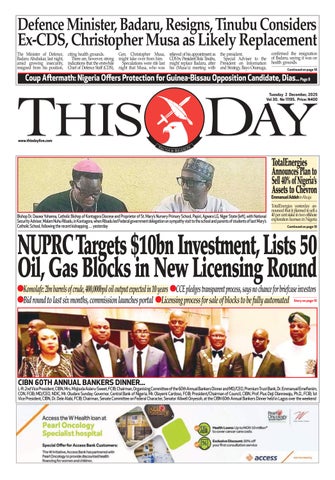
NUPRC Targets $10bn Investment, Lists 50 Oil, Gas Blocks in New Licensing Round

CIBN 60TH ANNUAL BANKERS DINNER...
L-R: 2nd Vice President, CIBN, Mrs. Mojisola Asieru-Sweet, FCIB; Chairman, Organising Committee of the 60th Annual Bankers Dinner and MD/CEO, Premium Trust Bank, Dr. Emmanuel Emefienim, CON, FCIB; MD/CEO, NDIC, Mr. Oludare Sunday; Governor, Central Bank of Nigeria, Mr. Olayemi Cardoso, FCIB; President/Chairman of Council, CIBN, Prof. Pius Deji Olanrewaju, Ph.D., FCIB; 1st Vice President, CIBN, Dr. Dele Alabi, FCIB; Chairman, Senate Committee on Federal Character, Senator Allwell Onyesoh, at the CIBN 60th Annual Bankers Dinner held in Lagos over the weekend


PRESENTATION OF BEST SME FOCUSED BANK AWARD TO FCMB BY THE CIBN...
L-R: CEO, Cowry Asset Management Limited, Mr. John Chukwu; President/Chairman of Council, Chartered Institute of Bankers of Nigeria (CIBN), Prof. Pius Olanrewaju; Executive Director, Wholesale Banking, First City Monument Bank (FCMB), Mr. Obaro Odeghe; and Executive Director, Corporate Services and Service Management, FCMB, Mrs. Felicia Obozuwa, during the presentation of Best SME Focused Bank Award to FCMB by the CIBN at its Annual Dinner in Lagos… recently
FG Flags Off Renewed Hope Campus Transport
Scheme across 12 Federal Universities
Launches 240 electric tricycles in first phase Education Minister inspects Lagos T-VET Centre UNILAG targets 120MT CO2 reduction with 20 new fleet
Sunday Ehigiator
The Federal Government (FG) yesterday, launched the Renewed ‘Hope Campus Transport Scheme,’ with a first batch of 240 electric tricycles in 12 federal universities across the six geopolitical zones.
The Minister of Education, Dr. Tunji Alausa, described the initiative as a major step in making student mobility safer, cheaper and fully powered by clean energy.
At the flagship event, held at the University of Lagos (UNILAG), the minister stressed that the initiative was driven directly by President Bola Ahmed Tinubu’s commitment to students’ welfare.
According to him, “The president holds the youth of this country in the highest esteem. You have a
president today in the person of President Bola Tinubu, who believes so much in what education does to any society, and that’s why this president has funded education in this country as no other president has ever done in the history of our country.”
He stated that a total of 240 solar-powered electric tricycles had been deployed across the federation, with 20 units each distributed to 12 federal universities, along with a solar-powered charging station at each school.
“The benefiting universities in this first phase were selected across the six geopolitical zones: in SouthWest: University of Lagos (UNILAG) and University of Ibadan (UI); South-East: University of Nigeria Nsukka (UNN) and Federal University of Technology Owerri (FUTO);
South-South: University of Benin (UNIBEN) and University of Uyo (UNIUYO); North-Central: University of Abuja (UNIABUJA) and Federal University of Technology Minna (FUTMINNA); North-East: University of Maiduguri (UNIMAID) and Modibbo Adama University (MAUTECH) and in NorthWest, we have the Ahmadu Bello University (ABU) Zaria and Bayero University Kano (BUK).”
Alausa emphasised that
ownership rests entirely with the student unions. “Let me emphasise clearly that these tricycles are being donated by the Federal Government directly to the student union of each of the beneficiary institutions. These tricycles are for the students,” he said. He also announced additional interventions, including the rollout of conversion kits under the Presidential CNG Initiative and a forthcoming 11MW solar mini-grid for UNILAG.
GDP Slows to 3.98% in Q3 as Non-oil Sector Accounts for 96.56%,
James
Nigeria’s Gross Domestic Product (GDP) grew by 3.98 per cent in real terms in the third quarter of the year (Q3 2025), compared to 4.23 per cent in the preceding quarter, National Bureau of Statistics (NBS) said yesterday.
Shettima Endorses Schoolnet Smart Class Initiative for Nigerian Schools
Tasks India tech firm to work with FG officials on workability of learning package
Vice President Kashim Shettima has welcomed the offer by Schoolnet India Ltd & Learnet Skills Ltd to partner with the Nigerian government and private sector entities to implement its KYAN smart class solutions in Nigerian schools. According to him, the project, which aims to digitally transform education by introducing interactive smart boards and digital content to improve
learning outcomes, will be very beneficial to primary and secondary schools in Nigeria if domesticated with local content.
The Vice President, who spoke yesterday, when he received a team from Schoolnet India Ltd & Learnet Skills Ltd led by its Managing Director/CEO, Mr. RCM Reddy, described the KYAN smart class solutions as a rugged package with the capacity to deliver.
He asked the Schoolnet Ltd
team to liaise with relevant officials of the federal government of Nigeria to deliberate on how to domesticate the learning package by integrating local content for Nigerian schools. Shettima cited the smart school initiatives in Edo and Enugu, two States he said have invested heavily in smart schools, saying integrating such indigenous ideas and KYAN smart class solutions into a single unit will significantly benefit Nigerian schools.
Year-in-year, however, the growth was higher than 3.86 per cent recorded in Q3 2024.
According to the GDP Q3 Report released by the statistical agency, aggregate GDP at basic price stood at N113 58 trillion, representing a nominal growth of 18.12 per cent, compared to N96.16 trillion in Q3 2024. Real GDP stood at N57.03 trillion.
The Q3 performance came
on the heels of the rebasing of GDP using 2019 as the base year, as previous quarterly estimates were benchmarked to the rebased annual estimates to align the old series with the new rebased estimates.
The procedure provided a new quarterly GDP series, which was compared to the 2025 third quarter estimates, NBS stated.
However, the overall GDP
Oil 3.44%
growth was aided by the 96.56 per cent non-oil sector contribution, compared to 95.95 per cent in Q2 and 96.62 per cent in Q3 2024. The non-oil sector grew by 3.91 per cent in real terms during the reference quarter. The oil economy accounted for 3.44 per cent, compared to 4.05 per cent in the preceding quarter and 3.38 per cent in Q3 2024.
House Calls for Forensic Probe of NMDPRA Over Alleged Misuse of Gas Infrastructure Fund
Juliet Akoje in Abuja
The Public Accounts Committee (PAC) of the House of Representatives has expressed concern over the alleged diversion and poor management of the Midstream and Downstream Gas Infrastructure Fund by the Nigerian Midstream and Downstream Petroleum Regulatory Authority (NMDPRA). Consequently, the Committee
has demanded an extensive forensic review of the fund’s activities from 2021 up to date.
The Chairman of the Committee, Hon. Bamidele Salam, made this decision following the adoption of a motion titled: “Motion on the Urgent Need to Investigate Misapplication and Mismanagement of Midstream and Downstream Gas Infrastructure Fund by the NMDPRA from Year 2021 to Date in Contravention of the
Petroleum Industry Act (PIA) 2021,” introduced by Hon. Cyriacus Umeha and seconded by Hon. Kafilat Ogbara.
The Committee recalled that Section 52(1) of the Petroleum Industry Act (PIA) 2021 created the Midstream and Downstream Gas Infrastructure Development Fund and clearly requires that spending from the fund must be authorised through National Assembly appropriations.

COMMEMORATION OF WORLD AIDS DAy...
First Lady of Nigeria, Senator Oluremi Tinubu (middle), flanked on the left by the wife of the Vice President of Nigeria, Hajia Nana Shettima, and on the right by the DG, NACA, Dr.
Ilori, and others, at the commemoration of the 2025 World AIDS Day held at the State House, Abuja, yesterday
New Tax Law Will Cripple Airlines If Implemented, Onyema Insists
Operators to meet members of National Assembly to discuss effect Keyamo urges aviation veterans to continue to lend voices to sector’s growth
Kasim Sumaina in Abuja Chairman/Chief Executive Officer of Air Peace, Allen Onyema, yesterday, said the proposed tax law, expected to take effect from January 1, 2026, would hurt airlines in the country if implemented.
Onyema stated the new tax regime, if allowed to stand, would crumble the industry,
which had over the years been struggling.
He spoke on behalf of Airline Operators of Nigeria (AON) at the 100 years’ celebration of Aviation in Nigeria, in Abuja.
Onyema stated, “This is our prayer. We are going to meet members of the National Assembly very soon, together with our minister, to discuss the issues of taxation that are
supposed to come into effect on January 1, 2026, as it affects the airlines, because if it is allowed to stand, all of us will crumble. But I know Mr. President will listen to our cries and do the needful.”
He added, “First of all, I want to pay my respect to the zonal and national leaders. Nigeria has never, ever enjoyed the kind of support we are having
today in the aviation industry.
“I want you to think back to the years before now and compare what we are getting today as airlines.
“We are the ones who truly bear the burden as airlines. We are the ones to tell the story—whether it is good or bad—and no other person can tell it better than the airlines.
“And here, I represent not
First Lady to Nigerians: Support Tinubu’s Drive to Make Nation HIV-free by 2030
Deji Elumoye in Abuja
Wife of the president, Senator Oluremi Tinubu, on Monday made a passionate appeal to Nigerians to support the President Bola Tinubu govern- ment’s renewed commitment to ending HIV/AIDS in the country by According2030. to Mrs. Tinubu, national unity and collective responsibility are essential for achieving the set target.
Speaking at the 2025 World AIDS Day commemoration event held at State House Banquet Hall, Abuja, she declared, “As we move forward,
I call on all Nigerians to support the Renewed Hope Agenda of His Excellency, President Bola Tinubu, in his commitment to achieving an HIV-free Nigeria byThe2030.”first lady said Nigeria must continue to show empathy and resilience as it worked towards “ending HIV/AIDS byShe2030”.stated that the day offered “an opportunity for reflection, gratitude, and renewed com- mitment,” stressing that Nigeria must not lose momentum after years of notable progress in prevention, treatment, and care. Despite gains recorded
in partnership with global donors, the first lady warned that stigma and discrimination remain strong barriers, urging Nigerians to “confront the judgment and exclusion that still surrounds HIV/AIDS,” and ensure every affected person is treated with dignity.
Mrs. Tinubu highlighted recent strides under the national HIV response, including prioritising the elimination of vertical transmission, expand- ing paediatric treatment, and strengthening long-term sustainability.
She stated that with robust support from the Global Fund,
Abbas: Nigeria’s Economy Suffering from Too Much Optimism, Too Little Data
Adedayo Akinwale in Abuja
The Speaker of the House of Representatives, Hon. Abbas Tajudeen, has said that for decades, Nigeria’s national economic discourse has suffered from an overdose of optimism and an underdose of measurement.
The Speaker disclosed this yesterday, in Abuja, during
the Enterprise Nexus Summit themed: “Strengthening Local Enterprise Through Policy Support and Access.”
He said when they conceived the summit, the intention was not to add another event to the already crowded calendar of economic conferences, but to create a working platform where policy, ambition and opportunity meet in one room
— and produce outcomes that can be measured in livelihoods, not communiqués. Abbas noted: “Nigeria’s entrepreneurs have never lacked ideas. They have never lacked courage. What they have lacked, too often, is a system designed to match their energy.
“A system where access, information, capital and public policy move in the same direction.
the National AIDS and STDs Control Programme (NASCP) had made “significant progress,” especially in protecting mothers and children.
She also highlighted the Free to Shine Campaign, launched nationwide this year through the Organisation of African First Ladies for Development (OAFLAD), which promotes the triple elimination of HIV, hepatitis, and syphilis by 2030.
just a piece of us, I represent the entire AON as one of their leaders. And when we speak, we speak without fear. We are not afraid to criticise when“Wenecessary. are not afraid to stand up against anything when necessary. And when it is necessary for us to applaud and commend, we do so with equal vigour.”
Onyema celebrated President Bola Tinubu for his commitment to the growth of the aviation industry, saying, “This president has helped the aviation industry, first and foremost, with the kind of appointment he made.
“I remember when I met him in the Villa, I told him—several times, clearly enough for him to hear and understand—that someday, Mr. President, you will thank God Almighty for allowing you to appoint Mr. Keyamo to this position.”
Onyema stated that before now, the industry was almost dead.
According to him, “Nigerian airlines were suffering under
a demonised status. We were all demonised as not being ef- fective. We were all demonised as lacking capacity. We were all demonised as if nothing good could come out of us. Nobody had faith in us
“The country was made to see us as a very hopeless sector—never mind the fact that the owners of these airlines, as private-sector operators, are very selfless in what they do for the entire nation; and that these were the same people moving the country forward, strategically powering the economy and the movement of the people.”
He stressed that there was still more to be done, saying, “We are very hopeful that with the kind of square peg in a square hole that we have, success is beckoning at the end.”
Minister of Aviation and Aerospace Development, Festus Keyamo, in his remarks at the event, urged veterans, who had over the years shaped the industry, to continue to lend their voices for its growth.
Over 100 children have benefited from a partnership between Niger Delta Development Commission (NDDC) and Sickle Cell Awareness Initiative Ireland-Nigeria (SCAIIN) to bring succour to sufferers of sickle cell anaemia in Bayelsa State.
The Sickle Cell Health Prevention and Sensitisation Programme, with the theme, “Bridging the Gap in Sickle Cell Disease Management and Care,” took place at the
weekend at Federal Medical Centre, Yenagoa.
Participants benefited from medical consultation, medical investigation, counselling and dispensing of drugs, while they were encouraged to provide their contact details for further support.
The programme, which was part of a Niger Delta-wide campaign, was to ensure that the voices of sufferers of sickle cell anaemia, that had been silent in the past, were heard in order to draw government attention to their plight.
Founder of SCAIIN, Mrs Esther Onolomemen, who spoke on “Sickle Cell and the Awareness”, expressed joy that at last, the voices of sufferers were being heard. Onolomemen thanked NDDC for the partnership to bring succour to sufferers, saying the children deserve to get the best care possible. She expressed the belief that the awareness would get to the government so that they would do something to ameliorate the pain the children were passing through.


TELECOMS EXCELLENCE AWARD NIGHT 2025...
CPPE: Higher Non-alcoholic Beverage Customs Duties Will Harm Economy, Society
Dike Onwuamaeze
Centre for the Promotion of Private Enterprise (CPPE) has expressed concern over the recent proposal by Senate Committee on Finance to amend the Customs and Excise Act for the purpose of increasing excise duty on non-alcoholic beverages.
CPPE stated that the “proposal to further increase excise duty on non-alcoholic beverages is economically disruptive, socially harmful, procedurally flawed, and inconsistent with Nigeria’s broader development and industrial policy objectives”.
It added that the proposal was coming at a time when manu- facturers, SMEs, distributors, and retailers across Nigeria were grappling with unprecedented macroeconomic pressures.
CPPE said after a thorough review and consultation with industry stakeholders, economic experts and public policy analysts, it decided to take the position that “the proposed increase in excise duty on nonalcoholic beverages should be
discontinued”, and the “current economic realities render the proposal counterproductive and potentially harmful to national economic recovery and the welfare of the people”.
CPPE also stated that excise policy rate-setting should remain an administrative function, and should not be legislated into the Customs and Excise Act since fiscal tools must remain flexible and responsive to prevailing macroeconomic conditions.
Speaking on the proposed amendment, Chief Executive Officer of CPPE, Dr. Muda Yusuf, said, “Nigeria is currently navigating a fragile economic recovery pathway.
“The manufacturing sector, a vital engine of employment and growth, needs policies that support stability, competitiveness, and resilience.
“The proposed increase in excise duty on non-alcoholic beverages threatens to undermine these objectives, jeopardising livelihoods, welfare, investment, and long-term industrial development.”
Yusuf added, “In the interest of economic stability, job protection, and sound public health strategy, we strongly urge the withdrawal of the proposed amendment.”
He recommended “a collaborative, evidence-based, and economically sensitive approach remains the best path forward for both public health and Nigeria’s manufacturing competitiveness”.
Yusuf pointed out that
over the past three years, the non-alcoholic beverage industry had absorbed significant shocks, including multiple tax adjustments and a steep rise in operating costs.
He also stated that “prices of non-alcoholic beverages have already risen by 200–300 per cent, driven by inflationary pressures and prior excise policy changes”.
According to him, many
operators are struggling to stayYusufafloat.said, “SMEs, who form the backbone of the beverage value chain, face thinning margins, declining sales, and limited access to affordable financing.
“Introducing a new round of excise increases under these conditions will further weaken their operating capacity, reduce
output, erode purchasing power and lead to avoidable job losses.”
He said, “The Nigerian economy cannot afford another wave of factory closures or layoffs at this delicate moment of recovery.”
Yusuf said the proposed excise duty increase carried significant economic and social risks that extended beyond the beverage industry.
OrderPaper, FRC, House C’ttee Brainstorm on
Transparency in Upstream Oil Sector
Stakeholders in the oil and gas sector yesterday discussed ways to ensure that there’s more openness in the sector, especially in the operation of the Host Communities Development Trust Fund (HCDTF).
The event organised by OrderPaper Nigeria and Fiscal Responsibility Commission (FRC), in collaboration with
the House Committee on Petroleum (Upstream), was themed: “Legislative and Stakeholder Synergy for a Transparent and Accountable Upstream Petroleum Sector.”
The session was meant to examine how the legislature could strengthen transparency, improve accountability, and ensure a fair distribution of oil revenues as well as review gaps in existing laws and share practical ideas for improving
Cape Town Conversation 2025: Fayemi Canvasses
Stronger African Sovereignty, Next-Gen Leadership
Gbenga Sodeinde
Former governor of Ekiti State, Dr. Kayode Fayemi, has called for renewed commitment to African sovereignty, stronger state institutions, and deliberate investment in next-generation leadership to reposition the continent in a shifting global landscape.
Fayemi made the remarks
at the Cape Town Conversa- tion 2025, where he featured on a high-level panel titled “NextGen Africa: Africa’s Strategic Imperative.” The annual forum, convened by the Observer Research Foundation in partnership with the Thabo Mbeki Foundation, brought together leading policymakers, scholars, and development experts to examine Africa’s
evolving geopolitical and economic outlook.
This year’s edition followed shortly after South Africa hosted the first-ever G20 Summit on African soil - a development Fayemi said added “a deeper sense of relevance and urgency” to the conversations on Africa’s global role.
Addressing the continent’s development trajectory, the
former governor said Africa must leverage its demographic advantage, deepen institutional capacity, and build more re- silient economies capable of withstanding global disruptions.
He noted that geopolitical tensions, climate shocks, and changing governance structures present both opportunities and serious risks.
the governance of Nigeria’s upstreamSpeakingindustry. at the event, the Executive Chairman of the FRC, Victor Muruako, explained that a defining pillar of the mandate of the commission is to ensure unwavering transparency and strict accountability in the management of government resources across all levels and tiers.
He expressed the FRC’s commitment to promoting fiscal discipline and responsible resource management, describ- ing the oil and gas sector as the most critical sector of the Nigerian national economy.
“As Nigeria navigates the intricate and dynamic complexities of its oil and gas sector, meaningful and effec- tive stakeholder engagement remains the critical engine for achieving efficiency, transpar- ency, and accountability in upstream resource governance.
“With global energy transi- tions underway and regula- tory frameworks continually
evolving, it is absolutely crucial to enhance governance mechanisms that not only foster responsible resource management and equitable revenue distribution but also ensure sustainable industry practices.
“The petroleum sector is, without doubt, the backbone of our national economy, contributing the majority of government revenue and foreign exchange earnings. However, it has historically been an area susceptible to opacity, poor reporting, and management challenges. This workshop provides a strategic opportunity to reflect on progress and rigorously identify areas for fundamental improvement,” he said, However, he highlighted the significant growth momentum in Nigeria’s petroleum sector, spurred by the recent bold reforms championed by the administration of Bola Tinubu, describing the Petroleum Industry Act (PIA) of 2021 as a proven game-changer.

Coup Aftermath: Nigeria Offers Protection for Guinea-Bissau Opposition Candidate, Dias
ECOWAS delegation visits embattled country for talks
Emmanuel Addeh in Abuja
Nigeria has offered GuineaBissau’s opposition presidential candidate, Fernando Dias, protection at its embassy in the capital Bissau following a military coup, the Nigerian foreign ministry said yesterday.
The offer came as leaders from the Economic Community of West African States (ECOWAS) regional bloc, led by Sierra Leone President, Julius Maada Bio, tried to persuade the military officers who seized power in Guinea-Bissau last week to stand down.
At a meeting on Monday during which tempers flared and voices were raised according to a Reuters witness,
nuprc TA rge TS
Emmanuel Addeh in Abuja
Nigerian Upstream Petroleum Regulatory Commission (NUPRC) yesterday kicked off the 2025 oil and gas licensing round, announcing that it is targeting $10 billion in investment tied to the current bidThecycle.upstream regulator also launched an online portal for would-be bidders, stressing that during the licensing round, expected to last six months from December 1, 50 oil and gas blocks across onshore, swamp/shallow water and offshore terrains spanning diverse basins will be up for sale.
ECOWAS officials urged the soldiers to allow a proclamation of the results of the country’s disputed presidential election.
“ECOWAS ... demands the restoration of constitutional order, as well as the continuation and logical conclusion of the electoral process,” Timothy Musa Kabba, Sierra Leone’s foreign minister, said after the meeting with the military leaders.
“As for Guinea-Bissau’s future, a decision will be taken during the (ECOWAS) conference of heads of state and government scheduled for December 14,” he said. ECOWAS has warned it could impose sanctions on Guinea-Bissau.
The interim president
installed by military officers, Major-General Horta Inta-a, said the coup was necessary to ward off a plot by “narcotraffickers” to “capture Guinean democracy” and vowed to oversee a transition that would last one year, beginning immediately.
Dias, a 47-year-old relative political newcomer, has said he was on track to win the November 23 presidential election before the military coup in the small West African nation last week.
The opposition coalition backing Dias has denounced the coup as a desperate attempt by President Umaro Sissoco Embalo and his supporters to block the proclamation of election results that would have
confirmed Embalo’s defeat.
In a statement dated November 30, Nigeria’s foreign ministry said that President Bola Tinubu had approved a request for protection of Dias in response to imminent threats to his life. It also asked the ECOWAS stabilisation force to deploy its troops in the country to keep Dias safe.
Guinea-Bissau’s military rulers have banned protests and strikes as they tightened control on power, a Reuters report said.
The military government, which seized power in what some West African leaders have termed a “sham” coup, announced late on Sunday that all demonstrations, strikes and activities regarded as threats
to peace and stability were prohibited.
The announcement followed protests in Bissau on Saturday where hundreds, primarily youths, demanded the release of detained opposition leaders and the publication of presidential election results.
The coup reflects a continued pattern of instability in Guinea-Bissau, a major cocaine transport hub with a long history of military interventions in politics.
Meanwhile, a delegation from ECOWAS has visited Guinea-Bissau for mediation talks with leaders of last week’s coup, as regional pressure mounts on the military leaders who seized power after a disputed election.

The mission, led by ECOWAS chairman and Sierra Leone’s President, Bio, came to Guinea-Bissau on Monday to urge the military authorities for a “complete restoration of constitutional order.”
Addressing journalists in Abuja, Chief Executive Officer of NUPRC, Gbenga Komolafe, stated that besides the $10 billion investment target, two billion barrels of oil and an estimated 400,000 barrels per day of production volumes were expected when the blocks become fully operational.
“Nigeria’s Defence Minister, Alhaji Mohammed Badaru Abubakar, has resigned his appointment, with immedi- ate effect. In a letter dated December 1, sent to President Bola Tinubu, Abubakar said he was quitting on health grounds.“President Tinubu has accepted the resignation and thanked Abubakar for his services to the nation.
President Tinubu will likely inform the Senate of Badaru’s successor later this week,” Onanuga said in the statement.
Badaru Abubakar, 63, was a two-term governor of Jigawa State from 2015 to 2023. He was appointed minister on August 21, 2023, by Tinubu, the statement added.
Onanuga stated that Badaru’s resignation came amid Tinubu’s declaration of a national security emergency, with plans to elaborate on its scope in due course.
Musa was appointed as the 18th Chief of Defence Staff of Nigeria on June 23, 2023. During his tenure, he was widely credited with
Komolafe said the announcement was in line with Section 73 of the Petroleum Industry Act (PIA) 2021, which prescribes a fair, transparent and competitive bidding process.Following the approval of President Bola Tinubu, Komolafe stated that of the 50 assets up for bid, 15 were onshore assets; 19 were from shallow water; frontier assets were 15; while the deep water asset was one.
He said the key objectives of the Nigeria 2025 licensing round included to grow oil and gas reserves through aggressive exploration and development efforts; increase Nigeria’s production capacity and government revenue; as well as create thousands of direct and indirect jobs, from technical oil-field roles to supporting services, especially in regions where blocks were located.
“The Nigeria 2025 licensing round is, therefore, expected to attract about $10 billion in investments and add up to two billion barrels of oil output over the next 10 years with an estimated 400,000 barrels/ day of production volumes when the blocks are fully
operational,” he stated.
According to him, the exercise will lead to expansion opportunities for gas utilisation and development in Nigeria, in view of energy transition, as well as reinforce Nigeria’s commitment to openness and transparency in line with the principles of the Extractive Industry Transparency Initiative (EITI).
Komolafe said the licensing round will enhance indigenous participation to drive skills development, knowledge reten- tion, and effective technology transfer within the sector, and contribute to long-term global energy sufficiency.
He said the commission, as a business enabler, and in line with the president’s approval, had also reduced the applicable signature bonuses in order to attract investments.
of kilometres of 2D and 3D seismic data, producing sharper, higher-resolution images of Nigeria’s petroleum systems and reducing the uncertainties that once hindered exploration decisions.
Komolafe stated, “For investors, this means entering a market where uncertainty is shrinking and where opportu- nity is backed by the richest, highest-quality subsurface data available anywhere in Africa. This wealth of high- quality geo-physical datasets means lower exploration risk, improved probability of discovery, faster appraisal timelines, reduced entry costs and accelerated journey from licensing to first oil or gas.”
involves the submission and evaluation of applications by interested parties or consortia in accordance with the regulation and the guidelines. Applicants shall provide all information required for this stage.
“Only applicants who are adjudged qualified and subsequently shortlisted by the commission shall proceed to the bid stage and will be required to execute a confidentiality agreement prior to participation.
On October 24, 2025, the president announced a major reshuffle of the country’s military leadership.
Under this shake-up, Musa was removed from his posi- tion as the CDS and was replaced by Gen. Olufemi Oluyede.
leading major restructuring and modernisation efforts in theAsmilitary. theatre commander before becoming CDS, he led operations against insurgents in the North-east under Operation Hadin Kai. He also emphasised civilmilitary cooperation, believing in integrating humanitarian and development initiatives with security operations.
to Chevron in a move aimed at strengthening collaboration between the French and U.S. energy giants.
TotalEnergies said it will remain the operator of the site with 40 per cent participation, alongside Chevron, also with 40 per cent, and South Atlantic Petroleum at 20 per cent.
Nigeria accounts for more than a third of TotalEnergies’ African oil and gas production and 8.5 per cent of its global hydrocarbons, though its output in the country has declined by a quarter over the past two decades.
It is now streamlining its African portfolio, focusing on assets it operates while seeking
new sources of supply.
In June, Chevron sold Total a 25 per cent interest in a portfolio of 40 U.S. federal offshore leases for an undisclosed amount, as part of an exploration partner- ship between the majors.
“ Further to an ongoing discussion of global explora- tion opportunities between TotalEnergies and Chevron, TotalEnergies EP Nigeria has signed a farmout agree- ment to sell to Star Deep Water Petroleum Limited, a Chevron company, a 40 per cent participation in the PPL 2000 and PPL 2001 exploration licenses, offshore Nigeria.
“Located in the prolific West Delta basin, the PPL
In today’s volatile global energy landscape, the NUPRC chief executive stated that certainty and predictability had become the true currencies of investment, explaining that NUPRC has, therefore, moved to de-risk exploration.
To that end, he stated that through extensive multi-client surveys, the commission had reprocessed thousands
2000 & 2001 licenses cover an area of approximately 2,000 square kilometers and were awarded to a consortium of TotalEnergies and South Atlantic Petroleum following the 2024 Exploration Round organised by the Nigerian Upstream Petroleum Regulatory Commission (NUPRC).
“TotalEnergies will remain operator with a 40 per cent participation alongside Chevron (40 per cent) and South Atlantic Petroleum (20 per cent),” the oil giant stated in the statement. This new joint venture, it said, reinforces TotalEnergies’ global offshore exploration collabora- tion with Chevron, following the June acquisition of a 25
He acknowledged that transparency was key to investor confidence, stressing that to ensure that the bidding process is credible and seamless, the commission has rolled out guidelines, which are now available on its website.
Besides, he revealed that NUPRC had adopted a two-stage bidding process for the award of the blocks, comprising a qualification stage and a bid stage.
The NUPRC chief executive stated, “The qualification stage
per cent working interest in a portfolio of exploration leases
Offshore U.S. comprising 40 Chevron-operated blocks.
“After launching our joint venture in US offshore exploration in June, we’re delighted to now expand our collaboration to Nigeria to unlock new resources in the West Delta basin,” said Nicola Mavilla, Senior Vice-President Exploration at TotalEnergies.
“This new joint venture aims at derisking and developing new opportunities in Nigeria, in line with the objectives of the country,” Mavilla noted.
Completion of the farmout transaction with Chevron, the statement said, is subject to
“At the bid stage, shortlisted applicants or bidders shall submit their technical and commercial bids in accordance with the regulation, the guidelines, and any other bidding documents issued by the “Givencommission. our commitment to transparency and alignment with best practices, the bid process will be automated and digital. Winners will emerge at the commercial bid process.”
Commenting on the last licensing initiatives, including the 2022 mini-bid round, and the “historic” 2024 licensing round, Komolafe emphasised that they were conducted with unprecedented levels of transparency, unmatched global competitiveness, and
Continued on page 28
customary conditions, including regulatoryTotalEnergiesapprovals. has been pres- ent in Nigeria for more than 60 years and employs more than 1,800 people across different business segments. Nigeria is one of the main contributing countries to TotalEnergies’ hydrocarbon production with 209,000 boe/d produced in 2024. TotalEnergies also operates an extensive distribution network which includes about 540 service stations in the country. In all its operations, TotalEnergies said it is particularly attentive to the socio-economic development of the country and is com- mitted to working with local communities.


LEADERS IN FOCUS: STEERING THROUGH TURBULENCE...
NSITF Backs Senate Social Security Reforms, Seeks
Clearer Governance Structure in New Bill
As NLC, NECA, CSOs raise concerns, demand further consultation
Sunday Aborisade in Abuja Nigeria Social Insurance Trust Fund (NSITF) has thrown its weight behind the proposed Nigeria Social Security Trust Fund Bill, 2025, describing it as one of the most ambitious and transformative overhauls of Nigeria’s social protection system in decades.
However, the agency, alongside organised labour and employer groups, warned lawmakers that without clearer governance structures, stricter compliance mechanisms, and stronger accountability safeguards, the reform could inherit the systemic weaknesses that had long undermined the country’s social security regime.
NSITF’s position was presented on Monday by its Managing Director, Mr. Oluwa- seun Faleye, in a comprehensive memorandum submitted to Senate Committee on Labour and Employment during a public hearing on the bill at the National Assembly.
Faleye commended the sen- ate for taking a “strategic and
forward-looking legislative step”. He stated that the bill aligned Nigeria’s social security framework with internationally recognised standards, espe- cially the ILO Social Security Convention (No. 102 of 1952) and the Tripartite Consultation Convention (No. 144 of 1976).
According to him, the proposal to repeal both NSITF
Alleged Defamation: Court Grants FG’s Request to Shift Akpoti-Uduaghan’s Trial to February 23
Justice Chizoba Oji of the High Court of the Federal Capital Territory (FCT), Maitama, Abuja, on Monday, adjourned trial of Senator Natasha Akpoti- Uduaghan till February 23, 2026.
The judge adjourned the alleged criminal trial, following a request by the prosecution.
Senator representingAkpoti-Uduaghan the people of Kogi Central Senatorial District at the National Assembly, is being prosecuted by the of-
fice of the Attorney General of the Federation (AGF), on charges bordering on criminal defamation against the Senate President, Senator Godswill Akpabio and former Governor of Kogi State, Yahaya Bello. When the matter came up on Monday, the defendant’s lawyer, Ehiogie West-Idahosa (SAN), who announced his appearance, drew the court’s attention to the absence of the prosecution.Responding, Justice Oji informed the defendant’s counsel that the court received
a letter from the prosecution, requesting an adjournment to a date next year.
She subsequently presented the letter to West-Idahosa who said he was not served with the letter, adding the letter was registered and filed on Monday morning.
While pointing out that the prosecution’s request for adjournment was not brought to the notice of the defence 48 hours before the court’s sitting, as required by law, West-Idahosa urged the court to proceed with the business of the
Barau: Fully Developed, Keffi Polo Can Become National Unifying Force
Sunday Aborisade in Abuja
The Deputy President of the Senate, Jibrin Barau, has declared the Keffi Polo Tournament a powerful instrument of national unity, saying Nigeria stands to gain immensely if the sporting event is fully developed and supported as a national asset.
Speaking at the closing ceremony of the 10th Anniversary edition of the Keffi Polo Tournament in Keffi, Nasarawa
State, yesterday, Barau said the tournament had grown beyond a sporting contest to become a meeting point for Nigerians across ethnic, political and social divides.
He said, “When you look around, you’ll find people from all parts of this country, Hausa, Yoruba, Igbo and others.
“The game is bringing us together. Polo here in Keffi has become a unifying factor that strengthens our bond as a
nation. If effectively developed, it will serve as a national unifying force and further develop our sporting potential.”
Barau, who has attended the last four editions of the tournament, commended the founder of the Keffi Polo Ranch and organiser of the tournament, Senator Ahmed Wadada, for consistently sustaining the initiative and introducing strong organisational improvements over the years.
day, because the defendant was in court and the application for adjournment was incompetent.
The defendant’s lawyer reminded the court that the business for the day was the hearing of the defendant’s preliminaryResponding,objection.Justice Oji who agreed the application for adjournment did not meet the required threshold, however said she was mindful to grant it in the interest of justice.
Act of 1993 and Employees’ Compensation Act (ECA) 2010 is long overdue. The Pension Reform Act (PRA) 2014 had already stripped NSITF of its role in managing contributory pensions, creating years of policy overlap, role confusion, and operational ambiguity, he said.
Faleye stated, “The con- solidation of the two Acts into a single statute is timely, necessary, and commendable. It eliminates duplication, resolves conflicts, and strengthens the legal foundation of the Fund.”
He also praised the proposed renaming of the institution to Nigeria Social Security Trust Fund.
He said the removal of the word “insurance” would resolve cultural misunderstandings that previously hindered the full implementation of the Employees’ Compensation Scheme.
Faleye highlighted what he described as “historic and progressive innovations” in the bill.
He identified electronic claims filing, protection for children of deceased workers through trust accounts, recognition of multiple spouses and dependents in line with Nigerian cultural realities, and acceptance of trado-medical practitioners in managing workplace injuries.
He further applauded provi- sions empowering the governing board to periodically update occupational disease schedules, impose penalties on employers, who fail to report accidents, and enforce higher workplace safety standards.
Others were diversifying the fund’s investment portfolio to include real estate.
Another major win, he said, was the bill’s firewall preventing external deductions from the fund’s resources, an issue that had plagued many statutory agencies.Despite his broad endorse- ment of the reforms, Faleye warned that the bill suffered from a major conceptual flaw – the misapplication of the term “Board”.
Kaduna State governor, Senator Uba Sani, on Monday presented a N985.9 billion budget proposal for the 2026 fiscal year to the State House of Assembly.
Addressing the lawmakers at Lugard Hall, Sani said the proposed spending places strong emphasis on security, infrastructure expansion, and the consolidation of human capital development across the state.
He said his administration is determined to strengthen public
confidence through transparency and broad stakeholder engagement.
Capital expenditure accounts for 71 per cent of the proposed budget, while recurrent spending is pegged at 29 per cent.
Education and infrastructure each received 25 per cent of total allocations, a balance Sani described as central to Kaduna’s long-term growth ambitions.
A major feature of the proposal is the allocation of N100 million to every ward in the state for community identified projects.
According to the governor, the move preserves the commitment of the state to participatory budgeting and ensures that development priorities are shaped from the bottom up. Sani told lawmakers that his government has contracted no new loans since assuming office in 2023.
He disclosed that N114.9 billion has been committed to debt servicing within that period, a decision he argued was necessary to preserve fiscal stability.

Acting Group Politics Editor DEJI ELUMOYE
Email: deji.elumoye@thisdaylive.com
08033025611 sms only
On Your Mandate Lyrics: When Politics Strays Into Judicial Space
a political anthem, On Your Mandate We Shall Stand, rang out recently during the opening ceremony of the 2025 a ll Nigeria Judges Conference in a buja, unsettling many who expected a strictly judicial atmosphere. Wale Igbintade considers the appropriateness of the moment and the obligation of political handlers to exercise better judgment in sacred democratic spaces.

There are moments in a nation’s public life that seem small on the surface, yet they speak so loudly that they cannot be ignored. One such moment unfolded at the opening ceremony of the 2025 All Nigeria Judges Conference in Abuja, a gathering meant to symbolise dignity, neutrality and the solemnity of the judicial calling. Instead, as President Bola Tinubu approached the podium, the air filled with a familiar political tune: “On Your Mandate We Shall Stand.” A song that belongs to the heat of campaign rallies suddenly appeared in a hall filled with judges—custodians of impartiality, arbiters of disputes, guardians of our constitutional order.
The song was brief. It was played by the Nigerian Army Guards Brigade band, not the judiciary. Yet, the implication lingered long after the sound faded. It struck many Nigerians, and not a few members of the legal profession, as a moment carried too far. Songs carry meaning. In the wrong context, they carry danger.
For most Nigerians, On Your Mandate We Shall Stand, is no ordinary jingle; it is the rallying cry of a political base. It evokes memories of campaign seasons, fierce electoral battles and the heat of partisan loyalty. So when that tune entered a hall full of judges, it instantly clashed with the environment. Political culture collided with judicial culture, and the latter lost ground. It was this uncomfortable clash that prompted Senior Advocate of Nigeria, Jibrin Okutepa, to raise the alarm. His reaction captured what many felt but could not put into words.
He described what he saw as disgraceful and dangerous. In his words, it was “as if the music was intended to tempt the judges, and of course some fell for it and sang. The playing of that music at that occasion was inappropriate, and it was bad for any judicial officer to sing it.”
His warning was less about the song itself and more about what it represented: the slow, silent erosion of boundaries that should never be crossed.
That the tune came moments after President Tinubu had just warned judges against corruption added another layer of irony. The President had delivered perhaps his strongest message yet on judicial integrity. “Justice must never be for sale, and the Bench must never become a sanctuary for compromise. Corruption in any arm of government weakens the nation, but corruption in the Judiciary destroys it at its core.”
These were powerful words, words Nigerians desperately needed to hear. But even power-
ful words can lose their force when the wrong symbols appear at the wrong time. And for many watching, the playing of a campaign song inside a judicial event was the wrong symbol.
The National Judicial Institute (NJI) responded swiftly. It’s statement was clear, factual, and necessary. Judges did not sing the chorus. The only song they collectively rendered was the national anthem.
The “On Your Mandate” tune was played solely by the Guards Brigade Band, not the judiciary. Judges stood out of respect for the office of the President, not in political allegiance. These clarifications matter. They help set the record straight. But they do not erase the deeper problem, because, public perception often moves faster than official explanations.
The reality is that in a country still healing from suspicious election petitions, controversial court rulings, and long-standing doubts about judicial independence, even the smallest hint of partisanship can grow into a wildfire. And this one did.
In Nigeria, judges live under a microscope, often unfairly so. Every ruling, every facial expression, every handshake, every rumour can become ammunition in public debates. Trust in judicial neutrality is already fragile; it does not need new cracks. By introducing a political tune into a room of judges, even inadvertently, you place them in a position where innocence can look like endorsement.
A camera angle can lie. A moment of confusion can be weaponised. A judge adjusting his robe could be framed as

dancing. Nothing is too small to be misinterpreted in today’s Nigeria. What should have been a routine ceremonial moment has now become a national conversation. That shows just how sensitive, how fragile, the judiciary’s public standing has become.
Part of the reason this incident has drawn so much commentary is that many Nigerians genuinely feel something is shifting in the Judiciary since Justice Kudirat Motonmori Kekere-Ekun became Chief Justice of Nigeria.
She has brought a different temperament to the role: calm, measured, structured, and quietly reformist. Under her leadership, lawyers speak of improving discipline among judicial officers, cleaner administrative processes, renewed seriousness at the National Judicial Council, better coordination across courts, and subtle but visible efforts to rebuild public confidence. Our judiciary is not perfect, far from it. But those paying attention can see signs of change.
It is precisely because of these fragile, valuable gains that moments like the “On Your Mandate” episode feel so disappointing. They distract from progress. They give cynics new talking points. They hand critics a free argument. A judiciary that is trying to rise should not be dragged back by careless optics.
Protocol officers, security units, and government handlers must understand the sacredness of judicial spaces. Some settings demand stricter sensitivity than others. And the judiciary is one of them. It is not enough to say, “We didn’t choose the song.” It is not enough to say, “It was a brief moment.” It is definitely not enough to say, “Nobody meant any harm.” Judicial events are not political events. Neutrality in appearance is just as important as neutrality in fact. Those who manage state ceremonies must internalise this distinction.
n igeria’s judiciary is in a moment of transition. If nurtured properly, it could become stronger, more disciplined, more trusted. If overshadowed by unnecessary controversies, it could lose momentum. This is why a political song played in the wrong place is a problem, not because of its lyrics, but because of its implications.
If a political song can accidentally slip into a judicial conference in 2025, what might slip in next year? What if another political chant is played? What if an image, a flag, a slogan, a gesture enters the frame? Where does the line gets drawn? If we don’t draw it now, we may not be able to draw it later.
This incident is less about blame and more about awareness. It shows how vulnerable our institutions remain to misinterpretation, how every detail matters, how every symbol carries weight, and how the judiciary must constantly defend not just its rulings, but its image.
It also shows the importance of better coordination between the judiciary and the executive during joint events. Both arms of government must understand: the judiciary is not a political ally; it is not a cheering crowd; it must be protected from even the perception of political influence. Mistakes will happen. But lessons must be learned.
Fortunately, what happened at the conference was not a conspiracy. It was more likely an oversight or a moment of thoughtlessness. But even harmless mistakes can carry harmful consequences in the wrong environment. The judiciary deserves insulation. It deserves care. And Nigerians deserve a judiciary that looks, and remains, beyond politics.
Nigeria’s judiciary is in a moment of transition. If nurtured properly, it could become stronger, more disciplined, more trusted. If overshadowed by unnecessary controversies, it could lose momentum. This is why a political song played in the wrong place is a problem, not because of its lyrics, but because of its implications.
The judiciary cannot afford to be painted with the colours of any political party, not even by accident. The 2025 Judges Conference should have been remembered for the President’s challenge to the judiciary, for the Chief Justice’s reforms, and for the gathering of some of the most important minds in Nigeria’s legal system. Instead, it risks being remembered for a careless tune that never should have been played.
Those responsible for ceremonial arrangements must do better. Those who understand the weight of judicial neutrality must speak up. And the judiciary must continue to guard its dignity, fiercely, jealously, consistently.
The song was not a crime. But it was a misstep. A moment carried too far. And if Nigeria is truly committed to building a stronger, more trusted judiciary, then moments like this must never happen again.


LAWYER

‘Fare Thee Well’, Mr “Zero Oil Plan”


Quotables


‘The recent Presidential Directive that we should withdraw Policemen from VIP protection, made us discover that 11,566 Policemen are engaged in VIP protection as at today. Of course, this is not the first time we are giving/ implementing this Directive…...’ - Dr Kayode Egbetokun, Inspector General of Police
‘We, as the Senate, must identify and communicate to the people….that part of the Report that military personnel were withdrawn from that school in Kebbi…. who gave the command and why.’ - Senator Asuquo Ekpeyong, APC Senator representing Cross River South Senatorial District, 10th Nigerian Senate
OLAWALE FAPOHUNDA, SAN

Olawale Fapohunda, SAN is the Immediate Past AttorneyGeneral of Ekiti State. A frequent contributor to Thisday Lawyer since its inception, he has written severally on the limitations of the administration of justice system in Nigeria, and the need for urgent reforms. He has played a leading role in several governmental and non-governmental initiatives, aimed at enebling legal, policy and administrative interventions, for managing the justice system and the institutions, that deliver justice. SERIOUS MATTERS airms to contribute to national discussions on law reform, institutional strengthening, and good governance across the three arms of government.


X Whether Flawed Reason(s) for Judgement Can Invalidate the Court’s Decision Page IV

Insecurity: Wase's Selfishness, Govt's Clay Feet
We are aware that Section 39(1) of the 1999 Constitution of the Federal Republic of Nigeria (as amended) (the Constitution), guarantees the right to freedom of expression, but, still, it is discouraging, and can even be dangerous, when people in positions of authority, responsible for crucial areas of governance, show by their words that they are ignorant or do not understand their roles, or if they do, they do not care less about them, or they lack the will to perform, or are simply not fit for purpose. A combination of absurd public statements, particularly at such a time when Nigeria is passing through serious security difficulties, can only create more apprehension in the polity. Public officials are expected to be circumspect, choosing their words wisely when making public statements.
Hon. Wase’s Self -Centred Submission
To say that I was ashamed, is an understatement, when I heard the selfish, self-centred and selfserving submission of Hon. Idris Wase, that the withdrawal of Police personnel from VIPs could lead to more kidnappings, obviously of VIPs. To tell the truth, this is the second time that I have heard Hon. Wase make a submission on the floor of the House, and both times, they have been unimpressive. In 2021, I believe I referred to his first submission as asinine, when he had blurted out that Nigerians in the Diaspora weren’t in a position to present a petition to the House of Representatives (HOR) about insecurity and the displaced people in Benue State, because they do not reside in Nigeria and could therefore, not know what is happening there! And, he was the Deputy Speaker of the HOR at the time. On my page, I had wondered out loud, whether Hon. Wase wasn’t aware that the world had shrunk into a global village as a result of technology, so that as soon as anything occurs, within minutes, the information is spread all over the world, or that Diasporans had their families in Nigeria that could easily update them?
As far as opposing the withdrawal of Police security for VIPs, even though on application, they can be replaced by Civil Defence, it reveals the mindset of people like Wase, who couldn’t care less about the security and welfare of Nigerians that are attacked daily, and are only concerned about their own personal safety and that of their families. Just imagine! A person who is part of government, and government’s primary responsibility is the security and welfare of the people (see Section 14(2)(b) of the Constitution), is only concerned about the safety of himself and his VIP group! And, we wonder why Nigeria is in such a precarious situation? When such so-called leaders are unconcerned about the Fundamental Objectives and Directive Principles of State Policy (Chapter II of the Constitution), and look at governance only through the lenses of self-preservation, and self-this and that. This is troubling.
It is an established fact that Nigeria lacks adequate manpower in the area of security, both in the Police, whose role it is to ensure internal security, and the Armed Forces, whose role it is to protect Nigeria from external aggression. Yet, Wase prioritises himself and VIPs over the seemingly hapless and helpless people of Nigeria, even though President Tinubu has declared a state of emergency on security, which confirms the urgent need to adopt extraordinary measures to secure Nigerians and ensure public order.
The Minister of Defence’s Perplexing and Defeatist Statement
Recently, the Minister of Defence was said to have made a statement that Terrorists are located in forests that bombs cannot penetrate. I found this statement, rather perplexing and defeatist. Does this mean that the authorities should do nothing about these undesirable elements who have taken over our forests, and turned them into havens of criminality? When people make statements that tend to sound like protecting terrorists, as if violent criminals are just shoplifters who stole a bottle of perfume from the store, and not the cold blooded killers that they are, I wonder about those people making the statements. Many of the heinous crimes of these terrorists, carry the death penalty.
Indeed, a forest like Sambisa is dense and the terrain may be difficult, but, there are different kinds of bombs that are effective in different types of terrain. Since it has been established that the
onikepo braithwaite
onIkepo BrAITHWAITe
onikepo.braithwaite@thisdaylive. com onikepob@yahoo.com
The Advocate

“To say that I was ashamed, is an understatement, when I heard the selfish, self-centred and self-serving submission of Hon. Idris Wase, that the withdrawal of Police personnel from VIPs could lead to more kidnappings, obviously of VIPs…. only concerned about the safety of himself and his VIP group….. the Minister of Defence was said to have made a statement that Terrorists are located in forests that bombs cannot penetrate….Does this mean that the authorities should do nothing…… There are different options for bombing a dense forest, so, when the Minister of Defence openly makes such a pessimistic, somewhat inaccurate statement…..it makes one wonder about Government’s will to fight these terrorists”
locations of some of these terrorists are known, the use of Precision Guided Missiles and Bombs that have GPS and Laser guidance, and can hit stationary and moving targets, can be directed to specific targets within dense forests, causing minimal collateral damage. There are also Fuel Air Explosives, Incendiary Bombs, and Bunker-Buster Bombs, amongst other devices. There are different options for bombing a dense forest, so, when the Minister of Defence openly makes such a pessimistic, somewhat inaccurate statement about key measures that must be taken to fight insecurity in an area that has been identified as possibly the most dangerous terrorist haven in the country, it makes one wonder about Government’s will to fight these terrorists. After all, it is hard to understand the rationale of how so-called “Negotiators” were freely visiting terrorist dens in the forest, yet, Government continued to fail to take any decisive action against the terrorists, knowing their locations. While some may argue that it may be some kind of strategic decision, maybe to save the lives of hostages (a position which President Buhari was reported to have taken), or to be able to gather more intelligence with the goal of wiping out the terrorists in their entirety, others see such inaction as a gross lack of will to do the needful.
Extraordinary Measures
So, what measures should Government

Nigerian laws are certainly not lacking in their provision for the structure of security in the country; it is the implementation/enforcement that is lacking. While Sections 214 & 4 of the Constitution and the Nigeria Police Act 2020 (NPA) respectively, provide for the establishment of the Nigeria Police and its duties, the National Security Agencies Act 1986 (NSA Act) which establishes the DIA, NIA and SSS (see Section 1 (a)-(c) thereof), in Section 2(3)(a)-(c), charges the SSS inter alia, with the prevention and detection of any crime against the internal security of Nigeria. Could the SSS which is already an institution established by law, be remodelled to be an effective MHS? Instead of wasting time and resources doing Police, EFCC and ICPC work, cases that have nothing to do with internal security - arresting judicial officers in the dead of night and chasing the former CBN Governor - the SSS should be made to concentrate on its core mandate and issues relating thereto, to make Nigeria a more secure place. For instance, if there isn’t any presently, the SSS as MHS could add on counter-terrorism units for strike (lethal) action in each geographical zone.
adopt in a state of emergency on security?
1) Homeland Security: Ministry of Interior or a Remodelled SSS?
Last week, I mentioned that Nigeria requires a Ministry of Homeland Security (MHS) to fully concentrate on coordinating internal security. Some people commented that a MHS would further bloat an already over-bloated government, and it could be a duplication of efforts, since there’s already a Ministry of Interior and an SSS. But, whether a stand-alone MHS, or one that is part of Ministry of Interior, or a remodelled SSS as MHS, security measures require more attention in implementation, to make them effective.
For example, there is the Abia State Homeland Security Agency Law 2025 (ASHSAL) establishing an Abia Homeland Security Agency, whose objectives for the State mirror that of the Police and Civil Defence for Nigeria - protection of lives and property and public infrastructure - see Section 4(1) of the ASHSAL, and whose functions for Abia are similar to that of the SSS for Nigeria - see Section 5 of the ASHSAL. The Front Cover of the Vanguard Newspaper of Sunday, November 30, stated that there are terrorist strongholds in 9 States in the North. Nothing stops these State Governments, from adopting the Abia model in their States, instead of relying principally on Federal security structures.

The relationship between the SSS and the Police should be an extremely close one, since their duties are closely related - see Section 4(a) of the NPA. The SSS whose work involves the gathering of secret intelligence to prevent and detect crimes against the internal security of Nigeria, would pass on intelligence and work with the Police - whose duty is to prevent and detect crimes within the country, and Civil Defence - whose mandate includes the protection of critical infrastructure, maintenance of internal security in areas beyond the scope of the Police and Armed Forces, and engagement in Community Policing - see Section 3 of the Nigeria Security and Civil Defence Corps Act 2003. These three institutions should work together, so that their efforts are coordinated into one cohesive strategy by the MHS.
2) Reabsorption of Retired Personnel
As a matter of urgency, the Inspector General of Police (IG), as an extraordinary measure and a faster way to increase personnel, can re-engage retired Police Officers, the ones who are fit and known to have been loyal and excellent in their service. Section 9(6)(a) & (b) of the NPA allows the IG to re-engage retired Police Officers for a period of up to 4 years. This would allow such Officers to be reabsorbed into the Police immediately, without any need for going through a longer period of Police College or training in the case of new recruits, but probably only at most, a brief refresher course, depending on how long ago they retired, so that they can start work immediately. The Armed Forces can also do same, all of them doing due diligence to ensure that moles and criminals are not reabsorbed into these institutions. See Section 25 of the Armed Forces Act 2004.
3)
Counterterrorism Strategy
Government has to improve its counter-terrorism strategy. It is time to maybe revamp the Nigeria Security Strategy and the Revised National Counterterrorism Strategy developed during the Jonathan and Buhari administrations respectively.
Conclusion
It is obvious that there is a need for urgent action on the part of the Federal and State Governments, and security agencies to curb the escalating violence against Nigerians. Last week, I saw two horrific videos of the beheading of two men, in two separate incidents. They were killed like rams. There can be no justification whatsoever, for the killing of innocent Nigerians, because your State Governments have failed you! Yes, State Governments, because a perusal of the Constitution clearly shows that the issues that affect the everyday lives of Nigerians, such as the provision of primary, adult and vocational education and health services, are largely in the hands of the State and Local Governments - see Sections 4 & 7 of the Constitution, the Concurrent Legislative List and Fourth Schedule to Section 7 of the Constitution on the Functions of a Local Government Council.
Having people, both in and out of Government, whose mindset and public utterances almost seem as if they have tacit support or sympathy for terrorists and criminals, particularly those in Government, is not just shocking, it is an open declaration to the world that Nigerians require external assistance to solve their insecurity problem, as those who are tasked with the duty of alleviating the problem appear to lack the necessary will to do so, and prefer to offer defeatist and patronising excuses instead.
Whether Flawed Reason(s) for Judgement Can Invalidate the Court’s Decision
Facts
This appeal arose from a dispute involving a Credit Guarantee Bond issued by the Appellant (an insurance company) in favour of the Respondent (a bank), guaranteeing a N150 million overdraft facility granted to Fort Knox Investment Limited. The Respondent sued the Appellant for the outstanding sum on the bond, after Fort Knox allegedly defaulted. At the trial court, the Appellant posited that its guarantee was limited to eight cocoa purchase contracts that had been fully settled, denying liability for newer contracts and disputing the interest rate claimed. The High Court of Lagos State initially declined jurisdiction on the basis that the dispute did not involve a direct banker-customer relationship under Section 251(1)(d) of the Constitution of Federal Republic of Nigeria, 1999 (as amended) (“the Constitution”). However, the Court of Appeal reversed this finding. The appellate court held that since Fort Knox (the bank’s customer) was joined as a third party, the case concerned a banker-customer dispute and therefore, fell within the jurisdiction of the High Court of a State.
The Appellant appealed this decision, to the Supreme Court. The core issue is whether the High Court has jurisdiction over the claim, given the guarantor’s relationship with the bank and the inclusion of the customer in the suit.
Issue for Determination
The Appellant’ brief raised a sole issue for determinationWhether the lower court was right when it held that the High Court of Lagos State, has jurisdiction to entertain the substantive matter at the trial court.
Arguments
Counsel for the Appellant submitted that under Section 251(1)(d) of the Constitution, the Federal High Court has exclusive jurisdiction over banking matters, except where disputes arise from a banker-customer relationship. He criticised the decision of the Court of Appeal for relying on an alleged joinder of the borrower, in the absence of credible evidence and the fact of which is irrelevant to the claims before the trial court. Counsel contended that there was no banker-customer relationship between the Appellant and Respondent, consistent with the statutory definition in Section 61 of the Banks and Other Financial Institutions Act 1991.
On jurisdiction, Counsel cited MADUKOLU v NKEMDILIM (1962) 2 SCNLR 341, where the Supreme Court stressed that jurisdiction is fundamental and must be determined solely based on the claims before the court, without extraneous matters, as affirmed in TUKUR v GOVERNMENT OF GONGOLA STATE (1989) and OGBIMI v OLOLO (1993) 7 SCNJ (Pt. 2) 447.
Counsel urged the Supreme Court to allow the appeal, set aside the decision of the Court of Appeal, and restore the ruling of the trial court that the High Court of Lagos State lacked jurisdiction, in line with constitutional provisions that grant exclusive jurisdiction to the Federal High Court over banking matters, except where disputes involve a banker-customer relationship.
For the Respondent, Counsel adopted the sole issue for determination formulated by Counsel for the Appellant and cited MADUKOLU v NKEMDILIM (Supra), to

In the Supreme Court of Nigeria Holden at abuja
On Friday, the 11th day of april, 2025
Before their lordships
Helen moronkeji Ogunwumiju Tijjani abubakar
Chidiebere Nwaoma uwa Haruna Simon Tsammani Habeeb adewale Olumuyiwa abiru Justices, Supreme Court SC/110/2007
Between
StaNDarD allIaNCe INSUraNCe Co ltD appellaNt And FIrSt CItY MoNUMeNt BaNK lIMIteD reSpoNDeNt (Lead Judgement delivered by Honourable Habeeb Adewale Olumuyiwa Abiru, JSC)
underscore the essential elements of the jurisdiction of court. He referred to the finding of the lower court that the joinder of the borrower, Fort Knox Investment Ltd. as a party, meant the trial court had jurisdiction, noting that the Appellant did not appeal this point, making it binding on the parties. Counsel highlighted that there were three parties before the trial court - the Respondent as Plaintiff, the Appellant as Defendant, and the Borrower as Third-Party Defendant. Counsel argued that the trial court erred when it held that it lacked jurisdiction, which mistake was corrected by the Court of Appeal. He emphasised that the Respondent’s claim was to enforce a contract of guarantee to recover the loan given to Fort Knox, which is a simple contract outside the exclusive jurisdiction granted to the Federal High Court by
“It is settled law that an appellate court is always preoccupied with the correctness of the decision appealed against, and not whether the reasons given for the decisions are correct. Insofar as the eventual decision is correct, the reasons given by the lower court, however flawed they may be, are of no moment”
Section 251(1)(d) of the Constitution. Counsel referenced NWANKWO v ECUMENICAL DEVELOPMENT CO SOCIETY (2002) 1 NWLR (PT 749) 518 on the definition of a guarantee contract and argued that, even without the joinder of the borrower, the trial court can exercise jurisdiction. He urged the Supreme Court to dismiss the appeal, and affirm the judgement of the Court of Appeal.
Court’s Judgement and Rationale In its decision on the appeal, the Supreme Court began by stating the guiding principle that determines the jurisdiction of a court. Their Lordships held that “it is the case of the Plaintiff as endorsed on the writ of summons and elaborated in the statement of claim or any other originating process, that determines the jurisdictions of the court”. The court cited ELELU-HABEEB v AGF (2012) 13 NWLR (PT 1318) 423. Furthermore, in determining jurisdiction, the court must not read facts into the statement of claim not contained there, and/or take into considerations issues not arising therefrom”. The Supreme Court found that the lower court erred in law by considering the joinder of a third party in deciding the issue of jurisdiction, as neither the Appellant nor the Respondent made claims against the third party (Fort Knox Investment Limited), which was not even joined
to the main suit. . The Court emphasised that a third-party proceeding does not make the third party a party to the main claim. This was supported by the case of UNIVERSITY OF CALABAR v ASSET MANAGEMENT CORPORATION OF NIGERIA (2024) 4-5 SC (PT. 1) 133. Addressing whether the High Court of Lagos State or the Federal High Court had jurisdiction over the suit, the Supreme Court examined the provisions of Section 251(1)(d) of the Constitution. The Court noted that “as a general rule, the Federal High Court possesses exclusive jurisdiction in matters that have to do with banking, banks, and other financial institutions, including any action between one bank and another, any action or against Central Bank of Nigeria arising from banking”. The Supreme Court relied on the decision in FEDERAL MORTGAGE BANK OF NIGERIA v NIGERIA DEPOSIT INSURANCE CORPORATION (1992) 2 NWLR (PT. 591) 333 on this point. However, the general rule is not without qualifications, such as where an action is predicated on banker/customer relationship, which will fall under the concurrent jurisdiction of the both the State High Court and the Federal High Court. Also, “where the cause of action is predicated on the tort of conversion, a non-customer, without an account in a bank, can maintain an action against that Bank in the State High Court, notwithstanding that the facts of the conversion arose out of a banking transaction”. The court noted further that where a matter is predicated on a simple contract, it is the High Court of State that has jurisdiction to entertain it - PETROLEUM (SPECIAL) TRUST FUND v FIDELITY BANK PLC & 3 ORS. (2022) 9 NWLR (PT. 1836) 475. In this appeal, the Supreme Court reiterated that the case at the lower court involved a Credit Guarantee Bond issued by the Appellant to guarantee a credit facility on N150 million advanced to a company known as Fort Knox Investment Limited by the Respondent, and by which the Appellant undertook to fully repay the said sum should the company default in repaying the facility. Relying on PETROLEUM (SPECIAL) TRUST FUND v FIDELITY BANK PLC & 3 ORS (supra), Their Lordships held that “the case of the Respondent in this appeal is predicated on a simple contract, and that it is the High Court of Lagos that possessed the requisite jurisdiction to entertain it”.
Consequent upon the foregoing, the Supreme Court concluded that the Court of Appeal setting aside the ruling of the lower court was correct, albeit for wrong reasons. The Court stressed the settled principle that an appellate court focuses on the correctness of the decision, rather than the correctness of the reasoning given by the lower court. Therefore, even if the reasons of the Court of Appeal were flawed, the correctness of its decision stands, as established in the case of PAN ASIAN CO. LTD v NICON (1982) 9 SC 1, NDAYAKO v DANTORO (2004) 13 NWLR (PT. 889) 189 AT 220. The Supreme Court thereby dismissed the appeal, and remitted the case to the Chief Judge of Lagos State for re-assignment to a Judge for an expeditious determination of the case. Costs awarded against the Appellant in favour of the Respondent.
Appeal Dismissed.
Representation
Adebayo Ologe with Oreoluwa Adelakun for the Appellant.
Olugbenga Ajala for the Respondent. Reported by Optimum Publishers Limited, Publishers of the Nigerian Monthly Law Reports (NMLR)(An affiliate of Babalakin & Co.)
serious matters

The Problem With Recruiting 30,000 New Police Officers
Meeting With the President
Iwas one of the "persons with subject-matter appreciation", that met with President Bola Tinubu in the early days of his administration. This was before he constituted his cabinet. The President's Chief of Staff, Femi Gbajabiamila, thought my perspectives on Justice Sector Reform may be worth Mr President's time.
I recall we met for just under an hour, during which I shared my thoughts on the state of the various institutions that made up the justice sector, and the need for his administration to prioritise their needs. Of course, Police Reform was a talking point. I was quick to mention that the immediate challenge facing his administration, is how to build a professional, accountable and effective Police that upholds the rule of law and protects human rights. I did inform Mr President, that there was nothing about the Police or that needs to be done, that cannot be found in the reports of the many high level Committees and Commissions on Police reform established by successive governments since 1999, including the report of the Constitutional Conference. We just need to put together these reports in a manner that articulates a coherent plan of action on what needs to be done, and within a specified time frame.
It is beyond comprehension that at least, since 1999, State Policy on Police reform appears to be based on plenty talk at the end of which government will adopt adhoc measures, all in an effort to give Nigerians the impression that something is being done. The result of this all talk and do little, is our current reality- a Police Force incapable of meeting the security needs of Nigerians. I was emphatic in my presentation to Mr President, that adhoc measures and interventions will not give Nigerians the Police institution they urgently desire. That there is no substitute for holistic reforms of Police and policing in Nigeria. It must now be obvious to us all, that a reformed Police Force is essential for our national security and economic development.
The Presidential Directive on Police Recruitment: Matters Arising Redefinition of Values and Review of Institutional Framework
This is why I found the recent Presidential Directive on the recruitment of 30,000 Police Officers, in response to our security situation, deeply troubling. The truth that is so self-evident, is that the problem with the Nigeria Police is not solely about numbers. Yes, Nigeria is below the UN prescribed citizen to police ratio, but, surely, the starting point for this mass recruitment should be ensuring a redefinition of the values that underlie policing, and a review of the institutional framework of the Nigeria Police. These are the twin factors, that continue to militate against effective policing in Nigeria. Otherwise, we stand the risk of placing Nigerians in the hands of an additional 30,000 potentially angry and frustrated police officers, who will join their in-service colleagues in taking out their frustrations on us when they see that their expectations are not being met. The point that must be made and made loudly to Mr President, is that there is no short cut to achieving a Police institution that will enhance our collective security. If the several adhoc measures undertaken by previous regimes have not solved our security problems, we now need to go in different direction. What organisational values, are these 30,000 new recruits going to imbibe? This is more so, in an era where citizens see corruption, Impunity, absence of accountability, incompetence and failure to control the law and order situation has deeply ingrained in the DNA of the Nigeria Police. Conditions of Service of Police Officers
It is again worth mentioning, as I have done in

my several articles on this page, that we need a holistic review of the conditions of service of Police Officers, to undercut the incentive for corrupt and criminal behaviour. I would go a step further to say this proposed review is not simply for the benefit of serving officers, but will also go a long way in attracting quality persons into the Force. Apart from further improvements in salary and allowances, where will these 30,000 newly recruits be accommodated? Has anyone given any thought to the effect of shabby and often stinking Police Barracks and Stations, on these new recruits? Improved salaries and working environment, will require an upward review of the funding of the Police. Low budget allocation, incomplete and late release of budgeted funds, all contribute in no small way to inefficiency in our policing regime, which makes the Nigeria Police unattractive specifically to the professionals that it sorely needs. Previous reviews have been limited and consequently, ineffective. Given our current security situation, the Nigeria Police should not be a dumping ground for the unemployed and the unemployable.
Change of Nomenclature
Then there is the issue of the institutional weaknesses, that would simply make nonsense of any recruitment process. A major area of intervention in Police administration over the last decade, has been the enactment of the Police Act, 2020. An important deliverable of the Buhari administration. The Police Act in many ways facilitates public service delivery, transparency and enhancement of community policing. Regrettably, we have been unable to achieve either the letter or the spirit of this progressive legislation. In my view, any institutional rejigging of the Police, should commence with a change of nomenclature.
A change of name from Nigeria Police Force to Nigeria Police Service. For those who may ask what's in a name? My response is everything. The difference lies in the underlying philosophy and approach to law enforcement. While 'Force' emphasises authority and control, 'Service' prioritises community engagement, partnership and a more proactive and preventive approach to policing. At the very least, this change of
“….but, surely, the starting point for this mass recruitment should be ensuring a redefinition of the values that underlie policing, and a review of the institutional framework of the Nigeria Police. These are the twin factors, that continue to militate against effective policing in Nigeria. Otherwise, we stand the risk of placing Nigerians in the hands of an additional 30,000 potentially angry and frustrated police officers, who will join their in-service colleagues in taking out their frustrations on us….”
name will give citizens an opportunity to keep reminding Police Officers who misbehave that they are now a Service, not a Force.
Appointment of Inspector-General and Senior Police Officers
Another main institutional reform that is necessary, is with the process for the appointment of the Inspector-General of Police and senior Police Officers. The current appointment process with its attendant limited public scrutiny and transparency, not only robs Nigerians of having a say in the appointment of those who will lead this important institution, but also denies the Nigeria Police of the services of its most competent officers at all levels of its management structure. Some may say with justification, that not a few of the problems plaguing the Police, especially the absence of bold and fresh ideas, is a result of this limited appointment process.
Senior Police Officers who went through a transparent and merit based appointment process and not through god-fatherism and the like, are likely to insist on a competitive and transparent process for the recruitment of new intakes into the Police.
Training and Manpower Development Facilities
No less important to any recruitment process, is the poor training and manpower development facilities of the Nigeria Police. In terms of increasing competence, the existing curriculum for Police education and training does little to make the Police more capable, service-oriented, people friendly and efficient. I was particularly alarmed to learn that a part of the Presidential directive on this recruitment mentioned the use of NYSC camps as additional training facilities, in a bid to decongest the already strained Police training facilities. If we are currently struggling with the quality of graduates who attend proper Police training schools, what can we possibly expect from graduates of make shift Police NYSC Training Camps? God have mercy!!
A component of the Police Training Curriculum which has found its way into police lexicon, is Community Policing. At different workshops, training programmes and publications, I have argued that community policing is perhaps, the most misunderstood and frequently abused theme in Police management. All manner of organisational tinkering within the Police has been labelled community policing. Community Policing is not a programme. It is a value system in which the primary goal of the Police is to work hand in hand with citizens, groups and organisations, to identify and resolve issues which potentially affect the liveability of our communities. Without community support, participation and ownership, it simply cannot work. A community policing strategy should foster a collaborative approach that involves local communities, including traditional rulers, in security management and
intelligence gathering, to build trust and ensure a more responsive Police Force. Reclaiming public trust, is a sine qua non to community policing. Police Oversight Bodies
It may be time to ask ourselves whether we can justify the continued existence of our Police oversight bodies - the Police Council, Police Service Commission and indeed, the Ministry of Police Affairs in their present forms. I struggle to assess their contributions to the development of the Nigeria Police, or policing in Nigeria. Apart from confirmation of the appointment of the Inspector-General of Police and promotion of Police Officers across the cadres, can anyone say with authority what they do? This is more so, with the Ministry of Police Affairs. This is a huge bureaucracy that largely duplicates functions already performed or statutorily assigned to the Nigeria Police or the Police Service Commission. Should we not consider replacing the Ministry of Police Affairs with a Ministry of Public Safety and Security, with a firm mandate to coordinate the activities of government in the field of public security and community initiatives on crime prevention?
State Police
Then there is the debate on State policing. The fact that there has been more than two decades of debate on State Police is indicative of either an absence of political will, or a deeply entrenched resistance to the idea. This is an area where decisiveness is required, of the sort we witnessed in the removal of petrol subsidy. The administration should encourage and support constitutional amendments to allow States that wish to establish their own Police regimes, to do so, hereby, decentralising policing and tailoring security responses to local needs.
The directive on mass recruitment, should have been accompanied by a directive to the States to begin the process of constituting their Police regimes, pending constitutional amendment. We have had enough debate, on the pros and cons of State police. The States should now be empowered to protect lives and properties within their territories on the basis of strict adherence to best practices, and with defined parameters for cooperation with the Nigeria Police and other security agencies.
Finally
Finally, before we embark on this massive recruitment process, can the Inspector-General of Police or any of Police oversight agencies, say with certainty that they know the precise number of Policemen in uniform today, not the estimates that are often used as a substitute for data collection?. Do we know the location of these officers? Not the visible ones attached to VIPs. Do we know the exact number of serviceable vehicles and other transportation utilities, available to the Nigeria Police presently? Do we know the number and state of police stations nationwide, including facilities they have?
In all, I can’t help but reflect on the parable of "new wine in old wineskins".

‘Fare Thee Well’, Mr “Zero
Oil Plan”
Featuring this 2016 interview of Olusegun Omotunde Awolowo, who was born on September 27, 1963 and joined the Saints triumphant on Thursday, November 20, 2025 at the age of 62, serves as a Tribute to him, in recognition of his service to Nigeria. This interview conducted by Jude Igbanoi, Tobi Soniyi and my humble self, Onikepo Braithwaite, was the fourth interview that I took part in conducting, in the early days of my career as editor of This day Lawyer (to be precise, a month after I took up the position). at the time, Segun was the cEO of the Nigerian Export Promotion council (NEPc). Nigeria’s over-dependence on crude oil as its major export product became a serious topic for discussion back then (and it still remains so), particularly as the country’s economy was in a recession. Segun recognised the huge potential in non-oil exports, seeing as Nigeria is a country that is richly endowed with a variety of resources which, to date, have remained largely under-explored and under-utilised. He envisioned a Nigeria, raking in billions of dollars in revenue, from non-oil manufacturing and exports. He saw that countries such as China, had become world manufacturers, increasing their volumes and number products for export. Segun explained his strategy, to ensure that what was coined NePC’s “Zero Oil Plan”, one which included every State of Nigeria being expected to identify at least one strategic export product it is endowed with, based on comparative advantage, and export same to the world, thereby earning much needed revenue/foreign exchange for the country, creating employment and stimulating economic growth. Segun’s views are as relevant today, as they were in 2016, seeing as there is no time better than now for Nigeria to diversify her economy, and buckle down to the serious implementation of the Zero Oil Plan
You are a Lawyer by profession. Have you ever engaged in the practice of law? Has your being a Lawyer been of any advantage to you in your role as CEO of NEPC?
Yes, I began my professional career
in law. Prior to joining the Council in 2013, I held various positions both in and out of the Nigerian Public Sector. I was called to the Nigerian Bar in December of 1989, and began my legal career by working with Abayomi Sogbesan & Co.
“I began my professional career in law. Prior to joining the Council in 2013…I was called to the Nigerian Bar in December of 1989, and began my legal career by working with Abayomi Sogbesan & Co. SAN, and GOK Ajayi & Co. SAN…..My goal is to develop NEPC into a fully functioning export promotion agency that is grounded on great clarity about exporters needs….. To build a performance, learning and dynamic organisation that is highly client centric. The report card, cannot be written by myself”
SAN, and GOK Ajayi & Co. SAN. I then had the opportunity to serve in various positions in President Olusegun Obasanjo’s Administration, first as Special Assistant on Traditional Institutions, then Legal Due Diligence and Legal Matters, during which I covered a wide range of legal issues for Mr President. I also served as Secretary for Social Development, and later, Transport and Area Councils in the FCT.
I knew from the start that, the foundation of the Council was important. I abide from this quote from Robert Hienlein, “In the absence of clearly defined goals, we become strangely loyal to performing daily trivia until ultimately, we become enslaved by
it”. I embarked on getting a strategic vision for the Council, that was clearly articulated and understood by all relevant stakeholders. My goal is to transform the NEPC into a fully functioning export promotion agency, in tune with best practices obtained all over the world. NEPC must be highly client-centric.
Do you believe that the sale of Nigeria’s national assets is the only way that the country can raise funds and increase its foreign reserves?
No, I do not believe that the sale of Nigeria’s national assets, is the only way the country can raise funds. So far, the country has been very proactive in decreasing our demand for foreign exchange. The Central Bank
‘Fare Thee Well’, Mr “Zero oil Plan”
has taken critical actions, to ensure foreign exchange is only used for legitimate transactions and tightened our interest rates. The currency adjustment of the Naira has also helped decrease our demand for forex, but we must also address the supply of foreign exchange.
There are numerous ways Nigeria can increase its foreign reserves, from attracting additional foreign direct investment (FDI) to portfolio investments. The most transformative and sustainable way however, is by increasing our exports. This is the model adopted by a number of other countries, from Brazil and China to Germany and the USA. We already know that, the world wants the goods and services Nigeria has to offer. It is up to us to scale up our productive capacity, and sell ourselves to the world.
In 1980, Nigeria and China accounted for about 1% each of global exports. In 2011, while China accounted for about 11% of global exports, Nigeria’s share had dwindled to about 0.4%? Why?
It’s true that China and Nigeria both accounted for about 1% of global exports in 1980, while today China accounts for 11% and Nigeria less than .5%. This is because, while China became the world’s factory over the last 30 years, diversifying its export base from textiles and agricultural goods to high-end technical machinery, Nigeria continued it’s over dependence on crude oil. China, and many other countries, long realised that, the way to prosperity was through exports. It is no secret that the world’s wealthiest countries, are also the largest exporters. Even other oil producing countries such as Mexico have a much larger share of global exports, because they have diversified their export base away from oil. Mexico is now the largest exporter of numerous agricultural products, and the country earns almost US$400 billion annually in non-oil exports. In Nigeria’s case, we focused solely on oil at the expense of other sectors with high export potentials such as solid minerals, ICT and agriculture.
NEPC has a Zero-Oil Plan for Nigeria. We understand that the programme is fashioned to boost Nigeria’s foreign exchange supply, grow the economy, reduce unemployment and consequently, reduce poverty. This is extremely timely, especially as Nigeria is presently facing a huge economic crisis. Could you explain the plan to us. Where do you see Nigeria in the next three years, if the Zero-Oil Plan is implemented? Have any other countries adopted

this type of plan? What kind of success was recorded, if any?
The “Zero Oil” plan is Nigeria’s first attempt at a coherent agenda, to mobilise public and private resources towards replacing oil as our number one source of foreign exchange. This will require us to reconstruct now defunct supply chains within the country, and will involve initiatives to increase production capacity, access new markets, create and rebuild economic linkages, as well as strong coordination between the public and private sector.
The plan is divided into 3 waves, for our different categories of priority export products (Category A and Category B products). Although work begins on all sectors immediately, some sectors have a shorter time horizon than others, and the country can reach our export targets in a number of products within wave one.
For example under the “Zero Oil” plan, within three years, Nigeria should be able to earn US$5 billion from exporting soybeans and meal, US$1 billion from hides and leather, and over US$250 million from cashew.
The “Zero Oil” plan, lays out the roadmap to a Nigerian economy that does not depend on a single drop of oil exports. It sets a long-term goal of earning 20% of Nigeria’s GDP (that is, US$100 billion) from non-oil
“The “Zero Oil” plan, lays out the roadmap to a Nigerian economy that does not depend on a single drop of oil exports. It sets a longterm goal of earning 20% of Nigeria’s GDP (that is, US$100 billion) from non-oil exports…. The plan is expected to have the following key impacts – first, to add over US$150 billion cumulatively to national foreign reserves over its first 10 years; second, to create 500,000 new export driven jobs annually; and third, to lift at least 10 million people out of poverty in the next 10 years”
exports. The initial target, is first to exceed US$30 billion annually in non-oil exports over the next 10 years (from US$5 billion today). The plan is expected to have the following key impacts – first, to add over US$150 billion cumulatively to national foreign reserves over its first 10 years; second, to create 500,000 new export driven jobs annually; and third, to lift at least 10 million people out of poverty in the next 10 years.
The “Zero Oil” plan is designed using six (6) pillars to guide its implementation. They are: (i) Export Sectors – which prioritises key products for exports (ii) Export Markets – opening new markets abroad for Nigerian goods (iii) Export Sourcing – for us to scale up local production like never before, and meet our supply requirements (iv) Finance and Incentives – to mobilise capital and other fiscal instruments for exports (v) States and Zones – to align State government policies with Federal plans (vi) Organisation and Institutions – for programme governance.
A number of specific products are expected to contribute the most to the US$30 billion non-oil export target, these are: Petrochemicals and Methanol, Nitrogenous fertiliser, Soybeans, Palm oil, Cotton and Yarn, Cocoa, Leather, Rubber products, Rice and Gold. A number of lower value export products will also be encouraged, such as cashew, cement, tomatoes and others. To achieve this, Nigeria needs to produce and send more than 70 million tons of cargo into foreign markets, which is a major logistical feat. The plan is also not just for big business, as it strives to develop the entire export supply chain – including MSMEs, women owed businesses, and the youth, from every State in the Federation.
Nigeria is not the only country, to adopt such a bold and ambitious strategy. Exports have been used to revolutionise economies, all over the
world. The economic miracle seen in East Asia, has been categorised by many as an “export revolution”. Countries that have faced Nigeria’s challenges, have addressed them by diversifying and growing their export basket. Exports account for 25% of the world’s GDP, 24% of Chinese, 24% of India’s GDP and 74% of Malaysia’s. In Nigeria exports have typically accounted for 18% of our GDP, but after removing contributions from crude oil earnings, exports account for only 1% of GDP. Nigeria must therefore, do what the Chinese, Indians and Brazilians have done, and rapidly expand the products we export, other than oil. Many oil-exporting countries have recently introduced national plans to stop over-dependence on oil, most recently Saudi Arabia. The “Zero Oil” plan articulates Nigeria’s commitment to export diversification. Is the Zero-Oil Plan connected to the one State one Export programme that you spoke about at the 2015 Nigeria Economic Summit Group Seminar? Has any of the States started to export any products?
The One State One Product (OSOP) initiative, is an essential part of the “Zero Oil” plan. The idea is to have all the States of the Federation identify at least one strategic export product based on their comparative advantage, from which Nigeria can earn foreign exchange. It’s important to note though, that States are not limited to choosing only one item. For example, Enugu continues to successfully export pineapples into the European market, despite choosing other products for OSOP. Nigeria is a very blessed country, and we want to encourage State governments to ramp up production, so we can meet export targets in areas where the States are naturally endowed. Sometimes this means States working together, which is something we highlight during advocacy visits.
For example in the Northwest,
‘Fare Thee Well’, Mr “Zero oil Plan”
Jigawa, Kaduna, Kano, and Katsina have realised the potential of revamping their cotton industries. By working together, these States have the potential to earn US$ 2–2.5 billion annually from cotton and yarn exports, by cultivating 2-3million hectares of land and bettering their yields. We would like to see this type of synergy and collaboration, replicated throughout the country.
In the Northeast, leather can be a major export driver. Leather has the potential to earn US$500-US$750 million annually, from cow, sheep and goat hide, all of which Nigeria already has in abundance.
In the North Central zone, Nigeria has the potential to earn US$4-5 billion annually by increasing our production of soya beans, meal and oil. We need approximately 5 to 6 million hectares of land cultivated for soya with necessary investments in milling and oil production as well.
In the Southwest, cocoa remains incredibly valuable, as it has been historically. With the right associated investment, Nigeria can move away from exporting the raw product and begin producing cocoa powder, butter and liquor. We have the ability to earn US$2-2.5 billion annually from cocoa and its derivatives.
In the Southeast, there is potential in gold. With one world-class gold mine, Nigeria can produce 1 million ounces of gold each year, earning US$1 billion annually.
Finally, in the South South, there is abundant potential in petrochemicals. Annually, the petrochemical industry is worth over US$150 billion internationally, and Nigeria, an oil producing nation, is missing from this. With at least 5 world-class petrochemical complexes in the South South region, Nigeria has the potential to earn US$4-5 billion annually.
Of recent, so much attention is now being focused on Made in Nigeria goods. Indeed, the ‘Buy Nigerian’ campaign has already started yielding some positive results. What is the road map for the NEPC to take this initiative beyond the shores of Nigeria?
Our vision at NEPC, is to make the world a marketplace for Nigerian non-oil goods. We want to show the world the best of what Nigeria has to offer, and this starts with getting all Nigerians involved, no matter where in the world they are. The World Bank estimates that, there are over 15 million Nigerians resident outside the country. The diaspora is our first contact in most international markets, as they’re often the ones who buy Nigerian products. The Nigeria Diaspora Export Programme (NDEX) is the Council’s key initiative meant to leverage on this opportunity through

commercial and cultural promotion, as well as social development of all things Nigerian. A key component of NDEX is the Nigerian Heritage City (NHC), a business and cultural enclave akin to Chinatown. We want to establish a carefully crafted setting abroad where we can project national cultural values in a positive light, and providing an avenue where people can experience Nigerian goods and services. Another component of NDEX is the Nigerian Cuisine Beyond Borders (NCBB), which is the promotion of World class and internationally recognised and unified Nigerian Cuisine at restaurants located in key commercial centres around the world.
With the value of the Naira at such an all-time low, many have argued that this is actually a great opportunity for Nigerian exports. Do you share this view? If so how do you intend to cash-in on this opportunity? What opportunities do you see at this auspicious time?
Of course, I share the view that this is a great opportunity for Nigerian exports! As a matter of fact, we had prepared and anticipated for the fall in oil prices for several years now. Our supervising Ministry launched the Nigerian Industrial Revolution Plan (NIRP) in 2014, and in 2015, NEPC prepared the Zero Oil plan, which promotes alternative sources to earn foreign revenue. Export opportunities within Nigeria abound in various sectors, but unfortunately,
“Nigeria must therefore, do what the Chinese, Indians and Brazilians have done, and rapidly expand the products we export, other than oil. Many oil-exporting countries have recently introduced national plans to stop over-dependence on oil, most recently Saudi Arabia. The “Zero Oil” plan, articulates Nigeria’s commitment to export diversification”
we’re still hindered by a myriad of issues such as limited capacity, infrastructural deficits, and quality control standards. Fortunately the current administration has identified these problems, and has put in place coherent strategies to address these shortfalls and provide a more conducive environment for businesses, which should ultimately impact on our ability to become a global player in international trade.
Now that oil prices are down globally and there is a crisis in the Niger-Delta Region, there definitely must be some pressure on the NEPC to perform at optimum level. What are your strategies for promoting non-oil exports?
While the “Zero Oil” plan is the Council’s main strategy for improving Nigeria’s non-oil exports, the promotion and development of Nigeria’s export trade is central to the work NEPC does everyday. We are an incentive organisation so it’s important that we constantly build consensus advocate and regularly engage with potential exporters in the private sector. To do this, NEPC organises specific trainings for infant exporters through programmes such as our Export Clinic Initiative, which is targeted towards beginners, our Zero to Export programme, and the establishment of our AGOA Human Capital Development Centre in Apapa, Lagos. We also host training workshops on capacity building throughout the year, and run a Youth Empowerment Export Skills programme (YEESAP) which is targeted at encouraging young people to enter non-oil exports. Internally, the Council has a Strategic Plan that’s revamped our decision making processes, and brought them up to date. We recently concluded an Institutional and Functional Review by KPMG, that restructured the Council by making it more in
line with other successful export promoting agencies internationally. For example, our Export Development and Incentives Department houses a division dedicated to SME financing. We’ve also increased collaboration with sister agencies and stakeholders needed for success in the export space. We strive to have a synergy of goals and mutual collaboration with organisations, such as NEXIM, NIPC, CBN, BOI, NIMASA, NCS, NBS, and others.
With the on-going efforts in the agro-allied sector, how soon do you see Nigeria exporting products like rice, smoked fish, shea butter, palm oil, cashew, cocoa, etc? We were shocked to discover that cocoa that used to be one of our major exports is now so low on the list, and Nigeria is still importing products like palm oil
While it is true that Nigeria does not produce nearly as much cocoa as it should and could, cocoa actually still remains the country’s largest non-oil export, but, we can do better. As already mentioned, the “Zero Oil” plan calls for Nigeria to scale up production in key priority sectors, many of which Nigeria is already exporting, but at a very low, subsistence level. We simply must increase our production capacity across several sectors, and the “Zero Oil” plan identifies the priority areas to begin with.
Both our Priority A and Priority B export sectors, are areas where Nigeria has a natural comparative advantage and is able to operate with relative ease, that is, manageable investments, a realistic level of technology needed and the complexity of the supply chain. The difference between Priority A and Priority B products, is the international market size. Priority A products are traded above US$20 billion annually, while Priority B products have smaller international value. If we begin to expand our production capacity immediately,
‘Fare Thee Well’, Mr “Zero oil Plan”
when Nigeria can reach the Zero Oil output targets in these products depends on their natural gestational periods. For example, this means the country can meet our export targets for Priority A products such as cocoa (312,215 tons), and palm oil (3,667,259 tons) within 3-7 years, and rice (7,812,935 tons) within 7-10 years. Priority B products such as Cashew and Shea butter export targets, can be met in less than three years and 3-7 years respectively.
Beyond the desire to promote Nigerian exports, how does NEPC deal with the issue of the quality of the products that are exported?
Rigorous quality control standards, are imperative to being able to export goods abroad. Unfortunately, this is an area Nigeria struggles with, and the country still lacks an internationally recognised quality infrastructure framework that ensures the safety of our products. NEPC is however, one of the government agencies actively participating with the EU and UNIDO on the National Quality Infrastructure Project (NQIP). NQIP aims to improve the quality, safety, integrity and marketability of Nigerian goods and services, especially those produced by small and medium enterprises. Quality control capacity building programmes are held throughout Nigeria, and exporters are actively encouraged to participate.
NQIP has hosted Food Assessment Risk Trainings, Monitoring and Evaluation Workshops, Laboratory Trainings, Quality in industry and Trade workshops and Quality and Standards system improvement trainings specifically for exporters of beans and melon seed. NEPC also spearheaded the formation of a technical committee to address the recurring issue of rejection of Nigerian food items and agricultural commodities on the international market, particularly the rejection of Nigerian beans into the European Union earlier this year.
The Committee was comprised of 20 private and public sector organisation representatives such as, Customs, SON, NAFDAC, NAQS, NACCIMA and FACAN, who discovered the ban was a result of the high usage of chemicals in the preservation of dried beans products by farmers and traders in storage. The strategies and recommendations put forth by the Committee at the completion of their assessment, were later adopted at the Federal level as a national strategy. What are the greatest challenges of being the CEO of NEPC? Are you able to overcome them? What methods do you adopt to carry out the mandate of the Council? How effective are they?

The greatest challenge I face as the CEO of NEPC is of course, the opposition to structural transformation in the reform process. But, with focus and clarity of goals, one continues to drive on. “You will never reach your destination if you stop and throw stones at every dog that barks”. Winston Churchill said this, and I believe it to be true. While at NEPC, I have embarked on a holistic transformation reform process which includes implementation of 1) A strategic plan; 2) An institutional and functional review; 3) A training needs assessment followed by capacity training across staff levels, I have also developed a robust monitoring and evaluation system. I am pragmatic, about what is needed to succeed.
Attracting investors to an economy in recession must really be a daunting task, how is the NEPC weathering the storm? In the course of your work, you interact with prospective investors. What are their major concerns and considerations about the Nigerian investment climate? Drawing investors into a slowing economy can be difficult, but internationally, the demand for Nigerian products is high, which is something any potential investor in the region needs to be aware of. NEPC works closely with our sister agency, the Nigerian Investment
“Our population is young, which means we have a powerful workforce with over 70% of Nigerians under the age of 30; this also provides us with cheap and effective labour. Nigeria has the 7th largest gas reserves in the world, and over 90% of our large land size is arable. The country already leads the world, in the production of 7 agricultural products. We also have an abundance of raw materials, 44 Solid minerals available in commercial quantities, for example, our iron ore reserves are the 12th largest in the world”
Promotion Commission (NIPC) to find export oriented investors because these are the businesses which will be able to take advantage of Nigeria’s proximity to both European and ECOWAS markets.
Additionally, market research and intelligence forms the backbone of the “Zero Oil” plan. NEPC has identified specific markets for all of our priority export products. Our 'Export 22' countries are 22 countries found throughout the world, with not only a demonstrated need for certain Nigerian products, but with a track record and proven capacity to buy Nigerian products in large quantities. For example, we know Germany has a growing need for petrochemicals and cocoa, while South Korea is in need of leather. This information allows us to attract international investors interested in exports, by showing them the potential market for their products outside Nigeria.
Nigeria is in competition with other countries for investments. What unique advantages does Nigeria have as a country, that can give it an edge?
Nigeria is a country teeming with unique advantages, that give us an edge over many other nations. To begin with, we have a large domestic market of over 170 million educated English
speakers. More importantly, we are strategically positioned within the ECOWAS region to grant access to an even larger market of 300 million people. Our population is young, which means we have a powerful workforce with over 70% of Nigerians under the age of 30; this also provides us with cheap and effective labour. Nigeria has the 7th largest gas reserves in the world, and over 90% of our large land size is arable. The country already leads the world, in the production of 7 agricultural products. We also have an abundance of raw materials, 44 Solid minerals available in commercial quantities, for example, our iron ore reserves are the 12th largest in the world. This all means that, Nigeria’s comparative advantage lies outside of oil. Most importantly, investors want to see continuation of government policy and this government, by the adoption of the Nigerian Industrial Revolution Plan (NIRP), is demonstrating this. Can you tell us some major achievements of the NEPC during your watch?
My goal is to develop NEPC into a fully functioning export promotion agency that is grounded on great clarity about exporters needs, with a clear appreciation and understanding of the expectations of our target markets. To build a performance, learning and dynamic organisation that is highly client centric. The report card, cannot be written by myself.
Thank you.
In 2021, in recognition of his contribution to the sector, Olusegun Awolowo was unanimously elected as the President of National Trade Promotion Organisations from ECOWAS Member States, a position which he held until his death.
Olusegun: “A o pade leti odo, (Yes, we’ll gather at the river), Odo didan, Odo didan na; (The beautiful, beautiful river); Pel’awon mimo leba odo, (Gather with the saints at the river), T’o nsan leba ite na” (That flows by the throne of God).
So very much loved, but, God loves you more. Goodnight Olusegun, may the flight of angels sing thee to thy rest. Amen. Sun re (Sleep well).


LawPavilion Unveils Revolutionary AI Solution for Nigerian Judiciary at Judges Conference
Stories by Steve Aya
LawPavilion, a Nigerian legal technology company, has unveiled a groundbreaking, domain-specific Artificial Intelligence solution designed exclusively to support Nigerian Judges in delivering faster and equitable justice. The innovation was introduced at the recently concluded All Nigeria Judges Conference, held at the National Judicial Institute (NJI), Abuja, marking a major milestone in the digital transformation of the justice system in Nigeria.
In a compelling presentation that captured the attention of the Judicial Officers from across the nation, Mr Ope Olugasa, Managing Director of LawPavilion, introduced LawPavilion AI (Judges’ Corner) as a transformative solution to the perennial backlog of cases challenging the Nigerian judicial system.
“Behind each case number is a human story, a widow waiting for her inheritance, a business owner seeking redress, a citizen denied their constitutional rights”, Olugasa stated.
He said: “The solution to this crisis is already here. Artificial Intelligence is not the future of judicial practice, it is the present, and it is our opportunity to eliminate backlogs, if we embrace it”.
Olugasa assured the Judicial officers in attendance that, unlike general-purpose AI systems that have raised concerns about accuracy, LawPavilion AI is specifically trained on a verified database of Nigerian Supreme Court and Court of Appeal decisions, Nigerian laws, regulations, and civil procedure rules. This specialised training ensures the system never “hallucinates” or fabricates non-existent cases, a critical distinction that addresses one of the primary concerns about AI in judicial practice. He explained further that, the platform features robust data protection mechanisms, with all uploaded documents automatically anonymised
to protect the privacy and confidentiality of sensitive case information.
Olugasa noted that at the heart of LawPavilion AI’s capability is its sophisticated “Draft Judgement” feature, which can harmonise multiple final written addresses from Counsel, pleadings, witness statements, exhibits, and other evidence.
The LawPavilion AI Platform provides Judges with:Comprehensive summaries of case materials, Intelligent
assessment and evaluation of evidence, Suggested issues for determination, Legal opinions supported by verifiable Nigerian cases, Reasoning and justifications linked to precedents that can be verified directly on the platform “This is not about replacing Judges, it is about empowering them”, Olugasa emphasised. “AI will handle the laborious, timeconsuming tasks of document review and legal research, freeing our Judges to do what only humans can do: listen
with empathy, understand nuanced arguments, weigh moral considerations, and deliver justice with wisdom and fairness.”
LawPavilion projects that comprehensive AI implementation could realistically reduce Nigeria’s case backlog by 30-40% within three years, clearing over 600,000 cases and preventing future accumulation.
Anticipating concerns about AI adoption, Mr Olugasa systematically addressed three primary fears: On AI
Hallucination, he explained how the company deployed “domain-specific, verifiable AI with a ‘human-in-the-loop’ system where although, every output is expected to still be reviewed by the Judges, our AI is trained to only cite actual Nigerian cases that can be verified on our platforms, no black boxes, only transparent, explainable reasoning”.
Addressing the issue of Privacy and Confidentiality: he maintained that “Our system employs state-of-
the-art encryption and data anonymisation techniques, ensuring full compliance with the Nigeria Data Protection Act”.
Replacement of Judges: “AI cannot, and should never replace Judges. Justice requires judgement, not just logic. It requires moral reasoning, empathy, and discretion, fundamentally human functions. Our Constitution vests judicial power in human beings, and the final gavel will always be in a human hand”.
Legal and Regulatory Protection of Privacy Rights and Data Tackled at 3-Day Conference
Stories by Steve Aya
Privacy rights and the protection of personal data of individuals, formed the main fulcrum of discussions on the future of digital rights in Nigeria and across Africa. The gathering was the 7th Privacy Symposium Africa (PSA 2025) themed , “Redefining Privacy, Power, and Trust in Africa’s Digital Future” convened a wide crosssection of stakeholders: regulators, policy-makers, legal experts, civil society, tech-industry leaders and media professionals, which took place from Wednesday, November 26 through Friday, November 28, 2025 at the Marriot Hotel, Ikeja, Lagos. Organised by the civilsociety group Unwanted Witness in partnership with allied bodies including the Data Privacy Lawyers Association of Nigeria (DPLAN), the symposium sought to map out a rights-centred digital governance framework for Africa’s accelerating digital transformation. Over the three days, participants tackled some of the continent’s most pressing digital dilemmas: data protection, privacy, accountability, emerging technologies, and the balance between security and individual rights. Panel discussions, master-classes and “Let’s Talk” sessions were packed, reflecting the
urgency of confronting issues such as biometric data, digital identity systems, surveillance, misinformation, and datadriven discrimination.
Speakers came from across Africa and beyond including regulators, privacy professionals, legal scholars, and representatives of media organisations. Among them were privacy officers, dataprotection advocates and academics specialising in tech law, as well as journalists and civil-society activists.
The diversity of voices underscored a shared recognition: digital rights are
no longer a niche concern, but central to Nigeria’s and Africa’s broader development mission.
One of the landmark outcomes of the symposium was the call for stronger, more enforceable dataprotection regimes, with both civil society and legal actors pledging greater collaboration. The partnership with DPLAN was highlighted as particularly important signalling a determination to ensure the voice of the legal community is heard loud and clear in shaping the digital-rights architecture of
it's clients, particularly that of children as well stated by the Keynote Speaker Dr Kemi Omotobora, of the Faculty of Law, University of Lagos. Furthermore, the Conference emphasised the need for inclusive digital governance: privacy protections that safeguard the vulnerable, protect children, and respect human rights, while enabling innovation. Many delegates agreed that Africa’s digital future must be built on trust, transparency, and equity, not just on infrastructure and market growth.
As the symposium drew to
a close, participants expressed cautious optimism. There was a shared sense that 2025, a moment of rapid technological acceleration, rising AI adoption, and expanding digital services, could mark a turning point. That if the commitments made in Ikeja are translated into policy, legislation, and on-the-ground practices, Nigeria could soon emerge as a regional leader in digital rights, ensuring that as the country embraces the digital age, its citizens do not lose their fundamental freedoms.
ASF France Trains Lawyers and Journalists on Tackling SLAPP Suits
Lawyers Without Borders, also known as Avocats Sans Frontières (ASF) France, last Tuesday concluded a two-day workshop in Lagos, aimed at equipping journalists and legal practitioners with practical tools to identify, prevent, and respond to Strategic Lawsuits Against Public Participation (SLAPP) in Nigeria.
The event, held earlier in the week, brought together leading media houses, civilsociety organisations, and legal experts amid growing concerns over the increasing use of litigation to intimidate reporters and silence publicinterest reporting.
The workshop opened on Monday with ASF Country Director, Angela Uwandu Uzoma-Iwuchukwu warning that SLAPP suits were becoming a sophisticated tool
for suppressing public debate. She noted that powerful individuals and institutions often deploy lawsuits, not to correct falsehoods, but to punish journalists for exposing wrongdoing. “A democracy cannot thrive, when the people who speak truth to power are constantly dragged to court as a form of punishment”, she said. Sessions on the first day focused on how to recognise SLAPP patterns, differentiate legitimate grievances from harassment, and understand the legal loopholes that allow such cases to flourish. Participants shared personal experiences, detailing how threats of litigation have been used to force retractions, discourage investigations, or drain reporter resources.
An Associate Prof of Law, University of Lagos, Dr
Abiodun Odusote described SLAPP as “a tactic that thrives on fear, and the hope that journalists will back down”.
Dr Folashade Adegbite, also of the Faculty of Law, University of Lagos, in her submission, pointed to the meritlessness of the claim of SLAPP, as a pointer to some form of dictatorship.
Media representatives present welcomed the initiative, noting a steady rise in threats and legal intimidation in recent years. They said that the workshop, helped clarify the distinction between legitimate defamation claims and harassment. “We have seen an uptick in letters from Lawyers, threatening lawsuits over stories that underwent rigorous fact-checking. This training is timely”, one journalist noted
Day Two of the workshop focused on practical defensive strategies, including early legal responses, documentation of harassment, and monitoring patterns of abusive litigation. Facilitators walked participants through real case scenarios and practical exercises, with Dr Abiodun Odusote emphasising on composure and clarity in responding to threats. “The first reaction to a legal threat should not be panic”, he advised. “It should be understanding what exactly you are being accused of, and whether the claim has legal merit.”
The psychological toll of SLAPP suits also featured prominently, especially for young investigative journalists covering corruption, environmental abuses and corporate malpractice.
Alim Abubakre’s BCA Role and Acceleration of African Enterprise, Institutional Reform
At a time when the world faces turbulence, fractured geopolitics and widening gaps in leadership ethics, there are individuals who choose to rise above ambition and embrace service. Dr Alim Abubakre stands firmly among that rare class of leaders who see influence not as a route to personal gain but as a responsibility to elevate others and strengthen societies.
His recent appointment to the board of the Business Council for Africa is not a ceremonial recognition. It is a strategic moment for the UK, for Africa and for the thousands of leaders whose decisions shape prosperity, governance and opportunity across the continent. It is also a moment that reflects the values that have defined Dr Abubakre’s life work: service without financial reward, leadership without ego and a relentless commitment to building nations and institutions that endure.
A leader whose work is driven by purpose, not pay
Two of Dr Abubakre’s most significant leadership commitments are entirely voluntary. His work as a board member of the Business Council for Africa and his contributions as founder and non-executive chair of TEXEM UK are unpaid. In an age where board roles are often transactional and influence is frequently monetised, he chooses a different path. He chooses impact. These roles allow him to do what he does best: convene leaders, elevate governance standards, nurture strategic thinking and ignite responsible leadership across continents.

The Sheffield Standard: Scholarship that serves society
Through TEXEM UK, the organisation he founded over a decade ago, he has helped more than 4,000 executives sharpen their leadership, strengthen institutions and make better decisions in difficult environments. Many of these leaders now occupy commanding heights across public and private sectors in Nigeria, Kenya, the UAE, Ghana, the UK and beyond. Yet Dr Abubakre’s contributions at TEXEM have always been rooted in the belief that leadership development is a national asset, not a commercial product.
His work at the Business Council for Africa mirrors the same spirit. Founded in 1956, BCA is one of the UK’s oldest Africa-focused business institutions, supporting policy dialogue, investment, enterprise and talent development across more than 30,000 members and networks. Dr Abubakre joins a board that includes titans such as Arnold Ekpe, and he does so not for personal advancement but to help build the next generation of African opportunity.
As a senior lecturer in International Business at Sheffield Business School, Dr Abubakre brings his international experience into the classroom, shaping future leaders with lessons forged in the real world. His work helps position Sheffield as a university that does not simply teach business theory but applies knowledge to transform lives, organisations and societies.
On his appointment to the Business Council for Africa board, Dr Abubakre said, “This role is not just a personal honour, but a platform to amplify Sheffield Business School’s mission of transforming lives and organisations through applied knowledge, responsible leadership and global partnerships. I am excited to contribute to strengthening UK–Africa collaborations that will shape inclusive growth, policy impact and sustainable business practices.”
His influence at Sheffield sits comfortably within the school’s global standing. Sheffield Business School recently achieved AACSB re-accreditation, placing it among the top six per cent of business schools worldwide. This is partly because of scholars like Dr Abubakre, whose work embodies the fusion of academic rigour, industry relevance and social impact.
“I have no doubt Dr Abubakre will
use his expertise to strengthen UKAfrica business relations and showcase the applied knowledge, responsible leadership and global outlook that are key aspects of our mission,” said Prof Conor Moss, Executive Dean of the College of Business, Technology and Engineering.
A strategic voice the continent needs
The endorsement from world-leading scholars speaks volumes about Dr Abubakre’s influence. Prof Christian Stadler of Warwick Business School noted, “For years, he has combined rigorous scholarship with hands-on executive education, helping leaders turn turbulence into long-term advantage rather than short-term reactions. His deep understanding of African markets, his uncommon non-financial passion, and his track record of building bridges between boardrooms in London, Lagos, Nairobi, Cairo, Abu Dhabi and beyond make him exactly the kind of strategic voice BCA needs.”
This is not praise for its own sake. It is a reflection of the weight of his ideas and the depth of his impact on decision-makers who shape financial systems, governance frameworks and economic resilience across continents.
Prof Rodria J. Laline of Harvard added, “His leadership does more than inspire. It drives the kind of positive,
structural change that strengthens economic resilience and accelerates institutional reform. Dr Alim brings a decisive sense of urgency and an exceptional ability to turn complexity into meaningful impact. His valuesdriven leadership will significantly advance the Business Council for Africa’s mission.”
These are not ordinary commendations. They represent a recognition shared by global scholars that Dr Abubakre embodies the rare blend of academic credibility, diplomatic tact, entrepreneurial influence and development-driven passion that nations need in the twenty-first century.
Why his work matters for leaders everywhere
In a world defined by uncertainty, leaders need more than technical knowledge. They need values. They need courage. They need clarity of purpose. Dr Abubakre’s career offers a blueprint for leaders who want to build legacies that endure. His journey demonstrates that leadership is not measured by titles but by the lives one uplifts. It is proven through decisions that empower others. It is validated when individuals choose to give more than they take. His career has taught executives from oil and gas, banking, government, technology, manufacturing, real estate and social sectors that leadership is ultimately service.
For African leaders navigating reform, for UK leaders strengthening international partnerships, for global executives seeking credibility in emerging markets, his example offers guidance: leadership must be deliberate, ethical and anchored in a vision larger than oneself.
A legacy built on contribution, not recognition
Dr Alim Abubakre’s story is not merely about professional achievement. It is about choosing to lead with integrity when it is easier to lead with ambition. It is about dedicating unpaid service to build capable, responsible leaders. It is about strengthening Africa’s human capital while creating pathways for UK institutions to learn, collaborate and grow with the continent. He reminds us that legacy is not the wealth we accumulate, but the lives we touch, the institutions we strengthen and the future we help build. His journey challenges leaders everywhere to rethink their purpose and commit to a path that makes the world better than they found it. This is the kind of leadership that shapes nations. This is the kind of leadership Africa and the world need now.
FEaturEs
Abuja Breathes Again: The Woman, the Movement, and the Clean Air Revolution in Nigeria
Abdulrahman Aliagan
When Dr. Adedolapo Fasawe walks into a room, she does not simply appear—she transforms the atmosphere. Her presence radiates the warmth of empathy and the precision of a scientist, the firmness of a reformer and the compassion of a healer.
A physician by training and an environmental strategist by destiny, Dr. Fasawe—now the Mandate Secretary of the FCT Health and Environment Secretariat—embodies a philosophy that has become the soul of a national awakening: environment is life. When it fails, healthcare fails. When it collapses, society collapses. And when it is ignored, hope itself begins to suffocate.
This conviction led to one of Nigeria’s most ambitious public health and environmental transformations: Project Breathe Clean Air Abuja. The movement did not begin in a boardroom but with a simple domestic discomfort—a father inhaling the sharp fumes of charcoal incense inside his Abuja home. If something so small irritated him, what of the millions of Nigerian women who inhale dense smoke while cooking?
What of infants strapped to their mothers’ backs, inhaling toxins before they speak their first words? That relatable discomfort inspired a far-reaching realization about Nigeria’s hidden epidemic: household air pollution, the silent killer in smoky kitchens across the country.
This realization converged at the newly unveiled Bola Ahmed Tinubu International Conference Centre in Abuja, where the Federal Capital Territory Administration, under the leadership of Minister Nyesom Ezenwo Wike and supported by the political vision of President Bola Ahmed Tinubu, launched a historic clean-cooking and clean-air transition initiative.
The programme, powered by the strong partnership of IHS Nigeria, immediately stood out not as another government pronouncement but as a turning point in Nigeria’s fight against respiratory diseases, environmental degradation, rising cancer prevalence, poverty induced by energy costs, and the gender inequities long embedded in traditional cooking methods.
To understand the fire behind this movement, one must trace Dr. Fasawe’s path back to Ile-Ife, where she was raised under the gentle firmness of a mother whose discipline shaped her academic and moral foundation. Her journey through Obafemi Awolowo University Staff School, Federal Government Girls College Ido-Ani and Obafemi Awolowo University—where she earned her MBBS with distinction—instilled her with the excellence, order and empathy that now define her leadership.
Further studies at Lagos State University, the Liverpool School of Hygiene & Tropical Medicine, King’s College London, and the University of Cambridge expanded her mastery of public health, international health consultancy, mental health, and circular economy strategies.
As a young clinician, she discovered that most patients in the hospital suffered not from unavoidable ailments but from preventable conditions created by failing environments. This insight compelled her to step beyond hospital walls into the broader arena where health and environment intersect.
Her transformative leadership in

Lagos, especially at LASEPA, turned environmental regulation into a peoplecentered movement, proving that waste could become wealth, that data could become policy, and that public health could not exist without environmental justice. Today, she brings that clarity, courage and innovation to the FCT.
The launch of Project Breathe Clean Air Abuja unfolded as a national spectacle of urgency and hope. The FCTA announced its plan to distribute 5,000 LPG cylinders— each accompanied by six months of free refills—to households across the six area councils. This initiative, designed to replace firewood and charcoal with safer alternatives, aims to combat the staggering reality that over 120 million Nigerians still rely on smoky biomass fuels.
The World Health Organization estimates that 3.2 million people die annually from household air pollution, with Nigerian women and children carrying the heaviest burden. Against this grim backdrop, the launch became a declaration that Nigeria is done cooking with death.
FCT Minister Nyesom Wike’s political will elevated the initiative from a concept to a coordinated intervention. His support aligned the programme with President Bola Ahmed Tinubu’s Renewed Hope Agenda, which prioritizes environmental sustainability, improved living standards, and energy transition.
The Permanent Secretary of the FCT Health Services and Environment Secretariat, Dr. Babayena Adams, underscored the economic implications, affirming that healthier households are more productive and that environmental protection directly strengthens the FCT’s GDP. He emphasized that beneficiary selection covered women, men, persons with disabilities and vulnerable groups, ensuring inclusivity and fairness.
From the private sector came a powerful reinforcement. Mohammed Darwish, the CEO of IHS Nigeria,
described the initiative as life-changing, particularly for the women and children constantly exposed to toxic kitchen smoke. He reminded the audience that beyond the cylinders lies the real value: helping families breathe again and escape the silent dangers of traditional cooking fuels. His colleague, Ayotade Oyinlola, Executive Vice-President of IHS Nigeria, highlighted the economic relief the programme would bring, as cleaner cooking dramatically reduces medical expenses and improves overall household well-being.
Medical experts deepened the urgency. Dr. Ayuba Usman, Consultant Radiation and Clinical Oncologist at the National Hospital Abuja, warned that clean cooking is one of the most effective preventive interventions against respiratory diseases and cancer.
His insights echoed the critical question raised by cancer prevention specialist Dr. Ramatu Usman: Why are more women who never smoked dying from lung cancer? The answer, she said, is found not in cigarettes but in smoky kitchens where firewood burns daily. With cancer treatment costing as much as ₦7 million monthly, prevention becomes not only lifesaving but economically essential.
The National Assembly’s presence at the event transformed the project from aspiration to policy. Hon. Dr. M. A. Oriyan, Chairman of the House Ad-hoc Committee on FCT Health, issued a directive that reverberated across the hall: the 2026 national budget must not be presented without provisions for this programme. With that pronouncement, clean air moved from advocacy to legislation, from speech to enforceable national agenda.
As environmental groups, development partners, student associations and community-based organisations applauded the initiative, a moment of pure hope emerged when a child poet, Isabella, took the stage. Her soft but resolute voice carried a message
that captured the soul of the movement: “Abuja, our hope will breathe again—free from smoke, free from pain.” The hall erupted. In her youthful words, the future found its innocence—and its courage.
The climax of the event came when LPG cylinders were handed to women from all six area councils, symbolizing not just distribution but liberation: liberation from respiratory disease, from economic strain, from deforestation-driven environmental decline, and from generations of smoky kitchens. It marked the beginning of what promises to be one of the most transformative clean-energy interventions in modern Abuja.
Yet, despite the scale of the celebration, Dr. Fasawe remains grounded. She continues to mentor young women, uplift communities, and preach the values of recycling, sustainability and environmental stewardship. Her belief that “everybody’s waste is somebody’s raw material” reflects a worldview that sees potential where others see problems, and solutions where others see obstacles.
The vision ahead is bold: a Nigeria where every household cooks safely; where children breathe clean air without fear; where environmental education becomes instinctive; where green corridors shape cities; where waste becomes industry; and where clean energy is accessible to all. But Dr. Fasawe warns that environment has no boundaries. If Abuja succeeds and Nasarawa fails, she says, the nation has not won. Clean air must spread from the FCT to all 36 states.
Today, Abuja stands not only as the political capital of Nigeria but as a rising Environmental Capital of Africa—an emerging model of modern public policy, compassionate leadership and sustainable innovation. At the heart of this transformation stands a woman who treats not only the human body, but the breathing soul of a city; a leader who understands that the fight for clean air is the fight for life itself.
Nigeria is breathing again. Abuja is leading. And the future—at last—smells clean.
•Aliagan wrote in from Abuja
ProPerty & environment
Nigeria Should Develop New Towns for Rapid Socio-economic Growth, Says Ngwu
Bennett Oghifo
To prevent chaos associated with population growth in the future, as well as propel socio-economic advancement, Nigeria should start developing new towns.
Prof. Franklin Nnaemeka Ngwu, Director, Public Sector Initiative, Professor of Strategic Management & Governance, Lagos Business School (LBS), gave this advice in a keynote address at UPDC Plc’s 4th Annual Real Estate Summit, with the theme, ‘New Towns and Their Impact on Economic Development’, which was held in Ikoyi, Lagos, last week.
Discussing ‘The Place of Real Estate in Nigeria’s Economic Growth: Exploring the Impact of New Towns on Economic Development’, Prof. Ngwu,
gave the definition of new towns as “not just suburbs, or urban expansion. It says, they are conceived as self-contained communities with their own housing, employment, industry, commerce and leisure facilities intended to relieve pressure for overcrowded major cities and development.”
He said new towns can be far from the city but properly connected to the city through good transport, “so it doesn’t really matter where you stay and where you work because the whole towns are connected and they are all integrated.
“So you find out that in terms of planning, it’s an integrated plan where real estate, education, finance, transport, shopping, leisure all of them are properly integrated in the planning to bring what they call new towns.
He gave an example of new towns as Milton Keynes in the U.K, saying, “When you are in Milton Keynes or you can be in London but when you go to Milton Keynes you feel more relaxed, you feel you are in a more organised city than the chaos that you have in London.”
He said in developing new towns the governments have key roles to play.
“Abuja is an example of a new town but I’m not sure that Abuja is really classified as a new town given what is going on there. If you go to Abuja, I’m sure we will all agree, you have to be careful the way you drive. In some new towns, especially in the U.K, you can travel and you know that you are really in a new town.
“So what I’m trying to say is that it is important for us
in Nigeria to see how we can rethink all we are doing. I keep referring to the Government because the Government has a

Cavalli Group to Accelerate Strategic Growth with Appointment of New Board
Bennett Oghifo
Cavalli Business and Investment
Limited Group has inaugurated a new board of directors, to
boost their long-term growth strategy and corporate evolution. Cavalli Group is one of Nigeria’s foremost multi-sector enterprises with operations
spanning Real Estate, Consultancy, Facility Management, Construction, Infrastructure, and Energy.
The Group Managing

Director of Cavalli Group, Emmanuel Odemayowa, described the transition as “a pivotal inflection point in the company’s trajectory.
“Cavalli Group is entering a critical new phase, one that demands heightened governance, deeper professional rigour, and a leadership architecture capable of sustaining the scale of growth we foresee.”
Odemayowa said, “The individuals joining our board bring exceptional expertise, integrity, and strategic clarity, positioning us to navigate this next chapter with confidence.
“With this board behind us, 2026 will be a landmark year. We are better prepared, more structured, and firmly positioned to deliver unprecedented value.”
The newly appointed board members, Dr. Ogechi Adeola,
Omolola Coker, Sani Jonathan, Bernard Zaatar, and Alhaji Sarkin Tafida, he said, bring with them a distinguished blend of academic pedigree, private-sector leadership, and sectoral influence. Together, they will guide the Group’s expansion into new markets and strengthen its governance framework.
The Chairman, Board of Directors, Cavalli Group, Sokipriye Graham-Douglas, reaffirmed the organisation’s commitment to excellence, innovation, and national relevance.
Graham-Douglas said, “Cavalli Group is stepping into a new era of refined governance and strategic ambition.
“After 15 years of sustained performance, the establishment of this board creates a stronger foundation for even greater achievements in real estate,
investment, and enterprise development.”
As part of its future-focused agenda, Cavalli Group also announced plans to raise substantial capital in 2026. The new board will play a central role in providing rigorous oversight to ensure that all strategic initiatives and management proposals align with global standards of governance, risk management, and corporate responsibility. In the course of its operations, Cavalli Group has delivered over 12 premium real estate developments across Victoria Island and other prime Nigerian locations. With enhanced governance structures now firmly in place, the company expects to surpass its past milestones and unlock expanded value for clients, investors, and stakeholders.
After 2 Years’ Break, Isale Eko Day Returns with Water Project, Medical Outreach
Fadekemi Ajakaiye
After a break of close to two years, Isale Eko Day is back and it resumed yesterday with water project, waste management and medical outreach to promote healthy living in the community.
Isale Eko in Lagos State, is a foremost home to many prominent figures in the country and a place rich in culture.
UNILAG
VC,
“Isale Eko Day is celebrated every year to commemorate our people and our heritage, and to bring together our sons and daughters, and well wishers,” said the Chairman, Isale-Eko Descendants Union, Prince Mos Kazeem ediq Adeniji, SAN, at the Isale Eko Day 2025 community wellness outreach, yesterday.
Kazeem promised new vigour
Bennett Oghifo
The Vice-Chancellor, University of Lagos, Professor Folasade Ogunsola, has called for collaboration in addressing challenges in cities of the future.
The vice chancellor made this call at the 3rd International Conference and Fair on Land and Development and 7th Annual Lateef Jakande Lecture of the University of Lagos (UNILAG) Centre for Housing and Sustainable Development (African Research Universities Alliance (ARUA) Centre of Excellence
and vibrancy, stating that their activity, which began yesterday with the Community wellness outreach, will be followed by Community Walk on 14th of December.
He said, “Today, we’re proud to bring to you a range of services aimed at promoting your health and wellbeing, including free health screening, water outreach, and health and
safety training. “These initiatives are designed to empower our community with the knowledge and resources needed to live healthy and productive lives.
“As a union, we’ve always believed that the wellbeing of our community is paramount. We’re not just about serving our members, but also about giving back to the community that has supported us over the
years. And that’s why we’re committed to making a positive impact in the lives of those around us.
“I’d like to take this opportunity to express my gratitude to our partners, volunteers, and staff who have worked tirelessly to make this event possible. Your dedication and commitment are the driving force behind this initiative, and
I’m grateful for your support.
“To our beneficiaries, I say thank you for trusting us with your health and wellbeing. We’re here to serve you, and we’re committed to providing you with the best possible services. Please take advantage of the services being offered today, and don’t hesitate to ask questions or seek clarification on anything that’s unclear.”
Ogunsola Calls for Collaboration to Address Challenges in Cities
for Urbanisation and Habitable Cities), which took place recently.
She listed challenges that are bound to emerge with rapid population growth in the future and rural urban migration. “The future requires us to collaborate to address these challenges, we require a paradigm shift from doing it alone to working together. The issues are too complex for anyone to attempt to do it alone.”
She said some of the questions should be “how do we develop and ensure that the land development models that leads to. Cities
are made here where sustainable infrastructure will serve all citizens, not only a privileged view. How do we make sure that our land development models are equitable? Africa faces a perfect storm of deep poverty infrastructure backlogs, weak institutional capacity and a critical shortage of the estimated $93 billion in annual funding required to meet our infrastructure needs. I’m hoping that as we challenge the poverty we think more innovativly. How do we create cheaper houses that are resilient and that do
not destroy our planet? Can we do it for cheaper? Can we look back to to our indigenous knowledge that were a lot more planet friendly. We have adopted many tools and ways of doing things, cement and so on, but they’re not friendly for our climate. Why have we thrown away mud and clay, which provides cooler temperatures without us even having to use more energy. I’m hoping that we will move away from our being boxed into thinking in a certain way. Please, let us start to look at these solutions, because the
$93 billion is based on certain assumptions. Can we make sure that their options change and so the money comes down? So I pray that you will tackle many questions. How can technology and innovative financing close the infrastructure gap? What policy frameworks do we need to put in place to ensure equitable land access and tenure security. How can we embed climate resilience into Urban Planning and Infrastructure Development? What lessons can we learn from Albany Jacobi to guide the creation of truly
affordable and inclusive cities. It is a tall order, and over the next three years, I urge every scholar, student, policy maker, exhibitor, to engage with rigour, creativity and collaboration. The I want us to move and transition from identifying problems to implementable strategies. I also want us to remove the boundaries of our minds and think wild, let’s push the boundaries and stop being conservative.” She lauded the late Lateef Jakande’s great stride in housing delivery as governor in Lagos State.
INTELS Expands Women’s Empowerment Drive, Enhances Host Communities Support
Oluchi Chibuzor
INTELS Nigeria Limited, has strengthened its commitment to women’s economic empowerment with the graduation of 62 trainees from its 2025 Women Empowerment Project Scheme Synergy (WEPSS). The graduation ceremony was held on Friday at the Rosa Volpi Women Development Centre located within the Federal Lighter Terminal at the Onne Oil and Gas Free Zone in Rivers State.
WEPSS, launched in 2013 as part of INTELS’ Corporate Social Responsibility initiatives, was conceived to train 5,000 women in tailoring and fashion design over a 20-year period.
INTELS Managing Director, Mr Pasquale Fiore, described the initiative as a cornerstone of the company’s community partnership model. Speaking at the event, he reiterated INTELS’ determination to
ensure that women in and around its host communities are equipped with the tools to attain financial independence.
“We firmly believe that when women thrive, communities thrive,” he said. “Our vision for WEPSS has always been to do more than train; we want to create opportunities for lasting prosperity. That is why, in 2022, we enhanced the programme by awarding fully equipped shop facilities to the best graduates. It is a way of saying that excellence, hard work and commitment will always be recognised.”
WEPSS Project Coordinator, Nancy Freeborn, emphasised the wider social impact of the training scheme. She noted that the programme has transformed the lives of many women in Rivers State, enabling them to become contributors to family welfare and community development rather than dependants.
She highlighted the
company’s consistent investment in skill development, innovation, and industry relevance, including the introduction of the Train-the-Trainer Scheme and partnerships with the Fashion Experience Festival and Private Broadway Shows, platforms that offer students exposure to broader creative and commercial opportunities in the fashion industry.
At the event, the 2025 Best Graduating Trainee, Saraphina Jacob, received N2 million and a starter kit that included an industrial sewing machine and a steam iron. In her note of appreciation on behalf of the 2025 graduating beneficiaries, she thanked INTELS for “opening a door that many young women only dream of” and expressed her commitment to using the opportunity to build a sustainable fashion business that would “make the company and the community proud.”
SMEDAN, MTN Sign MOU to Power SMEs with Digitala Platform
Dike Onwuamaeze
The Small and Medium Enterprises Development Agency of Nigeria (SMEDAN), and the MTN Nigeria Plc have signed a Memorandum of Understanding (MOU) to provide a digital platform that would promote financial and digital inclusions needed to grow Small and Medium Enterprises (SMEs).
The MOU was signed by the Director General of SMEDAN, Dr. Charles Odii, for SMEDAN and the Chief Enterprise Business Officer, MTN Nigeria Plc, Ms. Lynda Saint-Nwafor, and Chief Operating Officer, MTN
Nigeria Plc, Mr. Ayham Moussa, for MTN Nigeria Plc.
The signing of the MOU took place last week at the head office of MTN Nigeria Plc. Odii described the MOU as a handshake between the SMEDAN and the MTN Nigeria that would enable the SMEDAN to achieve its mandate of growing the prosperity of over 40 million SMEs in Nigeria. He said: “MTN is a commercial communication technology organisation that is helping us to achieve this goal. We have the mandate to develop these small businesses. So we are supposed to go into every local government and make
sure that small businesses get developed.”
Speaking on behalf of MTN Nigeria, Saint-Nwafor said that ignoring the wellbeing of the SMEs that contribute close to 50 per cent of Nigeria’s GDP would amount to ignoring the economic growth of the country.
She said: “That is why the government paid a lot of attention by establishing SMEDAN to focus on identifying opportunities to help SMEs to grow. Now, as an enterprise business, MTN’s role is to enable every business, whether they are small, micro, small, medium or large companies.”
Babarinde, Others Recognised Among Brandcom’s “35 Under 35” Outstanding Marketing Professionals
Muyiwa Babarinde, Head of Marketing and Growth at Waza, was celebrated among Nigeria’s top marketing leaders at the Brandcom “35 Under 35” Awards. The recognition, which highlights the most impactful young professionals shaping marketing and communications across Nigeria and West Africa, represents a defining moment in his career spanning technology, fintech, enterprise software, and consumer brands. With a track record of building brands and driving growth across diverse sectors, Babarinde has played a key role in Waza’s expansion, contributing to the company’s achievement of processing over one billion dollars in payments. His strategic approach has positioned Waza as critical infrastructure for African businesses engaging in international trade through
multi-currency payment solutions.
Throughout his career, Babarinde has delivered impact at scale. From supporting SeamlessHR’s early growth as one of Africa’s leading HR technology platforms to driving Facebook’s product penetration across African markets at Red Media Africa, and contributing to Uber’s West African expansion, his work has consistently demonstrated the ability to connect brands with their audiences in meaningful ways. His leadership at Alpha Mead Group, where he managed marketing initiatives across twelve African countries, further cemented his reputation for executing sophisticated multi-market strategies.
Joshua Ajayi, Convener of the Brandcom Awards and Publisher of Brand

Communicator, praised this year’s recipients: “The marketing professionals we celebrate today are redefining what excellence looks like in our industry. Their creativity, strategic thinking, and measurable results are setting new standards for marketing communications in Nigeria and beyond.”
Reflecting on the recognition, Babarinde shared: “This award represents the power of collaboration and the incredible teams I’ve been privileged to work alongside. Marketing, at its best, creates pathways for businesses to grow and communities to thrive. I’m honored by this recognition from Brand Communicator and motivated by the opportunity to contribute to Africa’s marketing landscape alongside such talented professionals.”
Dangote Sugar, 25 Others Drag Market Cap Down by N197bn
Kayode Tokede
The stock market segment of the Nigerian Exchange Limited (NGX) opened the new week on a negative note, dropping by N197 billion on investors’ profit-taking in Dangote Sugar Refinery Plc, and 25 others.
Specifically, the market capitalisation, which opened at N91.286 trillion, dropped
by N197billion or 0.22 per cent to close at N91.089 trillion.
The NGX All-Share Index also declined by 0.22 per cent or 310.20 basis points to close at 143,210.33 basis points as against 143,520.53 basis points it closed for trading last month as the Year-to-date (YTD) return stood at 39.14 per cent.
Sectoral performance was mixed as the NGX Consumer
Goods Index depreciated by one per cent, NGX Oil & Gas down by 0.1per cent and NGX Industrial Goods dipped by 0.1per cent declined, while the NGX Banking Index advanced by 0.1per cent and NGX Insurance Index appreciated by 0.1per cent..
After closing market trading activities, International Breweries led the losers’ chart by 10 per cent, closing at N10.35, RT Briscoe trailed by


9.88 per cent, settling at N3.10 while Cornerstone Insurance dropped by 7.83 per cent, ending the session at N5.53 per share.
Similarly, Daar Communications dipped by 6.52 per cent, finishing at 86k and Regency Alliance Insurance shed by 4.81 per cent, closing at 99k per share.
On the other hand, NCR Nigeria led the gainers’
chart by 9.97 per cent, finishing at N60.10, Sunu Assurances followed by 9.18 per cent, settling at N4.28 and Champion Breweries grew by 8.11 per cent, closing at N14 per share.
Also, Mecure gained by 7.58 per cent, ending the session at N29.80 while Guinea Insurance rose by 7.27 per cent, closing at N1.18 per share.
Analysis of the market
activity revealed growth in the market deals with decline in the volume and value as 1.47 billion shares valued at N18.7 billion were exchanged across 28,956 transactions. This is compared with 1.826 billion shares worth N20.03 billion that was traded across 20,645 deals. Wema Bank closed with the highest volume and value, with 113.25 million shares traded, valued at N2.07 billion.


A Mutual fund (Unit Trust) is an investment vehicle managed by a SEC (Securities and Exchange Commission) registered Fund Manager. Investors with similar objectives buy units of the Fund so that the Fund Manager can buy securities that willl generate their desired return.
An ETF (Exchange Traded Fund) is a type of fund which owns the assets (shares of stock, bonds, oil futures, gold bars, foreign currency, etc.) and divides ownership of those assets into shares. Investors can buy these ‘shares’ on the
floor of the Nigerian Stock Exchange.
A REIT (Real Estate Investment Trust) is an investment vehicle that allows both small and large investors to part-own real estate ventures (eg. Offices, Houses, Hospitals) in proportion to their investments. The assets are divided into shares that are traded on the Nigerian Stock Exchange.
GUIDE TO DATA:
Date: All fund prices are quoted in Naira as at 27 November 2025, unless otherwise stated.
Offer price:
BUSINESS WORLD
RATES AS AT DEC E mb ER 1, 2025
NUPRC Remits N8.79tn to Federation Account in 10 Months, Posts N873bn in October

Stories byEmmanuel Addeh in Abuja
The Nigerian Upstream Petroleum Regulatory Commission (NUPRC) remitted N8.79 trillion to the Federation Account jointly run by the federal government, state and local governments between January and October this year, according to a presentation at the November Federation Account Allocation Committee (FAAC) meeting. The commission also recorded a significant rise in revenue inflows for October 2025 alone, remitting a total of N873,104,663,972.70 to the Federation Account, the FAAC
data seen by THISDAY revealed.
This marked a 17.67 per cent increase compared to the N741.99 billion collected in September 2025, signalling improved operational performance despite persistent crude oil market volatility. The sources of funds included: Royalty collections, gas flare penalties, rentals, and miscellaneous oil revenues for the month under review.
“The commission’s performance from January to October 2025 is N8,795,528,705,538.82, which is inclusive of NNPC Ltd JV & PSC (Production Sharing Contract) Royalty Receivables
of N1,021,550,672,578.87 for the period of January to October 2025 and Project Gazelle receipt of N835,689,852,435.38 for November 2024…” the FAAC document showed.
The commission clarified that there were no receivables due for December 2024, February, August, September, and October 2025 under Project Gazelle.
October’s revenue improvements arrived at a crucial time for the federal government as it grapples with fiscal pressures, exchange rate challenges, and declining oil production resulting from mostly facility downtime.
The 17.7 per cent monthon-month increase in October offered a temporary financial breather, boosting federal allocations and enabling states and local governments to meet recurrent spending obligations.
However, the shortfall against the budget, representing 27.53 per cent underperformance highlighted the need for intensified efforts to stabilise production volumes, enforce compliance, and deepen reforms across the upstream oil sector.
According to the document, the outstanding obligations of NNPC reported at the October 2025 FAAC meeting
were $1,480,610,652.58 and N6,332,884,316,237.13 for oil liftings and royalty receivables respectively.
However, the commission said it recently received a Presidential Approval to ‘nil off’ the outstanding obligations of NNPC as at December 31, 2024 as submitted by the stakeholder alignment committee on the reconciliation of indebtedness between NNPC and the federation.
Consequently, out of $1,480,610,652.58 and N6,332,884,316,237.13, it stated that the affected outstanding obligations that have been ‘nil off’
are $1,421,727,723.00 and N5,573,895,769,388.45. “The commission has passed the appropriate accounting entries as approved,” the document showed. From the foregoing, the NUPRC stated that the outstanding statutory obligations of the NNPC from January to October 2025, according to the FAAC report, are: $56,808,752.32 and N1,021,550,672,578.87 for PSC and MCA (Modified Carry Agreement) liftings and JV royalty receivables respectively.
The story continues online on www.thisdaylive.com
Falana Applauds FG’s National Land Titling, Registration Initiative
A Senior Advocate of Nigeria (SAN), Mr. Femi Falana, has lauded the federal government for the implementation of the Nigeria Land Titling, Registration and Documentation Programme, saying it will unlock economic growth, enforce property rights and protect citizens from exploitation.
Falana delivered his

remarks today on Day 2 of the 30th Conference of Directors of Lands, held in Kano, where he presented a detailed position paper on the reform of Nigeria’s land administration system.
A statement by the Director Press and Public Relations in the Ministry of Housing, Badamasi Haiba, said Falana praised the ministry for championing
a programme that targets increasing Nigeria’s formal land registration from less than 10 per cent to 50 per cent within a decade, in partnership with the World Bank.
According to him, a properly executed nationwide land titling programme will mark the beginning of a new wealth creation era for millions of Nigerians and

put an end to decades of informal transactions, land disputes, corruption and the harassment of citizens by illicit land operators.
He stressed that over 90 per cent of Nigerian land assets currently exist as ‘dead capital’, a condition that undermines mortgage access, hinders housing development, and limits economic participation.
Falana, however, urged
the government to ensure that the ‘Land4Growth’ initiative remains inclusive, accessible and free of financial burden for citizens, especially vulnerable households in rural communities.
Accordingly, he called for a financing structure that places the responsibility of titling costs squarely on the government while ensuring legal enforcement

and transparency at every stage of implementation. He further noted that the success of the programme must go beyond digitisation and urban pilots, warning that without parallel reforms in enforcement of the Land Use Act and protection of customary rights, digitisation could simply “modernise the old inequities.”


The NNPC/Renaissance Joint Venture (JV) has donated $300,000 to the National Hospital, Abuja, for the maintenance of the hospital’s cancer treatment machine.
The state-of-the-art Linear Accelerator (LINAC) Radiotherapy Machine was donated by the JV in 2019 under its Corporate Social Responsibility (CSR) project which encompassed enhancement of the entire ecosystem around cancer treatment, provision and installation of necessary data and ancillary systems, and upskilling of healthcare
professionals to operate the sophisticated machinery.
Speaking at the office of the Coordinating Minister of Health and Social Welfare, in Abuja at an event, the Chief Upstream Investment Officer of the NNPC Upstream Investment Management Services, Oluwaseyi Omotowa, listed some of the benefits of the intervention.
“The sustainability of such advanced medical technology hinges on regular maintenance, which presents a critical challenge due to funding constraints. Recognising this, the NNPC Limited/ Renaissance JV and partners, is today taking a strategic step forward”, Omotowa,
Ekpo: FG Implementing Key Actions on Methane Reduction
The Minister of State Petroleum Resources (Gas), Ekperikpe Ekpo, has said that Nigeria has rolled out concrete measures to accelerate methane-emission reductions and eliminate routine gas flaring.
He announced the initiatives at the Sub-Saharan African Roundtable on Methane Emissions held in Abuja , a statement by his spokesman, Louis Ibah, said.
Speaking at the event
themed: “Turning Methane Pledges into Action,” Ekpo outlined a suite of measures the government is executing to meet its methane-reduction and energy-transition goals under national and global commitments.
At the centre of Nigeria’s strategy, he said, is strict enforcement of flare-out deadlines mandated in the Petroleum Industry Act (PIA). He noted that regulators have been directed to intensify compliance monitoring and ensure operators adhere to the timelines set for ending routine gas flaring.
who was represented by Head of Business Services, NNPC-NUIMS,” Nkechi Anaedobe, stated.
In his remarks, the Coordinating Minister of
The Nigerian National Petroleum Company Limited (NNPC) and Heirs Energies have restored production at a gas facility that had been offline for more than a year, enabling the joint venture to double output and increase supplies to power producers struggling with fuel shortages.
A gas well in Oil Mining Lease 17 that was shut due
Health and Social Welfare, Dr. Ali Pate, described the gesture as worthy of emulation by all industry players, noting that such an intervention will help expand access to affordable
to excessive water production was restored last month, an Heirs Energies spokeswoman, told Bloomberg. The restoration “doubled the JV’s gas output to a peak of 135 million standard cubic feet per day, delivering a significant boost to domestic gas supply and strengthening the nation’s energy security,” the company said separately in an emailed statement.
treatment for cancer patients
“This aligns perfectly with the broader efforts to revamp critical infrastructure aimed at improving the quality of healthcare for our people.
Natural gas underpins most of Nigeria’s grid power, yet years of underinvestment, vandalism and unpaid bills have left plants chronically short of fuel, worsening blackouts and forcing reliance on costly diesel, Bloomberg reported.
The restored OML 17 facility is already making a difference: Transcorp’s Transafam Power has
Your track record is truly commendable, and this gesture underscores the intentionality behind driving impactful change,” Pate added.
quadrupled output to more than 180 megawatts from an average of 50 megawatts a day, Heirs Energies said in the statement.
Electricity generation companies, including First Independent Power Ltd. and Geometric Power, have seen combined output surge to more than 350 megawatts from around 100 megawatts, it said.
Ministers, Others Set to Chart Future for Local Content Implementation at PNC Forum
In a move that reinforces Nigeria’s commitment to strengthening local participation in the oil and gas sector, the Nigerian Content Development and Monitoring Board (NCDMB) and the Nigerian Export-Import Bank (NEXIM) have disbursed $42 million to SMEs to enhance indigenous capacity and competitiveness. Surpassing the initial $30 million fund, this initiative aligns with the goals
of the upcoming Practical Nigerian Content (PNC) Forum 2025, scheduled for 1–4 December at the Nigerian Content Tower, Yenagoa. Under the theme “Securing Investments, Strengthening Local Content, and Scaling Energy Production,” the forum will focus on driving local content development, fostering collaboration, and promoting sustainable growth in the energy industry.
The 14th edition of the programme is a series of impact-focused high-level panel discussions. Panel Sessions Include: “Streamlining Project Delivery for Improved Efficiency”, identifying the enablers required to unlock investment and drive projects; “Nigeria’s First Policy,” assessing progress 15 years after the NOGICD Act and how the Nigeria
First Policy can drive broader economic value; “Turning Domestic Strength into Global Leadership,” exploring how Nigeria can build recognised centres of excellence; “Driving Energy Growth Through Technology and Innovation,” highlighting how digitalisation, automation, gas-powered solutions, and decarbonisation technologies can boost competitiveness and accelerate localisation.
Comms/e-Business
Asst.
Asst.
Nume Ekeghe
Correspondents
KayodeTokede(CapitalMarkets)
James Emejo (Finance)
Ebere Nwoji (Insurance)
Reporter Peter Uzoho (Energy)
Nigeria is also deploying an expanded array of methanedetection technologies, including satellite surveillance, drones, and handheld sensors, to enhance leak detection and repair initiatives across upstream and midstream facilities. These tools aim to deliver real-time data, improve accountability, and minimise emissions. To complement regulatory actions, the minister highlighted new commercial incentives for methane abatement, covering flare-to-power projects, Liquefied Petroleum Gas (LPG) market expansion, and small-scale LNG development.
Mrs. Patience Oyekunle has taken over from Dr. Vitalis Obi as the new Permanent Secretary in the Ministry of Petroleum Resources after the recent reshuffle by the federal government, conveyed in a circular marked HCSF/3065/V.I/224.
In his valedictory remarks, Obi expressed profound appreciation to the management and staff
Kemi Olaitan in Ibadan
The Managing Director of a leading multi-asset online brokerage firm, Tentrade, Mr. Victor Ufot, has assured of the commitment of the firm to continue to encourage Nigerians to explore opportunities in the forex
of the ministry for the unwavering cooperation, professionalism, and support extended to him throughout his stewardship. He urged them to sustain the same level of commitment and institutional loyalty in supporting his successor as she assumes office, a statement by the Head, Press and Public Relations Unit, Chris Ugwuegbulam, said.
market as a viable means of diversifying their sources of income.
He gave the assurance at the TenTrade Africa Partnership Conference, Ibadan edition, with the theme, “Empowering partnerships and expanding collaborations.” According to him,
Obi described his period of service as fulfilling and thanked the federal government for the privilege to contribute to the strategic petroleum sector.
Responding, the new Permanent Secretary, Oyekunle, commended Obi for his leadership and dedication to public service. She stated that she will consolidate on
Nigerians are assure of building financial resilience, which can help to fight poverty, unemployment, leading to inclusive growth, especially in light of Nigeria’s current economic challenges by participating in the global foreign exchange market.
Ufot, who is a financial
the foundation laid by her predecessor, while bringing renewed energy and administrative depth to the ministry.
Oyekunle assured staff of an open-door policy, collaborative engagement, and a strong focus on efficiency, transparency, and service delivery in advancing the ministry’s mandates.
marketing consultant for over 20 years, enjoined Nigerians to take advantage of regulated platforms like Tentrade Africa to invest their money safely and wisely, insisting that financial education and responsible trading cannot be over emphasized.
MonetaryReformasBlueprint for Sustainable Growth
Nume Ekeghe
At the 60th Annual Bankers’ Dinner, Central Bank Governor Olayemi Cardoso delivered a speech that was both reflective and forwardlooking, a sweeping account of Nigeria’s reform trajectory and its transition into a sustainable growth phase. The address was not mere rhetoric; it was a detailed narrative of how Nigeria has moved from crisis to stability, and how reforms are now laying the foundation for resilience and inclusive prosperity.
Cardoso began by situating the moment in history. “Tonight, we gather at a defining moment for our nation one marked by global uncertainty, domestic recalibration, and deep institutional rebuilding.” This framing was deliberate. It reminded stakeholders that Nigeria’s economic story cannot be divorced from the global context of geopolitical tensions, supply-chain realignments, and tightening external financing conditions. Yet, amid these headwinds, Nigeria’s reforms have begun to bear fruit, positioning the country as one of Africa’s leading examples of disciplined economic management.
INFLATION TARGETING
The first pillar of reform Cardoso highlighted was inflation moderation. Nigeria had been trapped in a cycle of double-digit inflation for decades, with food prices crippling households and liquidity conditions destabilising businesses. By November 2024, inflation had surged to 34.6 percent, a level that threatened the very fabric of economic planning. Cardoso recalled this moment starkly: “High inflation had become normalised, stuck in double digits for most of the last 35 years and risen to 34.6 per cent as of November 2024. Food prices were crippling households. Liquidity conditions were unstable. Many businesses faced an existential threat.” Against this backdrop, the Central Bank’s return to orthodox monetary policy was decisive. By October 2025, inflation had more than halved to 16.05 per cent, with food inflation dropping to 13.12 percent. This was not happenstance but the result of deliberate measures: ending monetary financing of fiscal deficits, strengthening data analytics, and improving communication. Cardoso underscored the significance of this achievement: “Price stability is the foundation of sustainable growth. Our transition to an inflation-targeting framework is gaining traction.”
FX REFORMS
Equally transformative has been the overhaul of the foreign exchange market. For years, Nigeria’s FX regime was plagued by opacity, distortions, and rent-seeking opportunities. The backlog of unmet obligations exceeded $7 billion, while the spread between official and parallel market rates ballooned to over 60 percent. Cardoso described the situation bluntly: “The foreign exchange market was in paralysis. A backlog of over $7 billion in unmet FX obligations undermined market integrity. The spread between official and parallel market rates had blown out to more than 60 per cent, creating distortions and rent-seeking opportunities.” The reforms introduced under his leadership unification of exchange-rate windows, clearance of the backlog, and deployment of the Electronic Foreign Exchange Management System (EFEMS) restored credibility. The naira now trades within a narrow, stable range, with the gap between official and parallel markets shrinking to under 2 percent. Investor confidence has surged, with foreign capital inflows reaching $20.98 billion in the first ten months of 2025, a 428 percent increase compared to 2023. Cardoso captured the essence of this turnaround: “Together, these reforms have reduced opacity and manipulation, and restored discipline to the market. The naira now trades within a narrow, stable range.”

STRENGHTENED EXTERNAL RESERVES
The strengthening of Nigeria’s external buffers further validates the reform trajectory. Foreign reserves climbed to $46.7 billion by mid-November 2025, the highest in nearly seven years, providing over 10 months of import cover. The current account balance rose by 85 percent to $5.28 billion in Q2 2025. Importantly, these reserves are being rebuilt organically, not through borrowing, but via improved market functioning, stronger non-oil exports, and robust capital inflows. Cardoso emphasised this point: “What is most important here is that our FX reserves are being rebuilt organically, not by borrowing, but through improved market functioning, stronger non-oil exports, and robust capital inflows.” This signals a structural shift in Nigeria’s external sector, reducing dependence on oil and enhancing resilience to global shocks.
BANKING REFORMS
The banking sector has also been a focal point of reform. Stress tests confirm its robustness, and recapitalisation is firmly on track. With the March 2026 deadline approaching, 27 banks have raised capital through public offers and rights issues, and 16 have already met or exceeded new thresholds. Cardoso noted: “Several banks have already met the new capital thresholds, while others are advancing steadily and are well positioned to comfortably meet the March 31, 2026 deadline.” Beyond numbers, the Central Bank is redesigning the credit-risk framework to enforce stronger governance and accountability, determined to break the boom-and-bust cycle of past recapitalisation efforts. Microfinance lending expanded by over 14 percent in 2025, and digital-credit products reached more than 1.2 million small enterprises. This focus on MSMEs reflects a broader commitment to inclusive growth, ensuring that reforms translate into opportunities for smaller businesses and households.
Digital finance and payment-system modernisation have accelerated Nigeria’s transformation. More than 12 million contactless payment cards are now in circulation, and fintech adoption is deepening. Nigeria stands among Africa’s most advanced digital payments markets, with eight of the continent’s nine unicorns originating from the country. Cardoso highlighted this achievement: “Supported by these measures, Nigeria today stands among Africa’s most advanced digital payments markets, with a dynamic fintech ecosystem that has produced eight of the continent’s nine unicorns.” The Central Bank extended its Payment System Vision roadmap to 2028, tightened agent-banking guidelines, and improved interoperability across switching companies. These reforms balance innovation with stability, ensuring consumer protection while fostering fintech growth. Cardoso’s emphasis on responsible innovation is critical: “Innovation must proceed responsibly, anchored in consumer protection and financial stability.”

Edo Sta te a ttr acts
For eign Dir ect Investment
Benin City, Nigeria – 02 December 2025
Edo Sta te has secur ed a major boost in for eign
i n v e s t m e n t a s P
landmark $100 million equity injection from SIAT NV, representing the rst phase of a broader $1 billion For eign Dir ect Investment (FDI) programme to accelerate agro-industrial development in Nigeria.
I t h i g h l i g h t s t h e c r i t i
l e o f s u b
o n a l leadership, par ticular ly the exemplar y commitment of His Excellency, Governor Monday Okpebholo, whose administration has strengthened gover nance, enhanced security, and created a business-friendly climate that continues to attract large-scale industrial capital into Edo State.
The $100 million will suppor t Presco's expansion of processing capacity, development of new plantations, and value-addition initiatives across its operations. The funds will fur ther enhance tec hnology adoption, talent development, and the company's downstream competitiveness in the edible oils and specialty fats mar ket.
“Nigeria and Edo Sta te r emain a t the hear t of P r e s c o ' s l o n g - t e r m s t
commitment r eects our condence in the countr y's r efor m dir ection, its r esilience, and the strong leadership driving Pr esco ' s perf or mance,” said Olakanmi Rasheed Sarumi, Chair man, Pr esco
With complementary operations in Ghana and Rivers State, this investment strengthens Presco's regional leadership and reinforces SIAT's role as a leading driver of sustainable industrialization and FDI inows across West Africa.
www.thisdaylive.com


opinion@thisdaylive.com
ENDING OPEN GRAZING
Our refusal to end open grazing is not a failure of capacity, it is a failure of courage, reckons SUNDAY
STEVE KARIMI

page 21
LOSING SIGHT OF THE SHORE IN AFRICA’S HIV RESPONSE
Much progress has been made in the treatment of HIV, argues ALLAN PAMBA

The adept use of taxation as a development tool is critical to economic growth, argues CHARLES IYORE
CHALLENGES AND BURDENS OF THE TAXMAN
The burdens of the taxman have not in recent times, been more obvious than in the 45-day premiership of Prime Minister Liz Truss in the United Kingdom. It showed how holding on to the wrong notions of the commonwealth, the bad use of taxation as a tool of economic development, and the inability to adequately engage private capital, can quickly unravel the tapestry of an organized society.
The world over, national asset management is burdened by an increasingly complex tax system that discourages investment, limits returns, and creates a significant administrative load on managers and taxpayers.
This issue affects both the public and private sectors, with government agencies facing budget constraints exacerbated by inefficiencies, and private investors being deterred by uncertainty and the cost of compliance.
In the United Kingdom (under PM Liz Truss), reduction in income and corporate tax rates, (reason: because the Tory party is not a taxing party), the refusal to tax the windfall profits of the energy companies (during the COVID lockdown) (reason: because profits to the Tories is not a crime) and the over dependence on the altruistic goodwill of brits (compassion) to deal with the living gaps of the lockdown. These actions translated to many budget line items being underfunded and the public sector borrowing requirement (PSBR) increasing significantly.
The rise in the cost of government borrowing, as a consequence, slowed down the economy and dragged it into a recession.
The building of the economic production base is the core task of government, in her administrative configuration. Governments must significantly reduce agricultural waste at the primary level, and develop agro-allied industries which together form the base for improving the higher echelons of the national production pyramid.
In Nigeria, there has been a high level of disorder, since government disbanded commodity boards without any ordered replacement alternatives.
As an example of sub-optimization, farmers chasing urban profit have been fuelling food inflation, and the disorder of the aggregation of “cash crops” and “food crops” means that efforts to diversify the economic base have left too much to be desired.

The use of boards of trade (partnerships between the public and private sector) in 10 or more aggregation centres, working with syndicates in the crop belts, can do a lot to optimise yield in these activities. This should follow in the manner that the local buying agents and marketing boards aggregated produce in the regions.
The different levels of government have been unable to define the risk and profit profiles of these activities and seem more interested in taxing immature linkages. They should however, be taking their time to develop these critical linkages. (reason: very high employment coefficients).
Against that background the challenges in national asset management are, in the public sector: Aging infrastructure, many public-sector bodies struggle with aging assets and a backlog of maintenance, which increases operating costs and reduces asset value.
Legacy IT systems, outdated technology is a major systemic issue, leading to fragmented and unreliable data across different departments. This hinders effective, long-term strategic planning for infrastructure projects.
Skills gap, a lack of trained staff and high employee turnover in asset management roles, prevent agencies from fully adopting modern asset management programs and new technology.
Short-term focus, public-sector asset management (PSAM) leaders are often pressured to focus on short-term results rather than on long-term, 20- to 50-year asset lifecycle plans (rolling development plans). This hinders sustainable and efficient management.
Budgetary constraints, public asset managers face aggressive budget cuts, and public funds are often tied up in inefficient or underused assets, preventing strategic reinvestment. (allocation based on cronyism rather that need: fiscal –irresponsibility).
In the private sector, regulatory
complexity, asset managers face a constantly changing and ever more stringent regulatory environment.
Keeping up with new rules, including increasing environmental, social, and governance (ESG) obligations, is a major operational challenge and can be expensive.
Fee compression and market volatility, high operating costs, intense competition, and volatile markets put pressure on asset managers to deliver results while lowering their fees, which squeezes profit margins. Legacy infrastructure, many private firms still rely on legacy technology and fragmented data systems. This makes it difficult to implement modern solutions like AI, automate processes, and consolidate data effectively. (the development of wide areas of free internet access can improve this).
Talent shortage, the industry is grappling with a skills gap and fierce competition for talent, particularly for expertise in new technologies like AI and sustainability.
Shift in investor preferences, there is a strong movement towards passive strategies, ESG-driven investments, and private markets. Asset managers must adapt their products and offerings to meet these changing demands.
The burdens of the taxman. The adept use of taxation as a development tool to impact national economies, is critical to impelling economic growth and if not done, the following can occur:
Inhibiting investment, high tax burdens (multiple taxation as a case in point) make savings and investment less attractive for both individuals and businesses. This reduces the capital available for crucial infrastructure and economic development projects.
Encouraging capital flight, the threat of new taxes, such as a wealth tax, can prompt high-net-worth individuals and investors to move their assets abroad.
Increasing administrative costs, a complex tax system requires businesses to spend more on compliance and administration, diverting resources that could be used for investment and innovation.
Risk and uncertainty, frequent or sudden changes to the tax framework undermine investor confidence and make long-term financial planning difficult.
Iyore is Principal Partner, Dion and Associates Limited dioncta@aol.com.

Our refusal to end open grazing is not a failure of capacity, it is a failure of courage, reckons
SUNDAY STEVE KARIMI

ENDING OPEN GRAZING

of policy. Nations become secure not be cause their leaders pray for safety, but because they take decisions that give safety the conditions to survive. Nigeria, painfully, has perfected the opposite art — the art of demanding security while protecting the very practices that destroy it. Few examples expose this contradiction more starkly than our continued romance with open grazing.
Last week, some colleagues and I travelled to Morocco on a legislative engagement. The learning began long before meetings started. We journeyed over 300 kilometres by road from Marrakesh to Casablanca. What confronted us was not merely a difference in infrastructure or landscape but a difference in thinking. For the entire duration of that journey, we did not see a single cow wandering across highways, not one herd marching through public roads, not a single animal being moved across vast distances by foot. Everywhere, livestock operations were orderly, enclosed, regulated, and integrated into a modern economy. That observation was not accidental. It was not cultural. It was not political. It was governance — the conscious decision of a state to protect human life, support agriculture, enhance food security, and reduce conflict by eliminating practices that have no place in a modern society.
The tragedy is that while other nations treat livestock management as an issue of planning and regulation, Nigeria treats it as an issue of emotion and identity. We elevate sentiment over survival, and in doing so, we inflict violence upon ourselves. Across the world — from Egypt to Kenya, Botswana to Brazil — open grazing is an artefact of history. It belongs to a period before population density, before mechanized farming, before modern borders, before organized crime, and before the sheer complexity of 21st-century life. But in Nigeria, we have turned it into a national ideology, defended by those who mistake stubbornness for principle.
The consequences have been catastrophic. The farmer–herder conflict has become one of the deadliest internal security crises in our history. Thousands have been killed. Millions displaced. Entire communities destroyed. Forest reserves have been colonized by violent
ment to mask criminal activity. Agricultural output has declined. Billions of naira have been lost. Rural economies have collapsed. Yet, as a nation, we continue to treat this as an inconvenient discomfort rather than the existential danger that it is.
Nothing in our Constitution mandates national suicide. Section 14(2)(b) declares that the security and welfare of the people shall be the primary purpose of the government. The government owes allegiance to its citizens first, last, and always.
Our refusal to end open grazing is not a failure of capacity; it is a failure of courage. We pretend that ranching is impossible while ignoring that even countries far poorer than Nigeria have adopted it without drama. We claim that transitioning to modern livestock systems is a threat to any particular group, when in truth it is the only policy that can protect herders from extinction, protect farmers from conflict, and protect the nation from collapse.
A country that can build airports, rail lines, bridges, and refineries cannot claim that ranching is beyond its power. It is within our reach. What we lack is the sincerity to implement it. No society truly committed to security will defend a practice that creates ungoverned spaces, encourages illegal arms, and fuels communal violence.
Across our history, every conflict we have refused to confront has returned with greater violence. The open grazing crisis is no different. It will not solve itself. It will not evaporate through wishful thinking. It will not disappear because politicians give speeches or communities pray. It will end only when we decide that the country is more important than political cost, and that the lives of Nigerians matter more than the comfort of avoiding hard decisions.
Ending open grazing is not about punishing herders; it is about protecting them. It is not about attacking culture; it is about safeguarding modern livelihoods. It is not about rejecting identity; it is about preventing death.
More importantly, ending open grazing is a national security strategy. Once cattle stop moving through forests, those who have weaponized the forests will no longer have cover. The criminal networks hiding behind cattle will be exposed. The illegal camps will be dismantled. The forests will cease to be havens of terror.
Senator Karimi, Kogi West, National Assembly, Abuja
Much progress has been made in the treatment of HIV, argues ALLAN PAMBA

LOSING SIGHT OF THE SHORE IN AFRICA’S HIV RESPONSE
Twenty years ago, when I worked the wards as a young doctor in Kenya, HIV was still an overwhelming force. Even as treatment slowly became available in the West, many African countries remained without routine access, and too many of our patients came to the hospital prepared for the worst.
Much has changed since then. Today, millions across Africa are alive because diagnosis happens earlier, treatment is simpler and more accessible, and communities have become powerful partners in the response.
Change is inevitable, and this year’s callto-action from the International AIDS Society, created to build momentum for the Road to Rio and the AIDS Conference 2026, reflects that: “#RethinkRebuildRise,” prompts us to honour the successes we have achieved but also to keep moving forward by reimagining our future.
We have built systems that were once unimaginable: laboratory networks spanning countries, integrated testing programmes, mobile outreach for hardto-reach communities and strong local expertise that drives care where it matters most. Now, we face a new inflection point, which brings to mind an old Swahili proverb that translates thus:
“You can never cross the ocean until you dare to lose sight of the shore.”
Real progress requires the courage to move beyond what is familiar. We are all inclined to anchor our decisions to past experiences; past crises, past constraints, past failures. That instinct can protect us, but it can also limit our ability to imagine and build something better.
Africa’s success in its HIV response has repeatedly shown that we cannot chart a new course by looking only in the rear-view mirror. If we had clung to the limitations of the early 2000s, we would never have achieved the extraordinary gains we see today: stronger laboratory systems, community-led programmes, integrated testing and access to treatment that once felt impossible. This is living proof that Africa can reimagine what is possible; a truly transformative approach to the AIDS epidemic.
What lies behind us is only a fraction of what we can achieve. The health systems we are building now are more resilient, integrated to test for multiple diseases with just one blood sample, and, most notably, locally led. These will carry us far beyond the shorelines of our past challenges.
For two decades, Africa’s HIV response has relied on a combination of domestic commitment and large-scale external funding. That global funding environment is now in a period of uncertainty. Major programmes are under pressure, budgets are tightening and donor priorities are shifting to a broader array of global health threats.
It needs to be said that these shifts do not diminish the value of past support.
But they make one truth undeniable: For essential health services to continue, grow and maintain the gains we have achieved thus far, Africa must reinforce the systems that sustain them; particularly diagnostics, and do so proactively, in haste.
A recent article by the World Health Organization states: “To boost supply chain resilience and regional self-reliance, WHO’s Global HIV, Hepatitis and Sexually Transmitted Infections Programmes Department, in collaboration with the Regulation and Prequalification Department, has been actively advocating for locally manufactured quality-assured medicines and diagnostics.
This work is carried out in close partnership with countries, manufacturers in Africa and partners such as the Global Fund and Unitaid. Strengthening highvolume laboratories alongside point-ofcare capacity.”
This is the point at which we must lose sight of the shore and go beyond the horizon. Protecting HIV testing within integrated programmes for TB, HPV and other diseases, reducing duplication and stretching limited budgets further is the next stage of our journey towards Universal Health Coverage (UHC).
African Ministries of Health are increasingly recognising integrated testing models that optimise use of existing infrastructure. Rather than running parallel disease-specific systems, integrated approaches allow countries to test for HIV, TB, Hepatitis and HPV using shared platforms, staff and logistics.
There are already powerful examples of what integrated systems can achieve. In South Africa, for instance, national laboratory networks were able to scale up viral load testing rapidly by using shared infrastructure, coordinated sample transport and high-volume platforms that supported multiple diseases, not just HIV alone.
By consolidating resources, the country secured lower testing costs, increased capacity and reduced turnaround time, demonstrating how integration can strengthen affordability and resilience at a national scale.
Dr. Pamba is the Executive Vice-President, Diagnostics, Africa Roche Diagnostics

Editor, Editorial Page PETER ISHAKA
Email peter.ishaka@thisdaylive.com
GENDER-BASED VIOLENCE IN A DIGITAL WORLD
All stakeholders should do more to stem technology-enabled gender-based violence
Last Tuesday marked the commencement of the International Day for the Elimination of Violence against Women. Each year, from 25 November to 10 December, World Human Rights Day, the 16 Days of Activism campaign calls for action against one of the world’s most persistent violations of human rights – violence against women. It is therefore imperative that authorities in the country make more efforts to understand the underlying causes and dynamics of this growing violence. We cannot continue to ignore the societal upsurge in these occurrences because of their ominous implications on our collective psyche, as citizenry, and our development as a nation.
The First Lady of Zamfara State, Hajiya Huriyya Dauda Lawal, spoke the minds of many Nigerian women at the official launch of the global campaign in Gusau last week. “This year’s theme is a powerful reminder that digital violence is real violence,” Dauda Lawal said while calling for action and accountability from all stakeholders. “In this fast-growing digital world, our phones, our devices and our social media platforms have become extensions of our lives. Sadly, they have also become tools for harassment, bullying, blackmail, exploitation, cyberstalking, and emotional violence. Online abuse is not virtual. It causes real pain, real trauma, and real harm. We must protect our people in both physical and digital spaces.”

lence especially in an age when cyber criminals are targeting women and girls for blackmail and all forms of exploitation.
Regulation and protection of citizens online cannot become a front for surveillance or digital oppression by the government or the rich of our society. But to the extent that ignoring signals of online violence can only lead to fatal consequences, critical stakeholders in Nigeria must work together to address these concerns. Besides the fact that most of the violence our women and girls endure are rarely reported for fear of being stigmatized, the attitude of the law enforcement agencies and the patriarchal nature of our society compound their challenges. Yet, we must assure our women and girls that we care about their welfare and wellbeing.
From manipulating videos to sharing deepfake pornography to shame, discredit and silence women and girls, the effects of digital violence are real
T H I S D AY
EDITOR SHAKA MOMODU
DEPUTY EDITOR WALE OLALEYE
MANAGING DIRECTOR ENIOLA BELLO
DEPUTY MANAGING DIRECTOR ISRAEL IWEGBU
CHAIRMAN EDITORIAL BOARD OLUSEGUN ADENIYI
EDITOR NATION’S CAPITAL IYOBOSA UWUGIAREN THE OMBUDSMAN KAYODE KOMOLAFE
To deal with the challenge, many critical stakeholders have long concluded that gender-based violence transcends the limited perspective of physical abuse. Violence continues to manifest itself in new forms and trends against women and girls in the country, including across digital spaces. It is most appropriate that the 2025 edition of the 16 Days of Activism Against Gender-Based Violence has the theme, 'UNiTE to End Digital Violence against All Women and Girls'. It is meant to highlight the rising tide of technology-enabled gender-based vio-

EDITOR-IN-CHIEF/CHAIRMAN NDUKA OBAIGBENA
GROUP EXECUTIVE DIRECTORS ENIOLA BELLO, KAYODE KOMOLAFE, ISRAEL IWEGBU
DIVISIONAL DIRECTORS SHAKA MOMODU, PETER IWEGBU, ANTHONY OGEDENGBE
DEPUTY DIVISIONAL DIRECTOR OJOGUN VICTOR DANBOYI
SNR. ASSOCIATE DIRECTOR ERIC OJEH
ASSOCIATE DIRECTOR PATRICK EIMIUHI
CONTROLLERS ABIMBOLA TAIWO, UCHENNA DIBIAGWU, NDUKA MOSERI
DIRECTOR, PRINTING PRODUCTION CHUKS ONWUDINJO
TO SEND EMAIL: first name.surname@thisdaylive.com
Letters to the Editor
Technology, according to the Executive Director of TechHer, Chioma Agwuegbo, has expanded the reach, speed and severity of violence that already exists in the lives of women and girls. “We are confronting harms that did not exist ten years ago. Generative AI tools are being used to remove hijabs from women’s photos. Apps like UndressAI are being deployed to strip girls digitally and nobody is safe since abusers don’t discriminate in the weaponisation of technology,” Agwuegbo argued while highlighting how online violence drives women to either retreat from public platforms or censor themselves after facing threats. “Teenagers are being targeted by teachers and strangers masquerading as peers or given tools to end their lives when they share their problems with chatbots.”
From manipulating videos to sharing deepfake pornography to shame, discredit and silence women and girls, the effects of digital violence are real in the country with all the dire consequences. While existing laws in Nigeria are robust enough to prosecute all forms of online harm, what has been missing are swift enforcement, thoughtful policing and trained prosecutors who understand the dynamics of tech-facilitated gender-based violence.
Letters in response to specific publications in THISDAY should be brief (150-300 words) and straight to the point. Interested readers may send such letters along with their contact details to opinion@thisdaylive.com. We also welcome comments and opinions on topical local, national and international issues provided they are well-written and should also not be longer than (750- 1000 words). They should be sent to opinion@thisdaylive. com along with photograph, email address and phone numbers of the writer.
SARAH YUSUF AND MALTINA TEACHER COMPETITION
Education is the cornerstone of national development. That's why government at different strata and corporate organizations play big and revolutionary roles in building a robust educational system in Nigeria. For example, in 2015, the Nigerian breweries instituted the Maltina Teacher of the Year Competition to reward secondary school teachers and execute infrastructural projects in a school from which the overall winner of the competition emerges. That the annual Maltina Teacher of the Year Competition has leapfrogged teachers from the dungeon of obscurity and poverty to the platform of national limelight and riches, in addition to giving their teaching careers a boost, is an irrefutable truism.
Since 2015, when the Maltina Teacher of the Year Competition debuted in Nigeria, eleven teachers had won the
competition, with Mrs. Rose Nkem Obi winning the maiden edition of the competition. The past winners of the competition are good at the subjects, which they teach students in their respective schools. So what emboldened Sarah Yusuf to enter the 2025 Maltina of the Year Competition was her masterful application of her pedagogical skills and craft in imparting knowledge to her students.
Before November 21, 2025, Sarah Yusuf was a demure, nondescript, and unobtrusive English language and literature teacher at Wisdom International School of Excellence (WISE) Abuja. But good fortune smiled on her and she won the 2025 Maltina Teacher of the Year Competition, which thrust her into limelight and national consciousness. So now, she has got on the list of past winners of the Maltina Teacher of the Year Competition.
Her emergence as the 2025 Maltina Teacher of the Year was neither a coincidence nor a fluke. Sarah Yusuf's acquisition of robust and well-rounded education; and, her participation in pedagogical-enhancing-training positioned her to win the most invaluable teachers' prize in Nigeria. And her strict family upbringing, which imbued her with the virtues of humility, discipline, love of education, and craving for excellence, contributed no less to her victory in the competition.
Sarah Yusuf studied English language/Theatre Arts at the Kogi State College of Education, Ankpa. Thereafter, she proceeded to the Kogi State University, Anyigba where she obtained a degree in English and literary studies.
Chiedu Uche Okoye, Uruowulu-Obosi, Anambra state

Nigeria’s ISP Market: Spectranet, Starlink, FibreOne Control 65% of Active Subscribers as Market Shrinks
Nigeria’s Internet Service Provider market is shrinking fast, even as demand for faster broadband rises, and three companies now control nearly two-thirds of all users.
New Q2 2025 data from the Nigerian Communications Commission (NCC) shows that Spectranet, Elon Musk’s Starlink, and FibreOne hold a dominant 65% share of all actively connected ISP customers, signalling a structural shakeout that is leaving many smaller providers behind.
A market under pressure
Nigeria’s ISP industry once looked like a vital path to broadband expansion. Today, it is struggling to survive. Out of 224 licensed ISPs, only 133 were active by the second quarter of 2025, meaning nearly 40 per cent have gone dormant.
These active providers serve a total of 313,713 customers. The top three ISPs alone account for 203,160 users, leaving 130 companies to compete for the remaining 110,553 accounts.
Industry analysts say this contraction is no surprise. Mobile Network Operators such as MTN, Airtel, Globacom, and 9mobile now dominate internet access through their unified licenses. They offer both voice and data services and are aggressively expanding 4G, 5G, and Fibre-to-the-Home coverage.
The difference between the markets is stark. Active ISP customers total 313,713, while mobile internet subscriptions reach 140.6 million. This mismatch highlights how far ISPs have fallen behind.
The big Three: Spectranet holds the lead, but not firmly
Spectranet remains Nigeria’s largest ISP with 99,520 active customers in Q2 2025. But its dominance is weakening.
It reported 103,252 customers in Q1, meaning it lost nearly 4,000 subscribers in three months. The slow but consistent decline has raised concerns that Starlink, the satellite provider that entered Nigeria in 2023, could overtake it.
Spectranet has long marketed itself as a reliable, fibre-based provider. Yet, increasingly, customers are shifting to solutions that offer more flexibility. Complaints include slow speeds in dense areas, customer support delays, and the rising cost of data packages driven by exchange-rate pressures.
Starlink: The Fastest growing iSP in Nigeria
Starlink reached 66,523 customers in the second quarter of 2025, up from 59,509 in the first quarter, making it the fastest-growing Internet Service Provider in Nigeria for the fourth quarter in a row. Its appeal lies in several key factors. Satellite coverage allows internet access virtually anywhere in the country, providing reliable connectivity even in remote or underserved regions.
The service delivers high speeds that meet both business and personal needs, while installation is straightforward, allowing users to set up quickly without complex

infrastructure. For businesses, schools, and other organisations, Starlink reduces downtime and ensures smoother operations.
FibreOne: The quiet third force
FibreOne remains in third place with 37,117 customers in Q2 2025. It recovered from losses in Q1, showing strong demand for home and smallbusiness fibre plans.
FibreOne has struggled with customer perception, especially regarding downtime and response speed. But the company has expanded to more residential estates, offering discounted installations and family streaming bundles.
Home broadband users say FibreOne remains cheaper than Starlink and often faster than Spectranet in estates with modern ducts.
However, its growth is limited by infrastructure costs. FTTH networks require heavy capital investment, and smaller ISPs struggle to scale.
The OTher PlAyerS: Still significant, but marginalised
The other ISPs in Nigeria, while still present in the market, are much smaller and operate on the margins compared with the top three providers.
As of the second quarter of 2025, iPNX had 15,636 active customers, Tizeti had 13,996, Broadbased Communications had 9,942, and VDT had 5,325. These companies continue to have a dedicated base of enterprise clients and last-mile users, yet none can approach the scale, reach, or visibility of Spectranet, Starlink, or FibreOne.
Tizeti, for instance, has built its model around solar-powered towers and affordable home broadband services, but rising inflation, currency fluctuations, and increasing diesel prices have hampered its capacity to expand infrastructure rapidly.
Analysts warn that this long tail of smaller ISPs is gradually disappearing, a trend that poses serious risks to Nigeria’s broader ambitions for nationwide broadband connectivity.

Why the iSP market is shrinking
The Nigerian Communications Commission has acknowledged the ongoing decline in the country’s Internet Service Provider sector. Former Executive Vice Chairman Umar Danbatta revealed that by 2022, 568 licensed ISPs had become inactive, highlighting the scale of the industry’s challenges. He noted that Nigeria had granted licenses to 756 companies as of March 2022, yet only 188 remained operational, reflecting both market pressures and structural obstacles.
Danbatta attributed the decline to anti-competitive practices that have persisted within the industry, creating an uneven playing field for smaller operators and emerging providers.
Speaking at an event, he outlined several additional factors that continue to constrain ISPs in Nigeria.
These included inadequate spectrum allocation, the high cost of bandwidth, steep charges for right-of-way, and widespread deficiencies in corporate governance. He emphasised that these challenges are compounded by limited investment capacity, debt burdens, and instances of infrastructure vandalism, all of which undermine the ability of indigenous ISPs to compete effectively.
Anti-competitive behaviour remains a major concern, alongside limited spectrum availability and the prohibitive costs of bandwidth and right-of-way access. Weak corporate governance, inadequate investment culture, and accumulated debt have further constrained smaller operators, while vandalism and sabotage of infrastructure have added operational risk. These difficulties have been exacerbated by the aggressive expansion of mobile network operators into fixed-line and home broadband services, a shift that has drawn many enterprise and residential customers away from traditional ISPs.
The launch of 5G services by MTN and Airtel in 2022 has transformed the competitive landscape, with coverage extending to major urban centres. These operators have promoted 5G routers to a wide range of clients, including
small and medium-sized businesses, hotels, restaurants, and even banks that had previously relied on traditional ISPs. While the regulator has taken steps to address these issues, deliberate policies and regulatory interventions are being explored to support smaller players and ensure their sustainability. The Commission is working to develop frameworks, guidelines, and determinations that promote fair competition across the telecommunications sector while ensuring transparency and openness among all stakeholders.
The rise of 5g and FTTh: A direct blow to iSPs
Nigeria’s ISPs initially grew strong by offering fixed wireless broadband, but the rapid expansion of 5G and Fibre-tothe-Home (FTTH) by mobile network operators has shifted the market in favour of the larger players.
MTN now targets enterprise clients with dedicated broadband teams, while Airtel focuses on homes and retail stores with new FTTH plans. Glo and 9mobile also offer bundled internet and voice services, increasing their appeal to both businesses and households.
With deeper financial resources, broader infrastructure, lower per-user costs, and the flexibility to offer multiple services under unified licenses, mobile operators have created a competitive advantage that traditional ISPs struggle to match. As a result, smaller and mid-sized ISPs are finding it increasingly difficult to retain customers and compete effectively in Nigeria’s broadband market.
Why the market still needs iSPs
Nigeria’s National Broadband Plan, designed to connect 70 per cent of the population to high-speed internet by the end of 2025, now faces serious challenges. Broadband penetration, which stood at around 44 per cent in late 2024, is significantly below the target, suggesting the ambitious goal may not be achieved on schedule. Industry experts caution that the ongoing sidelining of indigenous ISPs could further slow the country’s progress toward universal access, leaving key sectors underserved.
Business Special
As Agbeyewa Farms Targets Bigger Share of $3.65bn Cassava Market
Raheem Akingbolu writes on how a new Memorandum of Understanding between the National Agricultural Land Development Authority and Agbeyewa Farms could drive industrial production, boost exports, and strengthen food security through the $3.65 billion cassava market
When President Bola Tinubu took office in 2023, his administration identified the need to move beyond oil and gas to secure longterm economic stability. Years of reliance on crude revenues had exposed the country to price shocks and global energy shifts, making diversification not just desirable but essential.
To confront this, the government adopted a dual-track approach: extracting maximum value from the oil and gas sector while aggressively broadening the economy through investments in renewable energy, gas utilization, solid minerals, and wider economic reforms.
Agriculture quickly emerged as a pivotal pillar in this strategy. Beyond food supply, the sector offered a pathway to foreign exchange earnings, reduced import pressure, and a stronger currency. In the past two years, the administration has pursued measures such as advancing technology, scaling processing capacity, and tackling systemic issues like land titling to attract investment and promote mechanization; all aimed at repositioning agriculture as a viable industrial and export engine.
In a major stride toward transforming Nigeria’s agricultural landscape, the National Agricultural Land Development Authority (NALDA), recently signed a groundbreaking Memorandum of Understanding (MoU) with Agbeyewa Farms, a partnership set to redefine the nation’s cassava value chain and accelerate industrial-scale production.
The MoU signing ceremony held in Abuja, brought together key government officials, industry stakeholders, development partners, and private sector leaders in a strong show of commitment to agricultural transformation.
Speaking at the event, Executive Secretary of NALDA, Cornelius Olusegun Adebayo, reaffirmed the agency’s strategic drive to support private sector-led agricultural expansion under President Bola Ahmed Tinubu’s Renewed Hope Agenda.
He recalled that his initial visit to Agbeyewa Farms in Ekiti State in 2024 was a defining moment that influenced NALDA’s decision to prioritize cassava as a critical focus crop and partnership with Agbeyewa Farms.
“Our conviction to partner with Agbeyewa Farms is anchored on the clear capacity of their investment, the scale of their operations, and the size of the farms. These factors validate our belief that Agbeyewa Farms is not just the largest cassava farm in Nigeria, but indeed the largest in Africa.”
“We have moved beyond producing raw cassava quantities. The next phase for Nigeria is capturing the global market and this partnership is a key direction towards achieving that mark.”
He further announced that under the MoU, NALDA will clear an additional 5,000 hectares of land to support Agbeyewa’s large-scale cultivation drive, secure raw material availability for processing, and deepen industrial sector participation.
“Government has no business in running businesses. Rather, government should enable businesses to thrive. With Agbeyewa, we are building a model that proves that the

private sector, supported with the right policies and legislations, can scale faster, bigger, and more sustainably,” he added.
In his remarks, Mr. OSKA Seyi Aiyeleso, Managing Director and Chief Executive Officer of Agbeyewa Farms, expressed deep appreciation to NALDA for translating months of strategic engagement into a formal alliance that will reshape Nigeria’s agricultural future.
He reflected on Agbeyewa’s bold growth trajectory, disclosing that the company has already cultivated over 3,000 hectares of cassava, with expansion plans to reach 5,000 hectares by the end of 2025.
“Agbeyewa Farms is today the largest cassava farm in Africa. With this collaboration, we are positioned to become the largest in the world. This is not just growth; it is transformation. This is not just farming, this is industrial repositioning.”
Aiyeleso added that Agbeyewa’s operating model is anchored on four core pillars — cultivation, aggregation, agro-processing, and agro-training, driven by full mechanisation. He also reaffirmed the company’s commitment to economic empowerment, revealing that its workforce has now grown to over 2,000 direct jobs, with thousands more supported across its value chain.
Both leaders applauded President Tinubu for championing reforms that strengthen private sector participation, unlock investment, and remove systemic barriers to growth.
Delivering the technical framework for the partnership, Technical Adviser to
NALDA, Mathew O. Owolabi, described the MoU as a strategic collaboration designed to share resources, mitigate operational risks, strengthen transparency, and unlock long-term institutional value for Nigeria’s agricultural economy.
Observers believe that this development is still in line with the Tinubu administration’s approach to the sector’s growth, which focuses on food security through a combination of declaring a state of emergency, mechanization programs, and financial support for farmers. Key initiatives include the launch of the National Agricultural Development Fund (NADF), distributing 2,000 tractors and other implements, and implementing the Nigerian Farmers Soil Health Scheme.
The administration has also partnered internationally, created the Ministry of Livestock Development, and is working to boost dry season farming.
Meanwhile, stakeholders in the agric sector have expressed optimism about the transformation that is expected to take place in Nigeria’s cassava industry in the near future.
This position was expressed during a workshop organised early this year, by Cavista Holdings and Agbeyewa Farms which was held at Ikogosi Warm Springs Resort, Ekiti State.
The event, held just a day after Abubakar Kyari, Minister of Agriculture’s visit to Agbeyewa Farms, brought together representatives from Cavista Holdings, Agbeyewa Farms, the Nigeria Agricultural Development Fund (NADF), Nigeria Cassava Industrialisation Alliance (NCIA) and the Lagos Business School (LBS)
among others.
The Chief of Staff to the Ekiti State Governor, Niyi Adebayo, represented the state government and highlighted ongoing initiatives to boost cassava production and agribusiness development.
Adebayo outlined the government’s land-clearing initiative, which has opened 5,000 hectares for young farmers adding that the state has introduced mechanization and agribusiness programs for over 3,000 youth, aligning with national goals to increase agricultural productivity and employment.
During the workshop, stakeholders engaged in in-depth discussions on agricultural financing, mechanisation, logistics efficiency, and value addition, all geared toward positioning Nigeria as a leader in cassava processing.
A lecturer at Lagos Business School, Doyin Salami, emphasised that farmer aggregation is critical to unlocking financing and improving productivity. By organising smallholder farmers into structured groups, access to credit, mechanisation, and technical support can be significantly improved.
Also speaking, Head of Partnerships, at NADF), Nasir Ingawa, stated that limited access to financing remains one of the biggest barriers to productivity and industrial-scale processing.
Ingawa said to bridge this gap, NADF would work to develop tailored financing solutions that will enable smallholder farmers and agribusinesses to scale operations, adopt modern agricultural practices, and integrate into larger value chains.
The workshop concluded with a commitment to concrete action plans across four key areas: strengthening farmer aggregation which involves developing structured out grower models to increase financing access, mechanisation adoption, and productivity. It commits to scaling up processing infrastructure i.e mobilising investment for industrial-scale processing plants to expand cassava’s value-added potential.
There are also plans of improving logistics and market access that is, addressing inefficiencies in storage and transportation to reduce post-harvest losses.
Another thing is policy and investment facilitation which involves engaging policymakers and financial institutions to create an enabling environment for cassava industrialization.
“The Cavista Holdings-led workshop has set a clear path forward for transforming Nigeria’s cassava industry,” the company said in a statement.
“With continued investment and policy support, Nigeria is well-positioned to become a leader in cassava processing, unlocking billions in economic value, creating jobs, and strengthening food security,” it added.
For Agbeyewa farms Limited, the recent feat was not by accident. In 2024, the company unveiled an ambitious 12-point agenda designed to transform cassava farming and address food insecurity.
The agenda was made public during a presentation to a high-level delegation from the U.S. Agency for International Development (USAID) during a working visit to the farm on December 2, 2024.

INSTITUTE’S 2ND FOUNDERS DAY CELEBRATION...
L-R: Chairman, Securities and Exchange Commission (SEC), Mr. Mairiga Aliyu Katuka; Chairman of the occasion and Justice of the Supreme Court, Justice Abraham Aseimo Adumein; Chairman, Governing Council, Chartered Institute of Forensics and Certified Fraud Investigators of Nigeria (CIFCFIN), Dr. Iliyasu Gashinbaki; and Registrar of the Institute, Dr. Isa Salifu, during the Institute’s 2nd Founders
Northern Governors Set Up Regional Fund to Combat Security Crisis
Each state to contribute N1b monthly
Northern States Governors’ Forum (NSGF), yesterday, resolved to establish a regional Security Trust Fund to tackle the worsening security crisis in the north.
Each state and its local governments were to contribute a combined monthly sum of N1 billion, to be deducted at source under a framework to be agreed upon.
The decision was reached at a meeting between the governors and northern traditional rulers in Kaduna.
The communique was signed by Chairman of NSGF and Governor of Gombe State, Muhammadu Yahaya.
It read, “After exhaustive deliberations on critical issues of common interest impacting both the region and the nation, the forum hereby presents the following communiqué.
“The forum commends all members and our Royal Fathers for their steadfast commitment to the unity, security, stability,
and development of the region.
“At this pivotal juncture in our history, we recognise that only through unity, peer review and cooperation can we overcome the pressing challenges before us.”
The communique said, “Accordingly, we reaffirm our resolve to confront these challenges with firmness and clarity in order to fulfil our constitutional responsibility.
“The forum extends its deep- est condolences and solidarity to the governments and good people of Kebbi, Kwara, Kogi, Niger, Sokoto, Jigawa and Kano States following the recent kill- ings and abductions of school children and other innocent citizens, as well as to the victims of the Boko Haram attacks in Borno and Yobe states.”
The forum commended President Bola Tinubu “for leaving no stone unturned in ensuring the prompt release of some of the abducted children and in handling other security challenges”.
The governors also com-
mended the sacrifices of security personnel, who continued to battle various forms of violent insurgencies across the country.
NSGF resolved to renew its support for every step to be taken by the president in taking the fight against insurgents to their enclaves in order to bring an end to the criminality.
The communique also said, “The forum reaffirms its
wholehearted support and com- mitment to the establishment of State Police.
“Accordingly, the forum encourages National and States Assembly Members in the region to expedite action for its actualisation.
“The forum observed that illegal mining has become a major contributory factor to the security crises in Northern
Nigeria, the Forum therefore resolved to strongly recommend to the President to direct the Hon. Minister of Solid Minerals to suspend mining exploration for a period of six months to allow proper audit.
“Subject all mining Licences to revalidation for a period of six months in active consultation with the various State Governors and in the process
arrest the menace of artisanal illegal mining.
“In order to effectively confront the security crises in the North, the forum resolved to set-up a regional Security Trust Fund to be funded with monthly contribution of One Billion Naira from each state and local governments to be deducted at source under a framework to be agreed upon.”
FG Approves Third National Action Plan on Peace, Security for Women
Launches women with disabilities network
Kuni Tyessi in Abuja
President Bola Tinubu has approved the Third National Action Plan (NAP III), which includes disability inclusion, digital safety, community resilience, and women’s leadership into Nigeria’s peace and security agenda.
The federal government also launched Women with
Optiva Capital 2026 Investment Outlook Reveals Mobility Now New Wealth
As the world prepares to enter a new year shaped by global mobility, economic diversification, and digital transformation, Optiva Capital Partners, one of Africa’s leading investment immigration and wealth retention firms, has released its 2026 Investment Advisory and Outlook, calling on Africans to “think global, invest smart, and secure their future.”
Speaking during an interactive session, Chair-
man of Optiva Capital Partners, Franklin Nechi, underscored that the coming year represents a defining moment for African investors, entrepreneurs, and families to reposition themselves for global opportunities through strategic investment immigration and wealth diversification.
Disabilities Network for Peace and Security (WDNPS) in com- memoration of the 16 Days of Activism against Gender Based Violence.
Minister of Women Affairs and Social Development, Imaan Sulaiman-Ibrahim, revealed the steps on Monday in Abuja dur- ing a forum on “policy dialogue on digital safety, access and literacy: amplifying voices of women with disabilities”. It was organised in collaboration with Network of Women with Disabilities and the Strengthening Peace and Resilience (SPRiNG)
programme.Sulaiman-Ibrahim said though not disability-specific, the laws expanded protection, justice, and accountability for women and girls with dis- abilities, thereby reinforcing the national architecture for safeguarding human dignity, while highlighting gaps that require constant vigilance.
The minister, while inaugurating the committee on WDNPS, said Nigeria had over 35 million people within the disability demographic, and “nearly 19 million of them are women and girls”.
She said, “Studies show that women with disabilities are 2 to 3 times more likely to experi- ence gender-based violence and face systemic exclusion across education, health, employment, and participation in peace and security processes.”
She stated that the figures were not abstractions, as they represented lives, dreams, and untapped potential that demanded a collective action, even as the country remains cautious about emerging risks and vulnerabilities.
According to Nechi, the global migration and invest- ment immigration industry has evolved from being a niche luxury to a mainstream strategic necessity, particularly for Africa’s fast-growing class of high-net-worth individuals andHeprofessionals. noted that a second citizenship or residency now represents a pathway to greater economic resilience, international opportunity, and family security.
“The world no longer rewards isolation, it rewards access. Mobility is the new wealth. Those who can move freely, invest wisely, and con- nect globally will shape the next decade of prosperity,” Nechi declared.
Education, Digital Economy Ministries Pledge Inclusive Digital Ecosystem for Basic Teaching, Learning
Kuni Tyessi in Abuja
The Federal Ministry of Education and that of Communication, Innovation, and Digital Economy are collaborating to develop a national edtech strategy that would ensure an inclusive digital education ecosystem to transform teaching and learning across the country.
At the Mid-term Co-creation Workshop in Abuja, in partnership
with the Mastercard Foundation and the World Bank Group, the Minister of Education, Dr. Tunji Alausa, said Nigeria could not continue delivering knowledge through outdated frameworks while preparing children for a digital global economy.
“Doing nothing, or doing what we did before, is a total failure. We must embrace technology in how we deliver content to students, how we train teachers,
how classrooms operate, and how learning materials are accessed,” he said.
He noted that hundreds of smart schools and digital teaching platforms were already being deployed and announced that within the next four months, every classroom in federal government- owned secondary schools would have a smart board, with full internet access embedded as part of the infrastructure.

18TH ANNUAL INTERNATIONAL SECURITY CONFERENCE...
L-R: Keynote Speaker and Second Patron, Institute of Security, Nigeria (ISN), Lt-Gen. Tukur Buratai (rtd); Guest of Honour, Prof. Ibrahim Gambari; Chairman of the occasion, Dr. Ade Abolurin; President, Prof. Dele Olowokudejo; representative of the Vice Chancellor, University of Lagos, Prof. Olufemi Saibu; and Deputy President/ Chief Executive, Institute of Security, Nigeria, Barrister Adebayo Akinade, at the Institute of Security, Nigeria 18th Annual International Security Conference with the theme Expanding Frontiers of Innovations in Security Enhancement and Nation Building, held in Lagos at the weekend
Enugu Confident as Gov Mbah Launches Hi-tech
Drones, Equipment, Patrol Vans to Boost Security
Says we’ve no room for criminals in Enugu Anglican Bishop: We understand the
To further boost the security of lives and property, Governor Peter Mbah of Enugu State has inaugurated hi-tech security equipment and patrol vehicles procured by the Enugu State Security Trust Fund, ESSTF.
This was even as he warned remnants of criminals in Enugu that the state had no room for them, promising to track, capture, defeat, and bring them to justice.
Items inaugurated were two state-of-the-art drones, 10 Hilux vehicles (4x4), 40 motorcycles, 400 bulletproof vests, and 400 bulletproofInauguratinghelmets. the items at Government House, Enugu, on Monday, Governor Mbah who thanked Trustees of ES-
STF for their commitment to strengthening security in the state, said the items would complement the administra- tion’s existing investments in security, including the state-of- the-art Command and Control Centre, AI-enabled surveillance cameras across the state, and over 150 Distress Response Squad vehicles fitted with AI-embedded cameras.
He observed the administration’s achievements and humongous vision would have come to naught without the security of lives and property, but assured that his government would not rest on its oars and would continue to cooperate with the President Bola Tinubu Administration, which he said
was working tirelessly to make sure the country is safe and secure.
“The security challenges we are having are local, and at the state level, we must also play our own role to ensure our localities are safe. So, these items will be deployed to ensure Enugu State remains the safest state in this country.
“We can confidently say that violent crimes have been reduced by over 80 per cent in Enugu State today. But as you know, we are not resting on our laurels because the criminals and bad elements we are dealing with are not resting, but are looking for any opportunity to breach our security.
“Security is one sector you may have scored 90 per cent, but just one breach can undermine all the successes you have accomplished.
“That is why we must invest heavily in equipment and infrastructure that enable us to nip crime in the bud and act quickly when one has been committed. That is why today’s event is reinforcing,” Mbah stated.
Earlier in his remarks, the Chairman of ESSTF, Ike Chioke, who was represented by a member of the ESSTF Board of Trustees, Nath Udeh, said there was no longer any hiding place for criminals in Enugu State, adding that the inaugurated items would
Delta North Leaders Reject South-East Proposal, Insist Anioma State Must Remain in South-South
Wale Igbintade
The long-standing agitation for the creation of Anioma State took a decisive turn at the weekend as legislators representing Delta North Senatorial District in the Delta State House of Assembly and chairmen of the nine local government areas in the district issued a unified and emphatic rejection of propos- als suggesting the placement of Anioma State within the South-East geopolitical zone.
In a strongly worded joint statement, the political leaders reaffirmed their full support for the creation of Anioma State but insisted that such a state must remain firmly within the South-South.
They described recent suggestions of merging Anioma with the South-East as “vehemently “non-negotiable,”opposed,” and
contrary to the historical and cultural identity of the Anioma people.
The statement, endorsed by all elected representatives from Delta North, follows renewed national conversations and legislative engagements on the creation of additional states across the country.
According to the leaders, the resurgence of this national debate necessitated a clear and collective position to avoid misrepresentation of the aspirations of the Anioma people.
“Our quest for a distinct and autonomous Anioma State is not a fleeting politi- cal venture but a legitimate aspiration deeply rooted in history, championed by our revered forebears and leaders,” the signatories declared.
Describing the pursuit as a generational mission, they emphasised that the
Anioma dream is anchored on cultural identity, language, administrative continuity, and the desire for accelerated development.
They reiterated that the envisioned Anioma State comprises the current nine
local government areas of Delta North: Aniocha North, Aniocha South, Ika NorthEast, Ika South, Ndokwa East, Ndokwa West, Oshimili North, Oshimili South and Ukwuani, with Asaba as its capital.
consequences of porous Enugu to S’East
boost the governor’s efforts to position Enugu as the safest state to live and invest in.
He assured that ESSTF would do more, noting that the drastic improvement in security
under the Mbah Administration was visible in the number of visitors and businesses presently coming into the state. Continues online
At ICC, Nigeria Demands Respect for States’ Sovereignty, Constitution
Seeks recognition of Africa’s peculiar challenges
Alex Enumah in Abuja
The federal government on Monday while calling for cooperation among member states of the International Criminal Court (ICC) has urged for respect of the country’s sovereignty and constitutional framework.
Attorney General of the Federation and Minister of Justice, Prince Lateef Fagbemi (SAN), made the call at the 24th Session of the Assembly of States Parties to the Rome Statute of the International Criminal Court (ICC) which started Monday at The Hague, Netherlands, a statement by Kamarudeen Ogundele, the SA to the
President (Communication and Publicity), Office of the AGF/Minister of Justice, said.
According to the statement, the AGF in the country’s address expressed President Bola Tinubu’s appreciation to the Court and to the Assembly for their tireless efforts in ensuring a success- ful and meaningful session. Ogundele noted that Fagbemi while stating that Nigeria’s longstanding commitment to the Rome Statute system remained unwavering, assured of resolve to hold accountable those responsible for war crimes, genocide and crimes against humanity.
Sylvanus: Reliance on Foreign Certification, Standardisation Impeding Unlocking N1 Trillion Maritime Sector
Adedayo Akinwale in Abuja
The National Chairman of the Nigeria Institution of Maritime Engineers and Naval Architects (NIMENA), Dr. Eferebo Sylvanus, yesterday, said the country was missing out on opportunities to unlock the N1 trillion maritime sector because of its reliance on foreign cer- tification and standardisation for its operations.
He also added that a lack of clear national policy, poor standardisation and lack of technical sovereignty still threaten the actualisation of the full gains maritime sector.
Sylvanus disclosed this at the 14th Annual Conference of the Institution with the theme, “Digital Maritime Transforma- tion and Smart Solutions: A Pathway to the Advancement of Nigeria’s Blue Economy, “
held in Port Harcourt, Rivers state.
He said Nigeria has one of the most active maritime sectors because of oil and gas business and a long stretch of coastline and inland waters.
Sylvanus stressed that Nigeria’s blue economic sector was estimated to have the capacity to generate over N1 trillion annually into the national coffers if properly
harnessed.
The Chairman in a statement issued yesterday, noted that the sector has the capacity to create millions of jobs for the young population and create enormous wealth for the country.
According to him, the country is missing out on opportunities to unlock the sector because it technically relies on foreign certification and standardisation for its operations.

BRAND JOURNALISTS ASSOCIATION OF NIGERIA MARKETING CONFERENCE...
L-R: Divisional Head, Brands, Communications, Content and CSR, representing Executive Vice President/Group Head, Marketing and Corporate Communications, Interswitch, Tomi Ogunlesi; Head, Corporate Communications, Sahara Group, Mr. Bethel Obioma; GMD, SO&U, Mr. Udeme Ufot; and Chairman, Brand Journalists Association of Nigeria (BJAN), Mr. Daniel Obi, during the 13th Annual Brands and Marketing Conference of the Brand Journalists Association of Nigeria, held in Lagos at the weekend… recently
I Want to Help Osun Out of Current Doldrum, Guber Hopeful, Omisore, Declares
Alabi says party has not adopted any aspirant APC promises credible process at primary PDP holds governorship primary today
Osun State governorship hopeful and former National Secretary of All Progressives Congress (APC), Senator Iyiola Omisore, has said he is in the race to help take Osun State out of its current doldrum.
Taking a swipe at the current governor, Ademola Adeleke, Omisore said any governor dancing around would not appreciate the tenets of leadership andOmisore,governance.who addressed journalists yesterday in Abuja after submitting his expression of interest and nomination forms, said it was difficult to find any aspirant that beat his credentials.
He stated, “Of course, running for the state governorship, you will all agree with me that I have been in the party with experience. My pedigree, journey so far, speak volumes to the extent that in honesty and fairness, to find an aspirant that can beat my credentials again is difficult.
“You are all aware that my state is being headed by a dancing governor. Any governor that is dancing will not appreciate the tenets of leadership and governance. Governance is more a serious business than dancing.
“The projection towards anybody that is dancing in Government House shows actually the acumen and tolerance the people are made of. Can any serious person be dancing without drum or songs?”
Despite having nine aspirants contesting the party’s ticket, Omisore expressed optimism that he would win the governorshipWhenticket.asked if he would
support a consensus candidate by APC, the former deputy governor said whatever the party would do must be in accordance with the electoral process.
He stated, “As of today, we have nine aspirants. That presupposes the issue of consensus in line with our party guidelines. Whatever is going to be done must be done in accordance with the electoral process and whoever emerges becomes the party’s candidate.”
On what he was bringing to the table, Omisore said, “I was Deputy governor over 20 years ago. And each time I attempted to contest election, I came with different vigour and vision to the platform.
“I believe now that experience cannot be bought. The older the wine the sweeter the wine. So I believed Osun State is very lucky at this point in time for me to help them out of the doldrums.”
Meanwhile, the immediate past deputy governor of Osun State and governorship aspirant, Olugboyega Alabi, dismissed reports that the party had adopted a preferred candidate ahead of the August 8, 2026 governorship election. Alabi stated this on Monday at the APC national secretariat in Abuja after submitting his nomination and expression of interest forms for the December 13, 2025 party primary.
“I am the deputy leader of the party in the state. There is no adoption of any aspirant in Osun State for the forthcoming election,” he said.
Alabi added that he received the support and blessings of his former boss, former governor and current Minister of Marine and Blue Economy, Adegboyega
Oyetola, before picking the forms.
APC Assures of Credible Primary
The leadership of APC assured the governorship aspirants of a credible process ahead of the Osun governorship primary.
National Secretary of APC, Senator Ajibola Basiru, gave the assurance yesterday in Abuja.
The party, in a tweet via its official X handle said, “Osun State APC governorship aspirants were at the party’s national secretariat today to submit their nomination forms.
“The party leadership reaffirmed its commitment to a credible process ahead of the primaries and urged all aspirants to play by the rules and maintain decorum.”
Similarly, a governorship aspirant, Bola Oyebamiji, said the state needed a manager focused, credible and knowledgeable to drive that state to the highest pedestal.
Osun
PDP Holds
Primary Election Today
National Working Committee (NWC) of Peoples Democratic Party (PDP) scheduled the governorship primary election of the party to hold today in Osogbo, the Osun State capital.
The newly elected National Organising Secretary of PDP, Hon. Theophilus Shan, disclosed thisShanyesterday. said, in a statement, “Sequel to the earlier notice of 28th October, 2025 to the Independent National Electoral Commission (INEC) of our party’s gubernatorial primaries, and the successful completion of congresses to elect ad-hoc delegates and National delegates
in Osun State on the 24th and 29th of November, 2025.
‘’The party hereby reminds strategic stakeholders and the general public that the primaries to elect the gubernatorial candidate will hold as follows: ‘’Date: 2nd December, 2025;
Venue: Atlantis Multipurpose Hall, Ring road, Osogbo, Osun State Time: 10am ‘’Furthermore, the Electoral Committee for the Primaries has been constituted and will oversee the conduct of the primaries accordingly.’’
He further said the candidates cleared for the primaries had been advised to behave in accordance with the provisions of the party’s constitution and in the interest of law and order, as any act of indiscipline will be severely punished.
Kefas, Accompanied by Yilwatda, Visits Tinubu, Holds Defection Rally December 6
Deji Elumoye in Abuja
Taraba State Governor, Abu Kefas, yesterday, met with President Bola Tinubu at the State House, Abuja.
Kefas, who last month defected from the opposition Peoples Democratic Party (PDP) to the ruling All Progressives Congress (APC), was accompanied to the first floor office of the President by the National Chairman
of the APC, Prof Nentawe Yilwatda.
The governor’s closed-door meeting with Tinubu was the first since he defected to the ruling party.
Kefas, was initially scheduled to be formally received into the APC via a reception rally on November 19, 2025 but had to be put on hold following the abduction of schoolgirls in Kebbi State last month.
Although the agenda of President’s meeting with the Taraba governor was not made public, THISDAY learnt that the APC national chairman used the forum to formally present Kefas to Tinubu as the latest of the defecting governors to the ruling party. Tinubu was said to have also been informed he’d be formally welcomed to the APC at a grand reception in Jalingo, on December 6.
Alluding to Crisis, Adeleke Resigns from PDP
Left opposition party since November 4
Confirming many weeks old speculation, the Osun State Governor, Senator Ademola Adeleke, last night, resigned his membership of the Peoples Democratic Party (PDP).
Spokesperson to the Governor, Mallam Olawale Rasheed, disclosed in a statement that his principal resigned from the party since November 4th, 2025.
Adeleke’s resignation letter was addressed to the PDP Chairman for Ward 2, Sagba Abogunde of Ede North Local government, Osun
State.
He attributed his resignation to the ongoing crisis within the national leadership of the PDP.
“Due to the current crisis within the national leadership of the Peoples Democratic Party (PDP), I hereby resign my membership of the PDP with immediate effect.”
Adeleke thanked the party for the “opportunities given to me for my election as Senator (represented Osun West) and as Governor of Osun State under the Peoples
Democratic Party.”
A former National Secretary of PDP, Prince Olagunsoye Oyinlola, had earlier hinted that Adeleke might seek reelection in the Accord Party. He said the PDP was no longer viable for his aspiration due to the leadership crisis plaguing the party at the centre.
THISDAY gathered that Adeleke’s political base has been some sort of concern owing to the party’s leadership crisis, which was largely embroiled in legal matters.

UPDC’S 4TH ANNUAL REAL ESTATE SUMMIT...
L-R: Group Executive Director, Custodian Investment Plc, Adeniyi Falade; Lagos State Commission for Physical Planning and Urban Development, Dr. Oluyinka Abiodun Olumide; Chief Investment Officer, TotalEnergies Nigeria Closed Pension Fund Administrators, Mr. Louis Ogbeifun; MD/CEO, Eko Development Company FZE, Mrs. Erejuwa Gbadebo; Managing Director/Chief Executive Officer, UPDC Plc, Mr. Odunayo Ojo; Director, Public Sector Initiative, Professor of Strategic Management & Governance, Lagos Business School (LBS), PanAtlantic University, Prof. Franklin Nnaemeka Ngwu; Permanent Secretary, Lagos State Ministry of Physical Planning and Urban Development, Engr. Oluwole Olumide Sotire; and Chief Commercial Officer, UPDC Plc, Mr. Priye Johnson, at UPDC’s 4th Annual Real Estate Summit in Lagos... recently
Nigeria Receiving International Support in Fight Against Terrorism, Says Nuhu Ribadu
DHQ explains cross-border tension in Katsina You’ve all failed Nigerians, Aisha Yesufu tells National Assembly Bandits abduct 12 in Kano, 48 hours after army rescues 7
Linus
and
National Security Adviser, Malam Nuhu Ribadu, has revealed that Nigeria has begun to receive international support in its fight against insurgents and terrorists waging war against theRibaducountry.named some of the countries lending support to Nigeria to include the United States of America, France and Britain.
Speaking when he led a federal government delegation to pay a sympathy visit on the Catholic Bishop of Kontagora Diocese, the Very Reverend Dr Bulus Dauwa Yohanna, and parents of Students of St Mary’s Catholic Nursery Primary /Secondary School in Agwara Local Government Area of Niger State, Ribadu said the country would overcome the insurgents.
“Many good people from all over the world are coming to support us, including the United States of America. We appreciate everyone especially the European countries like France, the United Kingdom and a couple of others.
“The whole world is coming together to stop and defeat this evil which has been going on in Nigeria for two decades,” he stated.
Ribadu declared that President Bola Tinubu was distressed and disturbed by the kidnap of the children and some of their teachers resulting in his stopping some of his official engagements to attend to the problem.
“Mr. President said I should thank you, Bishop Yohanna for your understanding and patience and for giving us the right information and by standing by for us. We are one,” he said, assuring them that the school would remain
and survivewhile the children would return because “we will provide security in that axis.
“You will see our reactions and responses now. One thing I know is that, evil people will always be around but this thing they have done is what will change Nigeria for good.
“Enough is enough. We will not relent in our efforts, we are all under attack, let us not allow bad people to divide us, let us not allow evil to get into us,” he counseled.
Ribadu then assured them that “the children are where they are and will come back safely. God is with them and God is with us. Evil will never win. They are going to come back, I give you the assurance.”
Bishop Yohanna thanked President Tinubu and the National Security Adviser for coming to give hope to the parents before presenting copies of a report to the NSA
NUPRC TAR ge TS $10b N I N ve ST me NT, L ISTS 50 O IL , gAS bLOC k S IN New L IC e NSIN g R OUND robust investor engagement and roadshows.
He said the year 2024 licensing rounds were con- cluded remarkably without any petitions nor litigations, and commended by NEITI and other stakeholders.
He stated, “Consolidating on the achievements of the 2024 licensing round, the NUPRC is proud to formally announce the commencement of the Nigeria 2025 licensing round and the launch of the licensing round online portal br2025.nuprc.gov.ng.
after which they went into a closed door meeting that lasted for about 30 minutes.
The Principal of the school, Reverend Sister Felicia Gyang and a representative of the Parents, Mr. Luka Iliya narrated how the incident happened and their current states of mind.
The National Security Adviser was accompanied on the visit by the Minister of Humanitarian Affairs and Poverty Alleviation, Dr. Bernard Doro; the Director General of the Department of State Services (DSS), Oluwatosin Ajayi; and Chairman of the Christian Association of Nigeria (CAN), Northern Nigeria , Rev. Joseph Hayab.
DHQ on Katsina’s CrossBorder Tension
local vigilantes, who mistakenly perceived the movement as a potential hostile advance, prompting them to open fire.
Prompt dialogue between Nigerian security authorities and the Nigerien commander on the ground resolved the misunderstanding.
The Nigerien troops com- pleted their water-collection mission and returned safely to their side of the border without further incident.
The commander stressed the importance of prior liaison and communication before any future cross-border operations, particularly those involving large troop movements or visits by senior officers, and agreed to adhere to enhanced communication procedures going forward.
The letter criticised the parlia- mentarians for their deafening silence on the worsening security situation, where Nigerians were “hunted like animals” in homes, schools, markets, and on roads.
“Nowhere is safe in Nigeria and no one is safe in Nigeria,” Yesufu wrote, questioning why the legislators haven’t leveraged their protected parliamentary platform to raise alarms.
“As a citizen, I am dismayed and disappointed by the National Assembly’s failure to fulfil its constitutional duties,” she added.
Yesufu reminded the lawmakers of their core responsibilities – lawmaking, oversight, confirming nomina- tions, and holding the executive accountable – stressing these duties are being neglected.
Komolafe said the commission will effectively publish on the licensing round portal, the licensing round guidelines, candidate asset and maps, teas- ers, activity charts, and other details for proper guidance.
He stated that the Nigeria 2025 licensing round was a major window for investments in Nigeria, as it offered easier participation, transparency and comprehensive subsurface data, pointing out that it further reflects Tinubu’s charge that “Nigeria must not only be open for business; Nigeria must be irresistible for investment.”
Speaking on the impact of
“It is important to indicate to prospective bidders that our emphasis is not on date of incorporation or age of companies given the fact that the development of an asset is based on professionalism, funding and technical capacity.”
the last bid round on Nigeria’s overall crude production, Komolafe said all awardees from last year’s licensing round had paid signature bonuses and were in various stages of exploration and development. However, he explained that new barrels took time to materialise, saying the fact that a licensing round was done last year does not immediately translate into additional barrels.
He also dismissed insinuations that briefcase investors – people with no real capital, proven track record or opera- tional capacity – will hijack the process, stressing that everything has been done to ensure that the current bid meets global standards.
The Defence Headquarters (DHQ) has provided clarity on a recent border incident involving local vigilante members and Nigerien troops at Mazanya village in Jibia Local Govern- ment Area, Katsina State, which occurred on November 29, 2025 at approximately 1500 hours.
Director of Defence, Media Operations, Major General Mi- chael Onoja, said the statement aimed to correct misinformation, reassure the public, and underscore ongoing efforts to strengthen cross-border coordination with the Republic of Niger, and preventing similar misunderstandings in the future.
According to the DHQ, a convoy comprising four gun trucks and a Toyota Jeep carrying Nigerien military personnel entered Mazanya to collect water, a routine activity historically carried out by NigerienHowever,troops. the unusually large convoy raised concern among
“In line with the Armed Forces of Nigeria’s commitment to peaceful and cooperative relations with neighbouring countries, the DHQ convened a Joint Border Security Meeting on the morning of 1 December 2025. The meeting focused on strengthening liaison mecha- nisms between Nigerian and Nigerien security forces to prevent a recurrence of similar incidents,” Onoja explained.
You’ve Failed Nigerians, Yesufu Tells N’Assembly
Prominent activist, Aisha Yesufu, has rebuked members of the National Assembly, ac- cusing the legislative body of abandoning its constitutional mandate amid spiraling inse- curity, poverty, and corruption across the country.
In an open letter, Yesufu lambasted lawmakers for acting as a “rubber stamp assembly” instead of representing the people who elected them.
“The legislative arm is supposed to be the activist in government. The voice for the voiceless,” she emphasised, noting their immunity should empower them to speak boldly forInstead,Nigerians. she accused them of prioritising “fancy dinners” and trivial matters, “majoring in the minor” while citizens suffer.
The activist outlined five urgent demands for the National Assembly, including to convene an emergency session on insecurity; investigate security lapses and agency failures; hold the executive accountable for protection failures; pass legislation to strengthen security and address root causes of violence; and summon President Bola Tinubu to a joint session to account for protection efforts.
“The National Assembly must wake up to its responsibilities and act in the best interests of Nigerians,” Yesufu demanded.
Ambassadorial Nomination: Don’t expect too much from Senate, Joe Keshi Tells Nigerians
Chuks
Okocha in abuja
Former Permanent Secretary of the Ministry of Foreign Affairs and a Nigerian diplomat Ambassador Joe Keshi, has warned Nigerians against expecting any rigorous interrogation of ambassadorial nominees by the Senate.
Speaking on ARISE News yesterday, Keshi said he had no confidence that the current Senate would challenge any
of the names submitted by the presidency.
He stated that Nigerians should not expect surprises, declaring that “let’s not waste time debating whether they will surprise us. They will not surprise us.” He added that “the Senate we know today, under the current leadership of the Senate, is not going to surprise us.”
Keshi argued that the Senate has a record of
Police Arrest 5 Jetty Vandals in Rivers
jetty within the Port last Sunday.
Operatives of the Eastern Ports Command of the Nigeria Police have arrested five suspects over alleged vandalism in Port Harcourt, Rivers State.
Speaking with journalists at the Port Harcourt Port complex yesterday, the Commissioner of Police, Eastern Ports, Tijani Fatai, said the suspects were arrested while attempting to vandalise the iron pipes of Ports and Terminal Operators Limited (PTOL)
He said the feat was achieved through the effort of locals and the Command’s surveillance team, who caught the suspect in the act.
Fatai explained that vandalism around the Port environment had been reduced to zero level before now, but is suddenly beginning to rear its ugly head as the festive season draws near, with some hoodlums, desperate to make money, trying to vandalise government property.
allowing nominees to bypass scrutiny, stressing that “Nigerian Senate does not pursue such rigorous investigations.”
He said the pattern of allowing nominees to simply take a bow would continue,
especially for individuals with strong political connections or ties to serving lawmakers.
The former diplomat expressed concern that the lack of proper vetting undermines Nigeria’s global representation and erodes public trust. According to him, some nominees on the list have controversial backgrounds and should face serious questioning, yet the Senate is unlikely to confront them.”
Keshi also raised issues with the government’s piecemeal release of ambassadorial lists. He said this approach creates unnecessary controversy and complicates public assessment of the full scope of the appointments.
Gov Adeleke Imposes 24-hour Curfew on Igbajo
Following the breakdown of law and order last night till the early hours of yesterday in Igbajo, the headquarters of Boluwaduro Local Government Area of Osun State, according to the intelligence report from
‘Otti’s
the office of the Special Adviser to the Governor on Security, Samuel Ojo, the state Governor, Ademola Adeleke, has accordingly announced a 24-hour curfew in the town.
The curfew, which took immediate effect until total peace is attained, came about with the continued breach of law
and order among the natives, a development which has been attributed to the demise of Prince Adegboyega Famodun, who died last Saturday after a brief illness.
Announcing the imposition of the curfew in a statement issued by the Commissioner for Information and Public
Enlightenment, Oluomo Kolapo Alimi, Governor Adeleke condemned the development with a declaration that his administration would not be a party to any untoward civil disobedience capable of truncating the existing peace and harmony being currently experienced throughout Osun State, Igbajo inclusive.
Govt Has Weaponised Taxation against Traders in Abia’
adedayo akinwale in abuja
A chieftain of the All Progressives Congress (APC) in Abia State, Paul Ikonne, has accused the administration of Governor Alex Otti of Abia state of weaponising taxation against traders in the state.
Ikonne, in a statement yesterday, lamented that the governor’s appointees
Lagos Marks 2025 Restorative Justice Week, Honours Partners
sunday Ehigiator
The Lagos State Government has reaffirmed its pioneering role in the justice sector reform as the Ministry of Justice recently held a press briefing to mark the 2025 International Restorative Justice Week, highlighting major achievements, national adoption of the Lagos model, and presenting awards to outstanding partners.
The briefing, held in Ikeja, featured top justice-sector officials, community actors, international partners and civil society organisations.
In his keynote address, the Honourable Attorney-General and Commissioner for Justice, Mr. Lawal Pedro (SAN),
described restorative justice as “a fundamental human right and a permanent pillar of Lagos State’s criminal justice system.”
He highlighted the establishment of the Restorative Justice Centre in 2022, the first structured institutional restorative justice framework in Nigeria, as a deliberate diversionary mechanism from conventional punitive approaches.
According to Mr. Pedro, “the Centre has received 360 referrals this year, resolving over 80 per cent of cases successfully.”
He explained that the centre facilitates victimoffender mediation, restitution agreements, community service sentencing, and multi-party
conferencing involving business and government institutions.
“These measures have reduced pressure on courts, decongested correctional facilities, promoted community harmony, and ensured that justice goes beyond punishment to include restoration and rehabilitation,” he said.
The Attorney-General emphasised Lagos State’s leadership in criminal justice reform, noting that several other states, including Adamawa, Anambra, Edo, Kano, Abia, Plateau, and the Federal Capital Territory, have adopted its restorative justice model after visiting Lagos to study its framework.
Energia Launches Graduate Trainee Programme
Energia Limited, a leading Nigerian independent energy company has launched its Graduate Trainee Programme, structured and designed to accelerate the career growth of young Nigerian professionals in the energy sector.
The programme offers graduates the opportunity to gain hands-on experience across key operational and business functions while receiving mentorship and coaching from seasoned industry professionals. Participants will be exposed to both field and office environments, providing a comprehensive understanding of Energia’s
core operations and the broader oil and gas value chain.
Speaking on the launch, Chief Operating Officer (COO), Energia Limited, Oladimeji Bashorun, emphasised the company’s commitment to nurturing the next generation of industry leaders.
“At Energia, we recognise that the future of our industry lies in the hands of today’s young professionals.”
“This programme is our way of investing in Nigeria’s brightest minds, equipping them with practical skills, exposure, and the confidence to thrive in a fast-evolving
energy landscape,” Bashorun said.
Also speaking, the General Manager, HR & Corporate Services, Tope Daramola, highlighted the programme’s role in developing career readiness and building a sustainable talent pipeline.
“Our goal is to provide young Nigerians with more than just work experience, we are offering a launchpad for meaningful careers. Through mentorship, teamwork, and continuous learning, our trainees will develop the competence and values that define Energia’s culture of excellence and innovation,” he noted.
have turned a lawful civic responsibility into a brutal tool of oppression.
He expressed deep worry over the untold hardship traders in Ariaria and other major markets in Aba are currently facing in the hands of these government-backed enforcers.
Ikonne noted: “The governor’s appointees
have weaponised taxation, turning a lawful civic responsibility into a brutal tool of oppression.”
He recalled how Otti, during campaigns, criticized the N18,000 levy imposed by the former administration as “too high” and promised drastic reduction.
Ikonne said shockingly, upon assuming office, the
same governor inflated the levy to an outrageous N36,000, pushing thousands of struggling traders into deeper economic misery. He added that traders who can barely afford their daily survival are now confronted with an impossible choice: pay the inflated levy or lose their only source of livelihood.
PRESS STATEMENT BY CGC NIGERIA LIMITED
CGC UPHOLDS THE HIGHEST STANDARDS, DEMANDS IMMEDIATE RETRACTION OF FALSE ALLEGATIONS
The Management of CGC Nigeria Limited has become aware of a series of sponsored, malicious, and entirely false reports circulating online. These Reports mentioned the name CGC Construction Limited in connection with some fabricated stories about corruption within government Procurement Process. These reports are a deliberate attempt to damage our company’s hard-earned reputation and the “CGC” Brand. It is also a calculated attempt to undermine our strong, positive relationship with the Federal Republic of Nigeria.
These reports, originating from an obscure and non-credible Group unfamiliar with Nigeria’s established Procurement reform processes and procedure, form part of a coordinated campaign of calumny not only against our company but also against the Bureau of Public Procurement (BPP).
We categorically deny the baseless allegation that any Staff of CGC was pressured to make any payment to facilitate the issuance of a Certificate of No Objection for any project.
CGC Nigeria Limited has never either willingly or under pressure paid any kobo to facilitate issuance of a Certificate of No Objection for any Project. This claim is utterly false and fabricated.
CGC Nigeria Limited operates globally on an unwavering foundation of integrity, ethics and transparency. We have built our reputation as a world-class engineering and construction leader by delivering quality projects on time and in full compliance with all laws and regulations. We have neither the need nor the inclination to engage in or condone any form of unethical practice.
We note and welcome the statement from the Bureau of Public Procurement (BPP), which has also firmly rejected these allegations as false and malicious. The BPP has clarified that it operates under a robust, transparent, and digitally monitored system governed by the Public Procurement Act, 2007, making such alleged misconduct practically impossible.
As stated by the BPP, recent reforms to strengthen procurement reviews, enforce due process, and eliminate leakages may have disrupted certain vested interests, who have now resorted to blackmail and sponsored false narratives.
CGC Nigeria Limited fully supports the Nigerian Government’s ongoing reforms to enhance public procurement. We are proud partners in national development and remain committed to delivering the world-class infrastructure Nigeria deserves.
We will not tolerate the deliberate destruction of our reputation. Therefore, we demand the immediate and unconditional retraction of these libelous publications from all platforms. Failure to comply within the next 72 hours will leave us with no alternative but to pursue all available legal remedies to protect our name and interests.

SIGNED:
MR. BALOGUN MUNIR Head Public Relation Officer
Osimhen Fires Blanks as Jhon Duran Saves Fenerbahçe on the Death
Duro Ikhazuagbe
Fenerbahçe’s Jhon Duran scored a 95th minute equalizer on Monday evening to deny Galatasaray victory in a thrilling Istanbul Derby.
Nigeria’s Victor Osimhen who is still recuperating from a hamstring injury he copped on duty for the Super Eagles in a World Cup final playoff clash with DR Congo last month, defied medics as he was in action for all of 89 minutes but failed to find the back of the net in the clash with bitter rivals Fenerbahçe.
Former Manchester City’s Leroy Sane fired Galatasaray into the lead in the 27th minute when he navigated through the Fenerbahçe midfield and
TURKISH SUPER DERBY
struck a low shot that deflected off central defender Jayden Oosterewolde into the net.
But with the clock ticking to end of the first half, Fenerbahçe had a chance to equalise when En-Nesyri’s strike from a corner was initially ruled a goal, but VAR overturned it after it was deemed Skriniar handled the ball.
The second half was a tightly contested one, with both sides creating sporadic opportunities. Galatasaray however came close to doubling their lead in the 60th minute as another Sane’s low strike hit defender Milan Skriniar and drifted just wide of the post.
As Galatasaray fans were already celebrating the victory in the six minutes of stoppage time, former Aston Villa man, Jhon Duran, headed Levent’s cross from the left beyond the reach of Ugurcan Çakır in goal for the visitors in the 95th minute to make it 1-1.
The draw in one of the world’s biggest football rivalries in recent years, left Galatasaray
on 33 points from 14 games at the top of the Turkish Super Lig table, just one point ahead of Fenerbahçe on 32 points. Hot on the heels of the leaders are Trabzonspor on 31 points from same number of games.

Nigeria’s Sports Administrators, Promising Athletes Honoured at Prudential Sports Awards
Prudential Sports Limited, a company that focuses on sports development, talent empowerment, and athlete support, has recognised and honoured some of Nigeria’s outstanding sports administrators and some of the most promising athletes in Gombe.
Those honoured in different categories at the Awards Ceremony which held at the event hall of Matrix International Academy Gombe include: Mercy Iliya Namarwa-Overall Best Athlete of the Year (Gombe State Chess Association); Abdulrahman Mahmoud Baba -Young

Ambassador Ahmed
flanked by players and officials of teams that took part in Nigeria’s First Ladies’ Polo Tournament at the Fifth Chukker Polo Resort in Kangimi along the Kaduna-Jos Road in Kaduna State...at the weekend
Emir of Zazzau Adds Royalty to Nigeria’s First Ladies’ Polo at Fifth Chukker
A vibrant wave of history swept through Kaduna’s Fifth Chukker Polo Resorts at the weekend as Nigeria celebrated its first International Ladies’ Polo Tournament—an unforgettable blend of glamour, grit, and purpose.
Backed by the patronage of Adamu Atta, Abdulmumuni Dagazau, and Mohammed Sani Dangote, 16 talented players from eight countries stormed the lush fields, each team riding under the patrons’ bold corporate colours to battle for the coveted Pink Polo Cup. More than just a competition, the fiesta championed a powerful cause: raising aware- ness about breast and cervical cancer within the surrounding communities and beyond the Kangimi Resort situated along the Kaduna -Jos Road in Kaduna
State.
The Pink Polo Cup forms part of the annual Emir of Zazzau African Patrons Cup International Tournament—one of the most anticipated spectacles on Nigeria’s polo calendar. Earlier, the ever-formidable Muhammad Babangida clinched the main Patrons Cup after his Profile Security Services side edged out MSD Baby Bear
in a gripping final. But the Baby Bear Ladies were not to be outdone—they thundered back onto the pitch to defeat Clearwater and claim the Pink Polo Cup, restoring pride to the brand.
HRH Ambassador Ahmed Nuhu Bamali, the Emir of Zazzau, added royal prestige to the moment as he personally presented the trophies.
Before the final, the ladies joined a heartfelt community outreach organised by Fifth Chukker, the Medical Cancer Foundation, and Raise Foundation.
The session aimed to empower local women with life-saving information on cancer prevention, early detection, and the courage to seek timely medical help.
Athlete of the Season (Doma United); Chindo Abubakar-Most Improved Player –(Gombe Bulls Basketball Club) and Atiku Baitu of FC Yarmalight who was recognised as Player with the Most Appearances.
Others were; Bawa BuhariReferee of the Year, Williams Attah- Sports Journalist of the Year (Daily Independence); All Stars FC Gombe-winners of Senator Haruna Garba’s Fair Play Award while the CEO of
Mailantarki Academy, Hon. Khamisu Ahmed Mailantarki won Alhaji Baba Manu’s Sports Administrator of the Year award.
Apart from the individual awards, Prudential Sports Limited used the auspicious occasion to enrol over 1,000 Gombe retired athletes and their dependents in the Gombe State Contributory Healthcare (GoHealth) scheme at a cost of N10million.

Cohesion Football Tournament Kicks off 7th Edition with Official Draw in Lagos
Sunday Ehigiator
The 7th edition of the Cohesion Football Tournament has officially kicked off following the ceremonial draw held recently at the E-Centre, Yaba, Lagos. The draw event attracted coaches, team representatives, community leaders, media partners, and volunteers, setting the stage for what organisers say will be the most competitive season yet.
This year’s tournament will feature 30 Under-15 boys’
teams, 10 Under-13 boys’ teams, and eight female teams, with matches scheduled for Wednesday, December 17, and Thursday, December 18, 2025. The competition will feature 48 teams, including eight female teams, drawn from communities across Lagos and Ogun states.
Speaking at the event, the convener of the tournament, Damilare Obagbemi, reflected on the tournament’s growth and the impact it continues to make.
LBHF Plans Grand Governor’s Belt Finale on Boxing Day
The Lagos Boxing Hall of Fame (LBHF) is gearing up for an elaborate end-of-year Governor’s Belt showdown scheduled for December 26 at the Molade Okoya-Thomas Hall, Teslim
Balogun Stadium, following the conclusion of its final monthly tournament over the weekend.
The November edition drew notable attendance, including the Minister of Finance and President of the Nigeria Boxing Federation, Wale Edun, who expressed
satisfaction with the quality of performances displayed by the youngLBHFboxers.Director, David Mohamed, praised the athletes for their consistency, describing the monthly series, Nigeria’s longest-running amateur boxing
tournament, as a vital platform for grooming future champions.
“LBHF has been huge. It is arguably the major platform that has helped amateur boxing in Nigeria. The number of fighters who have graduated from LBHF to become champions and Olympic medallists is remarkable. We are proud of what we’ve done, and we will keep going,” Mohamed said. He added that the 2025 Governor’s Belt would deliver the thrills and excitement fans have come to expect over the past 15 years, but on a grander scale.
T I nubu’ S Amb ASSAD or S ambassador for the sake of the title? There are ambassadors who served under the Buhari administration – about 83 of them – who have already established contacts in various countries abroad for Nigeria. Is there a review system to identify some of them and return them to duty, especially the career ones, instead of changing diplomats every Eke market day?
President Tinubu recalled 83 diplomats in September 2023. He has now named only 35 nominees. Nigeria has 109 missions abroad including 76 embassies, 22 High Commissions and 11 Consulates. Is he going to name more persons? If so, he should be thoroughly guided by current responses from the public. But what would have been preferrable is a proper review of the country’s foreign diplomacy process: a rationalization of the number of missions, the welfare of diplomats and a deepening of capacity at the Ministerial level to monitor the missions. There is no point having an ambassador in every post. For example, one Ambassador can cover the Scandinavian countries. One person can oversee Niger and Chad, or Togo, Cameroon and Chad. Things became so poor in Nigerian missions abroad at a point that the embassies could not pay for utilities. Many diplomats could not travel with their families because they had to share apartments with their colleagues. Funding from the home state was irregular. The ambitious and aggressive ones among our diplomats became traders, using

diplomatic privileges to make quick profit. It is only luck that has saved this country so far that we have not had a scandal that would be a cause celebre in international diplomacy, that cannot be covered up! We can trim the bureaucracy.
The plight and interest of career ambassadors
should be treated as paramount. Diplomacy may be political, but it is also a professional calling. The convention is a 70: 30 ratio in favour of career diplomats. The dream of every professional is to get to the top in their line.
The politicization of diplomacy frustrates the ambition and dreams of those who have chosen
it as a vocation. It can be doubly depressing to see outsiders crowd one’s space, and watch them dominate just because they have political connections. This kills morale. In a random review of President Tinubu’s list, most of the persons are not from the Foreign Affairs Ministry – the lowest ratio in recent years. The people from the intelligence sector even seem to have a better deal. Is this an open admission of the known fact that the golden season of Nigeria’s Ministry of Foreign Affairs is long gone?
So much talk about Nigeria’s diplomacy since President Tinubu named his proposed ambassadors. We end this commentary with the well-worn view, nonetheless important, that domestic policy drives foreign policy. Nigeria’s standing in the world will be determined not solely by Tinubu’s ambassadors, but by a full reflection of how Nigeria treats its people at home. Do the people have enough to eat? Do they feel safe? Are they well taken care of? Are the children well provided for? Do the people trust their government? In the age of modern diplomacy, as different from traditional diplomacy, the reproducibility of technology, the rise of artificial intelligence, globalization, the increasing role of non-state actors and the multiplication of wicked problems over-testing the wisdom of the community has created new frontiers in world diplomacy. Nigeria must learn to measure up!
NAF, UBEC Deepen Partnership to Guarantee Safe, Secure School Environment Nationwide
Linus Aleke in Abuja
The Nigerian Air Force (NAF) and the Universal Basic Education Commission (UBEC) have strengthened their collaboration to enhance safety and security across basic education institutions nationwide, as part of ongoing efforts to protect learning environ- ments from emerging threats.
This renewed commitment was made yesterday when the Chief of the Air Staff (CAS), Air Marshal Sunday Kelvin Aneke, paid a courtesy visit to the Executive Secretary of UBEC, Dr. Aisha Garba, at the Commission’s headquarters in Abuja.
Air Marshal Aneke described education as “the foundation upon which a safer and more secure Nigeria is built,” noting that closer ties between security agencies and education authorities were now indispensable.
In a statement, the Director of Public Relations and Information, Nigerian Air Force, Air Commodore Ehimen Ejodame, highlighted NAF’s expanding role in promoting safe and technology-driven learning.
He noted that the Service runs 33 schools across the country - 20 primary and 13 secondary - which cater to both military and civilian children.
“Our responsibility extends beyond protecting communities to nurturing the future of the Nigerian child,” Ejodame said.
Air Marshal Aneke explained the NAF had already embarked on initiatives focused on teacher development, digital learning, and school infrastructure upgrades.However, he emphasised that deeper collaboration with
UBEC would help scale up these efforts, especially in deploying modern safe-school technologies and strengthening learning systems.
He stressed that “a well-educated child today becomes a productive citizen tomorrow,” highlighting the long-term national security benefits of safe, well-equipped schools.
He identified key areas of partnership, including support for expanding NAF schools to accommodate more pupils, joint teacher training initiatives, integration into UBEC’s digital education programmes, and enhanced quality assurance systems.
The CAS also welcomed UBEC’s Safe School Programme, noting that it would improve monitoring,
accountability, and the protection of basic education facilities, particularly in communities affected by insecurity.
In her response, UBEC Executive Secretary, Dr. Aisha Garba, affirmed the Commission’s readiness to deepen cooperation with the Nigerian Air Force.
She commended the Service for its contributions to national
development beyond its defence mandate, adding that “no education system can thrive without safety, and no security framework is complete without education.”
Dr. Garba endorsed the proposed areas of collaboration and assured that UBEC would continue engaging technically with NAF to strengthen school safety, improve learning
delivery, and build resilience across the basic education sector.
The partnership reinforces NAF’s commitment to the national Safe School agenda and aligns with the broader Renewed Hope vision to ensure that every Nigerian child - whether in civilian or military communities - has access to quality education in a secure environment.
At ICC, Nigeria Demands Respect for States’ Sovereignty, Constitution
Seeks recognition of Africa’s peculiar challenges
Alex Enumah in
The federal government on Monday while calling for cooperation among member states of the International Criminal Court (ICC) has urged for respect of the country’s sovereignty and constitutional framework.
Attorney General of the Federation and Minister of Justice, Prince Lateef Fagbemi (SAN), made the call at the 24th Session of the Assembly of States Parties to the Rome Statute of the International Criminal Court (ICC) which started Monday at The Hague, Netherlands, a statement by Kamarudeen Ogundele, the SA to the President (Communication and Publicity), Office of the AGF/Minister of Justice, said.
According to the statement, the AGF in the country’s address expressed President
Bola Tinubu’s appreciation to the Court and to the Assembly for their tireless efforts in ensuring a successful and meaningful session.
Ogundele noted that Fagbemi while stating that Nigeria’s longstanding commitment to the Rome Statute system remained unwavering, assured of resolve to hold accountable those responsible for war crimes, genocide and crimes against humanity.
“The Federal Government of Nigeria reaffirms its readiness to continue working with the ICC in the fulfilment of its mandate. Our cooperation is firmly rooted in the principles of international law and the sovereign equality of States, and we remain committed to ensuring that such cooperation always reflects respect for Nigeria’s sovereignty and constitutional
framework,” he said.
Highlighting recent national efforts aimed at strengthening the country’s commitment to international humanitarian and criminal justice norms, Fagbemi recalled that Nigeria in May convened a High-Level International Humanitarian Law Dialogue, bringing together relevant Ministries, Departments and Agencies, civil society organizations, and academia.
He said Nigeria has continued to prioritise the protection of civilians and accountability during military operations.
“Our Armed Forces conduct operations in line with international humanitarian law and maintain mechanisms for independent and transparent investigations into alleged violations.
“The Six-Month Demobilization,
Deradicalization and Reintegration (DDR) Programme, our home-grown initiative, has successfully reintegrated more than 6,000 former combatants into society, contributing significantly to national stability and peace building.
“Nigeria has also taken important legislative steps, including the domestication of the African Union Convention for the Protection and Assistance of Internally Displaced Persons (the Kampala Convention), which now awaits Presidential assent.
“The processes for the domestication of the Rome Statute and Additional Protocols I and II to the Geneva Conventions are ongoing. Furthermore, Nigeria has joined like-minded States in the Global Initiative to Garner Political Support for
International Humanitarian Law and recently endorsed the Political Declaration on Explosive Weapons in Populated Areas.
“Consistent with the ICC’s principle of complementarity, Nigeria continues to demonstrate the capability and willingness to investigate and prosecute serious crimes committed within its jurisdiction.
“In this regard, all arms of our government are collaboratively working to strengthen domestic mechanisms to address grave crimes and reinforce the rule of law. Nigeria therefore looks forward to formal conclusion of its Situation by the ICC.
“We will continue to cooperate with the Office of Prosecutor to address all observations on our Situation, in line with our international and national obligations.”

CREED AnnUAL DinnER AnD AWARD...
L-R: Royal Father of the Day/Emir of Gaya, Kano State, Dr. Aliyu Ibrahim Abdulkadir; President, Nigerian Barr Assassination (NBA), Mazi Afam Osigwe (SAN); Keynote Speaker, Professor Sebastine Tar Hon (SAN); Guest, Paul Harris Ogbok (SAN) and Former Secretary General, NBA, Jonathan Gunu Taidi, during the Creed Annual Dinner and Awards Night, themed: Law and Society: Leadership, Infrastructural Development, Pursuit of Good Governance held in Abuja on Saturday
TUESDAY
abati1990@gmail.com
WITH REUBEN ABATI

Tinubu’s Ambassadors
No one should be surprised at the level of controversy that President Bola Ahmed Tinubu’s ambassadorial list of 35 nominees, whose names have been sent to the Senate for confirmation has generated in Nigeria. Former Ambassadors were recalled in September 2023, and now it has taken two years and two months for the government to announce new ambassadors, against the background of loud protests about the face-off with US President Donald Trump, over alleged Christian genocide in Nigeria. The general argument was that if the government had appointed Ambassadors before now, and the country was represented in the US by an Ambassador Plenipotentiary, not by a junior Charge d’Affaires, the US-Nigeria religious issue may not have escalated so badly. As part of the efforts to address this charge, the administration has now hurriedly dug up a list and initiated a conversation about ambassadorial postings. In April 2025, it had been reported that the Federal Government was screening persons to be posted to the country’s diplomatic posts. Some of the names reportedly on that old list, are now in the list that has been made public in November 2025. Perhaps if there had been no diplomatic issues with the United States, we would still have been waiting for Godot.
Ambassadors represent the sovereign, and they are also the personal representatives of a Head of State in a receiving country, with the responsibility to promote the country’s interest abroad, build and foster relationships, trade and business, gather information, negotiate agreements, assist Nigerians in the country, and communicate with special interests in the receiving/host country and advise the sending/home country on foreign policy. My favourite book on the subject is the book generally considered the Bible of Diplomacy, namely R.G. Feltham’s Diplomatic Handbook which covers the broad scope of diplomacy as a serious business of international law and relations. With its announcement of 35 ambassadorial nominees, the Tinubu administration has finally acknowledged the seriousness of the business of diplomacy, but the main criticisms are noteworthy: one, that it is a list of persons of questionable pedigree, character and temperament, two, that it is a patronage list which seeks to reward party chieftains, foot-soldiers, political families, expired politi- cians and boys looking for jobs; three, that the

list does not reflect the quality and depth of talent available in Nigeria, and four, that it is so underwhelming, it should be withdrawn. Nonetheless, an ambassadorial posting is a prestigious assignment. It is a great honour to fly one’s nation’s flag in a foreign flag. Besides, the title of Ambassador is retained for life, and you get addressed as “Your Excellency” for the rest of your life even if you stopped being Excellent. Ambassador Joe Keshi, Nigeria’s former Consul General in Atlanta, USA, submits that the list is composed of the good, the bad and the ugly as in the 1966 Western film epic, starring Clint Eastwood. He is right. Character is important in diplomacy, and this is the main issue that has been raised with President Tinubu’s list of nominees. For obvious reasons, there may be no reason to panic. The nomination of a person as an ambassador is merely the first step in a process. The nominee goes through security screening by the sending country. Nigerians in their preliminary reactions argue that the Nigerian security system cannot be trusted to do any diligent screening. They claim that that they have found on the list, persons of questionable pedigree: persons who have no principles, professional political jobbers who stand for nothing, wife beaters, corrupt politicians, party hacks, with only a small percentage of career ambassadors making the list, and that if proper screening had been done, certain personalities should never have shown up on that list. But there is a second step: the nominee’s name is submitted to the Senate for further screening
and confirmation. Here, the Senate Committee on Foreign Affairs is expected to further re-examine the nominee, ask every possible question, assess the person’s temperament and evaluate objections by the public, and on the basis of this, take a decision. In a value-based process, the filtering process at this level should filter out the bad and the ugly. Whereas Nigerians may be aware of this, they claim that they are skeptical of the present National Assembly, an Assembly that seems to dance to the dictates of the Executive arm of government and particularly the Presidency. But even if Senators rubber stamp the President’s list, the Foreign Affairs Ministry would still have to request an agrement – that is an official consent to the nomination by a receiving/host government, signaling a mutual agreement that the person so nominated is acceptable to the receiving country. There are no obligations here, the receiving country is at liberty to either accept or reject the proposed diplomat without offering any explanation, upon which the sending country would either have to offer a replacement or downgrade the receiving post. Nigerians may draw consolation from this. Even if the system at home is compromised, it would be difficult to do so at the receiving end. It is by the way, a process that may take months, and a lot of diplomatic negotiations. The persons on Tinubu’s list may not jubilate too early. They should not count their chickens before they are hatched. The various embassies in the country are listening posts. The current public debate about the various nominees is important to the extent that they provide cheap and free intelligence on the basis of which the foreign missions will advise their home states. Nigerians cannot bribe the embassies. The level of diligence however varies from one mission to the other.
There is yet another dimension: the nominee may choose to decline the nomination either on health grounds or for any other reason. Professor Bolaji Akinyemi famously rejected his nomination as Ambassador to the United States under Presidents Umaru Yar’Adua and Goodluck Jonathan. On the contrary, we have also had a Justice Sylvanus Nsofor who at 83, was excited to be nominated as a non-career ambassador. He died in Maryland, US, at 85, three years after his appointment. The least that Nigerians can do is to campaign vigorously and urge persons who may have been nominated and who know that they are not fit or good
enough to step down. Self-knowledge is a virtue, and every man must be true to himself. Nigerians are unfortunately too desperate. Nigerians need capable men and women as diplomats. The kind of situation at home whereby it is easier for touts, and persons with dubious wealth to get to high places should not be exported to the international arena. Diplomacy is meant to advance the country’s estimation in the eyes of the world, not to lower it. In a country of over 200 million people, and with a rich resource of talented people, the Tinubu administration should not settle for the lowest of the pack. In many of the countries abroad, there are Nigerians who are already embedded in foreign systems, with a deep knowledge of culture, history and com- munity who could be recruited to represent their home country. Sending village people, whose only credential is that they belong to the right political party or that they once did the President a favour or had gone to him to beg him and his wife for forgiveness and help misses the point entirely. In choosing non-career ambassadors, there are Nigerians in Diaspora who are qualified and competent. It is now up to the National Assembly to prove itself or disappoint the country. They must put Nigeria’s interest first. Nigerians will be pleasantly surprised if they were to reject the “Baba so pe” (Our Father has directed… and so be it) or “Emi lo kan” (It is my Turn) principles. No nominee must be asked to take a bow. There must be no sentiments. No emotions. An ambassadorial appointment is not a chieftaincy title. It is a call to duty. The screening must be done in the open, in the full glare of the public. The President may have powers under Section 171 (2c) of the 1999 Constitution to appoint or fire ambassadors but public opinion/perception should be considered in the screening process. Nigeria belongs to all of us. We have a stake in ensuring that nobody goes out there to embarrass the rest of us. Incidentally, President Bola Ahmed Tinubu’s foreign policy approach is based on a doctrine of 4Ds – Diaspora. Development, Demography, Democracy and Global Impact. It was a policy approach championed by the incumbent Foreign Affairs Minister, Ambas- sador Yusuf Tuggar. How much of that policy does any of the nominees seeking to become Ambassadors understand? Do they think it is a useful policy or they just want to be an
Continued on page 31