WEDNESDAY 3RD DECEMBER 2025

Page 1


Mbah Presents N1.62 Trillion 2026 ‘Budget of Renewed Momentum’

Projects N1.3trn capital expenditure, N321bn recurrent expenditure Education gets 32.27% of total budget

Economic, social sectors lead sectoral allocations with N825.9bn, N644.7bn, respectively Lauds Tinubu’s policies as Enugu exceeds projected FAAC inflow

Dr. Peter Mbah, on Tuesday, presented a record N1.62 trillion budget estimate for the 2026 fiscal year to the House of Assembly, saying the administration is moving from

laying foundation to scaling transformation across every sector.

www.thisdaylive.com

Dubbed “Budget of Renewed

The figure represented a 66.5 per cent increase over the N971 billion revised 2025 budget. Continued on page 10

President Nominates Former CDS, General Christopher

Continued on page 10

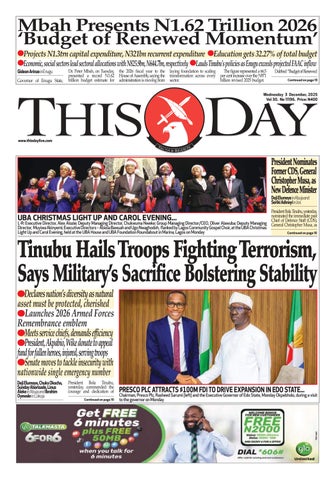
Tinubu Hails Troops Fighting Terrorism, Says Military’s Sacrifice Bolstering Stability

Declares nation’s diversity as natural asset must be protected, cherished Launches 2026 Armed Forces Remembrance emblem

Meets service chiefs, demands efficiency President, Akpabio, Wike donate to appeal fund for fallen heroes, injured, serving troops Senate moves to tackle insecurity with nationwide single emergency number

Continued on page 10

Gideon Arinze in Enugu Governor of Enugu State,
PresCo PlC AttrACts $100M FDI to DrIVe exPANsIoN IN
stAte... Chairman, Presco Plc, Rasheed Sarumi (left) and the Executive Governor of Edo State, Monday Okpebholo, during a visit to the governor on Monday
L-R: Executive Director, Alex Alozie; Deputy Managing Director, Chukwuma Nweke; Group Managing Director/CEO, Oliver Alawuba; Deputy Managing Director, Muyiwa Akinyemi; Executive Directors – Abiola Bawuah and Ugo Nwaghodoh, flanked by Lagos Community Gospel Choir, at the UBA Christmas Light Up and Carol Evening, held at the UBA House and UBA Foundation Roundabout in Marina, Lagos on Monday
President Bola Tinubu, yesterday, commended the courage and dedication of
Deji elumoye in Abuja and seriki Adinoyi in Jos President Bola Tinubu, yesterday, nominated the immediate past Chief of Defence Staff (CDS), General Christopher Musa, as
Musa, as New Defence Minister
Deji elumoye, Chuks okocha, sunday Aborisade, linus Aleke in Abuja and Ibrahim oyewale in Lokoja

EMBLEM APPEAL

Alausa: Nigeria in Learning Emergency, 45 Million School Children Have Learning Poverty

Can’t read age appropriate texts at age of 10 years Presents position paper on role of language in education Explains why FG is implementing comprehensive reform package

The Minister of Education, Dr Tunji Alausa, has highlighted why Nigeria needs to overhaul the learning processes in the education sector, describing the situation as an emergency which requires urgent attention.

In a position paper by the minister, he argued that despite high enrolment 45 million children aged seven and 14 cannot read a simple sentence, while learning outcomes remain unacceptably low.

Quoting UNICEF data, he stressed that the crisis remains uneven, with the North-west bearing the largest burden with a literacy rate of 9.4 per cent and Numeracy rate of 8.3 per cent rating, followed by the North-east with 12 per cent and 10.7 per centBesides,respectively. he noted that North-central has a literacy and

numeracy rates of 24.3 per cent and 22.7 per cent respectively, while the South-west has 45.8 per cent and 46.7 per cent rates. The South-east has the highest literacy and numeracy rates at 55.8 per cent and 52 per cent, while the South-south has 37 per cent and 34 per cent respectively.

“Nigeria is in a learning emer- gency. Despite high enrolment, 45 million children aged 7–14 still cannot read a simple sentence, and learning outcomes remain unacceptably low.

The crisis is uneven across the country”, he argued. According to him, the data demonstrates that Nigeria’s children are facing a severe and uneven learning crisis, with some regions lagging far behind in both literacy and numeracy. The gap between schooling and actual learning, he said, reflects a system-wide decline in education quality.

In response, Alausa pointed out that the Federal Ministry of Education is implementing a comprehensive reform package aimed at improving the quality of education and learning outcomes. These, he said, include the review of pre-service teacher training, nationwide capacity

building for teachers, school leaders, monitoring and evalua- tion officers, digital training with incentives, and the establishment of teacher Communities of Practice (CoP).

Other initiatives, according to the minister, cover school grading, the Safe Schools Initiative, revised

UBEC guidelines for state-targeted support, results-based financing (P4R), and partnerships with private schools to reduce out- of-school children.

Alausa stated that the language policy review is one component of this broader effort, designed to help children learn effectively,

stressing that although it is not the sole focus but one of many measures aimed at ensuring children acquire real learning and foundational skills, equipping them with a competitive advantage for future success.

Continues online

CPPE: Nigeria’s Q3 GDP Performance Reaffirms Gradual, Steady Economic Recovery

Highlights positive impact of ongoing economic reforms

Dike

Centre for the Promotion of Private Enterprise (CPPE) has declared that Nigeria’s third quarter (Q3) Gross Domestic Product’s (GDP) performance reaffirmed that the Nigerian economy is on a gradual but steady recovery path.

UBA Lights Up Lagos, Projects Improved Economic Outlook for 2026

It was glitz and glamour as the United Bank for Africa (UBA) Plc on Monday commenced the Christmas season with its annual lighting ceremony at its Marina headquarters in TheLagos.event marked the commencement of the festive period, with messages of hope and optimism about Nigeria’s economic trajectory come 2026.

Speaking to journalists at the event, Group Managing Director and Chief Executive

Officer, UBA, Mr. Oliver Alawuba, commended recent economic policy interventions by the federal government, while painting a picture of renewed confidence in the country’s financial landscape.

“We have seen a turnaround in the economy of this country,” Alawuba said at theHeceremony.highlighted several positive indicators that had emerged in recent months, stating that inflation rates have declined, exchange rates have stabilised, and liquidity has

improved significantly within the financial system.

Drawing from his recent address at the dinner organ- ised by Chartered Institute of Bankers of Nigeria, Alawuba praised the collaborative ef- forts of monetary and fiscal authorities.

He particularly acknowl- edged the central bank governor and Minister of Finance and Coordinating Minister of the Economy for what he described as excellent work in changing the economy positively.

The declaration by the Lagos-based firm followed Nigeria’s latest GDP report for the third quarter of 2025, which indicated that the economy grew by 3.98 per cent in real terms, but lower than the 4.3 per cent growth recorded in the second quarter.

It emphasised that the data confirmed that the economy remained firmly on a path of steady recovery and consolidation.

Chief Executive Officer of CPPE, Dr Muda Yusuf, made the assertions yester-

day in the firm’s “Policy Brief on Nigeria 2025 Third Quarter GDP.”

Yusuf said the GDP performance highlighted the positive impact of ongoing economic reforms, especially in stabilising the foreign exchange market.

He added that the “Q3 performance highlights the positive impact of ongoing economic reforms, especially in stabilising the exchange rate, moderating inflation, improving fiscal conditions, and gradually restoring investor confidence.

“These macroeconomic gains have strengthened business sentiment and supported activity across key sectors of the economy.”

He stated, “Nigeria’s Q3 GDP performance reaffirms that the economy is on a gradual but steady recovery path, supported by improved macroeconomic stability, stronger investor sentiment, and resilience across key sectors such as services, ICT, financial services, chemical and pharmaceutical and con- struction.”

FG Holds Nigerian Foods and Culture Festival in Lagos

Olawale Ajimotokan in Abuja

The federal government has scheduled the maiden Nigerian Foods and Culture Festival for December 16-17 at the Cricket Pitch, Tafawa Balewa Square, Lagos as part of this year’s Detty December.

Minister of Art, Culture,

Tourism and Creative Economy Hanatu Musa Musawa announced this yesterday in Abuja at a media briefing. She said the festival jointly organized by the ministry and Irabor Creative Minds, promises to be an unforgettable Detty December, celebration of Nigeria’s rich cultural

heritage, culinary diversity and everything that makes the country so great as a people.

The minister described the festival as an embodiment of the ministry’s commitment to harnessing the power of art, culture and tourism to drive economic growth, job creation and national unity.

Onwuamaeze
L-R: Chairman of the National Council of the Nigerian Legion, Morenike Grace Henry; President Bola Ahmed Tinubu; and Chief of Defence Staff (CDS), General Olufemi Olatubosun Oluyede, during the Emblem Appeal Launch for the 2026 Armed Forces Remembrance Day Celebration, held at the Presidential Villa, Abuja, yesterday PHOTO: GODWIN OMOIGUI
Kayode Tokede

NCDMB Pushes Intervention for Local Oil Firms to $550m with New $100m Equity Fund

Peter Uzoho and Blessing Ibunge in Yenagoa

Board reveals Nigerian Content implementation has hit 61% Ekpo pledges to address industry bottlenecks, reduce transaction timelines ment Fund (NCDF).

Nigerian Content Development and Monitoring Board (NCDMB) has unveiled a fresh financing intervention initiative, known as Equity Investment Scheme, with a total amount of $100 million to complement the existing

Nigerian Content Intervention Fund (NCIF) in helping to build capacities of indigenous oil and gas companies.

The move pushed the volume of the board’s funding interventions to indigenous service companies to $550 million.

Executive Secretary of NCDMB, Mr. Felix Ogbe,

announced the latest funding scheme yesterday in Yenagoa, in his welcome address at the opening ceremony of the 14th Practical Nigerian Content Forum (PNC) 2025.

The forum had the theme, “Securing Investments, Strengthening Local Content and Scaling Energy Production.”

Ogbe said the $100 million Equity Investment Scheme, developed in partnership with Bank of Industry (BOI), represented a bold step towards strengthening local participation and deepening investment in the sector. He said the scheme would diversify the income base of Nigerian Content Develop-

Emefiele Case: EFCC Operative Defends 24Day Detention, Says Statements Not Forced

“This finance scheme will provide equity financing to high-growth indigenous energy service companies. It will also diversify our NCDF income base while strengthening local content development,” he stated.

He also disclosed that the board had completed the framework for the issuance of the NCDF Compliance Certificate, a mandatory document that would confirm companies’ adherence to the statutory one per cent remittance.

NCECs are not admitted into the tendering process,” he said. The executive secretary highlighted progress on other initiatives, including the expansion of the Community Contractors Scheme, which he said recorded over 94 disbursements in 2025.

He also provided updates on Project 100 programme, where a new batch of beneficiary companies would be on-boarded after an exit ceremony in April 2026.

and N2.8 billion fraud, alongside Emefiele. Both defendants have pleaded not guilty.

Testifying in a trial-withintrial, Gurumnaan explained that Omoile remained in custody for 24 days because he was unable to meet the bail conditions set for him.

He insisted that the defendant’s statements were made voluntarily and not obtained through any form of coercion.

Ogbe further announced the commencement of the Nigerian Content Academy Lecture Series, adding that “so far, we have held seven lectures on key industry issues”. Continues online SenAtorS

An operative of Economic and Financial Crimes Commission (EFCC), Alvan Gurumnaan, yesterday told the Special Offences Court in Ikeja that the second defendant, Henry Omoile, in the ongoing trial of former Central Bank of Nigeria (CBN) Governor, Mr. Godwin Emefiele, was held in the commission’s custody for 24 days before he was released on bail.

Omoile is standing trial on 26 counts bordering on abuse of office and alleged $4.5 billion

Gurumnaan said, “The second defendant did not make any statement under duress. Our officers do not force statements through violence.”

He added that EFCC operatives were trained professionals who did not extract statements through threats, violence, or intimidation.

He further stated that where duress was alleged, it was the responsibility of the defendant to prove it.

The trial-within-trial was ordered by Justice Oshodi after defence counsel Kotoye Adeyinka (SAN) objected to the admissibility of Omoile’s extra-judicial statements, which prosecuting counsel Rotimi Oyedepo (SAN) sought to tender as evidence at the

Experts Advocate Digital Infrastructure Resilience to Enhance National Security

Linus Aleke in Abuja

Security experts have advocated strengthening cyber and digital infrastructure resilience as a crucial step towards enhancing national security.

Speaking at a press conference in Abuja on Tuesday, the Chief Executive Officer of the Nigeria Security Ex- hibition and Conference, Frank Ohwofa, noted that

increasingly sophisticated cyber threats and the growing reliance on digital systems de- mand robust, well-coordinated protective measures.

He emphasised the need for modernised networks, improved incident-response capabilities, and closer collaboration between government, industry, and international partners to address vulnerabilities before they can be

exploited.

He observed that Nigeria must achieve logistical and supply chain sovereignty in weapons manufacturing to guarantee self-reliance.

According to him: “We must ensure cyber and digital infrastructure resilience. This involves securing our command, control, and critical national assets from debilitating attacks.

October 9, 2025 sitting.

Gurumnaan, now based in Abuja, but formerly with the Special Operations Unit of EFCC Lagos Zonal Com- mand 1, narrated how Omoile’s statements were taken openly in a spacious conference room on the first floor of Block A at the EFCC Lagos Directorate 1, Awolowo Road, Ikoyi.

According to him, the environment made coercion impossible.

According to him, the cer- tificate would become effective January 1, 2026 and would be required to get key permits and approvals from the board.

As part of the new compliance regime, Ogbe stated that NCDMB had also barred the transfer of Nigerian Content Equipment Certificates (NCECs) and related certifications.

“Effective 1st January 2026, our NCECs and other certificates are no longer transferable. This ensures that entities without

He confirmed that the board would between the first quarter (Q1) and Q2 2026, review seven existing guidelines and finalise the legal and fiscal framework for the Nigerian Oil and Gas Parks Scheme (NOGAPS) ahead of operations at the Odukpani and Emeyal 1 parks.

NLNG Train 7 Builds Major Skills Pipeline as 331 Trainees Graduate

Nigeria’s ambition to build a competitive gas economy has received a major boost as 331 young Nigerians graduated from the NLNG Train 7 Human Capi- tal Development (HCD) Basic Training Programme, a statutory Nigerian Content requirement designed to strengthen the country’s technical workforce and reduce dependence on expatriateSpeakinglabour. at the closeout ceremony in Port Harcourt,

NLNG’s General Manager, External Relations & Sustainable Development, Dr. Sophia Horsfall, said the company’s aggressive investment in human capital was “not charity, but a business decision anchored on Nigeria’s economic future.”

“The most valuable of all capital is human capita. For us at NLNG, investing in people is not just corporate responsibility it is a catalyst for a thriving economy and a sustainable future,”Horsfall declared.

She noted that the Train 7 HCD Programme mandated

under the NOGICD Act (2010) is a strategic pillar of NLNG’s Nigerian Content Plan and “a worthwhile investment in the future of our country and our industry.”According to her, the pro- gramme has already proven its economic importance.

“From inception to date, Train 7 has created over 10,000 direct and indirect jobs. It has also delivered more than 70 million safe man-hours without Lost Time Injury, while enabling massive technology transfer to Nigerians at all levels.”

Blessing Ibunge in Port Harcourt
President of the Senate, Godswill Akpabio (right) in heart-to-heart discussion with his colleagues during yesterday’s plenary.
Photo: SenAte PreSident’S office

INAUGURATION OF NATIONAL YOUTH CONGRESS EXECUTIVES...

L-R: Chairman, Governing

Again, US Lawmakers Sit over ‘Religious Persecution’ in Nigeria

Urge Nigerian government to protect nation’s vulnerable Hartzler wants US to work directly with Tinubu’s administration

Obadare seeks ban on Sharia law, Hisbah in Nigeria Congress readies report for submission to Trump

The United States Congress yesterday continued its probe into alleged religious persecution in Nigeria, with a majority of the lawmakers holding on to their positions that there is specific targeting of Christians in the killings taking place in West Africa’s most populous nation.

The roundtable followed President Donald Trump’s October 31 directive to the House Appropriations Commit- tee to investigate the ‘slaughter’ of Christians in Nigeria and report back with their findings.

Participants, a statement released by the committee after the hearing, said, included: Mario Díaz-Balart (R-FL); House Appropriations Committee Vice Chair and National Security, De- partment of State, and Related Programmes Subcommittee Chairman, Robert Aderholt (R-AL) as well as Labour, Health and Human Services, Education, and Related Agencies Subcommittee Chairman and Values Action Team (VAT) Chair, Riley Moore (R-WV).

Others were: The House Appropriations Legislative Branch Subcommittee Vice Chair and leading religious liberty advocate, Brian Mast (R-FL), House Foreign Affairs Committee Chairman; Chris Smith (R-NJ), House Foreign Affairs Africa Subcommittee Chairman, Vicky Hartzler; U.S. Commission on International Religious Freedom Chair, Sean Nelson as well as Dr. Ebenezer Obadare of the Council on Foreign Relations.

In his remarks, Díaz-Balart said: “No one should live in fear because of how they worship. Defending religious liberty worldwide is both a moral duty and a vital American interest. As Chairman of the subcommittee that funds U.S. national security interests and foreign policy priorities, I remain committed to advancing policies that protect the freedom to live according to one’s faith without fear of violence and retribution.

“ I address this issue in my FY26 funding bill, and I intend to strengthen these efforts by passing a full-year funding

measure, which is essential to advancing an America First agenda.”

Also speaking, Congress- man Aderholt said the rising violence and ‘targeted persecution’ of Christians in Nigeria is a crisis that can’t be ignored. Throughout his time in Congress, Aderholt stated that he has worked to protect the most vulnerable, including those whose lives and liberties are threatened simply because of their faith.

“We must stand firmly with Nigeria’s Christian communities and all persecuted believers worldwide, and I commend our collaborative efforts to

provide the President with the information needed to confront this growing tragedy,” he noted.

Congressman Moore in his submission alleged that Chris- tians were being persecuted and slaughtered in Nigeria simply for professing their faith in Jesus Christ.

“That’s why President Trump designated Nigeria as a Country of Particular Concern, and why he asked me, along with the House Committee on Appropriations, to look into the horrific persecution of Christians in “I’mNigeria.grateful to Chairman Díaz-Balart for convening this

critical discussion to receive expert testimony and engage in an important dialogue to ensure we have a full picture of the ongoing crisis Nigerian Christians face every day. The world will no longer turn a blind eye to the persecution of Christians in Nigeria,” he pointed out.

Chairman Mast in his remarks, stated that the situation was not merely ‘inter-communal violence’ or a ‘resource conflict,’ as many claim.

“This is a targeted campaign of religious cleansing. Whether it is Boko Haram, Islamic State West Africa Province, or radicalised nomadic Fulani

militants, the objective is to drive Christians out of their ancestral lands in the Middle Belt and impose a radical Islamist ideology, as has already happened across the northern states, where blasphemy laws are used to oppress.

“As Chairman of the House Foreign Affairs Committee, I firmly stand with President Trump in his decision to redesignate Nigeria as a Country of Particular Concern. We must demand that the Nigerian government disarm these militias, return displaced families to their homes, and bring the perpetrators to justice,” he posited.

AIDS Would Cease to be Public Health Emergency in Nigeria Soon, Says UNAIDS

NEPWHAN holds candle light memorial for AIDS victims

The Joint United Programmes on HIVAIDS (UNAIDS) has said that with the provision

Indigenous Contractors Barricade Finance, Ministry, Protest Unpaid N500bn Debt

Ndubuisi Francis in Abuja

About three months after their last protest, hundreds of protesting contractors under the aegis of Indigenous Contractors Association of Nigeria (ICAN), again besieged the Ministry of Finance headquarters in Abuja, Tuesday over the non-payment contract fees in excess of N500 billion for federal projects completed in 2024.

Led by the General Secretary of the Association, Babatunde Oyeniyi, the protesters who pitched their canopies at the central gate of the ministry, said the government had reneged on all promises it made during previous negotiations.

With placards of various inscrip- tions, one of which read , “Don’t pay 2025 until you finish paying the 2024 budget that has been

completed,” they surged towards the entrance of the entrance, thereby disrupting movements in and out of the ministry.

Oyeniyi, who spoke on behalf of the contractors, disclosed that they had approached the Minister of Finance and the Coordinating Minister of the Economy, Mr Wale Edun, in September this year to find out what was delaying the payment of their money.

of lifesaving medications and unwavering commitment to fight stigma and support those affected, a pathway to ending AIDS as a public health threat is now a possibility in Nigeria. It also said world is fast get- ting to the stage of total new elimination of HIV infection based on current strides in scientific discoveries.

Speaking yesterday in Abuja at the Candlelight Memorial to remember and pray for people that died in Nigeria as a result of HIV/AIDS, UNAIDS Country Representative, represented by Gabriel Undelikwo, said that to bring down the trajectory of the pandemic, it is imperative that lifesaving medications can be reached without fear by all who need them.

“We know the pathway to

end AIDS as a public health threat and to build a society in which we all thrive - to protect the rights of every person, stop stigma and discrimination.

“We need to stop seeing People Living with HIV as: “them” ‘others’, we are together; we are one in our collective efforts to end AIDS. We need to be more inclusive, show empathy and compassion.

“We must stand together to challenge misconceptions, educate our communities, and promote acceptance and understanding,” he said.

He said that long-acting medicines that only need to be injected a few times a year are increasingly available and could add to the solution but only if a human rights approach is taken to ensure its production

in every part of the world.

“The report’s message is summed up in its title: “Take the rights path to end AIDS”. And for us in Nigeria, this translates to Sustaining the HIV Response and Stopping HIV Among Children to End AIDS in Nigeria by 2030As we gather here today, our hearts are united in remembrance, solidarity, and hope as we honor the memory of those we have lost to HIV/AIDS and stand with the millions living with HIV in Nigeria and worldwide.

“Our collective efforts will bring us closer to a world where everyone can live with dignity, respect, and health. Despite huge progress made in the HIV response, human rights violations are still preventing the world from ending AIDS.

Onyebuchi Ezigbo in Abuja
Board, Nigerian Youth Congress (NYC), Dr. Yakubu Shendam; Vice Chancellor, University of Jos, Prof. Tanko Ishaya; Chairman/CEO, Youths Jobs and Supreme Leader of the Natives, Mr Olalekan Smart and the newly inaugurated President of NYC, Engr. Jethro Annum, at the inauguration of NYC executives in Abuja yesterday PhOTO: ENOCK REUBEN

Ambassadorial Nomination: Delta APC Congratulates Reno Omokri

As ambassador-designate Ayodele Oke denies being indicted for financial misconduct as DG NIA

Segun James

All Progressives Congress (APC), Delta State, under the chairmanship of Elder Omeni Sobotie, has extended congratulations to Mr. Reno Omokri on his recent nomination as ambassadordesignate by President Bola Tinubu.

“This significant national recognition brings immense pride not only to Mr. Omokri and his family, but to the entire people of Delta State,” the party stated.

Meanwhile, following the uproar that witnessed his nomination as an ambassador designate, former DirectorGeneral of Nigeria Intelligence

Agency (NIA), Mr. Ayodele Oke, denied being indicted for financial misconduct while in office.

Oke, in a statement by his lawyers, Kayode Ajulo (SAN) & Co, said contrary to allega- tions, he was never indicted for financial misconduct.

In a good will message signed by the Delta State APC chairman, the party stated that as a political party committed to promoting excellence, competence and patriotic service, Delta APC was delighted to celebrate yet another proud son of the state, who had distinguished himself with honour and integrity on the national and global stages. Sobotie stated, “Mr. Omokri’s

intellectual contributions, his longstanding engagement in policy discourse and his extensive international exposure have consistently demonstrated his capacity to serve Nigeria at the highest “Omokri’slevels. nomination speaks volumes about Presi- dent Tinubu’s commitment to merit, national inclusion and the recognition of individuals who have shown unwavering passion for the advancement of Nigeria and commending the President for identifying and elevating the Delta-born technocrat and advocate whose voice and intellectual rigour have contributed to shaping national conversations over the years.”

I nubu H AI l S Troo PS F IGHTI n G Terror

troops fighting terrorism, insurgency, banditry, and other security threats across the country, saying the sacrifices of Nigerian military heroes have significantly strengthened nationalLaunchingstability. the 2026 Armed Forces Remembrance Day emblem appeal fund at State House, Abuja, Tinubu also

the new Minister of Defence.

In a letter to Senate President, Godswill Akpabio, Tinubu con- veyed Musa’s nomination as the successor to Alhaji Mohammed Badaru Abubakar, who resigned onInMonday. the letter, Tinubu, according to a release issued by his Adviser on Information and Strategy, Bayo Onanuga, expressed confidence in Musa’s ability to lead the Ministry of Defence and further strengthen Nigeria’s security architecture.

The senate said it will today screen the retired military chief as the new Minister of Defence.

The nomination, coming less than 24 hours after the former defence minister’s resignation on health grounds, triggered an accelerated confirmation process in the upper chamber amid intensified national security concerns.

Senate Leader, Opeyemi Bamidele, who announced the development in a statement from his Directorate of Media and Public Affairs, on Tuesday, said the upper chamber would treat the screening as a matter of urgent national importance.

According to Bamidele, the senate is “already in possession” of Tinubu’s request and will read the letter on the floor Wednesday before moving immediately to the screening exercise, in line with Section 147 of the 1999 Constitution.

Bamidele stressed that the senate could not afford any delay “at this crucial time in the history of our fatherland,” stating that the appointment is central to sustaining ongoing

urged Nigerians to reject divisive rhetoric and, instead, promote respect, tolerance, and mutual understanding, describ- ing the country’s diversity as a natural asset that must be protected and cherished.

Speaking ahead of the Armed Forces Remembrance Day, com- memorated every January 15, the president declared, “Today,

military campaigns against bandits, terrorists, extremists and other violent actors undermining national stability.

The statement read, “With the president having declared a state of emergency on national security, both the Presidency and the National Assembly must work hand in hand to ensure peace, stability and good governance.

“The screening of the defence minister nominee is one clear way to demonstrate that synergy in the national interest.”

Musa, who retired recently as Chief of Defence Staff, is widely regarded for his frontline operational experience across multiple theatres of conflict.

The senate is expected to conclude the screening on Wednesday as part of the administration’s attempt to quickly restore leadership at the defence ministry and reinforce the country’s security command structure.

Musa, 58, is a distinguished soldier, who served as Chief of Defence Staff from 2023 until October 2025. He won the Colin Powell Award for Soldiering in 2012.

Born in Sokoto on December 25, 1967, Musa received his primary and secondary educa- tion there before attending the College of Advanced Studies in Zaria.

He graduated in 1986 and enrolled at the Nigerian Defence Academy the same year, earning a Bachelor of Science degree upon graduation in 1991.

Musa was commissioned into the Nigerian Army as a

The state APC chairman added, “The Delta APC views this appointment as a shining example of the possibilities that lie ahead for Deltans who continue to excel across diverse professional fields. Mr. Omokri’s global footprint - spanning public service, advocacy, media, humanitarian work and diplomacy - positions him uniquely to project Nigeria’s values, deepen bilateral relations and promote our national interests with distinction.

“As he prepares for this new chapter of service, we urge Mr. Omokri to continue to embody the virtues of diligence, humility and patriotism that have characterised his journey thus far. We

we pay tribute to veterans and salute our serving troops, who continue to confront terrorism, insurgency, mandatory and other security challenges. Their resilience often in the face of great danger, remains a source of national pride.”

He said a grateful nation must continue to “honour the fallen, support the wounded,

Second Lieutenant in 1991 and has since had a distinguished career.

His appointments included General Staff Officer 1, Training/ Operations at HQ 81 Division; Commanding Officer, 73 Battalion; Assistant Director, Operational Requirements, Department of Army Policy and Plans; and Infantry Representa- tive/Member, Training Team, HQ Nigerian Army Armour Corps.

In 2019, he served as Deputy Chief of Staff, Training/Opera- tions, Headquarters Infantry Centre and Corps; Com- mander, Sector 3, Operation Lafiya Dole; and Commander, Sector 3 Multinational Joint

Momentum”, Mbah said the budget comprised a capital expenditure of N1,296,092,465,000, representing 80 per cent of the total budget, and recurrent component of N321,305,000,000, being 20 per cent of the budget.

Mbah said the budget would be funded through a projected N870 billion Internally Generated Revenue (IGR), while N387 billion would come from federal allocation, and N329 billion from capital receipts.

A sectoral breakdown of the budget showed that the economic sector got N825.9 billion, representing N51 per cent of the total budget, followed by the social sector (N644.7 billion, representing 40.1 per cent of the budget), while administration, justice,

are confident that he will not only excel in this diplomatic role but will also serve as a bridgebuilder, an image-bearer of Nigeria’s potential and a worthy representative of Delta State.”

Oke’s lawyers said the nominee, a non-career ambassador-designate, was cleared of all allegations, and he received presidential approval and was discharged of all alleged financial misconducts in the matter against him by the Economic and Financial Crimes Commission (EFCC).

In a statement on Tuesday, signed by Head of Chambers/ Senior Partner, Professor Bukola Akinola, the firm described allegations against Oke as a

and care for all who answer the call to serve”.

The president stated that the Remembrance Day was a solemn reminder of the cost of peace and the enduring importance of national unity.

He stated, “As a grateful nation, we must honour the fallen, support the wounded, and create and care for all who

Task Force in the Lake Chad Region.

In 2021, Musa was appointed Theatre Commander, Operation Hadin Kai. He later became Commander of the Nigerian Army Infantry Corps, before being appointed Chief of Defence Staff by Tinubu in 2023. Congratulating him, the governor of Plateau State, Caleb Mutfwan, expressed delight over the nomination of Musa.

In a statement by his Director of Press, Gyang Bere, the gov- ernor conveyed his appreciation to Tinubu for deeming Musa worthy of the noble responsibil- ity of providing leadership in the safeguard and defence of the country.

and regional sectors got N128 billion, N15.8 billion, and N2 billion, respectively.

Mbah explained, “Allocating N825.9 billion to the economic sector is strategic and deliberate. When we invest in agriculture, industry, and trade, we create jobs, reduce poverty, and generate revenue that strengthens the entire economy.

“The performance of this sector remains central to our vision of achieving a seven-fold GDP growth in Enugu State.”

Highlights of the economic sector include roads/infrastructure, where the governor plans to construct 1,200 urban roads and a significant number of rural roads, while also completing the ongoing

campaign of calumny.

It stated, “We are appalled by narratives on social media, following the appointment of Oke by President Tinubu as an ambassador designate, wherein some mischief makers pushed false stories against him. Omokri

answer the call to serve Armed Forces remember Remembrance Day marked every 15 January is a reminder of the cost of peace and the importance of unity as we honour our heroes.”

Tinubu further commended the armed forces for demonstrating exceptional courage across multiple theatres of operation.

He stated that their relentless efforts had restored normalcy to several communities.

The president said, “Our armed forces have demonstrated exceptional courage across various theatres of operation. Their efforts have restored normalcy to many communities and strengthened national stability.

“And under my adminis- tration, we have entrenched collaboration among security agencies and recorded signifi- cant gains tens of thousands of insurgents have surrendered.

“Key terrorist leaders have been neutralised, and many captives have been freed in our maritime domain, oil theft, piracy and illegal fishing have been contained, we have supported new platforms and

40-kilometre Owo-UbahuAmankanu-Neke-Ikem dual carriageway, dualisation of the Abakpa Nike - Ugwogo Nike – Ekwegbe - Opi-Nsukka Road, and the 21.65-kilometre Enugu-Abakaliki Expressway.

Concerning transportation, Mbah announced that the state would acquire 14 additional aircraft to bring Enugu Air’s fleet to 20, stating that three additional planes would arrive before the end of 2025.

He said the administration planned to build five more transport terminals in Emene, Udi, Awgu, Four-Corners (Ozalla), and Obollo-Afor. It equally set aside 15 per cent of the budget for the provision of 15,000 mass housing units, while ramping up infrastructural development

advanced capability acquired for Army, Navy and Air Force.” He also disclosed that the Ministry of Defence was developing a comprehensive programme to reclaim ungov- erned spaces across the country by leveraging the expertise and experience of retired military personnel.According to Tinubu, the initiative is designed to strengthen security, restore government presence, and turn previously insecure areas into zones of economic activity.

He added that the pro- gramme would also help prevent the resurgence of violence in communities that had been affected by insecurity.

Tinubu stated, “Ministry of Defense is developing reclaim- ing the ungoverned spaces for economic benefit programme by utilising the experience of retired military personnel.

“This initiative aimed to strengthen security and revitalize local economics and prevent the emergence of violence in previously affected communities.

“This year marks a new

Continued on page 28

at the New Enugu City. In the agricultural sector, Mbah said the government would, among others, step up the construction of 20-hectare farm estates in the 260 wards of the state, with some already underway.

In the social sector, education got the lion’s share of 32.27 per cent of the entire budget, following patterns of the 2024 and 2025 budgets, where it also got over 30 per cent.

The governor said with the 260 Smart Green Schools already completed or nearing completion, the state would focus on the construction of Smart Secondary Schools and Technical and Vocational

Continued on page 28

PRESENTATION OF LAIF ICON AWARD TO SHOBANJO...

L-R: Chairman, Lagos Advertising and Ideas Festival (LAIF) Management Board, Jay Chukwuemeka; Vice Chairman, LAIF Management Board, Henry Akpede; Member, Board of Trustees, Association of Advertising Agencies of Nigeria(AAAN), Omowumi Owodunni; Chairman, Board of Trustees, AAAN, Sir Udeme Ufot; Advertising czar, Biodun Shobanjo; President, AAAN, Lanre Adisa; Past Chairman, LAIF Management Board, Funmi Onabolu and Director General, Advertising Regulatory Council of Nigeria, Lekan Fadolapo during the presentation of LAIF Icon Award to Shobanjo at the 20th edition of LAIF Awards ceremony held in Lagos on Sunday

Compliance with Employee Compensation Act Less Than 30%, Says NLC

NSITF seeks harmonised legislation

The Nigeria Labour Congress (NLC) has decried the low level of compliance with the Employee Compensation Act, a social security initiative by the federal government meant to cushion the effects of workplace accidents on workers.

It also complained of the manner of operations of Nigeria Social Insurance Trust Fund (NSITF) say- ing it negates the spirit of tripartite arrangement behind its establishment.

At present, NLC alleged that NSITF is to be treated as one of it’s parastatal by the federal government.

These were some of the issues raised by the NLC president Joe Ajaero at the Nigerian Senate Public Hearing on the NSITF Bill onAjaeroMonday.said that NSITF is all about worker’s interest as represented by the tripartite structure involving, govern- ment, private employers and

organized Labour centres.

He said the leadership of the Organised Labour is insist- ing that the appointment of the board chairman of NSITF should revolve among the tripartite stakeholders.

“The NLC is concerned that this is a tripartite organiza- tion and that this should be reflected in the composition

NRC MD, Opeifa Backs Nigerian Local Engineers, Canvasses FG Recognition, Support

The Managing Director of the Nigerian Railway Corporation (NRC), Dr. Kayode Opeifa, has thrown his weight behind local engineers, calling on the federal government to accord them more recognition and support for their passion, industry, and resilience.

Opeifa stated this when he received the leadership of the Nigeria Society of Engineers, led by Mrs. Margaret Aina Oguntala, who was in his office recently on a courtesy visit.

According to him, “If the federal government could invest more in our local engineers, we

would be saving the country billions of dollars.”

Citing the example of the NRC, Opeifa said the corporation’s local engineers have continued to save the country huge foreign exchange as they continue to improvise in keeping the corporation’s rolling stocks moving.

“The Nigerian Railway Corporation is blessed with the very best of our local engineers. They have a good work ethic, and despite the absence of necessary working tools, they have continued to use their blood, brain, sweat, and cerebrospinal fluid to keep

the railway systems working,” Opeifa said.

He noted that the corporation’s engineers went beyond the rules in the books to continue to make the NRC work despite the funding.

The corporation boss added, “They have continued to demonstrate capacity. They have shown that they can build rail tracks, fix locomotive engines, and do much more.

“Our female engineers are very passionate, and they compete with their male counterparts just to contribute to the smooth operations of the railway.”

He said from the Kaduna

Emir of Kano Sanusi Urges Community to Unite Against Drug Abuse

Ahmad Sorondinki in Kano

The Emir of Kano, Alhaji Muhammadu Sanusi II, has urged community leaders to launch intensified awareness campaigns in educating people especially the youth on the dangers of substance abuse. Sanusi emphasized on

the increased awareness campaigns to educate people on the dangers of drug abuse in the state by involving traditional rulers in addressing the menace among youths,

The Emir made the call through the District Head of Shanono, Dankaden Kano, Dr. Bashir Mohammad at a summit in Kano on Tuesday.

The royal father, described drug abuse as a direct assault on the dignity of human society which required collective efforts to address before it gets out of hands

“Losing a young person to drugs means losing a lineage, a dream, and a future every child saved is a future restored.

bomb attacks and the very recent train incident at Asham, the NRC engineers were the ones who prevented the federal government from awarding any contract “to re-rail, recover and evacuate our trains. Beyond collecting materials from our supplies, we have sustained our operations through the ingenuity of our engineers, be it civil, mechanical, electrical, signals, and telecommunications engineers.”

of the board,” he said.

According Ajaero, the idea of appointing eight government representative, two for Labour and perhaps one from employers negates the principle of the tripartite template anywhere in the world.

He said the situation has enabled the government side to neutralize the position of others during boardroom politics.

His words: “The NLC is equally concerned that we should not have operations before pregnancy and as stakeholders (either as employers, government or labour) should have owned this arrangement because you are doing it for us.”

The NLC president further said that NSITF is funded by workers contribution, clarifying it is the money contributed by workers and their employers for the interest of the workers and so does not see the reason for playing boardroom politics

Prof Asagba: DELSU is

The Vice Chancellor of Delta State University (DELSU) Abraka, Prof. Samuel Ogheneovo Asagba, has said the institution has been ranked the best university in the South-South and South-East geopolitical zones.

He also disclosed that DELSU is also ranked the 12th best university in Nigeria.

Prof. Asagba made the disclosure on Monday at Abraka in Ethiope-East Local Government Area of Delta

State during his one-year anniversary celebration as the Vice-Chancellorship of the university.

While giving his stewardship, the Vice-Chancellor said that DELSU has been fully digitalized in its academic and non-academic activities.

He urged those who were yet to collect their certificates to do so at ease, saying with the digitization, the institution can now send certificates to those concerned at their various locations.

Prof. Asagba reeled out

to neutralize the interest of the workers.

He said that even the level of compliance to the Employee Compensation Act is less than 30 percent, adding that “this is an issue I expect the Ministry of Labour and NSITF management should endeavour to make should there is “Evencompliance. the informal sectors are not complying. Of what use are laws if they are not compliedRegardingwith.”the proposed amendment, Ajaero said rather than insisting the NSITF managing director should report to the minister, it should be that he would report to the board.

On the representation on the NSITF board, Ajaero said it should be treated as tripar- tite with proper representation by the stakeholders.

He said that without a strong tripartite board, the powers given to the NSITF managing director can be used arbitrarily.

achievements recorded within his one-year in office as VC, to include introduction of new faculties and depart- ments, collaboration with universities in South Africa, the UK, and China, promotion of 22 academics to professors, 17 associate professors and 267 non-teaching staff to senior positions, as well as the promotion of 31 junior non-teaching staff. He stated there was no increment in school fees in DELSU, so as not to burden parents and guardians.

Sylvester Idowu in Warri
Sunday Okobi
Onyebuchi Ezigbo in Abuja

BUSYBEE EXCELLENCE AWARD...

L-R: Convener, BusyBee Excellence Awards, Bisi Sotunde; Director, Sales and Marketing, Sofitel Cotonou Marina Hotel and Spa, Mr. Jean Yena; CEO, Eagle Eye Executive Protection and winner of the all-expense paid trip to Sofitel Cotonou Marina Hotel and Spa, Tobi Aladegbohugbe; CEO, Aksent Events and winner of the allexpenses paid trip to Sofitel Cotonou Marina Hotel and Spa, Ogunyemi Babatunde Augustine; and Chairman, Planning Committee, BusyBee Event Business Summit 9.0, Adeola Sessi-Traore, at the just concluded BusyBee Excellence Awards held in Ikeja, Lagos… recently

Alleged $35m NCDMB Fraud: Ex-Petroleum Minister,

Sylva, Instructed Payment of $13.45m, Witness Tells Court Says project remains abandoned since 2020

Alex Enumah in Abuja

A witness of the Economic and Financial Crimes Commission (EFCC) on Tuesday told a Federal High Court in Abuja that former Minister of State for Petroleum Resources, Timipre Sylva, gave him verbal instruc- tion for the payment of $13.45 million, being part of funds for the building of a 2000 barrels per day (bpd) refinery in Brass Island of Bayelsa State.

The witness, Mr. Isaac Yalah, a former Director at the Nigerian Content Development and Monitoring Board (NCDMB), made the claim while giving evidence in the fraud trial of an oil magnate, Dr. Akintoye Akindele.

The commission had last month declared Sylva wanted in connection with an alleged case of conspiracy and dishon- est conversion of the sum of $14,859,257, being part of funds injected by NCDMB into Atlantic International Refinery and Petrochemical Limited for the construction of a refinery.

A statement by the spokesman

of EFCC, Mr. Dele Oyewale, had disclosed that a warrant for the arrest of the former minister was secured on November 6, 2025, from a Federal High Court sitting in Lagos.

EFCC is prosecuting Akindele and two companies linked to him, over alleged complicity in the conversion of the sum of $35 million belonging to NCDMB. According to the charge, the said sums were allegedly converted from the money paid by the NCDMB Capacity Devel- opment Intervention Company Ltd to Atlantic International Refinery and Petrochemical Limited as investment in the establishment of a modular refinery, a jetty, among others, in Brass, Bayelsa State.

However, the witness who claimed to be the Director of Finance and Personnel for six and half years, before he was reassigned as Director of Planning, Research and Statistics, informed the court the project embarked on by NCDMB in conjunction with Atlantic International Refinery and Petrochemical Ltd, remained

abandoned till date, despite the payment of $35 million, being the total cost of the project.

Led in evidence by EFCC lawyer, E. E Iheanacho, SAN, Yalah, the 4th Prosecution Witness (PW4), narrated how Akindele’s proposal for the construction of the modular

refinery passed all four “decision gates” of NCDMB, leading to the approval of the sum of $35 million for the project.

He said, “When the proposal was approved, extract of the Governing Council was sent to the board. Highlight of the extract included that the

NCDMB invest $35 million to acquire 40 per cent equity in the Atlantic International Refinery and Petrochemical Ltd.”

He stated further that NCDMB was required to provide two representatives in the board and they were also to operate a joint project account to warehouse the $35 million.

Yalah told the court that himself and the then Executive Secretary were nominated as representatives of NCDMB to the board of Atlantic International Refinery and Petrochemical Ltd.

Shettima: Nigerian Journalists Are Democracy’s Shield Against Authoritarian Threats

Says press freedom, not negotiable under Tinubu Lauds media for resisting disinformation, foreign manipulation

Deji Elumoye in Abuja

Vice President Kashim Shettima on Tuesday described Nigerian journalists as the nation’s primary defence against authoritarian rule, assuring that press freedom remains a non-negotiable pillar of President Bola Tinubu’s government. He specifically said journalists have played a

Ododo Presents N820b Proposed Appropriation Bill for 2026 to Kogi Assembly for Approval

Ibrahim Oyewale in Lokoja

Governor Usman Ododo of Kogi State has presented a proposed appropriation bill of sum N820,490,585,443 billon for 2026 fiscal year to the State Assembly for approval.

Governor Ododo noted the proposed budget is divided into estimated recurrent revenue 2026 of N470 008,482,693 and recurrent expenditure 453042”501,760 billionAccordingrespectively to him, while the federation account alloca-

tions remain important, “our focus is on fiscal self-reliance, we are restructuring the IGR framework and adopting innovative financing to strengthen long-term sustain- ability.”

The governor made this known while presenting the proposed budget at the Hallow Chamber of the Kogi State House of Assembly on Tuesday. He commended the speaker and members of the House of Assembly for partnership, diligence and

unwavering commitment to the progress of Kogi State, noting the legislative support and oversight have continued to strengthen the agenda for sustainable prosperity. He highlighted some of the critical areas in which the administration will focus in 2026 as human Capital Development, empowering youths and women through skills development and inno- vation, education: Expanding access and enhancing quality to build a globally competi- tive workforce.

stabilising role during mo- ments of national tension by correcting misinformation and holding power to account.

In an address at the 2025 Conference and Annual General Meeting of the International Press Institute (IPI) Nigeria in Abuja, themed “Addressing Media Repression and Safeguarding Democratic Accountability in Nigeria,” Shettima affirmed the federal government’s unwavering commitment to protecting media prac- titioners from harassment

and intimidation.

According to him: “We owe you a space of practice devoid of harassment, intimidation, or fear. That much is non-negotiable. And as a government, we must continue to create an environment where truth can thrive without obstruction and where the work you do is protected rather thanThepoliced”.

Vice President praised Nigeria’s media community for its historical resilience in confronting authoritarian tendencies, stating that a

successful dictatorship is impossible in the country due to the press’s vigilance. “It is impossible, utterly impossible, to have a suc- cessful dictator in Nigeria. Never in our history has any person or government succeeded in suppressing the media permanently,” he said.

Shettima particularly commended journalists for standing firm against foreign information manipulation and interference, noting their refusal to surrender to disinformation campaigns.

Consul General Claims Indian UPI System Could Benefit Nigerian Banking Sector

The Consul General of India in Lagos, Mr. Kannan Chockalin- gam, has expressed optimism that the Indian Unified Payment Interface (UPI) system can benefit the Nigerian banking sector.

Speaking at the MarTech Excellence Awards Nigeria 2025, held at the Landmark Centre in

Victoria Island, Lagos, over the weekend, Chockalingam said, “We are trying to speak with the Nigerian government to introduce a UPI system. Because many countries are adopting the UPI system. So, India is ready to help and share the best practices with Nigeria.”

Chockalingam’s comments highlight the growing interest in digital payment systems in

Nigeria, and the potential for India to share its expertise in this area.

“That’s why I said that Nigerian banks can consider the UPI system. And they can put forward; they are sharing their ideas to the government of Nigeria. So that we can imple- ment the UPI kind of system here. That would be a benefit for all Nigerians,” he added.

Acting Group Politics Editor DEJI ELUMOYE

Email: deji.elumoye@thisdaylive.com

08033025611 sms only

Tinubu’s Choice of Uzodimma for South-east 2027 Campaign

The decision by President Bola Tinubu to anchor the all Progressives Congress 2027 election campaigns on the Imo State Governor, Hope Uzodimma, instead of the Deputy Speaker of the House of Representatives, Benjamin Kalu, is seen as what is to give the party victory in the region, Wale Igbintade writes.

Beyond the noise, it can be seen clearly that President Bola Tinubu’s decision to anchor the All Progressives Congress (APC) 2027 election campaigns on Governor Hope Uzodimma of Imo State, instead of the Deputy Speaker of the House of Representatives, Hon Benjamin Kalu, is a grand master stroke.

Informed analysts, who have taken time to study the politics of Tinubu over the years, agree with his close associates that he is very strategic. This attribute is today being played out as the president made the difficult choice of the political leader in the Southeast zone that he would anchor his campaign on ahead of the 2027 general elections.

Some of the APC leaders from the Southeast geo-political zone whose capacity and past roles were considered included Kalu, Uzodimma, Enugu State Governor, Peter Mbah, among others.

As would be expected, there has been so much noise over this matter. Kalu, for example, laboured so hard to convince Tinubu that he is the right candidate to market him in the geo-political zone.

To prove this, he also touted some organisations he believes will push the president’s campaigns. Added to these, Kalu tackled his state governor, Dr. Alex Otti, even when occasions have not called for a showdown, perhaps in a bid to convince Tinubu that he is also capable of political street fighting.

But considering Tinubu’s decision to choose Governor Uzodimma instead of Kalu, it can be said that he did some groundworks before making this choice.

One of the president’s associates said: “He was not deceived by empty noise or even roadside showmanship. He took this decision after being convinced, through realistic findings, that Hon Benjamin Kalu’s grassroots political influence is still largely limited to the Bende Federal Constituency, which he currently represents at the National Assembly.”

He added: “While victory at the Bende Federal Constituency may be important to Tinubu, everyone knows that he is looking for an anchor that will deliver the entire South-east zone, not just a federal

constituency.

“Also, his Renewed Hope Ambassadors are equally largely limited to the Bende Federal constituency and so cannot be relied upon to win elections across the entire South-east zone, comprising five states of Abia, Anambra, Ebonyi, Enugu and Imo states.”

So, it seems right to state that after a careful assessment of the political strengths of the frontline political leaders in APC jostling to convince Mr. President to anchor his 2027 Presidential Campaign on them, his choice of Uzodimma instead of Kalu is realistic.

It was after President Tinubu made public his stand on this matter, that the movement, South East Positive Movement (SEPM), a practical field research movement decided to research on the factors that informed Mr President’s decision and to comment on our assessment of it’s correctness.

First, it conducted a detailed assessment of the political leaders in APC considered for the job. It also assessed the depth and reach of the political platforms under their control, as a way of ascertaining their real political worth.

After the detailed assessments, it agreed with President Tinubu’s decision to settle for Uzodimma, as the best anchor that he can hope on to market him and APC in the South-east, ahead of the 2027 presidential election.

They further agreed with President Tinubu’s henchmen, some of who were interacted with that “the state governors in the Southeast have greater and more reliable political structure than others who may make empty boasts.”

They also see as wise, the advice that since Governor Mbah is comparatively newer in the APC, it would be more realistic to anchor the election strategies for South-east victory on Uzodimma.

It would be stating the truth to say that Renewed Hope Ambassadors, which project Kalu, as its political leader, has so far sounded more as a mere “empty vessel,” than a serious political movement that can effectively market APC in the South-east in 2027.

The point is that if President Tinubu depends fully on the so-called Renewed Hope Ambassadors, he may regret it as it may turn out to be a grave disappointment to his aspiration and the APC. This is because it seems the handlers of this movement are grossly limited in scope. They lack the reach they currently claim. So, the real worth of some South-east politicians at the grassroots, like Kalu, is not what the noise claim.

Take his Peace in the South-east Initiative for example, beautiful as it sounds, many believe that the peace initiative never held any security summit in any ward or local government area in the South-east.

Instead of organising a security summit anywhere in the region, the deputy speaker and his team allegedly went to have a gala night in Abuja with men in tuxedos, making mockery of the insecurity problem in the state.

s ome APC political leaders in the region may not know it, but m r. President is aware of the empty claims some of them still make to receive undeserving favours. From this his initial steps, it is easy to see that Tinubu is not ready to fall prey to any cheap lie ahead of 2027 general elections.

“So, our group, as a grassroots stakeholders in South-east political landscape, totally agree with President Tinubu’s henchmen who advised him on this crucial matter.” This is because mere dramatisation of peace will remain what it is, deceitful if it does nothing concrete to ensure real peace in the streets of the zone.

Some APC political leaders in the region may not know it, but Mr. President is aware of the empty claims some of them still make to receive undeserving favours. From this his initial steps, it is easy to see that Tinubu is not ready to fall prey to any cheap lie ahead of 2027 general elections.

The grandstanding notwithstanding, President Tinubu may have seen that Kalu has failed to tackle real peace initiative that will give APC an edge in the 2027 elections in the South-east region.

Mr. President is aware that aside Hon Kalu’s Bende Local Government Area, and perhaps one or two other areas in the entire Abia State, it can be said that Kalu’s Renewed Hope Ambassadors has no presence even in his home state, Abia, talk less of the entire South-east geo-political zone.

APC must strive to be more realistic than this for President Tinubu to win elections in the zone. But it is unfortunate that Hon Kalu and some other APC chieftains like him seem to think they can continue to give the president the wrong impression that they have what it takes to win the election in the South-east region come 2027, when facts on the ground show otherwise.

As objective observers and stakeholders, South East Positive Movement considers it unfortunate that some South-east political leaders, who should prepare more carefully ahead of 2027 elections, are still more interested in drama and show of power.

What they did not know is that Tinubu is a well-grounded politician who makes efforts to see beyond charlatans. He is now convinced that well grounded governors are more important for his electoral victory in the South-east zone than even ‘a Number Six man,’ whose real grassroots reach is basically his one local government federal constituency.

For many members of the party, the reasoning is clearly strategic.

Uzodinma
Kalu

FEaturEs

How CBN is Leveraging Reserves to Provide over 10-month Import Cover

The Central Bank of Nigeria (CBN) has disclosed that at $46.7 billion, the foreign reserves have the capacity to provide over 10-month of import cover for the economy. The reserves also signal significant boost to the foreign currency buffer for the country. With the drop in inflation rate to 16.05 per cent in October, the economic indicators have the potential to lift businesses and provide more buffer for sustainable economic growth. Precious Ugwuzor writes

Nigeria has continued to witness significant improvement in macroeconomic indicators as seen in the rise moderation in inflation rate and growth in foreign reserves.

These macroeconomic advantages include the progressive narrowing of the gap between the official and parallel market rates as well as positive balance of payments.

Nigeria’s foreign reserves have climbed to $46.7 billion, the highest level since 2018, driven by renewed investor confidence, improved oil receipts and stronger balanceof-payments inflows, the Central Bank of Nigeria said.

The reserves position, which represents over 10 months of import cover, signals a significant boost to country’s foreign currency buffer.

CBN Governor, Olayemi Cardoso, represented by the Deputy Governor in charge of Economic Policy, Dr Muhammad Abdullahi, disclosed this in Abuja at the 20th Anniversary of the Monetary Policy Department (MPD).

Cardoso said the latest reserve position, recorded on November 14, 2025, provides 10.3 months of import cover, describing it as a major milestone in the Bank’s reform programme. “Foreign reserves have risen to $46.7 billion, supported by sustained inflows and renewed investor participation across various asset classes,” he said.

He linked the sharp rise to stronger portfolio inflows, improved oil receipts, and policies that have stabilised the foreign exchange market. According to him, the naira has continued to firm up, while the spread between the official and Bureau-de-Change segments has narrowed to below two per cent — a development he said reflects restored confidence.

Cardoso noted that inflationary pressures were also easing. Headline inflation slowed to 16.05% in October 2025, down from 34.6% in November 2024. He described the decline as “seven consecutive months of disinflation” and “the lowest in three years”, adding that core inflation had also begun to soften.

Already, the National Bureau of Statistics (NBS) said that in October 2025, Inflation reduced to 16.05 per cent from 18.02 per cent in September 2025. This was contained in the Consumer Price Index (CPI) Report of October.

NBS said, “In October 2025, the Headline inflation rate eased to 16.05% relative to the September 2025 headline inflation rate of 18.02%.”

On a year-on-year basis, NBS said the Headline inflation rate was 17.82 per cent lower than the rate recorded in October 2024 (33.88 per cent).

The report said this shows that the Headline inflation rate (year-on-year basis) decreased in October 2025 compared to the same month in the preceding year (i.e., October 2024), though with a different base year, November 2009 = 100.

NBS added, “On a month-on-month basis, the Headline inflation rate in October 2025 was 0.93%, which was 0.21% higher than the rate recorded in September 2025 (0.72%).

“This means that in October 2025, the rate of increase in the average price level was higher than the rate of increase in the average price level in September 2025.”

The ongoing moderation in inflation rate, rising competitiveness of the naira and growth in foreign reserves all point to a positive phase

in Nigeria’s economic position.

The International Monetary Fund (IMF) relied on these indicators to project a 3.9 per cent growth for Nigeria in 2025 as well as expanded stability in the FX markets.

The FX reforms, instituted by the Cardoso-led Central Bank of Nigeria (CBN), new policies instituted by the Federal Government to boost local production, reduce forex demand pressure, and lessen domestic prices have been instrumental to macroeconomic stability.

The expectations are that the apex bank sustains the forex reforms while the fiscal authority strengthens efforts at enhancing FX earnings, especially from gas, oil and non-oil exports.

CBN Governor explained that the rise in foreign reserve marked a significant rebound in Nigeria’s foreign currency buffers amid ongoing efforts to stabilize the exchange rate and rebuild investor confidence. The reserves spike happened despite relatively stronger CBN market intervention this year and external debt servicing as well as weak oil receipts.

Looking ahead, the analysts expect robust FX liquidity from both foreign and local sources, driven by strong market confidence, to continue supporting naira stability in the near term.

Looking ahead, analysts expect headline inflation to ease further in July, supported by a moderation in both food and core inflation components.

“Specifically, we anticipate the slowdown in food prices to be supported by improved market supply from early green harvests and the relative stability of the naira, which is expected to reduce pressure on imported food prices. Similarly, core inflation is projected to remain broadly stable, supported by a reduced exchange rate pass-through effect and steady energy prices,” they said.

Multiple FX sources activated

The CBN under Cardoso is cultivating multiple FX sources to increase dollar inflows, boost dollar access to manufacturers and retail end users.

From moves to improve diaspora remittances through new product development, the granting licenses to new International Money Transfer Operators (IMTOs), implementing a willing buyer-willing seller FX model, and enabling timely access to naira liquidity for IMTOs, the apex bank has simplified dollar-inflow channels for authorized dealers and other players in the value chain.

The move has led to substantial accretion to the gross FX reserves and supported the stability of the naira.

Given that FX inflows to the economy are strategic in achieving monetary and fiscal policy stability, the CBN under Cardoso puts in a lot of efforts in attracting more inflows into the economy.

Diaspora remittances to Nigeria, estimated at $23 billion annually remain a reliable source of forex to the domestic economy. There are also other sources and policies that are being explored by the apex bank to keep dollar inflows coming.

The CBN's initiatives have supported continued growth in these inflows, aligning with the institution's objective of doubling formal remittance receipts within a year.

The remittances in the economy is expected to increase based on CBN’s ongoing efforts to bolster public confidence in the foreign exchange market, strengthen a robust and inclusive banking system, and promote price stability, which is essential for sustained economic growth.

Director of Trading at Verto, Charlie Bird, said dollar liquidity dynamic is now more balanced, with foreign investors and airlines able to repatriate funds.

Speaking during Cordros Asset Management seminar titled: “The Naira Playbook”, he said Nigeria is now darling of foreign investors because of improved dollar liquidity in the economy due to positive CBN’s reforms.

As naira rallies, import costs to dip

Import costs have been tipped to drop significantly as the naira continues to gain more ground across markets.

Importation costs in Nigeria include various taxes and charges, primarily import duties, VAT, and other levies. These costs are calculated based on the CIF value (Cost, Insurance, and Freight) of the goods, which includes the cost of the goods, insurance, and shipping.

The cost, insurance and freight (CIF) price is the price of a good delivered at the frontier of the importing country, or the price of a service delivered to a resident, before the payment of any import duties or other taxes on imports or trade and transport margins within the country.

Changes in exchange rate can significantly impact the cost of imports, as duties and other charges are often calculated based on the prevailing exchange rate.

Nigeria's total Imports in 2024 were valued at $40.97 billion, according to the United Nations COMTRADE database on international trade. Nigeria's main import partners were: China, Belgium and India

New figures from the National Bureau of Statistics (NBS) reveal that Nigerian imported food and beverages worth N1.67 trillion ($1 billion) during the first quarter of 2025 (January–March), reflecting a five per cent increase from the N1.59 trillion recorded over the same period in 2024.

Analysts from Cordros Securities said the naira appreciation helped cushion the impact of the spike in imported fuel prices triggered by tensions in the Middle East.

“We expect FX liquidity to remain robust, supported by reduced global pressures and stronger market confidence, which continues to attract inflows from foreign portfolio investors (FPIs). Additionally, a stronger net FX reserve position enhances the CBN’s capacity to intervene when necessary. Barring any unexpected shocks, we anticipate that the naira will remain stable in the near term,” they said.

While Nigeria is making strides toward fuel self-sufficiency, it still relies on imports, as seen in the reduced import bill for the first quarter. This indicates a decline in fuel imports but not a complete elimination. Already, trade tensions have softened from the tariff hike announcements in April. The US President paused the implementation of reciprocal tariffs, allowing countries to negotiate lower tariffs for 90 days, which was recently extended to August 1.

What other stakeholders are saying

The Director-General, the West African Institute for Financial and Economic Management (WAIFEM) Dr. Baba Musa, called on government to ensure that 3.9 per cent growth for Nigeria in 2025 translate to decent jobs, rising incomes, improved productivity, and broader social welfare.

In a report titled: “Nigeria’s Economic Outlook at a Turning Point”, he said as Nigeria moves further into 2025, Nigeria’s economic story is one of resilience, renewal, and strategic recalibration.

Musa, who is also the President, Nigerian Economic Society, said Nigeria’s economic trajectory is increasingly encouraging with the International Monetary Fund (IMF) projecting real Gross Domestic Product (GDP) growth of 3.9 per cent in 2025, up from 3.5 per cent in 2024, with further acceleration to 4.2 per cent in 2026.

CBN Governor, Olayemi Cardoso

www.thisdaylive.com

DRIVERS OF VIOLENCE IN THE NORTH-WEST

Uba Sani contends that porous borders, unchecked flow of illegal arms and drug trafficking are largely responsible for insecurity in Northwest Nigeria, writes MUHAMMED ABBAS

opinion@thisdaylive.com

CHIDI ANSELM ODINKALU argues that the recent directive to the Police is a difficult one

TINUBU AND THE POLICE PALAVER

When Olusegun Obasanjo returned as the president of Nigeria in May 1999, according to Mohammed Dikko (MD) Yusuf, a former Inspector-General of Police, (IGP) he “inherited a Police Force that was poorly equipped, decimated in numerical strength, deprived of necessary logistics, and lacking, as it were, moral and public support necessary for effective performance and the enhancement of the security of the nation.”

CRACKING THE SEC’S CHEMISTRY OF RISKBASED SUPERVISION

SOLA ONI argues that when done with care, riskbased supervision promotes transparency and better understanding of market dynamics

See page 21 See page 21

Former IGP, MD Yusuf said these in the report he submitted in 2008 to President Umaru Musa Yar’Adua as the Chair of the second Presidential Commission on Police Reform to report in as many years. Headed by former Deputy Inspector-General of Police (DIG), Muhammadu Danmadami, the first submitted its report in May 2006 to President Yar’Adua’s predecessor and benefactor, President Olusegun Obasanjo. In August 2012, another retired DIG, Parry Osayande, reported to President Goodluck Jonathan as the chair a third Presidential Commission on Police Reform to report in the six years between 2006-2012. The ritual of these reports achieved one thing: they crystallised a diagnosis of the problems of the Nigeria Police Force (NPF) and they are many.

When President Obasanjo returned to power as a civilian in 1999 after 15 unbroken years of military rule, there were an estimated 137,000 personnel in the NPF, representing a police-topopulation ratio of approximately 1:876.5. The UN Office for Drugs and Crime (UNODC) recommends a ratio of 222 per 100,000 or 1:450.

To address what he believed was a serious shortfall in police personnel, President Obasanjo directed the recruitment of 200,000 additional police personnel over five years from 2000 to 2004 at the rate of 40,000 recruits every year. By 2003, the police population was estimated to be 260,000 and by 2005, Human Rights Watch estimated that Nigeria had 325,000 police personnel. President Obasanjo deserves credit for identifying the situation with the NPF as a priority and giving attention proactively to the need to fix it. In a mere five years straddling his two presidential terms, he had managed to completely redress the deficit of police-to-population ratio in the country. In 2007, the NPF claimed that it had achieved a police-to-population ratio of approximately 1:400, based on an estimated force strength of about 360,000 police officers. At the beginning of President Yar’Adua’s tenure in 2008,

this had climbed modestly to 370,900.

But this came at a cost. At the time, all the training institutions in the NPF could only accommodate an intake of 14,000 per year. With no additional investments to upgrade police training institutions, it meant that standards of training, doctrine and orientation had to be sacrificed in the expedited recruitment. When he reported in 2008, MD Yusuf pointed out three consequences that have come to haunt the Force since then.

First, the expedited recruitment was “carried out in a very unwholesome manner without adherence to the established rules and guidelines governing the screening and recruitment of candidates”, which led to an influx of “suspected criminals, people with physical deformities, doubtful background, overaged and educationally unqualified barely literate entrants into the Police Force.” This “grossly compromised standards resulted in widespread abuse of established procedure”, resulting in “the enlistment of unsuitable candidates…. many of whose suitability to wear the respected uniform of the Force is in doubt.”

Second, it transpired that many politicians had used the opportunity to insinuate elements from their private networks of violence into the force for future political gain. As a result, the expedited recruitment created an internal market in the outsourcing of police assets. In its 2008 report, the MD Yusuf Presidential Commission on Police Reform estimated that 27% of police personnel were engaged in personal guard and protective duties for private individuals and VIPs, thereby creating a situation in which “the rich and powerful behave with impunity because of police protection.” When it reported in 2012, the Parry Osayande Presidential Commission on Police Reform put this

proportion at over one-third.

Third, the Force was chronically underfunded to the extent that, as IGP Ibrahim Kpotun Idris pointed out in 2017, “budgetary allocations on paper [were] insufficient to meet the financial needs of the Force, [and] the actual releases are far below what is budgeted.” As a result, the outsourcing of police personnel for guard duties became a subsistence and wellbeing supplement for the officers so deployed and a source of revenue for the commanding officers deploying them, who were often privately rewarded for doing so but also got through that to secure the patronage of their rich and politically connected benefactors.

This is the structure that President Bola Ahmed Tinubu did not appear to have taken account of in designing his recent directive to the Inspector-General of Police to withdraw “police officers guarding VIPs for core police duties.”

Four days after this directive, on 27 November, the IGP proudly announced that 11,566 of officers and men under his command had been ordered withdrawn in compliance with the directive. He cleverly failed to say how many had complied. Olusegun Adeniyi, who served as presidential spokesperson when MD Yusuf submitted his report in 2008, warned firmly that the police officers “may not obey” the president or their Inspector-General.

In his directive, President Tinubu had, somewhat naively, added that “VIPs who want police protection will now request well-armed personnel from the Nigeria Security and Civil Defence Corps.” The result will be that officer of the NSCDC across the board will now make more money at the expense of the police personnel whom they will be replacing.

A presidential directive cannot fix this political economy of policing in Nigeria. That requires imaginative and committed commitment of time and leadership. Police personnel depend on the crumbs from the table of VIP benefactors for survival and subsistence. With no functional police training facilities, many of them have been denied exposure to basic training, formation, and professionalism. They are unlikely to see their uniforms as evidence of a bond to get killed in a gun-fight with Ansaru, Boko Haram, Mahmuda, or any of the number of nihilist groups that now afflict the country.

A lawyer and a teacher, Odinkalu can be reached at chidi.odinkalu@tufts.edu

Uba Sani

contends that porous borders, unchecked flow of illegal arms and drug trafficking are largely responsible for insecurity in Northwest Nigeria,

DRIVERS OF VIOLENCE IN THE NORTH-WEST

At a time when insecurity continues to challenge Nigeria’s cohesion and development, Kaduna State Governor Uba Sani has sounded a firm and sobering alarm on what he describes as the real drivers of violence in the North-West: porous borders, drug trafficking, and the unchecked flow of illegal arms. Speaking at a high-level security summit organised by the Senate ad hoc committee on national security in Kaduna, the governor offered more than a diagnosis. He presented a comprehensive road map for restoring stability to a region that has endured years of banditry, kidnappings and communal fear.

According to Sani, Nigeria’s vast and weakly monitored borders in the NorthWest have become arteries for criminality. He warned that drug traffickers and smugglers “move across this border with astonishing ease,” often retreating into neighbouring territories whenever security forces close in. This fluid movement, he explained, allows criminal networks to outmanoeuvre law enforcement and sustain operations across state and national lines.

The governor’s concern goes beyond drugs alone. He revealed that the same porous borders are being used to funnel illegal arms into Nigeria, contributing to what he described as an alarming proliferation of ammunition “estimated in the tens of millions” within the region. These weapons, now firmly in the hands of nonstate actors, have dramatically escalated the scale and lethality of violence.

In a particularly stark assessment, Sani identified drug trafficking not just as a crime in itself, but as a central financier and enabler of banditry. He argued that narcotics are both a source of revenue for armed groups and a tool of control. Young people, already vulnerable due to unemployment and social dislocation, are drawn into criminal networks through substance abuse.

Bandit leaders, he explained, use drugs “to manipulate, embolden, or enslave” recruits, dulling fear and boosting aggression. The result is a dangerous cycle in which narcotics fund weapons, weapons fuel violence, and violence further destabilises communities. For the governor, any security strategy that ignores this nexus between drugs and arms is destined to fail.

Sani’s intervention was not limited to highlighting problems. Central to his proposals is a call for a fundamental restructuring of security operations in the North-West. He argued that the scale and complexity of the crisis demand a response that goes beyond fragmented and state-by-state efforts.

To this end, the governor recommended the creation of a North-West Theatre Command that would bring the Nigerian Army’s 1st and 8th divisions under a single, unified structure. Such an arrangement, he said, would accelerate intelligence sharing, enhance coordination,

and dismantle cross-state criminal networks more efficiently than the current dispersed system.

In Sani’s view, violent groups do not respect administrative boundaries, and security agencies should not be constrained by them either. A unified regional command would allow for faster decision-making and sustained operations across multiple states.

Beyond domestic coordination, the Kaduna governor also urged Nigeria to think regionally. He proposed expanding the Multinational Joint Task Force to cover Nigeria’s borders with the Republic of Niger. The MNJTF, he noted, has recorded notable success in the Lake Chad Basin by pooling resources and intelligence among neighbouring countries.

Extending this model to the North-West, according to Sani, would disrupt arms trafficking routes, deny criminals cross-border safe havens, and weaken the regional networks that sustain banditry. In a region where borders are lines on a map rather than barriers on the ground, cooperation with neighbours is not optional, it is essential.

Perhaps the most compelling element of Sani’s presentation was his insistence that firepower alone cannot solve the crisis. While acknowledging the importance of military operations, he stressed that sustainable security must rest on community participation and trust-building.

The governor proposed the establishment of permanent security committees at state and local government levels. These committees, he said, should include traditional rulers, religious leaders, women’s groups, youth organisations, civil society actors and security agencies. Their role would be multifaceted: serving as early-warning systems, mediating local conflicts, and acting as bridges of trust between citizens and the state.

In regions where distrust of government runs deep, such inclusive structures could help rebuild confidence and encourage communities to share intelligence before violence erupts. For Sani, security is as much about listening as it is about force. Uba Sani also returned to a long-running national debate by advocating the creation of state police. He argued that Nigeria’s centralised policing system is simply overstretched. With fewer than 400,000 police officers nationwide, vast rural areas are left without meaningful protection.

SOLA ONI argues that when done with care, risk-based supervision promotes transparency and better understanding of market dynamics

CRACKING THE SEC’S CHEMISTRY OF RISK-BASED SUPERVISION

The Management of the Securities and Exchange Commission (SEC) has announced January 2026 as the commencement date for operators to comply with the Investment and Securities Act (ISA) 2025. Earlier this year, I attended a forum on ISA 2025 organised by the Association of Securities Dealing Houses of Nigeria (ASHON), where participants raised the question of whether a coolingoff period would be granted at the start of implementation. Although the SEC’s Executive Commissioner, Operations, Mr. Bola Ajomale, did not provide a definitive answer, he encouraged operators to embrace self-reporting if they face any challenges.

He further assured attendees that the Commission would allow adequate time for operators to adjust and achieve full compliance. With the recent announcement of the January rollout, the SEC believes operators should now be ready for implementation. Another major issue highlighted at the forum was the introduction of risk-based supervision under ISA 2025.

The ISA 2025 initiative reflects a global evolution in financial regulation, in which regulators concentrate oversight on the highest-risk areas rather than applying uniform scrutiny across all market participants. While this approach promises greater efficiency and improved market resilience, its success will depend on careful calibration to avoid unintended consequences for Nigeria’s capital market operators. The SEC’s decision to begin 2026 with risk-based supervision is commendable; even with a five-year transition window, some operators may still encounter challenges.

At its core, risk-based supervision is a regulatory framework that prioritizes oversight based on the likelihood and potential impact of risks posed by market participants. Rather than inspecting every entity equally, the regulator identifies highrisk firms or activities for example, those with complex investment products, weak governance structures, or high exposure to market volatility and concentrates supervisory attention there

We can liken risk-based supervision to a chemical reaction: regulators, like chemists, must mix the right amounts of scrutiny, support, and intervention. Too little attention to a risky component can cause instability; too much pressure on a low-risk operator can stifle growth. By analysing the “composition “of the market, its participants, products, and operational risks, SEC can deploy its supervisory resources more efficiently while maintaining systemic integrity.

At the basic level, SEC has finite manpower and budget. Focusing on higherrisk entities allows deeper inspections and more meaningful oversight. By identifying and addressing high risk behavior proactively, SEC can prevent crises before they materialize, reducing systemic shocks. Lower-risk firms may experience lighter touch supervision, incentivizing them to

maintain sound practices while avoiding unnecessary regulatory burden. Riskbased supervision relies on continuous monitoring and reporting, promoting transparency and better understanding of market dynamics.

This Supervision model is endorsed by the International Organisation of Securities Commissions (IOSCO) and has been adopted by capital market regulators in the United States, United Kingdom, Australia, Singapore, Canada, the Securities and Exchange Board of India (SEBI), the Jordan Securities Commission (JSC), the Financial Services Commission of Mauritius (FSC Mauritius), among others. However, its design, intensity, and scope vary across jurisdictions.

It is fair to describe this supervision model as a double-edged sword. Determining which firms or instruments fall into the high-risk category can be subjective, and misclassification may result in unnecessary scrutiny of low-risk entities or inadequate oversight of those that present greater threats. A robust riskbased framework also requires advanced IT systems, highly skilled personnel, and strong data-analytics capabilities. Because the model relies heavily on accurate, timely, and comprehensive information, weak reporting standards or incomplete disclosures could significantly compromise its effectiveness.

To implement risk-based supervision without disrupting market operators, the SEC must prioritise clear communication and well-defined guidelines. Firms need to understand how risk levels are assessed, what triggers heightened supervision, and how compliance expectations vary across risk categories. Transparency, indeed, builds trust.

The SEC should also strengthen its capacity by investing in data analytics, market intelligence, and skilled personnel who can accurately monitor, interpret, and act on risk indicators. Instead of rolling out sweeping reforms all at once, the Commission could pilot the riskbased approach in select sectors, refine the framework based on feedback, and then scale it gradually.

Oni,

an Integrated Communications Strategist, Chartered Stockbroker, Commodities Broker and Capital Market Registrar, is the Chief Executive Officer, Sofunix Investment and

Abbas writes from Kaduna State

Editorial

Email peter.ishaka@thisdaylive.com

THOUGHTS FOR THE PHYSICALLY CHALLENGED

The physically challenged should be empowered

As Nigerians join the rest of the world to mark the 2025 International Day of Persons with Disabilities with the theme, ‘Fostering disability-inclusive societies for advancing social progress’, authorities in the country and all critical stakeholders must begin to place disability inclusion at the center of social development. In Nigeria today, the physically challenged are most often denied employment opportunities, and are also subjected to discrimination and stigmatisation by society and relevant authorities.

From transportation which allows movement and interactions, through health, recreations and even educational services which can make them compete effectively, people with one disability or another are most often deprived of their rights. Everywhere and every day, obstacles are thrown on their paths. To worsen the situation, many are regarded by their families as a source of shame and treated as objects of charity. The few vocational training centres established by the government are ill-equipped and ill-maintained. Many end up in the streets as beggars while others turn to drugs and other socially unacceptable behaviour to generate income.

million Nigerians living with one form of disability or another. From the ‘Nigerians with Disability’ military decree of 1993 which provides “a clear and comprehensive legal protection and security for Nigerians with disability as well as establish standard for enforcement of their rights and privileges” to the several efforts by the National Assembly in the last 27 years, the law is not the problem. The main challenge has been the attitude of Nigerians to the plight of this vulnerable group.

It has long been established that about 98 per cent of public buildings in the country are still inaccessible to persons with disabilities

All these despite the Discrimination Against Persons with disabilities (Prohibition) Act, 2018 signed into law by the late President Muhammadu Buhari. The law makes provision for the prohibition of discrimination and harmful treatment towards the physically challenged persons in the country. It also provides accessibility to physical structures and makes it mandatory for public buildings, roads, walkways, and others to be constructed in such a way that a person with disability can access them. The law guarantees the right to maintain civil action for damage by the person injured against any defaulter.

However, it would take more than laws to address the problems of the physically challenged in a country where, according to World Health Organisation (WHO), there are as many as 25

T H I S D AY

EDITOR SHAKA MOMODU

DEPUTY EDITOR WALE OLALEYE

MANAGING DIRECTOR ENIOLA BELLO

DEPUTY MANAGING DIRECTOR ISRAEL IWEGBU

CHAIRMAN EDITORIAL BOARD OLUSEGUN ADENIYI

EDITOR NATION’S CAPITAL IYOBOSA UWUGIAREN THE OMBUDSMAN KAYODE KOMOLAFE

EDITOR-IN-CHIEF/CHAIRMAN NDUKA OBAIGBENA

GROUP EXECUTIVE DIRECTORS ENIOLA BELLO, KAYODE KOMOLAFE, ISRAEL IWEGBU

DIVISIONAL DIRECTORS SHAKA MOMODU, PETER IWEGBU, ANTHONY OGEDENGBE

DEPUTY DIVISIONAL DIRECTOR OJOGUN VICTOR DANBOYI

SNR. ASSOCIATE DIRECTOR ERIC OJEH

ASSOCIATE DIRECTOR PATRICK EIMIUHI

CONTROLLERS ABIMBOLA TAIWO, UCHENNA DIBIAGWU, NDUKA MOSERI

DIRECTOR, PRINTING PRODUCTION CHUKS ONWUDINJO TO SEND EMAIL: first name.surname@thisdaylive.com

Letters to the Editor

It has long been established that about 98 per cent of public buildings in the country are still inaccessible to persons with disabilities. These include schools, hospitals, banks, and even shop stalls where some can make economic transactions. Even when Nigeria is a signatory to many international conventions that support equal opportunities for all their citizens, physically challenged face all kinds of discrimination in terms of opportunities for self-advancement. Yet, for their benefit, the United Nations defines equalisation of opportunities as “the process through which the general system of society, such as the physical and cultural environment, housing and transportation, social and health services, educational and work opportunities, cultural and social life, including sports and recreational facilities are made accessible to all.”

On a day such as this, we call on government at all levels to, as a matter of policy, create a conducive atmosphere for social, economic and political integration of the physically challenged in our society. Even if old public institutional buildings cannot be modernised to accommodate them, new ones should be built in such a way that they provide access to the physically challenged. Attempts must also be made to provide them with opportunities, especially in education and employment, so that they can compete and embrace life with more confidence and dignity. The physically challenged in our midst must be empowered to help themselves and their families and contribute their bit to the growth and development of the society.

Letters in response to specific publications in THISDAY should be brief (150-300 words) and straight to the point. Interested readers may send such letters along with their contact details to opinion@thisdaylive.com. We also welcome comments and opinions on topical local, national and international issues provided they are well-written and should also not be longer than (750- 1000 words). They should be sent to opinion@thisdaylive. com along with photograph, email address and phone numbers of the writer.

YULETIDE SEASON AND ROAD TRAFFIC CRASH PREVENTION

As another Yuletide season approaches, the familiar rise in travel activity comes with an equally familiar risk: increased road traffic crashes. This period demands a coordinated national effort to prevent avoidable deaths on Nigerian roads.

Recent figures from the Federal Road Safety Corps (FRSC) highlight a troubling trend. In 2024 alone, 5,421 people died in road traffic crashes, a 7% increase compared with 2023. What makes this more concerning is that the total number of crashes actually fell from 10,617 in 2023 to 9,570 in 2024, along with a decline in recorded injuries. Yet fatalities still rose. That indicates that when crashes occur, they are becoming deadlier.

No country can continue losing more than five thousand citizens every year to incidents that are largely preventable.

As the lead agency for road safety management, the FRSC carries a central responsibility in reversing this pattern. The Corps, under the current leadership of Corps Marshal Shehu Mohammed, has the institutional capacity to reduce crashes and eliminate avoidable deaths, but this depends on access to adequate resources, equipment, and logistics. Still, preventing road traffic crashes cannot fall on one institution alone. Critical stakeholders, including the National Union of Road Transport Workers (NURTW), Road Transport Employers Association of Nigeria (RTEAN), National Union of Petroleum and Natural Gas Workers (NUPENG), Tanker Drivers Union, National Association of Road Transport Owners (NARTO), the Nigeria Police, state traffic agencies, NEMA, and others, must take up their roles with urgency. With the expected surge in human and

vehicular movement during the festive period, these organisations must work collectively to ensure safer roads.

A persistent challenge is driver behaviour. Many crashes stem from deliberate violations of traffic rules, speeding, drunk driving, dangerous overtaking, and disregard for road signs. These actions endanger not just the offenders but every other road user. The FRSC should apply firm sanctions against recalcitrant drivers to deter dangerous conduct.

Infrastructure also plays a role. Poor road conditions, especially pothole-ridden stretches and failed portions of highways, contribute significantly to crashes and vehicle breakdowns.

Tochukwu Jimo Obi, Obosi Anambra State

Nume

Currency outside banks (COB) rose for the second straight month to N4.65 trillion in October 2025, reflecting renewed cash demand across the economy.

The latest Central Bank of Nigeria (CBN) “Money and Credit Statistics” report showed that COB grew by 4.07 per cent, adding N181.71 billion from N4.47

Nume Ekeghe

Non-Executive Director at Parthian Partners and Managing Director of Financial Derivatives Company, Bismarck Rewane, has predicted that the market capitalisation of the Nigeria Exchange Limited will reach N262 trillion by 2026, driven by new listings, stronger earnings, and improved market efficiency.

Themed, “Reforms to Results: Powering

trillion in September. The month-on-month data further indicates that COB had increased slightly in September by N14.73 billion from N4.45 trillion in August, after declining by N43.44 billion between June and August. Earlier figures show COB at N4.49 trillion in June, N4.56 trillion in April, N4.63 trillion in May, N4.52 trillion in February, and N4.72 trillion in January, compared with N5.13

Economic Growth for Shared Prosperity,” the event underscored 2026 as a critical year for institutional strengthening, market expansion, and domestic capital mobilisation.

“Market cap will climb to N262 trillion in 2026 due to new listings, earnings, and efficiency,” Rewane said, pointing to a recovery anchored on corporate fundamentals rather than market sentiment. But he stressed that these projections depend heavily

trillion in December 2024, N4.65 trillion in November 2024, and N4.29 trillion in October 2024.

Similarly, currency in circulation (CIC) rose to N5.06 trillion in October, a 2.12 per centincrease from N4.95 trillion in September, representing a monthon-month expansion of N107.95 billion. CIC had earlier risen in September by N29.57 billion from N4.92 trillion in August, after a decline of N78.16

on institutional capacity and policy execution.

“Reform does not just mean policy change but includes institutional reforms and market response,” he noted. Emphasising the primacy of sound judgement in a fast-evolving environment, he added, “Outlook is not as important as the judgement. What you do with information is the most important thing.”

Rewane warned about opacity in public

billion between June and August.

Prior to this, CIC stood at N5.01 trillion in May, N5.01 trillion in April, N5.00 trillion in March, N5.04 trillion in February, and N5.23 trillion in January, compared with N5.44 trillion in December 2024, N4.88 trillion in November 2024, and N4.55 trillion in October 2024.

The simultaneous rise in COB and CIC

spending. “The quantum of government expenditure is not as important as its dominance. What you see is what you get, what you don’t see is what gets you,” he cautioned.

Chair of the Board at the Africa Finance Corporation (AFC), Ireti Samuel-Ogbu, called for better sequencing of reforms and a stronger focus on human capital. She observed that while the intent of recent policies was right, implementation required more precision.

in October underscores persistent reliance on cash transactions despite ongoing reforms aimed at tightening system liquidity and promoting digital payment channels.

The CBN data also showed that credit to the private sector rose by 2.60 per cent to N74.41 trillion in October, up from N72.53 trillion in September, translating to a monthly increase of N1.88 trillion. However,

“The reforms have been good but it could have been better sequenced to make sure that there was supply, Naira is stable then subsidy is removed,” Samuel-Ogbu said. She added that policies must “deliver tangible benefits” and improve outcomes in “inflation control, education, transportation, and overall quality of life.”

Managing Director of Parthian Pensions, Olufemi Odukoya, underscored the transformational growth of

on a year-on-year basis, private-sector credit recorded a slight decline of 0.46 per cent, compared with N74.07 trillion in October 2024. Net credit to the government also climbed by 2.61 per cent to N24.79 trillion in October, from N24.16 trillion in September, though it posted a sharp year-onyear drop of 37.07 per cent, down from N39.39 trillion in October 2024.

Nigeria’s pension industry as a powerful engine of domestic capital formation. He traced the sector’s evolution from a N2.4 trillion deficit in unpaid liabilities in 2004 to over N26 trillion in assets today. “Pensions are fully taxexempt, and that remains one of the key advantages of our system,” Odukoya said. He projected that the industry’s asset base will reach “N30 trillion next year, adding N4 trillion in domestic capital.”

Jalo-Waziri: Innovation Powering Smarter, Faster Capital Market

With new infrastructure upgrades, smarter digital platforms, and a people-focused change strategy, Chief Executive Officer, Central Securities Clearing System Plc, Haruna Jalo-Waziri, in this interview with Kayode Tokede, highlights how the organisation is positioning Nigeria’s capital market to be faster, seamless and globally competitive.

Congratulations on the inauguration of T+2 Trading Cycle. How has technology enhanced CSCS’s interactions with key stakeholders such as stockbrokers, issuing houses, registrars and other stakeholders?

Technology has fundamentally transformed the way we engage with our stakeholders. Today, our interactions are faster, more transparent, and much more collaborative than ever before. With digital interfaces like our upgraded portals, APIs, and automated communication channels, brokers and other market operators can access realtime information, reconcile accounts, and resolve issues with significantly improved turnaround time. For issuers and registrars, technology has enabled a more seamless information exchange and better data visibility, reducing the administrative burden on all sides. Overall, technology has helped us create a more connected market Ecosystem.

In what ways has technology helped CSCS mitigate operational risks, strengthen internal controls, and build investor confidence?

A core mandate for us is risk reduction, and technology has been a critical enabler in achieving that. Modernising our platforms has enhanced our ability to process more transactions faster. We have significantly reduced manual interventions, which in turn reduces human error. More than 95% of our processes are automated and they are auditable. Our cybersecurity framework, data validation systems, and automated risk engines give both regulators and investors greater confidence in the integrity of post-trade processes. Trust is ultimately the currency of any market, and technology helps us safeguard that trust.

Following the recent infrastructure and core application upgrade, particularly the deployment of the new IBM Power 10 Series, what key outcomes or improvements should stakeholders expect from this investment?

The IBM Power 10 Series is a major leap for us. Stakeholders will notice faster processing speeds, improved platform stability, enhanced system availability, and greater scalability to support higher transaction volumes. This change was done seamlessly without the market knowing about the major lift. We also upgraded our core infrastructure which positions us to handle new asset classes, integrate advanced analytics, and deliver real-time services that market participants increasingly require. For the ecosystem, it means greater efficiency; for CSCS, it means we are future-proofing the market.

CSCS recently unbundled its portal to enhance user experience. What has been the feedback from stakeholders

so far?

The feedback has been very encouraging. Stakeholders appreciate the cleaner interface, the more intuitive navigation, and the speed with which they can now access and act on information. By separating user groups—custodians, brokers, issuers, and registrars—we have been able to tailor each portal to the specific needs of each segment. We have an interface for investors to access their portfolio. The consensus is that the experience across the portals feels simpler, smarter, and far more responsive.

How do you envision technology shaping CSCS’s growth and strategic development over the next decade?

Technology will define everything we do in the next decade. From faster settlement cycles to cross-border integrations, digital assets, tokenisation, and advanced data monetisation—our strategic direction is anchored on innovation. We see CSCS becoming a highly automated, data-driven platform with predictive analytics at the core, enabling stakeholders to make more informed decisions. We also envision a market that is more accessible, more transparent, and globally competitive.

Beyond CSCS’s ongoing digital transformation initiatives — such as API solutions, ISO 22301 certification for Business Continuity Management Systems (BCMS), RegConnect Version 2, Custodian Portal, *7270# USSD service, and cybersecurity infrastructure — how has the organisation managed the people aspect of change management?

Technology evolves quickly, but people evolve with communication,

training, and support. We recognised early that digital transformation must be accompanied by a strong change-management framework. We’ve invested heavily in capacity building, extensive staff training, continuous communication, and structured change programmes to ensure that our people understand why we are transforming and how they can adapt. It’s been about fostering a culture that embraces innovation rather than resists it.

CSCS has been a strong advocate for robust cybersecurity practices and public awareness. How would you assess CSCS’s current level of preparedness in protecting its infrastructure and data, and in equipping employees against potential cyber threats?

I would say we are highly prepared—but never complacent. Cybersecurity is not a destination; it’s a continuous journey.Our strategy is to drive thought leadership in among other things, Cybersecurity. Our believe is that the bad actors collaborate, why should we not collaborate and share knowledge. We have invested in enterprise-grade security infrastructure, threat-intelligence systems, and continuous monitoring tools. We are developing muscle memory among our team through cybersecurity drills and training programmes because we are only as strong as our weakest link. Our ISO 27001 and ISO 22301 certifications demonstrate our commitment to resilience. We also collaborate closely with regulators and global partners to stay ahead of emerging threats. We hold an annual cybersecurity conference where insights are discussed and emerging trends are workshopped. We are partnered

CSCS has outlined plans to introduce faster settlement processes, mobile applications, new asset classes (including digital assets), enhanced data analytics, cross-border settlement capabilities, and digital platforms for investor relations and compliance. When can the market expect to see these initiatives come to fruition?

Many of these initiatives are already in advanced stages. We recently transitioned to T+2 settlement cycle for equity like instruments. We believe that we will transit to will to T+1 by April 2026 and ultimately move to T+0 (instantaneous) settlement in the near future. We hope to launch our mobile App with expanded analytics capabilities in 2026. The ISA 2025 has allowed for the introduction of new asset classes—including digital assets.We are ready for these. We are also driving cross-border settlement through our regional partnership especially in initiatives like WACMIC and PAPSS.

CSCS has extended its Electronic Document Management System to the broader business community to support business continuity. How has the market responded to this service.? The response has been very positive. Many institutions see the need for secure, compliant, and easily accessible digital document management, especially in an environment where remote work and business continuity have become strategic imperatives. Organisations appreciate that the service is backed by CSCS’s infrastructure and security architecture, which gives them confidence in both the integrity and availability of their documents.

How is CSCS leveraging partnerships both local and international to drive innovation, market integration, and capacity building within Nigeria’s capital market ecosystem?

Partnerships are at the heart of our strategy. Locally, we collaborate with exchanges, clearing houses, fintechs, custodians, and regulators to modernise the ecosystem. Internationally, we maintain strategic relationships through the International Securities Services Association (ISSA) and with other regional and global CSDs through AMEDA and WFC, the World Forum of CSDs which allow us to benchmark against best practices and build capabilities that position Nigeria more strongly within the global capital market value chain. These partnerships are essential for knowledge transfer, innovation, and building globally competitive infrastructure.

Jalo-Waziri
with the Office of the National Security Adviser (ONSA) on our cybersecurity initiatives.

CITYSTRINGS

Honouring Dora Okoro, Legal Powerhouse and Abia’s Ambassador of Sports

December 3rd is a day to be reckoned with — the day the well-celebrated first female FA Licensed Agent and Abia State Ambassador of Sports, philanthropist par excellence, Dora Ezinne Okoro, marked her birthday in grand style.

The true measure of Dora Ezinne Okoro’s success extends far beyond her professional portfolio; it is deeply rooted in her unwavering commitment to social justice and empowerment, primarily realised through the Ada Ihie Foundation.

This philanthropic endeavour serves as the bedrock of her mission, reflecting a profound belief that education is the most powerful tool for liberation and change.

The Foundation was born out of Dora’s personal conviction that access to quality education should not be a privilege but a fundamental right, especially for vulnerable children in her home state of Abia and across Nigeria.

Recognising the endemic challenges of poverty and limited resources that often force young talents out of the classroom, the Ada Ihie Foundation focuses intently on sponsoring the education of indigent children. This involves comprehensive support, covering tuition fees, examination costs, books, uniforms, and other essential learning materials, ensuring these children can complete their primary, secondary, and even tertiary education.

Beyond financial aid, the Ada Ihie Foundation actively promotes gender equality in education, specifically encouraging the enrolment and retention of young girls in school.

Okoro herself, a highly educated professional and legal luminary who broke barriers in a male-dominated field, understands that empowering a girl through education is empowering an entire community.

The Foundation’s work is meticulous, involving the identification of genuinely needy students and the tracking of their academic progress to ensure the resources are having a tangible impact.

As a philanthropist par excellence, Dora Okoro channels her professional earnings and resources directly into the Foundation to ensure its mission is sustained. The primary focus remains the empowerment of the next generation through academic sponsorship, directly addressing financial barriers to schooling. This commitment involves the meticulous identification of genuinely needy students and the tracking of their academic progress, affirming her belief that education is the ultimate catalyst for breaking cycles of deprivation.

The Foundation is a living testament to her core values, proving that professional success must be translated into direct, actionable societal upliftment through learning.

Her emergence as the first female FA Licensed Agent and Abia State Ambassador of Sports wasn’t a fluke. Her pivotal role in advancing and promoting sports across the world undoubtedly contributed to those achievements.

The Trailblazer: Conquering the Concrete Pitch

The world of football agency is notoriously tough — a high-stakes, high-octane environment where powerful global agents like Jonathan Barnett, Jorge Mendes, and the late Mino Raiola have historically set the rules.

For an African woman to not only enter this arena but thrive, earning respect and

securing major deals with top European clubs, is an act of pure professional bravery. This is precisely the path Dora Ezinne Okoro has forged. Her audacity and fearlessness to “fish” in this male-dominated career can be easily and literally likened to someone running through a troop and leaping over a wall.

Dora’s entry into this field was not merely ambitious; it was a mission rooted in justice. She recognised the acute vulnerabilities of African players abroad, often subjected to contractual agreements that were less about partnership and more about exploitation — the infamous “bondage of slave contracts.”

Educated at the Federal Government Girls’ College in Umuahia, Abia State, and later earning her law degree from Madonna University, Okija, her foundation in legal principles became her secret weapon. She didn’t just learn the game; she studied its rulebook, combining her legal acumen with a deep understanding of fundamental human rights to become a force of nature in negotiation.

“As a lawyer, I decided to study the rules of football and combine it with fundamental human rights to ensure that my clients get the better of any contract,” she stated in an interview. This strategic knowledge allowed her to execute one of her most significant yet unquantifiable achievements: liberating African players from exploitative agreements. This was a monumental victory that reverberated through the African football community, serving as a powerful, real-life example of what educated, ethical representation can achieve. Her diligent negotiation and dialogue showcase a meticulous, resultsdriven professional who always looks out for the absolute best for her clients.

The Advocate: Knowledge is Power in Contract Negotiation

The statement that “knowledge is power” finds its most potent application in Dora Okoro’s career. She has leveraged her education not just for personal

deprivation,” she noted.

The award was a resounding affirmation of her decision to venture into this field and validates her belief that integrity and justice can, and must, be central to the business of football.

Building Generational Wealth: The Independent Investment Strategy

Dora Okoro’s vision extends far beyond the football transfer window. With the foresight of a legal mind, she embarked on a strategic, large-scale investment initiative to build generational wealth and secure her financial independence. She ventured into the sector of high-value assets and diversified investments as a means to earn passive income and set aside significant funds, ensuring total financial autonomy and securing the future.

Her investment strategy is indicative of sharp business acumen, focusing on assets that provide both capital appreciation and reliable cash flow. She invests in everything from residential properties to real estate investment trusts (REITs), and commercial holdings such as office buildings and hospitality ventures. This multi-pronged investment strategy demonstrates a calculated effort to create a robust financial platform entirely independent of her agency work — a move that speaks volumes about her prudent planning for every eventuality.

gain but for the collective welfare of African footballers. She understands the unfortunate reality that many talented players lack the enlightenment needed to protect their rights when signing complex international agreements.

“I helped free footballers from the bondage of slave contracts, which remains the bane of most African players,” she explained. “Unfortunately for footballers, most of them are not really enlightened and I am sorry to say this. They need people who can tell them the truth, educate them on their rights. And I’m always ready to do this.”

This commitment to advocacy elevates her beyond a mere transactional agent; she is a reformer. Her focus on enlightening African footballers and securing their freedom from slavish and dubious contracts that would have wrecked their careers is the reason she clinched the Female Football Agent of the Year prize in 2021. The award was a powerful acknowledgment of the giant strides she had made in the past few years.

The global recognition of her pioneering work arrived decisively in 2021 when Ezinne Dora Okoro was crowned the Outstanding Female Football Agent of the Year at the 11th Diamond Special Recognition Awards Worldwide, Nigeria Edition. This accolade was not given lightly; it celebrated an exceptional 12 months of positive contributions to the development of the sport in Nigeria and the welfare of African players internationally.

In her acceptance speech, Dora Okoro, who holds the distinction of being the first woman to bag a football agent licence in Nigeria, reflected on the broader significance of the honour.

“It is a testimony that the world is noticing the little things we are doing in the industry, and it gives us encouragement to strive to do more for the industry and the betterment of footballers, especially those from the continent of Africa who have been subjected to much inhumanity and

For the record, aside from being a football agent, Dora Okoro is a renowned lawyer and an independent developer and investor who has strategically invested in high-value assets across Lagos and beyond. Knowing the importance of financial independence, she built this portfolio to earn income and secure her own family’s retirement. She has built an empire designed for absolute stability and growth.

The Persona: Bravery, Brains, and Resilience

Beyond her professional conquests, Dora Okoro is an engaging and sophisticated personality who understands the demands of being a public figure in the modern age. As a highly successful businesswoman and a mother to three lovely boys, she manages a delicate balance with characteristic grace and humour.

Her commitment to looking good and dressing well is not about superficiality but about professional confidence and self-respect. She often quotes her father: “My dad once told me that ‘looking good is good business’. So you just have to look clean.” This attitude reflects a powerful message: success is a full package. It involves meticulous professional work, sharp legal strategy, financial prudence, and maintaining a personal image that commands respect. She proves that a woman can be sexy, sophisticated, a dedicated mother, and a world-class professional who navigates million-dollar deals.

A Legacy of Empowerment

As Ezinne Dora Okoro celebrates her birthday, her achievements serve as a beacon of inspiration. She is not just a success story; she is a blueprint for empowerment. She has demonstrated that barriers — whether based on gender, continent of origin, or industry conservatism — are merely challenges to be intellectually and strategically overcome. Dora Okoro is more than a lawyer, agent, or investor. She is a liberator, a strategist, and a visionary who saw a need for ethical representation in a complex industry and rose to meet it with her considerable intelligence and courage. She has proven her mettle, showing the world that a Nigerian woman can stand shoulder-to-shoulder with the best in any global sector.

Dora Ezinne Okoro

FG Urged to Attract Funding With Demand, Universal Health Care Coverage

The Health and Managed Care Association of Nigeria (HMCAN) has called on the federal government to prioritise demand creation and policy alignment as strategic tools for unlocking sustainable funding toward achieving Universal Health Coverage (UHC) in Nigeria. This is as medical professionals have predicted that the new tax reform expected to kick in next year January 2026 will raise the allocation available to Basic Health Care Provisional Fund (BHCPH)

Speaking at the association’s annual general meeting in Lagos, newly elected HMCAN President, Dr. Abdulkadri Osuma, said the theme of the conference was carefully chosen to highlight the enormous opportunities in Nigeria’s

healthcare landscape and the gaps within existing laws that could slow the sector’s growth if left unaddressed.

According to him, Nigeria’s large population presents vast opportunities for health insurance expansion that could significantly improve health indices such as maternal and child mortality.

However, contradictions between the National Health Insurance Authority (NHIA) Act and the recently enacted NIIRA law, he said, must be addressed promptly.

On his side,the immediate HMCAN President, Dr. Leke Oshunniyi,stressed that despite the complexities of achieving UHC in a country where over 100 million people are multidimensionally poor, health insurance managers remain central to the national health financing

architecture.

On whether growing tax revenues will support health financing, Oshunniyi noted that Nigeria’s rising tax revenue is projected to hit N30 to N35 trillion in 2025 and higher in 2026 when new tax laws take effect—providing a massive opportunity to expand funding for vulnerable populations.

For the Chairman of the event, Dr. Kolawole Owoka, emphasized that the government must create demand around every health facility it builds, warning that many centres become abandoned because communities are not mobilised to use them.

He urged the government to adopt a clear model— either the British or German path—toward UHC and commit to it with consistency.

Sterling Bank, EDC Seal Partnership to Certify Non-oil Export Academy Graduates

Sterling Bank Limited has entered into a Memorandum of Understanding (MoU) with the Enterprise Development Centre (EDC) of Pan-Atlantic University (PAU), paving the way for graduates of the bank’s Non-Oil Export Academy to receive formal certification.

The collaboration marks another major step in Sterling Bank’s drive to deepen Nigeria’s non-oil export capacity and reduce the country’s reliance on crude

oil earnings. It also builds on the recent rollout of the Sterling Bank Non-Oil Export Academy—an initiative created to help Nigerian exporters understand global standards, strengthen their business structures, and compete more effectively in international markets.

Speaking at the signing ceremony in Lagos recently, Sterling Bank’s Managing Director and CEO, Mr. Abubakar Suleiman, affirmed that the Bank is intentional about creating an ecosystem where non-oil exporters are well-informed and equipped

to advance national interests.

“We are not just training people to understand how to export; we want to train them to be competitive exporters of non-oil products,” Suleiman said.

Director of the Enterprise Development Centre (EDC), Dr. Nneka Okekearu expressed enthusiasm for the collaboration.

“Having spent the last twenty-three years deepening the competencies of entrepreneurs, we thoroughly understand what is needed and are excited to be part of this initiative,” she noted.

The Alternative Bank Drives New Era for Trade at NITF 2025

The Alternative Bank (AltBank) has emphasised its commitment to tailored exportfinance solutions for MSMEs in across the health, education, agriculture, renewable energy and transportation value chains.

The pledge, which comes on the backdrop of the ongoing Nigeria International Trade Fair 2025, reinforces the Bank’s role as a key driver of economic expansion and a catalyst for stronger trade systems across the country.

Executive Director South, The Alternative Bank, Korede Demola-Adeniyi stated that “Since inception, this fair has always represented a clear truth. When Nigeria trades, Nigeria grows and when

our cities open their doors to innovators and investors, prosperity follows.”“At the Alternative Bank, we believe finance should empower people. Through inclusive banking, we can unlock new wealth across communities and we are open to supporting communities that want to advance Nigeria’s trade potential without hidden fees or the burden of debt,” added Demola-Adeniyi.

In her remarks, Nigeria’s Minister of Industry, Trade and Investment, Dr. Jumoke Oduwole, acknowledged the contributions of Micro, Small and Medium Enterprises (MSMEs), stressing that they remain central to Nigeria’s

economic development. She encouraged entrepreneurs to leverage the fair to explore innovations, products, and services.“This trade fair complex was purpose-built to encourage trade and intra-African trade. The ministry is here in full force to support this revival and return it to its former glory,” Oduwole said.

Echoing this, Executive Director and CEO of the Lagos International Trade Fair Complex Management Board, Vera Ndanusa said the fair aims to enhance Nigeria’s commercial landscape by showcasing technological advancements in digital trade and industry.

Stanbic IBTC Emerge Asset Management Company of 2025

Stanbic IBTC Asset Management, a subsidiary of Stanbic IBTC Holdings, has been named Nigeria’s ‘Asset Management Company of the Year 2025’ by the Global Banking & Finance Awards.

The accolade recognises the firm’s consistent innovation and commitment to delivering investment solutions that empower Nigerians to grow, protect, and preserve their wealth.

Commenting on the recognition, Busola Jejelowo, Chief Executive, Stanbic IBTC Asset Management, expressed delight at the award, noting that it reflects the company’s active strategy to helping Nigerians make informed investment decisions, while appreciating their clients for the trust they have in the company. She said “We are truly honoured to receive

this recognition, which reflects the dedication and hard work of our entire team. Most importantly, I want to sincerely thank our clients for their trust and unwavering commitment to our company. It is your confidence in us that motivates us to maintain the highest standards of excellence and to continually innovate in serving your investment needs”.

(Gabon), Iran Heavy (Islamic Republic
Basrah Medium (Iraq), Kuwait Export (Kuwait), Es Sider (Libya), Bonny Light (Nigeria), Arab Light (Saudi Arabia), Murban (UAE) and Merey (Venezuela).

Stock Market Advances by N1.29trn Amid New Listings

The Nigerian stock market yesterday rallied with the market capitalisation rising by N1.29 trillion, amid listing of 181.6 million and 5.38 billion ordinary shares of Industrial and Medical Gases Plc and Ecobank Transnational Incorporated (ETI) Plc, respectively.

The Nigerian Exchange

Limited All Share Index (NGX ASI) gained by 1,718.03 basis points or 1.20 per cent to close at 144,928.36 basis points. Also, market capitalisation gained N1.287 trillion to close at N 92.376 trillion.

Market breadth turned positive as 27 advancing counters outpaced 20 decliners. Dangote Cement recorded the highest price gain of 9.99 per cent to close

at N588.00, per share. NCR Nigeria followed with a gain of 9.98 per cent to close at N66.10, while International Breweries rose by 9.66 per cent to close at N11.35, per share.

Livestock Feeds rose by 8.33 per cent to close at N6.50, while Daar Communications up by 8.14 per cent to close at 93 kobo, per share.

On the other hand, Ikeja Hotel led the losers’ chart

by 9.92 per cent to close at N28.60, per share. Legend Internet followed with a decline of 9.91 per cent to close at N5.00, while Living Trust Mortgage Bank declined by 9.78 per cent to close at N3.23, per share.

Wapic Insurance depreciated by 6.72 per cent to close at N2.36, while FTN Cocoa Processors declined by 5.10 per cent to close at N4.65, per share.

Meanwhile, the total volume traded declined by 58.65 per cent to 606.254 million units, valued at N39.690 billion, and exchanged in 14,791 deals. Transactions in the shares of Access Holdings topped the activity chart with 310.248 million shares valued at N6.418 billion. Zenith Bank followed with 40.334 million shares worth N2.416 billion, while Fidelity Bank traded

38.166 million shares valued at N725.329 million. FCMB Group traded

21.140 million shares valued at N216.966 million, while Guaranty Trust Holding Company (GTCO) sold 20.811 million shares worth N1.797 billion.

On market outlook, Imperial Asset Managers Limited said, “the positive rebound suggests improving investor confidence,

POCARI SWEAT COURTESY VISIT TO LAGOS STATE SPORTS COMMISSION...

L-R: Brand Communication Lead, Pocari Sweat, Mr. Toheeb Wahab; Managing Director, Pocari Sweat, Mr. Yoshihiro Bando; Director General, Lagos State Sports Commission, Mr. Lekan Fatodu; Sales and Marketing Development Manager, Pocari Sweat, Mr. Ade Pramana; and SSA to Lagos Governor on Sports, Mr. Damilare Orimoloye, during the Pocari Sweat courtesy visit to the Lagos State Sports Commission in Lagos… recently

Lagos Unveils City Trade Fair, Targets 3,000 MSMEs

Segun James Lagos State Government has said it is targeting over 3,000 participants in the Lagos Micro, Small and Medium Enterprises (MSMEs) Exclusive and Eko Round City Trade Fair.

The government stressed that the initiative was designed to deepen grassroots enterprise development and promote inclusive economic growth.

The week-long fair is sched- uled to be held from December 8 and 14 at the National Stadium, Surulere.

Speaking at a press briefing at Alausa, the Commissioner for Commerce, Cooperatives, Trade and Investment, Mrs. Folashade Ambrose, said the fair underscored the government’s commitment to empowering small businesses and giving visibility to often-overlooked

grassrootsAmbroseentrepreneurs. stated that the event aimed to create an inclusive marketplace that fostered capacity building, business expansion and inter-local government area collaboration.

The fair would feature participation from five key local government areas: Surulere, Lagos Island, Lagos Mainland, Eti-Osa, and Apapa, as well as their associated Local Council

Development Areas (LCDAs), including Apapa Iganmu, Eti-Osa East, Eti-Osa West, IruVictoria Island, Ikoyi-Obalende, Lagos Island East and West, Yaba, Coker Aguda and Itire Ikate.

According to Ambrose, the “Round City” concept reflects efforts to unify diverse communities across Lagos by connecting the commercial energy of Lagos Island, the industrial character

of Apapa, the vibrant pulse of Surulere, the bustling Lagos Mainland, and the fast-growing business corridors of Eti-Osa.

Ambrose highlighted the crucial role of MSMEs in Lagos’ economy, stating that the state contributes over 30 per cent to Nigeria’s total GDP.

She added that in 2024, the service sector, driven significantly by trade, accounted for over 90 per cent of Lagos’ real GDP,

Delta Ijaw Communities Disown NGO, Debunk Demanding N50bn from NEPL, ELCREST Over Environment Pollution

Sylvester Idowu in Warri

Two major Ijaw oil-producing communities, Opuama and Polobubo (Tsekelewu) in Warri

North Local Government Area of Delta State have debunked demanding N50 billion as compensation from the Nigeria Exploration and Production Limited (NEPL) and the ELCREST over alleged environmental pollution.

The denial followed reports credited to a Non-

Governmental Organization based in Warri, Save the Earth and Secure the Future (SESF), which had criticised the deg- radation of their environment due to alleged activities of certain oil companies in the communities.

The NGO, in a statement signed by Mr. Nehemiah Tobolayefa and Mrs. Tari Gideon had claimed the people of Opuama and Polobubo (Tsekelewu) had suffered strange illnesses and

avoidable deaths due to air, water, and land pollution.

They accused the oil firms of allegedly masterminding what they called “relentless oil spills and also for dumping hazardous drilling waste in Opuama Field, OML 40, while failing to carry out the necessary clean-up of spills,” demanding fifty billion naira as compensation”.

But reacting to the stance of the NGO in a statement issued yesterday, leaders of

Bripan Set to rescue Government, Business insolvency in South East

Holds first summit outside Lagos in 20 years

The Business Recovery and Insolvency Practitioners As- sociation of Nigeria (BRIPAN) has reiterated the resolve to rescue government institutions, business and private enterprises to stand firm and ready to meet up the challenges of survival in the current national and global economic situations.

President and Chairman of

council of Bripan, Mr. Chimezie Ihekweazu, a Senior Advocate of Nigeria (SAN) and Fellow of the Association stated this at the Bripan South East Insolvency summit held in Owerri, capital of Imo State at the weekend with the theme “Deploying Insolvency and Restructuring Tools for Government and Public Enterprises.”

To him, holding the sum- mit outside Lagos State in 20

years of its inception marks a milestone in line with his earlier promise and commit- ment to establish functional Bripan presence in all the six geopolitical zones of the country, stressing that professional development, accessibility, and national engagement required them to decentralise their activities and empower all the geopolitical zones in the country.

Opuama and Polobubo decried, what they described as “unwarranted and malicious publication aimed at dragging the names of NEPL and ELCREST oil companies into a negative publicity crisis”.

They described the NGO as a “faceless group of individuals” out to ‘dupe oil companies’ by using the names of communities in order

to reap what they did not sow. The statement was signed by Chief December Aweh (Chairman of Oil and Gas Opuama), Genesis Gbenmo, PRO, Rev’d Gabriel Ojiko, Chairman of Oil and Gas Polobubo (Tsekelewu), Amb. Dango Anthony, PRO, Pol- obubo (Tsekelewu), Gulf Beke Johnson, PRO of Opuama Welfare Executives.

with trade making up more than half of that in the second quarter.“These facts speak clearly: when MSMEs thrive, Lagos thrives. And when Lagos thrives, Nigeria advances,” she said.

The commissioner described the upcoming fair as a celebration of enterprise, resilience, creativity, and community.

She added that the event would provide informal and micro-enterprises with access to markets, knowledge, and partnerships, ultimately helping lift thousands out of poverty.

She stated, “We have created strong pathways between MSMEs and support agencies, potential investors, and public-private partners.

“For artisans and informal sector operators, from roadside vendors to market traders, we have ensured full inclusion and support.”Ambrose stated that a cross-LGA collaboration zone will enable entrepreneurs to exchange ideas and strengthen value chains.

MD pip a ppeals High Court ruling on Doctor’s Suspension

Sunday Ehigiator

The Medical and Dental Practitioners Investigation Panel (MDPIP) has filed a notice of appeal at the Court of Appeal, Abuja Division, challenging a judgment of the Federal Capital Territory (FCT) High Court which set aside the interim suspension of Lagos- based medical practitioner, Dr. Ferdinand Ejike Orji.

The appeal arises from Suit No: FCT/HC/CV/5318/2024, in which the Chairman of the Panel and the Panel itself are

the appellants, while Dr. Orji is the respondent.

The MDPIP had earlier suspended Dr. Orji and re- ferred him to the Medical and Dental Practitioners Disciplin- ary Tribunal (MDPDT) to determine the compatibility of his professional status following his conviction by a Lagos State High Court for criminal negligence in the treatment of a 16-year-old patient.

Dr. Orji had challenged the interim suspension before the FCT High Court, arguing that

the Panel acted unlawfully. It will be recalled that Justice Adedayo Akintoye of the La- gos State High Court sitting at Tafawa Balewa Square, Lagos, had in January 2023 sentenced him to one year imprisonment after finding him guilty on four of six counts related to reckless medical conduct which caused grievous bodily harm to the minor.

The charges against his wife, Dr. (Mrs.) Ifeayinwa Grace Orji, who was initially arraigned alongside him, were later withdrawn by the state.

Amby Uneze in Owerri

the MArteCh’s AfrO-BOllywOOd CustOMer AwArds... L-R: Regional Vice President, Netcore, Jeet Gagwani;

Manager, Netcore, Kishore Kumar at the MarTech’s Afro-Bollywood themed Customer Awards Night 2025 hosted by Infytel Communications Limited and Netcore Cloud held in Lagos at the weekend

Some People Want PDP Dead or Destroyed, Says States PDP National Chair, Kabiru Turaki

The National Chairman of the Peoples Democratic Party (PDP), Kabiru Tanimu Turaki, SAN, has cried out over the fate of the party, stating that the party was at a crossroads as some people wanted it dead or destroyed.

He spoke yesterday when his predecessor, Ambassador Umar Damagum and members of his former National Working Committee, NWC formally handed over the affairs of the party to the new executive elected at the November 15 and 16 national convention in Ibadan, Oyo State.

Speaking at the handover ceremony, Turaki said, ‘’The PDP is at a crossroads because some people feel that the PDP must be killed or destroyed.’’

He reminded the ruling All Progressives Congress (APC) that democracy thrived on allowing political plurality, and assured the people that the new NWC would restore the party’s winning spirit.

“We will take the party back

to the people. There will be no impunity, and there will be no injustice. The name of the party is the Peoples Democratic Party and we will take the party back to the people. There will be no impunity,’’ he said.

Turaki said the task before the new leadership was enor-

mous, but assured members that they were “equal to the task.”

His words: ‘’I want to assure you that we have resolved to carry the flag and take the PDP to the next level.

‘’The responsibility entrusted in us is a very huge one. We

will continue to take inspiration and advise and critical interface with you where necessary. You may be out but we need you for uncommon guidance.”

He asked for the cooperation of former NWC members and pledged to study the handover note as a guide

for his administration.

Earlier, Damagum, expressed confidence that the party would overcome its current challenges, saying the future remained bright for the PDP despite its recent setbacks.

“We are a party to beat. That is why they are trying

to frustrate us. We are people of faith. God is a just God, and He does not support injustice.

‘’The future is bright. Every day you cross one hurdle and another comes up. We are positive that God will always see us through,” Damagum stated.

PDP Issues Wike, Others Expulsion Certificates

The Peoples Democratic Party(PDP) led by Kabiru Turaki yesterday issued expulsion certificates to the Minister of the Federal Capital Territory, Nyesom Wike; former Ekiti State governor, Ayodele Fayose and nine others ex- pelled at national convention in Ibadan, Oyo State. Turaki, who displayed the certificates during a briefing with newsmen at the Bauchi State Governor’s Lodge, Aso- koro, said the action was taken to formally affirm the decisions of the convention—the party’s highest organ—anddecision-making to prevent the

affected individuals from violating Nigerian laws on dual party membership.

He said: “We have also considered the issue of members of our party who were expelled by the national convention in Ibadan. We have taken note of the fact that Nigerian law frowns on dual membership of political parties, and so we have sought to make it easy for them. Now that they are no longer members of our party… we have decided to issue them certificates of expulsion.”

Turaki displayed each certificate one after the other,

beginning with that of Wike and Fayose, and noted that all 11 certificates had already been dispatched via courier to the affected individuals.

“This is the certificate of expulsion of His Excellency Nyesom Wike. An original copy has gone to him via courier.

“This is the certificate of His Excellency Ayodele Fayose; it has also been sent to him through courier.

“This is proof that he has been expelled from the PDP. Next is the certificate of distinguished Senator Samuel Anyanwu; it has been sent to

him via courier.

“Next is the certificate of expulsion of Honourable Umaru Bature; that has also been sent to him via courier.

“Next is the certificate of Kamarudeen Ajibade, Senior Advocate of Nigeria; that has also been sent to him via courier.

“Next is that of Abdurahman Muhammad; it has also been sent to him via courier.

“The next one is for Senator Mao Ohuabunwa; it has been sent to him via courier services.

“The next one is for Mr Austin Nwachukwu; his certificate of expulsion has also

been sent to him via courier.

“The next is that of Abraham Nnanna; it has been sent to him via courier.

“Second to the last is that of George Turna; this certificate has also been sent to him via courier services. I am sure some of them have already received theirs.

“Last but not least is that of Chief Dan Orbih; it has been sent to him through courier.” He urged the Independent National Electoral Commission, the Nigerian Police Force and other security agencies to take note that the 11 persons are no longer members of the PDP.

Adeleke’s Defection from PDP is Desperate Move for Survival, Olabode George Asserts

segun James

A former Deputy National Chairman of the Peoples Democratic Party (PDP), Chief Bode George, yesterday, said although the crisis within the party might have forced the hasty exit of the Osun State Governor, Ademola Adeleke, form the PDP, he insisted it was a desperate move for survival. According to him, that the lack of clarity about which faction of the party’s leadership was in charge must have forced the desperate move.

He also urged President Bola

Tinubu to call the Minister of the FCT, Nyesom Wike, to order in order to save Nigeria’s democracy.

George said this while address- ing newsmen on the state of the nation in Lagos yesterday in a statement titled: ‘State of the Nation– Dear Mr President Our Nation is wobbling politically’. He noted that unchecked abuse of power undermined national cohesion.

“The recent disruption at the PDP Secretariat on November 18 is a grave warning. The actions of a group previously expelled for anti-party activities —report- edly encouraged by a serving

Federal Minister —constitute an unacceptable assault on democratic order.

“Their attempt to prevent a duly-elected leadership from assuming office was not only unlawful but part of a broader pattern that threatens the future of multi-party democracy in Nigeria.

“As a life member of the PDP Board of Trustees (BOT), I maintain without ambiguity: anyone wishing to leave the party is free to do so. A political party, like a tree, grows stronger when unhealthy branches fall away.”

George wondered why the secretariat would be shut without

any authorisation from newly elected PDP national chairman, Turaki.

“To Mr. President: is this democracy as envisioned by the Constitution, or are we drifting into a pattern of governance that contradicts its spirit?

“Repeated violations of due process and unchecked abuses of power undermine public confidence and threaten national cohesion.

“Nigeria stands at a crossroads. The current trajectory does not lead to peace or stability. If not halted, it could plunge the nation into deeper political crisis.

“I speak from experience,

and from a sincere desire to preserve the unity and future of our country. Let this serve as a solemn warning: Enough is enough. This country belongs to all of us. Power is not eternal, and every leader must govern with that humility in mind.

“For the sake of our democracy, our history, and our children, the time to act responsibly is now. Nigeria cannot afford another avoidable political collapse,” George said.

The PDP chieftain also advised Wike to exercise caution not to destroy the institution that made him.

“To Minister Nyesom Wike,

I speak as an elder: you have been a major beneficiary of the PDP — Chairman of a Local Government, Chief of Staff, Minister, and Governor. The party nurtured your political rise.

“It is, therefore, painful to watch you take actions capable of damaging the very institution that supported you. Power is temporary; reputation is permanent. Do not allow yourself to be used as an instrument to destabilise the Republic.

“History is replete with lessons. When institutions are weakened, chaos follows. This is not the path Nigeria deserves,” he said.

Chuks Okocha in Abuja
CEO, International Business, Netcore, Abithab Bhaskar; Consul General of India to Nigeria, Kannan Chokalingam; MD/ CEO, Infytel Communications Limited, Anant Sabat; Nollywood Actor, Deyemi Okanlawon; and Business

Policy Dialogue with Parliamentarians on tax for fossil Phase-out...

L-R: Chairman, House Committee on Rural Electrification Agency (REA), Hon. Ibrahim Mohammed Bukar; Chairman, House Committee on Climate Change, Hon. Saba Adamu; Executive Director, Civil Society Advocacy Center (CISLAC), Auwal Ibrahim Musa (Rafsanjani); Chairman, House Committe on Media and Public Affairs, Hon. Akin Rotimi; Chairman, House Committee on Foreign Affairs, Hon. Oluwole Oke; and Chairman, Rules and Business, Hon. Victor Nwokolo, at the Policy Dialogue with Parliamentarians on Tax for Fossil Phase - Out, organised by CISLAC, held in Ikeja, Lagos ... recently

T I nubu H AI l S Troo PS fI g HTI ng Terror ISM , S AYS M I l ITA r

chapter in our remembrance activities. The Ministry of Defence has introduced thank a soldier, QR code, an innovative platform allowing Nigerians at home and abroad to send messages of appreciation to our troops.

“Honouring them, this initiative promotes digital engagement and encourages youth participation in national service.

“As we launch the 2026 emblem, I urge all Nigerians to wear it with pride. It symbolises sacrifices, honour and national gratitude.”

Tinubu also urged Nigerians to reject divisive rhetoric.

He stressed that national unity was essential to Nigeria’s progress and stability, stating that the country’s true strength lay in the citizens’ ability to rise above differences and work together towards a common purpose.

He stated, “I call on every Nigerian to reject divisive rhetoric and embrace respect tolerance and understanding our diversity is a natural national asset that must be projected and cherished.

“As President and Com-

mander in Chief, I remain committed to equipping and motivating our military security a central pillar of the Renew hopeTheagenda.” president reaffirmed his administration’s commitment to improving the welfare of Nigeria’s military personnel and federal security operatives, out- lining several measures already undertaken to strengthen their support systems.

He said, “We will continue to improve the welfare of our troops and other security agencies, my administration has enhanced allowances, up- graded barracks, strengthening health care, expanded health maintenance and organised pension verification through BVN and NIN integration platforms.”

In appreciation of the efforts of fallen heroes to national security, Tinubu donated N200 million to the appeal fund.

Senate President Godswill Akpabio followed with a N100 million donation, after being decorated with the emblem by Chairman of the Nigerian Legion, Mrs Grace Morenike Henry.Minister of the Federal

Capital Territory, Nyesom Wike, contributed N20 million.

Equally present at the emblem launch were Vice President Kashim Shettima; National Security Adviser (NSA), Mallam Nuhu Ribadu; Deputy Speaker, Benjamin Kalu; Minister of Information and National Orientation, Mohammed Idris; Minister of Budget and National Planning, Abubakar Bagudu; and Chairman, Senate Committee on Defence, Ahmed Lawan.

Others were Chief of Defence Staff, General Olufemi Oluyede; Chief of Army Staff, Lieutenant- General Wahidi Shaibu; Chief of Naval Staff, Vice Admiral Idi Abbas; Chief of Air Staff, Air Marshal Kelvin Aneke; DG, National Intelligence Agency (NIA), Mohammed Mohammed; Director-General of Department of State Services (DSS), Mr Adeola Ajayi; and heads of paramilitary agencies.

Tinubu, also yesterday, met behind closed-doors with security chiefs and heads of intelligence agencies at State House, Abuja.

At the meeting, which lasted over an hour, Tinubu demanded from the military

Mb AH Pre S en TS n 1.62 Tr I ll I on 2026 ‘ b u D ge T of r enewe D Mo M en T u M ’

Education Training (TVET) Colleges across the state in 2026.

He stated, “There are some, who might look at what we spend on education and cringe. But what we spend currently on education is largely insignificant weighed against the future social cost of having a disproportionate population of out-of-school children.”

He said his administration budgeted N20 billion to clear longstanding gratuities inherited by the government, saying, “Our workers should not wait years to receive benefits they have earned.” N11 billion was budgeted to, among others, fund the second phase of the administration’s security surveillance system, while the health sector got 10 per cent of the total budget.

2025 Budget Performance

On the 2025 budget performance, Mbah said the administration had so far spent about N806 billion.

He said, “This means that we utilized 97.5 per cent of all the money that came into the state and achieved 83 per cent of the total budget implementation as against the revised budget of N871 billion.”

The governor said regarding revenue performance, “The money coming into Enugu State has grown in ways we have never seen before.”

According to him “Our internally generated revenue is set to exceed N400 billion by the end of the year. It is not yet where we ultimately want to be, but it is already the highest IGR in the history of Enugu State - a 221.6 per cent increase over 2024.”

Mbah commended Tinubu’s economic policies, saying they have revved up federal allocations to Enugu State.

He stated, “Our FAAC inflow did not just meet expectations - it exceeded them by more than half. We projected about N150 billion but we received N230 billion - over 50 per cent above projection.

“This is not accidental. It reflects the impact of President Bola Ahmed Tinubu’s bold economic reforms.

“The removal of fuel subsidies, unification of foreign exchange rate and other fiscal measures have strengthened key macro indicators – inflation has declined and continues to trend downwardly, interest rates have eased, and the exchange rate has stabilised. And our foreign reserve has continued to be strengthened, and recently hit the $46 billion mark.”

and security heads greater ef- ficiency in strategies and result in the ongoing fight against insecurity in parts of Nigeria.

Speaking with newsmen after the meeting, Chief of Defense Staff, General Olufemi Oluyede, revealed that the meeting was quite engaging as the presi- dent gave new direction and directives intended to achieve better result in the fight against insecurity.Oluyede promised that the security agencies were coordinating better to ensure that Nigerians celebrated the yuletide in peace.

At the meeting were Chief of Army Staff (COAS), Major General Waidi Shaibu; Chief of Naval Staff (CNS), Rear Admiral I. Abbas; and Chief of Air Staff (CAS), Air Vice Marshal Sunday Kelvin Aneke.

Others were Chief of Defence Intelligence (CDI), Lieutenant- General Emmanuel Undiandeye, and DepartmentDirector-General, of State Services (DSS), Adeola Ajayi.

Senate Moves to Tackle Insecurity With Nationwide Single Emergency Number

Senate advanced a landmark security reform by approving for Second Reading a bill seeking to establish a unified, toll-free, three-digit emergency number for use across the federation.

Lawmakers said the proposed law, sponsored by Senator Abdulaziz Yar’adua, was a critical step towards fix- ing Nigeria’s fragmented and inefficient emergency response system, which they warned had contributed to delays and avoidable deaths amid rising insecurity nationwide.

The bill sought to harmo- nise the multiple emergency numbers currently operated by various states and agencies into a single, code—112—toeasy-to-remember be used for all life-threatening situations, including police, fire, medical and rescue services.

Leading the debate, Yar’Adua said Nigeria could no longer afford the operational chaos caused by having different emergency lines in Lagos,

Abuja, Ogun and other states for ambulance services, police response, fire outbreaks, do- mestic violence, child abuse and other crises.

He said, “This bill seeks to provide for a nationwide toll-free emergency number that will aid the implementation of a national system of reporting emergencies.

“The presence of multiple emergency numbers in Nigeria has been identified as an impediment to getting accelerated emergency response.”

He stressed that the unified number would align Nigeria with global best practices, cit- ing the United States, United Kingdom and India as countries whose single emergency lines have strengthened response coordination, improved location tracking, and enhanced first responder efficiency.

With about 90 per cent of Nigerians owning mobile phones, Yar’adua stated that a toll-free number would dramatically expand citizen access to emergency services.

According to the provisions of the bill, all calls or text messages would be routed to the nearest public safety answering point or control room.

Yar’adua urged the senate to expedite passage of the legisla- tion, which he said required close collaboration with the Nigerian CommissionCommunications (NCC), govern- ment agencies and mobile network operators to ensure nationwide functionality.

Senators across party lines endorsed the proposal.

Senator Ali Ndume described it as “timely and very, very important,” warning that the absence of a reliable emergency channel has deepened the country’s security vulnerabilities.

Ndume said, “One of the challenges we are having during this heightened insecurity is lack of proper or effective com- munication with the affected agencies.

“If we do this, we are enhancing and contributing to solving the security challenges and other related criminalities we are Mohammedfacing.”Tahir Monguno, also supporting the bill, said a

centralised emergency number would strengthen public participation in security management and eliminate the barriers posed by Nigeria’s “multiplicity of emergencyMongunolines”. said, “Our security community is always calling on the general public to report what they see. There is a need for government to create an avenue where the public can report what they see without any“Thehindrance. bill would give strength and muscular expression to national calls for vigilance.” The bill was subsequently referred to Senate Committee on Communications for further legislative action and was expected to be returned for final consideration in four weeks.

COAS: Fake News, Propaganda Affect Troops’ Morale and Operational Success

Chief of Army Staff (COAS), Lieutenant-General Waidi Shaibu, expressed concern over the persistent spread of fake news and malicious propaganda, warning that they pose significant threat to ongoing military operations. Shaibu said such misinformation not only distorted public perception but also dampened the morale of troops on the frontlines.

According to him, deliberate falsehoods circulated by hostile elements can sow confusion, weaken confidence, and undermine the collective effort required to achieve operational success. Shaibu raised the concern while declaring open the Directorate of Army Public Relations and Nigerian Army School of Public Relations and Information (NASPRI) Media Workshop 2025, at Muham- madu Buhari Cantonment, Giri, Abuja.

Represented by Commander of Nigerian Army Women’s Corps, Brigadier-General Igbawua Amatso, the COAS said the workshop underscored the importance of the media as a powerful tool for shaping public perception, influencing

WORKING VISIT BY BOARD MEMBERS OF SSDC TO DANGOTE REFINERY...

L-R: Executive Director, Finance, South-South Development Commission (SSDC); Soni Abang; Board member, SSDC, Rasaq Yusuf; Executive Director, Projects, SSDC, Mr. Marcus Nle Eji; President, Dangote Group, Aliko Dangote; Managing Director/CEO, SSDC, Ms. Usoro Akpabio; CEO, Dangote Refinery, Mr. David Bird; Board member, SSDC, Charles Zuofa; CEO, Dangote Fertiliser, Mr. Vishwajit Sinha; and SSDC Board member, Dr. Nkereuwem Ebong, when the SSDC Board paid a working visit to the Dangote Refinery in Lagos, yesterday

No Time to Waste in Our Rescue Mission, Ex-VP Atiku Abubakar Tells ADC Leaders

Chuks Okocha in Abuja

Former Vice-President Atiku Abubakar, has said there was no time to waste in the opposition’s mission to rescue Nigeria.

Atiku made this statement when held a meeting with state chairmen of the African Democratic

Congress (ADC) in Abuja. He disclosed this in a post on X, noting that the delegation of state chairmen from all 36 states and the FCT visited to congratulate him on his official registration. According to him, the delegation was led by the Kogi State Chairman of

T I nubu H AI l S Troop S F

attitudes, and fostering national unity.

He stated, “In today’s digital era, the immediacy and reach of new media platforms have transformed how information is shared, consumed and interpreted. For the Nigerian Army, this reality presents both opportunities and challenges.

“On one hand, new media enables us to tell our story directly and transparently, projecting our values, profes- sionalism and commitment to national peace and security.

“Conversely, it exposes us to the dangers of misinforma- tion, fake news and malicious propaganda, which can affect troops’ morale, undermine operational successes and erode public trust.”

The army chief added, “In an era where perception often shapes reality, the role of the media in countering misinformation, dispelling fake news and mobilising public support for military operations cannot be overstated.

“It is therefore impera- tive that we continuously strengthen our engagement with media stakeholders, who remain critical partners in shaping public understanding of military activities within the broader framework of national security mutual“Throughmanagement.collaboration, understanding and professionalism, we can ensure that accurate and responsible

reporting guides the public narrative, particularly during internal security operations and crisis situations.

“As security challenges evolve, so too must our strategies for managing information and shaping public perception. We must embrace the fact that public support is not optional but a strategic necessity for all our operational efforts across theatres.”

Earlier, in her welcome remarks, Acting Director of Army Public Relations, Lieutenant-Colonel Appolonia Anele, stated that synergy between the military and the media was essential not only for effective public information management but also for sustaining public trust and confidence in military operations.

PDP Urges FG to Review Security Architecture, Protect Life, Property

Peoples Democratic Party (PDP) urged the All Progres- sives Congress (APC) led federal government to review its security architecture for the overall purpose of securing life and property in the country.

The party also said it had officially sent certificates of expulsion to all those expelled at the November 15 and 16 national convention in Ibadan.

Prominent among those that the party despatched the certificates of expulsion to were

the party, Ogga Temitope Kingsley.

In the statement on X, Atiku said the leaders expressed delight that he had now become a “bonafide member” of the party, a development he described as equally satisfying.

“I emphasised that there

Minister of the Federal Capital Territory, Nyesom Wike, and former PDP National Secretary, Senator Samuel Anyanwu.

Reading the outcome of the meeting of the National Work- ing Committee (NWC), PDP National Chairman, Kabiru Tanimu Turaki, SAN, said, “We, therefore, call on the federal government to brace up and, most especially, begin to consider a review of the security architecture in this country.

‘’We in the PDP believe that a situation where governors are called the chief security officers of their respective states, yet have no hand in controlling the operational activities of the military and security personnel, who oper- ate in their states, is something that needs to be overhauled.

‘’We believe the situation in this country is such that Nigerians are not safe on the streets. Nigerians are not safe in their places of work—be it in the office, on the farms, in the markets—and Nigerians are also not safe in their homes.

“So, the situation where every citizen lives in perpetual fear, walks in perpetual fear, and does their business in perpetual fear is something that must change.

‘’We, therefore, call on the federal government to really brace up and ensure that Nigerians are protected wherever they are, and that

was no time to waste in our rescue mission and encouraged other members and leaders of the coalition to register with the ADC formally,” he said. He stressed that full participation was neces- sary for the coalition to be effective, saying, “There can be no sitting on the fence.”

their properties are protected wherever they are.’’

Troops Rescue 6 Kidnaped Victims in Kogi

Troops of 12 Brigade of Nigerian Army, Lokoja, res- cued six abducted victims held in captivity by the suspected bandits terrorising Kogi West senatorial district.

The development was contained in a statement by Acting Assistant Director, Army Public Relations, 12 Brigade Nigerian Army, Lt. Hassan Abdullahi.

The statement read, “In the ongoing onslaught against banditry and kidnapping across Kogi State, troops of 12 Brigade Nigerian Army have recorded another operational success with the rescue of six kidnapped victims during a coordinated search and rescue mission conducted within the Ejiba and Saminaka Forest axis spanning Yagba East and Yagba West Local Government Areas.

“The operation forms part of ongoing efforts to eliminate criminal activities and enhance security across the region.

“The operation, which followed intensified air and ground offensives by troops and supported by the Nigeria Police helicopter, yielded positive results when troops deployed at Patrol Base Ejiba in Yagba West intercepted the kidnap victims.”

Atiku reiterated the coalition’s commitment to working toward a secure, united and prosperous nation, accusing the ruling All Progressives Congress, APC, of pushing Nigeria toward a deeper crisis.

“I am indeed pleased to see that leaders of the

The statement said, “The rescued persons were found in a stable condition and confirmed to have been released by the bandits owing to the sustained pressure mounted by troops during the joint operations.

“While five of the rescued individuals have since undergone debriefing and were reunited with their families in Egbe and Ejiba communities of Yagba West Local Government Area, the sixth victim is currently receiving medical attention due to his condition at the point of rescue.

“The Brigade reassures the general public and the good people of Kogi State that the Nigerian Army remains committed to safeguarding lives and property across the state. Troops will continue to intensify operations, dominate the forests and identified hideouts, and deny criminals the freedom of action.”

Akpabio Reshuffles

Security Oversight as Senate Names New Chairmen of Committees

President of the Senate, Godswill Akpabio, yesterday, unveiled new leaders across four key Senate security committees, marking the latest phase of an ongoing security-sector shake-up within the upper Announcingchamber. the changes at

party at the state level are thinking with the future of our country in mind. Together, we are commit- ted to our resolve to work towards a secure, united, and prosperous Nigeria.

“The APC is bent on wrecking our country, and we are ready to stop them from doing so,” he stated.

plenary, Akpabio appointed Senator Shehu Buba (Bauchi South) as the new chairman of Senate Committee on Livestock and Animal Husbandry, a sector increasingly linked to national security and rural stabilitySenatorviolations.Abdullahi Yahaya (Kebbi North) was named Chairman of the Committee on National Intelligence and National Security, one of the senate’s most sensitive oversight assignments amid the country’s battle against complex security threats. Akpabio also designated Senator Osita Ngwu (Enugu West) as Acting Chairman of Committee on Air Force, while Senator Musa Mustapha (Yobe East) was announced as the new chairman of Committee on National Planning.

The latest appointments came barely a week after the senate, in an unprecedented move on November 26, dissolved its committees on national security and intel- ligence and the Air Force following a motion by Senate Leader, Opeyemi Bamidele. The dissolution formed part of a broader directive mandating all security-related committees, including those on Army, Navy, Defence, Interior and Police Affairs, to submit comprehensive reports of their oversight activities within one week and appear before the senate in a closed session.

E-BUsiNEss iNdUsTRy HEads COMMiTTEE HOLds aGM…

L -R: Chief Executive Officer/Managing Director, Nigeria Consumer Credit Corporation (Credicorp), Uzoma Nwagba; Director, Consumer Protection and Financial Inclusion, Central Bank of Nigeria, Dr. Aisha A. Isa-Olatinwo; Chairman, Body of Banks Chief Executive Officers/Group Managing Director, United Bank for Africa Plc, Dr. Oliver Alawuba; Director-General/Chief Executive Officer, National Identity Management Commission (NIMC), Abisoye Coker-Odusote; Chairman, Committee of e-Business Industry Heads (CeBIH)/Chief Partnership Officer, Wema Bank Plc Ajibade Laolu-Adewale, and Vice Chairman, CeBIH/Head e-Business, Premium Trust Bank, Abidemi Asunmo at the 2025 Annual Conference of CeBIH in Lagos...

Kano Gov Visits JTF Bases, Promises to Procure Drones for Surveillance against Bandits

ahmad sorondinki in Kano

Governor Abba Kabir Yusuf of Kano State visited Joint Task Forces (JTF) bases in Yankamaye, Faruruwa, and Tsaure towns in Tsanyawa and Shanono Local Government

Otti

Areas, which were recently hit by bandit attacks.

The Kano State Governor met with the officers and men on the frontlines yesterday and affirmed the state’s commitment to tackle insecurity by providing drone assistance to bolster anti-banditry

Makes Poly Graduates Entrepreneurs with N150m

Bonface Okoro inUmuahia

In his push to make Abia youths to become entrepreneurs, Governor Alex Otti, has given N150 million grant to 150 graduates of Ogbonnaya Onu Polytechnic, Aba, to enable them start up their own businesses.

Rector of the polytechnic, Dr. Christopher Kalu Okoro, presented the cheques for the sum of N1 million to each of the beneficiaries yesterday on behalf of the governor, during a pre-investment entrepreneurship training organised for them at the polytechnic’s auditorium.

Addressing the participants at the workshop organised

under the auspices of Abia State Graduates Empowerment Programme, Dr. Okoro, charged the beneficiaries to invest the money wisely to be able to improve on their businesses and create job opportunities for others, adding that the essence of the grant was to make students to become “The essence of this is to be able to make us better than we were before now. And then His Excellency also directed that we should be able to interface with persons in the informal sector so that you people can be able to be groomed and then be aligned to what you’re supposed to be,” the Rector said.

NBM of Africa Lauds Edo Gov’s Security Measures

The Neo Black Movement of Africa (NBM of Africa) has commended Edo State Governor, Senator Monday Okpebholo, for the significant reduction in cult-related violence and unlawful killings across the state, following the implementation of recent security measures. The National Head of NBM of Africa, Barr. Aliu Hope, praised Governor Okpebholo’s proactive approach to restoring calm and safeguarding lives and property. He noted that the outcome demonstrates effective leadership and a focused commitment to public safety, adding that efforts to halt violence and stabilise

communities deserve broad support from all responsible stakeholders. Hope reiterated that NBM of Africa is founded on the principles of brotherhood, discipline, integrity, social justice, and an unwavering commitment to peace and equality.

He stressed that the Movement is fundamentally opposed to violence, criminality, and any conduct that undermines social harmony. According to him, over the years NBM of Africa has promoted constructive youth development, community empowerment, and peaceful coexistence across Nigeria and beyond.

efforts.

Yusuf described the surge in banditry and kidnapping in Kano towns as “alien” and assured residents that his administration would do everything to overcome the threat.

“These recent attacks are so alien to us but I’m promising you that together with the security personnel, we are going to nip it in the bud and bring peace and harmony back to the communities.”

“We are aware that some communities in Kano are facing threats of kidnapping and bandit attacks, we will stop it henceforth and bring back those innocent people kidnapped.”

Brigadier General A.M. Tukur, who presented the JJTF comprising Military, Police, Civil Defense, and DSS personnel, told the governor, that they moved to black spots on a daily basis.

Gunmen Abduct Four Rivers University Students

Blessing ibunge in Port Harcourt

Four students of the Rivers State University have been kidnapped from their campus in Rumuohia community, Emohua Local Government Area of the state.

It was gathered that the yet to be identified gunmen shooting sporadically invaded the hostel of the students who are schooling at the extended campus of the university in Emohua, killed the security dog in the premises and whisked them away yesterday.

The kidnapped victims are: Sampson Chimenum (Psychology Department 400 Level); Precious Onyebuchi (Political Science Department 400level); Azubuike Kenechukwu (Psychology Department 400level); and Prince Sampson. A female student of the school, who disclosed her name as Mariam, said students at the campus have suffered several cases of rape, robbery and other vices from hoodlums in the area.

Oborevwori’s Wife Inaugurates Cottage Hospital in Ughelli

First Lady of Delta State, Deaconess Tobore Oborevwori, yesterday inaugurated the newly completed Tobore Oborevwori Cottage Hospital in Ughelli North Local Government Area, describing the project as a “beacon of hope, healing, and humanity” for the people.

The ceremony marked a major milestone in the local government’s healthcare expansion efforts, led by the Chairman Olorogun Jaro Egbo, who described the hospital as part of a broader vision to deliver accessible, affordable, and reliable healthcare to residents of Ughelli North.

In her address at on the occasion, Oborevwori expressed deep gratitude to the local government council for naming the facility after her, stating that the honour underscored the value placed on her modest contributions to the welfare of Deltans.

“It gladdens my heart

to know that my modest contributions are being recognized and valued. It feels good to be home, home sweet home,” she said. She commended the council chairman and his team for “breaking barriers and creating access to affordable, quality healthcare for our people.”

AG Mortgage Bank Unveils Diaspora Home Ownership Scheme

Nume Ekeghe

AG Mortgage Bank Plc has unveiled a more accessible pathway to home ownership for Nigerians in the Diaspora, offering a seamless and reliable route through its Diaspora Home

Ownership Scheme.

Commenting on this, Managing Director/CEO, AG Mortgage Bank Plc, Mr Ngozi O. Anyogu, said:“Over 17 million Nigerians live abroad, these Nigerians, motivated by cultural ties and longterm investment goals,

represent a significant part of the underserved market in the real estate space in Nigeria.

“The Nigerian Diaspora population significantly contributes to the Nigerian economy through its huge home remittances ($19.550 million the highest in Africa in 2023). But beyond money remittances, what next?,” he said.

“To help Diasporas maximize return on their remittances on a sustainable basis, the bank had designed targeted products to meet these needs,” he added.

Niger, ARI Collaborate to Reduce Hostel Accommodation Challenges at FUT

The Niger State Government and the Abdulsamad Rabiu Initiative (ARI) have collaborated to reduce the accommodation challenges facing students of the Federal University of Technology, Minna.

As a result of the acute shortage of accommodation facing the institution, not less than 20,000 of the 30,000-strong student population are residing outside the school’s main campus at Gidan-Kwanu.

To reduce the sufferings of the students, the state

government would commit N3.6billion to the construction of hostel accommodation, while the Abdulsamad Rabiu Initiative has already constructed a 108-bed space hostel.

Inaugurating the N350million project christened Abdul Samad

Rabiu Students hostel and dedicated to male medical students of the institution, the Chief Executive Officer of ASR, Dr Ubon Udoh, said the major features of the hostel are 18 standard rooms, two standard kitchens, four central kitchens, four laundry and a courtyard.

Laleye dipo in minna

Chelle Unveils Unwieldy 55-man Super Eagles Squad 18 Days to AFCON 2025

S’Africa, Cameroon, DR Congo, others have listed final squads

With the 2025 Africa Cup of Nations (AFCON) barely eighteen days away to kickoff, Head Coach of the Super Eagles, Eric Sekou Chelle, yesterday unveiled a 55-man provisional squad from which he’s expected to name his final 28-man list of players for the tournament scheduled to hold in Morocco.

While the likes of Cameroon, DR Congo and even South Africa have named their final squad for the 35th AFCON,

Chelle who just led the Super Eagles to a failed 2026 World Cup qualification misadventure, listed several uncapped players in his unwieldy 55-man provisional squad, a decision that is likely to again blow up in his face.

The fresh rookies called up include: Blackburn Rovers defender, Ryan Alebiosu; Zulte Waregem midfielder, Tochukwu Nnadi; Ebenezer Akinsanmiro of Pisa of Italy; Peter Agba from Maccabi Haifa; and Fisayo DeleBashiru’s brother Tom, who plays in Turkey.

Terem Moffi to Quit OGC Nice After Attack by Club’s Fans

Terem Moffi now wishes to quit OGC Nice after he was attacked by the fans of the French Ligue 1 club.

French newspaper, Nice Matin, reported Moffi’s threat to quit the club yesterday.

The striker was along with teammate Jeremie Boga attacked by over 400 Ultra fans on their return to base after they lost 3-1 at his former club Lorient.

Terem Moffi ...threatens to quit OGC Nice after attacked by club’s fans

The pair were both punched, spat at, kicked and insulted by the Ultras according to people who were at the scene on the Boulevard Jean-Luciano where the team bus had brought players and staff back from the airport after returning from Lorient.

Both players later went to local police on Monday to press charges against the allegedMoffi,assailants. who has been named on Nigeria’s provisional squad for the 2025 AFCON, joined Nice in July 2023 and has a contract with the club until June 2027.

The French side, Nice, has sanctioned a week leave for both players involved in the attack by the irate fans.

The Nigerian international has 19 caps and 4 goals for his country. According to Transfermarkt, he has a current market value of €15million.

GOtv Boxing Night 34: ‘You’ll Go Home Sad,’Tiny Mocks Happy Boy Ahead of Title Showdown

National super bantamweight champion Durotimi “Tiny” Agboola has taken a swipe at Sadiq “Happy Boy” Adeleke ahead of their title clash at GOtv Boxing Night 34, scheduled for 26 December at Tafawa Balewa Square, Lagos. The event, featuring live music and comedy, includes two title bouts, an international contest, and three additional fights.

Speaking from his Ibadan base, Tiny dismissed Happy Boy as a boxer not yet ready for national-level pressure. “He needs to upskill. He is still new in this game. He calls himself Happy Boy, but he will go home sad and depressed. I am happy when I make people sad in

the ring, and Happy Boy will be my next victim,” he said. In the other title fight, Sadam “Baby Boxer” Oladipupo will take on Imole “System” Oloyede for the national lightweight crown.

On the undercard, Emmanuel “Ability” Abimbola will square up against Sodiq “Smart Lion” Suleiman in an eight-round light welterweight bout. Abimbola, a former Mojisola Ogunsanya Memorial Trophy winner, dismissed the undefeated Suleiman with characteristic bluntness. “Smart Lion, my foot. This is a pussy cat calling himself a lion. He will learn the difference when the bell rings,” he said.

Other new call-ups are: Rafiu Durosinmi from Czech club

Viktoria Plzen; Austria-based Emmanuel Michael; Chukwubuikem Ikwuemesi and Philip Otele, who plays for Swiss side FC Basel.

There are also Nigeria Premier Football League (NPFL) stars like: Abdulrasheed Shehu, Ebenezer Harcourt, Ekeson Okorie, Chisom Orji and Adekunle Adeleke.

Expectedly, the bulk of the regulars in Chelle’s team are

the usual suspects with which he prosecuted his failed World Cup qualifiers. Captain William Ekong; ace forward Victor Osimhen; midfielder Wilfred Ndidi; and goalkeeper Stanley Nwabali are all in the provisional list of 55 players.

Goalkeeper Maduka Okoye, defenders Zaidu Sanusi, Calvin Bassey and Semi Ajayi are back while midfielders like Frank Onyeka, Alex Iwobi and Raphael Onyedika, and

forwards Ademola Lookman, Samuel Chukwueze, Simon Moses and Chidera Ejuke are also listed.

A final list of 28 players will be drawn from the provisional list in a matter of days.

The Super Eagles are scheduled to arrive at a training camp in Egypt a week from today (Wednesday, 10th December).

The team is expected to play a couple of friendly matches before the tournament begins

on Sunday, 21st December. Already, there are speculations that most of the top players may not be available for the tune up matches as their clubs who will lose them for the one month duration of the 2025 AFCON are not willing to release them for the pre-tournament camping in Egypt Nigeria’s Super Eagles are in Group C of the tournament alongside Tanzania, Tunisia and Uganda.

Edo State Gets Hosting Right of 2nd Niger Delta Games

Dunamis-Icon Limited and the Niger Delta Development Commission (NDDC) have awarded the hosting rights of the 2nd Niger Delta Games to Edo State.

The State was on Tuesday, December 2 unveiled as the host state of the games which the NDDC has identified as a platform to provide youths in the region opportunities to express their talents in sports.

The announcement was made at a very impressive ceremony at the Ballroom of the Edo State Government House in Benin City and attended by the Governor, Monday Okpebholo, the Managing Director of the Niger Delta Development Commission (NDDC), Dr. Stanley Ogbuku, Edo State Deputy Governor, Dennis Idahosa, the Executive Director, Finance, Administra-

tion, Alabo Boma Iyaye and Sir Itiako Ikpokpo, the Chairman and managing director of Dunamis Icon Limited amongst other top state functionaries and the NDDC topInmanagement. his remarks, Ogbuku explained the choice of Edo State to host the second edition of the “Edogames. State was a deliberate choice to host the second edition

of the games because it has good facilities that will just allow us to come here in 2026 and have fun”, Ogbuku stated and assured the Governor that in the cause of bringing the event to Benin, the NDDC will also rehabilitate some of the sports facilities in the state. He recalled that a number of sports infrastructure in Uyo, Akwa Ibom State were rehabilitated for the 1st NDG in April 2025.

Folarin Wins as AGC Celebrates Alake of

The 11th in the series of the annual Alake Golf Tournament came to a thrilling end at Abeokuta Golf Club (AGC) over the weekend with Dayo Folarin emerging the overall winner.

To finish on top of the field in the keenly contested tournament, Folarin shots 68-net, beating over 130 others who took part in the competition.

Seye Ijaola won in the 0-5 handicap category after a score of 73, while Azeez Odejayi with a score of 78 defeated Michael

Oladeji also with a score of 78 on count-back.

Mubasiru Sanusi won in the Pro category with a gross score of 72, to defeat second placed Kabiru Adisa, also from Abeokuta Golf Club by 3-shots.

Ilorin-based Kadiri Aminu also with 75-gross placed third losing to the second placed Adisa on count-back

Adenike Saliu won in the ladies category with a net score of 69. Ronke Folami was runner up. Her score of 71-net was two shots off the winning score.

L-R: Executive Director, Finance and Administration, Niger Delta Development Commission (NDDC), Alabo Boma Iyaye; Governor of Edo State, Senator Monday Okphebolo; Managing Director of NDDC, Dr Stanley Ogbuku and Deputy Governor of Edo State, Hon. Dennis Idahosa shortly after the unveiling of Edo State as the host of the 2nd Niger Delta Games in Benin City...yesterday
L-R: Winner of the Oando/Alake Golf Tournament, Dayo Folarin, receiving his prize of a golf bag from the Alake of Egbaland, HRM Oba Adedotun Gbadebo while the Captain of the AGC, Sunday Ajiboye (centre) and other guests watch with keen interests at the closing ceremony in Abeokuta... recently

AWARD WELL DESERVED...

L-R: Non-Executive Director, Transcorp Plc, Dr. Oluwatoyin Sanni; Group Head, Internal Audit and Control, Chinweugo Nwafor, Mrs. Eniola Fadayomi; President/GCEO of Transcorp Plc, Dr Owen D. Omogiafo; MD/CEO Transcorp Energy, Chris Ezeafulukwe, and Immediate Past President, Institute of Directors, Immediate Past President, Institute of Directors, Alhaji Tijjani Borodo, at the Pearl Awards Nite, where Transcorp Plc won the Sectoral Leadership (Conglomerates) Awards and Owen clinched the historic Pearl CEO of the Year Award held in Abuja…recently

E R i C T ENIOLA

gu EST COL um NIST

Relevance of Traditional Rulers

With the death of Dr. Victor Omololu Sowemimo Olunloyo (14 April 1935 – 6 April 2025) and that of the Awujale of Ijebuland, Oba Sikiru Kayode Adetona (10 May 1934 – 13 July 2025), GCON, Ogbagba Agbotewole II, the final chapter of emergency rule in Western Nigeria of 1962 has been closed. Historians will have to draw the final curtain on that tragic event. Incidentally, both men died during the emergency rule declared by President Bola Tinubu GCFR, on Thursday March 20, 2025 in Rivers state.

Dr. Olunloyo and the Awujale served as Commissioners/Ministers during the emergency rule in Western Nigeria under the administration of Dr. Moses Adekoyejo Majekodunmi (17th of August 1916- 11 April 2012). He served as administrator of Western Region from 29 June 1962 – December 1962).

The emergency rule in Western Nigeria was effected on May 29, 1962, when the then Prime Minister, Sir Abubakar Tafawa Balewa (December 1912 – 15 January 1966), tabled a motion in the House of Representatives in Lagos. The motion was passed by 232 to 44.

Alhaji Sir Tafawa Balewa exercised his new prerogative to appoint his doctor friend, Senator Chief Moses Adekoyejo Majekodunmi, the Minister of Health who still belonged to no party, as administrator. Stanley Wey and others would have rather that for appearances’ sake the administrator had not been so obviously a personal friend of the PM, but they held their peace. Dr. Majekodunmi had in fact proposed the then Chief Justice of the Federation, Sir Adetokunbo Adegboyega Ademola (1 February 1906 – 29 January 1993), but for Sir Abubakar Tafawa Balewa (December 1912- 15 January 1966) had commented that this would permanently compromise his judicial position, and on the spur of the moment responded, “What about you?’ The doctor, still determined to see to the opening of the Lagos State Medical College, agreed provided that, to universal inconvenience, he retained his full federal portfolio. On resumption as Administrator, Dr. Ma- jekodunmi appointed Dr. Olunloyo and the Awujale, as Commissioners/Ministers. He also appointed Captain Murtala Ramat Mohammed (8 November 1938- 13 February 1976), who had just returned from military operations in the Congo, as his ADC. He later became Nigeria’s Head of State between July 27th, 1975 and February 13th, 1976.

They were appointed along with others on June 4, 1962.

Others appointed as Commissioners/Ministers were Chief S. O. Adedeji—Chieftaincy Affairs; Mr. V. Owolabi Esan—Finance; Mr. A.M. Laosebikan—Home Affairs; Mr. Abdul Yesufu Eke---Information; Mr W.G. Egbe—Justice; Mr. Olajide Esan---Labour; Chief J.O. Fagbemi—Lands and Housing; Chief E. A. Adeyemo—Local Government; Mr. B.O. Mark Uzorka---Midwest Affairs; Mr. J. Oyegoke---Office of Administrator; S.L. Edu---Health and Social Welfare and Dr. Adegbite---Trade and Industry. Also sworn-in as Commissioner/Minister was Chief Thompson Adogbeji Salubi (1906-1982), the Akaborode of Urhobo land in the present Delta state. Chief Salubi led the Urhobo Progressive Union for twenty years. He was appointed Commissioners/Ministers for Education.

He also appointed Engineer Adeniyi Williams (1907-1999), the Gboyegun of Oye-Ekiti as Com- missioner/Minister for Works and Transport. Mr Adeniyi Williams was the son of Mr. Phil- lips Williams, a foremost Nationalist, whose cotemporaries included Herbert Macaulay. His classmates at the Cambridge included Justice Adetokunbo Ademola and Sir Francis Akanu Ibiam (29 November 1906 - 1 July 1995), who later became Governor of the Eastern Nigeria. He was also the father of Chief Olufemi Adeniyi Williams (86), a Lagos Socialite and former Managing Director of OBM, a foremost Advertising Agency, who later became Chairman of Island Club, Lagos.

Dr. Majekodunmi also swore in Prince Daniel Adeleke Ademiluyi (10 September, 1913-20

September, 1985) as Commissioner/Minister of Agriculture and Natural Resources. Prince Ademiluyi was the son of revered Ooni of Ife, Ajagun Lawarikan, who ascended the throne in 1910. He was an aristocrat from Ile-Ife, the cradle.

Prince Adeleke Ademiluyi was elected to the Western House of Assembly in 1954 to represent Ile-Ife Central. Prince Ademiluyi’s political career saw him appointed as Parliamentary Secretary in the Ministry of Trade and Industry from 1954-1959. He later became Chairman of Western Nigeria Development Corporation from 1963-1966. He was the father of the famous journalist, Prince Kanmi Ademiluyi.

Others appointees were Oba of Benin, Akenzua II, The Osemawe of Ondo, Oba Tewogboye II, the Olubadan of Ibadan, Oba Akinyele, the Olu of Warri, Erejuwa II and the Oluwo of Iwo, Oba S.O. Abimbola. Two Ministers Messrs S.T. Rufai and F. Lamina were appointed to assist in two Ministries including the Ministry of Justice.

The appointment of the Obas was an ac- knowledgement of the contribution of traditional rulers in Nigeria’s struggles for independence. No doubt, the traditional rulers were involved in pre-independence struggles for Nigeria’s independence like the politicians.

For example, at the London’s Nigeria’s Constitutional Conference on Monday 27 July, 1953, the following traditional rulers attended the conference. The Ooni of Ife, Sir Adesoji Aderemi, the Olowo of Owo, Sir Olateru Olagbegi (1910- 1998) -(regional Minister without portfolio), the Obi of Idumuje Ugboko Kingdom in Aniocha North in Delta state, Obi Justin Nkezie Nwoko (1926-1955) and the Emir of Katsina, Sir Usman Nagogo Dan Muhammadu Dikki (1905-18 March 1981), 47th Emir of Katsina.

Others who attended the conference were Chief Bode Thomas, Chief S. L. Akintola, Chief Arthur Prest, Chief Obafemi Awolowo, Western Regional Minister of Local Government, Chief Rotimi Williams, S. O. Shonibare, S. O. Awokoya, Chief Anthony Enahoro, Latifu J. Dosumu, Mrs. Tanimowo Ogunlesi, G. C. Nonyelu, Alfred Ogbeyiwa Rewane and Mallam Mudi Sipikin.

Others were Dr. Nnamdi Azikiwe, K. O. Mbadiwe, E. O. Eyo, Mallam Bello Ijumu, Kolawole Balogun, Mazi Mbonu Ojike, N. P. Birabi, V. A. Nwankwo, N. N. Mbile, L. P. Ojukwu, E. G. Gundu, D. C. Osadebay, Mrs. Margaret Ekpo, Chief H. Omo Osagie, Chief Yamu Numa, Chief F. S. Edah, Ahmadu, Sardauna of Sokoto, Abubakar Tafawa Balewa and The

Hon. Aliyu, M.H.R., Makama Bida. The rest were Abba Habib, Pastor David Lot, Mallam Ibrahim Imam, Mallam Saladu Alamanu, G. U. Ohikere, Benjamin Akiga, Mohammadu Ribadu, Mallam Dauda Kwoi, Shehu Ahmadu, Sarkin Shanu, Mallam Nuhu Bamalle, Mallam Aminu Kano, Mallam Abubakar Zukogi, E. M. L. Endeley, Rev. J. C. Kangsen, Eyo Ita, A. C. Nwapa, Okoi Arikpo, J. A. Wachuku and Dr. E. U. Udoma.

Let’s take a look at the profile of other traditional rulers appointed as Ministers by Dr. Majekodunmi as Administrator.

Oba Samuel Omotosho Abimbola was the Oluwo of Iwo between 1958 and 1982. He was one of the most respected Kings in Yorubaland at that time.

Oba Isaac Babalola Akinyele (18 April 1882 – 30 May 1965) became an active member of the Christ Apostolic Church and was, for a long, its head in Ibadan. He also became a chief and thus rose steadily in the traditional hierarchy headed from 1936 by an Oba, the Olubadan. He became Otun Balogun and then, in late 1953, Balogun. Problems were expected because the title had close associations with the traditional Yoruba religion, which make it difficult for a devout Christian to hold it. But the problems were overcome and Oba Akinyele rose steadily towards the Oba’s throne.

Oba Isaac Akinyele was involved in politics, as a party supporter of the Action Group (AG). His political interests conflicted with those of the National Council of Nigeria and the Cameroons (NCNC) which controlled the Ibadan District Council, and its local boss, Adegoke Adelabu. In February 1955, he was elected Olubadan of Ibadan having previously served as Chief Judge. Oba Akinyele’s rule was soon engulfed in the turbulent political developments in Western Nigeria, the result of the growing rift in the Action Group between its leader, Chief Obafemi Awolowo (6 March 1909 – 9 May 1987) and his deputy and Premier of the Western Region, Chief Samuel Ladoke Akintola (6 July 1910 – 15 January 1966) in 1962. This came to a head when Alhaji Chief Dauda Soroye Adegbenro (1909-1975), the Balogun of Owu and the Ekerin of Egbaland, Chief Awolowo’s supporter, was appointed premier by Governor Sir Adesoji Aderemi, the Ooni of Ife.

Continues online •Eric Teniola, a former Director at the Presidency wrote from Lagos.

President Bola Tinubu

Turn static files into dynamic content formats.

Create a flipbook
Issuu converts static files into: digital portfolios, online yearbooks, online catalogs, digital photo albums and more. Sign up and create your flipbook.
WEDNESDAY 3RD DECEMBER 2025 by THISDAY Newspapers Ltd - Issuu