Inflation Falls for Fifth Straight Month to 16.1% Ndubuisi Francis in Abuja For the fifth consecutive month, the inflation rate dropped further from 16.25 per cent in May to 16.10 per cent in June 2017, indicating a 0.15 per cent points decline.
The National Bureau of Statistics (NBS), in its latest report released yesterday, said the Consumer Price Index (CPI), which measures inflation, increased by 16.10 per cent (year-on-year). The fifth consecutive decline
in the rate of inflation since January 2017 showed that on a month-on-month basis, the headline index increased by 1.58 per cent in June 2017, 0.30 per cent points lower than the rate of 1.88 per cent recorded in May 2017.
Also, month-on-month, inflation has cumulatively risen by 9.28 per cent since January 2017. The food index increased by 19.91 per cent (year-on-year) in June 2017, down by 0.64 per cent points from the rate
recorded in May (19.27 per cent), indicating continued pressure on food prices. Price movements recorded by all items less farm produce or core sub-index rose by 12.50 per cent (year-on-year) in June, down by 0.50 per cent points
from the rate recorded in May (13 per cent). This represented the eight straight month of decline in the core index since November 2016. Continued on page 9
Makarfi: Only Miracle Can Stop PDP from Retaking Power in 2019… Page 10 Tuesday 18 July, 2017 Vol 22. No 8125. Price: N250
www.thisdaylive.com TR
UT H
& RE A S O
N
NHIS Saga: More Officials Suspended as Security Personnel Besiege Agency’s Premises … Page 8
Power of Confirmation: Senate Unfazed by Presidency’s Decision to Head to S’Court Says Magu discredited by DSS, not legislature Damilola Oyedele in Abuja Senators remain unfazed by reports that the presidency may likely head to the Supreme Court to seek a judicial interpretation of Section 171 of the constitution, in a bid to resolve the impasse on the powers of the Senate to confirm the nominees of the president and by extension whether the Acting Chairman of the Economic and Financial Crimes Commission (EFCC), Mr. Ibrahim Magu, can remain
in office despite his rejection by the upper legislative chamber. The executive arm and the Senate have been at loggerheads for months over the latter’s insistence that the executive must remove Magu, having been rejected twice during his confirmation process at the upper legislative chamber. The Senate’s rejection of Magu was based on a report from the Department Continued on page 8
Court Adjourns FG’s Suit Against Omokore, Aluko over $1.7bn Debt to Sept 29 Davidson Iriekpen Due to annual court recess, the Federal High Court in Lagos has fixed September 29 to decide whether or not to stay further proceeding in a suit filed by the federal government against Olajide Omokore and Kolawole Aluko, seeking an order to recover the sum of $1,762,338,184.40 billion from both men. The federal government, Nigerian Petroleum Development company Limited
(NPDC) and Nigeria National Petroleum Corporation (NNPC) had dragged the two businessmen and their companies – Atlantic Energy Drilling Concepts Nigeria Limited (AEDC) and Atlantic Energy Brass Development Limited (AEBD) – seeking an order restraining them from dissipating all their known assets directly or indirectly. The government had also prayed the court to restrain Continued on page 8
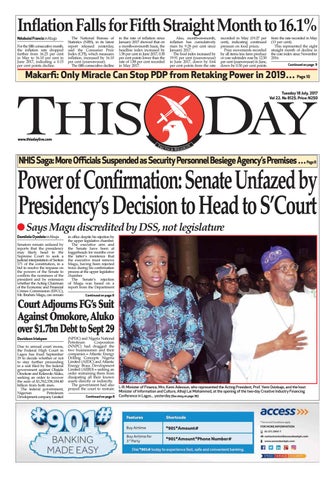
L-R: Minister of Finance, Mrs. Kemi Adeosun, who represented the Acting President, Prof. Yemi Osinbajo, and the host Minister of Information and Culture, Alhaji Lai Mohammed, at the opening of the two-day Creative Industry Financing Conference in Lagos... yesterday (See story on page 36)
2
T H I S D AY TUESDAY JULY 18, 2017
T H I S D AY TUESDAY JULY 18, 2017
3
4
T H I S D AY TUESDAY JULY 18, 2017
T H I S D AY TUESDAY JULY 18, 2017
5
6
T H I S D AY TUESDAY JULY 18, 2017
T H I S D AY TUESDAY JULY 18, 2017
7
8
TUESDAY, ˜ ͺͿ ˾ T H I S D AY
PAGE EIGHT
NHIS Saga: More Officials Suspended as Security Personnel Besiege Agency’s Premises Workers vow to resist Yusuf Senator Iroegbu in Abuja The ongoing power play between the suspended Executive Secretary of the National Health Insurance Scheme (NHIS), Prof. Usman Yusuf, and the Minister of Health, Prof. Isaac Adewole, took a new turn yesterday when security personnel laid siege on the Abuja premises of the agency. This is coming as the minister also suspended eight more NHIS officials implicated for their role in the alleged fraud, nepotism and abuse of office committed by Yusuf, which led to his suspension
penultimate week. THISDAY findings revealed that the security personnel, including policemen and officers of Nigeria Security and Civil Defence Corps (NSCDC) were stationed at the head office of NHIS and its annex in Wuse 2, both in Abuja, to prevent Yusuf from forcefully gaining entry into the agency’s offices. Since his suspension by the minister to enable the health ministry investigate the allegations levelled against him, Yusuf, who was appointed Executive Secretary of NHIS by President Muhammadu Buhari a year
ago, has maintained his innocence and defiantly told Adewole that only the president could remove him. According to a source, the arrival of security personnel at the NHIS yesterday got the backing of its workers’ union, which has vowed to prevent any attempt by Yusuf to disobey the three months suspension order. “The presence of the security personnel is a welcome development and we want to make it clear to Yusuf that he must obey the suspension order until the allegations against him have been fully investigated.
“Why is he in a hurry and why does he not want to be investigated? He is not above the law and should be grateful it’s only three months,” the source said. Adewole yesterday also approved the suspension of eight NHIS officials in order to pave the way for a thorough investigation of the allegations of corruption and nepotism levelled against Yusuf. The minister, in a statement by the Director, Media and Public Relations in his ministry, Mrs. Boade Akinola, said the suspension was “in furtherance of the establishment of the investigative panel of inquiry
and the desire to have an uninterrupted and robust investigation of all petitions at the NHIS, including security reports on maladministration and mismanagement by officials of the agency”. He listed the affected officer as follows: Mr. Olufemi Akingbade, General Manger, Zonal Coordinator South-south Zone; Mr. John Okon, General Manger, Finance and Accounts; Mr. Yusuf Fatika, General Manger, Human Resources and Administration; Mr. Shehu Adamu, Assistant General Manager, Audit; Mr. Vincent Mamdam, Assistant General Manager,
Head Insurance; Mr. Safiyanu Attah, Senior Assistant Officer, Marketing; Mr. Owen Udo Udoma, Senior Manager, Contribution Management; and Mr. Innocent Abbah, Senior Assistant Officer, Planning Research and Monitoring. The minister urged the committee “to remain focused, fair and transparent in the discharge of the national task despite the sensation this development has generated”. Adewole also directed the Acting Executive Secretary of NHIS, Mr. Attahiru Ibrahim “to ensure the immediate implementation of the suspension order”.
POWER OF CONFIRMATION: SENATE UNFAZED BY PRESIDENCY’S DECISION TO HEAD TO S’COURT of State Services (DSS), which had indicted him for alleged corruption and unprofessional conduct. Giving a reason for the presidency’s refusal to remove Magu, Acting President Yemi Osinbajo had latched onto Section 171 of the constitution and stated that the confirmation of the Senate was not required for Magu’s appointment. Osinbajo’s stance prompted a reaction from the Senate, which accused the presidency of double standards for sending the name of another nominee for the post of Director General of the National Lottery Commission for confirmation, after dismissing its powers to consider and confirm nominees. On this basis, the Senate said it would no longer consider nominees sent by the presidency except Magu ceases to act as the chairman of EFCC. Following the impasse over the powers of the Senate to confirm the nominees of
the presidency, which was further aggravated by another disagreement over the power of the National Assembly to alter the figures in the executive’s Appropriation Bill, Osinbajo had held a series of meetings with the leadership of the National Assembly to resolve the disagreement. This was followed by information made available to THISDAY by a presidency source on Sunday that the presidency was of the view that only a judicial interpretation of Section 171 of the constitution could either resolve or settle the matter once and for all. Reacting to the presidency’s position yesterday, some senators who spoke to THISDAY welcomed its decision to take what they described as a bold step to lay the matter to rest. “If they want to go to the Supreme Court, that is fine with us. The presidency is just looking for excuses. At the end of the day, it is a win-win situation, let
the Supreme Court rule on the matter so we can lay it to rest. “It is good for both parties so we can settle the matter of Magu once and for all,” said a senator who did not want to be named. “We are sure that they would lose. If they do not lose, it will set a bad precedence. The constitution is clear, but since they need verification, they should go for verification. “We have been saying it for months: go to the Supreme Court and they have been stalling. Now we have said nothing would happen unless they get that verification,” he added. Another senator challenged the presidency to also consider seeking interpretation on whether the National Assembly can alter figures proposed in the budget submitted by the executive. “In fact, they should go ahead on the budget bill also, so that the Supreme Court can decide if the National
Assembly can tinker with the proposed figures. “If the lawmakers can alter executive bills, will the Supreme Court say it cannot alter a money bill? A bill is a bill,” the senator said. “We stand firm and resolute, we will not consider anything, any request for confirmation. “Is it not contradictory that a presidency that said the EFCC chair does not need confirmation because the agency is not specifically listed in the constitution, would send us a confirmation request for another nominee for the Director General of the National Lottery Regulatory Commission, whose proposed agency is not listed in same constitution? “Finally heading to the Supreme Court is actually a welcome development. “Whatever they do between now and next week when we are going on recess, they have to get the ruling. The Supreme Court can get back within this week on the matter,” he said.
Another senator maintained that Magu was rejected by the Senate on the basis of the report of the DSS. “If for instance the Supreme Court rules in their favour, mind you, this is about the Presidency versus the Constitution, not the Senate versus the Presidency, as some may look at it, the issue of Magu’s credibility is still at stake. “An agency of the same presidency discredited him, not us, and it was on this basis that we rejected him, not just due to his appalling performance during the screening exercise,” he said. “It would actually be interesting to see how this plays out, whatever the outcome,” he added. Sources from the presidency had told THISDAY that the presidency was convinced that its position on Magu was the correct one, but wants the court to lay the dispute to rest. A source, who did not disclose when exactly the executive would head to
court for an interpretation of Section 171, said the decision was based on advise prepared by judicial and legal experts. “Our position is based on the legal advise prepared by judicial and legal experts as a working document in the presidency regarding the differences in the constitutional interpretations on matters of certain federal appointments. “In fact, the advisory unearthed a ruling of the Supreme Court on the matter when the current Chief Justice of Nigeria (CJN), before his elevation to CJN, had ruled in line with the view of the presidency on the matter,” he had said. He also observed that it was inaccurate to accuse the executive of acting unilaterally in its interpretation of Section 171. Efforts to get the official position of the Senate yesterday proved to be abortive, as the phone numbers of its spokesman, Senator Sani Abdullahi, could not be reached.
The deponent also stated that payment of a total sum of $25,839,606. 77, and N95 million were made to Real Bank for the purpose of part financing the acquisition of AEDC and AEBD companies’ property as well as renovation of some properties. Part of the properties included Mason Apartments situated at 6 Gerrard Road, Ikoyi, Lagos comprising 60 units of 3 bedroom apartments valued at $78 million; Marion Apartments Block 8 located at 4&5, Onikoyi Estate, Banana Island, ikoyi, Lagos consisting of 43 units of apartments valued at $76.16 million; renovation of an apartment block at 33A Cooper Road Ikoyi, Lagos at a total cost of $4,937,750; and renovation of Admiralty Towers at 8 Gerrard Road Ikoyi, Lagos. He also stated that the defendants made additional funds transfers among others to the tune of $69,912,981.15 to several companies, namely: Mia Hotels Limited, First Motors Limited, V.I. Petrochemicals, Evergreen Reality & Management, Wiz Trade Limited, DE First Union
Integrated Services and Amity Plus Limited. Kehinde also averred that Aluko literally took residence
COURT ADJOURNS FG’S SUIT AGAINST OMOKORE, ALUKO OVER $1.7BN DEBT TO SEPT 29 the defendants and their agents, and however called within and outside Nigeria from giving instructions, demanding, accepting or receiving payment from 19 commercial banks in Nigeria, eight offshore banks, and eight other companies listed before the court. The trial judge, Justice Oluremi Oguntoyinbo, last year, had issued an order restraining the defendants and their agents from demanding, receiving, transacting, mortgaging or whatsoever dealing in any manner with the assets of the defendants in banks, houses, land and shares in Nigeria and others located outside Nigeria, while the Nigerian banks listed in the motion papers were ordered to, within seven days, sequestrate all money and negotiable instruments standing to the credit of the defendants in the sum of $1,762,338,184.40, and keep same in an interest yielding account in the name of the Chief Registrar of the court as trustee of same, pending the determination of the motion on notice.
The court also ordered that the order of the court should be served on the affected parties by way of advertisement in newspapers circulating within and outside Nigeria. Apart from the pending application filed before the court by Omokore and Aluko urging the court to stay proceedings on the suit on the grounds that they have filed an appeal against the ruling of the court, there is another pending application filed by a company, Virtual Properties and Investment Limited as an intervener. The company is urging the court to discharge or vary its order, as it relates to Marion Apartments on the grounds that the property (Marion Apartments) located at Block 8 Plots 4&5 Onikoyi Estate, Banana Island, Ikoyi, Lagos, consists of 56 apartments owned and developed by the intervener by virtue of two separate deeds of sublease. The intervener also claimed that it conveyed its interest in 13 out the 56 apartments to Realblanc Energy Engineering Limited, an affiliate company
of the defendants. The intervener still retains ownership of the 13 out of the 56 apartments in Marion Apartments, therefore the order of the court is prejudicial to its interest and interferes with its right of ownership over these flats. The federal government in an affidavit attached to the suit and sworn to by a legal practitioner Oginni Isaac Kehinde of the Federal Ministry of Justice Abuja, had averred that Omokore, Aluko and their two companies were indebted to the Federal Republic of Nigeria to the tune of $1,762,338,284.40 on account of crude oil lifting under the Strategic Alliance Agreements (SAA) between them and the federal government. Kehinde averred that the defendants, by virtue of the agreement, were granted a licence to lift crude oil and other associated products in Nigeria for sale and for parties to share the profits under agreed terms. The defendants indeed lifted and sold the crude oil and have been paid but bluntly and deliberately refused to
pay the federal government, rather they unlawfully diverted and converted the profits share due to the federal government in the sum of $1,762,338,184.40 to their private use, he averred. The deponent listed the particulars of diversion as follows: Several vehicles with a combined value of over N800 million were purchased by the defendants and donated to the Peoples Democratic Party (PDP) through its former acting National Chairman, Prince Secondus. Additional vehicles valued at over N130 million were purchased by the defendants and distributed to former Minister of Petroleum, Mrs. Diezani Alison-Maduekwe and some other managerial staff of NPDC. He also stated that the sums of $18,548,619.99 and N1.070 billion were paid to FBN Mortgages Limited by Kolawole Aluko as part payment for Block A consisting of 26 flats at 46 Gerrard Road, Ikoyi, Lagos purchased at a total cost of N5.21 billion.
Continued on page 9
TOP GAINERS UNILEVER FORTEOIL SEVEN-UP CHAMPBREW FLOURMILLS TOP LOSERS OANDO NASCON AIICO
NGN NGN % 3.38 36.38 10.2 4.33 60.50 7.7 5.72 9.95 6.4 0.15 2.65 6.0 1.25 26.25 5.0 NGN NGN % 0.72 6.83 9.5 0.47 9.03 4.9 0.03 0.58 4.9 SKYEBANK 0.03 0.61 4.9 BOCGASES 0.15 2.99 4.7 HPE Nestle Nig Plc ₦ 904.00 Volume: 322.814 million shares Value: N2.734 billion Deals: 3,830 As at yesterday 17/7/17 See details on Page 31
9
TUESDAY, ͚΀˜ ͺ͸͚Ϳ Ëž T H I S D AY
STARTERS
Boris Becker Loses ÂŁ100m Fortune Investing in Nigerian Oil Firms
Two-Minute BrieďŹ ng NEWS Makarfi: Only Miracle Can Stop PDP
NEWS
TUESDAY JULY
Email davidso
from Retaking Power in 2019 The National Caretaker Committee Chairman of the Peoples Democratic Party (PDP), Senator Ahmed Makarfi, has said if the party sustains its current momentum, it will only take a miracle for it not to win back the presidency in 2019. Page 10
18, 2017 Ëž T
H I S D AY
Makarfi: On ly Miracle Ca n Stop PDP from Retak ing Power in Jonathan, Fay 2019 ose, Ekwerem adu News Editor
n.iriekpen@thi
Davidson Iriekpe
sdaylive.com,
n
08111813081
express optimism
Onyebuchi Ezigbo in
Abuja way forward for the party. The National He restated continues the Caretaker Committee good work the party not the position of doing Chairman of to punish any that time would it is Peoples Democratic The the one when come some former president said Party (PDP), for his role in the longeveryone Senator Ahmed members of drawn to go back to their crisis that bedeviled Makarfi, has the find their waywould begin who are if the party said the party. not PDP memberspublic to help rebuild villages in order atmosphere back to the He, however, sustains its current and warned: “While party, adding that momentum we are even those him after the Supreme called the affairs of the reposition secretariat at the PDP national , it will only Court grassroots judgment to take a give reconciling, we will not who had left would party at the miracle for (Wadatta House) it not show what belongs Abuja, saw the . in the presidencynot to win back and In spite of negativesolidarity. to a person to be begged to come need presence of “Most of us to another. back. in 2019. “Today is day tantrums against PDP, here should top leaders of the party many Speaking at endeavour of joy “We intend to it is still the full of expectations. a meeting to go home bring everybody us, I decided to come for all of all Nigerians, party canvass the expanded of on board and to this support for the meeting The and then move of the party national caucus party The chairman� he said. PDP. If Ike Deputy Senate President, our speech not to present any held at the national forward.� of the PDP this party must return to but. I Governors’ headquarters power, PDP Ekweremadu, described if this party Yesterday’s Forum, in the leaders came to thank Ayo meeting of said all the partyAbuja, Makarfi national and members Fayose, also Governor form, we will come back to dies. as a ‘Beetle’ that never the must of optimism expressed He said God to close ranks needs to do is turned caucus was almost the party. I felt that go back to our all be ready to the that PDP has seen this first sufferings villages would hard clinch power to realise the and work hard of someinto a campaign rally meeting is the best time for its success, to work and decided of Nigerians in 2019. to come target. and thank you sort, considerin “APC “If PDP and to all for standing being Abuja g the with will soon number party politicians,� he stop PDP, adding that restore the the party. leaders were to inherit power. die for PDP current effort sustains the the said. come Earlier, the in hall. If your brother “I believe that former acting the party will bounce 2019, its restructure at rebuilding National Chairman key decisions is alive, you will not inherit The back to power to return property. He it would onlys, I assure you higher momentum got even are to going to made tonight his party, of the the country will need Uche the path of to on before for us not to take a miracle President,when the former how to chart the way growth you inherit his to die very loud Secondus, in his forward. win the election Let us cooperate Among the top again. prayer to mark property. Dr. These people in 2019.� commence leaders of the with the Jonathan, entered Goodluck leadership the party must that attended to rebuild the party must go. Now the go; I say they proceedingment of the day’s the hall as Makarfi whose were, Governors the meeting party. This All our efforts coast is clear. s, speech was the crowed hall erupted intermittently party within in loud for saving the thanked God Nyesom Ayo Fayose, ovation that lasted for almost should be geared this period we must must bounce back, hands party from ovations from interrupted by five regain the confidence the Senators Wike, Dairus Ishaku, minutes. towards of of evil rebuilding the audience in the appreciative Nigerians,� party.� destabilising doers and the Akpabio,David Mark, Godswill In his the hall, said he hands of the leadership decided Fayose urged said. the expressed remarks, Jonathan Progressives All Josephine Dimeji Bankole, party leaders optimism Congress (APC). caucus meeting to hold the would Anenih, Senator to The recover from that PDP Stella highly in order to see the faces the present charged and Omu, former ministers state to of lawmakers. celebrate and members and Nigeriansbecome the toast of strategise on once the He said if again. the leadership
CBN Sells $195 m to Banks
In continuatio exchange supplyn of its foreign value of the naira. Bank of Nigeria drive, the Central According to him, the bank intervened in the (CBN) yesterday remained of the market interbank segment its objectivedetermined to achieve to the tune $195million. of hence the of rates convergence, unrelenting injection Figures released intervention of show that it offered by the bank exchange funds into the foreign market. the total sum of $100million Speaking further, segment, whileto the wholesale expressed Okorafor the small and optimism that medium enterprises the naira would sustain its run against (SMEs) segment received the the sum of dollar and other major currencies $50 million. around the world, considering The the level of transparen invisibles segment, market. comprising tuition cy He therefore in the payments and fees, medical stakeholde advised Allowance (BTA), Basic Travel guidelines rs to abide by the among others, to ensure transparenc received $45 in the market. y million. Confirming the The the CBN acting figures obtained, in the CBN last week intervened Director Mr. Isaac Okorafor, at the Bank, forex various segments of the market said the CBN was pleased $396.8 million.with the sum of L-R: with the state Partner and Head, of forex market, But adding that the the Technology Advisory will continue bank maintainthe naira continued to President and CEO of and Markets, to intervene in Dangote Advisory – SAP, its stability in KPMG in Nigeria, to sustain the liquidity order the KPMG in India, Industries, Alhaji Aliko Dangote; in the market market, exchanging at an forex the first African Mandar Joshi, and guarantee National SeniorJoseph Tegbe; Deputy CEO, average CEO to be featured of N364/$1 at the the internationa KPMG in India, in the report, in official presentation of the Partner, KPMG in Nigeria, l of the marketin the BDC segment Akhil Bansal; Lagos....yesterday Kunle Elebute; 2017 KPMG Global yesterday. and
WE ARE HAPP Y TO IDENTIFY
EDITORIAL AbujA And The InvAsIon of Cows
WITH YOU
Crud Oil
A
Partner ERP
CEO Outlo k R
D AY Ëž ÍŻÍśËœ Í°ÍŽÍŻÍľ
EDITORIAL
15
ABUJA AND The authorities
O
THE INVASIO
must enforce
N OF COW S
the
law banning n the front cattle grazing page of a national within the FCT newspaper last tograph which week was a phopicture of the painted a pathetic level to which to ornamen Federal Capital the tal resources is owers and grasses grown has degenera Territory (FCT) an ted. In the photowith huge condoned any economic waste that graph, herds ought not to of be over the same further. Besides, as we seen grazing cattle could be of the multi-bill warned recently ion naira National within the precincts muters using issue, the inconvenience men come Stadium. “The the nation’s caused cominto curtailed, precipitat capital highways herdsday. They come the stadium with their cattle almost could, if e a protest worsening fence and we through the collapsed every socio-economic by a populace over not portion of the can’t stop them their conditions. said an ofďŹ cial because we are not armed,â€? quite aware who claimed that the urely, herding management of the situation about it. was without doing highways of cattle along the streets and the anything The ugly developm street trading, FCT is as much an offence begging and ent probably less concern have been outlawed hawking, all as would if of which It is therefore From Asokoro it were an isolated incident. have been of bafing that by the federal governm to It Maitama was the ent. in spite not. FCT Minister, within the and Jabi, the FCT Mr. Muhamm of the clear charge by agencies to ing major accessnowadays is that of herdscommon sight ad Bello, to enforce the the security law prohibitin Abuja, the herdsmen even in broad roads, including within of cattle blockdaylight. This the city centre, have continued g cattle grazing in hindrance and Given the impact is clearly to of climate change,unacceptable. them to persist with a sense of entitleme operate without nt. Yet to allow TO ALLOW ecological factors, cattle grazing in utter disregard for HERDERS the law prohibitin population TO PERSIST growth, to suggest to within the precincts of g the federal other citizens increased cattle DISREGARD IN UTTER capital is they too could that do as they wish. the possibility exists PROHIBITINGFOR THE LAW rustling, banditry, teraugur well that That certainly TH for the rorism and CATTLE EDITOR I S DAY will not insurgency, DEPUTY EDITORS GRAZING WITHIN To the extent nation. we can understan that pastoral MANAGING Ëœ source of livelihood FEDERAL CAPITALTHE productio d the DEPUTY MANAGINGDIRECTOR
problem that for large populatio n system is a main we understan DIRECTOR IS is pushCHAIRMAN TO SUGGES
EDITORIAL ing ns d the in the herders our country, desperation T TO OTHER BOARD EDITOR NATION’S their ocks of shepherd CITIZENS THAT CAPITAL
to their natural from s pushing for grazing. any and everywhere they habitat. POSSIBILITY THE But the main But that still aggravating issue here goescan ďŹ nd grass does not THEY TOO EXISTS THAT excuse a situation challenges associated with beyond the COULD DO resource use AS and which for instance,in THEY WISH without which management to that transhumance, T H I S DAY at the Universit of law and order N E W S PA any society EDITOR-IN-C y of Abuja, is endanger We with students HIEF/CHAIRM P E R S L I M I T E D must GROUP remind cows EXECUTIVE ed. AN
the authoritie DIRECTORS intended to city has in the on the campus. Indeed, now compete s that
be ˜ the nation’s ˜ less possibiliti Nigeria’s pride and joy: Abuja was GROUP FINANCE ˜ herds of cattle last one year or so been capital DIRECTOR a city with limitDIVISIONAL es and our swarming with in search of DIRECTORS people’s convergen commerce, grass for grazing. Although the business, ˜ Abuja city centre DEPUTY DIVISIONAL and social developm innovation, ingenuity ce point for ˜ have farms and DIRECTOR that , creativity ent. That is SNR. ASSOCIATE administration clash between could precipitate the environs do not ASSOCIATE
why we DIRECTOR kind pastoralists CONTROLLER DIRECTORS law by keeping and the security agenciescall on the FCT season in several and farmers of violent S Ëœ Ëœ that states of the and its streets, the herdsmen and their to enforce the GENERAL country, the deďŹ nes this MANAGER Ëœ cattle off the
destruction GROUP HEAD If the authoritieroads and highways without city
DIRECTOR, PRINTING further delay. PRODUCTION herdsmen who,s do not curb the brazen TO SEND EMAIL: ďŹ rst name.surnam act as though in turning Abuja to theiracts of these e@thisdayliv above the law, grazing ďŹ eld, e.com the seed of a serious crisis. they are unwittingly sowing Letters in response to speciďŹ c publicatio readers may TO OUR READERS ns in THISDAY opinions on send such letters along topical local, should 1000 words). national and with their contact details be brief (150-200 They should internatio words) and to opinion@ be sent to opinion@nal issues provided straight to the thisdayliv point. Interested thisdaylive.com they are well-writt e.com. We also welcome en along with the and should also comments and email address not be longer than (950and phone numbers he recent assurance of the writer. given by Governor bode of Lagos
On the front page of a national newspaper last week was a photograph which painted a pathetic picture of the level of which the Federal Capital Territory (FCT) has degenerated. Page 15
S
Letters to the Editor
CURTAILING
T
Akinwunm State to stem as it is imperative. i Amthe tide of floods is as The crux of sustainable timely the matter solutions to is that finding this critical blame game issue goes b The go
POLITICS How Obiano Won the War
THE RAGE O
F FLOODS
challenge is the the construction reduced offshore sand deposit in Lagos of ports in close mo it both L cau d b
IN NIGERIA
POLITICS
T H I S D AY
Ëž TUESDAY, JULY 18,, 2017
Group Politic s Editor Tobi Email tobi.so Soniyi niyi@thisday live.com 0803314613 9 SMS ONLY
EXECU
TIVE B RIEFIN How Obian G o Won the W David-Chy ddy ar against Cr change a state Eleke looks at the measu res taken by that was almos imes the Anambra t a postca
against Crimes Just months into his swearing in J as Anambra State governor, Chief Willie Obiano convened a security summit, in which he flew in an Israeli security expert, Morshe Kennan. The summit had representatives of all security agencies in the state in attendance. Page 16
rd for violen ce, to one now
State governor, Chief Willie reckoned with Obiano, to by investors
ust months into his swearing Anambra State governor, Chief in as Obiano convened Willie a security in which he summit, expert, Morsheflew in an Israeli security representativesKennan. The summit had of all security in the state agencies to come out in attendance. The agenda with measures was criminal elements to flush out in the all safety of all residents of state, and ensure Close to four the years of his entire state. security has administration, achievements become one of the summit gave of the governor. The biggest security birth to the ‘Operation formation Kpochapu’, of in English means ‘clean and Igbo word which cleaning up up’ and was the state of geared at who have been all unwanted persons committing The Operation crimes in the state. Kpochapu of all security team comprises the Nigeria agencies in the state, Police including Nigerian Navy, Force, the Nigerian Army, Defence Corps, Nigeria Security and Civil National Drug Agency, Nigerian Law Enforceme Customs Services nt the vigilante, and even among others. was to fish out drug barons, Their mandate kidnappers armed who engage and even petty thieves robbers, in any activity and all be in the positive considered not to interest of This mission paid off greatly,the state. on the lips and the song of the governor many Anambra residents has become is that who has managed the to keep the new messiah devoid of state safe, and the brazen the state previousl robberies witnessed in daylight kidnaps y, as well as the kind of which the synonymous state was almost with then. Later, it dawned on the governor the armed robbers that as refuge in neighbour left Anambra ing states in , they took and also in the south-east neighbouring from the threat Delta State. Apart states posed robbers operating from these to Anambra this to be detriment , Obiano al to the growth thought states, hence of such conference the need to convene for all the a security Delta State, south-east states he is doing and get them to replicate and what his strategiesin Anambra by selling some of to This culminatethem. Obiano, the security conscious States’ security d in the South-Eas governor theme; Security; conference of 2015 t, Delta agreed that with the security was at the Anambra bedrock for governanc governance, the bed rock e held and must of good several personalitState governor’s be gotten Two years During a recent lodge right. after the conferenc ies including with in attendanc conference Associatio five governors under Obiano e. of the National e, Anambra n of Law host governor, The conference kicked most peaceful is known to be delighted Obiano Teachers press interview one of the off with Obiano welcomin states, as the stating that said the state (NALT), a praised the criminality security using governor for kind of brazen g guests years Anambra being witnessed the law, while had achieved acceding to driven investors of successive robbery and almost inexistent the federal command in other states the request State away had has by zone, and is to be able government to toe also advising of the them to work procuring working become the in Anambra today. Security left constitute from the south-eas the to provide most t helplessly. security in same line He told Acting recorded by with. Okaula said the aides for He said the d authorities looking of the Anambra State visible achievement the country. all the participat President time had the governme who was honoured hitherto as a result the police in fighting successes Yemi Osinbajo come for nt, just as inexistent ing states crime was of Anambra. and new investmen night life by the associatio to toe the “Anambra whom he said the support of the This, he said line of places. is highly regarded governor n that, had not relented ts springing has arrived, state to bring the explained to them. in Nigeria up in diverse states together the need in his support today. Anyone as the safest agenda. and set a common with the Anambra The governor, who is familiar Obiano at that for decades, narrative would procured over had early in his administra remember our beloved here to ask the conference said, tion down by lawlessne detector, speed100 security cars fitted state was held “We are with speed fall to th b how long we shall gun and l ss and i mad l oth
FEATURES
FEATURES Embracing Society’s Rejects Becker Wimbledon legend Boris Becker lost a huge part of his ÂŁ100 million fortune in dubious investments in Nigerian oil firms, it has been claimed. German news magazine Der Spiegel – citing documents from soccer whistleblowing platform Football Leaks – said Becker struck the deal in 2013, which contributed to his recent bankruptcy. Spiegel said the “mega dealâ€? was brokered by a Canadian firm and a Nigerian employee of Becker, pictured. It said documents show that in July 2013 Becker held shares in an oil and
petrol firm in Nigeria. But the investments tanked and last month he was declared bankrupt. John Briggs, Becker’s lawyer, told the London court: “He is not a sophisticated individual when it comes to finances.â€? Becker, now 49, was once estimated to be worth upwards of ÂŁ100 million. He was declared bankrupt over undisclosed sums owed to London-based private bankers Arbuthnot Latham & Co since 2015. His remaining assets will be disposed of to pay creditors. Among earlier cash
woes, Becker was landed with divorce and paternity settlements in 2001 totalling more than £20 million – to his first wife, Barbara, and Angela Ermakova, the Russian model who had his baby after a brief encounter in a London restaurant. The next year Becker received a twoyear suspended sentence for tax evasion. He was ordered to pay £2.5million in back tax, fines, and costs after claiming Monaco as his main residence while mostly living in Munich. And in 2011 a Dubai property development to which he lent his name went bust.
INFLATION FALLS FOR FIFTH STRAIGHT MONTH TO 16.1% The urban index rose by 16.15 per cent (year-on-year) in June 2017 from 16.34 per cent recorded in May, while the rural index increased by 16.01 per cent in June from 16.02 per cent in May. On a month-on-month basis, the urban index rose by 1.60 per cent in June as against 1.84 per cent recorded in May. The rural index also increased by 1.57 per cent in June from 1.92 per cent in May. According to the NBS, the corresponding twelve-month year-on-year average percentage change for the urban index rose from 18.88 per cent in June to 18.69 per cent in May, while the corresponding rural index equally jumped from 16.50 per cent in May to 16.56 per cent in June. Similarly, the composite food index increased by 19.91 per cent in June 2017. The rise in the index was attributed to a rise in the prices of meat, bread and cereals, fish, potatoes, yam and other tubers, oils and fats, milk, cheese and
eggs, coffee, tea and cocoa. On a month-on-month basis, the food sub-index increased by 1.99 per cent in June, up by 0.64 per cent points from 2.54 per cent recorded in May. The average annual rate of change of the food sub-index for the twelve-month period ending in June 2017 over the previous twelve-month average was 17.87 per cent, 0.39 per cent points from the average annual rate of change recorded in May (17.48 per cent). The all items less farm produce or core sub-index, which excludes the prices of volatile agricultural produce eased by 0.50 per cent during the month of June to 12.50 per cent points from 13.00 per cent recorded in May, as all key divisions which contribute to the index increased but at a decreasing rate. Taken on a month-on-month basis, the core sub-index recorded a 1.32 per cent rise in June, 0.15 per cent points above
the 1.17 per cent posted in May. Solid fuels, clothing materials and other articles of clothing and clothing accessories, liquid fuels, spirits, books and stationeries, passenger transport by air, garments, shoes and footwear and motorcycles recorded the highest increases. According to the NBS, the average 12-month annual rate of growth of the index was recorded at 16.22 per cent for the twelve-month period ending in June 2017, indicating a 0.35 per cent points decline from the twelve-month rate of change recorded in May. From 18.55 per cent in December 2016, Nigeria’s inflation rate increased to 18.72 per cent in January 2017 (the highest), dropped to 17.78 per cent in February, 17.26 per cent in March 17.24 per cent in April, and 16.25 per cent in May before declining to the current rate of 16.10 per cent in June.
COURT ADJOURNS FG’S SUIT AGAINST OMOKORE, ALUKO OVER $1.7BN DEBT TO SEPT 29 outside the shores of Nigeria in order to facilitate the diversion of the proceeds of the crude oil lifted. The residency abroad led to the diversion of funds into physical assets, cash in the bank and shares as at 2014 as follows: Grove End Road, London; 755 Sarbone Road, Los Angeles; 952 North Alpine Drive, Los Angeles; 815 Cima Del Mundo, Los Angeles; 807 Coma Del Mundo (Land); 1049 Fifth Avenue, New York; 1948&1952 Tolls Avenue, Santa Barbra; 157 West 57th St, New York, and 4100 Let Revenge, Dubai.
Others included residences in Nigeria: Avenue Towers, Lagos; land in Mont Tremblat, Canada; Colina D’oro Montagnola, Switzerland, while cash in bank accounts were as follows: LDT Switzerland - $25milion; Corner Bank, Lugano, Switzerland - $1 million; Deutsche Bank, Geneva - $40million; HSBC London - $175,000. Aluko’s investments in shares were as follows: 75 per cent shareholding in AEDC and AEBD and 10 per cent shareholding in Seven Energy. Other Holdings included Galactica Star (a luxury yacht); 20-year berth
lease in Barcelona; watch collection; car collections (58 vehicles); and aircraft comprising a Global Express S5-GMG, Bombardier Global 6000 9H-OPE, and another Bombardier plane. The deponent consequently urged the court, as a matter of utmost urgency and public interest, in aid of administration of justice to issue a worldwide Mareva Order restraining the defendants from dissipating all known assets directly or indirectly by the defendants, including but not limited to assets listed on the face of the motion paper filed before the court.
On a sunny afternoon, after several days of torrential rainfall that wreaked havoc in Lagos, a Good Samaritan showered love to the less-privileged children at the Heart of Gold Children Hospice, Surulere... Page 18
TUESDAY, JULY 18, 2017
Embracing Society’s
Ëž T H I S D AY
Acting Featur es Editor Charle Email charle s Ajunwa s.ajunwa@this daylive.com
Out of love Adebowale for children forgotten Hospice in Ogunkoya, celebrated by society, the Mana Lagos, write his ging Direc tor, Deksy s Peter Uzoh 60th birthday with Telecomms, children at o the Heart of Mr. Gold Child ren
Celebrant,
Adebowale
O
Ogunkoya
(middle) cutting
Rejects
cake with
some children n a sunny of Heart of afternoon, Gold Children several days after Hospice in Lagos, to mark of torrential decided to come rainfall that his 60th birthday‌r low to identify them. He has seen in Lagos, a wreaked havoc ecently with the suffering showered Good Samaritan s, pains and disconnect experienc love to privileged ed by children in YOMI AKINYELE Heart of Gold privileged childrenthe lessthe society, the less- for me the ones Children Hospice, at the at particularly, to thank God. a home for Hospice and the Heart of Gold children abandone Surulere, I think it’s Children opportunity for me Adebowa also an to enable himresolved to defy social d by society. to let this Home of Deksy le Ogunkoya, Managing exists,â€? he people know that his birthday extend love to them norm, Telecomm Director s, attained 60 on Monday, celebratio during to He did all these to explained. for me to quench show love July 10, 2017. the age of say I want n. “It’s not difficult day, he had to the unloved. his hunger move in there Prior to this to rent looking been preoccup to celebrate ied with how Celeb my birthday, with my friends a hall and poorest forward to celebratin “I’ve been his 60th birthday to celebrate of the poor rating with socially responsib but I think is more profitable and those g with the presence,â€? in a more I doing it this them le manner that need our that would Ogunkoy derive eterna way to me Ogunkoya and, told THISDAYand humanity,â€? satisfaction. Althougha said with a feeling humanity. make meaningful in a way l joy and You could of and the peak impact to also increa it was . Even when of working a working day se my sens children as see the joy on the his famil he h h f O of h
BUSINESS NNPC Asks Lawmakers to Quiz DPR
over Influx of Adulterated Kerosene The Nigerian National Petroleum Corporation (NNPC) has asked an investigative committee of the House of Representative Committee on Petroleum Resources (Down- stream) to shift its investigations on the influx of adulterated kerosene into the Nigerian market to the Department of Petroleum Resources (DPR)... Page 21
ÍŻÍśËœ Í°ÍŽÍŻÍľ
BUSINESSW NIBOR OVERNIGHT 1-MONTH
3-MONTH 6-MONTH
A S
ͰͰ˛ͳ͹͹ͯ ͰͲ˛ʹ͜ͳʹ
ORLD A T
NITTY 1-MONTH 2-MONTH 3-MONTH
21 Group Busines s Email: chika.am Editor ChikaAmanze-Nw achuku anzenwachukwu @thisdaylive.com 08033294157, 08057161321
J U L Y Ͱ͎˛ͯ͜Ͱ; ͯ͡˛͎Ͱ͜ʹ ͯ͡˛͹͜ͳͳ
7 ,
6-MONTH 9-MONTH 12-MONTH
2 0 1 7 EXCHANGE RATE ͹͎ͳ˛͹ͳ˚
Ͱͯ˛͹͜ʹͯ Ͱͯ˛ͳ͎ͳ͜ ͰͰ˛ͳ͹͡Ͱ
SNEPCo Launch
The Shell Nigeria es Health Crusad Exploration (SNEPCo) e and Productio has n Company Federal Capital launched its first medical Karu in Abuja, Territory at Gidan Mangorooutreach in the treating more community providing medical than 4,000 beneficiaries of supplies to This is the latest and phase of Shell’s five local primary schools. which was Health-in-M rolled out in Speaking at the Niger Delta otion programme the in 2005. in Abuja, the opening session of the Managing Director two-day said the crusade of SNEPCo, programme aimed to Bayo Ojulari, and curative health services take free promotive, preventive in Nigeria. By doing this, to the hard-to-reach communit support the he said, ies “we hope to efforts accessible healthcareof government at be able to to the people.� all levels in providing Shell’s Regional Ojulari, Fajola, advised Community Health Manager, represented by Dr. Akinwum which he said against ignoring early i signs of health management could make it difficult challenge for prompt by medical and effective officers.
‘SIIFZ Repres
ents
ALL FOR SAFE R SKIES
L-R: Commissio L. Sumwalt and ner, Accident Investigati on Bureau Managing Director DC, United States of NTSB, Mr. (AIB), Akin Olateru; Chairman, of America ... Dennis Jones, National Transporta recently during the helmsman ’s visit to the tion Safety Bureau (NTSB), headquarters Robert of NTSB in Washingto n
NNPC Asks Influx of Adu Lawmakers to Quiz DPR lterated Kerosen over e
Chineme Okafor
in Abuja
The Nigerian National Petroleum Corporatio
ENERG Y
Managing
every day in
the country,
The General Nigeria Manager of (NipeX), Mr. the Nigerian ’s Potential’ Petroleum Exchange of Nigerdock Kanayo Odoe has described and the available the Integrated facility at the operations Free Snake Island great prospects Zone (SIIFZ) as a paradigm of Speaking this and impact on Africa. Nigeria’s noted that during his recent courtesy Nigerdock and its activities visit to SIIFZ, Odoe the prospects “Snake Islandof Nigeria across Africa. on SIIFZ represent great country is a manifestation of all Nigeria. It the people is my earnestthat is good in this of hope on behalf muster to makethis great nation that of all good organisatiothe organisation great the support we can will be n. Be reassured commitment of our highestgiven to your in bolstering support and benefit of Nigeria. your organisati on for the overall He was conducted Keep up the good Affairs Director, on a tour of the facilitywork,� Odoe said. by Group Corporate Joy Okebalam Nigerdock, Ifeanyi a; Nigerian Temitope Odulate,Chime; Senior Project Content Manager, Manager, Nigerdock among others. During a brief , presentation, has a significant Okebalama operating withinnumber of Free Zone explained that SIIFZ Enterprises the zone. currently
leaving other marketers n (NNPC) Director of has asked NNPC, balance to import the safety standards. He Dr. Maikanti an investigat added: Baru, said “The NNPC of three committee ive NNPC the of ensures He explained million. Representative the House of player was only a market the corporation entire refining output that the and Committee also ensures in Nigeria through Petroleum Resources on the sector. not a regulator in that of refining and the processes Harcourt;its refineries in Port (Downstream) to shift distributin Warri; His on the influx its investigations in a remarks were contained kerosene were done with g its and any products and Kaduna statement from respect for standard kerosene into of adulterated Group industry protocols, it to make up for imported by NNPC’s Eskom Refute shortfalls meet market supply market to the the Nigerian Affairs,General Manager, Public adding that specificatio s Cash-crunch South African the specificatio ns proDepartment vided by the Mr. Petroleum Resources ns of in Abuja. Ndu Ughamadu, Nigerian Institute of the Nigerian Reports challenges, power producer Eskom of Standard (NIS) Institute of the utility said is not facing petroleum industry’s (DPR), the and Standards Standard (NIS) and alleging it would Represented liquidity on Sunday, Standards regulator. Organisation by NNPC’s Organisation of Nigeria after media Speaking at Chief Eskom, which be unable to pay of reports Operating a Nigeria (SON) (SON).� salaries by Officer, Down- were also observed public hearing recent two-day stream, According to November. Africa’s most produces nearly all to avoid Baru, the NNPC Mr. Henry Ikem-Obih its subversion would not compromi tee to address by the commit- the of safety in to neighbour industrialised economy of the electricity in NNPC boss , use of its the challenges the and quality se safety ing hampering kerosene kerosene. the corporation also stated that than $10 billion states such as Namibia,and exports energy in its products He noted that currently refines and use in Nigeria, availability up the kerosene processes. He maintained and “Eskom refutes in government guaranteeis backed by more to 60 per cent the Group that of the eight and other petroleum products all its depots in the notion s. million litres and that it the country had that it is supplied by of kerosene has laboratorie the NNPC used of months,� the only enough cash to facing a cash crisis, were to ensure s for quality checks high quality last for the safety of consumers The state-ownstate-owned utility said next three and meet . Continued publication ed power producer last in a statement. on page 22 of week postponed but said later its annual results without the that external auditors giving reasons, irregularities�. had raised “reportable Eskom has also come under documents scrutiny in the put it Eji f A d
Report: Upstrea m Projects’ FID 2017 s to Double in
Home Construction The use of incompetent craftsmen, low quality building materials, weak supervision non-compliance with specifications/standards by developers/contractors, poor maintenance culture, improperdesignareamong the many reasons given for poor workmanship in Nigeria. Page 28
PROPERTY & ENVIRO
T H I S D AY
Ëž TUESDAY, JULY 18,
NMENT Lafarge Af Constructionrica Bridges Skills Ga p in Home Lafarge Africa Plc.,
2017
is using its Easy skills gap in Home, an innov in block makiNigeria’s construction indus ative affordable ng, among other try, free services. by giving home build housing initiative, to ers access to bridge the Bennett Oghi trained artisa fo reports ns skilled
Lafarge’s aordable
home
The use of incompet craftsmen, ent from low quality African neighbouring building materials, West countries supervisio like Benin buying land and n non-comp weak Republic and local land tenure issues with specificati liance of Togo. home builders’ good bricklayer The lack challenges are some by developer ons/standards made budget and s and well of individual of the makes their s/contractors, blocks artisans, dream builders which poor maintena home project The Easy Home a reality.â€? and obstacles to are among the Easy Home nce culture, solving Nigeria’s addresses, land acquisitionexecution Rivers. improper said was another initiative, he builders housing deficit. Boyer said. design are It has enabled . It offers among He said Easy the many about “The housing reasons given Home benefi- how Lafarge is example of leverage the opportunity to 10 per cent of its beneficiari poor workmans contributing for estimated its partnershi to build business backlog is ciaries, in addition es hip in Nigeria. ps as the one to getting to the construction at access to structures of cities it has with such such as shops, around the and it will 14 million units trained Lapo schools, clinics, require 49 skilled in block-mak artisans innovative world, through Micro-finance Skilled manpowe to bridge,â€? trillion Bank which bakeries, etc and ing, enjoy solutions providing provides housing r‌ according to the Lafarge The country is creating opportunities them with report commissio a 2010 advantage finance needs infrathose that more housing for these busiartisans trained structure, i.e. come through for nesses to generate and Finmark ned by EFInA both and initiative. in site safety. making them more this naira “They also bridges, railways,hard (roads, Trust. It also compact, more and thousandbillions of houses) trained technicalget access to and durable, more beautiful, technical advisoryprovides free soft (skilled s of jobs. Boyer said, manpower) and Construction better connected services and assistants that “This is the assistance can handle its socioecono to for Experts style... home constructi and we deliver only . different phases construction of constructi on solution and the role mic development industry in the constructi a for Easy estimate of the constructio on on Home to boost from start such as is low income earners; the industry is n presently,believe that Nigeria, to finish, and a the solution afford- andnumber of cement, it critical. network of able housing... blocks of needs 59.5 profession their unit However, the Lafarge Africa people whofor this class al to bridge its trillion cost in just sector is neither minutes.â€? 18 million housing engineers and experienced that 10 N20,000 employing earn from Plc deficit. who assist nor contributi its Easy Home has said to N300,000 He constructi in enough. For said “These the is conceived and are ng aiming to initiative on “Every year, build technical advisory to provide site visits—befprocess through able in providinga sector involved of only afford- unconditiservices are offered The solution is their homes. ore constructio the one million a tenth starts housing accessible and property,shelter for lives required n to prepare everybod Easy Home in the country. beneficiar onally, but to the number a plan, design are built. homes and bill the traders, y including petty is an people employed of these ies are expected civil servants, are by intrepid Most of constructiof quantity, during housing solution ambitious to use in Nigeria’s construction Lafarge drivers, barbers, which inindividutaxi volves 25 on and at als who contend blocks because cement and countries the end. smaller than industry is way workman etc.â€? with shoddy The engineers According globally. In 2016 alone, those are those engaged also help). to the Director, ship, poor As these bricklayer in retail, wholesale over 445,000 the materials the Communications building people were materials, company is confident s, deficient financing, cians and and auto impacted and repair. Affairs, Folashadeand Public to engineers techni- targeting to and an it is The technical use. work on impact 25 under-dev construction According AmbroseMedebem million people eloped mortgage market. support jobs their to available , “Lafarge statistics, skills about by 2030. In Nigeria, available to anybody is also is committe Easy Home improve,â€? he said. Africa is designed as 30,000 people who has d to facilitatin his own source to suit individua Boyer said million people at 2010, 1.1 home benefited have g of funds other affordable housing “In effect, l addressin construction worked in the and builders (IHBs) by and still from the initiative than the one offered Nigeria with across g individua needs soothe their by LAPO counting. Micro-finance its Easy Home l home builders’ pressi 12.1 million industry while initiative pains â€? Boye Bank â€? Au li w h h
INTERNATIONAL Defend Europe Boat Tries to Block
SPORTS Obatoyinbo Dispels Swimming‘Myth’
Ͱͯ˛͹;ͳ͎ Ͱͯ˛͎͎͹͜
Quick Takes
PROPERTY Lafarge Africa Bridges Skills Gap in
Migrant Rescues Far-right activists have set sail in a boat with plans to prevent the arrival of Europe-bound boats carrying refugees and migrants in the Mediterranean Sea, sparking criticism from an anti-racism monitor. Page 33
R A T E S
INTERNATIO NA
L Defend Europe to Block Migra Boat Tries nt Rescues email:foreigndesk
TUESDAY JULY
18, 2017 Ëž T
H I S D AY
@thisdaylive.com
Far-right activists have set sail in a boat with with a 25-membe the arrival plans to prevent receiving r crew after of setting sail more than boats carrying Europe-bound in donations from $115,000 refugees and Defend EuropeDjibouti. in recent weeks. migrants in is a far-right The crew is expected the organisatio Sea, sparking Mediterranean in Catania, to arrive members n and comprises criticism from Italy, on Monday anti-racism of the Identitaria an await to monitor. the arrival of the boat Movement, a pan-Europ n Defend Europe, they will behind the journey the group organisersuse on their mission, conglomerate of activists ean rally against who which began said. Sunday, said Muslims and The UK-based on its fundraisin page that its organisation, refugees. members wouldg HOPE not hate, The movement set sail in a which has can be traced 422-tonne vessel monitored Defend back to France in 2002 when Europe, far-right reported that the the boat was Bloc established Identitaire party a youth wing.
Australian Wom an Killed in Minneapolis Shooting Police
Details about what led Minneapolis a saying: fatally shoot police officer to to terms“We are trying to come an Australian with The Bureau woman remained of Criminal to understan this tragedy and Apprehen unclear happened d why this Monday, has statement sion released a with authoritie .� saying only Sunday saying s Minneapolis that officers two were have responding authorities Minneapolis officers responded to a 911 call about name.not released the woman’s to a 911 call for a a possible assault when potential The woman was the strib.mn/ Star Tribune (http:// assault late Saturday. At shot. some 2tZtSB2 ) identified point, an officer As authoritie fatally shootingfired a weapon, s continued her as Justine Damond, to investigat e, the woman’s from Sydney, Australia. 40, Officials said the woman. family members newspaper the The body released reports she cameras weren’tofficers’ statement was Monday througha engaged to be married and on and that a squad turned Australia’s had already camera Department taken her fiance’s didn’t capture Foreign Affairs of Investigators the shooting. and Trade, last name. Her maiden were still trying name to was Justine determine Ruszczyk. video exists. whether other
Qatar Crisis : UAE Denie s Hacking News
The United Arab Emirates denied it was has Qatar said behind the alleged hacking of “unequivocally the report Qatar’s state Swiss news network news this agency in May. proves that The hacking crime took place�. said a fake news story quotingLocal The Washingto However, president Gianni n Pos cited US Fifa intelligence Infantino had of State for UAE Minister been officials as saying posted on a copycat Foreign Affairs the UAE had Anwar Gargash website told the BBC on Saturday. posting of orchestrated the on Monday incendiary The Washingto the Post’s report quotes was attributed to n Post’s “untrue�. Qatar’s emir story cited he insisted that unnamed He also reiterated were intelligence US The incident fabricated. officials as saying that the UAE and five helped spark other Arab nations newly-analysed diplomatic a had not written information rift between confirmed to Fifa Qatar that and its neighbour Qatar be stripped to demand members that on 23 May senior s. of the UAE governmen of the right to host the 2022 had discussed t World Cup. a plan to hack Qatari state media sites.
Brexit Talks Get
to ‘Heart of
Britain and the get to the “heart EU vowed to But as they launched of the matter� turmoilin London there was fresh in Brussels on fresh Brexit talks Minister as weakened Prime bitter infighting Monday, even as to urge Theresa May prepared gripped the British her warring government ministers to end damagin l k
Vice Chairman/Games Captain of the Swimming Section of Ikoyi Club, Oloyede Obatoyinbo, has described as ‘myth’ the presumption that swimming is not one sport where the black man can excel. Page 38
Agency
the Matter’
Commission. During four two sides hope days of talks the to make progres on k i
TUESDAYSPO RTS Obatoyinbo Di spels Swimm As Ikoyi Club celebrates wort ing ‘Myth’ hy Nigerian champion T H I S D AY
Ëž TUESDAY, JULY 18,
2017
Group Sports Editor Duro Ikhazuagbe Email duro.ik hazuagbe@th isdaylive.com
Duro Ikhazuagb e medals to place Vice Chairman/Games We equally had overall first. Captain of outstanding performan the Swimmin Section of Ikoyi g including ces in 12 events games Obatoyinbo, Club, Oloyede The Ikoyi Club records.â€? ‘myth’ the has described as Section Swimming Games Captain swimming presumption that that hinted is not one normal age where the black sport competitio for n is nine years the Speaking at man can excel. the Nigerian but the welcome party the club team has some held at the swimmers aged between weekend for and seven years who six that won the the 42 children getting the recently first position at coaches. full attention of are the International concluded 46th “By catching Swimming Competition are already them young, we in Neheim-H introducing Germany, Obatoyinb usten, to the them nitty-gritty o said for Nigeria that It is of the sport. champions to have emerged thesejust a matter of time before at this cadet proper grooming level, with kids hit the limelight needed to excel is all that is their the right funding training regimen. for at the senior level. “For the record, “It is not rocket science about state here that Ikoyi I want to swimming. Club did not go to any other competitio in Germany,At the competition before our kids swarm n arriving Germany. with Olympian we Yet Abeo Jackson s. The like of of were able to finish ahead clubs that was at the last of Ghana who competition went on pre training in Belgium, in Rio, BrazilOlympic Games The Netherlan was at the competition. we have good ds, UK etc. If to catch themWhat is needed is either funding from the corporate proper trainingyoung and begin governme world or nt, you can them. If we programme for what imagine of sponsors get the support of these children are capable doing. we can trainand government, “I strongly produce the them better to make belief we can Team Ikoyi Club swimmers it to the at the senior desired results do that represente well if we Olympic and Obatoyinbo. level,â€? stressed things do the right d Nigeria at the competitio with our swimmer next year.â€? He said that n at the closing s, with several most especially these ceremony march Amongst the medals at stake about their one young that in Germany‌ experiences events of either in swimming to who have been exposed represente swimmers Germany. recently international in to a country in Germany d Ikoyi Club Commonwealththe Olympics or Obatoyinb competitions,â€? “I won one better trainingwhere there are Akaolisa o explained Omo-Oluwaniwere the duo of one gold, cannot continueGames, Nigeria further. Kitan facilities. He admitted Obatoyinbo and bronze and one silver, be if things Nweze, Toluwalas to ignore the sport and be a certificate Adeniji. Obatoyinb that the improve, I May Magbagbeola, in 50m freestyle, challenge the represent Nigeria.â€? may Adekeye and Olasenie and Adeniji into popular putting money is section is facing funding. “ From were the twoo breaststroke and butterfly, all She however swimmers not producingsports that are kids sub 1.10:00. of who achieved around 28 I hope to win backstroke. enthusiasm two three showed of results for the They are 13 Nigeria at that represented next country. more years to meet age. now have over years ago, we Junior the last year,â€? observed medals legend 100 children. of the sport,American “ Our kids have Championships African The Girls’ Siana. want Twelve-ye We to Michael team implore Freestyle relay in Egypt. Kanu broken the ar old Chiamaka Phelps. “I would Obatoyinb myth that swimmin to come to our more sponsors medals o won two bronze included; who love meet g is not Chiamaka for the black aid. in 50m freestyle one silver won three gold, secret Phelps and ask him to Kanu, Iman Adama, people. They we had three banks This year 50m backstrok and two the competed against and medals behind Layomi and e. however did bronze gold medals all the Olympic Odusanya and Maria swimmers other sponsors from the some He from 35 other told Perner while the quartet not show excitement telcoms experienc THISDAY that clubs from seven and oil and gas. We swimming. he has won in Adekoya, in competing of Adewole countries in Germany are looking e in Germany the Nigeria. for Akaolisa Nweze, In some of and came at getting core sponsors further prepared out overall first. has Luka Okoli, the star Asked if she to to expect him for what They won 42 pick our participati and Olaseni gold, 39 silver would want the Ikoyi Club girls events, Adekeye on in other at top to go competitions anchored the came first and 35 bronze Little Liana competitions. or the to either the Olympics in the 4x100m Freestyle Medley relay Boys’ Germany to before arriving Rhodes Commonwealth Olaseindewhile the boys relay defend our and her two The trio of Pius Games in Nigerian title Siana green and white in the Medley finished second Barakumo sisters, Adegboye, and Arife spoke relay team. The Loya swimmers brilliantly colours, she retorted: “Nigeria? and Atelemo Tough who participate I don’t know. d that led were the coaches I prefer going in the Boys’ Freestyle the Ikoyi Club include; Adewole relay TRANSF 1938 Adekoya, children to win the competitio ER NEWS in Germany. n
s from Germ any
Wood, Others Hit Lagos for Freestyle Football Bayern Gives up
SWA on Sanchez Mou N Declares Three-day rning for Late Bekom
The President of the World and Founder Daniel’s Federation Freestyle of the role work is focused on Bayern Munich boss Football, Daniel football and Heinz Wood, has confirmed freestyle confirmedRummenigge Karl- week this won’t football has to drive change has that he will be in attendanc they have dropped Sanchez, who happen. in their e for the communities and has at times last Adibe Emenyonu in final of the network spanning built a Arsenalinterest in signing season cut a disgruntled first ever National City and Benjamin Benin Freestyle Football Nworie in Championship of best practice insix continents for nextstriker Alexis Sanchez as Arsenal struggled figure Abakaliki in Nigeria. form, is not season. with Also expected this field. on the team’s After head The competition pre-seaso in Nigeria for by Feet ‘n’ Tricks being hosted whothe event is Daniel Mikolaj Ancelotti last coach Carlo and Chinan tour to Australia The Sports Writers Association week has consistently of as Limited is billed International himself positioned his wish granted t had month’s Confhe rests after last d Nigeria (SWAN) t t k h l d C l d i
Secretary, Olawale Alabi and made available in Benin City, to newsmen he noted consequent upon this, that mourning period the h
10
TUESDAY JULY 18, 2017 ˾ T H I S D AY
NEWS
News Editor Davidson Iriekpen Email davidson.iriekpen@thisdaylive.com, 08111813081
Makarfi: Only Miracle Can Stop PDP from Retaking Power in 2019 Jonathan, Fayose, Ekweremadu express optimism Onyebuchi Ezigbo in Abuja The National Caretaker Committee Chairman of the Peoples Democratic Party (PDP), Senator Ahmed Makarfi, has said if the party sustains its current momentum, it will only take a miracle for it not to win back the presidency in 2019. Speaking at a meeting of the expanded national caucus of the party held at the national headquarters in Abuja, Makarfi said all the party needs to do is to close ranks and work hard to realise the target. “If PDP sustains the current effort at rebuilding its restructures, I assure you it would only take a miracle for us not to win the election in 2019.” Makarfi whose speech was intermittently interrupted by ovations from the appreciative audience in the hall, said the leadership decided to hold the caucus meeting in order to see the faces of members and celebrate and strategise on the
way forward for the party. He restated the position of the party not to punish any one for his role in the long- drawn crisis that bedeviled the party. He, however, warned: “While we are reconciling, we will not give what belongs to a person and to another. “We intend to bring everybody on board and then move our party forward.” Yesterday’s meeting of the national caucus was almost turned into a campaign rally of some sort, considering the number party leaders were in the hall. The momentum got even higher when the former President, Dr. Goodluck Jonathan, entered the hall as the crowed hall erupted in loud ovation that lasted for almost five minutes. In his remarks, Jonathan expressed optimism that PDP would recover from the present state to become the toast of Nigerians once again. He said if the leadership
continues the good work it is doing that time would come when everyone would begin to find their way back to the party, adding that even those who had left would not need to be begged to come back. “Today is day of joy for all us, I decided to come to this meeting not to present any speech but. I came to thank the leaders and members of the party. I felt that this first meeting is the best time to come and thank you all for standing with the party. “I believe that key decisions are to going to made tonight on how to chart the way forward. Let us cooperate with the party leadership to rebuild the party. All our efforts within this period should be geared towards rebuilding the party.”
The former president said some members of the public who are not PDP members called him after the Supreme Court judgment to show solidarity. In spite of negative tantrums against PDP, it is still the party of all Nigerians,” he said. The chairman of the PDP Governors’ Forum, Governor Ayo Fayose, also expressed optimism that PDP would clinch power in 2019. “APC will soon die for PDP to inherit power. If your brother is alive, you will not inherit his property. He will need to die before you inherit his property. These people must go; I say they must go. Now the coast is clear. This party must bounce back, we must regain the confidence of Nigerians,” he said. Fayose urged party leaders to
go back to their villages in order to help rebuild and reposition the affairs of the party at the grassroots. “Most of us here should endeavour to go home and canvass support for the PDP. If this party must return to power, if this party will come back to form, we must all be ready to go back to our villages to work hard for its success, and stop being Abuja politicians,” he said. Earlier, the former acting National Chairman of the party, Uche Secondus, in his very loud prayer to mark the commencement of the day’s proceedings, thanked God for saving the party from the hands of evil doers and the destabilising hands of the All Progressives Congress (APC). The highly charged
atmosphere at the PDP national secretariat (Wadatta House) in Abuja, saw the presence of many top leaders of the party full of expectations. The Deputy Senate President, Ike Ekweremadu, described PDP as a ‘Beetle’ that never dies. He said God has seen the sufferings of Nigerians and decided to restore the PDP, adding that come 2019, the party will bounce back to power to return the country to the path of growth again. Among the top leaders of the party that attended the meeting were, Governors Ayo Fayose, Nyesom Wike, Dairus Ishaku, Senators David Mark, Godswill Akpabio, Dimeji Bankole, Josephine Anenih, Senator Stella Omu, former ministers and lawmakers.
CBN Sells $195m to Banks In continuation of its foreign exchange supply drive, the Central Bank of Nigeria (CBN) yesterday intervened in the interbank segment of the market to the tune of $195million. Figures released by the bank show that it offered the total sum of $100million to the wholesale segment, while the small and medium enterprises (SMEs) segment received the sum of $50 million. The invisibles segment, comprising tuition fees, medical payments and Basic Travel Allowance (BTA), among others, received $45 million. Confirming the figures obtained, the CBN acting Director at the Bank, Mr. Isaac Okorafor, said the CBN was pleased with the state of the forex market, adding that the bank will continue to intervene in order to sustain the liquidity in the market and guarantee the international
value of the naira. According to him, the bank remained determined to achieve its objective of rates convergence, hence the unrelenting injection of intervention funds into the foreign exchange market. Speaking further, Okorafor expressed optimism that the naira would sustain its run against the dollar and other major currencies around the world, considering the level of transparency in the market. He therefore advised stakeholders to abide by the guidelines to ensure transparency in the market. The CBN last week intervened in the various segments of the forex market with the sum of $396.8 million. But the naira continued to maintain its stability in the forex market, exchanging at an average of N364/$1 in the BDC segment of the market yesterday.
APC Sweeps Chairmanship Seats in Kebbi LG Polls Mohammed Aminu in Birnin Kebbi The All Progressives Congress (APC) has won all the seats in the 21 chairmanship positions in the local government area elections conducted in Kebbi State at the weekend. The APC scored 958,881 votes to defeat the Peoples Democratic Party (PDP) that polled 37,532 votes. In a statement signed by the Chairman of Kebbi State Independent Electoral Commission, (KESIEC), Alhaji Aliu Mera, made available to journalists in Birnin Kebbi yesterday, he said the ruling party defeated other political parties which participated
in the polls. Mera disclosed that the main opposition party, PDP, which only participated in six local government councils got 37,532. He stated that the All Progressives Grand Alliance (APGA) which participated in four local government councils got 3,440 votes. Others parties which participated in the polls include HOPE, YDP, AD, AP, FRESH, PDN, NPP, MEGA, PDM, KOWA, ACCORD, ACPN, SDP, PPA, PRP, PPN, AP and UDP. Meanwhile, the results for the councillorship election had not been concluded as at the time of filing this report.
WE ARE HAPPY TO IDENTIFY WITH YOU
L-R: Partner and Head, Technology Advisory and Markets, KPMG in Nigeria, Joseph Tegbe; Deputy CEO, KPMG in India, Akhil Bansal; President and CEO of Dangote Industries, Alhaji Aliko Dangote; National Senior Partner, KPMG in Nigeria, Kunle Elebute; and Partner, ERP Advisory – SAP, KPMG in India, Mandar Joshi, at the official presentation of the 2017 KPMG Global CEO Outlook Report to Dangote who is the first African CEO to be featured in the report, in Lagos....yesterday
Crude Oil Price Inches up to $49 as US Drilling Declines Ejiofor Alike with agency reports Crude oil price yesterday edged up to about $49 per barrel after fewer drilling rigs were added in the United States, thus easing concerns that surging shale supplies will undermine the efforts by the Organisation of Petroleum Exporting Countries (OPEC) and non-OPEC to reduce the level of inventory in the oil market. While the Brent crude, the global benchmark traded at $48.99 per barrel, the US crude traded at $46.57 per barrel. Reuters quoted Baker Hughes as reporting that US drillers added two oil rigs in the week to July 14, bringing the total to 765. Rig additions over the past four
weeks averaged five, the slowest pace of growth since November, the report said. A sharp drop in US crude inventories in the week to July 7 supported prices last week. But crude stocks in industrialised nations remained high, putting a brake on the oil price rally. Oil prices are less than half their mid-2014 level because of a persistent glut, even after the Organization of the Petroleum Exporting Countries with Russia and other non-OPEC producers cut supplies since January. While OPEC-led cuts have offered prices some support, rising supplies from Nigeria and Libya, two OPEC states exempt from the pact, and increasing U.S. production have weighed on the
market. Kuwait said on Friday the market was on a recovery track due to rising demand and said it was premature to cap Nigerian and Libyan output. An OPEC and non-OPEC committee meets in Russia on July 24 to discuss the impact of the deal. Under the supply deal, OPEC is curbing output by about 1.2 million bpd, while Russia and other nonOPEC producers are cutting half as much, until March 2018. The Nigerian and Libyan recovery has prompted talk among producers about asking them to join the supply deal. The Secretary General of OPEC, Muhammadu Barkindo downplayed expectations this
would be addressed soon, saying a meeting on July 24 in Russia of some OPEC and non-OPEC ministers would discuss Nigerian and Libyan output only at a technical level. The Minister of State for Petroleum Resources, Dr. Ibe Kachikwu, had stated recently that Nigeria would in due time join in the crude oil production cut, stressing that the country’s production levels were still quite unpredictable as to guarantee when the country would join the pact. In a sign of strong demand, data last Monday showed refineries in China increased crude oil throughput in June to the second highest on record. OPEC is hoping higher demand in the second half will get rid of excess inventories.
T H I S D AY TUESDAY JULY 18, 2017
11
12
T H I S D AY TUESDAY JULY 18, 2017
T H I S D AY TUESDAY JULY 18, 2017
13
14
T H I S D AY TUESDAY JULY 18, 2017
COMMENT
Editor, Editorial Page PETER ISHAKA Email peter.ishaka@thisdaylive.com
REFORMING AFRICA’S‘OPEC’
Idang Alibi previews the African Petroleum Producers Organisation Council of Ministers’ meeting in Abuja
N
ext Monday, July 24, Acting President Yemi Osinbajo is expected to formally declare open the extra-ordinary session of the Council of Ministers of the African Petroleum Producers Organisation (APPO) which, until March this year, was known as African Petroleum Producers Association (APPA). The meeting will be hosted by Nigeria in Abuja, the Federal Capital territory. APPA, now APPO, is made up of 18 member countries namely Nigeria, Algeria, Cameroon, Gabon, Niger, Chad, Congo DR, Congo Brazzaville, Angola, Mozambique, Mauritania, Libya, Cote d’ Ivoire, Equatorial Guinea, Benin, Egypt, South Africa and Sudan. APPA was formed in January, 1987 in Lagos at the instance of Nigeria and seven other African petroleum producing countries: Algeria, Angola, Benin, Cameroun, Congo Brazzaville, Gabon and Libya. From this humble beginning, the association now boasts of its current 18 members with three others namely Kenya, Senegal, Madagascar and two international economic organisations, Economic Community of West African States (ECOWAS) and the Association of African Refiners (ARA) seeking to assume observer status. Chances are that in the next five to 10 years all African countries will become APPO members as oil and gas would have been discovered in commercial quantity in all of them! The organisation’s secretariat is located in Libreville, capital of Congo Brazzaville and its day-to day administrative head is an executive secretary who, at present, is a Nigerien called Mahama Laouan Gaya. The forthcoming Abuja meeting is called at the instance of Nigeria. The curious might well ask: what is in it for Nigeria for her to display such amount of zeal and commitment by deciding to host the Abuja meeting barely a year after she played host to the larger one held in March last year? Well, as one of the foremost oil and gas producing countries in the continent, Nigeria, as well as the other members, is anxious that the 30-year- old organisation needs to be re-jigged and reinvigorated for it to perform better. The sense of urgency on the part of Nigeria to host this meeting in these lean times underscores her concerns for the survival of APPO. If Nigeria did not feel strongly enough about the need to straighten the affairs of APPO it will not have elected to host the body again barely a year after it did. It will be a one-day event but a very crucial meeting in the life of an organisation that has, in its 30-year history, been trying to redefine and to constantly evaluate and re-evaluate itself in order for it to do for Africa what OPEC has been trying to do for the larger developing nations of the world which produce crude oil and gas. Its name change in Abidjan, a few months ago, from APPA to APPO, gives inkling to the mindset of the body’s leaders who seem desirous that their union becomes more cohesive and formidable enough
THE 30-YEAR-OLD ORGANISATION NEEDS TO BE RE-JIGGED AND RE-INVIGORATED FOR BETTER PERFORMANCE
to be an influential and an effective regional block in the market of such an important commodity as oil and gas. Some may wonder what is in a name but the change from being called a mere ‘’association’’ after 30 odd years of existence to now an ‘’organisation’’ is surely a reflection of a deep desire to have a stronger bond. The July 24 meeting will be an ‘’extra-ordinary’’ and not an ordinary, regular or normal session, because two issues which are purely administrative and urgent in nature but which are critical to the very survival of the organisation itself, will be tabled for discussion and for resolutions to be reached on them in order to place the organisation on a good footing to carry out its mandate. At the 34th ordinary session of the Council of Ministers held in Abidjan on March 31 one of the declarations made was: ‘’We affirm our determination to accelerate the work plan of the reform of the Association’’ and ‘’the holding of an Extra-Ordinary Session of the Council of Ministers of the APPA Member Countries in Nigeria, before the end of the month of July 2017 in order to give a ruling on the APPA reform project following the presentation of the final report’’. The final report is already being looked at by the committee of experts who have been in Abuja since Thursday, July 15, to do the leg work on the final report for the ministers to consider and approve when they meet on July 24. The two crucial issues before the July 24 meeting are: one, consideration of the report of a consultant hired to study APPO and bring out ideas that will lead to the reformation of the organisation and its bodies and structures to enable it to better serve its members’ interests. A decision was taken to commission a consultant to undertake a study on the evaluation and the reform of the organs, institutions and other structures of APPA. A German management consulting firm, Fichtner Management Consulting AG, was hired to do the job. The principal aim of the July 24 meeting is for the ministers to look at that report. The second issue is the adoption of guidelines and procedures towards the filling of vacancies in the organisation. Right now vacancies are filled without strict adherence to any guidelines in such a manner that candidates from member-countries that are not financially up to date get positions while those whose countries contribute to the sustenance of the organisation are denied such privileges. It will be recalled that last year, Nigeria hosted another meeting of the same organisation— the ordinary session of its Council of Ministers with an equally important companion activity called Congress of African Petroleum Exhibition (CAPE) VI which, for the past -- usually holds alongside the ministerial meeting. Alibi is the Director, Press and PR, Ministry of Petroleum Resources, Abuja
NIGERIA AND THE CHALLENGE OF RESTRUCTURING Restructuring should be aimed at modernising the economy, argues Charles Onunaiju
N
igeria public political discourse is currently at a high boiling point. The particular theme of political restructuring and its other associated derivatives as devolution of power, true federalism, fiscal federalism, resource control, etc., are not really new but have recently acquired strident passion that no proper interrogation of its meaning and essence is really on offer. Now, a very emotional political rhetoric offered as an all time and final panacea to Nigeria’s numerous woes, its new dynamism and phenomenal profile in the current national discourse, may not be unconnected with the crusading voices lend to it, by key establishment figures like former military president, Ibrahim Babangida and former vice-president, Atiku Abubakar, both from the North believed to have traditionally coldshouldered the idea of restructuring. The resurgence of separatist agitations especially of the vehement Indigenous People of Biafra (IPOB) is noted to have added urgency to the call for restructuring of the country. Nigeria’s ethnic and religious fault lines are said to have currently reached a breaking point that only a restructured polity, reflecting strong regional autonomy and ethnic identity would save the alleged fragile entity. The argument further stresses, that the overbearing and overwhelming central authority, would have to be considerably devolved to multiplicities of centres to contain the fury of ethnic irredentism. However, each of the claims for restructuring contains potent paradox that negates its particular essence. Firstly, the overbearing central authority for which restructuring is primed to bring to heels, is itself derived from the weakness of the Nigerian state. In the regional equivalents of the authority devolved to new political structures that would emerge from political restructuring, will also emerge a fiercer and more authoritarian hegemon, unconstrained by even a weaker Nigerian state, which would be free to trample on its new victims. The core challenge of contemporary states in Africa, and foremost for Nigeria, is the critical deficit of governance competence. Governance competence
is essential attribute of state capacity and efficiency and unless this is considerably achieved, the idea of restructuring and a call to true federalism, would amount largely to federalisation of governance incompetence, which would sow schism at every level of the federated structures, in advance to state failure with all the consequences of chaos. There are so many attractions to restructuring as political slogan and rhetoric, but a close examination of the historical mutations of Nigeria’s polity, reveals that the exercise would be a veritable road map to a dead end. As at 1996 when the last exercise of political restructuring was carried out, the demand for 72 more states ended with 36 states and apart from the fact that more unproductive politicians have emerged and more sterile bureaucracies established, nothing in the quality of lives of ordinary Nigerians have changed for better. However, the call to revert to the original six regions as federating units, which existed prior to the bazaar of state creations, appears to have given little thought as why the regions were broken up in the first place, which was essentially to accommodate the grievances of the then ethnic minorities who complained loudly of internal colonialism of their majority counterparts. The weakness of the Nigerian state is the principal reason why the federal government or the central authority is overbearing, because the institutional certainty, viability and transparency that only a strong state can guarantee is appropriated by regime operators who evolve and perpetuate an opaque and unaccountable network through which they subvert and undermine public institutions. In the Nigeria context experience over the years showed that this is fiercely truer in the lower political structure of states and local governments. At those levels there are very little semblance of public authority but the personal power of the governors who view any form of constructive dissent as treacherous mischief of an enemy. The pattern of constitutional structure of power does not entirely reveal the power relations in the actual sense or its practical dynamics. Constitutional formalism and its consequence
of ultra-legalism have been the bane of the active evolution of a competent and efficient state, with regime operators at varying times and circumstances, creating fudges and throwing clouds to confound further, the social ambiguities for which a weak state is mortally incapable of clearing. The social dilemma of a weak state and its political integrity deficit cannot be ameliorated by the multiplicity of petty sub-sovereignties, but by restoring its efficiency to basic challenges of governance competence. If governance competence is acquired by the mere homogeneity of exercising authority or even by its modest size then, our states and local governments would have been the outposts of excellence. But they are not. The federalist ramification that is optimistically expected to issue from political restructuring as widely canvassed and advocated would be significantly vitiated by the deficit of material security to stabilise it. The broad question of triggering transformational productive activities and widening the economic base, for which a strong and competent state could create and maintain the enabling environment, would not necessarily happen in the context of political restructuring, because what will endure and even be reproduced would be the same weak state institutions, with the full compliments of dysfunction, repression, exploitation and parasitism at the levels of the federating units. The new political chieftains in their new semi sovereign state would exercise in- ordinate authority, derived from the weakness of the state and fresh challenges to their new devolved authority would have a raw deal. What is apparent and very clear in the strident advocacy for restructuring is that it does not project a revolutionary or even reformist anti-state message, but merely to reproduce the static and dysfunctional state at another level. Even the separatist factions of the restructuring national orchestra only seek to reproduce, the hollow state in their geographic and cultural domains. In fact as Pierre Englebert illustrated in his highly respected work, “Africa: Unity, Sovereignty and Sorrow”, “sometimes, non-state actors experience difficulties in reforming the state because they do not appear
to represent a credible alternative to its ways. They might even seem to embrace the logic of the state and mimic its authoritarian and corrupt ways. Perhaps, there is no place, this conclusion is apt than in Nigeria. There is no group that is more strident in the assertion of the sacredness of the state in its indivisibility, indissolubility than any incumbent, notwithstanding the earlier anti-state stance. The loud call for restructuring today is majorly coming from the army of those, who only recently were too comfortable with the state of affairs and were clearly ready and committed to perpetuate it. Today, they are radical hot heads for which Nigeria should either restructure or go to hell. Even the conference organised by the former President Goodluck Jonathan in 2014, designed as mere decoy to conceal the more insidious plot for regime perpetuation is been touted as the grand road map to a new Nigeria. Nigeria, notwithstanding the stalking ghost of political restructuring is in dire and desperate need of restructuring but of a different kind which contributes to building state capacity, improving its efficiency and generally rendering it to the democratic accountability of the people. The central task of restructuring in contemporary Nigeria is to modernise the economy, through creating opportunities to bring many more Nigerians into productive and value-chain creating activities. The critical construction of strategic infrastructure to bolster connectivity and create a network of integrated national economy would secure the national foundation upon which a federal structure would subsist and thrive, enabling the state to acquire a measure of governance competence. A further consideration in the challenge of restructuring is to reform and rationalise the existing political institutions, on the basis of practical relevance and not on constitutional idealism, which may hold enormous political attraction but of little value in respect of popular political participation and mobilisation. Onunaiju is the research director of the Center for China studies, Utako, Abuja
15
T H I S D AY Ëž ÍŻÍśËœ Í°ÍŽÍŻÍľ
EDITORIAL ABUJA AND THE INVASION OF COWS The authorities must enforce the law banning cattle grazing within the FCT
O
n the front page of a national newspaper last week was a photograph which painted a pathetic picture of the level to which the Federal Capital Territory (FCT) has degenerated. In the photograph, herds of cattle could be seen grazing within the precincts of the multi-billion naira National Stadium. “The herdsmen come into the stadium with their cattle almost every day. They come through the collapsed portion of the fence and we can’t stop them because we are not armed,â€? said an ofďŹ cial who claimed that the management was quite aware of the situation without doing anything about it. The ugly development probably would have been of less concern if it were an isolated incident. It was not. From Asokoro to Maitama and Jabi, the common sight within the FCT nowadays is that of herds of cattle blocking major access roads, including within the city centre, even in broad daylight. This is clearly unacceptable. Given the impact of climate change, ecological factors, population growth, TO ALLOW HERDERS increased cattle TO PERSIST IN UTTER rustling, banditry, terDISREGARD FOR THE LAW rorism and insurgency, PROHIBITING CATTLE we can understand the GRAZING WITHIN THE problem that is pushFEDERAL CAPITAL IS ing the herders from their natural habitat. TO SUGGEST TO OTHER But that still does not CITIZENS THAT THE POSSIBILITY EXISTS THAT excuse a situation in which for instance, at THEY TOO COULD DO AS the University of Abuja, THEY WISH cows now compete with students on the campus. Indeed, the nation’s capital city has in the last one year or so been swarming with herds of cattle in search of grass for grazing. Although the Abuja city centre and environs do not have farms that could precipitate the kind of violent clash between pastoralists and farmers that deďŹ nes this season in several states of the country, the destruction
Letters to the Editor
to ornamental owers and grasses grown with huge resources is an economic waste that ought not to be condoned any further. Besides, as we warned recently over the same issue, the inconvenience caused commuters using the nation’s capital highways could, if not curtailed, precipitate a protest by a populace over their worsening socio-economic conditions.
S T H I S DAY EDITOR DEPUTY EDITORS ˜ MANAGING DIRECTOR DEPUTY MANAGING DIRECTOR CHAIRMAN EDITORIAL BOARD
EDITOR NATION’S CAPITAL
T H I S DAY N E W S PA P E R S L I M I T E D EDITOR-IN-CHIEF/CHAIRMAN GROUP EXECUTIVE DIRECTORS ˜ ˜
˜ GROUP FINANCE DIRECTOR DIVISIONAL DIRECTORS ˜ ˜ DEPUTY DIVISIONAL DIRECTOR
SNR. ASSOCIATE DIRECTOR ASSOCIATE DIRECTORS ˜ CONTROLLERS ˜ ˜
GENERAL MANAGER
GROUP HEAD DIRECTOR, PRINTING PRODUCTION TO SEND EMAIL: ďŹ rst name.surname@thisdaylive.com
urely, herding cattle along the streets and highways of the FCT is as much an offence as street trading, begging and hawking, all of which have been outlawed by the federal government. It is therefore bafing that in spite of the clear charge by the FCT Minister, Mr. Muhammad Bello, to the security agencies to enforce the law prohibiting cattle grazing in Abuja, the herdsmen have continued to operate without hindrance and with a sense of entitlement. Yet to allow them to persist in utter disregard for the law prohibiting cattle grazing within the precincts of the federal capital is to suggest to other citizens that the possibility exists that they too could do as they wish. That certainly will not augur well for the nation. To the extent that pastoral production system is a main source of livelihood for large populations in our country, we understand the desperation of shepherds pushing their ocks to any and everywhere they can ďŹ nd grass for grazing. But the main issue here goes beyond the aggravating challenges associated with transhumance, resource use and management to that of law and order without which any society is endangered. We must remind the authorities that Abuja was intended to be Nigeria’s pride and joy: a city with limitless possibilities and our people’s convergence point for commerce, business, innovation, ingenuity, creativity and social development. That is why we call on the FCT administration and the security agencies to enforce the law by keeping the herdsmen and their cattle off the city and its streets, roads and highways without further delay. If the authorities do not curb the brazen acts of these herdsmen who, in turning Abuja to their grazing ďŹ eld, act as though above the law, they are unwittingly sowing the seed of a serious crisis.
TO OUR READERS Letters in response to speciďŹ c publications in THISDAY should be brief (150-200 words) and straight to the point. Interested readers may send such letters along with their contact details to opinion@thisdaylive.com. We also welcome comments and opinions on topical local, national and international issues provided they are well-written and should also not be longer than (9501000 words). They should be sent to opinion@thisdaylive.com along with the email address and phone numbers of the writer.
CURTAILING THE RAGE OF FLOODS IN NIGERIA
T
he recent assurance given by Governor Akinwunmi Ambode of Lagos State to stem the tide of floods is as timely as it is imperative. The crux of the matter is that finding sustainable solutions to this critical issue goes beyond any blame game. The government cannot mitigate the scourge of floods alone, not just here in Nigeria but elsewhere in the world. Not only is it expensive but preventive rather than curative mechanisms would always save the day. A more pro-active approach that is all-encompassing would therefore save the residents of the state, especially those living in Lekki and the Victoria Island the trauma of having to lose their valued property worth millions of naira, or even precious, irreplaceable lives to the natural challenge. The first step is to collaborate with Nigerian Meteorological Agency ( NIMET) and heed its early warnings, more so for Lagos that is a coastal state. For instance, the agency has linked the increase in the volume of rainfall to the global climate change. The views of experts, especially that of environmental impact analysts is equally important, as the President of the Nigerian Institute of Town Planners (NITP), Mr.Remi Makinde has traced the flood, particularly in Lagos to the non-adherence to the master plan of the fast expanding city. According to him, huge funds must be made available for the drainages to be fully dredged. Similarly, other experts such as Professors David Aradeon, Margaret Okorodudu, Lanre Fagbohun and Mr. Ako Amadi of the Community Conservation and Development Initiatives (CCDI) have harped on the increasing need for the state government to take a critical look at the master plan of the Eko Atlantic City. The
challenge is the reduced offshore sand deposit in Lagos caused by the construction of ports in both Lome and Cotonou. This means that close monitoring of block and sand digging should be carried out so as not to deplete available sand and cause a swell in the tidal waves that could aggravate an already bad situation. It is heart-warming therefore that the state government has decided to re-engineer drainage systems, enforce physical planning laws as well as step up campaign against dumping of refuse into canals. The governor emphasised these while speaking at a sensitisation workshop on water management and environmental control held recently at Ikeja. This is a prelude to a Water Technology and Environmental Control (WATEC) exhibition holding in Israel later in the year. The role of the mass media in assisting to drive home the salient message that environmental issues are the concern of all cannot be underestimated. For instance, it would be recalled that yours truly felt so concerned about the fury of the flood that Lagos witnessed six years ago that I wrote an essay, “Let us take environmental issues more seriously�. One had canvassed then that a holistic Environmental Impact Assessment (EIA) be carried out across the country. Such would provide a clear picture of our geological environment. Measures should be taken to project the likely sociological and economic challenges and mechanisms put in place to curtail the effects on the citizens. Questions were raised on: “How do we dispose of our household and industrial wastes? What should be done to reduce the effects of climate change on hapless Nigerians? How equipped is the National Emergency Management Agency (NEMA) in terms of manpower,
equipment and training to assuage the pains of the victims?� Suggestions were also made on the need for our experts in the related field to conduct more researches on our peculiar environment and their recommendations acted upon with the desired dispatch. More health workers should be trained specifically to handle cases of shock, cholera, and diarrhea, all arising from flood disasters. More of our students should be trained on environmental sciences and jobs created for them by government. And narrowing it down to Lagos State, one had urged the federal government to make more funds available to it, to construct storm channels and drain the water from the Atlantic Ocean side of Eti-Osa into the Lagoon across the expressway. One had also canvassed for massive public awareness on environmental issues in schools, churches, mosques, market places with such translated into our local languages. Subsequently, I did another piece, “Just before the floods�. That was inspired by the more damaging effects of the flood caused by the opening of the dams in Cameroun that swept across several states in Nigeria. NIMET had predicted that there would be more torrential rainfall that year but the warning was not taken seriously until the havoc had been wreaked. One had also highlighted the needed synergy between the Ministries of Environment and Natural Resources, Agriculture and Rural Development as well as that of Science and Technology. Perhaps, if my humble suggestions had been taken more seriously we would not be where we are this day. May be the loss of property and lives in Niger State caused by the recent floods could have been less in magnitude. Ayo Oyoze Baje, Lagos
16
T H I S D AY ˾ TUESDAY, JULY 18,, 2017
POLITICS
Group Politics Editor Tobi Soniyi Email tobi.soniyi@thisdaylive.com 08033146139 SMS ONLY
EXECUTIVE BRIEFING
How Obiano Won the War against Crimes David-Chyddy Eleke looks at the measures taken by the Anambra State governor, Chief Willie Obiano, to change a state that was almost a postcard for violence, to one now reckoned with by investors
J
ust months into his swearing in as Anambra State governor, Chief Willie Obiano convened a security summit, in which he flew in an Israeli security expert, Morshe Kennan. The summit had representatives of all security agencies in the state in attendance. The agenda was to come out with measures to flush out all criminal elements in the state, and ensure safety of all residents of the entire state. Close to four years of his administration, security has become one of the biggest achievements of the governor. The security summit gave birth to the formation of ‘Operation Kpochapu’, and Igbo word which in English means ‘clean up’ and was geared at cleaning up the state of all unwanted persons who have been committing crimes in the state. The Operation Kpochapu team comprises of all security agencies in the state, including the Nigeria Police Force, the Nigerian Army, Nigerian Navy, Nigeria Security and Civil Defence Corps, National Drug Law Enforcement Agency, Nigerian Customs Services and even the vigilante, among others. Their mandate was to fish out drug barons, armed robbers, kidnappers and even petty thieves and all who engage in any activity considered not to be in the positive interest of the state. This mission paid off greatly, and the song on the lips of many Anambra residents is that the governor has become the new messiah who has managed to keep the state safe, and devoid of the brazen robberies witnessed in the state previously, as well as the kind of daylight kidnaps which the state was almost synonymous with then. Later, it dawned on the governor that as the armed robbers left Anambra, they took refuge in neighbouring states in the south-east and also in neighbouring Delta State. Apart from the threat robbers operating from these states posed to Anambra, Obiano thought this to be detrimental to the growth of such states, hence the need to convene a security conference for all the south-east states and Delta State, and get them to replicate what he is doing in Anambra by selling some of his strategies to them. This culminated in the South-East, Delta States’ security conference of 2015 with the theme; Security; bedrock for governance held at the Anambra State governor’s lodge with several personalities including five governors in attendance. The conference kicked off with host governor, Obiano welcoming guests and stating that years of successive robbery had driven investors away from the south-east zone, and left constituted authorities looking helplessly. He said the time had come for all the participating states to toe the line of Anambra. This, he said explained the need to bring the states together and set a common agenda. Obiano at the conference said, “We are here to ask how long we shall continue to fall to the barrel of the gun, pointed at us by our own people? Our ability to answer that question will determine how well we will live. Here in Anambra State, we have done what we should do by fighting criminals to a standstill. By doing so, we have secured the state and investors are happier coming here. We have attracted 2.4billion US dollars investments, and we have experienced liberty here, but our freedom will remain incomplete if the criminals we drive away here will find refuge in other states in the region.” The visiting governors, Dr Okezie Ikpeazu of Abia State, Ifeanyi Okowa of Delta State, Chief Ifeanyi Ugwuanyi of Enugu State and Prof Benard Odoh, the Secretary to Ebonyi State government who represented Governor Dave Umahi all took time to appreciate their host governor and his thoughtfulness in convening the conference. They, speaking individually,
Obiano, the security conscious governor
agreed that security was the bed rock of good governance, and must be gotten right. Two years after the conference, Anambra under Obiano is known to be one of the most peaceful states, as the kind of brazen criminality being witnessed in other states is almost inexistent in Anambra today. Security has become the most visible achievement of the Anambra State government, just as the hitherto inexistent night life has arrived, and new investments springing up in diverse places.
Security has become the most visible achievement of the Anambra State government, just as the hitherto inexistent night life has arrived, and new investments springing up in diverse places
During a recent conference of the National Association of Law Teachers (NALT), a delighted Obiano said the state had achieved security using the law, while also advising the federal government to toe the same line to be able to provide security in the country. He told Acting President Yemi Osinbajo who was honoured by the association that, “Anambra is highly regarded as the safest state in Nigeria today. Anyone who is familiar with the Anambra narrative would remember that for decades, our beloved state was held down by lawlessness and insecurity which made all efforts at meaningful development impossible. At a point, Anambra could almost pass for a postcard for disorder and insecurity. But our story has changed in just three years. We have made rapid progress from being an address for lawlessness to an oasis of peace and a destination for wise investors. “The very fact that this prestigious association choose to host the golden anniversary edition of its annual conference in Awka underscores the importance of what we have achieved in securing Anambra State. The idea of holding this conference in this state would have been inconceivable in the past. But we have changed our story, and we did it with the law. If we can do it, then Nigeria can do it even better,” Obiano said. Security agencies in the state have also been testifying to the support they have received from the Obiano administration to ensure that they are up to the task of in the discharge of their duties. Former commissioner of police in the state, Mr Sam Okaula who recently proceeded on retirement had, in a
press interview praised the Anambra State governor for acceding to the request of the command by procuring working aides for them to work with. Okaula said the successes recorded by the police in fighting crime was as a result of the support of the governor whom he said had not relented in his support to them. The governor, had early in his administration procured over 100 security cars fitted with speed detector, speed gun and alcohol detector and other security gadgets for the police. He also donated other security gadgets which include walkie-talkie among others. Recently too, he also donated motorbikes to the command. The new commissioner of police, Mr Baba Umar while briefing journalists to announce his assumption of office said his predecessor, Okaula had briefed him of the governor’s support to the command, and the level of security so far achieved, while also pledging that he would work had to ensure that the same level of peace was maintained, and even more. Featuring in an interview on Anambra Scorecard, Mr Stanley Uzochukwu, an investor and owner of Stanel World, a 24 hours one-stop shop consisting of fuel station, eatery, farmers market and car maintenance centre among others said he decided to bring home part of his investment having assessed the security in the state and found it good for investment. Uzochukwu praised Obiano for the secured environment in Anambra State, saying that he believed in the governor’s campaign for indigenes of the state to think home in looking for investment destinations.
17
T H I S D AY ˾ TUESDAY, JULY 18, 2017
POLITICS
Another Challenge for the Judiciary The Supreme Court’s position that only political parties win elections is no longer sustainable in view of the recently concluded Osun West Senatorial District bye-election, writes Davidson Iriekpen
T
he recently concluded Osun West senatorial district by-election conducted to fill the vacant position created by the death of Senator Isiaka Adetunji Adeleke may have come and gone, but it has again brought to the fore the importance of a candidate in winning an election. In the election, Ademola Adeleke of the Peoples Democratic Party (PDP) defeated his rival, Mudashiru Hussain of the All Progressives Congress (APC) by a huge margin to emerge the senator for the senatorial district. Recall that in the build up to the Osun State governorship election in 2014, Governor Rauf Aregbesola of the APC had sought the support of Isiaka Adeleke who was then in the PDP in order for him to defeat Iyiola Omisore. Adeleke later defected to the APC. As soon as Aregbesola won the election, and with the 2015 general election at hand, he prevailed on the senator representing Osun West senatorial district in the Senate, Mudashiru Hussain, to relinquish the ticket to Adeleke as compensation. Adeleke, also a former governor of the state, won the election. However, last April, the senator and former governor died in mysterious circumstances. To compensate the family, the late senator’s younger brother, Ademola Adeleke, was selected as a replacement. But this, THISDAY gathered, did not go down well with Aregbesola and some APC chieftains in the state who thought the position should not be hereditary. They however, insisted on Hussain who had earlier been disqualified from contesting the primaries by both the party’s electoral committee and the three-man appeal panel set up by the National Working Committee (NWC) of the party. The electoral committee and appeal panel had based Hussain’s disqualification on his non-resignation as a member of the Osun State Executive Council 30 days to the primary election as prescribed by the party’s constitution. But some members of the NWC argued that it would be wrong to disqualify a candidate favoured by an incumbent governor, so, the resolutions of the party’s electoral committee and appeal panel on Hussain were set aside. This did not go down well with Ademola Adeleke who resigned his membership of the APC in protest and defected to crisis-ridden PDP. After the poll, Adeleke was declared winner with a huge margin of over 39,000 votes. The victory has again raised the questions: Who wins election between a political party and candidate? Can a political party win election without a candidate? Many analysts believe that Adeleke’s victory and perhaps many others in the past, are a challenge to the judiciary, particularly the Supreme Court, that the candidate a political party presents for an election is equally as important as the party as against its judgment of the Supreme Court in the now famous Amaechi v INEC case where the court, relying solely on Section 221 of the 1999 Constitution, sacked Celestine Omehia as governor of Rivers state and awarded victory to Chibuike Rotimi Amaechi on the grounds that it is a political party that wins an election in Nigeria, not a candidate. In its reasoning, the court held that since the Nigerian constitution did not allow independent candidacy, any election won belonged to the political party. The court also held that a good or bad candidate may enhance or diminish the prospects of his party in winning but at the end of the day, it is the party that wins or loses an election. In the famous case, the Supreme Court declared Amaechi whose name was never on the ballot paper for the election, neither did he campaign nor was voted for as governor because electoral mandate in the country belongs to political parties and not the candidate. The court consequently sacked Omehia whose name was on the ballot and was voted for by the electorate, saying that since the country’s laws did not recognise independent candidacy, the mandate belonged to the political party. It held that since Amaechi
Osunbor... candidates are equally important in an election
was the rightful candidate of the PDP that won the 2007 governorship elections in the state on account that he won the party’s primary election in December 2006, he be sworn in as governor. But since the judgment was delivered in
Amaechi’s case, as we have seen, has far wider ramifications than were envisaged by the Supreme Court justices when they decided the case. Its effect will continue to reverberate in our polity for years to come as it is now in many on-going cases but it is hoped that the apex court will revisit that decision when the opportunity comes its way
2007, many legal and political analysts have been calling for its review in subsequent cases. They also wondered why the apex court did not consider Sections 177 and 179 of the Constitution which make reference to candidates in an election. They also asked what if the candidate presented for an election by a political party was not qualified, unlikable and did not do well in previous positions, jobs or vocation? Many others have also wondered what if the electorate are not happy with the party’s choice of candidate as in the case of APC and opt for protest votes in the case of Adeleke? It was against the background that a former Governor of Edo State, Prof. Oserheimen Osunbor, described the Supreme Court verdict as one of the most remarkable decisions ever handed down by the courts to undermine the country’s democracy and the supremacy of the constitution and the rule of law. He said the judgment failed to realise other sections of the constitution which equally lay emphasis on the candidate. The former governor and two-time senator said: “The correct position is that both the candidate and his political party jointly win or lose an election.” According to him, Section 221 of the Constitution relied upon by the justices of the apex court clearly envisaged canvassing “votes for any candidate” not votes for any political party. He stated that the marginal note indicated that the section deals with prohibition of political activities by associations other than registered political parties, not who wins or loses an election. Quoting copiously from Sections 177 and 179 of the Constitution to show that it is not only a political party that wins an election, the
professor of law and former Chairman of the Nigerian Law Reform Commission (NLRC) wondered: “How in the face of these clear provisions of the constitution and the Electoral Act could it be said that it is a political party, not the candidate that wins an election, will, unless it can be explained as a case of ‘judicial law-making,’ remain a mystery which only time will reveal.” To show that it is not only a political party that wins election, he cited Section 177 which states: “A person shall be qualified for election to the office of governor of a state if: (a) he is a citizen of Nigeria by birth; (b) he has attained the age of 35 years; (c) he is a member of a political party and is sponsored by that political party; and (d) he has been educated up to at least school certificate level or its equivalent.” He equally referred to Section 179 (2) to drive home his point. The section states: “A candidate for an election to the office of governor of a state shall be deemed to have been duly elected where, there being two or more candidates; (a) he has the highest number of votes cast at the election; and (b) he has not less than one quarter of all the votes. “The correct position in my view is that both the candidate and his political party jointly win or lose an election – one cannot do it without the other. That is why a victorious candidate will claim with joy that he has won an election while the political party can lay claim to having won x number of seats in the legislature or won the governorship or presidential election. “On the basis that both candidate and party jointly contest an election INEC in the 2007 elections printed on the ballot papers the photograph of each candidate besides his party logo/emblem. Presumably, because of the Supreme Court pronouncements in Amaechi’s case the use of candidates’ photographs has been discontinued. In all other countries that I know of, candidates’ photographs appear on the ballot papers to provide further aid to voters in identifying where to mark their ballot paper. “It may be more convenient for INEC in terms of the logistics to be spared the trouble of printing the photographs of candidates especially where the question as to who is the rightful candidate is resolved by the courts very close to election day. Nevertheless, it is hoped that INEC will, despite the challenges of logistics resume the printing of candidates’ photograph as is the practice in other countries because this is helpful to the voter. At any rate, if and when our Constitution is amended to permit independent candidates, INEC will have no choice but to use their photographs on the ballot paper. “Amaechi’s case as we have seen, has far wider ramifications than were envisaged by the Supreme Court justices when they decided the case. Its effect will continue to reverberate in our polity for years to come as it is now in many on-going cases but it is hoped that the apex court will revisit that decision when the opportunity comes its way.” He appealed to judges to consider the immediate and long-term implications for the benefit of the country’s democracy because they practically disenfranchise and subjugate the electorate, while substituting their own personal preferences for the will or choice of the voters. He advised that elections should be won or lost at the polls not in a court of law, adding that it was better to be mindful “lest judicial impunity would breed other forms of impunity.” But despite this intervention and many others, it was shocking again recently when the apex court having been aware of the impunity political parties perpetrate, sacked Sani Danlandi of the PDP from the Senate and Herman Hembe of the APC from the House of Representatives and declared that they be replaced with people whose names were never on the ballots without recourse to the candidates of other political parties who contested the elections with Danladi and Hembe.
18
TUESDAY, JULY 18, 2017 ˾ T H I S D AY
FEATURES
Acting Features Editor Charles Ajunwa Email charles.ajunwa@thisdaylive.com
Embracing Society’s Rejects Out of love for children forgotten by society, the Managing Director, Deksy Telecomms, Mr. Adebowale Ogunkoya, celebrated his 60th birthday with children at the Heart of Gold Children Hospice in Lagos, writes Peter Uzoho
Celebrant, Adebowale Ogunkoya (middle) cutting cake with some children of Heart of Gold Children Hospice in Lagos, to mark his 60th birthday…recently
O
n a sunny afternoon, after several days of torrential rainfall that wreaked havoc in Lagos, a Good Samaritan showered love to the lessprivileged children at the Heart of Gold Children Hospice, Surulere, a home for children abandoned by society. Adebowale Ogunkoya, Managing Director of Deksy Telecomms, attained the age of 60 on Monday, July 10, 2017. Prior to this day, he had been preoccupied with how to celebrate his 60th birthday in a more socially responsible manner and, in a way that would make meaningful impact to humanity. Even when he has all it takes to hold a trending party in any of the hotels in Lagos, and hire Basket Mouth to make what may pass for the greatest noise in town, he decided to let all that go just to touch the lives of the children. Although, it was not difficult for him to pay a dozen of cooling vans, complemented with all manner of inter-continental dishes on long, extended buffet, to get his guests and well-wishers satiated in such extravaganza, his special recognition for these children was rather more important to him. Ogunkoya deemed it a responsibility to come down to earth to be a blessing to them. The resources that would have been spent on fruitless feast somewhere else; he channeled all to attend to the needs of the poorest of the poor. Due to his extraordinary humility coupled with his value for the downtrodden, he
decided to come low to identify with them. He has seen the sufferings, pains
Celebrating with them I derive eternal joy and also increase my sense of humility. It helps me to know that I’m not extraordinary. Coming to see them and to celebrate with them I find out that the only difference between us and them is just privilege which God gives to us. Before God we are not better than them. It is God that knows why they are in their situation. So we should show them love
and disconnect experienced by the lessprivileged children in the society, particularly, the ones at the Heart of Gold Children Hospice and resolved to defy social norm, to enable him extend love to them during his birthday celebration. “It’s not difficult for me to say I want to rent a hall and move in there with my friends to celebrate my birthday, but I think doing it this way is more profitable to me and humanity,” Ogunkoya told THISDAY. You could see the joy on the faces of the children as Ogunkoya took them to the dance floor. Balloons exploded at will, as music led by the band, rent the air. Ogunkoya, his ‘beloved children’ and guests, were engaged in a free for all dance session, as hands swung back and forth, legs in motion, even as waists twerked in agreement with the rhythm of the instruments. He was clad in a clean white caftan, with well-polished black shoe to match. Wearing a neatly-cut hair, with designer's spectacles, he was full of smile as his captivating set of teeth kept sparkling. The light-skinned, tall, happy celebrant made a special cake not just for his birthday, but for these special children as shown by the cartoon characters designed on the cake. He was doing all these to appreciate God for keeping him alive in spite of his imperfection. “I’m 60 and, I’m grateful to Almighty God for keeping me till this day because quite a number of people not even half my age have passed on but God is keeping me alive. So it’s an opportunity
YOMI AKINYELE
for me to thank God. I think it’s also an opportunity for me to let people know that this Home exists,” he explained. He did all these to quench his hunger to show love to the unloved. “I’ve been looking forward to celebrating with the poorest of the poor and those that need our presence,” Ogunkoya said with a feeling of satisfaction. Although it was a working day and the peak of working hour, he pulled his family and friends to the Home to bring it to people’s consciousness. “I couldn’t invite many people because today is Monday and people have gone to work. I expected not more than 10 people but here we have more than that number,” he noted. Ogunkoya loves putting smiles on their faces as he sees doing that as gain. “Celebrating with them I derive eternal joy and also increase my sense of humility. It helps me to know that I’m not extraordinary. Coming to see them and to celebrate with them I find out that the only difference between us and them is just privilege which God gives to us. Before God we are not better than them. It is God that knows why they are in their situation. So we should show them love.” According to him, “these are children who we expect to grow normally but you can see that their states are quite pathetic. Almost 90 per cent of them were abandoned. Some were dropped on the road side, some under the gutter and they were brought here. So I said let me come here and celebrate with
19
˾ T H I S D AY TUESDAY˜ ͯͶ˜ Ͱͮͯ͵
FEATURES them and to see what I can do to assist them,” he noted. There was much for the children and the guests to eat and drink as he ensured that everyone was satisfied. Aside providing refreshment at the occasion, Ogunkoya presented a number of food items, beverages, toiletries and the likes to the Home for the children. He provided the Home with a big power generating set to ensure they have constant power. To enable him and his guests get a better picture of the condition of the children, Ogunkoya led a tour to the children’s halls. They saw the children in their bunks, as prayers were said for them. His family members and friends having seen the real states of the children and the need to support them, donated money individually to support their friend and relative in his mission of help for the children. Ogunkoya expects people to, on their own, be visiting the Home for the sake of the children. “I expect a lot of people to be coming here because they really need help just like every other person. We still have a number of them on the streets.” He used the opportunity to remind government at all levels of their responsibility to society. “I just want to let the government know that they have the responsibility not only for their children but for the society. It’s a responsibility which I think each and every one of us needs to fulfill,” he said. One of Ogunkoya’s friends and Grand Patron of Children Ministry, Mr. Okaro Ifeanyichukwu, said “We’re here to bring joy to these children. Having come here to celebrate with Ogunkoya and the children, I have had a second thought. So I’ll go home and discuss with my wife so we can come back here to see how we can help.” He also enjoined others to go home and think of what they could do individually to contribute to the welfare of the children. Citing Luke 18: 10, he advised the guests not to despise little children, especially, the less-privileged ones, as the ones at the Hospice. Another friend of Ogunkoya and Lawyer, Mr. Taiwo Kolawojo, thanked God for Ogukoya’s life, adding “I wish him the best in life. God will take care of his children.” He said he was moved when he came to the Home and saw the children’s condition. According to Kolawojo, “there is no way you will come here without being moved. He donated a cash sum of N100, 000 to the Home in support of Ogunkoya. On her part, Ogunkoya’s younger sister, Mrs. Bola Ogunkoya-Akpeji, who described her brother’s birthday as a time of jubilee and joy, said the celebration was scriptural, adding that God encouraged people to invite the poor in the society when they are having a feast. She said the essence of their coming was to bless the children. In her appreciation, Founder, Heart of Gold Children Hospice, Mrs. Lola Adedoyin, thanked Ogunkoya for celebrating his birthday “with her children”. “So I want to
I expect a lot of people to be coming here because they really need help just like every other person. We still have a number of them on the streets…I just want to let the government know that they have the responsibility not only for their children but for the society. It’s a responsibility which I think each and every one of us needs to fulfill
Celebrant, Adebowale Ogunkoya (middle) dancing with some children of Heart of Gold Children Hospice in Lagos, to mark his 60th birthday…recently
Celebrant, Adebowale Ogunkoya (middle) presenting some items to the founder, Heart of Gold Children Hospice in Lagos, Mrs. Lola Adedoyin, to mark his 60th birthday…recently
Celebrant, Adebowale Ogunkoya (middle) celebrating his siblings while marking his 60th birthday at Heart of Gold Children Hospice in Lagos
thank you for celebrating your 60th birthday with my children. Your 70th birthday you will celebrate here. Your 80th birthday you will celebrate here. You will continue to celebrate here with my children. God will provide your needs for you,” she prayed.
Adedoyin implored the guests to always be coming to see the children and spend some time with them, stressing that “It’s not about the money; it’s about spending time with my children. Money will go so far but your commitment is more important.
I cannot be alone without a multitude of people. So I enjoin everyone to come around once in a while to spend some time with them. Only me cannot carry their burden. I expect all of us to join in taking care of them,” she said.
20
IMAGES
L-R: Speaker, Ogun State House of Assembly, Rt. Hon. Suraj Adekunbi; Governor Ibikunle Amosun, Chairman, All Progressives Congress (APC), Ogun State, Alhaji Tajudeen Lemboye and National Treasurer of the party, Alhaji Tajudeen Bello at a meeting of party leaders and stakeholders in Abeokuta...recently
L-R: Permanent Secretary and Solicitor General, Lagos State Ministry of Justice, Mrs. Funlola Odunlami; Commissioner for Justice and Attorney General, Mr. Adeniji Kazeem; Chairman, House Committee on Judiciary, Lagos State House of Assembly, Hon. Funmilayo Tejuoso and the Chairman, Law Reform Commission, Prof. Gbolahan Elias SAN, during a stakeholders meeting on the review of the Lagos State tenancy law, by the Law reform commission, in Lagos....recently KOLA OLASUPO
T H I S D AY ˾ ˜ ͯͶ˜ Ͱͮͯ͵
Photo Editor ÌÓÙÎßØ ÔËÖË Email ËÌÓÙÎßØ˛ËÔËÖË̶ÞÒÓÝÎËãÖÓàÏ˛ÍÙ×
Cross section of Human Rights Lawyers under the aegis of fri ends of the Court in conjuction with workers of Green Fuels Ltd protesting the sudden discontinuance by Lagos Attoney General of the alleged fraud of $8.8million committed by two foreigners against the company at the premises of Lagos High Court, lkeja... recently Abiodun Ajala
L-R;Acting President, Prof. Yemi Osinbajo; Ogun State Governor, Senator Ibikunle Amosun, admiring Sona Agro Allied Foods Biscuits and Confectionery products while the firmís Sales Manager, Mr. Vivek Mishra, show-cases the biscuit brand during an exhibition organized by the Manufacturers Association of Nigeria (MAN) in Abeokuta, Ogun State....recently
L-R, Commissioner for Information, Ogun State, Mr Dayo Adeneye; Managing Director, Metropolitan Motors, Mr Toyin Okeowo; Ogun State Governor, Senator Ibikunle Amosun; Managing Director\CEO Bank of Industry Mr Olukayode Pitan and Commissioner for Commerce and Industry Ogun State,Otunba Bimbo Ashiru during the 7th Ogun State Micro Small and Mdium Enterprises Clinic (MSME) in Abeokuta...recently
L-R: Head Corporate Marketing, LG Electronics West Africa Operations, Mr. Hari Krishna Elluru; Sales Manager, Mr. Saheed Adeyemi; Sales Head, Mr. Vijay Bakshi and Corporate Marketing Manager, Mr. Paul Mba, during the CAC Elan Expo Exhibition in Lagos... recently
L-R:,Director-General, National Council for Arts and culture, Otunba Segun Runsewe and All Progressives Congress Deputy National chairman south, Mr. Segun Oni, during the burial rites of Prof. Abraham Babalola Borishade at Usi Ekiti, Ekiti State...recently
L-R: Chief Marketing Officer, Wakanow Fintech Limited, , Mrs. Victoria Onwubiko; one of the winners of 1st category of the Wakanow Rewards Promo, Bukola Aribisala and her husband, Femi and Managing Director, Wakanow, Mr. Kingsley Ulifun, during the prize presentation in LagosÖ recently YOMI AKINYELE
A
WEEKLY PULL-OUT
'PRESIDENCY UNDERESTIMATED “ANTI-ANTI-CORRUPTION” ELEMENTS IN THE SENATE'
18.07.2017
Professor Oyelowo Oyewo
2/DASHBOARD
18.07.2017
Court of Appeal’s Jurisdiction on Civil Appeals Emanating from National Industrial Court PAGE 4
CJN Leads Nigerian Justices to London Arbitration Conference PAGE 5
Court Asked to Commit Pastor Adefarasin, Church to Prison for Contempt PAGE 5
National Association of Catholic Lawyers Lagos Archdiocese 2017 Annual Dinner PAGE 6
QUOTABLES 'One thing we can take home, is that we have been vindicated. The Convention that took place on the 21st of May in Port Harcourt 2016, was right. I can say that this brings back PDP as a strong opposition party, to challenge the APC-led Government, which has not been performing to the needs of Nigerians.' – Mr Nyesom Wike, Lawyer, Governor of Rivers State
'There has to be a reform of the NJC, in a way that you do not have sitting Judges as members. It should be independent of Judges, so that the body handles cases of discipline without any allegations of influence, as is the case now.' – Femi Falana, SAN, Human Rights Activist
COLUMNIST ABUBAKAR D. SANI Abubakar D. Sani holds a Bachelors degree from the University of Maiduguri, and has been in active private legal practice since he was called to the Nigerian Bar in 1987.He is the Principal of Abubakar D. Sani & Co., which has offices in Abuja and Kano. " INSIGHT" aims to unravel, analyse and proffer solutions to numerous anomalies in Nigerian law and practice, particularly statutes, vis-a-vis the Constitution, International Treaties and Conventions to which Nigeria is a signatory, Judicial Precedent and other relevant statutes and issues.
‘Law is a Special Vocation and Business’ PAGE 6
Nigeria and her Moral Burden: ENWEOZOR v CBN Revisited PAGE 7
Saleh Changed the Face of the Supreme Court PAGE 11
As Akin Osinbajo Takes Silk PAGE 11
ONIKEPO BRAITHWAITE EDITOR JUDE IGBANOI DEPUTY EDITOR AKINWALE AKINTUNDE REPORTER TUNDE BUSARI GROUP HEAD OCHI OGBUAKU II ART DIRECTOR
/3
The State of the States
T
The Igbo Man’s Interview he other day, I caught part of a television interview of a young man of Igbo extraction. He lamented that the South East Geographical Zone had been cheated, because it only has 5 States, as opposed to the other zones which have 6 States, except the North West which has 7. He declared that this state of affairs is grossly unfair. Section 48 of the 1999 Constitution of the Federal Republic of Nigeria (as amended in 2010)(the Constitution) provides for 3 Senators per State. He posited that, where other zones have 18 Senators, North Central has 19 (including 1 from the Federal Capital Territory, Abuja), North West has 21, while the South East has only 15. The young man also deplored the fact that Kano has 44 Local Governments, while Lagos which he believes has a higher population, has only 20. He emphasised repeatedly, that the South East had not been ‘given’ a sixth state. I wondered why he put it that way, since we are no longer in the military era, and there are constitutional provisions for the creation of states.
Section 8 and the Process of State Creation When I perused Section 8 of the Constitution which provides for the creation of a new state (Section 8(1)) and a new local government area (Section 8(3)), I understood what the Interviewee meant about being ‘given’ a new state. If majority of Nigerians don’t give their consent, there can be no new state. By virtue of Section 8(1)(c) of the Constitution, practically the whole of Nigeria has to be involved and consent to the creation of a new state! Well, a simple majority of all the States and majority of the members of their Houses of Assembly, have to approve the referendum by 2/3 of the majority of the people in the area where the demand for the creation of the state emanated from. I don’t mean to burst any one’s bubble, but my question is, with all the quarrelling and agitation going on in Nigeria presently, will the South East be able to muster the requisite
support from other parts of the country, for their new state? Initially, the procedure for creating a new state set out in Section 8(1)(a) and (b) of the Constitution, seems straightforward and not particularly onerous. Firstly, a request (for the new state) by two-thirds majority of members representing the area demanding for the new state, in the Senate, House of Representatives, House of Assembly and Local Government Councils, is submitted to the National Assembly. Then the request must be approved in a referendum, by at least 2/3 majority of the people in the area demanding for the creation of the state. It is the approval of the result of the referendum, by almost the whole of Nigeria (well majority of the country anyway), that is the problem. Mischief of the Framers of the Constitution I wonder what the intent of the framers of the Constitution was, when Section 8(1) (c) was drafted. To make the creation of more states not just extremely difficult, but an impossibility? All the Nigerian States were created during the military era, and it seems to me that, the military did not want any new states in addition to the ones that they created, hence, the loophole that most of Nigeria must be in agreement, before a new state is created, knowing that the condition would be an extremely laborious task to fulfil. Section 9(3) of the Constitution confirms my foregoing suspicion. While an Act of the
"I WONDER WHAT THE INTENT OF THE FRAMERS OF THE CONSTITUTION WAS, WHEN SECTION 8(1) (C) WAS DRAFTED. TO MAKE THE CREATION OF MORE STATES NOT JUST EXTREMELY DIFFICULT, BUT AN IMPOSSIBILITY?"
National Assembly to alter the Constitution for other matters can be done inter alia (among other things) with a proposal supported by the votes of not less than 2/3 majority of the members of the Senate (72.6) and the House of Representatives (240), an Act of the National Assembly for the purpose of altering Section 8 requires inter alia, votes of not less than 4/5 majority of the members of the Senate (87.2) and the House of Representatives (288)! In short, it seems to be that there's a 'Catch 22' situation. The constitutional provisions to create a new state are gruelling, and the provision to alter the Constitution to be able to ease the hardship of the provisions to create a new state, are almost as burdensome! Finally, once the nationwide approval of the result of the referendum is sought and obtained, the final step to complete the process, is an approval of the proposal by a resolution passed by 2/3 majority of the members of the Senate and the House of Representatives. This final hurdle may also prove to be arduous. Furthermore, it seems that the alteration of Section 8(1) of the Constitution, is not on the agenda of the Joint Committees on the Amendment of the 1999 Constitution in the Senate, the House of Representatives as well as the State Houses of Assembly. Viability of the States However, I believe that the issue goes deeper than creating one or ten more states. The states must be empowered to be viable. What’s the use of creating 20 or however more new states, to have the same number of states as the United States of America, when most of the 36 states we have today have to come to the Federal Government very regularly, cap in hand, begging for bailouts? Based on the present system that obtains in Nigeria now, many of the states should be shut down! They are unable to generate enough income to pay their workers' salaries, talk less of developing their states. The States need to be more in control of their resources, so that they can tap them properly. The Federal Government as it is, is finding it difficult to cope with most of the tasks that a Central Government should tackle, like currency and foreign policy. It is doing better with security, but still has
ONIKEPO BRAITHWAITE
THE ADVOCATE onikepo.braithwaite@thisdaylive.com quite a distance to go. The Federal Government does not have time to mine coal in Enugu or petrochemicals in the South South. It has enough on its plate. This should be done by the individual States. Our interview last year, with the Director General of the Nigerian Export Promotion Council (NEPC), revealed that Nigeria has almost unlimited natural resources located in most areas of the country, ranging from produce to petroleum products and gas, to minerals and petrochemicals, which have remained untapped. This is why the NEPC came up with the Zero-Oil Plan. 'Apa' (Wastrel) I attended an Oil and Gas Summit, organised by the then Chairman of the House of Representatives Committee on Oil and Gas, some years ago (when Dimeji Bankole was the Speaker of the House of Representatives). Part of the topic of discussion was the Petroleum Industry Bill (PIB). I was rather shocked when one of the speakers at the forum, informed the audience that aside from the fact that the oil Nigeria has is little in comparison to its gas endowment, at the time, the quantity of gas that made Trinidad and Tobago Number 4 or so in world production and supply of gas, Nigeria was wasting even more, in gas flaring! That is what the Yorubas call 'Apa' (Wastrel). Part of the discussion then, was that the oil majors must be made to pay for the by-products resulting from their oil exploration activities, like gas, whether they choose to harness or flare it. They wanted this aspect to be included in the PIB. The PIB now tagged the Petroleum Industry Governance Bill, was finally passed this year, about 17 years after its inception. However, I doubt that much has changed, in regard to gas flaring. Change of Nigerian Mindset Most importantly, whether we have 50 States or 36, or Restructure and allow the States to have more control, so that they are able to harness their resources more efficiently and thereby generate revenue, the resources must be managed well. There has to be good governance, if not whatever change or restructure, will simply be in vain. If the States are simply going to reproduce what has been happening in the past on a Federal level, in their States, then what's the use? If we are going to continue to loot the State Treasuries once they start to generate revenue, as has been done on a Federal level, instead of utilising the income generated, for the development of state infrastructure and welfare of the people, what's the use? If we are going to exchange tribalism between Igbo, Hausa and Yoruba, for State Tribalism between Ijebu and Egba people, both from Ogun State, what's the use? If Religious Bodies continue to teach their devotees to pray that "ka sise bi era, ka de jere bi erin" (we work like ants, and reap like an elephants)!, thereby making them lazy, looking for miracles instead of buckling down to some hard work, what's the use? There needs to be a revolutionary change in the mindset of Nigerians.
4/LAW REPORT
18.07.2017
Court of Appeal’s Jurisdiction on Civil Appeals Emanating from National Industrial Court
T Facts
he Respondent instituted an action against the now defunct Afribank Nigeria Plc, at the National Industrial Court (NIC). He claimed that his employment had been wrongfully terminated by the Appellant and thus, sought unpaid accrued salaries and other benefits, allegedly due to him in the course of his employment. MainStreet Bank Ltd, the successorin-title of Afribank, filed a Notice of Preliminary Objection, challenging the jurisdiction of the Court to entertain the suit. After hearing arguments on the said Preliminary Objection, the trial court dismissed it, and ruled that it had the jurisdiction to hear and determine the matter. Aggrieved by the ruling, the Appellant appealed to the Court of Appeal. Thereafter, it filed an application seeking to amend its Notice of Appeal. However, the Respondent raised an objection to the Applicant’s application to amend the Notice of Appeal, challenging the jurisdiction of the Court of Appeal to entertain the appeal. While ruling on the said application that was pending before the Court of Appeal, the Appellant filed an application praying the Appellate Court to state a Case before the Supreme Court, for its opinion on the constitutional issue as regards the scope of the jurisdiction of the Court of Appeal in appeals emanating from the National Industrial Court. This is to guide the Court of Appeal in determining the appeal before it. Question Stated for Determination The application was granted and the three questions were stated for consideration by the Supreme Court. The Supreme Court however, adopted the question below: Whether the Court of Appeal as an appellate Court created by the Constitution of the Federal Republic of Nigeria, 1999 (as amended) has the jurisdiction to the exclusion of any other court of law in Nigeria to hear and determine all appeals arising from the decisions of the National Industrial Court? Submission of Counsel Parties filed and exchanged their briefs of arguments. Counsel for the Appellant, argued that on a holistic interpretation of Sections 240, 242 and 243 of the 1999 Constitution, all decisions of the National Industrial Court (NIC) are appealable to the Court of Appeal. He argued that there is no constitutional provision, which divests the Court of Appeal of its appellate jurisdiction over all civil decisions of the NIC, and submitted that a right of appeal can only be curtailed as approved by the Constitution. He posited that all a prospective Appellant needs to do, is to amble within the compass of the Court of Appeal Act and its Rules, which set out the procedure of appeals either as of right or with the leave of Court. He submitted that since the Constitution recognises appeals from the NIC to the Court of Appeal by virtue of Sections 240 and 243(4), a prospective Appellant's right of appeal, ought to be protected rather than being impeded or curtailed. The Respondent on the other hand, argued that the intention of the framers of the 1999 Constitution, was to make the decisions of the National Industrial Court, final, safe for matters involving fundamental rights under chapter IV of the Constitution and criminal matters in labour/employment matters as provided in Section 254(c) (6). He also drew attention to Section 243(3) on the power of the National Assembly to make laws for the exercise of the Court of Appeal’s jurisdiction over decisions of the National Industrial Court. He submitted that the Court of Appeal can therefore, only exercise appellate jurisdiction over the NIC’s decision on questions of fundamental rights, appeals pursuant to specific appellate jurisdiction contingent on the conferment of such jurisdiction by an Act of the National Assembly and appeals as of right in criminal matters. The Respondent submitted that, in the event of any conflict between Section 240 which in his view deals with the general appellate jurisdiction of the Court of Appeal and Sections 243(2)-(4), the latter would prevail. He cited ABUBAKAR v NASAMU (NO. 2) (2012) 17 NWLR (PT. 1330) 523, 587. He urged the Court to hold that, a community interpretation of Sections 240, 241(1)(a)- (f) (i)-(v) and 243(2)-(4), would show that the Court of Appeal has been expressly divested of its appellate jurisdiction over all civil decisions of the NIC. Opinion of the Court on the Case Stated The Supreme Court stated that, although the general rule of interpretation of statutes is that where the words used are clear and unambiguous, they must
Hon. Chima Centus Nweze, JSC
In the Supreme Court of Nigeria Holden at Abuja On Friday, the 30th Day of June, 2017 Before Their Lordships Mary Ukaego Peter-Odili Musa Dattijo Muhammad Clara Bata Ogunbiyi Kumai Bayang Aka’ahs Kudirat Motonmori Olatokunbo Kekere-Ekun Chima Centus Nweze Ejembi Eko Justices, Supreme Court SC.885/2014 Between Skye Bank Plc....... Appellant And Victor Anaemem Iwu........Respondent Lead Judgement delivered by Hon. Chima Centus Nweze, JSC
"THE SUPREME COURT, BY ITS MAJORITY DECISION, HELD THAT THE COURT OF APPEAL HAS THE JURISDICTION TO HEAR AND DETERMINE ALL CIVIL APPEALS ARISING FROM THE DECISIONS OF THE NATIONAL INDUSTRIAL COURT, EITHER AS OF RIGHT, OR WITH LEAVE, AND THIS JURISDICTION IS NOT LIMITED, ONLY TO FUNDAMENTAL RIGHTS MATTERS"
be given their literal interpretation; however, where the provisions are not clear, are ambiguous or have become controversial, in order to arrive at a reasonable construction, the Court is entitled to apply the mischief rule, which is to consider other provisions of the statute, how the law stood when the statute was passed, what the mischief was which the old law did not provide for, and the remedy which the new law has provided to cure that mischief. The Court relied on EGBE v ALHAJI & ORS. (1990) 1 NWLR (PT. 128) 546. The Court also referred to its decision in SARAKI v FRN (2016) 3 NWLR (Pt. 1500) 531, 631-632 and opined that it would be improper to construe any of the provisions of the Constitution as to defeat the obvious ends it was designed to serve, where another construction equally in accord and consistent with the words and sense of such provisions, will serve to enforce and protect such ends. Their Lordships analysed the hierarchy of Courts, as contained in the Constitution. The Court stated that prior to the promulgation of the Constitution of the Federal Republic of Nigeria (Third Alteration) Act No. 3 of 2010, the NIC was an inferior Court; however, by the Third Alteration Act, it was elevated to a Superior Court of Record. The Supreme Court referred to Section 2 of the Third Alteration Act which altered Section 6 of the 1999 Constitution to include in Section 6(5)(cc), the NIC among the Superior Courts of Record, and Section 254D(1) of the 1999 Constitution which provides that the NIC shall have all the powers of a High Court. The Court stated that it is clear that the NIC is of co-ordinate jurisdiction with the High Court of a State or High Court of the FCT and by the alteration made by the Third Alteration Act, the appellate jurisdiction of the Court of Appeal had been expanded, subject to the provisions of the Constitution, to include appeals emanating from the NIC. On whether the litigant has an unlimited right of appeal to the Court of Appeal over all decisions of the NIC, the Court reproduced the provisions of Section 240 of the Constitution, which lists the NIC as one of the Courts over which the Court of Appeal has appellate jurisdiction. The Court also reproduced the provision of Section 243(2) and (3), which provides that the appellate jurisdiction of the Court of Appeal, is in respect of questions on fundamental rights as it relates to the jurisdiction of the NIC, and decisions from the NIC as may be prescribed by an Act of the National Assembly. The Court held that a literal interpretation of the said sections would lead to an ambiguity in the intention of the draftsperson. Referring to the long title of the Third Alteration Act which provides as follows “An Act to alter the Constitution of the Federal Republic of Nigeria Cap. 23, Laws of the Federation of Nigeria, 2004, for the establishment of the National Industrial Court under the Constitution”, the Court held that a purposive interpretation which is consistent with the long title is that Sections 243(2) and (3) cannot by any stretch of interpretative logic supplant Sections 240 and 243(4). The purpose of enacting the Third Alteration Act was to elevate the NIC to the status of a Superior Court, ranking in judicial hierarchy with the High Courts and the draftsman did not therefore, intend that the NIC upon its elevation, would at the same time navigate out of the circumambient appellate constitutional jurisdiction of the Court of Appeal. Their Lordships held that the legislature could not have intended that Section 243(2)-(3) could validly curtail or circumscribe the right of appeal in respect of decisions of the NIC, expressly consecrated by Sections 240 and 243(4), because to do so would mean that its intendment was to render the latter provisions redundant and ineffectual. On the whole, the Supreme Court, by its majority decision, held that the Court of Appeal has the jurisdiction to hear and determine all civil appeals arising from the decisions of the National Industrial Court, either as of right, or with leave, and this jurisdiction is not limited, only to fundamental rights matters. The apex Court therefore, ordered that its opinion on the Case Stated before it, should be transmitted to the Court of Appeal for its guidance in determining the appeal before it. Representation: Dr. Charles D. Mekwunye with S.M Emojeghware and Ekene Nwonu for the Appellant. Fes Eze Eke with S.C. Onuzurike for the Respondent. Reported by Optimum Publishers Limited (Publishers of Nigerian Monthly Law Reports (NMLR))
18.07.2017
NEWS/5
STAKEHOLDERS MEETING L-R: Permanent Secretary and Solicitor General, Lagos State Ministry of Justice, Mrs. Funlola Odunlami, Attorney General and Commissioner for Justice, Mr. Adeniji Kazeem, Chairman, House Committee on Judiciary, Lagos State House of Assembly, Hon. Funmilayo Tejuoso and the Chairman, Law Reform Commission, Professor Gbolahan Elias, SAN, at a stakeholders meeting on the review of the Lagos State Tenancy Law, by the Law Reform Commission in Lagos, last week Photo: Kola Olasupo
ANNUAL CONFERENCE Vice-Chairman, Capital Market Solicitors Association, Mr. Benjamin Chukwuma Obidiegwu and Lagos State Chief Judge, Hon. Justice Olufunmilayo Atilade at the Annual Conference of Nigerian Institute of Chartered Arbitrators held in Lagos, recently
CJN Leads Nigerian Justices to London Arbitration Conference Jude Igbanoi The Chief Justice of Nigeria, Hon Justice Walter Nkanu Onnoghen, will be leading a delegation of senior members of the Nigerian Judiciary to this year’s Annual London Arbitration Conference organised byMitchell Simmonds Solicitors. The Conference which holds from Wednesday 2nd – Friday 4th August, 2017, will be at the Hilton Canary Wharf, London. In a release by Mr. Momoh Kadiri of Mitchell Simmonds Solicitors, he stated that the
Conference shall focus on amongst other topics, Introduction to International Arbitration, Introduction to English Arbitration Law and Practice, Consideration of the Widely Used Procedural Rules and Guides in International Arbitration- ICC, LCIA, UNCITRAL, IBA etc, Latest Developments in England involving International Arbitration Cases, Recent Appeal Cases arising from Arbitration Awards, David v Goliath: Winning Strategies in International Arbitration, Registration and Enforcement
of an Arbitral Award as Judgement of the English Court– some Practical Tips for Successful Settlement and Ethics in Arbitration: Fraud, Bias and Conflict of Interest. The Special Guest Speaker at this year’s Conference, is Daniella Horton, Honorary Secretary of the Maritime Arbitrators Association. It is on record, that the 2014 Conference, had the then CJN Hon Justice Mariam Aloma Mukhtar, GCON, leading the Nigerian delegation. According to Momoh
Kadiri, target Conferees include members of the judiciary, legal practitioners, in-house counsel, government executives, legal advisers, practicing arbitrators, business executives and persons with interest in arbitration/dispute resolution. The conference which would afford participants the opportunity to earn maximum Continuous Legal Education points, will also provide delegates with a platform for sharing of experiences on the international arbitral processes.
Lawyers Protest as Lagos AG Discontinues $8.8m Fraud Case against Two Britons Akinwale Akintunde Lawyers, who identified themselves as friends of the court last Thursday, protested against the decision of Lagos State Attorney-General, Mr. Adeniji Kazeem, to discontinue an alleged $8.8m fraud suit against two British citizens, Mr. Deepak Khilnani and Dr. Sushil Chandra. The lawyers, led by Mr. Olayinka Ola-Daniels, told the court presided by Justice Oluwatoyin Ipaye, that the Attorney-General failed to give any reasonable reason(s) why the case should not be continued. Mr. Khilnani, who is a chartered accountant and of Indian descent, was charged to court along side his accomplice, Dr. Chandra, by the Lagos State Government in connection with US$8,776, 862 fraud. Trouble for Khilnani and Chandra started in 2013, after the local partners petitioned the Inspector General of Police (IGP) accusing the duo of financial crimes. According to the petition, the complainants had in 2008, opened a Letter of Credit in favour of Khilnani’s firm, Gentec Energy Plc. UK, for the purchase of equipment for the local partnership. The petition led to Mr. Khilnani’s arrest and interrogation by the police, but he was im-
mediately granted bail with his lawyer, Chris Okunowo, standing as his surety, while investigation into the alleged crime lasted for about a year. Upon completion of the investigation, a six-count criminal charge was subsequently filed by the police, under Sections 323(1), 285(8), 321(1) and 312 of the Criminal Laws of Lagos, 2011. But on July 4, 2014, the day Mr. Khilnani was to be produced before a Senior Magistrate at the Igbosere Magistrates’ Court, the police prosecutor, Inspector Stephen Molo, informed the Presiding Magistrate that Mr. Khilnani reportedly jumped administrative bail granted by the police, and fled to the UK. Efforts to bring Mr. Khilnani to face his trial have been unsuccessful. However, the Lagos State Attorney- General and Commissioner for Justice, took over the case from the police and directed the Director of Public Prosecutions (DPP) to have further conduct of the proceedings. Based on DPP's recommendation, the Lagos State Government charged Khilnani and his accomplice, Dr. Chandra, before a Lagos High Court in 2015, for allegedly defrauding their Nigerian business partners, Green Fuels Limited of $8.8 million in 2008. The trial had been protracted since 2015, but the
defendants, even though always represented in court by their Nigerian counsel, had repeatedly failed to appear in court, until recently when the State notified the court of its plan to review the case. At Thursday's proceedings, Ola-Daniels told the court that, the matter was of public interest, and that the Attorney-General ought not to discontinue such a matter, without giving any reason to the court. He said since the police and the DPP had investigated the matter, and concluded that the defendants have a case to answer, adding that the court had on April 3, 2016, issued arrest warrants on the defendants on the request of the State counsel, it was surprising that the AG could discontinue the case without reasonable reason. Responding to the lawyers' argument, the prosecution team led by Akin George, informed the court that the State had filed a notice of discontinuance dated June 29, 2017, after reviewing the charges against the defendants and the State Attorney-General was of the view that there was no need to pursue the trial. "My Lord, we did inform this court at the last adjourned date, that the Attorney-General is reviewing this matter. The
outcome of this review is that the State has filed a notice of discontinuance of this trial. We pray the court to strike out this matter", he said. Following the submission of the State prosecuting lawyer, counsel to the defendants, Mr. George Oguntade, SAN, prayed the court to strike out the charges against his clients. Oguntade also urged the court, to strike out an earlier arrest warrant issued against his clients. However, in a short ruling, Justice Ipaye held that the statutory powers to initiate and discontinue a criminal proceeding in Lagos State, lies with the Attorney-General. "The State represented by the Attorney-General, has the absolute power to initiate and discontinue a criminal proceeding. It is not for this court, to mitigate or investigate the exercise of this legitimate powers. I see no reason why this charge should not be struck out. This charge is hereby struck out", Justice Ipaye ruled. The court also struck out the warrant it had earlier issued, for the arrest of the two defendants. “An order of arrest made by this court for the arrest of the defendants dated April 3, 2017, is hereby, vacated. This matter is adjourned sine die", she held.
Court Asked to Commit Pastor Adefarasin, Church to Prison for Contempt Akinwale Akintunde The Court of Appeal, Lagos Division, has been urged to commit to prison, a popular Lagos Pastor, Paul Adefarasin and his Church, House on the Rock, for allegedly disobeying a court order, restraining them from further trespassing on a land located in the Lekki area of the State. A Lagos based businessman, Gerald Chukwueke and four others, who filed the suit alleged that Pastor Adefarasin and his Cwhurch, breached a lower court’s order. According to the claimants, Justice Adebisi Akinlade of the Lagos State High Court in Igbosere, had on April 7, 2016, after listening to counsel for the parties, ordered that the status quo be maintained by the parties, pending the hearing of the Motion on Notice for Interlocutory Injunction. The said Justice Akinlade had also on March 17, 2016, granted an interim order of injunction restraining the defendants, their servants, agents or privies, from demolishing or removing any structure whatsoever be they temporary or permanent, on the claimants premises located at plots 15, 16, 17 and 18 at 188 Ikate, Lekki, Lagos. But Chukwueke and other claimants in the suit: Chinelo Chukwueke, Mrs. Martha Chukwueke, Germaine Logistics Limited & Germaine Auto Centre Limited, in a Motion on Notice filed on their behalf by Moyo Onigbanjo, SAN, before the appellate court, alleged that Pastor Adefarasin and his Church, breached the lower court’s order. The claimants averred in an affidavit attached to the motion, that after the order of the lower court, the defendants filed a Notice of Preliminary Objection, praying the court to dismiss the suit for lack of jurisdiction. That after Justice Akinlade heard arguments for and against the preliminary objection the court dismissed it on February 15, 2017. That dissatisfied with the dismissal of their Notice of Preliminary Objection, Pastor Adefarasin and his Church, appealed the ruling and transmitted the Record of
Appeal to the Court of Appeal. That the lower Court, on realising that the record of appeal had been transmitted declined further jurisdiction to hear the matter pending the hearing and determination of the Appeal. But the claimants alleged that, while the appeal was still pending, the defendants in disobedience to the order made by the High Court, applied to the Lagos State Government, and were granted a Demolition Permit to demolish the structures on the disputed land. They further claimed that the defendants, did not disclose to the relevant department of the Lagos State Government, that there was a pending Suit in respect of the land and that the court had ordered all the parties, including the State, to maintain status quo as at March 18, 2016. The claimants also stated that on July 7, 2017, the defendants together with armed policemen, soldiers and bulldozers, stormed the subject- matter of this suit, and commenced demolition of the structures on the property, in disobedience of the Order of Court. They are therefore, asking the Appeal Court for an order restraining Pastor Adefarasin and his Church, from demolishing, constructing and or redeveloping the disputed land in any manner whatsoever, pending the hearing and determination of the appeal filed by the appellants. They are also praying the appellate court, for an order directing Pastor Adefarasin and his Church, to reinstate/restore premises to the state it was on April 7, 2016, when the lower court ordered that the status quo as at March 18, 2016, be maintained by the parties. The claimants are also seeking an order for committal of Pastor Adefarasin and his Church, for the breach of the lower court’s order. In the motion on notice before the high court, the claimants alleged that Pastor Adefarasin and his Church, sometime in January 2016, repeatedly trespassed on their premises. They also averred that when their lawyer wrote to him over
CONTINUED ON PAGE 13
6/
18.07.2017
National Association of Catholic Lawyers Lagos Archdiocese 2017 Annual Dinner Jude Igbanoi The National Association of Catholic Lawyers, Lagos Archdiocese, held its 2017 Annual Dinner last Thursday with the chosen theme 'The Role of Religious Bodies in the Dispensation of Social Justice', and it was a reminder to members of one of the basic objectives of the Association, achieving social transformation by implementing the Catholic Social Teachings. The formal event which held at the prestigious Sir Adetokunbo Ademola Hall at the Lagos Campus of the Nigerian Law School, was reminiscent of the student days when would-be lawyers were required to eat mandatory dinners, as a requirement for admission to the Bar. The event was chaired by Professor Pat Utomi, founder of the Pan African University and Centre for Values in Leadership. Erudite scholar and Author of several books,Professor Fabian Ajogwu, SAN, was the Keynote Speaker. Prof Ajogwu drew the attention of those present, to scriptural injunctions to aid the less privileged, in this case prisoners, and stated that a lawyer by virtue of his profession, was in a position to stand up for human rights. He further enjoined the lawyers to take seriously, the task of being their brother’s keepers, more so in line with the tenets of the Catholic faith, saying that Catholic Lawyers are to regard their admission to the legal profession as, not just a career, but also a vocation. Commenting on the theme in her opening address, the President of the Association
Geraldine Wey, said, "One way or another, our faith is a fundamental feature of our lives as Nigerians. Now, how much this impacts positively on our relationship with our neighbour and loyalty to our Nation, is uncertain. Our role as Catholic Lawyers demands that we operate in the arena of Social Justice and give voice particularly to the voiceless". Reacting to Professor Ajogwu’s address, Deputy Comptroller of the Women’s Prison, Kiri-Kiri, Mrs. Lizzy Ekpendu, called for a societal change of mindset towards persons unfortunate to be in prison custody, and requested more visits to the Women’s Prison. "The Keynote Address laid the foundation for the launch of the ADOPT A PRISONER PROJECT of the Association. By virtue of its calling, the National Association of Catholic Lawyers Lagos Archdiocese, does much work in the Prisons, and for this purpose, has what is called the Prison Action / Pro Bono Committee. From time to time they call for contributions from their members and make formal visits to any of the five prisons in Lagos stretching from Ikoyi to Badagry. "The prison visits and intervention is twofold: 1. To take provisions to the inmates. 2. To interview the indigent ones who have no legal representation, with a view to assisting them to litigate their matters Pro Bono. "So far the Prison Action/Pro Bono Committee and a few of their members, have borne the expenses. The purpose of this project is
L-R: Mr.Dennis Ezika, Mr. Chris Aghaonu, Mr. Chukwuma Ezeala, Mr. Silva Ogwemoh SAN, Professor Pat Utomi, Dr. Kemi Oni, Geraldine Wey, Dame Priscilla Kuye, Kenneth Kelle, Sen. Mike Ajegbo, Chief Sena Anthony, Dr. Egbert Imomoh, Professor Fabian Ajogwu, SAN, Ande Egbe, Lizzy Akah and Mr. Soni Irabor
to engage more volunteers and donors, to contribute their resources in terms of legal services and financial support, towards the Association’s work in the Prison Ministry. It is expected that via this project, a partnership between donors and volunteers, will be created for the primary purpose of providing for the legal and material welfare of prison inmates in Lagos State, thereby achieving a measure of decongestion in the prisons." The Chairperson of the 2017 Dinner Planning Committee, Ande Egbe, expressed hope that
the guests both individual and corporate, would be moved to sponsor this laudable project. An invited guest, Dr Egbert Imomoh KSM, remarked on the need to engage stakeholders, particularly the Office of the Attorney- General, with a view to carrying out mass prison decongestion. Many distinguished guests were present at the occasion. Anchoring the event, was veteran Broadcaster, Mr. Soni Irabor Of Inspiration FM, and Toastmaster Chima Ezife of Expert Emcees.
Legal Personality of the Week ‘Nonso Azih
‘Law is a Special Vocation and Business’ My name is ‘Nonso Azih. I was born in Ebonyi State. I am an indigene of Eziobodo Mgbowo, in Awgu Local Government Area, Enugu State. I am married to Ijeoma Azih, and we are blessed with a daughter. I obtained a law degree from the University of Nigeria, Enugu Campus. I was called to the Nigerian Bar in 2006. I did my NYSC in Minna, Niger State, where I worked with both the Director of Public Prosecution and the Director of Civil Litigation. I was actively involved in several landmark criminal and civil matters between 2007 and 2008. One month after NYSC, I joined the Chambers of Ubong Akpan in Ikeja, Lagos where I cut my teeth in criminal and commercial litigation. I had the opportunity of working and learning the rudiments of the law from high profile cases; the high point of which was a celebrated murder trial - Usman v State, presided over by Hon. Justice Fati-Lami Abubakar. We successfully defended the politicians charged with the murder of a political thug. All the Defendants were discharged and acquitted. In 2009, fate introduced me to maritime and commercial law practice, when I was hired as an Associate Counsel in Foundation Chambers, under the able and solid tutelage of a leading and well respected maritime lawyer, Chidi Ilogu, SAN. I worked with Foundation Chambers for over three years before I moved to ACAS-Law in 2012. At ACAS-Law, I was privileged to work with the Shipping & Litigation team, under the supervision of Mrs. Funke Agbor, SAN, a super role model. My experience at Foundation Chambers and ACAS-Law, provided me the opportunity of honing my legal and business skills in commercial and shipping law litigation and advisory. I am currently a Senior Associate at Banwo & Ighodalo. I joined the law firm in 2015. I am an active member of the Nigerian Maritime Law Association. Have you had any challenges in your career as a lawyer, and if so, what were the main challenges? Yes, I have had several challenges as a lawyer; but the major challenge was the decision to remain a practicing lawyer, by
that there were no legal basis for the arrest. I was confident the facts alleged not to have been disclosed were inconsequential under our jurisprudence and didn't anticipate the worst. I confidently went to court for the ruling. Lo and behold, the judge upheld the Defendant’s application, discharged the arrest and awarded cost against my client. I was so devastated, to the extent that I could not pull myself together, to urgently draft a notice of appeal and application for stay of execution of the order of the court. However, I learnt two lessons – never to be too confident of winning, and never to be so emotionally involved in your case.
‘Nonso Azih
that, I mean to work in a law firm, as against taking up employment in a company or government establishment. I was called to the bar when working in the bank was the buzz; majority of lawyers and other professionals were drawn to the banking profession, because bank workers were perceived to be doing well, in terms of remuneration. I was drawn to join the band wagon, but something kept pushing me otherwise. I am glad I managed to listen to my inner voice, and resisted the temptation even though I needed to make more money as a young man in Lagos. At the end of the day, I thank God that the path I chose, though initially challenging in terms of material reward, is paying off, and is amazingly fulfilling. What was your worst day as a lawyer? About six years ago, I procured the arrest of a ship in Lagos, in satisfaction of a maritime claim as instructed by a client. The ship owners subsequently, brought an application to discharge the order of arrest I had obtained, on the grounds that I failed to disclose certain material facts before arresting the ship, not
What was your most memorable experience? In my early years of practice, we were instructed to defend a case that involved the right of subrogation under marine insurance for carriage of goods by sea. I was detailed to work on the case, and I took a very unpopular legal position, that no one else in the firm supported; I was literally standing alone. I was tempted, or rather pressured to jettison the opinion, but for my deep conviction on the viability of my opinion. I took the risk and filed the application, challenging the competence of the claim. The court heard arguments on the issue, and to my greatest delight, the judge agreed entirely with my position, and accordingly struck out the case. That boosted my confidence, and at the same time, humbled me. I also remember, with excitement and humility, the day I got listed as a “next generation lawyer” in Legal 500. Who has been most influential in your life? My parents; particularly my Mother, for her uncommon selflessness and prodigious love. She saw the talent in me, believed in me, encouraged and supported me to become what I am today. She made a lot of sacrifices to ensure I got a good foundation and education. Mr. Chidi Ilogu, SAN, has also been a major influence. I can boldly say that I am a competent maritime and commercial lawyer today, because of the
solid foundation he provided me in the early stages of practice. I will also not forget Mr. Babajide Koku, SAN, for his professional support. Why did you become a lawyer? I was not much of a debater growing up; but I wrote virtually all the debating scripts in a clear and logical manner for my group. I was also known by my parish priest, as the boy who asked a lot of disturbing questions. In school, teachers kept saying “you will make a good lawyer; give it a try...” and here I am today a lawyer. Again, I had a bitter brush with the Nigerian police as a young man. I was arrested few yards from our residence in Enugu, because I did not have an identity card on me. I pleaded with the police to take me to the house and arrest me if no one could identify me; my plea fell on deaf ears. After a night across the counter, I vowed I would become a lawyer, to help fight injustice and police harassment. What would your advice be to anyone wanting a career in law? Law is a special vocation and business. If you do not have the call; if the traits are not in you, please, do not even bother; as you will end up frustrated. Again, law is a trade, you must first learn from the masters. When you learn, you remove the “l” and earn. If you had not become a lawyer, what would you have chosen? Maybe I would have become a fiery, audacious Catholic priest; or a soldier, or busy making money in the entertainment industry. Where do you see yourself in ten years? I would want to, and I am working towards, becoming a household name in shipping and commercial law practice in Nigeria, and across the world. I also would want to have become a Senior Advocate of Nigeria. Above all, I hope to have helped a handful of young people actualise their dreams and aspirations in life in my own little way.
18.07.2017
/7
Nigeria and her Moral Burden: ENWEOZOR v CBN Revisited This article by Joseph Ndibuagu, revisits the suit filed by the late Chief F.R.A. Williams, SAN, on behalf of Chief J.J. Enweozor, against the Central Bank of Nigeria (CBN), in which the Claimant, having deposited the sum of £26,659 in the old Nigerian currency into the CBN on 7/4/70, was subsequently, informed by the then Governor of CBN, that he was only entitled to the sum of £20 in the new currency, in exchange for the deposit The Letter: £20 for £26,659 “I write with reference to your letter (Ref – FRAW/AO/ CB/11/71 of 8th October, 1971 to inform you that your client’s entitlement as a depositor was £20 ex gratia award authorised by the Federal Government” Signed by E. N. ISONG Governor of Central Bank of Nigeria
A
s applied by the Supreme Court of Nigeria in the celebrated case of Chief J. J. ENWEOZOR v CENTRAL BANK OF NIGERIA (1976)1 ALL NLR PAGE 252 AT PAGE 256. This letter, dated the 18th day of October, 1971, signed by E. N. ISONG, the Governor of the Central Bank of Nigeria, addressed to Chief F. R. A. Williams, an eminent Nigerian Lawyer, is a reply to Chief F. R. A. Williams' enquiry to the Governor of the Central Bank of Nigeria as to why his Client, Chief J. J. Enweozor, described as a Nigerian citizen ordinarily resident in Onitsha, who in response to the CBN’s directive “on the 7th of April, 1970, paid to your bank the sum of £26,659 (Twenty Six Thousand, Six Hundred and Fifty Nine pounds) as per receipt no ESOO5055 dated 7/4/70 in old Nigerian currency notes” is yet to be paid his money in the new currency. Shameful Story The shameful story is a stressed fact in Nigerian History. Yet it always compels repetition. The fact is that after Chief J. J. Enweozor and his Biafran folks, having been mercilessly massacred in all parts of Nigeria, particularly, the North, a savage and barbaric genocide unleashed on them, ‘shooting of everything that moves’, applied as a doctrine against them, starvation employed to annihilate the unborn and the children, Gowon, the Nigerian head of State, the architect of their woes, was so kind and so zealous in reconciling with, and rehabilitating them, that he gratuitously offered them from the milk of his Gowon – Nigerian heart, a gratuitous £20 (Twenty Pounds) in exchange of any amount whatsoever, which they had ever earned within the Nigeria context. Of course, neither Chief Enweozor nor his counsel, Chief FRA Williams of blessed memory, was impressed by this Nigerian-brand of benevolence. Consequently, they sought remedy from the court, the supposed last hope for the common man. The fact of this case is mutual between the parties. It behooves emphasis even at the risk of repetition. As told by Mr. Sule Okponubi, the sole witness of the Central Bank of Nigeria: “The Federal Government requested the people from the East Central State to exchange their currencies, both Biafran and Nigerian. We sent out teams to accept the deposits. This was in 1969/70. After all the deposits had been accepted, the Government directed that the Defendant should make an ex gratia payment of £20 each to all of them. As a result of this direction, the Defendant was not able to exchange the deposited amounts, whether Biafran or Nigerian”. The case was savagely dismissed by Savage J of the Lagos High Court, who, after considering the Decrees and subsidiary legislation governing the exchange or conversion of old currency note to new ones, held that “the action was
hard earned monies. Show me the laws of a State, and I will show you their ethos. With such laws in our code up till today, is it any difficult to see where the Nigerians penchant for greed and corruption comes from? If the State can so unscrupulously grab, rob and extort, then, why can’t the citizens do the same? Is it not pitiable that the State can pretend to be armoured against same graft? Is it any wonder, that the cardinal goal of office holders in Nigeria is to loot, extort and rob the citizens in any conceivable way? Chief Enweozor had endured the robbery of his £26,659 by the Nigerian State. My own parents, equally endured the same robbery of their over £7,000 by the Nigerian State. And so did other Biafrans.
misconceived because the Governor of the Central Bank of Nigeria had not exercised certain discretionary powers vested in him under the law”. At the Supreme Court Up to the Nigeria Supreme Court went Chief Enweozor, in a desperate quest for justice. On hearing the case, the Supreme Court was supremely confounded by the obnoxious provisions of Decree No 11 of 1968, a draconian legislation, that surpassed the worst in the annals of jurisprudence. Consequently, the Nigeria Supreme Court in sync with its Nigerian gusto, found that the law applicable in this case, the Currency Conversion (South- Eastern and other states) Decree No. 11 of 1968, at all times material to this case, is not applicable to the East Central States of Nigeria – The Biafran enclave. The Supreme Court placed reliance on section 2 of the Decree which provides inter alia that the Decrees:“shall apply to all States of the Federation, so however that nothing in this Decree shall extend its application to .......East Central State........until a direction of the Head of the Federal Military Government given in such a manner as he may think fit, and in the discretion of the Governor of Central Bank of Nigeria published in the Gazette at any time any such discretion is given, or at any time thereafter. In the characteristic Nigeria swagger, the Supreme Court held that: “there was no evidence that a discretion had either been given under section 2 or that it had been given and published in the gazette. We must therefore, conclude that it has not been established by evidence that Decree No. 11 of 1968 was applicable to the .......East Central State”. Not yet done in curtailing the effrontery of Chief Enweozor in taking Nigeria to court, the Supreme Court, although it acknowledged that it was not necessary for the determination of the appeal before it, waved a sword of Damocles from the Decree, in an obvious threat against any similar effrontery by the ilk of Chief Enweozor. Accordingly, the Supreme Court reminded all of the “mischief” aimed at by the stringent provisions of the Decree. The Supreme Court emphasised that, the exchange of the Nigerian old currency for new ones can take place “only where so authorised by law” as provided by section 1B of the Decree, which created offences in relation to the exchange of currency. Of much significance is sub-section D which made it an offence for any person: “by any means to move or cause to be
moved from a part of Nigeria where the time or extended time for conversion of former currency under this Decree has elapsed, into any part of Nigeria where former currency has not been converted, or as the case may be, action to convert has not commenced or if commenced, has not been completed under this Decree”. The exchange of the old Nigeria currency for new one in the East Central State of Nigeria, as the Supreme Court found, was never “authorised by law”. Sadism Accordingly, Chief Enweozor and his counsel, Chief FRA Williams of the blessed memory, came to the rude awakening that in Nigeria, courts are anything but the last hope for the oppressed. The articulated sadism of this Decree, must not be lost on any one. This provision made it impossible for the Biafrans, even in the so called liberated areas, to exchange their old Nigeria currency with the new one, or in any way touch or transact with it. Accordingly, another alternative means to genocide, was legitimised by the Nigerian law. Those that survived the bullet, must perish by starvation. It should also not be forgotten that Gowon at the time of this Decree, had put in place an “administrator” for the East Central State of Nigeria. Yet, no positive function of the alleged East Central State Administrator or government was allowed. The only utility of the administrator, was in shielding horrendous acts of genocide determinedly carried out by the Nigerian Army. As St Augustine of Hippo bewailed, “justice being denied, then, what are Kingdoms but great robberies”! In fairness to the Supreme Court Judges, they relied on the prevailing law, to reach their judgement. But what cannot be denied, is that this judgement firmly acknowledged, if not established, as unchallengeable, the right to the Nigerian State to rob people of their
"CHIEF ENWEOZOR HAD ENDURED THE ROBBERY OF HIS £26,659 BY THE NIGERIAN STATE. MY OWN PARENTS EQUALLY ENDURED THE SAME ROBBERY OF THEIR OVER £7,000 BY THE NIGERIAN STATE. AND SO DID OTHER BIAFRANS"
Present Day Government Excesses But it did not end there! In the present day Nigeria, any time I (like all others) use my ATM card, the Nigeria State pilfers N50.00 from me. But everybody has so embraced State theft as proper ethos, that no one complains! Even, oil, which God intends to be a blessing to the nation, has been converted to a veritable tool for extorting from the citizens. The saddest story about Nigeria is that both the State and her citizens, have lost the ability to be ashamed of anything at all! And accordingly, it is the law when electoral officers forgo the counting or computations of votes, and fill up their Return Forms, to declare abysmal losers as ultimate winners; It is the law when Nigerian Custom men lay siege on Easterners journeying home for Christmas celebrations, and rob them of their cars on the ground that cars registered in Lagos, and had been in use for years in Lagos, are uncustomed goods. And, of course, in the Nigerian brand of benevolence, they will grant bail to the victim, his wife and Children, after extorting all the money they have. It is the law! After all, the man should be grateful for not spending eternity in the custom cell or as an awaiting trial detainee in any of the many dungeons in Nigeria, termed prisons. Yes, It is the law when the Nigerian Army declares Operation Python Dance, and makes a career of molesting and extorting civilians. It is the law when Nigerian soldiers, devoid of any sense of honour, mow down defenceless civilians - men women and Children- because they are what GOD created them to be. It is the law when the State through the EFCC, tags any person as corrupt and embarks on immediate despoliation of the individual; It is the law when Lai Mohammed, in a characteristic Nigerian solemnity, announces to the Nation, that their patriotic President in his sick bed in a far away London hospital, is only taking made in Nigeria medications, eats only made in Nigeria food and sleeps on made in Nigeria bed. Nigerian patriotism is indeed spectacular! It is the law, when Judges who give judgements that offend the whims of the power holders, are raided in the dead of the Night, spirited out and subjected to mock trial. It is the law! The list is endless. In fact, in Nigeria, anything can be the law, once the government has the power to enforce it. The unscrupulousness to enforce it, is always assured. The compelling truth is that Nigeria is a dire jungle. The sooner everybody that bears the burden of its citizenship is liberated, the better. Joseph Ekene Ndibuagu Esq., Legal Practitioner, Principal Partner, Ekene Ndibuagu & Co.
8/COVER
18.07.2017
18.07.2017
COVER/9
‘Presidency Underestimated “Anti-Anti-Corruption” Elements in the Senate’ Legal Education in Nigeria, has witnessed its fair share of challenges, including understaffing, accreditation, dearth of adequate publications and overstretched facilities. Despite these obvious challenges, many Law Faculties in the Nigerian Universities, have struggled to produce some of the brightest and best materials for the Law School, and the University of Lagos, is a shinning example of such. Onikepo Braithwaite and Jude Igbanoi, both former students of the Unilag Law Faculty, sought out one of the leading authorities on Administrative Law, Professor Oyelowo Oyewo, who took time out of his busy schedule to speak on a myriad of issues, including the faceoff between the National Assembly and the Presidency, over the 2017 Budget Appropriation and the Non-confirmation of Ibrahim Magu, as Chairman of the EFCC
P
rof, the issue of the stalemate between the Presidency and the Senate, over the non-confirmation of Ibrahim Magu as the Chairman of the Economic and Financial Crimes Commission (EFCC) does not seem to have abated. What is your opinion on the matter? Is the EFCC an extra-ministerial department? To start with your latter question, the EFCC is neither an extra-ministerial department under section 171 of the Constitution of the Federal Republic of Nigeria 1999 (as amended) nor a Federal Executive Body under section 153 of the same Constitution. Rather it is a statutory body created pursuant to the Economic and Financial Crimes Commission (Establishment) 2004 as such, bound by the provisions of its enabling Act. Coming to the issue of non-confirmation of Ibrahim Magu as the Chairman of the Commission, the relevant provisions to the issue from a legal perspective is section 2(3) that provides that: “The Chairman and members of the Commission other than ex-officio members shall be appointed by the President and the appointment shall be subject to confirmation of the Senate.” The stalemate can therefore, be seen as being rooted in politics and power struggle, that has characterised the clashes between the legislature and the executive under the President Buhari Administration. From the standpoint of the cardinal objective of this administration to fight corruption at all levels and arms of government, the nonconfirmation of Magu by the Senate, is viewed as corruption fighting back, since the President of the Senate, Dr Olubukola Saraki, and some other leading members of the Senate, are also facing corruption charges filed by the EFCC headed by Magu. The twist to the whole saga, is the unfavourable intelligence Report on Magu twice presented by the DSS, relied upon by the Senate to twice exercise its statutory power of non- confirmation. Unless the DSS gives
a favourable report, it is unlikely that the Senate will change its stance, and the continued occupancy of the Chairman’s Office by Magu, even in an acting capacity, will continue to raise this issue dressed in legal/constitutional role, but having its essence in political and power struggle. During the Administration of President Obasanjo, the non-confirmation saga played out in the ministerial appointment of Professor Aborisade, who was presented several times to the Senate before his eventual confirmation. Maybe a political solution may see out a similar outcome. However, ministerial appointments, may not be likened to the appointment of the anti-corruption Czar, who wields such enormous power on the prosecution of corrupt officials, the category into which, some members of the Senate fall into, having served as elected officials of their states bound by the Code of Conduct and other anti- corruption legislations. It seems that any appointment by the President that falls within the purview of Section 171 of the 1999 Constitution of the Federal Republic of Nigeria, does not require the confirmation of the Senate. Is this the true position? Does that mean that the Presidency was wrong in seeking the confirmation of the Senate for the appointment of Ibrahim Magu in the first place? Section 171 is only applicable to extraministerial departments and officials enumerated in Section 171(2) wand. The office of the Chairman of EFCC is not included therein, as such no argument can be sustained in that respect. As earlier stated, the EFCC is a statutory body, and the relevant section pertaining to the appointment of the Chairman of EFCC is section 2(3) of the EFCC Act. Hence, the Presidency was not wrong in seeking the confirmation of the Senate for the appointment of Ibrahim Magu in the first place, it was just that the Presidency underestimated the force of the “anti-anti-corruption” elements in the Senate, and their influence, if any, on the DSS. Indeed, the President as much acknowledged this in his observation to the effect that “corruption fights back”. Hence,
Professor Oyelowo OyewoPHOTOS: Kolawole Alli
the Presidency must “doubly fight back” to win over the “corruption fight back”. Should the death penalty be stopped in Nigeria? Has it served any useful purpose, especially in being a deterrent of crime? Section 33(1) of the 1999 Constitution, as interpreted by the Supreme Court, constitutionally permits the imposition of death penalty sentence by a court of competent jurisdiction. The criminal and penal codes, have death sentences as punishment for the commission of capital or ”very serious” offences. It must be noted that, although the death penalty is not prohibited by article 6 of the International Covenant on Civil and Political Rights (ICCPR), however, the Second Optional Protocol to the ICCPR, has since abolished the death penalty. Moreover, fullfledged and complete respect for the right to life, something that necessarily involves the abolition of the death penalty, stands as the implied ‘common standard of achievement’ in article 3 of the Universal Declaration on Human Rights. Thus, the UN High Commissioner for Human Rights, Zeid Al Hussein, has reiterated the call for the abolition of death penalty, saying its subjecting of convicts to mental anguish, constitutes human rights violations. Zeid made the call on at the opening of the
biennial high-level panel discussion on the death penalty, which was organised as part of the Human Rights Council’s session for 2017. The Murder (Abolition of Death Penalty) Act 1965 is an Act of the Parliament of the United Kingdom, that abolished the death penalty for murder in Great Britain (the death penalty for murder survived in Northern Ireland until 1973). The Act replaced the penalty of death with a mandatory sentence of imprisonment for life. There is therefore, the need to seriously consider the arguments for the abolition of the death penalty in Nigeria, and for a comprehensive reform of our criminal laws, administration of criminal justice, penal and
"THE STALEMATE CAN THEREFORE, BE SEEN AS BEING ROOTED IN THE POLITICS AND POWER STRUGGLE, THAT HAS CHARACTERISED THE CLASHES BETWEEN THE LEGISLATURE AND THE EXECUTIVE UNDER THE PRESIDENT BUHARI ADMINISTRATION"
prison systems. It seems that the Government has been unable to secure convictions in several cases involving high profile politicians. What do you think is happening? Before the matter gets to court, it seems that there's a good case against the accused. By the time the matter is heard, the person is acquitted. Recently, Senator Ali Ndume was freed of terrorism charges. What is your opinion on this matter? As stated above, there is the urgent need for the comprehensive overhaul and reform of our administration of criminal justice system. Often times, the investigative processes of the anti-corruption agencies, are hurried and not thorough before taking matters to court, which makes them vulnerable to “no case submission” and acquittals of offenders. Why is it that it was not possible to effectively prosecute Ibori in Nigeria, but the same Ibori pleaded guilty to charges filed against him before the U.K Court? We need to also look into the practices of our prosecutorial and adjudicatory bodies, to determine if there are elements therein that are corruptly compromising the criminal justice administration system in Nigeria. The National Assembly must also put aside selfish interest, to pass the laws that will effectively overhaul
our justice system, including the recovery of stolen assets. What were the main challenges that you faced as the Dean of the Law Faculty of University of Lagos? What would you say you were able to do, to raise the standard of education in the Faculty during your term? Challenges are opportunities for manifestation of strength of character, experience and positive impact. The Faculty of Law, University of Lagos, is the foremost Faculty with institutional and human capital and reservoir of resources, in its Alumni. Hence, one was able to make a positive impact and contribute immensely to the standard of education, by addressing the infrastructural, human resource and capacity needs of the Faculty, during my tenure as Dean. The chronicles of my tenure and its accomplishments are well documented, in one of the 50th Anniversary publications titled Amongst Giants. Suffice it to say, that the legacies of my tenure such as the Refurbishment of the Faculty Building, Mooting Society, the Bilateral Exchange Programme between University of Lagos and University of Pretoria, The 50th Anniversary Events and Publications, The Proposed New Faculty Building, to mention a few, stand as beacons of the
Era of the ‘Golden Dean’. What steps do you think that Government should take, to eradicate the menace of cultism that has pervaded the Nigerian Universities? The Government must continue to advocate, articulate and educate about anti-cultism and zero tolerance for cultism, in all our tertiary and secondary institutions. The Universities and other tertiary institutions, must have in place firm, clear and easily enforceable anticultism frameworks. More importantly, the root causes of cultism must be addressed, as prevention is better than cure. Has the decentralisation of the Nigerian Law School (NLS) had any negative effects on the quality of lawyers being churned out from there? The decentralisation of the NLS, was informed by the explosion in the number of law students' population, arising from the exponential increase in the number of the Law Faculties in the country. Having served as a Member of the Council of the NLS, I can authoritatively say that, the NLS is constantly revising its curriculum and teaching methodology to address the falling standard of legal education. However, it must be stated that, the physical structures and human resources,
are presently inadequate to deal with current student population of the NLS. Moreover, the human capital/capacity and infrastructure deficiencies, are carried over from a lot of the Faculties of Law unto the NLS. Most of us in academics, acknowledge the need to declare an emergency in our legal education system, just like the general educational system in the nation, so as to address its inadequacies if we are to attain world-class standards. Do you believe that the recall of some of the Judges to resume their duties was premature? Some lawyers are saying that not all the recalled Judges have been fully cleared, and as such, they should not have been recalled. The discipline of Judges is the responsibility of the National Judicial Council (NJC) pursuant to section 153 and Third Schedule Part I, I of the 1999 Constitution, hence, if some Judges were hastily recalled to their duty post after being charged to court on corruption charges, then the NJC must investigate and take appropriate steps to deal with such lapses, as the independence of the judiciary, particularly in the eyes of the public, must not be tainted by such perceived lapses.
CONTINUED ON PAGE 10
10/COVER
18.07.2017
'PRESIDENCY UNDERESTIMATED “ANTI-ANTI-CORRUPTION” ELEMENTS IN THE SENATE' CONTINUED FROM PAGE 9
"WHY IS IT THAT, IT WAS NOT POSSIBLE TO EFFECTIVELY PROSECUTE IBORI IN NIGERIA, BUT THE SAME IBORI, PLEADED GUILTY TO CHARGES FILED AGAINST HIM BEFORE THE U.K COURT? WE NEED TO ALSO LOOK INTO THE PRACTICES OF OUR PROSECUTORIAL AND ADJUDICATORY BODIES, TO DETERMINE IF THERE ARE ELEMENTS THEREIN, THAT ARE CORRUPTLY COMPROMISING THE CRIMINAL JUSTICE ADMINISTRATION SYSTEM IN NIGERIA"
The agitation for the Restructuring of Nigeria seems to be reaching a climax. Do you think a restructuring of the country is necessary? If so, how do you think Nigeria should go about the task of restructuring? Nigeria has practiced the federal system since 1954 till date, except for a short period in 1966-1967; hence, federalism has become a fundamental principle of constitutional political governance in Nigeria. Over the years, we have devolved from three regions into the present 36 States structure. There are several federal principles that have been evolved, to address the National Questions arising from the plural and diverse nature of the Nigerian federation, such as: Federal Character and Catchment Areas Principle; Six Geo- political Zones formula and zoning, and constitutionalisation of the Local Government system of Administration. Irrespective of these principles and political solutions, the federation continues to be plagued constantly by questions of inclusion of the various ethnic nationalities in governance and management of its resources (resource control or resource management debate), leading calls for a sovereign national conference of the various nationalities; practice of “true federalism, decentralisation; devolution; secession; and now restructuring. We must remember the fact that the nation convened a National Confab under the Obasanjo Administration, and most recently the Political Confab of 2014 under President Jonathan, apart from the constitutional amendment programme of the 7th National Assembly, that was vetoed by President Jonathan. The Speaker of the House, Hon. Dogara, has reiterated the significance of the constitutional amendment process, as a sine qua non that is the only route for restructuring under the 1999 constitution. Hence, there are raw materials for preparing the solution to the problem of the Nigerian Federation. However, there is a the real question of what will be the ground rules for embarking on restructuring, the possible outcomes of restructuring, and the fall outs from it, including the possibility of the disintegration of balkanisation of Nigeria, with the attendant consequences. There are other questions being
"THE GOVERNMENT MUST CONTINUE TO ADVOCATE, ARTICULATE AND EDUCATE ABOUT ANTI-CULTISM AND ZERO TOLERANCE FOR CULTISM, IN ALL OUR TERTIARY AND SECONDARY INSTITUTIONS"
raised, as to whether or not there should not be economic, social and values restructuring, that will precede the political restructuring. But one thing that is certain, is that the restructuring agitation is not going away soon. The 1966-67 Biafra Civil War is a Bloody stain on the fabric of the Nigerian State, that must not be allowed to be repeated ever again, so if restructuring is the way out of the perceived inequities and imbalances in the Nigerian Federation, then the political will and the constitutional means must be available, to achieve this end peacefully. How would you rate the Government's Human Rights record so far, especially in relation to the blatant disregard of court orders by some of its agencies and the appalling state of the prisons? Clearly, the Buhari Administration came in at a time of extreme terrorism insurgency by Boko Haram, militancy in the Niger Delta, Fulani Herdmen plundering, kidnapping, armed robbery, wanton and unbridled corruption, and other criminal activities that threaten the Nigerian State. Thus, legislation such as the Anti-Terrorism Act, Administration of Criminal Justice Act, among others, were enacted for the purposes of dealing with some of these security threats and menace. However, Amesty International has alleged that the Nigerian Army engaged in systemic violations of human rights, through summary executions which the Buhari Administration has allegedly investigated and declared to be unfounded. But the judgements of our Courts and the ECOWAS Court of Justice, particularly in the Sambo Dasuki case, will suggest that the Government is in flagrant disobedience of the afore-mentioned judgements, and not a
respecter of human rights. But the appalling state of our prisons cannot be blamed on this administration alone, as the rot and decay of the prisons has been on-going for years. Many Nigerian law faculties are still struggling with accreditation by Nigerian Universities Commission, while many have mere provisional accreditation. In your assessment, what potential impact would this have on the nation’s legal education? It must be stated that periodic accreditation of our Faculties of Law by the NUC and the Council of Legal Education, is to ensure compliance with the Basic Minimum Accreditation Standards (BMAS). Consequently, the accreditation processes and stages can only impact positively on the standard of legal education. It is the non-compliance with the BMAS, that will impact negatively on legal education. You are Chairman of the Lagos State Prerogative of Mercy Committee. What categories of prisoners or offences are entitled to clemency by your Committee? The Prerogative of Mercy Committee of Lagos State, of which I am the current Chairman, was created pursuant to the constitutional provisions on prerogative of mercy and the power, granted to the Governor of a State thereunder. The Committee deals mainly with capital offences and serious offences that carry the death and life sentences. The Committee established Guidelines, to guide it in the discharge of its duties in making recommendations to the Governor. In the past few years, the debate over whether law lecturers should be legally allowed to engage in active legal practice
has assumed a new dimension, with many law teachers arguing that there is nothing legally or constitutionally barring them from practice. Examining the pros and cons of this issue, on which side of the divide would you stand? Clearly, being a Law Lecturer I will definitely be on the same wavelength on this issue, as the merits of allowing those Law Lecturers who engage in legal practice to do so, for the simple reason that, being part of the academic Bar, must not be a hindrance to being in active practice. The caveat here, is to be responsible and exercise a high sense of duty and accountability, to discharge ones primary obligation to the academia creditably well, not forgetting that the Universities have disciplinary rules and procedures, for erring Lecturers for dereliction of duty. There has been so much controversy over the nation’s 2017 budget, with many prominent Nigerians condemning the National Assembly for tampering with some vital clauses in the budget. Do the Legislators have any powers or locus to tamper with the budget? The issues relating to budget are both constitutional and political. Constitutionally, the Appropriation Bill is prepared by the Executive and passed by the Legislature. However, the President has a veto power to reject any unacceptable tampering or “padding” by the legislature. Indeed, the legislative process involves a ‘political process’ of negotiations between the executive and the legislature, as the legislature is not supposed to be a ‘rubber stamp’ for all appropriation proposals of the executive. What we need, is a Public Finance Control and Administration Act at the Federal level, to deal with these issues, as is being presently done in Lagos State. Moreover, the Legislature needs to build professional capacity for the budgeting process, so that the present arbitrariness and opportunistic approach, will be eliminated. You became Professor of Law at a very young age, in your early 40s, would you subscribe to the suggestion that the retirement age of university teachers be extended beyond the mandatory age 65, especially for Law Faculties where there is dearth of quality teachers in most universities? Contrary to your assertion, I did not become a Professor at a very young age, as I was in my mid-forties when I was so elevated, it may be the genetic endowment of a youthful look, that is giving the impression that I was very young then. As to the retirement age, it has since been extended to age 70, and even beyond that, Professors still go to pasture after retirement in Private Universities. What needs to be done, is to improve upon the remuneration of Professors, in comparison to that of political office holders. A situation where, even a Local Government Chairman, earns more than a Professor, does not augur well for the future of Legal education in Nigeria. Investment in human capital and capacity building, and infrastructure, must be the priority of government, in order for us to have world-class Faculties of Law in Nigeria.
18.07.2017
/11
Saleh Changed the Face of the Supreme Court Tobi Soniyi Anyone who has visited the Supreme Court in recent time will testify to the beautification of the complex. The Supreme Court, which is the highest court in Nigeria, is located in the Central District, Abuja, in what is known as the Three Arms Zone, due to the proximity to the Presidential Complex and the National Assembly. It is unarguably one of the nation's national monuments and like its counterpart in other climes, a treasure and symbol of national authority to behold. The apex court complex in Abuja was built over 20 years ago by the General Ibrahim Badamasi Babangida’s military government. Like many monuments in Nigeria, the Supreme Court had also suffered from lack of repairs. It faced serious infrastructural decay, wear and tear until the immediate past Chief Justice of Nigeria, Hon Justice Mahmud Mohammed (GCON) and the immediate past Chief Registrar of the Supreme Court, Gambo Saleh, assumed leadership of the nation’s judiciary and administration of the Supreme Court respectively. The Chief Registrar, with the support of the CJN, embarked on infrastructural upgrading of the facilities and face-lifting of the complex, to enhance performance efficiency, and provide a conducive working environment for the justices and the supporting staff of the apex court. Beginning from November 24th, 2014, a comprehensive overhaul of the complex's infrastructures began. Among others, anyone who recently visited the court, would have noticed the following: Landscaping The visible features of the surrounding of the complex have been re-designed with more paved walkways, gardening with lawns continuously kept tidy. Several watering pipes and sprinkling taps were installed to keep the lawns, shrubs and trees ever green, even during dry season. New flower pots now adorn the driveways. The premises has indeed become more beautiful to behold. Renovation For instance, the roofing sheets of the entire complex were replaced. This is a major work on its own. The vast external white tiled walls were cleaned up with chemical and machines,
Saleh Gambo
while the internal walls have been re-painted. So many offices within the complex have either been rehabilitated or reconstructed, and now boast of state of the art fittings, including furniture, gadgets, computers, windows and bullet proof doors, just to mention a few. Among the offices upgraded are Internal Audit, Accounts, Information Technology offices, and the Litigation Department. The main entrance to the complex, has also been re-tooled with sensory doors. The CJN's chambers was re- touched with better fittings and carpeting. The foyer or ceremonial hall, where major events are conducted in the complex, was also touched. An e-library was also installed. Two fully furnished state of the art canteens have also been constructed and equipped with air- conditioning and modern day facilities. The canteens are now being run by professionals, to cater for the needs of staff and visitors alike. New Befitting Retiring-Rooms for Justices To ease the work of the justices, marble-tiled retiring rooms containing dining, rest rooms and relaxing furnishings, have been constructed adjacent to each of the three court rooms in the complex. Attached to each of these rooms, is an up-to-date library for research.This, is in addition to the main library.
The Supreme Court Registry has streamlined and improved the archival and retrieval process of case files. This is to curtail the loss and/or misplacement of case files, and its incendiary effects as was the case in the past. There has also been an upgrade of the security architecture of the court, in line with the security realities of our country. Scanners were also installed, to ensure no one smuggles any harmful objects into the court. Going Digital The interviews of candidates for the conferment of the rank of Senior Advocates of Nigeria, are now streamed live on the website of the Supreme Court. This was for all members of the public to view and assess the suitability or otherwise of the interviewees, in order to forestall allegations of preferential treatment, bias and nepotism, in the appointment process. The New Legal Year Ceremony is also streamed live on the apex court website, another first in the history of the Supreme Court and the Nigerian Judiciary. The courtrooms have been completely re-structured, re-constructed and re-fitted with ultra-modern digital and state of the art equipment, and computers that can compete comparatively with courts anywhere in the advanced world. Some of the new features are: Technology Enabled Judge's Bench Justices benches are fitted with computer displays and Audio Visual Equipment, which enables each justice to view exhibits and documents, control court proceedings and make research on citation. These features are also available on the registrars and attorneys' desks, for effective synchronisation. High Definition Audio/Video Recording Equipment These latest technologies, enable the courtroom to be connected to a unified system that has a central repository for all audio/video recordings proceedings and associated linked notes. The court records include the transcripts, audio or audio and video recordings of any hearings, appearances and courtroom proceedings. New Court Reporting Software The FTR Software, a powerful solution for digital court reporting, is also implemented in
this project. It allows real-time transcription and transmission of court proceedings. This software works by capturing, annotating, playing back and managing the record of court proceedings. Up to 4- channel audio can be recorded and managed. FTR Reporter also facilitates electronic court reporting through linked note-taking, as well as review and playback of pre-recorded content. High Technology Mobile Podium for Presentation The focal point of the evidence presentation system, is the podium. The podium is mounted on a swivel base to enable the presenter face the judges or the barristers, as may be required. The podium contains a touch-screen monitor for viewing and make-up of evidence sources, including the document camera and various other inputs. There are also USB and SD Card connections for displaying media from these external devices. There is a remote control that can be operated by the presenter. The podium also houses electronic components, that gather and disseminate the media throughout the courtroom. Document Camera A document camera, to display exhibits which can be viewed by judges, registrars and Lawyers. It instantaneously converts a paper document or physical exhibit, to an electronic image, with ability to enlarge and reduce the image as needed. This new design has a high definition room camera unit strategically positioned in the courtroom, as well as fish-eye camera to capture all aspects of the courtroom. This will enable full viewing and recording of courtroom sessions. Enhanced Room Audio Speakers To ensure good quality sound, the court has been fitted with 6 pairs of Extron Speed Mount 2-Way Surface Mount Speakers, with 6.5’’ woofer and 70/100 V Transformer, suitably located around the room. Viewing Screens New screens that will enable court audiences to have a better view of proceedings, have been mounted in all courtrooms of the Supreme Court. Tobi Soniyi, Deputy Editor/Group Politics Editor, THISDAY
As Akin Osinbajo Takes Silk
O
n September 18 when ex-AttorneyGeneral of Ogun State and younger brother of the Acting President, Professor Yemi Osinbajo, Akinlolu Osinbajo, is conferred with the prestigious title of Senior Advocate of Nigeria (SAN), it will be the just and sweet reward for a journey that began well over 30 years ago. Having taken to heart the Biblical injunction, “no man, having put his hand to the plough, and looking back, is fit for the kingdom of God,” Akin Osinbajo,has remained steadfast in active legal practice since October 1986 when he was called to the Bar. A highly experienced litigator and commercial law practitioner, chartered arbitrator and notary public of Nigeria, the SAN-designate, is a thorough professional, who learnt from some of the best around to become the authority he is today. The Department of Civil Litigation, Kwara State Ministry of Justice, was where the alumnus of Holborn College, London and the University College London, first chose to hone his skills after he was called to the Bar in 1986. Later that year, he joined the chambers of eminent lawyer, Wole Olanipekun, SAN, as Associate Counsel and was there until 1987, before becoming Associate Counsel at Abdulai, Taiwo & Co. Solicitors, where he is currently Joint Managing Partner. The firm is internationally acknowledged for its expertise in transactional matters relating to Nigeria. While making significant strides in his career, Akin Osinbajo, an enabler like his older brother, was also selflessly giving himself to the community and the church of God. He was appointed Registrar and General Legal Adviser,
Church of Nigeria Anglican Communion, Remo Diocese in April 1996, and Legal Adviser and Member Board of Trustees, The Fountain of Life Church, Nigeria and Overseas, in June, 2001. This was after being appointed a Notary Public of Nigeria in July 2000. In 2003, the Osinbajo brothers made history, by becoming the first siblings appointed as Attorney-General and Commissioners for Justice in different states, simultaneously. While Yemi was quietly but efficiently re-energising and remodelling the Lagos State judiciary, Akin was doing same in Ogun, their home state. His principal, Governor Gbenga Daniel, was sufficiently impressed by his transformational abilities and diligence, that he retained him throughout his eight-year tenure. Commendably, Akin acquitted himself well, and extensively reformed the administration of justice in the State. Some of his interventions and reforms in Ogun State, include provision of meaningful access to justice for indigent citizens of the State, through the establishment of the Citizens Rights Department, that gives free legal advice and representation in court to poor people; reorganisation of the Ministry of Justice/ Chambers of the AttorneyGeneral with over 80 law officers to function like a private law firm; the employment of over 40 lawyers; establishment of the Office of the Public Defender in 2004, and Alternative Dispute Resolution Centres (Citizens Mediation Centres). Akin also facilitated the creation of more judicial divisions of the High Court and Magisterial districts; a comprehensive revision and publishing in 2006 of all the Laws of Ogun State in six volumes; establishment of the Criminal Justice Fund to provide funds to witnesses in criminal trials, to enable them attend court, and for process servers to serve witness summons.
Under his watch as leader of the judiciary, the welfare of judges and other legal officers, was significantly boosted such that judges were given brand new vehicles on two occasions, while houses were later provided for them. That’s not all. Akin also introduced and facilitated the regular payment of research/journal and other enhanced allowances to judges, magistrates and law officers in the State. Highly cerebral, Akin has not contented himself with practice alone. He has also done his bit in expanding the frontiers of the study law in Nigeria, with contributions to important law publications. He is a contributor to the Nigeria Country Report in the international compendium titled ‘International Corporate Law’ published by Aspatore Books, and also contributed to ‘Legal Aspects of Doing Business in Africa’ published by Yorkhill Law Publishers. The cleric and father of three children, has an essay in ‘Perspectives on Contemporary Legal Issues: Essays in Honour of Hon. Justice Dolapo F. Akinsanya’ while he is co-author of ‘Establishing a Business in Nigeria’; ‘Registration and Regulation of Foreign Investments and Enterprises’; ‘Privatisation of Government Enterprises by Tender and Public Offer’; ‘Registration of Trademarks, Patents and Technology Transfer Licences ‘all published by Abdulai, Taiwo & Co. A member of professional associations including the NBA, Chartered Institute of Arbitrators UK, International Bar Association, Chartered Institute of Arbitrators of Nigeria, Equipment Leasing Association of Nigeria and the Diocesan Board, Cathedral Greater Chapter and Synod of Church of Nigeria Anglican Communion (Remo Diocese), Akin, has not shirked his responsibilities to the NBA. He served as a member of the body’s Special Task Force on
Akinolu Osinbajo
Multidisciplinary Practices and Incursions into the Legal Profession, and has been a member of Body of Benchers Nigeria since April 2017. Fittingly, Akin’s interventions in the praxis and theory of law, as well as material assistance, have not gone unnoticed by both the NBA and the Bench. He has consequently, received several commendations, amongst which are from the Body of Benchers for facilitating the donation of N1million towards the building of the Body of Benchers Hall, and the Court of Appeal Ibadan for donating several sets of Revised Laws of the Federation (Volumes 1-6) for the Judges’ libraries. Given his immense contributions therefore, it came as no surprise that the Legal Practitioners’ Privileges Committee (LPPC), the conferring authority, found Akin worthy to be admitted into the select rank of senior Nigerian lawyers. The 57-year-old, indeed, is a worthy addition to the 481 silks so far appointed in Nigeria since 1975.
12/
18.07.2017
Trade In Babies by ‘Baby Mamas’ Cum Baby Factories Michael Ogunjobi, in this article, discusses the emerging crime of baby harvesting and sales, by many undesirable elements, in the quest to make money, the different aspects of the illegal trade, including baby breeding, forced impregnation, baby sales, illegal adoption, and human trafficking, with the connivance of baby factories which are usually camouflaged as maternity homes, orphanages, homes for unwed pregnant teenagers, social welfare homes and clinics
T
Emerging Crime he prevalence of illegal trade in babies in Nigeria, confirms that our society has imposed, and continues to impose, significant physical and attitudinal barriers, preventing the full participation of certain vulnerable persons in everyday life. Of note, baby factories or child harvesting is an emerging crime in developing countries such as Nigeria, Somalia, Indonesia, Sudan and India. Further, it encompasses heinous crimes such as baby breeding, forced impregnation, sale of babies, illegal adoption and human trafficking. This greed to amass wealth, while averting stigmatisation and discrimination, often overlooks the trite point, that a child has an equal right as an adult to lead a decent life. Succinctly, even as our sense of morality degenerates, the fear of being maltreated as an alien, hunts ladies conceiving out of wedlock and likewise barren women who patronise baby factories. Poverty, unemployment, lack of self esteem and ignorance, are all contributory factors to the rise of this social menace, as young girls or women in search of comfort, and others in order to earn a living, exchange their dignity for a paltry sum, while giving up their child. Victims of this illicit trade, are usually sold out like common household upholstery, and subjected to exploitative farm labour, domestic work, hawking, begging and prostitution; while some are used for money rituals. 'Baby Mama' Not forgetting to mention the emergence of the revered title of- ‘baby mama’, which is now a lucrative trade, but which overlooks the welfare of the child, since such is only seen as an object of trade, as is also the case with baby factories, usually camouflaged as maternity homes, orphanages, social welfare homes and clinics operated by well-organised groups whose proprietors are similarly addressed as- ‘mama’. Hence, where the target of a ‘baby mama’ declines responsibility for the product of the ill conceived amorous relationship, such product
becomes a victim of circumstance suffering similar fate as products of baby factories. Not forgetting that some ‘baby mamas’ go the extra mile of using intoxicants, rape, stealthing (the act of non-consensually removing a condom during sex), blackmail and threats simply to capture their affluent preys. Questions However, the questions begging for answers are as follows: What legislation is in place to checkmate this menace? Considering the rise of this menace, can it be said that the legislation is a mere piece of paper not deserving of the pulp graciously accommodating them? To properly situate the subject-matter of this discourse, it is necessary to give a précis of the relevant provisions in the extant legislation. Legislation The Trafficking in Persons (Prohibition) Law Enforcement & Administration Act (as amended in 2015), which establishes the National Agency for the Prohibition of Trafficking in Persons
"NOT FORGETTING TO MENTION THE EMERGENCE OF THE REVERED TITLE OF- ‘BABY MAMA’, WHICH IS NOW A LUCRATIVE TRADE, BUT WHICH OVERLOOKS THE WELFARE OF THE CHILD, SINCE SUCH IS ONLY SEEN AS AN OBJECT OF TRADE, AS IS ALSO THE CASE WITH BABY FACTORIES, USUALLY CAMOUFLAGED AS MATERNITY HOMES, ORPHANAGES, SOCIAL WELFARE HOMES AND CLINICS OPERATED BY WELLORGANISED GROUPS WHOSE PROPRIETORS ARE SIMILARLY ADDRESSED AS- ‘MAMA' "
(NAPTIP), was purposely enacted in order to domesticate the Protocol to Prevent, Suppress and Punish Trafficking in Persons, Especially Women and Children, supplementing the United Nations Convention against Transnational Organised Crime, adopted by the General Assembly Resolution 55/25. Section 21 of the Act provides: “Any person who buys, sells, hires, lets or otherwise obtains the possession or disposal of any person with intent, knowing it to be likely or having reasons to know that such a person will be subjected to exploitation, commits an offence and is liable on conviction to imprisonment for a term of not less than 5 years and a fine of not less than N2, 000,000.00” The lacuna herein, is expanding this provision to cover the deliberate act of bringing forth a child into the world, for no other intent, but to use same as an object of trade for self aggrandisement (common with baby factories), or regardless of the knowledge that the victim will be subjected to exploitation (common with ‘baby mamas’), when the provision merely penalises selling or buying of another person for exploitative means. Hence, an amendment of the Act is desirable to specifically criminalise this menace, particularly since baby harvesting and ‘baby mamas’, engage in this trade for exploitative purposes. However, judicial activism is expedient to curb baby harvesting and its newly evolved disguised form- ‘baby mamas’, since law is a veritable instrument of social engineering. Happily, Sec. 28 of Child Rights Act provides that no child shall be employed as a domestic help outside his own home or family environment, while section 30 provides that no person shall buy, sell, hire, let dispose
of or obtain possession of or otherwise deal in a child. Remarkably, Sec. 54(5) of Nigeria’s Labour Act defines-“child” to include both a legitimate and an illegitimate child. In addition, Section 206, Criminal Law Of Lagos State, 2011 provides that it is the duty of every person who as master or mistress and has contracted to provide necessary food, clothing, lodging or medical treatment for any employee or apprentice under the age of eighteen (18) years to provide the same; and he shall be held to have caused any consequence, which results to the life or health of the employee or apprentice, by reason of any omission to perform that duty. Succinctly, without an iota of pessimism, it is apt to restate that enforcement of these laudable provisions complementing the Trafficking in Persons (Prohibition) Law Enforcement &Administration Act, to address this menace of illegal trade in babies, will be better fostered when there is political commitment, sincerity of purpose and greater publicity. Conclusion In conclusion, all barriers, which prevent the effective participation of victims in the society as free born, must be removed. This is a collective responsibility, since these baby factories are usually in discreet places, requiring whistle blowing for discovery. Hence, in order for victims to have a tale of “and they lived happily ever after”, it is up to all of us. Likewise, empowerment and informative programmes to educate teenagers/ unmarried women on safe sex and preventing unwanted pregnancies, is desirable. Michael O. Ogunjobi Esq., Legal Practitioner, Jireh & Greys Attorneys, Lagos
18.07.2017
THE LIGHTER SIDE/13
LEGAL HUMOUR
We Hold Your Brief JUDE IGBANOI jude.igbanoi@thisdaylive.com Dear Counsel, I should have written to you earlier on than this, but I didn’t know that my problem would last this long. I worked for a foreigner and his wife, as a cook-steward for six and a half years. I didn’t have any problems with the couple or their children, for the period that I worked and lived with them. My only worry was the very poor salary they were paying me. I got a better job in a fast-food company, and I told them that I wanted to leave. They refused and offered to increase my salary, but I had made up my mind to leave, because I also saw it as an opportunity to build a career. To my total shock, my former boss came with the police to arrest me just three weeks after I left, in my new work place. They accused me of stealing their money, clothes and other household items. I spent four days in the cell, and the police have charged the matter to court. I am completely innocent of these accusations; they are only doing this to me out of malice, knowing that I have no money to fight them back. They used the police to search my house and nothing was found. What should I do? I have spent all the little savings that I have, on this matter. Some people advised me to beg them, but I cannot beg for a crime I did not commit. L. Etuk Victoria Island, Lagos.
Dear Mr. Etuk, I have heard and seen the needless pain and injustice that some people go through, due basically to ignorance. Nobody has any right, to force another person to remain in an employment against his will. When the terms of agreement are not breached or violated, an employee can lawfully and wilfully leave his employment. The law only requires that adequate notice is given by such an employee to his employer, as provided in the terms of his contract of employment. You also did not need to spend four days in the cell, without bail. But now that the police have arraigned you in court, I advice that you get a lawyer to represent you in the case. If, as you hinted, you don’t have the funds to get a lawyer, there are numerous agencies and NGOs, that offer pro bono (free) legal services to indigent persons that find themselves in situations like yours. I hereby, attach with this mail, a list of human rights NGOs and agencies, that offer free legal services, including the Legal Aid Council of Nigeria and the Office of the Public Defender (OPD) of the Lagos State Ministry of Justice.
Two armed robbers tried to rob a lawyer’s club, but the lawyers put up such a fight the robbers had to flee. Once they made their getaway, they counted their loot. “There is good news and bad news.” said one robber to the other. “What you mean?” asked the other robber. “Well, the good news is we got away with 60 dollars.The bad news is, uh, we went there with 300 dollars. The lawyers have apparently robbed us.” ˾˾˾ A dry cleaner was indicted with charges pressed for money laundering. A deal is being ironed out. ˾˾˾ A lawyer runs a stop sign and gets pulled over by a sheriff. He thinks he’s smarter, being a big shot lawyer from New York and has a better education than a sheriff from West Virginia. The sheriff asks for licence and registration. The lawyer asks, “What for?” The sheriff responds, “You didn’t come to a complete stop at the stop sign.” The lawyer says, “I slowed down and no one was coming.” “You still didn’t come to a complete stop. Licence and registration please,” said the sheriff impatiently. The lawyer says, “If you can show me the legal difference between slow down and stop, I’ll give you my licence and registration and you can give me the ticket. If not, you let me go and don’t give me the ticket.” The sheriff says, “That sounds fair, please exit your vehicle.” The lawyer steps out and the sheriff takes out his nightstick and starts beating the lawyer with it. The sheriff says, “Do you want me to stop or just slow down?” ˾˾˾ A bank was robbed 3 times by the same bandit in the space of 2 months. After the 3rd raid, a senior detective was brought in to question the bank teller. “Have you noticed anything distinctive about the robber?” he asked. “There is one thing.” replied the teller. “Each time he shows up, he’s better dressed.” ˾˾˾ A salesman was testifying against his wife in a divorce court. His lawyer said: “Please describe the incident that caused you to suspect your wife is unfaithful.” The husband replied: “I’m on the road all week, so naturally when I’m home I like to be with my wife. One Saturday morning we were in the middle of some very heavy sex. Then the old lady in the apartment next door pounded on the wall and yelled: “Can you at least stop all that noise on weekends?”
Businesswoman Asks Court to Restrain Ex-Landlord’s Son from Trespassing on Her Property Akinwale Akintunde A Lagos-based businesswoman, Mrs. Joy Pius Okafor, has urged a Lagos High Court sitting in Ikeja, to restrain one Mr. Nurudeen Olayiwola or his servants, or agents from harassing, intimidating, molesting and trespassing on her property situate at 18, Alasela Street, Off Sholanke Street, Karaole Estate, Ogba, Lagos. The claimant in the Suit No: Temp/29323/2017, is also praying the court to declare that the forceful takeover of her property by the said Olayiwola was unlawful, illegal and condemnable. According to Mrs. Okafor, she bought a portion of the property in dispute, comprising seven rooms, two kitchens, a toilet and a bathroom from one Alhaji Muruaina Olayiwola, whose son is the defendant in this case. Mrs. Okafor stated that Alhaji Muruaina Olayiwola, who suddenly died intestate sometime in November 2014, had informed his agent, one Mr. Akin Adepoju of his desire to sell a portion of his property. The claimant averred that she learnt of this from another agent, one Mr. Gbenga Ayeni, who is a friend of Adepoju, the late Olayiwola's agent. Mrs. Okafor said having shown interest, she conducted an inspection of the portion of the property which land space
measures about half a plot of land, adding that because she was satisfied with the portion, they bargained and settled for the consideration of N800,000 only. The claimant stated further that part of the negotiation and agreement was that she was going to pay the consideration in installments. According to her, based on the agreement, she paid the first instalment of N270,000 on November 12, 2003, whereupon Alhaji Muraina Olayiwola issued a receipt. She claimed to have paid the second instalment of N250,000 on April 4, 2014, while the third instalment of N100,000 was paid on June 26, 2014, and the fourth installment of N80,000 on August 7, 2014. The balance of N100,000 was paid in September, 2014 after which a Deed of Conveyance was executed on September 18, 2014. The claimant averred that, upon paying the last instalment and upon the execution of the said Deed of Conveyance, the said Alhaji Muraina Olayiwola introduced her to the tenants in the portion of the property sold to her, as their new landlady and she immediately took possession. Mrs. Okafor averred that she also on the same date, September 18, 2014, proceeded to the Obawole Family to have the matter ratified and obtained a Family receipt. The claimant averred that, when a room and a parlour
COURT ASKED TO COMMIT PASTOR ADEFARASIN, CHURCH TO PRISON FOR CONTEMPT CONTINUED FROM PAGE 5 this illegal action, the 1st and 2nd defendants claimed that they acquired ownership and possession of the property by virtue of a Deed of Assignment registered as No. 98 in volume 2513, executed in their favour, by Diamond Bank Plc. The claimants also alleged that, investigation revealed that the purported acquisition of the property, was fraudulent. According to them a forged Deed of third Party Legal Mortgage between Diamond Bank Plc and the 4th and 5th claimants, was purportedly executed on March 5, 2012 mortgaging the property in favour of the Bank. The claimants also alleged that, the deed was not executed by the directors or any authorized signatory of the 4th and
5th claimants. They are therefore, seeking the sum of N800 million, as damages for the trespass. The claimants are also asking the court for a declaration that the Deed of Assignment between Diamond Bank and the Incorporated Trustees of the Rock Foundation, be declared null, void and of no effect whatsoever. The claimants are praying the court for an order directing the Lagos State Government and the Registrar of Titles, Lagos State Land Registry, to revoke the Deed of third Party Legal Mortgage between Diamond Bank and the Incorporated Trustees of the Rock Foundation."
apartment became vacant in her own portion of the property, she moved into the premises with her family, and was resident there along with her tenants. The claimant averred that at a point, Alhaji Muraina Olayiwola, the father of the defendant, Nurudeen, mentioned to her in the presence of his agent that Nurudeen had sold the house without his knowledge and absconded, and that he had to refund the purchase price to the person whom Nurudeen sold the house to. Mrs. Okafor stated that trouble started after the sudden demise of Alhaji Muraina Olayiwola. That the son, Nurudeen, who had isolated his father and was not on a talking terms with his late father, came around and told her to vacate his late father's property, as he was sure that his father did not sell the property to her. The claimant stated that even having confronted the defendant, Nurudeen, with all receipts of payments and the Deed of Conveyance, the defendant continued to foment trouble, threatening to throw the claimant out of the property. The claimant averred that since then, it has been one form of attack or the other from the defendant, adding that, the defendant even told her tenants not to pay her rent. She averred that at a time, the defendant in the company of his sister and two other fierce looking young men, came to the premises caused some collateral damage to her wares by forcefully entering her apartment and destroying her belongings. The claimant stated that, as a result of the traumatic experience she suffered in the hands of the defendant, she had a relapse of psychosis which was a situation she had been managing over time, leading to her admission at the Yaba Psychiatric Hospital for about seven months. She stated that, due to her absence as a result of her admission in the hospital, the defendant took over her apartment and upon her discharge from the hospital, she had no home to return to. She further averred that, due to the forceful take over of her apartment by defendant, she lost valuables including TV set, Phone, fan, etc. She therefore, prayed the court to declare her the statutory right of occupancy to the premises, and that the signatures on the four receipts issued by the defendant's late father were the true and genuine signatures of Alhaji Muraina Olayiwola. Mrs. Okafor also wants the court to mandate the defendant to immediately vacate her apartment, and award her the sum of N5 million as exemplary and aggravated damages against the defendant.
14/BOOK REVIEW
18.07.2017
Constitutional and Migration Law in Nigeria Book Review Title: Author:: Pages: Pblisher: Reviewers: Year of Publication:
P
S.T. Hon’s Constitutional And Migration Law In Nigeria Sebastine Tar Hon, SAN 1,229 Pearl Digital Press, Port Harcourt Dele Adesina, SAN; Garba Pwul, SAN; David O. Ezaga, SAN 2016
ublished in the year 2016, the book “S.T. Hon’s Constitutional and Migration is, in our humble opinion, the most authoritative book on the subject-matter in Nigeria today – it being a well researched, well arranged and up-to-date book, written by a very seasoned legal practitioner and author. Broadly speaking, the book has discussed all the provisions of the Constitution of the Federal Republic of Nigeria, 1999 as amended, with the support of very relevant and current judicial and scholarly authorities. Chapter 1 of the book has traced Nigeria’s constitutional history, and has also provided tens and tens of principles of constitutional and statutory principles of interpretation, as formulated by the courts. Major words used in the Constitution and which have been given judicial definitions have also been reported and discussed extensively, providing the reader with a very good legal foundation to understand and interprete the provisions of the Constitution. Chapter 2 entitled “General Provisions of the Constitution of the Federal Republic of Nigeria, 1999 and Distribution of Federal Powers,’ has discussed the constitutionallyenshrined separation of powers, democracy at the Local Government level, amendment of the Constitution, and binding nature of treaties. The powers of the Legislature, the Executive and the Judiciary, have been discussed. Here too, the author has demonstrated his deep research – by supplying very relevant and current authorities to cover the topics and subtopics discussed. Chapter 3 has also discussed in admirable detail, the provisions of the Nigerian Constitution on ‘Fundamental Objectives and Directive Principles of State Policy,’ outlining and deeply covering the respective duties of the State and the people. Here again, the author has inter-mixed local and foreign decisions, to bring out the best possible interpretation of the provisions. To be specifically noted is Chapter 4, which has discussed ‘Citizenship, Migration into Nigeria, Refugee Entry and Movement, Extradition and Movement of Persons within the ECOWAS Sub-Region.’ Inherently and naturally discussed alongside extant provisions of the Constitution, are relevant provisions of Nigeria’s Migration, Extradition and Refugee Laws vis-à-vis those of foreign countries like Canada, the United Kingdom, etc. Also discussed are international and regional instruments, like the ECOWAS Treaty of May 28, 1975, the UN Geneva Convention on the Status of Refugees, the UN Charter and various Declarations, Etc. Current case law has been supplied by the author, to back up his discussions. Of critical importance, too, is Chapter 5 of the book, which, spanning pages 307758, is christened ‘Fundamental Rights and Fundamental Rights Enforcement Procedure.’ The author, quite commendably, has dug very deep into the fundamental rights provisions of the Nigerian Constitution (Chapter IV thereof), discussing them with innovative legal skills. Of particular note, is the author’s discussion on comparative international legal instruments – like the European Convention on Human Rights, the Constitutions of the
US, the UK, India, Pakistan, South Africa, Canada (the Constitution Charter), the UN Charter on Human Rights, etc. The amazing research capability of this author, is on full display in this Chapter – where very current judicial decisions of superior courts of record in Nigeria, and of all the above-mentioned countries/international judicial bodies, have been cited and discussed. To the best of our knowledge, this is probably the first time a book on Constitutional Law in Nigeria, has discussed extensively, topics and subtopics like ‘Duty and Obligation of the State to Protect Life;’ ‘Surrogate Pregnancy and Assisted Reproduction;’ ‘Parents Rejecting Medical Treatment for their Children’ and Euthanasia, Mercy Killing and Assisted Suicide’ (under Right to Life); ‘Unauthorised Photography;’ Unauthorised Publication of Personal or Confidential Information or Data’ and Medical Privacy’ (under Right to Privacy), etc. The author has discussed all these and many more in Chapter 5, supporting himself, quite commendably, with current local and foreign decisions. Chapter 5 has also done annotations on the Fundamental Rights (Enforcement Procedure) Rules, 2009 – again, with the support of relevant decisions of superior courts. In view of the fact that these Rules have not been exhaustively tested in our appellate courts, the author’s innovative reasoning is a most welcome effort, that will ease the work for law students, practitioners, researchers and Judges. To be specifically and specially appreciated, is the fact that the author has discussed even current decisions on the said Rules. We boldly state that, to the best of our knowledge, no book either on Constitutional Law or Fundamental Rights, has covered this much ground on the subtopic as S.T. Hon’s Constitutional and Migration Law has done. Chapter 6 of the book discusses the Legislature. Subtopics like the Composition and Staff of the National Assembly, Procedure for Summoning and Dissolution of the National Assembly, Qualifications for Membership of the National Assembly and Right of Attendance; Elections into the National Assembly; Power and Control by the National Assembly over Public Funds; and similar provisions as they relate to State Houses of Assembly, etc, have been discussed. This Chapter, also supported by the most current decisions of superior courts of record in Nigeria and outside the shores of Nigeria, spans over 73 pages. The Executive Branch of Government is
"BROADLY SPEAKING, THE BOOK HAS DISCUSSED ALL THE PROVISIONS OF THE CONSTITUTION OF THE FEDERAL REPUBLIC OF NIGERIA, 1999 AS AMENDED, WITH THE SUPPORT OF VERY RELEVANT AND CURRENT JUDICIAL AND SCHOLARLY AUTHORITIES"
discussed in Chapter 7 of the book. Commenting on section 130 of the Constitution, the author quite correctly, likens the Nigerian President to the USA President, who is clothed with executive powers, making him the head of government as well. The authority of A-G OF THE FEDERATION v ABUBAKAR (2007) 10 NWLR (Pt. 1041) 1 at 85 and the US decisions of UNITED STATES v PINK, 315 US 203 (1942), UNITED STATES v BELMONT 301 US 324 (1937), etc, are cited by the author in support. Providing recent cases and scholarly commentaries, the author has discussed subtopics like Establishment of Office of the President, Qualification and Procedure for Election of President; Tenure of Office of the President; Death, etc, of President-Elect Before Oath of Office; Disqualification from Contesting for Office of President; Presidential Election Tribunal, Office of the Vice-President; Removal of President and Vice-President from Office; Permanent Incapacity of the President or Vice- President; Acting President During Temporary Absence of President; Appointment of Ministers and Ministerial Responsibilities; Attorney-General of the Federation and Public Prosecutions; Appointment and Powers of Special Advisers; Public Revenue; Code of Conduct of Public Officers; Pension Rights, Presidential Pardon, etc. Corresponding provisions of the Constitution with respect to the States, have also been amply discussed. Also discussed under this Chapter are ‘Presidential Control of the Armed Forces and the Police;’ ‘Formation, Registration and Regulation of Political Parties by the Independent National Electoral Commission, INEC;’ ‘Role of INEC in Elections,’ etc. Chapter 7 also discusses the Judicature or the Judiciary. The establishment, composition, jurisdictions and powers, etc, of the Supreme Court of Nigeria, the Court of Appeal, the Federal High Court, the National Industrial Court, superior Courts of the FCT Abuja, State High Courts, the Sharia Court of Appeal, the Customary Court of Appeal, the Code of Conduct Tribunal, etc. have been discussed in great detail. We hereby state that, the three
Alteration Acts to the 1999 Constitution, have affected the Judiciary more than any other branch of government; and the author has again lived up to his billing, by discussing all the various amendments – with the support of current decisions of courts of record. Also discussed under this Chapter are the appointment and discipline of judicial officers, reference of questions of law to higher courts, etc. The last Chapter is christened ‘Federal Capital Territory, Abuja, and General Supplementary Provisions.’ It has discussed, with the support of both local and foreign decisions, the Establishment and Status of the FCT Abuja, Procedure for the Declaration of a State of Emergency (where judicial, historical and empirical happenings in the USA, Pakistan, Sierra Leone, etc, have been admirably and fittingly discussed); Resignation from Office of the President, etc, Restriction on Legal Proceedings against the President, etc, Existing Laws, Savings/Transitional Provisions of the Constitution; Interpretation of the Provisions of the Constitution, etc. General conclusion: S.T. Hon’s Constitutional and Migration Law in Nigeria, is a massive monograph of 1,229 pages. It has discussed over 2,500 reported and unreported decisions of courts in Nigeria and abroad. It has also discussed tens and tens of comparative provisions of foreign constitutions and international legal instruments. It is an up-to-date source material that is a must-acquire for every person – since the Constitution affects all. We hereby commend unreservedly, the highly appreciable effort of our Learned Brother of the Inner Bar, Sebatine Hon, SAN, who has done so much to the advancement of legal knowledge and knowhow in Nigeria and beyond – through the very arduous art of combining legal practice with book writing. His books are constantly referred to and relied upon in courts of law in Nigeria; and this one hereby reviewed, has already started enjoying that status! Once again, we recommend this book to all. Dele Adesina, SAN, Garba Pwul, SAN David O. Ezaga, SAN
18.07.2017
/15
INSIGHT ABUBAKAR D. SANI
xL4sure@yahoo.com
Can A High Court Sit With Assessors?
T Introduction
his question is prompted by certain provisions of the Child Rights Act 2003, which require a High Court to sit with assessors when hearing matters which involve children. I believe that to the extent that the 1999 Constitution provides that a High Court shall be duly constituted if it consists of at least a judge of that court, those provisions of the Act are anomalous, if not out rightly inconsistent with the Constitution. Jurisdiction Generally Jurisdiction means the authority which a court has, to decide matters that are litigated before it, or to take cognisance of matters presented in a formal way for its decision: MOBIL OIL v LASEPA (2003) 104 LRCN @240 @ 262 per Ayoola, JSC. Jurisdiction is conferred on a court by statute or the Constitution, and its limits are likewise imposed by the statute, charter or commission, under which the court is constituted; it may be extended or restricted by similar means: S.P.D.C. v ISAIAH (2001) FWLR pt. 56 pg. 608 It is trite law that a court is competent to hear a matter when: i. It is properly constituted as regards the number and qualification of the members of the bench and no member is disqualified for one reason or another; ii. The subject-matter of the case is within its jurisdiction and there is no feature in the case which prevents the court from exercising jurisdiction; and iii. The case comes before the court initiated by due process of law, and upon fulfilment of any condition precedent to the exercise of jurisdiction See MADUKOLU v NKEMDILIM (1962)2 SCNLR. It is also the law that the claim of the plaintiff determines the jurisdiction of the court: ADEYEMI v OPEYORI (1976) 9-10 S.C. 31. The Child Rights Act This statute was enacted by the National Assembly in 2003. As the title suggests, its purpose is the protection of the rights of the child, which the Act defines as any person under the age of eighteen (18) years - See Section 277 of the Act. As part of its safeguards for the rights of children, the Act creates a special court - which it calls “the Family Court” - for each State of the Federation and the Federal Capital Territory, Abuja. The Family Court consists of two levels, the court as a Magistrate Court and as a Division of the High Court: See Sections 149 & 150 of the Act. Jurisdiction of the Family Court By virtue of Sections 151 and 162 of the Act, the court shall have “exclusive and unlimited” jurisdiction to hear and determine:a. Any civil proceedings in which the existence or extent of a legal right, power, duty, liability, privilege, interest, obligation or claim in respect of a child is in issue; and b. Any criminal proceedings involving or relating to any penalty, forfeiture, punishment, or other liability in respect of an offence committed by a child, against a child or against the interest of a child. This includes divorce and custody of the child: Section 152(4). Section 152(1) & (2) of the Act provides that the Family Court at the High Court level, shall consist of judges of the High Court of the State/the FCT, as well as Assessors, who shall be officers not below the rank of Chief Child Development Officers;
all of them shall be appointed by the Chief Judge of the State/High Court of the FCT. Section 152(3) of the Act is most apposite for our purposes, and it provides thus: “The court at the High Court level shall be duly constituted if it consists of:a. A judge and b. Two Assessors, one of whom has attributes of dealing with children and matters relating to children preferably in the area of child psychology education”. In contradistinction to the foregoing, Sections 257(1), 272(1), 258 and 273 of the 1999 Constitution provide as follows, respectively:i. That, subject to Section 251 and any other provisions of the Constitution, the High Court of the FCT (or of a State) shall have jurisdiction to hear and determine any civil proceedings in which the existence or extent of a legal right, power, duly, liability, privilege, interest, obligation or claim is in issue or to hear and determine any criminal proceedings involving or relating to any penalty forfeiture, punishment or other liability in respect of any offence committed by any person - Sections 257(1) & 272(1); ii. That the High Court of the Federal Capital Territory (or of a State) shall be duly constituted if it consists of at least one judge of that court - Sections 258 & 273 I submit that the question is, whether these provisions of the Act and the Constitution are mutually exclusive or are they complementary? In other words, are the provisions of the Act which prescribe the jurisdiction of the High Court in actions involving children, inconsistent with those of the Constitution which deal with the court’s normal (i.e., non-family) jurisdiction? In order to do justice to this
question, it is essential to understand the legal concept of “Inconsistency” in the context of statutory/constitutional interpretation. See, in this regard, HON. MIN. OF JUSTICE & ATT-GEN OF FED v ATT-GEN OF LAGOS (2013) All FWLR pt. 704 pg. 1, where the Supreme Court defined it as “a situation where two or more laws, enactments and/or rules are mutually repugnant or contradictory, contrary, the one to the other, so that both cannot stand and the acceptance or establishment of the one implies the abrogation or abandonment of the other. It is thus a situation where two or more enactments cannot function together simultaneously”. Accordingly, in my view, the question is whether, having regard to the said constitutional provisions, are any proceedings in which the High Court sat as a Family Court, i.e., in which a Judge sat with two Assessors, is valid? This is almost certainly a novel point, because the only precedents on it are not direct, but rather tangential, as they arose from cases in which Judges of the High Court, sat in the court’s appellate jurisdiction along with one or more persons, who were not High Court Judges (Sharia Judges or Khadis). In all of those cases, the Supreme Court and the Court of Appeal, invalidated the proceedings of the Court for that reason, i.e., that the court lacked jurisdiction, because the composition of its members was unconstitutional by virtue of the participation of a non-judge of the High Court in the proceedings. See OLORIEGBE v OMOTESHO (1993) NWLR pt. 270 pg. 386 @ 402D & 409H and ADO v DIJE (1984) NCLR 5 pg. 260 @ 277 & 281 In both cases, the apex court and the
"HOWEVER, TO THE EXTENT THAT A HIGH COURT JUDGE MAY NOT VALIDLY SIT WITH A NONJUDGE OF THAT COURT, A STRONG CASE CAN BE MADE FOR A CONSTITUTIONAL AMENDMENT, TO EMPOWER THEM TO SIT WITH ASSESSORS WHILE HEARING CASES INVOLVING CHILDREN"
Court of Appeal, construed Section 238 of the 1979 Constitution (which are in pari materia with Sections 258 and 273 of the 1999 Constitution), with the court holding in the latter case that: “Although Section 238 enables more than one judge of the High Court to sit and hear appeals in the High Court, it does not enable any judge of any other court, or any other person to sit as a member of the High court . . . the express provisions of Section 238 do not contemplate any person other than a judge of the High Court sitting in that court.“ One More Thing . . . The aforesaid provisions of the Act also appear to be inconsistent with those of Section 254C(1)(i)&(5) of the 1999 Constitution which confer exclusive jurisdiction on the National Industrial Court, in respect of civil and criminal causes and matters “connected with or related to child labour, child abuse and child trafficking”. The same applies to Section 222 of the Act which empowers the Family Court to detain a child who has attempted to commit such capital offences as treason, murder or robbery. To the extent that the Constitution empowers only the Federal High Court/State High Court and the High Court of the FCT, to try these offences, the said provisions of the Act are ultra vires the National Assembly; see Sections 251(2), 257(1) and 272 of the Constitution. Conclusion The recognition that, Judges are not omniscient, obviously informed the provisions of the Child Rights Act which require High Court Judges to sit with Assessors, while hearing cases involving children: this is because of the peculiar needs of children. To that extent, those provisions are salutary. However, to the extent that a High Court Judge may not validly sit with a non-judge of that court, a strong case can be made for a constitutional amendment, to empower them to sit with Assessors while hearing cases involving children. This is not as novel as it might seem, as a similar provision already exists in respect of the National Industrial Court under Section 254E(3) of the Constitution which empowers that court to “call in the aid of one or more assessors specially qualified to try and hear the matter wholly or partly with the assistance of such assessors”
16/
18.07.2017
WATCH OUT FOR STRONG COMPETITION, SENATOR DINO MELAYE AND DAVIDO !
THE NEWLY ELECTED SENATOR ADEMOLA ADELEKE REPRESENTING OSUN WEST, PERFORMING HIS NEW SINGLE “ADELEKE CHANGE STEP RE O”
21
T H I S D AY Ëž Ëœ ÍŻÍśËœ Í°ÍŽÍŻÍľ
BUSINESSWORLD R A T E S NIBOR OVERNIGHT 1-MONTH
Ͱͯ˛͹;ͳ͎ Ͱͯ˛͎͎͹͜
3-MONTH 6-MONTH
A S
ͰͰ˛ͳ͹͹ͯ ͰͲ˛ʹ͜ͳʹ
A T
NITTY 1-MONTH 2-MONTH 3-MONTH
Group Business Editor ChikaAmanze-Nwachuku Email: chika.amanzenwachukwu@thisdaylive.com 08033294157, 08057161321
J U L Y Ͱ͎˛ͯ͜Ͱ; ͯ͡˛͎Ͱ͜ʹ ͯ͡˛͹͜ͳͳ
7 ,
6-MONTH 9-MONTH 12-MONTH
2 0 1 7 Ͱͯ˛͹͜ʹͯ Ͱͯ˛ͳ͎ͳ͜ ͰͰ˛ͳ͹͡Ͱ
EXCHANGE RATE ͹͎ͳ˛͹ͳ˚
Quick Takes SNEPCo Launches Health Crusade The Shell Nigeria Exploration and Production Company (SNEPCo) has launched its first medical outreach in the Federal Capital Territory at Gidan Mangoro community of Karu in Abuja, treating more than 4,000 beneficiaries and providing medical supplies to five local primary schools. This is the latest phase of Shell’s Health-in-Motion programme which was rolled out in the Niger Delta in 2005. Speaking at the opening session of the two-day programme in Abuja, the Managing Director of SNEPCo, Bayo Ojulari, said the crusade aimed to take free promotive, preventive and curative health services to the hard-to-reach communities in Nigeria. By doing this, he said, “we hope to be able to support the efforts of government at all levels in providing accessible healthcare to the people.� Ojulari, represented by Shell’s Regional Community Health Manager, Dr. Akinwumi Fajola, advised against ignoring early signs of health challenge which he said could make it difficult for prompt and effective management by medical officers.
‘SIIFZ Represents Nigeria’s Potential’
ALL FOR SAFER SKIES
L-R: Commissioner, Accident Investigation Bureau (AIB), Akin Olateru; Chairman, National Transportation Safety Bureau (NTSB), Robert L. Sumwalt and Managing Director of NTSB, Mr. Dennis Jones, during the helmsman’s visit to the headquarters of NTSB in Washington DC, United States of America ... recently
NNPC Asks Lawmakers to Quiz DPR over Influx of Adulterated Kerosene Chineme Okafor in Abuja The Nigerian National Petroleum Corporation (NNPC) has asked an investigative committee of the House of Representative Committee on Petroleum Resources (Downstream) to shift its investigations on the influx of adulterated kerosene into the Nigerian market to the Department of Petroleum Resources (DPR), the petroleum industry’s regulator. Speaking at a recent two-day public hearing by the committee to address the challenges hampering kerosene availability and use in Nigeria, the Group
ENERGY Managing Director of NNPC, Dr. Maikanti Baru, said the NNPC was only a market player and not a regulator in the sector. His remarks were contained in a statement from NNPC’s Group General Manager, Public Affairs, Mr. Ndu Ughamadu, in Abuja. Represented by NNPC’s Chief Operating Officer, Downstream, Mr. Henry Ikem-Obih, the NNPC boss also stated that the corporation currently refines up to 60 per cent of the eight million litres of kerosene used
every day in the country, leaving other marketers to import the balance of three million. He explained the corporation also ensures that the processes of refining and distributing its kerosene were done with respect for standard industry protocols, adding that specifications provided by the Nigerian Institute of Standard (NIS) and Standards Organisation of Nigeria (SON) were also observed to avoid its subversion of safety in the use of its kerosene. He noted that the kerosene and other petroleum products supplied by the NNPC were of high quality and meet
safety standards. He added: “The NNPC ensures that the entire refining output in Nigeria through its refineries in Port Harcourt; Warri; and Kaduna and any products imported by it to make up for market supply shortfalls meet the specifications of the Nigerian Institute of Standard (NIS) and Standards Organisation of Nigeria (SON).� According to Baru, the NNPC would not compromise safety and quality in its products and processes. He maintained that all its depots in the country had laboratories for quality checks to ensure safety of consumers. Continued on page 22
Report: Upstream Projects’ FIDs to Double in 2017 Ejiofor Alike A new report by Wood Mackenzie has predicted that the Final Investment Decisions (FIDs) for upstream projects are on track to double in 2017, with operators favouring brownfield projects over Greenfields, while the majors continue to dominate in new project sanctions. According to the report “A Big Year for FIDs: 2017 Marks a Turning Point�, the number of upstream projects reaching FIDs in 2017 could double to 25 compared to only 12 in 2016. Wood Mackenzie noted that in the first half of the year, the oil and gas industry has already witnessed 15 project sanctions, which equates to about eight
ENERGY billion barrels of oil equivalent (bboe) of reserves, mostly in brownfield projects. This, according to the report, is almost comparable to project sanctions in the whole of 2016, which saw 12 FIDs and 8.8 bboe of reserves approved. According to Wood Mackenzie’s Research Director for Asia-Pacific Upstream, Angus Rodger, “these are positive signs that the upstream industry is continuing on the road to recovery and that the more competitive conventional projects are moving down the cost curve sufficiently to attract new investment.� “Eleven of the 15 project
sanctions year-to-date are either brownfield expansions on existing fields, satellite developments or subsea tiebacks. Not only are these projects less risky than greenfield developments, they also tend to be less capital-intensive and are quicker to bring onstream, offering a quicker payback and better returns on development dollars,� Rodger said. “This is reflected in lower development capex per barrel and stronger project returns. For example, on average, project capex is down to $11/boe versus $15/boe in 2015, and internal rate of returns (IRRs) at 15 per cent in 2017 versus 11 per cent in 2015,� Rodger added.
The report indicates that IRRs run on a flat $50/bbl Brent deck in 2017, escalating at two per cent per annum thereafter. The report noted that another clear trend is that the majors dominate the FIDs scene. According to Wood Mackenzie, eight of 15 project sanctions in 2017, are operated by the majors. The report added that of the 35 mid-to-large projects sanctioned since the start of 2015, a total of 19 were majoroperated. This equals just below 14 bboe of the 22 bnboe total of commercial reserves sanctioned, the report said. Continued on page 22
The General Manager of the Nigerian Petroleum Exchange (NipeX), Mr. Kanayo Odoe has described the operations of Nigerdock and the available facility at the Snake Island Integrated Free Zone (SIIFZ) as a paradigm of Nigeria’s great prospects and impact on Africa. Speaking this during his recent courtesy visit to SIIFZ, Odoe noted that Nigerdock and its activities on SIIFZ represent the prospects of Nigeria across Africa. “Snake Island is a manifestation of all that is good in this great country Nigeria. It is my earnest hope on behalf of the people of this great nation that all the support we can muster to make the organisation great will be given to your good organisation. Be reassured of our highest support and commitment in bolstering your organisation for the overall benefit of Nigeria. Keep up the good work,� Odoe said. He was conducted on a tour of the facility by Group Corporate Affairs Director, Joy Okebalama; Nigerian Content Manager, Nigerdock, Ifeanyi Chime; Senior Project Manager, Nigerdock, Temitope Odulate, among others. During a brief presentation, Okebalama explained that SIIFZ has a significant number of Free Zone Enterprises currently operating within the zone.
Eskom Refutes Cash-crunch Reports South African power producer Eskom is not facing liquidity challenges, the utility said on Sunday, after media reports alleging it would be unable to pay salaries by November. Eskom, which produces nearly all of the electricity in Africa’s most industrialised economy and exports energy to neighbouring states such as Namibia, is backed by more than $10 billion in government guarantees. “Eskom refutes the notion that it is facing a cash crisis, and that it has only enough cash to last for the next three months,� the state-owned utility said in a statement. The state-owned power producer last week postponed the publication of its annual results without giving reasons, but said later that external auditors had raised “reportable irregularities�. Eskom has also come under scrutiny in the media after leaked documents put it at the centre of allegations of improper dealings in government contracts by the Gupta family, business friends of President Jacob Zuma. Zuma, Eskom and the Guptas have denied any wrongdoing. “...the power utility is sitting on its last 20 billion rand ($1.5 billion). This means that unless something is done urgently, the parastatal could find itself unable to pay November salaries,� the Sunday Times reported, citing the unpublished financial statements.
“If your best-performing staff will put you into HSE (health, safety and environment) problem, fire him because he can kill the company overnightâ€? Chief Executive OďŹƒcer of Seplat Petroleum Development Company Plc, Mr. Austin Avuru
22
T H I S D AY ˾ ˜ ͯͶ˜ Ͱͮͯ͵
BUSINESSWORLD NNPC ASKS LAWMAKERS TO QUIZ DPR OVER INFLUX OF ADULTERATED KEROSENE
FG Reviews 14-year -old PHCN Meter Contract, Secures Arbitration Chineme Okafor in Abuja
He stated that in keeping with its commitment to the safety of consumers of petroleum products, the corporation investigated the recent kerosene explosion in Calabar and could not trace the truck that delivered the adulterated product in any of its depots loading schedule. He thus advised the legislators to contact the DPR which he said is the regulator to investigate the source of the adulterated kerosene among the private depots. He also called on relevant authorities to empower the DPR to carry out its responsibilities more diligently by ensuring that petroleum products imported by marketers meet the required quality and safety standards because the NNPC cannot guarantee the quality of products imported by other operators. “The quality of kerosene being sold to the general public require regular inspection to ensure that it meets health; safety; environment; and quality standards at all times to avert any regulatory breaches or threat to lives and properties of the general public and consumers of the products,” Baru stated. REPORT: UPSTREAM PROJECTS’ FIDS TO DOUBLE IN 2017
Wood Mackenzie estimates that these projects would make up 1.6 million boe/d of net new production to the majors by 2024, which is around six per cent of total output from the peer group. Conversely, national oil companies (NOCs) have tightened their purse strings and have been noticeably inactive on new project investments over the 2015 – first half (H1) 2017 period. Operating less than one bboe of the 22 bboe total of sanctioned commercial reserves, NOCs need to be on the lookout for investment opportunities as many face significant production declines post-2020.
Group Business Editor
Chika Amanze-Nwachuku AgriBusiness/Industry Editor
Jonathan Eze
Comms/e-Business Editor
Emma Okonji
Capital Market Editor
Goddy Egene
Senior Correspondent
Raheem Akingbolu (Advertising) Correspondents
Chinedu Eze (Aviation) Linda Eroke (Labour) Eromosele Abiodun (Maritime) Ejiofor Alike (Energy) James Emejo (Nation’s Capital) Obinna Chima (Money Mkt) Chineme Okafor (Energy) Reporters
Nume Ekeghe (Money Market) Nosa Alekhuogie (Cap Mkt)
NEWS
The federal government has elected to settle out-of-court, a N37billion contract for the supply and installation of about three million electricity meters it signed in 2003, and has also reviewed the contract for an immediate implementation, the Minister of Power, Works, and Housing, Mr. Babatunde Fashola, has said. Fashola, stated recently in Lagos that an out-of-court settlement had been secured by the government on the contract, which was awarded during the defunct Power Holding Company of Nigeria (PHCN), but was not executed before the power sector privatisation exercise was concluded in 2013. According to him, a N119 billion court judgement in favour of the plaintiff was awarded against the government on its failures to execute the contract, adding that the government has negotiated the judgment to allow it go back to execute the contract. “The government of Nigeria had in 2003 (14 years ago) issued a contract for the supply of three million meters to NEPA/PHCN. That contract was not performed until the privatisation was concluded in 2013, and was inherited by the Buhari government as a court case in which a judgment of N119 billion had been signed against government. We have worked to get the case out of court, negotiate the judgement and go back to the N37 billion contract to see how many meters it can now provide, and how to install them. We
are still finalising the terms of agreement,” Fashola said. He said the administration of Dr. Goodluck Jonathan made the mistake of failing to make metering of consumers a compulsory obligation of the 11 electricity distribution companies (Discos) in the power privatisation exercise it concluded in 2013, adding that the development was compounded by inaccurate consumer enumeration in
the sector. “One of the omissions of the privatisation carried out by the last administration was lack of compulsory metering before the privatisation. This is compounded by an inaccurate consumer projection of six million households, without a consumer audit. These are the problems the Buhari government is now trying to fix with the Power Sector Recovery Programme,”
Fashola added. The minister also said that for Nigerian electricity consumers to enjoy reliable power supply to their homes and offices, they must accept that tariff charged them by their Discos can either go up or down. He added that consumers should instead of contesting the tariff in courts, demand that meters to observe their consumptions are deployed to their premises by the Discos.
“If we want to experience reliable electricity, we must accept the reality of tariffs and possible upward or downward reviews. We must stop going to court to get injunctions to stop tariff reviews. We don’t do so, when exchange rate, inflation and prices of other commodities change. What we must insist on, is the provision of meters, so that we can monitor and control what we consume,” he added.
HONOURING OUR SHAREHOLDERS
L-R: Director, VDT Communications, Tunji Gafaar; Director, Garba Imam; MD/CEO, Biodun Omoniyi; Chairman, Musiliu Adeola Smith; Director, Tokunbo Talabi and another Director, Umar Abdulahi, at VDT Communications 2007 annual general meeting (AGM), held in Lagos...recently
Fashola: Why Electricity Privatisation Has Failed NCDMB Targets $200m for Nigerian Content Fund Nigerians So Far Ejiofor Alike Chineme Okafor in Abuja The Minister of Power, Works, and Housing, Mr. Babatunde Fashola, has said that the electricity sector privatisation, which the federal government concluded in 2013, has failed to deliver the expected results because of various constraints. According to Fashola, the privatisation exercise has largely performed below the expectations of most Nigerians because it has challenges, which included political interference; financial illiquidity; poor metering of consumers; debts owed in the market; inadequate market governance; and below par technical capacity of operators. Speaking during a recent public lecture he delivered at the University of Lagos, Fashola, also stated that at the moment, the government was constrained by many reasons from reversing the privatisation exercise. He, however, noted that he believed in the privatisation of the power sector as a way to solving Nigeria’s power challenges, adding that the 2013 exercise would have to be improved on to meet its original targets. “Without a doubt, the privatisation of power is the way to go. Admittedly it has not yet delivered the
kind of results we were all made to expect, for some of the reasons I have stated; political interference, liquidity, metering, debts, governance, technical capacity of operators and the political dishonesty with which Nigerians expectation were raised to the sky,” Fashola said. He then added: “But I have no doubt at all, having studied the privatisation of Brazil, Mexico, India, South-Africa and China (who went through some or all of our current challenges), that reliable electricity will happen in Nigeria. “It is not an event, it is a journey marked by positive trends that have occurred and will occur as the right solutions are deployed to challenges,” he added. Speaking on the government’s plan to rework the exercise to get it to deliver on its targets, the minister explained: “This is what the Power Sector Reform Programme (PSRP) seeks to achieve.” The PSRP, according to him was developed with the World Bank, to restore credibility; liquidity; transparency; efficiency; good governance; and improved service delivery to the power sector. He noted that government would not cancel the exercise as recently repeatedly requested by people including the Chairman of Dangote
Group, Mr. Aliko Dangote, because it would be too expensive to do. “Because of the current transition challenges, some people have called for the cancellation of the privatisation, but such a course of action (which I do not support) has consequences. “Government will be breaching its own contract in the same way we cancelled the privatisation of refineries in 2007 and will send a negative investment signal that we do not respect agreements; government will have to refund in dollars, all the monies paid by the Discos and Gencos most of which have been spent on almost 50,000 workers of PHCN who had to be paid; government will now have to re-employ those or other workers back to operate the assets and again increase salary and pension costs, when our recurrent cost is above 70 per cent of budget today. “Instead of doing these, government believes that the lapses in the privatisation can be re-engineered, retrofitted or reformed to deliver. The PSRP is therefore a set of policies and actions aimed at restoring credibility; liquidity; transparency; efficiency; good governance; and improved service delivery to the power sector,” he added.
The Executive Secretary of the Nigerian Content Development and Monitoring Board (NCDMB), Mr. Simbi Kesiye Wabote has stated that the agency is planning to increase the funds lent to qualified oil and gas players under the Nigerian Content Intervention Fund (NCI Fund) from $100 million to $200 million. Speaking recently during a visit to the new Managing Director of the Bank of Industry (BoI), Mr. Olukayode Pitan in Lagos, Wabote explained that the new governance framework for the Fund had been finalised and that the updated Memorandum of Understanding (MoU) with the BoI will be signed within the next few weeks to signal the take-off of the scheme According to him, an increase of the pool would ensure that more deserving companies benefit from the Fund at the same time, he said. Key features of the NCI Fund according to the Executive Secretary, are that the loans will be disbursed directly by the BOI at single digit interest rate and repaid within five years. Wabote stressed that only contributors to the Nigerian Content Development Fund (NCDF), with bankable proposals in the oil and gas industry can approach BOI for the NCI
Fund facility. He noted that whereas there were various intervention funds for other critical sectors of the economy like agriculture, aviation, mining and others, there was none for the oil and gas sector before now. The NCDMB and BOI launched the NCI Fund in July 2016 with $100 million but it suffered delays as efforts were being made to fine-tune the governance process. The NCI Fund replaced the original model whereby the NCDF provided partial guarantees and 50 per cent interest rebate to service companies who obtained facilities from commercial banks for asset acquisition and projects execution. Industry stakeholders experienced difficulty accessing funds under NCDF model, necessitating a change of strategy by the Board. Industry stakeholders, including the Petroleum Technology Association of Nigeria (PETAN) had described the NCI Fund model as a great initiative that would address the paucity of funding and inability to access credit which often beset manufacturers, service providers and other key players in the Nigerian oil and gas industry. In his comments during the visit, the Managing Director of BOI expressed delight at the partnership between the Bank and NCDMB.
T H I S D AY ˾ ˜ ͯͶ˜ Ͱͮͯ͵
23
BUSINESSWORLD
ENERGY
Driving Gas Reforms for Economic Growth With proven natural gas reserves of about 186Tcf, Nigeria has the potential to be one of the world’s leading gas producers. However, 80 per cent of gas-fired power plants remain partially or perpetually offline owing to the non-availability of gas. Indeed, no deliberate efforts are being made to explore for non-associated gas on the scale that will catalyze growth in the production of sufficient gas volumes to power the plants. Analysts are ever concerned about the need to strategically drive economic growth from this sub-sector. “The more important question is how we monetise these reserves, either through the power sector or LNG or even gas-to-Liquids plants. The key advantage is that with pockets of gas reserves across the country, we can distribute power generation around the country more and reduce dependence on the grid”, said Dolapo Oni, Energy Research Analyst at Ecobank. In the last quarter of 2016, the federal government through the Ministry of Petroleum Resources unveiled a new draft National Gas Policy, which articulates the vision of the government to set goals, strategies and implementation plans for the introduction of an appropriate institutional legal, regulatory and commercial framework for the gas sector. The draft policy captures government’s intent to focus on gas with the stated mission of “moving Nigeria from a crude oil export-based economy to an attractive gas-based industrial economy”. The key features of the draft policy include identifying gas as a stand-alone commodity; establishing a midstream for the gas sector; putting emphasis on industry structure for sustainable development and growth; focusing on developing gas resources, infrastructure, as well as building new gas markets. Other features are proposing fundamental reforms to improve efficiency of gas operation companies; setting basis for transparency in regulation, policy, procurement, licence awards/renewals, and placing emphasis on domestic gas supply to strategic sectors. “The release of the draft National Gas Policy is a signal that the nation is finally taking a bold step to create room for gas as a specific resource and distinct resource from oil. This is actually the only way forward”, said Audrey Joe-Ezigbo, Co-Founder/Executive Director, Falcon Corporation Limited and 1st Vice Ezigbo, Chief Executive, Falcon Corporation President, Nigerian Gas Association (NGA). Limited. Though Nigeria’s LPG market has witnessed Under the draft National Gas Policy, the private sector is expected to be the pivot with a new legislative and commercial framework in place. “Government will set targets for market development, monitor progress and take appropriate actions to ensure market development takes place. However, gas utilisation in Nigeria is ultimately down to the private sector to deliver,” states the draft gas policy. Liquefied Petroleum Gas (LPG), commonly called cooking gas, is an integral part of the gas policy. Government sources say there is need to encourage gas supply for smaller scale project and also take steps to ensure rapid growth of the LPG markets. “The government policy for LPG in Nigeria is to ensure the development of a strong and rapidly growing LPG market in Nigeria” said Adegbite Adeniji, Senior Technical Adviser to the Minister of State for Petroleum Resources speaking earlier this year at a breakfast forum organised by the Nigeria-South Africa Chamber of Commerce. Already, Falcon Corporation, an indigenous midstream oil services operator that provides services in Natural Gas distribution, engineering, procurement and construction is strongly positioned to successfully drive the Nigerian government’s LPG and gas infrastructure aspiration. “We have remained steadfast in developing our existing gas business, taking strategic steps towards developing new markets beyond our franchise zone and looking at replicating our gas distribution successes in other parts of the country where gas utilisation would boost economic development. We are currently making an investment in developing LPG tank farms to address the infrastructure gap that has constrained the adoption and utilisation of LPG in various sectors and across the country”, said Prof. Joe
Though Nigeria’s LPG market has witnessed massive growth from less than 70,000 metric tonnes consumed in 2007 to the current 400,000MT (471.4 percent increase within 10 years), Nigeria’s per capita consumption of LPG is about 2kg or 350,000 metric tons a year. It ranks very low especially when compared to some African countries like Ghana (4.7kg), Senegal (9kg), Egypt (60kg) and Morocco (68kg)
massive growth from less than 70,000 metric tonnes consumed in 2007 to the current 400,000MT (471.4 percent increase within 10 years), Nigeria’s per capita consumption of LPG is about 2kg or 350,000 metric tons a year. It ranks very low especially when compared to some African countries like Ghana (4.7kg), Senegal (9kg), Egypt (60kg) and Morocco (68kg). There is, however, potential to grow Nigeria’s LPG consumption to over 1 million metric tons in the near term. This will throw up investment opportunities in the LPG value chain especially in-country cylinder manufacturing which was previously the case for Nigeria. Thus, Falcon Corporation’s foray into the LPG play fits into the emerging government agenda. Nigeria’s LPG sector is however riddled with impediments. Nigeria’s gas cylinder manufacturing capacity is still low largely due to the high cost of steel, power challenges and currency mismatch that have led to gross escalations in production costs. Raw materials for gas cylinders are imported and they suffer 40 per cent duties and tariffs. The consequence of this situation is increased importation of finished gas cylinders and the use of expired gas cylinders which pose risks of leakage and endangerment of life and property. Industry analysts say the federal government should put in place intervention funds to encourage the manufacture of cylinders in the country to stem the loss of about $10m being spent annually to import them. There is also an urgent need for an LPG road-map in Nigeria that would drive the development and growth in the market, otherwise there would be limitations to the attainment of the desired position that should be seen. According to Prof. Ezigbo, “there is need for more sensitization of the importance and relevance of the usage of LPG, which is a factor for the pursuit of a cleaner and affordable energy. In addition, the government
must as a matter of urgency remove the VAT charge imposed on LPG produced on the domestic front as this serves as a disincentive to investors that would otherwise be interested in domestic LPG production. It does not augur well from a local content, nation development and industrialisation view point, that LPG imports do not suffer the same tax as domestic LPG”. Falcon Corporation is a privately held, wholly indigenous company and member of the Falcon conglomerate which today holds a diverse portfolio of prime investments in oil and gas, energy and infrastructure, real estate and construction. As one of the Nigeria’s growing number of domestic independent operators working in line with government’s agenda of driving gas utilisation, Falcon Corporation operator of the Ikorodu Natural Gas franchise zone, supplies an estimated 12 million standard cubic feet per day (mmscfpd); about 3,650 million scfpd per year and roughly 25 bscf since its inception. According to Ezigbo, “While the terrain has been difficult, we continue to forge ahead to increase our reach and impact. We have always been focused on optimizing available resources, through tactical cost discipline and strategic cost reduction initiatives that do not compromise value delivery and stakeholder benefits. In this period, we launched our OneFalcon-OneFocus initiative which is targeted at consolidating our existing lines of revenue while synergistically mobilising to ensure our new initiatives take off”, said Ezigbo. Natural Gas demand in Nigeria has continued to present a challenge to the nations’ power and industrialization objectives, in the face of overwhelming inadequacies in supply. There is currently a shortfall of 4bcf/d of gas supply due to the dearth of investment in gas infrastructure which is required to support rising demand.
24
T H I S D AY ˾ ˜ ͯͶ˜ Ͱͮͯ͵
BUSINESSWORLD
ENERGY
Will New National Gas Policy Outlive Buhari’s Administration? The federal government will soon gazette the National Gas Policy approved by the Federal Executive Council last month. Ejiofor Alike expresses doubt that the new gas policy will outlast the administration, given that it failed to implement the Gas Infrastructure Blueprint approved by its predecessor A bold step to develop Nigeria’s domestic gas market through the expansion of supply infrastructure was taken on February 13, 2008 when the Federal Executive Council (FEC) under the administration of the late President Umaru Musa Yar’Adua approved the Gas Infrastructure Blueprint. The blueprint, which targeted a projected inflow of at least $30 billion investment, was the first deliberate attempt by any administration to develop Nigeria’s domestic gas market through the expansion of gas supply infrastructure. Before the late Yar’Adua’s administration shifted focus to the development of Nigeria’s domestic gas market, the various successive administrations had laid emphasis on the monetisation of the country’s gas resources via the export market. Initially, oil companies operating in the country had flared all associated gas (AG), that is, the gas produced in the course of crude oil production as there was no deliberate attempt to explore and produce gas in non-associated form, otherwise called non-associated gas (NAG). To end gas flaring, the then military regime promulgated the Associated Gas Re-injection Decree 99 of 1979, which mandated oil companies to submit proposals for the utilisation of Associated Gas (AG) and end flaring from January 1, 1980. According to the Decree, for a company to violate the deadline, such company must obtain permission by the minister or risk forfeiture of the acreage. Later, the Associated Gas Re-injection Amendment Decree 7 of 1985 was promulgated to impose a penalty of 2 kobo per million thousand standard cubic feet (Mscf) imposed at fields where permission to flare are not obtained. Subsequent amendments increased the penalty to 50 kobo per Mscf in 1988 and N10 per Mscf 1992. However, exactly 38 years after the Associated Gas Re-injection Decree 99 of 1979 was promulgated to end gas flaring in Nigeria, oil companies have continued to flare gas as a result of lack of commitment by the various successive administrations to implement sanctions and incentivise investors to embark on massive gas utilisation projects. To incentivise investors to produce and export gas in the form of liquefied natural gas (LNG), which was increasingly making impact in the global market, the then military regime of Gen. Ibrahim Babangida came up with the Associated Gas Framework Agreement (AGFA) of 1991 and 1992. Essentially, AGFA provided fiscal incentives to improve economics of any gas utilisation project that could reduce flaring by empowering oil companies to offset capital expenditure from crude revenue. Some of the incentives include: an initial tax-free period of 10 years for LNG projects; exemption from paying withholding tax on interests and dividends paid to non-residents for LNG projects; and capital allowance of 20 per cent per year in the first four years, 19 per cent per year in the fifth year and one per cent per year in the books. So, before the late President Yar’Adua came to power, the various successive administrations had laid much emphasis on eliminating gas flare through the export market, thus neglecting gas supply to the domestic market for power generation and other industrial uses. Even when the administration of former President Olusegun Obasanjo made a bold attempt to boost power generation by laying foundation for gas-fired power plants across the country, there was no clear domestic gas policy to guarantee adequate gas supply to the power stations. Emphasis on domestic gas supply The administration of the late President Yar’Adua changed the equation and developed aggressive mechanisms to shift emphasis from the export
Uquo Gas Plant market to the domestic market. Before the FEC approved the new gas blueprint on February 13 2008, the late President had approved two guidelines to ensure the realisation of his vision to boost domestic gas supply in the country. These guidelines include: the Gas Pricing Policy; and the Domestic Gas Supply Obligation (DSO) regulation. The Gas Infrastructure Blueprint and these two inter-related approvals constituted the ambitious Nigerian Gas Master Plan aimed at attracting $30 billion investments. Under the Yar’Adua administration, the Nigerian Master Plan had pursued three-pronged strategies - stimulating the multiplier effects of gas in the domestic economy; positioning Nigeria competitively in high value export markets, and guaranteeing the long term energy security of Nigeria. To achieve his vision in the gas sector, the late President had split the Ministry of Petroleum Resources into two - the Ministry of Energy (Gas) and the Ministry of Energy (Petroleum), and appointed different ministers to oversee each ministry. Under the Domestic Supply Obligation in the Gas Master Plan, oil companies were mandated to set aside a pre-determined amount of gas reserves and production for the domestic market. The DSO also stipulates that the Minister of Energy (Gas) should determine the requisite amount of gas periodically and all the operators were required to comply with their obligations or face penalty of $3.5 per thousand standard cubic feet of gas under supplied, restricted export or both as the Minister of Energy (Gas) may decide. As a practical demonstration that it was no longer business-as-usual for oil companies to focus on gas exports and neglect the domestic market, THISDAY had reported exclusively on October 13, 2008 how the late President Yar’Adua refused to grant approval for the production and shipment of LNG cargoes from the Train 6 of the Nigeria LNG plant in Bonny Island, 10 months after the Train 6 project was completed, insisting that enough gas should be set aside for the domestic market before exports. The late President’s FEC had also approved the short term gas supply proposed by the Gas Master Plan to double domestic gas avail-
ability to 1400mmcf/d by end 2008; triple it to 2050mmcf/d by end 2009. With this plan, power generating capacity was projected to hit 4,500 megawatts, excluding hydro, by end 2008 and 6, 200MW, excluding hydro, by end of 2009. However, the late Yar’Adua’s successor, President Goodluck Jonathan did not show equal commitment as the Ministry of Energy (Gas) was scrapped and powers concentrated on a Minister of Petroleum Resources at the detriment of the Nigeria’s gas development. However, it was to the credit of the Jonathan’s administration that domestic gas price was increased from $0.5 per thousand cubic feet to $3 per thousand cubic feet per day to encourage gas producers to supply the local market, but the new increase was still below the $6 Henry Hub gas price in the United States, which incentivised producers to prefer the export market. With the slow implementation of the Nigerian gas master plan, power generation is still around 4,000MW against the 6,200MW targeted for 2009, as many power plants are still idle due to lack of gas to fire their turbines, while the projected $30 billion investment did not come after several companies were shortlisted to invest in gas infrastructure under the Nigerian Gas Master Plan. Buhari’s new gas policy Under the current administration of President Muhammadu Buhari, the Federal Executive Council (FEC) meeting, presided over by the Acting President, Professor Yemi Osinbajo, on June 28, 2017, approved the National Gas Policy, following a presentation by the Minister of State for Petroleum Resources, Dr. Ibe Kachikwu. Kachikwu has told the fifth Triennial National Delegates’ Conference of the Petroleum and Natural Gas Senior Staff Association of Nigeria (PENGASSAN), that the country needed major changes in policy to make gas a hub of the nation’s economy. He also highlighted the need to have a stream of revenues between petroleum and gas in order to see an improvement in the Nation’s economy and leverage on opportunities for gains from the oil and gas sector. The Director of Press at the Ministry of Petroleum Resources, Idang Alibi said in a recent statement that the new gas policy docu-
ment builds on the policy goals of the federal government for the gas sector as presented in the 7 Big Wins initiative developed by the Ministry of Petroleum Resources and the National Economic Recovery & Growth Plan (ERGP 2017 – 2020). According to Alibi, the policy articulates the vision of the Federal Government of Nigeria, sets goals, strategies and an implementation plan for the introduction of an appropriate institutional, legal, regulatory and commercial framework for the gas sector. The new gas policy is also intended to remove the barriers affecting investment and development of the sector. Alibi added that the policy will be reviewed and updated periodically to ensure consistency in government policy objectives at all times. The gas policy intends to move Nigeria from an oil-based to an oil and gas-based industrial economy, which will be driven by some core principles. The targets aim to separate the respective roles and responsibilities of government and the private sector; establish a single independent petroleum regulatory authority; implement full legal separation of the upstream from the midstream; implement full legal separation of gas infrastructure ownership and operations from gas trading and realise more of the LNG international downstream value. Others include: to pursue a project-based, rather than a centrally-planned domestic gas development approach; make a strong maintenance and safety culture a priority; implement international best practice for environmental protection; establish strong linkages with electric power, agriculture, transport and industrial sectors; establish payment discipline throughout the energy chain; honour stability of contract terms; ensure security of assets and ensure compliance with the Nigerian Content Act. The main aspects of the recently approved National Gas Policy, which is soon to be gazette, include: governance (Legislation and Regulation); industry Structure; development of Gas Resources; infrastructure; building Gas Markets; developing National Human Resources. But whether Buhari’s gas policy will be implemented by future administrations remains a matter of conjecture, given that the previous administrations did not implement the gas policy of their predecessors.
T H I S D AY TUESDAY JULY 18, 2017
25
26
T H I S D AY TUESDAY JULY 18, 2017
T H I S D AY TUESDAY JULY 18, 2017
27
28
T H I S D AY ˾ TUESDAY, JULY 18, 2017
PROPERTY & ENVIRONMENT Lafarge Africa Bridges Skills Gap in Home Construction Lafarge Africa Plc., is using its Easy Home, an innovative affordable housing initiative, to bridge the skills gap in Nigeria’s construction industry, by giving home builders access to trained artisans skilled in block making, among other free services. Bennett Oghifo reports
Lafarge’s affordable home
The use of incompetent craftsmen, low quality building materials, weak supervision non-compliance with specifications/standards by developers/contractors, poor maintenance culture, improper design are among the many reasons given for poor workmanship in Nigeria. Skilled manpower… The country needs infrastructure, both hard (roads, bridges, railways, houses) and soft (skilled manpower) to for its socioeconomic development and the role of the construction industry is critical. However, the sector is neither employing nor contributing enough. For a sector involved in providing shelter for lives and property, the number of people employed in Nigeria’s construction industry is way smaller than those engaged in retail, wholesale and auto repair. According to available statistics, as at 2010, 1.1 million people worked in the construction industry while 12.1 million were in trading. During this same period the contribution of both sectors is just as stark; wholesale and retail trade contributed 14% to GDP while construction accounted for 1.2%. Qualified workers top the list of things home builders want. They also want cheaper cement delivered on time and other building materials at reasonable prices. Good bricklayers are so hard to find in Nigeria. Nowadays these skills are imported
from neighbouring West African countries like Benin Republic and Togo. The lack of good bricklayers and well made blocks are among the obstacles to solving Nigeria’s housing deficit. “The housing backlog is estimated at 14 million units and it will require 49 trillion to bridge,” according to a 2010 report commissioned by EFInA and Finmark Trust. Construction style... Experts in the construction industry believe that Nigeria, presently, needs 59.5 trillion to bridge its 18 million housing deficit. “Every year, only a tenth of the one million homes required are built. Most of these are by intrepid individuals who contend with shoddy workmanship, poor building materials, deficient financing, and an under-developed mortgage market. Easy Home is designed to suit individual home builders (IHBs) needs and soothe their pains.” Aurelien Boyer, Head of the Lafarge Africa Affordable Housing initiative, says, “The value proposition of Easy Home is that if the challenges are addressed, Nigerians could build more houses faster.” Delays in project completion (2 to 5 years); access to qualified professionals in the built environment; mortgages focused on the high-end market; inconsistent quality of building materials; bureaucratic building approval process and high cost of
buying land and local land tenure issues are some of the challenges of individual home builders which Easy Home addresses, Boyer said. He said Easy Home beneficiaries, in addition to getting access to trained artisans skilled in block-making, enjoy the Lafarge advantage i.e. artisans trained in site safety. “They also get access to trained technical assistants that can handle different phases of construction from start to finish, and a network of professional and experienced engineers who assist in the construction process through site visits—before construction starts to prepare a plan, design and bill of quantity, during construction and at the end. The engineers also help). As these bricklayers, technicians and engineers work on construction jobs their skills improve,” he said. Boyer said “In effect, by addressing individual home builders’ pressing needs, the free services of Easy Home form an ecosystem that bridges the skill gap and creates value for all stakeholders including individual home builders, artisans, construction professionals and retailers.” Over 30,000 people in 14 states have, through these services, built their bungalows, duplexes, self-contained apartments, shops, schools, clinics etc. Aurelien Boyer stated that “our provision of free technical assistance, links to trusted builders, reliable retailers and qualified artisans, maximizes
home builders’ budget and makes their dream a reality.” The Easy Home initiative, he said was another example of how Lafarge is contributing to the construction of cities around the world, through innovative solutions providing them with more housing and making them more compact, more durable, more beautiful, and better connected. Easy Home to boost affordable housing... Lafarge Africa Plc has said that its Easy Home initiative is conceived to provide affordable housing in the country. Easy Home is an ambitious housing solution which involves 25 countries globally. In 2016 alone, over 445,000 people were impacted and it is targeting to impact 25 million people by 2030. In Nigeria, about 30,000 people have benefited from the initiative and still counting. Boyer, who spoke at a media roundtable in Lagos, recently, described Easy Home as a pragmatic affordable housing solution with which they are building a business initiative with positive social impacts. He said the objective of the initiative was to build new markets for LafargeHolcim and improve housing conditions, pointing out that it is an investment vehicle launched with CDC Group / UK - DFID to take affordable construction solutions to scale with a focus on Africa. Boyer said, “Easy Home looks at how people build, facing the challenges of finance,
artisans, project execution and land acquisition. It offers builders the opportunity to leverage its partnerships such as the one it has with Lapo Micro-finance Bank which provides housing finance for those that come through this initiative. It also provides free technical advisory services and assistance and we deliver a construction estimate such as the number of cement, blocks and their unit cost in just 10 minutes.” He said “These technical advisory services are offered unconditionally, but the beneficiaries are expected to use Lafarge cement and blocks because those are the materials the company is confident to use. The technical support is also available to anybody who has his own source of funds other than the one offered by LAPO Micro-finance Bank.” Boyer said that anyone, whether he is a business owner, a salary earner or civil servant can apply for this solution, but he has to show evidence of stable source of income. To access the loan, he said the borrower needed to bring a deed of agreement or transfer showing that he is the owner of the landed property and a proof of income as the primary criteria. He said within the three years of operation, the Easy Home has impacted people in some states of the federation including Lagos, Ogun, Oyo, Kwara, Ondo, Osun, Nasarawa, Niger, Calabar, Abia, Akwa Ibom, and
Rivers. It has enabled about 10 per cent of its beneficiaries to build business structures such as shops, schools, clinics, bakeries, etc and is creating opportunities for these businesses to generate billions of naira and thousands of jobs. Boyer said, “This is the only home construction solution for low income earners; it is the solution for this class of people who earn from N20,000 to N300,000 and are aiming to build their homes. The solution is accessible to everybody including petty traders, civil servants, taxi drivers, barbers, etc.” According to the Director, Communications and Public Affairs, Folashade AmbroseMedebem, “Lafarge Africa is committed to facilitating affordable housing across Nigeria with its Easy Home initiative, a home construction solution which has so far benefited over 30,000 people since it began three years ago.” The Easy Home solution, she said was an opportunity available for whoever desired it. “We will provide you with technical support as long as you have a building project because we vouch for our cement and concrete solutions. “Based on the long term aspiration of the affordable housing value proposition at the group level, LafargeHolcim hopes to positively impact about 25 million around the world by 2020; we hope that Nigeria would represent a significant portion of the projected beneficiaries.”
29
T H I S D AY ˾ TUESDAY, JULY 18, 2017
PROPERTY & ENVIRONMENT
OMAIS Presents Agungi, Lekki Terraces, Gbagada Facility Bennett Oghifo OMAIS Investments Nigeria Limited has put in the Lagos property market a high-profile housing development known as Agungi, Lekki Terraces. Agungi Terraces is built on 2, 600 square meters, behind Shoprite and French Colony. The expansive and tastefully furnished terraces consists 8 units 4 bedrooms terrace with Boys quarters. The Managing Director of OMAIS, Chief Omochiere Aisagbonhi said Agungi Terraces is modestly priced at N60 million per unit, adding that it has fascinating facilities like swimming pool and a huge playground for children and
for recreation. Aisagbonhi, who addressed journalists at his office at Onigbogbo in Maryland, Lagos, said no other estate around the axis had such generous space and competitive facility, adding that even with the harsh effect of the recession on the earnings of real estate developers, he finds it a pleasure to provide exquisite residential apartments in middle to high income areas in Lagos and beyond. He said he has provided mortgage facilities for between 30 to 35 per cent for prospective clients to enable them pack in while they continue with their monthly mortgage plan. The company also has projects like the estate in Gbagada,
which comprises of 2 units 4 bedroom semi-detached duplex with one room boys quarter at a modest price of N55million each. This according to him has between 6 to 18 months mortgage to enable prospective subscribers have part of the tastefully done upscale residential buildings.fo The third apartment, a 10 units super luxury apartments at Shonibare estate, Maryland where he claimed is one the most secured areas in Lagos especially now that security is an issue in the city. Describing the apartments, he said it has fitted kitchen, stainless steel appliances, washing machine, 24 hours security service, CCTV,
electric fence, automated alarm system, water borehole etc. He said for all their development the idea is for the prospective owner to pack in and pay later. He however, lamented the downturn in the economy of the nation stressing that in other countries of the world government give genuine business men interest free loans and bail –out to ensure that they continue in business. He said: “ Here government stifle and suffocate small businesses with taxes but in other parts of the world depending on your number of staff government give you tax –holiday to keep you going. We have retrenched over 78 per cent of our staff and
shrinked our operation to about 10 per cent and government is talking of security issues while people are daily losing their means of livelihood through bad policies of government.” He disclosed that his company borrowed money at 30 per cent and wondered how they can break even. According to him he borrowed One Hundred Million Naira (N100m) in 2014 and have incurred N90million interest currently and wondered how long he can keep afloat even while operating at 10 per cent capacity utilisation. Providing solution, he asked government to come out with robust policies to help businesses and avoid multiple-taxation. He specifi-
cally mentioned the difficulties associated with procuring approval in land documents and ownership transfers. He advised government to monitor their officials in sensitive ministries and parastatals. On the several collapsed buildings in Lagos, he responded that all over the world buildings collapse but he advised government to implement her laws and monitor every construction from the foundation stage to the finishing. Aisagbonhi said buildings collapse when there is poor supervision, construction and flagrant disobedience to rules and regulations guiding construction.
Lagos Partners Visionscape on Cleaner Lagos Initiative Fadekemi Ajakaiye Cleaner Lagos Initiative (CLI) was established by the Lagos State Government to address, enforce and regulate the challenges in the solid waste management systems within Lagos State. The initiative is focused on improving the environment to make it cleaner, safer and healthier for all Lagos State residents, while also improving operational efficiency in waste management. Lagos State Governor, Mr Akinwunmi Ambode reiterated the commitment of his administration to provide the State with a functional, robust and sustainable waste management system that would transform the State into the cleanest city in the world. Governor Ambode said his dream had always been to positively affect the State as far as waste management is concerned, and that his commitment to follow it through remains unwavering. The governor’s vision statement was presented, last week, at the Phase One Implementation Launch of Visionscape Sanitation Solutions Limited, an environmental utility group appointed as partner by the State Government to implement the new environmental policy encapsulated in the Cleaner Lagos Initiative (CLI). Visionscape is currently in a public-private partnership with the Lagos State Government, to provide waste management services for the CLI, under the Lagos State Waste Management Authority (LAWMA). Visionscape Sanitation Solutions has successfully completed the development of their first waste management depot in Ogudu, Lagos State. The Governor, who was represented by the State’s Commissioner for the Environment, Dr. Samuel Adejare, said the soft launch of the new waste management policy was a dream come true, and a demonstrable evidence of what determination and proper planning could bring into fruition. “Coming here and seeing these fantastically looking vans and trucks of Visionscape that would be used for waste management in the State is inspiring and encouraging. This is just a small bit of what we
intend to launch through the CLI in days to come”, he said. He said “I am one of the happiest persons in the world today because a lot of people thought that this would not be achieved. Our believe in Visionscape led to the choice of the consortium and here the launching of the first phase”. He stated their satisfaction with the giant strides Visionscape is taking in ensure that the aim is achieved and admonish the staff of the firm to keep up with the aim. The aim of Lagos State and VisionScape is to be the cleanest city in the world by the grace of God, he said. The depot commissioned recently, marks the first of three 24-hour depot centres,that Visionscape will open in Lagos State. The other two depots will be located in Mushin and Lagos Island. Visionscape depots will oversee and provide maintenance services for the company’s multidimensional fleet. The waste management vehicles include walking-floor trailers, compactors, tippers, skips, tricycles, in addition to operational vehicles, which will all be embedded with innovative radio-frequency identification (RFID) technology. The Visionscape depot facilities will include on-demand maintenance and servicing bays, truck wash stations, fuelling stations, hostels, canteens, health centres, parking and other features. The depots have been built and designed to maximize efficiency and to meet the solid waste management needs for Lagos State. Mr. John Irvine, the Chief Executive Officer (CEO), Visionscape West Africa, stated that the opening of the new Ogudu depot will be an enormous benefit to the people of Lagos. He said the depot is the result of extensive collaboration between Visionscape technical & planning teams and LAWMA. It fully incorporates key safety features including maintenance workshops that will offer 24hour fleet maintenance service for the waste management vehicles which will serve all areas within the State. The depots will also be used for specialist training which each driver must undergo in order to drive any vehicles in the fleet, he said.
Agungi Terraces
Tetramanor Delivers N600m ‘LAGESC will have zero TM Gardens Tolerance for Environmental Infractions’
Bennett Oghifo
A prolific real estate development company, Tetramanor has delivered a N600m housing project known as TM Gardens to its investors. The middle to upper income housing estate, which was inaugurated recently, is located at Olaleye New Town, Iponri Surulere, Lagos. TM Gardens has eight units of townhouses, and each has four bedrooms en-suite with maid’s rooms, and private backyard, priced at N56.7m; two units of maisonette/penthouse with four bedrooms en-suite, a study, and penthouse garden, priced at N54.5m; and four units of condominium which has three bedrooms en-suite, master’s bedroom with walk-in closet, and large kitchens, priced at N36.3m. Other features of the estate include common areas of bush-bar for hanging out and a garden for relaxation, with a view to foster a real community. Services provided are security, backup power, treated water supply, landscaping, cleaning of common areas, waste disposal. The finished units are fully completed to high standards, tastefully finished with POP ceilings, vitrified & granite tiles, vintage PVC French windows for soundproofing, high quality kitchen cabinets and wardrobes, and sanitary fittings, according to officials of the company. The project which commenced March 2016 has been delivered in only 15months,
despite the prevailing economic challenges. The commissioning ceremony was witnessed by an array of stakeholders, subscribers, partners, contractors, investors, and prospective buyers. The estate was built to standards, said the CEO of Tetramanor, John Beecroft. “We will not compromise our standards for any reasons whatsoever, we will not extort our clients in order to make profit, and we will not sell to our clients spaces we are not willing to live in ourselves.” The next project in line, Beecroft said is the TM Meadows. The 45 unit multifamily estate is projected to cost over N1.5bn for multifamily buildings and will be sited at Ebute-Metta on Lagos Mainland. Still at the conceptual stages of design, construction is planned to start Q4 2017/Q1 2018. He said, “We are still committed to develop more projects on the mainland to alleviate the housing shortfall for our target market” and “are looking to applying all relevant lessons learnt from our previous projects towards making TM Meadows a huge success as it is part of our continuous improvement culture.” Despite the current economic challenges, the company hopes to deliver TM Meadows with the same quality as TM Gardens, but it would be at a much lower price point – between N25m and N45m, adding that it would depend on the type of units to be built.
Fadekemi Ajakaiye The newly formed Lagos Environmental Sanitation Corps, LAGESC, formerly known as the Kick Against Indiscipline (KAI), has disclosed that its top priority as it begins operation will be to ensure that environmental infractions become a thing of the past in the state. The Executive Secretary of LAGESC, Mrs. Idowu Mohammed disclosed this on Tuesday at a press conference to intimate the people about the activities of the new Corps. She also stated that LAGESC will make sure that the environment is kept clean at all times in line with the mandate of Cleaner Lagos Initiative. She assured that henceforth, LAGESC will prevent market women and traders generally from displaying their wares on the road. Mohammed said the corps would now be used to police the highways to ensure that people did not dump refuse indiscriminately on the roads in order to ensure a cleaner Lagos. “The sanitation corps will now clear the pathways and bridges and dislodge people selling on the road. They will make sure that the roads are clean and that there is no infraction. They will make sure that the Public Utility Levy is paid by residents of Lagos State.
She assured residents of the state that the new corps will carry out its responsibilities with international best practices, noting that gone were the days when KAI officials conducted their affairs in less civilised manners. “We are out to serve the residents with all civility and decorum. Government’s aim is to provide and promote a cleaner and healthy environment, devoid of indiscriminate dumping of refuse and drainage blockade,” she said. Mohammed that the Lagos State Government will deploy motorized trucks to sweep highways across the state rather than allow street sweepers to do the job, which previously endangered their lives and exposed them to the risk of being knocked down by vehicles. The LAGESC top executive said motorized trucks would now sweep the highways and that over 27,000 of the 30,000 sweepers that would be recruited would be made to sweep streets in their communities and be paid salaries above the N18,000 minimum wage. “Under the Cleaner Lagos Initiative, 30,000 jobs will be created for sweepers. We have an agreement backed up by the Lagos State Government. In the old waste management system, wastes were collected, but the disposal mechanism was the problem,” she said.
T H I S D AY Ëž Ëœ ÍŻÍśËœ 2017
30
BUSINESS/MONEYGUIDE
LSETF, Lawmaker Empower Lagos Women Peter Uzoho In line with its vision to boost the Lagos state economy through job creation leveraging on micro, small, medium Enterprise (MSMEs) operating in the state as well as provide loans to entrepreneurs operating within the state, the Lagos State Employment Trust Fund (LSETF) has signed a partnership agreement with Hon. Wale Raji Women Empowerment Scheme, an initiative of a Federal lawmaker representing Epe Constituency in the House of Representatives, Hon. Wale Raji. The Memorandum of Understanding (MoU) on the partnership agreement was signed in Lagos at the weekend. As part of the partnership arrangement, the lawmaker will provide the sum N10 million, which would be matched by the Fund with another N10million to fund the Hon. Wale Raji Women Empowerment Scheme. The LSETF will act as the administrator of the scheme and the Ibile
Microfinance Bank will be the custodian of the pool of funds. Under the partnership arrangement, business owners and promoters specifically women operating within Epe Constituency can get loans from the Fund to invest in their businesses at interest free rates. With this agreement, the five per cent interest rate originally meant to be paid per annum on loans serviced to the LSETF would be paid by Raji to ease the burden on borrowers. Speaking on the development at a ceremony in the Epe area of Lagos, the Executive Secretary of the Fund, Mr. Akintunde Oyebode said the project was a step in the right direction. Furthermore, he said that the move aligned with LSETF’s call for funding partnership from individuals, private organisations, donor agencies, not-for-profit organisation for its various programmes aimed at combating the ugly scourge of unemployment by boosting the capacity of small businesses
through access to affordable financing as well as providing training for the unemployed and putting them to work. “Today we are signing an agreement between the LSETF and Hon. Wale Raji’s Foundation. “Under that agreement, we will offer loans of up to N500,000 to constituents in Epe with Hon. Wale Raji paying the interest on behalf of the beneficiaries. As a result of this arrangement, the loans will be available to the beneficiaries at no interest rate.� He added: “We are very excited at what we are doing with Hon. Wale Raji and this indicates a step in the right direction. Hon. Wale Raji indicated his desire to help businesses in Epe grow and for people in his constituents to do well. “This is a great model for proper representation and we also ask well-meaning Nigerians in Lagos State who wants to run similar programmes in their communities to please contact us at the Fund.
Sigma Pensions Harps on the Need for Will John Shiklam Ă“Ă˜ Ă‹ĂŽĂ&#x;Ă˜Ă‹ The Executive Director (Technical) of Sigma Pensions, Alhaji Ibrahim Balarabe has urged employees to prepare their will before death to ensure an amicable settlement of benefits to those they would leave behind. Speaking with journalists during a sensitisation conference, organised for Human Resources (HR)/Pension Desk Officers (PDOs) organised by Sigma Pensions in Kaduna recently, Balarabe noted that if employees prepare their will before death, there would be an amicable and timely settlements of pension benefits to beneficiaries. According to him, one of the challenges being faced by pension administrators was the fighting that erupts among family members over the benefits of a deceased relation who did not give clear-cut information about who should be paid the benefits if he or she was no more.
“We have many instances where, because of legal tussle within family members, monies are there, but they cannot be paid, therefore, children cannot go to school and the family can hardly feed just because there was no clear-cut arrangement as to who the money should be paid to� he said. He noted that another challenge in paying pension benefits was the lack of sufficient information by pension contributors. “You will find monies in the account of those deceased persons but because of lack of update of information before death, you cannot even reach the families, their addresses are vague and you can’t reach them to come and access the pension benefits.� He added: “For some of the staff, lack of update of information also makes it difficult to communicate with them to give them feedback and update them on their pension account.
“Those are some of the challenges we are facing, but they are being addressed by the PenCom and the pension fund administrators, especially Sigma Pensions�. He advised employees to understand that retirement is a reality no matter how young or vibrant or financially sound or healthy one may be today. “The fall back should be what you have contributed under the pension scheme. So it is good to take pension contribution seriously,� he stressed. He commended the federal government for adequate payments of its pension contribution funds, pointing out that the only problem in the past two years had been the issue of accrued right for retirees who served during the old pension scheme. He however pointed out that some state governments and some organisations in the private sector have not been up to date in paying their pension contributions.
MARKET INDICATORS MONEY AND CREDIT STATISTICS
(MILLION NAIRA)
DECEMBER 2016 Broad Money (M2)
23,840,392.42
-- Narrow Money (M1)
11,520,166.67
---- Currency Outside Banks
1,820,415.90
---- Demand Deposits
9,699,750.76
-- Quasi Money
12,320,225.75
Net Foreign Assets (NFA)
9,353,504.03
Net Domestic Assets(NDA)
14,486,888.39
-- Net Domestic Credit (NDC)
26,774,684.47
---- Credit to Government (Net)
4,595,579.89
---- Memo: Credit to Govt. (Net) less FMA
7,436,917.79
---- Memo: Fed. and Mirror Accounts (FMA)
-2,841,337.90
---- Credit to Private Sector (CPS)
22,374,718.08
--Other Assets Net
-12,483,409.58
Reserve Money (Base Money)
5,837,322.41
--Currency in Circulation
2,179,174.28
--Banks Reserves
3,318,344.71 Ëž Ă™Ă&#x;ĂœĂ?Ă? Ě‹
MONEY MARKET INDICATORS (%)
FCMB Wins Award on Environmental Support First City Monument Bank (FCMB) said it emerged the ‘Best Environmental Supporting Financial Institution in Africa’ at the African Clean-up Award for Excellence 2017 held in Ghana recently. The award, organised by African Clean-Up Initiative and endorsed by ‘Let’s Do It’ World Clean-up Foundation in Estonia, is Africa’s first everindependent clean-up award. It recognises and honours outstanding and brilliant environmentalists, health and safety experts as well as philanthropists that are passionate about Environmental Sustainability in Africa. This year’s edition received several submissions from various corporate organisations across Africa. The ceremony was attended by distinguished personalities within the public and private sectors in the
continent and other parts of the world. In a statement conferring the award on FCMB, the organisers explained that “the bank is an environmentally-friendly financial institution that upholds best sustainable practices and demonstrates administrative excellence in dealing and supporting environmentally sustainable projects and social impact enterprise.� Commenting on the award, the Group Head, Corporate Affairs at the FCMB, Mr. Diran Olojo, said the development was a further confirmation that the impact of the bank’s Corporate Social Responsibility (CSR) initiatives, with environmental sustainability as a core pillar, was being felt and appreciated globally. According to him, ‘’As a responsible corporate citizen, we place a high premium on
December 2016
not just what we achieve as an organisation, but how these are achieved, taking into consideration the impact on the environment.� “Hence, our business activities and operations are designed to ensure that we lend responsibly, promote financial inclusion, encourage diversity, adhere to health and safety standards, create awareness on environmentally friendly activities and reduce (or totally avoid where possible) negative impact on the environment.� While commending African Clean-up Initiative for deeming FCMB worthy of the award, Olojo assured that the bank was committed to championing and executing activities that have the capacity to convert environmental challenges into opportunities in line with its values as a simple, helpful and reliable financial institution.
Inter-Bank Call Rate
10.39
Monetary Policy Rate (MPR
14.00
Treasury Bill Rate
13.96
Savings Deposit Rate
4.18
1 Month Deposit Rate
8.53
3 Months Deposit Rate
8.80
6 Months Deposit Rate
10.23
12 Months Deposit Rate
10.76
Prime Lending rate
17.09
Maximum Lending Rate
28.55
Ëž Ă™Ă˜Ă?ĂžĂ‹ĂœĂŁ ÙÖÓĂ?ĂŁ Ă‹ĂžĂ? Ě‹ ͯͲϹ
OPEC DAILY BASKET PRICE AS AT FRIDAY 14, JULY 2017
The price of OPEC basket of fourteen crudes stood at $46.40 a barrel on Friday, compared with $45.66 the previous day, according to OPEC Secretariat calculations. The OPEC Reference Basket of Crudes (ORB) is made up of the following: Saharan Blend (Algeria), Girassol (Angola), Oriente (Ecuador), ZaďŹ ro (Equatorial Guinea), Rabi Light (Gabon), Iran Heavy (Islamic Republic of Iran), Basra Light (Iraq), Kuwait Export (Kuwait), Es Sider (Libya), Bonny Light (Nigeria), Qatar Marine (Qatar), Arab Light (Saudi Arabia), Murban (UAE) and Merey (Venezuela)
31 T H I S D AY ˾ ˜ ͯͶ˜ Ͱͮͯ͵
TUESDAY, ˜ ͺͿ ˾ T H I S D AY
32
MARKET NEWS
Nasdaq, NSE Collaborate to Strengthen Market Surveillance, Monitoring Goddy Egene and Nosa Alekhuogie Nasdaq and the Nigerian Stock Exchange (NSE) have launched a new market surveillance platform powered by SMARTS, Nasdaq’s flagship surveillance solution. According to the NSE, the technology will, amongst other things, enable the exchange to proactively monitor market
manipulation (including spoofing and layering), detect and deter manipulative tendencies, gather intelligence, carry out traders’ monitoring and analysis, conduct multi-asset and cross-market surveillance, and execute risk-based supervision of flagged participants. Speaking on this development, General Counsel and Head of Regulation, NSE, Tinuade Awe, said: “As we
T H E
enter the growth phase of the development of our market, including the introduction of new asset classes such as derivatives, there will be the imperative of processing significant volumes of market information in real-time to detect anomalies.” She noted that the SMARTS technology, which they have successfully deployed, allows their team to proactively
N I G E R I A N
analyse patterns and trends to make sense of the vast amounts of data for investigative purposes and protection of investors, while strengthening the integrity of our market. Also speaking, Head of Exchange & Regulator Surveillance, Market Technology at Nasdaq, Tony Sio, said: “Through SMARTS, NSE is leveraging the latest in surveillance technology
STO C K
and demonstrating its commitment to fostering a strong marketplace.” “SMARTS performs universal surveillance of all asset classes and provides a strong platform for NSE to develop new products such as derivatives. We look forward to a long partnership with the NSE as the Nigerian markets evolve.” Sio explained that the
E XC H A N G E
Nasdaq SMARTS Surveillance solutions have been the industry benchmark for real-time, cross-market, cross-asset surveillance for over 22 years. “Used by over 3,500 compliance professionals around the world, SMARTS currently powers surveillance at 47 marketplaces, 17 regulators and 140+ market participants across 65 countries,” he said.
32
˾ TUESDAY, JULY 18, 2017
MARKET NEWS
FMDQ Lists Pioneer Infrastructure Debt Fund in Nigeria Goddy Egene The FMDQ OTC Securities Exchange yesterday listed the Chapel Hill Denham Nigeria Infrastructure Debt Fund (NIDF). Having successfully obtained the Securities and Exchange Commission’s approval, Chapel Hill Denham Management Limited registered and established the Nigeria NDIF N200 billion Issuance Programme, and subsequently issued the first series under this Programme – Series I 49,450,000 Units of N101.20 each.
The fund, which is the firstever listed infrastructure debt fund in Nigeria (and sub-Saharan Africa), is a close-ended fund and has its investment focus on the traditional infrastructure sectors, primarily transport, power, renewable energy, utilities, energy infrastructure (e.g. storage terminals), logistics and other public-private-partnership type investments, thereby supporting infrastructural development in Nigeria. The fund will enable investors to access infrastructure as an asset class, while providing the benefit
A Mutual fund (Unit Trust) is an investment vehicle managed by a SEC (Securities and Exchange Commission) registered Fund Manager. Investors with similar objectives buy units of the Fund so that the Fund Manager can buy securities that willl generate their desired return. An ETF (Exchange Traded Fund) is a type of fund which owns the assets (shares of stock, bonds, oil futures, gold bars, foreign currency, etc.) and divides ownership of those assets into shares. Investors can buy these ‘shares’ on the
of predictable returns available from long-dated infrastructure debt investments. Welcoming guests to the listing ceremony, Vice President, Marketing & Business Development at FMDQ, Ms. Tumi Sekoni, commended the NIDF and fund manager for achieving this milestone, noting that mobilisation of domestic funding for infrastructure was immense progress in the right direction for the Nigerian economy, and choosing to list the fund on FMDQ was in consonance with this progress. According to Sekoni,
floor of the Nigerian Stock Exchange. A REIT (Real Estate Investment Trust) is an investment vehicle that allows both small and large investors to part-own real estate ventures (eg. Offices, Houses, Hospitals) in proportion to their investments. The assets are divided into shares that are traded on the Nigerian Stock Exchange. GUIDE TO DATA: Date: All fund prices are quoted in Naira as at 14Jul-2017, unless otherwise stated.
the FMDQ Listings/Quotations service has been tailored to provide issuers as well as fund managers, an avenue to improve the credibility of debt securities issuances, thereby gaining from the substantial and indispensable benefits, including but not limited to, transparency, capital access, price formation and visibility, which such listings/quotations on FMDQ guarantee. In his address, Chief Executive Officer, Chapel Hill Denham Group & Chief Investment Officer, NIDF, Mr. Bolaji Balogun said:
“Infrastructure funding has been a major investment theme in our firm over the last decade. We are very proud of this pioneering role and NIDF is a natural fit with our commitment to developing Nigeria and Africa’s productive infrastructure. The progressive regulatory environment in Nigeria, which enabled NIDF to be conceptualised, reaffirms the forward-thinking approach of PenCom, SEC and FMDQ. Infrastructure debt provides a uniquely attractive combination of long term, stable, predictable
income and a yield higher than that available from government bonds.” Also speaking at the event, Chairman of NIDF’s Investment Committee, Mr. Philip Southwell, said: “NIDF aims to provide investors regular and stable income by making debt investments in Nigerian infrastructure projects. The market opportunity is huge in Nigeria not only because of the size of the pension fund assets available for investment in NIDF, but also by the number of high quality, investable projects.”
Offer price: The price at which units of a trust or ETF are bought by investors. Bid Price: The price at which Investors redeem (sell) units of a trust or ETF. Yield/Total Return: Denotes the total return an investor would have earned on his investment. Money Market Funds report Yield while others report Year- to-date Total Return. NAV: Is value per share of the real estate assets held by a REIT on a specific date.
DAILY PRICE LIST FOR MUTUAL FUNDS, REITS and ETFS MUTUAL FUNDS / UNIT TRUSTS AFRINVEST ASSET MANAGEMENT LTD aaml@afrinvest.com Web: www.afrinvest.com; Tel: +234 1 270 1680 Fund Name Bid Price Offer Price Yield / T-Rtn Afrinvest Equity Fund 164.36 164.51 29.21% Nigeria International Debt Fund 226.49 226.59 6.52% ALTERNATIVE CAPITAL PARTNERS LTD info@acapng.com Web: www.acapng.com, Tel: +234 1 291 2406, +234 1 291 2868 Fund Name Bid Price Offer Price Yield / T-Rtn ACAP Canary Growth Fund 0.74 0.75 6.31% AIICO CAPITAL LTD ammf@aiicocapital.com Web: www.aiicocapital.com, Tel: +234-1-2792974 Fund Name Bid Price Offer Price Yield / T-Rtn AIICO Money Market Fund 100.00 100.00 18.88% ARM INVESTMENT MANAGERS LTD enquiries@arminvestmentcenter.com Web: www.arm.com.ng; Tel: 0700 CALLARM (0700 225 5276) Fund Name Bid Price Offer Price Yield / T-Rtn ARM Aggressive Growth Fund 15.73 16.20 27.38% ARM Discovery Fund 341.84 352.14 19.03% ARM Ethical Fund 24.39 25.12 9.15% ARM Money Market Fund 1.00 1.00 17.54% AXA MANSARD INVESTMENTS LIMITED investmentcare@axamansard.com Web: www.axamansard.com; Tel: +2341-4488482 Fund Name Bid Price Offer Price Yield / T-Rtn AXA Mansard Equity Income Fund 133.42 134.35 26.84% AXA Mansard Money Market Fund 1.00 1.00 18.63% CHAPELHILL DENHAM MANAGEMENT LTD investmentmanagement@chapelhilldenham.com Web: www.chapelhilldenham.com, Tel: +234 461 0691 Fund Name Bid Price Offer Price Yield / T-Rtn Chapelhill Denham Money Market Fund 100.00 100.00 0.00% Paramount Equity Fund 10.87 11.15 16.14% Women's Investment Fund 91.85 94.21 8.58% CORDROS ASSET MANAGEMENT LIMITED assetmgtteam@cordros.com Web: www.cordros.com, Tel: 019036947 Fund Name Bid Price Offer Price Yield / T-Rtn Cordros Money Market Fund 100.00 100.00 18.57% FBN CAPITAL ASSET MANAGEMENT LTD invest@fbnquest.com Web: www.fbnquest.com; Tel: +234-81 0082 0082 Fund Name Bid Price Offer Price Yield / T-Rtn FBN Fixed Income Fund 1,096.85 1,097.94 8.37% FBN Heritage Fund 132.63 133.75 18.96% FBN Money Market Fund 100.00 100.00 17.96% FBN Nigeria Eurobond (USD) Fund - Institutional $108.71 $109.50 5.64% FBN Nigeria Eurobond (USD) Fund - Retail $107.73 $108.51 5.41% FBN Nigeria Smart Beta Equity Fund 142.88 144.68 26.78% FIRST CITY ASSET MANAGEMENT LTD fcamhelpdesk@fcmb.com Web: www.fcamltd.com; Tel: +234 1 462 2596 Fund Name Bid Price Offer Price Yield / T-Rtn Legacy Equity Fund 1.24 1.26 32.98% Legacy Short Maturity (NGN) Fund 2.80 2.80 9.03% FSDH ASSET MANAGEMENT LTD coralfunds@fsdhgroup.com Web: www.fsdhaml.com; Tel: 01-270 4884-5; 01-280 9740-1 Fund Name Bid Price Offer Price Yield / T-Rtn Coral Growth Fund 2,606.19 2,649.36 18.25% Coral Income Fund 2,304.07 2,304.07 9.50% GREENWICH ASSET MANAGEMENT LIMITED assetmanagement@gtlgroup.com Web: www.gtlgroup.com ; Tel: +234 1 4619261-2 Fund Name Bid Price Offer Price Yield / T-Rtn Greenwich Plus Money Market Fund 100.00 100.00 14.29% INVESTMENT ONE FUNDS MANAGEMENT LTD enquiries@investment-one.com Web: www.investment-one.com; Tel: +234 812 992 1045,+234 1 448 8888 Fund Name Bid Price Offer Price Yield / T-Rtn Abacus Money Market Fund 1.00 1.00 17.42% Vantage Balanced Fund 1.99 2.02 18.63% Vantage Guaranteed Income Fund 1.00 1.00 18.27%
LOTUS CAPITAL LTD fincon@lotuscapitallimited.com Web: www.lotuscapitallimited.com; Tel: +234 1-291 4626 / +234 1-291 4624 Fund Name Bid Price Offer Price Yield / T-Rtn Lotus Halal Investment Fund 1.08 1.10 8.91% Lotus Halal Fixed Income Fund 1,020.55 1,020.55 6.25% MERISTEM WEALTH MANAGEMENT LTD info@meristemwealth.com Web: http://www.meristemwealth.com/funds/ ; Tel: +234 1-4488260 Fund Name Bid Price Offer Price Yield / T-Rtn Meristem Equity Market Fund 12.77 12.85 31.98% Meristem Money Market Fund 10.00 10.00 19.08% PAC ASSET MANAGEMENT LTD info@pacassetmanagement.com Web: www.pacassetmanagement.com/mutualfunds; Tel: +234 1 271 8632 Fund Name Bid Price Offer Price Yield / T-Rtn PACAM Balanced Fund 1.13 1.16 14.59% PACAM Fixed Income Fund 10.68 10.74 2.75% PACAM Money Market Fund 10.00 10.00 17.27% SCM CAPITAL LIMITED info@scmcapitalng.com Web: www.scmcapitalng.com; Tel: +234 1-280 2226,+234 1- 280 2227 Fund Name Bid Price Offer Price Yield / T-Rtn SCM Capital Frontier Fund 151.22 153.48 49.03% SFS CAPITAL NIGERIA LTD investments@sfsnigeria.com Web: www.sfsnigeria.com, Tel: +234 (01) 2801400 Fund Name Bid Price Offer Price Yield / T-Rtn SFS Fixed Income Fund 1.33 1.33 6.52% STANBIC IBTC ASSET MANAGEMENT LTD assetmanagement@stanbicibtc.com Web: www.stanbicibtcassetmanagement.com; Tel: +234 1 280 1266; 0700 MUTUALFUNDS Fund Name Bid Price Offer Price Yield / T-Rtn Stanbic IBTC Balanced Fund 2,070.58 2,082.21 13.07% Stanbic IBTC Bond Fund 163.02 163.02 5.88% Stanbic IBTC Ethical Fund 0.92 0.93 20.13% Stanbic IBTC Guaranteed Investment Fund 203.08 203.08 8.66% Stanbic IBTC Iman Fund 156.25 158.38 20.39% Stanbic IBTC Money Market Fund 100.00 100.00 18.57% Stanbic IBTC Nigerian Equity Fund 8,887.21 8,987.54 17.17% UNITED CAPITAL ASSET MANAGEMENT LTD unitedcapitalplcgroup.com Web: www.unitedcapitalplcgroup.com; Tel: +234 803 306 2887 Fund Name Bid Price Offer Price Yield / T-Rtn United Capital Balanced Fund 1.27 1.28 13.49% United Capital Bond Fund 1.36 1.36 11.58% United Capital Equity Fund 0.80 0.81 18.60% United Capital Money Market Fund 1.13 1.13 3.54% ZENITH ASSETS MANAGEMENT LTD info@zenith-funds.com Web: www.zenith-funds.com; Tel: +234 1-2784219 Fund Name Bid Price Offer Price Yield / T-Rtn Zenith Equity Fund 11.92 12.12 22.95% Zenith Ethical Fund 12.61 12.74 15.22% Zenith Income Fund 18.27 18.27 10.52%
REITS NAV Per Share
Yield / T-Rtn
11.41 128.42
1.01% 3.59%
Bid Price
Offer Price
Yield / T-Rtn
9.94 96.56
10.04 98.35
13.14% 27.41%
Fund Name FSDH UPDC Real Estate Investment Fund SFS Skye Shelter Fund
EXCHANGE TRADED FUNDS Fund Name Lotus Halal Equity Exchange Traded Fund Stanbic IBTC ETF 30 Fund
VETIVA FUND MANAGERS LTD Web: www.vetiva.com; Tel: +234 1 453 0697 Fund Name Vetiva Banking Exchange Traded Fund Vetiva Consumer Goods Exchange Traded Fund Vetiva Griffin 30 Exchange Traded Fund Vetiva Industrial Goods Exchange Traded Fund Vetiva S&P Nigeria Sovereign Bond Exchange Traded Fund
funds@vetiva.com Bid Price
Offer Price
Yield / T-Rtn
4.12 7.64 15.50 19.76 131.07
4.16 7.72 15.60 19.96 133.07
48.93% 8.63% 29.92% 23.74% 1.67%
The value of investments and the income from them may fall as well as rise. Past performance is a guide and not an indication of future returns. Fund prices published in this edition are also available on each fund manager’s website and FMAN’s website at www.fman.com.ng. Fund prices are supplied by the operator of the relevant fund and are published for information purposes only.
TUESDAY JULY 18, 2017 ˾ T H I S D AY
48
INTERNATIONAL
email:foreigndesk@thisdaylive.com
Defend Europe Boat Tries to Block Migrant Rescues Far-right activists have set sail in a boat with plans to prevent the arrival of Europe-bound boats carrying refugees and migrants in the Mediterranean Sea, sparking criticism from an anti-racism monitor. Defend Europe, the group behind the journey which began Sunday, said on its fundraising page that its members would set sail in a 422-tonne vessel
with a 25-member crew after receiving more than $115,000 in donations in recent weeks. The crew is expected to arrive in Catania, Italy, on Monday to await the arrival of the boat they will use on their mission, organisers said. The UK-based organisation, HOPE not hate, which has monitored Defend Europe, reported that the boat was
setting sail from Djibouti. Defend Europe is a far-right organisation and comprises members of the Identitarian Movement, a pan-European conglomerate of activists who rally against Muslims and refugees. The movement can be traced back to France in 2002 when the far-right Bloc Identitaire party established a youth wing.
Australian Woman Killed in Minneapolis Police Shooting Details about what led a Minneapolis police officer to fatally shoot an Australian woman remained unclear Monday, with authorities saying only that officers were responding to a 911 call about a possible assault when the woman was shot. As authorities continued to investigate, the woman’s family members released a statement Monday through Australia’s Department of Foreign Affairs and Trade,
saying: “We are trying to come to terms with this tragedy and to understand why this has happened.” Minneapolis authorities have not released the woman’s name. The Star Tribune (http:// strib.mn/2tZtSB2 ) identified her as Justine Damond, 40, from Sydney, Australia. The newspaper reports she was engaged to be married and had already taken her fiance’s last name. Her maiden name was Justine Ruszczyk.
The Bureau of Criminal Apprehension released a statement Sunday saying two Minneapolis officers responded to a 911 call for a potential assault late Saturday. At some point, an officer fired a weapon, fatally shooting the woman. Officials said the officers’ body cameras weren’t turned on and that a squad camera didn’t capture the shooting. Investigators were still trying to determine whether other video exists.
Qatar Crisis: UAE Denies Hacking News Agency The United Arab Emirates has denied it was behind the alleged hacking of Qatar’s state news agency in May. The Washington Pos cited US intelligence officials as saying the UAE had orchestrated the posting of incendiary quotes attributed to Qatar’s emir that he insisted were fabricated. The incident helped spark a diplomatic rift between Qatar and its neighbours.
Qatar said the report “unequivocally proves that this hacking crime took place”. However, UAE Minister of State for Foreign Affairs Anwar Gargash told the BBC on Monday the Post’s report was “untrue”. He also reiterated that the UAE and five other Arab nations had not written to Fifa to demand that Qatar be stripped of the right to host the 2022 World Cup.
Swiss news network The Local said a fake news story quoting Fifa president Gianni Infantino had been posted on a copycat website on Saturday. The Washington Post’s story cited unnamed US intelligence officials as saying newly-analysed information confirmed that on 23 May senior members of the UAE government had discussed a plan to hack Qatari state media sites.
Brexit Talks Get to ‘Heart of the Matter’ Britain and the EU vowed to get to the “heart of the matter” as they launched fresh Brexit talks in Brussels on Monday, even as bitter infighting gripped the British government. Brexit minister David Davis met EU negotiator Michel Barnier for a second round of talks ahead of Britain’s historic withdrawal from the bloc, scheduled for March 2019.
But in London there was fresh turmoil as weakened Prime Minister Theresa May prepared to urge her warring ministers to end damaging leaks against each other over Brexit. “Now it’s time to get down to work and make this a successful negotiation,” Davis told reporters as Barnier welcomed him to the headquarters of the European
Jordanian Soldier Gets Life Term for Killing 3 US Troops A Jordanian soldier was sentenced Monday to life in prison after being convicted of killing three U.S. military trainers last year, but some said questions lingered about his motive for the shooting at a Jordanian air base. Jordan has ruled out terrorism in the November shooting in which the convoy of the U.S. Army Green Berets came under fire at the base entrance. The defendant has said he felt no animosity toward Americans and opened fire because he believed the base was coming under attack. However, relatives of the slain U.S. troops have described security camera footage that they say shows him shooting for six minutes, reloading and aiming at the Americans, even as they identify themselves as friendly forces.
Commission. During four days of talks the two sides hope to make progress on key issues surrounding Britain’s withdrawal, including citizens’ rights and its exit bill, so that negotiations can move on to discuss a future trade deal later this year. “For us it’s incredibly important we now make good progress, that we negotiate through this and identify the differences so we can deal with them and identify the similarities so that we can reinforce them,” added Davis.
34
TUESDAY JULY 18, 2017 ˾ T H I S D AY
NEWS
12 Killed in Suicide Attacks in Borno Community petitions Osinbajo over abduction of 14 women Michael Olugbode in Maiduguri Twelve persons were yesterday killed in a suicide attack on a mosque in Maiduguri, the Borno State Commissioner of Police, Damien Chukwu, told journalists. The commissioner, while addressing a press conference, said at about 4:30a.m. yesterday, a female suicide bomber attempted to enter a mosque in London Ciki area in Jere Local Government Area, an outskirt of Maiduguri, but was unsuccessful. He said: “In the process, she detonated explosive strapped on her body, killing herself and eight others while 18 other persons sustained injuries.” Chukwu added that: “Police EOD team was promptly deployed to the scenes to sanitise and render the scenes
and vicinities safe for normal activities to continue. “Corpses and injured persons were evacuated to the University of Maiduguri Teaching Hospital.” The police commissioner also disclosed that last Sunday at midnight, troops of the Nigerian Army deployed in Mammanti village, in Molai town in Konduga Local Government Area, an outskirt of Maiduguri, intercepted two teenage female suicide bombers trying to infiltrate the village through the parapet ahead of the village. He revealed: “The bombers were engaged by the troops after being challenged, which resulted in the detonation of their suicide vests, killing the two suicide bombers.” The state police boss said no other casualty was recorded in the foiled attack.
WAEC Records 70% Pass in 2017 WASSCE Funmi Ogundare The West African Examinations Council (WAEC) yesterday released the results for the 2017 West Africa Senior School Certificate Examination (WASSCE) recording an improvement in the performance of candidates who obtained credits and above in at least six subjects by 69.54 per cent as compared with the previous year. The Head of National Office (HNO) of the council, Mr. Olu Adenipekun, who briefed journalists, in Lagos, said out of 1,559,162 candidates that sat for the examinations with 829,853 males and 729,309 females, representing 53.22 and 46.27 percent respectively, 1,084,214 obtained six credits and above in six subjects. He said 1,243,772 candidates, representing 79.77 per cent obtained credits and above in five subjects and that 1,357,193 candidates, representing 87.05 per cent also obtained credits and above in four subjects. “Of the total number that sat for the examinations, 1,436,024 candidates, representing 92.44 per cent obtained credits and above in three subjects, while 1,490,356 candidates, representing 95.59 per cent obtained credits and above in two subjects,” he said, while attributing the success rate to hard work on the part of the candidates. The HNO said a total of 923,486 candidates, representing 59.22 percent, obtained minimum of credits in five subjects and above, including English Language and Mathematics, adding that the percentage of candidates in this category in the WASSCE for school candidates in 2015 and 2016 was 38.68 percent and 52.9 per cent, respectively. Of the total number of candidates that sat for the examination, Adenipekun said 1,471,151, representing 94.36 per cent have their results fully processed and released, while 95,734, representing 5.64 per cent have a few of their
subjects still being processed due to errors traceable to the candidates in the course of registration or writing the examination. “Such errors are being corrected by the council to enable the affected candidates get their results fully processed and released subsequently.” The results of 214,952 candidates, representing 13.79 per cent of the total number of candidates for the examination, the WAEC boss noted, are being withheld in connection with various reported cases of examination malpractice, adding that the cases are being investigated and reports of the investigations will be presented to the appropriate committee of the council in due course for consideration. “The committee’s decisions will be communicated to the affected candidates through their schools,” he added. Candidates who sat for the examinations, Adenipekun said, would be able to check the details of their performance on the its results website: www.waecdirect. org within the next few hours. “The result checker PIN and serial number are contained on the flip side of the candidates’ CIVAMPENS card issued to all candidates by WAEC, and used by them during the conduct of the examination,” the HNO said. He expressed delight over sthe coordination and marking of candidates’ scripts for the 2017 WASSCE for school candidates, saying that it was successfully held between May 24 and June 11,2017 at 83 marking venues across the federation. “We therefore wish to acknowledge and appreciate the immense contributions of our chief examiners, team leaders, assistant examiners and checkers during the marking exercise. We are also grateful to the schools that availed us the use of their facilities despite their other commitments and challenges,” Adenipekun stressed.
Chukwu, also disclosed that at about 1:49 a.m. yesterday, Nigerian Army troops deployed between Cimari community and No Man’s Land, Mafa Local Government Area, an outskirts of Maiduguri, “intercepted a female suicide bomber trying to infiltrate the community through the parapet. “The suicide bomber in an attempt to escape was shot by the troops, as a result of which the suicide vest on her body exploded killing the bomber only. Meanwhile, troops of the Operation Lafiya Dole have alerted the indigenes of Borno State on antics of members of the Boko Haram terrorist group who are now exploiting deceptive tactics to lure unsuspecting members of the public to target areas before detonating their suicide bombs in order to attain maximum casualty. According to a statement by the Deputy Director
Public Relations of the Theatre Command, Col. Onyema Nwachukwu, it was observed that one of the tactics employed by the insurgents is to create a fighting scene with each other or another person in order to attract people’s attention and thereby denote their bombs. He also stated that the other antic is abducting children who are on errands and strapping them with suicide vests and sending them back home, where the bomb would detonate and kill an entire household. Nwachukwu in the statement added: “These deceptive tactics have been found to have played out in recent suicide bomb attacks carried out by the group. The public are therefore urged to be wary of these tactics and avoid such unnecessary gatherings that could expose them to preventable danger. “Furthermore, all parents and adults are advised to sensitise their children on these new antics. They are also urged to
be conscious of the whereabouts of their children and rein them in where necessary to prevent them from being callously used by the insurgents for the evil mission of suicide bombing.” However, the people of Dalwa village, a community in Borno State, yesterday complained that 14 of their women were abducted by Boko Haram in a June 20 highway ambush. Elders of the community made the complaint in a petition to acting President Yemi Osinbajo copy of which was made available to THISDAY. Boko Haram had ambushed over 60 personnel of the Police Mobile Force, mourners and several vehicles on Maiduguri-Damboa-Biu highway on June 20. The abducted women, according to the elders, were taken from Dalwa village, about 31 kilometres from Maiduguri. The elder who brought the petition to a press conference, said
the whereabouts of the women remained mystery, while the state police command and other security forces were yet to offer any clarification on the issue. Spokesman of the aggrieved group, Mr. Madu M. Bukar, alleged that both the state government and security agents were duly notified on the ugly incident, but failed to act. “We are deeply saddened by the recent unfortunate incident of June 20, 2017, at about 11:30hrs along Abare-Dalwa road, 31 kilometers from Maiduguri. In the process, 14 of our daughters who were conveying the corpse of one Sergeant Rahila Antakirya to Askira for burial were abducted. “Uptil date your excellency, despite the official notification letters by the Chairman of Askira/ Uba Local Government Area to the security agents and the state government, no serious action seemed to have been taken about the plight of our abducted women,” the petition further noted.
TUESDAY JULY 18, 2017 ˾ T H I S D AY
35
NEWSEXTRA
Okorocha Kicks against Restructuring of Nigeria Current structure can’t deliver development, say Onaiyekan, Ndoma-Egba Amby Uneze in Owerri As prominent Nigerians across the country are calling for the restructuring of Nigeria as a way of strengthening the foundation of the unity, Imo State Governor, Chief Rochas Okorocha, instead, advocated the repackaging of the system, adding that restructuring is not the problem of the country. This came as the Catholic Archbishop of Abuja Metropolitan John Cardinal Onaiyekan, and Chairman, Niger Delta Development Commission (NDDC), Senator Victor NdomaEgba (SAN), yesterday said Nigeria’s current structure cannot deliver the needed development to the nation and her citizens. The duo spoke in Abuja at the launch of a music album by Rev. Fr John Oluoma titled: ‘His Presence’ stating that the present quasi-federalism being practised at the moment cannot in any way usher in giant strides and development in all sense. Okorocha, who made the call while declaring open the 67th annual conference of the Broadcasting Organisation of Nigeria (BON) in Owerri, said Nigeria needs to be repackaged to attract investors, regretting too
that only the privileged ones could afford to have access to the services of radio and television stations in the country, while most Nigerians, do not have such opportunity. He called on proprietors and managers of the radio and television stations in the country operating under the aegis of BON to help repackage Nigeria for consumption by the rest of the world because “that is what is needed now and not restructuring.” He also asked them to come up with programmes that could allow the less privileged in the society who cannot afford the high cost of electronic media to also be heard. The BON members led by its Chairman, Mr. John Momoh, had earlier paid courtesy call on the governor at the Government House Owerri. Okorocha said: “Our nation requires repackaging. It is unfortunate that a great nation like ours has not been properly packaged for consumption by the international communities. Yet, there are more evils in other nations than we have in Nigeria, but the reports going out about our country are such that no one will want to come into Nigerian, unless for those who want to take risk. No nation can grow with this
arrangement. I want to charge you today, as you meet, think Nigeria and see how you can repackage it. We are not the worst of them all.” He noted: “Every geo-political zone has its own interpretation of restructuring. To the South-east, restructuring means creation of an additional state. For the South-south, restructuring means resource control. For the South-west, it means devolution of power and the North may see it differently, but whatever is the case, we are better off as a united Nigeria” “The ball is in your court to see how you can project Nigeria and repackage it for public and international consumption. Let me say to all of us here that there is nothing wrong with Nigeria and Nigerians. Nigeria is a great nation and will forever remain a great nation. What we have passed through as a nation, no other country would pass through it without experiencing total collapse. The spiritualists will believe that God has relocated His headquarters to Nigeria and that is why we get away with anything that we do. “I call on all Nigerians that this is a period to dramatise and demonstrate patriotism which is anchored in the spirit of sacrifice. We must accept the fact that this
nation belongs to us and we do not have any other nation on the face of the earth outside Nigeria. So, it’s incumbent on us to fix Nigeria and make it better not only for us but for generations yet unborn. “You have a role to play. The news we have about our country outside Nigeria is not a good one and that has in many ways discouraged our investors. This is the time to speak less of the ugly situation we go through, this is the time to speak more about the potential in Nigeria. People keep destroying this country by what they say. Therefore, today, my plea would be to the national body that you get a space in your programme titled: ‘Repackaging Nigeria for Better.” According to him, this is a time for the country to come together and shun the institutions of ethnicity, tribalism, religion, which have characterised the affairs of our nation. “I wonder and my heart bleeds that at this 21st century, we are still choosing leaders based on ethnicity and zone. We must begin to choose people into offices based on their capacity and capability. What matters is not the ethnic group you come from or the religion you practice, what matters to us is the
ability to put food on the table of the common man. “The wisdom is hidden in the poor on the street. I pray that you create a space in your radio and televisions where people can voice out themselves without having to pay for it,” he said. In his address, BON Chairman, Momoh, said they were in the state for the 67th general assembly and 17th annual general meeting of the organisation to brainstorm on how to change the cause of history by facing the challenges confronting them and looking at how to surmount them to continue to serve as the watch dog of the society. He noted that they would also discuss how they can keep the political office holders in check as media men and women, adding that “it is their responsibility to bring the feelings of the people to the government and at the same time let the people know of their responsibilities towards the govt.” Meanwhile, According to Onaiyekan, “though some people are happy with the status quo, but they are many who are dissatisfied with the current structure. “So there must be room for us all to express ourselves, especially those that are dissatisfied and are
calling for restructuring. My own understanding of restructuring is that many things in our country are not going well; they are structurally imbalance. “There is a big debate now on whether the Nigerian state is negotiable, where we can think of rearranging the structure to make it look in a different way, I definitely believe that we should. Since Nigeria is not perfect, our constitution is not perfect, our constitution is not bible, then, we should be prepared to face it.” On his part, Ndoma-Egba contended that the current structure has been systematically aligned to prevent development. Comparing Nigeria with Brazil, the Asian tigers and other notable nations who were at par with Nigeria in the 1960s, Ndoma-Egba said: “The argument is simply economic. With the current structure, we definitely cannot deliver development, since states were not created on the basis of economic consideration, we must reconfigure the country,” the former Senate leader stated. Also, the Auxiliary Bishop of Abuja, Bishop Anselm Umoren, called for a more robust debate on the issue of restructuring, calling for more central focus on the matter.
36
TUESDAY JULY 18, 2017 ˾ T H I S D AY
NEWSEXTRA
FG: We Can’t Allow Drones on Our Airspace Uncontrolled, Unregulated FAAN: They have to be integrated in our safety system Kasim Sumaina in Abuja The federal government yesterday warned in strong terms that it would no longer tolerate a situation whereby individuals and private organisations use remotely piloted aircraft systems (RPAS) in any part of the country to roam about its airspace uncontrolled and unregulated. The Minister of State for Aviation, Senator Hadi Sirika, made this known in Abuja while declaring open the International
Civil Aviation Organisation (ICAO) Remotely Piloted Aircraft Systems (RPAS) stakeholders’ workshop and symposium for African and Indian Ocean Sirika disclosed that the intent and purpose of the symposium was to ensure that the country interacts adequately and shares ideas on how to keep the airspace safe efficiently. He noted that since the industry has drawn the attention of the aviation world to Nigeria, the country stands to benefit from
any system, ideas, advice or any guidelines that would change the future aviation positively. According to him, “I just want to draw the attention of Nigerians and plead with them that our system, norms, values, traditions and culture are very different from that of the rest of the world where there are no gun controls. But it is not the case in Nigeria because we are different people with different set of values and understanding
of issues. “So, we cannot afford to allow drones to continue to roam about our airspace uncontrolled and unregulated. There will for sure be regulations, but, we will not kill the enthusiasm of hobbyist and other users of drones. We will only regulate and make sure that all of us remain safe and secure.” Speaking further, he said: “Imagine the use of drones to drop anthrax in an envelope somewhere because, they now use GPS and
cameras. It will be disastrous for our nation. It can carry weight in kilogrammes of bomb and drop it with the use of GPS on innocent people. That cannot be allowed in our country.” Speaking with journalists at the sideline of the event, Managing Director, Federal Airport Authority of Nigeria (FAAN), Saleh Dunoma, said: “Well, you know we have a system and the airport is a system that has safety and security system.
“We are keen stakeholders since we run the airport. You know every flying object is about the airport. So virtually, they have to be integrated into our safety system so that the airspace and the airport will be safe for everybody.” According to Dunoma, “FAAN is looking at the entire thing. We are waiting for the regulation and as soon as the regulation is out, FAAN will make sure that they comply with our safety system in the airport.”
FG Unveils $1mVenture Capital to Boost Creative Industry Olawale Ajimotokan in Abuja The federal government has unfolded a $1million seed capital to boost the creative industry. The Minister of Information and Culture, Lai Mohammed, yesterday announced the package at the opening of the two-day creative industry financing conference in Lagos. The fund is to be sourced from 20 people, each investing $50,000. Mohammed revealed that $250,000 has in the mean time been guaranteed from five individuals, who have volunteered to invest $50,000 each. He expressed the optimism that more investors will come forward. The minister said the $1-million venture capital would provide the seed money for young and talented Nigerians to set up businesses in the Creative Industry. ‘’From my interactions with Industry stakeholders since assuming office, one issue has stuck out like a sore thumb: lack
of access to financing is a major bane of the industry. Instead of just lamenting over this, we have decided to tackle the problem headlong, hence the decision to host this conference. ‘’I have no doubt that at the end of the series of events here, we will be able to come out with a way forward that will surely boost the Industry,’’ he said. Mohammed said the government is paying a great attention to the Creative Industry because of its capacity to create one million jobs in three years, boost the economy and allow the creative talents of the youths to blossom. The conference was declared open by the Acting President, Prof. Yemi Osinbajo, who was represented by the Minister of Finance, Mrs. Kemi Adeosun. The Minister of State for Industry, Trade and Investment, Mrs. Aisha Abubakar; Minister of Information and Communication from the Republic of Niger, Koubra Sani and many Industry stakeholders attended the conference.
Afenifere Secretary: FG Sponsoring Opposition to 2014 Confab Report James Sowole in Akure The Secretary of the Yoruba Socio-Political Group, Afenifere, Chief Seinde Arogbofa, yesterday accused the federal government of sponsoring groups similar to the discredited Association of Better Nigeria (ABN) to rubbish the report of the 2014 National Conference. Arogbofa who was a delegate to the 2014 National Conference spoke at a press conference to herald the launch of his 18th book titled “Nigeria: The Path We Refused To Take,” said the upsurge in the criticism of the 2014 National Conference report showed the imprints of the federal government in trying to discredit the conference. Arogbofa said the only way out of the quagmire the nation has found itself is to restructure in a way that would allow true federalism. According to him, the states should be encouraged by the federal government to explore the mineral resources in their domain and pay royalty to the government at the centre as it is done in advance democracy. The Afenifere Secretary also said the problem of insecurity in different parts of the country, would
have been brought under control if restructuring is allowed to pave way for state police. He said those suggestions contained in the 2014 National Conference report which would have taken Nigeria out of the crisis it found itself was on the verge of being dumped because of the activities of groups akin to the defunct ABN. “Nigerians should call the ABN to order. Many of them did not know what is in the report. TheABN should not be made to rubbish the over 600 resolutions taken without voting at the confab. The federal government is encouraging ABN to frustrate the confab report. Those condemning the 2014 National Conference report did not know what restructuring mean. “The federal government should take hold of the report. It may not be the best, but what it contains is enough for the development of the country,” he said. Arogbofa said Afenifere supported the failed re-election bid of former President Goodluck Jonathan because he had the courage to convene the conference despite the opposition from members of his party, the Peoples Democratic Party (PDP).
WE HAVE MET AT LAST
Senate President, Senator Bukola Saraki (left), and Comptroller General of the Nigeria Customs Service, Col Ahmed Ali, during a public hearing by Senate Committee on Customs on smuggling -in Abuja....yesterday Julius Atoi
Presidency: Dasuki’s Claim on Boko Haram, Attempt to Rewrite History Omololu Ogunmade in Abuja The presidency yesterday dismissed claims by former National Security Adviser (NSA), Col. Sambo Dasuki (rtd), that the administration of former President Goodluck Jonathan had already cleared Boko Haram before the advent of President Muhammadu Buhari’s government. A statement by Senior Special Assistant to Buhari on Media and Publicity, Malam Garba Shehu, said the statement was not only untrue but also an attempt to deceive Nigerians and rewrite history. Dasuki had in the foreword of a book: “Boko Haram Media War: An Encounter with Spy Master,” written by a journalist, Yushau Shuaib, said the Jonathan administration had already cleared Boko Haram before the March 2015 general election. But Shehu who described the submission as a superlative claim, further argued that the claim was an attempt to rewrite history, stating that he would have to read the entire book before adequately responding to issues written there-in. Shehu further argued that during the March 2015 general election, a number of local governments were under the control of Boko Haram adding that a number of Nigerians in Borno State could not vote in their respective home towns because of the level of insecurity there. While listing a number of
impediments to anti-terror war in the previous administration, Shehu said the current administration was determined to get to the root of $2.1 billion arms deal scandal. “The superlative claims by the former National Security Adviser, Colonel Sambo Dasuki that the Goodluck Jonathan administration cleared the North-east of Boko Haram terrorists to make elections possible in 2015 is untrue and should be dismissed as an attempt to deceive Nigerians with blatant lies. “The claim as contained in a new book by a journalist, is just another unfortunate attempt by inglorious Nigerians to rewrite the history of our country in such a way as to cover the sins of the past. We will have to read the entire text to offer a full and adequate response. As a public relations goon for the former National Security Adviser, Sambo Dasuki, the author did not surprise anyone by dismissing the acclaimed successes of the Muhammadu Buhari administration in the fight against Boko Haram, claiming that this government simply took the glory for the achievements of the previous government in the war against terrorism. “For those interested in the facts, as at the time elections were held in March 2015, a number of local government areas in North-east Nigeria were completely under
the control of Boko Haram to the extent that elections in those areas had to be moved to safe areas. The residents of areas such as Gwoza, Banki, Kukawa, Monguno, Bulumba, Baga, Gamboru Ngala, Dikwa, Mafa, among others, were able to vote, not in their hometowns but in refugee camps in other parts of Borno State, under special arrangements made by INEC. “Since the Buhari administration came into power, however, many of those residents have returned to their homes and Boko Haram eradicated from their areas. In many of these areas, institutions such as schools, police stations, markets and courts have been reestablished or in the process of being reestablished. “Despite Dasuki’s attempt to rewrite history, Nigerians could not have forgotten the embarrassing
stories of failed weapons that plagued our country’s military during the previous administration, when unserviceable weapons, expired ammunition and fake armoured vehicles caused untold grief to our valiant armed forces on the battlefield, with arms exploding willy nilly and guns failing to fire. “It is for trespasses like these that the Buhari administration is determined to get to the bottom of the $2.1 billion arms procurement scandal and ensure that no single one of the culprits goes scot free. The truth, as a matter of fact, is that the monster of terrorism got bigger and more daring due to the incompetence and misgovernance of the last administration and no amount of lies and fiction can change that,” he said.
Osun Loses Perm Sec The family of the late Permanent Secretary, Bureau of General Services, Office of the Governor, Osun State, Mrs. Olufunke Kolawole, yesterday announced her demise. Mrs. Kolawole was ambushed and killed by suspected gunmen between Okene and Lokoja, Kogi State. According to a statement by
the husband, Mr. Tunde Kolawole, the late permanent secretary was travelling to Abuja to witness the swearing-in ceremony of her friend who was recently appointed a Federal High Court judge. He stated that the burial arrangements would be announced by the family later. Mrs. Kolawole died at the age of 53. She is survived by her husband and four children.
TUESDAY JULY 18, 2017 ˾ T H I S D AY
37
NEWSEXTRA
Integrity Group Recants, Exonerates Amaechi from Corruption Charges Says former governor was framed by Wike PDP calls for prosecution of Wechie for perjury CLO dissociates self from Wechie Ernest Chinwo in Port Harcourt A major political storm may be gathering in Rivers State again as the Integrity Group which had earlier pressed for the prosecution of former governor of the state and Minister of Transportation, Chibuike Amaechi, for corruption has recanted, saying the former governor was framed by Governor Nyesom Wike. While the All Progressives Congress (APC) has hailed the development as a vindication of Amaechi, the Peoples Democratic Party (PDP) has called the Executive Director of Integrity Group, Livinstone Wechie, a turn-coat and called on the Senate to summon and prosecute him for perjury. This as the Civil Liberties Organisation (CLO) dissociated itself from Wechie who also claimed membership of the CLO. Wechie had, in a live programme “Focus Nigeria” on Africa Independent Television (AIT) monitored in Port Harcourt yesterday, accused Wike and the Rivers State government of fabricating documents with which it had discredited Amaechi for corruption. He said documents presented by the state government to the Justice Georege Omereji-led judicial commission of inquiry that indicted Amaechi of corruption were forged. Also in a statement issued yesterday on behalf of the Integrity Group, Wechie said the group had petitioned the Economic and Financial Crimes Commission (EFCC) and the Independent
Corrupt Practices and Other Related Offences Commission (ICPC) in 2015 “demanding the investigation and prosecution of Amaechi over a then falsely believed conversion of Rivers monies/proceeds of the purported sales of state assets including power plants, a certain Karibi Whyte Hospital and diversion of some monies from the Rivers State Internal Revenue Service etc.” He said: “Same petition was addressed to the Senate President which was laid on the floor on August 8, 2015, and I in my capacity as the Executive Director of the Integrity Group appeared upon invitation before the Senate Committee on Public Petitions, Ethics and Privileges on October 12, 2015.” He said he had believed the documents then to be true but has now realised they were forged and fabricated to indict Amaechi. “In the coming days we shall unleash all the grand criminal violations which Wike has visited on our state so that stakeholders can take stock and decide on the urgent steps needed to salvage our beloved state. “Finally, we call on the general public and all relevant institutions to disregard all documents tendered by our organisation indicting Amaechi including particularly the so-called Omereji report and the subsequent white paper by the Rivers State government as all documents tendered were all politically fabricated and forged by the Wike government to achieve his unrighteous end,” Wechie stated. The state chapter of the APC has
reacted by saying that Amaechi has been vindicated by Wechie’s testimony. The state Publicity Secretary of the APC, Chris Finebone, said: “It is always our position in Rivers APC that every lie has an expiry date. Today, all the lies and falsehood perpetrated against Amaechi by Wike and the PDP expired with ignominy. “No better vessel would have conveyed the message of shame than Wechie himself having been the arrowhead of Wike and PDP on their self-appointed mission to destroy the impeccable image of Amaechi.” But the CLO, which Wechie claimed to also represent during the live interview, has dissociated itself from him and urged security agencies to investigate the activist. A statement issued by the South-south Zonal Chairman of the CLO, Uchegbu Karl Chinedu, said Wechie was not speaking for
the organisation. The statement said: “We take exception to the claims by Wechie, that he was the face of the CLO in the South South. This claim is just a figment of his imagination, as he was merely appointed a Deputy Director on Publicity as a result of his closeness to the mass media (special assistant to the zonal chair), a position from which he has long since removed. The face of CLO in the South south zone, as in other zones remains the Zonal Chairman, while the Zonal Director or Zonal Administrative Secretary, ZAS, takes charge of the administration of the zonal office. “Wechie admitted in his live appearance that he told lies on behalf of his Integrity Group and not on behalf of CLO. We therefore urge the relevant agencies to further investigate these lies and do the needful. It is important to state that we stand on the actions and interventions we made in
the past as they were made in the interest of the public and the suffering masses. “CLO has remained resolute in its campaign for enthroning good governance, protecting democracy and human rights. All our interventions have fallen under these mandates and we do not owe apologies to any one. CLO views the antics of Wechie and his paymasters as infantile and shocking.” The state chapter of the PDP has also called on the Senate to summon and prosecute Wechie for the “lies.” The state Publicity Secretary of the PDP, Mr. Samuel Nwanosike, told journalists in Port Harcourt: “I want to state clearly that from what we have seen today, men who lack integrity and character ought not to be taken seriously. This same Wechie swore to an oath in 2015 before Senator Anya that he was not sponsored by anybody.
That anything he had said was based on his investigation. “What happened today showed that when a man is hungry, he can be able to eat from the gutters. One of the issues he raised was the Karibe Whyte Hospital. Is it that there was no Clinotec that came in the name of building 1,000-bed hospital and nothing was built. The question we are asking is that did Clinotech not rip off the state in the contract? “All he said today was aimed at laundering the image of Amaechi. I am calling on the Senate to know that the document he presented to them belongs to him. With the current development, it showed that Livingstone lied on oath and the Senate should summon him. If he is being compelled to do what he had just done, then he should be used as an example because he thinks that Nigerians can be taken for a ride.”
APC National Legal Adviser, Banire Raises the Alarm over Threat to Life Ejiofor Alike The National Legal Adviser of the All Progressives Congress (APC), Dr. Muiz Banire (SAN) has alleged receiving several threats to life messages by those he described as agents of anti-democratic forces in Lagos State. In a statement yesterday, Banire also alleged that a rent-a-crowd rally is being organised today in Lagos by a former Chairman of Mushin Local Government and the current commissioner in Lagos State with the assistance of some elements to destroy the democratic aspirations of the people and impose candidates against the people of the state. “It is saddening to note that not satisfied with the several threat to life messages emanating from their quarters and addressed to me to intimidate me, these rudderless agents of antidemocratic practices in Lagos State have perfected plans to carry out a financially induced protest march against me in order to impose their soulless campaign of imposition of candidates against the people of Lagos State,” Banire explained. He reiterated that no amount of campaign of calumny or threat to life would deter him
from maintaining his principled position on the need to allow internal democracy in APC. According to him, this is uncompromisable in order to instill sanity in the country’s democratic experiment and allow progressive development. As the National Legal Adviser of APC, Banire stated that he is the custodian of the constitution of APC and the counsellor of the party on legal matters. “It would be most destructive to find me lending my weight in favour of imposition of candidates on the members of the party in order to promote a culture of personality cult advancement being nursed and nurtured by the likes of the organisers of this conscienceless rally,” Banire explained. He urged the public and the progressive members of APC not to be confused by those he described as the agents of dictatorship “who would level allegation of anti-democratic stance against other political parties in power but would savour every bit of dictatorship when they hold the reins of power”. “A life without a worthy principle is not worth living,” Banire added.
TOUR OF FACTORIES
L-R:Chairman,PharmaceuticalsManufacturersAssociationofNigeria,Mr.AkpaOkechukwu;MinisterofTrade,IndustryandInvestments,Dr.Okechukwu Enelamah; Managing Director/CEO, Fidson Pharmaceuticals Plc, Mr. Fidelis Ayebae; and the Managing Director, Bank of Industry, Mr. Olukayode Pitan, duringthe minister’s visit toFidsonfactory,inOtta,OgunState...weekend
Malala Calls for Declaration of Emergency in Nigeria’s Education Workers vow to resist Yusuf Omololu Ogunmade in Abuja Advocate of children education, Malala Yousafzai, yesterday called for the declaration of emergency in Nigeria’s educational sector, saying education of young persons are crucial to a nation’s progress. Malala made the call while answering questions from journalists in the State House after paying a visit to Acting President Yemi Osinbajo in the Presidential Villa. Malala escaped death by the whiskers in 2012 in Pakistan following her persistent campaign for the education of girlchild. She was specifically shot on October 9, 2012 after a Pakistani Taliban issued a death threat against her when she was 15 years old , an
episode which drew world attention and consequently made her an international figure. She has since been running an education trust fund which serves as her platform for the campaign for education of all children. The fund has a chapter in Nigeria. Answering questions from journalists after the meeting, Malala said during the meeting, she advocated two issues - a declaration of emergency in the education sector as well as the implementation of Child Rights Act. Shea also said she had earlier met with the freed Chibok girls and was excited about their freedom and equally called for the release of others who are still in captivity.
“It was a very good meeting. I had a very good response. I highlighted a few issues. The first was to ask the government to declare a state of emergency in education because the education of the Nigerian girls and boys is really important. The Federal government, state government and local government should all be united for this. “Secondly, the spending should be made public and thirdly, the Child Rights Act should be implemented in all states. I was really happy to hear a positive response from the acting president that they are happy with the suggestion of implementing emergency for education and that they are happy to work more on education and that they are united. “I’m happy to hear positive
responses from the ministers as well that they are ensuring that education is prioritised for both boys nd the girl child and that education in Nigeria is given priority. “In the morning, I met Chibok girls and I was very happy at what the honourable minister is doing to support the Chibok girls. I’m really excited to see them going back to their homes and to their families and continuing their education. But I hope the other girls who are still under abduction of Boko Haram are released,” she stated. She was accompanied by her father and Co-founder of Malala Fund, Ziauddin Yousafzai. Also in attendance was the Minister of Education, Malam Adamu Adamu and Minister of Women Affairs, Aisha Alhassan.
38
T H I S D AY ˾ TUESDAY, JULY 18, 2017
TUESDAYSPORTS Obatoyinbo Dispels Swimming ‘Myth’ Group Sports Editor Duro Ikhazuagbe Email duro.ikhazuagbe@thisdaylive.com
As Ikoyi Club celebrates worthy Nigerian champions from Germany Duro Ikhazuagbe Vice Chairman/Games Captain of the Swimming Section of Ikoyi Club, Oloyede Obatoyinbo, has described as ‘myth’ the presumption that swimming is not one sport where the black man can excel. Speaking at the welcome party the club held at the weekend for the 42 children that won the first position at the recently concluded 46th International Swimming Competition in Neheim-Husten, Germany, Obatoyinbo said that for Nigeria to have emerged champions at this cadet level, proper grooming is all that is needed to excel at the senior level. “It is not rocket science about swimming. At the competition in Germany, our kids swarm with Olympians. The like of Abeo Jackson of Ghana who was at the last Olympic Games in Rio, Brazil was at the competition. What is needed is to catch them young and begin proper training programme for them. If we get the support of sponsors and government, we can train them better to produce the desired results at the senior level,” stressed Obatoyinbo. He said that with several medals at stake in swimming events of either the Olympics or Commonwealth Games, Nigeria cannot continue to ignore the sport and be putting money into popular sports that are not producing results for the country. “ Our kids have broken the myth that swimming is not for the black people. They competed against swimmers from 35 other clubs from seven countries in Germany and came out overall first. They won 42 gold, 39 silver and 35 bronze
medals to place overall first. We equally had outstanding performances in 12 events including games records.” The Ikoyi Club Swimming Section Games Captain hinted that normal age for the competition is nine years but the Nigerian team has some swimmers aged between six and seven years who are getting full attention of the coaches. “By catching them young, we are already introducing them to the nitty-gritty of the sport. It is just a matter of time before these kids hit the limelight with the right funding for their training regimen. “For the record, I want to state here that Ikoyi Club did not go to any other competition before arriving Germany. Yet we were able to finish ahead of clubs that went on pre competition training in Belgium, The Netherlands, UK etc. If we have good funding from either the corporate world or government, you can imagine what these children are capable of doing. “I strongly belief we can make it to the Olympic and do well if we do the right things with our swimmers, most especially these young one who have been exposed to international competitions,” Obatoyinbo explained further. He admitted that the challenge the section is facing is funding. “ From around 28 kids two three years ago, we now have over 100 children. We want to implore more sponsors to come to our aid. This year we had three banks and some other sponsors from the telcoms and oil and gas. We are looking at getting core sponsors to pick our participation in other competitions before arriving Germany to defend our title
Team Ikoyi Club swimmers that represented Nigeria at the competition at the closing ceremony march in Germany… recently
next year.” Amongst the swimmers that represented Ikoyi Club in Germany were the duo of Omo-Oluwani Obatoyinbo and Kitan Adeniji. Obatoyinbo and Adeniji were the two swimmers that represented Nigeria at the last African Junior Championships in Egypt. Obatoyinbo won two bronze medals in 50m freestyle and 50m backstroke. He told THISDAY that the experience in Germany has further prepared him for what to expect at top competitions. Little Liana OlaseindeRhodes and her two sisters, Siana and Arife spoke brilliantly
about their experiences in Germany. “I won one gold, one silver, one bronze and a certificate in 50m freestyle, butterfly, breaststroke and backstroke. I hope to win more medals next year,” observed Siana. Twelve-year old Chiamaka Kanu who won three gold, one silver and two bronze medals however did not show excitement in competing for Nigeria. Asked if she would want to go to either the Olympics or the Commonwealth Games in Nigerian green and white colours, she retorted: “Nigeria? I don’t know. I prefer going
to a country where there are better training facilities. May be if things improve, I may represent Nigeria.” She however showed enthusiasm to meet American legend of the sport, Michael Phelps. “I would love to meet Phelps and ask him the secret behind all the Olympic gold medals he has won in swimming. In some of the star events, the Ikoyi Club girls came first in the 4x100m Freestyle relay while the boys finished second in the Medley relay team. The swimmers who participated in the Boys’ Freestyle relay include; Adewole Adekoya,
Akaolisa Nweze, Toluwalase Magbagbeola, and Olaseni Adekeye all of who achieved sub 1.10:00. They are 13 years of age. The Girls’ Freestyle relay team included; Chiamaka Kanu, Iman Adama, Layomi Odusanya and Maria Perner while the quartet of Adewole Adekoya, Akaolisa Nweze, Luka Okoli, and Olaseni Adekeye anchored the Boys’ Medley relay The trio of Pius Adegboye, Barakumo Loya and Tough Atelemo were the coaches that led the Ikoyi Club 1938 children to win the competition in Germany.
SWAN Declares Three-day Wood, Others Hit Lagos T R A N S F E R N E W S Bayern Gives up on Sanchez Mourning for Late Bekom for Freestyle Football The President and Founder of the World Federation of Freestyle Football, Daniel Wood, has confirmed that he will be in attendance for the final of the first ever National Freestyle Football Championship in Nigeria. The competition being hosted by Feet ‘n’ Tricks International Limited is billed to take place in Lagos on July 23 with huge support from GAC Motors, a product of Guangzhou Automobile Group Motor Company Limited and the Federal Inland Revenue Service (FIRS). Feet n Tricks’ Chief Operation Officer, Odyke Nzewi, told newsmen yesterday that Wood would be in Lagos for the event. “Wood has confirmed to be present here in Lagos because many people are excited that Nigeria is joining the big league of countries that have embraced freestyle football. “There are other top officials of the world body coming for the event and so we have doubled our efforts to stage a great Grand Finale come Sunday in Lagos,” stressed Nzewi.
Daniel’s work is focused on the role football and freestyle football has to drive change in communities and has built a network spanning six continents of best practice in this field. Also expected in Nigeria for the event is Daniel Mikolaj who has consistently positioned himself as one of the Top 8 freestyle football athletes in the world in the past five years. Mikolaj, a former European champion, uses his height to perform unique tricks which are difficult for others in the freestyle world to replicate. He makes the most difficult tricks look easy. Over 1,000 entries were received via the designated registration platform where participants uploaded a 30 seconds video of themselves in freestyling. These video entries were subjected to a screening process by professional judges after which 16 male and eight female freestyle footballers have emerged for the July 23 finals. The winner of the event will represent Nigeria at the Super Ball competition in Prague, in August 2017.
Bayern Munich boss KarlHeinz Rummenigge has confirmed they have dropped their interest in signing Arsenal striker Alexis Sanchez for next season. After head coach Carlo Ancelotti last week had his wish granted to sign Colombia’s James Rodriguez on loan from Real Madrid, Bayern have called off their bid to poach Chile’s hot-shot Sanchez from Arsenal. “We are no longer involved. We have agreed with our coach that we won’t add (new players) in attack. It wouldn’t make any sense,” Bayern’s chairman Rummenigge told German magazine Kicker. Bayern had reportedly been vying with Manchester City to sign Sanchez, 28, Chile’s all-time top scorer, who has a year left on his Arsenal contract, but is stalling over extension negotiations with the Gunners. Reports in Britain have said he could be offloaded for up to £80 million (US$103m, 90m euros), but Arsenal manager Arsene Wenger suggested last
week this won’t happen. Sanchez, who at times last season cut a disgruntled figure as Arsenal struggled with form, is not on the team’s pre-season tour to Australia and China as he rests after last month’s Confederation’s Cup when Chile lost to Germany in the final. Bayern will start their pre-season tour of China and Singapore on Wednesday when they play Arsenal in Shanghai.
Sanchez
Adibe Emenyonu in Benin City and Benjamin Nworie in Abakaliki
The Sports Writers Association of Nigeria (SWAN) has declared three days of national mourning among sports journalists in honour of the South South Vice President of the association, Mr Eddie Bekom, whose painful death occurred on Sunday, July 16, 2017 following the injuries he sustained from a fire incident occasioned by gas explosion. Bekom, wife and four children were admitted at the Plastic Surgery Department of the Federal Teaching Hospital in Abakaliki, Ebonyi State for more than two weeks receiving treatment for the second degree burns they all sustained from the cooking gas explosion from a neighbour’s apartment in Ikom, Cross River State. Before the journalist’s death on Sunday, Bekom had earlier lost his wife and last child while his remaining two other children are still on danger list at the hospital. In a media statement signed by SWAN National
Secretary, Olawale Alabi and made available to newsmen in Benin City, he noted that consequent upon this, the mourning period which begins today, July 18 requires members and sympathisers to wear black cloth or piece of black material pinned on their shirt pockets as mark of respect for the late sports journalist. “Mr Bekom’s death is a national tragedy, and given what has befallen his entire family, we can only pray the Almighty God to take control of the situation we have at hand,” observed the SWAN scribe in a statement. According to Alabi, “The Bekom family’s case is an unfortunate situation that calls for all hands to be on deck for all kinds of support. “However, while we thank those that responded as quickly as possible and joined us in the challenge of rescuing the family, it is now a greater challenge to us all that those still receiving treatment at the hospital in Abakaliki should not lack anything in the area of material and financial support for treatment and rehabilitation.
T H I S D AY TUESDAY JULY 18, 2017
39
Tuesday July 18, 2017
TR
UT H
& RE A S O
N
Price: N250
MISSILE Diezani to Aluko, Omokore “I said tell him (Aluko) to bring everything out, and then you know what will happen? No problem, I will be happy to escort all of you to jail along with myself. I said, in fact, you’ll be shocked by what I will do. Because when it comes to that, I will come out and tell the Nigerian people this is what happened” – Former Minister of Petroleum Resources, Mrs. Diezani Alison-Maduke threatening to expose her business associates who are currently subject of criminal investigations at home and abroad.
TUESDAY WITH REUBENABATI abati1990@gmail.com
Floods and the Rainmakers of Lagos Island
“T
o live in Lagos Island, these days, one needs to engage the services of rainmakers during the rainy season”, a friend who lives in that part of Lagos told me the other day. The job of a rainmaker, as known in our traditional communities, is actually to stop the rain from falling or to divert the rain to other locations, to allow people to hold an event without the threat of a heavy rainfall disturbing guests and participants. In those days when social parties used to be held more on open fields rather than event centres, the rainmaker was a necessary component to ensure positive outcomes. He deploys chants and an appeal to the supernatural, the invisible spiritual consciousness, to halt nature from taking a disruptive course. But who has ever heard of anyone stopping the rains from falling on a permanent basis? My friend said that was not the intention, but that at the last Landlords/Residents Association meeting that was held in the estate where he lives in Lagos Island, one of the ideas that came up was that every rainy season, the estate could engage the services of rainmakers, to protect the estate from heavy rainfall and flooding. Someone reportedly actually recommended an uncle of his who is said to be a renowned rainmaker! I dismissed the idea as hare-brained and impracticable. But it is possible to understand the reason for this desperation. The last time it rained heavily in Lagos, about a week or more ago, the better part of the Island was flooded. On Ahmadu Bello Way, a fellow was seen swimming comfortably, two men jumped into their canoes and rowed around with relish. The nearby ocean and rivers had spilled onto the road, due to the rise in the water level, resulting in the displacement of animals from their natural habitat, pollution and destruction. The pictures were shown of a fish that was found in the flood, and of a crocodile that followed the flow of water into living spaces. Vehicles and homes were submerged. In some homes, the families were trapped upstairs, the water level having travelled as high as the windowsill. When some families finally managed to escape, they had to relocate to hotels or the homes of family and friends. Families were disorganized and separated. Some people came down with fever and water borne diseases and many are yet to recover. The state government had to close down the road. Given the number of high profile businesses in that part of the city, the financial worth of recorded losses was huge. Real estate investment in Victoria Island alone is worth over $12 billion and with those structures being assailed regularly by acidic flood; it won’t be long before they gave way. The inherent paradox here is that whereas capitalism exploits nature and its resources for profit, it is in turn destroyed by it. Flooding is a major, global environmental crisis, and the effect has always been devastating. Since 1960, Nigeria has been exposed to perennial flash and river floods. In the 80s, the overflow of the Ogunpa river caused so much damage in Ibadan, resulting in the popular phrase: “Omiyale”. The identified reason was that people were throwing garbage into the
Lagos State Governor, Akinwunmi Ambode river; drainages and other water channels had also been blocked with refuse. The release of water from the Oyan dam also in other years resulted in massive flooding affecting places like Ogunpa, Challenge and Eleyele in Ibadan, and when the Ogun dam is drained, several parts of Ogun State are flooded. Each time water is released from the Lagdo dam in Cameroon there is flooding in Benue and Taraba states, farmlands are destroyed, raising fears about food crisis. There have also been reports of flooding in the coastal plains of Nigeria, in the plains of the Niger Delta, the Rivers Niger and Benue particularly, and in the Plateau area whenever the Lamingo dam overflows. The worst flood in Nigeria occurred between July and November 2012. Thirty states out of 36 states of the Federation were affected, 2.1 million people were displaced, 363 people died, 6, 000 houses were destroyed. It was the worst flood in 40 years. Whenever there is a major case of flooding in Nigeria, the standard response by government is to announce a relief and rehabilitation fund and express profound sympathy. The Nigerian government is certainly very good at expressing sympathy! In 2012, the Jonathan administration announced the immediate release of N17.6 billion. This year, Acting President Osinbajo responded in similar manner by approving the release of N1.6 billion. In some other parts of the world, steps are taken to ensure that the effect of flooding is mitigated, and controlled on a sustainable basis. Throwing money at the problem without any strategic plan to address the natural and artificial causes of flooding has not helped Nigeria over the years. Apparently the only people who enjoy flooding are the government officials who manage these funds. Since 1980 and the award of a N10 billion contract, the channelization of the Ogunpa River in Ibadan is yet to be completed, 37 years later! Obviously, the problem of flooding is not likely to disappear so soon. The Federal Ministry of Environment, the Ministry of Water Resources and the Nigeria Meteorological Agency (NIMET) have announced, following the floods this year in Lagos (losses already defined above), Jos (38 people died, 200 houses destroyed); Suleja
(13 dead, 500 missing, 100 homes destroyed) and Kaita, Katsina (2,000 people displaced, 150 houses destroyed) that there is likely to be much worse flooding in 30 states of the Federation between July and November 2017. This sounds like a possible re-enactment of the 2012 scenario. While environmental habits may be responsible for much of the flooding that occurs, the key message that perennial flooding conveys is partly the real dangers of global warming and climate change. African countries are negatively affected by this phenomenon and with most Nigerian communities located in low-lying areas, heavy rainfall could often result in ocean surge, flooding, erosion, or an imbalance in the ecosystem. In Nigeria, we have not yet developed mechanisms for managing the vagaries of nature. We take things for granted as a people, and as government. We defy nature and pay the price for so doing. In the absence of a functional waste management system in our cities, people continue to throw garbage into the seas and drainages. Managing the risks of climate change and environmental challenges is not a job for rainmakers; it requires more strategic thinking in terms of urban renewal, citizen education and policy execution. Much of the disasters that we face today with increased flooding and our climate-sensitive agricultural sector was long foretold. More than a decade ago, for example, Professor Benjamin Akpati of the Nigeria Institute of Oceanography and Marine Research used to warn both Lagosians and the Federal government about the chaotic spread of residential developments in Lagos Island, a part of Lagos that has always been water-logged. In the 60s, the beachfront of the Atlantic was more than a mile away from where it is today. Professor Akpati argued that the aggressive extension of constructions into the river space would lead to a day when with a dramatic rise in the water level, the entire Lagos Island would drown or disappear into the water. Nobody listened. Government after government kept approving the reclamation of land from the sea. Today, many buildings in Lagos Island are practically sitting on a foundation of water. Reclamation continues unabated, from Ilubirin to Park View to Lekki, and beyond; on the other side of the island, the sea is being chased further away. Recently, the Lagos state government further decided to take over Otodo-Gbame and 38 other waterfront communities, the poor who live there are still protesting, and have since gone to court to secure a restraining injunction, for they remember what happened to old Maroko and other spaces that the government took away from the poor and gave to the rich. There is even a project in Lagos Island called Eko Atlantic City, which when fully developed would be a mini-city on top of the ocean. The Nigeria elite has developed a taste for living “inside water” and yet when the water overflows into their compounds and sitting rooms, they raise an alarm about what is at best, self-inflicted injury. This probably explains why when the recent floods occurred in Lagos Island, most Lagosians living in the Mainland turned the incident into a matter for class warfare. They laughed at
the elite living on the island. A plot of land in some high-brow parts of the Island is as expensive as $2 million and yet when it rains heavily and the ocean overflows its banks, the people flee. “The rich also cry”, someone said. “Evans does not allow me stay in Magodo, I cannot go to Lekki because of flood, I am afraid of Badoo in Ikorodu, where do I now live?”, another asked. I don’t find the agony of the Victoria Island elite amusing, but I think beyond the concern about drainages and the way we treat the environment, the Lagos state government should put a stop to further reclamation of land from the sea. The old story was that the state government had built barriers and embarkments along the Bar Beach but in the past two years, those barriers have not saved Lagos Island from ocean surge. Man may have developed the capacity to tame nature, after all there are cities and houses built undersea, but with all his endowments, man remains a slave of nature. Human beings are constantly seeking unity with nature, to reduce their fears of its enormity and therefore master it, but through our interaction with the environment that is outside of us; we disrupt nature and create new patterns that violate the ecosystem and the cosmic harmony that we seek. We cut down the trees in the forest, we pollute the environment, we fail to manage human waste, but because nature is dynamic and mercurial, it fights back and we pay the price. In the South West, ocean surge, blocked drainage, and failed dams are the problem, in the East and the South East, erosion and flood, in the Benue and Plateau, flood and mismanagement of dams, in the North, deforestation and flooding. Nigeria’s climate is definitely changing and we are all at risk and it could get worse. In May, scientists reported that the Antarctica’s ice sheet is melting more rapidly into the sea, the effect of which is a rise in sea levels across the world, placing the world’s coastal cities at great risk. This would include cities like Lagos, of course, and the entire Niger Delta region. Increase in green gas emission and global temperatures could even make the projected scenarios more devastating. The prediction is that sometime in the future, there could be another Noah’s flood. If that happens, many inhabitants of low-lying coastal areas would be forced to abandon their homes and relocate. Even in Europe and Asia where the technology for invasive environmental activity is advanced, recent natural phenomena have indicated the limits of technology. In Nigeria, many communities and coastal islands have since disappeared due to erosion and ocean surge, and in the North, deforestation and desertification have proved fatal. Now imagine a scenario some day when all residents of Lagos Island and other coastal parts of Nigeria would have to flee inland. A disastrous environmental crisis in Lagos, which accounts for about 40% of the Nigerian economy could prove apocalyptic for both the country and the populace, and this is precisely why the Federal Government must take a special interest in Lagos State and general matters of the environment. To save our corner of the Earth, we must adapt to the realities of the new age, and change the way we live.
Printed and Published in Lagos by THISDAY Newspapers Limited. Lagos: 35 Creek Road, Apapa, Lagos. Abuja: Plot 1, Sector Centre B, Jabi Business District, Solomon Lar Way, Jabi North East, Abuja . All Correspondence to POBox 54749, Ikoyi, Lagos. EMAIL: editor@thisdaylive.com, info@thisdaylive.com. TELEPHONE Lagos: 0802 2924721-2, 08022924485. Abuja: Tel: 08155555292, 08155555929 24/7 ADVERTISING HOT LINES: 0811 181 3086, 0811 181 3087, 0811 181 3088, 0811 181 3089, 0811 181 3090. ENQUIRIES & BOOKING: adsbooking@thisdaylive.com