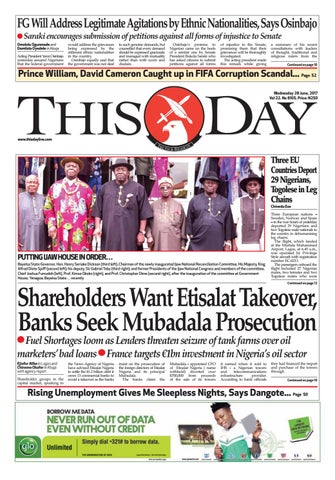
FG Will Address Legitimate Agitations by Ethnic Nationalities, Says Osinbajo Saraki encourages submission of petitions against all forms of injustice to Senate Omololu Ogunmade and Damilola Oyedele in Abuja Acting President Yemi Osinbajo yesterday assured Nigerians that the federal government
would address the grievances being expressed by the different ethnic nationalities in the country. Osinbajo equally said that the government was not deaf
to such genuine demands, but counselled that every demand should be expressed graciously and managed with mutuality rather than with scorn and disdain.
Osinbajo’s promise to Nigerian came on the heels of a similar one by Senate President Bukola Saraki who has asked citizens to submit petitions against all forms
of injustice to the Senate, promising them that their grievances will be thoroughly investigated. The acting president made this remark while giving
a summary of his recent consultations with leaders of thought, traditional and religious rulers from the Continued on page 10
Prince William, David Cameron Caught up in FIFA Corruption Scandal... Page 52 Wednesday 28 June, 2017 Vol 22. No 8105. Price: N250
www.thisdaylive.com TR
UT H
& RE A S O
N
Three EU Countries Deport 29 Nigerians, Togolese in Leg Chains Chinedu Eze
PUTTING IJAW HOUSE IN ORDER… Bayelsa State Governor, Hon. Henry Seriake Dickson (third left); Chairman of the newly inaugurated Ijaw National Reconciliation Committee, His Majesty, King Alfred Diete Spiff (second left); his deputy, Sir Gabriel Toby (third right); and former Presidents of the Ijaw National Congress and members of the committee, Chief Joshua Fumudoh (left), Prof. Kimse Okoko (right), and Prof. Christopher Dime (second right), after the inauguration of the committee at Government House, Yenagoa, Bayelsa State… recently
Three European nations – Sweden, Norway and Spain – in the wee hours of yesterday deported 29 Nigerians and two Togolese male nationals to the country in dehumanising leg chains. The flight, which landed at the Murtala Muhammad Airport, Lagos, at 6.45 a.m., was operated by Privilege Style aircraft with registration number EC-IZO. The passengers onboard the flight included 27 Nigerian males, two females and two Togolese males who were Continued on page 12
Shareholders Want Etisalat Takeover, Banks Seek Mubadala Prosecution Fuel Shortages loom as Lenders threaten seizure of tank farms over oil marketers’ bad loans France targets €1bn investment in Nigeria’s oil sector Ejiofor Alike in Lagos and Chineme Okafor in Abuja with agency report Shareholder groups in the capital market, speaking to
the News Agency of Nigeria have advised Etisalat Nigeria to settle the $1.2 billion debt it owes 13 commercial banks to avoid a takeover as the banks
insist on the prosecution of the foreign directors of Etisalat Nigeria and its principal Mubadala. The banks claim the
Mubadala - appointed CFO of Etisalat Nigeria ( name withheld) diverted over $700,000 from proceeds of the sale of its towers
it earned when it sold to IHS - a Nigerian towers and telecommunications infrastructure provider. According to bank officials
they had financed the import and purchase of the towers through Continued on page 10
Rising Unemployment Gives Me Sleepless Nights, Says Dangote... Page 50
2
T H I S D AY WEDNESDAY JUNE 28, 2017
T H I S D AY WEDNESDAY JUNE 28, 2017
3
4
T H I S D AY WEDNESDAY JUNE 28, 2017
T H I S D AY WEDNESDAY JUNE 28, 2017
5
6
T H I S D AY WEDNESDAY JUNE 28, 2017
T H I S D AY WEDNESDAY JUNE 28, 2017
7
8
T H I S D AY WEDNESDAY JUNE 28, 2017
T H I S D AY WEDNESDAY JUNE 28, 2017
9
WEDNESDAY, ÍşÎ€Ëœ ͺ͸͚Ϳ Ëž T H I S D AY
10
PAGE TEN WHY BANKS WANT ETISALAT’S TAKEOVER, MUBADALA PROSECUTION Huawei of China to help build the infrastructure backbone for Etisalat. But when the telco earned hard currencies from the sale, Etisalat failed to repay their USD loans as was done by other telcos like MTN and Airtel. " It makes no sense that that the Etisalat CFO simply exchanged the USD they earned at the official rate of $/ N200 when the forex markets was at almost $/N400 and used it for other purposes" said a bank risk official at the weekend. " Had they paid of the USD loans with the USD they earned from sale of the towers there would absolutely been no problem today" When contacted, Etisalat official who spoke to THISDAY, on conditions of anonymity, said that their CFO converted the USD to Naira and used the proceeds to pay off Naira loans because it had a higher Naira interest rate. But the banks are crying foul saying why would they elect to hold a USD loan when revenues are in Naira and USD scarce? " So when you get a rare USD revenue inflow, the only sound governance is to pay off USD debts and reduce foreign exchange risk. That Finance Director from Mubadala and Etisalat in AbuDhabi has questions to answer over the transaction which may have led the the bad loans through reckless and fraudulent trading, " insisting they must be held to account after Etisalat moved to pull out of Nigeria with our paying off the debt. The shareholder groups insisted that Etisalat must settle its indebtedness to the banks, so that the lenders in turn can pay dividends to their shareholders. Mr. Boniface Okezie, National Coordinator, Progressive Shareholders Association of Nigeria, called on Etisalat to settle the debt owed the commercial banks to avoid legal action, adding however that the affected banks should approach the court for receivership if Etisalat failed to settle the debt. He stated that the banks had obligations to their shareholders, insisting that the debt must be paid.
Also, Mr. Godwin Anono, the Chairman of Nigeria Professional Shareholders Association, said that the network operator should settle the debt and desist from making unnecessary noise about the whole thing. He said the transaction was in line with customer-banker relationship, noting that the terms and conditions of the loan must be met. Anono said further that the shareholders were in support of the banks to acquire the company if Etisalat failed to settle the loan. “This is like any other transactions, it’s not government business and I stand on existing protocols that the banks should acquire the company,� he said. In his view, Mr. Sewa Wusu, Head of Research, SCM Capital Ltd., said that the issue of loan between Etisalat and the consortium of banks was a customer-banker relationship, which ought to be settled amicably with terms agreeable to both parties. He said that the issue was beginning to elicit concerns in the banking industry given the level of the amount involved and its potential impact on the balance sheets of the banks involved. “But I think the monetary authority is also involved to ensure prompt settlement of the situation among the parties,� he said. Etisalat Group in the United Arab Emirates, on June 20, said it had transferred its 45 per cent stake and 25 per cent preference shares in Etisalat Nigeria to a loan trustee. It said it had been notified to transfer its stake by June 23, saying that the stake had a carrying value of zero on its books. However, in the last few months, Etisalat Nigeria has been in talks with Nigerian banks to restructure $1.2 billion loan after missing repayments. The loan is a seven-year facility agreed with 13 banks in 2013 to refinance a $650 million loan and for funding expansion of its network. Although the Nigerian
Communications Commission (NCC) and the Central Bank of Nigeria (CBN) had stepped into the fray to prevent a takeover by the banks, the discussions failed to produce an agreement on the debt restructuring.Another meeting with the regulators is scheduled for Friday or Monday according to sources familiar with the transactions. But as the shareholder groups fret over Etisalat’s indebtedness to the banks, another crisis is about to rear its head in the petroleum sector which may lead to fuel shortages around Nigeria, following the move by 18 Nigerian lenders to commence the process of classification of loans that were extended to oil marketers and depot operators in the downstream sector of the oil and gas industry, but is now turning bad in the books of the banks following the failure of the Finance Ministry to pay subsidy and FX differential claims from 2013 and 2014. THISDAY gathered that if the debts are not paid by the marketers and the Federal Ministry of Finance, the banks will begin seizing the marketers’ tank farms in lieu of the NPLs, which could potentially lead to massive job losses in the sector and fuel shortages. The indebtedness of the marketers to the banks followed the failure of the federal government to pay the outstanding subsidy claims and matured letters of credit (LCs) arising from the old subsidy regime, which amounted to about $2 billion. THISDAY had reported that the huge debts, which grew as a result of the naira devaluation and the interest charges by the banks that funded the importation of fuel cargoes, have since forced foreign banks such as the Citi Bank, BNP Paribas and others to stop opening lines of credits for oil marketers. The development has also led to the Nigerian National Petroleum Corporation (NNPC) assuming the role of sole importer of petrol, as marketers focus on the importation of diesel, which has no price cap, having been deregulated.
There are also speculations that the marketers could shut down their depots on July 1, in protest against their unpaid subsidy claims. When contacted by THISDAY, the Chairman of Depot and Petroleum Products Marketers’ Association (DAPPMA) and Chief Executive Officer of Heyden Petroleum Limited, Mr. Dapo Abiodun declined to speak on the alleged threat by the marketers to shut down their depots on July 1. Also, the Executive Secretary of DAPPMA, Mr. Femi Adewole said he was not aware of any planned shutdown of depots by DAPPMA but confirmed that the banks have initiated moves to seize the tank farms of marketers for failure to liquidate the loans. According to him, lack of working capital due to huge debts owed marketers by the federal government has eroded their ability to source funds from the banks for imports. “Banks have equally classified marketers’ accounts with the aim of seizing tank farms due to the bad loans,� he said. “When we say that the banks have classified the accounts of a marketer, we mean that such a marketer is owing one bank a loan whose repayment is long overdue and no other bank would give such a company any loan whatsoever,� Adewole added. Documents obtained by THISDAY showed that when the debts owed the marketers by the federal government was last reconciled in 2016, the outstanding balance was $1,522,111, 841.10. The documents also showed that the Major Oil Marketers’ Association of Nigeria (MOMAN) and DAPPMA members were originally indebted to 18 Nigerian banks to the tune of $1,184,621,931.17 before interest charges and exchange rate differentials pushed the outstanding claims to $2 billion, according to marketers, who spoke off the record. Detailed data on the marketers’ original indebtedness to the 18 banks revealed that 16
But despite the oil marketers’ woes, France yesterday disclosed that it has set aside about ₏1 billion to invest in the nation’s oil and gas industry, stating that Nigeria would remain its first economic trading partner in Africa. According to NNPC, the French Ambassador to Nigeria, Mr. Denys Gauer stated this when the Group General Manager, Public Affairs Division of the corporation, Mr. Ndu Ughamadu led a delegation to visit the ambassador in his office in Abuja. Gauer, said in a statement from the NNPC signed by Ughamadu, that the ₏1 billion had been put in place by French development agency to encourage French investors
to invest in Nigeria’s oil sector. He however did not provide details on the fund’s application. He noted that the French government was also cooperating with the federal government in its fight against the Boko Haram insurgency in North-east. Gauer equally commended the government for stemming the insecurity in the Niger Delta and explained that Total, a French multinational oil company, has significant investments in the Nigeria Liquefied Natural Gas (NLNG) Company and Egina deep water oil project. Notwithstanding the reported commitment of France to Nigeria, Gauer also expressed concern that some other French companies were having challenges with what he described as Nigeria’s unclear fiscal policies in the oil sector. He said, however, that some French investors were currently developing wind energy and solar energy in Katsina State. The statement said Ughamadu informed Gauer that the NNPC under the current management led by the Group Managing Director, Dr. Maikanti Baru, was well positioned and open to investment opportunities from France and its investors. He said with the significant drop in pipeline vandalism and insecurity in the Niger Delta, which he noted has boosted oil production, global investors such as those from France can now invest in renewable energy; gas and power infrastructure development; pipeline construction; storage facilities; and the direct sales and direct purchase of Nigeria crude oil grades. Ughamadu said NNPC as the state-owned oil and gas corporation has global operations and called for closer collaboration between it and the French government, especially in the area of consular services in order to enable its top executives and staff meet their global engagements. He also assured Gauer that the leadership at the NNPC was determined to develop a robust business atmosphere for investors.
against all forms of injustice to the Senate, assuring them that their grievances would be investigated and addressed. Saraki, speaking in a video interview published on the official twitter handle of the Senate, @NGRSenate, said the Eighth Senate was committed to addressing all petitions brought before it. He added that it was necessary that Nigerians were aware that they could get justice through the parliament by submitting their petitions through the lawmakers representing them. “We represent Nigerians, we are voted for that. The difference between democracy and military rule is the parliament. In my constituency, Kwara Central, if anybody feels there has been injustice against him anywhere in the system, it is me that he comes to and says you are representing me, fight for me, these are my issues,� Saraki said. The Senate President, in the video, which was less than two minutes long, added that the Eighth Senate has already been at the forefront of addressing all forms of injustice against Nigerians with the finalisation of 70 petitions in the two years of its existence. This number, Saraki noted, was more than the total number
of petitions addressed by some of the preceding assemblies. “Over the years, nobody attended to as many petitions but we have treated 70-something petitions in two years. I know a Senate that treated only five petitions. So there is an avenue now for Nigerians to go to if they feel there has been injustice,� he said. He cited the example of a petition addressed by the Senate: “We had a gentleman who was unfairly relieved of his duties in one of the agencies. He then died, the widow was left in anguish for so many years,� he said, adding that the matter was eventually brought to the Senate’s attention through a petition. The Senate heard the petition and directed the agency in question to pay the late man’s entitlements, including death benefits to his widow and the children, Saraki recalled. With this, the widow was able to start a business to support the family, he added. “That is what we are here for, those are the opportunities we create, Nigerians should know that there is somewhere they can run to so that they can get justice individually or collectively or as a community,� the Senate President added.
banks initially had $911,336,510.11 as outstanding unliquidated LCs with DAPPMA members, while nine banks had $273,285,421.06 as outstanding unliquidated LCs with MOMAN members. According to the marketers, no reconciliation of unpaid subsidy claims has taken place between the marketers and the federal government since the beginning of 2017. In a communiquĂŠ at the end of a recent meeting in Lagos, DAPPMA had expressed the fears that the Asset Management Corporation of Nigeria (AMCON) might take over their tank farms as a result of the NPLs. “Some of our members have resorted to staff retrenchment due to inactivity,â€? the marketers had added. Acting President Yemi Osinbajo at a meeting on May 22 was said to have directed the Minister of Finance, Mrs. Kemi Adeosun to initiate the process of paying the oil marketers all outstanding subsidy claims. Osinbajo had summoned the meeting with the marketers in which Adeosun, the Minister of State for Petroleum Resources, Dr. Ibe Kachikwu and the central bank governor, Mr. Godwin Emefiele were said to be in attendance.
France to Invest â‚Ź1bn
FG WILL ADDRESS LEGITIMATE AGITATIONS BY ETHNIC NATIONALITIES, SAYS OSINBAJO South-east and North over their respective agitations for secession and the quit notice to Igbos in the North, governors and media executives. He recalled that “the meetings were convened to provide a platform for frank and open discussions between the concerned stakeholders and by extension the Nigerian public on issues relating to the unity, peace and security of country�. According to a statement by his media aide, Mr. Laolu Akande, the acting president said the government would “continue to actively engage with different segments of the Nigerian population at different stages and format in the near future�. He added: “The meetings were convened to provide a platform for frank and open discussions between the concerned stakeholders and by extension, the Nigerian public on issues relating to the unity, peace and security of country. “The meetimgs touched on various issues relating to the ethnic agitations that have manifested most recently in a call for secession by some groups of youth from the South-east, and an ultimatum by Northern youths for south-easterners living in the North to leave the region
by 1st October 2017. “The meetings established common grounds on a number of issues, as follows: condemned all the hateful and divisive rhetoric by the concerned groups of Northern and Southeastern youths. “Affirmed the primacy of the Constitution of the Federal Republic of Nigeria, the ultimate basis for the unity of Nigeria. That Constitution guarantees freedom of residence and of movement for all Nigerians anywhere in the country, without fear of discrimination or prejudice. “Affirmed the need to draw a line between the freedom of expression guaranteed by the Constitution and the degeneration of such expression into hateful rhetoric, prejudice and hatred. Under no circumstances will government condone or tolerate hate speech in any way or form. “Affirmed the necessity of confronting all grievances and frustrations head-on, however uncomfortable that might seem now; instead of ignoring issues and allowing them to fester. “Affirmed the need for all leaders and elders, regardless of political or ideological persuasion, to speak out more forcefully to counter divisive
and hate speech and any form of warmongering.� The statement added that Osinbajo expressed appreciation to all the leaders for their time and commitment to the unity, peace and progress of the Nigerian nation. It added: “He also assures the Nigerian people of the determination and resolve of the Buhari administration to ensure their well-being and security at all times. “The federal government will continue to actively engage with Nigerians of all shades and opinions in its bid to move the country forward on a path of socio-economic development and ultimate greatness.� Akande recalled that the acting president at the consultative meetings cautioned that “there is a point where a line has to be drawn, and that is when conversations or agitations degenerate into hateful rhetoric, where the narrative descends into pejorative name-calling, expressions of outright prejudice and hatred�. He further quoted Osinbajo as stating: “We are not deaf to the legitimate concerns and frustrations arising from around the country. Every part of Nigeria has its own grievances. “But these have to be
expressed graciously and managed with mutuality rather than with scorn and disdain. “All of us have agreed that our nation must remain one‌ I think that there is clarity as to that one thing, that our country ought to remain, must remain, a united country. “It will be wrong of us to approach our grievances by threatening to disobey the laws or by threatening the integrity of our nation. “I firmly believe that we ought to address these agitations and proclamations urgently and decisively. Burying our heads in the sand and expecting the storms to blow over of their own accord is not an option. “One thing is clear – violence and war are not going to do anyone any good. They are easy to start but near impossible to end. “We are witnesses to the unspeakable devastation that war continues to inflict across the world. No one who has seen the horrors of war – even merely on television – would wish it on their worst enemy. “Our emotions must not be allowed to run wild in such a way as to endanger the lives of so many.â€? Also, Saraki yesterday urged Nigerians to submit petitions
T H I S D AY WEDNESDAY JUNE 28, 2017
11
12
˾ WEDNESDAY, JUNE 28, 2017
NEWS
Vigilante to Die By Hanging for Setting Goat Thief Ablaze Tobi Soniyi The Supreme Court has sentenced a member of a local vigilante group in Benue State, Moavega Igba, to death for killing one Kyernum Kervo 15 years ago for stealing goat meat. The convict was charged alongside one Michael Ankpergjer before the Benue State High Court, Makurdi, for causing the death of Kervo. The facts of the case as narrated by Justice Kumai
Akaahs were that after arresting Kervo for stealing the goat meat, the convict and his co-conspirator conducted a local trial, found the suspect guilt, and eventually took Kervo to a riverside. Justice Akaahs said: “On reaching their destination, the accused tied the deceased’s legs and laid him on the ground. They then spread the palm leaves over him and set him ablaze.” The case was eventually reported to the Divisional
Police Office in Konshisha Local Government Area of Benue State by relatives of the deceased. The police were taken to the scene and found the deceased had 100 per cent second degree burns. “The man was dead and early decomposition had begun,” Justice Akaahs said. The convict initially confessed but later said that his statement was made under duress, following which a trial within trial was conducted to ascertain whether he was forced to
make the statement. One of the witnesses, Ayakpa Ayo testified that he had killed the goat for his in-law who came to attend the funeral of his brother, Agena Mua. According to him, after killing the goat he decided to smoke some of it in his compound, but the deceased stole all the meat and sold some of it. When a search was conducted, the tail of the goat was found in the deceased’s bag. The deceased was then
handed over to the convict who was a member of the vigilante group to report the matter to the police. But rather than report the theft to the police, the convict took the law into his hands by setting the suspect ablaze. The convict was charged with murder before a Benue State High Court and was found guilty. His appeal to the Court of Appeal to overturn his conviction also failed. He finally appealed to the Supreme Court. In rejecting his appeal,
Justice Akaahs held: “There was therefore overwhelming evidence to support the conviction and sentence of the appellant and his co-accused to death for conspiracy and causing culpable homicide punishable by death. “The appellant’s action with the co-accused of setting the deceased ablaze for stealing goat meat was bestial and it brought out the pristine savagery in man depicting his brutish instinct in a Hobbesian state of nature.”
Sale Prices for Second-hand Private Jets Fall By 35% Billionaires and larger corporates have had tens of millions of dollars wiped off the value of their business jets, as massive oversupply in the run-up to the 20082009 credit crisis in Europe has left the industry awash with pre-owned aircraft. Prices for second-hand private jets, many of which have barely been flown, have dropped as much as 35 per cent over three years to the end of April. The average price of a preowned business jet has fallen from $13.7m in April 2014 to $8.9m, according to research by Colibri Aircraft, which specialises in the marketing, resale and purchase of preowned private aircraft. Owners have lost millions of dollars on the value of their existing business jets as a glut of planes came on to the market in the wake of the economic downturn. The resale price of a Bombardier Global XRS, which sold for $50m, has dropped from $31.3m to $20.4m — down just under 35 per cent, according to Colibri’s figures. Bombardier said it did not comment on specific pricing of its aircraft, but it said the company had realigned its production in the light of market demand. Newer models coming on to the market had also caused prices to fall further, said Oliver Stone, managing director of Colibri. “Customers are selling their current jets to upgrade to the new one,” he said. “Supply is increasing, but not demand.” Yet even with the release
ExecuJet FBO at the Lagos airport is one of largest hangars for private jets in Nigeria of new aircraft, with many manufacturers targeting the larger cabin market, the delivery of new business jets has fallen dramatically over the past decade. In 2008, 1,313 business jets were delivered, compared with just 661 last year. “Pre-2008, the jet market was in a massive bubble and prices have been decreasing ever since,” said Mr. Stone. Repossessions also
grew between 2009 and 2012, added Edwin Brenninkmeyer, chief executive of Biggin Hillbased Oriens Aviation, which distributes the Pilatus PC-12 turboprop in the UK and Ireland. “To keep pace with sales volume, manufacturers increased discounts to continue the high delivery volumes, often with 30 per cent discounts which became the ‘industry
norm’.” But while owners may be suffering, the private jet charter industry could benefit, as more owners decide to tender their aircraft for charter rather than put them up for sale. Charter flights account for almost 60 per cent of private jet flights across Europe, according to Victor, the private jet charter company. “The 2008-9 recession
caused many companies, and high net-worth individuals to reassess the true costs of ownership of business aircraft, including fractional,” said Brad Stewart, chief executive of XOJET. “This has also been precipitated by . . . a shift into shared ownership, on-demand and subscription platforms.” However, hopes that additional aircraft might lead to a reduction in the
cost of the “charter hour” were dashed by industry professionals. “It has been exactly the same price to charter a private jet for the past 10 years,” said Adam Twidell, chief executive of PrivateFly, a global booking service for private aircraft hire. “However, I think prices falling is overoptimistic — but they are likely to remain at this 10-year low.”
Nigerians, THISDAY learnt, had been held since last year and were prevented from communicating with their relatives and friends until it was time to bring them back to Nigeria. The spokesman of the Lagos Airport Police Command, DSP Joseph Alabi confirmed the deportation of the 29 Nigerians and two Togolese. Alabi said the deportees
were received by officers of the Nigerian Immigration Service (NIS), National Agency for the Prohibition of Trafficking in Persons (NAPTIP) and the police. He said also others at the airport to receive them were officials the Federal Airports Authority of Nigeria (FAAN) and the National Drug Law Enforcement Agency (NDLEA). According to him, nine
of the persons, who were deported for alleged drugrelated offences, were handed over to the NDLEA, while two others who were deported for criminal offences were handed over to the police. Alabi said the remaining deportees who allegedly committed immigrationrelated offences, were profiled and allowed to leave for their respective destinations.
THREE EU COUNTRIES DEPORT 29 NIGERIANS, TOGOLESE IN LEG CHAINS deposited in Nigeria, just as the flight took off at 8.30 a.m. to Ghana from Nigeria. THISDAY learnt that nine of the Nigerian passengers were deported for alleged drug trafficking, while the rest were sent back to their fatherland for immigration offences. An airport official, who spoke to THISDAY on the condition of anonymity, disclosed that by the time
the deportees were taken onboard the flight, the 29 males were chained at the ankles because they were considered huge and could pose a threat to the immigration and police officials in the aircraft. “I can authoritatively confirm that the males were kept in chains out of fear that they might resist their arrest and deportation, but they removed the chains a
few hours into the journey. “Other than the fact they were unwilling to return to their country, the deportees were very sad because of the ill-treatment they experienced in the hands of the officials. “One of them told me that the immigration and police officials were so despicable and rough in the way they treated the deportees,” the source told THISDAY. Some of the deported
T H I S D AY WEDNESDAY JUNE 28, 2017
13
14
T H I S D AY WEDNESDAY JUNE 28, 2017
COMMENT
Editor, Editorial Page PETER ISHAKA Email peter.ishaka@thisdaylive.com
BINDING VALUES, PROSPEROUS NATION Sonnie Ekwowusi argues the need to live our cultural values
A
s we continue to seek different ways of forging a national cohesion, a true brotherhood and fraternity so that commutative justice and peace may reign in our country, I think it is necessary to remind ourselves that political ties do not exist in vacuum, rather it is a fruit of years of shared communally-binding values and lived experiences. Somehow we have all become active participants in the blame-game. We trace everything that happens to us under the sun to the evil machination of someone or an institution. We blame the constitution for our woes. We blame the government. We blame corruption. We blame the judiciary. We blame the day we were born. We blame our neigbours. In fact our lives could be defined as lives characterised by litany of complaints and blames on why Nigeria is not working. But what ultimately strengthens a nation and thus paves way for the much-vaunted prosperity is a cultural life made up of those little communally-binding ideals which informs and forms the superstructure of the character of an individual. Take yourself as an example. Most of the things which you do or refrain from doing are not necessarily the outcome of imposed rules or things that the government or the constitution or the law is forcing you to do or to refrain from doing. Your personal worth; your life’s goals and aspirations are largely informed by your interior values or those lofty community values which you had imbibed earlier in life. Although government deserves all the hard knocks for failing in its many duties, you do not need the government to fulfil your social, cultural, family and religious obligations. Democracy has not divested us of our duties and obligations as members of the society. You do not need the state to enact a law compelling you to cater for your children and members of your family. When you see a dying neigbour in desperate need of assistance your first impulse will not be to complain to the government: your first spontaneous reaction would be to look for urgent means of restoring the health of the dying person. In many Nigerian cultures, one person alone does not raise a child. The task of raising a child is that of every member of the community. Therefore we cannot forget who we are as a people. Last week at the closing plenary of the Acton University Conference which took place at the prestigious De Vos Palace Convention Center, Grant Rapids, Michigan, United States, the plenary speaker did not fail to make this point. He stated that there is a limit to what can be achieved with empty political creeds or abstract thoughts or abstract constitution or abstract political party or political structure. Paraphrasing the French political scientist and historian Alexis de Tocqueville (1805-1859),
IT IS UNFORTUNATE THAT WE NOW HAVE IN NIGERIA A NEW POLITICAL FOLLOWERSHIP THAT CONDONES IMPROPRIETY OR KEEPS QUIET IN THE FACE OF EVIL
he stated that a country cannot escape destruction if the moral tie is not strengthened in proportion as the political tie is relaxed. Simply put, if we want to strengthen the political tie, we must first of all strengthen the moral tie because the latter is what gives rise to the former. In his essay with the title, “Rationalism in Politics,” Michael Oakesshott, stresses that the first thing is not politics: the first thing is the cultural life, the lived experience made up of little values which forms the character of an individual and sustains the society. Quoting Oakesshott in her essay with the title, “A disposition of Delight,” Elizabeth Covey, assistant professor of political science in the Honors College at Baylor University, writes that when the religious and social tradition of the society withers, we are left “with nothing but a dry and gritty residue. Thus we have the spectacle of a set of sanctimonious, rationalist politicians, preaching an ideology of unselfishness and social service to a population in which they and their predecessors have done their best to destroy the only living root of moral behaviour”. Therefore democracy is not synonymous with instant economic and political prosperity. In fact, countries that have reaped enormous dividend from democracy had worked out their democracy. An abstract democracy not sustained by the fundamental social tradition of the society is a recipe for disaster. It is unfortunate that we now have in Nigeria a new political followership that condones impropriety or keeps quiet in the face of evil. For example, if a political office holder from your village did not steal government money to erect a big house in the village all the villagers will taut him and laugh at him as a failure in politics. Certainly, a democracy that creates loopholes for flourishing corruption, fraud, kleptomania and graft cannot lead to human flourishing. A democracy bereft of communallybinding values and moral ties can kill in the same way a tyrannical military rule kills. According to Peter Kreeft, “if we think we are automatically free from the danger of ignorant prejudice and tyranny simply because we are a democracy, we should reflect on the fact that it was a democracy that killed Socrates....” Although our political destiny can be said to be in our hands but I believe that we still have to work hard to work it out. And one of the ways of achieving that is to create a fine blend or a happy convergence between those communally-binding values which sustain society and public life. We cannot say that we want to make progress and at the same time exclude from our policy those cherished values that lead to human flourishing.
A GOVERNMENT WITH A HUMAN FACE Governor Willie Obiano of Anambra State deserves a second term, writes Chuks Iloegbunam
A
nambra State has hit a consensus on the matter, notwithstanding the few loudspeakers blaring stridently. It all started from deep doubts. People had asked, Willie Who? People wondered what a non-career politician would bring to the table of governance. Some thought they had been sold the short end of the stick. But, within months, the doubts began to disappear. The man selling abada cloth inside the Onitsha main market soon discovered to his delight that true leaders are born not made. He did his sales, locked up at nightfall, got back home to dinner and sound sleep, returned to his stall the following morning, to see that it hadn’t been plundered. The primary school teacher quickly discarded the longstanding belief that her reward was in heaven. She received her salary promptly. If she got posted to some remote school in rural Anambra, her salary was upped by a significant 25 per cent. The same bonus was hers if she taught science subjects or mathematics or Igbo. When she exchanged her chalk for retirement, her entitlements – gratuity and pension – promptly followed as a matter of course. These are some of the reasons why,
today, the chorus in Anambra State is that Willie Obiano is fit to continue with his good work. In three sharp years Ndi Anambra have seen at the helm of their affairs a compassionate leader, a listening administrator, a dependable ally, and an empathetic son with hands outstretched in order that his people would stand, not to fall. Professor Chukwuma Charles Soludo summed it up graphically: “If it isn’t broke, why mend it?” The market associations, the town unions, the professionals, the students, the religious, the laity, all-comers have since queued in, chanting, “You can’t change a winning team!” But, in every 12, there is a Judas. Anambra’s judases are on the Internet, spewing falsehood. Despite the high decibels of their din, they constitute a miserable minority of frustrated losers and would-be political failures. One governor-sponsor of the rabble came from a South East State and announced that they were set to “capture” Anambra State. Why did the villain view the electoral process through the prism of violence? This is a man that owes his state retirees 24 months in unpaid pensions! Does he intend to capture Anambra and deliver it to the throes of work without pay and retirement without benefits? Ndi Anambra know that a recent
state-by-state survey of payment of salaries threw up Anambra as one of only five states that owed no arrears. Ndi Anambra are unlikely to forget this on election morning. The Internet prowlers called one of their sponsors an “industrialist”. But people are yet to set their eyes on any of his fabulous industries. There’s no record of any employees on the man’s payroll. It is not even certain that he ever paid any taxes in Anambra. But he wants to capture Anambra State! One man whose governorship was sacked by the courts for illegitimacy reared his head to promise a destruction of the Awka flyovers once they captured power! He also vowed to dissuade the Federal authorities from refunding the N43 billion committed into federal roads by the Obiano administration. Such are the characters eyeing Anambra’s Government House! A recent article by Ejike Anyaduba entitled The humanity of the Obiano administration underscores why Governor Obiano is set to continue with governing Anambra State: “If the Obiano government is standing on a pinnacle today it is not because it fixed security of the state hitherto in a whirl. It is not because it gave the state’s infrastructure that existed in outline
some uplift. It is not because it resuscitated investments, which had hit the nadir. It is not because it boosted agriculture until then in active decline. It is not because it gave healthcare a shot in the arm and sustains the progress in education. No, not in the least! It is because, in addition to all these, the government has shored up effort in the intangible sector.” The intangible sector refers to Governor Obiano foregoing salary and emoluments for the upkeep of society’s less privileged. It refers to the sanatorium he built to giving a meaning to the lives of the sick and wretched of the earth. It refers to scores of prisoners who, on completion of their terms, received N1 million each to start life on a fresh, clean slate. It refers to the disabled who are automatically employed in the state’s civil service. It refers to limbless folks issued with prosthetics. In short, it is all about running government with a human face. On Election Day, Ndi Anambra will turn their eyes from the noisemakers that prefer to remain numb and dumb even as the leaders of their political parties have issued a three-month ultimatum for Ndigbo to quit northern Nigeria. Iloegbunam is the Chairman of Governor Obiano’s Media Team
15
T H I S D AY Ëž Í°ÍśËœ Í°ÍŽÍŻÍľ
EDITORIAL THE MADNESS IN TARABA STATE There is need for the critical stakeholders to sit down and sink their differences
A
t an average elevation of about 1,600 metres above sea level, the highest in Nigeria, with many of the adjoining villages situated on hills, Mambilla Plateau is a beautiful highland that ordinarily should be a money-spinning tourist attraction for the country. Unfortunately, the plateau has in recent years been turned into another theatre of violent killings not only between farmers and pastoralists but also by different ethnic groups in Taraba State in the violence-prone northeastern part of the country. Aside hosting one of the hydro power plants in Nigeria, Mambilla Plateau has a unique temperature that makes it the coldest region in the country while its lush green provides an attractive environment for cattle herders who have for decades co-habited with tea farmers. The Gashaka Gumti National Park and the Ngel Nyaki Forest Reserve both of which harbour rare plant and animal species are also located within this rich plateau that has now become a killing ďŹ eld. In the latest of THERE IS AN URGENT such madness which NEED TO LOOK occurred last week, AT THE COMPLEX several Fulani villages INTERRELATIONSHIPS OF were invaded by some SECURITY, DEVELOPMENT ethnic militiamen, AND PEACEFUL leaving a trail of blood COEXISTENCE BETWEEN and anguish. While PASTORAL COMMUNITIES we condemn the violence and urge the AND THEIR MORE SEDENTARY NEIGHBOURS authorities to apprehend the culprits and bring them to justice, it is also important for the warring parties to ďŹ nd a way to resolve whatever their differences are. We commend Acting President Yemi Osinbajo for his prompt intervention not only in the deployment of the military, police and other securities agencies but also in directing that relief materials be delivered to the affected communities of TofďŹ , Mayo Daga, Mayo Sina, Tamiya,
Letters to the Editor
Kwara-Kwara, Tungan Lugere, Timjire, Nguroje and other villages in the hinterlands of Mambilla Plateau. However, we consider it unfortunate that what was initially considered to be no more than the usual skirmishes between herdsmen and farmers is now purely a sectarian conict with both religious and political dimensions. It is therefore our hope that all the critical stakeholders in the state and the relevant security authorities will take note and nip in the bud what could engender another round of violence. What is particularly noteworthy is that it is not the ďŹ rst time the area has witnessed such sectarian fumes. What is always disturbing is the dangerous politicisation of the whole affair with the parties involved trading blame.
A
T H I S DAY
EDITOR DEPUTY EDITORS ˜ MANAGING DIRECTOR DEPUTY MANAGING DIRECTOR CHAIRMAN EDITORIAL BOARD
EDITOR NATION’S CAPITAL
T H I S DAY N E W S PA P E R S L I M I T E D
EDITOR-IN-CHIEF/CHAIRMAN GROUP EXECUTIVE DIRECTORS ˜ ˜
˜ GROUP FINANCE DIRECTOR DIVISIONAL DIRECTORS ˜ ˜ DEPUTY DIVISIONAL DIRECTOR
SNR. ASSOCIATE DIRECTOR ASSOCIATE DIRECTORS ˜ CONTROLLERS ˜ ˜
GENERAL MANAGER
GROUP HEAD DIRECTOR, PRINTING PRODUCTION TO SEND EMAIL: ďŹ rst name.surname@thisdaylive.com
TO OUR READERS Letters in response to speciďŹ c publications in THISDAY should be brief (150-200 words) and straight to the point. Interested readers may send such letters along with their contact details to opinion@thisdaylive.com. We also welcome comments and opinions on topical local, national and international issues provided they are well-written and should also not be longer than (9501000 words). They should be sent to opinion@thisdaylive.com along with the email address and phone numbers of the writer.
IN PRAISE OF BOSUN ARUWE
SARAHA: THE POLITICS OF A GOOD MAN
A
lhaji Kabiru Saraha lives a life of service and philanthropy. Today it is an accepted fact that he has made substantial but quiet donations to important causes in Nigeria and Kogi State in particular, for the upliftment of the less privileged in the society. He was a self-made man. He who faces no calamity will need no courage. Mysterious though it is, he believes the characteristics in human nature which we love best grow in a soil with strong mixtures of troubles. He is always guided by this philosophy. As an estate developer and business man, he has faced a lot of challenges as would any business man in this society. He builds his business as a response to his responsibility in helping a society in need of development and the eradication of poverty. His striving business in the estate development sector is a testimony to the fact that even with the challenges posed by the harsh business environment in Nigeria, he has what it takes to keep the business afloat. But business is often faced with lot of challenges through the instrumentality of what I will call the human factor. This good man was betrayed by some members of his trusted staff. The effects of this betrayal of a good man should rather be forgotten rather than emphasised. A simple example shall suffix here. It was discovered during investigations that some members of his staff had account balances in their personal accounts that surpassed that of the boss. What a betrayal! Though the period was a very trying and devastating one, he picked up the lesson of that time which is that the world is more familiar with
s communities in the southern part of Taraba State grapple with various forms of internecine clashes and with casualty ďŹ gures steadily rising, the state government has come under criticism. Indeed leaders from the zone accused the government of taking sides in the matter, accusations which Governor Darius Ishaku has denied. Unfortunately, while the accusations and counteraccusations are trending, scores of people die daily in suspicious circumstances. We therefore urge the warring parties to engage in extensive dialogue and stop fuelling the problem. For instance, the war of words between Governor Ishaku and the Vice Chairman, Senate Committee on Science and Technology, Senator Yusuf Abubakar Yusuf--over the number of people killed and the call by the latter for a state of emergency was unfortunate and could only aggravate the situation. While we call for a speedy resolution of the current crisis, there is an urgent need to look more closely at the complex interrelationships of security, development and peaceful coexistence between pastoral communities and their more sedentary neighbours not only in Taraba State but across Nigeria. There is also the need to urgently take pro-active measures to address these developmental and security challenges and more speciďŹ cally, the exploitation of these conicts by agent provocateurs to destabilise the peace and stability of the country.
pain than with compassion. But he did not allow this pain to change his vision and aspirations in life, which is about service to humanity and God. He made a decision to chart a new path in his business and he enveloped this lesson into his aspirations. He seeks to take this lessons and aspirations into politics for the betterment of society. In politics, Kabiru Saraha is a professed and an active Buharist and he is always glad that by philosophy he has made a wise choice. With that said, his politics is now concentrated in Kogi State. He is worried about the direction in which Kogi State is headed. That there is a cloud of darkness surrounding his state, Kogi State is no longer in doubt. No thanks to the impunity of the politicians in the state. As things stand, he believes Kogi State foundation is not only threatened with predictable consequences, its politics and economy is also castrated. The masses are in hardships, toiling and sufferings and above all, just like the country, the state is about being described as a failed state. Civil servants are living in avoidable stress and agony as the impunity of the political class is taking a toll on the state. The political class criminal propensity to succeed in their acts has increased. Inadvertently, Kogi State has fallen on hard times and he believes it’s time we reawakened our collective preparedness to confront the situations and chart a new path for our state to move forward. He believes beyond the shadow of a doubt, politics in Kogi State is not only seen as an art of the possible, it’s also regarded as war by other means. Abdulmajeed Musa, Abuja
I
t is quite disappointing that the new trend in the ruling All Progressives Congress (APC) sometimes favours nominating the wrong persons for vital positions in the party. The time is ripe for the party to do thorough investigation in any local government in Lagos State with a view to presenting people with unquestionable character to occupy eminent positions. May I therefore suggest that the party looks inward to do everything possible for the progress of the party in each local government in Lagos and its environs. Hon. Bosun Aruwe has done well in the area of education by purchasing GCE forms for indigent students in the 10 wards of Mushin Local Government Area. Let it be said that he has not done this for political interest any less than he drew inspiration from the immortal words of late South African President Nelson Mandela who said: “Education is the most powerful weapon to change the world.� As an astute politician who has literally bestrode Mushin LGA like a colossus, Hon. Aruwe donated computer accessories to various schools in the council to aid the students’ quest for ICT literacy. The people
of Mushin Local Government have enjoyed the dividend of democracy through Hon. Aruwe such that it is a comedy of error for the APC to nominate him as vice-chairman of the local government as this can only ridicule the man who has done so much in all ramifications. I believe the party’s hierarchy should have a rethink and give him the chairmanship ticket in the forthcoming election so that Mushin may witness growth in leaps and bounds. Hon. Aruwe has achieved unprecedented success as a grassroots politician in Mushin local council in addition to empowering the youth, restructuring of the council as well as helping to ensure sustainable peace and development in the area. He also organised a seminar for youth by enlightening them on the need to eschew violence and disorderliness. In his quest at making the youth financially independent, he donated to them several tri-cycles, sewing machines and barbers’ clippers, among other tools. As the Joshua of our time, Hon. Aruwe will take us out of the land of Egypt and bring us to the Promised Land in Mushin. Anjorin Adeolu, Lagos
16
T H I S D AY WEDNESDAY JUNE 28, 2017
T H I S D AY WEDNESDAY JUNE 28, 2017
17
T H I S D AY ˾ WEDNESDAY, JUNE 28, 2017
18
MIDWEEKPOLITICS
Group Politics Editor Tobi Soniyi Email tobi.soniyi@thisdaylive.com 08033146139 SMS ONLY
THE NEWSMAKER
Et Tu, Dickson? Presidents usually become the subject of criticism when they leave office. In this wise, Goodluck Jonathan has had his own shares of such verbal attacks. However, the dismissal of his six-year reign as president by his godson and Bayelsa State governor, Seriake Dickson, was most uncharitable, writes Segun James
W
hen history comes to assess the tenure of former President Goodluck Jonathan as leader of the most populous black nation in the world, how will it judge him? From what angle will the judgment come? Whatever the angle this may take, as his reputation is being assailed at every corner, Jonathan was dealt the most unkindest cut when his political godson, Governor Henry Seriake Dickson allegedly described his six years as president of Nigeria a waste. Dickson regretted the six years administration of Jonathan, describing the period as a wasted opportunity for the Ijaws. The governor however, recanted claiming that he was misquoted. Although Dickson never out rightly dismissed the former president directly, he instead vented his scathing accusation on the ministers and other presidential aides from Bayelsa whom he said were after selfish interests, thus losing the unique opportunity of attracting development to their domains. But following the uproar that greeted the governor’s statement, Dickson quickly issued a rejoinder saying that his statement was taken out of context by political enemies. He insisted that contrary to what was used by the media, his words were never directed at the person of the president but at those from the state who had the opportunity to develop the state but were busy playing politics with the development of the state and people. The governor even went further to meet the former president at his country home in Otuoke with the video of the event to show he at no time said the words as ascribed to him. Whether Jonathan believed him or not, it is not clear. What is certain however is the fact that the relationship between the two had not always been like this. Dickson, the governor of Bayelsa state is by all standards a political godson of President Jonathan. Although both of them were friends before the advent of the 4th republic, they belonged to different political parties, before political circumstances brought them together. While Jonathan pitched his camp with the Peoples Democratic Party (PDP) and eventually became the deputy governor of the state, Dickson on his own pitched his tent with the Alliance for Democracy (AD). He became the state chairman of the party; and against all odd, the AD produced a senator in the 2003 election when the then governor, Chief Diepreye Alamieyeseigha was the lord of the Bayelsan political manor. The truth is that Dickson and Alams were never good friend. Yet Dickson and Jonathan maintained their friendship. This friendship continued until Alams was impeached and Jonathan stepped into his shoes. In the midst of the turbulence that followed, Dickson left the AD and came to the side of his friend to weather the political storm that followed the impeachment of Alams together. At the end, a grateful Jonathan compensated his friend with the position of Commissioner for Justice and Attorney-General of the state. That was when the relationship changed from mere friendship to that of godfather and godson. Their closeness and love for each other blossomed, and when Chief Olusegun Obasanjo decided that all electable positions in the state should be harmonized between Jonathan, whom Obasanjo had selected as the state governorship candidate of the PDP and Chief Timi Alaibe, Dickson was forced to jettison his ambition for the senate for a seat in the House of Representatives. Between these times, the situation changed.
Dickson....no longer the godson?
Jonathan became the Vice President, and ultimately, the president of the federal republic. That was the situation until 2011 when the president decided that his successor in office as governor, Chief Timipre Sylva would not have a return ticket. As usual, the president once again remembered his godson, and before long, Dickson had become the Governor of Bayelsa. That was five years ago. But now, the cord that binds their friendship seems to have snapped. No thanks in part to the wife of the president, Dame Patience Jonathan but more especially, the battle within the PDP where Dickson may have pitched his tent with the Ali Modu-Sheriff faction as against Jonathan who is aligned with the Ahmed Makarfi’s group. Mrs. Jonathan and Dickson had never liked each other right from their days in Yenagoa. As president’s wife, she wanted her godson, Dr. Peremobowei Dudafa as deputy to Dickson. Dickson rejected the nomination out rightly. He was quoted as saying that he would not want the decisions of his government taken at
My views might be in the minority, but my belief is that the judiciary is being over worked and labored unnecessarily by political actors of all parties. We have abdicated our responsibilities as political players, we have surrendered too much to the judiciary, we have involved the judiciary in too many unnecessary political issues, and thereby exposing it to ridicule. We are not helping the judiciary
the kitchen of the State House. That was the decision that sowed the seed of enmity between the governor and the president’s wife. Reacting to the controversial statement which was credited to the governor, a group, the Peoples Democratic Party (PDP) South-south League, apologised to the former president, describing the statement as a betrayal of trust. The group in a statement signed by the chairman, Mr. Ariolu Tebidapa and secretary, Mr. Akpan Ibibio , also said Dickson’s statement was a misrepresentation of facts and an attempt to ridicule Jonathan’s achievements. According to the group, “We are concerned PDP members from the South-south geopolitical region who still believe in the party, and your leadership as the national leader of our great party, as well as your great achievements during your reign as president. “However sir, we were swept off our foot with shock in the wake of a recent comment credited to none other than your own governor, Dickson, saying ‘your six years at the presidency was a waste to the Niger Delta region’. This, we consider, as a betrayal of trust and an insult on your person considering that this is a misrepresentation of facts and an attempt to embarrass you considering your achievements nationwide and as one who was President of Nigeria and not a regional president.” The group likened Dickson’s action to the parable of the talent in the Bible. “Reflecting on this story, it pictures you as that master and our regional (South-south) governors as those servants where you left the development of the region in their hands. And now that you are back home to settle accounts, we can see other governors giving good account of their stewardship, inviting you to commission projects and paying salaries up to date without complains. “While that one who has refused to invest the opportunity and talent which you have given to him, has failed to develop his state and can’t even pay salaries. He is the one today calling you names and blaming you for his failure even with the enormous resources at his disposal,” it said. The group also apologised to the former president on behalf of Dickson, while also pleading with him as a leader and father not to join issues, but rather forgive him in case he comes back like the ‘prodigal son.’ “As we all know, this period has never been
the best of time for our party, so we should be mindful of black legs who may want to create further disaffection within the party in order to achieve their selfish agenda of selling our party to the ruling party at the centre,” the group warned. As the nation’s political clock ticks rapidly toward 2019 and the PDP continues to be in disarray. Those close to the governor had hinted that Dickson had some time ago lamented that the leadership crisis rocking the PDP posed a great danger to the practice of democracy in the country, and that the former president’s handling of the crisis had further pushed the party towards the precipice. The source said that even though most members have resolved to reconcile whatever the decision of the party, Dickson and his people may abandon the PDP if the decision goes against Sheriff. Following the protracted crisis that engulfed the party in the wake of the report presented to the party’s leadership by the Dickson’s reconciliation committee, the centre has still not held. At that time, Dickson had lamented that the imbroglio in the PDP had robbed the party the opportunity to provide a virile opposition to the All Progressives Congress (APC). Dickson said relying on the court to resolve internal party crisis was an indictment on the political class and a show of its immaturity. He said: “I think the right question should be: what is the future of Nigerian democracy? The tragedy of our democracy today is that we neither have a strong political party in government nor a strong political party in opposition”, he told newsmen. “You all know the efforts we in my committee made to reconcile the various tendencies in PDP so that the party could come back on stream to play its role as a credible opposition platform. As a matter of fact, Nigeria’s democracy is worse for it. “Unfortunately our party has not been playing the role of an opposition party because of the needless crisis plaguing us. What is happening in PDP is a great danger to Nigeria democracy, but I still believe that all hope is not lost. But what is happening in PDP is unfortunately also happening in APC. “For our democracy to be secure, we need a strong party in government, strong cohesive united party in government, pursuing their democratic agenda as well as a virile party in opposition. But so far our democracy is weak because of the absence of these. There is crisis in APC, it is brewing and nobody is talking about it. “The sooner we in the PDP salvage our platform that is terribly suffering a lot of de-marketing the better for our democracy. It is unfortunate that a political party has to go to the judiciary to resolve its internal problem that is essentially political. “Relying on the court to resolve internal crisis is an indictment of the political class. It is an indictment on the democratic credentials of all players. “My belief, my views might be in the minority, but my belief is that the judiciary is being over worked and labored unnecessarily by political actors of all parties. We have abdicated our responsibilities as political players, we have surrendered too much to the judiciary, we have involved the judiciary in too many unnecessary political issues, and thereby exposing it to ridicule. We are not helping the judiciary. “Political leaders who are key players in the democratic system should show the maturity, the political temperament, the credentials to be able to recognize and solve problems within themselves and see politics as essential element
T H I S D AY ˾ WEDNESDAY, JUNE 28, 2017
19
UPDATE&TRENDING
MIDWEEKPOLITICS
INEC Seeks to Redeem Its Image Convinced that its present communication strategy isn’t producing the desired results, the Independent National Electoral Commission has embarked on a comprehensive review of its communication policy to enable it efficiently mobilise the electorate for the 2019 polls, writes Onyebuchi Ezigbo
T
he present leadership of the Independent National Electoral Commission (INEC) has always promised that “2019 elections will be better than that of 2015”. This presupposes that the commission under Prof. Mohmood Yakubu is promising to surpass the achievements recorded by his predecessor and to ensure free, fair and credible electoral contest. Speaking at two- workshop for the review of its communication policy, Yakubu said that the commission sought to identify areas of weakness and lapses with a view to correcting them in order to prepare itself adequately for the 2019 elections. He said that though the current communication policy had served the commission, it is obvious that a review was necessary as the next general election drew near. “Such periodic reviews of policies in the light of new developments are normal for any organization. In the case of this policy, such a review is significant in order to achieve four objectives. First, is a comprehensive review of the policy to determine what worked and what needs to be fine-tuned in the light of the experience we have gathered in implementing the current policy since inception in 2015. Secondly, and more specifically, is the need to examine the extent to which the policy has enabled the commission to effectively communicate with the public. Thirdly, determine the extent to which the policy has facilitated a more robust internal communication within the commission.” Finally, he said the workshop was meant to appraise the effectiveness of a sustained stakeholder engagement between INEC and all relevant stakeholders. However, one may wonder why the commission needed to review its policy on communication at this stage. The chief press secretary to the former INEC chairman, Kayode Idowu gave a very critical assessment of the situation when he said that the commission did not respond timely and aptly to incidents that required to be put in proper perspective in order to douse tension or unnecessary suspicion. He gave instances of such situations to include when INEC first declared inconclusive election and recently when a serving state governor was accused of double registration. Idowu said in all these situations, the commission’s information managers failed to satisfactorily explain things to members of the public thereby creating confusion. INEC chairman said that since the 2015 general elections, significant changes had taken place in the political and electoral processes that should be taken into consideration in planning for the next general election. He listed such developments that required consideration under a reviewed communication policy to include, the ongoing review of the electoral legal framework, the ever changing structure
INEC chairman said that since the 2015 general elections, significant changes had taken place in the political and electoral processes that should be taken into consideration in planning for the next general election.
Yakubu.....wants INEC to communicate better
and nature of political competition, prospective expansion in the number of political parties, growth in the use of social media and its possibilities. He also pointed at the ongoing activities such as the nationwide, all-year round Continuous Voter Registration exercise, the development of the Strategic Plan of Action, adding that these required the review of the communication policy in order to rise to the emerging challenges ahead of the 2019 general election. While one will accept that this comprehensive review is critical, of equal importance is how the policy can assist the commission to communicate better. On this count, INEC said that it had a crop of diligent officers doing an enormous amount of good work across the country in the areas of innovations in its operational activities, new initiatives such as result collation and transmission, security of electoral materials, stakeholder engagements as well as its internal administrative processes to ensure better delivery of electoral services to the public. What remains a challenge is how the commission can share these achievements and plans with the public more effectively, efficiently, promptly and succinctly. Yakubu said “If we cannot effectively communicate the commission to the public, no one else can do it for us”. According to him, the more effectively this is
done, the more the public appreciates the work of the commission, its constraints, challenges and giant strides. The chairman also noted that in addition to external communication, the commission also considered internal communication vital to its activities. He said that for the goal of effective communication to be achieved, the entire staff of INEC from the headquarters to the local councils must be aware of all major decisions, policies and activities so that they would be in a better position to provide clarification and defend the commission at all times. While emphasizing the importance of realtime information dissemination by the election management body, the representative of the United Nations Development Programme (UNDP), who is also the Team Leader, Governance and Peacebuilding UNDP Nigeria, Dr. Kehinde A Bolaji, said that a good and well-focused communication policy will help in ensuring peaceful and transparent electoral process. “Conversely, poor communication, occasioned by weak planning, coordination and dissemination, is a major causal factor of election-related violence, as it breeds citizen’s lethargy, speculations, and distortion of information and facts”. Resident Electoral Commissioner for Kaduna, Alhaji Abdullahi Adamu Kuagama, said the event was aimed at ensuring the achievement of the
strategic abjectives of the commission According to him, the the communication strategy will outline processes and strategies by which INEC could achieve effective communication with its diverse stakeholders, meeting their specific but varied needs and objectives, through different channels and with expected feedback. INEC National Commissioner in-charge of Publicity and Voter Education Department, Solomon Soyebi said the commission sought to align with current dynamics in the conduct of elections in Nigeria. In a bid to avoid a repeat of the wave of hate speeches and incitement that characterized the 2015 general elections, INEC also resolved at the workshop to take measures to checkmate the act. To this end, the commission said it would partner with relevant agencies as well as professional bodies in order to guard against any reoccurrence, in the build up to the 2019 general elections. In a communiqué issued at the end of the communique, participants “emphasized that the delivery of messages should take into account the socio-cultural, religious and linguistic diversity, as well as the population mix and peculiarities of our political environment and electoral system.” INEC said it would also partner with other regulatory agencies and professional bodies to ensure compliance with agreed code of conduct and statutes, especially with regard to incidences of incitement and hate speech”. The communiqué reads: “Taking into cognizance all extant statutes and provisions, the revised policy should develop, manage and sustain innovative and proactive communication capacity to promote internal cohesion, public trust common vision and values. “Arising from evolving operational environment and current internal and external developments, the revised policy should be based on effective, efficient, precise, honest and prompt dissemination and flow of information on the decisions, policies, activities, constraints and challenges of the commission.”
ET TU, DICKSON? of democracy, which is a market place of ideas. “We all do not need to belong to one political party, even within our parties there are tendencies. There should be contestation of tendencies but the irony in Nigeria is that politicians in Nigeria are more militant than the military. “Honestly, politicians in Nigeria do not know how to argue or disagree amongst themselves. We don’t listen to ourselves, we can’t argue amongst ourselves. If you hold a divergent view, you are marked for destruction or blackmail, or tagged as being anti-party and this is so because our political actors and leaders neither have the skills nor the democratic temperament to drive the political process. “These are partly the reasons why the crises in both PDP and APC are strong. In the US for example, you see all the tendencies playing out, Clinton on the centre of the Democratic Party, you have Bernie Sanders on the left of the Democratic Party and others. So also in the Republican Party, all marketing their ideas “But I am confident PDP will still bounce back
after the Supreme Court judgement but my view is that we had no business going to court. If PDP leaders had agreed to implement our template for reconciliation, a national unity convention would have held this month to elect a brand new leadership. “The irony of it is that the judiciary does not reconcile, it only adjudicates. Even after the Supreme Court judgement, the party will still hold a convention and embark on aggressive confidence building and reconciliation. So what is the real reason for going to court? As for me and my committee, we shall not give up on PDP. Reconciliation is ongoing, court or no court. “After the judgment, I will address party faithful. People should stop decamping from PDP or leaving PDP to form new political platforms. “I was opposed to Senator Ali Modi-Sheriff when some of my colleagues and others brought him. I didn’t like that; I thought that our party needed a fresh face to craft a fresh message after losing power at the centre. Losing election is
bad but that is not the end of the world for a party or for a politician. “Unfortunately those who brought him for whatever reason fell apart with him. And when the Appeal Court upheld Sheriff as Chairman, I as a product of the law, as a law-abiding citizen adhered to the Court Judgment by duly recognizing him as Chairman and the same people said I was a Sheriff man. “As politicians we shouldn’t be law breakers or hold the Judiciary in contempt. We should not personalize judicial pronouncements by selecting the verdicts to respect! Why should a politician for example want to pocket his party? “Why should you be the one to select the National Chairman and Secretary and all the other posts? That they must be in your pocket for you to be a member of that party, does that make sense, is that not madness? If that is the thrust of a politician then you can go and form a political party of your family and be in charge. But once it’s a national party, it is an aggregation of all interests and top of which is the national
interest.” Today Dickson is pitched in a battle of wits with the governor of Rivers state, Nyesom Wike over the issue of Jonathan. Wike has at different times accused Dickson of ingratitude and lacking in tact in his choice of words. However, Dickson was said to be battle ready to fight Jonathan’s men to a standstill following reports that Mrs. Jonathan was eyeing the Senate either in Rivers state or Bayelsa, a move that the governor would resist by all means. But with opposition coming from both the Jonathan camp and the APC, observers believe that the road is surely going to be strewn with a lot of political obstacles for the governor who will complete his second term in 2020; and is determined to install a successor who will watch his back when he leaves office. But today, Dickson has said it to Jonathan’s face that he is his own man and he would not even listen to Jonathan as to what political direction he would go let alone where he would lead Bayelsa.
T H I S D AY Ëž Ëœ Í°ÍśËœ Í°ÍŽÍŻÍľ
20
FEATURES
Acting Features Editor Charles Ajunwa Email charles.ajunwa@thisdaylive.com
Ray of Hope for Lagos Graduates The administration of Governor Akinwunmi Ambode of Lagos State recently initiated a graduate internship programme to create new opportunities for young graduates in the state and improve their employability, writes Gboyega Akinsanmi
A cross section of newly engaged graduates at Onikan Youth Centre, Lagos Island‌ recently
H
er narrative was somewhat depressing. Almost all her contemporaries battle similar realities daily. Like all graduates in Nigeria, however, Ms. Tirat Ogunlana completed her first degree with great expectations. With a background in Environmental Management, she thought she could secure a white-collar placement of her choice despite Nigeria’s socio-economic realities. But her expectation was almost dashed two years after she obtained her first degree. Ogunlana applied for different positions in various conglomerates, corporations and multinationals. She wrote aptitude tests several times, even with confidence of clinching a job. At least, on five different occasions, she made it to the stage of interview. Yet, she never got an offer from any of the companies she indicated interest to work; neither did she have an inkling of getting one as soon as possible. After the fifth interview she had in an oil firm, Ogunlana said she had lost hope in the country. She decided not “to apply for any placement,� which she said, might amount “to a sheer waste of time.� Still struggling to ward off disappointment from different quarters, her parents brought an advertorial of a graduate internship programme, which the administration of Governor Akinwunmi Ambode initiated sometimes in 2016. As Ambode once said, the programme was structured to place young graduates on a three-month placement and improve their employability. But reminiscent of what she had experienced, Ogunlana declined to apply for the programme. Her reasons are not far-fetched. First, she had applied for different positions without
an invitation for interview. Second, she had been invited for interview five times without an offer. She said each interview often ended with a statement: “Thank you. We will get back shortly.� Almost endlessly, she waited expecting responses – either negative or positive – from these establishments. Till date, she never got any reply from the companies, thereby resulting in what she described an outright loss of faith in the system in the country. Amid her frustration, she was prevailed upon to consider the internship programme. She, eventually, yielded to pressure from
For Ambode, unemployment is a huge burden. Ambode did not just recognise it as a potent threat to security speciďŹ cally in the state. He equally founded his administration on a tripod – security, job creation and infrastructure development to demonstration his commitment to the teeming number of youths, who he said, constitute 60 per cent
all fronts. She only agreed to apply for the internship programme to satisfy her parents. Even after she was invited for aptitude test and interview, Ogunlana never believed the programme could be real. She said: “I did not want to apply because I thought it was one of the programmes our political leaders used for political purposes.� She scaled through various stages of screening. Yet, she never believed the programme was an initiative borne out of passion for the youth. But she was proved wrong when a letter of offer was sent her, which she accepted unwillingly. She was further proved wrong when she was invited for her induction at Onikan Youth Centre, King George V Road, Lagos Island. Already, she is on a three-month internship programme after several failed attempts to secure a good job. The rest has now become a history. But like the 499 other candidates that scaled through the screening process, her narrative is a testimony to another creative solution the Ambode administration had evolved to deplete the camp of unemployed youths in the state specifically. Unemployment burden For Ambode, unemployment is a huge burden. Ambode did not just recognise it as a potent threat to security specifically in the state. He equally founded his administration on a tripod – security, job creation and infrastructure development to demonstration his commitment to the teeming number of youths, who he said, constitute 60 per cent of Lagos population. But Nigeria’s unemployment rate is becoming scarier by the day. In a report it released, last week, the National Bureau of Statistics (NBS) said the rate rose to 14.2 per cent in
the fourth quarter of 2016 compared with 13.9 per cent that was recorded in the third quarter. The rate is, perhaps, the highest the country ever recorded in the last two decades specifically. Steadily, however, the country’s unemployment rate has been surging in the last two years. As indicated in its report, in the fourth quarter of 2016, there were a total of 28.58 million persons in the labour force that were either unemployed or under-employed compared to 27.12 million in the third quarter, 26.06 million in second quarter and 24.5 million in first quarter. Unlike other states in the federation, the burden of unemployment rests more heavily on Lagos State. By implication, this deduction can be attributed to three indisputable factors. First, aside its population currently estimated at 21.9 million, according to the World Population Review, Lagos generates 25 per cent of Nigeria’s total gross domestic product (GDP). Second, Lagos is the eighth fastest growing city in Africa, where almost all nationalities globally co-habit without let or hindrance. Third, according to the World Economic Forum (WEF), Lagos is the fastest-growing city in the world with a growth rate of 85 people per hour apparently much higher than the rate at which the cities of London and New York grow per hour. Confronted with these realities, Ambode first came up with the Lagos State Employment Trust Fund (LSETF), which the Commissioner for Wealth Creation and Employment, Mr. Babatunde Durosinmi-Etti said, was set up by law to provide strategic interventions for Micro, Small and Medium Scale Enterprises (MSMEs) and critical startups for those with
T H I S D AY Ëž Ëœ Í°ÍśËœ Í°ÍŽÍŻÍľ
21
FEATURES
practicable initiatives. Good as the Fund is, it has not effectively addressed the challenge of employability, which the commissioner said, was the main reason most young graduates “are not getting desired placements in the 21st Century.� Hence, the state government evolved the graduate internship programme, which he said, was designed to prepare graduates for new practical challenges. Employability questions At different times, reports showed that the youth population “is central to the development of the state.� The state’s official statistics bears testimony to this assertion: the youths constitute at least 60 per cent of its population. But Durosinmi-Etti said unemployment “has been a challenge for most youths in the state.� It became worse when Nigeria snowballed into economic recession in 2016. As expected across the federation, DurosinmiEtti said the country’s socio-economic realities “pose fresh challenges. Like unemployment, lack of opportunities is equally a major issue. Also, lack of mentorship constitutes another problem of its own class.� Consequently, he said, most fresh graduates find it difficult to fit into specific roles in different workplaces. This suggests that there are still some opportunities, which according to Durosinmi-Etti, fresh graduates do not have requisite proficiency and cognate experience to effectively function on such placements. So, he concluded that formal education “only constitutes 30 per cent employability requirements almost all establishments demand for various job opportunities.� He admitted that formal education “is salient and indeed forms the foundation of all professions.� However, Durosinmi-Etti said 70 per cent employability requirement “are only obtainable through mentoring and specific training. The lack of mentoring and specific training is the core reason most graduates cannot meet requirements for available opportunities.� In response to the challenges employability throws up, consequently, the Ambode administration evolved the graduate internship programme “to bring back the culture of mentorship in workplaces and prepare fresh graduates for on-job challenges.� Also, Durosinmi-Etti explained that the programme was set up to bridge the gap between the gown and town, which he said, would help participants secure employment or set up their own firms. He added that it would be out of place to compare the programme with the National Youth Service Corps (NYSC). Unlike the NYSC, he said the programme was conceived on two different grounds. First, he said the programme was designed “to build the spirit of strong leadership.� Second, he said it was meant “to develop the culture of practical time management.� Now that the programme has been rolled out in full scale, he said expectation “is indeed high at different fronts.� At least, he explained, 500 candidates have been selected under the first phase. Aside, 45 companies – banking, telecom, manufacturing, oil and gas sectors – have agreed to take up the candidates under a three-month internship scheme.� Expected ends Undoubtedly, such programmes had been executed under the previous regimes in the state. But the Permanent Secretary, Ministry of Wealth Creation and Employment, Dr. Olajide Basorun said this particular one “is executed without political consideration or ethnic colouration.� He said all applicants went through rigorous screening before they were eventually selected. Contrary to what played out in other climes, the permanent secretary said political leaders, traditional rulers and lawmakers “will have nominated candidates. But this particular programme is an exception. It does not follow the old pattern.� He said the selection process was credible and transparent and that the process was handled by a reputable consulting firm. Specifically, Basorun said the programme was initiated to realise four cardinal objectives. First, he said it was designed “to expose all
Ambode (1st left) signing the Employment Trust Fund Bill into law at the State House, Alausa‌ recently
L-R: Basorun, Durosinmi-Etti and Managing Director of Mactay Consulting Firm, Mrs. Elizabeth Rotimi, at the take-o of graduate internship programme at Onikan Youth Centre, Lagos Island‌ recently
participants to particular job, skill and sector,� which he said they could build their career on. Second, he said it was meant “to improve the network of contacts of the participants,� which he said, was critical to career progress.
In response to the challenges employability throws up, consequently, the Ambode administration evolved the graduate internship programme to bring back the culture of mentorship in workplaces and prepare fresh graduates for on-job challenges
Third, the permanent secretary added that the programme was conceived to give opportunities for possible engagement or placement, which he said they had been looking for before the internship scheme. Fourth, he said it was designed to really strengthen their professional skills and inter-personal relations, which are critical “to their steady process.� Contingent upon the expected ends Ambode wanted to achieve with the internship programme, Basorun said there were three possibilities awaiting the interns if they conduct themselves well. First, he said the interns “stand the chance of being retained in the companies where they are serving.� Also, he said the interns could opt for self-employment. Lastly, the permanent secretary noted that the interns would gain sufficient on-job experience, which he said, could give them added advantage if they decided to seek placements in other establishments. Specifically, he said, the governor conceived the programme to fish out and develop an army of young graduates, who will add value to themselves and the state. However, the programme was conceived
without some dos and don’ts. By implication, the government expects so much from the interns on the one hand and their up-takers on the other hand. From all the interns, Basorun said, the state government expected them “to gain invaluable experience and build network of contacts on the internship programme.� If pursued with a clear mindset, Basorun believed the interns would be able to develop priceless proficiency, which he said, would no doubt set them apart in their future career. He added that the programme “will run for three months, but it will be three months of industry.� He said the state government “will pay each intern a stipend of N25, 000. Likewise, companies, where they are serving, can pay them additional stipend.� However, the permanent secretary warned against exploitation. Already, he said the state government had evolved framework for effective monitoring. He said the state government would monitor the performance of the participants at one end. Also, he said it would ensure that the interns “are not exploited while they are undergoing the programme.�
22
IMAGES
L-R; Product Manager, Online Banking, First City Monument Bank (FCMB), Mr. Adekunle Yusuf; Retail Head, Ikeja 1 Zone of the Bank, Mrs. Nkiru Nwogu; Retail Head, Ikeja 2, Mrs. Cecilia Fale; Deputy Director, Trade & Exchange Department, Central Bank of Nigeria (CBN), Mr. Olu Vincent and Sales OďŹƒcer, Transaction Banking of FCMB, Mrs. Modupe Ade-Akinleye, at the FCMB Stand during the CBN’s ‘’Promoting Financial Stability and Economic Development Fair’’, in Lagos...recently
Nollywood legend, Patience Ozokwor(middle) anked by Glo Subscribers who emerged winners in a dance completion, Sharon Odinaka (left) and Lilian Okogun (right) at the Glo Laffta Fest in Benin, Edo State...recently
L-R: PR Executive, Idris Aina; PR & Research Executive, Lanre Ekemode; Chief Executive OďŹƒcer, Mr. Odion Aleobua and Senior PR & Event Manager, Shade Omololu, all of Modion Communications at the Marketing Edge Awards 2017 where the agency emerged Outstanding Young PR Agency of the Year.in Lagos...recently
L-R: Aare Musulumi of Yorubaland, Edo and Delta States, Alhaji Dawud Akinola; Secretary to Oyo State Government, Alhaji Ismael Alli; and an industrialist, Chief Akinade Fijabi, at the Eid-el Fitri prayer, held at the Agodi prayer ground, Ibadan..recently. Photo: Governor’s OďŹƒce
T H I S D AY Ëž Ëœ Í°ÍśËœ Í°ÍŽÍŻÍľ
Photo Editor ĂŒĂ“Ă™ĂŽĂ&#x;Ă˜ ÔËÖË Email Ă‹ĂŒĂ“Ă™ĂŽĂ&#x;Ă˜Ë›Ă‹Ă”Ă‹Ă–Ă‹ĚśĂžĂ’Ă“Ă?ĂŽĂ‹ĂŁĂ–Ă“Ă Ă?Ë›Ă?Ù×
L-R ; Lagos Diocesan PRO Methodist Church Nigeria, Bro Aramide Tola Noibi; Bishop, Diocese of Remo RT. Revd Titus Omoniyi and Remo Diocesan lay President, Mr. Lana Odutola, at the Funeral Service of Late Mrs. Iyabo Olufunmilayo Oni in Lagos...recently
L-R; Chairman, Medical Advisory Committees, (LUTH), Prof. Olufemi Fasanmade; Deputy Director, Laboratory Services, Lagos University Teaching Hospital (LUTH), Mrs. Ayoola Oremosun; and Director, Corporate Communications & CSR, Airtel Nigeria, Emeka Oparah during the presentation of an Award for Seless Service to Airtel Nigeria by Lagos University Teaching Hospital at a public lecture organised to commemorate World Blood Donors in Lagos.....recently
L R ; Mr.Sunday Odunkoya; Oyo State Commisioner of Police,Mr Abiodun Odule;Assistant Inspector General of Police,Zone XI Oshogbo,Mr.Agboola Oshodi-Glover and Deputy Commissioner of Police Oyo State,Mr Sanusi Buba during the two day working visit of AIG to Oyo State Police Command, Eleyele Ibadan...recently felix ademola
R-L;Minister of Science and Technology, Dr. Ogbonnaya Onu; Chairperson, House Committee on Science and Technology, Hon. Beni Lar and Director, Building, Federal Ministry of Power, Works and Housing, Mr. Olusegun Bolarin, during the 2017 Nigerian Building and Road Research Institute (NBRRI) international conference in Abuja....recently enock reuben
23
T H I S D AY Ëž Ëœ Í°ÍśËœ Í°ÍŽÍŻÍľ
BUSINESSWORLD R A T E S NIBOR OVERNIGHT 1-MONTH
A S
A T
M A Y
NIBOR 21.3750% 21.0038 %
3-MONTH 6-MONTH
22.5331% 24.6856%
1 8
NITTY 1-MONTH 3-MONTH
Group Business Editor Chika Amanze-Nwachuku Email chika.amanzenwachukwu@thisdaylive.com 08033294157
2 0 1 7 20.1827% 19.3855%
6-MONTH 9-MONTH
21.3861% 21.5058%
EXCHANGE RATE N305.35//1US DOLLAR* *AS AT LAST FRIDAY
Quick Takes UBA Launches Read Africa in Liberia
NCRIB’S MEMBERS’ EVENING
L-R: Director, Saham Unitrust Insurance Nigeria Limited, Merrick Oeschger; President, Nigerian Council of Registered Insurance Brokers (NCRIB), Mr. Kayode Okunoren; Executive Director, Technical, Saham Insurance, Mrs. Yetunde Adenuga; Non-Executive Director, Saham Insurance, Mr. Adebayo Adeleke and NCRIB Vice President, Mrs. Bola Onigbogi at the June edition of NCRIB Members’ Evening held in Lagos ‌ recently
Budget Deficit Financing Gains Traction as DMO Raises N850bn Goddy Egene The financing of the 2017 federal government budget deficit may have little challenge as the Debt Management Office (DMO) have raised almost half of the amount required from the domestic market to finance. President Muhammadu Buhari presented a budget of N7.298 trillion while the National Assembly passed N7.44 trillion. The budget deficit is put at N2.3 trillion. Although the deficit is expected to be financed through domestic and external borrowing, there have been apprehensions among stakeholders over the ability to the government to successfully raise the funds. However, analysts at FBN Quest said the DMO has so
ECONOMY far raised N850 billion, saying the agency is on its way to the N1.25 trillion domestic financing of the budget deficit. DMO last Wednesday raised N99 billion in its monthly FGN Bond offering. According to FBN Quest, while the N99 billion was lower than the N140 billion offered, DMO was able to set marginal rates for all three bonds below the level of the previous month. “It was operating from a position of strength due to its successful front-loading of issuance. It has now raised N850 billion (gross) in the half-year and is well on its way to the N1.25 trillion projection for the domestic financing of the 2017
budget. It has other, smaller strings to its bow such as the FGN savings bonds,� FBN Quest explained. The analysts said the DMO may justifiably feel that it has done its bit towards budget deficit financing with these auctions as well as the sales of the sovereign Eurobonds and the diaspora issue. “It would feel more comfortable with tangible evidence that the multilateral contribution from the World Bank and the African Development Bank is forthcoming. We note that these partners were to have helped finance the 2016 deficit. The DMO has additional flexibility in its issuance in the months ahead since it has announced it is to launch Nigeria’s first sovereign sukuk (Islamic bond)
in naira to raise N100 billion,� they said. At the beginning of the year, DMO had planned to issue between N340 billion to N430 billion of local-currency bonds during the first quarter of this year. It explained that it would auction N110 billion to N140 billion worth of bonds maturing in 2021 and N85 billion to N105 billion in debt maturing in 2026. It will also sell N45 billion to N55 billion in bonds maturing in 2027 and N100 billion to N130 billion of the 2036 debt. Explaining the need for the government to borrow, a former Managing Director of Unity Bank Plc, Rislanudeen Continued on page 24
Digital Banking Key to Financial Inclusion, Says GTBank CEO Obinna Chima with agency report The Managing Director/Chief Executive Officer of Guaranty Trust Bank Plc (GTBank), Mr. Segun Agbaje has described digital banking as a major plank to drive financial inclusion in Nigeria. Agbaje stressed that Nigeria was becoming increasingly connected thanks to digital banking. The bank CEO stated this in an interview that was published by worldfinance.com “There are so many people in Africa that are outside the banking system. For you to
BANKING be part of organised society, financial inclusion is a must. Slowly but surely, financial inclusion in Africa is improving,� he said. The Central Bank of Nigeria predicts that, by 2020, the number of adult Nigerians with access to payment services will increase to around 70 per cent “It’s not as superfast as we would like it to be, but there are marked improvements, and this is steadily increasing,� Agbaje added. “Just 10 years ago, data on financial inclusion was hard to
come by. Now we know just how much better we must do in order to expand access to financial services.� Access to savings, credit, insurance and pensions is also growing rapidly. He added: “Encouraging as these projections are, we know that there’s a lot more to be done. This is why, at GTBank, we are keen to leverage digital technology to expand the reach of our products and services. Mobile has become very, very big and we have begun to see people doing a lot using their mobile phones.� Agbaje pointed to the example of Kenya’s M-Pesa, a mobile-
based money transfer and finance platform that is now used by more than two thirds of the country’s adult population. The mobile app serves as a channel for approximately 25 percent of Kenya’s GNP. “When I look at our mobile technology compared to a lot of developed economies, I think we’re a lot further ahead. You know, I actually think that the African banking sector is very much ahead in terms of mobile banking. And I think African banks are probably embracing disruptive technologies a lot Continued on page 24
In pursuance of its mission to uplift the lives of the communities in which the United Bank for Africa (Plc) operates, the UBA Foundation’s initiative, ‘Read Africa’ is visiting schools in African countries to encourage young children to embrace the culture of reading. A statement described Read Africa as an initiative of UBA Foundation geared at rekindling the dwindling reading culture amongst African youths. Conceived and introduced in 2011, by the Foundation, the project involves the provision of recommended Literature for junior and senior secondary school students across the African continent. This year, the foundation selected the book: ‘The Fisherman’ by Chigozie Obioma as one of the books that will be distributed to children on the continent. The Fisherman is a tale of four brothers growing up in the 90’s in Akure, Nigeria and the secret that bound them together. The statement revealed that the acting CEO, UBA Foundation, Bola Atta visited the C. William Brumskine elementary school in Monrovia to introduce ‘The Fishermen’ to a delightful group of young students with hopes and aspirations for the future. As she read passages of the book to the children, she told them: “We at UBA Foundation are eager to better the lives of people across the continent. I am here to tell you a bit about the importance of reading and how it can change your lives dramatically. Reading will encourage you to dream; it will broaden your knowledge, your vocabulary. You can read yourselves into very successful careers in the future.�
Citibank Rewards Journalists
Citibank Nigeria Limited, hosted the three ďŹ nalists of the 2017 Citi Journalistic Excellence Award (CJEA) to a private ceremony which took place in Lagos recently. The CJEA is an annual Citi contest held as a way of recognising journalists for excellence in Financial and Business reporting in the markets.The winner, Caleb Ojewale whose article bagged him the award was present alongside the ďŹ rst runner up, Femi Joshua Asu, and the second runner up, Isaac Ifeanyi Anyagwu. The Managing Director, Citibank Nigeria, Akin Dawodu in his opening remarks stated that: “We had so many participants who also contributed and did very well. The top three articles were sent to Colombia University Graduate School of Journalism who then screened those nominated and selected the winner for each territory. The most prominent aspect of the award is the winners participation in an eight days business and ďŹ nancial seminar in New York City, which hosted Columbia’s Graduate School of Journalism and sponsored by Citi Bank. “We are keen on helping to work with journalists on ďŹ nancial and business issues to raise a quality coverage of global and market speciďŹ c economic issues. We also run trainings from time to time for ďŹ nancial journalists which we do locally. “This year we are partnering with Lagos Business School in order to basically update the skills of ďŹ nancial journalists in order to educate the public on ďŹ nancial matters,â€? Dawodu added. The CJEA began in 1982 by recognising quality business journalism around the world and basically to help support eorts all over the globe. The nominees were selected by independent panels that Citi assembled.
PenComOrganisesWorkshopGovtWorkers
The National Pension Commission,(PenCom) will organise a preretirementworkshopfor staofministries,departmentsandagencies (MDAs), who are due to retire between January and December 2018. The workshop, which is designed to educate the participants on the modalities for accessing retirement beneďŹ ts under the Contributory Pension Scheme (CPS) will hold between June 28 and July 14, 2017 at various centres within the six geo-political zones of the federation and the FCT.A statement by the commission said it is the responsibility of the MDAs to sponsor their prospective retirees to the workshop. The commission in the statement emphasised: “Therefore, all MDAs are implored to make necessary arrangements for logistics and other incidentals to ensure full attendance and participation of their intending retirees at the Workshop. PenCom in the statement clariďŹ ed.â€? It noted that the workshop is not for people who have already retired.
The Treasury Single Account is a fundamental reform necessary to give the federal government better visibility and improve cash management�
Minister of Finance,, Kemi Adeosun
24
T H I S D AY Ëž Ëœ Í°ÍśËœ Í°ÍŽÍŻÍľ
BUSINESSWORLD BUDGET DEFICIT FINANCING GAINS TRACTION AS DMO RAISES N850BN Muhammad, had said in a period of recession, the plausible way to pull ourselves out of it is by way of reflating the economy through massive investment in infrastructure, income and job creating sectors like agriculture, mining and manufacturing, public private partnership etc with multiplier implication of increasing employment and jump starting the micro economy. “To that extent, the budget was rightly structured to deal with that challenge of stagflation and recession. However, we need to be careful in ensuring we borrow for capital expenditure only, on projects that will generate growth and support repayment of the loan. We should not borrow for consumption,� he said. DIGITAL BANKING KEY TO FINANCIAL INCLUSION, SAYS GTBANK CEO quicker, because we don’t have as many legacies.� This readiness to embrace new technologies has helped a large proportion of the African population skip whole stages of traditional digital development altogether. Indeed, for many, a smartphone is their first computer. Agbaje said: “From experience, we know that the major reasons for financial exclusion include the lack of physical access to financial institutions, inadequate understanding of financial institutions and their products, general distrust in the system, and the affordability of products as a result of minimum opening balance requirements.� Despite these hurdles, technology is helping forwardthinking institutions tackle such challenges head on, prompting financial inclusion to leap forward on the African continent. Agbaje explained: “The world is changing around us and the future of banking is digital. To protect our traditional business and maintain our social relevance, we are incorporating another model.
Group Business Editor
Ă’Ă“Ă•Ă‹ Ă—Ă‹Ă˜Ă¤Ă?Ě‹ ĂĄĂ‹Ă?Ă’Ă&#x;Ă•Ă&#x; AgriBusiness/Industry Editor
Ă™Ă˜Ă‹ĂžĂ’Ă‹Ă˜ äĂ?
CWG Declares N127.7m Profit, Zero Dividend Emma Okonji
Capital Market Editor
ÙÎÎã Ă‘Ă?Ă˜Ă? Senior Correspondent
Ă‹Ă’Ă?Ă?Ă— Ă•Ă“Ă˜Ă‘ĂŒĂ™Ă–Ă&#x; (Advertising) Correspondents
Ă’Ă“Ă˜Ă?ĂŽĂ&#x; äĂ? (Aviation) Ă“Ă˜ĂŽĂ‹ ĂœĂ™Ă•Ă? (Labour) ĂœĂ™Ă—Ă™Ă?Ă?Ă–Ă? ĂŒĂ“Ă™ĂŽĂ&#x;Ă˜ (Cap Mkt) ÔÓÙĂ?Ă™Ăœ Ă–Ă“Ă•Ă? (Energy) Ă‹Ă—Ă?Ă? Ă—Ă?ÔÙ (Nation’s Capital) ĂŒĂ“Ă˜Ă˜Ă‹ Ă’Ă“Ă—Ă‹ (Money Mkt) Chineme Okafor (Energy ) Reporters
Ă&#x;Ă—Ă? Ă•Ă?Ă‘Ă’Ă? (Money Market) Ă™Ă?Ă‹ Ă–Ă?Ă•Ă’Ă&#x;ÙÑÓĂ? (Maritime)
one of our operating countries, and these headwinds severely affected our technology business in 2016. “But despite the challenges, the company was able to generate a profit of N127,675,000.00, compared to the loss of N1,795,846,000.00 in 2015. As we promised at the end of 2015, we continued in the repositioning of our company to exit from businesses that we were unable to generate and protect profit and margins. “We hence refocused more on service contracts with better margins. We also walked away from businesses where we could not cover the foreign exchange risks. By streaming our businesses, we were able to reduce
our administrative costs from N4.41 billion in 2015 to N2.61 billion, which is a 41 per cent reduction, which allowed us to make a profit, even though our revenue dropped by 47 per cent, compared to last year. “Our business mix has also tilted in favour of subscription service contracts, which have better margins and predictability, hence raising our gross margins to 24 per cent from the 16 per cent in 2015,� Agada said. Speaking on the operational environment and the financial performance, Chairman, CWG, Mr. Abiodun Fawunmi, said the financial year was one of the most eventful for the company and the Information Technology (IT) industry, in the face of
several economic uncertainties. He however said that despite the odds, CWG recovered from loss position of N1.8 billion in 2015, to achieve N128 million profit after tax in 2016. Your company therefore exudes an impressive and promising outlook for current and potential investors, considering that some quoted companies recorded a bearish trend, following the economic headwinds in the country last year,� Fawunmi told shareholders present at the AGM. The Vice Chairman, CWG, Mr. Austin Okere, promised shareholders that the company would continue to diversify its business activities in the
current three country locations it is operating (Nigeria, Ghana and Cameroon), in order to declare dividend in subsequent AGM. He said that the current collaboration between CWG and state governments in Nigeria, in the area of internally generated revenue (IGR) for the states, using modern technology, would further boost the revenue stream of CWG. The highlight of the AGM, was the election of Mrs. Adedoyin Odunfa and Dr. Olusegun Oso, into the Board of Directors of CWG. Prior to the election, Odunfa was appointed as non- executive director on June 20, 2016, while Oso was appointed as non-executive director on October 14, 2016.
Despite microeconomic headwinds suffered by businesses in 2016 in Nigeria and Ghana, where Computer Warehouse Group (CWG) operates, aside Cameroon, the company, in its 2016 annual report, which was made public at its 2017 annual general meeting held in Lagos, weekend, disclosed that it was able to reduce the N1.8 billion loss it incurred in 2015, to make a profit of N127,675,000.00 in 2016. The company however declared zero dividend for its shareholders as a result of the marginal profit recorded in 2016. But in spite of the zero dividend that was declared by the CWG, its shareholders were satisfied with the company’s performance, citing transparency and commitment to business on the part of CWG Board of Directors. “We are satisfied with the performance of the Board of Directors for its transparency and commitment to doing focused business, especially for its ability to reduce the company’s loss in 2015 and still made profit in 2016,� the shareholders unanimously said after the presentation of the annual report at the AGM. Giving details of the challenges faced by CWG throughout its business transactions in 2016, its Group Chief Executive Officer, Mr. James Agada, said: “The company started the 2016 business with microeconomic headwinds that started in Nigeria in 2015, as a result of low price in oil, uncertainty in the foreign exchange market and the recession. We also had L-R: Company Secretary/Partner, Banwo and Ighodalo, Mr. Olumide Osundolire; Chairman, CRC Credit Bureau, Mr. Dele Alabi, and presidential elections in Ghana, Managing Director/ CEO, CRC Credit Bureau, Mr. Tunde Popoola at the 2017 annual general meeting of CRC in Lagos...recently
BEHOLD OUR PERFORMANCE
Counterfeiting Projected to Drain $4.2tn Globally Chinazor Megbolu The Anti Counterfeit Collaboration (ACC) Nigeria has said counterfeiting is projected to drain $4.2trillion from global economy. The organisation made this known at a press conference to mark the World Anti Counterfeit Day held in Lagos recently. The Chairman, ACC Nigeria, Mr. Desmond Adeola, during the annual event said the plague will also put over 4.5 million legitimate jobs at risk by the
year 2022. “It also revealed that Nigeria is one of those countries increasingly becoming a target destination and significant transit route for counterfeit and pirated products,� he said. He also explained that the consequence is the Nigerian economy is at risk if proper measures are not taken on time as trade in counterfeit creates an underground economy that would deprive government of revenue income. Adeola maintained that these
problems could force higher burdens on tax payers, bring unemployment, expose consumers to danger and damage the equity and consumer confidence in the legitimate brands being counterfeited. He, however, pointed out that effective policy for intellectual right protection including anticounterfeiting measures were strongly required to achieve a better ranking towards ease of doing business in the country. “ACC today lends his voice to that of our other partners in
calling for closer government attention and improved support towards combating the menace of counterfeiting,� he said. On the way forward, Adeola said there should be room for speedy drive towards legal reforms and strengthening of the legal framework since the current laws has virtually no deterrence value and offers little as a barrier against counterfeiting. “We use this opportunity to call for improved training, capacity building and inter agency cooperation. ACC will
continue to drive advocacy and promote awareness and we call on the ever vibrant Nigerian press to help champion the awareness drive,� he said. The ACC Nigeria is a nonpolitical, non-governmental, non-profit making coalition, which was conceived in October 2006 with the aim of bringing brand owners, enforcement agencies and interested parties together, to form an effective ‘opposition party’ against counterfeiters, infringers and pirates in Nigeria.
NestlĂŠ Shares Soar after Third Point Reveals Stake Jonathan Eze with agency report
Comms/e-Business Editor
Ă—Ă—Ă‹ Ă•Ă™Ă˜Ă”Ă“
NEWS
American hedge fund Third Point has unveiled a $3.5 billion stake in NestlÊ and urged the world’s largest food company to buy back stock. The fund, led by activist investor Dan Loeb, has taken an investment position of around 1.3 per cent of NestlÊ and it said productive conversations are already underway. NestlÊ shares surged by 4.7 per cent in the United States stock market to an all-time high as investors responded favour-
ably to the announcement. Third Point is proposing to set NestlĂŠ a profit margin target of between 18per cent and 20 per cent by 2020, offload its non-core range, sell its stake in cosmetics maker L’OrĂŠal and increase leverage for share buybacks. The announcement marks the largest single investment by Dan Loeb and Third Point since it was founded in 1995. A statement culled from Food Bev media website said,: “Despite having arguably the best positioned portfolio in the consumer packaged goods
industry, NestlĂŠ shares have significantly underperformed most of their US and European consumer staples peers on a three year, five year, and 10 year total shareholder return basis. “One year returns have been driven largely by the market’s anticipation that with a newlyappointed CEO, NestlĂŠ will improve,â€? the statement said. It continued: “Third Point invested in NestlĂŠ because we recognised a familiar set of conditions that make it ripe for improvement and change: a
conglomerate with unrealised potential for margin improvement and innovation in its core businesses, an unoptimised balance sheet, a number of non-core assets, and a recent history of meaningful underperformance versus peers. It is rare to find a business of NestlÊ’s quality with so many avenues for improvement,� it added. Mark Schneider, who took charge of NestlÊ in January and is the first CEO from outside the company in nearly a century, has been attempting to reignite growth after 2016
sales growth fell to the slowest rate in a decade. The Swiss-based company announced earlier this month that it may put its US confectionery business up for sale, which includes brands such as Butterfinger and BabyRuth and generated $924 million in sales last year. Last week NestlĂŠ revealed it is a lead investor in the $77 million round of funding in US prepared meal provider Freshly, reflecting its ambition to keep up with changing consumer trends by focusing on healthy foods.
T H I S D AY Ëž Ëœ Í°ÍśËœ Í°ÍŽÍŻÍľ
25
BUSINESSWORLD
NEWS
NLC Demands Review of Tax Policies Solomon Elusoji The Nigerian Labour Congress (NLC) has asked the federal government to review its tax policies, noting that it currently favours wealthy Nigerians and corporate organisation over workers. Speaking in Abuja at a gathering of labour union leaders over the weekend, the NLC president, Mr. Ayuba Wabba said that the government never fails to tax public and civil servants, whereas it overlooks high networth individuals and corporate organisations, who engage in illicit financial transactions to escape paying correct taxes. “You will remember that
last year, we led a campaign to the Ministry of Finance to advocate for tax justice and to stop illicit financial flows from Africa; because in the context of taxation in Nigeria, it is only workers that pay the correct tax, through Pay As You Earn (PAYE),� Wabba said. He added: “In other climes, it is the high and the mighty that are supposed to pay tax to subsidise for the poor. But in Nigeria, it is the poor that is subsidising the rich. This is why we are demanding for tax justice. Resources can only be made available if people are able to pay their correct taxes.� Wabba also noted that the Panama Papers leak has
exposed the manner in which tax resources are being diverted away from the Nigerian state towards tax havens and urged the government to do something about it. “Part of our campaign this year is to halt illicit financial flows and also to demand for tax justice, where workers and citizens, especially the high and mighty, should pay the correct tax�, he said. He added: “As an outcome of the NLC’s visit to the Ministry of Finance, some progress has been made; the federal government has set up a presidential committee to address illicit financial flows and also to ensure that issues of tax are appropriately addressed.�
South African Bankers Excited With LBS Training South African Investment Bankers have lauded the Lagos Business School for hosting the International Executive Development Programme (IEDP) for the Banking Sector and Training Authority (BANKSETA), held in Lagos Nigeria. The five-day programme which started on June 19, 2017, brought together high potential leaders from the investment banking sector in South Africa and immersed them into the best praticea of the Nigerian economy, culture and environment. Thebe Mabiletsa, of Absa Capital, South Africa, commended the Lagos Business School for hosting them in Nigeria, an experience he said had broadened the delegation’s horizon on the uniqueness of the Nigerian economy and market. He revealed that Nigerian businesses “have created a niche space in terms of their innovation and expertise which can make them partner favourably with South African banks as well as other banks on the continent.� Lead Professor/Orchestrator, Duke University, Jared Bleak said that the key learning from the week-long programme
was evident in the prospects for Nigerian banks becoming more international and how they could collaborate with other markets on the continent and even the rest of the world. “The internationalisation of Nigerian banks is happening, and even the South African groups here have learned from the economy and possibly thinking about partnerships,� he stated. He commended the Lagos Business School for exposing the team to a fast emerging market on the African continent, as well as the warm reception. A Senior Lecturer, Strategy, Finance and Risk Management, Lagos Business School, Dr. Franklin Ngwu remarked that it was a great feat helping the South African Investment bankers to understudy the Nigerian financial sector to see areas of opportunity, investment and collaboration with the two countries. “We have exposed them to both the formal and informal aspects of the economy and we envisage a possible cooperation and investment between the two economies,� he said. CEO of the Nigerian Stock Exchange (NSE) Mr. Oscar Onyeama commended the
Lagos Business School for the IEDP initiative, he stated that opportunities such as this affords the stock exchange an avenue to share relevant information which boosts confidence in the Nigerian capital markets and in turn the Nigerian economy. Dean, Lagos Business School, Dr. Enase Okonedo expressed appreciation to all organisations that welcomed the LBS/IEDP-BANKSETA participants during their tour for showing support during the programme and wished the South African bankers a safe trip back home. Some of the activities included visits to the International Centre for Commerce (ICC) Balogun Market, Lagos; NIKE Art Gallery; SLOT Systems Limited; Computer Village, and interactive sessions with Afri Invest, Ecobank and Fintech CEOs (Konga, Venture Garden, Interswitch etc.) Also included in the activities was a visit to the Nigerian Stock Exchange (NSE), where they got an expose into the Nigerian economy, the capital markets and participated in the activities of ringing the closing bell on the NSE trading floor.
‘Women Dignity Should Be Preserved through Entrepreneurship James Emejo in Abuja The Coordinator of the African Women in Leadership Organisation (AWLO), Abuja Chapter, Mrs. Doris Nkiruka Bombata has said the dignity of young women should be preserved against threats of compromise by engaging them in creative entrepreneurship and training. Speaking at its annual African Women in Leadership Conference and the launch of Abuja chapter of the organisation, Bombata said that the young women who constitute the immediate core of the next generation of female leaders were indeed the unemployed graduates and young women walking the streets and trying their hands on menial jobs for sustenance.
She said: “This desperate act exposes the dignity and worth of young women. These women, our future generation must be preserved from threat of compromise by creative entrepreneurship and training to develop their characters by laying leadership foundations from infancy to adolescence.� Bombata said that the “next generation female leaders are the young girls and young women in their various conditions in our tough world and economy of today.� AWLO was established nine years ago as a non-profit organisation with membership of women leaders from all spheres of life across the African continent and the diaspora. Founder of AWLO, Hon. Elisha Attai said the organisation
aims to see a continent where women take their rightful place as home and nation builders with equal opportunities and equal access in all areas of existence, drawing strength from the Gender equality bill. She said AWLO Youth Council is a generative and proactive platform that not only seeks to improve the performance of women in leadership but also anticipate and address issues that will give Africa and the world at large, the “very best from women leaders of tomorrow.� “I encourage us all here present, in acknowledging our role in supporting humanity; to make the world a better place by investing in our youths in whatever capacity we find ourselves,� she said.
ELEVATING TO THE NEXT LEVEL Marie-Therese Phido
Business Etiquette Makes the Difference – Part 2 Ă‹Ă?Ăž ĂĄĂ?Ă?Ă•Ëœ ĂĄĂ? Ă?Ùà Ă?ĂœĂ?ĂŽ Ă‹ĂœĂž ÍŻ Ă™Ă? Ă&#x;Ă?Ă“Ă˜Ă?Ă?Ă? ÞÓÛĂ&#x;Ă?ĘľĂ? Ă‹Ă•Ă?Ă? ÞÒĂ? Ă“ĘĽĂ?ĂœĂ?Ă˜Ă?Ă?Ë› Ă’Ă“Ă? ĂĄĂ?Ă?Ă•Ëœ ĂĄĂ? ĂĄĂ“Ă–Ă– Ă?Ă™Ă˜ĂžĂ“Ă˜Ă&#x;Ă?Ë› Ă? ĂĄĂ? Ă‹Ă–Ă– Ă•Ă˜Ă™ĂĄËœ ÑÙÙÎ ĂŒĂ&#x;Ă?Ă“Ă˜Ă?Ă?Ă? Ă?ÞÓÛĂ&#x;Ă?ĘľĂ? ÞËÕĂ?Ă? ĂŁĂ™Ă&#x;Ëœ ĂŁĂ™Ă&#x;Ăœ ĂŒĂ&#x;Ă?Ă“Ă˜Ă?Ă?Ă? Ă‹Ă˜ĂŽ Ă™ĂœĂ‘Ă‹Ă˜Ă“Ă?Ă‹ĂžĂ“Ă™Ă˜ ÞÙ ÞÒĂ? Ă˜Ă?âÞ Ă–Ă?Ă Ă?Ă–Ë› Ă˜ Ă?Ă™Ă˜ĂžĂ“Ă˜Ă&#x;Ă‹ĂžĂ“Ă™Ă˜Ëœ according to Kyra Sheahan and Business Culture ĂœĂ‘Ă‹Ă˜Ă“Ă?Ă‹ĂžĂ“Ă™Ă˜Ëœ ĂĄĂ? Ă?Ă’Ă™Ă&#x;Ă–ĂŽ Ă‹Ă–ĂĄĂ‹ĂŁĂ? Ă‹Ă“Ă— ÞÙ ĂŽĂ™ ÞÒĂ? following: ‘Thank You’ Note If you want to dierentiate yourself from ÙÞÒĂ?ĂœĂ?Ëœ ÞÒĂ?Ă˜ Ă˜Ă?Ă Ă?Ăœ Ă?Ă™ĂœĂ‘Ă?Ăž ÞÙ ĂĄĂœĂ“ĂžĂ? Ă‹ ËŠ Ă’Ă‹Ă˜Ă• Ă™Ă&#x;ËŞ note to your job interviewer or your client. This will leave a good impression and also reect well on you and your company. Following up correspondence is seen as a proper gesture. Ę°Ă?Ăœ ĂĄĂ™ĂœĂ•Ă“Ă˜Ă‘ åÓÞÒ Ă‹ Ă?Ă–Ă“Ă?Ă˜ĂžËœ Ă?Ă&#x;Ă?ÞÙ×Ă?Ăœ Ă™Ăœ Ă?Ă™ĂĄĂ™ĂœĂ•Ă?Ăœ it is in good form to send a thank-you email Ă™Ăœ Ă˜Ă™ĂžĂ?Ëœ ĂœĂ?Ă?Ă™Ă‘Ă˜Ă“Ă?Ă“Ă˜Ă‘ ÞÒĂ?Ă“Ăœ ĂŒĂ&#x;Ă?Ă“Ă˜Ă?Ă?Ă? Ă™Ăœ Ă?ĘĽĂ™ĂœĂžĂ?Ë› Know the Names Give others respect by knowing their names. This will increase goodwill and communication. It is also worth management stepping back and acknowledging people individually for their good ĂĄĂ™ĂœĂ•Ëœ Ă‹Ă? ÞÒÓĂ? ĂĄĂ“Ă–Ă– Ă?Ă˜Ă’Ă‹Ă˜Ă?Ă? ÞÒĂ?Ă“Ăœ Ă?Ă?Ă–Ă?Ě‹Ă?Ă?ĂžĂ?Ă?Ă— and increase motivation. Observe the ‘Elevator Rule ‘ Be mindful of saying inappropriate things at a job interview or client meeting. Don’t start discussing business with a client or Ă“Ă˜ĂžĂ?ĂœĂ Ă“Ă?ĂĄĂ?Ăœ Ă‹Ă? Ă?Ă™Ă™Ă˜ Ă‹Ă? ĂŁĂ™Ă&#x; Ă?ĂžĂ?Ăš Ă™Ă&#x;Ăž Ă™Ă? ÞÒĂ? Ă–Ă“Ę°Ë› ĂŁ ĂŽĂ™Ă“Ă˜Ă‘ Ă?Ă™Ëœ ĂŁĂ™Ă&#x; Ëà ÙÓÎ ÞÒĂ? ĂœĂ“Ă?Ă• Ă™Ă? ĂŽĂ‹Ă—Ă‹Ă‘Ă“Ă˜Ă‘ your reputation because such interactions are deemed conďŹ dential and talking about what transpired can be construed as an inability to keep business secrets. Focus on the Face, Not the Screen Never forget to switch o your phone and try not to use any other device just to prove you are Ă‹ Ă—Ă&#x;ÖÞÓÞËĂ?Ă•Ă“Ă˜Ă‘ Ă“Ă˜ĂŽĂ“Ă Ă“ĂŽĂ&#x;Ă‹Ă–Ë› Ă˜ Ă?Ă‹Ă?ĂžËœ Ă“Ă˜ ÞÒĂ? ĂĄĂ™ĂœĂ–ĂŽ of business this is considered bad manners. Concentrate on the meeting and listen to what people are saying. Don’t Judge Everyone is unique in their own way and use a dierent approach to deal with situations. Ă’Ă?ĂœĂ?Ă?Ă™ĂœĂ?Ëœ Ă“Ă? ĂŁĂ™Ă&#x; ĂŽĂ“Ă?Ă‹Ă‘ĂœĂ?Ă? åÓÞÒ Ă‹Ă˜Ă™ĂžĂ’Ă?Ăœ ĂšĂ?ĂœĂ?Ă™Ă˜ËŞĂ? approach instead of criticising try to understand Ă“Ăž Ă?ĂœĂ™Ă— ÞÒĂ?Ă“Ăœ ĂšĂ™Ă“Ă˜Ăž Ă™Ă? Ă Ă“Ă?ĂĄË› ĂŁ ĂŽĂ™Ă“Ă˜Ă‘ Ă?Ă™Ëœ ĂŁĂ™Ă&#x; Ă?ĂœĂ?Ă‹ĂžĂ? Ă‹ Ă?ĂœĂ“Ă?Ă˜ĂŽĂ–ĂŁ Ă?Ă˜Ă Ă“ĂœĂ™Ă˜Ă—Ă?Ă˜ĂžË› Ă–ĂĄĂ‹ĂŁĂ? ĂœĂ?Ă—Ă?Ă—ĂŒĂ?Ăœ ĂŁĂ™Ă&#x; get respect by giving respect. Character, Behaviour, Honesty Ă™Ă&#x;Ăœ Ă?Ă’Ă‹ĂœĂ‹Ă?ĂžĂ?Ăœ ĂœĂ?ĘŽĂ?Ă?ĂžĂ? ĂŁĂ™Ă&#x;Ăœ Ă“Ă˜ĂŽĂ“Ă Ă“ĂŽĂ&#x;ËÖÓÞã and your behaviour exhibits your personality. Business etiquette encourages revealing your positive qualities. This helps your reputation. Ă–ĂĄĂ‹ĂŁĂ? ĂŒĂ? Ă’Ă™Ă˜Ă?Ă?Ăž Ă‹Ă˜ĂŽ ĂœĂ?Ă—Ă?Ă—ĂŒĂ?Ăœ ÞÒËÞ Ă“Ăž ÞËÕĂ?Ă? Ă‹ long time to develop trust and a good reputation and only one small mistake to lose it. Business etiquette provides a framework for stating ÞÒĂ? ĂŒĂ™Ă&#x;Ă˜ĂŽĂ‹ĂœĂ“Ă?Ă? Ă™Ă? ÑÙÙÎ ĂŒĂ?Ă’Ă‹Ă Ă“Ă™ĂœËœ Ă?ÞÒÓĂ?Ă? Ă‹Ă˜ĂŽ integrity. How do you behave under pressure? How will you act if asked to compromise your Ă Ă‹Ă–Ă&#x;Ă?Ă?ËŁ Ă™Ă&#x;Ăœ Ă?Ă’Ă‹ĂœĂ‹Ă?ĂžĂ?ĂœËœ ĂŒĂ?Ă’Ă‹Ă Ă“Ă™Ăœ Ă‹Ă˜ĂŽ Ă’Ă™Ă˜Ă?Ă?Þã are all part of business etiquette because it determines whether people will want to do business with you. Sensitivity & Diplomacy Ă•Ă?ĂŁ ĂšĂ“Ă–Ă–Ă‹Ăœ Ă™Ă? ĂŒĂ&#x;Ă?Ă“Ă˜Ă?Ă?Ă? Ă?ÞÓÛĂ&#x;Ă?ĘľĂ? Ă“Ă? Ă?Ă?Ă˜Ă?ÓÞÓà ÓÞã˛ This means giving careful thought to every business aspect before making a judgment. This gives a strong foundation to your business. Ă–Ă?Ă™Ëœ ÞÒÙĂ&#x;ÑÒÞÖĂ?Ă?Ă? ĂĄĂ™ĂœĂŽĂ? Ă‹Ă˜ĂŽ Ă‹Ă?ĂžĂ“Ă™Ă˜Ă? Ă–Ă?Ă‹ĂŽ ÞÙ Ă‹ negative outcome. Being aware of business etiquette encourages careful thought. Dressing Business etiquette instructs on you how to present yourself professionally in dierent cultures. The keys for making a good impression are dressing appropriately for a meeting or an event. Underdressing or overdressing can
end up being embarrassing to you or your host. The way you dress impacts whether you have good business etiquette or not. The business ĂĄĂ™ĂœĂ–ĂŽ Ă“Ă? ĂšĂœĂ™Ă?Ă?Ă?Ă?Ă“Ă™Ă˜Ă‹Ă–Ëœ Ă‹Ă˜ĂŽ ÞÒĂ? ĂšĂ?ÙÚÖĂ? ĂĄĂ’Ă™ work in it must dress to reect that level of ĂšĂœĂ™Ă?Ă?Ă?Ă?Ă“Ă™Ă˜Ă‹Ă–Ă“Ă?Ă—Ë› Ă? Ă?Ă&#x;Ă?Ă’Ëœ Ă—Ă‹Ă•Ă? Ă?Ă&#x;ĂœĂ? ĂŁĂ™Ă&#x;Ăœ Ă?ÖÙÞÒĂ?Ă? Ă‹ĂœĂ? Ă?Ă–Ă?Ă‹Ă˜ Ă‹Ă˜ĂŽ ĂšĂœĂ?Ă?Ă?Ă?ĂŽËœ Ă‹Ă˜ĂŽ ÞÒËÞ ĂŁĂ™Ă&#x; ĂĄĂ?Ă‹Ăœ Ă?Ă&#x;Ă“ĂžĂ?Ëœ ĂŒĂ–Ă™Ă&#x;Ă?Ă?Ă?Ëœ Ă?Ă•Ă“ĂœĂžĂ?Ëœ ĂŒĂ–Ă‹Ă¤Ă?ĂœĂ?Ëœ ÞÓĂ?Ă? Ă™Ăœ ÙÞÒĂ?Ăœ Ă?Ă–Ă™ĂžĂ’Ă“Ă˜Ă‘ that make a good impression. Listening Skills Communication is the lifeblood of business. Ă™Ăœ ĂšĂ?ÙÚÖĂ? ÞÙ Ă‘Ă?Ăž Ă‹Ă–Ă™Ă˜Ă‘Ëœ ĂĄĂ™ĂœĂ• Ă“Ă˜ Ă&#x;Ă˜Ă“Ă?Ă™Ă˜ Ă‹Ă˜ĂŽ establish professional relationships with Ă™Ă˜Ă? Ă‹Ă˜Ă™ĂžĂ’Ă?ĂœËœ ÞÒĂ?ĂŁ Ă—Ă&#x;Ă?Ăž Ă?Ù××Ă&#x;Ă˜Ă“Ă?Ă‹ĂžĂ? åÓÞÒ ÞÒĂ? appropriate etiquette. Listening skills are a main part of communication etiquette. When others are speaking do not interrupt them. Employ Ă‹Ă?ÞÓà Ă? Ă–Ă“Ă?ĂžĂ?Ă˜Ă“Ă˜Ă‘ ĂžĂ?Ă?Ă’Ă˜Ă“Ă›Ă&#x;Ă?Ă?Ëœ Ă?Ă&#x;Ă?Ă’ Ă‹Ă? Ă—Ă‹Ă•Ă“Ă˜Ă‘ good eye contact and showing the speaker that you are paying attention to them. Meetings The Society for Technical Communication says it is proper business etiquette to show up Ă™Ă˜ ÞÓ×Ă?Ëœ Ă™Ăœ ĂšĂœĂ?Ă?Ă?ĂœĂ‹ĂŒĂ–ĂŁËœ Ă‹ Ă?Ă?ĂĄ Ă—Ă“Ă˜Ă&#x;ĂžĂ?Ă? Ă?Ă‹ĂœĂ–ĂŁ ÞÙ meetings. Come prepared with pen and paper. It is also important to note that you do not come ÞÙÙ Ă?Ă‹ĂœĂ–ĂŁË› ĘľĂ?Ă˜ĂŽĂ“Ă˜Ă‘ Ă‹ Ă—Ă?Ă?ĂžĂ“Ă˜Ă‘ ͹͎ Ă—Ă“Ă˜Ă&#x;ĂžĂ?Ă? Ă?Ă‹ĂœĂ–ĂŁ can be considered rude because you will be seen to be an intrusion into someone’s time. Politeness Remember to always say please and thank ĂŁĂ™Ă&#x; ĂĄĂ’Ă?Ă˜ ĂŁĂ™Ă&#x; Ă“Ă˜ĂžĂ?ĂœĂ‹Ă?Ăž åÓÞÒ ÙÞÒĂ?ĂœĂ?Ëœ Ă“Ă˜ ĂšĂ?ĂœĂ?Ă™Ă˜ or over written correspondence. Being polite makes you pleasant to work with and shows respect. Best Behavior Ă™ ĂŒĂ? Ă™Ă˜ ĂŁĂ™Ă&#x;Ăœ ĂŒĂ?Ă?Ăž ĂŒĂ?Ă’Ă‹Ă Ă“Ă™ĂœËœ Ă‹Ă–ĂĄĂ‹ĂŁĂ? Ă‘Ă“Ă Ă? others your utmost attention when they are speaking or conducting a presentation. Put your cell phone away during this time and do not engage in side conversations with coworkers. Handshake Shaking hands with your business counterparts establishes rapport and is in ÑÙÙÎ Ă?Ă™ĂœĂ—Ë› Ă™Ăœ Ă“Ă˜ĂžĂ?ĂœĂ˜Ă‹ĂžĂ“Ă™Ă˜Ă‹Ă– Ă“Ă˜ĂžĂ?ĂœĂ‹Ă?ĂžĂ“Ă™Ă˜Ă?Ëœ research how that culture greets one another ĂšĂœĂ™Ă?Ă?Ă?Ă?Ă“Ă™Ă˜Ă‹Ă–Ă–ĂŁ Ă“Ă˜ ĂŒĂ&#x;Ă?Ă“Ă˜Ă?Ă?Ă?Ëœ Ă‹Ă? Ă˜Ă™Ăž Ă‹Ă–Ă– Ă?Ă™Ă&#x;Ă˜ĂžĂœĂ“Ă?Ă? see shaking hands as a form of respect; for Ă?âË×ÚÖĂ?Ëœ Ă?Ă“Ă‹Ă˜Ă? ĂŒĂ™ĂĄ Ă‹Ă˜ĂŽ ÞÒĂ? ĂœĂ“ĂžĂ“Ă?Ă’ ĂœĂ™ĂŁĂ‹Ă– family courtesy. Table Manners There will be times when you have to attend a business luncheon. Some tableside manners to practice are not speaking with your mouth Ă?Ă&#x;Ă–Ă–Ëœ Ă&#x;Ă?Ă“Ă˜Ă‘ ĂŁĂ™Ă&#x;Ăœ Ă˜Ă‹ĂšĂ•Ă“Ă˜ Ă‹Ă˜ĂŽ Ă˜Ă™Ăž Ă?Ă?ĘľĂ“Ă˜Ă‘ ĂŒĂ‹Ă‘Ă? Ă™Ăœ briefcases on the table. Diplomacy Ă‹Ă Ă?Ă˜ĂĄĂ?ĂœĂ•Ă?Ëœ Ă‹Ă˜ Ă™ĂœĂ‘Ă‹Ă˜Ă“Ă?Ă‹ĂžĂ“Ă™Ă˜ Ă?Ă™Ăœ Ă‘Ă–Ă™ĂŒĂ‹Ă– Ă?ÞÒÓĂ?Ă?Ëœ Ă?ÞÓÛĂ&#x;Ă?ĘľĂ? Ă‹Ă˜ĂŽ Ă?ĘĽĂ?Ă?ÞÓà Ă?Ă˜Ă?Ă?Ă?Ëœ Ă?Ă‹ĂŁĂ? ÞÙ Ă‹Ă–ĂĄĂ‹ĂŁĂ? be diplomatic when engaged in a business Ă?Ă™Ă˜Ă Ă?ĂœĂ?Ă‹ĂžĂ“Ă™Ă˜Ëœ Ă?Ă Ă?Ă˜ Ă“Ă? ĂŁĂ™Ă&#x; ĂŽĂ“Ă?Ă‹Ă‘ĂœĂ?Ă? åÓÞÒ ĂĄĂ’Ă‹Ăž ÙÞÒĂ?ĂœĂ? Ă‹ĂœĂ? Ă?Ă‹ĂŁĂ“Ă˜Ă‘Ë› ÚÙÖÙÑÓĂ?Ă? Ă“Ă? ĂŁĂ™Ă&#x; Ă?ĂžĂ?Ăš Ă™Ă˜ ÙÞÒĂ?Ăœ ĂšĂ?ÙÚÖĂ?Ă?ËŞ ÞÙĂ?Ă?Ëœ ĂŒĂ&#x;Ăž ĂŽĂ™ Ă˜Ă™Ăž ĂŒĂ? Ă‹Ă?ĂœĂ‹Ă“ĂŽ ÞÙ ÒÙÖÎ ĂžĂœĂ&#x;Ă? to your convictions. Tone Never raise your voice to others in the work Ă?Ă˜Ă Ă“ĂœĂ™Ă˜Ă—Ă?Ă˜ĂžËœ Ă™Ăœ Ă&#x;Ă?Ă? Ă?Ă™Ă&#x;Ă– Ă–Ă‹Ă˜Ă‘Ă&#x;Ă‹Ă‘Ă? ĂžĂ™ĂĄĂ‹ĂœĂŽ ÞÒĂ?Ă—Ë›
Ă?Ă?Ăš ĂŁĂ™Ă&#x;Ăœ ĂžĂ™Ă˜Ă? Ă‹Ă? Ă˜Ă?Ă&#x;ĂžĂœĂ‹Ă– Ă‹Ă? ÚÙĂ?Ă?Ă“ĂŒĂ–Ă?Ëœ Ă‹Ă˜ĂŽ Ëà ÙÓÎ “talking downâ€? to others. Let’s practice these attributes and take our business etiquette skills to the next level. – Marie-Therese Phido is Sales & Market Strategist and Business Coach Email: mphido@elevato.com.ng tweeter handle @osat2012 TeL: 08090158156 (text only)
T H I S D AY Ëž Ëœ Í°ÍśËœ Í°ÍŽÍŻÍľ
26
ConoilMaintainsProfitabilityDespiteRecession Goddy Egene writes that despite the challenges in the oil sector that led to some companies not paying dividends, Conoil last week reported improved earnings and recommended a higher dividend payout for its shareholders
The crash in oil prices since mid-2014 and the sharp decline in oil production in 2016, severely hurt Nigerian economy such that the country slipped into recession for the first time in 25 years. Considering the fact that oil accounts for about 80 percent of federal government’s revenue and around 85 per cent of Nigeria’s foreign exchange earnings, the economy slipping into recession did not come as a surprise to many stakeholders and analysts. However, oil prices in the international markets slumped to below $40 per barrel from the high of over $100 while the country’s oil production declined to nearly 30-years low of 1.4 million barrels per day in mid-2016 from around 2.2 million barrels per day earlier in that year. In all of this, the downstream petroleum sector of the economy was hard hit with negative impact on many operators. The scarcity of foreign exchange, rising cost of funds and liquidity squeeze combined to stifle operations of many of the petroleum marketing companies and was so bad that analysts were already bracing for a decline in the profits of the companies for the 2016 financial year. Not even the major step taken by the Central Bank of Nigeria (CBN) in June of 2016 to abandon the peg on the national currency, the Naira in a bid to attract liquidity to the foreign exchange market, could help smoothen the operations of the marketers, such that by the end of the second quarter of 2016, major oil marketers stopped importation of premium motor spirit (PMS) also known as petrol as well as Jet-A1aviation fuel, which constitute about 65 percent of the businesses of oil marketing companies. By the end of 2016, it was a mixed fortune for
shareholders of petroleum products marketing companies. While some ended the year with improved performance and declared dividends, others did not pay dividends. Conoil Plc, is among those companies that were able to put smiles on the faces of their shareholders amidst the challenges in the operating environment. The frontline major fuel marketing company weathered the storm to put smiles on the faces of its teeming shareholders by recommended a dividend that is higher than what was paid the previous year. Financial performance According to the audited results for year ended December 31. 2016, released last week, Conoil posted a revenue of N85 billion, up from N82.919 billion in 2015. Cost of sale reduced from N71.381 billion to N70.8 billion in 2016, to bring the gross profit to N14.14 billion, compared with N11.53 billion in 2015. The company also adopted cost optimisation strategies, which led to a reduction in distribution expenses to N2.534 billion, from N2.69 billion. Similarly, finance cost fell significantly from N3.75 billion to N1.76 billion. This particularly resulted from a reduction in borrowing that fell by 50.6 per cent from N18.235 billon to N8.99 billion. Following the reduction in bank overdraft, interest paid reduced from N3.752 billion to N1.762 billion. Consequently, Conoil ended the year with profit before tax of N4.28 billion, showing an increase of 24 per cent above the N3.44 billion in 2015. Profit after tax rose by 23 per cent to N2.397 billion to N2.837 billion. Also, the company’s margins improved, showing efficient resource management. Gross margins improved from 13 per cent to 16 per cent, while net profit margin stood at
3.3 per cent in 2016, compared with 2.8 per cent in 2015. Returns on equities increased from 12.9 per cent in 2015 to 15.1 per cent in 2016, while shareholders’ fund also increased to N18.47billion from N17.01 billion. Accordingly, in line with its history of progressive dividend policy, Conoil Plc has proposed a total dividend payout of N2.15 billion, which translates to 310 kobo per share. The shareholders of the company are expected to ratify the dividend. In the opinion of capital market operators, this performance has further raised the bar of the strategic positioning of Conoil as a marketer of choice. Meanwhile, the company has demonstrated that the 2016 performance was by no means a fluke, given its 2017 first quarter (Q1) results ended March 31, 2017, also released last week. The results showed that Conoil recorded a 29 per cent increase in revenue from N19.04 billion in Q1 2016 to N24.47 in the same period this year. The company recovered from a loss of N860.6 million last year to a profit of N255.1 million in 2017. Company Explains Performance Conoil attributed the impressive performance, in spite of all the challenges, to the positive, robust, focused and performance-driven disposition of its Board and Management, who had always set the target to be the best in the industry. According to the company, all these attributes were backed byhuge investment in the expansion and upgrade of its facilities, efficient management of resources, as well as effective cost control policy. “Amidst the challenging economic
environment, our team proactively identified potential business risks and suggested quick fix solutions to optimally manage and minimize the risks, which helped in achieving efficiency in the way we do our business,� the company stated. In his message to the shareholders during the annual general meeting (AGM) last year, the Chairman of Conoil Plc, Dr. Mike Adenuga, had assured them of consistent returns on investments and promised that the company would strive to maintain and improve the momentum, focusing more on delivery and growth. Adenuga noted that the company proactively capitalised on every emerging opportunity in the sector, explored new income streams, while strengthening its income base in the core business segments of retail, lubricants, aviation and specialisedproducts. According to him, the company has maintained prime position over the years as preferred choice of strategic customers in specialised products such as base oil and Automotive Gas Oil (AGO), known as diesel. To further consolidate on this market segment, the company has constructed three new tanks to store AGO at its Apapa installation in Lagos, which will increase the AGO storage capacity to over 20 million litres. Besides, Conoil has also been consolidating its leadership position in the Jet-A1 fuel market with the growing list of its domestic and international airline customers. It recently signed business contracts with the major international airlines - Turkish Airline, Saudi Arabian Airlines and Egypt Air, to fuel their aircraft. This strategic move, among others, is expected to further boost the performance of the company and deliver better returns on investment going forward.
T H I S D AY Ëž Ëœ Í°ÍśËœ Í°ÍŽÍŻÍľ
27
BUSINESSWORLD
ANALYSIS
Debt, Debt, Everywhere‌ At the rate at which the federal government is borrowing, the country may plunge into a debt trap, writes Obinna Chima While there was cause for celebration recently after the federal government issued its first diaspora bond in the international capital market where it raised the sum of $300 million, some Nigerians have expressed concern that at the rate the government is going, the country may be approaching a debt trap. A debt trap is a situation in which a debt is difficult or impossible to repay, typically because high interest payments prevent repayment of the principal. The country’s weak revenue generating profile is also a source of concern. For instance, the 2017 budget with an aggregate expenditure of N7.44 trillion has an ambitious revenue projection of N5.08 trillion. With total capital expenditure of N2.178 trillion and non-debt recurrent expenditure of N2.987 trillion, the federal government is proposing to fund the projected fiscal deficit of N2.36 trillion by borrowing. The federal government also earmarked N1.841 trillion for debt service, which unfortunately is 24.74 per cent of the total budget and 36.3 per cent of revenue projections for the year. By implication, for every N1 to be made by the federal government this year, about N.036 will be spent on debt servicing, leaving it with N3.2 billion for recurrent and capital spending. Expectedly, this will be augmented by borrowings from mainly foreign and, to a lesser extent, local sources. The Director General of the Debt Management Office (DMO), Dr. Abraham Nwankwo had explained that the diaspora bond was structured to appeal to a wide range of investors and was offered through private banks and wealth managers, rather than institutional investors, which normally deal in large volume transactions. Beside the diaspora bond, the DMO disclosed that arrangement has been concluded for the issuance of the first sovereign sukuk, otherwise known as Islamic Bond or non-interest bond this month - US$328 million to fund road projects. Also, in line with the government’s borrowing plan, there is an outstanding issue of a US$64 million Green Bond. All these are happening at a time when the DMO revealed that Nigeria’s total debt stock increased to N19.15 trillion at the end of first quarter 2017, from the N17.36 trillion at the end of last year. According to the DMO, the external component of the country’s debt stood at $13.80 billion at the end of March 2017, as against $11.40 billion at the end of December. But the domestic component of the debt fell to N11.97 trillion, as against N13.88 trillion last year. A breakdown of the domestic debt component had shown that while FGN Bonds was N8.178 trillion, Nigerian Treasury Bills N3.6 trillion, Nigerian Treasury Bond was N191 billion and the FGN Savings Bond N2.068 billion. The federal government also raised a total of $1.5 billion through Eurobond sales in two tranches in the first quarter of this year. The country had earlier gotten a lifeline from the African Development Bank (AfDB), with the bank stating that it would support the country with the sum of $1 billion to help it address its budget deficit. It had also been in talks with the World Bank to plug its budget deficit, just as it is getting set to issue a $1 billion Eurobond. Crucially, the amount of the government’s debt is expected to expand further considering that the Central Bank of Nigeria (CBN) plans to issue treasury bills worth N1.021 trillion between June and August this year alone. Looking Back Six years into the administration of former president Olusegun Obasanjo, the government was able to get the Paris Club to write off the country’s debt. According to Obasanjo, the move then represented, for the first time, a total exit and freedom from Paris Club debt. The package in final terms then yielded debt relief of about 60 per cent on Paris Club debt and Nigeria was made to pay off the 40 per cent balance through a buy back operation. The total write off then was close to $20
DG, DMO, Abraham Nwankwo
billion which compared very favourably with the $40 billion write off of debts for the 18 highly indebted and poor countries of the world by the developed nations during that period. The former president had stated then: “This, debt relief offered to us, I am pleased and proud to say is the direct product of our relentless and persistent endeavour over the past six years. “Fellow Nigerians, how did we get to the point where our debt burden became a challenge to peace, stability, growth and development? “Without belabouring the point we can identify political rascality, bad governance, abuse of office and power, criminal corruption, mismanagement and waste, misplaced priorities, fiscal indiscipline, weak control, monitoring and evaluation mechanisms, and a community that was openly tolerant of corruption and other underhand and extra legal methods of primitive accumulation.� He then urged Nigerians to learn from the past, saying Nigerians; especially policymakers must all show collective responsibility to prevent a return to the past. “We must all commit ourselves to protecting, rather than squandering the future of our children. We must all agree not to remove the solid blocks on which our nation stands by accumulating debts that we cannot repay,� he had said. Unfortunately, recent developments, especially with Nigeria’s debt stock appear to suggest that the country might return to the past. Defending Government’s Debt Minister of Finance, Kemi Adeosun recently stressed that Nigeria’s debt is not too high. However, she pointed out that the country’s revenue was too low. She had said the country’s debt to Gross Domestic Product ratio remained low. “It is important that we all understand the overall strategy. When we came in, Nigeria was in trouble, there was no strategy to deal with our problems. We had missed the opportunity presented by some of the highest oil prices ever. “During that period of high oil prices, Nigeria experienced a rising debt profile that was a period when we should have been worried about debt. In fact, we should have been alarmed,� she said. According to her, when income was high,
Adeosun
the country had no reason to borrow especially when it was spending just 10 per cent on capital. “We increased our debt level from N6.5 trillion in 2011 to N10.9 trillion in 2015 and at the same time, reserves declined from US$45.6 billion to US$29.8 billion. That wasted opportunity created the ingredients for slow growth and recession. “We looked closely at the situation and realised that in the short term, we needed to spend our way out of trouble, so we set an expansionary budget to provide stimulus spending. “This has been successfully applied in many nations to reverse the downward trend by providing counter cyclical intervention. This entailed increasing borrowings to fund capital expenditure and increase aggregate demand to turn the economy around. That was the short-term and very urgent imperative,� the minister said. According to Adeosun, the government’s medium-term plan is based strongly on increasing revenue mobilisation. She stressed that increasing the country’s revenue is not something that can be attained instantly. “For example, in some cases like tax collection we needed data, we needed to sign some treaties and we needed tax policy reforms. We have been working hard on these measures. “Our focus on revenue is total. Revenue generation is not as rapid as raising debt but it is permanent. Increased revenue will ensure sustainability, will prevent us falling into a debt trap and will reduce our debt service to revenue ratio,� the minister added. Mixed Reactions Economic experts and financial market analysts have expressed divergent views about the situation with Nigeria’s debt. While they all agreed that borrowing in itself is not a bad thing, some however expressed concern about appropriate utilisation of the funds. To the Chief Executive Officer, Cowry Assets Management Limited, Mr. Johnson Chukwu, the “monies that they have borrowed so far- about N7 trillion - cannot be said to have gone into physical infrastructure.� According to him, the government’s total capital expenditure in 2016 was not up to N4 trillion. “If you look at the actual disbursements to
capital expenditure, I am not sure we have done up to N2.5 trillion, whereas we accumulated debt of about N7 trillion in 2016. “So, the challenge is that we have been servicing recurrent expenditure with our debt. The physical infrastructure required to catalyse economic growth that would enable the government to generate revenue to pay back these debts have not been built with the funds. “So, barring any windfall, we would servicing debt from existing income base because there have not been any investment to increase the income base of the country. “If we had borrowed exclusively for infrastructure and today we can point our hands to speed rails, new airports, new seaports, highways, improved electricity grid, better network of gas pipelines, then we would understand where these funds are going. “But today, we can’t point our fingers to the infrastructure that has been built with the monies that have been borrowed. Not even social infrastructure like schools! So, that is where the challenge is. The government borrowing has been for recurrent expenditure and that would create a challenge when paying back,� Chukwu argued. But the Head of Research, SCM Capital Limited, Mr. Sewa Wusu, believes there is nothing to worry about. He opined that borrowing is a common trend across the world, saying that most African countries are now borrowing more, because that is the way to go, particularly since the decline of commodity prices. “A lot of countries don’t have the wherewithal to raise funds to finance some of their infrastructure projects. That is why the likes of Ghana, Tunisia, Angola, and a lot more, are borrowing. “There is nothing wrong with borrowing, in as much as the funds are applied appropriately, to fix the needed infrastructure with which the monies are meant for. And looking at our condition right now, we just have to borrow. “We have a budget of N7.4 trillion. The question people are asking is how the government can finance the budget? So, to finance the budget, you have to borrow, and that is what this government is doing. Once there is the will to deploy the funds appropriately, then we would see the Continued on page 28
28
T H I S D AY Ëž Ëœ Í°ÍśËœ Í°ÍŽÍŻÍľ
BUSINESSWORLD
ANALYSIS
Is USSD the Future of Banking? Nume Ekeghe ponders whether USSD technology can survive the test of time More and more, technology continues to dictate the manner in which we deal with money. From the totally disruptive character of Bitcoin tech to the inclusive and convenient offerings of internet banking, traditional banking is quietly being condemned to the pages of history. One interesting aspect of this technological revolution is the application of Unstructured Supplementary Service Data (USSD), a Global System for Mobile (GSM) communication technology that is used to send text between a mobile phone and an application programme in a network, in Nigeria. USSD, which is similar to Short Message Service (SMS), has become a popular way in which Nigerians make banking transactions. According to a General Manager at Myriad Group, a technology company, Fabien Delanaud, USSD is menu-driven, and therefore much more interactive than SMS, in pull or push mode (ability to push a menu to a mobile phone). USSD notifications and menu can dramatically improve the user’s experience, giving you the ability to quickly and cost-effectively send essential and useful alerts to engage in interaction and send important information. Whilst SMS has been used and abused, and often subject to spam and associated regulations, USSD is free from these issues. One of the banks in Nigeria driving this technology is FirstBank, with its *894# service. The USSD service, according to a report from the bank, makes banking services available across all GSM networks, on any type of handset or device, whether it is iphone, android, blackberry and even simple feature phone famously referred to in Nigerian lingo as ‘kpalasa’. It requires no internet service connection and can be used in remote locations across Nigeria. This USSD service is delivered on the customers’ registered phone numbers linked to their FirstBank accounts. With this, the mobile phone has become a mobile branch and customers can activate this service easily. First Bank customers only have to go through three steps before they can transfer money to FirstBank and other banks in Nigeria; buy airtime for themselves and their loved ones; check account balance on their phones, and do lots more wherever they are. “FirstBank has always been at the forefront of seamless banking transaction in a convenient and secured manner and is committed to ensure its customers are fully served with the USSD service,� Group Head, Marketing and Corporate Communications, FirstBank, Folake Ani-Mumuney, said. But, the question is, does USSD has the staying power to completely revolutionise the banking sector without caving under the pressure of new technologies? In Nigeria, mobile banking actually started with mobile apps, as many banks attempted to join the app revolution started by Silicon Valley
and started rolling out products on Blackberry, Android and iOS devices. But the adoption rate was low, since the percentage of smart-phone users in the country was still puny, compared to the gargantuan size of the market. The banks invested a lot of money in these apps, but the results were not spectacular, with some smart-phone users staying away due to security reasons. Then, USSD came into the picture. It was an instant hit, as it was as easy as sending a text, which most mobile users were familiar with. From early 2016, virtually all major commercial banks in the country started rolling out USSD banking services, providing customers with specific short codes to transfer funds, buy airtime, pay for services, check account balances and perform other banking transactions, both large and small. From there, many began to see the service as the future of banking in the country.
The future survival of USSD technology might depend on the institutions backing it. With more than 12 million customer accounts, FirstBank has over 750 branches providing a comprehensive range of retail and corporate financial services. The bank has international presence through its subsidiaries, FBN Bank (UK) Limited in London and Paris, FBNBank in the Republic of Congo, Ghana, The Gambia, Guinea, Sierra-Leone and Senegal, as well as its Representative Offices in Johannesburg, Beijing and Abu Dhabi. Since its establishment in 1894, FirstBank has consistently built relationships with customers focusing on the fundamentals of good corporate governance, strong liquidity, optimized risk management and leadership. Over the years, the bank has led the financing of private investment in infrastructure development in the Nigerian economy by playing key roles in the federal government’s privatisation and commercialisation schemes.
With its global reach, FirstBank provides prospective investors wishing to explore the vast business opportunities that are available in Nigeria, an internationally competitive world-class brand and a credible financial partner. Another point to note is that USSD is very important within emerging economies, where the cost to access data services is increasing. Despite the growth of smart-phone penetration and 3G/4G coverage, the cost of data access is a very key factor in deciding how information is consumed. Here, USSD has no limitations. So long as a phone can make a call and send a text, then the technology is good to go. Sometimes, simple and lean win. Meanwhile, the continued reliability on USSD will enable mobile service providers and financial institutions more opportunities to satisfy new market segments, add more value to customer, as well as meet underserved customer needs.
African Institute for Financial and Economic Management, said what he expected was for the government to scale back expenditure and tighten spending efficiency, so that for example, if you spend N1, it would be sure of getting at least 85 per cent of the real value of that N1. “That is spending efficiency and that is what we should be thinking about now. If you look at the numbers now, our debt profile as a country is really alarming. It has never been this bad. “It was not even as bad as this before we had the Paris debt relief. Obviously, the debt numbers are worrisome. “What is going on is that people go into government, they mortgage the future income streams of Nigerians. In order for them to spend four or eight years in office, they would spend the income stream of 25 years from now. “That is precisely what is going on. It is worrisome and I think the debate should be around the tendency towards more debts and expenditure efficiency. The income stream
that we have now, if properly managed, can get us out of the woods. “But they would not look at them because everybody is trying to eat with 10 fingers. I don’t know where Nigerian politicians got the idea that a good politician is the one that has a massive spending budget which nobody monitors and is not accountable,� Itsede added. Nonetheless, a former bank Executive Director, Mr. Abdulrahman Yinusa urged Nigerians to focus on what the borrowed funds were meant to be used for. “We should concentrate more on making sure we do the right things and get them to be productive. For example, instead of cutting off monies budgeted for the second Niger Bridge, we expected that they borrow money to complete such projects. “So, I don’t think we should worry about the debt level itself, the level is not high, it is what we do with the money that we should worry about,� he added.
Also, a former bank CEO, Mr. Okechukwu Unegbu, argued that he has no problem with any borrowing tending towards rising the country’s debt profile, but being utilised for productive resources, to invest in infrastructure, particularly education. But if the reverse is the case, then the future generation is in trouble, he said. Therefore, while there are evidences to suggest that more debt can actually cure an economy of its calamities, not applying fiscal discipline would always have negative consequences on the nation in the future. The government must strive to push through its drive to enhance its non-oil revenue because presently, the Nigerian economy is still a monoproduct economy and if crude oil prices drops below the country’s benchmark price, its loan repayment plan would clearly be jeopardised. Finally, in order not to revert to the past, the government will have to be strategic in its borrowing plan.
DEBT, DEBT, EVERYWHERE‌ benefits in the economy,â€? he explained. But, Wusu pointed out that if the funds are not applied appropriately, then it would not augur well for the economy. “That is when you discover that you are piling up debt for generation unborn and that is where there is problem. Most of the developmental projects you see in most advanced countries where borrowed funds. Again, if you look at the threshold of our borrowing, it is still below the global benchmark,â€? added. He urged members of civil society groups and the media to demand for social accountability by ensuring that they monitor how the funds are being utilised. On his part, the Chairman, Polar-Afrique Consulting Limited, Dr. Chris Itsede, believes the government is getting into indebtedness and an ambitious spending plan which obviously outstrips its expected revenue stream. The founding Director General of the West
T H I S D AY WEDNESDAY JUNE 28, 2017
29
30
T H I S D AY WEDNESDAY JUNE 28, 2017
T H I S D AY WEDNESDAY JUNE 28, 2017
31
T H I S D AY Ëž Ëœ Í°ÍśËœ Í°ÍŽÍŻÍľ
32
EDUCATION Better Utilisation of Nigerian Varsities will Boost Development, Says Faborode In this interview with Funmi Ogundare, a Professor of Agricultural Engineering, and former Vice Chancellor, OAU, Ile-Ife, Michael Faborode said Nigeria must be alive to its roles to its citizens, and utilise its universities as the knowledge factories of ideas and innovations for development to take place. He also affirmed the need for the citizens to understand that education is the bedrock of development and commit to it genuinely without pretensions. Excerpts stakes, don’t believe in our local research. They do their own research in their own countries, they hold more allegiance to their countries of origin and the country has not embraced strong policy that will compel them to ensure that they develop the local industry. In the past we had the Nigerian indigenisation decree that tried to compel us and foreign investors to develop the local industry and employ Nigerians, instead of expatriates. Also recently we have the local content policy especially in the oil sector. These policies are only half-heartedly implemented. Nigerians collude with foreigners to undermine the policies and hence the country. So we need to be able to implement policies to the letter to the advantage of the country. The patriotism level of an average Nigerian is indeed very disappointing. We do not think of the country first but ourselves and what we are going to gain. This is what is deterring people from wanting to invest. It is sickening. It is not like that in other countries; patriotism is the first responsibility that every citizen owes a country. It’s a cycle, you have to give and allow the country to give back to you. We must start from somewhere. It is a major problem.
What is your view about the poor budgetry allocation for the education sector as compared with N369.6bn of 2016 considering the outstanding debt from the 2009 ASUU/FG Agreement and that of ASUP, and how are our universities fulďŹ lling their mandate? I don’t think Nigeria is very serious yet about its education. Poor funding of education traverses the continent of Africa, except for one or two countries who have shown sufficient understanding of the catalytic role that education can play in development. We seem to underestimate the role of education in development. On the one hand, we say all sorts of things either in the public domain or in written documents/publications that education is very important to national development but when it comes to putting funding at the right place, they don’t do it. They want to be comparing our education to those countries that are investing consciously and heavily in education. In spite of where America is today, being so developed, we see the amount of money they are putting into education. When we say education, the basic role of education, in tertiary institutions is to teach, produce the requisite manpower for the economy and those who will actually drive the development to change the country. Those people need to be empowered and that is through teaching and having the necessary skills. Second purpose of higher education is research. The output of their research, the outcomes are the things that will impact on the society and that output of research, you cannot quantify a priory. You can invest N10 million in research and get billions in the immediate or even in coming years. It will be shortsighted for anyone to say when you invest in education, you want immediate returns. The third function is community service. If you don’t do research, there is no way you can actually produce functional and industry-relevant graduates and there is no way they can contribute to development. Among the functions of higher education therefore, research is key and affects the other two functions of teaching and community impact. Our education has to be very relevant to our national development; solving challenges of health, hunger, poverty, environmental degradation, will enable universities, academia, to make salutary contribution to development. That is the area where we are questioning the relevance of Nigerian universities. How much is our knowledge contributing to solving national and global problems. A country has to be alive to its roles to her citizens, and it can utilize her universities as the knowledge factories of ideas and innovations for her development. Those who have been the operators of our system are totally unpatriotic, selfish and not committed. They are not committed to using education in the way it will be the bed rock of our development. Our education, particularly higher education, needs the right type of support, so that the institutions can produce the right output (graduates, innovations‌.) that will progress the nation and grow the economy, that will banish unemployment.. For Nigeria to develop, we just have to change our attitude rather than looking condescendingly on education. If we do not accord the right pride of place to education, knowledge and innovation, we will not get beyond where we are now, and genuine commitment to adequate funding is key.
that Nigerian universities get equipped with the capability to address some of the current challenges on the way to achieving the Vision 2020 goal? We have been trying our best within the confines of what we can do in the society. It’s one thing to use your talent to give advice, it is something else for the person being advised to take it. If you keep on advising and people keep on making mistakes, you will be frustrated. We continue to put our advise into public domain but too often these people ignore us and they seem to arrogate to themselves the knowledge that they know all. So they ignore proper advise and go by their own selfish desires. That is what guides their understanding and reaction to things. Selfish primitive accumulation tendencies that anchor corruption. We have had several conferences, fora, policy dialogue and we try to engage directly and bring the issues to the fore. We engage directly with those in authority and try to tell them what to do. But too often, they do what is in their minds. So, Vision 2020 goals remain a pipe dream. The national science and technology policy of 2012 says we need to produce scientists and engineers to drive national development, it projects that we must produce 2000 PhDs every year to have the requisite number to meet the goals we set for ourselves, yet there is no synergy between that Ministry and the Ministry of Education where the universities to produce that number are. On our part we shall continue to educate our members to focus on the mandate of universities, and we continue to engage with the real sectors till we shall be able to secure the change that we want and deserve.
How has your association been ensuring
What should be the way forward in that
Faborode
instance? As far as we are concerned, our advocacy will continue. We shall keep on educating the public as far as the output of our knowledge is concerned and we will continue to utilise the little that we get to better the society. The truth unfortunately, is that the mind of the general public has been conditioned to believing that noting else can come from education, except just churning out graduates who are not getting jobs. The larger role of driving overall economic development is not appreciate by society such that governments are put on their toes and are caused to be restless until they do the needful. The society remains docile and undemanding from those governing us. Hence they keep on taking all of us for a ride. Government is not held accountable at all levels. The people must arise and demand good governance from the powers that be. Wasteful, uncaring and unaccountable governance must stop. Smaller countries like Ghana, and even Benin Republic are beginning to get it right. This giant called Nigeria must wake up and change for good. We are going to be in it for a long time until we are able to change the way we look at and react to things. Our hope lies in understanding that education is the bedrock of our development and commit to this credo genuinely without pretensions. To what extent to will academic research from universities support commercial industry? That is one of the major cruxes of the matter is this country, the fact that there is a wide gap and serious disconnect between the civil society, the industry and their mindset about Nigerian education system. On the one hand the few multinational companies that have big
There has been a mis-directed attention of stakeholders to issues of quality education in the country, what is your view on this? The public is right to be concerned about the quality of the education given in our higher institutions and education generally, and must continue to demand transparent and accountable delivery of the right education and the assurance of quality. For us in the university system, we have the NUC as the regulatory body. However, our goal is to entrench internal quality assurance in all our universities such that they are self conscious of the need to put internal structures and systems in place to ensure quality in all their functions and relations, and flaunt their niches. This is much better than waiting for an agency to “horse-whip� them into compliance with rules and codes. The guiding principle is that students and parents and other stakeholders (or investors in the education enterprise, including alumni, development partners, etc) get value for their money and toil. A section of society sees the teaching profession as not being able to attract the best brains, do you share in this view? That is the present position unfortunately. It was not like that in the past. If you look back at the early days of education in Nigeria in the universities of Ibadan, ABU, etc, people of high caliber will want to go and teach in those universities and they have this inexplicable commitment to knowledge and development and they don’t care what happens in the society, just their simple life. They are not after riches or wealth or primitive accumulation, they try to give their best, till when the community started to ingress into the system, and derogate knowledge especially during the military era. The fall of Nigerian education system started really in the 60s and early 70s when the military were in power. They had disdain for knowledge, so they did all they could do to suppress the Nigerian academia. When General Yakubu Gowon then ordered lecturers to pack out of their university houses during a strike action, the end of the beginning for academic dawned. In those days, a number of lectures and academics had nowhere to go, with no property. After that sordid episode, lecturers started to own
T H I S D AY Ëž Ëœ Í°ÍśËœ Í°ÍŽÍŻÍľ
33
EDUCATION
Australian Government, JCI Renovate Classrooms, Donate Library to Abuja School Adedayo Akinwale in Abuja The Junior Chambers International (JCI) with the support of the Australian government, as part of their intervention programme to compliment government’s effort in achieving Goal 4 of the Sustainable Development Goals (SDGs), and provide quality and accessible education, have renovated three blocks of 8 classrooms at LEA Primary School, Gaube, Kuje Area Council. The programme was part of the 2017 Education Impact Project of JCI, geared towards revamping educational facility in schools. The Australian High Commissioner to Nigeria, H.E Paul Lehmann, while speaking at the commissioning and the handing over ceremony, held recently, in Abuja, said that the
Australian government was very proud to have partnered with JCI to bring the project into fruition. According to him, “we all know that investing in the future of the children is investment in the future of our country, it is the investment in prosperity and peace for the future. That is why the Australian government have decided to work with JCI to build this facility and we are very proud and happy to see this project comes to fruition. “Because we know it is an investment that will pay enourmous dividends in the future. What we see today will continue to benefit in my years to come. Many of these children that we see here today will become the future leaders in Nigeria and the future leaders in the world.� Lehmann added; “we can’t
on our own do everything that is necessary here in Nigeria, but what we have seen today shows what can be done when partnerships occur, what can be achieved with a little bit of money and a lot of dedication and commitment from the school, from the implementing partners, and what we are seeing today is an example that will hopefully encouraged others to make similar investment.� Meanwhile, the National President of JCI, Mr. Richard Ojo , said grassroots was where the impact lies, and where a country could be assessed and how the future of a country would look like. “With this kind of project in which we are coming to the grassroots to encourage the young people and also to give a future to
young leaders, I believe this is will go a long way. We must understand that government cannot do everything. We have done our own bit, it is now left for UBEB to ensure that this facility are well used for the benefit of the children The 2017 President, JCI Abuja Unity, Joyce Lawrence, said prior to the intervention, the facility in the school was in comatose, adding that when she visited the school in January, the experience was nothing to write home about, because there were more than a 100 pupils in a class and the roofs were leaking. “We will keep intervening on behalf of these less privileged until what looks like a privilege becomes their rights. We will continue to do our best until every child has access
to quality education. I want to appreciate the Australian embassy for this grants, we have been doing it but today we are able to do it in a larger magnitude.� Areas where intervention was done include; renovation of 3blocks of 8 classrooms, renovation of six toilets, donation of computers, textbooks, writing materials, conversion of manual borehole to solar, donation of chairs and tables. Responding, the Director of Universal Basic Education Board (UBEB), Dr. Adamu Jatau, said the FCT administration appreciated what JCI has done in collaboration with Australian embassy to make the school look more attractive, noting that though the structures were there before, but were dilapidated.
“They have now been made attractive and that alone can attract enrolment, retention and completion of students in this school. The provision of basic education cannot be left to the government alone, it is the responsibility of all. That is why we always call on every spirited individuals, NGOs, to collaborate with us, so that we better the quality of education at the basic education level. It is when we do that, we now say we are making education affordable, accessible and qualitative for the young children that are coming up.� The School Headmaster, Mr. Ashama Yanga, expressed appreciation for the intervention, saying that it still needs fencing to avoid incursion which might lead to destruction of the facility.
Students Canvasses Adequate Protection for the Nigerian Child Peace Obi Loral International Schools, Festac Town, recently, held the 2017 Children Day celebration which saw its students coordinating all the activities lined up to mark the colorful and fun-packed event while calling on parents and governments at all levels to step up measures towards ensuring adequate protection for the Nigerian child against all forms of abuse and molestation. The Social Prefect, Miss. Anita Ibhanesebhor within whose purview the event was anchored, affirmed that there has been increased cases of child abuse in the country, while calling on governments and parents to rise to their responsibilities of protecting every child. According to her, “ perpetrators of any form of ungodly act against any child should be prosecuted to deter others. The society gets rejuvenated through its children, it would be dangerous for a society to have children whose self esteem, moral values and sense of worth have been destroyed as future leaders. Parents should also desist from actions that are capable of lowering their children’s self esteem, because it has far reaching effects.� She added that parents should try as much as possible to improve their children’s self esteem, noting that what they say often times, ends up killing their children emotionally. “Painfully, parents don’t realise this early enough. A child who has lost his/her sense of worth may never lead a happy and responsible life. Parents should watch their words and actions, so that they don’t end creating monsters in the society.� The Head Girl, Miss. Miracle Uma described child abuse as any act by an adult that
negatively affects the physical, emotional or mental state of a child, saying that a society that considers its youths as future leaders must resist child abuse, even through the instrumentality of the law. “Parents and governments should consider child abuse bad enough and a war that must be won for the sake of posterity.� Calling for a collaborative effort towards arresting the ugly trend, Uma said, “ schools has a role to play along with parents and governments. In my school, we have a guidance counsellor and sometimes, special sessions are organised where experts are brought to talk to us on different things like child abuse, character modelling, among others. “Schools should have guidance counsellors who can build students’ confidence to be able confide in them when need arises. Parents and schools should also educate the children on what to do when they notice signs of abuse or molestation.� She also has a word to her mates saying, “one of the best ways to stay away from abuse of any kind is by being obedient to your parents, teachers and constituted authorities. Say no to culture of silence, talk to someone when you see some signs of it around you. Don’t shield evil. For the government, making education accessible to a greater number of Nigerian children is certainly a better way to fight child abuse. This is because education liberates the mind, it equips and floods the mind with good knowledge for survival and quality decision making.� The beauty contest saw Miss. Onyinye Okeke and Master Michael Nkporogwu emerging as the winners.
A cross section of Corona Secondary School students and guests with the set’s legacy project during the school’s graduation ceremony, held in Agbara, Ogun state‌recently
Lagos School Produces One-Day Governor A student of Awodi-Ora Senior Secondary School, Ajegunle, Miss Bukola Zoffun has emerged winner of the 17th edition of the Spelling Bee competition organised by the Lagos state government to become a ‘One Day Governor’. She beat Roseline Ogidan of Methodist Senior High School, Badagry and Philip Daniel of Yewa Juniour High School, Agege, to the second and third positions respectively. Speaking at the programme, held , recently at Adeyemi Bero Auditorium, the Deputy Governor of the state, Dr. Idiat Oluranti Adebule who was represented by the Chairman, House Committee on Education, Hon. Lanre Ogunyemi congratulated the winner , while promising that she will be awarded Lagos State Government scholarship, as was the practice, to pursue any course of her choice in any university in the country. She added that the winner and the ‘cabinet’ will also attend a cultural exchange program in Finland. She expressed delight that the competition is getting better as the year progresses, adding that its an indication of the quality of teaching and
learning in the state’s schools which is improving steadily. Adebule affirmed that policies and programmes in the sector are addressing the purposes for which they were initiated and implemented. According to her, “this sterling performance will strengthen the resolve of the state government to continue its free education policy because it gives opportunity to many indigent pupils to also pursue tall dreams, excel in their academic pursuit and become major players in national growth and development.� The Deputy Governor assured that the state government will continue to invest heavily in the education of the children and also introduce more educational and co-curricular programmes which will further expose their innate capabilities. “The government is convinced that education plays an important role in human capital development.� Earlier, the Permanent Secretary, Ministry of Education, Mr. Odeyemi in his remarks, said the competition has become the most interesting and keenly contested because
of the prestige and privileges that comes with winning. “The Lagos state government has kept faith with making the winner a One-Day Governor, awarding scholarship to study any course of interest in any public university in Nigeria and sponsoring them for education and cultural exchange programme to Finland.� He said it has deepened learning, and embolden the students to compete, interact and exchange views with their peers home and abroad, while appealing to students to continue to work hard and excel academically and in co-curricular activities. In another development, Nigerian Bottling Company Limited (NBC) in partnership with the Lagos State Ministry of Education rewarded the winners of the 8th edition of the Lagos state School’s debate competition to commemorate the 50th anniversary of the creation of the state, tagged ‘Lagos@50’. In the senior secondary school category, United Senior High School, Ikorodu represented by Ayobami Torishade and Qodiat Anifowoshe Qodiat emerged winner and received a cash prize of N250,000.
Vetland Senior Grammar School Agege represented by Tobi Odebowale Tobi and Dennis Akinyemi and Epe Senior Grammar School represented by Marvelous Adebayo and Mariam Ogunwale got cash prizes of N150,000 and N100,000 for emerging the second and third positions, respectively. Speaking at the grand finale of the competition, the Legal, Public Affairs and Communications Director of NBC, Mrs. Sade Morgan noted that NBC as a company makes significant investment in education through the provision and upgrade of educational infrastructure across the country, capacity building for academic professional at all levels of the educational system as well as other support initiatives. She said the sponsorship of the programme is a platform through which the organisation is adding value to the lives of the future generation . “We have decided to sponsor this laudable competition because we believe that corporate organisations should focus on listening to, celebrating and rewarding our future leaders; this is why we are always found setting the pace.�
T H I S D AY Ëž Ëœ Í°ÍśËœ Í°ÍŽÍŻÍľ
34
NTI DG Advocates Introduction of Environmental Education in Schools John Shiklam in Kaduna The Director General and Chief Executive of the National Teachers (NTI), Kaduna, Prof. Garba Dahuwa Azare, has advocated for the introduction of environmental education in schools saying that a proper knowledge of the environment by the citizenry, will go a long way in addressing some of the environmental problems being faced. Speaking at a five-day capacity building workshop on ‘Green Teacher Programme (GTP), jointly organised by the NTI and the Commonwealth of Learning (COL), Azare who was represented by the Director, Field Operations and Students Services, Dr.
Dele Yahaya said the abuse , misuse and problems in the environment can only be addressed when there is an enlightened and environment-friendly citizenry. He said Environmental Studies should be introduced into the institute’s NCE, BA/BSc Ed and PGDE programmes, adding that teachers will play crucial roles in addressing the challenging environmental problems the country is facing. According to him, “giving the appropriate training, teachers are the key agents in any educational innovation are in a better position to ensure a holistic understanding of the environment . The institute’s Deputy Director, Public
Relations, Mohammad Abdullahi said participants at the workshop were drawn from the Federal Ministries of Education and Environmental workers, adding that it was aimed at raising awareness on the need for proper education on the environment. “ Students must acquire knowledge and information about basic plant and animal ecology, as well as the current national , regional and global environmental issues and problems, and how human activity is impacting on the environment,� he said He said the workshop was part of the on-going efforts by the NTI Director-General to revive the process of implementing the GTP which was hitherto been abandoned
L-R:TheVice Principal Admin (Annex), Mrs.Titi Akinyemi; Service Manager, Head Office Branch, Helen Emordi; Business Executive, Head Office Branch,Vincent Adegbite, both of Sterling Bank;Vice Principal Academics (Main Campus), Kings College, Lagos, Mrs. Bisi Coker; Principal, Mr. OluseyiThomas andVice Principal Students Affairs, Mr. Abubakar Suleiman, during the presentation of overall uniforms to the college by Sterling Bank‌recently
LASU CESSED Partners Ministry on Sustainable Environment Funmi Ogundare The Centre for Environmental Studies and Sustainable Development (CESSED), Lagos State University(LASU), Ojo, has promised its readiness to build a partnership with the Ministry of the Environment towards making the state cleaner and safer. The Director of the centre, Professor Babajide Elemo who made this known, recently, during a courtesy visit of the Commissioner, Ministry of the Environment, Dr. Samuel Babajide Adejare to the institution, expressed optimism about working out a Memorandum of Understanding(MoU) with the state government to have a laboratory for its researchers, noting that one of the steps towards achieving it, is to create a Master’s programme in Climate Change and Development. According to him, “ we discovered that many of our staff have no continuous education in this regard. What we are doing is something that will outlive us. It is something that will make LASU
the focal point of the Lagos metropolis in another 50 years when many of us are no longer around. “I am aware of what Lancaster University is doing and I know we can replicate that in our Institution and state here.� The Vice Chancellor, Professor Lanre Fagbohun who welcomed the commissioner’s team, expressed delight about the visit saying, “when we created CESSED, it was meant to be the think-tank for the Ministry of the Environment. But somewhere along the line, it didn’t work out as planned. With your visit today, we intend to get this back on track. What we have in mind is to immediately kick-start this partnership with an environmental summit.� He said the institution has empowered its students to drive the initiative of the ministry, adding, “ our students can be the advocates of the Lagos Smart City. Give us the chance, believe in and trust us. We have the capacity to deliver.� In his response, the Commissioner in his response commended the Vice Chancellor
for his efforts, while expressing the readiness of the state government to work with the institution in actualising the Cleaner Lagos Initiative. “Your passion for the University cum Lagos is immeasurable and I am happy to let you know that the governor is passionate about making LASU a Central Focus of his Clean Lagos Initiative. I have been to other institutions abroad like the MIT (Massachusetts Institute of Technology) and Lancaster University and what those reputable institute are dong in their communities is what the governor envisions LASU to do for Lagos State,� he stressed He assured the university of a partnership that will further drive its development saying, “there are many top organisations that want to partner the state government. We will bring them to the table with LASU. We will get them to employ some of our students. We know it can be done. For your request about the summit, it is approved. We will constitute a team that will work with LASU on a continuous basis to actualise our plans.�
Govt Tasked on Uniformity of Standard in Nigerian Schools Okon Bassey in Uyo The federal and state governments as well as other relevant stakeholders in Nigeria’s educational sector have been urged to work towards ensuring uniformity of standards in the running of public and private schools in the country. The Executive Director of Christian Association of Proprietors of Private Schools (CAPPS-NIGERIA), Dr. Alpha Justice who made the call in a statement, noted that most schools in the country do not adhere strictly to government-approved curriculum and adopt the same admission requirements for pupils/students. He observed that public and private schools have separate standards for employment of teaching staff, adding that the
most affected are private schools which engage the services of non-professional teachers with lower qualifications. According to him, “schools in the country do not use the same instructional materials and even insist on the same moral and administrative standards, a situation which has badly affected the educational system. “These irregularities, according to our research findings, have contributed immensely to the dwindling quality of education in the country, resulting in poor performance of pupils/students in examinations, examination malpractices, certificate forgery and social vices in our schools. “CAPPS-NIGERIA as the foremost association of concerned Nigerian Christian leaders, education stakeholders, administrators and proprietors of Christian
schools, who are driven by passion for academic and moral excellence, with the aim of propagating the kingdom of God through quality and functional education, desires that the educational system in the country be made one.� Justice called on all tiers of government, educational stakeholders, Christian leaders, curriculum planners, administrators of Christian mission schools, parents and well-meaning Nigerians to team up with the organisation to work for the unity and upgrade in the academic and moral standards of schools in the country. He said his organisation is working assiduously to ensure that schools in the country become the focal point for academic and moral excellence as well as serve as reformatory centres.
Face to face with Dyslexia I once wrote about my accidental rumble with dyslexia as a profession on this platform. I wrote as a teacher within mainstream primary education at Corona School Victoria Island and St. Saviours School Ikoyi, both in Lagos, mostly children without learning disabilities. My intentions then and now are to entertain and inform my colleagues, of our noble Teaching Profession and Vocation, as well as to acquaint parents with the importance of showing love with our children with profound learning disability. In the course of my deliberate effort then to increase my readership, I got very encouraging feedbacks from my venture. One that particularly stands out in my memory was a letter from a lady in Bauchi State who wanted me to suggest tips for improving her spoken and written English. I mused then as my focus in teaching was changing. I wanted formal knowledge of why some children would possibly not learn the way we wanted them to no matter how hard we tried. I wanted to know why some children at the bottom of the class were not demonstrating learning despite painstaking efforts by teacher to teach them. I dabbled into dyslexia. This provided me with some answers and more importantly tools for teaching specific aspects of English and mathematics. My hunger remained. I wanted knowledge to enable me teach and support children with more visible usually congenital physical and behavioural conditions. In formal education, we consciously as teachers create the environment for learning. We have expected outcomes, and we garner resources to achieve this. We engage in a planning process and plan a strategy for success. At the end of the teaching session we judge success by changes in behaviour. Indeed, this change may have occurred as a result of some cognitive processing of information, or by forming some associations, through experiential or insightful learning etc or through a combination of all forms of learning. A lot of learning however takes place outside formal education. Learning can take place at anytime or anywhere; may be observable or otherwise; may or may not be readily measurable. I have found this to be readily true in my present preoccupation as a specialist practitioner. I work within a multidisciplinary team of therapists, in a further education college for people with profound physical and learning disabilities. Our work is to enable and empower people with profound physical and learning disabilities achieve their greatest potentials. Allow me to introduce to you one of the students in the college where I practise. Akpan is 19 years old with a Statement of Severe Learning Disabilities and Epilepsy. He is visually impaired being blind in his left eye. He has a left-sided hemiplegia and therefore is mostly paralised in the left side of his body. He is wheeled about in his wheelchair but can weight bear during transfers with the help of two staff. Akpan was not born with a condition resulting in his learning disability. He suffered a brain haemorrhage at three (3) weeks old which left him with a severe brain damage. Akpan displays challenging behaviour now and again especially whenever his routine has been altered. At such times he lets out his frustration in severe self-harm. This is however being successfully managed in college by structured learning and routine. Akpan experiences an average of six epileptic seizures weekly. These usually require the administration of emergency anti convulsant medication. Akpan’s self-help, survival skills if you like, are being retained in college. For example he feeds himself successfully with the aid of adaptive utensils. Akpan uses a range of communication modalities to express himself. He makes vocalisations to gain attention in order to communicate. He also combines vocalisation with gestures. He does a particular eye-twitching and mouth movement that expresses his ‘Yes’ and ‘No’. Akpan is able to use some basic makaton signs to support his vocalisation such as signs for the toilet or for a drink. In terms of comprehension, Akpan needs his attention gained before giving him an instruction. His comprehension is demonstrated by the use of gesture such as eye-pointing at what you are talking about. Akpan understands his daily routine with the help of cues like activity related objects. He is enabled to cope with change by being told about it, reminded of impending change and being prepared for it. Essentially change is introduced gradually, explained clearly and given time to be worked out by Akpan. How often do we as teachers leave behind our ‘slow learners’ in favour of the ‘high fliers’? Do we actually have a right to pronounce anyone as ‘slow learning’? Omoru writes from the UK
35
T H I S D AY Ëž Ëœ Í°ÍśËœ Í°ÍŽÍŻÍľ
Lagos Tackles Youth Unemployment with ‘Ready Set Work’ Initiative Peace Obi The Lagos state government has launched the second edition of its ‘Ready Set Work Initiative’ (RSW) across all its higher institutions, In an effort aimed at tackling youth unemployment. The initiative, designed to be a 13-week entrepreneurship and employability programme is aimed at equipping final year students in the state with the 21st century skills that will enable them succeed either as entrepreneurs or in the world of work. Announcing the expansion of the programme to now accommodate the six tertiary institutions in the state during the 2017 sensitisation programme at Lagos College of Health Technology, Yaba and University of Lagos recently, the Governor, Akinwunmi Ambode said RSW is aimed at ensuring that graduates in the state are provided with the critical skills to succeed. The Governor who was represented by his Special Assistant on Education, Mr. Obafela Bank-Olemoh said the state appreciates the fact that the wealth of a nation lies on the quality of its manpower, adding that the ministry of education through RSW initiative wants to address the gaps in the skill set of graduates by equipping them with market-aligned knowledge,
RUNNING THE CLASSROOM CHIOMA ERUOTOR
soft and employability skills, among others. He said the initiative is part of the strategic plans towards achieving his administration’s target of a Lagos that works for all , “we must empower you. This year’s RSW would accommodate 2000 students, selected from six institutions and the training would hold in three centres; Lagos State University, UNILAG and Lagos State Polytechnic. “Last year we took only 500 students from the state-owned schools, but this year we have expanded it to accommodate 2000 students spread across. It will interest you to know that the year’s overall best student that won the star prize in last year’s edition came from the Lagos College of Health technology. That tells you that no one can put you down. Your future lies in your hands,� he said. The Governor also announced the opening of RSW academy ; an online training platform where year three students will be simultaneously admitted in preparation for the RSW training in their final year. “What we have also done is that we are opening an online academy called RSW academy. It is open to those students who will be in their final year by next year. What we are trying to do is to give ourselves a longer period of time to train you. And
if you don’t take part in the RSW online academy this year, you won’t be eligible for the RSW in your final year. “You need to realise that you are not competing with people in Nigeria or Africa but with the world. You must benchmark yourself with what is obtainable globally. You must ensure that whatever skills you have is relevant in 21st century.� He noted that the students must fulfill the requirements to graduate and secure internship placement, adding, “If you want your life to be different, you have to do things differently. The program starts on the 30th of June, 9am to 5pm every Saturday. You are investing in your life. You are going to do 24 courses and you must do all or at least attend 21 for you to graduate; excuses of any kind will not be entertained. Your programme will be totally online. Assignments will be given to you with deadline and if you don’t submit on time, it won’t be marked. Every student must be seated in class by 8:45am, if you come 8:46, you are late.� Earlier in his remarks, the Deputy Vice Chancellor, Management Services, Prof. Ben Oghojafor commended the Ambode-led government on what he described as giant strides of the state government in transforming
the state through numerical developmental projects around the state. He also thanked the governor for considering UNILAG students for the initiative, adding that such kind gesture can only come from a government that appreciates the importance of quality manpower and youth empowerment in nation building. He advised the students to grab the opportunity the state government has brought to their doorsteps while reminding them that the future lies in entrepreneurship. “RSW initiative is meant to turn you from job seekers to job creators. The government feels that Lagos cannot work for all without creators of job and wealth, and they are here today to kick-start the process of making job creators rather than job seeks. Technology has provided you an opportunity of becoming a global player. So, be wise and make good use of it, Oghojafor counselled. The Provost of the Lagos College of Health Technology, Yaba, Mr. Moyo Kazeem, also thanked the government for giving the institution the opportunity to participate in this year’s edition, while reminding his students how one of them emerged the overall best despite the slim chance the institution had in last year’s edition.
4 Critical things to avoid when choosing a School ĂœĂ?Ă Ă“Ă™Ă&#x;Ă?Ă–ĂŁ ĂĄĂ? ĂšĂœĂ?Ă?Ă?Ă˜ĂžĂ?ĂŽ ÞÒĂ? Ă—Ă™Ă?Ăž Ă“Ă—ĂšĂ™ĂœĂžĂ‹Ă˜Ăž Ă?Ă‹Ă?ĂžĂ™ĂœĂ? ĂŁĂ™Ă&#x; Ă?Ă’Ă™Ă&#x;Ă–ĂŽ Ă?Ă™Ă˜Ă?Ă“ĂŽĂ?Ăœ Ă“Ă˜ Ă?ÒÙÙĂ?Ă“Ă˜Ă‘ Ă‹ Ă?Ă?ÒÙÙÖ˛ Ă’Ă? Ă—Ă?Ă?Ă?Ă‹Ă‘Ă? Ă“Ă˜ ÞÒËÞ ÚÓĂ?Ă?Ă? ĂœĂ?Ă—Ă‹Ă“Ă˜Ă? ÞÒÓĂ?Ë? Ă?ÒÙÙĂ?Ă? ÞÒĂ? Ă?Ă?ÒÙÙÖ ÞÒËÞ ĂŒĂ?Ă?Ăž ʨÞĂ? ĂŁĂ™Ă&#x;Ăœ Ă?Ă’Ă“Ă–ĂŽËŞĂ? Ă&#x;Ă˜Ă“Ă›Ă&#x;Ă? Ă?Ă?Ă‹ĂžĂ&#x;ĂœĂ?Ă? Ă‹Ă˜ĂŽ ĂŁĂ™Ă&#x;Ăœ Ă?Ă‹Ă—Ă“Ă–ĂŁ Ă Ă‹Ă–Ă&#x;Ă?Ă?Ë› Ă’Ă“Ă? Ă?ĂŽĂ“ĂžĂ“Ă™Ă˜Ëœ ĂĄĂ? Ă?ÞËÞĂ? ĂĄĂ’Ă‹Ăž ÞÙ ĂŽĂ™ ĂĄĂ’Ă?Ă˜ Ă?ÒÙÙĂ?Ă“Ă˜Ă‘ Ă‹ Ă?Ă?ÒÙÙÖ˛ ÍŻË› Ă?Ă?Ă“ĂŽĂ“Ă˜Ă‘ ĂŒĂŁ ÞÒĂ? Ă?Ă?ÒÙÙÖ ĂšĂœĂ™ĂšĂ?ĂœĂžĂŁ Ă‹Ă–Ă™Ă˜Ă?Ë? Ă‹Ă˜ĂŁ Ă?Ă?ÒÙÙÖĂ? Ă’Ă‹Ă Ă? ĂŒĂ?Ă‹Ă&#x;ÞÓĂ?Ă&#x;Ă– Ă?ĂžĂœĂ&#x;Ă?ĂžĂ&#x;ĂœĂ?Ă? Ă‹Ă˜ĂŽ Ă?Ă?ĂœĂ?Ă˜Ă? Ă?Ù×ÚÙĂ&#x;Ă˜ĂŽĂ? ĂĄĂ’Ă“Ă?Ă’ Ă?Ă™ĂœĂ— Ă‹ Ă‘ĂœĂ?Ă‹Ăž Ă–Ă?Ă‹ĂœĂ˜Ă“Ă˜Ă‘ Ă?Ă˜Ă Ă“ĂœĂ™Ă˜Ă—Ă?Ă˜ĂžËœ ÞÒËÞ Ă“Ă? Ă Ă?ĂœĂŁ Ă?Ù××Ă?Ă˜ĂŽĂ‹ĂŒĂ–Ă?Ë› ÙåĂ?Ă Ă?ĂœËœ Ă“Ă˜ Ă?Ă?Ă–Ă?Ă?ĂžĂ“Ă˜Ă‘ Ă‹ Ă?Ă?Ă’Ă™Ă™Ă–Ëœ ĂŽĂ™Ă˜ËŞĂž Ă?Ă™Ă˜Ă?Ă“ĂŽĂ?Ăœ Ă™Ă˜Ă–ĂŁ ÞÒĂ? ĂŒĂ&#x;Ă“Ă–ĂŽĂ“Ă˜Ă‘Ë› Ă˜ĂžĂ‹Ă˜Ă‘Ă“ĂŒĂ–Ă? Ă?Ă‹Ă?ĂžĂ™ĂœĂ? Ă?Ă&#x;Ă?Ă’ Ă‹Ă? Ă Ă“Ă?Ă“Ă™Ă˜ Ă Ă‹Ă–Ă&#x;Ă?Ă?Ëœ Ă?ÞËÑÑ̋Ă?ĂžĂ&#x;ĂŽĂ?Ă˜Ăž ĂœĂ?Ă–Ă‹ĂžĂ“Ă™Ă˜Ă?Ëœ Ă?ĂžĂ?Ëœ Ă—Ă&#x;Ă?Ăž Ă‹Ă–Ă?Ă™ ĂŒĂ? Ă?Ă™Ă˜Ă?Ă“ĂŽĂ?ĂœĂ?ĂŽË› Í°Ë› ÙÞ Ă?ĂšĂ?Ă‹Ă•Ă“Ă˜Ă‘ åÓÞÒ Ă?Ă?ÒÙÙÖ Ă—Ă‹Ă˜Ă‹Ă‘Ă?Ă—Ă?Ă˜ĂžË? Ă™Ă&#x; Ă—Ă&#x;Ă?Ăž Ă Ă“Ă?Ă“Ăž ÞÒĂ? Ă?Ă?ÒÙÙÖ Ă‹Ă˜ĂŽ Ă—Ă?Ă?Ăž åÓÞÒ Ă‹Ă˜ Ă‹Ă&#x;ĂžĂ’Ă™ĂœĂ“ĂžĂŁ ʨÑĂ&#x;ĂœĂ? ĂŒĂ?Ă?Ă™ĂœĂ? ĂŁĂ™Ă&#x; ĂŽĂ?Ă?Ă“ĂŽĂ?Ë› Ă?Ëš Ă?Ă’Ă? Ă?Ă‹Ă˜ Ă?Ă–Ă?Ă‹ĂœĂ–ĂŁ Ă‹Ă˜ĂŽ Ă‹Ă?Ă?Ă&#x;ĂœĂ‹ĂžĂ?Ă–ĂŁ Ă?Ă˘ĂšĂ–Ă‹Ă“Ă˜ ĂĄĂ’Ă‹Ăž ÞÒĂ? Ă?Ă?ÒÙÙÖ Ă“Ă? Ă‹ĂŒĂ™Ă&#x;Ăž Ă?Ă™ ÞÒËÞ ÞÒĂ?ĂœĂ? Ă‹ĂœĂ? Ă˜Ă™ Ă?Ă&#x;ĂœĂšĂœĂ“Ă?Ă?Ă? ĂŽĂ™ĂĄĂ˜ ÞÒĂ? Ă–Ă“Ă˜Ă?Ë› Ă’Ă? Ă Ă“Ă?Ă“Ăž ĂĄĂ“Ă–Ă– Ă‹Ă–Ă?Ă™ ĂœĂ?Ă Ă?Ă‹Ă– Ă‹ ÖÙÞ Ă‹ĂŒĂ™Ă&#x;Ăž ÞÒĂ? Ă?Ă?ÒÙÙÖ˪Ă? Ă?Ă&#x;Ă–ĂžĂ&#x;ĂœĂ? Ă‹Ă˜ĂŽ Ă?ĂžĂœĂ?Ă˜Ă‘ĂžĂ’ ËšĂŽĂ“ĂœĂ?Ă?ĂžĂ“Ă™Ă˜ Ă™Ă? Ă–Ă?Ă‹ĂŽĂ?ĂœĂ?ÒÓÚ˛ ͹˛ ÙÞ Ă?Ă’Ă?Ă?Ă•Ă“Ă˜Ă‘ ÚËĂ?Ăž Ă‹Ă?Ă‹ĂŽĂ?Ă—Ă“Ă? ĂœĂ?Ă?Ă™ĂœĂŽĂ?Ë? Ă“Ăž Ă“Ă? Ă“Ă—ĂšĂ™ĂœĂžĂ‹Ă˜Ăž ÞÙ Ă?Ă’Ă?Ă?Ă• ÞÒĂ? Ă?Ă?ÒÙÙÖ˪Ă? ĂšĂ?ĂœĂ?Ă™ĂœĂ—Ă‹Ă˜Ă?Ă?Ă? Ă“Ă˜ ÚËĂ?Ăž Ă?âÞĂ?ĂœĂ˜Ă‹Ă– Ă?Ă˘Ă‹Ă—Ă“Ă˜Ă‹ĂžĂ“Ă™Ă˜Ă? Ă‹Ă˜ĂŽ Ă?Ù̋Ă?Ă&#x;ĂœĂœĂ“Ă?Ă&#x;Ă–Ă‹Ăœ Ă?Ù×ÚĂ?ĂžĂ“ĂžĂ“Ă™Ă˜Ă?Ë› Ă’Ă?ĂŁ Ă—Ă‹ĂŁ Ă˜Ă™Ăž Ă?ÒÙå ĂŁĂ™Ă&#x; ĂŽĂ?ÞËÓÖĂ? Ă“Ă˜ Ă™ĂœĂŽĂ?Ăœ ÞÙ ĂšĂœĂ™ĂžĂ?Ă?Ăž ÞÒĂ? ĂšĂœĂ“Ă Ă‹Ă?ĂŁ Ă™Ă? Ă?Ă‹Ă?Ă’ Ă?ĂžĂ&#x;ĂŽĂ?Ă˜Ăž ĂŒĂ&#x;Ăž Ă‹ ÑÙÙÎ Ă?Ă?ÒÙÙÖ ĂĄĂ“Ă–Ă– Ă‘Ă“Ă Ă? ĂŁĂ™Ă&#x; Ă?Ă&#x;ĘŠĂ?Ă“Ă?Ă˜Ăž Ă‹Ă˜ĂŽ Ă‹Ă?Ă?Ă&#x;ĂœĂ‹ĂžĂ? Ă“Ă˜Ă?Ă™ĂœĂ—Ă‹ĂžĂ“Ă™Ă˜ Ă‹ĂŒĂ™Ă&#x;Ăž ÒÙå ÞÒĂ?Ă“Ăœ Ă?ĂžĂ&#x;ĂŽĂ?Ă˜ĂžĂ? ĂšĂ?ĂœĂ?Ă™ĂœĂ—Ë› Ͳ˛ Ă‘Ă˜Ă™ĂœĂ“Ă˜Ă‘ ĂŁĂ™Ă&#x;Ăœ Ă“Ă˜Ă?ĂžĂ“Ă˜Ă?ĂžĂ? Ă™Ăœ ĂŁĂ™Ă&#x;Ăœ Ă?Ă’Ă“Ă–ĂŽËŞĂ?Ë? ÞÒĂ?ĂœĂ? Ă‹ĂœĂ? Ă—Ă‹Ă˜ĂŁ Ă‹Ă—Ă‹Ă¤Ă“Ă˜Ă‘ Ă“Ă˜ĂžĂ?ĂœĂ˜Ă‹ĂžĂ“Ă™Ă˜Ă‹Ă– Ă?ĂžĂ‹Ă˜ĂŽĂ‹ĂœĂŽ Ă?Ă?ÒÙÙÖĂ? Ă’Ă?ĂœĂ? Ă“Ă˜ Ă“Ă‘Ă?ĂœĂ“Ă‹Ëœ ĂŁĂ™Ă&#x; Ă’Ă‹ĂœĂŽĂ–ĂŁ Ă˜Ă?Ă?ĂŽ ÞÙ ÖÙÙÕ Ă‹ĂŒĂœĂ™Ă‹ĂŽËœ ĂŒĂ&#x;Ăž Ă?Ă Ă?Ă˜ĂžĂ&#x;Ă‹Ă–Ă–ĂŁ ĂŁĂ™Ă&#x; Ă?Ă‹Ă˜ Ă™Ă˜Ă–ĂŁ ÚÓĂ?Ă• Ă™Ă˜Ă?Ë› ÙÞ Ă?Ă Ă?ĂœĂŁ Ă?Ă?ÒÙÙÖ Ă“Ă? Ă?Ă™Ăœ ĂŁĂ™Ă&#x;Ëœ Ă?Ă™ Ă“Ă? ĂŁĂ™Ă&#x; Ă Ă“Ă?Ă“Ăž Ă™Ă˜Ă? Ă‹Ă˜ĂŽ Ă?Ù×Ă?ĂžĂ’Ă“Ă˜Ă‘ Ă“Ă? Ă”Ă&#x;Ă?Ăž Ă™ĘĽËœ ÚËã Ă‹ĘľĂ?Ă˜ĂžĂ“Ă™Ă˜Ë›
Ăž ĂŽĂ™Ă?Ă?Ă˜ËŞĂž Ă—Ă?Ă‹Ă˜ ÞÒËÞ Ă‹Ă˜ĂŁĂžĂ’Ă“Ă˜Ă‘ Ă“Ă? ĂĄĂœĂ™Ă˜Ă‘ åÓÞÒ ÞÒĂ? Ă?Ă?ÒÙÙÖ˞ Ă“Ăž Ă—Ă‹ĂŁ Ă”Ă&#x;Ă?Ăž ĂŒĂ? ÞÒËÞ ÞÒĂ? Ă?Ă?ÒÙÙÖ Ă“Ă?Ă˜ËŞĂž ÞÒĂ? ĂŒĂ?Ă?Ăž ʨÞ Ă?Ă™Ăœ ĂŁĂ™Ă&#x;Ăœ Ă?Ă’Ă“Ă–ĂŽË› ĂŒĂ™Ă Ă? Ă‹Ă–Ă– Ă?Ă Ă?ĂœĂŁ ÑÙÙÎ Ă?Ă?ÒÙÙÖ Ă—Ă&#x;Ă?Ăž Ă‘Ă“Ă Ă? ĂŁĂ™Ă&#x;Ăœ Ă‹Ă?Ă‹ĂŽĂ?Ă—Ă“Ă? Ă?Ă&#x;ĂŒĂ?ĂžĂ‹Ă˜Ă?Ă? ÞÒËÞ Ă“Ă? ĂŒĂ?ĂŁĂ™Ă˜ĂŽ Ă‹Ă?Ă‹ĂŽĂ?Ă—Ă“Ă? Ă‘ĂœĂ‹ĂŽĂ?Ă?Ë› Ă?Ă?Ă™ĂœĂŽĂ“Ă˜Ă‘ ÞÙ Ă™ĂŽĂŽĂ“Ă˜Ă‘ Ă‹ĂœĂžĂ?ĂœËœ ˍÞÒĂ?ĂœĂ? Ă‹ĂœĂ? ÞåÙ Ă–Ă‹Ă?ĂžĂ“Ă˜Ă‘ ĂŒĂ?Ă›Ă&#x;Ă?Ă?ĂžĂ? ĂĄĂ? Ă?Ă‹Ă˜ Ă‘Ă“Ă Ă? Ă™Ă&#x;Ăœ Ă?Ă’Ă“Ă–ĂŽĂœĂ?Ă˜Ë? Ă™Ă˜Ă? Ă“Ă? ĂœĂ™Ă™ĂžĂ? Ă‹Ă˜ĂŽ ÞÒĂ? ÙÞÒĂ?Ăœ Ă“Ă? ĂĄĂ“Ă˜Ă‘Ă?ËŹ Ă‹ ÑÙÙÎ Ă?Ă?ÒÙÙÖ Ă?Ă’Ă™Ă&#x;Ă–ĂŽ Ă‘Ă“Ă Ă? ĂŁĂ™Ă&#x;Ăœ Ă?Ă’Ă“Ă–ĂŽ ĂŒĂ™ĂžĂ’Ë› Ë›
Eruotor writes from Lagos
FG Assures Of Sustained Efforts On Capital Projects In Varsities Kuni Tyessi in Abuja The Federal Government has said it would continue to strive to provide critical infrastructure needed for effective teaching and learning to take place across educational institutions. Minister of State for Education, Professor Anthony Anwukah who made this known, recently, during his inspecting of the on-going Cyber Crime department building project of the Federal University of Technology, Minna, Niger State, said the visit was in continuation of physical inspection of 2016 Capital Appropriation to ascertain
the extent to which due diligence has been applied in its execution. Professor Anwukah who was accompanied by the Acting Permanent Secretary in the ministry, Dr. Adamu Hussaini , representative of the Chairman, Senate Committee on Tertiary Education and TETfund, Senator Jibrin Barau and some management staff of Federal Ministry of Education, expressed satisfaction with the level of project execution, even as he noted that the four-wing building, would be of great significance to the smooth running of the Cyber Security programme in the institution.
Bond FM Holds Boot Camp to Boost Children’s Talent The Principal, Supreme Education Foundation(SEF), Magodo, Mr. Iheanyichukwu Akwitti; former Vice Chancellor University of Lagos and Chairman of the Occasion, Prof. Oyewusi Ibidapo-Obe; one of the best graduating students, Aliu Emmanuella, during the schools 24th valedictory service/ graduation ceremony held in Lagos... recently etop ukutt
Group Calls for NOUN Ingenuity Across States Kuni Tyessi in Abuja Initiative for Leadership and Economic Watch, a non-government organisation for the unemployed youth initiative and 17 allied civil society groups, has called on the government and other institutions across the country to emulate the pace and standard being set by the management of the National Open University of Nigeria (NOUN) in its administrative ingenuity. The Executive Director of the organisation, Ambassador Agbonkpolor Splendor who briefed Journalists in Abuja , said this has become necessary as a result of investigation into the activities of NOUN which has received several criticism.
“Prior to the new order, the entire information management and learning platforms of NOUN were being handled by two private firms; Cyber space and Emerging platform whose contract were terminated by the present leadership of the institution led by its Vice Chancellor, Professor Abdallah Uba Adamu� He added that the termination is a healthy and welcomed development as staff of the institution are competent enough to operate the information and learning system. According to him, “the present government in NOUN is anchored on transparency, prudent management of resources and efficient utilisation of manpower as vehicles of delivering the
dividends of good governance to the larger populace. It is therefore important that the administrative ingenuity exhibited by NOUN management be replicated across all offices and institutions of government with no exception. The development of any society, Splendor said, is anchored on the quality of education available to its citizenry and the capacity of educational institutions to initiate positive change. “The greater bulk of the work was being carried out by NOUN staff paid by the federal government with minimal inputs from these private firms, in line with due process, is a healthy and welcome development.�
Funmi Ogundare In an effort aimed at enhancing the creativity of children, Bond FM, Lagos, will in October, hold a boot camp to teach them how to turn waste to wealth and impact their immediate environment. The General Manager, Mr. Bandele Dada told Journalists, recently, that the children will be there for a period of six weeks when they will use the holiday to do something creative with their time to enhance their talents, adding that the move will go along way in demystifying technology. According to him, “ we want the children to come here and learn skills on how to use waste material to create something that they can use in
decorating their environment. With the knowledge that they gather at the camp, the children can start working on their own ideas. They will also be taught different languages. � He expressed optimism that if the initiative is able to capture 10 to 20 percent of homes, then at the end of the day, it will be able to impact about 10,000 homes, adding, “that is what drives us.� “Rather than buy made in China products, parents can send their children to learn the necessary skill to use waste to make Christmas tree, and toys for instance, and do other things to beautify their environment in their own spear time. We will help nurture talents in the area of Arts,� Dada said.
T H I S D AY Ëž Ëœ Í°ÍśËœ Í°ÍŽÍŻÍľ
36
CITYSTRINGS New Creation Designers
Ă?ĂžĂ“Ă˜Ă‘ Ă?Ă‹ĂžĂ&#x;ĂœĂ?Ă? ĂŽĂ“ĂžĂ™ĂœË? Ă’Ă‹ĂœĂ–Ă?Ă? Ă”Ă&#x;Ă˜ĂĄĂ‹ Ă—Ă‹Ă“Ă– Ă?Ă’Ă‹ĂœĂ–Ă?Ă?˛ËÔĂ&#x;Ă˜ĂĄĂ‹ĚśĂžĂ’Ă“Ă?ĂŽĂ‹ĂŁĂ–Ă“Ă Ă?Ë›Ă?Ù×
Fourth Canvas is a brand identity development startup company setup by two young entrepreneurs, Victor Fatanmi and Bolaji Fawole. In this report, Ugo Aliogo writes about the giant strides these entrepreneurs are making in changing the face of brand identity development in the country
Fatanmi
"W
e are a design agency with a mission to build a generation of designers from Africa for the future of global brands.� The statement sufficiently captures one of the goals of Fourth Canvas, a brand communication startup company. The company was set up by two creative designers Victor Fatanmi and Bolaji Fawole. As a startup company, they are passionate about addressing the skills gap in brand identity development facing organisations in Nigeria. Fatanmi was raised in a family where the love for reading was very strong. It was an activity that formed a core part of a child’s formation in the family. Fatanmi was no exception to this. As a child, he battled between reading books and appreciating book cover designs. But he discovered that his heart yearned for designs, than reading. He decided to follow this path not as a calling though, but because of the fascination for designs and aesthetic. He often wondered how companies such as banks changed their designs and images from January to December. For him, this was not something propelled by dint of hard work, but sheer creativity. “I was fascinated by the designs on the calendars by these banks, how they change to their designs and images from January to December. These were important highlights for me growing up. The library didn’t make me an avid reader of books, but got me interested in designs on magazines and books, not its content. This was the biggest influence for me. The secondary influence
Fawole
was the newspapers we had in the house. I always cut pictures in those newspapers and place them in 40 leaves exercise books to make my magazines. I used cellotape to make my magazines and then I used razor blade to cut pictures from newspapers. This was how I made magazines back then.� While studying in the university with his
I was fascinated by the designs on the calendars by these banks, how they change to their designs and images from January to December.These were important highlights for me growing up.The library didn’t make me an avid reader of books, but got me interested in designs on magazines and books, not its content.This was the biggest inuence for me
brother who ran a magazine, Fatanmi often watched with keen interest the designs his brother approved when the magazine designer brought them. The focus for him wasn’t to only appreciate them, but he felt the need to improve on them. But there was a challenge; he lacked the skillset required. He wanted to go for training. But he didn’t have the financial wherewithal. He began to develop himself through Corel Draw application. This became a major starting point for him. “I decided to apply the trainings I got from the Corel Draw application to carry out designs for people. My first client was my brother. I also did designs for friends who were doing magazine launch. I picked a name known as Victor Gold Creation. I was not keen at having a company name, but instead have a brand name,� noted Fatanmi. In the University, his path crossed with a technology savvy individual known as Bolaji Fawole. The encounter was a defining moment for Fatanmi and his dreams of owning a design startup company. Fawole keyed into Fatanmi’s visions. He often shared with Fatanmi design concepts to work on. After a period of working together, they decided to take their creative ambitions beyond the confines of their rooms to the larger society. They started an outfit known as VGC media. But in 2015, they felt a longing to raise the standard of their startup to an international design agency. They also realised that the name wasn’t something they owned because there was VGC Lagos and VGC water dispenser. Therefore in November, 2015, they changed the name to Fourth Canvas. They also changed the perspective of their business and increased their commitment.
Today, the company is making significant breakthroughs in brand identity development and delivering uniqueness in service delivery to businesses; local and international. As an emerging brand communication startup, their drive is to ensure that Nigeria is at par with global standards in areas of brand development. They are also focused at fighting mediocrity in visual communication for businesses. This is a skill gap they have identified and an opportunity to boost the growth of the creative industry. “We can develop capacity, and maximise human potential to fill these very evident needs. We have observed there is mediocrity in the way businesses communicate. Designs, and logos, have not done well enough to help drive these businesses. We are able to identify the unique points and messages of brands and give them the right representation. “In some other cases we are able to give brands identities that differ them from options right from the onset and that they can key into. To other category of our clients, we are able to give them a continuous flow of visual communication that sustains the brand’s image and perception,� Fatanmi noted. To carry out these designs, they deploy the use of software applications such as Corel Draw and Adobe Illustrator. Since its establishment in 2015, the company has succeeded in building a rich corporate profile. They have handled several design contracts such as Brand identity for Africa Business Conference 2016, visual communication for General Muhammadu Buhari Presidential Election Campaign (2015), visual communication for Nana Akufo-Addo Presidential Election Campaign (2016) Ghana,
T H I S D AY Ëž Ëœ Í°ÍśËœ Í°ÍŽÍŻÍľ
37
CITYSTRINGS
branding for Red Group, rebranding project for YNaija.com, brand identity for Pastor Nike Adeyemi, event branding for the invasion and the Redeemed Christian Church of God (RCCG) Excel Conference2017, brand identity for international centre Brooklyn, brand identity for desire of Nations, New York and others. “We have done so much actually. Our portfolio is one of our major strengths. It will be difficult for a Nigerian design agency to match our track record in the industry. But we like to boast more about the progress we are achieving already with our in-house design interns. We intend to launch our academy model next year. We will become more like what Andela is doing for developers.� Fatanmi said the startup capital for the business was sourced through personal savings from freelance jobs that he did. He also noted that the mother supported him financially to start up the business and procure a laptop. Another source he raised funds was through his friend Fawole who also contributed to support the startup capital. He espoused that their desire is to redefine what is currently obtainable in the industry. With the increasing rise of technology startups in the country, some experts are of the view that the sector is bedeviled with myriads of challenges which impede its growth. Therefore the potential of the sector are not fully maximised. Fatanmi doesn’t share with this view however. His conviction is that the sector is making significant progress in Information and Communication Technology (ICT). He argued that the sector is churning out technology entrepreneurs who are making giant strides in innovation within the sector. Speaking about the future projection of the company, he said although their clientele base is in Lagos, they don’t have office there; however they are planning to open an office in Lagos. “We currently work from our studio in Akure, Ondo State. The state government is our major client over there. We are working with their efforts to attract investment and tourism. The drive of Fourth Canvas is to redefine what is currently obtainable in the industry� Illegal cyber hacking stands as one of the major challenges confronting websites and online software applications. To address this challenge, the group employs the services of one of the most reliable hosting service providers. They ensure that there are backups and constant checks. In order to remain a key player in an industry with innovative designers, the group noted that there is need to maintain a secure system as threat increases with size and reach. According him, “We have increasing following our #logoeveryday series which we created to make brief but strong visual messages with daily events, causes and trends. It's a way of using our logo design expertise to tell stories that our audience can relate with. With this we have been able to gain trust and sell our design service, especially the aspect of brand identity. “Constant development and update of
We have observed there is mediocrity in the way businesses communicate. Designs, and logos, have not done well enough to help drive these businesses. We are able to identify the unique points and messages of brands and give them the right representation
Fatanmi taking class of students on designs at a training in Federal University of Technology, Akure, Ondo State
Brand Identity Visual for African Fashion Label, Tilewa
Events branding design for Lagos Business School Africa Business Conference 2017, a project done by Fourth Canvas
knowledge has been mostly our drive. We do this through continuous research, reading and observation. I use the internet, while I keep my mind open to new challenges and trends. I plan to attend an international Design Conference and also take some courses before the year runs out.
“We have the YesOrWow design training we organise twice a year with the Future Project. We recently had the training on June 24. We also organise a number of other trainings from time to time. People who follow us on Instagram are quick to get updates on such
programmes. We are also currently developing a number of courses and subsequently we will be up to more of talent development; expanding our in-house designer internship system to a larger scale. We believe this is the future.�
38
T H I S D AY WEDNESDAY JUNE 28, 2017
T H I S D AY WEDNESDAY JUNE 28, 2017
39
40
T H I S D AY WEDNESDAY JUNE 28, 2017
T H I S D AY WEDNESDAY JUNE 28, 2017
41
42
T H I S D AY WEDNESDAY JUNE 28, 2017
T H I S D AY WEDNESDAY JUNE 28, 2017
43
44
T H I S D AY WEDNESDAY JUNE 28, 2017
T H I S D AY WEDNESDAY JUNE 28, 2017
45
WEDNESDAY JUNE 28, 2017 ˾ T H I S D AY
46
INTERNATIONAL
email:foreigndesk@thisdaylive.com
New Cyberattack Causes Mass Disruption Globally A new and highly virulent outbreak of malicious data-scrambling software appears to be causing mass disruption across the world, hitting companies and governments in Europe especially hard. Officials in Ukraine reported serious intrusions of the country’s power grid as well as at banks and government offices, where one
senior executive posted a photo of a darkened computer screen and the words, “the whole network is down.” The prime minister cautioned that the country’s “vital systems” hadn’t been affected. Russia’s Rosneft oil company also reported falling victim to hacking and sai d it had narrowly avoided major damage, as did Danish
Pentagon: ‘Active Preparations’ by Syria for Chemical Attack The Pentagon on Tuesday said it detected “active preparations” by Syria for a chemical weapons attack, giving weight to a White House statement hours earlier that the Syrian government would “pay a heavy price” if it carried out such an attack. The U.S. accusation and ominous warning marked a further escalation of tensions in a country where the U.S. is using SyriaArab and Kurdish proxy soldiers to combat the Islamic State group in its remaining strongholds, even as Russia and Iran work to prop up President Bashar Assad, who has gained the upper hand in a long civil war. A Pentagon spokesman, Navy Capt. Jeff Davis, said the U.S. had seen “activity” at Shayrat airfield that “indicated active preparations for chemical weapons use.” That is the same base from which the Syria air force launched an attack in April that the U.S. and others said used lethal chemicals to kill civilians. Syria denied the charge. Assad’s government and Russia dismissed the White House allegation that Damascus was preparing a new chemical weapons attack. Russian President Vladimir Putin’s spokesman Dmitry Peskov said that “such threats to Syria’s legitimate leaders are unacceptable.” Russia is Assad’s key backer and sided with him when he denied responsibility for a chemical weapons attack that
Dozens Dead in US-led Raids on Jihadist-run Syrian Jail US-led coalition air strikes killed nearly 60 people at a Syrian prison run by the Islamic State group, a monitor said Tuesday, as critics hit out at Washington for threatening action against Damascus. The coalition has been striking IS in Syria and Iraq since mid2014 but has also been involved in recent confrontations with President Bashar al-Assad’s forces, raising fears of the United States being drawn into Syria’s civil war. The White House on Monday accused Assad’s regime of preparing a potential chemical attack and said it would pay a “heavy price”, prompting criticism from regime allies Russia and Iran. Monday’s strikes hit an IS-run jail in Syria’s Mayadeen at dawn, according to the Syrian Observatory for Human Rights, a Britain-based war monitor. Observatory chief Rami Abdel Rahman told AFP the strikes killed 42 prisoners and 15 jihadists in Mayadeen, a large town in the eastern province of Deir Ezzor.
killed dozens of people in Idlib province on April 4.
shipping giant A.P. Moller-Maersk. “We are talking about a cyberattack,” said Anders Rosendahl, a spokesman for the Copenhagen-based shipping group. “It has affected all branches of our business, at home and abroad.” The attack was confirmed to have spread beyond Europe when U.S. drugmaker Merck, based in New Jersey, said its systems had also been compromised. The number of companies and agencies reportedly affected by the ransomware campaign was piling up fast, and the electronic rampage appeared to be rapidly
snowballing into a worldwide crisis. There’s very little information about what might be behind the disruption at each specific company, but cybersecurity experts rapidly zeroed in on a form of ransomware, the name given to programs that hold data hostage by scrambling it until a payment is made. “A massive ransomware campaign is currently unfolding worldwide,” said Romanian cybersecurity company Bitdefender, where analyst Bogdan Botezatu said that it appeared to be nearly identical to GoldenEye, one of a family of hostage-taking programs
that has been circulating for months. Some analysts were calling the new form of ransomware Petya. It’s not clear whether or why the ransomware has suddenly become so much more potent, but Botezatu said that it was likely spreading automatically across a network, without the need for human interaction. Such self-spreading software, often called “worms,” are particularly feared because they can replicate rapidly, like a contagious disease. “It’s like somebody sneezing into a train full of people,” Botezatu told The Associated Press. “You just have to exist there and you’re vulnerable.”
The world is still recovering from a previous outbreak of ransomware, called WannaCry or WannaCrypt, which spread rapidly using digital break-in tools originally created by the U.S. National Security Agency and recently leaked to the web. “Data breaches and cyber hacks are one of the biggest risks facing business worldwide,” said Michelle Crorie, a partner at law firm Clyde & Co. who specializes in cybersecurity issues. “The WannaCry attack and now Petya clearly demonstrate that hackers do not discriminate which type of business they are targeting.”
T H I S D AY WEDNESDAY JUNE 28, 2017
47
48
T H I S D AY WEDNESDAY JUNE 28, 2017
T H I S D AY WEDNESDAY JUNE 28, 2017
49
50
WEDNESDAY JUNE 28, 2017 ˾ T H I S D AY
NEWS
News Editor Davidson Iriekpen Email davidson.iriekpen@thisdaylive.com, 08111813081
Rising Unemployment in Nigeria Gives Me Sleepless Nights, Says Dangote
Jonathan Eze President of the Dangote Group, Alhaji Aliko Dangote, has revealed that the success or failure of any of his businesses does not bother him or make him lose sleep like
the rate of unemployed Nigerian youths. Dangote, the richest man in Africa, disclosed this at the weekend on the sideline of a meeting with business leaders/chief executive officers from Nigeria and Kenya
Tension Grips Akure Residents as Cult Clashes Claim 10 Lives Police parade teenage ex-convicts James Sowole in Akure Palpable tension has gripped residents of Akure, the Ondo State capital, following incessant clashes among rival cult groups which have reportedly left about 10 persons dead. The situation exists just as police paraded four teenagers that were arrested in an uncompleted building near the state House of Assembly. Three of the teenagers were ex-convicts who were recently released from Olokuta Prison in Akure and another from Lagos. THISDAY gathered that frequent clashes had occurred at Okearo, NEPA, Old Garage and FUTAareas which had left some people dead. It was gathered that victims of the clashes were also members of cult groups while the current clashes were due to attempt to demonstrate supremacy. An unidentified man was killed at NEPA area late on Monday while some were injured during a clash during Eid-el -Fitri festivities between rival cult groups at Arakale area. The constant clashes in several parts of the state capital have now become a subject of discussions among the people of the state. The abandoned building where the four teenagers were arrested yesterday became a tourism site as people from all parts of the Akure metropolis trooped to the place to
know what had happened. Rumours on Monday went viral as some people went to town with the rumour that ritualists were arrested in the building. However, the parade of the four teenagers, Wake Ayenumowa, Bidemi Victor, Ojo Odunayo and Omololu Kayode, between ages 18 and 19, revealed that they were not ritualists. It was revealed that the suspects only turned the building to their place of abode and from where they go to burgle shops. Some items stolen by the suspects, which were displayed at the police headquarters are provisions, rice, children slippers and hair creams. The suspects confessed that they stole the items from a shop around waste management area. Speaking with journalists, the state Police Public Relations Officer (PPRO) , Mr. Femi Joseph, said the command had arrested 21 suspected cultists. He said only three persons were killed during recent clashes while two others were injured. Joseph said those killed were also suspected cult members, stating that the figures about victims of the clashes were exaggerated as police only have three casualties in their record. He said the command was doing everything possible to rid the state of criminal elements.
Lambo, Bayo Ojo, Others Deny Endorsing Any Statement on Melaye A former Minister of Health, Professor Eyitayo Lambo, former Attorney General of the Federation and Minister of Justice, Chief Bayo Ojo (SAN), Major Gen. Julius Oshanupin (rtd) and Tunde Ipinmisho have disassociated themselves from a statement credited to Okun Development Initiative (ODI) which included them among those endorsing the embattled senator representing Kogi West, Senator Dino Melaye. The eminent indigenes of Kogi West denied ever endorsing any statement on the recall of Melaye In a statement sent to THISDAY yesterday and signed by Lambo, Ojo, Oshanupin and Ipinmisho, they demanded a retraction of the story alleging that they supported Melaye. The eminent sons from Kogi West stated that based on their reputations which they achieved after decades of hard work, they would not allow anyone rub it in the mud or drag it into the messy recall process going on
in Kogi State. The statement read in parts: “Our attention has been drawn to a statement purportedly issued by the Okun Development Initiative on the ongoing attempt to recall Senator Dino Melaye (APC - Kogi West). Curiously, our names were given out as signatories to the document. “We wish to state that we do not know ODI and have no relationship with the body in any form whatsoever. It therefore follows that we did not and indeed could not have signed any statement for an organisation with which we are not affiliated. “We have earned our reputations through decades of hard work and would go to any length to resist attempts by anybody or group to draw us into the mess going on in Kogi State. “This forgery is unacceptable to us and we demand an immediate retraction and an apology from those behind it.”
held at the Dangote Lekki free-trade zone in Lagos. He stated that unemployment gives him sleepless nights, as he posited that it’s the collective responsibility of both the government and entrepreneurs to create jobs for the teeming Nigerian youths as a way of solving the restiveness and agitations that the nation is experiencing from different geo-political zones. According to him, population growth is not abating as population and poverty go together especially in the northern part of the country where limitless procreation is recorded. Dangote also harped on diversification as the major solution to the unemployment challenges the nation is facing, submitting sadly though, that successive governments had always paid lip service to job creation and diversification. He said: “Since 1978, when I came to Lagos, government has been talking about diversification of the economy which has not happened up till now. It is also sad that nobody is challenging anybody about how many jobs he or she has created. “In reality though, it is not
solely government duty to provide jobs. It is also the duty of entrepreneurs, but government at all levels must provide the enabling environment. When there is no jobs, people get frustrated, and I can tell you that the Boko Haram insurgency is a product of frustration. The way to go is diversification. Nigeria should diversify its economy, and take crude oil as icing on the cake.” Dangote appealed to young entrepreneurs especially from the Lagos Business School (LBS) who were part of his audience to brace up for the challenge and do something differently. He described Nigeria as a scratched card that has not been touched, and would be useless after loading it. “Nigeria is like a recharge card. Anywhere you touch is money. You should also have visions and be focused,” he added. On the quit notice order given to Igbo people in the North by a coalition of northern youths, Dangote said it is a topic not worth discussing, and however, urged the people to stop talking about it. According to him, “Unknown people are talking about Igbo leaving the North, and we are joining them to talk about it. Why
are we talking about it? It shouldn’t be discussed at all. Those saying it are just seeking relevance.” He recounted many world class projects his conglomerates have embarked, including the largest single petroleum refinery in the world with 650,000 barrels per day capacity, and 780 KTPA polypropylene, Africa’s largest urea plant with 3 million tonnes per annum capacity; largest subsea pipeline infrastructure in any country in the world with 1,100 kilometres to handle three billion sef of gas per day; world scale gas treatment stations and world class petrochemical complex among others. Dangote added that his company is determined to transform and diversify the Nigerian economy. “When we rolled these projects out, there was nothing like devaluation but now, we have to double our efforts and it is not a problem because Dangote group is a leader in the new breed of African multi-national conglomerates, and that is why its rated top 10 in Africa and top 400 globally. “We are globally competitive, yet growing local capacity and manufacturing quality products.
Dangote is rapidly transforming from a Nigerian company to a dominant African brand,” the Dangote Group president noted. The business mogul told the gathering that while people are scared of investing especially in the recession the nation has found itself, Dangote group has been investing because without investment, there cannot be growth. He acknowledged the fact that some individuals had invested in the past but failed with their businesses owing to inconsistencies in government policies and power challenge. To mitigate these hurdles, Dangote said it became necessary to be closer to those in government in order to always exchange ideas on how to improve the economy. On the issue of power, Dangote stated that his company decided to generate its own power in different countries where it operates; it’s only in South Africa and Ethiopia where it does not have its own power plants because it relies on power from the national grid. In Senegal we, generate our own power and it’s now in excess, so we sell to the government at modest rate.
CEMENTING TIES
Speaker, United States House of Representatives, Paul Ryan (left) and former Governor of Anambra State, Mr. Peter Obi, shortly after their meeting in the US....weekend
Balogun, Okowa, Okonjo-Iweala Hail Adesina’s Emergence as 2017 World Food Prize Laureate Nigeria’s Chargé d’Affaires to the United States, Hakeem Balogun; Delta State Governor, Ifeanyi Okowa, and a former Minister of Finance, Dr Ngozi Okonjo-Iweala, have lauded the emergence of Dr. Akinwumi Adesina as the 2017 World Food Prize laureate. Balogun and Okonjo-Iweala told the News Agency of Nigeria (NAN) in the US that Adesina’s selection for the prestigious prize was a great honour to Nigeria. Adesina, who is the current President of the African Development Bank (AfDB), was Minister of Agriculture during the President Goodluck Jonathan administration. He was named winner of the $250,000 World Food Prize, regarded as the equivalent of a Nobel Prize
for Agriculture, at a ceremony last Monday at the US Department of Agriculture in Washington D.C. Balogun described Adesina’s emergence as a great honour to our country. “It is a manifestation of government’s efforts, past and present, at eradicating poverty and placing food on the tables of all Nigerians. “Adesina is another show of the numerous Nigerians that are shining examples and who are excelling in their various professions all over the world. “You will recall that Adesina, while serving as Minister of Agriculture was known as the ‘Farmer’s Minister.” The Nigerian envoy said Adesina’s policies while serving
as minister, expanded Nigeria’s food production and attracted over $5 billion in private sector investments in agriculture. “His (Adesina’s) food policies resulted in close to, if not more than, 20 million metric tonnes. “For us in the Embassy of Nigeria, we are glad that this is a Nigerian to showcase. I congratulate Adesina,” Balogun said. On her part, Okonjo-Iweala, who served alongside Adesina, hailed the achievement of her former colleague. “A proud day for Nigeria; President Akin Adesina, President of the AfDB, is announced as the recipient of the 2017 World Food Prize,” she said. According to Okonjo-Iweala,
Adesina’s feat as the new Laureate is an example and a testimony that about 99 per cent of our citizens are law-abiding and good natured. Adesina is the 46th person and the sixth African to win the World Food Prize. He midwifed the Agricultural Transformation Agenda (ATA) under which the e-Wallet system of distribution of agricultural inputs, the first of its kind, was introduced. Also, Okowa in a statement issued in Asaba by his Chief Press Secretary, Charles Aniagwu, lauded the outstanding contributions of Adesina towards food security around the world, adding that the former minister has once again brought pride and honour to Nigeria by winning the coveted prize.
WEDNESDAY JUNE 28, 2017 ˾ T H I S D AY
51
NEWSEXTRA
Southern Leaders Insist on Restructuring of Nigeria Atiku hails APC governors’ position Onyebuchi Ezigbo in Abuja and Shola Oyeyipo in Lagos As the acting President, Prof. Yemi Osinbajo, moves to douse the political tension between the northern and southern parts of Nigeria, appropriate authorities in the country have been warned to urgently set up a committee to commence the processes that will culminate to restructuring the nation or else risk losing the country altogether. This was the assertion a new coalition of prominent southern leaders after a meeting held at the Ikoyi, Lagos residence of Professor Pat Utomi yesterday. The meeting was co-chaired by the duo of former Vice President of the Nigerian Academy of Science, Prof. Anya O. Anya and former Nigeria’s High Commissioner to the United Kingdom, Dr. Christopher Kolade. It had in attendance, among several others, former Minister of Foreign Affairs, General Ike Nwachukwu (rtd), Afenifere chieftains; Chief Ayo Adebanjo, Mr. Yinka Odumakin, Chief Amos Akingba, Senator Ebenezer Ikeyima, Mrs. Grace Chugbo and several notables from the South-west, South-east and South-south. While speaking against the background of the sustained clamour for secession by the South-east, the threatening quit notice issued the Igbos by northern youths on the platform of the Arewa Youths Consultative Forum (AYCF), Prof Anya stated that the people of the southern part of Nigeria are more united to forge a common front to collectively protect the interest of the region, stressing that the meeting that lasted over four hours was in the bid to arrive at what he called a new Nigeria. “We want to explore that has to be explored in order to prepare for a new Nigeria that is to come. A Nigeria that is fair to all, peaceful, with justice available to all; all Nigerians
should get food. We prepare for a country that cares about its people so that all the great things under our grounds can be used for the good of everybody,” Anya said. He also eulogised Babangida and former Vice President, Alhaji Atiku Abubakar, for supporting the growing call for restructuring Nigeria, stating that: “I thank my younger brother, Atiku and former military Heads of State, Yakubu Gowon and Ibrahim Babangida for lending their voices to the demand of Nigerian to restructure Nigeria. Because of such heavy voices, we can say half the battle has been won. Kolade on his part said the elders in the South are using the medium to put their experiences to work in ensuring that Nigeria does not split and that the country achieves it full potential in oneness. “We know that the condition in the country causes the occasional disturbances in our midst. All kinds of things have been said that point to implication on our oneness. Building this medium is the best way to go. Elders, by their experiences, they can say this is the best thing we should do. “This is a think-tank effort to make sure that we do not do something that will defeat the true objectives of the founding fathers of Nigeria. It is a platform to work together. We are not looking at religion, political affiliation or ethnicity. We must work together to build a new Nigeria,” Kolade stressed. Also speaking after the meeting, former Governor of the old Anambra State, Dr. Chukwuemeka Ezeife, in a chat with THISDAY after a meeting, commended former military President, General Ibrahim Badamosi Babangida, saying it was time to restructure Nigeria. Ezeife reiterated that the only alternative available to Nigeria is to restructure so as to achieve the set objectives of the founding fathers and avoid a situation that the country breaks.
Sanusi Pledges Loyalty to Buhari, Ganduje Ibrahim Shuaibu in Kano The Emir of Kano, Muhammadu Sanusi II, yesterday surprised the large crowd who attended the traditional Sallah homage of “Hawan Nassarawa” when he said his loyalty remains unshaken to Governor Abdullahi Umar Ganduje and the President Muhammadu Buhari-led administrations. Sanusi who made the declaration while paying Sallah homage to Ganduje at the Government House, declared: “I am very loyal to Ganduje and the federal government led by Buhari. “What the present administration is doing must be supported by all to actualise the yearnings and aspirations of the people.” He also commended the state government for the completion of the two abandoned hospital projects at Giginyu and Zoo road, stating that supporting the state government is compulsory for every responsible person in the state.
Sanusi also called the state government to redouble its efforts in improving the lives of the people promising that the emirate would continue to support all the activities towards the development of the state and its people. Also speaking, Ganduje disclosed that the threat posed by Falgore forest which became a threat to the state have been curtailed through the state government’s efforts to improve the security of lives and property. According to him, military personnel have been deployed to the forest which contributed immensely towards restoring peace in the state. He said the state government had recently donated 27 Hilux vans to the security agencies and built houses and communication rooms on the roads linking Kano and Kaduna to other states. The emir of Kano was recently rescued from the state government’s probes by prominent personalities in the country over alleged financial impropriety.
“At a meeting recently held at Ladi Kwali Hall, I told them that time is running out for Nigeria. If we don’t get restructuring by mid next year, we may be losing the country. The federal government should finish with restructuring the country by mid next year, even if it will involve referendum. We should go back to what was given to us by our forefathers. “If we add 18 more states to the current ones we would be having 54 states. It is essential that we narrow down. We are already operating a six geopolitical units. Each of the regions should operate their states,” Ezeife suggested. Meanwhile, former Vice President and chieftain of All Progressives Congress (APC), Atiku Abubakar, said in statement yesterday that he welcomed the resolution of the APC Progressive Governors’ Forum which has called for restructuring and true federalism.
So far, notable political and government leaders like the ex-military President Ibrahim Babangida, Atiku Abubakar, APC governors and social-cultural groupings such as the Afenifere, Ohanaze and the Middle Belt Forum have endorsed a proposal for a national dialogue aimed at restructuring the federation. The Nigerian Senate has also moved to consider the report of the 2014 National Conference which addressed most of the agitations for a reviewed federal structure. The issue of returning the country to the path of true federalism has generated public debate and is seen as being behind the resurgent agitations by groups across the country. However, Atiku, in welcoming the position of the governors of APC-controlled states, said the issue transcends religion and ethnicity. In a statement issued yesterday
by his Media Office in Abuja, the former vice president also described “as patriotic the convergence of positions around restructuring by leaders and stakeholders from diverse regions of the country, noting that it confirms that he (Atiku) was not just a lone voice in the wilderness in the inevitability of restructuring of Nigeria for the good of all.” He explained that the agitations for secession would not have arisen if the country had shown sincere readiness to address the underlying problems that feed the agitations by separatist forces. According to the restructuring debate transcends the ambition of any single politician in Nigeria, and that any attempt to ignore the agitations could make a bad situation more complicated. He stated that avoiding a problem won’t solve it, adding that with so much hate, distrust,
suspicions and fears in the country, political leaders shouldn’t be afraid to confront the challenge. The former vice president said the current federal structure should be freely discussed by allowing the federating units voice their grievances with a view to finding workable solutions that protects the rights and interests of all. He said the country could not afford to allow bottled up frustrations of the people to explode into violence, which threatens not only innocent lives, but also harms the country’s economic assets. Atiku, therefore, praised the APC governors and other leaders and groups for their courage to confront the country’s most urgent national challenge, adding that separatist agitations are dangerously threatening the country’s unity and indivisibility, adding that no country could afford to take these threats lightly.
SALLAH VISIT
R-L: Sokoto State Governor, Aminu Tambuwal; Sultan of Sokoto, Alhaji Mohammed Sa’ad Abubakar II; and Rivers State Governor, Nyesom Ezenwo Wike, during the Sallah visit by Rivers State leaders to the Sultan in Sokoto.... yesterday
Despite Market Glut, Crude Oil Price up on Weaker Dollar OPEC not in a rush to implement deeper output cut Ejiofor Alike with agency reports Despite the excess inventory in the global oil market, which has capped the gains in recent weeks, oil prices rose for a fourth consecutive session yesterday, boosted by a weaker dollar. This is coming as indications have emerged that the Organisation of Petroleum Exporting Countries (OPEC) will not rush into making a further cut in oil output or end some countries’ exemptions to output limits, the cartel’s delegates said. Brent crude futures, the international benchmark for oil prices, yesterday gained 46 cents to $46.29 per barrel, while US West Texas Intermediate (WTI) crude futures were up 39 cents at $43.76 per barrel. Reuters reported that the gains mean the market is up slightly so far this week, after spending much of the last month in negative territory. The dollar was said to have fallen 0.1 per cent against a basket of six
major currencies, before a speech by US Federal Reserve Chair, Janet Yellen in London. In a related development, OPEC will, in a meeting in Russia next month, likely consider further steps to support the market. OPEC and allied non-OPEC producers had agreed on May 25 to extend an existing supply cut into 2018. However, oil price has fallen sharply then on rising production from the United States and from Nigeria and Libya, two OPEC members exempt from cutting output. “I doubt it will be considered soon,” Reuters quoted an OPEC delegate, who was referring to the chance of a larger cut, as saying yesterday. “They will look at this issue most probably in the upcoming meeting in Russia in July,” the delegate added. Oil ministers from five countries monitoring the deal plus SaudiArabia as OPEC president are scheduled to meet in Russia on July 24. They could make a
recommendation to the wider group, which holds its next meeting in November, on adjusting the pact. “A larger cut could be an option,” said another OPEC delegate, adding that further steps could be to place caps on further growth in Nigerian and Libyan output, rather than requiring them to cut back their supply. A third source familiar with the matter agreed that removing more crude from the market was an option but said it was not being actively considered. “It is possible but there are no real discussions now,” this source told Reuters, and added that a drawback of the current supplylimiting deal was Nigeria and Libya being exempt. Comments from key oil ministers also suggest the OPEC-led group is in no rush. Iran said last week OPEC was considering further cuts but should wait until the effect of the current reduced level of production became clear. Saudi Energy Minister Khalid al-Falih was quoted on June 19 as
saying the market was heading in the right direction, while Russia said on June 11 there was no need to review the deal. Falih also said it would be “inappropriate” to pressure Libya to slow its output recovery. Nigeria and Libya were exempted from the cut because of production losses caused by unrest. Iran was given a small increase so it could recover market share lost while under Western sanctions. While the participating countries have delivered high compliance with their cut pledges, OPEC output has been rising led by recovering output in Libya and Nigeria. In May, this tipped the global market back into surplus according to OPEC’s monthly report. Nigeria has said it would be willing to join OPEC cuts if production rose to around 1.8 million barrels per day. The country is nearing that rate and planned exports in August imply production of at least 2 million bpd.
52
WEDNESDAY JUNE 28, 2017 ˾ T H I S D AY
NEWSEXTRA
Prince William, David Cameron Caught up in FIFA Corruption Scandal The Duke of Cambridge, Prince William and former British Prime Minister, David Cameron, have become embroiled in a row over corruption in football as the full extent of England’s failed attempt to stage the 2018 World Cup was made public. The former prime minister and Prince William were at a meeting during which a vote-swapping deal between England and South Korea was discussed, according to an official report released yesterday night. The long-awaited FIFA report, according to the London-based Telegraph Newspaper, has disclosed the lengths to which England’s football bosses went to court FIFA executives, many of them now discredited, as they sought to secure votes for England’s 2018 bid. At one point, officials discussed the possibility of arranging a meeting with the Queen for one FIFA representative whose vote could have helped England. The FIFA report revealed how Cameron asked the South Korean delegation to back England’s bid, only to be told that England would have to agree to reciprocate by pledging support for South Korea’s bid to host the 2022 tournament. Such a vote-swapping deal, the report concluded, would have been in “violation of the anti-collusion rules.” The report, written in 2014 by FIFA’s then chief ethics investigator, Michael Garcia, details how England bid officials interacted with FIFA officials in the run up to the vote. It disclosed how they were asked to bestow an honorary knighthood and arrange an audience with the Queen for one South American official England 2018 officials arranged work at Aston Villa and Tottenham
Hotspur football clubs for the “adopted son” of one official. They even considered a request by the same official, the Trinidad and Tobago FIFA Vice-President, Jack Warner, to have his hometown twinned with an “English village” according to the report. The FA offered Burton upon Trent, in Staffordshire, as a potential twin town. The report disclosed how Cameron met FIFA Vice President, Mong-Joon Chung of South Korea in Prince William’s suite at the Baur au lac Hotel in Zurich on the eve of the vote in December 2010. South Korea was bidding to stage the 2022 World Cup which was also being decided at the same time. “The Prime Minister asked Chung to vote for England’s bid, and Chung responded that he would if (Geoff) Thompson (chairman of England’s bid) voted for Korea,” states the report based on evidence provided by the English delegation. The Queen is also named in the report after it emerged that FA chiefs met with a senior FIFA official in 2009 who asked for an audience with the monarch. It is alleged that Nicolas Leoz, president of the South American Football Confederation, suggested the possibility of an honorary knighthood. In the meeting with Lord Triesman, the then FA chairman, it is alleged that Dr Leoz said, “that he believed that a knighthood from the United Kingdom would be appropriate.” Andy Anson, chief executive of England 2018, the company behind the English FA bid, told investigators he recalled officials “said to me that it would be nice if at some point Leoz would get to meet the Queen.” England 2018 officials,
Sultan: Agitations are Symptoms of Decay in Nation’s System Wike harps on indivisibility of Nigeria Mohammed Aminu in Sokoto The Sultan of Sokoto, Alhaji Muhammad Sa’ad Abubakar, yesterday said the ongoing agitations by different groups in the country are symptoms of decay in the Nigerian system. This is just as the River State Governor, Mr. Nyesom Wike, stated that he strongly believes in the indivisibility of Nigeria. Speaking when Wike paid him a Sallah homage in his palace in Sokoto yesterday, the Sultan noted that a lot of things were done by some people with impunity in the past and nothing was done. According to him, this was responsible for poor governance and corruption now bedeviling the country. ‘’No matter the situation at the moment and how bad your hand is, you cannot cut and throw it away. “There is the need to employ dialogue to resolve all the misunderstandings and problems in the country. So, we should sit together, brainstorm, look at what went wrong, retrace our steps and move forward,” he said. He appealed to statesmen in the nation to wade in this direction
in order to tackle the ugly trend “We are not short of them across Nigeria and they should help the country by championing the dialogue. ‘’We should not allow sentiments to rule our heads. Nigeria is our country and we have no any other nation than it.” He called on Nigerians to love one another irrespective of any religious, ethnic or cultural differences. The monarch also applauded the developmental strides of Wike in Rivers State, as well as his existing relationship with the Muslim community there. Earlier, Wike said the people and government of Rivers state believe in the indivisibility of Nigeria. Wike maintained that there were better ways to solve the agitations and problems of Nigeria, rather than pondering on a break up. “Rivers state and its people believe in the oneness and unity of Nigeria and that is our stand. The sultan is a father to all Nigerians and he is a peace builder in Nigeria and beyond. “We have also been friends with Tambuwal even before his emergence as the Speaker of the House of Representatives and this will be sustained in spite of party differences,” Wike added.
recognising the difficulty of arranging an honorary knighthood, instead discussed “creating a FA Disability Cup” that “could be named after him”. Subsequently officials questioned whether naming a trophy in his honour was “big enough” inducement to gain Leoz’s support. The attempts to court Jack Warner, then a FIFA vice president and president of North, Central American and Caribbean football confederation, and his astonishing demands are also revealed in full for the first time. “England 2018’s response shows an unfortunate willingness, time and again, to meet that expectation (of Mr Warner),” concludes the report. That included finding jobs for Warner’s ‘adopted son’ Richard
Sebro, who was actually the son of his banker, at Tottenham Hostpur Football Club and then a second placement at Aston Villa in 2009. The same year, the FA also paid for all costs covering a stay in Sheffield of the Trinidad & Tobago Under 20 team. A year later, according to the report, Warner then requested his home village of Longdenville, in Trinidad, be twinned with an English village in order to secure publicity and funding for it. In an email sent to Warner on June 29, 2009, the English bid team offered up Burton-uponTrent, which is home to the FA’s national football centre, as a possible twinned town. The report also discloses England’s agreement to play an international football friendly in
Thailand, a team ranked 120th in the world. Thailand would received money from all broadcasting rights to the game, bar in the UK, due to be staged in 2011. When England lost out on the World Cup bid in 2010 to Russia, the game with Thailand, arranged in November, was cancelled in December. The report states: “The game’s cancellation only underscores the improper relationship.” The FA’s attempts at lobbying were unsuccessful with England knocked out in the first round when receiving only two votes. The tournament went to Russia while Qatar secured the 2022 finals, with both decisions reached on December 2, 2010. According to the Garcia report England 2018 “provided full and valuable co-operation
in establishing the facts and circumstances of this case” with witnesses made available for interview and documents produced on request. However, the report also identified “conduct by England 2018 that may not have met the standards set out in the FCE (FIFA code of ethics) or the bid rules”. The report adds: “In many cases England 2018 accommodated or at least attempted to satisfy, the improper requests made by these Executive Committee members. “While the bidding process itself, and the attitude of entitlement and expectation demonstrated by certain Executive Committee members in the exchanges discussed in detail above, place the bid team in a difficult position that fact does not excuse all of the conduct.”
SALLAH HOMAGE
Emir of Kano, Alhaji Muhammadu Sanusi II (left), and Governor Abdullahi Ganduje, during a Sallah homage by the Emir to Government House in Kano...yesterday. Ibrahim Shuaibu
Falana: Court Never Ruled N’Assembly Had Power to Increase Budget Gboyega Akinsanmi A human rights lawyer, Mr. Femi Falana, yesterday said a Federal High Court presided over by Justice Gabriel Kolawole never granted the National Assembly the power to review upward the budget proposal laid before it by the executive arm of government. Under the 2007 Fiscal Responsibility Act, however, Falana noted that the members of National Assembly “may influence the introduction of new items or inclusion of projects to be executed in their constituencies” only at the stage of preparing the Medium Term Expenditure Framework (MTEF). He made this clarification in a statement he issued yesterday, faulting a position espoused by the Senate through its spokesperson, Senator Aliyu Abdullahi, last week that the National Assembly had power to insert or include new projects into the budget proposal. The Senate had in a statement by its spokesperson defended its decision to include over 4,000 new projects into the 2017 budget, noting that the federal high court had ruled that the National Assembly had
the power to increase the budget estimates laid before it by the executive arm of government. In a statement he personally signed yesterday, Falana faulted the position of the National Assembly, saying the interpretation of the court decision by the legislative arm “is grossly misleading.” He admitted that Kolawole, the trial judge, stated that the legislative arm “is not a rubber stamp parliament on the grounds that it is empowered by the 1999 Constitution to debate and make its informed inputs into the budget proposals submitted to it by the president.” He, however, said nowhere in the judgment did the court say that the National Assembly “has the power to increase or insert new items like constituency projects into the budget estimates contained in any Appropriation Bill or Supplementary Bill prepared and submitted to it by the President.” Falana, a Senior Advocate of Nigeria (SAN), therefore cited the court decision in Suit No: FHC/ ABJ/CS/295/2014 in which the trial judge ruled against the power of the legislative arm to increase or review upward the budget
estimate laid before it. As indicated in Falana’s statement, the trial judge ruled that the National Assembly was created by the 1999 Constitution and imbued with the powers “to receive budget estimates which the president is constitutionally empowered to prepare and lay before it as a rubber stamp parliament. “The whole essence of the budget estimates being required to be laid before the National Assembly, is to enable it as the assembly of the representatives of the people, to debate the said ‘budget proposals’ and to make its own well informed legislative inputs into it. “What the National Assembly cannot do is to prepare ‘budget estimates’ for the president or to disregard the proposals laid before it and substitute it with its own estimates. “The rationale for this is simple: It is the executive arm under the leadership of the president that controls and superintends all agencies, corporations and commissions that generate the revenue for the running of the government...” However, the human rights
lawyer pointed out that the seeming lacuna in section 81 of the 1999 Constitution has been sufficiently addressed by the Fiscal Responsibility Act No 31 of 2007. He noted that section 13 of the Act “has imposed a mandatory duty on the Minister of Finance to seek inputs from the National Assembly and other relevant statutory bodies in the preparation of the MTEF which shall be approved by the Federal Executive Council.” In line with the section 18 of the Act, Falana argued that the MTEF “shall be the basis for the preparation of the estimates of revenue and expenditure to be prepared and laid before the National Assembly under section 81 of the Constitution.” According to him, it is at the stage of preparing the MTEF that the members National Assembly may influence the introduction of new items or inclusion of projects to be executed in their constituencies. He, therefore, noted that the National Assembly “cannot prepare any aspect of the budget estimates, lay it before itself, pass same and then request the president to sign it into law.”
WEDNESDAY JUNE 28, 2017 ˾ T H I S D AY
53
NEWSEXTRA
APC, PDP in War of Words over Osun By-election Yinka Kolawole in Osogbo As part of countdown to the Osun West senatorial by-election scheduled to hold on July 8, 2017, the Peoples Democratic Party (PDP) yesterday raised the alarm over alleged plan by the ruling All Progressives Congress (APC) in the state to scuttle the process of free, fair and credible poll. Also, the candidate of the APC for the July 8 senatorial by-election, Senator Mudashir Hussain, yesterday alleged that the candidate of the PDP, Mr. Ademola Adeleke, is incompetent to speak on the negotiations that rescued his late brother, Senator Isiaka Adeleke in 2014. PDP, through its state Chairman, Soji Adagunodo, at a press conference in Osogbo alleged that some electoral officers are conniving with scores of APC chieftains to disenfranchise eligible voters at the strongholds of the PDP, by allegedly deleting their names from the voters’ list. He further alleged that APC had concluded plan to distort the allocation of ballot papers in such a manner that those meant for specific local government areas, wards and polling units are diverted to wrong locations so as to delay the commencement of voting and disenfranchise many. Also, the PDP chairman alleged that some chieftains of APC have “procured the service of notorious thugs from within and outside the state
to unleash violence in Ede North, Ede south, Egbedore, Irewole, Iwo and Ayedaade Local Government Areas on election day. “The APC election strategy committee is conniving with certain element in the Independent National Electoral Commission (INEC) to recruit OYES cadets and other party sympathisers as presiding officers and polling clerks. Part of the plans is to provide fake NYSC uniform and distribute same to these elements in order to make them carry out this nefarious plan. “There are plans by the APC to ensure that INEC allocate nonfunctioning card readers to area considered as stronghold of PDP. This, in their thinking, would slow down accreditation of voters and get voters discouraged. “We have credible information about the plans of APC and the state government to arrange the kidnap and or arrest of leaders of the PDP in certain local government areas on the eve of July 8 by-election. “As we speak, certain chieftains of APC have compiled names of their party members and sympathisers to be accredited by INEC as election observers and monitors. “You will recall that 181 of these same elements from Osun State were arrested somewhere in Imo State in 2013, while travelling as fake observers for the Anambra State governorship election.” Adagunodo also acused the APC candidate in the election,
Parent-Teacher Motivation Handbook for Launch Governor Ibrahim Hassan Dankwambo of Gombe State will on June 29, 2017, chair the Public Presentation of Parent-Teacher Motivation Handbook, a book on capacity-building of parents and teachers for the academic excellence and sound moral upbringing of children in homes and schools across Nigeria, at the Shehu Musa Yar’adua Centre in Abuja. The conveners of the book presentation, National Council for Women Societies (NCWS), Nigeria and Centre for Family Peace Initiative (CFPI), two Abuja-based women, children, marriage and family-focused non-governmental organisations, in a press statement signed by Chinedum Ikogwe, Executive Director of CFPI, disclosed that Governor Dankwambo was chosen to chair the occasion in recognition of his very visible and laudable achievements in the education sector, particularly his uncommon commitment to the prompt payment
of teachers’ salaries in Gombe State. The keynote speech at the book presentation entitled: ‘Children are the Hope of a Nation,” would be delivered by Governor Rochas Okorocha of Imo State who became one of the pioneers of modern child education in Nigeria with his establishment of the Rochas Foundation Colleges across the country some decades ago. Similarly, Governor Henry Seriake Dickson who recently received commendation from the United States Embassy in Nigeria on his giant strides in educational development in Bayelsa State would deliver the lead paper at the event, entitled: ‘The Critical Role of Education and Family in Nation Building.’ Brigadier-General Paul Boroh (rtd), the Presidential Adviser on Niger Delta and Coordinator, Presidential Amnesty Programme, would speak on “Effective Child Education and Character Building for National Peace and Security.”
Hussein, of clandestine plan to bring thousands of non-residents from Abidjan, Cotonou, Togo and Ghana as voters, the process which he alleged would commence this week. He therefore assured his party members and supporters in the ten local government areas that make up the senatorial district of efforts at the national headquarters of PDP to guarantee credible exercise, saying: “We shall not allow anyone, no matter how highly
placed, to subvert the freewill of the electorate.” However, Hussain, in a statement made available by his media aide, Kamil Opeyemi, in Osogbo said Adeleke’s assertion in a live radio programme on the Rave FM where he claimed that his late brother was not a beneficiary of his large heart and obedience to party’s position was a bunkum. “For Senator Adeleke’s brother, Ademola, to come out and claim that he did not step down for his
late brother is a clear indication that he is totally ignorant of the issues that led to his brother coming to the APC from the PDP where he and his loyalists had been disgraced. “Has he forgotten so soon how a serving minister of police affairs at that time who was a loyalist of Omisore threatened to beat him to coma but for Adeleke’s poor health then? “If he is so sure that their family’s so-called empowerment of Ede people or Osun West people
was so strong enough to win him election, why not stay in PDP and fight it out? “The results of previous elections in our zone are there for all to see. I defeated his late brother before. In 2015, I was asked by the party to release the ticket for him to return to the Senate. As a loyal party man, I carry that responsibility to help my party in whatever it would take for it to win in order to better the lots of our people. I could not have done otherwise,” he stated.
MEETING WITH STAKEHOLDERS
L-R: Academic Director, Owner Managers Programme, (OMP), Lagos Business School, Dr. Henrietta Onwuegbuzie; President/CEO, Dangote Industries Limited, AlikoDangote;andDirector,ExecutiveEducation,LagosBusiness School,IfeanyiObiora-Okafo,at a meetingbyDangotewithbusinessleaders/ CEOsinNigeriaandvisittoDangoteRefinery,PetrochemicalandFertilizerPlantin Lagos....recently SundayAdigun
NCAA Directs Telcos to Obtain Permit before Erecting Masts Around Airports Chinedu Eze The Nigerian Civil Aviation Authority (NCAA) has in strong terms warned all network operators to ensure they always obtained Aviation Height Clearance (AHC) permits and licences before the construction of high rise structures in order not to endanger flights. The warning was also extended to landing facilities owners, stakeholders and the general public. NCAA in a statement signed by its spokesman, Sam Adurogboye, explained that these permits include aviation height clearance and
licences ought to be obtained before the construction of the following – tower, telecommunication masts, high rise buildings/structures and landing facilities. These landing facilities also include construction of helipad/helideck for civil use and heliports. This action is in line to the Civil Aviation Act. 2006 Part IX (30) (L) which empowers the Authority to prohibit, regulate and remove any structure which, by virtue of its height or position, is considered to endanger the safety of aircraft
operations. “In addition, the Civil Aviation Act. 2006 Part IX (30) (K) stipulates that the Authority will grant and certify licences for the construction of helipads, helidecks, and heliports. “It is therefore an exercise in illegality to operate into a heliport (surface level, elevated or helideck) without the approval of the Nigerian Civil Aviation Authority,” the regulatory body said. The agency also explained that for organisations that wished to renew their heliport certificate, the Nigeria Civil Aviation Regulations
(Nig. CARs) Part 12.10.6 highlights that heliports operators are required to commence the process of renewal of heliport certificate not less than 90 days to the date of expiration of the certificate. “The regulatory authority is compelled to issue this warning as part of our oversight responsibilities which is principally safety and security of flight operations in and out of Nigerian airspace. “TheNCAAwillthereforeviewvery seriously and run the rule over any violation of these safety measures. All stakeholders should be guided,” the agency said.
Dickson Inaugurates 20-member C’ttee to Resolve INC Crisis Bayelsa State Governor, Henry Seriake Dickson, has in Yenagoa assembled leaders of thought in Ijaw nation to request their assistance and support to help in resolving issues affecting Ijaw ethnic nationality, especially the Ijaw National Congress (INC). The governor while inaugurating a 20 member Ijaw National Reconciliation Committee (INRC), said “all is not well” as the conflicts and disagreements arising from individual interests has led to the polarisation of the Ijaw nation. Dickson stated that a house divided against itself cannot stand and therefore echoed it loud that the time had come to fashion out ways to holistically address all the challenges, particularly those that are internal. He said: “A number of things are
not right about ourselves, about our zone and also the contradiction in our nation. And in all of these our people must develop a coherent approach as to how we can resolve these issues and move forward. “Interestingly you all are not new to these challenges. All of you have been saddled in one form or the other and always to protect the Ijaw national interest.” Dickson admitted that disagreements are normal within a family or organisation but the end point must be to arrive at an acceptable place and position that will satisfy the yearnings of all parties. For the INC he lamented the lingering leadership crisis which he said has weakened the agitation of the Ijaw nation using that platform and charged the committee to work
with six terms of reference to chart a way forward. He described the INC as a pride organisation with so much hope and promise which some of the leaders have laboured so hard to keep in existence and wondered why drastic steps should not be taking to make it bounce back to national reckoning. Just as he intervened and resolved the crisis in the Ijaw Youth Council (IYC), Dickson who gave the elders and leaders a two weeks provisional time to come up with a document said they can replicate same in the INC and the Ijaw nation at large. Dickson expressed great optimism that at the end of the crucial assignment, the Ijaw Nation will bounce back and put to shame those who think they will remain
in disarray forever. “We may be down but by the time the leaders will be through with their work, it will be very clear that we were only down but not out,” he concluded. In his acceptance speech, chairman of the Ijaw National Reconciliation Committee (INRC) and Amayanabo of Twon Brass, King Alfred Diete-Spiff commended the governor for his timely intervention and assured him that they will work to ensure that everyone and group is reconciled. A former Deputy Governor of Rivers State, Sir, GTG Toby will serve as deputy chairman while Dr. Felix Tuodolo, is the secretary of the committee which also has Gen. John Yeri (rtd) and Senator Inatimi Rufus-Spiff as members.
T H I S D AY ˾ WEDNESDAY JUNE 28, 2017
54
WEDNESDAYSPORTS
Group Sports Editor Duro Ikhazuagbe Email duro.ikhazuagbe@thisdaylive.com
Okagbare Takes on Thompson, Ahoure in Paris Diamond League Chases first sub-11 seconds 100m run in two years Reigning Nigeria speed queen, Blessing Okagbare-Ighoteguonor, will be hoping to legally race inside 11 seconds in the 100m event for the first time in two years at the Meeting De Paris, the seventh leg of the moneyspinning IAAF Diamond League meetings on Saturday at the Parc de Prince Stadium in Paris. The Nigerian, dethroned as African 100m champion without putting up a fight last year in Durban, South Africa has been struggling for form since she finished last in the 100m (11.02 seconds) in the final of the IAAF World Championships on August 24, 2015 in Beijing, China. Last year she failed to legally run a sub-11 seconds in the blue ribband event as her 10.92 seconds finish on July 18 in at the Sóstói Stadion in Székesfehérvár, Hungary was aided by a +2.6 metres per second trail wind. The last time she ducked inside 11 seconds was on September 3 last year at the IAAF Diamond League meeting in Zurich where she ran 10.98 seconds. This year the Nigerian holds an 11.16 seconds personal season best and will be hoping to
better this mark by breaking 11 seconds on Saturday in Paris, a ground she will fondly remember for some spectacular performances. It was at the Meeting De Paris that she ran her 10.80
seconds, her second fastest 100m time ever. She was second in the race behind Jamaica’s Shelly-Ann FraserPryce (10.74 seconds) just two years ago. In 2013 she also came
second behind Fraser-Pryce at the same meeting, losing by the narrowest of margins (10.92 to 10.93 seconds) while a year later she ran her second fastest time over 200m (22.32) at the meeting.
On Saturday, the Moscow 2013 IAAF Worlds double medallist will be hoping the presence of reigning World and Olympic 100m queen, Jamaica’s Elaine Thompson and Murielle Ahouré, the
Ivorian who dethroned her as African champions at the starting block can propel her back to form and reckoning at the 16th IAAF World Championships in London in August.
Cristiano Ronaldo (2nd right) and his Portugal teammates celebrating advancing to the semi final stage... last Saturday
C O N F E D E R AT I O N S C U P
T R A N S F E R …T R A N S F E R …T R A N S F E R …
Ronaldo’s Portugal Takes on Chile in the Battle for Final Ticket
Onyekuru Completes Everton Medical
The reigning European champions Portugal will today meet Chile the reigning twotime Copa America champions at the Kazan Arena to fight it out for a place in the final of the FIFA Confederations Cup Russia 2017. Returning to the stadium where they played their opening match of the tournament, a 2-2 draw with Mexico, Portugal will be hoping Chile are still feeling the effects of their intense encounter with Australia and will be lacking their usual intensity. Though his side had an extra day of rest ahead of them, Fernando Santos chose not to bench any of his attackers against New Zealand, a decision that could yet come back to haunt him. It has been a long season for the likes of Cristiano Ronaldo, Joao Moutinho, Andre Gomes and Bernardo Silva, while Pepe will have to sit the game out after picking up his second yellow card of the tournament. Whatever the make-up of the team that takes on La Roja, it is crucial they do not show too much respect to the South Americans and allow them to play their high-pace possession game. Portugal and Chile have met three times, with La Roja yet to beat the Europeans, who won two of those games and
drew the other. With two goals and an assist, Cristiano Ronaldo is the competition’s leading goalscorer, while Portugal also has the most prolific attack, along with Germany. In contrast, Chile has scored fewer goals than any of the semi-finalists, but have also conceded fewest: just two, the same as ASeleçao das Quinas. Having announced that he would like to meet Chile coach Juan Antonio Pizzi today, Portugal’s Luis Miguel Afonso Fernandes, better known as ‘Pizzi’, said: “When I was young, he used to play for Barcelona and he was right on top of his game. And when I began to score lots of goals, they started calling me ‘Pizzi’. I’d like to give him a hug, though I want the Portuguese Pizzi to be the one who makes it to the final.” POSSIBLE LINE-UPS: PORTUGAL: Rui Patricio; Raphael Guerreiro, Bruno Alves, Jose Fonte, Cedric; Andre Gomes, William Carvalho, Adrien Silva, Gelson Martins, Cristiano Ronaldo, Nani CHILE: Claudio Bravo; Mauricio Isla, Gary Medel, Gonzalo Jara, Jean Beausejour; Pablo Hernandez, Marcelo Diaz, Charles Aranguiz, Arturo Vidal; Eduardo Vargas, Alexis Sanchez.
To go on loan at Anderlecht Femi Solaja with agency report Nigeria striker Henry Onyekuru, 20, is close to sealing a £7million deal with Everton. The KAS Eupen forward who scored 22 goals for the Belgian top-flight club last season, has been linked with Arsenal, West Ham United and clubs throughout Europe. He’s understood to have had a medical with Everton on Monday. Sources in England hinted yesterday that Onyekuru may
not join the fray at Everton in the coming season as he is going to be loaned out to Anderlecht for the next 12 months to continue his development in the Belgian league. Everton Director of Football, Steve Walsh and Manager, Ronald Koeman, have fond words for the pacy Onyekuru whom they regard as one for the future. Onyekuru made his senior debut for Nigeria in the 3-0 friendly win over Togo earlier this month in France. Similarly, Everton is also
hoping to make a formal announcement soon on the deal for Malaga’s Spain Under-21 striker Sandro Ramirez, who has also had a medical and agreed personal terms. The Premiership team will pay £5.2m for 21-yearold Sandro, the transfer fee release clause inserted into his contract when he left Barcelona last summer, but official confirmation has been delayed by his involvement in the European Under-21 Championship, where Spain played Italy in the semi-final last night
Everton has already signed England Under-21 goalkeeper Jordan Pickford from Sunderland for £30m and Ajax captain Davy Klaassen in a £24m deal.
NPFL MATCH DAY 26 (Today at 4pm) Gombe vs Abia Warriors Plateau vs Nasarawa Rangers vs IfeanyiUbah Remo vs Akwa Utd ABS FC vs K’Pillars Wikki vs Lobi MFM FC vs Sunshine Katsina Utd vs Tornadoes Enyimba vs El Kanemi
Old Flames Come Alive at GTBank Masters Cup Final Two former winners of the old Lagos Principals Cup, St, Finbarr’s College Akoka and Anwar-ul-Islam College Agege will attempt to rekindle old flames as both teams clash in the GTBank Masters Cup final tomorrow. Both schools belong to the old strongholds of the Lagos Principal’s Cup which began in 1948. For the records, Sports Village Square recalls that both schools dominated the Lagos Principal’s Cup in the ancient era, but they never met in the finals. St Finbarr’s won the old
competition a record 10 times while Anwar-ul-Islam College won three times, but featured in final matches five times under its former name, Ahmadiyya College, Agege. While St Finbarr’s College hold a record of most victories in the Principal’s Cup, Anwar-ul Islam also can lay claims in the record books. When Ahmadiyya College won the then Zard Cup in 1957, it became the first victorious school outside the original seven that pioneered secondary schools football competition in Lagos in 1948.
Both Finbarr’s and Anwarul-Islam College produced many great names in Nigerian football. St Finbarr’s College had Stephen Keshi, Paul Okoku, Henry Nwosu among others while as Ahmadiyya College, Anwar-ul-Islam produced, perhaps the greatest school football sensation of the 1960s, Tunde Disu and also Tajudeen Olanrewaju who later became a general in the Nigerian Army. But Thursday’s setting is under a different platform produced by GTBank.
According to information offered Sports Village Square, the Masters Cup, which the bank previously called Heritage Cup, began in 2012 as a stand-alone league especially for the old strongholds of the Lagos Principal’s Cup. In the women’s category of the competition, Ansar-udDeen Girls High School, Itire will face Queens College, Yaba. Both schools have dominated the competition in the past. This year’s final match is a repeat of the keenly contested 2014 final match.
T H I S D AY ˾ WEDNESDAY JUNE 28, 2017
54
WEDNESDAYSPORTS
Yo
R
M Du
Du
Su Mi
Su Mi
O
T H I S D AY ˾ WEDNESDAY JUNE 28, 2017
55
WEDNESDAYSPORTS
Okagbare Takes on Thompson, Ahoure in Paris Diamond League Du Su Mi
Rivers United’s Bernard Ovoke (left) trying to outwit KCCA’s Awany Timothy Dennis during their CAF Confederation Cup clash last Tuesday in Port Harcourt
S Du Su Mi
B Du Su Mi
D Du Su Mi
T H I S D AY ˾ WEDNESDAY JUNE 28, 2017
47
WEDNESDAYSPORTS
H Du Su Mi
O
N Du Su Mi
F Du Su Mi
Mc
63
T H I S D AY ˾MONDAY JUNE 20, 2016
MONDAYSPORTS
Fa From 5,000-1 outsiders to champions with two matches to spare - the Leicester City story is surely the most remarkable in Premier League history.
Leicest
… Revives Interest in Ahmed Musa
Leicester City fans celebrate after Chelsea equalised against Tottenham, handing their club the Premier League
Leicester City has revived interest in Super Eagles attacker Ahmed Musa, according to UK’s Daily Mail. The newly-crowned Premier League champions were keen on signing Musa back in the January transfer window, but felt that CSKA Moscow’s asking price of £20million was too high. With the league championship safely secured – and the prospect of Champions League football looming large – Leicester are already looking at targets to boost their squad. Manager Claudio Ranieri is said to rate Musa highly, with the Nigerian’s versatility and goal-scoring prowess two attributes that
make him sought after. The Foxes have sent scouts to watch Musa playing for CSKA in recent times and to keep up with his performances in the Russian Premier League. Musa, 23, has scored 11 goals in 26 appearances for CSKA, who have a two-point lead at the top of the log with four rounds of fixtures remaining.
Musa
T H I S D AY WEDNESDAY JUNE 28, 2017
55
TR
Wednesday June 28, 2017
UT H
& RE A SO
N
Price: N250
MISSILE
Fashola to N’Assembly ”It won’t be out of place to seek a resolution of the conflict at the Supreme Court in order to protect the country’s future, because it is a clear conflict about how best to serve the people” – Minister for Power, Works and Energy, Babatunde Fashola berating spokespersons of the National Assembly for promoting falsehood and half truths regarding the alteration of the 2017 budget by the legislature, arguing that it is expedient for the matter to be resolved by the supreme court to decide whether or not the legislature has the power to alter the budget.
KAYODEKOMOLAFE THE HORIZON
kayode.komolafe@thisdaylive.com
0805 500 1974
The National Question and Its Perversion
T
he political landscape is in a ferment being fuelled by disparate forces with action and inaction. And the political fuel comes from different directions and in some cases unwittingly. For example, inaction becomes a fuel for the groundswell of agitation when the police fail to arrest those who flagrantly violated the law by issuing a quit notice to some citizens. The Inspector-General of Police does not need to be told to do its duty. By the inaction of the police, a national organisation in charge of security, the problem is further deepened. The irresponsible statement of some disoriented elements masquerading as “youths” is a categorical threat to national security and it has put the integrity of the federation into question. If you could put Nnamdi Kanu on trial for his Biafra fantasy, you have double reasons to charge to court those threatening the rights of citizens in a part of the country. Failure to do this unwittingly reinforces the arguments of those who say irrationally that national unity is not desirable. In this case, the problem is with the officialdom. However, a greater problem resides in the impulses located in the various ethnic and regional political quarters and more menacingly on the streets. As a result, the legitimate National Question which is as old as Nigeria itself has been perverted. Perhaps one good thing that could come out of the current heat in the polity is that it could serve as an opportunity to structure the age-long debate by posing the National Question more constructively. For instance, there is a deep conceptual confusion about what exactly restructuring entails in the circumstance. Restructuring means different things to different proponents. By the way, the National Question is a specific question arising from the relationship among different nationalities, regions and various identities. It is, in fact, a leftist category meant to acknowledge the fact that just as there are class contradictions there are also nationality and regional issues. The point being stressed here is that resolving the National Question does not automatically solve all “national problems” as some commentators tend to put their arguments. In the most charitable terms, the current vehemence in posing the question is to the effect that the Nigerian federalism should be made workable. In a way, the National Question was the pre-occupation of the various constitutional conferences that preceded the declaration of independence on October 1, 1960. The question was the substance of the debates among the Nnamdi Azikiwes, Ahamadu Bellos and Obafemi Awolowos as the foundation of the federation was being laid. It was the basis of the Henry Willinks Commission set up by the colonial government to protect the interests of the minority ethnic groups. The National Question has been a constant and vital
President Muhammadu Buhari
question for the polity. That is to be expected because contrary to what the proponents of the myth of “true federalism’’ say, federalism is indeed a matter of continuous negotiation between the centre and the federating units. Every federal nation will have to evolve its own peculiar federalism. At various stages, the National Question has been posed differently with attempts to answer it; sometimes the answer was by bloodlessly tinkering with the structure (state creation) and at other times, and on a sad note, by bloody engagements as in the case of the 30-month civil war. So let no one assume that he has just invented the National Question in Nigeria. That is why the currently rising political temperature should generate some light at the end of the day. This is more so as important interventions could be deciphered amidst the shouting march on the Internet and even on the streets. For instance, the tinge of irony in the
One good thing that could come out of the current heat in the polity is that it could serve as an opportunity to structure the age-long debate by posing the National Question more constructively
intervention of former President Ibrahim Babangida should not be lost on the rest of us. In August 1990, there was a gallant attempt to frame the National Question in the spirit of the moment. The late radical lawyer Alao Aka-Bashorun, eminent technocrat Phillip Asiodu, the late nationalist Tayo Akpata and others conceived of a National Conference to be held at the National Theatre, Iganmu, Lagos. The military government of Babangida, of course, frowned at the idea. When Aka-Bashorun and compatriots insisted on staging the conference, the government forcefully stopped it. The context is also important. The conference was proposed four months after an aborted coup against Babangida was announced by Major Gideon Orka. It was a bloody affair. The leaders of the coup (mainly elements from the minority ethnic groups of the South and the middle Belt) actually declared that some states in the north had been “excised” from the country in a speech laden with hate. So the virus of hate speech has been in the political blood of the Nigerian nation for long. However, 27 years after and with the benefit of hindsight, the same Babangida is now on the side of the proponents of restructuring of the federation. And his points are indubitably constructive. He has questioned the overload of the exclusive legislative list with items that states could now handle more efficiently. For example, he has wondered why there should be federal roads within the boundaries of a state. If you have course to experience the anguish caused the users of the federal roads in Apapa, Lagos, you would not doubt Babangida’s position. There should more voices of reason to dampen the tension in the land. The danger in the manner of posing the National Question this time round is that the voices of the separatists, irredentists and ethnic champions are becoming more strident. The pitch in the voice of the forces of division seems to be rising higher than that of the voice of unity and national integration. In the world of the separatists in the north, east and west, restructuring is interchangeably used with the split of Nigeria without weighing the repercussions of their irrational proposition. The separatists deny the reality of some integrative forces on ground. Hence, the polity has become a huge incubation for demagogues, budding fascists, bigots, merchants of hate and opportunists invoking the name of the people in vain to serve personal agendas. Their proposition lacks vision; their mission can only lead to bloodletting. And make no mistake about it; these forces of disintegration are located in every zone of the country. It is, therefore, risky at this stage to dismiss them as mere irritants. They should be confronted decisively with superior logic and positive action. Should we blame the growing army of demagogues in all parts of Nigeria alone
for this sorry state of affairs? No. They are the products of monumental failure of governance and lack of ideological politics. In a regime of poverty of ideas, hate speech becomes a ready improvisation to play politics. If the elements of the ruling class have no articulated strategy of development to tackle poverty ravaging the land, ethnic bigots are prepared to employ manipulation of religion and ethnicity to mobilise the poor and unemployed youths. If political parties would not lead national debates on socio-economic policies, ethnic associations and religious merchants are bracing up to fill the vacuum with their own ideas and doctrines of vertical division of the poor people. Imagine if all the energy invested in the current heated debate is put on the disaster that is happening to public education! The collapse of public education affects the poor horizontally and it is more important than the fact that some members of the elite are not offered federal appointments. The proponents of political restructuring are carrying on as if the problem of socio-economic structure of poverty and misery is not the primary problem of Nigeria. The illusion is being nurtured that once you achieve “true federalism” poverty would be “restructured” out of this society. Meanwhile, those who once had the privilege of holding crucial national positions in which they affected the fate of this country are not embarrassed to be known as ethnic and regional champions years later. How do you build a nation without nationalists in leadership positions? The perversion of the National Question is the tragic consequence of the worsening political underdevelopment of Nigeria. Again, to borrow the famous Lenin’s phrase, what is to be done? The federal government should act smartly and take the wind out of the sails of the forces of disunity. Come to think of it, the All Progressives Congress (APC) controlling the centre now promised restructuring in its manifesto. The other day the “southern leaders” met in Lagos and asked the federal government to take steps to restructure the country before October 1. The tactless ultimatum in that declaration made by these eminent Nigerians should be ignored. However, the federal government should consider the substance of their position by sending the report of the National Conference organised by former President Goodluck Jonathan to the National Assembly with its own position. It doesn’t matter that Jonathan himself kept the report for months without any action on it before leaving power in 2015. The National Assembly would at least provide a fairly representative platform for a structured and meaningful debate of the derivative issues in the National Question. It is time the perversion of the National Question was checked to save Nigeria’s unity.
Printed and Published in Lagos by THISDAY Newspapers Limited. Lagos: 35 Creek Road, Apapa, Lagos. Abuja: Plot 1, Sector Centre B, Jabi Business District, Solomon Lar Way, Jabi North East, Abuja . All Correspondence to POBox 54749, Ikoyi, Lagos. EMAIL: editor@thisdaylive.com, info@thisdaylive.com. TELEPHONE Lagos: 0802 2924721-2, 08022924485. Abuja: Tel: 08155555292, 08155555929 24/7 ADVERTISING HOT LINES: 0811 181 3086, 0811 181 3087, 0811 181 3088, 0811 181 3089, 0811 181 3090. ENQUIRIES & BOOKING: adsbooking@thisdaylive.com