Feb 4 2026

Page 1


109 HELEN GLASS BUILDING UNIVERSITY OF MANITOBA WINNIPEG, MB THEMANITOBAN.COM | 204. 474. 6535

GENERAL INQUIRIES: ME@THEMANITOBAN.COM

CIRCULATION INQUIRIES:

MISSING OR INCOMPLETE PAPER?

EMAIL: DISTRIBUTION@THEMANITOBAN.COM

EDITOR-IN-CHIEF Mikaela Warkentin editor@themanitoban.com

BUSINESS MANAGER Alice Teufack accounts@themanitoban.com

BUSINESS SUPPORT MANAGER Joshua Herold ads@themanitoban.com

EDITORIAL

MANAGING EDITOR Peace Ifeanyi me@themanitoban.com

COPY EDITOR Eden Quiring copy@themanitoban.com

COPY ASSOCIATE Mursal Ghiyasi

NEWS EDITOR Roy Albright Obah news@themanitoban.com

RESEARCH & TECHNOLOGY EDITOR Mansura Meghla research@themanitoban.com

COMMENT EDITOR Quinn Mayhew comment@themanitoban.com

ARTS & CULTURE EDITOR

Boris Tsun Hang Leung arts@themanitoban.com

SPORTS EDITOR Abdul-Jalilu Ahmed sports@themanitoban.com

DESIGN

DESIGN EDITOR Deveney Jarrow design@themanitoban.com

DESIGN ASSOCIATE Patricia Sanque

GRAPHICS EDITOR Emma Gillich graphics@themanitoban.com

GRAPHICS ASSOCIATE Teegan Gillich

AUDIO AND VIDEO

AUDIO EDITOR Max Reid audio@themanitoban.com

PHOTO EDITOR Mike Thiessen photo@themanitoban.com

PHOTO ASSOCIATE Ebunoluwa Akinbo

VIDEO EDITOR Zulkifl Rafah video@themanitoban.com

DIGITAL MEDIA EDITOR Faisal Rahman social@themanitoban.com

SOCIAL MEDIA ASSOCIATE Paula Robles Andia

REPORTERS

NEWS Arifah Gheesah

NEWS Nafisa Al Lilo

RESEARCH & TECHNOLOGY Nawal Semir

COMMENT Thandeka Katsika

COMMENT Kyra Campbell

ARTS & CULTURE Carrington Dong

ARTS & CULTURE Jordan Anglin

SPORTS Faiyaz Chowdhury

SPORTS Israel Abejoye

VOLUNTEERS

VOLUNTEER STAFF

Adam Johnston

VOLUNTEERS

Ronal Amata, Aubrey Stotter, Emmanuel Laramee, & Mei M. interested in volunteering?

email me@themanitoban.com today!

The Manitoban is the official student newspaper of the University of Manitoba. It is published monthly during the summer and each week of regular classes during the academic year by the Manitoban Newspaper Publications Corporation.

The Manitoban is an independent and democratic student organization, open to participation from all students. It exists to serve its readers as students and citizens.

The Manitoban is a member of the Canadian University Press, and our journalistic standards can be found on the Manitoban’s website.

The newspaper’s primary mandate is to report fairly and objectively on issues and events of importance and interest to the students of the University of Manitoba, to provide an open forum for the free expression and exchange of opinions and ideas and to stimulate meaningful debate on issues that affect or would otherwise be of interest to the student body and/ or society in general. The Manitoban serves as a training ground for students interested in any aspect of journalism.

Students and other interested parties are invited to contribute to any section of the newspaper. Please contact the appropriate editor for submission guidelines.

The Manitoban reserves the right to edit all submissions and will not publish any material deemed by its Editorial Board to be discriminatory, racist, sexist, homophobic or transphobic, ableist or libellous.

Opinions expressed in letters and articles are solely those of the authors. Editorials in the Manitoban are signed and represent the opinions of the writer(s), not necessarily those of the Manitoban staff, Editorial Board or the publisher.

A “volunteer staff” member is defined as a person who has had three volunteer articles, photographs or pieces of art of reasonable length and/ or substance published in the current publishing year of the Manitoban

Any individual who qualifies as a volunteer staff member must be voted in by a majority vote at a Manitoban editorial board meeting. Elected representatives and non-students may be excluded from holding votes as volunteer staff members in accordance with the Manitoban Constitution.

All contents are ©2026 and may not be reprinted without the express written permission of the Editor-in-Chief.

U of M launches digital survey

Students invited to shape the future of digital communication

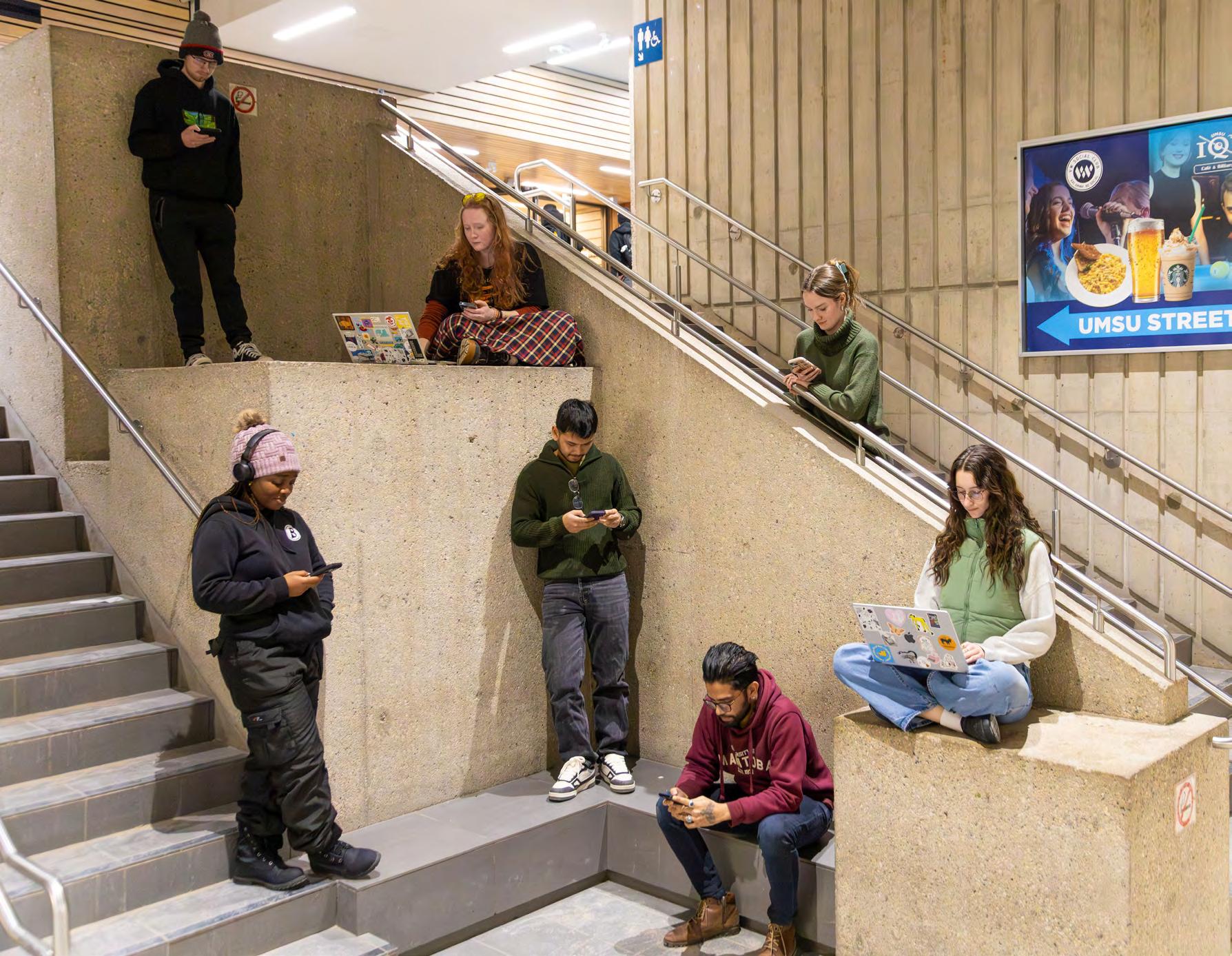
U of M launched a campus-wide digital communications survey the week of Feb. 2 to give students the opportunity to share feedback on how the university communicates online and how those systems can be improved.

The survey is part of a broader initiative led by Student Affairs to review and enhance the university’s digital communication landscape.

“We’re at a place right now where we really want to investigate and hear directly from students,” said Brandy Usick, executive director of student engagement and success.

“The tools we’re [using] were developed many years ago, and the importance of digital communication has only increased, particularly since the pandemic.”

Usick said the goal of the survey is to better understand how students currently access information, what platforms they rely on most and where gaps or challenges exist.

The findings will help inform future decisions around whether existing systems should be improved or replaced with more modern, integrated tools.

The upcoming survey builds on insights from a 2025 Perception Study conducted by an external research group

for U of M’s strategic marketing and communications team, which found that the dominant source of information was UM Learn for undergraduate students and emails for graduate students at the university.

Across all students surveyed, 87 per cent relied on UM Learn, 68 per cent on email, 61 per cent on professor communications and 54 per cent on the university website to stay informed.

While those findings provided a useful snapshot, Usick said the new survey will go further by focusing specifically on how students want to engage with the university beyond coursework.

“We want to [dig] deeper into where students go for information about what’s happening on campus, how to get involved and how they want to engage with the university community,” she said.

In addition to the online survey, students will also be invited to participate in small focus groups where they can provide more detailed feedback and discuss their experiences with digital communication tools.

Usick emphasized that student participation is essential and noted that students are best positioned to identify what works and what does not.

“Students […] are the largest constituent group on our campus,” she said. “Their voices matter in shaping how we communicate as a community.”

To encourage participation, students who complete the survey have a chance to win some incentives including bookstore gift cards, dining services gift cards and U of M Bisons merchandise.

“[This] is an opportunity to

lend your voice to a decision that will impact [current and future students],” Usick said. “We hope to hear how students want to communicate and engage with us as an institution.”

The link for participation in the survey will close on Feb.15. Students can access the survey via https://umanitoba. ca/student-survey.

Fighting fascism starts with migrant justice

Arifah Gheesah, staff

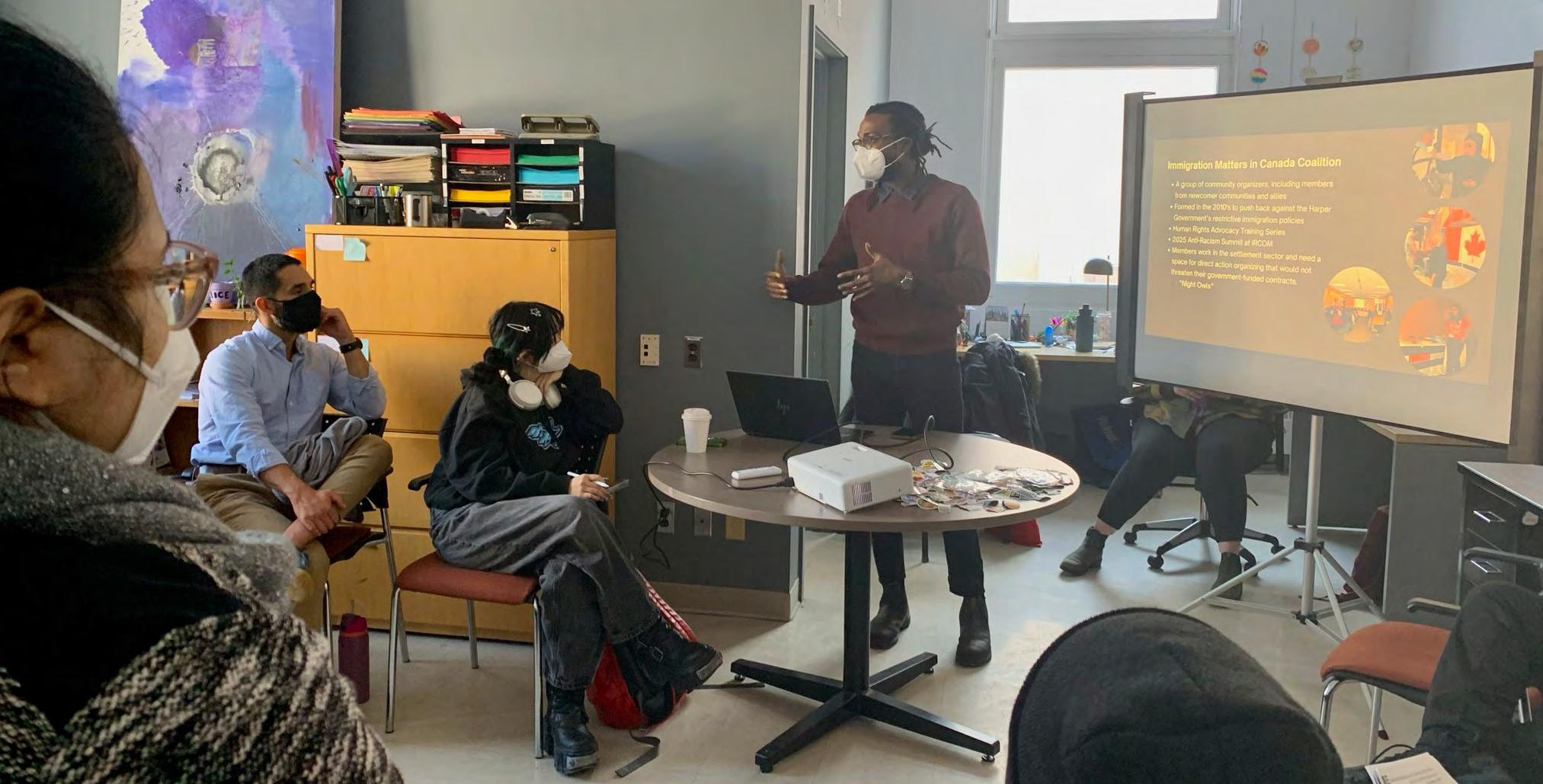
The Social Justice Hub’s teach-in for January, titled Migrant Justice Organizing, took place on Jan. 27 and was co-hosted by Migrante Manitoba, Anakbayan and the Social Planning Council.

The Social Justice Hub has a monthly teach-in where they discuss different social justice issues while bringing university staff, faculty and community partners to co-host sessions. This is a resource on campus for students who are interested in social change and community work.

Mandalyn Unger, Social Justice Hub coordinator, explained how those teach-ins are for students to learn how to do community work more effectively and sustainably. “We’re really an office that focuses on moving students

from identifying problems to then taking action on addressing them,” they said.

For January’s event in particular, the hub brought local community organizations that are working on the issue of migrant justice organizing so that students could learn from them and get involved. Unger added that these organizations can also learn directly from students about the challenges emerging in an increasingly anti-migrant political climate.

the history of colonialism and capitalism and its impact on the Philippines and on migration for Filipino people into Canada.

“When it comes to resisting fascism and resisting state suppression, your neighbour is the most powerful ally”
— Mandalyn Unger, Social Justice Hub coordinator

“I think especially with what we’re seeing happen in Minneapolis and the complicity of Canadian companies that are funding ICE either through the sale of

tanks or other resources, we wanted to make sure that we were talking about how we can make a difference in that fight here locally,” Unger said, reflecting on the economic barriers that are applied to international students and the impacts of anti-migrant rhetorics.

During the event, attendees were able to hear presentations from the three organizations. Various topics were discussed such as the importance of student leaders in social justice movements and mass movements and

The Social Planning Council talked about Bill C-12, the Strengthening Canada’s Immigration System and Borders Act, which aims to enhance border security and the Canadian immigration system. “It’s a huge bill that severely impacts migrants, newcomers [and] refugees, but also has implications for citizens,” Unger stressed.

Unger shared how Bill C-12 expands the surveillance state and the information that can be shared about people between government

agencies, which invades people’s privacy. It implies power to the government to mass-cancel immigrant applications. They believe that we are seeing as much antimigrant rhetoric and policy being put forward as we are in the U.S. Unger explained there is a “deportation machine” that is being built by Bill C-12 which will be mass-deporting people, regardless of the impact that will have on their lives.

The Migrant Rights Network, a cross-Canada alliance, is leading a campaign to ask people to write to their senators who are the last chance to stop this bill. People who want to contribute to that change can go to migrantrights.ca to write

Cont’d p. 4 / a letter <

PHOTO BY EBUNOLUWA AKINBO / STAFF

Social Justice Hub partnered with community groups to discuss migrant justice

< Cont’d from page 3

a letter to their senator.

“We do have the power to change the circumstances that make our lives so hard, and we have a much better chance of doing that if we work together than if we work alone,” Unger said, reflecting on the discussions that students had during the event.

With current happenings in the U.S., Unger is convinced empathy for our neighbours is necessary and want them to be safe and secure. An issue need not personally impact us to care about it. “Whenever we see state violence being enacted on a more marginalized or vulnerable group, we need to understand that it will never stop there,” they added.

“Our struggles are linked,” Unger said. “There is strength in […] working together, [and] we can support each other’s fights.”

Canada is a multi-cultural country, and it is important we know who we live next to, who we work beside and who

we go to school with and build personal relationships with.

Our neighbours have all levels of immigration status and hold all kinds of identities.

“When it comes to resisting

fascism or resisting state suppression, your neighbour is the most powerful ally,” Unger said.

The Social Justice Hub

remains a safe space for students to facilitate community organizing.

Students can find out at umanitoba.ca/communityengaged-learning/social-

justice-hub and can email Mandalyn Unger at mandalyn.unger@ umanitoba.ca for more about student organizing for migrant justice.

Career Fair provides guidance, links students with jobs

Employers, alumni and career services connect students with job options

The U of M’s annual Career Fair on Jan. 27 and 28 brought students, alumni and employers together to explore career opportunities, network and learn more about paths available after graduation.

The event featured organizations from a range of sectors, including public service, finance and international graduate education.

Students were able to speak directly with representatives and learn more about employment and postgraduate opportunities.

Malek Rose, a program support staff member with U of M Career Services, spoke about the career fair.

“We have a bunch of employers come in and students and alumni have a chance to have direct one-toone contact with employers to find out more about opportunities.”

Rose spent the day at the Career Services booth promoting resources available through the office, including resume support, interview preparation and job search assistance.

“This is obviously a service that’s free for alumni and students to use. A lot of people don’t know that it’s available

to them,” he explained. Career Services is located on the fourth floor of University Centre, room 474.

Rose encouraged students, particularly those nearing graduation, to take advantage of their services.

The fair also included international education options.

Zhaoying Hu represented the Community Solution Education System.

“We are a group of universities in the U.S.,” Hu stated. “We are all private, non-profit and we offer career focused graduate level education.”

Referencing one of the schools in the group — The Chicago School — Hu explained that although it initially “focused on psychology” it has since expanded to other programs.

She included that they were at the fair “because many of the programs that [they] offer are very limited in Canada, [whether] it’s mental health [and/or] physical health [programs],” she said, implying that “a lot of students have to go somewhere else to pursue that dream.” She encouraged everyone to keep exploring as there are many opportunities out there.

Janet Reichert, recruitment and communication specialist

for the Brandon Police Service, said the organization was attending the fair to recruit.

“We are looking for recruit officers. As well, we will have a cadet program opening coming up.”

Reichert explained that the Brandon Police Service prioritizes member wellness.

“Our executives are always looking out for our wellbeing, and we have a wellness committee,” she said. “We have one of the first psychologists in a small department coming on board.”

Genevieve Yoko, representative of Median Credit Union, explained the credit union is Indigenousfocused and owned but open to everyone.

Yoko highlighted specific benefits available to students and young adults.

“We have an account for 29 and under that has no fees at all,” she explained. “We also have many opportunities for anyone that would like to join us.”

Taqua Shapan, a third-year psychology student, attended the career fair. “I think that this is a very important event that you should all go to because it’ll open your eyes to the different companies that are in Manitoba,” Shapan said.

PHOTO PROVIDED BY SOCIAL JUSTICE HUB
PHOTO BY MATTHEW MERKEL / STAFF
THE MIGRANT JUSTICE ORGANIZING TEACH-IN ON JAN. 27.

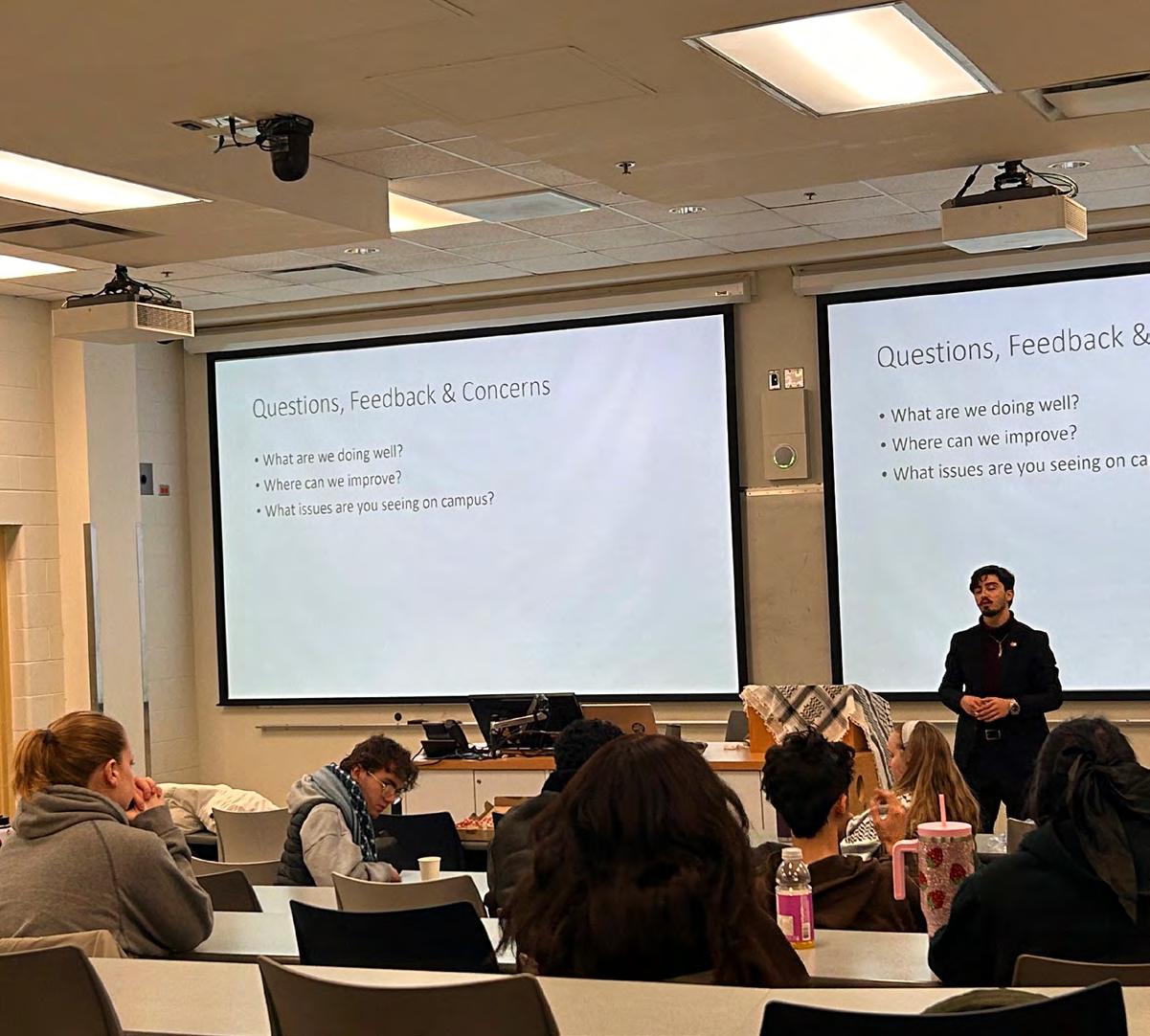
SJP holds general body meeting at U of M

Meeting outlined past events, current campaigns and ways to get involved

S

tudents for Justice in Palestine (SJP) held a general body meeting on Jan. 28 to introduce the organization to students, outline activities and explain opportunities for involvement.

Hussein Chokr, SJP vicepresident, led the meeting.

“The idea of the general body meeting was to essentially be more transparent to our community,” Chokr explained.

“And perhaps introduce SJP to people who have never attended our events, and to expand our reach on campus.”

“The general body meeting was divided into three aspects,” Chokr said.

and scope were described during the meeting.

“We are a group on campus that wants to advocate for Palestinian rights and to express solidarity with the Palestinian people,” he said.

“But our role isn’t limited to that. We also advocate for different groups and racialized communities.”

Previous events organized by SJP include Night in Palestine, held in December 2025 and similar events such as the Palestine Gala in 2024.

Chokr said the previous

talented performers within the pro-Palestine community, and we also had an Indigenous performance.”

The meeting highlighted the educational programming, particularly during the 2024 student encampment.

“The peak of the educational events happened during the 2024 encampment, where we collaborated with faculty members,” Chokr said. “They [gave] teachings regarding the economy, oppression and a lot of various topics.”

The campaign also discussed university investments.

“We are a group on campus that wants to advocate for Palestine rights and to express solidarity with the Palestinian people”

— Hussein Chokr, Students for Justice in Palestine vice-president

“This includes events that we have done in the past, the campaigns that we’re currently doing and […] how we can get people to be more involved.”

The organization’s mandate

events “had everything that you [could] ask for in a pavilion, [including] Palestinian food, culture, dances [and] a museum aspect.” He added, “We had performances by multiple

“Thanks to the encampment back in 2024, the university has disclosed a lot of their investments,” Chokr stated. “A working group of students and faculty combed through all of the investments and found that there are some organizations or companies that are complicit in the genocide in

Palestine.”

A new update about the club is that a lot of the current members will be graduating, which opens up opportunities for other students to fill their roles.

The evening concluded with representatives from SJP advising students to join the club. “Please be involved,”

UMUSA welcomes its members

Chokr said. “The work for Palestinian solidarity and solidarity within the greater U of M community is still important.”

To learn more about SJP and to stay up to date with their events, find them on Instagram @sjpuofm.

An evening of celebration and an opportunity for shared knowledge creation

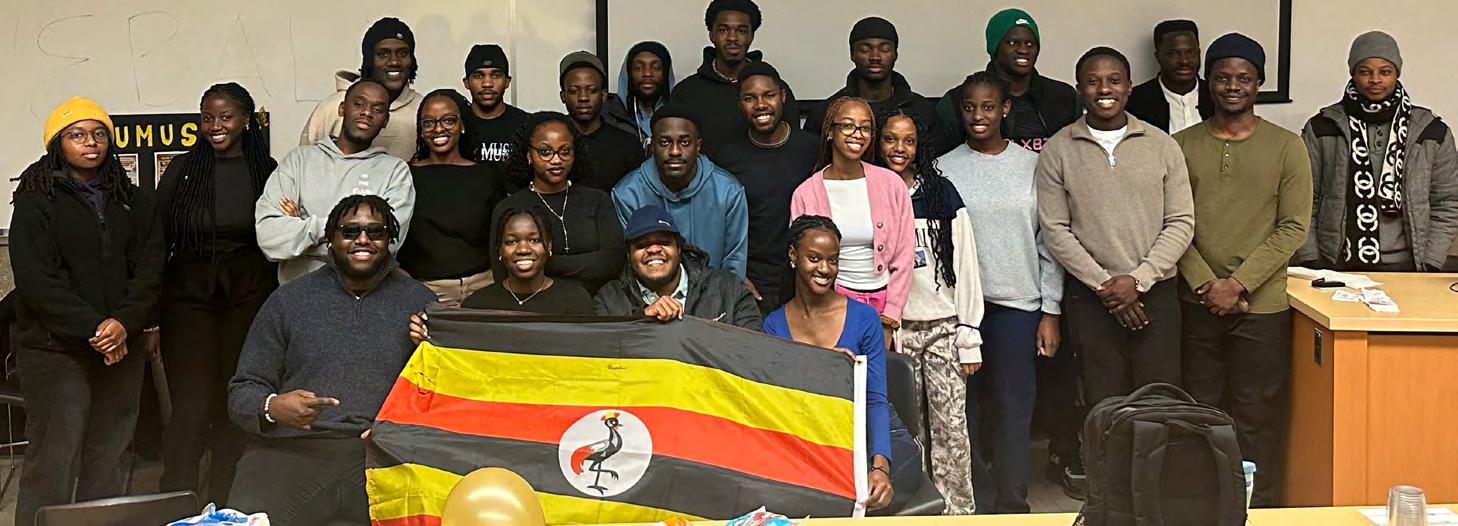
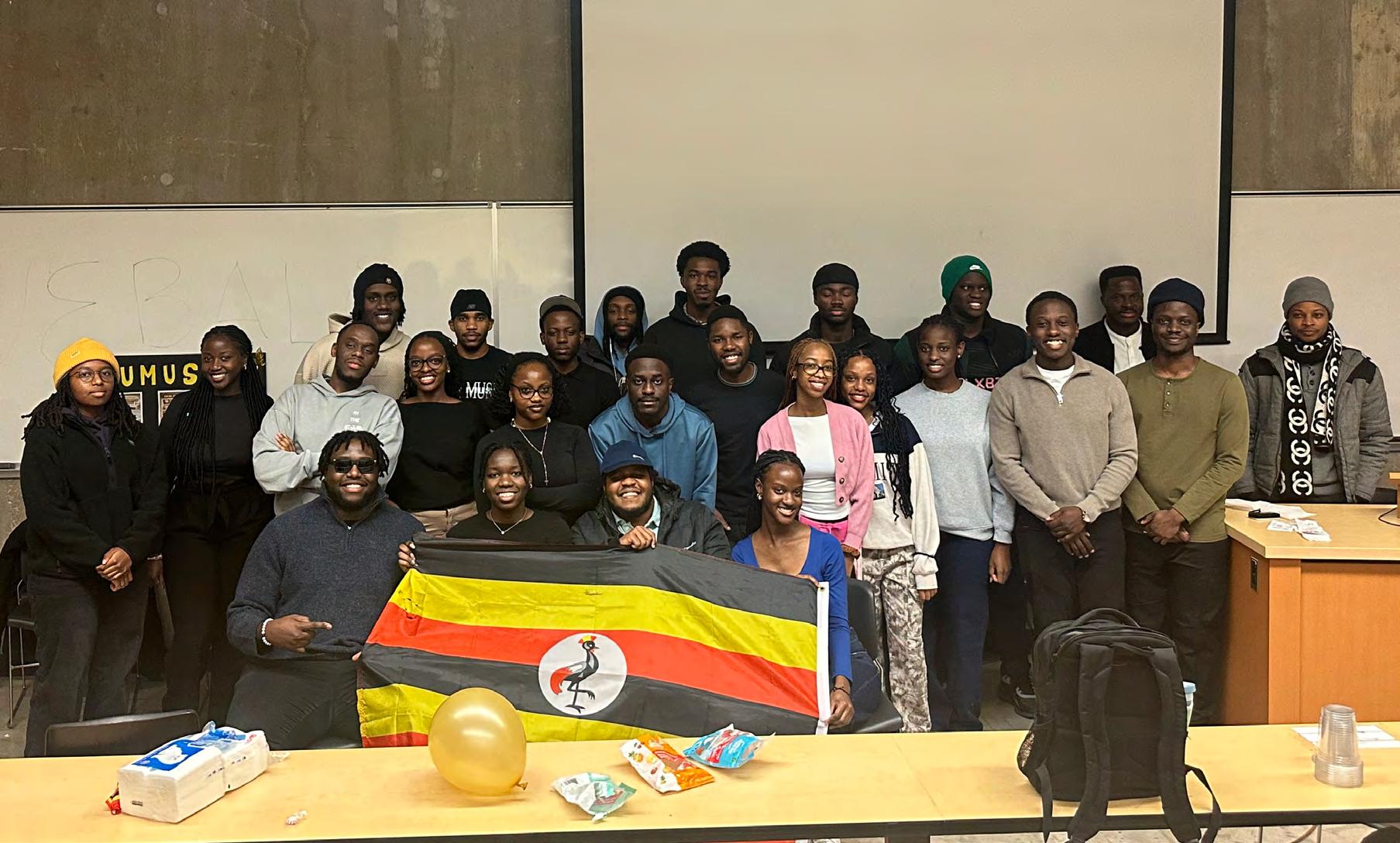
The U of M Ugandan Students’ Association (UMUSA) held its maiden community event on Jan. 23, bringing members together for a meet-and-greet aimed at fostering connection and engagement among Ugandan students on campus.

Hayley Gabriella Nanyange, president of UMUSA, said the gathering was designed to create an opportunity for members and executives to meet and share ideas for future events.

“The purpose of the club [is] to create a welcoming and supportive community for Ugandan students at [the U of M],” Nanyange said.

Paul Watuwa, UMUSA events coordinator, spoke about the ambiance of the event as one of its most meaningful elements. He described it as a “welcoming atmosphere” that encouraged participation and interaction.

informal structure of the meet-and-greet helped foster genuine connections and a strong sense of community.”

He attributed the positive outcome of the event to “strong teamwork, preparation and clear communication.” He added, “We aimed to make the event as inclusive as possible [which] required careful consideration.”

Nanyange acknowledged the novelty of the club.

“The club is still finding its footing within the university […] There are various plans ahead [which] will provide strong support for the student community,” she said.

connections among students.

“The world we are entering [into] after university requires more than just

a degree”

— Hayley Gabriella Nanyange, UMUSA president

Watuwa included that “the

Among the initiatives being considered are events like career fairs and cultural days, which Nanyange identified as notable opportunities for engagement. She also stressed the association’s current focus on building meaningful

The club, she said, works to “ensure presence and connection between students to make sure they [do not] feel alone on their journey.” Nanyange expressed hope

that UMUSA will continue to grow into a vital space for students. She said she aspires to see the association thrive “and provide a safe haven and landing spot for all Ugandan students […] as well as furthering knowledge about Ugandan culture and its people.”

In a message to students, Nanyange encouraged

involvement beyond academics, stressing the importance of engagement outside the classroom. “Participating in student clubs is an essential part of university experience,” she said. “The world we are entering [into] after university requires more than just a degree.”

PHOTO BY NAFISA AL LILO / STAFF PHOTO PROVIDED BY UMUSA
IMAGE OF THE U OF M UGANDA STUDENTS ASSOCIATION.

Research & Technology

Managing water for the future of prairie agriculture

Smarter irrigation and drainage can boost yields and protect resources

R anjan R. Sri Ranjan is a professor and associate head (graduate) in the U of M department of biosystems engineering. Sri Ranjan believes that water management is at the centre of sustainable agriculture on the prairies. Hence, his research focuses on soil and water engineering, with particular attention to irrigation and drainage systems on farms. His work combines longterm field research, computer modelling and applied engineering to help farmers improve crop yield and quality while preserving water and nutrients.

Much of Sri Ranjan’s research is conducted directly in farmers’ fields. Using fully instrumented field plots, his team has studied how water management affects crops such as potatoes, corn, canola, soybeans and wheat. That data is then used to develop computer models of fields growing specific crops.

Once these models are calibrated and validated, Sri Ranjan explained, they can be used to simulate how crops respond to different weather patterns and water management scenarios. “The idea is to develop best management practices that conserve water and

nutrients within the field while maintaining long-term sustainability,” he said. By running simulations across multiple years of weather data, the research helps predict outcomes under increasingly variable climate conditions.

One of the issues that first drew Sri Ranjan into this field of research was potato quality.

For potatoes destined for the processing industry, visual and chemical quality matters as much as yield. When potato plants experience water stress, poor root and canopy development can cause sugars to accumulate in the tuber. When those potatoes are fried, the sugars caramelize, creating what are known as “sugar ends,” or brown tips on french fries. Potatoes with sugar ends are often rejected, resulting in lost income for farmers.

According to Sri Ranjan, theoretically, irrigation and proper drainage could reduce this problem by creating better soil conditions for plant growth. To prove this, Sri Ranjan’s team conducted replicated field experiments to test different water management strategies. The research was funded by the Canadian and Manitoban governments, along with support from industry and producer groups. The

results of the research were significant. Fields with improved irrigation and drainage showed yield increases of up to 30 per cent compared to plots with no water management, while potato quality was also far superior.

The research did not stop with potatoes. Because tile drainage systems are expensive to install, Sri Ranjan said it was important to evaluate their benefits across crop rotations that include corn, soybeans, canola and wheat. Traditional drainage systems allow excess water to leave the field freely, often carrying valuable nutrients with it. By contrast, drainage control structures can limit water outflow, helping retain both water and nutrients in the soil.

In clay soils near Arborg, Manitoba, Sri Ranjan’s team has conducted extensive drainage research that has resulted in significant yield increases for canola and soybeans. The work explored a less conventional approach, using tile drains not only to remove excess water, but also to add water back into the soil through subirrigation. During dry periods in 2023 and 2025, applying water through the tile drainage system helped plants grow more effectively,

leading to higher soybean yields than in plots without drains.

Alongside field research, Sri Ranjan has also developed a patented irrigation decision-support device. The technology is designed to tell farmers exactly how much water to apply during their next irrigation, he explained. The device, which is currently being refined for field testing, will connect to a smartphone app. Before irrigating, farmers will be able to check the app to see the recommended water depth, helping them avoid overwatering or wasting scarce resources.

Sri Ranjan emphasized that this work is increasingly important in the context of climate change. Extreme and unpredictable weather is becoming more common on the prairies, making effective water management essential for sustaining crop yields. Tile drainage and controlled irrigation, he said, will play a critical role in adapting to these conditions and ensuring food security for a growing population.

According to Sri Ranjan, the research also has major implications for Manitoba’s agricultural economy. Manitoba is currently the second-largest potato producer in Canada,

contributing roughly $2 billion in economic benefits and supporting more than 4,700 jobs. There is now a push to expand potato production by 5,000 acres to meet processing capacity. Because potatoes must be rotated with other crops, this expansion would require developing roughly 15,000 acres with adequate irrigation and drainage infrastructure.

To Sri Ranjan, tools like the irrigation decisionmaking app will help farmers manage limited water supplies more precisely as production expands. At the same time, his work plays a key role in training the next generation of biosystems engineers. Students involved in his research gain hands-on experience designing and evaluating irrigation and drainage systems that will “sustainably grow crops, increase agricultural production, and boost Manitoba’s GDP.”

For students interested in this field, Sri Ranjan advised that students can work on research projects, earn funding and explore whether graduate studies are a good fit through summer research internships. “Summer research internships are a great way to explore your passion,” he said.

The Earth has entered a new era of water bankruptcy

A UNU-INWEH report calls for immediate action to mitigate damages

A new report from the United Nations University Institute for Water, Environment, and Health (UNU-INWEH) suggested that the globe has entered a new era of “water bankruptcy.” For the past four decades, the phrase “global water crisis” has been widely used to describe the world’s water situation. However, the report finds that this term is no longer sufficient to explain the current hydrological state — the condition and movement of water in the environment, including rivers, groundwater and rainfall.

Whereas the “crisis” narrative implied that baseline conditions remain viable despite the shock of disaster, conditions in many parts of the world suggest that water baselines have irreparably shifted. The problem in mischaracterizing the water trends is that such description creates the illusion that “with more infrastructure, better coordination and stronger emergency responses, the world can ‘return’ to a desirable past state,” the report explained. This, however, is an impossibility for many water systems.

As humans continue to affect and reshape global water systems, what were once acute impacts have now become chronic hydrological conditions. While an earlier UN press release suggested that 77.6 per cent of the Earth’s land is now drier than it was in the 30-year period preceding 2020, drought is not the only threat the Earth’s water systems face.

Man-made pollution has damaged water systems, promoting “eutrophication, harmful algal blooms [and] pathogen contamination,” as described in the 2026 report. Because of this, reports of water quantities overstate the availability of safe drinking water.

The UNU-INWEH report revealed that while the era of crisis warnings has come and gone, we have entered the new era of diagnosis — water bankruptcy. According to the report, this diagnosis shows “an admission of failure and the first step toward a fresh start.” In a hydrological context, water bankruptcy operates similarly to financial bankruptcy. As is the case with bank accounts, humans can draw on annual income and long-term savings. Per annum, regions receive a yearly “income” of water through rain and snow to be spent throughout the year.

When demand for water rises, “savings” — made up of aquifers, glaciers, wetlands and other natural resources — are accessed to compensate. However, in many places of the world, “these accounts have been systematically overdrawn, with withdrawals exceeding renewable inflows and safe depletion limits for years or decades, degrading the natural capital that once underpinned resilience,” the report described. This has caused damage that is irreversible on human timescales, making reversion of previous water levels an unrealistic goal. Even though not every water basin has dried up, enough global critical systems have been fundamentally altered to accurately diagnose global

water bankruptcy.

While humans focus on the big picture consequences of water bankruptcy, artificial intelligence (AI) companies silently contribute to the rising issue. In order to operate, AI servers require water to cool them and prevent them from overheating. Daily, ChatGPT

Our current reality requires humans to share this meager percentage with man’s new best friend, AI.

In the U.S., the water consumption of the 5,426 data centres across the nation have left noticeable impacts.

“While humans focus on the big picture consequences of water bankruptcy, artificial intelligence (AI) companies silently contribute to the rising issue”

alone uses 39.16 million gallons of water in order to operate. The water required to cool these AI servers is the same freshwater that humans use in our daily lives. However, fresh water makes up only three per cent of the world’s water supply, and only 0.5 per cent of all water is safe for human consumption.

In Northern Virginia, where 300 of these data centres reside, two billion gallons of water were consumed in 2023 alone. In certain counties in the region, this has led to a call for the use of potable water to cool data centres. In other states, residents attribute the water consumption of local data centres to increasingly discoloured, sediment-filled water flowing from their taps.

Despite the UNU-INWEH report’s strong stance that a just approach to water

bankruptcy management is required to mitigate harmful effects, it is unclear how such interests can be balanced with the presence of largescale AI consumers. The report indicated that affected communities “should have a voice in shaping reallocation plans, infrastructure choices and adaptation strategies.”

Meanwhile, AI companies seek to develop their data centres in Africa, with current sights set on Kenya, Nigeria, Morocco and Egypt, areas traditionally affected by water stress. It is unclear what steps are being taken to mitigate further damage to the region and its inhabitants. In fact, many African AI strategies have failed to address climate and labour concerns. Continued failures to adhere to the report’s call for a new global water agenda may lead to greater geopolitical instabilities.

GRAPHIC BY TEEGAN GILLICH / STAFF

I love beer and cussing

Succeeding in a field dominated by men

As a woman who has been constantly reprimanded for swearing, whether in public or by my mother, I will openly tell anyone that I swear like a sailor. I find swearing to be almost a therapeutic way of expression that can sometimes help me communicate frustration when regular words fail me.

It’s not just my love for cussing that is controversial, but also my love for beer. I think there’s something so whimsical about a woman who loves drinking beer and cusses.

In many spaces, beer is still seen as a drink that is intrinsically associated with the masculine, with ads tapping into imagery of beer being something rugged and gritty, often associated with aggressive masculine traits.

As a woman who enjoys a pint of Guinness as her drink of choice, I am unashamed in my brazen campaigning of beer being not only a drink that is catered to men but should be seen as a beverage which should be enjoyed by anyone who wants to crack open a cold one.

I see my beer drinking and cussing as the equivalent of the internet trend “#womeninmalefields.” I feel as though both cussing and drinking beer are often

idealized and perpetuated as mainly male-dominated activities, and I see my participation as resistance to this audience.

While I don’t happen to drink beer that often, I am constantly cussing. I find my cussing to be something of a hereditary gene that has been passed along for generations. My grandma loved to cuss, so much so that she would meld certain curse words together to create new ones.

Profanity is frowned upon for its crude nature, although this begs the question of why some people get so upset with swearing. I deduce that swearing gives people the power of interpretation — some view certain curse words as worse than others

For me, drinking beer and swearing go hand in hand. In my opinion as an Irish woman, there’s just something so Irish about it. As a veteran Guinness drinker, I highly advise going out, getting a pint and tossing around a few f-bombs and seeing where the night takes you.

More women should take up space in bars and pubs. I think it’s time to stop thinking of bars as an inherently masculine space, and the world of beer commercials as only a masculine place of existence. These aren’t exclusive experiences, so why

are we acting like they are?

For me, beer and swearing are something therapeutic, freeing almost. I want to take up space in male-dominated

spheres. I want to cuss without it being seen as “unladylike” by a group of misogynistic males vaping in the back corner of Leopold’s. I find

drinking and swearing not profane but expressive, not blasphemous but liberating.

GRAPHIC BY EMMA GILLICH / STAFF

I saw you in seasons

I saw you in winter... and thought of tree branches feathered by starlight in poorly lit neighbourhoods A hearth where I found the more honest parts of myself I am bared fetal warmed upon welcomed

I saw you in spring... and thought of long drives through the countryside in the rain Ice cream melting from our chins dancing petrichor upon our toes Kissing by the sea shore

I saw you in summer... and thought of sleepy boathouses uncovering ancient childhood treasures in the woods A secret lake somewhere the sky’s reflection in promise Windy hilltops upon which to blame each other for the sunrise

I saw you in autumn... and thought of scarfs and cafes city streets and sunsets where we watched each other’s breath escape Apartment staircases where windchill hibernates the world slowing down around us from your window

The first time I saw You I thought to myself... I could live there

Do you have a poem you’d like to submit to the Manitoban? Email your submissions to arts@themanitoban.com

To complete Sudoku, fill the board by entering numbers 1 to 9 such that each row, column, and 3x3 box contains every number uniquely. In Straights, like Sudoku, no single number 1 to 9 can repeat in any row or column. But rows and columns are divided by black squares into compartments. Each compartment must form a “straight.” A straight is a set of numbers with no gaps but it can be in any order, eg [7,6,9,8]. Clues in black cells remove that number as an option in that row and column, and are not part of any straight. Glance at the solution to see how “straights” are formed.

Poets’ Corner
Ronal Amata, volunteer
Aubrey Stotter, volunteer

The Manitoban horoscope for week of Feb. 2

Zodiac sign mania, see your fate this week

Mayhew, staff

AQUARIUS

January 20 –February 18

You love a good puzzle moment and it shows. You enjoy trying to figure people out in order to understand them. Take a break this week and try to understand that maybe, just maybe, you don’t need to perceive everything.

and take up some knitting. Although your ability to fight every battle for your friends like it’s the Hunger Games is commendable, I think maybe it’s time you see that you do not have to fight everyone’s battles.

PISCES

February 19 – March 20

Pisces, Pisces, Pisces. Much like Zendaya’s song “Replay,” this week will be filled with both a constant sense of dread and joy. Although the beginning of the week may be more difficult, those hardships will make sense closer to the end of the week.

some herbal tea and quality time at home. Make sure you take care of yourself to prevent burnout.

TAURUS

April 20 –May 20

Taurus, you have been put in the time-out corner. The universe is telling me that you have committed misdeeds. You may want to take some time to go on a long walk and figure out how you want to proceed with righting your wrongs.

ARIES

March 21 –April 19

Dear Aries, you are so full of rage, perhaps it is time to put the pitchfork down

CANCER

June 21 –July 22

Cancers, do not drink Guinness this week as it appears to be flat. Luckily, you don’t need beer to have fun. You are the fun. You may, in this upcoming week, be going out more than usual and realize that you don’t always need a party to have fun. You are the party.

GEMINI May 21 –June 20

Geminis, you know I adore you guys, but I’m going to be honest. Please stay home at least one night a week to recharge your social battery. This past week, you may have been going out a lot. It’s time you swap that shot glass for

VIRGO August 23 –September 22

Virgos, again, I adore you guys, but it’s time to stop acting like a fool. I sense that recently, you may have been up to no good. For this week, focus on keeping a low profile while doing some reflecting. Maybe reflect on what you want for the upcoming week.

LEO

July 23 –August 22

Liar, liar, pants on fire. Dear Leo, have you lied to me? I feel as though you have. I don’t know what, but I sense something is amiss. Did you forget to check in with friends and family this week? If you haven’t yet, make sure you do so. This will prevent chaos from escalating in the week.

LIBRA

September 23 – October 22

For this week, if you see a fellow Libra walking to their destination, make sure you offer them a ride. Libra, it’s time to look inward and do some reflecting. Is life going the way you want? What is the next step in your journey?

so seriously. Everything will work out. If you have any inkling to buy a lottery ticket, now would be the time.

SAGITTARIUS

November 22 –December 21

Dear Sagittarius, go see some art this week. I sense that you may need some artistic inspiration. Go to an art gallery or go see a movie. Sometimes inspiration can be all around you but you just don’t notice it. Do not dwell if you are not inspired. Inspiration will come soon enough.

SCORPIO October 23 –November 21

Scorpios, I highly encourage you to attend a dance party this week. You need to let loose and stop taking things

CAPRICORN December 22 – January 19

Capricorn, it’s time you stop thinking about others and focus more on yourself. Stop prioritizing others at the expense of yourself. At the end of the day, you need to realize that nothing else really matters except how you see yourself, not how others see you.

The case for a Winnipeg Transit riders union

Why organizing transit riders is more important now than ever

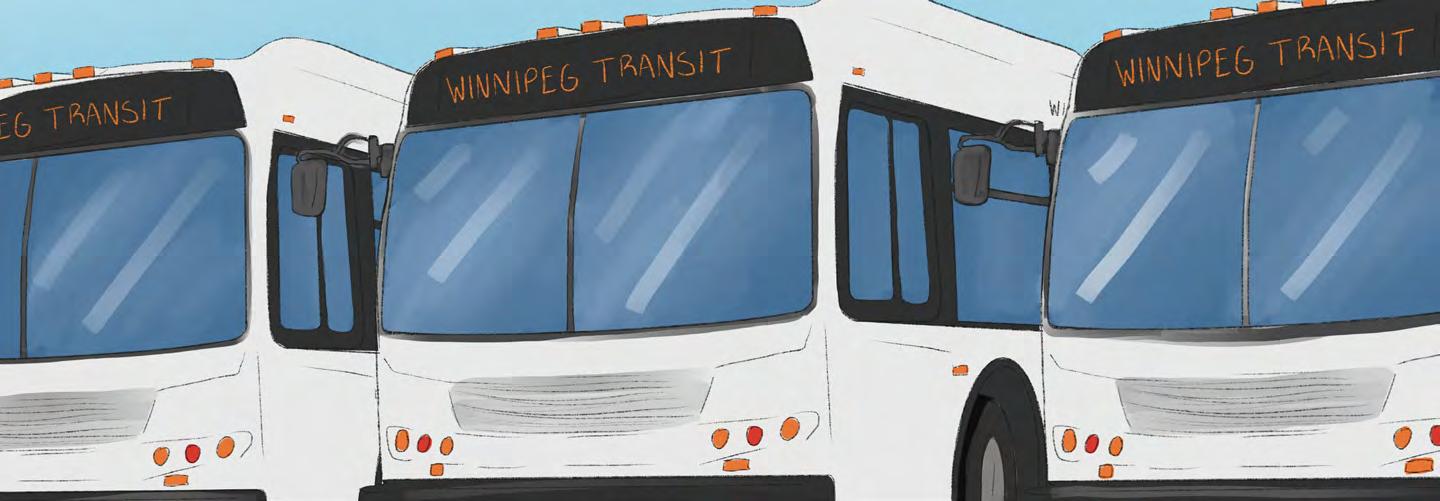
A transit riders union — successful in many other cities — is the next logical step toward restoring trust and accountability in Winnipeg’s transit system, which continues to face serious challenges.

Winnipeg Transit’s problems begin with reliability. Frequency issues were among riders’ top complaints, prompting the rollout of the Primary Transit Network, a spine-and-feeder system meant to reduce wait times and increase frequency. While some routes were improved, others were worsened with longer waits, continued bunching, missed connections and reduced service hours, especially in inner city neighbourhoods.

Bjorn Radstrom, Winnipeg Transit manager of service development, acknowledged these challenges and noted ongoing adjustments, which include an expanded On-Request service and longer hours on select routes. Still, riders remain frustrated, especially during evenings and weekends.

Concerns about safety have

escalated sharply. According to Statistics Canada, violent incidents on Winnipeg Transit increased 281 per cent between 2016 and 2024. In response, Mayor Scott Gillingham launched a community safety force in 2024, investing millions of dollars. Recently, this force has focused on fare evasion, citing millions in lost revenue. Yet over-reliance on enforcement — especially when most riders affected are low income, Indigenous, women or people of colour — risks further eroding trust.

Meanwhile, fares continue to climb. Adult cash fares now sit at $3.45, on par with Toronto despite much lower service quality. Youth and senior fares have also risen. Most violent incidents are tied to fare evasion, which is driven by high fares. Despite rising costs, service has not improved, ridership has dropped and public confidence continues to fall.

Winnipeg cannot meet its climate goals without strong transit. Transportation accounts for nearly 50 per cent of the city’s emissions, mostly from private vehicles. The Transportation Master

Plan targets a 50 per cent non-automotive mode share, but again, poor service disproportionately harms low income, Indigenous, newcomer and disabled riders who rely on transit most.

A transit riders union — representing those who use the system daily — is overdue. Transit decisions in Winnipeg are made with little meaningful rider input. Riders are the lifeblood of any public transportation system, yet as individual riders, their influence is limited.

A transit riders union reframes riders from “customers” to a political constituency. As the Seattle Transit Riders Union describes itself, it is “a democratic organization of working and poor people — including students, seniors and people with disabilities — taking control over our own lives, and building up the power we need to change society for the good of humanity and of the planet.”

Across North America, rider unions have won real gains. Toronto’s TTC riders recently forced a fare freeze for the third consecutive

year. Seattle’s Transit Riders Union secured reduced fares for low income riders and coordinated a new transit map. These victories show what organized riders can achieve.

Winnipeg lacks an equivalent force. Past groups, like Functional Transit Winnipeg, have greatly contributed to public transit advocacy. Today’s challenges, including service reliability, equitable fares and balanced safety strategies, need to go one step further with a democratic riders union focused on those most affected. A transit riders union can identify service gaps, fight rising fares, advocate for funding that caps adult fares and ensure youth, seniors and vulnerable riders face minimal financial hardship. It can also push for safety approaches that include social supports, not just enforcement, while demanding transparent reporting and climate-aligned investment.

Students should help lead this effort. As one of the city’s largest transit-dependent groups, students at the U of M, University of Winnipeg

and Red River College bring energy, vision and organizing capacity aligned with climate justice and public equity.

Winnipeg Transit riders are not just customers. They can be a powerful force for change. A safe, affordable, reliable and climate-aligned transit system is possible if riders choose to organize. A transit riders union is needed now more than ever.

Adam Johnston hosts “Not Necessarily The Automobile” on Thursdays at 11:30 a.m. on UMFM 101.5. He can be reached at notnecessarilytheautomobile@gmail.com

GRAPHIC BY TEEGAN GILLICH / STAFF

Canada’s arms exports are hitting closer to home

ICE in Minneapolis shows what Canada’s export loophole is built to allow

C anada’s arms export story is usually told as an overseas one. This story is not wrong, but it is incomplete. A large part of Canada’s export pipeline runs into the U.S., including equipment now being used by Immigration and Customs Enforcement (ICE).

In December 2025, reporting based on U.S. procurement records showed ICE moving ahead with a rush order worth roughly $10 million for 20 armoured vehicles from Roshel, a defence manufacturer based in Brampton, Ontario. The vehicles, designed to withstand bullets and blasts, are marketed for law enforcement, border patrol and military uses. This is not what most people expect when they hear “arms exports.”

These are Canadian-made, or Canadian-supplied armoured vehicles intended to support ICE operations within the U.S. Minnesota, where ICE operations have intensified, sits just across the Canadian border. Our geographical proximity to the current tensions makes the point unavoidable. Thus, Canadian armoured vehicles deployed there should be seen as a local problem to Canadians.

ICE has become synonymous with raids, family separation and the expansion of coercive state power against migrant communities. In Minneapolis, this enforcement has turned deadly. On Jan. 7, an ICE officer fatally shot Renée Nicole Good, and on Jan. 24, federal officers shot and killed Alex Pretti, with videos of the shooting raising alarm bells about the media narratives being spun. In this context, the presence of armoured vehicles is not only to use as transportation, but also to escalate fear and intimidate

communities.

So, why is Canada still congratulating itself for being a “responsible exporter” while supplying this machinery?

The short answer is Canada’s export controls treat the U.S. differently, and this difference creates an accountability gap.

Government guidance states that export permits are not required for most controlled goods or technology destined to a final recipient in the U.S., subject to limited exceptions. This means transfers that would trigger case-by-case reviews, assessments and ministerial scrutiny for other destinations can flow south with far less transparency. The result is that most arms exports to the U.S. are permit-free, and they bypass the case-by-case risk assessment Canada claims to apply through the Arms Trade Treaty aligned framework.

This is also why the U.S. loophole cannot be treated as a narrow technical issue. It is the same pathway advocates have warned can allow Canadian-made military components to reach Israel through U.S. transfers, even when Canadians are told exports are being paused or restricted. Roshel itself has been linked to controversy surrounding Israeli sales, including reports about plans to supply Israeli police with armoured vehicles and public debates about whether Canada should allow such exports.

The geography is different, but the structure is the same. Canada lets controlled goods move into the U.S. with less scrutiny, losing visibility over end use and then acting surprised when the consequences come to light, whether in Gaza or Minneapolis.

This is why Canada’s current economic attitude is so misleading. Governments love

announcing manufacturing wins. They point to jobs, contracts and the pride of Canadian industry. But when a human rights lens is missing from our business deals, the contracts we sign become political choices, affirming both the harms we are willing to enable and the harms we are willing to ignore.

This is where Bill C-233 comes in. Introduced by MP Jenny Kwan, Bill C-233 would amend the Export and Import Permits Act by removing destination-based exemptions, narrowing permit-free pathways and strengthening human rights

and humanitarian law safeguards, including end use certification and stronger reporting to parliament. Plainly, it targets the very logic that gives the U.S. a pass.

Critics argue that the Canada-U.S. defence relationship is deeply integrated, and they raise concerns about economic fallout. But integration is not an excuse for inaction. If supply chains are integrated, accountability must be integrated too. Otherwise “we did not know it would be used for this” becomes the permanent alibi of a country that keeps benefiting from the

deal.

Canada cannot keep marketing itself as a human rights nation while treating arms exports as a jobs program and never an ethical question. If Canadian-made Roshel vehicles are supporting ICE operations, it should trigger the scrutiny our export regime claims to exist for. Parliament should move Bill C-233 forward, and Canadians should demand an export system that puts human rights at the centre, regardless of whether the buyer is our closest neighbour.

GRAPHIC BY MEI M. / VOLUNTEER

Exploring men’s relationship with incompetence

Spotting weaponized incompetence in your relationship

I

f you have a boyfriend or husband who seems to struggle with the most basic tasks, like loading a dishwasher, folding laundry or making breakfast, and he makes you feel like you need to raise him the way you would a child, you are probably dealing with weaponized incompetence. This is a manipulative action where a person pretends to be bad at or incapable of doing tasks to avoid responsibility, forcing others to do the work instead.

Over the last couple of decades, the roles of men and women have become less distinct. Traditionally, men were expected to engage only with jobs and requirements outside of the home. They interacted directly with society through paid labour, military service and voting. Conversely, women were expected to focus only on work within the home, such as cooking and cleaning. Now, these roles are far less strict. Men and women alike are expected to work both inside and outside the household.

We no longer live in a society where only women perform domestic labour tasks, and so grown men should be able to contribute equally to household maintenance. Yet it seems like a considerably high number of men portray incompetence when it comes to household chores.

Somehow, men do not display this same incompetence outside of the household. Your boyfriend can maintain a good GPA with a full course load, but grocery shopping is beyond him?

I feel that because of traditional gender roles, men can feign inability without too much push back, while women are expected to occupy certain roles and perform many tasks.

Weaponized incompetence can be characterized by a number of different behaviours. The first is pretending to have no idea how to do something to avoid doing it when asked. I saw a comment on social media where a user complained that her ex-husband couldn’t pick up their sons from school because he didn’t know which

school they attended. There are obvious issues with this man’s response. If he was being honest, it is extremely irresponsible to be a parent who does not know what school his children attend.

Often, when weaponized incompetence is used, the manipulator will try to make it seem like this lack of not knowing can and will stop them from completing a task. They might say something like, “I can’t do the dishes because I don’t know how to load the dishwasher,” or “I can’t empty the dishwasher because I don’t know where everything goes.” But the answers to these problems are simple and can be found by doing a quick Google search or opening the kitchen cupboards.

Weaponized incompetence can also be seen in men who will complete a task, but will purposefully complete it poorly to avoid being asked to do it again. Your boyfriend knows that if he makes you feel like it is a waste of your time and energy to make him do something, you will

probably end up just doing it yourself. The problem in both cases is that it puts unnecessary pressure on one party in the relationship. It is selfish and manipulative, and ultimately reflects that your partner does not really care about your well-being.

It is 2026, and every adult should be self-sufficient. Being able to wash clothes and dishes and clean up after oneself is a basic thing to expect from any grown-up, and if your partner claims not to know how to do these things, don’t baby them. Tell them to figure it out.

GRAPHIC BY EMMA GILLICH / STAFF

Musical community and collaboration at Desautels

U of M and CMU concert bands celebrate community with tributes

Emmanuel Laramee, volunteer

I had the pleasure of attending my first U of M musical performance of the year, Unidad en Ritmo, on Dec. 4, 2025. I went into it blind, and to my surprise, it was not only a performance by the U of M Concert Band, but the Canadian Mennonite University Concert Band as well.

The CMU Concert Band opened with “Jocuri Poporale Romanesti,” meaning “Romanian Folk Dances,” by Béla Bartók. This was piece was a fitting start to the concert — its upbeat and engaging rhythms encapsulated the concert’s theme of “rhythm not only as a musical element but as a symbol of unity across cultures and generations,” as described in the program notes.

This is not to say that all the performances were similar in their rhythm and tone. The second piece performed by the U of M Concert Band, “Elegy” by James Barnes Chance, flipped the script and brought a somber, introspective mood to the concert hall. Written for a deceased band member of West Genesee Senior High School Band, “Elegy” carries its sadness slowly and with a heavy heart. Every note of its building climax feels like a fleeting memory, and the final fanfare is abruptly cut short. This was not the first or last time the mood had changed during the performance, and it was a testament to the skill and range of the musicians on stage. When attending performances like these, putting the emotions one feels into words can be difficult. Instrumental music touches our soul in a more esoteric and fleeting way than vocal music. Nevertheless, U of M director of bands Jacquie Dawson summed up the performance in a few words — community, sharing and energy.The star performance of the show

came near the end of the CMU Concert Band set, where Winnipeg-based composer Kenley Kristofferson debuted his concert band arrangement of Stan Rogers’s famous Canadian folk song “Northwest Passage.” Most notably, Bella Rogers, Stan Rogers’s granddaughter, was the guest violinist for the piece. Not only was the piece moving and beautifully played (resulting in a muchdeserved standing ovation near the end), the story behind the performance is also worth telling. Kristofferson wrote he started going “down a bit of a Stan Rogers rabbit hole” after being sent an Instagram story of a group singing “Barrett’s Privateers.” When he got to “Northwest Passage,” he said the arrangement just came to him, and he “heard the whole instrumental piece just laid out in front of [him].”

After its completion, his arrangement got the attention of music educator Ross Brownlee from Westgate Mennonite Collegiate during a group instrumental music reading session at Long & McQuade. Brownlee told Kristofferson that Bella Rogers attended his school, and Kristofferson soon found out she was a violin major at CMU. After Kristofferson reached out to Bella Rogers and the CMU Concert Band director Cheryl Ferguson, they began rehearsing, and everything fell into place.

Dawson also explained the U of M Concert Band and Wind Ensemble normally perform together, but the Wind Ensemble was performing with the Jazz Orchestra, leaving them without a performing partner. Being good friends with Ferguson, Dawson thought it was a

natural choice to bring the CMU Concert Band on board.

Kristofferson also praised his collaborators. “It was an instant connection,” he said. “So much of that speaks to the incredible musicianship of Bella, the ensemble members and the leadership of Cheryl Ferguson in that group.” He added, “The standing ovation was for Bella, and she deserved every second of it.”

I would like to think the standing ovation was for everyone who made the concert happen. Either way, it felt important, and the world needed this moment to bring people together.Dawson echoed the importance of musical collaboration, writing that creating community through music is valuable, and that it “takes people ‘where they are at’ and allows them to experience music in a variety of ways.”In an

era of streaming, music is on demand and personalized, and it is rarely a shared experience. However, when we experience music live with other people, we do not just experience the music itself — we experience the process, the practice, the emotion and the collaboration of the musicians and their art.Funnily enough, as impactful and important as I found this performance, Dawson was surprised by the news coverage of the concert, describing it as “low-key.” However, this shows how even an unassuming performance can be memorable and thought-provoking. So, whether it is at the U of M, or anywhere else in your community, you never know what you might experience when you go to a concert. So, grab your tickets, take your chances and go see some live music!

GRAPHIC BY EMMA GILLICH / STAFF

The Road Hammers to perform in Winnipeg Feb. 14

Canadian country rock group’s latest tour visits Winnipeg in support of latest single

T

he Road Hammers, known for their eclectic mix of outlaw, Southern rock and classic country music, have been active in the Canadian country rock music scene for over two decades.

Founded in 2004 by Canadian Country Music Association (CCMA) hall of famer Jason McCoy, the band comprises of McCoy, Clayton Bellamy and Chris Byrne. They saw immediate success upon releasing their debut album in 2005, reaching #1 on the Canadian country albums chart.

Speaking to the Manitoban, Bellamy explained that his favourite part of being in the Road Hammers for the last two decades has been the “unlimited amount of creativity” he has found.

“When you’re with three individuals who are all super creative […] you can’t help not only to always have cool ideas, but to get better […] Jason and Chris are incredible musicians, and you just can’t help but get better by osmosis, just being around them,” he reflected.

Bellamy stated that while the band is rooted in country rock and they love the genre, he does not feel that the

term fully encompasses their music.

“We’ve, in the last 20 years, cultivated our own kind of sound, and our own thing, and the Road Hammers are almost their own genre […] mixing up country music and […] and rock and roll and blues, and making it into our own,” he explained.

During the Road Hammers’ career, 10 of their singles have charted in the top 20, with three of them reaching the top five. The group has had the opportunity to perform with notable artists such as Def Leppard, Loretta Lynn, Chris Stapleton and the Scorpions, among others.

A personal highlight for Bellamy has been performing at the Grand Ole Opry in Nashville, Tennessee, known as the one of the biggest shows in country music.

“[The Grand Ole Opry] is the Carnegie Hall of country music […] We’ve played it a couple of times now, and it never disappoints. It’s an amazing opportunity,” he said.

Additionally, the group has collected impressive accolades. They have won multiple CCMA Awards, including three for group or duo of the Year, and won

the Juno Award for country recording of the year in 2006.

The Road Hammers released their latest single, “Till The Wheels Fall Off,” featuring Big Wreck’s Ian Thornley and Theory of a Deadman’s Tyler Connolly, on Jan. 9. According to the band’s website, the song is “fueled by roaring guitars, relentless drive and a spirit that never quits.”Bellamy explained that the writing and recording process for this single was different from their previous work as it was the first time that they wrote the song while recording it. Usually, the group writes songs first, whether individually or together, prior to recording.“We were working with Allen Salmon, a new producer [and] a friend of ours […] We wanted to make an opening song, a set opener for a live show, something that would just grab everybody and really make them pump their fists in the air and get excited,” he recalled.

Bellamy stated that fans of the Road Hammers will love the high energy of the song.

“I think the fans […] will love a song that is unabashedly fun and loud,” he said. “It’s the kind of song that [when] you […] get in your car and you hear it, [you want to] […]

immediately reach for the volume knob to turn it up, not turn it down.”

In support of the new single, the Road Hammers are touring across the country on the Till The Wheels Fall Off Tour, accompanied by country music duo and fellow CCMA winners Doc Walker, from Westbourne, Manitoba. The tour will end in Winnipeg on Feb. 14 at the Club Regent Event Centre.

Bellamy said that along with the tour, the Road Hammers will be releasing new music in

the near future.

“We just appreciate all the fans sticking with us for 20 years,” he stated.

The Road Hammers’ latest single, “Till The Wheels Fall Off,” is available now on streaming platforms. The group’s Till The Wheels Fall Off Tour, with Doc Walker, will come to Winnipeg on Feb. 14. For tickets and more information, visit theroadhammers.ca, or follow them on Instagram @ theroadhammers.

Softcult debuts feminist punk shoegaze-inspired album Canadian band begins tour in Winnipeg

Canadian alternative rock duo Softcult released their debut album, When A Flower Doesn’t Grow, on Jan. 30, to be followed by a tour including a stop in Winnipeg for the first time. Twins Mercedes and Phoenix Arn-Horn perform loud yet often dreamy and etherealsounding songs tackling 2SLGBTQIA+ and feminist issues. The debut album arrived after four previous EPs from the band. They will also be playing in other cities supporting Lights, a fellow queer Canadian artist.

The Arn-Horn twins write songs based on their personal experiences, noting the cathartic nature of the process and comparing it to journaling. They are strongly influenced by the riot grrrl movement, while presenting a more intersectional approach than was mainstream in 1990s feminism.

“I was sitting in my apartment […] feeling really down and looking at my plants,” Mercedes recalled from her attempts at selfhelp. “I just identified with how plants really need an environment to grow that is not confining them and oppressing them. If you keep a plant in a pot that’s too small for too long, it becomes root bound and strangled and it withers and dies. And that’s what the song was about. I was basically comparing how I felt to how my plants must feel when I don’t give them the proper environment to flourish.”

Phoenix expanded the metaphor to a representation of the world as a whole, which

The title track takes its name from Mercedes’s experiences of questioning her sexuality and orientation throughout her 20s, but having to repress it and alter her self-expression due to a long-term relationship. She compared the growing stress to a voice that was impossible to ignore.

cannot grow while under political oppression. So the dual meanings of the title became the linking themes throughout the album.

Another track of the album is “Tired,” a more energetic song about oppression and bigotry under the current U.S. government.

“Everyone reaches a breaking point where you become radicalized and you’re like, ‘You know what? This shit sucks. I’m tired of it,’” Mercedes explained. Phoenix continued, “We open our phones and we just see so much insane stuff. You can get burned out on it and start to feel desensitized and whatnot. But it’s important you stay awake even when you’re tired [and] not let it grind you down, and just let it light a fire under you.”

Phoenix produced the music themself, rather than going to a studio. The band enjoys the creative freedom self-production enables, and credits their ability to create

together from growing up as twins.

“From being in the studio [and] having more experiences on the road and getting to tour with other bands and in other parts of the world, it all has influenced what we do now and what we put on the album,” Mercedes commented. “We really tried to lean into our influences and take risks creatively. There are

some songs on this album where we are doing full riot grrrl yells and scream stuff. We never did that before.”

Softcult will perform at Sidestage on Feb. 9 at 8 p.m., supported by local shoegaze band Guilty Sleep. For tickets and more information, visit sidestagewpg.com/tmevent/soft-cult-with-guestsguiltysleep/.

PHOTO PROVIDED BY TRAVIS NESBITT
PHOTO PROVIDED BY KAYLENE WIDDOES

U of M hosts annual Canadian Jazz Summit

A weekend of workshops, lectures and a final concert

Boris Tsun Hang Leung, staff

This weekend, the U of M is hosting the fifth annual Canadian Jazz Summit, a two-day long jazz festival created by Jazz Winnipeg and the U of M jazz studies program.

Each year, the festival invites musicians to teach masterclasses and workshops and perform at the university. This year’s guests are Torontobased Tara Davidson and Alex Samaras, who will each be hosting workshops and lectures.

Samaras is a multi-genre vocalist who has performed with musical acts such as Meredith Monk & Vocal Ensemble and is the music director for Beverly GlennCopeland, a longtime singer and composer. In addition, he teaches at music camps, the University of Toronto and Humber Polytechnic.

Samaras described his upcoming U of M workshop, saying, “We’re going to be doing some breathing and body awareness exercises […] As a singer, my voice [and] my body is my instrument. And so I’ve really been curious about learning how to connect to my body and just become more aware of what this instrument is […] and how to use it efficiently and with ease.”

“I’m also going to do a workshop about singing rounds as a springboard to improvisation, which I found really interesting, because rounds are at first quite simple, but then when you start to play with them and start to get their coordination of listening and improvising, it can be a really fun playground.”

With a Juno Award for jazz album of the year in 2020, Davidson is a jazz-focused woodwind player whose primary instrument is the saxophone. She also teaches at the U of T and York University and will be hosting interactive woodwind classes for the summit.

Davidson explained that for the final concert, she and Samaras will be performing their arrangements with U of M jazz students and faculty members as well as original compositions by Davidson.

“We’ve shared the music with the people we’re playing with ahead of time, and then we’ll have a short rehearsal with them, but we’ll be improvising also,” she said.

“I find with the younger people I play with, there’s an energy, and their breath is so present and there’s a real aliveness to the energy they bring to the music,” Samaras added.

“We’re also going to play [Everybody Says Don’t] by Stephen Sondheim, who’s a composer that I love […] And it’s kind of a protest song, to be honest. And it’s a beautiful song to do with students. It’s about the world telling you no, and you’re saying, ‘Yeah, we’re going to do this, and I’m going to do this, and I believe in what I’m standing up for.’”

With a concert open to the community, there are bound to be some in the audience who are not necessarily jazz connoisseurs. However, Davidson spoke on the importance for people to be curious and open-minded about different genres — you just might find something that matches your groove.

“You never know what kind of music is going to resonate with you […] You don’t have to know exactly what’s happening in a concert to be able to appreciate [the] level of musicianship, or maybe stories that are trying to be told through even wordless compositions,” she said.

“I may have an opportunity to talk about the music that I’ve written […] I’ve found in the past, the more context that I can offer to the compositions, like how they came to be, it draws more people in that aren’t necessarily jazz fans.

But it gives them a little inside perspective, and oftentimes helps them appreciate it [on] a deeper level.”

The Canadian Jazz Summit

will take place on campus on Feb. 6 and 7. For tickets to the final concert on Feb. 7 at the Desautels Concert Hall, visit jazzwinnipeg.com/jazzsummit.

World premiere of Tad & Birdy launches end of January

Manitoba Theatre for Young People presents debut work by Anika Dowsett

Carrington Dong, staff

Winnipeg’s Manitoba Theatre for Young People (MTYP) presented the world premiere of a new play, Tad & Birdy, on Jan. 30. Written by Gimli-raised playwright Anika Dowsett and directed by Erin McGrath, the play follows the titular characters Tad the tadpole (Hera Nalam) and Birdy the lovebird (Samuel Benson), who form an unlikely friendship when they meet in a messy bedroom.

“The play starts with Tad being brought in in a jar and hatching, and then asking ‘Where am I? What’s going on?’ And the play is just about their friendship and learning from one another and helping each other grow,” Dowsett explained.

Dowsett has been interested in theatre from a young age. After studying theatre at the University of Winnipeg, they found that they wanted to create worlds and be a visionary. This led them to study playwriting under

playwright Brian Drader, and they fell in love with the art.

Dowsett has worked at MTYP for some time in various roles, ranging from box office to theatre instructor and assistant, which inspired them to write theatre for youth.

“Part of why I like writing for youth is that it’s really honest and fun and playful. Those are qualities that I love in art,” they reflected.

Dowsett came up with the idea for Tad & Birdy through MTYP’s Sandbox program.

One day, MTYP’s artistic director, Pablo Felices-Luna, gave Dowsett and the other creators in the program an exercise to draw a children’s song from a hat and pitch a play inspired by that song.

“My song was about a little tadpole in a bog,” they recalled. “And for some reason, I immediately was like, ‘Tadpole. [In a] little boy’s room, in a jar, with a bird.’ And then [I] wrote the outline in 15 minutes and then went from there.”

According to Dowsett, the play’s characters represent the two sides of their own personality if they tried to talk to each other. They described Tad as “kind, optimistic and curious,” while Birdy is “jaded,” but eager to share their knowledge with someone who will listen.

“I think of Birdy as the eight-year-old on the playground who’s been at school for a while and kind of knows what’s going on, or at least thinks that they know […] and then Tad is this wide-eyed five-year-old who’s just started school, who’s so impressed with Birdy and has no idea what anything is,” they said.

The world premiere of Tad & Birdy, presented by Manitoba Theatre for Young People, opened on Jan. 30 and runs through Feb. 7. For tickets and more information, visit mtyp.ca.

PHOTO PROVIDED BY WADE MUIR
PHOTO PROVIDED BY LEIF NORMAN

Phenomenally Flower inspires self-betterment

Local award-winning poet releases debut book

Poet, U of M school of business communications specialist and social entrepreneur Cheta Akaluka has released her debut poetry collection this January.

The writing is centred on her goal of relaying what she has learned about self-love, Christianity, marriage and her home country of Nigeria. The book is titled Phenomenally Flower — a verb commanding readers to flourish in their own lives.

“I wanted everything [in the book] to be bright,” Akaluka noted. “I wanted everything to be encouraging, so that [everybody] who comes in contact with it, even if it’s just the cover, knows that there is hope and light in this world, and you just have to be intentional.”

It is divided into four sections — Germinate, Grow, Flower and Flourish — representing steps of personal development and overcoming hardship. The journey follows stages of creating means for betterment, improving the

situation, experiencing the change and finally realizing a new outlook for life. Through this structure, Akaluka highlighted that the mere recognition of a problem and enaction of a plan is not the end of the story.

Phenomenally Flower is […] a documentation of different seasons of my life,” the poet explained. “I have put together lessons, [like] guiding lights for people who are in similar situations, so they can look and first of all know that they’re okay, they are normal. [This] isn’t something extraordinary that they’re going through, but also know how to navigate those situations.”

The first poem of the book is “Beacon,” a short poem with only three stanzas of three lines each. The poem introduces the book rather effectively, inviting the reader to search for hope, love and positive guidance within it. Following the opening reassurances, the next section starts on a darker note with “Enjoyment,” which depicts

a lethargic morning before work and the broader lack of meaning in life. The third section begins with a threepage dedication of the poet’s relationship with God, titled “To My First Real Love.”

The last section opens with “Congratulations, You Won,” a four-page list of everyday challenges for readers to celebrate their overlooked endurance. Akaluka’s debut is overall an inspirational work of literature.

“I’m able to draw certain conclusions about life,” she remarked. “Poetry is a lot about observation, it’s a lot about listening with your eyes, which sounds very metaphoric, but it is what it is. Listening with your eyes, observing and putting that creatively into different pieces. Most times it’s when I sit to reflect that all these words start pouring out of my pen.”

The collection presented in Phenomenally Flower is the result of a decade of writing poems. The publishing deal came when Akaluka won the

Black Label Poetry Slam in 2019. She was announced as the winner after three rounds facing off against competitors from across Winnipeg.

“It was amazing to have that experience, because […] I have a strong science

background, so I was on my way to study engineering when I realized I had a talent, a calling […] an undeniable skill for communication. So I rerouted to communications and marketing,” she recalled.

When extended reality becomes performance art

Local artist Freya Björg Olafson presents Motion Aftereffect

Boris Tsun Hang Leung, staff

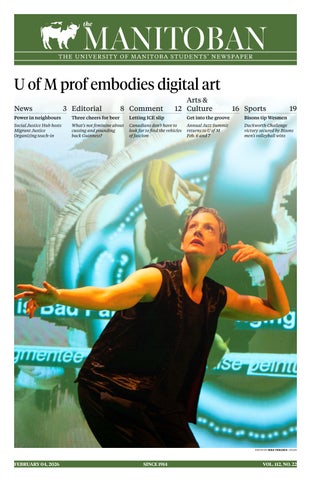
Cascading trails of arms, a twirling 3D model and ephemeral words that melt into digital noise — these are elements from the closing scene of Freya Björg Olafson’s MÆ – Motion Aftereffect, a live performance about the human body’s relationship with extended reality (XR) technology. The performance took place at Rachel Browne Theatre last week after touring Ottawa and Montreal.

In the final scene, Olafson gestures and spins on stage under a video camera while the footage is projected onto a screen behind her, coupled with a virtual model of herself.

“I used just a free phone app [called Photogrammetry] to make a 3D replica of myself […] and it gave me an avatar that I could animate with my own motion capture data. And then it’s played back live on stage through a software called Unity, which is used for building games,” Olafson explained.

The live footage of Olafson is made to have a ghosting effect, similar to how one gets a trail of mouse pointers when a computer crashes, creating hypnotic patterns and colours

in real time.

Olafson is a Winnipegbased intermedia artist and assistant professor at the U of M school of art with a focus on performance and digital media. She has been incorporating live video feeds and computers into her art since 2009, and pointed out that the everyday use of her computer has shaped her life.

“I wanted to bring some of my experiences engaging with popular media and technology and in the everyday, and comment on [or] explore how it is informing and shaping our experiences. So, in this piece […] there’s quite a bit of text that’s gathered from people online describing […] what they see in [virtual reality (VR)] or describing VR pornography experience, so that other people can decide whether that’s something they want to explore,” Olafson said. “I started this research [in 2017 to 2019, and people were] doing home motion capture tests using an Xbox Kinect, tools that were affordable for people to bring these techniques into their home, and that [was] quite an interesting, exciting time.”

There has been substantial

interest in XR technology in recent years, as seen in the viral 2016 mobile game Pokémon GO, the rise of virtual YouTubers and Mark Zuckerberg’s infamous Metaverse. Olafson pointed out that while the XR boom is exciting, she hopes people will remain critical of the

technology and aware of the challenges it could bring.

“Digital practice is not about necessarily the techniques or the tools that you use, it’s what you have to say with them. So I hope people are still excited and curious to engage critically with these tools,” she commented.

“[There are] lots of limitations and biases inherent in all tech development. So [I hope to see] more people involved and engaged at thinking critically and contributing to [help] shape what it is.”

PHOTO PROVIDED BY CHETA AKALUKA
PHOTO BY MIKE THIESSEN / STAFF
FREYA BJÖRG OLAFSON PERFORMS MÆ — MOTION AFTEREFFECT.

Duckworth Challenge favours visiting teams

Women’s basketball loses 57-55 and wins 76-61 against Wesmen

The Bisons and the University of Winnipeg Wesmen traded runs all night on Thursday, Jan. 29 at the Investors Group Athletic Centre. The visitors won 57-55 with only two seconds left in the 34th Duckworth Challenge. The Duckworth Challenge originated in the 1991-92 season as an effort to showcase the friendly rivalry between the two Winnipeg universities.

Taylor Schepp for the Bisons opened the scoring for the game with a layup, 0-2. The herd struggled to convert early, and although the teams were tied 4-4 midway through the first quarter, the Wesmen pulled ahead to 8-4. A late surge highlighted by Jazmin Birch’s contributions and a buzzer-beating three pointer sent the Wesmen to a 17-9 lead, winning the first quarter. Birch alone scored 12 points for the Wesmen in the first quarter, outscoring the Bisons who cumulatively scored nine points.

more even, as the Bisons used their depth to stop the game from slipping away.

The Wesmen stretched the margin to 20-11, but with contributions from Bisons’ Darya Rom (6 points) and Samantha Onyebuchi (6 points), the herd reduced the deficit. The Wesmen took a 30-24 lead into halftime. In the first half, the Wesmen exposed the Bisons’ strategy of playing wide and breaking late, circling up just before the herd could get a clean look and forcing bad shots, keeping the herd under constant pressure.

the clock. The scoreline was 41-39 as the game went into the last quarter.

In the final quarter, the herd took the lead with a three pointer from Rom, making the score 41-42. Both teams went back and forth on scoring and were equal in execution.

The closing 30 seconds was the tightest stretch of the game and revolved around the 55–55 deadlock. With 12 seconds left, Anna Miko missed a layup and then made a rebound — the ball made it to Schepp who attempted to make a jump shot but she missed.

“This is a classic Duckworth challenge game for sure, and unfortunately in close games like that someone always is gonna come out on the losing side”

— Michele Sung, Bisons women’s basketball head coach

The second quarter was

In the third quarter, the Bisons scored 15 points and the Wesmen 11. Outscoring the Wesmen allowed the herd to reduce the deficit. With a minute left on the clock, a three pointer by Rom tied the score 39-39. It turned out to not be much help as Wesmen’s Jennifer Kallon scored a jump shot with one second left on

With seven seconds left on the clock, Wesmen’s Jasia Hayden made a defensive rebound, with the ball ultimately making it to Kallon who scored the gamewinning layup for the Wesmen with two seconds left. The Wesmen won the game 57-55.

Bisons women’s basketball head coach Michele Sung reflected on the loss to the Wesmen. “This is a classic Duckworth Challenge game for sure, and unfortunately in close games like that someone

[will always] come out on the losing side and that was us today.”

She pointed to a slow first quarter as the herd searched for rhythm and the right lineup, but praised the secondhalf fight fueled by better rebounding and offensive flow, with Rom (16 points) and Schepp (21 points) stepping up when it mattered. “I was proud of them for taking over at times [...] we just need to be a little bit more consistent.”

The Bisons and the Wesmen played again on Saturday, Jan. 31 at the Duckworth Centre.

The herd went all in to win the game 76-61. Both games seemed to have favoured the visitors. As of Saturday, 10 p.m. C.T, the herd is seventh in the Canada West Prairie standings.

The Bisons will go on to face the Brandon Bobcats on Friday, Feb. 6 at 6 p.m. CT and Saturday, Feb. 7 at 5 p.m. CT at the Investors Group Athletic Centre. The herd last faced the Bobcats on Oct. 24, 2025, and lost the game 86-71.

Bisons split Duckworth Challenge against Wesmen

Wesmen edge Bisons women’s volleyball in thrilling five-set match at home

Israel Adeogo Abejoye, staff

The Bisons women’s volleyball team showcased their skills in the Duckworth Challenge, defeating the University of Winnipeg Wesmen 3-0 (25-23, 25-13, 25-16) at the Duckworth Centre but losing 3-2 (29-27, 15-25, 25-20, 21-25, and 16-14) at the Investors Group Athletic Centre.

On Friday, Jan. 30, the Bisons took an early lead, with a 4-1 score. They capitalized on this advantage as they continued, but the Wesmen nearly caught up, scoring four consecutive points to narrow the gap to 21-19. However, the Bisons maintained their lead and secured the set 25-23.

In the second set, the Bisons jumped to a 2-0 lead and extended it to 6-1 with four more points. They continued to dominate, eventually winning 25-13.

The Bisons dominated

the third set again, with six consecutive points to take a 6-1 lead after the Wesmen’s initial score. The Wesmen could not recover from this lead, and the Bisons won 25-16.

The Bisons’ strong performance was led by Raya Surinx, who had a total of 14 points, primarily from kills.

Ella Gray and Brenna Bedosky also contributed to the Bisons’ dominant win. The team’s serving prowess was evident throughout the match.

In the rematch on Saturday, Jan. 31, at the Investors Group Athletic Centre, the Bisons lost 3-2 to the Wesmen in a heated game.

The Wesmen took the first set 29-27, despite the Bisons tying the score at 22-22.

The Bisons bounced back in the second set, scoring seven consecutive points to take a commanding lead and winning 15-25. However, the Wesmen regained momentum

in the third set to take the lead and win 25-20.

The Bisons evened the score in the fourth set with a 1-6 lead, and maintained their lead to win 21-25.

In the fifth set, the Wesmen took the early lead. Despite the Bisons timeout, the Wesmen continued to dominate, eventually winning 16-14.

The Duckworth Challenge is an annual competition between the U of M and University of Winnipeg sports programs. The challenge involves games played between the men’s and women’s basketball and volleyball teams from both universities. The university whose teams win the most matches is declared the winner of the Duckworth Challenge.

The Bisons basketball teams also split points with the Wesmen, with both men and women’s teams winning

one and losing one. However, the Bisons men’s volleyball team won both of their games, which was enough to win this edition of the Duckworth Challenge for the Bisons.

The Bisons women’s volleyball will play UFV Cascades on Friday, Feb. 13 at 8 p.m. CT and Saturday, Feb. 14 at 6 p.m. CT in Abbotsford, British Columbia.

PHOTO BY EBUNOLUWA AKINBO / STAFF
PHOTO PROVIDED BY MIKE STILL

Bisons’ ace serve propels them to victory over Wesmen

Men’s volleyball team makes the difference in winning the Duckworth Challenge

T he Bisons men’s volleyball team dominated the University of Winnipeg Wesmen in the 34th edition of the Duckworth Challenge, winning 3-0 and 3-1. On Friday, Jan. 30, at the Duckworth Centre, the Bisons displayed determination, winning all three sets 25-16, 25-18, and 25-17.

In the first set, the Bisons took an early lead, scoring the first two points. The Wesmen narrowed the gap with a single point, but the Bisons responded with six unanswered points to take an 8-1 lead. They maintained their advantage and secured the set 25-16.

The Bisons continued their strong performance in the second set, taking the first point, but the Wesmen’s Luke

“Serving is a key element in volleyball, and we practice it a lot”
— Arnd Ludwig, Bisons men’s volleyball head coach

Lodewyks’s kill briefly leveled the game. The Bisons regained momentum, and scored four consecutive points to lead 6-2. The Wesmen fought back, tying the score 6-6. The teams traded points until the Bisons pulled ahead 20-13, eventually winning 25-18.

In the third set, the Wesmen initially took the lead, but the Bisons responded quickly, exchanging points and gradually increasing their advantage. They won the set 25-17.

Owen Weekes, Bisons player, shared his thoughts after the game. “I think for us

right now [the game] just feels like every other game. I think we’ve been on a good run right now, we’re working real hard in practice week in and out […] We take care of business, we know what we can control,” he stated.

In the rematch on Saturday, Jan. 31, at the Investors Group Athletic Centre, the Bisons won 18-25, 15-25, lost 32-30, and won 24-26.

Although the Wesmen took an early 3-0 lead in the first set, the Bisons tied at 11-11. The Bisons took control, scored

four consecutive points to lead 13-17, another four points to take a commanding 14-21 lead, and won the set 18-25.

The Bisons continued dominating the second set, as they scored four points to take a confident lead. Despite the Wesmen’s efforts, the Bisons won 15-25.

The third set was intense, with both teams refusing to yield. The Wesmen took a 22-17 lead, but the Bisons rallied, scoring seven consecutive points to take a 22-24 lead. The teams exchanged points,

and the Wesmen eventually won 32-30.

The fourth set was closely contested, with both teams evenly matched. When the Wesmen led 24-22, the Bisons scored four consecutive points to win the set 24-26.

Arnd Ludwig, Bisons men’s volleyball head coach, thought that his team capitalized on their serves to win the game

“We played very well today. It started right with our serves, we put a lot of pressure on the Wesmen. They struggled, especially at the beginning

of the set, and then we had a couple of good blocks, and I think that helped us a lot gaining the confidence for the rest of the game,” he stated.

“Serving is a key element in volleyball, and we practice it a lot,” Coach Ludwig revealed.

The Bisons men’s volleyball team will play the Fraser Valley Cascades on Friday, Feb. 13 at 9:45 p.m. CT and Saturday, Feb. 14 at 7:45 p.m. CT in Abbotsford, British Columbia.

PHOTOS PROVIDED BY MIKE STILL

Bisons neck and neck with Wesmen

Bisons men’s basketball defeats Wesmen 90-85 in game one, loses game

The Bisons men’s basketball team defeated the University of Winnipeg Wesmen 90-85 in the Duckworth Challenge on Thursday, Jan. 29 at the Investors Group Athletic Centre.

The Bisons displayed early promise with an 18-8 lead at 4:30 in the first quarter. Ramogi Nyagudi made a layup at 1:51, assisted by Mason Kraus, to put the Bisons ahead 24-15. Tito Obasoto added two free throws at 0:48 to extend the margin to 28-18. Elijah Mensah then made a layup for the Wesmen at 0:32, cutting the deficit to 28-20.

In the second quarter, Nyagudi scored a layup at 9:11, assisted by Cieran O’Hara, to extend the Bisons’ advantage to 30-20. At 4:53, Wesmen Kato Jaro made a jump shot to tie the game 32-32. Mensah then made a dunk at 0:08 which gave the Wesmen a 44-39 lead at halftime.

At 7:12 in the third quarter, Kraus made a three-point jump shot to reduce the gap 49-43. Kraus made a layup at 3:08, which brought the score to 61-57. With five seconds remaining, Taven Vigilance made a three-point jump shot to cut the Bisons’ deficit to 69-65.

Kraus made a three-point jump shot at 8:28 in the fourth quarter, assisted by Daren Watts, to put the Bisons back in front, 71-69. At 5:51, Jaro made a three-point jump shot to reclaim the lead for the Wesmen, 75-73. Kraus made two free throws at 5:27 to level the game 75-75. At 4:48, Nyagudi made a layup assisted by Kraus to give the Bisons an 80-75 advantage. With 13 seconds remaining, Obasoto made a free throw to stretch the lead to 90-83 and at exactly 0:00, Mensah scored a layup for the Wesmen ending the game on a 90-85 win for the Bisons.

Kraus and Nyagudi said the team shifted momentum in the fourth quarter, which turned the game around in their favour. “We just started to execute,” said Kraus. “Throughout the game we started to pressure Kato, and he made a few mistakes at the end […] You could just see they started to crumble a bit at the end, and we just capitalized. They gave us a few freebies at the rim, a few free threes, which would have killed us at the end, but we just

two 91-79

executed our game plan and just kept pushing forward.”

Nyagudi said, “We were

“I’m just grateful to be in a position to play in a game this big”
— Ramogi Nyagudi, Bisons men’s basketball.forward

playing a lot for ourselves at the start of the fourth.” He continued, “Near the end, we

had a little timeout. The coach got us together, he was like, we gotta keep swinging the ball, we gotta keep moving it. We came out of the timeout, got one good possession and started stacking up.”

Kraus spotlighted the team’s mindset, saying, “I feel like at the end, we just wanted it more.” He added “The whole

game, [we] had more fouls than them, but then at the end, the refs just let us play […] We were the more physical team at the end.”

Nyagudi shared his feelings after taking part in his first Duckworth Challenge for the Bisons. He pointed out what sets this game apart from others. “I always come to the game and everything is the same. It’s the same game. The only difference is the crowd [...] But one thing I’ll say, it reminded me of St. Paul’s —

my last game.” He revealed, “At the end of the day, I’m just grateful to be in a position to play in a game this big.”

In the second game on Saturday, Jan. 31, the Bisons lost 91-79 against the Wesmen at the Duckworth Centre.

The Bisons men’s basketball team will host the Brandon Bobcats on Friday, Feb. 6 at 8 p.m. CT and Saturday, Feb. 7 at 7 p.m. CT at the Investors Group Athletic Centre.

PHOTOS BY EBUNOLUWA AKINBO / STAFF

Turn static files into dynamic content formats.

Create a flipbook
Issuu converts static files into: digital portfolios, online yearbooks, online catalogs, digital photo albums and more. Sign up and create your flipbook.