28 Jan 2026

Page 1


109 HELEN GLASS BUILDING UNIVERSITY OF MANITOBA WINNIPEG, MB THEMANITOBAN.COM | 204. 474. 6535

GENERAL INQUIRIES: ME@THEMANITOBAN.COM

CIRCULATION INQUIRIES:

MISSING OR INCOMPLETE PAPER?

EMAIL: DISTRIBUTION@THEMANITOBAN.COM

EDITOR-IN-CHIEF Mikaela Warkentin editor@themanitoban.com

BUSINESS MANAGER Alice Teufack accounts@themanitoban.com

BUSINESS SUPPORT MANAGER Joshua Herold ads@themanitoban.com

EDITORIAL

MANAGING EDITOR Peace Ifeanyi me@themanitoban.com

COPY EDITOR Eden Quiring copy@themanitoban.com

COPY ASSOCIATE Mursal Ghiyasi

NEWS EDITOR Roy Albright Obah news@themanitoban.com

RESEARCH & TECHNOLOGY EDITOR Mansura Meghla research@themanitoban.com

COMMENT EDITOR Quinn Mayhew comment@themanitoban.com

ARTS & CULTURE EDITOR Boris Tsun Hang Leung arts@themanitoban.com

SPORTS EDITOR Abdul-Jalilu Ahmed sports@themanitoban.com

DESIGN

DESIGN EDITOR Deveney Jarrow design@themanitoban.com

DESIGN ASSOCIATE Patricia Sanque

GRAPHICS EDITOR Emma Gillich graphics@themanitoban.com

GRAPHICS ASSOCIATE Teegan Gillich

AUDIO AND VIDEO

AUDIO EDITOR Max Reid audio@themanitoban.com

PHOTO EDITOR Mike Thiessen photo@themanitoban.com

PHOTO ASSOCIATE Ebunoluwa Akinbo

VIDEO EDITOR Zulkifl Rafah video@themanitoban.com

DIGITAL MEDIA EDITOR Faisal Rahman social@themanitoban.com

SOCIAL MEDIA ASSOCIATE Paula Robles Andia

REPORTERS

NEWS Arifah Gheesah

NEWS Nafisa Al Lilo

RESEARCH & TECHNOLOGY Nawal Semir

COMMENT Thandeka Katsika

COMMENT Kyra Campbell

ARTS & CULTURE Carrington Dong

ARTS & CULTURE Jordan Anglin

SPORTS Faiyaz Chowdhury

SPORTS Israel Abejoye

VOLUNTEERS

VOLUNTEERS

Farouk Animashaun, Maryam Beg & Mei M.

interested in volunteering?

email me@themanitoban.com today!

The Manitoban is the official student newspaper of the University of Manitoba. It is published monthly during the summer and each week of regular classes during the academic year by the Manitoban Newspaper Publications Corporation.

The Manitoban is an independent and democratic student organization, open to participation from all students. It exists to serve its readers as students and citizens.

The Manitoban is a member of the Canadian University Press, and our journalistic standards can be found on the Manitoban’s website.

The newspaper’s primary mandate is to report fairly and objectively on issues and events of importance and interest to the students of the University of Manitoba, to provide an open forum for the free expression and exchange of opinions and ideas and to stimulate meaningful debate on issues that affect or would otherwise be of interest to the student body and/ or society in general. The Manitoban serves as a training ground for students interested in any aspect of journalism.

Students and other interested parties are invited to contribute to any section of the newspaper. Please contact the appropriate editor for submission guidelines.

The Manitoban reserves the right to edit all submissions and will not publish any material deemed by its Editorial Board to be discriminatory, racist, sexist, homophobic or transphobic, ableist or libellous.

Opinions expressed in letters and articles are solely those of the authors. Editorials in the Manitoban are signed and represent the opinions of the writer(s), not necessarily those of the Manitoban staff, Editorial Board or the publisher.

A “volunteer staff” member is defined as a person who has had three volunteer articles, photographs or pieces of art of reasonable length and/ or substance published in the current publishing year of the Manitoban

Any individual who qualifies as a volunteer staff member must be voted in by a majority vote at a Manitoban editorial board meeting. Elected representatives and non-students may be excluded from holding votes as volunteer staff members in accordance with the Manitoban Constitution.

All contents are ©2026 and may not be reprinted without the express written permission of the Editor-in-Chief.

UMSU board hears wide range of student services updates

Meeting includes updates on legal services, initiatives and funding

The UMSU board of directors met on Jan. 22 to receive executive updates, hear presentations on student services and discuss ongoing advocacy and governance matters.

The meeting began with a presentation regarding UMSU’s current legal services arrangement and a proposed alternative legal services model developed in partnership with the faculty of law. The presentation involved representatives such as dean of law Richard Jochelson and director of clinics Elizabeth McCandless.

The presentation detailed the proposed UMSU legal program and explained the process required for students to decide on future legal service options through a referendum.

Background information provided to the board explained that UMSU is

currently affiliated with the Alumo legal plan, and the level of usage raised questions about efficiency and expenses that students pay.

The proposed model would provide legal information and consultations delivered through faculty-run clinics that would be supervised by licenced legal professionals, and law students would have an opportunity to practice.

Leata Goulet, UMSU women’s representative, shared updates regarding The Magnificent Women’s Award Gala nominations, which are now open. One can head to Instagram (@ womenscentre_umsu) to get more information regarding the 36 award categories and apply or nominate someone.

The Women’s Centre has also partnered with UMSU to place sandwich boards to share resources for safe abortion services when anti-choice groups come to

campus.

Menstrual equity updates were provided. UMSU has expanded the provision of menstrual products in restrooms from eight to over 158 restrooms. The products are available in baskets with QR codes to aid the notification of the caretaking team for refills.

Heaven Kaur, UMSU vicepresident of university affairs, provided updates related to student engagement, advocacy work and upcoming initiatives during the meeting.

Kaur highlighted UMSU’s free breakfast program and described it as an ongoing effort to create a welcoming community for students at the start of the term. Kaur appreciated the efforts of volunteers, board members and community representatives who assisted with the program.

Details regarding the UM Food Bank Concert were also

announced. The concert will take place on Feb. 13 in the John J. Conklin Theatre. The profits will all go to supporting the UM Food Bank.

The board heard about efforts related to the Canadian Alliance of Student Associations’ (CASA) Canada Student Grant campaign. Kaur explained that the temporary expansion has not been

confirmed yet beyond July 2026. If expiry occurs, 700,000 post-secondary students would face cuts in financial support. Students are highly recommended to reach out to their Member of Parliament. CASA will be hosting a town hall on Feb. 5, partnered with UMSU, to educate students on their advocacy initiatives.

From student to faculty, Khan wins Teaching Award

U of M honours PACS educator for excellence in graduate teaching

After months of anticipation, the U of M Graduate and Postdoctoral Society (UMGPS) has announced the recipients of its 2025–26 Teaching Awards, recognizing outstanding contributions to graduate education.

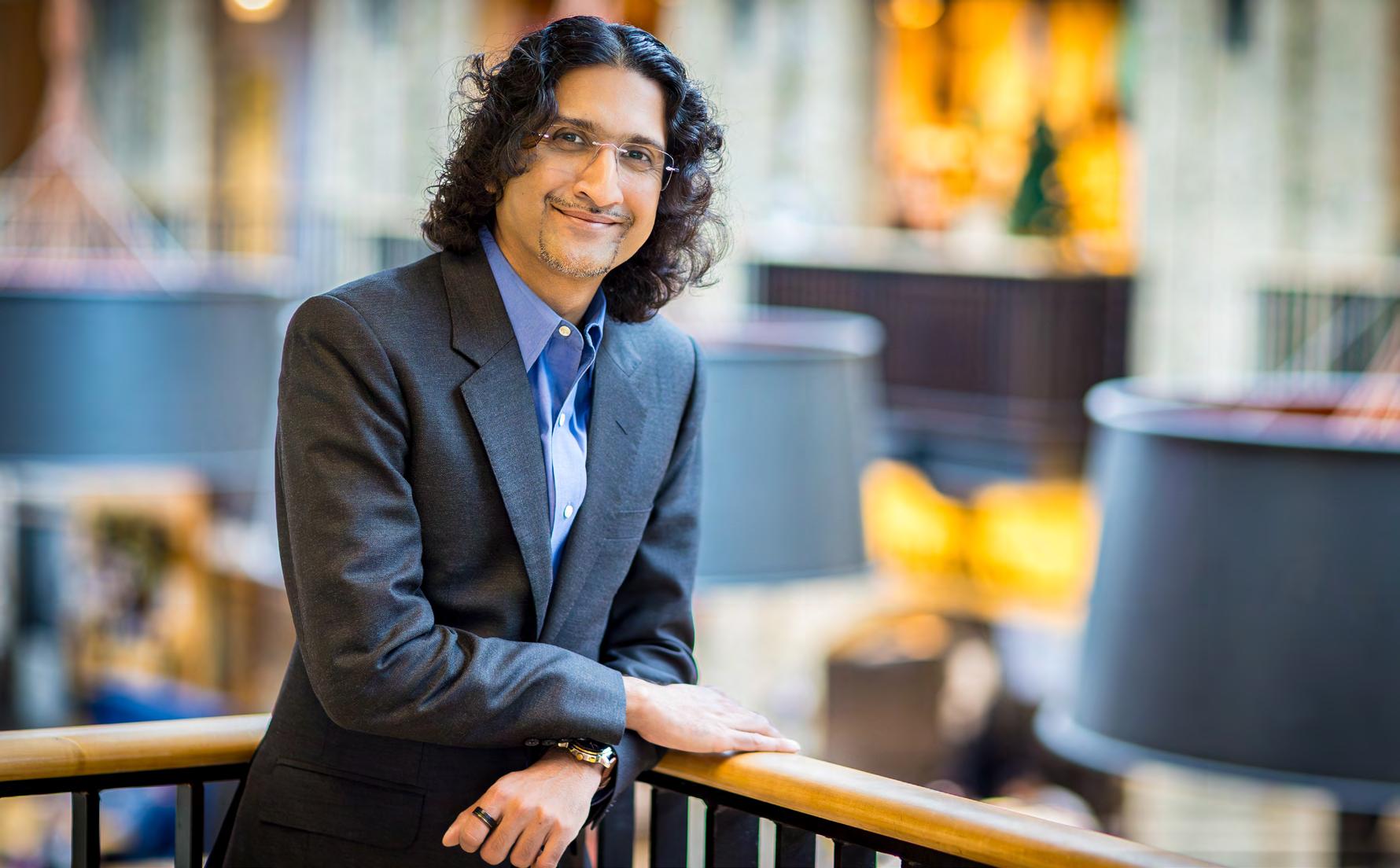
This year’s teaching award was presented to Saad Ahmad Khan, a faculty member at the University of Winnipeg’s global college and a core faculty member of the joint MA program in peace and conflict studies at the U of M. Khan, who serves in a dual academic role across both institutions, described the recognition as deeply meaningful, both personally and professionally.

He described the award as a source of encouragement, particularly at a time when educators face growing challenges in the classroom.

“It is recognitions such as this one that give us the courage to go into the classroom,” he said, pointing to the importance of affirmation and student support in sustaining meaningful teaching practice.

The award places Khan among a group of educators within the peace and conflict studies community to receive this distinction. Three years on, he becomes

the third recipient from the department, joining his long-time mentor in what he described as a shared legacy of excellence. “My mentor […] Sean Byrne received this award a few years ago,” Khan said. “To be the recipient of the same award is […] an honour which I cannot fully express in words.”

As a fourth-generation academic, he characterized teaching as “a familial vocation” that he approaches “with a lot of humility, care and responsibility.”

At the centre of Khan’s work is a teaching philosophy grounded in engagement, openness and relevance. Drawing inspiration from educator Parker Palmer, Khan emphasized the importance of cultivating classrooms where ideas are actively exchanged and critically examined. He said “the classroom should be a space where students feel comfortable expressing their viewpoints and asking questions.”

He stressed that graduate education must go beyond the transmission of information to support deeper intellectual development because “learning becomes most meaningful when students can connect [course] material to real-world contexts and their own lived experiences.”

In accepting the award, Khan expressed gratitude to those who have shaped his academic journey — individuals who have influenced his intellectual and professional life, including his family. “None of what I have achieved would be possible without them,” he said.

He also credited students for building trust and confidence within the classroom. “[Students] are the future,” Khan said, adding that they remain “the inspiration for the work we do.”

For educators aspiring to excellence in teaching, Khan offered advice rooted in authenticity and purpose.

He urged instructors to be “honest” with themselves, their goals and their students.

“A classroom is a sacred space,” he said, describing it as a place where educators “nourish and nurture the architects of tomorrow.”

He reminded educators of the lasting impact of their work. While change may not always be immediately visible, Khan said, teaching

ultimately leaves “footprints in the sands of time.”

Khan is an academic and international human rights lawyer whose research examines the factors contributing to the radicalization of secondgeneration immigrants in countries such as Canada. His work also spans international and counter-terrorism law, international criminal law, immigrant resettlement, postconflict reconstruction and civil liberties in polarized societies.

PHOTO BY EBUNOLUWA AKINBO / STAFF
PHOTO PROVIDED BY SAAD AHMAD KHAN

Activism across generations Palestinian activism at the U of M from 1972 to today

S

tudents and professors joined U of M alumnus Rachad Antonius on Jan. 22 for a lecture on Palestinian activism and history. The lecture allowed attendees to dive into the history of Palestine and the different systems that have enabled displacement and ethnic cleansing.

“This is a long, long protracted struggle that will go on until liberation”

— Robert Johannson, Students for Justice in Palestine executive of advocacy

Antonius discussed themes of Islamophobia and antiArab rhetorics in political discourse, including cartoons such as Aladdin and other forms of media. Antonius had previously helped publish a dossier of writings, art and poetry on Palestine in the Manitoban during his studies

at the U of M in 1972. The original physical dossier from the archives was available at the event to guide his lecture and for people to read.

Robert Johannson, an attendee of the event, thought it was wonderful. “It was really interesting to get to hear from a past activist in favour of Palestinian rights and the Palestinian struggle.”

Johannson believes that passing accumulated knowledge is important, as campus activism history gets replaced by new generations and it becomes difficult to learn from past lessons, even though different generations are fighting the same struggle.

Antonius was involved in campus activism in 1972, a time where Palestinian activism was not common and could result in much more backlash than in today’s time. However, the dossier that Antonius helped publish with other students and faculty members still acts as a way for current activists to feel connected and motivated to the long-term cause.

Johannson is also the executive of advocacy for Students for Justice in Palestine (SJP) and, to him,

attending such events is enlightening. He explained, “Things are not as bad as they used to be.” In 1972, Antonius’s dossier sparked little reaction regarding policy changes, but “the movement can no longer be ignored” in 2025. Johansson explained how this is partly

because of the mobilization of students in favour of policy, and the “real atrocious actions of Israel during the genocide.”

Johannson emphasized that activism for Palestine is not a new thing, and it is not just a trend. It is something that has a long history.

“As a member of SJP, we stand on the shoulders of giants, and Rachad Antonius is one of them,” Johansson said. “This is a long, long protracted struggle that will go on until liberation.”

MSA book club launches with questions on education

Book club brings students together to reflect on learning beyond grades and careers

Nafisa Al Lilo, staff

The U of M Muslim Students’ Association (MSA) launched its new book club last week with a discussion centred on the question, “What is education for?”

The first meeting brought together students and community members for an informal, discussion-based session in the Arts Lounge. This session was led by U of M professor Jonathan Jenner. Rather than assigning a full book, participants examined a short reading titled, “What is Education For?” by ecologist and academic David Orr.

“I really adore that question,” Jenner said. “What is education for? Why are we here? What are we doing? And those are the kinds of things I want us to think about and talk about today.”

Jenner emphasized that while university education is often framed as workforce training, he believes that focus can overshadow deeper goals.

“I get frustrated with the idea that education, especially university education, is simply for training workers,”

he explained. “I wish we were more concerned with values, with ideas, with basically questions of freedom.”

The session opened with a group activity in which participants were divided into small groups and given scenarios, such as recently freed enslaved people or factory owners, and asked to imagine what an education system would look like for each group.

Bareera Kamran, MSA secretary, said the activity helped ground the discussion in real world contexts.

“It made us think, ‘What can be different educational systems? What can be different goals that you’re trying to meet with educating different types of audiences?’” Kamran said. “Then we came together, [shared] our ideas, and then we [delved] into the reading.”

The book club is a new initiative introduced this year by MSA student life manager, Arifah Gheesah, with the goal of creating an accessible, lowpressure space for discussion.

“She wanted it to be a casual space where we read one

article or one chapter from a book at a time, or any news article or something that’s going on right now,” Kamran explained.

Faisal Shamim Zahed, MSA president, said the book club fills a gap in the organization’s programming, which has usually focused on religious and social events rather than academic events.

“Our thought behind it was also to encourage our student body to learn and to read books and to read articles, which nowadays [is] very rare.”

He also outlined how readings are selected and approved.

“[Gheesah] usually speaks to the speaker and she gets some info about which book they want to read,” Zahed shared. “And then she brings it up to the table with the [executives].”

Zahed said the executive team reviews the content before approving it.

“We confirm the contents and everything because we have to make sure that whatever MSA is doing, it is aligning with the Islamic code of conduct,” he stated.

“I personally have learned a lot of things from the previous lecture,” he explained. “I recommend everyone at least to join one of these sessions to just see how you feel.”

The MSA plans to continue the book club either bi-weekly or monthly, depending on interest and capacity.

PHOTO BY EBUNOLUWA AKINBO / STAFF
PHOTO PROVIDED BY UMMSA
RACHAD ANTONIUS SPEAKS AT THE FACES OF PALESTINE EVENT ON JAN. 22.
JONATHAN JENNER SPEAKS AT THE UMMSA BOOK CLUB EVENT.

Craft as care and resistance

Kaarigar’s workshops connect racialized women with cultural knowledge

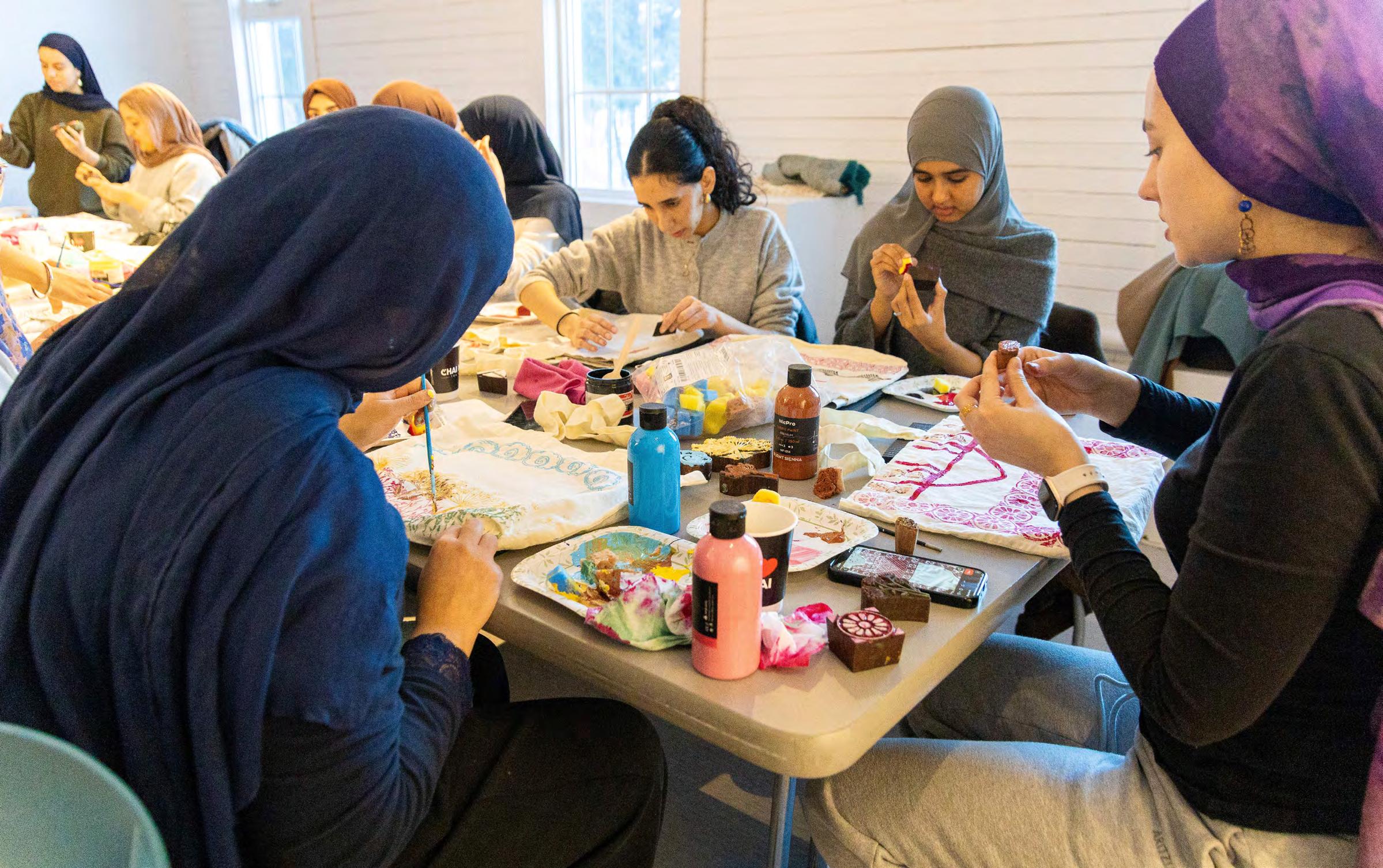
Kaarigar hosted a block printing workshop at the U of M Art Barn on Jan. 15 in collaboration with another creative venture, Kas Enn Poz. The event was free and available for racialized (BIPOC) women.

Ifra Shami and Alayna Shami, founders of Kaarigar, explained that the name of their brand means “craftsperson” or “artisan” in Urdu. Coming from a Pakistani background, the Shami sisters developed the program in response to needs they observed within their community.

There is a large disconnect from traditional and cultural crafting practices because of migration and a lack of teachers to learn these practices from. Their goal is to connect racialized women and students with people and crafts and help them carry on these traditions.

Ifra mentioned that from their audience, which is racialized women, they rarely see people allow themselves unconditional permission to rest, especially in a society where someone’s worth is often linked to how productive they are.

“We find that [crafting is] a really mindful process that allows you to slow down and be very intentional with what you’re creating,” she said.

Another issue that is common is that when people learn crafts, they are often

taught without the cultural, social and political contexts that surround these crafts. The Shami sisters want to change that by having people from different backgrounds in their workshops who can share their knowledge and talent.

Their first event was an Ethiopian coffee ceremony where students got to learn how to make a jebena, a traditional handmade

coffee pot. Shami described the event as “intimate and intentional.”Crafting is not just a way to preserve culture, but it is a form of resistance as well. “[Crafting] also always holds histories [...] especially in crafts that are cultivated by women [...] Women have always observed their surroundings and their environment through their crafts, so it’s another way of documenting history,” Shami

explained. Kaarigar is supported by Community Engaged Learning’s (CEL) Grow Your Community Fund and the Community Leadership Development Program. Shami said they have received a lot of support from CEL’s office. CEL not only helps with funding, but they also provide tools to help put the program in place and make it successful.

The Shami sisters hope to

host an Indigenous beading and a Palestinian crossstitching workshop soon. Their goal is to help at least one person obtain knowledge about their own or someone else’s craft. They want to make art and craft accessible and affordable to those who did not have the resources to learn while growing up.

PHOTO BY EBUNOLUWA AKINBO / STAFF

Autonomy, intimacy and ethics in a changing world

A philosophical look at personal freedom in an age of shifting relationships and AI

At the centre of Neil McArthur’s research is a concern with autonomy. Through the study of sexuality, law and social artificial intelligence (AI), McArthur examines how individuals negotiate freedom, dignity and identity as social norms and technologies continue to evolve.

“My research sits at the intersection of moral philosophy and the history of ideas,” he said. McArthur is a professor in the U of M’s department of philosophy. Although he is focused on sexuality, law and the ethics of social and relational AI, at a deeper level, he explained, his research is about autonomy and how people make meaningful choices in complex environments shaped by law, culture and technology.

McArthur was drawn to these areas after noticing that sexuality and technology were often treated as peripheral within philosophical study. Rather than being understood as foundational moral concerns, they were framed as “special topics,” he noted. When he began teaching, there were no regularly scheduled courses devoted to them. Instead, he introduced the subjects through special topics courses until they were eventually added to the academic calendar.

The popularity of those courses did not surprise him.

including how to form identities, build relationships, cope with loneliness and pursue well-being. For McArthur, philosophy has a responsibility to engage with those realities.

What keeps the work engaging, he added, is how quickly the landscape changes. Social attitudes toward sex, gender, family structures and technology evolve rapidly. New ethical challenges emerge and older debates take on new meanings. To McArthur, philosophy is a discipline that must remain responsive, adapting its frameworks to reflect how people actually live.

One of his major ongoing projects is a book-length study on the history of sexual liberty. The work traces the development of modern ideas about sexual freedom from ancient and Early Modern political thought through the 19th century and into the social upheavals of the 20th. Rather than treating sexual liberation as a sudden modern breakthrough, McArthur examined it as a long and contested intellectual project shaped by philosophers, lawmakers and activists.

McArthur is also studying social AI — chatbots and companion technologies designed for friendship, emotional support or

risks or offer benefits.

“There are real ethical concerns around manipulation, dependency and privacy. But I don’t think we should ignore [social AI’s] benefits either”

Sexuality and technology, he said, are areas where moral theory directly intersects with lived experience. They raise questions people actively grapple with,

“There are real ethical concerns around manipulation, dependency and privacy,” he said. “But I don’t think we should ignore their benefits either.”

— Neil McArthur, U of M department of philosophy professor

romantic connection. He is exploring whether these technologies pose ethical

Rather than dismissing these technologies outright, his research asks whether, under certain conditions, social AI might contribute positively to

human well-being, especially for individuals experiencing isolation.

Across both areas of research, McArthur emphasized that sexuality and technology are often surrounded by moral panic, where fear and judgment replace careful analysis. He hopes his work encourages more measured public conversations that recognize the diversity of human needs and experiences.

“I want to promote more nuanced public conversations about sexuality and technology,” he said.

McArthur also stressed the need for greater acceptance. For thousands of years, societies have judged people harshly for their personal choices, often with damaging consequences. He suggested that ethical reflection should move toward understanding rather than condemnation. McArthur’s research highlights the idea that ethical thinking must remain grounded in human experience, attentive to history and open to complexity.

PHOTO PROVIDED BY NEIL MCARTHUR

The death of fixed pricing

Advancements in technology give new meaning to

D

espite the significant role price plays in consumers’ buying habits, dynamic pricing threatens to reshape how customers understand price.

Dynamic pricing, a strategy that adjusts prices to real-time demand, is not a new practice. Before the introduction of advertised pricing in the 1870s, fixed prices did not exist. Rather, prices were determined through haggling. This system required that shop owners keep track of the cost of a good, the range of profitable prices a product could be sold for, as well as their competitors’ prices. Because of this, a clerk’s position could not easily be filled.

Shops retained apprentice shopkeepers who learned the process of haggling through years of training to serve as clerks. However, as businesses grew during the Industrial Revolution, the art of price negotiation proved to be inefficient. The lengthy process of negotiation resulted in long lines, and inconsistent pricing resulted in growing consumer dissatisfaction.

of the price tag largely made extinct the practice of price haggling in the Western world, dynamic pricing remains alive and well. While it is most famously associated with the airline industry, dynamic pricing is commonplace in many other marketplaces. Its mainstream use, however, has had adverse effects on unsuspecting

evidence that RealPage and Yardi took part in abuse of dominance or anticompetitive conduct, its report suggests that it believes in the possibility of collusion through the use of algorithmic pricing.

If you think that dynamic pricing does not affect you

the concept of “dynamic pricing”

products that they may like. On the other side of the register, 78 per cent of retailers are open to agentic commerce — a next step in e-commerce where shopping is powered by AI agents acting on customers’ behalf.

What effect will this have on

prices?

Well, AI

shelf labels, available at local Whole Foods and Kroger stores across the United States. Walmart has stated intentions to follow suit in 2,300 of its stores. Although grocery prices have long been affected based on supply and demand, these labels allow employees to update

Despite its widespread use at the time, haggling was rejected by the Quakers who believed it to be morally wrong to charge different prices for the same product. Agreeing with the Quakers’ ideology, John Wanamaker, a Philadelphia businessman and practicing Presbyterian, decided to introduce price tags in his clothing store. Taking place right after Wanamaker’s grand opening, the 1876 world fair in Philadelphia gave millions the opportunity to experience fixed prices and price tags for the first time. Soon after, price tags became the standard practice for retailers in the West.

Although the introduction

consumers. Allegations of rentfixing against American and Canadian landlords have been raised in recent years. RealPage and Yardi, property management software providers, were recently under investigation by Canada’s Competition Bureau regarding their algorithmic pricing practices. Allegations suggested that the software train algorithms on competitively sensitive information provided by competing landlords, generating rent suggestions that are above the market value. Although the Bureau ultimately concluded that there was insufficient

because you are not a tenant, think again. The increased globalization of online shopping has made the practice inescapable. On websites, cookies — text files with small pieces of data — track user data, including searches and purchases. These cookies are in turn shared with third parties that can utilize user data, affecting the prices consumers see.

Artificial intelligence (AI) adds another layer to the issue.

A new report suggests that 51 per cent of Canadian shoppers are open to AI completing the entire shopping process for them. The report also finds that 56 per cent of shoppers want AI to help recommend

chatbots can easily gather sensitive personal data on consumers, and they have already been doing so. This data not only personalize product recommendations but can also be used as a means to predict consumers’ shopping habits, influencing prices. The influenced price is personalized — not everyone sees the same figure for the same product. In relation to algorithmic pricing, the data collected by AI is used to determine the highest price an individual is personally willing to spend, and a product’s price is presented accordingly.

While alarm bells have been sounding online, consumers may be unaware that new dynamic pricing practices are making their way onto shelves in brick-and-mortar stores. Replacing traditional price tags and labels are electronic

shelf prices in minutes, compared to the two-day average it previously took.

While companies like Kroger claim that electronic labels allow them to effectively reduce prices and manage inventory, there is still a fear that retailers will take advantage, resulting in a surge in the price of basic goods. In Maryland, the governor has proposed the introduction of the Protection from Predatory Pricing Act, which seeks to ban dynamic pricing in supermarkets as a direct response to consumer concerns. Globally, consumers are calling for their local governments to follow suit to maintain affordability.

“Like empires, prices rise and fall,” reads one Expedia advert, referring to the dynamism of flight prices in the airline industry. It is true that, like empires, pricing conquers markets and encourage competition between rivals. Also, like many empires, fixed pricing may be a thing of history. It may be the case that prices were never really static to begin with. In any case, transparent dynamic pricing is a new normal that customers must adjust to.

GRAPHIC BY TEEGAN GILLICH / STAFF

Audiobooks as a study companion

For students balancing coursework, listening offers a flexible way to learn

University life comes with heavy demands as students juggle academics, work and volunteer roles out of necessity rather than choice. We, the students, often find ourselves reading for long hours, whether it is textbooks, journal articles or lecture slides.

For many of us, the act of reading is not just about processing words on a page, but about grappling with ideas, memorizing facts and preparing for exams. By the end of the day, our eyes are strained and our attention spans are depleted. As a result, for someone like me who also loves literature, there is little time left for personal reading with all the additional chores at hand. In that context, audiobooks offer an alternative — not a substitute of lesser value, but another valid way of engaging with knowledge.

The idea that only printed reading counts as “real” learning is rooted in long-

standing assumptions about literacy. But listening to books is not new. Oral traditions were once the main way knowledge was passed on. Stories, histories and lessons were shared by voice long before widespread literacy.

Audiobooks are not a replacement for reading but a continuation of this tradition, adapted for digital life. For me, this means a chance to learn and explore ideas through listening rather than solely relying on text.

campus or time spent cooking can become a moment to continue a short story, novel or a work of philosophy.

Audiobooks also reduce the physical strain that comes with constant screen time. During exam periods, especially, students spend long hours reading from laptops and textbooks. Listening offers a way to stay connected to literature

suggests that people retain information at similar levels whether they read or listen. For many, hearing a text enhances memory through tone, pacing and emphasis. Narration can make arguments clearer and stories more vivid, which helps listeners connect emotionally and intellectually to the material.

“Audiobooks help keep reading present by turning otherwise idle moments into opportunities for engagement”

One of the clearest advantages of audiobooks is accessibility. For someone who is juggling multiple responsibilities at a time, sitting down with a book can begin to feel like an unattainable luxury rather than a closely-kept habit. Audiobooks help keep reading present by turning otherwise idle moments into opportunities for engagement. A commute, a walk across

without further exhausting tired eyes. Rather than replacing reading, audiobooks provide a complementary way to engage with ideas when traditional reading feels overwhelming. Critics often argue that listening is less effective for comprehension. While reading does encourage close analysis, listening is not inherently inferior. Research

The performance aspect of audiobooks can also deepen engagement. Skilled narrators bring characters and rhythm to life in ways that enrich the experience. Shakespeare, for example, often becomes clearer when heard aloud.

Memoirs read by their authors add a sense of intimacy that strengthens connection to the text. For students exploring literature outside the classroom, this can reignite curiosity and enjoyment.

However, audiobooks do have limitations as well. They are less suited for close citation

or detailed academic analysis, where flipping between passages is essential. But this does not diminish their value. Instead, it highlights that different formats serve different purposes. Print supports deep study, while audiobooks support flexibility and sustained engagement with reading as a habit.

For me and many others like me, the real benefit lies in choice. Audiobooks make it possible to continue reading for pleasure even when schedules are full. In a university environment where burnout is common, that flexibility can be the difference between abandoning personal reading altogether and keeping it alive.

Ultimately, to me, audiobooks are not shortcuts. They are another way of experiencing literature — one that helps students maintain their relationship with reading amid the demands of university life.

Diversions

You walk and walk till Your knees start to bleed, And you look through every possibility. You raise your voice

But are suffocated, and are shunned and you wait where no one is waiting. Then sit and think and think and think While your wings slowly break,

When you fly like a swan, whose love is dead. You look at yourself with all the hope. When you hear your heart it’s all gone. But you have all the faith if not all the love, And you have all the things you need, which someone would die for.

And you seem just fine just like everyone does, But you don’t breathe you count each and every step. You came out if the cage but it’s still there, It’s just invisible now it’s still exists in your head. So you run for your life and do all you can but you see a face and it all ends,

So you jump into the sea even though you are scared, but it’s right in front of you, you fear what it contains. You fear you would find something unusual in the deep, So you are just scared of unfamiliarity.

You think just so and dive in deep only to know the beautiful life beneath.

It’s not like it was ever in your head, Creatures breathe and live here not just survive, Just what you want to do but no one can see your side.

Do you have a poem you’d like to submit to The Manitoban? Email your

To complete Sudoku, fill the board by entering numbers 1 to 9 such that each row, column, and 3x3 box contains every number uniquely. In Straights, like Sudoku, no single number 1 to 9 can repeat in any row or column. But rows and columns are divided by black squares into compartments. Each compartment must form a “straight.” A straight is a set of numbers with no gaps but it can be in any order, eg [7,6,9,8]. Clues in black cells remove that number as an option in that row and column, and are not part of any straight. Glance at the solution to see how “straights” are formed.

Straights Puzzle by Signdicated Puzzles Puzzle by Signdicated Puzzles
Sudoku Sudoku Solution Straights Solution
Maryam Beg, volunteer
Photo provided by Maryam Beg
submissions to arts@themanitoban.com

The Manitoban horoscope for the week of Jan. 26

Zodiac sign mania, flip a coin and see your fate this week

AQUARIUS

January 20February 18

This week, you should pack your bags because it looks like it’s going to be a long journey. Dear Aquarius, you may feel like the week is longer than usual but try not to resist the lesson this week may teach you along the way.

PISCES

February 19March 20

Dear Pisces, please know I am not mad, just disappointed. I feel a pull in the universe that perhaps you have made some bad choices going into this week. But fear not, things will straighten themselves out. Go get yourself some ice cream. You deserve it.

ARIES

March 21April 19

Aries, you may be enraged with things. Make sure you go to a rage room and take out all that frustration in a safe space. Although you may be struggling this week, whether romantically or friendship-

wise, please take the time to understand others rather than only your own perspective.

TAURUS

April 20May 20

Your hard work will finally be rewarded and recognized this week. Despite your belief that your hard work would never pay off, you are finally being recognized for the effort you put forward. The reward might be acknowledgement, or may be in the form of cash.

GEMINI

May 21June 20

Dear Gemini, are you finally going to the cottage? For this week, it looks like it’s going to be a mild forecast of no chaos and a normal week. Something you could do to break up the week might be to watch Heated Rivalry

-On-Foods. In-person conflict is never good if you and the other person are still so angry at one another. Take the time to collect your thoughts before confronting someone who may have hurt your feelings.

LEO

July 23August 22

Dear Leo, sometimes you just need to let whatever’s going to happen, happen. You can prevent certain things from happening but you cannot always craft other people’s perception of you. Take the time to do some self-reflection in the wake of the possibility of people attacking your character.

CANCER

June 21July 22

If you are thinking of having an argument, do not fight with them at your local Save

LIBRA

September 23 -

October 22

Libras, for this week, you are going to experience some academic distress. You may feel overwhelmed with classes because you are always trying to be a perfectionist. Take this as a sign from the universe to stop worrying and focus on what you do have instead of focusing on things that have not even happened yet.

VIRGO

August 23September 22

Virgos, you know I love you guys, but it’s time to stop crying. These past few weeks may have been really hard, but it’s time to get out of that rut. Do something for you and not what other people want you to do.

Why I hate group projects A personal rant about collaborative work

Thandeka Katsika, staff

I am sure I speak for many university students when I say I hate group projects. I know there are benefits to working in groups like learning to plan, organize time and collaborate with peers. But, at the end of the day, no group degrees are being handed out. When I graduate, it will be my degree or your degree, not our degree.

Almost every group project I have been in has had at least one slacker — someone who volunteers to take on a number of tasks, seems enthusiastic in person and gives the impression that they are ready to put in the work. Then, as deadlines roll around, their grandmother’s uncle’s wife’s dog’s sister-in-law is sick, and they just cannot find five additional sources on infectious diseases.

Usually, the first excuse is well excusable, and the slacker promises to have the work done before the groupimposed deadline. Then, a day before the official

on track of school and work or you may be led astray by opportunities that do not serve you.

SCORPIO

October 23November 21

Do not take advice from a magic eight ball. For this upcoming week, you may be stressing about the future more than usual. Instead of worrying about the future, you should be more worried about how you fit into the present.

CAPRICORN

December 22January 19

Some days you get the paper and other days you get the rock. This week may be a little bit of a mixed bag for fellow Capricorns. The beginning of the week may feel like you’ve won the lottery, but by the end, you may be feeling exhausted. Make sure you follow your heart instead of your head for this week.

SAGITTARIUS

November 22December 21

Dear Sagittarius, you are the kindest person in the room. You exude warmth and are pure sunshine. For this week, make sure you are keeping GRAPHICS BY EMMA

deadline, the slacker has yet to submit their part. The rest of the team tries to call and text but to no avail. So, to compensate, the other group members are forced to pick up the remaining workload in the slacker’s absence, fearing the impending doom of an F. If this last-ditch effort is somehow successful and the group gets a passing grade,

the slacker often miraculously reappears and enjoys the fruits of everyone else’s labour.

If you do not think this is outrageously unfair, you might just be the slacker.

I personally do not mind having to work a bit harder on a project if a groupmate genuinely has something preventing them from fully committing themselves, but

if a person is not completing the work solely by choice, they should receive a grade that reflects that. And if someone works really hard, their grade should reflect that too.

The thing with group projects is that there is no telling how they will go. Sometimes a few people will put in effort, but that effort will go unnoticed because

those that do not will bring down the grade or vice versa. I prefer being entirely in control of the work I present. Not because I think I am the most intelligent in class, or the most hardworking, but because I know that if I pass or fail, I will be the only one responsible.

GILLICH / STAFF
GRAPHIC BY EMMA GILLICH / STAFF

A conversation about colourism

There is beauty in every hue

As defined by the Cambridge Dictionary, colourism is the prejudice and unfair treatment of members of a particular racial group who have darker skin than others within the same group. Even before I was aware of the academic definition of colourism, I interacted with it socially.

For as long as I can remember, I have known about skin bleaching — the use of products like soaps, creams and pills to get a lighter complexion. In high school, I knew people who used these products despite the number of health risks, like numbness, high blood pressure and the development of skin cancers.

Alongside this, I remember how often my relatives

emphasized that my older sister was “Black” while my younger sister and I were not. Racially, we are all Black, but this term was used to refer to her darker hue.

As I have grown older, I have realized that this was not just an issue in Zimbabwe, but among many minority communities around the world. Brishti Basu wrote about how, when she visited India, she noticed the prevalence of these skin tone ideas.

Lighter skin was advertised as preferential to darker skin, and skin-lightening products were all over. In the U.S., DaniLeigh wrote a song which Highsnobiety titled a “colorist anthem.”

There are cues present in conversations, music and television that tell girls and

women of darker skin that they are inherently inferior to their lighter-skinned counterparts. This has severe impacts on the self-worth of women.

Additionally, colourism has economic consequences. Women have written about experiences in the workplace where they have been passed up for opportunities because of their darker skin.

Unlike other forms of oppression, colourism is rarely spoken about or focused on, and in many families it is not taken seriously. I think that because of the general public’s limited education on the issue, many women and young girls feel pressured to change their appearance to be better received by society. Instead of the world changing

its biases against women with a darker hue, women are changing their beautiful skin to fit into the “standard.” As of 2023, the global skin lightening market was estimated at $11.2 billion USD, and it is expected to reach $16.14 billion USD by 2030.

I believe that we should all educate ourselves on colourism. While minority communities are usually well educated on matters of racism, I feel that they often lack understanding of colourism and its impact on women within minority communities. I think we have to unlearn the idea that having fairer skin equates to being better and instead learn that every hue is beautiful.

The more we make the effort to educate ourselves, the more

effectively we can oppose colourism. When people speak from a place of ignorance, they unknowingly contribute to the idea that people’s skin colour determines their social worth.

I am so grateful I grew up in a home where my parents emphasized that each of their children was created perfectly, and despite the outside pressure, my sisters and I know we do not need to change anything about ourselves. I hope that girls within minority communities can grow up in a society that advocates for them in the same way my parents did for me and my sisters.

Greenland is not for sale

Trump is the toxic ex you can never seem to get rid of

Donald J. Trump, the president of the United States of America, is a fool.

A fool who is, in my opinion, running the U.S. into the ground for a multitude of reasons. And although there are endless reasons why Trump should be kicked out of office, I’d like to draw attention to the ongoing issue of Trump expressing his desire to annex Greenland, which is an autonomous territory of Denmark.

Trump’s desire for control does not stop with Greenland. He has also repeatedly mentioned turning Canada into the 51st state. The president has not stopped expressing his desire to dominate Canada, but has taken it a step further by sharing an image online of Canada shrouded by an American flag.

This form of entitlement is both eyebrow-raising and alarming. Trump’s desire for his administration’s domination over territories and sovereign states is cause for concern, especially with

his declaration to obtain Greenland “one way or another.”

Trump resembles something along the lines of a toxic ex you can never seem to get rid of. Always changing his mind, whether with regard to tariffs or by picking different groups of citizens to terrorize and oppress throughout the U.S.

Despite Greenland’s citizens and prime minister continually asserting, “We don’t want to be Americans, we are not for sale,” Trump continues to believe he is entitled to people’s autonomy, as though prosecuting the citizens of his own country isn’t enough.

The idea of “Manifest Destiny” has been continually stated by Trump as the U.S.’s right to rule over the Americas and is seen in his desire to not only control Greenland and Canada but to project American influence globally. For instance, his statement “We’re going to run the country until such time as we can do a safe, proper and judicious transition” following

the capture of Venezuela’s Nicolás Maduro, suggests that Trump thinks he alone knows what is best for Venezuelans more than they know for themselves. But who can claim to love and understand a sovereign nation more than its own people?

Now, what does his desire for domination mean for Canada and Greenland? In simple terms, this puts Canada in a vulnerable position. The acquisition of Greenland will leave Canada’s Arctic exposed — the Arctic, which has been historically under-explored, is now being geographically contested due to Trump’s proclamations and threats. Despite this, nations such as Canada and China are seeing eye to eye on their support for Greenland’s territorial integrity.

Trump’s desire to take Greenland is centred on both his greed for its untapped resources and its positionality as a potential centre for military bases. This bid for Greenland is not out of character for Trump — he not only extracts resources

and livelihoods from his own citizens but expects other nations to let him do the same to them. Greenland is not for sale,

Trump. Focus on helping your own citizens and economy and concern yourself less with other sovereign states.

GRAPHIC BY EMMA GILLICH / STAFF

I do not want children, I have Heated Rivalry

Pronatalist policy cannot fix misogynistic culture, or the risks women carry

E very few months, a government discovers that its birth rate is falling and reacts as if it has just found a crack in the foundation. The proposed fixes start to blur together — cash bonuses, tax credits, childcare promises, marriage-friendly messaging and, in some places, a sharp moral shift that asks women to absorb more risk with less autonomy. China’s latest move is so blunt it reads like satire — a 13 per cent sales tax on contraceptives beginning Jan. 1, paired with a value-added tax exemption for childcare services.

I do not think the problem is that governments are noticing a demographic shift. The problem is that they keep misdiagnosing what people are responding to. Yes, finances are an immense barrier, but another major challenge is relational. Parenthood is building a life around the unknown, and right now, a lot of women seem to not feel they have a solid foundation, neither economically nor romantically.

If you want proof that the natalist policy imagination is stuck, look at the “condom tax” that is being met with unease. Making contraception more expensive does not make family life more appealing — it just raises the stakes of a mistake. It has sparked concern about unwanted pregnancies and HIV, which are the broader public health fallouts that come with making protection harder to access. It also signals that a government is more interested in steering outcomes than earning trust, especially when the burdens of pregnancy and parenting land unevenly.

But even in places where the state is not hovering over everyone’s reproductive life, the trust problem appears in a different way. The rise of online misogyny and the red pill ecosystem has warped how some men talk about women, and what they think relationships are for. In that worldview, women are framed as prizes to be won or managed, men are told they should be “alpha” and women are told they should want that kind of man. It also normalizes a sense of entitlement, the idea that attention, sex and emotional labour are things women owe, and that rejection is an insult that justifies anger. Add in the decline of in-person communities and you get a dating culture where basic emotional literacy is treated as a luxury trait.

For a lot of women, this mindset alters the emotional math of parenthood as having children starts to feel less like a celebration and more like a risk analysis. Pregnancy and parenting amplify the stakes of unequal labour and instability. If a partner is not willing to communicate, share responsibility or be a safe place when things are hard, a child is not a joy — it is a multiplier of vulnerability. No tax credit fixes the fear of doing everything alone or while managing someone else’s resentment.

Heated Rivalry has become an unlikely guide to what many people feel is missing right now. The reaction to the book and television adaptation has become bigger than a single explanation, and people are taking different meanings from it depending on where they are coming from. From my perspective, one takeaway is that it reflects a hunger for a different script for love, one where desire is not entitlement, conflict does not become punishment

and masculinity includes tenderness, accountability and emotional competence. Even though the relationship is between two men, the appeal for many women is not that it removes women from the romance, it is that it removes the familiar threat that sometimes hangs over it. Jacob Tierney, the show’s creator, put it plainly when he talked about what draws women to this story. Women are “endlessly exposed to sexual violence,” he said, and seeing male vulnerability can be “refreshing” because there is “no fear of violence.” Not because women do not want passion, but because too many women have learned to watch for warning signs in intimacy. It is not that the story does not have stakes — it is that the stakes are different because the relationship itself is not built around the kind of fear women see too often in real life.

The cultural moment has also begun to develop a backbone. Ottawa Pride Hockey (OPH) responded to

the Ottawa Senators hockey team selling Hollander and Rozanov jerseys, welcoming the support and the indication that there is a demand to make hockey more inclusive. At the same time, they drew a firm line that inclusion is not just a vibe. OPH committed to holding the Senators and the NHL accountable when actions do not match community expectations, including pointing to the signing of goalie James Reimer. This matters because it underscores something bigger than hockey. Many women are tired of the package deal with men that often comes with toxic masculinity, contempt for vulnerability, entitlement and the casual homophobia that treats care and softness as weakness. Calling out homophobia is calling out the broader culture that makes relationships feel less safe and equal.

I am in a happy, healthy relationship, so I am not writing this as a complaint about my personal life. I am

writing it because I have felt the social weather changing around me. I can see how quickly online culture can teach some men to resent equality and respect. I can also see, in the Heated Rivalry phenomenon, a kind of collective call for something better — that love should feel safe, devotion should look like effort and masculinity does not need violence or emotional absence to be real. If states want to raise birth rates, the most effective incentive is not another cheque and certainly is not a “condom tax.” It is leading by example in building a world where housing and childcare are accessible and where partnership is safe and more equal. Until that world feels plausible, the birth rate panic will keep producing policies that sound like bargaining. People will keep opting out, not because they do not want family, but because they want a life that looks more like devotion than bargaining.

PHOTO BY MEI M / VOLUNTEER

Danko Jones releases 12th album Leo Rising

Juno-nominated band’s latest album is an uplifting and energetic work

The hard rock trio

Danko Jones was formed in Toronto in 1996. Comprised of vocalist and guitarist Danko Jones, bassist John “JC” Calabrese and drummer Rich Knox, the group first built their reputation through touring — performing around Canada and the northeastern U.S.

The group initially had no plans of recording, so they focused on growing their fanbase through live shows. Their first release, a self-titled six-song EP released through Sonic Unyon, was released in 1998, followed by the acclaimed self-produced EP My Love Is Bold the following year. The latter earned the group their first Juno Award nomination for best alternative album.

After a compilation release and a European tour in 2001, Danko Jones’s first full-length album, Born A Lion, was released in 2002. It led to an opportunity for the group to open for rock music legends, the Rolling Stones.

“Sharing the stage with the Rolling Stones at the ‘40 Licks’ tour kickoff show at Toronto’s Palais Royale in 2002 is a standout memory,” said Calabrese. “Each member of the band had one guest allowed, and I had my dad come out to the show.”

Calabrese mentioned other career highlights, including the opportunity to tour across Europe and the U.K. in 2008 with Motörhead and Saxon, releasing albums and being nominated for multiple accolades.

“Every time we release an album, it is a sense of accomplishment,” he reflected. “Being nominated for multiple Juno Awards is also a great recognition from the Canadian music industry.”

However, Calabrese stated that the proudest achievement in their careers has been entertaining their fans. “As far as accolades go, the best accolade is to see people leave our show with a smile on their face after being entertained with our music.”

Among Danko Jones’s numerous singles, their biggest success, “Full of Regret,” charted at #96 on the Canadian Hot 100 and #36 on the U.S. Top 40 Singles Chart, as well as notably appearing in EA Sports’s NHL 11 video game in 2010. They have been nominated for six Juno Awards, including a recent nomination for metal/hard music album of the year in 2024 for Electric Sounds, which marked their second nomination in the category.

Since the release of Born A Lion, they have released 11 more studio albums. Their most recent album, Leo Rising, was released in November 2025. Produced by long-time collaborator Eric Ratz, the album was said by Music Life Magazine’s Jim Barber to possibly be their “most uplifting and inspirational” record to date.

“[Leo Rising] is indeed a high energy rock-and-roll album from us,” Calabrese explained. “[It has] no compromises and no hold-backs. It’s what you would expect from rock-androll veterans like us. It is filled with anthems and full-on rock-and-roll action.”

Leo Rising was preceded by the release of the single “Everyday Is Saturday Night.”

The song was inspired by the group’s touring schedule and how it feels to be on the road.

“Being on the road constantly touring tends to blend all days into one,” Calabrese explained.

The music video for the song is a cinematic walk through the streets of Osaka,

Japan. It was shot by Italian cinematographer Giacomo Triglia, who has worked with noted Italian artists such as Brunori Sas (one of Calabrese’s favourite singers), Jovanotti, Eros Ramazotti, Lucio Dalla and Eurovision 2021 winners Måneskin. “Having [Triglia] involved in the project was great as he brought his vision and artistic approach to it,” Calabrese stated.

Other notable songs on the album include its loud, fast and infectious first single, “What You Need,” second single, “Diamond In The Rough” featuring Marty Friedman on lead guitar and Calabrese’s personal favourite, “I Love It Louder.”

The group has been supporting the album through its Rising tour. They enjoyed a sold-out leg of the tour in Germany from November to December 2025, which Calabrese noted as a highlight

of promoting the album. The group has upcoming legs set for Canada and Europe, with the Canadian leg running in January and February across six cities. They will also tour Scandinavia and the U.K. from April through August, with a final show in November. Fans can expect to see the group’s signature high energy rockand-roll.

Danko Jones’s long tenure is not lost on Calabrese, who reflected on the group’s passion and dedication since they first formed.

“It means persistence,” he said of their long career. “It means never giving up. It means having faced adversity. It means [experiencing] many highs and many lows […] It is not a hobby or a pastime, it is our life and it is treated with the utmost detail, care and immediacy.”

Ultimately, Calabrese has high hopes for the future,

feeling that the band has stuck to their roots and stayed true to their founding principle — to build a live reputation.

“We played relentlessly around Toronto and the northeastern U.S., opening for whoever would have us, and that grind turned into the band people know now,” he stated. “The band has not lost the love for music that launched our venture into the world of music, and the passion for wanting to continue is still there.”

Danko Jones’s 12th album, Leo Rising, is now available across streaming platforms such as Apple Music and Spotify. The group’s 2026 Canadian tour, Rising, will come to Winnipeg on Feb. 4 at the Park Theatre (tickets are sold out). For more information on Danko Jones, visit dankojones.com or follow them on social media.

PHOTO PROVIDED BY JON USUAL

Performing masculinity on a vintage talk show stage

Public access spoof to be filmed and broadcast in Winnipeg

G

islina Patterson and Dasha Plett are the two self-described transsexual artists behind We Quit Theatre, a performance collaboration based in Winnipeg. On Feb. 6, 13 and 20, they will present Men Explain Things to Us… and We Like It! — a descriptively titled trilogy of talk show episodes featuring male guests speaking about their passions and experiences regarding masculinity, plus musical performances. The three episodes will all have themes for discussion, which are “fantasy,” “romance” and “men,” respectively.

“All of our guests are real people coming on the show to talk about real things that they actually really care about,” Patterson pitched. “But everything surrounding them will be artificial and heightened and quite theatrical.”

“The two of us [have] very different feelings about masculinity and our interests in masculinity as a concept,” Patterson explained. “The idea for this project came from [this idea of] what if we could

ask men what it’s like, what it feels like for them to be a man?

There’s ways that masculinity is seen as neutral.”

“We’re very interested in investigating it a little more closely and putting it under a microscope in the way that femininity and femaleness is often much more put under a microscope and seen as performative. And so, this idea of engaging in a conversation about what masculinity actually is, what it feels like, why someone might want to do it, or not want to do it, and how they do it.”

“There’s a lot of different ways to think about gender and about having a gender,”

Plett elaborated. “Everyone is building their gender all the time. And that’s something that [transgender] people are doing in a way that is more culturally recognized and talked about. But [cisgender] people are also doing that all the time, and so [the inspiration] was something about the way that a talk show or a TV show is so obviously constructed, that it’s so obviously edited together, or affected by the camera angle, or the quality of the footage itself.”

The talk show format is a product of local 1990s nostalgia. The neon-coloured set will include multiple VHS camcorders for filming, and a backdrop collage of the Winnipeg skyline made from cardboard and construction paper. Men Explain Things to Us… and We Like It! is especially inspired by Winnipeg’s former VPW station. As a public access station, it broadcasted a wide variety of unorthodox TV programming sourced from independent producers.

“The most well-known and in some ways memorable show to come out of VPW was this show called Survival which was a fictitious talk show about how to survive the apocalypse,” Plett cited. “It’s just so militantly weird and obviously just the exact thing these guys wanted to make.”

We Quit Theatre has produced and performed three full performances since their partnership began around 2018. Their debut was Plett’s semi-autobiography titled 805-4821. The show featured Plett using an overhead projector to display

the printed script one line at a time for the audience to read in silence. Plett and Patterson have also produced performances in other cities across the country, noting that audiences in Winnipeg are typically less receptive to their experimental approaches to theatre.

The conception of Men Explain Things to Us… and We Like It! began in roughly 2021 with a short episode created for the Stratford Festival Laboratory, marking the duo’s first time working in a video format. It was derived from the title, which originated as a joke and turned into a real project upon its expansion.

Interestingly, this is not

the first transgender-themed spoof of ’90s public access television. There is also the 2024 American film I Saw the TV Glow, which enjoyed widespread acclaim among fans of experimental cinema and the wider transgender community. However, that is a horror movie, and Patterson and Plett’s satirical talk show will bear little resemblance.

The limited studio audience seats have already sold out for each filming, but the shows will also be available to watch live online and screened at Winnipeg Film Group’s Black Lodge Studio with artist Leigh Lugosi — plus other live screenings in Toronto and Guelph.

Dominique Adams to perform in Winnipeg

Folk singer-songwriter performs release show for first full-length album To Keep

Boris Tsun Hang Leung, staff

Winnipeg-based folk singer-songwriter Dominique Adams released her first fulllength album, To Keep, last summer.

“The namesake of the record is a message of staying true to yourself through life’s moments, big and small. It’s just maintaining that common thread through all of the different places that life takes you,” described Adams. “All the songs on the record capture those moments at various stages in my life in the last 10 years.”

For her Winnipeg performance on Jan. 29, Adams is playing all the tracks from To Keep, joined by musician friends and other guests.

“I’m just hoping to capture […] the collaborative spirit and the community that has made all of these things feel possible. I always want to try and reflect that feeling in the music,” said Adams.

Adams is originally from Alberta and spent time writing songs and singing in choirs.

Before moving to Winnipeg, she studied choral conducting at the University of Alberta. For her, music has always been a collaborative process.

“I spent most of my early 20s more engaged in group music making […] Then I moved to Winnipeg, and I didn’t embark on a solo music career because I was more interested in making music with other people and just experiencing the process with other people,” she said.

“Everyone [in Winnipeg] is doing the same thing, and we all make music with that group mentality. So it is a wonderful marriage of the two worlds for me […] I still feel very interested in choir […] but I’ve been leaning into songwriting and making music with friends in Winnipeg.”

In addition to Adams’s soft vocals and acoustic guitar playing, To Keep features local musicians Liam Duncan, Austin Parachoniak and Keiran Placatka as instrumentalists or background vocalists. The album is also recorded live

with a polished but strong folk, indie sound.

“We recorded everything live off the floor […] We did some overdubs and stuff separate, like some background vocals and electric guitars, but everything else is as it happened in the studio, which just lends itself to that collaborative spirit,” Adams commented. “It sounds and feels live when you listen to it, [it] feels like you’re in the room, but then also, still sounds like a really good recording.”

Adams is set to perform at Festival du Voyageur next month and is currently working on a project with a tour to follow in the fall. She is also opening for William Prince in April.

Dominique Adams’s album release show will take place at Sidestage on Jan. 29 at 8 p.m. For tickets and more information, visit sidestagewpg.com.

PHOTO PROVIDED BY WE QUIT THEATRE
PHOTO PROVIDED BY ADAM KELLY

Isiah Medina’s Gangsterism to be screened in Winnipeg

An experimental gangster movie about film, crime and philosophy

G angsterism, Winnipegborn filmaker Isiah Medina’s fifth feature film, is hitting the screen this week at the Dave Barber Cinematheque.

The film follows Clem, a filmmaker and gangster who needs money for an upcoming project. He learns that someone has been leaking his films without his consent, so he gathers his crew of filmmakers to confront the leaker and claim his fair share of money.

Medina described himself as a filmmaker who is interested in exploring the relationship between philosophy and cinema, and he sees film as a way to explore ideas without relying on words.

“What I love about cinema is that it doesn’t need language necessarily. That’s why it started as silent film, right? And I also like how Plato would say, “We philosophers begin with things and not words,’” he said.

“I try to, in a way, do the work of philosophy but with cinema, but also try to reach beyond it because most philosophy is written with language, but I think cinema offers us a chance to think without it.”

This notion is apparent in

Gangsterism. Despite being a gangster film, the dialogue frequently references Marxism, white supremacy and postcolonial theory, and there are numerous shots of book covers and literary works.

Medina also highlighted that gangster movies have a “funny” relationship to reality — people usually conceive reality and cinema as two separate domains, but in gangster movies, the lines are much more blurred.

“Gangster movies are one of the few movie genres where money is part of […] the story itself, you know? So I thought it allows me to be reflexive in this way because it’s part of the genre to talk about money all the time […] A lot of the characters [in Gangsterism] are filmmakers, and they have to deal with relatively the same issues,” Medina explained.

Gangsterism could not be more self-referential. Reminiscent of Clem’s story, Medina recounted that he initially could not shoot the film right away due to “budgetary reasons.” In one scene, Clem pitches his project idea to a board of critics, only to be told no one would understand it and that a film about racism should be easy to understand. This is

based on criticism Medina has received in real life. Moreover, the film’s poster has a quote in all caps saying “depiction = endorsement.”

“I think almost all art […] becomes self-portraiture, whether the artist knows it or not. So I rather just consciously do it than not. And it doesn’t mean that I’m

just one of the characters. I feel like I put myself a bit in every single character, no matter who it is,” Medina said.

“You see this everywhere […] It’s why so many filmmakers make gangster movies. They’re so clearly allegories of their own creation, whether it’s Scarface or Goodfellas or all the classics, there’s always

this minimal relationship to filmmaking.”

Gangsterism will be screened at the Dave Barber Cinematheque from Jan. 30 to Feb. 5 with a talk by Isiah Medina on Jan. 30. Visit davebarbercinematheque. com for tickets and more details.

Bound to Please brings romance to North End

New bookstore and community hub opens its doors

After graduating from the U of M with an English degree last year, Dylan Yuen now operates the bookstore Bound to Please in the North End of Winnipeg. They have spent the last several months collecting books, contacting authors and painting the room pink with their partner.

Yuen’s goal for the store is to provide a community space for the surrounding neighbourhoods, citing the lack of dedicated leisure spaces for youth to read and study. They began the initiative by hosting a silent reading and discussion group, as well as a book binding workshop this month, with the intent for more workshops to come. They are also planning to host children’s book readings, including some with drag performers.

“We have the Garden City Mall, but it’s not as active,”

Yuen explained. “And stores keep closing and then coming back. And it’s not as popular as Polo Park, but then that’s in a light industrial area. So there isn’t really anything for teens, young adults and kids to do in our area.”

As for products, Bound to Please specializes in romance novels. As a student, Yuen often found the genre was overly dismissed compared to other literary works due to its formulaic nature. However, many novels exhibit varied approaches to the format — such as the series of letters sent between the protagonists in one of Yuen’s gateways into the romance genre, the science-fiction novel This Is How You Lose the Time War by Amal El-Mohtar and Max Gladstone.

“Romance books get discounted for following [a] framework and following a certain flow,” they elaborated.

“But so many other kinds of books do that […] and that’s not a bad thing. It means that if you enjoyed this other book, you know you’re probably going to enjoy this same book.”

The shelves feature used books Yuen collected, as well as a collection of new and primarily local works. Some of them were supplied through connections Yuen has made at the annual Prairie Comics Festival, and many partnerships came about from writers and artists reaching out to Bound to Please after discovering them on social media. The author B. Mackenzie, who inquired after participating in the silent reading group, was especially excited that Bound to Please is the first physical bookstore to ever sell her books.

One of Yuen’s favourite novels in the local display is Oath by Kate Butler, a gay

romance novel about a baron and his guard exchanging letters. Another is the queer fantasy novel A Damsel and a Demon by Allie Leigh, a touching and heartbreaking sequel to A Sorceress and Scones

For future events and updates from Bound to Please, visit @b2pbooks on Instagram.

PHOTOS PROVIDED BY QUANTITY CINEMA
PHOTO BY JORDAN ANGLIN / STAFF

Bisons unleash the bison on Griffins

Bisons women’s volleyball shows no mercy to the Griffins in all six sets

The Bisons women’s volleyball team hit the MacEwan Griffins hard 3-0, 3-0 in their weekend series. They won all sets 25-13, 25-14, and 25-17 on Friday, and 25-18, 25-15, and 25-21, on Saturday.

On Friday, Jan. 23, in the first set, the Bisons did not give the Griffins room to breathe. They dominated this set throughout, with nine kills against the Griffins’ eight. The second set recorded 10 kills for the Griffins while the Bisons had eight. In the final set, the Bisons won 25-17, and had 13 kills while the Griffins had nine.

In total, the Bisons had 30 kills while the Griffins had 27. The Bisons made nine errors while the Griffins made 25. The Bisons ‘outblocked’ the Griffins 10-5. The Bisons also had nine aces while the Griffins only had one. This showed how the Bisons capitalized mostly on the Griffins’ errors to win the game.

In the rematch on Saturday, Jan. 24, the Bisons again dominated every set. In the first set, the Bisons won 25-18, getting 15 kills against the Griffins’ 12, and making only three errors while the Griffins made nine. In the second set, the Bisons won 25-15, earning 18 kills against the Griffins’ 11, committing only two errors while the Griffins made five. In the final set, the Bisons won 25-21, winning 14 kills against the Griffins’ 11, with only three errors, while the Griffins had five. In total, the Bisons had 47 kills and eight errors, while the Griffins had 34 kills and made 19 errors. Interestingly, the Griffins had six aces while the Bisons only had four.

The Bisons women’s volleyball team will play against the Winnipeg Wesmen for the Duckworth Challenge on Friday, Jan. 30 at 6 p.m. CT at the Duckworth Centre and Saturday, Jan. 31 at 6:45 p.m. CT at the Investors Group Athletic Centre.

Bisons men’s basketball overcomes the Griffins

Bisons achieve comfortable wins at home

Ahmed, staff

The Bisons men’s basketball team delivered an impressive performance, defeating the MacEwan Griffins 95-64 on Friday, Jan. 23 at the Investors Group Athletic Centre.

The Bisons started strong, racing to an 11-3 lead at the 5:30 mark in the first quarter. Daren Watts made two free throws at 2:14 to extend the advantage to a 19-8 lead. Taven Vigilance made a three-point jump shot at 1:47, assisted by Tito Obasoto, pushing the lead to 22-8. Watts made a three-point jump shot at 0:19, assisted by Obasoto, to give the Bisons a commanding 28-8 lead.

At 6:12 in the second quarter, Mason Kraus hit a three-point jump, assisted by Cieran O’Hara, to extend the lead to 35-13. Ramogi Nyagudi made a layup at 3:55, assisted by Kraus, making it 46-16. The Griffins tried to rally late in the quarter, but Samuel Jensen made a free throw with 32 seconds left to push the Bisons ahead 48-25. The Bisons went into halftime leading 48-30.

Nyagudi made a free throw at the 5:07 mark in the third quarter to extend

the Bisons’ advantage to 66-35. At 1:48, Manyang Tong delivered a three-point jump shot, assisted by Obasoto, pushing the margin to 72-42. Hudson Wollf made a tip-in at 0:19, keeping the Bisons comfortably ahead at 76-44.

In the fourth quarter, Wollf scored on a layup at 7:09, assisted by Vigilance, extending the lead to 80-53. Vigilance followed with a dunk at 2:35, assisted by Miguel Nitro, to make it 90-59. Jensen made a three-point jump shot at 1:13, assisted by Vigilance, as the Bisons held on for a 95-64 win.

In their second game on Saturday, Jan. 24, the Bisons earned a 96-71 victory against the Griffins.

In the first quarter, Tong scored on a layup at 3:35 to give the Bisons a 23-9 lead. At 0:23, Obasoto made a layup, assisted by Watts, keeping the Bisons ahead 27-19.

At 4:00 in the second quarter, Obasoto made two free throws to stretch the lead to 43-32. Nyagudi made a jump shot at 2:33, pushing the Bisons’ advantage to 45-36.

Watts scored on a layup at the 4:32 mark in the third quarter, assisted by Kraus, widening the margin to 60-48.

Watts added another layup at 0:38, extending the advantage to 71-50.

In the fourth quarter, Nyagudi delivered a threepoint jump shot at the 5:10 mark, bringing the score to 85-61. At 3:38, O’Hara made a layup, assisted by Tong, making it 90-67. The Bisons went on to close out the game with a 96-71 win.

Bisons men’s basketball head coach Kirby Schepp said the team has shown noticeable improvement in recent games. “I think we’re starting to play some pretty good basketball,” said Schepp. “We’re playing together. I just think our cohesiveness has been better.”

The Bisons will next host the Winnipeg Wesmen for the Duckworth Challenge, and Schepp said that “it’s going to be a very heated battle, as it always is in Winnipeg.” He continued, “Last time we played, we lost in overtime. We were missing Mason Kraus, one of our best players. They were missing a starter as well. I’m sure it’s going to be a very intense atmosphere and it’s going to be fun for anyone who comes out and watches.”

Kraus is confident that the Bisons will beat the Wesmen.

“We expect to win. It’s gonna be a battle either way, though, like every time we play them,” Kraus said. “But with myself now playing the game and hopefully now that we’re playing in our stride, playing our way, we think we should come out on top.”

Kraus, O’Hara, Obasoto, Jensen, Watts and Jonam Kazadi broke a program record after securing their 63rd career regular-season win last Saturday. Kraus shared how much the milestone means to them. “It’s really important because it just shows that over the past five years […] everything we’ve done has shown that it actually matters and means something. Even though we haven’t won [Canada West] or we haven’t made Nationals yet. We’re hoping this will be the year.”

Nyagudi scored a careerhigh 33 points to lead all scorers in the game. He noted, “The one thing that I was really focused about on this game was the fact that we just couldn’t take MacEwan lightly. We couldn’t walk into this game easy and think that we’re just going to win the game. We actually have to put in work and effort into the game, and that’s really what I put in for this one. Nothing really different from any other game that we played.”

The Bisons men’s basketball team will play the Winnipeg Wesmen for the Duckworth Challenge on Thursday, Jan. 29 at 8 p.m. CT at the Investors Group Athletic Centre and Saturday, Jan. 31 at 3 p.m. CT at the Duckworth Centre.

PHOTOS PROVIDED BY HUSAIN DHOOMA
PHOTO BY FAROUK ANIMASHAUN/ VOLUNTEER

Bisons clutch post-halftime

Bisons women’s basketball defeats the MacEwan Griffins in a close match

The Bisons women’s basketball team played against the University of MacEwan Griffins at the Investors Group Athletic Centre on Friday, Jan. 23 and won the first game 81-72. Again, in the rematch on Saturday, Jan. 24, the Bisons won 75-48.

In the first quarter of game one, the herd got the first bucket with a layup by Anna Miko and made it 2-0. However, the Griffins soon pushed the score to 4-12. But the herd did not sit idle. Miko scored 10 more points and the first quarter ended with the herd trailing 19-20.

In the second quarter, the two teams were equally matched in execution if not in play style. Both teams scored 22 points in this quarter. Toni Gordon single-handedly scored 15 of those points for the Griffins. It was 41-42 by the end of the quarter.

Post-halftime, the Bisons showed better offensive flow with smoother ball movement, which allowed the herd to break through the Griffins’ defence. Taylor Schepp scored nine points for the herd in this quarter. Unity Obasuyi for the Griffins put on a spectacular performance with three assists and six points, which led to being heavily guarded by the herd. The quarter ended with the Bisons leading 62-59. The game remained very tight.

In the last quarter, the Griffins were no longer able to keep up with the Bisons. The herd had 19 points while the Griffins scored 13. Miko and Schepp contributed massively to the herd’s offence by scoring 10 and eight points in this quarter. When the buzzer went off, the Bisons had won the game 81-72.

Throughout the Friday game, four players carried the bulk of the scoring load for

both sides. For the herd, Miko led all scorers with 28 points, while Schepp added 22 points.

On the Griffins’ side, Gordon topped her team with 21 points and Obasuyi followed with 18 points.

The top seven teams from the Prairie Division will be making their way to the playoffs.

Sung said, “We [have to] knock off some wins here, but we’ve just been really trying to get them to look at it one game at a time. It’s one opportunity at a time. [We] can’t look ahead if

there were no injuries. “I think [there were] some awkward contact pieces for both teams. So I think that played into it for sure. I thought it might have been the quickest first quarter, and then it kind of settled into a little bit more.”

“It took us a bit of time to really get into that game intensity that we know we need to play with to be able to win basketball games”
— Michele Sung, Bisons women’s basketball head coach

As of Jan. 25, 10 a.m., CT, the Bisons are ranked seventh.

On the importance of late season wins for playoff positioning in the Canada West Prairie standings, the Bisons head coach Michele

we don’t take care of what’s in front.”

On the increased physicality and fouls after halftime, particularly in the fourth quarter, Sung noted

When asked what changed after a tight halftime, the coach credited the Griffins’ shooting early on. “The [Griffins] shot the ball really, really well today. And I thought it took us a bit of time to really get into that game intensity that we know we need to play with to be able

to win basketball games.”

On the impact of Miko and Schepp, Sung praised their execution. “We’re trying to instill this mentality [that] we need at least […] three, four players to be in double digits, so it’s always nice when two do and I think they handled the game plan really well.”

The Bisons women’s basketball team will next face the University of Winnipeg Wesmen as a part of Duckworth Challenge on Thursday, Jan. 29 at 6 p.m. CT at the Investors Groups Athletic Centre. The Bisons last played against the Wesmen on Dec. 5, where the herd won 73-71.

PHOTOS BY FAROUK ANIMASHAUN / VOLUNTEER

Bisons battle back for series split

Late goals decide Bisons women’s hockey’s weekend series

The Bisons women’s hockey team lost 2-3 and won 3-1 in the weekend series against the MacEwan Griffins.

On Friday, Jan. 23, the Bisons were determined, creating goal-scoring opportunities. However, they lost the game.

In the first period, the Bisons started strong, mounting pressure on the Griffins’ defence, and eventually scored the first goal in the sixth minute [6:53]. This was less than two minutes after both Sophia Anderson and the Griffin’s Rian Santos returned from the penalty box for roughing. A few minutes after the goal, Bisons’ Louise Fergusson was sent to the penalty box for hooking. The Bisons scored their second goal soon after, with Alyssa Rasmuson giving them a twogoal lead in the 10th minute [10:15]. The Bisons won the first period 2-0.

In the second period, the Bisons kept the pressure on until the 17th minute [17:03], when the Griffins got a goal in. Kelsey Huibers of the Bisons was sent to the penalty box for tripping in the 18th minute [18:25].

In the third period, the Griffins tied the game on Kori Paterson’s goal in the fifth

minute [5:23]. Huibers was sent to the box again for crosschecking, and the Griffins scored the go-ahead goal just before she returned, with Allee Isley scoring in the 15th minute [15:28]. The Griffins won the game 2-3, although the Bisons outshot the Griffins 42-12.

Despite the obvious dominance of the Bisons in the game, head coach Jordan Colliton thought her team went easy on the Griffins’

goaltender. “We didn’t put enough pressure on their goaltender to get [the] inside position. MacEwan did a great job boxing out and collapsing to the front of the net, and we weren’t willing to pay the price to get to those areas, ultimately.” She also believed that the Bisons allowed the Griffins to hang around their goal area, hence, they were able to capitalize on the opportunities they had.

In the rematch on Saturday,

Jan. 24, the Bisons came out determined, but the first period was scoreless despite their pressure on the Griffins’ defence. Hanna Bailey and Dana Goertzen served penalties for holding and cross-checking, respectively.

The Bisons broke through in the second period, with Julia Bird scoring in the 14th minute [14:25] and Rasmuson adding another in the 16th minute [16:08].

The Griffins pulled within

one on Shaelyn Hopkins’ goal in the 11th minute [11:43] of the third period, but Fergusson sealed the 3-1 win for the Bisons with an empty-net goal with less than two minutes [18:20] remaining. The Bisons outshot the Griffins 36-13.

The Bisons women’s hockey team will face the Alberta Golden Bears on Friday, Jan. 30 at 8 p.m. CT and Saturday, Jan. 31 at 6 p.m. CT in Edmonton, Alberta.

Bisons top the Griffins in overtime thriller

The Bisons men’s hockey team rallies from early deficit to clinch overtime victory

Faiyaz Chowdhury, staff

The Bisons men’s hockey team faced the University of MacEwan Griffins in Edmonton, Alberta on Friday, Jan. 23. The herd won the game 4–3 in overtime.

The Griffins opened the scoring in the first period when Caden Cabana found the net, assisted by Vincent Scott and Myles Gauld. Eric Alarie tied the game for the herd with passes from Caden Zaplitny and Ben Bonni. The Griffins bounced back as both Brody Tallman and Sam Simard scored to give the Griffins a 1-3 lead.

In the second period, the Bisons started their comeback on the power play. Lucas Brennan scored with help from Dawson Pasternak and Skyler Bruce, making the score 2-3. This period saw high sticking and slashing from both teams, reflecting the aggression in the game.

The Bisons tied the game

early in the third period when Michael King scored off an assist from Andrew Boucher. The herd’s defence held the Griffins back for the remainder of time to send the game into overtime with a 3-3 scoreline. In the overtime, Pasternak

scored the Bisons’ gamewinning goal during a power play, assisted by Luke Brenton and Jonny Hooker. The final score was 4-3.

On Saturday, Jan. 24, the Bisons played the Griffins again, and the herd again won the game in overtime with the

same scoreline of 4-3. These two back-to-back games reflect the herd’s ability to stretch the game and pull the clutch in overtime.

The Bisons men’s hockey team will face the Alberta Golden Bears on Friday, Jan.

30 at 7 p.m. CT and Saturday, Jan. 31 at 2 p.m. CT in the Wayne Fleming Arena. The last time the Bisons faced the Bears, the herd lost the match 4-7.

PHOTOS BY FAROUK ANIMASHAUN / VOLUNTEER
PHOTOS PROVIDED BY JAMES MACLENNAN

Turn static files into dynamic content formats.

Create a flipbook
Issuu converts static files into: digital portfolios, online yearbooks, online catalogs, digital photo albums and more. Sign up and create your flipbook.