

GRAPHICS EDITOR Emma Gillich graphics@themanitoban.com
GRAPHICS ASSOCIATE Teegan Gillich
AUDIO AND VIDEO
AUDIO EDITOR Max Reid audio@themanitoban.com
PHOTO EDITOR Mike Thiessen photo@themanitoban.com
PHOTO ASSOCIATE Ebunoluwa Akinbo
VIDEO EDITOR Zulkifl Rafah video@themanitoban.com
DIGITAL MEDIA EDITOR Faisal Rahman social@themanitoban.com
SOCIAL MEDIA ASSOCIATE Paula Robles Andia
REPORTERS
NEWS Arifah Gheesah
NEWS Nafisa Al Lilo
RESEARCH & TECHNOLOGY Nawal Semir
COMMENT Thandeka Katsika
COMMENT Kyra Campbell
ARTS & CULTURE Carrington Dong
ARTS & CULTURE Jordan Anglin
SPORTS Faiyaz Chowdhury
SPORTS Israel Abejoye
VOLUNTEERS
VOLUNTEER STAFF
Adam Johnston
interested in volunteering?
email me@themanitoban.com today!
The Manitoban is the official student newspaper of the University of Manitoba. It is published monthly during the summer and each week of regular classes during the academic year by the Manitoban Newspaper Publications Corporation.
The Manitoban is an independent and democratic student organization, open to participation from all students. It exists to serve its readers as students and citizens.
The Manitoban is a member of the Canadian University Press, and our journalistic standards can be found on the Manitoban’s website.
The newspaper’s primary mandate is to report fairly and objectively on issues and events of importance and interest to the students of the University of Manitoba, to provide an open forum for the free expression and exchange of opinions and ideas and to stimulate meaningful debate on issues that affect or would otherwise be of interest to the student body and/ or society in general. The Manitoban serves as a training ground for students interested in any aspect of journalism.
Students and other interested parties are invited to contribute to any section of the newspaper. Please contact the appropriate editor for submission guidelines.
The Manitoban reserves the right to edit all submissions and will not publish any material deemed by its Editorial Board to be discriminatory, racist, sexist, homophobic or transphobic, ableist or libellous.
Opinions expressed in letters and articles are solely those of the authors. Editorials in the Manitoban are signed and represent the opinions of the writer(s), not necessarily those of the Manitoban staff, Editorial Board or the publisher.
A “volunteer staff” member is defined as a person who has had three volunteer articles, photographs or pieces of art of reasonable length and/ or substance published in the current publishing year of the Manitoban
Any individual who qualifies as a volunteer staff member must be voted in by a majority vote at a Manitoban editorial board meeting. Elected representatives and non-students may be excluded from holding votes as volunteer staff members in accordance with the Manitoban Constitution.
Fourth annual event strengthens community connections on campus
Nafisa Al Lilo, staff
The Indigenous Winter Market returned to the U of M on Nov. 20 for its fourth year, bringing beadwork, ribbon skirts, paintings and handmade accessories created by Indigenous student artists to Marshall McLuhan Hall in UMSU Centre.
The event, organized through the office of the vice-president (Indigenous), was created to support Indigenous student vendors and build connections across the university.
Vanessa Lillie , U of M director of cultural integration (Indigenous) said the idea for the event emerged in response to increasing interest from faculties.
“When I was first in this role as the director of cultural integration, there [were] many faculties reaching out to find out who were the beaders and the painters and the students who were creating beautiful works of art at the U of M,” she said. “I created the Indigenous Winter Market in order to create space for connections.”
“Any U of M Indigenous student is eligible to be a vendor,” she added.
Lillie said the market has expanded significantly since its launch. The first two years were hosted in Migizii Agamik, but attendance quickly exceeded the building’s capacity. Last year’s market drew more than 500 attendees, and this year’s turnout appeared similar, according to Lillie.
“We were outgrowing all of the spaces that I had chosen to

have it in,” she explained. “It’s great news to outgrow those spaces and to have so many people interested in the market.”
Lillie explained the market has become a space for community building. “It creates a space for people to come together and build stronger relationships across the university,” she said. “I really love the way that the market has brought people from all across our campuses to connect.”
Mariah Hanslip, a Métis beadwork artist, who sold handmade jewelry, stickers and pouches, said the market offers a meaningful way to share Indigenous art with the campus community.
Behind the numbers
UMSU’s 2025 financial audit
Arifah Gheesah, staff
UMSU received an audit opinion for the fiscal year ending April 30, 2025. Financial statements reviewed by BDO Canada LLP found the organization’s records to be in accordance with Canadian accounting standards for notfor-profit organizations, with no material misstatements identified.
Founded in 1975, UMSU operates as a registered notfor-profit corporation and is exempt from income tax. Its operations are organized across several fund categories, including the Operating Fund, Scholarship and Bursary Fund and a Capital Fund used for
campus building improvements and renovations.
The Health and Dental Plan Reserve opened the year with $3.54 million. The Deferred Revenue for the Childcare Facility Fund began the year at $589,806 and UMSU received $281,557 in new funds and recognized or transferred $210,000, bringing the balance to $661,363.
Net book value of capital assets declined to $606,404 from $708,360 the previous year. This includes computer equipment at $41,288, other equipment at $166,687, furniture and fixtures at $122,524, and leasehold improvements at $276,325.
“I just love being able to share Indigenous artwork with students on campus,” she said. “Whether it’s something that somebody is able to wear with pride or even if it’s just educating students that are coming by on Indigenous artwork, I think it’s really important to share that.”
Another vendor, Ethan Michlosky, has participated in the market every year. He has watched the event change, becoming bigger and better.
“It’s definitely changed for the better — it’s definitely bigger, more people [and] more variety of what people are selling,” he said.
Michlosky sold dot art, abstract paintings and prints.
He said art first appealed to him because of how grounding it felt. “It always was therapeutic,” he said. “When I realized that I had a talent for it, I figured I would just pursue it further.”
He encouraged other students to participate in the market. “Just do it,” he said. “It’s giving you experience, and at the end of the day it will just be a great time.”
Savannah Moon, also participating for the fourth time, said she has watched the market shift from a small gathering in the Indigenous Student Centre into the largest it has ever been.
accessories, wristlets and ribbon clothing. She also encouraged students to join the event in future years.
“If you don’t like your work, that doesn’t matter, because someone out there is going to think it’s so beautiful,” Moon assured.
“Even if you only have four pairs of earrings to sell, that’s still money that you could be putting in your pocket.”
Lillie emphasized, “Indigenous students are incredible artists, and often they use their creations as an outlet from some of the stress from school, as cultural reclamation and to learn from each other.”
UMSU maintains a longterm commitment to U of M’s Front and Centre Capital Campaign, under which it pledged $16.22 million over 12 years through student levies. Remaining payments total $4.94 million, scheduled from 2026 to 2029. In addition, UMSU continues annual repayments of $500,000 plus five per cent interest toward a $3 million loan from its Endowment Fund Inc., with repayments concluding in 2029. Related-party obligations include $538,929 payable to UMSU Endowment Fund Inc., down from $978,203 in 2024, and $54,673 payable to UMFM,

the student radio station. The Endowment Fund loan is secured, while other payables are non-interest bearing. The audit indicates that UMSU’s financial statements
present the organization’s financial position and comply with applicable accounting standards. No irregularities were reported.
PHOTO BY EBUNOLUWA AKINBO / STAFF
THE INDIGENOUS WINTER MARKET TOOK PLACE IN MARSHALL MCLUHAN HALL ON NOV. 20.
Students gather for Threads of Togetherness
5SA event showcased music, poetry and discussion on identity and culture
Nafisa Al Lilo, staff
he U of M Punjabi Stu-
T
dents’ Association (5SA) hosted Threads of Togetherness on Nov. 27, an event designed to bring students from different cultural backgrounds together through poetry, classical singing and dialogue.
Harisharn Bahra, vice-president external for 5SA and the evening’s MC, spoke on the goal of Threads of Togetherness. “This event [was] to serve a purpose of bringing all community and cultural diasporas on campus together,” she said. “[It was] an excuse to celebrate as well.”
The event’s concept originated from last year’s event. Bahra explained that Threads of Togetherness took inspiration from last year’s event— Oneness. However, this year’s focus was more cultural, unlike last year which was more religious.
“It’s great that we have so many cultural student associations on campus,” she stated. “Hence, these types of events
can happen.”
Ravneet Kaur, 5SA vice-president advisor, stated the roots of the event reach into the Sikh and Punjabi traditions that emphasize unity. Kaur said she was especially excited for the live qawwali performance, a South Asian musical tradition in which singers sit together on the floor, singing poetic and devotional folk songs. “It’s very energizing,” she said. “I’ve never seen it in person [...] so I’m super excited.”
She encouraged students to attend future 5SA events. “U of M is a multicultural and very inclusive environment,” she emphasized. “I really urge every student [at the] U of M to participate in such events moving forward as much as they can, so that they get to know more about our culture and we get to know more about theirs.”
Prabhnoor Singh, UMSU president, attending as a guest, spoke about the event’s broader message. “The significance of this event is to spread

the message of humility, kindness and love,” he explained. “And overall, just starting the dialogue about how we can build a world which is empathetic”
Dhruvi Shah, a student attendee, said she was drawn in by the event’s concept and welcoming poster. She said
the night offered space for “discussions that normally are not had.”
Somia Sadiq, whose work is centered around identity and belonging, decided to be a part of the event. She said she was moved by the wisdom she heard from the young people.
“I just really loved seeing so
many young people feel proud of who they are,” she said. “Our world is in safe hands with these folks.”
Sadiq encouraged students to “just keep going,” she said. “The world is your place — your ideas, your energy, your excitement, all of that is incredible.”
Dentistry4Youth debuts with interactive skills workshop
UMD4Y club creates space for students to discover dentistry together
Roy Albright Obah, staff
The U of M Dentistry4Youth club (UMD4Y) drew high school and university students to its event on Nov. 24, creating a space for aspiring dental professionals to connect with the team behind the new student-led initiative.
Heba Ismael and Ejlal Chioua, UMD4Y co-presidents and co-founders, said the purpose of the event was to launch the club to students. They presented the team and the year’s goals, alongside a hands-on workshop featuring soap carving and clay tooth modeling. These activities were designed to give students
“a fun glimpse into real dental skills” and highlight the club’s commitment to making dentistry “both accessible and engaging through real, skill-building experiences.”
Chioua and Ismael explained that UMD4Y is a student-focused group providing “mentorship, shadowing and meaningful opportunities for growth.”
their exploration. With guidance from pre-dental student mentors, the club aims to support high school students as they explore their academic and career paths by offering
“Stay tuned for those exciting opportunities”
— Heba Ismael and Ejlal Chioua, UMD4Y co-presidents and co-founders
While university students gain leadership experience, the primary focus is guiding high school students early in
interactive workshops and sessions with guest speakers to inform those decisions.
Chioua and Ismael reported an enthusiastic response to the launch. “The turnout was
amazing, [tickets] were completely sold out,” they said, and noted the energy was particularly high during the soap carving portion of the event. They found it “inspiring to see motivated students come together for a hands-on, engaging experience.”
The co-president founders said students and community members can expect “more shadowing opportunities,” mentorship visits to high schools and elementary schools, as well as
interactive events featuring dental students and professionals from a wide range of backgrounds. They promised future workshops will offer insight into the “dental school environment and the skill-building that comes with it.”
Chioua and Ismael confirmed the club is officially UMSU-approved. They added, “Stay tuned for those exciting opportunities.”
Students and community members can join UMD4Y via the link in the club’s Instagram bio @dentistry4youth_ umanitoba.

PHOTO BY EBUNOLUWA AKINBO / STAFF
Wisdom, wit and welcome
A look inside the U of M’s century-old debate culture
Arifah Gheesah, staff
The U of M Debate Club (UMDC) and the Philosophy Students’ Association (PSA) hosted a debate event named Wisdom and Wit on Nov. 24. The event created an opportunity for students to debate, enjoy each other’s company and engage in meaningful discussions.
UMDC has existed for a long time, tracing back over 110 years. Debating in Manitoba is a long-standing tradition and the club has only continued to grow.
Gregoria Ginakes, UMDC president, said the event was a collaborative effort with PSA to encourage discourse, compare ideas and deepen understanding about various topics.
The event opened with an introduction to Canadian parliamentary debating. Afterwards, motions were presented, allowing pairs to select a motion and prepare for it. This was followed by a round of debates. Beginners
were able to participate even though they had no experience, as training was provided. One of the motions focused on moral responsibility and whether it requires the ability to choose or to have done otherwise.
Corrina Colvinson, a general member of UMDC and attendee, said, “It is important to try to encourage that culture of critical thinking.”
Ginakes also emphasized the importance of giving students opportunities to spend their evenings doing something beyond studying or going straight home after classes. Instead, she encouraged engagement and interaction with other students.
UMDC sends debaters across the country and potentially around the world, giving students the chance to engage with others and unite over a common passion.
The club helps students develop skills they already possess and learn how to
apply them, boosting confidence in debating regardless of their faculty or academic background. At the start of each semester, they host workshops that coach debaters thoroughly.
Ginakes mentioned she still gets nervous behind the podium sometimes, but that there is nothing to be afraid of. “Everyone at debate is really friendly, you’ll get very warmly welcomed.”
Colvinson, who joined only in the middle of the previous school year, earned the top score at the Canadian Parliamentary Nationals in Ottawa in March, even though she was scared in the beginning.
The debate club offers many roles beyond debating — students can also serve as judges or simply watch debates to ease into the environment.
Ginakes said, “I think there’s definitely a first time for everything,” for those who want to try debating but may feel scared.
The club ensures that everyone receives training, and there is no pressure placed on new members. She included she does not know anyone
GSUM students express supportive spirit
First GSUM fall event offered students a space to build community
Roy
Albright Obah, staff
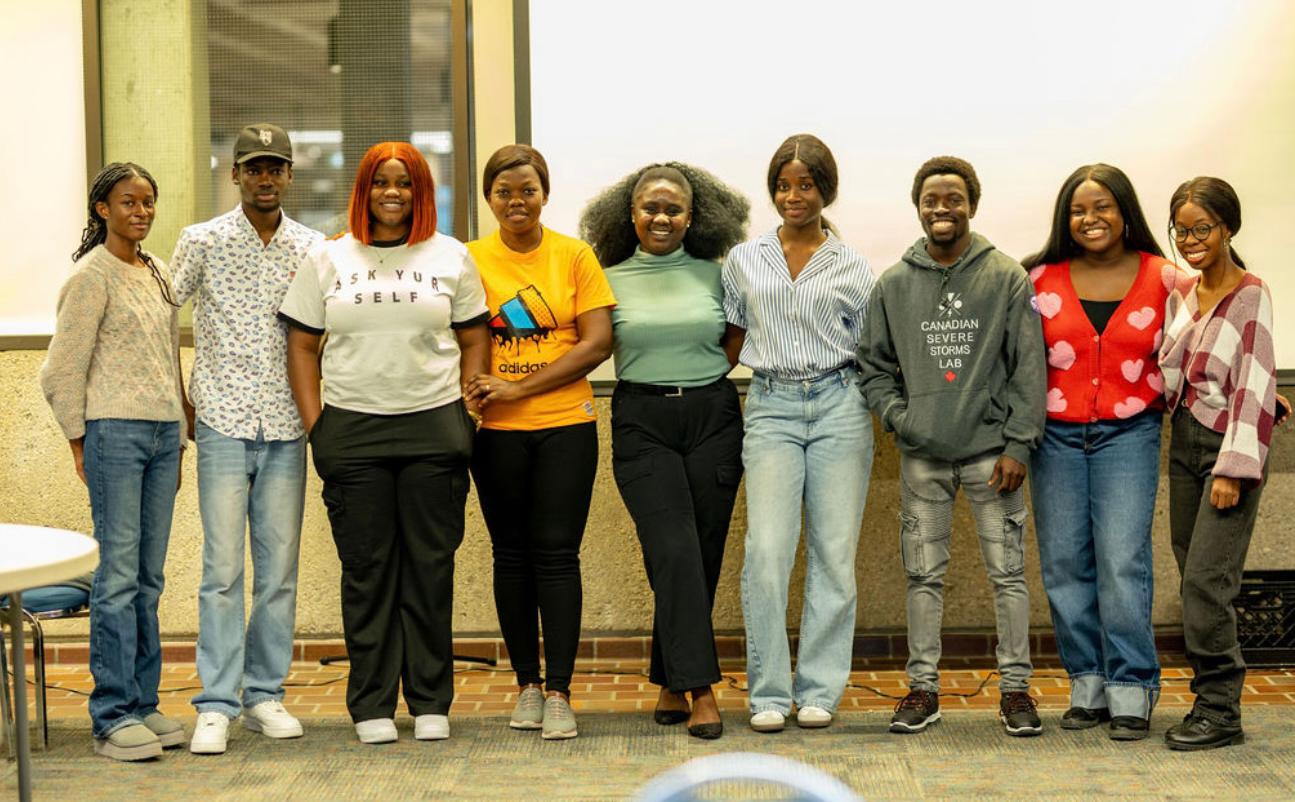
The Ghana Students’ Union Manitoba (GSUM) held its fall meet-and-greet on Nov. 21 at the GSA lounge, bringing students together to participate in conversations and shared experiences. The event introduced the union’s leadership, outlined its purpose and offered students an opportunity to connect through informal activities.
Emmanuella Nti, GSUM president, described the makeup of the union. “[GSUM] is made up of Ghanaian students and allies who are committed to building community and celebrating Ghanaian culture,” she said.
Nti explained the aim of the event “was to create a comfortable environment for everyone to connect and build a community.”
GSUM vice-president Genevive Osei Amaniampong addressed participants and commented on the attendance. She described the turnout as positive, noting that it contributed to broad engagement among students. “The [event] was a great success. Students were able
to connect and build genuine relationships that go beyond academic settings,” she said.
Osei Amaniampong also referred to feedback organizers received following the event. “Many attendees expressed how grateful they were for the event. It reaffirmed the importance of the work we do at GSUM in fostering unity and cultural pride,” she said.
Nti noted the turnout exceeded expectations and “created a vibrant, supportive atmosphere.”
The gathering allowed students to share information and experiences. “We had meaningful conversations about life in Canada, shared experiences, played games and enjoyed food together,” Nti said.
who has joined the club and did not come out with more friends than they had when they first arrived.
“Our membership is open and welcoming. Any interested student can participate and become part of the community”
— Emmanuella Nti, GSUM president
“Joining GSUM is about finding a home away from home, building lifelong relationships and contributing to a thriving Ghanaian community on campus,” Osei Amaniampong encouraged.
The union also intends to collaborate with other cultural student groups. Nti disclosed they “are already exploring collaborations with groups such as the African Students’ Association” and are “building bridges across communities [as a] priority.” The event highlighted par-
ticipants’ willingness to support one another. Nti noted that during the event, some students “expressed readiness to help others find job opportunities,” suggesting a shared interest in helping peers navigate life in Canada.
Nti said she hoped the event would achieve its purpose of community-building, “connect students to new friends and make everyone, especially newcomers, feel welcomed,” she said.
“Our membership is open and welcoming,” Nti stressed. “Any interested student can participate and become part of the community.”
The union announced its upcoming Christmas party and its plans to take part in Black History Month activities. Nti believes such “events will continue to foster community engagement and cultural pride among members.”
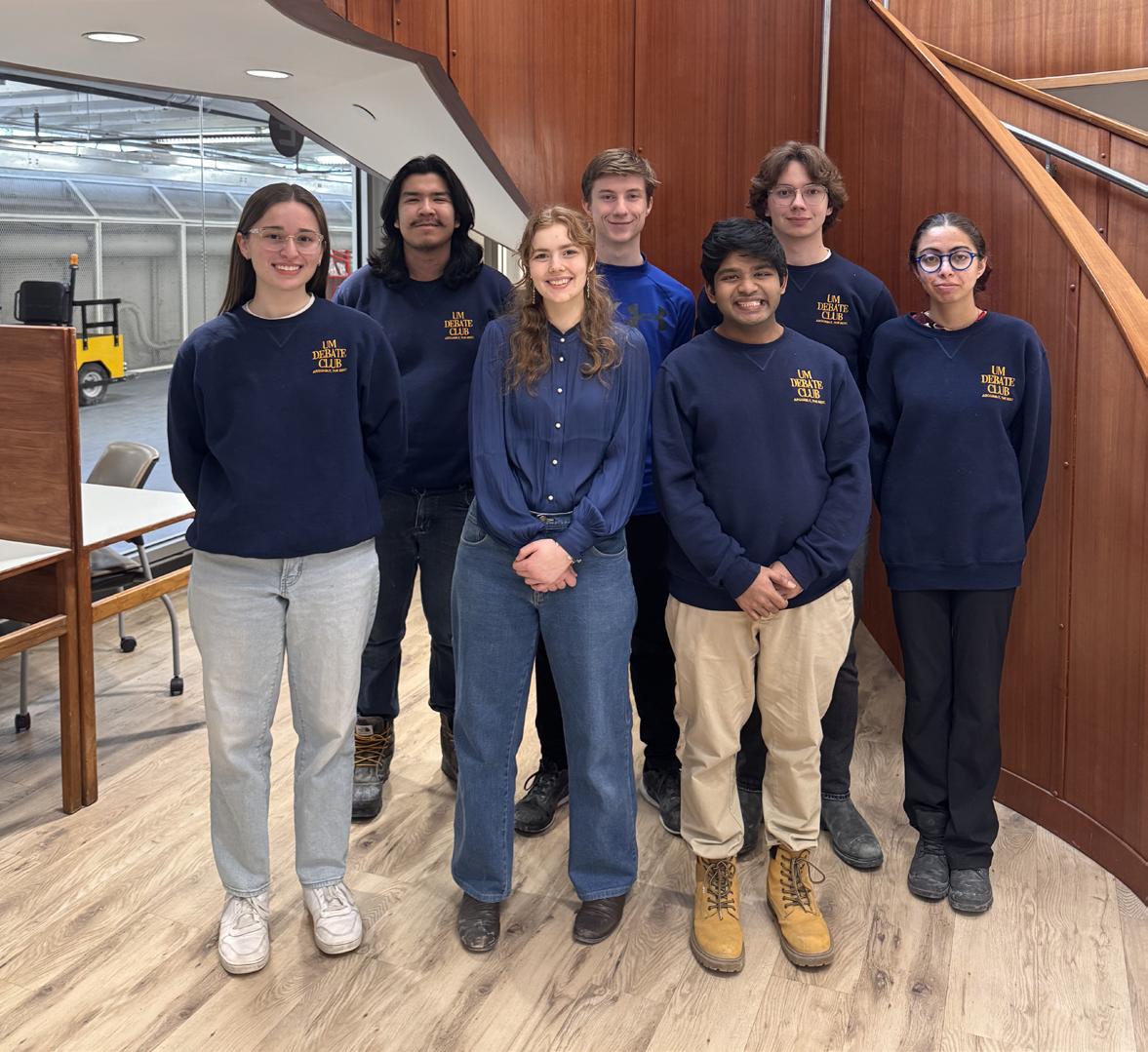
PHOTO PROVIDED BY U OF M DEBATE CLUB
PHOTO BY PROVIDED BY GMSA
THE U OF M DEBATE CLUB AT CANADIAN PARLIAMENTARY NATIONALS 2025 IN OTTAWA EARLIER THIS YEAR.
I hate Winnipeg!
Examining The Weakerthans’ refrain 22 years later
Mikaela Warkentin, staff
S ince moving to Winnipeg, I feel like I can begin authentically enjoying the discography of The Weakerthans, a cornerstone band in the Canadian indie scene with roots in this city. There’s something romantic about listening to a song tailored for a place while you’re in it, because yes, I am in fact driving the same route every day, just like the song! Based on my first months living fullfledged in this city, The Weakerthans got it right.
But there’s something in the back of my mind when The Weakerthans’ “One Great City!” hits its refrain — “I hate Winnipeg.” It’s a harsh thing to say, to hate something. For me, while I relate deeply to the issues brought up in the song, there’s a tinge of irony for me to sing along. I chose to live here — I actually kind of like Winnipeg. What a controversial idea!
/ Of feet on polished floor”. Finally, something I can contest! Earlier this fall, the city opened up aboveground pedestrian traffic on this infamous corner.
The same goes for the slight against the Jets later in the song — I’m no superfan, but I know they’ve regularly made the NHL playoffs (ignoring how they go in the second round). Debate over, Winnipeg’s great now. The Weakerthans can suck it.
However, there’s a distinction between hating Winnipeg for its cosmetic shortcomings and a genuine discontent of the people who live here. Statistics Canada collected data on quality-of-life indicators throughout Canada via their census, with factors being “life satisfaction,” “sense of meaning and purpose,” “future outlook,” “loneliness,” “having someone to rely on”
pile, hopeful about the good things this city has to offer. At least Winnipeg isn’t a complete dead end!
One Great City! ends on the stark visual of a city that does not care for its residents. “Our golden business boy / Will watch the North End die / And sing ‘I love this town’ / Then let his arcing wrecking ball proclaim / I hate Winnipeg.”
Our “golden business boy” atop the Legislature faces directly into the heart of the city and speaks to a level of disconnect. “I love this town,” but “this town” isn’t Winnipeg. With this in mind, I choose to understand this song not from the perspective of an inconvenienced citizen, but instead from the understanding that the government itself seems to hate the idea of Winnipeg. This isn’t an unfounded conclusion to arrive at, either.
“Debate over, Winnipeg’s great now. The Weakerthans can suck it”
As a newcomer to the city, maybe I’ve got it all wrong. Let’s assess what I do know about Winnipeg. The song mentions the dreary weather (“A darker grey is breaking through a lighter one”) that sits over the city — that I can’t argue with. “One Great City!” continues to reference the underground pedestrian crossing at Portage and Main — “A thousand sharpened elbows in the underground / That hollow hurried sound
and “a sense of belonging to local community.” Winnipeggers sit in the middle for most of these factors as 48 per cent of respondents “rarely or never feel lonely,” 46 per cent have a “high life satisfaction,” and 54 per cent have a “strong sense of meaning and purpose.” While it’s still a middling statistic, 59 per cent of respondents “always or often have a hopeful outlook” — maybe I am counted in this
The city of Winnipeg’s own resident satisfaction survey has seen a steady decline in respondents’ satisfaction with overall city services — from 87 per cent satisfaction in 2021 to 72 per cent in 2025. The reasoning behind this decline could be a myriad of issues found within city governance, but what takes the cake is the surveyed statement, “I believe the City of Winnipeg acts in the best interest of citizens,” a data point that needed the added subtext, “There are no
demographic subgroups more likely to strongly or somewhat agree with these perceptions,” noting that of the respondents, only 29 per cent hailed from Winnipeg’s inner city. From the mouths of the remaining 71 per cent, along with the inner city’s minor contribution, 63 per cent of respondents felt that the city is acting in the best interest of Winnipeggers. There’s one more number from Statistics Canada I failed to mention. 72 per cent of the Winnipeggers surveyed shared that they “often or always have someone to count on.” In my research for this, I was stopped in my tracks. It’s a lovely thing to survey for, or to monitor if there is a sense of community beyond the one understood by the larger cultures.
There’s the fact that the structural components of this
city seem to constantly let its citizens down — “One Great City!” bemoans the traffic, the government, the weather, but never seems to complain too much about the people. In fact, there’s a sense of unity in saying, “I hate Winnipeg.” While it’s a heavy sentiment, it’s at least a sentiment shared. The Weakerthans did indeed “get it right” about Winnipeg — we’re all hating it together.

GRAPHIC BY EMMA GILLICH / STAFF
Research & Technology
The feelings films leave behind
Studies show how movies shape memory, emotion and the way audiences connect
Mansura Akter Meghla, staff
F or Brenda Austin-Smith, a professor in the department of english, theatre, film & media at the U of M, the power of cinema has always been inseparable from the power of feeling. Her research spans film performance, stardom, audience emotion and the small details such as lighting, sound and camera placement that shape how films move us. Together, these threads highlight her interest in the ways movies matter to people and become meaningful parts of their lives.
Austin-Smith traced her fascination with films back to her mother, a devoted film lover who grew up in the small town of Cape Breton and snuck into theatres whenever she could. “She told me all about those films and those stars when I was young, and even let me stay home from high school sometimes to watch a film on TV with her,” she said.
Though Austin-Smith completed all her degrees in English, she gradually shifted her scholarly focus toward cin-
ema. “I owe it all to my mom,” she added. Her work ranges widely across film and media studies. One of her forthcoming essays explores the 1947 Hollywood film The Bishop’s Wife It examines how “angels” function on screen and how their benevolence brushes up against the unease we associate with ghosts or spirits.
According to Austin-Smith, the film’s premise — an exceptionally handsome angel appears smitten with the bishop’s wife — raises questions that linger beneath its light tone.
ing implications of an otherworldly being entering human life.
That interest in the emotional undercurrents of film is what consistently draws her to her work. She recalled watching Arrival and hearing the low, resonant sound accompanying the aliens’ appearance. “I knew that was the sound of grief — heavy, rumbling, in your bones — and I was overcome with tears,” she said. She explained moments
lar film, or where they sat in the theatre. Accuracy matters less than the emotional imprint. “Films help us recall things about ourselves. They can become cinematic placeholders for nostalgia,” she said. “A film can bring many things back to us the way music can.”
“Films help us recall things about ourselves. They can become cinematic placeholders for nostalgia”
“Why isn’t the angel already perfectly happy? What could the angel do to a human husband who might be in his romantic way?” she noted. These tensions, she argued, point to a broader cinematic pattern. For example, films about angels tend toward humour and charm, perhaps to soften the overwhelm-
— Brenda Austin-Smith, professor in the U of M’s department of english, theatre, film & media
like that illustrate how film form communicates feeling long before the plot reveals anything.
According to Austin-Smith, memory plays a similar role. She noted how vividly people recall who they were with when they saw a particu-
Her research on fandom and cinephilia reflects that same emotional connection. Cinephiles — people with a deep, enduring love for film — often experience movies as far more than stories. For them, film becomes personal and intimate through memorized dialogues, an enduring crush on a star or a scene known by heart. “A film is almost never just a film for fans and cinephiles. It is a treasure to be shared with a chosen few,” she noted.
Austin-Smith emphasized the afterlives of films — the enduring presence in cultural
memory, noting that iconic lines continue to circulate long after their original context has faded. In this way, films “get under the skin of lived culture,” revealing values and anxieties in ways that cannot always be predicted.
As viewing habits shift across massive screens and handheld devices, she shared her concern about the growing impatience that digital culture encourages. She also emphasized that many films may have been lost, forgotten or never digitized. “The internet is like the ocean. Things get lost, taken down, not restored, no longer circulated,” she said. “Films can disappear, which is tragic.”
Yet the magic remains. Even on a small screen, she still feels the pull of a film’s opening moments. “The opening shots of a film remain a portal to me, a door into a place of art and wonder,” she said. “I’m a Dorothy who wants to stay in Oz a bit longer.”

GRAPHIC
ChatGPT’s culpability in inducing AI psychosis
ChatGPT’s newest version potentially perpetuates sycophancy
Nawal Semir, staff
A
rtificial intelligence (AI)-induced psychosis is an emerging problem, with numerous reports of AI-induced psychotic episodes surfacing on the internet. Although no epidemiological studies of the effects of conversational generative AI on mental health have been conducted, there have been a number of media coverage reports of individual cases. News reports of individual cases have exposed severe risks such as suicidal ideation, increasing paranoia and conspiratorial beliefs after intense AI chatbot use.
Most recently reported, an Ontario man by the name of Allan Brooks experienced a mental spiral seemingly induced by conversation with ChatGPT. Brooks, interviewed by CTV News, indicated ChatGPT “convince[d] him that he had discovered a new math formula that could destroy some of the world’s most powerful institutions, and that he had to inform the authorities before it resulted in a global disaster.” Conversations between Brooks and the chatbot spanned three weeks, culminating in his deluded state that was only broken when a competing AI chatbot confirmed to Brooks that ChatGPT’s claims were false.
Brooks is now suing OpenAI, ChatGPT’s developer company, claiming that ChatGPT is prone to dangerous sycophancy, as it is designed to constantly reaffirm users. Brooks is not alone in his claim. Seven lawsuits have concurrently been filed against OpenAI, alleging chatbots caused the claimants delusions and psychosis, even resulting in four suicides, according to CTV.
Brooks’ claim of sycophancy against OpenAI is supported by a recent study

conducted by researchers at Stanford University. Testing the feasibility of substituting mental health care providers with large language models (LLMs), the study found that LLMs “respond inappropriately to certain common (and critical) conditions in naturalistic therapy settings.” The findings further explained, “LLMs encourage clients’ delusional thinking, likely due to their sycophancy.”
In a similar vein, another study from the Georgia Institute of Technology suggests that LLMs can be trained to recognize when users are looking for the reinforcement of their “bad” behaviour in therapeutic settings, subsequently encouraging selfharm. LLMs have been found to affirm users to an addictive degree, limiting their independence and causing
emotional harm.
The Stanford study explains that LLMs’ inability to substitute for mental health care providers is due to the very sycophancy Brooks alleges. “Confrontation is the opposite of sycophancy. It promotes self-awareness and a desired change in the client. In cases of delusional and intrusive thoughts — including psychosis, mania, obsessive thoughts and suicidal ideation — a client may have little insight and thus a good therapist must ‘reality-check’ the client’s statements,” the researchers explained.
While Brooks claimed LLMs’ sycophancy induced mental delusions that were not pre-existing, the Stanford study tests LLMs’ sycophantic behaviour through the lens of users in need of mental health treatment. Nevertheless,
the Stanford study provides insights on how LLMs operate to the detriment of users like Brooks.
Despite the several lawsuits against OpenAI, the company has promised that ChatGPT’s newest version, GPT5.1 Instant, is “now warmer by default and more conversational.” Claiming to adhere to customers’ concerns, the company said that they have created a GPT version that is “enjoyable to talk to.” Additionally, GPT-5.1 Instant includes controls that OpenAI says “can better match the tone you want in responses.”
While GPT-5.1 Instant may address the doubts and desires of many users, the concerns of a rising minority claiming AI-induced mental health episodes are sidelined. This updated version does nothing to address ChatGPT’s
sycophantic tendencies, but rather potentially perpetuates it. Tailoring responses to the desires of users may result in affirmative responses that have no end. OpenAI makes no mention of plans to incorporate more confrontational behaviours in future GPT versions — the kind of behaviour that is necessary to bring LLMs closer to therapeutic settings.
The undeniable rise of users depending on LLMs for emotional support makes it imperative for OpenAI and similar companies to address issues of sycophancy. The emerging allegations of AI-induced psychosis on a case-bycase basis highlights the need for further research on the matter.

GRAPHIC BY TEEGAN GILLICH / STAFF
The Danish Deception
The psychology behind a financial romance scam
Thandeka Katsika, staff
Recently, Onyeka Ehie has taken over a side of TikTok with her multi-part “Danish Deception” story. In it, she revealed the whirlwind romance she had with a man claiming to be a wealthy Danish prince, Olympian and investor. She explained how this so-called Olympian prince scammed her, her friends and her family out of roughly $400,000 USD. Although this incident can be dismissed as a dramatic personal tragedy, I think it illuminates a broader pattern of financial exploitation that mirrors the logic of pyramid schemes.
At first glance, romantic scamming and pyramid schemes may seem worlds apart, but I think they both depend on psychological mechanisms such as rapid trust building, fantasy construction and a manufactured sense of urgency that draws a person in. In both cases, the victim is sold a dream to buy into, literally.
To understand these parallels, we must begin with the hook — the promise of a future too
good to be true. The Danish deceiver’s presentation of himself made him seem like the kind of man you only meet once in a lifetime. I think this might be why Ehie ignored his prominent red flags. It is not every day you meet a man with a royal title, who has competed at the highest level as an athlete and has an incredible investment portfolio.
Similarly, pyramid schemes attract recruits through a heightened illusion of wealth. Victims are sold the idea that if they join and pay their dues, they will rise
within the ranks and make a lot of money. They feel like they are being given a rare chance for rapid financial growth. In both cases, the victim feels like they have stumbled upon something extraordinary.
These promises work, not because people are naive, but because emotional and economic pressure can make the fantasy of sudden stability very appealing. I feel this emotional manipulation is crucial for the success of a financial scam. It makes victims fall so in love with the idea of a better life that they suspend doubt and fall headfirst into the fantasy.
After the dream is sold and trust is secured, both the romance scammers and pyramid scheme recruiters present the “financial investment” as being temporary. In the Danish Deception, the Olympian investor constantly assured Ehie he had money, it was just that “his bank account was frozen by the Danish government” or his friend “needed money for an urgent investment.” She was always made to believe that she, her family and friends would be paid back the money they
loaned the prince. I think by framing each loan as a small stepping-stone toward a shared future, he left little room for Ehie to realize something was seriously off.
I see pyramid schemes as operating with the same psychological script. Recruits are told that the initial buy-in — purchasing inventory, starter kits or training retreats — is merely a momentary cost that will be recovered once the recruits rise in the business. The structure of the scheme relies on people believing that they will get back more than they give. But, just like Ehie’s prince, the
promised payoff never materializes. Instead, the demands escalate.
One of the clearest lessons I’ve learned from both of these forms of scamming is that if anything seems too good to be true, it’s probably because it is — it’s probably fake. There isn’t much likelihood of making a lot of money without having to work hard for it, and anyone who would sell that idea is a liar. Similarly, the probability that you will meet a perfect prince is unrealistic. In both cases, a high level of caution should be exercised no matter how attractive the dream being sold may be. Ultimately, to me, the Danish Deception is more than just a sensational TikTok scandal — it is a perfect reminder of how financial exploitation thrives when a person’s emotions are involved. Ehie’s story exposes the vulnerabilities that scammers deliberately target, such as the desire for security and the hope of upward mobility. Romance scammers and pyramid schemers have that in common.
The bicycle is not a toy
Why politicians and media should start taking cycling seriously
Adam Johnston, volunteer staff
hen it comes to how
W
Winnipeggers view cycling, we generally misinterpret the bicycle as just a toy for kids’ enjoyment or strange adults rather than a tool for getting around. Winnipeggers must move past their recreational mindset on cycling. If we want to see real climate and transportation justice outcomes, we must reframe cycling as a transportation necessity, strengthened by policy and media perception.
Car-brained influenza has infected Winnipeg’s policy, infrastructure and culture, reducing cycling to recreation rather than serious transport. Painted bike lanes on McDermot, Smith, Cumberland or St. Matthews offer little more than street art, creating a false sense of safety. Being squeezed between speeding cars on St. Matthews Ave, for instance, shows why cyclists demand protected lanes. In addition, lack of winter maintenance turns bike paths into skating rinks during freezethaw cycles, and high rates of bicycle theft discourage bicycle ownership.
City Hall’s inaction worsens risks for vulnerable users. A comprehensive cycling policy
must prioritize diverse users, not hobbyists. Yet local attitudes persist — at a September NDP meeting for my constituency, I wrote a resolution for their convention to advance active transportation within Manitoba. This was dismissed with claims that “cycling is only recreation” and “no one rides in winter.”
Mainstream media often reinforces cycling as child’s play, treating it as a nuisance rather than transport. Outlets like the Winnipeg Sun frame bike lanes as frivolous, while cars remain unquestioned kings. Media coverage also rarely presents cycling as infrastructure vital to climate or equity strategies, instead it relies on recreational clichés like sunny rides, rather than commuters braving rain or winter. This narrative undermines serious discussion about cycling’s role in reducing emissions. Nearly half of Winnipeg’s carbon output comes from transportation, mostly private automobiles. Without reframing cycling as essential infrastructure, we cannot reach the city’s goal of 50 per cent non-automotive mode share by 2050, nor build the climate and transportation justice
Winnipeg urgently needs. Around the world, cities challenge the bicycleas-toy myth. Copenhagen, Bogotá, Paris and Montreal are renowned cycling hubs because they embrace bikes as everyday transport, reducing car dependency. The rise of cargo and e-bikes expands access, enabling deliveries and mobility for those previously excluded. For many low-income users, cycling is not recreation but economic survival in a system that burdens the poor while wealth concentrates at the top. Reframing cycling as a necessity, not a novelty, is vital for equity and resilience.
So, how can the media improve? Give cycling in Winnipeg the same amount of media coverage as automobiles. Frame it as an accessible way of battling climate change and an equitable transportation mode. Expand more coverage into the community by interviewing more grassroots advocates who commute by bike every day. Show further diversity in cycling coverage. Show low-income and Indigenous commuters, parents hauling kids, cover community stories like bike buses. The more we hear
about them, the more the public will understand. Yes, of course, normalize winter riding and those who take the bus alongside cycling. Normalize the idea that it’s ok not to have a driver’s licence. Not everyone has one, nor wants one, including myself.
Let’s all reclaim the bicycle as a tool for economic, social
and environmental liberation, not just a recreational play piece.
Adam Johnston hosts Not Necessarily The Automobile on Thursdays at 11:30 a.m. on UMFM 101.5. He can be reached at notnecessarilytheautomobile@gmail.com
GRAPHIC BY EMMA GILLICH / STAFF
To tow or not to tow
Stop towing students away from
Quinn Mayhew, staff
I
f I were to write a hate letter to any establishment, it would be the U of M’s parking services. For a place that is named the “Welcome Centre,” it is one of the least welcoming places there are.
If you are ever unlucky enough to see a parking enforcement vehicle driving around campus, you’ve most likely seen them handing out tickets to cars. In my opinion, parking at the U of M should be free. Why on earth are students paying for parking at a university they already pay to attend?
Whenever I see one of those vehicles giving citations to students, I purposefully walk as slowly as humanly possible in front of said vehicle just to annoy them to the level that they annoy me.
I find it ironic, though, that a university that claims to value its students issued 13,000 parking citations in 2023, according to the Freedom of Information and Protection of Privacy Act, with a total revenue of $584,974.40 — all of which was paid to the U of M.
The greed coming from U of M parking services is nothing new. I’ve always had difficulties with them, whether because they’ve ticketed me for not parking within the allotted space or because the parking app crashed while I tried to pay. Boy oh boy, do they love to ticket people for any reason they can find.
Recently, I was towed off the U of M campus — something I had no idea they could even do. It is not listed anywhere on their website that
campus
they even engage in towing services.
I find it even more ridiculous that the university hired an outside company to tow away students when too many tickets accumulate, as if shutting down access to certain services on Aurora isn’t enough to encourage you to pay your tickets on time.
As I trudged down to Doctor Hook Towing that fateful Monday afternoon to retrieve my car from purgatory, a thought came to me. The U of M couldn’t care less if they cause mental distress to the students forced to scour the parking lot to find their disappearing car, like me. When I couldn’t find my car, I assumed it had been stolen. As I paid the $346 to have my car released, I asked the gentleman at the front counter if

they had towed many people off campus that day. He responded with, “A lot.”
Eventually, once you’ve figured out your car’s been towed, you’ll trudge your way down to the “Welcome Centre” and argue with the employees at the front desk, who do not seem to care if you get your
car back. The U of M needs to do better. They cannot be towing their own students away or bringing in an outside company to ensure citations are paid. Does the U of M have such a desperate need to expand the parking office into a mega mart that they cannot lay off such extreme ticketing?
When law school admissions reward free time and money
Heavy reliance on the LSAT can sideline those balancing work, caregiving and bills
Kyra Campbell, staff
If you want to go to law school in Canada, your grade point average and résumé are only the beginning. Standing between you and an admissions offer is a multiple-choice exam run by an American non-profit organization, the Law School Admission Council (LSAC).
The Law School Admission Test, or LSAT, is a standardized exam scored from 120 to 180 that most Canadian schools still treat as a major gatekeeper. Officially, it measures logical reasoning and reading comprehension. Unofficially, in an age of widening income inequality, it also measures who has the time, money and stability to bend their life around an exam.
Start with the price tag. LSAC lists the LSAT fee in U.S. currency — currently $248 USD. By the time the exchange rate and taxes are added, many of us in Canada see a charge in the high three hundreds. That number does not include other costs such as prep books, online subscriptions, practice tests and, if you’re lucky, LSAT tutoring. Even if you rely on free resources, you still need a decent laptop, reliable internet and a quiet space — none of which are guaranteed if you are living with roommates, family or in unstable housing.
Then there is the cost that does not show up on a receipt
— time. To be “LSAT-competitive,” applicants are encouraged to study for hundreds of hours. For some, that may mean rearranging schedules and cutting back on social life. For others, especially those working or caregiving, those hours can only be carved out of sleep or earning income. Studying for the LSAT may start to look like an unpaid fulltime job.
like this favours applicants who can afford to take fewer shifts, who have help paying rent, who can pay for a tutor when their practice
it’s who can buy themselves time. It is worth asking what, exactly, this test adds to the process that everything else does not already demand.

At the same time, law schools tell applicants they are looking for volunteer work, leadership roles, extracurriculars and a thoughtful personal statement. In practice, that means a lot of people are trying to hold down paid work, manage family responsibilities, find time to volunteer and still produce a competitive LSAT score.
On the flip side, a system
scores plateau or who have family who have already navigated the process. When so much weight is put on the LSAT, it is not just logic being tested —
I am not arguing that law schools should admit students without academic standards.
The ability to read dense material, reason carefully and manage stress all matter in the
with blind test takers, LSAC removed the logic games section because its reliance on drawing diagrams made it less accessible for many disabled students.
If an entire section of the LSAT can change in the name of fairness, it is hard to pretend that the test as a whole is some neutral, immovable standard. It is a timed, highstakes, one-size-fits-all exam that does not account for whether someone has navigated poverty, eviction, immigration or the criminal legal system from the other side of the table. Those experiences, which are invaluable in a lawyer, do not appear as a higher score.
If anyone from an admissions committee at a school I have applied to happens to be reading this, consider it my very nerdy way of saying I am excited about the possibility of learning all that law school has to offer. I am just less convinced that one very expensive standardized test should have so much power over who gets to attend.
practice of law. But the LSAT is a very particular way of measuring those skills, under very particular conditions. Even LSAC has acknowledged that the test is not untouchable. After a legal settlement
Right now, in a country where the cost of living keeps climbing, having the LSAT included and weighed heavily in admissions functions as yet another barrier that falls hardest on people from less privileged backgrounds. The law should not belong primarily to those who can afford the time and money it takes to master logic questions.
GRAPHIC BY EMMA GILLICH / STAFF
To complete Sudoku, fill the board by entering numbers 1 to 9 such that each row, column, and 3x3 box contains every number uniquely. In Straights, like Sudoku, no single number 1 to 9 can repeat in any row or column. But rows and columns are divided by black squares into compartments. Each compartment must form a “straight.” A straight is a set of numbers with no gaps but it can be in any order, eg [7,6,9,8]. Clues in black cells remove that number as an option in that row and column, and are not part of any straight. Glance at the solution to see how “straights” are formed.

Arts & Culture
Show Pony releases second single “Makes No Difference” Winnipeg alt-rock band’s latest release
Carrington Dong, staff
W
innipeg alt-rock band Show Pony consists of vocalist Mannon Smalley, guitarists Thomas Cram and Brett Hesford, drummer Nick Kula and bassist Hailey Hunter. The group formed when Kula and Smalley were playing in other bands that often played together. Both of those bands disbanded around the same time, and Smalley suggested to Kula that they start their own band together.
Soon after, they connected with Cram through his connection with Kula on Instagram, leading to the formation of the group.
The group values highenergy performances, hence the name Show Pony. Their musical influences draw from older styles such as ’70s punk and rock and roll, as well as modern alternative acts such as the Yeah Yeah Yeahs and Starcrawler.
sive music, so we try to take that and combine it with more modern stuff to give more of a classic sound with a bit of a modern take,” Cram explained.
When composing their music, Show Pony takes a collaborative approach, which varies from song to song. Usually, one member presents a small idea that they then develop as a group.
“It can come from a lot of different places […] ideas can come from anybody,” said Kula.
On Dec. 2, the band released their second single, “Makes No Difference.” The song’s chorus
precedes upcoming debut EP
great. The rest of the song, I think you can do better, but that bridge is really great,’” Smalley said of the song.
The original song had been about betrayal, and this theme was carried into “Makes No Difference.” They aimed for the song to be “cinematic.”
“We wanted the instrumentation to paint this picture of riding a motorcycle through the desert outside Las Vegas in the ’80s,” Cram said.
“Makes No Difference” will be part of the band’s upcoming debut EP, produced in collaboration with producer Ryan Worsley and music engineer Donavan Ostapowich.
“I feel like we are all individuals and we’re all different, but we’re like-minded. It’s fun to bounce off of people like that and to feel understood and feel not judged”
—
Mannon Smalley, Show Pony vocalist
had originally been conceived as a bridge to a different song.
“We love loud, aggres-
“I actually had written the chorus as a bridge to a separate song, and the band had agreed, ‘That bridge is really
“It was kind of an experiment because we never worked with anybody outside of the band before […] It turned out, I think, really well, and we’re really happy with how it worked out.” Cram reflected.
The group has two upcoming concerts on back-to-back nights — a cover show at
Sidestage on Dec. 5 where they will be covering the songs of Amyl and the Sniffers, and a single release party for “Makes No Difference” at the Park Theatre on Dec. 6. The Calgary-based new wave goth band Uncanny Valley will support them at both shows.
The group’s fans can expect these concerts to be highenergy, with a focus on live performance.
“I love a loud, intense rock show,” Cram commented. “There’s just this special feeling of getting your face blown off by a really loud show.”
When asked what they love about being in a band, the members highlighted their bond.
“I feel like we are all individuals and we’re all different, but we’re like-minded. It’s fun to bounce off of people like that and to feel understood and feel not judged,” Smalley stated.
Kula agreed, adding, “Obviously, music’s really important in my life, and so, just being around other people that are like-minded in terms of that […] it’s great.”
Show Pony’s second single, “Makes No Difference,” is now available on all major music streaming platforms. For tickets, visit ticketweb.ca. For more information on Show Pony, follow them on Instagram @showponyband.
Poetry society encourages meaningful conversation U of M student organizes
Jordan Anglin, staff
U of M student Erika Beaudin and her friends spent the summer of 2025 living in Montreal. Upon returning home, she was inspired to recreate the transformative experiences she had on her trip. So, she founded the UM Poetry Society.
The group emphasized sharing personal thoughts and reflections, rather than technical or academic analysis of literature. She has hosted three poetry nights since the start of the academic year, which are roughly twohour events in the Tier Building. Beaudin brings books of poetry to read from, or members can share their own writing and the group discusses how the works resonate with their lives. She encouraged members to consider varied perspectives and participate in debates.
“I wanted an artistic space to talk to other people […] especially things that brought people to reflect, and poetry
regular
does that,” Beaudin expressed. She hopes to expand the poetry society with other events in the future, such as workshops and writing sessions.
Beaudin told the story of her and her friends experiencing a multitude of changes in their lives and deciding to spend the summer living away from home. Her reasons included anxiety about turning 20 and a desire to gain more life experience beyond her engineering degree. They were attracted to Montreal for its arts and walkability and spent their time exploring, writing and completing a government internship.
She also discovered a group of poets in Montreal called Union Santa Fe, primarily made up of students at Concordia University. They meet weekly, in a park or a member’s home, and discuss their writing. Some of their work can be found in the literary magazine Oil. Beaudin met a member who gave her
poetry nights for reflection
the information while they watched a busker together. Beaudin was unable to contact her new acquaintance again, but she determinedly showed up to a meeting anyway.
Beaudin decided not to register her club as an UMSU student group as she had issues with their official regulations. But she took the initiative to hang posters and book rooms anyway. She encourages more students to follow her lead.
“It was remarkably easy to start a club,” Beaudin explained. “If you have an idea of any of your interests and you put up a poster that says, ‘Do you have this interest? Put your name and email down,’ people with that interest will […] Then you could go, ‘Let’s hang out and talk about it!’ And then they will.”
“University is so what you make of it,” she said. “Anything you’re thinking of doing, you should do it. Because also, if you don’t prioritize these things, they’ll never happen
[…] Never again will you be around 30,000 other people your age who also might join the club.”
For updates and more information, follow the UM Poetry Society on Instagram @um_poetrysociety.
PHOTO PROVIDED BY ADELLE RAWLUK
PHOTO PROVIDED BY ERIKA BEAUDIN
Goodbye, Hawkins
A spoiler-free reflection on a decade of Stranger Things
Eden Quiring, staff
It has been nine years since the first season of Stranger Things turned the world upside down in 2016. Now the series is finally coming to an end in 2025, and I don’t know how to feel.
During the run of this series, I have started and graduated high school, reached my fifth year of university and now I am nearing the end of my undergraduate degree as the show finally reaches its finale. Does Stranger Things still interest me? Do I even have time for it? These are questions I have asked myself amid the promotion for the fifth and final season.
I was compelled to check out Stranger Things in 2017 after seeing Finn Wolfhard in It in theatres and recognizing him from “that ’80s show my parents like.” I adored It, and Stranger Things seemed to be in a similar vein with its ’80s nostalgia and Stephen King energy, so I watched the first season. It altered my brain chemistry forever — I was hooked, and so was the rest of the world.
Nobody involved in the first season of Stranger Things expected the show to have the widespread cultural impact that it did. David Harbour, who plays Jim Hopper, told Variety, “I figured it would be kind of a sci-fi show, which some people would really enjoy, others it wouldn’t be their thing. But the universal appeal on the sort of zeitgeist that it has become, I never imagined.”
The show is quite nerdy, but it became one of the most successful television shows of the past decade. Brothers Matt and Ross Duffer, the show’s creators, have alchemically created the perfect combination of nostalgic references and timeless tropes to appeal to an almost universal audience. Whatever you enjoy — Dungeons & Dragons, Star Wars, The Lord of the Rings, rooting for the underdog or simply a good story — you will get something out of Stranger Things
It’s great to see a show become so mainstream while still clearly being made as a love letter to the outcasts and misfits of the world. I sometimes miss the more intimate tone of season one, but it is exciting to see the story and budget grow exponentially with every season.
I also believe much of the series’ long-term success can be attributed to the Duffer brothers’ ability to let the show and its characters grow
alongside its actors and audience. The plot has focused not only on fighting interdimensional monsters with telekinetic powers, but also timeless coming-of-age growing pains and cornerstones through the lens of the 1980s. The ensemble includes characters of a wide variety of ages, allowing for most viewers the ability to see the ups and downs of their own chapters of life represented.
In their commitment to grounding the show in reality, the Duffer brothers even went so far as to line up every actor’s last day of shooting with their final scene in the series so the actors could truly feel a sense of closure once they wrapped. This certainly
would have also impacted the realism of the actors’ performances as they played out their characters’ final moments.
So, do I, a full adult, still care about this nerdy show that teenage-me ran fan accounts for once upon a time?
Yes. Duh.
I have admittedly been nervous about letting myself get too excited about the final season, but only because I have spent the past nine years being so invested in this story and I cannot help but fear disappointment. There is a lot riding on this finale, every character and story arc needs to be wrapped up in a way that feels satisfying and true. I have spent so long analyzing the story, and I have many
expectations for where each arc could lead. However, I think I might need to loosen my grip on my expectations and just allow season five to be whatever it is in order to fully enjoy it. The Duffer brothers deserve my trust — surely they’ve earned it if they’ve kept me so interested all these years.
Honestly, it feels cathartic to see this series come to a close. It feels like I’m finishing a chapter of my own life. I am not at all the person I was when season one came out — granted, I’m not even the person I was at the start of this year. Even though I’ve grown and, in many ways, moved on with my life, this story impacted me greatly and con-
tinues to hold a special place in my heart.
I can still feel the same magic when I hear that dreamy synth glimmer while neon red letters in ITC Benguiat fill my television screen, and I know millions will be feeling that same magic as we all sit down to watch the final season of Stranger Things
All eight episodes of Stranger Things season five will be releasing in three parts on Netflix. The first four episodes were released on Nov. 26 and the next three episodes will be released on Dec. 25. The finale will be released on Dec. 31 on Netflix and in select theatres across the U.S. and Canada.
PUP to play concert in Winnipeg
Canadian punk rock band coming to Burton Cummings Theatre
Jordan Anglin, staff
he Toronto punk band
TPUP is set to play an all-ages concert at the Burton Cummings Theatre with Snotty Nose Rez Kids on Dec. 2 to promote their fifth studio album, Who Will Look After the Dogs? At least two UMFM disk jockeys will be in attendance.
Luc Mayor, whose UMFM show Signal Distortion is currently on hiatus, has been a fan of PUP since discovering them through the rhythm game Osu! in 2018.
Mayor was in his late teenage years when he saw PUP perform at The Garrick Theatre in 2019, when they toured to promote their album Morbid Stuff. It was one of the first concerts he went to alone and his very first time participating in a mosh pit. He described the experience as “one of [his] favourite concert experiences of all time” and formative to his love for pop punk and emo music.
“[When PUP played “If This Tour Doesn’t Kill You, I Will”]
it was something of a [communal] loving and endearing experience where everyone connected,” Mayor told. “I remember embracing this guy who I had never met before. I never talked to him, I never got to know his name […] but in that moment, we had a soul-born connection where [...] we understood each other in a way that few others would be able to say that they could […] We had that mutual love for the band.”
Mayor called Who Will Look After the Dogs? a “return to form” for its unpolished sound, reminiscent of their earlier work.
Cole Neustaedter, host of Cole’s Notes on UMFM, is excited for the concert as well. He mentioned he enjoys the album for its darker and more mature qualities.
“It was like love at first sight,” Neustaedter recalled the first time he heard PUP’s music in his mid-twenties upon the release of The Dream is Over in 2016.
He described the track “If
This Tour Doesn’t Kill You, I Will” as “[aggressive], but it’s also understood that [the band members] are all best friends and they actually love each other and it’s kind of beautiful. That was the first track I heard and it struck a chord with me.”
Neustaedter attended
PUP’s show at The Good Will Social Club on their tour following The Dream is Over. He remembered feeling a sense of belonging throughout the room while singing together.
“The crowd was just like one gelatinous blob of people who knew all the words,” he remembered.
He also looks forward to seeing Snotty Nose Rez Kids for the first time.
For tickets to the upcoming PUP concert featuring Snotty Nose Rez Kids, visit ticketmaster.ca/ event/11006298B27F3837.
Fête Ice Cream & Coffee scoops up success
Winnipeg shop recently celebrated their 6th year in business
Carrington Dong, staff
Fête Ice Cream & Coffee began with a conversation between co-founders Teri-Lynn Friesen and Élise Allard. The two, then working together at a dance studio, were in a staff meeting when Allard mentioned she had been trying to open a coffee shop. Friesen then mentioned her dream to open an ice cream shop, and that sparked an idea.
“I just thought it was one of those conversations that would live and die,” Friesen recalled. “But then [Allard] texted me and was like, ‘We should really talk’ […] Then we met a few times and just hashed out what she was dreaming of and what I was dreaming of […] and we just felt like, ‘Wow, we have very similar visions for what we imagined could be.’”
Friesen and Allard developed their ice cream recipe with the U of M dairy science program, headed at the time by John Thoroski. They rented the facility and had regular sessions to tweak their recipe over a four-month period, describing the experience as “trial and error, but with a little bit of side coaching.”
“He taught us how to use the ice cream machine and how to make the ice cream base,” Friesen explained. “We had ideas, but he kind of formalized a lot of that learning […] and then we would bring our ideas to the table.”
Fête serves a variety of flavours, ranging from salted caramel crunch and strawberry rhubarb crumble, inspired by their families, to the “whimsical and playful” funfetti, with real cake bits blended throughout.
“At the beginning, we were trying to find what our core flavours were, and that’s very much developed with the customer in a sense, because you [can] come up with a flavour, but then the audience has to enjoy it for it to stick around,” Friesen stated.
Allard and Friesen make their ice cream and almost all ingredients from scratch, in-house. They draw inspiration from current trends and suggestions. For example, for last year’s Made in Canada series, they sought to create flavours that could represent Canada from coast to coast.
One of those flavours, the pacific berry crunch, was particularly successful.
“We infused the base [for
pacific berry crunch] with a little bit of pine oil, so it felt like a breath of fresh air,” Friesen recalled.
Fête Ice Cream is located near the Forks Market, right next to the Bonnycastle Dog Park. It is a cozy setting that Friesen noted makes for a good study spot, with Wi-Fi, coffee and baked goods available for patrons.
Another notable highlight of Fête’s store is the wall covered in polaroid photos of dogs. Although they are located next to a dog park, they are unable to allow pets inside, so Friesen and Allard were looking to find a way to include them. The idea came from Friesen’s husband.
“My husband was like, ‘You should just have a “doggy wall.” That could be fun,’” Friesen said. “We dreamed up, ‘Oh, what if there were polaroids, and what if people could get their dogs’ picture taken?’ […] So that’s our way of including the dogs.”
Friesen and Allard celebrated Fête’s fifth anniversary last year with a trip to Calgary, where they explored different ice cream stores and attended a conference. When they celebrated six years in business this month, they kept things
comparatively low-key.
“We just had in-store specials for the day, launched our winter collection, got some balloons,” said Allard.
Fête will be winding down their season on Dec. 23 for their annual winter break and re-opening in January. In the meantime, they are offering limited edition holiday fla-
vours and a few collaborative flavours with Royal Manitoba Theatre Centre’s production of Elf.
For more information on Fête Ice Cream & Coffee, visit feteicecreamcoffee.com or follow them on Instagram @feteicecreamcoffee.
PHOTO PROVIDED BY VANESSA HEINS
PHOTO PROVIDED BY FÊTE ICE CREAM & COFFEE
PUP PLAYED THE BURTON CUMMINGS THEATRE ON DEC. 2.
Tuning into the sounds of the Swingin’ Sixties
U of M history student spotlights ’60s music with UMFM radio show
Boris Tsun Hang Leung, staff
Peace signs, bell-bottoms and long hair — the Swinging Sixties can be described as one of the most iconic and influential decades in recent history. With events such as the civil rights movement and the birth of counterculture, this decade saw dramatic shifts in almost all aspects of society, and the music scene was certainly no exception.
Jamie Sampson is the host of Sixties Expressions, the only radio show in Winnipeg that exclusively features music from the ’60s. He started the show when he grew tired of the repetitive songs on mainstream radio and wanted to tap into Winnipeg’s legacy as a musical mecca.
“All mainstream radio stations in Winnipeg, like 94.3, 99.9 [and] 100.5, play the same music every day. It’s the same music on a shuffle, and it’s because they will come out with a set list [to] guarantee it has 35 per cent of Canadian content […] To me, that seemed boring. I don’t need to hear the same Canadian ’80s song […] again for the fourth time in a row,” he said.
“I also noticed that Winnipeg doesn’t have a ’60s radio show, which is weird because Winnipeg was actually considered a music capital in the ’60s. We had a music revolution. Many bands emerged, such as the Guess Who, Chad Allan and the Expressions, the Jury, Sugar ‘N Spice and Neil Young.”
The fourth-year history student explained there were many garage bands in Winnipeg during that era, including the Squires and the Deverons, which featured renowned artists Neil Young and Burton Cummings, respectively. Sampson described that the surf rock, British Invasion style of these bands was vital for “paving the way for musicians in Winnipeg in the ’60s.” Leonard Cohen, best
known for his hymn “Hallelujah,” even performed twice at the U of M in the ’60s — first as a poet and then as a singer-songwriter in Taché Hall — attesting to Winnipeg’s vibrant music scene at the time. A photograph of him performing can be found in the basement of the Helen Glass building.
Speaking more broadly, Sampson commented that ’60s music was like a soundtrack to the sociocultural upheavals of that period. Music turned into something much more experimental and rebellious, and themes such as anti-war sentiment, racial segregation and communism began appearing in songs.
“It was no longer music like most of the ’50s, which had dry, boring lyrics [and] simple songs about love. Now there was lyrical depth. Now people were experimenting in terms of the music-making process and output of their songs. There were no genre bounds. People were trying different things out [and] different instruments,” said Sampson.
He highlighted the Who’s “My Generation” as an example. With lyrics such as “This is my generation / This is my generation, baby,” and “Why don’t you all fade away,” it is easy to spot its counterculture sentiments and resistance against tradition.
“[The song] is about going against your parents’ generation that grew up in the Depression and that went through [the Second] World War. It’s essentially going against everything that they said and believed in. It’s leaving your hair long and it’s wearing tattered sneakers. It’s completely shaking up the status quo,” he said.
When asked about his favourite record, he struggled (as any music aficionado would), but settled on “Something” by the Beatles — a slow ballad written by band mem-
ber George Harrison. He also recommended “San Francisco” by Scott McKenzie, “Time of the Season” by the Zombies and “Wouldn’t It Be Nice” by the Beach Boys.
It is hard to overstate the impact of music from the ’60s. For instance, six decades after its initial release, Connie Francis’s 1962 song “Pretty Little Baby” went viral this year and was used in more than 22.5 million TikTok videos. According to Sampson, this revitalization can be explained by advances in technology.
“There 100 per cent is a ’60s revival going on, and some of it can be, in part, due to the vast streaming services that we have now. In the ’60s […] if they weren’t listening to songs on the radio […] they were going to the record store.
And there would be listening booths [where] they could hear a song for the first time ever, and if they thought [it] was cool, they would buy [the] record,” he explained.
“Nowadays, I […] could go on Spotify for hours, and I could discover albums and artists that I never would have heard of [such] as “Ladyfingers,” an instrumental piece from the album Whipped Cream and Other Delights by Herb Alpert and his Tijuana Brass Band, [which] I believe, got 134 million streams through becoming popular on TikTok.”
Sampson added that Hollywood has also picked up on the oldies renaissance in recent years, releasing biopics of artists such as Elvis Presley and Bob Dylan, starring Austin Butler and Timothée Chalamet, respectively. A four-part
biopic on the Beatles is also coming out in 2028, starring acclaimed actors Paul Mescal and Barry Keoghan, among others.
“It’s interesting to see the lasting legacy of ’60s music. It completely changed everything. It shook it all up, and it was awesome,” Sampson enthused. “The ’60s is, if you ask me, the best decade for music.”
Sixties Expressions is hosted on 101.5 UMFM every Saturday from 10 a.m. to 12 p.m. For more information, visit umfm.com/programming/ shows/sixties-with-sampson. Connect with Sampson on Instagram @sixties_expressions_umfm or at sixtiesexpressionsumfm@gmail. com.
PHOTO BY EBUNOLUWA AKINBO / STAFF
Bisons women’s hockey crush Cougars
Bisons beat Regina Cougars 5-2, 4-3
Israel Adeogo Abejoy, staff
The Bisons rounded off November with 5-2 and 4-3 victories over the University of Regina Cougars in a thrilling matchup. In the first match on Friday, Nov. 28, the Bisons came out strong, scoring three goals in the first period, setting the tone for the rest of the game.
The scoring got underway in the second minute [2:28] when Sara Harbus netted the first goal, assisted by Aimee Patrick. The Bisons continued to apply pressure, and Patrick added a goal of her own in the seventh minute [7:28], assisted by Izzy Mann. Before the period ended, Julia Bird scored a power-play goal, assisted by Dana Goertzen, to give the Bisons a 3-0 lead.
The Cougars threatened a comeback in the second period, but the Bisons’ defence held strong, allowing only one goal. Pippy Pritchard scored for the Cougars in the 17th minute [17:00], assisted by Cassidy Peters. Despite being outshot in the period, the Bisons maintained their lead heading into the third period.
In the third period, the Bisons dominated, scoring two more goals while allowing one. Peters scored for the Cougars before the first minute [00:36], assisted by Kaylee Dyer to make the score 3-2. Despite the Cougars trying to catch up with the Bisons, Bisons head coach Jordan Colliton was confident in the team. “Teams are going to have pushback whether we score or we get scored against, so it’s important that you’re able to have a short-term memory so that you continue to play the right way,” she explained.
The Bisons quickly responded with two powerplay goals. Kelsey Huibers scored in the ninth minute [9:25], assisted by Patrick, and Brenna Nicol added the fifth goal 25 seconds after [9:50], assisted by Sadie Keller.
The game was not without controversy, as several players were sent to the penalty box throughout the game. Cougars’ Bailey McMaster was sent off for slashing, while Pritchard was penalized for boarding. For the Bisons, Keller, Sophia Anderson and Patrick were among those sent to the box.
Despite the physical play, the Bisons’ offence proved too much for the Cougars, as they outshot them 43-26.
Colliton expressed how the players felt after the win. “It feels nice that we finally came through — we started getting
rewarded. I think in the first period when we started pouring it in, there was a bit of a relief for our group that finally all their hard work was paying off,” she said. In the rematch on Saturday, Nov. 29, the Bisons secured a hard-fought 4-3 win in a shootout. The game was a back-and-forth affair, with both teams trading chances and showcasing
skills.
The Cougars struck first, with Olivia Leggett scoring a power-play goal in the sixth
“Teams
game in the seventh minute [7:34]. The first period also saw Bisons’ Keller and Glory Plett and Cougars’ Makena Kushniruk sent to the penalty box for various infractions.
are going to have pushback whether we score or we get scored against, so it’s important that you’re able to have a short-term memory so that you continue to play the right way”
— Jordan Colliton,
Bisons women’s hockey head coach
minute [6:15] in the first period. The Bisons responded quickly, with Patrick tying the
The Bisons took the lead in the second period, courtesy of Bird’s goal in the final minute of the period [19:06].
However, the Cougars refused to give up, and Shaylee Scraba leveled the score in the eighth
minute [8:34] of the third period. Kaitlyn Gilroy gave the Cougars a 3-2 lead in the 11th minute [11:17], but Patrick scored a dramatic equalizer for the Bisons with seconds remaining in the third period, sending the game to overtime. After a scoreless overtime period, the teams headed to a penalty shootout, where the Bisons emerged victorious. The Bisons outshot the Cougars 30-24, but it was goaltending and determination that ultimately decided the game.
PHOTOS BY MIKE THIESSEN / STAFF
Bisons women’s basketball lose on home turf
Calgary Dinos extended dominance over the herd on Friday
Faiyaz Chowdhury, staff
The Bisons women’s basketball team faced the University of Calgary Dinos at the Investors Group Athletic Centre on Friday, Nov. 28 and Saturday, Nov. 29. They lost the first game 84-59 and the second game 76-54.
On Friday’s game in the first quarter, the Bisons started well, going up by four before the Dinos had a chance to score, thanks to Taylor Schepp. But the lead was short-lived, as the Dinos soon caught up with the herd and they took the lead 13-11. While players from the Dinos like Amélie Collin and Christine Geraldo put up nine and five points respectively, Schepp alone scored 10 points. The first quarter ended with the Dinos leading 26-19.
The second quarter was dominated by the Dinos from early on — the score soared from 26-19 to 41-22 within six minutes. The Bisons struggled as the Dinos repeatedly grabbed offensive rebounds and extending possessions with better blocking. The second quarter ended with the Dinos leading by a huge margin of 22 points, the set score was 51-29.
The first half saw the Bisons making several runs but losing it just before the threepoint line, allowing the Dinos to switch to offensive transition and attack the basket.
The Dinos were extremely effective around the Bisons’ free-throw line, where two or more Dinos players would pass the ball before one suddenly drove into the gap looking to finish at the rim. This strategy by the Dinos served them well.
Post-halftime, the game flipped in the third quarter. This time, the herd controlled
the tempo, making crisper passes and exploiting gaps, which allowed them to score 21 points, with Schepp scoring seven points and Samantha Onyebuchi scoring eight.
The Dinos, on the other hand, struggled and managed only 13 points. The Dinos ended the third quarter still in the lead with 64-50.
final score of 84–59. Bisons athlete Schepp was one of the best on the court as she was able to get 17 points, four rebounds and two assists.
The Bisons women’s basketball head coach Michele Sung said, “We matched their phys-
practices and defensive skills in practice.” Sung also commented on Schepp’s performance. “She was patient. We tried to really prepare her for a ton of pressure.” Sung added, “[There are] some things that we can cleanup, but that’s where it’s fun, she’s only a first year.”
“We matched their [Calgary Dinos] physicality, we knew they are one of the more physical teams”
In the fourth quarter, the Bisons’ defence struggled to contain Kourtney Oss and Geraldo, who each scored nine points, while the herd added a total of nine points. The game ended in a win for the Dinos with a
— Bisons women’s basketball head coach Michele Sung
icality, we knew they are one of the more physical teams in Canada West.” She also commended her team’s defensive effort, noting, “We have tried to really emphasize defensive
The game on Saturday had a similar outcome to the Friday game, with the Dinos winning the game 76–54. The Dinos shined as a team as they got more total assists — 19 compared to the herd’s 11. Additionally, the bench points
Bisons fall 3-1, 3-2 to home Wolfpack
by the Dinos were 34, which was significantly higher than the Bisons, who had five. Geraldo led the Dinos with 12 points, adding four steals and five assists. Collin also made a big impact, scoring 16 points while contributing five assists and five steals. For the Bisons, Paige Schatkowsky led with 15 points, six rebounds and one assist despite the Dinos’ dominant performance.
The Bisons women’s basketball team will play their last game of 2025 against the Winnipeg Wesmen on Friday, Dec. 5 at 6 p.m. CT at the Investors Group Athletic Centre.
Bisons start strong, but Wolfpack storms back to claim weekend sweep
Israel Adeogo Abejoye, staff
The Bisons men’s volleyball team suffered a tough weekend, dropping two matches 3-1 and 3-2 during their game against Thompson Rivers University Wolfpack.
In the first match, the Bisons started strong, taking a 4-0 lead before the Wolfpack scored their first point. The Bisons continued to dominate, taking a nine-point lead at 21-12 and eventually winning the first set 25-15. However, the Wolfpack stormed back in during the
second set, taking a huge margin from 15-18 to 15-22 and eventually winning the set 17-25.
The third set was a backand-forth affair, with the Wolfpack taking a 10-12 lead and eventually winning 21-25. The Wolfpack continued to dominate in the fourth set, winning 22-25 to take the match 3-1. In the rematch on Saturday, the Bisons started strong again, taking a 6-1 lead in the first set and eventually winning 25-21. However, the Wolf-
pack responded with a 23-25 win in the second set before the Bisons took a 25-18 win in the third set.
The fourth set was a tight one, with the Wolfpack taking a 24-26 win. The Wolfpack sealed the match with a 14-16 win in the fifth set, giving them a 3-2 victory.
Kai Boyko led the Bisons with a strong performance, scoring key points throughout the weekend. Despite their efforts, the Bisons were unable to overcome the Wolfpack’s strong play.
PHOTOS BY MIKE THIESSEN / STAFF
PHOTO
Bisons men’s basketball wins one, loses one
Bisons defeat Calgary Dinos 66-59
Abdul-Jalilu Ahmed, staff
The Bisons men’s basketball team lost 75-73 to the University of Calgary Dinos on Friday, Nov. 28 at the Investors Group Athletic Centre.
The Dinos won the first quarter 22-21, but the Bisons responded with a strong second quarter, outscoring the Dinos 23-12. The Dinos regained control in the third quarter with a 22-19 advantage and sealed the win by taking the fourth quarter 19-10.
In the second game on Saturday, Nov. 29, the Bisons recorded a 66-59 victory against the Dinos.
Aidan Smith opened the scoring for the Dinos with a three-point jump shot at 9:26 in the first quarter. Eli Djordjevic followed with a dunk at 8:37 to give the Dinos a 5-0 lead. The Bisons got on the scoreboard at 8:18 when Daren Watts hit a three-point jump shot, assisted by Tito Obasoto, to cut the lead to 5-3. Daniel Chijioke made a free throw at 3:43 to extend the Dinos’ lead to 16-10. Brandt Lenz made a three-point jump shot for the Bisons at 0:12, reducing the deficit to 22-18.
At 7:10 in the second quarter, Watts hit another threepointer for the Bisons, assisted by Obasoto, to tie the game 24-24. Ramogi Nyagudi then made a three-point jump shot at 3:32, assisted by Lenz, to give the Bisons a 30-24 lead. Nyagudi added another three-point jump shot at 1:17, assisted by Watts, as the Bisons took a 37-27 lead into halftime.
“I was just glad that we were able to bounce back. I feel like we really brought it together”
— Daren
Watts, Bisons
men’s basketball guard
Cieran O’Hara made a free throw at 3:49 in the third quarter, assisted by Lenz, to widen the Bisons’ lead to 49-27. Lenz made a three-point jump shot at 1:45, assisted by Jonam Kazadi, to give the Bisons a 52-35 advantage.
In the fourth quarter, Lenz made a jump shot at 4:07 to bring the score to 50-58. Watts made two free throws at 0:17 to keep the Bisons ahead, 65-59. Lenz added a free throw at 0:11 to seal the Bisons’ 66-59 win.
Bisons men’s basketball head coach Kirby Schepp assessed the game and noted that the opponent made it
a tough one. “Calgary came in and kept fighting all the way,” said Schepp. “I thought our defence was really good for long stretches […] Then, Calgary started finding their rhythm and we lost our rhythm a little bit. [I’m] just happy we reclaimed it and got a couple of key buckets late when it mattered. But, yeah, it was a tough one for sure.”
“There’s always work to be done,” said Schepp in preparation for the next game. “We’re definitely going to go back and try to figure some stuff out to clean up some things offen-
sively, I think. But, we’ve still got a big [game] next week against Winnipeg to finish it off,” he added. Schepp indicated the upcoming game against the University of Winnipeg Wesmen will be a big one. “It’s always big, I mean, it’s an intense rivalry and those games always mean more than other games. We’ll certainly be locked in and [the] University of Winnipeg is one of the top teams in the country, so it’ll be a great test for us.”
Bisons guard Watts noted
he was excited for the win. “I was just glad that we were able to bounce back. I feel like we really brought it together. And this time we were able to fight against the run they had.”
He praised his teammates for creating the opportunities that allowed him to score in the game. “I feel good, but it’s really just all because of my teammates. They’re the ones that are passing me the ball. They’re the ones that are setting me up on those screens […] When they get buckets, it’s usually someone that’s setting them up. So, it’s just a team
thing.”
Watts shared his thoughts on the team’s next game against the Wesmen. “Those are always good games. A lot of people come out. It’s nice [that it] can bring people from both sides of the city. We’re going to take this week and really game-plan, watch a lot of their film and be ready.”
The Bisons men’s basketball team will host the University of Winnipeg Wesmen on Friday, Dec. 5 at 8 p.m. CT at the Investors Group Athletic Centre.