Jan 21 2026

Page 1


109 HELEN GLASS BUILDING UNIVERSITY OF MANITOBA WINNIPEG, MB THEMANITOBAN.COM | 204. 474. 6535

GENERAL INQUIRIES: ME@THEMANITOBAN.COM

CIRCULATION INQUIRIES: MISSING OR INCOMPLETE PAPER?

EMAIL: DISTRIBUTION@THEMANITOBAN.COM

EDITOR-IN-CHIEF Mikaela Warkentin editor@themanitoban.com

BUSINESS MANAGER Alice Teufack accounts@themanitoban.com

BUSINESS SUPPORT MANAGER Joshua Herold ads@themanitoban.com

EDITORIAL

MANAGING EDITOR Peace Ifeanyi me@themanitoban.com

COPY EDITOR Eden Quiring copy@themanitoban.com

COPY ASSOCIATE Mursal Ghiyasi

NEWS EDITOR Roy Albright Obah news@themanitoban.com

RESEARCH & TECHNOLOGY EDITOR Mansura Meghla research@themanitoban.com

COMMENT EDITOR Quinn Mayhew comment@themanitoban.com

ARTS & CULTURE EDITOR Boris Tsun Hang Leung arts@themanitoban.com

SPORTS EDITOR Abdul-Jalilu Ahmed sports@themanitoban.com

DESIGN

DESIGN EDITOR Deveney Jarrow design@themanitoban.com

DESIGN ASSOCIATE Patricia Sanque

GRAPHICS EDITOR Emma Gillich graphics@themanitoban.com

GRAPHICS ASSOCIATE Teegan Gillich

AUDIO AND VIDEO

AUDIO EDITOR Max Reid audio@themanitoban.com

PHOTO EDITOR Mike Thiessen photo@themanitoban.com

PHOTO ASSOCIATE Ebunoluwa Akinbo

VIDEO EDITOR Zulkifl Rafah video@themanitoban.com

DIGITAL MEDIA EDITOR Faisal Rahman social@themanitoban.com

SOCIAL MEDIA ASSOCIATE Paula Robles Andia

REPORTERS

NEWS Arifah Gheesah

NEWS Nafisa Al Lilo

RESEARCH & TECHNOLOGY Nawal Semir

COMMENT Thandeka Katsika

COMMENT Kyra Campbell

ARTS & CULTURE Carrington Dong

ARTS & CULTURE Jordan Anglin

SPORTS Faiyaz Chowdhury

SPORTS Israel Abejoye

VOLUNTEERS

VOLUNTEERS

interested in volunteering?

email me@themanitoban.com today!

The Manitoban is the official student newspaper of the University of Manitoba. It is published monthly during the summer and each week of regular classes during the academic year by the Manitoban Newspaper Publications Corporation.

The Manitoban is an independent and democratic student organization, open to participation from all students. It exists to serve its readers as students and citizens.

The Manitoban is a member of the Canadian University Press, and our journalistic standards can be found on the Manitoban’s website.

The newspaper’s primary mandate is to report fairly and objectively on issues and events of importance and interest to the students of the University of Manitoba, to provide an open forum for the free expression and exchange of opinions and ideas and to stimulate meaningful debate on issues that affect or would otherwise be of interest to the student body and/ or society in general. The Manitoban serves as a training ground for students interested in any aspect of journalism.

Students and other interested parties are invited to contribute to any section of the newspaper. Please contact the appropriate editor for submission guidelines.

The Manitoban reserves the right to edit all submissions and will not publish any material deemed by its Editorial Board to be discriminatory, racist, sexist, homophobic or transphobic, ableist or libellous.

Opinions expressed in letters and articles are solely those of the authors. Editorials in the Manitoban are signed and represent the opinions of the writer(s), not necessarily those of the Manitoban staff, Editorial Board or the publisher.

A “volunteer staff” member is defined as a person who has had three volunteer articles, photographs or pieces of art of reasonable length and/ or substance published in the current publishing year of the Manitoban

Any individual who qualifies as a volunteer staff member must be voted in by a majority vote at a Manitoban editorial board meeting. Elected representatives and non-students may be excluded from holding votes as volunteer staff members in accordance with the Manitoban Constitution.

All contents are ©2026 and may not be reprinted without the express written permission of the Editor-in-Chief.

FGPS hosts orientation for new graduate students

Orientation extends fall welcome to newly admitted winter students

Roy Albright Obah, staff

The faculty of graduate and postdoctoral studies (FGPS) organized the second phase of the 2025/2026 orientation on Jan. 13 for newly admitted students in the winter term.

Timilehin David Oluwajuyitan, president of the U of M Graduate and Postdoctoral Society, described the orientation as a step toward reflecting “the university’s commitment to ensuring that every student, regardless of when they begin their journey,” receives the required support and connection. He added, “Winter Orientation represents more than just a welcome.”

Oluwajuyitan encouraged students to “expect growth”

across academic, professional and personal endeavors.

Expressing hope for the end of the academic year, he said he was optimistic that students would “feel more confident in navigating university systems, [become] more connected to their peers and support networks […] [in order] to pilot their academic journey here at the university.”

and mutual support are encouraged, rather than competition.”

He shared the experience the orientation presented to him, and he defined it as a learning opportunity. He

“It feels like a space where collaboration and mutual support are encouraged, rather than competition”

him in navigating graduate studies. He stated, “Clear communication, access to academic resources and the opportunity to connect with fellow students will help me adjust to the workload and expectations of graduate studies.

— Manjali Weerasekara, graduate student

Manjali Weerasekara, a graduate student in the faculty of engineering, described his first impression of the graduate community as “welcoming and supportive.”

He said, “It feels like a space where collaboration

said, “The orientation became more tangible for me when we were introduced to the faculty, supporting offices and the websites that provide academic and personal support.”

Weerasekara disclosed three aspects are crucial to

Weerasekara expressed his readiness to “contribute by being an active and supportive member of the community.”

He added, “I would like to participate in student groups, share my experiences and collaborate with peers on academic or communityfocused initiatives whenever possible.”

Acknowledging the hurdles

associated with the academic journey, Oluwajuyitan reminded students of the bumpy road ahead. He said “Your journey may not always be easy, but it will be meaningful.”

He suggested some steps that can help students overcome these academic challenges. “Ask questions, seek support, build community and don’t be afraid to use your voice,” he advised. “Graduate school is not just about earning a degree, it’s about discovering your potential, shaping your purpose and growing into the scholar and leader you are becoming.”

U of M law alum wins 2025 Abella Justice Prize

Humaira Jaleel honoured for equity-focused legal and community work

Roy Albright Obah, staff

The Royal Society of Canada has announced the recipients of the 2025 Justice Rosalie Silberman Abella Prize, recognizing graduating law students across Canada who show strong potential to advance equity and social justice. This year’s edition of the award honours 24 recipients nationwide, with one student selected from each Canadian law school.

Here, at U of M, the prize has been awarded to Humaira Jaleel, a recent graduate of the Robson Hall faculty of law.

Jaleel is a Juris Doctor graduate and currently serves as the executive director of Healthy Muslim Families (HMF), a non-profit organization she founded to support newcomer and racialized communities in Manitoba. Through HMF, Jaleel coordinates legal clinics that prioritize culturally responsive and communitybased services.

[and] recognized in her name is affirming and motivating.”

For Jaleel, public engagement is closely tied to service and accessibility. She described it as “building pathways to justice that are accessible and inclusive,” adding that this understanding has shaped her work for more than a decade.

Over the past 15 years, she has designed and delivered community programs that combine “legal, social and cultural supports for immigrants and refugees, particularly those who are often excluded from mainstream systems.”

Jaleel’s path to law was not linear. She entered law school after an 18-year gap following her previous master’s degree in information technology.

with family life and nonprofit leadership. Despite these challenges, she said the journey was worthwhile. “I always felt this path was chosen for me. It was worth every hardship.”

Beyond personal recognition, Jaleel viewed the award as a broader call to action. “Being selected for this award means that as a community [...] we need to do so much more to improve access to justice in Canada,” she said. She expressed hope that her journey would help widen opportunities for others, and that “the future of law in Canada” should be “more representative of the communities it serves.”

“My dream is that ‘access to justice’ becomes more than a term

we throw around — it becomes

something people experience”

When asked what advice she would offer to students and early-career professionals interested in justice and social change, Jaleel encouraged them to begin where they are.

— Humaira Jaleel, recipient of 2025 Justice Rosalie Silberman Prize

Reflecting on receiving the Abella Prize, Jaleel described the recognition as deeply meaningful. “It’s an honour that I carry with deep humility,” she said. “Justice Abella’s legacy of compassion and commitment to equity resonates with me profoundly

She described law school as both transformative and demanding. “Law was a big step and a big change for me,” she said, as she cited the challenges of latenight assignments, highpressure exams and balancing academic responsibilities

“Don’t wait to feel ready,” she said. She emphasized that lived experience is a strength, not a limitation, and encouraged young professionals to remain connected to their roots, seek mentors and allies and create spaces where none exist.

While community and social justice work may

not always be visible, she noted they are essential. She encouraged emerging professionals to lead with humility, remain open to learning and “serve with intention.”

As she prepares for her call to the bar, Jaleel envisions formalizing a culturally responsive, community-

rooted legal practice. Her long-term commitment, she said, remains unchanged. To serve, mentor and help build a more inclusive legal system, “[her] dream is that ‘access to justice’ becomes more than a term we throw around — it becomes something people experience.”

PHOTO PROVIDED BY HUMAIRA JALEEL
HUMAIRA JALEEL, WINNER OF THE 2025 JUSTICE ROSALIE SILBERMAN ABELLA PRIZE.

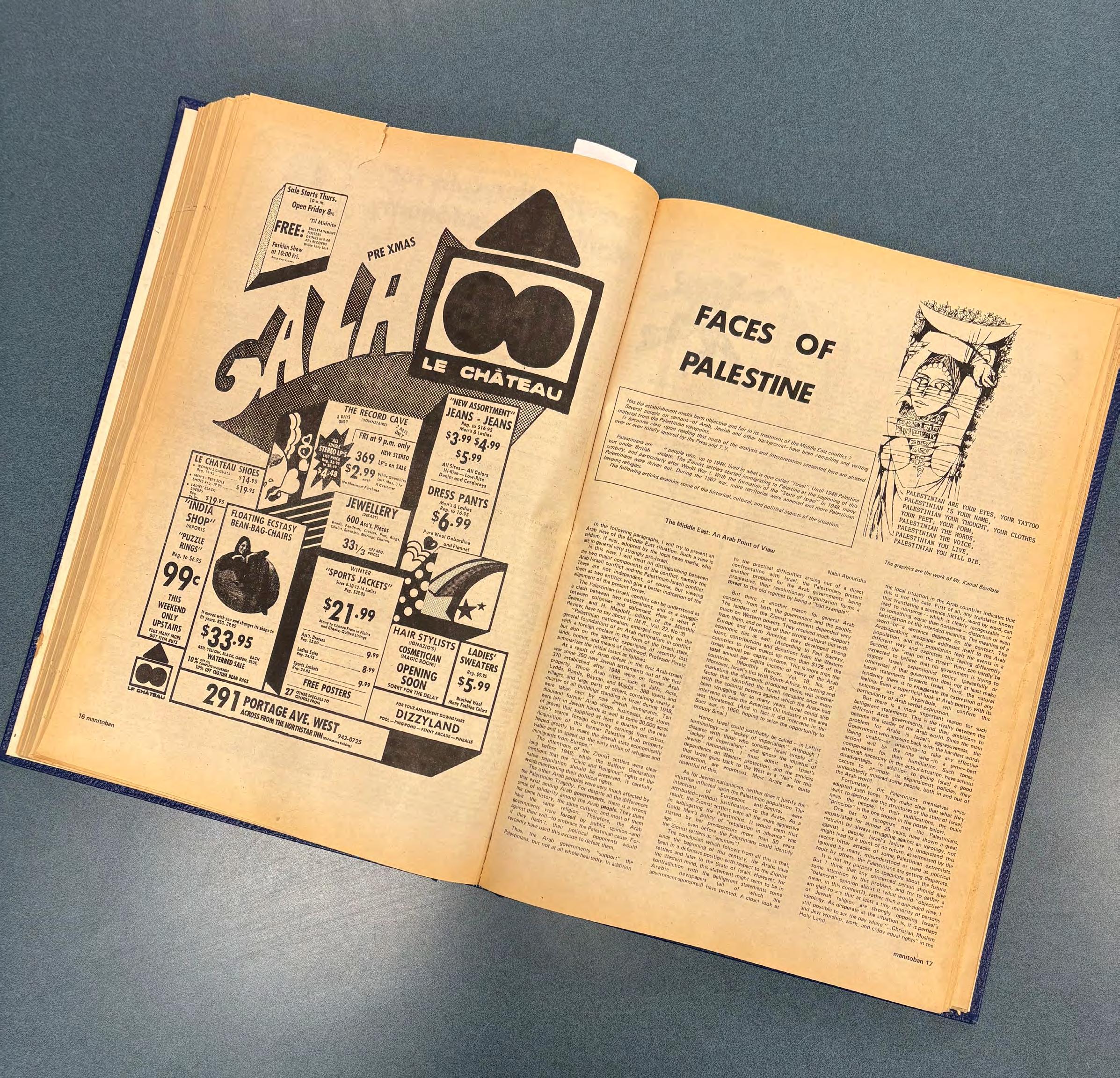
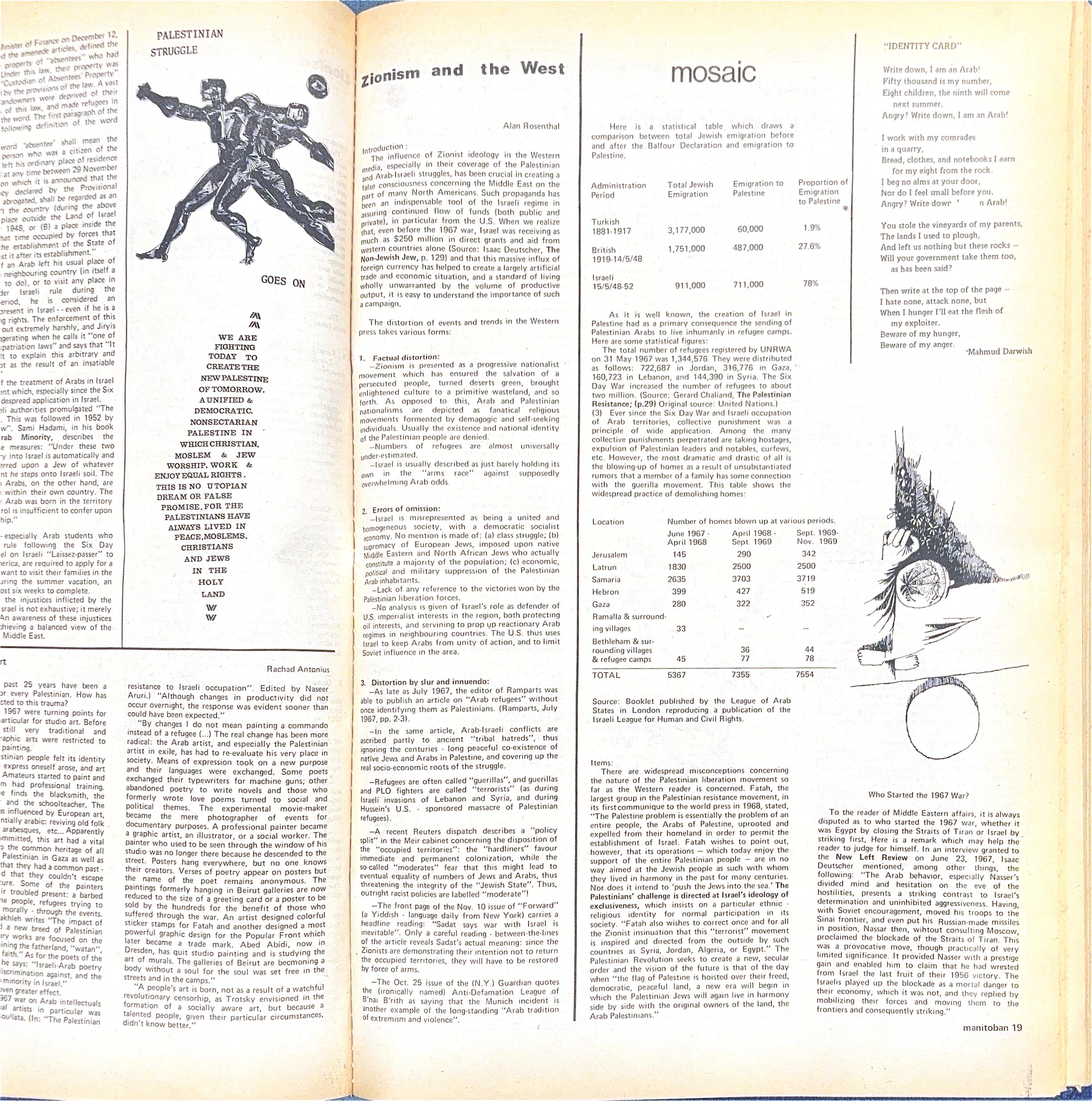
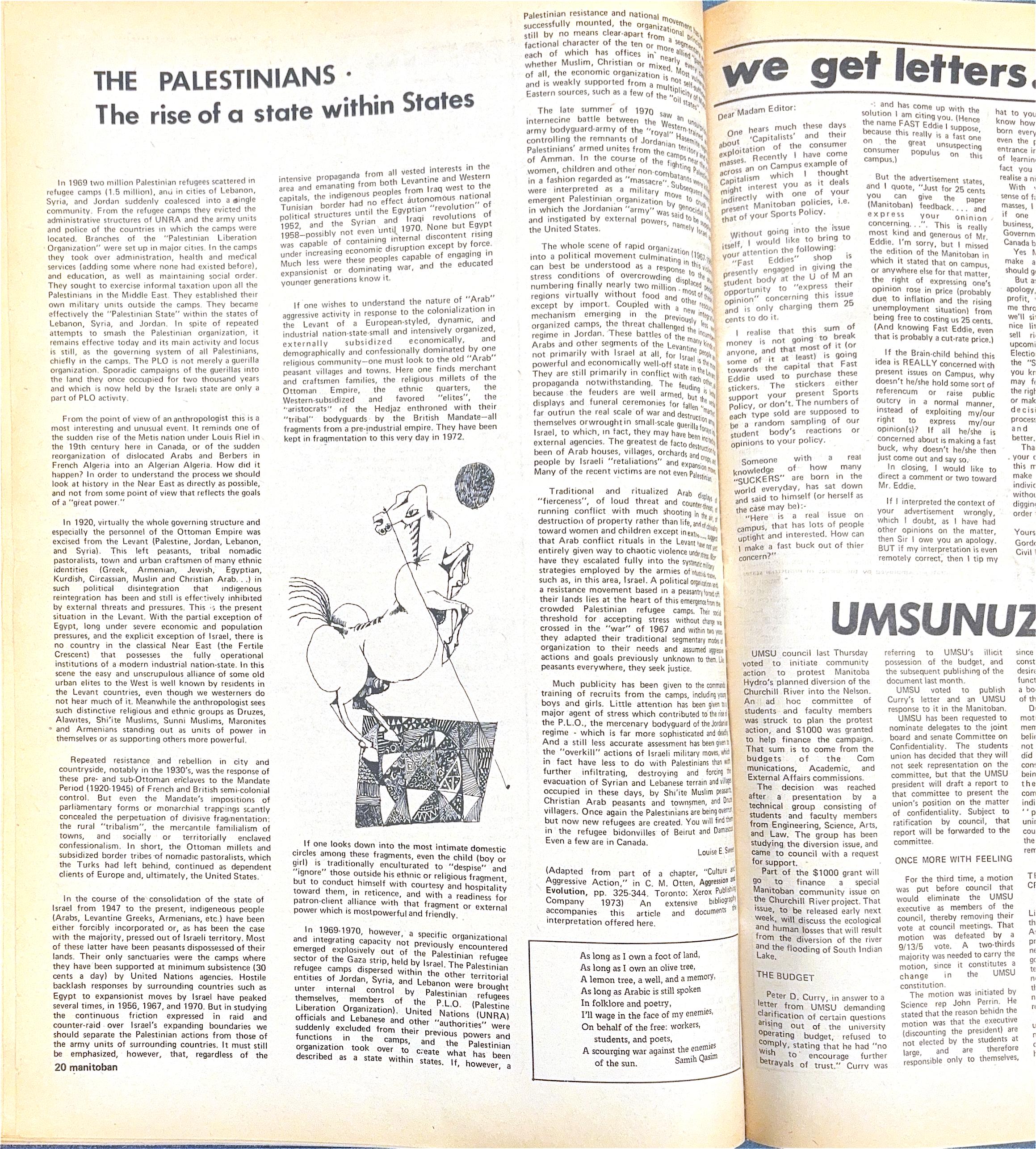
Faces of Palestine, 1972

U of M alum Rachad Antonius returns to discuss Palestinian activism

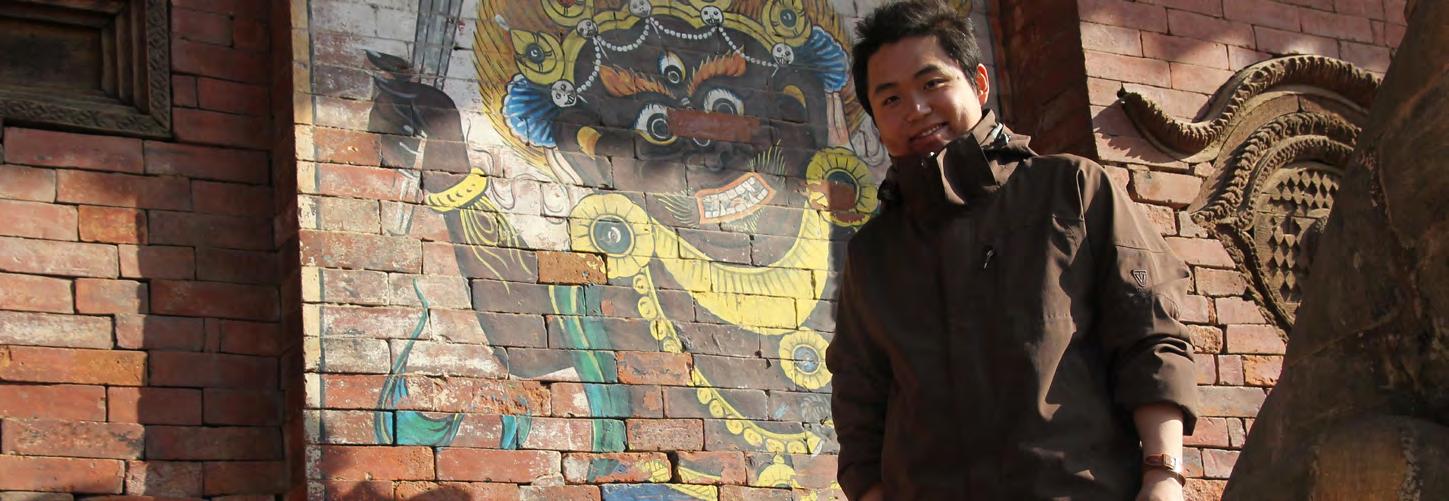
Tier Building will open its doors on Jan. 22 for an on-campus event titled Faces of Palestine, 1972: From a Document in the Manitoban to the Current Crisis. The event to be held at room 307

PHOTO BY DEVENEY JARROW / STAFF
ABOVE: PHOTO OF THE MANITOBAN 1972 ARCHIVE PHOTOS PROVIDED BY THE MANITOBAN ARCHIVE
ABOVE GRAPHICS BY MR. KAMAL BOULLATA, PER THE MANITOBAN 1972 ARCHIVE
PHOTOS

Syrian students mark first anniversary of liberation

SSA hosts campus event celebrating culture, community and Syria’s liberation

T

he U of M Syrian Student Association (SSA) hosted its largest event to date on Jan. 14, celebrating the first anniversary of Syria’s liberation by bringing together students, families and community members for an evening of remembrance, culture and community.

The event commemorated Syria’s liberation on Dec. 8 and featured speeches, videos, poetry, cultural performances and food. Student groups and community organizations from across campus attended in solidarity with the Syrian community.

Taqua Shapan, head of events for the East African Student Association , attended the event as a representative of the club.

“I’m here showing support to my fellow student club, and I’m excited to be here,” Shapan said.

When asked what she was looking forward to, Shapan said, “the dances — I love cultural dances.” She included she was also excited about the presence of “lots of good food.”

Islamic Relief Canada (IRC) sponsored the event and participated in fundraising efforts. Iqra Tariq, a representative from IRC, said the organization was proud to be involved.

“We’re a member of the Humanitarian Coalition, and we work on the ground in Syria with various programs — health, water, sanitation, education, amongst others — and we’re here to raise funds to support our programs in

Syria as well,” Tariq said.

She added, “We’re just happy the community is coming together, and we have an opportunity to be a part of that. Hopefully people will be generous today and give back to Syria.”

Ameen Al Naser, president of SSA, said the event marked both a milestone for Syria and for the club itself.

“We’re celebrating the first anniversary of Syria’s liberation […] We created our club just last year on Feb. 10, so today this is our biggest event,” Al Naser said. “We remember all the struggles [and] pains that the Syrian people have gone through from living under bombardment, to living in sieged cities and […] people fleeing their homes, crossing cities, crossing borders, crossing seas and oceans, just to get to safety and refuge.”

Aref Al Aswad, media manager for SSA, said the evening’s program included presentations from key speakers, videos and poems being read. Al Aswad also recited a poem during the event.

“I read this poem [by] Nizar Qabbani. It was mainly talking about Syria and what happened to Syria,” he explained

The evening was emceed by Raghat Aljundi, a member of the SSA event team, who explained the motivation behind the celebration.

“We initially did want to do something just to remark what happened a year ago and to honour and acknowledge everything that has happened in the past 14 years,” Aljundi

stated. “We wanted to bring this here, which is basically our new home.”

Zaina Abazid, a Syrian who was in attendance along with her family, described the event as well-organized.

“I’ve come to a lot of events, but the difference between a

lot of the events and this one [is] that you can see there’s a lot of love put into arranging and organizing the event,” Abazid said. “It’s really nice to see the community come together, because I feel like the Syrian community, we’re so many.”

Selma Jbara, a student attendee from Tunisia, conveyed that her highlight was the food and the poem read.

“If there was another event like this, I would 100 per cent come back,” Jbara said.

Research & Technology

Rethinking genocide through a non-human lens

Examining how violence against animals shapes collective loss

According to Marvin Xia, genocide cannot be fully understood by looking at human suffering alone. His research argues that violence against animals and the land is not a side effect of genocide, but a central part of how collective destruction unfolds.

Xia is an instructor in the U of M’s department of sociology and criminology and holds two doctoral degrees — one in anthropology from Peking University and the other in sociology from the U of M. His research examines how settler colonialism, systemic oppression and genocide shape both human societies and the environments they inhabit.

“My long-term research interests are primarily focused on the complex dynamics of conflicts between state and ethnic minorities,” Xia said. He placed particular emphasis on Indigenous peoples, whose experiences of colonial violence often extend beyond direct harm to humans and into the destruction of animals, land and social relations.

Xia’s second PhD dissertation is a comparative study of mass animal deaths

that occurred alongside genocides targeting human groups. He examined three cases — the slaughter of Tutsi cattle during the Rwandan genocide, the mass death of yaks during the collectivization of Tibetan nomads and the widespread killing of buffalo during the genocide against Indigenous peoples of North America.

as members of the community rather than objects owned by humans.

“A major takeaway from this research is that to truly understand the suffering of victimized groups, we need to explore their own beliefs and knowledge systems,” Xia said. Concepts such as destruction

impossible.

During fieldwork in Sichuan province, Xia witnessed the aftermath of Tibetan selfimmolation protests that began in 2009. Later, mass internment and re-education camps in Xinjiang targeting Uyghur Muslims further reinforced the urgency of studying ethnic minority oppression.

“To truly understand the suffering of victimized groups, we need to explore their own beliefs and knowledge systems”

“I try to find out why so many cattle were killed in the three events,” Xia explained, “and challenge the Western perspective that views animals as human property and natural resources.”

— Marvin Xia, recent PhD graduate and instructor in the U of M’s department of sociology and criminology

or collectivity, he argued, cannot be imposed from outside cultural frameworks without losing their meaning.

Rather than treating animals as passive losses, Xia’s research argues that cattle, yaks and buffalo held social, cultural and spiritual roles within their respective communities. Their destruction represented not only economic harm, but a collapse of collective life.

In many of the societies he studied, animals functioned

Xia’s academic path was shaped by political realities as much as intellectual interest. His first doctoral research in China focused on conflicts between ethnic minorities and pre-communist Chinese governments, particularly involving Tibetans in southwest China. Studying contemporary minority issues under the current political system proved nearly

“China’s ethnic minority issues are very important,” Xia said. “However, people cannot [study them] within China.”

Strict censorship and surveillance limited access to information, leading Xia to relocate to Canada to continue his research. At the U of M, he shifted his focus toward genocide studies, using comparative and interdisciplinary methods that were not possible in his previous academic environment.

Xia described his work as contributing to the decolonization of genocide studies. His findings suggest that Western definitions of genocide, which focus

primarily on human victims, overlook how collective destruction often includes animals and ecosystems that are integral to social life. In many non-Western societies, he argued, collectivity is not limited to humans alone.

“This suggests that ‘genos’ (collectivity) can have various implications and is not necessarily exclusive to humankind,” Xia said. Generally, this opens space for broader interpretations of violence, loss and survival.

Looking ahead, Xia plans to publish his dissertation with the aim of reshaping how scholars think about animal killing in genocidal contexts. Ultimately, Xia hopes his research encourages scholars and readers alike to reconsider fundamental questions such as, “What constitutes a group? And what constitutes destruction?”

For students entering the field, he advised stepping outside dominant academic frameworks and engaging with Indigenous and nonWestern knowledge systems. “Students should strive to reflect on the habitual frameworks of thought in their lives,” he included.

PHOTO

The politics of pregnancy

Exposing gaps in migrant access to perinatal and reproductive care in Canada

F or some, a nation’s borders demarcating jurisdictions serve as a symbol of national security. While it may be true that these heavily guarded boundaries provide a sense of safety for a nation’s citizens, they are a source of anxiety for many temporary status individuals living within its confines. One commonly-held source of anxiety is access to healthcare.

Lindsay Larios, an interdisciplinary critical policy researcher and assistant professor in the faculty of social work, studies how Canadian citizenship and immigration intersect with the politics and policies of reproduction. Focusing on how governments use administrative categories and jurisdictions to govern and restrict basic access to health resources, Larios’s work considers the broader impacts on race, gender and socio-economic status. She adopts a pragmatic approach to her practice, investigating the role community-based advocacy plays in expanding access and reimagining the power dynamics between governments and citizens.

With a focus on advancing reproductive justice for migrants, Larios’s most recent co-authored project draws on the lived experience of medically uninsured pregnant migrants. This work highlights barriers they have faced in accessing pregnancyrelated healthcare and the adverse effects this has caused for their families. Through interviews conducted with different uninsured migrants in Quebec, Larios identified a knowledge gap as they spoke on their experiences in childbearing, health and social service provision.

The final report shows that medically uninsured migrants consist of a multiplicity of heterogenous populations including refugees and asylum seekers, international students and migrant workers. Although it is encouraged for these groups to purchase private health insurance, this is a luxury many cannot afford. Financial costs alone create a significant barrier in accessing

prenatal and perinatal care, although the complexity of the system, precarious work and immigration conditions, fear of deportation and refusal of care further contribute to barring migrant access.

Upon examining the impacts of pregnancy on different temporary statuses, Larios found “these programs are not designed to accommodate pregnant people.” While uninsured migrants face physical consequences, the effects

of their condition are farreaching, affecting the trajectory of their lives within national borders. Canada’s policies, Larios explained,

as they support the labour market.”

“It’s a moment of intense vulnerability for a lot of people in a way that [is not] consistent with the way that we talk about Canada’s overall desire to support reproductive rights”

— Lindsay Larios, assistant professor in the U of M’s faulty of social work

disallow migrants from being “fully realized human beings — you come as a migrant worker, you are seen as a worker, and your human needs are supported insofar

The course of an uninsured migrant’s pregnancy is heavily influenced by external factors flowing from their status, causing a loss in decisionmaking power over one’s body and life more generally. “It’s a moment of intense vulnerability for a lot of people in a way that I don’t think is consistent with the way that we talk about Canada’s overall desire to support reproductive rights,” Larios shared.

Migrant workers, for example, find themselves at the whims of their employers — pregnancy runs the risk of job loss and may lead to employer-constrained access to preferred prenatal care services, including abortion services. “Where [this issue] has come up mostly in my research is not [through] direct [firing], but someone becomes pregnant and some time during [those nine months in] their pregnancy their work permit expires […] We see employers choosing not to renew work permits of pregnant people,” Larios explained. Although the employer may not specify their reasons for termination, “It looks like a de facto firing,” Larios added.

While recourse may be available to migrants for employment losses through administrative tribunals such as the Manitoba Labour Board or the Manitoba Human Rights Commission, power dynamics and accessibility issues often bar migrants from pursuing action. Additionally, few services in Manitoba are equipped to support migrant workers in the specific employment challenges they face.

Ultimately, Larios’s project corroborates existing findings in other Canadian studies that demonstrate the difficulties migrants face in navigating the healthcare system. These include fears of potential Canadian Border Services Agency involvement and anxiety about the quality of care they will receive, all of which further harm migrant health and act as barriers to accessing healthcare.

For Larios, these are all solvable problems. Based on the project’s findings, Larios recommended expanding access to public health insurance, increasing transparency in the availability of information and limiting pregnancyrelated health costs. Through the Manitoba Association of Newcomer Serving Organizations, the findings have been transformed into an accessible resource for uninsured individuals.

PHOTO PROVIDED BY LINDSAY LARIOS

INTERESTED IN UMSU LEADERSHIP?

STUDENT LEADER JOB FAIR

Speak with current executives and community representatives to learn more about each role!

1st floor – UMSU University Centre Wednesday, February 4 11AM to 1PM

Nominations open February 2, 2026

Are you really no better than a man?

The sapphic gaze is not the male gaze, and physical attraction is not objectification

Often, when I see a video posted by a beautiful woman, I notice comments from other women saying, “I’m no better than a man.” These commenters are implying that they find the woman attractive in a way that is on par with the objectification associated with the male gaze. I would like to challenge that idea.

Women experience objectification from men far too frequently. This form of disrespect is rooted in patriarchy and misogyny, denying the autonomy and humanity of women in favour of the ways they could serve a man. Men are taught by society that women are not worth more than how attractive, serviceable and self-effacing they are — women are simply trophies and caregivers for men.

Even a man who is not a raging misogynist will have subconscious misogynistic biases. It takes time and effort to unlearn the prejudices we are taught. Women are taught misogyny too, and it can be reflected in our words and

actions. But when a queer woman is turned on by the body of another woman, is she really “no better than a man?”

When I see these comments, I cannot help but feel these commenters have internalized and are feeding into the stereotype of the “predatory lesbian.”

The “predatory lesbian” stereotype has permeated media and our Western cultural beliefs for a long time — think Cynthia Rose in Pitch Perfect or Joseph Sheridan Le Fanu’s Carmilla This stereotype posits sapphic attraction as perverted and unwanted, a threat to the innocent heterosexual woman. But sapphic advances are not predator vs. prey (unless you’re into that), and sapphic desire is not a threat, it is human.

Humans are sexual creatures. Purity culture is not doing us any favours or making us more “civil,” it is simply asking us to suppress what is natural when it challenges the status quo.

It is not disrespectful to be attracted to a woman. It is not inherently objectifying to

like the way a woman looks. I think queer women today have internalized the idea that sapphic attraction is predatory and unfortunately equated our gaze with the hetero male gaze, which can be genuinely predatory. I think this false equivalence is damaging.

“Being a woman who is attracted to women should not feel shameful or dirty, it should be freeing”

However, while attraction itself is not disrespectful, expressions of it can be, and I do think people are getting too comfortable leaving comments on the internet. The “no better than a man” comments are borderline, for me. I see comments daily that are much more disrespectful, but I do think it is a strange thing to imply that you do not see a beautiful woman as a human and try to frame it as a compliment. I know these comments are meant

to be a joke, but I believe they come from a very real place of internalized homophobia.

Being a woman who is attracted to women should not feel shameful or dirty, it should be freeing. It has been for me.

In middle school, I was plagued by compulsory heterosexuality and crippling insecurity. I felt inadequate, but I thought my friends were wonderful, and in my oblivious mind my sapphic admiration became jealous aspiration.

This jealous phase of my adolescence ended when I realized I needed to learn how to be myself and love that girl. I realized I am attracted to women only after I started working on that.

I have been out as a lesbian since high school, and now, I never really get jealous of other women. Part of that was becoming confident in myself, but I do think that realizing I am attracted to women has also played a big role, even though I am not attracted to every woman I admire. Sometimes I wish I had realized I was queer

earlier so that my jealousy could have transformed into admiration sooner. Now, when I see a woman who is smart, talented, beautiful, confident, charming or funny, I don’t wish that I were her. Instead, I think to myself, “Diva!” Instead of feeling jealous of other women, I feel inspired.

To me, being a lesbian means more than just being attracted to women. I am passionate about all women — friends, family and strangers. I am loyal to my friends. I am kind to women I do not know. I am interested in intersectional feminism because I am passionate about Black women, Muslim women, trans women, immigrant women, old women, bisexual women, fat women and disabled women. In women, I do not see trophies or caregivers — I see role models, sisters, lovers, friends, people I am happy to know and happy to see bloom. I am so glad to be a woman, and so glad to be a lesbian. I love women, and I know that I love them in a way that a man never could.

Robert Pattinson, the people’s princess

He may be crazy, but he is free

Robert Pattinson, the “people’s princess,” is infamous for his unhinged internet presence. From lying in interviews to his intrinsic parasocial connection with his fans, Pattinson is truly an icon to watch both in movies and online. His “I don’t care” attitude continually appears in interviews, making people — myself included — feel drawn not only to watching his films, but also to his laughable and crazed behaviour.

Fans of Pattinson come to watch his movies, such as Twilight, The Batman and Die My Love, but ultimately stay for his manic behaviour that people cannot help but adore.

As a longtime Pattinson fan, I can honestly say that, unlike every other preteen girl, I jumped on the Twilight fandom bandwagon and chose Edward Cullen as my rideor-die. Pattinson was chosen not only as my adolescent celebrity crush, but also as the character I would make obsessive edits over in middle school.

Pattinson is known for his crazy antics and gremlinlike behaviour, going as far as lying about seeing a clown car explode as a child or claiming he never washes his hair.

Pattinson’s lies have spanned well over a decade. Pattinson once claimed, “There’s a little gremlin inside of me that thinks, ‘Just say something shocking. You’re only here for a few minutes, say something terrible.’ There’s a kind of perverse glee I get from that.”

This large online fan base of Pattinson comes from his online persona of, well, just being strange, while feeding into chaos that fans cannot help but admire, me included.

Pattinson’s notoriety continues as he feeds into deranged parasocial relationships with fans by lying about recounting a dinner he had with a stalker fan in Spain who had waited outside of his apartment for days. “I was so chronically bored that one day, she’d been out there for about three weeks, and I said, ‘Hey, do you just want to go to dinner or something? I mean, no one else wants to hang out with me,’” Pattinson explained.

He noted she took him to her parents’ restaurant, where he “complained about everything in life” before she passed him the bill.

Pattinson not only crafts a persona of chaos, but one of relatability. This keeps fans hooked on what unhinged

thing he might cook up next.

While on the topic of cooking things up, have you ever heard of piccolini cuscino, or “little pillow?” Well, I have. It is a piece of culinary mayhem that only the mind of Robert Pattinson could conjure up. For those who do not know what piccolini cuscino is, Pattinson described it as “pasta you can hold in your hand.”

Describing how to make this concoction, Pattinson told GQ, “Make a bowl out of aluminum foil, crushing breadcrumbs or cornflakes that will form the ‘sugar crust’ […] Layer up to nine packs of presliced cheese on top of the sugar crust, pour on the sauce and throw on the pasta. Sprinkle on more sugar. Top it with a hollowed-out burger bun. Wrap the whole thing in aluminum foil and put it in the oven for 10 minutes.”

My goal in life is to be as free as Robert Pattinson. There is something so intrinsically comforting about how little he cares about how others perceive him. His gremlinlike qualities concoct some of the funniest things I have ever seen on the internet. I think we should all live a little bit more like Pattinson. He may be crazy, but he is also free.

GRAPHIC BY TEEGAN GILLICH / STAFF

Blue Monday meets a rough Jets season

In Winnipeg winter, a Jets slump can make Blue Monday feel like a season

J

anuary always feels like a grind here in Winnipeg. The days are short, routines feel heavier and even when nothing goes wrong, everything still takes more effort than it should. That is why the third Monday in January has been given the label “Blue Monday,” branding it as the most depressing day of the year. The formula behind the day has been widely mocked, but the idea still lands.

For me, the feeling of Blue Monday overlaps with another Winnipeg pattern, the Jets as a civic mood tracker. I am not saying the Jets are the most important thing in anyone’s life, or that hockey should matter more than the real issues people are dealing with. I am saying that in a city where winter can easily wear people down, the team can provide a shared lift. When the Jets are rolling, people seem lighter. When they are not, the mood can shift.

This is far from a scientific claim, but it can change the tone of a day. It gives people something simple to talk about that is not work, rent or whatever is making headlines that week. Loss does the

opposite. It does not ruin anything, but it can make everything feel a bit flatter. It becomes one more small disappointment in a month that has already had enough of those.

I also say this as a Jets fan who does not fit the usual background story. I am from Nova Scotia and am the only Jets fan I know from there, which still makes me laugh. I moved to Manitoba for my degree, but I also joke that the real reason I came here was to be able to watch the Jets in person. It is a joke, but it is also not totally a joke. Being in Winnipeg makes the Jets feel less like a team you check in on and more like something built into the week.

That streak ended against the Ottawa Senators, which stung a little extra because Ottawa is not exactly a powerhouse, and they are also my brother’s favourite

I say the Jets can affect the feeling of a week. Not because the loss is tragic, it is not, but because it lands in the time of year when people are already tired. In January, small things tend to stack up, and lately the news never stops. Then you check the score, hoping for something that feels uncomplicated, and instead you get another night where nothing clicks.

People need things that are

not high stakes.

to the routine of watching the Jets during the hardest part of winter, and I have gotten used to the way the team becomes part of the atmosphere here. Knowing I will not be living in Winnipeg next season makes every home game feel more meaningful. It also makes it more frustrating that the season has had a long stretch of losses. If you are going to have your final Winnipeg winter, you want the fun version of the Jets, not the stressful one.

I have also been lucky as a fan because, until this year, I had never been to a Jets game where they have lost.

team. Watching that loss felt like getting hit from two directions at once — the Jets dropping a game at home and my brother feeling satisfaction while I was stuck feeling and living the loss in real time. That is what I mean when

They need something they can care about without it feeling heavy. Sports can do that, at least when they are fun. The point is not that hockey matters more than housing, health care or the state of the world. The point is that a lot of people feel burned out, and it helps to have something that feels simple. It does not need to be profound, but it is nice when it is shared.

I am also feeling this more because this is my last year in Manitoba. I have gotten used

To be clear, the Jets are not responsible for my nervous system, and Blue Monday is not a real holiday. A hockey team is not supposed to carry a city emotionally. Yet, it can still shape public morale in small, noticeable ways. In January, people take their small wins where they can get them. Sometimes that win is a Jets win. Sometimes it is just having something to look forward to on a Tuesday night. When even that stops being fun, you can feel it.

That does not mean hockey is everything. It means people need something that is light, because so much else is not.

A terrible woman is just an average man

The double standard for the reputations of men and women

In December, lists meant to catalogue the biggest celebrity villains were released, and some of the names were exactly who I expected to see. The likes of Sean “Diddy” Combs, Bill Cosby and Prince Andrew belong on such lists — as well as in jail cells. But I was surprised to see Meghan Markle on the list alongside people who have committed crimes, shown predatory behaviour and appropriated cultures for profit — people who have harmed society in legal, political or social spaces.

As far as I know, Markle’s primary offence was marrying a prince and refusing to bow down to the British monarchy after she did. Maybe she can be a bit annoying, but in comparison to the other names on the list, she has done nothing to earn the title of “most hated person.”

This list did more than confuse me — it highlighted something many women already know. There is a

stark double standard in how society treats and reacts to men and women.

People have found a way to blame Markle for her and Prince Harry’s exit from the royal family. She is the scapegoat for his estrangement from the royal family and his criticism of the institution. This narrative conveniently ignores the fact that Harry had been openly rebelling long before Markle was in his life. His partying, Halloween costume scandals and visible resentment for royal expectations were tabloid staples for years. Yet, somehow, Markle is portrayed as the mastermind behind his desire for autonomy — because, of course, a grown, wealthy royal man could never make his own decisions. Meanwhile, Markle is carrying the brunt of public resentment for “splitting the royal family” or being “inauthentic.”

Take Nick Cannon, for example. He has fathered 12 children as of 2025, yet instead of receiving real criticism for

being irresponsible, society has made a joke of him. Chris Brown was abusive to Rihanna and others, and although he was cancelled for a while, the social narrative has become that he has changed and deserves forgiveness. I am not saying people should not be

given second chances. What I am saying is that the grace and forgiveness awarded to men is non-existent for women. Furthermore, the line men need to cross to be hated is far higher than that of women. A woman could do what the average man does, like feel

entitled or be annoying, and society will not give her a break. Meanwhile, men need to behave in a way that is downright atrocious in order to receive the same treatment. Ultimately, an awful woman is usually just a regular guy.

GRAPHIC BY EMMA GILLICH / STAFF
GRAPHICBY EMMA GILLICH/STAFF

Your horoscope for this week

Zodiac signs, a mix of chaos for the week of January 19

AQUARIUS

January 20February 18

This week may be problematic for you, dear Aquarius. You may have stepped on a crack, or perhaps a black cat crossed your path, but ultimately, the week may not be looking too good. To combat this negative energy, perhaps take some time to reflect on the good things that have happened this week as opposed to the bad.

be going in a new direction. Whether that’s job-wise or school-wise, you may feel a disconnect with the universe and feel adrift. Combat this by shaking things up a little. Go out and do something you’ve never done before, live on the wild side.

PISCES

February 19March 20

Have you ever seen a clown car explode like Robert Pattinson said he did? If you haven’t already, you probably won’t be seeing it this week. This week, although it may be busy for you, will not be lacking in the number of good times you will be having with friends and family, as you reconnect with both past and present friends.

TAURUS

April 20May 20

This week, you may want to look into hiring an Etsy witch. It looks like you may be speaking up a lot this week, whether public speaking or standing up for something you believe in. This week may be a good week to tap into some supernatural guidance for interpersonal advice.

ARIES

March 21April 19

This week looks like a good time to pick up your Just Dance hobby if you had one as a child, because you may

GEMINI

May 21June 20

Hold your horses, my friend, because you may just be in for a turbulent time. Don’t try to undersell yourself this week. Make sure you receive credit where credit is due. Things in the middle of this week may come back to haunt you later, but do not dwell too much. This is just another blip in many weeks to come.

CANCER

June 21July 22

You may be speaking up a little more this week and telling people what’s on your mind rather than typically swallowing your feelings. If you feel the urge to prove yourself to someone in some capacity, take a step back and focus on what you need, rather than what other people want from you.

LEO

July 23August 22

You may find yourself in the maze this week. Sike, you may just find yourself in disputes with either friends or family during this week. Tensions may seem strained, but do not fret — these imbalances will correct themselves and return to a peaceful environment.

VIRGO

August 23September 22

Virgos, you have the right to party on down this upcoming week because you certainly have reason to celebrate. This week will be full of financial prosperity and good times with friends and family. Make

sure you capitalize on these good vibes by soaking up the sunshine as much as possible.

LIBRA

September 23October 22

This upcoming week is a good time to be creative. Whether that’s scrapbooking, photography or reading. This week will be crucial in helping you maintain positive energy in the following weeks. The desire or stress of career-based tasks will be minimized with more focus on academics.

SCORPIO

October 23November 21

A transformation is underway in your home life. Whether that’s moving houses or changing aspects of your room, there is a big transformation coming in your personal space. You may also feel challenged in communicating your feelings to others. Do not take this too seriously — let whatever happens happen.

a follower but a leader. This week may bring unexpected challenges for you, as you may feel external pressure to conform in interpersonal situations in your life. Make sure you take the time to think things through rationally before reacting.

CAPRICORN December 22 - January 19

You will get an unexpected burst of energy this week. If you are feeling lackadaisical this winter academic season, please take this as a sign from the universe to skip your classes for the day. You need to recharge as you are feeling burnt out from the academic season. Make sure you take the time to recover.

SAGITTARIUS

November 22December 21

For this week, make sure you set a trend of not being

Lessons from Desmond and Kristy Scott

Why we should stop idolizing online relationships

Thandeka Katsika, staff

My side of the internet was rocked on Jan. 10 by the news that Desmond and Kristy Scott are getting a divorce. The couple met when they were both 14 years old and have been married for over a decade. They started posting videos in 2020, with their social media presence centring around their dynamic and funny relationship skits. In a world where connections seem fleeting and relationships often don’t last, they gave viewers hope that real love does exist. Fans were drawn to them for their playful and prankful dynamic together as well as their individual niche content. Kristy focused on lifestyle while Desmond made cooking videos. They were, at least online, the perfect couple.

The reaction to their breakup was intense, seeing hundreds of people flocking to the internet stating that they don’t believe in love anymore because of the

Desmond and Kristy split.

As someone who spends a considerable amount of time off the internet, I thought these comments sounded a bit dramatic. We have no interpersonal connections to these influencers at all, and yet somehow a breakdown in their relationship will impact our lives. But I think this response reveals how strongly audiences engage with online couples. The Scott’s marriage was placed on a pedestal. To fans, they weren’t just two people in love — they were a symbol for love itself. And when this ideal collapsed, so did fans’ faith in love.

This level of emotional investment in online couples can be damaging to people’s everyday life when they assign too much meaning to what they see online. Influencer couples exist in a strange place between reality and performance because couples’ content is not just people sharing their life, it is a job. The Scotts get

paid for their content. Even though it is designed to look authentic, their videos are planned and set out, filmed and edited before they are posted and consumed by the general public. This is why it is so harmful to idealize these couples. We are only seeing parts of their relationship, specifically the parts they want us to see. And so it is unreasonable to compare our 24 hour lives to the 60-second clips of them we see online. Many people often compare themselves to what they see on the internet and their partners to the ones they see online. For example, more than once I have seen people comment under videos of Desmond cooking for Kristy, saying something along the lines of, “My man would never,” or, “I wish my man would.” These kinds of comparisons to curated influencer couples’ videos can often leave people feeling dissatisfied with what they have, making people build

up unrealistic expectations in their relationships. Afterall, conflict, boredom and cheating rarely make the cut in influencers’ videos, and instead the perfect moments are the only ones we see. Ultimately, influencer couples are not models for real life — they are curated narratives designed for public entertainment. It is important that we view and treat them

as just that. Not proof that love exists, or a blueprint of how our own partners should act, but simply as people who make content for us to consume. Maybe your love will be enduring, and maybe, like Desmond and Kristy, it will end in divorce — either way, our expectations for our own lives should not be heavily influenced by what we see online.

GRAPHICS BY EMMA GILLICH / STAFF
GRAPHIC BY TEEGAN GILLICH / STAFF

To complete Sudoku, fill the board by entering numbers 1 to 9 such that each row, column, and 3x3 box contains every number uniquely. In Straights, like Sudoku, no single number 1 to 9 can repeat in any row or column. But rows and columns are divided by black squares into compartments. Each compartment must form a “straight.” A straight is a set of numbers with no gaps but it can be in any order, eg [7,6,9,8]. Clues in black cells remove that number as an option in that row and column, and are not part of any straight. Glance at the solution to see how “straights” are formed.

Herbivore Haven Market sees local success

Vegan market showcases local businesses with plant-based offerings

Dong, staff

Herbivore Haven Market was started by friends Brittany Martens and Caitlin Sikora, who met through Winnipeg’s local market scene.

“We’ve been doing markets together for years, and we always knew that each other was vegan,” Martens recalled. “We [had been] longtime supporters of each other’s businesses, and that’s how this all started.”

Both Sikora and Martens operate their own small businesses — Sikora owns and operates Real Swanky, creating subversive handmade embroidery using vegan and locally sourced materials, while Martens is the owner of Plant Kitchen and Bakery, producing “vegan comfort classics” such as cakes, cupcakes and cinnamon buns.

The two were on the phone one night in late 2024 when both expressed a desire to start a vegan market. That night, Sikora made their first poster. They found a venue in Windsor Park United Church, where Martens bakes, and

their first market took place in March 2025.

Martens and Sikora found that their respective skill sets balanced well with each other. As a baker, Martens knew her way around public health inspections, meeting standards requirements and completing the necessary forms, while Sikora stated she was more on the “maker” side of markets.

“[Having different skill sets is] incredibly helpful because it feels like we’re the yin to each other’s yang,” Sikora commented.

In creating the market, Sikora and Martens hoped to “bring the community together” and teach the community about the vegan lifestyle, regardless of people’s views. For the vegan community, the market is an opportunity to shop without having to read product labels.

“It’s a really great opportunity for people to be able to go into a large, comfortable space [and] feel very welcomed, no matter what they eat or how they view things,” Sikora explained.

The duo was not originally expecting a large turnout at their first market, estimating 300 to 400 people in attendance. The turnout far exceeded that with an estimated 1,200 people. The line circled the back of their venue, and many of their vendors sold out within the first few hours.

“That first market really blew us away,” Martens recalled. “We were expecting a good turnout, but that was [an] excellent, amazing, incredible turnout […] Hearing that great feedback is a really proud accomplishment for sure.”

“I think it’s really cool that we will get people coming up to us that we’ve never met before asking about the market,” Sikora added. “I think that’s really cool that we had such a big splash so early into the conception of Herbivore Haven.”

As of January 2026, there have been three editions of Herbivore Haven Market with over 2,900 attendees in total. In selecting venues, Sikora and Martens choose locations that are accessible and bus

and cyclist friendly. They also highlight vendors on their Instagram page and in a zine produced for each edition of the Market. Back issues can be found on Sikora’s Real Swanky website.

For the future, Sikora and Martens hope to continue hosting Herbivore Haven events every few months.

“I think for the future, [we are] just continuing with that growth, and [will] keep

riding this wave of doing the market a couple times a year and keeping the vegan scene alive,” said Martens.

The next Herbivore Haven Market will be held on March 22 at Southdale Community Centre. To apply to be a vendor or learn more, visit Herbivore Haven Market on Instagram @herbivorehavenmarket. For the Herbivore Haven Zine, visit realswanky.ca.

Downtown Winnipeg welcomes Lights on the Exchange

Annual winter public art festival returns to Winnipeg

Boris Tsun Hang Leung, staff

Lights on the Exchange has returned to Winnipeg as of Jan. 21 for its fourth installment, kicking off a twomonth light-based art festival in the Exchange District. Until March 21, the Exchange will be illuminated with art by over 30 contemporary local and Canadian artists.

Scott Fitzpatrick, the arts and culture coordinator of the Exchange District BIZ and de facto director of the festival, explained the concept of Lights on the Exchange.

“The primary backbone of its programming has been based on a combination of large-scale digital projections, window display art installations and then a series of artist-designed lanterns that were commissioned through the Winnipeg Arts Council back in the first year of the festival,” he stated.

With a desire to expand programming, the 2026 edition of Lights on the Exchange is curated in partnership with other local arts organizations such as the PLATFORM Centre for Photographic + Digital

Arts, which contributed a photography exhibit on 35 Albert St.

“We have another new initiative with the Winnipeg Film Group called Lights on the Catalogue, and it is looking at films in the Winnipeg Film Group distribution catalogue that are lesser seen or lesser known […] We’ve blown up stills from some of those films and had them installed in light boxes in the Winnipeg Film Group office window just along King Street,” said Fitzpatrick.

“[This is] accompanied by a special screening of the works that are being shown in these light boxes, as well as 10 other films from the distribution catalogue […] It’s a public art installation, but it’s also bringing in some IRL meet space event energy to it. We’ll have this special screening at the Dave Barber Cinematheque.”

Fitzpatrick mentioned that Lights on the Exchange was created to drive foot traffic and tourism in the Exchange during the winter months, which is quieter than the summer months due to the

lack of festivals. Moreover, he hopes the festival will change the perception of the area.

“We were looking to fill an empty spot in the dark part of the calendar, but it was also conceived as a way to open up space for artists from Manitoba, and Canada more broadly, to explore and discuss alternative perspectives and stories to the traditional narratives that are told about the history of the neighbourhood,” he commented.

While most of the works

are light based, Winnipeggers will also be able to experience other art forms, such as live readings by poets selected by Plume Winnipeg. In addition, a concert featuring lightbased art is set to take place on March 6 at 555 Main Street, adding a musical touch to Winnipeg’s dazzling winter art festival.

“I think the strength of the festival is that it does engage a lot of different artists and a lot of different arts organizations,” Fitzpatrick reflected.

“I also direct the Winnipeg Underground Film Festival, and that’s got a more singular focus. We’re doing our thing, and we’ve got some partners. But this has been an experience working with a lot more organizations at once, and getting a lot of input and curatorial feedback from all kinds of different partners.”

For more information on Lights on the Exchange, visit exchangedistrict.org/ lightsontheexchange.

PHOTO PROVIDED BY CAITLIN SIKORA
PHOTO PROVIDED BY SCOTT FITZPATRICK

Law & Order Toronto a fine Canadian adaptation

Show highlights Canadian stories ‘ripped from the headlines’

The long-running Law & Order franchise has been a staple of television since the original American series premiered in 1990. Now, Canadians have their own adaptation of the show in Citytv’s Law & Order Toronto: Criminal Intent After attracting more than 1.1 million viewers in its premiere, it became the number one primetime drama of the year in Canada and was quickly renewed for second and third seasons.

Adapted from the American original, the series is created by Canadian showrunner Tassie Cameron, Montrealborn René Balcer and American Dick Wolf. The show also features a primarily Canadian cast, led by Aden Young, Kathleen Munroe and K.C. Collins.

Law & Order Toronto: Criminal Intent follows detectives from the specialized criminal investigations unit of the Toronto Police Service as they investigate crimes throughout the city. The unit is led by detective sergeants Henry Graff (Young) and Frankie Bateman (Munroe), deputy crown attorney Theo Forrester (Collins) and inspector Vivienne Holness

(Karen Robinson).

As with all series in the Law & Order franchise, many of the stories are “ripped from the headlines,” meaning they are inspired by highprofile real-life cases. While many episodes open with a disclaimer that the stories presented are fictional and do not depict real individuals, those who keep up with the news may recognize stories when they see them on screen.

One notable example is the episode “Crack Reporter,” which references the infamous viral video of the late former Toronto mayor Rob Ford ranting while under the influence of drugs and alcohol. Described by Ben Okazawa of Exclaim as a “thinly veiled dramatization” of the incident, the episode escalated the incident from scandal to murder. Taking place during the re-election campaign of the Ford counterpart (Ian Tracey), the reporter (Georgia Leva) assigned to break the story of the Ford-equivalent video is killed in a sneak attack — which I interpreted to be representative of the potential dangers that journalists face when covering high-profile cases, particularly when politics are involved.

Another example of Law & Order Toronto’s “ripped from the headlines” style comes in the episode “Face Value.” The episode follows a well-liked couple, Rod and Gloria Abalos (Von Flores and Catherine Thomas), who are found murdered at their business in what was initially believed to be the aftermath of a robbery. However, investigators soon discover that the killings may not have been by chance after learning of the pressure they placed on their son, Jerome (Joshua Dela Cruz) to succeed academically. Suspicion of Jerome grows when they discover that his diplomas and degrees are fake.

The plot closely resembles another famous Toronto crime — the case of Jennifer Pan. Like the fictional Jerome, Pan had a difficult relationship with her parents and was pressured to succeed academically. Feeling that they were controlling and strict, Pan lied about diplomas, employment and transcripts — just as Jerome does in “Face Value.” Pan was eventually charged for hiring hitmen to murder her parents after they discovered her lies. Her mother was killed in the attack, but her father survived.

A review of 100 Nights of Hero

My viewing experience of this show was enhanced by knowing the real stories they were inspired by, recognizing the similarities and seeing a depictions of how the investigations play out. As with all shows, certain aspects are often enhanced for drama, but I found the stories to be compelling in their realism, displaying sensible steps that investigators take to solve a crime.

Another aspect of shows like the Law & Order franchise that I enjoy is when I recognize an actor in the show from another role. Often, these appearances are surprising, but nothing surprised me more in “Face Value,” than seeing Josh Dela Cruz, who is best known as the most recent host of the

An atmospheric but shallow adaptation of its source material

Director Julia Jackman’s 2025 film 100 Nights of Hero was released in Canada last month. It follows the newlywed Cherry and her close housemaid, Hero, as the young attractive Manfred attempts to seduce Cherry as part of a wager with her absent husband, Jerome. In secret, Jerome has yet to consummate their marriage, despite pressures to bear children from their birdthemed church. Throughout the film, Hero recounts the story of a woman who was oppressed by men because of her literacy.

The film employs a distinct visual style, with particularly avant-garde costumes to depict a fantasy setting. Combined with the unconventional plot and monotone performances from the cast, the audience is left with a distinct eerie feeling. However, the prioritization of uncanniness results in a disjointed plot which abandons the stronger social

politics of Isabel Greenberg’s 2016 graphic novel of the same name.

Greenberg’s original story follows Cherry and Hero as a closeted lesbian couple, where Hero recounts a series of interconnected feminist folk tales to distract Manfred, who threatens to sexually assault Cherry as part of a wager with Jerome. The wager came about when Jerome proudly boasted Cherry’s perceived chastity and devotion to their bird-themed church, a tie-in to Greenberg’s previous work.

The folk art style is reminiscent of woodcut illustrations, and the events are narrated with a quirky mid-2010s wit and repeated emphasis on love’s importance to the human experience — but the frontmost lesson of the story is unquestionably that women will always be objectified in a patriarchal society, no matter what a woman accomplishes.

In the film, Cherry is shown to have some interest in the heartthrob Manfred that she

must resist, while he uses manipulative persuasion to justify his proposition of infidelity — thus Jackman’s addition of external pressures to consummate the marriage. Whereas in the graphic novel, Cherry is clearly disgusted and in fear of the menacing Manfred. It becomes an entirely different story when the outcome is dependent on Cherry’s choice, rather than her and Hero’s ability to protect themselves from danger. In sanitizing the fundamental conflict of the plot, the precise message of the film becomes less clearly communicated beyond a vague criticism of patriarchy. Nonetheless, the film is an impressive production in terms of technical skill. The costumes and sets made the fictional world feel whimsical. The scenes depicting Hero’s story also conveyed an ethereal mood through its cinematography, but this adaptation could have been so much more.

children’s show Blue’s Clues & You. Seeing him in such a different role from his jovial, friend-to-all-children persona in Blue’s Clues was a surprise, and playing such a dramatic role showed his versatility.

Law & Order Toronto: Criminal Intent takes a triedand-true concept from south of the border, and successfully adapts it to the Canadian market with stories familiar to local audiences and a strong showcase of local talent. It will be interesting to see the stories that the show will cover in the future.

Law & Order Toronto: Criminal Intent is available to stream on major platforms such as Citytv, Apple TV and Prime Video.

PHOTO

What if Arctic research had a soundtrack?

The eXperimental Improv Ensemble performs Arctic Resonance on campus

U of M’s eXperimental Improv Ensemble (XIE) is performing Arctic Resonance in Desautels Concert Hall on Jan. 23, blending Arctic research and music in a crossfaculty performance.

In this concert, XIE will play a live soundtrack to footage of scientific research in the Arctic, including clips from fieldwork and drone videos of Arctic whales. The videos are sourced from researchers at the U of M Centre for Earth Observation Science as well as Fisheries and Oceans Canada.

Aditya Gandhi, one of the co-curators of the performance, explained, “The reason we are collecting [those] drone videos is to […] get a better understanding of population, of different whale species in the Arctic.”

“People are actually going out there at different times of the year to take different kind[s] of videos or samples to understand that population better in real time, rather than just [a] one-time flying over and taking photos.”

Gandhi is a U of M alumnus

with a bachelor’s degree in environmental studies and biology, but he has always been interested in arts and music. He wanted to bridge gaps between the arts and sciences, prompting him to approach XIE after attending one of their concerts.

XIE, directed by composition professor Gordon Fitzell, is an interdisciplinary performance group that performs anything from live soundtracks to multimedia art installations. The group frequently collaborates with other departments, such as architecture and religion. In recent years, it has expanded to supporting social and environmental causes, such as Earth Day.

Apart from curated scenic footage from the field, Arctic Resonance also features animations of research data, which are reflected in the music.

“One [clip] shows the changing patterns of sea ice, and in general, a message of greenhouse emissions and rapid rate of climate change, et cetera, so we try to express

them in some perceivable ways,” described Fitzell.

“For example, when the scientific data presents itself in a cyclical pattern, we might choose repeating patterns that come around, ideally visually in sync with what’s being presented on the screen. Then we have more subtle elements, [such as] low drones that will maybe express the gravity of a situation.”

The goal of Arctic Resonance is to make Arctic science accessible and fun for all, which is important because papers are published at an “overwhelming rate,” and laypeople can get lost in the academic research.

“Having the video component and the music component can synchronize [information] in a way that that can be understood to most people out there. They don’t necessarily have to be a musician. They don’t have to be a scientist,” commented Gandhi. “The reason why I love this idea and the collaboration in general is because this also allows science to be felt or seen.”

Fitzell added, “While obviously music can’t express minute sophisticated details of scientific [and] Arctic research, I think it’s our hope that we can express and share and bring across in some way the importance of the

research. Ultimately, it affects all of us.”

Arctic Resonance will take place in Desautels Concert Hall on Jan. 23 at 12:30 p.m., followed by a Q & A session. Admission is free.

Winterruption to take over Winnipeg venues

Various music and arts events planned for late January

Jordan Anglin, staff

Local indie music promoter Real Love Winnipeg’s multi-day and multi-venue festival, Winterruption, is set to return for another year from Jan. 20 to 25. Altogether, the sixth annual iteration will feature over 50 artists. They are mostly prominent local acts, but some are coming to Winnipeg from other provinces, the U.S. and Germany.

Real Love co-founder Gilad Carroll commented, “We would love for people to go out and experience the band that they’ve maybe never heard of before, and for the opportunity to have their worldview shifted.” “People will see an act that we’re bringing in, and get excited about [discovering] new artists and things like that. So that feels good,” Carroll added. The festival is designed to give Winnipeggers the opportunity to break the low mood and isolation typical of midwinter and spend the week socializing and exploring music instead. Other Winterruption festivals also occur annually across the other cold prairie cities of

Saskatoon and Edmonton.

Prominent acts Fear, Hiss Golden Messenger, Open Mike Eagle and Thumpasaurus will all be performing at Winterruption shows. The bands Discovery Zone and Sour Widows are both returning after previously being featured at Real Love Summer Fest, and Sean Nicholas Savage will be performing in Winnipeg for the first time in roughly a decade.

“I remember [Savage’s previous] performance was so amazing and interesting,” Carroll recalled. “I’m really excited to have him back to see what he’s doing nowadays […] He’s a really unique, talented artist. Very artsy performance style and […] unique vocal technique.”

Among the most notable local acts to be featured are Christine Fellows, Strawberry Punch, Synthetic Friend, Virgo Rising and Jupiter Meltdown.

“[Strawberry Punch and Synthetic Friend] are really fun, newer, younger bands in the scene that we really love,” Carroll elaborated. “There’s no shortage of amazing local bands playing.”

Jupiter Meltdown will play alongside Sophie Stevens and Synthetic Friend at the Handsome Daughter on Jan. 24. They released their debut EP, Haunt, last June. Many of their songs are inspired by singer Tuva Bergstrom’s personal struggles with their sexuality, relationships, family and autism. The band has a focus on making their songs danceable and keeping energy up throughout their shows.

“But it’s hard to verbalize what [“energy”] means,” Bergstrom said. “Because sometimes the songs are really sad and sappy and depressing. And then sometimes it’s super upbeat and silly, but you’re trapped in this bubble of vibe.”

Bergstrom noted that they are especially glad to have the opportunity to play alongside Sophie Stevens for the first time, despite attending the same high school in different years. “It’s super important that Winnipeg, being a winter city, has winter festivals.” Bergstrom argued. “Because what else do we do when it’s -30 [degrees] all the time?”

“It’s a good feeling to […] keep the community of it going, even though [Real Love

Summer Fest is] not around,” Guitarist James Baines also complimented. Some non-musical events are to be part of the festival as well, such as amateur wrestling and a screening of The Room. Though, Carroll

suggested the possibility of a surprise musical performance at the wrestling event.

For more information on Winterruption, visit winterruptionwpg.ca.

PHOTO BY MIKAELA WARKENTIN / STAFF
GRAPHIC BY EMMA GILLICH / STAFF

Bisons dominate Saskatchewan in back-to-back wins

Despite tough weekend, Bisons men’s volleyball edges Huskies

The Bisons men’s volleyball team won against the Saskatchewan Huskies 3-0, 3-2 in the weekend series.

On Friday, Jan. 16, the Bisons won 25-19, 25-20 and 25-13. The first set was a tight one, with the Huskies resisting strongly. The Bisons showed prowess, edging the Huskies 25-19, without the Huskies dominating at any point.

Unlike the first, the Huskies dominated some parts of the second set. However, the Bisons stood strong and won the set 25-20.

In the final set, the Bisons won the first point and both teams went neck and neck.

The Bisons kept creating a margin, scoring three consecutive points at four different times to win the set 25-13.

In the rematch on Saturday, Jan. 17, the Bisons continued their dominance. They won the first set 25-19, lost the second set 15-25, lost the third set 25-27, and won the fourth and fifth sets 25-21 and 15-10, respectively.

In the first set, although Owen Weekes served first, the Huskies won the first point,

but it was short-lived due to Aaron Elser’s service error.

The Bisons won the set with seven double points and four consecutive points.

In the second set, the Huskies came on stronger.

After the Bisons’ first point, the Huskies scored six consecutive points to take a 6-1 lead. Despite the Bisons calling a timeout, the Huskies continued firing, scoring two

more before the Bisons scored their second. The gap was too much for the Bisons to amend, thus the Huskies won 15-25.

The Huskies extended their dominance in the third set and won the first four points.

The Bisons bounced back and tied 13-13, after which both teams went neck and neck.

The Huskies eventually won 25-27.

In the fourth set, the Bisons

won the first two points and kept dominating until they won 25-21. In the tiebreaker, the Huskies struck first, but it was short-lived due to another service error by Elser. The Huskies eventually had a 5-9 lead before the Bisons got back to the party, scoring six consecutive points to take an 11-9 lead amidst the Huskies’ two timeouts. The Bisons did

not slow down and ended the night on an excellent note, scoring four consecutive points after the Huskies pulled one back to win the set 15-10.

The Bisons men’s volleyball team will play the MacEwan Griffins on Friday, Jan. 23 at 7:30 p.m. CT and Saturday, Jan. 24 at 5:30 p.m. CT in Edmonton, Alberta.

Bisons women’s hockey falls 5-4 despite lead

The herd builds an early lead, but Trinity Western Spartans rally to steal the win late

Faiyaz Chowdhury, staff

The Bisons women’s hockey team played against the Trinity Western Spartans at the Wayne Fleming Arena on Friday, Jan. 16 at 7 p.m. The game ended 5-4, a loss for the herd in overtime.

The game started off well for the Bisons as they were able to take the lead within three minutes with a goal by Sophia Anderson in the power play. Before the Spartans could find their footing, Dana Goertzen scored another goal for the herd. By the end of the first period the herd were up 0-2. The second set dawned with aggression from the Spartans, leading to a power play allowing Louise Fergusson to score a goal for the herd, bringing them to 0-3. But the Spartans soon found wind in their sails. Chayce Kullman and Presleigh Giesbrecht both scored goals for the Spartans. The second period ended with 2-3. In the third period, Kailey

Ledoux scored a goal for the Spartans, tying the score to 3-3. A few minutes later, Kasey Ditner scored an impressive goal to give the Spartans a 4-3 lead, putting the herd on the backfoot. But the herd did not give up, and with less than a minute left in the period,

Aimee Patrick scored a goal for the herd. With scores tied 4-4, the game went into overtime.

In overtime, despite attempts by the herd, Kyra McDonald scored the goal to seize the win for the Spartans.

The final score of the game was 5-4.

This season, the Bisons have a new head coach, Jordan Colliton. Colliton was the associate head coach for the Mount Royal Cougars women’s hockey team for the 2021-2022 season.

After building an early lead, Colliton acknowledged the Bisons lost their edge. “We stopped doing things that allowed us to go up three nothing, and gave them some life [and] hope

through the rest of the game.”

She credited the opening power play with setting an early tone, and added that the first unit helped create momentum.Colliton added, “I think too many special teams ruins the rhythm of the game, so that was kind of unfortunate on both sides.”

She complimented her team’s power play yet emphasized on execution.When looking ahead to the next matchup that occurred the next day, the coach described the opponent.“They’re fast, they’re gritty. They’re similar to us, they have skill. I think they brought a will to win today.” She also reflected on her own group’s progress, noting, “We haven’t had a lead and had that pushback, and so it was a good lesson for our team today”

Explaining the late timeout before third period ended, the coach said, “We had an offensive zone face off and so we want to get our better players a little bit of rest before

we had that final push.”

Addressing the decision to manage the game late rather than push aggressively, Colliton said, “The more time that we can spend in the offensive zone, the less time we’re spending in the [defensive] zone and the less opportunity for them to score.”

On the Spartans, Colliton said, “I think they are a great team, and they had a great push. We just didn’t respond to it quick enough.”

On Saturday, Jan. 17 the Bisons played the Spartans again. The herd won the game 4-1. Patrick and Goertzen scored again in this match, alongside Sophia Heidinger and Norah Collins.

The herd will face the MacEwan Griffins on Friday, Jan. 23 at 7 p.m. CT and Saturday, Jan. 24 at 2 p.m. CT at the Wayne Fleming Arena. In the last faceoff, the Griffins defeated the herd 2-0, on Jan. 25, 2025.

PHOTOS BY ZULKIFL RAFAH / STAFF
PHOTO BY ZULKIFL RAFAH / STAFF

Consistent Bisons win again

Bisons women’s volleyball team extends winning streak to four this year

Adeogo Abejoye, staff

T

he Bisons women’s volleyball team had another sweep against the Saskatchewan Huskies this weekend. The Bisons won 3-0, 3-1 to complete a back-to-back win in the weekend series.

On Friday, Jan. 16, the Bisons won 25-23, 25-21, and 25-23.

In the first set, the Bisons won the first two points from attack errors, and the Huskies quickly tied the score. Both teams then went neck and neck until the Bisons scored four consecutive points from 5-6 to 9-6 to take a threepoint lead. Despite the Bisons’ effort to maintain the lead, the Huskies tied the score at 14-14. The Bisons took the lead again, scoring two points each time the Huskies scored one. However, when the score was 20-16 in the Bisons’ favour, the Huskies mounted a comeback, scoring 6 consecutive points to lead 20-22. The Bisons then scored three consecutive points, all kills by Raya Surinx.

“It is definitely a bit stressful at times when they’re creeping back in, and

especially since we had a bit of a lead the whole time,” Surinx, the Bisons’ skipper said regarding the Huskies comeback in the first set. “But I think, just thinking about playing Bisons volleyball and continuing to play our game, we were confident and knew that we could finish it off.”The second set began with both teams trading points from the start, after the Huskies won the first point. Despite the Huskies’ effort to create a margin, the Bisons bounced back to take a five-point lead, scoring six consecutive points from 11-12 to 17-12. The lead became too much for the Huskies to overcome, and the Bisons eventually won 25-21.

In the third set, the Bisons won the first point with a kill by Ella Gray. The Huskies swiftly responded, and at 2-2 the Bisons scored six consecutive points to take an 8-2 lead, which forced the Huskies to call a timeout.

When the game restarted, Surinx gave the Huskies their third point from a service error, and both teams started trading points again until the Bisons scored another six

consecutive points to take a 21-10 lead. The Huskies kept their hope alive, scoring five consecutive points to make it 21-15.

The Bisons’ timeout broke the jinx, and the team scored their 22nd point after the timeout. After both teams traded two points, the Huskies scored six consecutive points to make it 23-22 — however, they could not stop the Bisons from winning the set 25-23.

Ken Bentley, Bisons women’s volleyball head coach noted, “The third set, we were in total command, and then they chipped away at us and made it real hard. They are ahead of us in the standings and it is our job to catch up to them.”

In the rematch on Saturday, Jan. 17, the Bisons won 3-1 (2517, 19-25, 25-16, 25-18) against the Saskatchewan Huskies.

The game started with Keely Anderson winning the first point for the Huskies, and Surinx’s kill immediately tied the set 1-1. There was no significant lead until it was 3-4, when the Huskies scored four consecutive points to take a 3-8 lead. The Bisons

mounted a comeback, scoring five consecutive points to tie the score 8-8. Both teams went neck and neck, and the Bisons built their 18-15 lead, eventually winning the set 25-17.

In the second set, the Huskies took the first lead that was short-lived, but then scored five consecutive points to take a 2-5 lead. The Huskies maintained their lead, and they eventually won the set 19-25. The Bisons dominated the third set, winning 25-16. The Huskies came stronger, scored the first two points, but the Bisons scored four consecutive points to take a 4-2 lead. The Bisons kept the

lead and eventually won the set. In the fourth set, the Bisons got the first point, but the Huskies tied it. The Bisons mounted a comeback, scored three points, and when the Huskies scored their third, the Bisons scored another four consecutive points to make it 8-3. The Huskies reduced the gap to 11-12. However, the Bisons kept the lead and eventually won 25-18.

The Bisons women’s volleyball team will play the MacEwan Griffins on Friday, Jan. 23 at 6 p.m. CT and Saturday, Jan. 24 at 4 p.m. CT in Edmonton, Alberta.

Bisons men’s basketball records mixed results

Bisons beat the Alberta Golden Bears 85-79, lose 88-66

The Bisons men’s basketball team continued their strong run, defeating the Alberta Golden Bears 85-79 on Friday, Jan. 16.

The Bisons made an early impact, taking a 10-6 lead at 6:31 in the first quarter. The Bears responded and briefly took control, moving ahead 16-13 at the 4:06 mark. Tito Obasoto made a jump shot at 2:56 to put the Bisons back in front 17-16. Daren Watts followed with a layup at 1:24 to extend the lead to 23-19. Mason Kraus came up with a steal at 1:10 and scored a layup at 1:05, pushing the advantage to 25-19. With 35 seconds remaining in the quarter, Watts scored again on a layup, assisted by Jonam Kazadi, giving the Bisons a 27-19 lead. At the 9:07 mark in the second quarter, Kraus made a three-point jump shot, assisted by Cieran O’Hara, to stretch their lead to 31-19. Obasoto made a jump shot at 6:20, keeping their advantage 35-23. Kraus hit two free throws at 4:33 to extend their lead to 42-28. At 0:56, Manyang Tong made a free throw, bringing the score to 45-33 at halftime, as late chances from Obasoto

at 0:11 and Watts at 0:07 went unanswered.

The Bears staged a strong comeback in the third quarter, taking control with a 49-48 lead at the 5:00 mark after a jump shot by Isaac Simon.

At 3:33, Kyle Varner followed with a three-point jump to extend their lead to 52-48. The Bisons responded at 2:34 when Obasoto scored on a layup, assisted by Kraus, to reclaim a 53-52 advantage. Fahad Yusuf made a three-point jump shot for the Bears at 1:35 to tie the game 55-55. At 0:01, Taven Vigilance made a three-point jump shot, assisted by Kraus, to give the Bisons a 61-56 lead.

The Bears refused to back down, tying the game 62-62 on Logan Powell’s layup at 8:13 in the fourth quarter. Later, Kraus took control, hitting two free throws at 2:52 to push the Bisons to a 79-72 lead. Kraus added another free throw at 1:21 to make it 81-77.

The Bisons sealed an 85-79 victory when Obasoto scored on a layup with six seconds remaining.

In the second game on Saturday, Jan. 17, the Bisons recorded an 88-66 loss against the Bears.

In the first quarter, the

Bears went ahead 8-2 at 6:34, but Watts made a free throw at 5:21 to level the game 8-8. The Bears regained control and extended their lead to 18-10 at 3:17. At 0:33, Tong converted two free throws to cut the Bisons’ deficit to 26-16.

The Bears stayed in control throughout the second quarter. They led 36-19 advantage at 7:14 and pushed the advantage to 48-19 at the 4:11 mark. Kraus made a

three-point jump shot at 1:36, reducing the deficit to 51-30. Yusuf hit a three-point jump shot for the Bears at the 6:17 mark of the third quarter to increase the lead to 60-38. Obasoto made a layup at 2:43 to make the score 64-47. At 1:15, Kraus made two free throws to reduce the gap to 67-50. The Bears went ahead 71-50 at 0:04.

At 4:13 in the fourth quarter, the Bears pushed their lead to

81-57. The Bisons tried to rally late when Obasoto made a three-point jump shot at 1:45, assisted by Kazadi. The effort fell short as the Bears stayed composed and closed out the game with an 88-66 win.

The Bisons men’s basketball team will host the MacEwan Griffins on Friday, Jan. 23 at 8 p.m. CT and Saturday, Jan. 24 at 7 p.m. CT at the Investors Group Athletic Centre.

PHOTO BY ZULKIFL RAFAH / STAFF
PHOTOS PROVIDED BY GRAEME KELLY

Turn static files into dynamic content formats.

Create a flipbook
Issuu converts static files into: digital portfolios, online yearbooks, online catalogs, digital photo albums and more. Sign up and create your flipbook.