GRAPHICS EDITOR Emma Gillich graphics@themanitoban.com
GRAPHICS ASSOCIATE Teegan Gillich
AUDIO AND VIDEO
AUDIO EDITOR Max Reid audio@themanitoban.com
PHOTO EDITOR Mike Thiessen photo@themanitoban.com
PHOTO ASSOCIATE Ebunoluwa Akinbo
VIDEO EDITOR Zulkifl Rafah video@themanitoban.com
DIGITAL MEDIA EDITOR Faisal Rahman social@themanitoban.com
SOCIAL MEDIA ASSOCIATE Paula Robles Andia
REPORTERS
NEWS Arifah Gheesah
NEWS Nafisa Al Lilo
RESEARCH & TECHNOLOGY Nawal Semir
COMMENT Thandeka Katsika
COMMENT Kyra Campbell
ARTS & CULTURE Carrington Dong
ARTS & CULTURE Jordan Anglin
SPORTS Faiyaz Chowdhury
SPORTS Israel Abejoye
VOLUNTEERS
VOLUNTEERS
Farouk Animashaun & Maryam Beg
interested in volunteering? email me@themanitoban.com today!
The Manitoban is the official student newspaper of the University of Manitoba. It is published monthly during the summer and each week of regular classes during the academic year by the Manitoban Newspaper Publications Corporation.
The Manitoban is an independent and democratic student organization, open to participation from all students. It exists to serve its readers as students and citizens.
The Manitoban is a member of the Canadian University Press, and our journalistic standards can be found on the Manitoban’s website.
The newspaper’s primary mandate is to report fairly and objectively on issues and events of importance and interest to the students of the University of Manitoba, to provide an open forum for the free expression and exchange of opinions and ideas and to stimulate meaningful debate on issues that affect or would otherwise be of interest to the student body and/ or society in general. The Manitoban serves as a training ground for students interested in any aspect of journalism.
Students and other interested parties are invited to contribute to any section of the newspaper. Please contact the appropriate editor for submission guidelines.
The Manitoban reserves the right to edit all submissions and will not publish any material deemed by its Editorial Board to be discriminatory, racist, sexist, homophobic or transphobic, ableist or libellous.
Opinions expressed in letters and articles are solely those of the authors. Editorials in the Manitoban are signed and represent the opinions of the writer(s), not necessarily those of the Manitoban staff, Editorial Board or the publisher.
A “volunteer staff” member is defined as a person who has had three volunteer articles, photographs or pieces of art of reasonable length and/ or substance published in the current publishing year of the Manitoban
Any individual who qualifies as a volunteer staff member must be voted in by a majority vote at a Manitoban editorial board meeting. Elected representatives and non-students may be excluded from holding votes as volunteer staff members in accordance with the Manitoban Constitution.
Annual event builds entrepreneurial skills through campus problem-solving
Roy Albright Obah, staff
U of M’s annual entrepreneurial event, Better Together, will return for its third year on Feb. 17 at Marshall McLuhan Hall, continuing an initiative that brings students, faculty and staff together to strengthen problem-solving skills and address campus challenges.
Since its launch, the event has drawn more than 150 members of the U of M community over the past two years. Organizers say the initiative is designed to help participants build entrepreneurial competencies while working collaboratively on issues relevant to campus life.
The event seeks to “develop the entrepreneurial thinking skills […] thoughtfully designed for faculty, staff and students.”
While often associated with entrepreneurship, the event is not centred on launching businesses.
Janine Carmichael, faculty specialist for entrepreneurship at the Centre for the Advancement of Teaching and Learning
(CATL), emphasized that the focus is broader in scope. “Better Together is not a conference [nor] about building businesses,” she said.
Rather than business development, the emphasis is placed on mindset and approach. “The focus is all about learning to think like an entrepreneur in finding problems worth solving and solutions worth building,” Carmichael said.
The event is open to participants from all academic disciplines and levels of study, creating opportunities for collaboration across fields. Organizers note that this structure allows participants to learn from one another while engaging with new perspectives. Carmichael stated the learning environment is intentionally designed to be accessible. “Participants will see entrepreneurial thinking in many contexts […] All in a safe and welcoming learning community,” she said.
Each year, Better Together adopts a different theme to guide its activities and discussions. For the 2026
edition, the focus will be on peace. Carmichael said the theme aligns with a significant milestone at the university. “This year [the theme] is on everyday peace to celebrate the 20th anniversary of [the] peace and conflict studies [department] at [U of M],” she said.
The event will also feature three panelists from different disciplines. Carmichael said, “[the guests] are deeply connected to U of M [who] are applying entrepreneurial thinking in unique ways to solve unique problems.”
In addition to panel discussions, participants will engage in hands-on activities throughout the day. These activities are designed to simulate real-world problemsolving within a campus
context. “Participants will team up to tackle a real campus challenge… that can make meaningful impact,” Carmichael explained.
The structure of the event emphasizes experiential learning over theory-based instruction. “We [do not] want participants to leave having learned ‘about’ entrepreneurship [but rather to] learn through it,” she said.
Carmichael also pointed to the time-sensitive nature of the activities as a key component of the experience.
“The timeline makes it an exciting challenge to practice skills we are learning,” she said.
Beyond the event itself, she added the skills developed through Better Together are transferable while noting that
No rest for UMSU leading up to elections
the skills participants gain can be applied “in many contexts.”
Students who may be uncertain about attending are encouraged to participate. “Come give it a try [and] you [will not] be disappointed,” Carmichael said. “It is very possible that you might make some new friends.”
To incentivize participation, students who attend the full-day event will receive a $50 gift card to UMSU businesses, while faculty and staff participants will also receive a gift.
Registration is required to participate in this year’s event, as spaces are limited. To secure a seat, register via https://umcatl.vfairs.ca/en/ CATL-sessions.
Board meeting discussed potential governance change, Cosmopolitan and CASA
Mikaela Warkentin, staff
The final board meeting before the 2026 UMSU elections commence did not disappoint. Held on Feb. 5, UMSU’s governance committee proposed changes to UMSU’s current governance structure, planning is underway for a third annual Cosmopolitan and a representative from the Canadian Alliance of Student Associations (CASA) gave a presentation.
UMSU’s governance committee shared a presentation outlining a potential restructuring of how student governance happens within the organization. The proposed changes brought to the table included the splitting of the current UMSU board into two bodies — a council, led by student faculty association representatives and community representatives, and a board consisting of five executives and 10 students-at-large.
This proposed structure would have the council, potentially consisting of 60+ members, receiving all
motions from students-atlarge and passing them along to the board, where final decisions would be made. The board, consisting of studentsat-large (potentially chosen in some part by UMSU HR) and non-voting executives, would have staggered terms to ensure cohesiveness in decision-making.
The motion to proceed with further exploration of these changes to UMSU’s governance eventually passed. This came with the addition that the specific changes outlined in the governance committee’s presentation would not necessarily be the ones implemented and that more consultation with current board members would take place.
Present at the meeting was Maleeka Thomas, a CASA member relations officer. Thomas presented an overview of CASA and their avenues for federal advocacy of Canadian students.
Included in the presentation was an outline of what UMSU delegates did while attending Advocacy Week, a conference
held in Ottawa last November.
Representing UMSU at Advocacy Week was UMSU president Prabhnoor Singh, VP university affairs Heaven Kaur and Indigenous students’ community representative Arianna Gamblin. Singh was noted to have met with parliamentarians, including Winnipeg South MP Terry Duguid, and Minister of Jobs and Families Patty Hajdu. Singh is also a non-voting member of CASA’s federal policy committee.
Kaur also met with parliamentarians, including Winnipeg Centre MP Leah Gazan, regarding some of CASA’s focus points for student advocacy such as the job market, Indigenous and graduate student funding, international students and housing. Gamblin served as a delegate for the National Indigenous Advocacy Committee and focused her time on discussing Indigenous students’ education both on and off reserves, along with housing.
UMSU’s involvement with CASA includes participation
in their multiple conferences.
Among these are the Foundation Conference held in May, the Policy & Strategy Conference held in July, the Indigenous Student Conference in August or September and Advocacy Week in November.
Kaur and Singh individually reported that CASA is running a campaign in support of the expansion of the current Canada Student Grant program. Citing the upcoming federal budget, both shared that cuts to this program would spell harder times for post-secondary students. Both also encouraged students to reach out to their MPs, or use
CASA’s templates available on their Instagram.
UMSU’s third annual Cosmopolitan is on the horizon, as shared in Kaur’s report. A cornerstone event made to celebrate the U of M’s cultural diversity, Kaur encouraged clubs to table at the event and said that organizers are still looking for performers and fashion show participants.
Cosmopolitan takes place on Wednesday, Feb. 25 with doors opening at 4 p.m.
For more information regarding CASA’s activities, visit their Instagram @casaacae.
PHOTO BY QUINCY HOUDAYER / STAFF
PHOTO PROVIDED BY JANINE CARMICHAEL
Braided hair as a symbol of Kurdish resistance
Students learn about Kurdish identity and humanitarian crisis in Rojava
Arifah gheesah, staff
T
he Kurdish Student Association (KSA) hosted a solidarity event titled Braid Your Hair on Jan. 27.
The event aimed to educate attendees about the Kurdish people and raise awareness on the ongoing humanitarian crisis in Rojava. Hair braiding serves as a symbol of resistance and strength, inspired by a Kurdish fighter who died with her hair braided. After her death, a man cut her hair in an act of mockery, turning the braid into a powerful symbol of defiance and remembrance.
The Kurdish people are indigenous to the Middle East and inhabit regions across Syria, Turkey, Iraq and Iran.
They have their own distinct language, Kurdish, yet remain one of the largest ethnic groups in the world without a sovereign state, with a population of approximately 30 to 35 million. Throughout history, they have faced displacement and violence at the hands of various governments while also playing a crucial role in fighting against ISIS to protect Kurdish communities and the wider Middle East from its influence.
Diljin Nassan, KSA president, explained how they wanted to create a peaceful space for awareness as well as solidarity and support for the Kurdish students who are affected.
“The event was important because many people don’t know who the Kurdish people are and what is happening to them right now. Silence and lack of awareness allows violence and dehumanization to continue,” Nassan said.
Nassan was happy about the turnout. Many students interacted, engaged and asked questions about the Kurdish people and their current situation.
KSA’s next event will
“Silence and lack of awareness allows violence and dehumanization to continue”
— Diljin Nassan, KSA president
be a cultural event where traditional Kurdish clothes will be showcased, and people will also be able to learn about Kurdish history. “We will talk about assimilation,” Nassan explained. “A lot of people lost their identity. Some Kurdish people identify as Turks, Arabs [and] Persians as a result of assimilation and the ongoing violence they’ve been facing.”
Nassan hopes that everyone who visited their table during the event left with a greater
understanding of the Kurdish people and their ongoing struggle. Reflecting on the event, Nassan emphasized that it was not political in nature. “We are not taking any side. We’re just standing for the children that died — we’re standing against the
dehumanization.”
“Kurdish women fighters have played a historic role in the fight against ISIS,” she explained. “The event should be important for everyone for this important reason.” By braiding hair, attendees were acknowledging the sacrifices Kurdish women have made and showing respect to their strength and resilience.
EASA builds community through game night
Nassan hopes that people will help raise awareness, share what they have learned with others and stand up for the oppressed.
Student-led event mixed trivia, culture and competition in EASA’s first gathering
Nafisa Al Lilo, staff
The East African Students’ Association (EASA) hosted its first event, an East African-themed Family Feud game night on Feb. 6.
The event featured trivia inspired by Family Feud and Jeopardy, with questions focused on East African food, music, sports and geography. The participants were separated into teams, men versus women.
Rania Ibrahim, EASA president, described the event.
“I think this is a great, low-stakes event to get to know people, and also [have] some friendly competition,” Ibrahim explained. “It’s a great way to build community.”
“I think [the highlight was] getting people to know more about East African culture and the things that are important in East African culture,” she
said. Zahra Lokwa, EASA media executive, said she manages the club’s online presence. According to Lokwa, the questions reflected everyday cultural experiences.
“Questions varied from foods that East Africans would bring at an event to sports that are dominated by East Africans.”
Lokwa pointed out that the mission was to bring East Africa to the map for those who do not know about it.
Aref Al Aswad, Syrian Student Club media manager, attended as a representative.
“We aim to celebrate the East African culture and reinforce the importance of belonging and cultural pride within the student community,” Al Aswad explained. “Even though our cultures are different, there is a shared experience of communities.”
Ahmed Babiker, a student
attendee, explained that the event was a good way for students to feel more connected to their background.
“It’s a good opportunity for people of East African descent, and even otherwise, to get along, get together,” Babiker stated.
Efrah Ibrahim, EASA vice-president, shared her perspective on the intentions of the event.
“For our first event, we wanted something that was both collaborative and interactive so that people could get to know each other and also learn more about East Africa in a fun way,” she stated.
The event was not planned as part of Black History Month, but EASA is hoping to create events to related to it.
PHOTO PROVIDED BY DILJIN NASSAN
PHOTO PROVIDED BY EASA
U of M raises Pan-African flag for Black History Month
Students, leaders and community members gather for historic ceremony on campus
Nafisa Al Lilo, staff
U of M marked a historic moment during Black History Month with its first ever Pan-African flag-raising on Feb. 2, bringing together students, community members and government officials in a celebration of Black history, culture and unity.
Renée Cable, Manitoba’s minister of advanced education and MLA for Southdale was in attendance.
“It’s a pretty phenomenal event to happen here. It’s never happened before, and [the U of M is] the first university in Western Canada to do it,” Cable said.
Cable emphasized the importance of community presence, especially in a time of global uncertainty.
“I like to be involved in all community events […] but especially in this moment in time where there are a lot of tensions in the world, I think it’s even more important that we show up for community and that we really reinforce that being Canadian means being accepting and open
[…] Our diversity is truly our strength.”
She also encouraged students to engage with Black History Month programming.
“If you go to Black History Manitoba, there is a full calendar of events for the entire month, from film to cultural events [to] dance. I invite everybody to take advantage of as many events as possible,” she said.
Harisharn Bahra, a representative of the Punjabi Students Association, described the event as a show of solidarity.
“It was a communal gettogether for us to all come and celebrate where we all come from, especially the Black students on campus,” Bahra expressed. “It was beautiful to see so many other cultural groups come and uplift and support people during Black History Month.”
Isabella Emike Olatunji, a U of M alumna with a master’s degree in peace and conflict studies, was among the community members present at the ceremony.
She expressed her gratitude
for being invited. “I’m very pleased to be able to participate and to be a part of this,” she said. “I believe that when we’re able to lend our voice and our presence to things that matter, that’s when true change, positive change, really happens.”
“I think it’s important that we recognize that we’re more than our colour, and we’re more than [what] society labels us,” Olatunji said.
Godwin Tshibambuyi, Black Student Community vice-president of membership experience, spoke on the event. “It means a lot to me personally,” Tshibambuyi expressed. “Being born and raised here in Manitoba, you don’t see a lot of Black exposure, or things made for Black students or Black people in general.”
“It’s way bigger than [honouring Black History Month] — it’s a step towards a brighter future, and a step towards a bigger path.”
Tshibambuyi also advocated for better academic support systems for Black students.
Research & Technology
Turning waste into opportunity
Biotechnology converts agricultural by-products into sustainable alternatives
Mansura Akter Meghla, staff
W arren Blunt is an assistant professor in the U of M’s department of biosystems engineering.
Blunt’s research uses industrial biotechnology to convert agricultural waste into environmentally friendly products that could reduce dependence on nonrenewable resources.
His work focuses on the use of specialized microorganisms and enzymes to “upcycle” materials that would otherwise be discarded. In the context of the Canadian Prairies, that often means crop residues such as wheat straw or corn stalks. Rather than being left in the field or treated as waste, these materials can become inputs for new, sustainable value chains within agriculture.
“One of our projects is investigating the feasibility at taking inedible crop residues like wheat straw or corn stalks and using a specific bacterium to transform them into molecules with properties that can be used as biodegradable, non-eco-toxic fungicides,” Blunt explained. The goal is to create products that are both effective and less harmful to ecosystems, while also adding value for farmers.
Blunt’s interest in agriculture began early. Growing up in a rural area, he recalled spending hours watching farm machinery work nearby fields. Although he did not grow up on a farm, that fascination stayed with him. He initially pursued engineering with the expectation of a career in consulting, but an undergraduate research experience shifted his path. What began as a way to strengthen his resume became a long-term interest driven by curiosity, discovery and a desire to support sustainable development.
At present, Blunt’s research
program is built around several pillars, including microbial carbon capture — a bioelectrochemical system that uses carbon dioxide and organic waste to produce biomass and generate electricity. Many existing biotechnological processes rely on sugars or other organic carbon sources to feed microbes. A significant portion of that carbon is released as carbon dioxide, much like human respiration. Blunt’s
work explores alternatives. His lab has already made progress. Several microbes that use carbon dioxide have been successfully grown at
can be extracted and used as a biodegradable plastic. Over the coming months, Blunt and his team plan to scale up this process and optimize production.
“Through [initiatives such as] the Protein Industries Canada supercluster, Canada is seeking to position itself as a global leader in plant protein”
— Warren Blunt, U of M department of biosystems engineering assistant professor
small scale. These organisms can store energy in the form of a polyester material that
Blunt sees this work as addressing a major limitation in current “green” technologies. Many commercial bioprocesses still rely on crops grown specifically to produce industrial feedstocks, such
as corn or sugarcane used in ethanol production. These systems compete with food production and depend on agricultural land.
According to Blunt, autotrophic microorganisms offer a different pathway. By eliminating the need to grow plants solely to capture carbon, these technologies decouple biomanufacturing from the ecological impacts of agriculture. “From an equity point of view, I think a better use for the acres we cultivate land is always feeding people directly as a priority,” he said, especially as the global population continues to grow. Looking ahead, Blunt is also interested in expanding microbial biotechnology into food-grade applications. “Through [initiatives such as] the Protein Industries Canada supercluster, Canada is seeking to position itself as a global leader in plant protein,” he noted. Microbes could play a role in improving the quality of protein isolates from crops like peas, as well as finding uses for by-products like starch left over from protein extraction, Blunt explained. Beyond research outcomes, Blunt emphasized the importance of training students. He described creating opportunities for students to build skills, experiment and grow as the most rewarding part of his work. While he no longer spends much time at the lab bench himself, he values mentoring students as they move through the process of discovery.
For students interested in entering this field, networking and risk-taking are important, according to Blunt. He encouraged students to explore summer jobs, join technical societies and speak with professors about research opportunities. “We are always happy to hear from students,” he reiterated.
GRAPHIC BY EMMA GILLICH / STAFF
The Doomsday Clock inches ever closer to midnight
Global trends suggest that the Earth is headed for annihilation
Nawal Semir, staff
The Doomsday Clock is now 85 seconds to midnight, the closest it has ever been in its history.
Created in 1947, the clock is set each year by the Bulletin of the Atomic Scientists’ Science and Security Board, signalling how close the Earth is to midnight, a metaphor for human annihilation.
Founded by Albert Einstein and J. Robert Oppenheimer, as well as a team of scientists at the University of Chicago who helped develop the first atomic weapons in the Manhattan Project, the Bulletin of the Atomic Scientists informs the public, policymakers and scientists on how to reduce humancaused threats to humanity.
In its 79-year history, the clock has been reset 27 times. Starting at seven minutes in 1947, the clock reached its furthest distance from midnight — 17 minutes — following the collapse of the Soviet Union in 1991 and the signing of the Strategic Arms Reduction Treaty (START) by U.S. president George H.W. Bush and Soviet President Mikhail Gorbachev. With the START treaty — which saw its end on Feb. 4th, 2026 — the two nations agreed to greatly reduce the number of strategic nuclear weapons they would deploy, mitigating the nuclear risks threatening human existence.
As the treaty that safeguarded against nuclear catastrophe for the last three decades comes to an end, the world enters into an unprecedented era. For the first time since the early 1970s, there exists no legally enforceable limits on the nuclear arsenals of the U.S. and Russia. Currently, there are no discussions between the two countries regarding next steps, and officials on each side are left in the dark regarding the other nation’s intentions as well as nuclear capabilities. This uncertainty has left experts and officials warning of a potential nuclear arms race. These concerns are not unfounded. In the last year, three nuclear powers have been involved in regional conflicts with catastrophic potentials. The war in Ukraine has introduced new and destabilizing military tactics, along with repeated Russian references to nuclear weapons.
In May, fighting between India and Pakistan escalated into cross-border drone and missile strikes, raising fears of a wider conflict. In June, Israel and the U.S. carried out airstrikes on Iranian nuclear facilities believed to be linked
to Tehran’s nuclear ambitions. It is still uncertain whether these attacks slowed Iran’s nuclear program or instead pushed it into greater secrecy.
These situations involving nuclear powers have all had an effect on the Doomsday Clock’s approach to midnight. Although initially created with nuclear risks in mind, the clock’s movement is also fueled by existing wars, detrimental advances in artificial intelligence (AI) and climate change.
An array of adverse trends has only reinforced this stark reality. The level of atmospheric carbon dioxide
— the greenhouse gas most responsible for human-caused climate change, has reached a new high, rising to 150 per cent of pre-industrial levels. Global average temperatures in 2024 were the warmest in the 175-year record, with 2025 showing similar extremes.
Just last month, the United Nations University Institute for Water, Environment and Health announced that the world is no longer facing a water crisis but is rather water bankrupt. This era of water bankruptcy suggests that the world can no longer replenish water resources — rather, the water baselines
have irreversibly shifted. Trends in the last year are all responsible for this change. Melting glaciers and thermal expansion pushed global sea levels to record highs, while an energized hydrologic cycle made weather patterns more erratic. Large swaths of Peru, the Amazon, southern Africa and northwest Africa experienced droughts, Europe saw more than 60,000 heatrelated deaths for the third time in four years, and floods in the Congo River Basin and record rainfall in southeast Brazil displaced hundreds of thousands of people. Despite calls for more inclusive
water governance, current approaches to AI development rarely account for the communities affected by the water use of data centres.
In its statement announcing the Doomsday Clock shift, the Science and Security Board issue a stark warning. “Our current trajectory is unsustainable. National leaders — particularly those in the United States, Russia, and China — must take the lead in finding a path away from the brink. Citizens must insist they do so.” If those in power fail to heed this warning, the clock will strike midnight sooner than we expect.
GRAPHIC BY TEEGAN GILLICH / STAFF
More than a game
Why school sports deserve greater support
Abdul-Jalilu Ahmed, staff
School sports cannot be undervalued. When people think about school sports, they often focus more on winning trophies or scoring goals, but they are much more than just games. They help students grow, learn important life skills and stay healthy. Sadly, in many schools, sports programs do not get the support they deserve — some teams lack proper equipment while fields are poorly maintained. It is time to start seeing school sports as a fundamental part of education, not just an extra activity.
Sports help students stay physically healthy. Playing football, basketball, athletics or even simple games helps students build strong bodies. When schools support sports properly, they are also investing in the well-being of their students. Healthy students are more active in class and have better focus on their studies.
Sports also shape the mind and character. Through sports, students learn discipline, teamwork and responsibility. For instance, waking up early for practice, listening to coaches and working with
teammates teaches students how to manage time and respect others. These are lessons that cannot always be learned in a classroom. When a team wins, students learn the value of hard work. When they lose, they learn how to accept failure and try again. These experiences prepare students for real-life scenarios.
Another important benefit of school sports is confidence. Many students who struggle in academics find success on the field or court. Scoring a goal, running a fast race or helping the team win can make a student feel proud and capable. This confidence often spreads to other areas of life, including schoolwork and social relationships. When schools support sports, they give every student a chance to shine in their own way.
Unfortunately, many school sports programs face challenges. Some schools do not have enough funding to buy equipment or to hire trained coaches.
Parents and school leaders also have a role to play. Instead of seeing sports as a distraction, they should encourage students to take part. Schools should invest in safe playing areas, proper
equipment and trained instructors. When everyone works together, school sports can grow stronger.
While education is very important, it should not be limited to books and tests. Sports are a big part of growth. They teach leadership, problem-solving and how to handle pressure. These skills are just as important as math or science.
In addition, school sports bring students together. They create a sense of belonging and school pride. Cheering for a team, wearing school colours and celebrating victories help build a strong school community. Sports events also give students a break from daily stress and bring joy to campus life.
In all, school sports are more than just games. They help students stay healthy, learn life skills, build confidence and create strong communities. It is time for school leaders, parents and students to work together to improve sports programs. Investing in school sports is investing in the futures of students.
GRAPHIC BY EMMA GILLICH / STAFF
MEET YOUR CANDIDATES. ASK YOUR QUESTIONS.
February 23 to March 4
TABLING DAILY
Monday to Friday 1st Floor, UMSU University Centre Wednesday, February 25 | 4:30-7:30PM MPR, 2nd
Diversions
I look at your eyes while you look at the fire, I praise them while you praise the fire. Rage is all that your shrunken heart desires, You refuse to kneel, but you refuse to stand too, refusing to make a choice just like me. I refuse to hold on to you, But I also refuse to leave, Didn’t I say you are just like me?
The fire covers you and me, Our perfections and our incapabilities. Nothing ever mattered, but nothing else could make us leave. So the fire turned our souls into flames instead of ashes. Now we watch the other souls while we think they are watching flames. Flames of fire, flames of love or flames of misconceptions and of hate. The fire covers us in its beautiful darkness, it is only we who understand it truly, We watch everyone sometimes singing, sometimes crying and sometimes weeping in pain
We’ve seen it all and we carry their feelings, we are the flames. They need us to survive even if we bring them utmost pain. We are painful and beautiful in our own questionable ways, Because we don’t stop the singing, weeping or the heavy rain. We’re flames, we flow through everything, we flow through the love and the pain.
Do you have a poem you’d like to submit to the Manitoban? Email your submissions to arts@themanitoban.com
To complete Sudoku, fill the board by entering numbers 1 to 9 such that each row, column, and 3x3 box contains every number uniquely. In Straights, like Sudoku, no single number 1 to 9 can repeat in any row or column. But rows and columns are divided by black squares into compartments. Each compartment must form a “straight.” A straight is a set of numbers with no gaps but it can be in any order, eg [7,6,9,8]. Clues in black cells remove that number as an option in that row and column, and are not part of any straight. Glance at the solution to see how “straights” are formed.
Poets’ Corner
Maryam Beg, volunteer
Surviving an apocalypse, Valentine’s edition
Red flags or survival
Thandeka Katsika, staff
I
nspired by a TikTok trend where people listed the kinds of individuals they believed would be capable of eating the rest of us to survive an apocalypse, I decided to make my own list. Mine is a little less cannibal-coded and a little more personalitybased, but the essence is the same. These are the people I am absolutely convinced would outlive the rest of us if society collapsed.
Starting strong, at the very top of the leaderboard are people who break up with their partners on Valentine’s Day or right before it. You know exactly who I am talking about. The masterminds who conveniently discover “emotional incompatibility” on Feb. 13 at 10:47 p.m. Suddenly, they need to focus on themselves, they are not ready for commitment and the relationship has run its course. These people do anything, absolutely anything, to avoid buying a gift. You might call it cruel, I call it an advanced survival instinct.
These people plan ahead. They anticipate threats to
instincts?
their resources and are willing to make hard, heartless decisions for financial preservation. In the event of an apocalypse, these same instincts will take them far.
Right beside them are the people who enter relationships in late January with the intention of receiving Valentines’ gifts. No longterm plan, no emotional investment, just vibes, roses and maybe a dinner reservation. It may be ruthless, but it is also impressive. To treat romance like a limitedtime promotional event requires vision. These are people who understand opportunity windows. In an apocalypse, they would be the first to identify who has supplies, who has shelter and who is useful. They would adapt and pivot when necessary, and when push comes to shove, they would probably disappear into the night with someone else’s emergency kit.
Next on my list are those who proudly announce that they do not watch romance movies or read romance novels. Although they seem
I love being single
strange to the rest of us normal people, these people are not distracted by unrealistic expectations of love. They are grounded, practical and possibly emotionally indestructible. I think if the world were ending, they would not be crying over memories — they would be building fires, reinforcing doors and calculating escape routes.
Finally, we have the impostors — the people who scream breakup songs at the top of their lungs with so much passion, despite having never actually gone through a breakup. As a fellow impostor, I can confirm that dramatically singing breakup songs and channelling all the emotions I have never really experienced is quite fun. But I also think this ability to feel emotions on demand would be useful in an apocalypse because emotions are a way to connect with people and build community. Like Ned Stark said in Game of Thrones, “When the snows fall, and the white winds blow, the lone wolf dies, but the pack survives.”
So this Valentine’s Day, if you run into any of these individuals, just know they
Fulfillment does not always come from relationships
Quinn Mayhew, staff
I love being single. I think there’s a lot of misconception that if you aren’t in a relationship, you aren’t happy. I, for one, can attest that I’m happier out of a relationship than in one.
Happiness should not always be contingent on a partner. Sometimes, happiness should come from being okay with yourself, rather than from outside validation that may often mean less, especially in the long run.
Every time I go out with friends or see family, I am, without a doubt, always asked the same dreaded question, “Are you seeing anybody?” I expect it every time. But, my answer is always No! I am always met with varying reactions, sometimes astonishment, most times pity, because of the noticed lack of interest in pursuing a romantic relationship.
I think a lot of personal identity is defined by whether one is in a relationship or not, with happiness being
associated with having a spouse or partner, the white picket fence or having a child or two.
Now, in my early twenties, I find myself not wanting that white picket fence or kids. I thought I wanted the full family shebang in my late teens and that I had it all figured out. Now looking back, I realize we never truly have everything fully figured out.
Because happiness is often tied to being “coupled up,” I notice people are constantly seeking out new connections and never desiring to be or remain alone. This deprives them from understanding the source, in my opinion, of true happiness. Sustained happiness doesn’t come from relationships. It is first from within — from self-love, then friends, hobbies and maybe career.
There’s something intimate in being alone, in knowing yourself, in being comfortable in your skin — that quiet calm that comes only from being content with who you.
As a society, we put a lot of pressure on women to be mothers, sisters, partners, caregivers, chefs and cleaners. Assigning these roles to girls at young ages does not allow them the chance to experience a life that is free from responsibility and the caretaking of everyone but themselves.
I can only speak for myself, but I do think more and more women are realizing that they would much rather be alone than have to constantly cater to societal expectations of what the perfect woman should act like and hope for. The reality is that the idea of perfection is overrated in the face of authenticity.
Decentring the idea that relationships are the key to happiness is essential for the realization that one may not always need to be with someone to be happy. Perhaps, just sitting with yourself can be a form of fulfillment and contentment in itself.
might be red flags now, but in an apocalyptic environment they would probably thrive.
GRAPHIC BY EMMA GILLICH / STAFF
A case for the love letter
Give love the attention it deserves, even if you are not “a writer”
Kyra Campbell, staff
A handwritten letter makes you choose your words, and that choice is a kind of devotion. The moment is almost always the same — a pen, a quiet table and a blank page that feels too small for all the thoughts in your head. Starting feels awkward because it is easier to feel something than to name it with precision. Saying what matters can make you feel exposed, even when you trust it will be received kindly. Once you write the first sentence, the page keeps you in one place long enough to notice what you mean. You begin with one small memory, and you end up writing about gratitude, admiration and the ordinary tenderness that routine tends to swallow.
Handwriting takes time, which is exactly why it lands differently. A typed message can be sweet, but it arrives in the same stream as everything else, disappearing as the day moves on. A handwritten note shows effort in a way that is unmistakably human — the crossed out words, the lines where you run out of space and the place where your pen pressed harder because you cared about getting it right. The page becomes proof that you paused your life to think
about one person. The letter can also be kept, returned to and reread when life feels chaotic.
People have been writing affection down for as long as they have had paper, ink and distance. Courtship letters carried hope across weeks of waiting. Wartime letters held relationships together across fear and separation. Everyday love notes were tucked into suit pockets, lunch bags and books as quiet reminders that someone was thinking of you. You do not need one origin story to make the point. The pattern is older than any single tradition, and writing was how people carried love when they could not be there in person.
Victorian-era valentines and printed cards offer a useful contrast, because they spread a ready-made language of romance that was easy to send. That convenience has always been part of the appeal, but it also hints at what can get lost when you outsource your words. A prewritten sentiment rarely hits as hard as a sentence that only one person could have written for another.
This is why the love letter still stands against the test of time. We are more connected than ever, but we rarely sit
with a thought long enough to shape it carefully. We also assume the important parts are understood without being said. A letter pushes against this habitual assumption because it demands specificity, and specificity is one of the clearest forms of affection. It is the difference between saying, “You are amazing” and saying, “I love how you make space for people when
they are nervous,” or, “I love the way your eyes brighten when you talk about your passions.” You do not need to be a poet to write like that. You just need to pay attention and trust that the small details are often what make someone feel seen.
If you want a place to start, steal one of these prompts and write for five minutes. See where your heart takes you.
When you are done, share it in the best way that fits your life. Hand it to them over dinner, leave it on a pillow or set it by their coffee mug for the morning. Keep it brief if you want, and let it be imperfect, because the point is not to prove that you are good at writing. The point is to stop for long enough to choose your words carefully and say what you usually leave unsaid.
If you want a place to start, steal one of these prompts and write for five minutes. See where your heart takes you.
I want to be more intentional about…
The most romantic thing you do, without realizing it, is…
One thing I admire about you that I do not say enough is…
You have changed my life in these ordinary ways…
I love watching you become more yourself, especially when…
When I imagine this year with you, I hope we…
If our life story had a title, it would be… because…
You make hard days lighter by…
I love how you move through the world, especially when…
If I could bottle one feeling from being with you, it would be… because…
GRAPHIC BY TEEGAN GILLICH / STAFF
The Manitoban horoscope for the week of Feb. 9
Zodiac sign mania, flip a coin and see your fate this week
Quinn Mayhew, staff
AQUARIUS
January 20 –February 18
Aquarius, my dear friend, you do not always have to be so strong for everyone. Let someone else carry some of your burden this week. You do not have to do so much of the heavy lifting — it’s okay to delegate. Sometimes, you do not have to do everything.
anger rising. You do not have to pick fights with everyone who may have “done you wrong.” Maybe instead of fighting others this week, we can focus on emotional regulation and understanding.
PISCES
February 19 – March 20
Pisces, love is in the air. Perhaps not the good kind, though — it’s hard to tell. Valentine’s Day is coming up, and I, for one, can tell you that you are adored by many. Though before jumping into a new relationship, make sure that the person not only sees you, but truly understands you.
TAURUS
April 20 –May 20
Taurus, I would like to personally tell you that you need to download Just Dance and quite literally dance away your problems. This week, you need to loosen up. Things aren’t always that serious, and if they are, “just go to the record store and visit your friends.”
ARIES
March 21 –April 19
Aries, you need to take a break from fighting performative males. You must be getting tired. Take a deep breath when you feel your annoyance or
CANCER
June 21 –July 22
Do not drink from the fountain of youth, my sweet summer child. You may be looking forward to moments coming up in the future, but try to be present in the now, or you may just miss an important moment. “Life moves pretty fast. If you don’t stop and look around once in a while, you could miss it.”
GEMINI
May 21 –June 20
Dear Gemini, if you have a large dog named Ralph, please know that he is plotting against you. You may be feeling suspicious and anxious this week, but know that it’s only your anxiety in other aspects bleeding into your fears. Combat these fears by focusing on what you can control, unless you have a dog named Ralph.
LEO
July 23 –August 22
Leo, I am putting my foot down this week. It is high time we address the elephant in the room, “I know you touched my drum set.” It is okay to covet what is not yours, but it is important to realize that you cannot always have everything. It is okay to be happy with what you have.
VIRGO
August 23 –September 22
It is okay to be afraid of the storm, Virgo. You are simply learning how to sail your ship. You do not always have
to be perfect at everything. It is time to let go of some of the baggage you are carrying. It is okay to simply live and learn instead of being afraid of failing all the time.
sure you are being your authentic self instead of a curated image.
LIBRA
September 23 –October 22
The possibilities for you this week, Libra, are endless. Make sure you figure out what you want before those possibilities rot. “I saw myself sitting in the crotch of this fig tree, starving to death, just because I couldn’t make up my mind which of the figs I would choose.” Do not waste potential and possibility on things that do not matter.
SAGITTARIUS November 22 –December 21
Sagittarius, do not roundhouse kick anyone into next week because you are angry. Some things are better left unsaid. Sometimes, people won’t always understand you, and that’s okay. You know your own heart and who you are. Do not give in to the anger that people may want to see from you.
SCORPIO October 23 –November 21
Scorpios, you do not always have to be so good to everyone. It’s okay to be selfish sometimes. “You do not have to walk on your knees for a hundred miles through the desert, repenting.” It’s okay to not always be your best and it’s okay to break down sometimes. Make
CAPRICORN December 22 –January 19
Do not sign up for singing lessons being taught by a middle-aged man named Brad in his basement. Capricorn, as much as you want to be good at everything, you never will be. Focus on the things you do enjoy instead of trying to be the best at everything. Just be yourself, and the best will follow.
Arts & Culture
Bluebloods releases debut LP Discount Everything
Local band celebrates Canadian prairies and American Midwest in recent album
W innipeg band
Bluebloods released their self-produced debut LP, Discount Everything, last month. It features 11 tracks that celebrate the Canadian prairies and American Midwest, Mennonite socials and all.
The band is comprised of Conrad Sweatman (guitar and electronics), Courtney Devon (vocals) and Sam Little (bass). Both Devon and Little studied jazz at the U of M. The trio hail from the centre of North America, a driving force behind the LP and the band’s raison d’être.
“This LP is about being
from the prairies, and it’s being from flyover country […]
We’re all from the Midwest.
Courtney is from small town North Dakota. I’m from Winnipeg and Edmonton.
Conrad is from here […] The crux of our identity is founded in this Midwest central zone,” said Little.
Little also explained, while the prairies are known for their country and folk music,
Discount Everything leans into electro dance, neo-soul inspired hip-hop and Tin Pan Alley songs to tell stories from the region.
“It’s us wrestling with this dichotomy of where we are geographically and what our sonic interests are,” he
commented.
“As somebody who has grown up in a place that is so small that it’s actually kind of hard to describe to people who have never been there, there is this element of whimsy and magic about really small-town places like that, that I didn’t realize and didn’t appreciate until I got a little bit older, Devon said. “You can hear in the music a lot of that whimsy.”
The band loosely described its sound as R&B- and soulinfused dance pop which draws inspiration from Neil Young, Mac DeMarco and BadBadNotGood. However, Discount Everything runs the gamut across genres.
Members highlighted “Back in the Day,” a track featuring Cross Lake First Nation rapper CJ the Grey that reminisces life in rural Manitoba.
“CJ grew up in Cross Lake, and some of the stories that he’s told me about backyard parties and stuff, it’s very North Dakota […] Those are some of my very favourite lyrics I’ve ever written,” said Devon.
“Everything sort of fell into place, from start to finish,” said Little as he described the recording process for the track.
“Me and the keyboardist, Felix Fox, just sat in a room and recorded it live off the floor over a drum loop […] We were sort of expecting it to be a
demo. It ended up being on the record. Courtney’s lyrics came together super fast, and the melody that she does at the end of the tune is one of my favorite things that she’s written.”
This month, Bluebloods is set to perform at Festival du Voyageur and hopes to perform in more shows and festivals, including those outside of Winnipeg.
Discount Everything is available to stream on major platforms such as Bandcamp and Spotify. For more information, follow Bluebloods on Instagram @bluebloodsmusic.
Boris Tsun Hang Leung, staff
PHOTOS BY EBUNOLUWA AKINBO / STAFF
U of M graduate creates rustic, peaceful and golden art
Leah Gertzen’s Morningtide exhibition explores a quieter life
Jordan Anglin, staff
Uof M fine art honours
graduate Leah Gertzen exhibited her more recent work in the self-curated Morningtide show at the U of M student gallery in Taché Hall from Jan. 21 to 28. She has spent her time since graduating in a mentorship with local organization Mentoring Artists for Women’s Art (MAWA) and a residency with the Harvest Moon Society, creating the collection which has culminated in this show. Her show evoked an eerie nostalgia for a calm prairie cabin, inspired by her previous artwork and the loss of her grandmother.
The show contained monochrome brown to yellow coloured and gold accented paintings on wood, featuring a cabin, landscapes, views from windows, animals, trees, autumnal leaves, women and unseen figures’ hands and feet. Five-point stars are a repeated motif throughout, which have been present in Gertzen’s artwork since childhood.
One standout canvas,
“From the Western Wind,” was framed in wood and lace with a windowsill at the bottom, giving it the sense of looking out a cabin window at the snow-covered trees in the painting. The windowsill was topped with real pine needles, rosehip, sea glass, an envelope, a card and a stone cup. Dried bunches of thyme and rosemary hung beneath it. Gertzen revealed that the trees took until the day of the show opening to finish painting.
The show was largely a continuation of the themes presented in the work Gertzen created throughout her degree. In one instance, she built a small cabin and lived in it as a performance piece. The show also featured works of written word and audio recordings by Gertzen. Partway through creating her art, she suffered the loss of her grandmother. The cherished stories Gertzen grew up hearing her grandmother tell became entrenched in her artwork’s subject matter as she processed the grief.
“I started thinking about my
grandma, because she passed away in January of 2024. She had the craziest stories from my life, she was hilarious,” Gertzen said. “I wanted to do something to honour her and the women in my family.”
Gertzen also spoke about stories her grandmother passed down about her mother. “Her name is Helen. She grew up in Kenora with her grandma, so my greatgreat-great grandma. During the Depression, she would pick rosehips to eat, so that was [the piece ‘Gathering Rosehips’].”
The pieces were divided in two series — Midwinter and the eponymous Morningtide, respectively inspired by Gertzen’s both true and fictional stories. The collection’s inspiration began with Gertzen’s repeated encounters with deer at the riverbank beside the U of M campus.
“Throughout my degree I made three series about different women going to different houses on the same island over 600 years. The last woman that goes, the
series was called Sweetest Con, and [it] was about peace and having [a] quiet life. She lived there by herself, in nature,” Gertzen said. “A lot of it just had to do with making art because that’s what brings me so much happiness.”
Gertzen’s
until Feb. 27.
artwork is also now featured in MAWA’s Between Seasons show, which is on display at their Cumberland Avenue gallery
PHOTO BY JORDAN ANGLIN / STAFF
Holland navigates the complex life of a caregiver
Holland navigates tale of disability supports, Facebook groups and vengeance
Jordan Anglin, staff
Holland is Royal Manitoba Theatre Centre’s (RMTC) latest original three-act comedic play, following parents Carrie and Paul as they navigate the bureaucratic lack of accessible social services for their child with cerebral palsy. It is established that the couple have had previous complications with medical paperwork, meeting arbitrary deadlines, wait lists and strictly scheduled appointments. Opening with their latest struggle to acquire a respite worker, Carrie and Paul face the manipulative sympathy of social workers, who are depicted with a lighthearted incompetence.
One social worker, Alice, gives an analogy that the excitement of having a child only for them to be born with a disability is like feeling excited for a trip to Italy but arriving in the Netherlands — hence the title of the play.
Carrie is slowly enraged by Alice’s inability to help her child, and impulsively abducts her to her home art studio. Carrie avoids suspicion by forging a post on Alice’s social media, stating she is going on vacation, and does not even inform her newly unemployed husband of what
is actually happening. Yet, being the mother she is, Carrie is uncannily polite, optimistic and accommodating to Alice. She provides her with food, makeup, bedding, various media entertainment and washroom breaks. Meanwhile, Alice maintains the same manipulative sympathy as before, telling Carrie she just needs some counselling to process her emotions.
The scene transitions are repeatedly accompanied by skits starring the other two cast members acting out conversations on a fictional Facebook group for Manitoban parents of children with disabilities, rapidly switching props and voices to represent different members of the group.
The satirical show is amusingly relatable for those who have had aggravating experiences with civil bureaucracy, and contains a handful of laugh-out-loud moments. Jessy Ardern gives a chaotically exaggerated performance as Carrie, while Daniel Bogart as Paul reins her in. Alice is the most nuanced character, with somewhat ambiguous motivations for her actions, complemented by Jennifer Lyon’s comparatively more realist acting.
There is a noticeable
absence in terms of the child, Daniel, having any impact on the outcome of the story. His cerebral palsy is an objectified plot device. Meanwhile his
brother, Josh, is at least stated to have had a conflict with a bully at their school. Either way, there are little to no actions written for the child
with the disability, despite the plot revolving around him. Holland plays at RMTC now until Feb. 21.
The Art of Getting Lost and Found releases March 26
A story of two mothers searching for better lives over a century apart
Carrington Dong, staff
Kelowna-based writer
Glenna Turnbull, known for over two-decades as a freelance arts writer and columnist, is set to release her debut novel, The Art of Getting Lost and Found, this March.
Published by Breakwater
Books, the novel follows the journeys of two mothers as they search for better lives, leading both to Sally’s Cove in Newfoundland. Their stories take place in the same week in August, 130 years apart.
One half of the plot takes place in 2017 and centres around Toronto woman Maggie Breen, who lost custody of her children following a bitter divorce. Shortly after the divorce, her mother passed away. Losing her mother and her children made Maggie want to escape her everyday life, so she decides to take her parents’ ashes to Newfoundland, leaving her medication behind.
Told parallel to Maggie’s
story is the story of Susan Short, better known as Shorty. Set in 1887 in Newfoundland’s Great Northern Peninsula, Shorty finds that life with her children is more peaceful when her husband, Lorne, is away. Lorne forbids Shorty and her children from reading, even though she wants to read a novel as a means of escape. Her life is upended when Lorne finds out she broke his rule, and Shorty is forced into action to protect herself and her children.
The book alternates between Maggie and Shorty’s point of view, with short chapters told in first person from each character’s perspective. Turnbull connects the two stories with ease, keeping them from blending or confusing the reader.
Both Maggie and Shorty are compelling protagonists. Hearing the stories told from their points of view made it easy to empathize with them and feel their emotions. I was
rooting for each of them on their journey and watching both grow throughout the story was rewarding.
The ending chapters hit me hard, leaving me shocked, amazed and moved by the result of the main characters’ journeys. Without too many spoilers, the story ties in with the legend of Sally’s Cove. You do not need to know the legend to understand the story as it is told in a way that is subtle and only fully revealed at the end.
This is a moving and well-written debut novel by Turnbull. I would recommend it to those who like stories about women, those who like books that take you on a journey and those looking for stories set in Canada.
The Art of Getting Lost and Found will be released March 26 through Breakwater Books. For more information on the book, visit breakwaterbooks.com.
PHOTO BY JORDAN ANGLIN / STAFF
PHOTO PROVIDED BY GLENNA TURNBULL
JENNIFER LYON (LEFT) AND JESSY ARDERN IN THE ROYAL MTC’S HOLLAND
A coming-of-age story, but about a mother
The Mother and the Bear explores a different kind of parental love
Boris Tsun Hang Leung, staff
Parents always want the best for their children, but they may not always know what their children need — this is the lesson of The Mother and the Bear. Filmed in Winnipeg and released last month, this movie is a drama comedy about the relationship between a comatose daughter and her mother.
In the film, Sumi, a piano teacher from South Korea, slips and hits her head on a snowy pavement in Winnipeg, causing her to be put in a medically induced coma. Her meddling and doting mother, Sara, flies to Winnipeg from Seoul after hearing the news, and concludes that Sumi desperately needs a husband to take care of her.
To accomplish this, Sara impersonates her daughter on a dating app and eventually finds Min, a young, attractive Korean-Canadian man.
However, Sara later finds out that Min’s profile is a catfish, created by his father to sabotage his son’s interracial relationship with a white woman. It is also revealed to
her that Sumi is in a secret relationship with a female coworker. Sara, distraught, is forced to look inward and re-evaluate herself as a mother.
Both the writing and acting (Kim Ho-jung) perfectly captured Sara as a ditzy but well-meaning Asian mother. For example, after not finding any food in Sumi’s apartment, Sara buys heads of cabbage to make kimchi for her daughter in the bathtub. Her inappropriate antics with men on the dating app also firmly put the film in the realm of cringe comedy.
Despite the laughs, Sara’s character is complex. She is a widow who runs a guesthouse in Korea, and Sumi is shown to repeatedly ignore her messages before the coma.
Sara shows love the best way she knows how (by being an overbearing mother), but she changes her ways once she realizes Sumi needs space to be an adult.
In the end, Sara encourages Min’s father to accept his son’s partner. She leaves Winnipeg before Sumi wakes up from
the coma to let her celebrate Lunar New Year with her partner, only leaving behind a voicemail and a fridge filled with homemade kimchi.
Apart from the heartwarming motherdaughter story, The Mother and the Bear touches on an underexplored facet of an immigrant’s experience in Winnipeg — their family’s reaction. Sara is bewildered as to why her daughter would want to live in faraway Winnipeg, and calls it an awful place after experiencing the frigid prairie winter and grimy inner city.
However, as she spends time in the city, she meets people who do not hesitate to help and care for each other. As someone who, like Sumi, moved across the Pacific to Winnipeg on their own and was met with disapproval for it, this story hit close to home for me.
Moreover, many of the scenes were filmed in Downtown Winnipeg and the Exchange District, and Winnipeggers will have no trouble recognizing the
filming locations — a fun bonus for locals who like film tourism. The Mother and the Bear is a poignant coming-of-age story
of a mother. Equally comedic and profound, it shows that sometimes, the greatest act of love a parent can give to their child is to just let them be.
we tend to care opens in Winnipeg galleries
Multidisciplinary artist critiques colonial frameworks imposed upon the land
Carrington Dong, staff
WAG-Qaumajuq’s recent exhibition is the touring exhibition we tend to care by multidisciplinary artist, mother and community organizer Carrie Allison, which opened on Feb. 6.
The exhibition, produced in collaboration with Urban Shaman Contemporary Art, is displayed in two locations in Winnipeg — the Urban Shaman Gallery, curated by Franchesca Hebert-Spence (Anishinaabe, from Sagkeeng First Nation), and at the WAG-Qaumajuq, primarily curated by Marie-Anne Redhead (Ininiw, from Fox Lake Cree Nation, and French Canadian).
Allison (nêhiýaw/Métis/ mixed European descent) is based in Halifax, Nova Scotia, with maternal roots in High Prairie, Alberta. According to an artist statement on her website, her art practice responds to her maternal nêhiýaw/Cree and Métis ancestry and thinks through themes of intergenerational cultural loss and “acts of reclaiming, resilience, resistance and activism.” She also explores notions of
allyship and kinship.
“[Allison] is a very thoughtful maker and really sits with an idea for a really long time,” said HebertSpence. “This exhibition has been brewing since 2016 […] She’s really irreverent about these spaces, and I think it adds to her criticality around thinking about these day-today processes.” we tend to care centres around themes of property and public space. The exhibition encourages visitors to think about everyday rituals related to the land, such as lawn mowing and maintaining spaces to “fit a status quo” that has caused historical harm. Allison goes against these notions, treating plants as kin, like equals or family members.
Hebert-Spence explained that Indigenous peoples in Manitoba have long been identified by settlers as “not using the land properly,” followed by the replacement of plant kin native to the region with grass and agriculture. This replacement has had long-lasting negative effects.
“Anyone who’s lived within an agricultural community
[has seen] the difficulties that have arisen from soil deterioration and the implications of pesticides and things like that on our animal and plant kin,” Hebert-Spence stated.
There is some variation between the exhibition at Urban Shaman and the one at WAG-Qaumajuq. The exhibition at Urban Shaman has a greater focus on Allison’s multimedia works, including CGI holographic grass that can be projected onto a lawn, while the installation at WAGQaumajuq focuses primarily on “relationship building” and “gestures of care.”
“The show is really getting me to think so much about materials and what they embody and what they symbolize,” said Redhead. Additionally, the installation at WAG-Qaumajuq is an exhibition-within-anexhibition, appearing within Collection on View: European and North American Art, 1500-1900. When planning the show, Hebert-Spence and Redhead thought it would be interesting to have it intervene with WAG-Qaumajuq’s permanent collection, and the
themes of we tend to care tied into the time period of 1500 to 1900 in a fascinating way.
“During […] and towards the end of the Renaissance, there was this period of Enlightenment which developed ideas of property and property ownership,” Redhead explained. “So, tracing back that genealogy of European notions of what land is [...] Carrie is speaking against the European notions of […] land as something that you own or dominate and subjugate.”
One of the curators’ personal favourite pieces by Allison is “Red River,” with Redhead saying that her appreciation for the piece is deepened by an appreciation for the namesake river. Hebert-Spence highlighted
the 2022 performance art video “Our Hands, Our Body, Our Spirit” for its commentary on how Canadian land art and concrete interventions focus on “ego” and have not taken into consideration possible harms to the land.
“The exhibition is [called] we tend to care — we’re tending, we’re cultivating — because ultimately we want to be able to provide that care and to be reciprocal to the beings and the kin that support us,” she stated.
Carrie Allison’s we tend to care opened at WAGQaumajuq on Feb. 6. For more information, visit wag. ca. For more information on Carrie Allison, visit www.carrieallison.art.
PHOTO COURTESY OF IMDB
PHOTO PROVIDED BY WAG-QAUMAJUQ
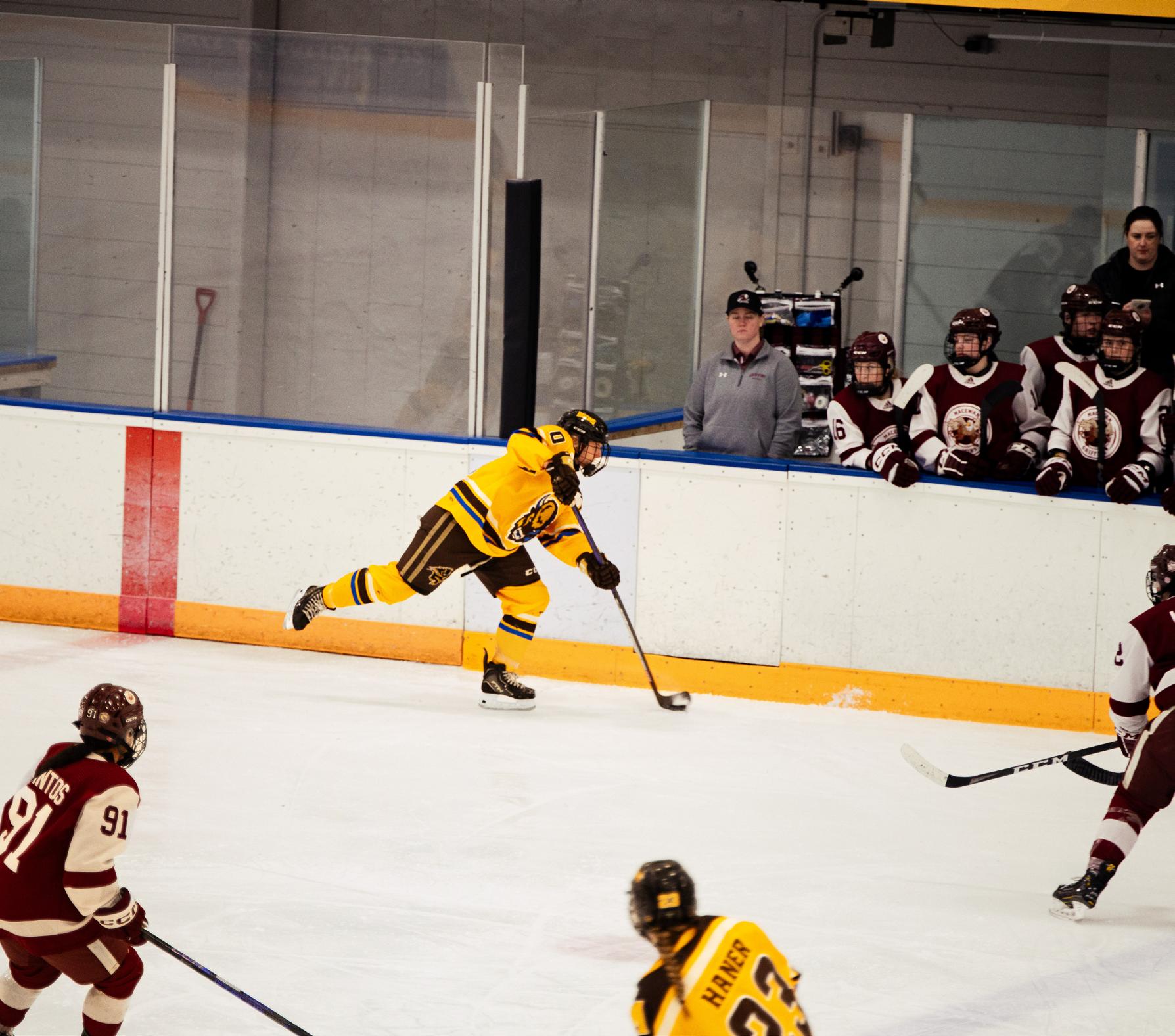
Cougars struggle to keep up with Bisons’ offence
Bisons women’s hockey crushes Cougars in dominant weekend
Israel Adeogo Abejoye, staff
The Bisons women’s hockey team beat the University of Regina Cougars in a two-game weekend series on Friday (0-2) and Saturday (1-6).
On Friday, Feb. 6, the Cougars were physical, earning a bodychecking penalty by Trinity Grove in the 16th minute [16:53] of the first period, but the Bisons failed to capitalize on the power play. The scoring began in the second period with Hanna Bailey’s goal for the Bisons in the 17th minute [17:42], amidst a flurry of penalties on both sides. The Bisons added an insurance goal in the third period with Jessie Haner’s empty net goal about twelve seconds to the end of the game [19:48].
In Saturday’s rematch, the Bisons struck early with Sadie Keller’s goal in the third minute [03:23], following Cougars’ Quinn McLaren’s cross-checking penalty. The Bisons continued to roll and scored three more goals in the second period. Julia Bilous
scored in the sixth minute [06:55] and Norah Collins added a power-play goal in the ninth minute [09:10], following Cougars’ Jordyn Blais cross-checking penalty.
Aimee Patrick (11:14) and Sara Harbus (15:24 and 17:59) added to the scoring for the Bisons, while Pippy Pritchard scored the Cougars’ lone goal in the thirteenth minute [13:40].
The Bisons were led by Harbus’s two goals and powerplay goals from Collins and Bailey. The team outshot the Cougars in both games, 12-33 and 19-26, respectively. Strong goaltending and opportunistic scoring secured the series win. The Bisons’ physicality was evident, with multiple penalties on both sides. Ultimately, the team’s skill proved too much for the Cougars.
The Bisons women’s hockey team will host the Calgary Dinos on Friday, Feb. 13 at 7 p.m. CT and Saturday, Feb. 14 at 2 p.m. CT at the Wayne Fleming Arena.
Dominant performance followed by tough loss for Bisons
Cougars even series with 1-3 win on Saturday against Bisons men’s hockey
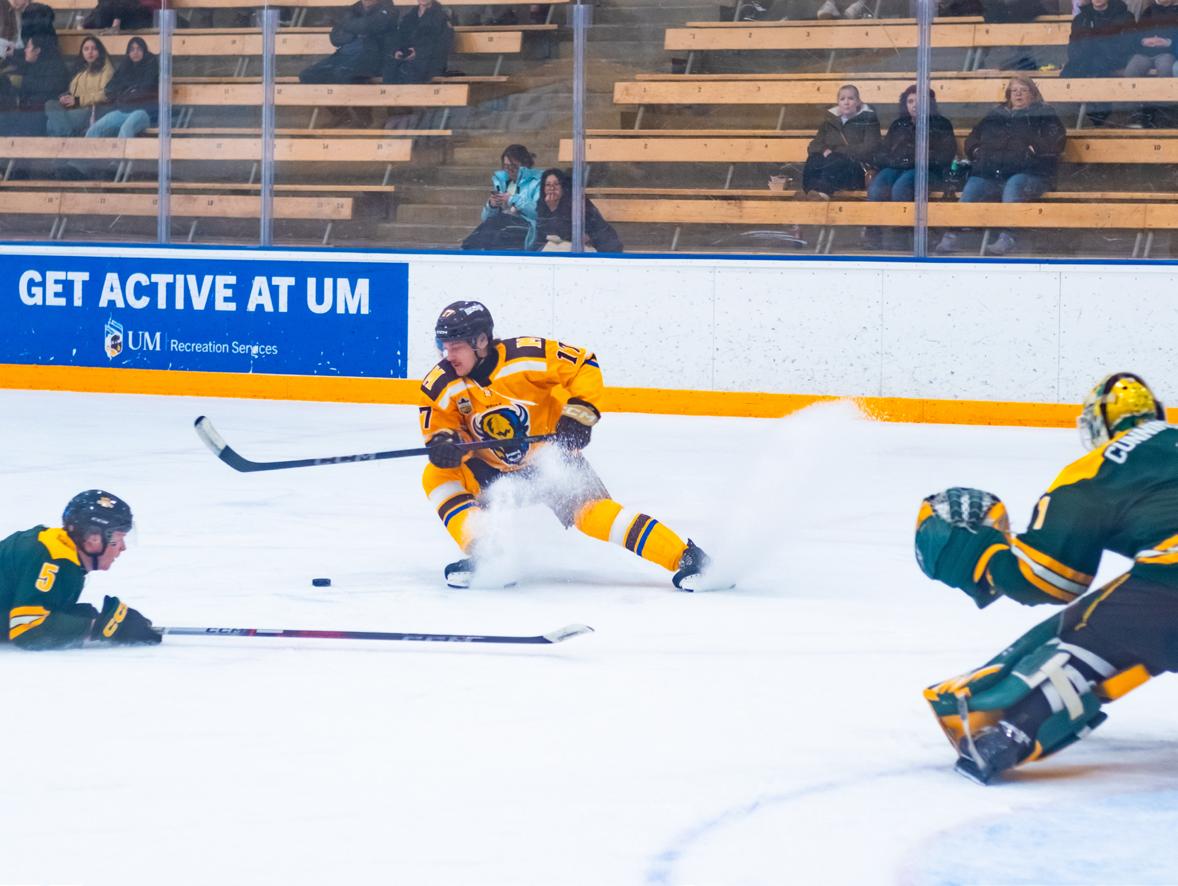
Israel Adeogo Abejoye, staff the Bisons men’s hockey team dominated the Regina Cougars 6-1 on Friday, Feb. 6, but suffered a 1-3 setback on Saturday, Feb. 7, in their weekend series.
The Bisons started strong, pressuring the Cougars from the outset. However, the Cougars took the early lead with Eric Houk’s goal in the 10th minute [10:12] of the first period, following a Bisons penalty. The Bisons quickly bounced back, tying the score 1-1 with Andrew Boucher’s goal in the 12th minute [12:46], before taking the lead 2-1 with Eric Alarie’s goal in the 18th minute [18:00].
The Bisons scored two more goals in the second period, including a power-play goal in the 19th minute [19:14]. Despite a few penalties on both sides, the Cougars failed to capitalize, and the Bisons entered the third period with a 4-1 lead.
The Bisons added two more goals in the third period, securing a 6-1 victory. Kaycee Coyle and Dawson Pasternak were sent to the penalty box for the Bisons, while Carter Belitski served time for the
Cougars. The Bisons outshot the Cougars 36-25.
Gordon Burnett, Bisons men’s hockey head coach, explained the team’s strategy for the win. “I think that we’re just focused on ourselves and what we’re supposed to do [...] I think we’re fortunate to score six goals. They have an incredibly athletic and good goalie, and they’re working hard. They have their chances. We’re lucky that Holt made some big saves when he had to [which kept] us in the game.”
Bisons defender, Luke Brenton, also played a large part in the defence line. He contributed to stopping the Cougars’ attacks and driving the Bisons offence forward.
“There’s a bit of strategy to hockey, especially being a defender. You’ve got to know when to pick your times to jump and […] it’s about being defensive first,” Brenton stated.
“Being a defender, [you have to keep] worrying about your own zone and making sure the other team won’t have a chance against [your team], and then you can pick and choose your times to jump in to play offensively,” he added.
“Overall, I’m really proud of the boys.”
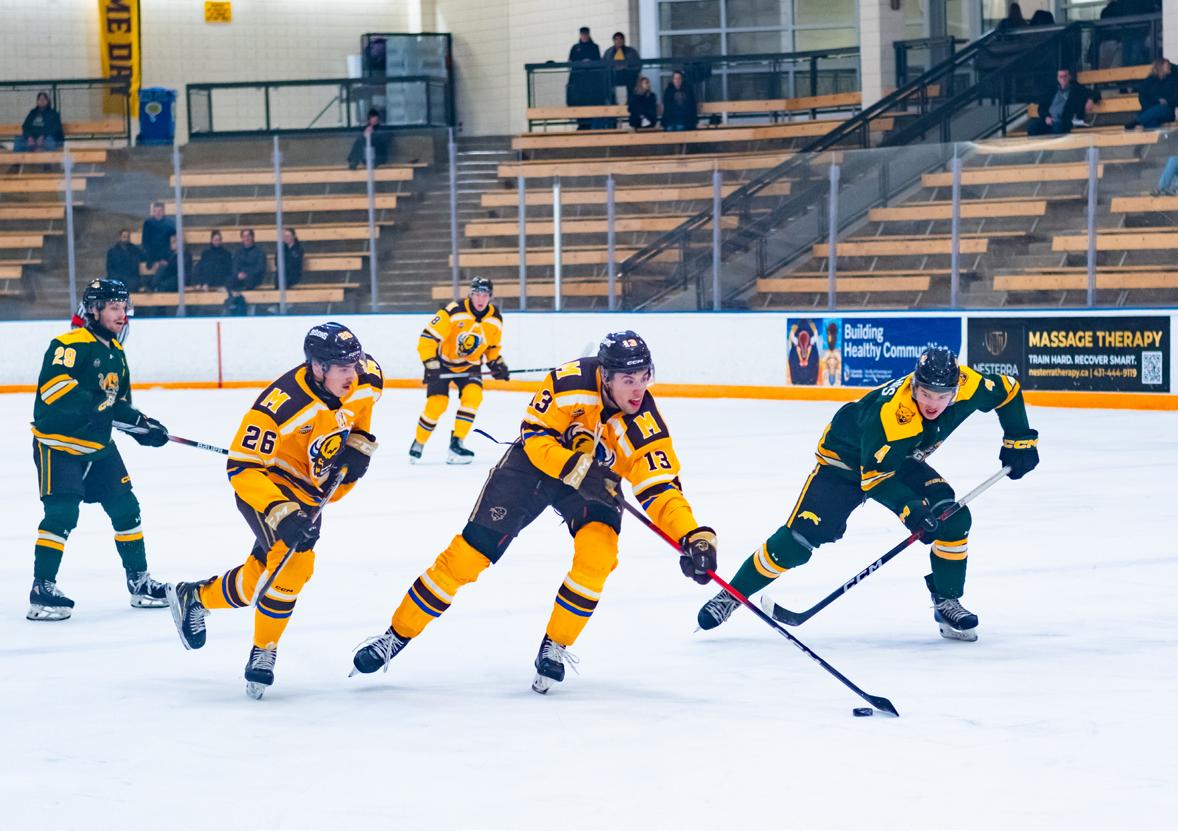
In the rematch on Saturday, Feb. 7, the Bisons lost 1-3 to the Cougars. The Cougars struck first in the first period with Parker Jasper’s goal in the 14th minute [14:58] after a Bisons’ penalty. The Bisons pushed hard, but the period ended 0-1 in the Cougars’ favour.
The Bisons’ penalties continued in the second period, with Lucas Brennan being sent off for hooking, and the Cougars capitalized with Cole Wirun’s goal in the 15th minute [15:43]. The Bisons responded with Skyler Bruce’s goal in the 18th minute [18:10], but the Cougars’ lead proved too much to overcome this period.
The Cougars sealed the win in the third period with a power-play goal in the fifth minute [05:17]. Despite dominating shots 34-18, the Bisons could not find the back of the net again.
The Bisons men’s hockey team will play the Calgary Dinos on Friday, Feb. 13 at 8 p.m. CT and Saturday, Feb. 14 at 4 p.m. CT in Calgary, Alberta.
PHOTO BY FAROUK ANIMASHAUN /VOLUNTEER
PHOTOS BY MIKE THIESSEN
Bisons men’s basketball overpowers Bobcats
Bisons rise to the occasion to beat Brandon 89-76, 87-65
Abdul-Jalilu Ahmed, staff
T
he Bisons men’s basketball team recorded an 89-76 win against the Brandon University Bobcats on Friday, Feb. 6 at the Investors Group Athletic Centre.
The Bisons took control, earning a 17-5 lead at 2:27 in the first quarter after a jump shot by Mason Kraus. Daren Watts made a layup at 1:06, assisted by Kraus, to make it 21-7. At 0:25, Cieran O’Hara scored on a layup, assisted by Kraus, extending the lead to 23-7. Arjun Hehar made a layup for the Bobcats with 15 seconds remaining to cut the deficit to 23-9.
Watts scored on a layup at 4:06 in the second quarter to give the Bisons a 35-17 lead. Ramogi Nyagudi made a layup at 1:45 to extend the advantage to 40-21. Malik Brown made a free throw for the Bobcats with three seconds remaining, making the score 40-23 at halftime.
Kraus made a layup at 6:49, assisted by Watts, in the third quarter, pushing the lead to 49-30. Taven Vigilance made a layup at 2:51, to keep the advantage 60-42. With three seconds to end the quarter, Vigilance made a jump shot to bring the score to 66-52.
At 6:22 in the fourth quarter, Kraus made a free throw, giving the Bisons a 74-54 lead. Miguel Nitro scored on a layup at 1:12 to extend the margin to 85-69. Watts made a dunk at 0:37, assisted by Tito Obasoto, to make it 89-71. At 0:00, Travis Hamberger made a three-point jump shot for the Bobcats, but the Bisons secured an 89-76 victory.
In the second game on Saturday, Feb. 7, the Bisons continued their strong play, defeating the Bobcats 87-65.
The Bisons led 29-16 after the first quarter and outscored the Bobcats 21-11 in the second quarter. The Bobcats responded by winning the third quarter 21-19, but the Bisons held on, taking the fourth quarter 18-17 to achieve the win.
Bisons men’s basketball coach Kirby Schepp reflected on the victory after the game. “It was a tough game,” he said. “The game didn’t mean a lot to [the Bobcats], so they were resting guys for playoffs. It was a great opportunity to get a lot of our bench in, get them some experience a little bit. In some ways it was a tough game to play in, but I’m just glad we got the win and we’re looking forward to playoffs.”
Before the game, seniors Kraus, Watts, O’Hara, Obasoto, Samuel Jensen and Manyang Tong were recognized.
Schepp described the group as “family.”
Schepp explained why he chose to start the game with those seniors. “I just wanted to give those guys one last run together. We started in the second half, too, and that was probably the last time those five guys will play together, at least on this floor. It was just great to see them go out.”
Obasoto talked about his experience playing alongside his fellow seniors. “Honestly, it’s surreal. I [wouldn’t trade
it] for the world. I had the opportunity to go somewhere else and a big part of me staying at home was the group of guys we had. The fact that we all played since we were in elementary school, middle school, high school, and we got to play together on the biggest stage just meant the world to me. Honestly, I feel like the chemistry is what put us above and had us break the record. That’s what it’s all about — camaraderie and chemistry.”
He shared his thoughts on what lies ahead for Bisons men’s basketball. “We have a bright future. I feel like the young guys got the right environment to grow and practice with five great seniors every day, day in and day out. Practices aren’t easy. Practices are harder than games sometimes […] and they have the right preparation to do great things next year.” Kraus also spoke about his experience playing with fellow seniors on the team. “It
was a great experience with all of our guys competing, getting some of the young guys in today. It was just great seeing them, especially since next year six of us are going to be gone.” He believed that the future of Bisons men’s basketball is “going to be bright.”
Kraus added, “Our old guys set a good tone and a good standard for the young guys so they can come in every day and compete and just show what they got.”
PHOTOS BY MIKE THIESSEN / STAFF
Bisons dominate Brandon Bobcats
Third-quarter surge lifts Bisons women’s basketball over Bobcats
Faiyaz Chowdhury, staff
T
he Bisons and the Brandon University Bobcats traded runs all night before the herd won 95-89 at the Investors Group Athletic Centre on Friday, Feb. 6. The Bobcats had already qualified for the playoffs prior to this weekend. The game was relatively even until halftime, with the herd leading by three points. However, by the end of the third quarter, the Bisons were leading by 13 points.
Anna Miko opened the scoring for the game with a layup. The herd stretched the scoreline to 13-0. Averill Ella made a layup, becoming the first Bobcat to score, 13-2. The Bisons maintained this gap until 3:04 minutes remaining, with a 20-10 score. The Bobcats then went on a run and scored seven more points, ending the first quarter 20-17.
The second quarter had both teams going head-tohead, each scoring 26 points. The game went into halftime with a 46-43 score. Macaya Copeland for the Bobcats shone in this quarter, scoring
“You [have to] pressure on their defence if you want to make ball movement a little bit easier”
— Michele Sung, Bisons women’s basketball head coach
nine points, grabbing two assists and two rebounds. The herd’s defence could not contain Copeland. But the Bisons were able to maintain significant but brief leads (13-0, 20-8, 31-22) in the first half as the Bobcats were
determined to reduce the gap, highlighting their offensive capability.
In the third quarter, Piper Ingalls made a spectacular three-point jump shot, to tie the score to 46-46. With another three-pointer from Amaya McLeod, the Bobcats were leading 49-46. The herd took back the lead a few minutes later when Paige Schatkowsky scored a layup, 52-51. The Bisons offence proved effective as they outscored the Bobcats by 10 points (28-18) in this quarter. The third quarter ended 74-61.
The last quarter started with the Bisons stretching the lead with back-to-back three pointers by Avya Khan and Taylor Schepp, making
the score 80-61. Both teams would keep scoring until the score was 95-81. This is where the Bobcats found the wind in their sails and started scoring consecutive points, reducing the deficit 95-89. Miko had a night to remember for the Bisons, scoring 20 points and getting 15 rebounds. Samantha Onyebuchi also had a spectacular night for the herd, scoring 19 points.
On Friday, the Bisons women’s basketball head coach Michele Sung said the team had already taken “care of a win [last] Saturday,” so they “knew [they] had taken another step toward a playoff push here.” She explained, “It’s more about tomorrow,” and if they win again it “just changes
the playoff opponents.”
Looking at the third quarter, she said they “got some stops back-to-back” and “locked into defence for a little bit,” which allowed them “to stay on pace with [the Bobcats]” and build the 10-point lead. She also emphasized that she wanted her group to attack, saying, “You [have to] put pressure on their defence if you want to make ball movement a little bit easier and getting into the free-throw line a bit more of a reality,” instead of “settling [and] playing from the outside of the free-throw line.”
The Bisons and the Bobcats played again on Saturday, Feb. 7, and the herd went on to win the game 93-77. Ella
Averill scored 29 points for the Bobcats, but that was not enough to win. Over the 2025-26 conference season, Schepp scored 240 points and Miko scored 223 points for the Bisons.
The Bisons might face the Calgary Dinos in the playoffs. The Bisons finished sixth in the Prairie Division, which placed them 11th overall in the playoff standings. Under the Canada West playoff format, the 11th seed is matched up against the sixth seed in the play-in round, and the Dinos earned that sixth seed in the Prairie Division standings. These rankings stand as of Sunday, Feb. 8 at 10 a.m.