
UMSU board meeting highlights
Arifah Gheesah, staff
T his week’s UMSU board of directors meeting was brief but packed with updates for students.
UMSU shared ongoing developments in its federal advocacy efforts. On Nov. 3, UMSU hosted MP Heather McPherson for a town hall meeting focused on student issues such as funding, post-secondary affordability and the federal budget. The event gave students the opportunity to speak directly with the MP and raise questions and concerns.
Advocacy on the Winnipeg Transit system continues. UMSU has been gathering student feedback and meeting with representatives from both the City of Winnipeg and Winnipeg Transit. The union hopes to see several key routes reinstated to better support student commuters.
UMSU president Prabhnoor Singh reported on his meeting with U of M president Michael Benarroch and vice-provost Laurie Schnarr where they
discussed broader student advocacy priorities. The meeting focused on opportunities for UMSU and the university to jointly push for a safer and
more reliable transit network, the urgent need to reinstate provincial healthcare for international students and the possibility of the univer-
sity subsidizing the Manitoba International Student Healthcare Plan to ease financial burdens. They also addressed growing concerns around student housing, emphasizing the need for more affordable options both on and near campus.
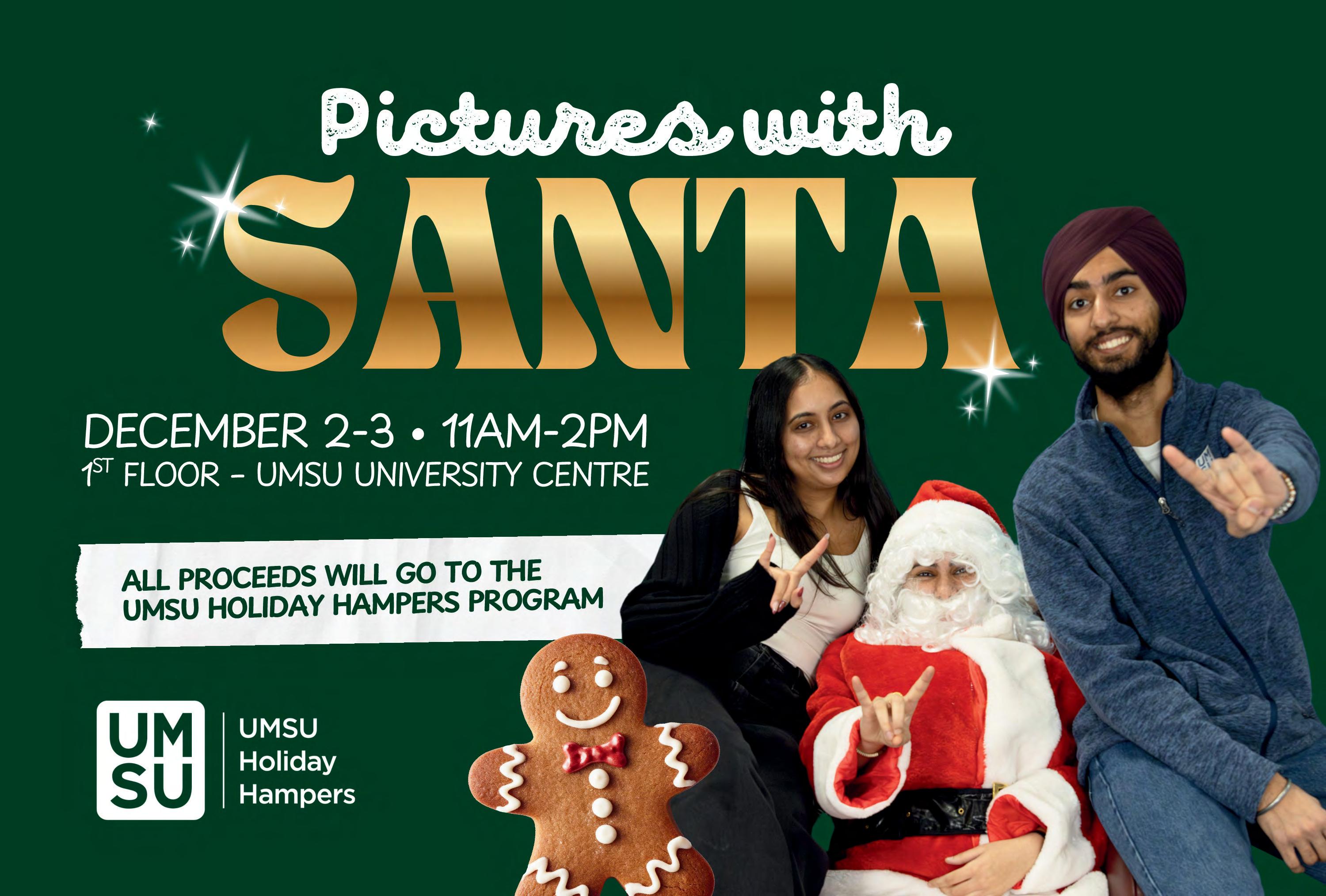
UMSU’s annual Holiday Hamper initiative is back. This year, UMSU will provide $150 grocery gift cards to support students during the holiday season and allow them to purchase personalized items for the hampers.
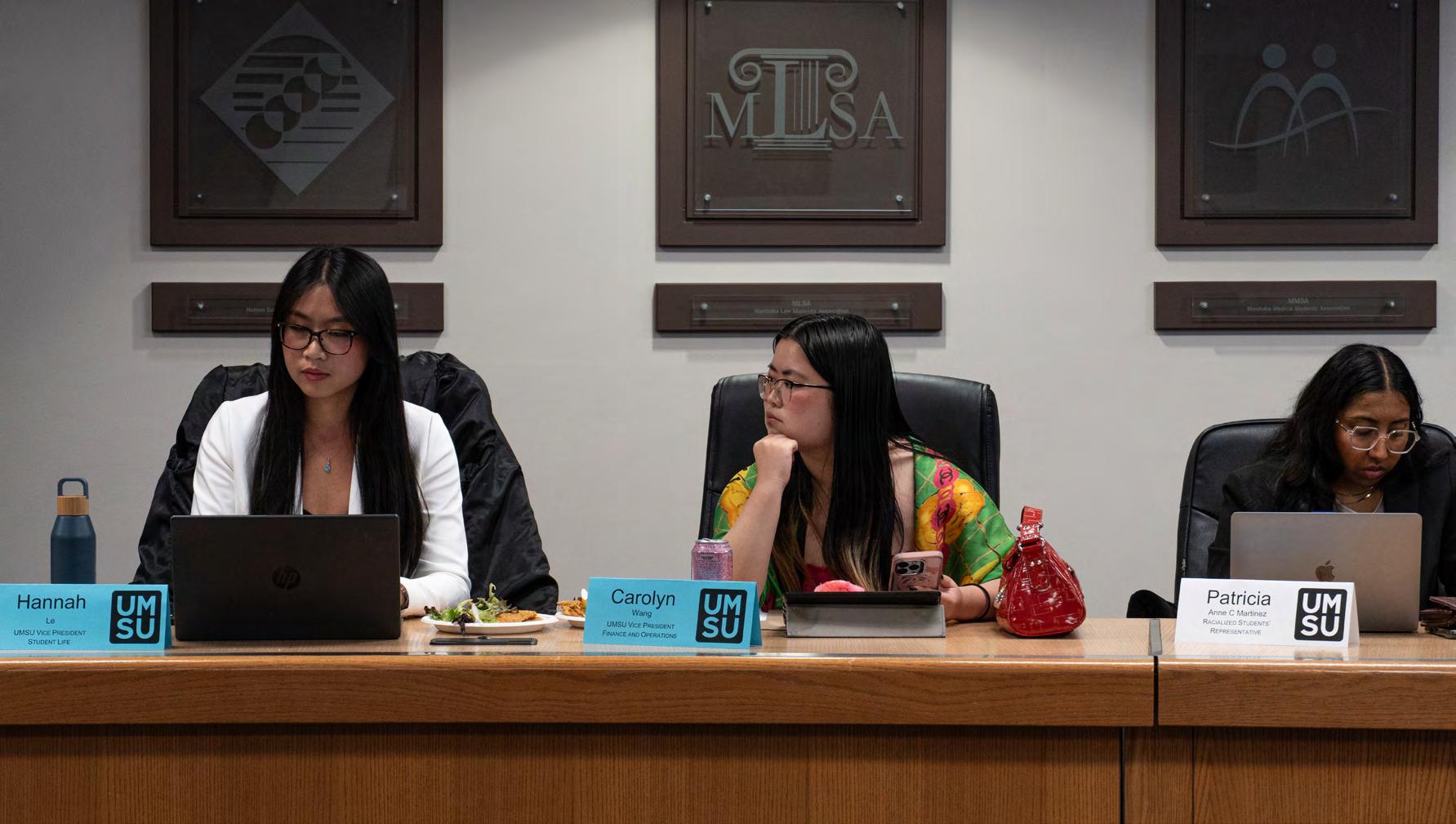
Carolyn Wang, vice president of finance and operations, presented updates on her work with UMSU Services and Operations to develop a new UMSU community lounge in Helen Glass. The project is still in its planning phase.
International Centre hosts International Education Week
Five days of global programming brought students together across campus
Roy Albright Obah, staff
The U of M International Centre marked International Education Week (IEW) with a five-day series of events held from Nov. 17 to 21. The annual observance is part of a global initiative to recognize the role of international education and the contributions of international students.
Fanny Levy, International Centre executive director, spoke about the event. “International Education Week is an annual opportunity for our team and partners to celebrate and highlight the contributions of international students and the value of global engagement across our campuses and abroad.”
Levy said this year’s celebration offered several opportunities to participants. “Students had opportunities to build intercultural skills, explore global mobility oppor-
tunities […] and funding to access those experiences, meet peers from around the world and receive direct support from international student advisors.”
The planning of the week involved collaboration across multiple groups on campus.
Levy said, “We consulted with student groups, campus partners and International Centre staff to identify themes that resonate with our current students.”
“Our programming included cultural showcases, student-led sessions, academic and immigration support workshops, and partner-led activities from faculties, Student Affairs and student groups,” she added.
According to Levy, the programming also featured information for students “to learn
“That spirit of engagement is what defines IEW for me”
or collaborative workshops, we help build mutual understanding and reduce social barriers that can sometimes arise.” However, for Levy, “that spirit of engagement is what defines IEW for [her].”
She added, “For many, it was also a chance to showcase their identity and culture in a supportive environment.”
— Fanny Levy, U of M International Centre executive
Levy said this year’s IEW centred “on community building, cross-cultural learning and student success.”
Throughout the five days, activities were organized to help students engage with campus resources and programs.
Who runs the world?
UMMA hosts She Leads event, amplifying voices of women leaders
Videographer’s creed
How video game cutscenes can inform visual storytelling techniques
about study-abroad pathways and global partnerships, highlighting both inbound and outbound mobility.”
Levy expressed that IEW is significant for students as “[IEW] creates shared spaces where students can learn with and from each other […] Through food, conversation
Levy noted the planning and coordination of IEW came with challenges, particularly given the range of activities across multiple units. She said, “Our team addressed [these] through communication, early planning and leaning on our campus partners’ expertise. We’re fortunate to have a committed group of staff and many student volunteers who adapt quickly and
ensure students have a meaningful experience.”
Levy mentioned the International Centre intends to “continue expanding student leadership [and ensure] programming reflects their voices and priorities.” She added,“We want [IEW] to keep growing as an annual celebration that brings our entire community together and reinforces [U of M’s] commitment to global engagement.”
The International Centre serves as U of M’s main pillar of global engagement, supporting students and faculty interested in international opportunities or global collaboration.
The office is located in Room 541 of UMSU University Centre. For updates on upcoming events, follow @um.international.
Hot cups of knowledge
What role did coffeehouses use to play in cultural advancement?
Craic for drama lovers
The Shaughraun runs from Nov. 26 to 29 at John J. Conklin Theatre
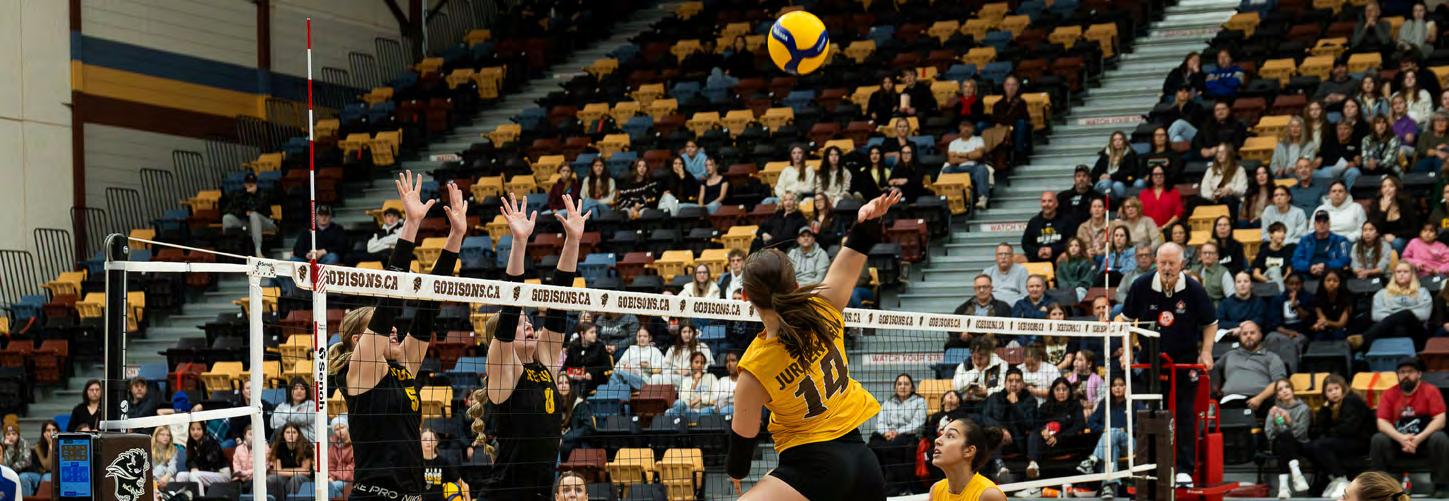
Bisons sweep Cougars
Bisons women’s volleyball team wins 3-0, 3-0 against Regina Cougars Sports 18
PHOTO BY ZULKIFL RAFAH / STAFF


109 HELEN GLASS BUILDING UNIVERSITY OF MANITOBA WINNIPEG, MB THEMANITOBAN.COM | 204. 474. 6535
GENERAL INQUIRIES: ME@THEMANITOBAN.COM
CIRCULATION INQUIRIES: MISSING OR INCOMPLETE PAPER?
EMAIL: DISTRIBUTION@THEMANITOBAN.COM
EDITOR-IN-CHIEF Mikaela Warkentin editor@themanitoban.com
BUSINESS MANAGER Alice Teufack accounts@themanitoban.com
BUSINESS SUPPORT MANAGER Joshua Herold ads@themanitoban.com
EDITORIAL
MANAGING EDITOR Peace Ifeanyi me@themanitoban.com
COPY EDITOR Eden Quiring copy@themanitoban.com
COPY ASSOCIATE Mursal Ghiyasi
NEWS EDITOR Roy Albright Obah news@themanitoban.com
RESEARCH & TECHNOLOGY EDITOR Mansura Meghla research@themanitoban.com
COMMENT EDITOR Quinn Mayhew comment@themanitoban.com
ARTS & CULTURE EDITOR Boris Tsun Hang Leung arts@themanitoban.com
SPORTS EDITOR Abdul-Jalilu Ahmed sports@themanitoban.com
DESIGN
DESIGN EDITOR Deveney Jarrow design@themanitoban.com
DESIGN ASSOCIATE Patricia Sanque
GRAPHICS EDITOR Emma Gillich graphics@themanitoban.com
GRAPHICS ASSOCIATE Teegan Gillich
AUDIO AND VIDEO
AUDIO EDITOR Max Reid audio@themanitoban.com
PHOTO EDITOR Mike Thiessen photo@themanitoban.com
PHOTO ASSOCIATE Ebunoluwa Akinbo
VIDEO EDITOR Zulkifl Rafah video@themanitoban.com
DIGITAL MEDIA EDITOR Faisal Rahman social@themanitoban.com
SOCIAL MEDIA ASSOCIATE Paula Robles Andia
REPORTERS
NEWS Arifah Gheesah
NEWS Nafisa Al Lilo
RESEARCH & TECHNOLOGY Nawal Semir
COMMENT Thandeka Katsika
COMMENT Kyra Campbell
ARTS & CULTURE Carrington Dong
ARTS & CULTURE Jordan Anglin
SPORTS Faiyaz Chowdhury
SPORTS Israel Abejoye
VOLUNTEERS
VOLUNTEERS
interested in volunteering?
email me@themanitoban.com today!
The Manitoban is the official student newspaper of the University of Manitoba. It is published monthly during the summer and each week of regular classes during the academic year by the Manitoban Newspaper Publications Corporation.
The Manitoban is an independent and democratic student organization, open to participation from all students. It exists to serve its readers as students and citizens.
The Manitoban is a member of the Canadian University Press, and our journalistic standards can be found on the Manitoban’s website.
The newspaper’s primary mandate is to report fairly and objectively on issues and events of importance and interest to the students of the University of Manitoba, to provide an open forum for the free expression and exchange of opinions and ideas and to stimulate meaningful debate on issues that affect or would otherwise be of interest to the student body and/ or society in general. The Manitoban serves as a training ground for students interested in any aspect of journalism.
Students and other interested parties are invited to contribute to any section of the newspaper. Please contact the appropriate editor for submission guidelines.
The Manitoban reserves the right to edit all submissions and will not publish any material deemed by its Editorial Board to be discriminatory, racist, sexist, homophobic or transphobic, ableist or libellous.
Opinions expressed in letters and articles are solely those of the authors. Editorials in the Manitoban are signed and represent the opinions of the writer(s), not necessarily those of the Manitoban staff, Editorial Board or the publisher.
A “volunteer staff” member is defined as a person who has had three volunteer articles, photographs or pieces of art of reasonable length and/ or substance published in the current publishing year of the Manitoban
Any individual who qualifies as a volunteer staff member must be voted in by a majority vote at a Manitoban editorial board meeting. Elected representatives and non-students may be excluded from holding votes as volunteer staff members in accordance with the Manitoban Constitution.
All contents are ©2025 and may not be reprinted without the express written permission of the Editor-in-Chief.






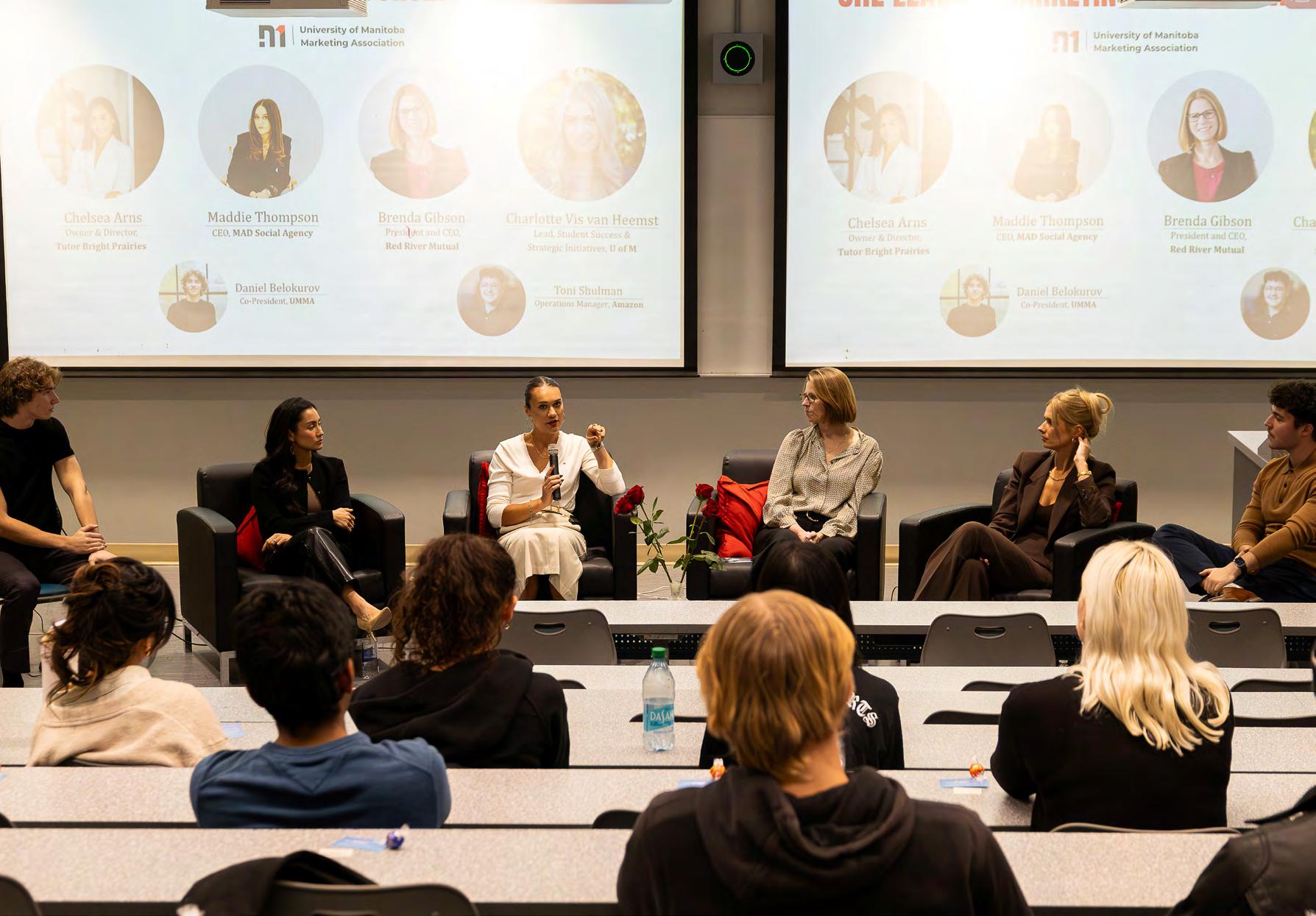
UMMA event champions women’s leadership
Event provides space for students to learn from women leading in the community
Nafisa Al Lilo, staff
T
he U of M Marketing Association (UMMA) hosted She Leads, a student-organized panel featuring women leaders from different professional fields including education, marketing and finance. The event was created to give students access to leaders whose work reflects the growing visibility and influence of women across industries.
The panel included four women — Maddie Thompson, the founder and CEO of MAD Social, Charlotte Vis Van Heemst, who leads student success and strategic initiatives at Asper school of business, Brenda Gibson, president and CEO of Red River Mutual and Chelsea Arns, who leads TutorBright Prairies.
The evening opened with remarks from UMMA co-president Sargis Sargisian, who explained the idea for the event came from ongoing conversations about how leadership, specifically women’s leadership, has shaped students’ experiences. He added that women’s leadership has played a major role throughout his career journey, and the event was designed to reflect that influence.
Sargisian explained that UMMA was hoping to create a greater impact within the lives of the students and community. “We thought that the new trajectory of UMMA should be about inspiring the younger generation and impacting the
community,” he said.
Sargisian’s goal was to bring together women who could demonstrate how leadership develops across different sectors. “We all start basically from the same place, mainly university for all of us,” he said. “But then it’s up to you to fully explore your opportunities.”
ations. He described entering the program without anticipating how strongly the discussions would shape his understanding of leadership.
“Know that in the end, everything always works out for you, but you have to be able to be willing to see that”
event. “Leadership is not a one-size-fits-all approach. We must understand who we are as individuals and how we want to carry ourselves,” he said. Shulman expressed how the discussion emphasized interper-
— Chelsea Arns, TutorBright Prairies lead
Toni Shulman, a fourthyear marketing student and one of the moderators, said the event exceeded his expect-
I think, as a student, this is incredibly inspiring,” Shulman said.
Shulman also shared his main takeaway from the

treated them,’” he said.
Arns offered practical advice to students navigating academic and career uncertainty. She advised students to view challenges as opportunities for reflection rather than signs of failure. “You need to look at every situation that you might think is a failure and [realize] that there is a blessing in it,” she said.
She encouraged students to stay committed even when the path ahead feels uncertain or when things do not go as planned. “Keep believing yourself,” she said. “Know that in the end, everything always works out for you, but you have to be able to be willing to see that.”
The event concluded with a question-and-answer session where students asked panelists about their achievements, networking and career direction. Students were also given time after the event to connect with the panelists and have one-on-one conversations.
Sargisian said he hopes the event will encourage students to step outside of their comfort zones. He emphasized that while university can feel like a contained environment, growth often happens when students look for opportun-
Are you ready to help shape the future of Manitoba’s largest credit union? We’re seeking passionate, forward-thinking individuals to join our Board of Directors.
We welcome candidates from diverse backgrounds, cultures, identities, and regions to ensure our Board reflects the communities we serve. Ideal applicants bring a blend of professional expertise and lived experience, with strengths in one or more of the following areas:
• IT, and digital governance
• Environmental, Social and Governance (ESG)
• Strategic planning and executive leadership
• Human Resources leadership
• Business acumen
WHY SERVE ON OUR BOARD?
Influence the strategic direction of a leading financial institution
Champion initiatives that benefit members and communities across Manitoba
Receive compensation for this paid governance role
LEARN MORE AT

PHOTO BY EBUNOLUWA AKINBO / STAFF
The cinema of cutscenes
How video game cutscenes shaped me as a videographer
Zulkifl Rafah, staff
Before I ever picked up a camera or learned the language of film, I learned storytelling, framing and emotional resonance through a unique medium — video games. Growing up, video games weren’t just something I played, they were something I studied. Cutscenes, those crafted moments in which gameplay seamlessly blends with narratives, became my gateway into the world of visual storytelling. It shaped my understanding of visuals, character development and the power of a well-told story.
Video games are in a unique position in modern storytelling. Unlike films, they allow you to participate in the narrative, and the best ones always manage to deliver long-lasting emotions and unforgettable moments.
I have always been particularly selective about the games I choose to play. I look for titles where visual storytelling isn’t a side quest but the heartbeat of the game. Titles like The Last of Us, Assassin’s Creed and Uncharted became my teachers.
The Last of Us showed me how a single close-up, a shift in lighting and even a quiet pause can speak louder than dialogue. It also showed me how music can be blended with scenes to elevate a story. Every cutscene felt like a scene from a beautifully crafted film, focused and intentional. Particularly, whenever Ellie says something that reminds Joel of Sarah, his daughter that he lost just before the outbreak, there’s usually a moment of pause and a zoomed shot of Joel where he doesn’t say anything back, but his facial expressions combined with a brief glance at his broken wrist watch tell players that he was reminded of his daughter. It is from this game that I learned that cinematography isn’t just about what you show, it’s also about what you hold back.
Then there was Assassin’s Creed, an award-winning video game series developed by Ubisoft. This franchise
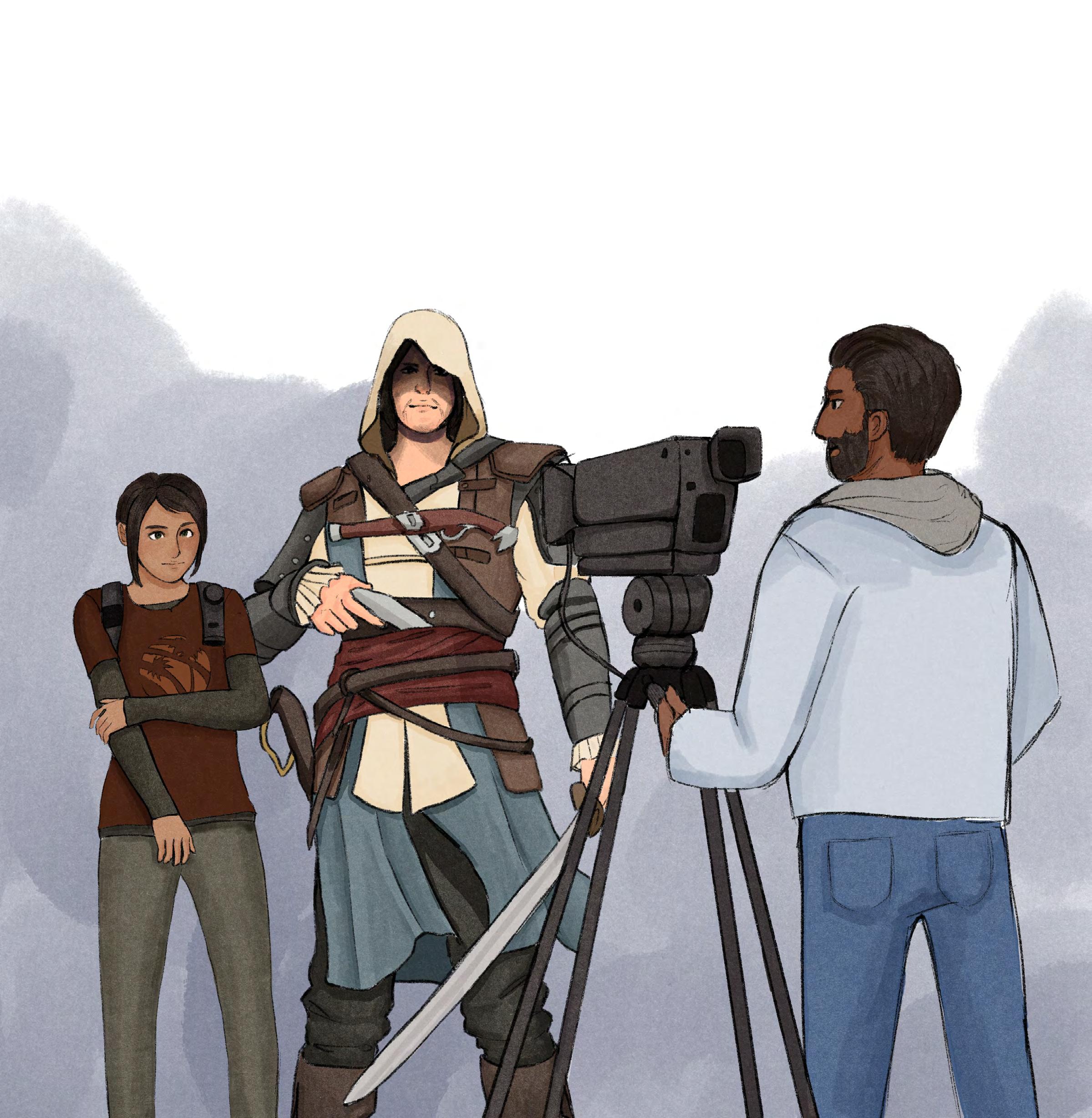
consists of 13 main titles as well as multiple spin-off games, several short films and various transmedia projects. A masterclass in world-building and visual immersion, Assassin’s Creed has been widely known for creating worlds that consist of beautiful landscapes, ancient cities with towering structures and cutscenes that make history feel alive. This series taught me

the importance of a wide-angle shot. It doesn’t just show a world — it sets the tone and the atmosphere of a story. Uncharted taught me the importance of motion. Its cutscenes mainly consist of energy, binding story and action through dynamic camera movement. This series taught me how the camera can move the story, creating tension, rhythm and excite-
ment without anyone saying a single word.
All of these games have one thing in common — they respect visual storytelling. Visual storytelling is important to me because at a very young age I discovered that I was able to express myself better with imagery than with words, and these games use imagery to project emotions that resonated with me long
after the credits rolled. The philosophy of visual narratives guides me every time I step behind a camera today. When I frame a shot or direct a scene, I carry the lessons from these games with me. The worlds that I explored on a screen helped me to create my own. These games didn’t just entertain me, they helped me find my voice as a visual storyteller and a videographer.
GRAPHIC BY EMMA GILLICH / STAFF

Research & Technology
Uncovering the history of reading without sight U of M professor’s new
Mansura Akter Meghla, staff
F or many readers today, braille is synonymous with blind literacy. But for Vanessa Warne, the story of how blind people learned to read provided a deeper look at the cultural history of disability itself.
Warne, a professor in the U of M department of english, theatre, film and media, studied how people in the 19th century understood disability. Her work explored the connections between poems, novels, paintings, sculptures and the history of blind readers who navigated the world through touch rather than sight.
Her interest in disability history began nearly two decades ago, after a colleague encouraged her to volunteer at the Canadian National Institute for the Blind. Warne spent her time in the organization’s recording studio, reading aloud everything from young adult novels to recipes that were not available in accessible formats.
The experience left a lasting impact on her. “The recording studio closed but I kept thinking about access to literature, including the history of 19th century blind people’s access to works of literature that I love and teach,” she said. “The more I learned about this understudied history, the more I wanted to know.”
That curiosity has culminated in her new book, By Touch Alone: Blindness and Reading in Nineteenth-Century Culture, published this summer. The book traces the history of the first generation of blind readers who became literate through inkless, tactile books created to be read by touch. Warne explained that while braille is widely recognized today, it was once just one of several tactile reading systems. “These inkless scripts both felt and looked very different from braille,” she noted. “Studying these now obsolete scripts taught me a great deal about how ableist attitudes toward disabled people have shaped technology and culture,” she added.
book traces how 19th century blind readers reshaped culture
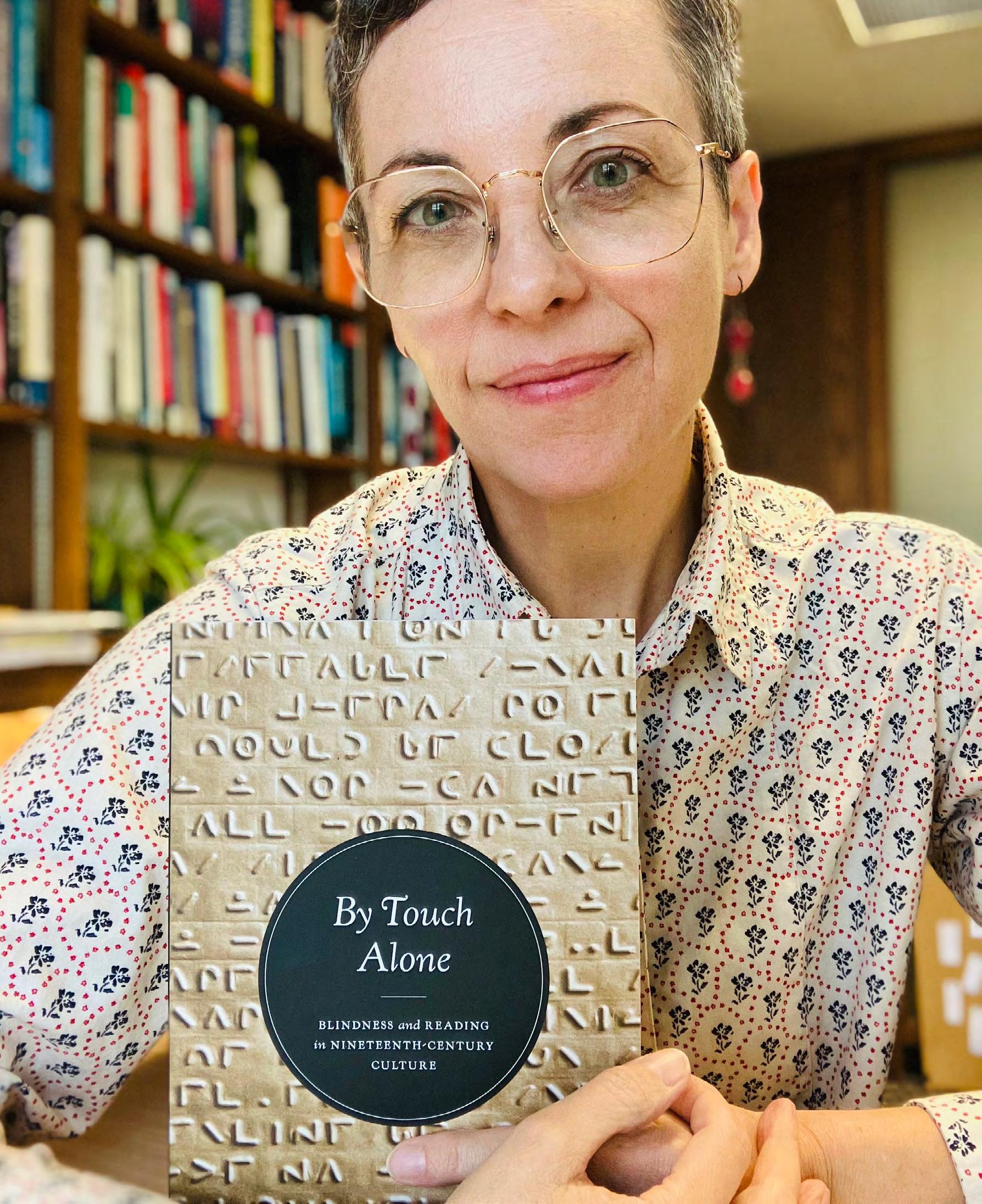
Alongside the technical and historical aspects, Warne examined how sighted people responded when blind readers entered literary culture. As reading by touch became more common, sighted contemporaries had to reconsider what qualified as literacy and rethink long-held assumptions about blindness. Her research brings together
life writing from blind authors with the fiction, paintings and sculptures produced by sighted artists, revealing a
“Different modes of accessing text, such as touching raised text or listening to audio […] facilitate different kinds of engagement”
— Vanessa Warne, professor in the U of M’s department of english, theatre, film and media
more complex and culturally contested history of reading than many expect.
While her work is rooted
in reading practices, Warne noted the influence of tactile literacy extended far beyond books. She found unexpected connections between reading by touch and other 19th-century cultural activities, from handling museum specimens to practices of tactile graffiti. These insights have shaped her upcoming research, which shifts focus from reading to the material
history of blind craftsmanship. Many schools and asylums for blind students historically paired literacy education with craft training, producing baskets and other hand-made items intended both for income and rehabilitation.
Warne also saw contemporary relevance in her work, particularly as debates continue over accessibility, digitization and the future of braille. With 2024 marking the 200th anniversary of braille’s invention, she said ongoing cultural investment in braille, both in teaching and publishing may be declining as digital tools expand. She hopes the history of reading by touch will help today’s blind readers reflect on “how different modes of accessing text, such as touching raised text or listening to audio […] facilitate different kinds of engagement or support different degrees of comprehension.”
Warne hopes her work will contribute to richer understandings of disability history and encourage students to explore the vast cultural archive of the 19th century. “The Victorians wrote and published and painted and sculpted and crafted astounding amounts of cultural material,” she said. “We can learn a lot about them and about our own cultural moment by studying the things they created and collected.”
Warne’s work has been supported by U of M Libraries’ Archives & Special Collections, which houses rare 19th century tactile books. She recalled travelling with some of these volumes and offering blind readers the opportunity to handle scripts they had never encountered in their lifetimes. One moment stayed with her — exploring a 150-year-old book printed in William Moon’s tactile script with a disability activist who had only ever read braille. “I’m grateful for the chance to share these rare books and their history with readers today, both blind and sighted,” Warne said.

PHOTO PROVIDED BY VANESSA WARNE
Social media use linked to cognitive decline in youth Student experiences suggest
Nawal Semir, staff
Newly published findings from the ongoing Adolescent Brain Cognitive Development (ABCD) study, one of the largest studies on youth development, links increased social media use during adolescence to lower cognitive performance. Dr. Jason Nagata of the University of California San Francisco, along with his colleagues, explained in their research letter that “there is a paucity of studies that have analyzed the associations between distinct longitudinal social media usage patterns and multiple domains of cognitive functioning.”
Their project thus aims to contribute to an underdeveloped field of interest in cognitive science. As per Nagata’s findings, this study contributes to literature by “[examining] the relationship between longitudinal patterns of social media use and cognitive performance two years later in a diverse, national sample of early adolescents.”
The ABCD study tracked
study is necessary on effects of social media on adults
6,554 American adolescents, of which 51.1 per cent were male and 48.9 per cent were female. Data was collected from three time points — baseline (2016 to 2018, ages nine to 10 years), year one (2017 to 2019), and year two (2018 to 2020). The conclusions are based on results from oral and memory testing the adolescents were put through every other year, as well as the ongoing yearly surveillance of their social media usage.
Between ages nine to 13, three trajectory groups appeared — no or low social media use (roughly 58 per cent of participants), low increasing social media use (roughly 37 per cent of participants) and high increasing social media use (roughly six per cent of participants). The low increasing group’s social media usage reached about an hour a day by the age of 13, while the high increasing group spent about three or more hours on social media daily.
The ultimate findings from the study are comparisons made with the no or low social
media use group.
From these comparisons, Nagata concluded that both low and high increases in social media use throughout early adolescence “were significantly associated with lower performance in specific aspects of cognitive function, supporting a prior finding that greater screen time was negatively but weakly associated with adolescent cognitive performance.”
Although not participants in the study, U of M students who were adolescents during the study period shared their lived experience with social media and how they believe it has affected their cognitive abilities, mainly in terms of learning and time-management.
Gina Ali, a fifth-year English major in the faculty of arts explained that, like the study participants, her social media usage began at age 11-12. “I [didn’t have] a device of my own until I was 14,” she shared. Her limited access to social media, coupled with the structured regiment of mid-
dle school — including a ban on phones in class — helped her regulate her social media usage in adolescence. Now in adulthood, she said social media is directly impacting her ability to study as well as her overall productivity.
Ali believed her increased social media use to be a symptom of excess “free time” and the fact that “university is not as structured as […] other years of schooling.”
Zahra Lokwa, a secondyear student in the faculty of arts traced her earliest social media usage back to the age of nine, with her consistent usage increasing greatly at the age of 13. Now, Lokwa attributes a decrease in her attention span to her heavy social media usage. Like Ali, she believed that an increase in “free time” as well as a lack of involvement in extracurriculars in her adolescence has caused her to form a social media dependency.
In an attempt to mitigate the physical and cognitive effects she believed were linked to her social media
usage, Lokwa took a two-year break from social media at the age of 18.
“I found myself reading again, painting again,” she recalled. “I found myself to be sleeping earlier and having a good amount of sleep,” she added. Since returning to social media and devoting her free time during the day and at night to social media, she’s “back worse than ever.”
The adolescent years are known to be highly formative. However, university students’ experiences suggest social media may also shape the cognition of older teens and young adults, potentially influencing skills they have already developed. While research, including Nagata’s, focuses on adolescents, accounts from students reveal a need for further study on social media’s effects on an older age group, especially regarding perceived declines in focus and cognitive skills.

Museums in a world we only see through screens
As algorithms narrow our world, museums reveal what we have forgotten to look for

Kyra Campbell, staff
D
o you know anything about Flemish life and artifacts between the 1400s and 1700s? I definitely did not before visiting an exhibit at the Royal Ontario Museum over reading week. I am not an artistic person, nor have I really taken a deep dive into art in my free time.
However, I loved the way the exhibits were themed and ended up learning a lot about that time period. Along with admiring the art, I learned that in 1570, cartographer Abraham Ortelius shifted from mapping individual places to a more global view with Theatrum Orbis Terrarum, a collection of 53 maps widely considered the first true atlas, which was on display. In a completely different area of study, I also learned about significant scientific developments made by midwives in the 1500s, as most women gave birth at home and relied heavily on their knowledge.
This article is not meant to give you a full rundown of the exhibit, nor is it a retelling of 300 years of Flemish history. Instead, it is about the fact
that there is so much happening outside our ordinary bubble of learning that, even if it is not directly useful in our day-to-day lives, it still opens our eyes to fascinating ideas.
I have always been pretty “nerdy” and I get a lot of joy from constantly learning new things. But I have increasingly found that even though we can ask the internet anything and get an almost instant answer, this apparent abundance can actually feel like our world of information is shrinking.
Most of us wake up and get the same five stories pushed at us, likely fuelled by whatever is trending, to create the most outrage or to keep us scrolling. The internet feels infinite, but what we really see is filtered through algorithms, advertisements and our own search habits.
After all, you cannot Google what you do not know exists. Click on a video about the moon landing, and your feed becomes the moon landing forever. It can be convenient, but also a trap. Your curiosity becomes confined to what the search engine recommends and believes you’ll
engage with.
In a museum, you can go in to see dinosaurs and then stumble onto an exhibit about diamond mining. You wander into the interactive science lab and suddenly you are modelling how a virus spreads through a city. You turn a corner and there is a room about a local community you have lived near for many years and never really thought about. You did not search for any of this. It found you.
There has been a stark rise in anti-intellectualism, especially in the form of demonizing education. Along with a lot of online discourse calling university “woke” or only a place for fostering “radical left-wing ideologies,” I vividly remember one moment from our most recent federal election cycle. Leader of the Conservative Party of Canada, Pierre Poilievre, announced as part of the party’s platform that if elected to form government, they would eliminate university degree requirements for most federal public service roles.
This announcement raised two concerns for me. First,
when one of Canada’s major political parties downplays the value of education in the public service, it sends the message that education does not really matter. This is particularly troubling because public servants deliver essential programs and services to Canadians, so even if the policy never takes effect, the sentiment is still out there.
Cynically, I cannot help but feel that some politicians prefer their citizens to be less educated on all fronts, so they are less likely to push back against or fully understand the severity of certain government decisions. For a bolder example of this, you can look at President Donald Trump’s attacks on education in the U.S.
Second, it highlights the importance of educational institutions like museums, where you can learn a lot about different subjects without having a degree. Of course, visiting a museum does not compare to the intensity or length of a university education, but it is far more affordable and accessible.
That said, there is also a
democratic issue here. When attacks are thrown at institutions like museums and they are treated as optional extras, they become easier to neglect and defund. If we instead understand them as part of how we stay informed, how we remember and how we argue about how we live and who we are, then they are not luxuries. They are the backbone of an informed society. Along with protecting our post-secondary education system, we must also ensure we do not let our guard down when it comes to museums and similar learning institutions. This argument does not mean we need to reject the internet — it means we must refuse to let it be the only way we learn. You can absolutely read up on an artist before you go to a gallery or look into a scientific concept before you go to a lab, and you deepen both experiences by letting them inform each other. If we want to be an informed society, we cannot just scroll for answers — sometimes we have to go out of our way, stand in front of the real thing, and let it surprise us.
GRAPHIC BY TEEGAN GILLICH / STAFF