Issue 163 December 2025/January 2026
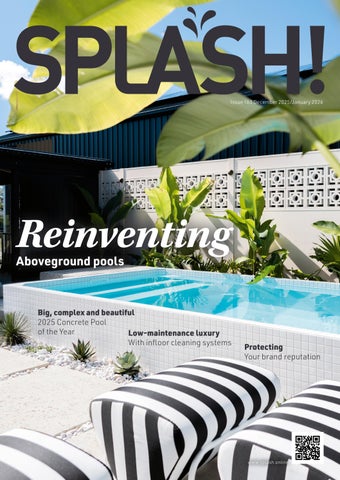
Reinventing Aboveground pools
Big, complex and beautiful 2025 Concrete Pool of the Year Low-maintenance luxury With infloor cleaning systems
Protecting Your brand reputation
www.splash.online
Size does matter AutoChlor® is the hallmark of AIS Water, an internationally acclaimed brand of inline chlorine generators that symbolises excellence in the industry. It’s the go-to choice for saltwater, coastline, and seawater pools, especially those with salinity levels between 3,500 - 35,000ppm. Offering a diverse range of models, from 10 to 5,000 grams per hour, AutoChlor® ensures there’s a perfect fit for you and your customers this summer.
AutoChlor® Pixie Chlorine output: 1 -10 g/h Salinity Range: 4,000ppm - 5,000ppm Designed in Australia to meet the surging demand in the plunge pool and spa market, the Pixie micro chlorine generator inherits the DNA of its bigger AutoChlor® counterparts. With a reverse polarity cell, water flow alarm, and high/low salinity alerts, it also shields your pool or spa from over-chlorination. Say goodbye to risky chlorine dosing and oversized chlorinators intended for larger pools. Pixie delivers peace of mind with its cost-effectiveness, simplicity, reliability, and hassle-free installation.
No Pro Rata No Small Print
AutoChlor® Classic MkII Chlorine output: 15 / 20 / 25 / 36 / 50 / 64 / 80 g/h Salinity Range: 3,500ppm - 5,000ppm
No Pro Rata No Small Print
ALSO AVAILABLE AS A LOW SALT (3,500PPM) VARIANT
Born over 30 years ago, the AutoChlor® Classic™ series reigns as AIS’ flagship, celebrated for its unwavering simplicity, unmatched reliability, and effortless installation. The Classic™ series has continuously advanced, and in its latest iteration, AutoChlor® Classic™ Mark II proudly features an aluminium heatsink, fortifying its durability to excel in the most extreme, high-temperature conditions with unparalleled ease.
51 Millennium Place, Tingalpa, QLD 4173 Australia Phone: +61 7 3396 5222 I Email: info@aiswater.com.au
aiswater.com.au
AR
Download the AIS Water AR app from the Apple App Store or Google Play Store and scan the AIS Water logo to learn “Why choose AIS technology?”
A 30 year history of innovation and a laser focus in chlorine generation via electrolysis.
AutoChlor® MIDI Chlorine output: 100 & 150 g/h Salinity Range: 3,500ppm - 5,500ppm Say goodbye to juggling multiple residential chlorinators. Elevate your pool experience with the AutoChlor® MIDI™ – the ultimate solution for busy pools. With its industrial aesthetics and unmatched performance, this semi-commercial powerhouse provides the chlorine your pool demands. Operating at a salinity level as low as 3,500ppm, the RP150 model, takes your swimming experience to the next level. AutoChlor® MIDI™: where reliability, strength, and top-tier functionality meet.
AutoChlor® Commercial Chlorine output: 100 - 5,000 g/h Salinity Range: 4,000ppm - 35,000ppm AIS Water stands as a pioneering force in commercial pool water disinfection, leading the charge in innovative solutions for over 25 years. The awardwinning AutoChlor® commercial range, designed for saltwater, coastal, and sea water swimming pools, is the culmination of 25+ years of relentless research and development. Today, it remains the unrivaled chlorine generator of choice, diligently disinfecting thousands of swimming pools in resorts, hotels, public swimming pools, aquatic centres, swim schools, lagoons, water parks, and schools across more than 55 countries worldwide. AIS Water - setting the gold standard in commercial pool water purification.
2023 Australian Manufacturing Awards
Embracing Innovation Award Winner Queensland
Power Supply and electrolytic cell
HOT H2O TECHNOLOGY
AWARDED AUSTRALIA’S BEST POOL HEAT PUMPS
SUPPLY SUPERIOR COMFORT WITH THE #1 POOL HEAT PUMP Consult an EvoHeat specialist today for your customers’ perfect solution!
SUPERIOR COMMERCIAL POOL HEATING: EVO CSi-E
SLASH OPERATING COSTS & CARBON EMISSIONS WITH THE EVO CSi-E Engineered to meet the demands of any commercial application, the Evo CSi-E is the most reliable and efficient way to heat a commercial pool. Designed with the latest full inverter technology, R32 refrigerant and exclusive smart features, the Evo CSi-E delivers reliable, year-round performance with the lowest operating costs and ultra quiet operation. FIND
R32 REFRIGERANT Lower global warming potential, while ensuring high performance and efficiency.
BMS & 4G DTU CAPABILITY Remotely manage parameters, monitor performance and track operational data.
1300 859 933 | evoheat.com.au
O RE
FULL DC INVERTER TECHNOLOGY Designed with the latest full DC inverter compressors, fans, and control systems.
TM
Ideal for aquatic facilities, sports and leisure centres, water parks, apartments, resorts and hotels – there is no job too big for the Evo CSi-E series!
O U
Published by The Intermedia Group Pty Ltd ABN 940 025 83 682 41 Bridge Road, Glebe, NSW, 2037 Australia Ph: (02) 9660 2113 Fax: (02) 9660 4419 On behalf of The Swimming Pool & Spa Association of Australia Ltd (SPASA Australia) Managing Editor: Chris Maher Phone: +61 412 048 639 Email: chrismaher@intermedia.com.au
editorial
Everyone wants a swim
Contributors: Veda Dante, Kristin Brookfield, Ben Makepeace, Spiros Dassakis.
My wife and I recently travelled in a small Hiace van customised by our carpenter son and his engineer fiancé. They’d travelled around the country for 10 months in it, but we went on a relatively short trip of 10 days around the New South Wales western plains.
Advertising enquiries: Gillian Doreian Phone: +61 488 983 102 Email: gillian@spasa.com.au Graphic Designer: Jacqui Cooper Production Assistant: Tazlin Cantrill
It was an awesome trip. But it was also hot – up to 40C, often with accompanying high winds.
Subscriptions: 1800 651 422 Email: subscriptions@intermedia.com.au
As we approached each town we looked for one thing first of foremost: the local pool! Oh, what a joy to get out of the van and dive into the cool water. Each pool had its own character and by virtue of sharing the pool and poolside with the locals, we ended up making friends and getting a closer understanding of the towns.
Copyright All material in this publication is copyright to the publisher and/or its contributors. No material may be reproduced without the express permission of the publishers.
Disclaimer: This publication is published by The Intermedia Group Pty Ltd (the “Publisher”) on behalf of SPASA Australia. Materials in this publication have been created by a variety of different entities and, to the extent permitted by law, the Publisher accepts no liability for materials created by others. All materials should be considered protected by Australian and international intellectual property laws. Unless you are authorised by law or the copyright owner to do so, you may not copy any of the materials. The mention of a product or service, person or company in this publication does not indicate the Publisher’s endorsement. The views expressed in this publication do not necessarily represent the opinion of the Publisher, its agents, company officers or employees. Any use of the information contained in this publication is at the sole risk of the person using that information. The user should make independent enquiries as to the accuracy of the information before relying on that information. All express or implied terms, conditions, warranties, statements, assurances and representations in relation to the Publisher, its publications and its services are expressly excluded save for those conditions and warranties which must be implied under the laws of any State of Australia or the provisions of Division 2 of Part V of the Trade Practices Act 1974 and any statutory modification or re-enactment thereof. To the extent permitted by law, the Publisher will not be liable for any damages including special, exemplary, punitive or consequential damages (including but not limited to economic loss or loss of profit or revenue or loss of opportunity) or indirect loss or damage of any kind arising in contract, tort or otherwise, even if advised of the possibility of such loss of profits or damages. While we use our best endeavours to ensure accuracy of the materials we create, to the extent permitted by law, the Publisher excludes all liability for loss resulting from any inaccuracies or false or misleading statements that may appear in this publication.
Chris Maher Managing Editor chrismaher@ intermedia.com.au
It reminded me of the vital role pools and pool staff play in Australia’s national story. It also made me think of the wonderful people I’d met at the Country Pool Managers Conference over the years – from the small-town pool managers to the people who run the larger aquatic facilities in the regional centres. They were always generous in offering information about their experiences, and were keen to soak up the knowledge on offer from others. So I felt quite sad to discover that the conference had come to an end. Fortunately, that sadness didn’t last too long, because Royal Life Saving NSW stepped into the breach, and agreed to continue the conference! More on this on page 58. Everyone in the bush seems to love a swimming pool – and not just the humans. When we arrived at a relative’s house in Bingara, east of Moree, we discovered someone else who likes a swim. The resident Jack Russell was engaged in a fight to the death with a black snake who had come in for cool splash and a drink. Luckily we managed to convince the dog to leave it alone, and the snake slunk off back into the bush. (Both were okay, but the snake was still thirsty.) There have been warnings from pool techs that snakes are rife this summer. So keep an eye out, and check the safety ideas on page 12.
This issue of SPLASH! magazine published by The Intermedia Group Pty Ltd (Intermedia) may contain magazine or subscription; offers, competitions, forms and surveys (Reader Offers) which require you to provide information about yourself, if you choose to enter or take part in them. If you provide information about yourself to Intermedia, Intermedia will use this information to provide you with the products of services you have requested and may supply your information to contractors that help Intermedia to do this. Intermedia will also use your information to inform you of other Intermedia publications, products, services and events. Intermedia may give your information to organisations that are providing special prizes or offers that are clearly associated with the Reader Offer. Unless you tell us not to, we may give your information to other organisations that may use it to inform you about other products, services or events or to give it to other organisations that may use it for this purpose. If you would like to gain access to the information Intermedia holds about you, please contact Intermedia’s Privacy Officer at The Intermedia Group Pty Ltd, PO Box 55, Glebe, NSW 2037.
I wish you all the most fabulous Christmas and New Year and trust you get a chance to relax for at least a few days – with any luck, a fair bit more – so you can start the new year refreshed and vitalised for what will hopefully be a wonderfully prosperous and fulfilling 2026. And keep an eye out for those snakes!
Copyright © 2025 - SPASA Australia.
Proudly supported by
The views expressed in this magazine do not necessarily represent those of the above supporters, nor should any product advertised in SPLASH! magazine be seen to be endorsed by the above.
Issue 163 December 2025/January 2026
Reinventing
The Intermedia Group takes its Corporate and Social Responsibilities seriously and is committed to reducing its impact on the environment. We continuously strive to improve our environmental performance and to initiate additional CSR based projects and activities. As part of our company policy we ensure that the products and services used in the manufacture of this magazine are sourced from environmentally responsible suppliers. This magazine has been printed on paper produced from sustainably sourced wood and pulp fibre and is accredited under PEFC chain of custody. PEFC certified wood and paper products come from environmentally appropriate, socially beneficial and economically viable management of forests.
Aboveground pools
Big, complex and beautiful 2025 Concrete Pool of the Year Low-maintenance luxury With infloor cleaning systems
Protecting Your brand reputation
The cover
The Plungie Original, chosen by 2020 The Block winners Jimmy and Tam, installed semi-above ground. Photography by Kieran Tunbridge. There is more on the changing aboveground pool market on page 38.
www.splash.online
December 2025/January 2026
SPLASH!
7
Introducing the next level of pool protection Smarter technology for a healthier, cleaner pool. The PuraShield UV® Sanitiser +Ozone from Pentair, takes pool protection to the next level. Harnessing the power of ultraviolet (UV) light and ozone’s proven oxidation and sanitation capabilities, the new PuraShield® UV +Ozone sanitiser is the best complementary solution to your swimming pool's chlorination system.
Harnessing the Power of Ultraviolet Light and Ozone PuraShield® UV
PuraShield® UV +Ozone Sanitiser
The ulraviolet light in the new Purashield® system from Pentair works to render harmful organic matter like bacteria and viruses inactive. This helps reduce the amount of chlorine required for your swimming pool. The UV light also breaks down the monochloramines in your pool to help reduce itchy skin, burning eyes and chemical odours. The ozone component of the Purashield® system works fast to effectively deactivate harmful bacteria and reverts back to oxygen without creating any toxic by-products. All rolled into an easy-to-use system, the Purashield® UV +Ozone Sanitiser easily fits to most existing pool systems offering you the best pool protection with minimum fuss.
See the full range at pentairpool.com.au
28
Contents
18 A year of change
38 Reinventing aboveground pools
20 Swimming pool entrapments increase
46 The low-maintenance luxury
22 Regulation update
Veda Dante looks into the engineering technology that is driving more pool builders and pool owners to adopt infloor cleaning systems.
Kristin Brookfield outlines some of the challenges and achievements in the industry over 2025.
of infloor pool cleaning
Spiros Dassakis discusses the current spike in litigated matters in the swimming pool industry.
Ben Makepeace updates us on the progress of the National Construction Code, AS 1926.1 and the other industry advocacy efforts.
24 The inaugural Master Pool Builder Showcase
MPB members gathered in Melbourne to enjoy a day filled with inspiring conversations, fresh insights and shared practical experience.
60 The strategic community value of swimming pools
20
63 Floating focus on mineral
Sol Elements has launched Australia’s first “floating” elemental bathhouse in the heart of Tamborine Mountain, Queensland.
Country manager David Sholl describes Aiper’s experience in the Australian market since launching here last season.
regulars
28 Big and complex? We love it.
News . . . . . . . . . . . . . . . . . . . . . . . . . . 10
Zen Building, Pools & Landscapes director Joel Webeck discusses the mammoth NSW Southern Highlands project that won the 2025 Concrete Pool of the Year award.
Veda Dante investigates the risks around losing control of your branding in both the real and online worlds.
A look at the new IAKS whitepaper analysing the community value of public swimming pool facilities.
soaking and spiritual wellbeing
26 Cordless robots growing the market
34 Brand reputation on the line
The latest innovation, designs and efficiency in aboveground and precast pool solutions.
Pool DAs. . . . . . . . . . . . . . . . . . . . . . . 11 Calendar. . . . . . . . . . . . . . . . . . . . . . . 13 Commercial news. . . . . . . . . . . . . . . 56 New products. . . . . . . . . . . . . . . . . . . 64
46
Ad index. . . . . . . . . . . . . . . . . . . . . . . . 66
December 2025/January 2026
SPLASH!
9
news
Manufacturing
Waterco launches Waterco Middle East in Dubai Waterco Limited has launched Waterco Middle East, a new entity strategically located in Jebel Ali, a key port city in the Emirate of Dubai. Tony Fisher, Waterco Division CEO of North America and Europe, says this expansion is a significant step in the group’s global growth strategy, enhancing its operational presence and ability to deliver premium pool, spa, water treatment, agricultural and aquaculture solutions in a highgrowth regional market. The move also strengthens Waterco’s footprint in Davey water transfer pump sales across the Middle East and North Africa (MENA). Waterco Middle East will be headed up by general manager Jon Maskell, a swimming pool and spa executive with more than 30 years’ experience in the sector, including in the Middle East. He was previously export director of Waterco Europe, where he helped strengthen business performance and foster international relationships, which in turn enhanced Waterco Europe’s global standing.
Waterco Middle East, enabling faster delivery, improved customer service and stronger engagement with partners. Fisher says the new entity demonstrates Waterco’s approach of combining local insight with global expertise to deliver proprietary solutions that enhance regional resilience and advance sustainable water security.
Waterco Middle East general manager Jon Maskell
Maskell says he is honoured to lead Waterco Middle East and is excited to bring Waterco’s solutions closer to partners and end users. “We look forward to delivering a broad product range that supports water efficiency, showcases advanced treatment innovations, and upholds the highest standards of quality and sustainability,” he says. “Waterco’s products, including its patented injection moulding and fibreglass winding techniques, are engineered to reduce water and energy use, optimise treatment processes, and lower operational costs,” he says. “By integrating advanced technology, research and strategic collaboration, we aim to help North Africa and the Middle East establish water management as a cornerstone of sustainable growth and longterm resilience.” Jebel Ali’s industrial and logistics hub provides an ideal base for
Manufacturing Micron filters
Training
New Zealand Swimming Pool and Spa Building qualification officially approved The New Zealand Certificate in Swimming Pool and Spa Building qualification has now been officially approved. The live qualification is now published on the NZQA framework, and the program guidance document has also been released. For the past three years, SPASA in collaboration with the Institute of Research and Learning (IRLearning), has been working closely with Waihanga Ara Rau to establish this formal qualification for swimming pool and spa building in New Zealand. COO Wendy Donaldson says this has been a major focus for SPASA. “Momentum has accelerated in recent months with the formation of a dedicated working group made up of
10 SPLASH!
December 2025/January 2026
industry representatives,” she says. “Their input, expertise and time have been invaluable in shaping a qualification that reflects the real needs of our sector. Thanks to their efforts, we’ve now reached this major milestone.” In parallel with the qualification development, SPASA and IRLearning are exploring options to deliver nationally recognised training in New Zealand. “We are currently assessing whether to establish our own private training establishment (PTE) or to partner with an existing PTE to deliver the qualification,” Donaldson says. “Either pathway will allow us to ensure high-
quality, industry-led training aligned to the needs of the pool and spa sector. Our intent is to make training accessible and relevant, supporting the development of a skilled and professional workforce across New Zealand.” She says that SPASA and IRLearning are working toward future training delivery options, and the finalisation of installation standards represent a turning point for the New Zealand swimming pool and spa industry. “Through training, standards and ongoing advocacy, SPASA continues to drive professionalism, recognition and longterm growth for our sector, ensuring a strong and sustainable future,” she says. Donaldson thanked everyone involved in this important initiative.
July Aug Sep
news
DAs numbers continue a slow climb The ALT Alabama team (supplied)
Manufacturing
Aquatic Leisure Technologies establishes fibreglass pool factory in US sunbelt
Available pool DA figures from Cotality for the three months from September to November 2025 show that applications are up by two per cent, while the annual numbers for the 12 months to November show the numbers improving by three per cent. The quarterly numbers show New South Wales is up by 28 per cent, South Australia is up by 14 per cent, and Queensland and Western Australia are both up by 11 per cent; while Victoria is down by 45 per cent. The national annual DA numbers continue to improve when compared to the same period last year, with New South Wales up by 24 per cent, Queensland up by 20 per cent and Western Australia up by eight per cent; while South Australia is down by 12 per cent and Victoria is down by 38 per cent.
Yearly comparison by month
Year old
Aquatic Leisure Technologies Group (ALT) has announced the establishment of its first US manufacturing facility in Opp, Alabama. The facility spans 5200 square metres on nine hectares, marking a significant milestone in ALT’s continued expansion across the United States. Commissioning is now underway, with initial production targeted for early 2026.
1200
4000
900
3000
600
2000
300
1000
0
Dec
Year new
Yearly comparison by State
Aqua Technics Pools has earned global recognition for design, 300 technology and performance, and was recently awarded 2025 SPASA Business of the Year.
She says the project will create new local employment 3000 opportunities as ALT builds and trains a US-based manufacturing team. In the2000 short term, key Australian specialists will support the facility setup and technology transfer to ensure that operations in the United States meet the company’s strict global 1000 manufacturing standards. 0
Papineau the Oct Nov also acknowledges NSW VICsignificant QLDsupport received WA
Oct Nov
Feb Mar Apr May June July Aug Sep
Oct Nov
0
Year new
12000
4000
9000
3000
6000
2000
3000
1000
0
0
NSW
Quarter old
VIC
QLD
WA
SA
Quarter new
12000
9000
6000
3000
0
SA
throughout this process from the State of Alabama, the Department of Commerce, AIDT, the City of Opp and the Covington County Economic Development Commission, adding that ALT is committed to contributing to the region’s economic development.
NSW
15000
5000
15000
Yearly comparison
0
Dec Jan Feb Marin the Apr United May June July is Aug Sep “Establishing a manufacturing presence States a natural progression for our business,” says president Lynley Papineau. “After two years of searching for the right property and the right community to call home, Opp, Alabama provides the ideal Year old Year new location – offering a strong local workforce, supportive community 5000 and excellent infrastructure that will help to facilitate our longterm vision for 4000 growth.”
Jan
Year old
1500market in 2018, ALT has experienced Since entering the US sustained growth, previously supplying distributors and dealers 1200 directly from its Australian operations. The Opp facility will now localise production, improve delivery times, and support the 900 company’s expanding dealer and distributor network across the country. 600
Year o 5000
The site will serve as the US manufacturing home of ALT’s flagship brand Aqua Technics Pools which will be promoted across the North American market. Year old
Year new
1500
While these figures give an indication of the way the market is trending, they are not comprehensive and don’t include all pools built or even all DAs lodged. By some estimates, the total national numbers including all types of pools could be triple these figures. They do not include pool projects that are approved as part of a new home, smaller projects under the cost threshold, renovations that don’t require a DA, or some aboveground pools. Additionally, not all councils are forthcoming with data or report on time; councils in some states such as Queensland and Victoria are particularly reluctant. For further information, call Cordell Information on 1300 734 318.
December 2025/January 2026
SPLASH!
11
news
Snakes love to cool off in the summer. This is a python, but many more dangerous snakes have also been spotted. (Image supplied)
“Snakes are drawn to pools for a range of reasons. They like access to water during hot, dry spells. They also like cool, damp hiding spots under pool equipment, pot plants and furniture,” Blair said. “Pool areas also provide great environments for food. Food sources, such as frogs and rodents typically thrive around water. “Pools and gardens are perfect microclimates, shaded, moist and quiet during the day. It’s an ideal environment for snakes to seek shelter.” Blair is urging homeowners to take proactive measures such as: • Clearing out old furniture, pots and pool toys that create hiding spots. • Cutting back overgrown bushes and grass around pool fences and equipment. • Checking skimmer boxes carefully before reaching inside. • Avoiding leaving pet food or bird seed outdoors, as these attract rodents and rodents attract snakes.
Safety
It’s not just humans who like to cool off in a pool With the weather heating up, general manager of Jim’s Pool Care Brett Blair is warning Australian pool owners of a concerning rise in the number of snakes lurking around pools. He says that more snakes are being found in and around pool areas, hiding in toys, skimmer baskets, bushes, hoses and at the bottom of pools and under pool ledges. As well as the more typically seen pythons and water dragons, the reptiles seen this summer include dangerous and deadly snakes such as redbellied black snakes and the more aggressive eastern browns.
• Call a licensed snake catcher immediately if a snake is spotted, never attempt removal yourself. “Snakes are part of our environment, but a little awareness and maintenance can go a long way toward keeping your family safe,” Blair says.
browns and red-bellied blacks,” he says. “These are highly venomous snakes that can kill you. Children don’t realise the danger they could be in simply playing around the pool. “As temperatures climb, snakes go searching for water and shade and pools are perfect for both. Our pool technicians have seen a significant increase in sightings of dangerous snakes lurking in pool areas, skimmer boxes and filter enclosures.”
“This is the biggest increase we have ever seen,” Blair says.
With snake activity at its seasonal peak, Blair warns that homeowners need to take immediate steps to reduce risks, particularly families with children or pets.
“We are seeing a disturbing increase in the number of snakes lurking around household pools. These aren’t your average pythons; we’re coming across
“It can be a terrifying experience when you reach for the pool skimmer or step outside barefoot and there’s a snake coiled up behind the filter box,” he says.
Keep informed by subscribing to the free online newsletter.
“Our technicians are trained to spot hazards and we’re reminding homeowners that now’s the time to tidy up, check your filters and pumps and be extra vigilant. Prevention is everything. “You would be surprised where snakes can hide and many of them blend in with foliage. Don’t pick up toys or furniture with your bare hands. Try and do so with a long handled broom or similar type of implement. Once you know an item is safe and snake free, you can then clear it away. “This is another reason why you also need to ensure you keep your pool clean and crystal clear. Snakes can also hide at the bottom of pools or under pool ledges. They are pesky critters and are adept at hiding in the least obvious places.”
Top five online news stories
The online stories that made the news over the past two months.
Industry innovator Anti Kajlich passes away
Waterco Middle East launches in Dubai
Poolwerx appoints global chief executive
Kids need extra lessons before high school
Sadly, the water polo legend, innovator and passionate supporter of the Australian aquatic industry passed away.
Waterco Middle East has launched: a new entity strategically located in Jebel Ali, a key port city in the Emirate of Dubai.
Poolwerx appointed Nic Brill to the newly created position of global CEO to position the company for international growth.
New research shows that the risk of drowning rises sharply for teenagers, surging 1300 per cent between the ages of 10 and 20 years.
12 SPLASH!
December 2025/January 2026
Modular public pool designs proposed to solve ageing pool crisis Royal Life Saving NSW, Cox Architecture and Waterco have combined to launch modular designs for public swimming pools.
news
Upcoming events 2026 Jan 15-17
Aquafun 2026, Istanbul Türkiye
Jan 30-Feb1 Pool Spa Life Expo Melbourne Feb 3-5
Spatex, Coventry UK
Feb 11-13
Forumpiscine, Bolongne, Italy
Feb 14-15
Pool Spa Life Expo Perth
Feb28-Mar1 Pool Spa Life Expo Sydney Mar 21-22
Pool Spa Life Expo Adelaide
Apr 11-12
Pool Spa Life Expo Auckland
May 16-17
Pool Spa Life Expo Brisbane
May 30-31
CPMC, Mudgee
Aug 11-14
Expolazer & Outdoor Living, Sao Paulo, Brazil
Aug 19-20
SPLASH! Trade Expo, Gold Coast Convention & Exhibition Centre, Broadbeach, Queensland
Aug 25-27
Spark 26, Gold Coast
Sep 10-12
Asean Patio Pool Spa Expo, Kuala Lumpur, Malaysia
October 6-8 Interbad, Stuttgart, Germany Nov 17-20
Piscine Global, Lyon, France
More details at www.splash.online Dates are subject to change and should be checked with the relevant organisation. Send calendar submissions to info@splashmagazine.com.au.
December 2025/January 2026 Splash magazin Alphaflo ECO V Pool Pumps Ad.indd 1
SPLASH!
13
25/09/2025 8:21 AM
news
Regulation
Digital Queensland licences Image representative only, generated by Firefly
Environment
Spa World celebrates the
removal of 7300 tonnes of CO2 Australasian spa pool retailer Spa World is celebrating five years of climate action through its partnership with Greenfleet, an environmental not-forprofit organisation restoring native forests to capture CO2 emissions. Spa World’s support has contributed to the restoration of 15 legally protected native forests across Australia, removing more than 7300 tonnes of carbon emissions to date. These forests will continue to capture carbon and deliver environmental benefits for decades to come. “For us, it’s about taking responsibility for the impact we have and doing something practical about it,” says Spa World managing director Andrew Pullen. “We know our products bring joy and relaxation to people’s homes, but it’s just as important to look after the world those homes exist in. Supporting Greenfleet lets us do something tangible, helping to restore forests, absorb carbon and protect the environment for the future.” Greenfleet’s restoration projects are located in Australia and New Zealand. Spa World has supported projects in Victoria, New South Wales and Queensland, including Ivory Creek on Yuggera Country, a regeneration site improving biodiversity and water quality in the Brisbane River Catchment.
Energy
Run pool pumps for free The Federal Government’s initiative to offer free power to households throughout the middle of the day has been seen as an ideal chance for pool owners to filter their pool water for free. Pool pumps can be one of the most energy intensive appliances in a home with a pool, with some estimates saying they make up around 18 per cent of the electricity bill. Many pool owners use their own photo voltaic roof solar to the power the pool, but those who don’t have that ability can, from July 1, 2026, use free electricity in the middle of the day to run their pumps to filter the pool. Households in NSW, South Australia and South East Queensland will be able to get three hours of free electricity per day under the federal government’s default market offer (DMO) framework. The government says it will also work with non-DMO states such as Victoria and Western Australia to consider implementing the policy there. The average Australian home with a connection to the grid can draw down 45kWh over the three hours. While charging home batteries is seen as one option for householders, for those with swimming pools, using a timer to run the pool pump and filter is an excellent use of this free electricity.
14 SPLASH!
December 2025/January 2026
The QBCC, in partnership with the Queensland Government, has rolled out digital licences via the Queensland Digital Licence app. This initiative makes using and renewing a QBCC digital licence simpler, faster and more secure. The initiative includes the following license types: • Pool Safety Inspector and Site Supervisor Licences; • Plumbing and Drainage, Fire Occupational, Mechanical Licences; • Certifier, Contractor, Nominee Supervisor Licence. Going digital is optional, but the benefits of going digital include: • Convenience – your QBCC licences stored on your phone, always with you. • Peace of mind through security – built-in security features mean your digital QBCC licence is official and protected. • Saves time – renewals and changes updated in real time, once processed, no more waiting for the post. • Know your status. Whether it’s active, up for renewal or expired, you’ll know right away. • Store multiple licences in one place. If you hold more than one QBCC licence, they’re all stored together. Contact: https://www.qbcc.qld.gov.au/licences/digital-licence/
Industry moves
Ben Coyne
SPASA appoints Ben Coyne as membership executive manager SPASA has appointed Ben Coyne as the new executive manager – membership, leading member engagement and growth initiatives. Coyne has 20 years’ experience across sales, portfolio management and team leadership, bringing a strong commercial focus and deep understanding of relationship management to his new role. He has been in the swimming pool and spa industry for more than a decade, most recently as strategic account manager at Daisy Pool Covers & Rollers, and previously at LaMotte Pacific. SPASA COO Wendy Donaldson says that over this time he has built a reputation for professionalism, industry insight and commitment to helping customers succeed, with a particular strength in B2B and B2B2C environments. “Ben’s extensive experience in sales, customer engagement and business development brings a valuable depth of skill to SPASA’s leadership team,” she says. “His ability to build meaningful partnerships and deliver memberfocused outcomes ensures SPASA continues to strengthen its connection with the industry and drive positive results for our members.” Coyne says he is very excited for the opportunity to join SPASA. “I’ve been so fortunate to be in this industry for 10 years so far and I have a passion for helping all industry members succeed across both Australia and New Zealand,” he says. “This is such an exciting time for our industry and I’m looking forward to making a positive contribution.”
Remco covers help builders boost revenue by up to 40% while keeping clients’ costs down.
news
Jim’s Pool Care franchisees at a recent conference Retail
Jim’s Pool Care reaches milestone of 150 mobile pool shops Jim’s Pool Care has achieved a major milestone, reaching and surpassing 150 mobile pool shop franchisees operating across Australia. This marks a significant achievement for the business, with more than 20 new franchisees joining in the past 12 months through both new sites and resales. The division’s journey began in Western Australia in 2004 and took a new direction when Brett and Kelli Blair took ownership in 2008. Over the past 17 years, the Blairs have focused on enhancing the franchise system, strengthening supplier partnerships, and improving training and support structures. “I am so proud of every franchisee and franchisor who invested in Jim’s Pool Care and built a great business and asset for themselves,” says Brett Blair, CEO and general
manager of Jim’s Pool Care Australia. “It’s been incredible to watch so many of our franchisees start out a bit unsure, grow in confidence, and become professional business owners. Their success is what motivates us to keep improving. “We’re grateful for the continued support from our franchisees, franchisors, and suppliers. And of course, a huge thank you to our thousands of customers nationwide who trust us with their pools every week.” Jim’s Pool Care provides professional pool servicing, water testing, equipment repairs and installations, pool heating, and a complete range of accessories and chemicals directly to customers’ doors. Jim’s Pool Care is part of the Jim’s Group, now with 5000+ franchises nationally.
Tectonic Pools director Zac Dejanovic with the Charger pump Manufacturing
30 years on, still beating strong After more than 30 years of reliable service, a now-discontinued Waterco Charger pool pump installed by Premier Pools was still running strong when recently discovered during a renovation project. Tectonic Pools director Zac Dejanovic replaced it with one of Waterco’s variable speed models, carrying on a legacy of dependable performance. While the exact installation date isn’t known, Premier says it was job #1932. They’re now in the 7000s, and this year marks their 42nd in business. Dejanovic will be renovating the pool and plans to gift the original badge to Premier Pools.
Retail
Ultimate Pools moves into retail and service with launch of Auckland pool shop Auckland pool builder Ultimate Pools has unveiled a new chapter, moving into retail and service with their Ultimate Pool Store at Rosedale. The retail outlet was formerly known as Poolside North Shore. General manager Rainbow Devlin says the rebrand is an evolution of the trusted Ultimate Pools name into a premium, New Zealandsupported retail and service destination. She says the same expert team, led by her, Warren
Wright and Steve Westlake, will continue to deliver the quality, craftsmanship and friendly expertise that have made the brand a household name. The launch event was held in November, drawing a crowd of consumers and suppliers to experience the upgraded store. The celebration featured more than $10,000 in giveaways – including cutting-edge robotic pool cleaners, water purifiers and valet vouchers – The newly branded shopfront
The launch drew an enthusiastic crowd 16 SPLASH!
December 2025/January 2026
plus a community barbecue and spot prizes that captured the spirit of summer fun. The new Ultimate Pool Store brings a streamlined focus on locally sourced, NZsupported products, ensuring improved availability and product range. Morris says that by partnering with domestic suppliers, Ultimate Pools will deliver lower prices without compromising quality, while continuing to offer free in-store water testing, professional servicing and expert pool and spa advice.
Water should be clean, clear and ready to indulge
Scan here for the Davey Pool & Spa Range
Dependable Water Solutions From quiet, energy-saving pumps to intelligent controllers and heat pumps, Davey’s Australian-designed solutions make pool care effortless, and pool time unforgettable. • Trusted for generations, Davey delivers energy efficiency, and reliability that stands up to the harshest conditions. • Whether it’s for the family splash zone, the lap pool, or the ultimate backyard oasis - there’s a Davey solution to suit.
PM200BT
Proudly Australian since 1934.
daveywater.com
feature
A year of
change
By Kristin Brookfield
In her regular column, SPASA CEO Kristin Brookfield describes the changes that have occurred in the industry over the past year.
W
ith Christmas just around the corner and 2025 almost at a close, it’s time to look back and reflect on the past 12 months. For SPASA, 2025 has been a year of change, but our mission – to protect, promote and grow the swimming pool and spa industry – remains the solid foundation for everything we do.
Protect
Our efforts to support and protect the swimming pool and spa industry are seen in our advocacy work – dealing with federal, state and local governments to fight for practical and costeffective regulatory settings. In 2025, the industry has seen changes to home warranty insurance in New South Wales and Victoria, changes to regulatory requirements for electrical safety in Queensland and inconsistent approaches to heat pump systems in South Australia. On each of these issues, SPASA has engaged with the relevant government to highlight the important of consistency, consultation and affordable regulations for the industry. Australian Standards play an essential role in pool and spa design, construction and maintenance. In 2025, SPASA has become a member of Standards Australia, giving us a stronger voice at the table. As a member of eight Australian Standards committees overseeing
79 different technical standards, SPASA supported the progression of 26 standards projects this year – and in many cases, our staff and members led this work. Thank you to those members who actively engage in this work and help to create the standards the industry relies on. Working to protect the industry is also reflected in our efforts to provide information and advice to members. This year industry updates have been regularly shared in our weekly newsletters explaining government changes, new standards and issues impacting members. In 2026, we will deliver more of this, with new industry guides and factsheets aimed at answering your questions and helping you to understand the ever-changing regulatory environment. The Institute of Research & Learning underpins our work to support and protect the industry by providing high quality nationally recognised training in pool building, pool and spa service, aquatic technical operations, landscaping and retail service. Alongside these qualifications, the institute also offers learning pathways in concrete pool building, fibreglass pool building, pool barrier inspections and business management. Supporting the industry to be more professional in the way it does business is one of the best ways to protect and grow the industry. In 2025, 58 students have completed a qualification, with over 300 students undertaking one of our courses. SPASA’s resources are also a key way we seek to protect the industry. SPASA’s suite of pool building contracts are exclusively available to SPASA members. In 2025, the contracts platform was upgraded and we launched new versions of the Master Pool Builder contracts in Victoria. In 2026 we will complete a review of the WA contracts and expand the reach of our Master Pool Builder contracts.
Promote
SPASA has a range of ways we promote our members and the value of the swimming pool and spa industry. A personal highlight for me this year was to join the association a week before 18 SPLASH!
December 2025/January 2026
A segment being filmed for the SPASAproduced Pool Spa Life Australia television show, focussing on the Polaris soft close pool gate hinge
Left: A seminar being held at the Pool Spa Life Melbourne consumer expo Right: Consumers looking for pools, spas, services and equipment at the Pool Spa Life Sydney consumer expo
feature
com cific. ttepa .lamo www
the first of the nine regional and gala awards of excellence events kicked off. This year was the first year we delivered a truly international awards series, with New Zealand joining the Australian winners at the gala event in September. Congratulations to all our winners! Showcasing the industry through the Pool Spa Life consumer expos has been a mainstay for members. In 2025, SPASA members supported five expos across Brisbane, Sydney, Melbourne, Adelaide and Perth raising their profile and highlighting the value of the association. 2026 will see the expos expand to Auckland in New Zealand, with the first event just around the corner in Melbourne in January – don’t miss your spot! Our Climate Care Certified (CCC) and Master Pool Builder programs are unique offerings for members looking to promote their business or their products as leading in the industry. In 2025, our CCC accreditations continued to grow with members gaining recognition for products and systems that save energy, water and materials. The Master Pool Builder membership is recognition of a builder’s professionalism and commitment to the industry. The program stepped up this year, holding three national events capped off by our showcase event in October, where members came together to see firsthand how builders have delivered award winning projects and to visit pools under construction. Thank you to our Master Pool Builder partners for supporting this year’s program: Pool Water Products, AstralPool and AB Phillips.
Grow
Being a SPASA member matters. A fundamental part of being a SPASA member is to value the brand and make it part of your own business advantage. The SPASA logo need to be front and centre in the minds of your customers and part of your business marketing to those customers. In 2026 we plan to get back to basics, making sure that everything we do to support members is underpinned by the SPASA brand. Look out for more details in the new year. For members, you’ve shared the challenges that 2025 has brought – with consumer confidence low and the postpandemic peak now in the rear-view mirror. The weather remains a challenge for members across many parts of the country. While it’s impossible to predict the future, my hope for 2026 is that members can excel, can grow your businesses and can be proud to be a SPASA member. I’m excited to lead the association into the new year and I’d like to thank members for the support and engagement you’ve had with me over the past seven months. All the best for the Christmas and New Year season. Travel safely, find time to rest if you can, and I look forward to engaging with you in 2026. n
December 2025/January 2026
SPLASH!
19
feature
Long hair can become an entrapment nightmare if the proper standard has not been adhered to
Swimming pool entrapments spike as supervision and contract controls dip Spiros Dassakis, the principal consultant at NextGen Experts, discusses the current spike in litigated matters in the swimming pool industry.
O “We still see builds where suction outlets are misplaced or poorly detailed, and pump flow exceeds the rated capacity.”
20 SPLASH!
ver the past two to three years, and right up to now, we’ve seen a marked rise in entrapment incidents in newly built swimming pools. NextGen Experts has been engaged in multiple litigated matters and has been instructed to produce expert reports for builders, insurers, lawyers and owners. A clear pattern is emerging: inadequate supervision of hydraulic trades and weak contract management are fuelling technical failures, consumer disputes and costly tribunal appearances across Australia. This is dangerous, costly and preventable.
The importance of abiding by the standard
Australian Standard 1926.3 (Water recirculation systems) is clear about the safe design and installation of skimmers, outlets and circulation systems. Yet we still see builds where suction outlets are misplaced or poorly detailed, pump flow exceeds the rated capacity of outlet covers and frames, dual outlets aren’t correctly spaced or interconnected (one was even capped on site), and vacuum points are left live without protective devices. These lapses elevate the risk of hair, body, limb and evisceration entrapment, especially in pools with high-performance pumps, aggressive hydraulics and tight geometries that concentrate flows. Builders must actively supervise hydraulic trades from set-out through commissioning and must not cover, bury or encase pipework until compliance with AS 1926.3 and manufacturer ratings is verified by inspection-point sign-off and pressure testing. Do not “set and forget”; do not allow tilers
December 2025/January 2026
By Spiros Dassakis
or finishers to “make good” non-conforming hydraulics; do not cap or disable any suction point to save time; and do not permit undocumented substitutions.
Other recurring failures we’re seeing
Beyond entrapment, three quality failures dominate our recent casework. Pools out of level. This nearly always traces back to missing inspection points, rushed set-out, and the absence of an independent check before the pour or placement. A 10-minute verification step by a competent person would have caught what ultimately becomes an expensive, visible defect. Shell movement or “pop-outs”. These typically occur where the hydrostatic risk is underestimated, hydrostatic valves are missing or non-functional, dewatering plans are inadequate, or sequencing is poor around high-water tables and wet seasons. These are planning and supervision failures, not acts of God. Finishes that fail fast. Debonding mosaics, cracked grout, hollow-sounding coping and visible substrate defects usually stem from a nonconforming substrate or from finishing trades being forced to “make good” structural or hydraulic compromises. Finishes can’t correct upstream defects; they only hide them temporarily. In nearly every one of these scenarios, the matter ends up in a tribunal. The real expense isn’t just rectification, it’s lost time, document recreation and chasing, and the legal and consultancy costs required to defend positions that are, in many cases, indefensible.
The false economy of speed
We all understand the commercial pressure to finish quickly. But the finish-fast model is a false
feature
economy. The short-term margin you see on paper is too often wiped out, then some, by call-backs, re-work, expert reports, legal defence and reputational damage. Worse, your team’s productivity is cannibalised by after-thefact documentation to prop up claims that basic supervision and record-keeping would have prevented in the first place. Hours that should be spent building get diverted into assembling timelines, photos and affidavits. Slow down to speed up: a controlled, supervised build or install, underpinned by tight documentation, consistently outperforms a rushed job on both margin and client satisfaction.
Contract control stops money walking out the door Technical supervision prevents defects; contract management preserves your margin. In our reviews, builders lose money far more often through process gaps than through legal failings. Loose variations are a recurring leak. When work proceeds without a signed variation, scope creep gets bundled into “goodwill” and is later contested, often successfully by the client. Extensions of Time (EOT) indiscipline is another. EOT not notified strictly in line with the contract – even when legitimately due for weather, access, or latent conditions – leaves builders exposed to liquidated and consequential damages, or unable to recover additional costs caused by the customer’s actions. Missing inspection-point signoffs also cost dearly. Without contemporaneous approvals, you can inherit responsibility for downstream re-work you didn’t cause and can’t easily dispute. A communication vacuum compounds the risk. Concerned owners keep immaculate email and document trails; many builders rely on memory and scattered texts. In a hearing, the better documented story wins. Finally, late-stage rights assertion rarely works. Waiting until practical completion, or after, to enforce rights is too late – by then, your conduct may already have waived key protections. Pool builders should consider appointing a dedicated contracts lead – not the busiest site supervisor – to own variations, EOTs, program updates, notices and payment claims. You should standardise templates for variations, EOT, delay notices, site instructions and inspection-point checklists. Keep a daily site diary with photos – if it isn’t written, it didn’t happen. Use without-prejudice meetings early and minute outcomes with clear action items. Escalate strictly in accordance with the dispute clause on time – don’t let issues drift.
Efficient conveying of f i lt e r m at e r i a l with Körting liquid jet solids ejectors A mobile solution that excels due to its: • Durability • Low maintenance • Versatility
MORE I N F O R M AT I O N
Early decisions and strong leadership
Builders who supervise trades, document decisions and enforce the contract early, rarely meet consumers in a tribunal. Builders who “keep the peace” by letting process slide usually pay for it later – in cash, time, rectification and reputation. The message is simple: fast is slow when supervision and contract controls are missing. The spike in entrapment cases and the volume of finish, level and shell issues is not “bad luck”; they’re symptoms of gaps in oversight and process. Close those gaps to protect swimmers, protect your margin and keep out of court. If you need help auditing your hydraulics supervision, setting up AS 1926.3 compliance checkpoints, or tightening your contract workflows, get in touch. A week invested in the right habits is cheaper than a year unpicking the wrong ones. n Contact: www.nextgenexperts.com.au
+49 511 2129-284
|
sales@koerting.de
December 2025/January 2026
SPLASH!
21
feature
Regulation update
By Ben Makepeace
Q
ueensland Electrical Safety Office’s recently released its Guidance Note – Water Equipment, explaining the application of existing regulations for installation or maintenance of prescribed electrical equipment. You must be the holder of an unrestricted electrical contractor licence to perform electrical installation work during initial construction of a pool or spa. This includes installation of pool spa lighting and associated electricity supply wiring during construction of a swimming pool, paddling pool, spa or bathtubs, including the initial connection of the lighting cables to the supply transformer, testing and energisation. A type of licence called a Restricted electrical work licence allows the licence holder to perform specific electrical work. The relevant licence class that may assist members with undertaking this work is Electrical equipment limited to 250Vac (plug-in only). The licence restrictions will be applied depending on the scope of work being performed, qualifications and experience. The Electrical Safety Office will determine what licence, if any, is appliable based on information provided. If you perform electrical equipment work on water equipment as part of your business, you will be required to hold either an electrical contractor licence or a Queensland Building and Construction Commission trade contractor’s licence in the appropriate category. For more information go to the relevant article at www.spasa.com.au/news.
NCC 2025
Further to last edition’s story on the delays to the National Construction Code (NCC), the State building ministers have finally signed off on the publication of NCC 2025, with the final version of to be available from February 1, 2026, with a start date of May 1, 2026.
Other standards activity SPASA’s Sanitisation Advisory Working Group has been meeting since the middle of the year and is progressing the development of an industry advice guide SPASA recently put out an EOI for members to be involved in the review of three key ‘aged’ standards: • AS 1926.3 - 2010: Swimming Pool Safety, Part 3: Water Recirculation Systems: This standard specifies requirements for skimmer boxes and other permanent water outlets in swimming pools and spas. • AS 2610.1 - 2007: Spa Pools, Part 1: Public Spas: This standard specifies requirements for the design, construction and operation of public spa pools intended for recreational use. • AS 2610.2 - 2007: Spa Pools, Part 2: Private Spas: This standard specifies requirements for the design, construction and operation of private spa pools intended for recreational use. There was a positive response to the callout, and two groups have been formed to progress the revision of these three standards.
22 SPLASH!
December 2025/January 2026
States and Territories will now decide when NCC 2025 takes legal effect. It is likely that some will not adopt the changes on May 1 based on their decision to delay NCC 2022 last cycle. There are two key changes in NCC 2025 for swimming pools and spas: • The adoption of the 2024 version of AS 1926.1 – Safety barriers for swimming pools, and • The introduction of Clause H2D2(2) – A new sub-clause related to swimming pool drainage stating that Performance Requirement H2P4 is satisfied for swimming pool drainage if the swimming pool’s pumped discharge is discharged to the sanitary drainage system in accordance with AS/NZS 3500.2.
AS 1926.1: 2024
AS 1926.1 is the primary standard for safety barriers around pools and spas. The 2024 amendment is the first major update since 2012. SPASA is a member of the Standards Committee and has worked to improve the standard and address a range of issues raised by industry. The changes include: • Clearer definitions and diagrams: Updated figures, especially for non-climbable zones (NCZs) to reduce interpretation disputes. • Plants and trees in NCZs (industry first): New section permitting certain plants, trees and shrubs within the non-climbable zone (NCZ) provide clear and enforceable landscaping guidance for areas adjacent to internal and boundary barriers. • 500 mm Setback (Clause 2.3.1): 2012 Ruling now adopted into Clause 2.3.1 confirming 500 mm setback does not apply to the boundary barrier. • Re-introduced 1400 mm latch-release height minimum: Reduces gate latch reach-risk for young children. • Gate hardware reliability: Mandatory marking/identification for latches and hinges, together with higher-cycle durability testing, strengthens reliability and operational integrity. • Practical flexibility: Exemption pathway for combined structures forming a barrier, and a compliant alternative for windows used as barriers to indoor pools. • Glass barriers and testing: New Appendix G introduces alternative test methods for glass panels, complementing existing durability and strength tests. The adoption of the 2024 edition by the NCC will impact the construction of new swimming pools after May 1, 2026, based on how your state adopts the code and when the building approval is granted. Details of any state variations, such as the existing NSW variation, are yet to be announced. SPASA has reached out to NSW, and all other states and territories, to confirm when they will adopt NCC 2025 and whether they will amend existing state variations. Regarding existing swimming pools and spas, SPASA has also requested advice from each state and territory to determine whether and when they may adopt the 2024 edition of AS 1926.1 for existing pools and spas. The change to NCC 2025 does not automatically mean the new standards applies to these pools, as they are controlled through different legislation. n
Light up
your life
COMPATIBLE WITH
SMART LIGHTING CONTROLLER SPASA National Award – Pool of the Year built by Urban Escape
As well as popular pool controllers
Underwater Lighting Specialists Aqua-Quip designs and manufactures in Australia, innovative underwater LED lighting systems for use in concrete and fibreglass swimming pools, spas, water features and catch tanks for the Australian and international pool markets. Lights are compatible with all popular pool controllers and home automation systems. The innovative InstaTouch™ Smart Lighting Controller provides instantaneous control via a water-resistant handset to enhance the evening atmosphere in your pool and spa.
aqua@aquaquip.com.au | 02 9643 8338
Aqua-Quip Australia
w w w. a q u a q u i p . c o m . a u
aquaquip_au
SPLASH fp 240220
Made in Australia
feature
The inaugural Master Pool Builder Showcase
T
he 2025 Master Pool Builder (MPB) Showcase was held recently in Melbourne, with members gathering from across Australia for a day filled with inspiring conversations, fresh industry insights and poolside experiences highlighting creativity and professionalism. SPASA chief executive officer, Kristin Brookfield says the day was a resounding success – despite Melbourne’s unpredictable weather – and that spirits were high. “Our Master Pool Builders Showcase was a fantastic event bringing together members from across the states to share and learn about
“ Events like this strengthen the supportive network that makes our industry thrive.” excellence in pool construction,” she says. “The Showcase covered industry updates and case studies, as well as visiting pools both under construction and completed. Members had the chance to network with their peers in a relaxed setting and hopefully take home some inspiration for their own businesses. “The Master Pool Builder program offers our pool builder members a way to highlight their quality and professionalism to customers and I look forward to seeing the program grow in 2026.” Brookfield opened the showcase, delivering an update on the direction of the association
The 2025 Master Pool Builder Showcase delegates 24 SPLASH!
December 2025/January 2026
and the broader industry. This was followed by leading industry voices including: • Cliff Cooke (Cooke Industries), who reflected on his 50-year journey in excellence and his experience with the Master Pool Guild. • Adam Martin and Kate Smith (Compass Pools Melbourne), discussing fibreglass innovation. • An engaging Q&A session hosted by Peter Zukowski (PJ Pools and Spas) with panellists Glen Maxton (Laguna Pools), Matt Seymour (Apex Pools & Spas) and Chris Jackson (Aquarius Pools). This included open conversation on innovation, design and professional development – all core values of the Master Pool Builder program.
Touring the master builds
In the afternoon, the showcase hit the road on a bus tour, giving attendees the opportunity to visit Master Pool Builder projects firsthand. Peter Zukowski of PJ Pools and Spas led the tour to visit pools built by Andrew Plithakis of Liquid Blue Pools and Gary Kilworth from Out from the Blue, with each visit showcasing innovation and creative excellence. The tour provided an opportunity to exchange ideas, strengthen connections and celebrate the collaboration and passion of the Master Pool Builder community. Dean Rogers from Rogers Pools says the showcase was collaborative and full of momentum.
feature
Kristin Brookfield delivering the opening address and industry update
Panel discussion on award winning pools with Peter Zukowski of PJ Pools, Glenn Maxton of Laguna Pools, Matt Seymour of Apex Pools and Chris Jackson of Aquarius Pools
“It’s beneficial for bringing people together and a real step in the right direction for our industry. Events like this strengthen the supportive network that makes our industry thrive.” Jeremy O’Brien of H2O Pools says the session would have been good in any case – but by being held on-site made it “cracking”. “Talking to Cliff Cooke for the first time was great – 50 years in a successful business is truly inspirational. Even chatting with PJ and the other builders was valuable,” he says. Matt Lord of Coastal Pools and Spas says the event was one of the better ones he’d been to. “It’s more relevant to builders,” he says. “Practical, hands-on and focused on the building side of things. Hearing from the award winners about their projects gave great insight you won’t get anywhere else. Definitely took a lot away and I’d be keen to go to more.” The event was partnered by AB Phillips, AstralPool and Pool Water Products. Contact: www.mpbaa.com.au
“Practical, hands-on and focused on the building side of things.”
Tour of an Out from the Blue pool site
Kate Smith, Adam Martin, Ted Martin and Cliff Cooke
Visiting a completed Liquid Blue pool project December 2025/January 2026
SPLASH!
25
feature
Cordless robots growing the market As cordless pool cleaner manufacturer Aiper commences its second full season in the Australasian market, SPLASH! discusses their progress, and what their future looks like in this part of the world.
David Sholl at this season’s launch
“Aiper has strengthened our offline presence this year through strategic partnerships with Fluidra and Pool Corp.”
C
ountry manager David Sholl says Aiper has experienced tremendous growth in the local market since launching here last season. “In a short period of time, we have become one of the leading sellers of cordless robotic pool cleaners in Australia,” he says. Their emergence into the Australian market preceded a $US100 million investment into the company from Fluidra, and more recently their deal with global pool equipment wholesaler PoolCorp, represented in Australia by Pool Systems which PoolCorp partly owns. These deals have seen Aiper add B2B distribution to the channel, which was initially online direct-to-consumer (DTC), and in Australia also involved bricks-and-mortar distribution through a number of pool and spa retail networks. Their new model now takes diverse channels to the consumer. “Aiper adopts a balanced omni-channel strategy to make our cordless robotic pool cleaners accessible to a wide range of customers,” Sholl says. Their online presence includes their own official online store, Amazon, eBay, and partners’ websites. “Together these represent a significant portion of our sales and allow us to connect directly with consumers nationwide,” he says. “Offline, we work closely with leading retail partners including Clark Rubber, Bunnings Warehouse, Pool & Spa Warehouse and Swimart. These established brick-and-mortar networks play a key role in helping customers experience Aiper products in person and receive expert advice and support.” He says this combination of online and offline channels enables them to reach diverse customer groups while maintaining strong brand visibility and service quality across Australia.
This season’s Aiper range 26 SPLASH!
December 2025/January 2026
The success in Australia reflects the overseas experience, where Aiper is leading the segment across numerous markets. While the United States remains Aiper’s largest market, it is being closely followed by Europe, and globally they hold the top market share in the e-commerce segment for cordless robotic pool cleaners. Sholl puts this down to their strong leadership in the cordless robotic pool cleaning industry, which they innovated based on their background in battery technology. Based in Atlanta, USA, Aiper began life as a battery producer in 2012, specialising in outdoor battery applications including lawn mowers, speaker systems and outdoor power stations. The need for them to be weather resistant led to the development of waterproof batteries, which were further developed for the pool cleaner market, where batteries are totally submerged. Their connection with the outdoor tech segment has recently been strengthened by the introduction of a tech-based landscape irrigation system, IrriSense, which automatically maps and waters your garden. While leading the e-commerce segment, they are now also reaching consumers through distribution models more familiar to the local pool and spa industry. “In addition to our online success, Aiper has further strengthened our offline presence this year through strategic partnerships with Fluidra and Pool Corp, enhancing our retail and distribution capabilities in key regions,” he says. “These developments allow us to better serve pool owners worldwide and continue expanding our international footprint.” This also enables an on-ground service and maintenance capability through their partners. “Aiper provides a fully integrated service and repair system that supports both our retail partners and DTC customers,” says Sholl. “For purchases made through retail networks, warranty and repairs are handled in collaboration with our authorised partners such as Clark Rubber, Bunning’s Warehouse, Pool & Spa Warehouse and Swimart, ensuring customers have convenient local access to product support. “For DTC and Amazon purchases, customers can reach Aiper directly through our customer service centre via hotline, chat, email or social media. Depending on the case, products are then sent to our after-sale centre for professional
feature
servicing, refurbishment or replacement. “Behind the scenes, our Sydney-based after sales warehouse, spare parts supply and technical support teams work together to ensure quick turnaround, reliable spare parts management, and consistent quality across all channels.” He says this connected ecosystem allows them to deliver a seamless, customer-centred service experience – whether a customer buys online or through retail partners.
Price points
Another reason for Aiper’s success is clearly the product price point, which has put robots in the range of more pool owners, including those who would normally buy suction cleaners. Their most successful price range sits between $1000 and $2000. Sholl says this is where consumers see the best balance between premium quality, innovative features and overall value. But he maintains that, while price point plays an important role, Aiper’s success comes primarily from delivering advanced, reliable and beautifully designed products that make pool care effortless for every household. “Currently, the Scuba S1 Pro is Aiper’s bestselling product in Australia, consistently earning excellent feedback for its performance, ease of use and smart design,” he says. “Globally, the Scuba X Series, launched earlier this year, has achieved remarkable success in North America and Europe thanks to its advanced features such as powerful suction, all-in-one pool cleaning technology, and intelligent path planning. “With the Australian summer approaching, we’re confident that the Scuba X Series will also capture strong consumer interest and become the next-generation bestseller in this market.”
Fluidra investment
In April, Fluidra became a significant minority owner of Aiper – a dramatic lift in the potential for this already fast-growing tech-based business. Fluidra’s initial investment of $US100 million – representing a 27 per cent interest – is only the first stage in the partnership, and Fluidra obviously sees scope for substantial growth in the market, saying that, with around 30 million pools worldwide, the robotic pool cleaner market remains largely underpenetrated – with adoption rates still below 25 per cent. Dave Franklin launching a Scuba into the water
A retailer’s perspective
Clark Rubber CEO Anthony Grice says that – on the back of a successful 2024/25 summer season – they are not only continuing their strong partnership with Aiper, but are actually expanding the range for the 2025/26 season. “Aiper has become a leader in cordless, robotic pool-cleaning technology, and we’re excited to bring their latest innovations to Australian pool owners,” he says. “This season, our customers will see an extended lineup designed to suit every pool type and household need – from smart, lightweight options ideal for small pools through to advanced models with enhanced suction power, longer run times and intelligent navigation. This includes the launch of the all new Aiper Scuba S1 2025 Upgrade Model – which is exclusive to Clark Rubber. The 2025 model, Aiper’s best seller, comes with a number of significant enhancements, including longer run time, app control and better filtration.” This season to date they have seen strong demand from customers across the entire Aiper Range. He adds that stores nationwide are ready to support customers with expert advice, hands-on demonstrations, and the trusted service Clark Rubber is known for. “We’re looking forward to helping Australians enjoy a cleaner, hassle-free pool season with the convenience and performance of Aiper robotic cleaners.”
For the moment however, Aiper and Fluidra continue to operate as independent entities. “Earlier this year, we entered into a strategic partnership that creates opportunities for growth while maintaining our operational independence,” Sholl says. “This partnership enables Aiper to broaden its consumer base, achieve a full omni-channel presence, and benefit from support across Fluidra’s European distribution network, patented technologies and extensive industry resources. “At the same time, Fluidra is well positioned to expand its product range within the professional channel. We view this collaboration as a mutually beneficial relationship that enhances both companies’ strengths.”
The future
Industry players estimate as many as 100,000 robotic pool cleaners are sold in Australia each year – and estimate that Aiper has snaffled more than a third of those sales since they entered the local market. With price points reaching into fresh territory, Aiper is likely contributing to growing the robot market. However, it is their release of new premium products reaching into existing markets where they anticipate growth during the 2025/2026 season. “We expect to see continued strong growth as we expand our partner retail channels and introduce a new premium product line — the Scuba X Series — which delivers best-in-class performance and exceptional value for money,” says Sholl. And Sholl says that, from a technology perspective, Aiper will continue to lead innovation in the pool robotics industry, including the Scuba X Series and its powerful and technologically advanced flagship Scuba X1 Pro Max. At the IFA Berlin expo – the world’s leading event for home and consumer technological innovation – they unveiled their newest product, the Scuba V3 “This is the world’s first cognitive AI-powered essential robotic pool cleaner,” he says. “Equipped with Aiper’s proprietary AI Vision technology, it can intelligently detect and target debris and dirt for precise, efficient cleaning.” Sholl says that in 2026 they will further expand their AI lineup with more advanced robotic pool cleaners, a new skimmer and an upgraded version of the IrriSense smart irrigation system. He says that on the distribution side, Amazon and their official DTC website will remain key pillars of their online strategy, while in Australia, the strategy will include their offline retail partners. “Going forward, we will continue to strengthen both our online presence and retail partnerships to ensure more pool owners can access Aiper’s smart cleaning technology with ease,” he says. n December 2025/January 2026
SPLASH!
27
feature
Big and complex?
We love it.
Zen Building, Pools & Landscapes director Joel Webeck discusses the mammoth NSW Southern Highlands project that won the 2025 Concrete Pool of the Year award.
T
his pool in the Southern Highlands town of Mittagong was a large and complex project including not only a raft of premium features, but also a rejigged power supply, substantial drainage and three broad and stunning circular spillovers. Directors Joel Webeck and Luke Moffat came together at Zen Building, Pools & Landscapes in 2019. The name was inspired by a trip to Bali, but Webeck says that while it’s a good name, they are not at all Zen – in the sense they are highly focussed on the job at hand, and are sticklers for detail. These are excellent attributes for their chosen profession – as handling these large and complicated jobs required rigorous planning and a total command of every aspect of the project right from the get-go. Webeck is Berry born and bred, but worked in Sydney and environs as a pool builder for ten years prior to moving back to Berry and forming Zen Building. Moffat focuses on the structural and cabana building side of things, while Webeck’s focus is the swimming pools. They build about 20 pool projects per year in the Highlands, South Coast and Illawarra, and with the influx of people either moving from Sydney to the area or building holiday homes there, they have not been short of quality, expansive work. The Mittagong project came to them through a house builder they have a close relationship with. The house was built 10 years ago, and when the 28 SPLASH!
December 2025/January 2026
owner wanted to add a pool, the builder put him in touch with Zen. The first thing they did was address the lack of power. “We had to upgrade and change the power for the whole site. There just wasn’t enough to control and power a pool like this,” says Webeck. “We had to bring in 42 solar panels and six Tesla batteries just to get it all operational – to help offset and provide additional power.” While the property had three phase grid power at 60 amps per phase, that power was used for the house – including air conditioning, underfloor heating and appliances. But the pool and cabana needed its own power supply – and it had to be substantial. “If everything is running, the pool draws around 83 kilowatt hours,” he says. There are 12 pumps in total, running the jets and air seats, four separate in-floor cleaning pumps, three sanitisation pumps, and three pumps operating the infinity edges so you can run each independently. “You can have just one or two infinity edges running, and when the spa is being heated, you don’t want it to spillover. So, you can change which infinity edges are running depending on which body of water you’re heating.” They also had to swap a few things over to gas and upgrade the gas meters not just for the pool but for the house as well.
Above: The expansive site required considerable work before the build even began, but the result is highly impressive
feature
The pool has gas as well as heat pumps. While the gas heats the spa and the upper lounging area around the spa, there is also the versatility to use it to heat the entire pool if required – basically you can heat any part of the pool with whichever heat source is called for. Naturally, all the power and gas had to be set up before they even started the build.
The project features three concentric curved infinity edges – a first for Zen Building
Handling the spillovers
While they have done several very big jobs – including 20-metre and even 30-metre lap pools and other projects that resemble small aquatic centres – the scale and scope of this project was something else, particularly considering the number of curved spillover walls. “In 15 years of pool building, I’ve never built something quite like this,” says Webeck. “To have three curved infinity edge pools was unique.” Additionally, there were some serious structural works needed below the pool due to its size. “The radius of the steel was a lot larger than the normal steel you’d use in a swimming pool. We had it pre-rolled in a factory in Newcastle and shipped down. It was a very tricky – five boys and I took almost six weeks just tying all the steel and doing the formwork.”
Zen Building, Pools & Landscapes completed the entire outdoor space including the cabana – a mammoth task
“We had to bring in 42 solar panels and six Tesla batteries just to get it all operational.” In all, there was about 20 tonnes of steel. While tiling can be tricky on curved walls, the build was made a little easier by having the formwork curves pre-cut by computer and shipped to site. “We had all the timber machined by computer numerical control – a CNC machine. All the curves on the formwork were done on a computer, and pre-cut for us – so the radiuses were all very precise. “We worked out all the arcs and the arc points, and they put that into a computer and the machine cuts the arcs exactly. It was like a big jigsaw, which we then put together. “So then when we did the tiling, everything was perfect because we had all the curves perfect from the start. It was still tricky with rendering all the curves in, but because we did a good job from the groundwork up, it was easier.” Zen Building use this method quite often, and actually have a number of templates made for various curved walls.
The cabana is a key element of the overall design
On the tools
The Mittagong project took approximately 18 months to complete. “We don’t operate like a lot of other pool builders, because we actually do all the work inhouse,” says Webeck. December 2025/January 2026
SPLASH!
29
feature
An aerial shot of the pool, showing the integration of home, pool, cabana and landscape
“To have three curved infinity edge pools was unique.”
“We do all our own formwork and steel fixing, all the pool plumbing, all the tiling – everything is done inhouse. That’s why we only build 20 pools a year.” As well as running the company, the young director also works on the tools for three or four days per week now. “I’m not normally in the office – I pretty much still do all the formwork, steel fixing and pool plumbing. We have a team of five or six of us that do all that, and then we have another team that does all the finishing work. I also have another project manager, and between us we pretty much run all the pool side.” Webeck says they each stick to their skillset – and his is building – so he leaves the pool design to others. “We’re purely construction. I give clients a list of architects or landscape designers or landscape architects we work with. I stay in my lane in that regard. I often get approached by architects, and I step in during the design stage, to work as a consultant and make sure the projects are actually feasible to build.” As they often work on rural properties, there are things to be taken into consideration such as the power as discussed above. “A lot of the projects we get are on single phase power, and we’re trying to build these humongous jobs. We did a big one last year – a full off-grid 90 kilowatt hour system powering a 25-metre lap pool and spa. This included enormous battery array and a massive inverter system as well as back-up diesel generators just to operate the pool. We spend a lot of time behind the scenes making sure we can actually build the pools.” For this job, Philip Cummings from Living Image Landscapes designed the pool cabana and surrounds, while for the landscaping, well known landscaper and TV presenter Jason Hodges, from Buxus Balls of Berry, built the sandstone walls, outdoor fire pit and landscaping.
Site considerations
As the site was sloping there were some things that had to be taken into consideration. “A lot of the jobs we build are on slopes,” he says. “So we’re used to working on sloping ground.” They put nearly 200 screw piles in the foundations. 30 SPLASH!
December 2025/January 2026
“There were about 80 screw piles under the pool, plus under all the surrounds as well. The surrounds are all suspended slabs, so it was all piered underneath. “Also, anytime there is sloping ground, we have to be cautious of runoff. Water runs downhill, and we don’t want to disturb the neighbours and other properties. We had a hydraulic engineer to look at that, and had certain areas we had to discharge water to – there’s a dam just below, so we obviously had to avoid that. “We put in channels, absorption trenches, level spreaders and a few different methods to stop the water affecting other properties.” Webeck says they spend money on geotechnical testing and planning the engineering hydraulics, so they know what they’re in for. “I would never take on a job without all the proper documents, because when you come to an issue or a problem that you weren’t sure about, there can be massive cost implications.” He says that while consultants cost money up front, it’s money well spent.
Interior shot of the cabana
Mittagong project Pool and cabana: Zen Building Pools & Landscapes Pool and surround design: Philip Cummings from Living Image Landscapes Landscaping: Jason Hodges from Buxus Balls of Berry Volume: 220,000 litres Timeframe: 18 months Surface: Mosaic tiling 12 Hayward pumps 20 Spa Electric Quantum underwater lights Four QuikClean infloor cleaning systems 60 kilowatt Madimack heat pump 400 mega joule Hayward gas heater Hayward Aquarite and Turbo Cell sanitisation Haywood Omnilogic touch screen system inside cabana to operate all pool controls
t s e b
The original & BENEFITS OF A DAISY SOLAR POOL COVER
SAVE on water, up to 10,000L per month. Improves water retention.
SAVE on chemicals. Reduce salt and chemical use by up to 50%.
SAVE money. Higher quality. Better design. Lasts longer.
UNDER BENCH ROLLER
STOP
SAVE on
evaporation. Reduces evaporation by 99%.
cleaning. Helps keep out dirt and leaves.
SAVE on time. Rolls off and on in 30 seconds.
SAVE on heat loss. Reduced heating costs and heat loss.
BELOW GROUND BOX
Daisy Pool Covers™ has been Australia’s favourite brand for pool covers and rollers since 1983.
Here at Daisy, we’re doing our best to help grow your business!
Daisy Pool Covers™ provides the largest and best range of pool cover and roller designs in Australia, manufactured using the highest quality materials, formulated to protect From product training to installation, Daisy is yourspecially full service pool cover partner. swimming pools all year round. The at Daisy Pool Covers™ can provide andinroller solutionsfinding for any the Withexperienced the most team extensive range of pool covers andcover rollers Australia, pool type or shape. right solution for your customers is easier than ever. Reduce the cost of maintaining a warm, sustainable swimming pool with the original and best Daisy Covers™. Find Pool out more today at daisypoolcovers.com.au
AUSTRALIA’S FAV URITE. 1300 55 18 11 • daisypoolcovers.com.au
Quality I Technology I Service
pool covers & rollers
Warms your pool by up to 8˚C for free.
Australian Made.
feature
Almost a resort
The owner has a family with children in their 20s living at home. “They’re a bit of entertainers and do have a lot of friends. So they’re always using the pool and entertaining in that outdoor space.” And there’s plenty of water for all to enjoy – 220,000 litres all up. And of course other luxury features like copious massage jets to enhance the resort ambience. And if you have a resort in your own backyard, the last thing you want to do is have to clean your own pool, so they installed a giant QuikClean infloor cleaning system supplied by Cooke Industries. “This was probably one of the biggest infloor cleaning systems we’ve done. It was huge and there was a bit of planning because of how far the pipework had to run to the field location. There are 65 jets and four separate in-floor cleaning systems. It’s huge.”
The 2026 SPASA Awards of Excellence are now open for entries. To enter, log in at the awards portal: https://portal.spasa.com.au Screw piles being prepared. In all, nearly 200 screw piles were put in place
The future
“We love doing these big, complex jobs, and we would love to keep doing them,” Webeck says. “That’s what we’re good at, because we have this broad knowledge between me and Luke. There’s probably not too many people that can take a job on like this and run it completely inhouse, especially when it is quite complex. “I love a challenge. If someone says we can’t build something, I will go out of my way to prove we can. We have about 12 employees, and everyone who works for us is young, and they’re all very driven, and all have good skill sets. “I’m 30, and I guess I’ve had a lot of people in the past probably doubt me. When I first started, I was 23 and yeah, one of my first jobs was huge – a massive 15 by five, with a cabana. People were like, you can’t build that – but Luke and I did. “So, jobs like this are full of challenges, but we have a very young crew that thrives on that challenge as well as I do, and so does Luke.” Webeck makes a point of mentioning his mother, Louise, who runs all the backend of the business. She was the one to convince them to enter this project in the SPASA awards. With a new website and the award nominations – and eventual victories – the business has now become more marketing savvy. “Louise said you should enter some your pools in the SPASA awards – they’re really nice. “So we put them in and went up to Sydney – and we won! Then when we won in Melbourne too – I was shocked to be honest. Some of the other projects in that category were amazing, I think any of them could have won it. “It’s certainly a good way of marketing ourselves, and I guess people can see the award win as proof we’re capable of jobs like this. “I’m very fussy and I take a lot of pride in my work, and I like my boys to take a lot of pride too. And this award helps with that as well.” n Contact: www.zenbuildingandpools.com.au 32 SPLASH!
December 2025/January 2026
Aerial shot showing the pool under construction. In all, there was about 20 tonnes of steel used The water volume of the combined pool areas is 220,000 litres
Su
POLYPLEX® 200E
st a
e Product inabl Aw ar d
GO
5 LD WINNER 202
Paving the way for more sustainable composite applications
POLYPLEX® 200E – Sustainability with improved properties
A sustainable rPET laminating resin for composite swimming pool constructions, with higher mechanical properties and improved water resistance POLYPLEX® 200E is a white pigmented structural laminating resin produced by using recycled PET as a starting raw material for composite swimming pool constructions. allnex, the global leader in sustainable and innovative resins for industrial coatings, is excited to announce the latest launch in the extensive Composites product line, POLYPLEX® 200E. allnex Composites in Australia is a leading producer of Unsaturated Polyesters, Gelcoats and Vinyl Esters for a wide range of Composite applications. PET RESIN OBJECTIVE rPET (Recycled PET) flake is sourced from a local recycled plastics supplier in Australia aligning this project with the allnex sustainability objectives. There is potential for a significant increase in the volume of PET conversion in the manufacture of these resins in Australia. Polyplex® 200E resin will contain the equivalent of 750 recycled plastic bottles per drum, or 3.3 bottles per kg of resin, reducing waste and promoting environmental sustainability.
What sets it apart: POLYPLEX® 200E was developed to not only create a sustainable resin using rPET flake but one that also provides improved properties for swimming pool constructions with: Higher mechanical properties, and Improved water resistance over standard Orthophthalic polyester resins for better reverse-osmosis resistance of real structural pool laminate potentially in contact with ground water.
If your focus is on delivering sustainable composites solutions POLYPLEX® 200E is the right choice. Contact us by calling Customer Service on 1800 789 607 or visit www.allnex.com
feature
Brand reputation on the line
I
n a world where a single selfie can reach thousands in seconds, pool and spa business owners must reckon with an uncomfortable truth: your brand is only as professional as your most unfiltered team member. Whether it’s a staff member using a company email to argue with a courier, a pool technician posting TikToks from job sites in uniform, or a casual employee sharing risky weekend antics while repping your brand hoodie, these behaviours aren’t just cringe-worthy – they’re potentially costly. Welcome to the murky waters of brand risk in the digital age where your staff’s conduct, both online and off, can ripple out into real-world reputation damage. The good news? You can get ahead of it with clear protocols, respectful conversations, and some smart, preventative education. You’ve spent years building your business. Word-of-mouth, referrals, a polished fleet, uniforms that look sharp. And all of that can be undermined by a poorly judged post or email. Customers today expect professionalism to be baked into every interaction, and that includes how your staff behave on and off the clock. It’s not about being controlling or killjoys. It’s about protecting your reputation, your relationships, and your revenue.
Trust, like water, starts at the source
In an age where news and opinions spread fast, public relations is about more than media coverage. It’s how a business manages its messages, actions and responses to issues. Strategic advisors like Trena-Louise Lyons of Newsroom PR help brands stay clear, consistent and prepared when it matters most. “Reputation is no longer just about media coverage or awards. It is shaped by the daily actions of a business and the culture behind them,” she says. “In sectors where safety, compliance and trust are essential, consistency matters more than spin.” Elena Gosse OAM, CEO of AIS Water, has engaged Lyons for more than 10 years to ensure the company’s communication reflects its internal values. For Gosse, brand protection is grounded in workplace culture. “Our code of conduct and values were developed with the entire team. That sense of shared ownership helps create a culture where people understand how their actions contribute to the company’s reputation,” she explains. Conversations about values are not confined to induction training but instead revisited regularly in meetings, informal check-ins and company events. This approach, Gosse explains, helps 34 SPLASH!
December 2025/January 2026
By Veda Dante resolve issues early, before they affect external relationships. “We address issues promptly and in person, whether they involve a customer, supplier or internal matter,” she says. “This approach reduces risk, resolves problems early and reinforces our commitment to accountability and professionalism.” While negative comments and misinformation can damage a reputation, platforms also allow companies to humanise their brand and respond authentically. Social media adds both complexity and opportunity to brand management. “People can spot inauthenticity. Reputation is built through behaviour that aligns with your values, not just statements that sound good,” explains Gosse. Lyons agrees, adding that effective reputation management is not about avoiding risk, but being prepared to respond with integrity. “Credibility comes from how a business shows up during pressure, not just how it performs when things are going well,” she says. “When businesses act with care and support one another, the entire sector benefits. Reputation is not just individual. It reflects on the whole industry.”
A single selfie can reach thousands in seconds (Image generated by Firefly)
“If the boss is making questionable jokes on Facebook while in uniform, it’s hard to expect better from junior staff.” When personal becomes professional
The following real-world examples (anonymised for privacy) aren’t malicious actions. In most cases, they’re just lapses in judgement. But the consequences can include bad reviews, legal liability, broken trust with clients, and lasting reputation damage. • A retail pool shop had to field angry calls from customers after a junior staffer used their company email to sign up for a dating site. • A service technician posted a photo of himself drinking a beer on a rooftop – wearing his branded work polo and tagged at a client’s property. • A pool builder’s apprentice bad-mouthed a competitor online, sparking a complaint and legal threat from that business – the comment was made under the company’s Instagram handle, which the apprentice had access to.
feature
Let’s break down the key risks when staff blur the lines between personal and professional. Reputational damage: • Inappropriate posts, arguments on community pages, or dodgy behaviour in uniform reflects badly on your business – even if it happens after hours.
“Your staff’s conduct, both online and off, can ripple out into real-world reputation damage.” Legal exposure: • Misuse of company emails, sharing customer info online, or defamatory comments can lead to legal action. If your branding is visible, you could be deemed vicariously liable. Loss of customer trust: • Pool businesses thrive on trust. If a customer sees unprofessional behaviour from your staff, they may question your standards, safety practices, or reliability. Internal culture erosion: • If staff see others behaving inappropriately without consequences, morale and professionalism can slip. Culture starts with what’s tolerated.
Your brand is walking around
Unlike office-based industries, businesses in the pool and aquatic sectors are highly visible. Your vehicles, uniforms, and branded tools are out in public. Every customer interaction, whether a site visit, a water test, or a quote, is a brand moment. When your team is wearing your logo, they represent your business. That’s why protocols around staff conduct aren’t optional, they’re essential.
For Spiros Dassakis, former SPASA chief policy officer and NextGen Experts founder, regardless of whether these seemingly small indiscretions occur online or face to face, they can lead to big consequences. “In our industry, trust is your currency. Clients expect professionalism in every interaction, on site, over the phone, or by email and one careless comment or inappropriate action can undo years of hard work,” he explains. Managing brand risk isn’t about micromanaging staff, it’s about empowering them to carry your reputation with care. “Reputation isn’t built on big gestures alone; it’s earned through the everyday moments that often go unnoticed,” says Dassakis. “Strengthening your internal culture and protecting your external reputation is no longer optional. Because your brand isn’t just your logo, your van, or your website – it’s your people.” When every member of your team understands the power of their presence, online and offline, your brand becomes not only stronger, but more consistent, more credible and more respected.
Educating staff without micromanaging
Most employees want to do the right thing. However, some just don’t always realise where the line is. That’s where education and respectful communication come in. Start at onboarding – new team members should be given a clear, friendly code of conduct that outlines: • What’s expected while in uniform. • Rules around company email and phone use. • Social media boundaries. • The “grey areas” – e.g. no swearing in company gear, even after hours. • Make this part of the welcome conversation,
December 2025/January 2026
SPLASH!
35
feature
Right: Social media is a potential minefield for brand reputation (Image generated by Firefly)
“ In this business, reputation is everything.”
not a scary policy dump. Keep the tone firm but fair. Run toolbox talks or team meetings – and use real (anonymous) examples to start discussions: • “Would you be okay with this photo going on our page?” • “What would a customer think if they saw this post?” • Creating a dialogue helps staff feel involved and less like they’re being policed. Use visual reminders – post a simple list in the staffroom, van or behind the counter: • In uniform = representing the company. • No photos of jobs without permission. • Keep personal messages off the work phone. • Short, sharp reminders help reinforce the message without nagging. Lead by example – business owners and managers must walk the talk. If the boss is making questionable jokes on Facebook while in uniform, it’s hard to expect better from junior staff. Be consistent. Praise good conduct. Quietly correct poor judgement. Your leadership sets the tone. Have a private, safe reporting process. If a staff member sees a colleague doing the wrong thing, give them a safe, discreet way to let you know. This protects your brand and prevents toxic culture. What should a basic policy include? You don’t need a 30-page HR manual. A clear, concise conduct policy is enough for most small and medium pool businesses. It should cover: • Appropriate use of company assets (email, phone, vehicles). • Expectations around uniforms and branding. • Social media boundaries. • Confidentiality around clients and job sites. • Disciplinary actions for breaches (e.g. warnings, termination for serious issues).
Key areas to watch
Use of company email and phone numbers: • Ensure staff understand that work emails and phones are for business use only. • Auto-signatures should look professional and not include personal slogans, emojis or unapproved links. Social media use: • Staff should never post photos of clients’ properties, equipment, or pools without permission. • Personal posts made while in uniform or using the business name can reflect on the company, even if unintentionally. Uniform use outside of work: • Branded clothing should not be worn to parties, protests, or any high-risk or inappropriate setting. • Encourage staff to change out of uniform before drinking, gambling, or socialising in public venues. Behaviour in branded vehicles: • Road rage, speeding, or running a red light doesn’t just reflect on the driver – it reflects on your entire business. Commenting or representing the business online: • Only authorised staff should respond to reviews or make statements on social media. • Avoid giving junior staff access to official accounts unless they’re trained and trusted.
36 SPLASH!
December 2025/January 2026
Make sure staff sign it. Revisit it once a year or when major issues arise.
When it goes wrong
Sometimes, despite your best efforts, a staff member crosses the line. How you respond matters: • Act quickly – address the issue privately and as soon as possible. • Be clear, not emotional – focus on the impact, not just the behaviour. • Give them a chance to explain – misunderstandings happen. • Document everything – keep a record of the incident and the conversation. If it’s a serious breach, you may need advice from firms like SPASA member services insurance partner AB Phillips. As its managing director Mark Van Der Haar explains, certain staff behaviours might expose businesses to insurable risks such as public liability, management liability, or cyber exposure. “For example, posting from job sites may unintentionally reveal client details or potentially unsafe practices, potentially triggering public liability or management liability concerns,” he says. Misuse of company email or digital platforms could also lead to cyber liability if it results in data breaches or reputational harm with legal consequences. “From an insurance risk management standpoint, having clear internal policies, staff training, and documented protocols is essential,” Van Der Haar explains. “These measures not only protect your brand but also help ensure your insurance coverage remains valid and responsive.” Protecting your business is protecting your legacy. In the pool and spa industry, your staff don’t just install pools or sell pumps. They are your brand. Their words, actions, emails, and photos all contribute to how your business is perceived. By setting clear boundaries, leading with consistency, and having respectful conversations, you can steer your team through these murky waters with confidence. Because in this business, reputation is everything. And one careless wave can swamp years of hard work. n
Contacts www.abphillips.com.au www.aiswater.com.au www.newsroompr.com.au www.nextgenexperts.com.au
feature
Reinventing
aboveground pools
By Veda Dante
Veda Dante reports on innovation, design and efficiency in aboveground and precast pool solutions.
T
he aboveground and recessed (or semiinground) pool segment has quietly evolved, becoming a versatile and design-conscious alternative to traditional inground installations. Advances in engineering, stronger materials and more adaptable configurations now give builders and installers solutions that navigate challenging sites, tighter budgets, and accelerated timelines – without compromising on quality or visual appeal. Modern features such as integrated seating, modular layouts and advanced filtration systems have extended the functionality of these pools, providing contractors with flexible options that simplify installation while meeting homeowner expectations. This versatility allows builders to create stylish, usable backyard spaces on compact or sloping blocks, expanding the possibilities for projects
38 SPLASH!
December 2025/January 2026
that might once have been considered difficult or cost prohibitive. Clark Rubber is a pioneer in this sector, serving as a cornerstone of the Australian aboveground pool market for more than five decades. “In my office, I have a framed warranty registration card from a 1973-1974 Clark Rubber modular aboveground pool,” says CEO Anthony Grice. “It was sent in by a customer back in October 1974 to register their new pool. Since then, we have sold more than half a million aboveground swimming pools.” This long-standing presence not only underscores the company’s pivotal role in the market but also inspired one of its most recognisable marketing campaigns. “Our focus on getting Australians swimming in their own pools led to the iconic jingle, ‘Clark Pool, better than a beach in your own backyard’,” he explains. “We brought the jingle back this year
feature
Integration of internal seating addresses a common challenge with aboveground installations. Image: Pools Above
Kids enjoying an Intex aboveground pool
Relaxing by the pool for fun family time. Image: Clark Rubber
as part of our brand campaign, ‘Clark Rubber, Home of the Aussie Summer’, currently airing on national free-to-air TV.” Since introducing its first modular pool, the company’s range has grown and diversified, reflecting advances in design, materials and technology. “New models, updated equipment, and modern sanitisation systems have been introduced over the years,” says Grice. “But the core idea remains unchanged: providing families with a safe, quick and enjoyable swimming experience in their own backyard.” Homeowners are increasingly looking for pool solutions that are easy to install, highly adaptable and efficient in their use of space. Growing demand for compact, modular and aboveground designs signals a broader shift in expectations, with clients seeking pools that can navigate tricky sites, complement smaller yards, and integrate seamlessly into outdoor living areas – all without the need for major excavation or high-maintenance upkeep. “In recent years, customers have moved away from traditional steel-wall pools toward soft-wall options, such as the Intex XTR Metal Frame pools and our exclusive Intex Graphite rectangle panel
pool,” he says. “Rectangle models are especially popular because they are easy to assemble, spaceefficient and suited to smaller backyards.” Aboveground pools also offer practical advantages, with Clark Rubber’s DIY designs helping reduce costs associated with labour and installation. “Compliance with safety standards remains essential, and homeowners are encouraged to consult the Australian Standard: Swimming Pool Safety – Safety Barriers and check with their local council regarding fencing and permit requirements,” Grice adds.
“Installers can position the pool confidently without major groundwork.” Affordability is another contributing factor. Pools in the range start at $299 for the Intex Prism Frame Pools and go up to $3699 for the Intex Graphite rectangle panel pool, making them accessible to a wide audience. Grice says there is continual refinement of designs and production techniques, ensuring each new generation of pools offers improved durability, reliability and performance. “Our premium Intex range, including the graphite rectangle panel pool, features a robust steel frame engineered for long-term use,” he says. “Each pool includes a triple-layer PVC liner to resist punctures and wear, while advanced filtration systems keep water clean and clear throughout the season.” Even as the market evolves, entrenched misconceptions about installation continue to surface. “Some people assume aboveground pools are difficult to install and maintain,” says Grice. “In reality, the DIY nature of these pools makes them accessible to most homeowners. Step-bystep guides, video tutorials, and in-store support ensure the process is straightforward.” December 2025/January 2026
SPLASH!
39
feature
Range of interior steps by Pools Above
A compelling value proposition
Over the past 35 years, Heath Pride from Pools Above has been observing firsthand how innovations in design and manufacturing have transformed both the builder and homeowner experience of aboveground pools. “Aboveground pools today are not just practical; they’re increasingly sophisticated, offering flexibility, style and functionality that rivals inground installations,” he says. Pride believes that for builders and installers, the combination of aesthetic appeal, structural integrity and easy set-up represents a compelling value proposition, saying that aboveground pools no longer need to be seen as a secondary choice; instead, they offer efficiency, reliability and design flexibility. “Innovation in aboveground pool design is
Interior steps by Pools Above
EN!E V I L NLI
WPLASH.O O N W.S
EWSAT WW D O NO
S T EPECIK IT OU CH
TECH TALK SPLASH! and Pool Systems have joined forces to launch Tech Talk, a video series delivering expert insights into the latest pool and spa innovations. Head to www.splash.online to watch and stay ahead in the industry.
BROUGHT TO YOU BY
40 SPLASH!
December 2025/January 2026
IN PARTNERSHIP WITH
feature
allowing builders to deliver premium installations efficiently, and it’s exciting to see how these enhancements are changing the way people experience their backyard swimming spaces,” he says. Pride’s integration of internal seating addresses a common challenge with aboveground installations. Traditional pools often require separate ladders or steps that can detract from the pool’s visual appeal and require additional maintenance. By embedding seating directly into the structure, the pool becomes more userfriendly while maintaining a clean, cohesive look. “This innovation also opens opportunities for builders to offer clients more versatile pool layouts without significant redesign or extra material costs,” he says. “Producing these components locally allows us to maintain strict oversight of materials and craftsmanship. Keeping manufacturing near the point of installation also shortens timelines and gives builders confidence in delivering a highquality result that meets both professional and homeowner expectations.”
Flexibility for any site
For many builders and installers, aboveground pools were once seen as a compromise rather than
“The core idea remains unchanged: providing families with a safe, quick and enjoyable swimming experience in their own backyard.”
A complex aboveground Compass Pool with a 10m fast lane, a wader and beach bench with glass panel
December 2025/January 2026
SPLASH!
41
feature
a premium choice. Compass Pools Australia is shifting that perception by offering an aboveground range engineered for strength, aesthetic appeal and design versatility. These pools aren’t just a workaround for difficult sites – Compass says they’re a high-quality solution that broadens what builders can offer and expands what homeowners can imagine for their outdoor spaces. “Our aboveground pool range is a deliberate response to the challenges builders face on sloping blocks, tight-access sites and properties where excavation isn’t practical,” says Kellie Harrower, business and dealer manager at Compass Pools. “By incorporating pre-engineered structural support, installers can position the pool confidently without major groundwork. It simplifies the entire process while still delivering the durability Compass is known for.”
42 SPLASH!
December 2025/January 2026
One of the key advantages of an aboveground installation is its design flexibility. Homeowners aren’t limited by the contours of the land, meaning they can create elevated entertaining areas, cohesive deck integrations, or multi-level outdoor spaces that complement modern architecture. “An aboveground pool opens up creative possibilities,” she says. “People can turn an awkward or steep block into something spectacular, and our dealers can help them achieve a polished, cohesive result.” Compass Pools’ aboveground designs come with a selection of custom options, giving homeowners
Left: An 11.8m aboveground Compass Xtrainer with spa and wader Below: The Plungie pool revealed on The Block
feature
and builders freedom to personalise every detail. Choices include steps, benches, water features, and a variety of finishes that help the pool integrate seamlessly into its surrounds. “We want families to feel like their pool reflects their lifestyle,” Harrower explains. “Offering this level of customisation allows our dealers to deliver spaces that feel intentional and beautifully resolved.” Support for builders begins well before installation. Compass Pools work closely with its dealer network to review site conditions, assess access points, and provide recommendations that help the project progress smoothly. This collaborative approach helps reduce the risk of delays and ensures consistent, high-standard outcomes. “Our team is always available to guide and assist,” she says. “Whether it’s understanding soil conditions, confirming the right placement, or advising on preparation, we make sure our dealers feel supported.” Harrower says quality assurance is a cornerstone of the Compass offering. Comprehensive warranty coverage, including structural and hydrostatic protection, reinforces the confidence builders and homeowners can have in their investment.
“It’s a deliberate response to the challenges builders face where excavation isn’t practical.” A Stoked plunge pool
Beyond UV. Beyond Ionisers. Only Quantum.
Only Available at Reece Irrigation & Pools
While traditional systems sanitise with light, chlorine, or metal ions, Quantum uses advanced photocatalytic oxidation to eliminate bacteria, viruses, organics, and chlorine byproducts - leaving behind nothing but crystal-clear, pure water.
December 2025/January 2026
SPLASH!
43
feature
Looking out from a Stoked aboveground pool
“We stand by our products. Our warranty reflects the strength of our Australian engineering capability and the reliability of our materials,” she says.
Built for speed and style
A Plungie pool with a panel exterior finish
44 SPLASH!
Modern backyard design often demands flexibility. Homeowners want options that suit their lifestyle, complement their landscaping, and adapt to site constraints. Plungie’s CEO Cam Levick says their precast concrete pool range addresses all these considerations, offering aboveground and recessed solutions that combine structural reliability with design versatility. “The beauty of our system lies in its adaptability,” he says. “Builders can choose to install a pool entirely above ground, partially recess it into a slope, or integrate it with decked areas and retaining walls. This flexibility opens possibilities on sites where traditional inground pools would be difficult or costly to construct.” Aboveground installations are particularly advantageous on steep or uneven blocks. By positioning the pool above natural ground level, builders reduce the need for excavation while still creating a visually appealing and fully functional swimming space. “This configuration allows installers to work quickly and efficiently,” he says. “It’s a solution that suits many urban and regional sites where space and access can be limiting factors.” For recessed pools, the purpose-built precast shell simplifies what is normally a complex engineering task. Each pool is manufactured to precise specifications, enabling contractors to install it with confidence. And because the shell comes pre-engineered and tested, builders can focus on site preparation and finishing touches rather than
December 2025/January 2026
worrying about formwork or concrete curing. “It streamlines the process and reduces uncertainty on-site,” Levick explains. Every Plungie comes pre-plumbed including the skimmer box, hydrostatic valve, and connections for general filtration and safety suction. Builders or service professionals then complete the final plumbing and equipment installation. “This system accommodates a range of setups, from simple pump and chlorinator connections to more elaborate filtration or heating systems, giving homeowners freedom to personalise their pool experience,” he adds. Levick says the electrical requirements are similarly straightforward. Standard installations call for a few general power outlets to operate pumps, chlorinators and lighting. Additional provisions can be added if owners select supplementary equipment such as heaters or advanced automation systems. “The pools are required to be earthed and as such, are delivered with the earthing bolt prefitted, ensuring safety and compliance with Australian standards,” he explains. Precast pools also offer practical advantages for builders. They reduce on-site labour, shorten construction timelines, and require fewer trades – allowing projects to be completed more quickly and predictably. “Aboveground or recessed, our Plunge Pools can be installed faster than conventional in-situ concrete, allowing builders to complete projects on schedule and with fewer complications,” says Levick.
Sustainable design approach
Aboveground spas and plunge pools are increasingly popular in the wellness sector, driven by rising demand for hot and cold water therapy and home-based relaxation solutions. Stoked Stainless, a New Zealand–based company with operations in both Australia and New Zealand, is one of the manufacturers shaping this shift. The company became the first manufacturer of spa pools and hot tubs to meet SPASA’s Climate Care Certified criteria, reflecting a design approach centred on efficiency, durability and sustainability. “People are increasingly considering the long-term cost and environmental footprint of their choices,” says Stoked Stainless director Dan Young who co-founded the business with Andrew Horton – both sheet-metal engineers – in 2010. “Efficiency is now part of the decision-making process.” The product range includes electric spa pools, wood-fired tubs and hybrid options that combine both systems. This variety accommodates different installation environments, particularly aboveground settings where access and serviceability are important. By keeping production local, the company maintains close oversight of every stage, from materials selection to final assembly, helping to ensure consistent quality and reliable performance across the range.
feature
Problematic sloping sites may be solved by a recessed pool. Image: Narellan
Above: The Plungie Original, chosen by 2020 The Block winners Jimmy and Tam, installed semi-above ground. Photography by Kieran Tunbridge. Below: A round Plungie adding swimming amenity to a tight backyard
“This allows us to monitor each detail, which gives us confidence in how the product will perform once it’s installed,” he says. “Because they can be relocated if homeowners move, the 50-year Stoked warranty represents a long-term investment that keeps its value over time.” As demand increases, aboveground systems are likely to play a larger role in both residential and commercial projects. For Young, the direction of the category is clear: “There’s a growing appreciation for solutions that combine performance, sustainability and installation flexibility. Aboveground formats allow all three to work together.” Aboveground pools are stepping out of the shadows and into the spotlight. No longer considered a compromise, they are now a strategic choice for builders, designers and homeowners. With modular construction, advanced materials, and flexible layouts, these pools offer efficiency on site, versatility in design and lasting appeal. For contractors, the streamlined installation process reduces labour and keeps projects on schedule, while clients benefit from adaptable solutions that fit a range of property sizes, slopes, and outdoor configurations. The result is a market segment that is growing in sophistication and demand. Aboveground pools are shaping the future of backyard living in Australia, providing premium, practical and visually appealing options that meet the expectations of today’s homeowners. As manufacturers continue to innovate, this category is set to redefine what is possible in pool design, combining performance, style, and efficiency in ways that are transforming landscapes – and businesses – across the country. n
Contacts: www.clarkrubber.com.au
www.climatecarecertified.com www.compasspools.com.au www.narellanpools.com.au www.plungie.com www.poolsabove.com.au www.stokedstainless.com.au
December 2025/January 2026
SPLASH!
45
feature
The low-maintenance luxury of
infloor pool cleaning By Veda Dante
Precise CAD layouts, engineering flexibility, and satisfied clients are driving more pool builders to adopt infloor cleaning systems. Veda Dante investigates.
W
hen pool builder Nick Clark designed his own backyard pool, he knew one thing would be critical: debris management. Surrounded by trees, his pool faced a constant challenge of leaves, twigs and seed pods: maintaining clean, inviting water by hand was never going to be practical. After spending the past 20 years helping pool clients bring their dreams to life, Clark and his wife Dominica decided it was time to create their own dream pool. Following two years in planning and a 10-month build, they’re now enjoying a pool that looks great and is also easy to maintain – something they attribute to the pool’s infloor cleaning system. During the initial design phase, Clark consulted with Waterco’s NSW branch manager Jonathan Hatfield about the pool’s hydraulic setup, who recommended Blue Square Q360 to overcome the pool’s very leafy setting. The design process began with Clark submitting his pool design and engineering plans to Waterco
46 SPLASH!
December 2025/January 2026
for computer aided design (CAD) analysis by Blue Square. “They came back very quickly with an exact, ‘to the millimetre’ design layout customised to suit our pool and spa, along with its associated beach ledge and seating benches,” he says. “Waterco then advised which pump, water valve and leaf canister to use for my pool’s specific infloor cleaning requirements. “The Q360 system significantly improves water circulation within our pool. The way in which it circulates water from the ‘bottom up’ keeps water chemicals balanced and warmth consistent across the pool,” he says. “It’s also incredibly effective at dealing with all types of leaves, twigs and seed pods, which we get in high volume. The large yet very discreet suction drain in the deep end floor eats up all but the largest of twigs and sends them to a canister in our filter plant room.” As this is the family’s first pool, he says being able to enjoy it with minimal effort has made
feature
the backyard project feel like a dream. While the initial cost gave him pause, the long-term benefits of infloor cleaning quickly became clear. “Having used the system for over a year, I fully appreciate its value,” he says. “Its performance is on a whole different level compared to robotic or pressure-side cleaners.”
From the floor to infinity
Tectonic Pools director Zac Dejanovic has installed Blue Square Q360 systems in a range of contemporary pools. He points out that while infloor cleaning focuses on the pool floor, combining it with an infinity edge can dramatically improve surface water clarity.
“With a wet edge or disappearing edge, water flows faster over the surface than into a skimmer box, removing body oils, hair, insects and other debris,” Dejanovic explains. “All of that then gets captured in the ballast tank, making it far easier to maintain a pristine pool than relying on the skimmer basket alone.” Dejanovic emphasises the long-term advantages of infloor cleaning systems over robotic alternatives, particularly when it comes to cost, convenience and consistent performance. “Simple infloor systems today cost around $20,000 and are built to last for decades, providing reliable cleaning day in and day out,” he says. “By contrast, a robotic cleaner might cost $3500
“Having used the system for over a year, I fully appreciate its value.” Aquarius owner Chris Jackson says once pool owners have had a good infloor system they don’t go back
Aquarius Pools offer Paramount infloor solutions as a standard An Aquarius swimming pool featuring a Paramount infloor cleaning system
December 2025/January 2026
SPLASH!
47
feature
Paramount system handling the intricacies of pool steps. Image: Aquarius Pools
and typically needs replacing every five years, which adds up to around $15,000 over 20 years. “On top of that, robots require regular maintenance, including cleaning the holding cassette, removing them from the water, and ensuring the hoses and cords are correctly managed. They simply cannot achieve the same level of consistent cleanliness that an infloor system provides. If a robot is a BMW or Mercedes, an infloor system is a Bentley in terms of performance and longevity.”
Engineering flexibility and design integration
Computer simulation and draft to where each pop-up is positioned, measurements are in millimetres. Image: Tectonic Pools
48 SPLASH!
Modern pools are rarely simple rectangles. Infinity edges, swim-up bars, cover pits, beach entries and integrated spas have transformed pool design into a more creative process. It is essential that infloor systems complement these features without compromising functionality. “All brands will work if they are installed properly,” says Rohan Beasley, general manager at Pool-Water Products. “Paramount has been providing infloor cleaning systems for over 60 years, and they are all installed by licensed, trained specialists. From designing and installing to understanding the hydraulic requirements to meet the Australian Standards for plumbing and safety. This is a crucial aspect of being a Licensed Paramount dealer.” Beasley says certain components of the Paramount system distinguish it from others on the market.
December 2025/January 2026
“The MDXR3 main drain for debris collection and the Paramount water valve for best-in-class circulation are unique to Paramount,” he says. He says there is no guesswork in the design, with every pool treated as a unique layout. Each plan is tailored to ensure complete coverage and efficiency. “The CAD designs are kept on file so the builder can call up the required components at any time,” says Beasley. “Individual components are listed and supplied to the installer in different stages, as some pools may take months or years to build. Following the excavation of the pool, the installer pre-plumbs the infloor components prior to the steel and concrete stages.” After concreting is completed and during the interior stage of the pool process, the internal components of the system are installed. “At this point, the tiler or pebble applicator will ensure that the interior components are installed to exact standards to ensure a smooth and seamless finish. Once the pool is filled, the system is flushed out to remove any construction debris that may have accumulated during the construction process,” he explains. “The floor, step and bench popup nozzles are fitted off, and the system is then tested to ensure that all components are operating at the desired flow rates and pressures to achieve peak performance and efficiency.” From a builder’s perspective, the integration of infloor cleaning does not necessarily require massive plant room upgrades. “As far as the plant room is concerned, all we need is space for one more pump,” he explains. “The system operates automatically in conjunction with the pool’s filtration system and automation.”
Return on investment for builders and clients
While the initial cost of an infloor cleaning system is higher than alternative cleaning methods, the long-term benefits are significant. “With an infloor cleaning system, the return on investment comes down to the reasons the owner wanted a pool in the first place,” says Beasley. “If they want to spend more time with family or just enjoy their backyard, infloor provides the least maintenance of any automatic cleaner on the market. It is swim-ready 24/7, 365 days a year. Once installed, the owner doesn’t need to remove anything before swimming, making it an effortless and safe option.” If prioritising aesthetics, an infloor system avoids the unsightly hoses and electrical cords that come with other cleaning options, and its components can be colour-matched to the pool interior. “For owners who travel frequently or have a busy lifestyle, there’s nothing to remove – the system runs automatically, keeping the pool clean while they focus on other things,” he says. “And for those looking to add value to their property, a self-cleaning pool is far more appealing.”
feature
1.
2.
3. 6.
5. 4.
1. Tectonic Pools’ Zac Dejanovic installing the infloor plumbing for a Blue Square Q360 2. Sand delivery 3. Steel cage placement while taking care of plumbing. Note the height of the main drain in the floor is already in place and cannot be changed, so it is extremely important to have it at correct height 4. Concreting process – all plumbing pipes are made to endure vigorous concrete pneumatical application
7.
5. Laser level check for mosaic tile installation 6. Pop-up heads are positioned to millimetreperfect height with no room for error
7. Pop-up heads positioned to computer simulation that estimates optimal performance of pushing water, dust and leaves towards the main drain. Precision tiling to the last millimetre for final install 8. The finished pool
8.
December 2025/January 2026
SPLASH!
49
Soundproof Pump & Filter Enclosures Reduce noise by 80% Assemble in as little as 15 minutes More internal space for easier access Save money on design, equipment and running costs Child safety features
100% Australian Made
theacousticbox.com.au 1300 787 089 sales@acousticbox.com.au
feature
QuikClean heads on the steps
“For owners who travel frequently or have a busy lifestyle, there’s nothing to remove.”
Chris Jackson, managing director of Aquarius Swimming Pools in Victoria, has made Paramount’s infloor solutions a standard feature across his projects. “Clients who’ve had a good infloor system, or know someone who has, will not build a pool without it,” he says. “Robots and suction cleaners only work the day they are in the pool. Paramount’s PCC 2000 is largely invisible and cleans every day, leaving you to enjoy swimming with your family while the work is done for you.”
Boosting builder value and efficiency
According to Jackson, infloor systems support builder margins by simplifying the delivery of a high-end pool experience. “It’s a way of increasing your turnover margin and a clear point of difference,” he says. Cooke Industries’ general manager, Justin Nicholas, agrees.
The benefits of infloor pool cleaning systems
“For builders, an infloor system allows them to deliver a premium result with minimal extra effort, helping justify higher project value and enhancing their reputation,” he says. Nicholas says Cooke can support the builders by providing a full range of installation options within the QuikClean range. This allows them to select the setup that best fits their budget, efficiency needs and site conditions. Certified installers can choose from suction skimmers, the Venturi-powered QuikSkim, or one- or two-pump configurations to suit the project. QuikClean systems use the AVSC dual-port drain, which Nicholas says improves debris removal while complying with Australian safety standards. “Our systems are designed for long-term reliability with minimal maintenance,” he says. “Pool owners typically only need to empty debris canisters periodically. The actuator valve and other mechanical components are highly reliable, and any worn parts are easy to replace.” As with Blue Square Q360, QuikClean’s design process takes advantage of precise CAD layouts. “Each system is individually designed to ensure comprehensive cleaning coverage,” Nicholas says. “For small to medium residential pools, plant rooms remain compact. Larger projects may need multiple valves, but we offer flexible options, with up to thirty cleaning heads powered by a single valve. Even pools with waterfalls, combined spas, or negative edges can be seamlessly integrated.” Using a concrete pool as an example, he says that most installers over-excavate the site to accommodate cleaning port runs, which are marked out according to the project plan.
QuikClean cleaning heads and the AVSC drain
Infloor pool cleaning systems are a premium, low-maintenance solution that keeps pools continuously clean with minimal effort, working automatically to remove debris and maintain clear, healthy water. Higher revenue: An infloor system is a premium upgrade that increases the value of a project. If homeowners are willing to invest in the convenience of a self-cleaning pool, it will provide builders with an opportunity to boost perproject profits. Competitive differentiation: Providing infloor cleaning allows builders to stand out from competitors who rely solely on basic filtration or robotic cleaners. It positions a business as a supplier of high-end, fully automated pool solutions. Fewer maintenance issues: Enhanced circulation eliminates dead spots where debris and algae can accumulate, improving chemical distribution and water clarity. The result is fewer post-installation service calls and more satisfied clients. Energy efficiency: Infloor systems work seamlessly with modern variable-speed pumps, providing effective cleaning while minimising energy consumption. By optimising water circulation and adjusting flow to suit the pool’s layout, these systems deliver consistent performance without unnecessary power use. Streamlined installation: Designed with both builders and installers in mind, infloor systems integrate easily into the pool construction process. Precise CAD layouts, pre-plumbed components, and coordinated installation stages help ensure a smooth build, reducing delays and simplifying setup.
December 2025/January 2026
SPLASH!
51
feature
“Mechanical components are highly reliable, and any worn parts are easy to replace.”
An Aquarius pool showing the position of cleaning heads on the bench and floor
“Trenches are dug to the equipment location for all suction and return lines. We recommend 80mm suction lines to improve debris removal and hydraulic efficiency,” he explains. “The port runs are installed, with risers angled 90° to the profile of the pool floor for effective cleaning and sweep bends to reduce friction. Once in place, the entire floor and piping network is covered with screenings, providing a stable base for the next stage of construction.” After structural support is added, concrete is poured and the pool shaped. Risers for the cleaning heads are cut flush, plumbing connections are completed, and the pool is then tiled or rendered. “Once filled, lines are flushed and pressuretested, cleaning head internals are installed, and the system started,” says Nicholas. “Port run operating times are set to ensure full coverage, and pumps are programmed to run daily.”
Why infloor systems make sense for builders Paramount canister and basket
Infloor pool cleaning systems have transformed domestic pools from high-maintenance luxury items into low-maintenance, high-value features that enhance both lifestyle and property appeal.
Q360 performance jet in blue
By combining engineering precision, automation, and near-effortless operation, these systems keep pools consistently clean, reduce chemical use, and optimise circulation. For pool builders, they offer a clear way to deliver premium experiences that satisfy homeowners, reduce service calls, and enhance project margins. Another significant benefit is the way infloor systems integrate with other pool technology, including variable-speed pumps, dual filtration and heated water circulation. By moving water efficiently across the floor, steps and benches, the system ensures even chemical distribution, maintains temperature consistency, and maximises filtration performance. This integration not only improves water quality but also reduces ongoing operational costs for the homeowner, making the pool more attractive as a low-maintenance investment. For modern pool construction, infloor cleaning systems are a mark of quality, sophistication and forward-thinking design. “They give builders a competitive edge, provide homeowners with a consistently clean and lowmaintenance pool, and ultimately transform the ownership experience,” says Nick Clark, reflecting on his own experience installing a Q360 system in his backyard pool. “After spending years helping clients realise their pool dreams, we now see firsthand how these systems simplify maintenance, improve water quality and enhance the overall enjoyment of a pool. By embracing infloor cleaning, builders can deliver smarter, more desirable pools while increasing efficiency, satisfaction and profitability across every project.” n
Contacts:
www.aquariuspools.com.au www.cookeindustries.com.au www.infloorpoolcleaning.com.au www.ncpoolscapes.com.au www.poolwaterproducts.com.au www.tectonicpools.com.au
52 SPLASH!
December 2025/January 2026
BUILDING EXCELLENCE THROUGH ACCREDITATION, ENGAGEMENT, DISCIPLINE, AND IMPACT.
AUGUST 19 - 20 Gold Coast Convention and Exhibition Centre
VISIT SPLASH.ONLINE
AUSTRALASIAN AWARDS OF EXCELLENCE HONOURING EXCELLENCE & INSPIRING INNOVATION
IRL WORKSHOPS OVER 100 EXHIBITORS
LEVEL UP YOU & YOUR TEAM
THOUSANDS OF PEOPLE
SEMINAR SESSIONS ALL INDUSTRY DRINKS LEADING EXPERTS, INNOVATORS, THINKERS & PROFESSIONALS
INDUSTRY NETWORKING & SOCIALISING
MASTER POOL BUILDERS FORUM
BUILDING EXCELLENCE THROUGH ACCREDITATION, ENGAGEMENT, DISCIPLINE, AND IMPACT
MEET & EAT AREA
NETWORKING OPPORTUNITIES
YOUR SPOT TO RECHARGE & RECONNECT
CONNECT WITH YOUR INDUSTRY
INNOVATION EXPERIENCE
WAVES BREAKFAST
ENHANCE YOUR BUSINESS WITH AUSTRALASIA’S FINEST
WOMEN ATTAINING VISION EXCELLENCE & SUCCESS
LEADING POOL & SPA SHOW IN THE SOUTHERN HEMISPHERE THE MUST-ATTEND EVENT FOR ANYONE IN POOLS, SPAS & OUTDOOR LIVING
news
Aquatics
Modular public pool designs proposed to solve ageing pool crisis
Commercial & Aquatics Royal Life Saving NSW to run Country Pool Managers Conference . . . 58 In brief . . . . . . . . . . . . . . . . 59 The strategic community value of swimming pools . . . . . . . 60 Floating bathhouse focuses on mineral soaking and spiritual wellbeing . . . . . . . . . . . . . 63
Perspective of one of the pool designs. Image: Cox
The NSW Government says it has a “secret weapon” in tackling the housing crisis: a pattern book of modular homes built off-site more cheaply than current onsite construction methods. The government launched its housing pattern book in July, where the public can access the preapproved designs for $1. Inspired by this concept, Royal Life Saving NSW, Cox Architecture and Waterco have combined to launch modular designs for public swimming pools. The Future of Pools pattern book has the potential to reduce the cost of replacing ageing swimming pool infrastructure for many local councils – especially the smaller ones for whom the cost is often prohibitive. RLS says that nearly 40 per cent of the Australia’s 1200 public pools will reach end-of-life by 2030, representing an estimated
$8 billion replacement cost. The average public pool is nearly 60 years old, and many facilities are energy-inefficient, costly to maintain, or no longer meet community needs. There are estimates that one third of local governments will not be able to meet the cost of replacement or refurbishment. The Future of Pools pattern book offer councils the option of a 50-metre or 25-metre length, five or eight lanes, and various pool depths – as well as choice of amenities such as cafes, gyms and offices. The pools would have the capacity to have more amenities and features added at a later date. “We are imagining a future where aquatic facilities can be delivered faster, smarter, and more affordably than ever before – without sacrificing quality,
A selection of designs from the pattern book. Image: Cox
safety or community value,” says Royal Life Saving NSW CEO Michael Ilinsky. Modularisation benefits from economies of scale, alleviates some of the issues with a trade skill shortage in regional and remote locations, and could be delivered in a truncated timeframe – estimated at eight months. Cox Architecture director Alastair Richardson says the unit cost of modular housing could save between 10 per cent to 30 per cent of the cost price, with hopes the savings could be even greater once scale is developed beyond the pilot process. Waterco commercial business unit manager Andy Gale says they are supporting Cox’s design of a modular swimming pool system with modular water treatment solutions that are energy and water efficient, climate resilient, and designed to lower both capital and operational costs. “Our objective is to facilitate fast and sustainable pool deployment for local communities,” Gale says, adding that Waterco will leverage their nearly 45 years in aquatics and an 11-year partnership with Royal Life Saving NSW to deliver efficient and innovative water treatment solutions. He considers that the issue extends beyond infrastructure, representing a significant social, economic and public health concern.
56 SPLASH!
December 2025/January 2026
This three-prong partnership’s stated aim is to shift the conversation from traditional, capital-heavy builds to innovative, modular, scalable and community-led solutions that can be delivered faster and more affordably – without compromising quality, safety or community value. The collaboration combines: • Royal Life Saving’s expertise in drowning prevention and sector leadership; • Cox Architects’ internationally recognised design capability; • Waterco’s industry-leading water technology and systems; • Public policy analysis, cost modelling, and community consultation. The collaboration now moves into its next phase with consultation and feedback from partners. To learn how the modular approach could support your community or facility, contact Royal Life Saving NSW for project information.
The containerised plant. Image: Cox
news
Safety
Lismore Council speaks out against abuse and vandalism Lismore City Council is calling out the disgraceful behaviour of a small number of individuals who have vandalised facilities and abused, threatened and assaulted staff at the Goonellabah Sports and Aquatic Centre. Council staff have been sworn at, spat on and, most recently, assaulted when a group of juveniles threw urine-soaked paper at reception, cleaning and crèche staff. Lismore mayor Steve Krieg says these are not pranks, they are acts of abuse and intimidation that have no place in our community, and that enough is enough. “Our staff are locals, people who live and work in this community. They come to work each day to support our residents, not to be threatened or humiliated. Abuse of any kind will not be tolerated,” he says. The council is taking a zero-tolerance approach to antisocial behaviour toward their teams. Individuals who breach the facility’s Conditions of Entry and reasonable conduct codes will face bans, with incidents being referred to police where appropriate. “These are grubby acts. Those who think this behaviour is funny or harmless need to understand it has real consequences,” Krieg says. “Not only does it impact the wellbeing of our staff, but it also costs the community. Every act of vandalism, every incident of aggression, adds to the cost of cleaning, repairs and security.” Lismore Council’s “Your Behaviour Matters” campaign reminds residents that how we treat each other makes a difference. “Everyone deserves to feel safe whether they’re working on our roads, in our libraries, or at our local sports and aquatic centres,” Krieg says. “Our message is simple – show respect, follow the rules and remember that our staff are here to serve you. Abuse will not be tolerated in any form.” Lismore City Council continues to work closely with the relevant state government agencies to support a safer community with Richmond Police District working to increase their presence around the Goonellabah shopping precinct and GSAC facility. Pool staff deserve respect. AdobeStock
December 2025/January 2026 Splash magazin Electroheat ECO V Pool Heat Pumps Ad.indd 1
SPLASH!
57
14/11/2025 9:06 AM
news
Conferences
Royal Life Saving NSW to run Country Pool Managers Conference For 28 years, the Country Pool Managers Conference has given rural swimming pool managers in New South Wales an opportunity to share their experiences and knowledge, make friends and learn about new technologies, methods and regulations. Recently, organiser Kerry Lynch said the conference was no longer viable and the one held in May would have to be the last one. He said the decision was based on a number of changes in the rural and regional pool management world: changing demographics, ageing population of managers, and an increase in the number of pools being managed by large management groups. He also said no one had volunteered to run the 2026 conference. Now, Royal Life Saving NSW has confirmed it will step forward to continue the longstanding annual gathering for regional and remote pool managers. While the event will move forward under a refreshed name, RLS NSW says it will honour the traditions, culture and purpose built over more than three decades through the Country Pool Managers Conference. In a media release, RLS NSW says that, with changes to the previous organising arrangements leaving a gap for 2026, they recognise how important this forum has been – and continues to be – for country pool managers, councils and aquatic teams across NSW. For many communities, it has provided a trusted space for learning, sharing experiences, and supporting one another through the unique challenges of operating regional aquatic centres. RLS NSW extended its sincere appreciation to those who built and sustained this legacy,
The conference held at Lake Macquarie in 2014
58 SPLASH!
December 2025/January 2026
Kerry Lynch
especially long-time coordinator Kerry Lynch, whose exceptional 30-year contribution shaped the event into an inclusive and valued gathering. This recognition also extends to all past organisers, volunteers and industry partners whose efforts have supported the conference’s success. The release says that RLS NSW will retain the spirit and core elements that have made the conference so successful, while carefully transitioning it to address today’s operational pressures, workforce needs, regulatory changes and modern challenges facing regional aquatic facilities. They say the aim is continuation — not reinvention — with gradual enhancements guided by operators, councils and industry partners.
Original co-founder, Mick O’Sullivan
They say there has been clear encouragement from within the sector for RLS NSW to assume this role. The following people are quoted: Gary Johnson, Pool Supervisor at Tamworth Regional Council: “Given the culture the Country Pool Managers Conference has developed over the past three decades and the unique need for such an event, I wholeheartedly support the idea of a resourced organisation like Royal Life Saving stepping up to continue to support regional NSW pool operators in a similar forum.” Chad McCamley, Aquatic Facilities Coordinator at Cessnock City Council: “It was my great honour that the team at Cessnock City Council hosted the NSW Country Pool Managers Conference in May 2025 – one of the best in recent memory. The conference was the largest in many years, attracting over 150 delegates and 60 trade
displays. With the news that the 2025 event was the last, I fully support Royal Life Saving NSW in managing and delivering an annual regional aquatics event moving forward.” RLS NSW confirms that the 2026 event will be held on the last weekend in May in Mudgee, with the exact dates, program outline and registration details to be released in the coming weeks. They say they look forward to working closely with operators across NSW to ensure this much-loved forum continues – preserving its history while supporting the future of regional aquatic communities.
news
In Brief In light of new data showing that the risk of drowning rises sharply for teenagers – surging 1300 per cent between the ages of 10 and 20 years – parents are being urged by Royal Life Saving Australia to consider a “second dose” of swimming lessons for their children before they start high school. RLS is urging parents to enrol their eight, nine and 10-year-olds in swimming and water safety lessons, warning that too many children miss out on the vital skills that keep them safe during the riskier years as teenagers and young adults. The historic Olympic Leisure Centre in Heidelberg West has closed after servicing communities in Melbourne’s north-east for decades. The pool was built in the 1970s on the site of the athletes’ village for the 1956 Melbourne Games. Banyule Council says the ageing facility is being decommissioned due to high running costs and safety issues.
Swimming Australia has responded to a series of fake quotes appearing on social media, purporting to come from Kyle Chalmers and Mollie O’Callaghan. The comments related to LGBT and transgender athletes, including American Lia Thomas – but they were not in fact made by the swimmers in question. Swimming Australia and the athletes requested Meta remove the fabricated quotes. Royal Life Saving’s National Aquatic Industry Workforce Report 2025 is based on more than 6000 responses across every major role in aquatic facilities. It found that the national aquatic industry employs an estimated 85,000 workers with the largest roles being swimming and water safety teachers (33 per cent), lifeguards (20 per cent), and customer service staff (15 per cent). It also found that women now hold 54 per cent of senior leadership roles, that
nearly half the workforce (45 per cent) is employed casually, and more than one-third (34 per cent) work fewer than 15 hours per week. However, the proportion working 32 or more hours per week has more than tripled since 2019. BlueFit has been named as the operator of the new Pavilion aquatic and health facility at the historic WACA Ground precinct in East Perth. The new facility will offer patrons the unique experience of watching live sport from a 50-metre pool alongside a fully equipped gymnasium, group fitness studios and wellness spaces designed to cater to beginners, families, elite athletes and seniors. It will feature an indoor learn-toswim pool, waterslides, aquatic play area, all abilities playground, and a public café. The WACA redevelopment is supported by a $99.7 million investment from the WA Government and $5.2 million from Lotterywest.
Trade floor at Bathurst in 2023
Receive regular updates on new construction activity Discover upcoming construction projects in your area with Cordell Connect to help you secure your next opportunity. scan here
1300 734 318 cotality.com/cordell
Social events were always part of the conference
December 2025/January 2026
SPLASH!
59
feature
Pools act as gathering spaces that strengthen community bonds. (Image YMCA, Illustrative only)
The strategic
community value
of swimming pools IAKS has released a whitepaper Why do we build pools?, which looks at the value of public swimming facilities to the community.
T
he International Association for Sports and Leisure Facilities (IAKS) enables international networking for the exchange of expertise in the fields of architecture, construction and operations for the sports, leisure and recreation facilities industry. IAKS has partners and members in 153 countries. National divisions serve local interests, organise regional events and provide services to the members of their countries. In Australia, Fluidra Australia commercial marketing executive Yvette Audet has recently been re-elected to the IAKS board of directors, serving as vice president. This whitepaper, edited by Darryl Condon, Warren Green, Gar Holohan, RJ Houston, Stefan Kannewischer (chair), Jens Oyas Moller and Frederic Tomarchio, explores what pools can offer, and makes the case for approaching them not simply as recreational facilities, but as strategic investments in public health, community development, and social infrastructure. Below are some extracts from the paper, but the full document can be downloaded from iaks.sport.
Health, wellbeing and safety benefits
Drowning prevention, water safety, learning to swim: Swimming pools teach essential life skills, including how to feel comfortable in and around water. Learning to swim builds confidence; it prepares children and adults for safe aquatic experiences in all environments. Rehabilitation: Water-based activities are a powerful tool for physical rehabilitation. For some people – including those with joint problems, injuries, or excess weight – it can be one of the most effective and low-impact forms of physical activity. Wellbeing, relaxation, and mental health: The calming properties of water – particularly in thermal and spa environments – can help relax the body and mind, reduce stress, and support an individual’s overall mental wellness. 60 SPLASH!
December 2025/January 2026
Leisure and fun: Pools are designed to support families with children and adolescents. They provide a healthy space to connect, play, and spend quality leisure time together. Building a foundation for other water activities: Swimming is a foundational skill to safely engage with most other water activities, including surfing, kayaking, and paddleboarding. Respite from heat: During times of extreme heat, as well as in hot regions of the world, it can be a matter of life or death to cool down. Water is incredibly efficient for lowering the body’s core temperature; pools can therefore provide a valuable public safety service.
Social benefits
Youth development: Swimming and other water activities are a positive and healthy way of spending leisure time and can help build social networks. Involvement in swim clubs or working as lifeguards can also foster leadership and provide employment opportunities for young people. Community building and engagement: Pools act as gathering spaces that strengthen community bonds. They offer a shared environment where people of all ages and backgrounds can connect. Inclusion, universal design, and an equitable society: Pools can be enjoyed across all stages of life and levels of ability; they are truly a place for all. With inclusive design and accessibility in mind, they become places where everyone feels welcome and supported.
Sport benefits
Fitness and sport for all: From lane swimming to water aerobics, pools host a wide range of physical activities that promote health and fitness among diverse individuals and groups. Competitive sport: Swimming competitions and other water-based sports offer an opportunity for people to pursue their personal fitness goals, build discipline, and stay active. Elite sport: A strong network of local, regional, and national pools supports the development of high-performance athletes and a path to elitelevel competition.
Economic benefits
Reduced healthcare system costs: Participation at public pools helps lower healthcare system costs by promoting healthier, more active lifestyles. One clear example of this was during the covid-19 lockdowns, when many elderly individuals were unable to attend their regular water gymnastics classes. As a result, their health significantly deteriorated, demonstrating the important role public aquatic programs play in preventative healthcare. Reduced workplace absenteeism: The health of the workforce was a key motivation when the pool sector was nationalised starting in England around 1850, with “public baths”. The recognition of this benefit remains to this day. Neighbourhood development: Leisure facilities,
feature
“Swimming pools teach essential life skills, including how to feel comfortable in and around water.”
including pools and community centres, are catalysts for urban renewal. They can improve the desirability of a community and even increase local property values. Attracting new businesses: Companies increasingly consider the availability of community amenities when deciding where to locate or expand. Access to leisure facilities, such as pools, can be a key factor in their deliberations. Tourism growth: Pools are a natural complement to other tourism offerings – such as skiing – as they create all-weather recreation options. Indoor aquatic facilities, in particular, can help extend seasonal tourism and enhance a region’s overall appeal. Job creation: Building and operating a swimming pool requires a diverse team, creating meaningful job opportunities – including those for youth. They can also provide a vital link for those exploring new career directions.
Setting goals and measuring outcomes
Swimming is a foundational skill to safely engage with most other water activities. (Image Belgravia, Illustrative only)
Before determining what to build or refurbish, it is essential to understand why you are doing it. Every facility should be anchored in a clearly defined purpose. This often begins with reviewing data from an existing pool. This helps at a strategic and political level, where decisionmakers identify the core goals of the project or an identified need. This might be to replace an ageing and/or energy inefficient facility, to reduce overcrowding at other existing pools, to add missing programming, such as family-friendly spaces, or to introduce a new type of recreational or wellness offer in the region. Swimming pools rarely serve only their immediate neighbourhood. Their impact – and their users – often span broader geographic areas. As such, it is essential to align any new facility with regional and national planning. By analysing the current coverage of aquatic facilities in a given area, decision-makers can better identify gaps and avoid duplication. For instance, are there enough warm-water pools for therapeutic use? Is there a shortage of learn-toswim facilities? Or perhaps there are already several 50-metre pools in the region? A national perspective becomes particularly important when there is demand for specialised functions, such as facilities for elite sports.
The users know best: Once the overall purpose of the project has been established, it´s crucial to involve future users – and non-users – as they play a central role in the success of the project. Users can help clarify why certain features are important and what functions are necessary to meet those needs. This feedback becomes a valuable resource for architects and operators as they translate broad goals into practical, functional design. Engagement is most valuable in the early planning stages, when key decisions around programming and purpose are still being shaped. Later, once a preliminary concept has been developed, users should be brought back into the process to test, refine, and validate the proposed content and functionality. To ensure this input is meaningful, it is important to set clear expectations about the purpose of their participation. The goal is not consensus, but insight. To inform decisions, not delay them. Be sure to involve a broad representation of future users – both organised and self-organised groups. Along with future local users, it is also advisable to involve operational experts and stakeholders who represent different aquatic activities, such as lifesaving organisations or aquatic federations. Both the facility owner/operator and the architect play a crucial role in creating processes that integrate user input, while also ensuring their input is appropriately weighed according to how critical each group’s needs are to the success of the facility. For example, if the primary goal is drowning prevention, it is essential to create an environment that builds water confidence, including warm, shallow pools for beginner experiences. Therefore, if the consultation process focuses too heavily on competitive swimmers, their needs may dominate the design – and yield a facility that fails to meet its core mission. When setting goals, it is important to ensure they are measurable. Social return on investment (SROI) is one framework gaining traction around the world, as it helps quantify the social, health and economic benefits of various programs and infrastructure, including pools. SROI estimates the social value created per investment dollar, using financial proxies for non-market outcomes, such as improved wellbeing, increased social cohesion, fewer drownings, or reduced injury risk. For example, a Royal Life Saving Australia study entitled Social Health and Economic Benefits of the National Aquatic Industry found an SROI of $4.87 for every dollar invested in aquatic infrastructure and programs. Through thoughtful goal-setting and strong project delivery, a pool project can become a cornerstone of community wellbeing – serving local needs and aspirations for many years to come. Contact: To download the full whitepaper and for links to many other useful documents go to iaks.sport. December 2025/January 2026
SPLASH!
61
feature
Sol Elements has launched Australia’s first “floating” elemental bathhouse in the heart of Tamborine Mountain, Queensland.
Floating bathhouse focuses on mineral soaking and spiritual wellbeing
S
ol Elements bathhouse is submerged in subtropical rainforest fronting a tranquil lake at Tamborine Mountain Glades in the Gold Coast hinterland. The lake is home to turtles, ducks and native birdlife, while spa resembles an island “floating” above it. Designed to merge with natural landscape, the owners are inviting guests to immerse themselves in the healing power of nature as part of their wellness journey. Inspired by the four elements, earth, air, fire and water, the unique concept was envisioned by husband-and-wife duo, Russell and Shae Raven and brought to life by the design team at Design Artisan Co. The bathhouse consists of three outdoor communal magnesium thermal pools heated to 38 degrees, two cold plunges at a refreshing 12 degrees and two bookable magnesium float caves infused with 39 per cent salt and a generous quantity of both Epsom and dead sea salt – a detoxifying concoction for the mind, body and spirit. There is also a cedar wood sauna offering a glass-faced lookout perched over the lake, a “silent” steam room and a Himalayan salt cave. In addition to the communal bathing areas sits Sol’s two elemental secluded suites one of which is dog-friendly, designed for couples and small intimate groups seeking the ultimate in privacy and seclusion. Each secluded suite includes a thermal mineral bath perched on a private balcony, complete with an indoor infrared sauna, ice bath and panoramic views of the glistening lake. The spiritual elements of the design include a 16-sided hexadecagon, a yin yang Zen garden complete with raked stones and nomo grass, a blooming Eastern Red Bud tree in the openair courtyard and a traditional Japanese burnt wood Yakisugi. To complement its organic and earth-inspired architecture, Sol Elements includes bronze and slate premium fixtures and fittings from ABI Interior’s Antique Collection. “This has been four years in the making – a journey filled with challenges, breakthroughs, tears and laughter,” says Russell Raven. “Every detail has been considered, every element crafted with intention, to create something we believe hasn’t been seen before in the Australian wellness space.” Contact: www.solelements.com.au
From top: The bath house seems to float over the lake Magnesium float caves are infused with 39 per cent salt and a generous quantity of detoxifying Epsom and dead sea salt Two secluded suites are designed for couples and small intimate groups There are three outdoor communal magnesium thermal pools heated to 38 degrees The lake view from the botanical steam room December 2025/January 2026
SPLASH!
63
new products
Beatbot launches in Australia Following a soft online-only launch at the SPLASH! Expo last year, Beatbot has now hard launched into Australia, with two logistics centres – one in New South Wales and one in Queensland where they are also rolling out retail distribution. Beatbot is the brainchild of Wang Shengle, a pool owner who saw a gap in the market for a pool robot that didn’t just clean the bottom and walls but also cleared the surface. Working with a team of engineers, designers and researchers – more than 60 per cent of the company works in R&D – Beatbot created a revolutionary 5-in-1 robotic cleaning system that does it all. Beatbot Australia managing director Rob Bell says he is excited to bring Beatbot’s next-generation smart pool care within reach of Australian pool owners. Contact: www.beatbot.com.au
Brauer launches B-Ultra UF filter Brauer Swim has launched its B-Ultra ultrafine regenerative media filtration for high-performance commercial and aquatic environments. Powered by NSF-certified perlite media, Brauer says B-Ultra achieves filtration clarity above traditional sand and cartridge systems. The B-Ultra requires no backwashing, reducing water consumption, heating loss and chemical usage, and its compact footprint saves up to 75 per cent in plant-room space. Intelligent automation features include a fully automated smart controller, real-time performance monitoring and soil-level alerts, remote access capabilities and seamless BMS integration. Built for performance, reliability and serviceability, the B-Ultra features robust construction, a patented diffuser plate, multiple access ports, and a flangeless lid for fast, safe maintenance. Contact: www.brauerswim.com
top-upturtle.com
AUTOMATIC POOL & SPA TOP-UP VALVE Utilising over 50 years of valve technology Distributors:
Australia: Stern’s , 02 9608 1111, darryl@sternsgroup.com.au New Zealand: Jobe Valves, 07 880 9090, info@top-upturtle.com
64 SPLASH!
December 2025/January 2026
new products
Maytronics launches the Dolphin Skimmi Maytronics Australia has launched the Dolphin Skimmi solar-powered robotic pool skimmer. “We’re excited to introduce the Dolphin Skimmi to the Australian market,” says David Dean, marketing and CX manager at Maytronics Australia. “It’s the ideal companion to our flagship Dolphin robotic pool cleaners. While Dolphin pool cleaners scrub the floor, walls and waterline, the Skimmi takes care of the surface – efficiently, sustainably, and without cables or cords.” The Dolphin Skimmi features cord-free operation, solar-powered efficiency, autonomous navigation and is suitable for all pool types, shapes and covers. It is available through Maytronics Elite Dealers, select retailers and online.
Wibit launches longer QuickJump
Contact: www.maytronics.com.au
Wibit has introduced their latest Wibit innovations for the 2026 season, bringing variety, action and fun to waterparks while offering smart solutions for safety, maintenance and guest flow. These can be used as stand-alone attractions or integrated into the park to create unforgettable moments for visitors. Pictured is the QuickJump L, with seven consecutive bumpers. This version doubles the length of the classic QuickJump and offers a highly athletic challenge. Its clear sequence of pads motivates repeated attempts while anti-slip surfaces ensure safety during fast-paced fun. Contact: www.wibitsports.com
December 2025/January 2026
SPLASH!
65
✁
Subscribe to
Index
Advertisements ABGAL Liners & Covers. . . . . . . . . . . . . . . . . . . . . . . . . . . . . . . . . 35
Tax invoice
AIS Water. . . . . . . . . . . . . . . . . . . . . . . . . . . . . . . . . . . . . . . . . . . . . . IFC
Please find enclosed my cheque/money order for $_________ payable to The Intermedia Group Pty. Ltd. OR please charge my:
Allnex. . . . . . . . . . . . . . . . . . . . . . . . . . . . . . . . . . . . . . . . . . . . . . . . . 33
Mastercard
Visa
Aqua-Quip. . . . . . . . . . . . . . . . . . . . . . . . . . . . . . . . . . . . . . . . . . . . . 23
Amex
Aussie Under Cover. . . . . . . . . . . . . . . . . . . . . . . . . . . . . . . . . . . . . 65 Cardholder Name: __________________________________________________
BWT Lincoln Pool Equipment. . . . . . . . . . . . . . . . . . . . . . . . . . . OBC
Expiry Date: __ __ / __ __ Signature: _______________________
Climate Care Certified . . . . . . . . . . . . . . . . . . . . . . . . . . . . . . . . . . 62
Name: ________________________________________________________________
Cotality . . . . . . . . . . . . . . . . . . . . . . . . . . . . . . . . . . . . . . . . . . . . . . . 59
Job Title: _____________________________________________________________ Company: ____________________________________________________________ Address: _____________________________________________________________
Daisy Pool Covers. . . . . . . . . . . . . . . . . . . . . . . . . . . . . . . . . . . . . . 31 Davey Water. . . . . . . . . . . . . . . . . . . . . . . . . . . . . . . . . . . . . . . . . . . 17 Evo Industries Australia Pty Ltd. . . . . . . . . . . . . . . . . . . . . . . . . . . . 4
Suburb/Town: _______________________ Postcode: ___________________
Evolution Water & Lighting Solutions. . . . . . . . . . . . . . . . . . . . . 37 Ph:_______________________ Fax: ______________________________________
Fluidra. . . . . . . . . . . . . . . . . . . . . . . . . . . . . . . . . . . . . . . . . . . . . . . . . . 6 Email: ________________________________________________________________
Jobe Valves. . . . . . . . . . . . . . . . . . . . . . . . . . . . . . . . . . . . . . . . . . . . 64 Koetring. . . . . . . . . . . . . . . . . . . . . . . . . . . . . . . . . . . . . . . . . . . . . . . 21
Yes! I wish to receive SPLASH! magazine Within Australia * $AUD65.00 – 1 year, 6 issues $AUD104.00 – 2 years, 12 issues – Save 20% $AUD136.50 – 3 years, 18 issues – Save 30% * Prices quoted include GST
Overseas Rates
LaMotte Pacific . . . . . . . . . . . . . . . . . . . . . . . . . . . . . . . . . . . . . . . . 19 Master Pool Builders . . . . . . . . . . . . . . . . . . . . . . . . . . . . . . . . . . . 53 Pentair Water Australia . . . . . . . . . . . . . . . . . . . . . . . . . . . . . . . . . . . 8 Pool Systems . . . . . . . . . . . . . . . . . . . . . . . . . . . . . . . . . . . . . . . . . . 40
New Zealand $AUD75.00 – 1 year, 6 issues
Pool-Water Products . . . . . . . . . . . . . . . . . . . . . . . . . . . . . . . . . . IBC
Asia Pacific $AUD80.00 – 1 year, 6 issues All Other Countries $AUD90.00 – 1 year, 6 issues We are committed to handling your personal information in accordance with the privacy act. Please Select one of the following: Yes
No - Please send me information about special
offers and or events from SPLASH!
PSQ. . . . . . . . . . . . . . . . . . . . . . . . . . . . . . . . . . . . . . . . . . . . . . . . . . . 42 Reece. . . . . . . . . . . . . . . . . . . . . . . . . . . . . . . . . . . . . . . . . . . . . . . . . 43 Remco Australia Pty Ltd. . . . . . . . . . . . . . . . . . . . . . . . . . . . . . . . . 15 Spa-Craft . . . . . . . . . . . . . . . . . . . . . . . . . . . . . . . . . . . . . . . . . . . . . 41 SPLASH! Expo . . . . . . . . . . . . . . . . . . . . . . . . . . . . . . . . . . . . . . . . . 54
The Intermedia Group Pty Ltd ABN 94002583682 PO Box 161 Hornsby NSW 2163.
The Acoustic Box. . . . . . . . . . . . . . . . . . . . . . . . . . . . . . . . . . . . . . . 50
www.shop.splashmagazine.com.au or call +61 8227 6486
Waterco Ltd. . . . . . . . . . . . . . . . . . . . . . . . . . . . . . . . . . . . . . . . .13, 57 66 SPLASH!
December 2025/January 2026
ash Subs HPV FEB 2024.indd 1
28/2/2024 2:38 pm
AUSTRALIA’S LEADING POOL BUILDERS CHOOSE POOL-WATER PRODUCTS
Simplifying Pool Life
Laguna Pools – Donvale VIC
Building a new swimming pool is an exciting journey to a better lifestyle. Pool-Water Products specialise in innovative, eco-friendly and high-quality products that are designed to simplify pool life. • • • •
In-floor cleaning systems Control Systems Lighting Pumps
• • • •
Filters Spa Equipment Water features Water treatments
Pool-Water Products | P: 03 9873 5055 E: info@poolwaterproducts.com.au www.poolwaterproducts.com.au
Essential Range NEXT-GEN TECHNOLOGY FOR ULTIMATE POOL COMFORT
ES700 ES800 ES ECHO
The Next Generation of Pool Cleaning Step into the future of effortless pool maintenance with BWT’s Essential Range of robotic pool cleaners. Engineered with cutting-edge technology, they deliver precise, powerful cleaning across your pool’s floor, walls, and waterline, completely cordless or corded for excellent value for money. Combining sleek design, superior performance, and BWT’s Planet Blue sustainability commitment, the BWT Essential Range Robots redefines convenience and clarity in your pool.
Engineered with: Smart Navigation & Gyroscope for complete coverage. Cleans the floor, walls and waterline Impressive suction power. Ultrasonic sensors for intelligent obstacle detection. Eco-friendly design that combines power with low energy use.
For You and Planet Blue.
bwtpools.com.au
MELBOURNE Lincoln BWT 27 Lakewood Blvd, Braeside Victoria 3195 T 03 9580 9016 E sales@linc.com.au
SYDNEY Lincoln BWT Unit 3/13 - 21 Hallmark St Pendle Hill NSW 2145 T 02 9674 6008 E sales.sydney@linc.com.au
BRISBANE Lincoln BWT Unit 2/67 Bluestone Circuit Seventeen Mile Rocks QLD 4073 T 07 3279 0083
PERTH Austral Pool Solutions BWT 5 / 160 Balcatta Road, Balcatta, WA, 6021 T 08 9240 5600 E sales@australpool.com.au
AUCKLAND Austral BWT 4 Hannigan Drive, St Johns, Auckland 1072, New Zealand T +64 9 570 9570 E info@austral.co.nz