Taleem ki Taquat Vol I issue no I
education first to uplift communities
taleemkitaquat
@Taleemkitaquat
Call to boost education standards
first person Zafar Sareshwala
I
am delighted at the success of the Mumbai edition of Taleem ki Taquat. In my view there are two reasons for this positive outcome. Primarily, it was the participation of a large number of committed Mumbaikars who believe that education is the answer to a better life. I am particularly grateful to the Muslim community where this message is now being reinforced vigorously. The other highlight was the outstanding speech by Chief Minister Shri Devendra Fadnavis who laid out a comprehensive roadmap for education with particular reference to the Muslim community. I would like to take this opportunity to thank my colleague Dimple Kapani who was the architect of this programme but preferred to stay in the background. I thank Dr S N Pathan, Shri Salim Khan, Shri Arun Tewari, Shri Rajiv Agarwal and, above all, the people of Mumbai for coming out in large numbers to this event. I now look forward to welcoming another group of eminent speakers and the citizens of Kashi at our next edition of Taleem ki Taquat in Varanasi this month-end. Zafar Sareshwala is the Chancellor of Maulana Azad National Urdu University
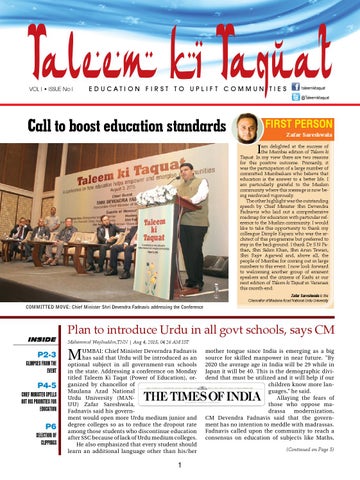
COMMITTED MOVE: Chief Minister Shri Devendra Fadnavis addressing the Conference
inside
P2-3 Glimpses from the event
P4-5 Chief Minister spells out his priorities for education
P6 Selection of clippings
Plan to introduce Urdu in all govt schools, says CM Mohammed Wajihuddin,TNN | Aug 4, 2015, 04.26 AM IST
M
UMBAI: Chief Minister Deverndra Fadnavis has said that Urdu will be introduced as an optional subject in all government-run schools in the state. Addressing a conference on Monday titled Taleem Ki Taqat (Power of Education), organized by chancellor of Maulana Azad National Urdu University (MANUU) Zafar Sareshwala, Fadnavis said his government would open more Urdu medium junior and degree colleges so as to reduce the dropout rate among those students who discontinue education after SSC because of lack of Urdu medium colleges. He also emphasized that every student should learn an additional language other than his/her
1
mother tongue since India is emerging as a big source for skilled manpower in near future. "By 2020 the average age in India will be 29 while in Japan it will be 40. This is the demographic dividend that must be utilized and it will help if our children know more languages," he said. Allaying the fears of those who oppose madrassa modernization, CM Devendra Fadnavis said that the government has no intention to meddle with madrassas. Fadnavis called upon the community to reach a consensus on education of subjects like Maths, (Continued on Page 5)
Glimpses from the Conference The hugely successful event was attended by a wide cross-section of Mumbai society including teachers, intellectuals, journalists, social workers, educationists and a large number of ordinary citizens. Apart from the Maharashtra Chief Minister, Shri Devendra Fadnavis, who was the Chief Guest at the programme, others on the dais included distinguished Bollywood writer Shri Salim Khan, Dr S N Pathan, former VC of Nagpur University, Shri Arun Tewari, Chairman, Union Bank of India and Shri Rajiv Agarwal, Member, SEBI.
2
Education Above All: Vignettes from the Conference which saw the participation of a wide section of Mumbai society
3
CM to chair ‘Taleem ki Taquat’ meet on education for Muslims in Mumbai Saturday, August 01, 2015 By A Staff Reporter
M
aharashtra’s Chief Minister Devendra Fadnavis will be the chief guest at 'Taleem ki Taquat' - a conference on how education can energise communities. This edition of the conference is with particular emphasis on the Muslim community and how to empower and accelerate the process of bringing the community into the mainstream through the use of the educational process. The conference is being held on August 3, 2015 in the city. Zafar Sareshwala, the Chancellor of
Maulana Azad National Urdu University is the persona behind this movement and he will be presiding over the conference. The conference will feature several eminent scholars including Guests of Honour Salim Khan, the distinguished Bollywood writer, Maulana Yusuf Naqvi, well-known Urdu scholar, Dr. S.N. Pathan, Vice Chancellor (Retd), Nagpur University, Arun Tewari, Chairman, Union Bank of India and Rajiv Aggarwal, Member, SEBI.
Urdu to be an optional subject in schools: CM Fadnavis Express News Service Mumbai: Aug 4, 2015, 0:36
T
he Maharashtra government will introduce Urdu as an optional language in schools to increase the intake of students from the minority community, Chief Minister Devendra Fadnavis said on Monday. A special degree college for minorities has also been approved by the state government and it will soon be established. Fadnavis made the announcement on Monday at an event organised by the Maulana Azad National Urdu University’s Vice Chancellor Zafar Sareshwala to discuss hurdles in empowering Muslim youth through education. The conference, titled ‘Taalim ki Tauqat’ (Power
Protestors should call for my return to Afghanistan, not Pak By Varun Singh |Posted 04-Aug-2015
S
alim Khan, father of actor Salman Khan, yesterday gave a message to detractors and protestors calling for his departure to Pakistan: “I hail from Afghanistan; those who protest outside my house shouldn’t tell me to go to Pakistan, they should say go to Af-
ghanistan. I have good relations there; I will go there,” said the screenwriter of Salim-Javed fame. Sa-
4
lim was speaking at an education event, ‘Taleem ki taquat’, which was also attended by Chief Minister Devendra Fadnavis. The event was organised for the Muslim community and sought to highlight the power of education. In that connection, Salim narrated how his
of Education), discussed the need to educate the Muslim population, specially women, to provide a boost to the economy and to ensure better employment opportunities. “Whenever I discuss about education in minorities, there will be one or two ministers opposing me saying that government should not interfere in religious matters,” Fadnavis said, adding that there is a “trust deficit” in government and policies will have to be formulated to finance education among minorities to improve existing conditions. “In madrasas, the focus should also be there on mathematics, science and other subjects. But ministers also need to understand that education needs to kept apart from politics,” he said. The government has also taken a decision to increase the annual income limit of scholarship to students belonging to the minority community from Rs 2.5 lakh to Rs 6 lakh. This was approved last week. Aiming to bridge the gap between the BJP government and minorities, Fadnavis said that the whole country is perceived as backward if even one caste or community is backward. “We are ready to finance schemes if ideas are brought to us,” he said.
Flashback
T
hough a wordsmith, noted Bollywood scriptwriter (and actor Salman Khan’s father) Salim Khan doesn’t talk much. When this one half of the Salim-Javed Jodi does talk, though, he holds the audience captive with his understated wit. The previous week at a seminar “Taleem ki Taqat (Power of Education)” organized by Maulana Azad National Urdu University chancellor Zafar Sareshwala and presided by chief minister Devendra Fadnavis, Khan spoke at length on his personal history. “A century ago, Latif Khan, a poor tongawala in Afghanistan, thought of leaving his homeland and getting his children educated. He joined the British cavalry and came to Indore but failed to get son Latif Khan educated. Latif Khan, though, educated
(Continued from Page 1)
forefathers had come to India from Afghanistan for a better education and life. “My greatgrandfather Anwar Khan wanted his family to lead a proper life and hence he came from Afghanistan. My father Rashid Khan was the third generation to be settled in India,” said Salim. At the same event, he also mentioned how he wanted to write more but had been unable to, due to recent circumstances, including his son’s ongoing trials.
Science and English so that the employability of the madrassa products could be increased. "Money will not be a problem. We have a budget of Rs 44000 crore for education in the state. I don't mind increase Rs 500 crore more for minorities' education provided we get concrete plans. Bring good plans for educational uplift of the minorities and we will allocate sufficient funds," he said. Congress city president Sanjay Nirupam dubbed the exercise a "nautanki" and said: "The government which scrapped Muslim reservation in jobs and education and which has stalled the minorities' scholarships initiated by the previous government doesn't inspire much trust when it
5
his son Majeed Khan. Majid Khan educated his son Rashid Khan who joined the police and retired as DIG. Rashid Khan’s son Salim Khan was a voracious reader and when he reached Bombay in 1958, he did not have much work and therefore had plenty of time to read. He read everything worth reading in a Mahim library. He flirted with acting, failed, and turned to writing. Khan claimed he changed the rules of the Hindi film industry, which did not take writers seriously and paid them peanuts. “A time came when producers paid me Rs.2 lakh more than the lead actor in a film. That was the victory I had dreamed of,” he said. “Now people ask me why don’t write. But where is the time, when I am busy fighting so many cases,” he said, making everyone laugh.
claims it is committed for the educational uplift of Muslims." Sareshwala said that the only purpose of this seminar was to start a dialogue between the community and the government as 'government belongs to all and confrontation and agitation will lead us nowhere while engagement will be mutually beneficial." Veteran Bollywood writer Salim Khan said that those who want to send him to Pakistan should change their tune as "my ancestors came from Afghanistan as they wanted to educate their children. Whatever I and my children are today it is because of Taleem ki Taqat," he said. Many in the audience felt that a committee should be formed to monitor the implementation of schemes aimed at minorities' development.
newspaper clippings
clippings from the net
Polytechnic for minorities, Urdu optional language soon, says CM Devendra Fadnavis Tuesday, 4 August 2015 - 7:45am IST | Agency: dna | From the print edition
C
hief minister Devendra Fadnavis on Monday announced a series of decisions the government will be coming out for the minority community in days to come. These include a polytechnic institute, Urdu as an optional language in schools and considering opening of a senior college in a Urdu medium school to arrest the dropout of students. Fadnavis was speaking at a conference 'Taleem ki Taquat'. The conference on education for Muslims was organised by Ahmedabad-based businessman Zafar Sareshwala in Mahalakshmi. Popular after his support for Modi, Sareshwala stated that the reason for having a conference was to "ensure that a beginning is made in the field of education. Once a person is a chief minister, he does not belong to any one community. There's no road map. We have just started and I do not know where it will head to, but Fadnavis joining is a good thing." Attended by over 300 people, the meeting had as speakers Dr SN Pathan, former vice-chancellor of Nagpur University, Arun Tewari, chairman and managing director of Union Bank of India, Rajiv Aggarwal, member SEBI and Salim Khan, a popular writer. "I also assure the gathering that if they come up with schemes, the government will surely consider them and money will not be a problem," said Fadnavis. He also spoke on issues pertaining to trust deficit and the reasons why the community was backward. Highlighting issues that his previous speaker had taken up on Madrasa education, Fadnavis said, "One of the speakers said that English, maths and science should be taught in Madrasas. But the same thing when I say, some two people stand up to say that there is politics in it and we are interfering in matters of religion. That should not happen and you should stop such leaders." Other issues, he said, were removing the trust deficit and government on its part taking steps. "In 21st century, India is the only country that can give human resource capital to the world. We are, hence, looking at skills. Learning a language besides one's mother tongue is good and if there is a scheme on skill development, we will support it," said Fadnavis. Lack of prominent institutions Other speakers rued the lack of prominent institutions. "Had Aligarh and Jamia not been there, the situation of the community would have been further backward," said Dr SN Pathan, former vice-chancellor of Nagpur University. He demanded that the government have a data collection of the skills and education of Muslims, career counselling for them in districts so that they study and take degrees from places like YB Chavan Centre that recognise Madrasa pass to some equivalent of modern education among others. "Over 150 years ago, my great grandfather decided to come to India because he thought he could educate the children. My father was a DIG and there was so much emphasis that we educate and read. That is how I became a writer," said Salim Khan. Other speakers encouraged the participants to enroll in Jan Dhan Yojana and other schemes that help the community become a part of banking, which helps the economy run.
7
Taleem ki Taquat A conference on how education helps empower and energise communities Chief Guest
Shri Devendra Fadnavis
Honourable Chief Minister of Maharashtra
August 3, 2015
The Mansion, Four Seasons Hotel, Mumbai
Guests of Honour Shri Salim Khan
Distinguished Bollywood Writer
Maulana Yusuf Nadvi
Well-known Urdu Scholar
Presided by
Shri Zafar Sareshwala, Chancellor Maulana Azad National Urdu University
Dr S N Pathan
Vice Chancellor (Retd) Nagpur University
Shri Arun Tewari
Entry strictly by invitation RSVP: Henna 9819168985 Priti 9833432174
Chairman, Union Bank of India
Shri Rajiv Aggarwal Member, SEBI
8