REAL ESTATE + LIFE + STYLE + ART + MUSIC + DINING
FEBRUARY 2022
THE FUTURE OF WARM SPRINGS PRESERVE BUILDING WITH HEMP THE WORLD OF ARTIST JANE WOOSTER SCOTT AN INSIDE LOOK AT THE SUN VALLEY STARSHIP
purveyors of beauty From large projects and new construction, to finding the perfect piece to complement your space, arcasa has a reputation for handling every detail by focusing on exceptional, consistent design, quality, and service.
110 lindsay circle, ketchum. idaho
208.928.6379
arsunvalley.com
OVER 150 CABINET HARDWARE AND APPLIANCE PULL OPTIONS 12 FINISH OPTIONS 180 N. Main St. Ketchum • Monday - Friday 8am to 5pm or by appointment. 208 726 2345 Exclusive regional distributor of rockymountainhardware.com | rmhshowrooms.com
Lily Debray, model and Theodore personal stylist. Follow Lily’s OOTD on
@lilydebray
HERNO OFF-WHITE PINKO WOOLRICH FRAUENSCHUH SKIWEAR KRU SKIWEAR AVANT TOI FALIERO SARTI VINCE SOLID AND STRIPES SAMANTHA SUNG CURRENT ELLIOT BRUNO MANETTI AMINA RUBINACCI BLUMARINE JAMES PERSE KRISTENSEN DU NORD BLUMARINE LORENZINI MAJESTIC CASMARI CP SHADES CLU THE GREAT CP SHADES TRANSIT GIORGIO BRATO 3X1 AG JEANS CORDERO
THE ORIGINAL INFLUENCERS
Private travel reimagined Journey between LA, Sun Valley and beyond. Aspen
Los Cabos
Jackson Hole
San Francisco Bay Area
Sun Valley
Los Angeles
Visit Aero.com and use code ‘SV10’ to get 10% off your first flight.
Unless otherwise advised: (1) All intra-EU flights are operated by Aero Guernsey Ltd (company number 62422) whose registered office is at Third Floor Cambridge House, Le Truchot St Peter, Port Guernsey GY1 1WD; (2) All flights either arriving or departing the United Kingdom are operated by Aero FlightOps UK Ltd (company number 13163672) whose registered office is at 16-18 Beak Street, London, W1F 9RD, United Kingdom; and (3) All flights within North America are operated by USAC Airways 695 LLC dba Aero Air. We will notify you as soon as possible if the air carrier operating your flight changes or is not one of the above companies. Aero Technologies Inc. acts as ticketing agent for Aero Guernsey Ltd. and Aero FlightOps UK Ltd., and, in the United States, as an indirect air carrier under US-DOT Part 380. All passengers are required to accept the applicable Operator Participant Agreement and/or Conditions of Carriage at the time of booking. © 2022 Aero Technologies, Inc.
elle rose
E L L E R O S E S V . C O M
Alaïa Alexander McQueen Balmain Bottega Veneta Dolce & Gabbana Gucci Jimmy Choo Loro Piana Manolo Blahnik The Row Valentino Versace & more
E L L E RO S E 6 4 1 S U N VA L L E Y RO A D, K E T C H U M , I D 8 3 3 4 0 , 2 0 8 . 7 2 6 . 8 8 7 1
DRY JANUARY
FLASK FEBRUARY
available in 30+ authentic skins
Featuring an exclusive collection of designs, hand-knit, crocheted, embroidered and loomed from the finest cashmere.
SOPHISTICATED & ECLECTIC CLOTHING, ACCESSORIES & JEWELRY FOR WOMEN 100 N. LEADVILLE • KETCHUM, IDAHO • 208.726.5160
511 Sun Valley Road | Ketchum 208.928.7884
D C
CONSIGN DESIGN Women’s Designer Apparel & Accessories On Consignment
331 First Ave. North Ketchum, ID 83340 208.727.9466 ConsignDesign1@me.com
Chanel | Prada | Gucci | Agnona | Chloe Loro Piana | Jil Sander | Etro | Dolce & Gabbana YSL | Celine | Bottega Veneta Christian Laboutin | Hermes Lanvin | Piazza Sempione Jimmy Choo | Bogner Christian Dior | Ferragamo Louis Vuitton MaxMara | Brunello Cucinelli
The very best in Consignment Shopping
: PEACE :
M O U N TA I N C O N T E M P O R A R Y H O M E F U R N I S H I N G S ACC E S SO R I E S & U N I Q U E G I F TS R E TA I L S T O R E F R O N T & I N T E R I O R D E S I G N
406 N MAIN ST
|
H A I L E Y, I D 8 3 3 3 3
|
208.788.9075
|
REDDOORDESIGNHOUSE.COM
SKI BIKE LIVE RETAIL | RENTALS | SERVICE
Rossignol Arc’teryx Blizzard Stio Völkl Elevenate Atomic Norrøna Black Crows Salomon The North Face Mammut Flylow Fischer Smith Dynafit POC Pomoca Sweet Leki Hestra Lange Skea Tecnica Icebreaker Full Tilt Amundsen Look Obermeyer Marker Swix Swany Barryvox Contour Scott Black Diamond Boot Doctor Intuition Sidas DFP stu r t e va n t s
-sv.co m
downtown ketchum
downtown hailey
bas e o f wa r m s p r i n g s
208.726.4501
208.788.7847
208.726.7547
limelight hotel, ketchum
208.726.0898
Soul In The Woods
380 N WASHINGTON AVE KETCHUM
208.928.6488 • bavariansoul.com
SOLD EXCLUSIVELY AT BAVARIAN SOUL
REMEMBER WHEN YOU GOT THAT NEW SUPER SMOKER BBQ GRILL? IT WILL MAKE HER FEEL KINDA LIKE THAT.
*Rhodochrosite Beaded Necklace and Bracelet with 18K Gold and Diamond Clasp
2 0 8 .7 2 6 . 5 2 76 511 S u n Va ll ey Ro a d Ke tc h u m , I d a h o 8 3 3 4 0 b a r r y p e t e r s o n .c o m
R O B C A R T E R | E M I LY K N O W L E S | Z A C K TAY L O R
RAISING THE BAR IN Fitness & performance in SUN VALLEY
A METHOD TO MATCH THE ATHLETIC CULTURE OF OUR COMMUNITY NOW OFFERING + Personal Training + Small Group Training + Metabolic Analysis and Performance Testing
@peakfitsv
PEAKFIT
141 N. Main Street Hailey, Idaho 83333
PeakFitSV.com
Sturtevants to come or is it?
photo credit: www.lynnvandokkum.com
Our projects are fully tailored to meet all clients’ needs, blending natural elements and unique textures to give them one of a kind bespoke interiors. Susan Witman, ASID
871 Warm Springs Rd | Ketchum | ID 83340 208.725.0606 bridgmanflorist.com
H O M E
F U R N I S H I N G S
F O R
I N D O O R
A N D
O U T D O O R
L I V I N G
Cooz y up this season 360 First Avenue North Ketchum, Idaho 208/622/0222 heather@openroomfurniture.com
Architecturally Authentic Lodging
Remote // Ranch // Custom Residential
www.pioneercabincompany.com 208.726.8347
Photo by SV Photo
SUPPORTING THE COMMUNITY SINCE 1992
Photo by Heidi Long Longviews Studio
www.conradbrothersconstruction.com 208.726.3830
351 Leadville Avenue | Ketchum ID 208.726.2363 | jensenstern.com
Photo by Sun Valley Photo
DESIGN ~ CABINETRY ~ NEW CONSTRUCTION ~ RENOVATION www.fivestarkitchenbath.com 208-726-4039
Protecting What Matters Most
Please don't forget to vote!
That’s why I’m proud to be here to help life go — and to support the community. If there’s anything you need, call me.
Life Insurance
831 N Main St Hailey, ID 83333 Bus : 208-928-7888 patrick@5binsurance.com
FLY SUN Photo: Carol Waller
Realtors for Air – Supporting Improved Air Service for the Community As someone long involved in Realtors For Air as well as the local restaurant business, supporting Fly Sun Valley Alliance’s mission is a perfect fit. Providing easy-as-possible access to SUN from multiple destinations adds to our vibrant business community and shared experiences in the valley. I am proud to partner with FSVA to support our vital and community enhancing air service. — Ellie Elllis, realtor, Coldwell Banker Distinctive Properties 100% of the Sun Valley Board of Realtors 350+ member businesses are supporting air service through the innovative SVBR Realtors for Air program.
air service news
WINTER FLIGHTS – NONSTOP TO 6 CITIES! MORE WINTER NONSTOP FLIGHTS! Alaska SEA 1-2x daily United DEN 1-2x daily United SFO and LAX daily United ORD daily holidays, Sat/Sun Jan/Feb, daily March Delta SLC 2-3x daily, LAX daily holidays
IMPROVED RELIABILITY ON ALL SUN FLIGHTS! New instrument approach technology = fewer diverted SUN flights in bad weather for ALL airlines (Alaska, Delta, United) *Busing service will still be available if needed
FLIGHT SCHEDULES AND INFORMATION AT www.flysunvalleyalliance.com
FLY SUN Nonstop to DEN • LAX • ORD • SEA • SFO • SLC ONE STOP TO THE WORLD
CONTENTS FEBRUARY | 2022
90
50
106
122
REAL ESTATE GALLERY Engel & Völkers . . . . . . . . . . . . . 50-63 Sun Valley Real Estate Christie’s . . . . . . . . . . . . . . . . . . . 64-69
FEATURES
Compass . . . . . . . . . . . . . . . . . . . 70-73
90 | Warm Springs Preserve
110 | Architectural Trends
Sun Valley Standard . . . . . . . . . . . 74-77
A community effort for a central park
Berkshire Hathaway . . . . . . . . . . . 78-81
96 | Sun Valley Film Festival
Allison Paige Interior Design’s new space in Bellevue
Keller Williams . . . . . . . . . . . . . . 82-84
A unique boutique film festival for all
My Sun Valley Home . . . . . . . . . . . . . 85 Berkshire Hathaway . . . . . . . . . . . . . 113
100 | Live Music
114 | Architectural Trends Style Dial must-haves
Wynton Marsalis is a living icon for jazz
122 | Fine Arts
106 | Architectural Trends
Artist Jane Wooster Scott on life and painting
Hempitecture building blocks
38
svpn-mag.com
TOP PHOTO BY KIMBERLY BARENBORG; MIDDLE PHOTO BY MATTIE MEAD
McLAUGHLIN &
A S S O C I A T E S
PO BOX 479_SUN VALLEY, ID 83353
A R C H I T E C T S , PH_208.726.9392
c h a r t e r e d
FAX_208.726.9423
A I A
www.mclaughlinarchitects.com
Th a n k Yo u A ga i n f o r Vo t i n g U s O n e o f Va l l ey ’s B e s t A rc h i t e c t s i n 2 0 1 1 , 2 0 1 2 , 2 0 1 3 , 2014, 2015, 2016, 2017, 2018, 2019, 2020 & 2021!
CONTENTS FEBRUARY | 2022
104
170
204
REAL ESTATE LISTINGS Coldwell Banker . . . . . . . . . . . . 170-176
158
Sotheby’s International Real Estate . . . . . . . . . . . . . . . . . . . . 177 Sun Valley Real Estate Christie’s . . . . . . . . . . . . . . . . . 178-182 Berkshire Hathaway . . . . . . . . . 183-187
104 | Stanley
154 | Wellness
Winterfest is outdoor fun in the snow
Family health services to open in Bellevue and cleanse with Glow
128 | Fine Arts Arts Etc is a go-to for February 2022
158 | Property News
Keller Williams . . . . . . . . . . . . 192-195
142 | Fine Arts
Experience the Starship in Bellevue
Windermere . . . . . . . . . . . . . . . 196-197
Now Showing is your Ketchum art gallery guide
204 | Dining Guide
Sun Valley Associates . . . . . . . 188-191
ReMax Sun Valley . . . . . . . . . . 198-199
40
svpn-mag.com
The official Sun Valley Resturant Association dining guide
MIDDLE CENTER PHOTO BY TORY TAGLIO PHOTOGRAPHY; MIDDLE RIGHT PHOTO BY PAULETTE PHLIPOT
Monster Protection Mode Lock doors. Adjust lights. Arm home security. Enjoy story time. Protect. Monitor. Control. Call 844-347-2219 or visit cox.com/homelife Cox Homelife is available to residential customers in select Cox service areas. A high-speed Internet connection is required. Cox Homelife Security service plan required for professional monitoring services for intrusion, smoke/fire and related system components. Applicable monthly service charges, installation, additional equipment, taxes, trip charges and other fees may apply. Subject to credit approval. Other restrictions may apply. Local ordinances may require an alarm user permit or external lock box. Cox Homelife Service provided by Cox Advanced Services: Arizona, LLC – Alarm Lic. #18141–0 & ROC Lic. #310876; Arkansas, LLC – Lic. #E 2014 0026 & #CMPY.0002278; California, LLC – Alarm Lic. #7196 & Contractor’s Lic. #992992; Connecticut, LLC – N/A; Florida, LLC – Lic. #EF20001232; Georgia, LLC – License: Bryan David Melancon #LVU406595; Idaho, LLC – Lic. #024933; Iowa, LLC – Lic. #C121646 & #AC268; Louisiana, LLC – Lic. #F 2006; Nebraska, LLC – Lic. #26512; Nevada, LLC dba Cox Homelife – Lic. #78331; Ohio, LLC – Lic. #53–18–1671; Oklahoma, LLC – Lic. #2002; Rhode Island, LLC – Lic. #9314; Kansas, LLC – Topeka Lic. #109 & Wichita Lic. #2015–36492; Virginia, LLC – DCJS Lic. #11–7776 & DPOR Lic. # 2705164725 ©2022 Cox Communications, Inc. All rights reserved. MAG107433–0110
EDITOR’S WELCOME
SVPN Magazine’s Fine Arts section is overflowing with gallery exhibitions in Now Showing and also with a hefty list of art-related happenings and events in Arts Etc. There’s live music, film screenings, readings, classes, pottery, and more. In addition, read about artist Jane Wooster Scott, who is known the world over but loves Sun Valley the most.
SUN VALLEY MID-WINTER Well, to say we’re going backward in 2022 might be a stretch. Sure, there’s a hesitancy about getting together and holding in-person gatherings, and virtual life has more traction again, but we must stay well and mindful, take care of our community and one another, and be positive. With some snow to play in, February can be an amazing winter outdoor experience, especially in the sun on Baldy and Dollar Mountains or sledding on Penny Hill. The Wood River Valley trails, Nordic skiing, pond hockey, ice skating, snowshoeing, and a host of winter backcountry adventures are aplenty. There are also some excellent virtual and inperson happenings at your favorite cultural valley entity. So, read on because we got this! With that in mind, SVPN Magazine decided to provide some extended stories with loads of images to help keep life moving forward and, of course, interesting. So, in this issue, we dive deep into our understanding of the Warm Springs Preserve and its meaning to the community and future generations. It’s a significant addition to Ketchum, when and if it happens, due to the generosity of many. For a visual feast, we upped our Architecture Trends section with new Style Dial must-haves, a look at Allison Paige Interior Design’s new space in Bellevue, and Ketchum-based hemp building product company, Hempitecture. It’s a great inspiration for design, form, and function. 42
svpn-mag.com
As a media sponsor for the Sun Valley Film Festival, March 30-April 3, 2022, SVPN looked at what we love about our hometown film festival and how this artistic endeavor is essential to what we see, and want to know, especially for Sun Valley audiences. For SVPN Wellness, there’s great news. St. Luke’s Family Health Services is opening a health clinic with pharmacy services in Bellevue to serve the uninsured and underinsured in Blaine County. Learn how a $1 million grant from the St. Luke’s Wood River Foundation made this much-needed facility a reality. And Dr. Molly Brown presents the 411 on a health reset with a Glow cleanse. It’s Sun Valley-proven. Up north, Stanley has it going on with Winterfest, snowmobiles, and celebrations. It’s just plain-old winter fun, which includes a few men in drag, racing across the snow in snowshoes in very cold temperatures. And for Property News, we have a look at the Starship home in Bellevue that’s on the market. Feast your eyes on what’s behind those unique doors. In addition, SVPN’s Fine Dining guide featuring the Sun Valley Restaurant Association establishments has you covered for where to eat once you have been out and about burning up calories. In healthy spirit and happiness, enjoy your February in Sun Valley.
Sabina Dana Plasse
PHOTO BY PAULETTE PHLIPOT
SEQUESTER IN
STYLE
JENNIFER HOEY INTERIOR DESIGN Jennifer Hoey Smith, ASID
300 North Main Street, Ketchum, ID jenniferhoey.com 208.726.1561 NCIDQ #21519
MAGAZINE STAFF
44
svpn-mag.com
SABINA DANA PLASSE Editor
RANDI KARABIN Art Director
GILLIAN DUNDAS Graphic Designer
Writer, publicist, and avid traveler, Sabina Dana Plasse has spent over 20 years at the keyboard crafting stories as a contributor writer or editor. When not writing, she’s watching movies, conjuring up ideas, or enjoying hikes, bikes, and walks in the mountains and at the beach.
Randi Karabin is a tenured, award-winning creative director and designer. She specializes in creating and re-imagining publications, print collateral, branding packages, and more, all predominently within the luxury, travel, hospitality, and music industries. Randi’s extensive travels inspire her creativity and vision.
Gillian studied graphic and fine art at the Norwich University of Arts in England. She has worked in design with several publications, notably Village Voice Media in Phoenix, for which she won several awards. She moved to Idaho in 2013.
JAN SUPER CFO
SUSAN KNIGHT Graphic Designer
JENNY BLOMQUIST Designer, Real Estate
Jan Super is an expert bookkeeper with more than 12 years of experience. She has provided full bookkeeping services for many clients in the Wood River Valley. She has spent many years volunteering for the Hailey and Ketchum/Sun Valley Chambers of Commerce. Jan has lived in the Wood River Valley for more than 20 years and enjoys gardening, fishing, and many of the other outdoor activities the Valley provides.
Susan is an award-winning art director and designer with her true passion being magazine design. From art directing and styling photo shoots to problem-solving layouts, her design abilities shine. In addition to her day-to-day work projects, she has taught art classes, designed studio spaces, and enjoys creative projects with her family.
Jenny came to SVPN with extensive experience in advertising and design in the real estate world, specifically at Sun Valley Real Estate in Hailey. After moving to several states over her years as a firefighter, she settled down in Idaho, where she lives with her son and can be found playing softball and singing with her band.
MAGAZINE CONTRIBUTORS
is an IACP award-winning professional photographer. Her fascination with food has provided endless opportunities for her photography to appear in cookbooks, magazines, and advertising campaigns worldwide. She is the cocreator and photographer of the coffee table cookbook Ripe: A Fresh, Colorful Approach to Fruits and Vegetables. When not behind the camera, she is recreating nourishing meals for her family.
A Sun Valley native, STEVE DONDERO is passionate about photography and addicted to travel. He’d love to be on constant safari, chasing animals or sunsets where passports are required. Having left the corporate world, he’s now living his dream as a professional nature, portrait, and commercial photographer, with a studio in Ketchum and a gallery in Minneapolis. You can see a small sampling of his work, including over 30 SVPN covers at stevedondero.com.
DANIELLE VIGUERIA
LORI WILLIAMS is a
recently traded her beach life in coastal Virginia for the mountains of Sun Valley. She has been a shape-shifting marketer and writer for more than 14 years—building brands and messaging for leading organizations in the healthcare, broadcast software, and defense industries. When she isn’t creating content, she relaxes by hanging out with her family, reading lots of YA fiction, and watching the deer wander in her backyard.
freelance writer, copy editor, former home-educator, and native Idahoan who’s lived in Ketchum for 35 years. Also a poet, she records family histories and stories writing in rhyme, and is a self-published children’s book author. When not road-tripping with her husband, she manages a handful of private Valley properties, hikes and bikes, journals, and drinks a ton of green tea.
PAULETTE PHLIPOT
46
svpn-mag.com
HALSEY PIERCE is a photographer who has worked in LA and NYC but whose roots remain firmly planted in Idaho. Her work has been featured in many publications including The Hype Magazine Network and Town & Country. Halsey is an animal lover and activist, adventure enthusiast, and wannabe farmer.
SUN VALLEY PROPERTY NEWS EDITOR
Sabina Dana Plasse dana@sunvalleypropertynews.com ART DIRECTOR
Randi Karabin randi@sunvalleypropertynews.com REAL ESTATE + LIFE + STYLE + ART + MUSIC + DINING
FEBRUARY 2022
COPY EDITOR THE FUTURE OF WARM SPRINGS PRESERVE BUILDING WITH HEMP THE WORLD OF ARTIST JANE WOOSTER SCOTT AN INSIDE LOOK AT THE SUN VALLEY STARSHIP
Carrie Lightner clightner@arrowleafediting.com PRODUCTION & DESIGN
Gillian Dundas gill@sunvalleypropertynews.com Jennifer Blomquist design@sunvalleypropertynews.com
PUBLISHER
Justin Williams 208.720.2142 justin@sunvalleypropertynews.com SALES EXECUTIVE
Kendall Cooper 208.720.0085 kendall@sunvalleypropertynews.com CFO
Jan Super jan@sunvalleypropertynews.com
On the Cover Sisters Tessa and Josie celebrate winter by taking flight on their favorite sled run. Cover photo by Steve Dondero
Sun Valley Property News is published by BRITSA LLC 1005A Warm Springs Road, Ketchum, ID 83340. 208.928.7797 Editorial, administrative, advertising, and production offices are located at 1005A Warm Springs Rd. in Ketchum, Idaho 83340. Telephone 208.928.7797. Copyright © 2013 BRITSA LLC. All rights reserved. The opinions expressed by the authors and contributors to Sun Valley Property News are not necessarily those of the editor and publisher. Postmaster, please send address changes to: SVPN 1005A Warm Springs Rd, Ketchum, ID 83340 or SVPN PO Box 8009, Ketchum, ID 83340.
PRINTED BY
48
svpn-mag.com
ORDER NOW FOR SUMMER 2022!
CREATE YOUR PLACE IN THE SHADE.
awning s | shades | furniture | draper y | design ser vices
LOCATED IN THE STUHLBERG BUILDING 511 EAST AVENUE, KETCHUM 208.726.9592
Sold exclusively in Sun Valley at Covered.
E N G E L & V Ö L K E R S A M E R I C A S : TA K I N G A C L O S E R L O O K As we continue to grow through 2022, our headquarters in New York has put together a video showcasing some of our highlights of 2021, which include $640.33 million in GCI, $26.5+ billion in closing volume - 61% growth year over year, 8 billion media impressions, and over $240,000 raised for Special Olympics. Engel & Volkers By the Numbers
Scan Here to Watch the Year in Review Video.
15,418 Members Globally | 1,011 Shops Globally | 5,578 American Advisors | 261 American Shops
Engel & Völkers Sun Valley • 291 First Avenue North • Ketchum, Idaho 83340 • +1 208-928-7223 sunvalley.evrealestate.com
/evsunvalley
©2021- 2022 Engel & Völkers. All rights reserved. Each brokerage independently owned and operated. Engel & Völkers and its independent License Partners are Equal Opportunity Employers and fully support the principles of the Fair Housing Act.
Live your luxury.
M A K E L U X U R Y P E R S O N A L LY Y O U R S I N S U N V A L L E Y It takes desire and ambition to forge a new path. There is a pioneering spirit that fuels us; it’s at the heart of what makes life so special here. It’s in the beauty of the pines, rivers and the lakes with mountain views, but it’s also something deeply authentic in the air. The drive to discover and explore is key to our sense of home. That’s why we at Engel & Völkers want to join your dream home expedition. Whether you are a longtime local, or you are relocating here with a pole and a dream, our commitment to our clients remains the same in Sun Valley and around the world: delivering a bespoke real estate experience tailored to you.
Engel & Völkers Sun Valley • 291 First Avenue North • Ketchum, Idaho 83340 • +1 208-928-7223 sunvalley.evrealestate.com
/evsunvalley
©2021- 2022 Engel & Völkers. All rights reserved. Each brokerage independently owned and operated. Engel & Völkers and its independent License Partners are Equal Opportunity Employers and fully support the principles of the Fair Housing Act.
G U I D I N G T H E W AY F R O M C O N C E P T T O C L O S I N G A PREMIER DEVELOPMENT PROJECT REQUIRES EXTERTISE YOU CAN TRUST Knowing the road ahead, creatively reacting to obstacles, and ultimately building something that is an asset to our
community is our commitment. Across the globe, our team of real estate advisors and development specialists have ingrained themselves in their communities to provide unparalleled insight and expertise to investors, buyers, and sellers. We pride ourselves on being the very best in Development Services.
Reid Sanborn Engel & Völkers Sun Valley +1 208-720-8244 reid.sanborn@evrealestate.com www.reidsanborn.evrealestate.com DRE# DB42683 / reidsanborn Engel & Völkers Sun Valley • 291 First Avenue North • Ketchum, Idaho 83340
©2021 Engel & Völkers. All rights reserved. Each brokerage independently owned and operated. Engel & Völkers and its independent License Partners are Equal Opportunity Employers and fully support the principles of the Fair Housing Act.
PE
N
D
IN
G
PE
6240 N Rapid Creek Road Listed at $ 2,590,000
N
D
IN
G
1520 Warm Springs Road Listed at $ 2,950,000
YO U R M O U N TA I N T O W N E X P E R T Y O U R R E A L E S TAT E & R E C R E AT I O N R E S O U R C E As the Designated Broker and Partner at Engel & Völkers Sun Valley, Reid Sanborn uses his leadership experience, market knowledge, and unrelenting work ethic to deliver a premium level of service to his clients. Representing his clients in over $40,000,000 in individual sold volume for 2021, Reid brings his mountain town expertise and experience to every transaction. Reid is a Planning and Zoning Commissioner for the City of Sun Valley, former Sun Valley Board of Realtors President, and recently completed his multi-family Ketchum Development Project, The Lofts @660 as part of Engel & Völkers Development Services. Reid enjoys skiing, biking, hiking, and playing in the outdoors with his family, while consistently exceeding the goals of his clients through passion for service and the ability to bring people together.
Reid Sanborn Engel & Völkers Sun Valley +1 208-720-8244 reid.sanborn@evrealestate.com www.reidsanborn.evrealestate.com DRE# DB42683 / reidsanborn Engel & Völkers Sun Valley • 291 First Avenue North • Ketchum, Idaho 83340 ©2021 Engel & Völkers. All rights reserved. Each brokerage independently owned and operated. Engel & Völkers and its independent License Partners are Equal Opportunity Employers and fully support the principles of the Fair Housing Act.
S U N VA L L E Y L E G A C Y E S TAT E C O M P O U N D 1 3 4 3 7 & 1 3 4 3 9 S TAT E H W Y 7 5 | O F F E R E D AT $ 1 5 , 9 9 5 , 0 0 0 Set on a manicured property just minutes north of Ketchum, with private ponds and stunning mountain vistas, this bespoke
family compound is the perfect mountain escape. The expansive property holds the Modern Craftsman Main Residence, a completely refinished historical Guest Cabin (once used as a Marilyn Monroe film set), and a newly completed Party Barn - all with stunning views of Bald Mountain, the Smokey, and Boulder Mountain ranges.
Main Residence 6,152 SF Livable | 984 SF Garage 5 Bedroom + Den | 5.5 Bath Extensive Decks on 3 Sides
Guest Cabin 2,082 SF Livable | Outdoor Sitting Areas 2 Bedroom, 2.5 Bath Firepits, Pond, and Water Feature
Party Barn 1,200 SF Livable | 1,980 SF Garage 1 Bedroom, 1.5 Bath Deck and Silo Perch with Mountain Views
Jones • Grover Team Engel & Völkers Sun Valley Travis: +1 208 721 8579 Svea: +1 208-720-0377 jonesgroverteam@evrealestate.com www.jonesgroverteam.evrealestate.com
Engel & Völkers Sun Valley • 291 First Avenue North • Ketchum, Idaho 83340 ©2021- 2022 Engel & Völkers. All rights reserved. Each brokerage independently owned and operated. Engel & Völkers and its independent License Partners are Equal Opportunity Employers and fully support the principles of the Fair Housing Act.
N E W M O U N TA I N M O D E R N H O M E S I N DESIR ABLE WEST KETCHUM PRICED FROM $4,350,000 | PROJECTED COMPLETION APRIL 2023 The Westcliff Residences are currently under construction in West Ketchum. These four free-standing townhomes set
the bar for in-town luxury, privacy, and convenience. Each 3-level residence features 3+ bedrooms, 4.5 bathrooms, oversized garage, a top-floor bonus room, large outdoor spaces including a spectacular rooftop deck and world
class views of Baldy’s famous West Cliffs. A large indoor live tree in each residence brings the outdoors into the home, and also offers space for an optional elevator.
3+ Bed | 4.5 Bath | 2 Car Garage | 3,115 Sqft | Unit 1 MLS# 21-328593 | Unit 2 MLS# 21-328594 Jones • Grover Team Engel & Völkers Sun Valley Travis: +1 208 721 8579 Svea: +1 208-720-0377 jonesgroverteam@evrealestate.com www.jonesgroverteam.evrealestate.com
Engel & Völkers Sun Valley • 291 First Avenue North • Ketchum, Idaho 83340 ©2021- 2022 Engel & Völkers. All rights reserved. Each brokerage independently owned and operated. Engel & Völkers and its independent License Partners are Equal Opportunity Employers and fully support the principles of the Fair Housing Act.
MEET THE
E N G E L & V Ö L K E R S S U N VA L L E Y
MURPHY BL AKE GROUP
M B G MURPHY BLAKE GROUP
©2021- 2022 Engel & Völkers. All rights reserved. Each brokerage independently owned and operated. Engel & Völkers and its independent License Partners are Equal Opportunity Employers and fully support the principles of the Fair Housing Act.
B R E AT H TA K I N G H O M E O N T H E B I G W O O D 130 S GOLDEN EAGLE DRIVE - BLAINE COUNTY IDAHO This expansive home has it all with over 11,000 square feet of living space in a flowing open floor plan. The
beautiful estate offers great space for entertaining in the gourmet kitchen which features all new appliances.
There are exquisite finishes with no details left out. The completely finished basement creates the opportunity for additional bedrooms. Plus.. World Class fishing out your back door!
4 Bed | 5.5 Bath | 3 Car Garage | 11,244 Sqft | MLS# 21-327773 | Offered at $8,495,000 Learn More at murphyblakegroup.evrealestate.com
Mike Murphy & Jessica Blake Engel & Völkers Sun Valley Mike: +1 208-720-3323 Jessica: +1 208-720-7566 murphyblakegroup@evrealestate.com www.murphyblakegroup.evrealestate.com Engel & Völkers Sun Valley • 291 First Avenue North • Ketchum, Idaho 83340 ©2021 Engel & Völkers. All rights reserved. Each brokerage independently owned and operated. Engel & Völkers and its independent License Partners are Equal Opportunity Employers and fully support the principles of the Fair Housing Act.
TR AC K RECORD OF PROVEN SUCCESS OUR SUCCESS IS YOUR SUCCESS From condos to large ranch and estate properties, the Murphy Blake Group’s proven success is in its numbers. Ranked in the
LD SO
LD SO
SO
LD
top 20 for the Valley’s top sales, Mike’s and Jessica’s property sales reach beyond $300 million.
Represented the Seller
Represented the Seller
Represented the Seller
4 Bed | 4.5 Bath | 4,111 Sq Ft
4 Bed | 4.5 Bath | 5,157 Sq Ft
5 Bed | 6.5 Bath | 7,832 Sq Ft
SOLD - Listed at $2,495,000
SOLD - Listed at $3,900,000
SOLD - Listed at $4,695,000
SO
SO
SO
LD
1 0 5 T H U N D E R ROA D , BL AINE COUNTY
LD
6 1 0 1 S T AV E N U E N , KETCHUM
LD
2 4 2 E L K H O R N ROA D , S U N VA L L E Y
123 IRENE, KETCHUM
201 PROSPECTOR, S U N VA L L E Y
1 STREAMSIDE, HAILEY
Represented the Seller
Represented the Buyer
Represented the Seller
4 Bed | 3.5 Bath | 3,876 Sq Ft
1.02 Acre Vacant Lot
5 Bed | 5.5 Bath | 4,296 Sq Ft
SOLD - Listed at $1,875,000
SOLD - Listed at $3,500,000
SOLD - Listed at $2,025,000
Mike Murphy Engel & Völkers Sun Valley +1 208-720-3323 mike.murphy@evrealestate.com www.murphyblakegroup.evrealestate.com
Engel & Völkers Sun Valley • 291 First Avenue North • Ketchum, Idaho 83340 ©2021 Engel & Völkers. All rights reserved. Each brokerage independently owned and operated. Engel & Völkers and its independent License Partners are Equal Opportunity Employers and fully support the principles of the Fair Housing Act.
OVER FIVE DEC ADES OF EXPERIENCE “Recently, we bought and sold houses in Sun Valley with the expertise of Mike and Jessica, and we can honestly say that we are delighted with both transactions. Mike and Jessica went far beyond our expectations to make our process as near-perfect as possible. We continue to recommend them to our family and friends. They genuinely demonstrate team
LD SO
LD SO
SO
LD
success.“ - Vicki Serles & Cliff Hersman
Represented the Seller
Represented the Seller
Represented the Buyer
5 Bed | 8 Bath | 7,452 Sq Ft
4 Bed | 4.5 Bath | 5,157 Sq Ft
4 Bed | 4.5 Bath | 6,146 Sq Ft
SOLD - Listed at $4,875,000
SOLD - Listed at $3,900,000
SOLD - Listed at $6,750,000
SO
SO
SO
LD
111 L AKE MEADOW, S U N VA L L E Y
LD
100 FIRST PH, KETCHUM
LD
22 CLIFFSIDE, KETCHUM
3 4 0 L L O Y D C O U R T, KETCHUM
431/451 NORTHWOOD, KETCHUM
5 0 8 C A N YO N , KETCHUM
Represented the Seller
Represented the Seller
Represented the Buyer
3 Bed | 3.5 Bath | 3,841 Sq Ft
7 Bed | 7.5 Bath | 7,110 Sq Ft
7 Bed | 11 Bath | 12,173 Sq Ft
SOLD - Listed at $2,995,000
SOLD - Listed at $8,750,000
SOLD - Listed at $9,950,000
Jessica Blake Engel & Völkers Sun Valley +1 208-720-7566 jessica.blake@evrealestate.com www.murphyblakegroup.evrealestate.com
Engel & Völkers Sun Valley • 291 First Avenue North • Ketchum, Idaho 83340 ©2021 Engel & Völkers. All rights reserved. Each brokerage independently owned and operated. Engel & Völkers and its independent License Partners are Equal Opportunity Employers and fully support the principles of the Fair Housing Act.
86 Prospect Avenue, Sausalito, CA 3 Bed | 4.5 Bath | 2,707 Sqft Pending at $4,200,000 Represented the Seller
225 Tamalpais Avenue, Mill Valley, CA Represented the Buyer Sold at $3,475,000 Represented the Buyer
A S T R O N G C L O S E T O 2 0 2 1 I N T H E B AY A R E A WISHING YOU ALL PROSPERITY AS WE MOVE THROUGH 2022 The end of the year is notoriously slow for real estate, but by working closely with my clients to seize the opportunity presented by Marin’s remarkably hot market, I was able to get 6 properties into escrow in December. 2021 has been a successful year, and I couldn’t be more greatful for the opportunity to serve my clients. Looking forward, Marin’s market is expected to remain
strong, with spring historically yielding the highest-prices and quickest home sales year-over-year. If you’re looking to make
the transistion between California and Idaho, I have the knowledge and connections in both regions to make the process easy whether you are buying or selling.
Ken Dara • Engel & Völkers Marin Co. +1 415 425-3626 ken.dara@evrealestate.com www.ken.dara.evrealestate.com DRE# 01331869 / coffeewithkendara Catch Ken online for local info on local real estate and more.
Engel & Völkers Marin County • 539 Bridgeway • Sausalito, California 94965 ©2021- 2022 Engel & Völkers. All rights reserved. Each brokerage independently owned and operated. Engel & Völkers and its independent License Partners are Equal Opportunity Employers and fully support the principles of the Fair Housing Act.
27 Redding Court, Tiburon, CA 3 Bed | 2.5 Bath | 2,412 Sqft Listed at $2,600,000 Closed at $2,550,00 Represented the Seller
71 Via Los Altos, Tiburon, CA 4 Bed | 3.5 Bath | 4,384 Sqft Pending at $4,300,000 Represented the Seller LOOKING FOR A MOVE IN 2022? IT’S NEVER TOO EARLY TO START PREPARING If you are looking to sell in the Bay Area, now is the time to start getting your home ready to go on the market. Spring historically sees the highest movement of inventory and with that we see schedules fill up quickly for inspectors, stagers, and contractors.
• Staged homes can sell 6% to 10% faster and see an increased profit vs non-staged homes 1 • If interest rates rise, demand for homes could be affected in the second half of 2022 2 • Give yourself time to clean, declutter, or remodel your home before photos and showings • Homes with professional photoagraphy get 61% more views and sell faster than those without 3
Whether you are looking at selling your home or buying, I am here to assist with resources in both the Bay Area and Idaho.
“In the industry who you work with absolutely matters. Lucky for our family we worked with the best to find our dream home - thank you Ken and Jen for over delivering and making it happen!” Robert Reedy - Founder | CEO - ECHOS Communications Engel & Völkers Marin County • 539 Bridgeway • Sausalito, California 94965 ©2021- 2022 Engel & Völkers. All rights reserved. 1. https://www.homelight.com/blog/home-staging-statistics/ 2.https://www.sfgate.com/realestate/article/Experts-predict-bayarea-housing-market-2022-16732134.php 3.https://photographyforrealestate.net/statistics-on-realtors-usage-of-real-estate-photography/
Imagine Your New Normal AT R I V E R R A N C H , M C C A L L Create your custom, private retreat in this idyllic 4-season mountain-lake resort community in the rugged West Central Mountains of Idaho along the Payette River.
ONLY A FEW PREMIUM RIVER FRONT LOTS REMAIN.
Call us to Secure Your Limited Release River Front Lot! River Lot 60
Learn about what makes River Ranch the most authentic community in McCall, Idaho.
McCall
River Lot 63 - Pending
River Lot 64
Call us at
+1 208-634-4686 or visit riverranchmccall.com /riverranchmccall
©2021 Engel & Völkers, Sadie Noah Real Estate Group. All rights reserved. Each brokerage independently owned and operated. Engel & Völkers and its independent License Partners are Equal Opportunity Employers and fully support the principals of the Fair Housing Act. All information provided is deemed reliable but is not guaranteed and should be independently verified.
OFFERED AT
$2,950,000 MLS 22-329023
The Mint Building – Hailey, ID The iconic, and recently renovated, Mint building is comprised of 3 levels with two full
bars, outdoor space, full commercial kitchen with ample cold storage, and must-see finished basement for private parties. Liquor License & adjacent lot/courtyard to North included in sale. Can reopen as a restaurant/bar with a 2nd floor nightclub, or could be repositioned as a mixed-use restaurant with a new 2nd floor commercial use (office, design/ performing arts studio). Over 15,000 Sq. Ft. of opportunity. Call us for more information!
Paul Kenny
Associate Broker | CCIM 208.726.1918 ext. 1 paul@kenny-bogue.com
Matt Bogue
Broker | CCIM 208.726.1918 ext. 2 matt@kenny-bogue.com
Matt Gelso
Associate 208.726.1918 ext. 3 mgelso@kenny-bogue.com
www.kenny-bogue.com
svpn-mag.com
63
SUMMER BALDWIN BAUER Associate Broker
208.720.2071
summersunvalley.com LOCAL • EXPERIENCED • PROVEN Summer is proud to be recognized as a 2021 Christie’s International Real Estate Luxury Specialist! Let Summer’s 20+ years experience and 5th generation local insight be your guide to the Sun Valley lifestyle.
A Perfect Shangri-la A magical experience of indoor/outdoor living that cannot be recreated. Artisan built stone and glass mountain luxury home on over 16 acres, with 400+ feet of spring fed Clear Creek bisecting the parcel. Situated up a private drive at the foot of Bald Mountain this location provides unparalleled privacy yet is 5 minutes to town. Dramatic custom design includes: wall size pocket doors, gourmet kitchen, plaster walls, antique french terra cotta and stone floors, multiple fireplaces, beach entry heated pool, private bridge over warm water creek. Multiple separate terraces each with it’s own unique mountain, garden, and/or creek views. $5,485,000 Seller is licensed Realtor in Idaho. 64
svpn-mag.com
2
SO
LD
HISTORIC WOOLLEY RANCH RARE OPPORTUNITY
EXCEPTIONAL LOCATION
Considering buying or selling a property in The Stanley Basin? Consider using Stuart Hoag. Woolley Ranch In Lower Stanley $6,500,000 SO
LOWER STANLEY | This scenic 498-a ranch sits on the banks of the Salmon Ri with majestic views of the Sawtooth Mount Range known as the Idaho Alps.This prem ranch has been family-owned since 19 by one of the oldest pioneering names the Sawtooth Valley. With abundant wild several hundred feet of river frontage, a recreation opportunities to fit everyon wish list, this is your opportunity to call t ranch home.
LD
$8,500,000
MLS# 19-325611
STUART HOAG | 208.720.3111 stuart.hoag@sunvalleysir.com www.sunvalleysir.com
Goat Creek Way In Iron Creek $1,095,000 STUART HOAG 208.720.3111 stuart@stuarthoag.com 300 N. Main Street, Ketchum svpn-mag.com
65
Your Mountain Home Awaits Timeless, contemporary townhomes in the heart of Sun Valley Clean lines, open floor plans, and the warmth of timber and stone blend together to create the home of your dreams.
43 TOWNHOMES FEATURING • Unit sizes from 1,750 - 3,750 sqft • Open floor plans • Large private terraces • Attached private garage
Including an interactive community map, pricing information, and more...
PHASE 1 COMING SOON
SUNSHINE-SUNVALLEY.COM
• Gas fireplaces
66
svpn-mag.com
Explore Sunshine
PUT DOWN ROOTS & GROW
A Whole Community Outside Your Door Quigley Farm is a neighborhood development dedicated to building a thriving community. PHASE ONE SOLD OUT. PHASE TWO COMING SOON.
For more information, please contact Eeva Turzian eeva@eevaturzian.com | 208.720.6906
QUIGLEY-FARM.COM svpn-mag.com
67
Kat Cannell Photography SO
68
LD
svpn-mag.com
SO
LD
SO
LD
SO
LD
Sun Valley, A Great Place to Wake UP!
SO
LD
"Please contact me to discuss your real estate objectives for 2022. I have a strong track record with buyers and sellers including off market opportunities." Alex Hughes 208-720-7444 Sun Valley Real Estate LLC, 300 N Main Street Christie's International Real Estate alexsunvalley.com; alexsunvalley@gmail.com svpn-mag.com
69
BL A K E N E LSO N blake.nelson@compass.com M E L I SSA TI N DALL melissa.tindall@compass.com
WELCO ME TO THE S UN VALLE Y STARSHIP ! 30 Cheval Circle, Bellevue, ID A one of a kind architectural masterpiece located in the heart of the world-class ski and equestrian country in the Wood River Valley. A custom-built enclave spanning over 12,000 square feet with 5 bedrooms, 5 bathrooms, and ample space for entertaining inside and out. A true Sun Valley area gem. 5 BEDS | 5 BATHS | 12,550 SQ FT | OFFERED AT $5,950,000 LE ARN M ORE AT SUNVAL L E YSTARSH IP.COM
Compass is a licensed real estate broker and abides by Equal Housing Opportunity laws. All material presented herein is intended for informational purposes only. Information is compiled from sources deemed reliable but is subject to errors, omissions, changes in price, condition, sale, or withdrawal without notice. Photos may be virtually staged or digitally enhanced and may not reflect actual property conditions.
A
BUSTERBACK RANCH $11,995,000 www.busterbackranch.com
CENTURY IN THE
MAKING
WORLD-CLASS, UNIQUE HORSE RANCH PROPERTY. A private, magnificent, 80-acre property where relaxed luxury and sophistication meet Western sensibility. Located in the Stanley Basin, just 40 minutes from world-famous Sun Valley, the ranch includes a stunning 5,700 square foot main house, three Ralph Lauren-inspired guest cabins, a three bedroom manager’s house, a barn, and numerous outbuildings. With the splendor of the Sawtooth Mountain Range and its magnificent sunrises and sunsets, abundant wildlife, and expansive, star-filled night outside your front door, there is no better place to hang your hat and call home. Please contact Linda Badell with Badell | Jones Real Estate Services at
Badell Jones Real Estate Services Linda Badell 208.720.6040
Lauren Jones 512.534.6571
linda@lindabadell.com or 208.720.6040.
Linda c. 208.720.6040 72
svpn-mag.com
Lauren c. 512.534.6571
130 S. Golden Eagle Dr. Mid Valley $8,495,000
Perfectly situated on 2.77 acres of exquisite river front property, this home sits amongst the finest estates in the Sun Valley Area. Arriving in the circular driveway, one is immediately drawn in by the compelling contemporary architecture and delighted by the feeling of quiet and privacy. Walking into the expansive living area, floor to ceiling windows look onto an expansive view of the Big Wood River. The backyard is on the river and faces east for enjoyable evening entertainment; it is rare that a riverfront home faces east, even though it is the most preferable direction. The chef’s kitchen, well appointed with top of the line appliances, opens to the breakfast nook and a cozy media area. A spacious master bedroom, reading room, office, and three other bedrooms complete the main floor. The lower floor has ample space to fulfill all of your own imaginations and to create your perfect oasis. Co-listed with the Murphy Blake Group at Engel & Volkers. Lauren Jones Linda Badell 512.534.6571 208.720.6040 Badell | Jones Real Estate Services svpn-mag.com
73
R EA L EST A T E
LOCATED IN THE HEART OF DOWNTOWN KETCHUM, Sun Valley Standard is a boutique real estate firm specializing in luxury residential real estate sales and development. Sun Valley Standard is the culmination of over twenty years of experience and client relations in the Sun Valley market. A dream and vision of owner, Sonya Johnston, Sun Valley Standard is the first of its kind in Sun Valley and the preeminent choice for all of your real estate needs in the Wood River Valley and beyond.
659 east sun valley road, ketchum id 83340
c 208.721.0411 e sonya@sunvalleystandard.com w sunvalleystandard.com
svpn-mag.com svpn-mag.com
193 75
PRESENTS FOUR NEW HOMES EXPECTED COMPLETION END OF 2022 Sonya Johnston | 208-721-0411 | sonya@sunvalleystandard.com Sun Valley Standard , LLC
|
saddleroadresidences.com
svpn-mag.com
77
LIVE FULLY
JED GRAY 208.720.0575 jed@svassociates.com svassociates.com
PAM RHEINSCHILD 208.720.5577 pamrheinschild@gmail.com sunvalleyluxuryproperty.com
• 5 acres next to the Big Wood River and USFS • Mountain modern residence + large collector’s barn • Additional building sites for future second home • $6,750,000 | MLS #21-328908
© 2022 BH Affiliates, LLC. An independently owned and operated franchisee of BHH Affiliates, LLC. Berkshire Hathaway HomeServices and the Berkshire Hathaway HomeServices symbol are registered service marks of HomeServices of America, Inc ®. Equal Housing Opportunity.
Experience Matters
Representing Buyers and Sellers with top drawer service for 15+ years. Let's make your wishes a reality!
Pam Colesworthy
208-720-4520 pam@pamcolesworthy.com www.pamcolesworthy.com
STANDARDS. STRATEGY. SUCCESS.
“The purchase of my first home seemed like it would be daunting, but with the help of Malea and Stacey it felt like a walk in the park. I couldn’t have asked for better people to handle this life event. From start to finish I knew I could rely on them for anything that came my way. I never felt overwhelmed, I was always supported. Thank you for making this memory a great one!” ~ Jensen
STACEY RUTHERFORD 208.450.9131 stacey@sunvalleybh.com
MALEA SOUTHWARD 208.721.1381 malea@sunvalleybh.com SUNVALLEYBH.COM
350 Eagles Wing JUST SOLD
155 S Golden Eagle JUST SOLD
© 2022 BHH Affiliates, LLC. An independently owned and operated franchisee of BHH Affiliates, LLC. Berkshire Hathaway HomeServices and the Berkshire Hathaway HomeServices symbol are registered service marks of HomeServices of America, Inc ®. Equal Housing Opportunity.
SUN SUNVALLEY. VALLEY.LIFE. LIFE.STYLE. STYLE. CHRISSY GOVE 208.720.3189 chrissygove@gmail.com chrissygove.com
Raising my two daughters in Sun Valley, we explored all the biking and hiking trails we could find, skied groomers and off-piste with equal joy, and spent as much time on the water as we could every summer. Living and being a Realtor in Sun Valley is a special opportunity. No other place combines natural beauty, friendliness, and sophistication in just such a way. We all have a responsibility to make sure we don’t take a single day in Sun Valley for granted. I would be honored to help you connect with Sun Valley.
CHRISSY GOVE 208.720.3189 chrissygove@gmail.com chrissygove.com © 2022 BHH Affiliates, LLC. An independently owned and operated franchisee of BHH Affiliates, LLC. Berkshire Hathaway HomeServices and the Berkshire Hathaway HomeServices symbol are registered service marks of HomeServices of America, Inc ®. Equal Housing Opportunity.
svpn-mag.com
81
DELANEY FOX www.41clubview.com 1-208-309-2601 82
svpn-mag.com
4 BED | 4.5 BATH | 3 CAR GARAGE | 3,788 SF Listed at $4,995,000 | MLS# 21-328982 Projected Completion Fall 2022
4 BED | 4.5 BATH | 3 CAR GARAGE | 3,788 SF Listed at $4,995,000 | MLS# 21-328982 Projected Completion Fall 2022
DELANEY FOX www.41clubview.com 1-208-309-2601 svpn-mag.com
83
MY SUN VALLEY HOME’S TEAM OF HIGH QUALITY, DEPENDABLE PROFESSIONALS ARE DEVOTED TO UNDERSTANDING OUR CLIENTS PREFERENCES TO PROVIDE A CUSTOMIZED EXPERIENCE AND BUILD LONG LASTING RELATIONSHIPS.
120 Northwood Way, Ketchum, ID • 208.726.4778 • mysunvalleyhome.com
svpn-mag.com
85
Warm Springs Preserve
A CENTRAL PARK FOR KETCHUM
90
svpn-mag.com
FEATURE
By Sabina Dana Plasse
In 1853, when the City of New York designated more than 700 acres in the middle of Manhattan as a public park, it was argued that everyone would benefit. People would be enticed outdoors rather than lingering in bars. Therefore, Frederick Law Olmsted and Calvert Vaux designed Central Park, featuring sights and activities to bring citizens outside. And now, in 2022, the City of Ketchum could do the same with what most know as Warm Springs Ranch. Aptly named the Warm Springs Preserve, 65 acres along Warm Springs Creek will be preserved for public enjoyment—in perpetuity. Though Ketchum is a far cry from a booming metropolis, the needs of its citizens align with residents of any major city.
PHOTO BY COOPER MORTON AND FRIENDS OF THE WARM SPRINGS PRESERVE
svpn-mag.com
91
For centuries, urban planners have understood the critical value of open spaces to preserve nature and be its stewards. Parks and preserves improve communities on multiple levels. In addition to the historical significance of the land, there are positive social, economic, and physical and mental health impacts. Furthermore, these areas offer residents a sense of shared ownership and visitors an experience unique to the place. Above all, a park is for everyone. There is no cost of entry, requisite age, or stature. A well-planned and maintained green space promotes health and well-being equitably, and in turn, a thriving ecosystem. It also protects a vibrant community space for future generations. The Warm Springs Preserve is a lush green oasis graced by flowing water in the middle of an expansive high-desert environment. “This is Ketchum’s Central Park,” says Warm Springs Preserve Committee member Ali Long. “It will be much more than the dog park it has become in recent years. As a preserve, it will have trails, meadows, benches, and tables—more amenities for two-legged visitors. And like the Wood River YMCA, it bridges the vast socio-economic gap in our valley. This preserve will level the playing field.” Much of what exists for public benefit in Ketchum is due to the generosity of its residents, often to continue a family or friend’s tradition of commitment to what is unique about the Wood River Valley. This has been proven in the outpouring of support—more than 750 donors—engaged by the Warm Springs Preserve Committee in the past several months. “Asking for financial support for this Preserve feels different from customary fundraising,” says Long. “Knowing the Preserve will benefit anyone who chooses to enjoy it and the benefit to the overall systemic health of our community has made asking for donations easy and fun. It is an extraordinarily rewarding process, with an even more rewarding product.”
Wood River Land Trust will lead the restoration efforts, which for starters will beautify the banks and mitigate flooding and threats to properties along the Preserve and downstream. This work will also improve fish and wildlife habitat according to Big Wood River Fishery goals.
Two critical pieces of the Warm Springs Preserve Master Plan are an upgraded, water-efficient irrigation system and a restored riparian zone. The City of Ketchum will spearhead the irrigation system, signage, and park maintenance. The
“Warm Springs Creek has essentially become a channel and is in desperate need of riparian restoration. The fundraising goal takes this as well as a new irrigation system into account as necessary improvements,” says Long.
92
svpn-mag.com
FEATURE
Plans for the Preserve are extensive and offer the community opportunities to enjoy the space year-round in myriad ways. The existing trails, dog park, and disc golf course will be improved and expanded. A connector trail on the upper bench will be added, and a lower trail along the creek. In winter, a Nordic ski loop will be maintained, and park benches and picnic tables will be placed on scenic plateaus for rest, enjoyment, and picnics. Leash hooks for hands-free dog walks, a public restroom, and a small maintenance building are also in the plan along with informational, historical, and educational signage. PHOTO BY COOPER MORTON AND FRIENDS OF THE WARM SPRINGS PRESERVE
“In the presence of nature, a wild delight runs through the man, in spite of real sorrows.” – Ralph Waldo Emerson
svpn-mag.com
93
“As a preserve,
it will have trails, meadows, benches, and tables—more amenities for twolegged visitors.” – Ali Long
The 65-acre parcel of land, part of the original Warm Springs Ranch, is privately owned. The owner has offered the City of Ketchum an option to purchase the land for $9 million by April 28, 2022, but only if the land is preserved in perpetuity as open space for public use. While donations from Wood River Valley residents and visitors have contributed significantly to reaching this goal, the incredible generosity of the Warm Springs Preserve Committee has been pivotal in bringing it truly within reach. One committee member gave $1 million early on, which inspired both the committee and other potential donors. Then, in early December, the seller offered a $1 million price reduction if the committee could raise $6.5 million by yearend. This was quite a jump from the previous December 31 milestone of $4.5 million. Immediately, to incentivize a three94
svpn-mag.com
to-one match, another committee member offered a $1 million challenge grant to the community. By December 31, 2021, the fund held at the Spur Community Foundation for the land acquisition had reached $7,642,809. The Warm Springs Preserve Committee, a self-selected group of 12 women and men, has been tasked with raising funds to acquire the land. Committee members have not only contributed time and expertise but are credited with $2,803,000 of the funds raised thus far. “The capacity to give is an opportunity, a responsibility, and a gift in and of itself,” says Long. “The depth and breadth of need are endless. I must trust that diversity among donors translates to an equally diverse distribution of charitable PHOTO BY WARM SPRINGS PRESERVE COMMITTEE MEMBER KIMBERLY BARENBORG
FEATURE
dollars. I am blown away by our committee’s efforts and humbled by the landowner’s offer to the City of Ketchum. His commitment to preserving, in perpetuity, the majority of his land for public enjoyment is his forfeiture of much greater potential profit and at his insistence that everyone in our community has a chance to be a part of making it happen. It is philanthropy at its best.” As of January, 681 donors have contributed $7,657,806 towards the goal, which leaves just over $340,000 needed to acquire the land and an additional $1 million for irrigation, restoration, and maintenance. The organized and strategic partnership between the Preserve committee and the city has demonstrated the capacity of this community to make the Warm Springs Preserve a reality. Adding the Spur Community Foundation as custodian of the funds and the Wood River Land Trust’s commitment to riparian restoration as well as a contribution of $500,000, this project epitomizes true public-private partnership. The Preserve will be added to the roster of parks managed by the City of Ketchum, and the Preserve committee will continue procuring funds for maintenance and improvements to the public open space. In the unlikely event that sufficient funds are not raised to acquire the land, the property will be available for significant development and potentially restricted from public access. The Warm Springs Preserve area in winter 2022.
The naming opportunities available to donors include Warm Springs Preserve, the connector trail, the main walking trail, a new lower trail (along the creek), a fairway, a bridge, a Nordic trail, an aspen grove, maintenance building, welcome and historic signs, benches, picnic tables, disc golf course, and leash hooks. In addition, gifts of $1,000 or greater will be recognized on the Preserve’s “Donor Wall,” which will include spaces to honor or memorialize a favorite four-legged friend. And in the spirit of those friends, Preserve Committee member Bob Burkheimer procured seven dog sculptures made into creative canine art by Wood River Valley and Western regional artists. These art dogs are for auction to benefit the Preserve. For details and to bid, visit go.rallyup.com/warmspringspreserve. For more questions about the Preserve campaign or the city’s plans, email warmspringspreserve@gmail.com. For more information or to donate, visit warmspringspreserve.org.
HOW TO DONATE Write a check to “Spur Community Foundation” (Spur) with a note in the memo field that says, “Warm Springs Preserve Fund” and mail to P.O. Box 6184, Ketchum, Idaho 83340.
To donate by ACH/wire transfer or securities/stocks, call Spur at 208.450.2607.
To donate online, visit tinyurl.com/ PreserveDonation.
To purchase a dog sculpture as a donation, visit go.rallyup.com/ warmspringspreserve.
svpn-mag.com
95
Below: SVFF attendees enjoy a Q&A at SVFF HQ. Right: SVFF filmgoers at the Sun Valley Opera House. Below right: Actress Kate Bosworth participating in a SVFF HQ Q&A.
REDISCOVER YOUR FILM WORLD at the Sun Valley Film Festival By Sabina Dana Plasse | Photos Courtesy of SVFF
In these most unusual times, what we watch and choose to view matters. With a massive sea of films to navigate for education and entertainment, finding quality movie-going experiences has become daunting. However, this is the very reason that a film festival experience, be it virtual or in-person, matters and merits importance. When there’s a magnitude of access to films today through streaming and new releases readily available as video on demand (VOD), film festivals like the Sun Valley Film Festival (SVFF) offer a direction and purpose for the films you want to see and will remember. These curated works will educate you about the world you live in with other 96
svpn-mag.com
viewpoints, making these types of films memorable and worthwhile. In addition, when the filmmakers, actors, and production team members are there to be part of the film’s screening and discussion, the event becomes that much more engaging. “In the past two years, many film festivals were virtual,” says Steven Wilson, co-founder of Scenario Communications, who works at various film festivals and is an advisor to the SVFF. “You lose that connection and ability to have a shared experience with an audience along with the opportunity to hear someone’s story. In person, you see original stories from someone’s unique perspective.”
FEATURE
“There’s still nothing like being in a theater and that connection of laughing together, tearing up with each other, being scared, and applauding.” —Steven Wilson
“When a filmmaker is present, you can connect with them in a Q&A or at an après function. There’s still nothing like being in a theater and that connection of laughing together, tearing up with each other, being scared, and applauding.” As a carefully curated event, SVFF offers a unique opportunity for those who want to watch films, learn about the artists and creators behind them. The event allows for festivalgoers to convene with like-minded folks in an incredibly intimate and accessible environment. For more than a decade, SVFF has been a boutique film festival where artists and cinephiles can enjoy and appreciate cinema on every level. Whether it is
rubbing elbows with filmmakers, participating in après and Q&A events, curious minds want to know more. Watching films not necessarily mainstream but perhaps unusual and unknown, or providing the community with the means to educate and enjoy, SVFF has something for every attendee. And there’s always free programming and events with the SVFF legacy and culture—coffee talks, street parties, and free public screenings. SVFF is a multi-day event where attending any or all elements will connect you to movies just from being in its atmosphere. It allows for independent filmmakers to engage and talk about their work. In addition, a festival such as Sun Valley’s allows a new film to garner feedback and gain traction—name recognition starts with an audience. “I enjoy the film festival for its interesting programming, especially as a supporter of the arts in Idaho,” says Jeanne Meyer, Sun Valley resident, arts philanthropist, and the Ketchum commissioner for the Idaho Commission on the Arts. “In south-central Idaho, it brings us the world on the big screen.”
svpn-mag.com
97
From left, actor Nat Faxon, actress Jennifer Lafleur, and actor Ross Partridge attending a SVFF Q&A event.
Most importantly, members of the Sun Valley community are the building blocks supporting SVFF as a sophisticated event. These philanthropists and supporters enjoy the entire experience, and the films chosen each year make a difference in their lives. These men and women have many options, so their choices are significant. Still, they care about what is happening in town, who is attending SVFF, and, most of all, the community’s ability to host an event that enriches people’s lives. “Sun Valley has been a place where my family has been coming for decades, and now I live here full-time,” says Amber Busuttil Mullen, an SVFF patron, working full-time professional, and Sun Valley Museum of Art board member. “The Festival has brought a great deal to the community, but I watch the SVFF films because they are curated. I find the films exciting and unique, especially the Nat Geo programming, and I do enjoy seeing them in the theater.” On the other side, the film industry that supports SVFF is also taking the time to deliver films that make a difference in our world. For those film industry professionals, including publicists, studios, distributors, media, sponsors, and so many more, SVFF is a unique and original event where they 98
svpn-mag.com
“As film festivals are a place to discover hidden gems, Sun Valley is a hidden gem within itself. It has the magic of the mountains in a small community of film lovers who are passionate about film…” —Steven Wilson
can meet, greet, and enjoy their work and what they do. The behind-the-scenes magic of filmmaking is often as interesting as what’s on screen. “SVFF is unique,” says Wilson. “As film festivals are a place to discover hidden gems, Sun Valley is a hidden gem within itself. It has the magic of the mountains in a small community of film lovers who are passionate about film ... you can feel the audience’s energy in the theaters. They are not there just to see a movie star; they want to know the process, how they got involved, and what that experience was like. It makes it very special for the talent, directors, and the guests.” For 2022 SVFF passes and information, visit sunvalleyfilmfestival.org.
Strong. Brave. Dedicated. Thank you, health care workers. Every day, you make a difference. Spanning diverse professions, we stand united by a common goal: to provide exceptional care for patients when and where they need it most.
WYNTON MARSALIS IS ALL THAT JAZZ
Wynton Marsalis, a Grammy Award winner, Pulitzer Prize winner, and honored ambassador of the arts and humanities, is an internationally acclaimed musician, composer, bandleader, educator, and a leading advocate of American culture. He has created and performed an expansive range of music from quartets to big bands, chamber music ensembles to symphony orchestras, and tap dance to ballet, expanding the vocabulary for jazz and classical music with a vital body of work that places him among the world’s finest musicians and composers. Always swinging, Marsalis blows his trumpet with a clear tone, a depth of emotion, and a unique, virtuosic style derived from an encyclopedic range of trumpet techniques. When you hear Marsalis play, you’re hearing life being played out through music. Marsalis’ core beliefs and foundation for living are based on the principles of jazz. He promotes individual creativity (improvisation), collective cooperation (swing), gratitude and good manners (sophistication), and faces adversity with persistent optimism (the blues). With his evolved humanity and through his selfless work, Marsalis has elevated the quality of human engagement for individuals, social networks, and cultural institutions throughout the world. 100
svpn-mag.com
In the Spirit of Swing, the mission of Jazz at Lincoln Center is to entertain, enrich, and expand a global community for jazz through performance, education, and advocacy. Managing and Artistic Director of Jazz at Lincoln Center, which Marsalis co-founded in 1987, the Jazz at Lincoln Center Orchestra with Wynton Marsalis, tours the world, performing a vast repertoire of music, from historic and rare compositions to commissioned works. The group’s compositions and arrangements include works by Duke Ellington, Count Basie, Fletcher Henderson, Thelonious Monk, Mary Lou Williams, Dizzy Gillespie, Benny Goodman, and Charles Mingus, as well as new music from the group’s unrivaled collection of world-renowned composers and arrangers. Saturday, February 12 7:30pm The Argyros Performing Arts Center 120 Main Street South | Ketchum theargyros.org This show is sold out. For the waiting list, email boxoffice@theargyros.org.
MUSIC NEWS
PHOTO BY CLAY McBRIDE
svpn-mag.com
101
PLAY HARDER & RECOVER FASTER WITH IV THERAPY
LIVE ELEVATED. STAY HYDRATED. DRIP LOUNGE + HOUSE CALLS Sun Valley | Ketchum | Boise
Scan to Book
KETCHUM/SUN VALLEY LOCATION 630 Sun Valley Rd E Ketchum | Idaho 83340 208.309.8079 elevatedhydration.com
WE ARE OPEN YEAR ROUND! ....so you can make memories in the heart of The Sawtooth Mountains
DISCOVER EXPLORE ESCAPE
restaurant & saloon service & gas station private hot springs entertainment dance hall mercantile restaurant lodge Mountain Village Resort | Intersection of Hwys 21 & 75 | 800.843.5475 | mountainvillage.com
KEEP CALM AND CARRY WINTER ON A fun-filled February in Stanley By Lori Williams
No one hibernates in the height of winter in Stanley. In fact, the colder it gets the cooler they get ‘cause the cold never bothers them anyway! First up in fun for February is the Stanley Skating Club’s 5th Annual Draw Pond Hockey Tournament at the Stanley Ice Rink, February 4-6. Teams based on experience levels will be drawn on Friday, February 4, during the four stops of the event’s pub crawl starting at 6:30pm. Saturday consists of three round-robin games for seeding in the double elimination tournament with the first game beginning at 9am. The first round of the tournament will be played Saturday night and the conclusion of the tournament ends around 3:30pm Sunday. There will be five games with both days of games guaranteed, and participants must be 18 and over to enter. February 11-12 brings the Salmon River Snowmobiler’s Annual Ball & Fun Run, hosted by Mountain Village Resort (MVR), and sponsored by Karl Malone Power Sports in Hailey. This family-friendly fundraising event supports the local Salmon River Snowmobile Club. Friday, February 11, is a meet and greet at Velvet Falls Dance Hall at 6pm. Saturday commences with the “fun run,” with sign-ups at MVR from 10am-12pm. Riders will leave from MVR and return by 3pm. From 7-10pm it’s a 104
svpn-mag.com
fun evening of carnival games and prizes, silent auction, and raffle where a $20 bill could win you a 2022 Polaris 850 AXYS PRO 165, a Savage 22-250 w/scope, or $100 cash. To purchase raffle tickets, visit mountainvillage. com and scroll through the Entertainment tab. On Sunday, February 13, Mountain Village Resort hosts the big game on the big screen in Velvet Falls Dance Hall. “There’ll be lots to eat and drink so come on in and enjoy the lively party atmosphere of Superbowl Sunday,” says MVR owner Mandy Clark. “We can’t wait for all of the fun activities February brings. I think 2022 will surpass years past.” If gettin’ weird is your jam, then get Winterfest on your schedule, one of the best winter festivals around, happening President’s Day weekend, February 18-19. It’s Stanley’s 13th annual forget-how-cold-it-is weekend rally of family-friendly crazy fun from a gracious community that invites outsiders in to creatively celebrate who they are, where they live, how cold it is, and how warm friends— and libations—can make you feel! Friday night’s event includes a pub crawl to a glow-in-the-dark beach party—beach attire covering the North Face, please—where you
STANLEY “We can’t wait for all of the fun activities February brings. I think 2022 will surpass years past.” —Mandy Clark
Eli Howard and The Greater Good
Southern rock to the street dance, and inside later at Velvet Falls Dance Hall (free, 21 and over). can pigout on pizza pies at Papa Brunee’s. Saturday’s events include a Fat Bike Fondo that begins in town and leads out onto a trail through the Sawtooth National Forest. There’s a Ski Plane Fly-in—weather permitting—a rite of passage to fly into Stanley during the winter. And, of course, the hilarious Outhouse Race races down Ace of Diamonds Street, in which participants build a contraption on skis and hopefully arrive in one piece at the finish line. For year-round rafting at its finest, get in on the Howlin’ Wolf Raft Ride on the snow-covered hill outside of town, a ride as rollicking as the one on the Salmon River in summer. There’s a snowmobile drag race and bowling down the street with a frozen turkey. Warm up movin’ and groovin’ to live music by Oregon-based Eli Howard and The Greater Good, bringing country-fried
For your weekend headquarters, Mountain Village Resort offers a variety of cozy accommodations and is open daily for breakfast, lunch, and dinner. Whatever you forget to bring can most likely be found at the Mountain Village Resort Mercantile, which offers groceries and sundries, sporting goods, and souvenirs. When making your hotel reservations at MVR, mention SVPN Magazine for a 10% booking discount, available through April 30. 5th Annual Draw Pond Hockey Tournament February 4-6
Superbowl Sunday Velvet Falls Dance Hall February 13
Salmon River Snowmobiler’s Annual Ball & Fun Run Mountain Village Resort February 11-12
Winterfest Stanley February 18-19
svpn-mag.com
105
HEMPITECTURE’S SUSTAINABLE SUCCESS Shaping the Built Environment with Hemp By Lori Williams | Photos by Mattie Mead
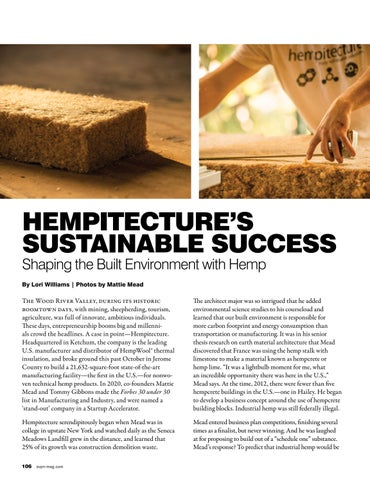
The Wood River Valley, during its historic boomtown days, with mining, sheepherding, tourism, agriculture, was full of innovate, ambitious individuals. These days, entrepreneurship booms big and millennials crowd the headlines. A case in point—Hempitecture. Headquartered in Ketchum, the company is the leading U.S. manufacturer and distributor of HempWool® thermal insulation, and broke ground this past October in Jerome County to build a 21,632-square-foot state-of-the-art manufacturing facility—the first in the U.S.—for nonwoven technical hemp products. In 2020, co-founders Mattie Mead and Tommy Gibbons made the Forbes 30 under 30 list in Manufacturing and Industry, and were named a ‘stand-out’ company in a Startup Accelerator.
The architect major was so intrigued that he added environmental science studies to his courseload and learned that our built environment is responsible for more carbon footprint and energy consumption than transportation or manufacturing. It was in his senior thesis research on earth material architecture that Mead discovered that France was using the hemp stalk with limestone to make a material known as hempcrete or hemp lime. “It was a lightbulb moment for me, what an incredible opportunity there was here in the U.S.,” Mead says. At the time, 2012, there were fewer than five hempcrete buildings in the U.S.—one in Hailey. He began to develop a business concept around the use of hempcrete building blocks. Industrial hemp was still federally illegal.
Hempitecture serendipitously began when Mead was in college in upstate New York and watched daily as the Seneca Meadows Landfill grew in the distance, and learned that 25% of its growth was construction demolition waste.
Mead entered business plan competitions, finishing several times as a finalist, but never winning. And he was laughed at for proposing to build out of a “schedule one” substance. Mead’s response? To predict that industrial hemp would be
106
svpn-mag.com
ARCHITECTURAL TRENDS
HempWool® insulation in an Los Angeles home. Hempitecture will produce HempWool in Jerome, Idaho, in 2022.
In 2020, co-founders Mattie Mead and Tommy Gibbons made the Forbes 30 under 30 list in Manufacturing and Industry and were named a ‘stand-out’ company in a Startup Accelerator.
Hempitecture CEO & Founder, Mattie Mead and CIO & Founder, Tommy Gibbons
PHOTO BY HALSEY PIERCE
svpn-mag.com
107
fully legal in the U.S. within five years—it was—and that he wanted to be on the ground floor of an emerging industry. “I knew that it was going to be legal because we were the only industrialized nation on earth that banned the domestic production of industrial hemp, yet we are the world’s largest consumers of hemp-based products,” explains Mead. After college, Mead went to work at an eco-resort in the U.S. Virgin Islands to gain experience in hands-on building. His phone rang one day with a 208 number. It was Matt Gershater, Executive Director of Idaho Basecamp (IBC), who had seen a Facebook post that a family friend of his had won a business competition, but he was more interested in the business plan of the runner-up, Hempitecture. Gershater invited Mead to come to Idaho to build a hempcrete building. “There was no doubt that this project for Idaho Basecamp was my next step,” says Mead. Under the mentoring of Architect Dale Bates, well known for progressive, sustainable building practices, the Community Center at IBC was built, delineated as the first public hemp building in the U.S. The process taught Mead that he had much more to learn about conventional construction, so he hired on with a framing crew in Hailey. “I was trying to work towards changing an industry I didn’t know enough about,” says Mead. Two years later, he was the hempcrete subcontractor on a house in Bellingham, Washington. Meanwhile, a high school classmate of Mead’s, Tommy Gibbons, was working for a tech start-up in San Francisco. His interest in building a tiny house led him to reach out 108
svpn-mag.com
Hempitecture product testing trials last year in Italy. This technology and equipment was purchased for Jerome’s new manufacturing facility.
to Mead to learn more about his work with hempcrete. Mead shared with him about the business potential. Gibbons, a Princeton grad and former financier at Goldman Sachs recognized the opportunity. “The more I learned, the more I saw the opportunity and need,” says Gibbons, now Hempitecture’s Chief Innovation Officer. “I felt I could provide a different skill set, and help lead Hempitecture forward.” In 2018, the two partnered and re-incorporated into a public benefit corporation, traveling throughout the U.S. building hempcrete structures with industrial hemp imported from Canada, which had legalized a decade before. But the travel demands of a labor-intensive, artisanal niche build, plus the process of obtaining local permits was challenging. “We were putting in twice the amount of effort and we weren’t seeing twice the results,” says Mead. That same year a hemp insulation manufacturing company in Quebec reached out to Hempitecture to offer a U.S. distributorship. “I knew at that moment that this was our pivot, because hemp insulation realizes about 60% of the benefits of hempcrete—sustainable, healthy, carboncapturing, easy to install by any builder—whereas hempcrete is incredibly specialized,” explains Mead. One container turned into a warehouse, then a third-party logistics company in Salt Lake City, and in 2021, an East Coast distribution center in Knoxville, Tennessee. The groundbreaking in Jerome County marks the next chapter
ARCHITECTURAL TRENDS
HempWool® is the tip of the iceberg for Hempitecture’s product roadmap, which includes researching other built environment products for retrofitting our homes and substituting foam and plastic waste in the packaging industry with nonwoven plant-based packaging material. Hempitecture’s sustainable building products have been used in homes across the U.S., including projects designed by international architects, such as the Minka house in Austin, Texas, designed by Axel Vervoordt.
in Hempitecture’s history, manufacturing products locally and sourcing raw materials regionally. Says Gibbons, “This manufacturing technology here in the United States will create jobs, industry, and legitimate opportunities for Idaho farmers in the massively growing southern Idaho economic development corridor.” In April 2021, Idaho became the last state to legalize industrial hemp as a commodity crop. HempWool®is the tip of the iceberg for Hempitecture’s product roadmap, which includes researching other built environment products for retrofitting our homes and substituting foam and plastic waste in the packaging industry with nonwoven plantbased packaging material. The company was recently awarded a $206,000 research grant from the Idaho Department of Commerce partnering with the University of Idaho, and the U.S. Department of Energy has named them to a Department of Energy program at Oak Ridge National Laboratory in Tennessee where Gibbons will represent for two years as an LEFT PHOTO BY MATTIE MEAD
innovation fellow. “My role will help Hempitecture develop its product roadmap in a world-class laboratory specifically designed for the testing and development of building materials,” explains Gibbons. Hempitecture continues to share their valuable expertise through contractor training, and by hosting an annual Hemp Building Summit. They have several building projects throughout the U.S., including work with highly regarded architects Olson Kundig and Alex Vervoodt. “It’s never been a linear path of success, says Mead. “Whenever I speak to young entrepreneurs, a piece of advice I always emphasize is to ‘embrace the pivot.’ By pivoting away from hempcrete to focus on HempWool®, we’ve been able to really imagine this future that is much more attainable for Hempitecture.” hempitecture.com svpn-mag.com
109
AN OPEN, CREATIVE SPACE Allison Paige Interior Design Finds a New Home By Danielle Vigueria | Photos by Halsey Pierce
Custom-made pillows, a hardwood floor with character, and a pink claw foot tub… these are just some of the fun things you will find in Allison Paige Interior Design’s new headquarters at 117 South Main Street in Bellevue. Much like Alli’s personality, the space is warm and inviting—it makes you want to grab one of the beautiful blankets off the shelf, pull up a chair at the thoughtfully decorated meeting table, and plan a creative masterpiece. After receiving news that the building she had occupied in Ketchum for more than 11 years was being torn down, Allison Connolly, founder and lead designer of Allison Paige Interior Design, started the search for the right space for her business. She decided that Bellevue’s Larsen Building would become her next home. She thoughtfully remodeled the 2,200-square-foot loft space and transformed it into a welcoming gathering place for her clients and colleagues. “I originally thought I had to be in Ketchum, but then I started to really consider my options and I realized that just wasn’t the case. What is most important to me is having an open, creative space where people want to be. What I do requires a lot of library materials, different surface areas to lay things out, and room to work on drafts. Since moving in here, I feel like I have way more space to be creative and meet with my clients. Our new office feels pretty perfect for us,” she says. 110
svpn-mag.com
Top, Allison Paige Interior Design’s headquarters in the Larsen Building in Bellevue. Above, Allison Paige at her conference table reviewing plans and finishes for an upcoming project.
ARCHITECTURE TRENDS
A Connecticut native with a background in art, Alli describes her family as a bunch of creatives. She came to the Valley more than 20 years ago and worked in a local art gallery and several architecture and design firms before starting her own interior design business in 2005. Allison Paige Interior Design handles all kinds of projects, from new construction and space planning to major remodels and small-scale renovations. Alli prides herself on her ability to work with all types of clients. She appreciates cultivating relationships with individuals from diverse backgrounds and working with a
wide range of aesthetics. No matter what the job is, she believes that collaborating with her clients is an essential key to her success. Throughout her design process she remains focused on achieving her client’s vision and getting the job done right. “If someone is looking for help, I want to bring beautiful and functional design to them if I can,” says Alli. In addition to her traditional design services, Alli’s expertise is also available to a wider audience at allisonpaige.market, her online storefront. The site offers a curated collection of unique home finds and furnishings as svpn-mag.com
111
well as a line of pillows that she personally designs. The new space has afforded Alli a way to display some of these items that would have otherwise only been viewed virtually. “Since our move in April of 2021, we have hosted three amazing open house events. They have been such a great way for people to come into the space, see things in person, shop, and get to know Allison Paige Interior Design. We have been starting to build a real sense of community, which is something I am excited to explore and cultivate in this new location,” shares Alli. “Several of our neighboring businesses have joined us in the open houses and I am looking forward to continuing to uplift my fellow business owners and creating real connections for everyone in our community.”
The Larsen Building currently houses several other femaleowned businesses, including Kundalini Yoga Center, Kirsten Shultz Photography, and others—an interesting turn, Alli points out, since one of the original uses in the 1880s is rumored to have been a gentlemen’s club. In the future, Alli hopes to extend her reach into the community even further by someday offering creative arts classes such as flower arranging or accessorizing 101. It seems as though the move south was the right choice. The inspiring and open spirit of Alli’s space truly seems to be a fitting reflection of the designer herself and the ideal setting for the next chapter of her business. “For me, it all comes down to the fact that I’m an artist,” says Alli. “And now I am able to work in an artist’s loft, in this vibrant arts community. I couldn’t be happier about our new space, and I just hope that I have the opportunity to stay here for a very long time.” For more information about the design services Allison Paige Interior Designs offers, visit allisonpaigedesigns.com.
Right: Allison Paige Design employees and shop-dogs hard at work Far right: Inspiration abounds as the space allows for found objects that spark creativity with an everevolving inspiration board. Below: Vintage rugs, a giant Fiddle Leaf Fig Tree, and plenty of surfaces to house plans, samples, and treasures for sale.
112
svpn-mag.com
To view the online store, visit allisonpaige.market.
DEANNA MELIN | 208.720.5557 The Busterback Ranch is a rare opportunity to own one of Idaho’s most iconic properties, just 45 minutes from downtown Ketchum. Presently an 80-acre horse/cattle ranch, the property includes a sophisticated 5800 SF main house, 3 Ralph Lauren-inspired cabins, a 3 BD manager’s house, barn, stalls and more. Experience unlimited wilderness, with hiking, snowmobiling, fishing, backcountry skiing, and biking all out your back door. In addition, three nearby pristine lakes provide endless water adventures. This property represents an exclusive chance to own a piece of history where you can embrace all that Idaho has to offer. $11,995,000 | MLS #21-328974
DEANNA MELIN 208.720.5557 deanna@deannamelin.com deannamelin.bhhssunvalley.com
STYLE DIAL TAKE ON THE SUN VALLEY WINTER WITH SVPN MAGAZINE ’S STYLE DIAL, where Valley designers and decorators have picked some excellent items to make your mountain retreat a cozy and luxurious home. Modern style and state-of-the-art design abound in this month’s selection of furnishings and statement pieces. Create a focal point in any area of your home with sleek arm and lounge chairs, textured art, wallpaper, decanters, and accessories while you enjoy indulgent comfort and chic-contemporary beauty.
STEVE SCHAFER
ARCHITECTURAL RESOURCES
LE CLUB ARMCHAIR “Between craftsmanship and technology, Le Club Armchair by Jean-Marie Massaud for Poliform is destined to become timeless, a new icon of contemporary furniture,” says Steve Schafer, head of design for Architectural Resources.
110 Lindsay Circle | Ketchum 208.928.6379 | arsunvalley.com
114
svpn-mag.com
STYLE DIAL
SUSAN WITMAN
SUSAN WITMAN INTERIOR DESIGN
CHARM CHAIR 323 Lewis Street | Ketchum 208.726.3639 | swidsunvalley.com
“Surprisingly affordable stylish Italian dining chair, bar, and/or counter stools by Costantini Pietro,” says Susan Witman of Susan Witman Interior Design (SWID). “Perfect for your mountain contemporary home.” Available through SWID.
OPHILIA CABINET MIX
ROCKY MOUNTAIN HARDWARE 180 North Main Street | Ketchum 208.726.2345 | rockymountainhardware.com
TOP LEFT PHOTO BY RAY J. GADD
Rocky Mountain Hardware unveiled an artisanal collaboration with Robert A.M. Stern Architects called Oasis. Brimming with organic shapes and forms, the sculptural assortment features 15 bronze designs available in an array of functions and finishes, including a wavy cabinet pull named Portia and an asymmetrical doorknob known as Flora. Visit rockymountainhardware.com.
svpn-mag.com
115
HEATHER NEWHOUSE
THE OPEN ROOM
THE OSCAR COLLECTION
360 1st Avenue North | Ketchum 208.622.0222 | openroomfurniture.com
“The Oscar Collection by Brown Jordan, designed in collaboration with Ann Marie Vering, is perfect for indoors or out,” says Heather Newhouse, owner of The Open Room. “Its curved frame and multi-dimensional rope form a striking silhouette visible from all angles. In addition, its arresting design and plush cushions make it the best in class for designer comfort.” Available in all Brown Jordan frame finishes and a variety of cushion colors. Order now for Summer 2022 delivery. For more information, email heather@openroomfurniture.com.
ROSEMARY MILLER
THE PICKET FENCE INTERIOR DESIGN
JAN BARBOGLIO DECANTERS
351 North Leadville Avenue | Ketchum 208.806.2900 | thepicketfence.com
116
svpn-mag.com
“We’ve seen our fair share of time at home over the last two years, so anything we can do to bring the ‘fun’ into our home is a welcome change,” says Rosemary Miller, designer and project manager for The Picket Fence Interior Design. “The bar is a focal point of entertainment in your home, and what better way to jazz up your bar than to update your barware! These decanters from Jan Barboglio personalize your bar space and add a bit of fun back into your nightlife.”
BOTTOM LEFT PHOTO BY RAY J. GADD
STYLE DIAL
ALLISON PAIGE
ALLISON PAIGE INTERIOR DESIGN
DASH WALLPAPER 117D Main Street | Bellevue 208.309.0789 | allisonpaige.design allisonpaige.market
JENNIFER HOEY SMITH
JENNIFER HOEY INTERIOR DESIGN
“We are big fans of the prints coming out of this small wallpaper and textiles manufacturer,” says Allison Connolly, owner of Allison Paige Interior Design. “The graphics are modern but pair nicely with an antique placed in front. It’s versatile and installs beautifully. And, as a bonus, it feels good to place orders directly with an artist.” Available in print on paper and grasscloth. Visit allisonpaige.market to see a curated selection.
WALL ART “We love to incorporate textured wall art into our projects, such as this unique piece made from natural coconut sticks,” says Jennifer Hoey Smith of Jennifer Hoey Interior Design. “The threedimensional feel evokes movement and brings warmth and depth into the right space.”
300 North Main Street # 202 | Ketchum 208.726.1561 | jenniferhoey.com
svpn-mag.com
117
MARINA BROSCHOFSKY
RED DOOR HOME + DESIGN
DAX LARGE OTTOMAN 406 North Main Street | Hailey 208.788.9075 | reddoordesignhouse.com
“X marks the spot for extra seating or a soft place to prop your feet,” says Marina Broschofsky, owner of Red Door Home + Design. “Drum-shaped cushioning in a performance boucle fabric makes this piece not only beautiful but durable as well.”
DURANGO LOUNGE CHAIR
SARAH LATHAM
LATHAM INTERIORS
500 Washington Avenue | Ketchum 208.928.6366 | lathaminteriors.com
118
svpn-mag.com
“Dramatic arms and a deep seat offer relaxation with mid-century modern sophistication,” says Sarah Latham of Latham Interiors. “Sculpted cedar frame adds an architectural feel to neutral-toned velvet upholstery.” Visit the Latham Interiors online shop at lathaminteriors.com.
DAVID HYTONE ANNA SKIBSKA FINE ART WITH A GRAND OPENING PERSONAL TOUCH
FRIESENLANTZ.COM F R I E S E N L320 A N1ST T ZAVE. . C ON.MKETCHUM, ID 12 320 1ST AVE. N. KETCHUM, ID
FEBRUARY, 2022 | 3-6PM
Frederic Boloix Fine Arts Showing "Hidden Treasures" by Martin C. Herbst
Barocco 5,3 Oil on Aluminum — (after Vermeer's The Girl with the Pearl Earring).
The artist in his studio.
351 LeadviLLe ave. N (GaLLeria BuiLdiNG oN 4th aNd LeadviLLe) • Ketchum, id 83340 208.726.8810 • WWW.BOLOIX.COM
SVPN | FINE ARTS
FINE ARTS
JANE WOOSTER SCOTT..............122 ARTS ETC......................................128 NOW SHOWING............................142 Two Wrens by Nyangulya Katie Nalgood. Acrylic on linen, 36” x 24”. Featured at Harvey Art Projects.
svpn-mag.com
121
122
svpn-mag.com
PHOTO BY
FINE ARTS | FEATURE
A LOVE AFFAIR WITH ART, PLACE, AND PEOPLE Jane Wooster Scott captures the essence of Sun Valley By Sabina Dana Plasse
If you have spent any time in Sun Valley, you may have noticed a particular type of art that characterizes and captures the picturesque life of Sun Valley. These are the paintings by Jane Wooster Scott. You may have seen her works in the local newspaper, on restaurant walls, or on the covers of various guides and in so many other familiar places around the Wood River Valley. Yet these works of art are not only in Sun Valley, they also exist worldwide as Jane paints many a scene that personifies the ideal American life. “I have sold paintings in Europe and especially in Japan. It always amazed me how my art would sell so well there because it’s so American. I could never figure that out,” says Jane. Jane’s personality is as bubbly as the art she creates. It makes so many people happy and they love to display it. Jane has been a part of Sun Valley for more than 40 years and
Top: Simple Pleasures by Jane Wooster Scott. Opposite: Sylvester Stallone with Jane Wooster Scott admiring her painting on exhibition.
svpn-mag.com
123
Above, Left, Shirlee Fonda, Jane Wooster Scott, and Henry Fonda admiring Jane’s work. Right: Gregory Peck and Jane Wooster Scott in front of one of Jane’s Hollywood paintings.
124
svpn-mag.com
FINE ARTS | FEATURE
continues to love it as much as anyone. Her love affair with Sun Valley has always been a prominent part of her life, even though her home is in California. “It’s so easy to make Sun Valley look happy,” she says. “It’s such a wonderful place.”
Sun Valley Snowflakes by Jane Wooster Scott.
When she was a young adult, never having had a lesson, on a whim, Jane wanted to paint a picture of a house for a girlfriend as a gift in the style of Americana artist Grandma Moses. “When I gave it to her, she loved it, and I had so much fun doing it. And then, her father, who was the governor of California, was so impressed, he wanted one,” says Jane. Jane was always connected to show business and had a contract with 20th Century Fox as an actress. She also hosted a weekly talk show on KTLA where movie stars would join her along with a member of the press to chat. “Yet, the whole time I was busy with my talk show and show business, I was painting on the side,” Jane says.
svpn-mag.com
125
Top: Arnold Schwarzenegger, Jane Wooster Scott, and Maria Shriver at a Jane Wooster Scott exhibition. Above: Jane Wooster Scott and Charlton Heston, a Jane Wooster Scott collector. RIght: Jane Wooster Scott and Paul Newman at one of her exhibitions.
126
svpn-mag.com
FINE ARTS | FEATURE
Jane’s husband Vernon was also connected to show business and wrote about Hollywood weekly. He was endearing to actors and studios and Jane met many movie stars including the comedian and actor Jonathan Winter, who also painted on the side. “He was having his first gallery show in Hollywood and needed to fill the space and asked me to join him,” tells Jane. “For the opening, I pulled up in front of the gallery, and there was an ambush of celebrities. There were so many famous faces and when I walked around, I couldn’t believe it or how expensive my paintings were. I remember thinking no one would buy my paintings at those prices. Nevertheless, my show sold out in 30 minutes.”
“When I paint, I think about what would look good in certain places. Reading, thoughts, memories, travel images, and lots of reminiscing will set something off in my head, and I will paint. It’s like a clip from a dream.”
With press about the show and Jane’s debut, the entire country was informed about her. Within a week of her first show, Jane had New York City galleries asking her to do an exhibition. “From then on, I would do a show every year and a half,” she says. “It is never work, and I still, to this day, love to paint. My daughter is also a painter, and often we will paint together. It’s something I will never stop doing.” The Guinness Book of World Records named Jane the most reproduced artist in America next to Pablo Picasso, a news item covered by TIME magazine. She also has been collected by many well-known celebrities. Her works hang in the American embassies in Portugal and Australia, she has had a painting in the White House, and her artwork has been featured on the lottery tickets of several states’ lottery campaigns. “When I paint, I think about what would look good in certain places. Reading, thoughts, memories, travel images, and lots of reminiscing will set something off in my head, and I will paint. It’s like a clip from a dream,” Jane says. “I believe my paintings bring people back to their childhoods, so for many, it makes them happy to look at my work. I am very fortunate to be able to do this.”
Jane Wooster Scott was featured in TIME magazine for being the “Most Reproduced Artist in America” by the Guinness Book of World Records.
Jane Wooster Scott’s art is available online for purchase at woosterscott.com.
svpn-mag.com
127
ARTS ETC
FEBRUARY | 2022
THE ARGYROS FRIDAY, FE BRUARY 18
SUN VALLEY GALLERY ASSOCIATION GALLERY WALK Gallery Walks take place from 5-7:30pm in Ketchum unless otherwise noted. svgalleries.org THURSDAY, FE BRUARY 24
THE MINT
120 Main Street South | Ketchum 208.726.7872 theargyros.org
FRIDAY, FE BRUARY 4 THROUGH SUNDAY, FE BRUARY 6
BANFF Mountain Film Festival World Tour Presented by Banff International Film Festival In conjunction with the Friends of the Sawtooth Avalanche Center, the Banff Mountain Film Festival World Tour will be shown for three nights in Ketchum/Sun Valley. Each evening will feature a different lineup of films. A portion of the proceeds from the event will go to support the Friends of the Sawtooth Avalanche Center. Doors at 6pm | Films at 7pm Tickets are $24 plus fees in advance and $27 plus fees at the door.
An Evening of Live Music at The Mint The Band of Heathers & Nicki Bluhm Doors at 6:30pm Show at 7:30pm $30 limited tickets available to ensure safe spacing 116 South Main Street | Hailey 208.788.MINT (6468) haileymint.com
LIMELIGHT HOTEL KETCHUM Limelight Lounge Series Live Music Thursday through Monday from 6-9pm 151 Main Street | Ketchum 208.726.0888 limelighthotels.com/ketchum
W E DNESDAY, FE BRUARY 9
TAKE3 Presented by The Argyros With a flair for the wild and unexpected, the genre-defying trio, TAKE3, brings the refinement of a rigorous classical music background and infuses it with rock-star charisma. Known for their infectious and down-to-earth onstage personalities, TAKE3 performs their own unique arrangements of top pop hits, Americana, and classical favorites. 7:30pm | Tickets are $20
128
svpn-mag.com
FINE ARTS | ARTS ETC
SATURDAY, FE BRUARY 12
Jazz at Lincoln Center Orchestra with Wynton Marsalis Presented by The Argyros The Argyros welcomes the Jazz at Lincoln Center Orchestra with Wynton Marsalis. Founded in 1988, the Jazz at Lincoln Center Orchestra with Wynton Marsalis tours the world performing a vast repertoire of music, from historic and rare compositions to commissioned works. The group’s compositions and arrangements include works by Duke Ellington, Count Basie, Fletcher Henderson, Thelonious Monk, Mary Lou Williams, Dizzy Gillespie, Benny Goodman, and Charles Mingus, as well as new music from the group’s unrivaled collection of worldrenowned composers and arrangers. This is a sold-out show. For the waiting list, email boxoffice@theargyros.org. 7:30pm | Tickets are $100-$225
SATURDAY, MARCH 5
Fred Hersch Presented by The Argyros A select member of jazz’s piano pantheon, Fred Hersch is a hugely influential creative force who has shaped the music genre’s course over more than three decades as an improviser, composer, educator, bandleader, collaborator, and recording artist. 7:30pm | Tickets are $20- $40
TOP PHOTO BY FRANK STEWART
svpn-mag.com
129
FINE ARTS | ARTS ETC
THE SUN VALLEY MUSEUM OF ART 191 5th Street E | Ketchum 208.726.9491 svmoa.org
THURSDAY, FE BRUARY 10
Paper & Glue documentary film Paper & Glue is a feature-length documentary that follows acclaimed French artist JR around the globe as he builds some of his most monumental projects, challenging perspectives and uniting communities through his thoughtprovoking work. 4:30 & 7pm Magic Lantern Cinemas, Ketchum $10 members / $12 nonmembers
THURSDAY, FE BRUARY 10
Evening Exhibition Tour
Wabi Sabi Enjoy a glass of wine as you tour the exhibition with The Museum’s curators. Four contemporary artists, two ceramists and two fiber artists, explore the Japanese notion of wabisabi and ideas around imperfection, impermanence, repair, and transformation. 4:30pm & 5:30pm (2 sessions) The Museum, Ketchum FREE, pre-registration required (space is limited)
130
svpn-mag.com
TUESDAY, FE BRUARY 15 & W E DNESDAY, FE BRUARY 16
Performing Arts Residency Series Concert
International Guitar Night International Guitar Night (IGN) has become a fan favorite among local students and evening concertgoers. The 22nd edition of International Guitar Night will be returning to North America’s finest venues from January to March 2022. After taking a hiatus in 2021, IGN is back with acoustic rock sensation Luca Stricagnoli (Italy), progressive classical guitarist, Thu Le (Vietnam), Slack Key master Jim Kimo West (Hawaii), and Latin Swing pioneer Lulo Reinhardt (Germany). 7:30pm The Argyros, Ketchum
FRIDAY, FE BRUARY 18
Gallery Walk
Wabi Sabi Start your Gallery Walk at SVMoA! 5-7pm The Museum, Ketchum FREE
FINE ARTS | ARTS ETC
THE SUN VALLEY MUSEUM OF ART 191 5th Street E | Ketchum 208.726.9491 svmoa.org
W E DNESDAY, FE BRUARY 23
Winter Open Studio
Figure Drawing Use this opportunity to hone technical drawing skills in a relaxed environment while drawing directly from the human figure. A model will hold a variety of poses throughout the two-hour session. All skill levels are welcome. Bring your own supplies; drawing boards provided. 6-8pm Hailey Classroom, Hailey Medium: drawing Age and ability: 18 years and older, beginners welcome $10, pre-registration required
SATURDAY, FE BRUARY 26
Creative Jump-in
Clothes Mending with Jeanna Wigger Join a small group of menders to repair your loved but damaged clothes. Bring a worn, torn garment in need of mending, and learn the best way to repair it by hand, making it stronger at the broken parts. Some hand-sewing experience is helpful but not required. Group size will be limited to allow each participant to get one-on-one instruction. Garments that can be successfully repaired using the methods taught in this class may include pants with holes, rips, or tears; shirts and sweaters; scarves; missing buttons; and torn seams. Repairs NOT covered in this workshop are zippers, complicated outdoor gear, hemming, or mends on precious clothing. Plan to repair one garment to completion. Cancellation reimbursement deadline: February 12, 2022. Part of SVMoA’s visual arts exhibition Wabi Sabi. 10am-3:30pm Hailey Classroom, Hailey Medium: sewing $80 members / $90 nonmembers
132
svpn-mag.com
Celebrate Your Wedding With Unique Bridal Portraits
Book A Post-Wedding Photo Session At: stevedondero.com
FINE ARTS | ARTS ETC
OCHI GALLERY ON E X HIBITION THROUGH FE BRUARY
Artist Carol Glenn OCHI Gallery is pleased to present a special installation by Carol Glenn featuring pieces from her Kyoto Brushwork and Cut Turquoise series. The exhibition is on view through the month of February, open by appointment. Please email gallery@ochigallery.com or call/text 208.309.4093. 119 Lewis Street | Ketchum 208.726.8746 ochigallery.com
THE SPOT FE BRUARY 17-26
Pass Over by Antoinette Nwandu Co-Directed by Savina Barini and Roney Jones February 17-19 & 23-26 at 7:30pm February 20 at 4pm 220 Lewis Street #2 | Ketchum info@spotsunvalley.com spotsunvalley.com
134
svpn-mag.com
PHOTO BY KIRSTEN SHULTZ
ESTABLISHED IN 1987, BROSCHOFSKY GALLERIES FEATURES FINE ART WITH A FOCUS ON THE WEST, HISTORIC THROUGH CONTEMPORARY.
RUSSELL CHATHAM
Winter in Shields Valley 1996, 54” x 62” Oil on Linen Also showing works by Bill Barrett, Rudi Broschofsky, Michael Coleman, Edward Curtis, Jim Dine, Joellyn Duesberry, Ewoud de Groot, Joan Mitchell, Ken Peloke, Billy Schenck, Pat Steir, Theodore Villa, Andy Warhol, David Yarrow, Russell Young, and more. Broschofsky Galleries • 360 East Ave. Ketchum, ID • 208.726.4950 www.brogallery.com
FINE ARTS | ARTS ETC
THE COMMUNITY LIBRARY 415 Spruce Avenue North | Ketchum 208.726.3493 comlib.org
FE BRUARY- MARCH 2 022
Winter Read Each winter, the Wood River Valley comes together to read a story and talk about the themes it raises. The 2022 Winter Read is Norman Maclean’s novella, A River Runs Through It. The book, in English and Spanish (El Rio de la Vida) is available for checkout at The Community Library and comlib.org in many formats: book, eBook, Nook, audiobook, and eAudiobook. Books are also available with our partner libraries in Hailey, Bellevue, and Stanley. For more information on special events for the Winter Read, visit comlib.org/programs-and-exhibits/ winter-read FREE
TUESDAY, FEBRUARY 8
Every Day the River Changes with Jordan Salama Part of the Library’s 2022 Winter Read Following Colombia’s thousand-mile Río Magdalena from near its source high in the Andes to its mouth on the Caribbean coast, journeying by boat, bus, and improvised motobalinera, Salama writes against stereotype and toward the rich lives of those he meets. 6pm | For virtual, watch on the Library’s Vimeo. FREE
SATURDAY, FE BRUARY 19
Alternative Facts Film Screening and Q&A with Jon Osaki Osaki’s film sheds light on the people and politics that influenced the signing of the infamous Executive Order 9066, which authorized the mass incarceration of nearly 120,000 Japanese Americans during World War II. The film exposes the lies used to justify the decision and the cover-up that went all the way to the United States Supreme Court and examines the parallels to the current climate of fear, attitudes towards immigrant communities, and similar attempts to abuse the powers of the government. The one-hour film will be followed by a Q&A with director Jon Osaki. Presented in partnership with Friends of Minidoka and the National Park Service. 4pm | Pre-registration required to join in person, or watch on the Library’s Vimeo. FREE 136
svpn-mag.com
creating abstract art with fire
(509) 993.1213
stejerstudio.com | jstejer.encaustic | 620 Sun Valley Road, Unit D101 A | Ketchum, Idaho 83340
THE COMMUNITY LIBRARY 415 Spruce Avenue North | Ketchum 208.726.3493 comlib.org
THURSDAY, FE BRUARY 17
Sammy and Jessica Matsaw Part of the Library’s 2022 Winter Read Sammy and Jessica Matsaw, co-founders of River Newe, will discuss nation-building activities and visions from their perspectives as a scientist and educator. River Newe is an Indigenous-run nonprofit based in Fort Hall, Idaho, that works to increase representation and create spaces of equity through learning experiences on homelands with Shoshone-Bannocks, Indigenous, and minoritized communities on and off river. 6pm | Pre-registration required to join in person, or watch on the Library’s Vimeo. FREE
THURSDAY, FE BRUARY 24
Restoring Tributary Health to Stage Zero Restoration Part of the Library’s 2022 Winter Read Brian Cluer, Fluvial Geomorphologist with NOAA, will share new river restoration techniques, their applications, and what bringing our tributaries back to “Stage Zero” health can mean for the overall health of a river. Ryan Santo, River Initiative Director for the Wood River Land Trust, will also join to talk about the work the organization is doing to restore the Big Wood River as a worldclass trout fishery. 6pm | Pre-registration required to join in person, or watch on the Library’s Vimeo. FREE Howard Preserve
138
svpn-mag.com
BOTTOM PHOTO BY JOHN FINNELL
Severn Art ServiceS
since 1974
Master Framing & Installation Severn Art Services has been the principal framer to collectors and galleries for over 45 years. Specializing in quality custom and archival framing, featuring exquisite copies of vintage and contemporary frames for fine art, mirrors, and threedimensional objects of all sizes. We provide experienced installation and curatorial services for homes, offices, collectors, and corporations. We also provide cost-effective framing and care for prints, posters, personal mementos, and family photos. Severn Art Services offers valuation, insurance appraisal, and advisory services including conservation, restoration, and fine art packing and shipping.
When your needs include rearranging or hanging new acquisitions we can provide professional services for both indoor and outdoor installations.
Art Hanging & Installation • Hardwood • Leather Specialty Mats Plexiboxes • Gold Leaf • Custom Metals • Period Frames Conservation & Restoration and Fine Art Packing & Shipping
Severn Art ServiceS
400 First Avenue North • PO Box 1679 • Ketchum, ID 83340 • 208.726.5088 • artservices@gailseverngallery.com
DAV I D D E V I L L I E R
11 x 11 in
C E L E B R AT I N G 4 5 Y E A R S
Oil on wood panel
SUMMER EXHIBITIONS Jun Kaneko • Hung Liu • Linda Christensen • Michael Gregory • James Cook • Julie Speidel • Laura McPhee Pamela DeTuncq • Pegan Brooke • Theodore Waddell • Ed Musante • Morris Graves • Lisa Kokin Gwynn Murrill • Cole Morgan • Robert Helm • Jane Rosen • Raphaëlle Goethals • Margaret Keelan • Jim Romberg Marcia Myers • Laura Wilson • Lynda Lowe • Luis Gonzáles Palma • Robert Polodori • Chris Maynard
G A I L SE V E R N G A L L E R Y
400 First Avenue North • PO Box 1679 • Ketchum, ID 83340 • info@gailseverngallery.com www.gailseverngaller y.com 208.726.5079
MARCIA MYERS
85 x 72 in
C E L E B R AT I N G 4 5 Y E A R S
Fresco on linen
SUMMER EXHIBITIONS Jun Kaneko • Hung Liu • Linda Christensen • Michael Gregory • James Cook • Julie Speidel • Laura McPhee Pamela DeTuncq • Pegan Brooke • Theodore Waddell • Ed Musante • Morris Graves • Lisa Kokin Gwynn Murrill • Cole Morgan • Robert Helm • Jane Rosen • Raphaëlle Goethals • Margaret Keelan • Jim Romberg David deVillier • Laura Wilson • Lynda Lowe • Luis Gonzáles Palma • Robert Polodori • Chris Maynard
G A I L SE V E R N G A L L E R Y
400 First Avenue North • PO Box 1679 • Ketchum, ID 83340 • info@gailseverngallery.com www.gailseverngaller y.com 208.726.5079
NOW SHOWING FEBRUARY | 2022
Kneeland Gallery Douglas Aagard, Silas Thompson, and Bart Walker Reception on Friday, February 18, 5-7:30pm
Douglas Aagard draws on the Utah landscape as his source of inspiration. His subjects vary from the mountain pines and cedars to the farmland in between, and all are linked by his intriguing use of texture and light combined with a vibrant color palette. One of the gallery’s youngest artists, Silas Thompson, has quickly become a familiar name among collectors. On annual backpacking trips with his father, he began to treasure the distinct birthmarks and icons of beautiful rivers, valleys, and mountains that carve through the high desert and farmlands of the West. His desire to create work that evokes a memory continues to be a driving force, which pushes Silas to be innovative in his choice of subject matter and composition. 142
svpn-mag.com
Above: Jammed by Silas Thompson. Oil on canvas, 30”x 40”. Featured at Kneeland Gallery. Left: Feed Time by Bart Walker. Oil on canvas, 24” x 30”. Featured at Kneeland Gallery.
Bart Walker paints the allure of the wildland. He uses oil sketches done in the field to recollect nature’s beauty on the finished canvas. His radiant plein air paintings are reminiscent of the early California impressionist landscapes, alive with deft brushwork and nuances of light. He and his wife Tracy have made their home in the dramatic setting of Teton Valley, which forms the inspiration for much of his work. 271 1st Avenue North | Ketchum 208.726.5512 kneelandgallery.com
FINE ART | NOW SHOWING
Tangled by Michael Massaia. Split-toned silver gelatin print. Featured at Gilman Contemporary.
Gilman Contemporary Michael Massaia On view through March 1, 2022
Photographer Michael Massaia’s exhibition Try and Remember features images that are reckoned with memory. By creating a feeling of intimacy between photographer and subject, Massaia asks us to try and remember a past that has been irrevocably changed by the passage of time. Whether a portrait of a phone booth, pinball machine, a vacant hotel, or a deserted path in Central Park, Massaia breathes life and light into the dark and inanimate. The luminous nature of silver gelatin prints is paired perfectly with each of his subjects. With meticulous attention to every detail, Massaia directs the viewer into a cinematic story that is familiar and yet new. A master of the science and craft of photography, Massaia’s meticulous silver gelatin and splittoned contact prints are unmistakable and pulse with life. 661 Sun Valley Road | Ketchum 208.726.7585 gilmancontemporary.com
Bally’s Evel Knievel by Michael Massaia. Split-toned silver gelatin print. Featured at Gilman Contemporary.
svpn-mag.com
143
Friesen+Lantz Fine Art Friesen+Lantz Fine Art announces their inaugural exhibitions—two solo shows from acclaimed artists David Hytone and Anna Skibska. The exhibitions open on February 12 with both artists in attendance, marking a new beginning for Friesen+Lantz.
David Hytone If Not For The Pantomime Ventriloquist Opens February 12, 2022
David Hytone is a Seattle-based artist with a theatrical background. The artist’s dimensional mixed-media works examine human frailty and the mechanisms that we employ to compensate for our limitations—imagined and otherwise. Using themes of theatre and still life, Hytone explores the space between the veneers of projection, façade, and the actuality of things.
Top: Jade Mountain by David Hytone. Acrylic, ink, flashe, and okawara on panel. Featured at Friesen+Lantz Fine Art. Above: Chaucer’s Blunderbuss by David Hytone. Acrylic, ink, flashe, and okawara on panel. Featured at Friesen+Lantz Fine Art.
144
svpn-mag.com
“I’ve often said that when I enter the studio, I do not so much begin with an idea as an endeavor to arrive at one. Allowing the process to lead my inquiries, as opposed to those inquiries driving my process, is integral to keeping the work honest, revelatory, and moving forward,” says David Hytone.
FINE ART | NOW SHOWING
Anna Skibska Labyrinth of Light Opens February 12, 2022
Anna Skibska is an innovator in glassmaking, utilizing her signature technique to capture, bend, and stretch light through the medium of glass. Skibska is fascinated by the paradox of light’s inherent traits, creating the ability to see yet also holding the potential to blind. The artist explores this phenomenon by creating a dynamic play between darkness, light, and shadow. “My primary medium as a sculptor is thinking–specifically about space and light, and the material that best embodies my thoughts is predominantly glass,” says Skibska. Skibska’s artwork bridges the worlds of architecture, line drawing, and sculpture. With her skillful use of an acetylene torch, the artist manipulates glass rods into fine intertwining threads, creating translucent ethereal webs of gravity-defying forms. Visit friesenlantz.com for more information on their inaugural exhibitions and the Grand Opening of Friesen+Lantz Fine Art.
Above: Golden Alchemy by Anna Skibska. Anna Skibska Technique, glass. Top: Triple by Anna Skibska. Anna Skibska Technique, 2016, 130” x 16” x16”.
320 1st Avenue | Ketchum 208.726.4174 friesenlantz.com svpn-mag.com
145
Wide Horizon by Devin Farrand. Aluminum chromate, 2021, 33” x 88” x 1.5”. Featured at OCHI Gallery.
OCHI Gallery Devin Farrand Warm Up On view through February 19, 2022
OCHI is pleased to present Warm Up, Devin Farrand’s second solo exhibition with the gallery, on view in Ketchum, Idaho, through February 19, 2022. Warm Up features large aluminum horizons, a suite of new paintings, and marble works depicting close-ups of down jackets. Utilitarian in nature and instantly recognizable, these coats are marketed as hi-tech, fashionable outerwear and consist of goose down and polyester layers held in place by parallel seams that create the eponymous puff. Farrand’s paintings frame details of coat construction with puff rows providing dozens of pillowy folds in the fabric, each rendered with care. Farrand creates closely cropped compositions absent of sleeves, zippers, or bodily form, transforming a pervasive cultural object into abstraction. Soft light falls on the crests of creases in contrast with painted threads found in the shadow of a seam—there is romance in Farrand’s observations. Farrand takes functionality out of context to better understand the language and meaning of materials and surface. His ongoing analyses of material aesthetics produce 146
svpn-mag.com
nuanced meditations on perception, at times fetishistic in nature or sublimely minimal. Farrand can even find a way to reveal humor or solace in raw material. Born into a family of highly skilled craftsmen, builders, and manufacturers, Farrand rebuilt cars, built musical instruments, drove combines, assembled boats, problemsolved, and tinkered—a methodology of learning by doing. Farrand’s puff paintings have emerged from his interest in marble as a sculptural material, natural resource, and signifier of permanence and societal authority. In the gridded landscape of the quarry created over thousands of years of marble extraction, Farrand found visual resonance with the seams of a downed jacket. The wrinkles in a painting of a puff jacket conjure the fleshy muscles of Greco-Roman gods draped in robes all exquisitely chiseled from a single block of marble—in fact, Farrand often sources marble from the Carrara quarry that birthed such masterpieces from centuries ago. The painted puffs reference the shifting colors of Farrand’s ominous Horizon works, with their reflective surfaces of aluminum chromate. They also evoke the colors and textures found in the landscape of his painting studio on the Big Lost River in Idaho. Farrand worked on-site during the summer of 2020 surrounded by smoke and fire,
FINE ART | NOW SHOWING
Broschofsky Galleries Russell Chatham, Ewoud DeGroot, Rudi Broschofsky, Russell Young, David Yarrow, and others Ongoing
Top: Prairie Puff by Devin Farrand. Oil on wood, 12” x 16”. Featured at OCHI Gallery. Above: Dusk Puff by Devin Farrand. Oil on wood, 12” x 16”. Featured at OCHI Gallery.
there is a tenderness to Farrand’s color selection—crimson, smoke, charcoal, hazy jewel tones—reflections of the man-made climate crisis creeping ever closer. The carved and painted puffs recontextualize an artificial material created into a larger and timely discourse within a manufacturing context. Farrand’s observations and technical abilities—form and content—provide great insight into individual perception and societal values. 119 Lewis Street | Ketchum 208.726.8746 ochigallery.com
Shows will highlight recent acquisitions of paintings by Russell Chatham, who died November 10, 2019. In viewing a Chatham painting, one typically gets a feeling of recognition of place. However, a feeling is revealed, a sense of emotion that goes deeper than the visual mind. Chatham’s last painting Moon Over Marshall Ridge, and other works on view quietly evoke this emotion. David Yarrow’s large-scale photographic works often bring curiosity, laughter, and awe. The British artist continued his “road” series that he initiated in 2018. The print On the Road Again shows Cindy Crawford and her companion enjoying the freedom of the vastness of the American West. As David says of this piece, “The sense of place is palpable. This is the America that so many know and love, with its long roads running to the horizon with either side exuding a sense of calm and solitude. No other country in the world offers road trips as visually rewarding as the USA, and they are integral to the fabric of the American Dream.” 360 East Avenue | Ketchum 208.726.4950 brogallery.com
Above: Winter in Shields Valley by Russell Chatham. Oil on linen, 54” x 62”. Featured at Broschofsky Galleries.
svpn-mag.com
147
Gail Severn Gallery Gallery 1 | Lynda Lowe February 2022
Gravity and Grace, an exhibition of work by Lynda Lowe, examines how complementary forces are linked to larger wholeness. These themes will be explored through several groups and paintings that integrate what is knowable and concrete, mysterious, or inherently soulful. 148
svpn-mag.com
Bird Path III by Lynda Lowe. Watercolor, oil, and wax on panel, 2021, 48” x 48”. Featured at Gail Severn Gallery.
FINE ART | NOW SHOWING
Gallery 2 | Linda Christensen February 2022
Solace, a solo exhibition of new paintings by Linda Christensen, will be in main Gallery 2. Comfort, console, reassure, and soothe are words woven through the textures of this new body of work. Solace, the title for the show, signifies a place to go for stability and understanding. The meditative rhythm of the marks for the underpaintings became a ritual of sorts in which the artist witnesses the steady and predictable world that is available to us all.
Gallery Viewing Room | Group Show February 2022
A small group show of gallery-represented artists working in various media will be exhibited in the gallery viewing room. 400 1st Avenue North | Ketchum 208.726.5079 gailseverngallery.com
Notable by Linda Christensen. Oil on canvas, 2021, 60” x 60”. Featured at Gail Severn Gallery.
Gallery 3 | Lisa Kokin February 2022
Party Hat Diabolique by Lisa Kokin. Mixed media button work, 55.5” x 27”. Featured at Gail Severn Gallery.
Gallery 3 will feature new work by Lisa Kokin, including pieces from the artist’s Wordless Library series of book-like objects created from punctured metal reminiscent of text. The wordless text is further explored in Facsimiles, where Kokin constructs faux book pages from trimmed zippers and thread, referencing the illustrative pages of dictionaries and 20th-century tomes by Dostoevsky, Chekhov, Flaubert, Wilde, and Whitman. The artist’s button work will also be shown, exploring family portraiture both past and present through reconstructed forms made from buttons and nostalgic ephemera.
svpn-mag.com
149
Sun Valley Museum of Art Wabi Sabi On view through March 26, 2022
Often defined as flawed beauty, the wabi sabi aesthetic connotes asymmetry, awkwardness, and evidence of the forces of nature and time. It embraces the unconventional and broken as beauty—reminders of the world’s fragility and transience. The four artists in this exhibition come from diverse traditions. Based in East Asia, Yeesookyung and Shiro Tsujimura bring an innovative approach to ceramics in places where cultural practices are rigorously prescribed. American artists Mark Newport and Frances Trombly have chosen the medium of fiber, historically perceived in the Western world as a lesser art, relegated to female and craft traditions. Whether raised in the East, where ideas of imperfection and wabi sabi have been cultivated for centuries, or with Western ideals of beauty and perfection, each of these artists makes art that is unconventional, raw, and, in its imperfection, deeply appealing.
Above: Frances Trombly, Weaving (Weld with Canvas Warp), 2020, hand-woven, hand-dyed (weld) silk and rayon, cotton, maple, courtesy the artist and Emerson Dorsch, Miami. Below left: Mark Newport, Repair 2, 2016, embroidery and mending in cotton, courtesy the artist, Greg Kucera Gallery, Seattle, and Simone DeSousa Gallery, Detroit.
Transforming ripped, torn, or worn pieces of cloth, Mark Newport emphasizes the place of repair with enhanced stitchery that leads to new patterns, bursts of color, and a reconsideration of original form. Newport sometimes refers to his threads as stitches or scars, and while he employs traditional darning techniques, he defies the expectation that the repair should be blended in to hide the tear. Instead, Newport accentuates the “wound,” introducing new colors or textures into the host cloth. Notions of renewal and restoration are also present in Yeesookyung’s ceramic vessels. She carefully assembles remnants of discarded Korean pots into wholly new forms, employing the traditional method of kintsugi—drawing attention to the place of repair with conspicuous lines of gold lacquer clearly articulating where one pot shard meets the next. In assembling disparate pieces from multiple originals, Yeesookyung re-presents these pieces in precarious and irregular new forms. 150
svpn-mag.com
FINE ART | NOW SHOWING
Shiro Tsujimura’s ceramic objects are uncontrived, simple forms with rustic surfaces enhanced by the clay’s imperfections and the fire’s trace. This collection of teabowls has been assembled by Henry Whiting, who chose them to complement the Frank Lloyd Wright studio where he lives in Bliss, Idaho. The simplicity and purity of the Japanese aesthetic resonated with Wright, and so too with Whiting. Tsujimura’s teabowls, which appear simple and alike at first glance, are unique shapes; every element of the pot is meant to be noticed as it nestles into two hands for tea drinking. Tsujimura’s teabowls are aligned with Japanese traditions that are centuries old, but made by an artist who came to ceramics without the restrictions imposed by a traditional apprenticeship, reflect an iconoclastic approach that allows him to work in multiple clay bodies and traditions. Frances Trombly’s hand-woven textiles speak to a different kind of purity. She uses color sparingly, allowing the weave and warp of the material to create surface. Presented as sculptures, the bare fabrics drape and flow around simple wooden structures, some of which suggest the painting’s armature. She presents material in its barest, most essential form and leaves glitches or mistakes evident, emphasizing the relationship between maker and form and honoring the time necessary for the labor. 191 5th Street East | Ketchum 208.726.9491 svmoa.org
Shiro Tsujimura, teabowls, c. 2015, ceramic, collection of Henry Whiting.
Frederic Boloix Fine Arts Martin Herbst February 2022
Above: Barocco 5.3-after Vermeer’s Girl with the Pearl Earring. Oil on polished aluminum, 23.5” x 21.5” x 7”. Featured at Frederic Boloix Fine Arts.
Frederic Boloix Fine Arts is showing a new series of sculpted paintings by Austrian artist Martin Herbst. This collection transforms several of the most iconic images, such as Vermeer’s Girl with a Pearl Earring and Gainsborough’s Blue Boy, into something entirely new and disruptive to the normal notions of what constitutes art. These highly radiant, interactive works on crumpled, polished aluminum absorb and reflect light, the surroundings, and the viewer, creating a uniquely beautiful and ever-changing synergy. To view more images, visit boloix.com/martin-c-herbst. The Galleria Building 351 Leadville Avenue North | Ketchum 208.726.8810 boloix.com
svpn-mag.com
151
Harvey Art Projects That’s How It Was: Three Strong Women On view through February 28
This exhibition celebrates the art of three women from the remote northwest of Western Australia, who paint at the Spinifex Hill Studio in South Hedland, over 1,000 miles north of the state capital in Perth: Pilbara artists Mulyatingki Marney and Mayiwalku (Maywokka) Chapman, and Nyangulya Katie Nalgood, from the Kimberley. Though their practices differ in artistic focus and aesthetics, all three artists are united in expressing their versions of ‘that’s how it was,’ their deep connection to the living and ever-present significance of 152
svpn-mag.com
Untitled by Maywokka Chapman. Acrylic on linen, 48” x 48”. Featured at Harvey Art Projects.
FINE ART | NOW SHOWING
Spinifex Hill Pilbara Artist Mulyatingki Marney
ngurra [home country or camp]. Sisters Mulyatingki and Mayiwalku are pujimanpa [desert-born], while Nyangulya was born and grew up on a pastoral station north of the mighty Fitzroy River. On view in Sun Valley at Harvey Art Projects through February 28. Two Wrens by Nyangulya Katie Nalgood. Acrylic on linen, 36” x 24”. Featured at Harvey Art Projects.
640 North Main Street | Ketchum (by appointment) 208.309.8676 harveyartprojects.com
Aurobora Revolving group exhibition featuring works by various artists Ongoing
Aurobora is an invitational fine art studio that publishes unique works by artists of regional, national, and international reputations and exhibits regularly changing shows of works created by artists during residencies. Aurobora Select exhibits current works by Fraser Taylor, Wesley Kimler, John Zurier, Liat Yossifor, Jennifer Reeves, Pat Lipsky, Richmond Burton, LoopmasterM, Steve Roden, and others. 340 Walnut Avenue | Ketchum 415.546.7880 aurobora.com svpn-mag.com
153
GENEROSITY HEALS St. Luke’s Wood River Foundation funding expands care for the uninsured. Family Health Services is slated to open a medical, dental, and behavioral health clinic with pharmacy services in the city of Bellevue to serve the uninsured and under-insured in Blaine County. A $1 million grant from the St. Luke’s Wood River Foundation (SLWRF) helps make the clinic a reality. “I believe this is one of the most impactful efforts that SLWR Foundation and the hospital have undertaken,” says Megan Tanous, SLWR Foundation Chief Development Officer. “Due to financial situations, people who might not otherwise have access to healthcare and dentistry services will now be able to get excellent medical care.” Last year, over 1,500 Blaine County patients traveled to Family Health Services Clinics in Jerome or Fairfield. 154
svpn-mag.com
“St. Luke’s Wood River supports Family Health Services in its mission to help reach the most vulnerable community members in need. We are particularly excited for the expanded access to dental and behavioral health services,” says Erin Pfaeffle, SLWR Director of Community Engagement. Access to affordable dental care and behavioral health services complements St. Luke’s work to address the community’s health priorities as identified in the 2019 Community Health Needs Assessment. All services for the uninsured will be significantly discounted based on a patient’s Federal Poverty Level (200% or below). Family Health Services also sees a high number of Medicaid patients, specifically in need of dental and behavioral health care. Unfortunately, many
WELLNESS | ST. LUKE’S
“Family Health Services is excited to be opening a medical, dental, and behavioral health clinic with pharmacy services in Bellevue later this year. We will be able to provide affordable healthcare for those living in the Wood River Valley…” — Aaron Houston, Family Health Services CEO.
Blaine County behavioral health providers and dentists do not accept Medicaid. “Family Health Services is excited to be opening a medical, dental, and behavioral health clinic with pharmacy services in Bellevue later this year. We will be able to provide affordable healthcare for those living in the Wood River Valley. The clinic would not have been possible without the support of the St. Luke’s Wood River Foundation,” says Aaron Houston, Family Health Services CEO. Family Health Services works to reach people who may be reluctant to access care or may not be aware of how to access care. Often, those managing chronic disease fall into this category and end up needing urgent or emergency care that may have been preventable. Adding a location in Bellevue removes the barrier of missing work and/or school as well as incurring additional expenses related to transportation to receive services outside of Blaine County. Family Health Services is working to hire two full-time nurse practitioners, one full-time dentist, one part-time hygienist, one full-time licensed clinical social worker (LCSW) counselor, one full-time pharmacist, and bilingual support staff.
Family Health Services is leasing a 4,136-square-foot building in Bellevue. The building needed a remodel to accommodate the proposed services. The grant from the SLWR Foundation assists with the remodel and start-up costs, including equipment and financial support for the five-year lease. Typically, these types of clinics can secure government grants to fund start-up costs. Unfortunately, these government grants are based on median income and health statistics; Blaine County’s median income is too high, and its health statistics are too good to qualify for a start-up grant. Without the Foundation’s support, Family Health Services would not be able to provide these essential and needed services to patients in Blaine County. Pfaeffle adds, “We are pleased to welcome Family Health Services and look forward to partnering with them to help improve access to care and to further deliver on our mission of improving the health of everyone in the communities we serve.” To learn more and support this project, contact Megan Tanous at 208.727.8444 or visit slwrf.org. For information about Family Health Services employment opportunities or services, visit fhsid.org.
svpn-mag.com
155
CENTER’S APPROACH TO:
CLEANSING Dr. Molly Brown offers SVPN Magazine readers some intel on the practice and value of cleansing
I continue to promote cleansing as a valuable, integral part of our healing routines, twice a year, regularly. I know the process of cleansing well and make it a priority for myself several times a year. Each time I cleanse, the experience offers a tremendous emotional, physical, and spiritual reset, a hint of our full potential, joy, and inspiration. The cleansing process has changed my life from the inside out, reorganizing my mental, spiritual, and physical bodies and accelerating me to the best health of my life and a quest for deep connection. At Glow, we lead plant-based, organic, highly mineralized, hydrating cleanses that include pressed juices, superfood
smoothies and elixirs, balanced entrees and soups, as well as warming herbal teas and supplements to support detoxification. People often feel so good after one day on these foods that they feel uplifted, joyful, and full of energy. It is incredible that one day of a diet shift can bring such a change, but it does. As part of our program, we recommend infrared light therapy, sea salt soaks, dry brushing, coconut oil pulling, ayurvedic lymph massage, pulsed magnetic therapy, and colon hydrotherapy, along with yoga and meditation. These therapies support the detoxification organs and process so that the body can cleanse successfully and not shut down or become overwhelmed. Cleansing regularly and periodically can help the body clear out the immense load of environmental toxins that accumulate in our tissues and organs from chemicals in our environment, food, skincare products, and more. The body’s filters are the liver, lungs, kidneys, colon, and skin. Unfortunately, many toxins cannot be filtered
156
svpn-mag.com
WELLNESS | CENTER
and are therefore stored in our bowels, brains, livers, and kidneys, interrupting normal detoxification procedures and affecting behavior and mood. Cleansing eliminates toxicity and congestion and provides well-being, a more efficient metabolism, and brings us to our optimal weight. In addition, after cleansing, our assimilation improves, and we can eat less food and feel satisfied.
the vital life force of the body recharges and takes you to a rare state of energy and well-being. Cleansing is a rest for the body, mind, and spirit. So often, we remain in a state of stress and busyness to the point that we burn out and become ineffective in our goals and forget our passion. This time of rest is so essential to allow us to be our best selves. The “pause” in life is so important.
The goal of cleansing is to bring back vitality, energy, happiness, and radiance. Regular cleansing, when done properly, one to two times a year, allows you to move toward this optimal expression of health to a state of well-being that you’ve maybe never before experienced.
Our cleanse dates for 2022 are live on glowsunvalley.com. In addition, we will be offering an extended nine-day retreat this May incorporating the magic of our local area and soaking in hot springs, hiking in the mountains, and nourishing the self with clean, vibrant foods and juices.
As one becomes more advanced in the cleansing process, juice fasting is another effective process to allow the body to “breathe” and enliven. By fasting on juices for days, the liver, kidneys, and lungs clear and clean out inflammation, increase cellular energy, and restore the body’s vitality. Often we have a deeper insight into our health, relationships, and lives. This process is impressive, and after a fast of three to seven days, PHOTO BY KIRSTEN SHULTZ
Dr. Molly Brown, Ph.D., D.N.M. owns CENTER health & performance and GLOW, her plant-based organic café, in Ketchum, Idaho. Specializing in sleep, endocrine issues, autoimmune, anxiety, depression, detoxification, and pain and sports injury through many different modalities including QNRT, PEMF, AMIT method, Neurotherapy, and REAMS metabolic testing, Molly passionately holds space for limitless healing. glowlivefood.com | centerhealthsv.com
svpn-mag.com
157
Starship’s freshwater pond is one of the many custom features at this unique property.
158
svpn-mag.com
PROPERTY NEWS
Sun Valley is known for its world-class amenities, from recreation and lifestyle to architecture and design. Adding to the Wood River Valley’s appeal is also a longtime Pacific Northwest influence, which, combined with western living, creates an authentic, unique, and extraordinary existence. The Sun Valley Starship property, owned by Gary Engman at the gated Bellevue Farms estate, is a south valley home that retains a sense and feel for the Pacific Northwest but with a unique and artistic sensibility in Idaho. “I have a personal connection to the Sun Valley Starship property because of its Pacific Northwest roots and my Seattle upbringing,” says Sun Valley Compass real estate agent Blake Nelson.
Sun Valley
STARSHIP By SVPN Magazine Staff | Photos by Tory Taglio Photography
svpn-mag.com
159
The Sun Valley Starship home is a unique and original custom build with over 12,000 square feet of living space. Designed by one of Sun Valley’s leading architects, Susan Desko, known for her award-winning designs with wood as a primary design element and as a former design architect for Frank Gehry in Los Angeles. Through Susan Desko’s vision, the Sun Valley Starship exists as a distinct and sophisticated contemporary house with five bedrooms, five bathrooms, and expansive space for entertaining inside and outside. The luxury amenities to the Sun Valley Starship abound. The house combines the exotic and nostalgia for an authentic living experience throughout. The entire kitchen is repurposed from Chandler’s Crabhouse, located on South Lake Union in Seattle, Washington. Adding more Pacific Northwest appeal, the kitchen bars came from 80-foot 1902 Douglas fir timbers from the Columbia River and Puget Sound. Inside, salvaged rustic, reclaimed wood from Pacific Northwest sawmills and the Puget Sound adorns and enhances a very eco-conscious build of concrete, steel, and glass throughout. Materials and wood from Restoration Lumber and reclaimed old-growth Douglas fir and western red cedar are also used throughout the living area. The mezzanine and living room floors are 1883 wideplank Douglas fir from Pueblo, Colorado, and the library walls are repurposed laminate. The Sun Valley Starship’s front door entrance was created from 1910 cedar from a sawmill in Aberdeen, Washington. Used in a Butte, Montana, mine in the late 1800s, which made the molds for the miners to get up and down, a round 12-foot metal sprocket door opens to an outside deck with a hot tub for a very decadent soak experience. A wrought-iron elevator cage with antique flooring replicated from a Parisian design of the 1800s features reclaimed steel from Colorado and accesses each of the five levels, including the rooftop pool. The gate on the third level is of the mid-1700s from France. And a fascinating feature and home focal point is a 40-foot-diameter circular bar on the third level overlooking the living room below it. 160
svpn-mag.com
The main level kitchen and living room.
PROPERTY NEWS
svpn-mag.com
161
162
svpn-mag.com
PROPERTY NEWS
The 40-foot-diameter circular bar on the third level is a view to the second floor.
svpn-mag.com
163
164
svpn-mag.com
PROPERTY NEWS This living area features 1883 wideplank Douglas fir from Pueblo, Colorado.
A twelve-foot metal sprocket door leads to the outside deck and hot tub.
“It is a work of art. Its space and form along with its use of natural materials from the Pacific Northwest and so many attentiongrabbing and spotlight additions from the West and abroad is a combination of contemporary style and nostalgia,” says Sun Valley Compass real estate agent Melissa Tindall. To add to the Sun Valley Starship’s artistic vision, two blue-green wood and steel sliding doors leading to the primary bedroom suite hail from India and date back to the mid-1600s. The main floor walls and barn doors are 1920 clear Douglas fir from the Forks, Washington, mill. In addition, a gym with 11 floor-to-ceiling glass windows offers views overlooking the pond and Pioneer Mountain foothills. At the home’s entrance, two 1920 steel mooring buoys seven feet in diameter from World War I ships from Sandpoint Lake, Washington, mark the driveway. The home’s exterior sports Apache Pine siding. For the entertainer and entertainment or corporate retreat location, especially for the philanthropists and community-centric, an outdoor amphitheater would fulfill the always needed particular space for fundraisers and meetings. And an Olympic-length rooftop pool that cantilevers over the entrance to the home is an Idaho’s summer’s delight, especially with a view of the Wood River Valley and its mountain ranges on either side. “As companies redesign their business and workplace models, holding retreats or owning a property with exclusivity is becoming the new normal,” says Blake. “It’s not about suits or boardroom meetings in today’s changing work environment. Still, it’s more about inspiration to meet around a fire in an amphitheater or host 50 people in a room with space, safety, comfort, and function.”
svpn-mag.com
165
To learn more about the Sun Valley Starship, contact Compass real estate agents: Melissa Tindall 206.818.8710 melissa.tindall@compass.com Blake Nelson 425.765.2185 blake.nelson@compass.com 166
svpn-mag.com
PROPERTY NEWS
The property, set upon eight acres with plentiful space, features an exclusive equestrian area, pastures, and two turnouts with the potential to add your very own riding arena. It also features a freshwater pond to ride around and enjoy its riparian beauty and ecology with 1882 water rights. In addition, the land has also been fit for irrigation throughout, including the outdoor amphitheater space, which could also become a reflecting pond. And a 2,124-square-foot oversized heated garage, which can accommodate several vehicles for all your needs or collection, can house all the motorized toys and gear that make Idaho a year-round sportsman and recreation paradise. “An owner who has a vision and creative mind would find the Sun Valley Starship appealing because they would have the ability to make it their own,” says Melissa.
Above: Eco-conscious concrete, steel, and glass building details exist throughout the Sun Valley Starship. Right: The Sun Valley Starship’s eight acres in the gated community of Bellevue Farms has 1882 water rights.
The Sun Valley Starship provides a sense of worldly knowledge and collectibles. The owner’s inspiration to install discoveries and mementos from iconic places and western life elevate its appeal as a home of distinction. “It is an architectural masterpiece that I could make my own,” says Sun Valley Starship owner Gary Engman. “It drew me in from the moment I saw the property. It is something special and near impossible to recreate. It’s also an entertainer’s paradise—a place for friends and family to make memories. The seclusion and solitude while still having incredible Baldy views and proximity to the mountain is what I love about it the most.” The Sun Valley Starship is 15 minutes within catching a plane, less than an hour from four different ski areas, and within 30 minutes of anything you need or want to do in the Wood River Valley, but far enough away to enjoy total retreat and solace. svpn-mag.com
167
SETTING THE STANDARD FOR REAL ESTATE Sonya Johnston has been a resident and fixture in the real estate community in Sun Valley and a licensed broker in Idaho for over twenty years. During that time, Sonya has expanded the footprint of her work to include licensure as a broker in Hawaii, Nevada, and Washington. In Sun Valley, Sonya has led project sales at marquee developments by David Hutchinson and his team at VP Companies including Thunder Spring Residences, West Ketchum Residences, Crown Ranch Residences, Saddle Road Residences, with Warm Springs Ranch coming to market later this quarter. Outside of Sun Valley, Sonya has run sales teams at developments on the Big Island of Hawai’i at Kohanaiki, the North Shore of Kaua’i at North Shore Preserve, Lake Tahoe at Clear Creek Tahoe and Boulder Bay and, most recently, River Run townhomes within the Harvest mixed-use residential and commercial development in the heart of wine country in Woodinville, Washington, which is under development. Sun Valley Standard represents the culmination of Sonya’s twenty years of project and home sales across all of these preeminent developments. Born of the recognition that many of her clients seeking opportunities beyond project sales were tired of traditional residential real estate brokerages, Sun Valley Standard embodies a new and different type of real estate experience focused on delivering bespoke service, a deep understanding of the marketplace, a passion for quality, luxury and design, and an enthusiasm for connecting clients to the beauty and lifestyle that Sun Valley has to offer. Contact: Sonya Johnston o 208.726.6060 c 208.721.0411 sonya@sunvalleystandard.com sunvalleystandard.com 168
svpn-mag.com
PHOTO BY HALSEY PIERCE
svpn-mag.com
169
MEET OUR TEAM OF WELCOME TO OUR NEWEST TEAM MEMBER
MIA L. CHERP 208-720-8113 miacherp.cbdp@gmail.com
DAWN SABO
208-274-4811 dawn.sabo@coldwellbanker.com
ELLIE ELLIS
208-309-1242 ellie@ellieellis.com
SUZANNE WALSH
JOSH FIELDS
MATT CHRISTIAN
SHANE CARDEN
KERRY DURELS
JANINE BEAR
917-751-9565 krdurels@gmail.com
208-720-1254 janine@janinebear.com
LISA TURNURE
DOUGLAS NIEDRICH
208-481-0553 suzanne@suzannebwalsh.com
208-720-7488 matt.christian@coldwellbanker.com
206-919-6605 lisaturnure@coldwellbankersv.com
208-720-8681 josh@fieldsdistinctiveproperties.com
208-309-8112 scarden5@icloud.com
208-720-2088 doug@quickcamo.com
208-622-3400 • 100 S LEADVILLE AVENUE • KETCHUM, ID 83340
170
svpn-mag.com
REAL ESTATE PROFESSIONALS CARON SHAY
DEBORAH SIEVERS
208-720-1196 caron@shaybuxton.com
208-720-0782 deborah.sievers@coldwellbanker.com
JEANNIE KIEL
JIM KUEHN
NED BURNS
RICK DIORIO
CINDY THEOBALD
DAYNA BUXTON
208-720-4063 jeannie.kiel@gmail.com
208-309-1183 ned@nedburnsrealestate.com
208-720-5464 ctheobald.coldwellbanker@gmail.com
208-720-1212 jim@svmproperties.com
208-720-2899 rickinsunvalley@gmail.com
208-726-3456 dayna@shaybuxton.com
LISA SQUIRES
STEVE TREFALLER
208-450-9092 lisasquires.coldwellbanker@gmail.com
208-720-8391 steve.trefaller@gmail.com
MICHELLE HIXON
208-850-4708 michelle@michellehixonhomes.com
WWW.COLDWELLBANKERSUNVALLEY.COM
SEARCH ALL SUN VALLEY REAL ESTATE AT
WWW.SVMPROPERTIES.COM DIDN'T FIND WHAT YOU WERE LOOKING FOR? GIVE ME A CALL.
WHISKEY JACQUES
VALLEY CREEK LODGE
Historic landmark business in Downtown Ketchum. Sun Valley's premier nightclub for 44 years. A piece of Sun Valley history. $3,995,000
One of the best waterfront, mountain view, commercial/residential opportunities available in Stanley. Impeccably maintained Lodge, RV park, 3319 sq. ft. 3/2 custom log residence + apartment & garage/possible living unit. $2,950,000
LD
ROCK CREEK
20 acres, private road, ponds, streams, pastures, water rights, 4 bedrooms, 3 baths, views and awesome privacy. 9 acres in grass hay, detached garage/shop is set up for 2 horses, hay storage and fenced pasture. $1,295,000
REAL ESTATE ONLY
14,000 sq.ft. lot, 4,000 sq.ft. building, right in the path of River Street redevelopment. Tenant would like to stay, perfect for owner operators and receive some income while waiting for redevelopment. $1,100,000
SO LD
LD
LD
SO
SO 3/4 acre lot with older home, garage, storage, and greenhouse. Zoned GR. Prime for development or personal residence. Great views and sun! Easy walk to town. $1,050,000
SO
LD
LD
SO
SO
ENDLESS HAILEY POTENTIAL
LD
LD
LD
HAILEY WATERFRONT
Created to mirror the owners' European heritage. Gourmet kitchen, yoga/dance/exercise room, theater, main floor master, 1 bedroom carriage house, zoned for horses, ready for adaptation to suit your personal needs. $2,900,000
SO
SO
SO
PRIVATE GIMLET
Your own private, gated, Idahome compound. Mountain Lodge styled home with ground floor master, separate ensuite, children's rooms, and living space, a large jetted pool surrounded by elevated deck, and massive back yard. $4,495,000
PRIVATE BELLEVUE HOME
Home on 5 acres boasts vaulted ceilings, woodburning fireplace, custom finishes from the granite to the hardwood, paver patio and several outbuildings plus a bonus room and 3-car garage. Currently set up for horses with irrigated pastures and water rights, auto waterer, barns and lean-to. Chicken coop, dog run and full irrigation system creates a ''ranchette'' with a hundred possibilities. $875,000
STANLEY CABIN
One of the last/best commercial properties in Stanley. The handcrafted Timber Frame structure was designed and built by a long-time resident with Stanley weather and lifestyle in mind. $825,000
JIM KUEHN
(208) 720-1212 JIM@SVMPROPERTIES.COM WWW.SVMPROPERTIES.COM © 2022 Coldwell Banker Real Estate LLC. All Rights Reserved.
SAWTOOTH STUDIO One of the few walk to skiing units, yes, with your ski boots on, only minutes from Warm Springs
SEARCH ALL SUN VALLEY REAL ESTATE AT
WWW.SVMPROPERTIES.COM DIDN'T FIND WHAT YOU WERE LOOKING FOR? GIVE ME A CALL.
BUSINESS PARK
11+ acres on Highway 75, 10,000 sq.ft. building with 5 units, 2 are rented, 1 office 2 shells, ready to build out. Infrastructure is in to move ahead with 4 more buildings of the same size. $699,000
HAILEY OFFICE BUILDING
Newer building in Hailey's core, 2,000 sq. ft. with about 1200 sq. ft. fenced outdoor sitting space. Parking for users/employees on the side of the building. $600,000
SO
HEATHERLANDS LOT
Just over an acre lot in the Heatherlands Subdivision. Great western views from this elevated home site. $500,000
JIM KUEHN
(208) 720-1212 JIM@SVMPROPERTIES.COM WWW.SVMPROPERTIES.COM © 2022 Coldwell Banker Real Estate LLC. All Rights Reserved.
LD
LD
LD
SO
SO
BELLEVUE BUNGALOW
LD
VILLAGER CONDO
SO
LD Located between Sun Valley Village and Dollar Ski Mountain. Townhouse style corner unit with large deck & detached garage. $625,000
3 bedroom, 3 bathroom home on a quiet street with an open floor plan, custom kitchen, main floor master suite, separate family/media room, plus an office. Beautiful, private backyard oasis with garden space. Walking distance to schools and parks. $535,000
FABULOUS IN TOWN CONDO 2 bedrooms 2.5 baths,1226 sq.ft., covered parking, walk to town and River Run. Tastefully remodeled, Baldy view, being sold turn key, just bring your clothes and toys. Best deal in Ketchum. $695,000
SO
LD
SO Duplex on HWY 75. Close to town, minutes from skiing, restaurants, movies, and nightlife. $695,000
HWY 75 DUPLEX
LD
LD
SO
SO
320 ACRES WITH VIEWS 320 Acres with big sky vistas and mountain views. Shoot, ride, hike, bike, and motorcycle out your back door. Easy subdivision into two 160 acre pieces. No CC&R's. Hand-dug well in place. Good location for an equestrian facility. $750,000
ELKHORN STUDIO
Most affordable unit in the north valley! EV ground floor studio, with hall and patio access, south-facing unit for great winter sun, chip shot to the garage, bus stop, pool, tennis, golf, and clubhouse. HOA dues pay for all utilities, grounds maintenance. New paint, EVP floors, efficiency kitchen, light, bright, clean, and move-in ready. $299,500
LD SO 114 W CHANNEL LANE, BLAINE CO
The Perfect Idaho River Retreat! This Custom Lodge Home sitting on 4.68 acres has world-class fly fishing out your back door with 400 feet of river frontage on the Big Wood. Spectacular open floor plan with a two-story river rock fireplace. 5 Bedrooms - 5.5 Bathrooms - 6,408 SQ FT Listed by Shane Carden
10749 STATE HIGHWAY 75
Mountain and valley vistas surround this 9.95-acre horse property with a wonderful ranch-style home. The property includes a fabulous barn with 4 stalls, tack room, washing area, large loft/hay storage, office, and ½ bath. 3 Bedrooms - 3.5 Bathrooms - 2,868 SQ FT Listed by Caron Shay
455 EAST FORK RD, BLAINE CO
Beautifully crafted by a custom boat builder, this home is located on the hillside with sprawling and beautiful views of Greenhorn and the Pioneers. With 2 separate living areas and kitchens, it is ideal for overnight guests or as a rental. 3 Bedrooms - 2.5 Bathrooms - 3,126 SQ FT Listed by Lisa Squires
LD SO
G
IN ND
PE
40 SAGEBRUSH CIR, CAREY
Between the gorgeous finishes and 'smart' technology, this new home welcomes you into a retreat of beauty, comfort, and safety. Nestled in a cul de sac, the soaring ceilings and oversized windows bring the outdoors in. 3 Bedrooms - 2 Bathrooms - 1,511 SQ FT Listed by Suzanne Walsh and Dayna Buxton
411 DELLA VISTA DR, HAILEY
Spacious home on a large lot a block or so from Heagle Park and Draper Preserve. Easy walk or ride to downtown or schools. Above garage apartment area with bed and bath is perfect for guests as well as space for workout room, media, or extra living. 4 Bedrooms - 3.5 Bathrooms - 3,100 SQ FT Listed by Ellie Ellis
Custom high-end details throughout including lighting, fixtures, alder cabinetry, stone fireplace, granite counters, stainless appliances, A/C, customized closets, natural stone in luxurious bathrooms, heated pavers. 3 Bedrooms - 3.5 Bathrooms - 2,502 SQ FT Listed by Jeannie Kiel
174
svpn-mag.com
Top to bottom brand new, this condo SHINES! Excellent location with walking distance to town, elementary school, Big Wood River, skate park, and more. Across from the YMCA, and on the bus route for easy skiing access! 3 Bedrooms - 3 Bathrooms - 1,405 SQ FT Listed by Cindy Theobald
LD SO
LD SO 101 EMERALD ST B, KETCHUM
114 PINEWOOD LANE 112, KETCHUM
2524 WOODSIDE BLVD, HAILEY
This lovely townhome includes an attached 2 car garage, open floor plan, gas fireplace, and a large, fenced-in yard. Great rental opportunity or first-time home! 3 Bedrooms - 2.5 Bathrooms - 1,380 SQ FT Listed by Michelle Hixon and Janine Bear
122 SOUTHERN COMFORT RD, KETCHUM Modern home with abundant windows, views, & light. The open great room, deck, sunroom, and office are just a few of the special features of this home. Located on a quiet street, close to Ketchum & the bike path. 3 Bedrooms - 2.5 Bathrooms - 1,800 SQ FT Listed by Deb Sievers and Dayna Buxton
No brand beats Coldwell Banker® when it comes to agent satisfaction. It sounds simple, but it’s the truth — the things that matter to you are the things that matter to us. The Coldwell Banker® brand is the North Star of the real estate industry. Guiding people to the homes of their dreams and leading affiliated agents to successful and fulfilling careers has been our calling for well over a century. Our depth of care, our suite of production-boosting resources and our inspiring culture make this company an extraordinary home for real estate professionals. If you are interested in learning more about Coldwell Banker Distinctive Properties and how we are committed to supporting our agents, we invite you to connect with our Managing Director.
HEIDI HOGAN MANAGING DIRECTOR 208.622.3400
svpn-mag.com
175
WE ARE PROUD TO ANNOUNCE THAT WE ARE NOW A CERTIFIED GLOBAL LUXURY OFFICE
Coldwell Banker Global Luxury is a world leader in the marketing of luxury homes. Our mission is to deliver the treasure of home to our clients with superior customer service.
176
208.622.3400 • 100 S Leadville Avenue • Ketchum, ID 83340 www.coldwellbankersunvalley.com svpn-mag.com
BEAUTIFUL NORTH VALLEY HOME STEPS FROM THE RIVER 3 Bedroom | Bonus Room | 3.5 Baths | 3,923sf | .25 acres
114 Aspen Grove Exquisite attention to detail and impeccable build quality distinguishes this remarkable, lightly lived in home which had an extensive "to the studs" interior and exterior remodel with interior reconfiguration and all new systems completed in 2018. The home has three-bedrooms consisting of two main suites - one on the ground level and one on the second floor - as well as a ground floor guest room, all with ensuite baths. There is also a private half bath, a Bonus Room with a loft and private, heated rooftop deck, ample outdoor living spaces on each level and plentiful storage throughout. This home is a rare opportunity and is located on a private road, in a quiet neighborhood cul-de-sac, just steps from the Bigwood River, close to the bike path and less than a 5-minute drive into downtown Ketchum. Offered at $4,950,000 | Showings by Appointment Only JAY EMMER 208.720.4282 jay.emmer@sothebysrealty.com
HONEST. TRUSTED. RESPECTED. PROFESSIONAL.
Each office is independently owned and operated. An Equal Opportunity Company. Equal Housing Opportunity. svpn-mag.com
177
Move to 'Where' Moves You...
Daren Pennell & Bailey
208-720-2619 • daren@darenpennell.com "Daren was extremely knowledgeable and responsive as we looked for the perfect place in Sun Valley. His years of local experience translated to expertise when finding the perfect solution. The property received over 5 Offers and Daren helped us navigate and negotiate the winning offer. Because of Darens’ hard work, we got "lucky"! My wife and I give Daren our strongest recommendation.” Dave & Scotta Ashcraft
~Experience Matters~ With a proven track record over 20 years, call Daren to discuss Buying and Selling strategies!
178
svpn-mag.com
www.sunvalleyrealestate.com | 208-720.2619 | 300 N. Main Street | Ketchum, Idaho 83340
G
IN
LD
SO
W
NE
T LIS
$280,000 MLS# 21-328741
$650,000 MLS# 21-328337 This 2 bedroom 2 bathroom top floor Bluff condo is 'super cute' -beautifully updated throughout, has an expanded deck and is on the elevated northern edge of the property which affords very nice views of Dollar, Baldy and the Boulders to the North. Bluff also includes arguably best pool in the North Valley as well as access to all Elkhorn amenities.
Les Saisons is a fractionally owned property that is exceptionally well appointed and ideally located downtown. This 3 bedroom 3.5 bath property has all the amenities one would desire: Golf privileges at Elkhorn, pool, hot tub, massage rooms, owner storage, concierge, valet and daily housekeeping.
DAREN PENNELL 208.720.2619
daren@darenpennell.com www.darenpennell.com 300 N. MAIN STREET KETCHUM, ID 83340
G
IN
LD
SO
W
NE
$875,000 MLS# 21-328569 This 3 bedroom 2.5 bath home is on ¼ acre and sits on bench in the Deerfield subdivision. The reverse floor plan offers exceptional light and privacy in the kitchen and great room. The mature landscaping and decks offer a very nice outdoor living experience as well. Centrally located as it is close to WRHS, Hailey Elementary, Recreation District pools, Quigley Canyon bike and Nordic trails, parks and downtown Hailey.
T LIS
$99,000 MLS# 21-328561 Located just 5 minutes from 'The Wrangler' restaurant in downtown Fairfield & Hwy 20. This 6.97 acre parcel offers open space, great 360' views, close to Soldier Mtn., Silver Creek & less than an hour to Sun Valley. The riparian area of the property invites birds, wildlife and visual diversity that is unique to the property.
W W W . S U N V A L L E Y R E A L E S TAT E . C O M
svpn-mag.com
179
HOW HAS THE PANDEMIC AFFECTED SUN VALLEY REAL ESTATE? READ MY BLOG AT SUNVALLEYSHEILA.COM $675,000 ON THE WATER IN HEAVENLY EAST FORK Nestled below Mind Bender Ridge is a private 3-acre lot situated on a large pond fed from the East Fork of the Bigwood River and brimming with trout. Imagine the solitude you can create in your idyllic home here with the noisiest neighbors being elk, deer and birds galore. MLS# 21-328222
$695,000 TWO PONDS UNDER MIND BENDER RIDGE IN EAST FORK The two ponds on this 3.72 acre lot under Mind Bender Ridge attract wildlife and birds, while being just 10 minutes from downtown Ketchum and world-famous Bald Mountain skiing. Minutes to the Sawtooth National Forest and a quick walk to the East Fork of the Big Wood River. Imagine hiking, biking and backcountry skiing out your back door. MLS# 21-328790
Price Reduced to $539,000 6.388 ACRES | DEVELOPMENT PARCEL IN TWIN FALLS 6.388 acres of prime development property in the Twin Falls R-6 zoning district & just a few blocks from the YMCA and Harmon Park, which features baseball, basketball, tennis facilities, a skate park and open green space. An ideal location location for duplexes or multi-family dwelling units. MLS# 21-328840
SHEILA LIERMANN
ASSOCIATE BROKER
208-481-0450
sunvalleysheila@gmail.com 300 N. Main Street, Next to the Pioneer in Ketchum, Idaho
180
svpn-mag.com
W W W. S U N VA L L E Y S H E I L A . C O M
SO
LD
$3,500,000 MLS# 21-328764 Beautiful setting on a large private lot with all day sun. Main Floor primary bedroom, plus 3 bedroom suites, separate guest suite and two in-home offices. Abundant light with big Baldy views and a large natural water feature in the backyard. Great access to Elkhorn amenities, with multiple pools, pickle/tennis courts and clubhouse. Walk to the bike path or Forest service hiking trails.
$2,395,000 MLS# 21-328495 Incredible Baldy Views from this mountain modern condo on the Saddle conveniently located between the SV Lodge and Zenergy. There is a two car tandem garage and private elevator. This condo features 3 bedrooms, 2 bathrooms and a powder room. Only 3 units in the ''lock and leave'' building and beautiful back yard area with deck.
Suzanne Finch Williams 208 720 3951 Noah Hendricks 253 320 4087 300 N. Main Street Ketchum, ID 83340
SO
$2,195,000 MLS# 21-328978 Downtown living at its finest! Convenient to Town Square, Atkinsons and Starbucks with heated covered parking. Beautifully renovated with new hardwood floors, custom cabinetry, light fixtures and stunning kitchen with quartzite slabs. Elevator to main floor entry. Fabulous great room with kitchen, powder room and one bedroom suite. Upstairs is the primary bedroom suite with views. Heated paver decks.
SO
LD
$1,100,000 MLS# 21-328098 Premiere ground level condo in the heart of Sun Valley with mountain views and large deck on the exterior of the Wildflowers overlooking Trail Creek and SV Golf Course. (Not looking at or hearing the pool or tennis courts!) One floor living with 2 bedrooms and 2 baths, tastefully remodeled in classic Sun Valley style.
LD
$925,000 MLS# 21-328040 Lane Meadows is just south of Ketchum and adjacent to Lane Ranch. This .46 acre lot orients north, south or east and is ready for construction. There are fantastic Red Cliff views and surrounding mountain vistas. Build your dream home and enjoy the convenience of this ideal location, only a few minutes to River Run and Ketchum, with immediate bike path access.
$449,000 MLS# 21-327741 One of the last remaining Big Wood River parcels in Blaine County! Gorgeous 2+ acre site in charming Bellevue subdivision adjacent to a City Park.Great views to the North and West. See documents for work that has been completed on this property. Part of property is located in Flood zone.
SUZANNEWILLIAMS.COM
svpn-mag.com
181
P
$9,500,000 MLS# 21-328231
IN
G
Opportunity in Southern Idaho only 60 minutes from Sun Valley. 1.5 miles of Little Wood River Frontage where Ernest Hemingway used to fish and hunt! Mountain Views, 160 Acres Subdividable into 2 Acre Lots. Existing 5 BD/4BA Lodge Style Home.
120 Coyote Bluff Loop – North of Hailey
Incredibly well-built and designed 3,071 Sq Ft Home on 1.05 Acre lot that is adjacent to the HOA common area with pond. Built in 2017 3 BD + Office/ 2.5 BA, 850 Sq Ft 2+ Car Garage with unfinished Bonus Room above. Located on the bench with amazing views and very low traffic.
ASSOCIATE BROKER
cindy@findmycorner.com
matt@findmycorner.com
PE
N
IN
27 Lower Broadford Road – Bellevue
.78 Acre Lot with access path to the River Custom built by Seller/ Local Contractor 2 + BD / 2 BA with unfinished ½ BA. So Much Potential! 3205 + Livable Sq Ft per Assessor + BARN & Bonus Room. Attached 2 Car Garage & Motorcycle Garage.
A MOTHER & SON TEAM WITH PROVEN RESULTS
G PE
$925,000 MLS# 21-328909 2601 Ridge Lane Sun Valley, ID
Recently remodeled 2 BD/ 2 BA Ridge Condo with great southern exposure, privacy and views across the open space. Beautiful kitchen, gas fireplace, new engineered wood flooring, radiant floor heating under slate, new master bathroom and expanded decks.
SO
$995,000 MLS# 21-328224
208.721.3013
W W W. F I N D M Y C O R N E R . C O M
D
LD
MATT WARD
ASSOCIATE BROKER 208.720.0485
SO
$2,395,000 MLS# 21-328939
240 ACRES – River Front Development
CINDY WARD
EN
D
$875,000 MLS# 21-328994 930 Quigley Road – Hailey
Located in Deerfield Sub this 2873 Sq Ft Home has 3 BD / 3 BA with an attached 2 Car Garage. Second Story is a large open room with one of the baths. Professional Home Inspection has already been completed.
N
D
IN
G
$749,000 MLS# 21-328872 331 Mother Lode Loop - Hailey
3 Bedroom / 2 Bath 1255 Sq Ft Home with attached 2 Car Garage on .37 Acre Lot. Massive remodel in 2016 both inside and outside. Newly fenced back yard with, access to the bike path. Lots of on-site parking for RV's.
LD
$549,000 MLS# 21-328887 1021 Cherry Hill Drive - Hailey Wonderful 3BD / 2BA single family home. Features includes a new roof, new siding, new flooring throughout and new solar panels. Attached 2 car garage with plumbed water and RV parking. Beautiful backyard paver patio provides great entertainment space. 182
svpn-mag.com
$525,000 MLS# 21-328995 216 S 9th St – Bellevue
One-Story 1440 Sq Ft 3 Bedroom / 2 Bath with attached 2 Car Garage. Laundry room, Gas fireplace, Fenced yard. Professional Home Inspection has already been completed. New Water Heater & Garage Door and a credit for New Carpeting will be given based on sales price.
$250,000 MLS# 21-328862 205 E C Street - Shoshone
Very well maintained residence in downtown Shoshone near fairgrounds and city park. Features include new flooring throughout, new windows, desirable backyard and detached garage. Buyers will be very impressed with this 3BD / 1BA home.
Office Locations: 300 N. Main St Ketchum, ID 83340 & 19 W Bullion St Hailey, ID 83333
SUE ENGELMANN 208.720.0680 360 N East Ave Ste 100, Ketchum sue@sueengelmann.com sueengelmann.com
Premiere, west-facing unit, Baldy views High-end features, Limelight Hotel amenities 3 BD, 3.5 BA, 2705 SF $6,700,000 | MLS #21-327543
SUE ENGELMANN | 208.720.0680
• • • •
SUE ENGELMANN | 208.720.0680
UNDER CONTRACT • • • •
Private Hailey homestead Perennial gardens, fruit trees, horse pasture 4+ BD, 4 BA, 4482 SF, 3 Acres $3,295,000 | MLS #21-328547
• • • •
3.2 Acres in Golden Eagle Lakefront building envelope Golden Eagle amenities $1,650,000 | MLS #21-327294
• • • •
Sunny Warm Springs location Over an acre, fantastic views No CCRs, close to bus line and base area $1,100,000 | MLS #21-328589
• • • •
Two irrigated acres N of Hailey Quiet equestrian neighborhood Mountain views $1,100,000 | MLS #21-328484
SUE ENGELMANN 208.720.0680 360 N East Ave Ste 100, Ketchum sue@sueengelmann.com sueengelmann.com
Fairway Nine condo on the golf course Mountain views in all directions 3+ BD, 2 BA, 1531 SF, sold furnished $995,000 | MLS #22-329049
• • • •
Corner location on Main Street in Hailey 3 offices, reception area, .5 bath Single detached garage $825,000 | MLS #21-328972
• • • •
Deer Creek location 3.57 acres, close to river Three freshwater springs on property $650,000 | MLS #20-327206
• • • •
20+ acres in South County Panoramic views, wildlife, and endless sun Several possibilities for building $395,000 | MLS #21-328531
SUE ENGELMANN 208.720.0680 360 N East Ave Ste 100, Ketchum sue@sueengelmann.com sueengelmann.com
SUE ENGELMANN | 208.720.0680
• • • •
ROBIN CHRISTENSEN | 208.720.2905
ROBIN CHRISTENSEN 208.720.2905 Robin@RobinSells5B.com RobinChristensen.com
UNDER CONTRACT • Custom home in Croy Canyon on 5 acres • Listed at $2,795,000
JUST SOLD • Ideal home in a great neighborhood • Listed at $769,000
JUST JUSTSOLD SOLD • New construction in Northridge in Hailey • Listed at $1,250,000
JUST JUSTSOLD SOLD • New construction in Strahorn in Bellevue • Listed at $635,000
JUST SOLD • New construction in Strahorn in Bellevue • Listed at $635,000
Thank you to all my clients for letting me help you make your Wood River Valley dreams come t��e. If you are wondering how to get a foothold in the valley, call me. Here’s to a g�eat year ahead!
©© 2022 2022 BHH BHH AffiAffi liates, liates, LLC. LLC. AnAn independently independently owned owned and and operated operated franchisee franchisee of of BHH BHH AffiAffi liates, liates, LLC. LLC. Berkshire Berkshire Hathaway Hathaway HomeServices HomeServices and and thethe Berkshire Berkshire Hathaway Hathaway HomeServices HomeServices symbol symbol areare registered registered service service marks marks of of HomeServices HomeServices of of America, America, Inc. Inc. Equal Equal Housing Housing Opportunity. Opportunity.
5th & MAIN
KETCHUM’S KETCHUM’SNEWEST NEWESTLUXURY LUXURYPROJECT PROJECT OFFERS OFFERSDOWNTOWN DOWNTOWNLIVING LIVINGAT ATITS ITSFINEST FINEST
FOR SALE: SECOND FLOOR LUXURY CONDOMINIUMS THIRD FLOOR PENTHOUSES FOR LEASE: GROUND FLOOR RETAIL & OFFICE SPACE
JOHN SOFRO 208.720.5776 johnalanpartners@gmail.com johnsofro.bhhssunvalley.com
© 2022 BHH Affiliates, LLC. An independently owned and operated franchisee of BHH Affiliates, LLC. Berkshire Hathaway HomeServices and the Berkshire Hathaway HomeServices symbol are registered service marks of HomeServices of America, Inc. Equal Housing Opportunity.
JOHN SOFRO | 208.720.5776
NOW NOWTAKING TAKINGRESERVATIONS RESERVATIONS AVAILABLE AVAILABLESUMMER SUMMER2023 2023
T OM MONGE
J I M F IG GE
J E D GR AY
JA SON BUC K
T E R RY PA L M E R
A L E X H IG GI NS
Put Our Team To Work For You. At Sun Valley Associates we approach our business with a commitment to hard work, honesty, tradition, and community—the values on which this unique Valley was built. Through years of experience, we have learned that a successful sale goes far beyond the final transaction. Let us help you invest in yourself, your family, and in the Sun Valley lifestyle; the place we happily call home.
700 Sun Valley Road • 208.622.4100 • www.svassociates.com 188
svpn-mag.com
Jason Buck 208-720-4859 VIEW ALL AREA LISTINGS AT WWW.SVASSOCIATES.COM
D
L SO
155 Golden Eagle Drive Stunning Golden Eagle Lakefront home offering quality construction throughout. 5,500 sq. feet, 3 Bedroom/3.5 Bath on 2 acres of privacy. Vaulted ceilings, main floor master, large Chef ’s kitchen, open floorplan, multiple stone fireplaces, limestone floors, plaster walls, extensive patios with built-in barbeque, wine cellar, generator, dog run and more. Livable square footage includes the basement. $5,950,0000
MLS# 21-328260
LD
SO
Ketchum Condo-171 W River St #103 A rare opportunity to own an ideally located ground floor condo in the heart of Ketchum with easy access to everything this amazing area has to offer. Could be a part-time for full-time residence. Anicento condo’s are located on the corner of 2nd and River Street. This unit is in the east building. $360,000
MLS# 21-328413 208-622-4100 | www.svassociates.com | 700 Sun Valley Ketchum, ID 83340 208-622-4100 | www.svassociates.com | 700 Sun Valley Road, Road, Ketchum, ID 83340
svpn-mag.com
189
Jed Gray 208-720-0575 VIEW ALL AREA LISTINGS AT WWW.SVASSOCIATES.COM
146 Barlow Road | Just 10 minutes north of downtown Ketchum, this 5 acre parcel has a new contemporary residence which can be converted to an auxiliary dwelling unit, upon conversion there is a separate building site which is nestled into the trees and a very short walk across Forest Service land to the Big Wood River. This is a very rare opportunity. $6,750,000 MLS# 21-328907
13404 State Highway 75 | Stunning 2.5 acre estate parcel with drop dead views of the Boulder Mountains and western sun exposure. Proximity to Fox Creek Trailhead, the Big Wood River, and the SNRA recreation area. Paint your Idaho palette, with no CC & R's - room for you, family, critters... you can have it all. Main home plus accessory dwelling unit are permitted uses. $2,395,000 MLS# 21-328831
190
svpn-mag.com
Terry Palmer 208-720-3401 VIEW ALL AREA LISTINGS AT WWW.SVASSOCIATES.COM
520 Juniper Road
The majestic Boulder Mt. views, simply stated, are spectacular with this 7 1/2 acre property. The property has 4 bed/ 4.5 bath, a chef 's kitchen with a large and wonderful dining room that loudly shouts out 'mountain views'. The master is oversized with a warm & friendly feeling. The substantial living & family area with the cathedral ceiling is more than comfortable and provides lots of space to relax and enjoy a roaring fire in the winter. The grounds, trees and landscaping are beautiful with the hot tub perched perfectly to appreciate the magnificent mountain views .The large parcel promote a very quiet and upscale neighborhood. $5,000,000 MLS# 21-328763
130 Latigo Lane #2 Sensational Saddle Road Townhome featuring 4 bedroom/3.5 baths with den, chef ’s kitchen, elevator and 2 private deck area’s, with absolutely the best ‘front row’ view of Bald Mountains. The extremely clean log interior compliments the mountain decor of this fabulous property. This sunny and bright location is walkable to town and to all Sun Valley amenities. The property is truly unique and ‘towers’ over the neighborhood to provide ‘Baldy’ views that are extraordinary and unequaled. A Townhome for all seasons. $4,500,000 208-622-4100 | www.svassociates.com | 700 Sun Valley Road, Ketchum, ID 83340
svpn-mag.com
191
Grady Burnett - Associate Broker / Partner 208.720.0906 | grady@sunvalleyidahoproperties.com
Heather Burnett - Sales Associate 208.721.0484 | heather@sunvalleyidahoproperties.com www.sunvalleyidahoproperties.com
PENDING Timeless Starweather Home With a smart floor plan that captures views from nearly every window, this timeless, meticulously maintained Starweather home is special in every way. Its Craftsmaninspired design, highlighted by quality materials, high-end finishes and built-ins throughout, exudes warmth and welcome. The main-level master suite is adjacent to a beautiful living/dining area complete with wood-burning fireplace. Perfectly located between Hailey and Ketchum. Big Wood River access. $3,375,000 MLS# 21-328338
PENDING Mountain Elegance in Croy Canyon This stunning 3BD/3BA home on 5 acres was built in 2008 using top-tier materials and finishes. Lower level comprises an impressive entertainment area and a pristine 4-car garage. The parcel is surrounded year-round by natural beauty and wildlife. Option to build separate ADU and barn on this horse property. Ideal Croy Canyon location near Rotarun Ski Area and close to Hailey. $2,795,000 MLS# 21-327849
192
svpn-mag.com
208.622.7722 | 335 Spruce Ave, Ketchum ID. 83340 Keller Williams Sun Valley Southern Idaho
Grady Burnett - Associate Broker / Partner 208.720.0906 | grady@sunvalleyidahoproperties.com
Heather Burnett - Sales Associate 208.721.0484 | heather@sunvalleyidahoproperties.com www.sunvalleyidahoproperties.com
East Fork Property One-of-a-kind parcel in the Thunder Meadows subdivision of East Fork canyon. This property is over 8 acres and situated in close proximity to the East Fork of the Big Wood River. Privacy, seclusion, wildlife and water define this property. $895,000 MLS# 21-328509
Hailey Townhome Wonderful 3BD/2.5BA Hailey townhome has been meticulously maintained and is primed for new owners. Solid construction and finishes, including stained concrete floors, radiant heat, gas fireplace, stainless steel appliances, and granite tile kitchen countertops. All bedrooms and the laundry room are located on the second floor. Fully fenced backyard with concrete patio. $479,000 MLS# 22-329028
As a seasoned husband-and-wife real estate team, we are passionate about helping people achieve their goals, whether they are buying their first
home, looking for the perfect mountain hideaway, downsizing to a smaller residence, or selling their
property. Together, we provide our clients with an exceptional real estate experience from start to
finish. And sharing our enthusiasm for Sun Valley
and its incredible mountain lifestyle is the highlight of what we do.
208.622.7722 | 335 Spruce Ave, Ketchum ID. 83340 Keller Williams Sun Valley Southern Idaho
svpn-mag.com
193
Sonja Huntsman: 208.720.7125 Kirstin Kozlowski: 208.720.2333
194
Luanne Mandeville: 208.720.4484 Ashley Wedlake: 208.309.8099
www.137Audubon.com NEW PRICE! Tranquil, serene, retreat on the Big Wood River. Enjoy the privacy and beauty of this newly updated home that has some of the prettiest views of the river! Call Sonja to understand the price differences.
www. 328JuniperRoad.com Surrounded by Spruce and Aspen trees, this solidly built home has amazing privacy and lots of space to call your own as it sits on over 2 acres! The layout of this home is wonderful with a large great room, updated kitchen and tons of storage! Call Sonja.
www.114Spruce.com SOLD! Privacy, gorgeous gardens, and mature trees surround this lovely Deer Creek home on 1.2 acres with seasonal creek running through property. Classic design and multiple living spaces provide versatile enjoyment of this 4 bd/3.5ba home. Listed by Kirstin.
$4,500,000 or $2,999,000
$1,850,000
$1,450,000
MLS# 21-328798
MLS# 21-328605
MLS# 21-328649
www.1115FilerAveW.com PENDING! Exchange, Development, Residential-13.68 acres/2 county parcels with 1500ft of Rock Creek Canyon Rim frontage. Sale includes 13 shares of Twin Falls Canal Co and 1400sf manufactured home. Only minutes from everything Twin Falls has to offer and prime for annexation into city. Call Kirstin. $999,000 MLS # TBD
www.201Skyline.com SOLD! On top of the world in Smiley Creek with Sawtooth views. Cozy 4 bedroom 2 bath log cabin furnished & ready for year round enjoyment, 0.43 acre lot on corner of Skyline and Ski Doo, room to grow. Listed by Kirstin.
www.2940Berrycreek.com SOLD! Be enamored by this setting and home, tucked in on the north end of Berrycreek backing open space. This 2018 built home has the feeling of new with its color scheme, design and open concept layout. A true delight! Listed by Sonja.
$795,000
$725,000
www.3481MountainAsh.com Enjoy this well-maintained, delightful home on Mountain Ash Dr. The home offers a unique floor plan, high ceilings, open-concept living and kitchen area. Stay warm with the fireplace! The yard is easy to keep and fun to entertain. Recently remodeled with new paint, gorgeous bathrooms and refinished cabinets in the kitchen! Call Sonja.
www.3361Berrycreek.com SOLD! Enjoy this delightful single level home on the highly desirable Berrycreek Dr! This home has a wonderful split floorplan, ample room in the fenced, front and back yard, an extra large garage with a laundry mudroom that adds square footage that comes as a pleasant surprise! Listed by Sonja.
www.3341MountainAsh.com SOLD! Spacious, single-level home close to lots of outdoor recreation. Looking out on the mountains beyond, spacious fenced backyard, A/C, a brand new roof and quality appliances throughout. Home has mature landscaping, a large deck for entertaining and curb appeal! Listed by Sonja.
$590,000
$550,000
$499,000
svpn-mag.com
MLS # 21-328828
MLS # 21-328875
MLS # 21-328801
208.622.7722 | 333 S. Main St. #201, Ketchum, ID 83340 Keller Williams Sun Valley Southern Idaho
MLS # 21-328360
MLS # 21-328642
svpn-mag.com
195
Suzanne Hausner, GRI 208.720.2147 shausner1@aol.com www.suzannehausner.withwre.com
5 ACRE LOT IN GRIFFIN RANCH I Build your dream house on this end of the road lot with abundant sun, privacy & beautiful views in all directions. Live the country life style yet minutes to town, world class skiing, fishing and airport. $285,000 MLS# 20-327478
BELLEVUE TRIANGLE I 33+ acre property with water rights south of Bellevue. There is a 28,800 SF riding arena on the property. In addition to the arena is a 1056 SF living area w/large kitchen & full bath. Multiple potential use including farming, horse facility, build dream home, etc. $1,795,000 MLS# 21-328921
196
svpn-mag.com
Russ Porter 208.720.2603 russ@windermere.com www.russporter.withwre.com
BUSINESS OPPORTUNITY! Premier event company serving SunValley/Ketchum Idaho & beyond with consistent, historical record of growth & profitability. Strong partnerships with wedding & event planners, as well as venues in the Valley, as the event rental company of choice with significant recurring revenue from these relationships. Strong, enduring history with corporate entities, 70+% repeat business. Business for sale only, does not include building. Bizbuysell.com for more information.
100 COYOTE LOOP I Well Located Lot in Woodside close to BLM and trails and open space. 360 views. $388,500 MLS# 21-327921
1831 WINTERHAVEN DRIVE I Great Location & Views. 2 miles north of Hailey, easy access to this large 1.1 acre lot. $225,000 MLS# 21-327928
Contact me anytime regarding any real estate needs in Blaine County
svpn-mag.com
197
Your Sun Valley Team Presents
www.PropertyInSunValley.com This home features a timeless floorplan and exquisite attention to detail. Stunning views with abundant light throughout. Reclaimed timber beams, wide plank hardwood flooring, custom lighting and comes tastefully furnished and ready to customize. The main floor primary bedroom features gorgeous views and privacy, cove lighting, and a stack-stone gas fireplace. The lower level, family/game room is off of the three guest suites. The bunk room features two built-in full size beds with trundle beds and two extra-long bunk beds, a large bathroom with two water closets and one large shower area. The family room enjoys room for games and TV lounging, plus has a kitchenette with a Sub-Zero beverage fridge. Most rooms have access to the covered patio and the built-in hot tub. The two generous guest suites have exterior access and walk-in closets. This home can easily accommodate 13 guests. Listed for $6,495,000
Joanne Wetherell Broker/Owner (208) 720-0916 (Mobile) (208) 726-4901 (Office) Joannew@remax.net 198
svpn-mag.com
Sun Valley
www.SunValleyResortProperties.com
www.BigwoodRiverfront.com
www.KetchumLoft.com Downtown living at its best! This loft penthouse is the only residence in the Friesen Gallery building in the Art district in Ketchum. This single-level penthouse comes fully furnished, featuring two bedrooms, two bathrooms, and an office area.
Stunning contemporary home with over 600' of Bigwood River Frontage. This fully furnished home enjoys over 8,000 square feet with 5 bedrooms, 7 full baths and a powder room all located on two full acres! Luxury that is unmatched.
www.TheValleyClubLots.com
www.IndianSpringsCondo.com
www.BluffCondo.com
$929,000
$695,000
$549,500
Your Sun Valley Team
Sun Valley
Brenda Waldner Broker/Manager
www.SunValleyResortProperties.com
Erika Waldner Director of Business Operations 199 svpn-mag.com
5
Top Deli Picks
Baked Potatoes Kale Salad
Glazed Salmon Grilled Vegetables
Crab Cakes
KETCHUM Giacobbi Square 726.5668 | HAILEY Alturas Plaza 788.2294 | BELLEVUE Main Street 788.7788 www.atkinsons.com
A new café from the Bigwood Bread family.
Join us
at the NEW
Order online at wildflouridaho.com 380 N East Ave Ketchum | 208.928.7868
Order online at bigwoodbread.com 271 Northwood Way Ketchum | 208-726-2035
202
svpn-mag.com
DINING GUIDE
Pioneer Saloon . . . . . . . . . .204 The Sawtooth Club . . . . . . . .205
“Pull up a chair. Take a taste. Come join us. Life is so endlessly delicious.” — Ruth Reichl
The Cellar Pub . . . . . . . . . .206 Glow Juice Bar & Café . . . . . .207 Limelight Lounge . . . . . . . . .208 Michel’s Christiania . . . . . . . .209 Sushi on Second . . . . . . . . .210 Il Naso . . . . . . . . . . . . . . .211 The Grill at Knob Hill . . . . . . .212 Ketchum Grill . . . . . . . . . . .213 Warfield Distillery & Brewery . . . . . . . . . . . . . .214 Enoteca . . . . . . . . . . . . . .215 The Kneadery . . . . . . . . . . .216 The Ram . . . . . . . . . . . . . .217 Village Station . . . . . . . . . . .218 Gretchen's . . . . . . . . . . . . 219 Sun Valley Club . . . . . . . . . .220 The Roundhouse . . . . . . . . .221 Konditorei . . . . . . . . . . . . .222 The Chocolate Foundry . . . . . .223
Pick up the official Sun Valley Dining Guide at locations throughout the Valley!
PHOTO BY ©PAULETTE PHLIPOT
svpn-mag.com
203
PIONEER SALOON Walking into the Pioneer Saloon in Ketchum is like greeting an old friend. It’s often the first stop for locals coming home or visitors starting a memorable vacation. For more than 50 years, the Pioneer has been welcoming its loyal customers with a warm and cozy atmosphere that feels more like someone’s home than a restaurant. Renowned for perfectly aged and flavorful beef, many varieties of seafood, fresh Idaho rainbow trout, and Northwest regional specials, the Pioneer is much more than a steakhouse. Unique and historic western art fills the bar and restaurant, reminiscent of earlier days when pioneers settled in this Valley. Authentic and genuine friendly service from familiar faces will make you feel as though you have arrived home when you walk in the door. As the locals say, “If you haven’t been to the Pioneer Saloon, you haven’t been to Ketchum.”
OPEN AT 4:00PM 320 N Main St Ketchum 208.726.3139 pioneersaloon.com
PHOTO BY PAULETTE PHILPOT
Clockwise from top: The Pioneer Saloon originally opened in the 1950s; flavorful beef on the grill; the interior of Pioneer Saloon.
204
svpn-mag.com
DINING GUIDE
THE SAWTOOTH CLUB Always busy with a fun mix of locals and visitors alike, The Sawtooth Club has been downtown Ketchum’s most beloved destination for dining and cocktails since the days when Ernest Hemingway himself was a regular there. Nowadays, it’s more popular than ever with an inspired menu offering an eclectic blend of creative small plates to share and diverse entrée offerings. Healthy salads, fresh mesquite-grilled seafood, grassfed beef, hearty ribs & chops, unique vegetarian dishes, original pastas, awesome burgers, sandwiches, and much more. The lively bar area features hand-crafted cocktails, 18 wines by the glass, 12 ice-cold craft brews on tap, and the perfect mountain-town vibe. Dinner offerings this winter include fresh Idaho trout, mesquite-grilled ribeye, filet mignon, rack of lamb, roasted free-range chicken, Tom’s Mom’s famous meatloaf, butternut squash ravioli, fresh steelhead salmon, bbq baby back ribs, halibut fish & chips, and fresh steamer clams, to name just a few. An award-winning wine list complements the wonderful food and the large central fireplace is everyone’s favorite gathering spot on cold winter evenings.
DAILY BAR: 4:30PM DINING ROOM: 5:30PM 231 N Main St Ketchum 208.726.5233 sawtoothclub.com
One visit and you’ll know why The Sawtooth Club has been voted the “Valley’s Best Overall Restaurant and Best Bar” five different times. Clockwise from top right: The Sawtooth Club in 1953; winter view from the balcony patio; pan-broiled Idaho trout; seared ahi salad.
svpn-mag.com
205
THE CELLAR PUB
OPEN DAILY, 4PM 400 E Sun Valley Rd Ketchum
Walking down the stairs into this traditional pub is a rite of passage for any visitor to Ketchum, along with downing one of the establishment’s notorious Moscow Mules, served cold in a copper cup and sure to quench anyone’s thirst. Step inside to the cozy bar and restaurant, full of locals and visitors alike looking to connect at one of the wooden tables over dishes like Fish & Chips, Bangers & Mash, or an Old-Fashioned Bar Burger. For the late-night crowd, The Cellar Pub offers a full bar, complete with draft beers and daily drink and shot specials. Music and sports memorabilia line the walls and bar. Head to the back room and you’ll find booths for chatting with friends as well as a full-size free shuffleboard table and a few arcade games. This pub will leave you feeling full—of good food and good times. Clockwise from left: Bangers & Mash; the interior of The Cellar Pub; copper cups for Moscow Mules.
206
svpn-mag.com
(TOP) PHOTO BY PAULETTE PHLIPOT/(RIGHT) INTERIOR PHOTOS JOSHUA PILLAR
208.622.3832 thecellarpub.com
DINING GUIDE
PHOTO BY PAULETTE PHILPOT
PHOTO BY KIRSTEN SHULTZ
PHOTO BY ADELAIDE MASON
GLOW JUICE BAR & CAFÉ
MENU INCLUDES:
SOUPS • SANDWICHES • WRAPS • PRESSED JUICES SMOOTHIES AND SMOOTHIE BOWLS • TOASTS NOODLE BOWLS • CACAO DESSERTS • COLD BREW COFFEE ORGANIC • PLANT-BASED • LOCALLY SOURCED
ORDER ONLINE!
PHOTO BY KIRSTEN SHULTZ
GLOWSUNVALLEY.COM | @GLOWSUNVALLEY
MONDAY-FRIDAY 9AM-5PM SATURDAY 10AM-4PM 380 Washington Ave, #105 Ketchum 208.725.0314 glowsunvalley.com
svpn-mag.com
207
PHOTOS COURTESY OF THE LIMELIGHT
PHOTO BY KEVIN SYMS
LIMELIGHT LOUNGE
OPEN DAILY 151 South Main St Ketchum 208.726.0888 limelighthotels.com
Above (clockwise from top left): Limelight patio; The Jackdaw cocktail; Pan-Fried Idaho Steelhead Trout; Spicy Fried Shrimp with Bang Bang sauce.
208
svpn-mag.com
Whether you are fresh from skiing Baldy or hitting the Nordic trails, Limelight Hotel in Ketchum is the place for seasonal gourment food, drinks, and entertainment. Enjoy the spacious indoor lounge and glorious outdoor patio for sociallydistanced drinks and dining. Serving the finest local and organic ingredients prepared by Executive Chef and longtime local Cody Bryant, the Limelight Lounge is sure to have something for
everybody. Try our new winter menu items, including roasted cauliflower gratin, sticky pork spareribs, and panfried Idaho steelhead trout. Enjoy casual dinner options like the hand-tossed wood-fired pizzas, famous cheeseburger, or one of the healthy vegetarian options. Choose from 12 beers on tap, great wine selections, and creative cocktails. In addition to fabulous food, the Limelight Lounge has a daily happy hour and live music five days a week.
DINING GUIDE
MICHEL’S CHRISTIANIA Few other restaurants in Ketchum are as steeped in history as the legendary Christiania. Known as “The Christy” to locals, the restaurant has been in operation since 1959 when Ernest Hemingway dined there so often he had his own table. To get your own glimpse of ski history, come to the famous Olympic Bar, where photos and
mementos from owner Michel Rudigoz’s time as the U.S. Women’s Olympic Ski Team Coach adorn the walls. For a true culinary experience, Executive Chef Laurent Loubot, who hails from Chalon-sur-Saone (Burgundy), presents classic French cuisine that is also inspired by Michel’s background in Lyon (the country’s culinary capital). Your meal
will be a pièce de résistance! Entrées like Wild Salmon in Sorrel Sauce and Braised Lamb Shank appear nightly on the menu in addition to an infusion of specials like the Poisson du Jour and Pâté de Campagne. The menu also features Lyonnaise pomme frites and fresh salads and, of course, Michel’s extensive wine list.
DAILY BAR: 4:45PM DINNER: 6PM 303 Walnut Ave Ketchum
Left/Above: Enjoy dinner in the cozy dining room. Below: Sautéed breast of chicken with morel cream sauce.
PHOTOS BY AMANDA NAGY
208.726.3388 michelschristiania.com
svpn-mag.com
209
After over 30 years of serving the best sushi in Ketchum, Sushi on Second shows no signs of slowing down. In addition to crafting amazing sushi rolls like the SOS or the Who’s Your Daddy, the chefs at Sushi on Second also whip up other Asian-influenced delights, like Hoisin Lemon-Glazed King Salmon with Sesame Seeds, Baby Bok Choy and Scallion Rice, Spinach Batayaki (sautéed spinach, red bell peppers, garlic, onions, fresh shitake mushrooms with a soy and rice wine dressing), and their SOS-Style Hawaiian Ribs.
210
svpn-mag.com
Sushi on Second also serves wine, beer, and sake. The praise for this restaurant comes from far and wide. Bon Appetit magazine writes, “Sushi on Second, the best sushi I’ve had in years,” and, framed in the entryway is a menu on which Julia Child wrote, “Bon appetit to Sushi on Second.” Come visit and learn for yourself why a restaurant in Ketchum, Idaho, is making its mark on the sushi world.
OPEN AT 5:30PM Second and Main Ketchum 208.726.5181 sushionsecond.com
Clockwise from left: Citrus Sun Roll; the reception area at Sushi on Second; Hawaiian Pork Ribs SOS-Style.
FOOD PHOTOS BY PAULETTE PHLIPOT/INTERIOR BY SEAN STRONG
SUSHI ON SECOND
DINING GUIDE
PHOTOS BY MAKAYLA CHAPPELL
IL NASO
Organically-driven Italian/Mediterranean-inspired food in Sun Valley. il Naso is a longtime favorite of the Wood River Valley for its innovative Italian dishes and excellent wine selection. Located in the heart of Ketchum, il Naso offers a cozy wine bar, elegant dining room, charming patio, welcoming service, and outstanding cuisine.
caramelized onions, herbs, and cherry tomatoes. The menu includes vegetarian options and the kitchen is always ready to prepare other thoughtful and innovative vegetarian and vegan dishes, at your request.
il Naso’s menu is rooted in Italian tradition, yet cleverly reimagined for the contemporary palate. Begin with the creative, everchanging seasonal starters and wine varieties sure to satisfy even the most particular of tastes. And follow that up with famous favorites including the Organic Chicken Picatta, Pan Roasted Diver Scallops, and the unforgettable Alaskan Halibut, with braised squash,
The cellar at il Naso is unparalleled. Wine Spectator has recognized the restaurant’s wine list year after year for its extensive and refined selections. There is a focus on Italian wines, as well as an impressive array of limited, allocated wines from all of the great wine regions of the world. The list includes something for everyone!
il Naso is the perfect place to celebrate a special occasion, enjoy an evening out with family and friends, or have a casual dinner at the bar.
OPEN Thursday – Monday 5:30PM– to close 480 Washington Ave Ketchum 208.726.7776 ilnasorestaurant.com
svpn-mag.com
211
THE GRILL AT KNOB HILL
Clockwise from left: Dining room with winter view; the bar at The Grill at Knob Hill; a delicious meal.
DAILY BAR: 4:30PM DINING ROOM: 5:30PM 960 N Main St Ketchum
From their days as owners of the iconic Warm Springs Ranch to today as owners of The Grill at Knob Hill, Bob and Jolie Dunn understand that pleasing their customers is the key to getting them to come back. Longtime favorites like fried chicken, prime rib, Idaho trout, and a new twist on the beloved Warm Springs scones and honey butter (now popovers and honey butter) have created a loyal following at this beautiful spot. The warm and friendly bar is a welcoming place to relax with neighbors, local bartenders, 212
svpn-mag.com
and hotel guests. Hand-crafted cocktails, small plates, or a wonderful bottle of wine and dinner make this a favorite local hangout. Come enjoy the bar after an active day or enjoy the open-style dining room, seven nights a week. Offering curbside takeout on the full menu including beer, wine, and cocktails; call to place an order or visit the website to order online.
PHOTOS BY KIRSTEN SHULTZ TOP RIGHT PHOTO BY BEN FIGUEIREDO
208.726.8004 grillatknobhill.com
DINING GUIDE
KETCHUM GRILL Top: A seasonal salad. Bottom: Steak of the day with morels.
OPEN DAILY 5-9:30PM 520 East Ave Ketchum 208.726.4660 ketchumgrill.com
PHOTOS BY PAULETTE PHLIPOT
The Ketchum Grill celebrates 30 years “new” this season, meaning they’ve been serving locally-sourced, comforting fare for three decades in their quintessential Ketchum historic house. If you need a little inspiration about what to order, chef and owner Scott Mason along with new partner, Kaari Harlemert, recommend the hand-shaped burger cooked over fruitwood with a homemade bun and condiments, or the longtime favorite, house-made lemon noodles with rock shrimp and black pepper cream. You won’t be disappointed!
svpn-mag.com
213
WARFIELD DISTILLERY & BREWERY The Warfield is Ketchum’s only distillery and the Valley’s largest brewery! Located on the corner of Sun Valley Road and Main Street in downtown Ketchum, The Warfield serves up elevated gastro pub fare created by James Beard Award-winning and Michelin-accredited chef, Jay Veregge. All Warfield cuisine features local and seasonal ingredients with an emphasis on organic food and a commitment to our agricultural community. OPEN DAILY FOR LUNCH AND DINNER 280 North Main St Ketchum 208.726.BREW (2739) Jay Veregge jay@drinkwarfield.com drinkwarfield.com
The commitment to quality ingredients extends to every aspect of The Warfield: All Warfield Beer is made with only certified organic malts and whole-leaf hops featuring an eclectic mix of traditional European styles and cask ales. Warfield’s Vodka, Gin, and Whiskey are certified organic and distilled in small batches on-site. Come check out the rooftop deck and enjoy a classic pub experience with exceptional food and the best beer and spirits in the Valley!
PHOTOS BY RAY J. GADD
Clockwise from top: Warfield's Organic Vodka, Organic Gin, and Organic American Whiskey; Charcuterie board; Fresh Organic Warfield Beer.
214
svpn-mag.com
DINING GUIDE
PHOTO BY PAULETTE PHLIPOT
ENOTECA
Above: Shaved Brussels sprouts with bacon.
DAILY, 5PM 300 N Main St Ketchum 208.928.6280 ketchum-enoteca.com
Wood-fired pizzas, specialty beers, featured wines, and an intimate urban-rustic ambience keeps everyone coming back to this Italian eatery. Beers on tap and an excellent wine selection are cultivated by Adelaide Smithmason, while chef Dave Schenck creates local favorites like Duck Confit with Risotto,
Pork Oso Bucco, and sautéed Idaho Trout. The fresh and seasonal cusine is always changing, making Enoteca the ideal place for dining out throughout the year. Season after season, there are always new reasons to love Enoteca.
svpn-mag.com
215
THE KNEADERY
PHOTOS BY HALSEY PIERCE
Like its sister restaurant, the Pioneer Saloon, The Kneadery has always been a draw for locals, visitors, and celebrities alike. Since opening in 1974, The Kneadery has been Ketchum’s go-to breakfast spot. Dishes like the Veggie Benedict and the Eggs Blackstone keep regulars coming back for breakfast. With breakfast items served all day, the lunch menu is sure to impress as well with hearty sandwiches and house-made soups. And did you know The Kneadery is available for private events? So look no further for your next special function!
OPEN DAILY FOR BREAKFAST AND LUNCH 8AM-2PM 260 Leadville Ave N Ketchum 208.726.9462 kneadery.com
Above: The Kneadery on Leadville Ave in Ketchum in the summer. Right: Kneadery Kobe Beef Burger; Bloody Marys; Huevos Kneadery Breakfast with Fresh-Squeezed Orange Juice and Kneadery Breakfast Blend Coffee.
216
svpn-mag.com
DINING GUIDE
THE RAM dishes such as pork tenderloin schnitzel and Hungarian goulash—resurrected from the restaurant’s long and storied culinary tradition. Next door, the Ram Bar is an upscale lounge perfect for enjoying specialty cocktails and light fare, replete with plush couches and a view of the Sun Valley Village and its dozens of trees dressed in beautiful twinkling lights.
PHOTOS BY KEVIN SYMS
Sun Valley’s original restaurant, The Ram has been warming and welcoming diners since 1937. This rustic-yet-elegant dinner house has been recently modernized, while still preserving its historic charm. Pianist Larry Harshbarger brings a classic ambiance to the room with gentle melodies played on the resident baby grand piano. Travel back in time with the nightly “Heritage Menu”—a series of historic
Hours change seasonally. Reservations required. Please visit: sunvalley.com/dining or call for more information. Sun Valley Village 208.622.2800 sunvalley.com
Above: In keeping with the traditional ambiance of the iconic restaurant, The Ram combines warm surroundings and décor with modern updates. Right: The Ram features fresh seafood and prime steak so tender you can cut it with a fork.
svpn-mag.com
217
Hours change seasonally. Please visit: sunvalley.com/dining or call for more information. Sun Valley Village 208.622.2138 sunvalley.com Above: Enjoy spacious seating inside Village Station, which overlooks the resort grounds. Right: One of Village Station's delicious pizzas.
Road-weary travelers of every age will find something to enjoy at Village Station. The train station-inspired décor pays tribute to Sun Valley’s history as an early destination on the Union Pacific railroad line. Enjoy a wide selection of cocktails and craft beers on tap, as well as a crowd-pleasing menu with hearty cheeseburgers, chicken wings, pizza, family-style salads, and more. Four big-screen televisions and ample seating inside make it the perfect place for your group to gather on game days. Take-out is also available.
218
svpn-mag.com
PHOTOS BY KEVIN SYMS
VILLAGE STATION
DINING GUIDE
PHOTO BY KEVIN SYMS
PHOTO BY PAULETTE PHLIPOT
PHOTO BY PAULETTE PHLIPOT
GRETCHEN'S
Gretchen’s restaurant is named after Olympian and Sun Valley native, Gretchen Fraser. She was the first American to ever win an Olympic gold medal for skiing in the 1948 Olympics in St. Moritz, Switzerland. Gretchen’s is the perfect place to enjoy lunch and dinner overlooking the Sun Valley Ice Rink. Conveniently located at the Sun Valley Lodge, Gretchen’s offers a wide range of fresh and innovative selections, such as the Kale & Quinoa Salad, Cashew Stirfry Chicken, and the classic Reuben. Whatever you’re craving, Gretchen’s is sure to have something for you.
Hours change seasonally. Please visit: sunvalley.com/dining or call for more information.
Above: Enjoy Gretchen's, located just inside the Lodge Lobby.
Sun Valley Lodge 208.622.2144 sunvalley.com
svpn-mag.com
219
PHOTO BY PAULETTE PHLIPOT
PHOTO BY PAULETTE PHLIPOT
PHOTO COURTESY OF SUN VALLEY RESORT
SUN VALLEY CLUB
The Sun Valley Club is much more than just a golf course and Nordic center; it’s also a restaurant and full bar open to the public. Young ones will find favorites on the kids menu while those coming fresh off the links or trails can sip specialty cocktails or draft beers. This season enjoy guest favorites like the Crab Louie Salad and the Turkey & Brie Club, in addition to locally-sourced menu items featuring fresh veggies, meats, and seafood options. Enjoy a large wine selection, cocktails, and beer as you take in stunning views of Bald Mountain. Above: Enjoy the many offerings for lunch with incredible views of Baldy.
220
svpn-mag.com
Hours change seasonally. Please visit: sunvalley.com/dining or call for more information. Sun Valley 208.622.2919 sunvalley.com
DINING GUIDE
PHOTOS BY KEVIN SYMS
THE ROUNDHOUSE
Hours change seasonally. Reservations required. Please visit: sunvalley.com/dining or call for more information. Bald Mountain 208.622.2800 sunvalley.com
PHOTOS BY STEVE DONDERO
Founded in 1939, the Roundhouse is one of the most iconic restaurants in Sun Valley. Perched midway up Baldy at 7,700 feet, the Roundhouse has views that cannot be beat. Ride up to the restaurant in style in the Roundhouse Gondola—a special experience that makes for a memorable meal. The restaurant is also accessible by ski and foot traffic. For those on skis, take a break from your ski day at the Roundhouse for a lunch complete with their famous fondue and a beer. The main dining room is available for reservations upstairs as well as a full menu at Averell’s Bar. For a special dinner, make a reservation for a Friday or Saturday night to enjoy the prix-fixe menu including a gondola ride.
Wine Spectator Award of Excellence for 2019 svpn-mag.com
221
PHOTO BY PAULETTE PHLIPOT
PHOTO COURTESY OF SUN VALLEY RESORT
KONDITOREI
Sun Valley’s Austrian-themed bakery and café is the perfect destination, whether you’re looking for locally-roasted organic coffee, house-made pastries, or a handcrafted meal to fuel your adventure. Locally renowned for its delectable pastries and third wave coffee program, Konditorei offers a little bit of sweetness for everyone. Situated in the middle of the Sun Valley Village, Konditorei is a must when visiting the Resort. Enjoy breakfast or lunch in the chalet-inspired dining room while watching the seasons change through one of the many large windows. Serving Alpine fare interpreted for the American palate, Konditorei serves up favorites like the Swiss Eggs Rösti and Cauliflower Hash for breakfast or the Reuben Sandwich and Ancient Grains and Berry Salad for lunch. Konditorei also features an all-day breakfast menu. No matter the occasion, Konditorei has you covered! Be part of the Alpine tradition and enjoy this classic café.
PHOTO BY PAULETTE PHLIPOT
Insider’s Tip: Earn ‘free drink’ rewards with every coffee and smoothie purchase! Bring your own cup and receive an additional $0.50 off per drink!
Hours change seasonally. Please visit: sunvalley.com/dining or call for more information.
Above (clockwise from top left): Locally-roasted, fair trade coffee and espresso; for a healthy start, try the Cauliflower Hash; endless selection of house-made pastries.
222
svpn-mag.com
/KonditoreiSunValley @KonditoreiSunValley
Sun Valley Village 208.622.2147 sunvalley.com
DINING GUIDE
8
4
E st. 1 9
CHOCOLATE FOUNDRY
PHOTOS COURTESY OF SUN VALLEY RESORT
Above: The Chocolate Foundry is located in the Sun Valley Village.
Hours change seasonally. Please visit: sunvalley.com/dining or call for more information. Sun Valley Village 208.622.2147 sunvalley.com
No matter how sophisticated your sweet tooth, The Chocolate Foundry has something to satisfy any craving. With a global selection of some of the world’s finest sweets—including clusters, fudge, Jelly Belly candies, licorice, and frozen yogurt—you can shop for gifts, treats, or a Sun Valley souvenir. And of course, this vintage shop is a must-visit for the kids! svpn-mag.com
223
Building brave futures.
SM
Because everyone defines wealth differently. At SEI, outcomes are more than just investment returns. Our wealth advisory experts Patsy Huntington and Jen Steele tailor investment solutions to your family’s goals, helping you pursue a very personal measure of financial success. With us, you can look to the future with confidence.
SEI Private Wealth Management is an umbrella name for various wealth advisory services provided through SEI Investments Management Corporation (SIMC), a registered investment advisor. ©2021 SEI
201035.01 PWM (01/22)
Relax. Together.
COUPLES SPA EXPERIENCES Indulge in one of our four luxurious Couples Spa Suites specially designed with plush seating, warm ambience and amazing views, offering remarkable tranquility and privacy for a soothing retreat for any couple looking to get away. Couples Simply Suite Package • Couples Suite Serenity Package • Couples Suite Retreat Package
BO O K YO U R CO U PL ES E X PE RIE NC E TO DAY (208) 622-2160 | VISIT SUNVALLEY.COM/SPA