HSS CONNECTIONS HUB™ ATLAS TUBE’S
The comprehensive resource now with 70+ calculators and typical details for USA and Canadian codes.
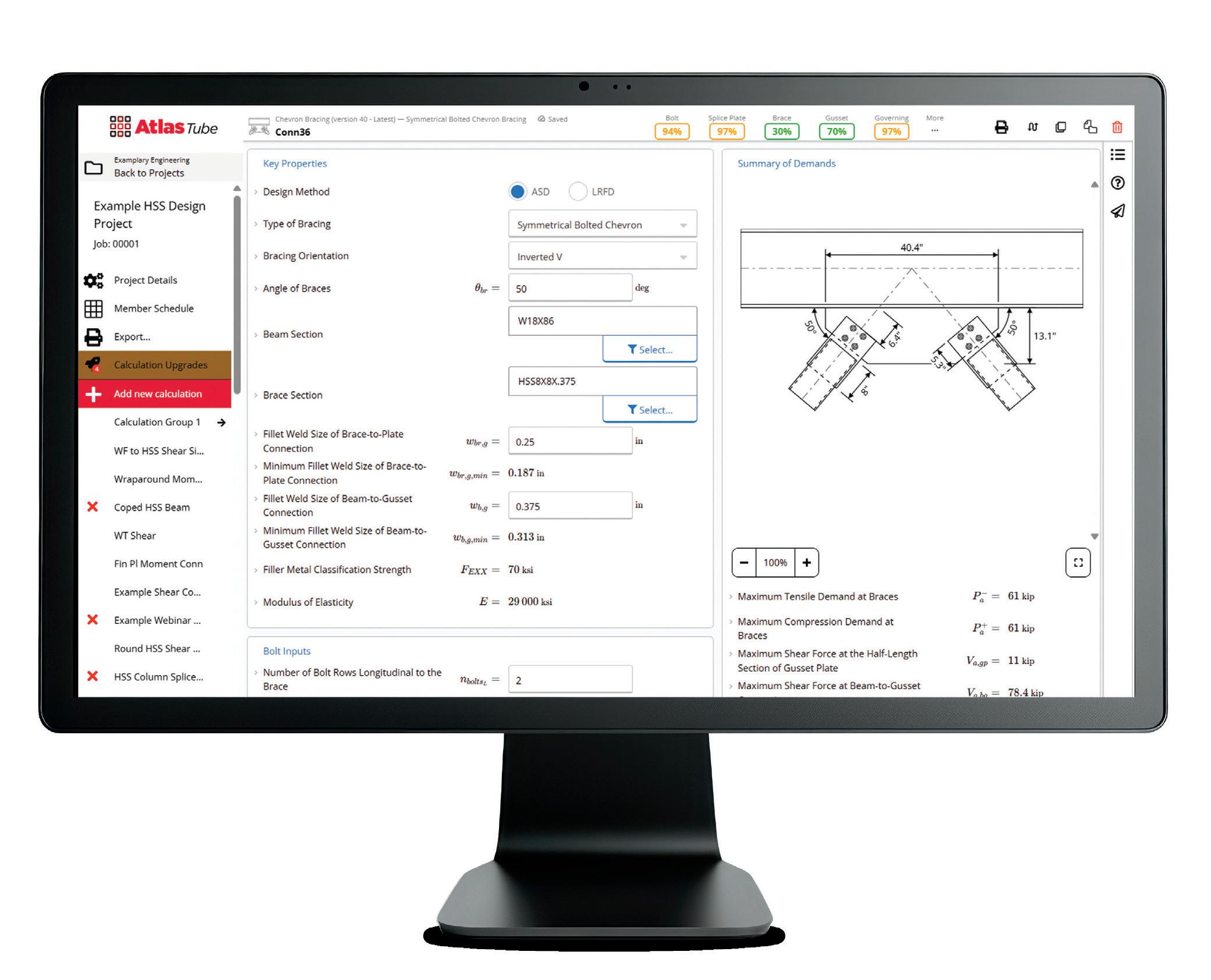
Join 2,400+ engineers who are reclaiming their time with Atlas Tube’s complimentary HSS Connections Hub. Explore the growing tool that enables more efficient design of fabrication-friendly HSS connections.
Optimize HSS connection designs.
RELENTLESS SUPPORT.
An ever-expanding resource for engineers, detailers and fabricators now featuring over 100 new updates.
A direct path to efficient HSS connection design
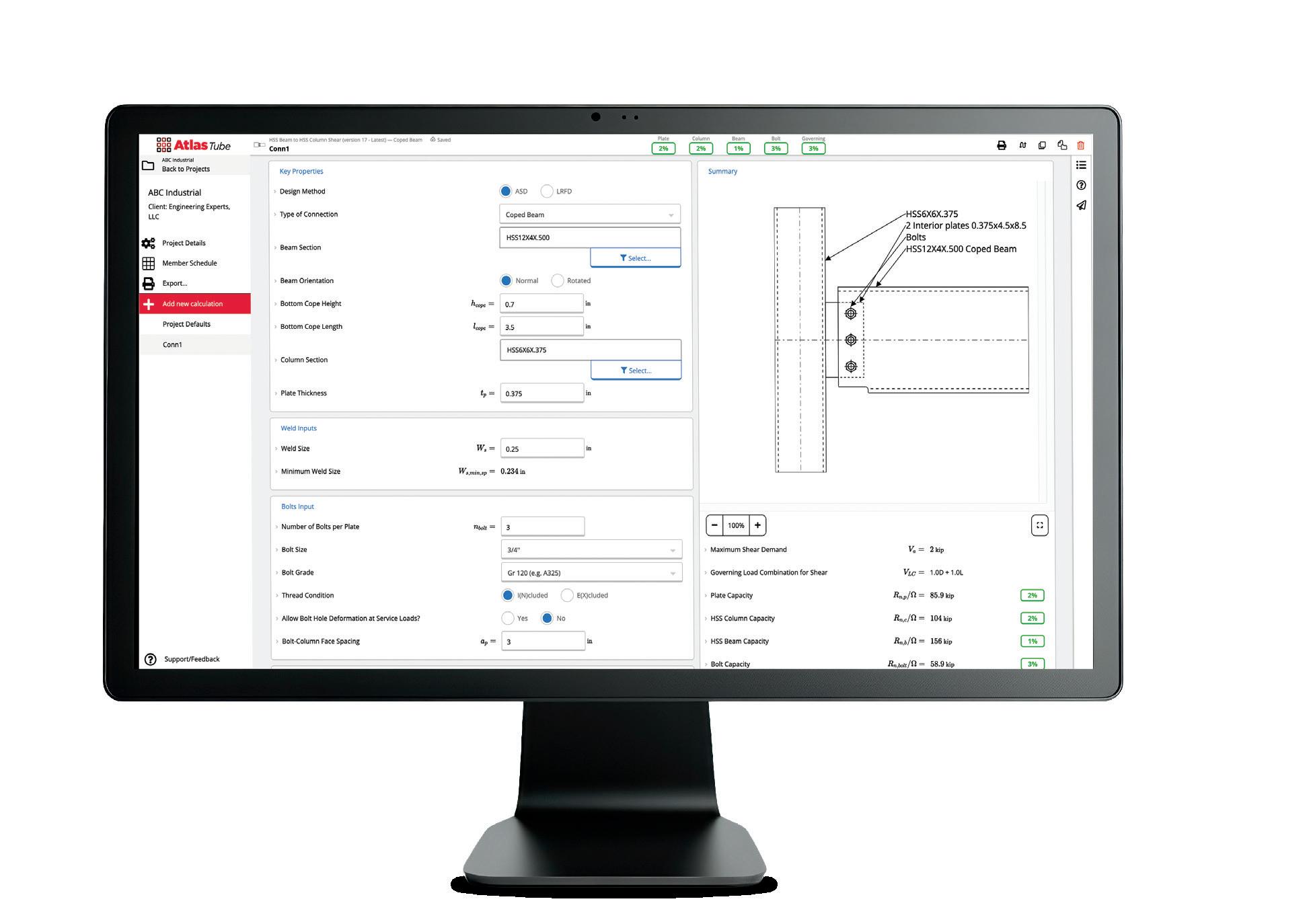
This invaluable and complimentary online resource will save design time by eliminating the need for developing and maintaining custom spreadsheets.
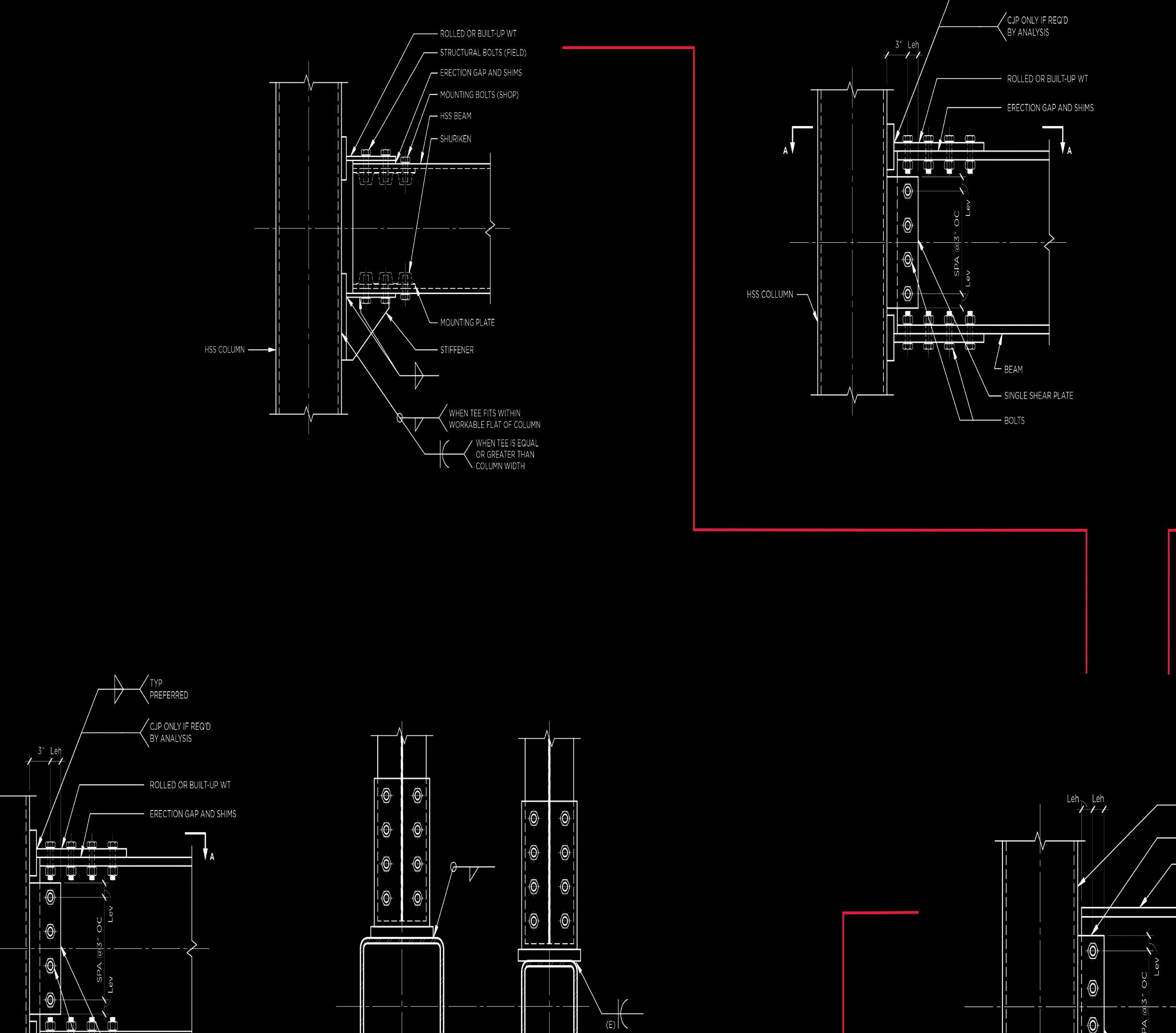
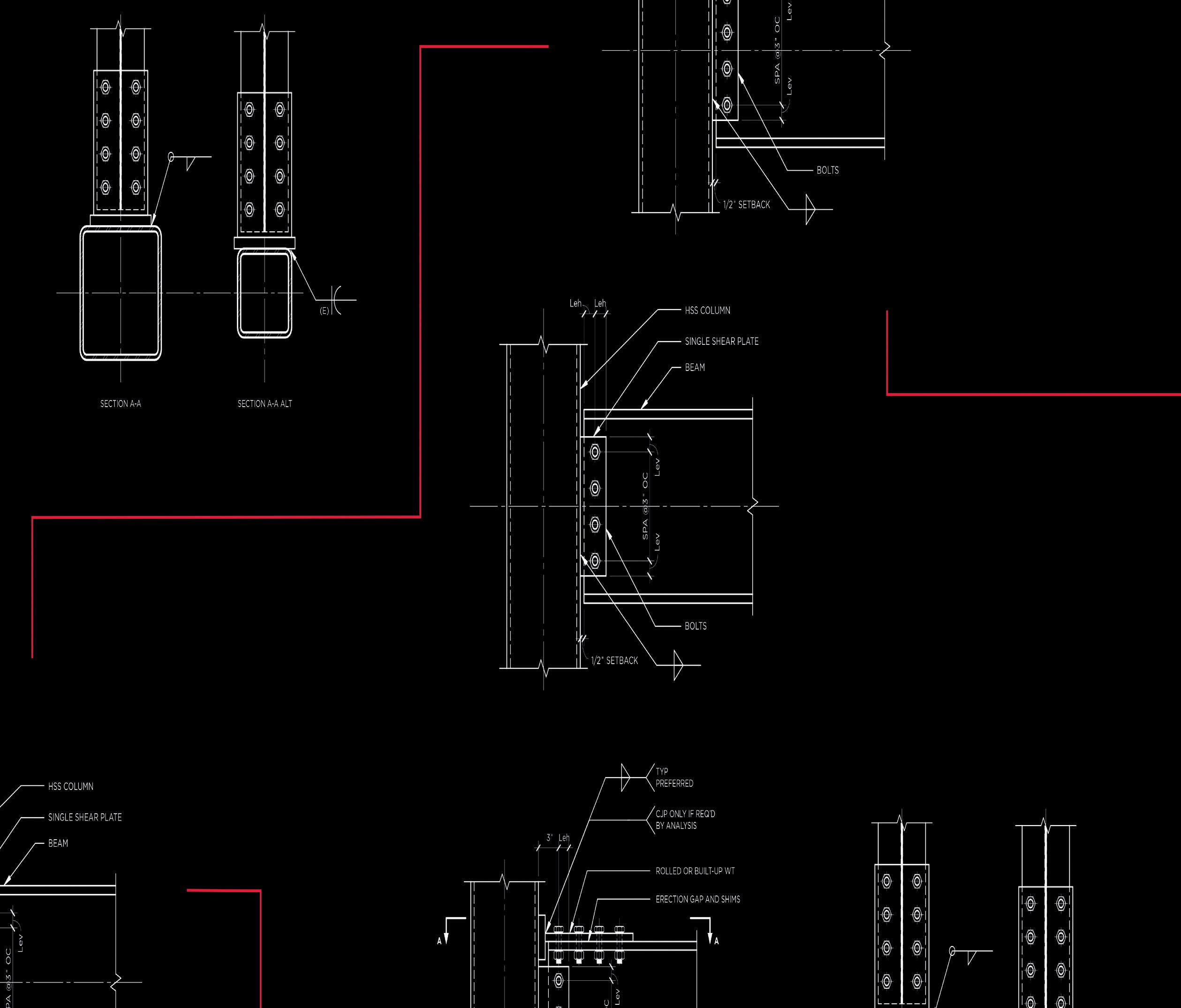
Fabrication-friendly typical HSS details are excellent starting points for design while corresponding calculators enable design completion.
Teams can streamline the design process and enhance collaboration directly on the HSS Connections Hub. Engineers can quickly create HSS connection calculations based on the most recent design manual and specific AISC and CISC code requirements. Fabricators will receive connection designs that meet requirements and are fabrication-friendly, eliminating back-and-forth revisions.
Recently Released
• Direct-input factored loads: Import factored reactions directly from your favorite analysis software.
• Automatic truss type detection: We’ll identify the correct truss type (T, K, Y, X, etc.) for you.
• Axial loads in moment connections: Apply axial loads to moment connections—shear connections coming soon!
• Built-up tees in WT connections: Customize tee sizes for WT connections beyond handbook limits.
• Custom bolt spacing for splices: Optimize bolt spacing to maximize splice capacity.
Launching in January
• HSS columns and beams for brace calculations: Connect braces to HSS beams and columns, expanding beyond current WF options.
• New truss connections: Enjoy support for X connections with round HSS and overlapped KT configurations.
• Moment in End Plate splices: Moment loads are now supported in splice connections for greater versatility.
Available in February
• Shear in splices: Apply and check shear loads on splice connections for enhanced safety.
• Extended configuration for shear plates: Add more bolt lines and length to shear plates for increased adaptability.
• Seismic design: Seismic design category determination and Ordinary moment frame (OMF) checks.
Leverage the benefits of HSS with the HSS Connections Hub
• Access a growing library of HSS connection calculators and fabrication-friendly typical HSS details.
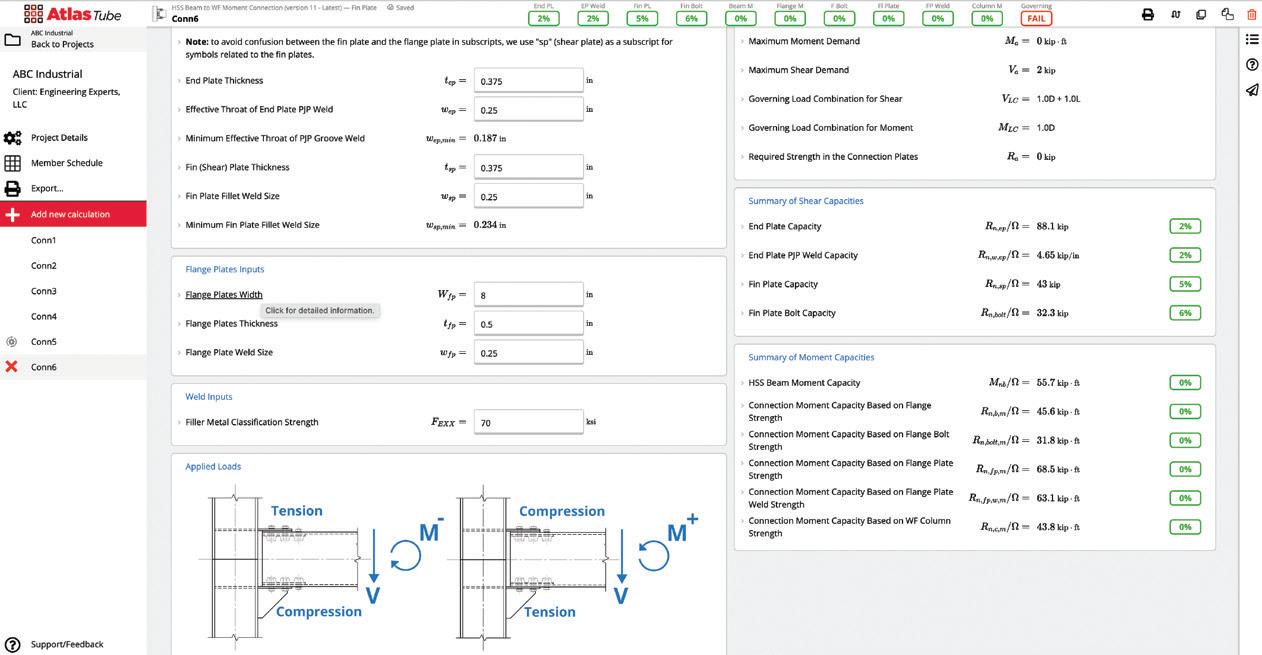
• Hub calculators automate and confirm connection designs in real-time.
• Clear and concise results indicate whether the designed connection is efficient and meets specified requirements.
• Full transparency: Review and verify your calculations against specific code references with a simple click.
• Download or share detailed reports and connection drawings, including dimensions, bolt sizes and other relevant information for easy communication with fabricators.
• Request support from Atlas Tube’s engineering experts on your project.
Sign up today and start using the HSS Connections Hub.
connectionshub.atlastube.com
Watch an Atlas Tube engineer demonstrate the HSS Connections Hub.


STRUCTURE ® CIRCULATION
subscriptions@structuremag.org
EDITORIAL BOARD
Chair John A. Dal Pino, S.E. Claremont Engineers Inc., Oakland, CA chair@STRUCTUREmag.org
Kevin Adamson, PE Structural Focus, Gardena, CA
Marshall Carman, PE, SE Schaefer, Cincinnati, Ohio
Erin Conaway, PE AISC, Littleton, CO
Sarah Evans, PE Walter P Moore, Houston, TX
Steven Judd Interstate Brick, West Jordan, Utah, and H.C. Muddox, Sacramento, California
Linda M. Kaplan, PE Pennoni, Pittsburgh, PA
Jessica Mandrick, PE, SE, LEED AP Gilsanz Murray Steficek, LLP, New York, NY
Brian W. Miller
Cast Connex Corporation, Davis, CA
Evans Mountzouris, PE Retired, Milford, CT
Kenneth Ogorzalek, PE, SE KPFF Consulting Engineers, San Francisco, CA (WI)
John “Buddy” Showalter, PE International Code Council, Washington, DC
Eytan Solomon, PE, LEED AP Silman, New York, NY
EDITORIAL STAFF
Publication of any article, image, or advertisement in magazine does not constitute endorsement by NCSEA, CASE, SEI, the Publisher, or the Editorial Board. Authors, contributors, and advertisers retain sole responsibility for the content of their submissions. magazine is not a peer-reviewed publication. Readers are encouraged to do their due diligence through
Executive Editor Alfred Spada aspada@ncsea.com
Managing Editor Shannon Wetzel swetzel@structuremag.org
MARKETING & ADVERTISING SALES
Senior Director for Business Development & Marketing
Monica Shripka Tel: 773-974-6561 monica.shripka@STRUCTUREmag.org
Sales Manager
Audrey Schmook Tel: 312-649-4600 Ext. 213 aschmook@ncsea.com
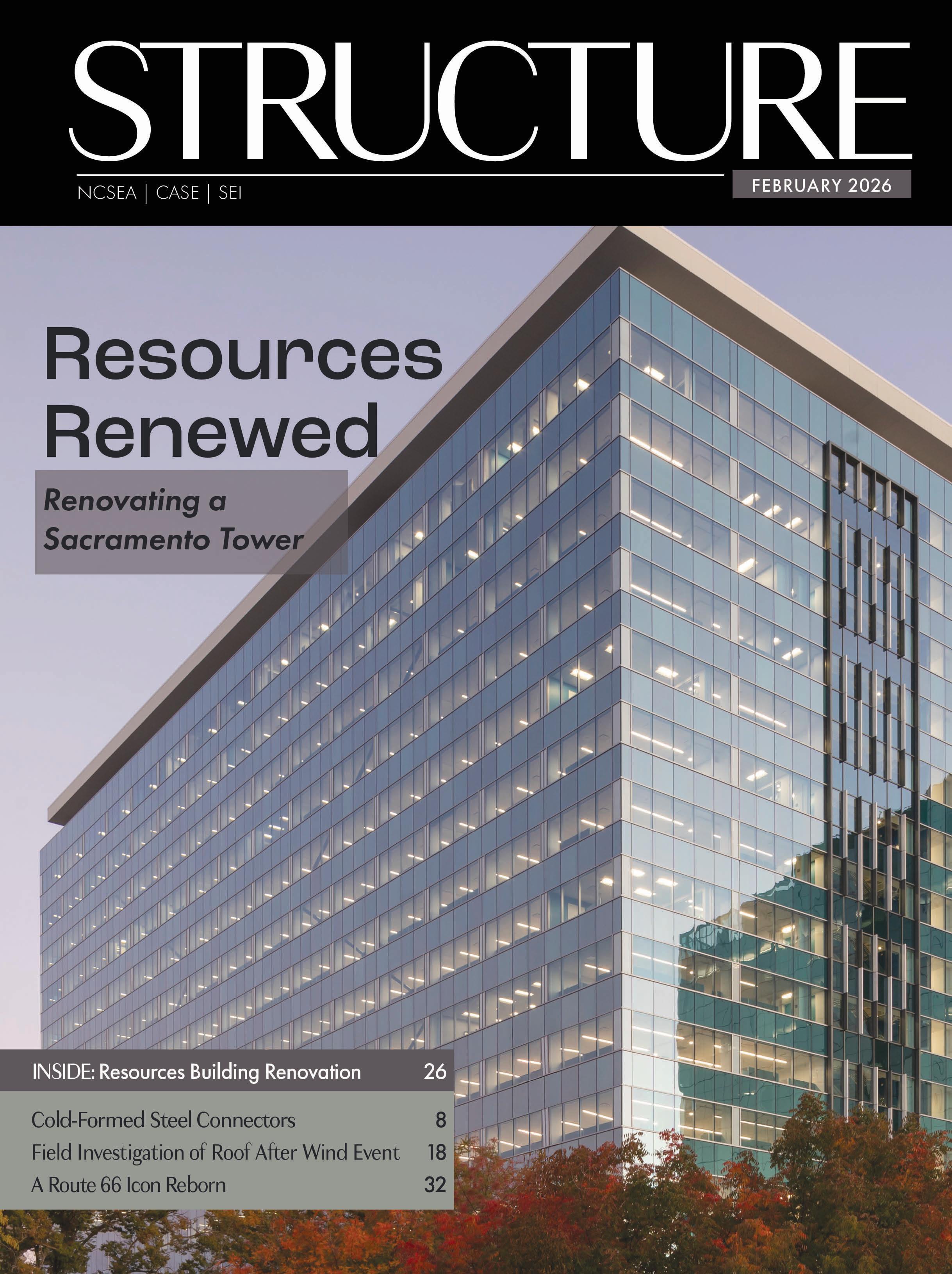
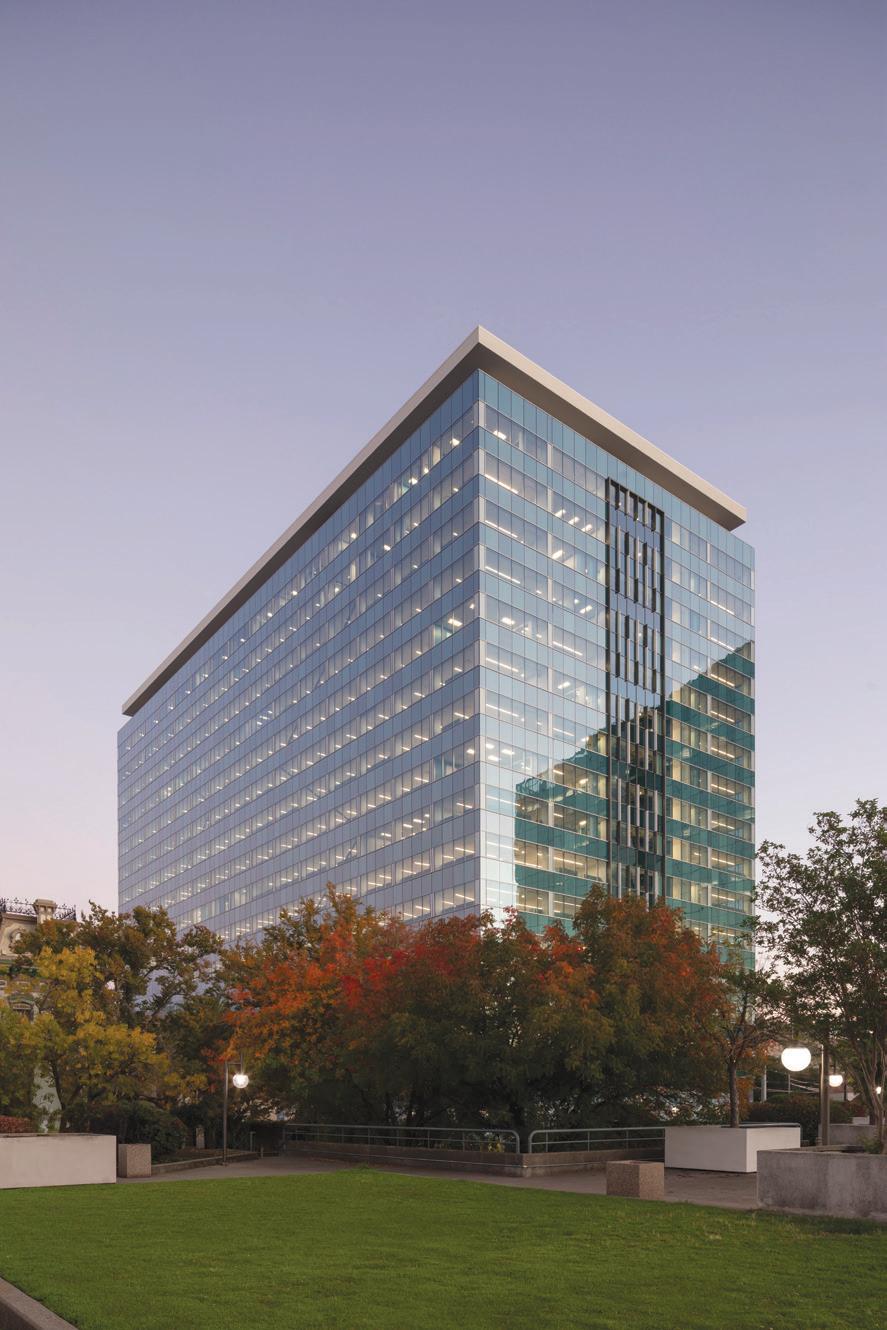
On the Cover: A 2015 assessment declared the Resources Building in California the No. 1 State-owned building most in need of repair. After a comprehensive renovation, the 62-year-old structure has turned from relic to radiant.
26 RESOURCES RENEWED
By Jason Horwedel, SE, DBIA, Matt Williams, SE, and Phil Petermann
A 2015 assessment declared the Resources Building in California the No. 1 State-owned building most in need of repair. After a comprehensive renovation, the 62-year-old structure has turned from relic to radiant.
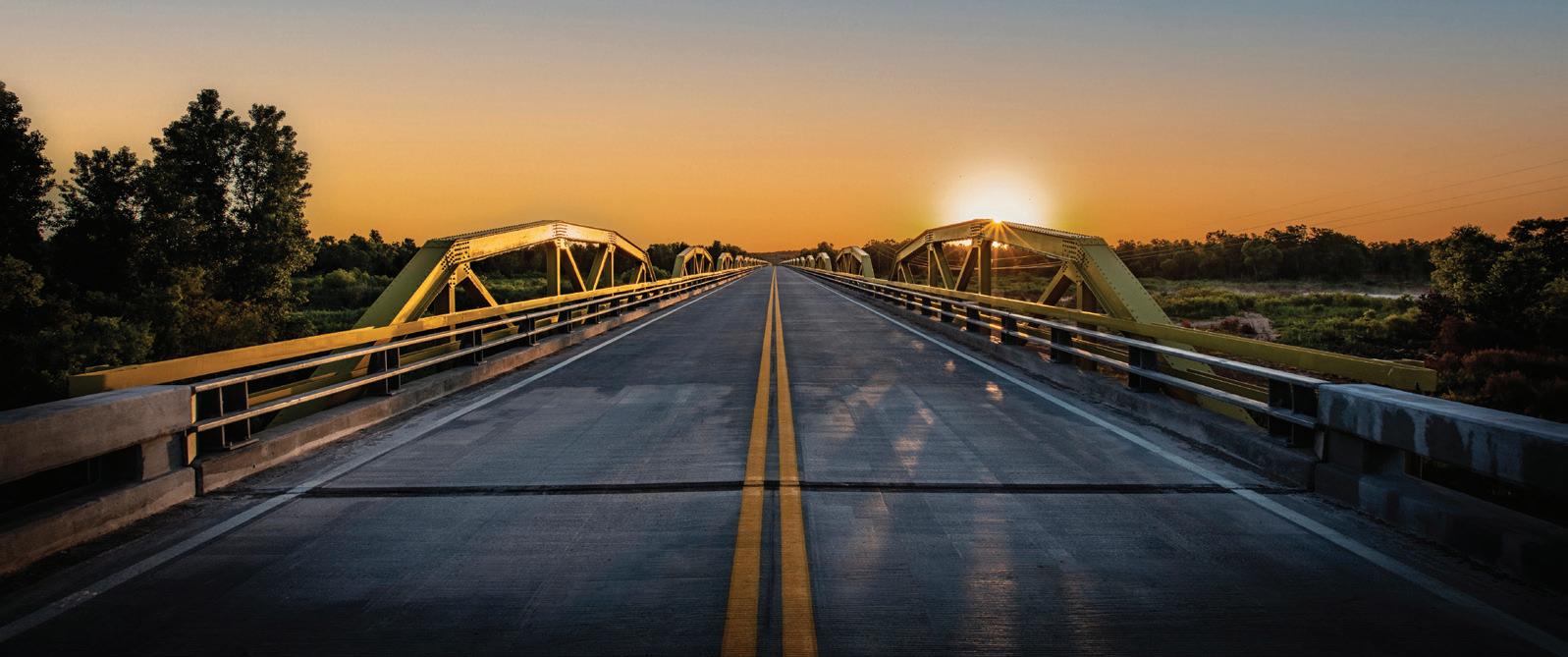
32 A ROUTE 66 ICON REBORN
By David Neuhauser and Jose Joseph
The rehabilitation of Oklahoma’s Route 66 William H. Murray “Pony” Bridge connects the past and future.
FEATURES COLUMNS and DEPARTMENTS
Design of CMU Masonry–The Paradigm Shift Has Begun
BIM Execution Plans: Towards a One -Page Communication Backbone
Matt Sweeney, Kristopher Dane, Margaret Sullivan-Miller, and the Structural Engineering Institute Committee on Digital Design 43 Structural Sustainability
10 Things Every Structural Engineer Should Know About Embodied Carbon: Wood By SE 2050 Resources Working Group 57 Structural Forum
Sustainability Starts at the Top By Kevin Kuntz, SE, PE, Ian McFarlane, SE, PE, and Jonathan Tavarez, PE
In Every Issue
INNOVATE FREELY
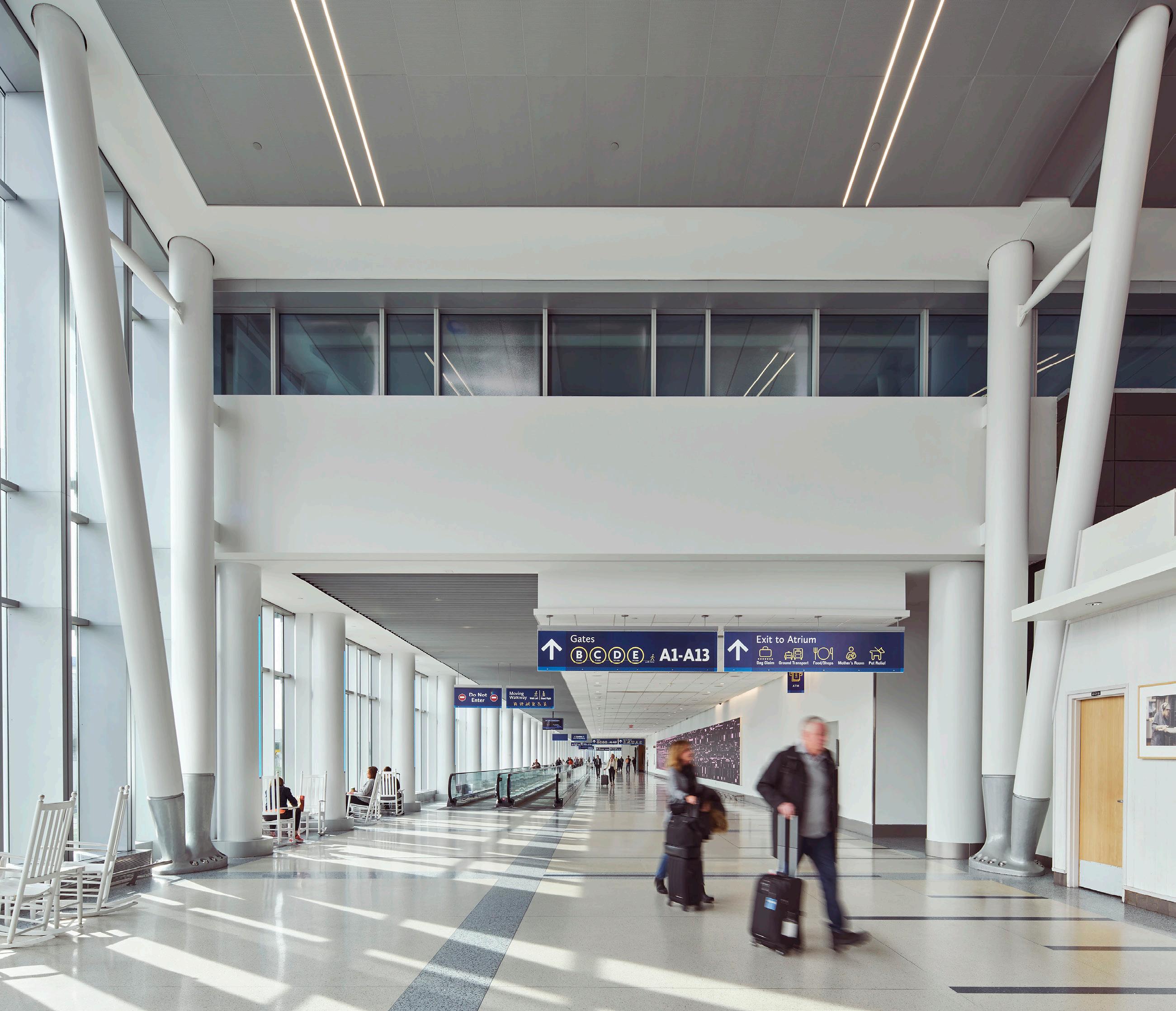
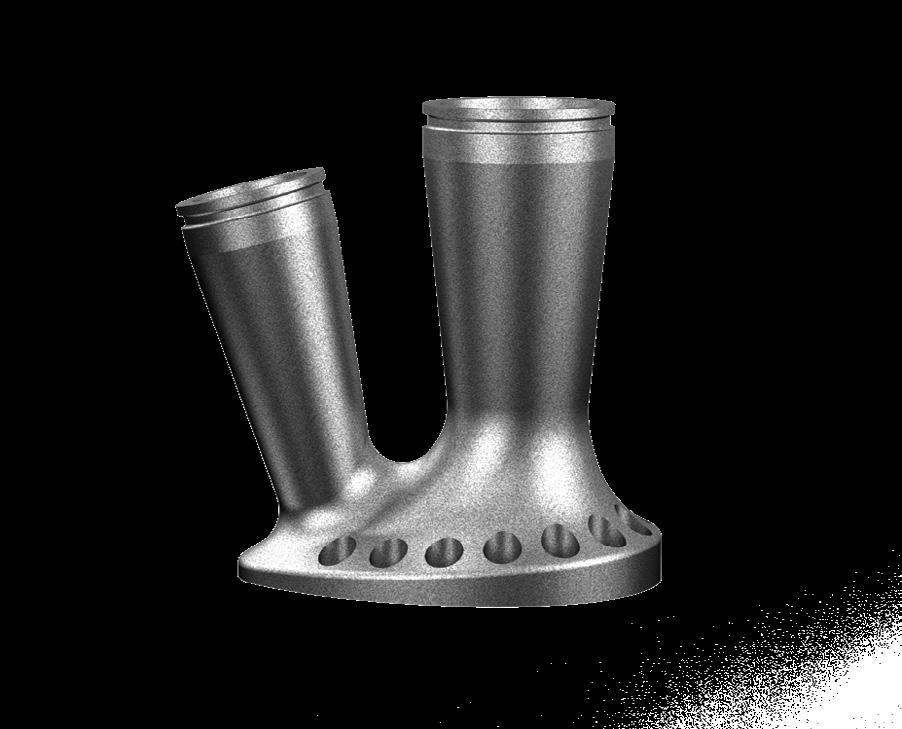
CAST CONNEX ® custom steel castings realize projects previously unachievable by conventional fabrication methods.
Innovative steel castings reduce construction time and costs, and provide enhanced connection strength, ductility, and fatigue resistance.
Freeform castings allow for flexible building and bridge geometry, enabling architects and engineers to realize their design ambitions.
Custom Cast Solutions simplify complex and repetitive connections and are ideal for architecturally exposed applications.

Architects: Perkins+Will | C Design
Structural Engineers: Stewart
General Contractor: Turner Rogers JV
Steel Fabricator: CMC Structural (now SC Steel)
Photography by Mark Bealer | Studio66
CHARLOTTE DOUGLAS INTERNATIONAL
AIRPORT EXPANSION
EDITORIAL Climate Change, Codes, and the Structural Engineer’s Standard of Care
By Yvonne Castillo
Structural engineers have always designed for weather and the physical environment. What is changing is not the existence of natural hazards, but their frequency, intensity, and interaction with the built environment.
Building codes remain largely grounded in historical data, while clients, insurers, regulators, and courts are embracing forward-looking climate science. This creates a practical tension in everyday practice: how to remain anchored in code compliance while responding to evolving expectations about foreseeable conditions.
This editorial is not about rewriting codes or turning structural engineers into climate scientists. It is about understanding how the professional standard of care is evolving when past conditions are no longer a reliable proxy for future extremes.
Many jurisdictions have adopted “modern” building codes—2018, 2021, or even 2024 editions. Yet even the most current codes rely on historical datasets developed decades ago, frequently based on observations from the mid- to late-20th century.
A simple question illustrates the issue: Does the world engineers design for today look like the world of the 1970s or 1980s?
Most practitioners, regardless of their views on climate science, would answer no. This is where the concept of stationarity versus non-stationarity becomes relevant to practice. Stationarity assumes future conditions will resemble the past; nonstationarity recognizes that baseline conditions are shifting. Codes, by necessity, evolve slowly and deliberately. Climate science, by contrast, is forward looking and scenario based.
For structural engineers, this tension appears in familiar areas of practice—wind, flooding, snow, extreme heat, wildfire exposure, and long-term material durability. Engineers are not being asked to abandon codes or design for speculative futures. Increasingly, they are being asked something more modest, more challenging: Have you considered whether historical assumptions fully reflect foreseeable conditions at this site?
That question may come from a client, a client’s insurer, a public agency, or, years later, in the context of a claim following a severe event.
Standard of care: Reasonableness,
not
prediction
From a professional liability perspective, the standard of care has always been a moving target. Courts do not ask whether an engineer predicted
the future correctly. They ask whether the engineer acted reasonably given what was known or reasonably knowable at the time.
That distinction matters because a jury or judge gets the benefit of hindsight. When a loss follows an extreme event, the inquiry may extend beyond simple code compliance to questions such as:
• Was the hazard foreseeable?
• Was relevant information available in the public domain?
• Did the engineer exercise professional judgment in light of that information?
• Were assumptions and decisions discussed and documented?
No one expects structural engineers to be experts in climate modeling. But as climate science becomes widely accessible and better understood, ignoring broadly recognized trends can become harder to explain.
Climate data as a screening tool, not a design mandate
Climate models are not predictions. They are scenario-based tools that describe how hazards may change under different assumptions. Different models produce different outputs because they measure different aspects of risk.
As a result, leading firms treat climate data as a screening input. Reviewing two or three credible sources can help engineers understand hazard context without over-relying on any single dataset. Commonly referenced resources include:
• NOAA data portals.
• Argonne National Laboratory’s CLIMRR tool.
• First Street Foundation.
• FEMA flood maps, which remain essential regulatory references but are intentionally limited in scope.
• The AIA Trust Climate Factsheet. Each of these tools is valuable and has their own limitations and intended purpose. Used together, they help identify which hazards warrant closer consideration.
The risk conversation
One of the clearest trends emerging across design practice is the importance of documented conversations. Engineers advise; clients decide.
Reasonable practice increasingly includes acknowledging relevant hazards, explaining what codes do and do not address, discussing optional
resilience measures, and documenting assumptions and client decisions. This does not shift responsibility to the engineer; it clarifies roles and preserves professional judgment.

The design professional may not have control over the overall design concept and may have limited direct contact with the owner. Design decisions are often constrained by architectural intent, project delivery method, and budget. Even on projects where engineers have greater design latitude, such as bridges or other infrastructure, cost constraints remain a dominant factor.
Reasonable practice does not require structural engineers to override these constraints or guarantee an outcome. Rather, it involves exercising professional judgment on a project, identifying relevant risks, communicating options and tradeoffs, and documenting decisions when constraints limit solutions.
Signals from the courts
Recent case law offers early signals worth understanding. Courts have increasingly recognized that where credible science is publicly available, it can be reasonable for decision makers to consider future hazard conditions, particularly for long-lived assets.
Cases involving asbestos exposure, public infrastructure planning, coastal parks, and land-use decisions suggest a consistent theme: reasonableness evolves with knowledge. Engineers are not expected to guarantee outcomes, but they may be expected to demonstrate thoughtful consideration of foreseeable risks.
Looking ahead
This is not about raising the bar overnight or designing beyond the code by default. It is about recognizing that code compliance and professional judgment are not mutually exclusive. Engineers who remain thoughtful, engage clients transparently, and document their reasoning are practicing in a way that aligns with where expectations are heading. ■
Yvonne Castillo, Esq., is the Director of Risk Advisory and a professional liability risk advisor for Victor’s Risk Advisory, U.S. Group.
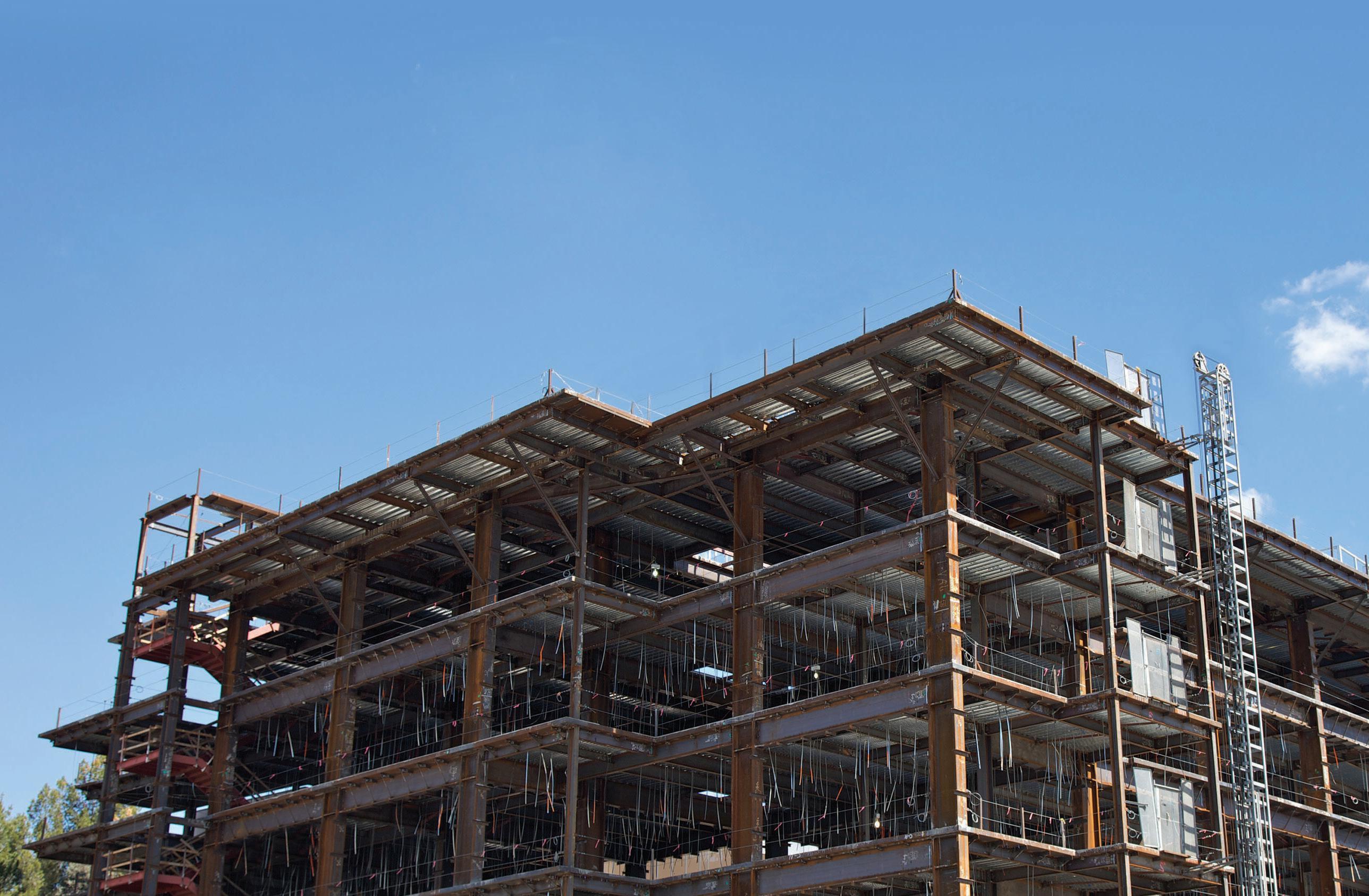

Overcoming Data Gaps in Proprietary Cold-Formed Steel Connectors
A testing and FEA-based approach was used to determine the resistance of a cold form steel product which did not have readily available technical data.
By Arif Shahdin and Jose Palao Jr., PE
At times, engineers may come across a situation in the design process where a cold formed steel (CFS) proprietary product is used in a project. When that happens, many non-conventional steps often are taken to understand the performance of the product/ system. Such products are becoming more common in the design practice.
The main challenge in using proprietary products in general lies in obtaining the technical data or resistance values of these products. Therefore, the inclusion of such systems/products in design projects has added new responsibilities on design engineers. Engineers cannot analytically evaluate the design resistance, nor can they access a table to pick a safety factor or a phi factor for a specific limit state. Rational Engineering approach is typically used to assess the performance of such systems. Rational Engineering is defined in AISI S-100 as an analysis based on theory that is appropriate for the situation, backed with relevant test data, if available, and sound engineering judgement.
The focus of this article is to highlight the process of determining the resistance of CFS proprietary products utilizing two techniques:
1. Physical testing
2. Finite Element Analysis (FEA).
A modular CFS structural system will be used as an example in this article for all further explanations. These bolted CFS systems are used in various industrial and commercial-type support applications.
Physical Testing:
AISI S100 2016 “Reaffirmed 2020” provides guidance in chapter K, Section 2 on how to evaluate structural performance of proprietary CFS system in accordance with Rational Engineering analysis with confirmatory testing. Before going into an example, the overall procedure can be summarized as follows:
1. Minimum of three tests shall be performed with a +/-15% deviation from average.
2. The average value of all tests shall be regarded as the nominal Strength Rn for the series of tests.
3. Only one limit state of the test specimen is permitted for evaluation at a time.
4. An LRFD (Load and Resistance Factor Design) phi factor is calculated using
various statistical coefficients such as material factor, fabrication factor, target reliability index etc.
5. A factor of 1.6 is then used to determine an ASD (Allowable Strength Design) level safety factor.
6. The nominal Strength Rn is reduced by the Safety Factor to obtain the ASD level resistance of the specimen for a particular limit state.
The following test elaborates on this method of evaluating the structural performance using the connector shown in Figure 1 as the test specimen. The goal is to evaluate only the +Fx direction load capacity.
a. Test setup:
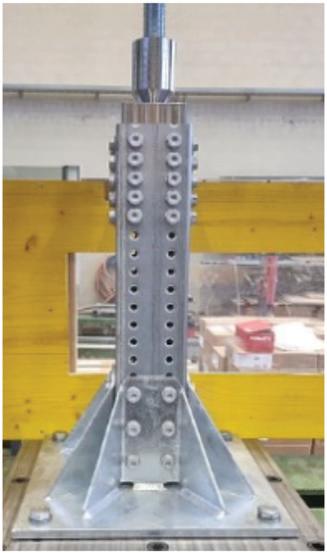
Five tests were conducted using the setup shown below. The Load Displacement curves were developed and the results were tabulated for all five tests (Table 1).
b. A mean test value was calculated from Table 1.
Table 1. Load Displacement Test Results
Fig. 1. The connector shown is the test specimen.
Fig. 2. Example bracket and test setup.
c. The phi factor for LRFD was calculated using Eq. K2.1.1-2 as illustrated below.
Following is a summary of all the statistical factors used in the equation above:
• Correction factor CP
where,
n=5 number of tests
m=n-1=4 degrees of freedom
• Coefficient of variation of test results V P . V R S 0 026 p
Since VP < 0.065, VP = 0.065 where,
St = 8.608 kN (1.935 kip) standard deviation of data
The following statistical data was obtained from Table K2.1.1-1(for Other Connectors or Fasteners not listed in the table)
Vm = 0.10 coefficient of variation of material factor
Mm = 1.10 mean value of material factor
Fm = 1.00 mean value of fabrication factor
Vf=0.15 coefficient of variation of fabrication factor
• Mean value of professional factor for LRFD P m = 1.0 Eq. k2.1.1-3
• LRFD target reliability index for connections
β0=3.5
• Coefficient of variation of load effect
VQ = 0.21
• Calibration coefficient for U.S./Mexico
C0=1.52
Eq. C-B3 2.2-10
d. ASD level resistance was then determined using a factor of 1.6
Ω = 1.6/0 = 1.6/0.596 = 2.683 ASD level safety factor
FxASD = Rn/Ω = 336.57kN (75.66 kip)/2.683 = 125.44 kN (28.20 kip)
Finite Element Analysis:
In addition to physical testing, FEA provides an alternative methodology for evaluating the structural performance of proprietary CFS systems when analytical equations are not applicable and physical testing alone is insufficient. AISI S100-2016 Chapter K recognizes numerical modeling as a valid component of Rational Engineering Analysis, provided that the model is appropriately calibrated and validated.
For proprietary CFS systems, particularly those with non-standard geometries, built-up assemblies, or unique connection details, FEA allows engineers to capture localized behaviors, nonlinear load paths,
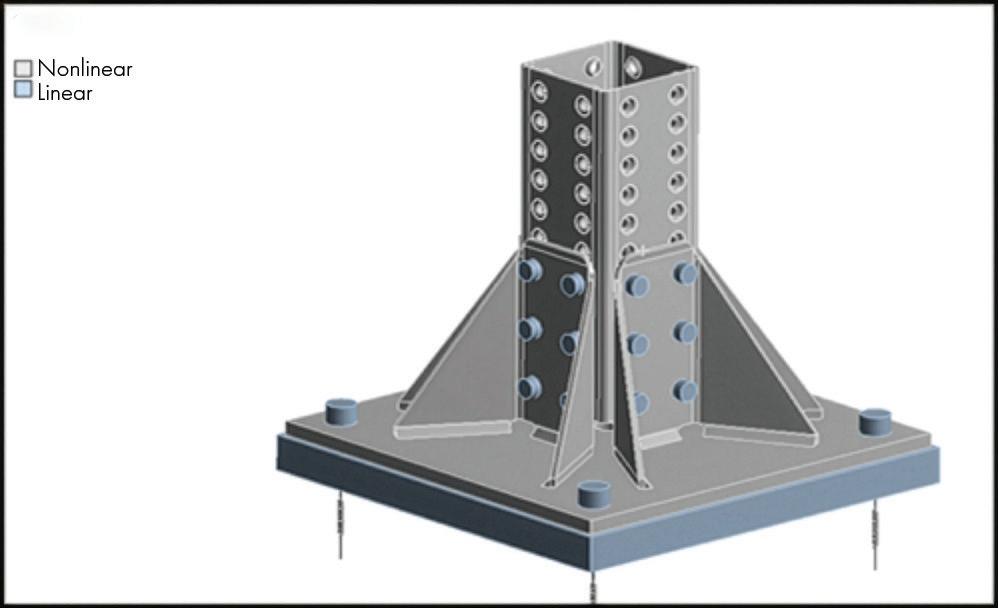
and connection interactions that cannot be represented by classical solutions prescribed in standard design codes such as AISI S100. The following section summarizes the overall process of developing and validating an FEA model to determine the +Fy and +Fz load capacities for the proprietary connector (shown as the test specimen in Figure 1) introduced previously.
Due to the complex nature of the mathematical solutions involved in FEA simulations, this article only addresses a few key components of FEA to provide a high-level understanding of how it can be used to evaluate the capacity of proprietary CFS products.
Modeling Approach
A square girder was attached to the connector and this connector and girder assembly as shown in Figure 3 was used for the FEA simulations to obtain the +Fy and +Fz load capacities of the connector. Since the connector is geometrically symmetric in both the Fy and Fz orientations, the load capacities in these directions are identical. The main modeling considerations are included below:
Geometry:
Before any modeling begins, a 3D CAD file is first provided, typically by the development/manufacturing team of the proprietary product. The 3D CAD geometry is verified against 2D drawings to ensure all overall dimensions are accurate and cross-checked. Additionally, the assembly is backchecked against the manufacturer’s installation instructions to ensure the model represents an approved configuration. The geometry is then cleaned to improve mesh quality and computational efficiency (Fig. 3).
Element Selection and Connection Modeling:
The assembly was modeled using thin-shell elements capable of capturing local buckling, crippling, and distortional deformations typical of CFS behavior. Bolt shanks and bearing surfaces were represented using solid elements for simplified geometry. Anchors embedded in concrete were modeled as tension only springs with a defined stiffness to replicate interaction with the concrete substrate.
Material Properties:
For this simulation, a bilinear elastic stress-strain curve was assumed and calibrated against empirical data that reflect the nominal steel properties.
Boundary Conditions and Loading:
Boundary conditions must accurately represent realistic support and loading scenarios. For this simulation, a free length is applied beyond the edge of the base connector, at least equal to the largest cross-sectional dimension. This free length helps simulate actual conditions and avoid unrealistic stiffness effects.
Fig. 3. Overall geometry girder and connector assembly.
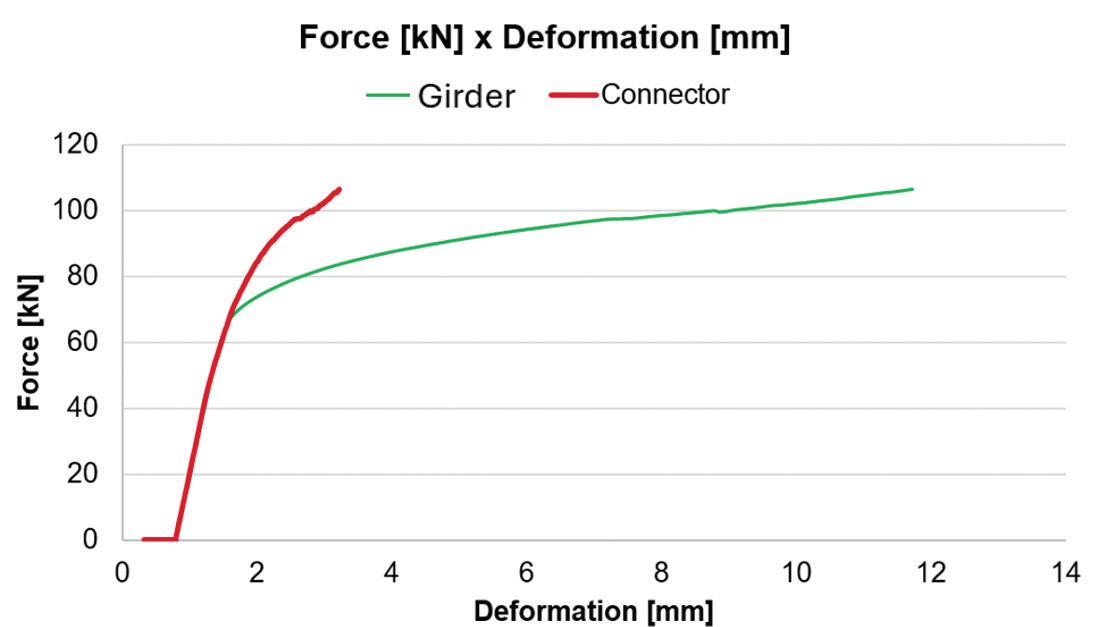
External loads are applied as displacement-controlled inputs, rather than direct force application. This approach enables the generation of force–deflection and moment–rotation curves, which are critical for evaluating connection behavior. In general, load application to the 3D analytical model should closely match the physical test loading protocol conditions in order to improve the correlation between simulation and experimental results.
Evaluation Criteria
Engineers are responsible for selecting appropriate validation
and verification methods. The most common approach is comparison with physical test data. This ensures close alignment of load-displacement behavior and validates stiffness, assumptions, and load capacity. When validating the results by this method, engineers must follow AISI S100 Section K2.1.1(b), which states the correlation coefficient, Cc, between tested strength (Rt) and nominal strength (Rn) predicted from the FEA model must be greater than or equal to 0.80.
Another means of validating and verifying the numerical solution can be to reduce the connector to an idealized, simplified assembly to allow for the use of classical solutions prescribed in design codes such as AISI S100. If FEA or classical solutions using an


SPENDING GREEN... TO GO GREEN
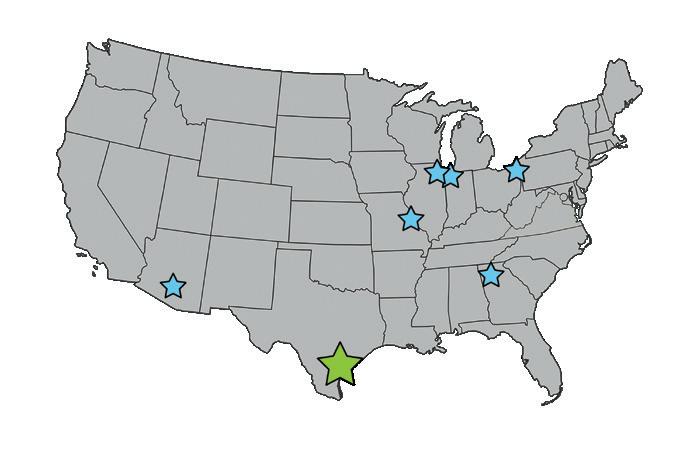
Bull Moose Tube made a major investment in a new 350,000 ton-per-year facility in Sinton, Texas – with the goal of providing you with the “greenest” steel tube in the United States.
• SUSTAINABILITY-FOCUSED | Our state-of-the-art facility boasts the lowest carbon footprint for steel pipe & tube in the United States. Additional Bull Moose products means a greater range of possibilities for your designs…while helping you achieve your green initiatives.
• MORE HSS AND NEW PIPE PILE CAPACITY | Our new mill enables us to produce HSS up to 14” square and 18” round, up to ¾” walls, and the ability to enter the pipe pile market.
Scan for more info about our Sustainability efforts.
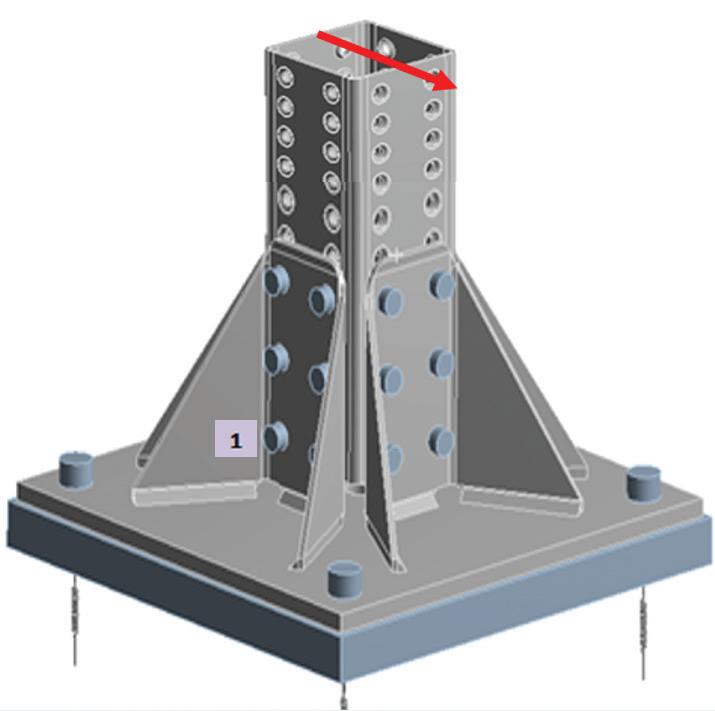
Fig. 5. Applied simulation load direction and Bolt #1 identification.
Fig. 4. Connector girder assembly force-deformation curve
idealized connector are performed, both which fall under Rational Engineering analysis, the following safety factors are applied, in accordance with AISI S100 Section A1.2(c). Per this specification, there are separate safety factors (and phi factors) for members and the connection. For members Ω ASD = 2.0 and ф LRFD = 0.80. Similarly for connections, Ω ASD = 3.0 and ф LRFD = 0.55.
Strength Determination
Once geometry, boundary conditions, and model assumptions are verified, the connector capacity is determined. Figure 4 shows the 3D simulation force-deformation curve, which shows a peak nominal resistance of Rn = 106 kN (23.83 kip).
Per AISI S100 Section A1.2(c), a safety factor of 3.0 is applied for ASD.
Fy-z ASD = 106 kN (23.83 kip) / 3 = 35.3 kN (7.94 kip)
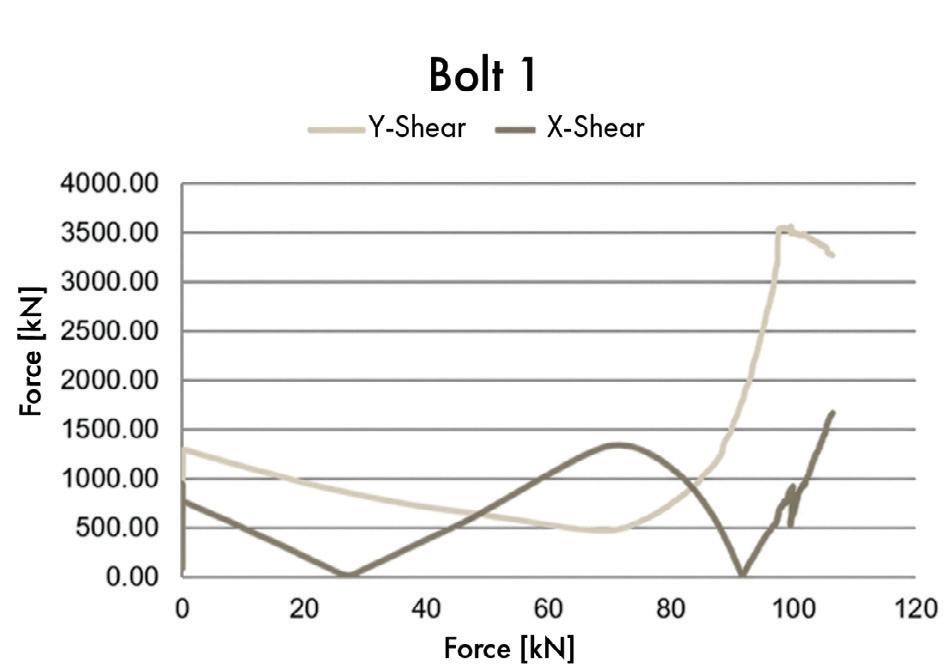
Another critical check is to evaluate the bolts that connect the connector to the girder. Figure 5 shows an example of the applied load on the simulation and the location of bolt #1. Figure 6 provides a typical example of the bolt force curve for bolt #1.
The nominal shear strength of the single bolt is 28 kN (6.29 kip)
and is based on physical testing of the individual bolt. Based on Figure 6, the maximum applied bolt shear load in the Y-direction is 3.57 kN (0.803 kip), and X-direction is 1.67 kN (0.375 kip). Therefore, the total resultant load is 3.94 kN (0.886 kip), well below the bolt’s nominal capacity.
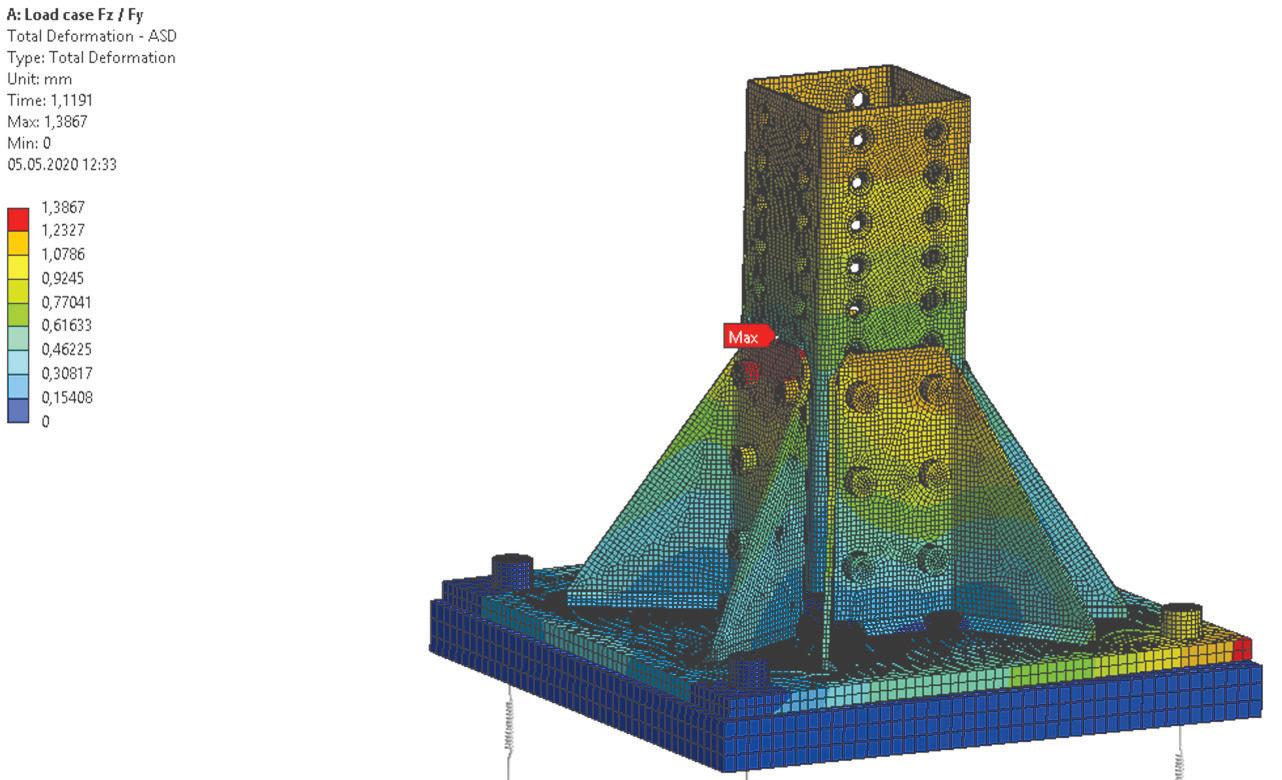
Additional considerations would be the stress and deformation contour plots. Figure 7 provides an example of the deformation contour plot at an ASD level. The maximum deformation is 1.3867 mm (0.0546 in).
Role of FEA in Proprietary Product Evaluation
While physical testing remains the primary method for establishing product resistance, a calibrated FEA model provides several advantages:
• Ability to evaluate alternate configurations without additional full-scale testing.
• Insight into failure mechanisms and load paths not visible during testing.
• Perform parametric studies for thickness changes, bolt spacing, or geometric variations.
• Identify critical details and optimize design before prototyping. When used in conjunction with confirmatory testing as outlined in AISI S100, FEA serves as a powerful tool for developing reliable technical data for proprietary cold-formed steel systems.
Conclusion
Without appropriate technical data, usually the resistance of proprietary CFS systems is estimated by engineers using a static model and hand calculations. This might be the least cost-effective method but tends to produce very conservative results. However, at times these results could also lead to unconservative and unsafe designs. Therefore, whether using physical testing or FEA, proper guidance as provided by AISI and highlighted in this article must be used as a practice for developing technical data for designing safe structures using proprietary steel products. ■
Arif Shahdin is a Technical Product Manager in Hilti. He has over 13 years of experience as a Hilti cold form/modular steel systems experts where he has worked on the development of technical data and design practices for Hilti’s modular support system product line, including developing an analysis software for the product. Shahdin is a degreed and practicing structural engineer and an adjunct faculty of structural engineering.
Jose Palao Jr, PE, is an Approvals Engineer at Hilti with two years of experience leading code approvals and technical compliance efforts for Hilti’s cold-formed steel modular support (MT) portfolio. He has over 10 years of structural engineering experience, including the design and evaluation of low-rise reinforced concrete and steel structures, waterfront and coastal resiliency projects, shallow and deep foundation systems, pump stations, building rehabilitation, temporary support systems, and permanent earth-retaining structures.
Fig. 7. A 3D model deformation contour plot was created for the example bracket.
Fig. 6. Bolt #1 X-Y direction force comparison from simulation results.
structural DESIGN
Two-Dimensional Modular Steel to Optimize Critical Path Steel Erection
Applications and methods for modular steel have grown and evolved over the last two decades.
By James Ryan, PE
Since the early 2000s, modular design and construction have expanded from two-dimensional grating floor panels to modular composite floor and roof panels, modular girt trusses, and partially fabricated stair towers. Over the past 25 years, approximately 10,000 modular steel panels have been used in fossil and nuclear power plants, as well as oil, gas, and chemical plants. Potential applications include AI data centers, chip manufacturing plants, and large-scale global airport expansions (i.e., to mitigate operational impacts).
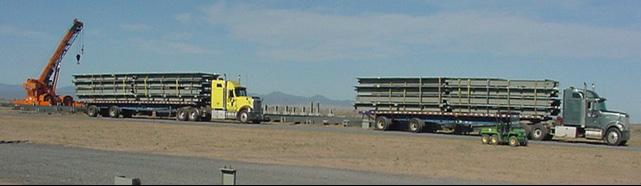
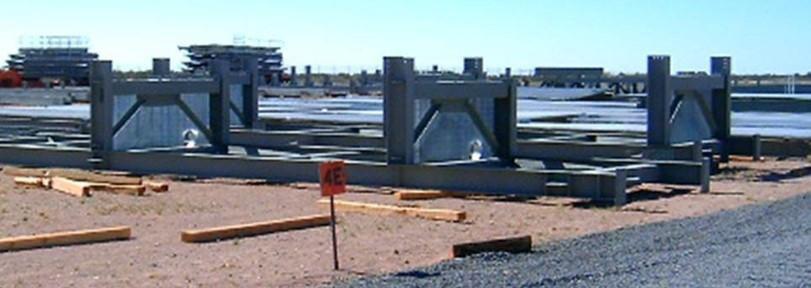
Truck-transported modular steel (Fig. 1) includes the most laborintensive miscellaneous steel components. The shop assemblies concurrently optimize weight and volume criteria, thus enabling truck transport without police escort or cost premium. Cost benefit includes a substantial reduction in schedule, which reduces interest costs, cranes, and other equipment costs; field supervision and engineering; home office support; and (at remote sites) per diems.
Modular Composite Floor and Roof Panels
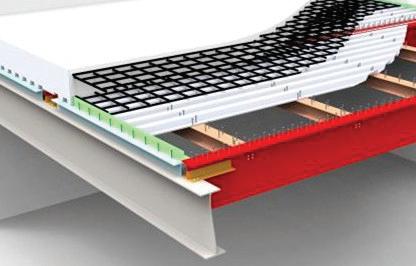
Steel composite panels (Fig. 2) are used in lieu of concrete floor and roof slabs. Panel components include two primary beams, infill beams at 12 feet maximum spacing (with dual use for commodity support), nominally 30 composite deck panels, penetrations, hundreds of steel-headed stud anchors and select HSS stubs above the floor for equipment or commodity support.
All structural and miscellaneous steel for a floor or roof bay is erected with only three modular composite panels, an incremental girder, and a greatly reduced bolt quantity relative to conventional “stick-built” construction. The web at the ends of the primary
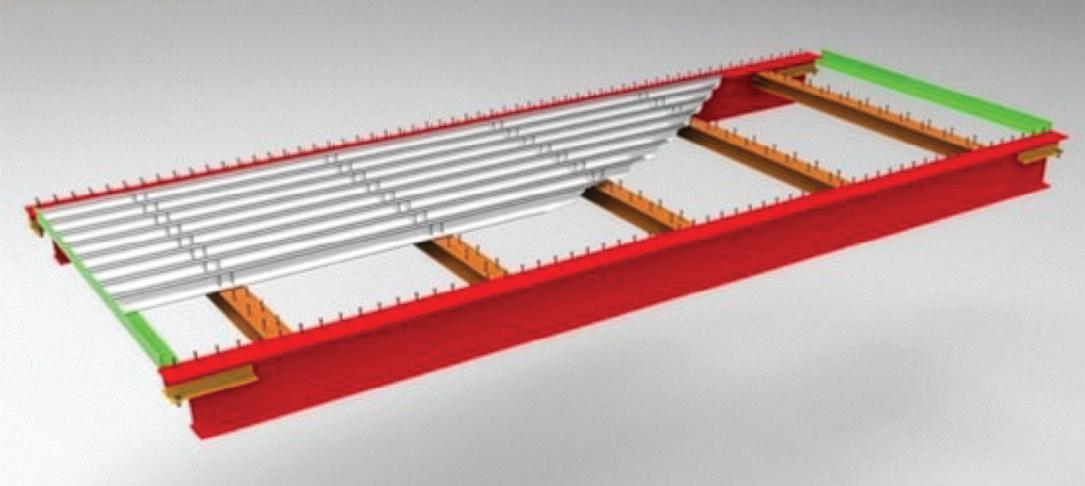
beams is typically coped to a depth of only 8 inches to mitigate impacts to the overall floor depth. The coped web is reinforced by two 4-inch-deep angles to provide for increased shear capacity. Only two bolts are used at panel seated connections, regardless of load. Oversize (OVS) holes all plies address cumulative tolerances.
Paradoxically, the modular panels greatly improve both safety and erection speed relative to “stick-built” conventional construction. Ironworkers may walk on top of the composite deck within the floor panels and install one-sided ASTM F3148 TNA bolt assemblies from above the floor panels. In conventional construction, ironworkers straddle girders and walk on their bottom flanges. All bolt installation is made by reaching below the girder top of steel elevation. The enormous quantity of composite deck sections is not installed until much later.
The composite deck orientation within the floor panels enables 7/8-inch diameter steel headed stud anchors on the two primary panel beams. This reduces the required number of steel headed
Fig. 1. Two-dimensional modular steel panels are transported to a construction site.
Fig. 2. Steel composite panels safely expedite concrete floor and roof construction.
stud anchors by a factor of two relative to conventional construction. For conventional construction, the flutes of the composite deck above beams limit the maximum diameter to ¾. In addition, design codes impose significant deck reduction factors.
Additional benefits of the modular steel composite panels include:
• Shifting field work from elevated heights to at-grade in an enclosed fabrication shop, thus minimizing lost days due to adverse weather conditions.
• Addressing craft labor availability issues, especially at remote sites.
• Mitigating impacts of an aging craft workforce by erection friendly design.
The composite deck is typically 16 gage to mitigate wet concrete deflection and increase durability in shipment and handling. The thickness also mitigates cumulative concrete ponding from the composite deck, primary panel beams, infill beams, and girders. Longer span primary panel beams are selectively cambered to preclude contributing to cumulative concrete ponding. Reinforcing steel installation and concrete placement is consistent with conventional construction.
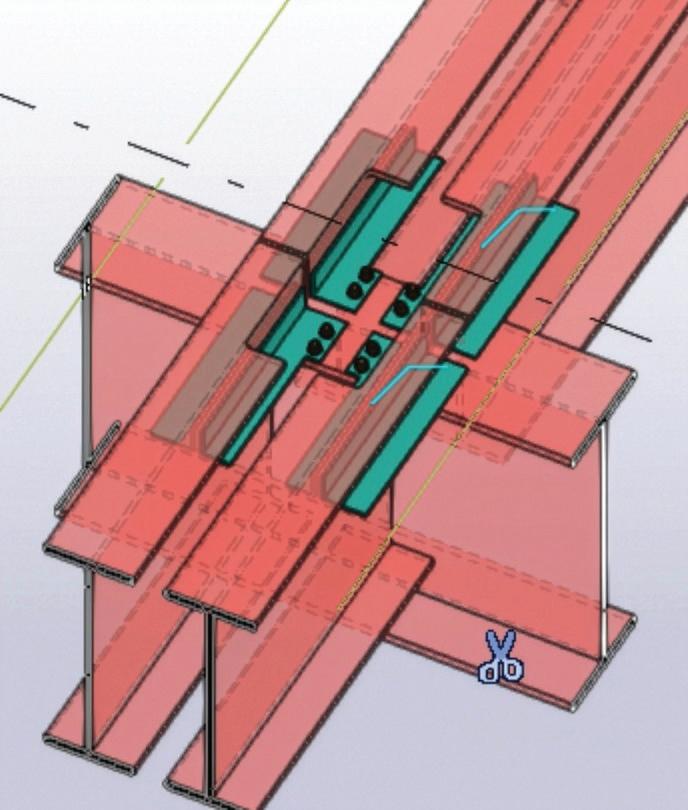
The horizontal legs of seated connection angles are coped away from the girder flange to improve hand access underneath (Fig. 3). Bolted connections are made only to the outer angle of each seated connection. Where up to four primary panel beams come together, the outer portion of each beam top flange is coped to allow for hand access. After bolt installation, a thin formwork plate (with shop welded bar “stops” underneath) is “dropped-in” prior to concrete placement. This plate is not shown for clarity. Closure for concrete placement between adjacent panel flanges is provided via light-gage steel strips. The plate is attached at grade to the latter panel to be installed with powder actuated fasteners (PAF).
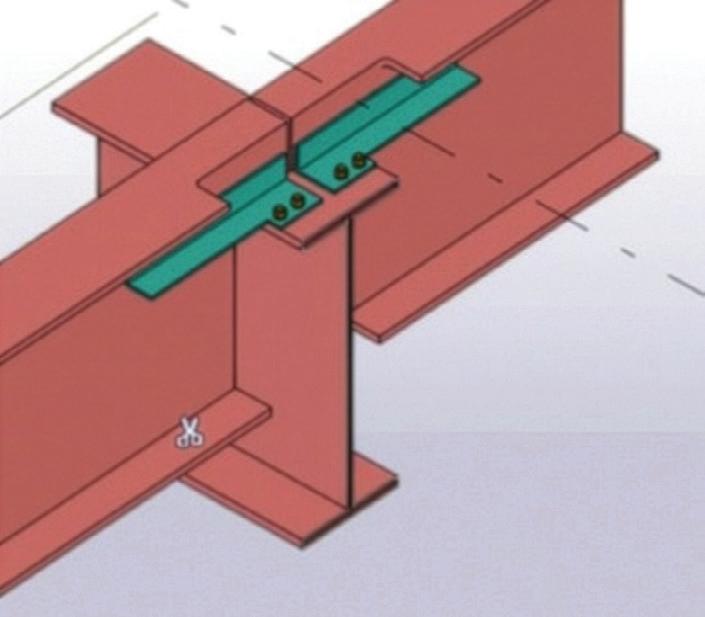
Column line composite stub girders have lengths of WT shapes welded to the top flange to facilitate composite action (Fig. 4). Between WT segments, column line primary panel beams bear on the girder top flange. However, at braced bay column lines, panel beams are not coped but bear on erection angles, thereby facilitating conventional bracing connections.
Modular Girt Trusses
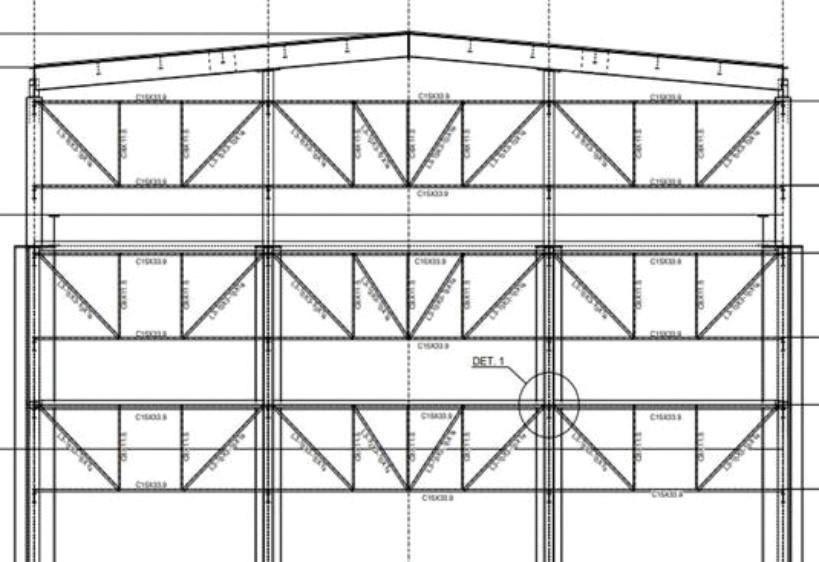
Modular girt trusses are used (Fig. 5) in conjunction with thin gage, 3-inch deep, steel siding panels.
Truss configurations are typically established for two upper bound bay sizes. The shorter trusses have three truss panels and longer trusses use four panels. Truss chord members are W12s with horizontal webs. Truss verticals are channels which also serve as lateral-torsional restraint to the chord members. Truss diagonals are angles. Seated connections are used at truss ends.
The optional variation in vertical member spacing provides a common Design to Capacity ratio along the entire length. Historically, this yields a nominal ten percent tonnage reduction versus equal spacing.
Partially Shop Fabricated Stair Tower Assemblies
Partially shop fabricated stair tower assemblies (Fig. 6) are used to maximize shop labor but mitigate transport volume. Assemblies include two columns, vertical and horizontal bracing, girts on two of three sides, platform framing, grating, and pipe penetrations (e.g., fire water). The panels are mirrored and mated for shipment. Cable tray, firewater pipe, and other commodities may be attached
Fig. 3. Coped beam top flanges and horizontal angle leg allow for tool and hand access.
Fig. 4. Seated connections with composite stub girders.
Fig. 5. Modular girt trusses are used in conjunction with steel sliding panels.
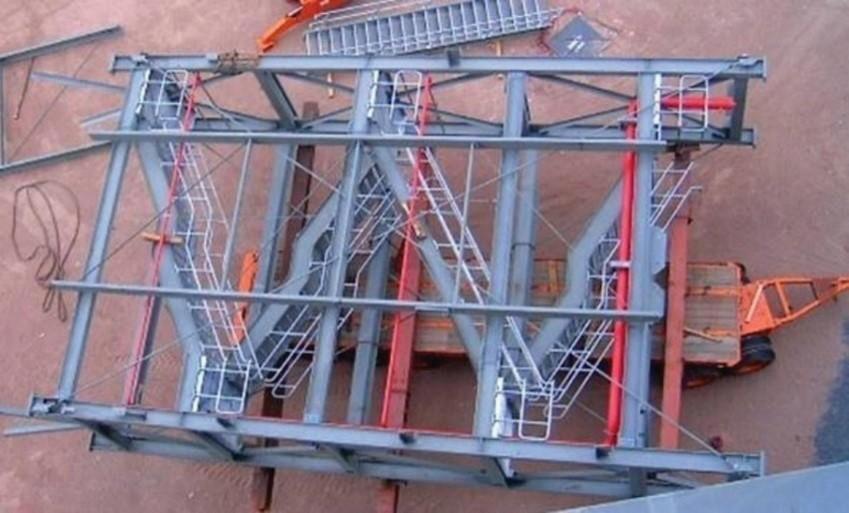
at grade prior to uplifting.
Cap and base plates facilitate seated connections for module stacking (Fig. 7). Tower segments provide rapid permanent stair access for craft. Moment frames are used in lieu of braced frames in the longitudinal direction to eliminate interferences with walkway access to building interiors. However, vertical bracing may be used for the exterior column line, with moment frames for the interior column line.
Summary
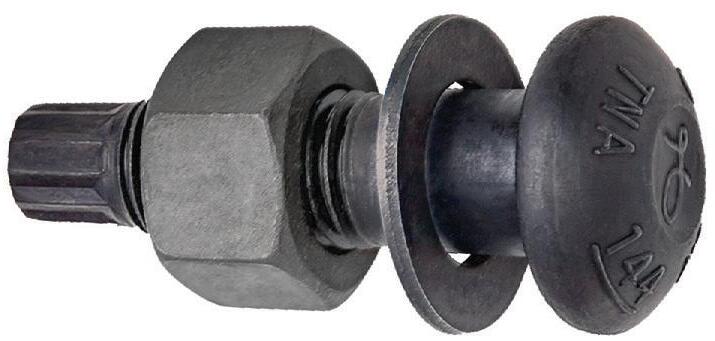
TNA® is the only fastening system that delivers both a quantifiable Snug Tight condition – ensuring every bolt in a connection meets a minimum requirement for tension – and the precise required angle for the perfect final pretension. No other system or method can match the TNA® Torque + Angle Fastening System for producing the highest level of accuracy and reliability in both the snug and final tensioning processes.

Our TNA® Bolts meet the requirements of ASTM F3148 and are 100% Melt & Manufacture in the U.S.
The Combined Method (Torque + Angle) is an approved RCSC installation method.
Based on successful implementation, the cited modular steel approaches and improvements shared above are recommended for expanded industry use in all non-commercial buildings and structures. Primarily for commercial purposes, a third category of steel (Modular Steel) has been used to distinguish the design/ build approach from the Structural Steel and Miscellaneous Steel categories of AISC 303, the Code of Standard Practice. This new category captures the significant shift of field labor costs to shop fabrication costs. ■
James L. Ryan, PE, is a retired Principal Engineer specializing in Steel Design and Modular Steel. His career included 40 years at Bechtel Corporation, with an intermediate 5 years at a commercial design firm. He welcomes any questions or further discussion and may be reached at JimR21157@gmail.com
Fig. 7. Shown is a stair tower ground assembly.
Fig. 6. Partially shop-fabricated stair tower assemblies are staged in laydown.
structural ANALYSIS
Field Investigation and Evaluation of Roofing Systems Following a Major Wind Event
The findings show installation quality, material condition, and adherence to jurisdiction-specific code provisions govern real-world performance.
By Maria R. Martinez Herrera
AsTampa, Florida, marks one and a half years since the unprecedented back-to-back hurricanes of 2024, the structural engineering community continues to analyze how hurricanes expose intrinsic vulnerabilities in the region’s building envelope systems. A forensic assessment of more than 30 residential structures across Hillsborough, Pinellas, Sarasota, and Manatee counties revealed both remarkable strengths and critical weaknesses in roofing assemblies. These findings have major implications for the resiliency and sustainability of coastal communities facing increasingly intense wind events (Emanuel, K., 2005. Increasing destructiveness of tropical cyclones over the past 30 years. Nature 436: 686–688).
Hurricane Helene made landfall as a Category 4 system along the eastern Gulf Coast near Tampa on September 26, 2024. According to the National Hurricane Center (NHC), gusts penetrated far inland due to the storm’s fast forward motion, with the strongest land-measured sustained wind of approximately 91 miles per hour (mph) recorded near Live Oak, Florida, and with maximum aircraft recorded sustained winds of 140 mph. Two weeks later, Hurricane Milton made landfall on Siesta Key (approximately 50 miles south of the Tampa region) as a Category 3 system, delivering sustained winds up to 91 mph and gusts approaching 107 mph along Venice Beach with maximum aircraft recorded sustained winds of 120 mph.
The consecutive nature of these events created a unique forensic scenario: structures were exposed to two major loading cycles within a short period of time—allowing the engineering teams to differentiate between pre-existing vulnerabilities, storm-induced damage, and cumulative deterioration across both events.
Forensic Engineering Investigation Methodology
Conducting a systematic and objective forensic investigation is crucial to ensure the integrity of the investigation, while ensuring accurate evidence is gathered in a safe and ethical manner. Post-event investigations were conducted in accordance with ASTM E2713-18 Standard Guide to Forensic Engineering, which provides guidelines on the role and qualification of engineers conducting forensic evaluations, including:
• Site observations and photographic documentation.
• Mapping of damage patterns across windward and leeward roof slopes.
• Interviews with homeowners, when available.
• Review of pre-storm aerial imagery, permit history, and maintenance records.
Takeaways: Construction Quality vs. Wind Intensity
• Approximately 70% of observed damage initiated at improperly installed or aged components, not at areas designed and installed in accordance with FBC and ASCE 7.
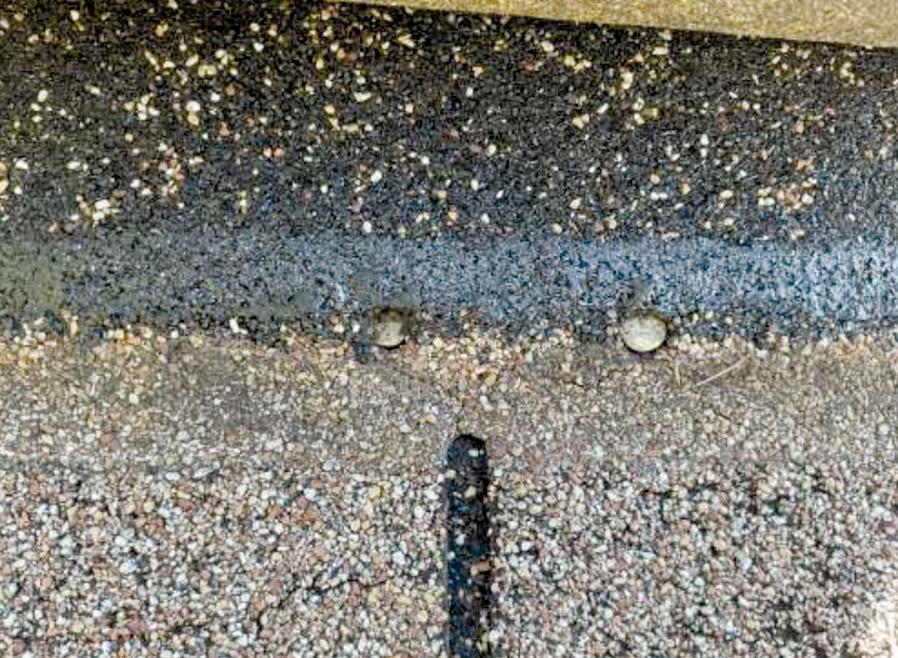
• Nearly 50% of shingle failures involved nails placed within adhesive strips, a direct violation of manufacturer and code requirements.
• Hurricane- related damage consistently initiated in known roof discontinuity zones, validating ASCE 7 provisionsperimeter and corner roof wind zones.
• Florida’s enhanced building code requirements as well as requirements from local jurisdictions have demonstrably improved performance compared to structures where installation did not follow the applicable code provisions. These findings reinforce that wind speed alone is not the dominant predictor of roof failure. Instead, installation quality, material condition, and adherence to jurisdiction-specific code provisions govern real-world performance.
• Correlation of observed damage with ASCE 7-22 Minimum Design Loads and Associated Criteria for Buildings and Other Structures wind speeds and calculated wind pressures. Wind pressures were evaluated for Components and Cladding (C&C) using ASCE 7-22 provisions, with particular attention to roof discontinuity zones where aerodynamic flow separation increases uplift demands.
Wind Design Considerations and Florida Building Code Requirements
A thorough understanding of wind effects on structures, as well as design and installation practices, enables investigators to effectively gather relevant field evidence, define minimum performance expectations, and accurately reconstruct and assess observed conditions using relevant engineering principles. The Florida Building Code (FBC) requirements and ASCE 7-22 wind design loads, were used to estimate the wind demand after each event. It’s important to mention, that current code was used for the purpose of this research to understand
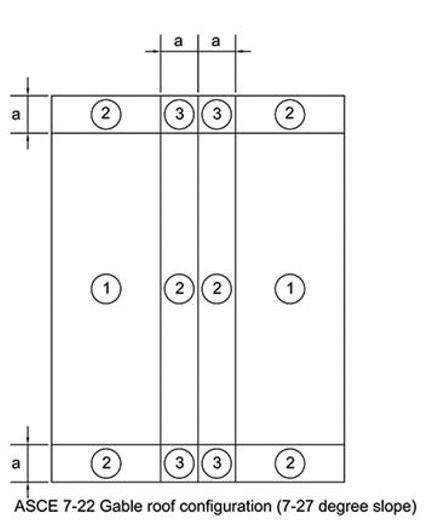
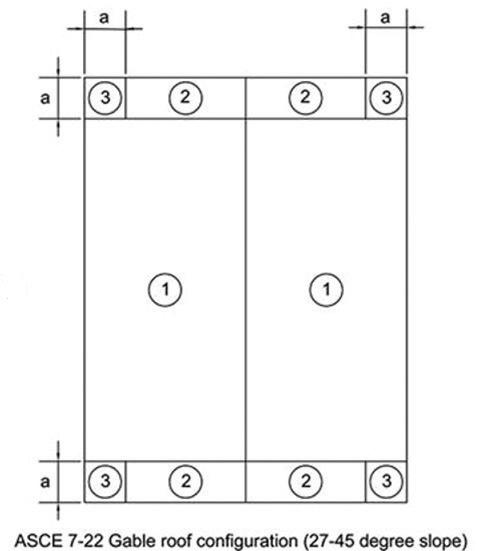
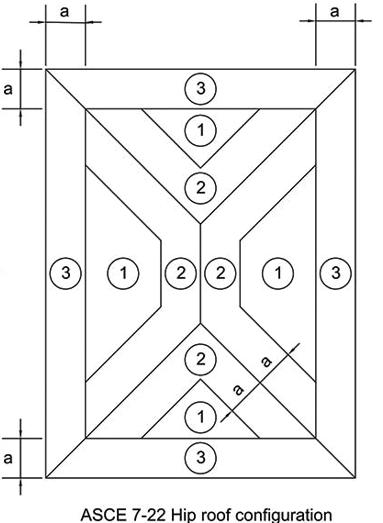
how the requirements of current code would affect the performance of roof assemblies and to determine whether damage was caused by wind speeds exceeding design level forces, under-designed roofing assemblies, or installation deficiencies.
When wind interacts with a building, both positive and negative (i.e., suction) pressures occur simultaneously. However, wind pressure on a structure is not uniform pressure. Wind pressure will increase as the path of wind encounters discontinuities in a structure due to aerodynamic effects, called flow separation. Flow separation around a building occurs when wind detaches from its surface, especially at sharp edges, creating turbulent, low-pressure zones (separation bubbles) that can cause significant uplift forces. Discontinuities include hips, ridges, corners, valleys, and edges in the roof covering as well as corners on the wall surfaces.
This behavior of wind forces is recognized by applicable building codes that require these areas to be designed to resist higher forces for a given wind speed compared to the main body of the roof. ASCE 7-22 partitions roof areas into zones:
• Zone 3—Corners for gable roofs and edges for hip roofs
• Zone 2—Perimeters
• Zone 1—Field of Roof
The areas of a structure that experience an increase in wind pressure as a result of the referenced discontinuities will likely exhibit wind related damage before the remaining areas of a structure that are subjected to lower wind pressures.
The exposure of the building to wind forces also plays a significant role in the wind forces a building experiences. Buildings in Exposure D zones experienced higher pressures.
Florida’s building code differs from many other U.S. jurisdictions due to its explicit focus on high-wind events, wind-borne debris regions, and repeated hurricane exposure. In addition to the ASCE 7-22 requirements, Florida jurisdictions typically incorporate:
Higher mapped design wind speeds: Florida’s High Velocity Hurricane Zone (HVHZ) designation established by the FBC apply to Miami-Dade County and Broward County. However, most of Tampa falls into areas of Wind-Born Debris Regions (WBDR) with ultimate design wind speeds of 150 mph.
Product approval systems: All building envelope products within the HVHZ must have a Notice of Acceptance (NOA) provided by the jurisdiction. All exterior opening products used within a WBDR are required to have a Florida Product Approval (FPA) or NOA approval.
Installation Requirements by Roofing Systems
Asphalt Composition Shingles—Installation Requirements
Asphalt shingles must be tested and classified for wind resistance under ASTM D7158 Standard Test Method for Wind Resistance of Asphalt Shingles and/or ASTM D3161 Standard Test Method for Wind Resistance of Steep Slope Roofing Products and per manufacturer’s recommendation. Proper installation typically requires:
• Placement of corrosion-resistant nails (ASTM F1667 Standard Specification for Driven Fasteners: Mails, Spikes, and Staples) within manufacturer-designated nailing zones.
• Nails installed below—not through—the adhesive sealant strip.
• Adequate nail embedment and avoidance of over-driven and underdriven fasteners.
• Functional adhesive bonding between overlapping shingles. For shingle detachment to occur, wind uplift forces must exceed both the adhesive bond strength and nail withdrawal resistance.
Fuplift>Fsealantbond+Fnailwithdrawal
Concrete and Clay Tile Roofing—Installation
Requirements
The Florida Building Code permits concrete and clay tile installation using:
• Mechanical fasteners (nails or screws at pre-drilled holes), or
• Mortar or foam adhesive systems, provided products are approved and installed by NOA and manufacturer guidance. The installation of concrete and clay roof tiles and their wind resistance is governed by the Florida High Wind Concrete & Clay Tile Installation Manual (FRSA/TRI) 5th Edition Manual and Section R905.3 of the Florida Building Code. Tile uplift resistance per FRSA/ TRI 5th Edition Manual is: R=W+A∙ΔP
Where:
R = Resistance of tile-fastener assembly
W = Self-weight of tile
A = Tributary area of tile
ΔP = Differential pressure
To cause the detachment of an individual roof tile secured to the substrate
Fig. 1. ASCE 7-22 partitions roof areas into zones: 1) field of roof, 2) perimeters, and 3) corners for gable roofs and edges for hip roofs.
with mechanical fasteners (typically two nails or screws per tile) or to cause the de-bonding of an individual roof tile secured with cementitious mortar or foam adhesive, the wind uplift force must first overcome the dead weight of the tile and be of sufficient additional magnitude to break the tile, fasteners and/or the bond between the cementitious mortar or foam adhesive used to secure the tile to the substrate.
Therefore, if wind forces were to affect a tile to the degree necessary to cause detachment, the tile would be significantly displaced from its installed location and/or blown off the roof.
Metal Roof Panels—Installation Requirements
Metal roofing systems consist of large mechanically fastened metal panels or sheets that create a continuous barrier to wind. Metal roofing systems rely on:
• Continuous panel attachment to framing or decking using manufacturer’s approved fasteners, typically self-drilling or self-tapping corrosion-resistant screws.
• Secure seam connections and fastener spacing per manufacturer specifications.
• Adequate substrate support.
When installed correctly, metal panels function as integrated, mechanically secured strong, lightweight roof covering systems that efficiently resist wind uplift while providing accommodation for thermal expansion and contraction without stressing the interlocking mechanism.
Wind damage to a metal roof panel is typically characterized by displaced, partially detached, or missing panels, as well as impacted (wind debris) panels.
Single Ply Roofing—Installation Requirements
Single-ply roofing systems, such as Thermoplastic Polyolefin (TPO), Polyvinyl Chloride (PVC), or Ethylene Propylene Diene Monomer (EPDM), are flexible membrane systems designed for low-slope roof assemblies. Proper installation is critical to ensure durability, water tightness, and wind resistance requiring the following:
• Roofing system to be installed to ensure positive drainage and to comply with minimum slope required by the FBC of no less than 1/4:12.
• Substrate to be clean, dry and smooth.
• Insulation or decking to be properly attached.
• A fully adhered membrane. Membrane is either glued to the substrate using a compatible adhesive or fastened with screws and plates at seams or edges.
• Seams to be properly welded or adhered to create a continuous waterproof barrier. Edges, corners, penetrations, and flashing details must follow manufacturer guidelines to prevent uplift and water intrusion.
The installation of single-ply roofing systems is governed by the manufacturer’s recommendation and the NRCA (National Roofing Contractors Association). ASTM Standards (ASTM D4434, ASTM D6878 and ASTM D4637) define material properties and testing requirements for such systems.
The detachment of a single-ply roofing membrane under wind forces is usually caused by a combination of improper installation (poor substrate preparation, incomplete seam welding) membrane defects, and wind loads that exceed the system’s design capacity. When installed
Aggressive environments are no match for the corrosion-resistant protection of Rhino-Dek ®. Easily installed stay-in-place bridge deck forms support new bridge construction and rehabilitation.
• Service life up to 124 years
• DOT tested and approved in many states
• Custom-color coating options
• 5 profiles for spans up to 14 feet
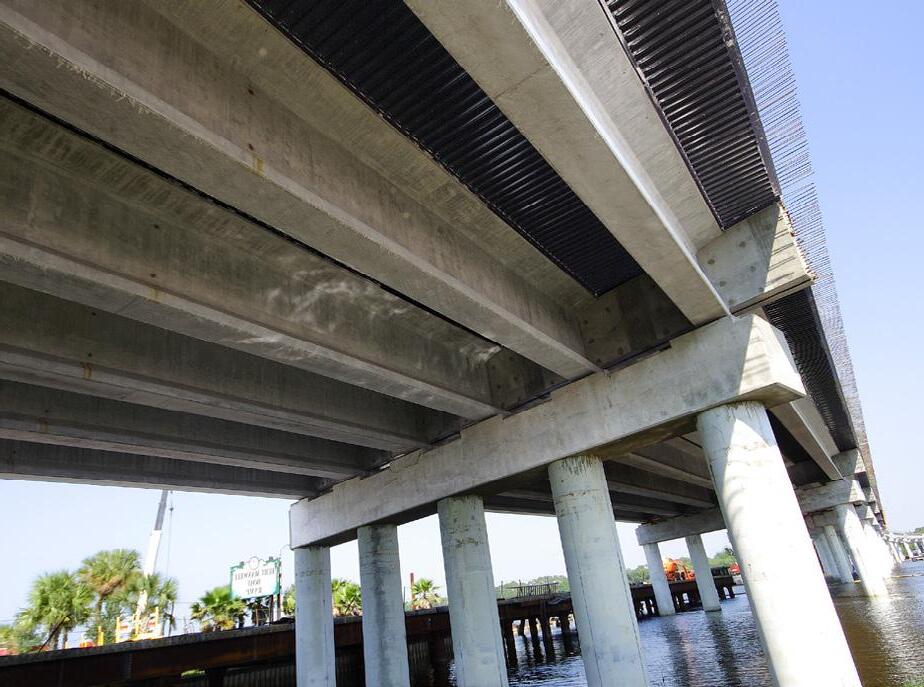
Table 1. Roof and Wall C&C Pressures (psf) at 150 mph
Table 2. Roof and Wall C&C Pressures (psf) at140
correctly, single-ply systems provide a continuous, wind-resistant roof system suitable for low-slope applications.
Roof Decking Requirements:
Recent updates to the 2023 FBC, Residential (Eighth Edition) have introduced more stringent requirements for roof sheathing thickness in high-wind regions. Under Section R803.2.2, the minimum thickness and required panel span rating for wood structural panel roof sheathing are established based on design wind speed and exposure category, with areas subject to higher wind loads (such as those with ultimate design wind speeds of 140 mph or greater) generally requiring a 19/32-inch (nominal 5/8 inch) panel to meet uplift resistance criteria. In less severe wind zones, thinner panels (such as 15/32-inch) may be permitted; however, each thickness must be installed with the appropriate fasteners and spacing outlined in Section R803.2.3.1 to ensure adequate attachment and resistance to wind uplift forces.
Observed Hurricane Damage by Roofing System
ASCE 7-22 C&C design pressures were used to evaluate and compare the maximum wind loads that roof and wall components of a building would be expected to resist, based on code-specified wind speeds versus the maximum observed wind speeds. For illustrative purposes, Table 1 summarizes the ASCE 7-22 C&C design pressures calculated for a basic wind speed of 150 mph with the following building parameters:
• Exposure: C.
• Risk Category: II.
• Mean roof height: 25 ft.
The values presented are representative design pressures for low-rise residential roofs and walls, providing a preliminary reference for evalu ating uplift and lateral wind loads in accordance with ASCE guidelines.
Asphalt Composition Shingles
Typical wind-related damage included missing, torn, or creased shin gles. Creasing indicated uplift forces sufficient to bend tabs without full detachment.
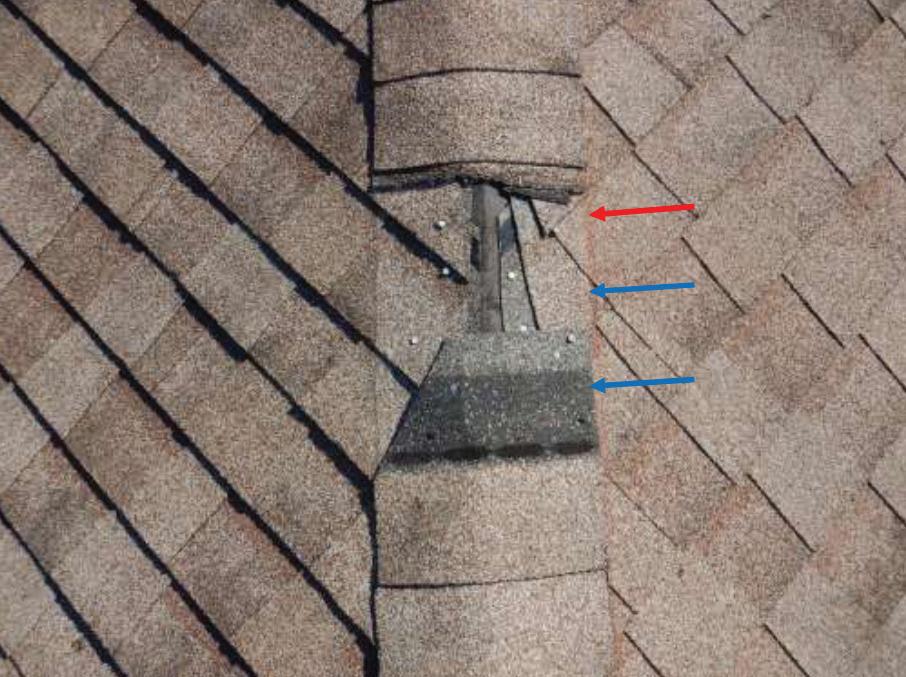
Fig. 2. Torn shingle (red arrow) and two missing shingles (blue arrow).
Table 3. Roof and Wall C&C Pressures (psf) at 120
In all observed instances, the observed damage was located within zone 2 of the roof, recognized by applicable building codes as an area that requires to be designed to resist higher forces for a given wind speed compared to the main body of the roof (Tables 1-3).
Concrete and Clay Tile Roofing
Observed damage primarily involved displaced or broken tiles, often due to wind-borne debris rather than direct uplift failure. Performance varied by attachment method:
• Mortar-set tiles frequently exhibited de-bonding due to aged mortar.
• Foam-set tiles failed where bead size or continuity was inadequate.
• Mechanically fastened tiles performed best when embedment met FBC requirements and placement was per product approval.
Metal Roof Panels
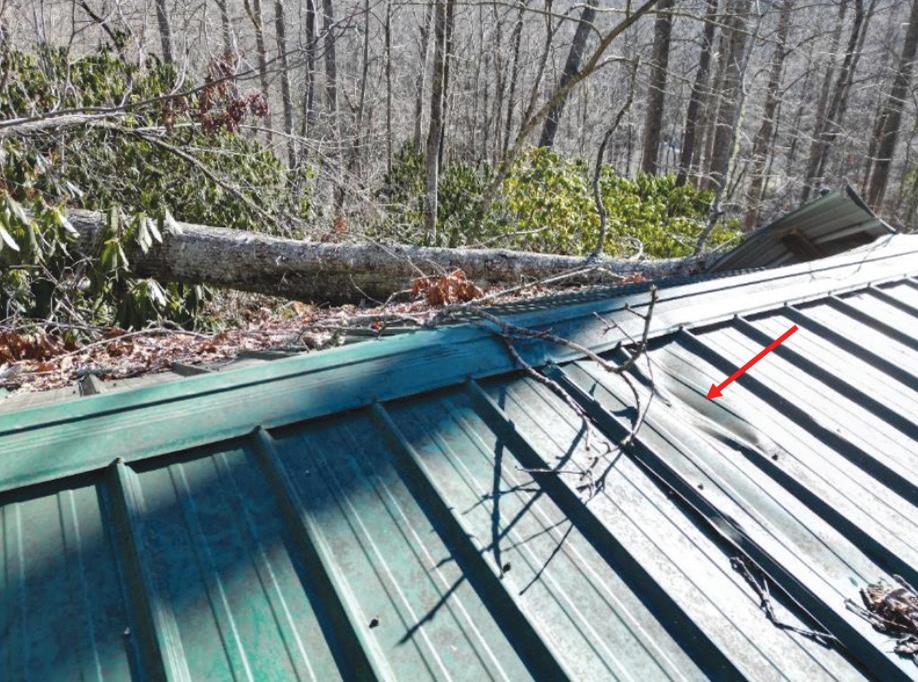
Metal roofing systems generally performed well under wind loading. The damage observed was primarily associated with impact from falling trees and wind-borne debris, leading to panel deformation and water intrusion through the damaged underlayment rather than uplift failure.
Single Ply Roofing
Single ply roofing systems performed well under wind loading. The damage observed was primarily associated with long-term deterioration (cracked and deteriorated sealant at intersection between roof and elevated walls), leading to water intrusion rather than uplift failure.
Observed Damage Not Caused by Elevated Wind Forces from a Single Event
Asphalt Composition Shingles:
Shingle creasing is a classic indicator of uplift force sufficient to bend the tab but not fully tear the shingle.
The most common construction deficiencies found were:
• Nails placed within adhesive strips reducing the area of adherence.
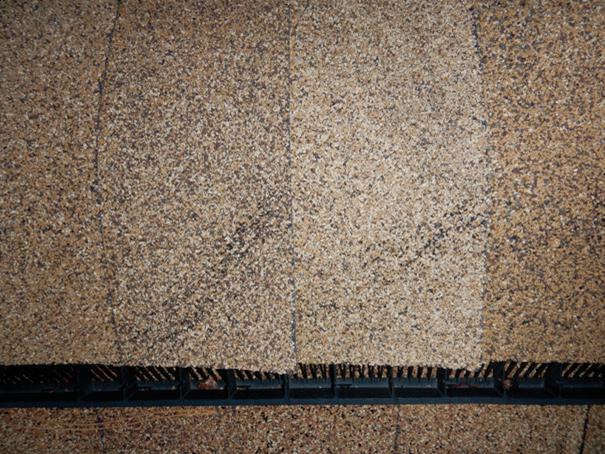
The FBC mandates corrosion-resistant nails (ASTM F1667) for shingle roofs, specifying placement within the manufacturer’s designated nailing line, typically 1 to 13 inches from the shingle’s end and below the sealant strip.
• Lack of factory-applied adhesive strip (manufacturing defect).
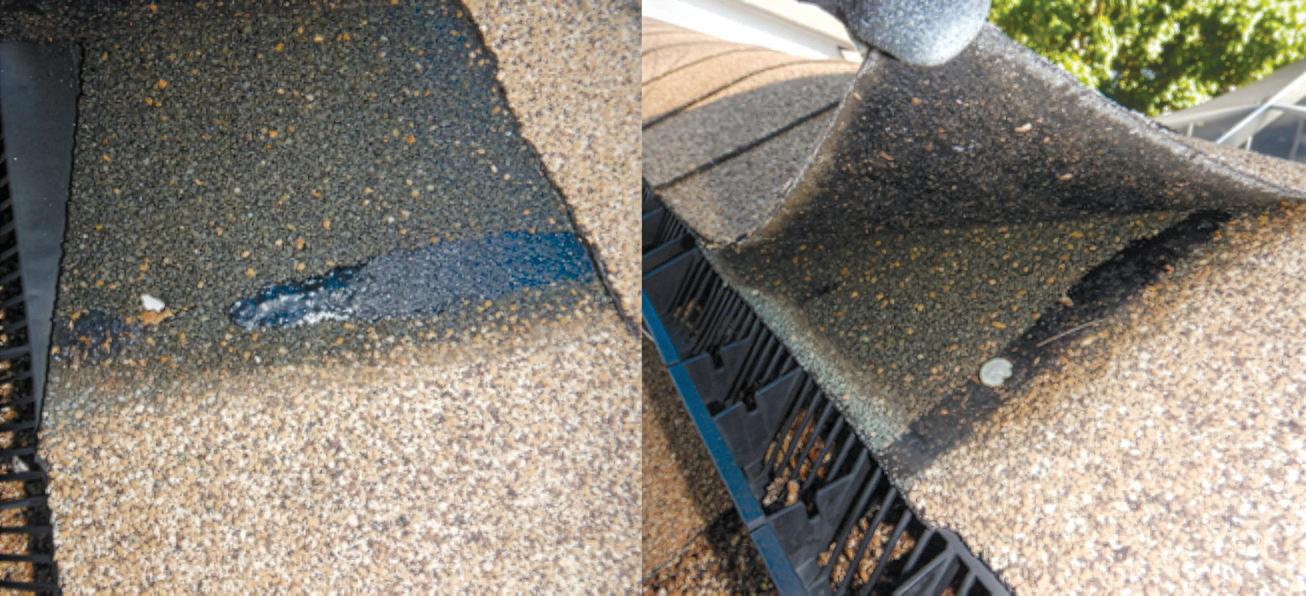
• Glossy finish of adhesive strip (indicating a lack of adherence).
Concrete and Clay Tile Roofing
The following damage was not attributable to elevated wind forces but to deferred maintenance, aging and/or construction deficiencies:
• Mortar-set tiles frequently exhibited de-bonding due to aged mortar.
• Foam-set tiles failed where bead size or continuity was inadequate.
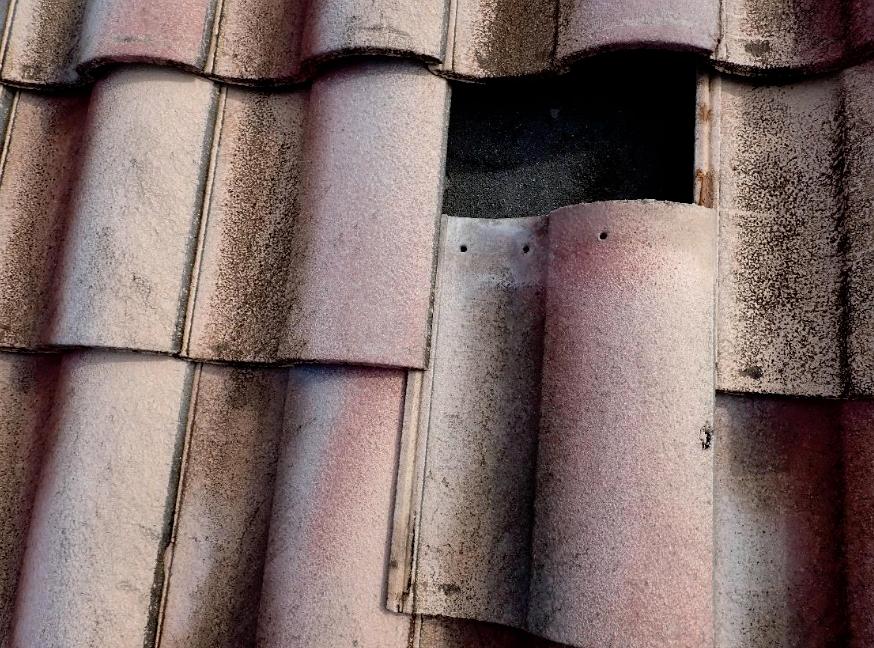
• Mechanically fastened tiles slipped when fasteners were missing. Manufacturing and/or installation defects can also be exhibited as cracks at the tile corner. These defects are the result of deficiencies in the uniformity of the material mix, and the mechanics of pressing or extruding processes, which causes an isolated weakness in the tile and/or installation without provision for thermal expansion and contraction.
Fig. 3. A field tile has slipped. The tile exhibited overdriven fastener through tile.
Fig. 4. Indented metal roof panel after tree impact.
Fig. 5. Creased ridge shingle.
Material Aging Factors
It is important to mention that long–term and repeated exposure to elevated wind forces, often less than design wind speeds, will impact the roof covering that has been deficiently installed. Other conditions such as quality and age of the materials, directionality of the winds, extent of UV exposure (e.g., shaded roof surfaces vs. exposed roof surfaces), thermal cycling, and other factors (e.g., debris covered surfaces), will affect the performance and extent of wind-related damage to the roof coverings.
Table 4. Summary of Common Failure Observations by Roof Type
Roofing System Primary
Asphalt Shingles Missing and torn shingles, creased tabs
Over-driven nails, aging sealant strip, improper fastening placement. Tree impacted roofs.
Concrete/Clay Tiles Tiles cracking and slipped tiles. Tree Impact and improper fastening placement.
Metal Panels Panel deformation, seam displacement
Tree impact
Single Ply N/A N/A
ASTM D7158, ASTM D3161, FBC R905.2
Conclusions and Resiliency Implications
The forensic analysis following Hurricanes Helene and Milton confirms that proper installation, inspection, and maintenance are the most critical factors in roofing system performance. Even when exposed to near-design wind speeds and multiple wind events:
• Code-compliant systems largely remained intact.
• Failures were associated with construction deficiencies. Strengthening inspection protocols during construction, improving installer training, and enforcing Florida’s product approval and fastening requirements will continue to enhance building resilience and reduce repeat wind losses across coastal communities.
over
years
forensic investigations and the evaluation of existing structures. Her practice centers on diagnosing structural distress, identifying damage mechanisms, and developing repair and rehabilitation strategies for residential and commercial buildings.
FRSA/TRI 5th Edition Manual and Section R905.3 of the Florida Building Code.
FBC 1507.4.3, UL 580, ASTM E1592, or TAS 125.
ASTM D4637 for EPDM, D6878 for TPO, D4434 for PVC).
Maria Martinez, PE, is a licensed Professional Engineer with
10
of experience in structural engineering, specializing in
Fig. 7. Overdriven fasteners within adhesive strip.
Fig. 6. View of a matte finish and a gloss finish of the adhesion strip below a torn shingle and a fastener installed within the adhesion strip below a creased shingle.
FUTUREPROOF
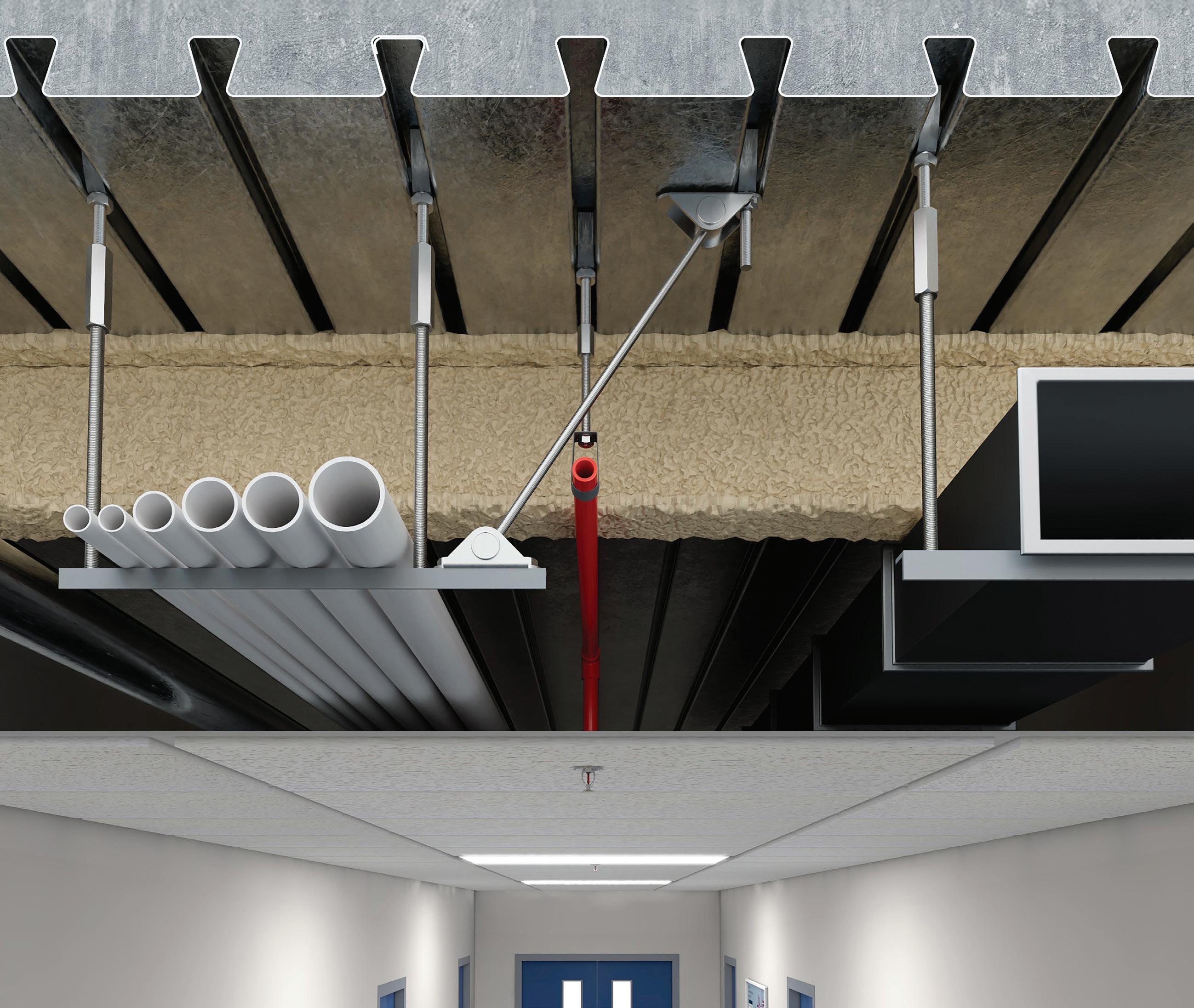
New construction architecture requires special consideration for the inevitability of future upgrades. That’s why modern construction projects need hanging solutions that are built for speed, versatility, and adaptability to ensure quick and seamless renovations.
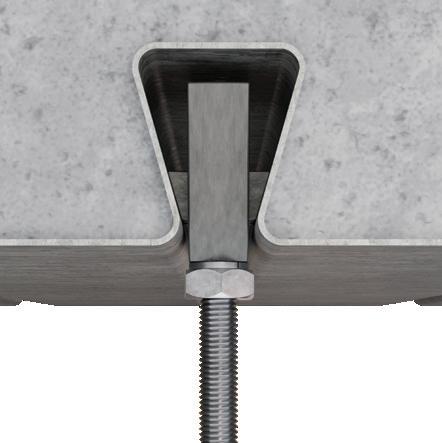
To help meet that challenge, Vulcraft-Verco has developed the PinTail™ Anchor, an innovative hanging solution that works exclusively with our Next Generation Dovetail Floor Deck, and are specifically designed to futureproof today’s construction projects for tomorrow’s renovations.
structural ANALYSIS
Inspection, Evaluation, and Rehabilitation of the Taylor Bridge Gusset Plates
During a recent inspection of the bridge, advanced corrosion was identified on numerous gusset plates along the interface with the truss bottom chords.
By Kai Marder and Dusan Radojevic
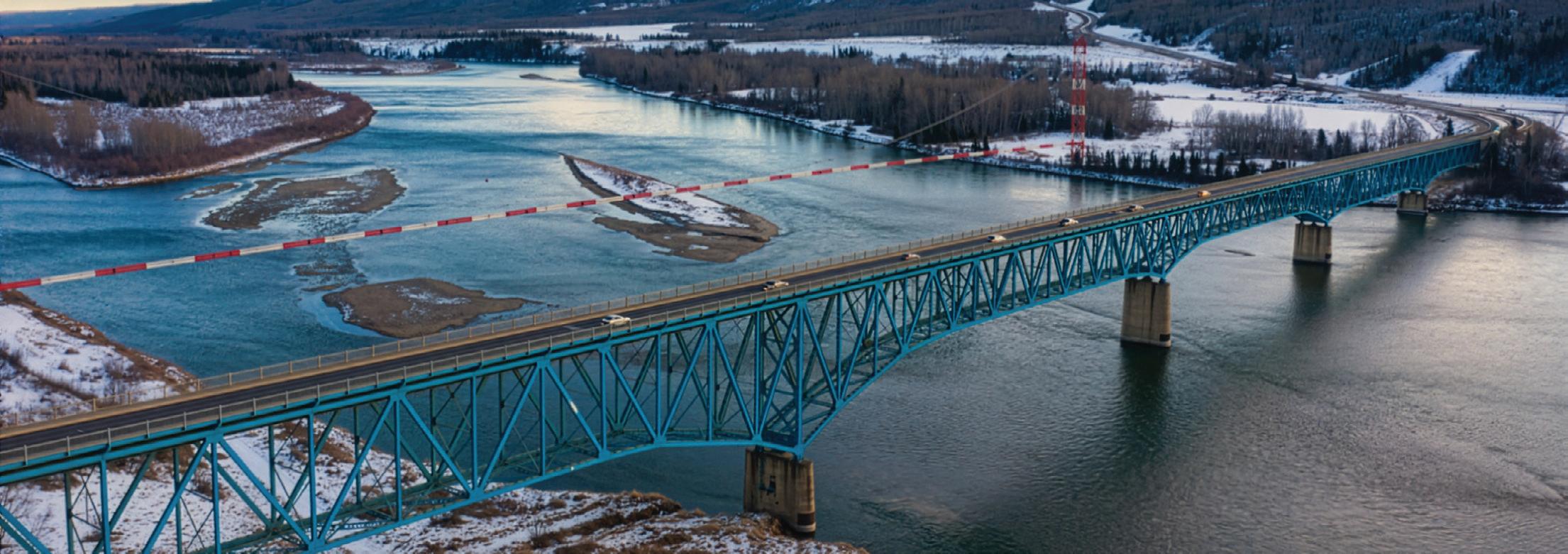
The Taylor Bridge in northeastern British Columbia represents an essential crossing of the Peace River for residents and industry. Built in 1960, the bridge carries a significant number of trucks with 30% of all traffic being heavy vehicles.
A joint venture consisting of T.Y. Lin International Canada Inc. (TYLin), Hatch Ltd. (Hatch) and Charter Project Delivery Inc. (Charter) has been contracted by the British Columbia Ministry of Transportation and Infrastructure (BC MoTI) to provide Owner’s Engineering (OE) Services for the Taylor Bridge Project. The project involves the development of various options for the future of the existing Taylor Bridge in northeastern British Columbia.
The Taylor Bridge is a two-lane, six-span, 712-meter-long structure that carries Highway 97 across the Peace River (Fig. 1). Five of the six spans are comprised of variable-depth steel trusses, while the remaining span is a stringer span at the north end of the bridge. Five concrete piers and two concrete abutments support the superstructure. From an articulation standpoint, the truss spans are a combination of continuous structures and suspended spans.
As part of their Owner’s Engineering Services assignment, the OE conducted a series of bridge inspections. These inspections identified the presence of relatively advanced corrosion on many gusset plate connections where the truss verticals and diagonals frame into the lower chord.
The OE determined recommended actions for the corroded gusset plates, including a scheme for strengthening.
Inspections
The OE carried out three inspections involving the gusset plate connections. The first inspection, conducted in May 2021, involved a complete inspection of the bridge, with the gusset plate connections being only one of many components included. This inspection indicated the need for more detailed measurement of the gusset plate section loss. The second and third inspections, conducted in March 2022 and April 2022, were targeted inspections, focusing on the most heavily corroded gusset plate connections.
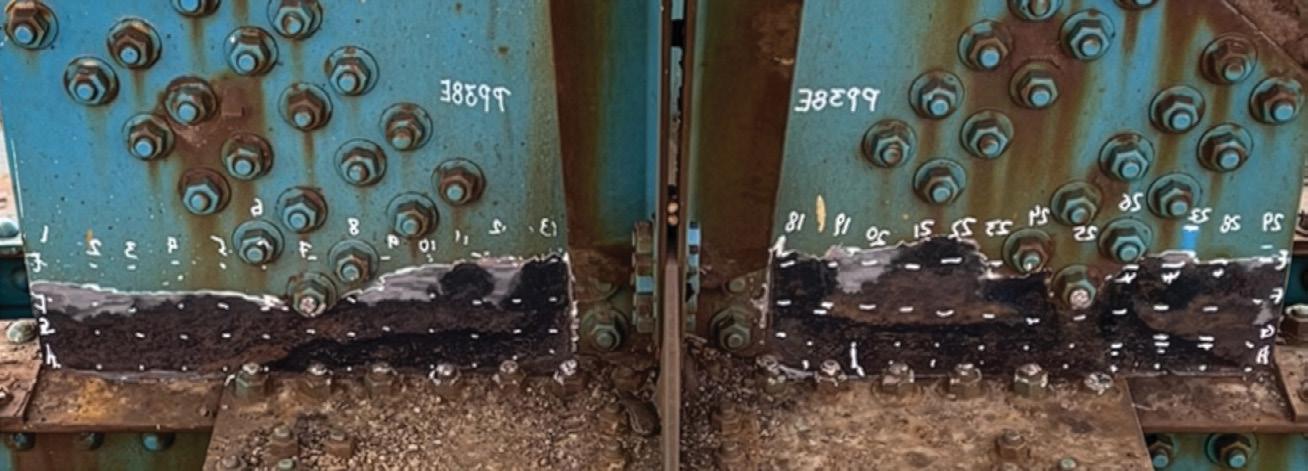
The targeted inspections involved ultrasonic testing measurements of the remaining thickness of the gusset plates. A combination of snooper truck and rope access was used to reach the gusset plate nodes. The measurements were taken in a grid pattern over the extent of the corroded region. The ultrasonic testing measurements gave a total remaining plate thickness but did not provide information on the asymmetry of the corrosion, i.e. how much section loss occurred on each face. This was estimated in the field for each node via measuring the depth from a straight edge to the corroded face on both sides of the
Fig. 1. Taylor Bridge in northeastern British Columbia was built in 1960.
gusset at a select few points and averaging the results. An example output of the targeted inspection ultrasonic measurements for one gusset plate is given in Figure 2.
Evaluation
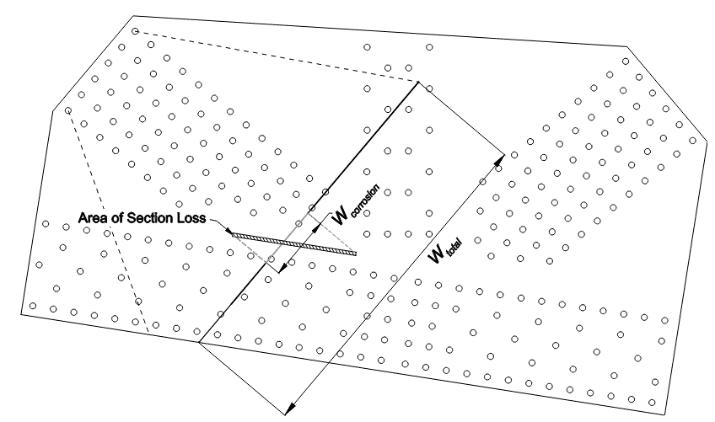
The overall load evaluation of the Taylor Bridge was conducted in accordance with Section 14 of the Canadian Highway Bridge Design Code CSA S6:19 and the BC MoTI Supplement to CSA S6:14. However, these standards contain limited information with regards to the evaluation of gusset plates and no information on the evaluation of gusset plates with localized corrosion. The methodology used for gusset plate capacity was therefore based primarily on the AASHTO Manual for Bridge Evaluation 3rd Edition . The National Cooperative Highway Research Program (NCHRP) Report ( Guidelines for the Load and Resistance Factor Design and Rating of Riveted and Bolted Gusset-Plate Connections for Steel Bridges ), which much of the AASHTO MBE methodology is based on, was also relied upon for additional background information. The effects of localized section loss due to corrosion were accounted for in two ways: (1) considering an effective remaining gusset plate thickness, and (2) considering the out-of-plane bending stresses induced as a result of asymmetric corrosion on either side of the plate. For the effective remaining gusset plate thickness, the OE considered followed the recommendations of AASHTO MBE. Different effective thicknesses were used depending on the failure mode considered. For shear and tension checks, the effective remaining thickness was simply taken as the average remaining thickness along the shear plane or Whitmore tension plane, respectively. For compression checks, the effective remaining thickness was the average remaining thickness along the Whitmore compression plane (Fig. 3).
AASHTO MBE provisions were also followed to determine when asymmetric corrosion effects on either side of the plates need to be considered. The limit at which it was considered is given as:
(e*c)/r2 < 0.25,
Where:
‘e’ is the thickness eccentricity due to corrosion
‘c’ is the distance from centroid of gusset plate to extreme fibre
‘r’ is the radius of gyration of the effective Whitmore section of the gusset plate
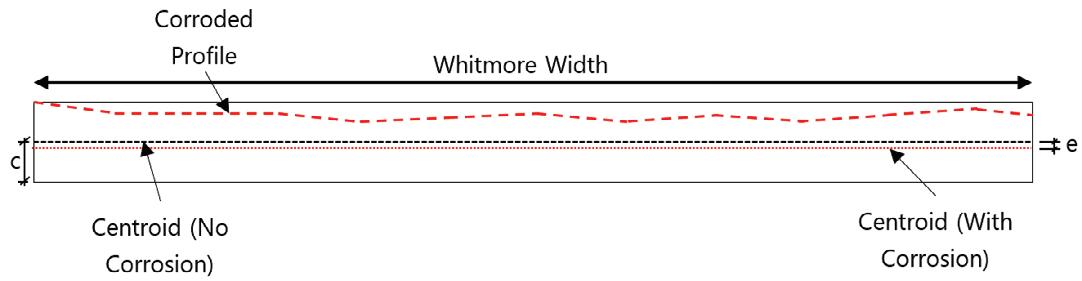
No guidance is given in AASHTO MBE on how to consider asymmetric corrosion effects when this limit is exceeded. Therefore, the OE developed a methodology that involved treating the gusset plate as a beam-column, with a bending moment equal to the axial compression in the gusset plate multiplied by the eccentricity due to asymmetric corrosion. The axial forces and bending moments were then combined using the provisions of CSA S6:19. This methodology is illustrated in Figure 4.
Finite Element Analysis
Due to the uncertainty over the remaining service life of the bridge, including the option of a full bridge replacement, it was desirable to keep gusset strengthening and recoating works to a minimum.
Furthermore, the code-based evaluation involved assumptions on the effects of asymmetric corrosion. For these reasons, the bridge owner requested a detailed finite element analysis be conducted on one truss node as a means of validation of the code-based evaluation, and to give increased confidence in the extents of strengthening and recoating
Fig. 2. In this ultrasonic thickness measurement example, gusset plate remaining thickness for each grid point (mm) is given in the table above, and measurement grid points are shown as white dots on the gusset in the picture.
Fig.3. Section Loss for Compression Checks (AASHTO MBE)
Mf=Cf /2*e
Fig. 4. The methodology for asymmetric corrosion is illustrated.
works proposed.
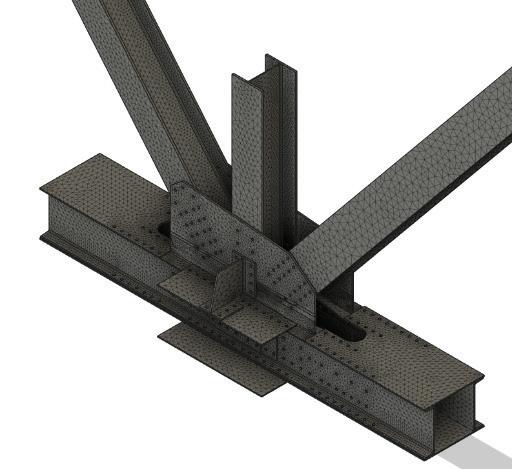
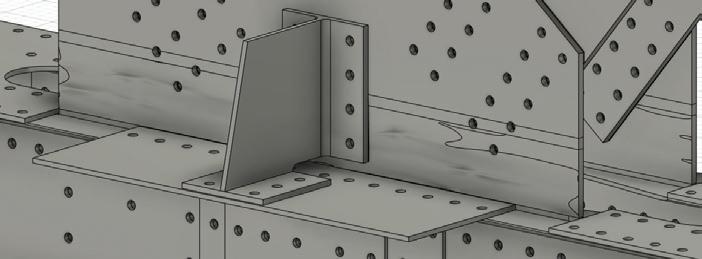
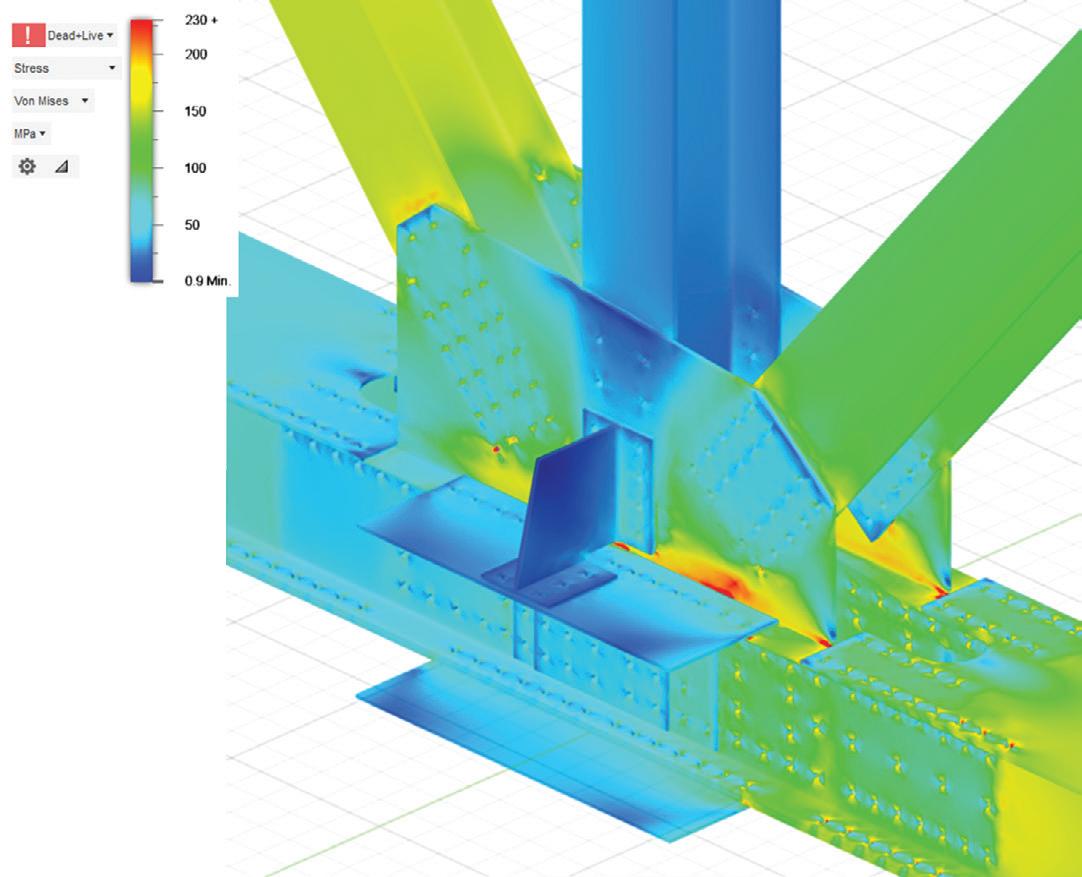
A 3D model of one selected truss node that was subjected to ultrasonic thickness testing was developed. An isometric view of the model, including the finite element mesh, is given in Figure 5. The section loss due to corrosion, based on the ultrasonic thickness measurements taken during the gusset plate inspections, was explicitly included in the 3D geometry of the gusset plate elements. The measured plate thickness at each grid point was mapped onto the gusset plate element surfaces. Figure 6 shows an example isometric view of a Von Mises stress plot of the entire node for the linear stress analysis under one selected load case. Critical stresses occur in the gusset plates under the compression diagonal (diagonal on the right side of the plot), as expected based on the code-based gusset plate load rating. The highest stresses of all the four gusset plate faces occur on the exterior face of the inner gusset. This pattern holds for all load cases considered and is consistent with what would be expected based on section loss measurements and combined bending and axial stresses due to asymmetric corrosion on either side of the gusset faces. At a level of load corresponding to a demand-to-capacity ratio of 1.0 from the code-based evaluation, the finite element analysis generally showed spreading of gusset yielding under the critical compression diagonal, but no loss of load carrying capacity. Ultimate loss of load carrying capacity in the non-linear finite element model occurred at a higher load level as a result of an inelastic sidesway buckling failure mode of the gusset plate. These results indicated that the code-based assessment methodology was reasonable albeit somewhat conservative.
Strengthening
A critical gusset node was identified as being deficient for certain heavy vehicle loads per the previously described evaluation process. The gusset plates on this node exhibited up to 50% section loss at the interface with the bottom chord, with the averaged section loss along the shear planes and Whitmore compression plane described previously being on the order of 35%. To address the deficiency, the OE developed a design for a strengthening scheme involving the installation of doubler plates on the inside faces of the corroded gussets.
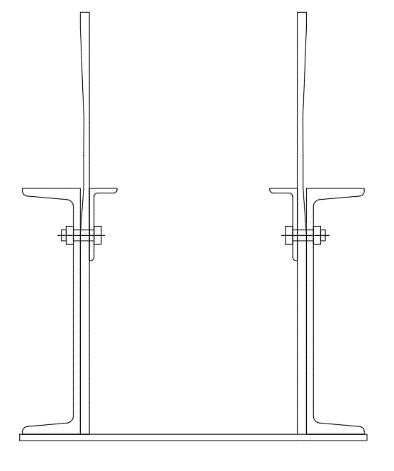
The doubler plates were shaped to fit around the vertical and diagonal members framing in. The lower half of the doubler plates were bolted to the lower (uncorroded) part of the gusset plate and bottom chord web through existing bolt holes. New bolt holes were field drilled to connect the upper half of the doubler plates to the upper (corroded) part of the gusset plate. Refer to Figure 7 for an overview of this strengthening scheme. This process was repeated for all four
quadrants of the node.
Since the bridge is an essential crossing for local residents and industry and available detour routes are long and, in some cases, not suitable for heavy truck traffic, the bridge had to remain open to single-lane alternating traffic at nights and fully open to traffic during days for the duration of the gusset strengthening work. Works were completed at night and the node was checked to ensure adequate load carrying capacity for the applicable traffic loads at all stages of construction.
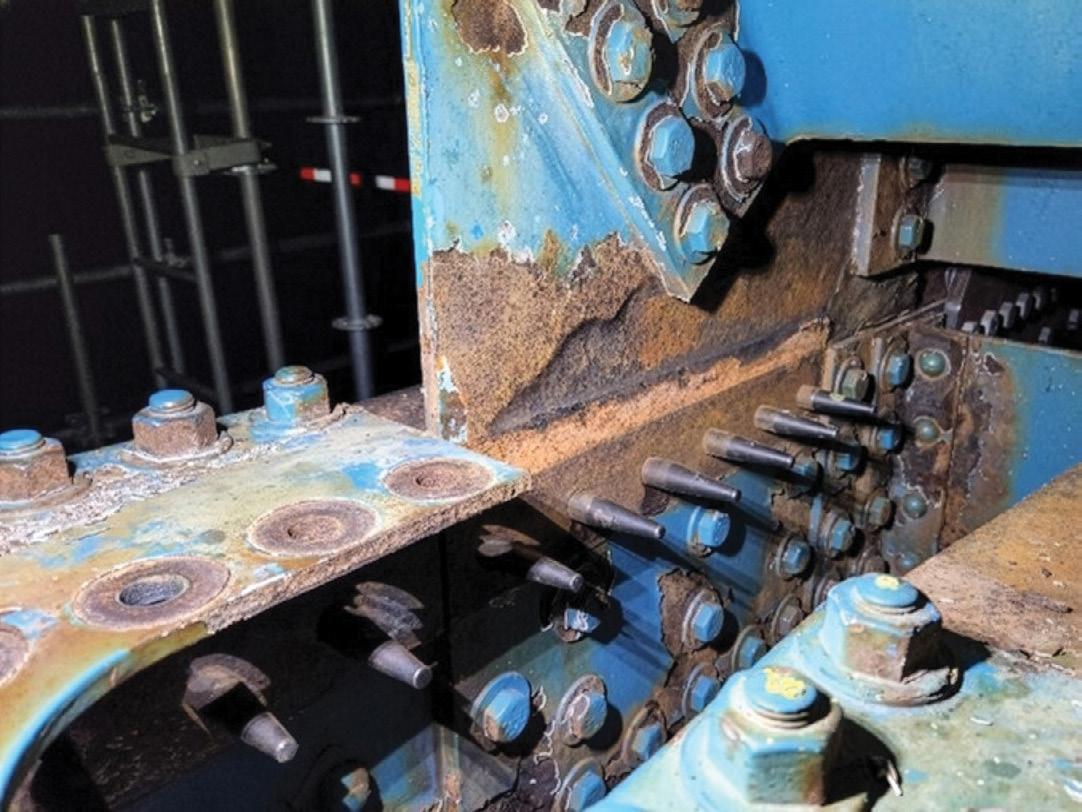
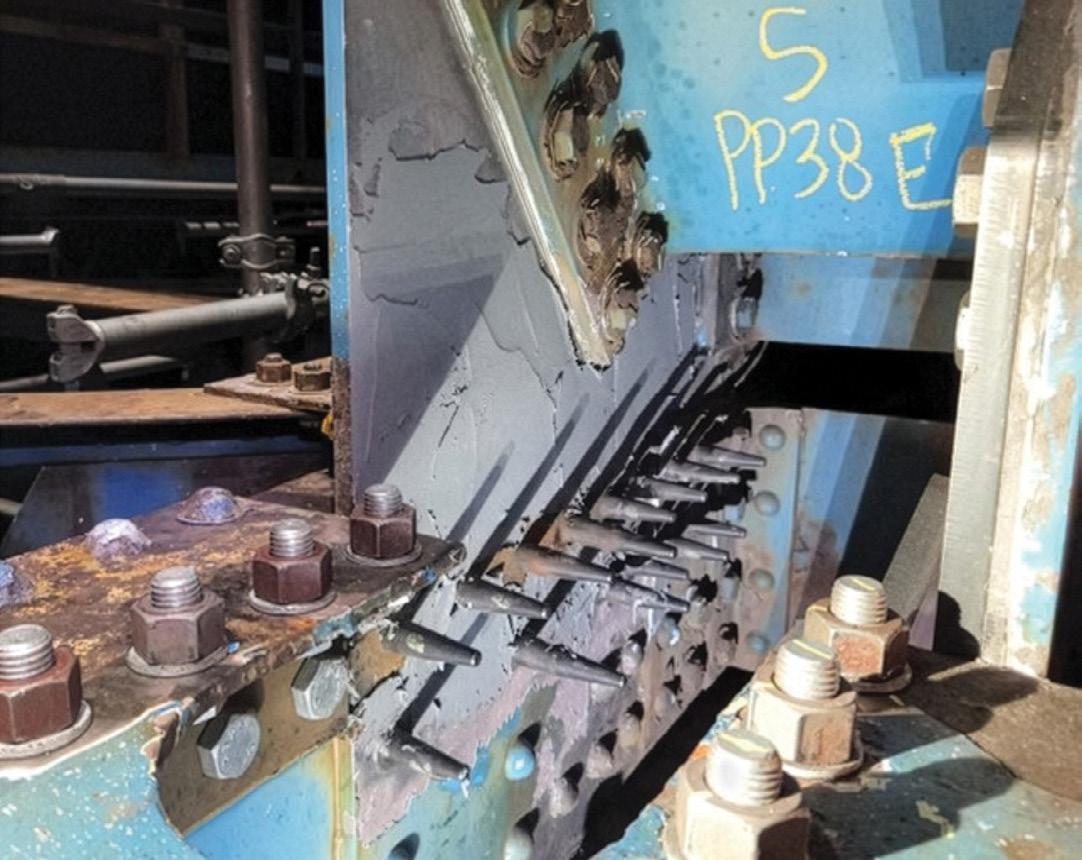
To maintain load capacity during installation of the doubler plates, the existing bolts between gusset plate and bottom chord web were replaced with tight-fit drift pins one-by-one (Fig. 8). The drift pins acted to transfer shear in bearing, with each drift pin having a shear capacity that exceeded the existing rivets/bolts they replaced. The corroded region was then filled with an epoxy-based composite material for metal repair, to fill the void that would otherwise have existed between the existing gusset and doubler plate due to the section loss (Fig. 9). A high-strength epoxy material was chosen in order to provide
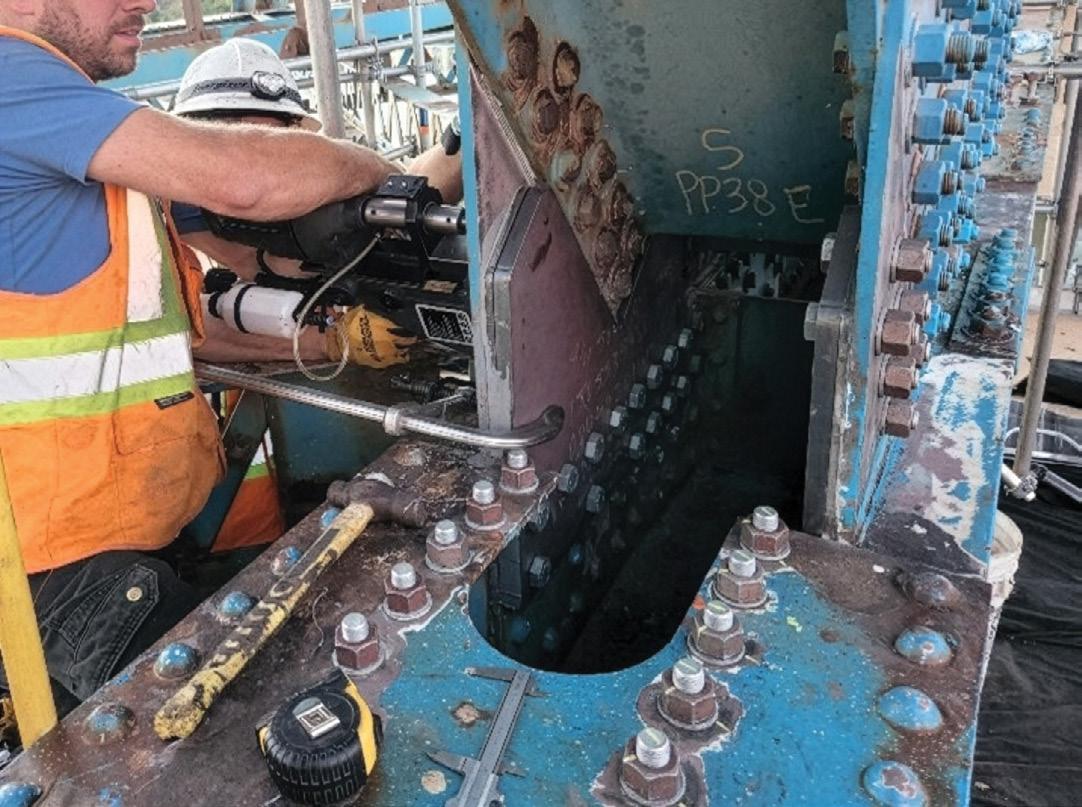
Fig. 5. An isometric view of the FE model showis modelling of the corroded region.
Fig. 6. As seen in the Von Mises stress distribution, critical stresses occur in the gusset plates under the compression diagonal.
Fig. 7. New bolt holes are field drilled through upper existing gusset and doubler plate. A new inner plate is also installed, and new bolts are added to the lower doubler plate through existing holes in the chord web and lower gusset.
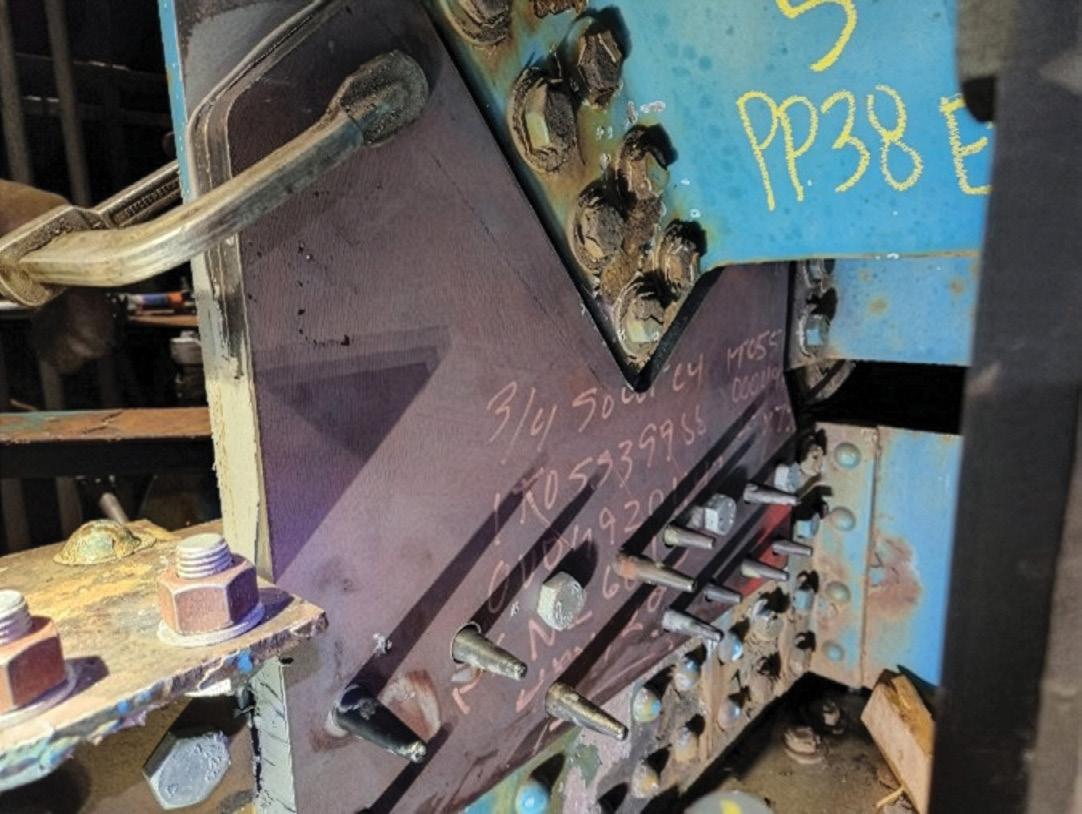
a flush solid surface that would not crush under the application of bolt tensioning loads between the existing gusset and new doubler plate. The doubler plate was then put into position by sliding it over the drift pins (Fig. 10). The drift pins were then replaced one-by-one with new bolts, and the process was completed by the field drilling of new holes and installing bolts from the upper existing gusset to the doubler plate. Shear load transfer between the existing gusset plate and the chord web was maintained throughout the duration of the works. The tight fit of the drift pins prevented them from shifting under vibrations due to the live traffic on the bridge during the strengthening works.
Many other gusset nodes that were identified as having significant section loss but not assessed as being deficient for heavy truck loads are currently in the process of being recoated on a staged basis. Future corrosion rates were approximated based on the measured section loss and estimated number of years in which corrosion has been occurring. These rates were used to forecast which gussets may potentially become deficient over a 10-year period of ongoing corrosion. Gussets not meeting this criteria were chosen for inclusion in the recoating program.
Conclusion
Corrosion along the interface between gusset plates and truss bottom chords is a common occurrence on older steel truss bridges. The inspection, evaluation, and strengthening procedures described here may have relevance for owners and consultants working on other truss bridges exhibiting similar defects.
The analysis performed for the capacity assessment of the gusset plates demonstrated that the AASHTO MBE approach produced reasonable results in this particular case. However, verification of the AASHTO methodology using the FE analysis was deemed necessary due to the eccentricity of the corrosion profile of the gusset plates which resulted in significant eccentric out-of-plane loading on the gussets at critical locations. The dual-method approach of code-based evaluation and FE verification increased confidence in the ability to accurately identify the severity of localized corrosion that warranted gusset strengthening and/or short-term recoating. This approach proved to be valuable to accurately determine which of the Taylor Bridge gusset plates required strengthening to maintain functionality
of this vital bridge in northern British Columbia. The strengthening method used enabled the works to be carried out at night during single-lane alternating traffic, without significantly impacting the traveling public. ■
Full references are included in the online version of the article at STRUCTUREmag.org
Dusan Radojevic has 30 years of structural engineering experience working on complex infrastructure projects, including 25 years working on long-span bridge structures. Radojevic holds a PhD in structural engineering from the University of Belgrade and currently serves as the Bridge Sector Manager for Canada at TYLin.
Kai Marder has over 10 years of experience in structural engineering, with wide-ranging project experience from conventional girder bridges to longspan suspension and cable-stayed bridges. Marder holds a PhD in structural engineering from the University of Auckland and is currently a Lead Bridge Engineer with TYLin’s Vancouver, Canada office.
Fig. 8. The existing gusset plate with corrosion removed and first row of drift pins installed.
Fig. 9. All drift pins are installed and epoxy filler material applied.
Fig. 10. New doubler plate is installed and drift pins are being replaced with bolts one-by-one.
Resources Renewed
A 2015 assessment declared the Resources Building in California the No. 1 State-owned building most in need of repair. After a comprehensive renovation, the 62-year-old structure has turned from relic to radiant.
By Jason Horwedel, SE, DBIA, Matt Williams, SE, and Phil Petermann
Project Team
SEOR: Buehler
Owner: State of California, Department of General Services
Architect(s) of Record: AC
Martin + HGA
General Contractor:
Turner Construction
Specialty Contractor(s):
Taylor Devices, Farrell Design Build
Construction Manager(s):
Gilbane + Cypress CM
Structural software used:
CSI ETABS
Geotechnical Engineer:
Geocon
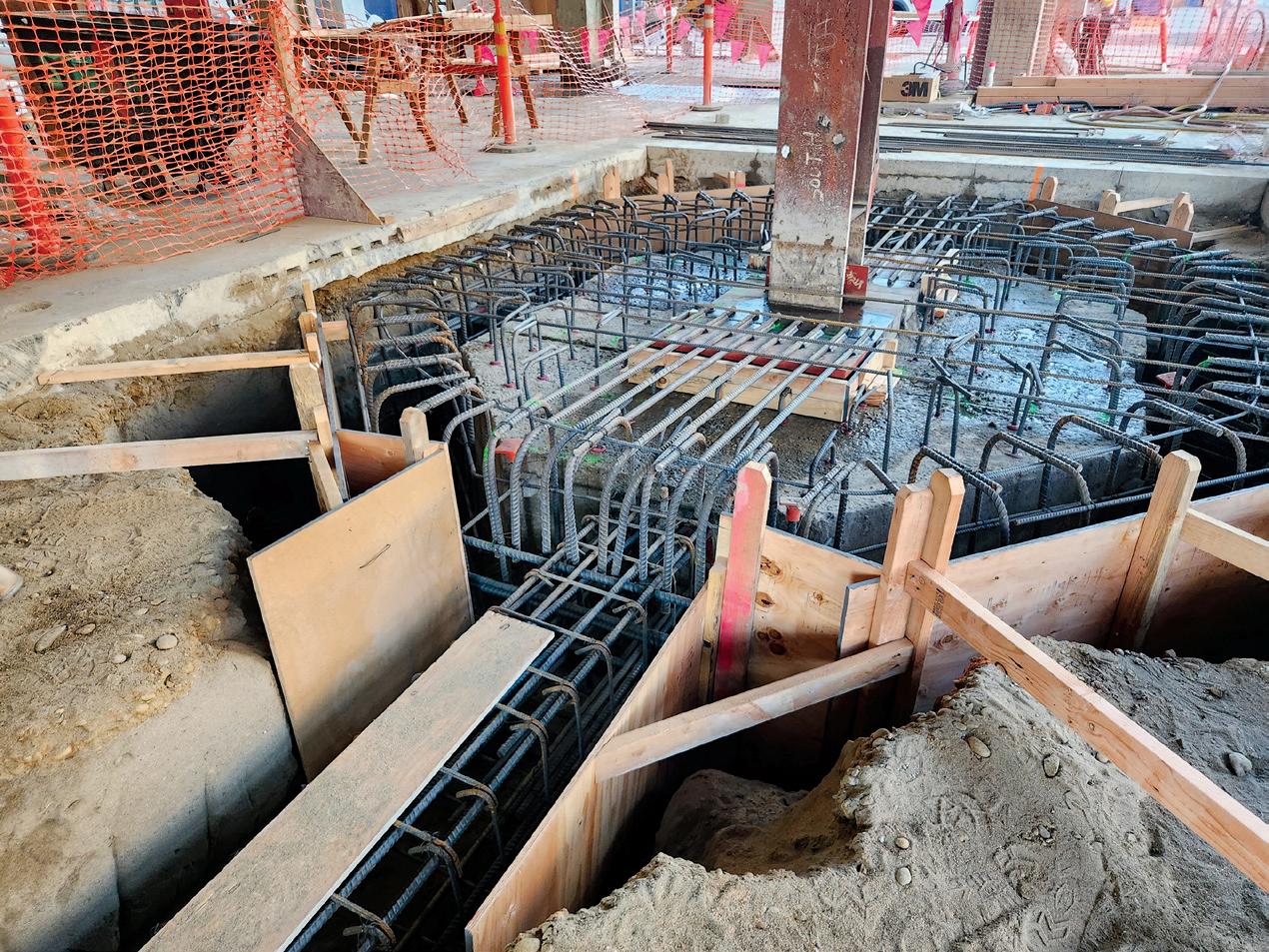
The 17-story Resources Building was a marvel when built. Located just two blocks from the California State Capitol in downtown Sacramento, the building was the fourth largest office space west of Chicago upon completion in 1964. The towering 657,000 sq. ft. workplace got its name from the State of California departments it housed: Forestry and Fire Protection, Parks and Recreation, Natural Resources, and chiefly, Water Resources. In addition to providing office space for 2,000+ employees, the building’s rooftop housed components for the California Public Safety Microwave System—cutting-edge communication technology in the 1960s. Unfortunately, time was not kind to Sacramento’s once-tallest building. A 2014 study by the California Department of General Services (DGS) identified several seismic deficiencies and the absence of modern high-rise fire and life-safety elements, putting the building’s occupants at “high risk” should an earthquake, fire, or any other emergency event occur. The following year, a statewide property assessment deemed it the State-owned building most in need of repair and identified numerous additional issues: A “spongy” roof susceptible to leaks. Asbestos in the floor, ceiling, and insulation. Electrical breakers with a history of safety problems. Lead paint. Windows that hadn’t been washed in 10 years due to a broken crane. An inadequate fire sprinkler system. In total, the 2015 assessment estimated $149M in repairs were needed within the next 12 months.
Given the litany of issues and high repair cost, questions surrounding whether it would be better to completely demolish the building and construct one anew naturally arose. However, the building was considered historic on the basis of age. Furthermore, the project Environmental Impact Report noted a significant prehistoric archeological resource was previously uncovered in the area adjacent to the Resources Building, and earthwork activities associated with replacing the structure were deemed a greater risk of destroying potentially undiscovered resources. Lastly, the location’s proximity to the State capitol meant that new construction would have to adhere to current zoning height restrictions, which would have greatly reduced a new building’s square footage. All issues considered collectively, the decision to renovate the existing building was solidified. The Resources Building is 300 feet long by 130 feet wide with an overall height of 232 feet. Typical grid dimensions are smaller than one might expect: 20 feet by 26 feet. Story heights between floors are generally 13 feet, 4 inches. The structural frame consists of 1960sera steel construction and includes concrete fill over shallow metal deck spanning to wide-flange beams, girders, and columns employing bolted double-angle shear and bearing connections and bolted column splices throughout the building. Steel truss moment frames comprise the lateral force-resisting system with double-angles forming the top and bottom chords and the diagonal web members. The truss moment frames are typically constructed with shop-welded
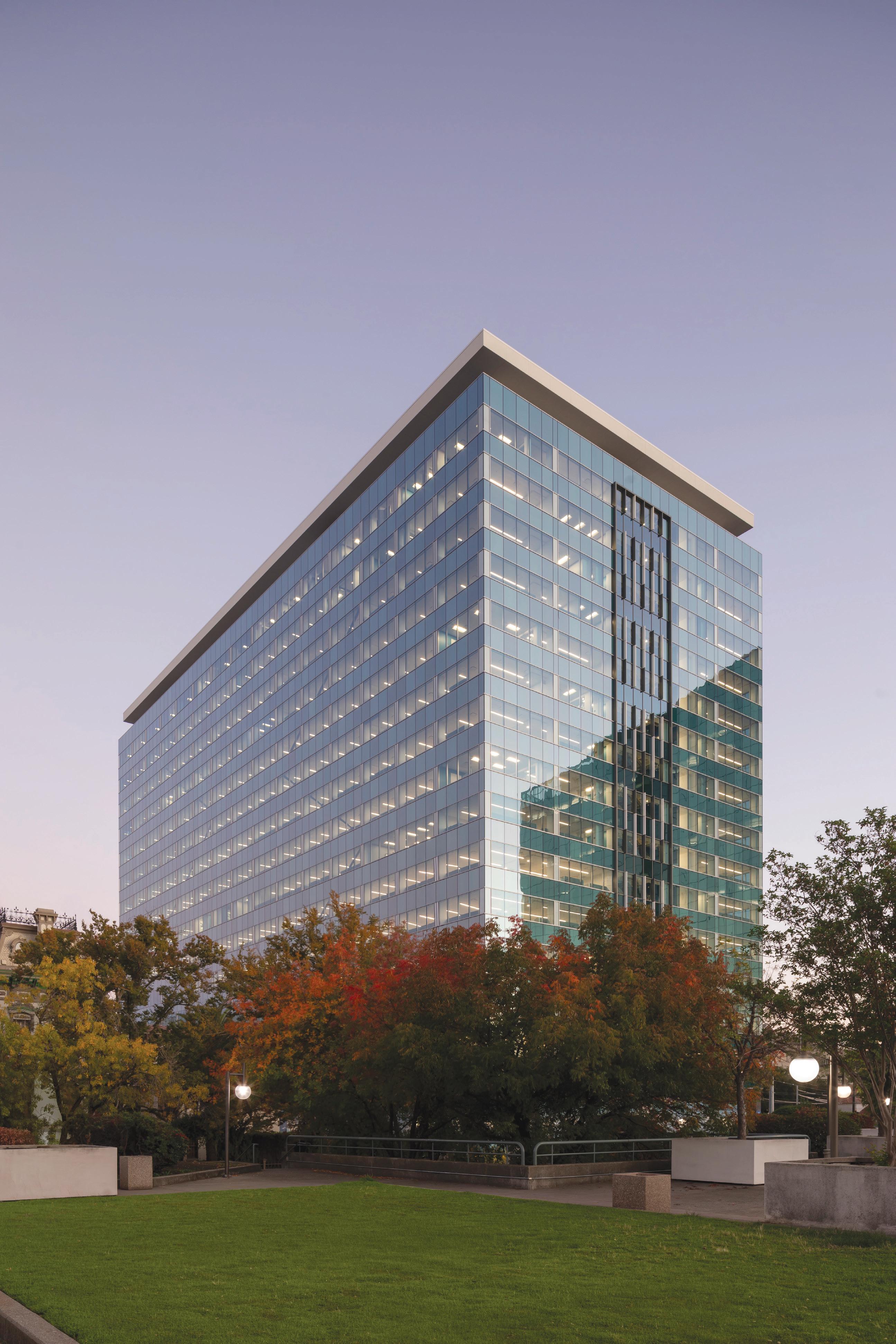
Photo credit: James Ewing/JBSA
connections between the webs and chords and with field-bolted connections of the last double angle to the gusset plates at the columns.
DGS has significant experience procuring projects using DesignBuild contracts for new construction, but less experience with the same procurement method for renovation projects. Despite this lack of experience, DGS leadership realized an existing building renovation of this magnitude needed a delivery method with more flexibility to account for the many unforeseen conditions that would likely occur throughout the life of the project. As a result, the State selected Progressive DesignBuild for their delivery method to allow greater design development and extensive site exploration to minimize risk and improve the certainty of the Guaranteed Maximum Price (GMP).
Project Goals
The main objective of the project was to extend the useful life and viability of the building and provide a modern, efficient, and safe environment for State employees and the public they serve. This meant removing and abating hazardous materials, correcting seismic and fire/life-safety deficiencies, and upgrading all infrastructure systems,
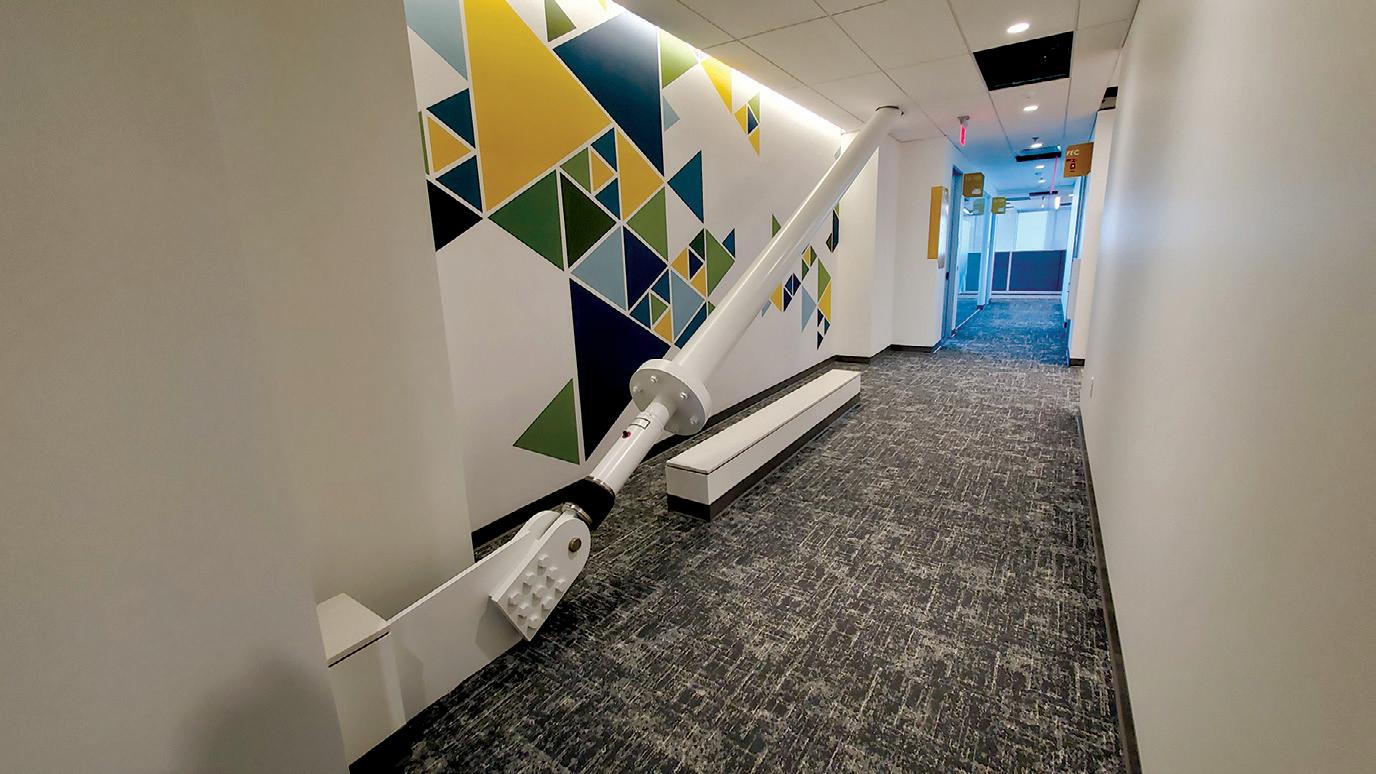
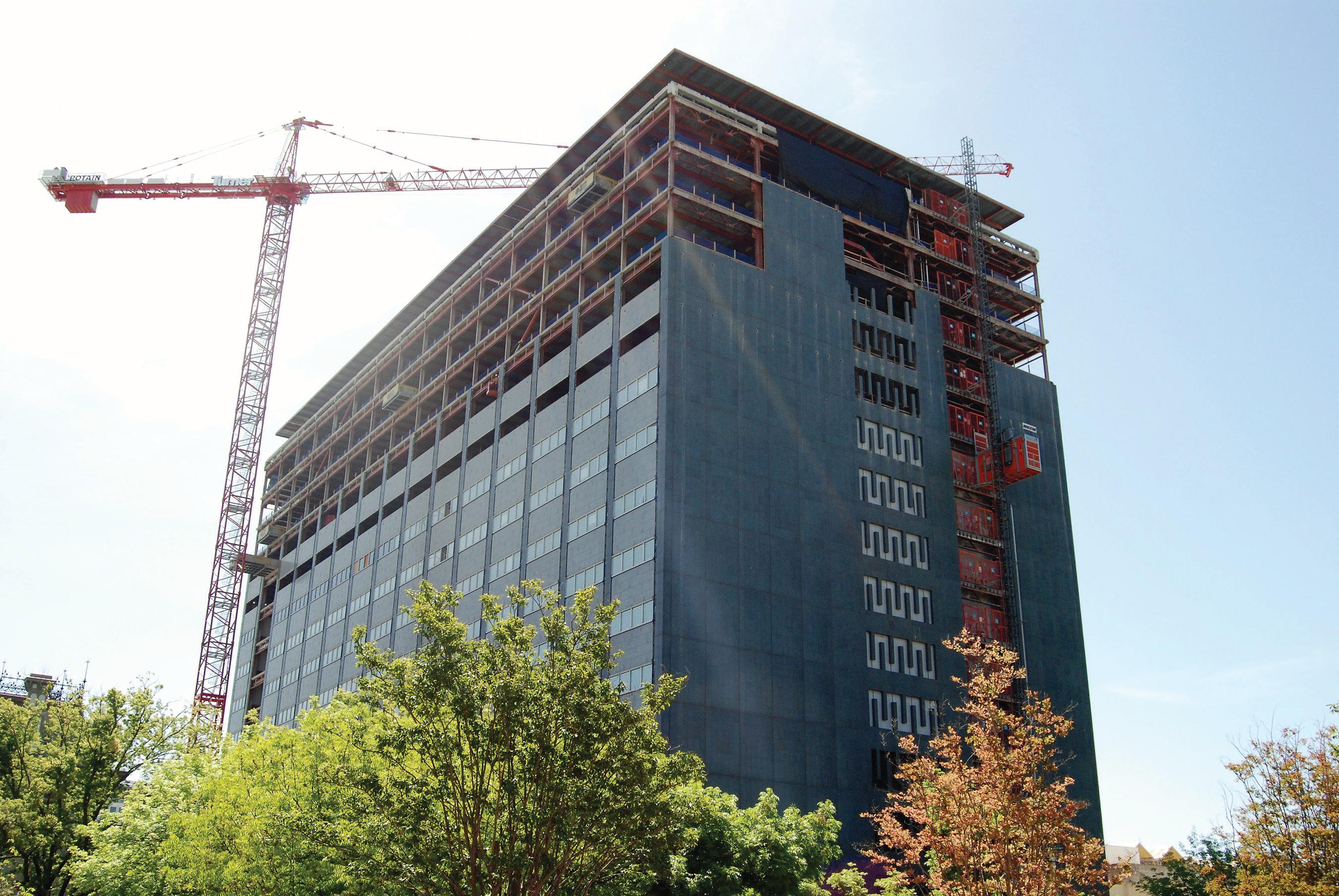
Partial demolition of perimeter walls—building with precast concrete panels removed from upper floors and dampers installed. (Photo Credit: Nathan Canney/Taylor Devices)
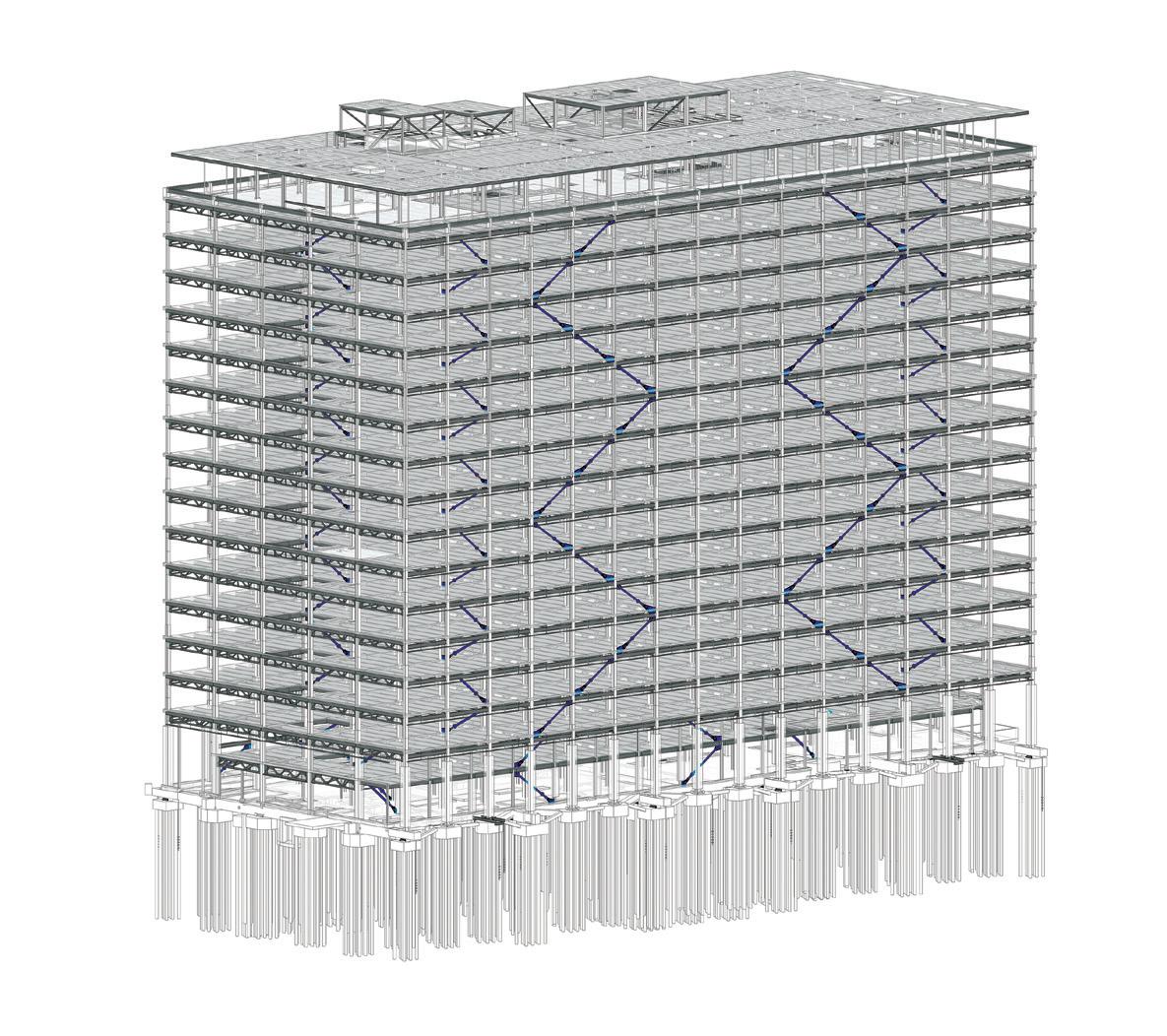
Revit model with damper configuration shown in blue.
including MEP, HVAC, telecommunications, and security. All building envelope elements, including the roof, windows, and exterior precast panels, were to be removed and replaced. Additionally, three 17-story exit stair cores were to be reconstructed.
Achieving these goals meant stripping the building down to its structural frame. Due to the historic status of the building, the renovation plan and all other proposed changes were reviewed by the State’s historic preservation officer, who was also charged with ensuring the new design respected the International Style expressed in the original design as well as the equally historic Leland Stanford Mansion located nearby across the alley.
Investigation and Testing
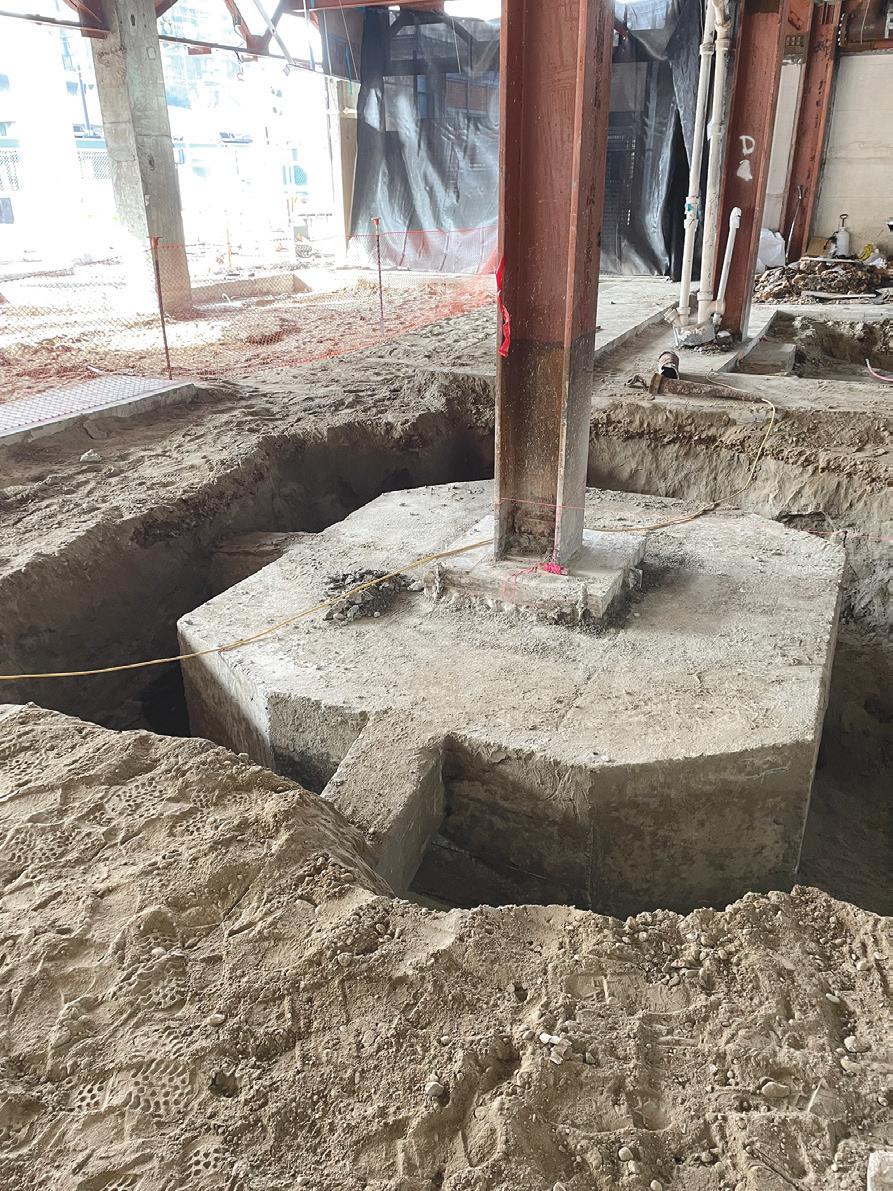
Many means and methods of the original design and construction were known at the start of the project, but still a great many remained unknown. Drawings used to validate the project were incomplete, so the Buehler team scoured the DGS plan room for two days, uncovering additional drawings for the entire team to use.
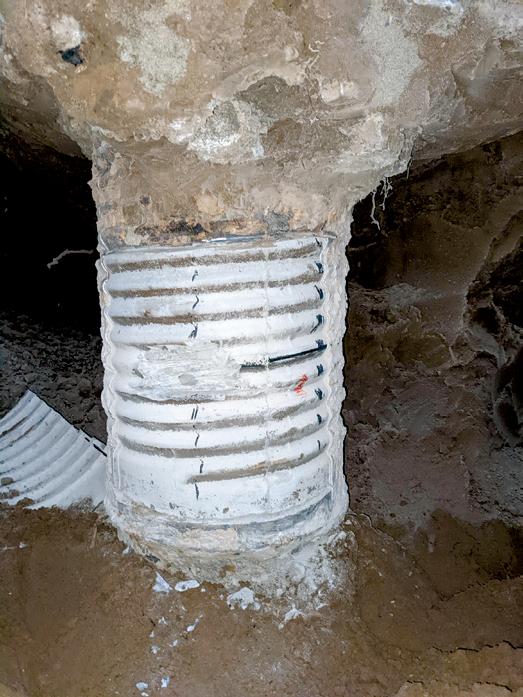
This effort yielded an interesting wrinkle about the steel frame. The drawings stated that the majority of steel used was of the high-strength ASTM A440 variety as opposed to the more common ASTM A36 type. Some steel coupons of the frames were taken and testing confirmed the presence of A440, which is more common for steel connected using rivets instead of bolts and welds. Though higher strength, A440 steel has different metallurgic properties that required the establishment of special
welding procedures. By identifying this issue before a GMP was established, these special welding procedures were easily accommodated into the project scope.
One large unknown remained despite discovering additional drawings: the original foundation and pile system. The original design documents allowed four possibilities, but analysis that incorporated the lower limits of compression and tension of the different types led to vastly different strengthening requirements.
With permission from DGS, the project team decided to perform destructive exploration to gather necessary information. Certain areas at the exterior of the building proved optimal for excavation as the building was unoccupied, and it was determined that there were minimized loading demands upon the selected pile caps. Following the installation of temporary shoring, excavation uncovered the building had step-tapered piles—a type not uncommon for downtown Sacramento given the era of construction.
This investigation into the pile types also yielded something unusual about the construction methods used for the original foundation. Before installing the piles, the area was completely excavated down approximately 10 feet to 12 feet, piles were drilled, pile caps formed, and the remaining hollow space was backfilled with sand.
To help mitigate another significant project risk, DGS gave the project team approval to remove one of the building’s exterior precast panels to help determine demolition expediency and overall project cost. Once again, another interesting tidbit was uncovered: the concrete deck slabs were cast directly against the exterior precast panels without any kind of separation, forming cold joints at every floor. Although the drawings did not indicate any method for creating a break between these two elements, it was expected that some sort of break would be discovered. What was found was quite the opposite—a strong bond between the floor slab and precast panel enhanced by roughened surfaces on the back side of the precast panel. The precast panels were already set to be removed from the building, but this finding meant that the design-build team needed to modify the sequence and time allotted for removing the panels. By removing one of the precast panels during this exploratory phase, the team was
Left: A pile cap in its original existing condition. Above: In-progress pile cap strengthening.
The investigation into the type of piles uncovered step-tapered piles.
able to validate a proposed demolition concept without the need to price this uncertainty into the GMP.
Nonlinear Time History Analysis
Now armed with additional knowledge, the team proceeded to the evaluation and design phases of the project. Development of an optimal retrofit solution necessitated extensive study of the expected seismic performance of the existing structure in its current condition. When renovating its office buildings, the State requires compliance with the California Existing Building Code (CEBC). The 2019 CEBC was the governing code for this project and stipulates a seismic evaluation and/or retrofit using ASCE 41 must be conducted to satisfy dual seismic performance objectives of “life safety” performance at the Basic Safety Earthquake (BSE) 1E seismic hazard level, and “collapse prevention” performance at the BSE-2E level. Given the building’s age, height, lateral system, and type of steel used, the team understood that a nonlinear time history analysis—rather than other linear or nonlinear approaches—would be the most appropriate method to evaluate performance and define the seismic retrofit measures necessary for meeting code requirements while simultaneously providing the best value to the project. The nonlinear analysis was completed using ASCE 41-17 as the primary standard for modeling parameters and acceptance criteria and was supplemented with provisions from ASCE 7-16 when appropriate. More specifically, the seismic evaluation followed the ASCE 41-17 Tier 3 Systematic Evaluation and Retrofit procedures relative to the applicable performance objectives of the CEBC.
Close collaboration with the project geotechnical engineer Geocon was warranted to select the appropriate ground motion records for the analysis, which applied 11 records in each primary direction of the structural system. These records were selected and scaled to reflect the seismicity and soil conditions of the project site relative to the BSE-1E and BSE-2E seismic hazard levels specified by the CEBC. The site-specific spectral acceleration parameters for the two seismic hazard levels are S s = 0.235 and S1 = 0.106 for BSE-1E, and S s = 0.427 and S1 = 0.194 for BSE-2E.
Even with the generally moderate seismicity of Sacramento, initial analysis of the as-built structure indicated significant structural deficiencies throughout the building, with an abundance of components failing to meet the collapse prevention performance criteria associated with the BSE-2E hazard level. The following behaviors were predicted to occur in numerous locations: buckling of the bottom chord of the steel truss moment frame, buckling of web members of the steel truss moment frame near columns, excessive yielding and/ or fracture of myriad welded and bolted connections within the steel truss moment frames, and excessive yielding and/or fracture of connections from the trusses to the columns. Foundation uplift capacity also appeared to be lacking.
Exploring Solutions
Further analysis was conducted in consideration of various retrofit strategies, including “brute force” solutions such as strengthening of all deficient conditions, as well as essentially abandoning and replacing the existing steel truss moment frame system by adding new braced frames throughout the building.
As the results of the various studies were further examined, it became clear that the steel truss moment frame members and connections were lacking reserve capacity and were limited by nonductile failure
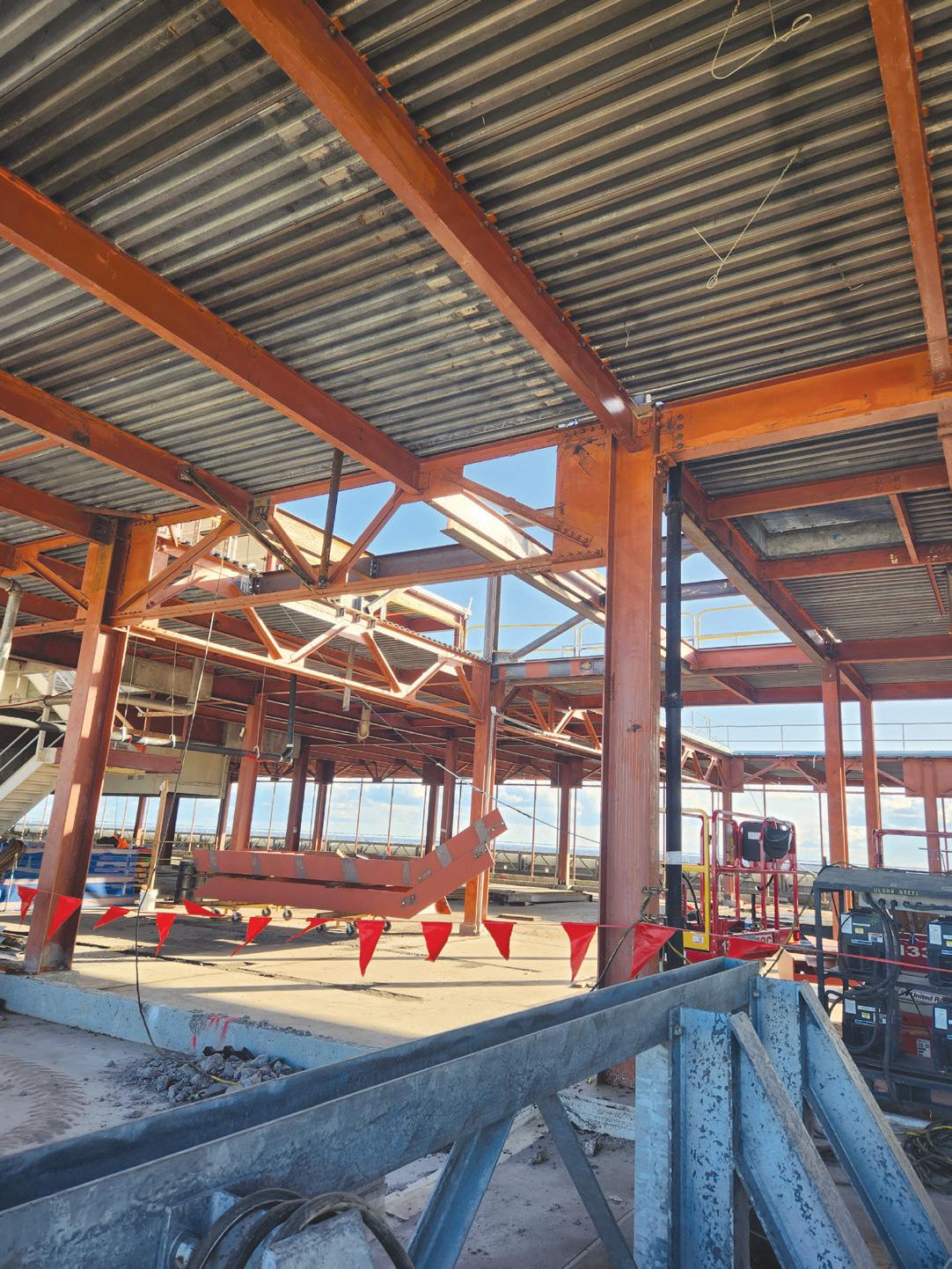
mechanisms associated with story drifts and joint rotations. The frames appeared to lack the ability to redistribute load through duc tile mechanisms to other portions of the frame or to other portions of the building, meaning that yielding of one component usually triggered a nonductile failure of that component or an overload of an adjacent component. This behavior was not isolated to a general region, specific floor, or particular line, but was instead prevalent throughout the entire building. The time history analysis indicated that inadequate capacity and unacceptable nonductile mechanisms occurred with seismic story drifts as small as 0.5%.
Conceptual retrofit studies focused on minimizing the need for strengthening the steel frame due to the A440 steel and nonductile connections. These studies quickly identified the use of fluid viscous dampers and their ability to reduce demands on the steel truss moment frames as the approach likely to meet all project goals, including providing the best value to the State.
Taylor Devices, the selected the damper manufacturer, brought a collaborative approach to placement analysis and design. The team performed iterative studies to develop a strategy for the most effective damper placements and sizes. The sensitivity to exceeding such low story drifts generally controlled the development of the damper retrofit configuration. In the end, a total of 128 dampers of differing sizes and damping characteristics were incorporated, which eliminated approximately 90% of the steel frame locations originally identified in the preliminary studies as needing steel frame strengthening, and resulted in about 50% less new helical piles needed to supplement the foundation system. The strengthening of the steel truss moment frames was mostly limited to minor bottom chord bracing at many of the trusses. At locations where dampers were added, only minimal, localized strengthening of a small handful of existing columns was needed, which was done by adding plates to create a boxed section. It is estimated that approximately $2M was saved due to the extensive nonlinear analysis and fine-tuning of the damper configuration.
Truss moment frames in each direction.
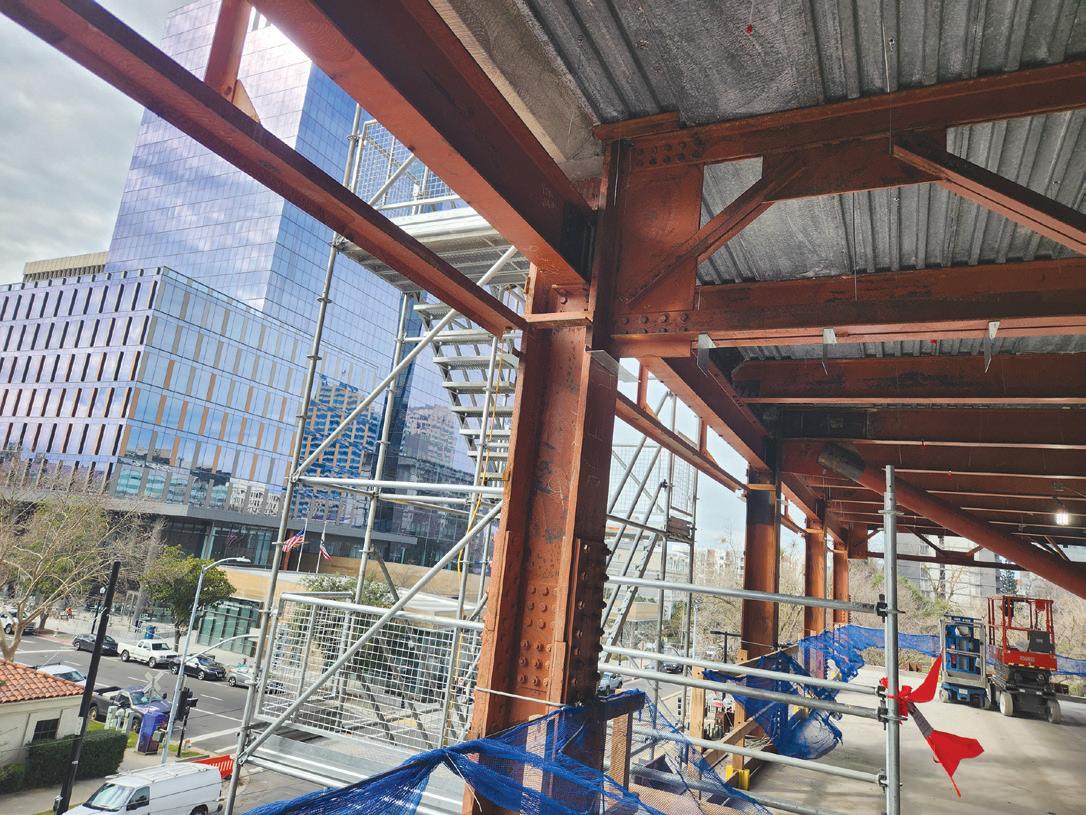
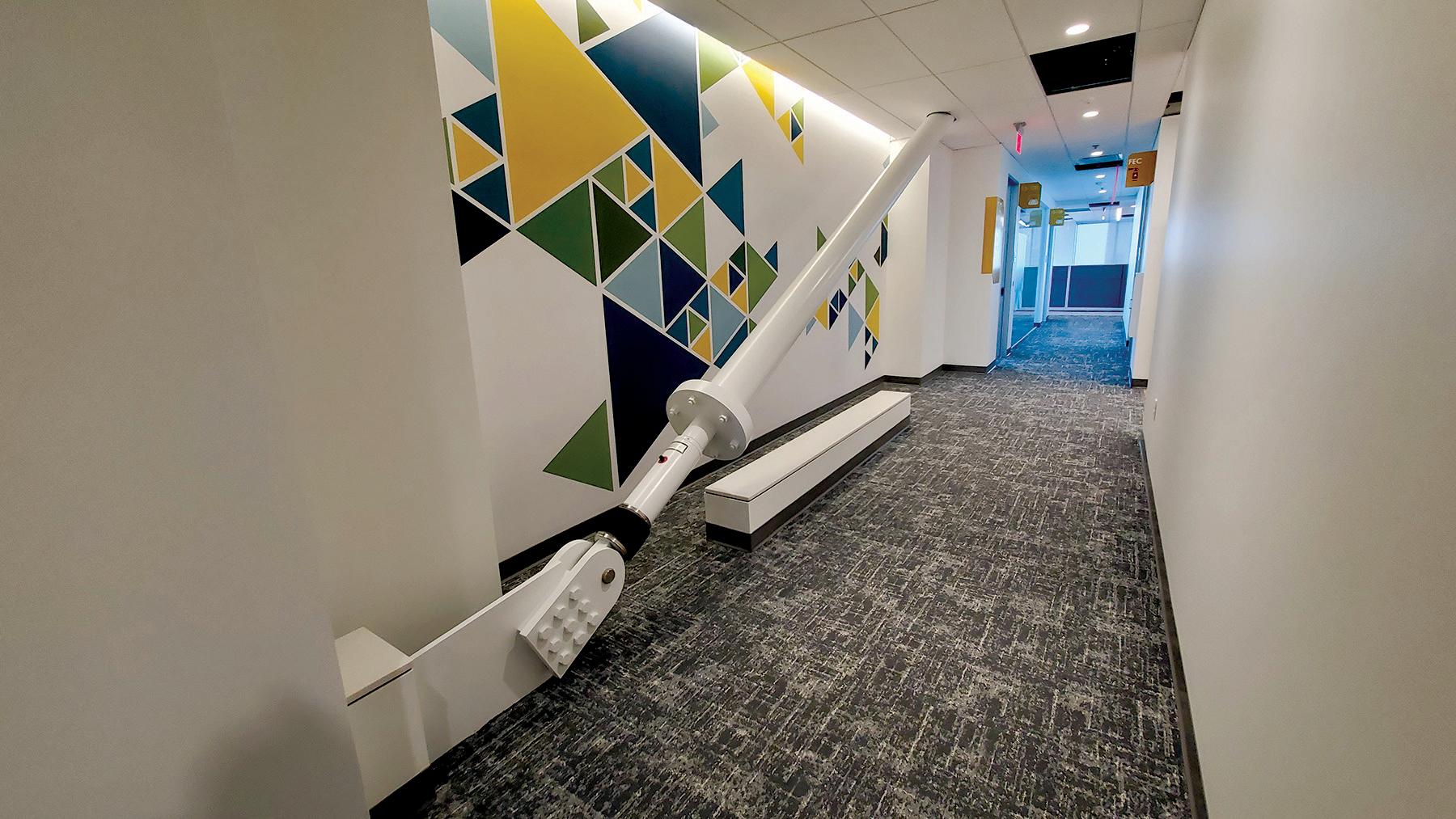
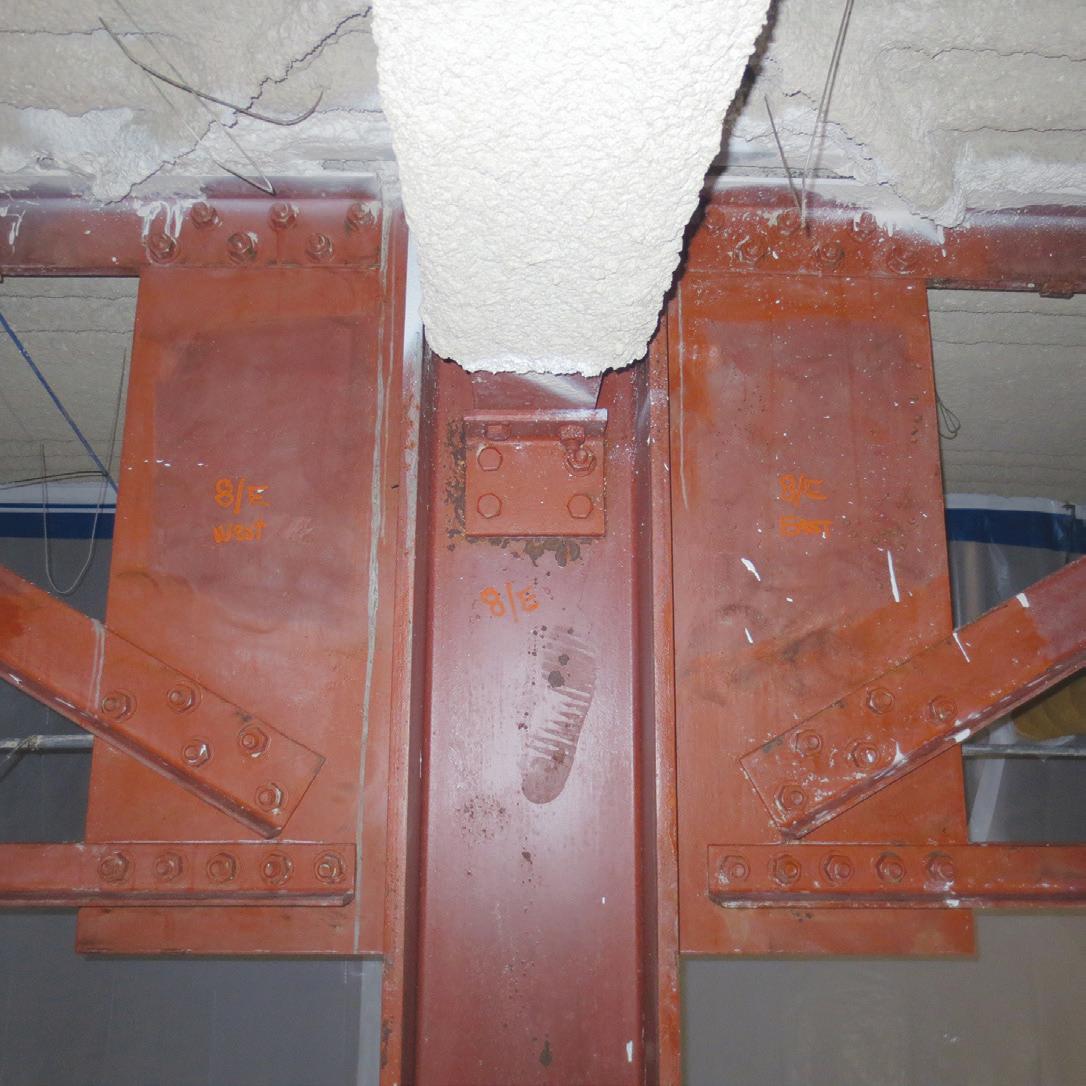
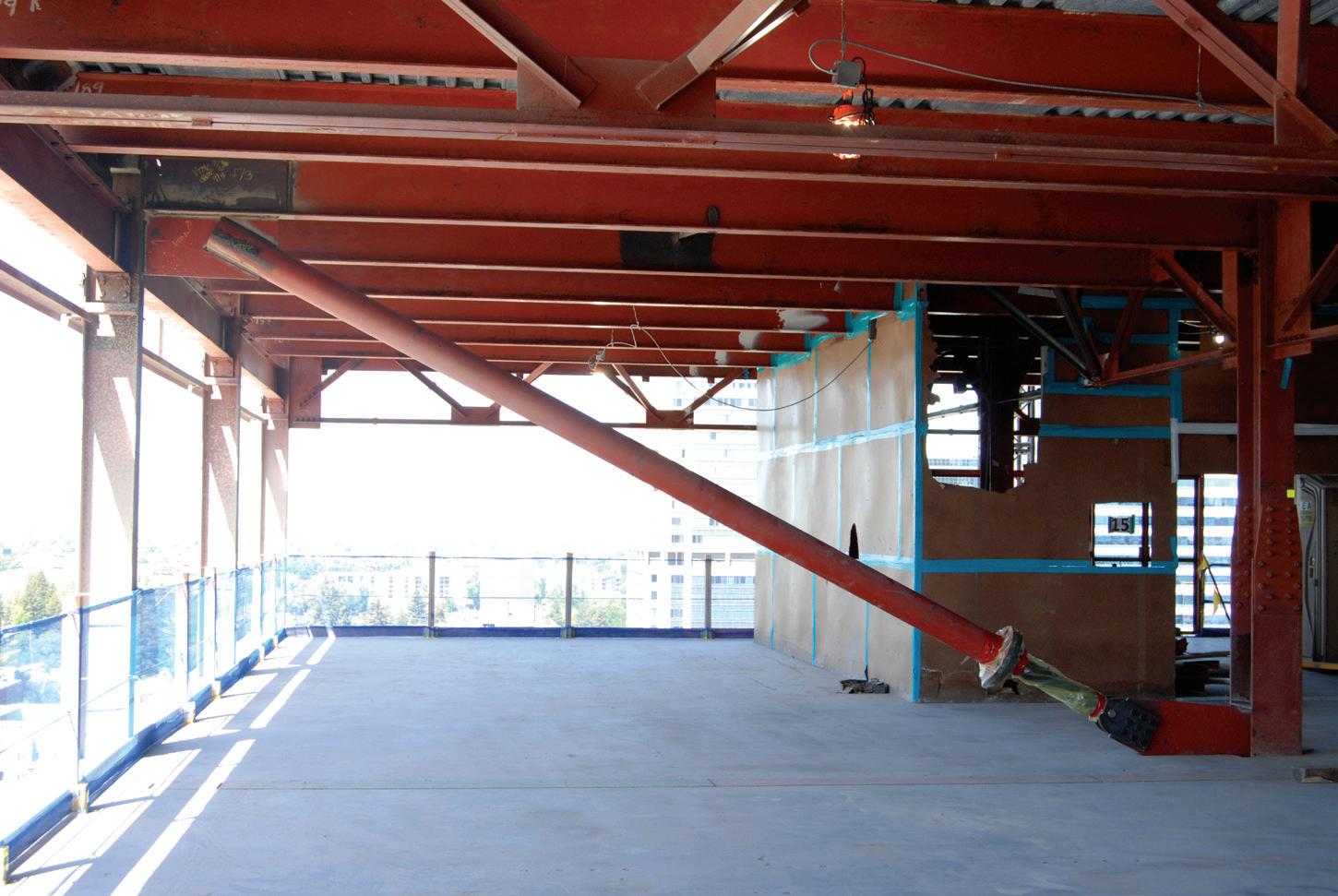
Marrying both function and form, the project team decided to leave the dampers exposed and display them prominently in the new floor plan designs to signal the building’s enhanced safety. This also helped achieve one of the State’s primary goals of providing their employees confidence that their workplace is in a safe structure of high-quality that emulates a new building.
A New Lease on Life (and New Tenants, Too)
The renovation was a smashing success thanks to meticulous structural investigation, analysis, and detailing; collaborative cooperation amongst project partners; and thoughtful engagement by ownership from start to finish. The building received its Certificate of Occupancy two months ahead of schedule and the project stayed within budget, maximizing value to the State.
Employees started moving into the updated spaces Nov. 3, 2025, although they are not the same ones who previously paced their passageways—those workers have since moved into the 22-story New Natural
Resources Headquarters in the block directly southwest. Instead, the revitalized building now serves as the headquarters of the California Labor and Workforce Development Agency and its 40 user groups, including the Employment Development Department, Department of Industrial Relations, and the Workforce Development Board. The State held a ribbon-cutting Jan. 21 and unveiled a no-nonsense new name for the building fitting of both its tenants and all the hard work that went into unleashing its full potential: Labor Building. ■
Jason Horwedel, SE, DBIA is a Principal at Buehler who specializes in large design-build projects, including sports and entertainment venues, civic facilities, and healthcare structures. (jhorwedel@buehlerengineering.com)
Matt Williams, SE, is an Associate Principal at Buehler whose projects include hospital expansions, government headquarters buildings, and airport facilities.
a Technical
Phil Petermann is
Writer at Buehler who got started in AEC performing historic concrete preservation at Alcatraz Island as a student at CSU Chico.
Left: Truss moment frame—exterior column. Right: Truss moment frame—interior column connection at 11th floor.
Damper connected to framing. (Photo Credit: Nathan Canney/Taylor Devices)
Dampers were left exposed to signal the building's enhanced safety.
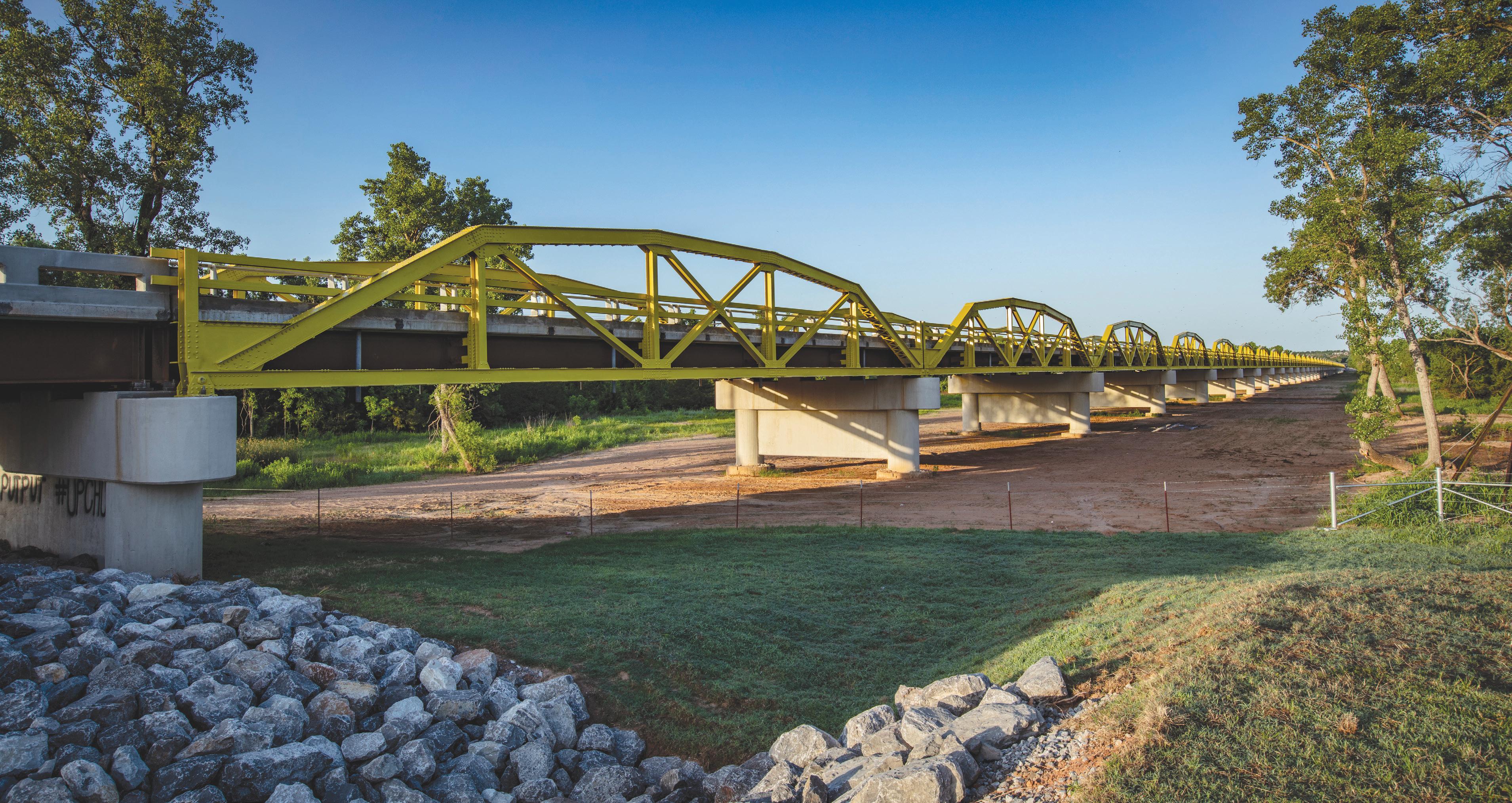
A Route 66 Icon Reborn
The rehabilitation of Oklahoma’s Route 66 William H. Murray “Pony” Bridge connects the past and future.
By David Neuhauser and Jose Joseph
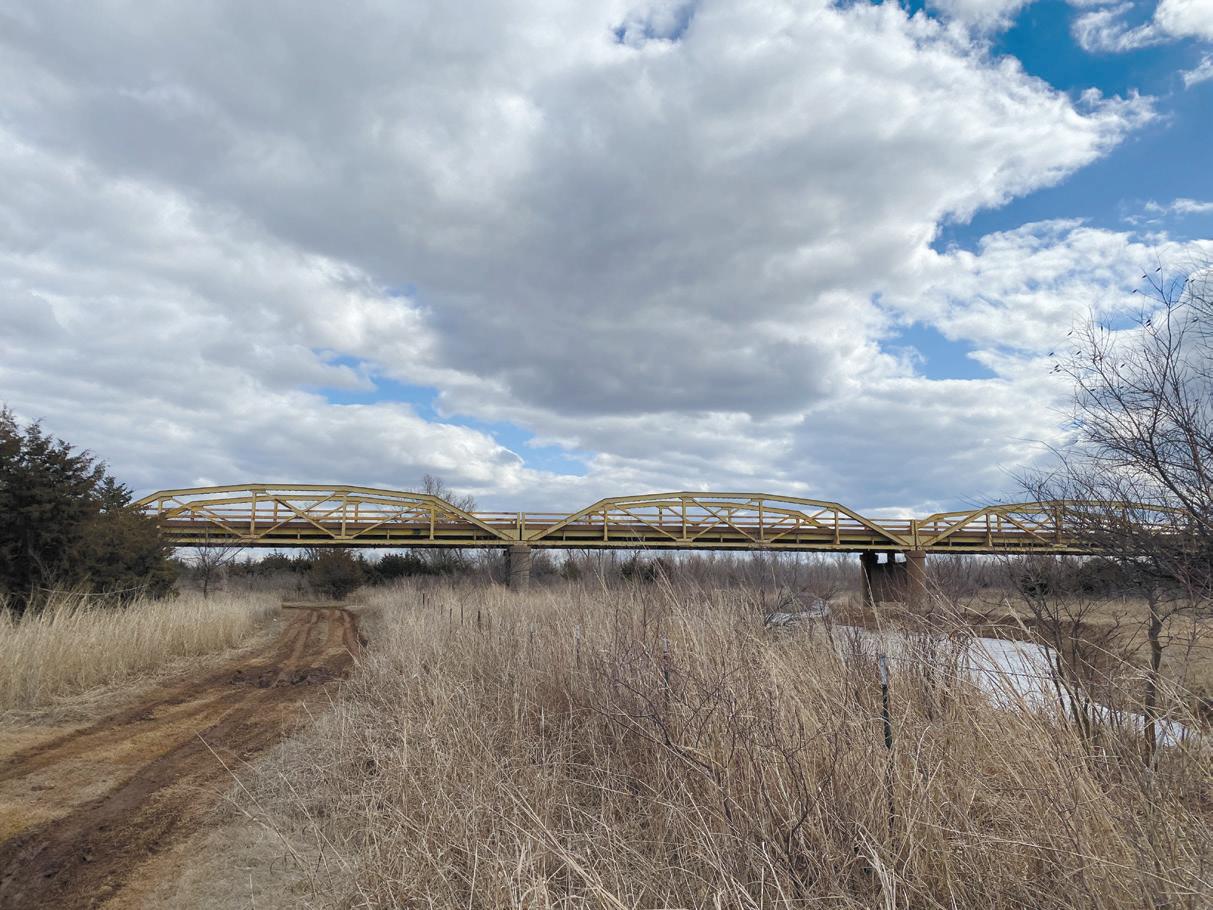
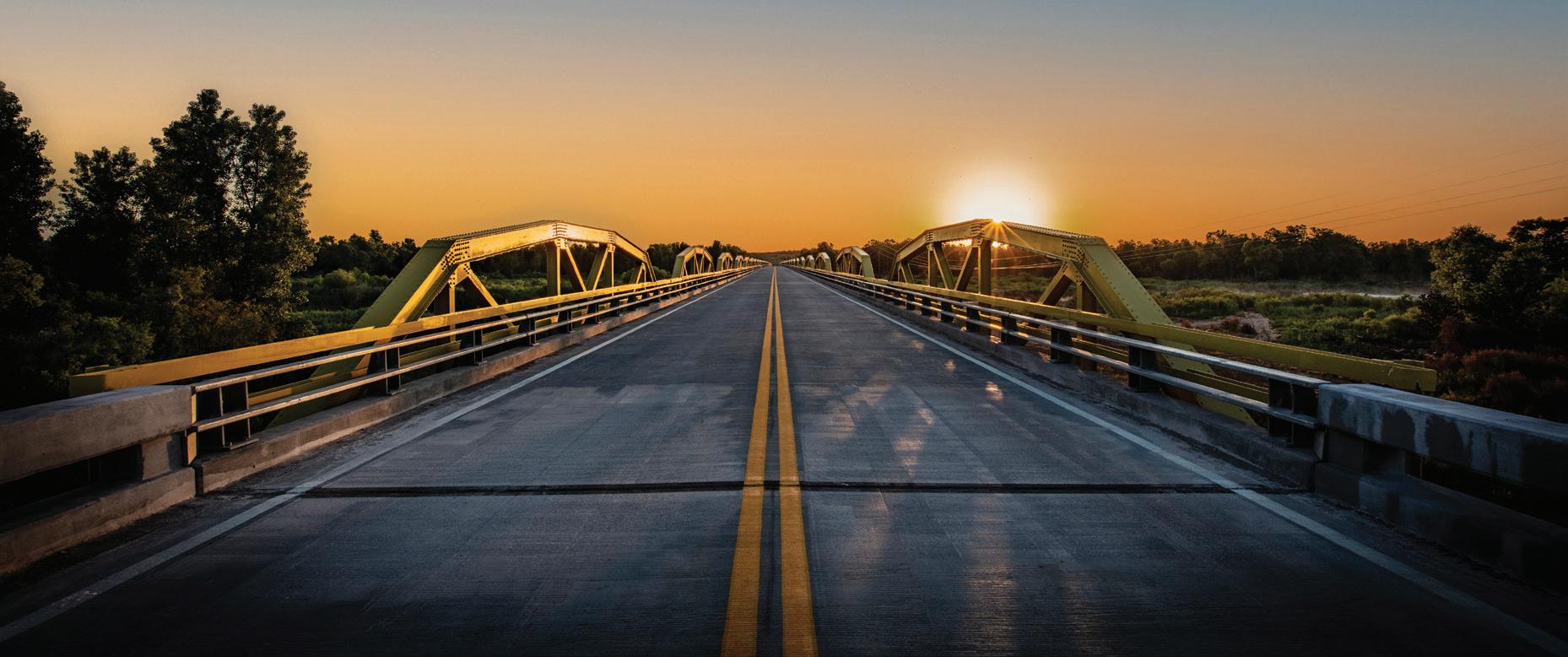
Few structures embody the cultural and engineering legacy of America’s highways like the William H. Murray “Pony” Bridge. Spanning the South Canadian River along the historic Route 66 corridor in Canadian and Caddo Counties, Oklahoma, the 3,945-foot-long structure near the town of Bridgeport, also known as the Bridgeport Bridge, has stood since 1933 as a gateway to the West. Known for its distinctive 38 pony truss spans, the bridge has long attracted tourists, preservationists, and transportation enthusiasts (Fig. 1).
After nearly a century of service, the bridge was facing closure. Years of wear, combined with the demands of modern traffic, led to the bridge being designated as structurally deficient. Without significant intervention, the bridge would have continued to deteriorate rapidly to a point where it would no longer be serviceable. For Oklahoma, which has more drivable miles of Route 66 than any other state, the loss of this bridge would have impacted both the daily local traffic use and the attraction of visitors from across the world.
The Bridgeport Bridge is the longest of its kind in the United
States and the second longest bridge in the Oklahoma Historic Bridge Inventory. A centerpiece of the Bridgeport Hill–Hydro Route 66 Segment Historic District, the bridge is listed on the National Register of Historic Places. With the 100th anniversary of Route 66 approaching in 2026, restoring the bridge before this milestone became a way to honor the past while ensuring the bridge’s continued service for future generations.
The Oklahoma Department of Transportation (ODOT) turned to STV Incorporated (STV) to lead the highly anticipated rehabilitation project. The design and construction efforts aimed to preserve the bridge’s historic character while implementing innovative structural solutions to ensure safety, resilience, and lasting performance.
In May 2024, after a complex four-year rehabilitation, the Bridgeport Bridge reopened with a ribbon-cutting attended by preservationists, elected officials, engineers and 350 classic cars. The event signaled more than the completion of a project—it represented the successful blending of heritage, engineering innovation, and community value.
Fig. 1. Above: The original Bridgeport Bridge was known for its 38 distinctive pony trusses. Below: The rehabbed bridge still features the historic pony trusses, reinstalled on the outside of the new spans as decorative elements.
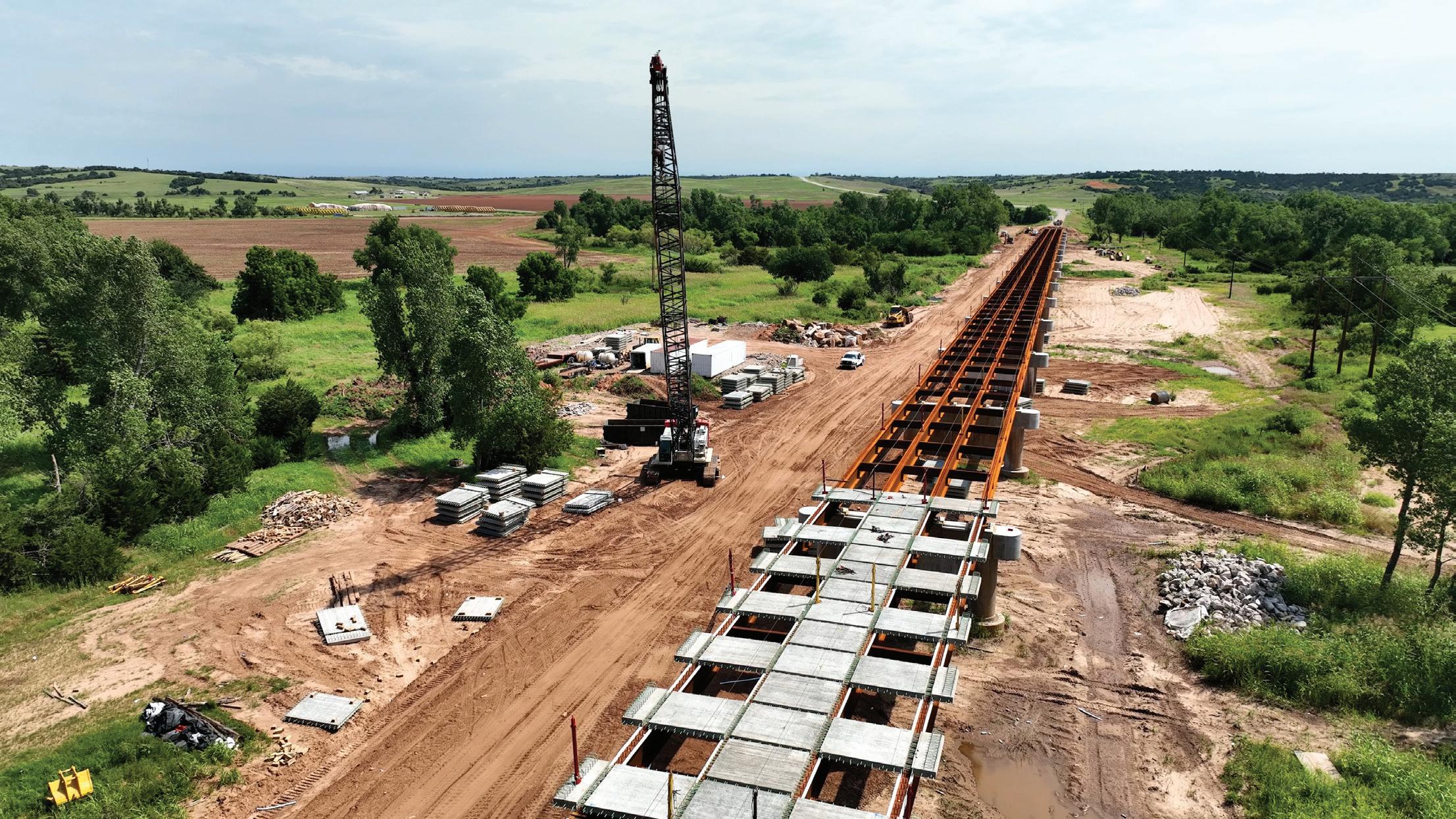
An Aging Bridge—and the Race to Restore It
The structure consists of 38 main spans, each a 100-foot-long pony truss. These trusses are located on either side of the deck, rise only to a height that eliminates the need for overhead bracing, and are connected by floor beams. In addition to its iconic pony trusses, the Bridgeport Bridge featured two 36-foot steel I-beam end spans and a narrow concrete deck just 24 feet wide, supported by concrete columns on hollow concrete caisson foundations.
By 2011, routine inspections classified the bridge as structurally deficient, with subsequent evaluations in 2013 and 2014 documenting vehicle impact damage to the upper truss members and corrosion on floor beams, stringers, and gusset plates. By 2019, ODOT recognized that, despite ongoing maintenance, the bridge’s aging pony trusses could no longer support modern truck traffic. The combination of the bridge’s size, age, and growing maintenance demands had begun to exceed ODOT’s available resources, highlighting the need for a comprehensive rehabilitation. Preserving a cherished landmark while delivering a structure capable of meeting 21st-century demands posed a significant challenge.
To address these challenges, ODOT contracted STV in 2015 to develop solutions and assess long-term rehabilitation strategies. The project began with the development and assessment of multiple design alternatives. These alternatives ranged from rehabilitation strategies affecting the existing structure to restrictions limiting access to only pedestrians to the full removal and replacement with a new, modern bridge. Each option was evaluated and presented as a detailed matrix that considered environmental, historical, and economic impacts along with the costs of roadway and bridge construction.
The design team also encountered various environmental and stakeholder factors. Construction would impact the habitat of the Arkansas River Shiner, a federally threatened fish species, necessitating seasonal construction windows and meticulous planning to minimize disturbance. Meanwhile, ODOT collaborated with various organizations—including the Federal Highway Administration, the Oklahoma State Historic
Preservation Office, the National Park Service, the Historic Bridge Foundation and the Oklahoma Route 66 Association—to make sure the project balanced preservation, safety and community priorities. Adding to the complexity was the timeline; ODOT aimed to finish construction well before the Route 66 centennial in 2026, setting an accelerated schedule that required both ingenuity and efficiency.
Modern Engineering for a 1933 Original
To achieve the project goals, STV’s design team combined advanced engineering techniques with a deep respect for the bridge’s historic identity. The team investigated whether the bridge’s original substructure could be preserved rather than replaced. STV included Wiss, Janney, Elstner Associates, Inc. (WJE) as a subconsultant to conduct material testing and analysis. Using Ground Penetrating Radar (GPR) and HalfCell Potential (HCP) surveys, the team determined that much of the substructure was still sound. Retaining the existing columns and drilled shafts preserved the bridge’s historical footprint while lowering costs and reducing environmental impacts.
Assessment of the substructure confirmed that the as-built configuration and material properties were generally consistent with those specified in the original construction documents. Petrographic analysis of concrete cores indicated high-quality, uniform concrete. Visual inspection and half-cell potential readings showed low to moderate corrosion risk in the columns, with no signs of active deterioration. In contrast, the tops of the web walls between the columns showed corrosion-induced damage, including cracking and surface distress, primarily caused by chloride ingress through open deck joints and inadequate concrete cover.
Based on these findings, the existing columns, caissons and portions of the web walls were retained and incorporated into the rehabilitated structure. The original pony trusses, bridge deck, floor beams, and stringers were removed or recycled due to significant corrosion and limited roadway width. To preserve the bridge’s historic character,
Fig. 2. The rebuilt bridge’s main structural system consists of steel girders with full depth precast deck panels. (Photo by ODOT)
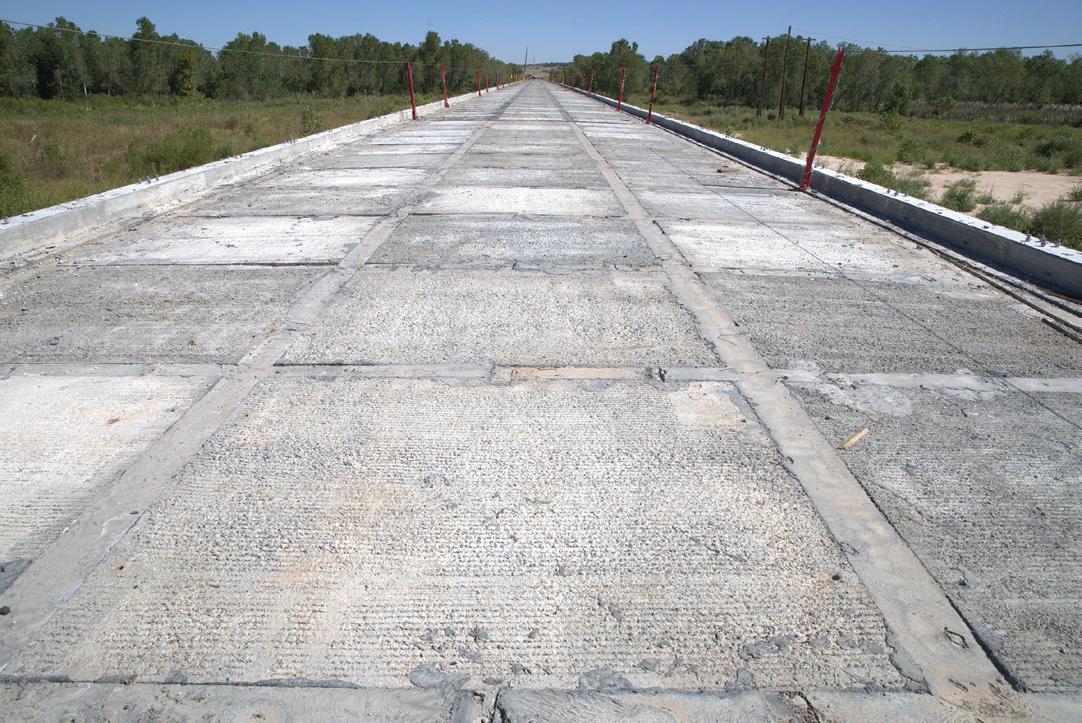
the pony trusses were reinstalled on the outside of the new spans as decorative elements.
To improve the overall roadway width, four new steel rolled beam girders were added as the main structural system along with new diaphragms (Fig. 2). These girders provided the necessary support for the new bridge deck and were designed to carry wind loads on the original pony trusses. The existing floor beam bolted connections were used to reattach the original pony trusses to the main structural system. This approach ensured that the historic visual identity of the bridge was maintained while the transverse loads are transferred to the foundation elements. The consulting parties approved this approach, recognizing the importance of maintaining the bridge’s visual identity and driver experience. Portions of columns and web walls were selectively removed to accommodate new pier caps, which supported the new structural system and the deck. This approach removed portions of the corrosion-induced web walls and shielded the remaining web walls from further deterioration.
The new deck and girder spans were designed in accordance with the current American Association of State Highway and Transportation Officials Load and Resistance Factor Design (AASHTO LRFD) Bridge Design Specifications. By spacing the steel girders at 8 feet 6 inches, the depth of the superstructure was minimized. Additionally, the use of full-depth precast concrete deck panels, connected with Ultra-HighPerformance Concrete (UHPC), accelerated the construction (Fig. 3). The deck consisted of one interior panel and two exterior panels with overhangs, connected monolithically using UHPC poured in an open trough above the girders. Finite Element Method (FEM) modeling simulated complex loading on the deck panels during transportation and installation. These analyses enabled a more advanced connection design between overhang and interior panels, increasing rigidity and expediting construction.
The Bridgeport Bridge became the first highway bridge in Oklahoma to use full-depth precast concrete deck panels with UHPC connections. With a compressive strength of approximately 20,000 psi—compared to 4,000 psi for conventional concrete—UHPC offers enhanced durability, resilience and construction speed. The use of UHPC also aligned with Federal Highway Administration guidelines for accelerated bridge construction, supporting ODOT’s BUILD Grant funding.
The Art and Challenge of Rebuilding a Giant
Executing the rehabilitation required careful coordination between ODOT, STV and the contractor, Oklahoma Bridge Company (OBC). The work began with the removal of all 76 pony trusses, each weighing approximately
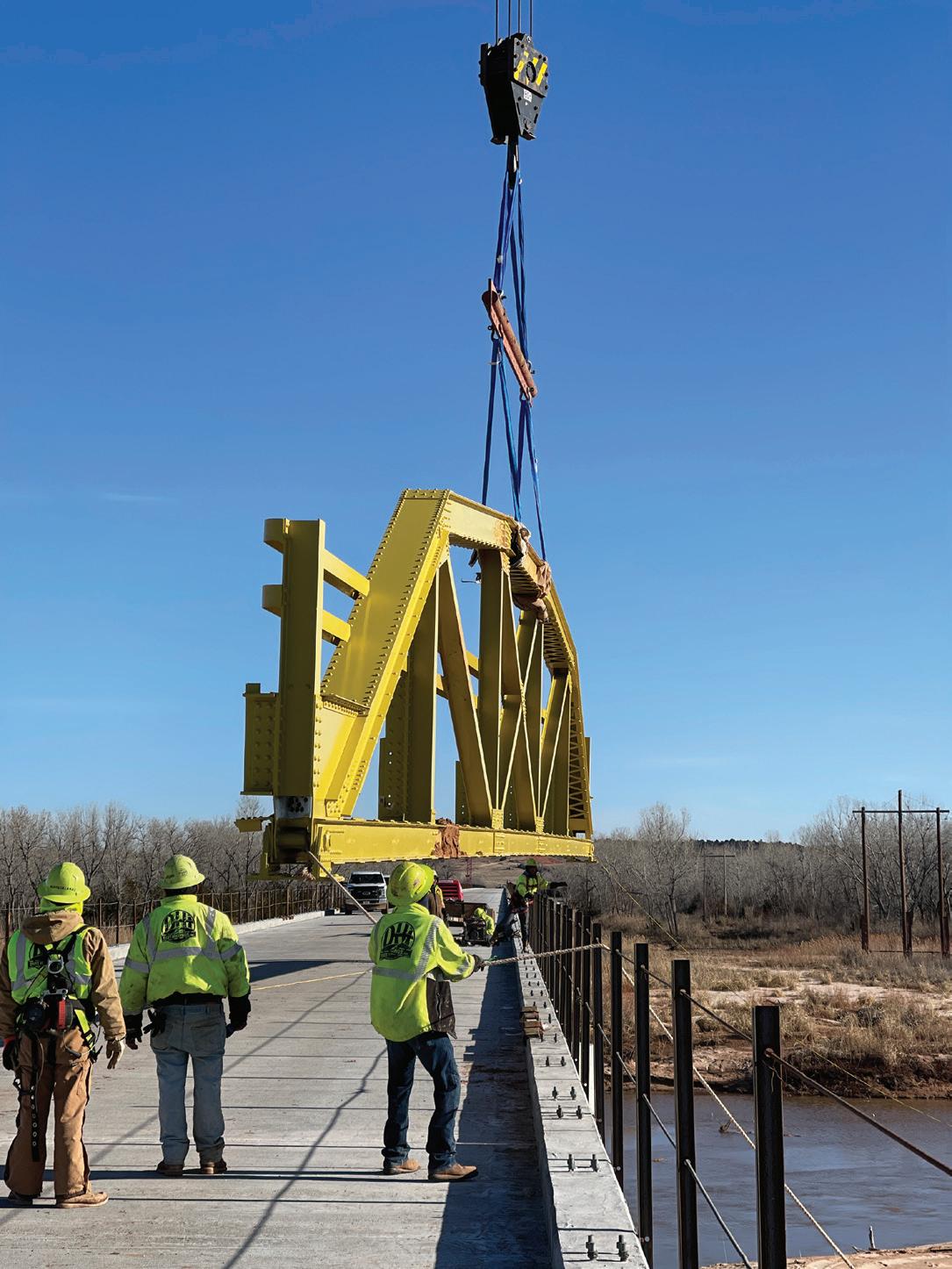
40,000 pounds. The trusses were transported off-site for sandblasting, repairs, sealing, and repainting before being reinstalled as decorative, non-structural elements on the rehabilitated bridge (Fig. 4). The reinstallation was completed quickly and without damage to the historic steel.
The use of precast deck panels further accelerated construction while enhancing safety. Traditional deck pours often require crews to work on narrow overhangs, but the precast panels provided an immediate, stable platform for workers, reducing exposure to hazards and shortening construction time across the nearly 4,000-foot-long bridge structure. Adding to the complexity was the installation of more than 2,900 linear feet of UHPC joints. Because UHPC is highly flowable, preventing leaks during placement demanded precise formwork and close coordination between ODOT and OBC. Through meticulous planning and on-site collaboration, the teams achieved consistent results, with the joints bonding smoothly and enhancing the bridge’s long-term durability.
Balancing Preservation, Performance, and Public Value
From the outset, ODOT emphasized the importance of preserving the bridge’s character while modernizing its function. The completed design met this goal in every respect. The rehabilitated structure widened the travel lanes, improved load capacity and provided a safer and smoother experience for motorists—all while maintaining the visual rhythm of its iconic trusses (Fig. 5).
The bridge reopened in May 2024, two years ahead of the centennial deadline, marking a major success for ODOT and its partners. The project also introduced new amenities, including a parking lot and viewing area with educational kiosks, creating a dedicated space for visitors to learn about the bridge’s history and its role in the evolution of Route 66.
Fig. 3. Full depth precast deck panels are connected with UHPC. (Photo by ODOT)
Fig. 4. Attaching original truss panels as decorative elements (Photo by ODOT).
Environmental stewardship was equally central to the project’s success. By using precast components and carefully planning work around sensitive habitats, the team reduced disruptions to the Arkansas River Shiner’s ecosystem (Fig. 6). These strategies highlighted ODOT’s dedication to responsible construction and sustainable design.
A Lasting Legacy
The rehabilitation of the William H. Murray “Pony” Bridge embodies preservation through progress, showing how modern engineering can honor history while advancing innovation. The project demonstrates the effective use of UHPC in large-scale bridge rehabilitation and the value of FEM modeling in refining precast deck design and installation. It also highlights how accelerated bridge construction can enhance safety, minimize environmental impacts and reduce community disruption. For the public, the bridge serves as a tangible link between Oklahoma’s past and future. It preserves a landmark of Dust Bowl–era resilience while offering a safe, modern crossing over the South Canadian River. The restored span reinforces Route 66’s enduring identity, providing travelers with a renewed way to experience one of America’s most storied roads.
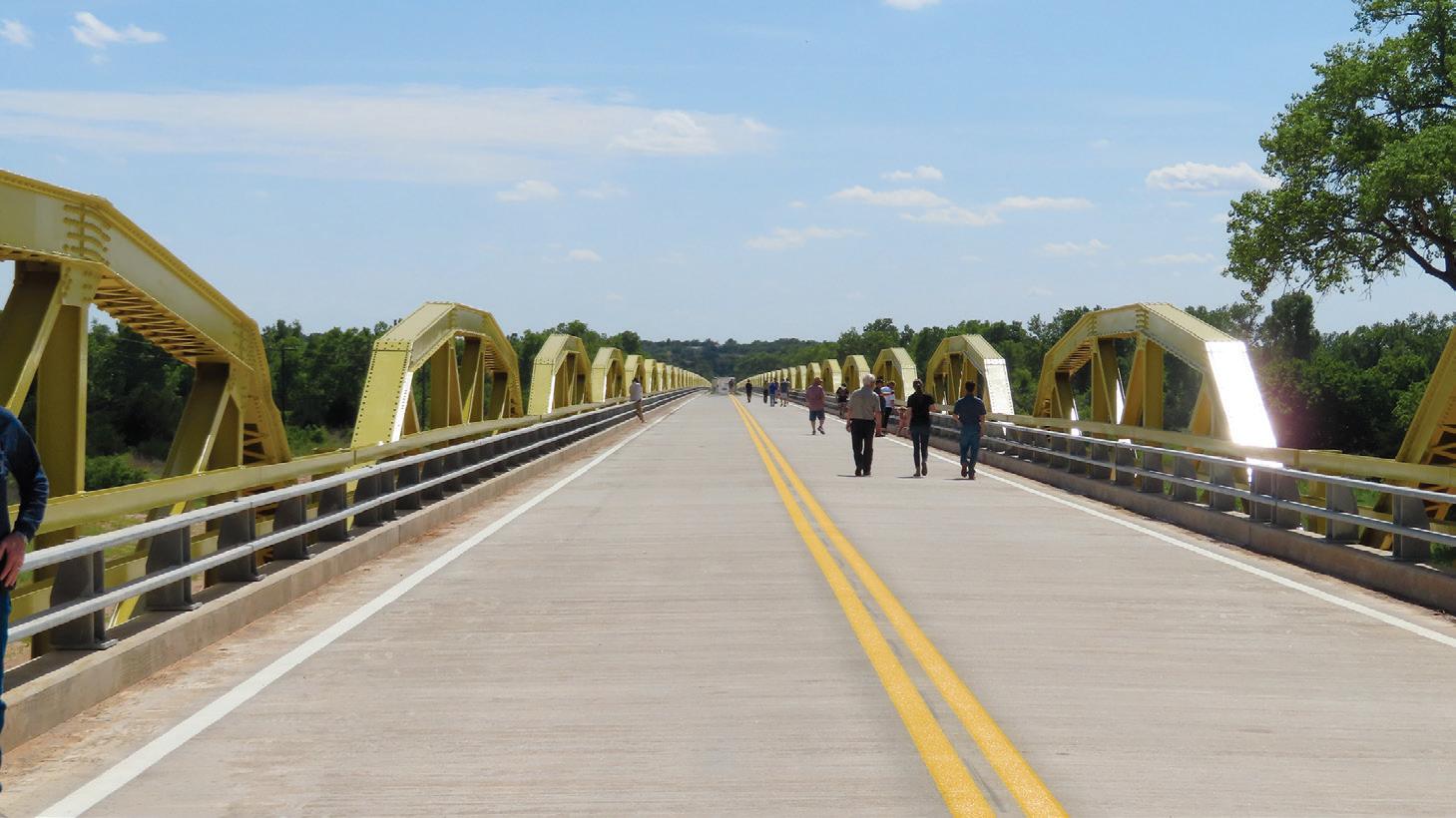
David Neuhauser, PE, is vice president and Oklahoma area manager for STV. Based in Oklahoma City, he brings nearly 30 years of experience in the transportation industry, with much of his career focused on leading roadway and bridge replacement and rehabilitation projects across the region. Neuhauser has been with STV for more than 16 years and oversees the firm’s growth and client service throughout the state.
As Oklahoma approaches the Route 66 centennial, the William H. Murray Bridge stands as both a vital transportation link and a monument to collaboration, ingenuity and respect for heritage—carrying the lessons of the past into the innovations of the future. ■
Jose Joseph, PE, SE, is a principal at STV with 22 years of experience leading, managing and delivering bridge projects. He holds a master’s degree in civil engineering from Oklahoma State University and is a member of ASCE and AISC. Joseph has presented on structural engineering topics at industry conferences and universities.
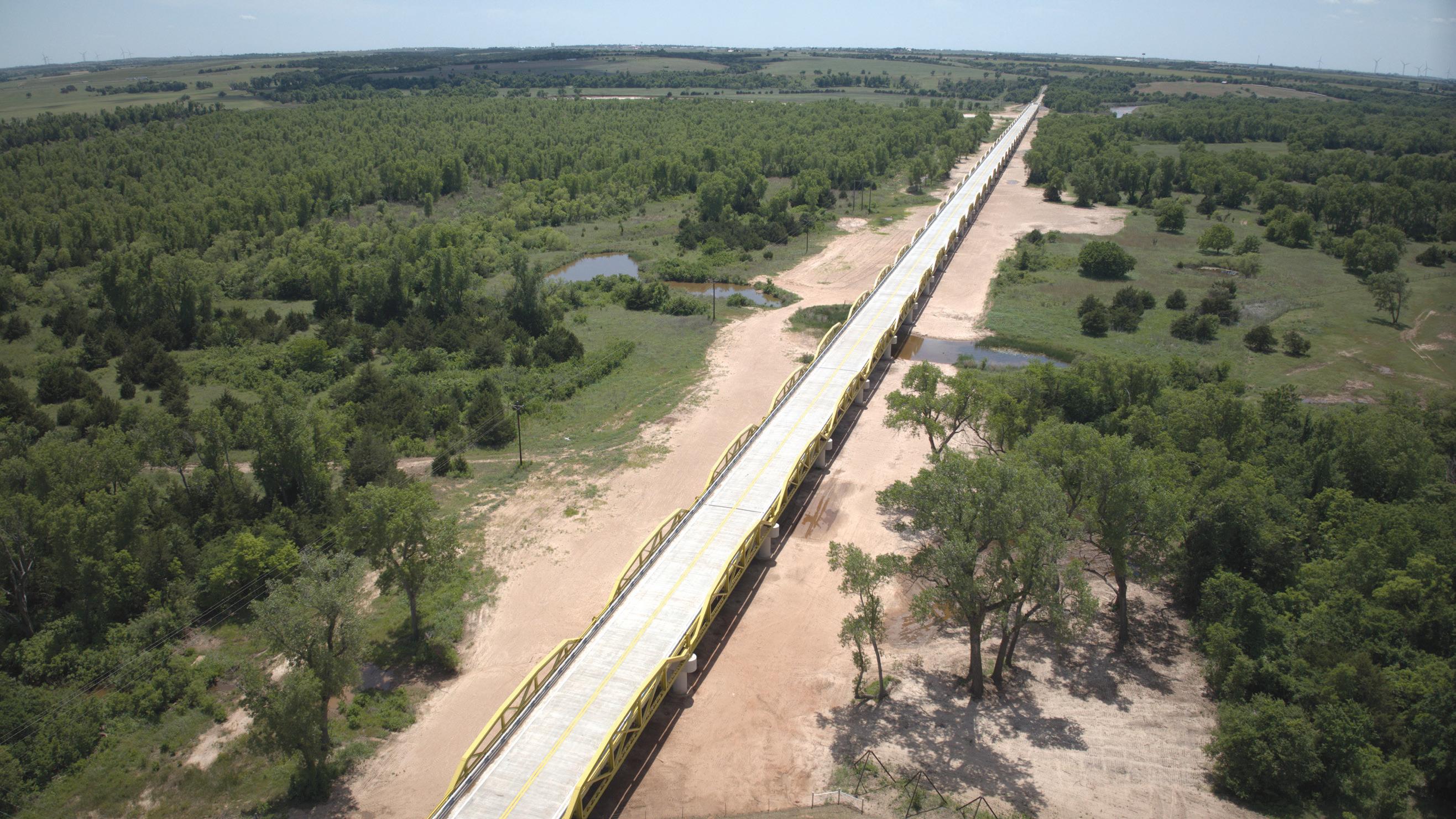
Fig. 5. The new Bridgeport Bridge Roadway reopened to traffic in May 2024. (Photo by STV)
Fig. 6. One of the construction's objectives was to minimize disruptions to the Arkansas River Shiner’s ecosystem. (Photo by ODOT)
professional TOPICS
Structural Engineering Groups Sign Unified Vision Statement
The document signals the three organizations’ commitment to collaboration for the benefit of the structural engineering profession.
CASE, NCSEA, and SEI have announced the adoption of an updated “Unified Vision for the Structural Engineering Profession.” This most recent vision statement builds upon the original 2019 “Vision for the Future of Structural Engineering” signed by the three groups.
The new statement signed in 2025 marks a significant milestone in the ongoing collaboration among the three organizations. The new Unified Vision reaffirms the profession’s commitment to serving society as creative partners in producing safe, sustainable, and resilient designs
that enhance the public’s lived experiences in every community. It also identifies three aspirational themes within the current goals of the three organizations: innovate, lead, and empower.
This Unified Vision, jointly endorsed by the CASE Executive Committee, NCSEA Board of Directors, and SEI Board of Governors, will guide the strategic direction and collaborative efforts of the organizations. Together, CASE, NCSEA, and SEI are committed to advancing the profession and ensuring that structural engineers are recognized for their irreplaceable and ongoing contributions to society.
Unified Vision for the Structural Engineering Profession
CASE, NCSEA, and SEI share a unified vision where the Structural Engineering profession is recognized and admired for its irreplaceable and ongoing contributions to society. Namely, Structural Engineers are creative partners in producing safe, sustainable, and resilient designs that enhance the public’s lived experiences in every community.
To make this vision a reality, CASE, NCSEA, and SEI are committed to the following aspirational tenets:
INNOVATE
Advance: Embrace life-long learning of new skills and innovative technologies to create and advance the built environment.
Educate: Inform the public about the important work of Structural Engineers through public-speaking, marketing, and cross-disciplinary collaboration.
LEAD
Advocate: Serve the public as indispensable problem-solvers, advocates, and stewards of the built environment while engaging in development of key policies that improve the safety and well-being of the public while advancing society on a global scale.
Create: Provide technically excellent structural solutions for resilient communities that protect lives and property, preserve the past, and consider current and future societal needs.
EMPOWER
Attract: Develop and mentor emerging future leaders of the profession and represent the diverse perspectives of the communities that we serve.
Engage: Inspire the best and brightest individuals to pursue rewarding careers in Structural Engineering filled with opportunities and roles that are dynamic and meaningful.
Adopted Date: September, 2025
CASE Executive Committee
NCSEA Board of Directors
SEI Board of Governors
structural FORUM
Delegated Design of CMU Masonry–The Paradigm Shift Has Begun
A newly published guide from the Block Design Collective offers definitions, responsibilities, a sample workflow, and sample specification language for delegated design of masonry.
By Jamie L. Davis, PE
In May 2023, STRUCTURE magazine published my article, “Delegated Design of Masonry.” In that article I proposed a paradigm shift to move masonry to a delegated design workflow similar to so many other specialized structural systems.
Knowing that change is hard and it’s very difficult to overcome inertia, I had little expectation anything would come from that article. I was wrong.
The timing was right. The industry was ready. And the paradigm shift has begun.
The Need
Masonry is one of those system designs that is not typically taught in an engineering curriculum. It is a system that requires not only technical expertise of the analysis and codes but also an understanding of the intricacies of masonry construction. A technically correct design can still be flawed if no thought is given to how the masons will build it. A cost-effective design merges technical savvy analysis with practical experience of constructability concerns, and no “one stop shopping” computer analysis software has it mastered yet.
Many engineering firms have this unique expertise, but many others simply don’t do enough masonry designs to be proficient. The result has been overly conservative designs that misinterpret the code and are difficult to construct. Over time, this has led to the perception that masonry is “too expensive” and can’t compete with other systems like cold-formed framing and precast.
The Solution
Building designs have become increasingly complex and intricate, codes have tripled in size, schedules have become more fast paced, and fees have remained stagnant, so it is no surprise that a release valve is needed on the pressure cooker. That release valve is delegated design. Delegated design has been used in the AEC industry for decades. AIA contracts have recognized and addressed delegated design since 1997. Most engineers have used delegated design for things like steel connection design, cold-formed framing, precast, wood trusses, preengineered metal buildings, steel bar joists, and many other nuanced structural elements and systems.
Delegated design is already being used for some aspects of masonry design. For instance, stone anchors are typically designed by a delegate engineer hired by the stone mason and some architects are delegating the design of clay brick veneer anchors. We are proposing expanding delegated design further to include structural masonry elements such
Delegated Design: A form of collaboration between a design professional and contractor where the contractor assumes responsibility for an element or portion of the design. The design professional and contractor typically have separate written contracts with the owner that establish their respective design responsibilities. In the contractor’s case, those design responsibilities are often established by performance specifications prepared by the design professional.
as partition walls, lintels, bearing walls, and shear walls. Delegating the design of certain systems to the Contractor allows the Contractor to engage delegate engineers that have the required knowledge, skills, experience and time to design and detail these systems more efficiently and economically.
The Start
So where does masonry stand with delegated design? The wheels are in motion.
A significant player in the shift is the Concrete Masonry Checkoff program. This Department of Commerce Checkoff program is devoted to the advancement of concrete masonry, and its Beauty of Block campaign and the Block Design Collective website offer much needed education, guidance, and design aids to architects, engineers, and masons. The Block Design Collective supports the shift to delegated design and has published a “Guide for the Delegated Design of Masonry.” This guide provides specific information on the role of the Engineer of Record, the Mason Contractor, and the Delegate Engineer. In addition, the Block Design Collective has established a Design Assist program for each region of the country where they now provide free project support by engaging with firms that have proven masonry expertise. These firms have agreed to work as consultants for the Block Design Collective and contribute regularly to guiding firms with less experience in masonry design and construction.
Masonry organizations like TMS (the Masonry Society), MCAA (Masonry Contractors Association of America ), MIM (Masonry Institute of Michigan), PCMA (Pennsylvania Concrete Masonry Association), and MISL (Masonry Institute of St Louis) as well as SEI (Structural Engineering Institute) have sponsored seminars and webinars educating the AEC community on delegated design of masonry. These educational sessions are crucial to address common questions and concerns.
The Stumbling Blocks
In my first article, I suggested that consensus among mason contractors would be critical for delegated design to be successful. In talks with MCAA and various mason contractors, I believe there is agreement that change is needed. Of course a new path is daunting, but no one is more interested in having superior masonry designs than the masons.
Another earlier challenge was finding qualified delegate engineers across the country. Thanks to the Block Design Collective, this hurdle has been crossed. Masons can contact their regional directors from the Block Design Collective who will connect them with the talent that they need to perform successful delegated designs.
And lastly, I noted a transition period would be needed to overcome inertia. Continued education and promotion will be necessary to encourage engineers to make the change to a delegated design. Again, the Block Design Collective is that conduit to pave the way to a successful experience. They can provide the outreach to masons in your region and be a resource during the process.
Implementing Delegated Design of Masonry
Before implementing a delegated design approach on your next project, I recommend reaching out to the Block Design Collective to obtain a copy of the Guide and to discuss the project with your regional representative. Your representative can reach out to local
Responsibilities and Roles Checklist
1. The Architect of Record (AOR)
• Develops layouts of walls, including elevations, sections, and dimensions of walls
• Determines locations of openings
• Specifies materials
• Coordinates openings for MEP systems
• Provides location of movement joints in coordination with EOR
3. The General Contractor (GC)/Construction Manager (CM)
• Implements structure design intent
• Maintains project budget, schedule, and results
• Furnishes and coordinates trade material, equipment, and labor
• Maintains site access and oversees project team members
5. The Delegate Engineer
masons to make them aware of the project and what aspects will be delegated. The Guide provides definitions, addresses responsibilities, liability and insurance, summarizes a sample workflow, and provides sample specification language. The key to success for any delegated design is having well defined responsibilities and roles. The Guide for Delegated Design of Concrete Masonry clarifies the roles of the Engineer of Record (EOR) and the Delegate Design. It is important to note that the EOR remains responsible for the load path through the building and the Contract Documents must clearly identify elements that will be delegated and must provide the load demand and performance criteria for each masonry element to the Delegate engineer.
This checklist provides a general summary of the roles and responsibilities (see sidebar below).
The wheels are now in motion for fundamental change. The Masonry Checkoff Block Design Collective provides the framework for that change. Lessons will be learned along the way, but the path is leading in the right direction: delegated design.
Let’s get masonry design and detailing into the hands of those that do it the right way. Let’s shift to delegated design. ■
2. The Engineer of Record (EOR)
• Determines applicable codes and design loads
• Provides gravity and lateral loads for each wall
• Designs supports and attachments of walls to other structural systems
• Defines unusual erection sequence requirements
• Determines required width of walls (i.e., 8-inch CMU)
• Identifies location of masonry movement joints and overall building joints
• Identifies serviceability criteria
• Reviews shop drawings prepared by Delegate Engineer
• Reviews construction of masonry elements
4. The Mason Contractor
• Engages Delegate Engineer
• Submits calculation package and shop drawings to Registered Design Professionals (AOR/EOR)
• Furnishes materials, equipment, labor for construction of masonry elements
• Designs reinforcing of masonry elements based on loading and serviceability criteria provided by EOR
• Prepares stamped calcuations and shop drawings
Jamie Davis, BAE, PE, is the President of Ryan Biggs Clark Davis Engineering, DPC and can be reached at (jdavis@ryanbiggs.com)
in SIGHTS
BIM Execution Plans: Towards a One‑Page Communication Backbone
How trimming the fat and focusing on precision, coordination, and real‑world workflows turns a static PDF into a living playbook.
By Matt Sweeney, Kristopher Dane, Margaret Sullivan-Miller, and the Structural Engineering Institute Committee on Digital Design
Ask a room full of structural engineers about the BIM Execution Plan (BEP) for their most recent project and you’ll spot the same grin: “Yeah … I think it’s on the server.” We all inherit PDFs that dictate line weights and sheet numbers, yet day‑to‑day coordination still happens in chat threads and late‑night “Where’s the latest model?” emails. The result is wheel‑spinning, confusion, and too often, rework.
A BEP should be less a rule book and more a communication backbone—the shared resource where decisions land, questions sur face, and responsibilities stay crystal clear. When it works, information flows smoothly from engineer to architect to contractor; when it doesn’t, we chase our tails hunting versions, debating model precision and con tents, and reopening settled questions.
In a breakout discussion at the 2025 SEI Structures Congress called “BEP Musical Chairs,” engineers from across the country representing firms of various sizes and specialties traded war stories. Within min utes the attendees realized they were not short on BEP templates; they were short on BEP templates that spark productive dialog and stick around as useful tools for the remainder of the project. The fix for this issue isn’t fancy tech—it’s slimming the plan so that it’s opened and used as an organizing tool for making key decisions and prioritizing effec tive communication.
Seven Pain Points Every Engineer Recognizes
The discussion at the Structures Congress recognized seven main pain points:
1. Template Overload: Most firms have a BEP template, but it dives into font sizes and colors before it explains how engineers and architects will synchronize models. The docu ments were originally built by technologists to explain the computer programs/applications when BIM was new to the industry. As the design process evolved to more readily utilize BIM, the BEP template must also evolve to more readily focus on the human issues and big‑picture questions like who sends what, when, and through which channel or else we get buried under layer standards or matrices that nobody ever looks at.
2. Contractual Blind Spot: Rarely are BEPs tied directly into the contract, which makes adherence difficult. The people draft ing or debating the plan often aren’t aware of the BIM language in the owner architect or architect engineer agreements. This dis connect means teams end up committing to
workflows that may not align with contractual obligations, often setting up conflicts down the road. Clear communication, simplifica tion, and compelling reasons to follow the plan become essential when enforcement isn’t guaranteed.
3. Undefined Model Consumers: As engineers, we sometimes argue LOD (Level of Development) 350 vs 400 before asking who is going to use the model and for what purpose. Sometimes, the wrong people end up having these conversations (people who may not be fully cognizant of the details of a specific project, and as such what’s needed from the model). Before we can determine the specific level of development of a column, we need to know who will do what with that column. Estimators? Fabricators? Code reviewers? Without that conversation, we unnecessarily over‑detail and at the same time miss communicating critical parameters. We also have model conversations when we could and should be having scope and value conversa tions. The right people need to have the right conversations at the right time in order to fully and effectively determine scope, value, and implementation.
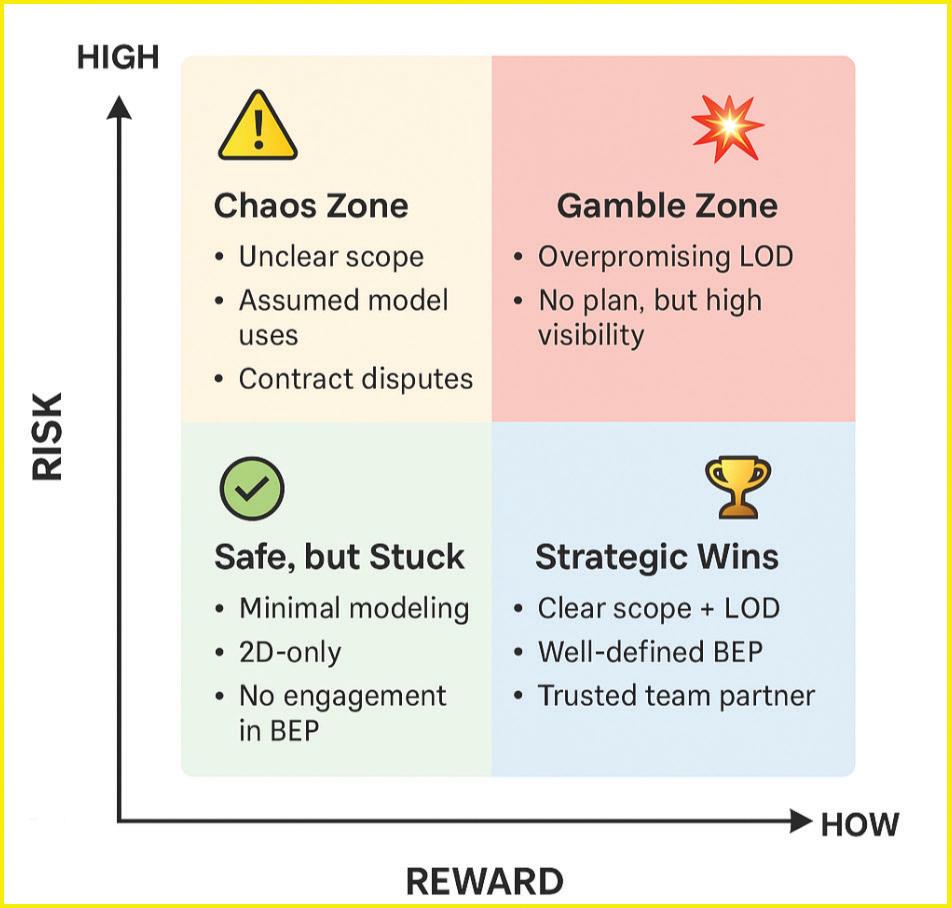
4. Version & Change Whiplash: New uploads can arrive with cryptic file names, and design tweaks can slip through silently. Sometimes it feels like every download becomes a detective hunt, and seemingly small issues snowball into RFIs. New(ish) platforms may be configured so there isn’t a need to have a conversation about a model “release,” and instead the model is treated as a continuously updated object (which sometimes just doesn’t work). Engineers shouldn’t be having a conversa tion about configuring an online
tool when instead we should be talking about a model freeze and risk process to get the right people into the room.
5. Precision & Coordinate Drift: Different models and data sources can end up with different origins, grid sizes, and acceptable tolerances. Sometimes angles are measured in decimal degrees, when degree minute second notation is what’s expected. Sometimes site curves arrive as radii with no center point. All of these end up requiring coordination between models, and could be avoided with effective BEP communication.
6. Reality‑Capture Gray Area: Point clouds are common, but workflows vary. Who converts .e57 to .rcp? What deviation is acceptable (< ½ inch / 12 mm)? If the team doesn’t own a scanner, who defines the formats and hand‑off when scans appear? Who determines when information in the scan will be used in lieu of information in existing drawings or vice versa? Structural engineers in particular (for whom the exist ing elements likely will not appear in reality capture) need to be aware of the limitations of reality capture to flag them early and pre empt them
7. Sustainability Scattershot: Owners hear about embodied carbon, but requirements differ depending on the project. Some teams embed carbon parameters in Revit, others export to spreadsheets and finalize calcula tions there. A placeholder line and a note on any Revit/BIM parameters you plan to track can keep the door open without hijacking the agenda.
What Needs to Change (and What Doesn’t)
How do we address these pain points?
1. Undead BEP: Move the plan from static PDF to a collaborative platform you already own such as SharePoint, Confluence, Autodesk Construction Cloud. Comments and version history turn debates into docu mented decisions. The format matters less than the ability for the team to quickly edit the document and keep it as a living refer ence to how the team has agreed to work together. A useful frame of mind is “if a new person joined the team today, do we have a document that would explain how we (and individual projects we are engineering) actually work?”
2. Bridge the Contract Gap: Recognize that most BEPs are not written into the con tract. This means the document’s usefulness depends less on legal enforceability and more on trust and practicality. Make the plan easy
Get a Six Pack BEP—One
Table, Six Sections
The table below can make these six points actionable to incorporate into your BEP, or if needed, can serve as the starting point of an internal BEP baseline.
# Section What Goes In
1 Project Snapshot and Contacts
One‑liner project blurb and three names: BIM lead, structures lead, coordinate/scan lead.
2 Model Uses and Stakeholders A short table that describes how the model may be used, who creates it, who consumes it, when, and how it’s shared. See the example table below.
3 Precision, Units, and Coordinates Rounding rules, angle units, survey DWG location, shared coordinates, acceptable curve definitions.
4 Version and Change Protocols
5 QA and Review Cadence
6 Sustainability and Future Tech Lot
Model upload rhythm, file naming, model change‑notice templates (Who are the senders?→Who are the recipients?)
Clash thresholds, point‑cloud deviation limit, how results circulate (Teams post Monday 9 a.m.).
Notes about tools or things the model may be needed for in the future. One‑line on carbon tracking creating that discussion point.
Know exactly who to communicate with before models drift.
Align level‑of‑detail with real consumers.
Stop guessing; start aligning.
Kill the need for detective work.
Issues surface before they sink costs.
Door stays open without derailing today’s scope.
Sample Model Uses Table:
Field‑Tested Quick Wins
• Fork‑and‑Trim Sprint—Copy your longest BEP then delete unnecessary sections until it fits on a laptop screen.
• Weekly 15‑Minute Plan Upkeep—Open the live BEP during coordination calls and edit it in real time. If a section goes untouched for a month, archive it to avoid clutter.
• Appoint a “Change Captain”—Determine one defined place to look for uploads and coordinate shifts. Interns are welcome and can be the change captains if you have them—the point is ownership.
• Determine QAQC BIM items at key milestones, such as:
◊ Three‑Strike Naming Rule—Wrong file name three times? Kick it back.
◊ Sustainability Single Metric—Track Revit parameter ‘EC_kg’ for steel tonnage at schematic & 75 % CDs
to use and compelling enough that teams want to follow it, because contract language alone won’t keep it alive.
3. Explicit Communication Triggers and Owners: Every model upload, change notice, coordinate shift, etc. gets a name and a description. Clarity in communication beats software.
4. Precision & Coordinate Rules—Frozen on Day 1: Set rounding (nearest 1⁄16inch? 1 mm?), lock the project coordinate system, write down angle units (deg‑min‑sec), and list acceptable curve definitions (arcs with a center point, NOT radius‑only).
BRIDGE guide
ENERCALC,
LLC
Phone: 800-424-2252
Email: info@enercalc.com
Web: enercalc.com
Product: ENERCALC SEL/ENERCALC 3D
Description: Major ENERCALC updates include expanded support for ACI 318-25 across retaining wall modules, with updated concrete shear limits, simplified concrete shear strength equations, and revised hooked development length provisions with clearer reporting. Rankine Active earth pressure options have been reintroduced for Cantilevered Retaining Walls. Soldier Pile Retaining Wall design has been enhanced with detailed flexural capacity reporting and updated lateral-torsional buckling provisions for square and rectangular HSS sections.
RISA Tech
Phone: 949-951-5815
Email: info@risa.com
Web: risa.com
Product: RISA-3D
5. Reality‑Capture Expectations: Note whether scans will be used and where. If yes, state the best data formats (.rcp, .e57), target density, and deviation tolerance. If no scan ner is planned, we should still list who will manage possible future scans.
6. Lightweight Sustainability
Placeholder: This should ideally be com prised of one bullet point: “Track embodied carbon parameters (Revit ‘EC_kg’) at 30% and 75% CDs; export via Revit Schedule.”
7. Right‑Sized Automation: Looking to include clash detection in Navisworks or a Dynamo parameter audit? List only what
LeJeune Bolt Company
Phone: 800-872-2658
Email: sales@lejeunebolt.com
Web: www.tightenright.com
Product: TNA® Torque + Angle Fastening System
Description: TNA® is the only fastening system that delivers both a quantifiable Snug Tight condition— ensuring every bolt in a connection meets a minimum requirement for tension—and the precise required angle for the perfect final pretension. No other system or method can match the TNA® Torque + Angle Fastening System for producing the highest level of accuracy and reliability in both the snug and final tensioning processes. TNA® Bolts meet requirements of ASTM F3148 and are 100% Melt & Manufacture in the U.S. The Combined Method (Torque + Angle) is an approved RCSC installation method.
Not listed?
Description: With RISA-3D’s versatile modeling environment and intuitive graphic interface you can model any structure from bridges to buildings in minutes. Get the most out of your model with advanced features such as moving loads, dynamic analysis, and over 40 design codes. Structural design has never been so thorough or easy! Monthly 2026 Resource Guide forms are available on our website. www.structuremag.org
runs today and keep future pilots in the parking lot.
Call to Action—Shrink the PDF, Amplify the Conversation
Structural engineers love precise load paths, and we should love precise communication just as much. A one‑page BEP doesn’t just simplify the work—it can clarify it. Convert your legacy BEP into the Six‑Pack layout, filling in precision rules, file formats, and who talks to whom. Post it and then review it weekly as the project progresses. Less paper and clearer conversations result in successful projects and, most importantly, more cohesive, trusting teams. That’s a load path everyone can support. ■
The SEI’s committee on Digital Design is a group that aims to explore and disseminate the benefits, risks, and challenges of implementing the growing set of digital design tools and project execution methodologies to advocate for and improve the practice and business of Structural Engineering.
Find more resource listings in the 2025 2026 Structural Engineering Resource Guide on our website, www.structuremag.org
structural SUSTAINABILITY
10Things Every Structural Engineer Should Know About Embodied Carbon: Wood
By SE 2050 Resources Working Group
The SEI SE 2050 Commitment Program was developed and is managed by a dedicated group of volunteers. Each member of the team brings a unique perspective and level of expertise to SE 2050. This is the fifth of a series of lists developed by the SE2050 Resources Working Group to communicate essential information that every structural engineer should understand about the topic of embodied carbon as they approach their work, and it is focused on wood. See http://SE2050.org to learn more about both the commitment program and embodied carbon in general.
1. Forest products contain biogenic carbon.
Biogenic carbon is carbon removed from the atmosphere during the growth of biomass and stored in all parts of trees and other plants by the process of photosynthesis. Although this biogenic carbon content of wood varies among species of trees, equating carbon content to 50% of the dry mass of wood provides a useful general approximation of the carbon fraction. This carbon content can be used to estimate equivalent carbon dioxide removed from the atmosphere based on molecular equations. The SEI Prestandard for Assessing the Embodied Carbon of Structural Systems for Buildings outlines the recommended approach for calculating biogenic carbon.
In the natural forest life cycle, carbon dioxide is absorbed by trees and emitted back into the atmosphere when trees decay or burn in wildfire. When trees are harvested to make wood products, a portion of the total biogenic carbon is stored within wood materials and sequestered from the atmosphere for the life of the forest product. Residuals, such as roots, leaves, chips and sawdust, are either utilized in secondary markets or left behind in the forest. Wood materials protected by the building envelope, including structural components, typically outlast building service life, which is expected to be at least 50 years. The percentage of biogenic carbon that is reintroduced into the atmosphere as a result of harvesting trees and at the end-of-life of a forest product depends on forestry practices and disposal specifics. Seeking ways to extend a wood product’s service life will maximize its carbon storing benefits and delay the release of carbon back into the atmosphere while new trees grow.
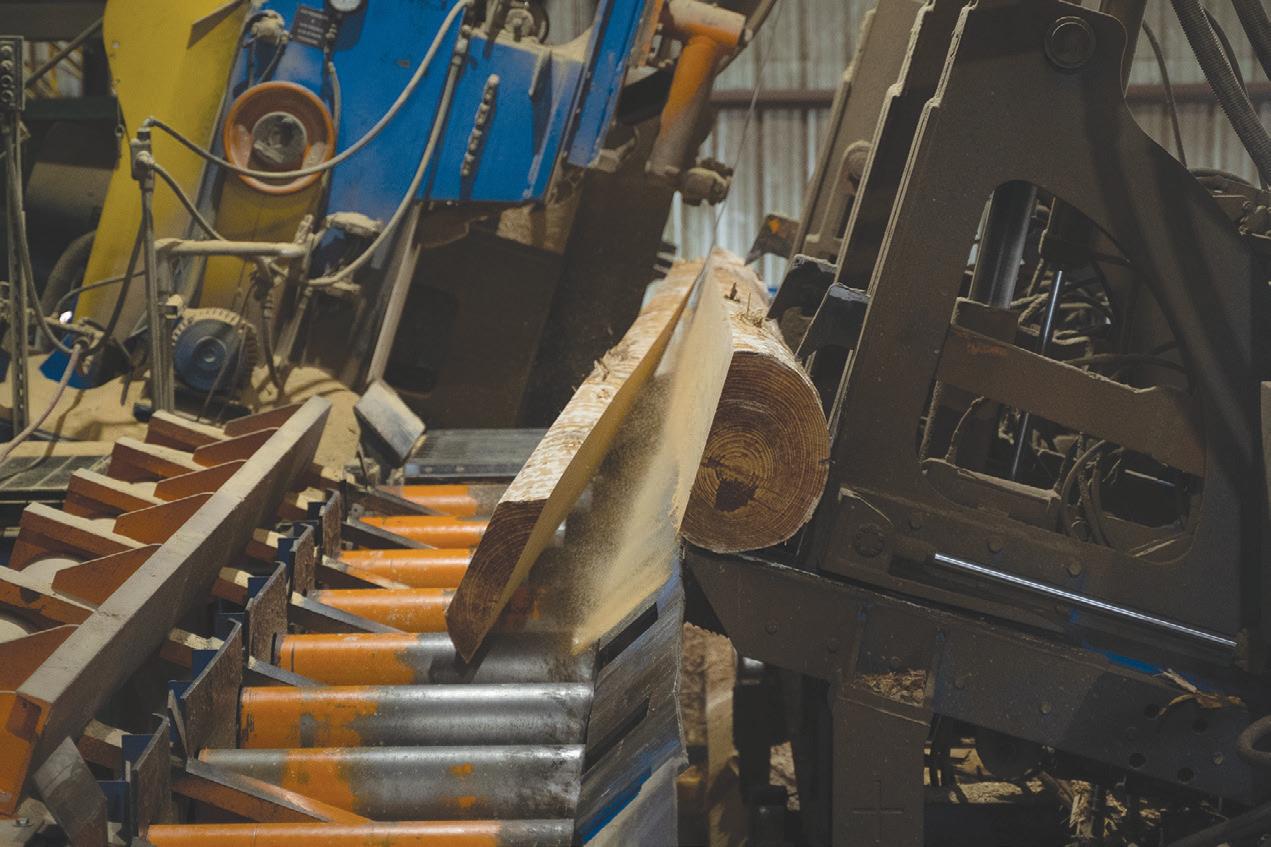
2. Specify wood from sustainably managed sources.
The carbon benefits of wood products depend heavily on how forests are managed. Unsustainable logging and land conversion can release substantial carbon and harm ecosystems, while sustainable forest management enhances biodiversity, resilience, and carbon storage. Engineers should prioritize wood sourced from operations that follow credible forest certification programs (such as FSC, SFI, ATFS, or PEFC), state Best Management Practices, or other verified sustainable methods. Because certification alone may not guarantee climate benefits and can exclude smaller or public landholders, engineers should also consider “climate-smart” forestry operations, including ecological restoration projects and non-industrial producers such as tribal, family, or public forests. Strategies for sourcing climate-smart lumber include: Engaging local foresters and suppliers to help source wood from forests with low-impact management practices, requesting transparency on forest sourcing, and identifying feedstocks sourced from operations aimed at improving forest health. See the Specify Wood from Sustainably Managed Sources Section of the Specification Guidance page at SE2050.org for additional information.
3. Request forest sourcing disclosure.
The supply chain for wood products is hard to trace, making it difficult to identify the exact origins and environmental impacts of timber products. Engineers can promote traceability by asking for the history of products, from source through production, and transparency, asking for policies and practices regarding sustainability, land use, and monitoring. Since current wood product EPDs lack upstream primary data such as source forest disclosure and associated emissions, engineers should proactively request sourcing information from manufacturers. When chain of custody documentation is available, ASTM D7612 Standard Practice for Categorizing Wood and Wood-Based Products According to Their Fiber Sources provides a framework to classify wood products into the following categories: noncontroversial (legal), responsible, and certified
A log is processed in a modern sawmill. Source: Softwood Lumber Board
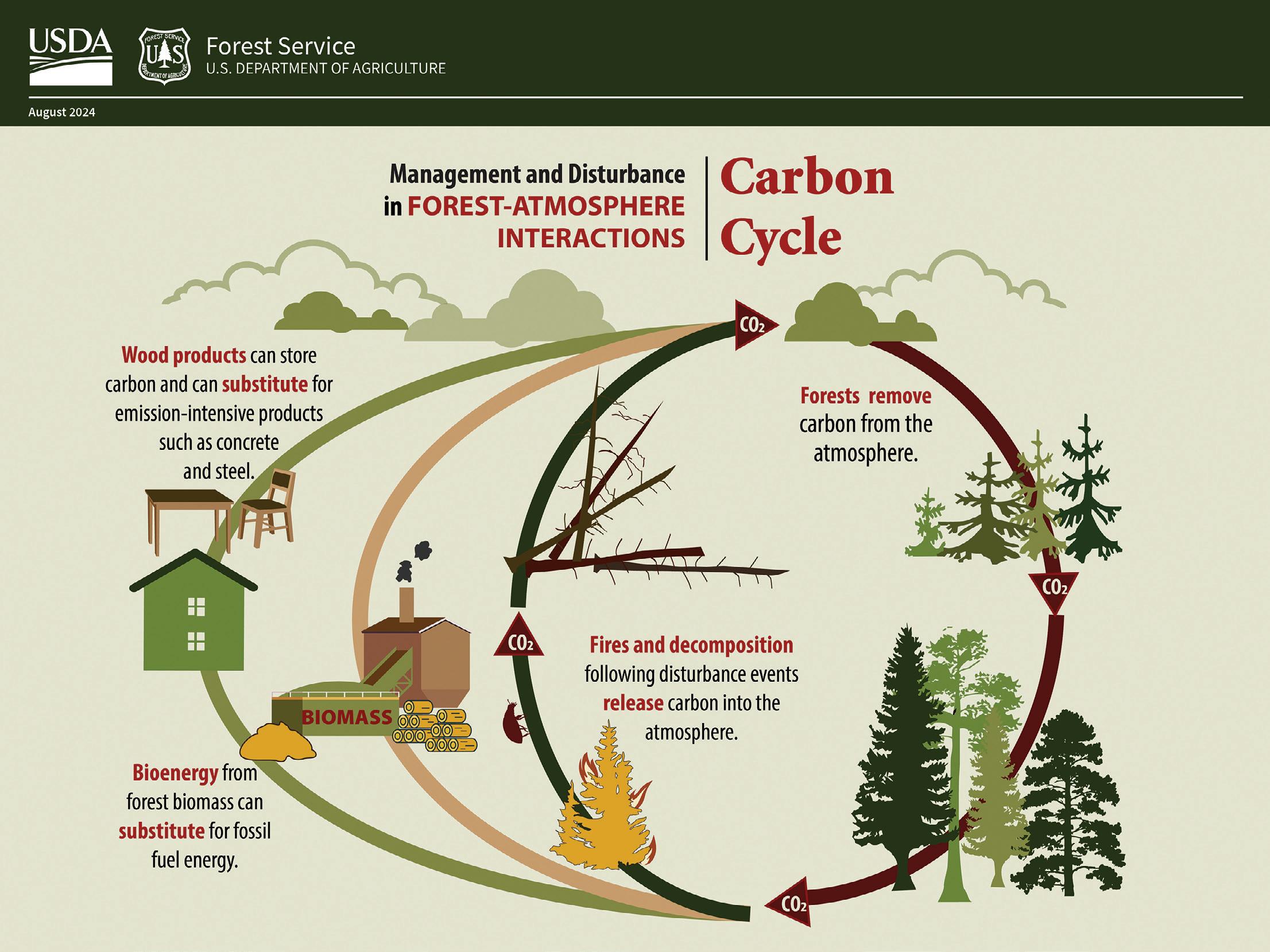
sources. Engineers can add forest sourcing disclosure questionnaires to their specifications and review available EPDs for data gaps. This approach not only improves life-cycle impact data for climate-informed design but also supports evaluation of transportation and embodied carbon, fostering regenerative and climate-resilient sourcing. See the Request Forest Sourcing Disclosure Section of the Specification Guidance page at SE2050.org for additional information.
4. Sourcing location and mode of transportation affect emissions.
Local sourcing of wood products generally saves emissions generated from the transport of structural wood materials from the manufacturer to the construction site. In addition to travel distance, the mode of transportation is significant. While ocean freight generates the least emissions per unit of mass times distance, vast distances typically amount to greater transportation emissions totals. For inland transport, rail or barge shipments generally emit less carbon per unit of mass and distance than truck shipments. At the start of a project, engineers can inquire about locally available species and grades of lumber to better specify wood that will not require long-distance transportation. Because the cradle-to-gate embodied carbon of wood structural components is relatively low, transportation impacts can amount to as much as half of the upfront embodied carbon footprint, depending
on sourcing distance and mode of transport. See the Transportation Emissions Section of the Specification Guidance page at SE2050.org for additional information.
5. Environmental product declarations exist for wood and engineered wood products.
EPDs are readily available for a variety of different structural wood products including softwood lumber, softwood plywood, oriented strand board, laminated strand lumber (LSL), laminated veneer lumber (LVL), wood I-joists, glued laminated timber (glulam), and cross-laminated timber (CLT). When reviewing an EPD, determine whether it represents an industry average across a geographic region, a specific product/supplier, or a specific facility. EPDs for softwood lumber, for example, have been averaged across the industry in North America and various regions of the United States. Most North American EPDs report environmental impacts from material extraction up to the point the product leaves the factory gate and will include an estimate of biogenic carbon content of the wood product and information on the average moisture content, density, and wood percentage. U.S. Industry-average EPDs have not been published for mass timber products other than glulam, so engineers must determine whether to use manufacturer-specific EPDs or proxy materials as the basis for industry-average modeling data. Facility-specific EPDs for wood products are limited at this time.
Biogenic carbon flows naturally through a forest lifecycle, but a portion may be sequestered from the atmosphere through the production and use of durable wood products. This circular cycle contrasts with the linear flows of fossil fuels, whose carbon is emitted once and not replenished on a human time scale.
6. Performance-based specifications help reduce embodied carbon by encouraging efficiency and innovation.
Performance-based approaches can reduce the embodied carbon of timber structures in a variety of ways, including the routine design of timber structures. Structural engineers commonly specify the species and visual grade of lumber used as the basis for design. An equivalent performance specification of mechanical properties, such as allowable design stress and stiffness, would open opportunities to use alternate wood species or machine-graded lumber and generally lead to more efficient wood utilization. With performance-based specifications, wood product selection can be tailored to what is locally and readily available, including underutilized wood species and salvaged wood.
7. Use an assembly-level approach that balances fire performance, acoustics, durability, and structural efficiency.
Wood structural systems often require additional non-structural components to meet performance requirements related to fire resistance, acoustics, and durability. To achieve optimal performance, design teams should collaborate to balance and integrate the contribution of each element within the assembly. For instance, mass timber floor systems commonly include a floor topping, acoustic mat, and gypsum board. Thinner floor panels may demand a heavier acoustic mat, and the type and thickness of the topping can vary depending on whether it participates in diaphragm action and the material used. When engineers verify fire endurance through char-depth calculations and demonstrate sufficient residual capacity, they can safely expose timber surfaces by eliminating the need for added fireproofing or finishes. Beyond the technical benefits, exposed wood enhances occupant well-being by fostering biophilia, a natural human response linked to improved health, comfort, and productivity in environments featuring natural materials. See the Design Materials to Work Together Section of the Design Guidance page at SE2050.org for additional information.
8. Modularity reduces construction waste and on-site construction emissions.
Both light-frame and mass timber construction facilitate modularity through pre-fabrication of 2D or 3D components. 2D or “flat pack” panels and framing are designed for ease of transport. 3D or “volumetric” modules deliver nearly complete units of a building to the construction site. Modularity generally speeds the pace of on-site erection and minimizes construction waste and the energy consumed by equipment during installation. Examples of modularity include panelized wood roofs, wall panels and volumetric wood modules. See the Modularity Section of the Design Guidance page at SE2050.org for additional information.
9. Select wood products that optimize structural efficiency and fiber utilization.
Wood products now span a wide spectrum of structural applications, with new engineered options continually reshaping the possibilities for design. The embodied carbon associated with wood product manufacturing can
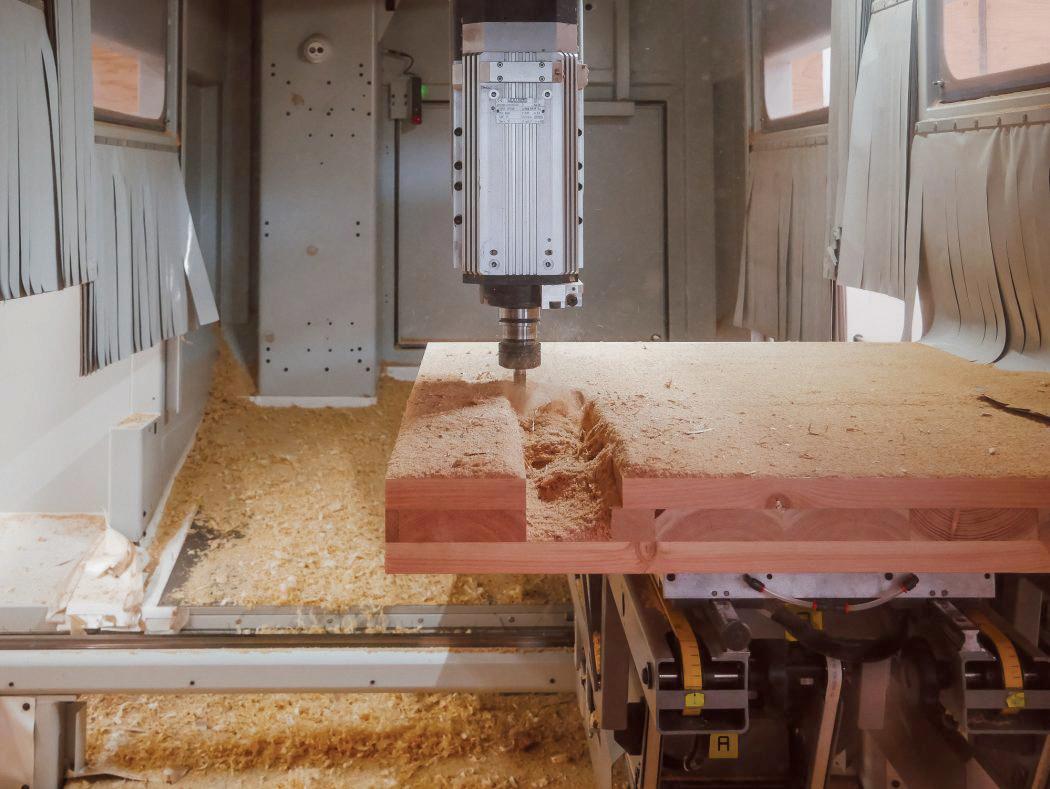
vary widely, influenced by how logs are processed, amount and type of adhesives used, and the drying methods needed to meet moisture requirements. By selecting products that make the most efficient use of wood fiber, engineers can achieve both structural performance and meaningful carbon savings. For light-frame construction, utilizing advanced wood framing (Optimum Value Engineering) can optimize the use of materials to reduce costs and improve energy efficiency while maintaining structural integrity. Designers also have many options to create hybrid and composite systems with other materials that optimize structural efficiency. See the Advanced Framing, Engineered Wood and Mass Timber Sections of the Design Guidance page at SE2050.org for additional information.
10. Prioritize wood reuse to extend biogenic carbon storage.
The best outcome for wood structures is reuse that continues the storage of biogenic carbon beyond the original service life of the building. In current practice, reclaimed wood is typically reused to make nonstructural products, such as furnishings, architectural finish products, and home goods. With advancements in technology and design practices, salvaging wood for reuse in structures is becoming more feasible. Existing technology can make condition assessment through Nondestructive Evaluation (NDE), extraction of fasteners through automation, and grading wood quality through proof-loading more practical, and engineers can further facilitate reuse by developing design-for-disassembly methods and building code provisions and referenceable standards for structural reuse. In contrast, at the end of a building’s service life, wood products are typically disposed of into landfills, incinerated for energy, or reused for nonstructural purposes. While wood that ends up in a landfill takes up space and emits greenhouse gases into the atmosphere, some permanent capture of biogenic carbon occurs below ground. Although incineration returns practically all biogenic carbon to the atmosphere, the energy generated by wood incineration substitutes energy produced by fuels from other sources. See the Seek Opportunities for Reclaimed and Salvaged Wood Section of the Specification Guidance page at SE2050.org for additional information.
The SE 2050 Resources Working Group produces, maintains, and publishes resources on the SE 2050 website for structural engineers on the topic of embodied carbon. More information on the SE 2050 Commitment can be found at http://SE2050.org.
A CLT panel is milled in a large-format Computer Numerical Control (CNC) router machine.
Source: TIMBERLAB
Fay, S&B USA Construction Awarded PennDOT Contract for Layton Bridge Replacement Project
F
ay, S&B USA Construction (Fay), a Pittsburgh-based firm specializing in heavy civil infrastructure projects in the Mid-Atlantic region, has been awarded a $39 million contract by the Pennsylvania Department of Transportation (PennDOT) to replace the Layton
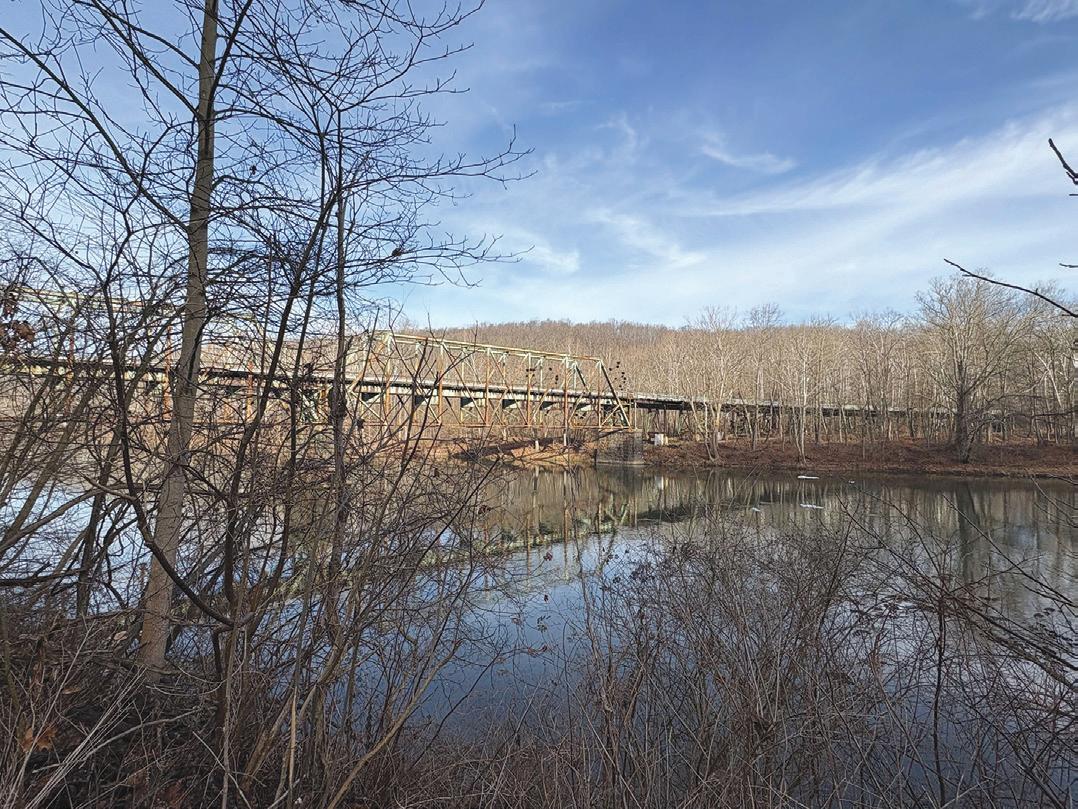
Bridge and perform additional bridge, roadway, and safety improvements in Perry Township and Perryopolis Borough, Fayette County.
The project will replace the Layton Bridge, a 17-span, steel Pratt Truss bridge over the Youghiogheny River with a modern two-lane, three-span composite steel I-girder bridge. The current one-lane structure has reached the end of its service life due to age and corrosion. Built in 1899, the Layton bridge was originally designed as a railroad crossing and carries only one lane of traffic. Fay will construct the new bridge about 200 feet southeast of the current structure. Fay crews will build from a temporary trestle, which is a work platform that will span the Youghiogheny River and is capable of supporting multiple cranes. This approach will allow PennDOT keep the current bridge and tunnel open during most of the construction and avoid a 17.5-mile detour.
Upon completion of the bridge and road realignment, Fay will close and seal the Layton Tunnel, which will no longer align with the new Layton Road alignment. ■
New EFFC/DFI Climate Adaptation & Resilience Guide Released
Deep Foundation Institute’s Sustainability Committee continues working with EFFC’s (European Federation of Foundation Contractors) Sustainability Working Group to develop a series of guides addressing the United Nations Sustainable Development Goals (SDGs) that are most relevant to the geoindustry.
The latest guide, EFFC/DFI Sustainability Guide No.3: Climate Adaptation & Resilience, focuses on climate adaptation and resilience to address SDGs 11 (Sustainable Cities and Communities) and 13 (Climate Action). While other EFFC-DFI guides focus on how to mitigate climate change, the focus of this guide is on adapting geotechnical designs and
construction practices to be more resilient to the world that we will be living in where climate change is occurring rapidly.
The first guide in the series, EFFC/DFI Sustainability Guide No. 1: Carbon Reduction, addresses SDGs 13 (Climate Action) 7 (Renewable and Clean Energy).
The second guide in the series, EFFC/DFI Sustainability Guide No. 2: Circular Economy, focuses on SDG 12 (Responsible Consumption and Production).
The guides are not minimum requirements or sector standards, but rather practical support guides sharing good practice. The guides are free and can be downloaded from the DFI Publications Store.
SEF Research Grant Awarded to Lilli Webb

The Structural Engineers Foundation (SEF) announced Lilli Webb as the winner of this year’s Research Grant. The SEF is the charitable arm of the Structural Engineers Association of Illinois. Each year SEF awards a research grant and six scholarships, supporting its goal of the advancement of structural engineering. Webb is a graduate student at Lawrence Technological University. Her research addresses a critical gap in the current AISC specification which requires the analysis of flange bending and weld strength limit states separately. Webb is conducting experimental testing in LTU’s Structural Testing Lab to further evaluate the interaction of flange bending on the reduced weld capacity when steel members are subjected to concentrated loads from plate elements. The work seeks to ensure the safety and integrity of steel wide-flange members in structural design and reduce the use of excess stiffener usage due to the flange bending limit state resulting in an overly conservative result.
IN BRIEF
Barry Isett Completes RJD Engineering Acquisition
Barry Isett & Associates (Isett) has completed the acquisition of RJD Engineering, a Hazleton, Pennsylvania-based civil and municipal engineering firm. As a result, the firm continues to expand its municipal engineering services throughout Northeast Pennsylvania. The acquisition closed on Dec.31, 2025, with RJD’s team officially joining Isett on Jan. 5, 2026.
The acquisition builds on a long-standing professional relationship between the two firms. For years, Isett and RJD Engineering worked together to support municipalities across the Greater Hazleton region.
Leading the transition are RJD’s owners, Bob Dougherty, PE, and Joey Calabrese, PE, who bring decades of experience as civil and municipal engineers. They join Isett along with a licensed surveyor, three full-time construction observers, and one part-time construction observer. The team will continue serving local municipalities as part of Isett’s Municipal Services Department, with access to expanded resources and specialized expertise across the company.
Ardurra Expands CA Water Expertise With Acquisition
Ardurra Group, Inc. (Ardurra), a nationally recognized engineering and consulting firm has acquired MKN & Associates, Inc. (MKN), a California-based firm specializing in water and wastewater engineering services for municipalities and government agencies.
Ardurra, ranked #75 on Engineering News-Record’s (ENR) Top 500 Design Firms list and consistently among the top 20 firms in ENR’s Water Sourcebook rankings for water and wastewater, provides complex engineering and design services to public and private clients across the United States.
Founded in 2012, MKN has grown to a team of more than 85 professionals with multiple offices across California. The firm has delivered hundreds of successful water and wastewater projects for municipalities and public agencies and is recognized for its practical approach and innovative, cost-effective solutions. MKN’s technical capabilities and strong municipal relationships complement Ardurra’s existing water practice and strengthen its presence across the Western U.S.
MKN will continue to operate from its headquarters in San Luis Obispo, California, along with seven additional offices across the state. Ardurra now comprises a combined team of approximately 2,100 employees across more than 100 offices nationwide.
PMA Engineering Celebrates 50 Years
PMA Engineering, Overland Park, Kansas, a privately owned structural consulting engineering firm, is celebrating 50 years in business. Since opening its doors in 1976, PMA Engineering has built a reputation for delivering quality structural solutions through a collaborative, client-focused approach. Today, the firm proudly operates as a certified Disadvantaged and Women’s Business
Enterprise under the leadership of President Erin K. Rosenthal, PE, positioning PMA for continued growth and innovation in the decades ahead. Last year, PMA strengthened its leadership team with the promotion of Justin L. Kunkle, PE, to vice president. He joins longtime vice president Jeffrey D. Patterson, PE, marking an exciting new chapter in the company’s 50 year legacy.
PMA looks forward to continuing its work on impactful projects that shape and strengthen the Kansas City community and beyond. Notable contributions include the new Negro Leagues Baseball Museum, hotel, multifamily housing and parking garage, Grand Place, an adaptive reuse of the original Kansas City Star facility, Heartland Logistics Park, and the AdHoc Center for Healing and Justice – scheduled to open to the public this spring.
Earth Tech and Farrell Design-Build Rebrand Under Menard Name
Menard, Pittsburgh, Pennsylvania, announced that Earth Tech, based in Florida, and Farrell Design-Build, based in California, are now officially operating under the Menard name as of Jan. 1.
“This transition is more than a name change; it’s about combining strengths to better serve our clients with cutting-edge solutions and a unified approach across North America,” said Hubert Scache, CEO of Menard North America.
Earth Tech joined Menard in April 2022, bringing more than 30 years of experience in design-build ground improvement, grouting, and piling services throughout the Southeast. Farrell Design became part of Menard in December 2021, adding deep foundation and ground improvement expertise in California’s highly seismic regions. Both companies have been integral to Menard’s growth and success in their respective markets, and this rebranding marks the next step in building a stronger, unified team.
Clients can now access all resources, project information, and support in one place at www.menardusa.com.
DeSimone Expands Dallas Leadership with Senior Associate Hire
DeSimone Consulting Engineering announced the appointment of structural engineer Jonathan Calton, PE, SE, as Senior Associate in the firm’s Dallas office. Calton will work closely with Principal and Director Thomas Taylor, PE, contributing to the delivery of innovative structural engineering solutions across a range of project types, assisting with the day-to-day management of the Dallas office, and upholding DeSimone’s long-held core values emphasizing exceptional service and trusted relationships.
Calton brings to DeSimone experience working with multidisciplinary teams in the design of structures that can withstand high wind and seismic conditions, including projects requiring advanced analysis techniques and performance-based design approaches. Areas of expertise include evaluating how buildings respond to extreme loading and designing resilient, efficient structural systems for such site specific conditions, as well as modelling and automation. ■

Opening Plenary: Say What?: Effective Multigenerational Communication
Creative Solutions to Complex Structural Engineering Challenges
Innovations in Tall Building Design: Taller, Slimmer, Quicker, with Less
Best Practices and Design Examples for Load-Bearing Cold-Formed Steel Structure
Self-Skilling: Emotional Intelligence
People-Skilling: Workforce Management and Retention
Power-Skilling: Communication in a Modern Structural Engineering Environment
“Wood You Believe It?”
Diagnosing and Repairing Exterior Wood Elements
Resilience Against Extreme Attacks
7 Wind: Past, Present, and Future
Practical Design Considerations for Blast Loaded Connections Future Conditions and Building Standards
Special Plenary: The Future of Engineering - How AI is Reshaping the Industry
Fireside Chat- The Human Nature and Cultural Dynamics in Infrastructure Delivery
FastFloor - Development of a Novel All-Steel Floor System
Circular Construction Case Studies: Cutting Carbon and Costs
Assessing Structures After Damage Advancing Seismic Design: Preview of
“What You Don’t Know Can Hurt You”
Closing Plenary: Changing the World for the Better Through Engineering Leadership
-
of Future
in
7-28: “What You’ll See and Why”

To Document or Not to Document
From QA/QC to QAI: Smarter Checks for Structural Design
An Interactive Business Bootcamp for Structural Engineers
Updates of ASCE Guidelines for Designs in Energy and Industrial Facilities
Reliability-Based Design for Structures
New and Updated Topics for Structural Stainless Steel
Tunnels and Underground Structures
Bridge Structural Health Monitoring / Digital Twins
Complex and Unique Bridges
Innovative Research with Applications to Steel Structures
Innovative Research with Applications to Computation Modeling and Large-Scale Testing
Transportation Security Research and Practice: Advances Since 9/11
SEI Resilience Committee - Progress and Challenges
Why Consider Performance-Based Design

Life-Cycle Assessments and the SE 2050 Commitment Program
What’s New with AISC Design Guides
Toward TMS 405: The Journey, Process, and Future of the Existing Masonry Standard
Business/Leadership/ Professional Practice/Technology
and
When BIM Goes Bad: Learning From Experience
Managing in the Age of Disruptive Change
Professional Formation of Structural Engineers for Modern Needs
Response of Structures to Multiple Hazards and Extreme Events
Understanding and Improving Warehouse Performance in Tornadoes
Structural Engineering Strategies for Wildfire Mitigation and Community Adaptation
Bridge Artificial Intelligence / Machine Learning
Concrete Bridge Loading Rating, Retrofitting and Performance
Bridge Subjected to Impact, Vessel Collision, and Flood
Physical Models in Contemporary Practice and Education
Findings from the CFS10 Multi-Hazard Test Program
Explainable AI in SE: From Algorithmic Transparency to Engineering Insights
Joint SEI-IStructE Workshop on Conceptual Design: Boston Edition
Meet the Future of Structural Engineering

Session
SEI Update
Program Unveiled for 2026 SE 2050 Signatory
Summit
SEI’s SE 2050 committee is hosting their second annual Signatory Summit on April 29, 2026, at Structures Congress in Boston, MA. This half-day event convenes structural engineers committed to reducing embodied carbon and advancing sustainability in practice. Led by the SE 2050 Committee, industry experts, and SE 2050 Recognition Program Firms, the program features interactive sessions on best practices, resources, emerging trends, and implementation strategies. Sessions include:
• Insights into the SE 2050 Program: Implementing Structural Engineering Sustainability Best Practices from Technical Tools to Policy Engagement
• Embodied Carbon Reduction Strategies, Trends, and Collaboration
• Building Fluency and Applying Technology for Embodied Carbon Reduction
• Design Innovation and Practical Application
• SE 2050 Resources and Next Steps
New SEI Committees
SEI announces two new task committees to advance innovation and sustainability in structural engineering.
• The Task Committee on Machine Learning for Civil Engineering, chaired by Mohannad Zeyad Naser, Ph.D., P.E., M.ASCE, will develop an SEI Manual of Practice to guide the responsible use of machine learning, ensuring safety, reviewability, and alignment with ASCE/SEI ethics and standards. Committee membership is open to all ASCE members.

• The Sustainability Roadmap Committee, chaired by Jay Arehart, Ph.D., EIT, M.ASCE, Assistant Teaching Professor at the University of Colorado Boulder, and vice-chaired by Jerry Hajjar, Ph.D., P.E., M.ASCE, Professor at Northeastern
The Summit is designed to foster new relationships and collaborative networks, enabling signatory firms to connect, exchange ideas, and strengthen industry-wide efforts. Participants will leave with actionable insights, practical tools, and clear pathways to execute their Embodied Carbon Action Plans, fulfill SE 2050 commitments, and advance structural engineering sustainability.
Summit and Congress participants are also invited to attend the SE 2050 and SEI Sustainability Committee joint meeting at 10am on April 29th.
Register: https://www.structurescongress.org/program/se2050-signatory-summit Discounts are available for SE 2050 Signatory Firms.

University, will develop a roadmap to inspire the structural engineering profession to move toward zero carbon. The committee will create an ASCE technical report that defines zero carbon, identifies pathways to achieve it, and outlines key milestones along the way, supporting broader climate change mitigation efforts. The committee will meet virtually once a month over an 18-month period, or until publication of the report. Committee membership is open to all members of SEI.
These initiatives reflect SEI’s commitment to driving progress in emerging technologies and sustainable practices for the future of structural engineering.
Learn more at https://go.asce.org/sei-committees.
ASCE Key Contacts: Turning Expertise into Policy Impact
The ASCE Key Contact program allows engineers to influence policies that impact infrastructure, safety, and the profession. By building relationships with elected officials and their staff, both locally and through opportunities like the Legislative Fly-In, Key Contacts help ensure engineering expertise informs public decision-making. These connections create meaningful dialogue and position engineers as trusted advisors when legislation is drafted or debated.
With a small time commitment, Key Contacts can make a big difference. Most involvement simply means responding to occasional ASCE Key Alerts and sending a brief email in support of key priorities. For engineers looking to strengthen the profession, advocate for sound policy, and extend their impact beyond individual projects, becoming a Key Contact is a powerful and accessible way to get involved. Learn more: https://www.asce. org/advocacy/key-contacts.
Mohannad Zeyad Naser
Jay Arehart
News of the Structural Engineering Institute of ASCE
Abstracts for 2027 Conference
Due March 4
Structural engineers are invited to submit abstracts to ASCE2027: The Infrastructure & Engineering Experience. This conference includes both discipline-specific content typically provided at Structures Congress as well as sessions that address the field’s most pressing questions through a civil engineering lens: managing risk and ethics in an uncertain environment, advancing new materials and methods, and sharing lessons from transformative projects—both modern and historic. Due to the unprecedented scale of ASCE2027, abstracts are due March 4, 2026. Structural-focused submissions will be reviewed by the SEI National Technical Program Committee, which also oversees the technical program for Structures Congress.
For more information, visit https://experience.asce.org/program/ call-for-content.
Structures Congress 2026 Program
Published
The Congress technical program includes 59 sessions across ten tracks. Explore the full Structures Congress 2026 technical program in this month’s issue of STRUCTURE or at structurescongress.org. PDHs are also available for the Boston Bridges Walking Tour and Boston Harbor Structural Boat Tour. Discounted registration is available for active SEI committee members.
SEI Announces 4-Part Performance-Based Design (PBD) Webinar Series for 2026
Performance-Based Design (PBD) is a focus initiative of SEI, reflecting the profession’s shift toward more resilient, predictable, and transparent building performance. PBD moves beyond prescriptive codes by enabling engineers to design structures based on explicitly defined performance objectives—supporting improved safety, sustainability, and long-term value for owners and communities. As buildings face increasingly complex hazards and higher performance expectations, SEI is advancing PBD as a critical framework for the future of structural engineering practice.
The inaugural session, Performance-Based Design Principles, provides a technical roadmap of the entire PBD process, covering performance targets, service life considerations, hazard loading, and peer review. Leading the discussion is Kevin Aswegan, Vice Chair of the SEI Advancement of Performance Based Design Committee and Senior Principal at Magnusson Klemencic Associates, who has been instrumental in shaping the next generation of PBD and seismic design guidelines.
Participants will leave with a clear understanding of core PBD concepts through high-level project examples and practical applications—equipping them to better communicate performance goals, manage uncertainty, and align design outcomes with stakeholder expectations.
Following this foundational session, the series will continue with deeper dives into performance-based approaches for specific hazards:
• Performance Based Design for Wind: April 23.
• Performance Based Design for Fire: May 28.
• Performance Based Design for Seismic: June 23.
Together, this series reinforces SEI’s leadership in advancing performancebased methodologies and supporting more resilient, forward-looking design. Check out the SEI Website for updates: go.asce.org/SEI.
Call for Papers: Journal of Structural Design & Construction Practice
The ASCE Journal of Structural Design and Construction Practice seeks cutting-edge research in structural engineering and related fields. Call for Papers – Featured Topics:
• Advancement in Structural Analysis, Safety Assessment, and Health Monitoring of Historic Buildings and Bridges
• AI-Powered Innovations in Construction: Design, Resilience, and Management
• Innovative Smart Material Systems for Sustainable and Resilient Infrastructure
• Strengthening Critical Civil Infrastructure: Advancing Resilience in the Face of Climate Change, Urbanization, and Natural Hazards
• Structures under Blast and Impact Loading

• Surrogate Modeling and Simulation-Based Approaches for Structural Reliability Analysis Under Uncertainty
Submit your latest work to the journal to share innovative design, analysis, and resilience strategies.
AI-Powered Support for ASCE Members: CORI and Event Concierge
CORI (Collaborate’s Organizational Research Intelligence) is a new AI-powered chat feature on ASCE Collaborate. It helps users quickly find and organize information from discussions, events, and documents. CORI can summarize relevant content, provide links to related topics, and assist in posting questions
through its “Ask Your Fellow Humans” feature. Try it out: https:// collaborate.asce.org/home.
ASCE has also introduced the ASCE2027 Event Concierge, an AI assistant on the ASCE2027 website that answers questions about the event and submission topics.
NCSEA News
NCSEA Announces Speaker Lineup for 2026 Structural Engineering Executive Retreat
Each year, the Structural Engineering Executive Retreat is designed to give firm leaders space to step away from daily demands and focus on the bigger picture: leadership, strategy, and the forces shaping the future of structural engineering. For 2026, NCSEA is bringing that conversation to Amelia Island, Florida, with a program focused on building a community of firm leaders through datadriven insights, peer exchange, and nationally recognized speakers.
The 2026 Structural Engineering Executive Retreat will take place March 18–20, 2026, at the Omni Amelia Island Resort & Spa on Amelia Island, Florida. The three-day agenda blends insightful presentations with facilitated roundtable discussions, creating an environment where firm leaders can learn from subject-matter experts and each other.
Featured Speakers for 2026




The 2026 retreat includes perspectives from leaders in structural engineering, economics, organizational development, and business strategy:
Ron Klemencic, PE, SE, Hon. AIA, NAE
Chairman and CEO, Magnusson Klemencic Associates
A nationally recognized structural engineer and firm leader, Ron Klemencic brings decades of experience in practice leadership, risk management, and firm strategy.
Bryce Gill
Economist and National Speaker, First Trust
Bryce Gill provides an in-depth look at economic trends affecting the
design and construction industry, including inflation, labor markets, capital investment, and market volatility.
Winslow Johnson
Senior Vice President of Talent and Organizational Development, STV Winslow Johnson focuses on the science behind leadership behavior and talent development, offering insights into how leaders can shape organizational culture and performance over time.
Dean West, FASAE
Founder and President, Association Laboratory, Inc.
Dean West brings a research-based perspective on the structural engineering profession, drawing on NCSEA surveys, benchmarking studies, and strategic planning data.
What’s on the Agenda
The retreat begins Wednesday evening with a welcome happy hour and dinner, offering an informal setting for attendees to connect and set the tone for the days ahead.
Thursday opens with a State of the Structural Engineering Profession briefing led by Dean West, presenting a data-driven snapshot of current market conditions and emerging trends based on NCSEA research, firm leader input, and industry benchmarking. The morning continues with a collaborative session on risk management and professional liability, moderated by Ron Klemencic, combining panel discussion with peer breakouts focused on real-world challenges and practical approaches.
In the afternoon, economist Bryce Gill examines the economic outlook for 2026, exploring inflation pressures, labor market shifts, demographic changes, and the implications of evolving trade and technology trends for firm leadership. The day concludes with facilitated leadership roundtable discussions, grouped by firm size and informed by NCSEA’s pre-retreat conversations, followed by dinner.
Friday’s program focuses on leadership and talent development. Winslow Johnson leads a session on epigenetic leadership, offering a science-based perspective on how leadership behaviors influence organizational culture and performance. The retreat wraps up with a final round of peer exchange discussions before adjournment at noon.
Designed for the Firm Leaders of Today and Tomorrow
The Structural Engineering Executive Retreat is intentionally structured to be small, interactive, and discussion-driven. It’s designed for firm principals, executives, and emerging leaders who want time and space to think strategically, learn from peers, and engage with experts in a focused setting.
More information, including registration details, is available at www.ncsea.com/exec-retreat.
Ron Klemencic, PE, SE
Bryce Gill Winslow Johnson
Dean West
NCSEA Surveys Collect Data on Compensation, Workplace Trends, Job Satisfaction
NCSEA has opened two national surveys designed to provide a comprehensive view of trends shaping the structural engineering profession. Together, the surveys collect data that support benchmarking, workforce planning, and long-term industry insight.
The NCSEA Compensation & Benefits Study gathers information on salary, benefits, and workplace practices to establish reliable benchmarks for structural engineering firms. Participants receive a discounted rate on the final report as recognition for their contribution.
The SE3 Survey examines job satisfaction, career development, mentorship, and workplace culture within the profession. Results from the SE3 Survey are made publicly available to help firms and

organizations better understand current conditions and areas for improvement.
Both surveys are available at benchmarking.ncsea.com. First-time users will be prompted to create an account before participating.
New Wood Design Guide Available in NCSEA Store
The latest publication from NCSEA, Wood Design Guide, will be available later this month for purchase on the website at www.ncsea. com. The new guide, authored by Jason McCool, PE, Daniel Sours, PE, SE, and Tim Mays, PE, Ph.D., will be published as digital and print versions, with multi-user licenses available.
The 155-page Wood Design Guide provides realistic examples drawn from the collective
Upcoming Webinars
March 3
experiences of the authors from actual projects. The intention is for the exercises to be useful in both tests and practice.
Chapters cover gravity, lateral, and connection design and examine solutions through the Allowable Stress Design and Load and Resistance Factor Design approaches. An Appendix explores an integrated building design example based on a retail building in Arkansas.
Seismic Deign Workflow for Concrete and Wood Systems: NCSEA Guide Examples
CE Credits: 1.5; Diamond Review approved in all 50 states
March 5 What Should We Do Now? Implementing Structural Engineering Judgment in Urgent Response to Localized Structural Failure
March 12
March 17
April 9
CE Credits: 1.25; Diamond Review approved in all 50 states
Landmark Structures—STRUCTURE of the YEAR 2025 WINNER: National Medal of Honor Museum
CE Credits: 1.0 for live session only
Seismic Deign Workflow for Concrete and Wood Systems: NCSEA Guide Examples
CE Credits: 1.5; Diamond Review approved in all 50 states
Renovation/Adaptive Reuse—Repurposing of St. John’s Terminal into Google’s New Headquarters
CE Credits: 1.0 for live session only

CASE in Point
2026 Coalitions Conference Introduces Two-Track Winter Format
ACEC’s 2026 Coalitions Conference will take place February 26–27 in Houston, replacing the former Winter Coalitions Summit with a revised two-track format. The conference will feature the Practice Area Summit and the Small Firm Workshop running concurrently over two days.
The updated structure is intended to provide more targeted engagement by discipline and firm size while maintaining opportunities for cross-coalition interaction. The conference brings together coalition leadership, firm executives, and technical professionals for education sessions, working meetings, and peer discussions.
The Coalitions Conference is open to both ACEC member firms and nonmember firms. Registration and additional details are available through ACEC and/or this QR code.
Practice Area Summit to Convene Structural Engineering Leadership
The Practice Area Summit held February 26-27 in Houston, Texas, will organize conference programming by engineering discipline, including structural engineering, MEP, land development, geoprofessionals, and surveying. Five PDF are available.
Structural engineers participating through CASE will convene for discipline-specific briefings, technical discussions, and business-focused sessions addressing current practice issues. Planned topics include AI and digital delivery, contract language, and
New Online Bookstore for Publications and Practice Resources Launched
ACEC has launched a new online bookstore that consolidates access to ACEC publications, including practice guides, contract documents, research reports, and coalition-developed resources.
The bookstore is intended to simplify access to ACEC materials by providing a centralized location for digital and print publications. For CASE members and structural engineering firms, the platform offers easier access to structural engineering guidance, risk management resources, and business practice materials developed through ACEC and its coalitions.
The online bookstore is now live on the ACEC website under Resources, then Contracts and Publications.
coordination challenges through a joint roundtable with MEP professionals.

The Summit is designed for executive leadership, principals, senior technical staff, and emerging professionals who are engaged in practice-area discussions and coalition activities. Participation in the Practice Area Summit is open to both ACEC members and nonmembers.
Small Firm Workshop to Address Leadership and Operations Challenges
Running concurrently with the Practice Area Summit, the Small Firm Workshop, held February 26-27 in Houston, Texas, will focus on business and operational issues affecting smaller engineering firms across disciplines. Eight PDH are available.
Sessions will address ownership transitions, project management, staffing, and firm growth strategies. Programming is structured around peer-led discussions and practical examples drawn from small-firm leadership experiences.
Structural engineering firms participating in the Small Firm Workshop will engage alongside other disciplines facing similar operational and market challenges. The Workshop is intended for firm owners, principals, and emerging leaders. As with the Practice Area Summit, attendance is open to both ACEC member firms and non-member firms.
CASE Access Now Included with ACEC Membership
ACEC has eliminated separate dues for most coalitions, allowing ACEC member firms to participate in the Council of American Structural Engineers at no additional cost. The Design Professionals Coalition remains the only exception.

For structural engineering firms, the change removes a cost barrier to engaging in CASE activities and accessing CASE-developed resources, including contract language guidance, business practice tools, and peer discussions focused on structural engineering practice.
Important membership update
Firms that previously participated in CASE must actively rejoin the coalition under the new structure to maintain access. Prior participation does not automatically carry forward. Use the QR code provided to rejoin.
News of the Coalition of American Structural Engineers
Joint Energy and Water and Environment Committee Meeting to Focus on Federal Policy
ACEC will hold a joint meeting of its Energy Committee and Water and Environment Committee on February 3–4, 2026, in Washington, D.C. Attendees will participate in sessions on Capitol Hill and at the ACEC National Office.
The agenda includes meetings with Members of Congress and congressional staff, briefings from federal agency officials, and committee discussions focused on policy priorities affecting the engineering
industry heading into 2026. The session is intended to inform ACEC’s legislative strategy related to energy, water, and environmental infrastructure.
Attendance at the joint committee meeting is limited to ACEC member firms. Additional agenda details and speakers are expected to be announced. Registration and event information are available through ACEC.
2026 ACEC Convention and Legislative Summit
The ACEC 2026 Annual Convention and Legislative Summit will take place May 3–6 in Washington, D.C. The meeting will focus on ACEC’s federal advocacy priorities, including infrastructure investment, licensure policy, and building safety from a multi-discipline perspective.
Programming will include legislative briefings, meetings with policymakers, and discussions on how federal decisions affect engineering firms and the profession as a whole. CASE will convene its standard structural engineering roundtable during the Convention. Additional agenda information is expected to be released closer to the meeting.
Policy Watch: Federal Issues to Track for Structural Engineering Firms
ACEC is flagging several federal policy developments that may affect how structural engineering firms pursue work, structure teams, and maintain compliance in the coming months.
Government funding deadline approaches January 30
The current short-term federal funding measure is set to expire January 30, 2026. If Congress does not pass another funding bill by that date, federal agency operations and program administration could be disrupted. For structural engineering firms working with federal clients or on federally funded projects, funding gaps can affect procurement schedules, contract modifications, and project approvals.
Surface transportation reauthorization work continues in early 2026
Congressional committees are continuing work toward reauthorization of federal surface transportation programs. Current authorization expires in 2026, and House and Senate committees are expected to release legislative proposals in the first quarter of the year. These bills will shape funding levels and project priorities for highways, bridges,
and related infrastructure with significant structural engineering scope.
Water infrastructure authorization tied to flood and coastal structures
Congress is also beginning development of the next Water Resources Development Act. WRDA bills authorize federal water infrastructure projects related to flood risk reduction, navigation, coastal protection, and water facilities. These programs frequently include major structural components such as dams, levees, control structures, and waterfront facilities, making them relevant to structural engineering firms supporting federal and state water projects.
Federal procurement rules under review through FAR overhaul
The federal government continues work on a comprehensive update to the Federal Acquisition Regulation. The ongoing FAR overhaul could affect solicitation language, contract terms, and procurement processes for federal design and engineering services. ACEC has indicated it will continue to support Qualifications Based Selection as a core procurement principle for A&E services.
structural FORUM
Sustainability Starts at the Top
Sustainable buildings begin with owner and developer consciousness, and their sustainability-focused decisions begin long before design and construction.
By Kevin Kuntz, SE, PE, Ian McFarlane, SE, PE, and Jonathan Tavarez, PE
The built environment accounts for about a third of the greenhouse gas emissions that contribute to climate change. As operational emissions from buildings in the United States—such as those produced by the energy that building systems use—have generally decreased with time, the building industry has turned more attention to embodied carbon reduction, which refers to the emissions from the production of construction products. The good news is that developers and owners can do a lot to set and meet their project’s embodied carbon goals, and structural steel can help them.
How can structural steel help? Domestic steel is sustainable without a cost premium. Steel has significant advantages for recycling and possible reuse at the end of a building’s life. The adaptability of steel structures is an advantage for the overall lifespan of a building, whether it is new construction or adaptive reuse. All U.S.-based steel mills produce facility-specific EPDs that clearly explain the carbon footprint associated with their production.
This article is an abridged version of AISC’s Steel and Sustainability: An Owner’s Guide, which was co-authored by AISC and Magnusson Klemencic Associates. It expands on these questions and considerations and explains how steel is a sustainability winner. Access the full document with case studies, appendices, and more for free at www. aisc.org/sustainability-toolbox.
While many factors drive building optimization, the sustainability of a steel structure is proportional to the quantity of steel required.
Introduction to Structural Steel
The domestic iron and steel industry accounts for 1.9% of all U.S. energy-related CO2 emissions. However, structural steel (which makes up a building’s beams, columns, plates, etc.) accounts for only 8.5% of the U.S. market, meaning structural steel’s share of emissions is somewhere around 0.16%. On top of this low upfront market impact, steel also has a distinct advantage over other materials in its ability to be reused or recycled. Steel can be repeatedly recycled by melting and recasting without losing its fundamental mechanical properties. A basic understanding of how steel is made is helpful for understanding the carbon footprint of steel. The two main methods of steelmaking use a blast furnace and basic oxygen furnace (BF-BOF) or an electric arc furnace (EAF).
1. Blast furnace and basic oxygen furnace (BF-BOF): An extractive approach that uses mined raw materials as its primary input and predominantly coal power and natural gas as its fuel source.
2. Electric arc furnace (EAF): A circular approach that uses recycled
scrap as the primary source of input and electricity as its source. Approximately 70% of all steel production in the U.S. comes from EAF, while the remaining 30% comes from BF-BOF. All hot-rolled sections are made in EAFs. In other countries such as China, India, and Russia, BOF remains the predominant form of steelmaking, which is why environmentally conscious owners and developers should avoid using foreign steel.
Structural Systems: Why Steel?
The overall structural system selection will have a significant impact on the potential embodied carbon associated with the building. Structural steel is the ideal choice when considering sustainability, based on the following benefits:
Inherently sustainable: All structural hot-rolled sections produced in the U.S. are made with EAF production, which, as mentioned above, uses an average of 92% recycled content and is 100% recyclable at the end of life. Domestically produced structural steel is already some of the cleanest steel in the world and doesn’t cost extra.
Transparency: All U.S. structural steel mills produce facility-specific EPDs that clearly explain the carbon footprint associated with their steel production, including a complete evaluation of the supply chain. This is the most accurate and transparent representation of the environmental impact of the specific facility when compared to an industry average evaluation, and the steel industry can boast 100% EPD coverage. No other construction material comes close to matching the level of data transparency and availability.
Adaptability: A more adaptable structure will lead to a longer service life for a given building and potentially higher resale value. Structural steel has the distinct advantage of significant adaptability to incorporate future building modifications, such as the addition of new floor openings, an increase in floor loading capacity, or completely repurposing a building. Compared to other structural systems where a more disruptive retrofit may be required or where retrofit is impractical, a structural steel building can achieve a longer service life and avoid the costly environmental impacts of replacing a building.
Resilience: Steel structures are non-combustible, capable of handling unexpected extreme loads in both compression and tension, not subject to water damage, and durable, therefore offering a resilience advantage over other materials. This advantage can be realized as a lower risk for insurance during construction and for the entirety of the building’s life.
End-of-life benefits: Structural steel is 100% recyclable, making it a completely circular material. Additionally, deconstruction and reuse are feasible strategies that can offset the embodied carbon associated with new construction.
Once a structural steel system is selected, the following sections describe options you can discuss with your design team that can further impact the embodied carbon of construction.
Building Optimization
While many factors drive building optimization, the sustainability of a steel structure is proportional to the quantity of steel required. The steel quantity is impacted by decisions that must be made by the owner and design team on the following:
• Column grid spacing.
• Beam depth limitations.
• Floor-to-floor heights.
• Overall floor assembly, inclusive of concrete and steel decking. Where appropriate, building owners should also encourage the design team to explore innovative strategies, including:
Hybrid systems with steel framing and mass timber flooring. Recent innovations with mass timber products such as CLT have been incorporated with steel framing to result in an efficient and lower carbon assembly compared to traditional slab on composite deck construction.
Incorporating salvaged materials. Constructing with salvaged materials is a highly effective way to reduce embodied carbon.
High-strength steel. High-strength steel generally has the same carbon footprint as typical steel grades, resulting in a direct embodied carbon reduction proportional to the steel weight saved using high-strength steel.
Performance-based fire design. Performance-based fire design is a modern approach to ensure fire safety based on achieving safety outcomes through an in-depth analysis of fire risks, building performance, and safety which can help achieve a significant reduction or elimination of fireproofing of the structure, thus reducing overall embodied carbon for the building.
While many of these example studies are presented in isolation, the combined effects need to be evaluated on a project-specific basis. For example, the use of a hybrid steel-timber deck along with a larger column grid may result in overall savings in embodied carbon when evaluated holistically with foundation impacts.
Tracking Carbon Through Design and Procurement
Embodied carbon should be evaluated at major design and construction milestones to understand the project trajectory. This may include comparing to industry baselines in order to benchmark the building or earn points for rating systems such as LEED.
As design development progresses, the uncertainty in the building material quantities reduces, and eventually, quantities measured and purchased by the contractor can be used. Likewise, the carbon intensity of the structural materials can be challenging to estimate early in the design, given the variability in manufacturing processes. Therefore, industry-average embodied carbon values should be applied at the beginning of the design. (The webpage www.aisc.org/epd has AISC industry-average EPDs). As the design is completed and steel is procured, project-specific information should be provided and applied to the LCA.
Procurement Strategies Using EPDs
The primary types of EPDs in the structural steel industry are industrywide, which contain the average data that can be used early in the design process, and mill-specific, which are specific to the production facility and can be used during design refinement.
Care should be taken when comparing industry-wide and mill-specific EPDs, as many of these data sets are not directly comparable due to
No matter the building material, sustainability decisions begin long before any contracts are signed or design choices or made—and the Steel and Sustainability: An Owner’s Guide (download at www.aisc.org/sustainability-toolbox) can guide the decision-making.
differences in background datasets used, age of data, uncertainty assumptions, LCA methodologies, PCR versions, and other variables. Overall, the structural steel industry is very transparent with its environmental data relative to other construction materials and has nearly 100% coverage of that environmental data for all structural steel products.
Procuring Based on Cost and Carbon
Procurement is another significant opportunity to impact the embodied carbon of a building. Embodied carbon can be used as another basis for bid evaluation, in conjunction with typical variables like cost and schedule. Some strategies include:
• Requiring mill-specific EPDs when bidding. This allows direct evaluation of cost and embodied carbon and is not expected to impact costs.
• Specifying GWP thresholds. Establish a threshold based on a targeted kg CO2e/kg or percentage reduction from industry-wide EPD. This may or may not impact cost.
• Requiring minimum recycled content percentage. This is not recommended because it is an indirect way to require GWP thresholds.
Owners and project teams should refer to the Specification Strategies for Structural Steel Embodied Carbon Reduction document (available at www.aisc.org/sustainability-toolbox) for commentary and sample specification language.
Projects have also successfully used bidding alternatives to provide tiers of carbon reduction with various ranges of cost impacts. For example, the primary bidding instructions may be to bid based on “business as usual” with supporting EPDs. Then, an alternative for maximum carbon reduction could be requested that may have an associated cost premium.
Moving Forward
Building tenants are increasingly seeking high-performing sustainable buildings, and owners should keep the sustainability considerations in this article top of mind. When owners consider and prioritize these factors, structural steel will often prove to be an attractive material choice and help compliance with local or state regulations, such as Buy Clean legislation. No matter the building material, sustainability decisions begin long before any contracts are signed or design choices or made—and the Steel and Sustainability: An Owner’s Guide, which is part of the Owner’s Toolkit (download at www.aisc.org/sustainabilitytoolbox), can guide the decision-making. ■
Kevin Kuntz (kkuntz@mka.com) is an associate and Ian McFarlane (imcfarlane@mka.com) is a senior principal, both at Magnusson Klemencic Associates. Jonathan Tavarez (tavarez@aisc.org) is a structural steel specialist with AISC.



• Concrete Repair Mortars
• Corrosion Protection
• Construction Grouts
• Waterproofing
• Sealants and Joint Fillers
• Coatings and Sealers
• Epoxy Adhesives
• Cementitious Flooring Systems
• Cure and Seals
• Densifiers
• Structural Strengthening Products
• Precast
• Epoxy Adhesives

Visit www.mapei.com/us for details on all MAPEI products. Your single-source
MAPEI offers a full range of products for concrete restoration, waterproofing and structural strengthening. Globally, MAPEI’s system solutions have been utilized for such structures as bridges, dams, tunnels, highways, parking garages, stadiums and high-rises.