St Richard's Hospice Annual Review and Consolidated Financial Statements 2024/25
Annual Review and Consolidated Financial Statements for the year ended 31st March, 2025
What we do
We work with other healthcare partners to prevent crisis intervention and hospital admissions where possible.
We care for patients in South Worcestershire – this includes in-patient and community care, Living Well Services and a range of further support.
Patients from the Wyre Forest, Kidderminster, Redditch and Bromsgrove areas can access in-patient care.
Thank you
On behalf of our patients and families we would like to say a big thank you for the wonderful generosity of our donors, supporters and volunteers who make our care possible.
Caring
Caring is at the heart of what we do.
We are inclusive and treat everyone as an individual who we respect and value.
We take time to listen and respond to the needs of each person.
Committed
We are dedicated, reliable and hard working.
We continuously strive to deliver high-quality services.
We support each other and work together for the benefit of our patients and loved ones.
Compassionate
We work with empathy, sensitivity and understanding.
We are considerate, kind and fair.
We support and empower individual choice.
Professional
We aspire to be the best in everything we do.
We are innovative and develop our skills through continuous learning and evaluation. We take responsibility for our actions and are accountable.
£399,890.75 obtained for patients and families in benefits and trust fund grants by the Citizen’s Advice Team
1,332 individuals helped by the Family Support Team
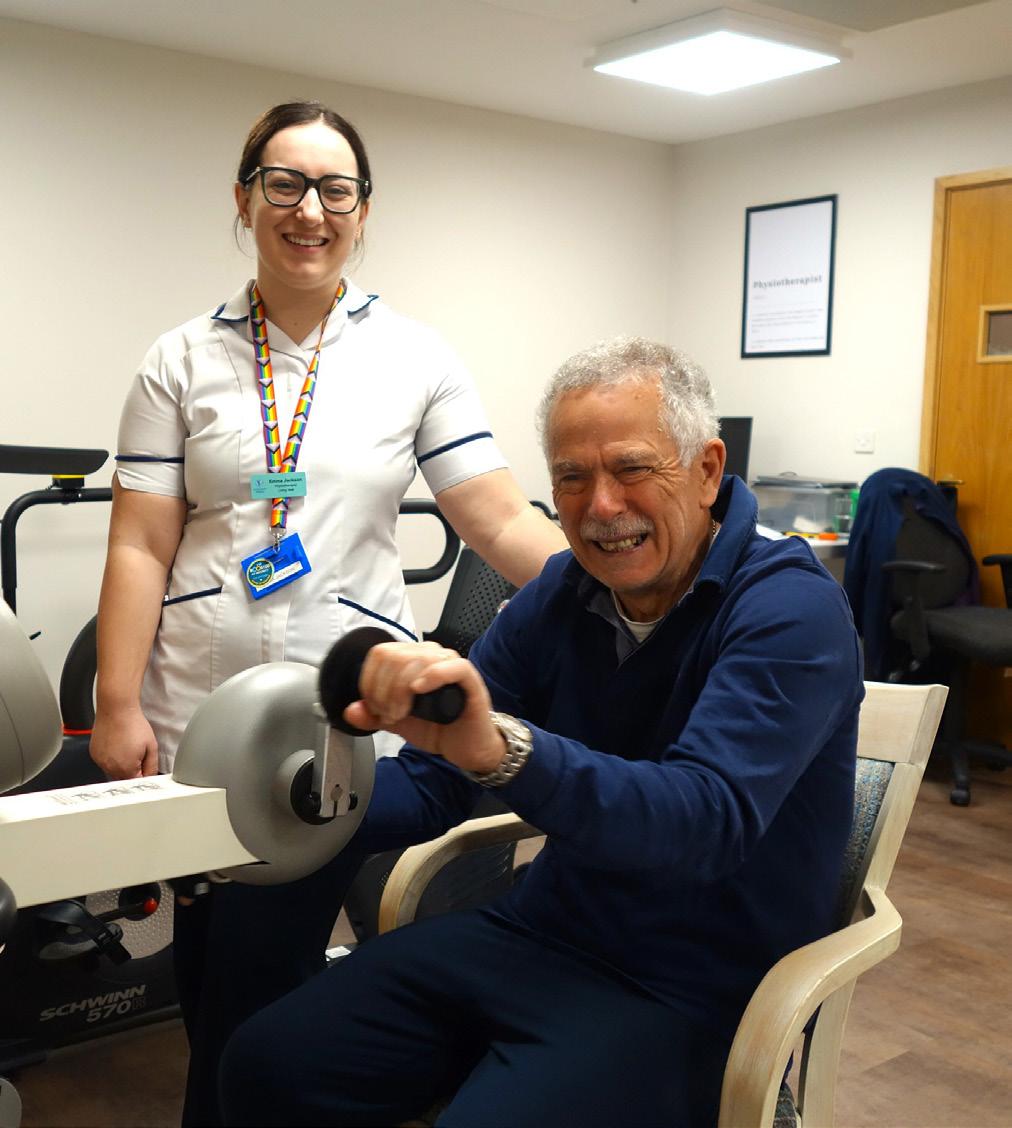
210 individuals were referred for Physiotherapy
779 Complementary Therapy Treatments
106,000 hours
162 Occupational Therapy referrals
980 people under our care every day – at the hospice, in people’s own homes or in the community
It is interesting to reflect how the energy in organisations can shift in the space of 12 months. In spring 2024, St Richard’s celebrated its fortieth anniversary with events designed to thank all those in our wonderful community who had contributed so much to our care over those four decades. As the year progressed, like so many hospices around the country faced with a growing demand for care but also rapidly rising costs without a significant increase in NHS funding, we turned our attention to creating a sustainable future for St Richard’s.
In the autumn, we announced that we were redesigning our clinical services, introducing new ways of working and restructuring our workforce in order to address a one millionpound budget deficit. This work consumed much time and energy during a challenging period for all.
While the goal was always to maintain hospice patient beds and care provision across Worcestershire, there was an unavoidable impact on staff numbers: by the end of March 2025, we had sadly said goodbye to 15 valued colleagues, whom I would like to recognise for their major contributions to the care of our patients and their loved ones over many years.
Although 12 of these team members chose to take voluntary redundancy, it has been an incredibly hard and upsetting time for everyone affected and the amazing professionalism of all our staff and volunteers during this difficult transition is to be commended.
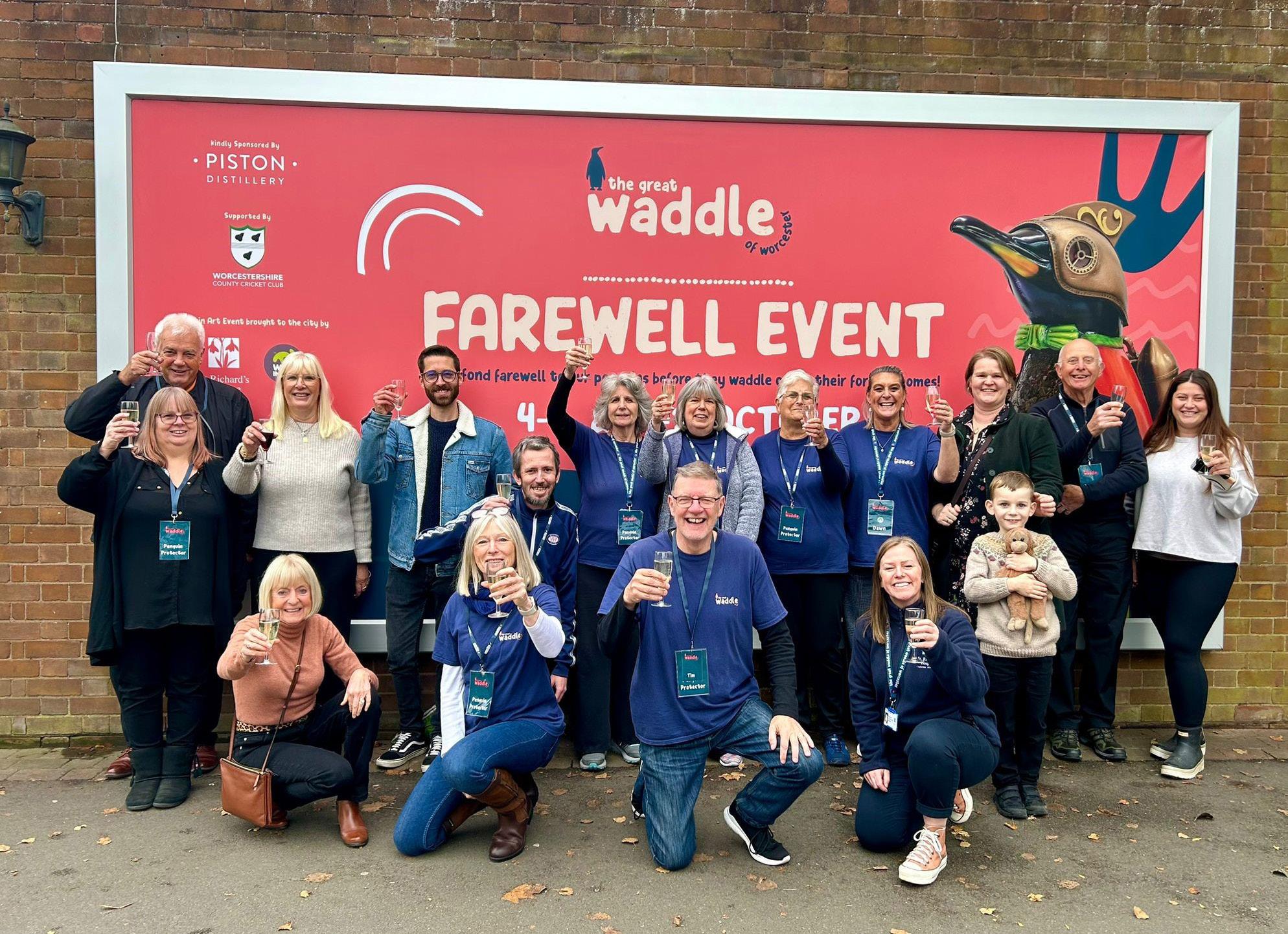
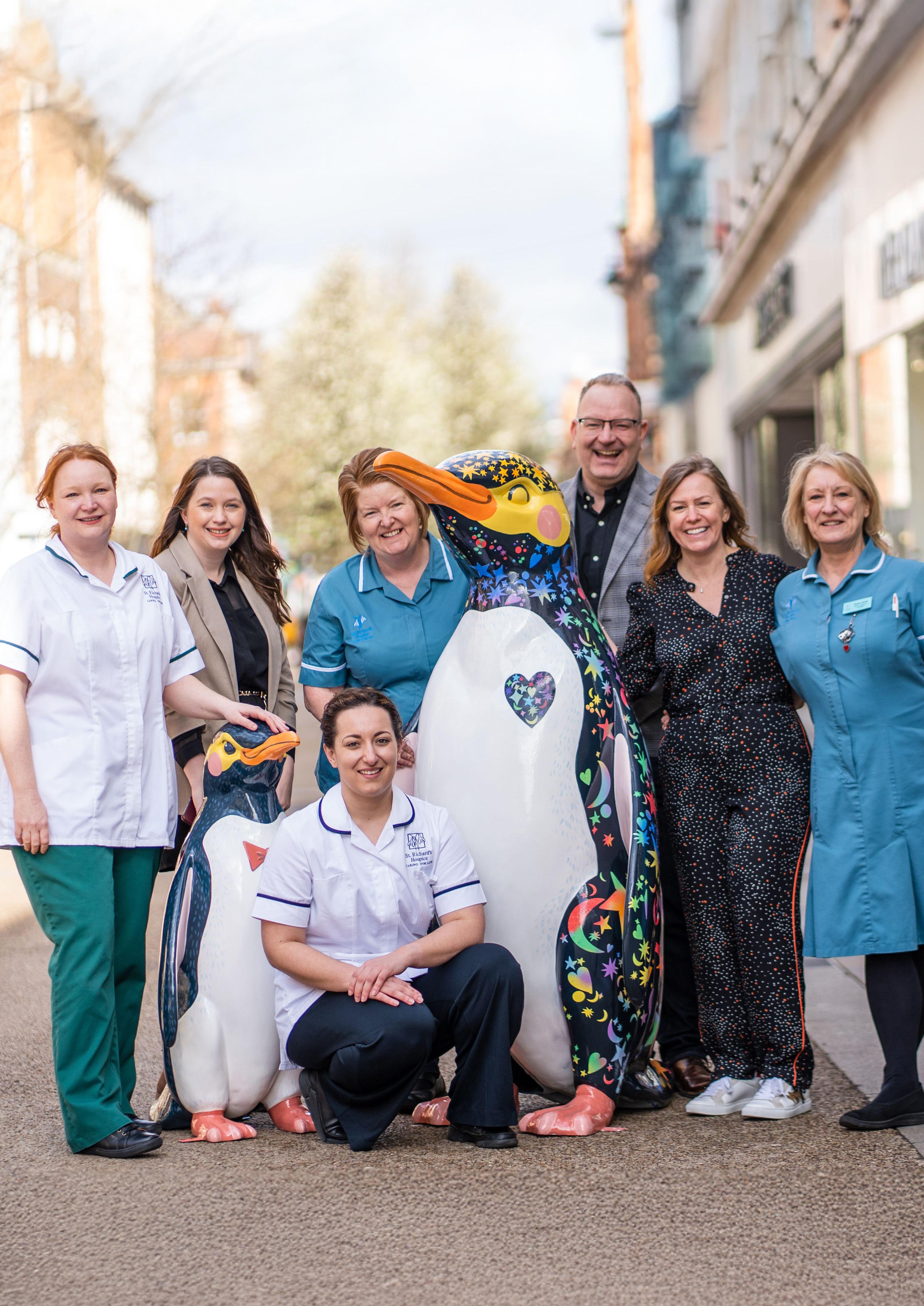
But as well as sadness, there were amazing highlights during the year too, including the great Waddle of Worcester. St Richard’s third Wild in Art project brought 40 adult penguins and 40 chicks to the streets of Worcester from July to September 2024 and raised an incredible £555,499 profit for the hospice.
Thousands flocked to the streets to follow the penguin trail and, as well as boosting hospice income, an evaluation revealed that city centre footfall had increased by 16% during the trail compared with the same period in 2023, thus benefitting local businesses too. The penguins brought joy and fun to Worcester and my congratulations and heartfelt thanks go to those who led the project and to our partners and sponsors, penguin purchasers, artists, local schools and community groups, crafters and makers, who all so generously played their part in its success.
In this Annual Review, you will read about the care we have given to our patients and those important to them this year. I should like to conclude my reflections with sincere thanks to all our staff and volunteers for their outstanding service and their dedication to our philosophy and cause, and to pay tribute to the amazing generosity of our donors, supporters and the Worcestershire community. You are all vital to enabling St Richard’s to support the thousands of patients, loved ones and bereaved people whom we serve every year.
Jenny Cowpe Chair of Trustees
Redesigning services to secure our future
Care Director Debbie Westwood writes:
2024/25 saw some of the hardest months the hospice sector has faced nationally. Here at St Richard’s we took the very difficult decision to review how we delivered our care as we continued to face rising costs, increasing demand for our services and an urgent need to tackle our deficit budget.
Our teams rallied to identify savings across the whole organisation and new ways of working while protecting the number of hospice beds available and our care provision across the county. Sadly the financial pressures we faced were too great and, after careful consideration and consultation, we said goodbye to much-valued colleagues.
We thank our teams for their unwavering commitment to putting patients’ needs first and maintaining services in a year of challenge and change for St Richard’s.
We are confident that our new ways of working will enable clinical services to flourish and for us to become more responsive to more people whilst still holding true to our values. With us relying on voluntary support for around 80% of our income, we remain grateful to our community without whom St Richard’s simply wouldn’t be here.
Together we can continue to make the most of every day for patients and their loved ones across Worcestershire.
Dan’s story
“I expected a lot of machines bleeping, people looking like they were on death’s door, and being surrounded by sadness. But the hospice is one of the most alive places I have ever been to.
“This place is one of the highlights of my life. It has given me something for me, at a time where you feel you have got no control over anything.”
Powerful words from Dan Machin, 43, who accesses support from our Living Well Services helping him manage symptoms of his multiple system atrophy.
As an outpatient, Dan comes to the hospice for sessions such as massage therapy, tai chi, and fatigue management.
He has the chance to chat with other patients, sharing experiences and support with people in a similar situation to him.
“When chronic illness affects you, your world does become really small. It was my house or the hospital,” explains Dan, who is a trained plumber and has also been a carpenter on theatre sets.
“But then suddenly having somewhere to go on my own – now when I go home, I have something new to talk about with my wife. St Richard’s offers independence with support.” Support is extended to Dan’s wife, and to his son who is Autistic and daughter who both receive support tailored to their needs.
“What this place has shown me is you are a person – you are not just a notepad of symptoms,” says Dan.
The Gateway Service
The Gateway Service continued to act as a ‘gateway to hospice care’ for patients, families and professionals in 2024/25.
The team ran with five Community Clinical Nurse Specialists and a Social Worker. The highly skilled professionals made telephone contact with every new referral into the hospice and for Bereavement Support South Worcestershire.
Telephone triage assessments took place and the team managed all of the helpline calls for people requiring immediate assistance and advice to get urgent help when needed, signposting to other services as appropriate.
They also supported the planned and unplanned admissions and transfers to the hospice from the community and hospitals, co-ordinating with
professionals to provide admission for end of life care or expert symptoms’ management.
1,528 individuals supported 5,359 interactions supported face-toface, via telephone, text, email or digital platforms
In 2025/26 the Gateway Service was restructured to become the Advice & Guidance Service providing an entry point for all professional and self-referrals to the hospice.
Our nursing team in the community
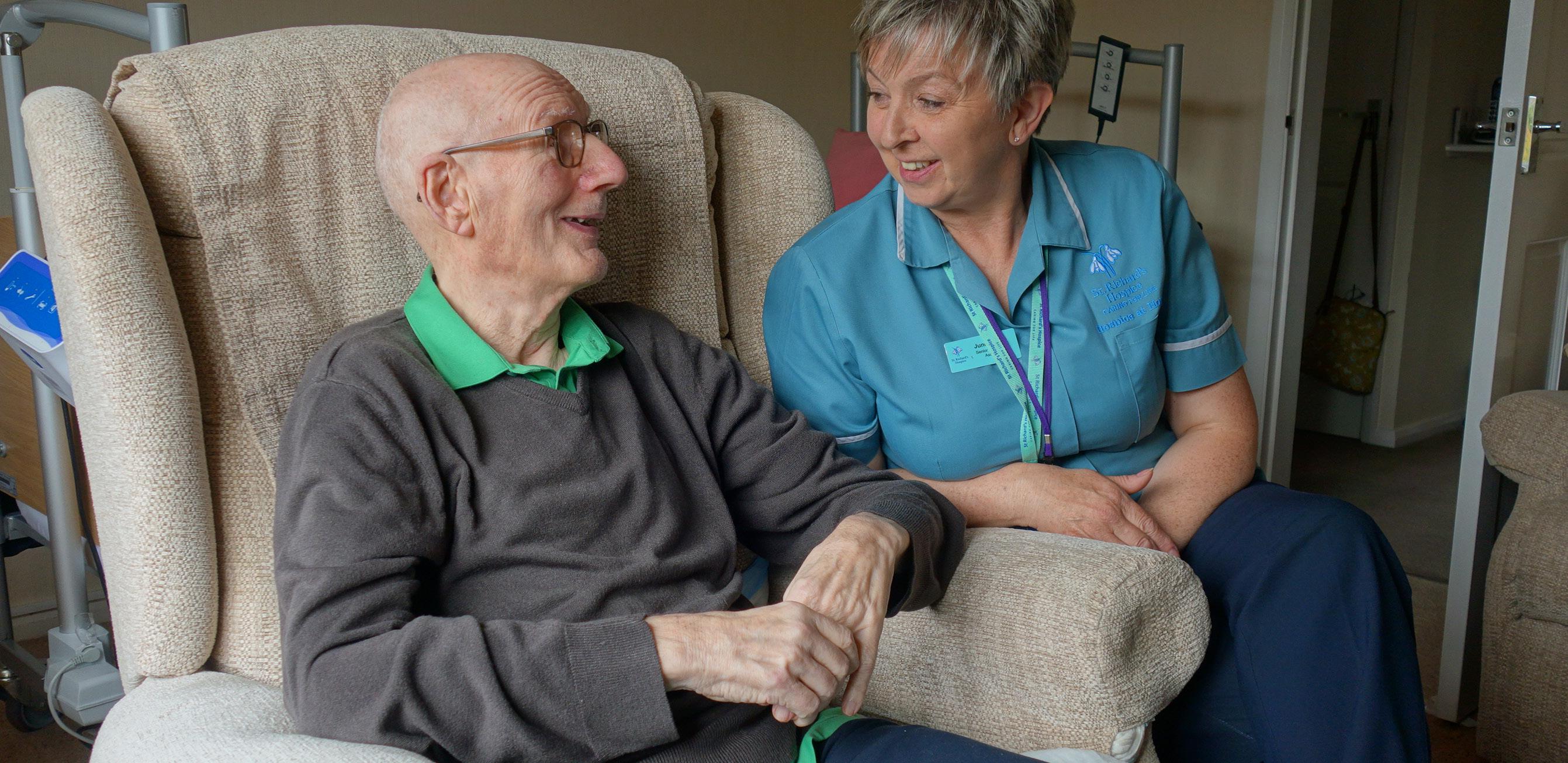
Most of our patients tell us that they would prefer to spend their last days in their own homes. This is where they feel safe and comfortable, and can spend precious time with their loved ones. Our highly experienced Clinical Nurse Specialists (CNSs), supported by Senior Staff Nurses (SSNs), continued to use their skills and knowledge to help manage patients’ symptoms, support them, their families and carers in making informed choices.
How patients were supported was determined by patient preference: this could be through face-to-face meetings at the patient’s home or via telephone or digital consultation.
Often patients chose a combination of face-to-face, telephone, text and email contact. The team continued to deliver high-quality care and to respond to the ever-increasing complex dynamics of social and psychological needs of patients as well as addressing their physical symptoms.
CNSs worked alongside other health care professionals, social care departments and voluntary/charity organisations to ensure patients had access to care services.
As part of the wider primary care community team, the CNSs and SSNs continued their close links with GPs and Neighbourhood Teams.
“Your support, kindness (in spades) and care in Mum’s last few weeks made it possible for her to remain in her own home – when I had reached a point of it feeling it was becoming too much…I shall always be grateful.”
In this review year the Clinical Nurse Specialist team had 27,500 contacts via face-to- face, telephone, text, email or digital platforms.
In 2025/26 our nurses in the community became part of the St Richard’s Integrated Community Team.
Hospice at Home
Our Hospice at Home Service provides critical 24-hour care and support to enable people to remain in their own home for their end of life care.
Referrals were received from multiple sources such as the St Richard’s Community Nurses, GPs, the NHS Neighbourhood Teams and acute and community hospitals.
Referrals were individually assessed to meet the needs of the family and patient. Visits to patients’ homes were usually for the following reasons:
Crisis care: where a patient’s situation was changing rapidly and there is a high risk of unnecessary admission to hospital. Hospice at Home was able to provide urgent physical nursing care and emotional support at short notice to allow the crisis to be addressed or on-going care needs to be assessed.
Packages of care: time-limited support as an interim measure whilst a longerterm provider of care was identified.
This nursing care allowed the Hospice at Home Team to provide personal hygiene care and support to enable patients to achieve their activities of daily living with dignity and respect.
‘Carer support’: was a crucial part of Hospice at Home service provision. By
supporting the carer, we were able to increase the likelihood of the patient remaining at home (if that was their wish). This also included where patients were supported so the carer could step away, allowing time for practical tasks such as attending appointments, or to take time out for themselves. In addition, the team could provide night sits, allowing the carer to rest easy, knowing that the patient was being cared for and supported.
The Hospice at Home Team expertly assessed care requirements and liaised with other organisations to ensure patients’ needs were met. This support for carers continued to be a significant part of the work for the team and often prevented crisis and subsequent admission to the hospice In-patient Unit or acute care.
The team continued to work closely with the wider health economy to support patient care in their own home. Liaising with the NHS Continuing Healthcare (CHC) and Neighbourhood Teams they continued to identify patients who needed support (care packages or one-off visits) to allow discharge from acute beds.
During the past year the team
Cared for 253 patients
Carried out 2,182 face-to-face visits
Made 802 telephone calls to plan support or provide telephone support
The Living Well Centre
The Living Well Centre is located at St Richard’s Hospice in Wildwood Drive, Worcester. In 2024/25 the team worked with patients in identifying what matters most to them as individuals.
The team also supported patients to set future goals and to complete advance care planning so that their voice and wishes were heard at all times through their palliative journey.
Often patient goals were around them maintaining independence and undertaking occupations that bring meaning to their lives.
The multi-professional and holistic team comprised of Nurses, Assistant Practitioners, Physiotherapists, Occupational Therapists, Therapy Support Assistants, Complementary Therapists, a Creative Therapist and Administration support.
Many areas of the service were ably supported by a committed team of volunteers.
Goals were different for everyone, but common themes were Advance Care Planning; maintaining function in their own home; improving mobility and reducing falls risk; improving psychological and mental health and learning skills to manage anxiety. The setting of goals for patients allowed for meaningful focus and collaborative action between the patient, their families and the Living Well Team.
We continued to offer courses to support individual needs, with the focus on the patient learning self-management strategies to take responsibility for and ownership of their own symptoms. The Relaxation for Wellbeing course continued to be effective for patients along with Therapeutic Horticulture.
Living Well Workshops continued to develop and thrive.
The Wellbeing Café, hosted in The Green at the heart of the
hospice, continued to flourish. This service allows patients and carers to gain advice and guidance from the Living Well Team in a relaxed environment. It also allows individuals that are not currently known to hospice services to self-refer to the hospice.
This service innovation continues to remove barriers to accessing hospice care and has also helped to challenge myths that hospices only support those who are actively dying.
In 2025/26 we introduced a revitalised, flexible Living Well programme to support patients and carers. The ethos of the service remains to support all patients that access our care to live well with their illness that cannot be cured, providing the right support at the right time, so that the individual can continue to be themselves.
633 individuals supported by Living Well Services.
The In-patient Unit
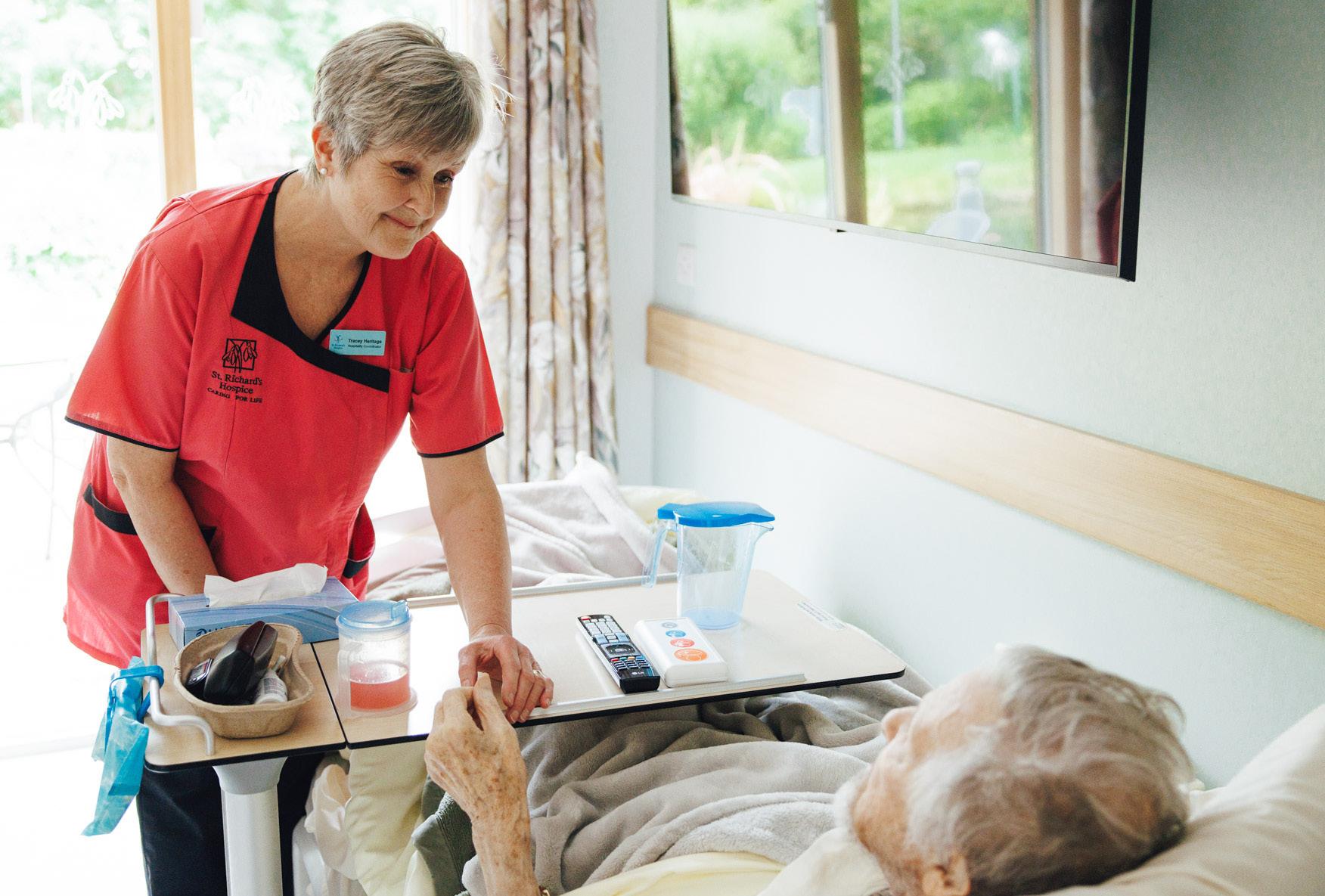
The In-patient Unit (IPU) continued to provide 24-hour specialist, palliative and end of life care tailored around the needs of the patients and those who are important to them.
We worked to identify and respond to all the needs that the patient and those important to them may have, including (but not restricted to):
• Pain and other physical symptoms
• Spiritual and emotional needs
• Social and psychological concerns
The care was provided by a team including:
• Specialist Doctors and Nurses
• Physiotherapists and Occupational Therapists
• Spiritual Care Team
• Family Support Specialists including dedicated Social Workers and Counsellors
• Complementary Therapists
IPU bedrooms are all light and airy single rooms with en-suites. The very best technology and equipment supports complex illness without losing that home-from-home feel.
Two family rooms allow loved ones to spend quality time together away from the bedside. Two jacuzzi spa bath suites offer calm and comfort to patients who may not have been able to bathe at home for some time.
288 patients cared for in our In-patient Unit
“My father in law only had a few hours at St Richards. He/we chose to die listening to his favourite music, comfortable in bed with compassionate healthcare professionals looking out for his every need and his son beside him. Forever grateful…”
Sue’s story
“Before coming to St Richard’s, I was living my life in black and white, in monochrome. Now, I’m really beginning to live my life in colour again.”
These words are from Sue, who lives with Pulmonary Hypertension and is supported by our Living Well Services.
Despite an initial apprehension to access hospice support, Sue came to discover St Richard’s care is all about improving patients’ quality of life.
She says: “I found a place that was so welcoming, warm, beautiful, and peaceful. The staff just seemed so kind, so friendly.
“On that first day, the team talked about all the different opportunities that could help me in achieving a better quality of life.
“And it wasn’t just about my body – this is the wonderful thing. They really understood where I was coming from. It was about the whole person – not just my illness.
“The hospice is so supportive and has been fantastic in helping me get to where I am today.
“I can’t speak highly enough of the staff. They are kind, dedicated, and willing to support in any way that’s possible.”
“The care here is above and beyond anything.”
Supporting the family
During 2024/25 the Family Support Service continued to offer a wide variety of services to St Richard’s patients, families, loved ones and bereaved people across South Worcestershire through the Bereavement Support South Worcestershire (BSSW) service.
Support was provided in a variety of ways: face-to-face, virtual or by phone, depending upon the needs and choice of the individual. A suite of services was available for both adults and children: Social Work, Counselling, Bereavement Support, Citizen’s Advice, Carers’ Support and Group Support.
The Family Support Team (FST) saw an increase in both the number and complexity of referrals and in response reviewed all services to ensure the best possible care and support for patients, clients and families.
The counselling team remained busy; supporting clients in a time-boundaried way both in pre-death and bereavement.
This included one to one support, couples counselling and specialist areas of support including EMDR.
The Social Work team supported the In-patient Unit, Community Nursing Team and Living Well whilst also working with children and families in the community and facilitating groups. They also continued to provide training and support to schools, enabling school staff to develop bereavement policies and bereavement leads. In addition to this other training was provided to other professionals. The team supported hospice staff and volunteers with safeguarding concerns across all clinical and non-clinical areas.
The team included two Citizen’s Advice Advisers. They offered invaluable support and advice to our patients and families who may struggle to negotiate the benefits and grants systems when they already have so much to deal with. They are an integral part of the Family Support team and have obtained £399,890.75 for patients and families in benefits and trust fund grants this year.
Group work continues to be an important and valuable way of supporting a large number of patients and families including carers. Our social and therapeutic groups for adults and children allow clients to have the opportunity to meet others who have experienced similar situations and they often go on to form new friendships outside of the hospice.
In 2025/6, as part of our clinical redesign, we changed the way we delivered the Bereavement Support South Worcestershire (BSSW) service. While we received a grant from the NHS to provide BSSW, the funding we received fell far short of what was needed to deliver the services.
This made BSSW financially unsustainable as St Richard’s continued to face rising costs and growing demand for our care.
Anyone referred to BSSW after 31 March 2025 was offered group support led by skilled staff and volunteers. And, a Family Support and Bereavement Referral Line was introduced to accept new referrals into family support and BSSW and signpost support for patients, loved ones, bereaved people and professionals. Those already supported by BSSW before 1 April 2025 saw no change to their care. And, these changes did not affect people referred for family support from St Richard’s Hospice as this care runs separately to BSSW. St Richard’s Hospice patient and families continued to be able to access one to one, family and group support.
The hospice Spiritual Care Team continued to support patients, relatives, staff and volunteers with spiritual, religious and wellbeing care needs in 2024/25. Support provided included hosting weddings, funerals and our annual Lights of Love celebrations in Worcester Cathedral.
“Continue with what you are doing. It made me feel supported, listened to and left with skill that will help me moving forwards. Thank you all.”
1,332 individuals helped by the Family Support and Spiritual Care Team
£399,890.75 obtained for patients and families in benefits and trust fund grants by the Citizen’s Advice team
Social work referrals: adult: 56, child: 108
719 visits to patients on the In-patient Unit
583 adults and children referred into BSSW
1000 patient contacts by Spiritual Care
54 funerals held by Spiritual Care
Therapies
Physiotherapy
The team continued to support patients within Living Well and IPU, and at times in the community.
Patients were offered a comprehensive assessment and treatment focussed around patients’ goals.
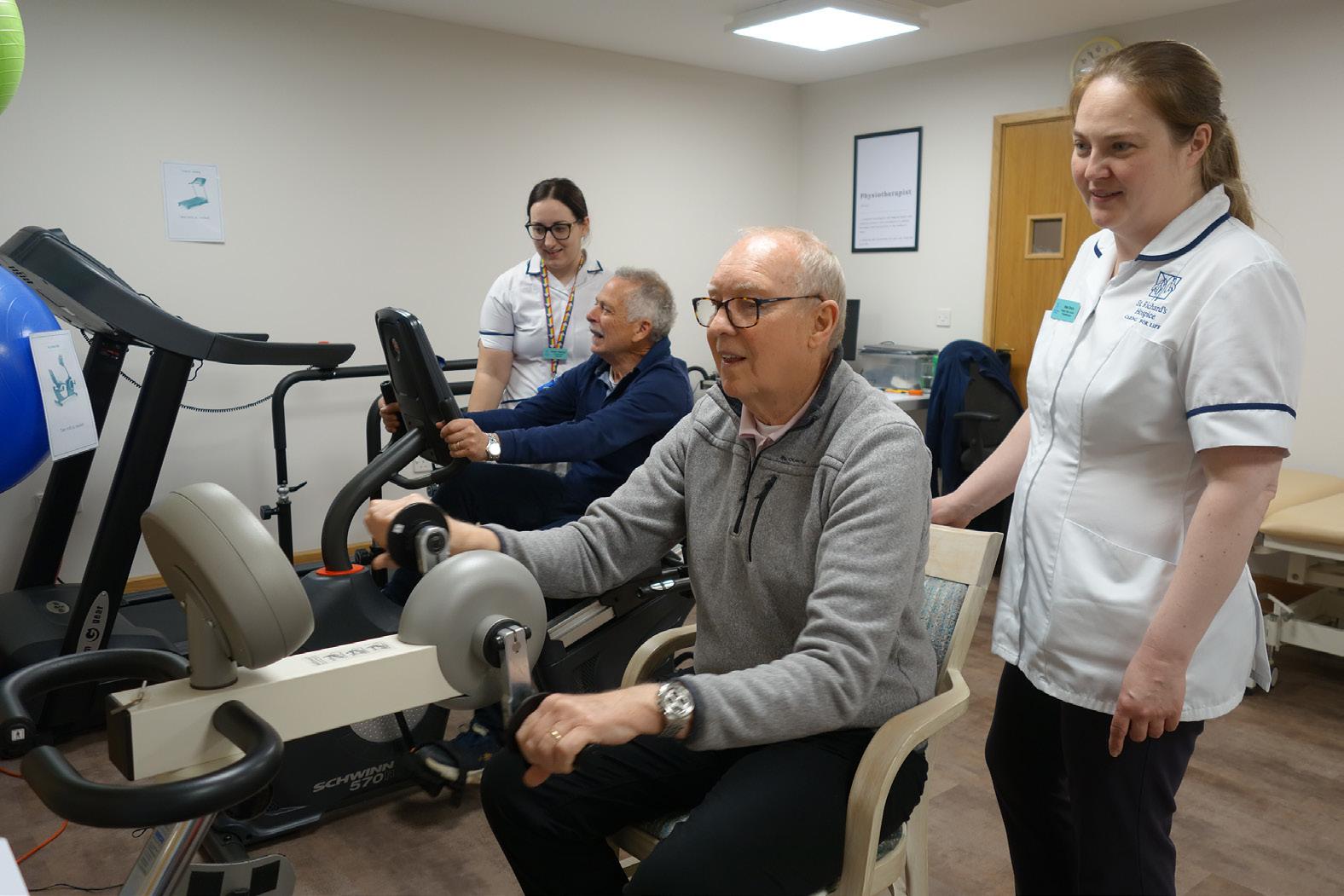
The Physiotherapy team continued to lead on the Adapted Tai Chi and Managing Breathlessness courses in Living Well. The team worked closely with Therapy Support Assistants.
Occupational Therapy
The Occupational Therapy (OT) Team supported patients across Living Well Services and IPU.
Patients were assessed holistically and OT input focussed on achieving patients’ goals and what is meaningful to them, including enabling the patient to stay at home or return home for as long as possible.
162 Occupational Therapy referrals
210 individuals were referred for Physiotherapy
Complementary Therapies
The Complementary Therapy Service continued to receive a high number of referrals, highlighting the value that this service has for patients, their loved ones and also for those that are bereaved.
Initial assessments were completed virtually and treatment sessions were predominantly face-to-face, dependent on individual choice.
The service was supported by volunteer Complementary Therapists.
779 Complementary Therapy treatments
“The reflexology that I received was a wonderful experience which I always looked forward to. It was an hour where I felt very relaxed and all my worries seemed to melt away. I am so grateful for this wonderful opportunity for ‘me time’.”
Learning Hub
The Learning Team facilitates learning aimed at developing the knowledge, skills, and professional qualities required to support people receiving palliative and end of life care. This includes all staff employed by St Richard’s, our volunteers, and people external to the hospice. We also support the learning of a range of health and social care students.
We understand there are different needs and provide learning in a range of formats, including face-to-face, online, and via video-link. Learning is delivered both onsite at St Richard’s and externally, allowing us to be responsive and flexible.
St Richard’s continues to access the Apprenticeship Levy to support the development needs of staff. During the Financial Year 2024/25 five members of staff completed apprenticeships, these were level three and level five apprenticeships across Leadership, Business Administration and Data Technician.
842
staff and 169 volunteer and student attendances at learning sessions 173
external study days, courses and conferences were attended by staff
272
external delegates given training, this includes Care Homes, Care Agencies, schools and universities, staff from other hospices, medical students and staff from other NHS Trusts across the West Midlands.
Working with our community
Equity, Diversity and Inclusion (EDI) remained at the heart of our work in 2024/5 and we continue to strive to be more equitable, diverse and inclusive to the needs of all people from our local communities.
This was never more important than in our approach to redesigning clinical services from 2025/6 onwards. Equality Impact Assessments were carried out at all stages with feedback from families, carers and partner providers helping shape services of the future.
We saw a significant improvement in capturing data relating to patients’ protected characteristics, helping to inform our care provision.
A new ‘All About Me’ area on our patient systems enables all clinicians and family support teams to understand at a glance what matters most to those we care for and any personal information that we may need to be aware of in providing support that’s tailored to each individual.
Our volunteers are hospice heroes!
Our volunteers are at the heart of the hospice dedicating their time, energy and compassion throughout the year.
Volunteers support all types of roles in the hospice and across Worcestershire in our shops and the warehouse. They never cease to amaze us with their passion, willingness and kindness in supporting our staff, patients and their families.
We couldn’t make the difference to lives within Worcestershire that we do, and keep our shops open without their commitment and devotion to St Richard’s. Each volunteer is integral to our care.
Volunteers contributed more than 106,000 hours
Volunteers involved in patient services gave 5,844 hours
Volunteers supporting our support services and retail clocked up 100,415
While volunteers assist in a wide range of patient areas, their help with fundraising events, shops and contribution within the administrative functions of the hospice is also essential.
Income generation: funding our care
In a year where St Richard’s faced rising costs, growing demand for its care and an urgent need to tackle its deficit budget, a robust income generation strategy remained ever important.
Our third public art trail, partnering with Wild in Art, was our biggest and best to date. Not only did our happy huddle of penguins capture hearts across the county but they raised an incredible £555,499 for our care after costs.
Gifts in Wills remained incredibly important to St Richard’s. In February 2025 we joined forces with 143 other hospices to raise awareness of the huge difference legacies make to our care. An emotive national TV advert showed how hospices like ours are at the very heart of communities, offering compassionate care and support when it’s needed most. We are grateful to everyone who has left a legacy to St Richard’s and encourage those who may be considering doing so, to make the commitment. Together we can make sure hospice care lives on for all, for now, forever.
The hospice is dependent on our community and the support of so many, whether they be an individual or a business, a community group or school. Funds raised from marathon runs, sky dives, bake sales, charity treks and so much more remain vital to our
future. We are indebted to our passionate supporters who do so much for our care. We are also extremely grateful to the grant making trusts who continue to support our work and their commitment to funding our core services makes a big difference to our patients and family members.
Our 18 shops remained the face of St Richard’s on the high street, offering good quality items and maximising sales to support patient services.
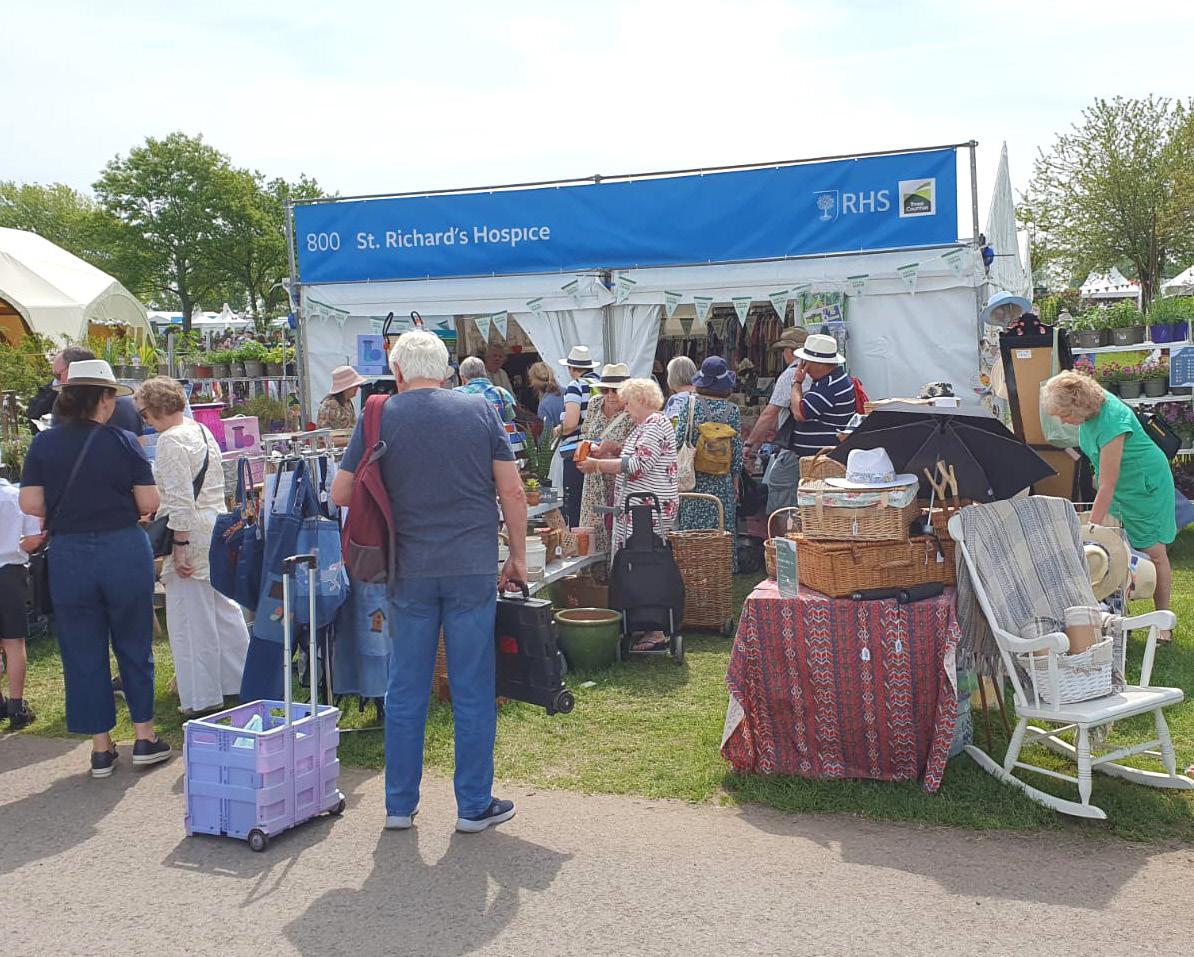
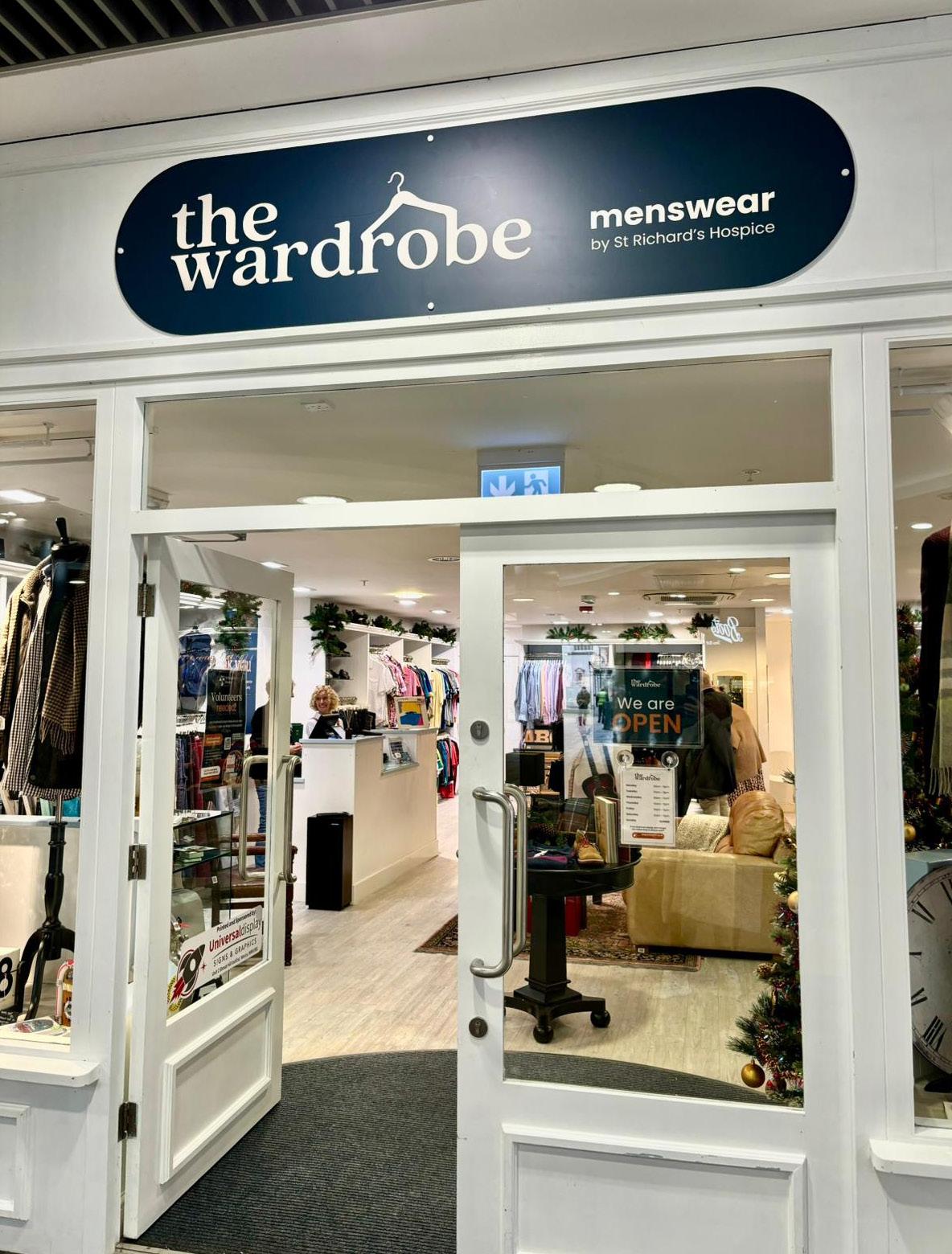
We added to our retail portfolio with the addition of The Wardrobe, a men’s pop up shop, in Worcester. The shop has proved a great success with a three-month trial now running on a rolling lease basis. Our first pop up shop at the RHS Malvern Autumn Show proved as popular as our offerings at the RHS Malvern Spring Festivals. We have plans to further increase our retail presence in 2025/26 with the opening of our very first charity superstore.
As well as our physical shops we continued to grow our online offer, opening up the market to a wider customer base beyond our physical stores.
Report of the Trustees for the year ended 31 March 2025
The Trustees present their annual report, strategic report and audited financial statements of the parent charity and its subsidiary undertaking for the year ended 31 March 2025. The accounts comply with current statutory requirements, the charity’s governing document and the Statement of Recommended Practice –Accounting and Reporting by Charities.
Reference and administration details of the charity, its trustees and advisers
The name of the charity is St Richard’s Hospice Foundation (“St Richard’s Hospice”), a company limited by guarantee. The company was incorporated on 24 September 1984. The Memorandum and Articles were completely updated and revised Articles were filed with Companies House on 22 November 2021. In accordance with Section 60 of the Companies Act 2006, the company is exempt from the requirements of that Act to include ‘Limited’ as part of its name. The company’s registered number is 01850502. The company is also a registered charity, number 515668.
The principal address and registered office of the company: St Richard’s Hospice, Wildwood Drive, Worcester WR5 2QT.
Trustees
Trustees in office during the year:
Jennifer Cowpe (Chair)
Heather Elliott (Vice-Chair)
Allard Alfrink
David Annetts (Left 21 March 2025)
Galen Bartholomew (Left 18 March 2025)
Danielle Clark
Hannah Edwards
Peter Flagg (Left 24 March 2025)
Anthony Glossop (Died 29 July 2025)
Dr Ian Laws
Professor Richard Lewis (Retired 18 October 2024)
Rebecca Lloyd (Appointed 21 October 2024)
Janet Matthews (Left 23 May 2024)
Andrea Palmer
Dr James Rankin
Helen Serrano
Steven Thrush (Appointed 24 March 2025)
The Trustees delegated the day to day management of the charity to the Chief Executive and Executive Directors.
Report of the Trustees for the year ended 31 March 2025
Key Management Personnel
Chief Executive Michael Wilkerson
Director of Corporate Services Daniel Haigh
Fundraising Director Tricia Cavell (Changed role 31 March 2025)
Commercial Director Daniel Corns (Changed role 31 March 2025)
Income Generation Director Abigail Holliday (Appointed 6 January 2025)
Clinical Director Sarah Onions
Care Director
Medical Lead
Debbie Westwood
Kath Newton (subcontracted from Herefordshire and Worcestershire Health and Care NHS Trust)
Principal Advisers
The company’s independent auditor Crowe U.K. LLP
4th Floor, St. James House
Cheltenham GL50 3PR
The company’s solicitors HCR Legal LLP
105 High Street
Worcester WR1 2HW
The company’s bankers
Barclays Bank Plc 54 High Street
Worcester WR1 2QQ
The company’s investment advisers
TrinityBridge Limited
Rathbones Investment Management
Wigmore Yard The Colmore Building
42 Wigmore Street 20 Colmore Circus Queensway
London W1U 2RY Birmingham B4 6AT
Report of the
Trustees for the year ended 31 March 2025
Structure, governance and management
The company is governed by its Articles of Association.
Board of Trustees
In accordance with the company’s Articles of Association, the company has a Board whose Trustees are members. Such Trustees constitute directors of the company for Companies Act purposes and Trustees of the charity for Charity Act purposes.
The company is limited by guarantee and therefore the Trustees have no beneficial interest to disclose. The appointment of new Trustees is undertaken by the current following advertisement of the role and an interview process.. St Richard’s Hospice Trustees are expected to be pro-active and actively involved in supporting the hospice. Potential Trustees are identified by the skills and expertise they will bring, as well as their motivation and support for the mission. They are interviewed by the Chair and at least two other Trustees. They are required to attend the volunteer induction training programme and receive formal induction by the Chair. The Chair works with other Trustees to review their performance and contribution to the work of the hospice.
Organisation
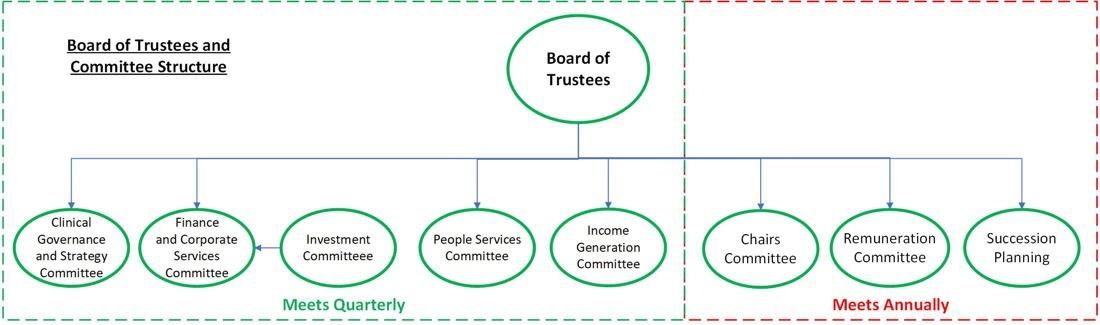
Strategic decisions are made by the Board of Trustees in regular meetings, delegating operating responsibilities to appropriate sub-committees. Day to day management is conducted by the Chief Executive Officer, who reports regularly to the Board of Trustees.
The Governing Committee structure, agreed in this financial year is:
Report of the Trustees for the year ended 31 March 2025
Trustees chair these committees, they meet regularly and report to the quarterly Board of Trustees meetings. Each committee has agreed terms of reference which clearly outline the demarcation of levels of responsibilities.
St Richard’s Hospice is affiliated to the National Board of Palliative Care, is a member of Hospice UK and is a member of the Herefordshire and Worcestershire Chamber of Commerce.
Subsidiary and associated companies and collaborations
The charity has a wholly owned subsidiary company – St Richard’s Hospice Trading Company Limited. The object of St Richard’s Hospice Trading Company Limited, which sells new goods, is to raise funds for St Richard’s Hospice Foundation.
The charity owns 33.33% of Worcestershire Hospices Lottery Limited sharing equal ownership with Primrose Hospice Limited and Acorns Children’s Hospice.
For the purposes of these consolidated accounts, the wholly owned subsidiary has been consolidated on a line by line basis and the holding in Worcestershire Hospices Lottery Limited included using the equity method applicable to joint ventures.
Employees
St Richard’s Hospice has a Remuneration Committee chaired by the Chair of Trustees with three additional Trustees who agree the pay of the Executive Team.
The People Services Committee recommends pay awards for staff to be discussed and agreed by the Board of Trustees. All salaries are benchmarked
against the Croner Hospice Rewards and Charities Rewards reports with consideration being given to the regional, West Midlands, median. Additionally, consideration is given to NHS and private sector comparators.
Employees and volunteers
It is charity policy to give full and fair consideration to all applications for employment in line with our Equality Diversity and Inclusion policy, having regard to the particular abilities and aptitudes of each applicant and to the requirements of vacant posts available.
Employee views are sought and information regarding the charity given, at team meetings, a regular People Focus group attended by members of the Executive Team, and through staff surveys. The “In Touch” news sheet is sent to all volunteers.
The charity is reliant upon its 800+ volunteers who work across the full breadth of its patient services, in the shops, and fundraise.
St Richard’s Hospice Foundation
St Richard’s Hospice Foundation
Richard’s Hospice Foundation St Richard’s Hospice Foundation
Report of the Trustees for the year ended 31 March 2025
Strategic Report
The organisation has agreed a strategic intent in the period which is as follows:
Strategic intent 2025 - 2027
Our vision Caring for Life Together inspires our purpose to continue providing care and support for people with an illness that cannot be cured and supporting their loved ones with practical, emotional and bereavement support. We will deliver our purpose through the following 6 strategic intentions:
1. Our Clinical Excellence:
Delivering exceptional care that continues to meet the holistic needs of people within our communities. Continually improving our services ensuring they are easily accessible, responsive, safe and sustainable and maintaining a CQC rating of Good or above. Ensuring our Hospice environment continues to enhance comfort, dignity and wellbeing.
2. Valuing Our Quality Workforce:
Delivering St Richard’s care and support through an integrated, inclusive and diverse workforce of empowered staff and volunteers maintaining our reputation as a good employer. Attracting and retaining people through competitive salaries, benefits, flexibility and welfare support. Investing in our people and enhancing skills through ongoing learning and development. Offering flexibility, variety and quality in our volunteering opportunities, utilising people’s unique value and potential.
3. Learning and Research Underpin Our Organisation:
Developing a culture of learning and continuous improvement throughout St Richard’s. Using research outcomes and best practise to support development across all areas of our hospice, from services to income generation.
4. Digital Transformation:
Developing information technology and digital solutions to facilitate different ways of working that maximise the efficient and effective use of our resources. Exploring the use of artificial intelligence systems to identify possible opportunities for use. Utilising digital systems, processes and records across all our activities to ensure regulatory compliance and support the delivery of exceptional care and support services. Ensuring the ongoing development and production of robust data to inform our continuous improvement, decision making, management and governance.
5. Sustainability Underpins Our Growth:
Creating a culture of continuous improvement and growth across all our income generation streams ensuring future sustainability and service delivery. Maintaining
Report of the Trustees for the year ended 31 March 2025
St Richard’s desired target level of free reserves with effective and efficient, and where practical environmentally friendly, use of resources. Developing future services only when there is an equally identifiable and sustainable level of income.
6. Profile, Partnership and Collaboration Underpin our Reputation:
Developing St Richard’s profile and respected reputation in all the local communities we serve through our partnership and collaboration with donors, supporters, hospices, other charities and the NHS. Nurturing and sustaining these relationships to achieve effective joint working and the ongoing creation of beneficial outcomes for patients and their loved ones.
STRATEGIC INITIATIVES 2025-2027 – Our Priorities for Improvement
Our strategic intent will be achieved by implementing various workstreams headlines of which are as follows and are broken down for staff as a range of actions:
1. Our clinical excellence:
2. Valuing our quality workforce:
3. Learning and research underpin our organisation:
Charitable Activities
If you would like to view details of clinical performance please see relevant pages earlier in the annual report.
Principal risks and uncertainties
St Richard’s has a comprehensive on-going system for risk assessment and management. The Executive Team meet regularly and will consider any risk to the charity. These, and any necessary
remedial action taken, will be reported to either the Finance and Corporate Services Committee or Clinical Governance and Strategy Committee as appropriate.
This presents an opportunity to:
- Talk about principal risks
- Give a summary of plans
- Explain factors affecting future performance
A Risk Register is managed by the Chief Executive and is reviewed at Committees and Board of Trustees meetings.
Areas of highest risk to the organisation currently are:
1. Potential unforeseen major incident disaster such as fire, flood utilities failure
2. Unknown impact of Assisted Dying Bill on hospices and what requirements may be placed on clinicians and the organisation. Potential funding risk from statutory and voluntary sources
3. Staff Sickness levels impact delivery of services for patients and families, and support departments including income generation
4. Reduction in income from Retail against annual target
5. Reduction in revenue income from Fundraising (including reduction of income from Grant Making Trusts) against agreed annual target as a result of changes in supporters’ behaviours, revised criteria by grant making trusts and donors preferences informed by the pandemic
In light of the current economic environment, the organisation is in a position whereby costs are expected to outstrip income growth in the short term. Forecasted deficits have been mitigated by the service redesign which reduced both salary and non-salary costs.
Forecasts for the 3 years ended 31 March 2028 were put to the Board of Trustees on 24 March 2025 which contain the financial impact of the service redesign. The forecast
shows the expectation that reserves will reduce over the three year period but not fall below St Richard’s reserve target in accordance with its Reserves Policy.
The strategic section of the Trustees Annual Report will now outline the current financial position of the organisation, provide a comment on our financial forecasts produced in March 2025 for the three years ended 31 March 2028 and refer to our reserves and investment policy all of which summarises the organisation’s position and response to its current financial challenges.
Financial review
Income shown in the statement of financial activity from page 45 is Group Income after Consolidation shown above. The two entities that materially contributed to the consolidated figures are the charity and its trading subsidiary. Income for the year ended 31 March 2025 was £0.6m below that for the year ended 31 March 2024. The main cause of the drop in total income was a £0.9m reduction in legacy income. In contrast, income from donations increased £0.3m and retail income increased by £0.4m. Due to the IPU upgrade which spanned the
Report of the Trustees for the year ended 31 March 2025
two financial years, cash levels dropped as did interest earned with the result being £0.1m less UK investment income for the year ended 31 March 2025 compared to 2024.
Income from St Richard’s NHS block grant increased by 1.8% in the year. St Richard’s also received a capital grant from the department of health and social care for £175k all of which was allocated to the IPU Upgrade project.
Group Expenditure increased by £541k for the year ended 31 March 2025 compared to 2024. Both the cost of raising funds and charitable expenditure increased, by £362k and £179k respectively.
For both the cost of fundraising and charitable activities the largest influence on increased cost in the year was an increase in salaries, which is the largest type of expenditure for the organisation. As can be seen in note 9, salary costs increase by £392k following cost-of-living increases which took effect from April 2024.
A service redesign process was completed in the year which lead to the removal of £1m per annum of cost, the majority of which was salary cost. The full year effect of this reduction will be shown in the accounts for the year ended 31 March 2026.
At 31 March 2025 the charity’s unrestricted fund balances were as shown in the ‘Group Reserves – Financial Years’ chart above and are represented by Designated Funds and Free Reserves. For clarity, designated funds represent the net book value of the group’s tangible fixed assets. Restricted funds are only a small proportion of the Group’s total reserves
details of which can be found in notes 27 and 28.
Reserves figures in the graph below do not differentiate between cash based and non cash-based assets. The level of cash held at the year-end by the group is £1,759,983 which is a £426,318 movement up on the prior year. The two largest factors causing the movement in cash held was the selling of £1m of investments near the year end and the NHS paying its quarterly grant instalment of £553k later than it did the previous year.
The net loss for the Group before gains on investments was £1,501,355 (2024£336,313). When net gains and losses on investments is included the net deficit in funds was £1,371,775 (2024 - £94,523)).
The Hospice activities, which are provided free of charge, are primarily funded by public donations, fundraising activities and retail income.
Material Fundraising Targets and Activity
of the Trustees for the year ended 31 March 2025
Yearly income generation targets are set as part of the annual budgeting process. The three main sources of income for the hospice are grouped as follows:
1: NHS
2: Donations, legacies and fundraising events
3: Retail Income
NHS
The budget for this stream of income was set at a 2% uplift on actual recurring funds received in 23/24. St Richard’s managed to achieve a 1.8% uplift in the level income from the block grant from the local Integrated Care Board (“ICB”). When and if available we apply for more government funding, this year the department for health and social care allocated £25m of grant funding to hospices in England, St Richard’s share of this total £175k. The result of this contributed to income from charitable activities increasing by 10.4% compared to 23/24.
Donations, legacies and fundraising events
Income shown in notes 2 and 4 of the financial statements, excluding retail income, shows there was a £1.2m reduction in these income stream compared to 23/24. £0.9m of this
reduction relates to a large fall in legacy income in the year. This year’s result contained a successful ‘Waddle of Worcester’ art trail. However, in 24/25 this event did not generate the amount of income received in the prior year from our Million Moments fundraiser.
Income from retail
Retail income for the hospice increased by £423k to £3,992k. Expenditure increased by £206k with cost increases mostly driven by pay. St Richard’s continues to use the Real Living Wage as a minimum for pay.
Forecast 1 April 2025 – 31 March 2028
Forecasting has been in place for a number of years at St Richard’s. As part of the continuing improvement in our Financial Management and reporting systems and following increased costs and pressure on income generation, forecasts were produced for the 3 years ended 31 March 2028 which were presented to the Board of Trustees in March 2025.
The Board forecast for the year ended 31st March 2026 estimated a deficit before depreciation of £415k. The reduction in projected deficit for this year was achieved with c.£1m per annum level of savings achieved as part of a service redesign which was initiated and completed in the year ended 31 March 2025. Factors such as inflation and the increase in employer’s national insurance
St Richard’s
St Richard’s Hospice Foundation
Report of the Trustees for the year ended 31 March 2025
cost from 1 April 2025 have increased costs following the saving. However, the service redesign has provided the organisation with more time to focus on creating and putting into effect new income generation initiatives without the expectation St Richard’s will be holding reserves below the target level of reserves per its reserves policy.
Reserves policy
The Trustees of St Richard’s Hospice Foundation are due to review of its reserve policy in the year ended 31 March 2026 accordance with their duty to do this regularly.
The current policy looks to the future to define and quantify how much reserves should be held, considering:
- Potential volatility of budgeted future income and expenditure
- The cost of known capital projects needed in the next 5 years
- Structural budget deficits
- Redundancy costs in the event of an insolvency procedure
Following this review, it was calculated that the amount to be held in free reserves from 1 April 2025 for the coming financial year should be £4,552k. The balance sheet at the year ended 31 March 2025 shows a free reserve position of £6,424k which is £1,872k over target reserves set using St Richard’s reserve policy.
Due to the need to focus on new income generation initiatives and a forecast which contains a growing organisation to support the care being delivered in St Richard’s community, the reserves target’s constituents have changed from being more heavily weighted towards the costs of known capital projects to being more heavily weighted towards potential volatility of future budgeted income and expenditure.
Following the service redesign, the size of structural budget deficits has reduced. The overall effect is an increase of the reserve target for 25/26 of £221k compared to the prior year.
Our forecasts demonstrate that the case Trustees have made previously for being cautious, should continue. The reserves are an important element of the resilience of the organisation which will enable it to redesign services to ensure sustainability in the medium to long term.
The reserves held over the current target reserve level will enable the organisation to act at speed whilst not undermining the quality of services.
Investment policy
Report of the Trustees for the year ended 31 March 2025
Income from these investments in the period are included in note 5. Total income can be shown as:
Interest earned by investment managers were enhanced by funds earned through Treasury deposit accounts managed in the year by St Richard’s Finance Department.
Investment managers Rathbones and TrinityBridge are currently work towards achieving a return on investment target of CPI + 2% for income and capital growth combined.
The Hospice’s investments are a means to earning revenue to fund activities which further the Charity’s purpose. The time horizon for these investments is 10+ years; the portfolio being low to medium risk.
Investments are not made in companies with turnover from the sale or production of tobacco.
The performance of investments held by the charity are reviewed regularly by St Richard’s Investment Committee which is attended by Trustees, staff and investment managers.
Both investment managers in the year monitored the environmental, social and governance credentials for all investments managed for St Richard’s which enables the Investment Committee to review ethical matters regarding investments.
St Richard’s
Richard’s
St Richard’s Hospice Foundation
Report of the Trustees for the year ended 31 March 2025
Streamlined Energy and Carbon Reporting (“SECR”)
A summary of the Carbon emissions of St Richard’s activities are as follows:
Methodology
St Richard’s Hospice Foundation
Report of the Trustees for the year ended 31 March 2025
To enable St Richard’s to satisfy our SECR requirements we have extracted data as follows:
Gas and Electricity kWh’s have been taken from supplier invoices. Mileage of paid staff have been totalled from expense forms. Van cost of fuel has been taken from supplier invoices. In order to arrive at estimated consumption of energy for staff and volunteer mileage, it is assumed 50% of staff and volunteers having a medium sized petrol car with the other 50% having a medium sized diesel car.
The total energy consumption figures then go through a conversion process using Government GHG Conversation Factors which results in kWh’s, miles and litres of fuel being stated as tCO2e. tCO2e being tonnes of CO2 equivalent emissions which represents total greenhouse gas emissions.
SECR requirements mean we need to select a metric which will enable the reader of the report to consider total emissions in light of the size of St Richard’s. The metric chosen, this ‘intensity ratio’, is the size of the St Richard’s workforce.
Comment on results
Total emissions through consumption of energy have increased compared to the previous financial year. The largest contributing factor being an increase in Gas consumption at the hospice’s Wildwood Drive site. This section of the
Trustees Annual Report last year referred to Gas consumption having dropped due to a temporary closure of bedrooms in the year to enable us to upgrade our In Patient Unit, the increase this year is due to the reopening of all of the In Patient Unit.
Energy efficiency action
St Richard’s has invested in and benefited from the purchase of 796 solar panels the installation of which was completed in early 2016 and generated 152,232 kWhs of electricity in this financial year (2023/24 148,188 kWhs).
The 796 panels represent a 231 kW peak system which reduces the amount and therefore cost of electricity we use from the grid and also provides some income in the form of feed in tariff.
Boilers and water heaters which drive the consumption of Gas at the Wildwood site will be replaced in the 2025/26 financial year which will improve energy efficiency and the cost of Gas consumption for the hospice.
Future plans
St Richard’s historically has not been of a size where the ESOS (Energy Savings Opportunities Scheme) reporting regulations apply. It is part of St Richard’s agreed strategy to develop a green agenda and plan to promote and enhance St Richard’s green credentials.
This SECR reporting caters for elements which would fall into Scope 2 and part of Scope 1 for ESOS reporting.
Report of the Trustees for the year ended 31 March 2025
s172 (1) Statement
This section of the Companies Act 2006 concerns how Trustees make decisions and what must be considered in the decision making process when promoting the success of the company. Specifically, the act states decisions should consider:
a) The likely consequences of any decision in the long term
b) The interest of the company’s employees
c) The need to foster the company’s business relationships with suppliers customers and others
d) The impact of the company’s operations on the community and the environment
e) The desirability of the company maintaining a reputation for high standards of business conduct
f) The need to act fairly between members of the company
All decisions are made within the governance framework shown on page 24. All matters of strategy are the responsibility of the board, the current strategic intent is stated on pages 26-27. There are detailed papers which the board will consider at each board meeting which contains updates on strategic initiatives which give effect to the intent agreed.
Trustees receive updates on KPIs on a regular basis which will inform them of how the hospice is interacting with and meeting the needs of key stakeholders including service users and employees. The Financial and Corporate Services Committee receives a quarterly internal audit report which is aimed at establishing if there are any matters that need closer attention; this internal process covers supplier and debtor balances.
Trustee’s decisions are made in light of the current environment, as reported, and future projections.
The board operate with our articles of association ensuring each member of St Richard’s are treated fairly. The company’s activities are declared in the annual report on page 28 and demonstrate how the company’s operations impact on its community.
Public benefit
The Trustees consider that they have complied with the duty in Section 17 of the Charities Act 2011 and have referred to the guidance contained in the Charity Commission’s general guidance on public benefit when reviewing their aims and objectives and in planning future activities.
St Richard’s Hospice Foundation
Report
of
the
Trustees
for the year ended 31 March 2025
Fundraising Disclosures –Charities (Protection and Social Investment) Act 2016
Overview
During the reporting period April 2024March 2025, St. Richard’s Hospice Income Generation engaged in various fundraising activities to support our charity mission and objectives. These activities include, but were not limited to:
• Events, challenges and sponsored activities
• Grant applications
• Corporate fundraising activities/ Charity of The Year partnerships
• Online fundraising
• Direct Mail campaigns
Compliance
St Richard’s is committed to upholding the highest standards of fundraising ethics and practices. We have adhered to the Fundraising Regulator’s Codes of practice ensuring transparency, honesty and respect in all of our income generation efforts. Several of our in-house fundraising team are members of the Institute of Fundraising and continue with their professional development to ensure compliance with all the relevant standards set out in the Fundraising Regulator’s Code of Fundraising Practice.
Evidence of the hospices commitment to follow the Code of Fundraising Practice can be found on the Fundraising Regulator website. We are also signed up to the Fundraising Preference Service to enable individuals to opt out from receiving fundraising communications from us.
All fundraising activity complies with the Data Protection Act 2018 and General Data Protection Regulation, UK and EU versions. We hold a gambling licence issued by the Gambling Commission to facilitate in house raffles and adhere to its rules and regulations.
Fundraisers are NHS compliant on safeguarding for vulnerable adults and for safeguarding children. The Fundraising Director is level 2 compliant and all others involved with fundraising are trained to level 1. This can be evidenced against individuals training record.
We have published our vulnerable persons policy on our website. Partnerships
We value our relationships with corporate partners, grant making bodies and individual donors. Their generous contributions and collaborative support have significantly contributed to our success during the reporting period. We actively work to ensure we protect any vulnerable donors, are clear about the reason for acceptance and refusal of
any donation, introduce Commercial Participants Agreement when required and ensure donor data is dealt with effectively and compliantly.
Our in-house fundraising team sometimes engage with third party suppliers to help us deliver fundraising initiatives such as direct mailing or generate Trust income. We aim to ensure those agencies and personnel we employ also observe the highest standards in terms of fundraising practice and have safeguards in place when working with suppliers so that we protect our supporters and the reputation of our charity.
Feedback and complaints handling
Our website outlines our complaints policy for the public and clearly explains how an individual can complain. We have a feedback and complaints handling process and policy in place to address any concerns raised by a member of the public in respect of income generation. We take this seriously aiming to resolve issues promptly and improve our practices accordingly. The charity and its trading subsidiary received 11 complaints (2024: 27 complaints) about income generation activities in the year. Of these 2 were fully and 4 partially upheld. The charity and its trading subsidiary also received 39 compliments in the year.
Looking ahead
St Richard’s is committed to diversifying and expanding our fundraising efforts to
sustain and enhance our charity objectives. This commitment is reflected in the appointment of a new Director of Business and Income Generation who joined the organisation is January 2025 and will be responsible for the strategic direction of our fundraising and retail income generation activities. This will enable us to explore and develop a new integrated approach, develop innovative approaches, strengthen existing relationships and seek new opportunities to engage with all our supporters.
Statement as to disclosure of information to
auditors
Insofar as each of the Trustees of the charity at the date of approval of this report is aware there is no relevant audit information (information needed by the charity’s auditor in connection with preparing the audit report) of which the charity’s auditor is unaware. Each Trustee has taken all of the steps that he/she should have taken as a Trustee in order to make himself/herself aware of any relevant audit information and to establish that the charity’s auditor is aware of that information.
Statement of Trustees’ responsibilities
The Trustees (who are also directors of St Richard’s Hospice Foundation for the purposes of company law) are responsible for preparing the Trustees’ Report and the financial statements in accordance with applicable law and United Kingdom Generally Accepted Accounting Practice
Report of the Trustees for the year
ended 31 March 2025
(United Kingdom Accounting Standards). Company law requires the Trustees to prepare financial statements for each financial year. Under company law the Trustees must not approve the financial statements unless they are satisfied that they give a true and fair view of the state of affairs of the charitable company and the group and of the incoming resources and application of resources, including the income and expenditure, of the charitable group for that period. In preparing these financial statements, the Trustees are required to:
• select suitable accounting policies and then apply them consistently.
• observe the methods and principles in the Charities SORP.
• make judgements and estimates that are reasonable and prudent.
• state whether applicable UK Accounting Standards have been followed, subject to any material departures disclosed and explained in the financial statements, and
• prepare the financial statements on the going concern basis unless it is inappropriate to presume that the charitable company will continue in business.
The Trustees are responsible for keeping adequate accounting records that are sufficient to show and explain the charitable company’s transactions, disclose with reasonable accuracy at any time the financial position of the charitable company and enable them
to ensure that the financial statements comply with the Companies Act 2006 and the provisions of the charity’s constitution. They are also responsible for safeguarding the assets of the charity and the group and hence for taking reasonable steps for the prevention and detection of fraud and other irregularities.
The Trustees are responsible for the maintenance and integrity of the corporate and financial information included on the charitable company’s website. Legislation in the United Kingdom governing the preparation and dissemination of financial statements may differ from legislation in other jurisdictions. The Trustees support the principles of good governance set out in the Charity Governance Code and uses the Code to evaluate its effectiveness.
Auditor
The auditor, Crowe U.K. LLP, will be invited to be our auditors for the 2025/26 accounts.
The report of the Trustees (incorporating the directors’ report and the strategic report) was approved by the Board
Independent Auditor’s Report to the Members of St Richard’s Hospice Foundation Opinion
We have audited the financial statements of St Richard’s Hospice Foundation (‘the charitable company’) and its subsidiary (‘the group’) for the year ended 31 March 2025 which comprise the Consolidated Statement of Financial Activities, Group Balance Sheet, Charity Balance Sheet, Consolidated Statement of Cash Flows and notes to the financial statements, including significant accounting policies.
The financial reporting framework that has been applied in their preparation is applicable law and United Kingdom Accounting Standards, including Financial Reporting Standard 102 ‘The Financial Reporting Standard applicable in the UK and Republic of Ireland’ (United Kingdom Generally Accepted Accounting Practice).
In our opinion the financial statements:
• give a true and fair view of the state of the group’s and the charitable company’s affairs as at 31 March 2025 and of the group’s income and expenditure, for the year then ended;
• have been properly prepared in accordance with United Kingdom Generally Accepted Accounting Practice; and
• have been prepared in accordance with the requirements of the Companies Act 2006.
Basis for opinion
We conducted our audit in accordance with International Standards on Auditing (UK) (ISAs (UK)) and applicable law.
Our responsibilities under those standards are further described in the Auditor’s responsibilities for the audit of the financial statements section of our report. We are independent of the group in accordance with the ethical requirements that are relevant to our audit of the financial statements in the UK, including the FRC’s Ethical Standard, and we have fulfilled our other ethical responsibilities in accordance with these requirements. We believe that the audit evidence we have obtained is sufficient and appropriate to provide a basis for our opinion.
Conclusions relating to going concern
In auditing the financial statements, we have concluded that the Trustees’ use of the going concern basis of accounting in the preparation of the financial statements is appropriate.
Based on the work we have performed, we have not identified any material uncertainties relating to events or conditions that, individually or
collectively, may cast significant doubt on the charitable company’s or the group’s ability to continue as a going concern for a period of at least twelve months from when the financial statements are authorised for issue.
Our responsibilities and the responsibilities of the Trustees with respect to going concern are described in the relevant sections of this report.
Other information
The Trustees are responsible for the other information contained within the annual report. The other information comprises the information included in the annual report, other than the financial statements and our auditor’s report thereon.
Our opinion on the financial statements does not cover the other information and, except to the extent otherwise explicitly stated in our report, we do not express any form of assurance conclusion thereon.
Our responsibility is to read the other information and, in doing so, consider whether the other information is materially inconsistent with the financial statements or our knowledge obtained in the audit or otherwise appears to be materially misstated. If we identify such material inconsistencies or apparent material misstatements, we are required to determine whether this
gives rise to a material misstatement in the financial statements themselves. If, based on the work we have performed, we conclude that there is a material misstatement of this other information, we are required to report that fact. We have nothing to report in this regard.
Opinions on other matters prescribed by the Companies Act 2006
In our opinion based on the work undertaken in the course of our audit:
• the information given in the Trustees’ report, which includes the Directors’ report and the Strategic report prepared for the purposes of company law, for the financial year for which the financial statements are prepared is consistent with the financial statements; and
• the Strategic report and the Directors’ report included within the Trustees’ report have been prepared in accordance with applicable legal requirements.
Matters on which we are required to report by exception
In light of the knowledge and understanding of the group and charitable company and their environment obtained in the course of the audit, we have not identified material misstatements in the Strategic report or the Directors’ report included within the Trustees’ report.
St Richard’s Hospice Foundation
We have nothing to report in respect of the following matters in relation to which the Companies Act 2006 requires us to report to you if, in our opinion:
• adequate and proper accounting records have not been kept; or
• the financial statements are not in agreement with the accounting records and returns; or
• certain disclosures of Trustees’ remuneration specified by law are not made; or
• we have not received all the information and explanations we require for our audit.
Responsibilities of Trustees
As explained more fully in the Trustees’ responsibilities statement set out on page 38 and 39, the Trustees (who are also the directors of the charitable company for the purposes of company law) are responsible for the preparation of the financial statements and for being satisfied that they give a true and fair view, and for such internal control as the Trustees determine is necessary to enable the preparation of financial statements that are free from material misstatement, whether due to fraud or error. In preparing the financial statements, the Trustees are responsible for assessing the charitable company’s ability to continue as a going concern,
disclosing, as applicable, matters related to going concern and using the going concern basis of accounting unless the trustees either intend to liquidate the charitable company or to cease operations, or have no realistic alternative but to do so.
Auditor’s responsibilities for the audit of the financial statements
Our objectives are to obtain reasonable assurance about whether the financial statements as a whole are free from material misstatement, whether due to fraud or error, and to issue an auditor’s report that includes our opinion.
Reasonable assurance is a high level of assurance, but is not a guarantee that an audit conducted in accordance with ISAs (UK) will always detect a material misstatement when it exists. Misstatements can arise from fraud or error and are considered material if, individually or in the aggregate, they could reasonably be expected to influence the economic decisions of users taken on the basis of these financial statements.
Details of the extent to which the audit was considered capable of detecting irregularities, including fraud and non-compliance with laws and regulations are set out below. A further description of our responsibilities for the audit of the financial statements is located on the Financial Reporting
Council’s website at: www.frc.org.uk/ auditorsresponsibilities. This description forms part of our auditor’s report.
Extent to which the audit was considered capable of detecting irregularities, including fraud
Irregularities, including fraud, are instances of non-compliance with laws and regulations. We identified and assessed the risks of material misstatement of the financial statements from irregularities, whether due to fraud or error, and discussed these between our audit team members.
We then designed and performed audit procedures responsive to those risks, including obtaining audit evidence sufficient and appropriate to provide a basis for our opinion.
We obtained an understanding of the legal and regulatory frameworks within which the charitable company and group operates, focusing on those laws and regulations that have a direct effect on the determination of material amounts and disclosures in the financial statements. The laws and regulations we considered in this context were the Companies Act 2006, the Charities Act 2011 together with the Charities SORP (FRS 102).
We assessed the required compliance with these laws and regulations as part
of our audit procedures on the related financial statement items.
In addition, we considered provisions of other laws and regulations that do not have a direct effect on the financial statements but compliance with which might be fundamental to the charitable company’s and the group’s ability to operate or to avoid a material penalty. We also considered the opportunities and incentives that may exist within the charitable company and the group for fraud. The laws and regulations we considered in this context were the CQC Regulations, General Data Protection Regulations and Employment legislation.
Auditing standards limit the required audit procedures to identify non-compliance with these laws and regulations to enquiry of the Trustees and other management and inspection of regulatory and legal correspondence, if any.
We identified the greatest risk of material impact on the financial statements from irregularities, including fraud, to be with the completeness and accuracy of income (specifically legacies and grant income other than NHS-grants) and the override of controls by management. Our audit procedures to respond to these risks included enquiries of management, and the Finance and Income Generation Committee about their own identification and assessment of the risks of irregularities, designing audit procedures over income (specifically
St Richard’s Hospice Foundation
legacies and grant income other than NHS-grants), sample testing on the posting of journals, reviewing accounting estimates for biases, reviewing regulatory correspondence with the Charity Commission and reading minutes of meetings of those charged with governance.
Owing to the inherent limitations of an audit, there is an unavoidable risk that we may not have detected some material misstatements in the financial statements, even though we have properly planned and performed our audit in accordance with auditing standards.
For example, the further removed non-compliance with laws and regulations (irregularities) is from the events and transactions reflected in the financial statements, the less likely the inherently limited procedures required by auditing standards would identify it.
In addition, as with any audit, there remained a higher risk of non-detection of irregularities, as these may involve collusion, forgery, intentional omissions, misrepresentations, or the override of internal controls.
We are not responsible for preventing non-compliance and cannot be expected to detect non-compliance with all laws and regulations.
Use of our report
This report is made solely to the charitable company’s members, as a body, in accordance with Chapter 3 of Part 16 of the Companies Act 2006. Our audit work has been undertaken so that we might state to the charitable company’s members those matters we are required to state to them in an auditor’s report and for no other purpose.
To the fullest extent permitted by law, we do not accept or assume responsibility to anyone other than the charitable company and the charitable company’s members as a body for our audit work, for this report, or for the opinions we have formed.
Consolidated statement of financial activities incorporating an income and expenditure account for the year ended 31 March 2025
Guy Biggin Senior Statutory Auditor
For and on behalf of Crowe U.K. LLP
Statutory Auditor
Consolidated financial statements company number 01850502 Group and charity balance sheet as at 31 March 2025
Consolidated statement of cash flows for the year ended 31 March 2025
The notes form part of these financial statements
1. Accounting policies
Charitable company information
St Richard’s Hospice Foundation is a private charitable company limited by guarantee, incorporated in England and Wales. The registered office of St Richard’s Hospice Foundation and St Richard’s Hospice Foundation Trading Company Limited is Wildwood Drive, Worcester, WR5 2QT.
Basis
of preparation
The financial statements have been prepared under the historical cost convention with the exception of investments which are included at market value. The financial statements have been prepared in accordance with the Financial Reporting Standard applicable in the UK and Republic of Ireland (FRS 102), the Statement of Recommended Practice: Accounting and Reporting by Charities preparing their accounts in accordance with the Financial Reporting Standard applicable in the UK and Republic of Ireland (FRS 102) (Charities SORP FRS 102), the Companies Act 2006 and the Charities Act 2011.
The charitable company meets the definition of a public benefit entity under FRS 102.
The financial statements are presented in sterling (£) and are rounded to the nearest £.
Going concern
The group has cash resources and no requirement for external funding to fund normal operating activities. The Trustees believe that there are no material uncertainties about the group’s ability to continue in operating existence for
the foreseeable future. They continue to believe the going concern basis of accounting appropriate in preparing the annual financial statements.
Group financial statements
These financial statements consolidate the results of the charity and its wholly owned subsidiary on a line by line basis. All intergroup transactions are eliminated on consolidation. Investments in joint ventures are included in the group financial statements using the “equity method”.
No separate Charity SOFA has been presented for the charity alone as permitted by Section 408 of the Companies Act 2006. The Charity has taken advantage of the exemptions in FRS 102 from the requirement to present a charity only Cash Flow Statement and certain disclosures about its own financial instruments within the consolidated financial statements
Income
Income is recognised when the charity has entitlement to the funds, any performance conditions attached to the income have been met, it is probable that income will be received and the amount can be measured reliably.
Income from voluntary sources is received by way of donations and gifts and is included in full in the Statement of Financial Activities when receivable. Income from gift aid tax reclaims is recognised for all donations made prior to the year end, where valid gift aid declarations are held.
Recognition of legacy income is dependent on the type of legacy, with
Notes to the consolidated financial statements for the year ended 31 March 2025
pecuniary legacies recognised when notification is received. Residuary legacies are recognised and measured when either notice of Probate or a statement of assets and liabilities, and a copy of the will, have both been received and the value of the gift can be reliably measured. Reversionary legacies are not recognised during the lifetime of the original beneficiary under the will. The charity operates a cut-off period being a practical mechanism to allow preparation of the accounts. Should a notification be received before the year end but not be quantifiable two months after the year end then the income, when measurable and receipt is probable, will be recognised in the following period. Where legacies have been notified to the charity, but the criteria for income recognition have not been met, the legacy is treated as a contingent asset and disclosed if material in note 21.
Income received in advance of an event or provision of other specific service is deferred until the criteria for income recognition are met.
Grants from government bodies and other sources are received for specific projects/costs and are recognised in accordance with their individual terms and conditions. Income is recognised when the charity has entitlement to the funds which is when any performance conditions attached are met, it is probable that the income will be received and the amount can be reliably measured. Grant income will be deferred if received in advance of meeting performance conditions or if the funder specifically states that the income must be spent in a future accounting period.
Expenditure
The cost of raising funds includes costs of generating voluntary income and costs of fundraising trading, shops and investment manager’s fees. Charitable activities costs include expenditure on delivering palliative care and education. Governance costs include costs of meeting the charity’s statutory and constitutional objectives.
Support costs are allocated to all cost centres on a basis calculated in proportion to the estimated usage of facilities. Expenditure is accounted for on an accrual basis.
Gifts in kind
Gifts received in kind for resale are recognised when the gift is sold using the sales value.
Donated services or facilities are included in the Statement of Financial Activities where the benefit to the charity is reasonably quantifiable and measurable. The contribution of volunteers is not included in the Statement of Financial Activities, but is disclosed in the Governors’ Report in accordance with the SORP.
Donated assets given for use by the charity are recognised at their market value as income and within the relevant fixed asset category on the balance sheet when receivable.
Liabilities
Liabilities are recognised in the accounts as soon as a present obligation arises from a past event that will probably result in a transfer of funds to a third party and
Notes to the consolidated financial statements for the year ended 31 March 2025
the amount due to settle the obligation can be measured or estimated reliably.
Fund accounting
General funds are expendable at the discretion of the Trustees in furtherance of the charity’s objectives and which have not been designated for other purposes. It is the policy of the hospice to look to the future to define and quantify how much reserves should be held, considering:
- Potential volatility of budgeted future income and expenditure
- The cost of known capital projects needed in the next 5 years
- Structural budget deficits
- Redundancy costs
Designated funds comprise unrestricted funds that have been set aside by the Trustees for particular purposes. The aim and use of each designated fund is set out in the notes to the financial statements.
Restricted funds contain income which has been received for specific purposes, less the related expenditure against these. The aim and use of each material restricted fund is set out in the notes to the financial statements.
Leasing commitments
Rentals paid under operating leases are charged to the Statement of Financial Activities over the term of the lease.
Pensions
The pension costs represent amounts payable by the group during the year (see note 22).
Stocks
Stocks are valued at the lower of cost and net realisable value, after making due allowance for obsolete and slow moving items.
Tangible fixed assets
Tangible fixed assets are initially included at cost.
Depreciation is provided at the following annual rates in order to write off each asset over its estimated useful life or, if held under a finance lease, over the lease term, whichever is the shorter.
Freehold property (including commercial property): 2% on cost of buildings
Freehold property: Solar panels - 5% on cost
Leasehold land: Over life of lease (125 years)
Assets under construction: 0%
Shop refurbishment: 20% - 33% on cost
Medical equipment: 20% - 50% on cost
Furniture and fittings: 10% - 50% on cost
Motor vehicles: 20% - 33% on cost
Office equipment: 20% - 50% on cost
Depreciation is provided at the following annual rates in order to write off each asset over its estimated useful life or, if held under a finance lease, over the lease term, whichever is the shorter.
Investments
Listed fixed asset investments are included at fair value (quoted market price in an active market). Gains or losses on investments are included in the Statement of Financial Activities and Income and Expenditure Account.
The Charity owns investment properties that are treated as own use, depreciated, tangible fixed asset in the group and charity financial statements in accordance with FRS 102 as it is let by the parent to its wholly owned subsidiary. The investment in the subsidiary and joint venture are included at cost.
Financial instruments
Financial instruments are classified and accounted for, according to the substance of the contractual arrangement, as either financial assets, financial liabilities or equity instruments. An equity instrument is any contract that evidences a residual interest in the assets of the company after deducting all of its liabilities.
Financial instruments include cash at bank, trade debtors, legacies receivable, accrued income from financial instruments (comprising dividends and interest due from investments), trade creditors and accrued expenditure. Financial instruments are initially recognised at transaction value and subsequently measured at their settlement value.
Significant estimates and judgements
Preparation of the financial statements requires management to make significant judgements and estimates. The items in the financial statements where these judgements and estimates have been made include:
Useful economic lives of fixed assets
The annual depreciation and amortisation charges for the tangible assets are sensitive to changes in the estimated
useful economic lives and residual values of the assets. The useful economic lives and residual values are amended when necessary to reflect current estimates and the physical condition of the assets.
Impairment of debtors
The group makes an estimate of trade debtors and other debtors. When assessing the impairment of trade debtors and other debtors, management considers factors including the current credit rating of the debtor, the ageing profile of debtors and historical experience.
Accrued legacy income
For non-pecuniary legacies, an estimate is made of the amount due to the charity based on the share of the estate as stated in the will, the value of the estate (from probate or a statement of assets and liabilities) and external factors including the volatility of the property market, and the stock market. An allowance is also made for expected costs.
Taxation
The charity is exempt from Corporation Tax on its charitable activities. The charity and its subsidiary company are registered for Value Added Tax. Irrecoverable VAT is allocated to the areas in which it is incurred.
Notes to the consolidated financial statements for the year ended 31 March 2025
2. Donations and legacies
3. Charitable activities
Notes to the consolidated financial statements for the year ended 31 March 2025
The wages and salaries cost above includes salaried employees’ costs of £7,215,090, (2024 £7,043,570) with the remaining £191,978, (2024 £259,082) being agency staff paid via invoice. Staff can receive a benefit by being a member of a private health insurance scheme and the cost of this for the year ended 31st March 2025 was £30,999 (2024 £24,168). Redundancy costs relate to 15 members of staff.
The average number of salaried employees during the year by the group was as follows:
The number of employees whose emoluments as defined for tax purpose amounted to over £60,000 in the year as follows:-
The total amount of employee benefits (Including National Insurance and Employer’s Pension contributions) received by the key management personnel was £707,658 - 8 employees (2024£650,944 - 7 employees). There were no expenses for travel and subsistance repaid to Trustees.
9. Staff costs
Notes to the consolidated financial statements for the year ended 31 March 2025
Taxation
The company is a registered charity and is not liable to corporation tax. No liability to UK corporation tax arose on ordinary activities of the subsidiary company for the year ended 31 March 2025.
Notes to the consolidated financial statements for the year ended 31 March 2025
12. Tangible fixed assets - group and charity
Notes to the consolidated financial statements for the year ended 31 March 2025
The value of intangible fixed assets was immaterial and as such has not been disclosed in a separate category. The net book value of intangible fixed assests at 31 March 2025 was £0 (2024 £690).
Depreciation on Commercial properties includes and amount of £100,000 being impairment of value of the Mealcheapen property.
Notes
13. Fixed assets investments
The
14. Investment property
Notes to the consolidated financial statements for the year ended 31 March 2025
The charity has the following subsidiary company whose results have been consolidated in these accounts:St Richard’s Hospice Trading Company Limited (Company No : 04805373)
Nature of business: Shop and commercial retailing.
The company had income of £572,850 (2024 £3,260,537) and expenditure of £506,657 (2024 £2,611,820). leaving a profit of £66,193 (2024 £648,717) which was distibuted as a gift aid payment to this charity. The Company has gone through a major restructuring which took effect from 1 April 2024.
The charity’s interest in the 12 months to 31 March 2025 of Worcestershire Hospices Lottery Limited is as follows: 15. Subsidiary company
At March 2025 St Richard’s Hospice Foundation was owed £12,984 (2024 - £16,752) relating to trading balances by Worcestershire Hospices Lottery Limited. The carrying value of this company in the Group Balance Sheet is £100 and forms part of the Investments balance in note 13.
18. Debtors: amounts falling due within one year
Notes to the consolidated financial statements for the year ended 31 March 2025
19. Creditors: amounts falling due within one year
As at March 2025 the charity has been notified of 4 legacies, the values of which are unknown, or cannot be reliably measured. As at the approval date of the financial statements no further information has been received and therefore this legacy income has not been accrued.
Included in Other creditors is an amount of £33,297 held as agent. There is a corresponding amount held in Bank and Cash at the year end. Included in accruals and deferred income is deferred event income of £118,848 (2024 - £59,724) for the group and the charity and this is this is included in the analysis below.
The company contributes to a defined benefit pension scheme operated by the NHS. Net NHS pension costs of £257,557 (2024 - £271,484) were charged in the Statement of Financial Activities during the year. The company also contributed £325,082 (2024 - £227,715) to some employees’ occupational pension schemes, and £14,705 (2024 - £15,077) to employees’ private pension schemes. Included in other creditors at 31 March 2025 was £32,603 (2024 - £35,433) in relation to the NHS scheme and £991 (2024 - £1,189) in relation to the work place pension scheme.
The cost and liability is allocated between activities by reference to the area the employee is working in. The cost and liability is allocated against unrestricted funds unless a restricted fund allowed the expenditure.
The NHS scheme is a defined benefit scheme which is unfunded. This is a multi-employer pension scheme based on final pensionable pay, contributions being charged to profit and loss account so as to spread the cost of pensions over employees’ working lives with the company. The company accounts for the scheme as a defined contribution scheme and is not required to account for any share of assets or liabilities of the scheme in accordance with FRS 102. This is deemed appropriate as the company has no ongoing liability once the contributions to the scheme are made.
The amounts have only been deferred when the
does not have unconditional entitlement to the income or when the income relates to delivery of a service and is therefore only recognised to the extent that the charity has provided the service.
The charity owns 33.33% of Worcestershire Hospices Lottery Limited, ownership and control is split equally between St Richard’s Hospice, Acorns Childrens Hospice and the Primrose Hospice Limited. M Wilkerson (Chief Executive) and Tricia Cavell (Fundraising director during the period) are also directors of Worcestershire Hospices Lottery Limited. St Richard’s Hospice received £74,521 ( 2024 - £75,010) gift aid from Worcestershire Hospices Lottery Limited. As at March 2025 Worcestershire Hospices Lottery Limited owed St Richard’s Hospice £12,984 (2024 - £16,752).
St Richard’s Hospice Foundation charged £217,754 to St Richard’s Trading Company in the year, representing the costs incurred by the Charity, in relation to the operations of the Trading Company. In 2024 the Charity was charged £862,777 by St Richard’s Trading Company Limited for administering the sale of goods gifted to the hospice and for which a gift aid claim was made.
St Richard’s Hospice Foundation was owed £156,296 by St Richard’s Hospice Trading Company Limited at 31 March 2025 (2024 - £163,678).
21. Contingent assets
22. Pension commitments
23. Related party transactions
Notes to the consolidated financial statements for the year ended 31 March 2025
Capital commitment
No capital commitments existed at 31 March 2025.
25. Operating lease commitments
The total future minimum lease payments under non- cancellable operating leases are shown below.
Prior year statement of financial activities
The group has off balance sheet arrangements in the form of operating leases, which means that neither the liability under the lease nor the related assets appears on the Balance Sheet. The group uses operating leases so it has the benefit of leasing over a defined period and the risks are retained by the lessor.
Notes to the consolidated financial statements for the year ended 31 March 2025
27. Restricted/unrestricted funds
The general fund represents the free funds of the hospice which are not designated for particuar purposes. The investment fair value reserve represents the excess of fair value over the historic cost of the investments. The designated fixed asset fund has been set up to assist in identifying those funds that are not free funds. It represents the net book value of tangible fixed assets.
The transfer from other funds to the designated fixed asset fund of £466,514 (2024 - £ 1,748,116) for the group and charity represents unrestricted tangible fixed asset additions in the year. When funds subject to a restriction are used to purchase a fixed asset, the restriction is deemed satisfied. This treatment applies to all funds, where they have been used to purchase an asset. Restricted other funds represent amounts held from many smaller grant trusts and others for various restricted purposes which, due to their individual size, are not to be disclosed separately in these accounts.
Should St Richard’s ever want to sell Wildwood Drive it will need permission from the Big Lottery as this was a condition of funding, registered at Land Registry.
to the consolidated financial statements for the year ended 31 March 2025
Notes to the consolidated financial statements for the year ended 31 March 2025
30. Legal status of the charity
The charity is a company limited by guarantee and has no share capital.
The liability of each member in the event of winding up is limited to £10.
31. Controlling party
The charity is under the control of its Trustees.
32. Agency note
St Richard’s Hospice Trading Company Limited acts as an agent to St Richard’s Hospice on selling second hand goods for which Gift Aid is claimed.
£33,297(£76,315 - 2024) is held in other creditors on behalf of the Worcester Acute Trust to pay for the training of speciality palliative registrars. There is a corresponding amount held within Cash at Bank at the year end.