University of Sydney Students’ Representative Council
Orientation & Countercourse Handbook 2026


The NO BULLSHIT Student Guide to the University of Sydney

Acknowledgement of Country
As you walk around USyd, the sandstone gives an air of heritage and elitism. There is an illusion present as you walk past the quadrangle that tempts you to think that this place has perhaps been here for hundreds of years like the Oxford architecture it mimics.
Instead what lies beneath us is the land of one of the oldest living cultures in the world. The 238 odd years of this colony are a blink of an eye to the 60,000+ years of connection First Nations Peoples have with the Lands across so-called Australia.
Many of us at USyd are international students that perhaps do not know this history or may be among those that have learned a white-washed account of the formation of this nation. Like other settler-colonies ‘Australia’ was carved out through a process of violent dispossession, rape, and genocide. Throughout this was and still is resistance. That is, intifada.
We at the SRC must strive to put the First Nations struggle at the forefront of our activism. That means going beyond mere liberal tokenisms fighting in solidarity alongside our Indigenous comrades for justice unfulfiled 238 years and counting.

The University of Sydney Students’ Representative Council exists and operates on the stolen lands of The Gadigal in which sovereignty was never ceded. Always was and always will be Aboriginal Land.
Editors-In-Chief
Ava Cavalerie & Vince Tafea

“Why
Editorial Contents
President’s
What
Honi

Accomodation
The SRC’s USyd Map
The Consensus on Pubs Near USyd
Thank you!
This orientation book you are holding in your hands is a miracle. Every year the SRC General Secretaries are tasked with making this orientation book. We can tell you right now that this is no light feat, especially when you are both the editors-in-chief and chiefly the only editors. Also, we weren’t exactly elected on the basis of our design skills.
We struggled through this for you dear students because we care about you and want to give you the knowledge and tips we wished we had in first year. Despite indesign being the worst application ever made, Vince became a professional graphic designer, carefully putting together these pages with precision, love and passion. The artwork at the base of the cover is from Ava. It may not represent much to you, but it is a reflection of the wins, losses, and general distress caused from compiling this handbook.
After many, many crashouts, we did it. So we are begging you PLEASE read it. Skim it if you must. Or let it decorate your desk until you finally decide to throw it out. We won’t know either way.
Truthfully, the wisdom provided in this handbook was not common knowledge to myself (Which, I must preface, is not to be shared, and is a truly humbling moment for myself). Nevertheless I now have a new found knowledge and understanding for the life hacks contained within these pages. Alongside my unfortunate, but not surprising, increased disappointment in the university’s general lack of care for its students and reluctance to advertise any helpful information. Thankfully, whether you’re feeling lost as you begin university, unsure about the avenues you can walk down to make life easier (Special mention to simple extensions), or just need to know there are people who will always back you in, the SRC is here for you. (In solidarity, Ava)
While new students will benefit most from this handbook, it’s still enjoyable as a way to procrastinate or perhaps just enjoy the stream of conscious nature this handbook embodies. It’s 99.9% a product of our minds for better or for worse. Albeit, mostly worse. I personally blame the lack of sunlight, which began to have detrimental effects on our reasoning, critical thinking, and overall well-being.
Get Involved!
Key policies I ran on in my election campaign that I’m excited to see:

Our expanded 2026 SRC-run influenza vaccination scheme in mid-Semester 1;
New initiatives to bring period products to more spaces across all campuses;
Working more closely with the Gadigal Centre and local First Nations students and networks;
Ramping up campaigns to protect our free speech and political freedoms both on campus and on the streets;
Building student-staff solidarity for better learning and working conditions during the 2026 Enterprise Bargaining round;
Continuing campaigns for our University to cut institutional and financial ties with Israeli institutions and companies complicit in genocide, and to expand BDS policies across other student organisations;
Expanding FoodHub (check out the new location!) with the USU and cheap meal deals on campus;
Using the President’s position on University committees to push for better policies for students, particularly regarding Special Considerations and Simple Extensions;
Continuing campaigns for paid practical placements and concession opal cards for all students;
Expanding the SRC’s presence to satellite campuses, particularly the growing Westmead campus and the Parramatta campus opening in 2026, and;
Measures around increasing the quantity and quality of housing for students – we need the University to reopen International House, to dismantle the elitist residential college system, and stop selling off housing to predatory private accommodation providers!
President’s Welcome
Welcome to the University of Sydney! My name is Grace Street, and I’m so excited to be the 98th President of your Students’ Representative Council (SRC) in 2026.
This 2026 SRC Welcome Handbook will be a great resource for you, whether you are a new or returning student. I had the pleasure of putting together this publication in 2025, and I can confidently say that a lot of love and labour goes into providing students with all the information they need to know about the SRC, our university, your studies, and our society more broadly. So, please read it!


In a University that has an undergradu ate population of more than 40 000 students, it is so easy for new (and old) students to feel left behind or unwelcome. Unfortunately, the University of Sydney also has a tendency to fail its students, as it seeks to everincrease its profits and pushes student satisfaction and safety to the side. We are independent of the University, and all of our services are FREE. As the SRC, our job is to advocate, represent and lead activism for USyd undergraduate students to try to make our lives and education as good as they can be.
While there is so much work to be done in seemingly every facet of the University experience, there are undoubtedly campaigns and passionate people ready to tackle these problems. The SRC is only as strong as our collectives are, and so we need you to get involved! Positive change doesn’t just happen overnight – it requires people power, strategic campaigns, and popular support.
dent representatives and with our casework and legal departments, we are uniquely placed to know what issues students are facing and how to solve them. Whether it be Australia’s current cost-of-living crisis or the University’s crackdown on special considerations and student protest, we have tools and resources for you to stay afloat, and lots of groups and campaigns for you to join to fight against these problems.
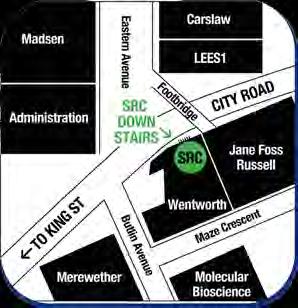
For any information you can’t find in the Handbook, check out the SRC website to contact the caseworker or legal service or drop into the SRC office on the bottom floor of the Wentworth Building (find the stairs outside City Rd bus stop) between Tuesday to Thursday from 9am–5pm.
Keep an eye out for weekly collective meetings and frequent SRC community BBQs and other events that will be advertised on our social media and website. Also please feel free to reach out to us if you have questions about getting more involved! You can contact me via email president@src.usyd.edu.au or on Instagram @gracestreet__
What the Helly is the ?

THE SRC IS NOT THE SRC IS
A Militant Union
The USyd SRC is Australia’s strongest undergraduate student union with a radical history fighting for both your education and justice (check out page 22 for Ava’s article explaining unionism)
Apartheid Free
The USyd SRC is offically an Apartheid Free Zone (AFZ) committed to refraining from providing any kind of support to Israel’s regime of oppression in line with BDS.
Democratic
Every year the student body elects a President and councillors to run the SRC. For every 1000 students, there is one councillor.
Independent
Independent of the University we are student controlled and operated.
Proactive
Every month there is a council meeting to guide the direction of the SRC with discussions and motions.
The USU
The USU (University of Sydney Union confusing I know) is responsible for clubs, food outlets, events and the party side of Uni.
For Postgrads
That’s SUPRA!
A Waste of SSAF
Many courses you take for granted were won in hard fought battles alongside staff with the SRC. In 2026, with staff bargaining we’ll be right there to fight for our education.
Caseworkers Legal Services Contact Us
SRC Caseworkers assist students with academic and welfare issues. We provide FREE, independent and confidential advice & support including:
• Academic rights & appeals
• Special Consideration & special arrangements
• HECS & fee refunds, Academic misconduct & dishonesty allegations
• Show Cause & Exclusion
• Centrelink
• Financial issues
• Tenancy & accommodation
• Harassment & discrimination
Have you been arrested? Do not fret! The SRC is here to help and protect you providing undergraduate students with FREE legal advice, representation in court, and a referral service. We can assist you with a wide range of legal issues for example:
• Police & Court Matters
• Traffic, transport offences and fines
• Employment law
• Consumer rights
• NCAT matters
• Immigration and Visa advice
• Witness / Certify documents

Location
Vince
SRC Collectives
Tafea explains what your right wing uncle assumes every USyd student is up to (I wish bro)
SRC Collectives...
are the bread and butter of the USyd SRC and student led activism. They have officers elected every year who convene organising meetings typically held fortnightly. They offer a great opportunity to meet likeminded individuals and develop both as a person and politically.
USU societies... are different and best serve as a way to socialise. The collectives are explicitly and unapologetically political, independent, and left-wing.
Should you join?
If you are going to get involved in activism then you chose the right uni. I can say that it’s been the best part of university life for me.
Environment Collective
Types of Collectives
The collectives on this page welcome all students with the Education Action Group being consistently the most active because the university is constantly trying to cut our fucking courses. That’s where we fight back against the corporate university.
The collectives on page 7 are ‘Autonomous.’ Basically, the activism centred by a given collective is by those directly affected (e.g., To join ACAR you must be BIPOC). They also function as safe spaces and welcoming communities for these identities with autonomous spaces in Manning for most.

The Enviro Collective is a leftwing, activist group organising on unceded Gadigal land at the University of Sydney committed to fighting for intersectional climate justice. Against the backdrop of the ongoing genocide in Gaza and the reckless expansion of coal mines in so-called Australia, science warns us that irreversible climate tipping points are now inevitable. As a very real existential threat looms, the time to fight for climate justice is now and is a matter of survival. Join us as we build an activist community around an issue which impacts us all. Stay tuned for what’s to come!
Environment Officers
I still don’t get ‘Autonomous’...
Analogy: If there was an Autonomous Leech Collective, then you would have to be a landlord to join.
Education Action Group
To get involved... check out their instagrams, show up to an organising meeting, or even apply to edit their special autonomous Honi Soit editions (see page 8)

The Education Action Group (EAG) is an activist collective dedicated to fighting for a free and quality education. In 2021, we successfully resisted the University’s proposed abolition of the schools of Theatre and Performance Studies and Studies in Religion.
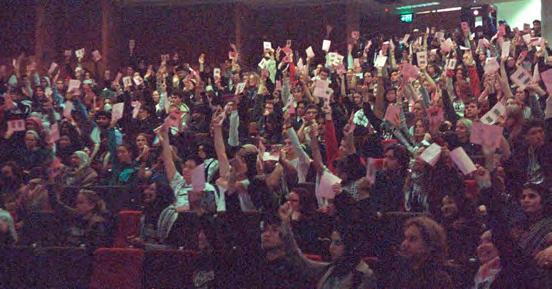
In 2022 and 2023, we organised a solidarity campaign with the staff union (NTEU) as they went on strike for better pay and working conditions, mobilising student contingents to participate in the picket lines. In 2023 and 2024, we highlighted our University’s investments in weapons companies that are complicit in the apartheid and genocide in Palestine. We organised the Gaza Solidarity Encampment, and the Student General Meeting, which saw over 700 students vote to call on the University to cut its ties with Israel and support Palestinian statehood. In 2025 and heading into 2026, we are continuing our campaign to support free speech on campus, which has been under threat from University management. Our movement is only as strong as our members, so we hope to see you around!
Welfare Action Group
The Welfare Action Group (WAG) campaigns for students rights and social justice through the USyd SRC. Previously we’ve been involved in organising the USyd Gaza Solidarity encampment to call for the university to cut ties with Israeli genocide as well as campaigns to call for affordable student accomodation on campus. We’re excited to continue representing students this year by standing up against uni management’s proposed course and job cuts alongside the EAG. Flick us an email or stop by the SRC stall anytime during Welcome Week to say hi!

Aria Nadkarni & Lucas Pierce
Connie Wong & Deaglan Godwin
Officers
Dana Kafina & Jasmine Al-Rawi
Imane Lattab & Pimala Leo
Queer Officers
Wendy Thompson & Jesper Duffy

Autonomous Collective Against Racism Disabilities Collective
The Autonomous Collective Against Racism (ACAR) is an activist organising space at the University of Sydney open to students who identify as Aboriginal and/or Torres Strait Islander, who come from a minority ethnocultural background, who are marked/marginalised by white supremacy, or who identify as a ‘person of colour’.
ACAR’s core values are anti-racism, anti-colonialism, and anticapitalism. We recognise the need to dismantle the unjust, interwoven systems of imperialism and capitalism. ACAR actively works with and alongside other activist organisations on and off campus, understanding the importance of solidarity in the fight for the liberation of all oppressed peoples.
We actively work to centre First Nations voices and struggles in our activism, especially as we continue to organise on stolen, unceded Gadigal Land. This involves supporting campaigns like “Land Back” and “Stop Black Deaths in Custody”. ACAR has always and continues to advocate for the selfdetermination and freedom of all Indigenous and/ or marginalised ethnic groups across the world, including but not limited to the people of Palestine, Sudan, the Congo, and West Papua.
Queer Action Collective

The USyd Queer Action Collective (QuAC) is a student activist group fighting for queer liberation on and off campus. Last year, we exposed the University’s transphobic and anti-refugee ‘Campus Access Policy’, which attempts to suppress political dissent by threatening students’ enrolment. We then successfully challenged the University’s suspension and deportation of an transgender, asylum seeking student. We also challenged the Labor Party’s careless outing of a queer student and got Sydney Gay and Lesbian Mardi Gras’ policies changed to better protect at-risk youth.
We organise rallies for trans justice, co-hosting Trans Day of Visibility and Trans Day of Resistance, and hold queer contingents to protests in solidarity with Palestine and to counter the racist far-right on our streets. We host educational forums and movie nights to raise awareness around police abolition, transformative justice, and sex workers’ rights, and we fight transphobia, Zionist pinkwashing, rape culture, and anti-sex work bigotry on campus. We will continue these fights on and off campus, including at NTEU strikes this year, and hope you will join us! Find us on Instagram @usydqueer or fortnightly in the Queerspace and on Zoom.
Disabilities Officers
Kayla Hill & Remy Lebreton
Women’s Officers
Avin Dabiri & Maxine McGrath
and Caregivers Network

The Disabilities Collective and Caregivers Network (aka DisCo) is an autonomous collective for students with disabilities and student carers. We are staunchly anticapitalist and antifascist, organising for disability justice amid inaccessible medicare, NDIS cuts, and poor working conditions for doctors and nurses. Join DisCo for some staunch campaigns, organising meetings, political workshops, and community events. BTW, we have a cool room for studying, chilling, or a little nap called the Khanh Tran Room on Level 1 of Manning House which you can apply for access to via QR code.
Women’s Collective

The Women’s Collective (WoCo) is a socialist, feminist collective organising on unceded Gadigal land of the Eora nation. Grounded in intersectional, anti-capitalist politics, we understand feminism as inseparable from struggles against colonialism, and racism. We foreground the struggles of our queer and sex worker members and allies. Our work centres on collective resistance and transformative justice through activism, education and creativity. We organise around issues including sexual violence on campus, Abolishing the Colleges, First nations justice, reproductive autonomy, femicide and global liberation movements - such as continuing the fight for Palestine. WoCo is an autonomous space open to students committed to collective feminist action. Get involved by following and messaging us on Instagram @usydwoco.
International Students Collective

Intl Students Officers
Anu Khulan
Xiangyuan (George) Feng
Lucas He
Aoyue Cao
The International Students Collective (ISC) is dedicated to strengthening representation and building a safer, more inclusive community for international students at USyd. Through hosting social events, offering advice and assisting with academic and tenancy related matters that may require legal guidance, we aim to help international students feel supported, treated fairly, and at home within the community. We recognise the challenges and injustices international students face studying abroad in Sydney. We actively advocate against inequalities such as the lack of access to opal concession cards and affordable student accommodation. As a collective made up of students from diverse backgrounds, we are committed to creating a community where all international students feel safe.
Interested in gaining experience in community building? Would like to stay connected and join us at social events we host throughout the semester? We warmly invite you to follow our socials or apply to become a member.

Publishing since 1929
PORTRAITS OF TWO GOATS FOUND IN HONI OFFICE
WHAT IS HONI SOIT?
By BURN FOR HONI
Honi Soit is the University of Sydney’s weekly student newspaper. We publish news, political analysis, cultural criticism, interviews, reviews, fiction, and much more. The newspaper is edited by students, and all students are welcome to pitch a piece or apply to become writers for us.
By writing for Honi Soit, you will help continue the legacy of USyd’s radical leftwing student newspaper. In 2026, we continue to witness governments across the globe, including ours, continually disrespect human rights and international law. It is important we remain critical as student journalists and continue Honi’s fight for the rights of all people across the globe, especially in the face of increasing repression and censorship.
Honi was created to serve as a counter-narrative to mainstream and conservative media. Honi aims to centre student voices, and revolves around the lives, experiences, and voices of students like you. Honi is a space for students, by students. We can’t wait to shape the next year of Honi with you!
With love, your Honi editors: Maddy, Anastasia, James, Kuyili, Ramla, Kiah, Marc, Firdevs, and Sebastien.
Grab a copy on news stands

How Does One Be An Honi Editor?
By MOP FOR HONI
Every year a fresh new team of up to ten USyd students are elected to edit Honi Soit. As part of these elections each team completes a quiz, interview, and debate organised by the incumbant team. They then get out on eastern avenue and make their case to students. However, if there is only one team that applies they get elected uncontested which is boring asf. The incoming 2026 team BURN went head to head with FLASH in which we saw plenty of fun stunts and moments. We even saw a ‘joke ticket’ MOP join in on the fun with his viral social media campaign.* That was

the first contested campaign since CAKE beat DRIP to edit for 2022. I’m hoping that by including this in the handbook we can see more elections. Will we see you in the 2026 elections?
By VINCE TAFEA
Whilst a given year’s Honi Soit team is responsible for most weeks of the year, there are four special ‘autonomous’ weeks in which an edition is made exclusively by a collective (see page 7). You can pitch articles for these editions or even apply to be an editor. Below are the weeks that editions are released and so any application would be well in advance so keep an eye out on their instas.
ACAR Semester 1, Week 5
QuAC Semester 1, Week 8
DisCo Semester 2, Week 4
WoCo Semester 2, Week 10
@MOP4HONI PHOTOGRAPHY
PIcTuRed AbOve Is cOMRAdes KHANH ANd LeNIN. THe LATe KHANH TRAN (1996–2025) Is ARGuAbLY THe GReATesT HONI edITOR Of ALL TIMe
W O W T H A N K Y O U
Clubs & Societies
What are they?
Clubs & Societies are organised and funded by the USU which is also funded by you through SSAF! They are a great way to get involved in university life and often a place you can make some lasting friends during your studies.
Should I join one?
‘Joining’ is easy and usually free via the USU app. You can usually find what they’re doing on their instagrams. It’s not alot of commitment either, just go to some events get some free drinks n food, and see if there are chillers. There are a very wide range of experiences you can have and it’s worth sussing a few societies out. If you want to invest more you can apply for a role in the society.
Applying for a role
Every year societies have to elect a team at an annual general meeting. Some societies are honestly quite small and can function as a close knit group of likeminded individuals. This can be cool and a way to find your people at university. Others are quite big which has it’s own strengths in being highly active.
Is there _______ Society?
There are so many different ones but not all of them are necessarily active. If nothing you want is there like a Kehlani Appreciation Society, you can apply to register a club with the USU! It’s a long process but I’d join that!
‘Stacking’
Stacking is when you bring all your friends to a society to ensure an election for a society ‘goes well.’ For the great majority of societies you do not need to do this and it really isn’t that deep bruh. Get involved, be normal, make friends, and you will probably get a society position.







SPOTLIGHT
Sydney University Radio Group (SURG)
A student run radio in which you can apply for a regularly scheduled time to broadcast. They run a ton of fun and events and the vibes are immaculate. I heard @yearn.fm was good.
Film Society (FilmSoc)
Est 1947, Film Society (FilmSoc) is for enjoyers of world cinema. Come every week for free pizza, a movie and talk about it at the pub after. There’s also the occasional director Q+A!
PULP Magazine
Student magazine that you can pitch art, articles, videos and more for, but if that’s not your thing you can just go to all of their launch parties with good music and a bar tab. Shout out to Sophie W!
Social Dancing Society (SDS)
If you’re looking for a way to get to know people and also get some exercise in at the same time while jamming to groovy music, this is the club for you! Try their weekly Salsa class, first ones free.
Sydney Pan-African Association (SPAA)
Looking to expand your social circle, celebrate African culture, and have a great time? This is the society for you with some great food and events. They also do a ton of fun cross-cultural events!
PPE Society
Bachelor of Politics, Philosophy, and Economics (PPE) is a new USyd degree and it’s motivated an enthusiastic new and active society. Come along to meet other PPE student or just to socialise!
AVOID AT ALL COSTS!
Liberal Club / Conservative Club
Pretty much the exact same group of people in both clubs but I don’t think the Liberal Party is long for this world ngl... may be rebranded for one nation soon. Extremely right wing and gross in the current political climate and vehemently opportunistic running every year in the SRC elections as ‘joke’ or ‘apolitical’ tickets such as ‘gym bros’ or ‘ban okta’ to obscure their affiliation.
A Welcome From Faculty Socs
Faculty Societies
These societies are the biggest on campus and thus usually the most active. Their relationships to the actual university faculties themselves can fluctuate. Overall it can be a good idea to join and see what they’re like in addition to some hobby societies.
Other big faculty socs include Sydney University Business Society (SUBS) and Sydney University Law Society (SULS).
The Conservatorium Students’ Association (CSA) is the representative body of students of the Sydney Conservatorium of Music. The Conservatorium is a home to diverse body of students studying a wide range of practices. We aim to support and empower these students, at the Greenway Building and at various sites across Sydney. We represent students on Con committees as well as the National Music Students’ Forum and the Australian Music Students Association. We are dedicated to creating a sustainable industry for students by working with Musicians Australia, a musicians union. We honour First Nations and other musical traditions, through our First Nations and Ethnocultural offices. We also provide assistance for women and gender-diverse students through our Queer and Women’s offices, and make the Con accessible and sustainable via our Disability and Environment offices.
Hey all, welcome to the University of Sydney!
The Sydney Arts Students’ Society, also known as SASS, is the official society for those studying under the Faculty of Arts & Social Sciences but welcomes anyone studying at USyd! We offer an inclusive environment for all students from all backgrounds and abilities, and endeavour to continue supporting the Arts and reinstating its importance within academia.

We have lots of exciting events coming up such as our annual First Year Camp, welcome drinks, and our annual Ball later in the year, and are planning for more events from pub crawls, parties,
G'day legends - welcome to the University of Sydney!
Conservatorium
and creative events, to academic and career orientated events relating to networking and our three annual publications; 1978, Wattle, and Avenue. We are also actively involved in interfaculty sport each week, bringing together a vibrant team and community for those wanting to meet new people and take the load off the stress of uni. This year we have an amazing and energetic executive team that is really looking forward to welcoming every student, and we would love for you to join us! (It’s also free :)) We hope to see you soon!
Jenna Ritchie, 2026 SASS President

Are you keen to meet new people? Attend all sorts of events? Or just do anything other than study? Well, the University of Sydney Science Society (SciSoc) has it all!
SciSoc is the official society for all science students here at USYD – or literally anyone interested in what we do! Catering to thousands of members each year, we run a large variety of events of every size so that there is something in student life for everyone.

The CSA has been behind the Con Ball, Con Revue, and student performances like First Timers at the OAF. We will further enrich the Con experience by introducing genre-
Whether you’re interested in events that are social, academic, sporty, creative, or just because there’ll be free food (peak uni student experience), SciSoc is for you. Think parties, trivia, pub crawls, BBQs, study groups, you name it.
We’re 100% free to join –come along whenever an activity is speaking to you and make the most out of your university experience!
Much love,
Charlise Gardner, 2026 SciSoc President
expansive performance opportunities, collaborations with local venues and radios, and more.
Jaehyun Kim, 2026 CSA Secretary
The Queen Mary Building
The Queen Mary Building (QMB) is near the RPA, making it a short walk to the Camperdown Campus. Rooms here can fill up quickly but there are opportunities each semester to move in. Like most university accommodation, at the QMB you’ll have your own private furnished room with shared amenities including communal bathrooms on each floor and kitchens on the ground floor.
Regiment
Regiment is located at the end of City Road, placing it on the same street as the university and a very quick walk to most areas of the Camperdown/Darlington campus. The Regiment follows much the same structure as the QMB, but the building is much smaller with fewer rooms.
Darlington House
Darlington House is unique for university accommodation, providing a private room in a shared unit. It is located across the road from Regiment placing it close to the uni and plenty of other students. Darlington house is very limited on rooms so it is best to apply early.
Abercrombie
Abercrombie is more expensive than the previous options (starting at $515 per week), but each room is a studio. Meaning the room comes with a private bathroom and kitchenette. Abercrombie is located a short walk from the Belinda Hutcherson Building, making it close to campus and Redfern station.
Stucco Student Co-op
Stucco is a unique student housing solution, requiring tenants to join committees and do weekly work to upkeep the building. Stucco is competitive to get into, and applicants at most risk are chosen to live there. So, if you’re able to live sustainably at other accommodations it is best to apply elsewhere.
Uni
Accommodation
Accommodation and Living Out of Home
Ava Cavalerie & Will Ryan give you the run down
Accommodation
Finding affordable accommodation is one of the most challenging hurdles students experience when first coming to university. Most private run student accommodations are extremely expensive, while more affordable options can be extremely difficult to get into.
The SRC is Here to Help You
The housing market in Sydney is broken and exploitative. The SRC is here for students who require help with their housing. This applies to ALL undergraduate students, not just those living at university accommodation. There’s a couple important things the SRC can help you with.
If you ever find yourself in a housing crisis, risking homelessness, or in an unsafe situation, we are capable of finding you alternative short-term accommodation while you can get back on your feet.
Facebook Groups
Facebook groups such as inner west flatmates help you connect with other people looking to find a share-house or advertising a room.
It is always important to verify online profiles, meet people in person and inspect the property before signing any agreements or spending any money. If you scroll through some facebook groups there are an array of scams but these are easy to spot and avoid. Think; does this feel right? Should I be taken to a form that requests all my personal information? If a post doesn’t feel right - it probably is a scam.
Renters Have Rights!
It’s important to know your rights as a tenant in the private market. In a city with a hyper-competitive rental market such as Sydney, realtors and property owners use our desperation to get the best circumstances for themselves. If you’re a first-time tenant, it’s always important to read your tenancy agreement and make sure you are comfortable with every detail. For information on your rights as tenants in the private market, visit the Tenants Union of NSW website.

Grocery Shopping
Grocery shopping can often be the worst time of the week, with grocery bills taking up the majority of your money after you’ve paid your rent. ALDI is the best chain grocery store if you want to get the essentials without breaking the bank - it also has frequent items on sale. The reject shop is actually great for cleaning supplies and miscellaneous items you may find you need. Local Fruit markets also have a wide variety of fruits and vegetables that are often half the price of major supermarkets (however you should always price compare before choosing where to shop because sometimes local markets or small stores are twice the price xx).

Facebook marketplace
Facebook marketplace is a top tier place to find second hand items; specifically there are heaps of people selling old furniture and appliances. Most people selling are willing to take less than the advertised price so always low ball a little and say you’ll pay cash. Sellers also tend to put things up for free. Always be aware for scams on marketplace, try to pick up in person and pay in cash to avoid losing money. A common scam is sellers asking for a deposit before you pick up the item, but once you send them the money, they block you.
Op Shops
Stores such as Vinnies, the red cross and salvos are great places to find household items. If you walk into any op shop chances are you’ll find a set of glasses or an old artwork. While some of these stores have become more popular and thus more expensive you can still find well priced items - especially if you go further away from the city
Council clean up days
Visit Suburbs - or even walk around your own area on council clean up days to see if they have put things out they no longer want. This saves items from being taken to the tip and saves you a plethora of money! There are even Facebook groups such as ‘Street Bounty’ that advertise when houses have put items out for collection.
Kmart
If you have been unsuccessful in finding some second hand items Kmart also sells nearly everything for relatively little money. It may not be the best quality and far from sustainable but it is always there if you need certain items (My Kmart kettle is still working after a year).
Financial Supports
Centrelink
Centrelink can provide a regular Youth Allowance payment to fulltime students who started their degree aged 24 or younger. This service provides financial assistance to students who are financially independent and living out of home. The payment varies depending on your individual circumstance and honestly there are many annoying bureaucratic hurdles but caseworkers at the SRC can actually help you out with it.
SRC Loans
The SRC provides emergency loans of $50 to students in need of financial assistance. It also provides calculators and science lab equipment for the day of your exam or lab class; all that is required is that a current USyd student card is presented at the SRC office.
Health Care Cards
Health care cards are available to most students on a centrelink payment, or Australian citizens who earn an average of less than $783 per week.
A health care card entitles you to receive discounted services such as;
• Reduced pharmaceuticals
• Ambulance cover
• Access to free dental care
• Free prescription lenses
Bursaries
Bursaries are available to students who have not failed any subjects and fulfil the requirements. These are used for essential living and study expenses including;
• Textbooks, readers and journals
• Laptops and IT equipment
• Bond and rent payments
• Phone, electricity and gas bills
• Medical and dental bills
• Travel and accommodation costs for compulsory placements
• Childcare arrangements
The university also provides 12 month interest free loans. Only take out a loan if you are going to be able to repay it
Failure to repay will result in financial sanctions that restrict your ability to use the library, see your grades, or even graduate.
Working
Having a bad boss, unfair hours, and too many shifts is a common experience of many workers. If you are working while at university, joining your trade union will ensure your rights are protected individually and collectively. And even better their fees are tax deductible so this kind of makes it like a savings account (girl math)
Consent & Support
Warning: This article discusses sexual assault
University is a time where many people are having their first sexual experiences, or are exploring their sexuality further. This is good and healthy, but it is important to always feel safe and respected in these experiences, and know where you can turn if that safety and respect are violated. This section is meant to give you the information you need about consent, resources for support, and how to help friends, so you can enter university informed and prepared.
Consent
Consent is a clear, voluntary, and ongoing agreement to participate in an activity, requiring active communication, mutual understanding, and the capacity to agree. It must be freely given without pressure, manipulation, or fear, and can be withdrawn at any time. It is an enthusiastic “yes,” not the absence of a “no,” and must be sought for every new action, even within an ongoing encounter, ensuring everyone is alert, sober, and truly wants to participate. As this section is focusing on sexual safety, this discussion of consent is more specifically related to sexual consent, though applicable to other types of consent. This section is meant to give you the information you need about consent,
resources for support, and how to help friends, so you can enter university informed and prepared.
No consent has been given if a person...
• Did not say or do anything to communicate consent
• Does not have the cognitive capacity to consent
• Is affected by alcohol or another drug to the point where they are incapable of consenting or withdrawing consent
• Is unconscious or asleep
• Participates in the act because of force, fear of force, harm, or fear of harm of any type, whether to the person, another person, animal or property, and irrespective of whether it was a standalone incident or a pattern of behaviour
• Participates in the act because of coercion, blackmail or intimidation, irrespective of whether it was a standalone incident or a pattern of behaviour
• Participates in the act with another person because the person is mistaken about the identity of the other person
• Participates in the act with
another person on the basis that a condom is used for the act and the other person does any of the following things before or during the act: does not use a condom; tampers with the condom; removes the condom; or becomes aware that the condom is no longer effective but continues with the sexual act.
Seeking Support
Seeking support and finding help after you’ve experienced unwanted sexual advances can be incredibly difficult. Experiencing sexual assault is never the victims fault, and always an active choice made by the perpetrator. No one deserves to be harmed or have their autonomy violated by others. Everyone deserves to feel safe and supportedin university, and outside. Coming forward is a decision you may choose to make, but it is essential to do what is best for you, not what others think is the right thing to do. Whatever you choose to do, making that decision is incredibly hard, and it can be good to seek support from friends, family or the following resources to help you in the process.
DO DON’T
• Actively and carefully listen to them
• Ensure they know you believe them
• Remind them it is not their fault
• Understand that talking about it can bring back traumatic experiences, and is incredibly difficult.
• Let them guide the conversation and stop whenever they want.
• Respect and allow them space to make their own decisions.
• Don’t ask them why they didn’t say anything sooner
• Don’t judge them based on what happened before the sexual violence or abuse
• Don’t ask why they didn’t try to run or fight back
• Don’t judge them for how they’ve responded to the sexual violence or abuse
• Don’t tell anyone without their consent
On-Campus Resources
Safer Communities Office
The Safer Communities Office offers Trauma-informed support for those who have experienced sexual misconduct, domestic/family violence, bullying/harassment and issues relating to modern slavery. They provide one-on-one support for students.
Hours: 8:30am–5:30pm Mon–Fri
Phone: (02) 8627 6808
Email: safer-communities. officer@sydney.edu.au
Confidential helpline: (02) 8627 6808
1800 SYD HLP
The confidential helpline for The University of Sydney, connecting students and sometimes staff to crucial support for emergencies, safety threats, sexual assault/ harassment reporting, misconduct complaints, and general student concerns, offering 24/7 emergency contact and businesshour support for various issues, including linking to external crisis services like the NSW Rape Crisis Centre.
Hours: 24/7
Phone: 1800 793 457 - for sexual assault support, press 2 and then press 1
Supporting Others
Responding to and supporting someone who has experienced sexual harm can be challenging and, at times, overwhelming. You may feel unsure of what to say or how to help. What matters most is recognising that this person trusts you, and making sure they feel safe, believed, and empowered to come forward. We can never fully understand what a person is going through and how they respond to traumatic situations, so being consistently supportive and showing love and support is essential to supporting people.
The USyd SRC
The SRC’s Caseworkers can help guide and direct you to support resources and through any reporting processes you wish to undergo. The SRC office also has free condoms you are welcome to take, judgement free.
Hours: 9am–5pm Mon–Fri
Email: help@src.usyd.edu.au
Phone: (02) 9660 5222
Counselling Services
The university offers free counselling and psychological services that can help you come to terms with an assault, and help you with your mental health throughout the reporting process.
Hours: 9am–5pm Mon–Fri
Phone: (02) 8627 8433, and after hours and 24/7 by calling 1300 474 065 or by texting 0488 884 429.
In-Person location: Jane Foss Russell Building
Protective services
If you’re feeling unsafe on campus or you’re concerned for the safety of others, call Protective Services. Security patrol officers can assist by escorting you from a building to your vehicle, to the local bus stop or to the local railway station.
Hours: 24/7
Phone: (02) 9351 3333
Royal Prince Alfred Hospital
Royal Prince Alfred Hospital Community Health and Sexual Assault Service provides free and unlimited counselling and responds to the needs of individuals aged 14+ who have experienced sexual assault.
Hours: 8:30am–5pm Mon–Fri
Phone: (02) 9515 9040
Address: King George V Building, 67-81 Missenden Road CAMPERDOWN NSW 2050
1800 Respect
24/7 free counselling to support people impacted by domestic, family or sexual violence.
Hours: 24/7
Phone: 1800 737 732 to call, 0458 737 732 to text
NSW Sexual Violence Helpline 24/7 telephone and online crisis counselling service for anyone in NSW who has experienced or is at risk of sexual assault, and loved ones of victims of sexual violence. They provide professional trauma specialist counsellors, telephone and online support, and information and referral to other services.
Hours: 24/7
Phone: 1800 424 017
Rainbow Sexual, Domestic and Family Violence Helpline
For Australians from the LGBTQIA+ community who have recently or in the past experienced sexual, domestic or family violence, and the loved ones of these individuals. They provide professional trauma counselling provided by counsellors who have completed LGBTQIA+ specialist training, and information and referral to other services.
Hours: 24/7
Phone: 1800 497 212
LifeLine
If you are experiencing extreme distress, Lifeline operates 24/7 to provide urgent support and care to anyone in need.
Hours: 24/7
Phone: call 13 11 14 or text 0477131114
Qlife
A telephone and online counselling and referral service for people who are LGBTQIA+.
Hours: 3–9pm, every day
Phone: 1800 184 527
The First Year Odyssey
Ava & Sophie reflects on their first year of uni last year
Ava Starts
We enter university with the taste of freedom and opportunity on the tip of our tongues. We leave the struggles of year 11 and 12 with eyes wide open, after all, how many times have we heard “year 12 is the hardest part; university is nowhere near as hard” and in many ways, that’s true. University gives us freedom, friendships, and new experiences. It offers the chance to pursue our passions, explore our interests, and develop a genuine love of learning. We meet our best friends and learn about people who have lived lives we have never understood. But it does not come without its own academic challenges.
For many of us, these freedoms become overly exciting and we slowly forget that we actually have to do our readings and attend our lectures. The reality is hanging out with friends, juggling casual work, or even just doing the laundry can take priority, and before you know it, the idea of escaping academic stress fades into disillusionment. I won’t deny that sitting in Victoria park or going to Hermann’s happy hour (which is specifically early) sounds much more appealing than sitting in a packed lecture theatre.
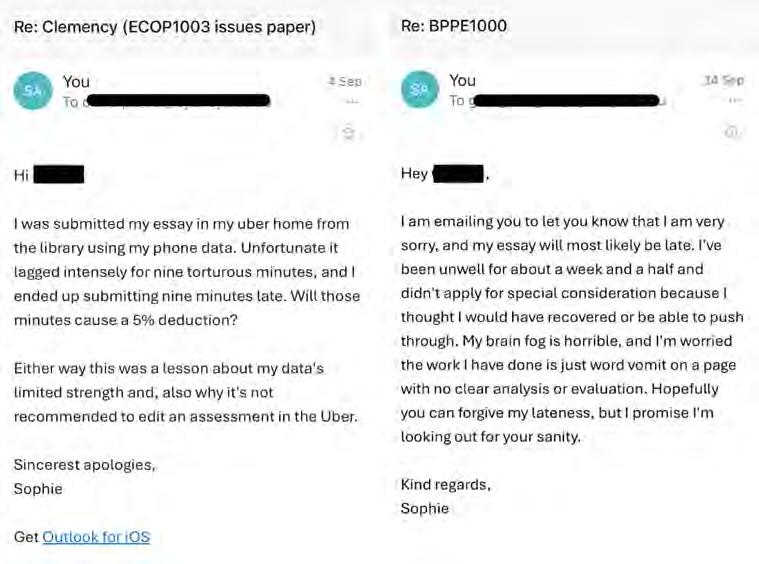
Sophie, now a second-year student, offers insight into what this can look like in practice. She reflects on submitting assignments late, having to bed for redemption. As she instead chose fun over function (which, in all honesty, I was a part of).
Sophie’s Insights
Hey guys, I’m Sophie, and unfortunately, I am no stranger to procrastination. In my first year of uni, I learnt about many new and interesting things, especially just how late I could leave things before absolutely needing to start them. My first year consisted of choosing to hangout with my friends rather than catching up on missed lectures, readings and course work (Nor did I ever start my assignments early).
While I had fun during the term, every time there was an essay due my procrastination meant a loss of sleep, insane stress and degrading (?) emails sent to various tutors and unit coordinators hoping they wouldn’t deduct the 5% late penalty for submitting at 12:05 AM.
Thankfully, if you find yourself struggling to keep up, you are not alone. Help is abundant and available, and the SRC is here to support you.
1) Set up your unikey and uni email, and write them down
2) Use your faculty handbook found online to find degree requirements and plan your units of study
3) Log into Sydney Student to enrol, select units, and more
4) Find an email with Allocate+ to put in preferences for your semester timetable
5) Submit a photo for your student ID and pick it up at the Student centre.
6) Check out Canvas after you enrol to find your units.
7) Check the location of your classes using your timetable.
8) If you want or need to apply for Disability Service, complete the Inclusion and Disability Service Request application through the Wellbeing Portal.
10) Make some friends!
First Year? Ya Gotta
Know...
Simple Extensions Disability Services
A simple extension is an automatic 5-calendar day extension on an individual, non-exam assessment. The simple extension is loved and cherished by all students (despite the university threatening to reduce it every year). It is not available for all assignments though so check your unit of study outline. It is so beloved because (as of writing) you only need to submit a student declaration of why you need it and it gets accepted automatically on submission.
Apply through the special considerations portal on or up to five days before the deadline.
If you have a long term (4 weeks or more) disability, or ongoing primary carer responsibilities, you can apply for support. The Inclusion and Disability Services can help you create an academic plan to successfully complete your degree with any reasonable accommodations. If your disability exacerbates around the time of an assessment, even if you have a Disability Plan and have already been provided with an adjustment, you can still apply for special consideration. The system can be confusing so dont hesistate to book an SRC caseworker!

Special Considerations
If you need more than a simple extension, for example, you have been severely impacted by illness, injury, or other serious misadventures for a period of less than four weeks. You can apply for special consideration for any impacted assessment, including assignments, attendance and exams. This will provide you with flexible arrangements to be able to complete and catch up with coursework.
Applications are due within 3 working days, no later than 11:59 p.m. on the third day of the original due date. You must have supporting documents, whether from a psychiatrist or a doctor.
If you have qualified for special considerations, the results vary depending on who your course coordinator is and the extent of time you were affected by your circumstances. Keep in mind, however, that these forms of special consideration involve a much longer process and are more often unsuccessful. Special cons can only be awarded in genuine times of need, not experiences like Sophie kindly outlined on page 16.
Census Date
Census date is the last day you can drop a unit without incurring financial or academic penalty.
Semester 1: 31 March
Semester 2: 31 August Grab an SRC wallplanner to stay on top these dates & more! (No seriously, or at least have a digital calendar because you DON'T wanna miss dates.
The Shared Pool of Majors (Table S)
Vince Tafea shows you a world of possibilities
American Studies
Ancient Greek
Ancient History
Anthropology
Arabic Language and Cultures
Archaelogy
Art History
Asian Studies
Chinese Studies
Criminology
Cultural Studies
Digital Cultures
Diversity Studies
Economic Policy Analysis
Education Studies
English

Finance
Accounting
Banking
Business Analytics
Business Information Systems
Business Law
Industrial Relations and HR Management
Innovation and Entrepreneurship
International Business
Management and Leadership
Marketing
Anatomy and Histology
Applied Medical Science
Biochemistry and Microbiology
Environmental, Agricultural and Resource Economics
European Studies
Film Studies
French and Francophone Studies
Gender Studies
Germanic Studies
Hebrew (Modern)
History
Indigenous Studies
Indonesian Studies
International and Comparative Literary Studies
International Relations
Italian Studies
Japanese Studies
Jewish Civilisation, Thought and Culture
Korean Studies
Latin
Linguistics
Modern Greek Studies
Music
Sanskrit
Socio-Legal Studies
Sociology
Spanish and Latin American Studies
Studies in Religion
Theatre and Performance Studies
Visual Arts
Politics
Philosophy
Political Economy
Economics
Econometrics
Environmental, Agricultural and Resource Economics
Financial Economics
Computer Systems
Design
Digital Music

Biology Chemistry
Computer Science
Data Science
Discrete Mathematics and Algorithms
Ecology and Evolutionary Biology
Environmental Studies
Financial Mathematics and Statistics
Food Science
Genetics and Genomics
Geography
Geology and Geophysics
Health
History and Philosophy of Science
Immunology
Immunology and Pathology
Infectious Diseases
Marine Science
Mathematical Modelling and Computation
Mathematics
Medicinal Chemistry
Microbiology
Neuroscience
Nutrition Science
Pathology
Pharmacology
Physics
Physiology
Plant Science
Disability and Participation
Hearing, Speech and Communication
High Performance in Sport
Physical Activity and Health
Project Management
Sustainability
Urban Studies
Wildlife Conservation
Psychological Science
Psychology (Program)
Software Development
Soil Science and Hydrology
Statistics
Virology
Animal Health, Disease and Welfare
Animal Production
Astrophysics (Program)
Environmental Science
Life Sciences
Medical Science
The Magical Table S
Within this gray space you are reading is the ‘Shared pool’ aka Table S the ‘general degrees’ like B Arts, B Commerce, B Science, you must take one major from Arts, Commerce, or Science respectively. However, and unique to USyd, you can also take another minor/ major in the shared pool. For example, someone could do a Bachelor of Science majoring in Maths (Science) and English (Shared Pool).
Also a lot of the time the differences between degrees is aesthetic. A Psychology student in B Psychology and B Science can study almost the exact same unity and also get into honours. A student double majoring in Maths/English is going to do the same units required to complete those majors regardless of if it’s in B Arts or B Science. What’s different is core units and degree requirements (which I highly suggest you look into, because it’s a bit too common an occurrence of people messing it up).
What I did in first year is that whenever I wanted to procrastinate, I planned my degree to feel like I was doing something. This genuinely really helped me. Those who fail to plan, plan to fail.
Faculty Handbook
Look I’m sure this is a bit redundant because this mentioned earlier in the book but it cannot be stressed enough. Do not take the ramblings of one psychology/statistics honours student as gospel. Look into your degree requirements.

What is a Credit Point (CP)?
Every unit has a CP loading and 24CP represents a full-time study load. Most units are 6CP so you will be taking four of them each semester if you’re an international student, or three if you’re like me and want to be eligible for centrelink whilst also working
What is the difference between a major and a minor?
A major is 48CP and a minor is 36CP of coursework. They involve a collection of 1XXX, 2XXX, and 3XXX levels units you must complete. A major also appears on your testamur whereas a minor doesn’t.
Is a double major more work?
Not necessarily. If you have 12 CP of elective space you can usually use this to turn a minor into a major. So really it just determines WHAT you will be studying rather than how much. I suppose you could use those 12CP to instead do fun and piss easy first year units though!
What is a program/ stream?
What is a stream?
Looking into this there is no single answer. In some instances it’s like super mega program with EVEN MORE units, and sometimes it changes what units you take (e.g., Advanced stream you take advanced units, Dalyell Stream you do Dalyell units). In any case, read your handook this is no substitute
Wait so if I can study a double major in statistics & english in both a B Arts or B Science, what’s the difference?
So for both majors you will be taking the exact same collection of units 48CP + 48CP. However, degrees themselves have core units you must complete. Sometimes this can be to your advantage such that the degree core units can function as units for your major (e.g., DATA1001 in B Science can be a core unit for statistics or data science) and this would leave you with more space for electives and flexibility!
Vince, I messed up my degree because of you
That’s not a question
A program is an extension of a major with more than 48CP. For example, the Psychology program is 60CP whereas the Psychological Sciences major is 48CP. Many degrees revolve around taking a particular program such as Bachelor of Science (Medical Science).

FUCK, I Got Group Projects...
Vince Tafea prepares you for some canon uni events
There comes a time in every university student’s life that they must do group work. For some it comes sooner and more frequently than others. My condolences. Okay, I’m exaggerating a bit, I actually think group projects are a genuine opportunity for character development. If you are in any way interested in how well you do at university, you will likely be praying that people step up and show initiative. In fact, you should probably expect to be that someone for your own sanity. I myself don’t consider myself someone ‘naturally’ interested in leading but, over my undergraduate degree, it was necessary.
USyd seems to be focusing on the concept of ‘interdisciplinarity.’ With this we were blessed with majestic Table S (see page 18). Unfortunately along with the light came the dark with the dreaded ‘interdisciplinary project unit’ that is a requirement of most majors. A shiver runs up the spine of every recent graduate when you mention SCPU3001, FASS3999, etc. Almost every person I have met has said that these were the worst part of their degree, so look forward to that twin. And it’s honestly kind of the biggest scam ever. We as students pay money to do a group project unit that we must complete for our major. You also must submit a waiver that hands the rights of whatever work you do over to the ‘partner’ or company. Like bruh bffr.
1. Choose the intensive version
Allows for degree flexibility and to get it over with fast.
2. Consider the advanced unit
The types of people that choose advanced units are on average more interested in their studies and how they do. My best group projects have been with a bunch of sweatlords (incl. myself) in DATA1901 and DATA2902.
3. Specialise bruh
Some units (e.g. Statistics) give you a choice between a specialised (STAT3888) and a generic (SCPU3001) unit. The specialised unit is something you’ll atleast be more likely to learn SOMETHING from (unless learning bullshit consultant jargon and saying the word ‘complex’ a million times is up your alley) .
4. Shared grief is half the sorrow
Some units allow you to choose your groups (find this out asap). If you have at least one reliable friend it can be a lifesaver.
5. Be the change you want to see in the world
Look, everyone complains about group projects. But who of us is without sin? Be honest with yourself, and be honest with your group members. Be someone you wish you had on your team. Be proactive. Do more than just the bare minimum. There are a lot of people that will see this and act in turn and it’ll expose people who plan to do the scientifically least amount of work.
6. Establish communication
Make a damn group chat as soon as possible. It’s necessary for the project but also like its logs of evidence of you attempting to communicate or get things done and people ignoring you. That will be useful if shit hits the fan. The semester tends to get busier for most people so it’s not the best idea to leave such a basic task like making a group chat until week 4.
7. Establish early on how you will (or willn’t #shakespeare) use AI
Units have provisions around AI and kind of expect you to use it. We can discuss the ethical implications another time, but with respect to the group project, you gotta establish how you are all going to use it. If you use it lazily you will (and should) get destroyed by your group.
1. People are Rough Around the Edges - Lower your standards (Respectfully)
It’s easy to feel driven by the need to hold ourselves to the highest standards at all times. While that pressure can push us to strive for more, it can also seriously damage our experiences of ourselves and university.
Some weeks will naturally involve lower productivity, missed lectures, or an unclean room. This is not a moral failing. This is your sign to recover, relax and give up on living your life like a Linkedin success story.
2. Not Everything Deserves 100%
Not all academic tasks require the same level of cognitive or emotional investment. Treating every requirement as equally demanding is neither realistic nor productive. Some things deserve strategic mediocrity.
FUCK, I am Studying & Working and THIS SUCKS...
Ava Cavalerie is fed up Gilmore Girls, a cult classic, paints a romantic picture of university life. When Rory starts uni, she somehow has endless time to read, make friends and actually enjoy her life. University appears as a site of intellectual curiosity, social ease, and quiet joy.
Unfortunately, for most of us, this series of simple pleasures attached to this university life no longer exists.

3. Group your suffering
Batch your tasks.
Today, being a student usually means juggling full-time study with casual work just to afford rent and eat. And while we’re often told that “time management is the solution,” that advice ignores a simple material reality: there are only so many hours in a day. No amount of calendars, productivity hacks, or personal discipline can create time where none exists.
While it sucks, it is not impossible.
Here are some tips to make your life less shit <3
Run all your errands at once Study in blocks
Stack responsibilities so you’re not constantly context-switching.
4. Work smarter, not harder
Casual work is exhausting. Protect your peace.
Set days aside where you are unavailable to work. Do not feel the need to outperform for minimum wage.
Avoid overnight work at all costs (your circadian rhythm deserves more)
5. Missing a Lecture is not a Crime
It is okay to miss a lecture here and there (at your own risk). It is also okay to watch that lecture later at 1.5x speed...
6. You are allowed to change
Your degree, your goals, your politics.
Embrace change, be free and let university flow around you.
7. Don’t compare yourself
Don’t do this, you are a baddie through and through.
Union? Who’s that?
Ava Cavalerie: The world’s injustices drive me mad. What can I, a 20- something year old, do about it?
Introduction
Have you ever had a terrible boss? Felt that your work wasn’t valued? Is government policy failing you? Join your union!
Why should you care?
People are stronger when they stick together, collaborate, and engage in collective action. Unions are organisations of workers who come together to fight collectively for better pay, safer workplaces, dignity, and real political power. Through solidarity, workers organise, take action, and win protections not just at an employment level but across broader society. Unions don’t just respond to injustice; they fight and challenge it. Unions are powerful because they give ordinary people a voice to push back against exploitation, inequality, and political neglect. Many of the rights we get to enjoy today, and perhaps pay little attention to, were fought for and won by people who organised and engaged in collective action.
A History of Unions in Australia
Unions have often been the space where private grievances were articulated as public injustices, and where collective organisation transforms individual frustration into political power.
1820s
The labour movement in Australia began as convict workers resisted brutal punishment, unsafe conditions, and unpaid or underpaid labour. Early organising was often informal, but it laid the foundations for collective resistance against exploitation.
1856
Melbourne stonemasons led a successful campaign for the eight-hour workday. A world first. Their victory
helped establish the principle that workers deserved time for rest, family, and life beyond labour.
1870
Women became active participants in the union movement, forming their own unions in industries such as teaching, clothing, and manufacturing. Despite exclusion and sexism, women organised to demand fair pay and safer conditions.
1901–1918 Australian Federation
Since federation in 1901, unionism has been embedded as a crucial aspect of national life. Australian unions had won working rights and conditions that had not been won in other places in the world. Australia earned its name as the land of the ‘fair go’ or ‘workingman’s paradise’ (White workingman’s paradise rather than anyone else).
Originally, unions were constructed by and for white, male workers, excluding women, Aboriginal and Torres strait islander people and migrants. However, the activism of women and Aboriginal people directly challenged the discriminatory, sexist, and deeply racist structures embedded within unionism. Crucially, these struggles did not merely reform unions; they exposed and confronted the discriminatory, colonial foundations of Australian society itself.
Importantly, this struggle is ongoing: Aboriginal sovereignty has never been ceded, the colonial state remains intact, and the logics of dispossession, exploitation, and racial hierarchy continue to structure contemporary social, political and economic institutions.
1901
The Australian Labor Party (ALP) was formed out of the trade union movement. As working people gained political power, the ALP be-
came one of the first labour parties in the world to gain national office, demonstrating the ability of organised workers to reshape political institutions.
1946–1949 The Pilbara Strike
On May 1st, 1946, Aboriginal pastoral workers across the Pilbara region walked off stations in one of the longest strikes in Australian history, lasting nearly three years. The Pilbara Strike was a heroic act of collective resistance against racism, exploitation, and unpaid labour, and a powerful demand for dignity, fair wages, and self-determination.
1966 Equal Pay for Aboriginal Workers Union campaigns succeeded in securing equal pay for Aboriginal workers, challenging entrenched racial wage discrimination that had long been sanctioned by law and industry practice.
1966 The Gurindji Strike
Later that same year, over 200 Gurindji stockmen, domestic workers, and their families walked off Wave Hill Station, owned by a British pastoral company. Gurindji workers were being paid as little as one-third of the wages of non-Indigenous workers. What began as a strike for award wages became a defining struggle for land rights, justice, and self-determination, exposing the deep racism embedded in colonial Australia.
1980s
From the 1980s, unions faced increasing pressure from privatisation, deregulation, restrictive industrial laws, and the rise of casual and contract work. These changes weakened collective bargaining and shifted power toward employers, but they did not erase resistance, with union membership remaining significant throughout this period.
Why should we care about the union movement?
There comes a point in many people’s lives when injustice becomes impossible to ignore. In these moments, it can feel like no matter where you look, you cannot see the good, purely the bad and the ugly.
However, it is these moments that matter most. You have two choices: one response is resignation. You can allow pessimism to harden into acceptance, letting the world dictate the way you live. Or you can stand up and decide to take action. You must ask yourself: What can I do and how can I use my voice to promote change? What do I want to see change in the world? Where can I find the power to fight for a better future?
These questions challenge us to take a proactive and impactful action, rather than accepting injustice as inevitable.
A Reality Check
Unionism has declined significantly in recent decades, yet we are living through increasingly volatile economic and political conditions. We are seeing rapidly rising costs of living, cuts to education, threats to democratic rights, insecure work and housing, alongside escalating climate disasters. This is why unionism matters today more than ever.
The reality of our system goes as follows: there are people at the top, and then, there is everyone else. Those at the top hold power, authority and wealth, and have no interest in giving it up, let alone helping others get ahead. Rather, they want to fight to maintain their monopoly over our resources, voice, and freedom.
In this system, gains for workers are rarely conceded voluntarily. Protection such as Medicare, the minimum wage, paid leave, and flexible working arrangements were not granted by
benevolent governments or employers. They were secured through sustained collective struggle. Unionism emerged as a response to these power imbalances, through which people demanded recognition to be seen as human, where we each have individual lives, families, rights and our own dignity
This is precisely why unions are attacked: because they disrupt unequal power relations by providing workers with a space to organise, resist, and demand structural change.
Iconic Figures
Muriel Heagney
Men, as it is often presumed, were the wage earners, while women were caregivers who existed purely within the home. We all know this sexist double standard, a standard that Muriel Heagney refused to accept. Heagney became a lifetime campaigner for equal pay for women, a trade unionist and Labor Party activist. Heagney was the first woman to use official channels to fight for equal pay, confronting sexism in legislation and the male centralised union movement. Her work helped motivate the fight for equal pay, helping push through a pivotal policy supporting equal pay in 1941.
William Cooper: Yorta Yorta Nation
William was a mobilising force in the early fight for Aboriginal rights. He was one of the early activists and campaigners in Australia’s history, being part of the Australian Workers’ Union and representing Aboriginal workers in western New South Wales and central Victoria. William petitioned for Aboriginal representation in Parliament, enfranchisement and land rights, going on to establish the Australian Aborigines League. And centralised the effects of settlement, invasion and colonisation of indigenous peoples, organising the day of morning.
Barbara Jackson
Barbara Jackson, a Noongar woman, was a lifelong advocate for Aboriginal rights, justice, and self-determination. She was involved in numerous Aboriginal rights organisations, including the New Era Aboriginal Fellowship Council and the training centre for Work Release Prisoners. Barbara founded the Aboriginal youth training centre, creating pathways for young Aboriginal people to access education, skills, and opportunity. She ewmpowered and inspired young indigenous people, consistently advocating for their rights, dignity and futures.
Aunty Oodgeroo Noonuccal
Aunty Noonuccal was a Quandamooka woman, Aboriginal rights activist, poet, veteran, environmentalist and educator. After serving in the Australian Women’s Army Service during World War II, she became a leading political organiser, writer and political intellectual. While not a trade union organiser, Aunty Noonuccal was deeply connected to the labour movement and its values, becoming a member of the Communist Party of Australia. In 1964, she became the first published Aboriginal poet in Australia, using poetry as a powerful tool to expose dispossession, racism and colonial injustice. Aunty Noonuccal was a key leader in the campaign for the 1967 referendum, fighting for equal citizenship, legal recognition, and national responsibility for Aboriginal affairs.
Conclusion
If this has resonated with you, you are not alone, and you are not powerless. Unionism reminds us that when we organise, we can help make the world a better place.
Some Union Wins

Every year the SRC General Secretaries send out a survey with one purpose and one purpose only: how can we capture the spirit of what USyd students think of their studies? This year looks a bit different because we ran out of time but for more robust reviews check out last year’s as they are still very much relevant
Bip
Digital Cultures: AA
repetitive courses, unsocial cohort
Environmental Studies: AAAA
Sumen
Neuroscience: AAAA
great variety of content from psych to anat to pharm
Mathematics: AAA taught pretty well however was often reliant on little staff for smaller courses
Marc Paniza Political Economy AAAAA
The woke agenda major (and it’s great)
Take ECOP1001 , it’ll change you. If you’re the kind of person who wants to talk about the political and economic state of the world right now, this is your major. Perfect if you love to yap
Politics 3.5/5
Debate prep for your right-wing relatives at Christmas dinner.
You’ll meet genuinely “interesting” people in your tutorials I’ve had some truly excellent professors who made me think differently about the world.
The course offerings for 3rd year can be a bit inconsistent
Maddy Burland
English (Major) AAAA
Jasmine Donnelly
History: AAAAA
Take HSTY2677 for a reality check.
Don’t take HSTY3810, also clapped and boring and it’s not what you think
English: AAAA
Avoid the entire english minor of English to not take ENGL2674... Clapped, boring, attendance strict asf
Jessica Heap
Socio Legal Studies: AAAB
a lot of the subjects merge with Social Policy and its a chore to get through.
Law: AAAA the amounts of readings are a chore and you question choices humans make a number of times.
Ava Cavalerie
Creative, Engaging and Critical.
Politics (Minor): AAA
Heated, Intense, Content-Heavy, Engaging.
Philosophy: AAAA
Lots of thinking, too many non-thinkers. Perfect if you love to yap
interesting, dominant white (ignorant at times) cohort
Anon OT AAA
pretty dry, lots of essay writing and hurdle tasks all happen around the same time, timetables are organised so you have to attend min 4 days a week. Lecturers/ tutors were mostly super helpful and easy to contact
Disability and Participation AAAA again a lot of essay writing and critical thinking, lectures can be interesting tho, lots of lived experience lecturers
Vince Tafea
Statistics: AAAAA extremely competently run major. challenging but very interesting stuff
Psychology: AAAA learn to write a research report. doing this with my other major was amazing.
Imop (Imane) Psychology AAAA all misconceptions of the field will be debunked in PSYC1001, so you won’t need to complete your entire degree to realise that what you actually wanted to study was philosophy/sociology/ neuroscience/etc. units are run quite well for the most part, which deserves its own criteria from unit difficulty. the assessments are known to be quite rigorous. also you get to meet some incredible academics
Data Science AAAA
someone who didn’t fully enjoy maths and was scared of stats & compsci. a very customisable major/ minor. somee of the core units (particularly any of the python/sql ones iykyk) were poorly managed, however they are actively trying to improve and taking student feedback seriously.
Some units...
GOVT1621: Introduction to International Relations (core unit for Politics/ Intl Relations Major)
Dry as hell, not gonna lie. IR was one of the majors I was actually excited about before starting uni, so this was disappointing. Can’t really blame the content since it’s a foundational unit and they have to cover the basics, but still. Shoutout Georgia Peters for making tutorials bearable.
GOVT1641: Introduction to Politics (core unit for Politics/ Intl Relations Major)
Thought this would be a drag - ended up liking it way more than IR. The assignments were actually pretty great and engaging.
GOVT2941: Making Policy in Political Context (core unit for Politics/ Intl Relations Major)
Assignments were excellent. Making a policy draft was genuinely enjoyable - did not feel miserable in Fisher working on this one, which is saying something. Shoutout Vafa Ghazavi.
ECOP1001: Economics as Social Science (core unit for ECOP Major)
This unit made me fall in love with political economy. WAM booster if you don’t mind essays. Shoutout Marty Duckgoated tutor.
ECOP1003: Global Economy: ProductionTrade-Finance (core unit for ECOP Major) The “economy” in political economy. Enjoyed it way more than expected considering I hate numbers. Essay questions were actually thoughtprovoking.
MECO1001: Introduction to Media Studies (core unit for Media & Comms Major)
Uhhhh it was okay? Lots of theory for a first-year core unit - maybe more than you’d expect going in.
MECO1004: Introduction to Media Production (core unit for Media & Comms Major) Highkey goated. You produce a short 5-min doco on whatever topic you want. Met so many awesome people in my group. Adobe Premiere = bane of my existence, but worth it.
ARCO1001: Civilisations of the Ancient World (core unit for Archaeology Major)
I was an archaeology major once upon a time. You get to handle actual artifacts in the Chau Chak Wing Museum. Amazing unit - highly recommend even as an elective.
SCLG1002: Introduction to Sociology 2 (core unit for Sociology Major)
Mixed feelings. Dreaded tutorials because they were boring as hell. Didn’t attend a single lecture but somehow scored my highest ever mark in uni for the final grade. Used to be a WAM booster but got patched with a 40% exam weighting, so your mileage may vary now.
GOVT2112: Introduction to Political Theory Alex Lefebvre is amazing at teaching theory. Fair warning though - there’s SO much theory that it basically becomes political philosophy. Great if that’s your thing.
OLES2210: Succeeding in a PostCrisis World DO NOT TAKE THIS OLE. Seriously. If you need to fulfill a 6-credit OLE requirement, just do an overseas one or literally anything else. Lectures and tutorials were brainnumbing. My groupmates were nice people, which was the only saving grace. That one time during tutorial when someone’s phone went off and played moaning noises from a message their friend sent. Iconic moment. Also, my tutor once told me I have the same name as her dad while I was having a notso-great day, and I genuinely didn’t know what to do with that information. Pretty cool though, I guess? The verdict: Skip it. Your WAM and sanity will thank you.
Imop (Imane mop4honi)
PSYC2012: trust me lil bro just watch all the lectures, do all the tutorial work + practice questions, and ask questions or lurk on the ed discussion. also, the exam will feel like shit but it will be your best mark trust me lil bro.
PHIL1012: this is not the WAM booster it once was trust me and the textbook is expensive as. also please stop taking electives because you think they’re WAM boosters cause why tf would you go into debt for boring ahh units. pls just pick something fun, interesting and that motivates you to study.
WRIT1001: also took this supposed WAM booster (it was) but i actually really enjoyed this unit as someone who missed writing creative essays but decided to sciencemaxx in uni. tutors were really nice and helpful. but tbh there are probably more stimulating first year english/lit units. super chill unit!
SCIE1001: science majors listen up cause this was a rlly fire 1st year philosophy of science unit AND it counts towards 6 credits of your degree core! so if you don’t like maths, this and DATA1001 is gonna be your holy duology. the unit seems to be developing with each year, but it’s still really good! the tutors were super nice and the content was so broad that there was something for everyone!
Sorry it’s quite barebones but we ran out of time and room! again, be sure to check out last year’s unit reviews! or alternatively browse r/usyd
Marc Paniza
In SPAN2621 (Spanish/ Latin American Film) the final was on a film festival that hadn’t finished screening in Sydney with limited info about it or its happenings (I had to go down so many rabbit holes to find the old website for it that hasn’t been updated since 2019). Was so hard to write on and the submission date changed like 3 times.
Vince Tafea asking me to go to Lickits and it was mid asl. (response from vince: its was ironic)
none so far, i simply chill
ANY HORROR STORIES??!@!!!!!!!
If we lived in a socially just world wouldn’t that be boring?” That was said by a fellow student in my first ever social work lecture. A degree all about social justice.
DATA3888
Just the typical bad group members that ghost you.
Yes. A couple times during the exam season the vending machine in Fisher ran out of sugar free redbull. It wasn’t even dark out.
going to any bathroom on campus is a horror story.
If you can avoid sitting replacement exams I would. I had two rescheduled, found out the date a week before and had two other assessments due that week, two due the week after and another two quizzes/assignments due the week after. It was not fun.
Literally every single assessment I’ve ever submitted (my worst was 8 days late). I think I’m shaving years off my friends lives with how disorganised and late my essays are. Please learn from me and submit your work on time
A course coordinator of a unit frequently used AI in class, which sucked because if I’m going to be staring at graphs about the economy and learning about the economic crises, I want to actually learn and not ask ChatGPT stuff. For a major that’s meant to be about the economy and the fallacies of capitalism, it was very disappointing to see people falling right into the latest grift of Generative AI.
Lowkey no
any tips or trick to pass on?
don’t slack, let uni life wash over you in its entirety with community and course content - enjoy learning
Get the USU membership, $30 a year but you’ll save on food and drinks. And don’t go to taste cafe if you want to save money.
Try find a balance between saying yes to fun things and creating memories with your friends and actually doing uni work (and if you figure out how come find me and teach me)
eatclub (restaurant discounts), toogoodtogo (restaurant leftovers), shopback (cash back)
Please take care of yourselves, this is a 13 week semester; if you try to do everything at the start, then you’re going to burn out. Make sure to maintain a life outside of university and definitely spend plenty of time with friends
For cheaper food and drinks, find apps that give discounts on your total, such as EatClub, often during specific times because they want to fill in chairs during quiet times.
Just stay caffeinated if you don’t have motivation. If that doesn’t work, go to the quad and put on a Hozier playlist and try to trick yourself into romanticizing uni. I also sometimes go to my student page and stare at the fees. That usually gets me up and studying.
Forgot about keeping a look out for student deals at restaurants and venues and online, including using student discount websites like Student Beans, UniDays, and Student Edge.
If you take the bus, always walk 1 extra stop back to get on quickly. If at city road, walk like 2 minutes up to the edge of Newtown to catch a bus to Central. If Paramatta road, then the bus stop near the office works to go Central.
Also, you learn more from asking and answering questions in class and building a relationship with your tutor than sitting quietly for 1–2 hours. Trust, it’s way easier to get advice, and then do well, on your finals if you do this.
Be authentic. Don’t let the USyd culture get you down. Be bold, be free.
DATA1902/1002: So horrifying that it was top of the USyd subreddit for a while. The pre-lecture slides (with different content from the actual lectures), which we were expected to view on top of the lectures, appeared to be AI-generated. Poor structuring: the group assignments took more work than their weighting would suggest, were tangential to the lecture context, and required skills scheduled to be taught weeks late in the unit. In week 1, they claimed the advanced lecture didn’t have a recording (despite being dotted in Sydney Timetable), and I had to argue with the staff almost every week to ensure the advanced lecture recording was uploaded, several days after it took place.
Skipping lectures is more addictive than crack, don’t do it
Hermanns Happy Hour
Big thank you to Ellen McGeoch who was my tutor and head tutor for GCST2607 and GCST2610 respectively who is so so passionate gender studies and was so understanding when life hit the fan that she gave me all time I needed for completing my assignments. If you see her as a lecturer and/or tutor, I’d really recommend choosing her for your GCST related classes.
I owe a lot to you, Simon Graham. you are the best teacher at USYD
Brendan Beare, Rebecca Cross, Kurt Iverson, Luka Anderson, (a couple others that I don’t know the last names of… Tommy (ECMT1020), Rafael (GEOS1001)).
Rodney Smith is the best tutor for GOVT1102 as well as an incredible lecturer. Also, Assala Sayara and Sacha Jamieson were amazing tutors and lecturer for SCWK1002. The whole team for SCWK1001 are lovely.
Marty Duck 10/10
Georgia Fagan 10/10
Hasti Saeedi 10/10
Georgia Peters was an insanely awesome IR tutor. Would recommend to everyone. So intelligent in her field and made me interested in IR.
Dr Karl Maton and Professor Salvatore Babones!
DO U HAVE SHOUT OUTS??!!!!!
(love beats hate)
You’re asking me to pick favourites???? I can’t possibly,, I got too lucky and had a lot of really great professors and tutors.
David Brandon Mitchell, Carolyn West and Christopher Hartney (Not philosophy but a studies in religion teacher and is such an enthusiastic character who is truly passionate about what he teaches—there was never a dull moment in his lecture) Also shout out to Jessica Wilson also in the studies in religon faculty because she is such a bright character and was always super willing to stay back and listen to students experiences and what they have to say. You’re amazing Jess!! She also gave us chocolates :))
I owe a lot to you, Simon Graham. you are the best teacher at USYD
Dr Dan Costa from psychology. The GOAT
Wendy Xin, Vafa Ghazavi, Alex Lefebvre, and Martin Duck!
Shoutout my FILM2001 tutor, Audrey Mitchell, she was so good. If you have her as your tutor, congratulations, you’re in for a good semester.
caroline moul and dan costa if you’re reading this you guys are my heroes
also big shoutout to jarrod jones for carrying data2001 by running that crash course in stuvac #legend
Gareth Bryant, Adam Morton, Claire Parfitt, Riki Scanlan, Tanya Pesa, Russell Edwards, Bruce Isaacs
Jack from Media Production and Nick and Alexis from Creative Music Technology
Shoutout Vafa, for having the career of every PPE student
Martin Duck. He was the best and I personally think he did a great job engaging with students, teaching course material and overall guiding us all whilst balancing getting his doctorate.
Vafa Ghazavi (GOVT2941) GOATED
Marty Duck (ECOP1001) GOATED
Georgia Peters (GOVT1621) GOATED
Peter Chen (GOVT3661) GOATED
Alex for every law unit
Naomi Fenton was an aamaaaazing tutor in PSYC3017. Don’t know if Fenton still works though.
REBECCA CROSS <3
LIAN SINCLAIR <3
DIANA CHESTER <3
CONOR SPENCE <3
VIVIEN NARA <3
JUSTIN MILLER <3
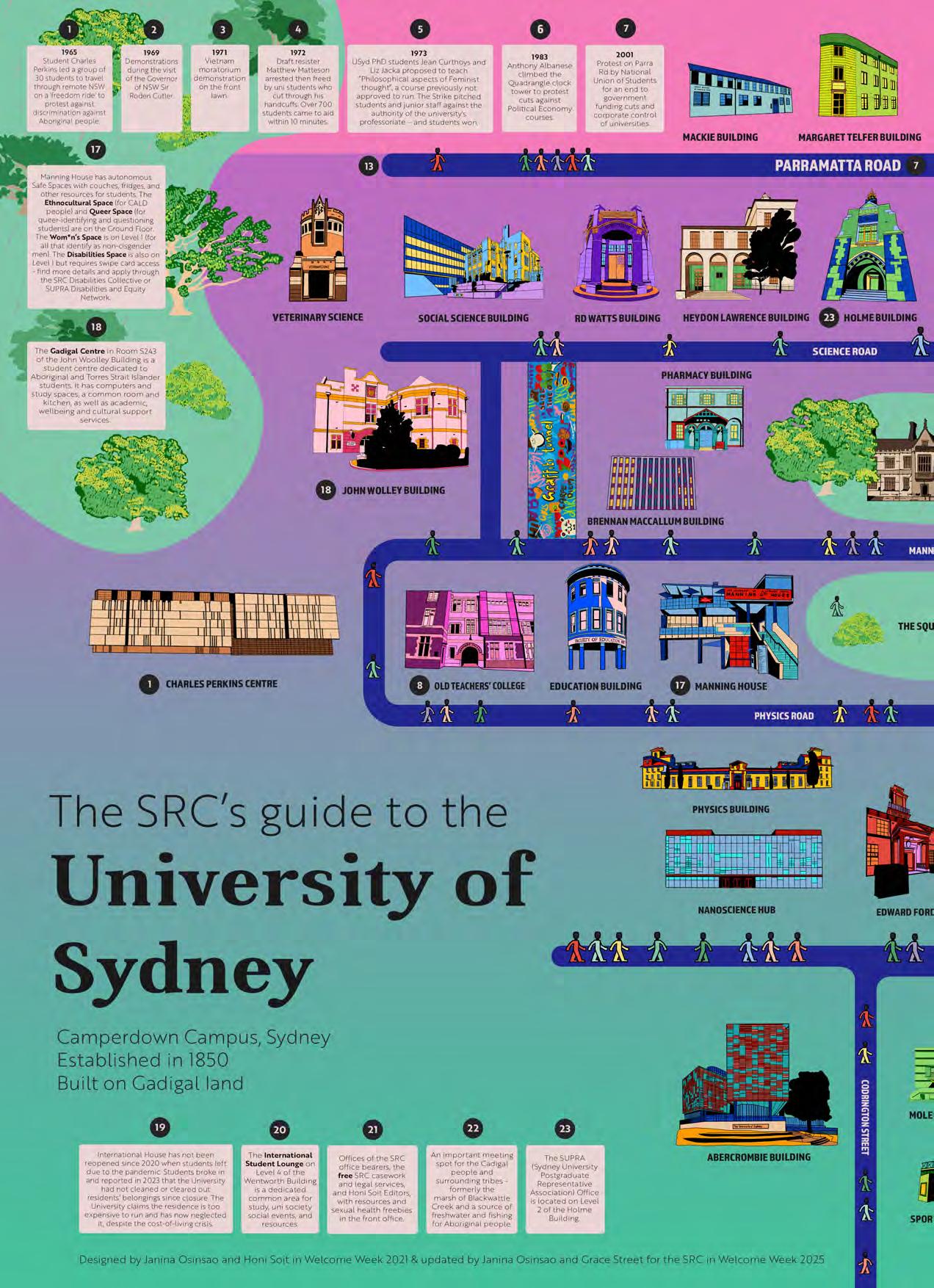
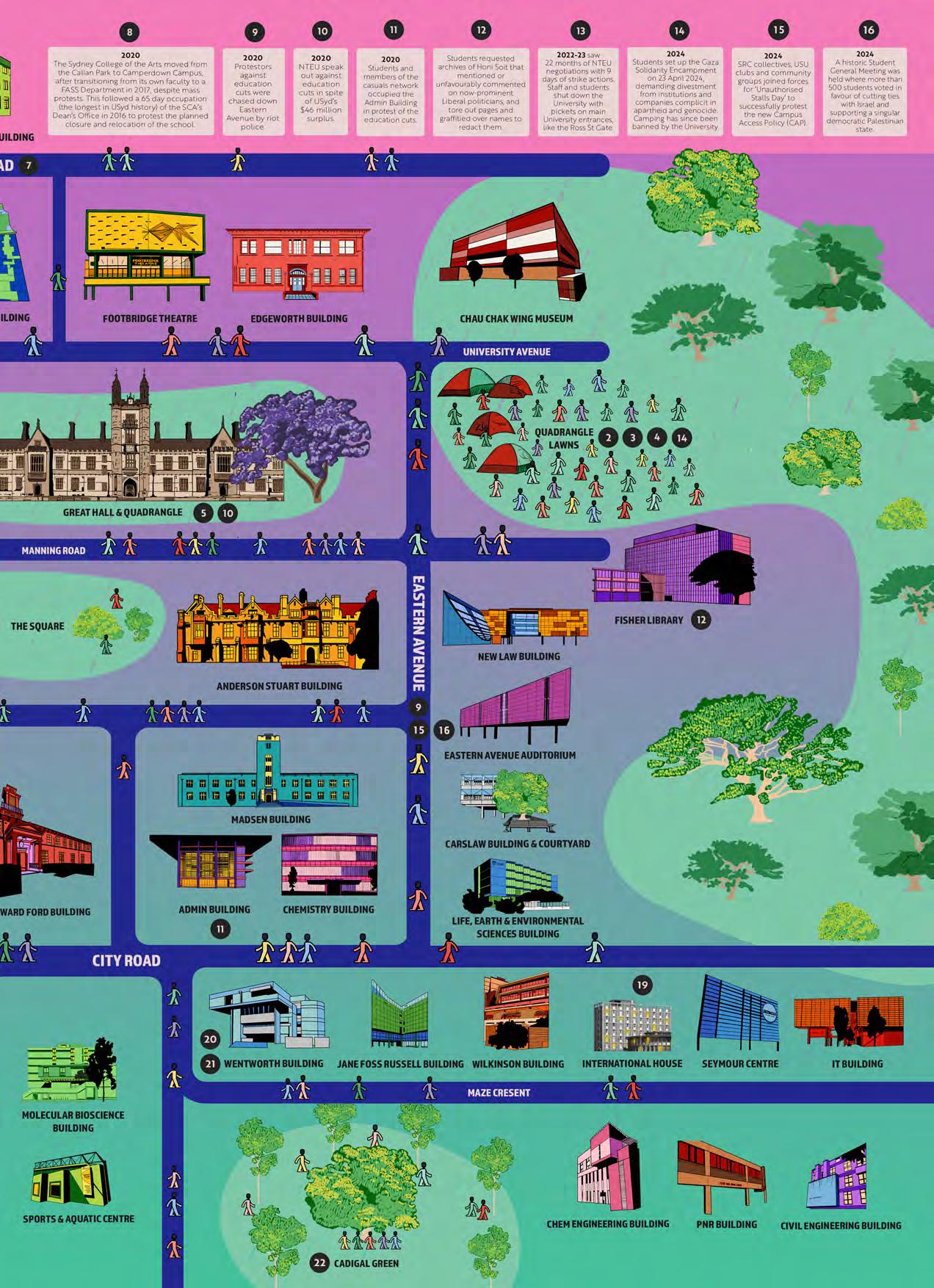
Pubs Around Campus
Ava Cavalerie gives you the rundown
The Royal
Vibe: The only real uni pub. Minimal fuckwittery tolerated
The Royal is a truly beautiful place. It has proximity, price and personality. There are two floors, a pool table upstairs, cheap drinks, and a nice and early happy hour. Mostly filled with USyd students who have purely great vibes. However, we hear one responder isn’t a fan of the strict smoking rules; perhaps the Royal is a sign that it’s time to put the cigarette down and take care of your lungs.

Best time to go: Any day of the week, or every day if you’re feeling bold. The Royal will never let you down. Chill vibes on a Monday afternoon.
Forest Lodge

Vibe: Flodge is where uni life continues well into the evening. Whatever you are craving, Flodge delivers. According to an avid fan Flodge is “The regular venue for a society I’m in; good chips and pizzas; many societies go there, so you might run into a friend you haven’t seen in a while; large back room for larger events”, while another claims it to be “THE uni pub, clubs congregate there after their events, the staff are great and understanding about this and the smokers area is not forcing you out into the cold.”
Best time to go:
Anytime after class, there is always something going on.

Rating out of 10: 7/10
The Rose
Hermann’s Bar

Vibe: Functional but forgettable
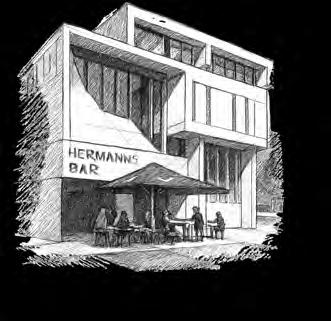
Hermann’s gets a bad rep, and in all honesty, it deserves some of it. That being said, it’s one of those places that’s like a magnet. There will be a time when you find yourself here, and for good reason: it’s close and cheap. One bar attendee claims that they are “Personally, not a fan of the decor or vibes, but it’s good for cheap drinks and events/ socials”, giving it only a 4/10.
Best time to go: Happy hour.
Vibe: A game of pool can always be had here. It has a great open area and is especially good for groups! Smoking is allowed when food isn’t being served, and one of the closest pool tables to campus. Food is decent, and sometimes they have $6 schooners before 6 pm. Good vibes overall.
Best time to go: Thursday afternoon
7/10 9/10
The Bank + Birdcage
Vibe: Two bar attendees share their thoughts and feelings; The Bank has great vibes with a nice outdoor area. It’s nicely located near Newtown station, and it has super awesome staff; Each bar has a different vibe, so it kinda gives you anything you’re looking for. Hot staff. The drinks are painfully expensive Birdcage, its weekly Wednesday night event, is for the girls and the gays who love a bit of drag. However, you will be waiting in line for a lifetime before entering and realising the venue is tiny and packed (Arguably, this is a worthwhile time despite the wait).
Best time to go: Wednesday/Saturday

Newtown Hotel

Vic On the Park
Vibe: Perfect spot to drink, only one pool table, but on weekdays it’s not too busy, and the People’s Burger truck right next door is open late and has great end-ofnight food. They have Bleachers for everyone to sit on and a basketball court for all the basketball lovers. If taylor swift was in newtown she would be there…. Haha. Get it.
NOTE: if there’s a big group, make a booking, or you will be forced to stand in the centre of the basketball court.

Best time to go: Weekends and whenever it’s sunny and warm. They have live music, so it’s always worth checking it out if you are a music lover. 2/10 9/10 7/10
8.5/10
Courthouse Hotel
7.5/10

Vibe: Amazing outdoor area, one of the slightly more secluded Newtown spots with the Camperdown Memorial Park right nearby. This is a university student hot spot with impeccable vibes 24/7. It is mostly outdoor seating, so if you ever find yourself leaving the library and realise you’ve missed another day of sun, and are feeling desperately in need of some sun. This is the place for you. One Bar attendee preferred the Courthouse Hotel, claiming that they’re “lazy and don’t like campus”
Best time to go: Literally any early afternoon.
Vibe: Very cool upstairs aesthetic, and the leopard print pool table is iconic. Comes with a beautiful view of King Street to watch all the artsy baddies walk past. One Bar attendee reports: The leopard print pool table can really mess with your pool game, but it’s not a bad pub overall! Has a really nice upstairs patio, which is great for a beer and a cigarette!
Best time to go: This is where you want to be if you are aiming to avoid crowds of people. Some say the leopard print pool table helps throw off your friends who are impeccable pool players.

Vibe: Sad, Cold, Ghostly. If you’ve ever wanted to feel like the last person alive on earth, manning is your place.
Best time to go: As rarely as possible. Unless there is an event. I have nothing else to say. Apologies to all the Manning lovers out there (though I doubt your existence).
Thanks For Reading!
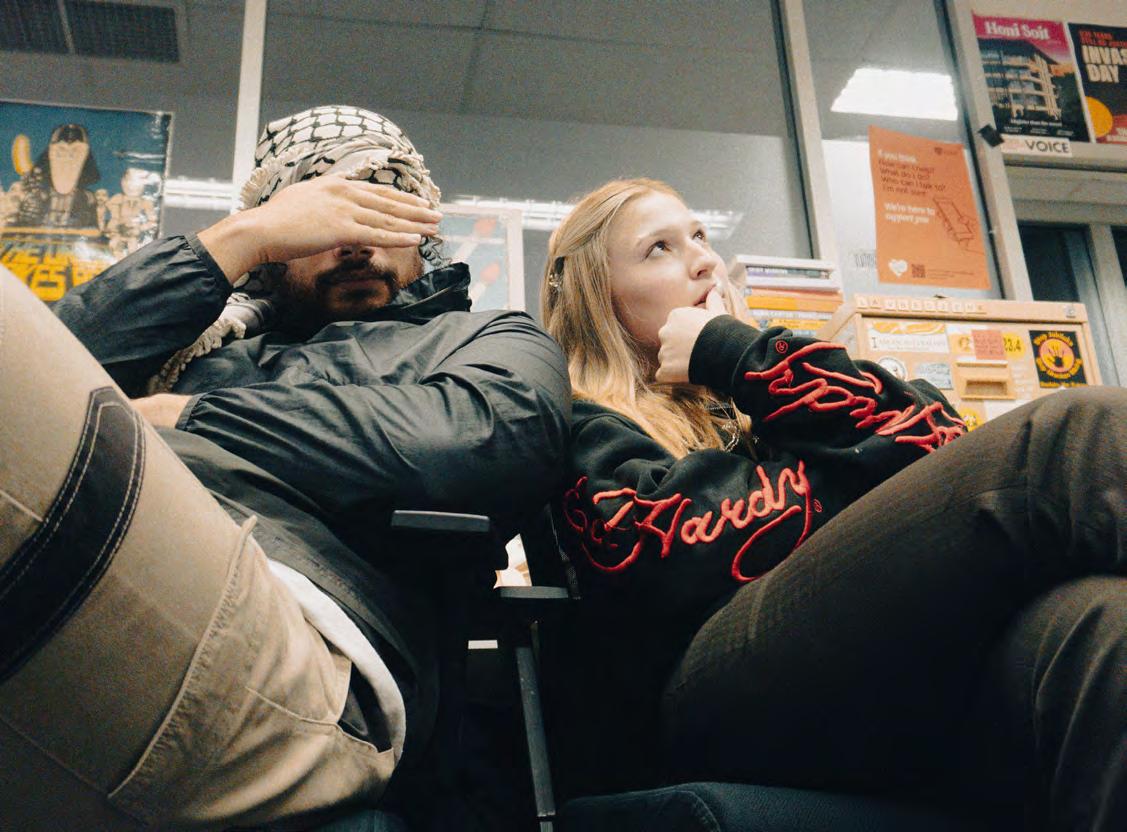
1) 2025 Gen Secs (Grace Street & Anu-Ujin Khulan) which we borrowed heavily from in many parts. (Sorry)
2) Ourselves! Ava Cavalerie for the swag cover art and staying sane, and Vince Tafea for becoming obsessed with InDesign and layups.
3) Honi Soit for their obliged tolerance of our use of their office.
4) You... if you read this!! (please guys)
5) Anyone who heard us deliriously yapping as we made this.



Need Help at Uni?
Ask the SRC.
SRC Caseworkers provide free, confidential, professional advice, that is independent of the University.
• Academic Appeals • Special Consideration • Plagiarism / Misconduct Allegations • Centrelink, Debt & Finance Advice • HECS Refunds • Tenancy & Accomodation Advice • Harrassment & Discrimination Support and more