Week 11, Semester 2, 2025
Publishing since 1929
Honi Soit
After Life: Dissecting Death Rituals and Body Politics Elke Guffogg Perspective, Page 17
Mind, Bodies, and Everything in Between Ondine Karpinellison Feature, Page 8
Be Safe Amandine Locke Perspective, Page 17
Editorial
Acknowledgement of Country Honi Soit operates and publishes on Gadigal land of the Eora nation. We work and produce this publication on stolen land where sovereignty was never ceded. The University of Sydney is a colonial institution. Honi Soit is a publication that prioritises the voices of those who challenge colonial rhetorics. We strive to continue its legacy as a radical left-wing newspaper providing students with a unique opportunity to express their diverse voices and counter the biases of mainstream media.
Week Eleven Editorial In This Edition...
4 News 8 Bodies, Bodies, Bodies Protest at the 11 No Opera House!
12 “Ugh, yes!” 13 Mother Nature Lesbians tell 15 Can the time?
17
Women should hike! Alone!
19 Yum Cha 20 SRC Pages 22 Puzzles 23 Comedy
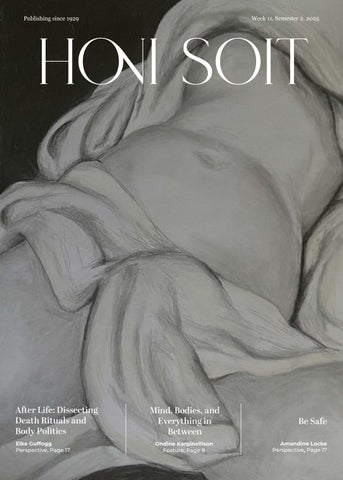
Our body is constant. It is the first medium through which we encounter the world. Bodies hold memory, sensation, and emotion; they shape how we communicate and how we are perceived. The body is never neutral, it is a battleground, always. It exists as an intersecting site of pleasure, pain and politics. It is where power, identity, history and resistance are inscribed. We have bodies, and we are bodies. This tension, between having and being, is what makes the body so powerful, and so difficult to write about. I chose the body as the theme for this edition, because though it is the very material of being, trying to capture it, particularly through words, is a slippery task. I wanted to challenge us to articulate the world through our bodies. When I conceptualised this edition, I couldn’t stop thinking about Gustave Courbet’s painting L’origine du Monde or The Origin of the World, which I go on to talk about in my feature article Mind, Bodies, and Everything in Between. For the cover, I asked one of my best friends Grace to create something that spoke to
the starkness and brazenness of the original painting. Knowing it was a vagina, I preemptively asked Gracie to censor it with a fruit, shell, or flower. Unfortunately, our legal advice was to refrain from going down this “artistic direction.” What became of this, was an ode to the original painting, but one that entirely censors all nudity. The front cover is now a comment on the censorship that women’s bodies continue to face, where a vagina may be perceived as pornographic just by nature of its existence. We hope a covered vagina is a permissible and palatable “artistic direction.” But we also question: is a woman’s body inherently sexual? Is the woman’s body still sexual when she is covered? In this edition, we look at the body from every which way. Jenna Rees looks at how the body is evoked to describe the environment around us, while Amandine Locke discusses how her body exists in that environment through the lens of solo hiking. My feature article ruminates on embodiment and what it means to live through your body. We even look at what happens to the body after
death, with Elke Guffogg urging us to choose decomposition over burial or cremation. When I joined the Honi team earlier this semester, I had no idea what to expect. I don’t know if I have been very forthcoming with how much I have enjoyed this experience, or what I have gained from this semester. I will never be sentimental. But I will just say that what I have gained from my fellow editors in community and knowledge is immeasurable. My best friends helped me discover the material ways my body has power. I am so lucky that I could enlist some of them to make art for this edition. My family taught me that what I felt through my body would always be true. My body is not static, but is entangled and embedded in the world around it. As I finish this edition of Honi, I know that it will continue to inscribe itself back on me as I absorb its reception. Ondine Karpinellison
Companion Piece, Grace Ireland You may or may not recognise her, given that her vulva is censored, cloaked by bed linen. Her wonderful bushy vagina is housed in Paris’ Musee d’Orsay and I had the pleasure of staring at it for a
long afternoon last year. I’m delighted that I could rebirth L’Origine du Monde (‘The Origin of the World’) for the cover of Honi Soit.
Editor-in-Chief
Contributors
Ondine Karpinellison
Sath Balasuriya, Martha Barlow, Eko Bautista, Pia Curran, James Fitzgerald Sice, Elke Guffogg, Sophie Grant, Mehnaaz Hossain, Ondine Karpinellison, Amandine Locke, Max Mcdermott, Ella McGrath, Sandy Ou, Jenna Rees, Imogen Sabey, Charlotte Saker, Ananya Thirumalai, Will Winter, Dongchen Yue, Victor Zhang
Editors Purny Ahmed, Mehnaaz Hossain, Ondine Karpinellison, Ellie Robertson, Imogen Sabey, Charlotte Saker, Will Winter, Victor Zhang
Front Cover
Artists Purny Ahmed, James Fitzgerald Sice, Anya Frlanova, Grace Ireland, Ellie Robertson, Will Winter, Victor Zhang
Grace Ireland ISSN: 2207-5593. This edition was published on 21 October 2025. Disclaimer: Honi Soit is published by the Students’ Representative Council, University of Sydney, Level 1 Wentworth Building, City Road, University of Sydney NSW 2006. The SRC’s operation costs, space and administrative support are financed by the University of Sydney. Honi Soit is printed under the auspices of the SRC’s Directors of Student Publications (DSP): Eliza Crossley, Celina Di Veroli, Hamish Evans, Leanne Rook, Daniel Yu, and Sunny Shen. All expressions are published on the basis that they are not to be regarded as the opinions of the SRC unless specifically stated. The Council accepts no responsibility for the accuracy of any of the opinions or information contained within this newspaper, nor does it endorse any of the advertisements and insertions. Please direct all advertising inquiries to publications.manager@src.usyd.edu.au.
2
Editorial
Letter to the Editor Dear Honi, I am writing to you for two reasons today: to thank you (the Honi Soit team) for publishing the Honi Soit paper; and to ask for advice on how to attend Pro-Palestine rallies “peacefully” to avoid getting into trouble with the NSW police. I feel very privileged to have access to Honi Soit. It is my personal GOAT newspaper. I can always count on you guys for the most recent coverage on changes in USyd’s policies and administrative thingies (like the student election, how USU funding is used, the Campus Access Policy etc.); and how they impact ordinary students like me. I love the down-to-earth content that you guys feature in the paper. There was an article last semester about how to eat healthily, at a budget, during busy exam seasons. I found these tips incredibly helpful. Most importantly, thank you for continuously reporting and exposing the Genocide that the Israeli State is inflicting on the people of Palestine; and the manner in which our Government and USyd’s management are complicit in this atrocity. If it weren’t for Honi Soit’s continuous and honest coverage, there is no way for me to know and understand the extent of hardship that Palestinian people are facing today. (I don’t use social media like Tik Tok, nor do I read the news published by the big media companies - as if they have the balls to speak the truth anyways.)
This leads to my second point: can I please have some tips on how to attend Pro-Palestine rallies without getting into trouble with the NSW police.
With utmost respect and love, Quicksand
In past student elections, I have voted for student candidates that support the Pro-Palestine movement and the demand to cut ties with Israel. However, I feel like I can no longer just sit and count on the people I voted for to progress the ProPalestine movement.
Dear Quicksand,
I need to do something myself. Especially after learning more about the horrors inflicted onto the Palestinian people on a daily basis, whilst I myself enjoy the peace and quiet here in Sydney - which I had taken for granted. The first thing that came to my mind was to attend (maybe volunteer at) one of the ProPalestine rallies/marches. But, I’ve read Honi’s coverage on the violence that the NSW police had inflicted onto protestors they deemed not “peaceful” in the past. I am also afraid that if I had contact with them, a police record will be logged onto the system; I will face horrible things like getting expelled from USyd and not being able to find employment - because I was an “activist” who wasn’t “peaceful” when he attended the demonstrations. Are these fears which have held me from joining the ProPalestine movement valid? Can I please have these queries answered by people who have been to these rallies (and potentially had dealt with the police).
Thank you very much for your kind letter, it has been the highlight of our week. We’re very glad to know that our coverage is helpful to you! Of course, note that what we’ve written here is general information to the best of our knowledge and does not constitute legal advice. Firstly, it is entirely natural to have fears attending protests, particularly under this antiprotest law regime in NSW. You are not alone in having these fears. I’ve been to a fair few protests where things have turned sour. Port Botany in 2024 is forever etched into my memory, where I had a front row view (literally) to police brutality. I say this not to deter you from protests, because each protest needs strength in numbers. Rather, I say this because you should be aware of what could happen. Your best defence is to know what your rights are. Follow Legal Observers NSW, they put out guides on what your rights are and what you should know heading into protests they anticipate might be flashpoints. They also explain your rights while protesting better than I could ever hope to. You’ll also find Legal Observers at each protest in pink fluorescent vests. Their role is to monitor the protest and police action and responses at the protest. Please remember, you are under no obligation to speak to
Rumour Has It...
police unless you are a) under arrest, b) given a move-on order, c) you are in a temporarily restricted area, d) they suspect you can assist in the investigation of a serious offence. Next, while there exists the risk of altercations with police at all protests, there are some protests that are more safe than others. There are “authorised assemblies”. The vast majority of authorised assemblies occur without incident. A protest in NSW is considered an authorised assembly if protest organisers have submitted a Form 1 to NSW Police that was not opposed by the police. Most Palestine protests are authorised assemblies. These protests are usually planned well in advance and if police have challenged these protests, organisers will likely publicly say it. However, sometimes actions get called on a short-notice or some actions occur due to necessity. It is not inherently illegal to attend an unauthorised assembly, however it means you don’t have the legal protections of an authorised assembly. There have been protests in the past that went ahead unauthorised, but resulted in no arrests. It is at these protests where you may run into incidents with the police. All that being said, we would still recommend getting involved with pro-Palestine rallies. The Palestine movement has grown over the past few years, and with more numbers there is more safety. Honi We don’t edit your letters. Send us your letters to editors@honisoit.com.
Legal Observers
WHAT’S ON? Banging Denmark The Cellar Theatre 22nd October Breaking Sound OAFGB 23rd October All Access Beats Manning House 23rd October 7pm Australian Friends of Irish Unity Welcomes Sinn Féin Senator Conor Murphy Gaelic Club 24th October 5:30pm YABFest The Rebel Theatre, ATYP 25th of October 6:30–8:30pm Wisp001 by Prefix @ prefixaudio Location TBA 25th of October F1Soc Mexico Grand Prix Watch Paty BHB Lecture Theatre 1110 27th October 7am All of: Entire SCASS art show Backspace Gallery 25th October 6pm NYU Fashion Show 13th of November SURG EYO Party Abercrombie Rooftop 6th of November
Submit to Dear Honey
3
News
“Say it loud, say it clear, refugees are welcome here”
Sydney unites against racism James Fitzgerald Sice and Victor Zhang report. Hundreds of protesters gathered at Belmore Park on 19th October 2025 for the Unite Against Racism rally, standing together against the racist ‘March for Australia’ and in solidarity with migrants and refugees.
on-going racism in Australia, from over 600 deaths in custody, the far-right attacks on Camp Sovereignty on 31st August, the visa cancellation and arrest of a 61-year-old Palestinian refugee, and the ban on same-sex parenting books at Cumberland Council.
The demonstration was organised by a broad coalition of unions and community groups, including the Refugee Action Coalition, Palestine Action Group, the Greens, Young Labor Left, Pride in Protest, the National Tertiary Education Union, and the Maritime Union of Australia. Across Australia, far-right groups are cohering around the anti-immigration March for Australia rallies. Organisers of these rallies have ties with neo-Nazi and white nationalist groups. In response, counterdemonstrations have been called in Adelaide, Brisbane, Canberra, Hobart, Melbourne, Perth, and Sydney. The weeks leading up to the counter-protest saw far-right mobilisation through the distribution of white nationalist newspapers in Sydney’s Inner West as well as reports of leaflets and flyers left in mailboxes. The Sydney rally was chaired by Ian Rintoul from the Refugee Action Coalition and Jasmine Al Rawi from Palestine Action Group and Students for Palestine. Uncle David Bell delivered the Acknowledgement of Country,
Luna told the rally that we should support “friends and neighbours who are refugees, asylum seekers, migrant workers, international students, and especially Palestinians”.
calling out and paying respects to the Indigenous peoples and clans in NSW. Paul Silva, Dunghutti man and Blak Caucus activist, spoke about the continuing incarceration and dispossession of Aboriginal and Torres Strait Islander peoples in Australia. The NSW Coroner revealed this week that a record 12 Indigenous people have died in custody in NSW. “We stand here almost 30 years on from the Royal Commission into Aboriginal Deaths in Custody, and still, yet we see an increase statistically, of our people being taken. They are not just statistics. These are family members. These are mothers, fathers, cousins, sisters and brothers. These people have been inhumanely taken by the system.” Pride in Protest activist and USyd student Luna spoke about her experience as a trangender asylum seeker threatened with suspension and deportation for Palestine activism. Luna highlighted examples of
Students for Palestine organiser Shovan Bhattarai spoke about the context of the burgeoning far-right in Australia, citing One Nation rising in polls and Andrew Hastie, who she described as a “wannabe Donald Trump”.
USyd student and Solidarity member Maeve Larkins told Honi that “migrants are not to blame for housing and cost of living” and that “the real cause for the cost-of-living and housing pains” stem from government policies like the “refusal to repeal capital gains, to fund public housing, or to take money out of things like AUKUS”. Larkins said that “We’re trying to create a public response to make it clear that Sydney is and should be more anti-racist than it is racist. Nazis can’t march in the street as they are doing today without being opposed.”
She warned about the mass mobilisation of the far-right in the United Kingdom and the United States which should be a “serious wake up call for all of us”. She emphasised the need to mobilise against the far-right, like the community mobilised in the hundreds of thousands to march across the Sydney Harbour Bridge for Palestine. Cynthia Wang, an international student at USyd, told Honi why they joined the Unite Against Racism rally today: “I was furious about the March for Australia, because this group of people are using people’s fear and anger to drive another group of people away. I don’t think that’s acceptable. Hatred towards migrants is a way of scapegoating real issues like housing and cost-of-living.” Vice-President of the NSW Teachers Federation Natasha Watt spoke against the scapegoating of migrants and refugees who contribute to the Australian community and economy. She pointed to tech
Photography by James Fitzgerald Sice and Victor Zhang
4
giants such as Netflix, Microsoft, Google, Facebook, Apple, and Amazon that avoid paying their fair share of tax.
speaking at these rallies, when they are the organisers. It’s not a few bad apples. The far right is on the rise, and we need to stamp it out.” Labor for Civil Liberties convenor Shannen Potter slammed the response of Labor towards the far-right rallies saying that “some members of Parliament from the Labor Party, including Anthony Albanese, have said that these people have legitimate concerns, or that there might be good people at these marches”. Potter said “There are no non combatants in the fight against Nazis. There are no non combatants in the fight against fascism, and there are no non combatants in the fight against white supremacy. You are either with them, or you’re against them, and everyone here is against them.” After the march there was live music at Belmore Park. Honi Soit spoke to organiser Brett Collis who started Rock Against Racism in the wake of the Christchurch shootings: “That was the end of it for me and I said “fuck this, I’ve always wanted to do this and I’ve always been reluctant to, for what ever reason”. I’ve been hanging around the Sydney music scene since I was about 18 so as a result I know a few musicians, so we got people together.
Greens Senator for NSW Mehreen Faruqi spoke to the rally and warned that we should not be complacent when faced with the “brazen nature and emboldenment of the far right”. Faruqi said what is more concerning is that the political establishment is downplaying the severity of these far-right rallies “even when thousands are marching, when neo-Nazis are
“It’s a mass movement so it needs integration with people to come on board and work together. My idea for this is to get people, get musicians involved wherever possible. If you are playing a gig then hold the banner high. With the rise of racism now through Trump, what’s happening over in Europe at the moment and then you’ve got Zionism which is another form of racism. We really need to try and stop this shit. The idea is to counter-rally these things through music.”
News
Tawny Frogmouth crowned Guardian Bird of the Year 2025
USyd’s 2026 bid to increase international student enrolment rejected
The Tawny Frogmouth (Podargus strigoides) has been crowned Guardian Australian Bird of the Year 2025, securing 11,851 votes in the final round of voting.
The Federal Labor government has rejected the University of Sydney’s (USyd) request to increase incoming international student enrollment due to “lack of evidence” in prioritising new housing, Southeast Asia engagement, and cohort diversification. This decision was made in accordance with the National Planning Level (NPL) for international education.
Victor Zhang reports.
The Tawny was crowned Bird of the Year after a ten-day competition from 9th to 15th October where 50 species of Australian birds were nominated for the competition. The Tawny has finally secured its victory after being the bridesmaid candidate for the past three competitions. The Australian Bird of the Year is a biennial competition by Guardian Australia and BirdLife Australia. Over 310,000 votes were cast in this year’s Bird of the Year competition.
Eko Bautista reports.
The 10 species that made it to the final round were the Tawny Frogmouth, the Baudin’s Black Cockatoo, the Gang-gang Cockatoo, the Willie Wagtail, the Bush Stone-Curlew, the Southern Emu-wren, the Laughing Kookaburra, the Little Penguin, the Spotted Pardalote, and the Wedge-tailed Eagle. This year the Tawny Frogmouth secured the endorsements of writer Wendy Harmer, Federal Environment Minister Murray Watt, Young Labor Left NSW, and, of course, this masthead. In 2023, the Swift Parrot overtook the Tawny Frogmouth in the last few days of voting, snatching victory with 11,171 votes to the Tawny’s 10,729 in the last 24 hours of voting.
From the NPL released in August 2025, 17,500 new places have been distributed amongst 37 public universities, except for USyd. This allocation caps USyd’s international student intake at 11,900 New Overseas Student Commencements (NOSC) for the 2026 academic year. Despite this, USyd will continue to have the highest intake of all Australian universities. USyd will have 600 more NOSC compared to the next highest, Monash University. In a media statement from the Ministers of Education portfolio, “Allocations have been driven by each institution’s demonstrated delivery against government priorities of new housing, Southeast Asian engagement and market diversification”. These allocations were intended to “manage growth [of the International Education Industry] in a sustainable way”.
These allocations come after Education Minister Jason Clare introduced legislation “to strengthen the integrity of the international education sector”, requiring additional requirements for private education providers, limiting new courses to domestic intake for 2 years. “We also know international education is a target for unscrupulous individuals trying to make a quick buck,” said Clare. “That’s why we introduced legislation to Parliament last week, to crack down on dodgy operators and practices.” The push to safeguard “the reputation of [the international education] sector” comes after Labor-supported international students caps and the Liberal election campaign targeted the cohort, blaming international students for increasing demand in a housing crisis. USyd residences are only able “to house 3.2 per cent of students” relying predominantly on purpose-built student accommodations. The near-sale of the Darlington terraces and the abandoning of the International House are examples of USyd’s actions that limit overall residential stock.
Supreme Court rules anti-protest law unconstitutional Jenna Rees and Victor Zhang reports. On Thursday, 16th October, the Supreme Court of NSW handed down a strong ruling against NSW’s widening framework of anti-protest legislation. Justice Anna Mitchelmore ruled that Section 200(5) of the Law Enforcement (Powers and Responsibilities) Act 2002 (also known as LEPRA) “impermissibly burdens the implied constitutional freedom of communication on government or political matters and is invalid”. The case was brought by Palestine Action Group (PAG) organiser Joshua Lees, represented by Craig Lenehan SC, Felicity Graham, Thomas Wood, and O’Briens Solicitors. Lees argued that a recent amendment to LEPRA gave police excessive power to silence political protests under the guise of protecting religious spaces. Section 200(5) of the Law Enforcement (Powers and Responsibilities) Act 2002 was introduced by the Crimes Amendment (Places of Worship) Bill 2025 in February 2025. The Bill expanded the powers of police to arrest or move-on people outside places of worship. The Bill did not specify a distance from which a protest would count as “near” a place of worship, leaving it to the discretion of the police.
What are move-on orders? Justice Mitchelmore set out the background plainly: part 14 of LEPRA gave police power to issue directions to people in public places if their conduct obstructs traffic, intimates others, or causes fear. Section 200 limits those powers: officers can not give such directions to people engaged in an “apparently genuine demonstration or protest”. This restriction is subject to exceptions, where police are not precluded from giving move-on orders. Section 200(5), the exception PAG challenged, allows officers to direct protestors to move on if the protest is not “authorised” or is occurring “in or near a place of worship”. The legislation meant that any unauthorised protest near a church, mosque, temple, or synagogue, was subject to move-on orders. Common sites of protest in Sydney are near places of worship, such as Sydney Town Hall (St Andrew’s Cathedral), Hyde Park (Saint Mary’s Cathedral), and the Supreme Court (St James’ Church). Lees said this provision went far beyond protecting worshippers from intimidation, arguing that
police were effectively given a veto over protest, a recognised form of political communication, based on location. The State defended the law as well-targeted, saying it was restoring the balance between free speech and the right to worship without harassment. Justice Mitchelmore ruled in Lees’ favour, finding that section 200(5) did in fact burden political communication and though its purpose of protecting worshippers from harassment was legitimate, the law was not appropriate or adapted to that purpose. This decision joins a growing line of cases that are testing the limits of NSW’s protests laws, especially after years of escalating restrictions under LEPRA and the Roads and Crimes Legislation Amendment Act 2022. Greens Member of the NSW Legislative Council (MLC) Sue Higginson said in a press conference after the ruling that the “judgement is a resounding win for our democracy and our right to protest in New South Wales”. Concerns around the original bill Labor Members of the Legislative Council Anthony D’Adam and Stephen Lawrence
expressed reservations when the Bill was passed. It is understood that D’Adam, Lawrence, and Cameron Murphy opposed the legislation in the Labor caucus prior to the passage of the Bill, with Murphy questioning the constitutional validity of the Bill. The incident that led to the creation of the Bill was a protest held on 4th December 2024 outside the Great Synagogue against an event by the Israel Institute of Technology featuring an Israel Defence Force soldier. The event was originally to be held at the University of Technology Sydney but was subsequently moved to the Great Synagogue. In the parliamentary debate, D’Adam said that while he did not attend the protest, he clarified that “no-one was obstructed in terms of access or egress to the synagogue. “The suggestion that somehow the protest was threatening or obstructive to those seeking to enter or exit the synagogue for the purposes of exercising their rights of expressing or practicing their religious faith is a complete confection.” The community’s response Australian Democracy Network Protest Rights Campaigner Anastasia Radievska welcomed the decision. Radievska said that this “ruling shows what
faith leaders, other community members, and legal experts said to the NSW government from the get-go — these laws were unnecessary, overbroad, and risked criminalising peaceful protest in major public spaces” She continued, saying that “we need to end the cycle of knee-jerk lawmaking that is not evidencebased, lacks consultation with communities and results in unconstitutional legislation”. Peter O’Brien, Principal Solicitor at O’Brien Criminal and Civil Solicitors said that the ruling “settles clearly that the government cannot insert arbitrary, ill thought out amendments into legislation which might water down the very foundational bedrock of what a community and what a democracy is all about.” He added that “It protects and it promotes the right to protest. It protects and it promotes the rights of the implied right to political communication in this country.” Sarah Schwartz, Legal Director of the Human Rights Law Centre and Executive Officer at the Jewish Council of Australia said on ABC that the ruling shows “that our politicians should be looking at ways of strengthening our democratic rights and institutions and acknowledging that the right to protest is really fundamental to our democracy”.
5
News
University of Newcastle staff to strike Class actions launched against UON, WSU for unaccredited on 23rd October degrees Imogen Sabey reports. Victor Zhang reports.
The University of Newcastle (UoN) National Tertiary Education Union (NTEU) branch overwhelmingly voted to undertake protected industrial action on Thursday, 23rd October. The NTEU says that UoN staff have chosen to escalate to strike action after an impasse in enterprise bargaining negotiations where the union has pushed for “fair workloads, job security, and equity for casuals including 17 per cent superannuation.” NTEU UoN Branch President Terry Summers said that the union’s “demands are fair and reasonable. “We want secure jobs so our colleagues aren’t consumed by stress over whether they will still have a job next year. We want safer workloads so staff aren’t forced to choose between burnout and their students’ education.” The Branch is pushing for a 20 per cent flat increase in wages over the life of the four-year enterprise agreement, which
Summers says “makes up for the losses we’ve experienced in real wages since 2018”.
UoN’s Chief People and Culture Officer Martin Sainsbury recognised that the NTEU’s demand for a pay increase remains a point of contention. Sainsbury said that if the NTEU’s demands were agreed to it “would add over $100 million to our operating costs over the life of the agreement” and that “meeting this claim would place significant pressure on our operating budget”. The University of Newcastle is undertaking a Business Improvement Program aimed at delivering $20.6 million in annual savings. The strike action comes amid the University’s cuts, where according to the NTEU, 140 jobs and a dozen courses would be axed for $20.6 million in savings. The University of Newcastle has said that only “28 ongoing occupied positions” would be cut. Summers told Honi that the NTEU’s determination of a
reduction of 140 jobs was calculated by the positions that were cut minus the new positions created.
Summers said that “University management has an opportunity to do right by staff, but instead they are busy slashing jobs and courses with no justification. The University’s own finance reports tabled in parliament this year show a $61 million surplus.” The university said that while there is an on-paper surplus, when “one-off items such as donations, grants, and restricted funds that cannot be used for teaching and research” are excluded, UoN had a net deficit of $16.3 million in 2024. General Secretary of the University of Newcastle Student Association James Campbell spoke to Honi in support of the upcoming industrial action. He said “staff working conditions are student learning conditions. Cuts impact each and everyone of us and is a highway towards austerity. “The students stand in solidarity with UoN staff and the NTEU, joining their call for genuine consultation for secure employment and safe working conditions.”
First major Federal Court hearing of the racial discrimination claims against USyd academics Keane and Riemer Sophie Grant, Ella McGrath, and Charlotte Saker report. The racial discrimination proceedings against academics John Keane and Nick Riemer have had their first interlocutory hearing in the Federal Court of Australia over Monday and Tuesday this week. The joint cases are considered a significant test case for hate speech, and could establish a precedent providing for the “protection of a political identity” — Zionism — under the Racial Discrimination Act (RDA), according to USyd’s barrister Robert Dick SC. After two full days of submissions, Justice Kennett has reserved his decision. Keane and Riemer are being sued under section 18C of the RDA by a small group of current and former staff and students at the University of Sydney: Joseph Toltz, Suzanne Rutland, Yaniv Levy, and Ariel Eisner. They allege that the academics’ criticisms of Israel and Zionism, “considered individually or cumulatively, were reasonably likely… to offend, insult, humiliate or intimidate Jewish persons or Israeli persons in Australia and elsewhere.” An
6
interlocutory hearing addresses issues in the case prior to the final hearing, often focusing on procedural matters. Although it was only a preliminary hearing, the Court’s decision in respect of this week’s interlocutory application will have major implications for the scope and content of the case if, or when, it eventually goes to trial. The claims against Keane and Riemer are brought as two separate proceedings but are being heard together. The applicants allege that the University of Sydney (USyd), the second respondent in both matters, is vicariously liable for some of Keane’s and Riemer’s alleged acts of racial vilification. The Court heard that USyd and Riemer want to have parts of the claims against them ‘struck out’ or summarily dismissed. In the words of USyd’s barrister, they are doing this to ensure the “efficacy” of the “entire legal proceeding,” to effectively narrow the scope of the case and, in so doing, curtail the length and complexity of the case.
In a separate interlocutory application relating to the Keane proceeding, the applicants seek orders allowing a fifth applicant, Andy Smidt, to be added.They also seek for the first and second applicants (Tolz and Rutland) to continue the proceeding on behalf of 13 others, one of whom, Peter Morgan, is not Jewish or Israeli. The Racial Discrimination Act establishes civil liability, not criminal offences, for acts of racial vilification or discrimination. If the applicants are successful in their court bid, their complaints will be resolved through ‘declarative relief’ in the Riemer proceeding. In the Keane proceeding, the applicants and the 13 proposed group members in the class action may be entitled to damages or financial compensation. Both Keane and Riemer were present in court for the hearing. Riemer wore a red keffiyeh around his shoulders, leaving only briefly on Tuesday afternoon to deliver a lecture for a Literary Theories class. Read full article online.
Western Sydney University (WSU) and University of Newcastle (UON) are being sued in two class actions for misleading and deceptive conduct for awarding students with unaccredited degrees. The specific degrees are UON’s Bachelor of Medical Engineering (Honours) for students who commenced in 2018–2019 and WSU’s Master of Advanced Imaging (MAI). The UON class action was brought by Andreas Sklavos, who filed a claim that UON had breached consumer law. A UON student, Vera Lawless, said “I finished all of my coursework back in 2020. It’s now 2025 and it’s five years down the line and I’m still experiencing all this emotion and I just want it done.” Lawless was told before enrolling that her degree was accredited with Engineers Australia. However, WSU sent an email to enrolled students in December 2020 to say that the degree was not accredited. UON received provisional accreditation from Engineers Australia in December 2023, for students who commenced in 2023 onwards. UON’s general counsel Daniel Bell said “The university denies that its published statements regarding accreditation, read in context, were misleading or deceptive and it denies that its representations were published in trade or commerce”.
The university claims that its website indicated that it was ‘seeking accreditation’ and thus not misleading students. At WSU, a class action was launched in June 2025 by Othniel Antwi. Antwi, who sought to work as a health practitioner, did not find out that his MAI degree was unaccredited with the Australian Health Practitioner Regulation Agency until he was looking for jobs with a $55,000 HECS debt. He told the ABC, “I think the hardest bit was the emotional and mental toll it’s taken on me… Just the pain of realising that my future career is pretty much non-existent. I just feel so much helplessness.” When he contacted WSU to ask about accreditation, the university told him there was no way he could be accredited. A week later they told him the course had been suspended for new students. Australian Law Partners are running both class actions. According to their solicitor, the firm has previously succeeded in settling a class action in 2023 for 27 students from James Cook University who alleged that their financial services major was unaccredited. Under Australian law, there is a legal threshold where courses must be accredited where accreditation is necessary for graduates to find work.
USU Board formally says that it won’t engage BDS principles Will Winter reports. At the September USU Board meeting, the USU Board formally announced that it would not be implementing Boycotts, Divestments, and Sanctions (BDS) into their Environment Social Governance strategy. When asked by Honi as to whether there was consideration taken as to BDS after the August Board meeting, USU President
Phan Vu said BDS was “not something we’ll adopt explicitly”. Vu instead postured towards the USU “aligning with the university’s broader principles… considerations were given to the history of the company who are engaged in such conduct.” A full write-up on the August and September meetings is impending…
Nick Riemer and John Keane
News
Coroner reveals record level of Indigenous deaths in custody in NSW Victor Zhang reports.
12 Aboriginal and Torres Strait Islander people have died in custody this year in NSW, an unprecedented level which the NSW Coroner Teresa O’Sullivan described as a “profoundly distressing milestone”. Over the past five years, Indigenous populations in custody have risen by 18.9 per cent while non-Indigenous prison populations have declined. O’Sullivan said “these figures reflect the entrenched overrepresentation of First Nations peoples in the criminal justice system”. Despite being 3 per cent of the population in NSW, Indigenous peoples make up 33 per cent of the NSW adult prison population, according to the NSW Bureau of Crime Statistics and Research
(BOSCAR). Indigenous people represent 50 per cent of the youth prison population. CEO of the Aboriginal Legal Service Karly Warner said that deaths in custody were a “preventable tragedy that should deeply alarm everyone in NSW. “A prison sentence should not be a death sentence.” Warner said that in 2022, the United Nations Working Group on Arbitrary Detention was denied an inspection of NSW prisons and that “it would be an international embarrassment” if the group were denied access again during their visit in December. A NSW government spokesperson said that “each one of these deaths is a tragedy, and the government takes this issue seriously”.
The spokesperson also said that a review of Indigenous deaths in custody, with recommendations on reducing deaths in custody, was due next year. Warner said that “We have solutions to reduce deaths in custody but too many are sitting on the shelf, gathering dust. We call on the Government to stop passing laws which contradict its obligations to reduce Aboriginal over-representation in police cells, courts and prisons, and instead work in partnership with Aboriginal communities to implement evidence-based, community-led solutions to reduce imprisonment.” There have been 609 Indigenous deaths in custody since the 1991 Royal Commission into Aboriginal Deaths in Custody. The report of the Royal Commission recommended methods into reducing Indigenous incarcer-
ation and deaths in custody. Justice Reform Initiative Executive Director Dr Mindy Sotiri said that the Royal Commission “clearly stated that in order to prevent Aboriginal deaths in custody, we needed to address the systemic over-incarceration of Aboriginal people. “We have completely failed as a community to do this. All Australian jurisdictions including NSW are overseeing increased First Nations incarceration. “We are seeing increased spending on imprisonment, ongoing over-policing of Aboriginal communities, the increased use of remand, alongside chronic under-
investment in community led and community-based support.” In June the Australian Human Rights Commission slammed the “national shame” of Indigenous deaths in custody. Social Justice Commissioner Katie Kiss and Race Discrimination Commissioner Giridharan Sivaraman called for the full implementation of the recommendations of the Royal Commission into Aboriginal Deaths in Custody.
Joy is resistance: A Night of Humanity for Palestine Mehnaaz Hossain and Imogen Sabey review. The Night of Humanity for Palestine was the kind of night that’s very difficult to describe: there were so many things going on, so many people, so much joy, and so many tears. It could only be encompassed by the kind of warm glowiness that comes from being in the same room as so many people who are all fighting, hurting, and hoping for justice for the Palestinian people. The event was organised by Blair Cassie Pack, Jessie Kernot, Lou Pack, and Elise Butt. It was hosted by media personalities Patrick Abboud and Julia Zemiro, and featured a star-studded cast of musicians, journalists, poets, comedians, and healthcare workers. The room was filled with jubilant energy when Zemiro and Abboud announced that the 1,600-person Enmore Theatre had completely sold out. The purpose of the event was to bring people together in solidarity and raise money for several charities in Gaza; namely, Palestine Australia Relief and Action (PARA), Palestine Children’s Relief Fund, Olive Kids, and Médecins Sans Frontières. The organisers had a goal of $100,000, and by the end, they
had surpassed their goal and were still going. Abboud told the audience that our presence was a form of collective action and “revolutionary in choosing joy”, opening the night with an atmosphere of community and hope. We were treated to an awesome performance by musicians Mudrat and Emile Battour before Abboud returned to the stage to speak about the systemic, targeted killing of journalists in Gaza. The slides behind him displayed a rolling list of over 270 journalists murdered by Israel. This segued into a rousing panel discussion featuring moderator Amy Remeikis with fellow journalists Antony Loewenstein, Antoinette Lattouf, and Jan Fran, who discussed the ever-pertinent issue of mainstream media promoting Zionist narratives and dehumanising Palestinians. Remeikis asked the other three why they thought the media was doing this. Loewenstein thought it was fuelled by racism, Lattouf responded that it was due to cowardice, and Fran said that it was the influence of the proIsrael lobby. Lattouf also spoke about the murder of Palestinian Al-Jazeera frontline reporter Anas Al-Sharif and the media’s shameful coverage whenever Israel targets the press. The panel spoke about the “non-lethal” F-35 fighter jet parts that are still being flown out of our country as recently as September, a story which Loewenstein broke in his independent publication Declassified Australia. It was refreshing to hear
Photography by Emma Leslie
such intelligent, and progressive voices speaking live on the media’s complicity in genocide. One of the most moving performances was from Baher Skaik, a pianist who lost his home and his beloved piano in the bombardment of Gaza, and who only arrived in Australia a few months ago. Skaik had had no hope and vowed to never play a piano again, but support from PARA made it possible for him to get a new piano and also provided one for him at the Enmore. He played with the accompaniment of Heba Tayeh, an incredibly talented singer who reduced everyone in the audience to tears.
Following this was a poignant and moving poetry recitation by Sara M. Saleh, Claudia Karvan, and Nathalie Morris. A beautiful poem that Karvan read out was called ‘I Want a Grave’ by Batu Abul Al-Klin: “I want a grave for myself alone / So my friends can come and talk to me […] I want a grave / I don’t want my corpse to be decomposing in the middle of the street.” Randa Abdel-Fattah and Sara M. Saleh then performed a hilarious but unfortunately
far too relatable skit about someone being disciplined in the workplace for posting about Palestine. Saleh and AbdelFattah explored the hypocrisy of organisations who deliver land acknowledgements but refuse to engage with Palestinians. Honi’s favourite line was when Saleh said “I’m not pro-Palestinian, I am Palestinian!” A particularly informative discussion was held with Dr Mohammed ‘Beast from the Middle East’ Mustafa and Dr Bushra Othman, who had both worked in Gaza on various missions over the last two years and had witnessed the genocide firsthand. Dr Othman spoke about how she has gone on multiple missions to Gaza and witnessed the “unbreakable spirit” of the Palestinian people and healthcare workers amidst horrific mass starvation, noting that stage five famine has generational consequences. Dr Mustafa is campaigning to build a mobile children’s hospital in Gaza. When asked about how he coped with the atrocities he’d seen, Dr Mustafa replied that he wasn’t really coping. He said “Those children are related to me, look like me. Trying to convince people that they deserve to live takes a toll.” He spoke about how he once witnessed a young girl carry her injured brother across Gaza, travelling kilometres, dodging quadcopters, bombs, and bullets, to deliver him. He told the audience that if she was able to be brave and keep going, so was he. One of the most heartbreaking and awful moments of the night was when Dr Mustafa recounted a mother who had brought her dead child to the doctor, their body parts
in plastic bags. The room was incredibly somber as we silently sat in deep, deep, disgust at the relentless violence and horror inflicted upon Gazan children by Israel. After the event, Honi spoke to some of the journalists. Remeikis spoke to us about the significance of an event with such an expansive cast and packed audience: “what was really noteworthy about tonight was the relief you could feel in the audience as people found community…I think that that has been missing over the last two years”. Loewenstein also spoke to Honi about the recent Australia Palestine Advocacy Network poll where a sizable portion of Australians support sanctions against Israel, a notable difference in opinion from two years prior. He stated that “The issue is not just about Palestine…a lot of it is...about how many people feel about justice, or the lack of it, and the fact that Australia is such an ally to Israel.” It was a bittersweet night for the community, as we were faced with the people who have been fighting on the front line to stop this genocide while also confronting the immense forces that have enabled it to happen. At the time of writing, there have been at least 28 Gazans killed since the start of the so-called ‘ceasefire’ and tens of thousands of Gazans are facing a famine. Honi was reminded of the urgency to do everything we can to protest against the ongoing genocide, and the strength in the community around us.
7
Feature
Minds, Bodies, and Everything in Between Ondine Karpinellison lives through her body. Content Warning: This article contains mentions of sexual violence. The body speaks a language we all know. Nature is full of observable examples of cause and effect. Lightning is followed by the rumble of thunder; you see smoke and then fire. Perhaps the body is similarly positioned in relation to the mind. The body is immediate, sensate, and alive, and the mind follows, giving form to what the body already knows. Western philosophers have long insisted that the order runs the other way: thought commands, and the body dumbly obeys.
Over the years, I have always been aware of the way my body dictated my everyday, especially as a cis woman. As I grew up, I found myself in early uncharted territory, with a body I didn’t know how to use. When I got my period two days before my 11th birthday, I only told my friend Phoenix. She asked me about it at school a few weeks later, and my reaction was hot and heavy embarrassment, which quickly turned into fury. “SHUT UP!” She was shocked. Of course I didn’t want anyone to know that my body did this weird thing, and bled every month? But she was just curious about how it felt. When we got to high school, it quickly transformed into a badge of honour. “Oh… you haven’t got it yet…?” Something that I had worked so hard to hide, was now something that people wished for. Then there was the corporeal anxiety that infected itself within me, as I approached my final exams. Or the way my body would suddenly become perceived, irrespective of if I wanted that or not. The way my body existed for others too.
However, the concept of embodiment, refers to both the act of being a body, and having a body. In other words, it grounds all cognitive processes in bodily experience: our consciousness, identity, and ways of knowing. To view the self as embodied is to recognise that consciousness does not float above but emerges from muscle nerve and reflex. The body, my body and your body, does not wait for permission to know. Consider the body not as an object to be interpreted, but the subject through which we live, perceive, and know the world. This is the essence of embodiment. René Descartes said “Cogito Ergo Sum”. I think, therefore I am. Here the mind and body remain crucially distinct, with the mind designed as the initial impulse. The mind is the source of all certainty, whilst the body is merely an unreliable machinery, an object among other objects. If we stitch the mind and body back together, as inevitably entangled, where does that take us?
8
The openness through which my friends and I began to talk about our bodies changing, and being perceived, became a point of connection, providing solace while we navigated our teens. But this openness could find no place in a classroom that was ironically devoted to charting new experiences and forms of understanding. Rather, we were taught to sift for the objective, in history, in science. Even in English, where we considered confessional poetry, where we praised perceptive and revealing voices that find new ways of describing experiences, there was no suggestion that our comparable discoveries could find voice.
Embodiment is, inevitably, drenched in subjectivity. We were led to believe that the subjective experience was partial, unreliable, and too emotional. We were taught to seek disembodiment in ourselves, our language, and our analysis of situations in order to come to the truth or the fair outcome. For one of my year 12 major works I wrote about the language of embodiment, in particular the #MeToo movement. I wrote about how women tweeting their stories of sexual assault and/or harrasment, was an example of the language of embodiment in action. Unbound by the shackles of journalistic or police reporting that emphasised objectivity and the priority of conscious thought, these women were reclaiming their stories of body. Experiences that perhaps lacked adequate language previously, now found their voice through embodied accounts. Psychologist Rosemarie Anderson argues that “embodied writing seeks to communicate through resonance.” Take this tweet for example: “Crowded tram at Disney, sat a row behind my family. The man kept his hand on my thigh the whole ride, stroking the fine hair there. Think I was 11 but scared to confirm the dates of that trip with my mom because I never told anyone. Us too. All of us.” Here, we are confronted with the immediacy of her bodily responses. The invasive presence of the touch, evoked by the reference to the hairs on her leg, forcing an excruciating awareness of our own bodies and physical vulnerability.
Feature
might, assuming a safe space, say something that directly targeted his identity. Or when he took a queer law subject, and earnestly worried that he may have been perceived as an obnoxiously over-opinionated straight man, taking up all the speaking time. He once told me that the biggest struggle he had with his transition was listening to his body. The problem was, as he described it over voice note:
I, and maybe you, consider the fine hairs on my leg. I considered the #MeToo movement as a turning point, where women could finally convey their experiences, through their bodies, and be listened to. If women were truly listened to during and post #MeToo, perhaps we might have seen more tangible change in the way society responds to sexual violence. But these experiences find themselves up against an impossible hierarchy that will consistently privilege objective, or disembodied accounts. Nevertheless, I saw how talking through and listening to the body could, if only for a moment, return power to you. When I met James, who is trans, I began to understand embodiment in a different register. Not as a bodily identity settled into like a well-worn groove, but as something that can jump the tracks, take new directions, and keep becoming. James and I became friends after high school, but it wasn’t until we were on exchange in Paris together that we really got to know each other. Paris, for James, was a radically new space, geographically separated from any knowledge of his prior identity. He described it as a space where his body just existed: “before it felt like everyone that I knew, had their own perception of my body, in the past and in the present, and they were inseparable. In Paris, my body was taken at face value in the way that I had always wanted it to be.” But there were, of course, difficulties that came along with that. Like, worrying someone
“understanding that some things you feel in your body, you just feel, and that is real. You don’t have to have thoughts that correlate directly. The experience of the body is in and of itself outside of consciousness. It took me forcing myself to stop asking a million questions about why I felt like that, why did I think like that? What was wrong with my brain? And just going ‘oh wait, it feels good in my body when I do these things.’ It feels right, and maybe that’s okay, in the same way most cis people feel their whole life [to] just accept that the way their body exists feels good for them.” For James, the body was a site of negotiation. When I told him I was writing this piece and wanted to reflect on our connection to our bodies, he told me a story. “I had gone to Emma Gorge in Western Australia, and it's basically just an hour long walk and then you end up at this swimming hole that's surrounded by huge rocks, and ever since I can remember I have loved to swim. When I was less comfortable with my body and going through puberty and when I became aware that, you know, the feelings that I was having in my body weren't normal, swimming became this really difficult thing for me. It was only difficult because of the way everyone perceived me. When I was there in that place and at that time, I hadn't had top surgery, but I was there and I was swimming and I felt amazing. But all I could think about was how much I wanted to go back there after having my surgery. I was so close to that feeling of connectedness, but there was something missing, and that actually really was the moment that pushed me to come out.” Listening to James, I thought about his experience of embodiment. As we understand, embodiment implies some sort of connection to one’s body, James felt that he existed on the precipice of connection, and therefore on the precipice
of embodiment. The feeling of alignment came from gender affirming surgery for James, for others it arrives through voice, touch, recognition. In this sense, embodiment is not a static condition but a continual negotiation between the self and body and cultures that read, surveil, and regulate our bodies, determining what is being felt and what is being seen. My mum talks about embodiment, as a process of moving from unconsciousness, to consciousness, to self consciousness. As a child, her decision to have hairy armpits seemed a bold statement of defiance, to me, one that made me reckon with the body as a site of protest. Yet she also told me stories of blissful ignorance in relation to her body. She laughed, when I was much younger, recounting the time she realised that her nipples were poking through a crochet top she had worn to one of her first law jobs. Now, I can see the way my body mirrors hers. Our outlines blurring. All of that matter, inscribed with entirely different experiences, still carrying the quiet insistence of being there. She gave me form and meaning.
This tension between interiority and visibility finds form in Gustauve Courbet’s L’origin du Monde, or The Origin of the World. When I thought about a recent moment I had felt connected to my body, I thought about seeing this painting for the first time at the Musee D’orsay in Paris. The painting sits in the Rez-de-chaussée, room six, and is a close up of a woman’s vulva, laying on a bed with her legs spread.
Art by Anya Frlanova
9
Feature
Courbet’s work remained hidden from the public for 100 years after he painted it in 1866. I saw it with a group of my male friends, and I felt myself perceive it through their eyes. When I returned a few months later, alone, I found that the experience of seeing it wasn’t just about looking at the painting, but absorbing the people around me. The different children who laughed at what they saw as forbidden content, and the adults who postured an extreme indifference, as if to say “a vagina would never phase me!” To feel the way the body is existing so differently to each passerby, obscene to some and ordinary to others, is to witness embodiment in action. It is the moment when the body becomes plural, when meaning fractures and multiplies across gazes. In front of me is a body, and I am experiencing this through my body. Embodiment here is not just living in a body, but what happens when a body enters a field of vision, when being seen and just being, can never fully align. The mind interprets, but it is the body that first perceives. The gap between the two is where power and identity take shape. I bought a postcard of L’origine du Monde that now sits above my bed. I see this painting — of the vagina — not as a sexual object but as the site of embodiment. The idea, presented by Courbet, that the vagina is the origin of the world, offered me a key to the concept of embodiment. The very idea of the “world” emerging from this body rather than this body simply existing in the world, speaks to the power of that embodiment. It reminds us that the body is politically and symbolically charged. Who gets to represent life, and whose bodies are seen as its source is critical to understanding how society works. The question then, as Judith Butler puts it, is whose bodies matter? Bodies that Matter redefines the body as matter, that is continually being reproduced and reformed through power. Butler notes that there is an inherent problem with “elevating mind over matter.” This idea was crucial to understanding that gender is performed, since the body is not merely matter but is continually shaped by relations of power and cultural norms, such as those that define which bodies are seen as male or female, legible or illegible. These norms are most visible when they falter, as in the case of trans and nonbinary people whose bodies refuse to fit neatly within the categories that society enforces. The body’s material existence is undeniable, as Butler notes,“for surely bodies live and die; eat and sleep; feel pain, pleasure; endure illness and violence,” yet these so-called facts are always mediated by discourse, by how they interact with the world. The body is both real and constructed: its physicality cannot be dismissed, but neither can the cultural and linguistic frameworks that give the body meaning.
10
Butler didn’t believe it possible for bodies to exceed discourse, but what if it can? Let’s take the extreme example of glossolalia, or ‘speaking in tongues’. Glossolalia is a form of vocalisation that does not resemble known languages. It is the supposed divine language, and is practiced particularly in pentecostalism as a way to communicate with God. Many of us would not accept this as a communication with God, or the divine, but rather recognise it as an unencumbered utterance which becomes re-embodied without discursive thought or meaning. As anthropologist Thomas Csordas notes “the stripping away of the semantic dimension in glossolalia is not an absence, but rather the drawing back of a discursive curtain to reveal the grounding of language in natural life, as a bodily act.” In other words, meaning begins in the body, in breath, in sound, in gesture, before it is ever codified in language. The more I write, and think about embodiment, the more it becomes this vaporous, slippery, shifting, and changing thing that is ironically hard to concretise. Yet, I am talking about the very material of being. If meaning begins in the body, then knowledge must also. This is why embodiment must be recognised as a legitimate mode of understanding the world we inhabit.
To reject embodiment, to dismiss the authority of bodily experience as merely subjective, is to overlook how our bodies define us. It is also to remove the tools through which we can truly understand how our bodies define us. For those whose bodies are regulated, racialised, or cast as dangerous, the body is not just a vessel of experience, but a site where power and identity are negotiated. It is where the world begins and where we return to make sense of it. The origin of subjectivity, and the ground of everything we come to know.
Analysis
NSW’s Apex Court Grants State New Power to Ban Protests Dongchen Yue analyses the destruction of civil liberties. On Thursday 9th October, the Court of Appeal gave its ruling on the case Commissioner of Police v Amal Naser. The Palestine Action Group (PAG) had intended to hold a mass pro-Palestinian procession on 12th October that would pass by the Opera House forecourt. In view of provisions contained in the venue’s by-law that prohibit political demonstrations on its premises, PAG had leveraged NSW’s assemblies notification regime to obtain an exemption from the anti-protest provisions of that by-law. Police approached the courts for an order invalidating the exemption, objecting mainly on the basis of crowd crush risks. The three-judge bench ultimately sided with police. PAG then announced an alternate route agreed to by police. In addition to responding to arguments about physical safety, PAG contended that the anti-protest provisions of the Opera House’s by-law were incompatible with the implied freedom of political communication guaranteed by the Australian constitution. It was due to this potential constitutional consequence that the case was transferred to the Court of Appeal. In the hearing the previous day, the judges indicated that they will likely not decide on the constitutional question. They wrote in the ruling, “it is not necessary to determine the constitutional questions”. As Justice Stephen Free enunciated the ruling in the spacious Banco Courtroom, keffiyeh-wearing observers in the public gallery exhibited faces of defeat. Observers from the Executive Council of Australian Jewry and the NSW Jewish Board of Deputies — which had intervened in the case — seemed relieved. The order granted by the court pursuant to Section 25 of the Summary Offences Act is called a “prohibition order” in the legislation. Setting a new precedent, the court not only granted the order, but also reinterpreted the term “prohibition order” to be vastly more expansive in its implications for the freedom of assembly. The “Form 1” regime Prior to a public assembly in NSW, organisers often submit a Form 1 (or in legal parlance, “notice of intention to hold a public assembly”) to police. It contains the purpose, size, route, and time of the planned assembly. It confers upon participants legal immunity against offences that are intrinsic to the conduct of the assembly — for example, without special immunities, participants in the pro-Palestinian “March for Humanity” procession across the Harbour Bridge in August would have committed two offences: blocking traffic as they occupied the Harbour Bridge for several hours, and gathering next to a place of worship as the starting point Lang Park happened to be next to St Philip’s Church. A Form 1 allowed the bridge march participants to commit these acts without fear of punishment. The police were
thus legally obliged to close roads and facilitate. In the case of the Opera House, PAG submitted a Form 1 to gain immunity from clauses in the Sydney Opera House Trust By-Law 2021 that prohibit political demonstrations and the use of loudspeakers on Opera House premises. Then NSW Attorney-General Frank Walker explained in 1979, as the Labor Party was in favour of repealing the Liberal-drafted Summary Offences Act 1970 and replacing it with a series of separate bills, including a Public Assemblies Bill, to better protect civil liberties: “the Public Assemblies Bill to be enacted will afford the greatest possible recognition of the right of freedom to assemble [...] Permission will not be required, but advance notification of not less than seven days, of the intention to assemble or conduct a procession, will be rewarded by immunity from prosecution for obstruction offences. [...] If a court is satisfied by those opposing the assembly that such offences should continue to apply, and the court so orders, then if the offence is committed, a person may be prosecuted. If less than seven days’ notice is given, immunity will apply only if the Commissioner of Police does not oppose the holding of the assembly or the notifier obtains an order from the court. “All existing general criminal sanctions, for example, prosecution for assault and malicious damage to property, and the proposed general offence will apply in relation to all processions and assemblies, whether or not notified.” Walker contended that “an inherent right of freedom to protest was denied”, calling Section 44 of the Summary Offences Act “a fascist and totalitarian measure reminiscent of the worst excesses of Stalin’s Russia, Salazar’s Portugal, Smith’s Rhodesia, or Bjelke-Petersen’s Queensland”. Under the new act, “No longer will permission be required to assemble or conduct a procession in a public place. The freedom to assemble will not be dependent upon permission of some authority, be it the police or otherwise.” Upon returning to power in 1988, the Liberal Party re-consolidated the standalone acts. The Public Assemblies Act 1979 was repealed and inserted essentially unchanged into Part 4 of the Summary Offences Act 1988, which remains in force today. Courts have consistently interpreted the Section 25 term “prohibition order” as being consequential only for the purpose of determining whether an assembly enjoys immunities, rather than restricting an assembly’s conduct beyond the reach of ordinary criminal law (cf. Commissioner v Rintoul 2003, Commissioner v Langosch 2012, Commissioner v Ridgewell 2014, Commissioner v Jackson 2015, Commissioner v Lees 2025). For example, in the case Commissioner v Rintoul, Justice Simpson noted:
“I observe that the Act gives me no power to do other than grant or refuse the orders sought. I am not empowered to impose conditions upon the conduct of any assembly that goes ahead but such an assembly should be in accordance with the law and participants should be aware of the very limited nature of the protection that the Act affords them.” However, Justice Bell disputed the limited effect of a Section 25 order: Andrew Bell (Chief Justice): Why wouldn’t the organisers be in contempt if they continue to organise on the face of a prohibition order after the time and expense has been spent on a hearing of this kind? Felicity Graham (defence barrister): It depends on what the effect of the order actually is, because if all the order does is remove the authorisation status, then there’s no order to breach by engaging in the conduct. Andrew Bell: So the order doesn’t mean what it says? An order that this [sic] Supreme Court of New South Wales prohibits the holding of a public assembly, that an order expressed in the terms of the statute doesn’t mean what it says? Felicity Graham: That’s right. Defence Barrister Graham mentioned the parliamentary debates from 1979, cited previous court decisions, and argued that if a Section 25 order put participants in a more disadvantageous position than if they had not submitted a Form 1 at all, organisers would be discouraged from engaging with the Form 1 regime. In their ruling, the judges asserted that anyone with knowledge of the Section 25 order will be in contempt of court if they continue to assemble or incite others to assemble at the Opera House. They wrote: “Powers conferring jurisdiction on a Court should be interpreted liberally and not as subject to implications or limitations which are not found in the express words. “To the extent that Rintoul and other decisions [...] have been understood as excluding the possibility of liability for contempt in the event that a s 25 order were contravened, we do not consider that such an understanding is warranted.” Furthermore, the judges accepted the police barrister’s argument that a Summary Offences Act Section 25 order may also render any participants to an assembly guilty of the Crimes Act 1900 Section 545C offence “knowingly joining or continuing in an unlawful assembly”. Like the argument regarding contempt, this is novel. The Crimes Act has within itself its own definition of “unlawful assembly”. There existed no precedent of equating an assembly subjected to a Section 25 order, to a Crimes Act “unlawful assembly”.
This more expansive interpretation of a Section 25 order may seem materially inconsequential in this particular case of the Opera House procession, as police and Opera House staff have authority under the Sydney Opera House Trust ByLaw and the Law Enforcement (Powers and Responsibilities) Act to prevent people from holding the pro-Palestinian demonstration, irrespective of whether we interpret the Section 25 order to include the relevance of contempt or “unlawful assembly”. That is to say, the new interpretation does not harm the freedom of assembly in this particular case, since demonstrators would already have been liable to punishment under the old interpretations. However, this lack of harm to the freedom of assembly cannot be well extrapolated to other situations, for it assumes contempt and “unlawful assembly” charges would always be complementary to some existing sanctions. It is apposite to examine a case from 11 years ago. In August 2014, leading up to a protest outside an Israeli film festival in Paddington, PAG submitted a Form 1 to march on the roadway through surrounding streets and pass by the cinema. Police successfully obtained a Section 25 order from Justice Peter Hidden of the NSW Supreme Court, arguing on the basis of traffic disruptions and potential confrontations with the cinema attendees. Hidden acknowledged that his granting of the order would merely deprive participants of immunity from obstructing traffic, not prohibit the gathering per se. That 2014 demonstration proceeded peacefully. The few dozen participants stuck largely to footpaths — due to the Form 1 immunity being revoked by the court order. Police re-routed and blocked the procession at certain points out of the stated fear of confrontation with the festival attendees. Damian Ridgewell, the demonstration’s organiser, told Honi he does not recall any arrests that night. Were the more expansive interpretation of a Section 25 order to have been applied, police would have been empowered to punish attendees to the 2014 protest for merely attending, rather than blocking traffic. Outside court following the ruling, PAG solicitor Nick Hanna said the decision should be noted by “anyone who is concerned about the right to protest in this country”. Standing beside Hanna, Greens Member of the NSW Legislative Council Sue Higginson also criticised the ruling, saying she feared a “chilling effect” and enunciating her support for legislative changes to protect protest rights. NSW premier Chris Minns characterised the ruling as “common sense”.
11
Analysis
“Ugh, yes!”
A Vision for Ethical Porn Will Winter is ethically sexy. Ethical pornography, to any reasonable person, will sound like a paradox. A medium of depravity, shameful desire, and exploitation, it’s also incredibly common to consume: the amount of young Australians who have watched online porn in their lives is estimated to be between 87 to 99 per cent, with men on the higher-end of consumption (the remaining 1 to 13 per cent are liars). Up to 69 per cent of young Australian women and 89 per cent of young Australian men watch porn weekly. The average young Australian first encounters porn before they turn 14, a statistic which feels uniquely suited to our chronically online generation but follows a trend from as early as youth in the 80s stumbling into porn magazines through family or friends.
towards ethical porn is also one of the only ways we can combat the teething misogyny in young men who learn about sex and sexuality through media by theoretically demonstrating healthy heterosexual relations.
In September, the federal government legislated age verification laws for porn sites, which will require porn domains within the next six months to restrict access to individuals unless they can prove their age using ID. This legislation, in tandem with the under-16 social media ban being introduced in December, is the newest in a wave of international panic around the proliferation of online porn. There’s a multitude of issues with age verification as solution, starting with questions of whether sites and the government can be trusted to store this data securely, especially since they could ostensibly track individuals’ intimate porn habits with this data (as advertisers are inclined to do in our over-surveilled era). More broadly, it draws into question whether the jeopardising of our fundamental right to privacy is worth the ostensible ‘golden bullet’ of age verification to ‘protect children’ from the threat of porn.
However, whilst we exist within a heteronormative, capitalistic framework, it is vital we look at the passage of money and power within these domains, and how we can ensure that a commercial porn industry is viable, ethical, and regulated with care and specificity.
The negative effects of early porn consumption are welltrodden: it suggests an early correlation between sexual pleasure and violence; it amplifies the misogynistic objectification of women as objects to receive pleasure from, not with; it perpetuates hegemonic ideals of attraction which prioritise young, white, conventionally attractive and heteronormatively performing actors. When we specifically talk of industry, it’s also a troubling reality, with long and well-documented histories of sex trafficking, underaged performers, exploitation, coercion, poor working conditions, the unconsensual sharing of content, and broader questions of whether vulnerable communities participating in sex work are ever truly able to consent to being in porn. The production of pornography is overwhelmingly decriminalised in Australia, not legalised, though laws vary between states and depending on the aspect of the production process. In NSW, sex work is decriminalised but restricted and unprotected as industry. The regulatory frameworks for the production, packaging, and distribution of porn are all drawn from different legislative areas, creating an incredibly confused web of laws which ostensibly permit individual actors to operate autonomously (such as on OnlyFans), but do not incentivise the creation of commercial studios. The few studios that do exist in Australia have specific interest in feminist ‘arthouse’ pornography (a doubledescriptor which in of itself assumes a posturing of ‘regular’ porn as inevitably antifeminist). These videos take a keen interest in aspects of kink and intimate pleasure centreing women. This genre of content is vital in a broader landscape, but ‘ethical’ porn being only thought capable of creating and consuming by cisgender women is troubling. It must be viable for every market to be able to access ethical porn. As a queer male, the lack of desire to create ‘ethical’ male x male pornography overlooks the very different but very tangible negatives associated with incredibly homogeneous gay porn. For queer audiences, porn is often a way to first discover one’s sexuality, something so foundational to a person’s identity, especially when we’re still so underrepresented in many other sectors. A move
12
As fundamentally sexual beings, a utopian view of pornography would suggest that without the incentive to produce capital, humans would still create content that falls under the umbrella of pornography. Look no further than smutty fanfiction websites or incredibly-niche X communities and you’ll find a hub of individuals who engage in sexual practice for public consumption with no desire for profit, rather a reciprocal pleasure of watching and being watched within a sexual counterpublic.
Porn, when used correctly, can be a tool of identity exploration, a form of experience which allows a lot of people to discover themselves sexually shamelessly. It also, intentionally or not, creates a cultural assumption of what sex can and should look like. This fertile tool of meaningmaking cannot be unexamined in the arsenal of consent training and world shifting. If porn is inevitable, then restriction cannot be the solution. What I’m asking you to do is to queer your idea of what porn is and how it’s made. I am not porn practitioner, nor legal mastermind or academic scholar, but I am a person with a long and complex history of consuming porn with a conscious double-think: being aware of porn as a work of fiction, and feeling how it has imparted exponentially problematic ideals on myself, my sex, and my body. Audiences don’t suddenly stop being impacted by harmful messaging when they turn 18. Instead of seeing porn consumption as a private, shameful experience, we should be having honest conversations around use, messaging, and a better path forward. Drawing on a 2023 study around ‘healthy’ porn led by porn academic Professor Alan Mckee, I propose four key tenets to (re)build an ethical commercial porn industry. I do this as a vision, not as praxis, borne from the vain hope that pornography can and should be a tool for good. It’s also written with the very fundamental truth that young people, be it minors or twentysomethings, will always find ways to consume pornography. Regardless of how this is moralised, debated, or attempted to be curtailed, Australia’s legislative age verification is a slippery slope for everyone. It’s the act of choosing a morally dubious cultural artifact and demarcating it as necessary of ‘protecting’ a vulnerable group from, to make permissible increased surveillance and information compromise. We should all be invested in making noise about this blatant violation of privacy. We should also consider taming the beast, rather than assuming we will ever be rid of it. Financially Equitable & Rooted in Worker Sovereignty Sex work is real work, as many with a radical left perspective will suggest. Much like the film industry, so desperately in need of radical financial equity and funding for the multitude of skill-specific people on sets, an ethical commercial porn industry would equitably pay its people for their jobs. Porn acting could arguably constitute hazard pay, or at least incur additional funds for potential reputational damage (another broader societal issue). A focus on worker sovereignty also means actors having the agency to create their own conditions of safety and comfort on sets. A unionised workforce, much like we’ve seen with actor’s unions, is not a panacea, but a start.
Explicitly Safe & Consensual People watch movies aware that they’re created and produced by people. Still, with this awareness, audiences can find ways to untether themselves from the reality that porn is made consensually and often with off-camera discussions around what is and isn’t permissible in the scene. Consent, which can be non-verbal in real situations, is much more difficult to ascertain by an audience in terms of the actors performing, especially if they’re engaging in a sort of roleplay. This could look like the actors having a conversation before a video about their levels of consent, actors continually negotiating this verbally and non-verbally throughout a scene, and even in normalising smaller moments like discussions around condom use and the inclusion of putting condoms on. ‘Safe’ also refers to a lack of egregious violence in pornography, acts which truly cannot be performed safely (like punching or choking a partner, regardless of their ability to consent). While this content could still be created in independent online communities, prohibiting it in normative commercial porn would be essential in creating healthy sexual dynamics for general audiences. On a Continuum of Intimacy & Pleasure As much as your step-sister being stuck in the washing machine feels like a prime time to jump straight to penetration, it is vital that depictions of sex prioritise intimacy and pleasure as processural, mutuallyattainable goals. The first step to this is, as suggested above, having the actors acknowledge that the scene is in fact acted at the start. If the actors are ‘themselves’ in a scene, they can discuss their boundaries as people. If they are performing roles, they can discuss their boundaries before entering their characters. The next is performative complexity: looking, kissing, touching, slow burns, romantic entanglements, all of these deserve to be platformed alongside depictions of quick and cheap sex. This can also look like realistic orgasms, and a decentering of the orgasm as the apex of a sexual encounter. Mostly, it’s about normalising sex as pleasurable for all involved. Representative of Diverse Bodies Conceptualising diversity in porn is plausible in many directions. There’s the hitherto usual discussions of gender and race, the variety of ways racial minorities, sexual minorities, and gender diverse bodies are sectioned into ‘types’ and fetishes as opposed to real, holistic people. For pornography, there’s a minutiae of other variables to consider in terms of representation, including body hair, genital size/shape, and height. The problem, as always in discussions of representation, is more. Perpetually showing bodies which are conventionally ‘perfect’, which is typically characterised by whiteness, thinness, muscularity, eurocentricity, and proximity to heteronormative ideals, will forever imbue insecurity in a porn audience. Most ‘diverse’ bodies in porn are played as fetish, deeply racialised by cisheteronormative norms, typecast with connotations of subservience which lack autonomy. Australia is one of the most diverse populations in the world, surely our porn should look like our communities, especially on a commercial scale. The fantasy of pornography is in the ascertaining of pleasure, not in subscribing to the ideology that sexual pleasure can only be prioritised for normative bodies. There is no ethical pornography without this baseline.
Our Bodies as a Site of Religious Ritual Max Mcdermott engages in ritual. As humanity’s physical link to the spiritual realm, the body has been central to countless religious rituals throughout history. While many of these are still practiced today, others survive only as footnotes in textbooks that tend to overlook their development and significance. From self-mummification to human sacrifice, bodily religious practices are a near universal method of expressing our faiths.
Sokushinbutsu Sokushinbutsu, translating to “Buddhas in their very body”, refers to Shingon Buddhist monks who sought enlightenment through the process of self-mummification. Emerging in the late 14th century, this practice drew on the teachings of Kūkai, the faith’s founder, who believed that monks could become living Buddhas. To achieve Sokushinbutsu, Shingon monks practiced the rite of Dochū Nyūjō, beginning with a phase known as “tree-eating”, a diet of nuts, berries, resin, pine needles, and in some cases small river rocks. Over a period of 2,000 to 3,000 days, the diet eliminated the monk’s fat and muscle, preventing future decomposition by depriving the body of naturally occurring bacteria. When this stage concluded, the monks ceased the “treeeating” diet and consumed a range of toxic plants and herbs to prevent insects feeding on their bodies. As death approached, the monks were buried underground in a tomb, with a narrow bamboo tube extending to the surface so they could breathe. Inside the tomb, they would meditate constantly, ringing a bell daily to let their followers know they were alive. When the bell fell silent, the tomb was sealed for another thousand days, before the body was exhumed to be checked for decay, a sign of failure. Monks who attained sokushinbutsu were enshrined in temples for worship. In the late 19th century, amid the Meiji restoration — a coup d’état that overthrew the Tokugawa shogunate and laid the foundations for Japanese modernisation — authorities sought to ban the practice. They enacted laws that treated any aid in Sokushinbutsu attempts tantamount to abetting suicide. The practice gradually declined, with just 18 Sokushinbutsu preserved across Japan today.
Self-flagellation In the early Christian church, self-flagellation was practiced as a way to physically share in Jesus’ suffering, while also being imposed as a form of penance for disobedient clergy and laity. Martin Luther, a central figure in Christianity, engaged in self-flagellation before renouncing the practice. First emerging in central Italy, the practice spread northwards into Germany and the Low Countries — what are now Belgium, Luxembourg, and the Netherlands. Flagellant brotherhoods arose, regularly carrying out the ritual in public as a display of penitence and religious devotion. Practitioners employed a range of tools for this ritual, such as the ‘Disciple’, a whip made of knotted cords. Some favoured the ‘Cilice’, a device made from coarse hair or spiked metal, designed to be worn against the skin to cause constant discomfort and chafing. In 1349, Pope Clement VI condemned the practice, and German flagellant brotherhoods subsequently became targets of the inquisition. Over time, self-flagellation waned in popularity, only to be revived in the 16th century by the Jesuits.
The Human Anatomy of Mother Nature Jenna Rees overanalyses. In high school, I took a class about the environment, with posters of the water cycle peeling off the walls, failed experiments hanging around the edges of the lab, and my teacher’s voice droning on about wind and ocean currents. I hardly listened. I hated that class and my mind always seemed to float elsewhere. But one day, we learnt about cyclones — the immense, spiralling storms that swallow coastlines, like nothing was in their way. What caught me was not their power nor their strength but their core: the eye. A perfect circle of calm, sitting still in its centre while the world around it unravels. I remember thinking how strange, how humanly even, that despite the storm’s chaos, there must exist a place that quietly and calmly watches. A space that takes it all in, despite the disorder around it. And how intriguing that we decided to call that the eye.
Capacocha Capacocha was an Incan ritual involving the sacrifice of children and teenagers. It was performed for various reasons, including significant events in the Incan emperor’s life, to appease the gods, and prevent natural disasters. These sacrifices were generally performed using one of four methods: strangulation, a blow to the head, suffocation, or live burial. The Capacocha ritual began with male and female children being brought from across the empire to the Incan capital city, Cuzco. They then paraded through Cuzco, visiting statues of the Creator, Sun God, Moon goddess, and the God of Thunder. Afterward, the sacrificial group was divided into four, a pair sent to each of the four Suyu regions that constituted the Incan empire. On their journey back to these regions, the groups were required to travel in a straight line rather than along the empire’s established roadways, forcing them to cross rivers, valleys, and mountains in tedious, month-long trips. Upon reaching the sacrificial site, the children drank an intoxicating substance to induce sleep before being sacrificed. After death, the children were buried in the fetal position, accompanied by offerings for the gods. These sacrifices were believed to serve the gods in the afterlife and act as guardians of the Suyu region where they were offered. In Inca society, having a child selected for the Capacocha ritual was considered a great honour, and many families offered their children for the ceremony. However, following the Spanish colonisation of the Inca empire, they actively sought to eradicate the ritual, viewing it as a perversion of religion. Since the dawn of religion, human faith has been expressed through bodily rituals. As cultures evolve, these once-accepted practices often transform into acts seen as cruel or grotesque. Millenia from now, when we are dust and our civilisations are reduced to footnotes in a history textbook, what bodily rituals will endure? How will ours be perceived? I’d sure like to know. Read full article online.
The eye of the storm is not the only natural phenomena or landmark that seems to mirror something deeply human. Across the world, nature shapes itself in ways that echo our own anatomy more often than we ought to realise. Valleys resemble the curves of our bodies, rivers pulse like our beating veins, mountains rise and fall like a breath. We look at these forms and without even thinking, as if it is instinctual, reflect them back on ourselves. It’s as if the Earth, in all its vastness and glory, speaks a language our bodies already know. We call forests, trees, the bush, and even singular oaks in grassland plains our ‘lungs’. They draw in carbon and release oxygen. They sustain life in ways we can neither see nor survive without. Each breath we take is interlinked with theirs, an invisible beat connecting our bodies to Earth’s. That’s why we call them our lungs. To cut them down, is to wound ourselves; to protect them is to safeguard the very air we depend on. The linguistic quirks of our vocabulary — phrases like mouth of the river, heart of the city, and foot of the mountain — all act as bridges between our intimate bodies, and the vast world around us. A phrase as simple as the face of a mountain was curated as a reflection of what we see: a sheer, upright surface, the profile of the mountain. Similarly, how the face is the profile of a human. These phrases reveal how instinctively we map what we know onto the landscapes we inhabit. How we make sense of impersonal spaces by putting them on the human scale. In speaking this way, we do more than just describe. We claim intimacy with the world, translating its larger than life perception into terms we can feel, touch and somewhat understand. Our language becomes a mirror reflecting the Earth’s forms into the contours of our own bodies. In the end, our words do more than just describe the Earth: they inextricably bind us to it. They remind us that in every mountain, river, city, and forest, there is something of ourselves and something we can understand. In that sense, all knowledge is reducible. Every idea, every single little thing in our world, no matter how complicated, can be broken down into smaller, more understandable parts — into words, atoms, data, or even human body parts. Knowledge gaining is an act of disassembly, of tracing phenomena back to their simplest forms until what once seemed infinite becomes measurable, and even mundane. Our world is that infinite place. Our little Earth, in its larger solar system, and even greater galaxy, exists within this boundless, cosmic universe. Within this incomprehensible vastness, our Earth holds its own small infinity. It is a teeming, living paradox that defies human comprehension. We try to mirror this immensity in smaller forms; we build systems, stories and meanings to attempt to contain the infinite within the finite. In our search to understand this complex world, we draw on ourselves. We draw on our bodies. We map the language of human anatomy onto the monuments of the Earth, shaping the cosmos in our own image. This is not to make it more mysterious or inexplicable, but to reduce it to something we can understand. To something our human minds can simply comprehend.
Art by Will Winter
13
Perspective
The Fall of Alexandra Canal: Prehistoric Dugong Habitat to Shit Creek Sath Balasuriya’s falls in the canal. A staple landmark encountered on many a morning walk in the Inner South is the Alexandra Canal, a meandering waterway which stretches from Alexandria to Tempe, and releases into the Cooks River. While a little run-down, the canal’s waterside appeal, as well as its prime location next to Sydney Airport, makes it more than attractive for the throngs of cyclists, pedestrians, and plane spotters that regularly pass by. But ask any local about the canal and they’ll tell you a story that goes beyond aesthetics, one about how the canal transformed from a feat of 19thcentury maritime civil engineering into little more than a piddling stream. Did the canal’s story justify its ill reputation? To answer this question, I dug into the history of the Alexandra Canal, and in doing so, found that the record of its construction and early land use mirrored its own watery depths: sordid, murky, and full of unexpected surprises.
Sheas Creek as Prehistoric Dugong Habitat One of the earliest written accounts of the Alexandra Canal concerns itself not with the canal directly, but rather its watery precursor and the foundations of the canal: a salt marsh called Sheas Creek. Robert Etheridge, then curator of the Australian Museum, wrote a paper in 1896 which documented the various archaeological discoveries made by workmen excavating along the creek bed in preparation for the canal. The most fascinating of these discoveries would be found a mere 15 feet away from the newly dug canal bed: a partial dugong skeleton. Etheridge identified the recovered skeleton to contain roughly half the bones that living dugongs were believed to have had at the time. And while the full skeleton was never found, its discovery nonetheless shook up the archaeological landscape for two reasons. The first was that the swampy condition of Sheas Creek and other local waterways around Botany Bay at the time barely resembled the environmental conditions of the habitats that were known to support existing dugong populations. Etheridge remarks that the current known range for dugongs along the East Coast only extended as far down as Wide Bay, which made the discovery of the skeleton near Sheas Creek an anomaly given its sheer distance from the animals’ habitat. Etheridge arrives at two hypotheses to account for the skeleton’s location. Either the dugong had “strayed some considerable distance from its accustomed feeding ground” and found its way into the creek, or it had died and its carcass had floated there from the sea on a tributary. Etheridge inferred that if the dugong had indeed been stranded alive near the creek and therefore had food to survive on, then it was reasonable to assume that in the past, the conditions of the creek had resembled the conditions of its current habitat along the modern day Queensland coast. To this day, the skeleton
14
remains the only one excavated in the area. The second finding from the skeleton excavation concerned the activity of Aboriginal people near the area. Etheridge remarks that the ribs of the dugong featured cuts which were too deep and linear to have come from the bones coming into contact with rocks as they settled into sediment. He writes that the marks are instead more likely to have come from the blows of hunting tools that Aboriginal people used to kill the dugong. The excavation of two stone axe heads nearby lended Etheridge’s claim more weight. For Etheridge, the most surprising finding stemming from the evidence of Indigenous hunting tools was what it implied about how long Indigenous people had lived in the area. The dugong skeleton and tomahawk heads were uncovered in strata five to seven feet below the high water line of Sheas Creek, which suggested that Indigenous people had lived and hunted near there several thousand years ago, at a time when the sea level had been at least five feet lower than what it was at the time of excavation. When Etheridge wrote his paper, the amount of uncovered archaeological evidence which directly suggested the existence of First Nations people in eastern Australia was relatively “meagre” (his words). Due to this and other underlying biases, colonial historians at the time disputed the multiple thousand year chronological continuity of the existence of First Nations people that we take as historical fact today. What made Etheridge’s discovery so unique then was that it was one of the first pieces of archaeological evidence uncovered in NSW which hinted at this historical reality. Carbon dating done by the University of New England in 2004 later confirmed the fossil to be roughly 6,000 years old.
Shit Creek and Building Alexandra Canal When I read Etheridge’s paper for the first time, what stood out to me was his seemingly unfounded contempt for Sheas Creek, which he described as the “sluggish malodorous Sheas Creek”. The more I read into the general history of the Creek in the mid to late 1800s’, the more I came to agree with his assessment. Thousands of years into the future from when the Aboriginal people had killed the dugong, Sheas Creek would come to be known not as a creek that once could have supported dugong life, but as a waterway used by industries and private households for dumping sewage and industrial waste. When the first European settlements were being built around what was to become Sydney’s Inner South, a lack of forethought and inadequate sewage infrastructure meant households and businesses were forced to find ‘natural’ ways to conveniently dispose of their waste. Sheas Creek offered the ultimate solution to the Europeans’ questions. Under their auspices the waterway became little more than a sewage disposal, carrying waste from households in and around Surry Hills and Redfern.
In the midst of all the smell, ambitious plans were drawn up in the 1880s’ for the construction of a canal along the creek which could allow barges to transport goods from ships docking at Botany Bay, to those in Sydney Harbour. However, major hitches in the early phases of construction saw plans scaled back for the canal to stretch as far as Mascot, with plans soon abandoned altogether for naval transport. A few decades earlier, the pollution in Sheas Creek had been recognised as cause for concern. The NSW Government passed the Sydney Slaughterhouses Act in 1849 and then the Noxious Trades and Cattle Slaughtering Act in 1894 which together forced slaughterhouses and other ‘noxious industries’ dumping waste into Sheas Creek to fully relocate to outside urban centres. But as time would come to prove, any laws enacted by the state government had come too little and too late.
The Most Polluted Canal in the Southern Hemisphere Just as the ambitious canal construction plans were abandoned a century prior, a $300 million dollar proposal floated in 2000 by the Deputy Premier to rebeautify the untapped land around the canal into a commercial hub fell out in shambles. The proposal was abandoned in 2008 after the Department of Environment and Climate Change and the NSW Environment Protection Authority released consecutive reports stating that the requisite dredging of the canal needed for redevelopment to occur would disturb the toxic sediment that had settled in the canal’s depths, posing a significant danger to both marine and human life. The same year the proposal was abandoned, the EPA, in a briefing note, bluntly called the Alexandra Canal “the most severely contaminated canal in the Southern Hemisphere”. The years and years of accumulated industrial runoff and chemicals carelessly dumped into Sheas Creek and the early Alexandra Canal had finally taken its toll. 17 years on it seems like the canal, despite its checkered history, has finally found greener pastures. Now, there’s a brand new 3km bike track that stretches along the canal from Mascot to Tempe, with futuristic rest areas along the way reserved for plane spotters. But it seems the canal hasn’t been able to leave its past fully behind. Shared along the new path are the ugly reminders of its shameful past – metal signs warning of the water’s toxicity as well as the fishing ban in place. While the toxic chemicals lingering in the canal have been detrimental in the past to both urban development and the ecological health of the Inner South suburbs, today it seems we pretend that the concern no longer exists. It seems stakeholders have glossed over the persistent trouble the pollution causes and focused on developing illusory fixes (if fixes at all) which divert attention away from the elephant in the room instead of attempting to resolve it. If we’re not careful of how we manage the canal’s ecological health, what’s lost may never come back.
Perspective
Lesbian Temporality: The Delay That Isn’t Ananya Thirumalai is right on time.
Straight life is written into the body like a calendar. The first bleed marks entry into womanhood, the first boyfriend proof of heterosexual arrival. A white dress signals adulthood, a swollen belly certifies legacy, and menopause closes the book. These milestones appear natural, even inevitable, as if the body carries within it a timetable to be followed faithfully from girlhood to wife to mother. But this calendar is not neutral. It is enforced by medicine, the state, and family alike, all of which discipline bodies to march in sequence. Doctors measure health in fertility. Governments obsess over birth rates, urging women toward motherhood to secure the future of the nation. Families judge daughters against a checklist of boyfriends, weddings, and babies, marking the body’s worth in reproductive increments. Straight temporality functions as a form of governance: a ruler pressed against flesh to ensure lives are legible, valuable, and above all, reproductive.
Policies reward married couples, tax codes connection, intimacy, and sustenance. privilege nuclear households, and the media Queer temporality thus rewrites not laments the demographic crisis of declining only chronology but the very texture of birth rates. Such narratives reveal what embodiment. lesbian embodiment makes visible: that the calendar itself is Heteronormative violence, disciplining calendars cast these Heteronormative flesh into a future that improvisations as serves family, nation, calendars cast these failure: unfinished, and capital. childish, sterile. improvisations as But lesbian temporality Queer time bends refuses that translation. failure: unfinished, bodies out of shape. What looks belated childish, sterile. But through straight eyes Jack Halberstam describes queer generative lesbian temporality becomes time as life lived on its own terms. The refuses that outside the logics of deferred kiss, the vowless reproduction, refusing cohabitation, the march translation. the milestones that and the vigil: these are bind the body to not pale imitations of inheritance. It is a refusal of chronology heterosexual milestones but autonomous itself: lives that arrive out of order, or inscriptions of history, writing life on the not at all. body in new scripts.
Lee Edelman sharpens the point. In No Future, he argues that politics itself Lesbian embodiment interrupts this is organised around “reproductive timeline. Our bodies fall out of sync, futurism”: the fetishisation of the hesitate, reroute, or detonate the script Child as the emblem of tomorrow. altogether. Where straight calendars The future is imagined only through tick in orderly succession, lesbian the child’s body, and our bodies are time insists on other rhythms, other enlisted into that service. To refuse arrivals, other ways of writing history marriage, to refuse reproduction, on the body. is treated as nihilism: a betrayal of life’s supposed purpose. Yet queer time insists Heterosexuality demands that futures can be that bodies move in imagined otherwise, Where straight sequence, making that meaning need coherence appear not be funnelled into calendars tick in natural and deviation bloodlines. orderly succession, unintelligible. Girl becomes woman, woman For lesbians, refusal lesbian time insists becomes wife, wife is invention. To on other rhythms, becomes mother: each role decline the uterus as embodied, each milestone the ring as other arrivals, other destiny, validated through its certification, the child ways of writing inscription on the flesh. as legacy is to break Judith Butler reminds us reproductive history on the body. from that this is a choreography: futurism and fashion a performance so carefully another archive. This naturalised that failure to keep time reads as archive is not genealogical, but affective: it failure to be. is written in the nervous laugh of a belated kiss, in the choreography of bodies moving For lesbians, this failure is embodied as together in protest, in kinship braided accusation. Too late. Too childish. Too through care rather than blood. barren. Someone who does not marry a man, Embodiment becomes testimony, who does not reproduce, who comes proof that other lives can be lived. out in adulthood, is cast as suspended Lesbian time feels less like delay outside of time: unfinished, adolescent, than like improvisation. A kiss at even pathological. Their body is seen 25 is not belated but differently not as one in motion but one arrested, tuned: hesitant, crackling, fierce. lacking the signs that straight temporality Living with a partner outside demands. marriage reshapes domestic space This is political regulation. States into something elective rather than numerically measure women’s value by mandatory. Friendships and lovers fertility rates and replacement levels, become kin, refiguring the body from treating reproduction as civic duty. a vessel of reproduction into a site of
And these inscriptions reverberate politically. To claim a kiss after years of silence is to survive a world that demands secrecy. To build households out of friends and lovers is to unseat the nuclear family as the sole model of belonging. To carry scars, banners, and rituals of queer domesticity is to make history legible through endurance rather than inheritance. Lesbian temporality is a counter-calendar, one that sustains legacy without serving family, nation, or capital. If straight life is mapped through bloodlines and inheritance, lesbian life is mapped through rupture, reinvention, and choice. Straight calendars mark value in weddings and baby photos, lesbian calendars record other inscriptions: a kiss at thirty, a scar from surgery, a banner raised at a march, the quiet intimacy of a queer household. These are histories themselves, collective memory etched into bodies that refused to be measured against straight time. José Esteban Muñoz reminds us that queerness always points toward horizons, toward futures not yet legible within the present. Lesbian temporality embodies that horizon. It insists that our lives do not matter less for their refusal of reproduction; they matter because they gesture to another world, one crafted in our rhythms. To live on lesbian time is to refuse the stopwatch of heteronormativity altogether. It is to declare that history can be told in our image: through chosen kin, through late blooms, through survival and joy. The most radical act is not to apologise for being out of sync, but to honour the clocks our bodies already keep, and to insist that the world learn to tell time differently.
15
Perspective
After Life:
Dissecting Death Rituals and Body Politics
Elke Guffogg wants to decompose.
When asked to imagine death, many writhe in familiar discomfort. The image of an end is so inconceivable it is instantly ejected from the conscious mind. But why is such a universal and frankly inevitable experience faced with such visceral rejection? Should we not find comfort in the fact that death is the one unifying force; to be experienced by everyone before you and all those to come? Death has been the defining mystery of the human condition for the length of our existence. It underlies religion, war, ritual, purpose; the human condition. For what are we without an end? To know existence is finite and fleeting seems to invoke a practical yearning for immortality. Whether it be faith in an afterlife, a wish to live on through memory and stories, or inspiring change so significant that it can’t be forgotten, we all long to remain. Of course, a healthy fear of death is evolutionarily essential. But to reject it outright, indicates, to me, a severe form of societal sickness. People cling desperately to their bodies… cradling buckled skin and flabs that sink away with age… Trying desperately to claw a solid grip onto life as it slips — or at least scratch their mark into the world in the process to prove that at some point, they existed.
Ar tb
yE
llie
Ro be
rts o
n
I recommend caution in this approach. To spend your days clawing at life could gouge it beyond recognition. The (particularly atheist) West’s uneasy relationship with dying is fascinating, yet also considerably novel. This is perhaps the product of: 1) our treatment of the physical remains themselves, and 2) separatist perception of humans and nature. Standard rituals of processing a corpse in Australia currently consist of two options: burial and cremation. Both initially appear to emulate the natural processes of decomposition, but practices have evolved alongside us to interrupt this cycle — emancipating ourselves from nature like an indignant child from their mother. Standard burial procedure in Australia consists of disinfecting and dressing the body in synthetic make-ups and clothing, before being tightly sealed in a casket, lowered, and contained at least 90cm deep. Embalming is standard practice in the US; a corpse is drained of all fluids before replacing them with a preservative formaldehyde-based solution. Perhaps this is a product of our need to endure — by encasing ourselves in impenetrable capsules to lie bathed in forever chemicals, shriveledly preserved while the earth degrades around us. Environmental concerns arise with vast grids of buried corpses leeching embalming fluid and methane into the surrounding soil and waterways. Furthermore, we are simply running out of space. 19th-century Londoners infamously resorted to grave re-use and haphazardly stacking bodies upon bodies upon bodies, leading to massscale uprooting and relocating to the ‘magnificent seven’ cemeteries at the city’s outskirts; a solution which only temporarily curbed the storage issue. Even Sydney’s housing crisis is extending beyond the mortal realm, with our public cemeteries expected to run out of space by 2032.
16
Cremation has less of an impact, but not by much. The process releases various toxic and combustible gases including mercury, with a single cremation releasing an estimated 400kg of CO² on average while using the same amount of energy as an average alive person does in a month. Cremation is common in Hindu and Buddhist cultures, but traditional methods practiced here have a far smaller environmental impact due to absence of high-powered machinery. In India, for example, Hindu cremation typically occurs on open-air wood pyres, burning multiple bodies at each ceremony. Like mechanical burials, however, the ash and smoke produced from burning remains harmful to the air and nearby waterways. Observing modern traditions of death and burial in the West is symptomatic of a much deeper cultural deviation from the natural existence of life as we manufacture an increasingly consumeristic and synthetic environment. The ideological (and subsequently physical) separation of the natural and human worlds in the West have created a paradigm within which the commodification, destruction, and over-exploitation of nature is structurally normalised. Pillaging the planet has become a perfectly acceptable mode for ensuring the continuity and ‘success’ of civilization. In this world, humans are the superior organism and money is their God. Capitalism fosters a socially constructed system of faith devoted to material wealth, while the environment, without which no life could survive, has no inherent value outside of being commercialised. In an ecosystem where the sole objective is accumulating as much material wealth as possible, the next logical step is to immortalise yourself. For what’s the point of earning all this money if it will just slip through your fingers when death pulls you away? It is not in the nature of greed to surrender its assets, so the final obstacle for the elite is to defy the one inevitable law of nature. Perhaps we can begin the healing process from the (literal) ground-up: return to what nature has always done. Composting. Let the introduction of industrial scale eco-friendly body processing heal our severed souls. Return to nature, return to each other, return to the earth naked and content in a warm bed of soil. I’m aware that the image of natural decomposition and everything it entails can be highly disconcerting. But, take a moment to interrogate why this is so. Is a physical return to earth not almost miraculous? Beautiful, even? It is potentially the only certain form of immortality: rebirth as new life. The ultimate expression of gratitude to earth — re-fertilising her soil with your body in exchange for all that has sustained it throughout a lifetime. Why do we insist on physically sealing ourselves off from the world for eternity when we can become one with all that came before us and all that remains to come?
Embrace the lifecycle of permanent impermanence: rejoin nature in death to rejoin it in life.
Perspective
Be Safe
Don’t you feel unsafe? The narrowed eyes, the shake of a head: these were common reactions when I first started solo hiking in my late teens. People in my life were often anxious, angry: How could you do that? What if something happens? Along the South Coast in the chill of mid-Winter, I hadn’t seen anyone in days. I was well out of phone coverage, and I hadn’t yet bought the trusty satellite device I now rely on for out-of-the-way adventures. Deafening waves crashed against black rocky outcrops, the wind splitting the ocean into peaks of fragmented white. It was hours to safety in either direction by the time I reached the remote campsite, my bright red tent a solitary spark of colour amongst the darkening trees. I can still feel the thrill of that fear: nobody knew where I was, nobody was coming to save me if things went wrong.
For a moment, I felt unsafe. Then I felt powerful. The solitary female hiker undercuts everything we are told as girls, from the minute we’re old enough to hear it. Sliding haphazardly down play equipment, leaving for the first high school party, texting friends in the Uber home from the city. Be careful. Stay safe. Living in a woman’s body means you are constantly exposed to risk. Being “safe” means cautious calculations that are so everyday we forget how exhausting they are. Choosing not to change the way your body exists in the world — to not cover up or go home early or make the “safer” choice — makes you “reckless”, “dumb”, or “asking for it”.
Amandine Locke takes a hike. The danger resides in your own body, which has failed to make itself safe. Here — here, in the solitary wild — there are no bathroom mirrors, no thinly-veiled comments from relatives, no shouts as you walk down the street. There is no sick feeling, wondering whether you said the wrong thing to the wrong man, whether you were “too friendly” or “too cold” in ways that will provoke. No wondering whether your fear is somehow showing through your beating chest, no fake phone calls or frantic text messages, no grabbing hands, no dead-eyed strangers’ stares. My body, supposedly vulnerable, out in the open, is cocooned within a world that holds a place for it. When I wake in the cold of night to heavy silence and a deep, pulsing loneliness in the mountains, the sky patchworked with glimmering stars, I am experiencing my body unmediated, as my own. There is nobody else to protect me from the world. Yet here, my body transforms from the source of danger to the only thing that can keep me safe. Instead of observing my own body like a predator in order to avoid predation, I feel it move freely. My legs propel me up cliff faces with speed, muscles, ligaments, and tendons all stretching and contracting in surprising harmony. My body is upright, bones straight and strong, pack secured on my hips. My ticking heart keeps time, my hands reaching out to feel the rush of a waterfall or clear branches from a trail. The intricate moving parts of my body combining, entirely right.
What does it mean to keep this body safe? The entreaties of fearful mothers fade away: That skirt is too short. Get an Uber home. Don’t drink too much. Don’t talk to strangers. Be safe. Outside of that world, the focus shifts and re-shifts, a camera lens readjusting into clarity. Zoom out, and you are standing at the top of the tallest peaks, feeling like you could contain the whole of the world in your outstretched arms.
This is safety. There are snakes, ticks, and broken bones, and a myriad of ways that things could go to shit. Alone, these risks are magnified. I have had mishaps; I have been in dangerous situations. Standing for hours in the dirt on the side of the Princes Highway trying to hitch a ride. Damp matches forcing me to eat cold-soaked food for days, no fire to warm me at night. Misjudging the depth of an inlet crossing in the freezing July cold. Whenever I tell these stories and hear I could never or I’d be too scared my reply comes, a little defensive, but certain.
In a world where I cannot protect my own body, this is the safest place I could be.
The Hero’s Journey in a Female Body In 1949, American mythologist Joseph Cambell codified the narrative theory of the ‘Hero’s Journey.’ A hero is made when he is separated from his own world, encounters and fights otherworldly forces, prevails, and returns home transformed. We see it in epics like the Homeric poems, the Aeneid, and also in modern media like The Hobbit, Star Wars, and Harry Potter. This ‘monomyth’ is so pervasive across disparate aeons and cultures that it has become the universally accepted template for how a boy becomes a man. In 1984, Campbell was asked how his theory applied to women. He said that, unlike the boy who must go looking for transformation, a girl turns into a woman with “her first menstruation. It happens to her. Nature does it to her.” Like the masculine, female transformation is preordained. Yet, rather than being pre-destined by some god or grand fate, it is pre-destined by our bodies, and rooted in stasis. We are what we are, according to this model, and we must accept it. As Campbell says, “A woman is a vehicle of life. Life has overtaken her.” The body overtakes the self. During puberty, girls’ bodies begin to follow a more ‘primitive’ set of guidelines beyond their control. We get moodier, murkier. Hips rear apart like tectonic plates, chests blister. Once a month we bleed. For all the parallels we can draw between the natural cycles of our bodies and those of the moon or the tides, for most young adolescent girls, this experience is borderline traumatic. It’s no surprise that the onset of puberty often coincides with the onset of depression, eating disorders, and other mental health conditions in girls. As a child, my body enabled me to climb, run, explore, draw. We worked together; I did not think of my mind as existing inside my body. As I developed into an adolescent, there seemed to be a splitting, the beginning of a friction between my core ‘self’ and the vessel that projected
that self out to the world. That friction came from this nebulous thing called ‘womanhood.’ Because what does it mean, to a little girl, to become ‘woman,’ having grown up alongside fantastic tales of adventurers that apparently, by virtue of her sex, she can never become?
I interject here to acknowledge my own shameless intellectualising. There was obviously no tangible moment when my younger self stormingly realised that the stories that shaped my childhood were nearly all about men, blazing out an image of masculine power that I came to regard as the ultimate marker of ‘strength.’ I am superimposing feminist and narrative theory onto a past version of myself who had no idea what these things were, trying to understand her. But, if it does help me understand, I’m okay with that. Campbell theorised katabasis as the second ‘act’ to his narrative schema. This, he says, is a kind of ‘initiation.’ The hero descends to the literal or metaphorical underworld to reach the centrepoint of their journey. In many realworld cultures fed by these founding stories, concepts of initiation are accompanied by ritual wounding. Through these rites, boys become “instructed into the mythology of the tribe” — they become men. And for the woman, after she has undergone the transformation of menstruation, what is her initiation? “Typically,” says Campbell, “it is to sit in a little hut for a certain number of days and realise what she is.” How long have I been sitting in this little hut, trying to figure out how the hell I should treat my body? I have felt, for a long time, an implacable resentment toward the concept of ‘femininity,’ the natural softness and curves of the female body, replacing them with hard, angular, masculine lines. The idea of a female ‘initiation’ through the body, only serving to reinscribe and instate the body as the ultimate marker of female destiny, made me angry.
Pia Curran descends.
One thing I realise now is that Campbell’s theory is flawed on its own terms. The women in the epic narratives from which he forms his schema do undertake hero’s journeys of their own, to an extent independent of their bodily-prescribed destinies. For some, feminine ‘stasis’ and ‘passivity’ becomes a tool of resistance against the inexorable forward force of masculine narrative, even if it only delays rather than halts it entirely. In the Iliad, Hektor’s wife Andromache stays his entry into battle by forcing him to confront the realities that await her if she should lose a husband. The Odyssey’s Penelope famously weaves and un-weaves a shroud to postpone her marriage to the suitors. Later epics see women taking on more ‘active’ roles alongside the focus hero, even if they ultimately descend again into stasis and madness. Jason’s Medea is largely responsible for the fulfilment of his journey; Virgil’s Dido is leading the construction of a new capital city before she is struck by Eros’ arrow. These ‘journeys’ are unlikely to be regarded ‘heroic’ or satisfactory to the desires of ‘modern’ women. Nevertheless, they reveal that Campbell’s account of narrative journeys is simplistic and one-sided. Even in antiquity, an epoch stereotypically associated female oppression and confinement, women engaged with the world beyond the boundaries of their bodies. What does all this mean for women’s relationship with their own bodies and destinies now? I’m not entirely sure. Like I said, all this analysis is going on at the level of the mind and the intellectual, where the real living takes place at the level of the body and the senses. Perhaps the answer lies in that. Not to the role that narrative plays in socialisation, but to realise that, it is all ultimately just theory. There are infinite possibilities for re-inscription, infinite underworlds to descend to, and infinite ways to claw yourself back out.
17
Culture
When I Die, Bury Me With My LAWS2011 Final Exam Paper Martha Barlow is a mediocre law student.
....................................................................................................
CONFIDENTIAL EXAM PAPER This paper is not to be removed from the exam venue
SID:
510461650 ANONYMOUSLY MARKED
(Please do not write your name on this exam paper)
Sydney Law School
In a subject like law, there’s no body of work you leave behind. Heavily weighted exams have always been the modus operandi in law school, something only exacerbated by the advent of AI; a paranoia about ChatGPT doing our thinking for us has meant essays and short release assignments have almost entirely disappeared from our curriculum. For the most part, this works well for me — my perfectionism, procrastination, and love of structure and rote learning means I tend to cope better mentally with exams than assignments. But looking back on my English degree, my google drive is full of essays, reflections, drafts, redrafts, rambles, poetry, stories, and so on. Varying in quality, sure, but it’s there — tangible, permanent evidence of three years worth of effort. At University, or at least in the Law School, you never even receive your exam paper back. For those wishing to view their paper, exam review sessions are held from 8-8:45am on the Tuesday after release of marks under strict exam conditions. If you miss that, the only proof you’ll have that you ever even completed that subject will be a disembodied number recorded on your academic transcript (a good one if you’re lucky, a fairly average one if you’re me). What does that leave me with? Four years of law school and essentially nothing to show for it. Although law is meant to be hard, I worry at times that the ephemeral nature of the exam allows me to get away with the bare minimum in a way that wasn’t possible in my
English degree. It’s shocking how well you can scrape by with nothing but a good set of lecture slides and a bundle of outdated legacy notes. So long as the mark you get at the end is half decent, there’s no evidence of the lack of work you put in. A bad essay sits in your google drive forever, a tell-tale heart reminding you of your failures. A poorly done exam is the perfect crime; you can bury the body. There’s something dehumanising about the whole experience. Whilst there’s a sense of pride and satisfaction in having produced a piece of work that lasts forever, there’s no comparable sense of achievement in an exam mark. Especially in my harder subjects, there’s no incentive to internalise any of the knowledge, only a robotic need to turn content into scaffolds I can formulaically regurgitate onto an exam paper, only to immediately forget everything the moment I leave the exam hall. Sometimes I like this. In my arts degree, I found the vulnerability of an essay almost suffocating at times. Handing in a piece of my work felt like handing over a piece of my soul. There’s something appealing about being another nameless, faceless body in an exam hall, anonymously marked, identifiable only by my student number and blue attendance form. Yet, it cuts you down into something less human; an entire life sliced across one plane of time, reducing you until you’re as flat as the exam paper. Your marker has no context for your work, no sense of where you started or how far you’ve come. They see
only the here and now, the scribbled words on the paper in front of them. There’s no workshopping, developing, hanging back after class to run an idea by your tutor. No group discussion or reflection. The Law School say they value creativity and innovation in our arguments, when in reality, examiners are given fifteen minutes to mark a paper alongside a checkbox-list of criteria. Put this way, law is not an arts subject — it’s maths. Produce an answer and show your working. It doesn’t matter if you actually understand it. Say the sentences you’re meant to say in the order you’re meant to say them, and that’s it — you’re ready for your life at a corporate law firm. This is not to say I’ve learned nothing in my law degree — of course I have. I’ve done some brilliant subjects, had some incredible teachers, and had all sorts of opportunities that English could not have given me. Yet, without proof, I struggle to feel connected to any of the things I’ve achieved. I don’t feel “good” at my law degree; I feel like I get by. Maybe it’s insecurity, some need to prove to myself that getting into this degree wasn’t a fluke, that I do deserve to be here, and I’m not just tricking my markers into keeping me here every semester, but I am constantly fumbling around in the dark trying to grasp a sense of my own capabilities. I can’t help but feel that I’d be able to see a little more clearly if I could just get that damn FedCon paper back. Here lies Martha Barlow, who can’t appeal her equity mark because she can’t remember what she wrote in her exam. Regardless, she passed.
Students’ Representative Council, University of Sydney
A meeting of the Representatives-Elect of the 98th Students’ Representative Council will be held 5pm on Wednesday 29th October, Quad Board Room The following positions are open to nomination from currently enrolled members of the undergraduate student body: Vice-President General Secretary One Education Officer One Women’s Officer Two Disabilities and Carers Officers Two Environment Officers Two Ethno-Cultural Officers Two Global Solidarity Officers Two First Nations Officers Two Inter-Campus Officers Two Interfaith Officers
Two International Students’ Officers Two Mature-Age Students’ Officers Two Queer Officers Two Refugee Rights Officers Two Sexual Violence Officers Two Social Justice Officers Two StudentAccommodation Officers Two Welfare Officers
SRC Elections The following positions are only open to nomination from representatives of the 98th Council:
Five Executive members* Two Standing Legal Committee members* Two Inter-Campus Committee members*
Six Directors of Student Publications (DSP)* Chairperson of the Standing Legal Committee*
*These position can not be shared (SRC Regulations Part One Section 3d). All other positions may be split ONCE only (Part One Section 3c). Nominations shall be taken from the floor at the meeting. However, nomination forms may be submitted in advance online at: srcusyd.net.au/elections. Candidates may nominate singly for all positions, and two candidates may submit a joint nomination for all positions, except those positions listed in italics. Descriptions of positions are found within the Regulations of the SRC available on the SRC website: srcusyd.net.au/about-us/constitution-regulations PLEASE NOTE: All students nominating for SRC positions MUST be able to attend the compulsory SRC Induction and Training sessions held 1st to 5th Dec 2025 Authorised by R.Scanlan, 2025 Electoral Officer, Students’ Representative Council, University of Sydney p: 02 9660 5222 | w: srcusyd.net.au
Culture
Sandy Ou picks from the trolley. I’m not one to wake up early to eat, especially not on a weekend. Prioritising a meal over sleep doesn’t seem justified to me. But weekends are prime time for eager yum cha diners to queue outside institutions like Vinh Phat in Cabramatta, Royal Treasure Seafood Restaurant in Burwood, and The Eight in Haymarket for the rolling spread of dim sum sprawled across tables draped with white tablecloth. If there was anything to get me out of bed, it would be the invigorating sensory experience of yum cha. The hit on my senses begins before I’m even seated at a table. There are plenty of people waiting outside the store front and inside the small waiting area. A lady stands by the podium busily coordinating with the other workers to get customers seated as quickly as possible while dealing with new customers. She asks them how many people are in their party and gives them raffle tickets so that she can call the numbers through the muffled PA speakers. Amongst the eagerly waiting patrons are three little kids sitting on a row of chairs loudly playing games on their iPads while their mother sits opposite them, reminding them not to lean so forward in their seats so as not to fall into the virtual gaming realities that have got a hold on them. There is a middle-aged couple constantly going in and out of the restaurant to suss out the situation and gauge the wait time before they are seated at a table. There is also a large party gathered for an elderly family member’s birthday celebration. Guests arrive one by one and greet each other wholeheartedly. The younger family members have partners from outside of Chinese culture but are nevertheless here to immerse themselves in the culture of loud chatter and exquisite banquets. The mothers and fathers in the family instruct their children to properly greet their elders and the elders are glad to see their descendants. The lady continues to call out numbers corresponding to the raffle tickets, alternating between Cantonese, Mandarin, and English. “Luk sap saam, liu shi san, number 63”, and repeat once more. “Luk sap sei, liu shi si, ba wei, number 64”. Our number is finally called. As soon as we sit at our table, there is no time to relax. The teapot clanks on the table as it is placed in front of us. Steam rises from the jasmine tea as it is poured into each teacup.
A lady with a steel trolley approaches from the table next to us. We must immediately decipher what there is to eat because there won’t be time to dawdle once the trolley is in front of us and the lady presses us for a choice. It’s the trolley full of fried delights, the perfect variety of dim sum that gets everyone — old and young, picky and easygoing — saying “that one, that one” while pointing at different plates on the trolley. Deep fried wontons, wu gok (crispy taro puffs), garlic and chilli fried whitebait. It’s tempting to pinch all the goodies once they are on the table but there’s no need to take loads at a time. The better way to go about it is savouring the tastes and textures of a piece or two, leaving the rest for others to share the same joy. Elders first, of course. As I eat the fried whitebait (an all-time favourite of mine), the trolley of the classic steamed dim sums — har gow (steamed crystal prawn dumplings), siu mai (steamed pork and prawn dumplings), fu pei guen (bean curd rolls) — comes around. Watching the heat escape the bamboo steamers once the lids are removed is a seductive sensation. Then comes the trolley carrying fried noodles, cheung fun (rice noodle rolls) and chicken feet, soon filling up the few gaps on our table. I hold my bowl up close to my mouth as I shovel the noodles into my mouth and fumble with the slippery cheung fun in between my chopsticks. As I savour them, I am reminded that yum cha is both rushed yet slow. The trolleys come around, demanding me to make more choices as I eat what is already in my bowl, yet the food itself requires deliberate intention to eat. Meticulously nibbling on chicken feet to suck the collagen and spitting out the bones drowns out the chatter reverberating throughout the restaurant, and time stretches as I eat. The tea that was poured earlier is still barely a tolerable temperature to drink but I can still hear echoes of my family telling me that hot drinks are good for my body. I take a few quick sips of the tea to wash away the grease on my palate. As I reach for more food, I hear a family member
getting my attention across the table. It’s peak hour for yum cha so amidst the noise I struggle to hear them questioning why I haven’t tried the har gow yet. I tell them I just haven’t got round to it yet because I’m enjoying the chicken feet. There is an unspoken rule that, just as the first bite of food should be offered to the elders or guests, so should the last bite of food. A bartering act ensues before they insist that I take the last har gow.
Once I’ve eaten it, we help ourselves to dessert. The assortment of rainbow jelly cubes for the kids, warm red bean soup for the older family members, and no-one can resist the soft and creamy mango pancakes. What from the outside may seem like a perplexing and slightly overwhelming approach to dining has its own rhythm, bringing together loved ones for the lively, shared experience of food and company. While a little disorientating at first, it is, once you settle in, a unique sensory immersion into Chinese, specifically Cantonese, culture. The nostalgia evoked by the comforting tastes of various dim sum, the friendly performative fight over the bill,
and the joy of gathering large intergenerational families all make sense only by being in the midst of it and being swept by the pace and rhythm of yum cha.
Art by Purny Ahmed
19
SRC REPORTS
President
Queer Officers
Angus Fisher
Wendy Thompson
The end of the semester is approaching a little too quickly. Slow it down by reading my report.
be a small step in the right direction in addressing International Student Wellbeing.
Last Tuesday, I attended the Universities Australia Student Governance Symposium, hosted by UNSW. I was joined by a variety of student representatives from across the country to discuss where universities need to improve in including students in their governance. During one of the panels, I posed the question of: “It sounds like increased involvement in the governance of Universities is an overall good thing. However, what is the incentive for universities to involve student leaders? How do we get in the room with decision makers?” I think it’s about legitimacy. If you can demonstrate the relevance of your role in representing thousands of students, often by pushing university management hard, you are more likely to get a seat at the table.
A fortnight ago, I sent off a letter signed by myself and the SRC Vice President to Mark Scott and the Vice Chancellor’s office, requesting his presence at a public debate on the issue of the university’s ties to weapons companies. Unfortunately, unsurprisingly, his office declined the invitation, noting that he is too busy to attend. However, we’re not giving up on the first “no”. The university is complicit in the genocide in Palestine, and we have to do everything in our power to ensure that does not continue. The aforementioned letter is now public. Please sign it a the QR code below to show Mark Scott that students expect USyd management at this debate.
The working groups of the International Student Advisory Groups (ISAG) have kicked off. The SRC is part of the wellbeing and safety working group, focusing on stopping contract cheating, reviewing international student wellbeing services, and addressing the stigma around accessing said services. An action point is to work on linking the SRC casework service with the university’s wellbeing team to refer students who use the casework service to the university’s wellbeing sessions. This will hopefully
In solidarity, Angus
Vice President Ethan Cao, Shovan Bhattarai As we approach the end of semester and the exam timetable drops (yes, it’s that time again), I hope you’re all taking care of yourselves — remember, balance matters as much as grades. Here’s a quick update on what’s been happening behind the scenes at the SRC to support you. Academic Integrity Video I’ve been working with our Caseworker team and the SRC Publications Managers to produce an educational video on contract cheating and academic integrity, specially designed for international students. The goal is to help clarify what counts as contract cheating, highlight the support channels available at the SRC, and prevent academic misconduct through early education. The script’s been reviewed by our caseworkers, and filming will begin soon with the help of some amazing student volunteers. SSAF Applications: Translation Services
20
FoodHub
&
Together with Angus, Grace, Anu, and Chitra, I helped coordinate two major SSAF joint funding applications: FoodHub — aiming to extend opening hours and diversify grocery supplies so that students can access affordable food year-round, including during semester breaks and busy exam periods. Free Translation Services — tackling the financial strain many students face when needing certified translations for academic or legal documents. With the federal government’s free translation service discontinued, our proposal seeks to provide free or low-cost translation support through the SRC, ensuring students don’t have to choose between affordability and accessibility. Wishing everyone good luck with your studies and exams — take breaks, eat well, and know that the SRC’s got your back. Best, Ethan
Shamefully, the Northern Territory Government has banned trans women from women’s prisons. With the Vital Collective, Pride in Protest, and other community organisations, the Queer Action Collective (QuAC) has endorsed an open letter to the NT government concerning trans people and Sistergirls detained in men’s prison. Over 67,900 Palestinian martyrs have been directly killed by the Zionist regime since October 7th, 2023. With the Disabilities Collective (DisCo), QuAC organised a cross-collective banner paint in solidarity with the Global Sumud Flotilla breaking the siege. On October 1st and 2nd, we participated in snap rallies at Central Station and Town Hall, calling for full sanctions and an immediate and complete end to the genocide. QuAC condemns the NSW Police for violently attacking peaceful protesters demanding the release of everyone kidnapped by the occupation forces. QuAC also organised the Queers 4 Palestine contingent to the Nationwide March for Palestine on October 12 to mark 2 years of Gaza genocide and 77 years of ongoing Nakba.
QuAC members travelled to the University of Wollongong as part of a cross-campus contingent to the October 16 rally to stop the cuts of Safe and Respectful Communities (SARC) at UOW and to demand an end to sexual violence on campus. After escaping suspension and deportation, Luna is continuing the fight for divestment from genocidal weapons companies. She will be running for the Sydney Gay and Lesbian Mardi Gras Board at their AGM in November to push the organisation to adopt BDS and commit its support to trans people and migrants. Contact us at queer.officers@ src.usyd.edu.au to find out how to become a Mardi Gras member and build the fight for queer rights beyond university. Trans Day of Resistance is on November 23, 2PM at Pride Square, Newtown. Join us to demand no right to discriminate, cops out of Pride, no pride in detention, and sanction the Zionist regime – no pinkwashing the murder of Palestinians. Gays for Gaza, queers for the Intifada – until victory.
Student Accommodation Officers Yuxuan Wang, Luming (Jason) Xu, Misheel Galkhuu, Kai (Connie) Wong As the four-person SRC Student Accommodation team, we’ve spent this semester turning students’ housing concerns into concrete support and policy wins. Sydney’s rental market remains tight and costly, and too many students face long commutes, crowding, or informal sublets that expose them to risk. Our shared goal is simple: safe, affordable, and fair housing for every student. With four officers on rotation, we’ve expanded weekly drop-ins, run a same-day email triage, and provided hands-on help to read leases, challenge unlawful terms, recover bonds, and avoid scams. We produced a plain-English inspection checklist, a guide to rooming houses and head-tenant arrangements, and quick templates for repair requests and rentreduction letters during property works. Division of labour helped: two of us lead casework and workshops, one coordinates referrals and data, and one focuses on outreach and policy. Together we streamlined pathways with the University Accommodation Service for crisis and short-term stays, and partnered with local tenants’ advocates to back
complex matters like break-leases, sudden rent increases, and privacy breaches. On advocacy, our four-officer survey of commute times, crowding, and housing stress now informs council submissions on student-friendly planning, stronger enforcement against illegal share-houses, and incentives for transparent, purposebuilt student accommodation. We’re urging the University to expand housing hardship grants, extend arrival support for international students beyond the first weeks, and publish clearer guidance on homestays and third-party providers. In the meantime, our advice is practical: never pay cash or a holding fee without a receipt; keep communications in writing; photograph the condition report thoroughly; avoid “no bond” deals that shift risk; and ask for help early— ideally before you sign. If you need support, contact the SRC, the University Accommodation Service, or a tenants’ service. If you can offer a spare couch for an emergency night, volunteer with us. With four officers and a growing network, we’re making student housing fairer, safer, and kinder.
SRC CASEWORK
Moving Out & Getting Bond Back
Ask Ask Abe Abe SRC Caseworker Help Q&A
Exams & Academic Dishonesty
Dear Abe, This is my first semester and I have 4 big exams coming up. I feel nervous that I might not do well enough to pass. What should I do to prepare? First Exams Dear First Exams,
Moving out If you are currently renting your home and you want to move out, the steps you need to follow depend on a few details of your situation. If you are renting from a real estate agent, it is likely that you are a “tenant”. If you are experiencing domestic violence, you do not need to give any notice. You will need to provide proof of your experience, so talk to an SRC caseworker about how to obtain those documents. Similarly, if you are experiencing “hardship” you may be able to break your lease early without penalty. Get advice from an SRC caseworker. If not, check your lease for the end date. If that has passed you are considered to be on a “periodic agreement” and need to give at least 21 days notice. If that date has not passed, and you intend to leave on or after the end date, you will need to give at least 14 days notice. If you want to leave before the end date of your lease, you need to pay a “break fee” as a penalty for not staying for the length of the lease. That fee is the equivalent of 4 weeks rent if the lease is less than 25% completed, 3 weeks if less than 50%, 2 weeks if less than 75%, or 1 week if more than 75%. If you are not a “tenant” (e.g., your landlord lives with you or you live in a boarding house). If you have passed the end date of the contract, you should give at least the same period of notice as the frequency you pay rent. For example, if you pay rent weekly then give at least one week notice. If you have not yet passed the end date of the contract, look for instructions in the contract explaining how to move out early. Usually there will be some sort of penalty fee. You can negotiate with your landlord to see if they will reduce your penalty fee if you can
provide someone who is willing to replace you.
Exams can be nerve wracking, but there are things you can do to reduce this feeling. Go to each of the rooms you will have your exams in, so that you know how to get there, and look for an alternative entrance just in case
the one you go to is locked on the day. Double check your timetable (days and times). Prepare what you are bringing to the exam, e.g., spare pens or pencils. Find out if you are allowed to bring a Uni approved calculator, or a page of notes, or anything else. Make sure that you do not bring anything that is not approved for that exam, e.g., headphones, phone, smart watch, study notes, etc. The library runs an exam ready program that has lots more hints and resources. Good luck with your exams, Abe.
How to give notice. Notice must be given in writing, preferably through email, so the message cannot be deleted. In your email, include the address of the property, your full name, and the date you would like to leave.
If you need help and advice from an SRC Caseworker, start an enquiry here. bit.ly/contact-a-caseworker
Getting your bond back. You will be responsible for repairing any damages and leaving the place clean (minus fair wear and tear), compared to the condition of your home before you moved in. When you have moved all your furniture and belongings out, take lots of photos of the walls, ceiling, floors, bathroom, kitchen, etc, to show that you have left the place in good condition. Email these to yourself, so they are date stamped, in case you need to have evidence to get your bond or deposit returned. If you need any advice about your accommodation, contact an SRC caseworker.
If you want to leave before the end date of your lease, you need to pay a “break fee” as a penalty for not staying for the length of the lease. That fee is the equivalent of 4 weeks rent if the lease is less than 25% completed, 3 weeks if less than 50%, 2 weeks if less than 75%, or 1 week if more than 75%.
Contract cheating or using AI in your assessment – Don’t risk it! The University defines contract cheating as getting someone to complete part or all of your assignment or exam. This includes: • buying an assignment from a tutoring company; • having a friend complete some of your assessment; • having someone coach you through an assessment; • using a model answer from a tutoring website or social media (e.g., facebook or WeChat); • uploading or downloading lecture notes, assignments or exams to an information sharing site, e.g., CourseHero, Github, CHEGG; • getting someone to do your exam; or • using AI in an assessment, where it was not authorised or correctly referenced contact a caseworker bit.ly/contact-a-caseworker
srcusyd.net.au 02 9660 5222
21
Puzzles The Crossword Across 34 Thick Japanese noodle (4)
1 New press everyday? (5,10)
18 Higher in rank (6)
8 Word said to magically turn a dozen pixels into a hi-res image of a suspect, on cop shows (7)
20 Texter’s “Truthfully …” (3)
9 Free from blame (7)
22 Laminated electronic circuit (3)
12 Clothing (4)
24 Cry and cry (3)
13 Canadian crooner Michael (5)
26 Voting group (4)
16 Theme of this week (4)
28 Always, poetically (3)
17 Should not be stuffed, sometimes subject to car chases (6,3)
30 Prude’s least favourite flower (6)
35 Heart or kidney (5)
21 “Très ___!” (4)
36 Play divisions (4) 39 Isolated, as a people (7) 42 Fake names (7) 43 Joseph Conrad jungle tale (5,2,8)
32 Broke down (9)
Down 1 ___ up as in unearths (7)
13 Largest city in Catalonia (9)
29 D&D, e.g. (3)
2 Blood of the gods (5)
14 Sandwich initials (3)
31 Helps out (7)
3 AmeriKKKan (4)
15 Throws in a high arc (4)
4 As much as one cares to see (6)
16 Katter and Carr, for example (3)
33 World’s largest desert (6)
5 Blue expanse (3) 6 Former name of USyd Business School building (3)
37 Social stratum (5)
17 Jazz style (3) 19 Some righties, for short? (3,4)
38 Alternative sexual preference (4)
7 Falun gong dance show (4,3)
23 Man or ___? (4)
40 __’s Wife, Monash publication (3)
10 “Symphony No. 9” composer (9)
25 Rotten, defective (3)
41 U.K. fliers (3)
11 Pope of Rerum novarum or Rights and Duties of Capital and Labor (3,4)
26 Barbaric (7) 27 Pro’s opposite (3)
Semester 2 Week 10 Crossword Answers
Puzzle by Some Hack
Across (by individual row): Set On Fire, Mao Zedong, Hawke, Estonia, Keanu, Days, Riot, Emit, Scab, Litany, Asia, Syllabi, Sedates, R. Luxemburg, Antithesis, V.I. Lenin, Kessler, Deal, Deanna, Used, Anon, Axon, Bird, Defer, Emu-wren, Unlit, Youngling, Fergusons
Beryl Photo by Drita Ajredin
Spilling Sounds
Down (by individual column): Schedule, Tawny, NTEU, Iberia, Estates, Monte Carlo, Omani, Elks, OPA, Grumbling, CPA, Infantile, Plummeted, Theft, Sex Tip, Meteor, Union, Jack Mundey, Hindenburg, Bad Dates, See, A Pair Of, Sooner, Need I, Igloo, Frog, Sulu, FSU
Beryl is a Sydney-based band, melting indie-rock and folk genres throughout their extensive discography. After building a large local following and monthly listener count, their LP Dry Peel Crack was nominated for Album of the Year at the FBi Radio SMAC Awards.
Police & Court Matters, Traffic & Transport Offences, Immigration & Visas, Employment Law, Consumer Rights, NCAT Matters, Witness/Certify Documents & More
Upcoming shows:
LEGAL SERVICE APPOINTMENTS ARE AVAILABLE BY PHONE OR ONLINE
8th November - Secret Inner West (keep updated on their Insta), Sydney (TBA time) 15th November - Lord Gladstone, Chippendale, Sydney (between 3pm and 3am)
Their most recent album, ‘Body Break’, was released just over a week ago and has already accumulated almost 20,000 listens on certain songs. With their melancholic yet relaxed energy, their music is an incredibly easy listen that could also work for your more emotional moments.
Check out the band on Spotify here!
22
Do you have a legal problem? We can help you for FREE!*
*This service is available to Sydney University undergraduate students & cases that meet the eligible criteria
SRC Legal Service Level 1, Wentworth Building (G01), University of Sydney NSW 2006 PO Box 794 Broadway NSW 2007
ACN: 146 653 143 p: 02 9660 5222 w: srcusyd.net.au
Special Buys Bad. Same. McFlurries for USU Board Meetings
The Two Nation Solution
Two alt-right baddies for the price of one. vagina vagina vagina vagina vagina vagina vagina vagina vagina vagina vagina vagina vagina vagina vagina vagina vagina vagina vagina vagina vagina vagina vagina vagina vagina vagina vagina vagina vagina vagina vagina vagina vagina vagina vagina vagina vagina vagi Vagina gina vagina vagina vagina vagina vagina vagina vagina vagina vagina vagina vagina vagina vagina vagina vagina vagina vagina vagina vagina vagina vagina vagina vagina vagina vagina vagina vagina vagina vagina vagina vagina vagina vagina vagina vagina vagina vagina
An Honourary Doctorate in Not Being Lectured in Misogyny by This Man
Rejected Victoria’s Secret Angel
Someone who is Humble about Going to France Once Oui oui I love Europe and I’m sooo cool...
Out of context Honi editorial team quote of the week: “December 1st, I am on the market.”
23