Bioplastics
The Bioplastics Revolution Challenge An advantage of bioplastics is their independence from fossil fuel as a raw material, which is a finite and globally unevenly distributed resource. It is also linked to petroleum politics and has a negative environmental impact. Life-cycle analysis studies show that some bioplastics can be made with a lower Carbon footprint than their fossil counterparts, however, other bioplastics’ processes are less efficient and result in a higher carbon footprint than fossil plastics. Although bioplastics are advantageous because they reduce non-renewable consumption and GHG emissions, they also negatively affect the environment through their land and water consumption. This is in addition to their use of pesticides and fertilisers, eutrophication and acidification. Ashish Chitalia, head of polyolefins at the energy and petrochemicals consultancy and research organisation, Wood MacKenzie, explains: “The challenges faced by bioplastics, in the first place are the economic considerations. Actually, it’s pretty expensive to produce bioplastics when compared to petrochemicals. Yet another thing is that it competes directly with agricultural resources for food, where you are competing for land-use with sugar, corn and wheat,” he said.
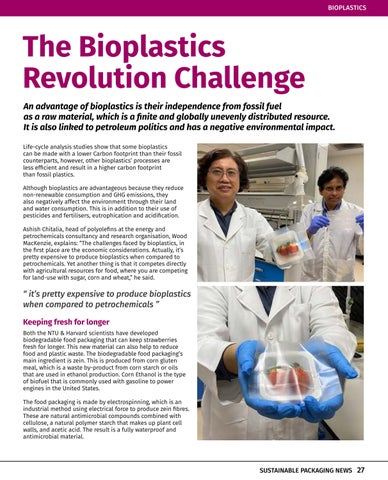
“ it’s pretty expensive to produce bioplastics when compared to petrochemicals ” Keeping fresh for longer Both the NTU & Harvard scientists have developed biodegradable food packaging that can keep strawberries fresh for longer. This new material can also help to reduce food and plastic waste. The biodegradable food packaging’s main ingredient is zein. This is produced from corn gluten meal, which is a waste by-product from corn starch or oils that are used in ethanol production. Corn Ethanol is the type of biofuel that is commonly used with gasoline to power engines in the United States. The food packaging is made by electrospinning, which is an industrial method using electrical force to produce zein fibres. These are natural antimicrobial compounds combined with cellulose, a natural polymer starch that makes up plant cell walls, and acetic acid. The result is a fully waterproof and antimicrobial material.
SUSTAINABLE PACKAGING NEWS
27