Mission Emphasis
Transformational Initiatives
foster care system in Colombia each year. Sadly, she is also a member of the growing statistic of 48 minors each day that suffer sexual abuse. Tragically, femicide touched her life as her stepfather brutally murdered her mother, in front of Alé’s eyes. Latin America ranks 1st in the world in terms of death from the violence of femicide, with notable cases in Ciudad Juárez, Mexico, in Recife, Brazil, and along the border of Guatemala and Mexico. I don’t want my eyes and heart to be closed to reality, but I want to be able to walk with Alé and others like her towards Jesus, with hope! How can my theology grow and become richer to do this?
T
Left: A project initiated by Wájaro, storytelling through embroidery explores who Wayuu women are, the things that unite them and the common challenges they face.
Alé cont’d from page 1
“…they must understand their past, and youth especially need to reconcile the outside influences that are shaping their character.”
his is a question that follows me on my journey and shapes how we approach ministry initiatives within the Fundación Comunidad Viva (FCV) in Bogotá, Colombia. Over the past few years, since FCV has been an affiliate ministry of South America Mission, we have been able to receive the support and structure needed for our initiatives to thrive. FCV is the legal non-profit through which we have integrated diverse community development strategies, like those in which Alé has found a safe environment to be transformed. In Spanish, the word Juventudes represents the multifaceted nature of Alé’s population. Instead of putting all youth in a box, with only one way to approach them, we recognize their diversity and that the way to walk with them will look different in their varying contexts. For example, it is very different to minister to a young, indigenous woman in a rural context than a young male living in an urban middle
REDEEMED LIVES | BEAUTIFUL CHURCHES | TRANSFORMED COMMUNITIES
Below: Proud Wayuu graduates celebrating their graduation with bachilleratos conferred by the COTELGUA program. MAKE IT HAPPEN Will you donate to Wájaro to enable vital vocational development for our Wayuu friends and church leaders? Visit www. wajaro.org or www. southamericamission.org to learn how you can be involved.
Jones/Wájaro Foundation cont’d from page 5
class context. There is much diversity in Latin America and it is beautiful to recognize and celebrate. Weaving the social fabric of our communities is one of the passions of FCV. More than acknowledge the history of Latin America, we believe it is important to help our neighbors reconcile with that history and see how it affects our current cultural mentality with the expanse of globalization. Within FCV and our various programs, we try to value diversity. We see that there is such a rich cultural diversity within our own communities and we attempt to tread softly as we bring North American missionaries or short-term mission trips into these spaces. Even in simple ways such as using worship songs written in Spanish and using Latin American rhythms, we celebrate our culture within ministry. For any Latin American to understand who they are, they must understand their past, and youth especially need to reconcile the outside influences that are shaping their character. This ‘past’ includes the colonization and conquest of our countries. There has been a precedent of submitting to a dominant external culture for survival that still impacts Latin Americans today. As you travel from
and peace processes and to unify and encourage the church in indigenous and vulnerable populations. The Wayuu people invited the Wájaro team into its first project: helping form an association of Wayuu pastors committed to addressing the needs of their territory in northern Colombia. “This group of pastors has leaders from 9 church denominations,” Jake explains. “Their main objective is to unify the church in the Guajira region of Colombia, as well as to equip the pastors to further the gospel. As a unified association, they also position themselves to be active participants at the table with other organizations and the
article by Melissa Weisssenberger melissa.weissenberger@southamericamission.org
>>> 2 |
Front Page
government as vital decisions are being made that will affect Wayuu communities post-conflict.” Together, they held workshops to assist the pastors as they determined their objectives and formulated goals while supporting the formation of a viable association. Wájaro helped connect the association to COTELGUA (Corporacion Tecnica Laboral de la Guajira), which provides vocational training, and with Alfalit, which provides literacy programs and training. These partnerships allow indigenous pastors and denominational leaders to earn high school diplomas, and equip pastors for seminary. Providing a way for collaboration, and accompanying others on their road to fulfilling God’s vision, is the underlying premise in all that the Joneses do. Lauren says that some might look at their projects and ask ‘how can you do it all?’, but their answer is that they don’t. “We work with local leaders so the work does not rely on us. When the communities succeed, they can look back and see the work they have done and how—when the body of Christ works together—God can move mountains!” •
Front Page
SEPTEMBER 2018
by Ginny Enciso Fundación Comunidad Viva–SAM Colombia. edited by Melissa Weissenberger.
Alé
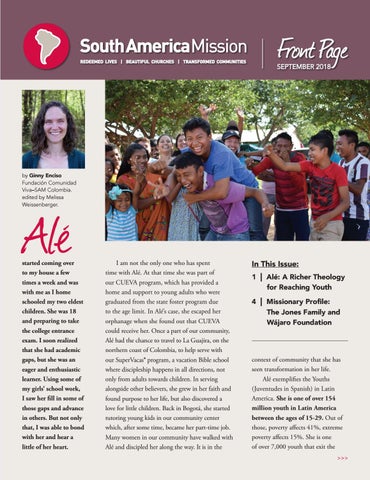
started coming over to my house a few times a week and was with me as I home schooled my two eldest children. She was 18 and preparing to take the college entrance exam. I soon realized that she had academic gaps, but she was an eager and enthusiastic learner. Using some of my girls’ school work, I saw her fill in some of those gaps and advance in others. But not only that, I was able to bond with her and hear a little of her heart.
I am not the only one who has spent time with Alé. At that time she was part of our CUEVA program, which has provided a home and support to young adults who were graduated from the state foster program due to the age limit. In Alé’s case, she escaped her orphanage when she found out that CUEVA could receive her. Once a part of our community, Alé had the chance to travel to La Guajira, on the northern coast of Colombia, to help serve with our SuperVacas® program, a vacation Bible school where discipleship happens in all directions, not only from adults towards children. In serving alongside other believers, she grew in her faith and found purpose to her life, but also discovered a love for little children. Back in Bogotá, she started tutoring young kids in our community center which, after some time, became her part-time job. Many women in our community have walked with Alé and discipled her along the way. It is in the
In This Issue:
1 | Alé: A Richer Theology for Reaching Youth 4 | Missionary Profile: The Jones Family and Wájaro Foundation
context of community that she has seen transformation in her life. Alé exemplifies the Youths (Juventudes in Spanish) in Latin America. She is one of over 154 million youth in Latin America between the ages of 15-29. Out of those, poverty affects 41%, extreme poverty affects 15%. She is one of over 7,000 youth that exit the >>>
6 |
Front Page
Mission Emphasis
Transformational Initiatives
foster care system in Colombia each year. Sadly, she is also a member of the growing statistic of 48 minors each day that suffer sexual abuse. Tragically, femicide touched her life as her stepfather brutally murdered her mother, in front of Alé’s eyes. Latin America ranks 1st in the world in terms of death from the violence of femicide, with notable cases in Ciudad Juárez, Mexico, in Recife, Brazil, and along the border of Guatemala and Mexico. I don’t want my eyes and heart to be closed to reality, but I want to be able to walk with Alé and others like her towards Jesus, with hope! How can my theology grow and become richer to do this?
T
Left: A project initiated by Wájaro, storytelling through embroidery explores who Wayuu women are, the things that unite them and the common challenges they face.
Alé cont’d from page 1
“…they must understand their past, and youth especially need to reconcile the outside influences that are shaping their character.”
his is a question that follows me on my journey and shapes how we approach ministry initiatives within the Fundación Comunidad Viva (FCV) in Bogotá, Colombia. Over the past few years, since FCV has been an affiliate ministry of South America Mission, we have been able to receive the support and structure needed for our initiatives to thrive. FCV is the legal non-profit through which we have integrated diverse community development strategies, like those in which Alé has found a safe environment to be transformed. In Spanish, the word Juventudes represents the multifaceted nature of Alé’s population. Instead of putting all youth in a box, with only one way to approach them, we recognize their diversity and that the way to walk with them will look different in their varying contexts. For example, it is very different to minister to a young, indigenous woman in a rural context than a young male living in an urban middle
REDEEMED LIVES | BEAUTIFUL CHURCHES | TRANSFORMED COMMUNITIES
Below: Proud Wayuu graduates celebrating their graduation with bachilleratos conferred by the COTELGUA program. MAKE IT HAPPEN Will you donate to Wájaro to enable vital vocational development for our Wayuu friends and church leaders? Visit www. wajaro.org or www. southamericamission.org to learn how you can be involved.
Jones/Wájaro Foundation cont’d from page 5
class context. There is much diversity in Latin America and it is beautiful to recognize and celebrate. Weaving the social fabric of our communities is one of the passions of FCV. More than acknowledge the history of Latin America, we believe it is important to help our neighbors reconcile with that history and see how it affects our current cultural mentality with the expanse of globalization. Within FCV and our various programs, we try to value diversity. We see that there is such a rich cultural diversity within our own communities and we attempt to tread softly as we bring North American missionaries or short-term mission trips into these spaces. Even in simple ways such as using worship songs written in Spanish and using Latin American rhythms, we celebrate our culture within ministry. For any Latin American to understand who they are, they must understand their past, and youth especially need to reconcile the outside influences that are shaping their character. This ‘past’ includes the colonization and conquest of our countries. There has been a precedent of submitting to a dominant external culture for survival that still impacts Latin Americans today. As you travel from
and peace processes and to unify and encourage the church in indigenous and vulnerable populations. The Wayuu people invited the Wájaro team into its first project: helping form an association of Wayuu pastors committed to addressing the needs of their territory in northern Colombia. “This group of pastors has leaders from 9 church denominations,” Jake explains. “Their main objective is to unify the church in the Guajira region of Colombia, as well as to equip the pastors to further the gospel. As a unified association, they also position themselves to be active participants at the table with other organizations and the
article by Melissa Weisssenberger melissa.weissenberger@southamericamission.org
>>> 2 |
Front Page
government as vital decisions are being made that will affect Wayuu communities post-conflict.” Together, they held workshops to assist the pastors as they determined their objectives and formulated goals while supporting the formation of a viable association. Wájaro helped connect the association to COTELGUA (Corporacion Tecnica Laboral de la Guajira), which provides vocational training, and with Alfalit, which provides literacy programs and training. These partnerships allow indigenous pastors and denominational leaders to earn high school diplomas, and equip pastors for seminary. Providing a way for collaboration, and accompanying others on their road to fulfilling God’s vision, is the underlying premise in all that the Joneses do. Lauren says that some might look at their projects and ask ‘how can you do it all?’, but their answer is that they don’t. “We work with local leaders so the work does not rely on us. When the communities succeed, they can look back and see the work they have done and how—when the body of Christ works together—God can move mountains!” •
Front Page
SEPTEMBER 2018
by Ginny Enciso Fundación Comunidad Viva–SAM Colombia. edited by Melissa Weissenberger.
Alé
started coming over to my house a few times a week and was with me as I home schooled my two eldest children. She was 18 and preparing to take the college entrance exam. I soon realized that she had academic gaps, but she was an eager and enthusiastic learner. Using some of my girls’ school work, I saw her fill in some of those gaps and advance in others. But not only that, I was able to bond with her and hear a little of her heart.
I am not the only one who has spent time with Alé. At that time she was part of our CUEVA program, which has provided a home and support to young adults who were graduated from the state foster program due to the age limit. In Alé’s case, she escaped her orphanage when she found out that CUEVA could receive her. Once a part of our community, Alé had the chance to travel to La Guajira, on the northern coast of Colombia, to help serve with our SuperVacas® program, a vacation Bible school where discipleship happens in all directions, not only from adults towards children. In serving alongside other believers, she grew in her faith and found purpose to her life, but also discovered a love for little children. Back in Bogotá, she started tutoring young kids in our community center which, after some time, became her part-time job. Many women in our community have walked with Alé and discipled her along the way. It is in the
In This Issue:
1 | Alé: A Richer Theology for Reaching Youth 4 | Missionary Profile: The Jones Family and Wájaro Foundation
context of community that she has seen transformation in her life. Alé exemplifies the Youths (Juventudes in Spanish) in Latin America. She is one of over 154 million youth in Latin America between the ages of 15-29. Out of those, poverty affects 41%, extreme poverty affects 15%. She is one of over 7,000 youth that exit the >>>
6 |
Front Page
This ideology is reflected in the colloquial phrase “ser or loser” (ser meaning “to be” in Spanish). There are people who actually exist in the “ser”, meaning that they have the status and ability to conform, but the rest of the population are “losers”, and they will never make it all the way. Those in the “ser” are the winners of society who have access to upward mobility. It is quite common for the “losers”, those who cannot above: Ginny Enciso leading an outreach initiative of the Foundation’s youth development reach the level of “ser”, to project called Conexión Wayuu. The book she is reading is described as “an elegant story of portray themselves falsely on generosity that crosses boundaries, nations, and cultures.” social media as the only means of advancing their image. Bogotá’s central district to its outskirts, you see the lasting This is one space where we see room for the gospel to come in impact of previous civilizations. In the center of Bogotá’s and speak a new message in our society. Echoing the words of historic district Spanish and Portuguese traditional, colonial Henri Nouwen in his messages on “Being the Beloved”, there is buildings stand tall, unchanged. Farther out are French styles a call of the gospel to find our identity rooted in how God sees and even an entire district of British-styled homes. Even us and how God’s love can transform us on a heart level. farther to the north is a series of US-inspired architecture. Therefore, when we approach pastoring youth, there are Instead of seeking diversity in our countries, we see a many factors to consider. One big question for us is: how continued trend of people seeking a homogeneous culture can we increase inter-generational dialogue? Technology that conforms to the dominant external norms, as was and the use of social media become factors in this discussion. necessary during colonization. Now, for example, we see Social media can be a way for youth to find a voice and stay that young girls all have the same hair style, same clothing, connected, and in some ways can “level the playing field” for and speak with the same dialect or accents to imitate youth in all contexts of Latin America. One example is with Western popular culture. Being like that dominant culture Conexión Wayuu, an FCV program that grew out of youth allows for more opportunities in all areas of life. If you from the urban context of Bogotá working alongside rural, cannot or do not conform to the dominant culture, you are indigenous Wayuu youth and discovering that they could rejected or face potential discrimination. learn from each other, in the context of children’s ministry. We have stayed connected to each other using social media, and the themes we discussed have included valuing of cultural diversity and giving a voice through storytelling and the technology available to them. “…there is a call of the gospel to Another question we ask in ministry is how to shift the find our identity rooted in how pastoral relationship from a traditional vertical relationship to a more horizontal relationship. Understanding the context God sees us and how God’s love of colonialism, how can we ask permission to enter any given can transform us on a heart level.” context or a relationship? This must have elements of listening 3 |
Front Page
and asking questions. For example, in FCV’s house church movement Ciudad Corazon, the study of the Bible is done horizontally, i.e., the facilitator seeks to ask questions and listen instead of doing most of the talking, and people of all ages are free to say what the Spirit is teaching them. The pastor, understanding the priesthood of all believers, can shepherd and walk alongside the others. Our house churches have become close knit communities and safe places for Alé and others like her, where the members can lend a unique perspective on the Bible because of their backgrounds and where we can all walk towards Jesus together. When I think of Alé in Bogotá, or Davíd, a Wayuu young man in Maicao, I think that where they have seen the gospel lived out, and encountered Jesus, is in healthy community, be it a house church, Conexion Wayuu, working alongside others in SuperVacas®, the community center, or my own home. As FCV continues to expand its ministries and initiatives, we see a responsibility to the communities that we serve. We must not close our eyes to the daunting numbers of youth in our countries or the realities of our communities, but find transformational ways of walking alongside them towards Jesus. •
HELP FUNDACIÓN COMUNIDAD VIVA BUILD VIBRANT GOSPEL COMMUNITIES IN COLOMBIA www.southamericamission.org/fcvcolombia www.fundacioncomunidadviva.com
FUNDACIÓN
Comunidad Viva RESTAURANDO LAZOS • TEJIENDO ESPERANZA
4 |
Front Page
Mission Emphasis
Missionary Corps
Above: The Jones family: Emma, Naomi, Judah, Eli, Lauren and Jake.
B
><
efore joining South America Mission, Jake and Lauren Jones served for years in Muncie, Indiana, intentionally living in an underresourced neighborhood. They helped plant a church with a mission to reconcile people to God and each other, especially across racial lines of segregation. They also started and ran a cleaning business, which still exists, to provide jobs and community for people who need a second chance. Looking back, they both clearly see how God directed each step in their lives to prepare them for their current ministry in Colombia: the Fundación Wájaro. “Wájaro”, a word from the Eduria, an Amazonian indigenous group, means “let’s go together”. The philosophy of working together as equal members of a team is a lifelong ideology for the Joneses. As they tell their story, Jake and Lauren
refer to themselves as those who accompany, rather than the protagonists of the work in communities. Lauren expresses their philosophy of mission by saying, “Over time, we become real friends and partners, but along the way we have conversations to break down the old way of doing things. Our work is not a hand out, but rather an extended hand in friendship, we position ourselves side-by-side to work together as brothers and sisters in Christ along the same road.” Jake grew up in Colombia as a child of Wycliffe Bible Translators and Lauren has a background in social work. When the Joneses arrived in Colombia in 2016, they were part of the Fundación Comunidad Viva (FCV) team in Bogotá, and their history with vulnerable communities was apt for FCV’s CUEVA program, which works with at-risk youth who are graduated from State foster care without receiving permanent families. In their words, “we feel a lot more comfortable hanging out SAM Centennial Celebration ★20 PANAMA 15★ who are on the fringes of society. That’s with people where we love to be as followers of Christ. That’s who Jesus hung out with. Those were his people. These are our people. We see so much hope and hunger in these places.” Jake and Lauren also participated in the Platform for Peace, an initiative of FCV that sought to position the church as an active participant in Colombia’s peace and reconciliation process as well as build bridges in indigenous communities where reintegration and reparations would take place. Through the relationships established in this initiative, and the natural connections Jake had to indigenous communities, it became apparent that there was a greater opportunity to serve and it would be strategic to branch out and form their own NGO to address the needs with indigenous groups post-conflict. Together with key local partners, they formed the Fundación Wájaro to realize and strengthen these communities’ responses to the physical needs of their people, their reconciliation >>> 5 |
Front Page
Above: Agustina Pushaina imagining her “story” as she engages in a community development project with Wájaro.
><
“That’s where we love to be as followers of Christ. …Those were his people. These are our people. We see so much hope and hunger in these places.”
This ideology is reflected in the colloquial phrase “ser or loser” (ser meaning “to be” in Spanish). There are people who actually exist in the “ser”, meaning that they have the status and ability to conform, but the rest of the population are “losers”, and they will never make it all the way. Those in the “ser” are the winners of society who have access to upward mobility. It is quite common for the “losers”, those who cannot above: Ginny Enciso leading an outreach initiative of the Foundation’s youth development reach the level of “ser”, to project called Conexión Wayuu. The book she is reading is described as “an elegant story of portray themselves falsely on generosity that crosses boundaries, nations, and cultures.” social media as the only means of advancing their image. Bogotá’s central district to its outskirts, you see the lasting This is one space where we see room for the gospel to come in impact of previous civilizations. In the center of Bogotá’s and speak a new message in our society. Echoing the words of historic district Spanish and Portuguese traditional, colonial Henri Nouwen in his messages on “Being the Beloved”, there is buildings stand tall, unchanged. Farther out are French styles a call of the gospel to find our identity rooted in how God sees and even an entire district of British-styled homes. Even us and how God’s love can transform us on a heart level. farther to the north is a series of US-inspired architecture. Therefore, when we approach pastoring youth, there are Instead of seeking diversity in our countries, we see a many factors to consider. One big question for us is: how continued trend of people seeking a homogeneous culture can we increase inter-generational dialogue? Technology that conforms to the dominant external norms, as was and the use of social media become factors in this discussion. necessary during colonization. Now, for example, we see Social media can be a way for youth to find a voice and stay that young girls all have the same hair style, same clothing, connected, and in some ways can “level the playing field” for and speak with the same dialect or accents to imitate youth in all contexts of Latin America. One example is with Western popular culture. Being like that dominant culture Conexión Wayuu, an FCV program that grew out of youth allows for more opportunities in all areas of life. If you from the urban context of Bogotá working alongside rural, cannot or do not conform to the dominant culture, you are indigenous Wayuu youth and discovering that they could rejected or face potential discrimination. learn from each other, in the context of children’s ministry. We have stayed connected to each other using social media, and the themes we discussed have included valuing of cultural diversity and giving a voice through storytelling and the technology available to them. “…there is a call of the gospel to Another question we ask in ministry is how to shift the find our identity rooted in how pastoral relationship from a traditional vertical relationship to a more horizontal relationship. Understanding the context God sees us and how God’s love of colonialism, how can we ask permission to enter any given can transform us on a heart level.” context or a relationship? This must have elements of listening 3 |
Front Page
and asking questions. For example, in FCV’s house church movement Ciudad Corazon, the study of the Bible is done horizontally, i.e., the facilitator seeks to ask questions and listen instead of doing most of the talking, and people of all ages are free to say what the Spirit is teaching them. The pastor, understanding the priesthood of all believers, can shepherd and walk alongside the others. Our house churches have become close knit communities and safe places for Alé and others like her, where the members can lend a unique perspective on the Bible because of their backgrounds and where we can all walk towards Jesus together. When I think of Alé in Bogotá, or Davíd, a Wayuu young man in Maicao, I think that where they have seen the gospel lived out, and encountered Jesus, is in healthy community, be it a house church, Conexion Wayuu, working alongside others in SuperVacas®, the community center, or my own home. As FCV continues to expand its ministries and initiatives, we see a responsibility to the communities that we serve. We must not close our eyes to the daunting numbers of youth in our countries or the realities of our communities, but find transformational ways of walking alongside them towards Jesus. •
HELP FUNDACIÓN COMUNIDAD VIVA BUILD VIBRANT GOSPEL COMMUNITIES IN COLOMBIA www.southamericamission.org/fcvcolombia www.fundacioncomunidadviva.com
FUNDACIÓN
Comunidad Viva RESTAURANDO LAZOS • TEJIENDO ESPERANZA
4 |
Front Page
Mission Emphasis
Missionary Corps
Above: The Jones family: Emma, Naomi, Judah, Eli, Lauren and Jake.
B
><
efore joining South America Mission, Jake and Lauren Jones served for years in Muncie, Indiana, intentionally living in an underresourced neighborhood. They helped plant a church with a mission to reconcile people to God and each other, especially across racial lines of segregation. They also started and ran a cleaning business, which still exists, to provide jobs and community for people who need a second chance. Looking back, they both clearly see how God directed each step in their lives to prepare them for their current ministry in Colombia: the Fundación Wájaro. “Wájaro”, a word from the Eduria, an Amazonian indigenous group, means “let’s go together”. The philosophy of working together as equal members of a team is a lifelong ideology for the Joneses. As they tell their story, Jake and Lauren
refer to themselves as those who accompany, rather than the protagonists of the work in communities. Lauren expresses their philosophy of mission by saying, “Over time, we become real friends and partners, but along the way we have conversations to break down the old way of doing things. Our work is not a hand out, but rather an extended hand in friendship, we position ourselves side-by-side to work together as brothers and sisters in Christ along the same road.” Jake grew up in Colombia as a child of Wycliffe Bible Translators and Lauren has a background in social work. When the Joneses arrived in Colombia in 2016, they were part of the Fundación Comunidad Viva (FCV) team in Bogotá, and their history with vulnerable communities was apt for FCV’s CUEVA program, which works with at-risk youth who are graduated from State foster care without receiving permanent families. In their words, “we feel a lot more comfortable hanging out SAM Centennial Celebration ★20 PANAMA 15★ who are on the fringes of society. That’s with people where we love to be as followers of Christ. That’s who Jesus hung out with. Those were his people. These are our people. We see so much hope and hunger in these places.” Jake and Lauren also participated in the Platform for Peace, an initiative of FCV that sought to position the church as an active participant in Colombia’s peace and reconciliation process as well as build bridges in indigenous communities where reintegration and reparations would take place. Through the relationships established in this initiative, and the natural connections Jake had to indigenous communities, it became apparent that there was a greater opportunity to serve and it would be strategic to branch out and form their own NGO to address the needs with indigenous groups post-conflict. Together with key local partners, they formed the Fundación Wájaro to realize and strengthen these communities’ responses to the physical needs of their people, their reconciliation >>> 5 |
Front Page
Above: Agustina Pushaina imagining her “story” as she engages in a community development project with Wájaro.
><
“That’s where we love to be as followers of Christ. …Those were his people. These are our people. We see so much hope and hunger in these places.”
This ideology is reflected in the colloquial phrase “ser or loser” (ser meaning “to be” in Spanish). There are people who actually exist in the “ser”, meaning that they have the status and ability to conform, but the rest of the population are “losers”, and they will never make it all the way. Those in the “ser” are the winners of society who have access to upward mobility. It is quite common for the “losers”, those who cannot above: Ginny Enciso leading an outreach initiative of the Foundation’s youth development reach the level of “ser”, to project called Conexión Wayuu. The book she is reading is described as “an elegant story of portray themselves falsely on generosity that crosses boundaries, nations, and cultures.” social media as the only means of advancing their image. Bogotá’s central district to its outskirts, you see the lasting This is one space where we see room for the gospel to come in impact of previous civilizations. In the center of Bogotá’s and speak a new message in our society. Echoing the words of historic district Spanish and Portuguese traditional, colonial Henri Nouwen in his messages on “Being the Beloved”, there is buildings stand tall, unchanged. Farther out are French styles a call of the gospel to find our identity rooted in how God sees and even an entire district of British-styled homes. Even us and how God’s love can transform us on a heart level. farther to the north is a series of US-inspired architecture. Therefore, when we approach pastoring youth, there are Instead of seeking diversity in our countries, we see a many factors to consider. One big question for us is: how continued trend of people seeking a homogeneous culture can we increase inter-generational dialogue? Technology that conforms to the dominant external norms, as was and the use of social media become factors in this discussion. necessary during colonization. Now, for example, we see Social media can be a way for youth to find a voice and stay that young girls all have the same hair style, same clothing, connected, and in some ways can “level the playing field” for and speak with the same dialect or accents to imitate youth in all contexts of Latin America. One example is with Western popular culture. Being like that dominant culture Conexión Wayuu, an FCV program that grew out of youth allows for more opportunities in all areas of life. If you from the urban context of Bogotá working alongside rural, cannot or do not conform to the dominant culture, you are indigenous Wayuu youth and discovering that they could rejected or face potential discrimination. learn from each other, in the context of children’s ministry. We have stayed connected to each other using social media, and the themes we discussed have included valuing of cultural diversity and giving a voice through storytelling and the technology available to them. “…there is a call of the gospel to Another question we ask in ministry is how to shift the find our identity rooted in how pastoral relationship from a traditional vertical relationship to a more horizontal relationship. Understanding the context God sees us and how God’s love of colonialism, how can we ask permission to enter any given can transform us on a heart level.” context or a relationship? This must have elements of listening 3 |
Front Page
and asking questions. For example, in FCV’s house church movement Ciudad Corazon, the study of the Bible is done horizontally, i.e., the facilitator seeks to ask questions and listen instead of doing most of the talking, and people of all ages are free to say what the Spirit is teaching them. The pastor, understanding the priesthood of all believers, can shepherd and walk alongside the others. Our house churches have become close knit communities and safe places for Alé and others like her, where the members can lend a unique perspective on the Bible because of their backgrounds and where we can all walk towards Jesus together. When I think of Alé in Bogotá, or Davíd, a Wayuu young man in Maicao, I think that where they have seen the gospel lived out, and encountered Jesus, is in healthy community, be it a house church, Conexion Wayuu, working alongside others in SuperVacas®, the community center, or my own home. As FCV continues to expand its ministries and initiatives, we see a responsibility to the communities that we serve. We must not close our eyes to the daunting numbers of youth in our countries or the realities of our communities, but find transformational ways of walking alongside them towards Jesus. •
HELP FUNDACIÓN COMUNIDAD VIVA BUILD VIBRANT GOSPEL COMMUNITIES IN COLOMBIA www.southamericamission.org/fcvcolombia www.fundacioncomunidadviva.com
FUNDACIÓN
Comunidad Viva RESTAURANDO LAZOS • TEJIENDO ESPERANZA
4 |
Front Page
Mission Emphasis
Missionary Corps
Above: The Jones family: Emma, Naomi, Judah, Eli, Lauren and Jake.
B
><
efore joining South America Mission, Jake and Lauren Jones served for years in Muncie, Indiana, intentionally living in an underresourced neighborhood. They helped plant a church with a mission to reconcile people to God and each other, especially across racial lines of segregation. They also started and ran a cleaning business, which still exists, to provide jobs and community for people who need a second chance. Looking back, they both clearly see how God directed each step in their lives to prepare them for their current ministry in Colombia: the Fundación Wájaro. “Wájaro”, a word from the Eduria, an Amazonian indigenous group, means “let’s go together”. The philosophy of working together as equal members of a team is a lifelong ideology for the Joneses. As they tell their story, Jake and Lauren
refer to themselves as those who accompany, rather than the protagonists of the work in communities. Lauren expresses their philosophy of mission by saying, “Over time, we become real friends and partners, but along the way we have conversations to break down the old way of doing things. Our work is not a hand out, but rather an extended hand in friendship, we position ourselves side-by-side to work together as brothers and sisters in Christ along the same road.” Jake grew up in Colombia as a child of Wycliffe Bible Translators and Lauren has a background in social work. When the Joneses arrived in Colombia in 2016, they were part of the Fundación Comunidad Viva (FCV) team in Bogotá, and their history with vulnerable communities was apt for FCV’s CUEVA program, which works with at-risk youth who are graduated from State foster care without receiving permanent families. In their words, “we feel a lot more comfortable hanging out SAM Centennial Celebration ★20 PANAMA 15★ who are on the fringes of society. That’s with people where we love to be as followers of Christ. That’s who Jesus hung out with. Those were his people. These are our people. We see so much hope and hunger in these places.” Jake and Lauren also participated in the Platform for Peace, an initiative of FCV that sought to position the church as an active participant in Colombia’s peace and reconciliation process as well as build bridges in indigenous communities where reintegration and reparations would take place. Through the relationships established in this initiative, and the natural connections Jake had to indigenous communities, it became apparent that there was a greater opportunity to serve and it would be strategic to branch out and form their own NGO to address the needs with indigenous groups post-conflict. Together with key local partners, they formed the Fundación Wájaro to realize and strengthen these communities’ responses to the physical needs of their people, their reconciliation >>> 5 |
Front Page
Above: Agustina Pushaina imagining her “story” as she engages in a community development project with Wájaro.
><
“That’s where we love to be as followers of Christ. …Those were his people. These are our people. We see so much hope and hunger in these places.”
Mission Emphasis
Transformational Initiatives
foster care system in Colombia each year. Sadly, she is also a member of the growing statistic of 48 minors each day that suffer sexual abuse. Tragically, femicide touched her life as her stepfather brutally murdered her mother, in front of Alé’s eyes. Latin America ranks 1st in the world in terms of death from the violence of femicide, with notable cases in Ciudad Juárez, Mexico, in Recife, Brazil, and along the border of Guatemala and Mexico. I don’t want my eyes and heart to be closed to reality, but I want to be able to walk with Alé and others like her towards Jesus, with hope! How can my theology grow and become richer to do this?
T
Left: A project initiated by Wájaro, storytelling through embroidery explores who Wayuu women are, the things that unite them and the common challenges they face.
Alé cont’d from page 1
“…they must understand their past, and youth especially need to reconcile the outside influences that are shaping their character.”
his is a question that follows me on my journey and shapes how we approach ministry initiatives within the Fundación Comunidad Viva (FCV) in Bogotá, Colombia. Over the past few years, since FCV has been an affiliate ministry of South America Mission, we have been able to receive the support and structure needed for our initiatives to thrive. FCV is the legal non-profit through which we have integrated diverse community development strategies, like those in which Alé has found a safe environment to be transformed. In Spanish, the word Juventudes represents the multifaceted nature of Alé’s population. Instead of putting all youth in a box, with only one way to approach them, we recognize their diversity and that the way to walk with them will look different in their varying contexts. For example, it is very different to minister to a young, indigenous woman in a rural context than a young male living in an urban middle
REDEEMED LIVES | BEAUTIFUL CHURCHES | TRANSFORMED COMMUNITIES
Below: Proud Wayuu graduates celebrating their graduation with bachilleratos conferred by the COTELGUA program. MAKE IT HAPPEN Will you donate to Wájaro to enable vital vocational development for our Wayuu friends and church leaders? Visit www. wajaro.org or www. southamericamission.org to learn how you can be involved.
Jones/Wájaro Foundation cont’d from page 5
class context. There is much diversity in Latin America and it is beautiful to recognize and celebrate. Weaving the social fabric of our communities is one of the passions of FCV. More than acknowledge the history of Latin America, we believe it is important to help our neighbors reconcile with that history and see how it affects our current cultural mentality with the expanse of globalization. Within FCV and our various programs, we try to value diversity. We see that there is such a rich cultural diversity within our own communities and we attempt to tread softly as we bring North American missionaries or short-term mission trips into these spaces. Even in simple ways such as using worship songs written in Spanish and using Latin American rhythms, we celebrate our culture within ministry. For any Latin American to understand who they are, they must understand their past, and youth especially need to reconcile the outside influences that are shaping their character. This ‘past’ includes the colonization and conquest of our countries. There has been a precedent of submitting to a dominant external culture for survival that still impacts Latin Americans today. As you travel from
and peace processes and to unify and encourage the church in indigenous and vulnerable populations. The Wayuu people invited the Wájaro team into its first project: helping form an association of Wayuu pastors committed to addressing the needs of their territory in northern Colombia. “This group of pastors has leaders from 9 church denominations,” Jake explains. “Their main objective is to unify the church in the Guajira region of Colombia, as well as to equip the pastors to further the gospel. As a unified association, they also position themselves to be active participants at the table with other organizations and the
article by Melissa Weisssenberger melissa.weissenberger@southamericamission.org
>>> 2 |
Front Page
government as vital decisions are being made that will affect Wayuu communities post-conflict.” Together, they held workshops to assist the pastors as they determined their objectives and formulated goals while supporting the formation of a viable association. Wájaro helped connect the association to COTELGUA (Corporacion Tecnica Laboral de la Guajira), which provides vocational training, and with Alfalit, which provides literacy programs and training. These partnerships allow indigenous pastors and denominational leaders to earn high school diplomas, and equip pastors for seminary. Providing a way for collaboration, and accompanying others on their road to fulfilling God’s vision, is the underlying premise in all that the Joneses do. Lauren says that some might look at their projects and ask ‘how can you do it all?’, but their answer is that they don’t. “We work with local leaders so the work does not rely on us. When the communities succeed, they can look back and see the work they have done and how—when the body of Christ works together—God can move mountains!” •
Front Page
SEPTEMBER 2018
by Ginny Enciso Fundación Comunidad Viva–SAM Colombia. edited by Melissa Weissenberger.
Alé
started coming over to my house a few times a week and was with me as I home schooled my two eldest children. She was 18 and preparing to take the college entrance exam. I soon realized that she had academic gaps, but she was an eager and enthusiastic learner. Using some of my girls’ school work, I saw her fill in some of those gaps and advance in others. But not only that, I was able to bond with her and hear a little of her heart.
I am not the only one who has spent time with Alé. At that time she was part of our CUEVA program, which has provided a home and support to young adults who were graduated from the state foster program due to the age limit. In Alé’s case, she escaped her orphanage when she found out that CUEVA could receive her. Once a part of our community, Alé had the chance to travel to La Guajira, on the northern coast of Colombia, to help serve with our SuperVacas® program, a vacation Bible school where discipleship happens in all directions, not only from adults towards children. In serving alongside other believers, she grew in her faith and found purpose to her life, but also discovered a love for little children. Back in Bogotá, she started tutoring young kids in our community center which, after some time, became her part-time job. Many women in our community have walked with Alé and discipled her along the way. It is in the
In This Issue:
1 | Alé: A Richer Theology for Reaching Youth 4 | Missionary Profile: The Jones Family and Wájaro Foundation
context of community that she has seen transformation in her life. Alé exemplifies the Youths (Juventudes in Spanish) in Latin America. She is one of over 154 million youth in Latin America between the ages of 15-29. Out of those, poverty affects 41%, extreme poverty affects 15%. She is one of over 7,000 youth that exit the >>>
6 |
Front Page