Glenn Raglin, National Sales Manager glenn@indmacdig.com (404) 905-8933
Lisa Hanschu, Sr. Account Executive lisa@indmacdig.com 785-366-0810
William C. Strickland III, National Sales 205-903-9178 | fax 866-826-5918
Susan Strickland, Accounting susan@indmacdig.com 205-542-1098 | Fax: 866-826-5918
CIRCULATION & SUBSCRIPTIONS
IMD, 3590-b Hwy 31 South, Suite 233, Pelham, aL 35124 circulation@indmacdig.com | Fax: 866-826-5918
REPRINTS
To purchase article reprints please call 800-366-0676 ext. 103 or email wstrickland@indmacdig.com
A Practical Industry Reset
Manufacturing enters 2026 with a different mindset than it had just a few years ago. The urgency hasn’t disappeared, but it has matured. Instead of reacting to disruption, manufacturers are making more deliberate decisions about where to invest, what to modernize, and how to protect the systems that keep production moving.
across this issue, one theme is consistent: performance now depends less on isolated improvements and more on how well systems work together. Fabrication operations are balancing precision with workforce realities. Material handling strategies are shifting toward predictability and flow rather than brute-force capacity. Metalworking continues to push tighter tolerances and faster throughput, but with greater emphasis on stability and repeatability.
Quality has moved closer to the process itself, no longer confined to inspection rooms or end-of-line checks. Measurement, verification, and data feedback are becoming embedded functions of production, helping manufacturers identify risk earlier and reduce costly downstream corrections. In robotics, automation is no longer a question of if, but how intentionally. The conversation has shifted toward scalability, safety, and return on investment, with autonomy increasingly deployed where labor constraints and risk intersect.
Safety and maintenance reflect a similar evolution. The focus is less on reacting to incidents and more on preventing them—through better data, clearer ownership, and disciplined lifecycle planning. equipment reliability, operator safety, and uptime are now viewed as connected outcomes rather than separate responsibilities.
Finally, tooling and workholding underscore a quiet but critical truth: consistency at the cutting edge and the clamping point determines everything that follows. Precision, protection, and process control have become baseline requirements, not competitive luxuries.
Taken together, these developments suggest an industry that is recalibrating. Manufacturers are no longer chasing every new solution, but they are no longer standing still either. They are investing where performance compounds, where risk is reduced, and where systems support people instead of working against them.
That balance—between speed and stability, innovation and discipline—is where manufacturing stands today. This issue reflects an industry focused less on recovery and more on building durable, repeatable advantage.
We’re glad to start the year with you.
William Strickland, Publisher, IMD
POLISHERS &
INDUSTRY NEWS
BIG DAISHOWA Promotes Edgar Argueta to Regional Sales Manager – West
b IG Da ISHOWa Inc. has promoted edgar a rgueta to r egional Sales Manager – West, expanding his leadership role across a broad territory that includes California, Washington, Oregon, Colorado, u tah, Wyoming, a rizona, New Mexico, Idaho, Montana, and Nevada. In this role, a rgueta will oversee sales operations and strategy throughout the region, with all local sales team members reporting directly to him.
a rgueta joined b IG Da ISHOWa in May 2024 as Sales Manager for the Southwest District, following several years as a manufacturer’s representative for the company. His background includes extensive experience supporting customers with precision tooling solutions and building long-standing industry relationships. The promotion reflects b IG Da ISHOWa’s continued growth and its focus on strengthening customer support and sales leadership across key u .S. markets.
For More Information: www.bigdaishowa.com
Caldwell Strengthens Sales and Engineering Teams With Two Strategic Hires
The Caldwell Group Inc. has announced the addition of two experienced industry professionals to support its next phase of growth. brian Porter has joined the company as regional sales manager, while Kent Henry has been named sales engineer.
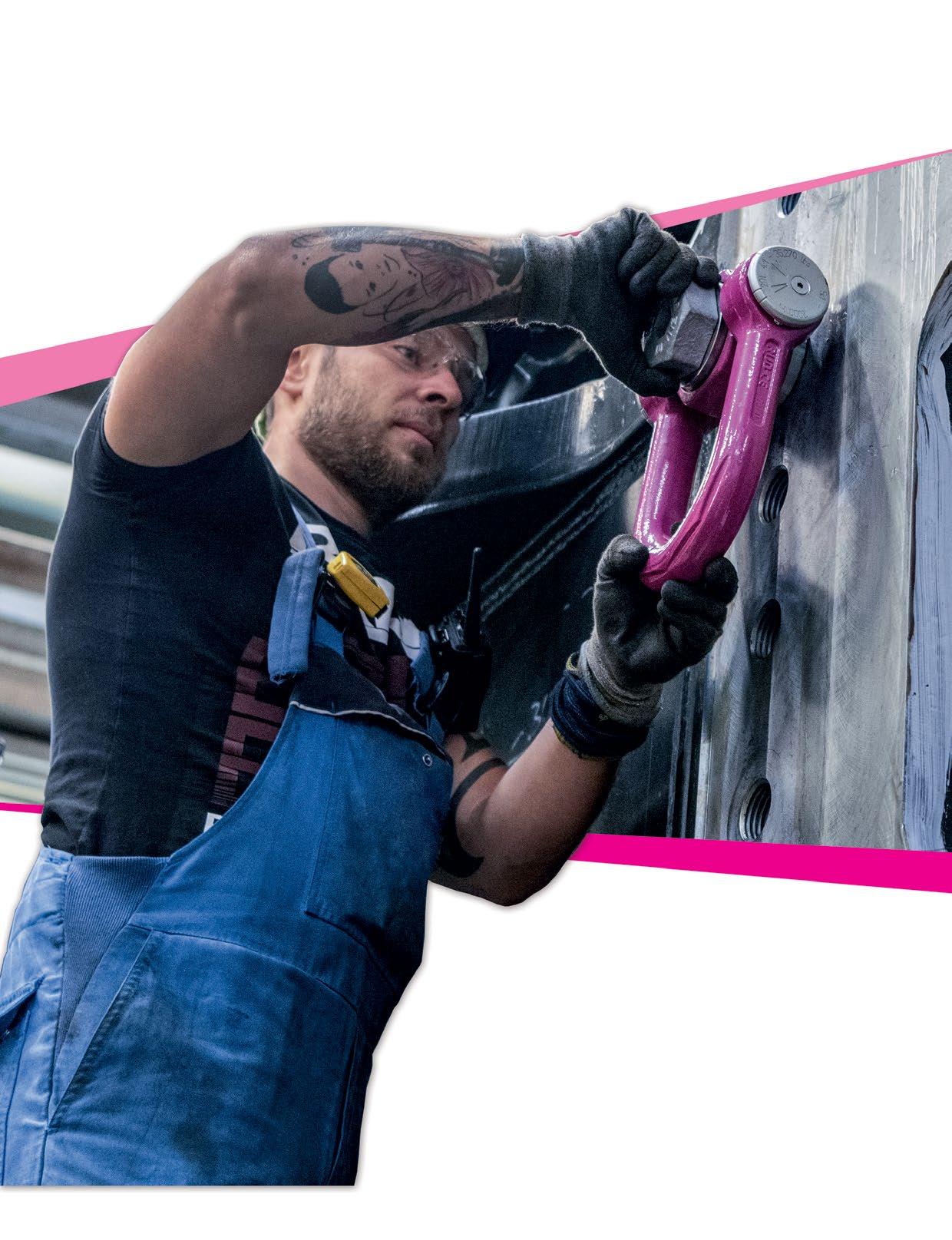
Porter brings nearly three decades of experience in lifting and rigging, with a focus on distributor partnerships and end-user solutions across industrial, construction, and O e M markets. His role will span Caldwell’s full product portfolio, including belowthe-hook lifters, construction lifters, mill duty lifters, and lifting points developed in partnership with the ru D Group. Henry joins Caldwell with a strong engineering background, focusing on custom lifting solutions, concept development, and technical support for complex applications.
The hires reinforce Caldwell’s commitment to expanding its technical sales capabilities while delivering engineered solutions tailored to customer needs.
For More Information: www.caldwellinc.com
Cincinnati Incorporated Expands Hendrick Motorsports Partnership for 2026 NASCAR Season
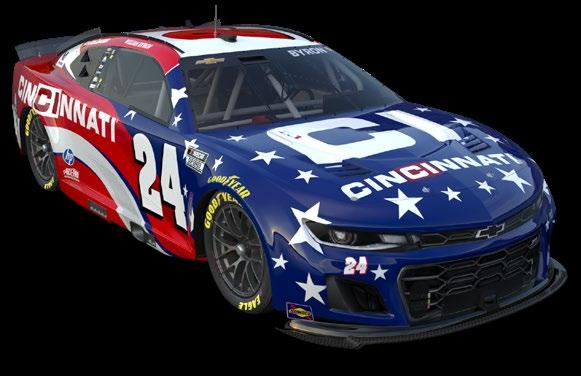
Cincinnati Incorporated and Hendrick Motorsports have announced an expansion of their long-standing partnership, with Cincinnati serving as the primary sponsor of the No. 24 Chevrolet for two races during the 2026 NaSCar Cup Series season.
Edgar Argueta
Brian Porter
Kent Henry
Driven by William byron, the Cincinnati-branded car will debut at Martinsville Speedway on March 29 and return at richmond raceway on august 15. The sponsorship builds on a 10-year agreement that designates Cincinnati as the Official Metal Fabrication equipment Provider for Hendrick Motorsports. The race team relies on Cincinnati’s laser cutting, press brake, and automation equipment in the fabrication of its race vehicles.
The collaboration highlights the role of advanced manufacturing technologies in high-performance motorsports and underscores Cincinnati’s ongoing commitment to a merican manufacturing.
For More Information: www.e-ci.com
NC State Awarded Department of Defense-Funded METAL Hub to Advance u.S. Metals Workforce
North Carolina State university has been selected as a new hub within the Metallurgical engineering Trades apprenticeships & Learning (Me TaL) network, a national workforce development initiative funded by the u.S. Department of Defense through the Industrial base analysis and Sustainment Program.
Led by IaCMI – The Composites Institute, the Me TaL program focuses on training and upskilling workers in critical metal manufacturing disciplines such as casting, forging, and plate rolling. NC State’s hub will expand the program’s scope by adding powder metallurgy and powder-enabled forging, technologies increasingly important to aerospace, defense, and advanced manufacturing sectors.
The hub will offer bootcamps, workshops, and hands-on training programs for students, apprentices, and working professionals, reinforcing efforts to strengthen domestic manufacturing capabilities and supply chain resilience.
For More Information: www.ncsu.edu
LASERDyNE Appoints Fabrizio Anzalone as Chief Executive Officer
Prima Power has appointed Fabrizio anzalone as Chief executive Officer of its L aSerDyNe division, a leader in precision laser processing solutions for aerospace, space, and energy applications.
a nzalone brings extensive global leadership experience, most recently guiding growth initiatives across europe and North a merica. His appointment comes as demand accelerates for high-precision, automated manufacturing systems driven by the expansion of the space economy and data center infrastructure. under his leadership, L a SerDyNe plans to expand its presence in europe, a sia, and emerging markets while continuing to invest in innovative product development.
L a SerDyNe maintains a commitment to 100% u.S.-based manufacturing, reinforcing its support of domestic production and advanced manufacturing leadership.
For More Information: www.laserdyne.com
REGO-FIX Announces Expanded Leadership Roles at North American Headquarters
reGO-FIX has announced several leadership promotions at its North american headquarters, reflecting continued growth and a strengthened focus on engineering, operations, and customer support.
Jeff Schemel has been named President of reGO-FIX uSa , overseeing all u.S. and Canadian operations. David McHenry has advanced to Vice President of engineering, leading technical teams and training initiatives, while Jeremy Kirkbride has been promoted to Vice President of Operations, managing customer service and warehouse operations. Chris Herdman has also assumed a new role as Technical Manager, directing daily technical support activities.
The leadership updates support reGO-FIX’s ongoing investment in service excellence and technical expertise across North a merica.
For More Information: www.rego-fix.com
Scotchman Industries Announces National Sales Leadership Transition
Scotchman Industries has announced the retirement of longtime National Sales Manager Mike albrecht after 31 years of service and the appointment of bradly Kuchenbecker as his successor.
albrecht will remain involved through a pril to ensure a smooth transition while continuing to support customers and automation initiatives. Kuchenbecker brings 26 years of industry experience and deep familiarity with Scotchman’s products and distributor network, positioning
Jeff Schemel
David McHenry
Chris Herdman
Jeremy Kirkbride
him to lead the company’s national sales efforts moving forward.
The transition marks a new chapter for Scotchman while maintaining continuity in customer relationships and sales strategy.
For More Information: www.scotchman.com
Toyota Material Handling North America and Tailift uSA Form Strategic Alliance
Toyota Material Handling North america and Tailift uSa have announced a strategic alliance aimed at strengthening Tailift’s distribution, service, and aftermarket support across the united States.
under the agreement, Toyota Material Handling North a merica will provide operational and business support
while both organizations collaborate on tools to enhance dealer and customer engagement. Jim O’ brien has been named managing director of Tailift uSa , bringing three decades of material handling experience to the role.
The alliance is designed to optimize support capabilities without changing existing dealership networks or governance structures.
For More Information: www.toyotaforklift.com
Women in Manufacturing Announces Second Annual Men as Allies Conference
Women in Manufacturing a ssociation has announced the second annual Men as allies Conference, scheduled for February 18–19, 2026, in Clearwater beach, Florida.
The event is designed for male leaders in manufacturing committed to fostering inclusive workplaces and strengthening business performance.
The conference will focus on the connection between allyship, workforce engagement, and organizational success, featuring expert-led sessions, interactive workshops, and panel discussions. Speakers will represent manufacturing leaders from across the industry, with support from sponsoring organizations committed to workforce development and inclusion.
For More Information: www.womeninmanufacturing.org
FABRICATION
Transforming Materials Into Excellence
Discover the innovative tools and technologies shaping today’s manufacturing landscape. Highlighting processes that transform raw materials into precision-crafted products, from advanced cutting and forming systems to welding and finishing techniques, the focus remains on efficiency, accuracy, and innovation driving modern fabrication.
From advancements in automation and sustainable manufacturing practices to the latest developments in material processing, gain insights into trends and solutions that enhance productivity, improve quality, and maintain competitiveness in a rapidly evolving industry. This overview showcases the equipment and expertise behind the products powering industries worldwide.
How AI Is Salvaging the Hidden Costs of Machine Misconfiguration
By Le’ora Lichtenstein, Co-Founder & CEO, Corbel
Most productivity losses in manufacturing are not caused by machine failure.
They come instead from machines that are technically capable, but improperly configured for the job they are asked to do.
The impact is material. Qualityrelated losses are cumulative—such as scrap, rework, and failure costs—and are typically estimated at 15–20% of sales revenue across an enterprise.
This is why configuration matters. It’s not just about what type of equipment a business buys, but how deliberately—and how well—it is set up and operated.
Misconfiguration is one of the most expensive and least visible problems in industrial environments. It rarely announces itself as a single catastrophic event. Instead, it emerges through a series of smaller contributing factors that are difficult to trace back to a single root cause.
by the time the issue is identified, the cost has already been absorbed. addressing misconfiguration must happen at every level—because once problems are visible, it is often too late. This is where advanced aI-driven platforms can play a critical role.
by providing aI-driven pre-purchase insights, these technologies can guide manufacturers toward optimal equipment configurations tailored to their specific operational needs before deployment. early guidance reduces misconfiguration risk from day one, ensuring optimized performance while preventing costly downtime, inefficiencies, and operational risk.
The Data Deficit—and How AI Is Bridging the Gap
Industrial manufacturing sales are projected to reach a trillion dollars
by 2030, yet the sector remains dominated by large, expensive, and increasingly complex machinery. at the same time, configuration choices are multiplying. enterprises increasingly rely on technology to support those decisions. While the introduction of aI software does not automatically simplify configuration, it fundamentally changes when decisions are validated. When integrated early in the configuration process, aI and automation can deliver predictive insights that guide decisions before production begins. by analyzing historical performance data alongside real-time variables, aI helps organizations identify suitable configurations while reducing downstream risk.
With ongoing workforce constraints—including a well-documented shortage of skilled labor—manufacturers are shifting validation earlier in the lifecycle. This “shift left” approach moves configuration checks ahead of installation and production by introducing decision-support layers that compare proposed setups against specifications, compatibility, and performance criteria.
b y embracing a I-driven technology during equipment purchasing, manufacturers gain a comprehensive view of the product lifecycle. Continuous analysis of past configurations, maintenance histories, operating conditions, and performance metrics allows a I systems to deliver real-time recommendations and calibration guidance—resulting in alignment without costly missteps.
Preventing Cost Downstream
The most expensive aspect of misconfiguration is not the initial mistake—it is everything that compounds afterward.
Downtime alone is estimated to reduce productivity by 5–20%, and it is not driven solely by mechanical failure. base component issues caused by vibration, misalignment, heat exposure, and wear contribute significantly. Manual maintenance errors further compound risk; human error accounts for roughly 23% of unplanned downtime, and some estimates attribute up to 80% of manufacturing defects to human mistakes.
Siemens’ 2024 True Cost of Downtime report estimates that an average large manufacturing plant loses approximately $250 million annually due to unplanned downtime.
Misconfigured equipment increases scrap rates, rework, maintenance frequency, and setup times while shortening tool and component life and producing inconsistent quality. These costs rarely trace back to configuration decisions—they appear as operational failures rather than design errors—making systemic correction difficult.
To prevent this cost leakage, manufacturers must incorporate aI-driven pre-purchase analysis and simulation. Identifying misconfigurations before equipment is specified or purchased shifts correction upstream rather than absorbing losses downstream.
Preserving Institutional Knowledge
Industrial equipment operates within strict boundaries defined by load capacity, duty cycle, thermal limits, electrical requirements, environmental conditions, and regulatory compliance. When these constraints are respected, machines perform predictably.
The challenge is that specifications are often fragmented across manuals, PDFs, spreadsheets, and institutional knowledge. Validation frequently relies on a small group of experienced engineers or operators. a s organizations scale and experienced personnel retire, that expertise becomes harder to replicate.
aI does not replace experience—it reinforces it. by validating decisions against historical data and best practices, aI tools give teams greater clarity and confidence without requiring deep expertise at every decision point.
Why Visibility Alone Is Not Enough
Manufacturers have invested heavily in monitoring, diagnostics, and dashboards. but visibility alone does not prevent misconfiguration.
Most configuration errors occur before a machine ever starts running. Once an incorrect setup is in place, monitoring systems can only report consequences—not explain why the configuration was flawed.
aI systems validate configuration decisions before execution, assessing them against comprehensive datasets to surface risk early. This enables proactive correction, reducing downtime, rework, and operational disruption while freeing skilled personnel to focus on higher-value tasks.
reducing misconfiguration does not require replacing people or adding unnecessary complexity. It requires better decision support at the moment decisions are made.
aI complements human expertise by scaling institutional knowledge, interrogating historical intelligence, and delivering consistent, data-backed recommendations. Misconfiguration is a hidden tax on manufacturing operations—and as equipment complexity increases, that tax will grow unless configuration discipline receives the same rigor as machine design itself.
aI-driven automation brings unprecedented oversight to configuration management, proving its value across the full equipment lifecycle.
manufacturing ecosystem designed to bring repeatability, traceability, and scalability to industrial 3D printing operations. The workflow integrates build preparation, Hybrid PhotoSynthesis (HPS) printing, post-processing, inspection, and analytics into a single, unified production environment.
a s part of the launch, a xtra3D introduced three new products—a xtra.Wash, a xtra.Cure, and a xtra.Insight—each designed to function as part of the validated workflow. a xtra.Wash automates material-specific washing and drying processes, while a xtra.Cure combines u V and thermal curing into a single system to support consistent post-processing. a xtra.Insight aggregates sensor data across the workflow, providing real-time process visibility, layer-level monitoring, predictive maintenance insights, and complete job history traceability. Together, the ecosystem is designed to reduce variability, streamline qualification, and support repeatable production across regulated and end-use manufacturing environments.
For More Information: www.axtra3d.com
ESAB Introduces Warrior® Edge Aluminum Push-Pull MIG Welding System
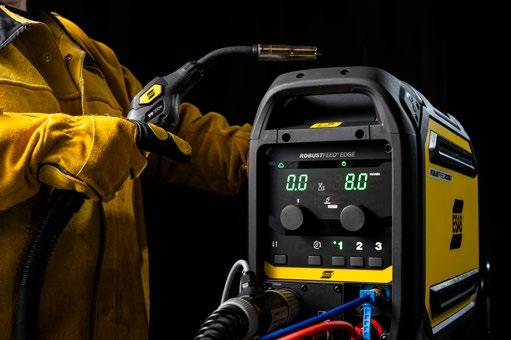
eSab has introduced the Warrior ® edge aluminum push-pull MIG welding system, combining a high-capacity power source, advanced wire feeding technology, and a new water-cooled MIG gun designed for heavy industrial aluminum welding applications. The system is engineered to address common challenges associated with aluminum welding, including feeding instability, arc inconsistency, and excessive heat input.
The system features multiple WeldModes, including a new Craft Mode that uses overlapping pulsed currents to improve heat control, reduce spatter, and produce smoother weld bead appearance. Synergic control allows operators to maintain optimized arc characteristics by adjusting a limited number of parameters, reducing
reliance on operator skill and minimizing training requirements. Designed for demanding fabrication environments, the Warrior edge aluminum system supports improved weld quality, higher productivity, and reduced rework.
For More Information: www.esab.com
Flex Machine Tools Expands FlexJet Waterjet Systems With Multi-Head Cutting Configurations
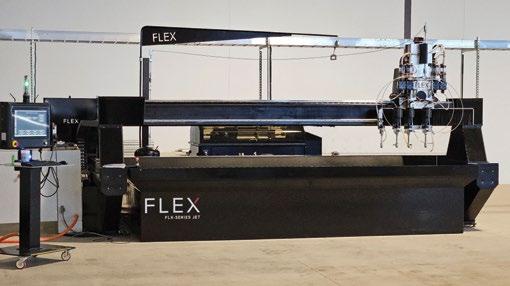
Flex Machine Tools has expanded its FlexJet waterjet product line with configurable multi-head cutting options designed to increase throughput and reduce cost per part in fabrication operations. The multi-head configurations allow multiple cutting heads to operate simultaneously, enabling fabricators to complete jobs faster while maintaining consistent cutting performance.
each cutting head is supplied with its own abrasive delivery system to ensure uniform cutting quality, and systems can be paired with higher-horsepower pumps to prevent performance loss at individual heads. adjustable head spacing and independent head control allow fabricators to tailor setups to part geometry and production requirements. built in the united States, FlexJet waterjet systems are designed for high-speed positioning, reliability, and demanding cutting applications, with service support available throughout North a merica.
For More Information: www.flexmachinetools.com
GREENERD PRESS & MACHINE CO.
Greenerd Delivers Automated MultiStation Hydraulic Press System for High-Volume Production
Greenerd Press & Machine Co. has designed and built a highly automated, multi-station hydraulic press
FLEX MACHINE TOOLS
system engineered to produce aluminum electrical splices at a rate of 60 parts per minute. The custom system integrates multiple operations into a single automated line, supporting high-volume production with consistent quality.
Material is fed through a straightening and shearing process before being transferred via a Greenerd-designed conveyor and diverter system. a servo-driven shuttle coordinates multiple forming operations, including dimpling, hole formation, chamfering, and grooving. The project highlights Greenerd’s ability to deliver custom press solutions that combine automation, precision control, and throughput for complex fabrication and forming applications.
For More Information: www.greenerd.com
MILLER ELECTRIC MFG. LLC
Miller Introduces ArcCapture™ Weld Camera Systems for Training and Process Visibility
Miller electric Mfg. LLC has introduced a rcCapture™, a high-definition weld camera system designed to enhance training, instruction, and process visibility in both educational and industrial welding environments. The compact system provides real-time views of the welding arc, allowing instructors and supervisors to observe weld quality without disrupting operations.
In training environments, a rcCapture enables live demonstrations to be displayed to entire classes while allowing instructors to monitor individual welds remotely. In manufacturing and automation settings, the system integrates with robotic and automated welding cells to support process monitoring, inspection, and quality assurance. a rcCapture is available in both standard and Wi-Fi-enabled models to support a wide range of welding applications.
For More Information: www.millerwelds.com
PALMGREN
Palmgren Introduces Two-Speed Dual Head Buffer and Polishing Lathe
Palmgren has introduced a two-speed dual head buffer and polishing lathe designed for deburring, surface
conditioning, polishing, and finishing operations across a range of fabrication applications. The system supports both high-production work and fine-detail finishing by allowing operators to adjust speed based on material and surface requirements.
The machine features a direct-drive powertrain with an oversized shaft and sealed ball bearings to support demanding use and extended service life. a heavy-duty floor stand provides stability, vibration reduction, and integrated storage, making the system well suited for shop environments where consistent surface finish and durability are required.
For More Information: www.palmgren.com
SCOTCHMAN INDUSTRIES
Scotchman Expands PressPro Hydraulic Press Line With New 110W MT Model
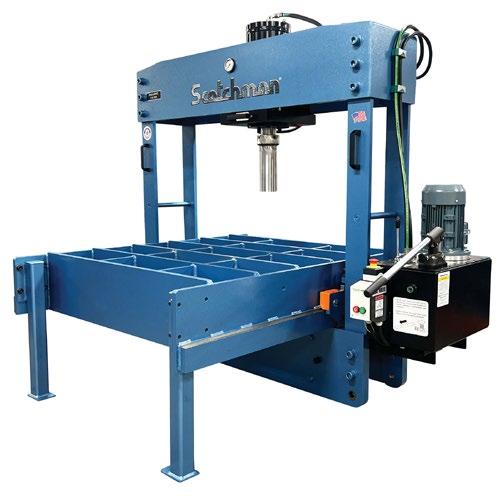
Scotchman Industries has expanded its PressPro hydraulic press lineup with the addition of the 110W MT, a 110-ton wide-frame straightening press designed to improve accessibility and handling of oversized materials. The press features a movable frame and laterally adjustable ram head, allowing operators to position heavy workpieces more easily and access the full work surface.
Two-speed hydraulic operation, joystick controls, and a hand pump provide both power and precision for demanding straightening and fabrication tasks. Manufactured in the united States and backed by a three-year warranty, the 110W MT reflects Scotchman’s continued focus on durable, application-driven fabrication equipment.
For More Information: www.scotchman.com
MATERIAL HANDLING
Empowering Efficiency and Precision
Material handling is at the heart of efficient industrial operations, focusing on the movement, storage, and organization of materials. This section highlights strategies and technologies that streamline these processes, from automated storage and retrieval systems to advanced conveyor solutions. Readers can explore innovations like forklifts, cranes, hoists, and magnetic lifters, which play a pivotal role in optimizing material flow across warehouses, factories, and supply chains.
In addition to hardware advancements, this area emphasizes cutting-edge solutions like warehouse management systems and parts tracking technologies, which integrate seamlessly into modern production environments to enhance operational control. Topics also cover sustainable practices, such as energy-efficient lift equipment and ergonomic tools designed to improve workplace safety while reducing strain. Whether tackling inventory management or enhancing material logistics, this section provides the insights and tools needed to excel in today’s industrial landscape.
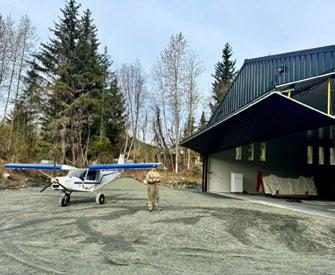
Airkat Airpark: Building Alaska’s Backcountry Hub With a Schweiss Bifold Door
In alaska, movement depends on air access. With much of the state unreachable by road, aviation is not a convenience—it is a necessity. alaska has more than 9,100 licensed pilots, the highest number per capita in the united States, supported by a vast network of more than 760 recorded landing areas. Nearly 400 of those are public-use airports, while the remainder are privately owned or operated by the military.
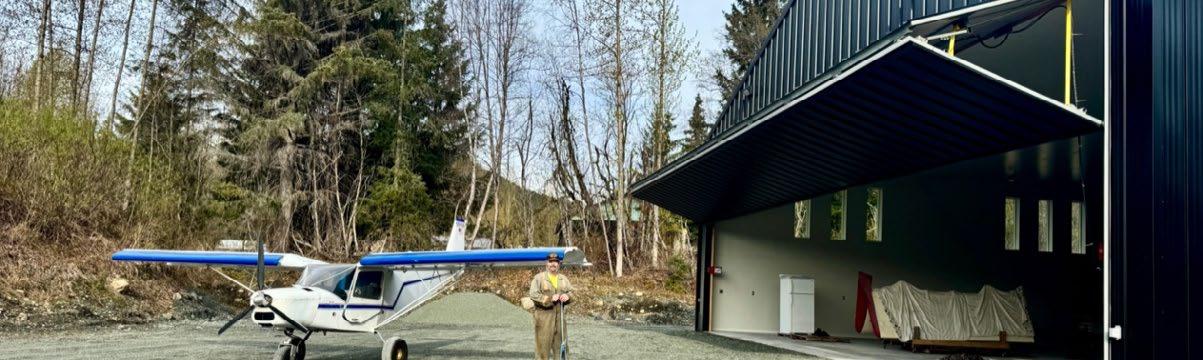
One such private facility is airkat airpark (9aa9), located outside Haines, alaska. Owned and operated by George and Lynette Campbell, the airpark was developed to serve both personal aviation needs and the broader logistical gaps that define flying in alaska’s backcountry.
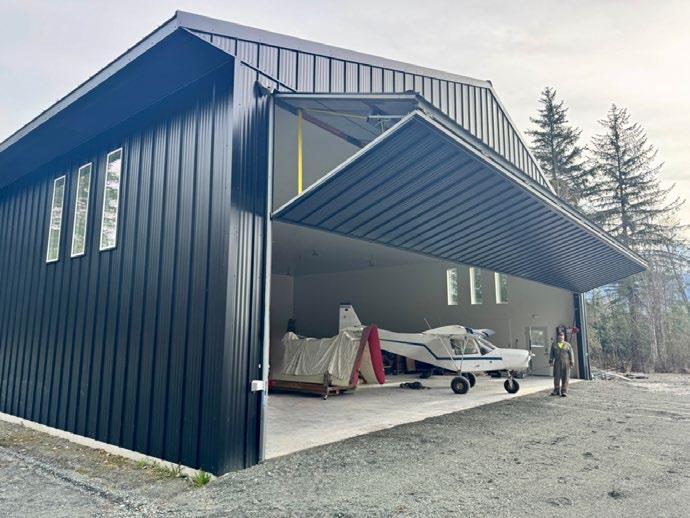
The current runway at a irkat measures approximately 1,100 feet long and 130 feet wide, with plans underway to extend it to 2,300 feet to accommodate larger aircraft. Supporting the runway is a newly constructed hangar measuring
roughly 60 feet wide by 80 feet deep. The hangar includes a bunk room for visiting pilots and a finished apartment above the hangar floor intended for extended stays— reflecting the Campbells’ vision of a irkat as both an operational hub and a safety resource.
both owners bring deep aviation experience to the project. Lynette Campbell, now retired, spent her career with the alaska Department of Transportation aviation Division, managing airport lands across Southeast alaska. George Campbell is a veteran bush pilot, flying throughout the state on air taxi routes and offering flight tours for glaciers, fishing, and wildlife viewing.
“both of us come from aviation— him from the pilot side and me from the management and operations side,” Lynette says.
before developing airkat, the couple operated a makeshift landing area near a glacial river. Over time, shifting riverbanks and erosion made
the site unreliable, prompting the search for a permanent location. The Campbells also wanted to ensure their airstrip could serve other pilots in emergencies, such as low-fuel situations or sudden weather changes. by registering the landing strip with the Federal aviation administration, airkat became part of alaska’s larger aviation support network.
“ you want to strategically place airports along the way to fill in gaps so a pilot is never more than a few hours away from one,” Lynette says. “This airport helps fill a hole in the aviation system. I’m passionate about alaska and alaskan aviation, and this is my contribution.”
a s with many infrastructure projects, the scope grew over time. What began as a simple runway evolved into a more comprehensive facility designed to support aircraft movement, storage, and access under challenging environmental conditions.
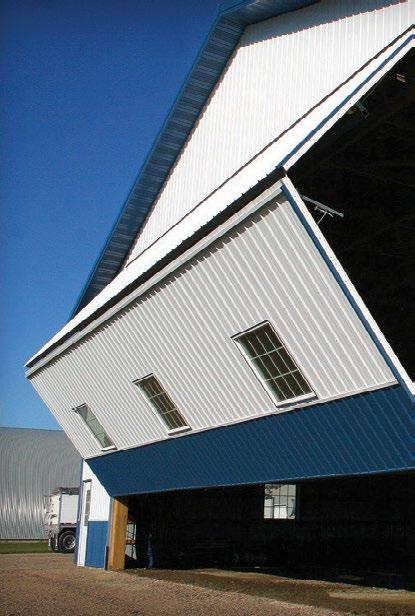
an essential component of the hangar—and the overall functionality of the airpark—is the door system. The Campbells needed a solution that would allow large aircraft to move in and out efficiently while maximizing limited apron space and withstanding alaska’s unpredictable weather.
based on decades of experience with aviation facilities, they selected a liftstrap bifold door from Schweiss Doors, measuring 55 feet wide by 15 feet tall.
“I’ve seen a lot of door configurations over my career, and the people who installed Schweiss doors were always the happiest with them,” Lynette says.
The bifold design allows the door to lift up and out of the way, preserving valuable apron space—an important consideration in alaska, where hangar access areas are often constrained. The door also uses Schweiss’ patented liftstrap system, replacing traditional steel cables with high-strength nylon straps. The straps are quieter, require less maintenance, and are not susceptible to corrosion, an important advantage in coastal environments where salt air and moisture accelerate metal deterioration.
Durability was another priority. alaska’s operating conditions include high winds, rapid weather changes, and seismic activity. The Campbells wanted a door system they could install once and rely on long-term without ongoing adjustments or repairs.
“I didn’t want to deal with door issues for the rest of my life,” Lynette says. “I wanted something that would work reliably and be no hassle. The Schweiss door was built to fit this environment—to be stable and last.”
Logistics were also a consideration. While Haines can be reached by road, air, and water, shipping large
components into remote regions can be complex and expensive. Schweiss Doors coordinated delivery by shipping the door as part of a consolidated load headed to alaska and Canada, allowing the Campbells to receive their door efficiently without time pressure.
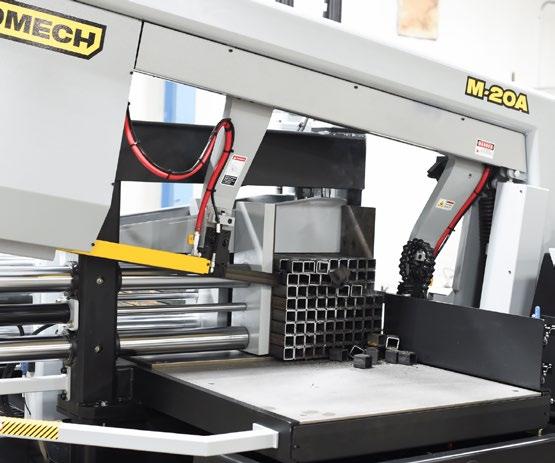
Heavy Gauge Steel Design
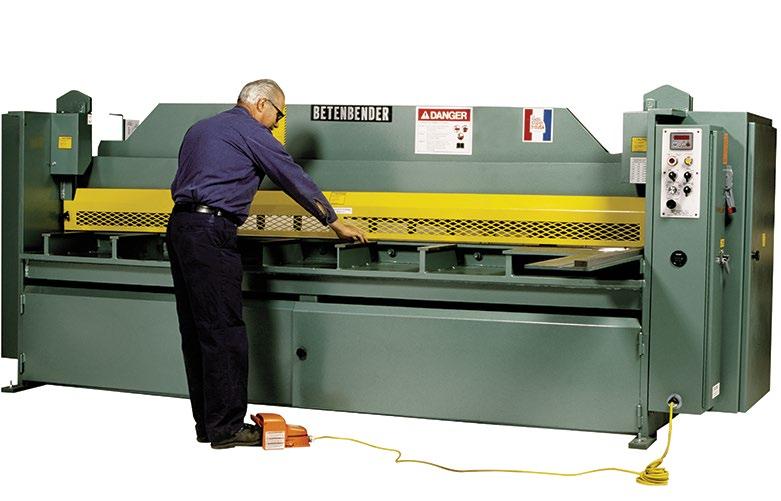
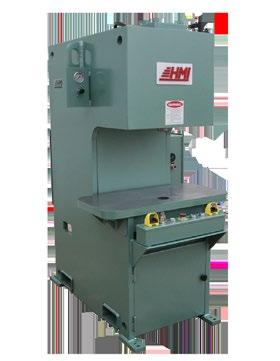
Press Bed bolted on, not welded, to prevent distortion.
Large press bed to accommodate a variety of tooling other than just punching.
Pump, motor, valve and reservoir are all easily accessible for maintenance.
Large rectangular tubes used at base of machine to give safe, instant portability.
Installation was handled by Northern Construction Inc. of Haines, with the same attention to detail applied throughout the project. From ordering through installation, the Campbells describe the process as smooth and well-supported.
“I can’t think of another element of the hangar that went any better than the door,” Lynette says. “If someone asks, we tell them—do it right the first time. you won’t regret it.”
For airkat airpark, the hangar door is more than an architectural feature. It is a critical access point that enables safe aircraft movement, protects valuable equipment, and supports aviation logistics in one of the most demanding operating environments in North america.
COMBILIFT
Combilift Marks 100,000th Forklift Milestone With Global Charity Initiative
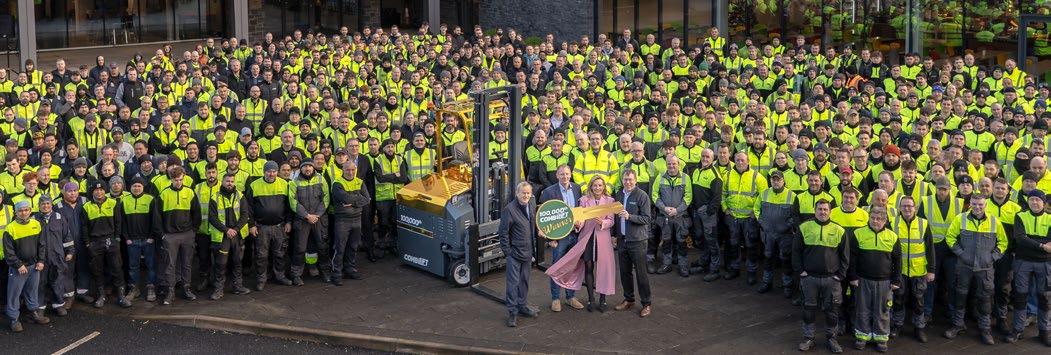
Combilift has reached a major manufacturing milestone with the production of its 100,000th forklift, marking the occasion by raising and donating €100,000 to uNICeF Ireland’s Children’s emergency Fund. To commemorate the achievement, the company launched a worldwide competition centered around a special edition multidirectional Combi-Cbe forklift, with all proceeds directed toward humanitarian relief efforts.
The campaign generated significant global participation, with ticket sales raising €56,500 before Combilift increased the total contribution to €100,000. The milestone forklift was unveiled at the IMHX exhibition in the uK and toured several european trade shows, drawing attention to both the company’s manufacturing scale and its corporate social responsibility initiatives. The effort reflects Combilift’s continued investment in community impact alongside its global growth in materials handling solutions.
For More Information: www.combilift.com
CYNGN
Cyngn Expands Autonomous Vehicle Deployment With G&J Pepsi
Cyngn has secured an expanded autonomous vehicle deployment with G&J Pepsi, the largest independent Pepsi bottler in the united States, further scaling the use of its DriveMod autonomous material handling technology across distribution operations. The new purchase order represents a continuation of G&J Pepsi’s shift toward autonomy as a core operational capability rather than a single-site solution.
Notably, the additional vehicles were ordered before final facility assignments were determined, reflecting confidence in DriveMod’s performance across varied workflows. The autonomous vehicles are designed to handle repetitive material movement tasks, reduce operational variability, and support productivity improvements within large-scale warehousing and distribution environments. The expanded deployment builds on earlier implementations and signals growing acceptance of autonomy as a scalable material handling strategy.
For More Information: www.cyngn.com
EXAIR
EXAIR Introduces Chip Trapper Lid Rebuild Kit to Extend System Performance
e X aIr has introduced a new Chip Trapper Lid rebuild Kit designed to restore performance and extend the service life of existing Chip Trapper systems used to remove chips, swarf, and shavings from used coolants and process liquids. The rebuild kit allows older units to be returned to near-new condition by replacing critical sealing components that may degrade over time.
The Chip Trapper operates as a pneumatic vacuum with no moving parts, offering long-term reliability in material
Combilift Marks 100,000th Forklift Milestone With Global Charity Initiative
separation applications. Over time, sealing rings and gaskets can wear or react with coolants, reducing system efficiency. The rebuild kit includes replacement bulkheads, quickconnect fittings, and sealing gaskets, along with updated instructions to support proper operation. The kit is available for multiple Chip Trapper capacities, supporting preventive maintenance strategies that help maintain fluid quality and reduce waste handling costs.
For More Information: www.exair.com
HYSTER
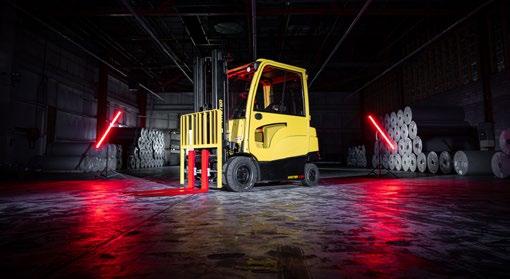
Hyster Expands Electric Counterbalanced Line With J45–70A Forklift
Hyster has introduced the J45–70a electric counterbalanced forklift, expanding its electric product line with a model designed to support demanding indoor and outdoor material handling applications. The truck is available in lifting capacities ranging from 4,500 to 7,000 pounds and is engineered to deliver reliability and configurability without exhaust emissions.
The J45–70a features robust component protection, IP67-rated sealed drive motors and axle, and multiple battery options including lead-acid, thin plate pure lead, and lithium-ion. The design allows operations to align productivity, sustainability, and infrastructure requirements without extensive facility modifications. Standard features include the Hyster Dynamic Stability System and base-level telemetry, supporting improved operator awareness, uptime, and fleet management across intensive industrial environments.
For More Information: www.hyster.com
IRON BULL MANUFACTURING
Iron Bull Introduces Skeleton Hoppers for Sheet and Plate Scrap Handling
Iron bull Manufacturing has introduced skeleton hoppers designed to simplify the collection and disposal of skeletal sheet and plate metal waste generated by stamping, punching,
laser cutting, and plasma cutting operations. The hoppers are engineered to safely handle bulky scrap materials while allowing forklift operators to dump loads directly from the cab. built to customer specifications, the skeleton hoppers support capacities up to 7,000 pounds and are designed to place scrap efficiently into dumpsters while minimizing floor space usage. Manufactured in Indiana, the hoppers are part of Iron bull’s broader lineup of scrap and waste handling solutions intended to improve safety, efficiency, and material flow in fabrication and processing environments.
For More Information: www.ironbullmfg.com
YALE LIFT TRUCK TECHNOLOGIES
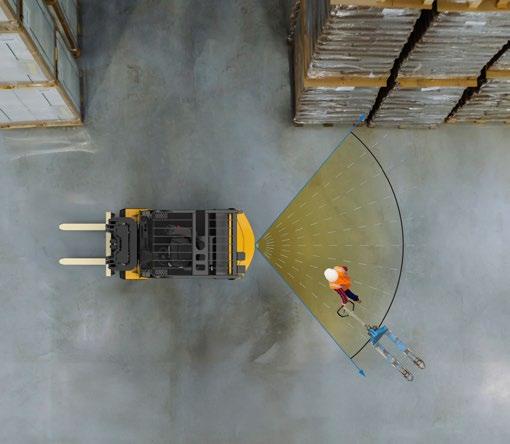
Yale Introduces Pedestrian Awareness Camera for Lift Truck Safety
yale Lift Truck Technologies has introduced a pedestrian awareness camera as part of its yale reliant™ portfolio of operator assist technologies. The camera system is designed to detect pedestrians within a defined range behind the lift truck and provide visual and audible alerts to the operator to help reduce the risk of collisions in busy warehouse environments.
The system uses real-world image data to adapt to varying lighting and environmental conditions and is optimized for typical warehouse travel speeds. Optional traction alerts can automatically slow the truck when a pedestrian is detected, encouraging operator response while maintaining full operator control. The solution builds on the yale reliant platform, which has accumulated millions of operational hours across deployed units and continues to expand safety capabilities for material handling operations.
For More Information: www.yale.com
Safety & Maintenance
The
Cornerstones
of Operational Excellence
The Safety & Maintenance section is dedicated to creating safer workplaces and ensuring equipment longevity. Covering everything from cutting-edge machine guarding systems to advanced air filtration and dust collection solutions, this section provides actionable insights into workplace protection and preventative maintenance. Whether you're exploring ergonomic tools to reduce operator strain or electrical systems that enhance reliability, this section focuses on products and practices that prioritize both people and machines.
In addition to highlighting safety innovations, this section delves into essential maintenance strategies, including retrofitting, rebuilding, and remanufacturing, ensuring that machinery operates efficiently and reliably over time. Maintenance supplies, facility equipment, and accessories are explored alongside new safety technologies designed to meet evolving compliance standards. Readers will discover how a proactive approach to safety and maintenance not only minimizes risks and downtime but also fosters a culture of care and continuous improvement within industrial settings.
Most forklift fleets do not fail loudly. They drift. a truck gets a little older, repairs take a little longer, operators start borrowing units from other areas, and procurement gets pulled into another last-minute order. For a while, the operation still works.
In 2026, that slow drift is harder to absorb. Throughput targets are tighter, labor remains constrained, and any downtime shows up quickly in missed picks, overtime, and steadily increasing service and repair costs just to keep equipment functional. a fleet assessment is a practical reset for forklift fleet management. It clarifies what you have, how it is being used, what is driving cost, and what actions come next.
Start With the Baseline: Get the Fleet List and Data Ownership Right before debating fleet count or replacement timing, a trustworthy baseline is essential. When the fleet list
lives across email threads and aging spreadsheets, basic questions become guesswork, such as how many units actually exist or which areas are short—and when.
Many operations also lack a clear fleet concept or replacement strategy, or they rely on one that no longer aligns with current operating conditions or market realities. In those cases, even accurate data fails to drive good decisions because there is no shared framework for what the fleet should look like or how it should evolve.
This is not unique to forklift fleets. Gartner estimates that poor data quality costs organizations an average of $12.9 million annually. In a fleet context, poor data shows up as missing units, incorrect truck classifications, outdated hour readings, and costs booked to the wrong places. The outcome is predictable: trucks remain in service past their healthiest years, maintenance surprises accumulate, and replacements happen under pressure.
The goal is not a perfect database. The goal is decision-grade clarity.
Baseline essentials include:
» a complete list of every truck, verified against what is physically on the floor
» For each unit: truck class or type, capacity and key attachments, model year, current hour meter, primary area, and primary shift
» Planned annual hours alongside actual recorded hours
» a named owner for the fleet list and a defined update cadence
» One authoritative version of the list with clear rules governing updates
Right-Sizing: Fleet Count and Truck Mix
right-sizing is not just about how many trucks exist. It is about how many trucks of the right type are in the right locations across the shifts that matter. Two fleets with the same unit count can perform very differently if one has the wrong mix of truck types, capacities, or assignments.
Start by mapping the fleet to how the building actually runs. Count units by shift and work zone, note which trucks are dedicated versus shared, and identify spares that exist due to reliability issues rather than true demand.
Fleet complexity also matters. excessive variation in manufacturers and models increases training requirements, parts inventories, and service friction. Task fit is often the quieter issue: light-duty trucks pushed into heavy applications or larger trucks used where smaller classes would suffice. These mismatches frequently surface later as increased repair frequency and downtime.
utilization: Finding the Imbalance That Drives Wear and Reactive Buying
Many operations feel short on trucks, but uneven utilization is often the real issue. a small subset of units carries most of the operating hours while others sit underused. High-hour workhorses age faster and fail more often, while underused units become de facto spares—even if they are the wrong class or located in the wrong area.
In a typical two-shift distribution center, a handful of trucks may operate continuously in the busiest lanes and service windows. When one goes down, the entire operation feels constrained, even if other trucks remain idle.
Common indicators include wide gaps between highest- and lowest-hour units, shortage complaints concentrated in specific zones or shifts, and trucks frequently bouncing between areas. addressing these imbalances often reduces pressure without adding units by tightening assignment rules, creating shared pools where appropriate, and adjusting the truck mix in overloaded zones.
Maintenance Reliability and Downtime
Forklift maintenance is often treated as a single cost number, masking what actually drives reliability. a more effective assessment separates service work into scheduled maintenance, functional repairs, and damage-related repairs. each category points to a different response. Service agreements also influence outcomes. Well-structured full-service programs and properly negotiated labor and parts terms can significantly improve cost predictability and uptime.
even without formal downtime KPIs, reliability gaps are visible. Deloitte notes that poor maintenance strategies can reduce productive capacity by 5 to 20 percent. In a fleet assessment, availability is a capacity lever.
Focus on repeat-offender units, recurring repair types, aging trucks consuming disproportionate effort, and practical signals such as frequent rentals or constant truck sharing. The output should be a short, actionable list identifying which units to monitor, extend, repair, or replace.
Safety and Training: Damage as a Cost and Risk Signal
Damage repairs are one of the most visible indicators of both cost and safety risk. They are frequent, patterned, and measurable. Increasingly, operations are reinforcing this view through telematics, using impact sensors to capture unreported events and identify where incidents actually occur.
an effective assessment looks for system issues rather than isolated events: repeated impacts in the same location, congested intersections, blind spots created by racking or overflow storage, and habitual pedestrian interactions. Pair maintenance records with facility walks and telematics data where available.
If the same rack is struck repeatedly, the issue is a collision zone, not operator luck. Solutions are often straightforward: adjust traffic flow, enforce one-way aisles
where feasible, improve sightlines, and refresh training around real risk areas. a ssign ownership. When damage belongs to everyone, it belongs to no one.
TCO and Lifecycle Planning
The goal is not a perfect cost model. It is an executable plan that protects uptime and reduces volatility.
Cost per operating hour provides a practical bridge between operations and finance. even without perfect data, it can be estimated accurately enough to guide decisions. at its simplest, annual unit cost divided by annual operating hours reveals meaningful differences between similar trucks. From there, lifecycle targets can be set by vehicle category and application, recognizing that electric forklifts, pallet stackers, order pickers, and internal combustion trucks age differently depending on duty cycle and environment.
Define target age and hour ranges, simple greenyellow-red cost thresholds, and a 12- to 24-month view of units approaching the expensive end of their lifecycle. revisit these targets periodically as utilization and service performance evolve.
Connect lifecycle planning to sourcing discipline. Instead of ordering trucks reactively, bundle demand into planned tenders on a regular cadence. Procurement negotiates best when decisions are driven by clarity rather than urgency.
a structured leasing approach can also support execution by enforcing term consistency, simplifying tender bundling, and improving cost visibility—especially when late-life repair volatility drives downtime.
A Practical Starting Point
a fleet assessment works because it replaces assumptions with a plan. Start by reconciling the fleet list and assigning ownership. review utilization to identify imbalances. Separate predictable maintenance from preventable damage. build a 12-month replacement and tender plan.
These steps strengthen forklift fleet management without requiring a system overhaul, helping operations avoid the high-cost, high-downtime back end of the fleet lifecycle.
DENSO, INC.
Denso Highlights 190DP Epoxy Grout for Heavy Machinery Stability
Denso, Inc. is highlighting its 190DP epoxy grout as a long-term foundation solution engineered to support heavy machinery installations in demanding industrial environments. Designed to deliver superior compressive strength and vibration resistance, the 190DP epoxy grout helps ensure proper machine alignment while minimizing movement that can lead to premature wear or performance degradation.
The formulation is engineered for excellent flow characteristics, allowing it to fully encapsulate baseplates and anchor bolts, creating a rigid, load-bearing foundation once cured. This contributes to improved machine accuracy, reduced maintenance requirements, and extended equipment life. Denso’s 190DP epoxy grout is suited for applications across manufacturing, power generation, and heavy industrial facilities where precision and durability are critical.
For More Information: www.denso-group.com
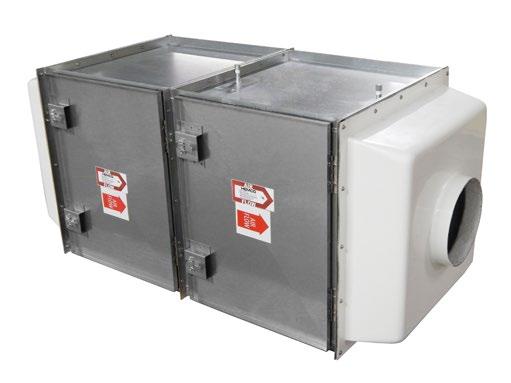
HEMCO Introduces HEPA and Carbon In-Line Air Filtration Packs
HeMCO Corporation has introduced its HePa and carbon in-line air filtration packs designed to improve indoor air quality in laboratory and industrial environments. These filtration systems are engineered to capture airborne particulates, chemical vapors, and odors, supporting safer working conditions while helping facilities meet air quality and safety requirements.
The in-line filtration packs are designed for seamless integration into existing ventilation systems, providing flexibility for retrofits or new installations. by combining HePa filtration with activated carbon media, HeMCO’s solution addresses both particulate and gaseous contaminants, supporting worker safety, equipment protection, and overall facility cleanliness in manufacturing and research environments.
For More Information: www.hemco.com
HUBTEX
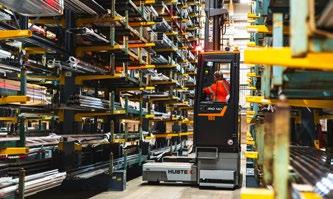
HUBTEX Addresses Collision Risk with Clear Aisle Assist Technology
HubTe X is addressing collision risks in narrow aisle operations with the introduction of its Clear aisle a ssist technology. Designed to improve visibility and situational awareness, the system enhances safety for operators navigating confined warehouse and production environments where space constraints increase the risk of accidents.
Clear aisle a ssist supports safer material handling by helping operators maintain clear sightlines and avoid potential obstacles, contributing to reduced downtime, fewer incidents, and improved operational efficiency. The technology reflects HubTe X’s focus on integrating safetydriven innovations into material handling equipment to support modern, space-optimized facilities.
For More Information: www.hubtex.com
MURATEC USA (MURATA MACHINERY USA, INC.)
Muratec USA Earns Carolina Star Certification
Muratec uSa has earned Carolina Star Certification, recognizing the company’s commitment to workplace safety and health excellence. The certification is awarded to organizations that demonstrate effective safety and health management systems, strong employee involvement, and continuous improvement in hazard prevention.
achieving Carolina Star Certification reflects Muratec uSa’s proactive approach to maintaining safe working environments across its operations. The recognition
underscores the company’s ongoing investment in training, safety protocols, and operational practices that protect employees while supporting reliable manufacturing performance.
For More Information: www.muratec-usa.com
WINTRISS CONTROLS GROUP
Wintriss Controls Group Acquires ISB
Wintriss Controls Group has announced the acquisition of ISb, expanding its capabilities in industrial safety and control solutions. The acquisition strengthens Wintriss’ portfolio by adding complementary technologies and expertise, supporting a broader range of safety, monitoring, and automation needs within manufacturing environments. by integrating ISb’s offerings, Wintriss Controls Group aims to deliver enhanced solutions that help manufacturers improve machine safety, operational reliability, and compliance with evolving safety standards. The move reflects Wintriss’ continued focus on growth through strategic expansion while supporting safer and more efficient production operations.
For More Information: www.wintriss.com
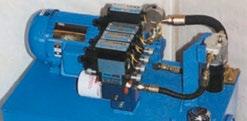
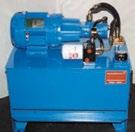
DESIGNERS AND BUILDERS OF HYDRAULIC PRODUCTS AND CUSTOM ASSEMBLIES
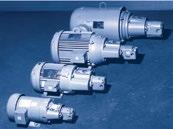
POWER UNITS… As designers and builders of custom hydraulic assemblies, MacMillin offers solutions for both your system and physical requirements. Wide range of capacities and components to suit every application. Both horizontal and vertical configurations.
CIRCUIT-BLOCK
MANIFOLDS… With MacMillin
“Circuit Blocks”, numerous valves and controls can be plugged in to a single space-saving manifold. Eliminates troublesome plumbing problems, such as leaking or broken hose and pipe connections, that can cause system failure.
PUMP MOTOR MOUNTS… Strong lightweight aluminum alloy castings completely enclose motor shaft and coupling, providing greater safety and quieter operation. Assures accurate alignment without bedplates, brackets or shims. Fractional to 200 hp motors.
QUALITY
Ensuring Precision and Performance
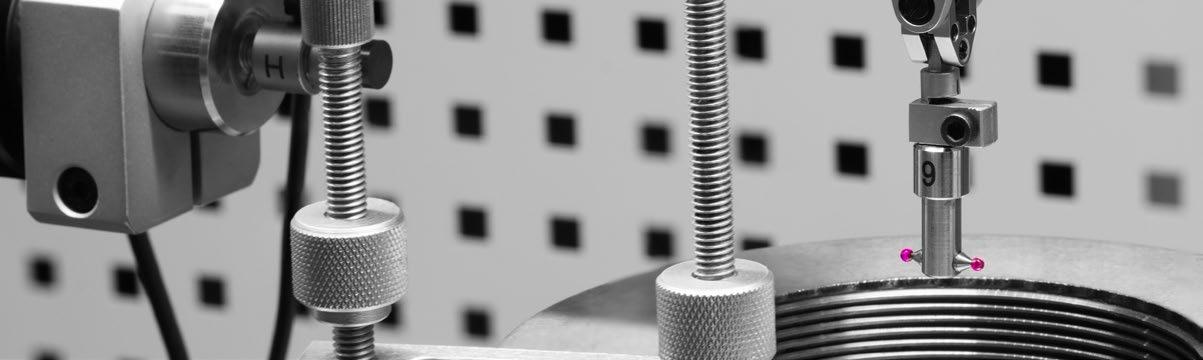
Quality control and assurance are the backbone of manufacturing, ensuring every product meets rigorous standards for precision, performance, and reliability. This section delves into the tools and technologies that enable manufacturers to uphold the highest quality standards. From advanced coordinate measuring machines (CMM) to vision systems and laser inspection equipment, the spotlight is on innovations that enhance accuracy and efficiency in measurement and inspection.
Nondestructive testing (NDT) equipment and positional measuring machines are also featured, allowing manufacturers to evaluate products without damage. Tools such as form measurement gauges, cutting tool inspection systems, and tool condition monitoring devices refine production processes and reduce errors. Whether through shrink-fit technologies or video inspection systems, this section highlights the importance of advanced solutions in maintaining precision, ensuring compliance, and driving continuous improvement in industrial operations.
Quality Moves Closer to the Process—and the Point of Risk
Quality in manufacturing is no longer confined to inspection rooms, offline labs, or end-of-line verification. across industries, quality systems are moving closer to production, closer to automation, and closer to the moment where risk is introduced.
This shift reflects a broader change in how manufacturers define quality itself. rather than treating inspection as a corrective step, quality is increasingly viewed as a real-time control mechanism—one that protects throughput, reduces scrap, and stabilizes processes in environments where tolerances are tighter, materials are more complex, and product failure carries higher cost and regulatory risk.
Several forces are driving this evolution. First is the growing prevalence of precision components used in medical devices, aerospace systems, electrification, and advanced industrial equipment. These parts often feature micro-scale geometries, delicate surfaces, and functional characteristics that cannot be reliably verified through traditional contact
measurement or spot-checking methods. a s a result, non-contact inspection, high-resolution sensing, and surface characterization technologies are becoming essential—not optional.
at the same time, manufacturers are under pressure to inspect faster without sacrificing confidence. High-mix production, shorter runs, and labor constraints make manual inspection increasingly difficult to sustain. Quality teams are being asked to deliver reliable data with fewer skilled inspectors, tighter cycle times, and greater integration with automated production systems. This has accelerated adoption of inline and near-line measurement solutions that can operate continuously, feed data directly into quality systems, and support closed-loop process control. a nother defining trend is the convergence of quality data with operational analytics. Measurement systems are no longer isolated instruments; they are becoming data generators that support statistical process control, traceability, compliance documentation, and
return-on-investment analysis. Whether monitoring machine utilization, detecting surface anomalies, or validating dimensional stability, quality data is increasingly used to inform production decisions—not just validate outcomes.
Scalability is also shaping modern quality strategies. From benchtop systems designed for quick deployment to large-scale metrology platforms capable of handling heavy or oversized components, manufacturers are seeking solutions that can grow with production demands. Flexibility, modularity, and integration with existing automation and control infrastructure are now key selection criteria alongside accuracy and repeatability.
Taken together, these shifts point to a quality landscape defined by proximity and precision— measurement systems that operate where parts are made, when risk occurs, and at speeds aligned with modern production. a s the following industry developments show, quality is no longer a downstream checkpoint. It is becoming an active, embedded function of manufacturing itself.
BOLD LASER AUTOMATION
Bold Laser Automation Unveils Advanced 3D Measurement System for Precision Inspection
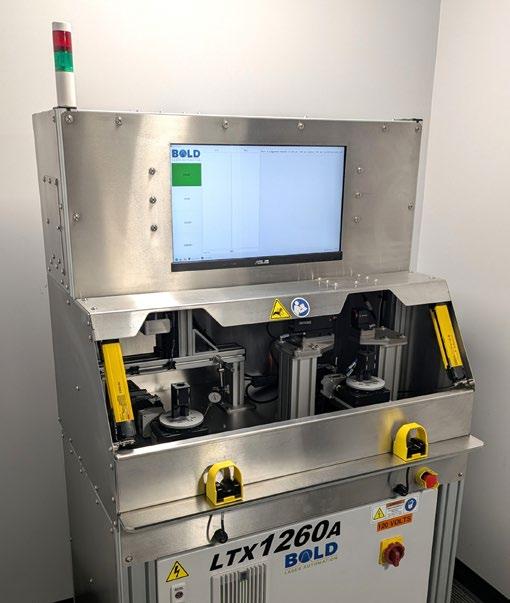
bold Laser automation has introduced the LTX1260a 3D Inspection and Measurement and TMX Profile System, a next-generation solution designed to deliver
fast, high-precision inspection for delicate and critical components across medical, electronics, aerospace, and precision manufacturing applications. The system integrates Keyence’s LJ-X8020 3D scanner with the TMX-5006 profile measurement platform, enabling non-contact, automated inspection of both geometrical profiles and surface quality.
a pplications include fuel injector nozzles, micro fasteners, hypodermics, catheters, stents, biomedical textiles, precision spray nozzles, optical fibers, and other ultra-fine components. The dual-station design supports contamination detection and precision profile measurement using rotary and linear stages, while footswitch or push-button operation allows fast data acquisition and storage. a n optional touchscreen interface is also available.
The system features bold’s Integration Suite software with real-time data storage, CSV and e xcel export, and Q a /QC reporting. built to uL, NFPa 79, and OSHa standards, the enclosed system includes safety indicators, seismic mounts, and modular scalability to support semi-automated and future fully automated production environments.
For More Information: www.boldlaserautomation.com
KAMAN PRECISION PRODUCTS
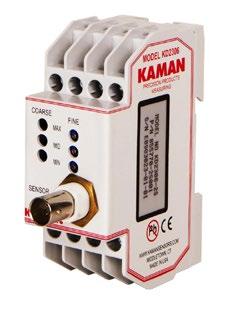
Kaman Highlights KD-2306 Non-Contact Displacement Sensing System
The Measuring Division of Kaman Precision Products, Inc. is highlighting its KD-2306 single-channel, multi-purpose non-contact displacement sensing system designed for both static and dynamic industrial measurement applications. Compatible with dual- and single-coil sensors, the KD-2306 delivers high-precision performance with a resolution of 0.01% full scale and frequency response up to 50 kHz.
Designed for easy integration, the system features a DIN rail mount, terminal I/O connections, auto-synchronization for multi-channel expansion, and multiple output options including 0–10 VDC, 4–20 m a , bipolar, and differential voltage outputs. Front-facing calibration controls allow precise on-site adjustments, while factory calibration includes NIST-traceable certification.
With low nonlinearity, temperature-compensated stability, and extensive customization options, the
KD-2306 serves as a cost-effective alternative to traditional LVDTs, air gauges, and micrometers for OeM equipment, industrial automation, process monitoring, and quality control in demanding environments.
For More Information: www.kamansensors.com
LK METROLOGY
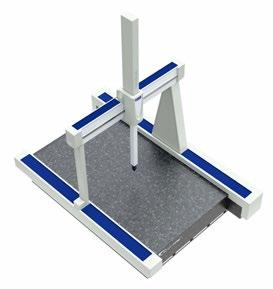
LK Metrology Launches MAXIMA and MAXIMA R CMMs for LargeScale Measurement
LK Metrology has launched two new bridge-type coordinate measuring machine (CMM) ranges— Ma XIMa and Ma XIMa r—designed to meet growing demand for precise measurement of large, heavy, and complex components. The machines are suited for quality control applications across aerospace, automotive, energy, power generation, transportation, and heavy engineering industries.
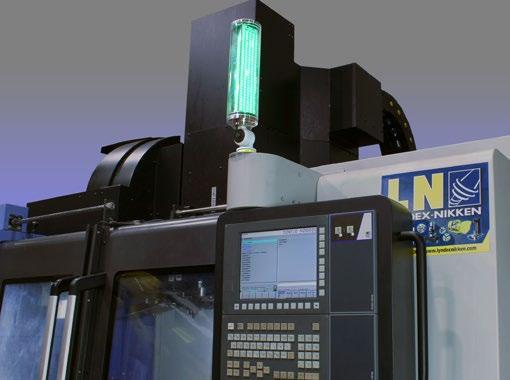
productivity. The system enables real-time monitoring of up to 30 machines from a single workstation without requiring specialized expertise.
e Z-SmartTower logs cycle counts, idle time, error states, operator input, and part data to provide comprehensive insight into machine and spindle utilization. LeD indicators provide immediate visual feedback on machine status, while Wi-Fi connectivity enables real-time data transfer. Free software allows users to generate charts and e xcel reports for performance analysis, bottleneck identification, and incentive tracking.
The M a XIM a series offers measurement volumes from 12 to 72 cubic meters and features a granite table for exceptional stability when measuring heavy workpieces. advanced ceramic beam and spindle guideways provide high stiffness-to-weight ratios, while air bearings and zero-hysteresis drive systems deliver repeatable accuracy in the 3 µm range.
The M a XIM a r range introduces a twin-rail design optimized for floor-level loading and automated transfer integration, eliminating the need for special foundations while maintaining high stability. both platforms support tactile probing, laser scanning, and multi-sensor configurations using LK’s controller and probe head options, reinforcing LK Metrology’s commitment to largescale, high-precision measurement solutions.
For More Information: www.lkmetrology.com
LYNDEX-NIKKEN
Lyndex-Nikken Introduces EZ-SmartTower for Machine ROI and Performance Analysis
Lyndex-Nikken has introduced the eZ-SmartTower, a machine tracking and analytics solution designed to help machine shops streamline rOI analysis and improve
all data remains internal to the machine shop and is not stored in the cloud, supporting data security requirements. The system supports Industry 4.0 and 5.0 initiatives by enabling data-driven decision-making to maximize throughput and reduce downtime.
For More Information: www.lyndexnikken.com
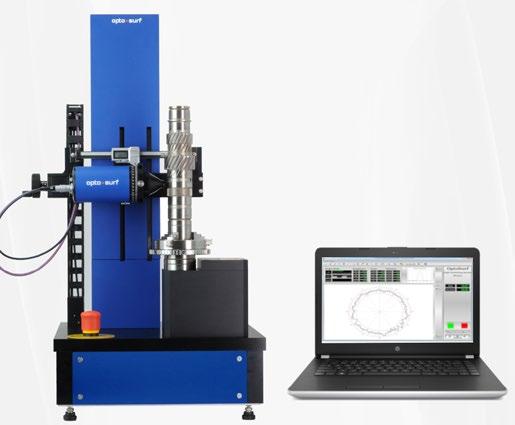
Mahr Expands Surface Metrology Capabilities With MarSurf3D Scattered Light Portfolio
Mahr Inc. has expanded its surface metrology portfolio with the launch of MarSurf3D scattered light measurement systems following its acquisition of OptoSurf GmbH. The integration brings high-speed, high-precision scattered light technology to Mahr’s dimensional measurement offerings, supporting advanced tribology and surface quality analysis.
The expanded MarSurf3D family includes OptoSurfbased solutions such as OS 500 for inline grinding and finishing measurement, Optorack for ball screw and rack monitoring, OptoWorm for worm gear inspection, and OptoShaft for bearing seat measurement. These systems provide fast, low-maintenance operation and detect surface waviness and roughness at sub-micron levels, even in harsh production environments.
MAHR INC.
The portfolio supports inline measurement, remote operation, and integration with machine control systems, enabling manufacturers to reduce defects, optimize processes, and improve productivity through precise surface characterization.
For More Information: www.mahr.com
SUNNEN PRODUCTS COMPANY
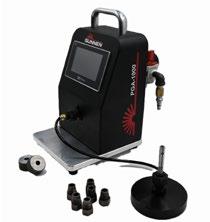
Sunnen Launches PGA-1000 Benchtop Air Gage for Dimensional Measurement
Sunnen Products Company has launched the PG a-1000 air Gage, marking the company’s first dedicated benchtop air gaging system. Designed to deliver high precision and reliability, the PG a-1000 expands Sunnen’s metrology portfolio beyond dial bore and in-process air gaging solutions.
The system features a 5-inch color touchscreen for intuitive setup and measurement, with real-time quality monitoring and SPC capabilities. Data storage and export are supported via uSb or PC connection, while changeable orifices and front-mounted probe connections enable flexible configuration for various air probe types. built with a rugged housing and precision filter regulator, the PG a-1000 supports both inch and metric units and offers optional features such as air-saving functions and temperature compensation modules. Multiple display modes allow operators to tailor data visualization for different inspection scenarios.
ROBOTICS
Driving Automation and Innovation
Robotics and automation are transforming modern manufacturing, redefining efficiency, precision, and versatility across industrial processes. From welding robots and robotic tooling to autonomous technology and cobots (collaborative robots), innovations are seamlessly integrating robotics into diverse manufacturing workflows.
Key advancements include automated cells and press transfer robotics, enabling streamlined operations and reduced cycle times. Solutions like material handling systems and end effectors highlight the adaptability of robotics in tasks ranging from machining to assembly. With a focus on enhancing safety and productivity, the integration of RFID and enclosure systems, along with comprehensive training, empowers manufacturers to harness the full potential of robotics in an increasingly automated world.
The High Cost of Delaying Industrial Automation
The rise of industrial automation has ushered global manufacturing into an era defined by greater transparency, flexibility, scalability, and efficiency. according to Fortune business Insights, the global industrial automation market is projected to reach $395.09 billion by 2029, reflecting both rapid adoption and the tangible benefits automation delivers across industries.
a s competitive pressures intensify, investment in automation has become less of a strategic option and more of a necessity. early adopters are already establishing new operational benchmarks, leveraging robotics and autonomous systems to improve productivity, consistency, and cost control. a Deloitte study found that 86% of manufacturing leaders believe investment in automation will be the primary driver of competitiveness over the next five years. yet, despite this recognition, adoption remains uneven—only about 12% of u.S. manufacturers have integrated autonomous vehicles into their workflows.
Cost is often cited as the main barrier. Ironically, many of the same organizations that delay automation due to perceived expense are already absorbing significantly higher costs through labor inefficiencies, productivity losses, and safety incidents. In reality, postponing automation frequently proves far more expensive than deploying it.
The Cost of Doing Nothing
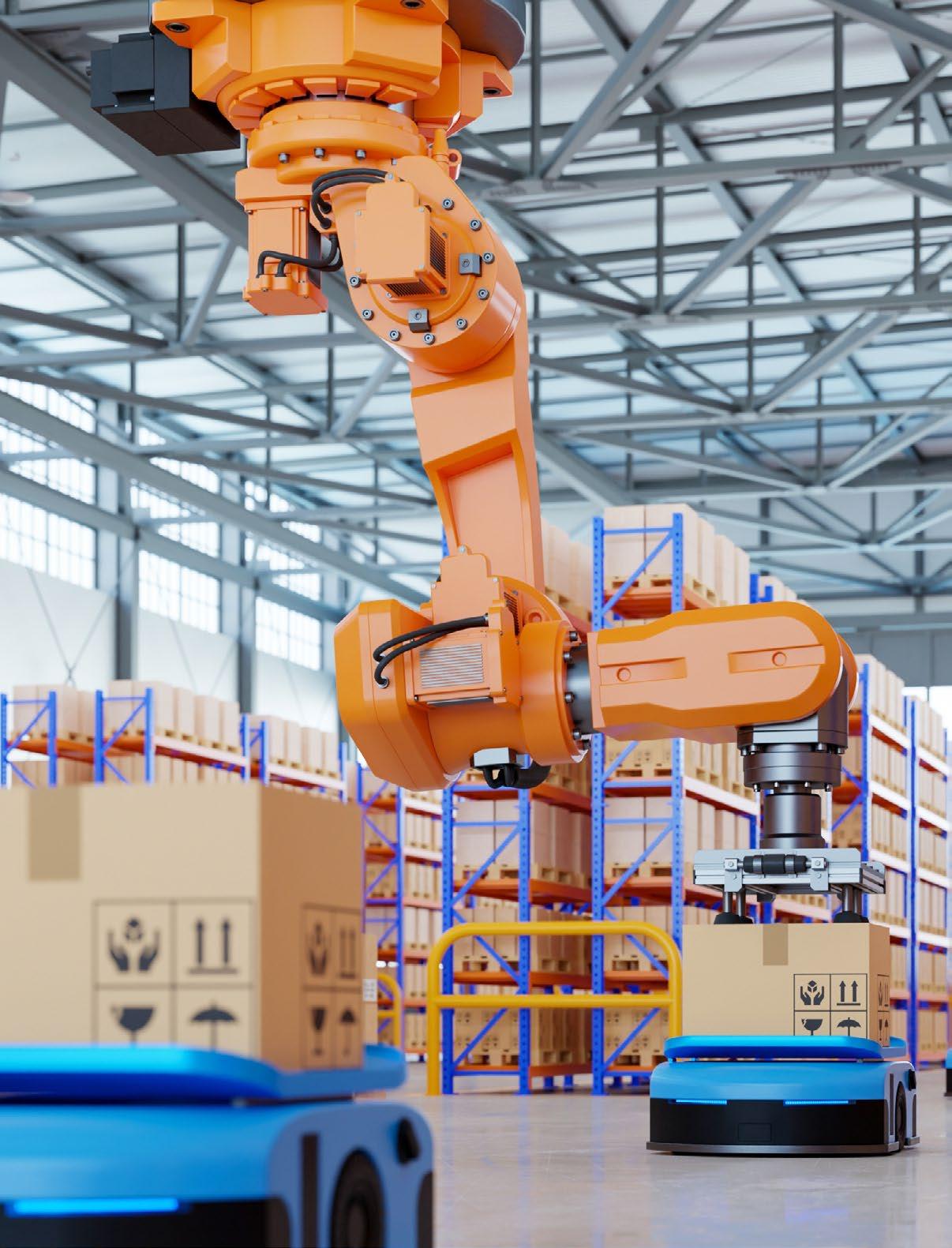
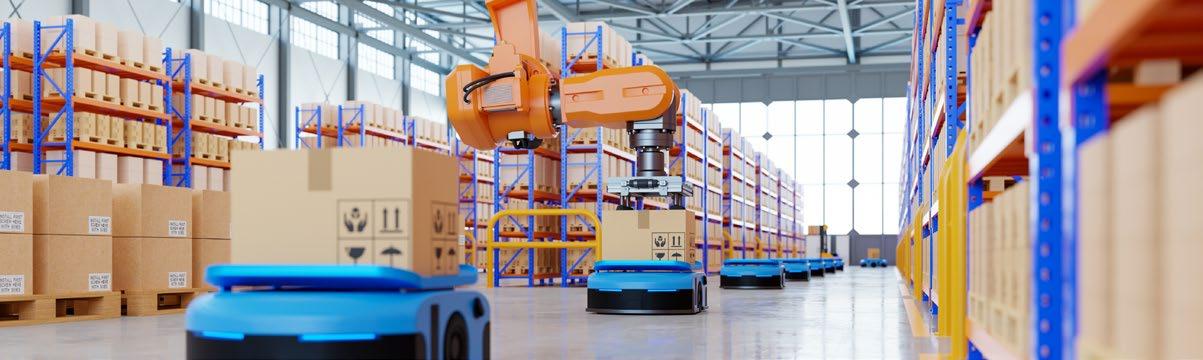
Delaying investment in automation introduces a range of hidden costs tied to labor, downtime, and workplace safety. analysis shows that autonomous material transport systems can operate at roughly one-fourth the cost of traditional labor-based workflows. In a typical scenario, human workers manually transport and unload pallets throughout a facility. autonomous mobile robots (aMrs), by contrast, streamline material flow by moving multiple pallets per trip, operating continuously, and reducing manual handling.
Over a five-year period, these efficiencies can translate into savings
exceeding $850,000, driven by lower labor expenses, reduced downtime, and fewer safety-related disruptions. What appears to be a cost-saving delay often becomes a compounding financial burden.
Labor Pressures and Workforce Volatility
Labor challenges remain one of the most pressing issues facing manufacturers. by 2030, the manufacturing skills gap could result in more than 2 million unfilled jobs, potentially costing the u.S. economy $1 trillion annually. Labor shortages consistently rank among the top challenges for manufacturing and supply chain leaders, with employee retention cited by more than half as the single greatest concern.
beyond wages, labor carries a wide range of associated costs, including recruitment, training, benefits, and turnover. Training a new warehouse employee can exceed $1,000, while replacing a single worker can cost approximately $7,000. In facilities with high turnover rates—averaging around 43% in manufacturing—these costs accumulate quickly, often surpassing $300,000 annually in workforce replacement alone. autonomous systems help mitigate these pressures by assuming repetitive transport and handling tasks, freeing skilled employees to focus on higher-value work. unlike human labor, autonomous vehicles do not experience wage inflation, turnover, or productivity fatigue.
Productivity Loss and Downtime
Lost productivity represents another significant, often underestimated cost. Labor productivity in warehousing and storage has declined steadily in recent years, as increases in hours worked have failed to keep pace with output. repetitive, monotonous tasks contribute to boredom, errors, and safety risks—factors that directly impact throughput and morale.
Human error alone accounts for approximately 23% of unplanned downtime. For manufacturers, even a single hour of downtime can cost more than $100,000, with some organizations reporting losses exceeding $1 million per hour. Collectively, unplanned downtime costs manufacturers an estimated $50 billion each year. automation reduces these risks by enabling continuous operation, consistent performance, and predictive analytics that help prevent equipment failures before they occur. Studies show that robotics and automation can reduce machine downtime by 30% to 50% and improve labor productivity by up to 30%.
Safety as a Financial Variable
Safety incidents represent another major hidden cost. Thousands of forklift-related accidents occur annually, with OSHa estimating total incidents closer to 62,000 per year. each industrial accident carries an average direct cost of $42,000, not including production losses. In 2019 alone, preventable workplace injuries cost the u.S. economy $171 billion.
autonomous systems significantly reduce these risks by removing workers from hazardous transport tasks and minimizing collision and handling errors. Industry studies indicate that autonomous material handling solutions can reduce accidents by as much as 90%, delivering measurable safety and financial benefits.
Investing Forward
The financial case for automation is no longer theoretical. Organizations that invest in industrial automation today gain immediate advantages in labor efficiency, productivity, and safety while positioning themselves to scale amid ongoing workforce challenges and market volatility.
The question facing manufacturers is no longer whether automation delivers value—but how long they can afford to wait.
Dürr Installs “Paint Shop of the Future” for CEER Electric Vehicles
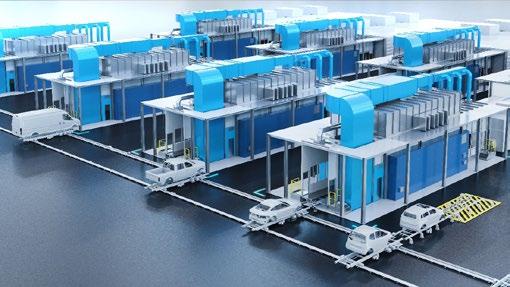
Dürr is installing an advanced, sustainable paint shop for Ceer , the first Saudi automotive company and Saudi-born electric vehicle brand, at the Ceer Manufacturing Complex in King abdullah economic City. Ordered in 2023 and currently in the installation phase, the facility represents the first full implementation of Dürr’s Paint Shop of the Future concept and is scheduled to begin production in the fourth quarter of 2026.
The modular system replaces rigid production lines with flexible ecoProbooth paint boxes, allowing interior and exterior vehicle painting within a single station. automated guided vehicles ( aGVs) transport vehicle bodies between stations based on demand, enabling scalable production and rapid model changes. The system supports fully automated two-tone paint applications without overspray using Dürr’s ecoPaintJet Pro technology, eliminating masking tape and reducing paint waste.
Sustainability is central to the project. Dürr supplies ecoInCure ovens that heat vehicle bodies from the inside, reducing heating time by up to 30 percent compared to conventional systems. electric exhaust air purification
DÜRR
systems, including the Oxi.X rV regenerative thermal oxidation unit, further reduce CO₂ emissions. Digital solutions from Dürr’s DXQ software family support predictive maintenance, process optimization, and intelligent production control across the paint shop.
For More Information: www.durr.com
INTERNATIONAL FEDERATION OF ROBOTICS (IFR)
IFR Reports on Top Five Global Robotics Trends for 2026
The International Federation of robotics reports that the global market value of industrial robot installations has reached an all-time high of $16.7 billion, with future demand driven by advances in artificial intelligence, system versatility, and new application areas. In its 2026 outlook, IFr identifies five key trends shaping the robotics industry.
a rtificial intelligence and autonomy are expanding robot capabilities through analytical aI, generative aI, and agentic aI, enabling robots to anticipate failures, learn new tasks, and operate independently in complex environments. The convergence of information technology (IT) and operational technology (OT) is accelerating robot versatility by enabling real-time data exchange and advanced analytics.
Humanoid robots are moving beyond prototypes toward real-world deployment, particularly in environments designed for human interaction. Safety and cybersecurity are becoming critical priorities as robots increasingly operate alongside humans and connect to cloud-based systems. Finally, robots are playing a growing role in addressing global labor shortages by automating routine tasks while supporting workforce upskilling initiatives.
For More Information: www.ifr.org
KUKA
KUKA Partners with Autotool for Automation Technology Day
KuK a robotics and system partner autotool will host a collaborative open house and educational seminar, autotool Tech Day: Powered by KuK a Connexions, on February 25–26, 2026, at autotool’s facility in Plain City, Ohio. The event continues the KuK a Connexions initiative, bringing together system partners, integrators, and technology partners to showcase automation solutions and emerging technologies.
attendees will have access to hands-on demonstrations, networking opportunities, and educational seminars focused on welding automation,
autonomous material handling, and part transportation. Featured technologies include KuK a’s Kr CyberTeCH nano arC edition robot for arc welding applications and KuK a’s autonomous mobile robot platforms such as the KMP 1500P, which uses SL a M navigation and omnidirectional drive technology for precise material transport.
autotool, with more than 30 years of experience as a system integrator, designs customized automation solutions for welding, joining, material handling, and dispensing applications. The partnership highlights how system integrators and robot manufacturers collaborate to deliver scalable, application-specific automation across North a merican manufacturing.
For More Information: www.kuka.com
LOGIC
Logic Introduces the Octopus Overhead Robot for Warehouse Automation
Logic has introduced the Octopus, an overhead industrial robot designed to transform warehouse picking, inspection, and material handling operations. unlike traditional floormounted systems, the Octopus is installed overhead, freeing floor space while enabling high-speed, multi-arm picking in compact environments.
The Octopus supports multiple fully active tooling attachments—including suction, clamp, and gripping tools— mounted on independent arms that operate simultaneously. Tool changes are eliminated as Logic Pallets automatically position items beneath the appropriate arm based on SKu and package requirements. Integrated with Logic’s Interface Network (LINK), the system enables real-time coordination, inventory tracking, and inspection through image scanning and weight validation.
Designed for both legacy warehouses and microdistribution centers, the modular Octopus system integrates with conveyors and standard pallets to support end-to-end goods-to-robot workflows. by reducing manual labor and increasing throughput, the Octopus delivers improved efficiency, flexibility, and operational transparency in warehouse automation.
For More Information: logic-os.com/contact
METALWORKING
Precision and Craftsmanship in Manufacturing
Metalworking encompasses the tools, technologies, and processes that drive precision manufacturing. This area highlights advancements in machining, grinding, lathing, and cutting systems, along with innovations like EDM (Electronic Discharge Machining). It captures the synergy between precision equipment and skilled craftsmanship, essential for producing high-quality components across diverse industries.
Focusing on the integration of controls, machining tools, and accessories, metalworking emphasizes the efficiency and accuracy demanded by modern manufacturing. From contract manufacturing to heat treating and gear machinery, it reflects the essential techniques and equipment shaping today’s industrial landscape. Whether utilizing traditional methods or cutting-edge innovations, metalworking celebrates the pursuit of excellence in every detail.
A New Look at Automation in the Machine Shop — Partnering Makes It Possible
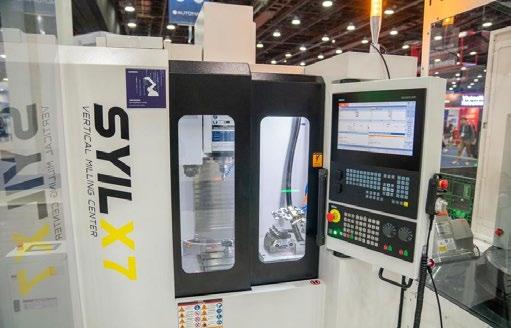
Siemens expands its SINuMerIK run Myrobot platform with the CNC, enabling cost-effective KuK a robot part handling and articulation functions directly on the control screen of a SyIL machine tool.
Automation for Every Shop Size
Through a technology partnership that breaks new ground in the machine tool industry, Siemens presents an automation solution for busy, multitasking small to mid-sized machine shops. The solution combines a digital twin of the software and programming of its popular SINuMerIK 828 CNC, working in tandem with a KuK a robot, to simplify operation and programming for part handling by machine tool operators. bringing the concept to life during a recent trade show, KuK a robotics Corporation demonstrated the same control and robot working in tandem with a SyIL vertical milling machine. The machine featured the S yIL r 1 machine-tending
automation package, developed with one of KuK a’s system partners, Waybo. The package seamlessly integrates pick-and-place functions, part articulation, and CNC communications onboard, all at a highly attractive price point.
The goal of the program, according to Frans buikema, Chief Marketing Officer at SyIL, is to offer small and mid-sized shops an entry point into automation without requiring major capital investment. Likewise, ron bergamin, Key Technology Manager for Machine Tool automation at KuK a , notes that return on investment can be very short, as this automation advancement enables the addition of lights-out second or third shifts at job shops of almost any size. automation is the key, and this cooperative engineering venture has opened a new chapter for small to mid-sized machine shops.
Displayed here are the S yIL machine tool and KuK a robot
interacting, with all motions run on the SINuMerIK run
Myrobot/Handling application directly in the control.
Simplifying Robotics Through the CNC
Only a decade ago, integrating a robot with a machine tool required a separate learning curve. robotics demanded specialized programming, teach-in communications, a separate pendant for operation, and often outside consultants to implement the system. For small and mid-sized machine shops, this barrier—combined with cost—resulted in a market where fewer than a quarter of smaller job shops in the united States utilize automation, particularly robotics, in daily operations.
That landscape has changed. a s Tiansu Jing, Product Manager for SINuMerIK CNC systems, explains, the benefits of this development for busy job shops are significant. Setup, programming, operator interface, and diagnostics are all improved with the SINuMerIK run
Myrobot/Handling application, which easily incorporates the KuK a robot with the SyIL machine tool.
Teach-in functions are implemented through the SINuMerIK Operate HMI system on the control, while the proprietary run Myrobot/Handling capability seamlessly integrates with the KuK a robot control. because there is no need to learn robotic programming, start-up time is reduced and the robot’s separate control pendant is eliminated. The SINuMerIK control’s HMI is used to operate both the machine tool and the robot tender, with all commands and operating conditions displayed on a single screen.
Jing notes that a key benefit for job shops is the system’s ability to integrate robots across all machines while minimizing the learning curve for operators. This cooperative venture between Siemens, KuK a , and S yIL made the advancement possible.
From Complexity to Clarity
The SINuMerIK 828D CNC used in this application is designed for turning centers, milling machines, and vertical machining centers common in job shop environments. It also provides the flexibility for machine builders and end users to enhance productivity with robotic automation integrated directly into the control.
a s Jing explains, the 828D is scaled to the functionality of standard machines sold to smaller job shops. With run Myrobot/Handling included, programmers can use the same G-code for both the robot and the machine tool. Programming, operation, and diagnostics for both systems are handled through a single control screen.
Designed for the Job Shop, Including Affordable Lights-Out Manufacturing
ron bergamin of KuK a notes that machine builders can now offer robotics through KuK a’s PLC mx automation, a universal PLCopen-certified interface. This allows users to program and operate key robot functions directly within the shop’s familiar control environment.
Jing adds that run Myrobot/Handling enables machine builders to offer robotics as an option at a much lower cost than in the past, as engineering effort has been significantly reduced. With simple ethernet and safety cable connections, robot integration is faster and easier. In many cases, bergamin notes, the robot can be up and running within a single day.
With the addition of a lights-out second or third shift, spindles continue turning and productivity increases. return on investment is rapid.
Jing concludes that machine builders can add their own robot-specific screens to improve usability and display robot tasks. This resolves long-standing challenges for both builders and end users, allowing companies like S yIL to offer robotic packages with less price resistance and greater shop-floor advantages.
A New Benchmark for Machine Tool Builders
Philip Peloso, business Development Manager for Machine Tool automation at KuK a , explains that the initiative addressed a robotic skills gap and price resistance common among smaller job shops. Working with system partner Waybo, the team developed an entry-level automation solution designed to be easy to use, robust, and adaptable to high-mix, low-volume production environments.
The partnership leveraged the long-standing relationship between Siemens and KuK a , bringing combined support to the field. S yIL adopted the system as its S yIL r 1 automation solution, with all meaningful controls and diagnostics displayed directly on the CNC. robot motion, pick-and-place functions, and communications with workholding are transmitted seamlessly from the robot application layer to the CNC.
ron bergamin notes that working with Waybo allowed the team to develop automation around the robot using KuK a’s mx automation software. This enables control from the Siemens CNC, requiring only a single pendant for both machine and robot operation, with all diagnostics handled internally.
Real Results on the Shop Floor
buikema cites tangible results, noting that automation is now accessible in new and practical ways. a package
priced around $60,000 can deliver a payback period of a year or less. Wesley Wang, Managing Director for SyIL North america, adds that understanding today’s automation options—and how different they are from the past—is key for modern machine shops.
S yIL plans to expand these automation packages across its full lineup of CNC milling machines, turning centers, and Swiss-type lathes. The integration of the SINuMerIK 828D CNC with run Myrobot/ Handling represents a major step forward, enabling broader adoption of robotics among small and mid-sized machine shops.
The S yIL r 1 automation package offers a standardized machine-tending solution for parts up to 3 kg, with higher payload and reach options available. It supports harsh operating environments and integrates fully with conveyors, bins, pallets, and workholding systems. all programming, operation, and diagnostics are handled through the SINuMerIK control, eliminating the need for a second pendant and simplifying training.
Increasingly, job shops are recognizing automation as a critical asset for achieving consistent quality and flexibility. Digitalization enables higher levels of automation and component networking. Through this partnership, Siemens, KuK a , and S yIL are delivering a cost-effective, fully integrated robotic solution tailored to the realities of today’s machine shop.
Mazak Open House Showcases Advanced Machining and Automation Technologies
Mazak Corporation will host a two-day Florida Open House on February 18–19 at its Mazak Technical Center in Orlando, highlighting advanced machining and automation solutions for aerospace, medical, defense, marine, and other precision manufacturing sectors. The event will feature live demonstrations of machine tools processing real-world parts and provide attendees with direct access to Mazak applications engineers for manufacturing guidance.
Live demonstrations will include the QT e-100My MultiTasking Machine equipped with bar feeder automation, the VarIa XIS C-600 Vertical Machining Center, and the S yNCre X 12/8 Swiss-style Production Turning machine. The QTe-100My combines turning and milling with y-axis capability and features a 6,000 rpm spindle, 13.39-inch maximum part diameter capacity, and a rotary tool turret with a 4,500 rpm milling spindle. The VarIa XIS C-600 supports full simultaneous 5-axis machining with multiple spindle options ranging from 12,000 to 20,000 rpm and tool magazine capacities up to 120 tools.
For high-precision small-part production, the S yNCre X 12/8 demonstrates eight-axis Swiss-style turning with support for up to 27 tools and a maximum bar diameter of 12 mm. The machine is powered by the M a Z aTrOL SmoothSt CNC, which includes Swiss Setup a ssist and Dynamic Chip Control to support fast setup and stable cutting performance. The open house provides manufacturers an opportunity to evaluate machining solutions tailored to complex, high-precision production requirements.
For More Information: www.MazakuS a .com
NEUGART
Neugart Introduces New Pro Series Precision Gearboxes
Neugart has launched a new performance class of high-precision gearboxes with the introduction of the PSNpro, PSFNpro, and PSbNpro series. The new gearbox family is designed to set higher standards in performance, precision, and reliability for dynamic industrial applications, including mechanical engineering, robotics, and linear motion systems.
The Pro series is based on newly developed gear technologies and advanced materials that improve tooth flank quality and reduce point load peaks. This enables higher torque transmission while maintaining service life. Cycle torque performance has been significantly increased, allowing the Pro gearboxes to rival and, in some applications, surpass traditional spur gearboxes,
particularly in applications with frequent load changes and direction reversals.
Helical tooth design enables low transmission fluctuation between input and output shafts, improving synchronization and reducing chatter marks in applications such as woodworking machinery. The gearboxes also operate at low noise levels under high loads, contributing to improved system acoustics and overall machine stability. reduced mass inertia in smaller frame sizes supports faster acceleration and braking, improving control quality in highly dynamic axes. The Pro series will be available beginning January 2026.
For More Information: www.neugart.com
ROMI BW MACHINE TOOLS
Romi Appoints Cristiano Rodrigues de Fraga as General Manager for the U.S. and Canada
romi bW Machine Tools has announced the appointment of Cristiano rodrigues de Fraga as General Manager for the united States and Canada. In this role, de Fraga will oversee romi’s North american operations, including market development, customer engagement, and the continued expansion of romi’s regional presence.
Cristiano brings more than 25 years of experience in the manufacturing and machine tool industry. He previously spent 15 years as Sales Manager at romi’s headquarters in brazil, where he led commercial strategy, market development initiatives, and sales teams with direct responsibility for business performance. His background combines engineering knowledge, technical expertise, and business leadership.
In his new position, de Fraga will focus on strengthening romi’s local footprint, expanding strategic partnerships, and aligning North american operations with romi’s global strategy. Founded in 1930, romi is a market leader in machine tool sales in brazil and serves customers worldwide with advanced manufacturing technologies and industrial solutions.
For More Information: www.romi.com
SIEMENS DIGITAL INDUSTRIES
Siemens Releases 2026 SINUMERIK Operation and Programming Training Schedule
Siemens has released its 2026 training schedule for SINuMerIK CNC operation and programming, offering free instructor-led online courses and in-person classes at its elk Grove Village, Illinois facility. The program covers a wide range of topics including CNC programming, machine operation, service, and maintenance.
Online instructor-led offerings include Level 1 Turning, Level 4 Macro Programming, and Level 2 Milling courses scheduled throughout the first quarter of 2026. In-person training options include Level 3 five-axis programming and SINuMerIK service and maintenance courses, providing hands-on instruction for advanced machining applications.
The expanded training schedule supports manufacturers seeking to improve CNC proficiency, optimize machine utilization, and maintain advanced SINuMerIK-controlled equipment. Full course details and schedules are available through Siemens’ CNC4you training resources.
For More Information: www.siemens.com/cnc4you
Siemens Releases 2026 SINUMERIK Operation and Programming Training Schedule
SOFTWARE
The Digital Backbone of Modern Manufacturing
In an era where innovation drives productivity, the Software section explores the cutting-edge tools empowering manufacturers to streamline operations, enhance precision, and optimize performance. From CAD/CAM/CAE design platforms to CNC simulation and process verification, this category reveals how digital solutions are revolutionizing the way products are conceptualized, created, and delivered.
Covering a broad spectrum of applications—such as ERP systems, factory floor software, and industrial IT—this section emphasizes the importance of connectivity and real-time data in achieving operational excellence. Topics like quality control, job tracking, and program optimization showcase how software bridges the gap between vision and execution, enabling manufacturers to stay competitive in a fast-evolving industry.
Manufacturing Is Entering a New Era of Speed, Intelligence, and Integration
By Dave Evans, CEO & Co-Founder, Fictiv
If you work in manufacturing today, you can feel it: the old way of doing things just doesn’t cut it anymore. Development cycles are getting shorter. Products are more complex. Teams are stretched thin. a nd the supply chain feels like it’s in a constant state of motion.
at the same time, expectations haven’t relaxed—they’ve gone up. Customers want faster timelines, tighter tolerances, and more predictability. engineers want to spend their time on real problemsolving, not chasing quotes. Supplychain teams want fewer surprises and more control.
That’s the world we’re all building in now. a nd it’s why the changes we’re seeing in 2026 feel like the new baseline.
aI is moving from the lab into everyday work. Digital workflows are becoming the connective tissue between design, sourcing, and
production. Precision machining is scaling to meet production speeds. a nd on the supply-chain side, transparency and trust are becoming just as important as cost.
Taken together, these shifts point to a new operating model for manufacturing—one that’s smarter, more connected, and far more resilient. The good news is that this future is already taking shape.
AI-Driven DFM and BOM Automation Are Becoming Essential Infrastructure
For years, aI in manufacturing was framed as “the next big thing.” Today, it’s simply how the most effective teams get work done. The most meaningful progress isn’t happening in abstract concepts, but in highly practical tools like aI-driven designfor-manufacturability (DFM) analysis and bill of materials (bOM) automation. Consider how much time is
lost waiting for manufacturability feedback or manually updating bOMs. Those hours compound quickly across a program. aI now enables teams to surface manufacturability issues in minutes instead of days and generate accurate, standardized bOMs without repeated manual intervention.
The impact is tangible. engineers reclaim hours each week for design, validation, and innovation. Design cycles tighten as slow feedback loops disappear. Downstream errors drop because issues are identified early, when they are still inexpensive to fix. Suppliers receive cleaner, more complete information, reducing miscommunication and late-stage surprises.
Manufacturers are embracing these tools because they offer a way to move faster without sacrificing quality or control. When aI genuinely reduces workload and amplifies engineering expertise, it becomes foundational rather than experimental.
Complex Mechanical Assemblies Are Moving under unified Digital Workflows
Modern products—particularly in robotics, electric vehicles, medical technology, and industrial systems—are inherently complex. They depend on multi-step assemblies involving welding, CNC machining, sheet metal fabrication, coatings, mechanical integration, and quality assurance. Historically, these steps lived in silos, spread across vendors, systems, and endless email threads.
The consequences of that fragmentation are familiar: delayed timelines, misaligned revisions, and quality checks that fail to propagate across the supply chain.
What’s changing is the shift toward unified digital workflows that bring these processes together. Instead of juggling multiple disconnected tools, manufacturers are adopting platforms that coordinate multi-step assemblies end to end, push design updates directly into fabrication and inspection, automate quoting and sourcing, and capture traceability throughout the process.
When everything flows through a single digital orchestration layer, builds move faster, handoffs become smoother, and quality issues are easier to identify and resolve. Teams gain the visibility they’ve long needed, without relying on spreadsheets and inboxes to manage complexity.
Demand for Advanced Tooling and Large-Format CNC Capabilities Is Surging
a s companies move from prototype to production faster than ever, expectations at the machine level are rising. Manufacturers are demanding greater precision, larger scale, and higher throughput from their machining partners.
This is most evident in the growing need for high-tolerance metal assemblies that must be right the first time, large-format components that exceed the capacity of legacy equipment, and production-grade machining that delivers speed and flexibility without sacrificing repeatability.
The result is strong demand for advanced tooling, fixturing, and large-format CNC capabilities that can support both accuracy and scale. Manufacturers want production-quality results on modern timelines, with those capabilities fully integrated into the same digital workflows used for design, sourcing, and quality.
When advanced machining capacity is not just available but digitally connected to daily operations, performance improves across the board.
Full Landed-Cost Transparency and Importer-ofRecord Services Are Now Critical
recent supply-chain disruptions have underscored a hard truth: hidden risk is costly. unexpected tariffs, customs delays, and unanticipated fees can derail projects late in the process.
That’s why full landed-cost transparency has become essential. Manufacturers want to understand total cost upfront, including duties, freight, tariffs, and regional risk exposure. a longside this, demand for Delivered Duty Paid (DDP) and importer-of-record services continues to grow.
When a partner manages compliance, documentation, and cross-border risk, teams gain predictability. Surprise charges are eliminated, customs issues are reduced, and true cost and risk are visible before a build is approved. In today’s trade environment, that level of clarity is a competitive advantage.
What These Trends Signal for the Future of Manufacturing
Viewed together, these trends point to a clear direction. Manufacturing is becoming more intelligent, with a I handling repetitive work and amplifying human expertise. It is becoming more integrated, as unified workflows replace disconnected systems. It is becoming more precise, driven by advanced tooling and scalable machining. It is becoming more transparent, with cost and risk visibility replacing guesswork. a nd it is becoming more resilient, as digital infrastructure replaces brittle manual processes.
Perhaps most importantly, these changes make manufacturing more human. When engineers, buyers, and operations leaders are freed from administrative burden and constant firefighting, they can focus on solving hard problems and building better products.
Manufacturing is being rebuilt in real time through the choices organizations make—where they invest, who they partner with, and which workflows they modernize. Those that embrace this new operating model, powered by aI, digital platforms, and transparent supplychain partnerships, will move faster and operate with greater confidence.
The tools are stronger, the platforms are smarter, and the appetite for change is real. The future of manufacturing isn’t just faster and more efficient—it’s better aligned with how people actually work.
LANTEK
Lantek Launches v45 of Its Lantek Suite to Advance Automation and Connectivity in Sheet Metal Operations
Lantek has released version 45 of its Lantek Suite software, continuing its focus on automation, connectivity, and digital continuity for sheet metal manufacturers. The latest release enhances integration across factories and departments through improved a PIs and tighter connections between e xpert, b end, Integra, Flex3D, M e S, and iQuoting modules, enabling unified workflows and full traceability.
Key updates to Lantek e xpert include an enhanced Stackmaster module with expanded lift-device compatibility, faster pick-and-place operations, 3D simulation, and interactive pallet layout definition to support unattended production. New multiangle machining strategies allow users to define and automatically apply machining rules based on part orientation, reducing setup time for punching machines and evacuation systems. a dvanced standard and 3D beveling capabilities further simplify programming of complex parts.
Lantek b end v45 introduces a redesigned interface and Finite e lement Method–based bend deduction calculation, enabling more accurate predictions based on specific tool, die, and angle combinations. a ssembly to Nesting ( a 2N) enhancements improve bend deduction accuracy through tool and die filtering, while Flex3D delivers improved nesting performance, enhanced assembly imports, and deeper integration with StruMIS M r P systems via Tekla. u pdates across M e S, Integra, and iQuoting strengthen production planning, cost management, scheduling, and quotation workflows, supporting smarter, more connected sheet metal operations.
Siemens Introduces Digital Twin Composer to Power the Industrial Metaverse
Siemens has unveiled Digital Twin Composer, a new software solution designed to bring industrial metaverse environments to life by combining comprehensive digital twin data with real-time physical information. built using NVIDIa Omniverse libraries, the platform enables organizations to create secure, high-fidelity 3D environments that unify design, simulation, engineering, and operations throughout the lifecycle of products, processes, and facilities.
Digital Twin Composer allows manufacturers to visualize and interact with products and factories in real-world context before physical construction begins. The solution integrates 2D and 3D digital twin data from the Siemens Xcelerator portfolio with live data from manufacturing execution systems, quality management systems, PLCs, and IIoT sources. This enables rapid validation, simulation, and optimization of production systems at scale.
PepsiCo is among the early adopters, using Digital Twin Composer to digitally transform select u.S. manufacturing and warehouse facilities. by creating high-fidelity digital twins of operations, PepsiCo identified up to 90 percent of potential issues before physical changes were made, achieved a 20 percent increase in throughput, and realized 10–15 percent reductions in capital expenditures. Launched at CeS 2026, Digital
SIEMENS DIGITAL INDUSTRIES SOFTWARE
Twin Composer is currently available in early access for select customers.
For More Information: www.siemens.com/industrial-metaverse
Siemens Named Leader in Verdantix Green Quadrant for Quality Management Software 2025
Siemens has been recognized as a leader in the Verdantix Green Quadrant: Quality Management Software 2025 report, which evaluated 14 prominent QMS providers. The report cites Siemens for delivering best-in-class quality management capabilities through its comprehensive and well-rounded QMS platform.
Siemens’ Quality Management Software is available through Teamcenter ® Quality and Opcenter™ Quality solutions, connecting design, manufacturing, and operations to improve traceability, standardize workflows, and support continuous improvement. Delivered as part of the Siemens Xcelerator portfolio, the platform integrates digital twin technologies including PLM, MeS, and IIoT to enhance quality management across regulated and industrial environments.
The recognition highlights Siemens’ use of advanced aI to transform quality data into actionable insights, streamline operations, and embed quality best practices across the product lifecycle. a s QMS adoption expands beyond traditionally regulated sectors, Siemens’ integrated approach supports organizations seeking smarter, faster, and more reliable quality management systems.
For More Information: www.siemens.com/qms
SIKICH AND COSMO PARTNER SOLUTIONS
Sikich and
COSMO
Partner Solutions Partner to Expand IEM Capabilities for Microsoft Dynamics 365 Business Central
Sikich has announced a strategic partnership with COSMO Partner Solutions by COSMO CONSuLT to deliver enhanced Industrial equipment Manufacturing (IeM) functionality on Microsoft Dynamics 365 business Central. The collaboration addresses growing demand among mid-market manufacturers for advanced manufacturing capabilities traditionally available only in large enterprise erP systems.
Through the COSMO Discrete & Project Manufacturing solution, Sikich will deliver tools for complex, projectbased manufacturing, including configurable bills of materials, product lifecycle management, engineering change tracking, advanced costing, production planning,
equipment lifecycle management, and service optimization. The solution supports both mid-market manufacturers and enterprise organizations seeking scalable digital transformation.
The partnership aligns with broader industry trends toward making advanced manufacturing technology more accessible. by combining Sikich’s consulting expertise with COSMO CONSuLT’s manufacturing solutions, the companies aim to help manufacturers modernize operations, improve efficiency, and strengthen competitiveness on the business Central platform.
For More Information: www.sikich.com
VECTOR GFX
Vector GFX Launches as Independent Software Company Following Canvas X Draw Acquisition
Vector GFX has officially launched as an independent software company following its acquisition of the Canvas X Draw product line, including X Draw for Mac and Windows and X Geo, from Canvas GFX, Inc. The acquisition establishes Vector GFX as the dedicated steward of one of the industry’s most widely used 2D technical illustration platforms.
The acquisition was financed by Gary Griffiths, co-founder and managing director of WISDOM LLP, who formed Vector GFX to provide long-term focus, stability, and renewed investment in the Canvas X Draw product family. Griffiths will serve as chairman of the board, joined by co-founder rebecca Darsch, who oversees commercial operations. The leadership team brings deep operational and product expertise rooted in the history of Canvas X Draw.
Headquartered in Carver, Massachusetts, Vector GFX is advancing the Canvas X Draw roadmap with priorities including performance improvements, user experience modernization, and continued innovation for technical illustration professionals. additional announcements regarding team expansion and product development are expected in the coming months.
For More Information: www.vectorgfx.net
TOOLING AND WORKHOLDING
Precision in Action
Tooling and Workholding is the cornerstone of precision manufacturing, ensuring that materials are securely held and processes are executed with unparalleled accuracy. This section highlights the latest innovations in clamps, chucks, collets, and magnetic workholding, alongside advancements in rotary tables, toolholders, and modular fixturing systems. Together, these solutions enable manufacturers to achieve repeatability, reduce setup times, and enhance overall productivity.
From versatile milling and turning tools to specialized threading and gear-cutting instruments, this category delves into the diverse range of equipment designed to meet the unique demands of every operation. Whether exploring robotic end-effectors for automation or custom fixtures for intricate designs, Tooling and Workholding underscores the critical role these components play in driving efficiency and precision across the manufacturing spectrum.
Tooling and Workholding Move Toward Precision, Protection, and Process Control
In modern machining environments, tooling and workholding are no longer treated as consumables or static components of the process. They are increasingly viewed as performance drivers— directly influencing throughput, surface finish, machine health, safety, and total cost per part.
This shift is being shaped by a convergence of pressures on manufacturers. Tolerances continue to tighten across aerospace, medical, automotive, and energy applications. Materials are harder, more abrasive, and less forgiving. at the same time, machines are running faster, setups are more complex, and skilled labor remains limited. under these conditions, inconsistency at the tool or workholding level quickly translates into scrap, downtime, and unplanned maintenance.
a s a result, tooling strategies
are becoming more deliberate and more data-driven. Manufacturers are placing greater emphasis on tool life predictability, vibration control, coolant delivery, and balance— recognizing that small improvements at the cutting edge can have outsized impact on spindle health and process stability. advances in coatings, internal coolant design, and proven cutting geometries are being adopted not simply for speed, but to extend usable life and protect capital equipment.
Workholding is undergoing a similar evolution. rather than relying on traditional “good enough” clamping assumptions, shops are increasingly validating holding force, jaw condition, and actuator performance as part of routine maintenance and safety programs. The cost of a lost part, damaged spindle, or safety incident far outweighs the effort required to
verify and maintain secure workholding. This has elevated measurement, verification, and preventive inspection tools from niche accessories to essential safeguards.
Flexibility is another defining theme. High-mix production and shorter runs demand tooling and fixturing solutions that can adapt quickly without sacrificing rigidity or accuracy. Modular systems, customizable cutters, and forgiving contact designs are enabling manufacturers to handle irregular geometries, complex assemblies, and rapid changeovers with greater confidence and less setup time.
at the same time, the industry is reinforcing the link between tooling performance and lifecycle management. balanced tools reduce vibration and bearing wear. Properly clamped parts reduce crashes and rework. Predictable tool behavior supports automation, unattended machining, and lights-out strategies. In this context, tooling decisions are increasingly aligned with broader goals around reliability, safety, and sustainable production.
Together, these trends reflect a tooling and workholding landscape focused less on individual components and more on system-level performance. Precision, protection, and process control are no longer optional advantages—they are becoming baseline requirements for manufacturers seeking consistent output in demanding production environments.
The following industry developments highlight how
tooling and workholding suppliers are responding to these expectations with solutions designed to improve stability, extend equipment life, and support safer, more predictable machining operations.
New Sphinx Drinox Pilot Step Drill Delivers Significant Tool Life and Performance Improvements
bIG DaISHOWa has introduced the Sphinx Drinox Pilot Step Drill at 3xD, designed to deliver measurable improvements in tool life, coolant throughput, and drilling speed. The tool is engineered to provide up to three times longer tool life, three times higher coolant-through output, and drilling speeds up to three times faster in demanding applications.
BIG DAISHOWA
available in diameters ranging from 0.70 mm to 3.00 mm with 0.05 mm increments, the Sphinx Drinox incorporates coolant-through channels with a power chamber in the shank to maximize coolant delivery, even in machines with lower pump performance. The tool features a newly developed ultra-thin TiSiN coating that enhances sharpness, improves chip evacuation, and reduces material adhesion.
The cutting geometry includes a 90-degree cutting step and tool head based on proven high-performance designs, making it suitable for stainless steels, titanium, and heat-resistant nickel- and cobalt-based alloys. according to bIG DaISHOWa , the tool is intended for manufacturers seeking higher reliability and efficiency in high-stakes drilling applications.
For More Information: www.us.bigdaishowa.com
Speroni STB AEQUILIBRIA Tool Balancing System Enhances Safety and Machining Performance
bIG DaISHOWa has expanded its tool management offerings with the introduction of the Speroni STb aeQuILIbrIa tool balancing system. The system is designed to help manufacturers reduce vibration, improve surface finish, and extend spindle life by ensuring precise tool balance.
balanced tooling enables higher spindle speeds, increased chip removal rates, and improved machining consistency, while also reducing bearing loads and unplanned downtime. The STb aeQuILIbrIa features high balancing precision, clamping force comparable to high-quality machine tools, and an intuitive touchscreen interface with laser marking and illuminated status indicators.
The system supports fast and flexible tool changes and is paired with in-house developed SPerONI software designed for ease of use. Clear compensation options and an intuitive interface allow operators of varying experience levels to perform balancing efficiently and reliably.
For More Information: www.bigdaishowa.com
DILLON MANUFACTURING
Dillon Jaw Force Gauges Verify Chuck Jaw Performance for Safer, More Reliable Workholding
Dillon Manufacturing’s Jaw Force Gauges allow manufacturers to accurately measure the holding force
applied by each individual chuck jaw, providing a clearer understanding of chuck performance and workpiece security. unlike traditional gauges that measure total force across multiple jaws, Dillon’s system reports force per jaw, expressed in pounds, allowing for precise diagnostics.
The gauges help manufacturers identify issues such as insufficient lubrication, worn or damaged internal chuck components, improper jaw travel, or actuator and pressure inconsistencies. With a force range from 0 to 30,000 pounds, the gauges are suitable for chucks ranging from 6 to 18 inches, with support for other chucks up to 25,000 pounds rated force per jaw.
by verifying rated jaw force and identifying potential safety hazards before failure occurs, Dillon Jaw Force Gauges help reduce production losses, improve safety, and establish effective maintenance schedules. each gauge includes detailed setup and operating instructions.
For More Information: www.dillonmfg.com
FAIRLANE PRODUCTS
Fairlane
Products Introduces
New Thrust Screw Product Line for Secure, Damage-Free Clamping
Fairlane Products has announced the release of a new line of thrust screws designed to provide straight-line static load thrust without transmitting torsional or radial force to the contact surface. The thrust screws are intended as an alternative to traditional set screws for clamping, holding, retaining, and pushing applications, particularly on contoured or irregular surfaces.
The design features a free-floating ball that allows the threaded body to rotate while the contact point remains stationary, preventing surface damage. Thrust screws are available in both threaded and headed styles and offered with a variety of thrust end options, including stainless steel, Delrin®, urethane, serrated tool steel, and diamond surfaces.
With a larger contact surface area than conventional set screws and fully replaceable components, the thrust screws provide secure holding without marring or scarring the workpiece. Sizes range from 1/2 to 3 inches in length, with thread sizes from 1/4-20 to 1-14 and contact diameters from 9/64 to 49/64 inches.
For More Information: www.fairlaneproducts.com
Platinum Tooling Expands Tool Program for Swiss-Type CNC Automatic Lathes
Platinum Tooling Technologies has expanded its tooling program for Swiss-type CNC automatic lathes, adding new live and static tooling options along with 1:4 speed increasers for current Citizen machine models. The expanded lineup is designed to optimize machine performance while maintaining efficiency and cost effectiveness.
Swiss-type CNC automatic lathes, originally developed for precision watchmaking, are now widely used in automotive, medical, and electrical manufacturing. Platinum Tooling’s expanded offerings, developed in partnership with Heimatec, are engineered to enhance processing quality, extend service life, and increase machine capability through higher spindle speeds.
The tools incorporate high-quality bearings, precision-ground gears, rigid housings, and robust spindle designs to support demanding applications. Platinum Tooling continues to expand its tooling programs to help manufacturers improve productivity and achieve cost savings across a range of machining environments.
For More Information: www.platinumtooling.com
REGO-FIX AG
REGO-FIX AG Announces Leadership Transition to Support Long-Term Growth
reGO-FIX aG has announced a leadership transition effective January 1, 2026, with Pascal Forrer assuming the role of Chief executive Officer. Forrer succeeds long-time CeO richard Weber, who has transitioned to Chairman of the board of Directors and will continue to guide the company’s strategic direction.
marketing and sales initiatives. With more than 20 years of experience in the machining industry, his appointment reflects a long-term succession plan focused on continuity and sustainable global growth.
The leadership team, including members of the Weber family, will continue to support reGO-FIX’s commitment to innovation, quality, and long-standing customer relationships within the global tooling market.
For More Information: www.regousa.com
Seco Introduces 335.18 Disc Milling Cutter with Broad Customization Options
Seco has released the 335.18 disc milling cutter, a robust slotting solution offering more than 70 standard variants and full customization through the company’s MyDesign platform. The system is engineered to deliver stable performance, reduced vibration, and extended tool life across a wide range of machining applications.
Forrer joined reGO-FIX in 2018 and has played a key role in strengthening the company’s international
Designed for use in automotive, aerospace, and general engineering environments, the 335.18 is well suited for long overhangs and less rigid setups, including robotic machining. The system supports a broad selection of LNKT inserts, corner radii, integrated wiper flats, and grades to achieve fine surface finishes and consistent results.
Cost efficiency is achieved through double-sided inserts with four cutting edges and a durable cutter body manufactured from Swedish steel. When standard configurations are insufficient, MyDesign allows users to configure and quote custom cutter bodies quickly and efficiently.