Lisa Hanschu, Sr. Account Executive lisa@indmacdig.com 785-965-9159 | Fax: 785-965-7199
William C. Strickland III, National Sales 205-903-9178 | fax 866-826-5918
Susan Strickland, Accounting susan@indmacdig.com 205-542-1098 | Fax: 866-826-5918
CIRCULATION & SUBSCRIPTIONS
ImD, 3590-b Hwy 31 South, Suite 233, Pelham, AL 35124 circulation@indmacdig.com | Fax: 866-826-5918
REPRINTS
To purchase article reprints please call 800-366-0676 ext. 103 or email wstrickland@indmacdig.com
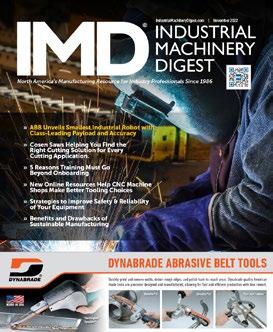
As the year comes to a close, manufacturers continue to navigate rapid change—from evolving workforce dynamics to accelerating digital transformation and rising expectations for precision, consistency, and speed. This issue of Industrial machinery Digest highlights the technologies and strategies helping companies meet those challenges head-on.
In Fabrication, KASTO demonstrates how intelligent sawing, adaptive control, and data-driven optimization are redefining productivity on the cutting floor. Our Safety & maintenance section examines SimuTech Group’s analysis of downtime, revealing just how costly disruptions can be—and how simulation helps prevent them.
robotics features AmeTeK/Ncc’s rugged smart display HmIs, which deliver the visibility and control modern automation requires, even in the harshest environments. In Software, we explore how smart machine shops are using digital workflows to preserve legacy knowledge, streamline training, and improve process consistency.
Quality continues to evolve quickly, and this month’s coverage showcases new metrology platforms from Hexagon, ZeISS, mahr, and others that bring automation, cloud-enabled insights, and real-time verification into everyday inspection. rounding out the issue, our Tooling & Workholding and metalworking sections highlight advances in cutting tools, cleaning systems, and machining solutions designed to increase throughput while maintaining accuracy.
As we move into 2026, one thing is clear: manufacturers that blend skilled people, intelligent machines, and connected digital workflows will be best positioned for long-term success. We’re proud to bring you the innovations shaping that future.
Thank you for your continued readership and support.
William Strickland, Publisher, ImD
From precision machining in Ohio to robotics integration in Texas, a new era of American manufacturing is rising. It’s not nostalgia — it’s a resurgence powered by automation, innovation, and a workforce ready to lead.
Every product made here strengthens our economy, shortens supply chains, and puts quality back at the forefront. The reshoring movement is more than a trend — IT’S A TRANSFORMATION.
Whether you’re a job shop, OEM, or advanced manufacturer, now is the time to invest in American strength, reliability, and ingenuity. Let’s build the future—right here at home.
INDUSTRY NEWS
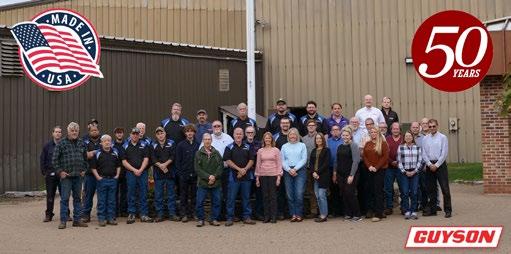
Guyson Corporation of USA Celebrates 50 Years of Innovation, Precision & Progress
Guyson corporation of USA marks its 50th anniversary, celebrating five decades as a leader in industrial surfacefinishing and blasting technology. Founded in 1975 as the North American arm of Guyson International, the company has grown from a small operation into a global manufacturer serving aerospace, additive manufacturing, medical devices, automotive, and defense markets. Operating from its 40,000-square-foot facility in Saratoga Springs, New York, Guyson designs and builds every system in-house, reinforcing its reputation for craftsmanship, quality, and engineering excellence.
Throughout 2025, the company has honored its milestone year through product innovation, deeper customer partnerships, and a renewed focus on the skilled workforce whose expertise continues to define its success. Guyson remains committed to delivering advanced surface preparation solutions that strengthen quality, productivity, and performance across modern manufacturing.
For more Information: www.guyson.com
November 2025 Business Conditions Report Shows Steady Outlook as Shipping Levels Decline Slightly
The Precision metalforming Association (PmA) reports a mixed economic outlook among metalforming manufacturers for the next three months, according to its November 2025 business conditions report. While most respondents foresee either no change or a decrease in general economic activity, optimism surrounding incoming orders is rising. Thirty-one percent of companies expect an increase in new orders—up from 21 percent in October—indicating potential demand stabilization heading into early 2026.
current shipping activity dipped slightly, with 40 percent of manufacturers reporting a decrease in average daily shipping levels. Workforce indicators also shifted, as 14 percent of respondents reported workers on short time or layoff, compared to eight percent in October, while 26 percent plan workforce expansion. Lead times remain unchanged.
The report reflects cautious sentiment, influenced by ongoing supply-chain constraints and rising raw material
prices, yet also points to resilience among manufacturers anticipating stronger order activity.
For more Information: www.pma.org
STLE Announces 2026 Metalworking Fluid Management Course at Argonne National Laboratory
The Society of Tribologists and Lubrication engineers (STLe) has opened registration for its 2026 metalworking Fluid management course, scheduled for march 10–11 at Argonne National Laboratory in Lemont, Illinois. This two-day intensive program provides a comprehensive overview of metalworking fluid management and offers updated instruction, expanded case studies, and preparation for the certified metalworking Fluids Specialist™ (cmFS) exam.
The course brings together leading experts from across the industry, with presenters representing master Fluids Solutions, Faith-Full mWF consulting, Quaker Houghton, munzing corp., engineered Lubricants co., clariant, John Deere, blaser Swisslube, and FUcHS.
STLe highlights the event as an exclusive learning opportunity within a world-class laboratory environment, emphasizing the organization’s mission of advancing tribology, lubrication engineering, and professional education across global manufacturing sectors.
For more Information: www.stle.org
Wauseon Machine Reorganizes Into Integrion Automation and Steelcrest Precision
Wauseon machine, a longstanding provider of automation integration, tube forming technologies, and precision machining, has announced a major strategic reorganization. The company will now operate as two independently focused entities: Integrion Automation and Steelcrest Precision.
The restructuring enables each business to deepen its specialization and accelerate investment tailored to its specific market. Integrion Automation will focus on advanced automation, field service, and tube end forming technologies, carrying forward Wauseon m achine’s legacy of engineering-driven automation solutions. Steelcrest Precision will concentrate on machining and fabrication, supported by expanded technology, workforce development, and enhanced production capabilities.
both companies operate under cornerstone corporation and retain the shared values—quality, ingenuity, and customer partnership—that have shaped Wauseon machine since 1983. Leadership emphasizes that this evolution supports long-term growth, sharper market alignment, and greater customer impact across all served industries.
For more Information: www.IntegrionAutomation.com
ENGINEERED TO ENDURE. CRAFTED FOR CONFIDENCE.
Inspire your team with durable, comfortable and wellfitting workwear — and we’ll take care of your laundry list, too. With an Apparel+ program, we’ll pick up your team’s dirty clothes, wash and repair them, and deliver the fresh garments back to your business. Cintas gives you the complete package, with no upfront investment.
SCAN TO LEARN MORE
FABRICATION
Transforming Materials Into Excellence
Discover the innovative tools and technologies shaping today’s manufacturing landscape. Highlighting processes that transform raw materials into precision-crafted products, from advanced cutting and forming systems to welding and finishing techniques, the focus remains on efficiency, accuracy, and innovation driving modern fabrication.
From advancements in automation and sustainable manufacturing practices to the latest developments in material processing, gain insights into trends and solutions that enhance productivity, improve quality, and maintain competitiveness in a rapidly evolving industry. This overview showcases the equipment and expertise behind the products powering industries worldwide.
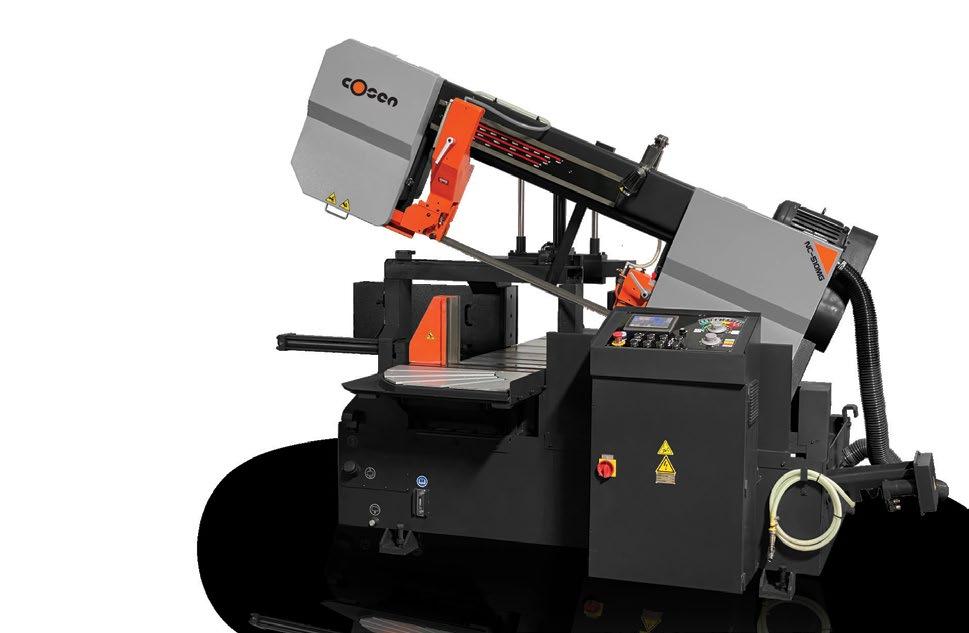
Smart Sawing for a Connected Future: How KASTO is Redefining Digital Fabrication
Digitization has steadily reshaped modern manufacturing, but few areas have evolved as rapidly—or as intelligently—as sawing and material handling. KASTO maschinenbau GmbH & co. KG, a long-standing
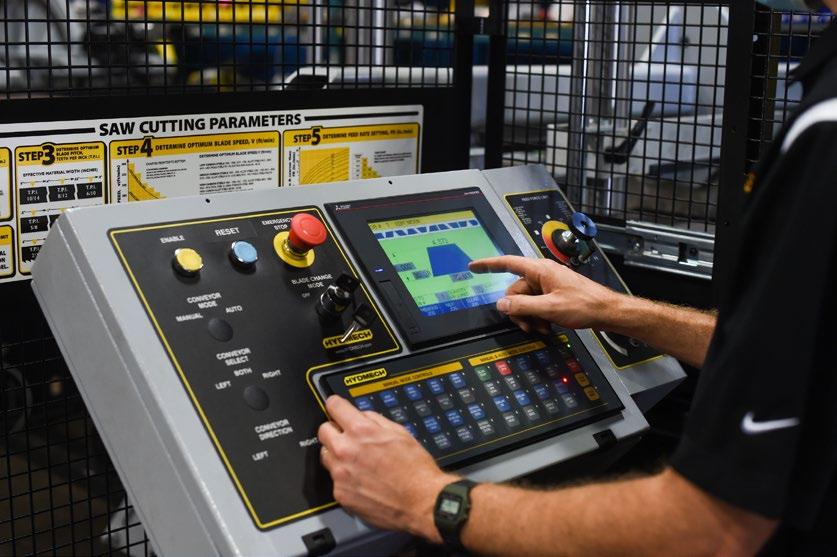
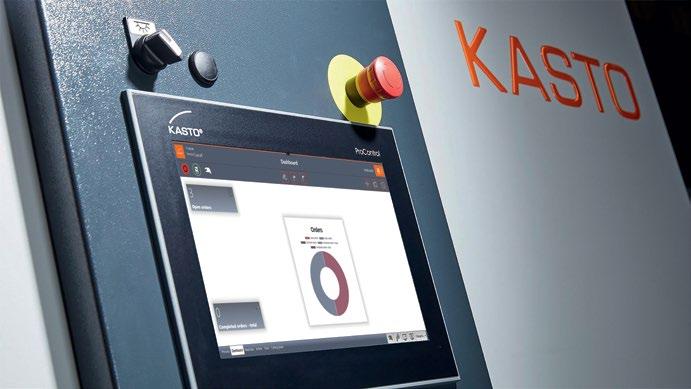
Exclusive preview of the EMO: KASTO introduces the new control generation for industry professionals. With its smart features and intuitive operation, it aims to provide more overview and greater efficiency.
innovator in sawing, storage, and automation technologies, has placed itself at the forefront of this shift. The company’s newest digital platforms demonstrate how deeply connected systems are transforming fabrication, optimizing workflow, and redefining
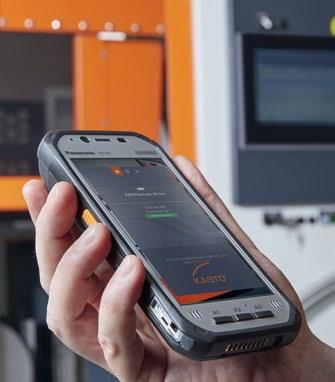
The KASTOapp provides a real-time overview of the status of all KASTO sawing machines within the network.
what a sawing machine can deliver inside a smart factory environment.
KASTO’s strategic vision starts with a simple but powerful idea: a saw should no longer function as an isolated machine. Instead, it should be part of a seamless, data-driven ecosystem where planning, cutting, monitoring, and optimization work together in real time. The company’s engineers have spent years prioritizing the full material flow, developing tools that automate decision-making, reduce waste, and strengthen repeatability across every step of the process.
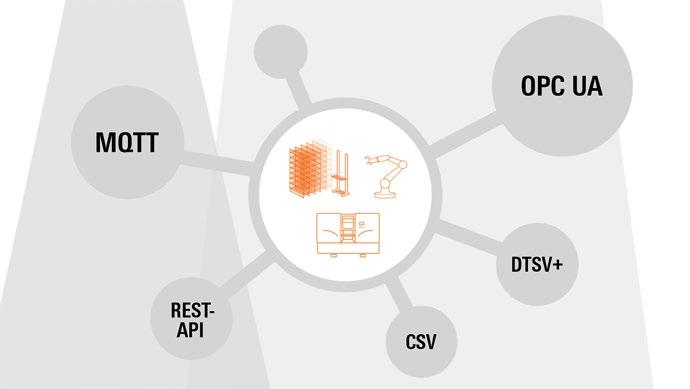
At the center of this approach is KASTOlink, a versatile interface that connects sawing machines to storage systems, production equipment, warehouse management software, and erP systems. Supporting open standards such as OP c UA, mQTT, reST API, and c SV, KASTOlink enables continuous, uninterrupted data exchange from order entry to finished cut. This creates a
transparent, traceable workflow in which machines communicate autonomously and users can monitor performance across the entire production network. For many facilities, the saw becomes a proactive contributor rather than a passive station.
material optimization is another area where KASTO has applied deep
engineering focus. KASTOoptisaw, fully integrated within the KASTOlogic WHm platform, automatically assigns bar stock to cutting plans while factoring in kerf width, minimum cutting lengths, and machine-specific characteristics. The software runs numerous possible cut arrangements to generate the most efficient layout, minimizing remnants and reducing
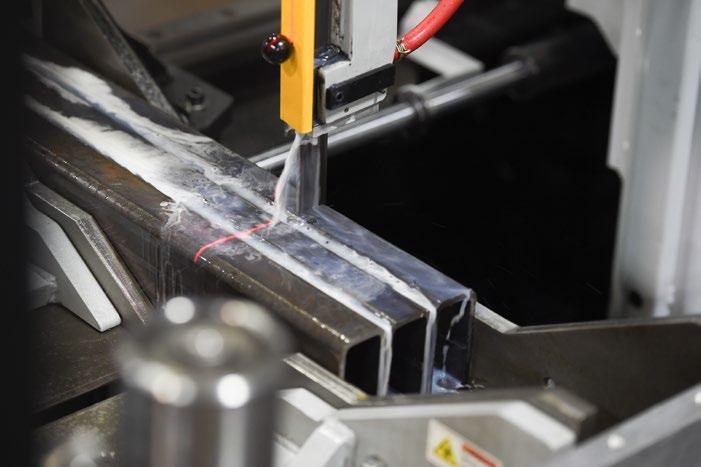
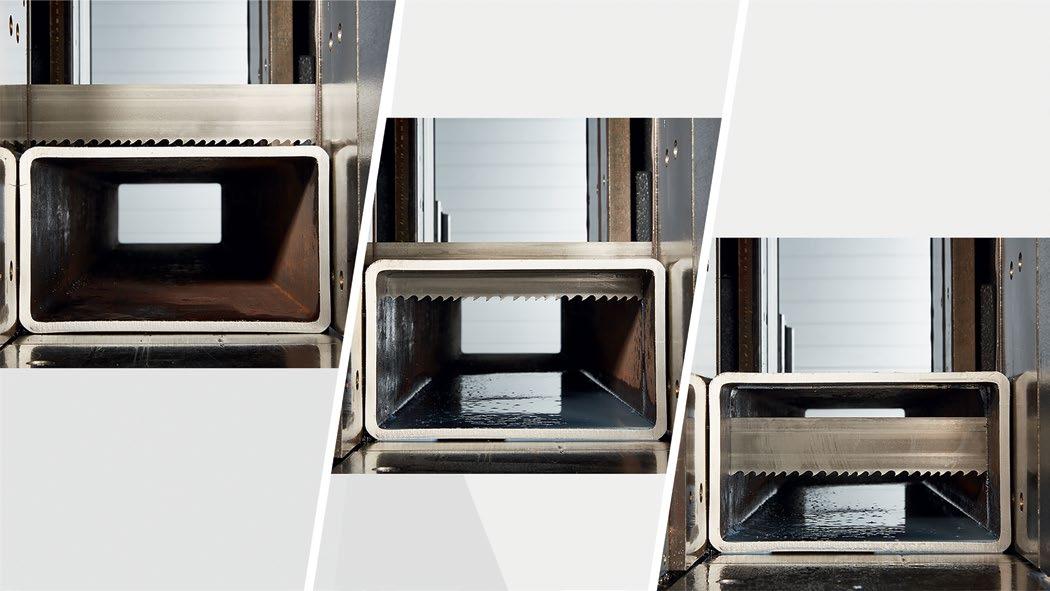
KASTOrespond can detect variations in wall thickness, differing contact lengths, and particularly hard areas in the material, adjusting to the appropriate feed rate.
costs. Users can also design plans manually using a graphical wizard that previews alternative configurations before cutting begins. The system supports bars, tubes, profiles, and mitred work, helping shops reduce waste and reclaim valuable storage space previously taken up by unusable returns.
mobile access through the KASTOapp adds another layer of visibility. The app provides real-time machine status updates, including part counts, feed rates, cutting speeds, target and actual quantities, and error notices. This enables supervisors and operators to make fast, informed decisions from anywhere. KASTO ensures secure transmission by using encrypted HTTPS connections and operating its own servers, reinforcing data protection while enabling remote operational insight.
KASTOrespond advances automation further by optimizing the digital feed in real time. The system measures the forces acting on the tool during cutting— without add-on sensors—and adjusts feed rates to match material thickness, hardness, and contact conditions. Whether cutting solids, tubes, or bundles, the technology reacts instantly to variations that could otherwise slow the process or compromise accuracy. Operators only enter a few basic parameters such as material type, lengths, and quantities. KASTOrespond handles the rest, shortening cycle times and significantly extending blade life.
Looking forward, KASTO is preparing to launch a new control generation designed for faster setup, improved clarity, and simplified operation. The updated interface introduces modern visuals, smart functions, role-based navigation, and a streamlined “Simple mode” for quick order processing. browser-based access makes machine
control possible from a P c or tablet, while newly enhanced cutting-plan capabilities allow multiple lengths of the same material to be grouped and processed automatically. A redesigned dashboard displays key operational metrics at a glance, and built-in contextual help guides users directly at the point of need.
With its deep experience in sawing and storage automation, KASTO continues to push fabrication toward a connected, Industry 4.0-ready future. by combining autonomous machine communication, optimized material usage, mobile monitoring, and adaptive feed control, the company demonstrates how digitalization can elevate even the most established processes. For manufacturers navigating tighter tolerances, rising material costs, and competitive lead-time demands, KASTO’s digital sawing ecosystem presents a clear path toward higher efficiency, lower waste, and fully integrated production workflows.
For more Information: www.kasto.com
Axtra3D Expands Elastomer Portfolio with New Production-Grade Materials
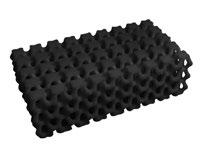
Axtra3D has expanded its Axtra Solutions portfolio with three newly qualified elastomers: Loctite 3D IND475, Loctite 3D med414, and Ultracur3D eL 4000. Developed in collaboration with Loctite and ForwardA m , these materials enable production-grade flexibility across industrial, medical, and high-performance applications.
AXTRA3D
Loctite 3D IND475 offers resilient Shore 48A performance suitable for seals, gaskets, housings, and lattice structures. med414 is a medicalgrade elastomer engineered for durability, elongation, and skin-contact safety, making it suitable for wearables and patient-facing components. Ultracur3D eL 4000 provides Shore 90A hardness, high tear resistance, and strong rebound for demanding uses such as footwear and sports equipment.
The new materials complement Axtra3D’s rigid portfolio and integrate seamlessly with the LumiaX1 printer and Axtra Solutions workflows, supporting both optimized production and open-material experimentation.
For more Information: www.axtra3d.com
FRONIUS USA
Fronius Launches Vizor Air/3X Respirator System for Improved Welding Safety
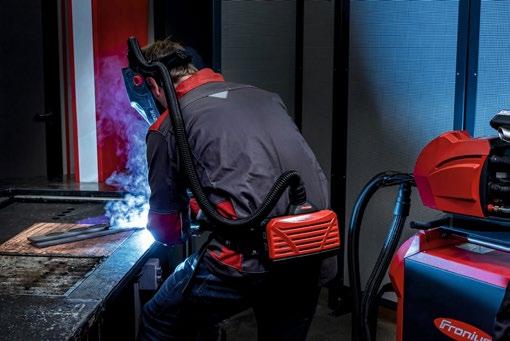
Fronius USA has released the Vizor Air/3X, a certified respirator system designed to deliver clean, filtered air for welders. The system incorporates a fan-assisted airflow, lithium-ion battery power, smart filter detection, and three selectable airflow levels.
The lightweight design, combined with an ergonomic harness, provides comfort during long shifts. Users may purchase a ready-to-go package that includes the Vizor Air/3X unit, belt, harness, carrying bag, additional filter, and compatibility with multiple Fronius welding helmets.
Developed to reduce operator exposure to particulates and welding fumes, the system is available through authorized Fronius distributors.
For more Information: www.fronius.com
NISSEI PLASTIC INDUSTRIAL CO., LTD.
Nissei Highlights Next-Generation Injection Molding Technologies at K2025
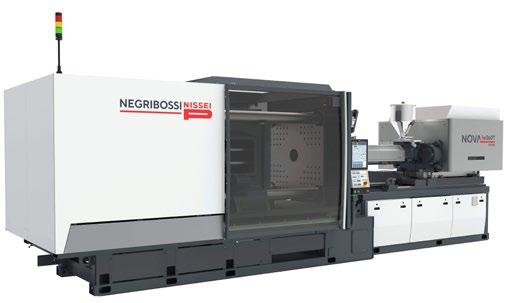
Nissei Plastic presented a range of next-generation molding technologies focused on sustainability, low-pressure processing, and micro-precision capabilities. Demonstrations included all-electric machines equipped with cube mold technology for multi-component food packaging production and new low-pressure molding methods designed to reduce energy consumption and mechanical stress.
Additional highlights included Pe TG processing using Nissei’s hybrid X-Pump system for recycled materials and micro-molding demonstrations using the N-constellation IoT platform. These technologies support stable processing, improved part quality, and smart factory integration.
Nissei continues to strengthen its presence in North America by offering energy-efficient, environmentally responsible solutions tailored to high-performance production environments.
For more Information: www.nisseiplastic.com
POSTPROCESS TECHNOLOGIES
PostProcess Introduces DEMI X 520 for Automated PolyJet Support Removal
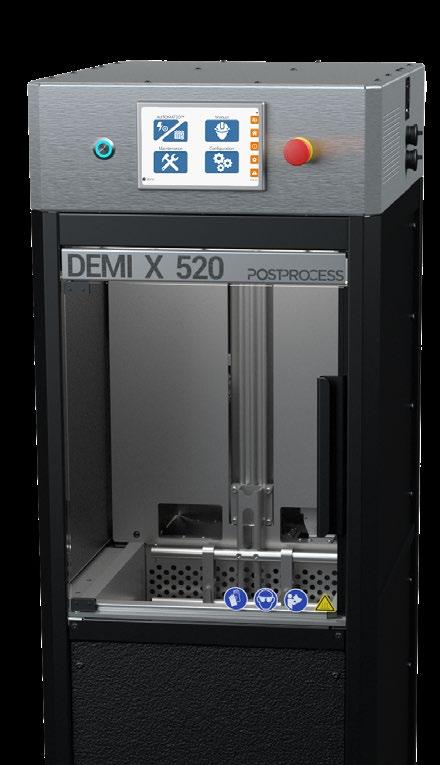
PostProcess Technologies has announced the DemI X 520, a fully automated post-processing system designed for industrial PolyJet workflows. building on the company’s previous platform, the new system features AUTOm AT3D software, a programmable automated
lift, variable-speed pump control, and Axial Flow Technology for adjustable fluid dynamics.
The DemI X 520 enables large-batch throughput with minimal operator involvement, delivering repeatable results and reducing labor demands. Its safety enclosure and optimized flow control help ensure consistent support removal across complex geometries while reducing the risk of part damage.
Designed for manufacturers seeking reliable, end-to-end workflow automation, the system streamlines PolyJet post-processing and scales efficiently for high-volume environments.
For more Information: www.postprocess.com
PRIMA POWER
Prima Power Expands 3D Laser Portfolio with Laser Next Core
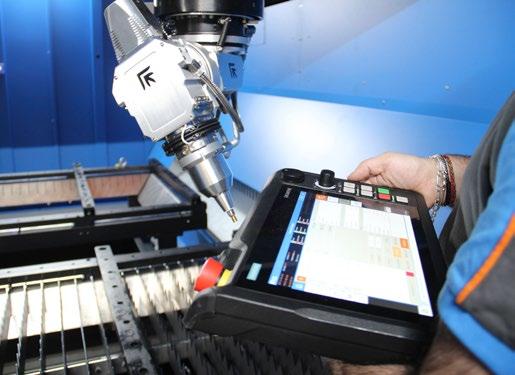
Prima Power has introduced Laser Next core, a new 3D laser cutting system engineered for flexibility, quick changeovers, and minimum cost-per-part in small and medium production runs. The machine features axis strokes of 3,160 x 2,100 x 750 mm, offers both 2D and 3D cutting, and supports optional welding applications.
Laser Next core delivers lower operating costs through reduced energy usage, minimal maintenance, and streamlined setup. Its intuitive programming, graphical interface, and automatic
head-offset compensation simplify production across varied geometries.
The system joins Prima Power’s expanding 3D laser family, which now includes four models plus the high-productivity Giga Laser Next. The company also offers turnkey automated solutions through its robotics Integration Unit, enabling coordinated cutting, part handling, loading/unloading, and quality inspection.
For more Information: www.primapower.com
SCOTCHMAN INDUSTRIES
Scotchman Launches New eStore for Fabrication Tools and Accessories
Scotchman Industries has launched an online eStore featuring saw blades, punches, dies, accessories, and branded Scotchman gear in one central location. The platform provides convenient access to consumables and equipment components directly from the manufacturer.
coinciding with the holiday season, Scotchman highlights new gear offerings suited for gift purchases. The company continues to supply the fabrication industry with a full line of American-made ironworkers, cold saws, band saws, hydraulic presses, measuring systems, and programmable feed and stop systems.
For more Information: www.scotchman.com
Bottom line: Clear, simple answers about small business health insurance
Select Health obeys federal civil rights laws. We do not treat you differently because of your race, color, ethnic background or where you come from, age, disability, sex, religion, creed, language, social class, sexual orientation, gender identity or expression, and/ or veteran status. This information is available for free in other languages and alternate formats by contacting Select Health Medicare: 855-442-9900 (TTY: 711)/ Select Health: 800-538-5038. ATENCIÓN: Si habla español, tiene a su disposición servicios gratuitos de asistencia lingüística.注意:如果您使用繁體中文,您可以 免費獲得語言援助服務。請致電 4210900 .To see the full fair treatment notice, visit selecthealth.org/disclaimers/non-discrimination.
MATERIAL HANDLING
Empowering Efficiency and Precision
Material handling is at the heart of efficient industrial operations, focusing on the movement, storage, and organization of materials. This section highlights strategies and technologies that streamline these processes, from automated storage and retrieval systems to advanced conveyor solutions. Readers can explore innovations like forklifts, cranes, hoists, and magnetic lifters, which play a pivotal role in optimizing material flow across warehouses, factories, and supply chains.
In addition to hardware advancements, this area emphasizes cutting-edge solutions like warehouse management systems and parts tracking technologies, which integrate seamlessly into modern production environments to enhance operational control. Topics also cover sustainable practices, such as energy-efficient lift equipment and ergonomic tools designed to improve workplace safety while reducing strain. Whether tackling inventory management or enhancing material logistics, this section provides the insights and tools needed to excel in today’s industrial landscape.
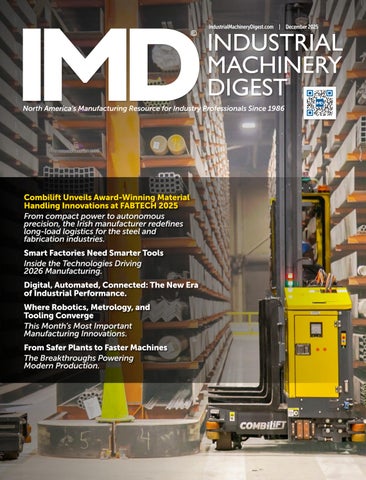
Combilift Unveils Award-Winning Material Handling Innovations at FABTECH 2025
from compact power to autonomous precision, the Irish manufacturer redefines long-load logistics for the steel and fabrication industries.
At this year’s FAbTecH 2025, combilift commanded attention across mccormick Place with two booths—#A2949 in the Forming & Fabricating pavilion and #D41913 in metals, Welding & Finishing—showcasing the company’s latest breakthroughs in multidirectional handling, electric drive systems, and autonomous sideloader technology.
Known for revolutionizing the way manufacturers move and store long and heavy loads, combilift delivered an engaging, technologydriven experience that reflected its core mission: enhancing safety, productivity, and space efficiency in material handling.
Compact Powerhouse: The New Combi-CB 155E
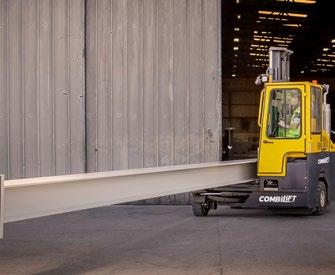
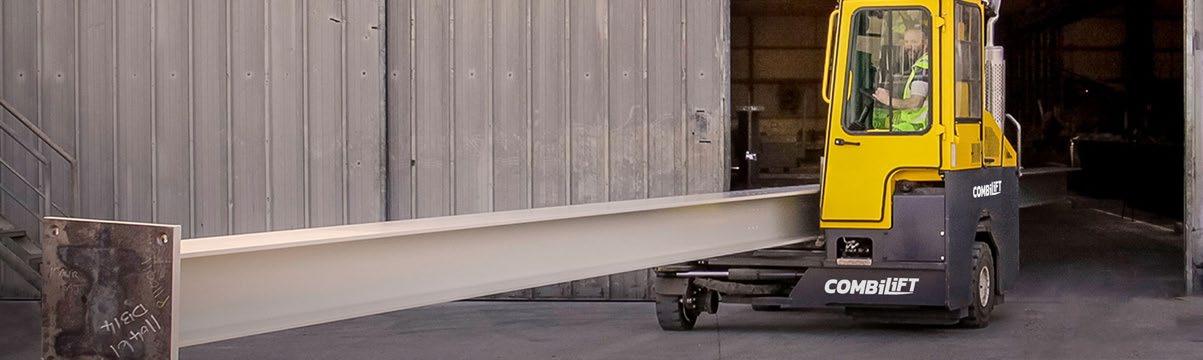
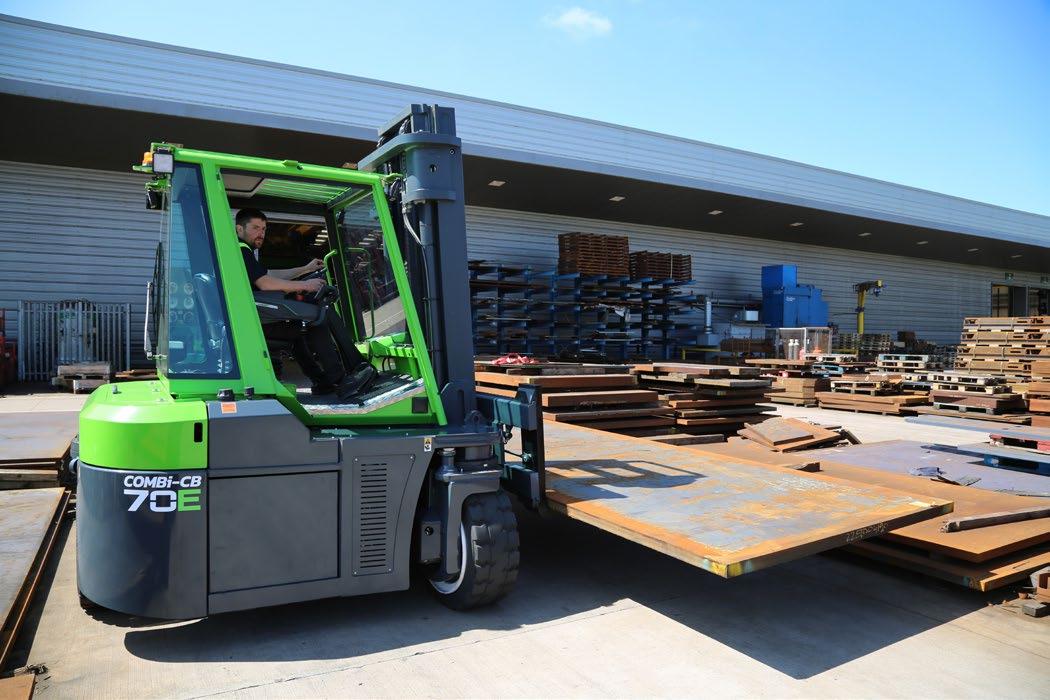
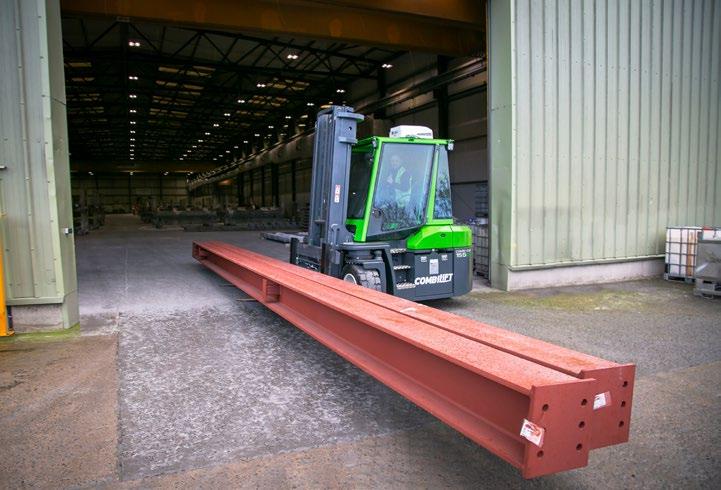
Headlining the booth, the all-electric combi-cb 155e stood out as the most compact 15,500-lb capacity counterbalance forklift on the market, combining multidirectional maneuverability with award-winning ergonomic design.
Developed for sectors handling dense and elongated materials—such as steel billets, bars, and fabricated assemblies—the cb 155e merges robust lifting power with an incredibly small footprint. Its ability to travel in multiple directions enables operators to navigate narrow aisles and confined spaces without sacrificing load size or safety, eliminating the need for overhead handling and reducing both time and risk.
The model’s standout feature is its operatorcentric design, which recently earned combilift two major accolades:
“ergonomic Innovation of the Year” from the UK materials Handling Association (UKmHA), and the 2025 red Dot Award for Product Design, recognizing its ergonomic excellence, environmental performance, and contribution to operator comfort.
Inside the cab, a floor-to-ceiling panoramic glass enclosure delivers exceptional visibility—a critical safety advantage when maneuvering long loads. The cab includes the Auto Swivel Seat, which automatically pivots 15 degrees toward the direction of travel. This seemingly small feature has a major impact: it minimizes driver strain, particularly
during extended reverse operations, improving both comfort and productivity over long shifts.
Under the hood, the cb 155e features combilift’s independent electric traction system—a red Dot awardwinning technology that ensures 100 percent traction control across all four drive wheels. Unlike traditional differential systems, this electronically synchronized system optimizes grip on every surface, preventing wheel spin and load swing even on slippery or uneven ground. The result is unmatched stability, precision, and operator confidence during side-travel operations.
compact yet powerful, the cb 155e embodies the core of combilift’s engineering philosophy: maximizing output and safety while minimizing space and energy use.
Live demonstrations at booth A2949 drew constant crowds, offering visitors a close-up look at the future of multidirectional forklift performance.
“The cb 155e shows what’s possible when electric technology meets ergonomic design,” said one combilift representative at the booth. “It’s proof that sustainability, operator safety, and heavy-duty capacity can coexist in one machine.”
Automation in Action: The Combi-AGT
Autonomous Sideloader
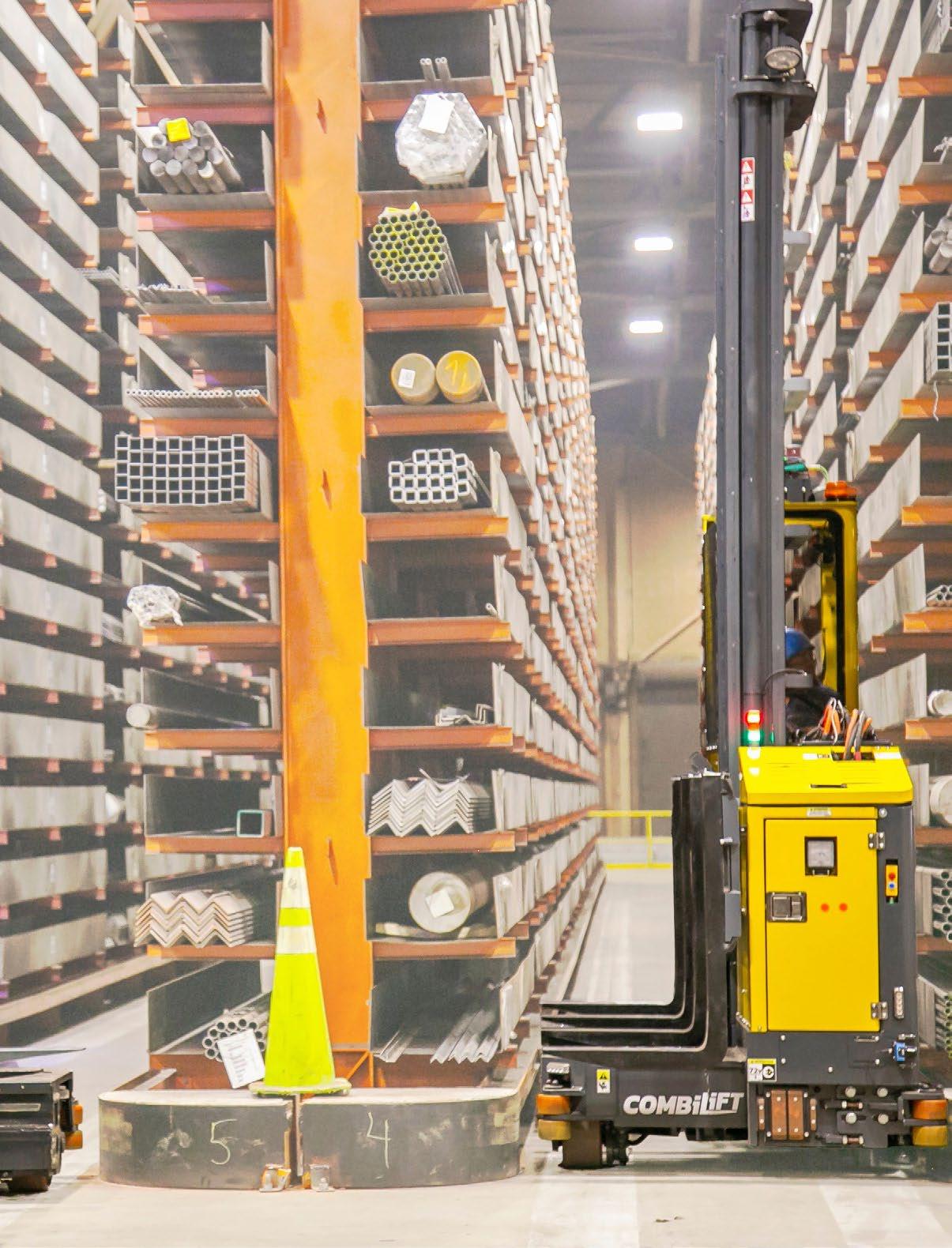
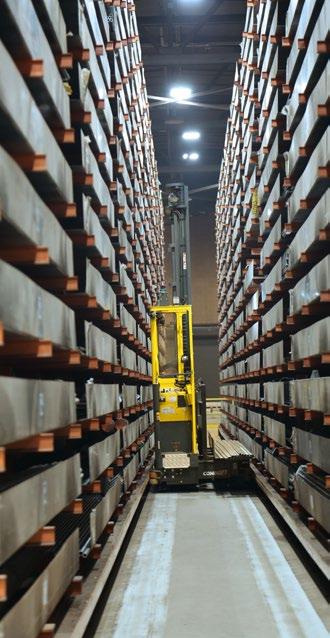
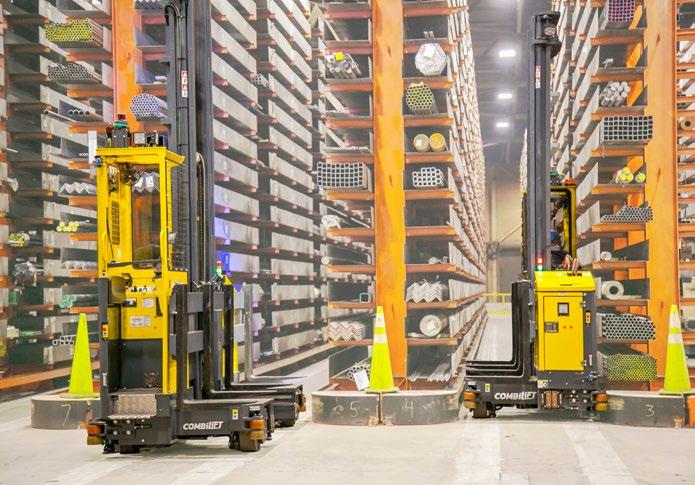
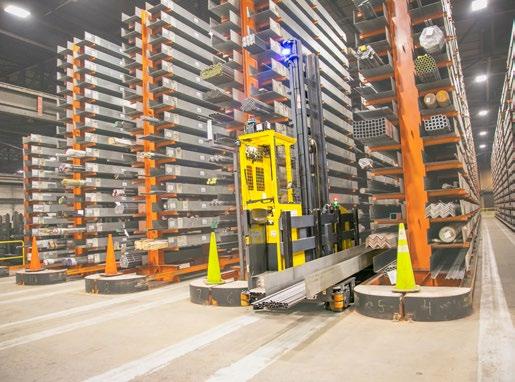
Sharing the spotlight was the combi-AGT, the world’s first autonomous sideloader designed specifically for long-load handling in very narrow aisles (VNA)—a leap forward
for manufacturers striving toward automated warehouse operations.
This four-wheel, electric, stand-on model is engineered for industries like steel service centers, tubing suppliers, and fabricators managing elongated loads up to 11,000 lbs. At FAbTecH, combilift staged live demonstrations that drew substantial interest from automation specialists and operations managers alike, revealing how the AGT can receive drive orders directly from a warehouse management system (WmS) or centralized dashboard.
Once a task is assigned, the AGT calculates the optimal route for pick-and-place operations, executes the move autonomously, and updates system data in real time—all without an operator. This seamless integration between machine and digital infrastructure embodies the growing convergence between robotics and material handling.
Safety, however, remains paramount. The combi-AGT complies with ANSI laser safety standards, featuring a full anti-collision laser system that continuously scans for obstacles. When objects enter its path, the AGT automatically slows, stops, and resumes only when clear. complementing this, a load dimension detection system laser-scans materials before lifting to verify length and available rack space—ensuring that each move is accurate, safe, and efficient.
In the event of a power failure or network downtime, operators can engage the dual-operation mode, instantly switching the AGT to manual control. This redundancy keeps production flowing even when systems are offline— an important reassurance for high-throughput facilities where downtime costs can be significant.
At FAbTecH, combilift positioned the AGT as more than a standalone innovation—it represents a transitional bridge between manual operation and full automation, offering a scalable entry point for manufacturers looking to automate gradually rather than all at once.
“The combi-AGT allows companies to automate safely, step by step,” noted a combilift engineer during the show. “It brings the intelligence of robotics to the long-load space—one of the last frontiers of automation.”
Multidirectional Mastery: The C-Series and CB Range
While the cb 155e and AGT grabbed headlines, combilift also spotlighted its broader portfolio of multidirectional forklifts, emphasizing how the company’s modular designs can handle nearly any material-flow challenge.
The c-Series, combilift’s flagship line, offers load capacities up to 55,000 lbs and serves as the foundation of the company’s reputation in long-load handling. each c-Series unit operates as “three forklifts
in one”—a counterbalance, sideloader, and narrow-aisle forklift—dramatically reducing fleet size and eliminating time-consuming double handling.
For steel fabricators, tube producers, and heavy manufacturers, the c-Series is built to endure harsh conditions while maintaining precise load control. With a low center of gravity and solid, all-wheel traction, it delivers safe, stable travel even with high-center loads.
complementing it, the cb range—including the cb 155e—covers capacities from 6,000 to 15,500 lbs and excels in hybrid environments where operators must handle both palletized and long loads. These models are more compact than conventional forklifts, yet offer dual-mode capability for front-facing pallet work and sideways long-load transport, enabling seamless transitions between indoor racking systems and outdoor yards.
Together, the c-Series and cb lineup demonstrate combilift’s holistic approach: reduce equipment redundancy, increase storage density, and streamline logistics in both new and existing facilities.
Safety, Sustainability, and Productivity — the Core of Every Design
every aspect of combilift’s FAbTecH presence reinforced its three-pillar design philosophy:
» Safety: From the panoramic cab and low-center chassis to laser-based anti-collision systems, each combilift innovation prioritizes operator protection and stability when handling awkward, heavy materials.
» Sustainability: Fully electric drive systems across the cb 155e and AGT align with the industry’s decarbonization goals, offering zero emissions and reduced noise for both indoor and outdoor applications.
» Productivity: Through multidirectional mobility, automation compatibility, and reduced aisle requirements, combilift equipment enables higher throughput per square foot, addressing one of the most pressing challenges in modern manufacturing— space optimization.
Redefining Space Efficiency for Fabricators and Steel Service Centers
As fabrication facilities face ever-tighter real-estate constraints, combilift’s solutions have become essential tools for maximizing cubic storage capacity. The ability to move long loads sideways through aisles less than half the width required by standard forklifts can yield up to 50 percent more storage space within the same footprint. For many FAbTecH visitors, this represented tangible rOI: more material stored closer to production lines, fewer handling steps, and reduced material damage during transport. by consolidating three machines’ functions into one, the c-Series and cb lines also help reduce total cost of ownership. Less fleet redundancy means fewer operators, lower maintenance overhead, and simplified training—all critical in a tight labor market.
A Vision of the Connected Warehouse
FAbTecH 2025 demonstrated that combilift is no longer just a manufacturer of forklifts—it’s a partner in digital transformation for material handling. The company continues to develop integrated systems that pair with warehouse management and erP platforms, enabling smarter scheduling, predictive maintenance, and real-time load tracking. The combi-AGT’s ability to accept drive orders from WmS platforms is a key step in this evolution, moving the brand firmly into the realm of connected manufacturing ecosystems.
This approach mirrors a broader trend within the fabrication and logistics sectors: blurring the line between mechanical handling and digital intelligence.
Two Booths, One Message: Versatility Meets Vision
Visitors who explored both of combilift’s booths at FAbTecH were met with a consistent theme—every load, every facility, every footprint can be optimized. Whether attendees were focused on automation, ergonomics, or space utilization, combilift offered a solution tailored to their operational scale and budget.
Large screens played looping demonstrations from the company’s headquarters in monaghan, Ireland, while in-booth video presentations featured real-world deployments across steel distribution, construction materials, and modular manufacturing.
The company’s representatives emphasized its role as a consultative partner, offering site analysis, space-utilization modeling, and custom-engineered configurations to meet specific material-flow needs.
For many visitors, this consultative approach—rather than a simple product pitch—was what truly set combilift apart.
Looking Ahead
combilift’s showcase at FAbTecH 2025 underscored its leadership in electric mobility, ergonomic design, and intelligent automation. The cb 155e and AGT models are more than incremental updates—they are indicators of how the next generation of material handling will look: sustainable, smart, and human-centered.
by blending cutting-edge engineering with deep industry insight, combilift continues to shape how manufacturers approach logistics efficiency and workplace safety in the age of Industry 4.0.
As FAbTecH 2025 closed its doors, the message was unmistakable: material handling has entered a new era—and combilift is driving the change.
Safety & Maintenance
The Cornerstones of Operational Excellence
The Safety & Maintenance section is dedicated to creating safer workplaces and ensuring equipment longevity. Covering everything from cutting-edge machine guarding systems to advanced air filtration and dust collection solutions, this section provides actionable insights into workplace protection and preventative maintenance. Whether you're exploring ergonomic tools to reduce operator strain or electrical systems that enhance reliability, this section focuses on products and practices that prioritize both people and machines.
In addition to highlighting safety innovations, this section delves into essential maintenance strategies, including retrofitting, rebuilding, and remanufacturing, ensuring that machinery operates efficiently and reliably over time. Maintenance supplies, facility equipment, and accessories are explored alongside new safety technologies designed to meet evolving compliance standards. Readers will discover how a proactive approach to safety and maintenance not only minimizes risks and downtime but also fosters a culture of care and continuous improvement within industrial settings.
The True Cost of Engineering Downtime: Why Manufacturers Can't Afford to Ignore It
Downtime has long been treated as a temporary inconvenience in manufacturing, but its real impact reaches far deeper than a paused production line. In today’s highly competitive environment— where the manufacturing sector generates more than $14 trillion in revenue—lost hours directly translate into missed delivery windows, delayed product launches, weakened customer trust, and millions in unrealized revenue. For many mid-sized manufacturers operating under $500 million in annual revenue, the margin for error continues to shrink, making downtime one of the most dangerous and underestimated threats to long-term competitiveness.
To quantify the financial and operational consequences of downtime, SimuTech Group surveyed 200 engineering and operations professionals across the United States.
The findings reveal a consistent trend: interruptions are frequent, costly, and often symptomatic of systemic issues that can be mitigated with better planning, better training, and stronger simulation-driven processes.
How Often Is Downtime Occurring?
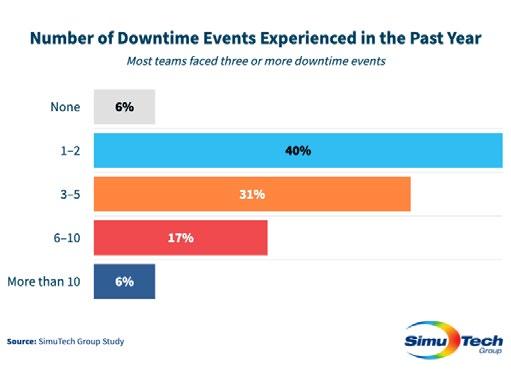
For many manufacturers, downtime is not an occasional interruption but a recurring part of their operational reality. more than half of surveyed respondents reported three or more downtime events lasting an hour or longer in the past year. Larger companies felt the strain most acutely. Among organizations with revenue between $250 million and $499 million, nearly two-thirds reported at least three significant disruptions—evidence that operational complexity grows with size, and so does vulnerability.
Image Source: Pexels
Smaller companies reported fewer long stoppages, with nearly half experiencing only one or two major events over the same period. This disparity underscores how scale introduces more points of failure, more equipment dependencies, and a greater need for robust predictive and preventive strategies.
What’s Causing the Outages?
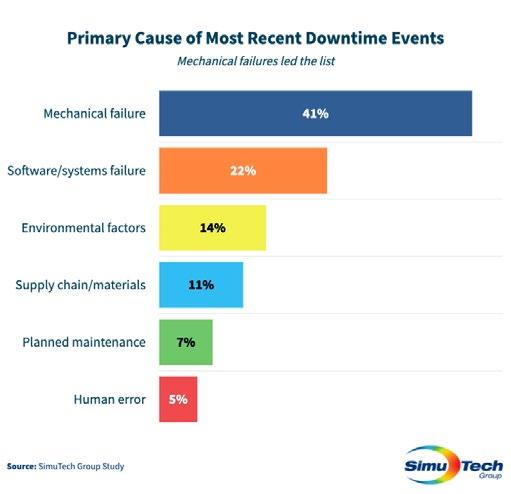
m echanical failures were identified as the most common cause of downtime, accounting for nearly one-third of all reported incidents. These breakdowns often require significant repairs, replacement parts, or extended troubleshooting that keeps production idle for hours. Software and systems errors followed closely behind, highlighting the growing reliance on digital infrastructure.
environmental factors also played a significant role, especially in regions prone to severe weather or infrastructure instability. manufacturers in the South reported higher rates of environmental disruptions, demonstrating how geography can influence downtime exposure. meanwhile, supply chain delays—still common for nine out of ten manufacturers even after pandemic disruptions—added another layer of uncertainty.
Across all categories, the cost of a single incident escalated quickly. Twenty-one percent of respondents said their most disruptive downtime event cost more than $250,000, and more than half said a typical hour of downtime cost at least $50,000.
How Long Are These Interruptions Lasting?
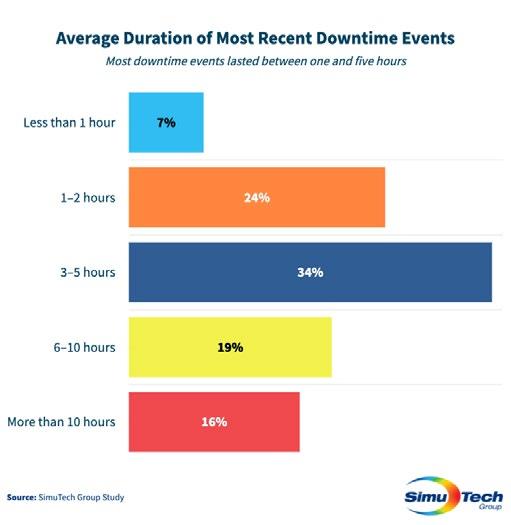
While many events were contained within one to five hours, these “short” interruptions still consumed a substantial portion of a production shift. Forty-four percent of respondents reported one-to-two-hour events, while another twenty-nine percent experienced downtime lasting three to five hours. eleven percent recorded outages of six hours or more, disruptions that can ripple through supply chains and jeopardize customer commitments.
Larger manufacturers reported significantly more long-duration downtime, further emphasizing how operational complexity can magnify the impact of individual failures.
Financial Consequences That Add Up Quickly
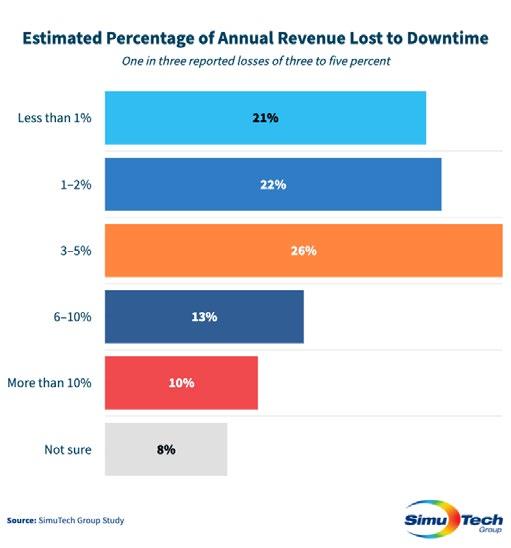
The financial burden of repeated downtime is significant. Nearly one in three respondents reported that downtime consumed three to five percent of their annual revenue, with an additional fourteen percent reporting losses of six percent or more. For organizations generating hundreds of millions annually, even a three percent hit equates to millions in lost productivity and delayed shipments.
Smaller firms were less likely to report such high-percentage losses, but the impact was still felt. even a one or two percent revenue hit can strain narrow margins and force difficult operational decisions.
Downtime’s Hidden Cost: Customer Trust
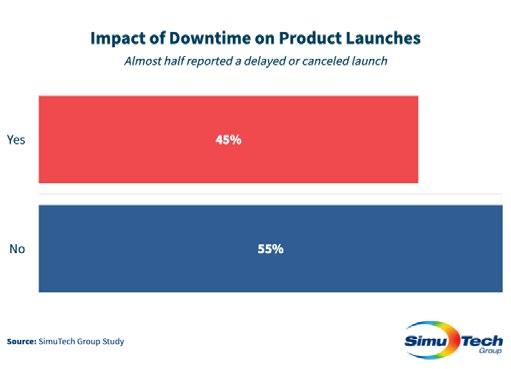
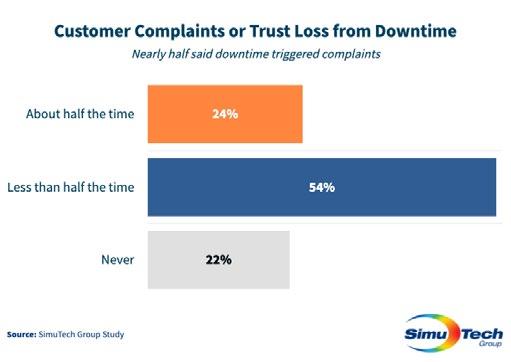
beyond the financial impact, downtime carries substantial reputational risk. Nearly half of surveyed organizations said they had been forced to delay or cancel a product launch due to downtime. These setbacks can erode customer confidence, disrupt long-term partnerships, and create lasting competitive disadvantages. For large manufacturers with tightly synchronized supply chains, even a brief interruption can ripple downstream and affect multiple partners. maintaining reliability is more than an operational goal—it is a strategic imperative tied directly to customer retention and future revenue.
Why Aren’t More Teams Using Simulation to Prevent Failures?
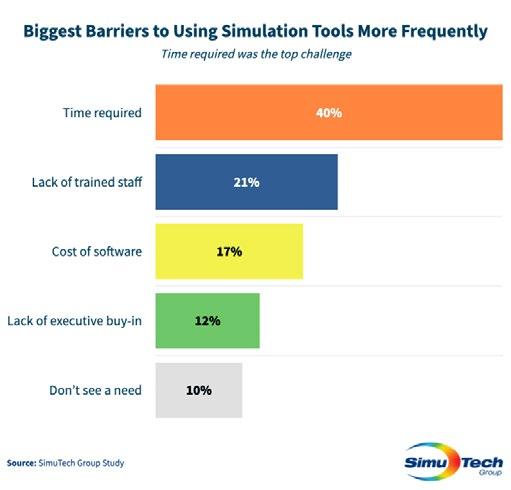
While simulation tools offer a proven path for detecting failures before they reach production, adoption remains uneven. Forty percent of respondents cited implementation time as a primary barrier, signaling that even companies who understand the long-term value struggle with upfront resource demands. Another twenty-two percent reported lacking trained staff, while eighteen percent pointed to software and licensing costs.
These hurdles reflect a broader challenge in the industry: organizations recognize the need for predictive technologies but often lack the internal bandwidth, training, or budget to deploy them effectively.
The Path Forward
The findings are clear: downtime is widespread, expensive, and preventable. manufacturers that invest in simulation, staff training, and proactive maintenance position themselves to reduce interruptions and strengthen operational resilience. As supply chains grow more complex and customer expectations tighten, reducing downtime is no longer optional—it is essential for protecting revenue, maintaining trust, and sustaining competitiveness.
INSIGHTS FROM SIMUTECH GROUP
Industry Perspective
One of the most striking data points was the percentage
of organizations experiencing severe financial losses. more than half reported that a single hour of downtime cost over $50,000, and more than half experienced multiple hour-long events in a single year. This makes downtime less of a technical inconvenience and more of a recurring financial event that directly affects the bottom line.
Actionable Recommendations
A practical starting point for reducing downtime is to focus on a single high-impact asset or failure mode and run a targeted simulation pilot with clear success metrics. many organizations overcome skill gaps by pairing simulation tools with mentoring or consulting support. Upskilling existing engineers, rather than relying solely on new hires, also accelerates return on investment and builds long-term internal capability.
ABOUT SIMUTECH GROUP
SimuTech Group is the largest provider of Ansys engineering simulation software in North America. The company supports organizations across industries with simulation tools, training, and consulting services designed to improve performance, reduce costs, and prevent failures before they occur. by combining technical expertise with real-world application, SimuTech Group helps engineering and operations teams strengthen reliability, enhance innovation, and reduce downtime across complex manufacturing environments.
ITW PRO BRANDS
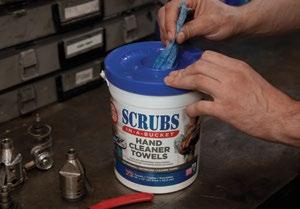
ITW Pro Brands Introduces SCRUBS® Hand Cleaner Towels Refill Pack to Reduce Plastic Waste by 83% ITW Pro brands has expanded its ScrUbS® Hand cleaner Towels line with a new refill pack designed to significantly reduce plastic waste while delivering the same cleaning performance trusted across industrial environments. The ScrUbS® system combines a powerful cleaning formula with a dual-textured rough Touch® blue towel that lifts and locks in heavy soils, preventing them from transferring back onto hands or surfaces. Formulated with a clean citrus scent, the solution dissolves tough industrial contaminants including oils, grease, adhesives, paints, lubricants, dyes, tar, and asphalt. The towels clean without leaving sticky residue, and no rinsing is required, making them ideal for use in the field, on the shop floor, or anywhere water is unavailable.
The new refill pack reduces plastic waste by 83 percent compared to standard packaging, supporting sustainability initiatives while also helping facilities lower disposal fees. The combination of advanced cleaning chemistry and environmentally conscious packaging offers an effective, versatile option for technicians, mechanics, electricians, construction crews, and maintenance teams.
For more Information: www.itwprobrands.com/brand/scrubs
NORSTAT
Norstat Introduces MBI-L Large Polycarbonate Enclosures for Harsh Industrial Environments
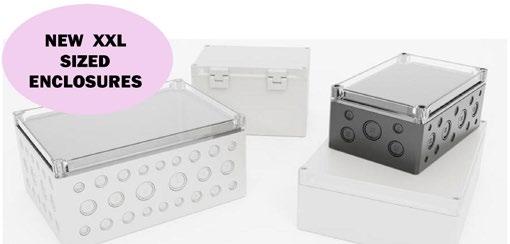
Norstat has released the mbI-L series, a line of large polycarbonate enclosures designed for demanding industrial environments requiring additional space and durability. The enclosures feature glass-fiber reinforced polycarbonate for a superior strength-to-weight ratio, UV resistance, and a UL 94 V2 flammability rating. bases are available with pre-formed knockouts or plain walls, and all models utilize a foamed-in polyurethane gasket for a secure IP66 seal. With impact resistance rated at IK08 and multiple size configurations, the enclosures offer a lightweight alternative to aluminum or steel while maintaining excellent stability.
For more Information: www.norstat.com
Norstat Releases AD SRE4 Safety Interface for E-Stop and Switch Monitoring
Norstat has introduced the AD Sre4, a safety interface designed for monitoring emergency stops and safety switches in industrial applications. The unit uses guidedcontact safety relays, eDm feedback inputs, and offers automatic or manual restart options.
Operating on 24 VDc , the interface provides three NO and one Nc safety relay outputs with a response time under 50 ms. LeD indicators offer clear diagnostic visibility, and the system is engineered for high reliability with a 71-year mTTFD rating and an operating temperature range of –25°c to +55°c
For more Information: www.norstat.com
QUALITY
Ensuring Precision and Performance
Quality control and assurance are the backbone of manufacturing, ensuring every product meets rigorous standards for precision, performance, and reliability. This section delves into the tools and technologies that enable manufacturers to uphold the highest quality standards. From advanced coordinate measuring machines (CMM) to vision systems and laser inspection equipment, the spotlight is on innovations that enhance accuracy and efficiency in measurement and inspection.
Nondestructive testing (NDT) equipment and positional measuring machines are also featured, allowing manufacturers to evaluate products without damage. Tools such as form measurement gauges, cutting tool inspection systems, and tool condition monitoring devices refine production processes and reduce errors. Whether through shrink-fit technologies or video inspection systems, this section highlights the importance of advanced solutions in maintaining precision, ensuring compliance, and driving continuous improvement in industrial operations.
Digital Inspection Is Reshaping How Manufacturers Define Quality
Quality control is undergoing a profound shift as manufacturers confront shorter product lifecycles, complex multi-material components, and rising expectations for traceability. Today's inspection environments must process more data, more quickly, across more distributed teams than ever before. As a result, quality workflows are moving beyond traditional point checks and toward connected, software-driven ecosystems that bring measurement, analysis, and verification into a unified digital framework.
cloud-based inspection platforms, automated programming, AI-assisted reporting, and real-time dashboard visibility are becoming the new foundation for modern quality assurance. These tools do more than streamline workflows—they help organizations standardize methods across sites, ensure consistency from shift to shift, and make quality insights easier to apply across design, production, and maintenance teams.
In an era defined by speed and complexity, the companies that bring
digital intelligence into their quality operations are positioning themselves not only to detect deviations faster, but to prevent them altogether. The following releases highlight the technologies shaping this transformation.
HEXAGON
Hexagon Launches Autonomous Metrology Suite to Accelerate Inspection Workflows
Hexagon has introduced the Autonomous m etrology Suite, a cloud-based solution that removes coding from cmm programming and simplifies inspection through a unified digital workflow. b uilt on the Nexus platform, the suite synchronizes each cmm with its digital twin, ensuring the correct program reaches the right machine and reducing human error. With applications such as m etrology m entor, m etrology r eporting, and m etrology Asset
m anager, the suite standardizes inspection methods, consolidates data from multiple systems, and monitors machine health and environmental conditions. e arly adopters report significant reductions in programming time and smoother onboarding for new operators.
For more Information: www.hexagon.com
Mahr Introduces Precimar SM Instrument for Automated Calibration
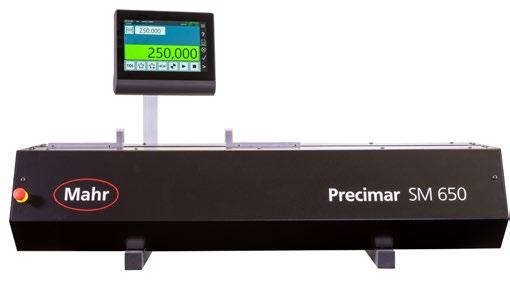
mahr Inc. has released the Precimar Sm , a motorized setting instrument designed to automate calibration tasks that previously required gage blocks and setting rings. Users can enter a reference dimension, and the instrument automatically positions itself to the correct measurement standard.
Delivering accuracy of 0.7 μm + L/1000 and offered in multiple size ranges, the Precimar Sm supports a wide variety of measuring devices. It reduces calibration time, minimizes manual errors, and provides a streamlined touch interface with favorites, barcode scanning, and fast repeat adjustments.
For more Information: www.mahr.com
ZEISS Opens Connecticut Quality Excellence Center to Support Northeast Manufacturing
ZeISS has opened a new Quality e xcellence c enter in b loomfield, c onnecticut, providing manufacturers with access to advanced metrology systems, demonstrations, inspection services, and expert-led training programs. The 12,000-square-foot facility houses a wide array of ZeISS technologies including cmm s, optical scanners, microscopes, and software tools.
The center serves as a regional hub for hands-on evaluations, training, and application engineering support, helping manufacturers adopt new quality technologies and strengthen inspection capabilities across complex industries.
For more Information: www.zeiss.com
ZEISS Releases 2026 Software Updates for INSPECT and PiWeb Platforms
ZeISS Industrial Quality Solutions has introduced its 2026 updates for ZeISS INSP ec T and ZeISS PiWeb, adding new tools for optical inspection, X-ray analysis, and measurement data visualization. e nhancements include advanced GD&T features, improved c AD compatibility, automatic brightness and contrast adjustments for X-ray datasets, and multi-part separation for batch inspections.
ZeISS PiWeb now offers augmented c AD visualization, streamlined report creation, AI-assisted translations, and customizable notifications. These updates help teams interpret data more quickly and maintain consistent workflows across design, engineering, and quality operations.
For more Information: www.zeiss.com
ROBOTICS
Driving Automation and Innovation
Robotics and automation are transforming modern manufacturing, redefining efficiency, precision, and versatility across industrial processes. From welding robots and robotic tooling to autonomous technology and cobots (collaborative robots), innovations are seamlessly integrating robotics into diverse manufacturing workflows.
Key advancements include automated cells and press transfer robotics, enabling streamlined operations and reduced cycle times. Solutions like material handling systems and end effectors highlight the adaptability of robotics in tasks ranging from machining to assembly. With a focus on enhancing safety and productivity, the integration of RFID and enclosure systems, along with comprehensive training, empowers manufacturers to harness the full potential of robotics in an increasingly automated world.
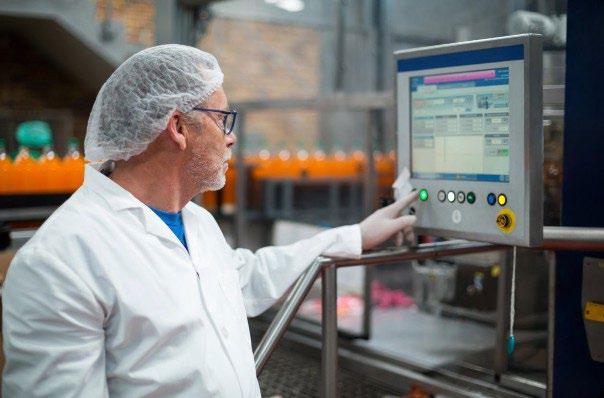
Smart display HMI controllers for robotics, automation, and heavy-duty industrial operations
Modern robotics and automation rely on far more than mechanical precision— they depend on intuitive, durable, and intelligent human-machine interfaces (HmIs) capable of guiding operators, supporting complex workflows, and surviving the harshest industrial environments. As manufacturing becomes more automated and labor shortages continue to challenge companies around the world, smart display controllers are emerging as an essential tool for bridging efficiency gaps, improving operational safety, and supporting increasingly sophisticated machines across industrial sectors.
A me TeK National controls corporation (Ncc) has focused on this need with a generation of smart
display controllers designed to bring modern digital capability to both new and legacy equipment. These advanced HmIs are engineered to tackle challenges spanning robotics, automated production cells, rolling mills, ovens, packaging machines, and multi-stage industrial processes, where precision—and operator confidence—are critical.
Addressing Labor Shortages With Smarter Interfaces
A global shortage of skilled workers has left many manufacturers struggling to fill roles that require experience and technical proficiency. In the United States alone, more than 400,000 manufacturing positions remain unfilled, and predictions indicate nearly two million vacancies by 2033 if trends
continue. europe faces similar pressure, as aging workforces and demanding factory conditions make industrial roles increasingly difficult to staff.
To compensate, manufacturers are turning to automation and assistance systems that reduce dependency on manual intervention. Smart HmIs play a central role by enabling:
» clear visual guidance for less experienced operators
» Faster training through on-screen tutorials
» reduced reliance on high-level expertise for routine tasks
» A more intuitive experience thanks to touch interfaces familiar from everyday consumer technology
What once required extensive analog knowledge can now be conveyed through guided menus, role-based workflows, and digital procedures directly embedded in the display. For new operators entering difficult environments—heat, dust, noise, and physically demanding conditions—this accessibility is crucial.
Digitization Unlocks Flexibility in Long-Lived Machinery
Industrial machinery often stays in service for decades, making modular, updatable controls an important requirement. Smart HmIs allow companies to modernize equipment without full system replacement.
These displays introduce:
» Software-based updates that extend machine life
» mode switching for production, maintenance, or troubleshooting
» real-time data monitoring for process optimization
» Improved visibility into temperatures, pressures, load data, and trend history
This flexibility increases uptime and enhances operator decision-making. by making the machine "smarter," manufacturers can adapt long-standing equipment to new workflows, quality standards, or production demands without heavy capital investment.
Assistance Systems Improve Safety and Efficiency
As manufacturing grows more autonomous, decentralized control structures have become essential. Smart display controllers can operate as independent sub-control hubs, monitoring local processes and offloading workloads from higher-level controllers. When connected to robotics cells, conveyors, forming machines, or robotic-assisted production lines, these displays deliver faster response times and more efficient processing.
They also introduce built-in safety tools:
» Authorization management to prevent unauthorized operation
» Guided workflows that help reduce operator error
» Visual confirmation that commands are executed properly
» Support for safety-critical applications found in heavy industry
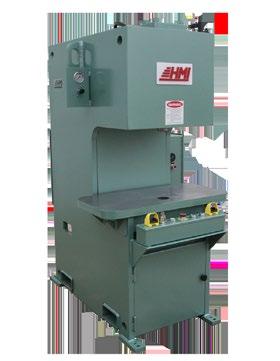
Heavy Gauge Steel Design
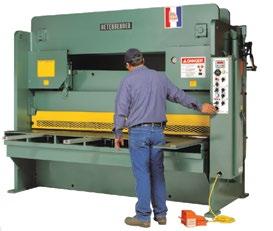
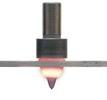
Press Bed bolted on, not welded, to prevent distortion.
Large press bed to accommodate a variety of tooling other than just punching.
Pump, motor, valve and reservoir are all easily accessible for maintenance.
Large rectangular tubes used at base of machine to give safe, instant portability.
In high-risk environments—such as steel rolling, forging, chemical processing, or high-temperature operations—these built-in safety features help prevent accidents and improve workflow consistency.
Engineered for Harsh Industrial Environments
Smart HmIs must endure punishing conditions: dust-filled air, elevated temperatures, vibration, moisture, gloves that diminish touch sensitivity, and lighting environments that make screens difficult to read.
A me TeK/Ncc ’s mDDe 3084 series is built specifically for these realities. The display features:
» A rugged 8-inch touch screen
» High-definition 1280 × 720 resolution
» A 1000-nit brightness rating for high-visibility environments
» An i. m X8m Plus quad-core processor with 4 G b r A m and 4 G b flash
» IP67 protection against dust, liquid, and heat
» Optional camera integration for optical monitoring
» broad protocol support including ethernet, c AN, and rS232
Originally developed for heavy-duty equipment in construction and agriculture, the mDDe 3084 brings that same robustness to robotics and factory automation. With dust-tight sealing, glove-friendly operation, and long-term part availability, the display is engineered for the years-long service lives expected in heavy industry.
A Digital Foundation for the Next Generation of Robotics
robotics continues to shape the future of manufacturing, but the operator still plays a vital role—monitoring systems, validating processes, and troubleshooting exceptions. Smart HmIs help close the gap between autonomous machines and human decision-makers by presenting information clearly, guiding operators through complex logic, and enabling fast adjustments when needed.
As factories move toward greater decentralization, predictive maintenance, and edge computing, these displays will serve as local intelligence hubs that support safer, smarter, and more adaptable operations.
For more Information: www.ametekncc.com
ROCKWELL AUTOMATION
Chang Robotics and OTTO Partner to Accelerate
AMR Deployment Across North American Manufacturing
chang robotics and OTTO by rockwell Automation have announced a collaboration aimed at delivering
integrated autonomous mobile robot (Amr) solutions across manufacturing, consumer products, automotive, food and beverage, and e-commerce environments. With rising labor shortages and growing demand for flexible production systems, both companies see Amrs as essential to modernizing internal logistics and material movement.
The partnership pairs chang robotics’ experience deploying large-scale automation with OTTO’s high-performance A mr platforms. Together, the companies will deliver turnkey systems that integrate with existing production lines, warehouse workflows, and highly dynamic operations. Their combined offerings focus on improving throughput, reducing manual transport, and enabling production cells that can be rapidly reconfigured for new product lines.
manufacturers adopting A mrs increasingly prioritize reliability, scalability, and safety. To address these needs, chang robotics and OTTO are focusing on systems that adapt as volumes shift, layouts change, or new product mixes emerge. Their solutions enable seamless communication between mobile robots, robotic arms, conveyors, and warehouse management systems.
Key focus areas include:
» Flexible material handling solutions for distribution centers and warehouses
» Scalable A mr fleets that operate within existing facility constraints
» Seamless integration with reconfigurable manufacturing cells
This collaboration aligns with a broader industry shift toward robotics-enabled intralogistics and automation strategies that reduce labor dependency, increase uptime, and improve environmental safety. As manufacturers continue to invest in operational resilience, A mr platforms are becoming central to long-term automation planning.
For more Information: www.changrobotics.ai HARTING AMERICAS
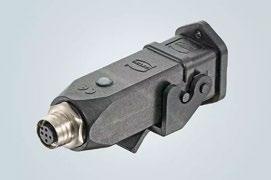
HARTING Expands Industrial Connectivity Portfolio with Three New Smart Factory Solutions
HArTING Americas has introduced three new connectivity products engineered to meet the demands of today’s automation-intensive environments: the Han® Protect connector, the D-Sub PushPull connector, and a new generation of Single Pair ethernet (SPe) solutions. each is designed to support the increasing speed, power, and data requirements of connected factories and transportation systems.
The Han® Protect connector brings a modern approach to electrical protection within industrial control architectures. by integrating an externalized fuse directly
CHANG ROBOTICS & OTTO BY
into the connector itself, HArTING enables faster servicing, improved safety, and tighter space utilization. This design reduces cabinet size by up to 30 percent and allows maintenance teams to replace fuses quickly without opening enclosures.
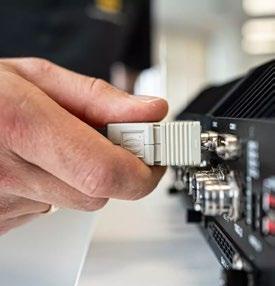
The D-Sub PushPull connector modernizes the well-known D-Sub interface by introducing a tool-free, quickconnect mechanism engineered for tight spaces and challenging environments. With 360-degree unplugging flexibility and backward compatibility, it provides a clear upgrade path for systems requiring ruggedized data or signal connections.
HBK Advances Robotic Intelligence with
Custom 6-DoF Force/Torque Sensors
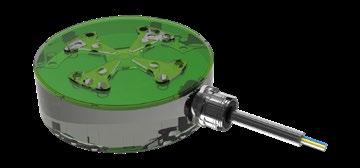
HbK is redefining the role of tactile sensing in robotics with its customized six degreesof-freedom (6-DoF) force/ torque sensors, engineered to help robots interpret and respond to their physical environment in real time. As robots increasingly interact with people, objects, and dynamic environments, high-precision sensing has become essential for safety, adaptability, and performance.
HArTING’s Single Pair ethernet technology—tested with major North American class 1 freight railroads— introduces a smaller, lighter, and longer-reaching ethernet solution for industrial and transportation applications. by reducing the cable pair count to a single pair and cutting weight by 50 percent, SPe simplifies installations while enabling distances up to 1000 meters at 10 mbps. As automation demands continue to intensify, SPe provides a highly efficient method for delivering data across distributed systems, including mobile equipment, robotics, rail, and large facilities.
These launches reflect HArTING’s continuing investment in North American production and engineering, emphasizing reliability, sustainability, and long-term value for automation-driven industries.
more Information: www.harting.com
Unlike sensors that measure force or torque independently, 6-DoF sensors simultaneously capture forces along the X, Y, and Z axes, as well as torque around three rotational axes. This full picture of physical interaction enables robots to make nuanced adjustments in collaborative environments, precision assembly, medical applications, and high-speed logistics.
HbK’s technology is built on decades of metrology expertise. Their sensors incorporate high-sensitivity strain gauges, proprietary calibration methods, and rugged architectures tested across millions of cycles. The result is extremely low crosstalk, sub-millisecond responsiveness, and repeatable accuracy under combined loads.
customization is a core differentiator. HbK works directly with Oems to engineer sensors suited to specific payloads, geometries, communication requirements, environmental conditions, and integration constraints. each design is validated in real operating scenarios to ensure seamless compatibility with robotic arms, A mrs, grippers, and specialized automation platforms.
The company’s engineering teams address challenges such as:
» minimizing crosstalk under multiaxial loads
» maintaining responsiveness in high-speed applications
» Achieving robust construction in compact form factors
HbK is also supporting logistics providers as they adopt more sophisticated robotic picking and handling capabilities. by improving tactile responsiveness, robots can operate with greater accuracy, reduce damage rates, and collaborate more effectively with human operators.
Across manufacturing, logistics, medical robotics, and mobile automation, the demand for physical intelligence continues to grow. HbK’s 6-DoF sensing technology equips robots not just to move, but to understand the forces shaping every interaction.
METALWORKING
Precision and Craftsmanship in Manufacturing
Metalworking encompasses the tools, technologies, and processes that drive precision manufacturing. This area highlights advancements in machining, grinding, lathing, and cutting systems, along with innovations like EDM (Electronic Discharge Machining). It captures the synergy between precision equipment and skilled craftsmanship, essential for producing high-quality components across diverse industries.
Focusing on the integration of controls, machining tools, and accessories, metalworking emphasizes the efficiency and accuracy demanded by modern manufacturing. From contract manufacturing to heat treating and gear machinery, it reflects the essential techniques and equipment shaping today’s industrial landscape. Whether utilizing traditional methods or cutting-edge innovations, metalworking celebrates the pursuit of excellence in every detail.
Precision, Throughput, and Flexibility Continue to Define Next-Generation Metalworking
Metalworking operations are undergoing rapid transformation as manufacturers pursue better precision, shorter lead times, and more resource-efficient machining workflows. Whether shops are cutting complex geometries, finishing critical surfaces, or managing large-format structures, today’s technologies focus on speed, stability, and predictable quality.
From advanced turning centers and high-speed machining platforms to new cleaning, automation, and multi-axis systems, the newest introductions aim to strengthen process consistency without increasing operator burden. manufacturers are seeking systems that integrate seamlessly with digital controls, offer automated material handling, and provide highly repeatable performance across
diverse metals and part sizes. The following announcements highlight key advancements shaping the metalworking landscape — from flexible cleaning systems and universal turning centers to high-rigidity machining solutions designed to support the next generation of production demands.
ECOCLEAN
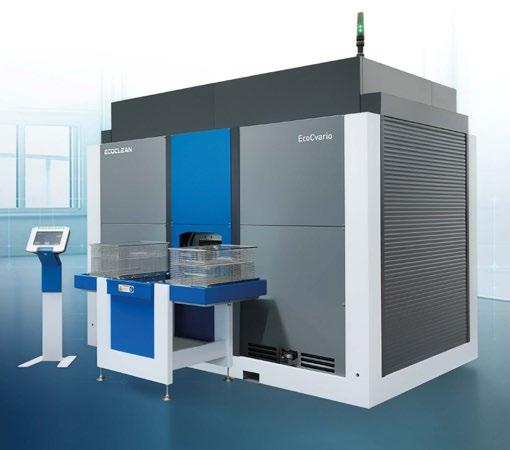
EcoCvario Delivers High-Purity, Water-Based Cleaning for Precision Metalworking
ecoclean has introduced the ecocvario, a flexible, waterbased precision cleaning system engineered to meet rising cleanliness specifications across metalworking industries. built on a modular
platform, the system combines multiple cleaning and drying technologies — pulsated pressure cleaning, powercontrolled ultrasound, high-pressure cleaning, gentle flooding, and combined hot-air/vacuum drying — allowing users to configure the process for both mass-produced and precision components.
A vacuum-tight working chamber, optimized flow design, and frequency-controlled pumps support
consistent, repeatable results. Three standard flood tanks, vertical cylindrical tank geometry, and improved media circulation help extend bath life while reducing water, chemical, and energy consumption. Gravity separators and full-flow filtration systems remove suspended particulates and light contaminants such as oils and casting residue. The ecocvario’s polished stainless-steel chamber, specialized welded piping, and precise component positioning help maintain high cleanliness levels even on intricate or delicate metal parts. A guided HmI interface supports up to 50 customizable programs, while IO-Link connectivity enhances process monitoring, diagnostics, and maintenance. Overall, the system provides a sustainable, configurable solution for fine cleaning in demanding metalworking environments.
For more Information: www.ecoclean.com
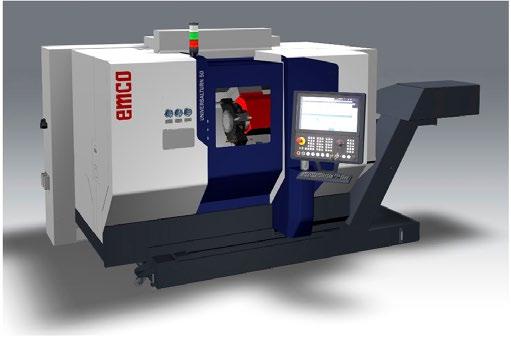
Introduces UNIVERSALTURN 50 for High-Precision Complete Machining
emcO has launched the UNIVerSALTUrN 50, a next-generation turning center designed to deliver high rigidity, accuracy, and complete machining capability
for both bar and chuck workpieces. With a 51 mm bar capacity and advanced drive systems, the machine supports high-speed cycles while maintaining stability for complex geometries used in mechanical engineering, hydraulic components, transportation systems, medical devices, and bearing production.
A fully integrated Y-axis with extended guideways enhances milling performance and provides a strong platform for multi-technology machining. Automation options include short-bar loaders, full-length 3-meter bar loaders, a parts catcher, and an optional cNc-controlled mini-gantry system for automated loading and unloading.
The UNIV er SALTU r N 50 features a compact counter spindle for precise rear-side machining, a 12-position tool turret, and milling speeds up to 12,000 rpm. Siemens SINU mer IK ON e control is standard, with a FANU c 0i Plus version available in 2026. A rigid cast-iron base, vibration-damping structure, and thermal stability support long-term precision, making the system suitable for both high-volume and high-accuracy metalworking operations. For more Information: www.emco-world.com
ZIMMERMANN
Zimmermann Introduces FZP37 Modular Gantry Milling Machine for LargeFormat Precision
Zimmermann has expanded its gantry milling portfolio with the FZP37, a modular system engineered for large, complex workpieces across aerospace, automotive, moldmaking, shipbuilding, and alternative-energy applications. The FZP37 offers expansive travel ranges — up to 1,575" in X, 236" in Y, and 118" in Z — supported by a rigid gantry structure and dynamic milling heads for high-accuracy machining across a wide scale.
A vibration-damping cast-iron base, structurally rigid center-lead portal, and advanced cross-slide design ensure reliable performance regardless of workpiece weight or size. The FZP37 supports multiple cNc platforms, including Heidenhain TNc 7 and Siemens Sinumerik One, and can be equipped with a range of milling heads for single-setup machining in five or six axes.
Optional systems include tool probes, tool measurement, work-area covers, tool changers, chip conveyors, vacuum systems, and dust-extraction modules. With its modular configuration and broad application range, the FZP37 provides a high-performance solution for large-scale, precision metalworking.
For more Information: www.zimmermann-inc.com
MAZAK CORPORATION
Mazak Showcases High-Speed CNC Solutions for Motorsports Manufacturing
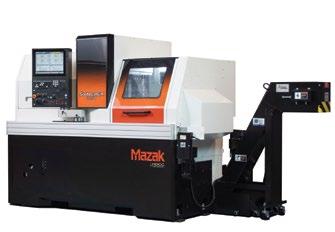
mazak highlighted two automation-ready machining platforms at the Performance racing Industry (PrI) show, demonstrating systems built for the speed and precision required in motorsports manufacturing. The QTe-200mSY cNc Turning center features a 20-hp turning spindle
reaching 5,000 rpm, 7.38-hp milling spindle capable of 4,500 rpm, and DONe-IN-ONe® machining through a secondary spindle operating at 6,000 rpm. Lm guides across all axes and an integral spindle design support accuracy, reduced vibration, and improved surface finish.
For high-volume production of small components, mazak’s SYNcre X 38/8 Swiss-type turning machine offers an 8-axis configuration, 36 tool positions, live tooling on both spindles, and the flexibility to operate in guidebushing or chucker mode. built on mazak’s High Damping composite c asting (HDcc), the machine improves thermal stability, vibration damping, and tool life.
b oth machines feature m azak’s latest cN c platforms — Smooth e z and SmoothSt — along with assistive technologies such as Swiss Setup Assist and Dynamic chip control, designed to reduce operator burden and increase repeatability in demanding motorsports environments.
For more Information: www.mazakusa.com
HAND CLEANER TOWELS
SOFTWARE
The Digital Backbone of Modern Manufacturing
In an era where innovation drives productivity, the Software section explores the cutting-edge tools empowering manufacturers to streamline operations, enhance precision, and optimize performance. From CAD/CAM/CAE design platforms to CNC simulation and process verification, this category reveals how digital solutions are revolutionizing the way products are conceptualized, created, and delivered.
Covering a broad spectrum of applications—such as ERP systems, factory floor software, and industrial IT—this section emphasizes the importance of connectivity and real-time data in achieving operational excellence. Topics like quality control, job tracking, and program optimization showcase how software bridges the gap between vision and execution, enabling manufacturers to stay competitive in a fast-evolving industry.
Smart Machine Shops Are Redefining What Skilled Labor Means
By: Hiren Kumbhojkar, Senior Product Leader, Hexagon Manufacturing Intelligence
Across the manufacturing industry, the shortage of skilled machinists has become one of the defining challenges of the decade. As experienced operators retire and fewer young people enter the trades, shops face gaps that threaten productivity, quality, and long-term growth. Hiring alone cannot solve the problem. The work itself—and the systems that support it—must evolve.
This shift is driving the rise of the “smart machine shop,” an environment where knowledge is shared, processes are connected, and operators are supported with the information they need at the moment they need it. These shops are not defined by new equipment alone, but by how they capture, organize, and apply data to make work more efficient and knowledge more accessible.
Turning Legacy Knowledge Into Shared Intelligence
For decades, machining excellence has relied on legacy knowledge— expertise built through years of troubleshooting, intuition, and hands-on experience. This knowledge has tremendous value, yet it often remains undocumented, held by a small group of veteran machinists. As the workforce changes, that approach is no longer sustainable.
Smart machine shops focus on capturing and connecting institutional knowledge so it can be shared across teams. When reasoning behind a setup, tool choice, strategy, or fixture design is documented and accessible, operators no longer depend solely on shadowing or trial and error. The goal is not to replace craftsmanship, but to make it available to everyone,
increasing consistency and
Guided Workflows Support Faster Ramp-Up
Small changes in how information is presented can dramatically reduce training time. Shops that connect tooling data, fixture information, and setup parameters across stations ensure operators always have the right context without searching through spreadsheets or old files. This interconnected approach helps new operators learn in days what used to take weeks. Guided workflows embed logic directly into the process, reducing errors and improving part quality. These improvements come not from automation replacing workers, but from workers making better, faster decisions.
Connectivity Strengthens Process Stability
many facilities discover that connecting legacy systems with new digital tools does not require a full overhaul. Sharing information across c A m , tooling libraries,
and inspection systems can produce meaningful gains on its own.
Once systems communicate, best practices become standardized. Variability decreases. And when staff changes or workloads shift, the shop maintains stability because the reasoning behind each step does not disappear with any one operator.
The Skills Gap Is Really a Process Gap most manufacturers already have valuable information— design intent, machining decisions, inspection feedback— but these insights often remain isolated. Smart machine shops bring these elements together so operators and programmers can build on what already exists rather than start from scratch.
This changes the conversation. It’s not simply about needing more skilled labor; it’s about creating smarter, more connected systems that support the skilled labor already in place.
Skilled Work Is Evolving, Not Disappearing
As shops become more data-driven, the role of the machinist evolves. Operators spend less time hunting for information and more time applying judgment. Work becomes more about understanding why decisions matter, not just executing them.
The bar for excellence remains high—but the baseline for performance rises with it.
Human intuition, adaptability, and decision-making remain at the center of the machining process. Smart machine shops amplify these strengths with clearer guidance, better data, and systems that preserve the best of a shop’s legacy knowledge. This evolution ensures that machining craftsmanship not only survives but thrives for the next generation of workers.
For more Information: www.hexagonmi.com
DYNDRITE
Dyndrite and EOS Open New Possibilities for Vector-Level Control and 2–3X Productivity Gains in Metal Additive Manufacturing
Dyndrite has announced a major integration between its LPbF Pro software and eOS’s Open Architecture framework via the eOS Toolpath API, delivering unprecedented vectorlevel command over laser powder bed fusion (LPbF) systems. This collaboration brings together eOS’s build Plan environment, Dyndrite’s high-performance toolpath engine, and nLIGHT’s advanced AFX beam-shaping laser technologies to transform part quality, process consistency, and build speed.
With this integration, engineers gain the ability to precisely control laser speeds, exposure strategies, and melt-pool behavior on leading eOS platforms. The system supports both legacy laser systems and advanced configurations equipped with AFX beam shaping, enabling improved thermal management, stable melt pools, and higher throughput across a wide range of geometries— from thin walls to bulk structures.
Key advantages include:
» Direct access to vector-level toolpath parameters
» Programmatic automation for qualification and repeatability
» Optimized exposure strategies tailored to each geometry type
» enhanced control of melt-pool size, shape, and heat distribution
For manufacturers scaling from r&D to full serial production, these capabilities reduce iteration time and improve consistency while maintaining part quality.
The combined impact has been validated by Ursa major, a leading propulsion systems company. by leveraging Dyndrite LPbF Pro with eOS’s open architecture and nLIGHT’s laser technology, Ursa major achieved two-to-three-times faster build speeds without sacrificing quality, significantly reducing scrap and accelerating development cycles.
The collaboration underscores a broader industry shift toward more open, software-driven additive ecosystems. As LPbF continues to mature, Dyndrite’s approach— providing engineers direct control and automation tools— positions manufacturers to unlock new levels of efficiency across demanding industrial applications.
For more Information: www.dyndrite.com
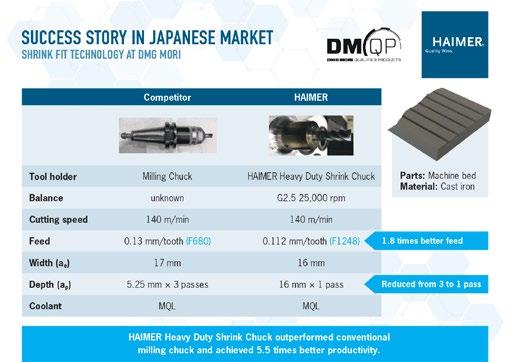
DMG MORI and HAIMER Strengthen Global Strategic Partnership to Advance Tool Room Automation and Digital Transformation
DmG mOrI and HAImer have expanded their long-standing global partnership to accelerate tool room digitization, automation, and software-driven machining transformation. building on nearly two decades of cooperation, the strengthened alliance integrates HAImer ’s complete “Tool room of the Future” portfolio— including shrink-fit systems, balancing machines, presetting technology, digital tool management software, and automated assembly solutions—across DmG mOrI facilities worldwide.
HAIMER & DMG MORI
This deepened partnership extends to Dm G mO r I showrooms, technical centers, and production sites, creating a unified environment where customers can experience and purchase HAI mer technologies directly through the Dm G mO r I Qualified Products (DmQP) program. The agreement also includes a global distribution partnership for HAI mer ’s WinTool and Tool room m anager software platforms through Dm G mO r I Technium, ensuring worldwide availability and synchronized digital twin connectivity across more than 20 c A m systems.
At DmG mOrI’s Iga production facility in Japan, the companies recently introduced HAImer ’s fully automated Automation cube One system, a 12-axis, lights-out tool assembly cell that uses cobots and magnescale components to deliver exceptional repeatability and reliability. early results at Iga show significant productivity improvements, following earlier gains achieved by replacing traditional milling and collet chuck systems with HAImer ’s shrink-fit technology.
Across Japan and global markets, the integration of HAI mer ’s m icroset tool presetters, shrink-fit holders, and balancing systems has delivered major performance increases. Automotive manufacturers have reported higher accuracy, fewer calibration cycles, and improved process stability due to the cast-iron thermal stability of
HAI mer ’s presetting platforms. customers worldwide can now streamline ordering, service, and implementation of HAI mer technologies directly through Dm G mO r I’s global infrastructure. by combining HAImer ’s precision tooling and tool management expertise with DmG mOrI’s machine tool innovation and digital ecosystem, the partnership aims to accelerate machining transformation and prepare manufacturers for the next era of automation, interoperability, and closed-loop process control.
For more Information: www.haimer.com
KASPERSKY
Kaspersky and VDC Research Estimate Over $18 Billion in Potential Ransomware Losses for Manufacturers in 2025
Kaspersky, in partnership with VDc research, has released a global assessment estimating that ransomware attacks targeting manufacturing organizations could have resulted in more than $18 billion in losses during the first three quarters of 2025—had the attacks not been blocked. The figure represents labor-related downtime alone, with total operational and financial damage significantly higher when
CHAR-LYNN HYDRAULIC PRODUCTS
LOW SPEED HIGH-TORQUE MOTORS… The Char-Lynn motor range consists of three major types based on the valving used to distribute fluid through the Orbit gear set (geroler or gerotor), Spool Valve, Disc Valve and VIS (Valve-in-Star). A variety of displacement sizes are available in each of the three motor types to provide a wide range of speeds and torques.
• Complete isolation of load forces from the control station.
• Continuous, unlimited control action with low output torque.
• Wide selection of control circuits and meter sizes.
• Works with many kinds of power steering pumps or fluid supply.
GEAR PUMPS… DANFOSS 26 gear pumps with 13-tooth gears minimizes flow ripple to reduce noise and vibration. Bearing lubrication system uses inlet oil rather than high pressure oil, improving volumetric efficiency and power output. The 13 available displacements and many mounting configurations provide for an easy retrofit. Other series available.
supply chain disruption, recovery costs, and reputational impacts are included.
The analysis draws on data from APAc , europe, the middle east, Africa, cIS, and LATA m , combining rates of detected ransomware attempts, average downtime per attack, average staffing levels, and hourly labor costs. Several regions showed elevated detection activity, including the middle east and Latin America, followed closely by APAc and Africa. All attacks referenced in the study were blocked before causing harm.
If successful, ransomware events can halt production lines for an average of 13 days. When multiplied across thousands of targeted organizations, the cost of idle labor alone reaches:
» $11.5 billion in APAc
» $4.4 billion in europe
» $711 million in LATA m
» $685 million in the middle east
» $507 million in cIS
» $446 million in Africa
Kaspersky cautions that real-world losses would extend far beyond labor costs. Operational recovery, shipping delays, contract penalties, and customer dissatisfaction often amplify the financial burden. mid-sized manufacturers are increasingly vulnerable as their security budgets tend to be smaller while the ripple effect of downtime can be substantial.
The report calls for stronger IT-OT integration, adoption of extended detection and response (XDr) tools specifically built for industrial environments, and continuous training of security operations teams. As manufacturing environments grow more complex and attackers become more targeted, the cost of insufficient cybersecurity continues to rise sharply.
Rootstock Software Acquires Praxis Solutions to Strengthen AI-Driven ERP Innovation and Salesforce Ecosystem Expertise
rootstock Software has announced the acquisition of Praxis Solutions, a long-standing Salesforce consulting and implementation partner. The move deepens rootstock’s capabilities across the Salesforce ecosystem and accelerates its development of agentic, AI-enabled erP technologies for product-based companies.
As part of the acquisition, Praxis founder and ceO Ohad Idan—recognized as a Salesforce mVP Hall of Famer and winner of the 2025 Dreamforce Hackathon—joins rootstock as Vice President of Product. His expertise in enterprise transformation, erP modernization, and customer-focused solution design will shape the next stage of rootstock’s roadmap.
The acquisition enhances rootstock’s ability to:
» Deliver advanced AI-ready erP capabilities
» e xpand professional services capacity
» Strengthen global delivery and customer enablement
» Accelerate product development aligned with Salesforce innovations
Praxis consultants will be integrated into rootstock’s Global Professional Services team and will immediately begin contributing to erP modernization projects for manufacturers and distributors. Their combined experience is expected to increase delivery speed, improve customer outcomes, and support the rollout of more intelligent, adaptive erP functionality.
rootstock’s leadership describes the acquisition as a major milestone in positioning the company for long-term
ROOTSTOCK SOFTWARE
growth. by combining agentic automation, AI-driven insights, and deep domain knowledge, rootstock aims to set a new benchmark for next-generation erP designed for modern product companies.
For more Information: www.rootstock.com
SIEMENS
Siemens to Showcase Industrial AI Vision at CES 2026, Highlighting the Next Era of Digital Twin and Automation Technology
Siemens has announced that President and ceO roland busch will deliver a keynote address at ceS 2026, outlining the company’s vision for AI-driven industrial innovation. The presentation will demonstrate how Siemens is combining digital twin technology, automation systems, and artificial intelligence to accelerate the transformation of manufacturing, infrastructure, energy, and transportation. According to Siemens, the convergence of AI and industrial domain expertise represents a once-in-acentury inflection point—similar to the arrival of electricity. The company has been investing heavily in industrial AI, positioning itself as a global leader in solutions that bridge the physical and digital worlds.
During ceS 2026, Siemens will showcase technologies that support:
» AI-assisted factory engineering and operations
» Digital twin environments optimized for design and planning
» Adaptive infrastructure and futureready energy systems
» Scalable industrial automation platforms
» real-world AI deployment through partner ecosystems
Visitors will also experience Siemens’ mobile experience center, demonstrations from the company’s global customers, and livestreamed interviews with leaders from Siemens and its partner organizations. by emphasizing AI as a practical, deployable tool rather than a theoretical concept, Siemens aims to show how industries can achieve greater resilience, competitiveness, and sustainability in the years ahead.
For more Information: www.siemens.com
President and CEO Roland Busch
TOOLING AND WORKHOLDING
Precision in Action
Tooling and Workholding is the cornerstone of precision manufacturing, ensuring that materials are securely held and processes are executed with unparalleled accuracy. This section highlights the latest innovations in clamps, chucks, collets, and magnetic workholding, alongside advancements in rotary tables, toolholders, and modular fixturing systems. Together, these solutions enable manufacturers to achieve repeatability, reduce setup times, and enhance overall productivity.
From versatile milling and turning tools to specialized threading and gear-cutting instruments, this category delves into the diverse range of equipment designed to meet the unique demands of every operation. Whether exploring robotic end-effectors for automation or custom fixtures for intricate designs, Tooling and Workholding underscores the critical role these components play in driving efficiency and precision across the manufacturing spectrum.
New Tooling Solutions Drive Efficiency Across Injection Molding and Automation Workflows
ArbUrG’s latest portfolio developments demonstrate how advanced tooling, optimized processing technologies, and integrated automation continue to reshape the future of injection molding. As manufacturers face increasing pressure to reduce cycle times, cut energy consumption, and deliver higher precision across complex part geometries, the company’s newest solutions show how coordinated machine, mold, and support systems can significantly elevate production performance.
At the center of ArbUrG’s strategy is a holistic approach that views molding not only as a machinedriven process, but as a tightly interconnected ecosystem. This includes next-generation injection units, adaptive processing controls, intelligent automation modules, enhanced workholding technologies,
and digital tools that streamline operation and quality assurance across the entire production cell.
Integrated Cell Design Reduces Cycle Times and Improves Precision
ArbUrG’s current machine lineup focuses heavily on optimizing interactions between clamping units, injection units, and downstream automation. by analyzing the entire cell as a single functional system, the company has made measurable gains in precision, stability, and energy use.
New developments in multicomponent and high-speed molding are designed to maintain tight tolerances while significantly reducing cooling times and mechanical stresses. ArbUrG’s latest all-electric and hybrid machines offer improved dynamic response, faster acceleration of critical axes, and more consistent
injection profiles — especially important for thin-walled packaging, consumer goods, medical components, and automotive parts.
Automation modules such as linear robots, articulated systems, and integrated quality checks allow parts to be removed, inspected, or transferred immediately, minimizing operator involvement and supporting faster cycle times.
Stronger Tooling Design Increases Process Stability
The company has pushed forward with tooling advances intended to maximize temperature control, part quality, and longevity. enhanced cooling channels, optimized steel selection, and improved surface treatments help maintain more stable process windows and reduce the likelihood of warp or dimensional variation.
ArbUrG emphasizes that tooling remains a critical success factor; even the most advanced machine cannot compensate for inconsistent thermal management or suboptimal cavity design. Their latest tooling guidelines and digital templates make it easier for moldmakers and processors to align design intent with practical production requirements.
Digital Tools Support Predictability and Error Reduction
Digitalization continues to influence every stage of the injection molded part lifecycle. ArbUrG’s updated digital platforms focus on:
» real-time machine monitoring
» Process parameter guidance
» Predictive maintenance
» Smart alarms and diagnostics
» Automated setup support
» Data-driven molding strategies for continuous improvement
This digital infrastructure helps operators identify deviations early and supports a more consistent production environment, especially in facilities with new staff or high part turnover.
Sustainability, Material Efficiency, and ResourceSaving Technologies
ArbUrG's innovations also reflect the industry’s broader sustainability goals. material-efficient processing, closed-loop production strategies, and systems engineered to support recycled or bio-based plastics are key focus areas. Improvements to machine hydraulics, servo systems, and thermal control reduce energy consumption, making high-volume production more sustainable.
A Future Built on Precise, Integrated Automation
As manufacturers continue to push for higher output, better repeatability, and shorter lead times, tooling and automation will remain defining performance levers. ArbUrG’s latest developments illustrate how coordinated machine design,
Turning tools weighing tons in a matter of seconds at the touch of a button: An Arburg employee operates the RUD Tecdos TM. Photo: Ingo Jensen/RUD
optimized mold engineering, and digital connectivity create measurable advantages across tooling-intensive applications. From packaging and medical manufacturing to automotive and consumer goods, the company’s approach demonstrates how production success increasingly depends on full-system integration rather than isolated equipment upgrades.
For more Information: www.arburg.com
BIG DAISHOWA
BIG DAISHOWA Introduces New SCA Shrinking Chuck for Precision Toolholding
bIG DAISHOWA has expanded its toolholding portfolio with the new ScA shrinking chuck, engineered to deliver exceptional rigidity and improved balance for high-speed, high-accuracy machining. The chuck features a compact outer diameter and refined mass distribution that helps reduce vibration while maintaining precise clamping force during demanding milling operations.
Designed for 6 mm and 12 mm shank diameters, the Sc A shrinking chuck supports better reach in tight cavities and enhances tool access when machining deep features or complex geometries. Its thermal expansion clamping method provides strong gripping power while minimizing runout, extending tool life and improving surface finish even in challenging materials. With compatibility across modern machining centers, the Sc A series provides a stable, repeatable toolholding solution for advanced milling applications.
For more Information: www.bigdaishowa.com
DILLON MANUFACTURING
Dillon Expands Workholding Line with New Chuck Jaws and Custom Fixturing Solutions
Dillon manufacturing has introduced new standard and custom chuck jaws designed to enhance gripping stability across diverse turning applications. The latest designs
incorporate improved serration profiles, optimized contact surfaces, and durable materials that help maintain accuracy under heavy cutting forces.
In addition to standard jaws, Dillon continues to grow its custom fixturing capabilities, offering engineered solutions for large-diameter parts, irregular geometries, and challenging workholding conditions. The company’s in-house manufacturing and rapid production cycles allow shops to address specialty workholding needs without long lead times. These new offerings support aerospace, energy, and general machining sectors requiring stable, reliable, and repeatable gripping performance.
For more Information: www.dillonmfg.com
FIXTUREWORKS
Fixtureworks Introduces Modular Clamping and Positioning Components for Flexible Fixturing
Fixtureworks has released a series of modular clamping and positioning components designed to give manufacturers greater flexibility in building custom fixtures. The new elements—ranging from adjustable clamps to precise locating pins—allow users to assemble or reconfigure setups quickly without specialized tooling.
These components are engineered for repeatability, durability, and ease of adjustment, helping operators maintain consistent positioning across batches and reduce setup time during changeovers. Their compact footprint makes them suitable for cNc machining centers, inspection setups, and fabrication environments
where space efficiency and versatility are critical. Fixtureworks’ latest additions reflect growing demand for adaptable fixturing systems that support high-mix, low-volume production.
For more Information: www.fixtureworks.com
HEULE Expands Back-Counterboring and Deburring Solutions for Automated Hole Finishing
H eUL e Tool corporation has expanded its hole-finishing portfolio with new tools engineered for automated back-counterboring, deburring, and chamfering applications. These tools enable manufacturers to finish
both sides of a hole in a single pass, eliminating manual secondary operations and improving process reliability. Designed for precision parts with tight tolerances, the tools feature self-actuating blades and durable cutting edges that maintain consistent quality even in high-volume environments. The new solutions help reduce cycle times, improve edge consistency, and simplify programming for cN c machines. H eUL e’s continued development of automated finishing tools supports the growing need for repeatable, high-quality hole preparation across aerospace, automotive, and medical manufacturing.
For more Information: www.heule.com
Palmgren Introduces Heavy-Duty Workholding and Vise Solutions for Manual and CNC Machining
Palmgren has expanded its lineup of vises and workholding products with new heavy-duty designs aimed at improving stability and precision in both manual and cN c machining environments. These vises feature hardened, precision-ground surfaces and high-strength
PALMGREN
construction that minimize deflection during aggressive milling or drilling operations.
The new models include enhanced quick-clamping mechanisms, improved jaw alignment, and greater resistance to wear over long production cycles. With configurations suited for vertical machining centers, toolroom mills, and inspection benches, Palmgren’s expanded offerings address the needs of job shops seeking durable, affordable, and reliable workholding solutions that support consistent machining accuracy.
For more Information: www.palmgren.com
PI (PHYSIK INSTRUMENTE)
PI Introduces High-Precision Positioning Stages for Micro-Assembly and High-Accuracy Tooling Applications
PI has released a new range of high-precision positioning stages engineered for microassembly, semiconductor packaging, inspection automation, and advanced tooling environments. These stages provide sub-micron accuracy, smooth motion, and rigid
construction suitable for applications requiring exceptional control and repeatability.
The series features low-friction guides, high-resolution encoders, and flexible drive options—including piezo, linear motor, and servo-driven configurations. Their modular design allows integrators to combine multiple stages for multi-axis positioning systems, supporting complex workflows such as micro-welding, optical alignment, or delicate component placement. PI’s newest positioning technologies reflect the increasing demand for ultra-precise automation in modern manufacturing.
For more Information: www.pi-usa.us
Walter Introduces Indexable Shoulder Milling System for Improved Versatility in Steel and Stainless Applications
Walter has expanded its milling portfolio with a new indexable shoulder milling system designed to improve performance across steel, stainless steel, and cast iron applications. The system features robust insert geometries, optimized chipbreakers, and high-strength cutter bodies that enable stable machining under demanding conditions.
Suitable for shoulder milling, slotting, and pocketing operations, the new system provides consistent surface finishes and predictable tool life across a broad range of cutting parameters. by combining rigidity, efficient coolant delivery, and advanced coatings, Walter’s milling platform allows users to push higher feeds while maintaining dimensional accuracy.
For more Information: www.walter-tools.com
WIDIA
WIDIA Expands Turning Line with New Durable Insert Grades for Tough Materials
WIDIA has introduced new turning insert grades engineered to improve tool life and reliability in challenging materials such as stainless steels, high-temperature alloys, and hard ferrous metals. The inserts feature refined edge preparation, heat-resistant coatings, and chip control designs that enhance stability during continuous and interrupted cutting.
These additions help reduce built-up edge, lower cutting forces, and maintain consistent wear patterns— key factors for maintaining part quality during long production runs. For manufacturers facing unpredictable tool performance in difficult alloys, WIDIA’s latest turning grades offer a more durable and consistent solution.
For more Information: www.widia.com
WALTER
Standard-Direct.us
DRILL. TAP.
DRILL. TAP. REPEAT.
Engineer ed Tough for Year After Year Relia bility
Engineer ed Tough for Year After Year Relia bility
Engineer ed
bility
in
Drilling & Tapping Units and Multiple Spindle Heads