This Week: 5 - HARVEST ROARING FORK 7 - SCHOOL BUS ETIQUETTE 9 -SPORTS 14-15 - GOVERNMENT 16-17 - OPINION Your nonprofit
community newspaper
Volume 17, Number 49 | January 15-21, 2026
For lands’ sake
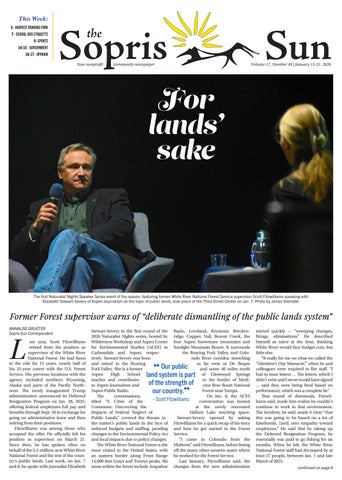
The first Naturalist Nights Speaker Series event of the season, featuring former White River National Forest Service supervisor Scott Fitzwilliams speaking with Elizabeth Stewart-Severy of Aspen Journalism on the topic of public lands, took place at the Third Street Center on Jan. 7. Photo by James Steindler
Former Forest supervisor warns of “deliberate dismantling of the public lands system” ANNALISE GRUETER Sopris Sun Correspondent
ast year, Scott Fitzwilliams retired from his position as supervisor of the White River National Forest. He had been in the role for 15 years, nearly half of his 35-year career with the U.S. Forest Service. His previous locations with the agency included northern Wyoming, Alaska and parts of the Pacific Northwest. The newly inaugurated Trump administration announced its Deferred Resignation Program on Jan. 28, 2025, offering federal employees full pay and benefits through Sept. 30 in exchange for going on administrative leave and then retiring from their positions. Fitzwilliams was among those who accepted the offer. He officially left his position as supervisor on March 21. Since then, he has spoken often on behalf of the 2.3-million-acre White River National Forest and the rest of the country’s public lands. Last week, on Jan. 7 and 8, he spoke with journalist Elizabeth
Stewart-Severy in the first round of the Basin, Loveland, Keystone, Brecken2026 Naturalist Nights series, hosted by ridge, Copper, Vail, Beaver Creek, the Wilderness Workshop and Aspen Center four Aspen Snowmass mountains and for Environmental Studies (ACES) in Sunlight Mountain Resort. It surrounds Carbondale and Aspen, respecthe Roaring Fork Valley and Colotively. Stewart-Severy was born rado River corridor, stretching and raised in the Roaring as far west as De Beque Fork Valley. She is a former and some 40 miles north Aspen High School of Glenwood Springs teacher and contributes to the border of Medito Aspen Journalism and cine Bow-Routt National Aspen Public Radio. Forest near Yampa. The conversations, On Jan. 8, the ACES - Scott Fitzwilliams titled “A Crisis of the conversation was hosted Commons: Uncovering the at the newly renovated Impacts of Federal Neglect of Hallam Lake teaching space. Public Lands,” covered the threats to Stewart-Severy opened by asking the nation’s public lands in the face of Fitzwilliams for a quick recap of his story reduced budgets and staffing, pending and how he got started in the Forest changes to the Environmental Policy Act Service. and local impacts due to policy changes. “I came to Colorado from the The White River National Forest is the Midwest,” said Fitzwilliams, before listing most visited in the United States, with off the many other western states where an eastern border along Front Range he worked for the Forest Service. 14,000-feet Grays and Torreys peaks. Ski Last January, Fitzwilliams said, the areas within the forest include Arapahoe changes from the new administration
Our public land system is part of the strength of our country.
started quickly — “sweeping changes, firings, eliminations.” He described himself as naive at the time, thinking White River would face budget cuts, but little else. “It really hit me on what we called the ‘Valentine’s Day Massacre,’” when he and colleagues were required to fire staff. “I had to issue letters … The letters, which I didn’t write and I never would have signed … said they were being fired based on performance, which was a complete lie.” That round of dismissals, Fitzwilliams said, made him realize he couldn’t continue to work in that environment. The incident, he said, made it clear “that this was going to be based on a lot of falsehoods, [and] zero empathy toward employees.” He said that by taking up the Deferred Resignation Program, he essentially was paid to go fishing for six months. When he left, the White River National Forest staff had decreased by at least 27 people, between Jan. 1 and late March of 2025. continued on page 6
‘Don’t worry about it!’ EDITOR’S NOTE: Some quotes in this column are paraphrased. Those of us living in America’s moderate- and left-leaning I don’t understand. People are dying, the ocean is in flames, and political spaces expected a bad year, and 2025 didn’t disappoint. you’re telling us we shouldn’t worry?” The Trump-Kennedy Center, Trump-class battleships, masked “That’s right,” Anbender answered. “If you have access to (secret?) police in unmarked cars abducting our neighbors, the change the situation, please use it. But if you don’t have access, and military patrolling city streets, yo-yo tariffs, more mass shootings, most of us don’t, then don’t worry. The TMLP is about accomplishthe continued dismembering of our already inadequate health- ment. Have you ever accomplished anything by worrying? When care system in favor of no healthcare system, precipitous. Deadly you have access, use it. When you do not, don’t worry!” sinking of boats on the high seas, reluctance to feed the hungry, Anbender’s advice wasn’t original, as any 12-stepper will tell more gerrymandering, suppression of free speech and freedom of you. (“God, grant me serenity to accept the things I cannot change, the press. The list seemed endless. (You can read courage to change the things I can and wisdom a more complete and more thoughtful version to know the difference.”) Still, coming as they did, in the Dec. 27, 2025 New York Times: “Trump Anbender’s words made enough of an impresPromised Radical Change in His Second Term. sion that I can honestly say I’ve worried little for Here’s What He’s Done So Far.”) And then, just the last 35 years. when we thought it was safe to go back in the What, though, does “Don’t worry about it” water, the almost-invasion of Venezuela. How mean when we’re reading the news over breakcan we live fulfilled lives amid this ongoing, fast in 2026 Carbondale, rather than being potentially disastrous chaos? trained in a 1991 San Francisco ballroom? It You are reading Mature Content, and I’d like means, I assure you, the very same things. It to tell you a story. means being honest about access. Most of My 50th birthday, Jan. 17, 1991, was memorawhat daily floods our consciousness is beyond ble, among other reasons because it was the first our reach. We can rage about it, argue about it, day of Operation Desert Storm. I was in San Frandoomscroll endlessly and post ad nauseam, cisco for a training weekend with about 500 other inviting algorithms to amplify our posts to people MATURE Teams, Management and Leadership Program who already agree with us. We can lie awake CONTENT (TMLP) devotees. We awoke to images of buildrehearsing speeches we’ll never give. None of By Ron Kokish ings and oilfields aflame, distraught at seeing our that improves anything. It just wastes the limited country again going to war on foreign shores. But our instructors energy we have. “Don’t worry about it” means using our energy stuck to the syllabus. Though gloom dampened our usual trainee effectively. It means using it where we have access. enthusiasm, none of them mentioned the tragedies unfolding in Anbender asked a question that evening that’s as relevant now the Middle East throughout the day. as it was the day the Gulf War erupted. Where do we have access? TMLP Guru Ken Anbender wasn’t scheduled to be there that And how are we using it? This morning, I saw a social media post weekend, but, after dinner, he surprised us by taking the stage to from the finder of a wallet seeking its rightful owner, and two posts open the evening. Roars of welcome filled the room. from people who had received someone else’s package looking for “I love you guys,” Anbender began. “I have this weekend off, the rightful recipients. Three posts from three people using their but I couldn’t miss an opportunity to spend time with you. We access to social media to create a better world. Those posts made can talk about anything you’re interested in. Who wants to start?” my day, because small things matter. Dozens of hands shot into the air, and he picked one. “How We have access to how we treat people we encounter. We have should we relate to the war?” access to how we use our money, time and attention. We have Anbender, who, I’m sure, knew exactly what question he access to whether we show up to a town meeting, write a letter, would be asked no matter who he called on, said, “Don’t worry help a neighbor or donate to a group doing work we believe in. We about it!” Then he stood there, waiting in the stunned silence. He have access to our own integrity. Fulfilled lives aren’t created by had, after all, answered the question. carrying the weight of the world on our backs. They’re created by Eventually, another hand went up, more hesitatingly this time doing work that’s ours to do. And critical work that’s not ours to do? and not quite as high. Then another, and then a few more. “Ken, “Don’t worry about it!”
OPINION
Mature Content is a monthly feature from Age-Friendly Carbondale.
LETTERS Re: Therapy Pool At first upon seeing Fred Malo’s opinion column picture on Jan. 8, I thought it was another Fred from the past, Fred Sanford on that ‘70s comedy “Sanford and Son.” He’s a dead ringer for Redd Foxx, omitting skin tone, and almost as funny. It’s nice that Mr. Malo has found a hobby in his autumn years. Personally, I love gardening. But Trump Derangement is what underlies all of Fred’s past woke, socialistic “hobbies”. From cheering open borders and hating ICE to writing that St. Paul was gay and a pedophile [Post Independent letter published Jan. 5, 2018]. Anything Trump accomplished Fred has denigrated. But hobbies are necessary to stay active and happy. And if your hobby defines you as a “climate crusader” fighting existential environmental evil, so much more wind to blow up your own personal social bubble of delusion. A happy and prosperous new year to all. Bruno Kirchenwitz Rifle
Winter foraging Greetings from the Western Colorado Mycological Association (WCMA), where the 2025 theme was “Skunked” …
August was supposed to be our wet season, but Mother Nature had other plans. She ghosted us harder than a bad Tinder date. No rain, no mushrooms, just a lot of optimistic hiking and sad empty baskets. The only species found were for the ID table, not the dinner table! We thought winter might redeem itself, but the precipitation gods continue their cruel joke, as we are now five feet below average snow pack. However! We refuse to be defeated. Enter our humble hero: Phellinus tremulae, the trusty medicinal polypore clinging to aspen trees where branches once waved goodbye. This woody genus of wonder has been studied for antiviral properties, particularly against corona viruses. Who knew our drought-stricken slopes were secretly harboring tiny pharmaceutical factories? We did! If you’re curious about mushrooms or just need friends who understand your obsession with fungus, join us the first Monday of every month at Carbondale Community School, 6pm. Our next gathering is Feb. 2 for MUSHLOVE craft night! Come for the mushrooms, stay for the community of people who won’t judge your extensive mushroom photo collection. Hamilton Pevec WCMA President
2 THE SOPRIS SUN | soprissun.com | January 15-21, 2026
Celebrating Bob Weir Who are you? Where are you? How are you? This valley is full of heads. In my 35 years I’ve met hundreds of you. Let’s do what Deadheads do best, get together in community while celebrating the life and passing of Bob Weir. This Saturday, Jan. 17 from 5 until ??? at Roaring Fork CrossFit, 35 Park Ave in the Mid-Valley Design Center in Willits. Bring your instruments to jam, your playlists, your stories, your photos, maybe a little something to drink and munch on. This event is open to all who love and appreciate the legacy of The Grateful Dead and the impact Bobby had on our lives. Call Scott at Sopris Chiro if you have any questions. Scott Tesoro Carbondale
Epstein files The Epstein files were supposed to be released a month ago; the extension for release has also passed. We are manipulated into forgetting about that, and all the other illegal actions of this administration, by their scintillating! fabulous! amazing! unparalleled! kidnapping of Venezuela’s president and his wife and the securing continued on page 22
Editor Raleigh Burleigh 970-510-3003 news@soprissun.com Contributing Editor James Steindler Sol del Valle Editora Bianca Godina bianca@soldelvalle.org Digital Editor Ingrid Celeste Zúniga ingrid@soldelvalle.org Lead Editorial Designer Terri Ritchie Partnerships & Engagement Manager Luise Nieslanik Advertising Department adsales@soprissun.com Sol del Valle Marketing and Development Manager Margarita Alvarez margarita@soldelvalle.org Advertising Designer Emily Blong Delivery Frederic Kischbaum Youth Journalism Instructor Skyler Stark-Ragsdale Proofreaders Lee Beck Tracy Kallassy Ken Pletcher Hank van Berlo Executive Director Todd Chamberlin 970-510-0246 todd@soprissun.com Board Members / Mesa Directiva board@soprissun.com Klaus Kocher • Kay Clarke • Eric Smith Roger Berliner • Elizabeth Phillips Anna Huntington • Loren Jenkins Carlos Ramos • Gayle Wells
The Sopris Sun Board meets at 6pm on second Thursdays at the Third Street Center. The Sopris Sun, Inc. is a 501(c)(3) nonprofit corporation with a mission to inform, inspire and build community by fostering diverse and independent journalism. Donations are fully tax deductible. Sincerest thanks to our Honorary Publishers for their annual commitment of $1,000+ Lee Beck & John Stickney Kay Brunnier Frances Dudley Michelle & Ed Buchman Sue Edelstein & Bill Spence Deborah & Shane Evans Greg & Kathy Feinsinger Michael & Nancy Kish Gary & Jill Knaus Eric Smith Peter and Mike Gilbert Patti & George Stranahan Elizabeth Wysong Alpine Bank Emily & George Bohmfalk Kathy & Carter Barger Sandy & Paul Chamberlin Karen & Roger Berliner Donna & Ken Riley Gayle & Dick Wells
Legacy Givers for including us in their final wishes. Mary Lilly
Donate by mail or online: P.O. Box 399 Carbondale, CO 81623 520 S. Third Street #26-B 970-510-3003 soprissun.com/Donate The Sopris Sun, Inc. is a proud member of the Carbondale Creative District
SCUTTLEBUTT
Send your scuttlebutt to news@soprissun.com
Basalt art grants
OUR UNDERWRITERS AND NONPROFIT PARTNERS!
Grants of up to $10,000 are available to local artists, organizations and nonprofits via the Basalt Public Arts Commission. Funding may be used for one-time or continuing public arts projects and programs that have a measurable benefit within Basalt. Submissions are due by 5pm, Feb. 20. Find details at www.basalt.net/bpac
RFSD declining enrollment The Roaring Fork School District (RFSD) observed a 4.2% decline in student enrollment this year, based on the October 2025 student count. According to the Colorado Department of Educations, student enrollment declined an average of 1.2% across the state in the fall of 2025 compared with the year prior. The shift is attributed to declining school-aged populations, increased racial and ethnic diversity and increased online learning opportunities.
North Star management Pitkin County Open Space and Trails is in the final stages of updating its North Star Nature Preserve Management Plan. The community is invited to review a draft and take a questionnaire by Feb. 4 (online at www.bit.ly/North-Star-Plan). Experience North Star on skis with a free, one-hour guided tour, Jan. 19, 25, Feb. 4, 15 at 11am; registration at www.bit.ly/North-Star-Ski
O&G replacement sale
FirstBank Alpine Bank Colorado Mountain College Nordic Gardens Hilary Porterfield Basalt Library
NONPROFIT PARTNERS Two Rivers Unitarian Universalist Carbondale Arts Carbondale Rotary Club Colorado Animal Rescue
Interested in becoming an Underwriter or Nonprofit Partner? Email Todd@soprissun.com or call 970-987-9866
On Dec. 9, 2025, the Bureau of Land Management (BLM) held an oil and gas lease sale during which the industry chose to pass on 40% of the acreage offered for lease. As mandated by Congress under the “One Big Beautiful Bill Act,” the BLM then announced a “replacement sale” on Jan. 8 where all the parcels that did not sell were again offered. Not a single re-offered parcel received a bid, “a clear example of how wasteful and inefficient this process is,” stated Wilderness Workshop in a press release.
Glenwood Chamber awards The Glenwood Springs Chamber Resort Association is calling for nominations for Citizen of the Year, ATHENA Leadership, ATHENA Young Professional, Top Brass Outstanding Business, Top Brass Outstanding New Business and Top Brass Milestone. Awardees will be honored at a gala at the Hotel Colorado on Feb. 28, sponsored by Alpine Bank and Valley View. The community is encouraged to nominate individuals or businesses for these awards by Jan. 31 at glenwoodchamber.com/annual-gala
SoL auditions Stage of Life Theatre Company announced audition sign-ups for “Alice by Heart,” a musical inspired by the 1865 novel Alice’s Adventures in Wonderland. In-person auditions will be held at the Thunder River Theatre Company on Feb. 21-22 and video submissions emailed to brittany@soltheatrecompany.org will be accepted through Feb. 20. This advanced training production is open to high school and college students. Find details at www.bit.ly/SoL-Alice
Art Base opportunities The Art Base in Basalt is seeking a part-time office administrator, as well as a bilingual art instructor for youth and adult classes. Learn more about both positions at www.theartbase.org/about/ work-opportunities
Literacy Outreach is in desperate need of volunteer tutors, facing increasing demand with 110 Garfield County resident tutees already on its waiting list. Tutors help participants with basic language skills and practical tasks, like preparing for a citizenship exam or filling out a job application. Most participants are Spanish-speaking, but tutors don’t have to be! Literacy Outreach will host four informational sessions this month: Jan. 15 (3-4pm) at the Glenwood Springs Library, Jan. 16 (3-4pm) at the Carbondale Library, Jan. 23 (4-5pm) at the Rifle Library and Jan. 29 (2-3pm) at its office in Glenwood Springs (1127 School Street). No RSVP is required. Contact Megan Webber at meganwebber@literacyoutreach. org or call 970-945-5282 for more information. Pictured: Volunteer tutor Deb Loter (second from left) poses with four students that she teaches in a class at the Rifle Library. Courtesy photo
Range riders Colorado Park and Wildlife (CPW) is expanding its Range Rider program this spring and looking to hire additional riders. Eleven range riders were brought on for the initial 2025 summer season, helping livestock producers navigate and prevent wolf-livestock conflicts, mostly in the northwest part of the state. “With continued wolf dispersal, CPW is hoping to expand the program into the southwest and increase the number of contracted riders,” read a press release. An information session will be held on Jan. 16 at the CPW Grand Junction Office, with a virtual attendance option available. Requests for proposals are due by Feb. 6, and riders mount up in April. For more information, visit www.tinyurl.com/2026RangeRiders
Childcare assistance The City of Aspen and Kids First’s annual financial aid program, offsetting childcare costs for parents who live or work in Aspen with children under 5 and attending a participating licensed childcare program in Pitkin County, is accepting applications until Feb. 1. Families already receiving assistance through the program do not need to reapply. The online application includes a translation option, and can be found at www.aspen.gov/316/Financial-Aid
They say it’s your birthday! Folks celebrating another trip around the sun this week include: Crista Barlow and Frank Nadell (Jan. 15); Johann Aberger, Kimberlie Chenowith and Drew Walters (Jan. 16); Brenda Buchanan, Katrina Byars, Ron Kokish, Roy Rickus and Tanner Rollyson (Jan. 17); Patrick Anderson, Joe Flores, Tarie Lahet, Katie Woltjer and Shannon Pelland (Jan. 19); Bryan Alvarez-Terrazas, Brooke Bockelman, Olivia Emery and Lewis Cooper (Jan. 20); Maisa Metcalf (Jan. 21).
Your Mid-Valley Real Estate Expert Professionally Representing You with 19 Years of Experience
Thurs, Jan. 22, 4-5PM HILARY PORTERFIELD
Call me, I love to talk real estate! 970.319.5757 • hilary@hilaryporterfield.com • roaringfork-homes.com ©2025 Engel & Völkers. All rights reserved. Each brokerage is independently owned and operated.
Join your Teen Librarian, Travis Wilson, for an introduction into the world of improvisation on stage. All you need to bring is a clear mind and be willing to lean into the discomfort of thinking on your feet! 14 Midland Avenue | Basalt Colorado 81621 | 970.927.4311 | basaltlibrary.org
THE SOPRIS SUN | Your weekly community connector | January 15-21, 2026 3
Thompson House gets some TLC Search for steward of Heritage Gardens commences JAMES STEINDLER Contributing Editor
The Thompson House is of particular significance to Carbondale, being the only structure in town on the National Register of Historic Places and the home of the homesteading Thompson-Holland family, including Hattie Thompson, who passed away in the house in 1944. Setting foot inside is like stepping back in time, with many items of the original occupants still filling the space. Now owned by the Town, and overseen by the Carbondale Historic Preservation Commission (HPC) and the Carbondale Historical Society, the building continues to host guided tours, school field trips, Potato Days wrapping parties and more, providing a space for the past and present to intersect. The enclosed south porch is currently the focus of a restoration effort. The wraparound north porch was added in 1896, when the second story was built, and the south porch was added sometime later, according to local historian Sue Gray. “This is a maintenance issue,” Eric Doud with the HPC told The Sopris Sun. And for that reason, the legwork, initiated in the fall, was expedient, as no building permit was required. It’s a good thing, because, as Doud pointed out, the building hasn’t seen this extent of upkeep for a long time. The south porch is the most degraded part of the exterior, largely due to being south-facing. Much of the material needs to be touched up, but some will be replaced and mimic the original. The Town hired Chris Thompson — no relation to the Thompson family — of Aspen Preservation Company to carry out the project. The contract is for $24,200, according to Planning Director Jared Barnes. The Town budgeted $30,000 in 2025. Chris has a master’s degree in historic preservation and worked on homes back East before moving to the Valley about 15 years ago, including the Mercer-Williams House in Savannah, Georgia, the murder setting in “Midnight in the Garden of Good and Evil;” the Green-Meldrim house,
which General Sherman occupied and was headquartered during the Civil War; and Fort Garland in the San Luis Valley. Closer to home, he’s done work at the Wheeler-Stallard house, the Wheeler Opera House and in the Town of Ashcroft. “It’s fulfilling work,” he said. Chris removed the windows around the porch at the end of 2025, which he’s been working on at his shop in Carbondale. He plans to level the porch a little bit, but doesn’t want to stress the structure too much. “Rule number one of preservation is to do no harm,” he stated. And when it’s necessary to swap out material, “you replace in kind,” mirroring the species of wood, he’s using white pine, the old wavy windows and so forth. The exterior woodwork mostly consists of scraping, prepping, priming and painting. The Paint Store in Carbondale will help with matching the original colors. Last year, Carbondale Parks and Rec replaced grass up against the house with fine, copper-colored gravel to pull back the irrigation and keep it from spraying the edges of the house. The Town did the same thing around the cabin at History Park on Weant Boulevard. Maintenance is critical, and “water is the enemy,” Chris stated. “All we’re trying to do here is save this thing before it falls down,” HPC member John Williams said. Doud added that taking care of the grounds is equally important.
Heritage Gardens Sue Gray has stewarded Hattie’s Heritage Garden outside of the house, as well as the Pioneer Heritage Garden on Weant Boulevard, for several years, but is looking to pass on the baton, eventually. The HPC has high hopes of finding a replacement who, like Gray, not only specializes in gardening but also has a keen interest in local history. “[We’re] just looking for a unicorn,” said Barnes. “We’re looking for [a] Sue Gray,” added Doud.
(Left to right) Carbondale Historical Preservation Commission members John Williams and Eric Doud with Town Planning Director Jared Barnes outside the south porch of the Thompson House in December. Photo by James Steindler
Gray volunteers, but the new unicorn will earn a wage and be assisted by volunteers. The bulk of the work occurs spring through fall. There haven’t been any bites yet, but Gray is confident her successor is out there somewhere. She indicated that the position is especially suitable for someone who is retired, so their day job doesn’t overshadow the role. Gray plans to stick with it until the right person is found and has been properly trained. continued on page 23
30 years in business
Full Line Pet Store
RJ Paddywacks Open 7 days a week
20% off Freeze Dried Food! All January • • • •
Pet food & supplies Self-service dog wash Home delivery Expert nutritional counseling
Next to City Market El Jebel 970. 963.1700
4 THE SOPRIS SUN | soprissun.com | January 15-21, 2026
1,500-unit development faces fierce opposition ahead of February planning meeting WILL BUZZERD Sopris Sun Correspondent
On Jan. 6, hundreds of Roaring Fork Valley residents gathered remotely, and in person at Carbondale’s Third Street Center, to voice concerns about Harvest Roaring Fork, a proposed 1,500-unit residential community on roughly 283 acres of open space near the confluence of Cattle Creek and the Roaring Fork River. Hosted by a citizen-led opposition group called the Cattle Creek Confluence Coalition, the meeting was organized in preparation for an upcoming Garfield County Planning Commission meeting, during which the development’s fate may be decided. Formerly the Sanders Ranch, the property has faced land-use battles in the past. In 2005, a developer aimed to create an 18-hole golf course, but that met its demise after construction crews disrupted a herd of elk seeking winter habitat and a bulldozer tore down the property’s iconic big red “U76” barn, provoking public outcry. Although a slew of development projects have been proposed by different owners since, the still-undeveloped open space continues to serve as a wildlife corridor for elk, mule deer and other species. The current applicant, Harvest Roaring Fork LLC, bought the Highway 82 adjacent property in the spring of 2024. Harvest Roaring Fork is affiliated with Texas-based development firm Realty Capital, which has already developed over 500 homes and apartments across the Roaring Fork
Valley, including the Tree Farm Lofts across from Willits. Harvest Roaring Fork’s big selling point is its prioritization of affordable workforce housing in the midst of a growing housing crisis. Of the 1,500 residential units proposed, 150 would be price capped and deed restricted, in accordance with the 10% minimum required by Garfield County’s Land Use and Development Code. An additional 300 units would be deed restricted and sold only to buyers with fulltime employment in Garfield, Eagle or Pitkin County. These extra deed-restricted units would not be required, and thus face no official pricing restrictions. The intent is that ownership of these properties could only be transferred to other locally employed buyers. The developer expects to price these units between $475,000 and $575,000, based on construction cost estimates. For comparison, real estate platforms, such as Zillow and Redfin, estimate the median home-sale price in Garfield County at approximately $615,000. The remaining 1,050 units, marked as “market-rate workforce units,” would not be price capped or deed restricted, and are estimated to cost anywhere between $400,000 to $1.5 million. In addition, Harvest Roaring Fork intends to develop the area into a fullyfledged suburban community, including a village center with 55,000 square feet of commercial space, a 120-room hotel, playgrounds, a childcare facility and a coffee
Over 100 people filled the Third Street Center Community Hall, along with many attending virtually, for Cattle Creek Confluence Coalitions’ meeting opposing the proposed Harvest Roaring Fork development. Photo by Marilyn Gleason, KDNK News
shop within a reconstructed replica of the historic U76 barn. Also present in the application are 325 accessory dwelling units, which, when factored in with the 1,500 regular units and accounting for a 54-acre conservation easement, makes for a development density of 7.96 units per acre. None of the neighborhoods in the surrounding area — including Iron Bridge, Aspen Glen, Teller Springs and Westbank Ranch — exceed a density of one unit per acre. Such unprecedented density has spurred the Cattle Creek Confluence Coalition to strongly oppose the development. Since the project’s proposal, the coalition has been gathering members and donations
to defend the 283-acre parcel from what it calls irreversible change. During the Jan. 6 meeting, concerns included increased wildfire risk, light pollution, overburdening existing traffic infrastructure and emergency services, permanent disruption of a vital wildlife corridor and changing the fabric of the Valley’s rural character. The coalition’s leaders picked apart discrepancies in the developer’s traffic assessment, which accounts for fewer hotel rooms, accessory dwelling units and retail spaces than stated in the development proposal. Furthermore, the assessment does not account for construction traffic generated by the continued on page 23
“She listens carefully, and thoughtfully considers the many tools in her toolbox that will best support what I am needing.” client testimony
“No matter how I’m feeling going into a session, I am happy in Mishe’s presence and feel better when I leave.”
New Patient Consultation $35 (regular price 85$)
client testimony
Find out if Zelena Medicine’s approach is right for you: -Share your current health challenge and goals -Ask questions -Receive a personalized treatment plan Offer ends January 31, 2026
Mishe Skenderova, LAc.
Specializing in: PELVIC FLOOR HEALTH •Urinary urgency, dribbling, or incontinence •Painful intercourse •Pelvic pain or tension •Postpartum or surgical scar therapy •Tailbone pain
CANCER SURVIVORSHIP SUPPORT •Peripheral neuropathy •Fatigue •Stress and anxiety •Medication side effects •Sexual side effects
To schedule your appointment call Zelena Medicine at (970)500-0203 Office Location: 350 Market St #311 Basalt, CO 81623
ZelenaMedicine.com
THE SOPRIS SUN | Your weekly community connector | January 15-21, 2026 5
NATURALIST NIGHTS from the cover “Our public land system is part of the strength of our country,” Fitzwilliams said, emphasizing that it is a unique facet of the United States. “We need these lands,” he emphasized, and expressed that he finds it odd that the administration has been targeting public lands when the spaces “have never been more popular.” Stewart-Severy noted that budget and staffing challenges have existed for the Forest Service for many years, and asked
Fitzwilliams what he believes makes these changes different. “This is a deliberate dismantling of the public lands system,” he responded. He added that his impression is that the administration and Congress will continue to pursue selling public lands, as Utah Senator Mike Lee tried repeatedly to include in last year’s “One Big Beautiful Bill.” Fitzwilliams shared that his Forest Service contacts are not able to hire to
Every seat was filled in the Community Hall at the Third Street Center on Wednesday, Jan. 7.
6 THE SOPRIS SUN | soprissun.com | January 15-21, 2026
fill any vacancies, and that they’ve been asked to reduce staff further. Stewart-Severy inquired why that is. “That’s the curious thing,” he answered, saying that there wasn’t a clearly stated goal. “Our public lands and these mountains and refuges are going to be essential in the future,” he said. Fitzwilliams has been advocating for the importance of forests and public lands since his resignation. Just last week, he spoke with Aspen Public Radio on the topic.
The free Naturalist Nights series occurs every two weeks through March 4 and 5, from 6-7 pm on Wednesdays at the Third Street Center in Carbondale and Thursdays at Hallam Lake in Aspen. The next topic, “Ecology and Resilience of Pinyon-Juniper Woodlands under Global Change” with Dr. Miranda Redmond, will be covered on Jan. 21 and 22.
Local journalist Elizabeth Stewart-Severy kept the conversation flowing, and covered a lot of ground. Photos by James Steindler
School bus safety rules and etiquette KEN PLETCHER Sopris Sun Correspondent
It is a new year, and students are back in school. What better time, then, to refresh our memories on school-bus safety when students are getting on or off — especially now, with winter’s more challenging driving conditions? First, the state law. Drivers in either direction on a road or street must stop no closer than 20 feet from a school bus that is stopped with its red lights flashing and stop sign extended. They must remain stopped until the lights and sign are off and then proceed with caution, watching out for any students in the vicinity. The only exception is for vehicles going in the opposite direction of a stopped bus: They may proceed with caution if there is a median or barrier separating the two directions of traffic. Both the Marble Charter School (MCS) and the Roaring Fork School District (RFSD) employ buses to transport students to, from and within Marble, Redstone and Carbondale, with the bulk of the trip on Highway 133. The Sopris Sun spoke recently with MCS drivers Angus Barber and Ron Leach (along with MCS Director Sam
Richings-Germain, who occasionally drives the school’s small van) and RFSD driver Gene Schilling. The very good news is that, overwhelmingly, drivers encountering stopped buses do obey the law, and that riding the bus is extremely safe for students. Barber noted MCS’s “perfect safety record” with students on buses, and Schilling stated that there have been no incidents with students during his more than 45 years behind the wheel. Richings-Germain stressed that parents should be completely confident with their children’s safety, continuing, “Our drivers are amazing and care so deeply about keeping kids safe.” Barber said, “Generally, the vast majority of motorists are extremely courteous with us,” noting that only “a tiny minority” of drivers run through the lights and stop sign. Leach thought it was “maybe once every two weeks.” Schilling, who was also Carbondale’s longtime police chief, has observed even fewer, maybe one per month, but he also indicated that the problem is “worse now than decades ago — so much more traffic, more people in a hurry.”
A Roaring Fork School District bus stops and discharges a student in Carbondale, as an oncoming truck abides by its stop sign and flashing reds. Photo by Alison Osius
Leach has been driving for MCS for six years, but he also brings the perspective of his long tenure with the town’s fire station, including as chief. “I’ve had 50 years of dealing with 133,” he told The Sun. “The main issue on that road is speed: People go too fast.” And that is the problem. Drivers just can’t stop in time, especially coming around some of 133’s “blind” corners or when roads are slick. Leach continued, “People are not paying attention; it’s not intentional” when they run the lights. Barber and Schilling concurred. What is intentional (and more common), the three noted, are vehicles going around a bus or passing it from the opposite direction when the amber warning lights are on. Even more troubling, they have seen vehicles passing
a bus in a double-yellow-line, no-passing zone. Schilling stated the obvious: “It could cause a serious accident.” Fortunately, the drivers for both MCS and RFSD are highly trained and follow strict safety procedures when picking up or dropping off students. No children cross a road or street unless the driver has determined that the road is clear or traffic has stopped, and only then gives them the go-ahead to proceed. Enforcement can be challenging, especially for MCS drivers. Although their buses have cameras, those devices are not useful at catching “runners.” RFSD buses, however, are equipped with sophisticated cameras that can take a photo of a violator’s license plate and “bookmark” it
Working To gether For Pets A nd Their Peo ple 2801 Glenwood S CR 114 prings, CO (970)947-9 173
CARE cu 10 cats, 3 rrently has 9 dogs,s, guinea pig s ready for adoption!
for easy sharing with the RFSD dispatcher and, ultimately, the proper police authority. The three drivers and Richings-Germain had nothing but praise for the Pitkin County Sheriff’s Office (PCSO), which patrols nearly all of 133 between Carbondale and Marble. Richings-Germain described PCSO as being “super supportive” of the drivers. One highly effective strategy has been two or three times a week a deputy follows in their car and pulls out with its lights on when the bus is stopped. Richings-Germain emphasized, “The kids love riding the bus,” which is not only safe but fun, though, “It is important to have regular reminders about bus safety.” We have been reminded.
.A.R.E. CKS offers a “C ies, A W Y D D A P J R mil new adoptive fa lan package” for p ” ts n s for Poi including a “Paw % discount e 15 and a first timpet. ew n r u for yo
Meet sweet that just arrPraline, a beauty through thei ived at CARE program. A r transfer comes out oflittle shy, she smother th her hidey hole to full body ruebright person with Are you the os, purrs, and pets! ne to finally her a foreve give RJ Paddywacks r get spoiled w home and 400 E Valley Rd. # I/J it h love? Fill out an a Next to City Market d o p ti o n survey and in El Jebel at CARE todmaeet her y! 970.963.1700 rjpaddywacks.com
THE SOPRIS SUN | Your weekly community connector | January 15-21, 2026 7
River Bridge notes child abuse prevention education ‘strengths’ and ‘needs’ MYKI JONES Sopris Sun Correspondent
River Bridge Regional Center (RBRC) presented its Child Abuse Prevention Education Strengths and Needs Assessment in the fall in partnership with the OMNI Institute, a Denver-based social science consulting organization, and spoke to RBRC’s progress as an organization and its short- and long-term goals. This assessment, according to Development Director Mary Cloud, helps set the stage for a collective approach to embolden child abuse prevention resources. RBRC serves Garfield, Pitkin, Eagle and Rio Blanco counties, guiding child victims and their families through an already challenging process following allegations of abuse. The team hopes to broaden their reach, specifically when it comes to prevention education and creating a wider understanding of the resources they, and others, provide. “We wanted to educate and bring awareness to … symptoms and prevention opportunities to make sure our kids and community are safe,” Cloud told The
Sopris Sun. “We started with OMNI. They led the charge with developing the assessment by reaching out to various partners to get involved … and then putting together the results and analyzing them to see what it is that our community has in place already.” She stressed that “child abuse education [and] prevention is not a one-organization task.” Some of the entities and individuals that partook in the assessment included local law enforcement agencies, Garfield County Public Health and Human Services, CASA of the Ninth, YouthZone, Stepping Stones, Advocate Safehouse, local educators and Garfield County Public Library District staff who work with children. Amy Gomez, a prevention coordinator and a mental health provider at RBRC, shared that she is happy to see the word getting out. “I’m happy that we’re getting more attention on the prevention work we’re doing. We do get a lot of recognition for the direct services we do, but I think the prevention side is really starting
to grow and [have] an impact,” Gomez stated. The assessment outlined a need for more education and resources pertaining to child exploitation on the internet, web safety for children, trauma-informed care, community-based prevention strategies and abuse within diverse communities. “We would like to expand to the Spanish-speaking community. We hope to partner with more nonprofits that have a majority of Spanish-speaking clients [to] see how we can work with them and provide them our services,” said Cloud. “Another group we hope to reach is the LGBTQ+ community. We’d like to partner with organizations that work with that community so we can, again, strengthen awareness and information.” According to the survey, 63% of community respondents expressed that language barriers can prevent people from taking part in child abuse prevention education and resources. It’s worth noting that RBRC is navigating some funding changes, with 75% of its staff
Join our Team! >>The Art Base in Basalt is currently seeking a PART TIME OFFICE ADMINISTRATOR. The ideal candidate is detail oriented, organized, proactive, and comfortable managing multiple responsibilities in a collaborative, small-team environment. >>The Art Base in Basalt is seeking a BILINGUAL ART INSTRUCTOR for youth and adult classes. This is an hourly, as-needed position based on program needs. The Art Base embraces diversity and equal opportunity as a key organizational value. We are committed to building a team that represents a variety of backgrounds, perspectives, and skills. To apply, please send a resume and cover letter to info@theartbase.org or visit
https://www.theartbase.org/about/work-opportunities/
8 THE SOPRIS SUN | soprissun.com | January 15-21, 2026
(Left to right) Scooter Funger of the Carbondale Library, Barb Corcoran of Valley View Women’s Health and Liz Russo of Raising a Reader review handouts pertaining to River Bridge’s Child Abuse Prevention Education Strengths and Needs Assessment during a presentation in November. Courtesy photo
salaries being funded federally as per the Victims of Crime Act. Its income from these grants was cut by 28% in 2025, as compared to 2024. Despite this loss, Cloud said that the organization will not turn away any child in the community. “Even though we have $108,000 less than what we did in 2024, we still have a community to serve. We’re not going to say no to a child in need, [or to] law enforcement or human services when
they report a child in need. We’re going to continue delivering all of our services,” said Cloud. “We are just finding that we’re having to do a lot with less.” For general information about River Bridge, visit www.riverbridgerc.org To view its Child Abuse Prevention Education Strengths and Needs Assessment, visit www.tinyurl.com/ RiverBridgeAssessment
SPORTS
Roaring Fork hoops teams handle Basalt in rivalry meetup JOHN STROUD Sopris Sun Correspondent
we have some big potential.” Bevington led the way with 26 points against Basalt, A Basalt High School boys basketball team, hungry for while senior Nikki Tardif had 16 and junior Hazel Jenkins their first win of the season, gave Roaring Fork all it could had 14. Coach Mike Vidakovich knows Cedaredge will be a big handle in the first half of play on the Rams’ home court in test, though the Rams come in ranked No. 2 in the state Carbondale Tuesday night. In the end, though, it was the high-powered Rams who among 3A teams, while Cedaredge is ranked 16th. “We will have to put our best foot forward in that game, pulled away for the 61-43 win to score a Roaring Fork shutout. The Lady Rams easily won their rivalry bout over the but I am confident that the girls will keep their momentum and continue to build on a promising season,” Longhorns, 65-24. At one point late in the first half, the Basalt boys, who Vidakovich said. Over the weekend, the boys and girls teams both got big play at the 4A level, opened a surprising 24-22 lead over wins on the road and at home to open the league schedule. the 3A Western Slope League-leading Rams. The boys won Friday night at North Fork, 66-34, and Coach Jason Kreiling sent in what resembled a beat Grand Valley at home on Saturday, 63-34. hockey substitution to replace the starting five Carballeira was the points leader with 23 and give them some time to sit and think. in each game. “We were having some weak energy, The girls won Friday at North Fork, even in the warmups, so we had to do 73-49. Bevington led with 31 points, something to get the motors running and Tardif had 23 points and 12 again,” Kreiling said. “I was just trying rebounds. Jenkins pulled down 13 to get them into their heads again rebounds. and to step things up.” On Saturday, the girls easily Regroup they did, blazing to a handled Grand Valley, 90-30. Bevingdouble-digit lead in the third quarter ton was again the leader with 33 points and holding off the Longhorns stam- Riley Bevington and had 12 steals. Tardif and Jenkins each pede down the stretch for the win. had 16 points, and sophomore Annelise “You always know it’s going to be tough Bumgarner had 11 points. with a rivalry game like this,” Kreiling said. “They This Saturday, Jan. 17, the Rams are at home against bring it with a lot of students, so it’s nice to see the crowd come out, and we know they’re going to be coming at us.” Olathe; varsity girls at 1:30pm and the varsity boys at 3pm. Roaring Fork senior Lucas Carballeira led all scorers on the night with 21 points, while junior Quintin Galbraith Wrestling returned to action after a pre-holiday knee injury to score The combined Basalt-Roaring Fork boys wrestling 16. Basalt’s leading scorer was sophomore Ben Zertuche team hosted Glenwood Springs and Moffat County for with 15. a triangular at home on Jan. 7. In the team competition, Roaring Fork improves to 7-2 on the season, while the Longhorns won 35-32 over Glenwood and 42-28 over Basalt falls to 0-10. Moffat. Meanwhile, the Roaring Fork girls remained undeIndividual match wins against Glenwood were scored feated at 9-0 with another big win, if a bit sloppy at times by Herberth Requeno at 215 pounds, Brooks Ragan at 285, against the rival Longhorns (now 1-10). Waylon Applegate (144), James Opp (157), and Luca Del “It wasn’t exactly how we wanted to play, but we got it Cid (175). done,” junior points leader for the team, Riley Bevington, And, versus Moffat, match winners were both Brooks said after the game. “It’s just a good learning curve, and and Caleb Ragan, Graham Rose (132), Opp, Del Cid, and now we’re going to be ready for Cedaredge.” Requeno. Both Rams teams hit the road Thursday night to play The girls team was on the mat Jan. 3 at the West Grand the Bruins, whose girls won the 3A league last season, Invitational. Genesis Pacheco wrestled her way to the handing a strong Roaring Fork team their only two regular championship match in the 105-pound division, falling season losses. to Rifle’s Anna Gieselman in a hard-fought match in 5 Bevington said she believes the Rams are ready to take minutes, 52 seconds. that next step. Basalt’s Cristina Solis also made it to the champi“This team can get it done,” she said. “We’re well-con- onship match at 145 pounds, falling to Saratoga’s Paige nected, and we’ve got a lot of independent drive. I think Bangs in 1:23.
We’re well-connected, and we’ve got a lot of independent drive. I think we have some big potential.
Boxed in by Longhorns on all sides, Ram Lucas Carballeira takes a shot during Tuesday night’s game. Photo by Kate Ott, youth correspondent
Kelly Grace Field in her element (BLISS Studio). Photo by Kate Phillips
BLISS Studio: Where heart and art flow together KATE PHILLIPS Sopris Sun Correspondent
After a fruitful holiday season, BLISS Studio owner and award-winning artist Kelly Grace Field is embracing the introspective pull of deep winter with a special reopening on Saturday, Jan. 24, from noon to 4pm. The event, “A Makeover of BLISS”, will feature the studio’s new healing arts space, Field’s latest artwork, a New Year sale, yummy treats and the opportunity to engage in blissful, heart-centered conversation. “Bliss is that state of peace, love and joy. It’s our highest vibrational field,” Field said. “We do that through sound, color and what we are radiating from ourselves … I want my art, my teaching and my healing practices to [help create that bliss]. That’s my intention.” Located at 1370 Main Street in Carbondale (west of Ace Hardware), BLISS is a dynamic boutique that captures the synergy between Field’s three archetypes: artist, healer and educator. BLISS opened in October 2025, and originally served as a gathering place to view Field’s collection of contemporary fine art, delightful miniature sculptures, photography and small gifts, such as earrings, bookmarks and journals. Starting this month, Field is expanding her offerings to include healing body work, personal coaching sessions and commissioned artwork. The idea is for BLISS to become a holistic place where the mind, body and soul can experience respite as well as growth. In the “Blissful Body, Mind and Soul” healing body work sessions, Field will rely on over 20 years of massage therapy expertise to provide individualized therapies, including: acupressure, nervous system reset, reiki energy, vibrational sound and breathwork. “My thumbs and wrists have decided they’re done with deep tissue massages,” she said. “I’m more interested in nervous system reset work and hands-on healing … I did a lot of self-help work with my massage clients using fascia and jaw release work, and I want to blend that in.” For heart coherence between oneself and/or others, clients can book a “Blissful Relationships” coaching session. In these sessions, Field uses affirmations and heart-centered wisdom to teach effective strategies for radiating love from within, and attracting that of others. “My husband John and I met in the spiritual community and we both trained for four years to become a step below minister,” said Field. “We’ve led three relationship retreats, present workshops and we really like to do ritual ceremonies.” Their counseling, Field noted, is non-denominational and focuses on opening one’s heart toward unconditional, divine love of self and others. continued on page 19
THE SOPRIS SUN | Your weekly community connector | January 15-21, 2026 9
You Made a We extend our sincere gratitude to the 500+ donors who raised $2.1 million to build the all-new Carbondale Aquatics Center. Sharon Abernethy Abrams Familys Barbara Adams & Rick Harrison Tom Adkison Betsy, Brion, Jules, & Arbaney After Ame Alamag Steve & Jean Alberico Kathleen Albert Jeri & Clyde Alberts The Alderfet Family Alpine Bank Itzel Alvarez The Alvord Family Kelley & Jon Amdur ANB Bank Anonymous Donor (7) Phil Armstrong The Aspen Barbershop Pete Athens & Leisl Clark Sue & Al Atkinson Avalanche Ranch Cabins & Hot Springs Back to Balance Marco Baghetti Neil & Margo Baron Ron Barr X Bartlett Clare Bastable Lisa & Tom Batson Katie Bauer Steve Baumann Romeo Baylosis Deborah & Beau Beauchamp Chris Beck Lee Beck & John Stickney Sarah Beesley Daniel Benavent Lindsay Bennett & Jesse Helmig Judith Benson Allison & Charlie Berger Sallie & Thomas Bernard
David Bernhardt Miriam Bertram-Nothnagel Joey Berv & Sumaya Abuhaidar Valerie & Larry Black Jade Blasi Rick Blauvelt & Candace Goodwin Tonia Bleecher & Dave Nickolay Bonnie Bloch Joy Blong Ben Bohmfalk & Megan Perkins Emily & George Bohmfalk Lawerence Bond Bonfire Coffee Botany Houseplant Shop Judianna Boulanger Mary Boyd Rebecca Bradley Alex Braiedy Mitzi Braiser Kathleen Brehm Bryn Brendamour Eric & Patty Brendlinger Rachel Brenneman & Brian Barker Kathleen Brewer Jill Briggs Randy Brimm Roz Brokaw & Bobby Rosati Michael Brown Katie Browne Jon & Christi Brule Andrea & Chris Bryan Ed & Michelle Buchman Janet Buck Ash Buckberg Meredith & Dan Bullock Kent Bumgarner Jean & John Burks Barbara Butler
Valerie & Jim Byrnes Ryn Calhoon Michael Camarena Cora Carballeria Rick, Lorrie, Anders, & Jared Carlson Beth Cashdan Elizabeth Casner & Aric Jorgenson Alpenglow Foundation Carbondale Family Dental Toni Cerise Story & Doug Cernonok The Chacos Family Georgia Chamberlain & John F. Foulkrod Jr. Charis Caldwell & Mike Bucchin Susan Cheney Sam Chittenden & Katie Dehler Erica Cicero & Ed Chrapla Susan Christman Taras and Kristin Chwalk David Clair Suzanne Clarke Lydia & Phil Clay Cory Close Cohen Family Theodore & Cynthia Colebrook Debbie & Gabe Collins LK Collins Kristin Colon Ali Cottle Barbara & Mark Courtney Cowen Center Convenience Store Miles Craft Del Craig Lu Craig Heath Crawford Linda Criswell The Cullwick Family John Czechowicz Jeff Dahl Lee & Donna Dale Suzanne and Mike Dalton Susan Darrow Donna & Jerome Dayton Jody Dechant Kimberly Defries Niki Delson & Ron Kokish Cliff and Sandy Deveny Charles Dill Liam, Hudson & Lyra Dolan Margaret & Quinn Donnelly
Diane Doolittle Double Diamond Moving & Storage Wendy & Albert Draina Chris Drake Deanna Drew Hilary & Angus Drummond Tom Dudley Mark Duff Dana Ellis Susy Ellison Gayle Embrey Michael Hassig & Olivia Emery Jody Ensign Erickson Family of Swiss Village Makenzie Eshelman EV Enterprises Deborah & Shane Evans EverGreen ZeroWaste PBC Evolve Structural Design Eileen Fagan & Bob Kaplan Katie Fales Kathy & Greg Feinsinger Joey Fetzko Dan & Julie Feuerborn Max & Amy Filiss Carolyn Fisher & Chris Sapp Margot Fishman Elouise & Ben Forman Cici Fox Suzanne Fraizer Charlotte Francisco Katie Frank Jack & Suzanne Frazier Ellen Freedom Zach Frisch Dain Fritz Brian Froelich Dr. Bert & Dyana Furmansky Nina Gabianelli Kerry Galusha Garcia - Ives Family Jose Garcia Jennifer & Patrick Gattari Ed Geiss Linda Geiss Elaine & Gordon Gerson Mark Giesecke Michael, Joanne & Oliver Gilbert Robert Gilfillan Valerie Gilliam The Gister/Gold Family Kelly Gitre
Angelique Glifford The Slo Fund Sha Golden Lari & Mark Fischer Matthew Goodstein Larry Gottlieb Patricia Goudvis Will Grandbois Community Office for Resource Effciency Federal Mineral Lease District, Garfield County Pitkin County Grant Colorado Department of Energy, Public Building Electrification Grant SBS & DAG Mary F. Griffith & James W. Griffith, Jr. Grant Grimes The Groomello Family Ashley Gutierrez Sara Haack Carrie, JT, & Shawn Haberern Jonathan Hagman Linda Halloran Mark Hamilton Tracy Handy Kevin Hanian Angela Hanley Laura Hanssen Bill Hardcastle Carolyn & Dan Hardin Ann Harris Scot and Nancy Harris Christopher Hassig Robin Haugland Samantha Hayes Charlotte & Brynley Hejtmanek Jesse Helmig Carolyn Hennefeld Sarah Henrikson The Henry Family Todd Herman Stephen Hessl Russell Hoffberger Katie Hoffmaster Linda Hollomon Ruth & Lee Hollowell Rick Holmstrom & Kate Ridgeway Holy Cross Energy Amy & Ryan Honey Korissa Hoover Laura Horst
Elyse Hottel Carolyn & William Howard Jan & Mike Huck Lincoln Hull Matthew & Breckie Hunt Joy Hunter Anna Huntington Huey Hurst Hannah Hutchison Ellen Huttenhower The Ibbotson Family The Imhoff Family Jeff Jackel Francie Jacober Rio, Robin, Wilder & Montana Jacober Rob, Tess, & Molly Jankovsky Ashley Jardine Christie Jensen Ann Johnson Beth Johnson Leslie and Patrick Johnson Jennifer Jones Lea Jurcenoks Cherryl Kachenmeister & Tom Berthiaume Cari Kaplan Robert and Helen Kasper Andy Kaufman & Ann Sinton Leslie & Sean Keery Carrie Kellman Valery Kelly Sarah Kemme Jennifer & Philip Kendzior Julie & Michael Kennedy Diane Kenney Chris & Jaclyn Keran Lucy Kessler Nic Kilbourn Cici Kinney Clint & Erin Kinney Nicole Kinsler Lynn Kirchner & David Clark Terry, Julie, & Chris Kirk Sandi Kister Yvonne Klausmann Sarah & Chris Klingelheber Gary & Jill Knaus Elena “Izzy” Koerper-Kuhn Martin Kollman Kelly Koorn Andrea Korber & Robert Sommerfeld Mr & Mrs Michael Korber Wilder & Lael Thompson, Walter & Faye Korber
Join us for the grand opening in May 2026! 10 THE SOPRIS SUN | soprissun.com | January 15-21, 2026
a BIG Splash Ross Kribbs Elena Kuhn Matt Kuhn Colin Laird Eric Lamb & Cassidy Willey Leslie Lamont & Lance Luckett Sue Ann Latterman Rosemarie Lavender Anna Laybourn Jaime Levy Bob & Dori Libson Julianna Lichatz Katherine Lindholm Jenny Lindsay Robyn Liotta Kacey Locsin Liza Logan Sacha & Michael Logan & Family Angela Loughry Jesse Low Bob & Diane Lowe Luby and Joan Lubrant Tracey and Ned Lucks Monte & Meghan Lutterman Timothy Lyons Kim Magee Alexis Mahon Fred Malo Jesica Markham Joe Markham & Cindy Nett Julie Martin Barbara & Tim Mason Jane Mason & Brian Vaughan Cathey Massey Maura Masters Max Simon Foundation Michael Maxson Stewart Mcconaughy Kae McDonald & Andy Schwaller Teri & Mack McDuffey Daniel McGuinness Bridget McIntyre Malcom McMichael The MacMeier Foundation Tony Mendez Barbara Menendez Ashley Meyers Gina Mile Anastasia Miliano Hallie Miller Quinn Miller Judy Milne Jeff & Beth Mohsenin Peter Moore Julia Morton Mountain Town Mental Health Rachael Mueller The Munzinger Family Carlene Murphy Becky Musselman
Gayle Neidert Shane Neidert Marianne Neiley Jesse Newman Nona F. Niland Family Fund The Nimmo Family Denise & Roderick O’ Connor Kayo & Jennifer Ogilby Jaime Lynn Olden Bob Oleinick Lisa K. Olsen Andrea Orrego Hawks Jesus Ortiz Ruth Owens Summit Detail Solutions & The Palmer Family Marta Parker Tim & Diane Parks Kevin, Megan, & Sean Passmore Matthew Patera Lori & Chad Patrick Thomas Penzel Bachman Perkins Family Hensley & James Peterson Zuleika Pevec Ronald Pickman Zoe & Max Pletcher Ravenscraft Carrie Podl Jennifer & Michael Potter Little Blue Preschool Robert Purvis The Quinn CREW Wyatt & Ruth Quinn Timothy Racke Sara Ransford Jeannine & Darren Ravenscraft Meg Ravenscraft Jilliene Rector Reese Henry & Co Inc. Kendall Reiley Susan Rhea Rachael Richards Holly & Dan Richardson Caroline Riddle Judy & Jim Rifkin Kitty Riley The Riley Family Dave & Terri Ritchie Daniel Ritschard Rivers Dentistry Andrew Roberts-Gray Jess Robison Jessi Rochel William Rodman & Katherine Le Mieux-Rodman Nancy Roen Caren Rogers Maureen Rolles Dan Rosenthal Rose Rossello Rotary Club of Carbondale
Arthur & Maureen Rothman Liz Rovira Bob Rugile Adam Sahnow Sally Sakin & Duncan Braber The Sanchez Davila Family David & Ellen Sanders Tommy Sands Jordan Sarick, Eastwood Investments Hildegard & Joanna Schaffner Pamela Schilling Sarah Schlichter Mimi Schlumberger David Schott Leslie Schramer Robert Schultz Andy Schwaller Katie Schwerin Luke Schwerin T.R. Schwerin B.D. Scroggins Seven Star Rebekah Lodge Frank Sgambati Sara Shainholtz, In Memory of Bill Shainholtz Shelly Sheppick Sloan Shoemaker Aaron Siegel Kara Silbernagel Leigh Sinclair Aspen One Environment Foundation Katherine Soden & Janet Earley Lauren, Nick, Lucy & Hope Sontag Sopris Barracuda Swim Team Sopris Liquor & Wine Drew Sorenson Erica & Ryan Sparhawk Ron & Lisa Speaker — MEMC Foundation Kim and Lori Spence Erin Spiess Karyn Spiropoulos The Spiropoulos Family The Spurrier Family Sunsense Solar Jill St. Louis & Tim Welsh Kim Stacey Eden Steele Jeff & Suzanne Stephens John Stickney Udelle Stuckey J.D. Sturgill & Sylvia Wendrow Marie Sullivan Siouxzy Sundheim Hollis & Charlie Sutherland Gella & Tripp Sutro Sopris Furniture Repair Russell Swank Rebecca Swirbul
Jamie Tatsuno Rod Tatsuno Angilina Taylor Charlene D Taylor Jenny Tempest The Tempest Family Terralink Structures, LTD Green Electric Solutions The Tezanos Family Rachel Thompson Todd Thornton Amy & Doug Throm The Tibby Family Alex Tiernan Liz Tierney James Titsworth Robin Tolan Eileen Tucker Liz & Brad Tucker Steve Tullar Sarah Ty Umbrella Roofing Inc Vanderhoof Family Fund Jenny Vandeventer The Village Smithy Genevieve Villamizer The Voorhees Family Pat & Jim Waddick Susan Waldo-Harris Rebecca Walker Waldkinder Sebastian & Kathleen Wanatowicz Luke and Hannah Wander Bruce Warren Allyson & Walter Weathers Virginia & Michael Weathers Patricia Weisbart Jody Weiss Gayle Wells Wember The Wexner Family Debbie & Ken Whaley Erin Rigney & Craig Wheeless Jenny Whelan Casey White Greg & Carolyn Williams Greg & Maureen Williams Jan Williams John Williams Patrick Wilson Maria Wimmer Liz Winn Claire Wright Beth Wysong Don Willins & Alex Yajko-Willins Nancy & Brad Zeigel Kathy & Bob Zentmyer Becky and Jeff Zimmermann Juniper Shye Sue & Ted Zislis Nicki Zugschwerdt
A Special Thank You to Our Campaign Cabinet
This campaign would not have been possible without the dedication of an incredible volunteer cabinet that gave hundreds of hours over the past 18 months.
CAMPAIGN CABINET Kathleen Wanatowicz, Chair Rachel Brenneman Todd Chamberlain Cynthia Colebrook Carolyn Fisher Malcolm McMichael Kayo Ogilby Kiko Pena Rose Rossello Sloan Shoemaker Hollis Sutherland Steve Vanderhoof Craig Wheeless Eric Brendlinger, Parks & Recreation Director Brian Froelich, Aquatics and Health & Wellness Coordinator
PARKS & RECREATION COMMISSION Hollis Sutherland, Chair Drew Sorenson, Vice Chair Rachel Bachman Perkins Ashley Hejtmanek Leslie Keery, Alternate Eric Lamb Liza Logan, Youth Member Susan Rhea Rose Rossello Erica Sparhawk, Board of Trustees Liaison
511 Colorado Ave. Carbondale, CO 81623
carbondaleconnect.org/pool
THE SOPRIS SUN | Your weekly community connector | January 15-21, 2026 11
CALENDAR THURSDAY, JANUARY 15
THIRD THURSDAY BOOK CLUB The Third Thursday Book Club discusses “So Far Gone” by Jess Walter from 2 to 3:30pm at the Carbondale Library. CARDBOARD CREATIONS Youngsters create cardboard masterpieces at the Basalt Library from 3:45 to 5pm. Details at www.basaltlibrary.org
Chris Roseberry, MD
Alexandra Kovar, MD
Helping You Live the Extraordinary— Every Day Our team of Surgical Specialists is here to support your lifelong health, offering advanced surgical services crafted with your unique needs in mind. • General Surgery • Breast Surgery • Cancer Surgery • Laparoscopic Surgery • Robotic Surgery with the latest da Vinci 5 • Trauma and Acute Care Surgery • Specialized GI Services
SOAP-MAKING Join the Aspen Center for Environmental Studies for a soapmaking workshop at Rock Bottom Ranch from 5:30 to 7:30pm. Register at www.aspennature.org ARCTIC CRISIS Climate educator Sarah Johnson presents “Arctic Crisis: Beyond the Ice,” a free presentation in partnership with Colorado Mountain College in Carbondale from 6 to 8pm. Topics will include dynamics of the cryosphere, accelerating changes and the role of indigenous knowledge. Register at www.bit.ly/ CMC-Arctic MOONLIGHT UPHILL The second Moonlight uphill race of the season takes place tonight from 6 to 9pm at Sunlight Mountain Resort. Register at www.tinyurl.com/ SunlightMoonlight KNIT NIGHT The Town of Basalt and The Art Base combine forces for Community Knit Night, when participants work together to create unique covers for the bollards on Midland Avenue, at 6pm at The Art Base. No experience is necessary. GIRL WINTER |Join a high-vibe ladies’ night celebrating women, winter and “the unstoppable outdoor community of the Roaring Fork Valley” hosted by WildKind at the Crystal Theatre at 6:30pm. Tickets at www.bit.ly/Girl-Winter SPANISH CONVERSATION CLUB Beginner and intermediate Spanish speakers are invited to practice together at the Carbondale Library every third Thursday from 6:30 to 8pm. ‘DIANA’ As part of Aspen Gay Ski Week, the Wheeler Opera House presents “Diana: The Untold & Untrue Story,” an Awkward Productions comedy show, at 7:30pm tonight and Saturday. Tickets at www.aspenshowtix.com
FRIDAY, JANUARY 16
MEET BASALT TOWN MANAGERBasalt’s new town manager, Gloria Kaasch-Buerger, sips coffee and chats with residents at the Starbucks in Willits (719 East Valley Road) from 9 to 10am.
Now seeing patients in Basalt and Aspen
Basalt 1460 East Valley Road, Suite 103
8:30 am–5:00 pm 970.544.1200
Aspen 0401 Castle Creek Road
For you. For life. aspenvalleyhealth.org aspenvalleyhealth
ELLA & THE BOSSA BEAT Ella and the Bossa Beat perform at the JAS Center in Aspen tonight at 6:30 and again at 8:45pm. Tickets at www.jazzaspensnowmass.org CRYSTAL THEATRE The Crystal Theatre screens “Hamnet” tonight, tomorrow and Monday at 7pm. Sunday’s show at 5pm is captioned. QUEER COUNTRY In partnership with Aspen Gay Ski Week, Adam Mac and Chris Housman perform at TACAW at 8pm. Tickets at www.tacaw.org
SATURDAY, JANUARY 17
YOUTH ART SHOW The Aspen Chapel Gallery presents “5 X 17,” a show highlighting 17 artists 12 THE SOPRIS SUN | soprissun.com | January 15-21, 2026
from five local high schools. The show will remain on display through Feb. 8. Art can be “adopted” for $25 with 75% of the proceeds benefiting art departments at the participating schools. The gallery is open daily from 10am to 5pm. JOYFUL RESISTANCE Mountain Action Indivisible hosts Joyful Resistance Singing at the Aspen Sister Cities Plaza (between the Rubey Park Transit Center and Wagner Park) from 4 to 5:30pm. CELEBRATING WEIR Local Deadheads gather at Roaring Fork CrossFit (35 Park Avenue, Basalt) to celebrate the life of Bob Weir beginning at 5pm. “Bring your instruments to jam, your playlists, your stories, your photos, maybe a little something to drink and munch on.” CEDRIC BURNSIDE Cedric Burnside performs at the JAS Center in Aspen tonight at 6:30 and again at 8:45pm. Tickets at www.jazzaspensnowmass.org JOHN PRINE TACAW screens “You Got Gold,” a film celebrating the late musician John Prine, at 7:30pm. Tickets at www.tacaw.org STILLHOUSE JUNKIES Catch a performance by the Stillhouse Junkies at Steve’s Guitars at 8pm. Tickets at www.stevesguitars.net
SUNDAY, JANUARY 18
YOGA RETREAT The Yoga Collective in Glenwood Springs hosts a day retreat to include “movement, nature, journaling, a breathwork journey and nourishment” from 10am to 4pm. Register at www.yogaglenwood.com DREAM LIVING Local author/musician Larry Gottlieb explores the common phrase “Living the Dream” as science and spirituality expand our knowledge of what it means to be human. That’s at A Spiritual Center, Room 31 of the Third Street Center, from 10 to 11:30am. ‘A CALL TO ADVENTURE’ Erin McElroy guides a day retreat for folks on the precipice of a transformation, or with a long-awaited change that’s been simmering, at True Nature from 10am to 4pm. Register at www.truenaturehealingarts.com POETS & WRITERS The Carbondale Library hosts a group of poets and writers on the third Sunday of each month from 3:30 to 5pm. BREATHWORK Allison Alexander guides a trauma-aware breathwork and meditation journey at True Nature in partnership with Pathfinders from 6 to 7:30pm. Register for free at www.truenaturehealingarts.com
MONDAY, JANUARY 19
MLK DAY Most public offices are closed in observance of Martin Luther King, Jr. Day. The landfill near Rifle remains open, as well as the Rifle Garfield County Airport. NORTH STAR SKI Join Pitkin County Open Space and Trails rangers for a free exploration of North Star Nature Preserve on skis from 11am to noon. This offering repeats on Jan. 25, Feb. 4 and Feb. 15. To RSVP, visit www.bit.ly/ North-Star-Ski
ONGOING EVENTS
Mike Uncapher helped Mount Sopris Nordic Council install “The Hitching Post,” created by Chet Haring, at Spring Gulch (lower intersection of Clim’It and Bullwinkle) as “a tribute to the collective support that helped launch our ambitious capital improvement plan and achieve our $750,000 fundraising goal,” according to a press release. The cold is helping maintain the snow that’s on the trails, and the next storm isn’t expected until Jan. 23, just in time for the free Independence Run & Hike Nordic Demo Day on Jan. 25, from 9am to 1pm, weather permitting, of course. To reserve gear or sign up for a lesson, call the store at 970-704-0909. Courtesy photo
TUESDAY, JANUARY 20
AUDIO EDITING 101 Learn to edit audio using Audacity at the Basalt Library from 2:30 to 3:30pm. Details at www.basaltlibrary.org NEW YEAR, NEW CLASSROOM FocusedKids invites teachers to a free webinar covering social-emotional learning routines from 4:30 to 5:30pm. Register at www.focusedkids.org VISITING ARTIST Anderson Ranch hosts a lecture by visiting artist Wu Chi-Tsung, whose work “encompasses photography, video, installation and experimental ink art, with a particular focus on reinterpreting traditional Asian art in contemporary contexts,” from 4:30 to 5:30pm. Register at www.andersonranch.org DJ NAKA G The Paul JAS Center continues hosting community nights every Tuesday at 5pm, this week featuring DJ Naka G. Learn more at jazzaspensnowmass.org/events DRAWING CLUB The Roaring Fork Drawing Club gains access to the Roaring Forge on Buggy Circle in Carbondale at 6:30pm. All are welcome! ‘BLOOM’ Everett Films and 643 Productions present the first public screening of their short film, “Bloom,” at the Crystal Theatre at 7pm. Tickets at www.bit.ly/ Crystal-Bloom HANNAH BERNER Comedian and New York Times best-selling author Hannah Berner brings her “Non of My Business” tour to the Wheeler Opera House tonight at 8pm. Tickets at www.aspenshowtix.com
WEDNESDAY, JANUARY 21
POWERS ART TOUR The Powers Art Center hosts a tour of its exhibits, followed by an interactive art-making activity appropriate for all ages, from 4 to 5pm. Details at www.powersartcenter.org PHOTOSHOP BASICS Hone your Adobe Photoshop skills at the Basalt Library from 5:30 to 6:30pm. Details at www.basaltlibrary.org
ECOLOGY AND RESILIENCE Dr. Miranda Redmond presents “Ecology and Resilience of Pinyon-Juniper Woodlands under Global Change,” the second in Wilderness Workshop and the Aspen Center for Environmental Studies’ Naturalist Nights speaker series, at the Third Street Center at 6pm. The program will repeat at Hallam Lake tomorrow at 6pm. CRAFT NIGHT AT THE LIBRARY For this month’s craft night at the Carbondale Library adult participants create knitted snoods from 7 to 8pm.
ALCOHOLICS ANONYMOUS The Meeting Place in Carbondale (981 Cowen Drive) offers “Hole in the Donut AA,” Monday through Saturday at 6:45am, plus “Daily Reprieve” at noon on Mondays, Tuesdays, Wednesdays and Fridays. Find a full schedule at www.meetingplacecarbondale.org ROARING FORK ZEN A new Zen meditation community based in Carbondale gathers for meditation at True Nature to sit from 8 to 9am on Mondays and 7:30 to 8:30pm on Wednesdays weekly. TAI CHI Community tai chi sessions are hosted every Monday, Wednesday and Friday from 9 to 10am at the Third Street Center. Newcomers are welcome. For details, email jhof@rof.net MOMMY MEET-UP The Glenwood Springs Library hosts a “mommy meet-up” on Mondays from 11am to 12:30pm for mothers and their babies ages 0 to 3. There will be play items provided for the little ones and coffee and conversation for the moms. PARKINSON’S EXERCISES An exercise class for people living with Parkinson’s Disease, MS or any other neuromuscular conditions is offered at the Glenwood Springs Library every Monday from 1 to 2pm. For more details, email dnovak@parkinsonrockies.org or call 866-718-2996. IN STITCHES The In Stitches Knitting Club meets at the Carbondale Library every Monday at 1:30pm. BOARD GAMES Kids (5 and up) play board games in the Treehouse Room at the Basalt Library
Mondays at 4pm. Snacks provided. RAGING GRANNIES All are welcome to join the Raging Grannies, singing for a healthy planet and a kind world, on Wednesdays at the Two Rivers Unitarian Universalists office at the Third Street Center from 4:30 to 5:45pm. CRYSTAL RIVER AIKIKAI Crystal River Aikikai offers aikido classes for kids from 4:45 to 5:45pm and teens and adults from 6 to 7pm on Mondays at 13 Moons Ranch, south of Carbondale. ENGLISH IN ACTION Volunteer English tutors and developing learners meet for informal conversational practice at the Carbondale Library every Monday at 6:30pm. Interested in becoming a tutor? Email angela@englishinaction.org or call 970-963-9200. AFRICAN DANCE Dance to live drumming by the Carbondale Rhythm Collective at the Glenwood Springs Library on Mondays from 6:30 to 8pm. BABY STORYTIME The Carbondale Library hosts baby storytime at 11:30am on Tuesdays. RAISING A READER Basalt Library hosts an hour of storytime, activities and snacks Tuesdays at 10:30am. PILATES Coredination offers weekly pilates mat classes for all levels at The Launchpad in Carbondale. Tuesdays from noon to 1pm intermediate/advanced students are welcome. Beginners are encouraged to attend on Thursdays from 8 to 9am. For more info, call 970-379-2187.
TRIVIA AT EL DORADO El Dorado hosts trivia at 7:30pm.
THURSDAY, JANUARY 22
TECH CLUB The Carbondale Library invites teens and tweens to explore technology at the Carbondale Library every second and fourth Thursday at 4:35pm. The Aspen Science Center will guide activities exploring coding languages, hands-on hardware projects and more. TEEN IMPROV Teens try their hand at improv with the support of theater extraordinaire and Teen Librarian Travis Wilson at the Basalt Library from 4 to 5pm. Details at www.basaltlibrary.org ART RECEPTION Anderson Ranch Arts Center hosts a reception for local artist Brad Reed Nelson’s curated exhibit, “Use my Imagination,” also featuring works by ceramicist Sam Harvey, blacksmith Jordan Kepler, multidisciplinary artist Savanna LaBauve and textilist Claire Wright, from 5 to 6pm. Details at www.andersonranch.org DUNGEONS & DRAGONS The Basalt Library hosts a Dungeons and Dragons campaign from 5:30 to 7pm. All are welcome, but some familiarity is recommended. ‘ALMOST FAMOUS’ The Sopris Sun screens “Almost Famous,” a journalismthemed classic starring Patrick Fugit and Kate Hudson, at the Crystal Theatre at 7pm. Tickets at www.bit.ly/SSAlmostFamous
Find more events at www.SoprisSun.com
Peacemaking in Community Mediation Training
with Wendy Huber FREE 40-hr Certificate Training Monays, 5:30-8:30pm, 1/26-5/4 Offered with support from Colorado Mountain College’s Center for Civics Education & Engagement.
Student Art Show
Featuring work of art students at the Carbondale campus. Opening: Friday, 5-8pm, 1/16
Community Education Classes
CROSS-COUNTRY SKI LESSONS AT SPRING GULCH Fridays/Saturdays ZUMBA Mon, 5:30-6:30pm, 1/26-3/16 EXPLORING LOSS, GRIEF, AND RECOVERY Thurs, 6-8pm, 1/22-2/26
INTRO ARTIFICIAL INTELLIGENCE Wed, 1:30-3:30pm, 1/28-2/18
INTRO TO SOUND HEALING Friday, 6-9pm, 1/30 SEWING - HAND MENDING Fridays, 2-4pm, 1/30-3/6
CHOCOLATE TASTING/MAKING Thursdays, 5-7pm, 2/5-2/12 DECORATE CUPCAKES FOR VALENTINES - ages 8-16 Wednesday, 3-4:30pm, 2/11
OPEN PAINTING STUDIO Tues, 1:30-4:30pm, 2/17-3/24
*Credit Art Classes ART OF THE POSTER - Jones Mon, 5:10-8:50pm, 2/9-3/9
INTRO TO PRINTMAKING - Bell Thurs, 9-11:50am, 2/12-4/2
CHAI AND NATURAL MEDICINE Thursday, 6-9pm, 1/29
*Senior tuition discount. Call for registration info.
Lapalla Center 690 Colorado Ave, Carbondale
Scan for Community Ed
970.963.2172
THE SOPRIS SUN | Your weekly community connector | January 15-21, 2026 13
CARBONDALE REPORT
Smart meter opt-out approved, futsal open for play RALEIGH BURLEIGH Sopris Sun Editor
All Carbondale trustees were present for their first meeting of the year. The unanimously-approved consent agenda included designation of the Town’s website, www.carbondalegov.org, as the primary posting place for notice of meetings pursuant to state law; plus meeting minutes; acceptance of infrastructure and a security reduction at 111 Main Street, bringing Carbondale’s new food truck court one step closer to opening for business; and accounts payable. Then, Garfield County Nutrition Programs Manager Christine Dolan gave a presentation on the harms of sugary drinks. Garfield County is part of the Healthy Beverage Partnership, a group of local public health agencies and community partners working to curtail the consumption of sugary drinks to prevent chronic diseases and address health inequities. According to Dolan’s presentation, “This generation of kids is the first in U.S. history to have a shorter life expectancy than their parents” due to rising rates of obesity. During trustee comments, Colin Laird highlighted that ridership for Roaring Fork Transportation Authority (RFTA) buses is back to where it was before the COVID19 pandemic, with 83,000 logged rides last year. He mentioned that RFTA renovated an old motel into staff housing and some federal funds were unfrozen thanks to Representative Jeff Hurd which will allow RFTA to move forward with constructing an administrative building and transit
January’s students of the month included Gus Alvord and Abigail Robison. Not pictured: Max Hmielowski and Wallace DeGolia. Photo by Raleigh Burleigh
center in West Glenwood. Laird then gave a West Mountain Regional Housing Coalition update, sharing that the Good Deeds buydown program is closing on its 20th unit. In all, the coalition has invested $4.2 million on securing deed-restrictions from Basalt to Rifle. Christina Montemayor announced that Town Clerk Patrick Thibault met with the Latino Advisory Board to talk about the voting process. She then mentioned the Chamber of Commerce will focus on getting more participation in the Carbondale Revolving Loan Fund program which saw zero applicants last year.
Ross Kribbs expressed concern about the Chacos Park design outgrowing approved plans after seeing shade structure drawings at the Public Arts Commission meeting on Jan. 7. Town Manager Ryan Hyland assured there would be a meeting with the Chacos Park consultant in coming weeks to update trustees on that project. Moving along, the first item for discussion was a proposal from Clean Energy Economy for the Region seeking to partner with the Town on a grant opportunity for an electric vehicle car share program with three docks in Grand Junction and three in Garfield County. Colorado CarShare
is a nonprofit implementing this concept throughout the state. Carbondale would be required to install one or two charging ports with designated parking spaces and pay operational costs including electricity fees. Trustees expressed support for the concept. Next, the board reviewed an opt-out policy for the Town’s new water metering system which uses cellular networks to provide automated readings to the Town. “The transmission frequency and power levels are comparable to a mobile phone sending a text message,” the memo described. Because opt-outs require additional staff time, vehicle travel and manual data entry, a monthly fee of $40 per month ($280 per year) for in-town customers and $60 per month ($720) for out-of-town customers was proposed. “These fees are designed to prevent cost-shifting to customers who participate in the [new] system and to preserve the financial integrity of the water utility enterprise fund,” the memo described. Three residents spoke on the topic. Ann O’Brien, Richard Vottero and Arthur Franklin questioned the safety of installing these new “smart meters” in their homes. Vottero proposed the Town share the cost of copper cloth with residents to act as a Faraday cage draped around each device, “nullifying the radio waves.” Without further discussion, the board unanimously approved the policy as proposed by staff. Lastly, trustees considered a credit reduction and restoration security reduction for Main Street Marketplace. The true continued on page 22
BASALT REPORT
Councilors and Eagle County Commissioners share pizza, plans for the future WILL BUZZERD Sopris Sun Correspondent
During this week’s regular Tuesday meeting, Basalt Town Council held a shared meal and joint work session with the Eagle Board of County Commissioners (BOCC) to discuss updates concerning wildlife, childcare, land use and housing, both in Basalt and the greater county. The first topic of discussion concerned recent county-funded efforts to reduce wildfire risk. Although the discussion was led by Eagle County Director of Emergency Management Birch Barron, he was supported by representatives from Roaring Fork Fire and Rescue, White River National Forest Aspen-Sopris Ranger District and the Roaring Fork Valley Wildfire Collaborative. Barron noted the necessity of such interjurisdictional communication when dealing with fires that don’t tend to respect county borders. In 2026, Eagle County plans to invest approximately $2 million in general wildfire mitigation and response efforts, from both its general fund and funds allocated
from the county lodging tax. Of that $2 million, $605,000 will go toward reducing fuels in the landscape; $530,000 will go toward community resiliency programs such as fire safety assessments through the REALfire program, wildfire collaboratives and cost-share-assistance programs for home and neighborhood-level mitigation projects. The remaining $865,000 will be used for interagency emergency response funding. In 2026, Eagle County also plans to move its Community Chipping and Slash Removal program into the Roaring Fork Valley, using $50,000 in county funding matched by an equal amount from the Roaring Fork Valley Wildfire Collaborative. Through this program, property owners can simply drag downed trees, branches and other wildfire fuels to the curb to be picked up and properly disposed of free of charge. According to Barron, Eagle County will continue communicating with Basalt Town staff, so that this program finds its way to the Roaring Fork Valley this coming summer.
14 THE SOPRIS SUN | soprissun.com | January 15-21, 2026
The next topic of discussion centered around the Early Childhood Service District approved by voters in November of 2025. Spanning from Aspen to Parachute, the district established a 0.25% sales tax for tuition assistance
Our valleys do mirror each other in different ways, and at the same time we face different challenges. - Eagle County Commissioner Tom Boyd
for families seeking early childhood education. Commissioner Jeanne McQueeney inquired how funding will be allocated and assistance programs implemented, especially considering that both Basalt and Eagle County provide childcare assistance funding programs in addition to the newly created district. Commissioners and councilors
discussed possible implementation plans, such as a unified waitlist across all childcare facilities and prioritization of younger children. Conveniently, the executive committee for the Confluence Early Childhood Education Coalition (CECE), which spearheaded the creation of the special district, includes Basalt Councilor Hannah Berman, who intended to communicate the ideas to her fellow CECE board members. Afterwards, Eagle County Attorney Beth Oliver presented the Eagle County Land Use Regulations (ECLUR) rewrite project, in which the county is comprehensively rewriting its regulations in order to simplify language, modernize landuse plans and procedures and conform to state legislation. The code introduces new standards for the protection of natural resources, including refining the code for stream setbacks and wildlife habitat protections. Additionally, the code streamlines the review process for accessory dwelling units, reducing the review process from a public hearing to a simpler limited review.
Eagle County has worked with a contractor to develop an online portal in which citizens can review the updated ECLUR and provide comments on specific sections. The newly drafted ECLUR, which will be continually updated throughout the rewrite project, can be found at www.tinyurl.com/ECLUR A public comment period will close in May and the ECLUR should be adopted in July. One purpose of the rewrite project is to address housing concerns. According to County Manager Jeff Shroll, the 30-yearold land-use regulations have discouraged developers from pursuing affordable housing projects in Eagle County. According to Commissioner Tom Boyd, the modernized ECLUR will encourage affordable development within urban growth boundaries, while preserving the rural character of much of Eagle County. “Our valleys do mirror each other in different ways, and at the same time we face different challenges,” reflected Boyd. “Although we may not have exactly the same housing strategies … hopefully what we’re coming to today is that the spirit of all these regulations and documents are aligned.”
GARFIELD COUNTY REPORT
Book complaint, weeds and waivers AMY HADDEN MARSH Sopris Sun Correspondent
Kristi Gill of New Castle started off Monday’s Garfield Board of County Commissioners (BOCC) meeting with comments about certain books on Garfield County Library shelves. In a similar vein as previous complaints about library materials, Gill talked about a series of graphic novels titled “The Boys” by Garth Ennis and Darick Robertson, which she said may be illegal. She said she researched Colorado obscenity laws and gave a vague presentation about how the library may be violating those laws by providing certain graphic novels to patrons. She did not identify the specific state statutes that she quoted. Gill added that she thinks the First Amendment needs to be updated, referring to the Musket Second Amendment movement that claims the original Second Amendment only protects ownership of muzzle-loading, flintlock muskets. ”Also with the First Amendment of free speech, we now have [artificial intelligence], computer cell phones and an immoral society,” said Gill. “[The library] can’t go under just
the First Amendment the way it was written.” Gill also referred to the film “Rocky Mountain Heist,” from conservative advocacy group Citizens United, about how wealthy Democrats in Colorado are conspiring to take over the state. Gill quoted a verse from the Bible. “Beware there are wolves in sheep’s clothing among us,” she said. “I thought that was appropriate for Colorado.” Gill said she had also made her presentation to the Library Board of Trustees at a recent meeting. The BOCC approved an intergovernmental agreement between the county and the City of Glenwood Springs to allow the City access to Eagle View Pictometry aerial imaging for a fee. They then approved the consent agenda, which included a resolution to appoint Cindy Bjerstedt, Ed Green and Brit McClin to the library board of trustees. Commissioners moved on to fairground fee waivers for the Northwest High School Rodeo Club’s February and March events. The club has 40 members, representing Carbondale, Rifle and Grand Junction schools.
“Stay clear of that one. It gets weedy.” A fairground stall fee change was also approved. Stall renters will now pay $75/month for an additional stall for tack or feed with a $100 deposit, instead of $100/month and a $200 deposit. A fee waiver request was granted to the AgriWest Business Incubator Center (AWBIC) for a January event at the fairgrounds, featuring Dr. Nathan Perry. Janie VanWinkle, federal fellow for AWBIC, said the organization commissioned Perry to study agriculture’s economic impact in
THURSDAY, JAN. 22 7PM CRYSTAL THEATRE THE SOPRIS SUN presents
Rio Blanco, Garfield, Mesa, Delta and Montrose counties. He will discuss the study on Jan. 29 at the free, public event. The county vegetation management team, Sarah LaRose and Matthew Rothrock, presented the annual county pesticide application report. “Basically, this includes all the herbicide spraying done by the county employees,” explained Rothrock. He said that the county also sent mosquito information to Vector Disease Control International,
which sends it on to the Colorado Department of Public Health and Environment Water Quality Control Division. Rothrock added that the report is for the state to see what chemicals are being released into the Colorado River. LaRose clarified that the county is not releasing chemicals directly into the river. According to the report, nine herbicides are applied, mostly by truck-mounted sprayers, to just over 176 acres from Glenwood continued on page 19
Leave it to Beavers!
ALMOST FAMOUS
starring Kate Hudson and Patrick Fugit
Please join Jessica Doran & Benjamin Jackson, Wetland Ecologists & Beaver Scientists at EcoMetrics, for a talk about the science & benefits of beaver restoration.
A film about a young Rolling Stone Magazine reporter who, while covering a rockstar band on tour, falls in love with a groupie.
Thursday, January 22nd, 5:30 pm – 6:30 pm Third Street Center in Carbondale, 520 S. 3rd St. •
A FUNDRAISER FOR THE SOPRIS SUN AND SOL DEL VALLE LOCAL NEWSROOMS
Learn how beavers help restore land health! • Learn how you can help restore beavers! • Learn how we can coexist with beavers!
Jessica’s research & work as an ecologist has revealed the ecological importance of beavers. Benjamin Jackson is an ecologist who is passionate about restoring Colorado’s natural ecosystems.
Tickets: $20
www.bit.ly/SSAlmostFamous THE SOPRIS SUN | Your weekly community connector | January 15-21, 2026 15
BOOK REVIEW:
Former local reporter’s new novel strikes a chord for resort-town residents BOOK REVIEW BY MYKI JONES Arts Correspondent
EDITOR’S NOTE: Potential spoilers lie ahead. Michael Bourne, a professor of writing at the British Columbia Institute of Technology and a former reporter for Aspen Daily News, recently wrapped a mini tour promoting his second novel, “We Bring You an Hour of Darkness,” a riveting read that offers a peek, albeit fictional, into the world of newsrooms, environmental activism and the ways in which ski-resort communities are often susceptible to big changes at the whims of big money. “I always wanted to write a detective novel, but I don’t know anything about being a cop,” Bourne told The Sopris Sun. “Even when I was working as a journalist I didn’t cover the courts. So when I sat down to write this book, I thought, ‘I’ll center this around newspaper reporters.’” “One of the other big rules I made for myself when I sat down to write this story was that I wanted to have a strong plot with a woman at the center of it,” he continued. “I also wanted it to be episodic … many of the different chapters having different characters that are the focus of it, [and] which all lead back somehow to the newsroom.” Set in a fictional ski town — Franklin, Colorado — in 1993, the story follows the news team behind The Franklin Daily Flyer, led by Editor-in-Chief Patricia “Tish” Threadgill. When Tish is introduced, she is lamenting having to tell her dedicated staff that the days of the Flyer are numbered. Unexpected news turns the tide for the newsroom, however, after a domestic eco-terror attack prompts a federal investigation and national coverage. Tish and her crew are tasked with keeping their readers informed and navigating red tape amid the intensified pressure of competing with national headlines, all the while going about their day-to-day lives — which are just as nuanced as the leads they’re chasing. The eco-terrorist, or activist, group, The Jack Frost Collective, commits a series of acts to deter an impending ski development and protect a population of Canada Lynx, which may, or may not, even be roaming the area. “I was inspired with this storyline by my time Michael Bourne, courtesy of covering Pitkin County’s resource manageTamea Burd Photography ment, environment and development stories,” Bourne said. “When I was researching for the story, I recalled the 1998 Vail arson attacks, in which the Earth Liberation Front firebombed a restaurant called the Two Elk Restaurant and took down some ski lifts to, allegedly, stop a development of an area that was habitat.That gave me a way in for my story, so I applied it to this group.” The story is certainly reminiscent of life in a resort town, so much so that that familiarity was even a little jarring at times, reflecting contemporary issues that such places often experience. Tish’s narrative in itself captivates readers just as well, as she throws herself into work following a tragedy as a means to avoid the grief that comes with it. Tish is a “get-it-done and get-it-done-right” type of feminist, which is particularly significant considering the period. While it wasn’t unheard of to have a woman at the head of a newsroom, print media then was still very much male-dominated, according to Bourne. “In the ‘90s it wasn’t completely out of the bounds of possibility for a woman to be the head editor and publisher of a newspaper, but it was much more of a man’s world and much more of an old boys’ network,” the author stated. “She’s blazing a trail in the story.”
When I sat down to write this book, I thought, ‘I’ll center this around newspaper reporters.’
“We Bring You an Hour of Darkness” is now available for purchase. To keep up with Michael Bourne’s works, visit www.michaelbournewriter.com 16 THE SOPRIS SUN | soprissun.com | January 15-21, 2026
The Sopris Sun hosted a screening of “All the President’s Men” at the Crystal Theatre in November. Photo by Alison Osius
In a world of streaming services, you still can’t beat the big screen The Nefud Desert, Saudi Arabia. Sear- retired after 40 years, choosing to sell to the ing, shimmering heat. In “Lawrence of nonprofit Crystal Theatre Alliance, which Arabia,” T.E. Lawrence (Peter O’Toole in his took over in September. first major role) and Sharif Ali (world, meet The Crystal has always shown indepenOmar Sharif) lead their soldier band at dent and offbeat movies. I didn’t mind if we night through the “Devil’s Anvil.” had to wait a little for them to reach One man, exhausted, falls off his GUEST our outpost. One year, when my camel. I saw this film probably in flew out from Annapolis, OPINION mother the ‘80s, but still remember Gasim, Maryland, to help us with babies By Alison Osius having awakened to his death (now grown), she exclaimed, sentence, walking as determinedly “‘Il Postino’ is here!” She’d been as he could before dawn. unable to find it at home, even by driving an “This is better on the big screen,” my hour into Washington, D.C. or 45 minutes brother, Ted, said as we watched on our to Baltimore. mother’s VCR. (Remember those?) He Years earlier, my college roommate Cathhad been so affected by the 1962 film erine Harris and I, moving to Salt Lake City he’d written his senior honors thesis at to work and ski, discovered a treasure of a Harvard on Lawrence. little downtown, downstairs theater, the Blue In the film, Lawrence realizes Gasim Mouse. There, I saw “Aguirre, the Wrath of has been left behind and, against advice, God,” about a river expedition seeking the turns back. mythical city of El Dorado in the Peruvian Watching the burning vistas, Ted groaned, jungle; lush, moody and volatile, it introsaying, “You lose so much here.” duced me to the director Werner Herzog As a student, he went repeatedly to and the crazy-looking actor Klaus Kinski. the Harvard Square Theater to watch Another was the harrowing “Christiane F.,” “Lawrence.” He recalls, “I’d get a seat in the based on a true story of a 14-year-old heroin front row so I could see the sunrise over the addict in Berlin. “The Rocky Horror Picture desert, unobstructed, on a vast screen.” Show” showed, weekly for a while, with In an iconic scene, Lawrence’s comrade, regulars who would dress up as the characDaud, waits, peering from under a blanket at ters, throw toast (during a toast), rice (at a the horizon of scorched white, the merciless wedding) and shout prompts before lines or blue above. Then, does he see something? even gestures. Do we? A ghost of a dot? The Blue Mouse is long gone, but other As stirring and symphonic as the rescue iterations remain. Ramona Roof, a longtime scene still is, yes, I wish I had seen one of the movie pal, frequents the nonprofit, commugreatest moments in cinema at full size, in nity-owned Roxy in Missoula, Montana. full glory. “It takes donations and has volunteers to I’ve always loved films. A movie, even in supplement the business,” she texted. “They the era of streaming, is still my favorite night serve organic popcorn with real butter in big out. I’ve judged towns by whether or not they metal bowls!” The Majestic in Crested Butte, have movie theaters. incorporated in 2020, has been a nonprofit So I am crushed to hear that Movieland 7 model for the Crystal Theatre Alliance. in El Jebel, owned by Bow Tie Partners, is I am so grateful we have the Crystal. closing January 22 due to operating losses, There, in recent months, I’ve watched “All according to The Aspen Times (Jan. 8), the President’s Men” (which everyone in our post-pandemic, streaming world, should see, annually), played movie trivia reflecting a general box-office decline. (our team tanked) and seen a 5 Point filmEvery time I drive by the marquee on high- fest retrospective. Whether I’ve liked films way 82, I read the titles as fast as I can. Many or not, I talk about them afterwards with are the times I’ve gone to Movieland, and people, inside or out on the sidewalk. to the soup bar at Whole Foods before or After a benefit showing of “Girl Climber” after, with or without a friend. When I was last month, I saw Holly Buell in the lobby raising small children, that linkup was my with her daughter, Scout, and a friend, bit of luxury. Lately, I saw “Song Sung Blue,” Gigi, both 8. which I loved, though I would sure like to What did you like best? I asked the girls. get “Holly Holy” out of my brain. “That she persevered,” Gigi said. All of which brings us to Carbondale’s Holly says Scout has been talking about single-screen Crystal Theatre, still in oper- the film ever since. continued on page 17 ation after its owners Bob and Kathy Ezra
Library director begins a new chapter Before I came to Garfield County, I lived in two big cities: — consistently offered thoughtful and measured responses to Chicago and Denver. I was surprised to learn that I did a lot more various inflammatory challenges. We also showed true civic grit, walking and biking there than I did in the more rural and subur- holding to institutional purpose, statute and policy. Today that ban settings I’d lived in before. Cars are a hassle in the city. In example is more important than ever. the country, you have to have one. That means you spend more But the larger narrative is more accurate and important: in time sitting. that period, we moved close to a million books Foolishly, I did a little too much biking in Denver through people’s houses and minds. County residespite the wildfire smoke trapped in the heat inverdents attended our programs by the hundreds of sion. It led to adult onset asthma. Since starting my thousands. You just know that many of them expejob here, too much driving and sitting behind a rienced personal or community transformations. computer edged me over into Type 2 diabetes. (I’d That knowledge, that information plus context, been borderline most of my life but kept it under helps make meaning of the world. Libraries libercontrol through exercise. My siblings, all younger ate our imaginations. than me, slipped over years ago.) Meanwhile, the library is financially sound Let’s not even get into sleep apnea. Or dental issues. and forward-focused. Our buildings are beautiful. The story is old as time, because it IS time. I’m Our technological infrastructure is managed with getting old. intelligence and competence. Last May, I started thinking about retirement. Our branches deliver warm and enthusiastic I’m just one year younger than my father when he service. We proffer a curated cornucopia of global LITERATE died. Four of my six best friends have died in the last content to our community. We poke our neighbors LIFE couple of years. My partner is retired, and we like to talk to each other. We partner with like-minded By Jamie LaRue to hike and bike. I’d rather keel over on a mountain people to accomplish shared goals. Our internal Garfield County than on a desk. leaders are also community leaders. We make our Public Library District But at the same time, county commissioners and neighborhoods, towns and counties better. That’s a group of utterly unreliable activists were trying to what libraries are supposed to do. get me fired. This attempted bullying, as I told my board at the Too, I’m impressed by the persistent talent and ability of our time, was actually and ironically what was keeping me here. Hispanic community. Our staff recruitment, collection developAs I approach my four-year mark, and believing that the ment, and community outreach have tried to acknowledge and library has mainly survived its political crisis, I think it’s time to build on those gifts. We’ve made progress. There’s more to be done. pay more attention to what my aging body is telling me. So as Professionally, I have been lucky twice. First was finding required by my contract, I have given my 90-day notice. I will “Right Livelihood.” For me, librarianship has always been a callretire on April 9, 2026. ing. Second is working with people I love. The passion, creativity That decision, naturally enough, prompts some reflection. and endless potential of our staff remains the core strength of the During my tenure the library stood firm on its core values. district. I expect that to continue. Libraries are founded on the freedom of the mind, the courage Over the next three months we’ll be working on various tranto investigate many viewpoints. No one has the moral author- sition plans. But I am confident that the future of the Garfield ity to silence or wall off the minds of others. Over the past few County Public Library District is very bright. It has been an honor years I believe the library — here meaning both board and staff to add my story to its catalog.
OPINION
MOVIE THEATERS from page 16
Sure, I watch things at home, on our television, my laptop. Everyone I know streams movies and shows, and I “bundle” and prop an i-Pad on the treadmill console. I’ve walked over seven miles more than once watching episode upon episode (those cliffhangers!). But a big screen is just better, more immersive. Cinematic. People have been shown to like movies more when watching in audiences. Studios, historically, tried to have critics see films among others. That’s why I, as a squirt of a journalism-school student, enjoyed a special advance viewing of “This Is Spinal Tap” in Manhattan in 1984. I didn’t know a thing about the film, not even that it was a spoof. But the eight or 10 of us from Judith Crist’s style class were part of the discovery, laughing so hard that anyone in the auditorium would think the movie was funnier. I’m still devoted to that once-cult film, even now that key phrases — a band playing “the Enormodome,” “These [amps] go to eleven,” and, “He died in a bizarre gardening accident” — have spread. We’ll share. Learn more about the Crystal Theatre Alliance and donate at www.crystaltheatrecarbondale.com
THE SOPRIS SUN | Your weekly community connector | January 15-21, 2026 17
OBITUARIES
Robert Lee Beasley August 16, 1942 January 1, 2026
Robert Lee Beasley of Carbondale passed away peacefully at home at the age of 83. He was born on Aug. 16, 1942, in Ysleta, Texas, to Jesse Earl Beasley and Leta Mae Hargis Beasley. He graduated from Van Horn High School in Texas and spent most of his career in the propane business as a regional manager for Arrow Gas. Robert married Ida Mae Garlick in 1962 and had three daughters: Tina Kim, Pamela Kay and Jamie Sue. As residents of Carbondale since 1972, the family enjoyed camping, fishing and snowmobiling while the children were young. Robert enjoyed playing volleyball on the town rec teams and was an avid fan of the Roaring Fork Rams, his children and grandchildren’s sports teams. He enjoyed woodworking, making special gifts for his entire family. Over the last 13 years, a new pastime included watching the wild turkeys from the porch on Cattle Creek. He is survived by his wife of 63 years, Ida Mae; his children, Kim (Rob) Velasquez, Pam (Steve) Wismer and Jamie (Scott) Schilt; six grandchildren and 11 great-grandchildren. His grandchildren and great-grandchildren adored their papa and how he softened in their presence. Robert was preceded in death by his parents, Earl and Leta Mae, and his siblings, Laverne Lawrence, Kenneth Beasley and Virgil Beasley. Visitation will be from 9 to 10am on Friday, Jan.16 at Farnum Holt Funeral Home. Services will follow at 11am at The Orchard in Carbondale. Interment will follow at Evergreen Cemetery, with a celebration of life continuing at The Orchard immediately after.
Thane R. Lincicome
November 2, 1940 December 1, 2025 Thane R. Lincicome was born in Wichita, Kansas, on Nov. 2, 1940, to Landon and Mary Lincicome. After a brief illness, he died at home in Salida on Dec. 1, 2025. Thane moved with his mother and father to Glenwood Springs when he was 5 years old. His mother soon got him into kindergarten even though school had already started. Evidently, his curiosity and mischievous attitude was already getting him in trouble, so, off to school. He graduated from Glenwood Springs High School in 1958 and then went on to the School of Mines in Golden, where he graduated in 1961 with a degree in metallurgy. He and his first wife, Julie née Threadgill, moved to Ashland, Kentucky, where he worked for Armco Steel Corporation. In 1966, Thane and Julie moved back to Colorado, to Denver, with their two daughters. Thane worked for the Dow Chemical Company and Robinson Surveying while in the Denver area. Thane moved to Farmington, New Mexico in 1975 to work as a surveyor on a large power plant (which has recently been demolished to make way for a solar array). There he met Betsy Bucher on a blind skiing date, and they married in 1976. They ended up in Carbondale and stayed for 45 years. Thane worked as a surveyor for Mid-Continent Coal and Coke and then finished his engineering career with CDOT as an engineer on the Glenwood Canyon I-70 project. After he and Betsy retired, they moved to Turret, Colorado where they built a cabin together. Thane loved taking his daughters and grandkids skiing, hiking, backpacking and fishing. He was active with the Glenwood Downtown Development Group and on the Carbondale Trails Committee. Sudoku was one of his passions in later life. He and Betsy were lucky to travel abroad and all over the United States. Thane is survived by his wife, Betsy; daughter, Shawna; sister, Deborah; brother, Sydney; three grandchildren, Benjamin, Maggie, Zachary; many nieces and nephews; and is predeceased by his parents and daughter, Holly. He will be missed by many. Memorials will be held in Carbondale (before the end of the ski season) and in Salida. T-shirts with clever sayings or Hawaiian shirts may be “mandatory.” Arrangements are with Lewis and Glenn Funeral Home. Online condolences may be sent to the family at lewisandglenn.com
aspenvalleyhealth.org
A Bond Beyond As a not-for-profit health system, we exist to care for you. Our independent Network of Care enables us to broaden services tailored to your needs and support the health of our community. Together, we grow stronger, healthier and more connected—a bond that goes beyond medicine.
For you. For life.
18 THE SOPRIS SUN | soprissun.com | January 15-21, 2026
OBITUARY
Margaret Jane Frise Wright Upp April 10, 1934 December 31, 2025 “If it’s not fun, don’t do it.”
BLISS from page 9 A natural artist Soft spoken and quick to laugh, Field is a lifelong artist with a gift for seeing the magic in life’s minute details. She grew up exploring the forests and lakes of Bellingham, Washington, while using art to express herself. “My mom was uber creative, because we were super poor,” Field shared. “We made art out of garbage — like dollhouses from milk cartons. We’d wallpaper the walls and make little beds by hand. Instead of buying things, we would make things.” A testament to her youth, Field, who has a dual master’s degrees in art and education, creates miniature sculptures, repurposing found materials like bits of marble and river stones for portrayals of cats or bumblebees. The pieces are fixed onto soft stone, adorned with crystals, and are suitable as wall hangings or ornaments. At BLISS, Field’s large-scale contem-
GARCO from page 15 Springs to Parachute. Herbicides include Telar XP, Escort XP, Esplanade, Milestone, Opensight, Perspective, Hardball, Roundup Custom and Trumpcard. She added that she’s seen a decrease in the amount of pesticides used on county land. She pointed to whitetop (Lepidium draba) as a tough one to eradicate. According to the USDA National Invasive Species Information Center, whitetop — also known as hoary cress — was introduced to the U.S. in
porary paintings command the studio’s wall space. Each piece, inspired by nature, complements the other as far as style, but it is the unique color palettes that evoke various moods or nostalgic memories of long-lost places. Field utilizes color schemes that fall into one of the earthly elements: water, air, earth and fire. She then employs a technique that involves dripping fluid acrylic paint on canvas, using gravity to direct the paint’s flow. In one painting, Field experimented with deep black, crackling white, shades of red, orange and yellow and bits of hematite, which, altogether, resemble a sweeping Hawaiian landscape at sunset with lava flow. As a final touch, Field added a striking piece of driftwood, eliciting an ancestral feel. Brightly lit with views of Mushroom Rock, BLISS is curated on the principles of feng shui. Each area represents the elements with meaningful color
schemes. Field, who studied feng shui, said harmonizing her studio helps visitors gravitate toward pieces or styles that best suit their internal nature. With the “Blissful Spaces” package, she customizes artwork to create intentional frequencies and flow, akin to feng shui, using color and sacred-space design. “When I lived in Seattle, I went into homes and set up feng shui rooms,” Field explained. “By moving furniture, adding lighting and certain color tones to the space it feels more balanced.” With the implementation of BLISS’s latest offerings, Field is ready to shift toward the growing light season and help others express their inner light and bliss.
the 1800s, probably as an ornamental plant. LaRose said whitetop and Russian knapweed (Rhaponticum repens) come up at the same time. Whitetop, she explained, has a short flowering season during which time the herbicides are most effective. “It flowers and then it’s gone.” she said. “If we don’t hit it in time, then we’re kind of out of luck and planning ahead for next year already.” The Colorado Department of Agriculture has had some success in the past few years controlling Russian knapweed
with host-specific wasps and midges. Both plants are on the state’s B List for noxious weed species. The BOCC reappointed three people to the county noxious weed board, approved three Department of Human Services positions and formalized the appointments to the Planning Commission discussed last week. After an executive session and a lunch break, the BOCC approved a waiver request for an Annexation Impact Report regarding the annexation of Heron’s Nest into the Town of Silt.
BLISS Studio is open Saturdays, 12-4pm. To book a healing session or visit the studio outside of business hours, call 970-989-8104.
DON’T BE FOOLED BY THE HARVEST ROARING FORK DEVELOPMENT ADS! THIS DEVELOPMENT HAS NOT BEEN APPROVED - 1,500 residential units, up to 375 ADU’s - 55,000 sq feet of Commercial Space - 120 room Hotel all on 230 Acres No enforceable commitment to affordable housing except for 150 mitigation units required by Garfield County. All other units will be “market rate.” IMPACTING: -
Traffic ~An additional 12,000 daily vehicle trips, 2 new stop lights with U-turns, 20 years of construction traffic on an already overloaded Hwy 82
-
Water Quality and Availability ~ Increased Runoff to the Roaring Fork River, Excessive Water Consumption
-
Wildlife ~ Critical Loss of Habitat
-
Photo courtesy of Steven Harding
JOIN THE CATTLE CREEK CONFLUENCE COALITION GET THE TRUTH Rescheduled Date!
Please note the January 28th, 2026 Planning Commissioners meeting regarding the HRF Application has been changed!
SAVE THE DATE
February 25th, 2026 at 6pm Ascent Center-CMC Spring Valley Campus, 3000 CR 114 Glenwood Springs
Let's Pack the House!
HALT Harvest Roaring Fork STOP THE DEVELOPMENT!
Stop the Continuous Urbanization of the Valley Make your voice be heard - Let’s get LOUD!
cattlecreekcc.com THE SOPRIS SUN | Your weekly community connector | January 15-21, 2026 19
ASPEN & SNOWMASS Pitkin county Library Hyman Avenue Box Wheeler Opera House Box Snowmass Town Park Station Aspen Valley Hospital Mi Chola Snowmass Clarks Market Snowmass Mall Alpine Bank in Snowmass Alpine Bank in AABC BASALT & EL JEBEL Willits General Store Alpine Bank ANB Bank Basalt Quick Lube Basalt Regional Library Big O Tires El San Miguel Box Casa Tequila CC’s Cafe Whole Foods Eagle County Courts Crown Mountain Express Lube El Jebel Mobile Offices El Korita Hightone Autobody El Jebel Laundromat Mountain Family Health Cazadores Skotties The Basalt Store Timbo’s Hightone Automotive and Tires CARBONDALE 3rd St. Center Alpine Bank Carbondale Library Main St. Box Catherine’s Store Food Truck Carbondale Recreation Center City Market Carbonaldale CMC Edna’s Hair Salon Gloria’s Boutique Garcia’s Jalisco Grill La Fogata La Perla La Placita La Roca Lift-up Sunburst Valley Meats First Bank GLENWOOD SPRINGS Glenwood Springs Library Centennial Park Box Comfort Dental Coin Laundromat Glenwood Recreation Center Glenwood CMC El Yaqui First Bank Frida’s Glenwood Hot Springs Yampa Hotsprings Valley View Hospital Impuestos Seguros La Michoacana Mountain Family Health Post Office Gafield County Human Resources Sal Mex Tequila’s Tony’s Bakery Super Taco Alpine Bank on Grand Ave New Castle New Castle Library City Market Carniceria Elias Hacienda San Miguel Post Office Tapatios Alpine Bank SILT Silt Library La Placita 2 La Placita Market LeMora Pizza Silt Roundabout RIFLE Cafe y Pasteleria Galea East Ave & 3rd St. Box City Hall Box E 12th St. Box El Patron El Rincon Jalisco Grill Mercado San Jose Momma’s Nachos Mexican Dining Paleteria La Korita Promex Bakery Remignton Square Spyderwash Tapatios La Baja Espresso Rifle Library Imperio Variedades Dinora Diversity Salon Alpine Bank on 4th St Alpine Bank on Airport Rd PARACHUTE Nalini’s Taqueria Jalisco El Tapatio City Hall Box Parachute Library Running Burrito Lift-up Fifty Shadz Salon Sinclair Vero’s Mexican Bakery
Look for stories like this in this week’s Sol del Valle!
Full edition is available every Friday afternoon on newstands and at businesses from Rifle to Aspen
Meet the Sol del Valle Advisory Council Carlos Ramos Luján is a native of the Roaring Fork Valley and a luxury real estate broker, known for his warm presence and well-informed approach. Committed to long-term community development and the local business landscape, Carlos offers a steady hand and a native’s perspective on the future of the Valley. He serves on the Sol del Valle Advisory Council because he believes the Spanish-speaking community needs the solutions and information the newspaper provides. Specifically, he feels there is a significant lack of access to accurate information in Spanish about the real estate sector overall and he wants to be part of a publication that helps bridge that gap. His favorite books are those that challenge his reality; in fact, he prefers readings that make him slightly uncomfortable. Gladys Arango Marcon is a proud Colombian who has called the United States home for eight years. Here she has built a life with her husband, and although her son remains in Colombia, they are the driving force that motivates her to give her best every day. Although she is a certified public accountant by profession, her true calling has always been service. Today, she has the privilege of working as community liaison coordinator for the City of Glenwood Springs and as a member of the Sol del Valle Advisory Council. On the council, her motivation is to ensure that her community’s voice is heard and that information serves as a tool for unity and progress for all. For a long time, she did not identify with her name, Carmen (she actually didn’t like it); she was told it was a name of “strength,” but it was difficult for her to make it her own. Klaus Kocher has lived in Chile, Costa Rica, Honduras, Mexico, Spain, Germany, Switzerland and the United States. He is a photojournalist and adjunct professor at the Isaacson School at Colorado Mountain College. He holds a master of fine arts in photography from Ohio University, as well as a bachelor’s degree in business and another in food technology from Iowa State University. He has received numerous awards from the Denver Photographic Society, was a finalist in the Gordon Parks
Sol del Valle Advisory Council, photo by Klaus Kocher
Photography Competition and earned an honorable mention in Rotary International’s photography contest. Klaus continues to work as a freelance photographer based in Glenwood Springs. He is always traveling the world with a camera in hand and loves teaching darkroom photography. What motivates him to be part of this council is his belief that information is power; the more we know, the smarter the decisions we can make. As a Swiss man with three brothers, their names are Fritz, Klaus, Walter and Hans. Lorena Gallegos was born and raised in the state of Michoacán, Mexico. She has been part of this incredible community for more than two decades. Through her work, her children’s schools and the organizations where she participates and shares her mission, she has had the honor of meeting, working with and collaborating with remarkable people who have left a lasting mark on her life — and from whom great friendships have grown. She is the mother of four wonderful children and is proud of each of them; by her side is a husband who loves and supports her on both good days and difficult ones. She also has a grandson who has brought joy to their lives. She is a woman of faith and also believes in destiny. Like everyone, she has a story that continues to be
written each day. She wants to keep supporting her community, as she firmly believes they can create positive change. She is very introverted, but her facial expressions say everything. Martha Elena Márquez is originally from Mexico City. She worked as a professor and project coordinator at the National Autonomous University of Mexico (UNAM) for 29 years. She holds a PhD in science and technology studies, as well as two master’s degrees in related fields completed in Spain and Mexico. She currently works as a librarian at the Pitkin County Library and also collaborates with the University of Colorado Anschutz Medical Campus on brain cancer research groups. She balances her professional life with personal interests such as jogging, hiking, reading and traveling. She feels privileged to be part of the Sol del Valle Advisory Council, as it gives her the opportunity to be close to the Roaring Fork Valley community, learn about its needs, recognize its strengths, and think about how to contribute solutions. As a native of Mexico City, she puts lime on every savory dish — but she doesn’t eat spicy food, nor does she dance “banda” or “tropical” music. Raleigh Burleigh was born in Glenwood Springs and spent
his youth in Carbondale and the surrounding area. At the age of 16, he went to live for a year with a family in Chile as a Rotary International exchange student. From that experience grew his love for Spanish and his passion for learning about other cultures. He returned to South America several times over the years. At 23, he landed back in his hometown and began working as news director at KDNK. In 2021, while serving as editor of the Sopris Sun, he created a new Spanish-language publication to serve the Roaring Fork Valley and called it “El Sol del Valle.” He is motivated to serve on the Sol del Valle council to do what he can to ensure it endures. A little-known fact about Raleigh is that he is an aspiring tattoo artist. Rosa Santiago was born in the beautiful state of Jalisco, Mexico. Her parents brought her to the United States when she was 2 years old. She has lived in Colorado for 30 years. She is the mother of three wonderful children and three wonderful grandchildren, who bring her great joy. She has the pleasure of volunteering with several organizations that are part of the community, one of them being Sol del Valle. She joined Sol del Valle because she was deeply interested in the importance of Spanish-speaking people having access to a newspaper in their own language. It brings her great joy to know that Sol del Valle has reached several towns in the community and is making a difference in each household. She feels very grateful to Sol del Valle for giving her the opportunity to be part of it. Rosa loves having a flower garden, growing vegetables and sharing her harvest with neighbors and friends.
Follow Leonardo Occhipinti’s “Nuevo Mundo” in Sol del Valle every week in Spanish.
Bianca Godina — Editor • bianca@soldelvalle.org | Margarita Alvarez — Advertising • margarita@soldelvalle.org www.soldelvalle.org • info@soldelvalle.org • 970-510-0234 20 THE SOPRIS SUN | soprissun.com | January 15-21, 2026
Comparte tus proyectos creativos aún en proceso con nuestros lectores. Puedes enviarnos un correo electrónico con tus ilustraciones, creaciones literarias y poesía a fiction@soprissun.com
Share your works in progress with readers by emailing illustrations, creative writings and poetry to fiction@soprissun.com
Local poetry ...
By Kitty Riley Carbondale
By Greg Feinsinger Carbondale
By Russ Criswell Carbondale
A warm wind is blowing Too many nights, too many sights From too many bar stools November and no snow November and nowhere to go Too many burgers, too many fries Too much smoke in my eyes December and no snow December and nowhere to go Too many starry nights Too many sunny days January and no snow January and nowhere to go
In the land
Winter rain
A ski bum’s lament
Disoriented. Waxing for dirt, sage brush, and wood chips before heading to Spring Gulch. Walking on pavement in the rain to Pine Creek Cookhouse for a holiday meal on Christmas Day. Riding bikes on New Years Day Confused birds, animals, and trees.
In the land of mesas and red cliffs of basalt and sandstone of spires and rubble of canyons and shadows of scrub brush and grasses of thorns and brief flowers of wings and scales of paws and hooves The wind sings of times distant and mountains close by And I nestle into the arms of Mother Earth And turn my gaze to the face of Father Sky
Is this the new normal?
A warm wind blows
For you. For life.
With Us, Your Health is Personal Living your best life starts with Primary Care in Aspen and the Midvalley. With us, you’ll find a team-based approach focused on prevention and wellness so you can live empowered—every step of the way.
Primary Care Aspen
0401 Castle Creek Road
Midvalley
1460 East Valley Road
970.279.4111
Monday-Friday, 8 am-5 pm Virtual visits available
aspenvalleyhealth.org THE SOPRIS SUN | Your weekly community connector | January 15-21, 2026 21
LETTERS of national oil reserves for our private oil vulture capitalists. As if this illegal action is equal to the attack and justified killing of Osama bin Laden. As if this administration’s Dept. of War is the penultimate agent of peace in the Western Hemisphere. Many of us saw through the ploy of justifying murder at sea as a drug enforcement project because it always was about the oil, and now many of us are rightfully wary that this administration will allow free and fair elections in November. We may have a reliable system of voting and vote counting here in colorful Colorado, but nationally? Not so much. In a free and fair electoral environment, lovers of liberty, justice and the pursuit of happiness will overwhelmingly return to running the levers of government. But in this virtual reality our dictators have allowed, we won’t know what’s what or who’s who. It will take effort to find truth (FOLLOW THE MONEY), effort to resist despair (FIND PEOPLE, TALK IN PERSON) and engagement to find meaning (THE GREATEST THING YOU’LL EVER KNOW IS TO LOVE AND BE LOVED IN RETURN.*) Be the change you want to see in the world.** *Nat King Cole **Ghandi Susan Rhea Carbondale
Good news first Happy New Year, or maybe not. Even if you’re not personally affected, your actions matter to keep Coloradans healthy and safe. There’s some good news. The Denver Broncos won the AFC West for the first time in a decade. Representative Jeff Hurd defied Republican party leadership by voting to extend healthcare subsidies for millions of Americans, overriding the President’s veto. The bad news is plentiful. The Trump administration has targeted five Democratic states, including Colorado, with a freeze on funds for agencies, counties and nonprofits that help our poorest families with monthly welfare payments, child care and job training. The administration has also demanded information on Coloradans who receive food and other assistance. If that’s not enough to upset you, the administration is seeking to pull funding from freight rail corridors. Compared to trucks, freight rail improves fuel efficiency, produces lower emissions, is safer and reduces road traffic. The administration also wants to dismantle a global leader in earth systems scientific research, the National Center for Atmospheric Research, located in Boulder. In addition, the administration plans to open an ICE detention center in Hudson, Colorado. I urge you to stay current on events im-
CARBONDALE from page 14 news, as Trustee Kribbs stated, “is we have a futsal court that’s open to the public and public facilities there and I really encourage everyone that likes to kick a ball into a net to go use it because it was part of a pretty serious negotiation.” He added, “Unfortunately the weather is gonna be really nice for that in the next couple of days.” Public Works Director Kevin Schorzman said the park can be accessed from the north and west and there are four more buildings to complete in that development, 22 THE SOPRIS SUN | soprissun.com | January 15-21, 2026
from page 2
pacting our state. Please speak up, Coloradans. Nancy Peterson Carbondale
TANF funding The recent freezing of Colorado’s Temporary Assistance for Needy Families (TANF) program poses an immediate threat to working families across the state including many right here in our community. TANF is designed to help families who are already working but still struggling to meet the true cost of living. When that support is interrupted, the effects are often immediate: parents face financial instability, childcare becomes uncertain and children risk losing the supportive environments they rely on. Aspen Youth Center (AYC) provides free after-school and full-time summer programming for hundreds of children each year. Our programs are rooted in Positive Youth Development, ensuring children have a safe, welcoming place to learn, connect and grow. But our role extends further. By providing thousands of hours of free youth programming annually, AYC effectively supports the local workforce and even subsidizes the local business community. Many of our parents who work in low-wage and service positions are able to stay employed because they know their children are safe and cared for. While about 15% of AYC families qualify for TANF-related support because they meet both the income limits and the age requirements, roughly 25% live below the ALICE threshold (Asset Limited, Income Constrained, Employed). These are working households earning too much to qualify for aid, but far too little to afford the real cost of living in Pitkin County. ALICE data lists housing for two adults in Pitkin County at $1,779 per month — a figure that does not even come close to reflecting the reality of our regional market. The freezing of TANF funding does not only affect those receiving direct benefits. It places children at risk, destabilizes families and strains the very workforce our local economy depends on. When families lose support, parents may be forced out of work, businesses lose employees and youth lose access to stability and enrichment. Because TANF funding has been frozen, AYC is navigating up to a $50,000 loss in program support this year. AYC will continue serving families at no cost, but communitybased programs cannot replace the public systems designed to support vulnerable households. These funds exist for families and programs like ours because when children have a safe place to go, parents are able to work, families stay stable and our community is stronger. Brian Zubek AYC Executive Director two of which are underway with foundations in the ground. Next week’s evening work session will be replaced with a noon to 4pm meeting at the Roaring Fork School District offices, 400 Sopris Avenue. On Jan. 27, the board will speak with Carbondale Arts about possible collaboration on improved wayfinding signage. Nomination petitions are available at Town Hall for citizens interested in running for mayor or one of three board of trustee seats. Petitions must be returned no later than 5pm on Jan. 26.
PARTING SHOTS In response to the shooting of Renee Good in Minneapolis by an ICE officer, Mountain Action Indivisible organized protests in Parachute, Glenwood Springs and Basalt over the weekend, as well as a vigil in Carbondale. “The murder of Renee Nicole Good by ICE follows a string of horrific assaults, abductions and killings of immigrants across our country,” described Mountain Action Indivisible in a press release. “Our response must be loud, peaceful and undeniable.”
Parachute ICE Out for Good Visibility Brigade, courtesy photo
Basalt Wingo Junction Bridge ICE Out for Good Visibility Brigade, courtesy photo
Carbondale vigil, photos by Klaus Kocher
THOMPSON HOUSE from page 4 “It’s really going to take the right person to fill the role. It’s not just a gardening job,” Gray said. “It’s so much more than that.” Folks interested in the position can email carbondaleheritagegarden@gmail.com
Glenwood Springs ICE Out for Good Visibility Brigade, photo by Dave Ritchie
Tune into Everything Under The Sun on KDNK Community Access Radio this Thursday, Jan. 15 at 4pm for a live interview with Heritage Garden steward and historian Sue Gray and HPC member Eric Doud.
HARVEST ROARING FORK from page 5 project’s estimated 17 to 20 year build out. Even with these reduced values, the traffic assessment estimated a 50% traffic increase on Highway 82. The development would also include two additional stoplights. Attendees at the meeting feared that the resulting gridlock could be disastrous in the case of a wildfire evacuation. The coalition has been collecting resources in preparation for a Planning Commission meeting, originally scheduled for Jan. 28. Due to the applicant failing a public notice requirement, the meeting has been postponed to Feb. 25 at 6pm, and will take place in the Ascent Center at Colorado Mountain College’s Spring Valley Campus.
Parachute memorial, courtesy photo
THE SOPRIS SUN | Your weekly community connector | January 15-21, 2026 23
There’s nothing like it under the SUN Keep us airborne. Launch us some greenbacks.
www.soprissun.com/donate
Shipping nuggets? P.O. Box 399, Carbondale, CO 81623 24 THE SOPRIS SUN | soprissun.com | January 15-21, 2026