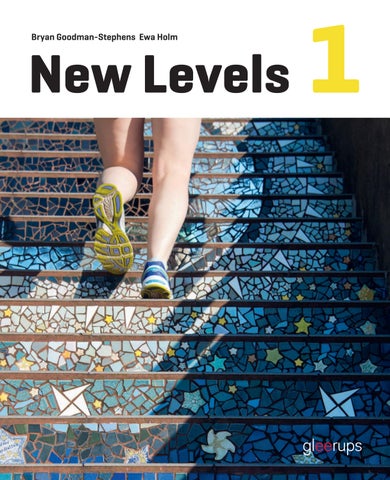
Bryan Goodman-Stephens Ewa Holm
New Levels 1

Introduction
Welcome to New Levels 1, a course book for Level 1 of the Swedish basic adult English course (Engelska, nationell delkurs 1), and also for students who need to learn or revise basic English language skills. This edition is certidied for Komvux25.
The book has five units, which are each divided into three parts. Each of the five units is based on a general theme and the three parts in each unit are linked to that theme. Each part has the following structure:
• S how what you know – exercises allowing you to show what you already know and to practise the key vocabulary of the unit. You can also find extra practice on skills vocabulary in the Skills focus section at the end of the book.
• Main texts for reading and listening – texts of different types and genres, from different parts of the world, which contain key vocabulary and grammar and help you develop your reading skills.
• Look at the texts – questions and activities related to the main texts. At the end of this section is a grammar discovery activity called I spy grammar. Here you have the chance to show what you already know about the grammar before it is presented.
• Improve your English – presentation of the key grammar, with examples taken from the main texts. You can then practise the grammar in a wide variety of exercises, as well as further tasks and activities to help you develop your pronunciation, listening, speaking and writing skills.
There are also additional Time out pages which focus on cultural aspects of the English-speaking world. Finally, each unit also contains a Dig Deeper box – a task related to the theme, where you and your classmates have to look for information online and then share it in class.
Each exercise also has a small symbol to show you which skill is practised: reading listening speaking writing pronunciation discovery exercise grammar presentation/rules
At the back of the book there are Skills focus pages to practise the main skills vocabulary, a Language school section with useful information on grammar, writing and expressions for speaking, and Classmates – fact files of the five main characters that you will get to know in New Levels 1 and the other books in the series.
In the digital New Levels 1 student practice and teacher’s material you can find:
• audio files for all main texts, listening and pronunciation exercises (plus Internet links for songs)
• t he answer key for all exercises and scripts for all listening texts
• ex tra interactive exercises to practise grammar, vocabulary, reading and listening
• word lists for each part that you can complete with definitions, example sentences, pictures or translations into your own language
• an interactive word list that allows you to listen to correct pronunciation
We hope that this book can help you take your English to a new level!
UNIT 1: WELCOME 7
1.1 A tour of the school 8
1.2 The first English lesson 16
Parts of a school Numbers 0–10 (Skills focus)
Countries and towns Alphabet A–Z (Skills focus)
1.3 In the school canteen 24 Food Numbers 11–20 (Skills focus)
UNIT 2: MEETING PEOPLE 33
2.1 My home town 34
2.2 Making friends 42
2.3 Friends and family 50
UNIT 3: LIFESTYLES 59
3.1 Life’s good 60
3.2 Life’s hard 68
3.3 Busy lifestyle 76
UNIT 4: WORK AND TRAVEL 85
4.1 A job for life? 86
4.2 Getting to work 94
Places in a town Days of the week (Skills focus)
Appearance Numbers 21–50 (Skills focus)
Parts of a house Family Numbers 51–100 (Skills focus)
Lifestyle words (1) Numbers 101–1,000,000 (Skills focus)
Lifestyle words (2) Colours (Skills focus)
Lifestyle words (3) Months and seasons (Skills focus)
Verb ‘be’: am, are, is This is/That is Subject pronouns
Verb ‘be’: short forms/negatives/questions
Articles: a, an, the
Jobs Money (Skills focus)
Transport and more jobs Time (Skills focus)
4.3 A TV quiz show 102 Countries in Europe Years (Skills focus)
UNIT 5: SUCCESS 111
5.1 New arrivals 112
Life words Dates (Skills focus)
5.2 Well done! 120 Verbs Containers and measurements (Skills focus)
5.3 No more problems? 128
Learning English Time expressions in the past (Skills focus)
Plural nouns There is/There are Some/Any And, but/Very, too
Have got I like
Demonstrative pronouns: this, that, these, those Prepositions of place: at, in, on, under
Present simple with I, you, we, they Adverbs of frequency: how often?
Present simple with he, she, it
Subject pronouns: I, you, he, she, it, we, they Object pronouns: me, you, him, her, it, us, them Possessive pronouns: my, your, his, her, its, our, their
Past simple of ‘be’: was, were There was/There were Indefinite article (a/an) with jobs
Past simple of regular verbs: positive (-ed ) More prepositions: by, for, at
Ordinal numbers: 1st, 2nd, 3rd Comparative and superlative adjectives: faster, the fastest
Past simple of regular verbs: negative and questions
Past simple of irregular verbs
Can, can’t/Could, couldn’t Adverbs
PRONUNCIATION
Say the sentences
Long/short forms of be
SPEAKING/WRITING
Talk about the school
Ask and answer questions
Talk and write about yourself (1)
Different ways of saying a, an, the Make conversation
Write a conversation
The - s in plural nouns
Long/short forms of have got
Pronunciation of th
Do in questions
Deduction: which town?
Write about your city/town/village
Talk and write about yourself (2)
Talk about the people in a house
Write about your family (with family tree)
Talk and write about lifestyles
The - s in he/she/it verbs (present simple) Describe somebody you know
Pronouns
How do you say a? (including schwa [ə])
The - ed in regular verbs (past simple)
Interview with a famous person
Talk and write about your new job and your old job
Talk and write about your new lifestyle and your old lifestyle
Tongue twisters with th and f Quiz show: write questions and role play
OTHER
Storyline: You are in classroom six/In the classroom/In the library/In the canteen
Dig Deeper Capital cities
Time out: Hello, Goodbye by the Beatles
Liaison (past simple regular verbs)
Irregular verbs – present and past
Can etc. and adverbs
Talk and write about a famous immigrant’s life/your own life
Talk and write about successes
Talk and write about what you could/ couldn’t/can/can’t do
Write about a successful immigrant
Storyline: Is this your profile?/ Sam’s family
Dig Deeper Family tree
Time out: We Are Family by Sister Sledge
Storyline: Back in the canteen
Dig Deeper Busy lifestyle
Time out: Global English
Storyline: After school
Dig Deeper TV quiz shows
Time out: Language problems
Storyline: Famous immigrants/ Maybe tomorrow?
Dig Deeper A famous immigrant
Dig Deeper A successful immigrant
Time out: Someone Like You by Adele
CLASSMATES 173
We are the students and teachers in New Levels 1. Nice to meet you!
Students









Teachers


Ivan Johan Leena
Alia
Ana Barbara
Mamdouh Mona Nasim
Maria Sam
Unit 1 Welcome

1.1 A tour of the school (pages 8–15)
1.2 The first English lesson (pages 16–23)
1.3 In the school canteen (pages 24–31)
Time out Hello, Goodbye by the Beatles (page 32)
Skills focus Numbers 0–10, Alphabet A–Z, Numbers 11–20 (pages 138–140)
1.2 The first English lesson
Show what you know
A. Find the countries on the map.
B. Listen and say the letters.
In the classroom






C. Read and listen. Find the countries in the text.
Hello everybody, my name’s Maria. That’s M-A-R-I-A. I’m from the UK. I’m your English teacher for this course. Please say and spell your name and the country you are from.
Hi everybody, I’m Ivan. That’s I-V-A-N. I’m from Poland.
Good morning, everybody. I’m Alia and I’m from Somalia. Alia: that’s A-L-I-A.
Hi there. My name’s Ana and I’m from Colombia. No problem with Ana: A-N-A.
Hello, my name’s Mamdouh. That’s M-A-M-D-O-U-H and I’m from Syria.
Good morning. My name’s Mona and I’m from Uppsala in Sweden. Mona: that’s M-O-N-A.
Ana
Mona Alia
Mamdouh
Maria
Ivan
In the library







D. The two teachers talk about the students. Listen and read.
Maria: OK, let’s check the new students. I think this is Alia. She’s from Somalia.
Sam: Yes, you’re right. That’s Alia. I’m sure.
Maria: And this is Mamdouh. Is he from Kabul?
Sam: No, he isn’t. He’s from Aleppo.
Maria: Aleppo?
Sam: Yes, it’s in Syria. And this is Johan and Barbara. Are they single?
Maria: No, they aren’t single. They’re married and they’re from Gothenburg in Sweden.
Maria Sam
Alia Mamdouh
Johan Barbara
Look at the texts
E. Look at the first English lesson on page 17. Choose A or B.
1. The name of the English teacher is
A. Maria
B. Mary
2. The teacher is from
A. the UK
B. the USA
3. There are … students in the class.
A. five
B. six
4. Alia is from A. Colombia B. Somalia
5. Mamdouh is from A. Syria
B. Sweden
6. Mona is from A. Poland
F. Read the conversation on page 18. Match the pairs.
1. The teachers check
A. are married.
2. Aleppo is B. from Syria.
3. Johan and Barbara
C. the new students.
4. Mamdouh is D. in Sweden.
5. Gothenburg is E. in Syria.
G. Work with a partner. Say and spell your names.
B. Sweden And I’m Mamdouh. That’s M-A-M-D-O-U-H.
My name’s Alia. That’s A-L-I-A.

H. I spy grammar!
1. Underline all the short forms of the verb ‘be’ (’m, ’re, ’s) in the texts on pages 17–18.
2. Circle all negative forms of the verb be (...n’t) and questions (?) in the two texts.
Improve your English
Verb ‘be’: short forms/negatives/questions
+ Short forms (positive)
Singular Plural
I ’m (I am) we’re (we are) you’re (you are) you’re (you are) he’s (he is) they ’re (they are) she’s (she is) it ’s (it is)
Note:
Use short forms when you speak: My name is Leena. y My name’s Leena.
The short form of ’That is’ is ’That ’S’. There is NO short form of ’This is’.
I’m from Somalia. He’s in the canteen. They’re from Gothenburg.
- Negative
Singular Plural
I’m not (I am not)
We aren’t (We are not) You aren’t (You are not) You aren’t (You are not) He isn’t (He is not) They aren’t (They are not) She isn’t (She is not) It isn’t (It is not)
? Question
Are you Alia?
+ Yes, I am. / - No, I ’m not. Is he from Kabul?
+ Yes, he is. / - No, he isn’t . Are they single?
+ Yes, they are. / - No, they aren’t
I. Write the long forms.
1. He’s from Australia.
2. I’m from London.
3. They’re Kyra and Joe.
4. This is Rosie. She’s from Liverpool.
5. Baghdad’s in Iraq. It’s in Iraq.
6. You’re right. That’s Ana.
J. Write the short forms.
1. I am from Somalia.
2. That is Mona. She is from Baghdad.
3. They are Ali and Aisha. They are from Kabul.
4. This is Bruce. He is from Australia.
5. Aleppo is in Syria. It is in Syria.
6. You are right. That is Martin. He is from Australia. I’m from Somalia.
K. Listen and repeat. How do we say the long and short forms?
1. That is right. That’s right.
2. I am from Somalia. I’m from Somalia.
3. That is Mona. She is from Baghdad. That’s Mona. She’s from Baghdad.
4. They are Ali and Aisha. They’re Ali and Aisha. They are from Kabul. They’re from Kabul.
5. This is Bruce. He is from Australia. This is Bruce. He’s from Australia.
6. Aleppo is in Syria. It is in Syria. Aleppo is in Syria. It’s in Syria.
7. You are right. That is Martin. You’re right. That’s Martin.
L. Make the sentences negative.
1. He is married.
2. They are from Kabul.
3. She is French.
4. You are a student.
M. Complete the questions.
1. ________ ________ from London? Yes, he’s from London.
2. ________ ________ married? No, they’re single.
3. ________ ________ American? Yes, she’s American.
4. ________ ________ English? No, I’m not English.
N. Listen. Write the names and countries.
1. Name: __________________________ Country: __________________________
2. Name: __________________________ Country: __________________________
3. Name: __________________________ Country: __________________________
4. Name: __________________________ Country: __________________________
5. Name: __________________________ Country: __________________________
6. Name: __________________________ Country: __________________________ He isn’t married. Is he
Dig Deeper
Ask your teacher for help finding the capital cities of the countries on the map on page 16. Say and spell them to your partner or to the class: Afghanistan – Kabul – K-A-B-U-L
O. Write five sentences about yourself. You are Melanie or Jack.



Language school/Writing (pages 167–171)




P. You are a student in your first English class. Talk about yourself.
Hello/Hi/Good morning, everybody.
My name is Mona. I’m from Sweden.
Introduce your friends.
This is Ivan. He’s from Poland.
This is Ana. She’s from Colombia.
This is Johan and Barbara. They’re from Sweden.



Melanie, student, Toronto (Canada)
Jack, student, Boston (USA)
Language school Grammar
Dig Deeper
There are many grammar sites online. They are usually free and they have lots of information and good examples of English grammar. For example: EnglishClub.com BBC Learning English Grammar-monster.com
You can also just search online for information with these keywords (or any other words in this grammar section): adjectives adverbs articles nouns singular plural prepositions pronouns verbs
Adjectives
Adjectives describe people, places, and things:
The old man.
The beautiful city. The big dog.
The coffee is hot.
You can use very or too to make an adjective stronger:
This coffee is very hot. (the coffee is hot but you can still drink it) This coffee is too hot. (negative meaning – you can't drink the coffee because it is so hot)
Comparative adjectives
You use a comparative adjective when you talk about two things. Most short adjectives end in -er in the comparative: fast – faster slow – slower
If the adjective ends in a consonant + -y you change it to -ier: ea sy – ea sier
hap py – hap pier
If the adjective has one syllable and ends in a single consonant you double the consonant:
big – bigger sa d – sadder
For longer adjectives you add the word more: modern – more modern popular – more popular
Some comparative adjectives are irregular: good – better bad – worse
Use the word than when you compare two things: Tom is faster than Billy. Football is more popular than rugby.
Superlative adjectives
You use a superlative adjective when you talk about more than two things.
Most short adjectives end in -est in the superlative: fast – fastest slow – slowest
If the adjective ends in a consonant + -y you change it to -iest:
ea sy – ea siest
hap py – hap piest
If the adjective has one syllable and ends in a single consonant you double the consonant:
big – biggest sad – saddest
For longer adjectives you add most: modern – most modern popular – most popular
Some superlatives adjectives are irregular: good – best bad – worst
You usually add the word the before a superlative adjective: Tom is the fastest in the class. Football is the most popular sport in the world.
New Levels 1
New Levels 1 är ett läromedel avsett för Engelska, nationell delkurs 1 inom kommunal vuxenutbildning på grundläggande nivå samt gymnasiets introduktionsprogram. Läromedlet kan användas av såväl rena nybörjare som elever som behöver repetera språket från grunden och är anpassat efter Komvux25.
Utöver elevboken finns även en elevträning med verktyg och ytterligare träningsmöjligheter för eleven, samt en ett digitalt lärarmaterial med värdefulla resurser för läraren att använda i undervisningen.
New Levels 1 finns även som heldigitalt läromedel – se www.gleerups.se.
• Elevbok, tryckt 51120751
• Digital elevträning, individlicens, 6 mån 51120805
• Digital elevträning, individlicens, 12 mån 51120799
• Digitalt lärarmaterial, individlicens, 12 mån 51120812
• Digitalt läromedel, elevlicens 6 månader 51120775
• Digitalt läromedel, elevlicens 12 månader 51120799
• Digitalt läromedel, lärarlicens 12 månader 51120812
Ewa Holm är komvuxlärare i engelska, svenska och svenska som andraspråk, samt erfaren textgranskare, redaktör och läromedelsförfattare.
Bryan Goodman-Stephens är en mycket erfaren lärare, lärarutbildare, utbildningskonsult, skolinspektör och författare som har skrivit läromedel i över 30 år.