your HEALTH body / mind / fitness
May 26, 2022
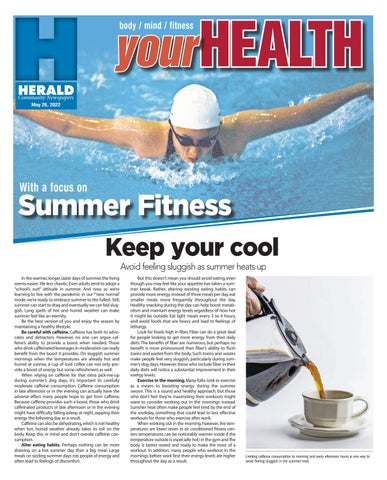
With a focus on
Summer Fitness Keep your cool Avoid feeling sluggish as summer heats up In the warmer, longer, lazier days of summer, the living seems easier, life less chaotic. Even adults tend to adopt a “school’s out!” attitude in summer. And now, as we’re learning to live with the pandemic in our ‘“new normal’ mode, we’re ready to embrace summer to the fullest. Still, summer can start to drag and eventually we can feel sluggish. Long spells of hot and humid weather can make summer feel like an eternity. Be the best version of you and enjoy the season by maintaining a healthy lifestyle. Be careful with caffeine. Caffeine has both its advocates and detractors. However, no one can argue caffeine’s ability to provide a boost when needed. Those who drink caffeinated beverages in moderation can really benefit from the boost it provides. On sluggish summer mornings when the temperatures are already hot and humid at sunrise, a cup of iced coffee can not only provide a boost of energy but some refreshment as well. When relying on caffeine for that extra pick-me-up during summer’s dog days, it’s important to carefully moderate caffeine consumption. Caffeine consumption in late afternoon or in the evening can actually have the adverse effect many people hope to get from caffeine. Because caffeine provides such a boost, those who drink caffeinated products in late afternoon or in the evening might have difficulty falling asleep at night, zapping their energy the following day as a result. Caffeine can also be dehydrating, which is not healthy when hot, humid weather already takes its toll on the body. Keep this in mind and don’t overdo caffeine consumption. Alter eating habits. Perhaps nothing can be more draining on a hot summer day than a big meal. Large meals on sizzling summer days rob people of energy and often lead to feelings of discomfort.
But this doesn’t mean you should avoid eating, even though you may feel like your appetite has taken a summer break. Rather, altering existing eating habits can provide more energy. Instead of three meals per day, eat smaller meals more frequently throughout the day. Healthy snacking during the day can help boost metabolism and maintain energy levels regardless of how hot it might be outside. Eat light meals every 3 to 4 hours, and avoid foods that are heavy and lead to feelings of lethargy. Look for foods high in fiber. Fiber can do a great deal for people looking to get more energy from their daily diets. The benefits of fiber are numerous, but perhaps no benefit is more pronounced than fiber’s ability to flush toxins and wastes from the body. Such toxins and wastes make people feel very sluggish, particularly during summer’s dog days. However, those who include fiber in their daily diets will notice a substantial improvement in their energy levels. Exercise in the morning. Many folks look to exercise as a means to boosting energy during the summer swoon. This is a sound and healthy approach, but those who don’t feel they’re maximizing their workouts might want to consider working out in the mornings instead. Summer heat often make people feel tired by the end of the workday, something that could lead to less effective workouts for those who exercise after work. When working out in the morning, however, the temperatures are lower (even in air conditioned fitness centers temperatures can be noticeably warmer inside if the temperature outside is especially hot) in the gym and the body is better rested and ready to make the most of a workout. In addition, many people who workout in the mornings before work find their energy levels are higher throughout the day as a result.
Limiting caffeine consumption to morning and early afternoon hours is one way to avoid feeling sluggish in the summer heat.
Stay hydrated — stay healthy
S-2
HERALD COMMUNITY NEWSPAPERS — YOUR HEALTH - May 26, 2022
ASK THE DOCTOR
DEAR
Dr. Tina
When the heat rises, keep the fluids coming When the temperatures rise, getting enough to drink is important whether you’re playing sports, traveling or just sitting in the sun. And it’s critical for your heart health. Keeping the body hydrated helps the heart more easily pump blood through the blood vessels to the muscles. And, it helps the muscles remove waste so that they can work efficiently. “If you’re well hydrated, your heart doesn’t have to work as hard,” says John Batson, M.D, a sports medicine physician
Board-Certified by the American Board of Dermatology and the author of “The Doctor’s Secret”
Dr. Tina is taking your skin related questions via her Instagram @tinafuntmd and Tfmdbook@gmail.com
Dr Tina Funt
SKIN CONCERNS FOR SENIORS
Board-Certified by the American Board of Dermatology and Author of The Doctor’s Secret
These can be keratosis (warty Why is my skin itching? has we been growths), angiomas (red bumps) and As seniors, losenamed moistureain brown spots (liver spots or lentigos). our skin. This is due to older cells Power Womanmoisture. of the This East not maintaining is End! They are benign but can itch, bleed, or look unsightly. The good news is the number one reason itching that they are easy to remove. occurs. It is essential to moisturize at least once daily. You can use Do skin cancers occur more lotions (lighter), creams (thicker) or frequently as we age? ointments (greasy). If we still itch Yes. Again, cell communication after we add moisture, we need and the body’s immune system to check for underlying medical decreases with age, leading to conditions that cause itching. development of skin cancer. It is vital Diseases such as thyroid, liver, to get “skin checkups” on a regular kidney, and blood diseases can basis. Skin cancers that are detected cause severe itching. Thus, the earlier are easier to treat with better itching can be a marker for severe outcomes. internal disease. Why do I get more spots as I age? As we age, the communication between our cells diminishes leading some cells to grow more rapidly causing small growths.
Can we treat wrinkles and sunspots? We treat wrinkles with fillers, Botox products and lasers. We treat brown spots with lasers and bleaching creams.
IS YOUR BOOK “THE DOCTOR’S SECRET” AN AUTOBIOGRAPHY?
r Tina Funt
a
Dr. Tina K. Funt is a Board-Certified Dermatologist practicing in Garden City for 33 years. She works for Schweiger Dermatology Group with 80+ offices throughout Long Island and the tri-state area. Dr. Funt specializes in both medical and cosmetic dermatology. Her passions are medicine, the arts, golf and dogs.
rd-Certified by ADVERTORIAL the American Board of Dermato
1171817
The Doctor’s Secret is a fiction based on autobiographical events. Many authors write about real events but use the platform of fiction to enhance creativity. The book stresses the importance of determination, resilience and support of friends and family while navigating life’s challenges. “The Doctor’s Secret” is a must read and can be purchased on amazon. com (Tina K. Funt, M.D., The Doctor’s Secret) or DM Dr. Tina at tfmdbook@gmail.com to purchase novel or ask your skincare questions.
Understand dehydration Dehydration can be a serious condition that can lead to problems ranging from swollen feet or a headache to life-threatening illnesses such as heat stroke. t can cause a host of complications and even prove fatal in severe cases. But as dangerous as dehydration can be, many cases are entirely preventable. The best way to prevent dehydration is to drink enough water. When the body does not take in as much water as it puts out, it can become dehydrated. People who live in warm climates or in elevated altitudes may lose more water than those who do not. In addition, water loss is accelerated during strenuous exercise, highlighting the emphasis men and women must place on drinking enough water during their workouts. But water does more for the body than prevent dehydration. Water can help people maintain healthy weights. Dieting fads come and go, but water is a mainstay for people who want to control their caloric intake in an effort to maintain healthy weights. Water has zero calories, so reaching for a bottle or glass of water instead of a soda, lemonade or another caloric beverage can help people keep the pounds off. A study from researchers at the University of Texas Health Science Center found that even diet soda enhances weight gain by as much as 41 percent. In addition, soda has been linked to conditions such as obesity, diabetes and tooth decay. No such association exists with water. Water helps to fight fatigue. The fatiguefighting properties of water are another of its lesser known benefits. When the body is not adequately hydrated, it can experience muscle soreness. And fitness enthusiasts who do not drink enough water may notice their bodies require extensive recovery time after working out. Each of those consequences can be prevented by drinking enough water, and doing so can even improve performance, as studies have shown that just a 3 percent loss of body weight due to dehydration can cause as much as a 10 percent drop in performance level. Water can improve the appearance of the skin. Skin that does not get enough water can turn dry and flaky and feel tight. In addition, dry skin is more likely to wrinkle than adequately hydrated skin. Getting water to the skin can be tricky, as the University of Wisconsin-Madison School of Medicine and Public Health notes that water will reach all the other organs of the body before it reaches the skin. But the school recommends applying a hydrating moisturizer within two minutes of leaving the bath or shower and drinking at least eight glasses of water a day to ensure the skin is getting enough water. Water helps the gastrointestinal tract. Water can help maintain normal bowel function. When the body lacks sufficient fluid, the colon will pull water from stools in an effort to stay hydrated.
That can lead to constipation, a condition in which people experience difficulty emptying their bowels. By drinking enough water, people can ensure their colon will not have to pull water from stools to stay hydrated, thereby helping them stay regular. How much water do you need? What does being well hydrated mean? The amount of water a person needs depends on climatic conditions, clothing worn and exercise intensity and duration, Batson says. A person who perspires heavily will need to drink more than someone who doesn’t. Certain medical conditions, such as diabetes or heart disease, may also mean you need to drink more to avoid over-taxing the heart or other organs. And some medications can act as diuretics, causing the body to lose more fluid. Thirst isn’t the best indicator that you need to drink. “If you get thirsty, you’re already dehydrated,” Batson says. Batson said the easiest thing to do is pay attention to the color of your urine. Pale and clear means you’re well hydrated. If it’s dark, drink more fluids. If you want to know exactly how much fluid you need, Batson recommends weighing yourself before and after exercise, to see how much you’ve lost through perspiration. It’s a particular good guide for athletes training in the hot summer months. “For every pound of sweat you lose, that’s a pint of water you’ll need to replenish,” Batson says, adding that it’s not unusual for a high school football player, wearing pads and running through drills, to lose five pounds or more of sweat during a summer practice. Not sweating during vigorous physical activity can be a red flag that you’re dehydrated to the point of developing heat exhaustion. Not just for athletes or exercise Hydration isn’t just important during physical activity. Sitting in the sun on a hot or humid day, even if you aren’t exercising, can also cause your body to need more fluids. People who have a heart condition, are older than 50 or overweight may also have to take extra precautions. It’s also a good thing to keep tabs on if you’re traveling.“You might sweat differently if you’re in a different climate,” Batson says. Above photo: As the mercury rises, pay close attention to an important aspect of your health — your hydration.
S-3
Sun myths exposed
When the weather gets warmer, a great number of people take to the outdoors to participate in athletics, to enjoy a meal al fresco or to take a dip in a pool. However, fun in the sun does come with risk, most notably overexposure to the sun’s potentially harmful rays. Misinformation often reigns supreme with regards to sun exposure. Here are some common sun myths debunked.
Love the skin you’re in
Kick back, relax, but don’t skimp on your skincare routine
W
armer weather means more sun and that means you will have to take extra care of your skin. With the advent of this season, your skin starts screaming for more protection — from exhibiting those annoying rashes and sunburns to the stubborn tan and acne. So it’s essential that you up your skincare game right away to stay away from unwanted summer skin issues. Let’s see how. Winter brings dry weather that strips the skin of its natural moisture and causes scaly, itchy skin. Humidity during summer can lead to bacterial infections due to sweat, clogged pores and acne breakouts. Air conditioning in summer and heaters in winter can both dehydrate the skin. So each season comes with its set rules of skincare. First off, transition from winter weather, which can really do a number on your skin and dry it out. Use a gentle exfoliating scrub to get rid of the dry, dead winter skin. You should exfoliate your face as well. Remember, you will need to buy separate exfoliant for your body and face. You’ll want to use a more gentle exfoliant for your face than you would use for your body. You can also find face masks that will help get all the dead skin off your face without having to use a scrub that could cause tiny skin tears.
Sunscreen is self-care The sun’s warm rays can be very harmful to your skin. As the temperature begins to rise, people want to be outside and enjoying the sun, especially after being sidelined in our homes throughout the pandemic. The sun’s UV-A and UV-B rays can be very harsh. Besides giving you a stubborn tan, they can cause premature aging, age spots, fine lines, wrinkles, and melanoma. You should always be careful exposing your skin to sun without sunscreen. It’s crucial to apply a good sunscreen during the spring and summer months. Apply sunscreen with at least a good SPF 30 (or higher) to both your face and your body. If you go swimming, apply sunscreen multiple times. Opt for a good skin care routine Maintain a skin care regimen and follow it religiously. Choose gel-based (for dry skin) and water based (for oily skin) rather than cream-based products as the former are lighter and non-greasy. Cleansing, toning and moisturizing twice a day will help keep your skin clean and fresh. Remove the excess oil. In summer, oily skin can get more oily. Use a face wash suited to your skin type that can deep cleanse and remove all the dirt and grime. People
with dry skin would need a non-foaming cleanser. Opt for mild, alcohol-free and pH balanced cleansers. Moisturize, moisturize, moisturize Cold weather dries your skin out and your skin may have soaked up the heaviest of moisturizers you may have. During spring and summer, you’ll want to switch it up to a light moisturizer that won’t leave your skin feeling greasy. Find one that makes your skin feel hydrated and healthy. Find a hyaluronic acid-or water-based formula. Your skin holds more water during the summer and spring months, so you won’t need as much moisturizing protection as you would during cold months. Choose a non-greasy formula based on your skin type. But look for ingredients like antioxidants like vitamins A and C. If it has SPF, even better. It is best to apply a moisturizer immediately after your bath or shower. Keep your skin hydrated Hydration is key at all times during summer. You can use a hydrating face mask after you wash your face at night for some extra hydration while you sleep. Splash your face frequently with water or carry a facial mist to freshen your skin at regular intervals. Also hydrate by drinking a lot of water. It hydrages your skin as well as your body. Eat more fruits and veggies Applying sunscreen and moisturizer are great ways to liven your skin up during the warmer weather, but there are also dietary things you can do to help your skin. Eating nutrient-rich food packed with vitamins and minerals — those fruits and vegetables — also work wonders for yourn skin. Fruits and vegetables such as blackberries, guavas, kiwi, cucumbers, oranges, and strawberries are just some of the fruits and veggies that aid in skin care. Don’t forget your eyes, lips and feet Always wear sunglasses to protect the eyes from the sun’s harmful rays. Use a moisturizing under eye gel; and a lip balm with SPF under your lipstick. Scrub your feet to exfoliate. Apply sunscreen and moisturizer on your feet too, especially if you are wearing open-toed sandals.
Above photo: Your skin requires extra attention and care during summer. With a few simple steps like cleansing and moisturizing, staying hydrated and using sunscreen, you can protect your skin from the harmful effects of the sun and heat.
Myth: I don’t have to worry about the sun on cloudy days. Truth: There is a risk of exposure to UV radiation even on cloudy days, necessitating the application of a sunscreen or sunblock. According to the Skin Cancer Foundation, up to 80 percent of the sun’s ultraviolet rays can still pass through the clouds. Even if the weather is cool or overcast, apply sunblock before going outdoors. Myth: Most sun damage occurs before age 18. Truth: Recent studies indicate that previous estimates were inaccurate and that only 25 percent of sun exposure occurs during childhood. That makes being sun-smart important at any age. Myth: Establishing a base tan provides a safe way to tan afterward. Truth: There is no such thing as a safe tan if it’s coming from the sun or a tanning bed. Spending prolonged periods of time outdoors unprotected from the sun can damage the skin. For those who want to have skin that glows, consider a self-tanning lotion. Myth: Light clothing reflects the sun’s rays while dark colors absorb it. Truth: UV rays tend to pass through light-colored fabrics easier than darker ones. If you are able to see light through a piece of clothing, there’s a good chance UV rays can pass right through to the skin. Choose deep colors to protect the skin better. Myth: Sun rays do not pass through windows. Truth: UVB rays cannot pass through windows but UVA rays can. While you may not get a sunburn sitting next to a window, you may experience premature aging from freckling and wrinkles. Myth: A beach umbrella is adequate protection from the sun at the beach. Fact: Although the umbrella will shade you somewhat, the surrounding sand reflects up to 17 percent of UV radiation. That means you can still get skin damage if you don’t apply sunblock. Myth: Makeup that contains SPF is protection enough. Fact: Some makeup will offer a light measure of protection from the sun, but will not be adequate. Furthermore, some shiny or glossy products actually can draw the UV rays to areas where the product was applied. Myth: Sunscreens can increase skin cancer rates. Truth: Research indicates this is only the case if you use sunscreen to spend more time out in the sun. When used correctly, sunscreens can lower skin cancer rates. Myth: Dark-skinned individuals do not get sunburn. Truth: Although people with more melanin pigment in their skin may not burn at the same rate as lighter-skinned individuals, there is still the chance for skin damage if sunscreen isn’t used. Myth: Vitamin D deficiency will occur if I don’t spend long times out in the sun. Truth: While it’s true that sunlight exposure is necessary for the body to produce vitamin D naturally, it doesn’t take that much exposure to do so, even when wearing sunscreen. The Cancer Council of New South Wales says most people get enough vitamin D from their everyday activities during the summer, even when protected with hats, sunscreen and clothing. During the months when there is limited sunlight, a supplement may be needed. Enjoy the outdoors during the short summer months but be smart about using sun protection. Above photo:Be sensible about protecting yourself from too much sun exposure while enjoying the outdoors.
HERALD COMMUNITY NEWSPAPERS — YOUR HEALTH - May 26, 2022
Summer smarts
HEALTH HEALTHMEMOS MEMO
S
Tips to prevent sports and exercise injuries
oon, spring will give way to summer and with it an increase in outdoor sports and exercise activities. Over 30 million children and adolescents in the United States will sign up for sport specific camps, clubs and travel team sports, while millions of adults will take to the tennis and basketball courts, bicycle and running paths, and golf courses as weekend warriors. This increased physical activity among all age groups results in a seasonal increase in visits to emergency rooms or orthopedic practices for sports related orthopedic injuries. Approximately two-thirds of the injuries are soft-tissue injuries, including sprains (tearing/stretching of a ligament) and strains (tearing/injury of a muscle or tendon). Only 5 percent of children’s sports injuries involve broken bones. Mount Sinai South Nassau orthopedic and sports medicine experts say there are steps that should be followed before jumping into action and participating in your favorite summer sports, fitness and recreational activities. “It’s important to warm up first before any activity followed by stretching after a workout,” said Stelios Koutsoumbelis, MD, Chief of Orthopedic Surgery at Mount Sinai South Nassau. “Injuries and accidents occur when people rush back into action without proper preparation.” To prevent such injuries, Dr. Koutsoumbelis recommends these simple tips before exercising: 1. Follow a schedule that sticks to the “10 percent rule” of increasing the intensity, volume, distance, and duration of workouts. Make time for rest and recovery after strenuous exercise. 2. Warm up first, followed by stretching before practice or training. 3. Diversify training by combining or alternating activities like walking, jogging, biking, or weightlifting. Improving your core strength, lower extremity balance, flexibility, and cardiovascular
endurance can enhance your fitness. 4. Listen to your body; if you feel pain, soreness, or tightness, stop! Early intervention with targeted conditioning and stretching exercises, or even physical therapy, is key to avoiding further injury. 5. Eat healthy. Be sure to include fruits and vegetables and adequate portions of protein in your daily diet. 6. If you or your child suffers an injury, don’t live by the rule “no pain, no gain.” Mount Sinai South Nassau’s sports medicine professionals are ready to help by applying their experience and expertise to develop a tailored plan that will lead to a faster recovery and prevent reinjury. If surgery is needed, the hospital’s orthopedic surgeons use minimally invasive arthroscopic and image-guided surgery to repair common and complex orthopedic sports injuries. “The benefits of minimally invasive and arthroscopic surgery
include reduced post-operative pain, less scarring, a quicker recovery, and a faster return to normal activities,” said Dr. Koutsoumbelis. “Many of these surgeries can be performed on an outpatient basis.” Minimally invasive procedures such as the Birmingham Hip resurfacing may eliminate the need for traditional hip replacement surgery, just as the Uni-Knee partial knee replacement and ImageGuided knee replacement procedures may help you avoid open surgery. Knee and shoulder injuries repaired at Mount Sinai South Nassau include torn cartilage and anterior cruciate, posterior cruciate, and medial collateral ligaments in the knee as well as instability, impingement, rotator cuff, or labrum tears and recurrent dislocations in the shoulder. Mount Sinai South Nassau’s orthopedic spine surgeons also use minimally invasive surgical approaches that provide short- and longterm relief from painful back problems, such as herniated discs and stenosis. To ensure that you maximize the benefits of the treatment plans prescribed to you, Mount Sinai South Nassau’s Physical Medicine and Rehabilitation team of an experienced physiatrist along with a physical and occupational therapist will provide a top-notch multidisciplinary-based rehab program.
Get a leg up on recovery and return to action sooner by calling Mount Sinai South Nassau Orthopedics at (866) 32-ORTHO or (866) 326-7846. For more information on orthopedics, go to www.southnassau.org/orthopedics
One Healthy Way Oceanside, NY 11572 • 877-SOUTH-NASSAU (877-768-8462) • www.mountsinai.org/southnassau Health memos are supplied by advertisers and are not written by the Herald editorial staff.
HEALTH MEMO Exercise … it does a body, and mind, good!
E
1174544
HERALD COMMUNITY NEWSPAPERS — YOUR HEALTH - May 26, 2022
S-4
xercising regularly will make your heart and blood circulatory system more efficient. It will also help to lower your cholesterol and keep your blood pressure at a healthy level, decreasing your risk of developing some kinds of dementia. Research from Dr. Kramer, at the University of Illinois, found that brain volume (as measured in an MRI) actually increases in people who regularly exercise. For most people, a minimum of 150 minutes (2 hours and 30 minutes) of moderate-intensity aerobic activity each week, such as cycling or fast walking, is recommended. Try these exercises to help maintain a healthy senior lifestyle and possibly reduce the risk of developing dementia. Endurance: Walking briskly with no incline. Walking is great to get the senior heart rate up, without straining joints. 15 to 30 minutes of brisk walking 3 to 4 times a week is a great way to help seniors maintain both physical and mental fitness. Swimming: Water is great for older joints as it is buoyant and provides a free-flow, low-impact environment for senior workouts. Either lap swimming or water aerobics are great for seniors. Many health centers offer either open lap swim or senior water aerobics classes, so check with your local community pool. Gardening. Gardening offers an enjoyable
alternative to working out, although it’s more difficult to measure the exercise. If gardening is the desired workout, make sure it’s alternated with another endurance option. Cycling on stationary bicycle. Cycling on a stationary bicycle can be a senior favorite as it can be done while watching tv. 15 to 30 minutes on the bicycle is ideal to get the heart rate up. There are additional resistance and strength exercises that can also be healthy for the body and mind. Remember to always consult your physician before starting a new exercise regimen.
(516) 788-7830 ilovehearing.com
Health memos are supplied by advertisers and are not written by the Herald editorial staff.
S-5
HERALD COMMUNITY NEWSPAPERS — YOUR HEALTH - May 26, 2022
Restore Your Hearing
at I Love Hearing At I Love Hearing, we use a special MEET OUR TEAM process to ensure that our clients receive the ideal hearing loss solutions for their needs. Dr. Amy Sapodin,
3 Hearing aid fitting 3 Hearing aid repair 3 Hearing testing
3 Hearing protection
3 Tinnitus therapy
3 Ear wax management
Au.D., F-AAA, CCC-A
3 Auditory therapy & rehabilitation Dr. Alison Hoffmann,
(516) 788-7830 ilovehearing.com 30 Merrick Avenue North, Suite 109, East Meadow, New York 11554
Seth Dank,
Clinical Audiologist, M.A., F.A.A.A
1174671
Au.D., F-AAA, CCC-A
1172474
PARKER CARE. THE BEST. FOR THE BEST.
THEY GAVE YOU THE BEST
Short Term Rehabilitation | Long Term Care | Home Health Care | Hospice | Palliative Care Inpatient And Outpatient Dialysis | Medical House Calls | Managed Long Term Care | Medicare Advantage Plan 271-11 76th Avenue New Hyde Park, NY 11040 | 877-727-5373 | parkerinstitute.org
1174597
NOW IT’S YOUR CHANCE TO GIVE THEM THE BEST
HEALTH HEALTHMEMOS MEMO
HERALD COMMUNITY NEWSPAPERS — YOUR HEALTH - May 26, 2022
S-6
T
Queens Long Island Renal Institute provides dialysis patients care, safety and convenience
he award-winning Queens Long Island Renal Institute focuses on care, safety and convenience for kidney dialysis patients in the New York metropolitan area. Located in the lobby level of Parker Jewish Institute for Health Care and Rehabilitation with its own entrance, the center provides care to Parker’s residents and patients as well as to the general public. Queens Long Island Renal Institute offers the finest quality of care, state-of-the-art technology and uncompromised dignity, in a bright, ultramodern and comfortable setting. The center is a certified 5-Diamond Status Facility, and is recognized for its demonstrated commitment to quality improvement by building and promoting a culture of patient safety. To earn this status, dialysis facilities must apply for the recognition each year. They must complete the program’s Culture of Safety module each year. A facility’s entire staff - including dieticians, management, nurses, medical directors, social workers and technicians - must participate in the program in order to qualify. Licensed by the New York State Department of Health, QLIRI is led by a dedicated, interdisciplinary team of experienced nephrologists and dialysis registered nurses, a
About Parker Jewish Institute for Health Care and Rehabilitation Parker Jewish Institute for Health Care and Rehabilitation, which is headquartered in New Hyde Park, is a leading provider of Short Term Rehabilitation and Long Term Care. At the forefront of innovation in patient-centered health care and technology, the Institute is a leader in teaching and geriatric research. Parker Jewish Institute features its own medical department, and is nationally renowned as a skilled nursing facility, as well as a provider of community-based health care, encompassing Social Adult Day Care, Home Health Care, Medical House Calls, Palliative Care and Hospice. renal social worker, and a registered renal dietitian. The team is ready to meet the individual needs of dialysis patients and families, and provides individual and family health education, as well as nutritional counseling and social work services. QLIRI is outfitted with an in-center chronic hemodialysis. It features comfortable, state-of-theart, private treatment stations with personal TVs. There is also a homelike reception area with a large-screen TV as well as free wireless access. It
accommodates stretchers, and offers valet parking. “With Queens Long Island Renal Institute conveniently located in Parker’s first-floor lobby, we continue to safely and comfortably meet the needs of our patients and residents, as well as members of the New York community who also benefit from our services,” said Michael N. Rosenblut, President and Chief Executive Officer of Parker Jewish Institute for Health Care and Rehabilitation.
Queens Long Island Renal Institute • 271-11 76th Ave., New Hyde Park • (718) 289-2600 Health memos are supplied by advertisers and are not written by the Herald editorial staff.
HEALTH MEMO
Parker Jewish Institute offers unparalleled care, comfort for older adults
F
ounded in 1907, Parker Jewish Institute for Health Care and Rehabilitation is headquartered in New Hyde Park. The facility is a leading provider of short term rehabilitation and long term care. At the forefront of innovation in patient-centered health care and technology, Parker Jewish Institute is a leader in teaching and geriatric research, serving as a teaching affiliate of Albert Einstein College of Medicine and Long Island Jewish Medical Center. Parker features its own medical department, and is nationally renowned as a skilled nursing facility, as well as a provider of community-based health care, encompassing Home Health Care, Medical House Calls, Palliative Care and Hospice. Parker’s Indian Cultural Unit is the first of its kind serving South Asian and Indo-Caribbean older adults in Nassau and Queens. It is staffed by medical team members fluent in Hindi, Punjabi, Malayalam, Gujarati and Bengali. Here, residents and patients stay connected with their traditional lifestyle and traditional Indian vegetarian cuisine is always served. Parker At Your Door provides Medical House Calls to patients in Nassau, Queens and Brooklyn. With this service, patients receive the medical care they need, right in the comfort of their home so that they can achieve the best level of health possible. Parker is also home to Queens-Long Island Renal Institute, providing safe, comfortable hemodialysis treatments in a relaxed setting. Through the unprecedented pandemic, Parker remains a leader. As mandates changed rapidly, Parker continues to drive new policies ahead of regulatory protocols. This includes Parker’s Infection Control Patrol, through which a multidisciplinary team rounds the facility’s care areas, ensuring that team members comply with
includes a regular concert series, during which residents sing, dance and clap along to the music. Through Virtual Reality experiences, residents can see Broadway shows, visit new cities, or even stop by an animal exhibit at a world-class zoo. And there are arts and crafts and other activities that remain popular year-round, promoting engagement and overall wellness. Today’s Parker is well positioned to continue its leadership in patient care, teaching and research, on the wings of compassion, excellence and innovation. Learn more about Parker Jewish Institute by visiting parkerinstitute.org, or call (718) 289-2100.
meticulous standards. It includes Parker’s virus-killing ultraviolet light system for its HVAC units, and upgraded generator system. Parker also launched a COVID 19 testing center and vaccination site. And with Parker’s Family Call Center, staff communicate regularly with families, providing resources as needed. During the height of the pandemic, Parker’s Family Call Center played an important role in enabling families to stay connected. “It is so important for families to see and speak with each other to stay in touch and enjoy companionship,” said Michael N. Rosenblut, Parker’s President and CEO. “Parker’s new Family Call Center continues to extend our ability to help families get the information they need, quickly. And the ability to connect family members through virtual technology helps to foster family relationships.” Parker continues to offer programs that residents enjoy. This
About Parker Jewish Institute for Health Care and Rehabilitation Parker Jewish Institute for Health Care and Rehabilitation, which is headquartered in New Hyde Park, is a leading provider of short term rehabilitation and long term care. At the forefront of innovation in patient-centered health care and technology, the Institute is a leader in teaching and geriatric research. Parker Jewish Institute fea-tures its own medical department, and is nationally renowned as a skilled nursing facility, as well as a provider of community-based health care, encompassing Social Adult Day Care, Home Health Care, Medical House Calls, Palliative Care and Hospice.
Parker Jewish Institute • (718) 289-2212 • lscacco@parkerinstitute.org Health memos are supplied by advertisers and are not written by the Herald editorial staff.
Move it — all summer long
S-7
Be flexible about when you work out Become obsessed with checking the weather, and find out when temps are going to be the lowest that day. Sometimes it’s early in the morning, and sometimes late in the evening, so you’lll need to rearrange your schedule to fit in exercise during the coolest time of day. Invest in some wicking clothes Lightweight, breathable, wicking clothes are a must. They’ll pull moisture away from your skin, so you really do feel cooler. Wearing a hat to keep the hot sun off your head and face also helps. Take a cold shower It may seem a little odd to shower before a workout, but the cold water will cool you down. Leave your hair wet and pop it in a bun, so when you head outside water dripping down your face and neck will feel so refreshing. If you have short hair, carry a water bottle with you and squeeze a little on top of your head whenever you need a little cooling boost. Change up the type of workout to fit the temps On super hot and humid days, choose cooler cardio activities like biking in the wind or swimming in cold water. Exercise in cooler places Hit the trails in shady woods or along a breezy beach shoreline. It can be 10 or more degrees cooler than the
sunny streets in your neighborhood. Exercise in the rain It’s so exhilarating to feel a little sprinkle on your skin while out for a run or bike ride. If it’s thundering and lightening, head home quick; you don’t want to be out running in an electrical storm. Shorten or split up your workouts Summertime isn’t the best time to push yourself, so if you can only handle 10 minutes at a time, do what you can, or exercise twice in one day. Slow down your pace If you’re set on getting in a 30-minute workout, move with less intensity or do intervals to avoid overheating. Remember it’s OK to take breaks. Head indoors Now is a good time to take advantage of a monthly membership at an air-conditioned gym. Can’t afford it? Check out virtual classes, something positive that came out of the pandemic. Burn calories by jumping rope, running up and down your stairs, or doing strength training routines at home. If you need to get out, speed walk at the mall. Drink water all day, not just before or after your workout Staying hydrated will help prevent some of the symptoms you may experience from exercising in heat such as dizziness, stomach cramps, and headaches. During your run, sip four to eight ounces of water every 15 to 20 minutes. Above photo: Adjust your exercise approach during the warm weather and avoid summer workout blunders.
1174607
Warmer, sunny days are finally here, but after exercising in cooler spring temps, hot and humid 80-degree days can feel overwhelming. Running, biking, hiking, even walking feels harder in the heat, so here are some tips to help you get through your summer workouts.
HERALD COMMUNITY NEWSPAPERS — YOUR HEALTH - May 26, 2022
Keep fitness as part your everyday routine
HERALD COMMUNITY NEWSPAPERS — YOUR HEALTH - May 26, 2022
S-8
When Jimmie rang the Victory Bell to signify his final cancer treatment at Mount Sinai South Nassau in Oceanside, our team celebrated with him. Our cancer experts were able to be at his side every step of the way because we offer the full spectrum of cancer care, from chemotherapy to radiation therapy to surgery. We’re also the only Long Island hospital to be part of the National Cancer Institute (NCI)-designated cancer center at Mount Sinai. With this multidisciplinary approach, we help you overcome not only the cancer, but whatever else cancer brings with it. Learn more at southnassau.org/cancer
11`74062
Cancer care you can trust, right here on Long Island.