TheJewishStar.com
Honest Reporting • Torah-True • Kosher and Fat-Free
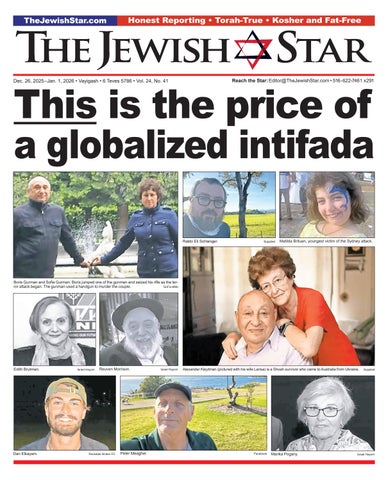
This is the price of a globalized intifada Reach the Star: Editor@TheJewishStar.com • 516-622-7461 x291
Dec. 26, 2025–Jan. 1, 2026 • Vayigash • 6 Teves 5786 • Vol. 24, No. 41
Rabbi Eli Schlanger.
Supplied
Matilda Brituan, youngest victim of the Sydney attack.
Boris Gurman and Sofia Gurman. Boris jumped one of the gunmen and seized his rifle as the terror attack began. The gunman used a handgun to murder the couple. GoFundMe
Edith Brutman.
Dan Elkayam.
Israel Hayom
Reuven Morrison.
Rockdale Ilinden FC
Peter Meagher.
Israel Hayom
Alexander Kleytman (pictured with his wife Larisa) is a Shoah survivor who came to Australia from Ukraine.
Marika Pogany.
Supplied
Israel Hayom
December 26, 2025-January 2, 2026 • 6 Teves 5786 THE JEWISH STAR
2
Here’s what they mean by ‘globalize intifada’: Ending 15 precious lives on other side of world By Adi Nirman, Israel Hayom These are the stories and legacies of the 15 people who were murdered during the lighting of the first Chanukah candle at Bondi Beach in Sydney, Australia. More photos on pages 1 and 23.
our fellow citizen Dan Elkayam in the antisemitic terrorist attack in Sydney. My thoughts are with his family and loved ones, and I extend to them the full solidarity of the nation.”
Sofia and Boris Gurman
Peter Meagher, who was working at the Chanukah event as a freelance photographer, completed 34 years of service with the NSW Police Force before retiring with the rank of detective sergeant. Randwick Rugby, where he volunteered as a firsrt-grade manager, mourned the devastating loss of “Marzo” in a statement, saying, “He was one of the heart and soul figures of Randwick Rugby. … He spent so long in the dangerous front line as a police officer and was struck down in retirement while taking photos. … Rest in Peace ‘Marzo.’ We all love you and will miss you greatly. We are devastated.” “Our family is heartbroken by the loss of our beloved Peter. He was a cherished brother, husband and uncle whose kindness, generosity and love touched everyone who knew him. Our lives have been changed forever,” his family said.
Peter Meagher
Russian immigrants Boris Gurman, 69, and his wife, Sofia Gurman, 61, shared 34 years of marriage before terrorists killed them. Their relatives described the couple as honest and industrious individuals who extended kindness to everyone they encountered. Dashcam video captured Boris Gurman fighting with gunman Sajid Akram in the attack’s opening moments. The footage shows Gurman seizing control of the terrorist’s rifle for several seconds during their confrontation on the street, before the terrorist used a handgun to shoot the couple at point-blank range. Eyewitnesses reported they died in each other’s arms. The family statement read: “Devoted to their family and to each other, their absence has left a void that cannot be filled. … In the moments before their passing Boris, with Sofia courageously beside him, attempted to intervene to protect others. This act of bravery and selflessness reflects exactly who they were: people who instinctively chose to help, even at great personal risk.”
Tibor Weitzen
Rabbi Eli Schlanger
London-born Rabbi Eli Schlanger led his congregation for 18 years and directed the Chabad mission in Bondi. He is survived by his spouse, Chayale Ulman Schlanger, and several young children, including an infant two months old, along with his mother and siblings. “A devoted rabbi and chaplain, working tirelessly … to support Jewish life in the Bondi community,” Chabad’s statement read.
Rabbi Yaakov Levitan, secretary of the Sydney Beth Din, pictured with his wife and children.
Chabad.org
Matilda Brituan
Matilda Brituan, a 10-year-old girl who was the massacre’s youngest victim, was at the Chanukah by the Sea event with family members, including her sister, when a terrorist shot her. Her parents, Valentyna and Michael, immigrated to Australia from Ukraine before Russia’s invasion, the Guardian reported. “We came here from the Ukraine … and I named her Matilda because she was our firstborn in Australia. And I thought that Matilda was the most Australian name that could ever exist. So just remember — remember her name,” the parents said. “Imagine you see your beautiful little sister that you love just being killed in front of you. They were like twins. They’ve never been separated. … Matilda was very friendly. She loves school, has a lot of friends. … She’s just a happy kid, always gives me cuddles,” her aunt Lina said. At a memorial ceremony on the beach one week after the attack, “Waltzing Matilda” was sung in honor of the girl.
Alexander Kleytman
Tibor Weitzen.
Israel Hayom
Boris Tetleroyd
Tania Tretiak
Alexander Kleytman survived the Holocaust as a child, struggling to survive through a Siberian winter alongside his mother and younger brother. Following the war’s conclusion, he departed Ukraine for Australia to pursue a career in civil engineering. His children and grandchildren also attended the Bondi Chanukah celebrations. Alexander’s wife, Larissa, said her husband of 57 years was murdered while attempting to protect her. “He died shielding her from the gunman’s bullets,” Chabad’s statement read. “In addition to his wife, he leaves behind two children and 11 grandchildren.”
Edith Brutman
Edith Brutman was a cherished figure within Sydney’s Jewish community. “Our beloved Edith was a woman of integrity who chose humanity every day,” her family shared. “She met prejudice with principle, and division with service. Our family mourns her deeply, but we ask that her life, not the senseless violence that took it, be what endures. We hope her memory calls us as a nation back to decency, courage and peace.”
Dan Elkayam
Dan Elkayam, a French citizen, relocated to Australia last year to seek an engineering job. Elkayam played soccer passionately, and the semi-professional Rockdale Ilinden Football Club in west Sydney described him as “an integral member” of its National Premier Leagues NSW squad in a Facebook statement. The club characterized him as “an extremely talented and popular figure amongst teammates. Our deepest and sincerest condolences to Dan’s family, friends and all that knew him. He will be missed.” French President Emmanuel Macron wrote, “I have learned with deep sadness of the death of
Tibor Weitzen, 78, was a father, grandfather and great-grandfather who died while protecting his family members from the gunfire. He immigrated to Australia from Israel in 1988, and his relatives characterized him as vibrant and full of vitality. “My grandfather was truly the best you could ask for,” his granddaughter Leor said. “He was so proud of us … and loved us more than life itself. He only saw the best in people and will be dearly missed.” “He was the congregation’s beloved ‘candyman’ who brought joy and smiles to everyone,” Chabad’s statement read.
Marika Pogany
A couple at the flower memorial beside Bondi Pavilion in Sydney, Australia.
James Morgan, Getty via JNS
Marika Pogany, a Slovak citizen, volunteered to transport kosher meals for COA (Centre of Activity), an organization serving Jewish seniors. “She lifted the room simply by being in it,” the organization shared in a statement. “She asked for nothing and gave everything. … She took the time to know every person on her route. She chatted. She listened. She noticed the small things. She changed light bulbs, literally bringSee The victims of Sydney on page 23
3 THE JEWISH STAR December 26, 2025-January 2, 2026 • 6 Teves 5786
MUSEUM OF JEWISH HERITAGE A LIVING MEMORIAL TO THE HOLOCAUST
EDMOND J. SAFRA PLAZA 36 BATTERY PLACE | NYC MJHNYC.ORG
1328073
“There is no use painting flowers or landscapes any more. Art must be mobilized – like everything else.”
December 26, 2025-January 2, 2026 • 6 Teves 5786 THE JEWISH STAR
4
Gehry couldn’t be Goldberg. Are we there again? MICHA DANZIG
T
Attorney
A
s tributes continue following the death of Frank Gehry at the age of 96, one striking truth has not be emphasized: He was born Frank Owen (Ephraim) Goldberg. And mid20th-century America made clear that “Goldberg” was a name that carried consequences. Born in Toronto, his family later moved to California. In 1952, he married Anita Snyder, who was said to have encouraged the name change as his career got started. He graduated from the University of Southern California’s School of Architecture in 1954; there, he was a member of Alpha Epsilon Pi (AEPi), a Jewish fraternity. Gehry did not change his name as an artistic flourish. He did so because a young Jewish man seeking opportunity in America in the 1950s quickly learned what generations before him knew well: Jewish visibility carried a cost. This reality becomes clearer when we look at the world that shaped him. Born in 1929 as the Nazi Party gained national traction — his mother, a Jewish immigrant from Poland, was born in Łódź — Gehry entered a world where antisemitism defined Jewish life across continents. European Jews endured systemic persecution and state-backed violence; Jews in the Middle East and North Africa faced pogroms, discriminatory edicts and formal second-class status. Yet even in the United States, a supposed refuge, hatred of Jews was embedded in respectable society: university quotas, restrictive housing covenants, social-club bylaws and professional ceilings. olite antisemitism may not announce itself with violence, but it accomplishes something quieter: It erases opportunity while pretending to offer inclusion. In Gehry’s youth, colleges capped Jewish ad-
P
amation League, antisemitic attacks are up over 893% in the United States in the past decade. This is not progress. It is regression, and it is accelerating. hat a gifted young man in mid-20th-century America felt compelled to abandon his Jewish name should trouble us. That countless Jews today again find themselves negotiating their visibility in schools, workplaces and cultural spaces — should trouble us far more. Gehry is rightly celebrated as a genius who reshaped global architecture. But the world that embraced his brilliance rejected his name. And society rarely asks what is lost when Jews learn, explicitly or implicitly, that belonging requires shrinking a central part of who they are. If a culture cannot accept the brilliance of an Ephraim Goldberg “as is,” the flaw is not in the Goldberg. To honor Frank Gehry honestly, we must remember Ephraim Goldberg, the young man who concluded that shedding a Jewish name was the price of admission to the American dream. And we must confront the uncomfortable truth that Judaism remains the only minority identity routinely treated as suspect in institutions that claim to champion inclusion. Why do Jewish students calculate how visibly Jewish they dare to be? Why do Jewish professionals weigh the risks of expressing a connection to the Jewish state? Why does the world still embrace Jewish contributions while resisting unapologetic Jewish existence? Gehry was born into a world steeped in antisemitism. He died in a world beginning to resemble the one he entered. And in the end, a society that makes Jewish identity a liability is a society shrinking its own moral and cultural horizons. Jew-hatred does not merely wound Jews; it impoverishes the world that tolerates it. If America cannot make room for its Goldbergs, it is not the Goldbergs who are diminished. It is America. Write: Columnist@TheJewishStar.com
Aerial view of EMP|SFM (Museum of Pop Culture) in Seattle, 2008.
missions, professional guilds informally barred advancement and neighborhood associations wrote Jews out of their property covenants. He learned early that certain doors opened more readily for a Gehry than a Goldberg. Like many Jews of his era, he concluded that concealment offered safety and possibility. There is a painful irony here: Gehry would later design buildings that refused to “hide”: structures defined by openness, irregularity and defiance of convention. Yet the society that formed him demanded the opposite. His art embraced what his youth forced him to suppress. This pattern is hardly unique to America. istory offers a long record of conditional acceptance for Jews, from 15th-century Spain, where Jews were told they could remain only by renouncing Judaism, to the later Limpieza de Sangre laws declaring even Jewish ancestry intolerable. Today’s version is secular but structurally identical. The message now is not “convert” but “con-
H
Wiki Commons
form.” You may be Jewish in our spaces as long as you adopt the dominant ideological line. You may belong as long as you say the approved slogans. You may be safe as long as you are (or say you are) the one thing most Jews are not: an anti-Zionist. This is not inclusion. It is conditional tolerance masquerading as progressivism. For a time, American Jews believed that these forces were fading. But the past few years have shattered that confidence. Jewish students are told that they cannot safely walk their campuses as visible Jews. Stars of David are labeled “provocations.” Kippahs become a target. Jewish professors face ideological litmus tests that no other minority is asked to pass. Professionals scrub their Jewish identity or their connection to Israel from résumés and social media to avoid retaliation. Synagogues and Jewish day schools function under security protocols more suited to diplomatic posts. And, according to the data compiled by the Anti-Def-
NBN hosts ‘Book Shuk’ featuring olim writers By Steve Lindem, JNS Four English-speaking Israeli writers convened in Jerusalem for a candid discussion on spirituality, creativity and resilience, reflecting how Oct. 7 transformed their inner worlds and work. The panel was part of the first “Book Shuk” at the Nefesh B’Nefesh aliyah campus in Cinema City, a literary fair featuring more than 50 olim authors who have written and published their own books since making aliyah, the majority from North America and English-speaking countries. Some 300 shoppers came to check out the book selection, whose genres included fiction, memoirs, poetry, cookbooks, history, nonfiction, selfhelp, health & wellness and children’s books, Nefesh B’Nefesh said. Titled “Faith in Times of War,” the discussion featured therapist Shira Lankin Sheps and educator Rachel Sharansky Danziger, co-editors of a new prayer anthology “Az Nashir: We Will Sing Again”; Gabi Katz, author of “Alone with G-d”; and Rabbi Uri Pilichowski, author of “Together We Win.” Asked by moderator Gaby Stemp when they realized they had to write their books, the panelists pointed to the shock of the early days of the war. Together, they reflected on how writing can offer clarity, comfort and connection at a moment when ordinary language often fails. Katz, 27, a South African-born educator who came to Israel from the
A panel discussion at the Nefesh B’Nefesh Book Shuk in Jerusalem, featuring, from left: Gaby Stemp, Rachel Sharansky Danziger, Shira Lankin Sheps, Gaby Katz and Rabbi Uri Pilichowski. Steve Linde
United States as a lone soldier and whose wartime journals became the basis of his book, said he had sensed immediately that people abroad would need a window into the lived experience of soldiers. “As soon as I was called up, I felt a responsibility to document my journey,” he said. “Personal moments of fear, faith and connection. People needed inspiration in real time.” For Sheps and Danziger, who began organizing Az Nashir within days of the Hamas massacre, the urgency was palpable. “So many people said, ‘We don’t have words’,” Sheps recalled. “We felt a responsibility to give them language for their grief, fear and hope.” Danziger said her shift had been immediate: “Before Oct. 7, I wrote for inner beauty or exploration. Afterward, the motive became responsibility — to write only what could help others endure.”
Unlike most wartime documentation, often dominated by male soldiers, commanders and politicians, Az Nashir brings women’s experiences to the forefront, Sheps and Danzinger told the audience of several dozen immigrants. Reflecting on the impact of the massive mobilization of IDF soldiers and reservists, Sheps said, “Cities became cities of women overnight. Men were called up, and women kept the home front running — children, workplaces, communities.” The anthology includes poignant prayers for women sending husbands and sons to the front, mothers comforting children during sirens, widows, and women serving in uniform themselves. The panel wrestled with the tension between individual trauma and national unity — reflected even in their book titles: “Alone with G-d,” “Az Nashir, “Together We Win.” “How do we balance personal grief
with collective solidarity?” Stemp asked. “We created a communal space built from individual stories,” Sheps answered. “Your loneliness is held within something larger.” Rabbi Pilichowski said unity remains Israel’s greatest challenge. “We had a moment after Oct. 7 when unity felt possible,” he said. “But politics returned quickly. I don’t know how we regain that togetherness without courageous leadership.” Still, he said the core message of his book remains relevant: “We don’t win unless we are together.” Katz described writing during combat as both difficult and necessary. “In the army, you don’t have much time,” he said. “I wrote at night, before falling asleep. It was my way of processing — not just for myself, but for the people who needed to understand what we were living through.” Now, reading his journals as a civilian, he said he sometimes feels that he
is encountering a different version of himself. The writers said the war changed not only what they wrote, but how they wrote. “There was a breathlessness to everything,” Sheps said. “People were thirsty — to be seen, to be understood, to have their feelings named.” Rabbi Pilichowski, director of Israel Advocacy and Education at Nefesh B’Nefesh, said he had sought to help readers contextualize events historically and theologically. “Panic comes from the fear of the unknown,” he said. “My goal was to show people that what we’re seeing now fits into a larger story.” Toward the end, the panelists were asked to recommend texts and books, other than their own, that had sustained them during the war. Their answers ranged from Psalm 91 in the Tanakh to historical works such as “Ghosts of a Holy War: The 1929 Massacre in Palestine That Ignited the ArabIsraeli Conflict” by Yardena Schwartz. “All offer grounding,” Danziger said. “They remind us that we are part of a story bigger than our pain.” In closing, Stemp said that although each writer’s work grew out of a different experience their shared message points toward resilience. “These books don’t end the pain,” she said. “But they offer light. And sometimes, light is what gets us through.”
THE JEWISH STAR December 26, 2025-January 2, 2026 • 6 Teves 5786
1326130
5
December 26, 2025-January 2, 2026 • 6 Teves 5786 THE JEWISH STAR
6
Scarsdale rabbi recalls message from Kotzker Rebbe: Now is not the time for us to bow down RABBI JONATHAN MORGENSTERN
Jacob’s weak-minded overture to Esau should not be seen as legitimizing and dignifying Zohran Mamdani. After that encounter, Jacob stood his ground and became Yisrael.
Young Israel of Scarsdale
I
n the mid-1800s, a rabbi was in the midst of making Kiddush on a bitterly cold winter Friday night in Poland — and stopped. Suddenly, he could not continue. His disciples around the table exchanged looks of concern. What was happening to their rabbi? What could make him so upset that he forgot the familiar words of Kiddush and could not go on? The rabbi then blurted out, “Is there no fairness in this world? Is there no judge?” He threw down his Kiddush cup — wine spilling everywhere — and stormed up to the attic in his home, remaining in a state of seclusion for the next 19 years. Thus began the isolation and despair of the vaunted Chassidic master, the Kotzker Rebbe, Rabbi Menachem Mendel Morgenstern. What vexed this Jewish leader to the point of literally and figuratively wanting to leave this world? It was the notion that Jacob, upon returning to encounter his infamous brother, Esau, after some 20 years apart, incessantly bowed to him and referred to him as “my master,” obsequiously referring to himself as Esau’s humble “servant.” Why is it, the Rebbe raged, that we Jews are always lowering and ingratiating ourselves to curry favor with our enemies? This isn’t what Divine justice should dictate, he felt; consequently, he bowed out of public life due to this historical injustice. am reminded of this today, in 2025, as a descendant of that Rabbi Morgenstern, because of a recent article I read in which a prominent member of the Jewish community used that very episode and example of Jacob and Esau as proof that he should engage, legitimize and dignify New York mayor-elect Zohran Mamdani, a clear adversary of the Jewish people and the Jewish state. He argued that as mere “guests” in this country, we should never antagonize the governmental and civic leaders who allow us to live here by their good graces. Well, I don’t know about you, but I am an American, and I am a New Yorker. And if there is an individual who promotes “globalizing the intifada,” wants to arrest the prime minister of Israel, believes that the religious yearning of Jews to make aliyah violates international law, refuses to recognize Israel as the nation of the Jews and espouses so many other offensive positions, I will not “bend the knee.” I will not retreat into my attic until the
to excuse and explain away the clear antisemitic fissures that are emerging on the American extreme right, as others may be tempted to do. his moment in history calls for what the great Menachem Begin called “Hadar.” It is the notion that no matter what they do to try to break us or how hard they try to divide us, we don’t break, we don’t fracture. Rather, we stand tall, we stand united, and we stand strong in the face of what this is. It is not just antisemitism. It is evil. And it is an evil that threatens the very existence of society as we know it. Who can we learn these lessons from? We can go all the way back to the Maccabean revolt in the Chanukah story, as they sought to shine a light on the ancient anti-Jewish darkness that was threatening us in ancient times. But we don’t even have to go that far back. We can look to the heroic hostages who have returned to us. People who refused to bow by reciting a verse from the Quran at the urging of their captors, even for another scrap of food, as they were starving and tortured. Incredible heroes among us, like Eli Sharabi, who talks about how we “all have a choice” in life. We can retreat, or we can stand our ground; the choice is ours. We can look to Edan Alexander, who, after suffering through grueling captivity in the dungeons of Gaza, put his IDF uniform back on and went back into the fight. What a betrayal it would be to those hostages, those courageous IDF warriors and those we’ve lost over the past two years, if we turn to appeasement, rather than to empowerment. If we choose to hide our Jewishness, tuck in our Stars of David, take off our kippahs and bow down to those whose rhetoric and actions seek to defame and belittle us. For if we do, then we risk becoming unworthy of their heroic efforts and sacrifices on our behalf. inally, we can look to Rabbi Eli Schlanger of Bondi Beach, a 41-year-old father of five who just a few weeks ago wrote an impassioned letter to Australia’s prime minister, Anthony Albanese, who has been weak in reacting to rising antisemitic hate in his country and is a frequent critic of Israel. He wrote the following: “As a rabbi in Sydney, I beg you not to betray the Jewish people and not G-d Himself. … Jews have been torn from their land again and again by leaders who are now remembered with contempt in the pages of history. You have an opportunity to stand on the side of truth and justice.” His last public act on this earth was lighting the menorah for all to see — with faith and pride in our people. Now, it’s our turn to stand for truth and justice. So let us not retreat into our attics and turn away. No hiding. History will judge us for what we choose to do now. How we respond will determine the very fate of the Jewish future. It is our turn to bring the light. May we be worthy of this moment. Jonathan Morgenstern is senior rabbi at the Young Israel of Scarsdale. Write: Columnist@TheJewishStar.com
T
Israeli children celebrate the Jewish holiday of Chanukah during a torch race at Kibbutz Hulata in northern Israel, on Dec. 16. Ayal Margolin, Flash90
I
The grave of Rebbe Menachem Mendel of Kotzk in Poland.
storm blows over. I will stand up for myself, my people, my country, my hometown and my homeland. While retreat may have been the only option at certain points in history, there is another paradigm — the one we learn not from Jacob but from the man he ultimately becomes, and that is Yisrael. Because right after his weak-minded overture to Esau, he is encountered by an adversarial angel. He doesn’t retreat. He stands his ground. He fights. And, eventually, he outlasts
1312214
Yair Lieberman via WikiCommons
the angel, whereupon the angel blesses him as a man worthy of the name Yisrael, for he fights the good fight, engages in the struggle for our people and prevails. ollowing the dark days of the Holocaust, it has been our mission to not just blend in and be tolerated as American Jews, but to identify and broadcast our identities as proud Jews, proud Zionists, proud New Yorkers and proud Americans. This is the ethos of American religious freedom, and it has been the calling card of American Jewry throughout my lifetime. That is, until the Hamas-led massacre of 1,200 people in southern Israel on Oct. 7, 2023, the kidnappings of 251 others, and the subsequent explosion of antisemitism and anti-Zionism in the United States and around the world. This is what the danger of Mamdani-ism is all about. Sadly, all you need to do is look at what happened at Bondi Beach in Australia on during Chanukah to see where all of this leads. If you’ve been paying attention, street mobs don’t have to chant “globalize the intifada” anymore. The intifada — the worldwide war against the Jewish people — has already been “globalized.” It is here: from Brooklyn to Bondi, from Manchester to Manhattan. And the question we must ask ourselves is: What are we going to do about it? I can tell you one thing. The answer is not to start blaming ourselves (as some Jewish leaders are doing), to call for greater scrutiny of Israeli policies and government, or to question decisions made by the Israel Defense Forces. It is not
F
F
7 THE JEWISH STAR December 26, 2025-January 2, 2026 • 6 Teves 5786
“SIGGI WAS A MAN OF COURAGE AND FAITH” —ELIE WIESEL
NOBEL PEACE PRIZE WINNER
1326876
Purchase At: UnstoppableSiggi.com
December 26, 2025-January 2, 2026 • 6 Teves 5786 THE JEWISH STAR
8
City of David proves Jewish history, indigeneity By David Isaac, JNS The importance of the City of David, capital of ancient Israel, and specifically its Pilgrimage Road, was discussed at an event featuring US Ambassador to Israel Mike Huckabee and former IDF Spokesman Maj. (res.) Doron Spielman at the National Library of Israel in Jerusalem on Dec. 9. Pilgrimage Road, a Second Temple-era route, connects the Pool of Siloam to the Temple Mount. It is located just south of the Old City of Jerusalem and was used by Jewish pilgrims ascending to the Temple on the three major festivals of Passover, Shavuot and Sukkot. Viewed as one of the most significant archaeological discoveries in recent times, its excavation has aroused worldwide opposition. The road was inaugurated in September and will be accessible to the public soon. “This is not just an archaeological curiosity. It is the physical proof of the Jewish people’s origin story,” explained former Israeli government spokesman Eylon Levy, MC at the National Library event. “It is the anchor of our indigeneity in the land of Israel, and is the foundation on which both Israel and … America have both built their modern identity.” It is because of its importance not just to Jews, but to Western civilization, that excavating the site has engendered so much hostility, Spielman and Huckabee agreed. “I can’t think of another archaeological site in the world that has faced as much violence, so much discreditation,” said Spielman, who has spent more than two decades helping to turn the City of David into a major archaeological site. He was one of the first, along with four others, to discover the road. He described how he was “scared out of my mind” as he crawled along an ancient water tunnel in search of the Pilgrimage Road. “Over our heads, we saw the stairs of the pool, the stairs of the road. It was unbelievable,” said Spielman, who is vice president of the City of David Foundation. The next day, as word spread, Arab employees in the City of David didn’t show up for work. “We were not sure why, but we quickly
At the National Library of Israel in Jerusalem on Dec. 9, from left: Doron Spielman, vice president of the City of David Foundation; US Ambassador Mike Huckabee; and former Israeli government spokesman Eylon Levy.
found out. On the telephone poles of the City of David there were names written in Arabic. They were the names of every [Arab] worker in the City of David,” he said, explaining that it was a message to those workers, a threat to stop digging at the site. The Arabs understood faster than the Jews that the Pilgrimage Road would become something of a competitor to the hajj, the Muslim pilgrimage to Mecca. They realized millions of Jews and Christians would flock to the site and walk the road, a constant living reminder of an ancient route that proved Jews are indigenous to the Land of Israel. Spielman said the battle to force Israel to give up the excavations began locally with NGOs, fueled by European funding, protesting and petitioning Israel’s High Court. The Northern Branch of the Islamic Movement in Israel, a Muslim Brotherhood group, also opposed the excavations. Accusations varied from displacing Arab residents to more conspiratorial claims that the excavations were intended to undermine
the Al-Aksa mosque on the Temple Mount. When local efforts failed, opponents turned to the United Nations agency UNESCO, which condemned Israel’s archaeological activities. The then-Obama administration was also enlisted. It issued a condemnation when Jews moved into 25 apartments in the City of David, falsely accusing them of forcing Arabs out, Spielman said. Levy noted that proving Jewish “indigeneity” to the Land is a relatively new phenomenon because in the past the Jewish connection to the Land of Israel was a fact beyond dispute. It was the rise of ahistorical Palestinian claims, asserting that Jews were foreign to the region, that have turned “indigeneity” into an important talking point. Spielman said that telling the story of Israeli indigeneity is crucial to countering the Palestinian claim that “we stole their land.” He lamented that the Jewish people, normally excellent storytellers, have failed to tell the “greatest story on earth,” that of their return to their ancient homeland. Levy asked whether a durable regional peace
is possible if Israel’s neighbors do not accept the Jewish people’s native status in their ancestral homeland. Huckabee agreed that recognition of Jewish indigeneity by Israel’s neighbors would advance peace. He said the greatest proof of Israel’s claim is the Bible, the original “title deed” to the land, an unbreakable covenant beginning with Abraham. He stressed that G-d made his promise in a historical and geographical context. There is a Mount Moriah where King David stood, a Pilgrimage Road where people walked 2,000 years ago, he said. The existence of these places is “then, now and forever … irrefutable, indisputable validation of this being the Jewish homeland. “Whether we’re Jewish or not, it’s a matter of accepting the reality and embracing it,” Huckabee said. The participants also touched on the public relations war, one that Israel struggles to wage effectively. Spielman said Israel’s opponents have spent decades shaping a misleading narrative that has become widely accepted, while the Jewish side has been “asleep at the wheel.” He urged Jews to speak confidently and fearlessly about their history to counter those longstanding narratives. Huckabee advised going where the battle is being fought, which in today’s world is on social media. “Social media is destroying the minds of many young people because they’re being TikTok’d into an ignorance that is very dangerous,” he said. “I find way too many people who say, ‘I don’t want to get into social media. It’s a nasty sewer.’ Yes, it is, but that’s where the game is being played.” The key is to project confidence in our beliefs, Huckabee added. “If we follow the law, the light of G-d, then our lives will take on a level of meaning, and our culture, our civilization, will, in fact, be defensible. “Let’s be the people who express with our lives that we are going somewhere because we know where we come from. That really is the biblical message,” he said.
Rare Maimo manuscript at the National Library By JNS Staff The National Library of Israel is displaying a rare 14th-century manuscript of Maimonides’ Mishneh Torah for the first time as part of its permanent exhibition. The illuminated volume, copied in Provence between 1300 and 1350 CE, represents one of Judaism’s most significant legal texts. Italian artist Matteo di Ser Cambio later enhanced the manuscript in Spain with vivid illustrations, gold ornamentation and decorative motifs featuring figures, animals and plants. The manuscript shows evidence of centuries of scholarly use, including proofreading notes and corrections. It also bears marks of 16th-century Christian censorship, with erasures on its final page and a censor’s seal from 1574. The Mishneh Torah is considered Maimonides’ most important work, encompassing all areas of Jewish law. Several other items are making their public debut in the exhibition “A Treasury of Words” at the William Davidson Permanent Exhibition Gallery. A 15th-century prayer book from Lisbon of-
The National Library of Israel in Jerusalem.
US Embassy Jerusalem
fers one of the last glimpses into Spanish and Portuguese Jewish liturgical traditions before the 1492 expulsion. The volume features block lettering with colorful and gold decorations. The library is also presenting a newly discovered 13th-century liturgical poem found within the pages of the Worms Machzor. The illuminated poem appears between two columns with lions at their base. Other highlights include the world’s earliest printed Passover Haggadah, produced in Guadalajara, Spain, in 1482, and the Benghazi Haggadah from 1943. The latter was hastily printed on confiscated telegram forms by Jewish Brigade soldiers for a Seder held shortly after Libya’s liberation from Nazi control. The exhibition also features Persian poetry manuscripts, including a tale of Layla and Majnun by 12th-century poet Nizami Ganjavi — a tragic love story that inspired works including Eric Clapton’s song “Layla.” Two rotating exhibitions at the library have been extended through May 15, 2026, due to popular demand. Tickets are available at nli.org.il/en.
9 THE JEWISH STAR December 26, 2025-January 2, 2026 • 6 Teves 5786
Mount Sinai South Nassau is High Performing in Ten Areas of Care.
1327618
mountsinai.org/southnassau
Israelis visit NY to eye teaching Jewish identity By Debra Nussbaum Cohen, JNS Many American Jews assume that it’s easy to be Jewish in Israel given the ubiquity of Hebrew and history in the Jewish state, where one needn’t pay tens of thousands of dollars annually for day school or thousands for synagogue membership to raise children who are knowledgeable about Judaism. But senior Israeli educators told JNS that is not the case. Several Israeli education officials, who spent a week visiting New York schools and synagogues, said that Israeli students aren’t taught what it means to be part of the Jewish people or to appreciate Jewish diversity and pluralism. And where students at US Jewish community day schools learn to read and understand classical Jewish texts, that’s not the case in Israeli secular public schools, they said. Israeli “kids receive their Jewish education by osmosis,” which isn’t enough of a way to do so, said Peri Sinclair, director-general of the Tali Education Center, one of the trip organizers. The other partners were the Jewish Agency for Israel and the Israeli Education Ministry. Values relating to Jewish identity are not currently taught in Israeli schools, and while Israelis come in skin tones and cultures from Ethiopian to Scandinavian, South American to Russian to Middle Eastern, schools don’t cultivate an appreciation for that diversity, according to Sinclair. “In Hebrew there is no word for ‘pluralism,’” she said. “People may talk about amiyut, peoplehood, but that is a new term coined just 10 or 15 years ago.” The trip, held from Dec. 10 to 16, included 23 participants, including heads of education departments from a dozen municipalities all over Israel. It was part of a program that began in February, and the senior educators met monthly across Israel and went on two retreats.
Israeli educators at the 9/11 Memorial in New York on Dec. 16.
Educators have been brought to America to learn about American Jewish life in the past, but not at such a high level, with the ability to bring new ideas to hundreds of schools and tens of thousands of students, Sinclair said. The idea with this trip was to transform educators at the top of their fields, so that they can infuse teaching in Israeli secular schools from the top down, she said. “They have so much power to make a real plan to teach Jewish identity through texts that belong to all of us,” Talia Afik-Grossman, head of Israeli Jewish culture at the Education Ministry, said. The trip in New York included Shabbat visits to Upper West Side synagogues of several denominations and, during the week, a meeting
Debra Nussbaum Cohen
with Eric Goldstein, CEO of UJA-Federation of New York, about the place of philanthropy and volunteer leadership, and intra-communal challenges. They visited the Heschel School in Manhattan and met with its leaders and students and also went to the Shefa School, which is dedicated to children with language-based learning disabilities. They also visited two pluralistic K-8 Jewish day schools in Brooklyn — Luria Academy and the Senesh School. The group also met with Rabbi Amichai LauLavie, the openly gay co-founder of Lab/Shul, a diverse congregation in Manhattan. He spoke with the Israeli educators about the challenges of building a community where people with complex identities feel comfortable, and where
celebrating Israel has been a controversial issue for some members, according to trip organizers. On their final day in New York, the educators gathered at the North Pool of the 9/11 Memorial site for a somber ceremony of remembrance of those who died in the 2001 terrorist attack, as well as of those who died in Israel in the terror attack on Oct. 7, 2023. At the end of the visit, they began singing the Israeli national anthem, but Sinclair urged them to do so quietly, given increasingly common antisemitic attacks in New York. Nani Reisberg is director of education for all schools in Israel’s South Sharon region. Inspired by what she saw in New York, Reisberg said that she wants her schools to start programs in which Israeli and American Jewish students will learn together regularly, initially meeting on Zoom. “I feel a sense of calling to create connections between students in Israel and in New York,” Reisberg said. Afik-Grossman, of the Education Ministry, observed that Jewish American schools create community for the entire family, not only for students. “The school here is not only for academics,” she said. “In Israel it’s very different. Each family has their own community.” One of her main objectives on returning home from New York will be to create ways to teach “non-religious Jews that Judaism also belongs to them.” “I want them to read it, talk with the texts and learn how these texts are relevant to them,” she said. “I want every child in the non-religious schools to understand that Judaism belongs to them just as much as it does to children in religious schools. These students have never been asked to open the texts, to think about what kind of Jewish identity they want,” she said. “I want them to know that this is their birthright.”
2026
Happy and Healthy New Year from Mount Sinai South Nassau!
mountsinai.org/southnassau 516-632-3000
1296955
December 26, 2025-January 2, 2026 • 6 Teves 5786 THE JEWISH STAR
10
1325807 1249534
At HALB Lev Chana, parents join in Chanukah prep
As Chanukah neared, children at Lev Chana were buzzing with excitement. They spent time in class making Chanukah related projects, and parents were invited to join their
children for Chanukah workshops. Between the art projects, singing, dancing and laughing, everyone had a great time.
HANC EC rocks The yeladim at HANC’s Early Childhood were excited to use their gross motor skills and use their new rock climbing wall.
CIJE VEX Robotics tourney at HAFTR Chessed at HALB
Felicia Bernstein’s art classes teamed up with Chessed 24/7 for Chanukah, students writing and decorating cards for delivery with gifts to children in the hospital.
HAFTR hosted CIJE’s VEX Robotics Tournament, a two-day celebration of STEM learning, teamwork and innovation that brought together students and several schools. The expanded two-day format elevated the experience and allowed for more showcasing of student skill and ability. HAFTR High School teams earned an outstanding first and second place finish; Middle School teams impressed with both first and second place wins, and the Lower School team continued took first place
for the fourth year in a row. These achievements reflect not only technical skill, but perseverance, collaboration and a love of learning. HAFTR’s Robotics Program is one of the school’s proudest achievements — a thoughtfully designed pathway that begins with curiosity in the Lower School, deepens through exploration in Middle School, and culminates in championship-level design and engineering in High School. At every stage, students are encouraged to ask questions, take risks and grow together as thinkers
and problem-solvers. HAFTR is appreciative to CIJE for its continued partnership, and thanks Phillip Brazil and Adam Jerozolim for their vision in creating such an inspiring platform for students to shine. Their commitment to excellence in STEM education was felt throughout the tournament and made this expanded two-day event truly memorable. At HAFTR, robotics is about curiosity, collaboration, growth and watching students engineer their futures together.
YCQ PTO workshop
The YCQ PTO presented an inspiring evening with Dr. Yoni Schwab, assistant head of school at the Shefa School. His presentation on “The Impulsive Mind” delivered meaningful tools to help children grow with calm, confidence and focus. The PTO thanked corporate sponsors Jewel Bagels, Aron’s Kissena Farms, Bake N’ Take, Top Notch Sushi, Wasserman, and IntelliRx Pharmacy, and parent sponsors Ariel and Daniela Shamayev, Eado and Liel Shwartz, Isaak and Sarah Dzhurayev, Shalom and Natalie Rakhminov, and Jeffrey and Natalie Sulaymanov.
THE JEWISH STAR December 26, 2025-January 2, 2026 • 6 Teves 5786
SCHOOLS
11
December 26, 2025-January 2, 2026 • 6 Teves 5786 THE JEWISH STAR
12
WINE AND DINE The cold days of winter call for warm soups Kosher Kitchen
JoNI SchocKEtt
Jewish Star columnist
I
t is 30 degrees and the wind is howling. It is amazing how fast winter can appear. Sometimes, I wonder why I stay in this frozen climate. My nose is always freezing, my lips are always chapped, and I use hand cream by the gallon. I really just want to hibernate till the color green returns to the landscape! Not only does the cold change our wardrobe, but it also changes our food choices. We’re back to winter foods — those stick-toyour-ribs dishes that people make in winter and avoid spring, summer and fall. Although I have never figured out why anyone would want food to stick to their ribs and not travel through their digestive track, I get the idea of eating heavy foods that take longer to digest and are steaming hot. The joys of soup are countless. Soups soothe and warm. They comfort. They nourish the soul as well as the body and they fill us with warmth. They heal as well. Chicken soup is prescribed for upper respiratory infections. Vegetable soup is a healthful and perfect soup for anyone with a virus or anyone recovering from surgery as it is filled with healthful nutrients and is easy to digest. Additionally, soup is the perfect diet food. Anyone on a diet knows that eating a bowl of light, broth-like veggie soup before dinner can help decrease the number of calories consumed in the meal. We can’t change the season. It’s grey and cold and miserable — but we can make it more tolerable with some delicious, nutritious soup which just might soothe that first winter cold and help you avoid winter weight gain. Here’s an idea for a winter party: Make a soup bar! Have some delicious hot soups for your guests to choose from and accompany them with some great breads and dips, maybe a salad, and then a delicious dessert. It makes for a wonderful, warm way to ring in the new year.
Roasted Garlic, Leek and Potato Soup topped with croutons.
Lenbir, Adobe
Roasted Garlic, Leek and Potato Soup (Dairy or Pareve)
• 2 heads garlic or about 20 cloves • 1/2 to 2/3 cup canola oil • 2 to 3 large leeks, white and light green parts only, thinly sliced, slices broken apart • 1-1/2 lbs. Yukon Gold potatoes, peeled and cut into 1-inch cubes • 3 to 4 cups vegetable broth • OPTIONAL: 1 cup milk, half and half or non-dairy substitute like rice, oat, or soy milk • Salt and pepper, to taste Place the garlic cloves and the oil in a small, heavy saucepan over medium-low heat. The oil should cover the cloves completely. If it does not, add more oil. Simmer until the cloves are golden and softened, about 20 minutes or more. When done, remove from the heat and let cool. Place 2 to 3 tablespoons of the oil in which the garlic was cooked in a soup pot. Add the sliced leeks and cook until softened, about 10 minutes. Stir often to break up the slices. Strain the garlic cloves over a container to reserve the oil. Add the garlic cloves to the soup pot and reserve the oil for another use. (It’s great in salad dressings.) Add the potatoes to the soup
White Bean and Kale Soup.
pot and mix well. Add the broth and bring to a boil. Reduce heat and simmer for about 30 minutes, until the potatoes have broken down and are mushy. Use an immersion blender to emulsify the soup until it is creamy. Add the milk or cream and mix well. Heat until steaming but not boiling. Season with salt and pepper to taste. Garnish with snipped chives or scallions. Serves 4 to 6. See What could be finer? on page 14
Turkish Lentil Soup.
veganhuggs.com
13 THE JEWISH STAR December 26, 2025-January 2, 2026 • 6 Teves 5786
WE NOW ACCEPT WIC
KOLSAVE FRESH FLOWERS STARTING AT $5.99!
ORDER NOW ON
TM
Prices Good Sunday, December 28th through Friday, Janaury 2nd, 2026
5
2/$ 2/
4
$ 99 13 oz/14 oz
12 oz
M Macabee PPizza Bagels
L Lieber’s SSnackers
$ 99
$ 49 13.7 oz
B Yet Best Apple Juice A
1
5
99¢
Sweet Strawberries
33/$
4
$ 59 16 oz
�������� Squash
Yukon Potatoes
LB
$ 99 EA
1 oz
Simcha ��������� Clear Tumblers
��� ������������ Ch Cheese
16 oz
69¢
2
$ 99 EA
1
1
Riverhead Cholent Mix or Barley
5 oz
L Lieber’s CChoco Chiplets
$ 99 12 oz
5
$ 49
3
5/$
Penn Dutch Noodles
12 Pack
$ 99 46 oz
5
5
$ 99 24 oz
Pringles Snack Stacks
Simply Orange Juice
Givat Slims 60 Calorie Yogurt
Kineret Chocolate Chip Cookie Dough
3
1 oz
3
$ 99 20 oz
3
$ 99 42 oz
$ 49 10 oz
Funzz Snacks
Leifer’s �����������
Old Fashioned or Quick
Regular or Mini
5
5
$ 99
Bowl & Basket Oatmeal
Dandie’s Marshmallows
$ 99 16 oz
6 Pack Pouches
2/$
5
6 oz
Mehadrin Yo Smart Yogurt
8 Pack
$ 49 24 oz
Bone Suckin Sauce
10
10/$
Nestle Rich Milk Hot Cocoa
B’gan Broccoli Florets
$ 99 64 oz
1
3
3
9
Dagim Chunk Light Tuna
$ 99 14 oz
Original Only O
118 Pack
3/$
Osem Mini Mandel
Nabisco Oreos
Ge General Mills Ch Chex Cereals
100 Pack
8
$ 99 Grape Tomatoes
5 LB Bag
3
3
2/$
LB LB
1449
$
Chicken Thighs
Square Cut Roast
Super Family Pack
9
2
$ 49 LB Honey Glazed ������������
9
$ 99 LB
Chocolate Pretzel Poppers
11
$
Breaded Flounder
8
$ 999 LB
Chicken ���������
2
$ 79 LB
2
$ 89 LB �������������������
9
$ 49
99 LB
|
Chicken Breast
8
$ 99 LB
Wing On
$ 79 LB LB
Tender Chuck Stew
$ 49 LB
5
$ 49 LB
LB
Small Kolichel
9
Super Family Pack
Grilled Chicken Cutlets
Egg Salad 1 LB
1299
$
EA
1399
$
LB
Savings Plaza | 11 Lawrence Lane, Lawrence, NY | (516) 371-6200 | info@kolsavemarket.com | /kolsavemarket Hours: Sunday-Tuesday: 7am-8pm | Wednesday: 7am-10pm | Thursday: 7am-11pm | Friday: 7am-2 hours before Shabbos �������������������������������������������������������������������������������������������������
1326844
Ground Beef Chicken Mix
Flat London Broil
December 26, 2025-January 2, 2026 • 6 Teves 5786 THE JEWISH STAR
14
What could be finer? Cold days, warm soups… Continued from page 12 NOTE: You can add lots of ingredients to this to change it up. You can use buttermilk instead of milk for a little tang. You can also add sour cream or yogurt. Add some thyme or oregano, if you like, or add some carrots to the recipe while cooking for a bit of sweetness. You can also season it with some smoked salt or other seasonings like a bit of chili powder or tobacco sauce. The soup can be personalized to your family’s tastes.
Turkish Lentil Soup (Pareve or Dairy)
• 1/3 cup olive oil • 2 large onions, diced • 4 garlic cloves, minced • 2 qt. vegetable broth • 1 lbs. dried red or mixed lentils (red, brown, etc.) • 2 to 3 fresh tomatoes, peeled, seeded and quartered OR • 2 carrots, peeled and diced • 2 potatoes, peeled and diced • 3 ribs celery, diced • 1-1/2 tsp. Kosher salt, to taste • 1/2 tsp. pepper Pour the olive oil into a large soup pot and add the onions and garlic. Sauté until lightly golden, about 7 minutes. In a large pot, bring the water to a boil. Add all the ingredients and boil for 15 minutes. Reduce heat and simmer for about 30 to 60 minutes more. Taste and adjust seasonings. You can use an immersion blended and blend the soup to any consistency you like or leave the lentils and veggies whole. Makes about 4 quarts soup. VARIATIONS: •Add cooked rice or macaroni. •Just before serving, add some freshly made large toasted croutons and/or sprinkle some parmesan cheese over the top. •Drizzle some mild chili oil in a design on the soup before serving. •Top with some toasted, chopped pistachio nuts.
Butternut Squash Soup with Apples, Orange and Ginger
thinly sliced apples. Serves 6 to 10
Joni’s Signature Zucchini Leek Soup (Pareve)
White Bean and Kale Soup (Pareve or Meat)
This is an easy soup to make that can be varied easily to suit your family’s tastes. • 3 to 5 Tbsp. extra virgin olive oil • 2 large onions, chopped • 6 to 10 cloves garlic, minced • 3 to 6 carrots, peeled and thinly sliced • 2 to 4 ribs celery, thinly sliced • 2 large yellow gold potatoes, peeled and diced • 2 bay leaves • 2 to 3 qt. vegetable or chicken stock • 2 to 3 cans white navy beans, rinsed and drained • 1 large bunch kale, washed thoroughly, stemmed and cut into bite sized pieces • 1/4 tsp. red pepper flakes (salt and pepper to taste) • 1/4 cup chopped, fresh parsley • OPTIONAL: 1 to 2 cans red beans, rinsed, drained; 1 large can (28 ounces) diced tomatoes with liquid. Heat the oil in a heavy stock pot. Add onions and garlic and heat until translucent, 5 to 9 minutes. Add the carrots, celery, and potatoes, and cook until softened, 5 to 7 minutes. Stir frequently. Add the bay leaves and mix well. Slowly add the stock and beans and simmer for about 30 to 40 minutes. Remove the bay leaves and discard. Add the kale and simmer for another 30 minutes. Add salt, pepper, and red pepper flakes. Simmer an additional 5 to 10 minutes. Garnish with minced parsley. Serves a crowd. NOTE: If you hate kale, use baby spinach leaves for the last 5 minutes of cooking time. VARIATION: For an added calcium boost, add some broccoli florets to the soup during the last 5 to 8 minutes of cooking. (You can add any vegetables or beans you like. I have used frozen
Joni’s Signature Zucchini Leek Soup.
lima beans and frozen cut green beans instead of the white beans and kale.)
Butternut Squash Soup with Apples, Orange and Ginger (Pareve) • 1 large butternut squash, halved and seeded • 1 Tbsp. extra virgin olive oil • 1 large onion, diced • 1 large or 2 medium apple(s) such as Honeycrisp or Fuji, peeled and diced • 1 Tbsp. fresh ginger, finely minced • 1/2 to 1 tsp. ground cumin* • 1/2 to 1 tsp. curry powder* • 1/3 cup freshly squeezed or not-fromconcentrate orange juice • 1 qt. vegetable broth • 1 to 2 cups water, as needed • Kosher salt and freshly ground black pepper to taste • OPTIONAL FOR GARNISH: Pure maple syrup, 1 apple, peeled and finely minced *OPTIONAL: You can leave these spices out, if your family does not like these flavors.
throughthefibrofog.com
Line a large, rimmed baking sheet or large roasting pan with foil and lightly grease the foil. Set aside. Preheat the oven to 425 degrees. Carefully cut the squash in half lengthwise, remove the seeds and place the cut side down on the pan. Place the pan in the oven and pour water into the pan so it is about 1/2-inch deep. Roast for about 1 hour, until a spoon easily indents the squash, adding more water as needed to keep a bit of water in the pan. Remove from the oven and let cool for 1 hour. Meanwhile, heat a skillet and add the olive oil. Sauté the onions until lightly golden and softened. Add the apples, ginger, cumin, curry powder, and orange juice. Simmer for 10 to 13 minutes, until the apples are very soft. Most of the juice will have evaporated. Remove from heat. Scoop the squash out of the skin and discard the skin. Place in a large soup pot and add the vegetable broth and the onion-apple mixture. Simmer until just bubbly and turn off the heat. Use an immersion blender and process until smooth. If too thick, add some water. Season with salt and pepper as desired. Garnish each bowl with a drizzle of pure maple syrup and/or
This is one of the easiest soups I have ever made and has become my most requested. It is thick and creamy yet has nothing fattening in it. Serve with some frizzled leeks or croutons as a garnish. NOTE: Use enough veggies to fill the size pot you are using about 2/3 full. • 1/4 to 1/3 cup extra virgin olive oil • 6 to 10 long leeks white/light green part should be about 7 to 12 inches long • 6 to 10 zucchinis about 7 to 8 inches long • 2 to 3 carrots • 2 to 3 stalks celery (Optional) • 3 to 4 qt. boxes Vegetable broth (Imagine No Chicken-Chicken Kosher) • 1 to 2 Tbsp. Kosher Better than Bouillon vegetarian paste, to taste Discard the dark green part of the leeks. Cut the leeks in half lengthwise, discard the first layer, and cut the leeks into thin slices, so you have half-round pieces. Place in a large bowl of cold water and swish to clean thoroughly. If you like, reserve about 1 cup for frying for garnish. Heat a large soup pot over medium-low heat and add the olive oil. Add the leeks, stir and cover. Peel the carrots and cut into thin slices. Add to the pot and stir. If using, add the celery. Wash the zucchini and trim the ends. Cut into thin slices and add to the pot. Remember, the veggies should fill 2/3 or a bit more of the pot. Add enough vegetable broth to cover the veggies and then cover the pot. Simmer for 45 to 60 minutes until all veggies are really mushy. Add more broth if too much evaporates. Turn off heat and let cool for 10 minutes. Use an immersion blender and emulsify the soup until very smooth. Soup will be thick. Add a generous tablespoon of the bouillon paste and mix with the immersion blender. Taste and adjust bouillon paste. Add more to taste. Add salt and pepper if you like. FOR THE GARNISH: Heat a small skillet over medium-high heat until hot. Add about 1/4 inch of canola oil and heat for about 20 seconds. Separate the reserved leeks into half circles and fry until deep golden and crispy. Place on a paper towel to drain. Sprinkle with a bit of salt. Serve soup and garnish with a few frizzled leeks, pumpkin seeds or croutons. This recipe serves a crowd. Freezes well. Write: Columnist@TheJewishStar.com
Jewish Women Int’l
J
ewish Women International was preparing to lead a training seminar last year about domestic violence for staff members at a Jewish Community Center on the West Coast. As we do with every one of these, we reached out to the local domestic violence agency and invited them to participate. But the response we received was chilling. “No, thank you,” they replied. “Our staff supports Gaza.” This was not a political debate or a socialmedia post. We did not mention Israel or Gaza. It was a refusal to collaborate with a Jewish organization on survivor support, a decision that directly affects whether Jewish women know where to turn for essential and often life-saving resources. As upsetting as the response was, it didn’t surprise us. More than a decade ago, JWI was leading a healthy relationship workshop at a university
and reached out to the campus sexual-assault survivor support group to partner with us. They refused because we also worked with Hillel. Jewish professionals working in domestic and sexual-violence spaces have long shared similar experiences. But since the Hamas-led terrorist attacks in southern Israel on Oct. 7, 2023, and Israel’s ensuing war against Hamas in the Gaza Strip, this antisemitism has become normalized. What was once whispered has become overt. enial and misinformation about the sexual violence committed by Hamas and other Palestinian armed groups against Israeli women and men is now widespread. These narratives have moved beyond social media and onto the global stage, echoed by international figures like Reem Alsalem, the UN’s special rapporteur on violence against women and girls. The consequences of that denial are not abstract, but deeply personal. That reality became painfully clear after the murder of 26-year-old Sarah Milgrim and her partner, 30-year-old Yaron Lischinsky, this past May. Sarah worked at the Israeli embassy in Washington and, like many other young Jewish women since Oct. 7, paid a steep personal price
D
Listen to and support our young Jewish women. for her commitment to Israel. When we first met, she told me how she had lost all of her friends after accepting the embassy role. The isolation that so many young Jewish women describe in a JWI survey was not theoretical for Sarah, but her lived reality. Joining our Young Women’s Impact Network DC chapter, she found a community where she could show up unapologetically as a Jewish woman. It was a rare space where belonging, support and friendship still existed when many other doors were closing. After Sarah was murdered, I repeatedly heard the same refrain from young Jewish women across the country: “She could have been my friend. She could have been me.” n the two years since Oct. 7, I’ve spoken with young Jewish women across the country who have described a growing sense of isolation. Many have lost friends, professional networks or entire communities for standing with Israel or
I
HOOKED ON FRESHNESS?
We cater that.
refusing to stay silent in the face of rape denial. Spaces that once felt safe—feminist organizations, survivor groups, even workplaces—have become hostile and exclusionary. The message they’re hearing is unmistakable: “MeToo, unless you’re a Jew.” For more than 125 years, JWI’s mission has been to end violence against women and amplify Jewish women’s leadership. Just as we called on the world to stand with the victims of Oct. 7 and Israeli survivors, we are now calling on our community to listen and support our young Jewish women here at home. They are standing in solidarity with Israel, while battling antisemitism, hostility and isolation. They are the future leaders of our Jewish community, and we cannot afford to let them stand alone. I will not let Jewish women be marginalized. I will not let us stand alone. I will not let us fall. Join us by listening, supporting this research and helping to ensure that the next generation of Jewish women knows that they are believed, protected and never alone. Meredith Jacobs is CEO of Jewish Women International. Write: Columnist@TheJewishStar.com
Cater your next event
Shop online at GourmetGlattOnline.com
gourmetglatt
1326806 1326803 132680
MEREDITH JACOBS
THE JEWISH STAR December 26, 2025-January 2, 2026 • 6 Teves 5786
Young Jewish women feel increasingly isolated
15
December 26, 2025-January 2, 2026 • 6 Teves 5786 THE JEWISH STAR
16
כוכב של שבת Jewish Star Torah columnists: Rabbi Benny Berlin, spiritual leader of BACH Jewish Center in Long Beach; Rabbi Avi Billet of Anshei Chesed, Boynton Beach, FL, mohel and Five Towns native; Rabbi Binny Freedman, rosh yeshiva of Orayta, Jerusalem; Dr. Alan A. Mazurek, former ZOA chair, retired neurologist, living in Great Neck, Jerusalem and Florida. Contributing writers: Rabbi Sir Jonathan Sacks zt”l, former chief rabbi of United Hebrew Congregations of British Commonwealth; Rabbi Yossy Goldman, president South African Rabbinical Association; Rabbi Dr. Tzvi Hersh Weinreb, OU executive VP emeritus. To submit commentary, inquire at: Editor@TheJewishStar.com. Contact our columnists at: Columnist@TheJewishStar.com.
Fri Dec 26 / 6 Teves
Fri Jan 2 / 13 Teves
Tue Dec 30 / 10 Kislev
Fri Jan 9 / 20 Teves
Vayigash Five Towns candles: 4:15 • Havdalah: 5:25 Scarsdale candles: 4:14 • Havdalah: 5:20 Fast of Asarah B’Teves
Vayechi Five Towns candles: 4:21 • Havdalah: 5:31 Scarsdale candles: 4:20 • Havdalah: 5:25 Shemos Five Towns candles: 4:28 • Havdalah: 5:38 Scarsdale candles: 4:27 • Havdalah: 5:32
Five Towns Candlelighting: From the White Shul, Far Rockaway, NY Scarsdale Candlelighting: From the Young Israel of Scarsdale, Scarsdale, NY
Facing choices, even the virtuous can change rabbi Sir JonaThan SaCkS zt”l
T
he sequence from Bereishit 37 to 50 is the longest unbroken narrative in the Torah, and there can be no doubt who its hero is: Joseph. The story begins and ends with him. We see him as a child, beloved — even spoiled — by his father; as an adolescent dreamer, resented by his brothers; as a slave, then a prisoner, in Egypt; then as the second most powerful figure in the greatest empire of the ancient world. At every stage, the narrative revolves around him and his impact on others. He dominates the last third of Bereishit, casting his shadow on everything else. From almost the beginning, he seems destined for greatness. Yet history did not turn out that way. To the contrary, it is another brother who, in the fullness of time, leaves his mark on the Jewish people. Indeed, we bear his name. The covenantal family has been known by several names. One is Ivri, “Hebrew” (possibly related to the ancient apiru), meaning outsider, stranger, nomad, one who wanders from place to place. That is how Abraham and his children were known to others. The second is Yisrael, derived from Jacob’s new name after he “wrestled with G-d and with man and prevailed.” After the division of the kingdom and the conquest of the North by the Assyrians, however, they became known as Yehudim or Jews, for it was the tribe of Judah who dominated the kingdom of the South, and they who survived the Babylonian exile. So it was not Joseph but Judah who conferred his identity on the people, Judah who became the ancestor of Israel’s greatest king, David, Judah from whom the Messiah will be born. Why Judah, not Joseph? The answer undoubtedly lies in the beginning of Vayigash, as the two brothers confront one another, and Judah pleads for Benjamin’s release. The clue lies many chapters back, at the beginning of the Joseph story. It is there we find that it was Judah who proposed selling Joseph into slavery: Judah said to his brothers, “What do we gain by killing our brother and covering his blood? Let’s sell him to the Ishmaelites and not harm him with our own hands. After all, he is our brother, our own flesh and blood.” His brothers agreed. Gen. 37:26-27
Judah is the first penitent, the first baal teshuvah, in the Torah.
T
his is a speech of monstrous callousness. There is no word about the evil of murder, merely pragmatic calculation (“What will we gain?”). At the very moment he calls Joseph “our own flesh and blood” he is proposing selling him as a slave. Judah has none of the tragic nobility of Reuben who, alone of the brothers, sees that what they are doing is wrong, and makes an attempt to save him (which fails). At this point, Judah is the last person from whom we expect great things. However, Judah — more than anyone else in the Torah — changes. The man we see all these years later is not who he was then. Then he was prepared to see his brother sold into slavery. Now he is prepared to suffer that fate himself rather than see Benjamin held as a slave. As he says to Joseph: “So, please, let your servant stay as my lord’s slave in place of the boy, and let the boy go back with his brothers. For how can I go back to my father if the boy is not with me? I could not bear to see the misery that would overwhelm my father!” Gen. 44:33-34 It is a precise reversal of character. Callousness has been replaced with concern. Indifference to his brother’s fate has been transformed into courage on his behalf. He is willing to suffer what he once inflicted on Joseph so that the same fate should not befall Benjamin. At this point Joseph reveals his identity. We know why. Judah has passed the test that Joseph has carefully constructed for him. Joseph wants to know if Judah has changed. He has. his is a highly significant moment in the history of the human spirit. Judah is the first penitent — the first baal teshuvah – in the Torah. Where did it come from, this change
T
in his character? For that, we have to backtrack to chapter 38 — the story of Tamar. Tamar, we recall, had married Judah’s elder son, who died, and then married his next son, who also died, leaving her a childless widow. Judah, fearing that his third son would share their fate, withheld him from her — thus leaving her unable to remarry and have children. Once she understands her situation, Tamar disguises herself as a prostitute. Judah sleeps with her. She becomes pregnant. Judah, unaware of the disguise, concludes that she must have had a forbidden relationship and orders her to be put to death. At this point, Tamar — who, while disguised, had taken Judah’s seal, cord and staff as a pledge — sends them to Judah with a message: “The father of my child is the man to whom these belong.” Judah now understands the whole story. Not only has he placed Tamar in an impossible situation of living widowhood, and not only is he the father of her child, but he also realises that she has behaved with extraordinary discretion in revealing the truth without shaming him (it is from this act of Tamar’s that we derive the rule that “one should rather throw oneself into a fiery furnace than shame someone else in public”). Tamar is the heroine of the story, but it has one significant consequence. Judah admits he was wrong. “She was more righteous than I,” he says. This is the first time in the Torah someone acknowledges their own guilt. It is also the turning-point in Judah’s life. Here is born that ability to recognize one’s own wrongdoing, to feel remorse, and to change — the complex phenomenon known as teshuvah – that later leads to the great scene in Vayigash, where Judah is capable of turning his earlier behavior on its head and
doing the opposite of what he had once done before. Judah is IshTeshuvah, penitential man. e now understand the significance of his name. The verb lehodot means two things. It means “to thank,” which is what Leah has in mind when she gives Judah, her fourth son, his name: “this time I will thank the L-rd.” However, it also means to admit, to acknowledge. The biblical term vidui (confession) — then and now part of the process of teshuvah and, according to Maimonides, its key element — comes from the same root. Judah means “he who acknowledged his sin.” We now also understand one of the fundamental axioms of teshuvah: Rabbi Abbahu said: In the place where penitents stand, even the perfectly righteous cannot stand. Brachot 34b His prooftext is the verse from Isaiah: “Peace, peace to him that was far and to him that is near.” Isaiah 57:19 The verse puts one who “was far” ahead of one who “is near.” As the Talmud makes clear, however, Rabbi Abbahu’s reading is by no means uncontroversial. Rabbi Jochanan interprets “far” as “far from sin” rather than “far from G-d.” The real proof is Judah. Judah is a penitent, the first in the Torah. Joseph is consistently known to tradition as Ha-Tzaddik, “the righteous.” Joseph became mishneh le-melech, “second to the king.” Judah, however, became the father of Israel’s line of kings. Where the penitent Judah stands, even the perfectly righteous Joseph cannot stand. However great an individual may be in virtue of his or her natural character, greater still is one who is capable of growth and change. That is the power of penitence, and it began with Judah.
W
DR. ALAN MAZUREK
Jewish Star columnist Great Neck / Jerusalem
A
s are most of you, I am heartbroken and enraged. Though our people have endured nearly 4,000 years of persecution, the hatred unleashed since Oct. 7 feels different. Once, after tragedies, there was at least a pause, a moment when the world seemed to remember its conscience. But now? The attacks, the slanders, the blood libels don’t stop.
When two dozen Jews were murdered or wounded in Australia, what followed was not silence or shame, but boos, calls for “jihad” and chants to “globalize the intifada.” Even as Jewish blood had barely dried, our enemies rejoiced. That response is enough to rapidly send me to the Clint Eastwood school of justice — “Go ahead, make my day,” “Do you feel lucky today? Well, do ya’ punk?” or “I tried being reasonable. I didn’t like it” — swift, decisive and final — all from the barrel of a gun. Any other people would be expected, even justified in such a response, taking matters into their own hands after such outrages are thrust upon them. Why don’t we?
Those who hate us are unmoved by our restraint. Mainly because of two porfound ideas — kiddush Hashem and chilul Hashem. or centuries, as we lived in exile among others, our lives were regulated by the ethics and morality of Torah law. Thus living among non-Jews we became inordinately concerned and aware of any hint of chilul Hashem, for “what would the goyim say?” We see in this this week’s parsha, Vayigash, as Yosef reveals himself to his brothers. Before
F
doing so, he clears the room. Why? To keep the painful moment private, to avoid exposing the family’s flaws before strangers. This is sensitivity, humility — and a form of kiddush Hashem. Our tradition teaches us to reflect G-d’s morality in our behavior. We are commanded not only to seek justice but to do so in ways that honor G-d’s name. That means acting with restraint, even when every bone in us demands vengeance. This is not to say that punishment is unjust. On the contrary: Torah mandates systems of justice. The commandment to establish courts of justice was one of the seven Noahide commandments incumbent upon all people, even See Mazurek on page 22
44 lights guide us through winter’s darkness RABBI BENNY BERLIN Jewish Star columnist BACH Long Beach
W
e are in winter, the season when many of us feel like pulling the covers over our heads when the alarm goes off in the morning. Therapists report that these months are their busiest time of year. As the days become shorter, the nights lengthen, and the gray weather settles in, many people feel heavier, slower, and more emotionally taxed. Speaking of feeling emotionally drained,
Yaakov’s meeting with Pharaoh in this week’s parshah, Vayigash, is deeply relatable. Honestly, if anyone had the right to feel worn down, it was Yaakov. His life had been extraordinarily difficult. The struggle with Eisav began in the womb and followed him for decades. Lavan deceived him for years. The trauma of Dinah shook his entire family. And for twenty-two agonizing years, he mourned Yosef as if he were dead. Yaakov had been through it all. When Pharaoh asks him, “How old are you?” and Yaakov answers that his 130 years have been “few and unpleasant,” not reaching the years of his fathers, it sounds understandable (Bereishis 47:8–9). And yet, the Daas Zekeinim MiBaalei HaTosafos, citing a Midrash,
Teves invites us to clean out whatever is holding us back. states that G-d held Yaakov accountable for this response. It is important to keep in mind that this criticism is said with great respect for Yaakov and his incredible spiritual level as one of our Avos. Although Yaakov faced tremendous hardship, G-d never abandoned him. Each time there was a challenge, whether it was Eisav, Lavan, or the pain of losing Yosef, G-d was there, guiding and protecting him.
The Midrash teaches that Yaakov was punished measure for measure for the negative words he said. He was meant to live 180 years, like his father Yitzchak, but instead he lived only 147. The thirty-three-year difference corresponds to the words he said to Pharaoh, each word costing him a year of life. But Rabbi Chaim Shmulevitz asks a sharp question. If you count Yaakov’s reply to Pharaoh, you find only twenty-five words. So where do the missing eight years come from? He explains that those eight words are actually Pharaoh’s question itself: “Vayomer Par‘oh el Ya‘akov, kamah yemei shenei chayecha,” “Pharaoh said to Yaakov, ‘How old are you?’” Those eight words are included as part of the punishment. See Berlin on page 22
Throughout time, forgiveness is a Jewish value RABBI DR. tZvI hERsh wEINREB Orthodox Union
T
his has got to be one of the oldest “rabbi” jokes in the entire repertoire of American Jewish humor. It tells us of a young rabbi, fresh from rabbinical school, who addresses his first several sermons to his new congregation on the varied subjects of meticulous Sabbath observance, refraining from malicious gossip, honesty in business, and the avoidance of inappropriately familiar behavior with other men’s wives. After these first homiletic salvos, the president of the congregation approaches him with the sug-
gestion that these topics are much too sensitive and have upset many of the synagogue’s members. The president urges the rookie rabbi to try to find some more acceptable topics to speak about. The rabbi objects, and asks, “But what, then, do you suggest I speak about in my sermons?” To which the president replies, “Judaism! Why not just talk about Judaism?” Those of us with experience in the pulpit rabbinate typically do not find this story very funny. Each of us has, on more than one occasion, taken on causes in our sermons that our audiences have felt were not in our rabbinic purview, and indeed were somehow “not Jewish.” ne of my favorite examples of this phenomenon in my own career has been my attempts, in sermons to the entire congregation, and in more intimate counseling sessions, to encourage forgiveness. I will never forget the first time I made
O
A Christian virtue not preached by Judaism? forgiveness the theme of one of my sermons, only to be accused by one of the more prominent members of my congregation of preaching Christianity. I urged people to forgive those who have offended them, only to find that, for many Jews, forgiveness is a Christian, not a Jewish, virtue. Of course, this is not true. Forgiveness is a major teaching of our own faith. We are encouraged to forgive others who may have sinned against us, and we must seek forgiveness of those against whom we have sinned. In this week’s Torah portion, Vayigash, we have an outstanding Biblical example of forgive-
ness. Joseph, after putting his brothers through tests and trials, finally cannot contain himself. He exclaims, “I am your brother Joseph, whom you sold into slavery in Egypt.” And immediately after identifying himself, he unequivocally forgives them: “Now, do not be distressed or reproach yourselves because you sold me hither... it was not you who sent me here, but G-d...” It is true that the brothers wore “blown away” by this unanticipated revelation of the true identity of their tormentor, and even more astounded by this assertion of total forgiveness. But this is not the first example of human forgiveness that we find in the Bible. Joseph may have learned about this value from his great-grandfather Abraham’s precedent. Abraham, back in Genesis 20:17, not only forgives his adversary, Avimelech, but offers prayers on his behalf. See Weinreb on page 22
Retelling Chanukah story: Our rock of all ages RABBI YossY GoLDMAN
S. African Rabbinical Assn.
L
et’s consider the significance of Chanukah — one of the most widely observed holidays in Israel — to the Jewish nation. Those who wouldn’t even remotely call themselves religious have been kindling the candles on chanukiyahs annually with no sense of pretense or hypocrisy whatsoever. Virtually every Jewish home has one on the mantelpiece or other place of honor gracing the family abode. Yes, it may be that Chanukah — a national historical festival commemorating the miracle
of the oil coupled with a miraculous military victory — may resonate with Israelis more than the more ritualistic festivals of Passover or Yom Kippur. I’d have to acknowledge that kindling lights on a candelabra is more enjoyable than, say, dipping horseradish in some weird mixture called charoset. But I believe that there is more to it. It is the center point between religion and spirituality. Both belong to the realm beyond, the otherworldly; both are critical to a metaphysical approach to life. But there are many differences between them. Religion without spirituality is dry — an empty ritual, like a body without a soul. You know what a body without a soul is? It’s called a corpse. Religion without the energy of spirituality is a way of life where the whole source of life
Spirituality minus religion is not grounded. has been obliterated, expunged. It is unsustainable. A spiritless faith cannot survive. However, neither can a spineless, wishywashy, new world order of social justice replace a foundational belief system of morality and ethics. You know the types. “I love humanity. It’s just the guy who sits next to me in synagogue who gets on my nerves!” Or let’s do a mitzvah and “save the whales. But please, get my sister-in-law out of my life!” pirituality minus religion is not grounded. Without an anchor of stability and objectivity, it cannot play a meaningful
S
role in the moral behavior of a nation. Feeling groovy makes for a catchy song, but it cannot serve as a rock-solid way of life. Frankly, it’s pretty much meaningless. Without an absolute morality, we become completely biased and subjective. Some say that if it feels good, do it. Why not? Because that is a very dangerous game to play. I can think of too many situations that feel good but are very bad. There are all sorts of things that feel good but are dead wrong. Still, we rationalize. Human-made rituals have no right or wrong. There is a mitzvah to light candles for Chanukah. There is no mitzvah to light incense candles near our bathtubs. It may feel nice and relaxing, and that’s 100% permissible. But it’s not the same as the Kohen lighting See Goldman on page 23
THE JEWISH STAR December 26, 2025-January 2, 2026 • 6 Teves 5786
Our response: Kiddush Hashem & Chilul Hashem
17
December 26, 2025-January 2, 2026 • 6 Teves 5786 THE JEWISH STAR
18
TheJewishStar.com Honest Reporting • Torah-True • Kosher and Fat-Free • Established 2002 Published weekly except during certain religious and civil holidays by The Jewish Star LLC
New York City office: 5676 Riverdale Ave Suite 311, Bronx NY 10471 • LI office: 2 Endo Blvd, Garden City NY 11530
Here’s how to reach The Jewish Star — Write: Editor@TheJewishStar.com. Call: 516-622-7461 ext 291 Editor & Publisher: Ed Weintrob 516-622-7461 ext 291 Jewish Star Associate: Nechama Bluth 516-622-7461 ext 241 Content: The Publisher endeavors to ensure that our content is within the bounds of normative halachah and hashkafah. Anyone who feels anything we publish may be inappropriate in this regard is urged to bring the item in question to the attention of the Publisher. Advertising is accepted at the sole discretion of the Publisher and should conform to standards appropriate for distribution in an Orthodox community. Send us your news! Editor@TheJewishStar.com Advertising: Publisher@TheJewishStar.com Kashrut: The Jewish Star is not responsible for the
kashrut of any product or establishment featured in its pages. If you have questions regarding any establishment or product, including its supervision, please consult your rabbi for guidance. Submissions: All submissions become the property of The Jewish Star and may be edited and used by the Publisher, its licensees and affiliates, in print, on the web and/or in any media that now exists or will exist in the future in any form, including derivative works, throughout the world in perpetuity, without additional authorization or compensation. The individual or entity submitting material affirms that it holds the copyright or otherwise has the right to authorize its use in accordance with The Jewish Star’s terms for submissions. Opinions: Views expressed by columnists and other writers do not necessarily reflect the position of the Publisher or of The Jewish Star LLC.
Distribution: The Jewish Star is available free in kosher food establishments, stores, synagogues, and curb-side newsboxes on Long Island, in New York City and elsewhere. To request free delivery to your location, write Publisher@TheJewishStar.com. Copyright: All content is copyright and may not be republished or otherwise reproduced without written permission by The Jewish Star; to do so without permission is against the law and halacha. For content reproduction write to Publisher@TheJewishStar.com. The Jewish Star subscribes to JNS. It, or its contributors, own the copyrights on material attributed to them. The length and content of JNS material and all other submitted material may be edited by The Jewish Star. Member: American Jewish Press Association. This newspaper contains words of Torah. While it is not considered shaimos, please dispose properly.
OPINION COLUMNISTS
Mitchell Bard, foreign policy analyst, authority on USIsreal relations; Ben Cohen, senior analyst, Foundation for Defense of Democracies; Stephen Flatow, president, Religious Zionists of America-Mizrachi and father of Alisa Flatow, murdered in an Iranian-sponsored Palestinian terrorist attack in 1995; Yisrael Medad, Americanborn Israeli journalist and political commentator; Rafael Medoff, founding director of David S. Wyman Institute for Holocaust Studies; Fiamma Nirenstein, Italian-Israeli journalist, author of 13 books, leading voice on Israeli affairs, Middle Eastern politics and antisemitism; Melanie Phillips, British journalist; Moshe Phillips, national chairman, Americans for a Safe Israel; Thane Rosenbaum, Distinguished University Professor at Touro University (published by Jewish Journal); Jonathan S. Tobin, editor-in-chief, Jewish News Syndicate.
Podhoretz’s journey and the fate of US Jewry JONATHAN S. TObIN
JNS Editor-in-Chief
T
here are those who insist that no one person, let alone a journal of opinion, can be said to have changed the world. Yet this was true of Norman Podhoretz and Commentary magazine. The man and his magazine helped win the Cold War, while awakening Americans to the moral bankruptcy of modern political liberalism and the threat it posed to the two countries that he loved: America and Israel. The longtime editor of Commentary, who died on Dec. 15 at the age of 95, was more than a seminal figure among Jewish intellectuals of his era. He was that rare man of letters whose work transcended the worlds of literature, Jewish life and journalism in which he labored for many decades. To take a deep dive into his many essays, the 12 books he authored — not to mention the volumes of issues of the monthly magazine he edited from 1960 to 1995 — is to take a journey through the history of the last century.
Still relevant today
The remarkable thing about so much of Norman Podhoretz’s writing is how relevant it is to today’s political battles, especially those involving the ones concerning the defense of America and the Jewish people, causes to which he remained devoted throughout his life. In this way, even though the volume of his writing diminished in the last decade and a half of his life, the body of work he created remains fresh and vital to the struggles in which he engaged. Take, for example, one piece he wrote for the New York Post in May 1986, a clipping of which fell out of one of his books in my personal library when I opened it while preparing to write about him. Titled “Anti-Semitism in the ‘Nation’,” it discussed that left-wing magazine’s decision to publish an openly antisemitic essay by author
Gore Vidal in which he referred to Jews as “Israeli fifth columnists,” nothing more than guests in the United States who should shut up about “the politics of the host country.” That marked, as Podhoretz rightly noted, “an ominous new stage in our public discourse.” Only 40 years after the Holocaust, antisemitism had “begun creeping back” into the national discussion “under the guise of anti-Zionism” and “criticism” of the Israeli government. But what was really going on was that people like Vidal, who were “eaten up with ferocious anti-Jewish feelings” were trying to “get away with putting all the old lies about the Jewish people back into circulation.” Podhoretz was prescient in this, as he was on most things. Nearly 40 years later, his takedown of Vidal and the Nation also apply to the now fashionable antisemites on the left like New York mayor-elect Zohran Mamdani, as well as the ones on the right with large followings like former Fox News host Tucker Carlson, both of whom also traffic in the same hateful tropes of dual loyalty and buying influence that they claim is only opposition to the State of Israel. This is just one example of the arguments that characterized the arc of his career.
A lot of ‘ex-friends’
A brilliant prose-stylist, literary critic and influential editor, he was also well-known as a controversialist who never shied away from conflict with allies or foes. As a consequence, he lost a lot of friends among the luminaries of the world of letters who dominated the culture and society. He chronicled this in books like “Breaking Ranks,” “The Bloody Crossroads: Where Literature and Politics Meet” and “Ex-Friends.” Like many American Jews, Podhoretz started out on the left but eventually abandoned it. He began a journey to the right when he realized that the political liberalism of the 1960s and ’70s, second nature to most Jews, was increasingly incompatible with the defense of the West against totalitarian communism and the battle against antisemitism.
The editor’s career epitomized both the success of 20thcentury Jews and an awakening to the peril posed by the moral collapse of political liberalism.
where he was mentored by some of the great minds of the era, to Cambridge University in England. But as he later wrote, it was during his two years of Army service, in which he encountered the people and the culture outside of New York, that he began to understand the greatness of America and its people. And it was that love for his country that animated his refusal to go along with cultural trends that denigrated it.
Understanding neoconservatism
Norman Podhoretz at his home in New York. James Keyser, Getty Images via JNS
That was something for which the New York literary set — inclusion in which was very important to him as a young man — never forgave him. Nor could they abide his willingness to unsparingly expose their hypocrisy, grasping ambition and raw lust for status, power and inclusion among the elites of fashionable society that he made clear in his groundbreaking 1967 memoir “Making It.” For a 37-year-old writer and editor to write such a book at all was itself an act of chutzpah. But its memorable first line — “One of the longest journeys in the world is the journey from Brooklyn to Manhattan” — and what followed not only provided important insights about the struggle for acceptance for the generation of children of Jewish immigrants to America. It heralded the arrival of a literary pugilist who was prepared to tell the truth about the high and mighty, and who would also chart a path toward a new way of looking at public policy and society. In the course of making his way from an impoverished childhood in Brooklyn to the dazzling salons of Manhattan and all it represented, Podhoretz also gained a perspective that most of his peers lacked. His path took him from life at Columbia University as a scholarship student,
Podhoretz was one of the leading lights of what came to be called “neoconservatism.” That is a term that in the last two decades came to be associated with advocacy for the failed American wars in Afghanistan and Iraq, and the futile attempt to export democracy to Islamic societies that wanted no part of it. But its meaning — when it first began to be applied in the 1970s to people like the Commentary editor, and his friend and colleague Irving Kristol — bespoke the willingness of a generation of thinkers who had grown up on the political left to rethink the assumptions of the political liberalism that had dominated American life since the Great Depression. It involved critiques of the welfare state and its impact on the poor, as well as the consequences of an all-powerful government and administrative state that was increasingly unaccountable to voters. It also involved a spirited defense of American society against the formidable challenge it was undergoing from the socalled “New Left” and the counterculture that had rapidly become the new establishment, which brooked no dissent. This liberal deconstruction of the foundation of the traditions of Western civilization would eventually lead to the creation of new toxic myths rooted in Marxism and misguided ideas about race that would seek to tear down America. Even 50 years ago, the rot was apparent to those who cared to see it. As Kristol noted, “a neoconservative is a liberal who has been mugged by reality.” In response, Podhoretz and Commentary mounted a defense of the sort of bourgeois values that centered on the importance of family and patriotism, which elites looked down upon. This same necessary rethinking of where liberalism had led also applied to foreign policy. See Tobin on page 22
GLOBAL FOCUS
BEN COHEN
T
he bloody massacre at a Chanukah celebration on Sydney’s iconic Bondi Beach that left 16 people dead and three times as many injured has underlined the blindingly obvious fact that there seems to be nowhere safe from terrorism. Jewish communities have been reminded of this reality on far too many occasions since the Hamas-led pogrom in Israel on Oct. 7, 2023. On Yom Kippur, two Jews lost their lives when a Syrian-born Islamist carried out a carramming attack at the Heaton Park Hebrew Congregation in the English city of Manchester. Here in the United States, the last year has witnessed the murder of two Israeli embassy staffers by a far-left gunman in Washington, as well as a Molotov cocktail attack by an
Members of this violent organization hunger for extreme measures that make waves against Israel and make headlines worldwide.
Egyptian-born Islamist upon a pro-Israel gathering in Boulder, Colo., resulting in the death of an 82-year-old Jewish woman. But while Jews are on the front lines, they are not the only targets. In Africa and the Middle East, Christians are also hunted down and murdered by Islamists. Even in Europe, security for Christian holidays and events can no longer be guaranteed, with several Christmas festivals and markets canceled this month because the terror risk has been deemed too great. The New Year’s Eve party on the Champs Élysées in Paris has been scratched this year for the same reason. Terrorism, however, doesn’t always rely on gun or bomb attacks to promote its goals. Hamas, to take one example, is a terror group that understands the value of propaganda networks, particularly in the West, which frame its depraved violence as “resistance” and present its goal of destroying the State of Israel as a noble one rooted in justice. key amplifier of Hamas disinformation has been Palestine Action, based in the United Kingdom. From its inception in 2020, the group sought to distinguish itself from other organizations in the pro-Hamas space by skirting the edges of the law through “direct action” against Israeli companies in Britain, as well as other businesses suspected of trading with the Jewish state. In targeting Elbit, an Israeli defense manufacturer, it deployed vandalism and property destruction as its trademark methods, at the same time sneering at other pro-Hamas groups, like the Palestine Solidarity Campaign, for failing to venture beyond public
A
Supporters of hunger strikers affiliated with the group Palestine Action, which has been deemed a terrorist organization by the UK government, protest in London’s Parliament Square on Dec. 15. Guy Smallman, Getty Images via JNS
statements and demonstrations in their activism. In the months that followed Oct. 7, Palestine Action stepped up its attacks, turning its violence against property into violence against people. In August 2024, activists from the group used a prison van to break into Elbit’s factory at Filton, near the city of Bristol. When police intervened, one officer, Sgt. Kate
Evans, was beaten so badly that she was left unable to drive, dress or wash by herself. As Evans attempted to handcuff one of the activists, another delivered a powerful blow to her back with a sledgehammer, causing pain, she recalled, that “extended through my whole body down to my legs. I was stunned to begin with. I didn’t know what it was. I reSee Cohen on page 23
Preacher says Constitution must yield to Sharia StEpHEN M. FLAtOw
Verify before you share. Don’t let algorithmic anger do the thinking for you.
S
croll through X long enough, and you’ll see it: Muslim preachers denouncing America as corrupt, portraying liberal democracy as a fraud, and — most alarming — arguing that Sharia law should replace the US Constitution. Some clips are foreign. Some are domestic. Some are deceptively edited. But enough are real, and enough are applauded, that dismissing the phenomenon as “rage bait” is no longer responsible. Let’s begin with a principle that should unite Americans across party and faith: Religious freedom is not the same thing as permission to dismantle the constitutional order. The First Amendment protects worship, belief and speech. It does not require Americans to pretend that every political theology is compatible with the system that protects us all. There is a distinction we must make — carefully, consistently and without collective blame. Islam is a religion practiced peacefully by millions of Americans. Islamism is a political project: the belief that society should be governed by religious law, enforced by state power and ultimately superior to human-made constitutions. Criticizing Islamism is not “anti-Muslim.” It is the same civic vigilance we apply to any ideology, religious or secular, that claims America’s founding principles are illegitimate. he rhetoric is not hypothetical. At events held in the United States, audiences have been asked directly whether Sharia takes precedence over “the laws of the land,” and the answer has been an unambiguous “absolutely.” In other venues, speakers have floated the scenario of Muslims becoming a majority and then replacing America’s constitutional framework with religious law. Still others, speaking in
T
the language of inevitability, tell listeners that liberal democracy is doomed and that Islam is the alternative. Whatever one thinks of those claims as theology, they are not merely theology. They are political assertions about power, authority and sovereignty. We should not exaggerate these voices into a caricature of American Muslims. Most Muslim Americans are not preaching revolution. Many are deeply patriotic, serving in uniform, building businesses and raising families who want the same security and opportunity as everyone else. The danger is not “Muslims.” The danger is a radical minority — leaders speaking at Friday Jummah prayers, often networked online, sometimes funded from abroad and amplified by social media — that pushes a hardline ideological agenda while benefiting from the liberties it seeks to weaken. ocial media is gasoline on this fire in two ways. First, it amplifies propaganda, letting fringe ideologues reach millions at virtually no cost. Second, it now does so in an
S
age of AI-enhanced manipulation, when propagandists can clip, caption, translate and distribute content at speed — and adversaries can also manufacture or distort clips to inflame distrust and polarization. The result is a toxic mix: Real radicals get a megaphone, and fake radicals can be manufactured to turn Americans against one another. The response must be firm, constitutional and equal-opportunity. We do not need religious tests or loyalty oaths. We need leaders and institutions — political, civic, academic and religious — to speak plainly: In America, the Constitution is the common ground. You are free to practice your faith fully, but no faith gets to replace the Constitution. Organizations that claim to represent Muslim communities should be challenged when they evade that baseline. Muslim reformers and courageous community leaders who reject Islamism deserve support, not suspicion. At the same time, we should enforce existing laws vigorously and neutrally. When preaching crosses into threats, harassment,
intimidation, recruitment or material support for violence, it is not “just speech.” It is conducted with consequences. The rule of law can protect the country without sacrificing its values as long as we apply it consistently and resist the temptation to turn legitimate security concerns into broad-brush stigma. We should also follow the money. Americans have learned, repeatedly, that foreign regimes do not donate millions to universities, nonprofits and advocacy networks out of charity alone. When overseas money bankrolls institutions that preach hostility to American constitutionalism, transparency matters. Disclosure rules and enforcement tools should be applied evenly across the nonprofit sector, not as a religious dragnet but as a basic rule-of-law safeguard in a world where influence operations are real. inally, citizens have responsibilities, too. If a clip outrages you, that’s the moment to slow down. Verify before you share. Look for full sermons, dates and original sources. Don’t let algorithmic anger do the thinking for you. The goal of propaganda is not only to persuade; it is to divide, demoralize and paralyze. America is strong enough to welcome diverse faiths, and it must be strong enough to insist on one civic rule: the Constitution is the sovereign framework for our public life. The answer to Islamist radicalization is neither suspicion of all Muslims nor denial that a problem exists. It is confident constitutionalism: equal rights, equal scrutiny and zero tolerance for ideologies — any ideologies — that preach the replacement of American self-government with religious rule. Write: Columnist@TheJewishStar.com
F
THE JEWISH STAR December 26, 2025-January 2, 2026 • 6 Teves 5786
Latest bid for martyrdom by Palestine Action
19
December 26, 2025-January 2, 2026 • 6 Teves 5786 THE JEWISH STAR
20
Nuremberg: Personal liability is the only fix LEA WOLF Let’s Speak Up
T
he new film “Nuremberg” isn’t just historically disturbing; it’s a wake-up call. Based on real conversations between US Army psychiatrist Dr. Douglas Kelley, a psychiatrist serving in the US Army, and Hermann Göering, supreme commander of the German Air Force and one of the most powerful members of the Nazi Party, it captures Göering’s chilling mindset: “People can always be brought to the bidding of the leaders. All you have to do is tell them they are being attacked.” The film exposes how psychological warfare bends individuals into obedience and rationalizes genocidal acts. That machinery has been repackaged and franchised across our educational system. Göering and fellow Nazi architects understood how easily people could be coerced into submission through authority, fear and the illu-
The film asks, ‘How could this have happened?’ The answer is brutally simple: ‘People let it happen.’
sion of certainty. Their formula was simple: 1. Construct an existential threat. 2. Intensify fear with distorted narratives. 3. Designate an enemy. 4. Reward conformity and punish dissent until people begin to accept falsehood as fact. This algorithm now permeates academic departments, administrative suites, DEI offices and professional associations, propagating lies as “truth” based on distorted “evidence,” while exploiting the vulnerabilities of their stakeholders. ithin 24 hours of the Hamas atrocities of Oct. 7, campuses across America were glorifying terrorist murder, rape, torture and mutilation, while calling for the genocide of Jews. Instead of leading with moral courage and clarity, university presidents legitimized this hostility under the banner of “free speech.” This perverse conduct was not organic. It has been orchestrated through unified slogans, petitions, syllabi, conferences, programming, and professional networks that mobilize students into hate movements. When antisemitic incidents are reported, administrators invoke “academic freedom” and “free speech” as catch-all shields to protect perpetrators and evade accountability. We have swallowed academia’s lies that this is “just speech.” Our institutions are running the very propaganda algorithm Göering described, draped in academic robes instead of military insignia. Within the halls of academia, the professorstudent relationship is not casual speech; it is regulated professional conduct. Teaching, grading, controlling classroom climate and hosting programs are services delivered under institu-
W
Hermann Göering in captivity, May 9, 1945.
tional authority, contractual obligations and a duty of care. These concerns are not abstract to me. As the co-founder of GWU-JPULSE and CAPE-Ed, and as a plaintiff in the 170-page federal civil-rights lawsuit against George Washington University, the case alleges a sustained pattern of institutional and professional misconduct. In an incident this past March, it is alleged that an anti-Zionist student berated guest lecturer Laura Brown, a Jewish, lesbian feminist scholar, for nearly 20 minutes, calling her a “Nazi,” rapist and “murderer” after she affirmed
WikiCommons
her Zionism. Two GW professors were present — DeSilva, director of clinical training, who later praised the protester, and Helen DeVinney, who told students that Brown should not have been invited. The message to students is unmistakable: those who openly identify as Zionists risk becoming targets for shaming, sanctions, and sustained intimidation. hen educational programming is used to target, shame, exclude or retaliate against Zionists, educators engage in coercion, See Wolf on page 23
W
A 1930s reminder: Ze’ev Jabotinsky was right RONN TOROSSIAN Betar Worldwide
O
ne of my earliest memories is standing in Yad Vashem in Jerusalem at age 11, hearing how European Jews once believed that catastrophe could never touch them. They were successful, cultured, integrated — convinced that prosperity was protection. For me, the grandson of Holocaust survivors who lost more than 70 family members, that lesson was never theoretical. I grew up in a home shaped by my mother, Penina Waga, born in a Polish Displaced Persons camp before immigrating to Israel, who taught not only what the Nazis did, but what Jews did and did not do in response. Now, as an Israeli-American, a refugee from New York, I watch the city from afar and see a frightened, rudderless Jewish community. Since the COVID pandemic, many Jews in New York Jews have fled to other states — namely, Florida — or to the suburbs seeking safety. But history whispers: In the 1930s, Berlin and Warsaw were also thriving Jewish centers. Prosperity is not protection. eanwhile, the political trajectory of the American Jewish community is deeply troubling. More than 33% of New York’s Jewish voters supported Mamdani. A growing portion of American Jews now hold
M
In 1936, Jabotinsky said: ‘If you won’t eliminate the Diaspora, the Diaspora will eliminate you.’
Ze’ev Jabotinsky (bottom right) at a meeting with Betar leaders in Warsaw, including (bottom, left) Menachem Begin, circa 1939. National Photo Collection of Israel via WikiCommons
views about Israel not just disconnected from Israeli reality but openly hostile to it. Elliot Cosgrove, spiritual leader of the Park Avenue Synagogue embodies this trend. [While in a widely-viewed sermon in October, he spoke as a Zionist and urgently warned against the election of anti-Zionist Zorhan Mamdani, earlier] public statements put him at odds with a majority of Israelis. At an event in his Conservative synagogue in 2017, he gave a platform to his daughter’s claim that because Palestinians don’t vote in Israeli elections, Israel was an apartheid state. That falsehood itself was heightened by his choice to repeat it uncritically. Still, the American Zionist Movement invited Cosgrove to headline its Biennial National Assembly on Dec. 8. There, explaining Mamdani’s success among Jewish voters, he argued
that for “a liberal Zionist disillusioned by the Israeli government, Mamdani’s anti-Zionism is a difference of degree, not of kind.” His asked: “What are we going to do about it?” Cosgrove insisted that “by making unconditional support for the Israeli government a litmus test for Jewish identity, we ourselves have inflicted harm on the Jewish future.” And he blamed Israeli policy for Diaspora alienation: “The unresolved status of the Palestinians … forms a wedge issue between an increasingly liberal-leaning American Jewry and an increasingly right-leaning Israeli Jewry.” That the American “Zionist” movement provides a platform for this is disgraceful. ut the most glaring omission at the conference was that no one spoke about aliyah. Not one “Zionist” leader invoked the
B
core Zionist response to Jewish vulnerability. In similarly perilous times, Jabotinsky told the Hatzach Conference in Warsaw on June 13, 1936, that Jewish survival in Europe was slipping away. He was mocked for insisting on “Evacuation” — mass aliyah — as the only realistic solution. His warning now echoes with terrifying clarity: “We must save the millions — many millions. I don’t know if the question concerns absorption of one-third of the Jewish race, to half of the Jewish race, or one-quarter of the Jewish race. This I do not know. But, it’s a question of millions.” And he delivered the starkest truth of all: “If you won’t eliminate the Diaspora, the Diaspora will eliminate you.” These were prophetic warnings from a man who saw the storm before anyone else. Yet now, in 2025, at a conference called “Zionism: Many Visions, One Dream,” Jabotinsky’s foundational idea of aliyah was conspicuously absent. Worse, the American Zionist Movement banned Betar, Jabotinsky’s own movement, until Israeli Zionist courts reversed it. And the Anti-Defamation League labeled Betar, the 100-year-old Zionist movement, along with slain conservative commentator Charlie Kirk, a hate group. As they silence Jabotinsky, American Jewish leaders in an increasingly unsafe New York lecture Israelis about democracy, identity and morality. Over-represented Park Avenue liberals claim authority over a reality they do not live. They lament that Israel does not resemble American progressive ideology, even as their own communities dissolve through assimilation, intermarriage and ideological confusion. t was Betar — Jabotinsky’s movement — that insisted on Jewish dignity, self-defense and national pride when others hesitated. That message resonates today. Jabotinsky taught that Jewish survival depends on clarity, courage and refusing to apologize for existing. His words remain piercing: See Torossian on page 23
I
21 THE JEWISH STAR December 26, 2025-January 2, 2026 • 6 Teves 5786
Your Jewish Star workplace can be almost anywhere. Where you work is less important than what you accomplish. Many of our editorial and marketing positions are hybrid or remote, offering optimal flexibility. Impact New York’s Orthodox communities from your home office, a
library or Starbucks (even a local park when the weather’s warmer!) — as well as from our well-equipped congenial workplaces in Riverdale and Garden City where our teams collaborate and inspire each other. Don’t be put off by the grind of a
daily commute. If a Jewish Star position calls out to you, you owe it to yourself to call back. Enjoy working for a media company devoted to honest journalism, whose goals are Torah-true and where all Jewish holidays are observed.
1328934
View current openings on our website at www.thejewishstar.com/jobs.html
December 26, 2025-January 2, 2026 • 6 Teves 5786 THE JEWISH STAR
22
Tobin: Podhoretz journey and fate of US Jews… Continued from page 18 n the 1970s, America was reeling from the disaster of Vietnam and suffering from a “credibility crisis” to which both the Lyndon Johnson and Richard Nixon presidencies had contributed. It was also awash in a post-1960s despair about the ability of the West to resist the growing Soviet menace to the free world. Here again, Commentary helped point the way by championing a vigorous defense of the need to combat communism when fashionable opinion increasingly took the cynical and defeatist view that the two sides in that long conflict were morally equivalent. Podhoretz and his wife Midge Decter, also an accomplished and important writer, were founding members of the Committee for the Present Danger, a group whose members included a number who would serve in the Ronald Reagan administration (including Reagan himself) that sought to raise awareness of the threat from an “evil empire” that liberals were not willing to confront let alone ready to defeat. Decter died on May 9, 2022, at the age of 94. While some other conservatives (by the end of the Cold War, the notion of a separate group of neoconservatives was more a function of antisemites trying to anathematize what they incorrectly believed were solely Jewish thought leaders than a meaningful distinction) treated the fall of the Berlin Wall as signaling the end of history, Podhoretz readily understood that the next challenge for the West from radical Islam,
I
and its adherents and apologists, would be just as dangerous and perhaps even more difficult to overcome.
Standing up for Israel
And it was in this context that his full-throated defense of the State of Israel must be understood. His opposition to efforts to weaken it or to appease its existential enemies, even via false hopes for peace that were raised by the 1993 Oslo Accords, Podhoretz courageously opposed, again led the establishment to decry yet another example of his unwillingness to bend to conventional wisdom. Where others, especially among the credentialed liberal elites, stood in judgment on an embattled Israel, critiqued its efforts at self-defense and sought to force upon it suicidal concessions to implacable enemies, he pointed to the stakes in this struggle, both for Israelis and Americans. America’s efforts to transform Afghanistan and Iraq were forlorn hopes sunk by the solid grip of Islamic beliefs that are clearly antithetical to Western democracy. Podhoretz, however, wasn’t wrong to focus on what he saw as an existential threat (detailed in his 2007 book “World War IV: The Long Struggle Against Islamo-Fascism”), something that has only become clear to less cogent thinkers in the two years since the Hamas-led Palestinian Arab attacks on Israel on Oct. 7, 2023. The global surge in Jew-hatred that has swept over America, especially at campuses like Colum-
Mazurek… I
Continued from page 17 non-Jews. Torah established arei miklat (cities of refuge for accidental killers) but also the death penalty for murderers. What makes something a chilul Hashem? When Jews act in ways G-d would disapprove of — publicly violating Shabbat, mistreating the poor, or behaving unethically in business or leadership. But there is another layer: failing to act when we must. Standing idly by while Jews are attacked is also a chilul Hashem. hose who hate us are unmoved by our restraint. We keep Torah. We uphold justice. We care for the stranger. So why does the world still turn on us? Because much of what they’ve been taught is false. We hold these truths to be not only self-evident but verifiable: •The Jews introduced many of the foundational values of Western civilization. •The Jewish people are, historically, among the most generous and peaceful — yet also the most persecuted in the world. •Western civilization, through the development of capitalism and democratic systems, has raised out of poverty and tyranny the largest numbers of people in history. Yet the world embraces lies. University students chant slogans rooted in blood libels. Protesters shout support for jihad. In some cases, they don’t even pretend it’s about Israel — they say outright they want to kill Jews. This isn’t a geographic conflict. It’s not even just ideological. It’s religious. We’re attacked in Sydney, London, Antwerp, New York — not just Tel Aviv or Sderot — because we are Jews. That’s why the story of Chanukah is so instructive. The Seleucid-Greek empire wasn’t satisfied with political control. They sought spiritual domination — banning Torah learning, outlawing circumcision, defiling the Temple. Mattityahu’s revolt was not political, it was religious. When he cried out, “Mi l’Hashem elai” (Whoever is for G-d, join me), he made his purpose clear: not personal vengeance, but the defense of G-d’s truth.
T
f the Greeks had allowed Jews to practice their faith freely, there would have been no need to revolt. In fact, this is what the prophet Yirmiyahu had urged before the Babylonian conquest: return to Hashem and the Temple would be spared. But Tzidkiyahu, king of Judea at the time, failed to acknowledge this and was defeated, and the horrible consequences of massive destruction followed. Today, the stakes are again high. When Jews are assaulted, vilified and murdered and we do not respond, we risk desecrating G-d’s name. But when we defend ourselves, we sanctify His name. Baruch Hashem, in the face of unprecedented hatred, the people of Israel have not stayed silent and have not bowed. Now, while we celebrate the victories and miracles that Hashem bestowed upon us these past two-and-a-half years, we also remember that Ron Gvilli’s body, hy”d, is still in Gaza, and we demand that governments protect their Jewish citizens. If they will not, we will. At the same time, let us be grateful that we are blessed to have a Jewish state, Jewish soldiers, and leaders willing to act, pursuing our enemies wherever they are found. Am k’lavi yakum (“Israel rises like a lion”) is not just a pasuk or slogan — it is our national policy. Am Yisrael Chai. Shabbat Shalom. Write: Columnist@TheJewishStar.com
Berlin…
Continued from page 17 Why should Yaakov be held accountable for Pharaoh’s question? Rabbi Shmulevitz explains that the wear and tear of life had left such visible marks on Yaakov’s face that Pharaoh was shocked by his appearance. Yaakov looked far older than his years. On Yaakov’s level, he was held responsible not only for what he said, but for how he carried himself. This insight brings us back to the season we are in. The question is not whether we struggle. Yaakov certainly did. The question is how we allow that struggle to shape our presence in the world. There are exactly 44 days from Rosh Chodesh Teves until Tu B’Shevat,
bia and now manifesting itself in a long list of terrorist attacks against Jewish targets, illustrates that Podhoretz was again ahead of the curve when it came to understanding what was important. It must be recognized that the man was a prophet who was largely rejected by those he cared most about. American Jews, for whom political liberalism came to replace traditional Jewish faith, remained stubbornly wedded to the political left and erstwhile minority allies, who were increasingly willing to treat them and the security of a besieged Israel as unworthy of their concern. They remained stuck in the ideas of the early 20th century, in which they embraced the left and distrusted both new religious allies on the right, and the America that was not a product of the two coasts and elite opinion. He would memorably dissect this problem in his 2009 book, Why Are Jews Liberals? It remains the most important work on the topic. Even his early writings, such as his controversial essay “My Negro Problem — and Ours,” published in Commentary in 1963, spoke of growing up in a divided neighborhood where the races were at odds with each other. It speaks eloquently to America’s current post-Black Lives Matter problems with its advocacy for a color-blind society, as opposed to efforts by leftists to make such divisions permanent.
American Jewish experience
Podhoretz’s life was a microcosm of the American Jewish experience in which the child
the heart of winter, when nights are long, days are short, and in Eretz Yisrael the rainy season is in full force. These 44 days correspond to the 44 candles we light on Chanukah, including the shamash each night. We are given 44 days, illuminated by our 44 Chanukah lights, to carry light outward during these dark days. The Chiddushei HaRim notes that the month of Teves is connected linguistically to hatavas haneiros, the daily Beis Hamikdash service where the Kohanim would carefully clear away old oil and charred wicks before kindling the Menorah again. This sacred work happened beneath the surface, clearing away what was spent so the lights could be kindled again in freshness. eves invites us to do the same with ourselves, to clean out whatever is holding us back. Winter naturally slows us down and turns us inward, but that does not mean we are doing nothing. Hibernation is actually a form of preparation. Animals emerge from hibernation stronger, and we can do the same. Even when we struggle internally, we are still called upon to bring warmth to the spaces we enter rather than drain energy from those around us. This does not mean forcing false cheerfulness or denying real pain. Yaakov’s suffering was real, and ours is too. Rather, it means that despite our struggles, we can choose modest acts of connection. This might mean greeting our children with genuine attention even when we’re tired, or offering support at work despite feeling burdened. How we conduct ourselves has a real impact. Whether we project hope or despair, we influence those around us more than we realize. Yaakov’s story teaches that the way we carry our struggles is part of our spiritual work. Let’s use these 44 days for more than just surviving winter. Let’s use them to grow. Just as the earth quietly absorbs nourishment from winter rains, we too are being nourished beneath the surface, sustained by the 44 Chanukah candles we lit. When Tu B’Shevat arrives, may we look back and see just how much growth happened during the hidden work of Teves. Benny Berlin is the rabbi of BACH Jewish Center in Long Beach. Visit: bachlongbeach.com Write: Columnist@TheJewishStar.com
T
of immigrants raised in poverty ascended to the heights of influence in the worlds of literature and politics. In 2004, President George W. Bush awarded him the Presidential Medal of Freedom — the nation’s highest civilian honor — at a time when it had not yet begun to be promiscuously distributed. Later, Presidents Obama, Biden and Trump offered the honor to a less selective group of recipients. The real proof of Podhoretz’s significance, however, rests in the way his magazine and his writing helped lead the way forward at a moment in history when the forces of totalitarianism seemed to have the wind at their backs. It merged with a time when the country’s intellectual establishment had essentially disarmed itself in the name of morally bankrupt liberalism. Just as important, his example fostered a new generation of American thinkers and writers who recognize those threats and who are willing to engage in the intellectual battles needed to defend the West and Israel, as well as to bear witness against antisemitism. Among them are his son John, who followed in his footsteps as editor of Commentary; his daughter, my friend and valued colleague JNS senior contributing editor Ruthie Blum; myself; and many others. Whatever we may achieve as we continue to take up the struggle for the right that he passed on to us is only because we stand on the shoulders of a giant. May his memory be for a blessing. Write: Columnist@TheJewishStar.com
Weinreb…
Continued from page 17 hat, then, can be the basis for the misconception that forgiveness is a Christian virtue and is not preached by Judaism? I think that the answer can be found in a precious book called “The Sunflower,” by Simon Wiesenthal. Wiesenthal relates his personal experience of when he was brought to the bedside of a dying Nazi officer by the officer’s own mother, who pleaded with him to forgive her son for killing Jews. Wiesenthal had been an eyewitness to this officer’s murderous brutality. He found himself confronted with a moral dilemma. Could he deny a mother’s tearful entreaties? On the other hand, could he possibly forgive such unspeakable cruelty? And could he forgive on behalf of other victims? I will leave it for you, dear reader, to discover for yourself what Simon Wiesenthal actually did. But long after the event, he submitted this excruciating dilemma to several dozen philosophers, writers, and political leaders, asking them what they would do. Some of his respondents were Christians, some were Jews, and I believe one was a Buddhist. The results were astounding. By and large, the non-Jews were able to find justification for forgiveness. On the other hand, most of the Jews could not express forgiveness for this soldier’s heinous crimes, convinced that certain crimes were not subject to forgiveness. For me, the lesson here is one that Judaism teaches well. Forgiveness must be earned, it must be deserved, it must be requested, and above all, it can only be granted by the person who was offended. I cannot forgive you for a sin you’ve committed against my brother. n a sense, Joseph goes beyond the call of duty in expressing forgiveness to his brothers. They did not even know who he was, let alone beg forgiveness from him. But he knew from close observation of their concern for each other that they had long transcended their previous petty jealousies and rivalries. He was convinced that forgiveness was in order. Joseph is an exemplar of how important it is for each of us to forgive those who have ofContinued on next page
W
I
Continued from page 2 ing light into people’s homes. Her joy and spirit carried people through their week and through their loneliness. …We are shattered by her loss. Marika gave real love to this community, and her impact runs deep.”
Boris Tetleroyd
The fatal shooting of Boris Tetleroyd, a Soviet immigrant, occurred while he attended Chanukah by the Sea alongside his son Yakov. While Yakov sustained gunshot wounds and continues receiving treatment for severe injuries, his father succumbed to his wounds. A fundraising campaign was established by his niece, who described the family’s mourning over his “sudden and violent” death. “Our family is facing an unimaginable tragedy after the sud-
den loss of Boris Tetleroyd in the Bondi attack,” said his niece, Leia Roitour. “He was a loving husband and father, and his absence has left a void that words cannot express. My aunt is now navigating life as a widow, and my cousin is recovering in the hospital from injuries sustained during the attack.” Online social media profiles reveal Tetleroyd’s passion for nature, where he documented wildlife encounters from his hiking excursions.
Reuven Morrison
Reuven Morrison was a businessman who escaped the Soviet Union as a teenager in the 1970s and built his life in Bondi. Following a 2024 terrorist attack on a Melbourne synagogue, he informed the ABC [Australian Broadcasting Corporation] that he had become constantly alert, and
Continued from previous page fended us. Forgiveness is a practice for all year long, and not just for the season of Yom Kippur. After all, it is not just on that one sacred day that each of us stands in need of the Almighty’s forgiveness. His forgiveness is something we need at every moment of our lives. The prophet Micah (7:18) says: Who is G-d like You, tolerating iniquity and forgiving transgression Upon which the Talmud comments (Rosh Hashana 17a): Whose iniquities does G-d tolerate? He who forgives the transgressions of another. Write: Columnist@TheJewishStar.com
Goldman… Continued from page 17 the incense on the Golden Altar in Jerusalem. We need the combination of the strong moral code of faith, coupled with the spiritual energy and creativity of a living people. Light the menorah. Recite a blessing that it is to sanctify us and make us a holy people. Then add a candle each night until the light is full, powerful and radiant. And, please G-d, Chanukah will serve as the interface between religion and spirituality for generations to come. Write: Columnist@TheJewishStar.com
Cohen…
Continued from page 19 member looking round and seeing the male with the sledgehammer behind me.” he British government eventually acceded to growing calls to proscribe Palestine Action as a terrorist organization in July of this year. The decision followed a raid on the Royal Air Force base at Brize Norton during which the infiltrators damaged two refueling planes by pouring paint into their engines. Subsequent angry demonstrations protesting the government ban, which forbids declarations of support or solidarity with Palestine Action, resulted in nearly 3,000 arrests. Riding the wave of publicity generated by its actions, Palestine Action has now opted for another tactic pioneered by Irish Republican Army (IRA) and Irish National Liberation Army (INLA) prisoners at the height of the Irish
T
expected Australia would offer Jews security. In an ILTV interview, his daughter recounted her father’s heroism, throwing bricks at terrorist Sajid Akram to try and stop him. “My dear father was shot dead for being Jewish,” his daughter Sheina said. “He had jumped up the second the shooting started. He managed to throw bricks, he was screaming at the terrorist and protecting his community. If there was a way for him to go on this earth, it would be fighting a terrorist.” Rabbi Gabi Kaltman said, “a most beautiful, generous man who had a gorgeous smile that would light up the room. He built a life here in Australia for his family and was an active member and generous contributor to both Melbourne and Sydney Jewish communities.”
Republican campaign of terror on the British mainland. In early November, eight of its imprisoned operatives announced that they were beginning a hunger strike. Six of those prisoners remain on that strike as of this writing, with their supporters, largely drawn from the ranks of the far left, issuing daily warnings that all of them face imminent death. So far, the British government has held its ground, refusing to meet with delegations of its supporters and rejecting their demands, which include the reversal of the proscription against Palestine Action, in addition to the closure of the British operations of Elbit and other Israeli companies. Back in 1981, then-Prime Minister Margaret Thatcher’s Conservative government faced a similar situation when the Irish Republicans in Belfast’s Maze prison declared a hunger strike that eventually led to the deaths of 10 of them. Thatcher stuck to her refusal to classify the IRA/INLA hunger strikers as political prisoners — their key demand. In a letter to four US legislators who objected to her position, Thatcher rejected the claim that the British government was responsible for their fate, arguing that the culpability for any deaths “rests firmly on the shoulders of those who are ordering these young men to commit suicide in the cause of subverting institutions in Ireland, north and south.” similar logic applies in the case of the Palestine Action prisoners. If the six currently on hunger strike do die, it is they — and those who support them both in the United Kingdom and from abroad — who are responsible for that outcome, and no one else. The internal discipline that governs terrorist organizations, including the demand that members risk their own lives for the cause, illustrates the cultural overlap with religious and political cults that callously regard individual lives as expendable if their greater goals are served in the process. If the pro-Hamas movement in the West continues to shed its more casual supporters, leaving a hardcore remnant to carry the torch, then it is reasonable to expect that the terrorinflected, radical activism that distinguishes Palestine Action will surface in other countries. Instead of protests, citizens will see the already visible shift toward violence and vandalism become far more acute. Those activists who sign up to participate will be brainwashed into the same fantasies of martyrdom that Palestine Action prisoners have succumbed to. No one should welcome or rejoice in the deaths of young people like these. But equally, acquiescing to the moral blackmail that their hunger strike represents cannot be an option. Write: Columnist@TheJewishStar.com
A
Yaakov Levitan
Rabbi Yaakov Levitan, 39, leaves behind his wife and four children. As chief operating officer of Chabad of Bondi, Levitan was instrumental in planning the Chanukah event. He died alongside Schlanger, the assistant rabbi of Chabad of Bondi who was serving as emcee that night. The two men had worked together for years, their wives’ best friends since high school, Chabad.org reported.
Tania Tretiak
Tania Tretiak, a 68-year-old grandmother, was the last victim identified in the Bobndi Beach terror attack. She was at the menorahlighting with family. According to media reports, her husband remains in critical condition after being wounded in the attack.
Wolf…
Continued from page 20 character assassination, manipulation of the classroom climate and cultural erasure. When protection, perks or privileges are granted to one group while denied to another, they breach core principles of equal access to education. And when educators misappropriate terminology to label Israel an “apartheid” state, a “settler-colonial” project or a “genocidal” nation, they misrepresent the underlying facts, deploy distorted narratives and mislead students under the guise of academic authority. Raphael Lemkin coined the term “genocide” to describe how a people can be destroyed long before mass killing — through assaults on their institutions, culture, language and identity. When universities allow faculty to shun, censor and distort Jewish history, they are engaging in “speech” that is regulated conduct, governed by Title VI and other civil-rights laws, contracts, ethics codes, scholarship policies and accreditation standards. Such conduct may constitute professional malpractice and institutional misconduct, collectively termed by Roger Scruton as “institutionalized fraudulence.” We already know what institutions do when left to govern themselves. The #MeToo movement exposed educational institutions’ covert playbook that protected sexual predators and silenced victims for decades. These perverted practices are described by Jennifer Freyd as DARVO: Deny, Attack, and Reverse Victim and Offender. Antisemitism on campus is simply another form of institutional misconduct and cover-up. Different victims, same tactics. The 2008 financial crisis revealed the same pathology. Enron’s “smartest guys in the room” exploited weak oversight, falsified reports for profit, bankrupted families and corporations and devastated the global economy. They believed that they were too big to fail. Today, academia is following the same script. They function as judge, jury and executioner, insulated by corporate veil, general counsel, lobbyists, PR teams, federal funding and insurance payouts. The result is moral bankruptcy, democratic erosion and an emerging national-security risk. cademic fraud will only subside when professionals face severe personal liability. To disrupt this pattern, we must hold institutions to their own rules — carefully documenting and exposing violations of academic integrity, research-misconduct safeguards and scholarship standards.
A
Adam Smyth: Collateral damage Jews were the target of the jihadists in Sydney. Any Jew would do — Zionist, religious, athiest — even a nonJew participating in the Jewish event. But not everyone killed on Bondi Beach was Jewish or Jewish-adjacent. Adam Smyth, who was not Jewish, was simply walking along the beach with his wife Katrina when they were caught up in the mass shooting. The Smyth family says the father of four was a “generous and kind person who will be dearly missed and is forever irreplaceable” — collateral damage in the globalized intifada.
We need the equivalent of a Sarbanes-Oxley framework for education. Under SOX, corporate executives must certify the accuracy of financial reporting and can face criminal liability for false or irregular filings. In the same way, Congress should adopt an Educational Accountability Framework that requires presidents, administrators, deans and faculty to certify the accuracy of scholarship, research, curriculum, educational programming, misconduct reports and major decisions. When professionals violate codes or conceal misconduct, they should face consequences ranging from restorative measures to punitive sanctions. For this to work, complaints, investigations and outcomes must be tracked and accessible in real time, and case assignments must be conflictfree through random selection. Educational institutions that receive public funding should be evaluated by how they uphold evidence-based scholarships, foster intellectual rigor, cultivate moral clarity, enforce their codes, reduce misconduct and meet clear standards of civil-rights compliance. At the film’s center, Kelley turns to Triest, the US Army interpreter and asks: “How could this have happened?” Triest’s answer is brutally simple: “People let it happen.” So the question now is equally simple: What will you do to not let it happen? Lea Wolf is author of “The Soffer Rosh Hashanah and High Holidays Haggadah” (2025) and founder of Let’s Speak Up. Write: Columnist@TheJewishStar.com
Torossian… Continued from page 19 “Our habit of constantly and zealously answering to any rabble has already done us a lot of harm. … We do not have to apologize for anything. … We are what we are, we are good for ourselves, we will not change, nor do we want to.” And again: “The bitter root of our shame and our suffering is that we do not give our own people the full love of a patriot. … It would be better if we did not love our people at all … than that we should love it halfway which means to despise it.” Count me among those who believe the Zionism of 2025 means making aliyah, not lecturing Israel from a dangerous Western city or from a woke, self-congratulatory “Zionist” conference. Ronn Torossian, an Israeli-American entrepreneur, is vice chairman of Betar Worldwide. Write: Columnist@TheJewishStar.com
THE JEWISH STAR December 26, 2025-January 2, 2026 • 6 Teves 5786
The victims of Sydney massacre…
23
? t e Y L A P A Y Are
Blowout Deals! Deal! HybridG City! 52 MP
2026 Toyota Camry LE Hybrid Push Button Start, Blind Spot Monitor, Power Driver Seat, Wireless Apple Carplay, Wireless Android Auto, Bi-LED Headlights, Toyota Safety Sense 3.0, and Much More!
$
279
month* 42m lease, 7.5k miles/year
Leath er 8 Large Passeng SUV! er
2025 Honda Pilot EX-L AWD Leather Seats, Power Trunk, Parking Sensors, Driver Memory Seating, Wireless Phone Charger,Wireless Apple CarPlay, Wireless Android Auto, and Much More!
$
Lease an! wned iv Pre-O 8 Pass Min er Leath
469
month* 42m lease, 7.5k miles/year
2023 Honda Odyssey Sport Color: Sonic Gray Pearl Mileage: 11,413 Stock #: 7076 Retail: $34,995, Est. Finance $612
$
The plaza Advantage: $1,000 Damage Waiver Fr Delivery! & NO Lease End Return F!
339
month* 36m lease, 7.5k miles/year
Leat Pre-Ow her n 8 Pa ed Lea s ss L arge e SUV !
2022 Toyota Highlander XLE AWD Color: Midnight Black Metallic Mileage: 12,634 Stock #: 7051 Retail: $36,495, Est. Finance $638
$
349
month* 36m lease, 7.5k miles/year CONTACT US:
WhatsApp Text Phone
You Know Us. Let Us Know You!
Plaza Auto Leasing & Sales
718.975.9000
WhatsApp PALS Daily Lease Deals
Don’t Delay!
2753 Nostrand Avenue | Brooklyn, NY 11210 | www.PlazaAutoLeasing.com
Lowest Prices. Any Make. Any Model. Any Time. Huge Invenry. *Expires 12/31/2025 or while supplies last, whichever comes first. "Subject to tier 1+/A+ credit approval". Due at lease signing: 1st-month payment, Registration Fee and applicable taxes, and Bank Fee/CCR of $1,445. Some deals may require lease loyalty or lease conquest. Some deals may require a security deposit. Residency restrictions may apply. Car(s) pictured in this ad, are for representation purposes only. Not responsible for typographical errors.
| Plaza Auto Leasing & Sales is a dba of Crystal Motors of Bayside Ltd. | DCA Lic#: 1312589 | DMV#: 7084665 |
1326834
Open: Monday - Thursday 9am - 6pm | Friday 9am - 1pm