INNOVATIONS
ENVIRONMENT
INFRASTRUCTURE
ELECTRIC STEELMAKING
Ten pages of the latest products and steel contracts
Is ‘wet steam’ the answer for energy-intensive industries?
Ever wondered how high-speed train wheels are made? Wonder no more!
How can EAF design and metallics influence energy consumption?
www.steeltimesint.com Digital Edition - December 2017 - No.7
ARCELORMITTAL PUSHES AHEAD WITH DIGITAL MANUFACTURING
LIFE CYCLE SERVICES In times of rapidly changing markets, you want your technical partner to support your competitiveness. We listen. We learn. We deliver: based in over 50 locations around the world, our technical specialists are always close by and ready to help at any time. We provide a full range of Life Cycle Services to boost plant availability, including consulting and technical assistance. Whatever you envision, we will make it happen for you.
Leading partner in the world of metals
www.sms-group.com
Life Cycle Services_A4_e.indd 1
13.09.17 08:12
CONTENTS DIGITAL EDITION - DECEMBER 2017
INNOVATIONS
ENVIRONMENT
INFRASTRUCTURE
ELECTRIC STEELMAKING
Ten pages of the latest products and steel contracts
Is ‘wet steam’ the answer for energy-intensive industries?
Ever wondered how high-speed train wheels are made? Wonder no more!
How can EAF design and metallics influence energy consumption?
www.steeltimesint.com Digital Edition - December 2017 - No.7
1
Picture courtesy of: KOCKS KOCKS RSB® 5.0 370++/5 currently operating in Taiwan. The RSB® 5.0 is the latest milestone in reducing and sizing technology for SBQ products and offers enhanced bar quality, improved productivity, mill availability and economy as well as a simplified and safe operation.
ARCELORMITTAL PUSHES AHEAD WITH DIGITAL MANUFACTURING
EDITORIAL Editor Matthew Moggridge Tel: +44 (0) 1737 855151 matthewmoggridge@quartzltd.com Consultant Editor Dr. Tim Smith PhD, CEng, MIM Production Editor Annie Baker Advertisement Production Martin Lawrence SALES International Sales Manager Paul Rossage paulrossage@quartzltd.com Tel: +44 (0) 1737 855116 Sales Director Ken Clark kenclark@quartzltd.com Tel: +44 (0) 1737 855117 Managing Director Steve Diprose stevediprose@quartzltd.com Tel: +44 (0) 1737 855164 e ecu ve Paul Michael
IF YOU WOULD LIKE TO PRESENT A PAPER AT NEXT YEAR’S EVENT (JUNE 6-7 2018) GET IN TOUCH.
ficer
SUBSCRIPTION Elizabeth Barford Tel +44 (0) 1737 855028 Fax +44 (0) 1737 855034 Email subscriptions@quartzltd.com Steel Times International is published eight times a year and is available on subscription. Annual subscription: UK £178.00 Other countries: £254.00
2 Leader by Matthew Moggridge, editor.
28 Environment Is ‘steam steel’ the answer?
4 Astounding Facts & Figures Industry facts and figures.
35 Global EAF survey results The influence of metallics and EAF design on energy consumption
2 years subscription: UK £320.00 Other countries: £457.00 ) Single copy (inc postage): £40.00 Email: steel@quartzltd.com Published by: Quartz Business Media Ltd, Quartz House, 20 Clarendon Road, Redhill, Surrey, RH1 1QX, England. Tel: +44 (0)1737 855000 Fax: +44 (0)1737 855034 www.steeltimesint.com Steel Times International (USPS No: 020-958) is published monthly except Feb, May, July, Dec by Quartz Business Media Ltd and distributed in the US by DSW, 75 Aberdeen Road, Emigsville, PA 17318-0437. Periodicals postage paid at
6 Innovations The latest product innovations.
Emigsville, PA. POSTMASTER send address changes to Steel Times International c/o PO Box 437, Emigsville, PA 17318-0437. Printed in England by: Pensord, Tram Road, Pontlanfraith, Blackwood, Gwent NP12 2YA, UK ©Quartz Business Media Ltd 2017
20 Industry 4.0 and ArcelorMittal Pushing ahead with digitalisation. 22 Infrastructure Under extreme pressure.
ISSN0143-7798
www.steeltimesint.com
44 Continuous casting State-of-the-art automation. 54 Rolling Thermal imaging for hot rolling mills. 60 Recycling steel waste The wonders of mill scale! Digital Edition - December 2017
2
LEADER
Future Steel Forum 2018 is ready to roll...
Matthew Moggridge Editor matthewmoggridge@quartzltd.com
I was elated when I stood on stage at the very end of my inaugural Future Steel Forum, (14-15 June 2017, Sheraton Hotel, Warsaw, Poland). Why? Because the event proved to be a great success and – most importantly – the delegates were very happy. It had been a long haul of meetings around Europe and the USA – two years of chatting to various leading lights from the world of advanced manufacturing and trying to persuade them all to take part in what I knew would be a ground-breaking conference. The problem with a success story, of course, is that a sequel is never far away, and Future Steel Forum is no exception. On my return to the UK I started work on what, in rock music circles, would be described as the ‘difficult second album’. Now, as I write this, the programme is all but finished, with just a few people still to confirm their presence at the lecturn. We’re getting there is what I’m saying and if you’re reading this and want to present a paper on an Industry 4.0-related topic – be it on artificial intelligence or 3D printing, or the Internet of Things – just let me know as there is still just about space to accommodate you. Industry 4.0 is clearly the buzz phrase of the moment and it is good to see that big
companies like ArcelorMittal are pushing ahead with a programme of technological development that embraces digital manufacturing in all its glory. The company fully intends to remain ‘at the forefront of digitalisation in the steel industry’ according to Aditya Mittal, CEO of ArcelorMittal Europe (see page 20 of this issue). They’re not alone. All major steelmakers are assessing how the principles of Industry 4.0 can be applied to their processes – and most are finding that the possibilities are infinite. The 2018 Future Steel Forum takes place 6-7 June 2018 at the Sheraton Hotel, Warsaw, in Poland. It’s a great venue for a conference and right at the heart of Europe. The conference programme will go live next month and then it’s only a matter of months before the event’s ‘second coming’. “Once we harness the volumes of data generated by our plants, we stand to make a huge leap in terms of the benefits of digitalisation for our manufacturing processes, and for our customers,” says Wim Van Gerven, ArcelorMittal’s management committee member responsible for digital transformation. Harnessing the power of Industry 4.0 is the way ahead.
Metal forming by Siempelkamp Plant operators specialising in the aircraft, aerospace and automobile industries as well as the energy industry may select a tailor-made forming press from our extensive range of products. The mechanical, hydraulic and electrical equipment of our hydraulic hot and cold forming presses is developed and manufactured by us at various international locations. Moreover we run our own Krefeld-based foundry and manufacturing facility for producing cast structural components, electrical and hydraulic equipment. Since we provide system solutions, our customers may depend on us from the first draft of the machine up to its start-up, going far and beyond the latter: plant operators know from a very early stage that they are heading towards an efficient production with all work carried out with utmost precision and reproducible results. Siempelkamp has continued to serve the market niche of heat-resistant alloy steels and nickel titanium alloys for special applications in the aircraft/aerospace industry and the energy sector. The 24-h hotline is at your disposal for any prompt help required for all issues around mechanics, electrics, automation and hydraulics. Siempelkamp Maschinen- und Anlagenbau GmbH | Siempelkampstr. 75 | 47803 Krefeld | Germany metal@siempelkamp.com | phone: +49 2151 92-30
SiempelkAnzeigeSteelT171115.indd 1 Digital Edition - December 2017
www.siempelkamp.com
14.11.17 12:11
Strong in Performance. Strong in efficiency. Energy savings up to 30%!
1.08.2017
DIJ pumps from Leybold are the most advanced, most powerful, most power-saving and most reliable state-ofthe-art diffusion pumps available on the world market.
©
BICOM_20111.01
They excel with superior vacuum performance. Highest pumping speed and throughput, ideal for industrial high vacuum applications, like degassing of steel and special metals or heat treatment. ■
High and stable throughput at pressures >10-3 mbar
■
High pumping speed, stable forevacuum pressure
■
■
30% Energy
saving
■
Most innovative heating concept providing an optimized energy transfer into the pump fluid Choice of ISO or ANSI flange variants for improved connectivity Innovative ECO Energy control unit for energy savings up to 30% without vacuum performance loss
The new DIJ Oil Diffusion Pumps Best performance and utmost efficiency
Leybold GmbH Bonner Str. 498 · D-50968 Köln T +49 (0) 221-347-0 F +49 (0) 221-347-1250 info@leybold.com
www.leybold.com
Anz_DIJ_Diffusion_Coating_EN_210x297.indd 1
31.07.17 15:27
4 NEWS IN BRIEF
Thompson appointed Rio Tinto chairman Simon Thompson has been appointed chairman of Rio Tinto, succeeding Jan du Plessis who steps down from the role, after nine years in the hot seat, on 5 March 2018. Thompson joined the Rio Tinto board as a non-executive director in 2014 and has over 20 years’ e perience working across five continents in the mining and metals industry. He was chairman of 3i Group since 2015 and was chairman of Tullow Oil from 2012 to 2017. Ann Godbehere, a senior independent director of Rio Tinto commented: “The board is delighted to have appointed Simon to chair Rio Tinto. He brings to the role a deep understanding of the mining industry, as well as a strong track record as a non-executive.”
Chinese steelmakers hit by water usage limitations Chinese steelmakers in Shanxi province are feeling the pinch of new water usage rules introduced by the Shanxi Development and Reform Commission. Incremental levies are now payable by companies that exceed mandatory water usage standards and can double the cost if usage is e ceeded by , or cost five times more if exceeded by more than 60%. With stricter environmental regulations resulting in the closure of some Chinese mills, the Shanxi region plans to cut its hazardous PM 2.5 concentration by 40% from October to March, according to a report by Reuters. Source: Reuters.
Nucor to build US$250 million micromill Nucor Corporation, the largest steelmaker in the USA, has announced that it will be investing around US$250 million to build a steel bar micromill in Sedalia, Missouri, USA. On completion, the plant will create more than 255 high-paying jobs, it is claimed. The plant will be 90 miles east of Kansas City and is expected to be running in 2019. John Ferriola, chairman, CEO and president of Nucor said: “This rebar micromill is consistent with our long term strategy for profitable growth and builds on our position as a low cost producer.” Digital Edition - December 2017
NEWS “We made it too hard for the general public and even the Government to understand life cycle assessment and sustainability; and I think we need to find ways to calculate and communicate it in a way that is easy and clear and differentiates between the processes as well as the regions of the world.”
Philip K Bell, president, Steel Manufacturers Association
Endless rolling tech for Italian minimill Italian steelmaker Ferriera Valsabbia SpA has contracted Primetals Technologies to supply ERT-EBROS endless rolling technology to the company’s bar rolling mill in Odolo, Brescia province. The new equipment will boost output and utilisation levels, claims Primetals. What is endless rolling technology? “The system welds together billets intended for rolling, thus enabling a continuous rolling process with a consistently high product quality,” explained Primetals. Ferriera Valsabbia was established in 1954 and operates an EAF-based minimill with an annual production capacity of 900kt. It is among the largest rebar producers in Italy.
Cutting edge solutions for tube project Fives, a French global industrial engineering company, has been contracted to provide cutting-edge solutions for a large-scale investment project in Russia. Fives has expertise in welded tube production lines and finishing solutions and was contracted by a leading Russian tube maker to de-
sign and manufacture process and finishing e uipment for a tube production facility. The scope of supply includes three Bronx straighteners, two OTO accumulators for tube mills, and five Taylor Wilson finishing products (a three-head hydro tester, a set of end-facers, a dual drifting
machine, and two coupling leak testers for a pipe threading line). The Taylor-Wilson three-headed hydro tester features a robust yet efficient design that ma imises plant production, claims Fives. According to Fives, the Bronx straightener is a rigidly constructed machine, enabling tube manufacturers to meet reliability and accuracy criteria. The OTO accumulator is a durable machine, allowing for high production capacity. Fives has been active in the Russian tube and pipe market for more than 40 years, having supplied straighteners, hydro testers, leak testers, end facing machines, welded tube mill lines and cut-off systems. www.steeltimesint.com
ASTOUNDING FACTS AND FIGURES... • China has built more than 3,000km of new subway lines since the global financial crisis in 2008 – more than all the subway lines in the United States and Britain put together. Source: South China Morning Post
• Cities are growing at a staggering rate of 170,000 inhabitants a day. Source: OECD. • The energy consumption of the iron and steel industries has been cut by 50% in Europe over the last 40 years, but they are still one of the largest emitters of CO2, accounting for between 4% and 7% of anthropogenic CO2 emissions globally. Source: European Commission.
• Australian outlaw Ned Kelly’s armour was made entirely out of steel. The armour withstood five shots to the head, three to the chest, nine to the back and one to the shoulder. Source: Steel Fabrication Services.
• The amount of steel currently ‘in use’ throughout the world averages out at around 270g per person. Source: Steel Fabrication Services.
• In 1999, the recycling rate for steel cans in Australia was 40%. Source: Steel Fabrication Services
• The so-called ‘samurai snail’ has a steel-plated shell made up of iron sulphite granules, which is extremely tough and resistant to attacks from predators. Source: Steel Fabrication Services.
• 24 tonnes of steel were salvaged from the World Trade Centre in New York and used to build the USS New York, commemorating the victims of 9/11. Source: Steel Fabrication Services. • In less than 20 years, 60% of all people will be living in megacities, increasing to 75% by 2050. Source: Jebens GmbH.
NEWS IN BRIEF 5
Clean growth initiative from GFG Alliance GFG Alliance, one of Britain’s largest industrial groups, is planning to create five million tonnes of low-carbon steelmaking capacity over the ne t five years as part of a drive to develop ‘a green and competitive future for manufacturing in the UK’. This equates to half of all the steel made in Britain at present. The company said the plan would play an important role in delivering the vision for ‘clean growth’ outlined in the UK Government’s Industrial Strategy White Paper recently.
JSW exceeds coal handling limits Indian steelmaker JSW stands accused of exceeding the quantity of coal it was permitted to handle at Goa’s Mormagao Port. The company has until 6 December to respond to a show-cause notice issued by the Goa State Pollution Control Board (GSPCB). An investigation by The Indian Express found that JSW has been exceeding its import capacity since 2012. Over the period 2016-17, the steelmaker pushed 10.11Mt of coal through the port against ‘an awarded consent’ of just 5.48Mt. Earlier in 2017 JSW Group’s South West Port Ltd’s permitted capacity was reduced by 25% (to 4.125Mt) by the GSPCB.
Financial advisors told not to advise steelworkers The UK Financial Conduct Authority has ordered West Midlands-based Active Wealth to cease giving any further advice to British Steel workers at the company’s Port Talbot and Scunthorpe works. Following news that Tata Steel was going to of oad the ritish Steel pension scheme into the Pension Protection und, financial advisers swarmed in to offer workers the option of transferring to ‘the lifeboat fund’ – and losing benefits in the process – or going into the new Tata Steel scheme with ‘potentially higher payouts’ or taking on a private pension. Problems arose when it transpired that the ‘rogue’ advisors hadn’t mentioned high charges or had put the pension holders into risky and unsuitable investments. Source: Financial Times
Digital Edition - December 2017
6
INNOVATIONS
Global Pipe Company invests in key equipment from SMS group for pipe production
Jubail, Saudi Arabia-based Global Pipe Company (GPC), plans to double its annual production capacity from 200kt to 400kt and has placed an order with SMS group for a mechanical expander and a hydrostatic pipe tester for its new manufacturing line. “Our target is to equip our new manufacturing line with the most advanced technology available on the market, from reliable machine suppliers with lengthy experience in the supply of equipment for pipe mills,” said Ahmed Hamed AL Khonaini, shareholder and managing director of GPC. The new 10-MN mechanical expand-
er will be installed in the finishing area of the new line and will give GPC’s products their final shape, ensuring that the final dimensions are within the required range according to the applicable specifications. The machine will initially cover the diameter range between 24 and 56 inches, and optimise GPC’s output in large-diameter pipes. The new hydrostatic pipe tester covers pipe diameters from 16 to 62 inches and, claims SMS group, will be a key equipment addition to the new line and designed for a maximum test pressure of 650 bars. The new line will be a completely
independent line, allowing GPC to run two different manufacturing orders simultaneously. “By doubling our nominal capacity to 400,000 tons, we will be in a position to allocate production slots for neighbouring markets within the GCC and MENA regions without neglecting our home market,” says Ahmed Hamed AL Khonaini. The new line is expected to be ready for production in Q3 2018. For further information, log on to www.sms-group.com
100 robots installed globally Polytec, part of BM Group, has installed 100 robotic solutions in steelmaking plants all over the world and now claims to be a world leader in robotics. Polytec specialises in the production of high-tech robotic cells for the steel market. The company’s deep knowledge of the steelmaking process, acquired through its supply of advanced automation systems to the industry, together with constant investment in
R&D, have been the keys to gaining a greater understanding of steelmakers’ needs in respect of safety, productivity and quality The company has developed a range of more than 15 robotic cells that integrate the steelmaking process, from the furnace to the finishing mill. Each solution is manufactured based on customer needs, tested in Polytec’s workshop and rapidly installed in new
steel plants, as well as in existing ones. Advanced machine vision systems can collect data and verify product quality and process performance. Upgrading to 4.0 enables robotics and advanced automation systems to talk to one other. “From operator to supervisor” is Polytec’s motto. It explains how the role of the human operator changes; robotic systems replace human operawww.steeltimesint.com
INNOVATIONS
7
Quality strip production for Vietnamese steelmaker Vietnamese steelmaker Hoa Phat Steel (HPS) is using Danieli QSP technology at its plant in Dung Quat, Vietnam. This new order follows earlier orders from the company for the supply of blast furnaces, billet casters, long products rolling mills, cold products rolling mills and strip processing lines, claims Danieli. The equipment will be used to enable HPS to enter the hot rolled coil (HRC) and will initially produce 3.5Mt/yr of HRC with strip thicknesses ranging from 1.5 to 12.0mm and widths from 900 to 1,500 mm. The plant design gives HPS room to expand production to 4.0Mt/yr by adding two segments to the slab caster and a downcoiler.
According to Danieli, QSP enables the production of both commercial and special steels, including API grades. The two vertical-curved casters will produce 70- to 85-mm-thick slabs after dynamic soft reduction, covering the whole product mix with a single mould. The Danieli Centro Combustion twinstrand shuttle furnace connects the casters to the mill. HPS’ QSP mill features a 2+4 stand configuration with separation of high reduction and finishing units, in order to perform the dual step rolling. The line is completed with a laminar cooling system, including power and normal units, pinch rolls, down coilers and a coil handling system.
Danieli Automation will provide, A complete electrical and automation package, including instrumentation and in-house-made Q-drives. The QSP control system will be based on the HIPAC industrial platform. Danieli Construction will erect the complete supplied technological equipment. For further expansion of the product mi , the P design is configured to allow future installation of a crop shear and an additional finishing mill stand. Plant start-up is expected by 2019. For further information, log on to www.danieli.com
tors in hazardous areas, the operator supervises the activities from the safety of the control pulpit and, therefore, the work environment and work conditions considerably improve.
For further information, log on to www.polytecrobotics.com www.steeltimesint.com
Digital Edition - December 2017
8
INNOVATIONS
Indian steelmaker buys Primetals caster
Primetals Technologies is to supply Indian steel producer Star Wire with a continuous billet/bloom caster for its Ballabgarh steel plant in Haryana State, India. The caster is designed for the production of 30kt to 60kt/yr (metric tons) depending on the steel grades cast. The caster complements the plant’s existing ingot casting route. Star Wire (India) Ltd. is an EAF-based minimill for special steel grades. Currently, production proceeds via Ingot and ESR (electroslag remelting) routes. The product portfolio includes special steel rolled products and forged products, steel castings and forging quality ingot. The company produces alloy steels for the local and international automobile, aerospace, power Digital Edition - December 2017
and engineering sectors. In addition, it operates a foundry to produce alloyed and stainless castings weighing up to 80 metric tons, mainly for the power sector. For Star Wire, the chief objective is to further improve the quality of cast products and increase the yield of the production process from liquid steel to ready-to-roll products. According to Primetals, the casting process will be fully automated. “This is the first continuous billet and bloom caster for an extended steel grade mix worldwide,” Primetals claims. “It also features the first application of dynamic soft reduction for long products in India.” The billet/bloom caster is planned to be started-up in late 2018. The new caster will have a machine
radius of 12 metres and a metallurgical length of 20 metres. It will produce square billets with dimensions of 145mmx145mm and 195mmx195mm, with provisions for the future production of larger cross sections up to 350x350mm. It will cast a wide variety of steel grades, including austenitic and martensitic heat-resistant steels, tool and die steels, ferritic, martensitic and austenitic stainless steels, and other special steels. Primetals Technologies’ role in the project will be to provide basic, detail and process engineering, the complete supply of caster process equipment including technological structure, hydraulic system and subsystems like auto-torch cutting machines and similar equipment. Key features include the www.steeltimesint.com
INNOVATIONS
9
Ametek buys six gas analysers
level 2 process automation and technological packages, such as DiaMold mold, the DynaFlex mold oscillator, LevCon automatic mold-level control and DynaGap soft reduction including the Dynacs secondary cooling model. The stopper rod mechanism, roller units, withdrawal straightening unit (WSU) and electromagnetic stirrers are also part of the order. Caster start-up is end 2018 and the project is being undertaken by Primetals Technologies Austria GmbH and Concast (India) Ltd, a Primetals Technologies Group Company.
For further information, log on to www.primetals.com www.steeltimesint.com
Nova Analytical Systems, part of Tenova Goodfellow Inc., has received an order from Ametek Reading Alloys, a division of Ametek Speciality Metal Products, for six DuraNOVA continuous process oxygen gas analysers. Ametek Reading Alloys is a global leader in the production of speciality powdered metals, particularly those with a titanium base. In October, these six units were commissioned by NOVA field service engineers. Titanium powder has an affinity for oxygen (O2), which creates a potential fire ha ard during the powder milling process. Historically, to eliminate the hazard, an Argon blanket was introduced to provide an inert environment for this industrial application. The inert blanket of gas prevents the powder being processed from reacting with oxygen from the surrounding air and sparks created by the mill. Adding Argon toAmetek’s powdered metals process this process greatly reduces the risk of fire, but there was still two unknowns: was the drum installed properly; and was the oxygen sufficiently purged For Ametek, the objective of using the DuraNOVA continuous off gas analysis was twofold first, validation that the milled powder drum was installed and sealed properly and second, that the system was sufficiently purged of
oxygen to allow the milling process to start. There was a need to continuously measure for the presence of O2 in the inert environment created by the Argon. To accomplish this, a DuraNOVA Model 810N4 analyser was installed on each of the six milling cells in the plant. The analyser O2 control alarm was connected to an interlock that controlled the mill and vibrating table. In this way, the cell cannot be energised until the measured O2 level in the Argon atmosphere is below the analyser’s alarm setting. Simplicity of use was the key reason for choosing the DuraNOVA continuous gas analyser, claims Ametek, along with e ibility and overall ruggedness to accurately measure low oxygen concentrations in a very high dust load environment. The DuraNOVA Model 810N4 meets the Class 2, Division 1, Group E area rating required for manufacturing that involves powdered metal processes. The equipment also includes automatic calibration and purging functions, which will keep the equipment in a ready-state despite the batch-nature of the process. For further information, log on to www.ametek.com Digital Edition - December 2017
10
INNOVATIONS
MaGang chooses PSI for planning and quality
State-owned Chinese steelmaker MaGang has awarded PSI Metals the contract to implement an integrated supply chain planning and full process quality management system. The systems in question are PSImetals Planning (covering all plants from hot iron to service centres) and PSImetals Quality (for full process quality management). MaGang is the seventh-largest stateowned Chinese steel-making company, which was founded in 1958. MaGang’s steel production capacity amounts to 18Mt/yr and the company owns production lines for thin strip cold-rolling and thin strip hot-rolling, strip hot-galvanising, strip colour coating, silicon steel, H-beam, high-quality wire and rod, train wheels and other key product lines. Since 2015, MaGang has been looking for a new IT solution for its supply chain planning and integrated quality management for all at production lines. The steelmaker decided in favour of PSI for both projects. PSI’s solution, based on one factory model, is capable of harmonising MaGang’s production processes. MaGang and PSI have been working together for more than a decade. Vertically, the goal of the supply Digital Edition - December 2017
chain planning system is to build a solution from strategic planning, sales and order planning with online due date uoting, ow planning to order and line scheduling. Horizontally, it will manage hot iron demand, steelmaking, hot rolling, and cold rolling to MaGang’s distributed service centres all over China. As an integrated solution, the quality management system includes centralised order dressing and quality standard management, as well as a quality know-how database. Based on process data acquisition a comprehensive process analysis, online quality decision making, cross-line defect position analysis as well as centralised Statistical Process Control (SPC) is provided. “We have worked with PSI for 12 years. With the award of both projects via a bidding process, PSI and MaGang will continue their trustful co-operation. We are convinced that with its experiences and its proven solution for planning and quality, PSI will harmonise our IT landscape optimally”, says Zhang Wenyang, vice general manager at MaGang. For further information, log on to www.psi.com
Konecranes and CSX
CSX Intermodal Terminals (CSXIT), a wholly owned subsidiary of CSX Corporation and one of the USA’s largest multimodal companies, has entrusted Konecranes with the supply of critical lifting machinery. Since August, eight new machines have reinforced IT’s e isting eet of 16 Konecranes machines, and this month (December 2017) another three machines will be delivered to CSXIT. The first delivery consists of two SMV 52 GC3S railroad sideloaders, five MV 3 T reach stack er trucks and one SMV4543 TCX5 reach stacker. The order scheduled for delivery in December consists of another three www.steeltimesint.com
INNOVATIONS
11
X Railroad grow their partnership
SMV 4535 TCX5 reach stackers. The two railroad sideloaders, also referred to as trailer handling top-picks, have been modified in line with client specifications. The new machines come with ELME 878 folding leg attachments for handling trailers from an extended 40 feet/12-metre position. The R/R side loaders are a new project that Konecranes has developed with CSXIT, working to meet the exact design requirements of the US rail market. The SMV 4543 TCX5 is Konecranes’ top of the range reach stacker and can lift up to , lb tons, five containers high on the first row, and up to 55,115 lb/25 tons, 3 rows deep. In addition, the reach stackers’ front support jacks can be engaged to inwww.steeltimesint.com
crease stability, effectively raising the lift capacity on the second row to 97,000 lb/44 tons, and 66,000 lb/30 tons on the third row. The CSXIT team says, “We are proud to offer our customers a cleaner, quicker transportation solution across a vast rail network that spans 23 states and over 34 inland intermodal terminals. Succeeding at this scale requires machinery that is exceptional in every way safe, eco efficient, reliable and powerful. Since 2012, we have trusted Konecranes to deliver those machines.” Tony Dolega, Konecranes’ product support manager in the USA, notes, With a eet of onecranes lift trucks, CSXIT expects consistent, professional support from us. Over
the years our service and maintenance teams have developed an excellent working relationship with CSXIT’s equipment teams, and we look forward to many more years of co-operation and friendship, leading to further successes.” “We are exceptionally proud of being able to deliver exactly the machines CSXIT need for their operation. After many hours of co-ordination and consultation, we are certain that the new R/R sideloaders will be a huge asset to the company, as well as to the US rail market”, concludes Phil Stevens, Konecranes’ sales manager North America. For further information, log on to www.konecranes.com Digital Edition - December 2017
12
INNOVATIONS
CADUNITY from SMS group
SMS digital GmbH, SMS group GmbH, Blumenbecker Automatisierungstechnik GmbH and case-team GmbH presented CADUNITY at the recent SPS IPC Drives trade show, which took place in Nuremburg, Germany in November. Visitors to the exhibition were able to experience CADUNITY live. According to SMS group, virtually all electrical engineers and switchgear manufacturers strive to digitalise their value chains. “In switchgear engineering, this starts with basic engineering configuration and comprises everything from detail engineering (generation, design) through to the manufacturing of the control cabinets.” The company argues that tools to Digital Edition - December 2017
configure and generate circuit diagrams and other processes of the value chain down to the automated support of switchgear manufacturing can only be efficiently used if compatible data and documents are available. “They form the basis for an integrated digitalisation of the entire value chain,”said SMS group. Using a common ECAD design standard is crucial if a high level of compatibility is to be achieved and so far, an established universal standard has not existed. “For CADUNITY, such a standard has now been developed and defined. sers of the virtual marketplace can now buy and sell ECAD data on the basis of
a common standard, explained SMS group. “All data is quality-checked and ready for immediate use. This dramatically reduces interface problems when exchanging data or documents and cuts costs significantly. The CADUNITY marketplace, it is claimed, offers high-quality digital product data in a common design, forming the basis for a digital value chain in switchgear engineering, from the planning stage down to the manufacturing processes.
For further information, log on to www.sms-group.com www.steeltimesint.com
Vacuum Solutions
©
BICOM_20110.02
1.04.2017
for Secondary Metallurgy and Heat Treatment Processes
For the newest vacuum systems that are ideal for VD, VOD, RH and other steel degassing processes, depend on Leybold. Our state-of-the-art mechanical vacuum solutions are extremely robust, compact and highly efficient, giving you superior process control and highest uptime. Leybold provides ATEX certified systems for steel degassing applications handling explosive gasmixtures. If you want to increase productivity and process safety while decreasing energy use and space requirements, please contact us.
Leybold system solutions utmost efficiency through vacuum
Leybold GmbH Bonner Str. 498 · D-50968 Köln T +49 (0) 221-347-0 F +49 (0) 221-347-1250 info@leybold.com
www.leybold.com
Anz_LV_SteelDegassing_EN_210x297.indd 1
25.04.17 13:05
14
INNOVATIONS
Unilux launches Cross Light inspection for steel mills Unilux, a leading specialist in the design and manufacture of surface inspection lighting, has introduced Cross Light Inspection simultaneous bright field and dark field inspection, to improve the effectiveness of surface inspection in a steel mill’s quality control programme. The ability to perform cross light inspection, claims Unilux, is a result of the company’s recent move to Smart Assist technology, where control over the LEDs is more precise. In cross light inspection, Smart Assist technology provides access to advanced Digital Edition - December 2017
features. Multiple LED2000 series strobes are configured from a single location to simultaneously illuminate the strip at varying angles. right field surface defects, like scratches, dents, and holes, are exposed to the viewer at the same time as dark field surface defects like build-up and dross. In addition to advance configuration control, Smart Assist technology allows more precise control over critical settings and improvements to multiple strobe configurations, said Mike imonis, president of Unilux. “As a result,
mills have greater e ibility in illuminating the strip, improving their ability to produce top-grade steel with a perfect surface.” Unilux LED2000 Series stroboscopic inspection systems now come standard with Smart Assist, available in English, German, panish, rench and implified Chinese (more languages to follow) to accommodate global operations. For further information, log on to www.unilux.com www.steeltimesint.com
Optimized production, maximized savings Your process. Our priority. Thermo Scientific™ coating weight sensors have a 65 year history of accurate, reliable measurements of zinc, tin and other metal coatings in production lines around the world. The sensor design delivers measurements that provide the opportunity for maximum savings from automatic control of the coating weight. There are also proven solutions for hot dipped galvanization lines that allow installation above the air knives to provide the fastest measurement feedback possible. Experience counts and here it counts your savings.
Find out more at thermofisher.com/metals Š 2017 Thermo Fisher Scientific Inc. All rights reserved. All trademarks are the property of Thermo Fisher Scientific and its subsidiaries unless otherwise specified.
CD5085_Thermo_Coating_Advert_A4_AW_f_r.indd 1
11/01/2017 11:16
16
INNOVATIONS
Fives’ furnaces change the game Simultaneous surface inspection and profile measurement Rising quality standards in the steel industry require highly accurate inspection and full documentation right from the very beginning of rolled product production, says profile measurement specialist NEXTSENSE. The company manufactures profile measurement and surface inspection systems, including the Osiris combined optical measuring system, that recognises surface defects while also detecting profile deviations in one production step. According to the company, Osiris registers almost any type and size of surface defects – such as peelings, blow outs or aking – while also measuring the profile sections according to pre defined evaluation specifications. Using state-of-the-art laser light section technology and high sampling rates, the stationary system creates a com-
Digital Edition - December 2017
www.steeltimesint.com
INNOVATIONS
Shougang Jingtang United Iron & Steel of China has contracted Fives to design and supply a new galvanising line furnace and inductors dedicated to the production of ultra high-strength steels at the company’s Caofeidian facility. According to Fives, ultra highstrength steels (UHSS) are complex materials, with carefully selected chemical compositions and multi-phase microstructures resulting from precisely controlled heating and cooling processes. Fives offered its best available technologies tein Digi e furnace and inductors for Shougang Jingtang’s new continuous galvanising line with 360kt of annual production. The tein Digi e furnace will be equipped with a FlashCooling system operating at 75% of hydrogen in order to reach unrivalled cooling performance, Fives claims. In addition, the system offers e ibility in operation in terms of a cooling rate and temperature cycle control, and enables uniformity of cooling which is critical for the production of third generation steel
17
grades to meet stringent requirements for automotive applications. Fives’ combustion system AdvanTek WRT 2.1 features energy efficiency, fuel e ibility and ultra-low NOx emissions, which is critical for China’s environmental policy. As part of a new thermal cycle, the three longitudinal u inductors for precise adjustment of thermal processes will enable Shougang to produce high value-added steel grades, such as DP, CP and Q&P. Moreover, Fives has engineered a selective oxidation system to accurately control the oxidation process and ensure a perfect coating, which is essential for automotive steel grades. In total, Shougang Jingtang United Iron & Steel will operate six Fives’ furnaces at the Caofeidian facility, including the new continuous galvanising line, reaffirming the steelmaker’s target to become a major player among automotive steel producers, says Fives. For further information, log on to www.fivesgroup.com
MAC’s new Echomac FD6/6A tester
plete 3D reconstruction of the product to be inspected during production in real time. Measurement results can be reviewed in real time on a control terminal and are available for further analysis. With the product version “Osiris Hot” even high temperature products of 1,000 °C (1,800 °F) can be inspected during the production process. “Thanks to this early quality control, steel mills can implement suitable corrective measures much earlier and thereby considerably reduce their reject rate,” says NEXTSENSE.
For further information, log on to www.nextsense-worldwide.com
www.steeltimesint.com
The Echomac FD6/6A ultrasonic instrument for aw detection, weld inspection, and thickness and dimensional measurement of tube and pipe has been introduced by Magnetic Analysis Corporation (MAC). The system offers a high signal to noise ratio, a wide range of selectable band pass filter settings, precise thickness resolution, and excellent repeatability, claims MAC. According to the company, users can
set up and control all key test parameters on one screen, move thresholds by selecting and dragging on screen, or use a global key to copy a group of test settings from one channel to another. Model A is G ualified to meet key standards for aerospace and other critical applications, says MAC. For further information, log on to www.mac-ndt.com
edwardsvacuum.com/steel
DEDICATED TO STEEL DEGASSING Edwards is the smart choice if you’re looking for a complete module with proven performance, or if you want to replace any mechanical booster. With our experience in providing either standalone pumps or complete systems our solutions always fits to the customer needs. For example the new Edwards GMB40K leads the pack in the large booster class. Our systems and solutions provides significant benefits • Designed from vacuum experts to the customer needs • An extremely compact design • Unrivalled performance that results in faster pump down • A small carbon footprint because of its low energy consumption • Worry-free maintenance with spare parts that are readily available
© Edwards Limited 2017. All Rights Reserved.
edwardsvacuum.com/steel
DEDICATED TO STEEL DEGASSING Edwards is the smart choice if you’re looking for a complete module with proven performance, or if you want to replace any mechanical booster. With our experience in providing either standalone pumps or complete systems our solutions always fits to the customer needs. For example the new Edwards GMB40K leads the pack in the large booster class. Our systems and solutions provides significant benefits • Designed from vacuum experts to the customer needs • An extremely compact design • Unrivalled performance that results in faster pump down • A small carbon footprint because of its low energy consumption • Worry-free maintenance with spare parts that are readily available
© Edwards Limited 2017. All Rights Reserved.
20
INDUSTRY 4.0
Pushing ahead with digitalisation ArcelorMittal, the world’s largest steelmaker, is investing in digitalisation throughout its business. Aditya Mittal, CEO of ArcelorMittal Europe, said that 2017 had been ‘a milestone year’ for digitalisation within the company. “While the company has had a digital focus for a number of years, benefitting customers in particular, ArcelorMittal is today making major investments, not only in terms of resources, but also in time and in management attention, to remain at the forefront of digitalisation in the steel industry,” he said. Wim Van Gerven, management committee member responsible for digital transformation for industry, speaking at the company’s Europe media day, said that ArcelorMittal wasn’t new to digitalisation and has been deploying it for years to improve its processes. “Our assets are already highly automated and in many cases connected,” he said, adding that it was the pace of change that was new. “We’re no longer having to wait two to three years for prototypes to be developed and tested – it’s happening in a matter of months,” he said. Changes in the affordability of sensors and the ability to use big data to process huge volumes of data, ‘are creating possibilities that did not exist two years ago’, claims the company. Centres of digital excellence have been created throughout Europe in Belgium, France, Luxembourg, Poland and Spain where new technologies are developed from prototype to maturity. “Today, if you go to our facilities around the world, especially in Europe, you will see small clusters of people working together in finding solutions, said Aditya Mittal. To imagine a steel company of this size, to be addressing these challenges in a start-up style, is quite exciting,” he added. The recent creation of ArcelorMittal Poland Research & Innovation is testament to the company’s determination to lead the field in terms of Industry . and digital manufacturing. The focus is to lead and Digital Edition - December 2017
encourage multi-functional teams to launch new initiatives. In Spain, ArcelorMittal is concentrating on the development of breakthrough technologies through Global R&D Aviles Innovation Island Centre, which is described as one of the principal centres of excellence for digitalisation and Industry . within the ArcelorMittal group. Also in Spain, ArcelorMittal Europe (Long Products) has created a small Digital Competence Centre where it is working on new agile methodologies and cloud technologies which are helping the business around web and mobile services, such as Amazon Web Services and Microsoft Azure. In Gent, Belgium, over 100 company engineers are accelerating ArcelorMittal’s plant automation projects and rolling out the technology across the group. A team of 70 systems and modelling experts have joined forces with company engineers within ArcelorMittal Europe (Flat Products) and are working together, while in France the company’s Downstream Solutions business is creating a digital headquarters in Reims. One of the projects underway is the development of an online steel shop. Commercial digital initiatives are ongoing and there is plenty of work underway in conjunction with leading universities throughout the world to capture the best academic expertise and implement new ideas. A key example here is ArcelorMittal’s Long Products R&D team collaborating with the Luxembourg Institute for Science and Technology. Partnerships have also been established with a number of startup companies working on topics such as additive manufacturing, big data analytics and manufacturing intelligence. The key driver for ArcelorMittal is competitive advantage in terms of meeting customer needs, offering the best quality product and achieving cost efficiencies in production and logistics. ArcelorMittal believes that customers too
are driving change through digital twinning whereby virtual models of physical assets or manufacturing processes are built and enable continuous learning while providing data insights. The practice is used on production lines that supply the automotive industry to create a digital fingerprint of a coil scheduled for delivery. Quality defects are marked with a barcode on the coil and linked to a digital twin of the coil in the cloud. Customers can www.steeltimesint.com
INDUSTRY 4.0
then automatically scan the bar codes when the coil arrives, access the quality data from the cloud and optimise their operations with the knowledge downloaded from the bar code. Knowing where the issues with the coil are in advance helps eliminate waste and optimises productivity. While one could accentuate the challenges of developing and implementing digitalisation on a large scale within a global business like ArcelorMittal, www.steeltimesint.com
the company would argue that, once implemented, these projects will only benefit such a large organisation. Wim Van Gerven admitted that digitalisation within ArcelorMittal is far from straightforward. “But once we harness the volumes of data generated by our plants, we stand to make a huge leap in terms of the benefits of digitalisation for our manufacturing processes, and for our customers,” he said.
21
Van Gerven believes that cultural change within ArcelorMittal is as important as the digital changes taking place, claiming that the process of digitalisation impacts the entire business. “We are acutely aware of the need to ensure cultural change in our workforce, in order for our employees to have the right mindset to help ensure our digital ambitions are fully realised,” he concluded. �
Digital Edition - December 2017
22
INFRASTRUCTURE
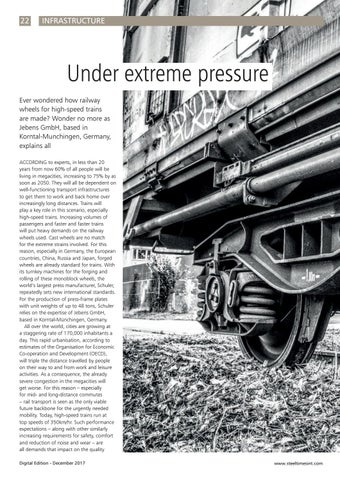
Under extreme pressure Ever wondered how railway wheels for high-speed trains are made? Wonder no more as Jebens GmbH, based in Korntal-Munchingen, Germany, explains all ACCORDING to experts, in less than 20 years from now 60% of all people will be living in megacities, increasing to 75% by as soon as 2050. They will all be dependent on well-functioning transport infrastructures to get them to work and back home over increasingly long distances. Trains will play a key role in this scenario, especially high-speed trains. Increasing volumes of passengers and faster and faster trains will put heavy demands on the railway wheels used. Cast wheels are no match for the extreme strains involved. For this reason, especially in Germany, the European countries, China, Russia and Japan, forged wheels are already standard for trains. With its turnkey machines for the forging and rolling of these monoblock wheels, the world’s largest press manufacturer, Schuler, repeatedly sets new international standards. For the production of press-frame plates with unit weights of up to 48 tons, Schuler relies on the expertise of Jebens GmbH, based in Korntal-Münchingen, Germany. All over the world, cities are growing at a staggering rate of 170,000 inhabitants a day. This rapid urbanisation, according to estimates of the Organisation for Economic Co-operation and Development (OECD), will triple the distance travelled by people on their way to and from work and leisure activities. As a consequence, the already severe congestion in the megacities will get worse. For this reason – especially for mid- and long-distance commutes – rail transport is seen as the only viable future backbone for the urgently needed mobility. Today, high-speed trains run at top speeds of 350km/hr. Such performance expectations – along with other similarly increasing requirements for safety, comfort and reduction of noise and wear – are all demands that impact on the quality Digital Edition - December 2017
www.steeltimesint.com
INFRASTRUCTURE
www.steeltimesint.com
23
Digital Edition - December 2017
24
INFRASTRUCTURE
requirements for railway wheels. As the technological and global market leader in forging equipment, Schuler Pressen GmbH is represented in over 40 countries with a total staff of around 5,170. Although the family business, which now belongs to the Austrian ANDRITZ Group, has only been active in the railway market for 10 years, Schuler has already succeeded in securing three orders for turnkey machines and equipment for the manufacture of railway wheels. The company’s innovative technology and the automated interlinking of its individual machines fulfil the most demanding requirements on the manufacturing process, from continuous casting material through to the finished railway wheel. Schuler is currently manufacturing a turnkey machine for forging and rolling railway wheels for a customer in Asia. A new wheel every 45 seconds The integrated process of wheel manufacture on this forging line begins with the charging robot that loads the rotary hearth furnace with 400mm to 800mm long billets. Next, a robot transports the billets, after they have been heated for up to five hours to a temperature of 1,250ºC, to the descaling machine. From there, they are forwarded by robot to the pre-forging press, where, in two forming stages, the wheel blanks are forged with a press force of 10,000 tons and the hub is also formed. The central cylinder – typical for Schuler wheel presses – and the slide that moves beneath it give the pre-forged form an almost near-net shape. Thanks to the high degree of force and precision during pre-forging, the required material input is reduced by up to 10%, which impacts positively on the cost efficiency of
the wheel manufacturing process. Patented hydraulics enable super-quick opening of the press and thus reduce the contact time between the workpiece and the forming die. This not only increases productivity but also extends the service life of the contact dies by reducing the thermal strain on them. In addition, with fficient ydraulic Forming (EHF) technology, Schuler reduces the power consumption of the machine, because, just like with a start-stop system in a car, this module allows the drives to be selectively switched on and off. Unlike conventional hydraulic presses, which need over a half a minute for the drives to start up, the Schuler pre-forging press is ready for operation within 1.5 seconds. This means that energy-intensive idle times can be almost completely avoided. From the pre-forging press, a gantry robot then conveys the wheel blanks to the core component of the forging line, the wheel roller. A total of nine rollers – four central rollers, two conical rollers, one main roller and two web rollers – give the wheel its final form in just seconds. The central rollers hold the blank in a vertical position while the web rollers press the wheel ange against the main roller and, simultaneously, the conical rollers form the width of the ange. In this way, the diameter of the wheel is enlarged parallel to the forming of the wheel ange. With a diameter of . metres, the main roller is ideally equipped to form the up to 1,500 kg heavy forged parts. To overcome moments of inertia, the forming rollers have their own drives. This means that the rollers, which are subjected to high thermal stress, can be turned during idling, thus enabling them to cool down again after each forming pass much faster than with conventional machines. Longer service life of the forming dies is an
additional efficiency benefit of this system. In the downstream dishing press, the wheel is given its finished form under , tons of press force. Its height is calibrated, the hub is offset axially and the web is given an S-shaped or bell-shaped form. This creates a cushion effect, which significantly reduces noise emission when the wheel is running. Then, a punch integrated into the press cylinder stamps a hole of about 150 mm diameter into the up to 350mm long hub with a press force of 1,000 tons. The end of the forging line consists of the e ible marking station – where the wheel is indelibly marked with a 10- to 15-character combination of numbers and letters – and a laser system that performs a contact-free measurement of the finished wheel. Sturdy support for the highperformance press Up to 75 wheels with diameters of up to 1,450mm will be produced per hour on this forging line. And the dimensions of the turnkey plant are correspondingly huge: it is 80 metres long and 30 metres wide, including the furnace. The undisputed “Hercules” of the line is the hydraulic highperformance press – towering 12 metres above oor level and going down four metres below it – in which the wheel blanks are created under 10,000 tons of press force. The forces exerted during this process call for a press frame with extreme rigidity if the required precision in production is to be guaranteed. Schuler commissioned Jebens – a leading specialist for large, heavy ame cut parts and ready to install welded components – for the production of the press plates. Arranged in layers and held together with spacers, they accommodate the press axles with the forming dies. Jebens delivered a total of 14 welded
HIGH TEMPERATURE BARCODE TAGS AND LABELS
Westmoreland, NH 03431 USA / www.polyonics.com / +1.603.352.1415 / info@polyonics.com Digital Edition - December 2017
www.steeltimesint.com
Pub_PMR_2017_Mise en page 1 28/02/2017 08:58 Page 1
redex
The Strip Processing Equipment Company
TENSION LEVELER for Tinning Lines
PMR MULTIROLL « Perfect Flatness at your fingertips ! »
REDEX advanced Tension Multiroll Levelers guarantees a perfect flatness, whatever the incoming strip quality: up to 50% improvement in overall quality can be achieved in comparison to conventional solutions. REDEX design provides the smoothest, the most progressive alternative bending, and the most stable process on the market. The major tinplate producers, such as Arcelor Mittal, TATA Steel, US Steel, UPI, AHMSA, ILVA, ERDEMIR, have already adopted the REDEX PMR Multiroll Leveler and got the immediate benefits from its outstanding performances and from the full service provided by REDEX. STEEL’S PREMIER TECHNOLOGY EVENT
> Extreme compactness, allowing easier integration in existing lines > Extremely high stiffness, making the PMR fully suitable with the high speed of the latest and most innovative tinning lines.
> 100% in-house manufacturing (machine-tool precision standards)
redex
European Headquarter > Ferrieres - France Services Centers > Europe, Americas, Asia Worldwide Setting-up and Maintenance service
Booth #2548
Find out more about our equipment portfolio
www.strip-processing.com
T. +33 2 38 94 42 00 | info@redex-group.com
26
INFRASTRUCTURE
plates according to precisely defined rigidity specifications for the press body of the hydraulic press eight profile frame plates, each 14,450mm long, 4,780mm wide and 150mm thick, with a unit weight of 48 tons. Six further plates, 11,060mm long and 3,600mm wide, weighed 22 tons each. Apart from the sheer handling of these heavy components, a major challenge was to maintain the required evenness over the plate length of more than 14 metres. But the crucial factor in achieving the specified rigidity of the frame is the overall quality of the welded parts. There are not many welding companies capable of fulfilling the correspondingly demanding welding specifications defined by Schuler. Because of positive experience over many years of reliable collaboration with Jebens, they were the logical choice. As Markus Knebel, head of purchasing at Schuler in Waghäusel, explains, “We can look back on over 25 years of successful collaboration with Jebens – initially as a supplier of ame cut parts, then increasingly as a supplier of smaller welded components with unit weights of five to 10 tons. So we know that we can rely on Jebens to implement the required quality Digital Edition - December 2017
specifications, and to keep the delivery deadlines. And, last but not least, the price is also right.” Uwe Konnerth, head of sales for forging at Schuler, adds, “When you’re making a plate press with a press force of 10,000 tons, the quality of the welding seams is absolutely crucial. With Jebens, we have a competent partner with certified ualifications for the job. or the M based in Baden Württemberg, Germany, production processes requiring extreme precision are daily routine. Thanks to its own welding specialists and comprehensive certification, ebens is e uipped for high precision work in reproducible premium quality. After sourcing the raw material, the company produced the welded components e actly to the drawing specifications submitted by Schuler. “For the pre-forging press, the shaping of the components is actually rather easy. The challenge lies in implementing the uality specifications for parts with these dimensions and a total weight of 440 tons,” says Uwe Konnerth. With its two welding robots and an XXL annealing and normalising furnace, Jebens had everything it needed for the complete in-house production of these large-
format components. The ame cutting and chamfering of the giant components was performed at Plant 1, the company’s headquarters in Korntal-Münchingen. After transportation to nearby Plant 2 in Nördlingen, the press plates were then welded, annealed and primed. According to Jebens, a welding robot was used for multi-layer welding to ensure seam precision and fault-free welding seams. The 15 metre long, 5.8 metre wide and 3.8 metre tall annealing furnace had no problem accommodating the gigantic dimensions of the large-format components in order to enhance them with the specified mechanical properties. Delivery of the welded components to a processor commissioned by Schuler marked the successful completion of the job for Jebens. The production of these press plates has re confirmed the reliability of the co-operation between Schuler and Jebens and established an excellent basis for future joint projects. And one thing is certain: in the global growth market for long-life forged wheels for high-speed trains, Schuler’s turnkey forging lines for efficient wheel manufacture will be in high demand. � www.steeltimesint.com
200 YEARS OF FUTURE! The CMI Group proudly celebrates its bicentennial
Innovative technologies for the metals industry
Cold rolling § Strip processing § Chemical processes § Thermal processes Mechanical equipment § Automation § Extractive metallurgy DESIGN
|
ENGINEERING
|
COMMISSIONING
|
TECHNICAL
A S S I S TA N C E
&
TRAINING
|
AFTER-SALES
CMI Group, two centuries of engineering in the service of the industry Cockerill Maintenance & Ingénierie: a long history, inextricably linked to that of the industrial revolution… In 1817, the British businessman John Cockerill begins his industrial activity in Wallonia by supplying weaving looms to the wool industry. He rapidly diversifies his activities: blast furnaces, industrial boilers, warships… Passionate about steam machinery, in 1835 Cockerill builds the first working steam locomotive to run on the European continent.
power plants, rolling mills and steel processing lines, reheating and heat treatment furnaces, boilers for thermo-solar power plants... From the outset, the ‘Cockerill factories’ have been anticipating trends and playing a determining role in worldwide technological advances.
The tone was set. This thirst for innovation has driven the generations of engineers who, for the past two centuries, have been introducing new processes bearing the Cockerill brand onto the market: engine designed by Rudolf Diesel, guns, boat engines, water tube boilers, locomotives, heat recovery steam generators for electric
John Cockerill also laid the foundations of the international vocation of CMI today. A great industrial explorer, he made many visits abroad, always on the lookout for new technologies and new projects. His conquering spirit has thrived through the decades. Thus, in 1890, the ‘Cockerill company’ was involved in the construction of the first major Chinese steelmaking complex, located at Hanyang, designing equipment and assisting the client in raising capital, assembling the installations and training the local workers.
1 In the 19th century, a team from the ‘Établissements Cockerill’ at Seraing (Belgium) receives Viceroy Hung-Chang from the Chinese province of Zhili.
1 In the 21st century, the teams from the CMI Group perpetuate the John Cockerill tradition, sparing no effort to meet the expectations of their clients.
Today, with the benefit of this centuries old understanding of industrial processes, and driven by the conquering and innovative spirit of its founder, the CMI Group continues to design, install, modernize and maintain equipment across the whole world, and to provide its clients and partners with valueadded services and its expertise in international project management.
Technological, international, robust This technology driven group places numerous beneficial assets at the disposal of its client industries: a unique combination of engineering and maintenance expertise, a vast geographic and technological scope, and an ability to innovate in accordance with the operational needs of its customers. CMI has never stopped enlarging its geographical reach and its portfolio of technologies. The Group today counts operational units in Africa, Brazil, China, Europe, India, New Caledonia, Russia and the United States. In all, some 4 600 members of staff within the Group constitute a pool of talent commensurate with CMI ambitions. With the benefit of this organization, CMI today serves an ever more diversified client base. Whatever their specific needs, in CMI they find a partner of choice, whether as an EPCM services provider across all technologies, for solutions involving reducing the ecological footprint of industrial processes, for specialized services or for the Group’s dynamism in terms of innovation.
www.cmigroupe.com 175422-ann-CMI Metals-200 ans+redaction-A4.indd 1
29/03/17 17:36
28
ENVIRONMENT
Is ‘steam steel’ the answer?
teel was one of the key contributors to the first industrial revolution. ighter, cheaper, and stronger than iron, it was a major component of a host of new inventions and the building of the railroads. As we enter the fourth industrial revolution, the steel industry faces a number of challenges – well documented in the media over the past months – some of which could be overcome, at least in part, by looking back to its roots in the first wave of industrialisation.
Digital Edition - December 2017
www.steeltimesint.com
ENVIRONMENT
Chris Armitage of Heliex Power
The initial phase of ritain’s industrial revolution owes as much to steam as it does steel the steam engine was another of the key innovations that powered industry during this rapid period of e pansion. ut, as other sources of energy became cheaper and more viable, the use of steam declined – trains, for e ample, switched to using diesel and gasoline. And, although steam has remained an important source of power since its heyday in the th century, much of its potential has gone untapped. www.steeltimesint.com
owever, that has begun to change – with the steel industry among a handful of sectors leading the way. ne steel mill, based in Terni, Italy, is making use of new, ground breaking technology, developed by academics at ity niversity, ondon, and ‘productised’ by elie Power, a company based in ast ilbride, cotland. Professors Ian mith and Nikola tosic, had been working on the challenge of creating energy out of a particular grade of steam for about four decades. When most people think about creating energy out of steam, they think of giant turbines, which have been generating power for years. owever, this form of steam, which is typically low pressure and at temperatures between and , couldn’t be used because the water particles within it eroded machinery. It’s called ‘wet’ steam and it’s ubi uitous in process industries like steel production , e plains hris Armitage, chief e ecutive of elie Power. If you think about a kettle, when it boils there’s a small amount of almost invisible, high temperature and pressure steam that escapes from its spout. That’s what’s called ‘dry’ steam it’s generally superheated and has been used to generate power in turbines for years. The problem is, it’s e pensive to produce. In much more ready supply is ‘wet’ steam the kind you can actually see but it is bad news for turbines. It destroys them and makes machinery impossible to use. That’s the problem we have solved our patented team pander ystem, a robust twin screw system, can harness this abundant source of energy, with variable ow rates. It’s working in areas and conditions that no one has been able to use before. The core of the system is a screw e pander, which functions similarly to a screw air compressor, and the most important part is the profile of its two entwined rotors, which sit within casing and are supported on bearings at each end. The rotors turn, but the edge of the rotors do not touch, forming a seal with a very small piece of water, which is where the wet steam comes in. We e pand the steam through that e pander and, in doing so, the two rotors turn and we have an output at one end. We connect that to a generator to produce electricity with our elie Gen et, and have
29
recently introduced three new products that use the same core technology to power an air compressor, a steam compressor, or drive a piece of rotating e uipment, adds hris Armitage. What prevents the water particles from eroding the system is the combination of the way the steam is put into the machine, and the profile and robustness of the rotors – they are a much tougher piece of e uipment than a turbine blade. The profile of the inlet port means that we get ma imum efficiency on the machine, while also ensuring that the steam e pands in a manner that prevents it from eroding the rotors. Anyone who works in the industry knows that the energy demand of an integrated steelworks is incredibly high – in fact, many of them consume as much electricity and gas as a medium si ed city. And, although the energy consumption of the iron and steel industries has been cut by in urope in the past years, they are still one of the largest emitters of – accounting for between and of anthropogenic emissions globally, according to figures from the uropean ommission. That is significant progress on where the industry was before, driven largely by the doubling of the use of recycled scrap iron from a share in the s to around today. owever, given that more than two thirds of the sector’s energy consumption is used to provide heat, there is more that can be done to enhance the steel industry’s e isting efforts to realise efficiencies. Within steelworks, there are many individual areas of the production process that could benefit from recovering energy from steam. To take a few e amples, the waste gases from coke ovens, blast furnaces, and basic o ygen steelworks are normally all captured and reused, either as natural gas replacement for heating purposes or combusted in a boiler to create steam for electrical generation. The potential is huge for the steel industry to make significant savings in its facilities through waste steam recovery, both in terms of carbon and energy costs , says hris Armitage. The system could be applied to a wide variety of the typical phases within steelmaking, from sinter plants and hot strip mills, to Digital Edition - December 2017
30
ENVIRONMENT
Digital Edition - December 2017
31
Digital Edition - December 2017
32
ENVIRONMENT
the continuous annealing process lines. sually we’re looking at a one to three year payback on the initial investment in one of the steam recovery systems, which is an attractive proposition by any measure and demonstrates how much energy they can create. The potential for elie ’s team pander ystem goes well beyond the steel industry though. stimates suggest that more than , gigawatt hours GWh of energy vanishes globally every year through waste steam, in sectors from chemicals and pharmaceuticals, through to agriculture and waste incineration. ther analyses find that up to of industrial energy usage is eventually released as waste heat – enough to power billion homes. £70 billion market elie estimates that the potential market for its system is in e cess of billion, with demand from across the globe. The company already e ports from its base in the to India, Poland, rance, Austria and Italy, while research from a possible partner in hina suggests that a million of its systems are re uired in that country alone. Adoption of the technology has been steadily picking up, with more than units in the field, clocking up over , hours of operating time. After booking , Digital Edition - December 2017
in revenue in , elie grew sales to . million last year. The company e pects to double this in , and do the same again during the following months – which translates into a lot more of the systems in action. The technology can be used in any process that uses steam directly or uses a steam system as a heating medium – that makes its possible applications wide ranging and its commercial potential vast , concludes hris Armitage. When we first looked at the numbers for the product’s overall market, they were so large we had trouble believing them. The steel industry could be one of the top beneficiaries, given the scale of its energy re uirements. The sheer amount of wet steam out there that could be put to better use, is mind blowing – and the steel industry is one of the first industries to start embracing its potential. Although very much in its infancy, this technology could be transformative for energy intensive sectors – it’s a real breakthrough in delivering energy efficiency and there’s plenty more to come from it yet. Case study – Acciai Speciali Terni A T Terni is a long established Italian steel mill, founded in , and one of the world’s leading manufacturers of stainless
steel, at products. The company’s steel is mostly used in food preservation, household appliances, in the construction industry, kitchenware and energy production. nown in the industry for its modern and sophisticated machinery, in addition to its technological innovation, A T Terni recognises the importance of future proofing its business, through a commitment to operating sustainably and reducing the effects of rising energy costs. ne of the ways it is doing this is by converting its e isting waste steam into usable electrical power. At its main facility in Terni, mbria, the company’s site distributes steam at . ar G, which is then reduced for use locally via pressure reduction valves P Vs . een to further invest in carbon emission reduction technologies, a elie Power P Gen et was installed, operating at , rpm and driving a 3, rpm asynchronous generator through a toothed belt transmission. The P is waterproof, which is suited to A T’s site and outdoor positioning. The overall result for Terni has been significantly reduced energy bills. The site uses the electricity produced by the Gen et, reducing its carbon footprint and ualifying Terni for white certificate incentives – all of which helps its drive to be a greener and more efficient steel plant. � www.steeltimesint.com
Swiss Quality and German Reliability... complete engineering and supply
contact us your specialist in heat up & hold hots Dry Out and Pre-heating -
portable High Velocity Burners
-
adaptable to clients’ requirements
-
experienced manpower
-
precise temperature control from ambient to 1400°
Service performed for: -
Blast Furnace Repair Blast Furnace Re-line Heating Hotblast Main & Bustlepipe
-
Blast Furnace Stove Heat-Up/Hold Hot Reheat Furnace (Walking Beam/Pusher) Dry Out Iron throughs/slag runners Coke oven full or partial
Worldwide Availability with local offices and partnerships in over 60 countries worldwide
Hotwork International AG Romanshornerstrasse 123 9322 Egnach, Switzerland Tel.: +4171 649 2090 contact@hotwork.ag http://www.hotwork.ag
visit our website at
Buenos Aires, Argentina Cebu, Philippines Egnach, Switzerland Jakarta, Indonesia Gujarat, India Mexico City, Mexico Osaka, Japan Seoul, Korea Shanghai, China ...
www.hotwork.ag
35
GLOBAL EAF SURVEY RESULTS
The influence of metallics and EAF design There is an important variation in scrap quality and alternative iron sources depending on country and region. esides, a variety of furnace designs are available. This paper looks at the in uence of metallics type and A design on specific consumption of energy, o ygen and other inputs, as well as on some productivity indicators, based on a survey of published figures of A s around the world. The results obtained are analysed in detail. Jorge Madias1, Andrea Bilancieri2, Sara Hornby3
THE data base was selected from publications in technical journals and presentations in conferences, from 2010 to February 2017. All furnaces included are intended for production of rolled products: EAFs for steel castings, forgings and powder are not included, nor are furnaces producing e clusively stainless and tool steels. Also e cluded are furnaces with heat capacity lower than 30 t. The universe surveyed includes 190 furnaces. Twin shell furnaces are counted as one furnace (including the CONARC furnaces). All steelmaking regions are included (Fig 1). Charge types include from 100% scrap to 40% pig iron, 60% hot metal, 100% DRI/HBI and 100% hot DRI. Products include merchant long products, , at products coil and plate and seamless pipes. The survey includes 28 DC vs. 162 AC
Africa 1%
Oceania 2%
electrode diameter; productivity; tap to tap time; power on time; consumptions power, o ygen, injected carbon, natural gas, electrodes; metallic yield; charge type; product type; published reference. Information sources are cited in the reference [1-46]. It is obvious that published data corresponds usually to a specific operation period, and consumption figures as well as productivity times change depending on demand and other situations that may vary along time.
furnaces. Regarding tapping system, there are 16 furnaces equipped with spout, and 174 with EBT. 31 furnaces have some form of scrap preheating (15 Consteeel, 5 shaft and 11 twin shell furnaces), while the other 159 furnaces have no scrap preheating at all. In terms of charging, nine furnaces are known to be single bucket. In Fig 2, the distributions of these furnace features within the survey are shown. The relation between transformer power and heat capacity within the survey is shown in Fig 3. The line in the figure shows the 1:1 ratio.
Power consumption For the population of surveyed furnaces, the specific consumption of electric energy depends first on the raw materials, and the thermal state of them when charged (hot DRI, hot metal). Of the 10 top EAFs with the lowest energy consumption (<300 kWh/t), nine charge more than 20% of hot
Survey pecific consumptions are e pressed in terms of metric tons of liquid steel in the ladle. The data included are: company / group; plant name; country; EAF type, heat capacity; transformer (power in MVA);
Fig 1. (left) Distribution of the surveyed furnaces by region
Asia 10% Spout 8%
DC 15% Europe 18%
Consteel 8%
Twin shell 6%
Shaft 2%
North America 48% AC 85%
EBT 92%
No preheating 84%
Latin America 21%
Fig 2. (above) Distribution of furnace type within the survey. Left (Fig 2 above): electric current type; centre: tapping system; right: no preheating and preheating systems
* 1metallon - 432, 9 de Julio Street, San Nicolas B2900HGJ, Buenos Aires Province, Argentina e-mail: jorge.madias@metallon.com.ar 2TenarisSiderca, Av. Dr. Jorge A. Simini 250, Campana 2804, Buenos Aires Province, Argentina e-mail abilancieri@tenaris.com 3Global Strategic Solutions, Inc.; 16317 Woolwine Road, Charlotte, NC 29278, USA e-mail drhornby62@gmail.com www.steeltimesint.com
Digital Edition - December 2017
36
GLOBAL EAF SURVEY RESULTS
350
650 600 Specific power consumption (kWh/Mt)
Transformer power (MVA)
300 250 200 150 100 50 0 0
50
100
150 200 Heat capacity (t)
250
300
350
Fig 3. Transformer power and heat capacity (steel in the ladle) for the surveyed furnaces
550 500 450
Hot metal
400
Pig iron
350
Cold DRI/ HBI Hot DRI
300 250
Scrap
200 150 0.000
0.500 1.000 1.500 Specific power (MVA/Mt)
2.000
2.500
Fig 4. Specific power consumption for furnaces with different metallic charge. Scrap-based EAF applies for furnaces charging more than 80% scrap. Hot metal charging furnaces are considered for those charging 20% or more hot metal.
metal (Table 1 and Fig 4). In these cases, energy is consumed in the blast furnace, and EAF CO2 emissions are larger than usual. The furnaces charging an important share of pig iron, as well as those charging scrap that are managed more efficiently, have a specific energy consumption of 3 kWh/t (Fig 4). Then, those furnaces of intermediate efficiency with scrap based metallic charge, as well as those charging hot DRI, are located in the range of 400 – 450 kWh/t (Fig 4). Higher energy consumption (more than 450 kWh/t) is typical of high cold DRI/ I share or of low efficiency scrap based EAFs. A favourable in uence of scrap
Country
Heat
Current
Type
capacity (t)
preheating is observed (Fig 5). Consteel, shaft furnaces and twin shell furnaces are located within those with lower power consumption, sharing this position with the more efficient conventional A s. or this purpose, to eliminate the aforementioned in uence of the metallic charge, only those EAF charging 80% of scrap or more were considered. Other factors ygen consumption. The distribution of specific o ygen consumption in the surveyed furnaces is shown in figure . More than half of the surveyed furnaces consume 30 to 40 Nm3 t of o ygen. This re ects the advance of chemical energy, due to productivity and power cost.
Transformer
Tap to tap
Power cons.
(MVA)
(min)
(kWh/tls)
From a technological point of view, this is associated with the use of injectors instead of lances, as well as the changes in injector design to allow for a larger o ygen ow rate. Although there is a large dispersion, it is worth mentioning the average o ygen consumption related to the metallics charged: -
20% or more of hot metal: 36.3 Nm3/t 20% or more of pig iron: 43.3 Nm3/t 20% or more of DRI/HBI: 31.7 Nm3/t 80% or more scrap: 31.7 Nm3/t
As e pected, the higher the heat capacity, the larger the electrode diameter (Fig 7). But two other aspects can be mentioned:
O2 (Nm3/tls)
Met. other
Product
than scrap (%)
China
50
AC
Standard
67
132
54 HM
LS
China
100
DC
Standard
90
44
177
47
57.5 HM
LS
China
110
AC
Standard
80
33
220
33
30 HM
LS
Russia
175
AC
Standard
150
45
223
34
22 HM
LC
Taiwan
155
AC
Twin Shell
120
44
225
37
35 HM
LC
China
110
AC
Standard
80
35
240
33
30 HM
SP
China
110
AC
Standard
80
35
240
33
30 HM
SP
Brazil
110
AC
Standard
48
43
265
30 HM
LC
Brazil
80
AC
Standard
75
25 HM/5PI
LC
Singapore
80
AC
Shaft
48
295
0
LC
Turkey
195
AC
Standard
47
300
38,5
0
LC
South Africa
170
AC
Conarc
115
57,5
310
43
50 HM/ 50 cDRI
FC
India
180
AC
Conarc
137
57,5
310
50 HM/50 cDRI
FC
Korea
120
AC
Shaft
49
314
not known
LC
Vietnam
63
AC
Consteel
54
328
10 HM
LC
A
tandard
Me ico
33
295
31
31
33
Italy
95
AC
Standard
100
340
20
10 PI
SP
Brazil
50
AC
Standard
36
343
60
30 PI
LC
Brazil
50
AC
Standard
48
343
60
30 PI
LC
A
tandard
Me ico
42
cD I
3
cD I
Table 1. Top twenty furnaces regarding power consumption. HM: hot metal; PI: pig iron; cDRI: cold DRI. LS: Long special; LC: Long carbon; SP: Seamless pipes; FC: Flat carbon.
Digital Edition - December 2017
www.steeltimesint.com
Specific power consumption (kWh/Mt)
38
GLOBAL EAF SURVEY RESULTS
650
50.0
600
45.0 40.0
550
35.0
500 450 400 350
Standard
30.0
Spout
25.0
Consteel
20.0
Shaft
15.0
Twin shell
10.0 5.0
300 0.500
0.000
1.000 1.500 Specific power (MVA/Mt)
2.000
-
2.500
Fig 5. Specific power consumption for scrap preheating and conventional furnaces.
<20
20-30 30-40 40-50 Oxygen consumption (Nm3/Mt)
>50
Fig 6. Specific oxygen consumption in Nm3/t for the EAF surveyed
Only furnaces charging 80% scrap or more are considered
16 of them are dedicated to merchant long products. The logic behind this situation is that in general, these furnaces are linked to billet casters equipped with metering nozzle and oil lubrication, characterised by casting speeds much higher than those used for SBQ, for the same billet size. Long sequences are usual for these casters, most of them equipped with automatic nozzle changer. SBQ casters, instead, have limited sequence length because of shorter SEN life and a larger variety of steel grades. See Table 2.
- There is a big concentration of furnaces using 610 mm diameter electrodes, tapping from 70 to 200 t per heat. - DC furnaces, with one or two electrodes, present the larger diameter, for a given heat capacity. Increased electrode consumption As e pected, there is a trend to increased electrode consumption for higher power consumption (Fig 8 . D furnaces e hibit lower electrode consumption. Productivity per hour is linearly related to the heat size, although other factors in uence, too Fig 9). Seven of the 10 top EAFs in productivity per hour are feeding slab casters. Regarding power on time, the twenty top EAFs have a varied heat size (35t to 220t);
Country
Heat
Current
Type
capacity (t)
Conclusions There are four ranges of power consumption according to the metallic charge: - <300 kWh/t: furnaces charging more
than 20% of hot metal - 300-400 kWh/t: furnaces charging an important share of pig iron, as well as those charging scrap that are managed more efficiently - 400 – 450 kWh/t: furnaces of intermediate efficiency with scrap based metallic charge, and those charging hot DRI - >450 kWh/t: furnaces with high cold D I I share or low efficiency scrap based EAFs. References Regarding furnace type, it is clear the favourable in uence of scrap preheating, with transporter, shaft or twin shell. DC EAFs do not differ much on power consumption, but are in the lower range of electrode consumption.
Transformer
Tap to tap
Power on
Power cons.
(MVA)
(min)
(min)
(kWh/tls)
Spain
130
AC
Standard
140
43
29
Germany
100
AC
Standard
90
41
30
O2 (Nm3/tls)
Metallics
Product
other than scrap SC
LC
365
38,6
SC
LC LC
Germany
100
AC
Standard
90
41
30
365
38,6
SC
Belgium
90
DC
Standard
99
42
31
370
44
SC
LC
Russia
175
AC
Standard
150
45
32
223
34
HM
LC
USA
35
AC
Consteel
30
55
32
350
31
SC
LC
USA
171
AC
Shaft/Twin
140
38
32
372
50
PI
FC
Brazil
110
AC
Standard
48
43
33
265
Norway
89
AC
Consteel
75
41
33
384
26
Turkey
220
AC
Standard
230
41
35
360
35
SC
LC
USA
154
DC
Standard
180
40
35
386
41
CDRI
FC
USA
154
DC
Standard
180
45
35
386
41
CDRI
FC
D
Twin hell
LS
u embourg
HM
LC
SC
LC
3
China
100
DC
Standard
90
44
36
177
47
HM
Brazil
80
AC
Standard
75
37
295
31
HM
LC
Korea
100
AC
Standard
100
45
37
354
29
SC
LC
France
92
DC
Standard
72
54
37
375
44
SC
LC
UAE
152
AC
Standard
130
64
37
392
35
HDRI
LC
Belarus
110
AC
Standard
95
38
386
SC
LC
Qatar
85
AC
Standard
78
38
480
CDRI
LC
50
35
Table 2. Twenty furnaces in the survey, with the shorter power on time. HM: hot metal; PI: pig iron; cDRI: cold DRI. LS: Long special; LC: Long carbon; SP: Seamless pipes; FC: Flat carbon.
Digital Edition - December 2017
www.steeltimesint.com
BSE Spray Cooling Technology Safe, simple, reliable Cooling of EAF Components Principles.
Concept.
Advantages.
Support structure with cooling elements consisting of water header and spraybars providing a pressureless water flow.
Collector ring as an integral part of support structure used for water supply and return for cooling elements; water-cooled centre piece and fume take-off adapter.
Maximum safety in operation, based on pressure-less function, thus eliminating the risk of explosions.
Heat transfer through steel plate cooled by a thin water layer. Water amount adjustable according to individual heat load areas. Suitable for the furnace roof and the elbow.
Area around electrode openings designed for refractory-lined, easily exchangeable centre piece. Usage of clog resistant spray nozzles and access hatches.
Reliable operation and long lifetime due to proven design with well-balanced cooling performance. Lower consumption of cooling water compared to tubular design. Reduction of production delays – in many cases production can continue until next shutdown.
Tested and proven at BSW, the steel plant of the Badische group, and at many customers’ plants worldwide.
Designed for lower weight, thus increasing the lifetime of the gantry bearing.
Quick repair of minor damages and good access to all areas.
Spray bars with nozzles providing a pressure-less, balanced and efficient water cooling
Top view of roof with holes for the electrode centre piece and the furnace elbow
Bottom view of the roof equipped with centre piece for the electrodes
Easy cleaning of roof surface for an optimised maintenance.
Badische Stahl-Engineering GmbH Robert-Koch-Straße 13 D-77694 Kehl/Germany Phone (+49) 78 51/877- 0 Fax (+49) 78 51/877-133 eMail info@bse-kehl.de www.bse-kehl.de
BSE0370_Leaflet_Sprühdeckel_2017.indd 1
14.09.17 09:18
40
GLOBAL EAF SURVEY RESULTS
2.5
Electrode diameter (mm)
800 700 600 AC 500
DC
400
Electrode consumptiuon (kWh/tls)
900
2.0 1.5
DC 0.5
300 0
50
100
150
200
250
300
AC
1.0
-
350
0
100
Heat capacity (t)
400 200 300 Power consumption (kWh/tls)
500
600
350
Fig 7. (top left) Electrodes di-
16.
300
ameter vs. heat capacity, for
Houbart, M.; “Dragon Steel Corp. in Taiwan boosted
AC and DC furnaces of any
150-ton EAF twin shell by continuous hot metal
design and metallic charge
charging process”. AISTech 2011 Proceedings, pp. 799-
Productivity (t/h)
250
Solver, Chr.; Roth, J.-L.; Hoffmann, M.; Stoltz, R.;
809.
200 Fig 8. (top right) Electrode
150
consumption vs. energy
100
17.
Gottardi, R.; Miani, S.; Partika, A.; SUber, M.;
Decarburisation efficiency in A with hot metal
consumption for AC and DC
charge”. Iron & Steel Technology, January 2012, pp. 61-
furnaces
69.
50
18.
Kim, D.S.; Jung, H.J.; Kim, Y.H.; Yang, S.H.; You,
-
Fig 9. (left) Hourly production
-
versus heat capacity, for all
through uid ow simulation and practical evaluation .
EAFs
Ironmaking and Steelmaking 2014 VOL 41 NO 5, pp.
50
100
200 250 150 Heat capacity (Mt)
300
350
400
.D.
ptimisation of o ygen injection in shaft A
321-328 9.
Jones, J.A.T.; McClanahan, R.; Carraway, K.;
“Analysis of meltshop operating data at North Star
References
lue cope teel to uantify the e pected benefits of
19.
de Oliveira Paula, A.; Martins Araújo, A.; Renato
Ribeiro, S.; Coelho Furtado, Th.L.; de Souza Lima, W.L.; “Aciaria elétrica e utilização de gusa líquido”. 43º
increased furnace bottom volume on EAF operations”.
Seminário de Aciaria da ABM, maio de 2011, Salvador,
Steel Technology January 2017, pp. 136-159.
Iron & Steel Technology January 2012, pp. 56-60.
Brasil p. 792-800.
2.
10.
20.
1.
“AIST 2017 Electric Arc Furnace Roundup”. Iron & Brooks, G.; McClellan, J.; Muschamp, D.; Fontana,
Fritella, P.; Lucarelli, A.; Angelini, L.; Filippini,
Pinto Wandekoken, Th.; Totti Maia, B.;
A.; Bogusz, M.; “Optimizing chemical energy into
E.; Poizot, B.; Legrand, M.; “iCSMelt applications to
Hopperdizel, P.; de Oliveira, J.R.; “Desenvolvimento
electric arc furnaces”. SEAISI Quarterly Journal 2012 Vol.
EAF operating practice optimisation”. AISTech 2011
e utilização de um modelo matemático de balanço
41 No. 4 , pp. 17-22.
Proceedings – Volume I, pp. 915-927.
térmico de um FEA como ferramenta de avaliação de
3.
11.
parâmetros técnicos e econômicos no uso de gusa
Magalhães Almeida, E.; de Oliveira, T.A.; Martins
D’Souza, J.; Al Marr, A.S.A.A.; “Use of high
Barreto, A.F.; Chesseret, L.; “Processo de desfosforação
percentage uality D I in A and its benefit in cost
líquido”. 43º Seminário de Aciaria da ABM, maio de
no Consteel da Vallourec Sumitomo Tubos do Brasil”.
reduction”. AISTech 2011 Proceedings – Volume I, pp.
2012, Belo Horizonte, Brasil, p. 75-85.
955-972.
21.
2013, p. 385-391.
12.
Giacomini, .
4.
Rollinger, B.; Braga, P.; “Steelmaking – Tailored solutions
emin rio de Aciaria da A M, Ara , rasil, maio de Nikkanen, K.; Mistry, S.; Maiolo, J.; Khan, M.; peration benefits at ArcelorMittal ontrecoeur uest using EFSOP technology”. AISTech 2011 Proceedings –
Huber, Th.; Fleischer, M.; Niedermayer, W.; Modern and efficient mini mill concepts
e ible in electrical power uality, charging materials
for high quality steel”.
and meltshop rolling mill connections”. SEAISI Quarterly
13.
Grant, M.G.K.; Kaufman, C.; Blostein, Ph.; Prakash,
Journal 2011 Vol. 40 No. 4, pp. 14-19.
irel, Ph.
22.
.
Volume I, pp. 867-875.
Schreiter, T.; Meierling, P.; Kleinschmidt, G.;
ygen steelmaking practices in non
Fabbro, M.; Chiogna, A.; Cappellari, G.; “The 1.2
conventional EAF operations”. Steel Times International
Mtpy steelmaking plant and combicaster for the new
li uido en el A , la ltima e periencia en ArcelorMittal
– April 2013, pp. 49-50.
minimill at Siderurgica Balboa, Spain”. 40o Seminário
Lázaro Cárdenas Flat Carbon”. CONAC, Monterrey,
14.
de Aciaria da ABM, São Paulo, Brasil, maio de 2009, p.
M ico, Noviembre
Abdelaziz, E.A.; “Improving EAF performance by
527-541.
chemical energy optimisation at Ezz Flat Steel”.
23.
Ironmaking & Steelmaking 2010 Vol. 37 No. 6, pp. 445-
evaluation of EAF performance – Operational results”.
at TenarisTamsa”. Iron & Steel Technology January 2013,
451.
AISTech 2011 Proceedings – Volume I, pp. 1007-1015.
pp. 81-89.
15.
7.
Plant visit, 2013
steelmaking process with increasing hot metal charging
M.; Shifrin, V.; Popenov, A.; Delabroy, O.; Oliveira, F.;
8.
Travaglini, C.; Cavinato, E.; Losso, P.; “O tarugo
5.
6.
Lule, R.; López, F.; Espinoza, J.; “El uso de arrabio
.
Martell, F.; Mendoza, R.; Meléndez, M.; Llamas, A.;
Increasing energy efficiency of the electric arc furnace
Megahed, G.M.; Fathy, A.M.; Morsy, M.A.;
Duan, J.-P.; Zhang, Y.-L.; Yang, X.-M.; “EAF
24.
Grosse, A.; Opfermann, A.; Baumgartner, S.; “The
Cruz de Moraes, G.; do Amaral Filho, W.; Grant,
ratio and improving slagging regime”. International
“Implementation of Pyrejet technology in electric arc
mais longo do miundo”. MPT Edição Brasileira 3/2010,
Journal of Minerals, Metallurgy and Materials, Vol. 16,
furnaces at Siderurgica Barra Mansa”. XXXIII Seminário
p. 16-20.
No. 4, August 2009, pp. 375-382.
de Aciaria da ABM, pp. 36-48.
Digital Edition - December 2017
www.steeltimesint.com
GSM 200 to capacity and GFM 100 to capacity
performance for high productivity GLAMA Maschinenbau GmbH Headquarters: HornstraĂ&#x;e 19 D-45964 Gladbeck / Germany Fon: +49 (0) 2043 9738 0 Fax: +49 (0) 2043 9738 50 email: info@glama.de
GIR-P 1 t capacity
glama.de
GFM 150 t capacity
GLOBAL EAF SURVEY RESULTS
25.
43
Giavani, C.; Guzzon, M.; Picciolo, F.; “Start-up and results of the EAF
Consteel Plant of Celsa Nordic - Mo i Rana (Norway)”. AISTech 2010 Proceedings – Volume I, pp. 783-791. 26.
Gottardi, R.; Engin, B.; Miani, S.; Partyka, A.; Kohl, S.; “Single EAF and single
billet caster for 320 t/h productivity”. SEAISI Quarterly Journal 2009. 27.
Dietrich, A.; Kaspersen, P.’; Sommerauer, H.; “More than two years of
e perience of several laser installations to measure
2
, CO and temperature of the
off-gas”. AISTech 2004 Proceedings Vol. II pp. 755-759. .
Al Dhaheri, A.
a a, P. Damiano, P.
cellent operating results of the
integrated minimill #I at Emirates Steel lndustries”. MPT 2/2010, pp. 34-40. 29.
Gottardi, R.; Engin, B.; Miani, S.; Partyka, A.; Kohl, S.; “Single EAF and single
billet caster for 320 t/h productivity”. SEAISI Quarterly Journal 2009. 30.
Gervais, O.; Alameddine, S.; Fregonese, T.; Renard, Y.; Finot, T.; “Total cost
and CO2 emission reduction using Apollo electrode system at ArcelorMittal Differdange DC arc furnace”. AISTech 2011 Proceedings – Volume I, pp. 9911005. 31.
Damiano, P.; Pesamosca, A.; “Successful start-up and benchmark operating
results of 100 t FastArc EAF at Kosco, Korea”. AISTech 2012 Conference Proceedings, pp. 778-782. 32.
Januard, F.; Bockel-Macal, S.; Müller, B.; Lebrun, C.; “Decision support tool
Materials handling solutions for your industry
for EAF control”. AISTech 2005 Proceedings – Volume I, pp. 555-561. 33.
Bianchi Ferri, M.; Cozzi, G.; Lombardi, E.; “ Energy & graphite electrode
savings in Ori Martin, Brescia, Italy” . ISSTech Conference Proceedings pp. 11011110. 34.
Matschullat , Th.; Rieger, D.; Dietmer, B.; Klüger, K.; Döbbeler, A.; Mess, H.;
“Results of foaming slag and scrap meltdown control SIMELT CSM/FSM based on structure-borne sound in electric arc furnace operation”. AISTech 2012 Conference Proceedings pp. 2577-2589. 3 .
Min, h. W.
perating e perience of finger shaft electric arc furnace in
Natsteel Asia”. SEAISI Quarterly Journal 2009, Vol. 38, No. 1, pp. 30-34. 36.
Adachi, T.; Sellan, R.; “The jumbo size 420 t EAF at Tokyo Steel, Japan”. MPT
International 2/2012, pp. 54-62. 37.
Marcozzi, M.; Guzzon, M.; “The evolution of preheating and the
importance of the hot heel in supersized EAF systems”. MPT International 3/2011, pp. 82-90. 38.
Picciolo, F.; Rondin, N.; Villares de Freitas, J.; “Record in performances with
EAF Consteel technology – Thep Viet (Vietnam) melt shop case”. 41o Seminário de Aciaria da ABM, Resende, Brasil, maio 2010, p. 688-697. 39.
Abel, M.; Hein. M.; “The breakthrough for 320 t tapping weight”. MPT
International 4/2008 pp. 44-48. 40.
Lu, D.; Hassan, A,; Griscom, F.; “Antara Steel & HBI – 25 Years of Adding
Value to South East Asian Steelmaking”. SEAISI Quarterly Journal 2009. 41.
Huber, Th.; Fleischer, M.; Niedermayer, W.; Giacomini, L.; “Modern and
efficient mini mill concepts e ible in electrical power uality, charging materials and meltshop rolling mill connections”. SEAISI Quarterly Journal 2011 Vol. 40 No. 4, pp. 14-19. 42.
Plant visit, November 2013
3.
antacu ene, . Grant, M.
oussard, P. Devau , M.
arreno, . aurence,
. Dworat ek, . Advanced A o ygen usage at aint aulve steelworks . Ironmaking & Steelmaking 2005 Vol. 32 No. 3 pp. 203-207. 44.
Piemonte, C.; Vignolo, L.; Burin, P.; “Start-up da MMK-Atakas com alta
capacidade de produção de aço plano na costa do Mediterrâneo”. MPT Edição Brasileira 3/2011, p. 30-35. 45.
Tsubone, A.; Momiyama, T.; Inoue, M.; Saito, N.; Matsubae, K.; Nagasaka,
T.; “Development of EAF dust injection technology in Aichi Steel”. AISTech 2012 Proceedings, pp. 163-172. 46.
Bianchi Ferri, M.; Giavane, C.; “Maior usina mundial da Consteel alimenta o
novo laminador de chapas finas em Arverdi, lt lia . MPT di o rasileira p. 10-12.
www.steeltimesint.com
,
• Improved storage utilisation • Safer product handling • Increased productivity • Indoor / Outdoor
44
CONTINUOUS CASTING
State-of-art automation for continuous Advancements the accuracy and reliability of sensors and the application of Artificial Intelligence using mathematical models in continuous casters has improved productivity and uality. In addition, the use of robotics has enhanced operator safety. By I Banerjee, S Kumar & S Singh
Pic courtesy of SMS Group
Digital Edition - December 2017
www.steeltimesint.com
CONTINUOUS CASTING
45
s casting The authors are with D I esearch Devel opment entre for Iron teel , AI teel Authority of India td , anchi, India.
www.steeltimesint.com
Digital Edition - December 2017
46
CONTINUOUS CASTING
Disturbance factors
Stopper rod
Electric serve drive and actuator
undish Alternating magnetic field
SEN Mould
Eddy currents
Fig 2. Philosophy of automatic metal level control
Mould level sensor
Mould level
Withdraw al roll
- Manual interference -Non linearity - hange in tundish weight - Nozzle clogging/ damage - Stopper erosion - hange in casting speed - Slab bulging - Slab slipping
drive
Fig . Eddy current sensor for level of metal in mould
NTIN casting transforms liquid steel into solid on a continuous basis. This is the most efficient way to solidify large volumes of li uid steel into simple shapes for subse uent processing. The CC ratio for the world steel industry now averages around of crude steel output compared with a mere in . elative to other casting processes, continuous casting generally has a higher capital cost, but lower operating cost. It is the most cost and energy efficient method to mass produce semi finished products with consistent quality in a variety of sizes and shapes. ross sections can be rectangular, for subse uent rolling into plate or sheet, s uare or circular for long products and seamless pipes, and even dog bone shapes, for rolling into I or beams. rom the metallurgical point of view, state of the art continuous casting machines have features to enable strand treatment through special cooling and soft reduction technologies. ophisticated process models allow on line process simulation and close loop control to further optimise product quality and productivity goals. obotic units perform tasks in hazardous areas and improve operational reliability without human intervention. Innovative technologies and designs have played a role in improving every area of casters from turret, through tundish, mould and segment drives. se of robots in ha ardous areas of the caster is gaining popularity. Developments in computational capabilities and use of artificial intelligence are being used as performance enablers. Sensor types ontinuous casting is a comple metallurgical process which demands measurement of parameters and dimensions with great accuracy and in real Digital Edition - December 2017
time. Corrective actions are taken based on these measurements by a very high speed automation system working in the background. The continuously cast steel is further processed in hot rolling mills which require consistent dimension achieved by taking corrective action at the caster so that non conformity can be reduced or eliminated. Contact sensors are prone to maintenance problems which are difficult to rectify in the hazardous location of a caster. ensor technology has advanced with the advent of non contact methods of measurement using such principles as inductive and capacitive coupling, laser, radar, fibre optics etc. Non contact sensors are prevalent in the measurement of temperature, speed of moving slab billet, measuring li uid steel level and dimension determination of the moving slab billet. ome applications of non contact sensors in continuous casting are described below Eddy current mould level sensor ddy urrent sensors operate using the principle of magnetic field interactions ig . An alternating current is created in the sensing coil at the end of the non contact probe. This creates an alternating magnetic field with induces small currents – eddy currents – in the target material. The eddy currents create an opposing magnetic field which resists the field being generated by the probe coil. The interaction of the magnetic fields is dependent on the distance between the probe and the target. As the distance changes, the electronics sense the change in the field of interaction and produce a voltage output which is proportional to the change in distance between the probe and target. The target surface must be at least three times larger than the probe diameter for normal calibrated operation, otherwise, special
calibration may be re uired. In casters, eddy current sensors are primarily used to detect the level of molten steel in the mould. Automatic mould level control AM is one of the most important features in a caster. The accuracy of this depends on precise measurement of the level of molten steel in the mould, based on which an electro mechanical actuator operates the stopper rod in the tundish to maintain a steady level of steel in the mould Fig.2 . The sensor block contains a 3 coil sensor head that measures the induced eddy currents to measure the metal level in the mould. The sensor’s primary coil receives a high fre uency current k , adjustable from to k , which generates a high fre uency magnetic field. In response an eddy current is generated in the molten metal which induces differential voltages in the secondary coils depending on the metal height. A differential measurement is chosen to minimise drift, electro magnetic disturbances and to enlarge the measurement stroke to withstand the high temperatures of the molten metal. Both primary and secondary coils are air cooled and protected with a specially designed ceramic shell. Infra-Red camera slag detection lag carry over from the ladle to the tundish has detrimental effects on continuous casting operations and product uality. lag entrainment in the steel stream at ladle changeover leads to a cumulative build up in the thickness of the tundish slag during e tended se uence casting. low of slag from ladle to the tundish is undesirable. It is a challenging task for the operator to close the ladle slide gate using e perience alone to prevent slag passing into the tundish. ere an industrial thermal imaging camera plays a vital role to detect slag. This works www.steeltimesint.com
www.danieli-froehling.de
7
YOUR
“
tailor made solutions
“
FOR
MANUFACTURER
8LI HMǺIVIRGI FIX[IIR SVHMREV] AND
extraordinary is that little bit extra!
ROLLING MILLS kƚų ųŅĬĬĜĹč ĵĜĬĬŸ ±ųå ±ƴ±ĜĬ±ÆĬå ĜĹ ÚĜýåųåĹƋ ÚåŸĜčĹ ÏŅĹĀčƚų±ƋĜŅĹŸ üųŅĵ ƖĘĜ ƚŞ ƋŅ ƖLjĘĜ ĵĜĬĬŸ according to the required applications.
SLITTING LINES
SERVICE
Our slitting lines with advanced CNC-shears and braking units suitable also for sensitive strip surface provide you with cutting edge technology to be a leading strip producer in your market segments.
Our service department is available not only for spare parts supply but for enhancement and revamping of existing equipment as well.
CONTACT US:
ONLINE:
+49 2354 7082 - 0
danieli-froehling.de
48
CONTINUOUS CASTING
IR camera
k
adle
HMI screen for operator guidance
epth of field
(area in which product can be measured)
Signal conditioner
Measured
undish
product
Accelerometer Image processing
Strand-off distance (distance from gauge to product)
SIDE VIEW OF LASER BEAMS
TOP VIEW OF LASER DOPPLER PATTERN oppler pattern created at the point where beams converge. oppler pattern not visible to the human eye. d
Material direction t
REFLECTED FREQUENCY (f)
Fig 4. aser oppler philosophy
Fig 5. Laser Doppler on slab caster
Fig 3. wo-fold slag detection system
sensor is kept well away from the heat and dust in a much safer place Fig 6 . The fibre optic lead is sheathed in stainless steel for protection rated for a temperature range of . Accurate sensing is possible because of close pro imity of the lens while instrument reliability is improved by the fact that electronics are kept at a distance from the hot area.
on the principle of a difference in emissivity of steel and slag. A two fold method has proven to be a reliable solution for ladle slag detection. oth an I camera mounted to view below the metal stream shroud detects any change in emissivity while an accelerometer detects the vibration of the shroud which changes distinctly in the event of slag passing through it Fig 3 . Laser Doppler slab speed A aser Doppler Velocimeter is a non contact sensor for determining casting speed using state of the art laser technology. y intersecting two laser beams on the side of the slab, light fringes are created and produce what is known as a ‘Doppler ffect’ Fig. 4 . The speed at which these fringes move is directly proportional to the speed of the object passing through the point of intersection. y recording the speed of these fringes using receiving optics, the precise speed of the object can be determined. Typical accuracy of the instrument is in the range of . , or . inch min at ipm. Accurate speed and length measurement by this instrument results in enhanced cutting accuracy at the torch cutting machine, which cuts the slab according to the re uirement of hot Digital Edition - December 2017
rolling mill. Also, the more precise casting speed enables greater accuracy in predicting ladle pour times and the setting of casting speeds. The unfiltered laser output is much more sensitive to speed variations than that determined by a tachometer, and is so because of its precision. The caster does not run at a constant speed as the tachometer reports, instead, casting speed varies continuously by small amounts. ere, mould oscillations are very evident in the casting speed read out. The comparison of filtered and unfiltered data can be used to warn of mechanical abnormalities due to fro en bearings, uneven rolls, failing motors, mould oscillator, or other moving parts in the machine directly contacting the steel Fig. 5 . Fibre optic hot metal detector A hot metal detector is used to sense the presence of hot slab in a particular place. The working principle is differential comparison between background and hot product. This signal is used for further interlocking and se uencing of operations. With the advent of fibre optic technology reliability of this instrument has been enhanced. Now, the lens, protected by a cooling jacket, can be placed much nearer the object to be sensed while the electronic
Mathematical models and AI The productivity and quality from a continuous caster depend mainly on the process parameters, ie casting speed, casting temperature, steel composition and cleanliness, water ow rates in the various cooling ones and so on. Artificial intelligence AI has been used for developing algorithm to achieve ma imum productivity and consistency in quality. Breakout prediction model Metal breakouts in a caster are a catastrophic situation responsible for huge financial loss and are a severe safety ha ard for operating personnel. The predominant cause of this is sticking of the developing solidification shell with the copper plate of the mould due to improper lubrication between copper plate and the shell. If not detected it time, this will cause the shell to rupture and li uid steel to ow out resulting in complete stoppage of casting for a substantial time as well as damage to the caster. Every year billions of dollars worldwide are wasted due to such break outs. To predict a sticker type breakout an array of thermocouples are fi ed in matri formation in the mould copper plate Fig. 7 . Whenever a sticker occurs an abnormal rise in the adjacent thermocouple signal is e perienced. ticker formation is associated with a typical signature in which the upper and lower row of thermocouples e hibit www.steeltimesint.com
“I can sit by my desk and check the status of the trucks - how they are doing, how they are being used”
Rolf Andersén Gränges, Sweden
BUILT FOR YOUR WORLD For more information about our Smart Connected Lift Trucks:
www.kclifttrucks.com
Steel Times Int_Steel Times HP 16/11/2017 08:07 Page 1
Instructed by SBIC Vietnam For Sale
Instructed by Gutser Group For Sale
An Impressive Modern 500,000 TPY Steel Plate Mill
1997 Fagor High Speed Blanking Line Coil Weight: 25t Coil width: 400-2050mm Gauge: 0.5mm – 2.5mm Coil O/D: 530-2000mm Including: Coil Car; Expanding Mandrel Uncoiler with snubber; Fimi 17 roll Leveller (optional); Proin 11 Roll Leveller; Cyclical Roll with edge guides; Fagor SE4 500 Hydraulic Blanking Press; Scrap Conveyor; Side Take off Conveyor and Magnetic Piler; Additional Take Off Station with 2 Scissor Lift Tables; Tooling Change Table; Control Desks etc.
Can be seen working
n n n n n n n n n n n n n n
Ideal for Ship Building Plate and other Applications
Built by China First Heavy Industries under license from MAN Ferrostaal Year of Manufacture 2010 Feed Stock: Steel Slab 1750 x 1850 x 250mm Finished Product: Steel Plate 3300 x 18000 x 5-70mm thick 90 Tonnes/Hour HFO Slab Preheat Furnace 4Hi Reversing Mill with high speed roll changer IMS Messsysteme X-Ray Thickeness Gauge 9 Roll Hot Leveller Cooling Bed with Plate Turnover Edge Trimming & Scrap Chopping Cut To Length Shear Run out Table and Magnetic Plate Take Off CNC Roll & Shear Blade Grinders Comprehensive Range of Drawings
For Sale Dismantled, Packed and Delivered Dockside
Location: Castellbisbal, Barcelona, Spain Inspection: By appointment with CJM Asset Management Further Information: Charles Moses
Location: Cailan Port, Vietnam Inspection: By appointment with CJM Asset Management Further Information: Charles Moses
Tel: +44 (0)1724 334411, Email: charles.moses@cjmasset.com
Tel: +44 (0)1724 334411, Email: charles.moses@cjmasset.com
To view all our current Negotiated Sales, visit www.cjmasset.com
50
CONTINUOUS CASTING
T [oC]
ens inside air cooled acked Fibre optic
Meniscus temperature
Automation system Electronic box
heck thermocouple temperature
Time [s]
Fig 6. Fibre optic hot metal detector in slab caster
Fig . S hermocouples in slab mould to detect risk of
Fig 8. Typical temperature signature of a sticker
metal break-out
an inversion of temperature and if this characteristic signature is captured in time, using mathematical and statistical tools, an impending breakouts can be predicted and the necessary algorithms implemented to prevent a breakouts. Today, iber ragg Grating based temperature measurements are used to continuously monitor the heat transfer into the mould. This method of temperature measurement is very fast and accurate when compared to conventional thermocouple breakout prediction systems Fig. 8 . The readings of the thermocouples adjacent to the metal meniscus is assumed as the meniscus reference value. The meniscus temperature value is compared with the temperature values of the other thermocouples in the same column to detect any temperature inversions which warns of sticking. In normal conditions the meniscus temperature is higher than the temperature of the thermocouples below it in the same column. Dynamic soft reduction oft reduction technology appeared in the late s. The basic principle of is to apply sufficient reduction towards the end of solidification to compensate for li uid core shrinkage and preventing residual molten steel owing toward the centre of the strand and so reduce central segregation and porosity in the cast product. Dynamic soft reduction D was developed from the static , and is able to adjust the amount of reduction according to variation of casting condition to ensure that is implemented at the end of strand solidification. D was first commercially applied in aahe teel Works of autaruukki y in inland by VAI now Primetals Technologies in December . ince then it has been used in more than casters worldwide, and has proved an effective means to minimise and sometimes eliminate central segregation and porosity. D technology is concerned with the theories of solidification heat transfer, Digital Edition - December 2017
Soft reduction starting point
A i uid one
Soft reduction end point
B
C Mush one Solid one
Fig .
ynamic Soft eduction to prevent centre line
segregation
of the ladle tilt hinge bolt. Procedures at the tundish such as temperature measurement, the determination of o ygen and hydrogen content, sample taking, the addition of casting powder and ladle o ygen lancing are now completely automated and carried out by robots. perating personnel need no longer to enter these potentially dangerous zones and can safely monitor and control the casting process from the control room Fig. 10 . Technology providers such as iemens, A and Danieli have carried out pioneering work in the field of robotics in steel plant applications. � Acknowledgements The authors are grateful to the management of teel Authority of India td AI for continuous encouragement and support for adoption and implementation of the latest state of the art technologies in various units of AI .
Fig 10. Robot on casting platform
elasticity and plastic deformation, control engineering, etc, and its key technologies include solidification end on line prediction, parameter design, D control model and a corresponding process control system. The success of the D model depends upon accuracy of real time measurements of inputs slab temperature, casting speed and spray water ow rate. The key technologies use the control model accurately to predict the location of the centreline mushy one, and to determine the position of soft reduction and amount of soft reduction re uired, giving consideration to the characteristics of different steel compositions. Robotics in caster Robots assume tasks such as automatic connection of electrical and utility supply to the ladle, connection of the metal stream shroud and sliding cylinder and unlocking
Bibliography arlos A. antos, aime A. pim r., Maria . . Ierardi, Amauri Garcia ‘The use of artificial intelligence techni ue for the optimisation of process parameters used in the continuous casting of steel’ lsiver Applied Mathematical Modelling – heng i, Miao yong hu, ‘Development and Application of Dynamic oft eduction Technology for ontinuous asting Machine’, TM IM vans onorary ymposium 3 es enson, ‘Advances in non contact length and speed measurements with zero speed and automatic direction detection for process automation’ Beta lasermike ichard naith, ‘Automated, Non ontact Measurement Method for apturing Accurate, eliable ength and peed Measurements in teel Production’ AITI M , ebruary , anchi, India iswajit hakraborty, illol umar inha, ‘Development of caster slag detection system through imaging techni ue’ Int. . Instrumentation Technology, Vol. , No. , www.steeltimesint.com
High-performance long products pickling solutions for effective removal of mill scale and other surface impurities
Batch pickling plants for ferrous and non-ferrous metals: Wire Coil Pickling Lines § Tube Pickling Lines Bar Pickling Lines § Plate Pickling Lines § Universal Pickling Lines www.cmigroupe.com DESIGN | FEASIBILITY STUDIES | ENGINEERING | COMMISSIONING | INSPECTION | TRAINING | SPARE PARTS
164244-CMI_LongProduct_Ann A4.indd 1
17/02/16 17:53
20% DISCOUNT FOR GROUP BOOKINGS
Delegates can expect ground-breaking papers on Industry 4.0 and associated ‘disruptive’
STANDARD RATE
technologies that are affecting industry generally
For more information on how to register contact: Sophie Wright, Delegate Sales, sophiewright@quartzltd.com T: +44 (0) 1737 855 022
and steel production in particular. Expect lively conversation, animated discussion panels and plenty of networking opportunities.
£990
Future Steel Forum 2018 – what to expect… The ‘Learning Steel Mill’ of Big River Steel How Technology Catalyses Disruptive Change in the Steel Industry Steel 4.0 – Industry 4.0 and the Big Data Challenge: Development of a fully integrated system for the real time predictions of microstructure evolution during hot rolling The Digital Dilemma Facing Steel Mitigating GHG Emissions with Industry 4.0
Industry 4.0 for the steel industry – from a research perspective Steel 4.0 – current activities and expectations for Europe
A15 A13 A12
Buffet
A9
table and access to power.
Find out more now by contacting Paul Rossage
A8
Foyer C
Coffee
Registration
Book your space for £1,950
A10
A24
Coffee
A23
A22
A7
A18
A21
Foyer 1 A1
A2
A3
A4
A5
+44 1737 855 116 |
paulrossage@ quartzltd.com
Cloak Room
Safes Office
Amsterdam Refreshment Area
Official Media Partner
@Future_Steel
Organised by:
Join our Future Steel Forum Group
BLOCK BOOKING RATES: We are also offering a group block booking discount rate for five delegates or more. A block booking will receive a 20% discount for each pass. Please contact Sophie Wright if you would like to take advantage of this offer.
Open Innovation and Social Product Development Industry 4.0 and the Workforce of Near Tomorrow Cloud manufacturing as a New Product-Service-System Smart Factories require Smart Planning
Business Ethics 4.0 @steelindustry #respect
Engineering Education and Qualifying the Industry 4.0 Workforce
How the Internet of Things in the steel industry improves safety
Industry 4.0: Future Growth and Productivity in Steel
Holistic Data Analysis
2 metre space with a draped
A20
£790
Foyer 2
A19
EARLY-BIRD RATE (UP TO 28 FEBRUARY 2018)
day. This package includes a
Lisbon (Speakers Room)
Brussels
of Industry 4.0.
with delegates throughout the
A11
mysteries and get to grips with the complexities
Conference Room
with a base at the event where
A6
Sheraton Warsaw Hotel, Poland on 6-7 June
Register online to subscribe to the Future Steel Forum membership package which will include a subscription to Steel Times International, the Steel Times International Directory, relevant news alerts and admission to the Future Steel Forum, 6-7 June, Sheraton Warsaw Hotel, Warsaw, Poland.
industry professionals who want to unravel the
also provides your organisation
A17
GET INVOLVED:
will draw upon unrivalled expertise of steel
and services that you offer. It
you can meet and network
Future Steel Forum is returning to the 2018. This global steel technology conference
LIMITED SPACE REMAINING
literature about the products
A14
the continuing story
This is your chance to display A16
Industry 4.0 –
Book your table-top exhibition space
Through Process Optimisation
Register now at www.FutureSteelForum.com FSF_2018_1p_Ad_A4.indd 4-5
30/11/2017 14:30
20% DISCOUNT FOR GROUP BOOKINGS
Delegates can expect ground-breaking papers on Industry 4.0 and associated ‘disruptive’
STANDARD RATE
technologies that are affecting industry generally
For more information on how to register contact: Sophie Wright, Delegate Sales, sophiewright@quartzltd.com T: +44 (0) 1737 855 022
and steel production in particular. Expect lively conversation, animated discussion panels and plenty of networking opportunities.
£990
Future Steel Forum 2018 – what to expect… The ‘Learning Steel Mill’ of Big River Steel How Technology Catalyses Disruptive Change in the Steel Industry Steel 4.0 – Industry 4.0 and the Big Data Challenge: Development of a fully integrated system for the real time predictions of microstructure evolution during hot rolling The Digital Dilemma Facing Steel Mitigating GHG Emissions with Industry 4.0
Industry 4.0 for the steel industry – from a research perspective Steel 4.0 – current activities and expectations for Europe
A15 A13 A12
Buffet
A9
table and access to power.
Find out more now by contacting Paul Rossage
A8
Foyer C
Coffee
Registration
Book your space for £1,950
A10
A24
Coffee
A23
A22
A7
A18
A21
Foyer 1 A1
A2
A3
A4
A5
+44 1737 855 116 |
paulrossage@ quartzltd.com
Cloak Room
Safes Office
Amsterdam Refreshment Area
Official Media Partner
@Future_Steel
Organised by:
Join our Future Steel Forum Group
BLOCK BOOKING RATES: We are also offering a group block booking discount rate for five delegates or more. A block booking will receive a 20% discount for each pass. Please contact Sophie Wright if you would like to take advantage of this offer.
Open Innovation and Social Product Development Industry 4.0 and the Workforce of Near Tomorrow Cloud manufacturing as a New Product-Service-System Smart Factories require Smart Planning
Business Ethics 4.0 @steelindustry #respect
Engineering Education and Qualifying the Industry 4.0 Workforce
How the Internet of Things in the steel industry improves safety
Industry 4.0: Future Growth and Productivity in Steel
Holistic Data Analysis
2 metre space with a draped
A20
£790
Foyer 2
A19
EARLY-BIRD RATE (UP TO 28 FEBRUARY 2018)
day. This package includes a
Lisbon (Speakers Room)
Brussels
of Industry 4.0.
with delegates throughout the
A11
mysteries and get to grips with the complexities
Conference Room
with a base at the event where
A6
Sheraton Warsaw Hotel, Poland on 6-7 June
Register online to subscribe to the Future Steel Forum membership package which will include a subscription to Steel Times International, the Steel Times International Directory, relevant news alerts and admission to the Future Steel Forum, 6-7 June, Sheraton Warsaw Hotel, Warsaw, Poland.
industry professionals who want to unravel the
also provides your organisation
A17
GET INVOLVED:
will draw upon unrivalled expertise of steel
and services that you offer. It
you can meet and network
Future Steel Forum is returning to the 2018. This global steel technology conference
LIMITED SPACE REMAINING
literature about the products
A14
the continuing story
This is your chance to display A16
Industry 4.0 –
Book your table-top exhibition space
Through Process Optimisation
Register now at www.FutureSteelForum.com FSF_2018_1p_Ad_A4.indd 4-5
30/11/2017 14:30
54
ROLLING
Thermal imaging for hot rolling mil In recent years, demand for high-quality steel has grown rapidly. Temperature measurement methods that used to be acceptable in the hot mill are now being pushed to, and sometimes past, their limits trying to cope with the newest families of steels. By Richard Gagg*
TIGHTER temperature tolerances require better instrumentation. Many of these steels need to be lighter and thinner, but stronger than their predecessors. This movement has been largely led by the automotive sector with its requirements for more fuel efficient vehicles. Without more accurate and complete temperature measurement, product quality cannot be achieved. Temperature deviations outside of ever-tightening tolerances at each location along the hot rolling mill process can result in a product that is unacceptable. Caster In the past it was rare to measure slab or billet temperatures in the spray chamber area of a caster. Many caster designs relied on mathematical models fed with minimal temperature measurement data. Specially designed spray chamber pyrometers can be used to verify actual surface temperatures, especially on slab edges, which allows spray patterns to be adjusted to reduce the chance of edge cracking. Towards the exit of the spray chamber borescopedesign thermal imaging cameras can measure temperatures within areas across slabs or measure multiple billet strands simultaneously. In addition, such thermal imagers produce a high-resolution live
image that allows operators to easily visualise other phenomena. Caster exit Thermal imaging line scanners are widely used at the straightener exit, before the slab or billets are cut – this provides the last confirmation of slab surface temperature uniformity. Some users are now installing highresolution, short wavelength 2D thermal
imaging cameras to view the just cropped end and verify the core temperature. An imager is excellent for this as the slab or billet can be anywhere within the 2D scene and still be accurately measured. Roughing stands exit Thermal imaging line scanners provide an accurate temperature profile of the strip – this information is fed forward to the first of the finishing stands.
* Global product manager, Ametek Land Digital Edition - December 2017
www.steeltimesint.com
lls
Finishing stands exit For hot strip mills, lighter weight and thinner gauge steels all challenge temperature measurement devices. In the past, single pyrometers measuring the centre line temperature of the strip would be used for control. An assumption was made that the strip had the same temperature across its entire width. As typical strip thicknesses have decreased, the temperature uniformity of the strip has become more difficult to www.steeltimesint.com
control as the steel has less mass and is less thermally stable. Achieving temperature uniformity is, therefore, much more difficult. For grain structures to develop uniformly across the entire strip, lateral temperature distribution must be very uniform. Short wavelength thermal imaging line scanners are commonly used at the exit of the finishing stands. Thermal imaging line scanners have many advantages over conventional 2D thermal imagers.
A line scanner has just one very high response speed IR detector, which looks at an inclined first surface mirror within the scanner. That mirror is attached to a high-stability scanning motor, which rotates the mirror at high speed. By this method, the view of the IR sensor is scanned along a line through a wide scan angle. To allow the scanner to “see� out of its protective enclosure, the scanner views through a sealed sapphire protection window. Sapphire is an ideal optical material for a steel mill, since it is extremely durable and Digital Edition - December 2017
I wear out fans in a flash!
GUNNING ROBOTS O
O
HOT REPAIR
But not our fans.
of EAF, Ladle, RH
They are protected against wear and long-lived. Provision of effective wear protection on the fan impellers ensures a significant increase in resistance to wear and service life.
Long service life High availability Extremely reliable
We make air work for you. Process and hot gas fans Process gas dust collection Process gas cleaning plants Secondary fuel technology Belt drying plants Vapour exhaust plants
VELCO GmbH Haberstraße 40 42551 Velbert (Germany) info@velco.de • www.velco.de Tel +49 (20 51) 20 87-0
ROLLING
resists scratching. As the hot strip passes the scanner location, it is measured by this scanner sensor, which produces rapid se uential thermal profiles of the steel surface. ach thermal profile consists of 1,000 temperature samples. The scanner’s software then assembles these profiles into a live scrolling thermal image. 2D thermal imaging camera? If a 2D thermal imaging camera is used, each of the hundreds of thousands of pixels in the 2D focal plane array has a slightly different sensitivity and so differential temperature measurements will be less certain. Typical thermal imaging cameras have a or worse accuracy specification at the centre of the image. Towards the edges of the scene, the accuracy decreases. So, at 1,000 °C the accuracy is +/- 10 °C. A conventional thermal imaging camera is not measuring at the same location in the process. Instead, it produces a 2D thermal image of a length of the strip with one side of the image being a couple of seconds older than the other side. At a typical distance of 2.5 metres above the strip, the image would be of a 2-metre length of strip.
an accuracy of +/- 2 °C, and that same accuracy is along the full length of its scan line. The thermal image of a moving strip produced by a line scanner shows the thermal conditions that e ist at a specific distance location on the rolling mill. For example, it may be scanning a thin scan sample profile one metre after the last finishing stand and building a thermal image based on that physical point in the process. When looking at the temperatures in the thermal image, they are all taken at the same scan line position in the process. A typical thermal imaging line scanner
57
can scan the strip at user-selectable speeds up to 150 scan lines per second, while still sampling 1000 temperature samples in each scan line. So, for example, even if the strip were moving at 15 metres a second, the scanner would scan a 1000-point profile every mm. With its very precise, fully focusable optics, if the scanner was positioned 2.5 metres away from a 1.8 metre wide strip, each sample point in the profile would be between 5mm and 6 mm in diameter. By accurately measuring the entire strip width temperature profile, operators are now able to control grain size and prevent other phenomena from occurring, like strip camber. Typical thermal imaging line scanners can operate for many years in a hot mill environment. With tool-free, quick-release mountings, they are easy to install and maintain. Only one cable is required, since line scanners employ power over ethernet technology. After the laminar cooling section Temperature measurements are not possible from the top side of the strip in this section, because of surface water, which is typically viewed as black. In this location, understrip pyrometers are commonly used. These devices are located under the run-out table and view upwards in the gaps between rolls. These extremely rugged devices are specifically designed for this environment. Their main advantage is that there is no
Thermal imaging line scanner When using a line scanner, if one measurement point in the thermal image is 2°C different to another point it is actually 2°C different because the same single sensor has measured all the points in the image. A good line scanner will typically have www.steeltimesint.com
Digital Edition - December 2017
MM
DIAMETER
The biggest bloom cut We broke another world record cutting the largest continuously cast blooms available in the world.
→ → → → → → →
→
SENSORS Full Capacity Supplier for Rolling Mills
We keep on bringing the flame cutting technology beyond the limits. Any size you cast, we cut!
Load Cells Width Gages Tensiometers Plate Outline Gages Laser Speed/Length Measuring System Weighing Applications Fluid Pressure Transmitters Hot Metal Detectors
YOU CAST, WE CUT
Absolute Displacement Transducers
For details call +1-416-445-5850, or kelk.sales@vpgsensors.com
AUTOMATION TECHNOLOGY AND SERVICE
kelk.com ©2017 Vishay Precision Group, Inc.
WWW.ALBACUT.COM
ROLLING
59
surface water on the underside of the strip, so they are able to make stable uninterrupted temperature measurements. These devices work with little or no required maintenance. Before the coiler In the last few years, many companies have installed thermal imaging line scanners just before the coiler. This enables them to determine the cooling pattern and efficiency of the preceding laminar or forced cooling section. Laminar cooling sections with edge masking have become quite common. Edge masking allows strip edges to retain more heat, which helps produce strip with better atness and consistent grain si e. Precise edge masking can be controlled using signal inputs from the line scanner’s profile measurements. Controlled edge masking is particularly important with dual and multiphase steels. More precise and controlled cooling produces a superior product with less need for expensive alloy additives. Short wavelength under-strip pyrometers are commonly used prior to the coiler when
www.steeltimesint.com
producing dual-phase steels. These systems can measure temperatures from 100 °C upwards. The result of the increasingly wide use of process thermal imaging devices is that modern hot rolling mills have been able to produce ever more challenging steel products. In the future, we anticipate that
use of thermal imaging techniques will increase as steel producers recognise how it can help them meet the needs of increasing demands for more specialist products.” �
For further information, log on to www.landinst.com
Digital Edition - December 2017
60
ENVIRONMENT e e efi s o
Recycling steel waste Mettech Industrial Alloys of India claims to be the only company in that country capable of recycling mill scale using a German technology known as ‘Thermite’. Thermite is used for track welding and the production of low carbon ferro alloys. The process uses plain ‘mill scale’ as a raw material to recover clean metal, which in turn is poured into molds for the manufacture of different types of steel castings. In this article S N Gupta* and Sandeep Gupta* explain the origins of the process and its advantages THE Iron and steel industry is without doubt one of the most important foundations of any industrial economy. However, the industry is also a significant contributor to environmental pollution. It would, therefore, need to adopt more efficient and cleaner technologies to minimise its environmental footprint and ensure the long term sustainability of the industry. Some years back, China started asking for supplies of mill scale. Steel rolling mills took note of this. Something that was thrown out as waste was being bought in whatever quantity available. Thus the talk of mill scale circulated. Some governments, like India and Turkey, also took note of this development and they stopped exporting this so-called waste material. The earliest well known use of this so-called waste material was by Dr.Hans Goldsmith of Germany who developed the compound ‘Thermit’ in 1895.This mixture of aluminium and mill scale was used to create an exothermic reaction to weld rail joints. It is still being used in many parts of the world. Somewhere in the middle of 2000 A D the process of alumino-thermy came to be used in many countries for the production of low-carbon ferro alloys from their respective ores. In the early 70s the National Metallurgical Laboratory in Jamshedpur, India, took the lead and so did a few scientists from the Metallurgical Department of I.I.T.Kanpur and Bombay. They developed low carbon ferro alloys by using thermit, the exothermic compound.
In India, ferro Titanium was the first low carbon ferro alloy produced from ilmenite, a sand found on a beach in Kerala. The high cost of power and furnaces were a deterrent for setting up units for producing steel and alloy steel castings, the demand for which was accelerating owing to the massive growth of the construction, heavy engineering and steel industries. Smaller steel casting units looked for alternatives to overcome this problem and thus the rise of this new process. One idea was the use of exothermy to melt a required quantity of steel scrap. This in turn brought in problems like the design of melts pot, the lining, method of pouring, time required for this, removal of slag and so on. Persistence, however, paid off. The issues were satisfactorily resolved. The yield of iron from mill scale rose from 10% to 30%-40%. Today the yield of clean iron from mill scale can be higher than 50% by pre-treating it. The clean metal composition can be as high as 99.6% Fe. Suitably alloyed it can be used for the manufacture of very high value steel castings. This process is still making castings from the steel scrap available. The quantity of Thermit required to melt large scale steel scrap also brought to notice the yield of molten metal from mill scale. Hence the next effort was to melt mill scale only to recover clean molten metal. The process for melting mill scale through exothermic reaction today stands to work as an alternative. Heavy Industries, particularly steel rolling mills, in so many countries throw out large quantities of mill scale as
ec c
g
c e
1.Waste dumped by steel rolling mills, which is recycled using technology that minimises pollution. 2. Dust pollution is also minimised. 3. It saves on transportation and the cost of disposing of this waste. 4. It also saves on the cost of waste storage. 5. The clean metal recovered can be sold to other steel foundries. 6. Finally, and most importantly, the waste is recycled within the country of origin, thus giving an initiative to others to find ways of recycling other types of waste. 7. It generates employment opportunities for locals.
waste. Large amounts of this waste can be recycled using an exothermy compound to melt it. The economic feasibility of the process is very attractive. It does not require costly plant and equipment. It is an exceptionally clean process and causes no pollution to the environment. It leaves no residue since the slag, hard like cinder, can be used in place of stone pebbles to fill up pits and potholes. Also the size of a steel foundry using this process can vary from 100Mt/ month to 200Mt/month. That said, caution has to be taken for this purpose. To the best of my knowledge there is nobody else in India who is using this process to make castings on a commercial basis. There are bound to be a few people who may have tried melting mill scale, but no known party is using it for commercial production. A few years ago there was a sudden demand for very large quantities of mill scale from China. Nobody knows for sure, but the little information gained showed that China was mainly using it for sintering and pelleting. India and a few other countries had put a ban on the export of mill scale to China. I do not know the present position, but I do know that steel mills are happy if we can take away the mill scale from their premises and save them the cost of disposal. I must stress that recycling mill scale to recover clean metal reduces the cost of producing castings and takes care of the pollution caused by it. �
* Directors, Mettech Industrial Alloys Digital Edition - December 2017
www.steeltimesint.com
Discover More Steel Research Capability
The DIL 805 series quenching and deformation dilatometers provide the most accurate measurements over the widest range of heating, cooling, and deformation conditions, allowing for the most sophisticated characterization and optimization of steel processing conditions in the industry. 1000
Including: • continuous-cooling-transformation (CCT) • time-temperature-transformation after deformation (DTTT diagrams) • stress-strain curves
F Temperature (˚C)
• time-temperature-transformation (TTT)
800
P
600 B 400
Ms
200
0
100
101
102
103
104
105
Time (min)
Powerful inductive heating and an innovative helium quench system enable heating rates up to 4000 K/s and quenching rates as high as 2500 K/s
www.tainstruments.com
Steel Times ad 2016 v2.indd 1
2/3/16 4:35 PM
IMAGINE 4D PANTHER
MASTERS OF ULTIMATE PERFECTION Imagine you have an extraordinary surface inspection system for long products – powered by Automation W & R www.kocks.de
KNOW-HOW FOR TOMORROW