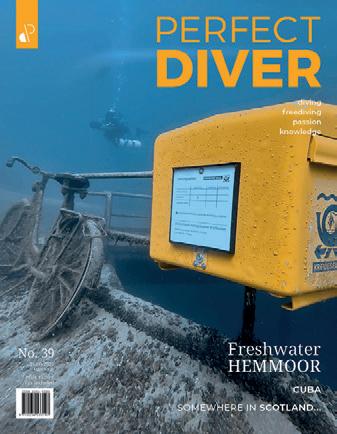
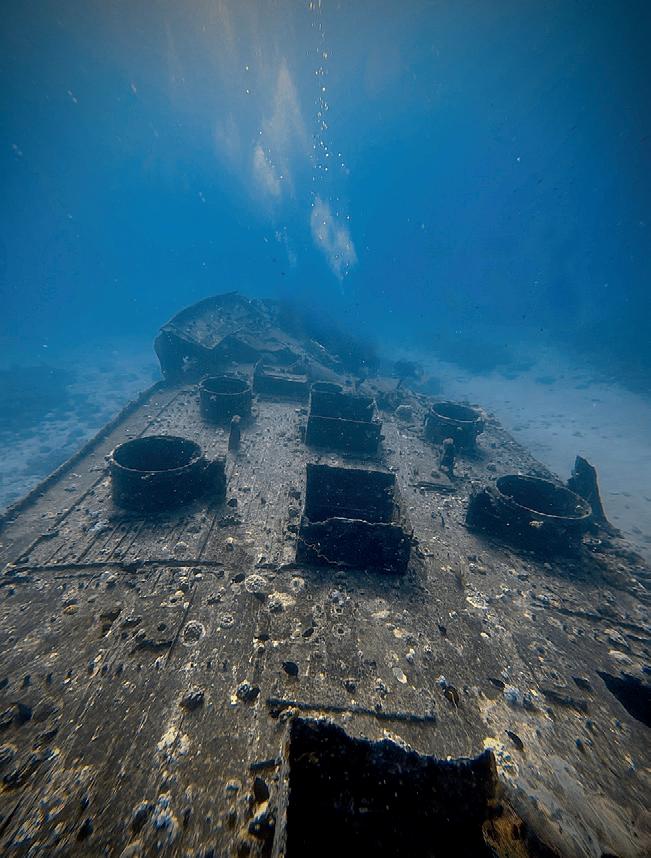
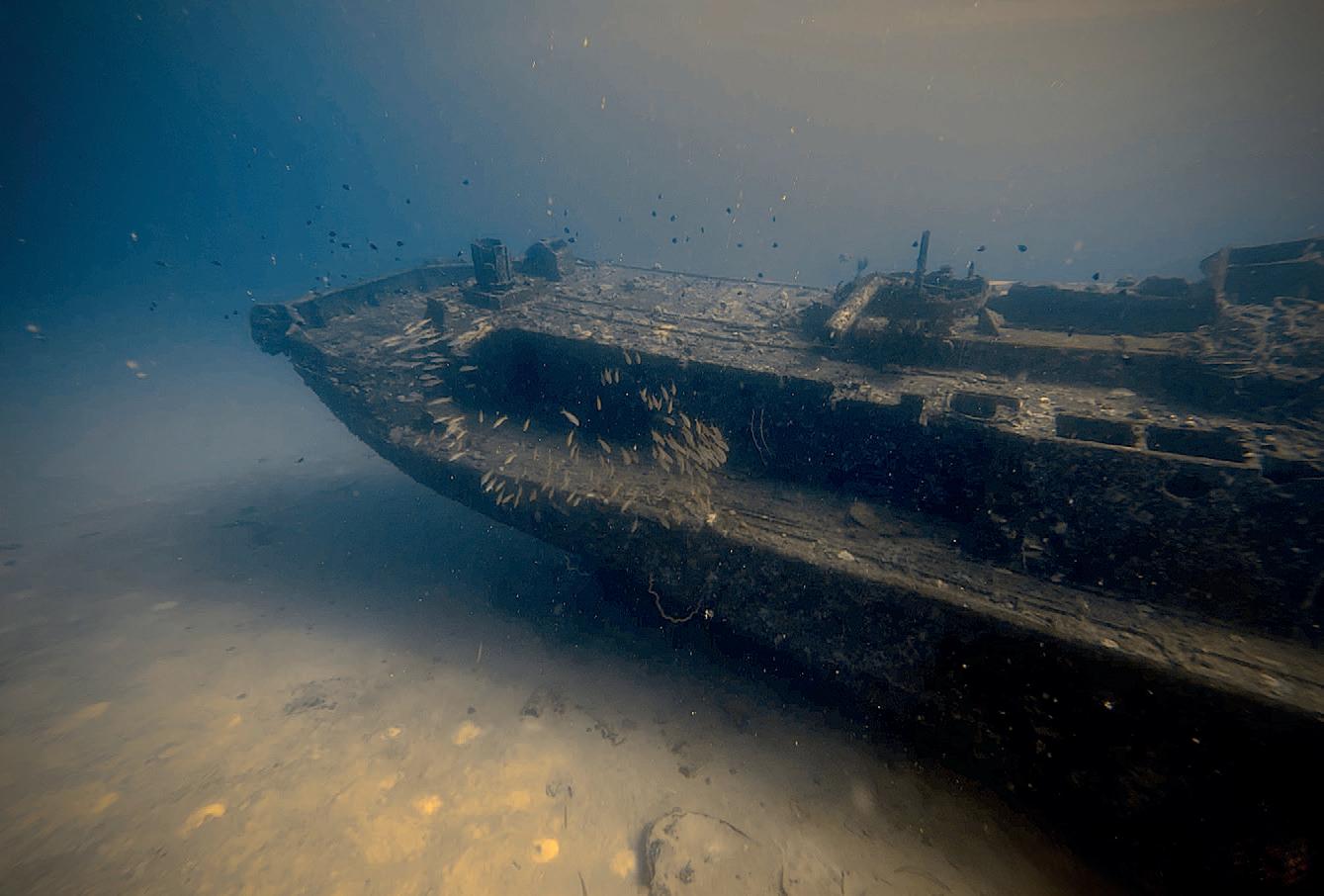
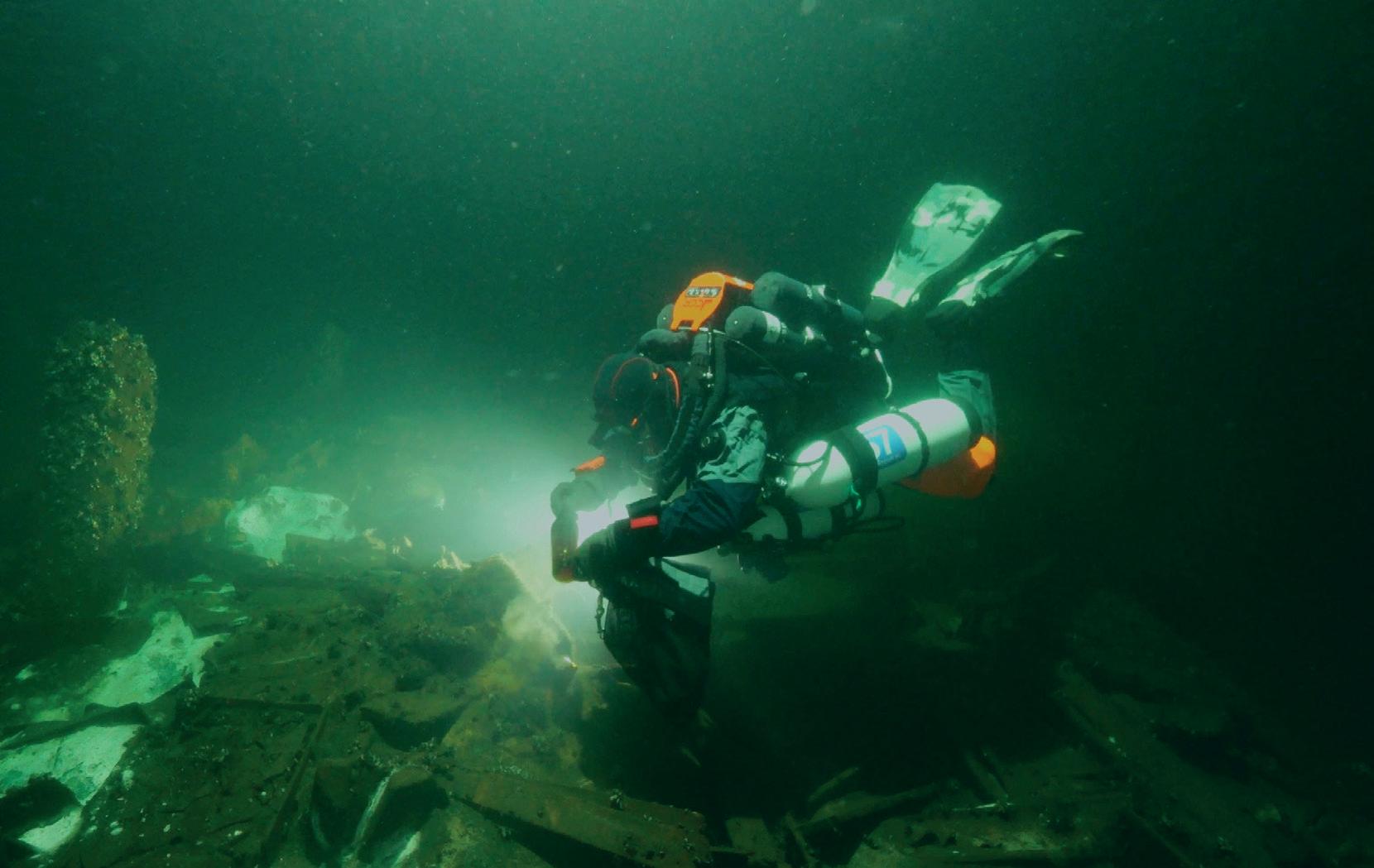
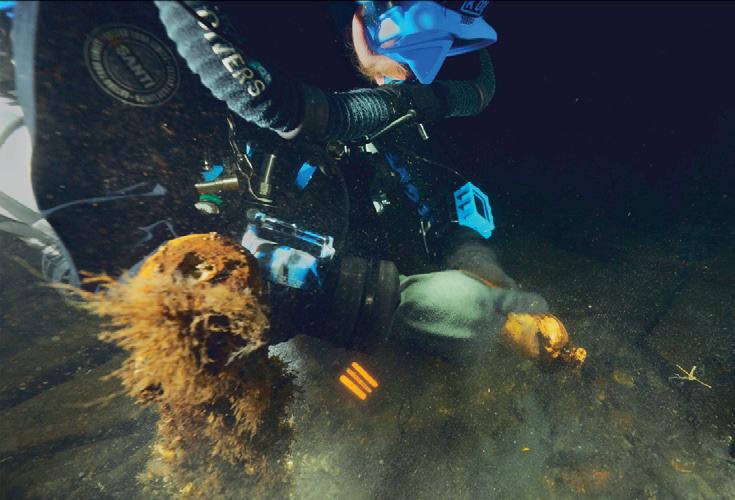
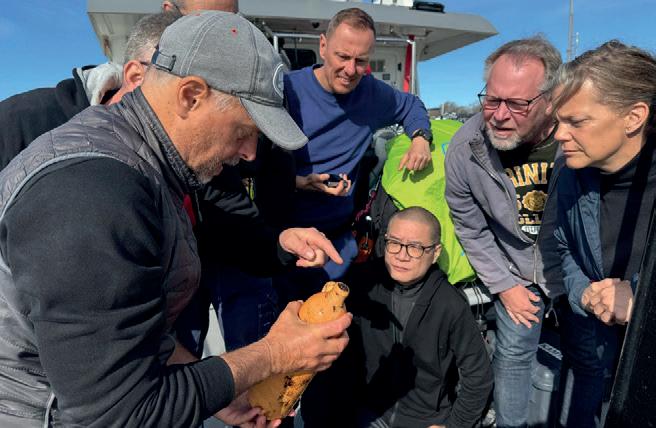
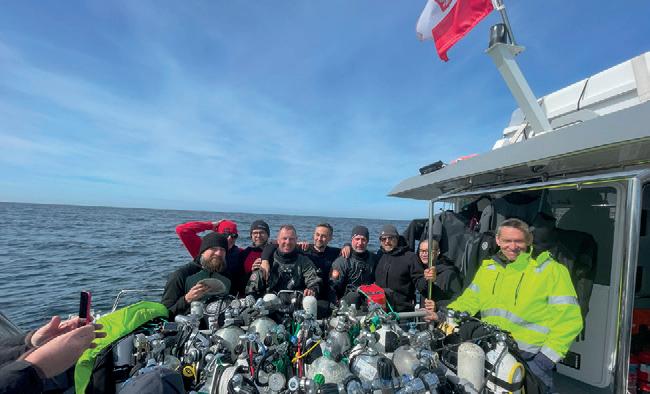
This isn’t just a magazine to flip through – it’s one to dive into! Join us for the freshest discoveries from the ocean floor, thrilling expeditions, and travel stories that inspire and ignite every diver’s imagination. The Baltictech team returns with an incredible find: champagne, mineral water, and ceramics recovered from the depths of the Baltic Sea. Meanwhile, Nicolas Giannoulakis takes us on a fascinating journey to the legendary Antikythera shipwreck – a site that continues to intrigue underwater archaeologists.
Ready to pack your fins and explore the world? We’re diving in Cuba, Mauritius, Egypt, and even the rugged shores of Scotland. In Europe, we visit the quarries of Hemmoor and Wetro, and we search
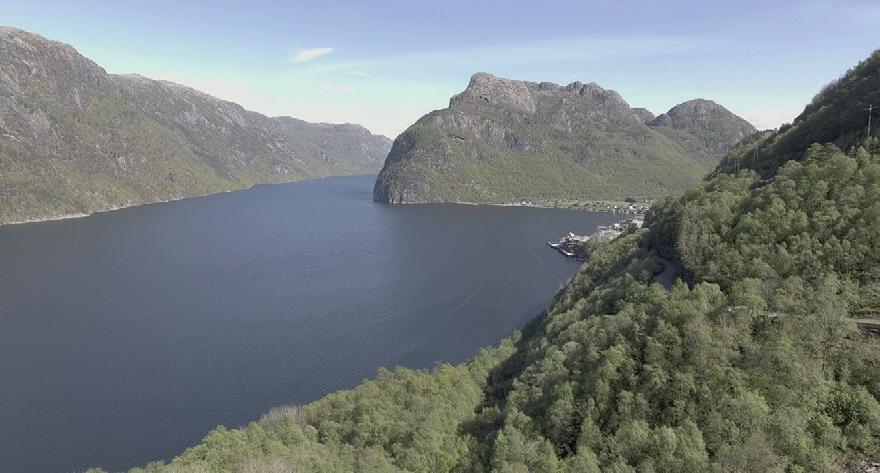
the Norwegian fjords for the elusive Greenland shark.
Closer to home, we explore Poland’s Lake Dejguny and Lake Barlinek – the latter calling for divers to join a cleanup on June 7th. Will you answer the call?
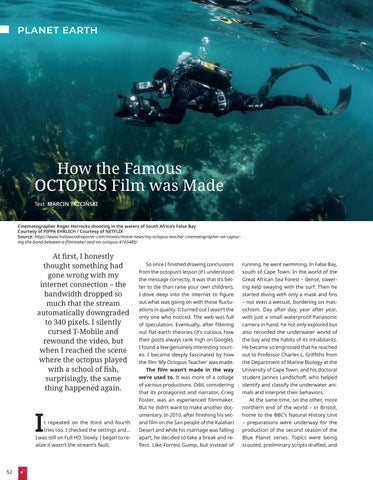
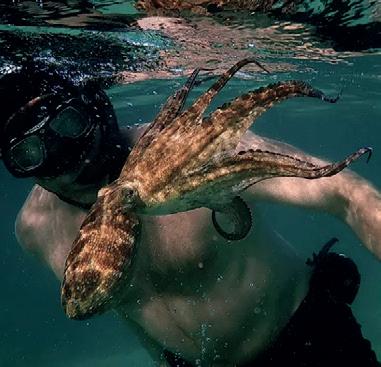
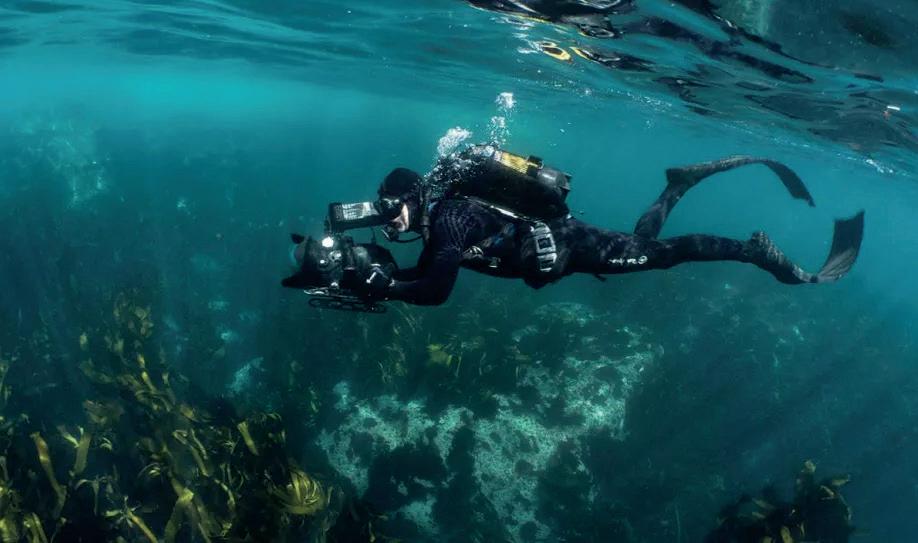
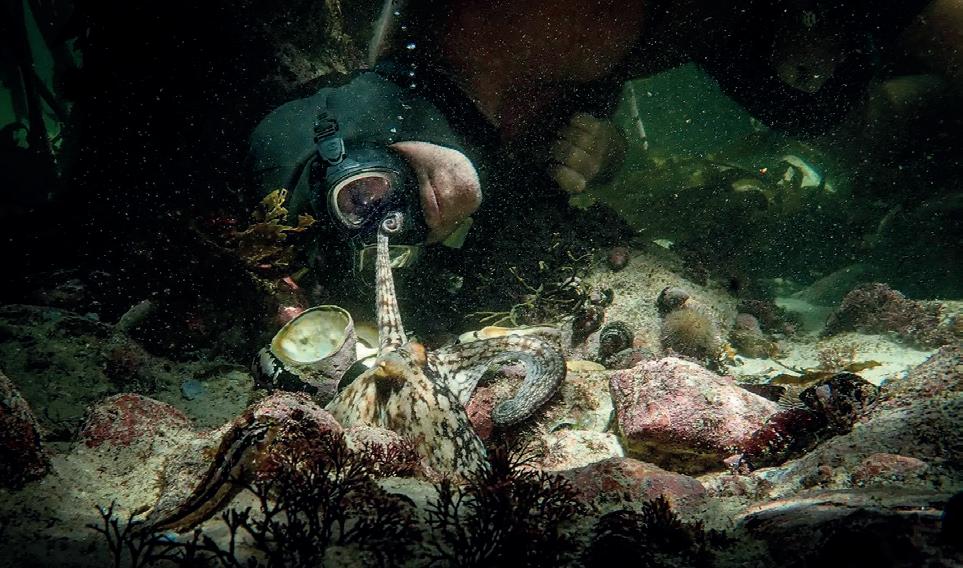
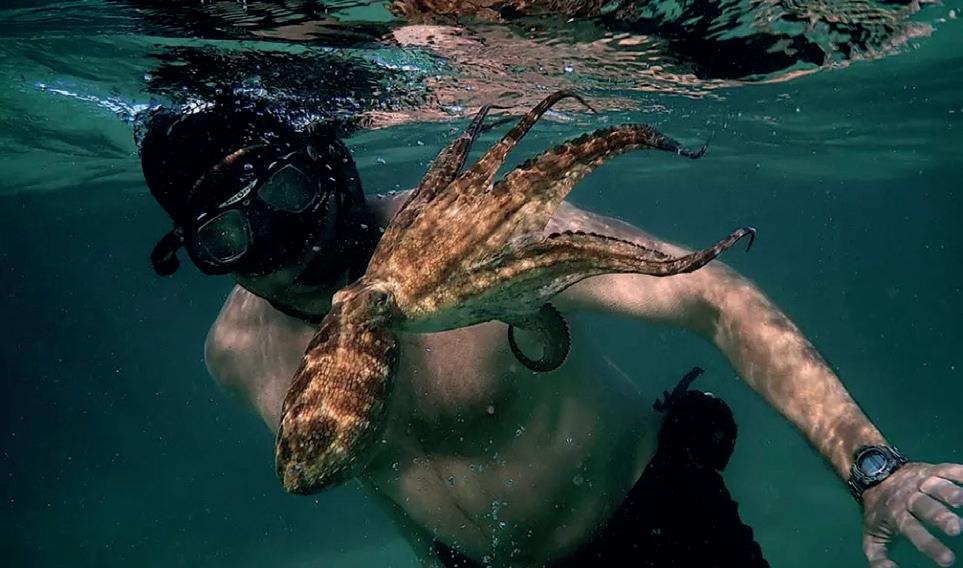
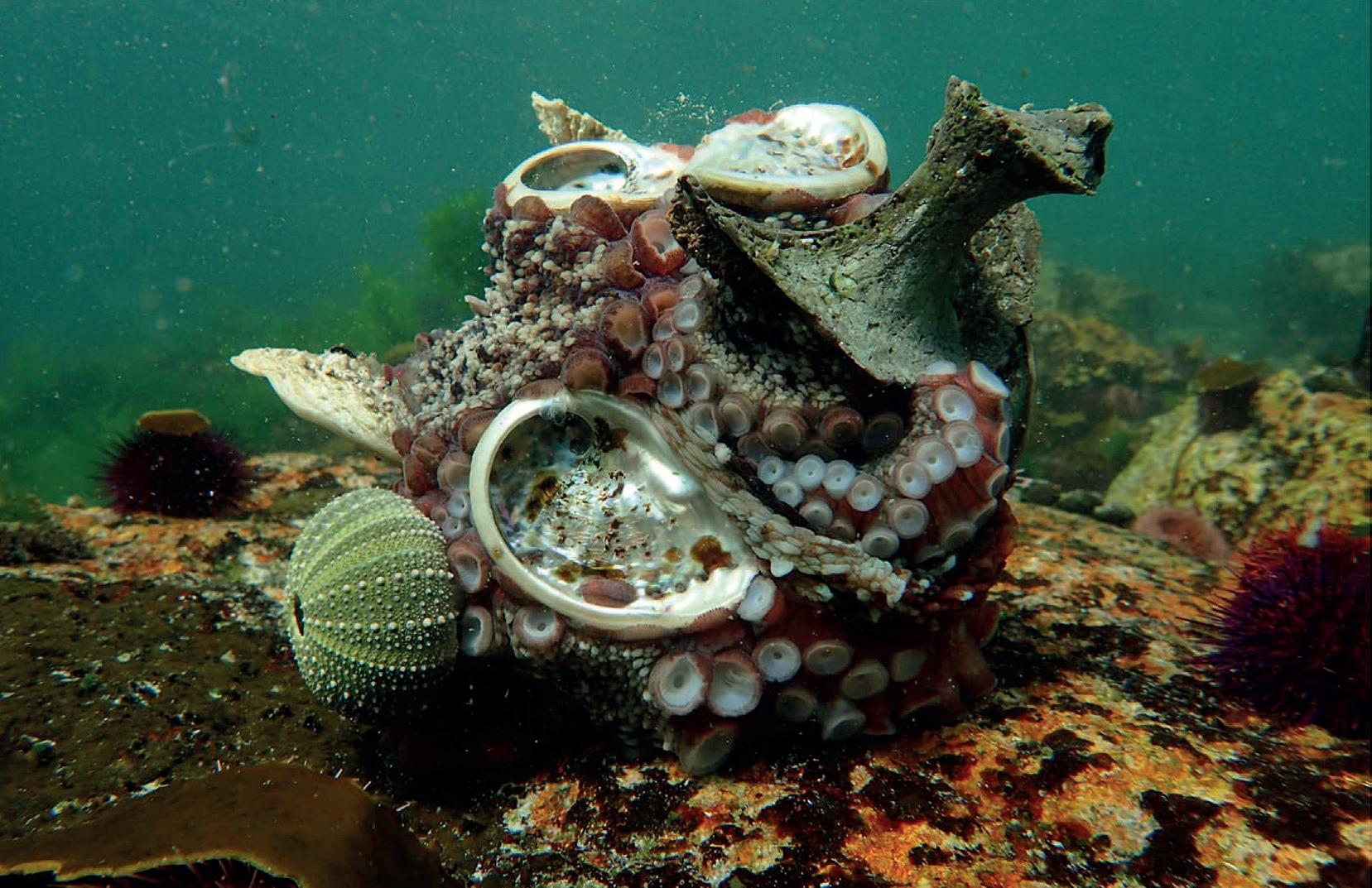
This edition also brings emotion from the screen: Marcin Trzciński reveals the behind-the-scenes of My Octopus Teacher, while Przemek Zyber has had enough… of what? You’ll have to read and see.
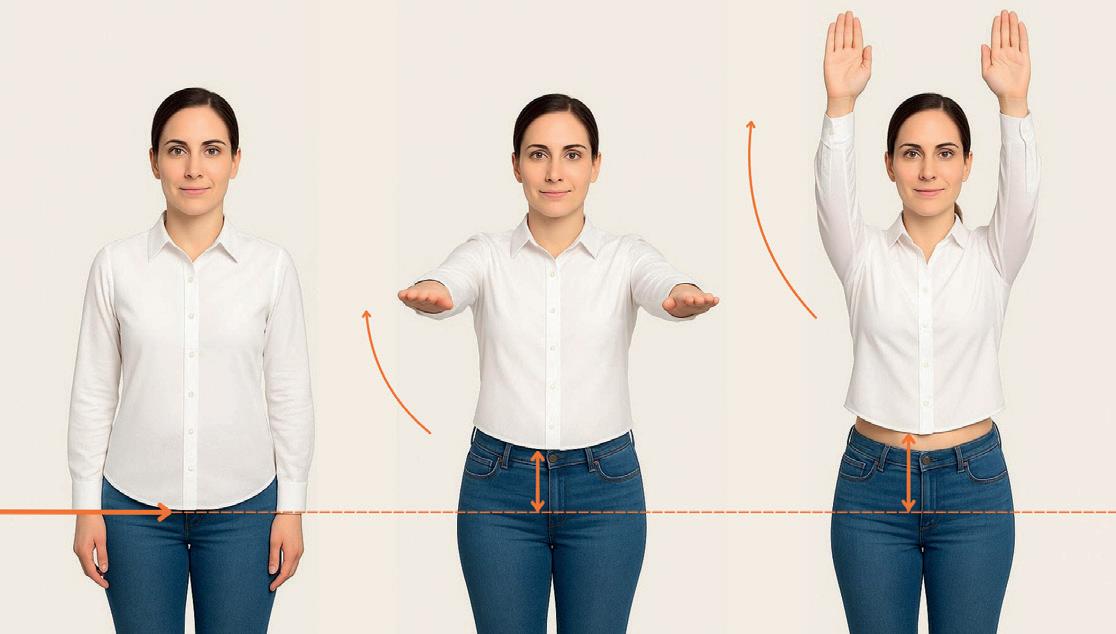
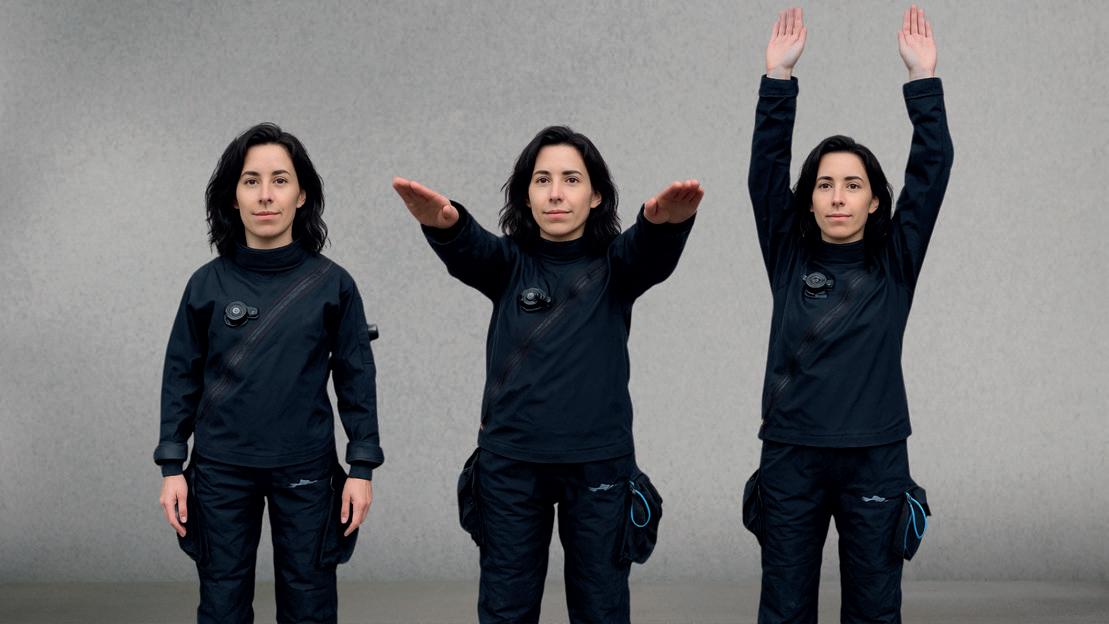
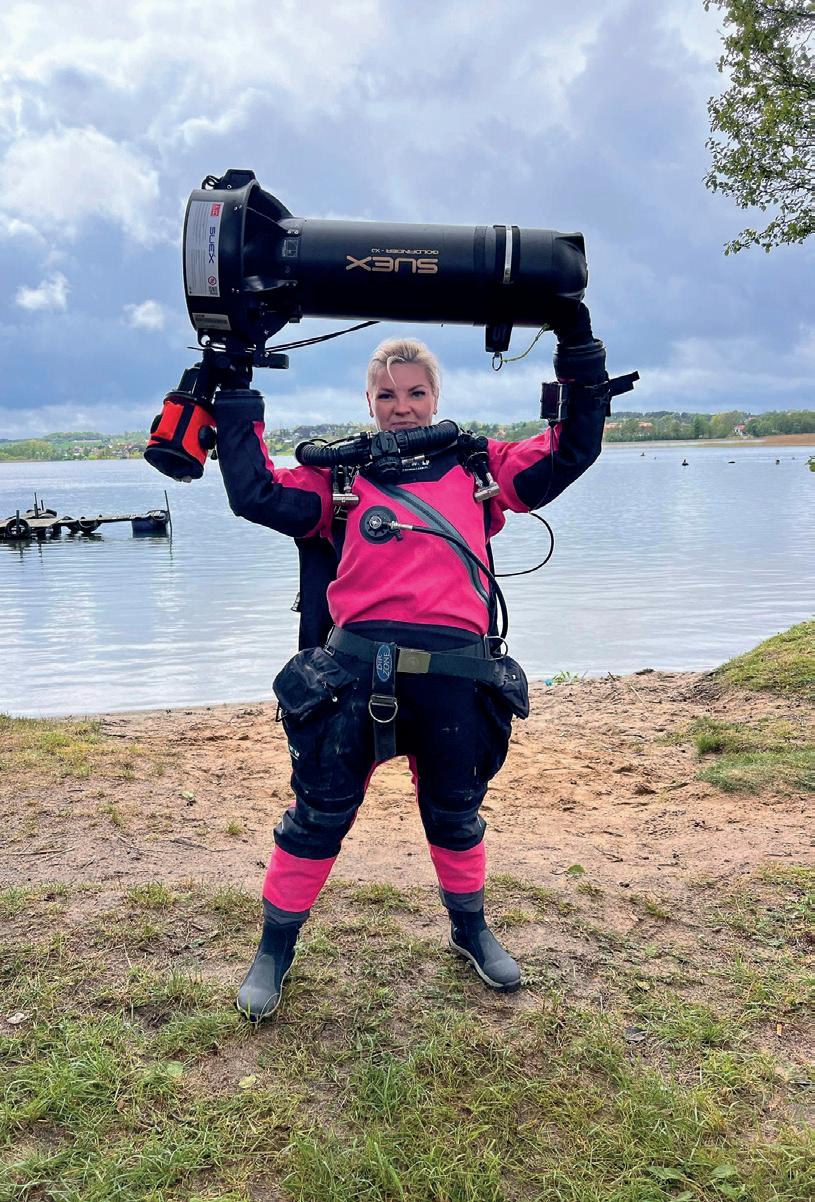
Gearheads, we’ve got you covered too: if you’re thinking about buying a drysuit, don’t miss Wojtek A. Filip’s article explaining why that suit sometimes pulls uncomfortably when you lift your arms underwater.
Don’t wait – dive into this issue with us!
Did you like this issue? Give us a viral coffee buycoffee.to/perfectdiver Visit our website www.perfectdiver.com, check out Facebook www.facebook.com/PerfectDiverMagazine and Instagram www.instagram.com/perfectdiver/
40 BLACKMOUTH CATSHARK Galeus Melastomus
52 How the Famous OCTOPUS Film Was Made planet earth
60 10 Years of IDF in Poland events
Publisher PERFECT DIVER Sp. z o.o. ul. Folwarczna 37, 62-081 Przeźmierowo redakcja@perfectdiver.com ISSN 2545-3319
64 TELESCOPIC TORSO: Friend or Problem?
Editor-in-Chief Technical Diver World Geography & Travels Reportage Advertisement English Language Translators Legal care
Graphic Designer WOJCIECH ZGOŁA TOMEK KULCZYŃSKI ANNA METRYCKA DOMINIKA ABRAHAMCZYK reklama@perfectdiver.com AGNIESZKA GUMIELA-PAJĄKOWSKA, ARLETA KAŹMIERCZAK, PIOTR WITEK, TOMEK KULCZYŃSKI Lawyer JOANNA WAJSNIS BRYGIDA JACKOWIAK-RYDZAK
THE MAGAZINE IS FOLDED WITH TYPEFACES
Montserrat (Julieta Ulanovsky), Open Sans (Ascender Fonts), Noto Serif, Noto Sans (Google)
DISTRIBUTION online store sklep.perfectdiver.pl redakcja@perfectdiver.com
Tomek Kulczyński
LOCATION
Hemmoor Quarry
Passionate about diving and pure nature. He likes to say that he travels by diving. He learned to swim when he was less than 6 years old. At the age of 15, he obtained a yacht sailor's license and has been diving since 2006. He has completed over 800 dives in various regions of the world. He wrote and published many articles.
Co-author of photo exhibitions. An advocate of leaving the place of residence clean and unblemished. Diving promoter. Since 2008 he has been running his own website www. dive-adventure.eu. Based on extensive experience, in 2018 he created the new Perfect Diver Magazine, which has been successfully published regularly every two months in Polish and English for 7 years.
A graduate of geography at the University of Wrocław, an incorrigible optimist... permanently with a smile on her lips
I have been diving since 2002, which is more than half of my life I started diving in Polish waters, to which I willingly return during the year – and it gives me great pleasure! :) I must have come to Activtour by destiny and I have stayed here for good... for over 10 years! I am passionate about fulfilling people's dreams by preparing diving trips around the world! Personally – I fly and dive in different seas and seas whenever I can, because it is one of the loves of my life Since the beginning of the existence of the PD magazine, I have been transferring my memories of diving trips to paper, sharing my passion with others and I can't stop writing ;) 2023 permanently in the PD editorial office – hoping to bring her some "fresh blood" ;) A diving dream come true: Galapagos! Still ahead of me… Antarctica! If I don't dive, I choose skiing, tennis or strong rock sounds! ;) The motto that I really like is: "Be realistic – start dreaming"! :) anna@activtour.pl; www.activtour.pl;
A traveller and a photographer of wild nature. A graduate of journalism and a lover of good literature. She lives in harmony with nature, promotes a healthy lifestyle: she is a yogini and a vegetarian. Also engaged in ecological projects. Sharks and their protection are especially close to her heart. She writes about the subject in numerous articles and on her blog www.blog.dive-away.pl. She began her adventure with diving fifteen years ago by total coincidence. Today she is a diving instructor, she visited over 60 countries and dived on 5 continents. She invites us for a joint journey with the travel agency www.dive-away. pl, of which she is a co-founder.
For Tomek, diving has always been his greatest passion. He started his adventure at the age of 14, developing into a recreational and technical diving instructor, a first aid instructor and a diving industry technician. Currently, he runs the 5* COMPASS DIVERS Pobiedziska Diving Center near Poznań, where he passes his knowledge and skills to beginners and advanced divers, which gives him great joy and satisfaction from being part of their underwater adventure...
Infected with a passion for diving by Perfect Diver. She continues to expand her diving skills. Although she definitely prefers warm waters, she dons a dry suit and explores colder bodies of water as well. Her favorite dives are those with plenty of marine life! Recently, she’s been taking her phone underwater in a protective case, trying her hand at amateur photography. She’s also curious about diving medicine. Professionally, she’s a Master’s degree nurse and a surgical scrub nurse.
Zoopsychologist, researcher and expert in dolphin behavior, committed to the idea of protecting dolphins and fighting against keeping them in dolphinariums. Passionate about Red Sea and underwater encounters with large pelagic predators. Member of the Dolphinaria-Free Europe Coalition, volunteer of the Tethys Research Institute and Cetacean Research & Rescue Unit, collaborator of Marine Connection. For over 15 years, he has been participating in research on wild dolphin populations, auditing dolphinariums, and monitoring the quality of whale watching cruises. As the head of the "Free & Safe" project (formerly "NO! for a dolphinarium"), he prevents keeping dolphins in captivity, promotes ethical whale & dolphin watching, trains divers in responsible swimming with wild dolphins, and popularizes knowledge about dolphin therapy that is passed over in silence or hidden by profit-making centers. on this form of animal therapy.
WOJCIECH ZGOŁA ANNA METRYCKA
TOMEK KULCZYŃSKI
DOMINIKA ABRAHAMCZYK
JAKUB BANASIAK
SYLWIA KOSMALSKA-JURIEWICZ
He has been diving for 35 years. He has spent more than 16,000 hours underwater, most of them diving technically. He has been an instructor and mentor instructor for many organizations including CMAS, GUE, IANTD, PADI. He co-created the training programs for some of them. He is a professional with vast knowledge and practical experience. He has participated in many diving projects as a leader, explorer, initiator or speaker. He was the first Pole to dive the HMHS Britannic wreck (117m). He was the first to explore the deep part of the Glavas Cave (118m). He made a series of dives documenting the wreck of ORP GROM (110m). He has documented deep (100-120m) parts of flooded mines. He is the creator and designer of many equipment solutions to improve diving safety.
Technical Director at Tecline, where, among other things, he manages the Tecline Academy a research and training facility. Author of several hundred articles on diving and books on diagnosis and repair of diving equipment.
He dives in rivers, lakes, caves, seas and oceans all over the world.
WOJCIECH JAROSZ
A graduate of two Poznan universities, the Academy of Physical Education (coaching specialization –handball) and the University of A.Mickiewicz, Faculty of Biology (specialty of experimental biology). He connected his professional life with this first university trying to influence the direction of development of future professionals on the one hand, and on the other planning and implementing research, pushing laboriously in the right direction of the stroller called science. In his free time he spends his time actively – his main passions are sailing (sea helmsman), skiing (downhill skiing instructor), riding a motorcycle, recreational diving and many other activities, as well as photography, mainly nature.
A long, long time ago in a galaxy far, far away there was chaos...
…that is, the multitude of thoughts and delights after my first immersion under water in 2005 in the form of INTRO while on vacation in Egypt. By then I had completely immersed myself in the underwater world and wanted it to have an increasing impact on my life. 2 years later, I took an OWD course, which I received as a gift for my 18th birthday, and over time, further courses and skills improvement appeared.
"Photography" appeared not much later, but initially in the form of a disposable underwater "Kodak" from which the photos came out stunningly blue
I am not a fan of one type of diving, although my greatest weakness at the moment is for large pelagic animals. The Galapagos Islands were my best opportunity to photograph so many species of marine fauna so far.
I share my passion for diving and photography with my buddy, who is my wife IG: luke.divewalker; www.lukedivewalker.com
Laura is a journalist, instructor trainer, CCR and cave diver. She has been developing her diving career for over a decade, gaining knowledge and experience in various fields. Her specialty is professional diving training, but her passion for the underwater environment and its protection drives her to explore various places around the world. From the depths of the Lombok Strait, caves in Mexico and wrecks in Malta to the Maldives, where she runs a diving center awarded by the Ministry of Tourism as the best diving center in the Maldives. Laura actively contributes to promoting the protection of the marine environment, takes part in scientific projects, campaigns against ocean littering and cooperates with non-governmental organizations. You can find her at @laura_kazi_diving www.divemastergilis.com
I photograph because I love it, I film because it excites me, I write because I enjoy sharing, I teach because I support growth, I travel because I love discovering new things. www.facebook.com/przemyslaw.zyber www.instagram.com/przemyslaw_zyber/ www.deep-art.pl
He has been diving forever, he does not remember his first dives. The only thing he remembers is that diving has always been his passion. He spent his entire childhood on Polish lakes, which he still prefers to distant destinations. With great success, he turned his passion into a way of life and business. Curiosity of the world and constant striving for perfection are the main features that definitely hinder him in life. Professional diving instructor, photographer, filmmaker.
Creator of the DECO Diving Center, PADI Course Director, TecTrimix Instructor Trainer TECREC.
PRZEMYSŁAW ZYBER
WOJCIECH A. FILIP
ŁUKASZ METRYCKI / Luke Divewalker
LAURA KAZIMIERSKA
DOMINIK DOPIERAŁA
Snap-pop and diving came back into my life. And it changed my landscapes – and it was nice, and it changed my perspective – and it was great! Well, if someone has a nice life like me, diving would have to be included in it... hi-hi. That's my approach. I don't want to count the days, I want the days to count (preferably every day!) That's why diving is another adventure that I enjoy with delight (in small bites, so as not to have hiccups!) And I like it very much, because it is accompanied by great company, great views and thrill.
I come from Puławy in the Lublin region of Poland. I've been living in Norway for 19 years and diving for 16. I'm certified for trimix diving and have logged around 2,000 dives. I used to focus on underwater photography, but for the past 8 years, I've been fully immersed in videography.In diving, I'm passionate about filming both marine life and wrecks – especially war wrecks. Macro subjects also play a role in my underwater filming interests. In my free time, outside of diving, I enjoy traveling, hiking in the mountains, skiing in winter, and reading – I love traditional paper books. I also appreciate a good magazine when I come across one.
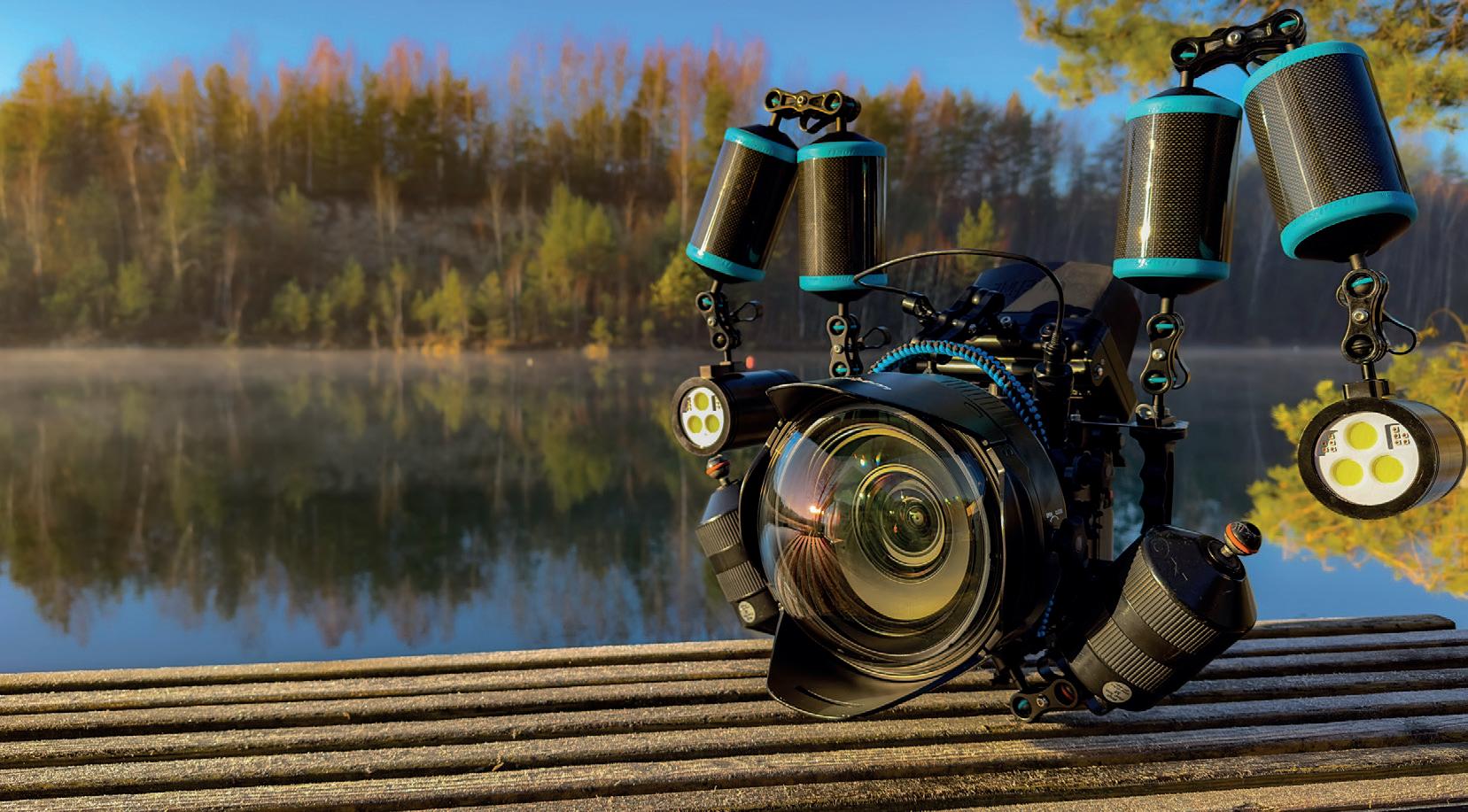
A graduate of the University of Warsaw. An underwater photographer and filmmaker, has been diving since 1995. A co-operator at the Department of Underwater Archeology at the University of Warsaw. He publishes in diving magazines in Poland and abroad. The owner of the FotoPodwodna company which is the Polish representative of Ikelite, Nauticam, Inon, ScubaLamp companies. www.fotopodwodna.pl m.trzcinski@fotopodwodna.pl
I run my own business on a daily basis, which gives me the freedom to pursue my passions. In my spare time, I travel in search of places that inspire further exploration. My love for diving began in Thailand – it was there that I first immersed myself in the extraordinary world hidden beneath the surface. Since that moment, underwater photography has become not only a passion but also a mission: to show how beautiful and diverse the world is that remains hidden from everyday view. Insta @underthewater.pl www.underthewater.pl
A graduate of the Poznań University of Technology, financier, the auditor. A diver fascinated by theory diving – physics and physiology. In love passionate about history in underwater archaeology Ancient Rome, active Centurion in the group reconstructionist Bellator Societas (Rome I century BC). He dreams of attending at least once underwater archaeological research a then describe everything in a series of columns. It can be found as often as under water in Japan, whose culture and history he has been fascinated by nearly three decades.
PAWEŁ FRANCZYK
MICHAŁ CZERNIAK
DAMIAN NIWIŃSKI-KUJAWIŃSKI
MARCIN TRZCIŃSKI
MONIKA ZYBER
Is 45 years old and married, has been working professionally in the metallurgical industry for 25 years, has been diving since 2009 and diving has become a way of life and passion for him. He lives in Kętrzyn and is associated with the Mazursharks Club.
A Polish woman living in Scotland, co-owner of two companies, and a laser tattoo removal technician by profession. After hours, she’s a movement enthusiast in all its forms and the proud owner of four lizards: Holly and Dracula (bearded dragons), Goro (a crested gecko), and Basam (a leopard gecko). She loves cooking – and eating.
A salesperson by profession, a diver and traveler by passion. She has been diving since 2011. For 12 years, as a professional, she has been infecting successive generations of lovers of the deep sea with her passion. She started as a Divemaster and later an Instructor at PADI. In 2015, together with her husband, she founded her own diving school "Lionfish" in Pruszków near Warsaw. Since 2019, she has been associated with the Polish diving organization IDF. She achieves the greatest successes in initial training and her "hobby horse" is working with young diving enthusiasts. She loves underwater photography and traveling to the farthest corners of the world.
www.lionfish.pl
I became interested in diving five years ago, when my partner introduced me to the underwater world. Since then, it has become my passion, and I’ve been continuously developing my skills and knowledge in this field. I hold AOWD and Rescue Diver certifications, and I have also completed CPR and Oxygen First Aid Provider training.
For the past three years, I have been working at a specialist dive equipment store, where I advise customers. This is not just my job, but above all, an opportunity to share my passion, experience, and ever-growing knowledge. My daily contact with top-quality gear and experts in the field allows me to grow both theoretically and practically.
I’ve had the opportunity to dive in a variety of locations, although I enjoy warm, clear waters the most – they offer the best conditions to fully admire the underwater world. I’ve developed a particular fondness for Raja Ampat and Mexico – places that captivated me with their rich marine life and spectacular underwater formations.
For me, diving is much more than a hobby – it’s a way of life. In the near future, I plan to explore the more demanding conditions of cold and dark Polish waters. One dream that has accompanied me since the beginning of my diving journey is to swim under the Arch – and I hope to make it come true.
Born in Athens in 1982, Nikolas Giannoulakis has been a professional dive instructor since 2006. A former hammer throw athlete (1996–2001), he initially trained as a sound engineer (2001–2005) before relocating to Crete in 2006 to pursue a career in diving in the land of his origin. Since 2012, he has been an active member of the Antikythera Shipwreck expedition team, contributing his expertise in technical and scientific diving. He is particularly passionate about cave diving and the exploration of World War I and II wrecks around Crete. Nikolas is based in Crete, where he is married and the father of three children.
MAGDALENA GIL
AGNIESZKA JAROSIŃSKA
ANNA PASZTA
NICOLAS GIANNOULAKIS
JACEK KUBIAK
www.compassdivers.pl
www.nurkowanie.kalisz.pl
CUBA
Text and photos MAGDALENA GIL
The very name conjures up images of vintage cars, the hot rhythms of salsa, rum, and colorful alleyways. For me, Cuba became something more than just a holiday postcard – it turned into an adventure full of surprises, from underwater wonders to unexpected power outages.
The first message I received after landing and getting internet access at the Cuban airport was that there was no electricity anywhere on the island. I thought, well, that’s quite a start. We landed in Havana – a big city that should be bursting with nightlife – but all we saw on the way to the hotel was darkness. Still, we got there without issue. It turned out that the better hotels and restaurants had their own generators, so we had everything we needed to recover after a full day of travel.
I knew this trip would be completely different from any dive trips I had done before. Here, in addition to diving, we had a lot of sightseeing planned. We stayed in several hotels and covered hundreds of kilometers by bus. There’s
so much to see in Cuba that you simply can’t do it any other way.
The alarm pulled me out of bed at 6:30 a.m. – today we had 500 km ahead of us. Before setting off, we had to exchange dollars for the local currency: Cuban pesos. It turned out it didn’t work like it does in a regular exchange office. Cuba has its own rules – you have to find a money changer, like in Poland a few decades ago. Our group was large, so we had to find several of them – but we managed quickly. With our pockets full of pesos, we could finally begin our journey through a country that would surprise us more than once.
During the day, we begin to see the fascinating Havana: sunshine, vivid colors, and the thing that immediate-
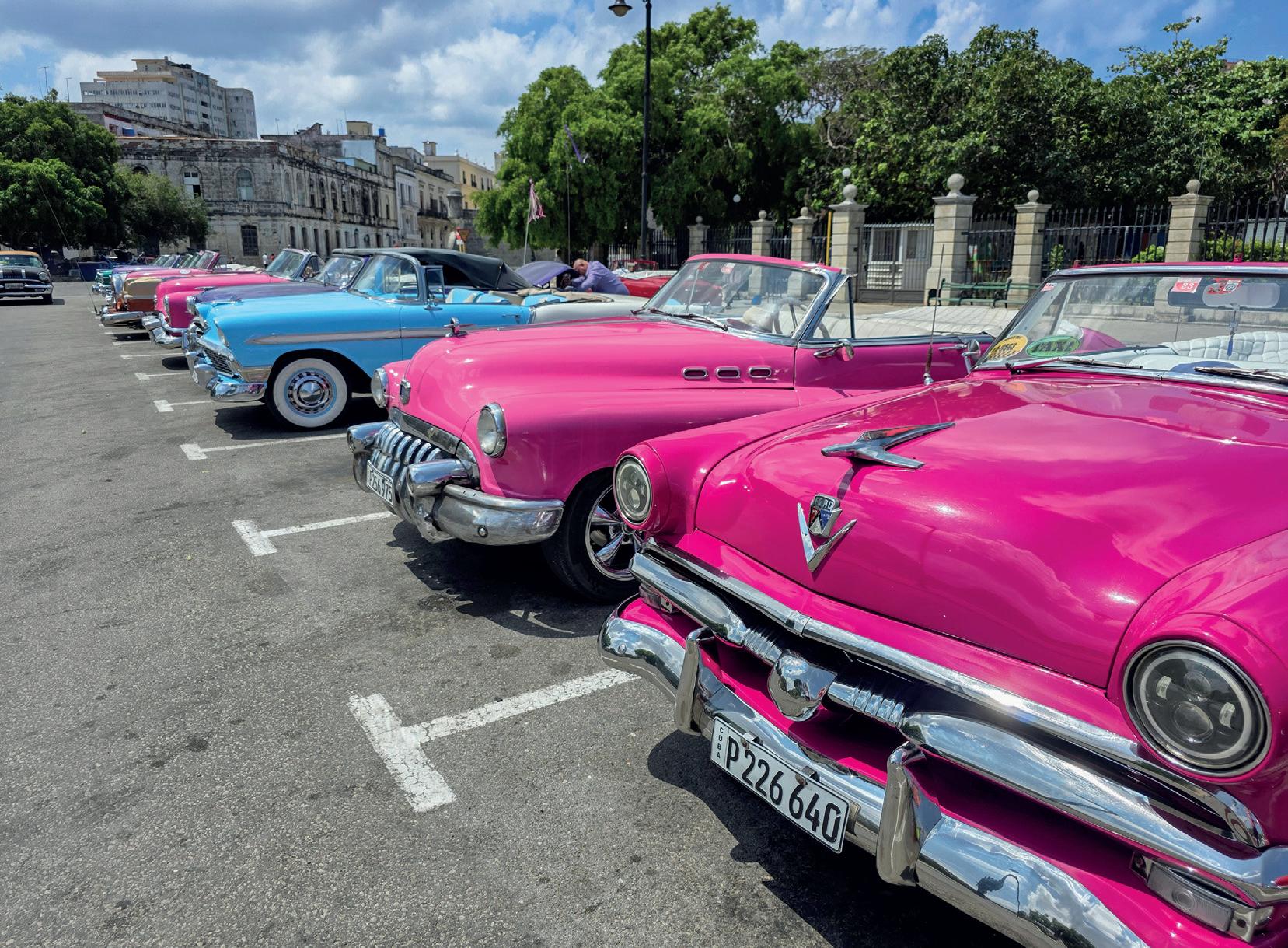
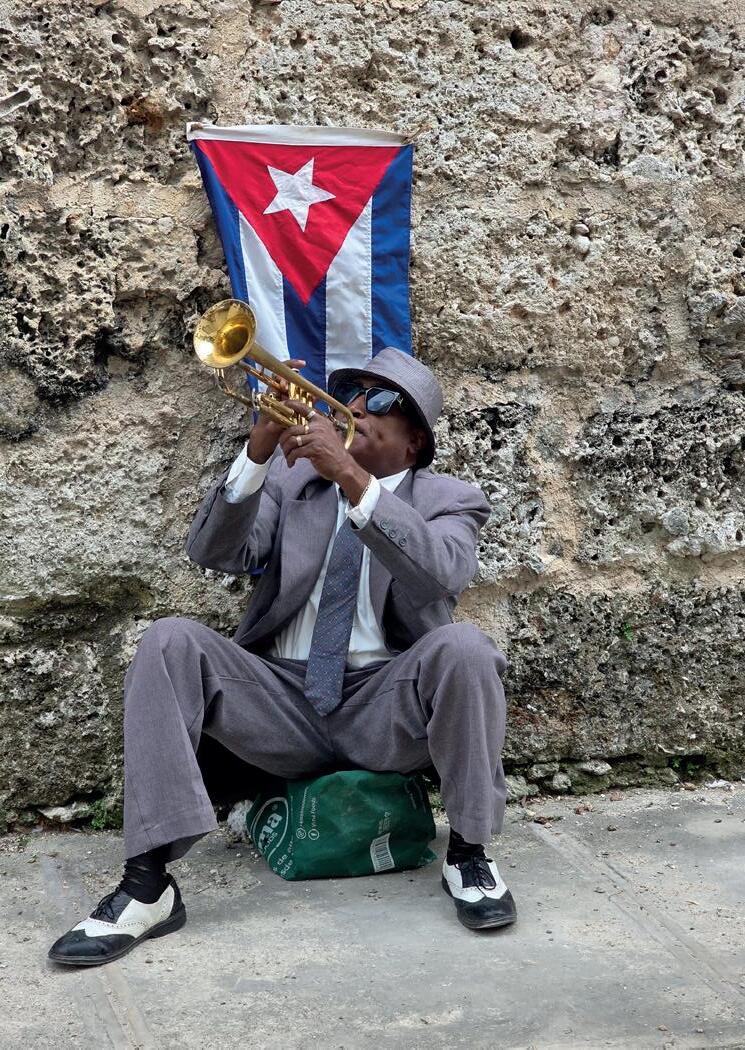
We head toward Cayo Guillermo. On the way, we stop at a roadside bar where we're greeted by Cuban music, a proper Piña Colada, and exceptionally friendly Cubans. In front of the bar, there are only old cars and our coach – these aren’t tourist convertibles; here, such cars are simply the norm, and that’s the charm of this increasingly captivating country.
We arrive in Santa Clara, a key industrial, university, and tourist center. It's best known for the Che Guevara mausoleum. In front of it stands a several-meter-tall statue of the revolutionary, depicted with his arm in a sling and holding a rifle. That’s how locals remember him – a few days before the attack on Santa Clara, Guevara broke his arm and fought for the city while wearing a sling. This is the city’s main attraction, alongside the armored train captured by revolutionaries during the battle – a train that still stands there today.
We continue on our way. To reach the island of Cayo Guillermo, we must cross a 27-kilometer-long narrow causeway that connects the mainland to the island. We arrive at the island, home to a beach ranked among the 25 most beautiful in the world. The next day, we get to admire it in person – stunning beaches with white, fine sand and turquoise, crystal-clear water.
And it’s here, in the Jardines de la Reina National Park, that our diving begins. At the dive center, we’re greeted – as it turns out – by a fantastic team who will help us explore Cuba’s underwater world over the next two days. When coming to Cuba, you really should bring your own gear, as the local dive shops are modestly equipped.
Wearing our wetsuits, we load onto the boat and set off for our first three dives. The water temperature is around 25°C – a bit chilly for some, but for me, it’s perfect in a 3 mm suit.
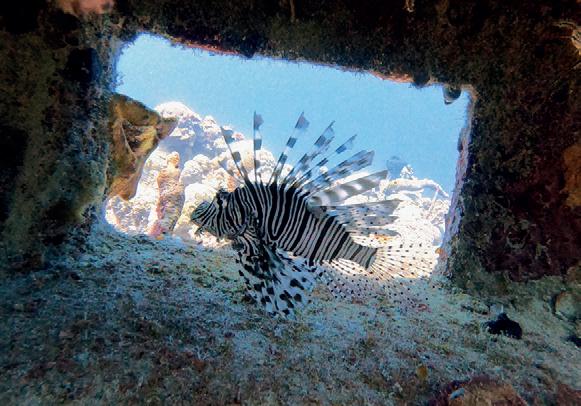
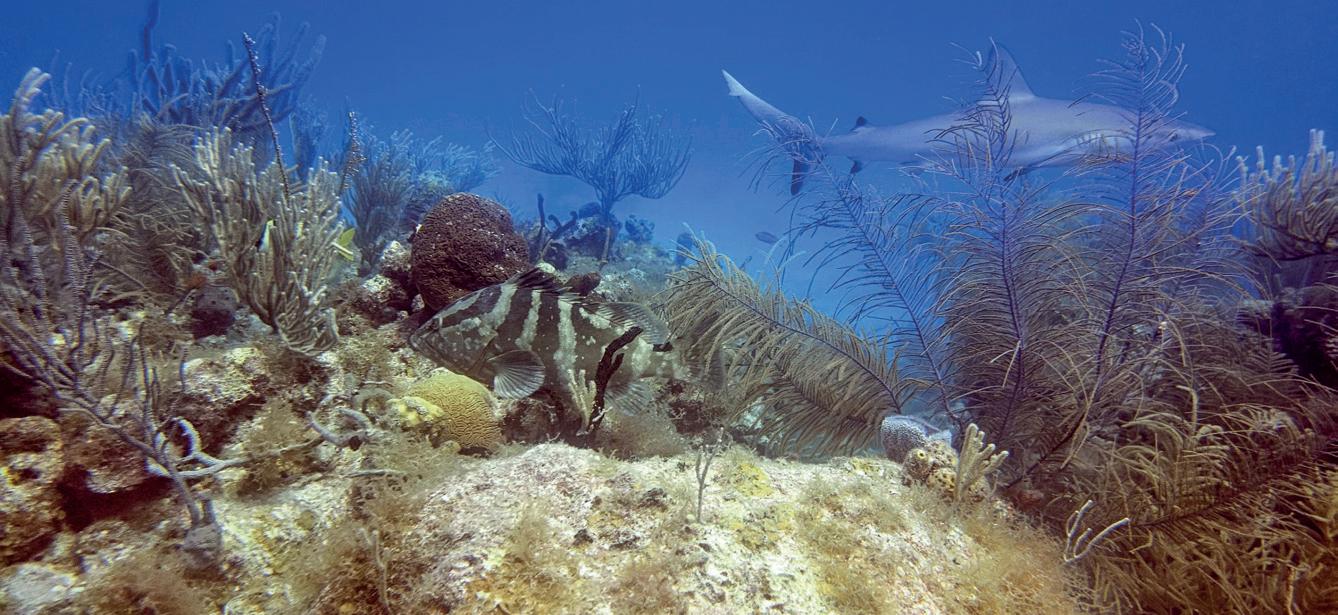
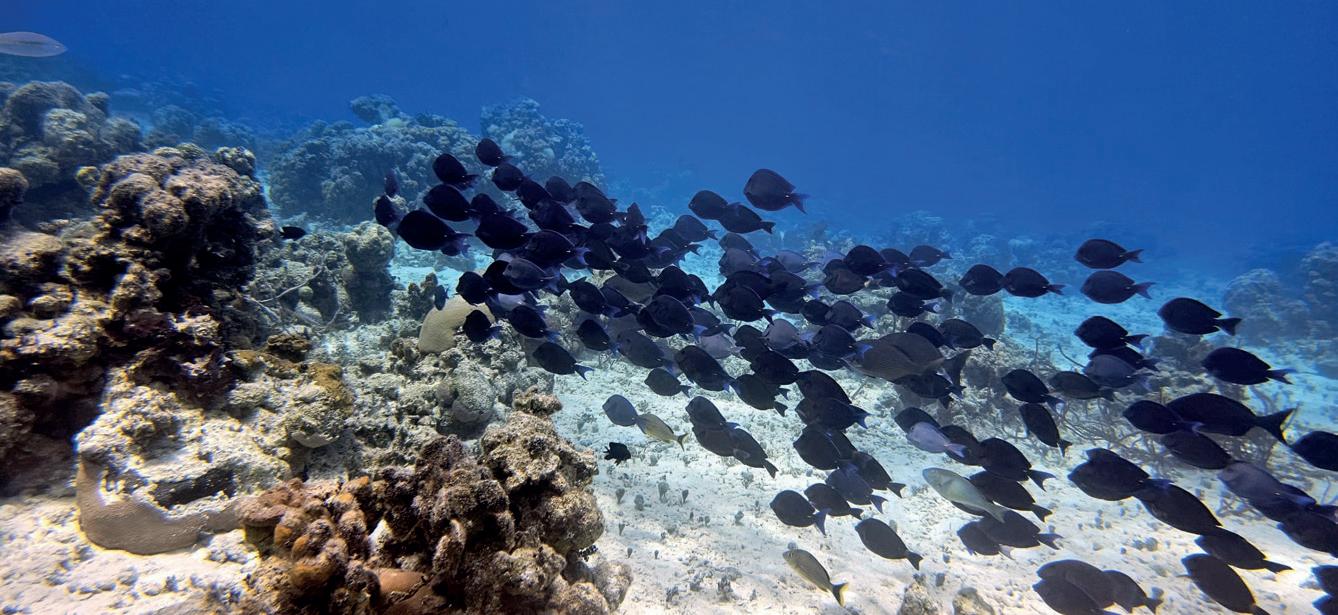
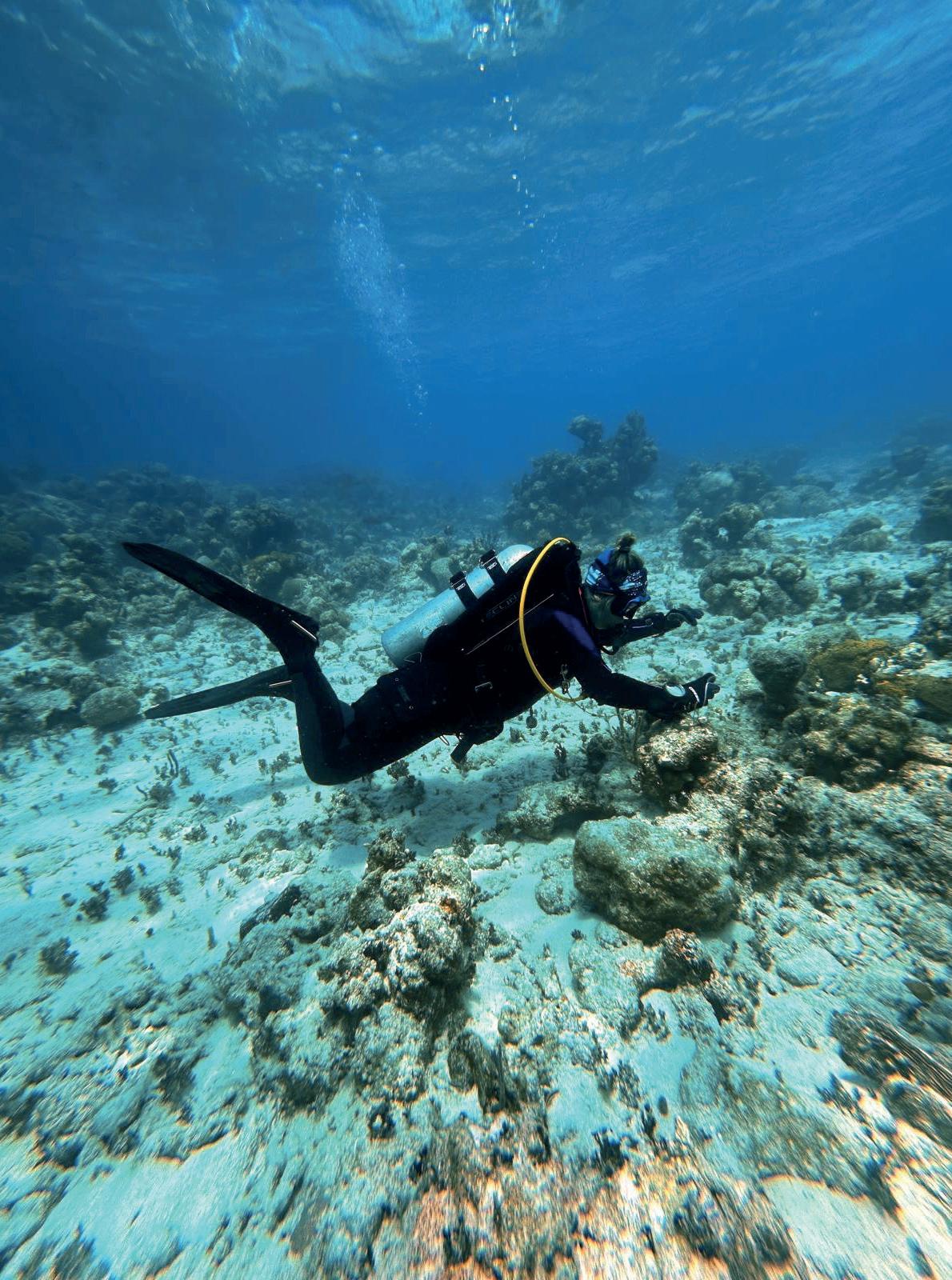
Underwater, marine life isn’t especially abundant, but we come across interesting reefs, some small fish, and impressive lionfish. Turtles swim with us, along with barracudas, and from the cracks in the reefs, exceptionally large and colorful lobsters show off their claws. We even spot a reef shark, proudly gliding in front of us. We’re thrilled, but unfortunately, the wind is strong, and our second day of diving is in question – we’re not sure if we’ll even be able to go out to sea.
The next day, sadly, we’re unable to dive due to very strong winds. No boats were granted permission to leave the harbor.
We had to make something of this beautiful day. We discovered that just 400 meters from the hotel, in the nearby marshes, beautiful, majestic flamingos
live – it was like something out of a fairytale. Flocks of elegant flamingos, walking proudly and feeding – truly stunning. We couldn’t take our eyes off them; we were all captivated by this wonderful spectacle.
After returning, we still had time to indulge in some beachside laziness. After a swim in the sea and strolls along the soft, white sand, I now understand why this beach is ranked among the 25 most beautiful in the world. It really is breathtaking –white sand bordered by turquoise water on one side and lush green palm trees on the other. In short: paradise on Earth :-)
In the morning, we head toward Trinidad, where we’ll spend the next two days. On the way, we visit the Valle de los Ingenios, home to former sugar plantation estates. At the Manaca Iznaga estate, we climb a 45-meter tower from 1816 that was once used to oversee enslaved laborers. We have lunch accompanied by Cuban music.
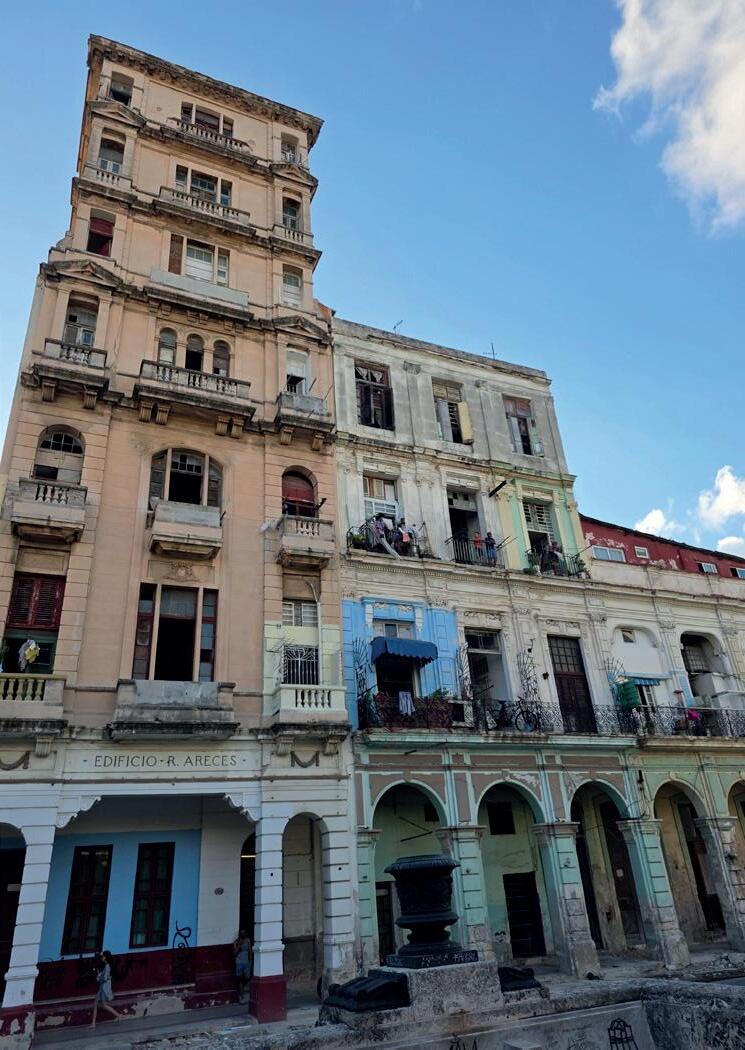
Trinidad enchants with its colonial architecture – from the tower of a former monastery, we admire views of the city’s roof-
tops and the Escambray Mountains. We stroll along cobbled streets free from car traffic. At the iconic bar La Chanchanchara, we try a local drink made with honey, rum, and lime.
We visit the historical museum in the Cantero Palace, which features a neoclassical courtyard and a tower offering a panoramic view of the entire city. We also make our way to Plaza Mayor, a UNESCO World Heritage Site. There, we explore the Church of the Holy Trinity, which houses an 18th-century figure of Christ, as well as the Museum of Colonial Art.
In the evening, after dark and surrounded by total blackout (power outages are common in Cuba), we set out for some nighttime sightseeing. Along the way, we come across a family playing dominoes – they invite us into their home, and we offer birthday wishes to the head of the household.
We arrive at Casa de la Musica – a spot with live music, a bar, and dancing under the open sky. We dance salsa and mambo with the Cubans, soaking in the incredible atmosphere of Trinidad.
Photo Agnieszka Kruk
Photo Agnieszka Kruk
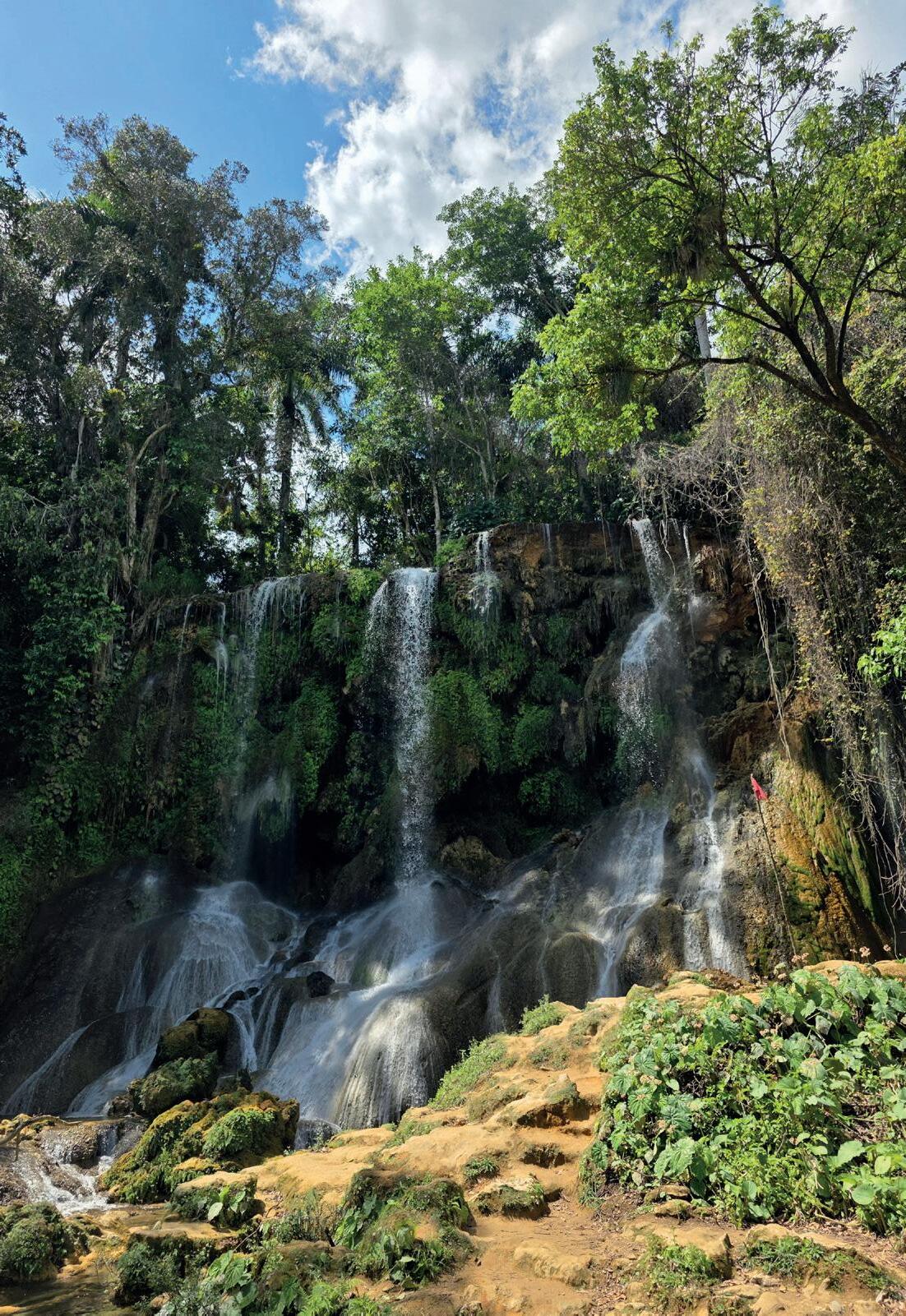
As usual, the next morning starts early – we admire the sunrise and set out for Playa Girón. On the way, we plan to visit the El Nicho waterfalls. Due to the winding roads, we switch to small buses that take us through Cuba’s rural areas to the Topes de Collantes national park.
We hike the easy trail “Reino de las Aguas”, passing lush vegetation, wooden walkways, and waterfalls – first Poceta de los Enamorados, then the main waterfall and a scenic viewpoint overlooking the Escambray Mountains and Lake Hanabanilla. We finish with a dip in the icy water of the Poceta de Cristal waterfall – pure childhood joy!
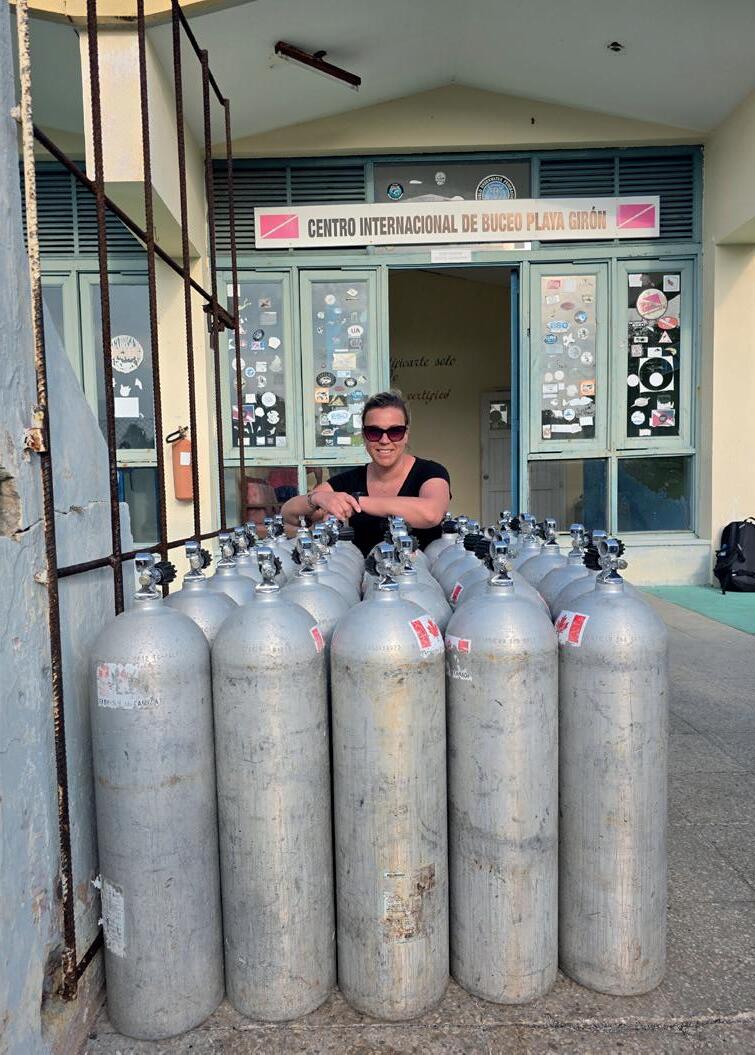
After our swim, we head to Cienfuegos, where we visit the Art Nouveau–style Palacio de Valle and stroll through the historic city center, a UNESCO World Heritage Site, with its impressive José Martí square. We end the day in Playa Girón – where we’ll spend the next few days diving in the sea and in caves.
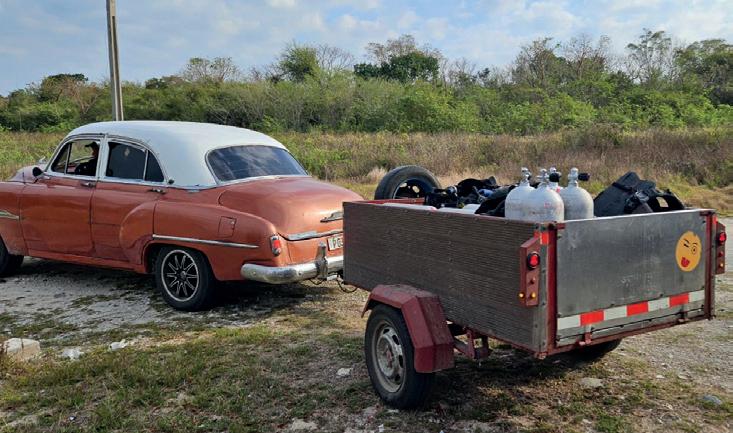
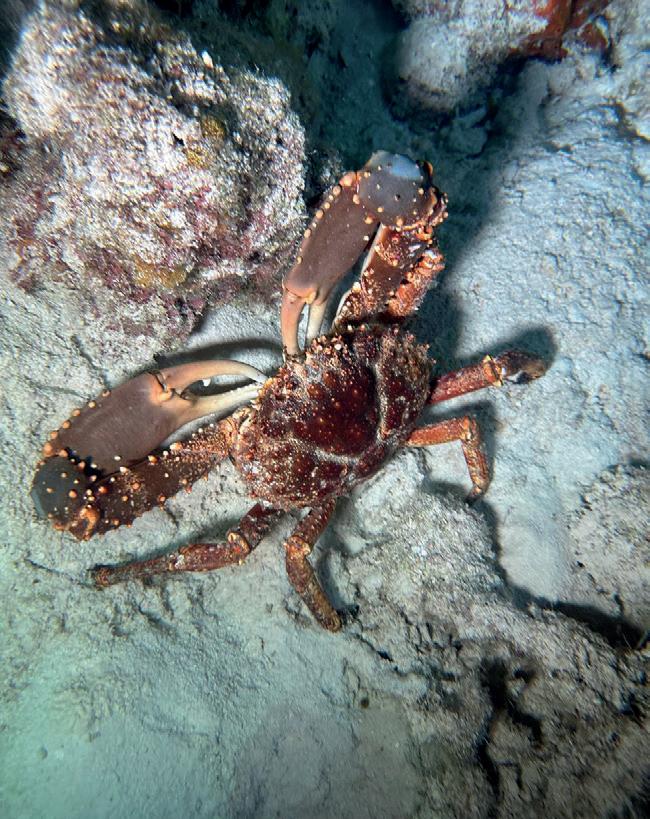
We begin diving in the Bay of Pigs. Our first two dives are on the El Tanke reef. The gear arrives in an old Chevrolet with a trailer. We enter the water from the shore, walking over pristine white sand. Once underwater, visibility turns out to be excellent, and the water temperature is around 25°C. During the dive, we don’t see many fish, but we do spot large crabs, lobsters, and shrimp hiding in crevices. The local reefs are stunning – completely dif-
ferent from those in Egypt. They’re unspoiled, vividly colorful, and rich in vegetation. The outstanding visibility and vibrant colors make this a dream location for underwater photographers.
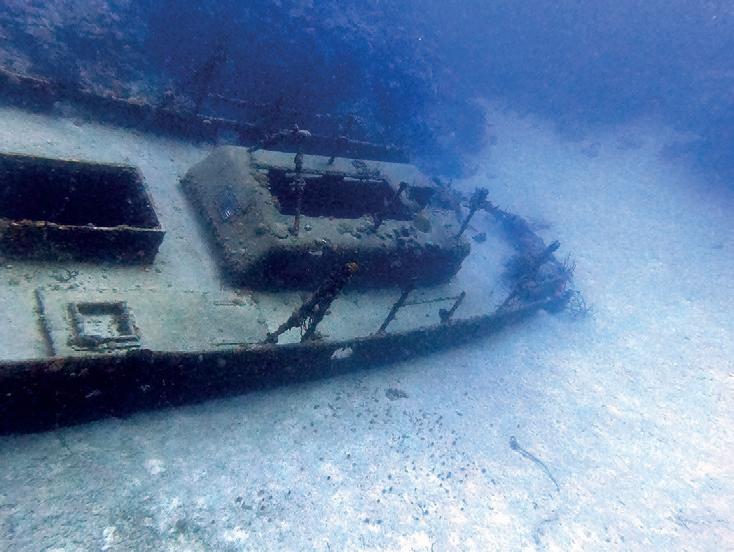
After lunch and some rest on the local beach, we begin our next dive – this time at Punta Pertiz. It’s a magical place both from the shore and from a diver’s perspective. We enter the water over rocks. A wonderful, vibrant, and colorful Caribbean reef lies close to the shore. It consists of two drop-offs, beyond which lies a mesmerizing deep blue. Between the reefs, we see a sunken shipwreck that we can swim into. There are some small, colorful fish, stingrays, pufferfish, and unique species not seen anywhere else.
After the dive, we have to pack up our gear and bring it back to the hotel – unfortunately, at local dive centers, you can’t leave your equipment overnight; it has to be taken with you each day.
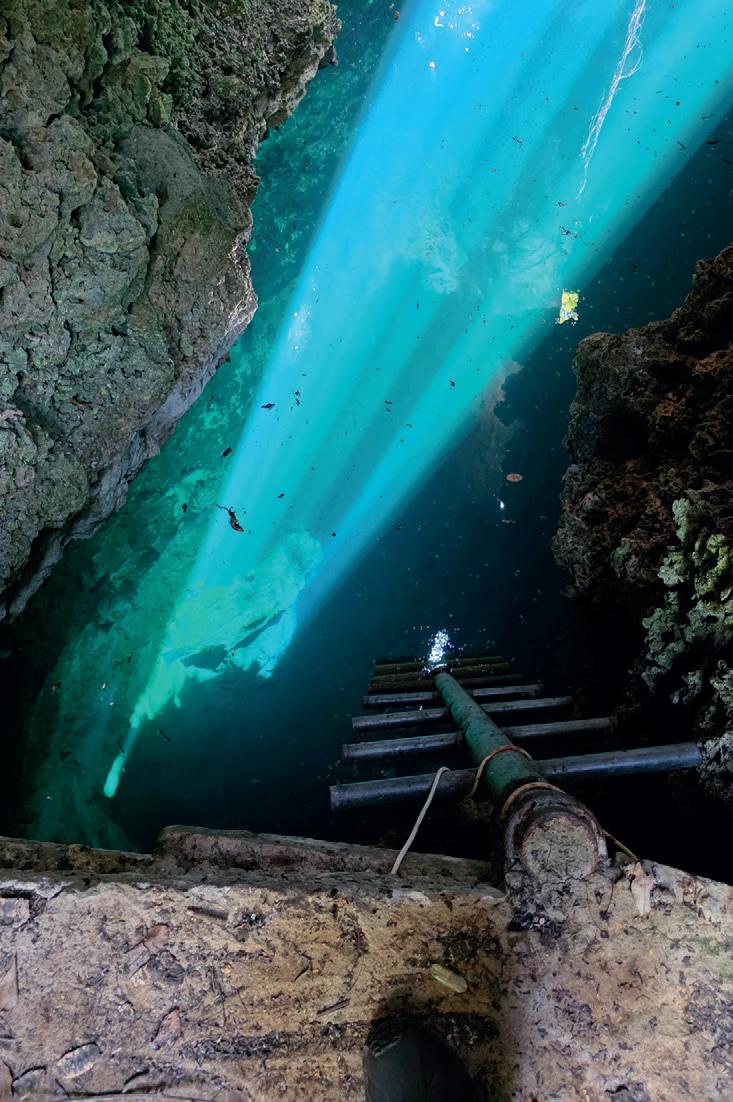
The next day promises to be fantastic – today we have three more dives ahead of us: one in the sea, one in a cave, and a night dive. Part of the group heads out to the sea, while we make our way to Cueva de los Peces, known as the Fish Cave. It's considered the largest cenote of its kind in Cuba. The cave is 70 meters deep and is known for its unique underwater corridors and passages that connect the cenote to the ocean – though unfortunately, we don’t manage to reach that far.
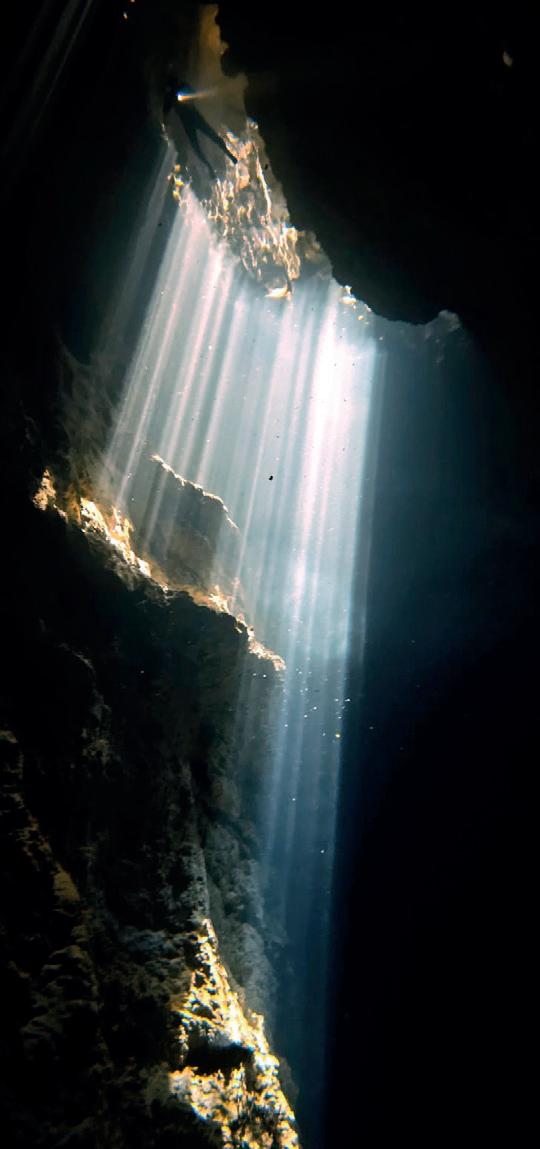
It’s spacious enough to accommodate divers of varying skill levels. We descend to 30 meters, exploring the underwater corridors. Visibility inside the cave is quite good, and in some places, sunlight reaches through, creating a spectacular play of light. The water in the cenote is fresh and relatively cold compared to the sea. Exiting isn’t the easiest – we have to climb out over slippery, steep rocks – but we manage.
Our next dive is in the sea, at Cueva de los Peces en mar. It’s very similar to the dives from the previous day. Once again, we’re enchanted by the colorful, beautifully preserved reefs and the variety of small, vibrant fish.
One more dive awaits us today – a night dive. We do it at Punta Pertiz Jordain, a place we already know from a daytime dive. But night diving is always a completely different experience. We enter the water just after sunset. Underwater, we’re greeted by nocturnal life – completely different species emerge. We encounter moray eels, spider and red crabs, lobsters, cuttlefish, small fish, and lionfish.
The most impressive sight was the squid, which hide during the day and only come out at night. Their shimmering colors under the flashlight beams will stay with us for a long time. The depth at this dive site, already mesmerizing during the day, feels even more magical at night.
After the night dive, we packed up our gear and returned to the hotel, where – naturally – we spent some time chatting about the next day, which promised to be even better.
Today, more caves awaited us: Cueva 35 Aniversario and El Brinco. We had a feeling the day would surprise us – more than once. Some members of the group chose to dive in the sea.
Our smaller group had to walk through the forest for about 300 meters to reach the site where we would begin our descent – a stunning “pond” nestled in the middle of the woods and surrounded by steep rocks.
One question came to mind: how are we going to gear up here? Our equipment arrived on a cart… pulled by horses. We strapped our backpacks to bushes so nothing would roll into the water, which was 75 meters deep. We placed our tanks in crevices between rocks and started to gear up – it took some time, but eventually, we were ready. Between the rocks, a concrete platform had been prepared, from which we jumped into the water. Visibility was excellent, but we had to be very careful not to stir up sediment from the rocks with our fins. The water was fresh and relatively warm. Once we were all in, we swam toward a tunnel, which turned out to be quite wide – about 3–4 meters.
The site surprised us right from the start. At around 7 meters, an incredible phenomenon occurred – a halocline – and
Photo Agnieszka Kruk
Photo Anna Słowek
our vision went wild. A moment later, we entered saltwater and found ourselves in a vast cave with visible, massive fissures in the rocks. We swam through a fairly long section and descended to a depth of 32 meters, where we reached a narrow passage and examined it closely. At that point, we had to turn back to ensure we had enough air. On the way back, we were struck by the beautifully lit cave exit. We passed through the halocline again, enjoying its thrilling visual effects. At 5 meters, while making our safety stop, we were kept company by shrimp clinging to the walls. The exit from the cave was tricky, so we removed our gear in the water and scrambled up the rocks. We packed our equipment, loaded it onto the cart, and set off toward our second dive site – through the heart of the Cuban jungle. Along the way, crabs emerged from cracks in the rocks, and we passed many small pools that held turtles and crocodiles.
When we arrived at the site, it turned out to be even more fascinating. We had to descend a set of rocky stairs to see the brilliant blue of the water illuminated by sunlight. We began our second dive – and to make things interesting, we had to jump about two meters down from a rock ledge between two boulders. Once again, we submerged into the blue to explore caves filled with a magical play of light. We swam into a very wide chamber, where the cave reached a depth of around 40 meters, with spectacularly clear and transparent water. Unfortunately, we couldn’t go all the way to the bottom, so we stayed around 30 meters and admired it from that depth. Of course, here too, freshwater mixed with saltwater, and we could once again enjoy the halocline effect. After finishing the dive, we had to climb a ladder about two meters high and ascend a staircase back to the surface.
Sadly, that was our last cave dive – but luckily, we still had one more dive in the sea.
Photo Agnieszka Kruk
Photo Agnieszka Kruk
Our final dive site was Los Tunelos / Punta Perdix – featuring the same kind of reefs as before: beautiful, colorful, and untouched. The difference was the strong surge – we were tossed left and right, and the sand on the bottom seemed to dance.
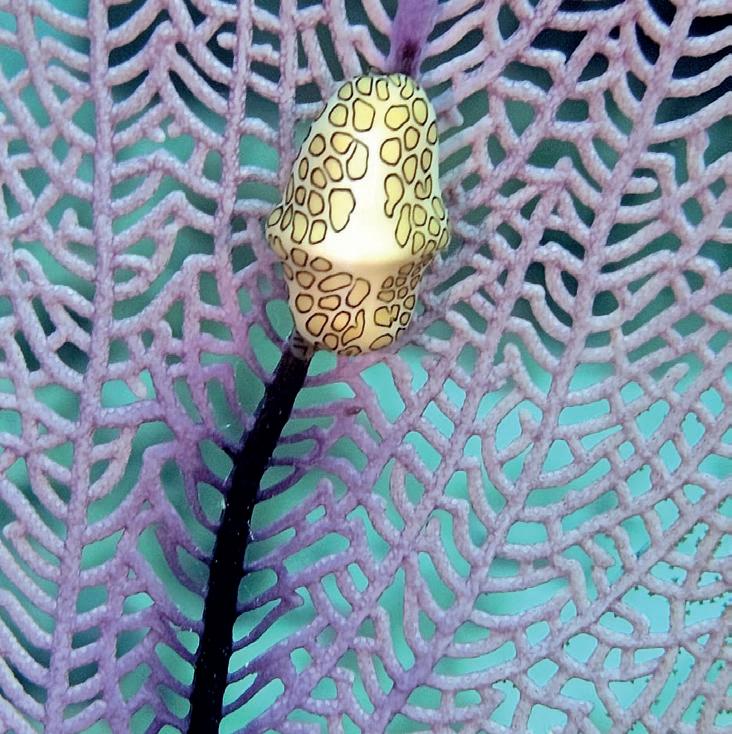
During the dive, we came across a beautiful Flamingo tongue snail (Cyphoma gibbosum). Then we swam through a narrow crevice to a sunken fishing boat – and unfortunately, that marked the end of our diving adventures in Cuba.
The last days of our journey are ahead – we’re heading to Viñales. On the way, we visit a crocodile farm and
a replica of a Taíno village on Taino-Guamá island, where we learn about their customs. Passing through picturesque villages, we reach a hotel with a beautiful view of the sunset.
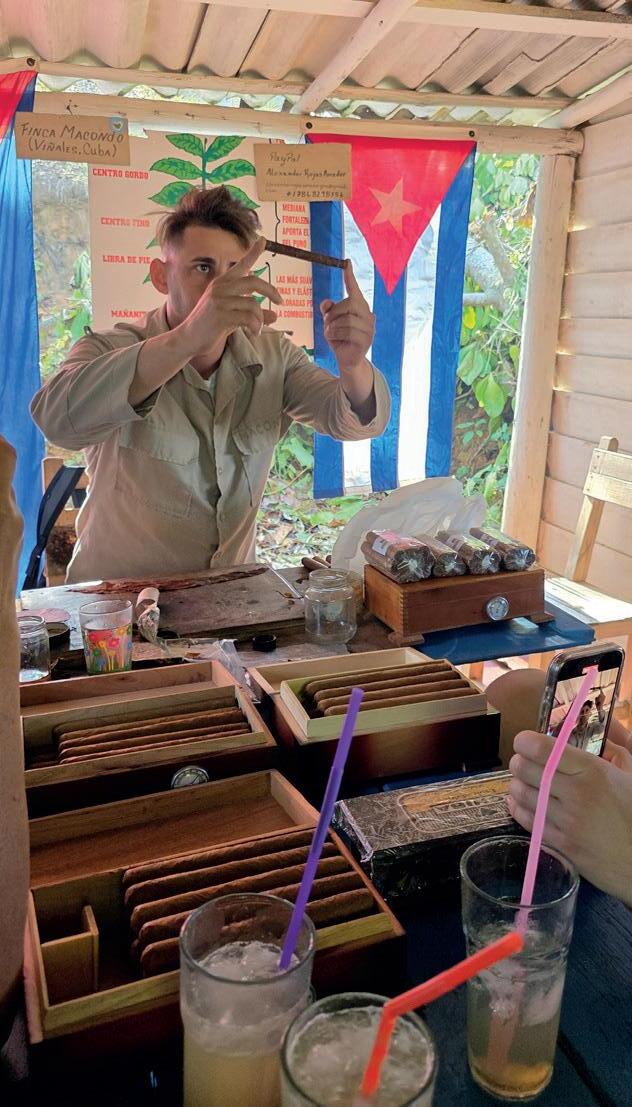
After an evening full of dancing, we head to the Viñales Valley – a UNESCO World Heritage Site. We tour a tobacco plantation, where everything is done by hand, and sample authentic Cuban cigars. The next item on the agenda is a horseback ride through the valley –thrilling for some, pure fun for others.
We also visit Indio Cave, which we explore on foot and by boat.
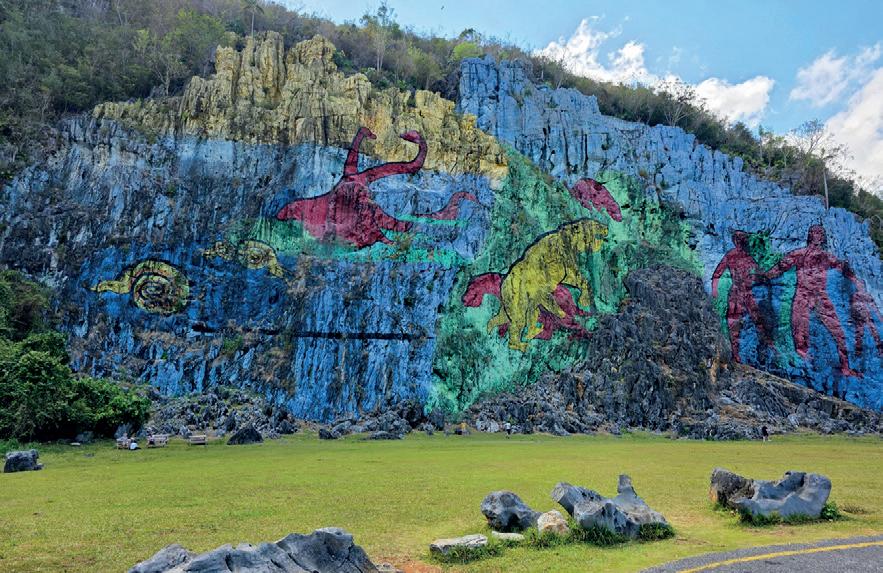
We stop by the Mural de la Prehistoria – a 120-meter-long painting depicting human evolution. Viñales impresses with its landscapes, but time is short – we head to Havana.
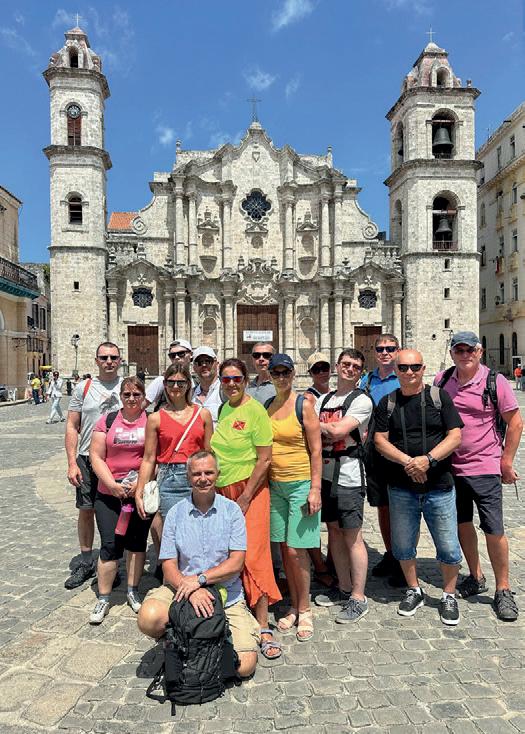
In the capital, we visit places like Hemingway’s estate, Castillo del Morro fortress, and the Capitolio. We tour the city in stylish convertibles, passing Revolution Square, the Vedado district, and the Malecón promenade with the Hotel Nacional. We stroll through Old Havana: from the Cathedral, through Plaza Vieja and Plaza de Armas, to beautiful colonial alleyways.
In the evening, we attend a Legendarios del Guajirito concert, where stars from the Buena Vista Social Club project perform – and we dance until morning!
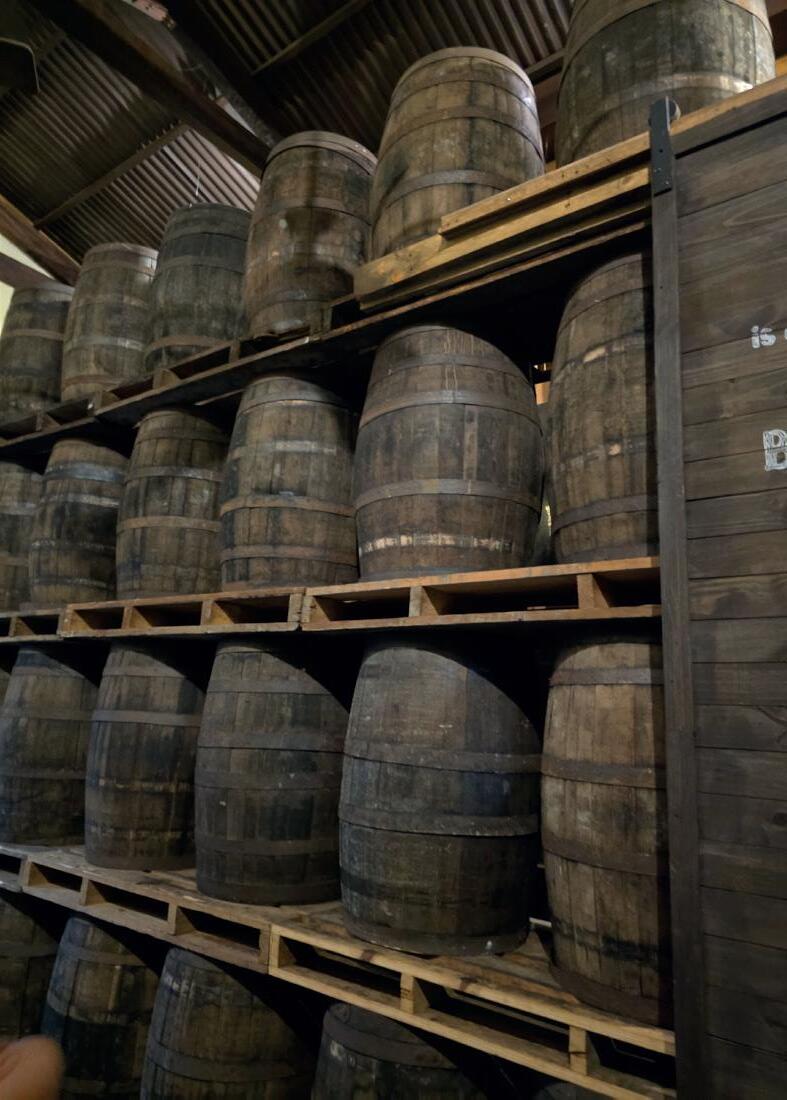
We spend our final moments in Cuba at the Havana Club rum factory and El Floridita bar – Hemingway’s favorite haunt. We finish with a walk through the less touristy streets, discovering the true face of Havana – full of contrasts that make the city, and all of Cuba, so unique.
Cuba isn’t just a country to visit –it’s a country to experience. If you go there, don’t get upset about the power outages, and don’t plan every minute. Let Cuba flow to its own rhythm. Because in that rhythm – full of color, laughter, and music – lies its greatest magic.
SECRETS OF THE INDIAN OCEAN
or the underwater magic of
MAURITIUS
Text and photos MICHAŁ CZERNIAK
IN JANUARY THIS YEAR (2025), AS PART OF THE SCHOOL HOLIDAYS, WE DECIDED TO VISIT MAURITIUS AS A FAMILY. THE CURIOSITY WAS ENORMOUS, BECAUSE THIS TINY ISLAND IN THE MIDDLE OF THE INDIAN OCEAN IS FAMOUS NOT ONLY FOR ITS SYMBOL – THE DODO BIRD (EXTINCT IN THE 17TH CENTURY) BUT ALSO FOR ONE OF THE LARGEST CORAL REEFS IN THE WORLD.
The Mauritius Reef is a true natural treasure, known for its diversity of marine life. The reef here protects the coast from the ocean waves and creates calm lagoons.
The flag of this country consists of four colors: red, blue, yellow and green. Each color symbolizes something
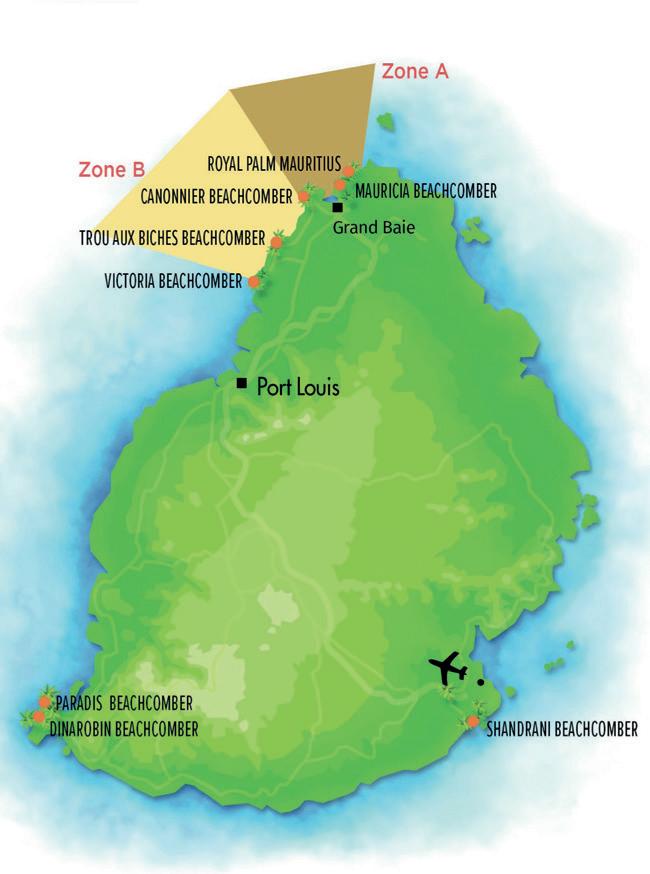
different: red represents the struggle for independence, blue represents the ocean surrounding the island, yellow symbolizes the sun, and green represents the lush vegetation of the island. Already on the first day after our arrival, we found that the promise made in the colors of the flag was fully fulfilled. We chose the "Canonnier" hotel
located in the north of the island. Scattered on its territory were a dozen or so cast-iron cannons, bearing the marks of well-known British and Dutch armories, remembering the 17th century and the fights for independence. The island was discovered by the Portuguese in 1505 and then colonized by the Dutch in 1638, who named it after Prince Maurice of Orange. In the 18th century, the French took control of the island, changing its name to Ile de France. In 1810, Mauritius became a British colony; slavery was abolished. Mauritius gained independence in 1968, becoming a member of the United Nations. In 1992, the country became a republic within the Commonwealth of Nations. This process was the result of long-term negotiations and peace activities, which significantly distinguishes the modern history of this country from the violent and violent history of other African countries.
Today, Mauritius is home to people of different cultures, religions, and traditions. Indians, Creoles, Chinese, Europeans. This makes the country have a very diverse culture and is a safe holiday destination for tourists from all over the world.
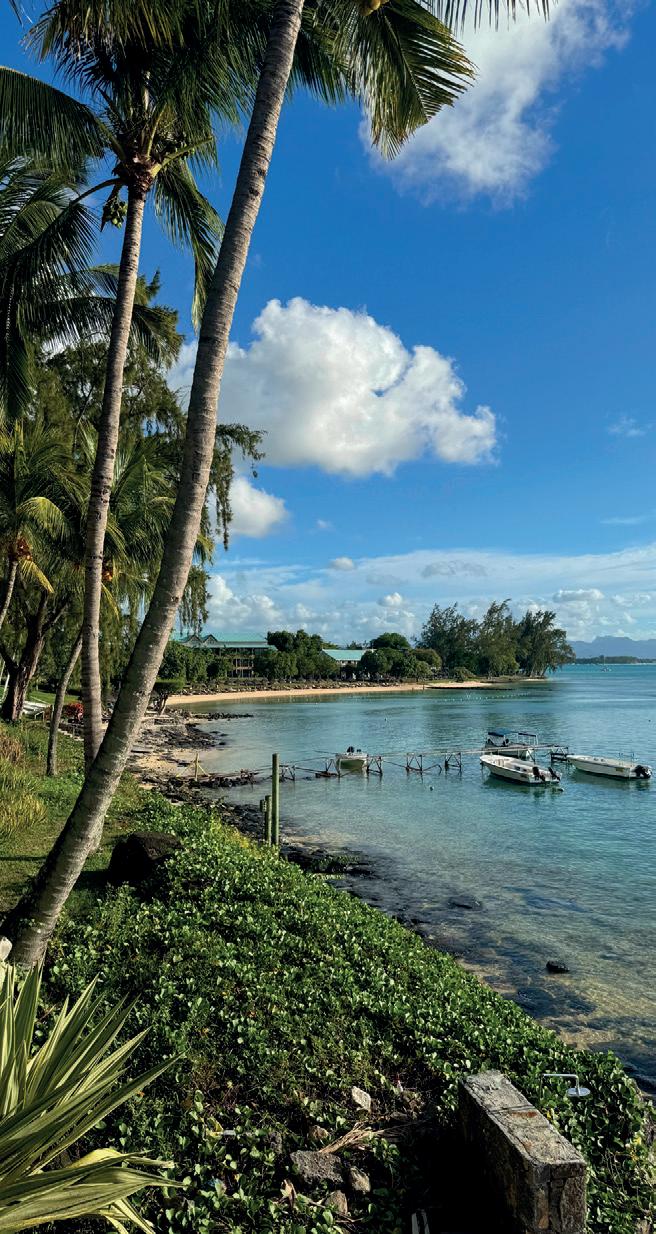
Coming back to the northern areas of the island, where we had the opportunity to relax – wide, sandy beaches and numerous small coves were perfect places to relax. Stable weather conditions and calm waters of the northern coast make this region popular with both tourists and diving enthusiasts.
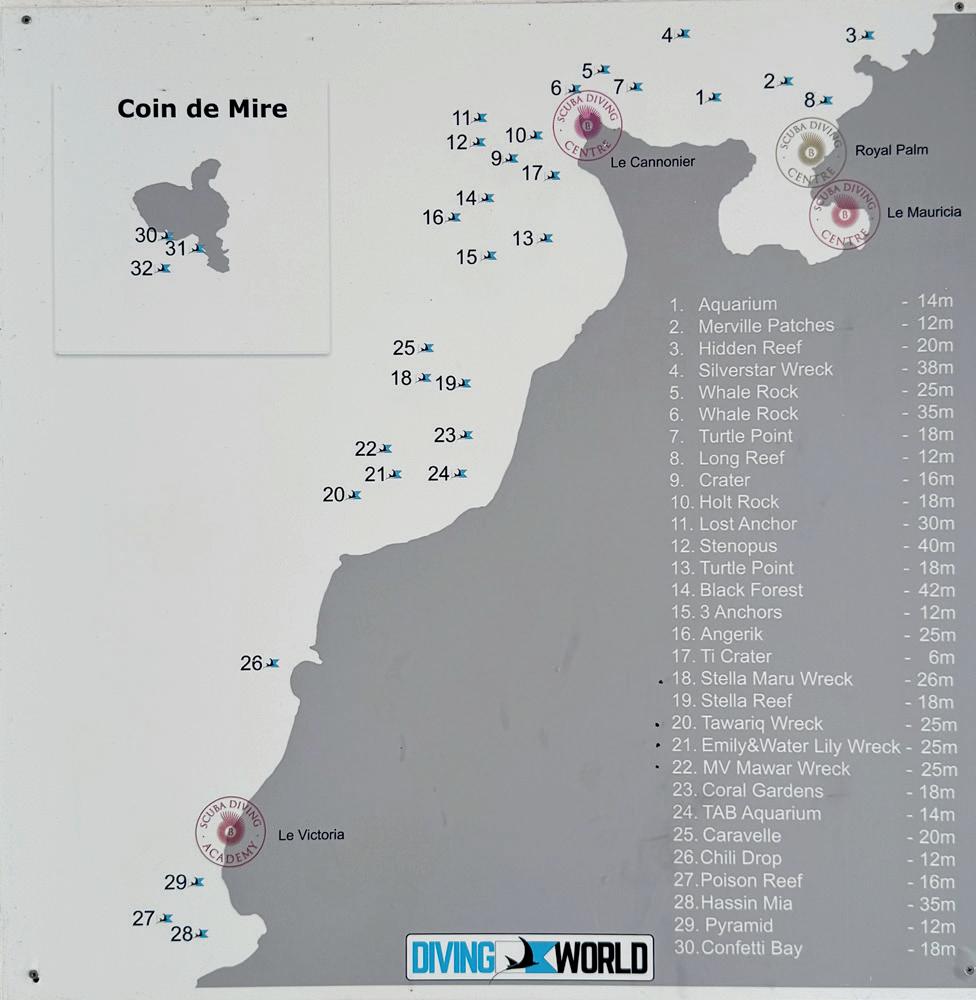
The choice of the "Canonnier" was not accidental, as the hotel housed the 5-star PADI "DIVING WORLD" center, offering a full range of diving adventures – from thrilling wreck explorations to majestic diving along the coral reef, combined with admiring the underwater gorgonian fields.
When planning the trip, I decided that this part of the island is the most interesting place in terms of diving. There are locations on the north coast that offer steep walls and an abundance of marine life. To the west, you can admire shipwrecks and shimmering reefs. The waters around the island are crystal clear, and visibility often reaches 30-40 meters.
Mauritius is home to many species of tropical fish, rays, moray eels. In some places, such as Pigeon Rock, larger groups of reef sharks can be found.
The team from the PADI "DIVING WORLD" center created an extremely warm and friendly atmosphere. After a while, holding a glass of fresh orange juice in my hand, I was enjoying reading the "menu", containing 30 suggestions of fascinating and very diverse diving spots.
I chose two as my destination: the wreck of Stella Maru (26 m) and "3 Anchors" (12-17 m), giving me a chance to get to know the fauna and flora of Mauritius.
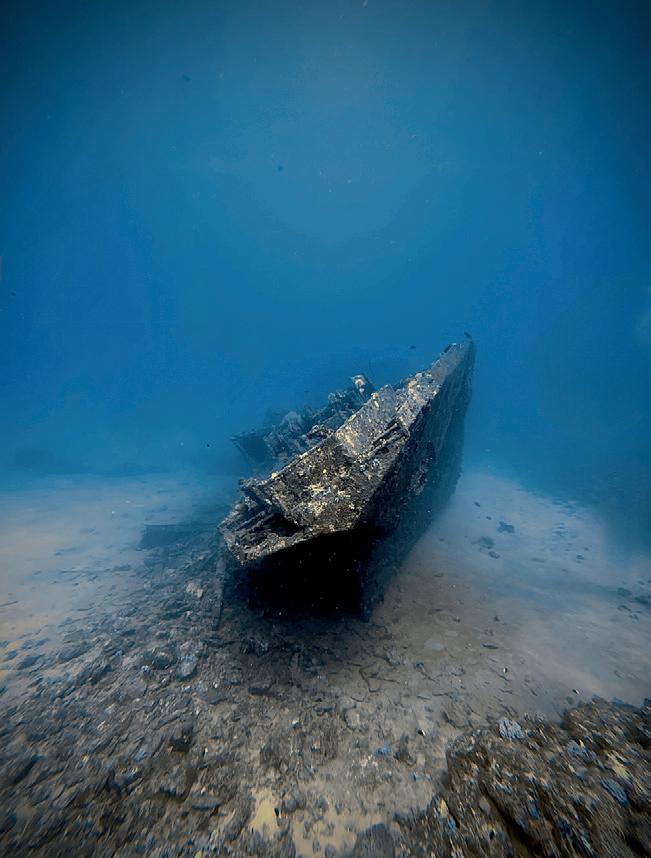
The next morning, a fast dive boat took me (no one else came forward) to the dive site. Admittedly, the wreck of Stella Maru is one of the most famous dive sites in Mauritius, and it's hard to miss when diving in this destination.
The Stella Maru is a Japanese fishing vessel that was deliberately sunk by the Mauritius Marine Conservation Society in 1987 to create an artificial reef. The wreck rests on a sandy bottom at a depth of about 26 meters, near the village of Trou aux Biches.
Visibility at this site is usually excellent and the currents are gentle, making Stella Maru an ideal location for both beginners and more experienced divers.
The wreck has become home to many marine species, such as moray eels, scorpion fish, octopuses and a variety of mollusks.
The wreck is well prepared in technical terms, which means that you can safely peek inside through numerous openings and hatches.
Although 38 years have passed since the sinking of the ship, the coral reef has not yet covered it to an extent visible to the untrained eye. It perfectly shows how slowly the reef grows and how important it is to protect it and prevent its devastation.
The diving story says that on exceptionally warm days, a sea frog appears on board the ship, which loves to sit on the mast of a sunken ship... Unfortunately, I did not have the opportunity to stand face to face with this frog. I suppose that we are dealing here with an anecdote or an unusual light phenomenon observed by divers. There is a species of frog that can tolerate the marine environment! The crab-eating frog is the only known amphibian that can adapt to life in salt water. It is main-
ly found in Southeast Asia, in places such as mangroves and wetlands. This frog produces an increased amount of urea, which allows it to survive in a salty environment... However, the depth of 26 meters seems too great for her frog's capabilities.
The second dive of the day was done in a place called "3 Anchors" – a historically fascinating and very pleasant location, ideal for divers at the OWD level.
The name "3 Anchors" comes from three large anchors, which are the remains of ships from the 18th century, belonging to the East India Company. The anchors have been colonized by a variety of corals and sponges, creating a unique ecosystem.
The East India Companies (British and Dutch) were among the most important players in international trade in the 17th century. The Dutch company was the first multinational corporation in the world. The company had a monopoly on the trade in overseas spices. It was also equipped with semi-governmental powers, such as the ability to wage wars, conclude treaties and establish colonies – it ran its own administration and had a well-equipped army. The anchors left behind are an incredible reminder of the heyday of these organizations, which had a huge impact on the development of trade, colonialism and globalization in the 17th-18th centuries.
Around the anchors, you can admire an abundance of marine life, including colorful tropical fish, mollusks, and soft corals.
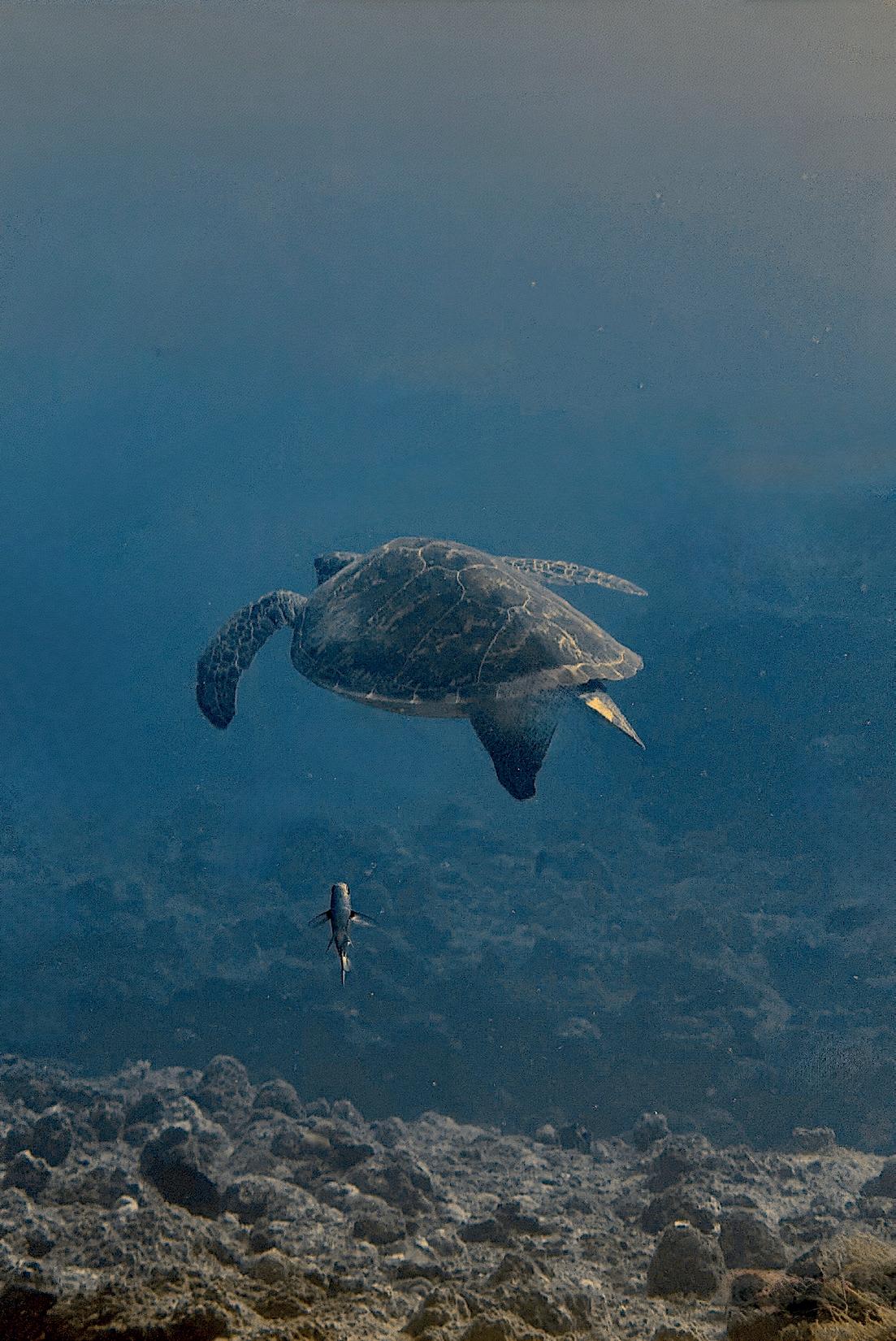
During the dive, I was accompanied by a turtle, swimming slowly a few meters away from me. I'm not sure, but I think I had the opportunity to meet the hawksbill sea turtle – a rare species and heavily endangered today. These turtles feed mainly on sponges and are known for their beautiful, patterned shells. Their shells, which have beautiful, overlapping plates of brown, gold and amber colors, were once prized in jewelry, which unfortunately contributed to their extinction in many areas.
Hawksbill turtles, as great travelers, are known for their long-distance journeys between nesting sites and feeding areas. They can swim thousands of kilometers using underwater ocean currents.
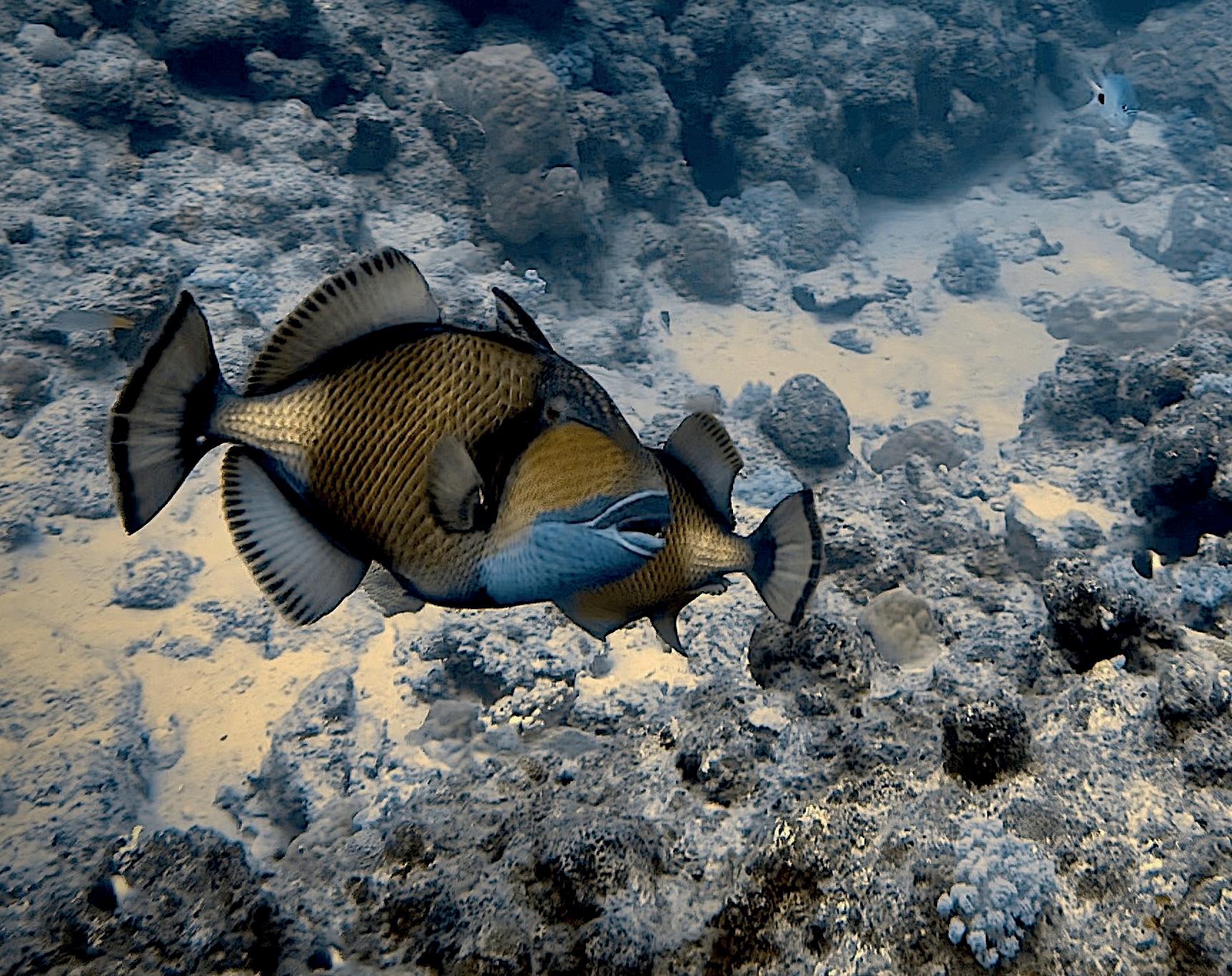
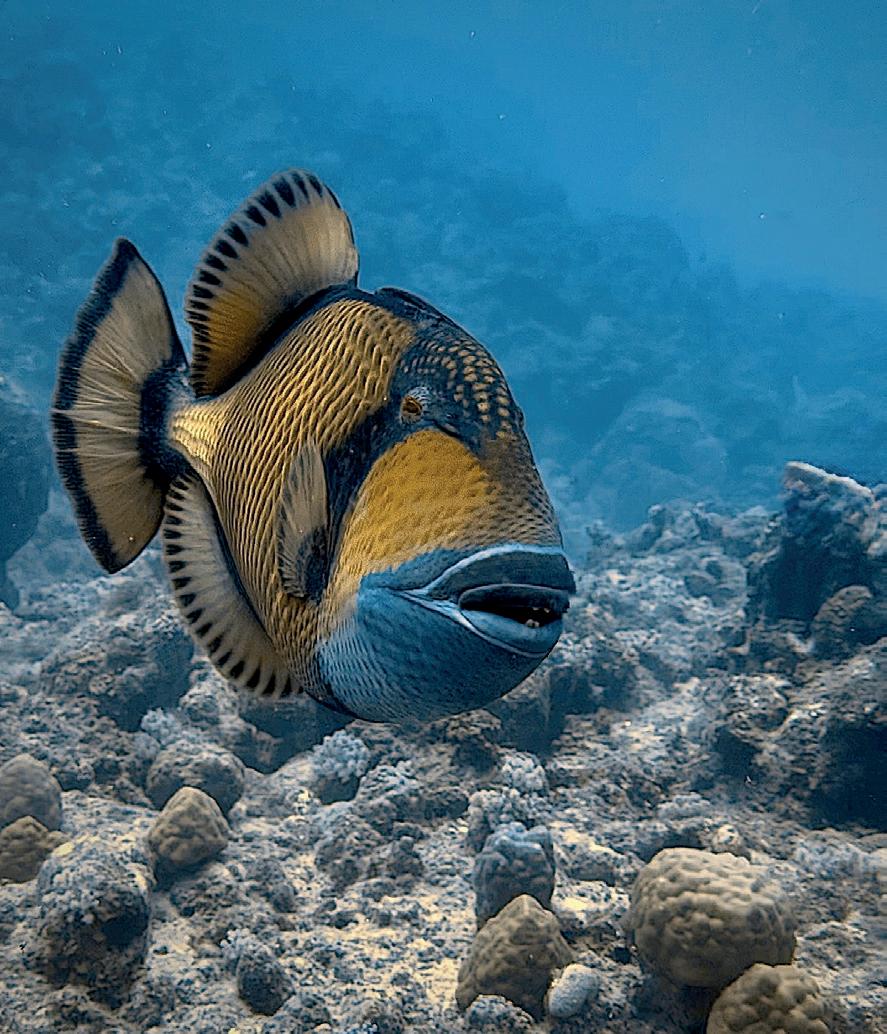
Diving on "3 Anchors" would probably go at the majestic pace of a turtle from Mauritius... if it wasn't for my unconscious intrusion into the territory of a pair of "triggerfish"
Triggerfish, (balistidae family), inhabit coral reefs in tropical waters. They are easily recognizable thanks to their bright colors, geometric patterns on the body and flattened shapes.
The name "triggerfish" comes from their unique feature – the
fish has a "trigger mechanism", i.e. a dorsal fin that can be locked in an upright position, which allows it to wedge itself in rock crevices, protecting itself from predators.
These fish have very strong teeth and jaws (reminiscent of human ones) that allow them to break the shells of sea urchins and crustaceans.
The triggerfish is known for its territoriality and aggression, especially when protecting its nest, which is often found in the sand on the seabed. When an intruder approaches their territory, fish can attack very quickly in an attempt to scare away the threat. They are known for using their strong teeth for defense, though this is usually limited to displays of aggression.
I had the opportunity to experience several dynamic charges performed by one of these beautiful fish. Its size – 60-70 cm to my eye – commanded respect! The fish, defending its territory, was gaining speed and heading straight for me. She passed me at the last moment, being so close that several times she almost brushed against my fin, which I stuck forward like a shield.
Although I only made two dives in Mauritius, these experiences allowed me to immerse myself in the extraordinary world of underwater mysteries of this island in the Indian Ocean. Each descent below the surface was like discovering an unknown universe, full of life, colors and stories just waiting to be explored. Mauritius is more than just a paradise island – it is a window to a fascinating, underwater world that will remain in my memory for a long time.
to travel!
IN PURSUIT OF THE DUGONG
MARSA MUBARAK
Through a Diver’s Eyes
Text and photos DAMIAN NIWIŃSKI-KUJAWIŃSKI
Underwater meadows, majestic turtles, and a fleeting encounter with a dugong –MARSA MUBARAK is a place where nature still rules by its own laws.
Marsa Alam – From Ancient Treasures to Underwater Wonders
Did you know that the area around Marsa Alam was already known in the times of ancient Egypt? The nearby mountains were home to some of the world’s oldest emerald mines! These precious gems were extracted for the pharaohs and later for Roman elites.
Today, Marsa Alam attracts not mineral hunters, but lovers of underwater treasures – sea turtles, dugongs, and the stunning coral reefs of the Red Sea.
Marsa Mubarak – A Bay of Peace and Life
Marsa Mubarak Bay stretches for about a kilometre, offering a wide, natural lagoon ideal for both snorkelers and recreational scuba divers. The bay spans around 400–600 meters in width, and its gentle shore entry makes it friendly even for beginners.
In the central part of the bay, the depth ranges from just 2 to 6 meters – this is where expansive underwater seagrass meadows grow, providing feeding grounds for sea turtles and dugongs. The seabed slopes gradually toward the open sea, eventually reaching a depth of about 15–20 meters.
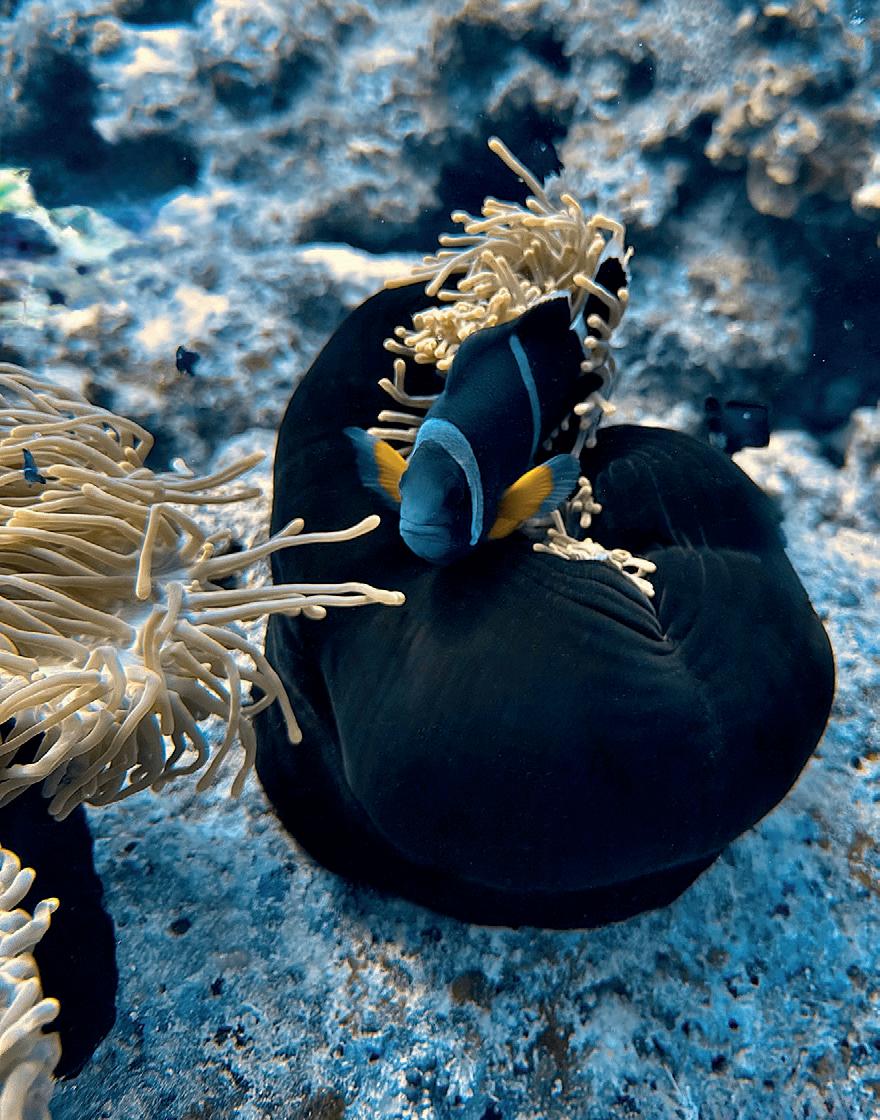
But that’s not all. Marsa Mubarak is a true underwater theatre of nature. Curious octopuses hide in the reef’s crevices, reminding divers that intelligence takes many forms below the surface. Rays glide gracefully just above the sand, and triggerfish – some of the most spirited and beloved fish among divers – can appear out of the blue. Among the corals, it’s hard to miss the clownfish – a small, colourful guardian of the anemone, instantly bringing to mind Finding Nemo, though in reality, it can be fiercely territorial.
Meeting a Legend
At the end of March, when the temperatures are already pleasant and the water enchants with its clarity, we jumped into the bay for a quick snorkelling recon. Almost immediately, something magical happened – a majestic dugong appeared. It glided along the underwater meadows, unhurried and full of grace.
The dugong we were lucky enough to encounter moved with such calm dignity that, for a moment, I forgot about the entire world above the surface. That fleeting moment – brief yet incredibly intense – felt like a wordless conversation.
You don’t always get the chance to see a dugong, and that’s exactly what makes such moments so special. It’s a bit like searching for a legend – and when you finally find it, you’re left with a deep sense of gratitude for simply having been a silent observer.
The dives that followed, although equally beautiful, didn’t bring another encounter with that mysterious resident. Instead, we had the chance to admire other wonders of the underwater world. Majestic sea turtles accompanied us, lazily crossing the sandy seabed or resting among the corals, completely unfazed by our presence. At one point, right next to a rock covered in soft corals, we spotted a perfectly camouflaged stonefish – almost indistinguishable from its surroundings, with a motionless body and a watchful gaze.
On one of the reefs, we encountered stingrays – their graceful movements resembled a slow-motion dance as they glided just above the seabed, stirring up delicate clouds of sand. In the crevices of the reef, we also spotted octopuses that, by changing the colour and texture of their bodies, blended into their surroundings with almost magical precision. Their curious eyes watched us from hiding, and when we got too close – they vanished in the blink of an eye.
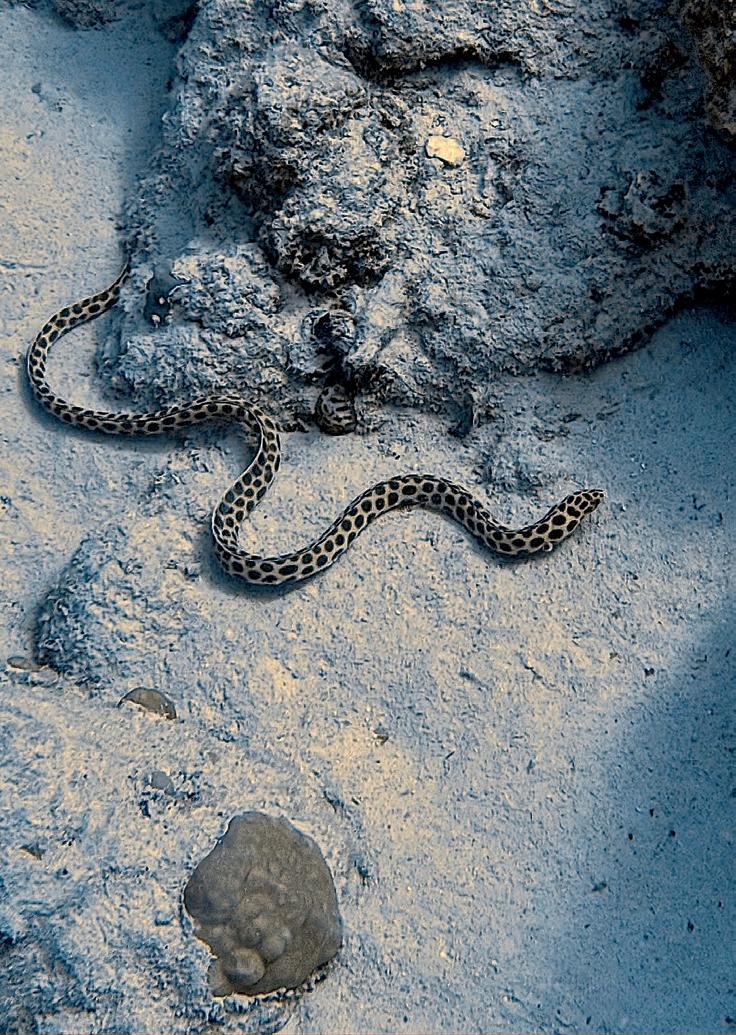
We also had a close encounter with a moray eel, which poked its head out from its hiding spot in the reef. Its undulating motion and sharp teeth commanded respect, yet were equally fascinating. Watching its slow, hypnotic movements felt like
observing the guardian of an underwater kingdom, keeping watch over the serenity of the place.
The reef was teeming with life – schools of orange and blue anthias flashed around, clownfish darted between the corals, and more timid species, like lionfish, emerged from the deeper parts. Colourful corals, both hard and soft, swayed with the current, creating a remarkable landscape that amazed us with every meter of reef we explored.
Though the dugong did not appear again, each of these encounters was unique and a vivid reminder of how incredibly diverse and full of mystery the underwater world of Marsa Mubarak truly is.
Would I return to Marsa Mubarak?
Absolutely yes – this place offers very peaceful dives, with a chance to encounter turtles and dugongs in their natural habitat.
When is the best time to visit Marsa Mubarak?
Marsa Mubarak is also popular with tour boats organizing snorkelling trips. During peak hours, the bay can get busier, so it’s best to plan dives early in the morning or late in the afternoon, when the bay regains its natural quiet and tranquillity.
THE BALTIC SEA HOLDS MANY SECRETS, BUT THIS DISCOVERY IS TRULY HISTORIC!
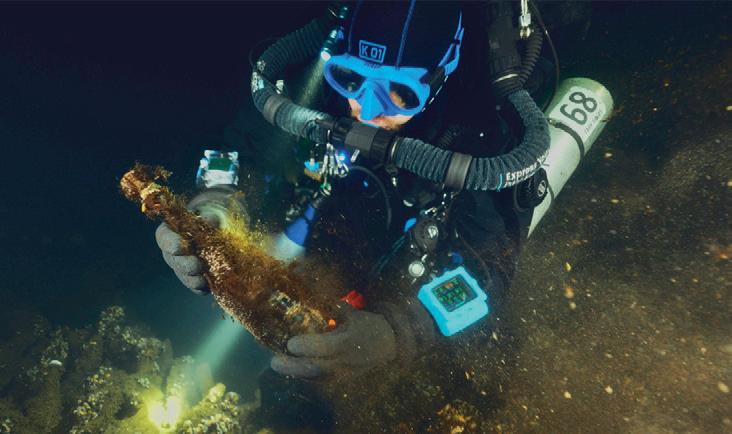
At a depth of 57 meters, a mid-19th-century shipwreck filled with bottles of champagne, wine, Selters mineral water, and porcelain has been found.
The discovery was made by the Baltictech diving team led by renowned diver and explorer Tomasz Stachura. The wreck was originally located in July 2024, but only now has the world learned of the treasure recovered from it.
A Treasure from the Depths: 170-Year-Old LOUIS ROEDERER Champagne
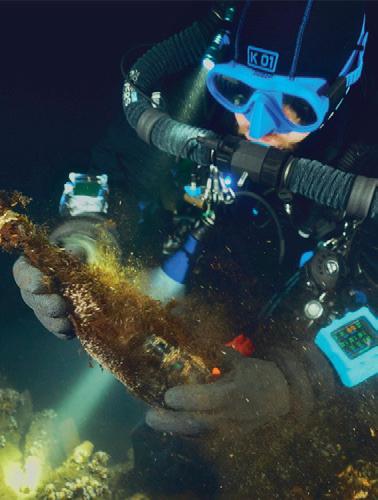
One of the most sensational finds is a series of French champagne bottles by Louis Roederer, dating back to around 1850. The bottles recovered from the wreck were preserved in a drinkable state – a global rarity.
"We have quite a few bottles of champagne here, and it’s actually still drinkable. That’s what makes it unique. The cork didn’t let in any saltwater," said Tomasz Stachura, head of Baltictech.
Experts determined that the champagne contained 110 grams of sugar per liter, about 11% alcohol, and – surprisingly – no bubbles. The lack of pressure and the airtight seal helped the champagne survive nearly two centuries underwater in excellent condition.
A Luxurious Cargo on an 18-Meter Wooden Vessel
The ship, named Henryk, measured 18 meters in length and 4 meters in width. When divers found it, the wreck protruded about 2 meters above the seafloor. According to archaeologists, the vessel sank in October 1861 during a violent storm, recorded in historical chronicles. The wreck was found south of the island of Öland, off the Swedish coast.
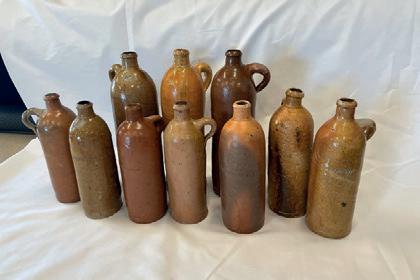
In addition to alcohol, divers recovered valuable porcelain and ceramic bottles of Selters mineral water, which in the 19th century was considered a luxury item and even a form of medicine.
"It was only served on royal or imperial court tables and was considered medicinal. People would drink just a small glass, and it was transported in ceramic bottles," Stachura explained.
Thanks to the markings on the ceramic containers, the team was able to identify the manufacturer and determine the approximate time of the ship's sinking.
International Cooperation and Years of Preparation
This discovery would not have been possible without the help of
an international team. Archaeologists from Sweden and a champagne expert from France were involved, and all necessary legal permissions were secured. Years of research, hundreds of hours spent at sea and underwater, and waiting for the right weather conditions – all led to one of the most spectacular underwater discoveries of recent decades.
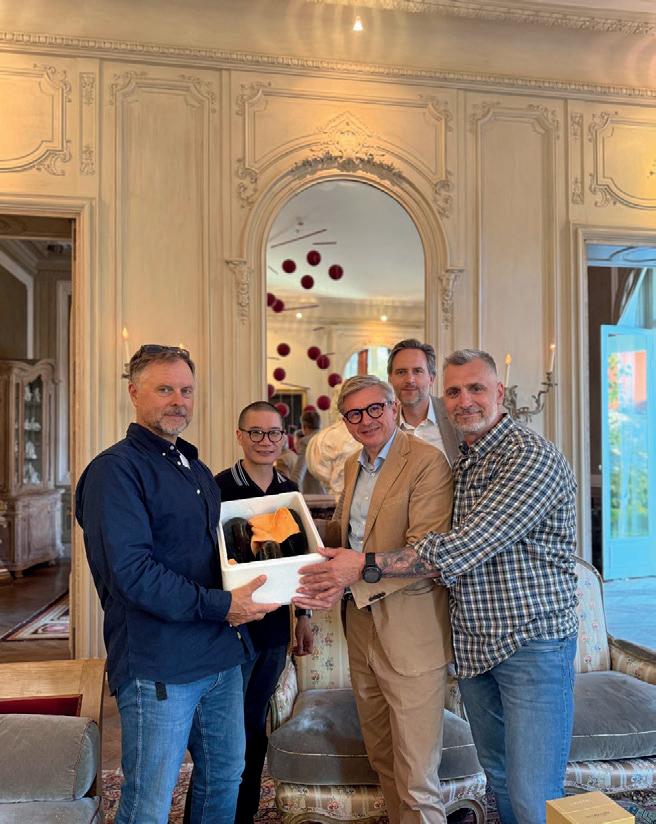
Interestingly, the recovered champagne bottles were handed over to the current CEO of Louis Roederer, a company that will celebrate its 250th anniversary next year. In a symbolic twist of fate, the champagne has now returned to its homeland after nearly 200 years.
A Polish-Led Success
This is a world-first discovery – not only because of the uniqueness of the preserved cargo but also because it was carried out by a Polish team of technical divers. Baltictech has long specialized in exploring wrecks in the Baltic Sea, but as they admit – they never expected to find such a treasure.
The recovery of the "Henryk" wreck and its contents is not only a scientific sensation but also a potential gem for collectors, museums, and history enthusiasts. What will become of the artifacts? We’ll find out soon enough.
The editorial team of Perfect Diver Magazine extends our warmest congratulations to the entire Baltictech team! This discovery is not only an archaeological triumph but also a proud moment for the diving community and all lovers of maritime history.
TECHNICAL DIVING
in Scientific Research
Text and photos NICOLAS GIANNOULAKIS
OThe Role of Technical Diving in the Advancement of Scientific Research: Increasing Underwater Safety and Efficiency.
THE CASE OF THE ANTIKYTHERA SHIPWRECK EXPEDITION
ver the past decades, technical diving has become an indispensable tool in scientific exploration, allowing researchers to safely descend to greater depths, extend bottom times, and work effectively in complex underwater environments. This fusion is perfectly illustrated by the ongoing excavations of the Antikythera wreck – a groundbreaking archaeological project beneath the surface of the Aegean Sea, combining science, technology, and human expertise.
Pushing the limits of depth and discovery
Technical diving, which goes beyond the boundaries of recreational diving, utilizes advanced equipment such as closed-circuit rebreathers, gas mixtures, and decompression protocols to enable safe and effective underwater operations. These skills are especially crucial in projects like the Antikythera wreck ex-
cavations, where artifacts lie at depths of 45–60 meters in a demanding, dynamic environment.
Since 2014, Nikolas Giannoulakis has played a key role in this international endeavor. As a technical diving instructor, scientific diver, and underwater photographer and filmmaker, Giannoulakis embodies the fusion of technical proficiency with scientific purpose, capable of elevating underwater research to new heights. His work includes both ensuring diver safety and training, as well as documenting exceptional moments of discovery with scientific precision and artistic flair.
Ensuring safety in challenging conditions
Safety is the foundation of every successful underwater research project – especially those conducted at great depths, in remote or hazardous locations such as the Antikythera wreck
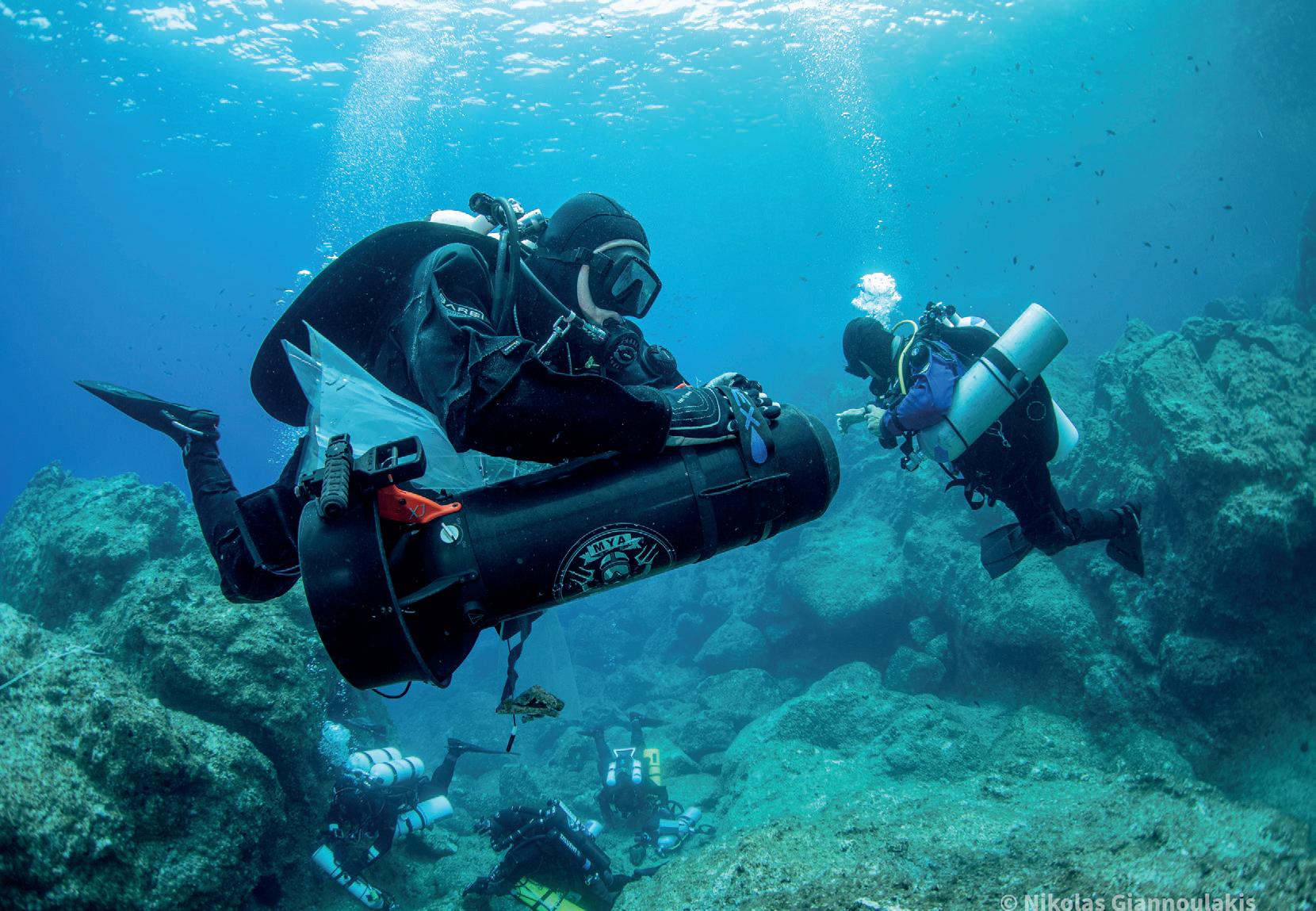
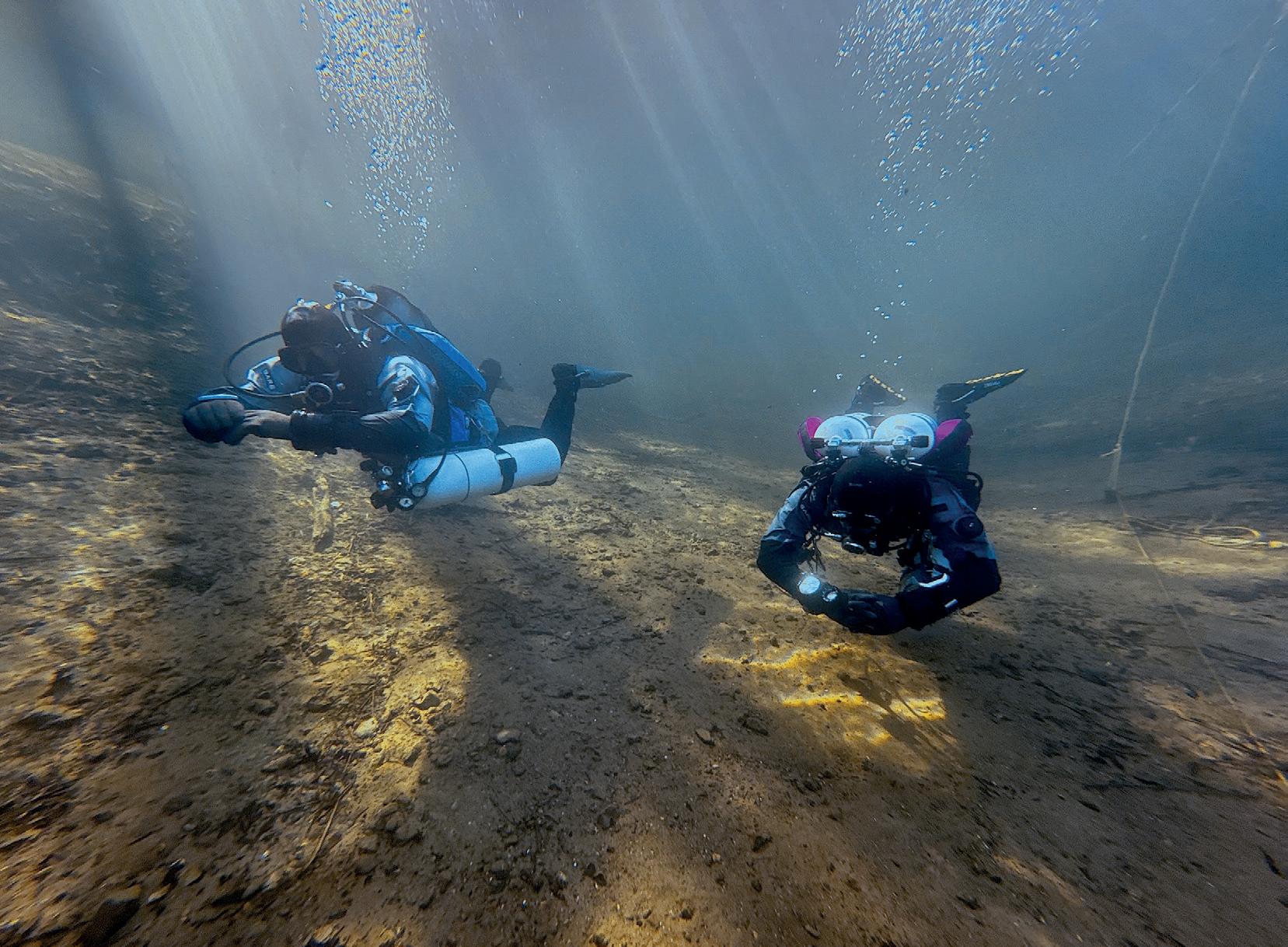
Divers using scooters and rebreathers to access the Antikythera wreck site efficiently
site. The risks of decompression sickness, nitrogen narcosis, or equipment failure are significantly higher at these depths. Therefore, strict procedures and the highest level of training are essential.
As a technical diving instructor, Giannoulakis plays a crucial role in maintaining and elevating these safety standards. From planning decompression using advanced software to managing equipment redundancy and emergency protocols, his efforts allow divers to operate in difficult conditions with full confidence in themselves and their team.
More bottom time – more discoveries
One of the greatest advantages of technical diving in scientific research is the extension of effective working time at depth. Thanks to devices such as rebreathers, divers can stay on the bottom longer while minimizing environmental disturbance – a key factor when working with delicate artifacts or filming video material.
In the case of the Antikythera wreck, extended dives enabled archaeologists to create detailed terrain maps, carry out 3D documentation through photogrammetry, and safely recover ancient items such as ceramics, sculptures, and components of
the Antikythera Mechanism – a 2,000-year-old analog computer that continues to fascinate the scientific world.
Giannoulakis’ dual role as diver and visual chronicler amplifies the impact of the entire mission. His photographs and films document the progress of research and discoveries in real time, creating a visual legacy that educates and inspires the public by showcasing our shared underwater heritage.
Conclusion
The combination of technical diving and scientific research grants access to a world that was, until recently, out of reach. Projects like the Antikythera wreck expedition demonstrate that properly applied diving technology – supported by knowledge and driven by curiosity – can literally and metaphorically bring history to the surface.
Through his work from 2014 to 2025, Nikolas Giannoulakis embodies this synergy, showing how technical excellence, scientific commitment, and storytelling can together illuminate the past and preserve it for future generations. As underwater exploration continues to evolve, so too does the role of technical divers in shaping our understanding of the underwater world.
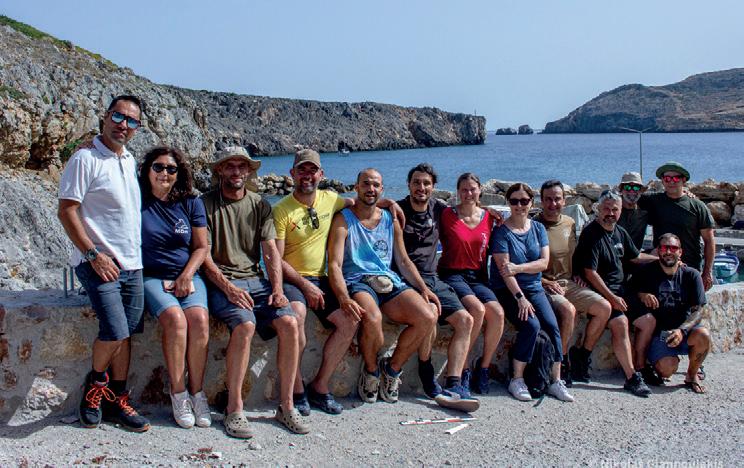
The Antikythera Shipwreck research team on shore at the expedition base
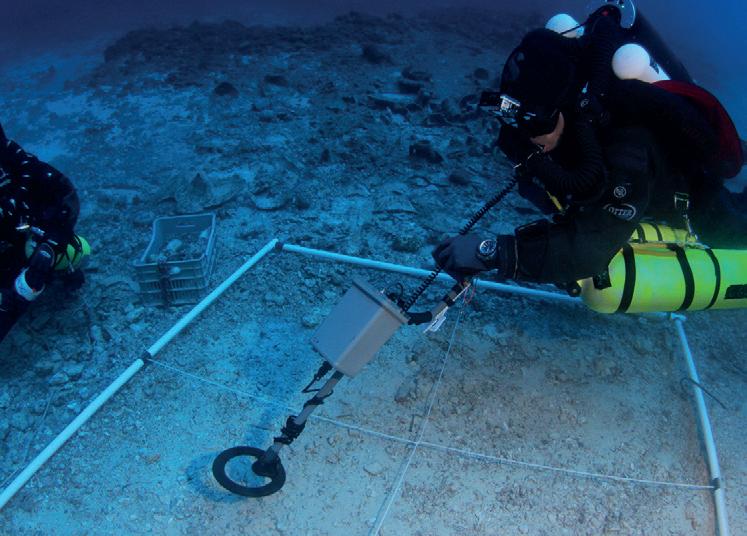
A diver conducting a metal detection survey during stratigraphic excavation
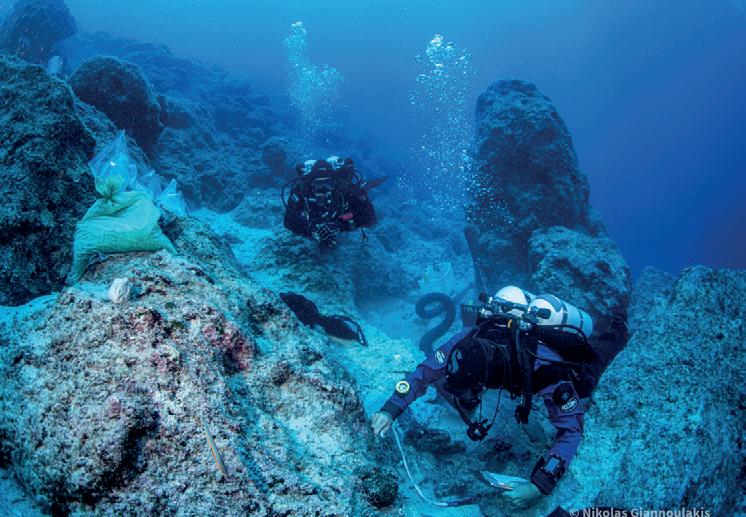
Careful artifact documentation in progress on the seabed with site grid and sample bags visible
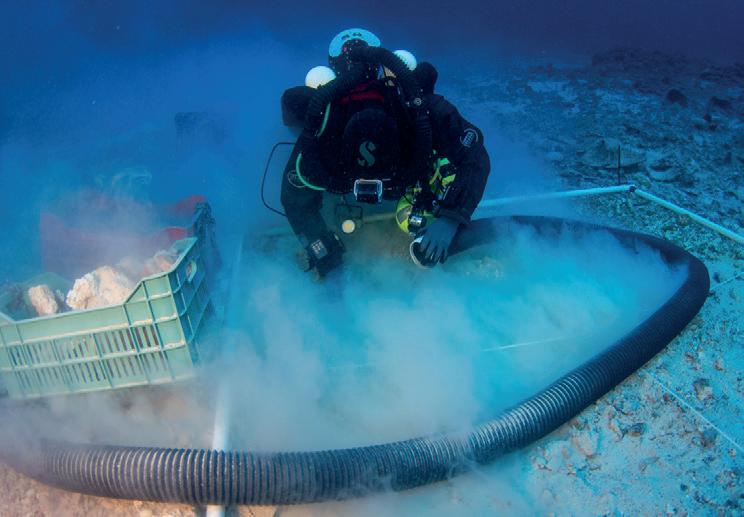
A diver uses a dredge to excavate fragile material from the sediment, guided by a site grid
Text and photos AGNIESZKA JAROSIŃSKA
"SCOTLAND AS A DIVING DESTINATION? AFTER ALL, IT'S COLD HERE, IT'S RAINING ALL THE TIME AND THERE'S NOTHING IN THESE WATERS."
I OFTEN HEAR THIS OPINION, BUT FORTUNATELY IT IS NOT SO!
I've been living in Scotland since 2013, I started diving in 2021 and I can't stop.
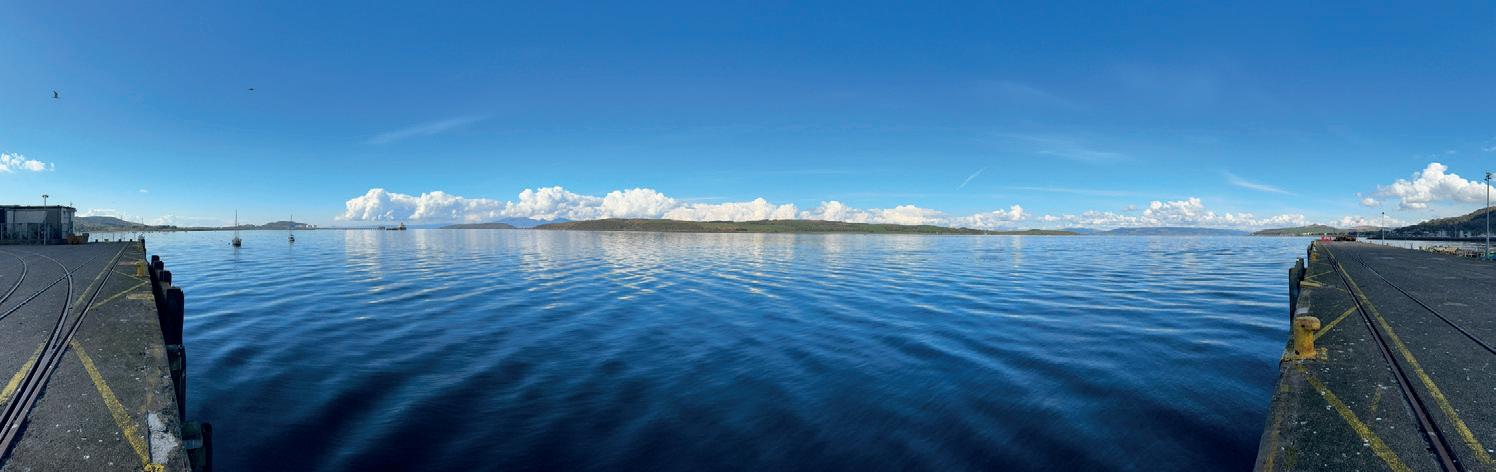
One of my favourite dive sites in Scottish waters, where I learned to dive and where the season lasts all year round, is a small quay with a large pier in the village of Fairlie, 3 miles south (about 4.5 km) from Largs, in North Ayrshire. For the less initiated: 35 miles southwest of Glasgow (approx. 55 km).
Why did I choose this place? When I first came here to the C&C Marine Services diving school, run by Peter Carrick, I wasn't quite sure if I had come to the right place. This is not how I imagined a dive center, although I also had no idea what it should look like. While completing the OWD course, I came to the conclusion that it is not the building that makes up this diving center, but the people who work there and the great atmos-
Panorama – 3 islands
phere in general. I loved diving with every inhale and exhale. And what I saw underwater exceeded my sincere expectations. And anyone who has dived in other places off the coast of Scotland says that they did not expect what they saw under our pier, are pleasantly surprised and want more!
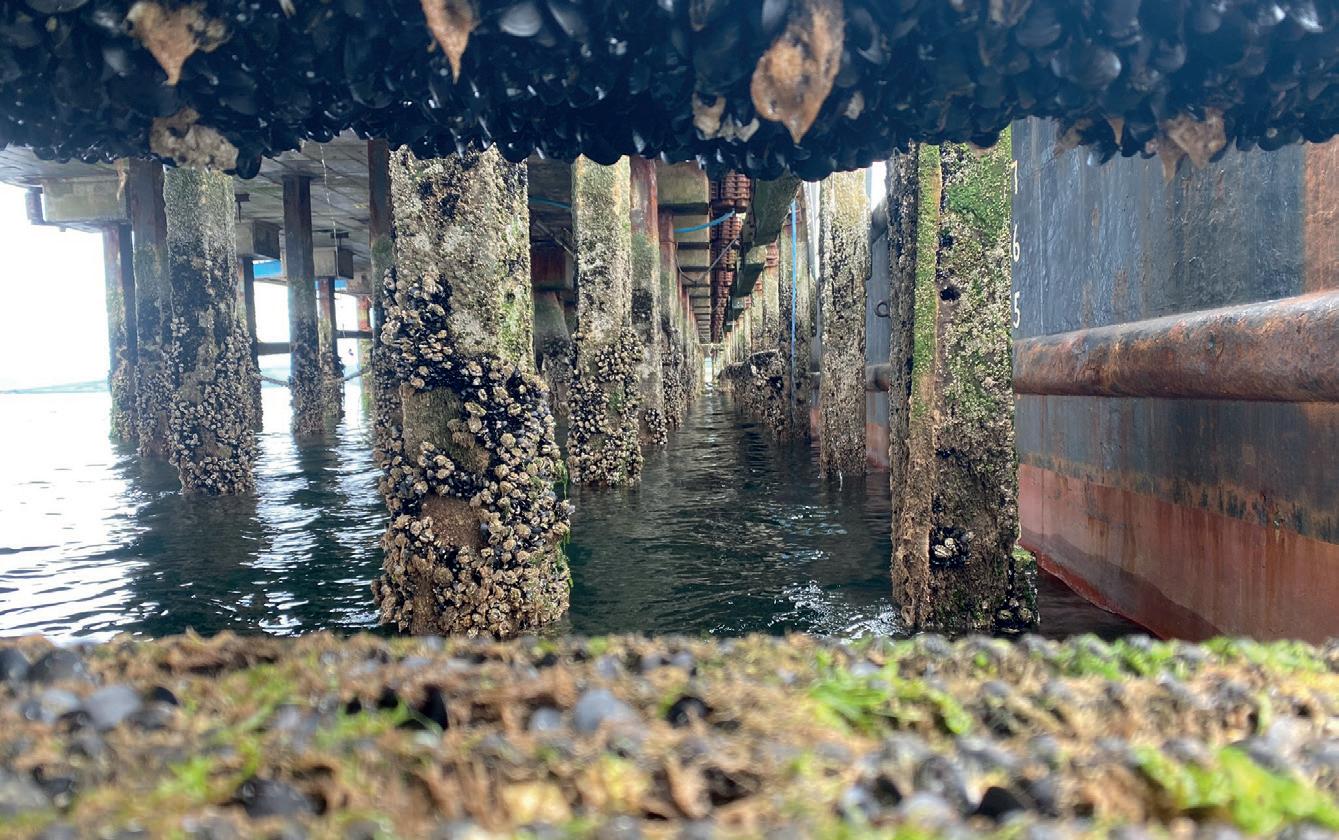
The pier is located in the area of Fairlie Quay Marina, it is 188 m long, the depth reaches 14-16 meters at maximum tide. Certainly, this pier is a form of protection (home) for all animals, and their diversity is an excellent feeding place. We can enter the water in two ways, from a pontoon pier (which is removed for winter due to seasonal storms), where the depth of the water is 1-2 meters at low tides and 3-4 meters at high tides, and stairs with a platform and ladder in the further part of the pier. Here the water is about 6 meters at low tide and 8-9 meters at high tides. The L-shaped pier itself, which means that when planning your route and time spent underwater, you can do it in many ways. I'm not sure if I've tried every possible route! The pier is placed on concrete legs, but there are also many wooden elements and each of them is home to plants and animals. Sailing under the pier, you have the impression of a real jungle. And the deeper we go, the darker it gets, and somehow atmospheric.
We dive all year round, in summer the water temperature reaches up to 18 degrees Celsius (a 5-8 mm thick wetsuit is easily suitable for diving about 1 hour), and in winter 4-6 degrees Celsius (definitely a dry suit and decent undersuits, standard 35-40 minutes, for those who can do more – up to 50 minutes, but I admit that it's hard, despite thick gloves, your hands are freezing and your face is all pink, like during the frost in Poland). With visibility...Well, it is very different here. Scottish coastal waters do not have a beautiful blue color, they are green and visibility is often very limited. But there are days or even weeks when it does not rain and the water is clear, and the visibility then reaches up to 10 meters. On such good days, we laugh that we don't go diving because it will be too much
to see. Anyone who has swam in warm waters with infinite visibility will now think that what a pleasure it is, but it has its own atmosphere, besides, it would be sad not to use what you have on your doorstep.
On sunny days, diving around the pier can be done without a flashlight, especially in the shallow waters around the pontoon pier. But going deeper under the pier, a flashlight is a must have! I must admit that on a cloudy day, when the visibility is 1-1.5 meters, you sometimes have the impression that you are diving at night! Poor visibility, green water, lack of sun and a pier over your head give just such an impression. We also dive at night! Then the whole bridge changes beyond recognition, it is like Las Vegas, teeming with life! Nocturnal species of animals appear that you won't see during the day! But you have to see it with your own eyes. Those who have dived at night know that this is not something for the faint-hearted. I remember my first night dive, we were 6 people, that is, 6 powerful flashlights... And despite this, when I bumped into the foot of the pier, my
imagination started and I was very, very scared (after all, who put those feet in this place).
The bottom around and under the pier is sandy, there is a strip of erratic stones to protect against storms, a great place for snorkelling. Every dive is different, even if you choose the same route. You don't know if you will meet the same animals, some species of fish come only on sunny days (like the dog shark that likes to bask in the sand), after each storm the bottom changes, and because there are many old elements of the pier at the bottom (e.g. old wooden 10-meter legs of the pier, or metal pipes), they also travel with the force of the water. Everything in the water is home to animals and if you know what you want to see and how to look for it, you will surely find it. Of course, there are also regulars and you can always count on them.
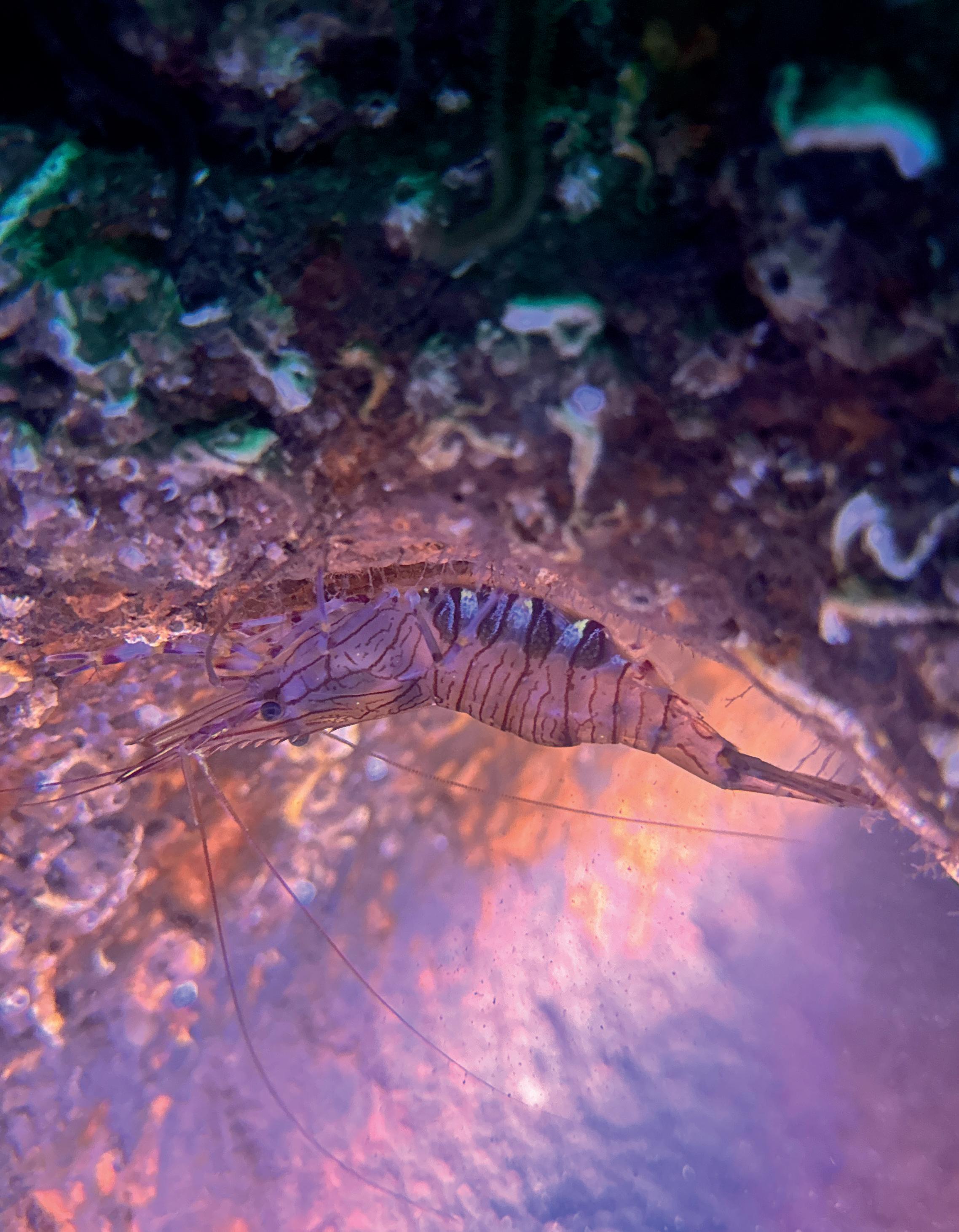
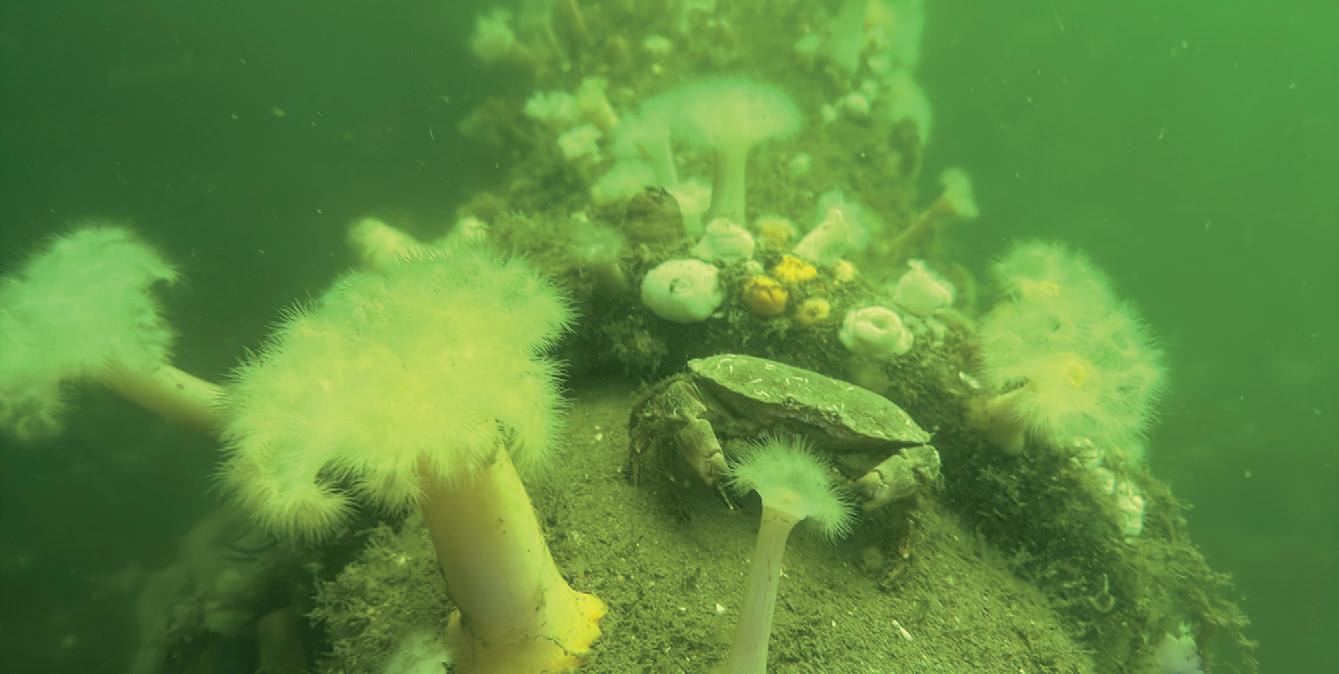
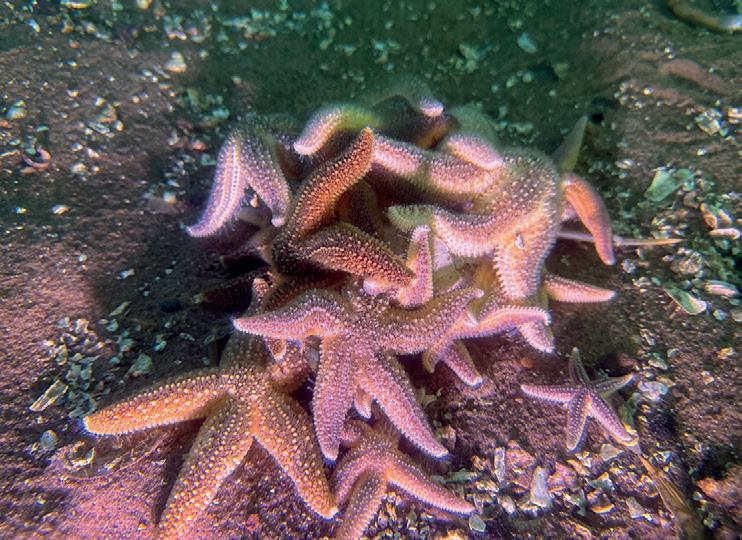
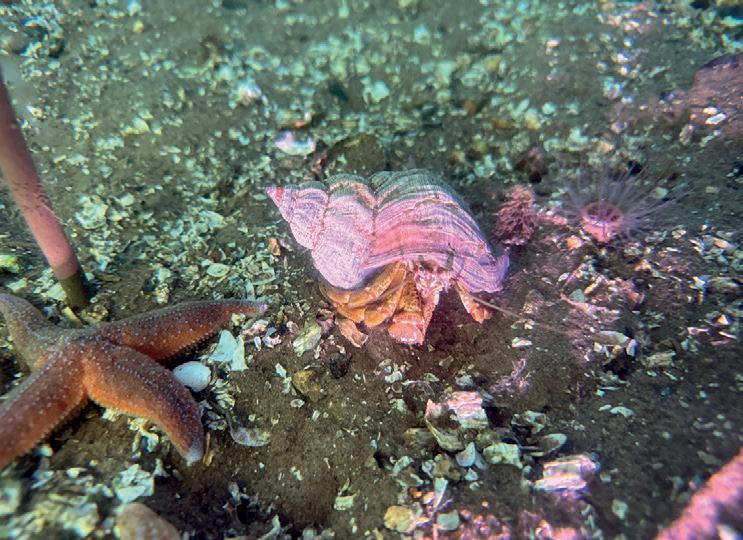
What interesting can we find here? Starfish of all colors, colors and sizes; fish nurseries and adult fish (herring, wrasse, mackerel, sandeel, gobies and others), nudibranchs (also of various sizes, with spears, lilacs and different colors), lobsters, crawfish, shrimps, crabs (brown also called edible crab, hermit
crab, littoral crab, bristly crab, strawberry hermit crab, migratory crabs and others), various types of worms (Sabella pavonina, called peacock worm, sea mouse, polychaetes), sea urchins and colorful anemones. When it comes to marine flora, the most common are dead man's fingers (Xylaria polymorpha, white and orange), many species of seaweed (sugar kelp, bladderwrack, spiral and flat wrack, common oarweed and others). I could go on and on, but I won't reveal everything to you.
You can't forget about the views by the water, from the pier you can see the Isle of Arran, Small and Large Cumbria (Wee Cumbrea and Great Cumbrea), the Isle of Bute and the Highlands foothills (which start just outside Glasgow). We are visited by seals and bottlenose dolphins, but you can't treat them underwater, they stay away (so far away that you can't see them, although they do).
Regardless of whether you are an experienced diver or just want to start your adventure with diving, I encourage you to use the services of a diving center. There is also a hardware store and the possibility of filling cylinders with air and nitrox. In addition, great company, warm coffee and pizza after the dive.
Blackmouth catshark
Galeus Melastomus
IT’S MID-APRIL, A THURSDAY AFTERNOON. I’M THINKING ABOUT WEEKEND DIVING AND TRYING TO CHOOSE A SITE. I GET DISTRACTED BY THE SOUND OF A NOTIFICATION ON MY PHONE. A NEW POST HAS APPEARED IN THE CLUB GROUP – SHARKS WERE SPOTTED DURING A NIGHT DIVE.
The location is provided, so the decision of where to dive practically makes itself. I call up a few club buddies and suggest a joint night dive.
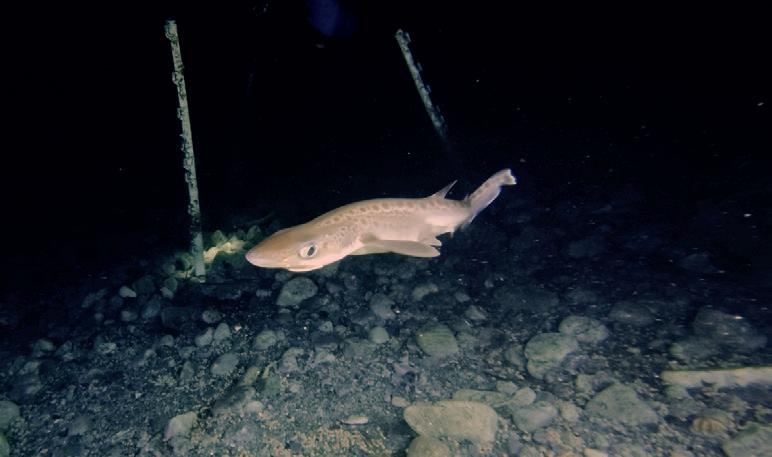
We’re planning to dive on air with a maximum depth of 40 meters. We're bringing nitrox 50 with us. Decompression stops are definitely in the cards since I’ll be filming. Still, I approach it cautiously and with a bit of skepticism. In 15 years of diving in the fjords, I’ve only seen blackmouth catsharks (Galeus melastomus) twice. Once by chance, during a trimix dive at a depth of 53 meters, and the other time at about 48 meters. In both cases, they were lone adult females, which in this species are larger than males. On average, they reach between 80 and 90 cm, though individuals as long as 1.2 meters have been recorded.
I arrive at the site – my friends are already there and setting up their gear. We have plenty of time, as we plan to descend about fifteen minutes after sunset.
The dive site is, in truth, more visually impressive above the surface than below. It’s a large bay located where the fjord branches off and stretches deep into the mountains for 6–7 kilometers. The bay itself transitions into a beautiful valley flanked on both sides by mountain ranges. A small river flows into the fjord along one of these ranges. That’s exactly where we expect to find sharks. In the autumn and winter, this calm river turns into a rushing stream, carrying loads of gravel down to its mouth. That’s exactly what the seabed is like where we’ll be diving – mostly gravel, with decaying leaves scattered around. The bottom slopes off rather quickly, but smoothly, into deeper water.
By day, not much happens here – the seabed is plain and rather uneventful. You’ll usually see some fish and various echinoderms – mostly sea urchins and starfish slowly moving across the bottom in search of food. Occasionally, your attention might be caught by a wolffish
resting on the bottom, a drifting jellyfish, or, more rarely, a seal.
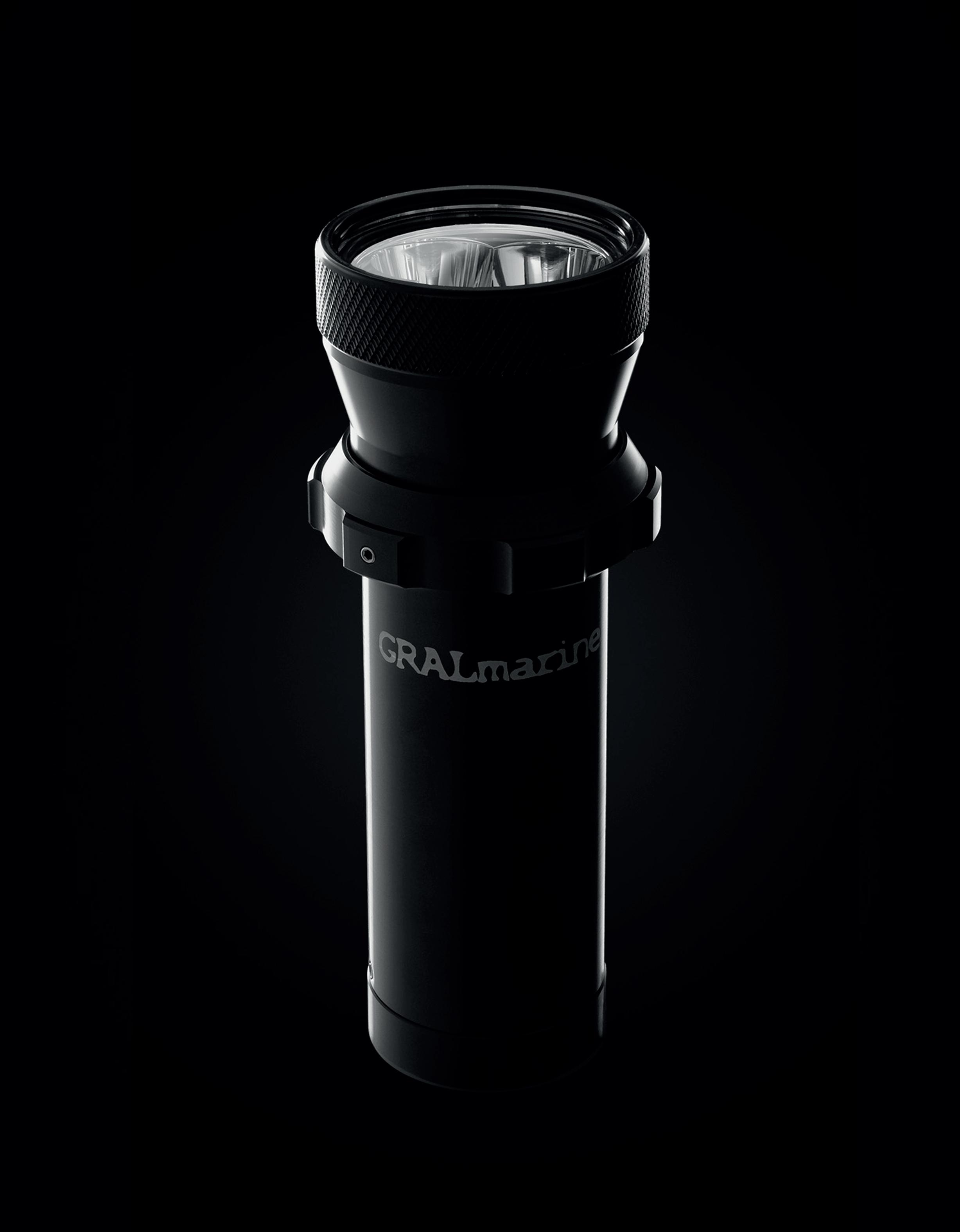
By now, the sun has already set. We go over the dive plan one more time –the gear is ready, and it’s time to suit up. We enter the water and do a light check. The primary lights are working, backups too, and the video lamps light up the area beautifully. For filming, I use two heads powered by canister batteries, which always ensures a constant light output for a long period. The species we hope to encounter isn’t under special protection and is considered abundant. However, due to its habitat preferences, it’s rarely seen by divers – hence my decision to go with this specific lighting setup. I really don’t want anything to go wrong while recording. Underwater, I decide to set the lights to 50% power, since visibility is excellent – around 20 meters. Also, blackmouth catsharks are deep-sea animals, typically living between 150 and 400 meters, though some sources say they can
Text and photos PAWEŁ FRANCZYK
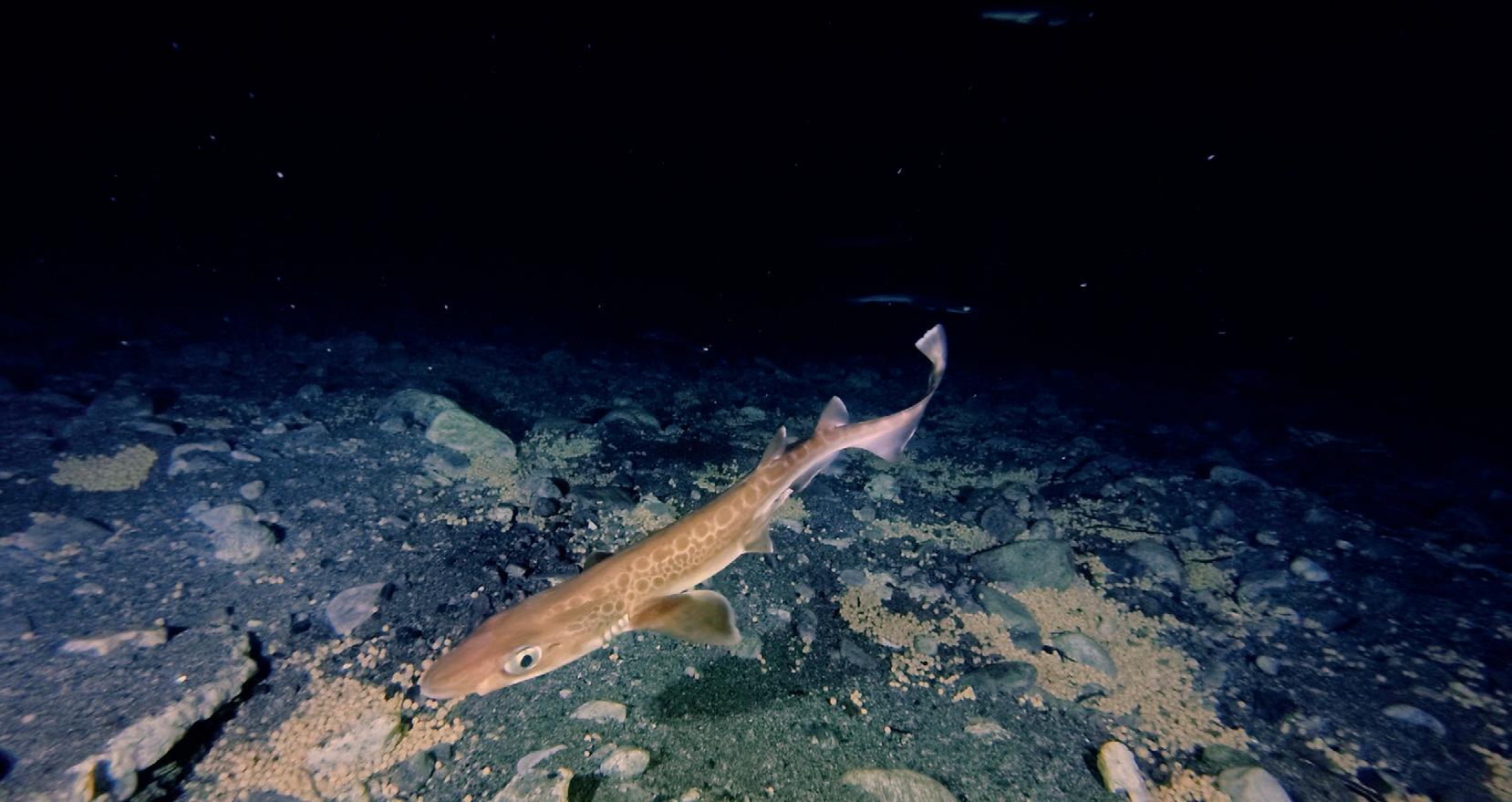
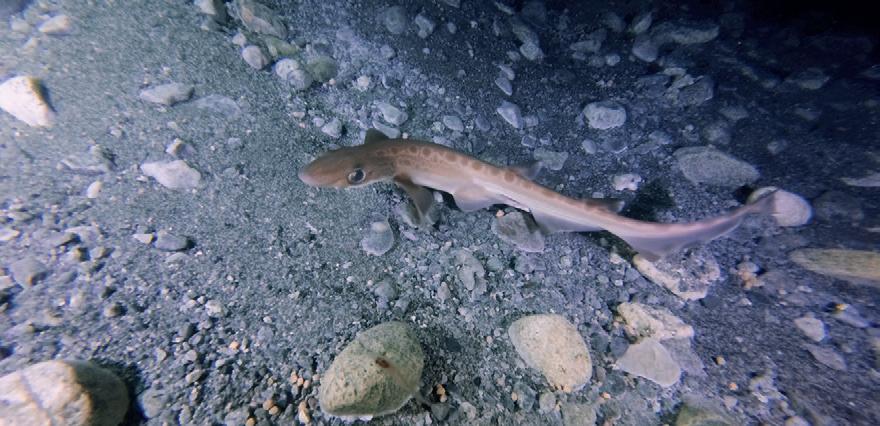
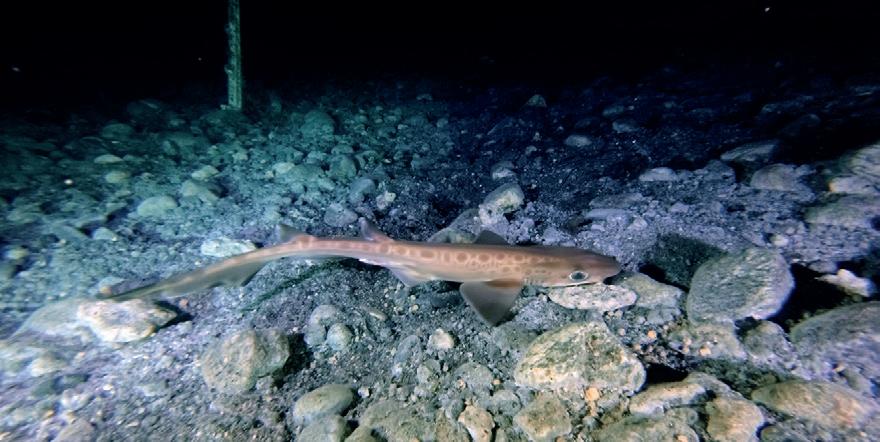
dive as deep as 900 to 1200 meters. So it’s best not to spook them too much with light – or risk damaging their eyesight. We reach a depth of 25 meters. The decaying leaves on the bottom begin to thin out, and among them are many common crabs feeding at this hour. The water column is full of krill and shrimp, shimmering beautifully in the beams of our dive lights. Suddenly, one of my dive partners signals with his torch. It seems he spotted the shape of a shark within a small group of fish and is pointing to the spot where he saw it just moments earlier. For a second, I think he may have imagined it, and I’m about to turn off my video lights when – there it is – in the distance, the shark turns, makes a wide loop, then disappears into the impenetrable darkness. We’re passing 30 meters, and I think to myself that maybe, just maybe, luck is on my side, and I’ll be able to capture something on film this time. The nearby group of feeding fish doesn’t seem too bothered by us – they’re young cod. But as we approach, they suddenly scatter. For a moment I think we must have startled them – but no, it wasn’t us. There’s the culprit: a stunning blackmouth catshark, boldly swimming toward me as if it’s ready to pose for the camera. So focused on capturing the shot, I don’t even notice when two more sharks swim above and below me. That throws me off a bit – I hadn’t expected several, maybe one or two at best if I were lucky. I look ahead – we’re at 39 meters. On both sides, I see writhing shapes – a large group of sharks – and right in front of me, emerging from the depths, a school of at least eight individuals. Shock and disbelief. That makes about 20 to 30 sharks in one place. It feels like a prearranged meeting – I stop at 40 meters and begin filming. And just like that, there they are: blackmouth catsharks in all their glory. Mostly adult specimens, 70–90 cm in length, though there are also smaller ones – around 30–40 cm. The adults are noticeably more vividly colored, their slender bodies covered in brown-beige spots. Five gill slits – the last one ending just above the pectoral fin. Large oval eyes without a nictitating membrane, an elongated head. A long tail with a slightly
downward-curved edge and small protrusions resembling saw teeth. They really do resemble a saw in shape. These ground sharks are found throughout the North Atlantic – from Madeira to northwestern Africa and into the western Mediterranean. Blackmouth catsharks are oviparous, with females typically laying 2–4 eggs, sometimes up to 8. The eggs look like small pouches with short tendrils for anchoring. These small sharks feed on crustaceans, mollusks, and small fish. Galeus melastomus – their Latin name means "black mouth," a reference to the black coloration inside their mouths. The
English name directly reflects the Latin: Blackmouth Catshark. Twenty-eight minutes of bottom time and a short decompression stop give me a moment to cool down and reflect on just how incredible and unpredictable this diving hobby can be. A week later, I return to the same site and again count more than 20 individuals – but most importantly, I leave with plenty of great footage featuring blackmouth catsharks in the spotlight.
Stay tuned for the film...
FRESH WATER
The Underwater World of the Old Prussian Galindians
Lake DEJGUNY
Text and photos
DEJGUNY IS A LAKE IN THE LAND OF THE GREAT MASURIAN
LAKES, LOCATED IN THE CATCHMENT AREA OF THE WĘGORAPA RIVER, IN GIŻYCKO COUNTY. THIS SCENIC BODY OF WATER OWES ITS PICTURESQUE LANDSCAPE TO ITS LOCATION FAR FROM CITIES AND PAVED ROADS.
As history has shown, this Masurian gem attracted the interest of all people who inhabited the region since ancient times.
There is a large island on the lake, which, according to legend, was once home to an Old Prussian priest. The Galindians – a tribe that lived in the area – would paddle to the island in dugout canoes to seek his prophecies and advice. This legend is believed to be true, as fishermen have found vessels and Roman
coins from the Antonine dynasty on the lakebed. These may have been gifts from the Galindians to the priest. During World War II, the lake became a military area. On the Lisi Ogon peninsula was a communication center serving the Wolf’s Lair, and on the island stood a building used by Nazi officials.
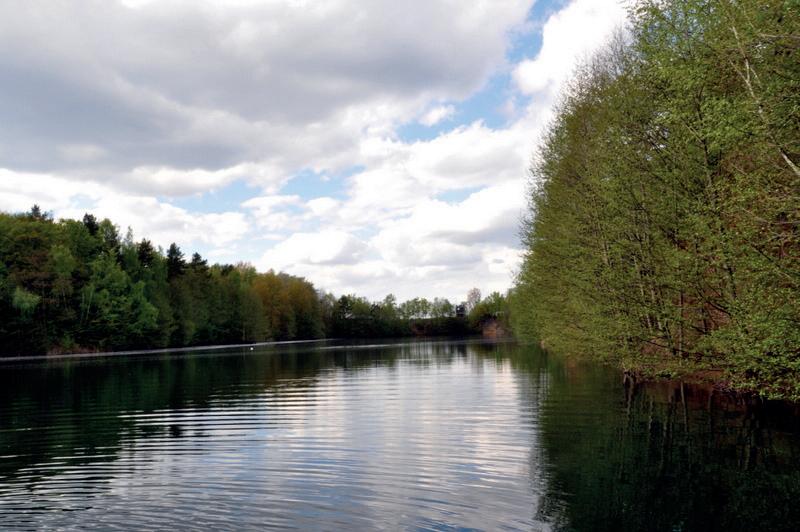
Today, the lake is one of the cleanest in the Masurian region. On a sunny day, you can dive to 15 meters without a flashlight. Underwater, there are no signs of civili-
zation – only pure nature, which makes diving a kind of meditation. Although the lake reaches a maximum depth of 45 meters, most of its shores have long, sandy descents, giving the impression of being in the Maldives on a sunny day.
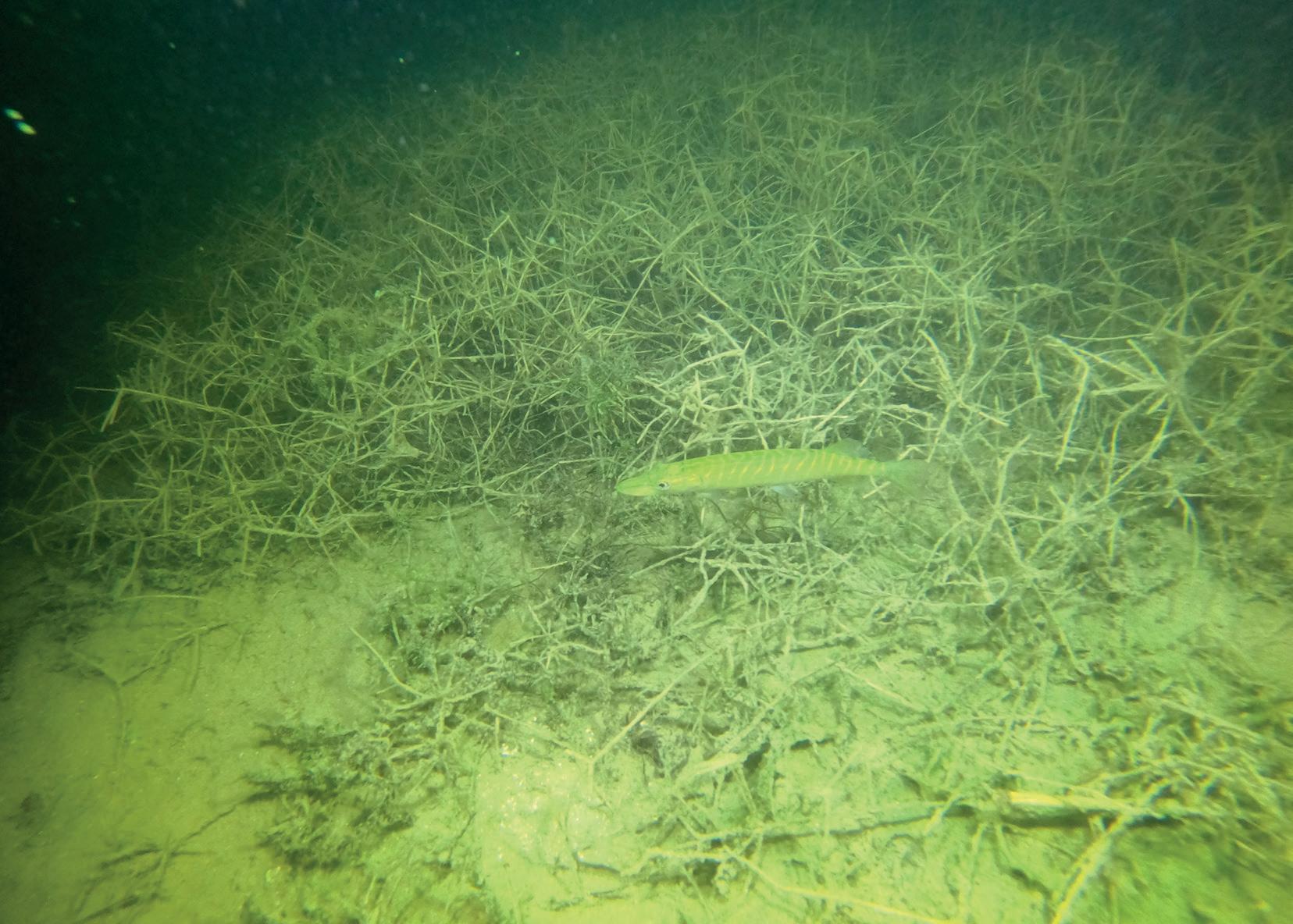
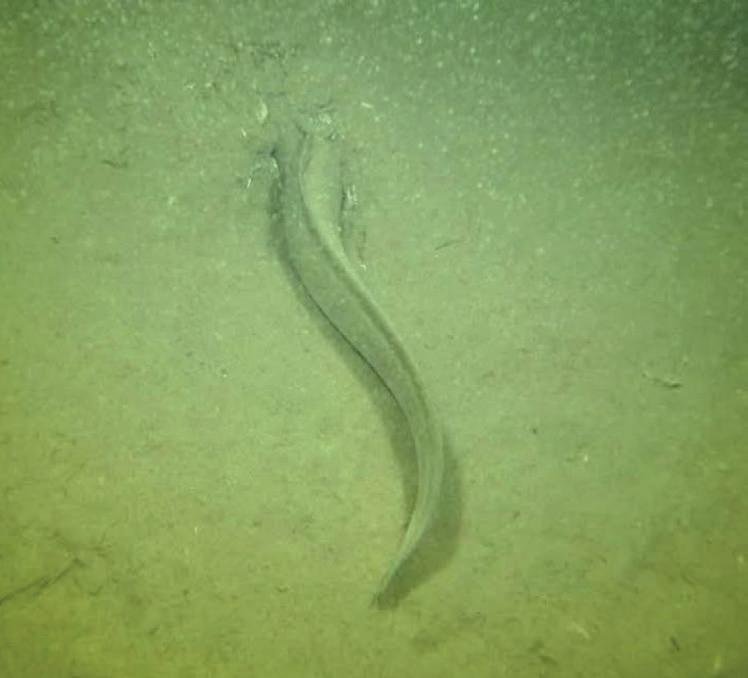
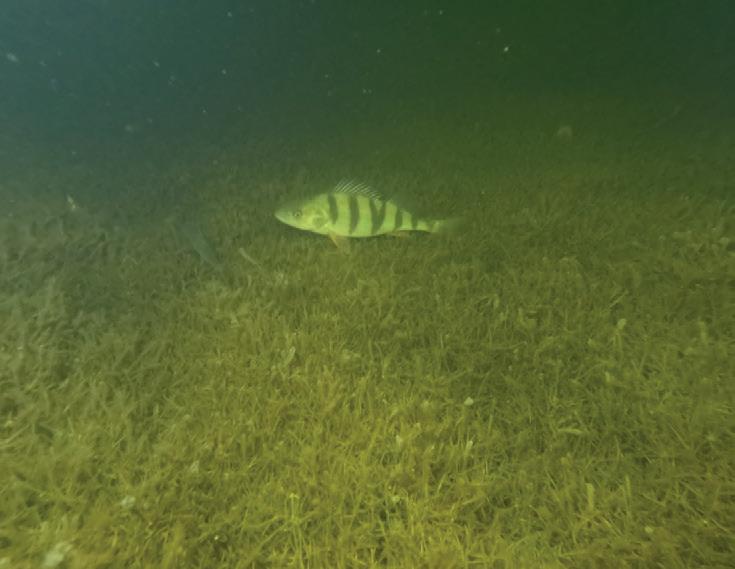
DEJGUNY is a whitefish lake, but you can find all species of fish here. My favorites to observe are eels and deep-water perch – the biggest I’ve seen anywhere, over 50 cm long. In the littoral zone, you can admire beautiful, lush
JACEK KUBIAK
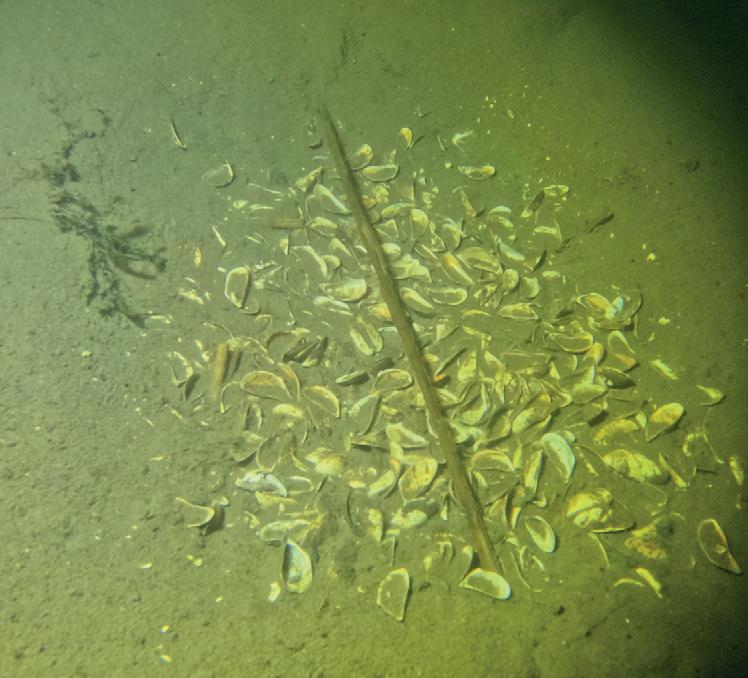
underwater meadows interspersed with patches of hornwort. Below the littoral, you’ll find crayfish promenading among mussel shells.
The lake is part of a quiet zone, which guarantees peacefulness and tranquility – a welcome contrast to the noise and bustle of lakes along the Masurian trail. This is an additional advantage when it comes to diving safety.
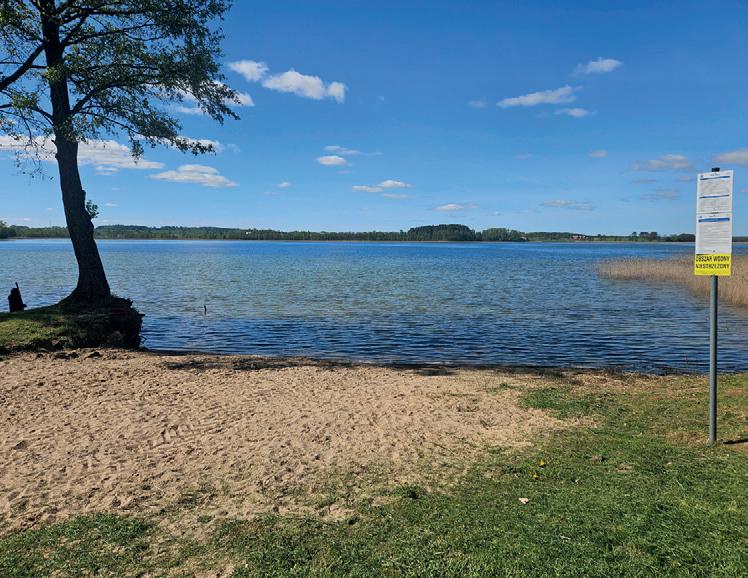
Due to its size, Lake DEJGUNY lies between three villages: Bogacko, Kronowo, and Grzybowo. Fortunately, each village has public beaches, making access to dive sites possible. These days, such accessibility is becoming increasingly rare – “private property” signs are taking over...
Personally, I recommend this lake to divers who value clean water, silence, and tranquility – those in search of communion with nature. For many local divers, it’s the lake where they took their first diving steps, and it is always fondly remembered.
HEMMOOR Freshwater
KREIDESEE HEMMOOR
– this is the full name of the flooded quarry that was once a chalk excavation site. It's a unique and original place that I would like to present in greater detail due to the tremendous popularity it has gained in recent years.
Iwill try to introduce and describe this site more thoroughly, give some tips for planning a trip, and share my personal insights and experiences related to this body of water.
The town of Hemmoor is located in northern Germany, about 100 km from Hamburg. The route you take depends on where you live, but even if you're close to the border with our western
neighbor, it's still quite a journey. You also need to account for the time it takes to get through Hamburg – in our case, it added an extra 40 minutes to the planned trip. Overall, we started our journey at 3 AM and arrived around noon.
Here’s a useful tip for the future – our trip started at night, we arrived on Friday, and dove until Sunday. Each day brought more people to the site, which clearly affected underwater visibility. By Sunday, it was a complete disaster due to the large number of diving schools with student divers, which dropped visibility in places to just a few meters. We had to look for less frequented areas. On future trips, I think it would be wiser to leave a day earlier, dive from Thursday to Saturday, and head back on Sunday morning.
As for the location itself – it’s a complete diving complex. There is a base where you can fill air, nitrox, or trimix. There's a campsite, mobile homes, and proper cottages with a full kitchen, living room, sauna – all part of one complex, like a holiday resort. We rented a cottage, and I can wholeheartedly recommend it. Plenty of space to dry gear, clean and tidy.
As far as food goes – there are plenty of eateries, restaurants, and fast food places in town. If you'd like to eat out, you’ll have no trouble finding something. Since we had a rented cottage, we cooked ourselves and went out for dinner. Keep in mind
Text and photos TOMEK KULCZYŃSKI
that we dive in dry suits, and the whole procedure of changing, sorting equipment, and going to eat takes a significant amount of time that could be spent underwater. There are various supermarkets in town, and prices are lower than in Poland – so there’s no point bringing food or drinks with you.
At check-in at the dive base, you’ll need to present your diving certifications, a current medical certificate, and have at least two first stages on your regulator. This means a single tank with a dual valve and two regulators at minimum. We used stage bottles for single tanks or twin sets. Note: during dives, dive center staff walk among divers to check if everyone has the second stage and monitors dive computer limits! Being German, they are thorough and systematic – even parking incorrectly resulted in a verbal warning
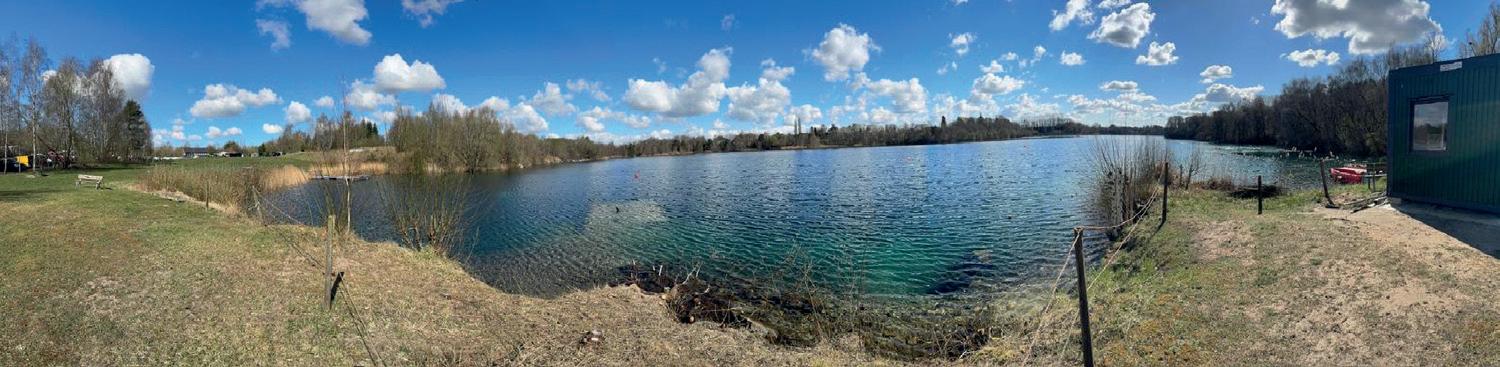
The quarry’s history dates back to the mid-18th century when it housed one of the largest cement factories in the world. As we know, chalk is needed to make cement – hence the quarry was formed. Supposedly, the cement produced with chalk from Hemmoor was used in the construction of the Statue of Liberty in New York. The factory employed 2000 people until 1983, when financial problems began. These were caused by the increasing difficulty of extraction, as the quarry reached a depth of 60 meters, making operation costly. Pumps couldn’t keep up with the groundwater, and local infrastructure also needed upgrades. The factory closed in 1983, and it took 6 years for the groundwater to fill the area. By the 1990s, the first divers began exploring the lake and were enchanted by its charm. Since then, the diving infrastructure has developed to its current level –
the lake has a surface area of 33 hectares and a depth of 60 m.
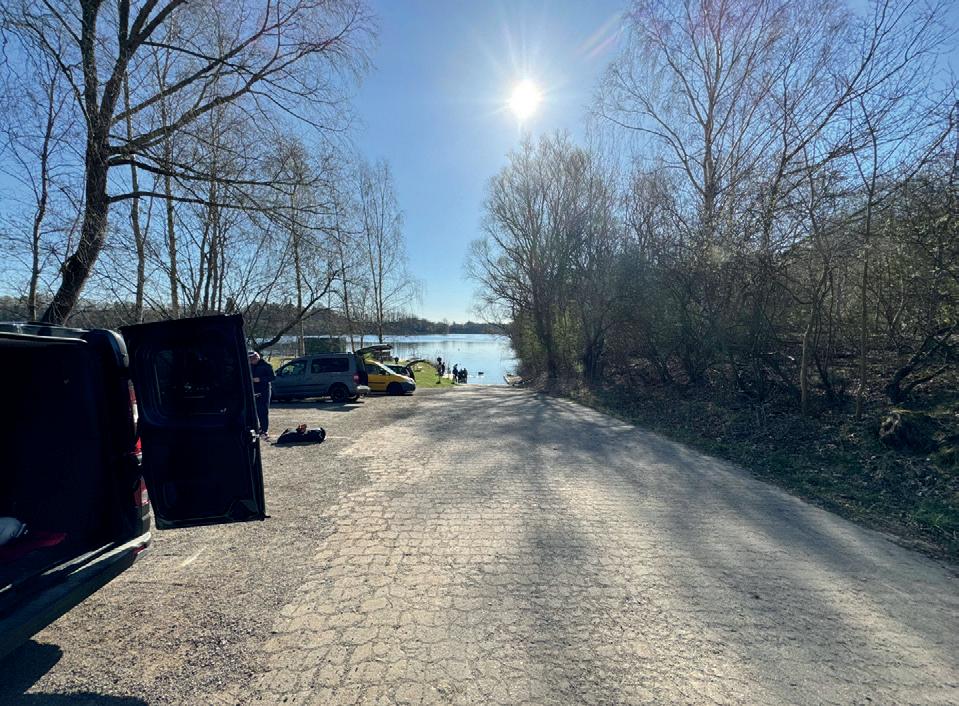
From a diving perspective, the first thing you notice is the crystal-clear water with a distinctive turquoise color. It’s really impressive – and if I had to compare it to anything else, it would be similar quarries in the UK. The water is cold – in summer it can supposedly reach 15 degrees Celsius, but even the dive base suggests using a dry suit. Gearing up is a bit of a hassle here since, regardless of the chosen entry point, you’ll face a short or long walk to the water – sometimes down steep stairs, other times along a wide path. Designated gear-up areas are accessible by car. Unfortunately, on busy days the "first come, first served" rule applies, and sometimes only distant spots are left. These aren't major logistical problems, but over several days with multiple dives, it can become tiring.
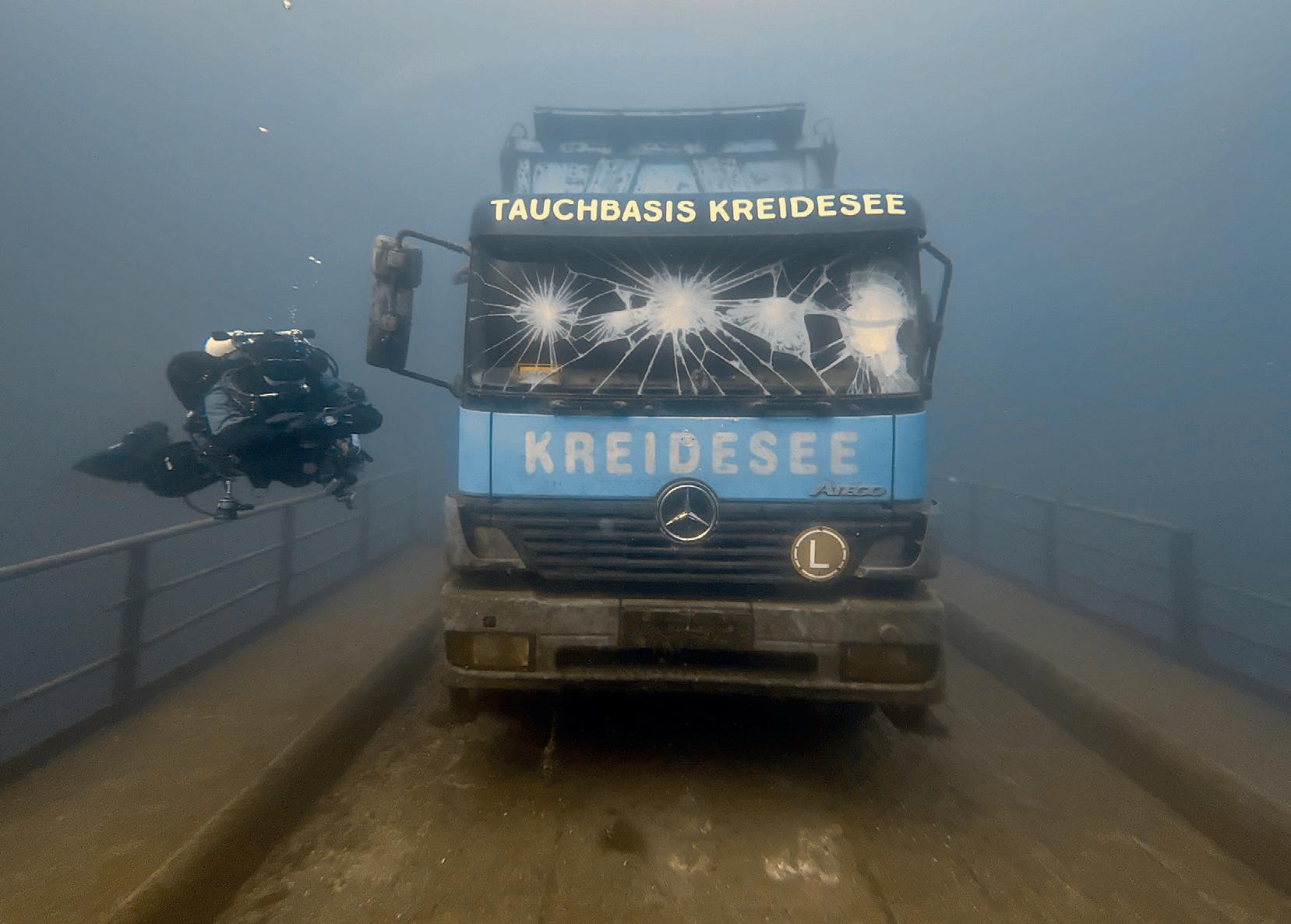
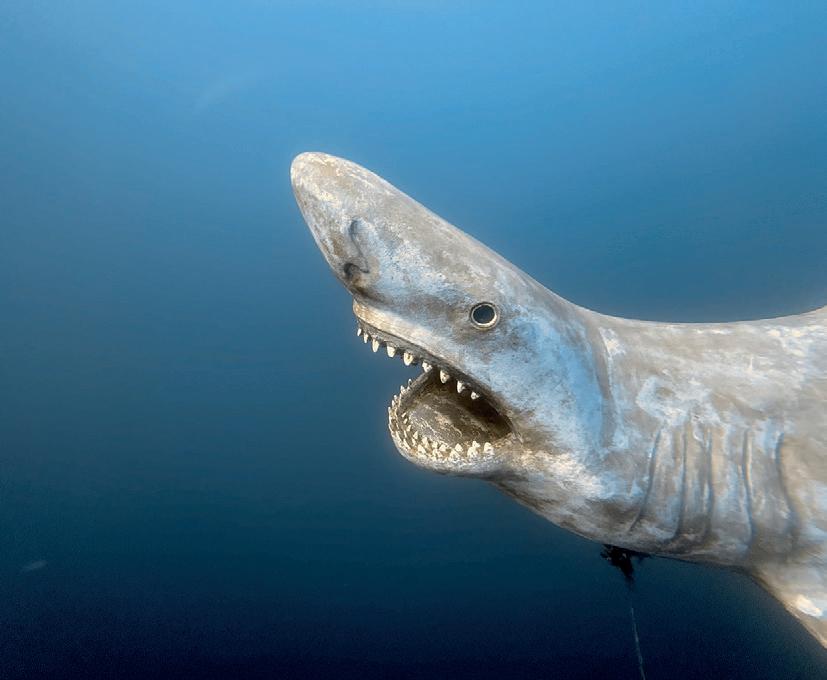
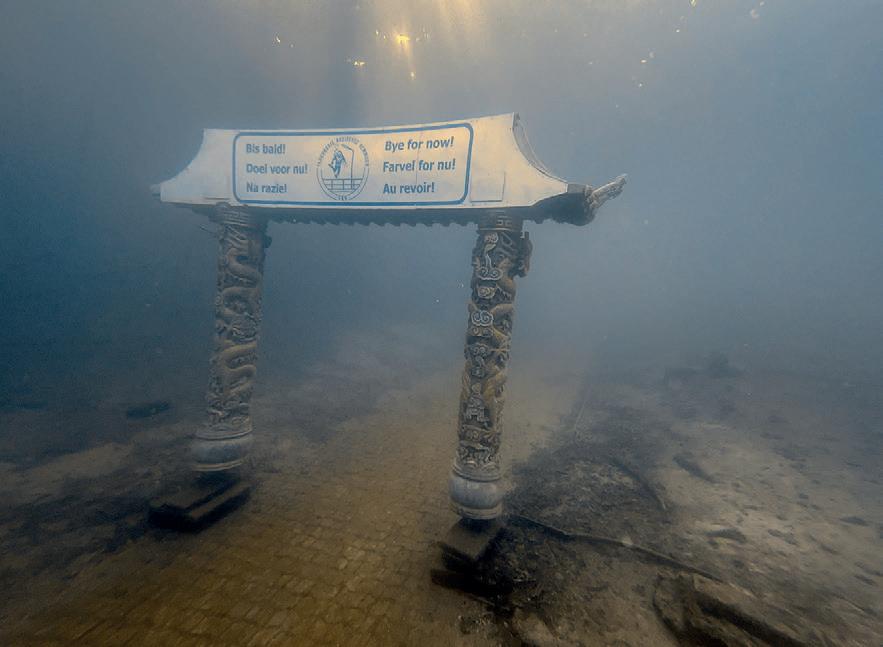
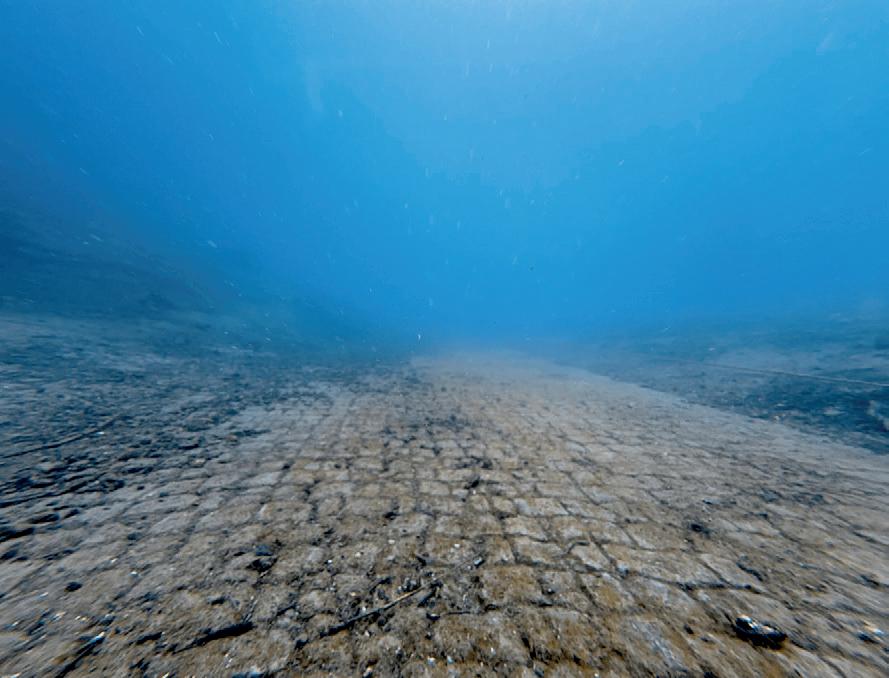
Underwater, there are plenty of attractions. I was captivated by the road near the main entry and the gate located there. It has a certain charm, and the afternoon sunlight angle makes it quite memorable. Visibility below 30 meters feels like diving in a bottle of mineral water The main attraction – a truck – is truly impressive. It stands on a platform, at the end of which is a kind of shaft going down to 30 meters. Next to the truck, there's a mailbox where you can drop a waterproof postcard – purchased at the dive center – and it will be delivered like a normal card to the given address. The number of attractions is countless: a boat, old structures, cars, buildings, an airplane, a sunken forest, and... a shark! Unfortunately, during our visit the airplane was being renovated and removed from the water. But the shark made a big impression on me. I’d never seen a shark
suspended in midwater before... It looks really impressive – it's huge and definitely not a friendly cartoon shark, but rather a menacing one. If you bump into it unexpectedly, it can make you sweat inside a dry suit...
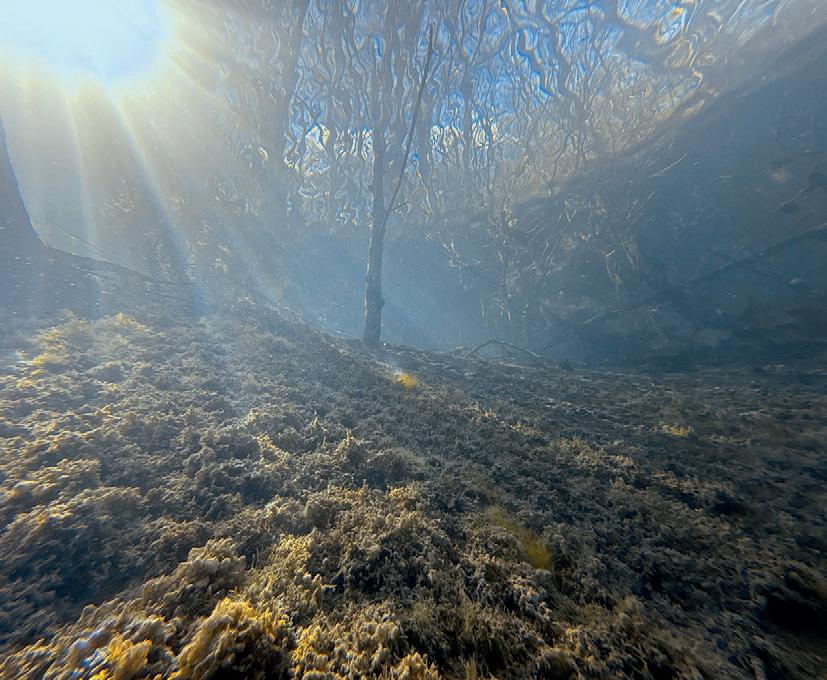
Unfortunately, on the last day with many divers, the attractions were crowded, and visibility was poor. That’s why I think Sunday is perfect for visiting the underwater forests at depths of up to 8 meters – we found great visibility there. These areas aren’t buoyed, so far fewer divers go there, and those who do usually have good buoyancy control.
To sum up – places like Kreidesee Hemmoor are the icing on the cake for most divers. This site has repeatedly been voted the best dive spot in Germany. The visibility and water quality are exceptional. The abundance of attractions and the lake’s depth make it ideal for both newly certified divers and experienced technical ones.
FRESH WATER THROUGH THE EYES OF ANNA PASZTA
Fairy-Tale Saxony and Its
GRANITE TRAIL
Text and photos ANNA PASZTA
THE CROWN JEWELS OF SAXONY’S QUARRIES are a paradise for dive-addicted adventurers who thrive on mysterious, cold, and shadowy depths.
Atleast once a year, we dedicate a few days to joyfully splashing around in the flooded basins of former mines, where the extraction and processing of plutonic rock spans more than a century of history.
In the 19th century, granite played a vital role in construction, road paving, bridge building, and as ballast for railway tracks.
In the Lusatia region, numerous quarries were established, and mining and stonemasonry became key branches of industry. Today, many of those quarries are no longer active, and the pits left behind by extraction have since filled with water.
And this is where their newest chapter begins…
WETRO
The quarry closest to the Polish border is Wetro, located near the town of Niesky, which was founded by Czech Hussites in 1742. The town’s name is a Germanized form of the Czech word nízký, meaning “low.”
Basalt was extracted here as early as the 17th century. The mine was shut down in the 1940s, and the excavation pit gradually filled with water, eventually reaching a depth of 56 meters. Over time, a lush littoral zone developed in the shallower parts of the reservoir, now inhabited by fish and crayfish.
We pass the town and enter a small forest surrounding the quarry. The flooded excavation is large and encircled by trees. Its steep banks are densely covered with greenery. The resulting lake stretches about 450 meters in length and averages 70 meters in width. On a forest clearing, there’s space for camping and pitching a tent. A dive base is also located here. Equipment can be set up under a convenient shelter decorated with retro-style metal advertising signs. The shelter has power outlets – which turns out to be crucial, as the base doesn’t sell any food or drinks. You can plug in your own kettle or heating coil.
Underwater, at a depth of about 20 meters, a submerged embankment runs across the reservoir, gradually rising to just
6 meters in the west. It divides the pit into two basins. The deeper one reaches 56 meters, the shallower – 45 meters.
The dive base and water entry point are located on the eastern side, by the deeper basin. From the steep bank, comfortable metal stairs lead into the water, ending at a large platform with benches. Here, you can rest your heavy gear, perform a buddy check, and put on your fins and mask.
We descend into the cool, green depths. Visibility is decent, though not outstanding. In spring and summer, it’s often lower. The best time to dive here is in autumn, when the water reaches its highest clarity.
Right after submerging, we observe a green littoral zone covering the steeply sloping walls. Schools of small perch move about nearby. Wetro is a site suited for more experienced divers, as you quickly reach a significant depth right after entering. There’s no gently sloping bottom here, which would be useful for training beginners. We descend freely to about 12 meters and head to the right, staying close to the wall. At this depth, there’s still enough natural light, but due to the moderate visibility, we all switch on our dive lights. From time to time, we come across branches of submerged trees hanging from the walls.
We pass a plaque mounted on the wall, commemorating the former owner of the base, Thomas. From the plaque, a smiling man in a tracksuit top looks back at us. We descend deeper – 22 meters. Down here, below the thermocline, the cold and darkness set in. I appreciate my thick undersuit, heating system, and thermal base layers – all so uncomfortable on the surface, but now, I’m not cold, even though the surrounding water is only 6°C.
We continue along the wall for a bit until a rocky embankment rises up before us from the depths. We ascend slightly to 18 meters and turn left, heading along the ridge of the embankment, which will lead us to the opposite wall. At the very start of the path, we come across a bicycle lying there. Just behind it, on a rocky ledge, two metal chairs stand side by side – as if inviting us for a short break – and a few meters further on, we meet a very serious-looking mannequin dressed in an old diving suit.
The embankment slowly becomes shallower, and the light increases. On the right side, bent railway tracks arc out into the water directly from the ridge. They hang unsupported in open water, like a wild roller coaster in an amusement park, and abruptly end after a few meters. At the very tip, as if bliss-
fully unaware of the deep abyss below, a small plush teddy bear sits perched. The embankment ends at a green meadow at a depth of 8 meters. Here too, we see perch swimming about. If we now head right, slightly downward, at around 12 meters we’ll come across a large cabin boat. And if we head left from the embankment, we’ll find fascinating basalt walls that look as if they’ve been deliberately arranged into rectangular stone tiles.
We decide to visit the boat, then begin our return. Before surfacing, just above the thermocline in the warmer water, we make a safety stop.
I climb back onto the platform, look up – and my gaze meets 40 steep steps climbing up the hillside. Did I mention earlier that they were comfortable…?
I’ve got a twinset on my back, and about 140 bar of air left in the tanks. That gives me the luxury of leaving it on the platform until the next dive. With relief, I dump the 50-kilogram load onto the bench.
After a two-hour surface interval, we go in for our second dive. This time, we’ll explore the left side of the quarry. It’s wilder here. Along the way, we encounter large, leafless trees and the skeletons of bushes that once covered the quarry floor. The
steeply sloping walls have an interesting, unusual texture. At greater depths, the gray rock is overgrown with something venomously yellow, streaming downward in narrow ribbons. It looks like well-fed mold or dense clumps of cotton wool.
After 40 minutes of a calm drift along the wall, my compass tells me we’re now on the opposite side of the basin. Our plan is to return to the platform through open water as a training exercise. At a depth of 6 meters, I set the compass heading and we head off into the blue. It’s not easy. You have to constantly correct your course, because without any visual reference points, the compass says one thing – and your body and brain say another. I always tell my students: the compass knows best!
And, as it turns out – I’m right…As I swim, sticking to the heading, I briefly turn my gaze to check on the group behind me. I look back at the compass – I’ve veered off. I correct. A moment later, same thing – a quick glance at the group, back to the compass – veered again. Correct. I’m starting to think one of my legs must be stronger than the other, because I always veer right. Eventually, after this uneven battle, we make it back to the entry point. Whew! We hit it dead-on, so my instructor pride remains intact
I climb out of the water and realize – this time, there’s no escaping the long, steep stair climb with all that gear strapped to my back. Fitness and strength matter a lot in diving. Don’t neglect it – even if people keep saying diving is a sport for the lazy
How the Famous OCTOPUS Film was Made
Text MARCIN TRZCIŃSKI
Cinematographer Roger Horrocks shooting in the waters of South Africa’s False Bay Courtesy of PIPPA EHRLICH / Courtesy of NETFLIX
At first, I honestly thought something had gone wrong with my internet connection – the bandwidth dropped so much that the stream automatically downgraded to 340 pixels. I silently cursed T-Mobile and rewound the video, but when I reached the scene where the octopus played with a school of fish, surprisingly, the same thing happened again.
It repeated on the third and fourth tries too. I checked the settings and... I was still on Full HD. Slowly, I began to realize it wasn’t the stream’s fault.
So once I finished drawing conclusions from the octopus’s lesson (if I understood the message correctly, it was that it’s better to die than raise your own children), I dove deep into the internet to figure out what was going on with those fluctuations in quality. It turned out I wasn’t the only one who noticed. The web was full of speculation. Eventually, after filtering out flat-earth theories (it’s curious how their posts always rank high on Google), I found a few genuinely interesting sources. I became deeply fascinated by how the film 'My Octopus Teacher' was made. The film wasn’t made in the way we’re used to. It was more of a collage of various productions. Odd, considering that its protagonist and narrator, Craig Foster, was an experienced filmmaker. But he didn’t want to make another documentary. In 2010, after finishing his second film on the San people of the Kalahari Desert and while his marriage was falling apart, he decided to take a break and reflect. Like Forrest Gump, but instead of
running, he went swimming. In False Bay, south of Cape Town. In the world of the Great African Sea Forest – dense, towering kelp swaying with the surf. Then he started diving with only a mask and fins – not even a wetsuit, bordering on masochism. Day after day, year after year, with just a small waterproof Panasonic camera in hand, he not only explored but also recorded the underwater world of the bay and the habits of its inhabitants. He became so engrossed that he reached out to Professor Charles L. Griffiths from the Department of Marine Biology at the University of Cape Town, and his doctoral student Jannes Landschoff, who helped identify and classify the underwater animals and interpret their behaviors.
At the same time, on the other, more northern end of the world – in Bristol, home to the BBC’s Natural History Unit – preparations were underway for the production of the second season of the Blue Planet series. Topics were being scouted, preliminary scripts drafted, and
production teams assembled. One of the people invited to take part in the project was Roger Horrocks, a South African who had already made a name for himself in the industry with his previous work, including Into the Dragon’s Lair, a film for Discovery, during which he collaborated with Craig Foster.
“I wanted to film a few sequences in the South African kelp forest and had an idea for a story, but it wasn’t strong enough. Craig mentioned the behavior of an octopus that hides in shells to protect itself from sharks. And that was truly the beginning of our work on the Blue Planet sequence.”
“I showed Roger some of the footage I had shot. He was amazed by the behaviors I had witnessed,” recalled Craig Foster.
But then again, it’s no wonder. With two deep ocean currents converging at the southern tip of Africa and delivering vast amounts of nutrients to the surface, the resulting biodiversity is enormous. And such diversity in flora and fauna means there’s always something to eat –and often, the eater becomes the eaten. No surprise there was so much to observe.
Once the team had the subject and the green light from headquarters, all that was left was... to film everything.
“Roger and Craig began a year-long shoot, gradually getting individual octopuses used to their presence and building mutual trust. Then we had to bring large cameras into the water, which took a lot of time.” And that was by no means easy – not just according to John Chambers, the assistant producer who said those words, but also the rest of the crew. They were working at depths of just a few meters, in water that was almost always rough. Weather frequently disrupted the planned shooting schedule. Altogether, Harrocks and Craig spent about 80 days in the water together (not consecutively), for three to five hours a day, during low tides when diving conditions were best. However, while Craig stayed faithful to free diving, Harrocks couldn't afford to. “I would’ve missed too much if I’d stuck to free diving.”
“It turned out to be difficult to get close enough to film the animals, but the relationship I developed with one young octopus started to pay off. Despite our massive
camera setup, she realized we weren’t a threat and began to charm us with her antics. Like any underwater chameleon, she wasn’t easy to track, but I managed to find her by following the remains of the prey she had hunted.”
There were also moments of fear – like the time, as John Chambers recalled: “[…] our ‘star’ was attacked by a pajama shark. It swam up to her, grabbed her, and she fought back. By that point, we’d been filming for a year, and I thought, ‘Great, now our star is being eaten right before my eyes.’ And then I saw the octopus had her arms inside the shark’s mouth and out through its gills. She deprived it of oxygen! It had to let go, and as it swam away, it slammed into a rock – it was that dazed.”
Kathryn Jeffs, the producer of the Green Seas episode, was equally in awe of the octopus: “[…] who turned out to be a genius in the art of escape. And thank goodness, because she lived in an underwater forest teeming with predators.” And although much of the underwater work consisted mainly of waiting, Harrocks eventually managed to capture the “shell armor” on film – a clever defense technique in which the octopus used more than 80 shells and stones to shield herself.
For filming, Roger Harrocks used a RED Dragon camera with a Super 35 sensor and a Nikkor 17–55mm f/2.8 lens. The footage was recorded in 6K resolution at 60 frames per second. But
it wasn’t the resolution or frame rate that made him choose this camera.
“Another absolutely critical advantage of the RED system is its pre-recording feature. That gives it a huge edge. In wildlife cinematography, events are often unpredictable and spontaneous, which makes this feature essential.”
He paired the camera with a Nauticam housing and... no lighting whatsoever. The shots were taken shallow enough that lighting wasn’t needed, and the cinematographer was determined to capture the play of light – the sun’s dancing rays filtering through the blades and leaves of the kelp.
After the BBC had wrapped filming and Blue Planet II – which premiered in 2017 – was celebrating global success, Craig Foster was still swimming in False Bay. Still without gear, still with some random, small camera, filming the world around him. Sometimes he would set it on the seafloor to capture his interactions with the coastal marine life. He was so engrossed in it that it took him nearly another full year to even start thinking about a new film – one about the kelp forest, the octopus, sharks, and sea otters...
He invited Pippa Ehrlich to collaborate, who initially helped sporadically, but eventually committed fully to the project. She took over diving duties from Harrocks, accompanying Foster
in the bay. For the next six months, she documented Craig’s underwater activities daily. However, following in Foster’s footsteps, she also chose to free dive, which inevitably affected the quality of the footage.
They used a Sony RX100 Mk V in a Nauticam housing, plus a WWL-C wet wide-angle converter – but even aside from the equipment, the very nature of free diving made it impossible to film in the way Harrocks had aimed for.
Nevertheless, the film archive was growing at an incredible pace, and the recorded footage needed to be organized, annotated, and… somehow turned into a story. The team working on the film continued to expand, and their first result was a broad, multi-threaded narrative that… satisfied no one. It was too diluted, touching on too many important yet not entirely cohesive themes.
That’s when the team decided to strip everything else away and focus entirely on the octopus. Then her story was enriched with Craig’s personal struggles – at first told through his voice-over narration, and eventually with him speaking directly to the camera.
While the team of writers, directors, and producers was shaping the backbone of the film, an equally challenging task was given to Kyle Stroebel, a Baselight colorist. He was hand-
ed terabytes of footage from 20 different camera models that had been used to shoot the selected material for the film – and was asked to make it all match.
It was a titanic task, as it’s no small feat to match footage from a RED Dragon with clips shot on a Sony RX100 or Panasonic WG. But he pulled it off – even if some fluctuations in quality were still noticeable. Then again, it’s hard to expect cameras with 1-inch or even 1/2.3-inch sensors to match the image quality of a professional cinema camera, right?
That’s exactly where my (and not just my) initial surprise over the “wavering” video quality came from. Now that I know how the film was made, I watched it again. It hasn’t lost any of its charm – and I had the added challenge of guessing which scenes were shot with which camera. Which, to be honest, wasn’t all that hard.
The confession of a “wet work” specialist and a tale of gear that weighs more than common sense.
Text MONIKA & PRZEMYSŁAW ZYBER
Photos PRZEMYSŁAW ZYBER & JORAM
“Underwater photography” – it sounds like great fun and the fulfillment of dreams all at once: colorful reefs, dancing fish, the deep blue, and communion with a world still full of incredible secrets... ...but is that really all there is?
Very few truly know the real weight of this passion.
So today, I’d like to invite you on a journey into my world. Because dragging dreams of the perfect shot through airports, across borders, and into the bureaucratic paranoia of customs – hauling suitcases whose weight never seems to stay within the allowed limits – well, that’s my daily bread. Sound like a rant? Okay… maybe a little! But it wasn’t always this way. Because as you might have guessed…
It started off innocently enough
At the beginning of my diving journey, I brought along a regular GoPro. But over time, I wanted something that could reproduce colors more accurately. So I reached for the Olympus TG-6. Now that was already something to actually hold in your hand. Well…
a camera without lights simply doesn’t stand a chance. So the next logical step was arming myself with lumens.
Two lights – fairly hefty ones – and suddenly the whole setup had a seriously negative buoyancy. Next came buoyancy floats and clamps.
The pile of photo gear kept growing
Separate chargers for the lights, extra batteries, O-rings, and silicone grease. Before I knew it, my airline luggage had gained 5 kilos. Unfortunately, the image quality still didn’t wow me. Better, yes – but still far below my expectations. Great for macro. But I’ve always loved wide shots, and for that, a small sensor and a one-size-fits-all lens just didn’t cut it. The final straw was a trip to Mexico – my first attempt at shooting in the dark, mysterious cenotes. And there, the gear completely failed me.
I craved a proper full-frame DSLR
I had to capture the beauty of those caves. Since I already had a Nikon D700 at home, I made the decision: "You’re coming underwater with me." The only question was – could I find a case for you? Months of searching for a housing finally paid off. After six months, I managed to track one down for my aging camera body. And since the seller also had decent flash strobes, I went ahead and bought the whole set. Naturally, I added a fisheye lens and a 230 mm dome port so I could finally start shooting wide-angle landscapes.
There’s no way I’m fitting this into my carry-on! And just like that, I condemned myself to the role of pack mule. In the blink of an eye, my setup became gigantic. A massive
aluminum housing, topped with an even larger dome port, and crowned – like antlers – with flash strobes mounted on float arms. Chargers, spare batteries, cables… But I achieved what I was aiming for: Incredible photo quality – even in dark caves.
Unfortunately, one checked bag was no longer enough for this setup. I always needed two. From that point on, every flight felt like roulette: "Will my backpack make it past the conveyor unnoticed today?" Sadly, lucky number 13 didn’t always come through.
Sometimes a grinning airport worker would pop up… because rising over the baggage counter’s horizon came the dreaded word: “EXCESS FEE!”
The logistics nightmare kept growing
I trained myself into a Tetris master – hours of packing became the norm. So did two checked bags and an extra carry-on. More to carry, higher transport costs, longer airport inspections. Traveling stopped being effortless. Armed with two large suitcases and two backpacks, I pursued my dream of underwater photography. Of course, I always expected trouble: extra fees, gear inspections... But my ambitions didn’t stop there. I wanted to do more than take photos – I wanted to shoot videos.
My trusty old D700 didn’t have that option, so the only choice was to replace the entire setup – lights included. Filming requires continuous light, which meant the flashes were no longer needed.
A new arrival on board
I turned my attention to the Canon R6 – a mirrorless camera that seemed perfect for my needs.
The jump from DSLR to mirrorless wasn’t easy. It took me a few months before I learned how to use it properly and discover its strengths. But once we clicked, the relationship was smooth.
I took care of it, and in return, it rewarded me with beautiful photos and video. For the next three years, our love remained steady. Meanwhile, the setup kept evolving.
I kept upgrading my lights – stronger, but also heavier. Which meant bigger floats, more chargers, heavier batteries... During that time, I fell in love with filming just as much as with photography.
But… something started bothering me: the R6 only recorded in MP4, not RAW.
It’s the same kind of difference as with JPG vs RAW photos. JPG and MP4 are compressed files, not really suitable for meaningful post-processing – or only to a very limited extent. RAW files, on the other hand, are unprocessed, highly flexible, and fully editable.
The
decision was simple
It was time to upgrade the gear – once again.
Unfortunately, every time you change the camera, it means changing the housing too. This time, I went all in on a seriously powerful photo and video setup. Since I had been thoroughly impressed with Canon’s quality, I stuck with the brand once again. I bought a Canon R3 with a 15–35 mm f/2.8 L USM lens. I placed it inside a Nauticam housing, and the cherry on top was the WACP-2 250 mm port. For added filming comfort, I added a 7" Weefine WED-7 PRO external monitor and Big Blue lights delivering a combined output of 120,000 lumens.
And I thought the previous setup was heavy?
Now I’ve gifted myself a golden ball and chain. The old setup weighed 10 kg. The new one? 25 kg.
My luggage swelled up like a belly after the holidays. Suddenly, I realized that even with the most optimistic packing, there was no way I could fit both my dive gear and camera equipment into two 23 kg checked bags plus 8 kg of carry-on – even if airport staff were feeling unusually generous.
Nope. Not happening. This had officially become a problem. The worst part? Trying to make it through airport check-in without them weighing the carry-on… because it’s almost always twice the limit.
The weight of passion
The cost of flying to exciting underwater destinations is astronomical – especially with my amount of luggage. Entrance fees to cenotes or caves? They multiply several times over when you show up with a setup like mine. Lately, one question keeps echoing in my mind: Is it worth it?
And then another: Am I burned out?
At the thought of yet another flight? Absolutely.
At the thought of layovers, missed connections, broken elevators, hauling suitcases up stairs, running marathons through endless airport corridors, and last-minute terminal changes…
If my knees and back could talk, I’d really hear it.
Would I buy this same setup again after everything I’ve experienced? Hard to say. I’m tired of carrying it.
Squeezing into tight caves brings a real risk of damaging the gear. Moving around a boat with a rig this massive? No joke. Jumping into the water with it? Always nerve-wracking.
The entire kit – with that heavy glass dome – is my personal tearjerker. My “barbell.”
Sometimes I think underwater photography is a kind of extreme sport.
Except instead of a medal, you get a referral to a physiotherapist and joint cream.
Every trip is filled with stress, sleep deprivation, exhaustion, and endless lugging.
Taxis, boats, dinghies, minibuses, rickshaws… and eyes in the back of your head.
The only warm-up: reaching for coffee. The only rehab: setting the backpack down for a moment.
And lately, one depressing thought just won’t leave me: Never again.
Spoken for the fifteenth time this year – and each time, it hits a little harder.
And why go through all of this?
Because underwater – everything stops hurting.
There’s silence. There’s beauty.
There’s a world I can’t describe with words – only with images. And for that image, I sacrifice pieces – large pieces – of my health and comfort.
Because down there, beneath the surface, there’s no chaos, no noise, no sensory overload, no endless to-do list demanding attention. There’s a wondrous world that doesn’t ask your permission to amaze you. And only now, with my current heavyweight setup, am I achieving the results I’ve always dreamed of. The quality of the photos and videos keeps me motivated and fuels my passion to keep growing.
P.S.
Warm regards to everyone who thinks that taking a good underwater photo is just a matter of pressing the shutter button ;)
10 Years of IDF in Poland
Text and photos
DOMINIKA ABRAHAMCZYK
From April 11–13, 2025, the IDF Meeting 2025 DIVING CONFERENCE took place in Janów Lubelski, Poland. The editorial team of Perfect Diver was invited to attend under the media patronage of the event.
We had two days of diverse diving-themed presentations ahead of us, featuring speakers well-known in the diving world. We were very curious about the event – especially since the diving community still clearly craves integration, and such gatherings are unfortunately too rare.
The conference was dedicated to divers affiliated with the IDF federation – over a hundred of whom actively participated. It served as a kind of summary of a decade of work by the organization, as highlighted during the opening speech by
Sebastian Dobrowolski, president and co-founder of IDF –the third-largest federation in Poland, bringing together 200 active instructors. During his presentation, he awarded distinguished federation members, reviewed organizational changes, outlined possible development paths for divers, and presented plans for the future, including new training manuals. So far, 17 manuals have been published, containing condensed theoretical knowledge to help divers earn new qualifications. All of these were available for purchase at a booth run by Daria Dobrowolska.
The next presentation was delivered by Konrad Kępka, who spoke about training opportunities for people with disabilities – how to turn the impossible into the possible. He emphasized the importance of an individualized approach and the fulfilment of dreams for people with mobility limitations. In this context, “where there’s a will, there’s a way” rings especially true.
Next, Dr. habil. Piotr Dynowski posed the question: “Does science need scuba divers?” and summarized the activities of the Foundation for Scientific Underwater Research. Ariel Łukaszewski then presented the pros and cons of Back-, Side-,
and Chest-Mount configurations, highlighting the evolution of these systems and their practical differences. Commander Patryk Kiedrowski offered a glimpse into 21st-century military divers, including navigation systems used by military services and diving equipment employed by soldiers.
The final presentation before the lunch break came from Dr. Zdzisław Sićko, who discussed various aspects of fatal diving accidents, shared statistical data, and explained the role of divers in the construction of transportation tunnels. After such a knowledge-packed morning, a well-deserved meal followed :)
During the breaks, conference participants had the opportunity to view an underwater photography exhibition by Michał Bazała and explore equipment showcased by exhibitors such as Suunto, Garmin, Extreme Divers – Nurkowysklep.pl, iQsub & SubGravity CCRs.
Recharged and ready, we returned to the hall to listen to the last three presentations of the day. This panel began with special guest Anton Zhuchkov. Thanks to Daria Dobrowolska’s translation, we could comfortably follow his talk on the beauty of Portugal and his exploration of the Ancos cave using Dual CCR – along with the challenges he faced in reaching unexplored sections. A similar cave diving theme was presented by Bartłomiej Pitala, who explored previously unknown passages of Sintzi –the deepest cave in Greece – and announced a return expedition to uncover more of its secrets.
The day concluded with a vivid tale about Sierra Leone, the discovery of a shipwreck, and the process of its identification, presented by Marcin Jamkowski.
This emotionally rich day wrapped up with a social bonfire gathering, accompanied by delicious homemade food and live sea shanties. At times, the concert turned into karaoke – but as they say, “What happens in Vegas stays in Vegas,” so let’s move on to the final day of the gathering.
The first three presentations of the final day had a travel theme. Wojciech Zgoła spoke about picturesque North Macedonia and diving in Lake Ohrid – with its maximum depth of 289 meters and crystal-clear waters. Anna Metrycka introduced us to the Galapagos – a paradise for divers who enjoy encountering large marine animals. Przemysław Zyber presented a film and narrative about diving adventures in the Yucatán. Articles by all three of these authors appear in this magazine. These breathtaking presentations set the stage for the next talk, focused on freediving and the physiological effects of depth on the human body, by Piotr Ławrynowicz.
Dr. Mikołaj Wróbel dispelled many doubts about diving with less-than-perfect health, and finally, Dr. Jarosław Kur provided guidance on how to properly call for help and the risks associated with dive rescue – aligned with IDF’s core message: Safety First!
We were delighted to take part in this event where divers shared experiences in a truly excellent atmosphere.
TELESCOPIC TORSO
Friend or Problem?
Text WOJCIECH A. FILIP
Photos TECLINE ACADEMY
At the end of this article, you’ll find a proven way to ruin your dive – using only your dry suit and harness.
Let’s start simple: a dry suit affects your position in the water. Not just because you can use it for buoyancy control, many divers do – but because when you clear your mask or reach for a valve, your knees or fins might suddenly dig into the bottom. That can happen if you don’t understand how to use the telescopic torso on your dry suit.
Below: how to choose the right telescopic torso – and how not to fight it.
Quick experiment. Worth doing. Put on a long-sleeved shirt.
Button it.
Let it hang loose over your trousers.
Now ask someone to gently hold the bottom of the shirt.
Start raising your arms slowly. Stop as soon as you feel the first bit of resistance.
You probably didn’t even get to shoulder height.
Now drop your arms. Tell your assistant to keep a finger where the bottom of the shirt used to be.
Raise your arms all the way up.
Ask them to measure how far the bottom edge moved up.
Photo Mocean Images
You’ll get around 30 cm.
This distance may vary slightly depending on gender, body type, flexibility, and overall fit – but it's a solid reference. It's also the minimum amount of vertical range your telescopic torso should allow.
Why it matters underwater
Imagine the shirt is now tucked deep into your trousers, belt on tight.
Raise your arms. You’ll feel resistance. Keep going – the shirt starts pulling out. Same thing happens in your dry suit: as you reach up or forward, the tight torso pulls your legs down, or sideways – or into the reef.
This will mess you up when: clearing your mask shooting an SMB reaching for your valves or just extending arms forward to stay balanced
Yes – that’s right.
You were probably thinking: "Wait… does this explain why my knees keep dropping when I try to hold trim?" Exactly.
That’s what happens when the suit’s too short and the telescopic torso can’t move.
ACADEMY
ALTERNATIVE METHOD – FOR THOSE WHO ENJOY BEING LIMITED UNDERWATER:
Pull the torso down as far as it goes
Tighten that wide elastic strap
Clip your harness at waist level
Welcome to the end of mobility. Voluntary, of course.
Here’s how to fix it:
1. Put on the lower half of the suit and tighten the suspenders. Make sure the crotch doesn’t sag.
2. Put on the top half and zip up.
3. Do not pull the telescopic torso down yet.
4. Put your harness over the raised torso.
5. Don’t pull it down. Don’t “tidy it up.” Just leave it up.
DONE. Now it works.
If not, the issue might be deeper – let’s dig a little further. Check your undersuit.
Same rules. Tighten those suspenders.
Still feels like something’s pulling?
Maybe you tucked your top layer too deep into your thermals.
That works just as well as blocking the telescopic torso entirely.
If something’s still restricting your arm movement, find out what – and replace it with gear that fits right.
No shirt?
No problem.
Come visit the Tecline Academy. Bring your dry suit. We’ll show you exactly how to check if your telescopic torso is doing what it should. WAF.
PS.
A few notes on that external bungee pulling the torso down:
1. It was first added by a dry suit brand to help the suit fit better on divers with, let’s say, generous midsections.
2. The bungee buckle often presses against your pubic bone and makes life miserable. Ask the manufacturer if cutting it off voids the warranty.
3. Some very slim divers can raise their arms without needing the telescopic torso to move. If you're one of them – lucky you.
REMINDER:
The telescopic torso doesn’t extend or retract itself – not underwater, not on the surface. If you don’t set it up before the dive, it’s just decorative.