Directors’ Handbook
2026 Edition
Key Contacts
2026 Board of Directors
EXECUTIVE COMMITTEE
Fawnia Oblack President president@pentacletheatre.org
Anthony Barghini Vice President anthony@pentacletheatre.org
Jennifer Killikelly Secretary jennifer@pentacletheatre.org
Carson Abrahamson Treasurer carson@pentacletheatre.org
MEMBERS AT-LARGE Mat Genuser mat@pentacletheatre.org
Brandon Gitchel brandon@pentacletheatre.org
Chris McCarty chrismccarty@pentacletheatre.org
Heather Toller heather@pentacletheatre.org
Noah Vanderburgh noah@pentacletheatre.org
Staff
Steven Trahan
Executive Director
Cell: (971) 718-6758 Office: (503) 485-4300, ext. 108 executive_director@pentacletheatre.org
Chris Benham Technical Director Cell: (971) 370-0144 Theater: (503) 364-7200 chris@pentacletheatre.org
Kimberly Houser Taylor Box Office Manager Cell: (971) 718-6759 Office: (503) 485-4300 kimberly@pentacletheatre.org
Christie Smith Bookkeeper Cell: (971) 718-7166 Office: (503) 485-4300 christie@pentacletheatre.org
Facilities
Office and Rehearsal Facility 197 Liberty St SE Salem, OR 97301 (503) 485-4300
Hours: Wednesday–Sunday 11 a.m.–5 p.m.
Theater
324 Fifty-Second Ave. NW Salem OR 97304 (503) 364-7200
Committee Chairs and Deputies
COSTUME CHAIR
Karen McCarty karenmccarty@pentacletheatre.org (503) 851-6785
COSTUME DEPUTIES
Mary Ann Black maryannb@pentacletheatre.org
Shaula Coulson shaulac@pentacletheatre.org
Dee Montgomery deem@pentacletheatre.org
Susan Schoaps susans@pentacletheatre.org
BUILDING FACILITIES CHAIR
Liz Rogers Cell: (310)-387-5606 ladyliz428@gmail.com
GROUNDS FACILITIES CHAIR Vacant
HOSPITALITY CHAIRS
Beverly and Michael Freitas
Beverly: (408) 439-0555
Michael: (408) 439-4193 hospitality@pentacletheatre.org
PROPS CHAIR
Chris Benham
Cell: (971) 370-0144
Theater: (503) 364-7200 chris@pentacletheatre.org
SOUND AND AUDIO CHAIR
Michael McIntosh
Home: (503) 370-8913 Cell: (503) 931-7577 mcintosh.audio@icloud.com sound@pentacletheatre.org
STUDENT AND COMMUNITY NIGHT CHAIR
Loriann Schmidt (503) 881-4154 freedressrehearsal@pentacletheatre.org
WIGS AND HAIR CHAIR
Eddie Willits Cell: (503)-269-2758 edwardwillits@yahoo.com
Other Contacts
ALARM AND SECURITY
Greg Blankenship Alarm NW Tech Cell: (503) 871-0830 Office: (503) 361-0830 antwest2@gmail.com
CAN RECYCLING
Rob Sim (503) 999-1830 fishbeef32@gmail.com
PHOTOGRAPHER
Vicki Woods Cell: (714) 402-4569 zombies.vicki@aol.com
PIANO TUNER
Matt or Chris Northwest Piano Service Work: (503) 371-8863
PROGRAM DESIGNER AND EDITOR Carlee Wright carleewright@gmail.com
DRY CLEANING
Quality Fashion Cleaners 1311 Liberty St. NE
Salem, OR 97301 (503) 589-3148
Administration
Office Support
The business office supports directors’ administrative work. This support includes ordering scripts; providing directors with budget information, keys to the theater, and access to the copy machine; marketing productions; posting production-related announcements online; and printing posters and programs.
Photocopying is governed by copyright and licensing restrictions. No illegal photocopying is permitted at the Pentacle Theatre ticket office.
Membership Requirement
Directors must have a current Pentacle Theatre membership before holding auditions
Security Code and Keys
The week before auditions, the executive director will provide the director with the security code for the parking garage entrance to the rehearsal space. At rehearsals, the director or another designated production team member will enter from the parking garage door and unlock the Ferry Street door to allow the cast and crew to enter. One week before the show moves into the theater, directors may contact the executive director to make arrangements for checking out master keys to the theater. The office usually issues two keys per production, but if a production team will need more than two keys, they may alert the executive director. Each person who receives a key must sign for their own key. All master keys must be returned to the executive director within one week of the show closing. The director’s stipend will be held until keys are returned.
Royalties, Scripts, and Scores
The business office is responsible for making all arrangements for ordering scripts and scores. In addition to the acting edition, many publishers have stage manager scripts. If stage manager editions are available, directors are encouraged to order two copies, one for the booth and one for backstage. Scripts for nonmusical shows become the property of cast and crew members to highlight or write in as they wish. For musicals, directors are responsible for returning rented or borrowed scripts and orchestrations to the business office within three days of closing. Cast and crew members may only write in pencil in the librettos, and they are responsible for removing all pencil marks from the librettos before returning them There may be charges for librettos that are late, damaged, or missing. The business office may deduct these penalties from the director’s stipend.
Copyright and Performance Rights
Review the language in the licensing agreement for your play or musical. Failure to abide by the terms of the agreement may result in increased fees, and the licensing agency may not allow the theater to produce their plays in the future. Contract terms typically address gender requirements for casting and allowable alterations to the time, locale, or setting of the play. If directors would like to make changes to these production elements, they must ask the rights holder for permission
in advance. Directors should allow months for this process and be prepared for the possible denial of the request. Directors must determine if their production is unique in some way, such as not having an intermission, and inform the board as well as the office at their oral presentation of their proposal.
Video Archival Recording
Most contracts prohibit videotaping performances without written permission. Directors may contact the executive director if they want to seek permission to record the production, as archival rights may be available
Music Rights
Directors must have grand rights for any music that is part of their production from curtain up to curtain down. Acquiring grand rights is a time-consuming process that affects the production’s budget. Directors should initiate this work as soon as possible. The executive director can assist with this process.
Pentacle uses a licensing agency to acquire rights. The following information is required for the rights application for each song in a production:
• Title.
• Artist
• Publisher
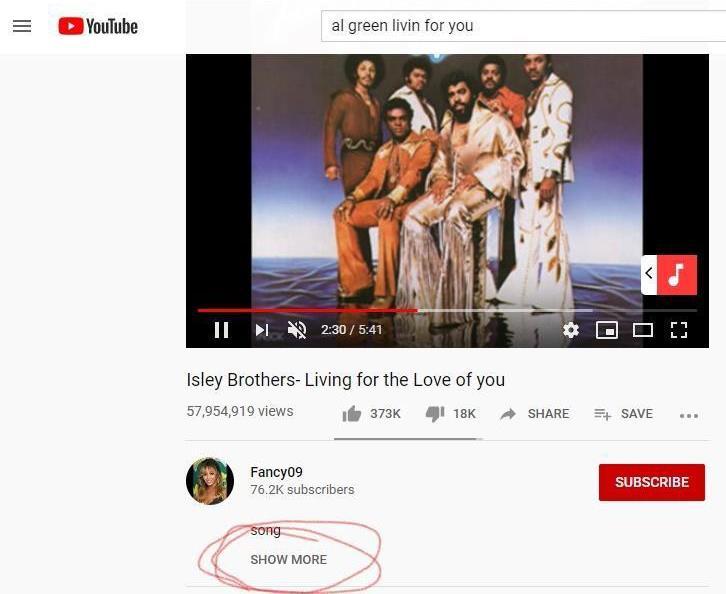
Figure 1. YouTube video description with “show more” text location.
• Record label.
• Website
• Length of selection.
• Description of onstage action during the music.
Much of this information can be found on YouTube by clicking on “show more” in the video description (figure 1) Correctly licensed YouTube posts will include the song title, artist, and license holders (figure 2). Covers of songs are often cheaper to license than the original versions.
For preshow, intermission, and postshow music, directors or sound designers must confirm that the selected songs are covered by Pentacle’s ASCAP (https://www.ascap.com/repertory) or BMI (http://repertoire.bmi.com/) jukebox licenses.

Production Dates
The governing board sets the production dates of all plays. Only the board can change production dates or add performances within the scheduled run dates. If a show is selling out, the board may ask the director, cast, and crew to add a performance. Cast and crew members must consent to any added performances; if anyone is unwilling or unable to add a performance to their personal schedules, the board will not add a performance. For 2026, each production will have one Saturday matinee.
Benefit Performances
In anticipation of possible benefit performances, directors need to add Wednesdays to their performance schedules. The executive director will inform directors of benefit dates that have been sold Benefits may be sold up to two weeks before the performance date. The executive director will also let the director know about any requirements or requests the benefit sponsor
Figure 2. Song licensing information in YouTube video description.
may have. For example, sponsors sometimes have a representative give a speech prior to the performance
Budget and Reimbursement Procedures
BUDGET RESPONSIBILITIES
• The director prepares the budget when proposing a show.
• After the season is selected, budgets may be reviewed and updated as needed.
• Any budget changes must be approved by the board.
o The director (not the liaison or other team members) must personally present all requested increases to the board.
CASH ADVANCES
• The director must request any cash advance.
• Cash advances will only be issued to one of the following:
o The director.
o A designated production team member named in writing via email by the director.
PURCHASING AND REIMBURSEMENTS
• The director may authorize cast or crew members to make necessary purchases, with or without cash advances.
o These designees must organize and submit their receipts.
o All reimbursement and advance-related submissions must use the Reimbursement Request and Advance Reconciliation Form (appendix 1).
o The director is ultimately responsible for ensuring all reimbursement requests and advance reconciliations are submitted properly.
• Only the executive director and technical director may charge purchases directly to vendors in Pentacle Theatre’s name.
• To comply with IRS rules, volunteers and staff must submit all of the following:
o A completed Reimbursement Request and Advance Reconciliation Form (appendix 1)
o Original or electronic receipts (in PDF form only). Screenshots or photos (files with extensions such as HEIC, PNG, JPG, etc.) will be returned for correction.
REIMBURSEMENT AND ADVANCE RECONCILIATION FORM INSTRUCTIONS
1. Completing the Form
• Fill out the official form exactly as provided it contains all required IRS and audit information.
• Using the Excel version is encouraged, as it will do the calculations for you.
• You may insert additional lines as needed.
• Any submissions not using the required format will be returned for correction.
2. Line-by-Line Guidelines
a. Use one line per receipt whenever possible (matching the total on the receipt).
b. The purpose/category must match the show budget categories (e.g., props, costumes, hair, makeup, or set).
c. If a receipt includes multiple items in one category, you may write “various” in the description.
d. If a receipt includes items from more than one category, split the receipt across multiple lines. The amounts on those lines must add up to the total amount claimed.
e. If you are not claiming all items on a receipt, clearly mark the receipt by doing one of the following:
• Cross out unclaimed items.
• Circle the items being claimed.
3. Receipt Requirements
• Attach receipts to the reimbursement request.
• A screenshot of an item with a price is not considered a receipt.
• A valid receipt must show the total amount paid.
4. Manual Completion
If completing a printed copy by hand, ensure your totals match the amounts from your receipts.
5. Cash Advance Reporting
Enter any advance received on the line labeled “less advance, if any.”
6. Submission Deadline
Submit the completed form and receipts within two weeks of the show’s closing date in either of the following formats:
• As original hard copies
• Electronically via email to christie@pentacletheatre.org (in PDF format only).
DIRECTOR’S POSTSHOW REQUIREMENTS
The director’s stipend will not be issued until all the following items are returned to the office:
• Theater keys issued to the director and production team members due within one week of closing.
• Completed reimbursement and advance reconciliation forms for all production-related expenses due within two weeks of closing.
• Rented or borrowed scripts and orchestrations (musicals only) due within three days of closing.
• Theater-owned costumes, borrowed items, and rentals.
Stipends
Directors, choreographers, and musicians receive a stipend for their work on productions. There is no maximum stipend amount for individuals filling multiple roles. See table 1 for the current stipend rates for eligible production team members.
The director will consult the music director on all aspects of the production, including the configuration of the pit. One of the key duties of the music director is to find and contract musicians for the show The music director will participate in the presentation of musical proposals to the board.
TABLE 1. PENTACLE THEATRE STIPEND RATES
Director of a musical
Non-musical director
Music director/conductor/contractor
Vocal director
Choreographer
Rehearsal pianist
Electronic pit editor and operator
Each musician, up to a maximum of ten
$500
$450
$500
$150 to $350
$150 to $350 (depending on complexity)
$150 to $350
$450
$500
To receive a stipend, an individual must file a stipend agreement and a W-9 with the office before opening night (figure 3). The office will not pay a stipend without a completed W-9 and stipend agreement showing the amount agreed to by the director and production staffer. Both parties must sign the stipend agreement. See the following stipend agreement.
Stipend Agreement
I, , understand that I am to receive a stipend of $ for my full participation as in Pentacle Theatre’s production and performance of during the season.
Production staffer
Show director
Board Liaison
Date
Date
The governing board will appoint one of its members to serve as a liaison for each production. The executive director will inform directors about board liaison appointments. The liaison will be available to orient the cast and crew to the workings and policies of the theater. See Board Liaison Roles and Responsibilities to Productions (appendix 2) for further information.
Marketing Materials
Pentacle has a professional artist who will consult with the director to design art for the show’s poster and other marketing materials
Photographer
Pentacle’s photographer will contact directors to schedule headshots and rehearsal photos. The photographer takes pictures of cast members, the director, and the assistant director for the program. For musicals, photos of the vocal director, music director, and choreographer may also
be taken. A new headshot is required for anyone who has not been involved in a show for the current season
Usually, the photographer will take dress rehearsal shots during opening week. The show should be photo-ready for this session with full and final costumes, hair, makeup, props, and a photoworthy set.
Program Designer and Editor
The executive director works with the graphic designer to ensure that the program designer and editor has the artwork that they need. The director will have an opportunity to review and make corrections to the program prior to printing. Directors can send all edits to the program designer and editor via email and copy the executive director. The executive director will review the final program proof.
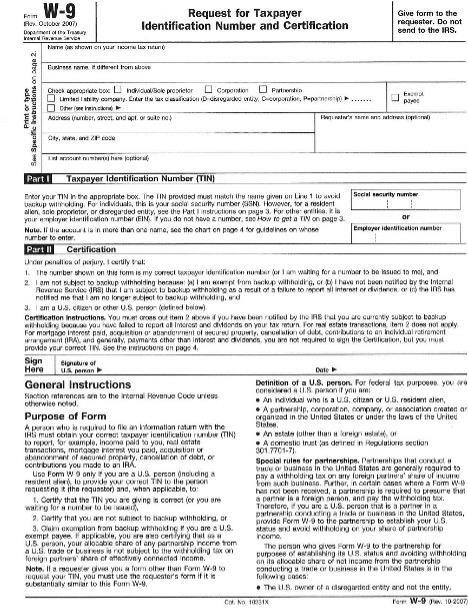
Figure 3. Example of a W-9 form.
Hospitality, Tickets, and Seating
House Managers
The Hospitality Guild chairperson will assign one or more members of the Hospitality Guild to act as the house manager(s) for the duration of each production. The house manager is responsible for managing the Hospitality Guild members or other volunteers needed to greet patrons, help audience members find their seats, hand out programs, resolve any seating issues, and serve snacks and beverages for all performances, including benefit performances. The house manager will unlock the auditorium doors for patrons’ entry and coordinate the start of the show with the director or their designee. The house manager is an essential part of the production team and should be encouraged to feel that they are part of the show. Please introduce them to the cast and crew, invite them to social functions, etc.
Complimentary Seats for the Hospitality Guild
Pentacle Theatre provides complimentary seats as an expression of gratitude for our valuable hospitality volunteers. One seat is reserved for each Hospitality Guild person for the date they volunteer (section A; row 6; seats 1, 2, and 3 and section C; row 6; seats 1, 2, and 3).
Director Preshow Form for the Hospitality Guild
The Hospitality Guild has created a questionnaire for the director of each show to fill out and return to hospitality@pentacletheatre.org within 10 days to 1 week before each production. The information on the form will help the Hospitality Guild, the director, and the production team to have a successful run of the show. This form is available in appendix 3
Dress Rehearsal Audiences
Our community service and student night chairperson arranges audiences for the final dress rehearsals. See the Pentacle Theatre website for community service and student night policies. Email questions to freedressrehearsals@pentacletheatre.org
Directors’ Seats
The director has two complimentary seats (section A, row 5, seats 6 and 7) reserved for each performance that are typically used by the director and assistant director. In addition, the director has three seats to sell for each performance (section A; row 5; seats 3, 4, and 5). These are not complimentary seats; they still need to be paid for by patrons. These additional seats are not available to the director during benefit performances. To use these seats, the director gives the name(s) of the patrons purchasing them to the box office manager or house manager for purchase at the box office. If the director does not have anybody who wishes to purchase these seats, the box office may sell them according to the procedures for other available seats.
Seating Guidelines
The box office opens 45 minutes before curtain. Pentacle Theatre uses a reserved seating system (except for student night, community service night, and benefit performances). Tickets are sold on a first-come, first-served basis. In the event of a sold-out show, the box office will create a
waiting list. The theater does not build a waiting list over the phone. Cast and crew members may not add names to the waiting list before the patron arrives.
When there is a waiting list, shows will start late. Wait-listed patrons cannot be seated until the house manager determines which seats are empty as of the scheduled curtain time. Only the house manager can assign seats or move patrons to other seats. Patrons may not move around the theater on their own or under the direction of anyone without consulting the house manager. The house manager will let the director and stage manager know when all wait-listed patrons have been seated so that the show can start. All waiting list tickets are $25.00.
There are spaces in section C for wheelchair seating. If there are no patrons using wheelchairs, the house manager has the option to sell those seats. In compliance with fire marshal regulations, no seats may be added anywhere in the auditorium.
Holding the Show
In the event of a last-minute influx of late patrons, the director may decide to hold the show in consultation with the house manager.
Late Seating
Once the show has started, no one may seat latecomers. Latecomers may watch the show on the monitor in the lobby and take their seats at intermission.
Costumes, Wigs, and Makeup
Costumes
The main goal of the costumer for a play is to collect the clothing items for cast members to wear in the play. The costume committee and costume storage rooms are resources to help all Pentacle costumers create a fabulous show. The following will help you understand what is expected and involved in costuming.
ACCESS TO COSTUME ROOM
The costumer will have access to the costume room through costume committee work parties and through the director and stage manager. Work parties are held every second Saturday from 9 to 11 a.m. Costumers can schedule time to tour the costume room or to pull costumes for their shows with one of the four deputy members of the costume committee or with their director or stage manager.
LOCATING COSTUMES FOR YOUR PLAY IN STORAGE
Please feel free to pull items from the costume room as needed. If you are looking for a specific item, you can email costumes@pentacletheatre.org, and this email will go to the group of costume deputies who have both access to and familiarity with our stock. They will help you with your questions.
RETURNING UNUSED COSTUMES
This is the number one rule in the costume room: if you pull it out and do not use it, put it back where you found it (if you really know where you found it). If you cannot remember, hang it on a return rack.
COSTUME CARE
The ironing boards, irons, sewing machine, limited sewing supplies, and steamer are all located in the dressing room. Please do not remove any of these items from the theater The steamer is an under-appreciated but fabulous machine. If you use it, please remember to turn it off afterward and make sure the water reservoir does not run dry. If the reservoir runs dry, the motor will burn out, and it is an expensive machine. Do not be afraid to use it, but please treat it with care. Make sure that all irons and the steamer are turned off and unplugged before you leave at night. Do try to keep the sewing area tidy, or at least restore it to tidiness as part of your strike on closing night.
Please ask your cast to treat the costumes with respect. The better care we all take of the costumes, the longer we will be able to keep them and continue using them in future productions. This includes the following:
• Costumes should always be hung up when not being worn. If the cast member has a quick costume change, they should make arrangements for a dresser, another cast member, or a stagehand to help them take care of their costume after they rush back onstage.
• There should be no eating, smoking, or drinking while in costume. If cast members must eat or drink, then furnish them with a smock or oversized shirt. The same goes for
applying makeup. Always cover up when applying makeup and hair spray while in costume.
• Under no circumstances is a production member or cast member to remove any costume or any part thereof from the theater during the run of a production. The only exception is personal undergarments and tights/hosiery/socks for laundry purposes. The costumer may remove a costume or part thereof for maintenance or laundry purposes.
• In order to keep costumes in good condition, it is suggested that costumers collect all washable items each Sunday night during the run of a production, wash them, and return them to the theater before the next show. Non-washable items can be sprayed with Febreze or a 50-50 mixture of isopropyl alcohol and water. Alternatively, costumers may collect the non-washables and run them through the dryer using Dryel. It’s a little extra work, but it’s a nice courtesy to your cast. Remember, they all share a dressing room.
STRIKE
All costumes and costume pieces must be removed from the dressing room on closing night. The director and/or costumer is responsible for having all costumes cleaned and returned to the theater.
Costumes should be sorted on closing night into items to be laundered, items that will be dry cleaned, and items that can be returned to the costume room.
• Returning items to the costume room: Please separate men’s shoes, women’s shoes, accessories, and clothing into different groups. Shoes can be returned to their respective rooms; clothing should be returned on hangers and hung on a return rack. Hats can be returned to their specific areas.
• Laundry: The costumer and/or the director will ensure the laundry is done and returned to the theater.
• Dry cleaning: Pentacle has an account Quality Fashion Cleaners on Liberty and Gaines. Make sure the cleaners will give you a receipt for your costumes. The receipt must be given to the office bookkeeper so they can charge the cleaning fees to the correct show.
ALTERATIONS
There are no permanent alterations allowed. A good rule of thumb is if you can’t undo it, don’t do it. If you feel that you absolutely must use a certain costume and must irrevocably alter it in the process, please contact the costume chair. The costume chair must approve all permanent alterations. Most necessary alterations will be approved. This is an extra hassle, but we do have some items that are irreplaceable and unique, and they need to be maintained in their current condition.
RESOURCES
• Patterns: We have a good library of patterns. Feel free to use them and return them when done.
• Fabric: There is a fairly good supply of fabrics, trims, notions, etc. in the costume rooms. Check there before purchasing; we may already have just what you need.
• Cleaners: Pentacle has an account with Quality Fashion Cleaners on Liberty and Gaines. They will bill to Pentacle. However, the bill only lists the amount spent, so be sure to get
a physical receipt to give to Pentacle’s office bookkeeper. That way, the bookkeeper is able to pay the bill and can charge the cleaning fees to the correct show.
Please don’t hesitate to contact one of the costume deputies if you have any other questions or would like assistance.
Wigs
Pentacle Theatre has an inventory of wigs available for use. New wigs may be purchased at the discretion of the director if it is in the production budget. Each director will get a key to access the wig department. Please contact the chairperson prior to making any permanent alterations to any wigs or hairpieces. Contact the wig chairperson with questions. All wigs and hairpieces purchased within a production budget are the property of Pentacle Theatre and shall be returned to the wig department at the close of each show.
Makeup
For most productions, actors use their own makeup. For shows requiring specialized makeup, a makeup designer should be part of the production team. It’s best to determine makeup needs prior to moving the show into the theater in case special orders are necessary. The theater has a very limited supply of makeup in the dressing room for use if needed.
Directors’ Timetable
• After season selection (exact date to be determined):
o Attend orientation.
o Confirm production team: director, assistant director, stage manager, sound designer, costumer, video designer (if necessary), hair and makeup designer (if necessary), props manager, etc.
• Seven weeks prior to auditions:
o Molly Duddleston or the executive director will contact you to put together a draft news release for auditions for distribution to print outlets. This information will also be shared with the executive director for posting online.
o For auditions at the rehearsal space, contact the executive director reserve the rehearsal room in advance.
o Meet with your production team.
o If you need help recruiting additional or replacement production team members, contact the Directors’ Forum (directorsforum@pentacletheatre.org)
• Five or six weeks prior to auditions:
o The executive director will send the final press release to media outlets, post it on the website, and distribute it for publication.
o Finalize members of the production team, including light and sound operators and stagehands
• Three weeks prior to auditions:
o Contact your board liaison.
o Finish preparing audition scenes.
• The week prior to auditions:
o Pick up audition supplies (audition forms, name tags, pencils, scripts, etc.) from the audition kit at the office.
o For auditions at the theater, sign out theater key for auditions (to be returned immediately after auditions).
• After casting:
o Electronically submit cast and crew list to the executive director.
o Return completed audition forms to the office.
o Send the cast and crew list to the box office manager for comp tickets.
• First read-through:
o Board liaison and director greet cast and crew and review policies.
• During the first month of rehearsals:
o Contact the costume chair to make arrangements for access to the costume room.
o The photographer will contact you to schedule headshots of cast for the program. Make sure to let your cast know about the date for headshots in advance.
o Contact the program editor for the cast bio forms and information about due dates for the program.
• During the last four weeks prior to moving to theater:
o The technical director will attend a run-through.
o Check with your production team and technical director to ensure that the show is ready to move in.
o Ensure sound design is in progress.
o Review set construction timeline provided by the technical director.
o Confer with the technical director to determine the date of the first rehearsal on the stage Monday is often a set build party, not a rehearsal.
• One week prior to moving into the theater:
o Check out theater key(s) from the office and sign the key policy agreement.
o Get the alarm system code for your production.
• After moving into the theater:
o Ensure costumes for quick changes are available for rehearsals.
o Conduct a “paper tech” before the Saturday of tech weekend.
• Tech weekend:
o Friday night light hang.
o Possible Saturday work party for cast and crew
o Sunday cue-to cue-tech rehearsal.
• Sunday or Monday before opening:
o Dress rehearsal photography. Make sure as many production team members as possible attend this rehearsal so that they can be included in the cast and crew photos.
• The week of opening Monday–Wednesday:
o A hired service will clean the auditorium, lobby, and restrooms before community service and student night dress rehearsals.
o Have the cast and crew sign up for chores or assign chores to the cast and crew (see appendix 10 for the weekly chore schedule)
• Before the last week of the production:
o Return all required stipend agreement forms to the bookkeeper
• Closing week:
o Musical directors pick up stipend checks from the business office by close of business Friday.
o Distribute musicians’ and production team members’ stipend checks.
o Write thank you cards for your cast, crew, and production team.
• Closing night (see appendix 11 for the closing night checklist):
o Bag garbage in black bags and place it in the dumpster. If the dumpster is full, do not fill it to overflowing. Instead, place garbage bags in front of the doors to the dumpster.
o Break down boxes.
o Recycling services are not available at the theater. Rob Sim handles can recycling; contact him for his schedule.
• After closing:
o Take costumes that need dry cleaning to Quality Fashion Cleaners make sure you get a receipt to give to the bookkeeper. Do not take washable items to the dry cleaner. Wash and dry costumes before returning them to the costume room.
o For musicals, within three days of closing collect and return all musical scores and scripts to the business office. Examine scripts for marks and ensure they are erased.
• No later than one week after closing:
o Collect and return all keys to the executive director.
o Ensure that all requests for reimbursement of expenses and reconciliation of any advances are submitted to the business office for approval within two weeks of the
show’s closing date. The reimbursement form is available on the “Resources for Directors” page on the website. It is the business office’s responsibility to verify your budget, not to balance it. Please be sure it is complete. If you need assistance, please contact the business office.
o Turn in all receipts for show expenditures to the bookkeeper. Receipts can be scanned and sent electronically or turned in physically. For scanned receipts, make sure the file is sent as a PDF rather than a photo.
o Pick up and return all dry-cleaned costumes to the theater within 30 days. Place the costumes in the proper location.
Auditions and Casting
Auditions are generally scheduled eight to twelve weeks prior to opening night. Auditions are open to anyone who wishes to attend. Auditions can be held at the theater or in the downtown rehearsal space. Audition dates and notices will be posted on Pentacle’s website and social media accounts.
Precasting is discouraged; however, if limited precasting is necessary, board approval must be obtained. The audition announcement needs to include information about any role that has been precast Review Pentacle’s Casting Best Practices (appendix 4)
The director or designee must notify everyone who auditions (in person, by phone, or by email) about casting decisions. No director may take a role in a play he or she is directing without the consent of the board unless it is due to the emergency absence of a cast member.
After fully casting the show, the director or a designee submits a complete cast and crew list (including mailing addresses, email addresses, and phone numbers) to the executive director.
The cast list will posted on social media and on Pentacle’s website. Please discourage cast members and others from posting about the audition results until after the theater’s official announcements.
Removal or Replacement of a Cast or Crew Member
If a cast or crew member is not meeting expectations, the director will inform the board liaison about the situation. The director will make a reasonable effort to help the volunteer meet the needs of the production. If the actor or crew member does not improve sufficiently with coaching or extra rehearsal time, the director may elect to remove the volunteer.
The director and another representative of the theater (the board liaison, the executive director, or the technical director) will meet privately with the individual to terminate their role in the production. In the case of a minor, the director will involve a parent or guardian in this meeting.
The director will notify the executive director of any changes to the cast or crew.
Cast and Crew Information
Orientation
The board liaison will usually attend the first rehearsal of a show. At that time, they will provide a general orientation to cast and crew members regarding the theater’s practices and policies and also explain the role of the board liaison. If the board liaison is not available for an initial orientation, the director needs to provide this information to the cast and crew.
Minors
Pentacle Theatre has guidelines for minors that will help prevent incidents, clarify expectations, and protect both children and the theater. Please take time to review and incorporate these guidelines into your communications with minors and their parents or guardians. See Guidelines for Minors (appendix 5)
Anti-Harassment Policy
Pentacle Theatre has an anti-harassment policy that prohibits all forms of bullying and harassment and establishes expectations for conduct of volunteers and staff. Similarly, the theater has adopted a statement of Commitment to a Harassment-Free Theater (appendix 6) addressing sexual harassment. The theater’s Progressive Resolution Policy (appendix 7) addresses the disciplinary approach to harassment of any kind, such as teasing, bullying, etc., at the theater.
Beverages
In the downtown rehearsal space, there is a small kitchenette with a small refrigerator, microwave, and sink. Cast and crew are welcome to use the fridge during rehearsal to store beverages and/or food. Please be sure everyone cleans up after themselves. Remember, the office staff also use this area.
At the theater, there is a kitchen is available for cast and crew to store labeled beverages and snacks. Keep in mind that this kitchen is shared with the technical director and others working at the theater. A water cooler is available in the dressing room. Please encourage cast and crew to bring their own cups or use cups from the kitchen. Please be sure to wash your own dishes.
Complimentary Tickets
Pentacle Theatre provides complimentary tickets as an expression of gratitude for our valuable volunteers. Each cast and crew member receives one complimentary ticket for the production on which they work. An individual may not receive more than four comp tickets per calendar year.
• The ticket office will issue complimentary tickets from the cast and crew list provided. The office will not issue comps to individuals who are not on the list.
• The director will be responsible for updating the list as needed.
• Comp tickets need to be arranged over the phone or in person with box office staff at the downtown ticket office.
The technical director is responsible for supplying the ticket office with a list of technical volunteers eligible for complimentary tickets.
Accidents and Injuries
In the event of an accident or injury, inform your board liaison immediately Complete an Accident/Incident Report Form (appendix 8) and submit it to the executive director as soon as possible no more than 24 hours after the incident. Accidents and injuries include any of the following situations:
• Injury (fall, cut, concussion, twisted ankle, bone break)
• Near miss (electrical shock not causing permanent harm, falling set pieces, etc.).
• Call to emergency services
• Patron or volunteer files an insurance claim or threatens to file one.
The theater’s insurance policy covers any volunteer injured during rehearsal, set construction, or performance of our productions. The theater’s insurance policy will not honor a volunteer’s injury claim if received after 90 days from the date the volunteer received medical care.
Locations of Accident Report Forms
AT THE DOWNTOWN REHEARSAL SPACE
There is a white binder on the counter. The forms are in a manila envelope inside the binder.
AT THE THEATER
Downstairs next to the office, there is an envelope on the wall labeled “Accident Report Forms.”
Rehearsal Space Guidelines
Before auditions, the director should contact the executive director to discuss and confirm the audition schedule, possible callback dates, and the proposed rehearsal schedule for studio availability.
Directors are responsible for the daily maintenance of the space, including the kitchenette, during their rehearsals. This includes removing garbage and vacuuming or sweeping at least once per week. The key to the garbage is hanging on the bulletin board on an Oscar the Grouch keychain labeled “garbage key ” The dumpsters are in the parking garage; the closest dumpster is for recycling and the farthest dumpster is for trash. Garbage bags and cleaning supplies are available in the labeled cupboards. Furniture should be put back in place at the end of each rehearsal. Other activities may take place in the studio during the daytime and on weekends. If you want to use the rehearsal space for a weekend rehearsal, please check with the executive director about availability.
Directors will receive a building security code to access the rehearsal studio. Only the director and the stage manager should have the security code. After entering from the parking garage, the director or stage manager can unlock the Ferry St. door. That is the door that cast and crew members can use. A doorstop can be used to prop open the door into the hallway where restrooms are located. Cast and crew may use the microwave and temporarily store items in the refrigerator. There is also a water cooler in the rehearsal space. Please encourage the cast and crew to bring refillable water bottles to help reduce waste.
There is a large plastic bin with a red lid that may be used for prop storage. There is also a white fabric-covered “closet” for storing costume pieces, additional props, and other rehearsal items.
Please adhere to the following:
• Do not leave dirty dishes in the sink.
• Do not leave food items out on the counter.
• Keep the microwave and refrigerator clean.
• Do not allow smoking inside the building at any time.
• Do not unplug the wireless router.
• Turn off all lights when not in use.
Email the executive director if you need supplies such as paper towels, cleaning chemicals, water, or cups. The executive director should also be notified via email regarding problems such as broken equipment or furniture in the rehearsal space.
Preshow Announcement
An announcement will be made before each performance in a manner appropriate to the production. Please submit your preshow announcement to the executive director for final approval before recording it. The announcement shall include the following:
• Please remember to turn off your watch alarms, beepers and cell phones.
• The use of recording equipment and cameras during the performance is prohibited.
• Beverages are sold downstairs in the lobby during intermission.
• Smoking and vaping are allowed only in the designated area.
• Title and director of the next production.
• Acknowledgment of the show sponsor
• Mention of season sponsors (check with the executive director regarding current season sponsors).
The announcement may also include other information or reminders relevant to the specific performance or production, such as safety reminders about actors using the aisles, information about season ticket sales, news about fundraising, etc. The preshow announcement should run no more than one and a half minutes. The director should communicate the duration of the preshow announcement to the house manager regarding so the house manager can consider it with respect to seating latecomers.
Theater Building Care
Security
It is the director’s responsibility to turn out lights, close doors, lock up, and set the alarm at the theater each night. If a door is left open and/or the alarm goes off, Alarm Central Station will contact, in order, those listed on the call list. The director or their representative may appear first on the security call list.
Prior to setting the alarm and leaving the theater building, check each door of the theater from the outside to ensure it is locked. Then set the alarm and exit the building. You may set the alarm from the lobby or from the top of the stairs in the dressing room.
Heating and Cooling System
The thermostat is set to heat to 69 degrees and cool to 72 degrees. It operates Sundays through Fridays from 12 p.m. to 11 p.m. and Saturdays from 9 a.m. to 11 p.m. The system is locked and can be changed by Chris Benham only. If you have any problems, contact the facilities chair or technical director immediately. Do not turn on ceiling fans in the auditorium during a performance, because they make noise and may interfere with stage lights. Run the fans prior to performances or during intermission to air out the auditorium as needed.
Parking
During performances, cast and crew must park in the third parking level by the Glogau building. Encourage carpooling, because parking is at a premium, especially during sold-out shows.
Do not park in the designated fire lane outside the lobby door. This area is for loading and unloading only. Set an example for others about respecting emergency access to the theater.
Housekeeping
Our theater is our home help us keep it in good condition for the comfort and enjoyment of our Pentacle community. It is the responsibility of the cast and crew to maintain the theater during each run. The director is responsible for assigning housekeeping duties to the cast and crew during the run of the show and on closing night. Use the QR code posted on the bulletin board across from the kitchen to submit notifications for any necessary repairs or additional cleaning supplies.
Chore Duties and Descriptions for the Cast and Crew
The Hospitality Guild has created a chore description document (appendix 9), which describes in detail the expectations for all cast and crew volunteers during the show’s run. This document is displayed on the bulletin board in the green room.
Chore Chart
The Hospitality Guild has created a weekly chore chart (appendix 10) that directors can post in the green room for cast and crew to sign up for during the show’s run. Alternatively, the director or stage manager may assign chores to the cast and crew when posting the chore chart.
Closing Night
Be sure to schedule enough people to help with cleanup and shutdown of the building. Directors are responsible for leaving the theater in a clean and tidy condition for the incoming show. See the Closing Night Job List (appendix 11)
Garbage
Garbage goes in the outside dumpster and is collected every Wednesday morning.
Smoking
Smoking and vaping are not allowed in any part of the theater building. There is one designated smoking area at the theater; it is located on the northeast side of the lower deck. A sign and a bench mark the smoking area, and an ashtray is provided. Please do not smoke or vape in any other location on the property.
Fire and Safety Regulations
The care and safety of the facility and those who use it is a shared responsibility. The safety of patrons, cast, and crew must always take priority over other considerations. In the absence of a specific regulation, use common sense. Bring issues to the appropriate authority (e.g., the director, house manager, executive director, or board liaison). Instruct your cast and crew to be aware and careful.
Fire Lanes
• Keep fire lanes clear.
• Fire trucks need at least two possible routes of access to the theater. Always keep the driveways to and through the parking lot clear.
• Observe all parking signs.
• Do not park outside the lobby in the fire lane. This area is for short-term loading and unloading only.
Decks, Stairs, Paths, and Aisles
• The state fire marshal requires that we maintain an unobstructed path between the stage and the audience that is at least 44 inches wide.
• Keep the lower deck and front and sides of the upper deck clear of all obstructions such as wood, seats, props, furniture, and set pieces. In particular, do not create a barrier to the flow of traffic. The house manager will let patrons know that they are not permitted to walk toward the green room stair door or beyond the “Cast Only” sign unless using the inside auditorium stairs presents an access problem.
• All stairways are fire exit routes. Nothing may be stored in any of the stairwells. Keep external stairs clear of debris, leaves, etc.
• Clear the handicap ramp and the footpath that leads from the parking lot to the theater of all obstructions, including mud and debris.
• No part of a set may be considered part of an emergency exit route unless it is at floor level and unobstructed.
• The aisle and main entrance lights in the auditorium must never be turned off during a performance.
• Never block the exit doors or cover the exit signs. Exit signs will be lit at all times.
Fire Extinguishers
Fire extinguishers are located throughout the theater, including near all exits and in the dressing rooms, booth, lobby, and kitchen.
Open Flames
If you plan to use an open flame in a production, contact the technical director for the required precautions.
First Aid Kit
A first aid kit is available in the dressing room and in the tool room. If supplies are low, use the QR code posted on the bulletin board across from the kitchen to request needed supplies.
Power Tools
Use of the theater’s power tools must be restricted to those who know how to operate them, as determined by the technical director.
Glow Tape and Spike Tape
Use glow tape judiciously. It must be “charged” by light to work effectively. Each production will receive a supply of gaffe, glow, and spike tape from the technical director. Tape costs will be charged to the respective show.
Never use masking tape or duct tape on any theater surface.
The director is responsible for ensuring their team follows these guidelines.
Set Design and Construction
The following guidelines ensure that the production’s technical requirements and actors’ needs are met as quickly as possible. Due to the varying complexity of set construction and technical needs, the technical director has until opening night to meet aesthetic and artistic needs of the set. Make sure you and the technical director have clearly communicated about and agreed on who is responsible for providing each component of the set, furniture, and set dressing.
Technical Schedule
Below is a brief summary of the technical schedule. See appendix 12 for a detailed technical timeline.
After the previous show closes:
• Sunday: Strike the previous show’s set and move in the current set.
• Monday: Regularly scheduled rehearsal time used to move into the theater and continue set construction (costumes, props, etc.).
• Tuesday: Cast can move in and rehearse on set (if possible, cast may move in prior to Tuesday, subject to technical director approval).
• Weekday determined by the lighting team (no later than Friday): Light hang.
• Before Saturday: Paper tech.
• Saturday: Light and sound cue programming.
• Tech Sunday: Cue-to-cue tech rehearsal. The primary goal of this rehearsal is to introduce lights and sound cue to cue. This is the day to ensure all technical aspects are in place for your production (e.g., props, costumes, special effects, set pieces affecting the timing of the action including doors, stairs, level, etc.). This allows two weeks to make any needed tech adjustments.
Everything prior to the Friday night opening performance is a rehearsal.
Email or text (please do not call) the technical director about any desired changes, concerns, issues or problems.
Cast and Crew Safety on Set
The stage manager is responsible for backstage lighting and glow tape to ensure the safety of the cast and crew. Use glow tape judiciously. It must be “charged” by light to work effectively. Each production will receive a supply of gaffe, glow, and spike tape from the technical director. Tape costs will be charged to the show. Do not use masking tape or duct tape on any theater surface.
Sound and Light Equipment
The audio chair and tech director will orient the operators to the booth equipment. Any time equipment failures occur, the director should inform the executive director, audio chair, or technical director immediately. This includes body mics, battery packs, follow spots, computers, and lighting instruments. Light and sound boards must be powered off after every performance.
Strike
On closing night, the director, cast, and crew work together to remove all furniture and props from the set and return them to their private owners or to their proper locations in prop/furniture storage.
The technical director will not be present on closing night. On Sunday following closing night, the technical director and strike crew will take care of dismantling and storing sets and preparing the theater for the next set to be built. For musicals, the musical director must work with the technical director to map out the space required for the orchestra.
Theater Truck
Pentacle owns a truck that is available for theater business only. For example, it may be used to move props and furniture to the scene shop after a show closes. No one under the age of 25 is allowed to drive the truck. Authorization to drive the truck must be obtained from the executive director.
Electrical Equipment
For your safety and the safety and security of the theater, please follow these guidelines.
General
• Make no additions or alterations to existing electrical systems. If any system does not meet your needs, contact the technical director for assistance.
• Use only three-wire grounded extension cords.
• Do not use masking tape, scotch tape, duct tape, or any other type of tape that leaves a residue on any electrical equipment. This includes the walls of the control booth, microphones, and battery packs. Gaffe tape may be used when necessary, but no tape of any kind is to be used on any lighting instrument. Use gaffe tape to cover extension cords on the floor. This tape must be removed during the closing night strike.
• Keep all liquids away from electronic equipment.
• All electrical wiring onstage must conform to local electrical codes. The technical director will oversee the installation of any electric wiring on the set.
• Blue lights and power strips are stored in the stage manager’s workstation.
• There is one station/outlet for headsets on each side of the backstage area. The rest of the headsets are stored in the booth.
• Keep access to the electrical panels clear at all times.
• Use work lights only, not stage lights, when working.
Maintenance
• Use the QR code posted on the bulletin board across from the kitchen to report facilities issues.
• Volunteers may replace burned out standard lightbulbs with those kept in the storage room. Use the same type of bulb with the same wattage as the one that burned out.
Lighting
Only light designers and/or light operators who are approved and/or trained by the technical director are allowed to work with the lighting system.
• Contact the technical director for any advice as to the operation of equipment, inventory of equipment, or any unusual requirements for lighting.
• Keep the lighting booth clean. No food or open drink containers are allowed near the light or sound board.
• Instruct and assist the operator to mark their script boldly (in pencil for musicals) with cues, levels, warnings, etc.
• Be extremely careful when replacing lamps in stage lighting equipment.
• Store unused fixtures on racks in the electrical room. Loosen all adjustment devices on fixtures and remove gel frames, barn doors, and funnels.
• Mark the color identification number on all gels with a grease pencil in one corner when cut from a large sheet.
• Do not try to repair a fixture or change a plug.
• Do not put any device such as strobes, transformers, or non-lighting equipment on any dimming circuit.
• Keep heated portions of fixtures two inches from combustible material.
• The technical director will train the follow-spot operators on the proper use of the equipment.
• The technical director will demonstrate how to replace burned out lamps to a member of the production team.
• Ensure that your operator has a checklist to go over everything before each performance.
Audio Guidelines
Directors should contact the audio chair before submitting their proposals to ensure that all audio requirements are identified and properly budgeted for. If your production is chosen for a Pentacle season, you should contact the audio chair as soon as possible to affirm that your needs have been identified and properly planned for.
Musical directors must use a sound tech approved by the audio chair. The sound tech must be familiar with QLab or available for any necessary training in both QLab and the theater’s sound system.
If you wish to use your own audio equipment or borrow equipment from elsewhere, please contact the audio and video technology chairs. We will make every effort to make it work.
You should have arranged for and identified a sound designer prior to proposing your production. If you have any difficulty finding help with sound design, please contact the audio chair.
Pentacle Theatre uses a standardized technical script format. This standardized procedure protects the theater and the production by making training and substitutions easier, and it broadens the group of available and readily trained volunteers. (Refer to the technical director timeline, appendix 12, for information about the paper tech prior to moving into the theater).
If you have problems or questions, feel free to contact the audio chair.
Musicals
Only trained and approved individuals can add or remove actors’ mics and mic packs. This individual must contact the audio chair to arrange necessary training. Due to a very high (and very expensive) mic failure rate in past productions, this rule is strictly enforced.
Note that body mics pick up surrounding sounds as well as the voice of the actor wearing the mic. Consider this in planning your blocking, as phasing issues caused by close proximity of your actors can seriously affect the sound quality of the entire production if not handled by an experienced sound technician To avoid issues, train your actors to recognize mic failures and, if necessary, temporarily adjust their blocking to relocate closer to another performer with a functioning mic until their equipment can be replaced.
Batteries
Review the quantity of batteries needed for the run of your production with the audio chair. If rechargeable batteries are used, obtain an appropriate number of standard batteries to allow replacement when necessary. If standard batteries are used, calculate the amount needed as follows:
(Number of shows) x (number of actors with mics) x (2 batteries per pack) = total
Make sure to contact the office to order your batteries at least two weeks before you move into the theater
Pentacle Theatre recycles standard batteries. Please collect the used ones and put them in a resealable plastic bag labeled for recycling.
Pit
Please have your musical director contact the audio chair as soon as possible to discuss the number of musicians that will be in the pit and where they might be placed. Plan ahead for any specialty mics and/or music stands, drum shields, etc. Our goal is always to isolate the pit from the room as much as possible. Because the backstage area is comprised of parallel hard-surfaced walls, floor, and ceiling, any sound generated in that area will ricochet off those surfaces before making its way to the audience, resulting in sound that is muddled and delayed. Additional acoustic treatments can help mitigate some of these problems. If possible, the technical director may be able to design the set to help enclose the pit.
Our Equipment
We use Apple Macs as our media computers with QLab as our primary show control software. Musicals generally require their proprietary software for rehearsal and show tracks. Some integrate relatively smoothly with QLab; others do not. Discuss available options with the audio chair to avoid delays and issues during rehearsals and tech planning.
Do not change any settings on any gear in the rack without the express permission of or instruction from the audio chair. If you experience an issue or want something changed, please contact the audio chair.
We have 16 channels for music and sound effects. These are the mains (channels 1 and 2), audience left front and back (channels 3 and 4), audience rear left and right (channels 5 and 6), audience right front and rear (channels 7 and 8), subwoofers audience left and right (channels 9 and 10), and two channels (11 and 12) for backstage practical sound effects. Backstage and onstage monitors can be configured as needed for the orchestra and performers.
Setting Sound Effect Levels
We have the ability to remote desktop with both our sound effects software programs so that levels can be set from the auditorium. We highly recommend using this method for rehearsals so that the sound effects levels can be optimized while considering that those levels will likely need to be adjusted when an audience is present. What may seem loud during rehearsals may be very quiet during an actual show.
Running the System
The equipment rack in the sound and light booth contains the controllers for both Mac computers and the sound system.
Strike
The audio team will be responsible for striking any audio gear. This includes intercom headsets/body packs, pit monitors, and any mics and cables used for the pit. This is a time when
we can look over our gear to assess if any repairs are needed. It also helps us keep our inventory in order.
Appendix 1. Reimbursement and Advance Reconciliation Form Instructions
The Reimbursement and Advance Reconciliation Request Form is available on the “Resources for Directors” page of Pentacle’s website (https://pentacletheatre.org/director-resources/).
1. Fill out the form as provided. This is exactly the information the office needs in a way that meets IRS and audit documentation requirements. We encourage you to use the spreadsheet in MS Excel and let it do the math for you. You can insert lines as needed. Requests not submitted using this form/format will be returned for correction and resubmission
2. Detailed line instructions:
a. Generally, use one line per receipt that matches the receipt total (with adjustments where relevant, as discussed in item c below).
b. Purpose/category should match the general show budget lines: props, costumes, hair, makeup, set, etc.
c. If a receipt contains more than one item in the same general category, you may write “ various” in the item description column. Item-level detail is usually on the receipt anyway.
d. If the receipt contains items in more than one purpose/category, you can split it between two or more lines. Just make sure the line amounts add up to the amount you are claiming on that receipt.
e. If you are not claiming/reporting everything shown on a receipt, be sure to note on the receipt what is included or excluded either by crossing out items not included or circling items that are included.
3. Attach receipts to the reimbursement request. A screenshot of an item with a price does not meet IRS and audit documentation requirements. The receipt must be an actual receipt that shows the full amount of the purchase.
4. If you choose to print the spreadsheet and complete it manually rather than letting the form do the math for you make sure the total of items listed from your receipts match the expense total.
5. Enter any advance you received on the line where it says “less advance, if any.”
6. Submit the reimbursement form and receipts to the office within two weeks of the closing date of the production, either as hard copies (originals) or electronically via email to christie@pentacletheatre.org. Electronically submitted receipts must be in the PDF format screenshots or phone pictures in formats such as HEIC, PNG, JPG, etc. will be returned for correction
Pentacle Theatre Reimbursement Request/Advance Reconciliation—EXAMPLE
Name of show: Zombie Santa
Name of requestor: Phineas Flynn
Address: 2308 Maple Drive
Phone: (666) 654-5555
Email: phineas@doofenshmirtz.com
Attach receipts for each item. List in chronological order.
Note: blue cells contain formulas to provide totals do not type over them.
Pentacle Theatre Reimbursement Request/Advance Reconciliation Form
Name of show:
Name of requestor:
Address:
Phone:
Email:
Attach receipts for each item. List in chronological order.
Note: blue cells contain formulas to provide totals do not type over them.
To download and fill out the Excel version of this document, which contains formulas that will automatically do the calculations for you, please visit https://pentacletheatre.org/director-resources/.
Appendix 2. Board Liaison Roles and Responsibilities to
Productions
Role Overview
The Pentacle Theatre Governing Board President assigns a board member as a liaison to each Pentacle production as soon as possible after a season is announced. Board liaisons have two overarching responsibilities: to monitor adherence to theatre policies and procedures as a means of protecting the theatre's financial health and legal status and to actively welcome, appreciate, and celebrate Pentacle volunteers as a representative of the governing board.
Key Responsibilities
The board liaison is a conduit from the board to the director and vice versa, providing regular updates from the director to the board about the status of the production and notifying the board as needed about any issue that may require board action (e.g., adjustments to the performance schedule). The liaison is also available to the director as a resource to help address production needs, whether that be through board action or by accessing other available supports.
The board liaison is expected to:
• Pick up a key from the office and be an additional resource to access the theatre for any production needs.
• Serve as an administrative/policy resource for the director.
• Be aware of any additional permissions that the director has requested from the licensing agent (e.g., alterations to the script, alternative casting, making a recording of the production, etc.) and monitor the status of these requests going forward.
• Immediately apprise the board president and operations manager of any possible production issues that could lead to financial or legal repercussions.
• Deliver regular updates on the progress of the production during scheduled board meetings. Executive session should be used if the subject is sensitive to maintain confidentiality.
• Update the director, cast and crew with any pertinent communications from the board while respecting time and input in a supportive and helpful manner.
• Respond to any issues brought forward by any member of the production or the facility in a timely and respectful manner. Direct any questions related to these issues to the appropriate resource, such as the board as a whole or the production's director.
Duties
The general duties to be performed by the liaison during the production cycle are outlined below.
PHASE 1 (PRIOR TO AUDITIONS)
• Once assigned to a show, read the script, proposal, and budget.
• Contact the director several weeks prior to auditions to set up an information-sharing meeting covering the following topics: o Liaison contact information.
• Mutual expectations for the director/liaison relationship.
• How to support and check-in with the director at auditions, such as offering to help with
set up, clean up, and check in.
• Arranging time at auditions to welcome those auditioning to Pentacle theatre and invite them to become members. o Check-in styles and frequency.
• Provide the director with a copy of this document.
• Confirm that the director has a system to track receipts for their budget.
• Confirm that you (the liaison) are included on and receive a copy of the cast and crew contact list.
• Confirm that you have a copy of and will receive updates to the production calendar.
PHASE 2 (DURING THE REHEARSAL PHASE)
• Attend rehearsals periodically; check in with the director regarding show progress and demonstrate support for the director, cast and crew. Checking in on rehearsals once every week or so is an average expectation for most shows. Some projects might require attention.
• Check in with the director at production milestones (e.g., the transition from the rehearsal space into the theatre, initial technical cue to cue, etc.) according to production timeline.
• Deliver reports on production progress during regularly scheduled board meetings.
• Deliver posters for the cast and crew to distribute. Reserve a poster or artifact for the sponsor of the production and have the cast and crew sign it, then deliver the signed poster to the frame shop and pick it up when it is ready.
• Contact the sponsor to find out when they plan to attend the show. Arrange a time with the director and crew to present the signed poster or artifact to the sponsor before the show with a short statement of appreciation.
PHASE 3 (DURING THE RUN OF THE SHOW)
• Attend opening night if possible. If not possible, arrange for another board member to be your surrogate.
• Present the signed poster or (artifact) if the is sponsor is in attendance.
• Ask the director for a few moments in the dressing room to deliver a short statement of encouragement and thanks to the cast and crew (e.g., "Thank you for all your hard work, I'm very excited to see the show, break a leg," etc.).
• Stay for the opening night afterparty to mingle with the cast and crew and thank everyone involved in the production, including hospitality volunteers and house manager(s).
• Check in with the director during the run of scheduled performances to assist with any emergent issues and to promote a smooth production run.
• On closing night or within two weeks of closing, do something appreciative for the cast and crew. Past examples are listed below.
• Write “thank you” messages to the director, cast, and crew on behalf of the board. These could be sent by email from the contact list or delivered as handwritten notes on closing night or to addresses provided by the director's contact sheet.
• Help with arrangements or treats for the closing night party. Provide tokens or treats with messages of appreciation.
• Hang posters with appreciative messaging in the green room.
PHASE 4 (FOLLOW-UP AFTER THE SHOW)
• Return the key to the office.
• Check in with director about turning in show receipts, costumes, and props.
• Check in with director about turning in key.
• Reach out to the director to debrief the production. Depending on the director's experience with the show, this may be done in person or through messaging.
Appendix 3. Hospitality Guild Questionnaire for Directors
Please fill out this form and return it to hospitality@pentacletheatre.org within 10 days to 1 week before opening night of the production.
Show name:
Director:
Assistant director:
Stage manager(s):
Length of preshow announcement (to allow house manager to seat late patrons):
Length of show (time):
Number of intermissions (zero, one, or two):
Are you having separate nights for community night and student night, or are you combining them? If you are combining the two nights, please list the date:
If this is a musical, please confirm if you are having community night on Tuesday, student night on Wednesday, and are dark on Thursday night before opening:
Do you need to use the storage room for dressing room space? If so, how many cast members do you anticipate will be in those areas? (If possible, we would like to keep the house manager office free so we can access the safe and count money safely after intermission.)
Would you like us to provide you a list of chores to be done by the cast and crew, along with a sign-up sheet for those tasks? (If so, we will post those for you on the green room bulletin board):
Any other information you would like to provide that will help us help you:
Appendix 4. Casting Best Practices
Pentacle Theatre is dedicated to open communication and transparency with our patrons, volunteers, and communities. This Casting Best Practices document will be posted online, made available during auditions, and shared periodically in e-news and other communications. The document will be revisited and updated as needed.
Overview and Goals
The best interests of the theater and production should guide every casting decision. Auditions and casting should be both transparent and inclusive, with newcomers and Pentacle Theatre veterans welcome.
Directors and their production team should convey respect and appreciation for each person who auditions. This includes notifying actors (both those who are cast and those who are not) about results in a timely manner. This also includes encouraging actors who are not cast to contact the director and ask for feedback about their audition.
Precasting
In general, precasting should be avoided; the goal is to embrace an open audition process. As outlined in the director’s handbook, the board must approve any precasting. Board liaisons should remind directors during or prior to auditions about the process for pre-casting.
If certain roles are precast, the director must identify those roles in audition announcements. Announcements about roles that have been precast also will be included in Pentacle Theatre communications, e.g., on the website, e-news, etc.
Nepotism
Nepotism is defined as casting an immediate family member (spouse/partner, child, sibling or parent) or close friend. In service to the theater’s commitment to open and fair auditions and to community perception, nepotism in casting should be considered carefully.
Casting family members or close friends should occur only if the family member auditions, meets casting requirements, is judged without personal bias, and is the best person for the role. Directors should carefully make these decisions, balancing what is best for the show with public perception about favoritism/nepotism.
Board liaisons should remind directors during or prior to auditions about the theater’s casting best practices as related to nepotism. If a director feels he/she needs to cast a family member or close friend, he/she should discuss this with the show’s board liaison prior to making a final casting decision.
Production Team
The director should make careful consideration when casting a member of the production team. The director should announce at the beginning of auditions that a production team member is
auditioning and that they will not be shown any favoritism. Factors to consider when casting a member of the production team include the following:
• No other actors auditioned for the role, and/or the production member is capable and willing to fill the role.
• Production duties (e.g., choreography, music/vocal direction, etc.) for that particular show are within the scope of what can be accomplished successfully when the production person also is fulfilling on-stage duties.
• An emergency situation (illness, actor leaves the show suddenly, etc.) occurs and the director has explored all other options for a casting substitution.
Casting Changes
Directors should follow the protocol for cast changes as outlined in the directors’ handbook.
Diversity in Casting
Directors always should strive to make culturally appropriate casting decisions with a strong commitment to inclusivity and diversity (race, ethnicity, gender, etc.).
Workshops
When workshops affiliated Pentacle Theatre are offered, participants in those workshops will be afforded equal casting consideration to those who do not attend the workshops, i.e., there will be no “pay-to-play” favoritism given to workshop attendees.
Appendix 5. Guidelines for Minors
Overview and Goals
Pentacle Theatre believes that children and adolescents play an integral role in helping to provide quality community theater. We also take seriously our role in helping to bring arts, culture and theater to young people. Because our number one priority in working with minors is their care and safety, below is an overview of responsibilities for minors, parents, and show directors. We define minors as anyone under age 18, or under age 21 when alcohol is present
Minors in Shows (Cast and Crew)
• Children and adolescents must be committed to attending all or most rehearsals and all performances. Scheduling conflicts must be communicated ASAP with directors.
• Minors who are cast members must be committed to learning their lines and participating fully in the rehearsal process, as outlined by the director(s).
• Children and adolescents will be assigned chores (once the show moves into the theater) that are appropriate for their age.
• All cast and crew, including minors, are expected to fulfill their chores as outlined by the director.
• Minors are expected to behave appropriately, responsibly, and maturely for their age.
Parent/Guardian Responsibilities
We expect parents and guardians to be committed to supporting their children in their show. This includes communicating effectively with the director; helping their children learn their lines; providing encouragement; sending snacks, water, and quiet activities for their children for rehearsals and performances; notifying the director if any issues arise; and providing or arranging for reliable transportation for rehearsals and performances. If parents/guardians are unable to provide prompt rides or help children learn their lines, they may contact the director for support with ride sharing, strategies for learning lines, etc.
Be prompt when dropping off and picking up your children from rehearsals and shows. Parents/guardians who are habitually late in dropping off or picking up their children may jeopardize their children’s participation in the show. When parents/guardians are late dropping off children, it affects the entire rehearsal process. When parents/guardians are late picking up their children, a member of the production team must wait outside the rehearsal space or the theater with them until their parent/guardian arrives to ensure the child’s safety. We ask that parents/guardians please prioritize picking up their children on time.
Notify the director if children have mental or physical health conditions or behavioral concerns that may affect their participation or require vigilance on the part of the production team. Examples include allergies, anxiety disorders, school suspensions, etc.
Director Responsibilities
A show’s director(s) and/or other members of the production team (e.g., assistant director, stage manager, etc.) are responsible for ensuring that all minors involved in the show are safe, respected and supported.
Directors must be respectful of schedules for children and their families; please avoid last-minute schedule changes if at all possible. Please end rehearsals on time, especially on school nights and/or schedule scenes with child actors early in the evening and then dismiss them.
The director must ensure that he/she has contact information for the parents/guardians of all children in the show. This information should be available at the first rehearsal, if not sooner. The director must be committed to communicating promptly, consistently and clearly with parents/guardians at all times. Please use one standard form of communication (preferably email) for notifying cast/crew/parents about schedules. If an issue arises that could affect a child’s safety or wellbeing, the director should notify immediately the parents/guardians, production team members and board liaison.
Cast Parties
At various times during the show’s run and/or on closing night, parties are held as an important way for the cast and crew to connect and celebrate their work. These parties usually are held at someone’s home (cast/crew) or at a restaurant. Parents/guardians of minors should be invited and encouraged to attend. As long as these parties are held off site (i.e., not on Pentacle property), these are not Pentacle events, and the theater bears no responsibility for the conduct of volunteers/participants.
Hosts of cast parties should understand that a person who provides intoxicants to guests can be held responsible for damage caused by or to their intoxicated guests. Because alcohol often is available at cast parties, special consideration and extra care must be taken when minors are around to ensure their safety. Directors should notify their board liaisons of measures they will put in place to protect minors during a cast party. The board liaison should be informed of this plan at least one week prior to the party. Steps to ensure the safety of minors when alcohol is present include the following:
• Director must inform minors’ parents/guardians in writing that an upcoming event will include alcohol.
• Parents/guardians must respond to the director in writing that they understand alcohol will be served at a cast party.
• Parents/guardians are responsible for ensuring that their children understand that they are not allowed to drink alcohol at a cast party.
• Parents/guardians are responsible for picking up their children after a party. If they are unable or unwilling to transport minors to/from a cast party, the parent/guardian must designate a person as the driver, and that information communicated to both the show’s director and parents/guardians. Directors should work with hosts of a cast party ahead of time to ensure there are adequate protections in place to prevent minors from drinking alcohol. These protections could include the following:
o Prohibit alcohol from being served
o Require that a parent or guardian attend the party with his/her child.
o Assign two adults in the cast/crew to serve and supervise alcohol consumption at all times during the cast party.
Appendix 6. Commitment to a Harassment-Free Theater
Pentacle Theatre strives to be a place where everyone feels safe, welcome and supported. That includes being an environment free of sexual harassment. The important thing for casts and crews to know is that they have a right to volunteer in an environment free of the following:
• Unwelcome sexual advances.
• Requests for sexual favors
• Any conduct of a sexual nature that interferes with a volunteer’s duties.
At no time should you feel you are volunteering in an intimidating, hostile or offensive environment. Harassment could possibly come from other volunteers, employees and Pentacle vendors and patrons. It doesn’t matter who does it; you do not have to tolerate it.
Prohibited at Pentacle
• The offer of a role in exchange for a sexual favor (and vice versa).
• Unwelcome flirting, either in person or via social media, texts, or email
• Touching a person in a flirtatious or sexual way without permission of that person.
• Making comments about a fellow volunteer’s body, sexuality or gender identity
• Making sexually suggestive gestures lewd jokes or otherwise sexualizing the volunteer environment
• Sharing pornographic or sexually explicit materials with fellow cast and crew.
This list is not inclusive of every possible form of harassment, but it is a tool to help volunteers understand what constitutes harassment.
Some Things You Can Do if You Are Subject to Harassment
• Report it.
• Tell the harasser to stop.
• Walk away from the harasser.
If You Witness Harassing Behavior
• Report it.
• Do something to disrupt the behavior.
• Follow up with the victim with support and validation.
Reporting Harassment
Pentacle Theatre encourages people who have been harassed or who have witnessed harassing behavior to report the problem to a trusted leader in the organization. There will be no retaliation for making a report. You can make a report with one of the following people:
• Your director
• Your board liaison.
• Another member of the board.
• Pentacle’s executive director.
We recognize that it may be uncomfortable to make a report, but doing so is critical to stopping harassment. Pentacle Theatre’s board and staff are committed to handling your report discreetly and effectively.
Thank you for being at the heart of what makes Pentacle Theatre great our community.
Appendix 7. Progressive Resolution Policy
Purpose
Pentacle Theatre’s (Pentacle) progressive resolution policy (PRP) and procedures are designed to provide a structured corrective action process to improve and prevent a recurrence of undesirable behavior, performance issues or actions by a volunteer that violate Pentacle Theatre’s Code of Conduct, Drug and Alcohol Policy, Sexual Harassment Statement or another of the theater’s policies.
Outlined below are the steps of Pentacle Theatre’s progressive resolution policy and procedures.
Definition
Volunteer includes, but is not limited to, members of the Pentacle Theatre governing board (the board), directors, committee members, production teams, hospitality guild members, cast and crew members, including individuals receiving a stipend.
General Provisions
STIPEND RECIPIENTS
Nothing in this policy confers contractual rights under the PRP on volunteers who are stipend recipients. Additionally, receiving a stipend does not alter the at-will status of any Pentacle employee or volunteer.
DISCRIMINATION POLICY
Consistent with other Pentacle policies for employees and volunteers, and consistent with state and federal law, no volunteer will suffer discrimination or retaliation for either reporting conduct pursuant to the reporting procedures described below. Moreover, Pentacle prohibits all forms of unlawful discrimination and retaliation as descried in Pentacle’s Code of Conduct and Sexual Harassment Statement or any other Pentacle policy related to employees or volunteers.
Policy
REPORTING PROCEDURE
Pentacle Theatre would like to see problems solved at the lowest level possible, but certain conduct requires a more systematic response to ensure that the theater continues to provide a safe and supportive environment for volunteers. Nevertheless, problematic conduct should be reported to the executive director or, in the event that reporting to the executive director is impracticable, to the board chair, where a volunteer’s conduct violates Pentacle’s Code of Conduct, Drug and Alcohol Policy, Sexual Harassment Statement, or another Pentacle policy addressing issues with volunteer conduct.
PROCEDURE MODIFICATION
Pentacle reserves the right to add, modify, or deviate from the prescribed procedures below, depending on the facts of each incident and the nature of the offense, at any time without
advance notice. We will attempt, however, to notify volunteers of any such changes where circumstances allow for such notice.
Further, Pentacle reserves the right to proceed with suspension of a volunteer as described below in step three of this policy. Conduct triggering such immediate action includes, but is not limited to, conduct potentially in violation of federal or Oregon criminal law or conduct inconsistent with Oregon Safety and Health Administration (OSHA) workplace regulations.
FACTORS CONSIDERED IN THE PRP
Some of the factors that will be considered during the PRP include, but are not limited to, the following:
1. Whether the offense is repeated despite coaching, counseling, or training.
2. The volunteer’s record.
3. The impact the conduct and performance issues have on the organization.
PRP EFFECT ON VOLUNTEER RELATIONSHIP WITH PENTACLE
Nothing in this policy provides a volunteer with contractual rights regarding volunteer discipline or counseling, nor should anything in this policy be read or construed as modifying or altering the employment-at-will relationship between Pentacle Theatre and its volunteers.
Procedure
STEP ONE: COUNSELING AND VERBAL WARNING
Step one creates an opportunity for Pentacle Theatre’s executive director to bring attention to the existing performance, conduct, or attendance issue. The executive director will discuss with the volunteer the nature of the problem or the violation of Pentacle Theatre’s policies and procedures. The executive director will clearly describe expectations and steps the volunteer must take to improve their performance or resolve the problem. Within five business days, the executive director will prepare written documentation of the verbal counseling. The volunteer is to sign this document to demonstrate their understanding of the issues and the corrective action.
STEP TWO: WRITTEN WARNING
The step two written warning involves more extensive documentation of the performance, conduct, or attendance issues and resulting consequences. During step two, the executive director and a Pentacle Theatre board representative will meet with the volunteer to review any additional incidents or information about the performance, conduct, or attendance issues, as well as any prior relevant corrective action plans. The executive director and board representative will outline the consequences for the volunteer of their continued failure to meet performance or conduct expectations. A formal corrective action plan or a conduct resolution agreement for volunteers, requiring the volunteer’s immediate and sustained corrective action, will be issued within five business days of a step two meeting. The written warning may also include a statement indicating that the volunteer may be subject to additional discipline, up to and including expulsion or termination, if immediate and sustained corrective action is not taken.
STEP THREE: SUSPENSION AND FINAL WRITTEN WARNING
Some performance, conduct, or safety incidents are so problematic and harmful that the most effective action may be the temporary removal of the volunteer from the Pentacle Theatre environment and workplace. As described above in the procedure modification provision, Pentacle reserves the right to alter the sequential order of discipline described herein when conduct that jeopardizes the health, safety, or welfare of any patron, volunteer, participant, employee, or board member of Pentacle Theatre requires immediate action, such as a volunteer potentially violating federal or state criminal law or a volunteer engaging in conduct inconsistent with OSHA workplace regulations. When immediate action is necessary to ensure the safety of the volunteer or others, the executive director and the Pentacle Theatre board may suspend the volunteer pending the results of an investigation. A member of the Pentacle Theatre governing board or a third party will conduct this investigation. Timely resolution is important. Generally, an investigation will be completed within 30 days of being initiated, unless the situation results in it being referred to a third party or other factors require additional time. Suspensions that are recommended as part of the normal sequence of the progressive resolution policy and procedures are subject to approval from the Pentacle Theatre board.
STEP FOUR: RECOMMENDATION FOR TERMINATION OF VOLUNTEER RELATIONSHIP
The last and most serious step in the progressive resolution process is a recommendation to terminate the volunteer. Generally, Pentacle Theatre will try to exercise the progressive nature of this policy by first providing warnings, issuing a final written warning, or suspending the volunteer from the Pentacle Theatre environment before proceeding to a recommendation to terminate the volunteer. However, Pentacle Theatre reserves the right to alter the PRP depending on the circumstances of each situation and the nature of the offense. Furthermore, volunteers may be terminated without prior notice or disciplinary action.
Appeals Process
Nothing in this section confers a right to volunteers to a disciplinary response described above, nor does initiating the appeal process confer a right to a particular outcome. However, to the extent an appeal process is appropriate, volunteers will have the opportunity to present evidence to dispute information used to issue disciplinary action. Though presentation of evidence during this process need not necessarily be formal, communication regarding and a request for an appeal must be done in good faith. Moreover, that a request for an appeal is communicated by a volunteer to the executive director, or the board does not guarantee an appeal or a requested outcome. The purpose of this process is to provide insight into extenuating circumstances that may have contributed to the volunteer’s performance or conduct issues while allowing for an equitable solution. Pentacle reserves the right to grant an appeal or receive evidence at its discretion.
If the volunteer does not present this information during any of the meetings related to the steps described above, they will have five business days after each of those meetings to present such information.
Documentation
The volunteer will be provided copies of all progressive resolution documentation where practicable or appropriate. The volunteer will be asked to sign copies of this documentation
attesting to receipt and understanding of the corrective action outlined in these documents. Notwithstanding such receipt and signature, Pentacle reserves the right to amend disciplinary decisions as appropriate given the circumstances.
Copies of these documents will be confidential and retained in Pentacle Theatre’s records. Members of the governing board may review these documents, subject to maintaining their confidentiality. Consistent with Oregon law, inadvertent dissemination or disclosure of such records does not constitute a breach of contract, nor does maintenance of such documentation constitute a special relationship between Pentacle and volunteers.
Appendix 8. Accident/Incident Report Form
Part One
Complete for all accidents/incidents (report any unsafe act or condition that could result in an injury to volunteer, patron or employee):
Date: Time:
Location:
Description of the accident/incident (be specific):
Witness name and address: Daytime phone number:
Witness name and address: Daytime phone number:
Factors involved (check one or both and specify what acts or conditions): ( ) Unsafe act: ( ) Unsafe condition:
PERSON COMPLETING THIS FORM:
Name:
Job title:
Signature:
Date:
Phone number:
Part Two
Complete for each injured person:
Name of injured person:
Phone Numbers:
Work phone:
Home phone:
Nature of injury:
Status of the injured person:
( ) Staff member
( ) Patron
( ) Volunteer
( ) Other (specify):
Severity of the injury:
( ) Minor (First aid)
( ) Severe, but not disabling
( ) Severe and disabling
( ) Fatality
Outcome of injured party:
( ) Onsite medical treatment given by:
( ) Able to leave premises without assistance
( ) Transported by:
( ) Other:
Part Three
Complete for employees:
Job title:
Injured while on the job:
( ) Yes ( ) No
Address, city, state and zip code:
Gender: ( ) Male ( ) Female ( ) Nonbinary
Age:
Affected body part(s):
Cause of the injury (check all that apply and specify):
( ) An object:
( ) Equipment or tool:
( ) Hazardous substance:
( ) Other:
Protective equipment:
( ) Was required
( ) Was available
( ) Was used
( ) Was not sufficient to prevent injury
Treatment given:
To:
Status: ( ) Full-time ( ) Part-time
Job being performed when injury occurred:
Stopped work immediately: ( ) Yes ( ) No
Date supervisor learned of injury:
Submit the completed Accident/lncident Report Form to the Pentacle Theatre business office within 24 hours.
Appendix 9. Cast and Crew Chore List and Descriptions
Green Room
Sweep as needed
Empty garbage cans
Keep sink area clean
Remove any large, used water bottles to the rack outside stage left door
Green Room Bathroom
Clean bathroom: mop/sweep floors, empty garbage, clean mirrors, sinks & faucets, clean toilets
(wipe down handles, surfaces, etc.)
Refill toilet paper, soap, paper towels, etc.*
Kitchen
Clean/sweep
Keep dishes clean and put away
Empty garbage cans
Keep refrigerator clean (needs to be emptied as much as possible before opening night so that reception food can be refrigerated)
Stage Area/Auditorium
Sweep and mop as needed
Vacuum seating area as needed (vacuum is located behind volunteer seats in section C)
Clear trash and programs from patron seating area (recycle programs in appropriate holders)
Tech Booth
Keep tidy and free of dust
Empty garbage
Ensure no food or drinks are left overnight
Outside Pathway and Deck
Clean pathways (use leaf blower/broom)
Empty all outside garbage cans on deck and replace garbage bags
Lobby Area
Empty trash/recycling containers in lobby (includes concession-area garbage cans)
Put full bottle drop bags in garbage bin area (next to large trash receptacle outside)
Vacuum lobby entrance carpet†
Sweep lobby area (vacuum lobby rug, if needed)†
* If you are not sure how to change the toilet paper, paper towels, or refill the soap dispensers, please see the house manager(s), who will be happy to help.
† See house manager for vacuum, as this is plugged in to keep it charged.
Men's Lobby Bathroom
Clean bathrooms: mop/sweep floors, empty garbage, clean mirrors, sinks & faucets, clean toilets (wipe down handles, surfaces, etc.) Refill: toilet paper, soap, paper towels, etc.*
Women's Lobby Bathroom
Clean bathrooms: mop/sweep floors, empty garbage, clean mirrors, sinks & faucets, clean toilets (wipe down handles, surfaces, etc.)
Refill toilet paper, soap, paper towels, etc.*
Appendix 10. Weekly Chore Schedule
See chore descriptions on the board for specific details. Week of:
Green room
Green room bathroom Kitchen
Stage area/ auditorium
Tech booth
Outside pathway and deck area
Lobby area
Lobby men's bathroom
Lobby women's bathroom
Appendix 11. Closing Night Job List
Instructions
See the list on the corkboard that specifies what needs to be done in your area. Do not leave until you check out with your director or stage manager to make sure no one else needs your help.
Lobby
Dressing room/bathroom
Spotlight areas
Sound area
Light booth
Auditorium
Men’s restroom
Women’s restroom
Kitchen
Backstage/set
Deck garbage/recycling
Costumes
Hair/makeup
Props
Appendix 12. Technical Director Timeline
Two Weeks Prior to Auditions
The technical director and production team meet to discuss the technical needs of the show. Ideally, the team and technical director conduct a scene-by-scene review of the show to identify all needs for the following elements:
• Set design
• Lighting
• Props (including props needed for the rehearsal process).
• Sound.
• Special needs (including technology and special effects).
In an effort to ensure that all elements of production are properly documented and all tasks are able to be completed properly, all official communication about the production should be conducted in writing, or a written synopsis should be made of any discussion in which instructions or decisions were expressed. This should be done via email with all affected team members included. Text messaging will not be sufficient to fulfill this requirement.
One Week Prior to Auditions
The technical director and the show’s director will meet to review and refine the draft of the set design, if needed.
If necessary, the production's props manager will acquire any props needed for the rehearsal process as identified in the production team meeting referenced above. If the props manager needs to access Pentacle's props collection, they will need to coordinate with the technical director to access the Glogau production facility. The technical director will not be able to transport any props or furniture needed for rehearsal either to or from the rehearsal space.
By Auditions
The final set design will be approved. A scaled drawing of the set with both elevation and floorplan layout will be provided to the director.
First Read-Through
The production team will be responsible for taping out the set area on the rehearsal space, if desired.
The technical director may attend the read-through as determined by both the production's needs and the technical director's availability.
Prior to the Opening of the Previous Production
The director will provide the technical director with a complete list, in writing, of all of the furniture needs. This should include the desired dimensions (if required), colors, and styles, as well as an indication if someone other than the technical director will be responsible for the acquisition or fabrication of each item and the name(s) and contact information for these individuals. Any special needs should also be included in this document. Highly specialized,
specific, or unusual furniture items may require significantly more lead time. If your production has a need for anything that may be difficult to find or will have to be built from scratch, please talk to the technical director as early as possible.
One Week before Moving to the Theater
The technical director will attend a full run-through of the show at some point during this week of rehearsals. The day attended will be determined by the status of the show.
If necessary, the technical director and the production team will meet to review the show’s status and to ensure that all props, furniture, and set dressing items have been gathered.
If it has not been provided previously, the technical director will provide the production team with a calendar that includes all of the major technical milestones for the production.
First Day on the Set
The technical director will conduct a safety walkthrough of the set with the entire cast and crew prior to rehearsal. This will take approximately 20–30 minutes and should take place promptly at the beginning of the scheduled rehearsal time, before any other cast and crew meetings or other preparatory work.
NOTE
The following schedule is counted backwards from opening night and will vary depending on the length of the rehearsal period.
Tech Weekend: Two Weeks Prior to Opening
The technical director will have a functional set at a status that allows for all technical elements to be rehearsed. The technical director, in conjunction with the lighting designer (if this is a separate individual), sound designer, and video designer (if applicable), will be responsible for the management of all elements of technical preparation and rehearsals, including the light hang, light cue programming, and cue-to-cue technical rehearsal. This time is set aside to ensure proper setup, programming, and operation of technical aspects of the production and will be the primary focus of the weekend.
The sound designer and video designer will have the sound and video cues ready prior to the cue-to-cue rehearsal. This will include having all sound and video files installed on the media computer and having a cue list programmed in QLab and ready to go by the scheduled start time.
The timeline to prepare for tech weekend will be as follows:
• NO LATER THAN THE FRIDAY BEFORE CUE-TO-CUE: LIGHT HANG
o The light hang will include the Technical Director, the lighting designer, the lightboard operator (if necessary) and a small crew.
• BEFORE SATURDAY: PAPER TECH
o The exact date and time will be determined by the availability of those involved. The technical director, sound designer, lighting designer, stage manager, and director will meet to conduct a “paper tech.” They will mark scripts for all light
and sound cues. This will ensure that all the cues can be programmed correctly and that the cue-to-cue rehearsal can be run as smoothly and quickly as possible.
• SATURDAY: WORK DAY
o Light cue programming.
• SUNDAY: CUE-TO-CUE
o The cue-to-cue rehearsal will run no later than 9:00 p m , regardless of progress. This process may continue on Monday if required.
• SUNDAY EVENING: REHEARSAL
o Optional run-through rehearsal, if time allows, at the director’s discretion. The technical director will not attend this rehearsal.
The Week Following Cue-to-Cue
The technical director will attend rehearsal on Monday and Tuesday and may attend additional rehearsals that week if it is determined there is need for their presence.
• MONDAY
Run-through of act I with technical elements.
• TUESDAY
Run-through of act II with technical elements.
• NOTE
If the cue-to-cue rehearsal requires an additional day, these rehearsals may be pushed to Tuesday and Wednesday.
These rehearsals will give the cast and crew the opportunity to rehearse the technical elements in the framework of the complete show while allowing the technical team to stop rehearsal to fix issues as they arise.
The technical director will attend the technical run-through rehearsals during this week. They will attend additional rehearsals if the technical needs demand it, at their discretion.
The technical director will continue to work on the set with the goal of meeting the deadlines listed below, but with a soft deadline to complete the set by Friday of the week following the cue-to-cue rehearsal.
The Week of Opening
The technical director will work under the following deadlines to have the set 100% completed:
• FIRM DEADLINE
Community service night, usually the Wednesday before opening.
• HARD DEADLINE
2:00 p.m. on the day of opening.
All cleanup of construction debris in the auditorium, on the deck, and in the lobby space will be completed by 2:00 p.m. on the day of community service night.
NOTE
Any items in the auditorium that are not specifically related to set construction or are the property of individual members of the production team and/or cast will be set on the floor or
front of the stage on this day for the cast and crew to remove from the space prior to opening the house.