Promoting investment and business climate reforms in Egypt’s infrastructure sector
High-quality infrastructure is key for inclusive and sustainable growth. Transport, energy and ICT networks are vital for facilitating investment, connectivity and participation of firms in regional and global value chains. Under the right condition, infrastructure can enlarge markets, lower logistics costs, facilitate trade, enhance export diversification, and boost competitiveness. Better infrastructure is important not just for firms but for households as well, providing access to new jobs, skills development, and higher wages, as well as greater access toa diversity of goods and services. According to the International Monetary Fund (IMF), 1% of global GDP in public investment in infrastructure can generate over seven million jobs worldwide (Moszoro, 2021[1]).
Promoting infrastructure investments has been a priority for Egypt and the Middle East and Africa (MENA) region overall. Investments of USD 100 billion annually over the next five to ten years are required to both maintain existing and build new energy, transport and ICT infrastructure in the region (World Bank, 2020[2]). A USD 1 billion investment in infrastructure in the region could create 138,000 jobs in the short run and 442,000 in the longrun,aswellas increaseGDP growthby0.48% (WorldBank,2020a[3]).Thisrepresents an opportunity to promote quality infrastructure investments that incorporate elements of economic efficiency, in addition to limiting environmental and social costs. In 2019, the G20 agreed to the “G20 Principles for Quality Infrastructure Investment” to bridge the existing global demand-supply gap of infrastructure financing by promoting quality investment to support strong, sustainable and balanced growth and enhance resilience in societies.
The OECD is recognised as an international leader on multiple fronts related to infrastructure, and has been mandated by OECD Ministers to identify good practices and develop guidelines in this area. A few examples of such tools include instruments to improve the quality of infrastructure (e.g. OECD Compendium of Policy Good Practices for Quality Infrastructure Investments), to build government capacity in identifying and commissioning key infrastructure projects (such as the draft Recommendation on the Governance of Infrastructure), as well as tools to promote green transformation through clean energy investments (e.g. Policy Guidance for Investment in Clean Energy Infrastructure).
Infrastructure plays an important role in Egypt’s economic and social development
Egypt’s experience with rapid growth in recent years has raised demand in energy and transport sectors and is likely to continue. In 2020, it was the only country in MENA to experience positive economic growth. Real gross domestic product (GDP) is expected to grow by 3.3% in 2020/21 and 5.6% in 2021/22. Egypt’s Vision 2030 national strategy specifically acknowledges the role of infrastructure in achieving the Sustainable Development Goals (SDGs), including by increasing the transport sector’s capacity and boost its share in international andregional transport volumes. This was partiallyaddressed in the Transport Sector Master Plan and complemented by several mega infrastructure
projects including the Suez Canal Corridor and its logistics area, the rehabilitation of 3000 kilometres of roads, and the development of renewable energy projects
Complementing the Egypt Vision 2030, the government recently launched the second phase of the National Structural Reform Program, which also targets infrastructure financing through enhancing the private sector’s role and improving the business climate (Ministry of Planning and Economic Development, 2021[4]) Finally, it has set up national renewable energy targets of meeting 20% of its electricity needs from renewable sources by 2022 and 42% by 2035 (OECD, 2021[5]). As host of the upcoming UN Climate Change Conference 2022 (UNFCCC COP 27), more ambitious policies to achieve green transformation are expected.
These policy efforts are necessary to support the increasing contribution of infrastructure to Egypt’s GDP. For instance, the contribution of the construction sector through transportation, equipment supply and production is estimated at 16% of GDP (ILO, 2016[6]). Overall, construction is expected to continue to grow by 9% on average for the period 2020-24 (US International Trade Administration, 2021[7]). These trends contrast with the decreasing contribution of extractive industries to GDP that dropped from 14.6% to 9.8% during the same period (ILO, 2019[8]).
Infrastructure works can also contribute to increasing direct and indirect job opportunities for Egypt’s over 29 million workforce 1 For instance, the construction sector accounted for 12% of total employment in Egypt in 2017 (ILO, 2019[8]), generating 313,000 or 11.7% of jobs between 2010-15 with higher growth for female employment (25%) compared to males (11.6%) (IOM, 2017[9]) (Box 1). However, these figures might be underestimated considering the higher levels of informal employment in the construction sector A recent study by the ILO on three large energy and environment projects2 carried out in Egypt estimated that they will result in creating a total of 76,712 direct and indirect job opportunities for semi-skilled, unskilled and skilled workers (ILO, 2016[6])
Box 1 Infrastructure’s role in women’s economic empowerment in Egypt
Investments in infrastructure can contribute to women’s economic empowerment in Egypt by increasing job opportunities in sectors that tend to employ more youth and women, improving their mobility, and reducing their time spent on unpaid care work. It provides an opportunity to increase their limited labour force participation which is approximately 19%3 Investments in clean energy and renewables in particular also attract more women than traditional energy sectors ( (IRENA, 2019[10])).
In construction stages, infrastructure projects might have limited direct contribution to female employment as they entail activities that are usually male-dominated. However, they might increase job opportunities for women when targeting infrastructure in sectors such as telecommunications, education and health with higher potential for female employment. Furthermore, investments in transportation infrastructure can facilitate women’s mobility and in turn support their involvement in paid activities. In particular, they could improve access to quality transportation, making it a reliable and safe public transport system for women. Infrastructure projects can also contribute to reducing women’s time spent on unpaid work in activities such as collecting water, and energy sources. This is particularly relevant to Egypt where unpaid work activities are
disproportionately affecting women, including in rural areas where access to energy and water might be limited.
Sources: (World Bank, 2021[11]), (Louay et al., 2020[12]), (World Bank, 2018[13]), (World Bank, 2012[14]), (CIHEAM, 2018[15]), (Oxfam, 2019[16])
Key questions
How have the recent strategies of the Egyptian government addressed the needs of the infrastructure sector?
Has the Egyptian private sector been involved in the development of these strategies. If yes, how?
How can Egypt’s infrastructure policy ensure inclusiveness for youth and women?
Private sector participation in infrastructure remains limited
Notwithstanding privatisation processes in the 1990’s, the infrastructure sector continues to be dominated by large state-owned companies (SOEs). While some public construction companies are open to private capital, in practice, its participation remains limited especially in the railway, gas and oil sectors (IFC, 2020[17]) However, other channels for private sector engagement in infrastructure exist, including through public-private partnerships (PPPs) or in the Sovereign Fund of Egypt (SFE). In this context, PPP contracts can take different forms such as build operate transfers4 , or management and maintenance only. For example, the management, operation, and maintenance of the Cairo Metro’s future third line is to be operated by an Egyptian subsidiary of the French transport firm RATP Dev.
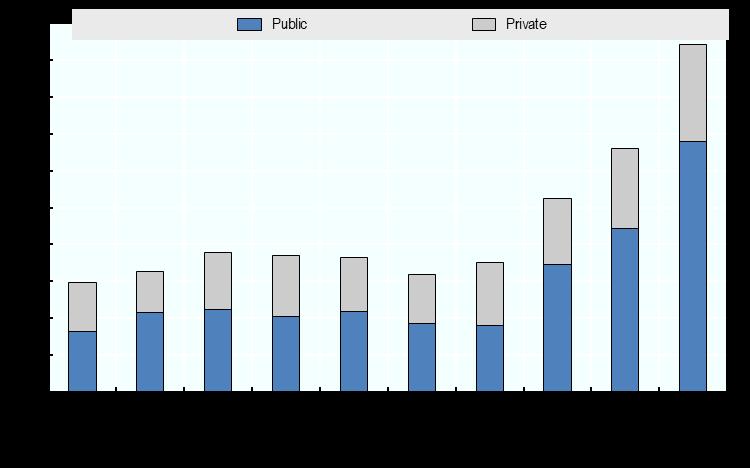
Overall, infrastructure investments in Egypt are largely driven by public spending with the share of private investments relatively lower. Data by the Central Bank of Egypt suggests that the government invested over 56% of total public investments in economic infrastructure in FY 2016-17, up from 47% in FY 2007-08 (Figure 1). In 2019-20, infrastructure received 46% of total public investments5 (Ministry of Planning and Economic Development, 2021[18]). The recent increase in public spending to counter the impact of COVID-19 in the economy will likely have an impact on public finances and may reduce the space for public investment in infrastructure. As a result, greater private sector involvement in infrastructure, including through PPPs could not only improve the efficiency of infrastructure operations and bring new technologies and skills (OECD, 2015[19]), but also reduce the fiscal burden on Egypt’s public finances.
Figure 1: Public and private investments in economic infrastructure assets
EGP billions (2007-2017)
Note: Economic infrastructure covers investments in “Electricity”, “Water”, “Drainage”, “Construction and Building”, “Transportation and Storage”, “Communications”, “Information”, and “Suez Canal”.
Only preliminary data was available for years 2014/15, 2015/16 and 2016/17.
Source: Central Bank of Egypt
Key questions
What types of infrastructures projects should be targeted to ensure spillovers across other sectors of the Egyptian economy?
How can the Egyptian regulatory framework promote further private sector engagement in infrastructure projects?
How can promoting sustainable infrastructure help attract more FDI to drive Egypt’s growing economy?
FDI in the infrastructure sector in Egypt remains below its potential
Foreign investment inflows have been steadily increasing since 2011, and despite more modest inflows in recent years and the Covid-19 pandemic, Egypt remains the largest recipient of FDI in Africa (UNCTAD, 2021[20]). In 2020, FDI inflows amounted to USD 5.9 billion, a decrease of 35% compared to the previous year (ibid). A sectoral breakdown of announced greenfield investments in Egypt between 2003 and 2019 shows that coal, oil and natural gas and manufacturing of chemicals accounted for 37% and 33% respectively of a total of USD 245 billion in investments (Figure 2). Investments in renewable energy and the transport sectoralsoattracted USD 12.8and 9.6billion of investments respectively,
the highest compared to other North African countries but very low compared to the share of the coal, oil and gas sector. Attracting more investments in sustainable infrastructure would contribute to the country’s current priorities to develop new trade routes and transportcorridors,includingthenewstrategyoftheSCZone2020-25tobecomeagateway to African and other global markets6
Figure 2. Greenfield FDI in Egypt by economic activity, 2003-2017
Cumulated Greenfield FDI capital between January 2003 and September 2017 in USD million
Note: Other includes Rubber, Leisure & entertainment, Consumer products, Paper, printing & packaging, Pharmaceuticals, Minerals, Automotive components, Business machines & equipment, Healthcare, Electronic components, Semiconductors, Aerospace, Non-automotive transport OEM, Engines & turbines, Space & defence, Medical devices
Source: OECD based on fDi Markets (2021)
Key questions
How can Egypt enhance the attractiveness and competitiveness of its infrastructure sector vis-à-vis international investors?
What can betheroleoftheEgyptian privatesectorin attractingquantityandquality investment in infrastructure?
How can the Egyptian government align public and private investments to ensure coherency in infrastructure financing?
Key challenges continue to negatively affect investments in the infrastructure sector
FDI can bolster the impact of infrastructure on development outcomes through filling financial needs and improving infrastructure performance (OECD, 2021[21]) This contribution will ensure the implementation of new infrastructure projects and necessary
refurbishments to prevent from assets deficiency that might impact on private sector’s competitiveness (OECD, 2020[22]) However these outputs depends on addressing remaining obstacles to attract further investment.
Inthiscontext,theprivatesectorconsultationwillfocusonthreemainchallengeshindering the potential impact of the sector on economic development: (i) the lack of an adequate business and regulatory environment; (ii) addressing private financing and (iii) sustainability and integration in GVCs.
Challenge 1: Lack of adequate business and regulatory environment
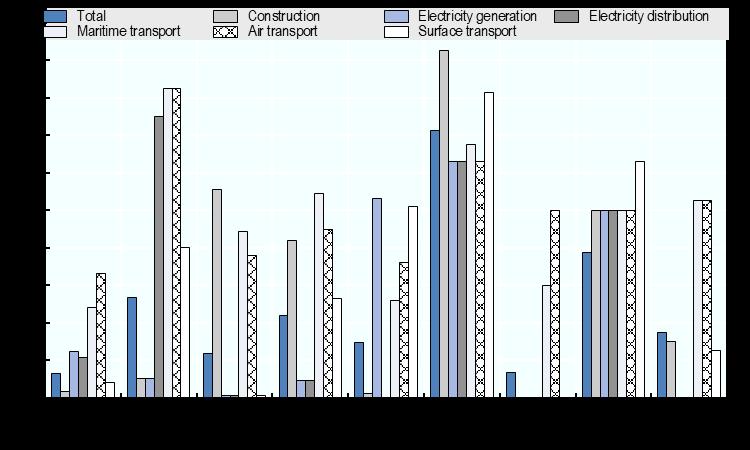
Egypt has made progress in improving its investment climate, including through the new Egyptian Investment Law from 2017 (Law No. 72 of 2017) that aims to remove discrimination between foreign and domestic investors. Based on statutory FDIrestrictions (those explicit in regulations or laws) as of year-end 2019, Egypt is as liberal as OECD countries overall, while Libya, the Palestinian Authority and Algeria are significantly more restrictive than OECD and non-OECD peers. Yet, Egypt presents higher restrictions in the construction sector, maritime, air, and transport services than the OECD average and some of its regional peers (OECD, 2021[23]) (Figure 3). For instance, Egypt’s Maritime Law 1 of 1998 only allows foreign investments in the form of joint venture companies in which foreign equity does not exceed 49% (OECD, 2017[24]) The Construction Law 104 of 1992 also restricts foreign investment to joint-ventures in which foreign equity does not exceed 49%.
In addition, foreign participation in electrical wiring and other building completion and finishing services is restricted to projects valued at more than USD 10 million (OECD, 2017[24]). Such restrictions on investment could affect competition in the market as well as thequalityofinfrastructureservicesneededtoimproveconnectivity.Removingrestrictions on service sectors such as maritime, air and transport, could also allow Egypt to enhance investments in high-quality logistics and move into higher-value added industries.
Figure 3: OECD FDI Regulatory Restrictiveness Index in selected sectors
Closed=1; Open=0 (2020)
Source: OECD, 2020
Besides these statutory restrictions on FDI, other barriers limiting investments in the infrastructure sector in Egypt include the complexity of regulatory procedures and lack of an adequate business climate. In particular, the lack of a clarified regulatory framework
governing infrastructure activities in Egypt causes challenges when navigating the numerous coexisting channels for private sector engagement and sector-specific laws regulating this sector. This is amplified by problems pertaining to contractual uncertainty, a complex land system registration and the lack of clarity on procurement contracting procedures. These are all mentioned as major impediments to investments by local private actors operating in infrastructure sectors (EBRD, 2017[25]) Clarifying infrastructure strategies and priorities and their integration with other economic sectors is also key to improve the overall business climate
Challenge 2: Addressing private financing
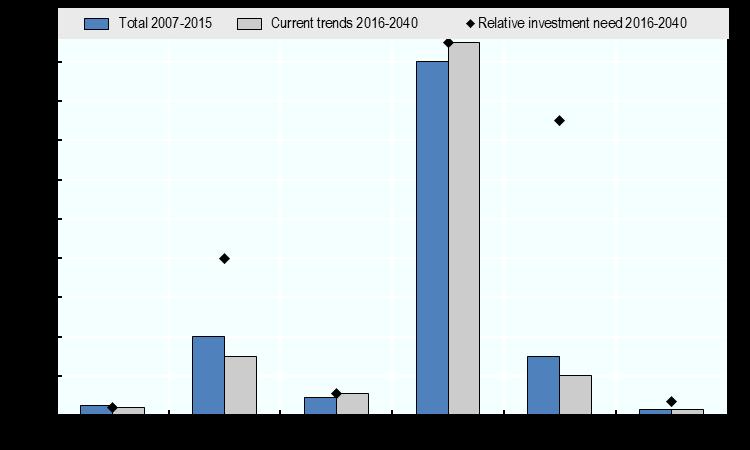
Infrastructure in Egypt is mainly provided by the public sector through state-owned enterprises (SOEs) that typically award direct subcontracts to private sector entities, including to foreign investors. Public-private partnerships (PPPs) are limited but they are an important avenue through which private sector resources and expertise can be leveraged in Egypt. The infrastructure investment gap is estimated to be at least USD 675 billion, or 5% of GDP, between 2016 and 2040 (Global Infrastructure Hub, 2017[26]) (Figure 4) At current levels of spending, this translates into an investment gap of USD 230 billion per year, or1.7% of GDP.These gaps areparticularlyimportant insome sectorsincluding inter alia, electricity and roads at respectively USD 251 billion and USD 212 billion.
In an effort to attract further private sector engagement in infrastructure, Egypt implemented a number of reforms that slightly increased private sector participation In 2010, it strengthened its PPP regulatory framework through a PPP Law (Law PPP No.67 from 2010) allowing private entities to perform infrastructure projects and public utilities for contracts of up to 30 years duration. It complemented the creation of a PPP Central Unit (PPPCU) supporting authorities in the preparation of PPP projects in 2006 and a PPP Supreme Committee coordinating with different relevant ministries. Despite these legislative efforts, the lack of resources allocated to the PPPCU, as well as limited tracking and implementation were identified as obstacles to higher private sector engagement in PPPs.
These infrastructure needs could also be partially covered by non FDI tools such as bonds but with the risk of further reducing the space for private sector engagement in infrastructure.On the otherhand,theestablishment ofthe Sovereign Fund of Egypt in 2018 and its initial USD 12.7 billion (EGP 200 billion) capital might provide new opportunities, along with more flexibility for investors to engage in infrastructure projects. Such arrangements might lower management fees and improve investors’ visibility (Lopez, 2019[27]) Overall, switching to a more market-oriented model through private sector engagement can increase competitiveness through more efficient procedures and lowering costs. It can in turn, induce positive spill overs in other sectors such as transportation, or industries engaged in global value chains.
Figure 4: Infrastructure investment needs in Egypt
Percent of GDP, (2016-40)
Source: Global Infrastructure Hub Outlook 2018
Challenge 3: Sustainability and integration in value chains
Attracting quality investments in infrastructure in Egypt is key to align with the sustainable development goals and objectives of the Paris Agreement. While the country is endowed with renewable energy sources such as solar and wind, there is scope to further increase the share of renewables in the energy mix. For instance, the share of renewable energy in final energy consumption is between 5 and 5.5% in Egypt and Jordan, and between 10 and 12% in Morocco and Tunisia (IEA, 2020[28]). Similarly, the share of renewables in electricity production is 8.5% in Egypt compared to 35% in Morocco, partly due to the fact that Egypt still relies on fuel consumption (OECD, 2021[23]). Despite their attractiveness andpotential,investmentsinrenewables remainfarbehindthelevelsallocatedtoextractive industries.
In an effort to address this issue, Egypt adopted a Sustainable Energy Strategy 2035 aimed at covering 20% of its electricity needs with renewable sources in 2022, compared with only 3% in 2015 (World Bank, 2021[11]). Other measures include the Feed-in-Tariff Act that provides several advantages and incentives such as land granting, or tax incentives for investors in renewable power projects. These efforts were complemented by the adoption of the new Electricity Law (Law No. 87 of 2015) liberalising electricity transmission activities towards more competition to reduce market entry costs for renewable energy players. In 2019 Egypt was the first country in the MENA region to issue green bonds with atotalvalueofUSD750millionoverfiveyearsandwithaninterestrateof5.25% 7 Overall, these initiatives can contribute in raising the sectors’ attractiveness to international investors but might not be sufficient if other limits to FDI are not addressed.
Similarly to sustainability, addressing connectivity issues in Egypt can also contribute to boost economic activity and increase attractiveness for investors. Thanks to a boost in investment over the last decade, Egypt has advanced the most in the region on the indicator of “quality of trade and infrastructure”8 (e.g. ports, roads, airports, information technology) of the World Bank’s Logistic Performance Index9. Yet, despite such progress, major challenges on connectivity remain including a lack of multimodal transport, overreliance
on roads, a fragmented port system, and low efficiency of the railway sector (OECD, 2020[22]) For freight, there is no integrated scheme yet in place that would encourage intermodal rail-road-river transport.
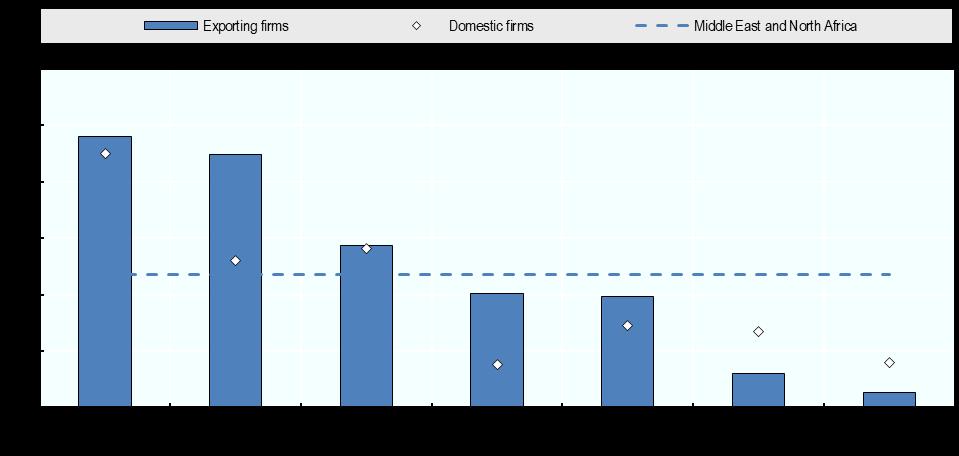
Addressing bottlenecks in logistics and the transport infrastructure could also lead to more trade and investment, stimulating the growth of manufacturing firms in particular. According to the World Bank enterprise surveys, 13% of domestic firms identified transportation asa major constraint ontheiractivity(Figure 5) (World Bank, 2020[29]) This is lower compared to many of its neighbours in the Mediterranean, such challenges can add to logistics costs, further limiting Egypt’s relatively low integration in regional and global value chains (OECD, 2018[30])
Figure 5: Exporting firms identifying transport costs as a major constraint
As % of manufacturing firms
Source: World Bank, Enterprise surveys, 2020
Key questions
What are the most important obstacles for private sector development and the attraction of quality FDI in the infrastructure sector of Egypt?
Besides those listed in this paper, what other challenges exist?
How can the private and public sector build grounds for important reforms such as competition or further removing investment restrictions?
What policies are needed to enhance the competitiveness of Egyptian MSMEs in infrastructure-related subsectors, to enhance competition and innovation in the sector?
How can the Egyptian private sector support sustainable infrastructure development?
OECD policy frameworks and tools can support Egypt’s efforts to improve the competitiveness and attractiveness of its Infrastructure sector
Over the years, the OECD has developed a number of policy tools on investment that can help Egypt improve the competitiveness of its infrastructure sector and its attractiveness for international investors.
The OECD Framework for the Governance of Infrastructure provides policy solutions to the main challenges in the governance of infrastructure investments. It is based on an assessment of the current practices in infrastructure governance and key obstacles encountered throughout the policy cycle. For each challenge, this framework suggests practical policy tools and benchmark indicators that can support policy makers in improving infrastructure management (OECD, 2017[31])
The OECD Guidelines on Multinational Enterprises, contain key recommendations addressed by governments to MNEs operating in or from adhering countries. The Guidelines recognise that MNEs have a responsibility to ensure that their international business operations contribute positively to sustainable development outcomes. In this context, they include a recommendation to MNEs on improving their environmental performance and reduce greenhouse gas emissions (OECD, 2011[32]).
The OECD Policy Framework for Investment (PFI) brings together key guidelines to help governments create the right conditions to attract domestic and foreign investment. Investment policies can participate in enhancing connectivity, notably through enhancing market openness, investment promotion and facilitation, and by enhancing the impact of FDI on sustainability. A specific chapter is dedicated to investment in infrastructure that highlights key principles including creating an enabling environment for investment as well as encouraging inclusiveness and responsible conduct. (OECD, 2015[33]).
o Based on the PFI, the FDI Qualities Indicatorsand ongoing work on a Policy Toolkit also address the ways in which infrastructure investments can contribute tosustainable development. In particular,it focuses onways FDIcan support decarbonisation and efficiency improvements of the energy sector (OECD, 2019[34])
The OECD Principles for Private Sector Participation in Infrastructure established in 2007 supports government engagement with the private sector on financinginfrastructure projects that hold significant potential economic outcomes, in particular, transport, water and power supply and telecommunications (OECD, 2007[35]). The principles outline a checklist of policy considerations to ensure the benefits of these projects and services to the economy and viable returns to private sector partners.ThePrinciples canbeusedfor government assessment,action plans and reporting, international co-operation and public-private dialogue, in conjunction with other OECD instruments, such as the Policy Framework for Investment and the OECD Guidelines for Multinational Enterprises.
The OECD Principles for Public Governance of Public-Private Partnerships provides guidance to policy makers in ensuring that selected PPP projects –including in infrastructure - have value added (OECD, 2012[36]) The 12 principles give directions to assess cases in which PPPs are relevant and then focus on the public sector role in safeguarding PPPs benefits throughout each step of the process. The principles focus on three main objectives:
o Establish a clear, predictable and legitimate institutional framework supported by competent and well-resourced authorities.
o Ground the selection of Public-Private Partnerships in value for money.
o Use the budgetary process transparently to minimise fiscal risks and ensure the integrity of the procurement process.
The OECD Policy Guidance for Investment in Clean Energy Infrastructure supports governments in addressing barriers and identifying ways to scale up private investment in clean energy infrastructure (OECD, 2015[37]). It addresses all aspects pertaining to investment attraction from policy requirements, investment promotion and facilitation, as well as public governance considerations.
The OECD Compendium of Policy Good Practices for Quality Infrastructure Investment compiles best practices and measuring tools for quality infrastructure investments in accordance with international standards and the G20 Principles for Quality Infrastructure Investment It includes specific recommendations on integrating the private sector in infrastructure projects in order to bring expertise, achieve economies of scale as well as cost effectiveness (OECD, 2020[38])
o Based on the Compendium, the OECD Implementation Handbook for Quality Infrastructure Investment provides concrete guidance on ways in which quality infrastructure investment can support policy priorities including underpinning sustainable development. The Handbook focuses on major investment issues in the context of the post COVID-19 era and provides practical solutions to them. It includes a dedicated chapter on mobilisingfinancefor qualityinfrastructureinvestment that outlines existing challenges such as project risk-assessment or risk mitigation and potential options to manage these (OECD, 2021[39])
Key questions
How can the existing OECD policy tools best support reforms to boost the Egyptian infrastructure sector?
How can the OECD best support sustainable sectoral PPD in Egypt?
References
Central Bank of Egypt (2020), Annual Report 2019-2020, https://www.cbe.org.eg/en/EconomicResearch/Publications/Pages/AnnualReport.aspx
CIHEAM (2018), Strengthening the role of women in rural and agricultural areas – obstacles and opportunities in the Mediterranean region, https://www.ciheam.org/watchletters/strengthening-the-role-of-women-in-rural-andagricultural-areas-obstacles-and-opportunities/.
[42]
[15]
EBRD (2017), Private Sector Diagnostic, Egypt, https://www.ebrd.com/where-weare/egypt/overview.html [25]
Global Infrastructure Hub (2017), Global Infrastructure Outlook: Infrastructure investment need in the Compact with Africa countries, Oxford Economics, https://www.oxfordeconomics.com/recent-releases/99f4fa86-a314-4762-97c6fac8bdcbe40a
IEA (2020), Data and Statistics: Renewable share in final energy consumption, https://www.iea.org/dataandstatistics?country=ALGERIA&fuel=Renewables%20and%20waste&indicator=SDG72 (accessed on 18 November 2021).
IFC (2020), Creating Markets in Egypt, Realizing the full potential of a productive private sector, https://www.ifc.org/wps/wcm/connect/af513599-08b4-45a4-b3461a44de58cda6/CPSD-Egypt.pdf?MOD=AJPERES&CVID=npT1-BJ.
ILO (2019), Growth and Precariousness in Egypt, https://www.ilo.org/wcmsp5/groups/public/ ed_emp/documents/publication/wcms_735169.pdf
ILO (2016), Employment Impact of Infrastructure Investment in Egypt, https://www.ilo.org/wcmsp5/groups/public/ ed_emp/documents/publication/wcms_575881.pdf.
IOM (2017), Egypt Labour Market Report, https://publications.iom.int/system/files/pdf/egypt_labour_market_report.pdf
IRENA (2019), Renewable energy: a gender perspective, https://www.irena.org/publications/2019/Jan/Renewable-Energy-A-Gender-Perspective
Lopez, D. (2019), Will Sovereign Wealth Funds Fill the FDI Gap?, https://www.fdiintelligence.com/article/75974.
[26]
[28]
[17]
[8]
[6]
[9]
[10]
[27]
Louay, C. et al. (2020), Barriers to Employment That Women Face in Egypt: Policy Challenges and Considerations., https://www.rand.org/pubs/research_reports/RR2868.html. [12]
Ministry of Planning and Economic Development (2021), , https://mped.gov.eg/singlenews?id=445&lang=en
Ministry of Planning and Economic Development (2021), National Accounts Data, https://mped.gov.eg/Investment?lang=en
Moszoro, M. (2021), The Direct Employment Impact of Public Investment, https://www.imf.org/en/Publications/WP/Issues/2021/05/06/The-Direct-EmploymentImpact-of-Public-Investment-50251.
OECD (2021), FDI Qualities Policy Toolkit, Policies for improving the sustainable development impacts of investment
OECD (2021), Middle East and North Africa Investment Policy Perspectives, OECD Publishing, https://doi.org/10.1787/6d84ee94-en
OECD (2021), OECD Implementation Handbook for Quality Infrastructure Investment, https://www.oecd.org/finance/oecd-implementation-handbook-for-quality-infrastructureinvestment.htm.
OECD (2021), Regional Integration in the Union for the Mediterranean: Progress Report, https://doi.org/10.1787/325884b3-en.
OECD (2020), Compendium of Policy Good Practices for Quality Infrastructure Investment, https://www.oecd.org/finance/oecd-compendium-of-policy-good-practices-for-qualityinfrastructure-investment.htm [38]
OECD (2020), OECD FDI Regulatory Restrictiveness Index, https://stats.oecd.org/Index.aspx?datasetcode=FDIINDEX#. [44]
OECD (2020), OECD Investment Policy Review: Egypt 2020, https://www.oecdilibrary.org/deliver/9f9c589a-en.pdf?itemId=/content/publication/9f9c589aen&mimeType=pdf.
[22]
OECD (2020), OECD Investment Policy Reviews: Egypt 2020, OECD Publishing, https://doi.org/10.1787/9f9c589a-en [43]
OECD (2019), FDI Qualities Indicators -Measuring the sustainable development impacts of investment, https://www.oecd.org/investment/FDI-Qualities-Indicators-MeasuringSustainable-Development-Impacts.pdf
OECD (2018), Making Global value chains more inclusive in the MED region: The role of MNE-SME linkages, Draft Background paper, https://www.oecd.org/mena/competitiveness/BN-Making-global-value-chains-moreinclusive-Beirut-04201.
[34]
[30]
OECD (2017), Getting Infrastructure Right: A framework for better governance, https://doi.org/10.1787/9789264272453-en.
OECD (2017), National Treatment for Foreign Controlled Enterprises, Including Adhering Country Exceptions to National Treatment, https://www.oecd.org/daf/inv/investmentpolicy/national-treatment-instrument-english.pdf [24]
OECD (2015), Policy Framework for Investment, https://www.oecd.org/investment/pfi.htm
OECD (2015), Policy Guidance for Investment in Clean Energy Infrastructure: Expanding Access toClean Energy for Green Growth and Development, OECD Publishing, http://dx.doi.org/10.1787/9789264212664-en
OECD (2015), Policy Guidance for Investment in Clean Energy Infrastructure: Expanding Access toClean Energy for Green Growth and Development, OECD Publishing, http://dx.doi.org/10.1787/9789264212664-en
OECD (2012), Recommendation of the Council on Principles for Public Governance of Public-Private Partnership, https://www.oecd.org/governance/budgeting/PPPRecommendation.pdf
OECD (2011), Guidelines on Multinational Enterprises, http://mneguidelines.oecd.org/guidelines/.
OECD (2007), OECD Principles for Private Sector Participation in Infrastructure, OECD Publishing, https://doi.org/10.1787/9789264034105-en.
OECD et al. (2021), Production Transformation Policy Review of Egypt: Embracing Change, Achieving Prosperity, OECD Publishing, https://doi.org/10.1787/302fec4b-en
Oxfam (2019), Women’s unpaid work in Jordan, Lebanon, Tunisia and Egypt, https://oxfamilibrary.openrepository.com/bitstream/handle/10546/620811/rr-countingwomens-work-unpaid-care-mena-region-030619-en.pdf?sequence=1.
[41]
[16]
Phi, N. et al. (2019), Performance Differential Between Private and State-Owned Enterprises: An Analysis of Profitability and Leverage, https://www.adb.org/sites/default/files/publication/503476/adbi-wp950.pdf. [40]
UNCTAD (2021), World Investment Report 2021, United Nations Publications, https://unctad.org/system/files/official-document/wir2021_en.pdf
US International Trade Administration (2021), Egypt Commercial Guide, https://www.trade.gov/country-commercial-guides/egypt-infrastructure
World Bank (2021), World Bank Development Indicators, https://data.worldbank.org/indicator/SL.TLF.CACT.FE.ZS?locations=EG. [11]
World Bank (2020), Convergence: Five Critical Steps toward Integrating Lagging and Leading Areas in the Middle East and North Africa, http://dx.doi.org/10.1016/978-1-46481450-1
[2]
World Bank (2020), Enterprise Surveys, https://www.enterprisesurveys.org/en/enterprisesurveys.
World Bank (2018), Women Economic Empowerment Study, https://documents1.worldbank.org/curated/en/861491551113547855/pdf/134846-WPPUBLIC-march-2-WB-Women-Study-EN.pdf
World Bank (2012), World Development Report 2012: Gender Equality and Development, https://openknowledge.worldbank.org/handle/10986/4391
World Bank (2020a), Building forward better in MENA: How infrastructure investments can create jobs, https://blogs.worldbank.org/arabvoices/building-forward-better-mena-howinfrastructure-investments-can-create-jobs.
[29]
[13]
1 https://data.worldbank.org/indicator/SL.TLF.TOTL.IN?locations=EG
2 The study focused on the Egyptian Pollution Abatement Project II in the environment sector and Giza North Power Generation Plant project and Egyptian Power Transmission Project in the energy sector.
3 This number is based on estimations from the ILO of female labor force participation rate in proportion of total female population over 15.
4 Under a BOT the private sector finances builds and operates a new infrastructure facility or system using its own capital with in return, a commitment from the public sector to purchase a minimum level of output. The public sector retains the ownership of the infrastructure facilities and becomes both the customer and the regulator of the service.
5 This includes public investment in electricity, water and sewerage, construction, storage and transportation, information, communications and Suez Canal.
6 See Suez Canal Economic Zone Website, Outline of 5-year strategic orientations, https://sczone.eg/next-5-year-plan/
7 For more details see http://country.eiu.com/article.aspx?articleid=1630223146
8 Egypt advanced its score from 2.22 in 2010 to 2.82 in 2018 on a scale from 1 (worst) to 5 (best), ranking from 106th (out of 155) in 2010 to 58th (out of 160) in 2018.
9 The World Bank Logistics Performance Index (LPI), is based on a worldwide survey of logistics operators on the ground, providing feedback on the logistics “friendliness” of the countries in which they operate and those with which they trade. It measures performance along six dimensions of the logistics supply chain, including: 1) Efficiency of the clearance process (i.e., speed, simplicity and predictability of formalities) by border control agencies, including customs; 2) Quality of trade and transport related infrastructure (e.g., ports, railroads, roads, information technology); 3) Ease of arranging competitively priced shipments; 4) Competence and quality of logistics services (e.g., transport operators, customs brokers); 5) Ability to track and trace consignments; 6) Timeliness of shipments in reaching destination within the scheduled or expected delivery time
[14]
[3]