






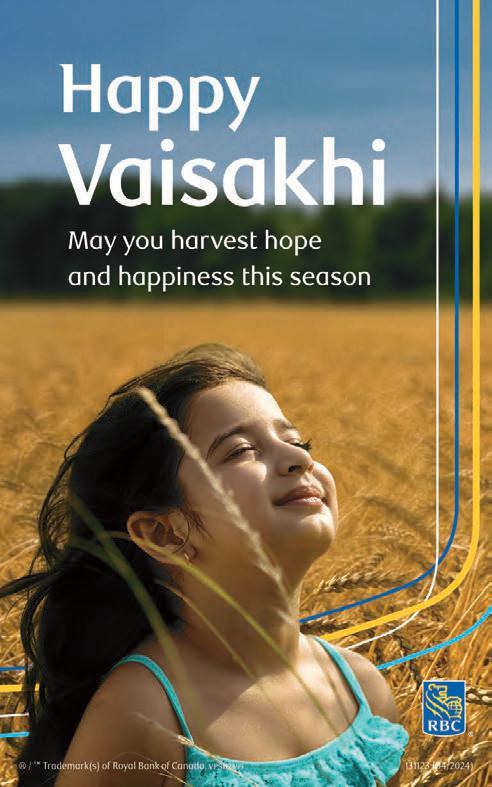
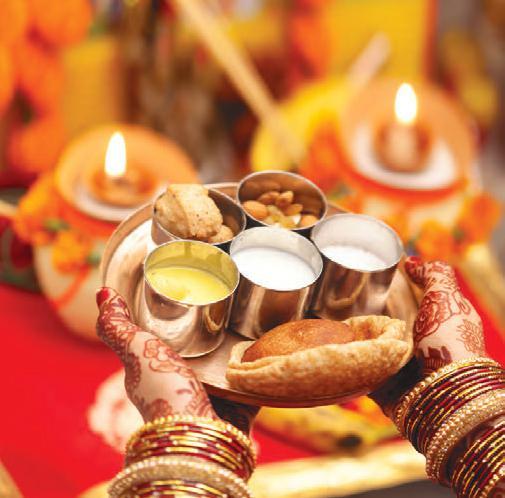



This is a time of celebrating Sikh Heritage Month and Vaisakhi, the Birth of Khalsa. This is also a time to celebrate 14 years of success of Drishti magazine on this Vaisakhi, and it is a landmark for us. We would have never made it this far without all the support from our community, loyal readers, subscribers, advertisers, and our entire creative teams. Diversity, Inclusion, and Equity are fundamentals to the success of DRISHTI.
Vaisakhi’s signs and positive vibes are all around us and showcased in this special issue of Drishti with inspirational stories and engaging content. All the stories in this issue bring you hope and positivity and show that you never give up throughout life’s trials. Thanks for being here for our 14th anniversary and our special issue for Vaisakhi. We will keep you entertained, enlightened, and encouraged. At this beautiful festival, I wish you all love, prosperity, and a life filled with joy and happiness.


Publisher
Nawal Tandon
Editors
J.M.Lee
Changye Fan
Advisor
Anil Sharma
Advertising Sales
Nawal Tandon
Graphic Designers
Jatinder & Jose
Writers
Dr. Devinder Pal Singh
Anjali Pathak
Pooja Valeja
Gurleen Kaur Bajwa
Dr. Arun Garg
Dr. Rishi Singh Drishti Media Group Ltd.
Drishti Magazine is published by Drishti Media Group Ltd. The views expressed and images used in the articles of this Magazine are solely of their writers. It is not mandatory or complusary for the Publisher and/or the Editor of this publication to be in agreement with these views. The whole matter in this magazine has been taken from approved and accepted sources, and while publishing the same, every care has been taken, but even in case there is any flaw or error, the Publisher and/or the Editor will not be responsible for it. The readers are advised to get all information from the sources directly and not through this magazine. Any reproduction of this magazine, editorial content, images or advertisement cannot be reproduced or reprinted in any other form, without prior written permission from the Publisher.










64 Meaning & importance of Karah Parshad
Sikh Heritage Month in BC
68 e Constructive role of parents in a child’s success 70 You, your health & your heart VAISAKHI RECIPES 72 Ultimate tadka dal
Sweet rice with orange zest
Crispy paneer sticks
Masala Chai
Beetroot Kheer

Drishti Magazine is published by Drishti Media Group Ltd.
e views expressed in the articles of this Magazine are solely of their writers. It is not mandatory or complusary for the Publisher and/or the Editor of this publication to be in agreement with these views. e whole matter in this magazine has been taken from approved and accepted sources, and while publishing the same, every care has been taken, but even in case there is any aw or error, the Publisher and/or the Editor will not be responsible for it. e readers are advised to get all information from the sources directly and not through this magazine. Any reproduction of this magazine, editorial content, images or advertisement cannot be reproduced or reprinted in any form, without prior written permission from the Publisher.

BY DR. DEVINDER PAL SINGH
n our diverse and interconnected world, fostering understanding and appreciation for various cultures and religions is crucial. One such rich and inclusive tradition worth exploring is Sikhism. Rooted in the principles of equality, compassion, and sel ess service, Sikhism o ers valuable lessons that can shape the character and
values of children. In this essay, we will delve into why children need to learn about Sikhism and consider adopting its way of life.
Guru Nanak founded Sikhism, a monotheistic religion, in the Indian subcontinent in the eenth century. From its inception, Sikhism has been a beacon of inclusivity, transcending

the boundaries of caste, creed, and social status. e teachings of Sikhism emphasize the oneness of God, the equality of all human beings, and the pursuit of a life guided by morality and virtue. First and foremost, Sikhism promotes the fundamental principle
of equality. In a world o en marred by discrimination and prejudice, instilling the idea that everyone is equal and deserving of respect is invaluable. Sikh teachings reject the divisive notion of caste and emphasize that all are equal in the eyes of the divine. By learning about Sikhism, children can develop a deep appreciation for diversity and understand the importance of treating everyone with kindness and fairness.
Moreover, Sikhism encourages a life steeped in compassion and sel ess service. e concept of 'seva,' or sel ess service, is at the heart of Sikh practices. Children who embrace this principle learn that true ful llment comes not from self-centred pursuits but from helping others in need. Engaging in acts of kindness and service to the community becomes a natural extension of their character, fostering a sense of responsibility for the well-being of others.
Sikhism's emphasis on humility and compassion is another valuable lesson for children. In a
world o en preoccupied with individual success, Sikh teachings remind us that true greatness lies in humility and a compassionate heart. By adopting these qualities, children can cultivate excellent interpersonal skills, empathy and the capability to connect with others on a deeper level, contributing to a more harmonious and understanding society.
and a positive mindset. e rejection of ritualism and superstitions in Sikhism encourages a rational and practical approach to faith.
Children who learn about Sikhism are exposed to a worldview that values critical thinking and emphasizes ethical conduct over empty rituals. is rational approach fosters a mindset that seeks to

Sikhism also provides children with a spiritual foundation to guide them throughout their lives. Practicing prayer, meditation, and connection with the divine helps instill a sense of inner peace and resilience. In the face of life's challenges, the spiritual teachings of Sikhism o er children a source of strength and guidance, promoting emotional well-being
discern the world, make informed decisions, and contribute positively to society.
Sikhism's commitment to social justice and community harmony is particularly relevant in today's global context. Children who adopt the Sikh way of life are likely to develop a strong sense of social responsibility. e principles of Sikhism inspire individuals to stand up against injustice,
work towards creating a just society, and advocate for the rights of the marginalized.
Education is another pillar of Sikhism; establishing educational institutions is a testament to its commitment to learning. By encouraging children to learn about Sikhism, we not only expose them to a rich cultural and historical heritage but also emphasize the value of education. is commitment to intellectual growth can inspire children to follow excellence in their academic endeavours and contribute meaningfully to society.
Sikhism's environmental stewardship is also a lesson that resonates in today's world, where ecological awareness is paramount. By learning about Sikh
teachings emphasizing the interconnectedness of all creation, children can develop a deep admiration for nature and a sense of responsibility toward environmental conservation.
In conclusion, in a world that o en seems divided, Sikhism o ers a timeless message of unity, compassion, and the potential for positive transformation through simple acts of love and service. Introducing children to Sikhism and encouraging them to adopt its way of life is an investment in building a more compassionate, just, and harmonious future. e principles of equality, compassion, humility, and social responsibility inherent in Sikhism provide a solid ethical foundation for children to navigate the complexities of the
modern world. By embracing Sikh values, children not only enrich their own lives but also contribute to the creation of a more inclusive and virtuous society.

Dr. Devinder Pal Singh, M.Sc., Ph.D. is the Director of the Center for Understanding Sikhism, Mississauga, Ontario, Canada. He has published about 250 articles, three books and two booklets on various aspects of Sikhism in several newspapers and magazines in English, Punjabi, and Hindi. Website: c4usikhism.com

P E R M I N D E R



BY GURLEEN KAUR BAJWA
India has become known as one of the most culturally rich countries in the world. is is partly due to a diverse population participating in unique traditions and lifestyles nationwide, including festivals celebrating everything from religious occasions to celestial events and seasonal changes. Among those many festivals, however, only some have become
as representative of the nation internationally as Vaisakhi. And its signicance can be understood and explained.
Vaisakhi’s origin is simple, serving to signal the coming of spring as the grain harvest festival, especially in Punjab and Northern India. It’s easy to see the festival’s signi cance for that purpose alone since India’s roots (and heart) lie in its farmland. Proof
of this can be seen in the 2020- 2021 Indian Farmer Protests, which involved tens of thousands of farmers rallying for better working conditions and garnered worldwide attention for its massive scope. An incredible sixty percent of India’s 1.6 billion population’s livelihoods depend on the land. Farming is inarguably a vital part of India and its industries, and it
always was, which is why Vaisakhi was so widely celebrated. But as important farming is to India, and while Vaisakhi did start as a thanksgiving to the natural elements, it is not o en remembered for that now—the reason why it started with Vaisakhi in 1699.
e Mughal Empire is o en considered one of South Asia’s earliest modern empires. It was founded in 1526 by Babur and lasted for over two centuries till 1857. But by the time it came to be led by the sixth Mughal Emperor Aurungzeb in 1658, it had already begun its decline. is was in part due to Aurungzeb’s increasingly repressive and intolerant policies, under which the ninth Guru of the Sikhs was also persecuted and achieved martyrdom in 1675. is incident likely in uenced the events of Vaisakhi in 1699.
Vaisakhi was a well-celebrated day, with many Sikhs visiting Anandpur annually to seek blessings
from the Sikh Guru. Still, the Vaisakhi of 1699 became a signi cant landmark in Sikh history. It marked the institutionalization of the Khalsa by the tenth Guru, Shri Guru Gobind Singh Sahib Ji. One of the purposes of this was to protect the innocent against religious persecution, which was rampant under Aurungzeb’s rule. is event came to be so monumental to the identity of Sikhs that it has rede ned the very celebration of Vaisakhi.
Several other Indian historical events also came to take place on Vaisakhi, both joyous and tragic. In 1801, Ranjit Singh was proclaimed Maharaja on this day, the rst Maharaja of the Sikh Empire. Just over a century later, in 1919, Bengal Army o cer Reginald Dyer ordered forces to shoot peaceful protestors in the Jallianwala Bagh massacre, also on Vaisakhi, which inspired such widespread anger that it is o en considered the beginning


of the end of the British rule in India. It should be noted that this is still a minimal introduction to Vaisakhi’s signi cance to India. Vaisakhi means di erent things in di erent regions of the country—some consider it the Indian New Year (according to the Indian Solar calendar). In contrast, others associate it with worshiping various deities, including Durga in Himachal Pradesh and Vishnu in Southern India. Outside of India, however, Vaisakhi has become synonymous with the inauguration of the Khalsa and is widely celebrated as such in countries like the United


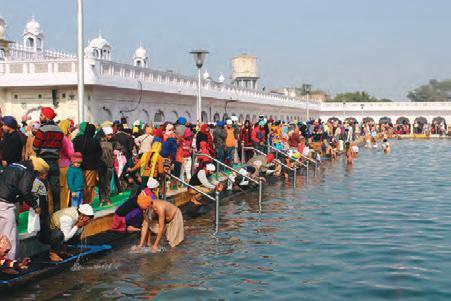
States and Canada. Of note, among those many celebrations is the Surrey Vaisakhi Parade.
Returning a er a three-year hiatus, the Surrey Vaisakhi Parade attracted more than half a million people in 2023. It is commonly considered the biggest Vaisakhi parade outside of India, featuring cultural oats, community performers, and live music. And this is no coincidence. Surrey, neighboring cities, and Canada have played a signi cant role in Sikhs settling in the West. e rst Sikh immigrants established themselves in
British Columbia, and the rst Gurdwara in North America was founded shortly a er in Abbotsford in 1908. Since then, the foreign population of Sikhs in Canada has signi cantly increased, especially between 1991 and 2000.
By 2011, the population had doubled that of 1991, and by 2019, Canada became the rst country in the world to pass a bill acknowledging April as Sikh Heritage Month. With such an expansive and rich history, Canada, particularly British Columbia, became a cultural hub for Sikhs, so
much so that ‘Indo-Canadians’ have taken on a sub-identity of their own. One that is on display during the Surrey Vaisakhi Parade, which stands out in comparison to its Indian contemporaries in many ways, from its diverse participants that come from various cultures and religions to the fact that it is very much communityhosted, bringing together local organizations and businesses. e parade re ects how far the celebration of Vaisakhi and Sikhs have come from their beginnings and how far they will let go.




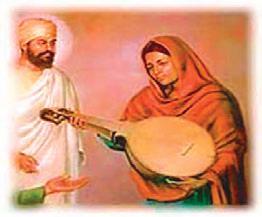
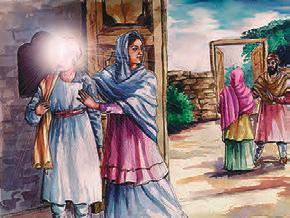
SBebe Nanaki ji (1464-1518) was the elder sister of Guru Nanak, the founder and rst Guru of Sikhism. Bebe Nanaki is an important religious gure of Sikhism, and is known as the rst Gursikh. She was the rst to realize her brother's "spiritual eminence"
he was born to father Kalyan Chand Mehta (Mehta Kalu) and mother Mata Tripta in the year 1464, at her grand-maternal home in the village of Chahal, now in Lahore district of Pakistan Punjab. e Guru's love for his sister is referred to in most touching terms in some of the Sakhis. A sister's love for her brother is a perennial theme of Punjabi folklore. ere are many stories of Nanaki's deep and devoted a ection for her brother, Nanak. Bebe Nanaki was ve years older then Guru Nanak, she was the rst to recognize his spiritual eminence and to become his devotee. She is o en
credited as becoming the rst Sikh. She protected Nanak from their father's wrath, when repeatedly he disappointed and angered him. She was with him throughout the early years of his childhood. When Guru Nanak Dev was only six years old in 1475, Nanaki was married to Bhai Jai Ram, a revenue o cial of very good reputation, at Sultanpur, which is in the present-day native state of Kapurthala, and was then the capital of the Jalandhar Doab. Nanak continued to live at home. He rebelled against Hindu ritual customs and rites that were imposed without reason. He loved to be in the company of saints, and gave money away to the poor and the hungry. His father despaired of never being able to make him behave and take on a respectable employed position in the village. Rai Bular, who revered young Guru Nanak, got continuous reports of Mehta Kalu's ire directed towards him. One day he invited Bhaiyya Jai Ram to his home, and advised him to take him to Sultanpur with him and
get him employment with the Nawab Daulat Khan of Sultanpur. He wrote a letter of recommendation for young Guru Nanak and so, at the age of een, Nanak came to live with his sister, and to work as a mamager of the royal granaries and provision stores of the Nawab of Sultanpur. It was Bhai Jai Ram who arranged the wedding of Nanak to Sulakhani, daughter of Baba Mool Chand Khatri and Mata Chando Rani of the village Pakhoke, District Gurdaspur.
Bibi Nanaki adored her brother, Nanak, and felt herself blessed when he came to join the Nawab's service and stayed with her at Sultanpur. Childless, she loved Guru
Nanak's sons, Sri Chand and Lakhmi Das, as if they were her own. Guru Nanakreciprocated her a ection and a er he had quit the Nawab's service to go out to preach his message, he did not fail to visit Sultanpur and meet with his sister between trips.
Once as he visited her in 1518, Bibi Nanaki sensing her end near, detained him a short while. Soon, she departed this life , as she had wished, in the presence of her brother — Guru Nanak Dev ji. ree days later, her husband, Bhai Jai Ram Ji, also passed away. Guru Nanak performed their obsequies. ere is no doubt that, perhaps, the rst Gur Sikh was none
other than Bibi Nanaki and second Gursikh was Rai Bular, the ruler of Talwandi.
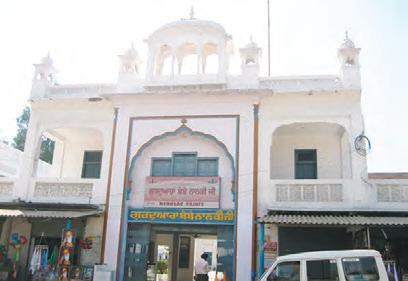
Gurdwara Bebe Nanaki Ji is situated in the Sultanpur Lodhi City of Kapurthala Distt. is sacred place was residence of Bibi Nanaki ji, constructed in 1970's, honours the memory of Bebe Nanaki, elder sister of Guru Nanak. e actual house, a three storeyed old building where Bebe Nanaki is believed to have lived with her husband, Jai Ram, is inside the old town in Mohalla Chhimbian.
But the premises being in private possession, a public monument (cornerstone, laid on 13 November 1970) was raised in the form of a gurdwara by Bebe Nanaki Istri Satsang Charitable Trust under the chairmanship of Bibi Balvant Kaur of Birmingham (United Kingdom). e Gurdwara Bebe Nanaki JI comprises a central hall, with the Guru Granth Sahib seated in a white marble palaki at the far end. e Guru Granth Sahib is also seated in a small sideroom symbolizing Bebe Nanaki's own lodging. Over the sanctum, above the hall
roof, is a square domed room with arched copings. Bulbous domes adorn the corners of the hall roof. is Gurdwara was in the news in the recent past because of neglect by the Gurdwara authorities regarding the
knowledge of heritage preservation during the beauti cation of this shrine as the original house of Bebe Nanaki Ji was destroyed during the construction process and was replaced by marble work.



by J.M. LEE
aajal’s dream of a massage therapy career was shattered by arthritis at 15, forcing her into a journey of resilience and adaptation.
At 15, Kaajal began experiencing wrist and
arm pain, noticing sti ness and weakness creeping into her hands. Initially, it manifested in her le hand, a ecting simple movements like opening a water bottle but not schoolwork. However, she
recalls struggling to close shop alone when her hand seized up, sometimes needing a family member’s help at the end of her shi .
Misdiagnosed with carpal tunnel, Kaajal didn’t yet know it was arthritis.
But the symptoms continued to escalate. “Suddenly, I was unable to move my hand. It was swollen, numb, tingly, cold and pale,” Kaajal recounts. “I was told my pain wasn’t treatable, and I would just have to wait for it to go away on its own.”
Yet, as one symptom
faded, another emerged.
“On one of the joints in my hand, I developed a swollen, red lump that was hot to the touch,” says Kaajal. “I went to my local clinic, and they immediately thought it was arthritis.” She recalled the doctor’s alarm at what she thought was a rare occurrence in a child. is led to a series of specialist appointments, numerous tests, and an eventual referral to BC Children’s Hospital, where Kaajal was diagnosed with polyarticular rheumatoid Factor Positive Juvenile Arthritis at 16.
e diagnosis came as a shock, challenging her family’s understanding that arthritis primarily a ected the elderly. Learning more about arthritis, Kaajal’s family rallied around her, helping her navigate her diagnosis with resilience and acceptance. ey educated peers, debunked arthritis myths, and participated in community fundraising events to raise money and awareness for Arthritis Society Canada. Having this support and community has been crucial to adjusting, but Kaajal says her are-ups are just plain hard. She never knows when they’ll show up. “I feel kind of
stuck when I have to rely on everybody else to do things for me,” She quietly shrugs. “It’s horrible having to rely on someone else to care for you, especially when friends are launching more independent lives.”
She knows the crushing reality of losing the ability to perform basic tasks like brushing her teeth and hair. She experienced humiliating skepticism when her employer demanded proof from swollen hands and doctors’ notes to explain why she couldn’t work her waitressing shi .
“When my arthritis ares up, it hits my hands and wrists. ey balloon up, and I can’t grip anything—not a toothbrush, a pen, or a fork,” shares Kaajal. “I need help washing and tying up my hair.”
But Kaajal refuses to wallow in self-pity. “To me, arthritis is a new way of living. I’ll have it for the rest of my life, and it means adjusting to my new normal when my are-ups occur.”
While pursuing a career in Human Resources, Kaajal jumped at the opportunity to work with Arthritis Society Canada for a school project.
“To me, arthritis is a new way of living. I’ll have it for the rest of my life, and it means adjusting to my new normal when my flare-ups occur.”
Witnessing rsthand the organization’s profound impact on the community and its support for people living with arthritis, she found herself drawn to non-pro t work and advocacy.
Inspired by their dedication, Kaajal, now 25, shares her story to raise awareness of arthritis whenever possible. “If I can help someone have a better experience than I did at 15 and 16, I will keep advocating for more awareness and better care.”
Learn more about


immigrant women facing domestic violence. Recognizing resource gaps, she advocated for Serenity House.
by J.M. LEE
eena is the Director of Women’s Programs and Initiatives at the Progressive Intercultural Community Services Society (PICS). Her primary focus is on
supporting immigrant women and children who escape domestic violence. Her journey at PICS began with a strong awareness of the need for enhanced support for
“ is is a second-stage transition house specically designed to support immigrant women eeing violence at PICS,” she explains. “In addition to my work in transition houses, I have been instrumental in securing funding for multicultural outreach initiatives. is has expanded services to include poverty law advocacy and helping low-income clients access crucial legal advice.”
Neena also facilitates newcomers’ access to settlement services,
One of the last hurdles to eradicating abuse is the culture of silence and shame that still exists today. Victims are led to believe they are alone, that no one will trust them, and others will think less of them.
collaborates with local developers to provide temporary housing solutions for the homeless, and actively contributes to broader discussions about domestic violence.
“I currently serve on the BC Society of Transition Houses board,” Neena reveals, “advocating for systemic changes and service improvements for survivors.”
One notable achievement attributed to Neena is her role in establishing the South Asian Helpline (SAHAS). is helpline ensures barrier-free access to emotional and practical support for community members experiencing crisis. It caters to diverse linguistic needs while providing culturally safe assistance.

Neena is an exceptional leader who lives with her family in BC’s Lower Mainland outside her professional responsibilities. She extends her passion for well-being by teaching yoga and meditation to children.
“ rough this holistic approach, I can foster resilience and balance.”
For Neena, personal success extends beyond individual achievements and encompasses positively impacting others’ lives.
“It is about nding ful llment in my work by creating lasting change within the community I serve,” she states.
Knowing she has made a di erence in their lives brings her accomplishment and personal ful llment. Moreover, Neena’s success
involves actively contributing to the broader discourse on domestic violence. “On the BC Society of Transition Houses board, I use my rsthand knowledge and expertise to advocate systemic changes and service improvements for survivors.”
By providing this culturally safe assistance, she is essential to in uencing policy decisions and driving positive change within the industry. Neena believes, “I can make a meaningful impact on people’s lives when they need me.”
Neena’s success extends beyond her professional accomplishments. As a certi ed yoga teacher, she embraces a holistic approach to well-being by teaching yoga and
meditation practices professionally and personally.
Neena’s quali cations, experiences, and contributions to her business showcase her strong business acumen. While her expertise lies in women’s programs and initiatives, she has demonstrated various skills and accomplishments that have contributed to her success.
• Director of Women’s Programs and Initiatives at the Progressive Intercultural Community Services Society (PICS): is position highlights her leadership abilities. She oversees and manages various programs that support immigrant women and children escaping domestic violence.
• Advocate for Enhanced Support: Her journey at PICS began with her recognition of the critical need for enhanced support for immigrant women facing domestic violence. Her determination led to successful advocacy e orts, such as establishing Serenity House. Serenity House supports immigrant women and children facing domestic violence. It advocates for Serenity House and multicultural outreach initiatives.
“Let’s all help build a larger community of awareness and understanding so that real work to end violence may begin.”
Acquisition: Her ability to secure funding for multicultural outreach initiatives demonstrates her pro ciency in resource acquisition. is funding has expanded services to include poverty law advocacy, ensuring low-income clients can access crucial legal advice.
• Collaboration with Local Developers: Another testament to Neena’s business acumen is her collaboration with local developers to provide temporary housing solutions for the homeless population. is partnership showcases her networking skills and ability to forge bene cial relationships within the community.
• Board Member: her service on the BC Society of Transition Houses board highlights her strategic thinking and dedication to advocating for systemic service changes for
domestic violence survivors. Her rsthand knowledge as a frontline worker informs her contributions to improving policies and procedures.
One of the last hurdles to eradicating abuse is the culture of silence and shame that still exists today. Victims are led to believe they are alone, that no one will trust them, and others will think less of them. For South Asian women especially, heavy societal, family, and status pressure generally falls on the victim instead of on the person committing the crime.
Women’s situations are complicated and unique, and no stereotype exists. Every abuse survivor is di erent from her peers. By sharing stories, we can educate ourselves about how pervasive domestic violence and sexual abuse/assault are. We can also learn how it crosses cultural, racial, and seriocomic lines. is is our society’s collective issue, not simply a problem of those directly impacted.
“Let’s all help build a larger community of awareness and understanding so that real work to end violence may begin,” Neena concludes.


MA, Ph.D (CAND)
by J.M. LEE IN KIDNEY RESEARCH
Kidney disease impacts one out of every ten Canadians. It is common among people with diabetes and chronic high blood pressure. For many, kidney transplantation,
especially from a living kidney donor, is the treatment of choice, but this is not always easy to achieve.
Reetinder Kaur is a Ph.D candidate and recipient of
the prestigious Kidney Research Scientist Core Education and National Training program, which trains future leaders in kidney research across Canada. rough her research, Reetinder is keen to understand the intersection of culture, gender, and health better. While completing her Ph.D in the Interdisciplinary
“My major goal is to mentor the next generation of researchers in health equity, particularly in the South Asian community,” says Dr. Gill.

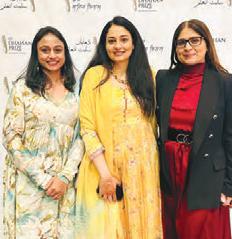
Studies Graduate Program, she works in the Faculty of Medicine at UBC with her Ph.D supervisor, Dr. Jagbir Gill. Dr. Gill is a transplant physician and Medical Director of the Kidney Transplant Program at St. Paul’s Hospital in Vancouver and is President of the Canadian Society of Transplantation.
Over the last 15 years, Dr. Gill and his colleagues in the UBC Kidney Transplant Research Program have led clinical and health services research and have informed innovations in kidney transplantation locally, nationally, and internationally. Dr. Gill currently leads several research grants and initiatives
funded by the Canadian Institute of Health Research and has received the Canadian Society of Transplantation Research Excellence Award and the Kidney Foundation of Canada Organ Donation & Transplantation Award. His research focuses on rede ning the health care system to ensure improved access to kidney transplantation and living kidney donation, particularly among Indigenous, South Asian, and other racialized communities.
Reetinder initially began working with Dr. Gill and the Progressive Intercultural Community Services to engage with and reach out to critical South Asian community

members and organizations to understand barriers to organ donation and transplantation in the South Asian community. Her involvement in this work quickly expanded. She has led focus groups and conducted qualitative research with patients and community members as part of the Health Canada-funded ACTION project to improve access to transplantation for South Asian Canadians.
“My major goal is to mentor the next generation of researchers in health equity, particularly in the South Asian community,” says Dr. Gill. “Reetinder is a prime example of our community’s incredible talent. With a focus on women’s health and how this in uences access to care and outcomes for
Organ donation is a life-altering gift that enables the medical marvel of transplantation. Education, awareness, and changes to the health care system that ensure everyone, regardless of age, gender, and background—can access this gift are essential.
women with kidney disease, Reetinder addresses an area o en forgotten in health care. Her experiences as a South Asian immigrant woman and links to the South Asian community have informed her research. ey will continue to ensure her research speaks to women from the South Asian community.”
Organ donation is a life-altering gi that enables the medical marvel of transplantation. Education, awareness, and changes to the health care system that ensure everyone, regardless of age, gender, and background—can access this gi are essential.
e work done by Reetinder, Dr. Gill, and their team is helping to make this a reality.











by J.M. LEE
n the dynamic tapestry of Canada’s multicultural landscape, Devinder Kaur Chattha stands as a beacon of empowerment and support for newcomers, refugees, and vulnerable populations. As the Senior
Director of Language, Settlement, and Social Programs at Progressive Intercultural Community Services (PICS) Society, her dedication to facilitating the integration and settlement of individuals
“Nearly half a century ago, I immigrated from India to Canada, which is the bedrock of my commitment to guiding others through similar experiences.”
into Canadian society is profound and impactful. Devinder’s journey into community support stems from a deep, ingrained, and ardent desire to aid individuals during transformative phases of their lives.
Devinder explains, “Nearly half a century ago, I immigrated from India to Canada, which is the bedrock of my commitment to guiding others through similar experiences.”
She epitomizes expertise in her eld with 28 years of rich and diverse experience coordinating, instructing, and managing programs and projects. Educationally astute, Devinder holds a Master’s in Education from Simon Fraser University,
“My family’s unwavering support and encouragement have been instrumental in my journey. They have cultivated a nurturing environment where my professional ambitions can flourish.”
complemented by a TESOL Diploma from Vancouver Community College and a second Master’s in English Literature. Her undergraduate degree, with honors in Political Science and minors in Economics and English, further underscores her holistic understanding of societal dynamics. Her pedagogical prowess is unparalleled as a former English as a Second Language Instructor and elementary school teacher. Since joining PICS in 1995, Devinder’s journey has been unwavering dedication and continuous growth. Her innate leadership qualities, honed over three decades, have helped to forge robust community partnerships across non-pro t, private, and public sectors. From the Lower Mainland’s local

landscape to national and international platforms, her in uence knows no bounds. Her interest in writing motivated her to write a biography on the founder of PICS, Mr. Charanpal Gill.
Devinder’s e orts in community empowerment have received widespread recognition. In 2021, the Surrey Board of Trade honored Devinder with the Leadership Award for Women in Business of the Year in the Non-Pro t Sector, recognizing her exemplary leadership in community empowerment. Her appointment to the Minister’s Advisory Committee for the Minister of Families and Children with Support Needs in 2022 underscores her pivotal role in shaping policy and advocacy.
Beyond her professional endeavors, Devinder nds solace and strength in her family. “My family’s unwavering support and encouragement have been instrumental in my journey. ey have cultivated a nurturing environment where my professional ambitions can ourish.”
Rooted in compassion for the less fortunate, Devinder’s ethos mirrors Cesar Chavez’s timeless words, emphasizing the interconnectedness of individual achievement and communal prosperity.
“To make a great dream come true, the rst requirement is a great capacity to dream; the second is persistence. In giving of yourself, you will discover a whole new life of meaning and love.”

Received the Queen’s Platinum Jubilee Award for Outstanding Service to the Community.
Satbir Cheema, the esteemed President and CEO of PICS Society, commemorates 26 years of dedicated service and visionary leadership. roughout his tenure, Satbir has exempli ed commitment and loyalty to the organization, starting as a frontline sta and quickly working his way up as Supervisor, Manager, Director, and
by J.M. LEE
nally as CEO when his mentor, coach, leader, and role model, Mr. Charanpal Gill retired in 2017.
Striving for excellence, he has always empowered and nurtured his team, rst as Director of Employment Programs and Planning and later as CEO. He allows everyone to think outside the box and be creative and innovative, taking the
organization to unprecedented heights and evolving into a beacon of success and excellence in the industry.
Join us in congratulating Satbir on this remarkable journey of 26 years and expressing our gratitude for his exceptional leadership. Here’s to many more years of success and collaboration ahead!





Early Years (1998 – 2007)
1. Persuaded the Canadian Forces to open a Recruiting O ce within the PICS Head O ce. He presented to the Defense Diversity Council in Ottawa, providing a community perspective to their recruiting e orts. is led to the Canadian Forces replicating the PICS model by opening similar recruiting o ces within other community organizations.
2. Conceptualized and launched the widely popular Annual PICS Mega Job Fairs in Surrey, Satbir conceptualized and launched the widely popular Annual PICS Mega Job Fairs in Surrey, which have grown into the largest job fairs in the Lower Mainland and are now organized in Vancouver
which have grown into the largest job fairs in the Lower Mainland and are now organized in Vancouver.
3. Played an active role in arranging community support for “Operation Remembrance,” an initiative by RCMP O cer Marc Searle (and Sergeant Huf Mullick of Canadian Forces) to arrange markers for unmarked graves of 36 veterans.
4. Set up a PICS Employers Advisory Committee to support the organization.
5. Assisted with the special recruitment drives
Satbir is overseeing the Guru Nanak Diversity Village ‘GNDV’development project in partnership with Fraser Health, BC Housing, and the Ministry of Health. This visionary 125-bed long-term care facility will provide culturally sensitive care for South Asian seniors.

undertaken by the CRA, the Public Service Commission, the Canadian Forces, the Correctional Service of Canada, Surrey City Hall, and many others in the local community.
6. Organized a special “Media and Community Appreciation Dinner” by arranging exclusive support from sponsors at no cost to the organization.
7. Organized a special dinner by inviting 1000+ ‘Friends of PICS’ to honor Mr. Charanpal Gill (PICS Founder) and gave him the title of “ e Living


Legend” by arranging exclusive support from sponsors at no cost to the organization.
8. Participated in the following consultations by the provincial government:
• Management &
Consultation Committee, established by the Ministry of Economic Development to open an Information Centre for professional and skilled immigrants coming to British Columbia.
• Employment Access



Strategies for Immigrants (EASI) Initiative
– a Project set up by the International Credential Unit of the BC Government
• Advisory Committee for Engineers and Technologists Pro ling Project – a Focus Group organized by the BC Government through VCC
Middle Years (2008 – 2016)
9. Spearheaded various community projects, including a volunteer Placement program, a work experience placement program for students, and a summer internship for youth.
10. Organized two “Prom Night” dinners with the help of summer students to raise money for the PICS Society’s food bank initiative.
11. Named as the Event Chair for organizing the 25th Anniversary Celebrations of PICS Society in 2012.
12. Served on the following Advisory Committees and Boards:
• BC RCMP CO’s Cultural Diversity Advisory Committee (for three years).
• Member of the City of Surrey’s Gang Violence Prevention Task Force.
• Board of Boys & Girls Club and Community Services in Delta/Richmond
• Board Member with ASPECT (Association of Service Providers for Employability and Career Training) for seven years.
• Surrey Board of Trade’s Police Awards Committee for a few years.
• Member of the Program Advisory Committee at Vancouver Community College.
• Board Member with Collaborate Delta for three years.
13. Awarded Queen Elizabeth II’s Diamond Jubilee Medal
14. Attended the special ceremony in Ottawa to witness the o cial apology by the Prime Minister in the Parliament for the Komagata Maru incident.
15. Attended a Special State Dinner for Prime Minister Narender Modi at the invitation of Prime Minister Stephen Harper. 16. Developed and strengthened strategic partnerships with various organizations in the Social Services Sector, including PCRS, SOURCES, OPTIONS, DCRS, BGC, and YWCA, for various projects.
CEO Tenure (2017 –2024)



17. Overseeing the Guru Nanak Diversity Village ‘GNDV’ development project in partnership with Fraser Health, BC Housing, and the Ministry of Health. is visionary 125-bed long-term care facility will provide culturally sensitive care for South-Asian seniors.
18. e PICS board and membership were recommended to name the long-term care facility
“Guru Nanak Diversity Village.” e Surrey City Counsel was propositioned and persuaded to rename 175A Street “Guru Nanak Village Way.”
19. Organized a special Golden Grandma Pageant for grandmothers and invited Bollywood Superstar Zeenat Aman to be the chief judge at the event.
20. Conceptualized and launched the annual “Drugs and Gangs Free Communities” walk and car rally.
21. Recognized through the “Safe Communities Award” from the Ministry of Public Safety & Solicitor General on November 5, 2021.
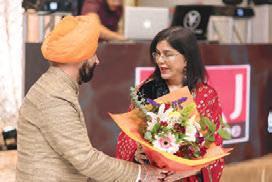
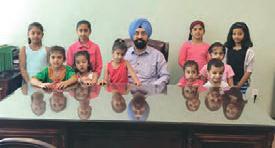

22. Received the Community Crusader Award from Darpan Extraordinary Achievement Awards in November 2021
23. Overseeing other ventures under the PICS Society umbrella: SEWA Ventures Society, PICS Event Management Society, PICS Charitable
Foundation, and Delta Food Bank Society.
24. Expanded the Transition Homes program by adding another second Stage Transition House, the Serenity House, to support immigrant women and children eeing domestic violence.
25. PICS Society has experienced tremendous growth during this period:
• e sta ng level has increased from about 110 to over 275+
• e operational budget has increased from about $7+ million to $23+ million.
• e number of projects o ered by PICS has expanded from about 20 to 60+
• e geographical reach of PICS has expanded across British Columbia and to other provinces,
• PICS has become the largest non-pro t organization serving the South-Asian community across Canada.
26. Received the Queen’s Platinum Jubilee Award for Outstanding Service to the Community.








A Splendid Night of Recognition & Celebration
INNOVATION & EXCELLENCE years of Celebrating




Duly licensed and certified Immigration Consultant, member in good standing with college of Immigration and Citizenship consultants



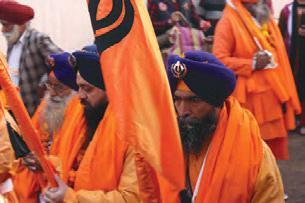
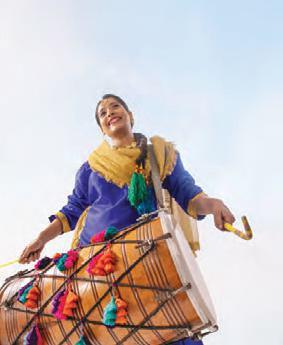
When we hear of Vaisakhi, there comes an instant rush of joy. Happiness and celebration are all that this festival brims with. Generations a er generation and decades a er decades have been getting bigger, and wow! From going to the gurudwara to enjoying the scrumptious Langer and from dressing up to meeting friends and family, it’s a part of this big day’s festivity.
Prayers, Kirtan, Bangra, Gidda, designer

BY POOJA VALEJA
Indian wear, lassi da glass, sarson da saag, and what not! However, are you genuinely aware of the reasons behind this celebration? Do you know when it all began? What does the day stand for, and what is its signi cance in history? Well! is began hundreds and hundreds of years ago, in 1699, to be exact. Vaisakhi has originated from the Sikh tradition. It signi es a dual celebration, which means it is celebrated for two prime reasons. e
rst was the harvest festival, and the second was the day of establishment of the Khalsa Panth. is festival holds immense importance as it marks the day when Guru Gobind Singh formed the Khalsa. It’s the day when Sikhism came o cially into existence. It’s also considered the Sikh New Year. Still, more importantly, it’s a day to remember Guru Gobind Singh ji’s endeavor to spread morality, courage, and strength.
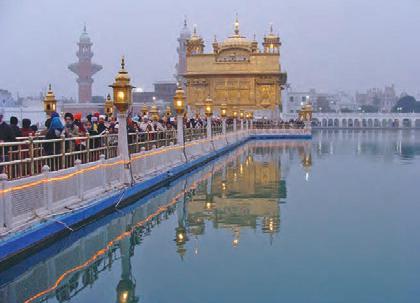
If you are going through some lows in life, it’s time to revisit history and motivate yourself.
It is one of the biggest celebrations of the year in the northern belt, especially in Punjab. It kicks o the harvest season, the season that sees the growth of crops. Farmers sow and wait through the harsh winters to nally see the gold (harvest) in their elds and happiness on their faces. When this is all about the harvest, ode plays a crucial role. e festivities usually commence with Nagar Kirtan, a grand religious procession featuring hymns and singing. As the
name suggests, ‘Nagar” stands for ‘town or neighborhood,’ and Kirtan stands for the singing of Shabad (hymn). Punjab, having signi cant numbers of gurudwaras, tends to have multiple occasions created by each gurudwara for everyone to participate in and enjoy. is also involves traditional martial arts displays by the localities, which depict courage and strength. Most usually, this is done wearing traditional attire and colorful turbans. Temples are illuminated, and langars (meals) are organized, symbolizing communal harmony and service.
You must have heard

of ‘Punjabi wala dil,’ so let’s understand how their lion (big) hearted people celebrate. What kind of clothes do they wear? What kind of food do they eat? How do they pray?
Punjabis are known for their vibrancy and joyful nature. In comparison, we see that in their lifestyle, we also notice that there are usually bright colors of red, pink, green, yellow, and blue in their attires. Traditional clothing usually consists of Patiala salwars paired with Kameez and a dupatta for women. At the same time, men dress in kurta pajamas, which have now been replaced by pathanis and sherwanis
with new trends. e same goes for women with palazzos and shararas; everyone wears their nest out ts. In the olden days, women wore parandas, also known as Parandi. ese are ornaments for the hair. ese are threads of silk that are intertwined with the hair, along with owers and tassels. It’s a part of ethnic Punjabi clothing or, you could say, a part of folk Punjabi culture. is celebration would be complete with music and dance.
sweets, and delicious traditional cuisines with delicacies like sarson ka saag, makai Ki roti, dal makhni, parathas, and lassis can sway anyone’s heart away.
It’s so wonderful to see that even a er decades, it’s celebrated by Punjabis across the globe with immense pride and love. While in India, farmers express gratitude for the harvest, and various folk dances and music performances add cultural richness to the celebrations, there is
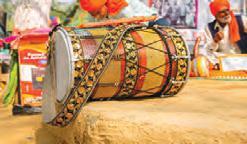
Evenings are usually get-togethers, just like we have across the globe. Bhangra and Gidda are a must for every celebration. I am sure you must have watched a lot of Bhangra in the Bollywood Punjabi numbers, and don’t forget the Dhol. Who would not want to shake a leg when they hear the sound of Dhol? Colorful attire, lots of
another side to it. It was earlier also known as Baisakhi. Younger Generations abroad have been paying respect and enjoying the celebration in their own way. e celebrations could be more modernized, but the emotions and sentiments are the same. Places in the UK, Canada, Australia, the United States, New Zealand, and
even Malaysia have big processions that distribute sweets and food and spread International joy; Kirtans are organized to showcase Sikh culture. Sikh communities also participate in parades and community events.

Across the globe, people want to stay connected with their culture, so they tend to enroll in Bhangra classes, Punjabi cooking classes, language learning, and more. ere are community programs to educate the kids and youth. While it’s fun to do it all, it’s essential to pray for the farmers who work tough season a er season to feed all of us and to everyone’s beloved Waheguru, who has allowed just joys in everyone’s life. e festival serves as a bridge, connecting Sikhs worldwide through shared traditions and values.





BY DR. DEVINDER PAL SINGH
Dr. Karminder Singh Dhillon is a muchacclaimed theologian, a renowned civil servant, a proli c writer and a profound scholar of comparative religious studies. Born in 1960 at Teluk Anson, Perak, Malaysia, he retired a er 32-years-long professional career in the Malaysian Civil Service. His incisive articles on Sikh theology have been regularly published in various international journals. Currently serving as Joint Editor for the Sikh Bulletin, USA, he, with his exceptional writing style, has established
himself as an eminent exponent of the Sikh doctrines. In addition, he has published about one dozen books on various aspects of Sikhi.
Dr. Dhillon’s book 'Understanding Anand' explores the Spirituality of Bliss as outlined in 'Anand,' a composition by Guru Amar Das, the third Sikh Guru, and enshrined in Sri Guru Granth Sahib (SGGS) on pages 917-922, in Ramkali Raag. He emphasizes that Gurbani advocates a spirituality of Fearlessness and Contentment leading to Anand (bliss and Joy). He laments that our
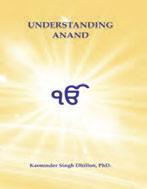
clergy is intent on promoting the Spirituality of Fear and the Spirituality of Asking, which is the antithesis of what Gurbani stands for. He enunciates that Gurbani's spiritually brilliant and divinely genius messages lead to Vigaas, the Spirituality of Bliss and Joy (Anand). In 'Foreword' of the book, Gyani Jarnail Singh Arshi points out that the translation methodology adopted by the author makes the messages of Anand hymns free from literal translation trends as well as snatan, vedic and yogic slants. e book includes
three 'Introductory Essays,' i.e. (i) e Spirituality of Anand, (ii) e Methodology of is Book, and (iii) How to Read is Book. e book's last section elaborates on the Anand composition.
In the essay ' e Spirituality of Anand,' the author articulates that Contentment is the starting point of Sikh Spirituality. It starts with an internal testimony that the Creator is within oneself, leading to fearlessness and desirelessness. e author emphasizes that the rightful emotion of the Creator within oneself is Love, Reverence and Realization. On such a realization, the person's only prayer is one of anks, Appreciation and Gratitude in Contentment. Dr. Dhillon laments that our clergy have twisted the Gurbani meanings to promote the feeling of fear and an attitude of constant asking, begging and pleading with God. e author emphasizes that the Spirituality of Asking reduces Spirituality to a barter transaction leading to the "hedging" of wants or the "future
trading" in wants and needs. Such a spirituality negates the Creator's Hukm (Command or Will). Using appropriate quotes from Gurbani, the author emphasizes that if one must ask for something, then the person must ask for the Realization of the Creator within oneself. e only Asking accepted in Sikhi is to Ask that Asking to be eliminated. It is pointed out that while the Spirituality of Asking seeks desired outcomes, irrespective of the individual's choices, the Spirituality of Sikhi is about making the right choices to achieve the
desired results. e Spirituality of Asking is about wanting a denial or change of Hukm. However, the Spirituality of Sikhi is relational, devotional, and about accepting Hukm. e author asserts that the Spirituality of Anand comprises three components: (i) the Love of the Creator, (ii) acceptance of Hukm and (iii) Contentment. Anand composition describes the Spirituality of Bliss brought about by the realization of the Shabd Guru.
In the essay " e Methodology of is Book – e Gurbani Framework," the author
delineates the process he adopted in interpreting Gurbani. He points out that the objective and focus of the messages of Gurbani are to bring about a realization of the creator within the human conscience. In our everyday usage, the default mode for interpreting the messages of Gurbani is literal. But the messages within the verses cannot be ascertained from this default mode. erefore, the discovery of Gurbani's messages requires us to cross over from the literal to the domain of spiritual messages. Although the task is arduous and challenging, the composers of Gurbani provided adequate milestones and sign boards along our spiritual journeys to ensure we get to the intended destination of the envisioned messages. e author enunciates that the Rahao verse or its equivalent is critical in interpreting and understanding Gurbani. Firstly, as each Shabd in SGGS has a poetic rendition, Rahao is the title verse. Secondly, each Shabd is composed in a particular raag, so it has a musical component. Herein Rahao is the asthai verse.
irdly, each Shabd contains a spiritual message, so herein, the Rahao verse represents the core message of the Shabd. erefore, the author asserts that Rahao acts as a guide, signboard or milestone for getting to the real messages. us, the Rahao or its equivalent verse must be understood to interpret Gurbani compositions. And it should be used as an anchor and base for the interpretation of the remaining verses.
concept ties in with the Principle of Context and Gurbani Grammer. He emphasizes that the explanations and concepts used in Gurbani must be de ned from Gurbani. Also, the meanings of words and pre-existing concepts deployed within Gurbani are rede ned–o en in a new and revolutionary way. ese rede ned and recalibrated meanings are always found within the SGGS, never outside. Using appropriate
context within a composition, the author asserts that it is provided by any or all the following four entities (i) e Rahao verse or its equivalent, (ii) the previous verse, (iii) the succeeding verse and (iv) the preceding Shabd or sub-section. Elaborating on the inner rationality of Gurbani, the author points out that this
examples from diverse interpretations of Gurbani, the author successfully illustrated the perils of ignoring Gurbani's inner rationality and context during its interpretation. Moreover, Inner Rationality leads to Conceptual Consistency. e author emphasizes that if the Conceptual Consistency of SGGS is ignored, it leads to the



search for conceptual context outside the SGGS, for instance, Vedantic, Brahmanical or yogic concepts and contexts.
Dr. Dhillon states that Gurbani is primarily composed in rst-person terms, so it is a narrative of the writers' experiences, processes, choices, consequences and outcomes. Furthermore, it is an experiential narrative from the spiritual depths of their inner experiences. e author asserts that the norm is true that Gurbani is, for me, about me and addressed to me as a guide to my spiritual journey.
Deliberating on the Spirituality of the Shabd, Dr. Dhillon emphasizes that the de nitive, decisive and ultimate answer regarding Shabd Guru comes from within the pages of Gurbani, in that the Shabd has been the Guru from the point of conception of Sikhi. Within the Spirituality of Sikhi, the Shabd is the essence. ereby, the entirety of Sikhi is pivoted on the Shabd.
Explaining the Spirituality of realizing the Creator within, the author reports that the voice of one's consciousness is the
Creator's voice within. e practical meaning of "Realizing the Creator Within" comes in Guru Nanak categorizing the Creator Within as a conglomeration of divine virtues. e ultimate realization of the Creator Within is to realize and become divine virtues, thereby becoming divine. In this way, Spirituality

becomes a choice and a journey for the here and now. It is to be lived within the con nes of one's human life from birth to death and never beyond. It replaces the Spirituality of Fear, the Spirituality of Asking and the pre-eminence of life a er death.
Reporting on the Spirituality of Self, the author articulates that Guru Nanak's message that the Creator is Within oneself implies the elimination of the clergy or other third party as intermediaries in one's spiritual discoveries. Guru Nanak's Spirituality was a spirituality of the self, for the self, by the self. It was a spirituality undertaken by the self, transversed by the self, and conducted within the self. It was a spirituality whose outcomes were borne by the self and goals achieved by the self. It is pointed out that human responsibility, human choices and human intellect are the basic premises of Gurbani, Gurmat and Sikhi.
Enunciating the concept 'Using Gurbani to understand Gurbani,' the author pronounces that SGGS uses spiritual concepts, beliefs, idioms, metaphors, similes etc., (that were already in use and within the psyche of spiritual seekers of the time) with new meanings

and understandings. So the rede ning of these concepts are to be found within SGGS, not outside. For example, he reports that Amrit Vela is de ned as a period of life that is imbued with the messages as contained within the Shabd, rather than an ambrosial hour, dawn etc., as is traditionally thought in various Indian religious practices, rituals and dogmas. According to Gurbani, there is no such thing as an auspicious or inauspicious time. Time is good or bad depending on what we do during a particular time. Another example he provides is that of Chaar Padarath (Four blessings). ese have been traditionally explained as Dharm, Arth, Kaam and Moksha. However, the Gurbani-based rede ned interpretation of Chaar Padarath is the Spiritual Bliss (Elimination of Spiritual Sorrow), Spiritual Dignity attainment, Spiritual Courage (Elimination of the primal fears of death a er birth), and Enlightenment (Realization of the Creator). e author has used this methodology throughout the book and termed it ' e Gurbani Framework.”

In the essay "How to Read is Book," the author explains the style he followed in the book to interpret Gurbani's verses. ough the starting point of any translation is the literal, context is given its due place within the interpretations. e purpose of using the context is to get the intended meaning of the individual verses by examining them within the composition's complete and holistic narrative. As the methodology applied in the book makes the translations and interpretations starkly di erent from the commonly propagated/preached versions, the author has provided
ample notes within sections or verses to explain why the commonly accepted translations are defective and need to be rejected. e book's last section provides the translation and interpretation of the Ananad (Spiritual Bliss) Bani composed by Guru Amar Das. It is pointed out that this Bani is a song of spiritual love, bliss and a conversation of spiritual attainment. As Gurbani is not person speci c but universal, its messages are for all of us. e author enunciates that the primary message of the composition is that once we realize the Creator Within, our mind (Ghar) becomes the abode of the Creator; the mind has it all and desires no more.
Gurbani and Gurmat postulate that the need for the mind is to become the master of our senses and not the other way around.
Dr. Dhillon reports that Kachi Bani is a composition that is not Creator connecting. e command that a Sikh connects only and solely to Sachi Bani (i.e., Creator connecting Bani as enshrined in SGGS) is crystal clear in Gurbani.
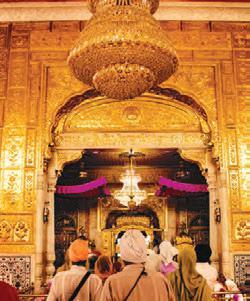
e author points out that Spirituality is the process of lining up one's senses, mind, and conscience into congruence; into a state where they complement each other; and into a hierarchy where the Conscience reigns supreme and the mind is subservient to one's conscience, but master of one's senses and one's senses following the dictates of a Gurbani imbued mind. Only such a state leads one to spiritual bliss (Anand).
Dr. Karminder Singh Dhillon has done a momentous work in projecting the divine thoughts of Guru Amar Das, particularly and
other Sikh Gurus, in general, to the modern world through this book. A er making a splendid in-depth study of various religions, along with the life and teachings of Sikh Gurus, the author has successfully attempted to project the dynamic vision of the Great Masters in the context of the contemporary socio-political milieu. e book o ers an exciting bridge between the empirical and applied aspects of the great Gurus' teachings in developing Sikhism. Appropriate references and quotes from Sri Guru Granth Sahib strongly supplement Dr. Dhillon's thesis. ough
there has been some repetition of Gurbani quotes and textual material in the book, it does not take the reader astray; instead, it helps clarify things. Each article is complete in itself and is a treat to read. e younger generation will likely gain much literary and spiritual knowledge from this treatise on Sikh philosophy. It is one of the best books ever authored on this topic. is book should be on all library shelves and distributed by all Gurudwaras. e Sikh youth of today must be encouraged to read works of this nature.
In conclusion, I would like to add that "Understanding Anand" has the potential to inspire countless readers/learners around the world and gives them a unique insight into the concept of Spiritual Bliss as outlined in SGGS. It is a timeless book to be rightly treasured by all learners and truth seekers. Dr. Karminder Singh Dhillon deserves the credit and appreciation of the Sikh community for diligently, painstakingly, and untiringly working to make this excellent book a reality.








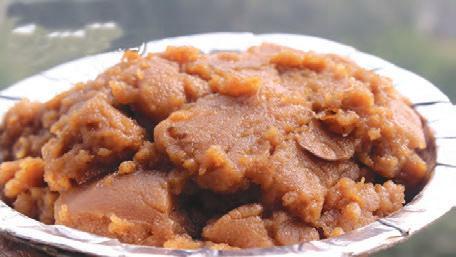
egh/ Karah Parshad the sacred pudding of Sikhism is made from equal parts of wheat our, ghee and sugar. Everyone receives this in equal parts, this shows that everyone is equal in the eyes of Waheguru. O ering karah parshad also makes sure that no one leaves the Guru's presence (Gurdwara) empty handed. is delectable delicacy is
served as a sacramental o ering during Sikh worship services. Prashad is prepared for gurdwara services in the langar facility by sevadar volunteers.
HISTORY:
Bhai Gurdaas ji has written that when Pir Dastgir (a Su master) asked Siri Guru Nanak Dev ji to prove that there are Lakhs of worlds as opposed to only 14 levels,
Siri Guru ji took the Pir’s son along and showed him countless worlds, in a matter of split second. On their way back, they attended the end part of a Gurmat Samagam (in some other world) when Karah Parshad was being distributed. As a proof, Guru Sahib and the son of Pir Dastgir brought a bowl of Karah Parshad from the Karaahi where Karah Parshad was kept.
In addition to the main ingredient of Naam and Gurbani, following ingredients are necessary for Karah Parshad:
1. Stone ground whole wheat our 1 bowl
2. Liquid Ghee (NOT butter) 1 bowl
3. Sugar 1 bowl
4. Water 2 bowl
1. e sewadaars should cover their mouths with their Hazooria/cloth to avoid spitting in Karah Parshad.
2. e sewadaars should not utter anything other than Gurmantra or Gurbani. Siri Jap jee Sahib and Siri Anand Sahib are ideal baanis to be read during Karah Parshad preparation.
3. On one stove, pour Ghee in the Cast Iron Karahi (Sarblohee Karaahee) and once it melts, pour wheat our in it. Keep the heat at slightly higher than medium.
4. Right a er pouring the wheat our and mixing it in ghee, place the Cast Iron Pan with water and sugar on the other stove. e heat should be slightly higher than medium.
5. Continuously stir the
our and ghee with the Cast Iron mixing spoon/spatula otherwise the our at the bottom will burn. It is important to continue to stir this mixture.
6. Let the water and sugar mixture boil and mix the two using the khurchana.
7. When the color of the our changes to brown and that typical smell of
with the karaahee, you know that the Karah Parshad is ready. Extinguish the re at this point and continue to stir the Karah Parshad for some time.
Kirpan Bhet (Tucking the Karah Parshad) with a Sword
Touching a Sarbloh
Kirpan to the Karhaah Parshaad is a tradition
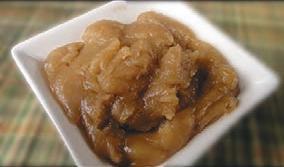
Karah Parshad starts coming, pour the boiling water and sugar mixture slowly in the Karahi containing our and gheo. Make sure that the our does not become too dark brown which would mean the our has burned. Similarly ensure that the water and sugar mixture is not poured in too early, i.e. when the our has not turned brown.
8. Continue to stir the new mixture vigorously.
9. When the Karah Parshad stops sticking
that we can trace back to the lives of the Guru Sahibaans (before 1708 CE). is action servedas an indication of the Guru’s acceptance and blessing of the Sikh nation, and the Sikhs’ acceptance and consumption of Parshad displays a submission to the Guru.
is tradition lives on today in the Gurdwaras where during the Ardaas the Kirpaan is put into the Parshad before it is distributed to the Sangat. is is symbolic of the
acceptance of the Parshad (which is o ered by a baptised Sikh) in the Guru Darbaar.
Some do‘s and dont’s with Karah Parshad:
• Head must be covered when receiving Karah Parshad.
• Bend down on your knees to receive it if you go to the Karah Parshad table.
• Do not just put one hand out, one should have two hands cupped together – you are receiving not demanding.
• If some drops on the oor when the sevadaar is doling it out– pick it
up, do not disrespect it by leaving it on the oor.
• Karah Parshad MUST be eaten whilst sitting down – it is not a takeaway food.
• ere should be no talking while the Karah Parshad is consumed.
• Until the Karah Parshad is completely distributed, the Sangat should remain sitting.
• Try not to take a tissue, rub the oil into hands and wash excess oil o with water and soap.
• Do not put Karah Parshad on the tissue –the Karah Parshad sticks to the tissue and the
tissue is thrown in the bin meaning you are throwing away Karah Parshad which is disrespectful.
Before it is given to the larger Sangat (congregation), Karah Parshad is given to the Guru Granthi Sahib. Karah Parshad is later distributed to the Sangat equally and without discrimination. When a Sikh gets Karah Parshad he bows to the Guru to thank him for this blessing and then proceeds to eat the Karah Parshad.





iki Sharma, Attorney General, has released the following statement in celebration of Sikh Heritage Month:
“Since 2017, April has been marked as Sikh Heritage Month in B.C. to honour the invaluable contributions Sikhs have made to our province over the last century.
“ e roots of Sikh heritage run deep in B.C. e rst Sikh migrants came here in the early 1900s, and today, there are nearly 300,000 Sikhs who call this province home. Despite being met with discrimination and racism, they built ourishing communities, contributed to the growth of our province and established cultural landmarks, like
North America’s rst gurdwara in Golden.
“In the face of numerous obstacles, Sikh Canadians have remained steadfast in their pursuit of equality, social justice and service to others. In times of greatest need, like during the pandemic, B.C.’s Sikh communities have stepped up, displaying enormous compassion and solidarity for their neighbours by providing food, shelter and other supports.
“Unfortunately, many Sikhs and people of other faiths are still facing racism today. To counter ongoing hate and discrimination, we must unite and commit to being anti-racist, everyday and in every aspect of our lives.
“In a few weeks, we will
introduce anti-racism legislation to begin removing racist barriers and gaps in government programs and services. We will also be launching a racist-incident support line this spring to help those who witness or experience racism. ere is more the government still needs to do to foster inclusivity and ght bigotry, and we are committed to doing that work. “As we mark the beginning of Sikh Heritage Month, I urge everyone to explore not only Sikh culture and history, but also to re ect on what we can do to be anti-racist. Together, I know we can create a more inclusive and equitable B.C. for generations to come.”

by DR. RISHI SINGH
Educationist
ll parents and guardians want their children to have positive experiences and succeed in school. However, many parents underestimate their role in making those things happen.
As a parent or guardian, how could one make a change? Creating a constructive educational environment at home is vital in a family system. School education must be valued more than anything
else. In addition, it is prudent to talk to your child about the school as an institution and what it o ers for the holistic growth of mind and body. More engagement, encouraging the child, and demonstrating interest in learning add to the child’s educational success. With the accessibility of technology in school children, reading has taken a backseat, even though the capability to read with
comprehension is a foundation of educational success. Assisting your child to access books by encouraging visits to the school library or city library for reading and storytelling sessions makes a signi cant di erence in instilling the discipline of reading.
Parents make a profound di erence in their child’s education. When families are involved in education, student accomplishments increase. It’s essential to
develop and teach good habits to your child. A child must be well rested and prepared to learn as it improves the ability to focus. Su cient sleep helps children grasp new knowledge and master their conduct. Making a child’s habit of arriving at school on time daily will train them to have self-discipline that will bene t them throughout their lives. Encouraging your child to eat nutritious food ensures they have adequate energy to learn and fully join the school activities.
Parent-teacher meetings are essential as the information between stakeholders
supports the child’s performance. I believe it is crucial to know your child’s teachers early in the school year and do what you can to build a constructive relationship with them. e teacher’s remark in the report card must be read thoroughly, and the child must track progress. Following up with teachers to keep up-to-date with reports and notices about your child’s progress, such as whether they are keeping up with assignments, etc., can have a positive impact. Teach your child to organize what they need for studying so they don’t waste time looking


Dr. Rishi Singh
for supplies. Compel them to turn o cell phones so your child isn’t tempted to text and check the internet while studying. Do not underrate the di erence you make in your children’s educational success. You are helping them learn and succeed as children and preparing them to become successful in their inevitable adulthood someday.



We have been covering critical health organ systems, which play a signi cant role in health, especially what you can do for better health and health promotion. ese are not comprehensive descriptions of the organs but an overview so you can better engage in your health. Your heart is in front of the chest, slightly le to the sternum, protected by a ribcage. It beats 60 to 80 times a minute or one beat a second. So that is approx. 100,000 a day or 35 million a year or 2.5 billion times during a lifetime. ese are a lot of beating. It is the size of a closed st and approx. 10 oz. in weight. It also pumps 5.6 L of blood 3 times a minute, thus
traveling 12,000 miles of distance daily. Outstanding dedication and hard work. e heart has a complex structure of walls, muscles, valves, blood vessels, and an electrical conduction system that pumps blood throughout the body and is a powerhouse. It contains four chambers, which hold blood and circulate it to various organs with each contraction. is activity is coordinated with the brain through an electrical beat. e whole process happens without you being even aware at any given time. It maintains heart rate, controls rhythm, and maintains blood pressure. is activity synchronized through various
parts of the nervous and endocrine systems. To perform all this work, the heart has a complex structure of walls, muscles, valves, blood vessels, and an electrical conducting system. Each one does an assigned function in a rhythmic and controlled way.
Four separate chambers consist of the right atrium, right ventricle, le atrium, and le ventricle. e right atrium receives blood from the body and sends it to the right atrium, which pumps it to the lungs with each contraction. Blood picks up its oxygen supply in the lungs and travels back to the le atrium. From here, the le ventricle is pumped to the body to meet its oxygen and nutrient needs. During the process, tissues receive oxygen, which produces metabolic activity. e valves control ow, which acts like a door, open and close to allow blood to ow and keep it owing in one direction. e heart receives its supply from coronary arteries, the most crucial step in keeping it supplied with oxygen. e heart's electrical activity has its own conduction pathway and nodes, which control the rate and rhythm

of the heartbeat. In addition, the heart is also an endocrine organ, producing certain hormones which control many of these functions. is should give you some idea of the complexity of heart function and fantastic work, ere are so many moving parts, and things are of many kinds. ey can go wrong, which results in heart diseases of many kinds. e most common is the heart's blood supply if coronary arteries are blocked and the heart cannot receive blood supply. e most common cause is atherosclerosis of coronary arteries. is also causes chest pain called angina. Other heart conditions include irregular heartbeat, which is too fast or too slow, or an irregular rate. e heart is a very muscular organ, and unusual thickening of the heart muscle or in ltrations
of muscles by abnormal metabolites results in cardiac myopathies, coronary artery disease, congestive heart failure, heart valve disease, high blood pressure, abnormal lipids, in ammation of various layers of heart are some of the conditions on the list.
As the heart is the powerhouse of circulation control, most symptoms are pain, palpitations, dizziness, shortness of breath, fatigue, and ankle swelling. Modern medicine has many diagnostic tools to investigate all these conditions and pinpoint the possible cause.
While the heart is doing its function, we must do ours to reduce or delay the onset of some heart disease. Smoking and excessive alcohol are major toxins, along with a balanced diet and minimal added salt and sugar.
Arun K Garg Ph.D. MD FRCPC
Former medical director in laboratory medicine who practiced for 40 years as a biochemical medicine consultant. Engaged with the community for better health. Clinical Professor of Pathology, Faculty of Medicine. e University of British Columbia, Adjunct Professor Faculty of Health Sciences Simon Fraser University; Distinguished Visiting professor, Swami Vivekananda Yoga
Anusandhana
Samsthana (S-VYASA), Executive Member: Global Association of Physicians of India
Origin (www.gapio.in)

'Dal' refers to lentils and 'Tadka' is the technique of tempering your spices to release their avours and aromas. ere are so many di erent varieties of lentils, and any will do, but I love to make this recipe with yellow lentils (toor dhal). Di erent cooks will add their own spice creations and so make sure you play around with your spice box and see what works for you.
Serves: 4 people
Takes: 30 mins to 1 hour
BY ANJALI PATHAK
• 250g yellow lentils (toor dal)
• 1 teaspoon turmeric powder
• 2 black cardamom pods (optional)
• 3 tablespoons vegetable oil
• 3 green cardamom pods
• 1 cinnamon stick
• 4 cloves
• 1 teaspoon cumin seeds
• 1 teaspoon mustard seeds
• 3 cloves garlic, nely chopped
• 2 teaspoons root ginger, nely chopped
• 1-2 chillies, nely chopped (or more if you like it ery)
• 2 spring onions, sliced (optional)
• 3 cherry tomatoes or 1 tomato, roughly chopped
• 1 teaspoon salt, to taste
• 1/2 teaspoon sugar, to taste
• Juice of 1/2 lemon
• 2 tablespoons fresh coriander

Method:
1.Wash the lentils in several changes of water and put in a deep saucepan with around 2 pints of water.
2. Stir in the turmeric powder and add the black cardamom pods.
3. Bring to the boil and reduce the heat to simmer. Allow the lentils to cook through and so en. is should take around 30 minutes. Remove the froth that rises to the surface, and top up with water if it boils o too quickly. ere should be plenty of water!
4. When the lentils have so ened it's time to make the tadka. Gently heat the oil in a frying pan.
5. Add the green caradmom pods, cloves and cinnamon stick. A er a minute or so the green cardamom will start to
lose its colour and the cloves will begin to swell.
6. Add the cumin seeds and mustard seeds.
7. When they start sizzling, which will only take a minute, stir in the garlic, ginger, chilli and spring onions.
8. Saute for 2 minutes before adding the tomatoes.
9. Stir well and leave to cook for a further minute before removing from the heat and pouring it all into the lentils.
10. Add the salt, sugar, lemon juice and stir through the coriander.
11. Taste and adjust the seasoning.
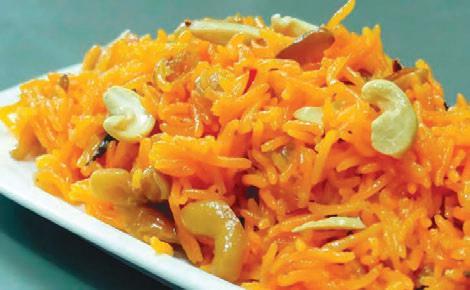
Ingredients
2 cup rice
5 green cardamom sugar as required
1 tablespoon raisins
1/2 cup chopped almonds
1 teaspoon edible food color
1 tablespoon vegetable oil
1 1/2 tablespoon heavy cream
1/2 cup chopped walnuts
1 teaspoon orange zest
Method: To prepare this dessert recipe, add rice in a medium sized bowl and wash 3-4 times to remove the dust particles. en, pour water to the bowl and cover it using a foil paper or cloth. Soak the rice for about an hour.
Next, put a deep-bottomed pan on medium ame and boil water in it. A er a boil, add orange food colour in the water along with half the quantity of cardamom pods, and switch o the burner.
en, put a medium sized kadhai over medium ame and heat vegetable oil in it. When the oil is hot
enough, saute the remaining cardamom pods for about a minute.
Drain the extra water from the soaked rice and add them to the kadhai along with sugar as per your taste and coloured water. Stir to mix once and cover the kadhai using a lid and cook for 5-7 minutes. en, add orange zest, almonds, walnuts, raisins along with fresh cream to the kadhai and mix once again. Remove the kadhai from the burner.
When the rice are done, transfer in a bowl and serve hot!


Ingredients
250 gm paneer
re ned oil as required
1 pinch garam masala powder
1/2 teaspoon garlic paste
2 peppercorns
20 gm mint leaves
20 gm yoghurt (curd)
2 tablespoon lemon juice
1 pinch chaat masala
5 gm ginger
4 papad
3 gm red chilli powder
1/2 teaspoon ginger paste
25 gm gram our (besan)
20 ml water
20 leaves coriander leaves
4 pieces ice cubes
1 pinch dry mango powder
black salt as required
2 cloves garlic
• Take a bowl and mix red chili powder, salt, ginger-garlic paste, garam masala and black pepper in it. Now, cut the paneer pieces into small squares and marinate them into the red chili mixture.
• Refrigerate the marinated paneer for about 10 minutes.
• In a separate bowl mix gram our with the given amount of water to form a creamy consistent batter.
• Roast papad over tawa and crush it to form a crumble.
• Pour the marinated paneer pieces into the gram our batter and cover with crumbled papad pieces.
• Take a pan and add enough
oil to deep fry the paneer.
• Pour the paneer pieces coated with papad into the pan and fry till crisp and brown. Serve hot with your favourite dip.
To prepare the mint dip
• Add coriander leaves, mint leaves, ginger, garlic cloves, lemon juice and ice cubes.
•Grind the ingredients well to form a consistent paste.
• In a bowl add the beaten curd and whisk well with the blended ingredients.
•Sprinkle over some black salt as per your taste, mango powder, chat masala and mix well into the curd. Mint dip is ready to serve with paneer papad. Enjoy!


Ingredients
• 4 cloves
• 8 green cardamom pods
• 1 cinnamon stick
• Few whole black peppercorns
• ½ teaspoon fennel seeds
• 500ml water
• 3 - 4 tea bags or 3 teaspoons of loose-leaf tea
• 2 teaspoons sugar, to taste (optional)
• 1cm root ginger, grated or 1 teaspoon ground ginger
• 500ml whole milk or semi skimmed if you prefer
BY ANJALI PATHAK
Chai is world renowned for being sweet and spicy. e masala is usually kept secret and is passed down from mother to daughter. Here is one of my favourite recipes for creating your very own homemade chai .. ssshhh don’t tell my mum I shared it with you!
Serves: 4 people Takes: Up to 15 mins
Method: 1.Roughly crush the spices with a pestle & mortar before adding them to a pan with the water, tea bags or tea leaves and sugar (if using).
2. Add the ginger and bring to a rolling boil.
3. Add the milk, stir well and allow to boil.
4. Taste and add more sugar if you like before straining through a sieve and serving.
My Tip: If you prefer your tea less milky then add more water instead of milk.












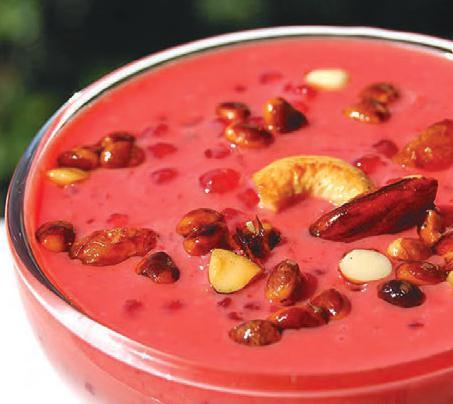
Ingredients:
• Beetroot - 1 large grated
• Moong Dal - 1/2 cup
• Ghee - 1 tblspn + 1 tblspn
• Jaggery - 1 cup or as needed
• Water - 2 cups + 1/2 cup
• ick Coconut Milk - 2 cups
• Cardamom Powder - 1 tsp
• Cashews and Dried Fruits
3 tblspn
Method:
• Soak dal for 15 mins. Drain and set aside.
Preparation Time : 10 mins
Cooking Time : 30 mins
Serves: 4 and water is all dried up.
• Now add in jaggery water and cook well.
• Take jaggery and 1/2 cup of water in a sauce pan, heat till it is melted, drain and set aside.
• Take ghee in a pan, add beetroot and dal and roast for 2 mins.
• Add in water and cook till it is completely done
• Add in coconut milk and mix well. Simmer for 5 mins.
• Add cardamom and mix well.
• Heat ghee in a small pan, fry nuts and dry fruits. Pour this over the kheer and mix well.



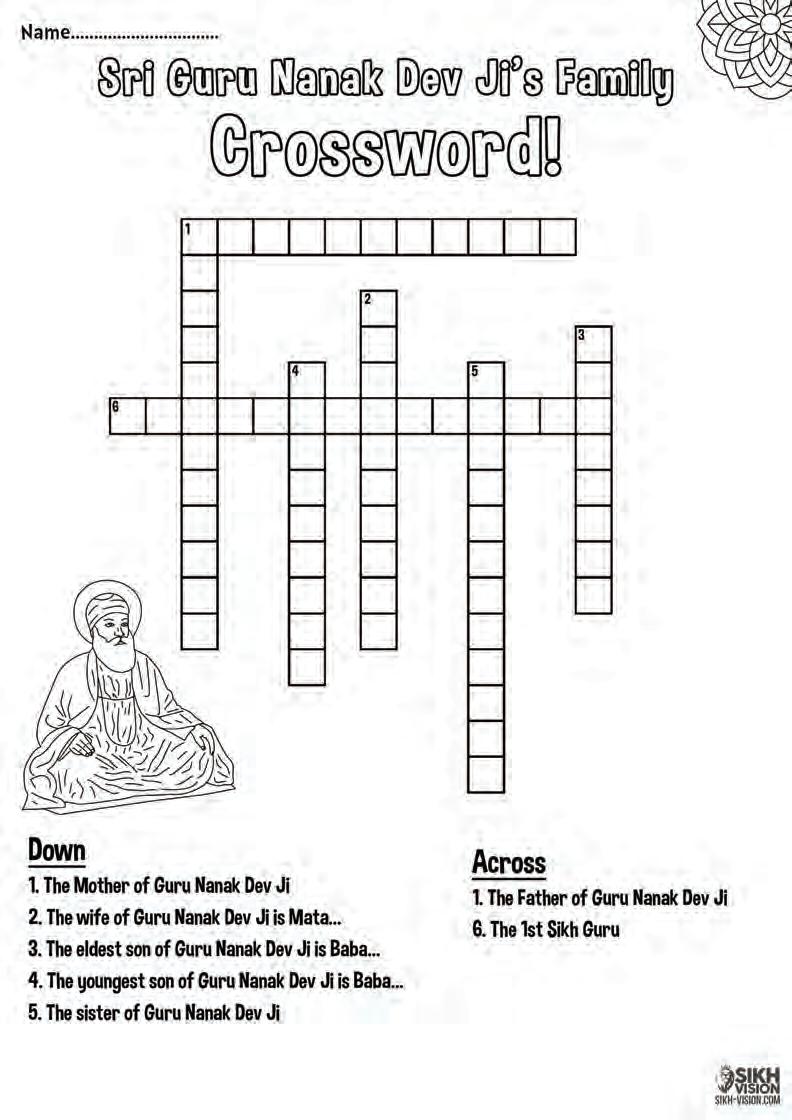




Instrument (Guitar, Violin, Rabab etc.) • Tabla, Djembe, Dholki & Dhol
- ENTHUSIASTIC & FUN - ALL AGES, STYLE & LEVELS - QUALIFIED MUSIC DEGREE HOLDER - PERSONALISED ATTENTION

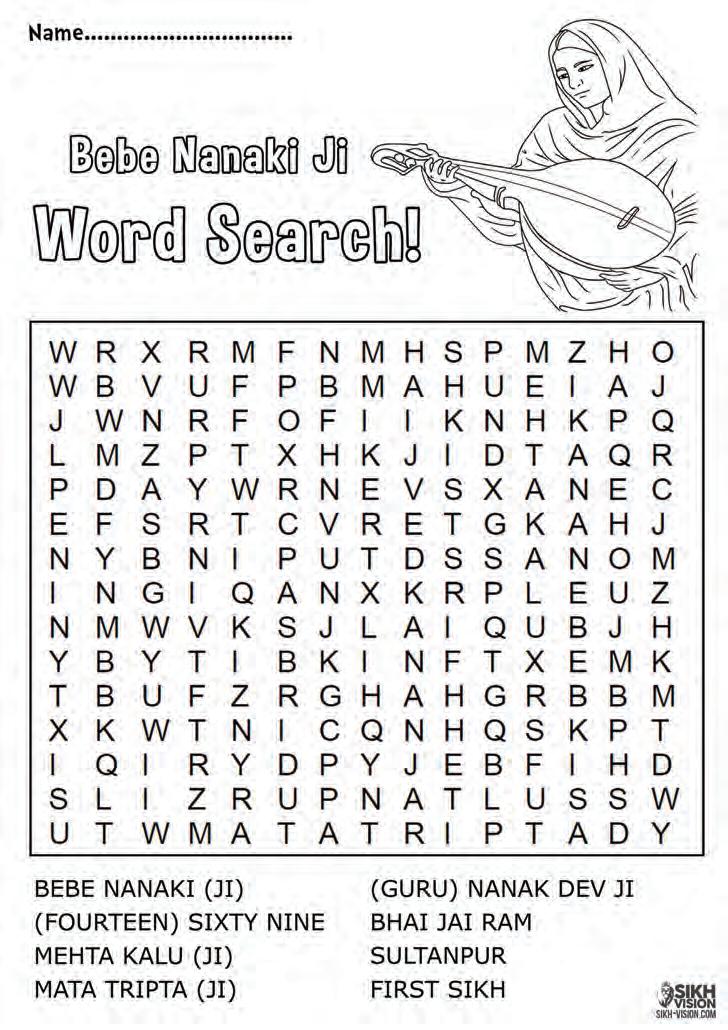

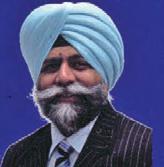
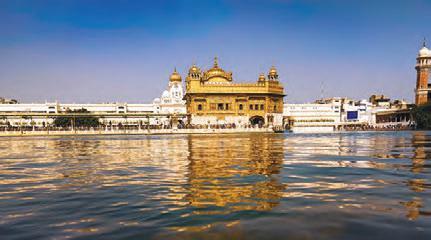
We give you a list of few historical gurudwaras across India that you might want to visit at least once.
Gurdwara is the place of worship for Sikhs. ere are thousands of Gurdwaras throughout India. Out of them Panj Takht are 5 important Gurdwaras of Sikhism in India:
• Sri Harmandir Sahib Ji or Akal Takht Sahib
• Takht Sri Keshgarh Sahib
• Takht Sri Damdama Sahib
• Takht Sri Patna Sahib
• Takht (Sachhand) Sri Hazur Sahib
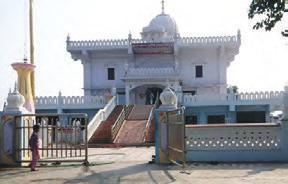
Gurudwara Sri Damdama Sahib, Basmath Nagar Gurudwara Sri Damdama Sahib is situated in Basmath Nagar, Distt Prabhani, Maharashtra. Sri Guru Gobind Singh ji came here while coming from Punjab. e beauty, peace of this place compelled Guru Sahib to
stay here. Guru Sahib stayed here for Eight Days. Hearing Guru Sahib is staying here sangat came for Guru Sahib's darshan and blessings. From here onwards Guru Sahib le for Nanded. When few years back this place ada Sahib was dug, a Barsha(Picture Displayed) was found.




Gurdwara Dudh Wala
Khuh Sahib is associated with the rst Guru, Guru Nanak Dev ji who came here during his ird UDasi or travel in 1514 A.D. e yogis who inhabited this place possessed a large number of cows. Bhai Mardana expressed a desire for milk. Guru ji told him to ask the yogis for some milk. However, they refused to give him any milk and taunted him by telling him to get milk from his Guru. By virtue of his spiritual powers, Guru Sahib drew all
Gurudwara Manji Sahib - Nawanshahr is Gurdwara is situated in Nawanshahr City.
e Ninth Sikh Guru, Shri Guru Tegh Bahadur Sahib Ji stayed at this place for sometime while on his way from Baba Bakala to Kiratpur Sahib. Guru Ji was accompanied by his wife Mata Gujri Ji , Bhai Mati Das Ji and Balaki Rai.
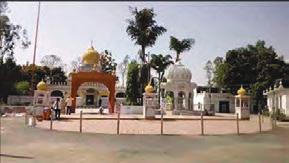
the milk from the cows of the yogis and stored it in a well. It is said that the water of this well tasted like milk. Since that time, this well is called the Dudh Wala Khuh, or the Well of Milk. e main gurpurab celebrated here is the birthday of Guru Nanak Dev ji.
Gurdwara Guru Har Rai Sahib
Patshahi Satvein - Dosanjh Khurd
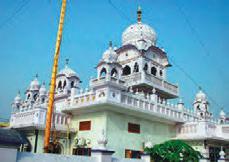
is Gurdwara is situated at a distance of 5 Km South of Banga City and 25 Km from Nawanshahr Railway Station on Balachaur-Ropar Road in Village Dosanjh Khurd. Gurudwara Sri Har Rai Sahib ji is situated in Village Dosanjh Khurd, Banga district Nawanshahar (Shaheed Bhagat Singh Nagar). Sri Guru Har Rai Sahib ji came here along with with army. Guru Sahib was coming back from mehraj and heading towards Kartarpur Sahib. Guru Sahib stayed for some time le for further journey.

Gurudwara Nanaksar Sahib - akarwal
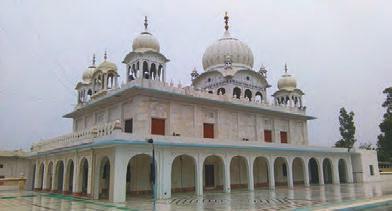
is Gurdwara is situated at a distance of 8 Km from Ludhiana City in Village akarwal.
e First Sikh Guru, Shri Guru Nanak Dev Ji during his Preaching tours visited this place, while coming from the
Gurudwara Baoli Sahib is situated in the Panchkula city. is Gurudwara Sahib is situated on the back side of Mata mansa Devi mandir. On this sacred place on request from mahatama for water, Guru Nanak Dev ji uprooted a stone placed nearby to him from which water started coming out. Guru Nanak Dev ji said that this is the water of Panjore (city near chandigarh) and you can drink this water. Guru Gobind Singh came here along with 700 Singhs. He provided the sacred
place where Gurdwara
Gau Ghat Sahib is situated in Ludhiana City. Guru Ji with his disciples Bhai Bala and Bhai Mardana stayed here for 3-4 Days. e Villagers did not care for the presence of Guru Ji. When Guru Ji was
about to leave the Village, an old man came taking milk and o ered it to them. Guru Ji, Bhai Bala and Bhai Mardana took the milk. e old man apologized for the behaviour of the Villagers.
Baoli Sahib, Panchkula
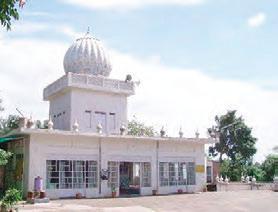
water of this baoli to all the Singhs who came along with him, and later, he, too, drank it. According to faithful believers, this sacred water can cure every disease if one drinks it continuously for 40 days.


















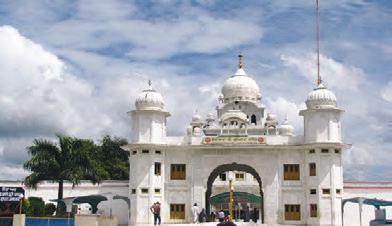
Gurudwara HarGobind
Sahib is situated in the Distt, Udham Singh Nagar, UtrraKhand. It is situated in the same compound of Gurudwara NanakMata Sahib. Baba Almast ji was taking Care of Guru Nanak Dev ji's Place. But Again the Gorakh Matts Harrased Baba Almast ji and had thrown him and captured this place and named it as GorakhMat. Sidhs also Set re to Pipal Tree Under Which Guru Nanak Dev ji
had meditated. Baba Almast ji send message to Sri Guru HarGobind Sahib ji at darolli Bhai. On request of Baba Almast ji ,Guru HarGobind ji came to this place and sprinkled some water on pipal tree and made it live again. e pipal tree at some parts can be felt as burnt. Half of the trees leefs are of redish shade and rest of are of Green shade. Sidhs sent message to Raja Baj Bahadur of Pilibhit for
help. When Raja Baj Bahdur came here and seen Guru HarGobind ji, he fell on the feets of Guru HarGobind ji, He was among the 52 Rajs's whom Guru HarGobind ji had rescued from Fort Of Gwalior. en Raja Baj Bahdur took Guru HarGobind ji along him to Pillibhit. Gurudwara HarGobind Sahib is 45 KM from Rudarpur, 11 KM from SitarGanj. 500 KM from Chandigarh.
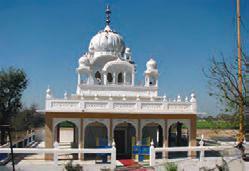
Gurudwara Shri Guru Tegh
Bahadur Sahib is situated in viilage Khatkar Distt Jind. Gurudwara Shri Guru Tegh Bahadur Sahib came here while going to Jind from Dhamtan Sahib. Guru Sahiban came here from Kharak Bhura and rested here for some time and le for further journey.