
International Research Journal of Engineering and Technology (IRJET) e-ISSN: 2395-0056
Volume: 12 Issue: 06 | Jun 2025 www.irjet.net p-ISSN: 2395-0072
International Research Journal of Engineering and Technology (IRJET) e-ISSN: 2395-0056
Volume: 12 Issue: 06 | Jun 2025 www.irjet.net p-ISSN: 2395-0072
Vijayalekshmi
1Assistant Professor, Dept. of Electronics and Communication Engineering, SJCET Palai, Kerala, India
2UG Student, Dept. of Electronics and Communication Engineering, SJCET Palai, Kerala, India
3UG Student, Dept. of Electronics and Communication Engineering, SJCET Palai, Kerala, India
4UG Student, Dept. of Electronics and Communication Engineering, SJCET Palai, Kerala, India
5UG Student, Dept. of Electronics and Communication Engineering, SJCET Palai, Kerala, India
Abstract - This paper introduces Thermobottle, a portable travel friendly kettle designed for travellers and commuters who need quick access to hot water on the go especially in public transportations like buses and trains. Thermobottle functions both as a kettle and a thermal flask which offers rapid water heating, effective temperature retention and compatibility with power sources(110V and 230V)in vehicles and residential settings. This system incorporates essential features like: continuous temperature monitoring and safety features like auto cut-off and alert system for users safety and to conserve energy. This paper presents the design methodology, hardware implementation, and system integration details, along with its performance evaluation and practical use case scenarios.
Key Words: kettle, thermal flask, Compatibility, temperature retention, auto cut-off
In today’s fast-moving modern world, traveling has become an integral part of everyone’s life. Hot water is a necessity for travellers, whether for preparing tea or coffee, making instant food, addressing health-related needs or maintaining basic hygiene. However, obtaining hot water, especially in public transportation such as buses and trains can be challenging. To address this issue we are introducing our product ”Thermobottle”. It is a portable, travel-friendly kettle that also functions as a flask, capable of both heating water and retaining its temperature for an extended duration. Unlike a conventional kettle, it features enhanced insulation to improve heat retention. It is designed with an advanced heatingcoilforrapidwater heating, a temperaturesensor for real-time monitoring and also a controller to set the desired temperature based on a relay-based automatic shut-off and a buzzer for safety and alert. One of the key advantages of our product is its userfriendly design and compatibility with power sources in public transport systems including 110v ac power in buses and trains as well as standard 230v ac household outlets. This makes it idealfordailytravellerssuchasofficetravellers,students,
and commuters who face difficulties in accessing hot water. By integrating modern technology with userfriendlyfunctionalities,wehavedevelopedapracticaland innovative solution to meet the demand for hot water while traveling. Thermobottle eliminates the need for conventional heating methods, offering users instant accesstohotwaterattheirfingertips.
The development of electric kettles has evolved significantly, with research focusing on intelligent temperature control, energy efficiency, and sustainable design. This review brings together studies that explore these aspects from both technical and environmental perspectives.
Shah et al. [1] introduce a temperature control system based on the PID algorithm, specifically designed for electrickettles. Their work highlightshow properlytuned PID controllers can maintain precise temperature levels, improving user safety while also minimizing overheating andexcessenergyusage.
In a related study, Aisuwarya and Hidayati [2] apply the Ziegler-Nichols tuning method for a hot-water dispenser. Their results show how strategic PID tuning can improve system responsiveness and temperature accuracy an approach that can be extended to kettle designs. Beyond control systems, the materials and environmental footprintofkettlesarealsodrawingattention.TheDesign Life-Cycleplatform[3]providesananalysisofthematerial composition and life-cycle impact of electric kettles. It emphasizes the need for sustainable materials and responsible disposal practices to reduce long-term environmentaldamage.Understandinginsulationandheat retention is essential when designing kettles meant for travel or prolonged thermal storage. Anyanwu et al. [4] investigate how vacuum flasks retain heat, offering useful insights into thermal insulation materials and their effectiveness knowledge that can inform kettle designs meanttokeepwaterhotforextendedperiods.Meanwhile, Chowdhury et al. [5] introduce a temperature sensitive voltage regulator using RTD sensors for AC loads, which helps in monitoring temperature and adjusting power delivery accordingly. Such systems can support safer,
International Research Journal of Engineering and Technology (IRJET) e-ISSN: 2395-0056
Volume: 12 Issue: 06 | Jun 2025 www.irjet.net p-ISSN: 2395-0072
energyaware kettle operationsThe role of microcontrollersinmodernelectricappliancesisalsowell represented. Ei et al. [6] develop a temperature sensing and motor control unit using a PIC microcontroller, demonstrating practical ways to implement automatic heating and shutdown features.Farineau [7] presents a compact brewing system using Arduino, showcasing how microcontroller-based setups can manage timing and temperature efficiently principles easily applicable to smart kettles. Accurate temperature monitoring remains central to most kettle systems. Fezari et al. [8] and Koestoer et al. [9] focus on the DS18B20 sensor, widely used in temperature sensing applications. While Fezari explains its functionality and calibration, Koestoer goes further by proposing a specific method to calibrate the sensor in liquids valuable for boiling water monitoring. ThisperspectiveisechoedbyMarcinkowskiandZych[10], who examine the environmental performance of kettle production and promote the adoption of recyclable components and energy-efficient manufacturing processes. Energy consumption patterns also deserve consideration. Murray et al. [11] study how users interact with electric kettles and identify areas where energy savings can be achieved. Their research supports the integrationofsmartsystemsandbetterinsulationtocurb unnecessary power usage. On the hardware side, Pyakuryal and Matin [12] present filter design techniques for converting AC to DC, ensuring a smoother and more stable power supply for appliances like kettles. Finally, Ramesh Saha et al. [13] describe a real-time temperature monitoring system using Arduino and the DS18B20 sensor,providingatemplateforhowsmartkettlescanlog andmanagethermaldataeffectively.
Altogether, these studies offer a holistic view of how modern electric kettles can be designed to be smarter, safer, and more sustainable. By combining intelligent control systems, robust sensor integration, and environmentally conscious practices, future kettles can meet the growing demand for both convenience and responsibilityinhomeappliances.
The goal of this project is to create a practical and travelfriendly solution toaccessinghot wateronthego. It isdesigned with frequent travelers in mind,suchas office travelers, commuters, students, and outdoor enthusiasts, who often find it difficult to get hot water during their travels. The focus is on keeping the device compact and lightweight so it can be easily carried in a bag without addingbulk.Safetyisacorepriority,withfeaturessuchas automatic power cutoff, overheating prevention, and an insulated outer surface that remains cool to the touch. In addition to heating, the bottle is designed to retain the temperature of the water for extended periods,
functioningsimilarlytoathermalflask.Anotherimportant aspect is affordability, with the product priced between 1000 and 2500 to ensure it is accessible to a broad user base.Durabilityisalsoemphasized,allowingthedeviceto withstand regular travel use while remaining simple to operate. In general, Thermobottle aims to provide a reliable,safe,andefficientsolutiontoacommoneveryday problem, improving comfort and convenience for users duringtravel.
Although various models of electric kettles are widely available,manyarenotoptimized forportabilityoruse in transit. Most conventional designs are bulky, powerspecific, or lack features that support mobile usage, making them inconvenient for daily commuters and travelers. To address this gap, we developed Thermobottle, a portable travel kettle designed to be lightweight,compact,andeasytocarry.Itenablesusersto heat water directly by connecting to standard 110–230V AC outlets commonly found in buses, trains, and public facilities. In addition to its heating function, Thermobottle incorporates insulation technology that retains the temperatureofthe waterforextendedperiods, effectively combiningthefeaturesofa kettleandathermalflaskinto asingletravel-friendlysolution.
The thermobottle is integrated with a heating system, temperature sensing unit, and insulated design to deliver an allin-one solution for water heating and retention. The system is powered by commonly available AC sources (110V–230V) and is suitable for use in vehicles such as busesandtrains,aswellasindoorenvironments.
The core functionality is driven by the ATmega328P microcontroller,chosenforitscost-effectiveness,adequate I/O capacity, and ADC capabilities. Temperature monitoring is achieved using the DS18B20 digital temperaturesensor,whichprovidesaccuratereadingsand simplifies interfacing due to its one-wire communication. Safetyandautomationarehandledbyarelaymodulewith auto cut-off functionality, triggered when the desired temperatureisreached.
The heating element is placed at the base of a stainless steel 500ml bottle, surrounded by vacuum insulation to ensure prolonged temperature retention. The user interface includes a 16x2 LCD display for real-time temperature feedback and a buzzer for alert notifications. The system operates on a stepped-down DC voltage regulated using a 7805 voltage regulator and a bridge rectifiercircuitforpowerconversion.
International Research Journal of Engineering and Technology (IRJET) e-ISSN: 2395-0056
Volume: 12 Issue: 06 | Jun 2025 www.irjet.net p-ISSN: 2395-0072
Survey results and target user analysis shaped the functional and safety priorities of the product, which include:
• Autocut-offtopreventoverheating
• Leakproofconstruction
• Lightweightanddurablematerials
• Cost-effectiveness within a (INR)1000–(INR)2500 range
It is developed to serve the needs of office-goers, commuters, and adventurers, offering a portable solution to access hot water on demand. The project also includes scope for future enhancements such as touch screen control,solarcharging,andintegratedfiltration.
A. Target users
1. Primary users:Officers goers,Travelers and Commuters.
2. Secondaryusers:Campers,Students.
3. Tertiaryusers:Gadgetenthusiasts,Giftbuyers.
B. Customer Requirements
• UserFriendlydesign
• HeatRetention
• Durable
• Safetyfeatures
• Multi-powersourcesupport
• Temperaturecontrolling
• Costeffectivedesign
• Lightweight
7. DESIGN
7.1 SEQUENTIAL DIAGRAM
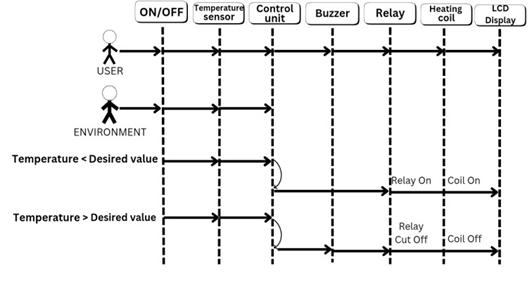
Fig-1: Sequentialdiagram
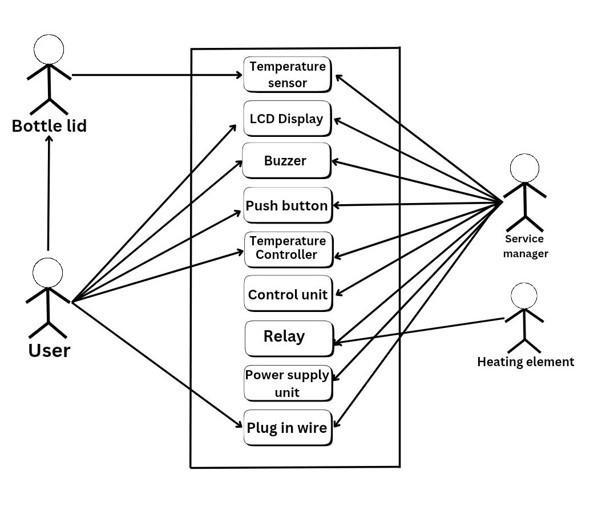
Fig-2: Usecasediagram
8.

Fig-3:Blockdiagram
Theblockdiagramofthissystemillustratestheinteraction of essential components designed to enable portable, temperature-controlled water heating and monitoring. Thesystembeginswithapowersupplyunitthatacceptsa standard110–230VACinput,whichisthensteppeddown using a transformer. The stepped-down AC voltage is rectified using a bridge rectifier and filtered with capacitorstosmooththeoutput.A7805voltageregulator isemployedtodeliveraconsistent5VDCoutputrequired to operate the microcontroller and other low-voltage components.
At the core of the system is the ATmega328P microcontroller, which serves as the central processing unit. It collects real-time temperature data from the connected sensor, processes the input, and controls other components such as the relay, display, and buzzer based on predefined logic. The DS18B20 digital temperature sensor is used to measure the water temperature inside
International Research Journal of Engineering and Technology (IRJET) e-ISSN: 2395-0056
Volume: 12 Issue: 06 | Jun 2025 www.irjet.net p-ISSN: 2395-0072
the bottle. Known for its accuracy and ease of communication via a one-wire interface, it continuously provides temperature data to the microcontroller for precisemonitoring.
The relay module operates as a switching unit that controls the heating element. Based on the temperature inputandthresholdconditionssetinthesystem,therelay is triggered by the microcontroller to either activate or deactivatetheheater.Theheatingelementisplacedatthe base of the bottle and is responsible for converting electrical energy into thermal energy to heat the water efficiently.
To enhance user interaction, the system includes a 16x2 LCD display, which shows key information such as the current water temperature and heating status. Additionally,abuzzerisintegratedasanalertmechanism tonotifyusersabouteventslikethecompletionofboiling or any abnormal temperature conditions. Together, these blocks work in coordination to ensure that Thermobottle deliversasafe,user-friendly,andefficientheatingsolution suitablefortravel.

Fig -4:Circuitdiagram
10. RESULTS AND DISCUSSIONS
TheinitialimplementationoftheThermobottlecircuitwas carried out on a breadboard, which served as a flexible andefficientplatformforprototyping.Thisphaseallowed for rapid assembly of components such as the ATmega328P microcontroller, DS18B20 temperature sensor, LCD display, relay module, voltage regulator, and buzzer using jumper wires. It provided the necessary
flexibility to test different circuit configurations, debug connection issues, and fine-tune the interaction between hardwareandsoftwarecomponents.Real-timemonitoring during this stage made it possible to verify voltage levels, test temperature response, and adjust control logic, ensuringallmodulesworkedseamlessly.
Once the breadboard prototype was verified to be functionally stable, the circuit was transitioned to a custom-designed PCB, created using EasyEDA. This shift introduced several improvements in terms of reliability, compactness, and aesthetics. Unlike the breadboard setup whichwasmorepronetolooseconnections,signal noise, and physical instability the PCB offered a more robust, permanent platform with fixed routing paths and cleaner signal transmission. The integration of all components onto a single board also reduced wiring clutter, minimized electrical interference, and made the final product more suitable for enclosure within the Thermobottlecasing.
During the transition, careful attention was paid to component placement, power line routing, and thermal isolation, especially around heating control circuitry. The physicalarrangementwasoptimizedtofitwithinthebase of a 500ml bottle without compromising the layout’s electrical integrity. Testing on the PCB confirmed that all core functionalities such as temperature monitoring, relay switching, auto cut-off, and user alerts operated consistently and reliably, as they did during the breadboardphase.
Overall, moving from a breadboard prototype to a finalized PCB significantly improved the system’s structural integrity, reduced the likelihood of mechanical failures, and contributed to a cleaner, more professional product finish. This transition was essential in validating thepracticalimplementationofThermobottleasamarketready,travel-friendlysolutionforhotwateraccess.
Thermobottle is a clever and practical solution to a common issue faced by daily travellers like the inaccessibility of convenient hot water while travelling. It is designed to be portable, suitable for power input devices in homes, buses, and trains, and capable of rapid heating and temperature retention.It focuses onn protection and ease of use for mobile travellers.It combines practical features with user-friendly technology to meet real-world travel needs and aims to provide a small but meaningful improvement by making hot water availablewhenitismostneeded.
[1] M.B.N.Shah,N.Zailan,A.F.Z.Abidin,M.F.Halim, K.A. Annuar,A. H.Azahar, M.H. Harun, and M.F. Yaakub,
International Research Journal of Engineering and Technology (IRJET) e-ISSN: 2395-0056
”PID-basedtemperaturecontroldeviceforelectrickettle,” International Journal of Electrical and Computer Engineering (IJECE), vol. 9, no. 3, pp. 1683–1693, Jun. 2019,doi:10.11591/ijece.v9i3.pp1683-1693.
[2] A.R. Aisuwarya and Y. Hidayati, ”Implementation of Ziegler-Nichols PID Tuning Method on Stabilizing Temperature of Hot-water Dispenser,” 2019 16th International Conference on Quality in Research (QIR): International Symposium on Electrical and Computer Engineering, 2019, pp. 1–5, doi: 10.1109/QIR.2019.8898259.
[3] ”Electric Kettle Design Life-Cycle: Materials and Environmental Considerations,” Design Life-Cycle platform. [Online]. Available: https://www.designlifecycle.com/electric-kettle.[LastAccessed:Jan.19,2025].
[4] Anyanwu, C. S., Gad, A., Bilal, H., & Ewim, D. R. E. (2022). Heat Analysis of a Vacuum Flask. The Journal of Engineering and Exact Sciences, 8(11), 15174–01e.https://doi.org/10.18540/jcecvl8iss11pp15174-01e
[5] Chowdhury, T., Bulbul, H., & Eee, B. S. I. (2010). Design of a Temperature Sensitive Voltage Regulator for AC Load using RTD. *International Journal of Engineering ScienceandTechnology*,2(12).
[6] Ei, M., Thaw, E., Zaw, M., & Htun, M. M. (2014). Design and Implementation of Motor Speed control and Temperature sensing unit using PIC Controller. In International Journal of Scientific Research Engineering & Technology(IJSRET)(Vol.3).www.ijsret.org
[7] Farineau,M.S.(2015).Arduino-BasedSmallScale ElectricBrewingSystem.
[8] Fezari, M., Al Dahoud, A., & Mokhtar, B. (n.d.). Exploring One-wire Temperature sensor DS18B20 with Microcontrollers.
[9] Koestoer,R.A.,Saleh,Y.A.,Roihan,I.,&Harinaldi. (2019). A simple method for calibration of temperature sensor DS18B20 waterproof in oil bath based on Arduino data acquisition system. AIP Conference Proceedings, 2062. https://doi.org/10.1063/1.5086553
[10] Marcinkowski, A., & Zych, K. (2017). EnvironmentalPerformanceofKettleProduction:Product Life Cycle Assessment. Management Systems in Production Engineering, 25(4), 255–261. https://doi.org/10.1515/mspe-2017-0037
[11] Murray,D.M.,Liao,J.,Stankovic,L.,&Stankovic,V. (2016). Understanding usage patterns of electric kettle and energy saving potential. Applied Energy, 171, 231–242.https://doi.org/10.1016/j.apenergy.2016.03.038
[12] Pyakuryal,S.,&Matin,M.(2013).FilterDesignfor AC to DC Converter. In International Refereed Journal of EngineeringandScience(Vol.2,Issue6).
[13] RameshSaha,Biswas,S.,Sarmah,S.,Karmakar,S., & Das, P. (2021). A Working Prototype Using DS18B20 Temperature Sensor and Arduino for Health Monitoring. SN Computer Science, 2(1). https://doi.org/10.1007/s42979-020-00434-2
Volume: 12 Issue: 06 | Jun 2025 www.irjet.net p-ISSN: 2395-0072 © 2025, IRJET | Impact Factor value: 8.315 | ISO