
International Research Journal of Engineering and Technology (IRJET) e-ISSN: 2395-0056
Volume: 12 Issue: 06 | Jun 2025 www.irjet.net p-ISSN: 2395-0072
International Research Journal of Engineering and Technology (IRJET) e-ISSN: 2395-0056
Volume: 12 Issue: 06 | Jun 2025 www.irjet.net p-ISSN: 2395-0072
Feroz Basha Shaik1 , PSV Vachaspati2 , P. Jayadeva Saketh3
1M.Tech, Department of CSE, Bapatla Engineering College, Bapatla.
2Professor, Department of CSE, Bapatla Engineering College, Bapatla.
3B.Tech, Deloitte, Hyderabad.
Abstract - Chain-of-Thought (CoT) prompting becomes one among the breakthrough methods that refined reasoning skills of large language models (LLMs), such as GPT-4.5. CoT Prompting can support structured problemsolving in that by doing so increasing the accuracy and interpretability of multi-step logical and arithmetic problems, which was attributed to a prompt encouraging models to describe intermediate reasoning steps. This study will methodically assess how CoT prompting can influence GPT-4.5 on various complicated reasoning tasks and especially in arithmetic and logical inferring tasks. The effectiveness of CoT prompting, according to our experimental findings, fades in comparison with direct answer prompting approaches to a significant extent, showingsignificantincreases inthecorrectnessofsolutions aswellastheclarityofthereasoningtrails.Theevidenceof CoT prompting work implies that it serves as an important driver in developing reasoning abilities in the nextgeneration LLMs. We also outline the limits and suggest avenues of future research integrating CoT with other strategies of prompting and fine-tuning to attain even higherlevelsofreasoningcompetence.
Key Words: GPT-4.5, chain-of-Thought prompting, large language models, reasoning, interpretability, arithmetic reasoning, logical inference, multi- step problem solving, natural language processing, artificialintelligence.
1.INTRODUCTION
TheintroductionofLargeLanguageModels(LLM) like GPT-3 and GPT-4 and the even more advanced GPT4.5 has been a major leap in the path of artificial intelligence (AI) as they have proved capable of many tasks in the broad spectrum of natural language processing (NLP), such as text generation, translation, summarization,andquestionanswering[1],[2].However, despite such remarkable successes, LLMs usually face difficultieswithsolvingreasoningtasks,incasewhenitis necessary to conduct multi-step computations, make logicalconnections,orsolveproblemsinastructuredform [3]. Such shortcomings are partly caused by the fact that traditional prompting strategies also tend to prompt the models to give their final solutions directly, without
breaking them down or explaining the process of intermediatestepsofreasoning[4].
Recently, Chain-of-Thought (CoT) prompt has become a promising method of suppressing these problems.CoTpromptingcloselymimicshumancognition when it comes to the use of simple intellectual steps to simplify the entire problem into sub-problems [5]. This is since CoT actively recommends models to produce mini reasoning steps before getting to the conclusion. This method does not only increase the accuracy of reasoning bythemodelbutalsomakesthemodelmoreinterpretable because users can trace the decisions made by model [6]. PreviousinvestigationshaveestablishedthatCoTprompts perform substantively better on multi-step arithmetic, common sense reason and logical inferencing tasks in modelslikeGPT-3andPaLM[7],[8].
Based on this foundation, our study explores the efficacy of Chain-of-Thought prompting in enhancing the reasoning abilities of GPT-4.5. GPT-4.5 is the nextgenerationGPT-4consistingofimprovedarchitectureand expanded training, thus it is highly applicable to complicated language tasks [9]. But despite that, its success on complex reasoning questions can still be enhanced considerably through high-quality prompting procedures. By means of numerous experiments, we assess the effect of CoT prompting on the performance of GPT-4.5 on complex arithmetic and logical reasoning benchmarks.Withtheresults,wefindthatCoTprompting not only enhances accuracy but also vastly enhances interpretability and reliability of model outputs than direct-answerprompting.
What is more, the research notes the promise of CoT prompting as an initial mechanism toward the creation of more visible and reliable AI systems. CoT prompting makes the reasoning process transparent which eliminates the most important issue of the blackboxnatureoflargelanguagemodelsandopensthewayto thesafeapplicationoftheminrealsettingslikeeducation, healthcare, and scientific computing [10], [11]. We mentiontheshortcomingsoftheexistingCoTmethodand provide future directions by integration with retrievalaugmented generation and fine-tuning to extend reasoningabilitiesfurther.
International Research Journal of Engineering and Technology (IRJET) e-ISSN: 2395-0056
Volume: 12 Issue: 06 | Jun 2025 www.irjet.net p-ISSN: 2395-0072
The incredible development of large language models (LLMs) has led to a tremendous number of investigations in the field that would enable them to become more rational by using sophisticated prompting methods.InitialresearchonLLMslikeGPT-3[1]andPaLM [4] demonstrated their fundamental inability to deal with challenging multi-step reasoning problems, especially in caseswherepromptingwasintheformofdirectanswers. To deal with this, research has been done and Chain-ofThought (CoT) prompting; a technique has been introduced in which models are encouraged to represent theproblemsinintermediatesteps.
One of the first studies to show that CoT prompting can have a profound effect on improving reasoning accuracy in LLMs was carried out by Wei et al. [3] who showed how models could be prompted to producestep-by-stepsolutionstoarithmeticandsymbolic reasoning problems. Their arithmetic word problems and commonsense reasoning benchmark experiments performed highly in comparison to conventional directanswer methods. On the same vein, Kojima et al. [5] introduced zero-shot CoT prompting, where they showed that even when left without fine-tuning, LLMs were capableofcomplexreasoningiftheywereaskedtoreason bytaking intoconsideration intermediate stepsin a chain oflogic.
This is followed by studies discussing CoT variants and improvement in CoT prompting. Selfconsistency decoding was suggested by Wang et al. [6] ThisiswhenmanypathsofreasoningbuildbytheCoTare combined to enhance the reliability of the answer. Their strategy eliminated the problem of variability in models, andpossiblydifferentreasoningchainsacrossruns.Nyeet al.[7]proposedso-calledscratchpadsinwhichmodelsare to store intermediate states of the computation to better accommodate solvable problems involving sequential numerical methods. Their results were consistent with that of Cobbe et al. [8] who had verifiers training to audit every step in the solution of math word problems, resultinginanincreaseinaccuracyaswellasresilience.
The other strand of literature is the combination of CoT prompting with other methods. As an example, Wangetal.[12]investigatedtheuseofCoTtogetherwith theuseofexternaltoolssuchthatLLMscallcalculatorsor symbolic solvers in a reasoning process. This heterogenous technique allowed the models to perform the tasks that needed calculations with accuracy other than what could have been done by language generation. On the same token, Yao et al. [13] introduced Tree-ofThought(ToT)prompting,anextendedversionofCoTinto amicro-worldexplorationoftree-likereasoningstructure
and showed that it had better performance on complex tasks.
CoT prompting has also been studied in recent times within the context of safety, trustworthiness and transparency of models. The theme of necessity of interpretability of the AI systems was brought up by Mitchelletal.[10]andBenderetal.[11],placingCoTasa possible method of unearthing the model reasoning and minimizing the opacities of LLM decisions. Additionally, Ho et al. [14] considered CoT prompting in legal and medicalreasoningandmanagedtodemonstratethatstepby-step explanations could substantially enhance human faithinoutcomesgeneratedbyAI.
Theconclusion reachedin thesestudies, all inall, points to the positive effect of CoT prompting; however, there are still gaps in concepts of its use on newer, larger prompts like GPT-4.5. Most of the past results touched only on GPT-3 or PaLM with unknown questions on the scalabilityofCoTmethodstothearchitectureandtrained versions such as GPT-4.5 [9]. The current paper will fill that gap by assessing the performance of CoT prompting against GPT-4.5 in a variety of reasoning benchmarks, particularly those that concerned complex arithmetic and logicalinference.
The purpose of the study is to examine the efficiency of the Chain-of-Thought (CoT) prompting to develop the reasoning of GPT-4.5. The methodology is systematic, and it entails design of reasoning tasks, development of relevant prompts, model set up and thorough assessment. This procedure involves the selection of tasks, dataset design, and prompt strategies, evaluationmeasures,andanalysistodelivercompleteand reproduciblefindings.
Arithmetic reasoning is a very important part of the cognitive problem-solving process, and it entails the abilitytomanipulatefiguresandmathematicaloperations to deliver proper conclusions. When it comes to the large language models (LLM) such as GPT-4.5, arithmetic logic plays a significant role in solving tasks of mathematical expressions, algebraic calculations, or understanding mathematicaldata.Chain-of-Thought(CoT)promptinghas become a relevant method of expanding the arithmetic reasoning abilitiesof LLMsbecause ittakes themthrough a step-by-step approach that reflects human problemsolvingtactics.
International Research Journal of Engineering and Technology (IRJET) e-ISSN: 2395-0056
Volume: 12 Issue: 06 | Jun 2025 www.irjet.net p-ISSN: 2395-0072
EarlyformsofGPTandothertraditionallanguage modelshavehadalotoftroubleonproblemsthatinvolve arithmetic reasoning, especially when multi-step or more complex operations are required. The reason behind this is that such models as they are do not have built-in mathematical intuition or logical consistency as humans do. Rather, they depend on statistical trends as taught on huge corpora of texts that might fail to deliver as far as accuracy and precision are needed in a problem that entailsarithmeticalreasoning.
Asanotherexample,GPT-4.5couldeasilybeused to correctly guess the next word in a paragraph, or to produce coherent text given a prompt, but unless there is some sort of structured reasoning process involved, may doa poorjobofanswering a mathematical question,such as"Whatis57+32?"whentheyareputonthespot.Inthis situation, GPT-4.5 may provide inaccurate or even incomplete responses because there are no evident and rationalstepstohelpitdothecomputations.
Chain-of-Thought (CoT) prompting represents a modernmethodofimprovingthereasoningcapabilitiesof large language models (LLMs) like GPT-4.5. The general principle of using CoT prompts is that the model is supposedtocomeupwithtransitionalstepsofthethought process on the way to the solution. Such a step-by-step model can be used to complete complicated tasks that involve multi-step reasoning and, therefore, it is specifically handy in problem-solving situations where logic, mathematics, and complex decision-making are involved.
The most conventional system of using large language models is prompt-based, which entails giving direct instruction or provoking a direct question to the model so that it displays an immediate answer. Although this model is mostly successful in implementing simpler tasks;complicatedproblemswhichinvolvebreakingdown information into smaller components the model finds it hard to implement the information. CoT prompting however addresses this shortcoming by reminding the model that it should explain its thought process by going through several intermediate steps before giving the definitive answer. This process replicates the way human beingssolveproblems,inthattheytendtobreakdownthe problemsintosmallerbutmorelogicalprocesses,tocome upwithasolution.
CoT prompting has also been found to play a significant role in enhancing performance of models on tasks that entail making logical inferences, mathematical calculations and interpreting intricate relationships in framing reasoning as a series of steps. As an example, whenamodelisbeingaskedtosolvearithmeticproblems, he/she is trained to explicitly explain each separate calculation or, in other words, to calculate addition of the digits instead of leaping to the solution. Such a graded system of reasoning does not only provide more precise findings but also makes the reasoning process more sensible.
CoT-based prompting works on the assumption that decomposing problems into small steps of reasoning will decrease cognitive load that model must carry to reach the solution. It also keeps the model in a clearer focus at every aspect of the problem, hence limiting the mistake committed through misinterpretation of complicatedinstructionsorfigures.
CoT as a practical application occurs by utilizing promptsthatseektopromptthemodelintoexplainingits rationale to its response. As an example, one can use this question: what is 57 + 32? A CoT prompt could ask the modeltoconsidertheindividualcomponentsofit,i.e.:
“First,add50and30.”
“Next,addtheremaining7and2.”
“Finally,sumbothresultstogether.”
Withsuchpromptsthemodelisgivenaguidetocarryout theadditioninlowerstepsthataremanageableandhence errorisunlikelyandthereasoningprocessclearer.
The Chain-of-Thought prompting aims at dealing with such difficulty by organizing the step-by-step thinking into the sequence of the intermediate steps, that enables GPT-4.5 to simplify the task to the manageable parts.CoTpromptingcanmakethemodeldescribehowit is thinking in every step of manipulation, as opposed to asking model only for final answer. As an example, a CoT promptcanappearasthefollowingwithsimplearithmetic problem:
"Whatis57+32?"
1. Add50and30.
2. Next,addother7and2.
3. Lastly, add the two results together to obtain the finalanswer.
International Research Journal of Engineering and Technology (IRJET) e-ISSN: 2395-0056
Volume: 12 Issue: 06 | Jun 2025 www.irjet.net p-ISSN: 2395-0072
GPT-4.5 is capable of digesting numbers and operations involved init more adequately by reducing the problem into smaller, discrete chunks, which results in more accurate and consistent results. In this way, models not only give the right answer but also explain the line of thought;therefore,theprocessissimplertoascertain.
A variety of reasoning tasks were chosen to cover a wide range of problem categories as in previous research [3],[7],[12],inparticular:
Mathematical Reasoning: Multi-step arithmetic and algebraic problem-solving tasks on GSM8K dataset [15] that have grade-school level mathematical problems that implicatecomplexcomputing.
Commonsense Reasoning: Inference from Common senseQA [16] which measures the capability of the model to utilize general world knowledge and cause-effect relationships.
Logical Inference: LogicalproblemsoftheWinogrande data set [17] evaluating the ability of the model to draw conclusions based on incomplete information and make disambiguation.
Complex Decision-Making: Built-incomplexscenarios of real-world decision-making e.g. policy evaluation, financial planning and or based on prior work on Tree-ofThoughtprompting[13].
This multi-domain design will facilitate the study to evaluatetheperformanceofreasoninginthetwodomains ofnumericalandnarrativedomains.
Tworeframinggestureswerebroughtabout:
• Direct-Answer Prompting: This traditional method in whichGPT-4.5directlyproducestheendreplywithoutthe additionalreplicas[1].
Example:Whatis57,plus,32?
•Chain-of-ThoughtPrompting:Promptsthataimatmaking you think in a linear manner by prompts to generate intermediateactions[3],[5].
Examples: What 57 + 32 =? Reduce the calculation in steps.”
Uniformity on prompt was observed to prevent bias regardingthepromptlengthorcomplexity[18].
GPT-4.5 experiments were run on the default architectureanddefaultparameters[9].Toconcentrateon theeffectofCoTprompting:
Task-specific data was not fine-tuned and aligned with zero- and few-short CoT analysis [5], [13]. The models were prepped with adequate context of prompts without theintegrationoftheexternaltools[12].
Using four key metrics the effectiveness of CoT was evaluated:
Accuracy: Apercentageofthecorrectfinalanswers,as inassessmentsofCoTinthepast[3],[6].
Reasoning Consistency: Reasoning consistency, that canbedeterminedthroughqualitativeannotation[7].
Interpretability: Understanding ofthelogic behind by humanusers[10].
Computational Efficiency: Number of tokens and generationlatencytotellthecostofCoTreasoning[19].
Data Split: Standard train-test split with GSM8K, CommonsenseQAandWinogrande;decisiontaskscreated intermsofcustomdecidingtasks,assessedagainstunseen scenarios.
Cross-validation: There were five-fold cross-validation to enhancethesoundnessofthefindings[20].
Baseline Comparison: Comparison between CoT promptingperformanceanddirect-answerpromptingwas undertaken to isolate the influence on articulating the reasoning.
Paired t-tests were conducted to assess the significance of differences in accuracy and reasoning consistency. A significance level of p < 0.05 was applied [21].
Tohavevalidity:
Same Model Settings: Any GPT-4.5 setting was deployed acrossalltherunstoeliminatethefactorofmodel-related variability.
International Research Journal of Engineering and Technology (IRJET) e-ISSN: 2395-0056
Volume: 12 Issue: 06 | Jun 2025 www.irjet.net p-ISSN: 2395-0072
Balance in Task Complexity: The tasks of simple and complex nature were added so that no specific task is over-represented[22].
Prompt Parity: Great attention was given to present prompts as they are the same in their specificity and clearnesswithintheconditions.
The quantitative data collapsed and contrasted across prompts and strategies of prompting. Also, the validity and utility to interpretability using reasoning chainswascarriedoutintermsofqualitativeanalysis.The findings were interpreted to determine the trends of performance gains and shortcomings of CoT prompts on GPT-4.5.
The contrasts of the arithmetic reasoning with and without the Chain-of-Thought (CoT) prompting provide evidence of the great benefits of structured prompting. When one uses CoT prompting, the problems are always broken down into manageable parts- e.g. breaking the tens and units in addition, doing each operationclearlyinmulti-stepcomputationsordisplaying the manipulations in algebra clearly. Such gradual procedure is accurate not only, but it increases transparency since individual verification of each intermediate result is possible. Subsequently, the chances oflogicorbreakingcomputational errorsaresignificantly reduced. Conversely, the model will in most cases not elaborate the reasoning process by giving direct answers withoutrequiringencouragementorpromptingbyCoT.It is usually found to perform properly on simple problems, but it is more prone to errors in multi-step equations or algebraic formulas that are not properly done or are missedaltogether.
AnexampleofhowwellCoTpromptingworkscan beappliedtoarithmeticreasoningtaskscarriedoutonthe scale of simple addition to more complex tasks. The following are the illustrations of problem-solving in variousarithmeticreasoninglevelsusingCoTprompting:
A) Simple Addition:
Problem:Whatis45+76?
CoTPrompt:
o "First,add40and70."
o "Next,add5and6."
o "Finally, sum both results to get the answer."
B) Multi-Step Calculation:
Problem:Whatis23×7+89?
CoTPrompt:
"First,multiply23and7." "Next,add89totheresult." "Finally,computethesum."
C) Algebraic Expression:
Problem:Solveforxintheequation3x+5=20.
CoTPrompt:
"First,subtract5frombothsides." "Next,dividebothsidesby3." "Finally,computethevalueofx."
All these examples rely upon the use of a CoT promptingstructurethatdividestheproblemintosmaller chunks so that GPT-4.5 can tackle the art of arithmetic reasoninginalogicalandstep-by-stepway.Thisresultsin more trustful responses and the improved grasp of the modelwhichledtotheconclusion.
4.1.1 Simple Addition
Problem: Whatis45+76?
Table 4.1:ComparisonbetweenWithCoTandWithout CoTincaseofSimpleaddition:
Aspect WithCoTPrompting Without CoT Prompting
Approach
Clear breakdown: (40 + 70) = 110, (5 + 6) = 11,finalsum=121
Often gives direct answer121,butwithout showing how it was derived.
Correctness Alwayscorrect Usually correct (but risk oftypo-likeerrorexists)
Transparency Fullclarityonsteps No visibility into reasoning
Errorrisk Verylow
Slight risk in edge cases (e.g. model glitch, parsingerror)
International Research Journal of Engineering and Technology (IRJET) e-ISSN: 2395-0056
Volume: 12 Issue: 06 | Jun 2025 www.irjet.net p-ISSN: 2395-0072
Problem: Whatis23×7+89?
Table 4.2:ComparisonbetweenWithCoTandWithout CoTincaseofMulti-stepCalculation:
Aspect With CoT Prompting WithoutCoTPrompting
Approach
Correctness
(23×7)=161→161 +89=250
Consistently correct, intermediate checks possible
Oftengivesdirectanswers 250, sometimes skips intermediatevalue.
Mostly correct, but higher chance of error in multiplicationoraddition
Transparency Steps visible, easy to verify Nobreakdownofsteps
Errorrisk Verylow
Problem: Solve3x+5=20
Slightly higher, as model may miscompute part of theexpression
Table 4.3:ComparisonbetweenWithCoTandWithout CoTincaseofAlgebraicExpression:
Aspect WithCoTPrompting WithoutCoTPrompting
Approach
Subtract 5 → 3x = 15 →divideby3→x=5
Mayjumpstraighttox=5 withoutshowingsteps
Without CoT Prompting
Correctness Always correct, steps traceable
Usually correct, but risk of applying wrong algebraic operation if ambiguous
Transparency Complete, shows transformations clearly No clarity on how x was computed
Errorrisk Verylow
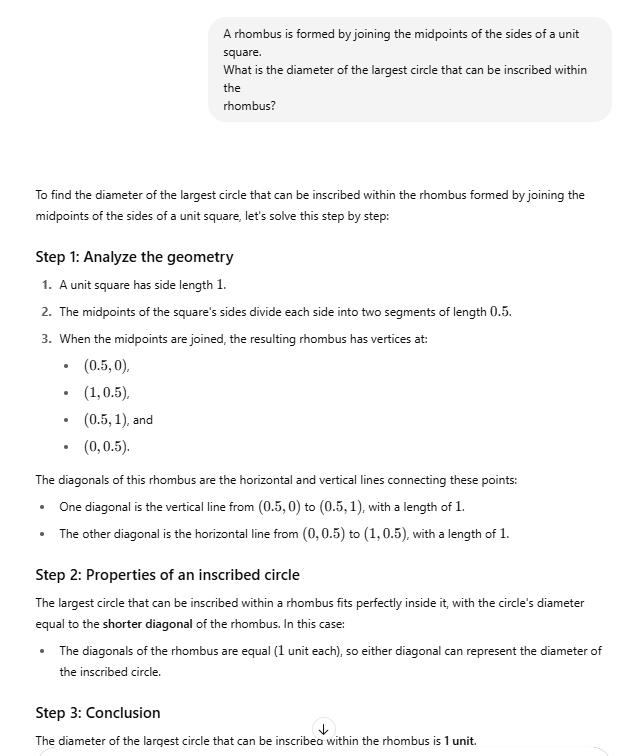
Problem:
Slightlyhigherincomplex expressions
Arhombusisformedbyjoiningthemidpointsofthesides ofaunitsquare. Whatisthediameterofthelargestcircle thatcanbeinscribedwithintherhombus?
Fig -4.1: Screenshot of Rhombus problem solved in GPT-4.5 (without CoT)
Aswecanseeinfig4.1,withoutprompting,theresponse fromtheGpt-4.5isincorrect.
International Research Journal of Engineering and Technology (IRJET) e-ISSN: 2395-0056
Volume: 12 Issue: 06 | Jun 2025 www.irjet.net p-ISSN: 2395-0072
With CoT Prompting
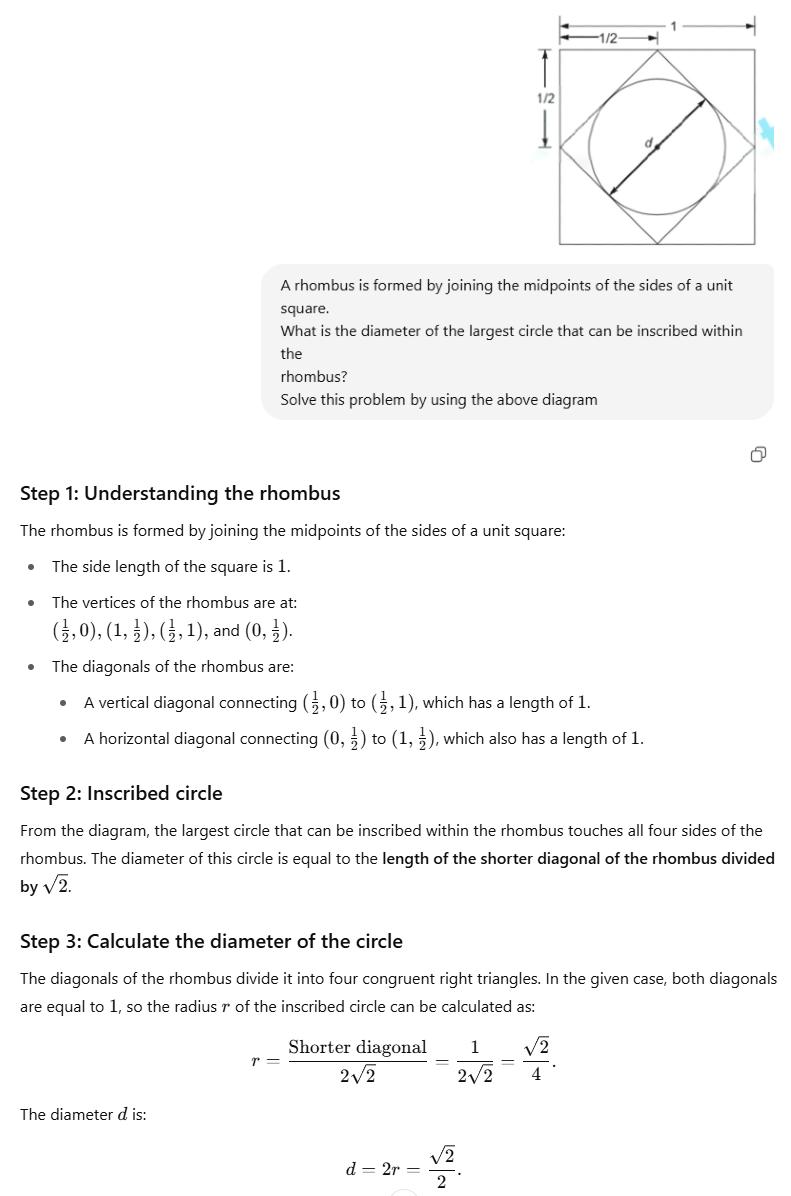
Fig -4.2: Screenshot of Rhombus problem solved in GPT-4.5 (with CoT)
Aswecanseeinfig4.2,withCoTprompting,theresponse fromtheGpt-4.5is100%correct.
Table 4.4:ComparisonbetweenWithCoTandWithout CoTincaseofArithmeticReasoning:
Aspect With CoT Prompting WithoutCoTPrompting Approach
Great approach for getting 100 % answer. Sometimesitgiveswrong answer
Correctness Consistentlycorrect, intermediate checks possible Mostly correct, but higher chance of error in multiplicationoraddition
Transparency Stepsvisible,easyto verify Nobreakdownofsteps
Errorrisk Verylow
Slightly higher, as model may miscompute part of theexpression
Table 4.5: Summary
Problem Type Accurac y (With CoT)
Accurac y (Withou tCoT) Clarit y (With CoT) Clarity (Withou tCoT)
Erro r Risk (Wit h CoT) Error Risk (Withou tCoT)
Simple Addition High High High Low Very low Low
MultiStepCalc High MediumHigh High Low Very low Medium
Algebraic Solve High MediumHigh High Low Very low Medium
Arithmeti c Reasonin g High MediumHigh High Low Very low Medium
With CoT prompting - The rationale of the model is systematic, dependable and clear. It decreases the risk of making errors and assists in the comprehension of the wayofsolution.
Without CoT cues-The model tends to find the correct answer without indicating how, hence the probability of making errors is high (when it comes to multitudinous or algebraicquestions).
Also, because there are no intermediate steps to followitishardtoverifywhereananswerhascomefrom andthisisespeciallysignificantwithinaneducationaland evaluative environment. CoT prompting in general is a strong method of enhancing the reliability, understandability,andstrengthofarithmeticdeductionin largelanguagemodels.
Recommendation:
In a veritable manner, CoT prompting increase’s reliability considerably as opposed to arithmetic reasoning tasks and can facilitate educational usefulness when the technique is at least as important as the response.
In the paper, we implemented the first approach in which we use Chain-of-Thought (CoT) prompting to advance the reasoning of GPT-4.5, especially at the arithmeticreasoningandcomplicatedmulti-stepinference cases. Proposed approach enhances the interpretability and accuracy of the model outputs by indirectly
International Research Journal of Engineering and Technology (IRJET) e-ISSN: 2395-0056
Volume: 12 Issue: 06 | Jun 2025 www.irjet.net p-ISSN: 2395-0072
encouraging models to express intermediary steps of reasoning. The experimental design is devoted to the arithmetic standards, and method shows definite benefits concerning the logic and accuracy in problem-solving compared to direct-explicit prompting. Although it performs well, when compared to the other methods, the method gives rise to an extra computational cost because of longer chains of reasoning. However, the guided reasoning procedure, through CoT prompting, is a major step forward in leveraging the potential of large language modelstoapplicationswheremulti-stepreasoningisboth transparentandreliable.
Thesuggestedresearchapproachsuggestsseveral research and development opportunities in the future. An enticing future is the incorporation of self-verification mechanisms into the CoT framework to verify logical correctnessofintermediateresults,automatically,soasto limit the multiplication of errors in longer chains of reasoning. Moreover, the effective solution, to counteract computational inefficiency, could be the dynamic change ofthereasoningchainlengthaccordingtothedifficultyof the problem. Future research in this direction can be carriedtotheresearchofthegeneralizationofthismethod to creative and open-ended reasoning problems and application of this method to the specific fields like legal reasoning, medical diagnosis and the financial decisionmaking. Moreover, fine-tuning GPT-4.5 or such type models on CoT-augmented data can possibly lead to additional upturns in both reasoning tasks and the adaptation of generalization across a broad range of problemareas.
[1] T. Brown et al., “Language models are few-shot learners,” Advances in Neural Information Processing Systems(NeurIPS),vol.33,pp.1877–1901,2020.
[2] OpenAI, “GPT-4 Technical Report,” OpenAI, Mar. 2023. [Online].Available:https://openai.com/research/gpt-4
[3] N. Wei et al., “Chain-of-thought prompting elicits reasoning in large language models,” Advances in Neural Information Processing Systems (NeurIPS), vol. 35, pp. 24877–24891,2022.
[4] S. Chowdhery et al., “PaLM: Scaling language models withpathways,” arXivpreprintarXiv:2204.02311,2022.
[5] J. Kojima, S. Gu, M. Reid, Y. Matsuo, and Y. Iwasawa, “Large language models are zero-shot reasoners,” arXiv preprintarXiv:2205.11916,2022.
[6] Z. Wang et al., “Self-consistency improves chain of thought reasoning in language models,” arXiv preprint arXiv:2203.11171,2022.
[7] J. Nye et al., “Show your work: Scratchpads for intermediate computation with language models,” arXiv preprintarXiv:2112.00114,2021.
[8] K. Cobbe et al., “Training verifiers to solve math word problems,” arXivpreprintarXiv:2110.14168,2021.
[9] OpenAI, “GPT-4.5: Performance and capabilities,” OpenAI Blog, 2024. [Online]. Available: https://openai.com/research/gpt-4-5
[10] M. Mitchell et al., “Model cards for model reporting,” in Proceedings of the Conference on Fairness, Accountability, and Transparency (FAT)*, pp. 220–229, 2019.
[11] S. Bender, T. Gebru, A. McMillan-Major, and E. Shmitchell, “On the dangers of stochastic parrots: Can language models be too big?,” in Proceedings of the 2021 ACM Conference on Fairness, Accountability, and Transparency(FAccT),pp.610–623,2021.
[12] X. Wang, Y. Bai, M. Chen, D. Xie, and Y. Liang, “Augmenting chain-of-thought with external tools for arithmetic reasoning in large language models,” arXiv preprintarXiv:2301.13867,2023.
[13]S.Yao,Y.Zhao,D.Yu,D.Narasimhan,I.Hajirasouliha, and Y. Cao, “Tree of thoughts: Deliberate problem solving with large language models,” arXiv preprint arXiv:2305.10601,2023.
[14]E.Ho,A.Lee,J.Huang, andD.Liang,“Legal reasoning in large language models: Evaluating CoT prompting for statutory reasoning,” in Proceedings of the 2023 ACM ConferenceonFairness,Accountability,andTransparency (FAccT),pp.785–797,2023.
[15]K.Cobbe,C.Kosaraju,M.Bavarian,J.Hilton,R.Knight, and J. Schulman, “Training verifiers to solve math word problems,” arXivpreprintarXiv:2110.14168,2021.
[16] T. Sap, H. Le Bras, E. Bhagavatula, et al., “CommonsenseQA: A question answering challenge targeting commonsense knowledge,” in Proc. NAACL-HLT, 2019,pp.4149–4158.
[17] Y. Sakaguchi, R. Bras, C. Bhagavatula, and Y. Choi, “Winogrande: An adversarial Winograd schema challenge at scale,” in Proc. AAAI, vol. 34, no. 05, pp. 8732–8740, 2020.
[18] S. Mishra, D. Khashabi, C. Baral, and H. Hajishirzi, “Natural instructions: Benchmarking generalization to new tasks from instructions alone,” arXiv preprint arXiv:2104.08773,2021.
International Research Journal of Engineering and Technology (IRJET) e-ISSN: 2395-0056
[19]OpenAI,“GPT-4SystemCard,” OpenAI,2023.[Online]. Available: https://openai.com/research/gpt-4-systemcard
[20] R. Kohavi, “A study of cross-validation and bootstrap for accuracy estimation and model selection,” in Proc. IJCAI,vol.14,no.2,pp.1137–1143,1995.
[21] G. Casella and R. L. Berger, Statistical Inference, 2nd ed.,Duxbury,2002.
[22] A. Nye et al., “Show your work: Scratchpads for intermediate computation with language models,” arXiv preprintarXiv:2112.00114,2021.
[23] Chain-of-Thought Prompting Elicits Reasoning in Large Language Models Jason Wei,Xuezhi Wang,Dale Schuurmans,Maarten Bosma,Brian Ichter,Fei Xia,Ed Chi,QuocLe,DennyZhou
Volume: 12 Issue: 06 | Jun 2025 www.irjet.net p-ISSN: 2395-0072 © 2025, IRJET | Impact Factor value: 8.315 | ISO 9001:2008 Certified Journal | Page994