
International Research Journal of Engineering and Technology (IRJET) e-ISSN:2395-0056
Volume:12Issue:06| Jun2025 www.irjet.net p-ISSN:2395-0072
International Research Journal of Engineering and Technology (IRJET) e-ISSN:2395-0056
Volume:12Issue:06| Jun2025 www.irjet.net p-ISSN:2395-0072
E.Sumalatha M.Tech, Computer Science and
Engineering
Shri Venkateshwara University
Gajraula, Uttar Pradesh 244236
Manoj Yadav Computer Science and Engineering
Shri Venkateshwara University Gajraula, Uttar Pradesh 244236
Abstract— Considering the reality that healthcare supplies are essential to deliver adequate health care and experiences considerable costs for the medical field, very has been learned about what is needed to get it economically. This work focuses on streamlining and automating the procurement and tracking process of laboratory items. This automation improves efficiency, reduces manual errors, and ensures seamless communication between departments via email notifications. Our system incorporates a face authentication feature for enhanced security. During user registration, users can register their faces, and when they attempt to log in, the system checks the live image against the registered face. Only if the live face matches the registered one, the user is granted access; otherwise, they are denied login. The system uses Convolutional Neural Networks (CNNs), VGG16, and MobileNet for live face recognition, ensuring secure access by comparing the live image with the registered face. These models help verify the user's identity and improve security, as they rely solely on live face detection and not other images. Finally, we validate the performance in means of several performance measures-viz., precision, recall, F1score, and support for the three models CNNs, VGG16, and MobileNet across certain classes like class 0, class 1, accuracy, macro avg., and weighted avg. Best precision value of 81%; best recall value of 81%; and best F1-score value of 79% were obtained for the two methods, namely, CNN and MobileNet, whereas VGG-16 method produced the least precision value of 76%; least recall value of 75%; andleastF1-scorevalueof77%.
Keywords- Lab item tracking, Medical equipment, Procurement process, Goods Receipt Note(GRN),and Material IssueVoucher(MIV).
The motivation for this paper stems from the need to streamlinetheprocurementandtrackingoflabitemsin
Md. Aftab Alam Computer Science and Engineering
Shri Venkateshwara University
Gajraula, Uttar Pradesh 244236
medical equipment companies, reducing inefficiencies, delays, and manual errors [1]. Traditional processes often suffer from poor communication and lack of accountability, which this automation aims to resolve through a centralized, transparent platform [2]. By introducing automated workflows, email notifications, and secure face authentication, the system enhances efficiency, security, and collaboration among stakeholders [3]. The goal is to ensure seamless communication, accurate tracking, and scalable operations, enabling organizations to meet current and futuredemandseffectively[4].
In our paper, we aim to revolutionize the traditional procurement and tracking processes by introducing a fully automated, secure, and efficient system. In the medical equipment industry, where timely procurement and accurate tracking of laboratory items are critical, manual processes often lead to delays, errors, and communication gaps among stakeholders such as indenters, purchase departments, suppliers, stores, and administrators.
This paper leverages a web-based platform to automate workflows, enabling users to raise purchase requests, monitor approvals, and track inventory seamlessly. Key features include automated email notifications, centralized ledger updates, and streamlined documentation with Goods Receipt Notes (GRN) and Material Issue Vouchers (MIV). To ensure robust security, the system integrates advanced face authentication using Convolutional Neural Networks (CNNs), VGG16, and Mobile Net, restricting access to authorizedpersonnelonly.
By enhancing transparency, accountability, and operational efficiency, this paper addresses critical challenges in the procurement lifecycle while laying the foundation for scalable and future-ready solutions. It ultimately contributes to improved organizational productivity and ensures uninterrupted operations in themedicalequipmentsector.
International Research Journal of Engineering and Technology (IRJET) e-ISSN:2395-0056
Volume:12Issue:06| Jun2025 www.irjet.net p-ISSN:2395-0072
Streamline Procurement Processes: Automate the end-to-end workflow for laboratory item procurement, reducing delays and manual effortacrossstakeholders.
Enhance Transparency and Accountability: Provide clear tracking and documentation (GRN, MIV, and ledger updates) to ensure all stakeholdershavevisibilityintotheprocess.
Improve Communication: Implement automated email notifications to keep indenters, purchase departments, suppliers, andstoresinformedateverystage.
Strengthen Security: Integrate face authentication using CNNs, VGG16, and MobileNetforsecureandreliableuseraccess.
MinimizeErrorsandBoostEfficiency:Eliminate manual errors and optimize operations for timely and accurate delivery of laboratory items.
1. Comprehensive Automation: Covers the entire procurement lifecycle, from purchase requests to final delivery, ensuring seamless operationsformedicalequipmentcompanies.
2. Stakeholder Integration: Supports collaboration between indenters, purchase departments, suppliers, stores, and administrators through a centralized webbasedplatform.
3. Enhanced Security: Implements live face recognition for secure user authentication, safeguardingsystemaccess.
4. Real-Time Updates: Providesautomatedemail notifications and ledger updates to ensure transparencyandtimelycommunication.
5. Scalability: Designed to handle growing organizational needs, making it adaptable for future expansions and increasing operational demands.
The traditional process of procuring and tracking laboratory items in medical equipment companies is plagued by inefficiencies, delays, and communication gapsamongstakeholders,includingindenters,purchase
departments, suppliers, stores, and administrators. Manualworkflowsarepronetoerrors,lacktransparency, and often result in mismanagement of inventory and delays in order fulfillment. Additionally, there are significant security risks in user access and identity verification.Thispaperaimstoaddressthesechallenges by automating the procurement and tracking process, integrating secure face authentication, and ensuring seamless communication and transparency through a centralized,web-basedplatform.
[5] explores the effects of automating supply chain processes, particularly procurement, in the healthcare industry. The case study shows that automation significantly boosts procurement efficiency by streamlining workflows, reducing manual errors, andenhancingdataaccuracy.Automatedsystemsenable quicker processing of purchase orders, provide better visibility across the supply chain, and support real-time communication between departments. The findings indicate that automation improves policy compliance, facilitates tracking of procurement stages, and reduces lead time, ultimately resulting in timely availability of medicalsupplies.
[6] focuses on the development of a web-based procurement system designed to streamline purchase order management. The system automates the entire procurement workflow, from raising requests to final order placement, reducing processing time and minimizing data entry errors. The role-based access controls improve security and accountability. Integrated notificationswithinthesystemensuretimelyupdatesfor stakeholders, enhancing communication, transparency, anddecision-making.
[7] discusses the use of RFID technology combined with workflow automation to optimize the goods receipt processinwarehouses.TheintegrationofRFIDallowsfor efficient identification and tracking of received goods, reducing the processing time and minimizing manual errors. The automated system provides real-time updates on the status of incoming materials, improving inventory visibility and enabling prompt handling of discrepancies. The approach results in enhanced operationalefficiencyandsignificantcostsavings.
[8] highlights the role of automated procurement systems in reducing manual errors and improving the efficiency of healthcare equipment purchasing. Automation streamlines workflows, facilitates faster approvalofpurchaseorders,andenhancescollaboration between the procurement team and suppliers. The systems enable real-time tracking and accurate documentation of procurement activities, improving
International Research Journal of Engineering and Technology (IRJET) e-ISSN:2395-0056
Volume:12Issue:06| Jun2025 www.irjet.net p-ISSN:2395-0072
accountability. The cost benefits include lower labor expenses and reduced process delays, ensuring timely availabilityofcriticalmedicalequipment.
[9] intends to improve neuroscience clinical performancebyintroducinganAgile-orientedsystemto manage inventory of medicinal materials. The recognized issue is the need for more effectiveness in handling healthcare equipment inventories, and this might give rise to stock shortages in supplies, administrative mistakes, and disruptions in treatment for patients. The technique used is an Agile strategy for developing software, beginning with customer requirement research and progressing through app creation and user acceptability testing. This study demonstrates how successful the system is in boosting clinical effectiveness through enhanced inventory management execution, health care purchasing efficacy, stock administration mistakes reduction, and user's satisfaction with the system. This study makes a conceptual addition to the advancement of inventory managerial theory in the medical sector, as well as operational implications for effective neurological clinicaladministration.
To drive technical advancement and evolution, [10] detailed the cutting edge of automation in pathology labs. The objective was to inspire innovative tools and proceduresaspositivelytransformationalassistancefor operators, organizations, and patients by anticipating laboratoryrequirementsandrequests.
[11] proposed that, at least for value chains that are socially driving us to create new markets, like assistive technology,thecleverarticulationofphysicaldevicesin tandem with their related digital twins can greatly enhance customized manufacturing processes. Along with a much-needed responsive yet sustainable manufacturing methodology, it guaranteed bespoke design,aspeedyproductionrun,andfrequentfollow-up maintenancethatalsoimprovesuseroutcomes.
[12] lookedatanumberoftopicsrelatedtothedelivery of medications, including the regulatory environment, the creation of smart hospitals, the products offered by IT companies, and the analysis of additional research resources. IT support needs, medication planning and procurement, and personalized recordkeeping were amongtheaspectsofmedicationmanagementthatwere investigated. Next, modelling and an architectural approach were used. Consequently, an information systems-based business process model has been developed, which can be used to develop the entire medicationmanagementcycle.
[13] investigated the different uses of AI in healthcare, emphasizing how they may save costs and enhance the
experienceofpatients. The studyemphasizedpredictive analytics,whichusedAIsystemstoexaminepastpatient data,findtrends,andprojecthealthconsequences.Early interventions were made possible by this, and they can lower hospital admissions and related expenses. AIdriven RPA (i.e., Robotic Process Automation) lowers administrative costs by automating processes including claimsprocessing,coding,andinvoicing.This eliminates mistakesandlessenstheneedforphysicaleffort.
[14] clarifiedhowmedical deviceswerecategorizedand examine how ChatGPT may help with many facets of medical device design, optimization, and enhancement. Nevertheless, it is important to take into account constraints such the possibility of misinterpreting user intent, the absence of firsthand knowledge, and the requirement for human supervision. Safe, high-quality, and compliant medical devices may be achieved by finding a balance between ChatGPT and human knowledge. In addition to highlighting the mutually beneficial interaction between artificial intelligence and human engagement in healthcare, the research study advances ChatGPT in the medical device manufacturing sector.
[15] administered a quantitative, cross-sectional questionnaire to 200 supply chain managers and healthcare workers from various healthcare businesses situated in US hospitals, clinics, and specialized medical facilities. The participants were specifically selected based on their familiarity with the workflow of AIinducedsystemsortheirpreviousexposuretothem.
[16] developed a LARG (i.e., Lean, Agile, Resilience, and Green) evaluation approach for Iran’s hospital medical equipmentsupplychain,withamainfocusonHamadan. Fourcriteriasuchaslean,agile,resilient,andgreenwere used by the FIS (i.e., Fuzzy Inference System) to assess LARG. Moreover, a targeted group of specialists in the field of medical equipment supply chain verified key indicators derived from an extensive literature research and other published publications in the field of LARG. The results show that the medical equipment supply chain’sLARGvaluewasattainedas0.787.
[17] developed a computerized system for managing hospital medicine supply chain information that was based on artificial intelligence and vendor managed inventory (AI+VMI). As the system generated buy, sales, and inventory data along with a variety of inquiry results,itmadeitpossibletodigitalizeandintelligentize purchasing plans, reconciliations, and consumption settlements.
Using DRL (i.e., Deep Reinforcement Learning), [18] created an ideal inventory replenishment strategy to guaranteedrugavailabilitywhilereducingstockoutsand
International Research Journal of Engineering and Technology (IRJET) e-ISSN:2395-0056
Volume:12Issue:06| Jun2025 www.irjet.net p-ISSN:2395-0072
medicalwastefromexpiry.Usingcontinuouslearning,it mapped the inventory problem as a MDP (i.e., Markov Decision Process) by using data from each store environment, including lead time, open orders, current inventory levels, and dynamic demand trends. The appropriate order amounts were chosen from the continuous action space for precise decision-making in thepharmaceuticalsupplychain.Thisleadstoenhanced profitabilityandservesa largerpatientbase,effectively deliveringhealthasasocialbenefit.
Consignment Stock policy and Vendor Managed Inventory(VMI)werecombinedin[19]tocreatea new ViableSupplyChain(VSC)thatwouldmanageinventory acrossSCcomponents.Byusingthesetactics,thevendor mayseehowmuchinventorythecustomerhasonhand. If the products are sold, the client pays out the vendor for the inventory that was sold. The model was solved using CVaR (i.e., Conditional Value at Risk) as a risk criterioninconjunctionwithRSO(i.e.,RobustStochastic Optimization).Thismodel’sgoalfunctionintegratedthe cost’s maximum, anticipated value, and CVaR. Sustainability criteria including energy use and CO2 emissions are taken into account to support viability against interruption. It was proposed to take an agile strategywithalearningcomponent.
With an emphasis on combining and evaluating data from several sources, this study [20] provided a thorough performance assessment of supply chain disruption risk forecasting systems in the medical field. The study processed diverse data streams from healthcare supply chain activities using an advanced LSTMnetworkarchitectureinconjunctionwithattention mechanisms. The suggested system includes feature fusion tactics, automated data pretreatment methods, and performance indicators that were specifically tailoredformedicalcaresupplychainapplications.
Purposive sampling was used in a cross-sectional descriptive research carried out by [21] at a few Western Province tertiary care facilities. Drug shop observations, document inspections, and selfadministered questionnaires were used to gather data. The study found that tertiary care institutions’ supply chain management procedures had serious flaws. Ineffective inventory management, poor training, and inadequate storage facilities were all shown to be contributingfactorstoinefficiency.
[22] investigated a generic model for hospital medication inventory management, specifically the problem of medicine refilling optimization. Tosolvethe issue,aDeepReinforcement Learning(DRL)model was examined as part of an online solution that can automaticallydecidewhentorefillmedicationsinorder toavoidaprescriptionshortage.Theperformanceofthe
suggested method was further validated using a numericalresultthatexceededthebaselines.
[23] suggested a decentralized blockchain-basedmethod tomanageCOVID-19medicalequipmentforwardsupply chain operations. The research made it possible for all partiesengagedinthehandlingofwastetocommunicate information in a completely safe, transparent, traceable, and reliable way. Data pertaining to the forward supply chain of COVID-19 medical equipment and its handling waste was safely retrieved, stored, and shared through the integration of the Ethereum blockchain with the decentralized storage of IPFS (i.e., Interplanetary File Systems). Algorithms were created to provide interactionguidelinesforprocessingCOVID-19trashand the penalties that will be applied to the involved parties intheeventthattheseguidelineswerebroken.
[24] interviewed 39 supply chain management and procurement specialists in semi-structured interviews. Seven recommendations for buffering and bridging strategies were then developed in order to manage the changing resource needs and enhance supply chain resilience during a pandemic.Overall,it wasestablished that the resource dependency hypothesis could be used to describe how businesses would mitigate a pandemic disruption.
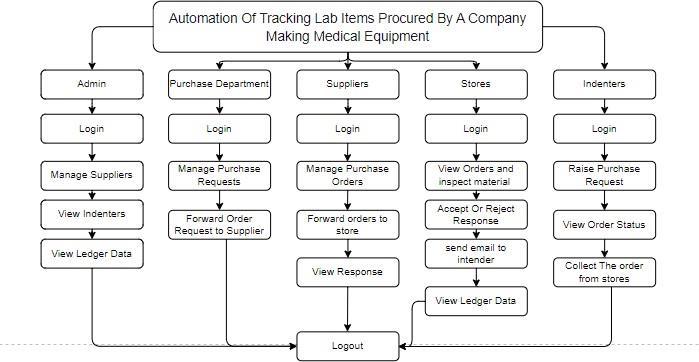
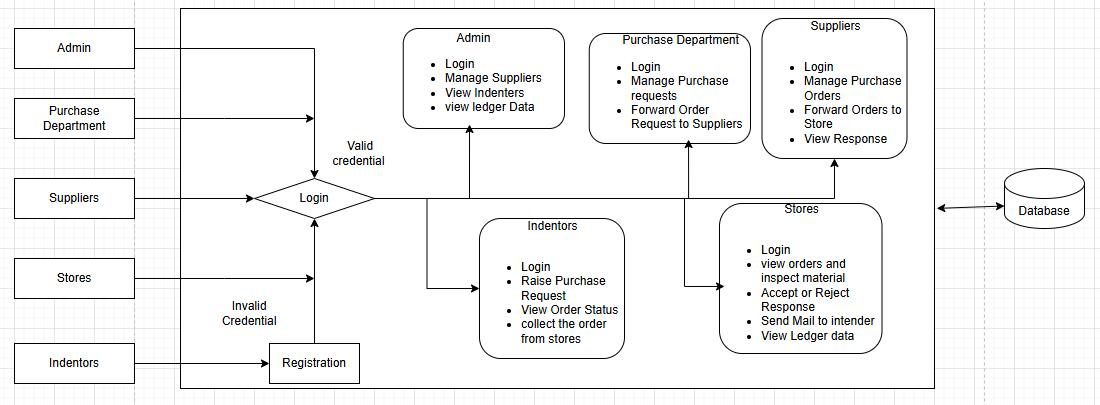
Our automated lab item procurement tracking framework (subsequently presented below in the fig 1 and fig 2) automates the entire procurement and trackingprocessforlaboratoryitems,ensuringseamless and efficient operations. A web-based platform enables stakeholders, including indenters, purchase departments, suppliers, stores, and administrators, to interact efficiently. Automated email notifications keep all parties informed at every stage, minimizing communication gaps. Advanced face authentication using CNNs, VGG16, and MobileNet ensures secure accessbyverifyingusersthroughlivefacedetection.We have used CNNs, VGG16, and MobileNet for the live face authentication’s sake in our work due to the following reasons:
CNNsareprominentlyknownforitspotentialto acquire the unique characteristics of the authenticated person’s face without any compromise because of the prevailing lighting conditions.
VGG16 is much robust, serving the face authenticationpurposesbecauseofitsabilityto remain unchanged despite the fluctuations of several aspects (like slight occlusions, expressions/feelings,andlighting)oftheface.
International Research Journal of Engineering and Technology (IRJET) e-ISSN:2395-0056
The utilization of MobileNET mostly leave out reduced memory traces while serving the face authenticationpurposes.
Thesystemincorporatescentralized trackingwithclear documentation, including Goods Receipt Notes (GRN)
A. Served functionalities
The system involves various stakeholders, including indenters, the purchase department, suppliers, stores, and administrators, all interacting within a web-based platform. Indenters can register, log in, raise purchase requests, and receive email notifications when their orders are ready for collection. The purchase department reviews requests, either approving or rejecting them, and forwards approved requests to suppliers. Suppliers review and accept or reject the
and Material Issue Vouchers (MIV), enhancing transparency and accountability. Real-time updates and a centralized ledger allow accurate inventory tracking and reduce errors. The scalable and secure design supports future organizational growth and ensures optimizedoperationalworkflows.
purchase orders, forwarding accepted orders to the stores. Stores inspect the received material, either accepting or rejecting it, and notify suppliers accordingly. Once accepted, stores fill a Goods Receipt Note (GRN) and inform the indenter that the order is ready for collection. Upon collection, stores complete
theMaterialIssueVoucher(MIV)form,updatingaledger to track quantities until the full order is delivered. Administrators oversee the entire process, managing suppliers and reviewing ledger data for transparency andaccountability.
Volume:12Issue:06| Jun2025 www.irjet.net p-ISSN:2395-0072 © 2025, IRJET | Impact Factor value: 8.315 | ISO 9001:2008 Certified Journal | Page932
International Research Journal of Engineering and Technology (IRJET) e-ISSN:2395-0056
Volume:12Issue:06| Jun2025 www.irjet.net p-ISSN:2395-0072
Here, we list the methods that we have used in our automatedlabitemprocurementtrackingframework.
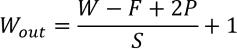
CNNs are neural networks that need enormous amounts of labeled data to train. CNNs are useful for a variety of tasks, including picture categorization, object identification,identifyingphishingmessages,andillness diagnostics. The four primary levels required to build a CNN are as follows: input, convolution, pooling, and completely connected levels. Improving the procedure for learning has enabled CNN to provide excellent and high-qualityoutcomesforavarietyofchallenges.Some formulaeusedinCNNareasfollows:

CNNs are able to overcome the challenges suffered by the traditional feed-forward neural networks. This superiority of CNN is pointed out with the followingbenefits:
Local Connectivity: Connections are not fullydensebetweenlayersbutlocalized.
Shared Weights: Thesamefilter(kernel)is used (shared) across different spatial locations, reducing the number of parameters.
Pooling: Down sampling mechanisms (pooling layers) reduce spatial dimensions, summarizing regions and helping the networkachievespatialinvariance.
VGG16isaCNNthatiswidelyregardedasoneofthe greatest visual computing frameworks ever created. This framework's authors used a tiny (3 × 3) convolution filtering topology to analyze networks and enhance depth, resulting in an important enhancement over previous setups. The framework increased the depthbetweensixteenandnineteenweightlevels, totalingaround138variablesthatcouldbetrained.
The number 16 in VGG16 represents the number of weighted levels. It comprises 13 convolutional levels, 5 Max Pooling levels, and 3 Dense levels, for a total of 21 levels, with just 16 weight levels (i.e., learnable variables).
Mobilenet is a framework that filters pictures using theidenticalconvolutionjustlikeCNN,yetemployingan alternative manner than prior CNNs. It employs the concepts of depth and point convolutions, which vary from the standard convolution performed by regular CNNs. This boosts CNN's performance in predicting pictures, allowing them to remain viable in handheld devices in addition.Because theseconvolution methods significantly cut comparative and identification duration,theydeliveranenhancedreactioninashorter amountofduration.
Theadvantagesofourautomatedlabitemprocurement tracking framework have been presented in the below bulletins.
Improved Efficiency: Automation of procurement and tracking processes reduces manual effort, speeding up the entire workflow andensuringtimelydeliveries.
Enhanced Security: Integration of live face authentication using CNNs, VGG16, and MobileNet ensures secure access, protecting sensitivedataanduseraccounts.
Better Communication: Automated email notifications at key stages keep all stakeholders informed,improvingcollaborationandreducing miscommunication.
AccuracyandReliability: Thesystemminimizes human errors in data entry, approvals, and documentation, ensuring accurate inventory trackingandprocurementrecords.
Transparency and Accountability: Centralized tracking, ledger updates, and automateddocumentation(GRNandMIV)enhance visibilityandaccountabilityacrossallstages.
Scalable and Future-Ready: The system is designed to handle growing demands and can easily scale as the organization expands, ensuringlong-termusability.
Cost-Effective: By reducing manual processes and errors, the system improves operational efficiency, ultimately saving time and costs associatedwithprocurementandtracking.
International Research Journal of Engineering and Technology (IRJET) e-ISSN:2395-0056
Volume:12Issue:06| Jun2025 www.irjet.net p-ISSN:2395-0072
This section presents the implementation modules of our automated lab item procurement tracking framework.
A. Indenter Module
Registerandlogintotheplatform.
Raise a purchase order and send it to the purchasedepartment.
Receiveemailnotificationswhenanorderis readyforcollectionfromthestores.
Collecttheorderfromstores.
Filloutthereceivedformfortherecords.
Logoutaftercompletingtasks.
B. PurchaseDepartmentModule
Logintotheplatform.
View and manage incoming purchase requests.
Accept or reject purchase requests and forwardacceptedorderrequesttosuppliers.
Logoutaftercompletingtasks.
C. Supplier Module
Logintotheplatform.
View purchase orders forwarded by the purchasedepartment.
Acceptorrejectorders.
Forwardacceptedorderstothestores.
Receive email responses from stores on materialacceptanceorrejection.
Logoutafterorderprocessing.
D. StoresModule
Viewordermaterialsuponarrival.
Inspectthematerialforquality.
Send acceptance or rejection responses to thesupplier.
Fill out the Goods Receipt Note (GRN) form foracceptedmaterials.
Send email notifications to indenters when theirordersarereadyforcollection.
Fill out the Material Issue Voucher (MIV) formuponordercollectionbytheindenter.
View the ledger to track delivered and pendingquantities.
Logoutaftercompletingtasks.
E. Admin Module
Logintotheplatform.
Viewtheregisteredindenters.
Add,view,orremovesuppliers.
Viewtheledgerdata.
Logoutaftercompletingadministrative tasks.
The results of our automated lab item procurement tracking framework have been presented below. The results have been generated for all the three models (viz., CNN, VGG16, and MobileNET). The performancesspecificcomparisonshavebeendoneinmeansofseveral measures/ certain aspect and are presented in the followingfiguresandtables.
First, we present the results of CNN in means of accuracy, loss, and confusionmatrix in the following fig 3,fig4,andfig5.Inthebelowfig3,theaccuracyplotfor CNN has been presented with accuracy Vs Epochs for boththetrainaccuracyandvalidationaccuracy.
In the below fig 4, the loss plot for CNN has been presentedwithlossVsEpochsforboththetrainlossand validationloss. International Research
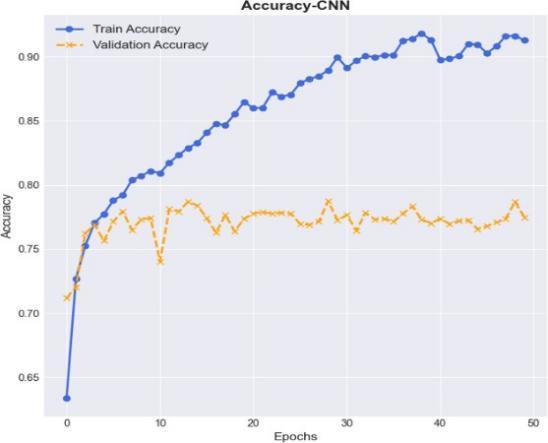
Fig 3 : Depiction of accuracy plot for CNN
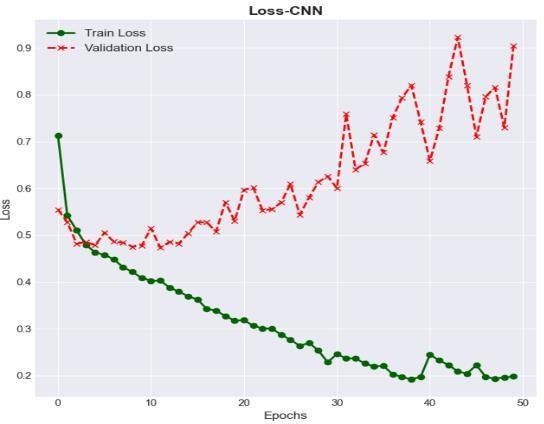
Fig 4 : Depiction of loss plot for CNN
In the below fig 5, the confusion matrix for CNN has been generated and presented with two groups by consideringtrueVspredicted.

Fig 5 : Depiction of confusion matrix for CNN
Then,wepresentthecomparisontabulationinmeans of precision, recall, F1-score, and support across five
lasses for classification-specific investigation for CNN inthefollowingtable1:
Table 1: Tabulation of classification-specific investigation for CNN
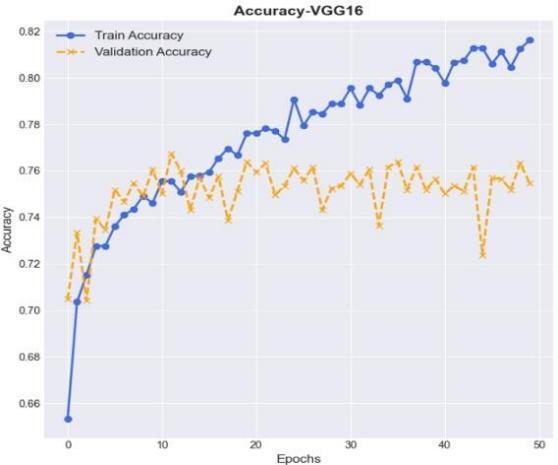
Here, we present the results of VGG16 in means of accuracy, loss, and confusion matrix in the following fig 6,fig7,andfig8.Inthebelowfig6,theaccuracyplotfor VGG16hasbeen presented withaccuracyVsEpochsfor boththetrainaccuracyandvalidationaccuracy.
In the below fig 7, the loss plot for VGG16 has been presentedwithlossVsEpochsforboththetrainlossand validationloss.
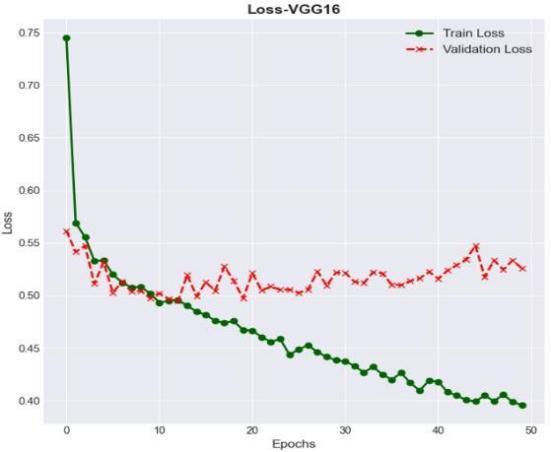
7 : Depiction of loss plot for VGG16
International Research Journal of Engineering and Technology (IRJET) e-ISSN:2395-0056
Volume:12Issue:06| Jun2025 www.irjet.net p-ISSN:2395-0072
Inthebelowfig8,theconfusionmatrixforVGG16has been generated and presented with two groups by consideringtrueVspredicted.
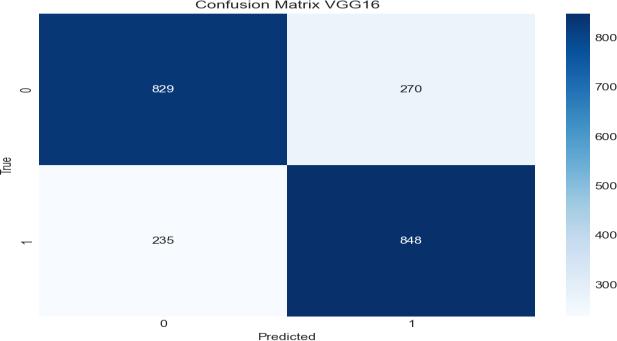
Then,wepresentthecomparisontabulationinmeans of precision, recall, F1-score, and support across five classesforclassification-specificinvestigationforVGG16 inthefollowingtable2:
In the below fig 10, the loss plot for MobileNet has been presented with loss Vs Epochs for both the train lossandvalidationloss.
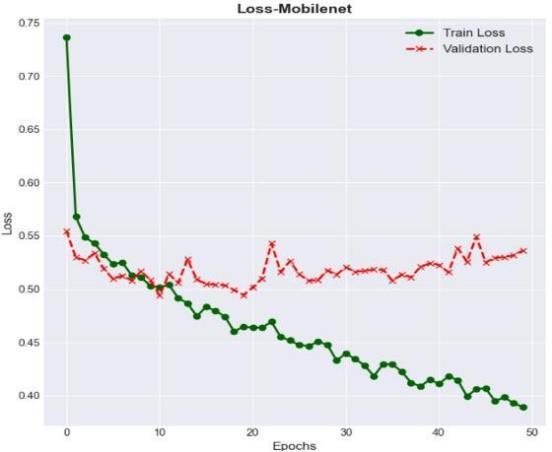
In the below fig 11, the confusion matrix for MobileNet has been generated and presented with two groupsbyconsideringtrueVspredicted.
C. MobileNet
Here,wepresenttheresultsofMobileNetinmeansof accuracy,loss,andconfusionmatrixinthefollowingfig9, fig10,andfig11.Inthebelowfig9,theaccuracyplotfor MobileNet has been presented with accuracy Vs Epochs forboththetrainaccuracyandvalidationaccuracy.
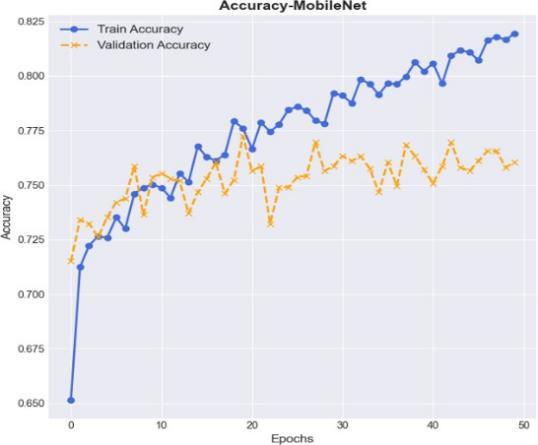
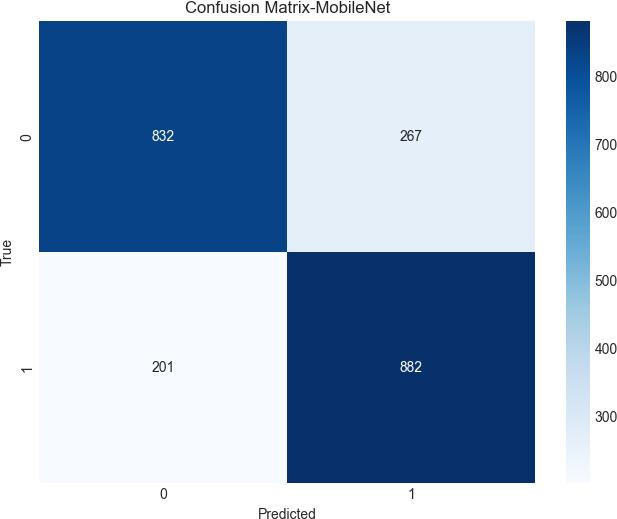
Then,wepresentthecomparisontabulationinmeans of precision, recall, F1-score, and support across five classes for classification-specific investigation for MobileNetinthefollowingtable3:
International Research Journal of Engineering and Technology (IRJET) e-ISSN:2395-0056
Volume:12Issue:06| Jun2025 www.irjet.net p-ISSN:2395-0072
We offered a transformative solution to the challenges faced by organizations in managing the procurement andtrackingoflaboratoryitemswiththedeploymentof methodologies like CNN, VGG16, and MobileNET. By automating manual workflows, integrating secure face authentication, and streamlining communication, the proposed system enhances efficiency, accuracy, and security across all stages of the procurement process. The automation reduces human errors, minimizes delays, and provides transparent and accountable tracking of orders, leading to improved overall operational performance. Moreover, the system is scalable, allowing it to meet the evolving needs of growing organizations. Ultimately, this paper paves the wayformoreefficient,secure,andreliableprocurement operations in the medical equipment sector, ensuring better management of resources and enhancing productivity. As far as the simulations of the models used in our automated lab item procurement tracking framework are concerned, both CNN and MobileNet were superior with both of them yielding higher precision of 81%, higher recall of 81%, and higher F1score of 79%. The MobileNet method was the least performerwithlowerprecision,lower recall, and lower F1-scoreequalto76%,75%,and77%,respectively.
AI-Driven Analytics: Integrating machine learning algorithms for predictive analytics to forecast procurement needs and optimize inventorymanagement.
Mobile Application Integration: Developing a mobileapptoenablestakeholderstoaccessthe system, track orders, and receive notifications on-the-go.
Blockchain for Transparency: Implementing blockchain technology to further enhance transparency, security, and immutability of procurementrecords.
Supplier Performance Tracking: Adding a module to assess and track supplier performance based on delivery times, quality, andorderaccuracy.
Automated Reporting: Introducing automated reportingfeaturestogeneratereal-timeinsights and performance reports for better decisionmaking.
[1] V. Nabelsi and S. J. I. J. o. P. R. Gagnon, "Information technology strategy for a patientoriented, lean, and agile integration of hospital pharmacy and medical equipment supply chains,"vol.55,no.14,pp.3929-3945,2017.
[2] C.Flechsig,F.Anslinger,R.J.J.o.P.Lasch,andS. Management, "Robotic Process Automation in purchasingandsupplymanagement:Amultiple case study on potentials, barriers, and implementation,"vol.28,no.1,p.100718,2022.
[3] S. Kansal and O. Goel, "Streamlining Security Task Reporting in DistributedDevelopment Teams.1,"2025.
[4] M. L. Abbott and M. T. Fisher, The art of scalability: Scalable web architecture, processes, and organizations for the modern enterprise PearsonEducation,2009.
[5] I. A. Omar, R. Jayaraman, M. S. Debe, K. Salah,I. Yaqoob, and M. J. I. a. Omar, "Automating procurementcontractsinthehealthcaresupply chain using blockchain smart contracts," vol. 9,pp.37397-37409,2021.
[6] М. Havrylenko, "Developing a System for Automated Monitoring of the Procurement Process Using Digital Technologies and Analyzing the Results of Previous Procurements,"2023.
[7] O.Denysov,N.Litvin,A.Lotariev,andV.J.I.J.o. R. Oliinyk, "Digitization of the Production Process: An Example of The Use of RFID TechnologiesForModernEnterprises,"vol.5,no. 11,pp.626-635,2024.
[8] S. Raghul, G. Jeyakumar, S. Anbuudayasankar, and T.-R. J. E. S. w. A. Lee, "E-procurement optimization in supply chain: A dynamic approach using evolutionary algorithms," vol. 255,p.124823,2024.
[9] D. J. C. J. J. E. Sihombing, "Enhancing Neurology Clinic Efficiency through Agile-Based Inventory Management System for Medical Supplies," vol. 13,no.02,pp.268-277,2024.
[10] E. Munari et al., "Cutting-edge technology and automation in the pathology laboratory," vol. 484,no.4,pp.555-566,2024.
International Research Journal of Engineering and Technology (IRJET) e-ISSN:2395-0056
Volume:12Issue:06| Jun2025 www.irjet.net p-ISSN:2395-0072
[11] V. J. R. d. I. A. e. M. Tamraparani, "Applying Robotic Process Automation & AI techniques to reduce time to market for medical devices compliance&provisioning,"vol.15,no.1,2024.
[12] E. Pelipenko, D. Ivanov, A. Dubgorn, and A. Levina, "Data-Driven Management of Medicine Provision in a Health Care Facility," in Innovations for Healthcare and Wellbeing: Digital Technologies, Ecosystems and Entrepreneurship: Springer,2024,pp.285-308.
[13] K.J.J.Q.J.o.E.T.PrabhodandInnovations,"The Role of Artificial Intelligence in Reducing Healthcare Costs and Improving Operational Efficiency,"vol.9,no.2,pp.47-59,2024.
[14] S. Li, Z. Guo, and X. J. A. o. B. E. Zang, "Advancing the production of clinical medical devices through ChatGPT," vol. 52, no. 3, pp. 441-445,2024.
[15] I. A. Badhan, M. H. Neeroj, I. J. F. M. Chowdhury, Management, and E. Journal, "The Effect Of Ai-Driven Inventory Management Systems On Healthcare Outcomes And Supply Chain Performance: A Data-Driven Analysis," vol.4,no.11,pp.15-52,2024.
[16] R. Pabarja, G. Jamali, K. Salimifard, and A. J. I.J. o.R.i.I.E.Ghorbanpur,"AnalysisoftheLARGof the Hospital Medical Equipment Supply Chain UsingtheFuzzyInferenceSystem,"vol.13,no.2, 2024.
[17] J.Shen et al.,"Management ofdrugsupplychain information based on “artificial intelligence+ vendor managed inventory” in China: perspective based on a case study," vol. 15, p. 1373642,2024.
[18] A. Kaur and G. J. S. I. Prakash, "Intelligent Inventory Management: AI-driven solution for the Pharmaceutical Supply Chain," p. 100109, 2025.
[19] R. Lotfi, P. MohajerAnsari, M. M. S. Nevisi, M. Afshar,S.M.R.Davoodi,andS.S.J.R.i.E.Ali, "A viable supply chain by considering vendormanaged-inventory with a consignment stock policyandlearningapproach,"vol.21,p.101609, 2024.
[20] C.Ju,Y.Liu,andM.Shu,"Performanceevaluation of supply chain disruption risk prediction models in healthcare: A multi-source data analysis,"2024.
[21] K. Jeyassuthan, G. P. Roshan, N. Gandharupan, andB.J.S.L.J.o.H.R.Kayalvizhi,"Assessmentof DrugSupplyChainManagementEffectivenessin SelectedTertiaryCareHospitalsinTheWestern ProvinceofSriLanka,"vol.4,no.1,2025.
[22] T. Abu Zwaida, C. Pham, and Y. J. A. S. Beauregard, "Optimization of inventory management to prevent drug shortages in the hospital supply chain," vol. 11, no. 6, p. 2726, 2021.
[23] R. W. Ahmad, K. Salah, R. Jayaraman, I. Yaqoob, M. Omar, and S. J. I. A. Ellahham, "Blockchainbased forward supply chain and waste management for COVID-19 medical equipment andsupplies,"vol.9,pp.44905-44927,2021.
[24] A. Spieske, M. Gebhardt, M. Kopyto, H. J. J. o. P. Birkel, and S. Management, "Improving resilience of the healthcare supply chain in a pandemic: Evidence from Europe during the COVID-19crisis,"vol.28,no.5,p.100748,2022.