Chapter Outline
SEQUENCES AND SERIES CHAPTER 3
3.1 Arithmetic Progression
3.2 Geometric Progression
3.3 Harmonic Progression
3.4 Relation between AM, GM, and HM
3.5 Arithmetico-Geometric Progression
3.6 Special Series
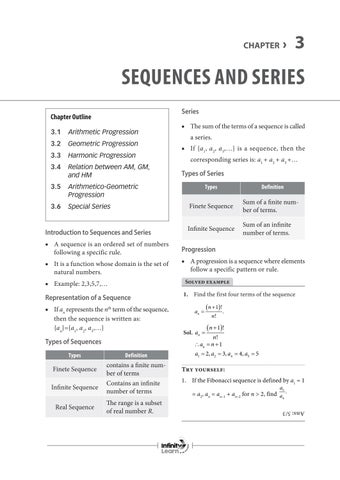
Introduction to Sequences and Series
■ A sequence is an ordered set of numbers following a specific rule.
■ It is a function whose domain is the set of natural numbers.
■ Example: 2,3,5,7,…
Representation of a Sequence
■ If a n represents the nth term of the sequence, then the sequence is written as:
{a n}={a1, a2, a3,…}
Types of Sequences
Types
Definition
Finete Sequence contains a finite number of terms
Infinite Sequence
Real Sequence
Contains an infinite number of terms
The range is a subset of real number R.
Series
■ The sum of the terms of a sequence is called a series.
■ If { a 1, a 2, a 3,…} is a sequence, then the corresponding series is: a1 + a2 + a3 +…
Types of Series
Types
Finete Sequence
Infinite Sequence
Progression
Definition
Sum of a finite number of terms.
Sum of an infinite number of terms.
■ A progression is a sequence where elements follow a specific pattern or rule.
Solved example
1. Find the first four terms of the sequence
Try yourself:
1. If the Fibonacci sequence is defined by a1 = 1

Ans: 5/3
3: Sequences and Series
3.1 ARITHMETIC PROGRESSION (AP)
Definition
■ A sequence is an Arithmetic Progression (AP) if the difference between any two consecutive terms is constant.
■ This constant difference is called the common difference (d).
■ Example: 1,6,11,16,… is an AP.
General Form of AP:
■ The terms of an arithmetic progression are written as: a,a+d,a+2d,a+3d , . . .
■ Where:
a = first term
d = common difference
Checking Whether a Given Sequence is an AP
■ Compute the difference between successive terms.
■ If the difference remains constant, the sequence is an AP.
■ Mathematically, for an AP: 1 nn aad + −= ,
∀ n ∈ N.
Solved example
2. Check if the sequence 3, –1, –5, –9 .... is an AP. Find the common difference.
Sol. Let a1 = 3, a2 = –1, a3 = –5, a4 = –9, where a2 – a1 = –4, a3 – a2 = –4, a4 – a3 = –4
∴ a2 – a1 = a3 – a2 = a4 – a3 = .........
∴ The sequence is in AP and common difference is –4
Try yourself:
2. Check whether the following sequence 2,32,52,72........ is an AP. Find the common difference.
Ans: AP; Common difference = 22
3.1.1 Genereal Term of AP
■ The n th term of an AP is given by: ( )1 n aand =+−
■ Key observations:
The general term is a linear expression of the form An + B, where A and B are constants.
The coefficient of n in the general term is the common difference d.
Three terms in AP: a–d,a,a+d .
Four terms in AP: a–3d,a–d,a+d, a+3d.
Odd number of terms: Middle term = a, common difference = d
Even number of terms: Middle terms = a – d, a+d, common difference = 2 d.
■ p-th term from the end of an AP with n terms: an–p+1 =l–(p–1)d where l is the last term.
Solved example
3. Find the nth term of the AP 13, 8, 3, –2 .......
Sol. Here, a = 13, d = 8 – 13 = –5 Now t n = a + (n – 1)d = 13 + (n – 1) (– 5) = 18 – 5n
Try yourself:
3. Which term of the AP 4, 9, 14, ...... is 254? Ans: 51
3.1.2 Sum to n Terms of an AP
■ Sum of first n terms: ( ) ( ) 21 2 n n Sand =+−
■ When the last term l is given, is ( ) 2 n n Sal =+
■ Special cases:
If n is odd, + = 1 2 .()nn Sna
If n is even, 1 22 2 nnn n Saa + =+
nth term of the sequence is 1 nnn aSS =−
Solved example
4. Find the sum of 20 terms of the AP. 1, 4, 7, 10,......
Sol: According to the problem, a = 1, d = 3, n = 20
S n = 2 n [2a + (n – 1)d] = 20 2 [2 + 19 × 3] = 10 × 59 = 590
Try yourself:
4. Find the sum of the series 5 + 13 + 21 +......+ 181.
3.1.3 Properties of Arithmetic Progression
Relation Between Terms
■ If the terms a,b,c are in arithmetic progression, then 2b = a+c
Properties of Arithmetic Progression for Sequences
■ If 123,,,..., n aaaa a form an arithmetic progression (AP), the following properties are true:
λλλλ ±±±± 123,,,..., n aaaa are also in arithmetic progression.
123 ,,,..., n kakakaka are also in arithmetic progression with common difference kd, where { }0 kR∈−
3 12 ,,,... aaa kkk are also in arithmetic progression with common difference d k , where { } ∈− 0. kR
Sum of Equidistant Terms
■ In a finite AP, the sum of the terms equidistant from the beginning and the end is always same and is equal to the sum of the first and last term.
1 (1) 1,2,3,....1 nknk aaaakn +=+∀=− .
nth Term as a Linear Expression
■ A sequence is in AP if and only if its nth term is a linear expression in n, i.e., n aAnB =+ , where A and B are constants. In such cases, the coefficient of n in a n is the common difference of arithmetic progression.
Sum of the First n Terms
■ A sequence is an AP if and only if the sum of its first n terms is of the form 2 AnBn + , where A and B are constants independent of n. In such cases the common difference is 2A, i.e., 2 times the coefficient of n2 .
Regular Interval Selection
■ If the terms of AP are chosen at regular intervals, then they form an arithmetic progression.
Example Sequences and Their Properties
■ The following table shows the number of terms, terms, and common differences.
3 a–d,a,a+dd
4 a–3d,a–d,a+d, a+3d2d
5 a–2d,a–d,a,a+d, a+2dd
6 a–5d,a–3d,a–d, a+d,a+3d,a+5d2d
Solved example
5. If a,b,c are in AP, then check whether 111 ,, bcacab are in AP or not.
Sol. Given: a,b,c are in AP.
Dividing each term by non zero constant abc, ,, abc abcabcabc are in AP
⇒ 111 ,, bcacab are in AP
Therefore, a,b,c are in AP ⇒ 111 ,, bcacab are also in AP
Try yourself:
5. If ,, bccaab abc +++ are in AP, then check whether 111 ,, abc are in AP or not.
Ans: AP
3.1.4 Arithmetic Mean
■ If n arithmetic means A1, A2, A3,.... A n are inserted between two numbers a and b , then they form an AP.
■ Common difference d: 1 dba n = +
■ Arithmetic means: A1=a+d,A2=a+2d, ...,An =a+nd.
■ Sum of n arithmetic means: S = n x AM
■ Arithmetic mean of two numbers: AM =
2 ab +
■ Arithmetic mean of n numbers: AM = 123 n aaaa n ++++ .
■ If a1, a2, ..., a n are nonzero terms of an AP: AM > GM (Using AM-GM Inequality)
Solved example
6. Find the AM between 7 and 13.
Sol. Arithmetic mean of a and b is 2 ab + + == 713 10. 2
Try yourself:
6. Which term of the AP 4, 9, 14, ...... is 254?
Ans: 51
CHAPTER 3: Sequences and Series
TEST YOURSELF
1. If a,b,c,d,e,f are in AP, then e – c = (1) 2 (c – a) (2) 2 (d – c) (3) 2(f – d) (4) d – c
2. If 7 times of the 7th term of an AP is equal to 11 times of its 11th term, then 18th term of AP is
(1) 0 (2) 10
(3) 12 (4) 8
3. If 1 + 6 + 11 + 16 + ..........+ x = 148, then x = (1) 36 (2) 8 (3) 148 (4) 30
4. The sum of n terms of an AP is 2n2+n. Then, 8th term of the AP is (1) 27 (2) 31 (3) 35 (4) 39
5. If a1, a2, a3, a4,…… are in AP such that a1 + a5 +a10 + a15 + a20 + a24 = 450, then a1+ a8 + a17 + a24 = (1) 100 (2) 150 (3) 300 (4) 450
6. The interior angles of a polygon are in AP. The smallest angle is 120° and the common difference is 5°. Then, the number of sides of the polygon is (1) 6 (2) 7 (3) 8 (4) 9
7. If a1, a2, a3……. are in AP and a4 + a8 + a12 + a16 = 224, then the sum of the first nineteen terms is ___.
8. If the sum and product of the first three terms in an AP are 33 and 1155, respectively, then its 11th term is ______.
9. The sides of a right angled triangle are in arithmetic progression. If the triangle has area 24, then what is the length of its smallest side?
Answer Key
(1) 2 (2) 1 (3) 1 (4) 2 (5) 3 (6) 4 (7) 1064 (8) 47 (9) 6
3.2 GEOMETRIC PROGRESSION
Definition:
A sequence of non-zero numbers is called a Geometric Progression (GP) if the ratio of any term to its preceding term is constant. This constant ratio is called the common ratio (r)
General Form
■ A geometric progression is represented as: a,ar,ar2,ar3 ,... where:
a= first term
r = common ratio
Condition for GP:
■ To verify if a sequence is a GP: + = 1 , n n T r T
∀ n ∈ N. If the ratio remains constant, the sequence is a GP.
Solved example
7. The sequence given by a n = 3(2n), for all n ∈ N, is a GP. Find its common ratio.
Sol. a n = 3(2n) 1 1 3(2) 2 3(2) n n n n a r a + + ===
∴ Common ratio, r = 2
Try yourself:
7. If the sequence 4, 12, 36, 108,....is in GP, then find the common ratio.
Ans: 3
Solved example
8. Find the 9th term and the general term of progression 11 , 42 , 1, –2,...
Sol. Given progression is in GP, where a = 1 4 , r = –2
a9 = ar9–1 = 1 4 (–2)8 = 64.
General term = arn–1 = 1/4 (–2)n–1
Try yourself:
8. Find the 4th term from the end of GP 3, 6, 12, 24,....3072.
Ans: 384
3.2.2
Sum to n Terms of GP
■ The sum of the first n terms of a GP is: ( ) 1 1 n n ar S r =
For r < 1 : ( ) 1 1 n n ar S r = for r >1: ( )1 1 n n ar S r =
Some important derivations to remember:
■ Sum of n terms of p + pp + ppp + .....is 10(101) ,1,2,3.....9 99 n n apnp =−=
■ Sum of n terms of 0.p + 0. pp + 0. ppp + ..... is (110) ,1,2,3.....9 99 n n p anp =−=
Solved example
9. Find the sum of 7 terms of the GP 3, 6, 12,...
3.2.1
General Term of GP
■ nth Term Formula: T n =ar(n–1)
Term from the End:
■ The kth term from the end of a GP with terms is:
1 1 , p l r where l is the last term.
Sol. According to the problem, a = 3, r = 2 >1, n = 7 77 7 121 3 121 r Sa r == = 3(128 – 1) = 381
Try yourself:
9. Find the sum of the series 2 + 6 + 18 +....+ 4374.
Ans: 6560
3.2.3 Sum to Infinite GP
■ For an infinite GP (n→∞) : ∞ = , 1 a S r if < 1. r If 1 r ≥ , the sum does not exist.
Solved example
10. Find the sum of series 234 1111 1 3 333 −+−+−∞
Sol. a = 1, r = 1 3 < 1
S ∞ = 1 a r = 13 1 4 1 3 = +
Try yourself:
10. Find the sum of series 111 3927 9.9.9.......∞
3.2.4 Properties of GP
Ans: 3
■ If 123,,,...aaa are in geometric progression, then for any non-zero constant k :
123 ,,,...kakaka are also in geometric progression.
3 12 ,,,... aaa kkk are also in geometric progression.
123 111 ,,,... aaa are also in geometric progression.
123 ,,,... kkk aaa are also in geometric progression.
123,,,... akakak ±±± are not in geometric progression.
123,,,... kkk aaa are in geometric progression with common ratio k r
If a 1 , a 2 , a 3 a n are non-zero and non-negative terms of a GP, then 123 log,log,log,...log n aaaa are in AP and vice versa.
CHAPTER 3: Sequences and Series
■ In a finite GP, the product of the terms equidistant from the beginning and the end is always same and is equal to the product of the first and the last terms. 11 2,3,....1 knkn aaaakn −+ =∀=− .
■ If a,b,c are in geometric progression, then = 2 bac
■ If the terms of a given GP are chosen at regular intervals, then the new sequence so formed also forms a GP.
■ Solving problems by considering the terms of GP: The following table shows the number of terms versus terms in geometric progression.
No. of terms Terms Common ratio
3 ,, a aar r r
4 3 3 ,,, aa arar rr r2
5 2 2 ,,,, aa aarar rrr
Solved example
11. If the sum of the squares of the first three terms of geometric progression is 33033, then find the sum of three terms.
Sol. Let the terms be 2 ,, aarar
Given: 22224 33033 aarar++= It implies that ( ) ( ) 224 2 133033 11273 arr++= = ( ) ( ) ( ) ( ) 24 42 422 22 2 22 11and1273 2720 17162720 1716170 16170 4 arr rr rrr
Therefore, the sum of the first three terms is ( ) ( ) 1114161121231 ++==
Try yourself:
11. Find k such that k + 9, k – 6 and 4 form three consecutive terms of a GP.
Ans: 0,16
3.2.5 Geometric Mean
■ If G1,G2,...,Gn are inserted between a and b in GP, they are called geometric means.
■ For three terms in GP: a,G,b
G2 = ab ⇔ Gab =
■ If n geometric means are inserted:
b=ar(n+1)
Common ratio: 1 1 1 n n b r a b r a + + ⇒= ⇒=
Sequence: G1,G2,...,Gn is a GP
Product of all geometric means: ( ) 12 ...... n n n GGGabG ==
Solved example
12. If p is the GM of 2 and 1 4 , then find p
Sol. GM of a and b is ab So, 11 2 4 2 p =×=
Try yourself:
12. Insert 5 GM’s between 576 and 9.
Ans: 288, 144, 72, 36, 18
TEST YOURSELF
1. If t8and t3 of a geometric progression are 4 9 and 27 8 , respectively, then the value of t12 of the geometric progression is (1) 32 243 (2) 64 729 (3) 64 81 (4) 128 729
2. If sum of n terms of the GP 3, 32, 33,........ is 120, then n = (1) 1 (2) 2 (3) 3 (4) 4
3. If the third term of a GP is 4, then the product of its first five terms is (1) 289 (2) 1024 (3) 576 (4) 384
4. If k−1, 2k+1, 6k+3 are in GP, then k = (1) 2 (2) 4 (3) 6 (4) 8
5. In a GP consisting of positive terms, each term is equal to the sum of the next two terms. Then the common ratio of this progression is (1) 15 2 (2) 5 2 (3) 51 2 + (4) 51 2
6. Let a1, a2 ........ a10 be a GP. If 3 1 25 a a = , then 9 5 a a equals to ______.
7. The value of 2 × 21/441/881/16....to ∞ is______.
8. If a,b,c are the pth , qth , rth terms of GP, then (qr)ln a + (rp)ln b + (pq)ln c is equal to_____.
Answer Key
(1) 2 (2) 4 (3) 2 (4) 2 (5) 4 (6) 625 (7) 4 (8) 0
CHAPTER 3: Sequences and Series
3.3 HARMONIC PROGRESSION
■ A sequence of non-zero numbers is called a harmonic progression (HP) if the reciprocals of its terms form an arithmetic progression (AP). The nth term of an HP is the reciprocal of the nth term of the corresponding AP.
■ General Term of HP: If the terms of an HP are reciprocals of an AP with first term a and common difference d, then the nth term of HP is: ( ) 1 1 n a and = +−
■ Harmonic Mean: Let a and b be two given numbers. If n numbers H₁, H₂, ..., Hn are inserted between a and b such that the sequence a, H₁, H₂, ..., Hn, b is in HP, then these inserted numbers are called harmonic means (HMs).
■ The reciprocals of terms in HP form an AP: 12 1111 ,,,..., aHHb
■ If d is the common difference of the corresponding AP: ( )1 ab D nab = +
■ Harmonic Mean of Two Numbers: HM= 2ab ab +
■ Harmonic Mean of n Non-Zero Numbers: 123 1111 1 n
Solved example
13. Find the 10th term of harmonic progression 1424 ,,,,... 519917
Sol. Given: 1424 ,,,,... 519917 are in HP
⇒ 19917 5,,,,.... 424 are in AP
where,a= 5, d = 191 5 44 −=−
Now, a10 = 5 + 111 9 44 −=
∴ 10th term of HP = 4 11
Try yourself:
13. If a1, a2, a3, a4, a5 are in HP, then find a1 a2 + a2 a3 + a3 a4 + a4 a5 .
Ans: 4a1a5
TEST YOURSELF
1. In an HP 4th term is 1 9 and 13th term is 1 27 . The 7th term is (1) 15 5 (2) 1 15 (3) 1 12 (4) 1 3
2. If 3rd term of HP is 7 and 7th term of HP is 3, then 10th term is (1) 10 21 (2) 21 10 (3) 10 7 (4) 3 7
3. Let three numbers form an HP. The sum of the numbers is 11 and the sum of their reciprocals is 1. Then, one among those numbers is (1) 3 (2) 4 (3) 1 6 (4) 1 2
4. If a,b,c are in HP, then 111111 bcacab
(1) 2 21 bcb + (2) 22 1321 4 ca ca
(3) 2 32 bab (4) 11 ba +
5. If a,b,c are in HP and a2 , b2 , c2 are in HP, then (1) a = b = c (2) 2b= 3a+ c (3) 2 8 bac = (4) 2c = 3b+ a
6. If a1, a2, …………a n are in HP, then a1.a2 + a2. a3 +a3.a4 +……+a n–1.a n =
(1) (n – 1) a1a n
(2) na1a n
(3) (n+1)a1a n
(4) (n+2) a1a n
Answer Key
(1) 2 (2) 2 (3) 1 (4) 3 (5) 1 (6) 1
3.4 RELATION BETWEEN AM, GM, AND HM
■ Let A, G, and H be the Arithmetic Mean (AM), Geometric Mean (GM), and Harmonic Mean (HM) between two numbers a and b.
Definitions:
■ Arithmetic Mean (AM): 2 ab A + =
■ Geometric Mean (GM): Gab =
■ Harmonic Mean (HM): 2ab H ab = +
Important Relations:
■ Inequality Relation: AGH ≥≥ (Equality holds when a = b)
■ AM, GM, and HM are in Geometric Progression: A, G, H form a GP G2 = AH
■ Quadratic Equation with a and b as Roots: 2220xAxG−+=
Conditions for AM, GM, and HM:
■ A, G, H satisfy the following conditions:
Arithmetic Mean (AM): 2 ab A + =
Geometric Mean (GM): Gab =
Harmonic Mean (HM): 2ab H ab = +
Extension to Three Numbers:
■ If A, G, H are AM, GM, and HM of three positive numbers a, b, c, then the equation with roots a, b, c is:
11 nn nn ab ab + +
Generalized Relations:
■ If A₁, A₂ are two AM’s, G₁, G₂ are two GM’s, and H₁, H₂ are two HM’s between two numbers a and b, then: = 1 1,,0 2 n
Solved example
14. If AM and GM are 9 and 4 respectively, then find HM.
Sol. Given: AM = 9, GM = 4
Since G2 = AH ⇒ 16 = 9H ⇒ H = 16 9
Try yourself:
14. If a is arithmetic mean and G1, G2 are geometric means between b and c, then find G1 3 + G2 3 . Ans: 2abc
TEST YOURSELF
1. If 11 nn nn ab ab + + is the AM between a and b, then the value of n is
(1) 0 (2) 1 (3) –1 (4) 1/2
2. The GM of two numbers is 6. Their arthmetic mean A and harmonic mean H satisfy the equation 90A + 5H = 918. Then,
(1) A=10, A = 4 (2) == 1 , 10 5 AA
(3) A = 5, A = 10 (4) == 1 , 5 5 AA
3. If n AMs are inserted between 2 and 100, then sum of n AMs is
(1) 50 n (2) 51 n (3) 50 (4) 51
4. After inserting n AM between 2 and 38, the sum of the resulting progressions is 200. The value of n is
(1) 7 (2) 8 (3) 9 (4) 10
5. If the AM of the roots of a quadratic in x is 3 and GM is 22 , then the quadratic equation is
(1) x2 – 3x + 8 = 0
(2) 2 – 6 22 0 xx +=
(3) x2 – 6x + 8 = 0
(4) 2 – 3 22 0 xx +=
6. If A and G are the AM and GM respectively between two numbers, then the numbers are
(1) 22AGA ±+ (2) 22AAG ±−
(3) 22 2 AAG ±+ (4) 22GAG ±−
7. If 11 AM’s are inserted between 28 and 10, then number of integral AM’s is _____.
8. If x,y,z are three numbers in GP such that 4 is the AM between x and y and 9 is the HM between y and z, then y is _____.
9. If HM of 23 10 1111 ,,, 2 222 … is 10 21 λ , then λ = _____.
Answer Key
(1) 2 (2) 2 (3) 2 (4) 2 (5) 3 (6) 2 (7) 5 (8) 6 (9) 5
3.5 ARITHMETICO-GEOMETRIC PROGRESSION
■ A sequence in which every term is product of corresponding term of AP and GP is known as arithmetico-geometric progression. The series may be written as ( ) ( ) ( ) 23 ,,2,3,... aadradradr +++ .
■ General term: ( ) ( ) 1 1 n n aandr =+−⋅
■ Sum to n terms of arithmetico–geometric progression:
CHAPTER 3: Sequences and Series
i. ( ) ( ) ( ) ( ) 1 2 1 1 11 1 nn n arandrSdr rr r +− =+− , when 1 r ≠
ii. ( ) ( ) 21 2 n n Sand =+− , when 1 r = iii. ( ) 1 1 n n ar S r = , when 0 d =
■ Sum to infinite terms of arithmetico–geometric progression, ( )2 1 1 adr S rr ∞ =+ , when 1 r <
Solved example
15. Find the sum to the infinity of the series 234 261014 1 3 333 ++++ +... Sol. Let 234
1 3 333 S =++++ ......(1)
112610 33 333 S =+++ ...(2) (1) – (2) ⇒ 22
1...
Try yourself:
15. For k ∈ N, if the sum of the series
481319 1 kkkk ++++ is 10, then find the value of k. Ans: 2
TEST YOURSELF
1. If the sum of 1+4x+7x2+10x3+...∞ |x|<1 is 35 16 , then x = (1) 1 3 (2) 1 4 (3) 1 5 (4) 1 6
2. The sum of n terms of the series 2 11 12131.... nn
+++++
is (1) n2 (2) n (n+1) (3) 2 1 1 n n + (4) (n+1)2
3. The sum of the infinite series 2345 27121722 1 3 3333 ++++++…… is equal to (1) 9 4 (2) 11 4 (3) 15 4 (4) 13 4
4. The positive integer n for which 2× 22 +3 ×23 + 4 × 24 +..+n ×2n = 2n +10 is (1) 510 (2) 511 (3) 512 (4) 513
5. Let S k be defined as 1 1 n nk ∞ =
∑ where k is a positive integ er greater than one. If the maximum value of the expression 2 2 1 () kk k SS S + + can be expressed in the lowest rational as p q , then the value of (p + q) is _____.
6. If (10)9 + 2(11)1(10)8 + 3(11)2(10)7 + ...... + 10(11)9 = k(10)9, then k = _____.
7. If 2 11 1 3 3 n S =++ 1 1 ..., 3n ++ then least value of n, such that 3 – 2S n < 1 100 , is _____.
Answer Key
(1) 3 (2) 1 (3) 4 (4) 4 (5) 7 (6) 100 (7) 6
3.6 SPECIAL SERIES
■ General Term when First Differences Form an Arithmetic Progression
If the first differences between two consecutive terms of a sequence form an Arithmetic Progression (AP), then the general term of the sequence is given by:
T n = (formula for general term, derived from AP)
■ General Term when First Differences Form a Geometric Progression
If the first differences between two consecutive terms of a sequence form a Geometric Progression (GP) with common ratio r, then the general term of the sequence is given by:
T n = (formula for general term, derived from GP with common ratio r)
■ Sum of the First n Natural Numbers
The sum of the first n natural numbers is given by: ( )1 2 nn n + = ∑
■ Sum of the Squares of the First n Natural Numbers
The sum of the squares of the first n natural numbers is given by:
( ) ( ) 2 121 6 nnn n ++ = ∑
■ Sum of the Cubes of the First n Natural Numbers
The sum of the cubes of the first n natural numbers is: ( )2 2 3 1 4 nn n + = ∑
■ Sum of the Fourth Powers of the First n Natural Numbers
The sum of the fourth powers of the first n natural numbers is:
( ) ( ) ( ) 2 4 121331 30 nnnnn n +++− = ∑
■ Sum of n terms of series 12 – 22 + 32 – 42 + 52 – 62 + 72 – 82 ..........
Case (i): When n is odd, sum = (1) 2 nn +
Case (ii): When n is even, sum = (1) 2 nn +
Some important series to remember:
=++++∞∈ 23 1 ........., 1!2!3! xxxx exR
=−+−+∞∈ 23 1 ........., 1!2!3! xxxx exR for any a > 0,
2 2 3 3 1(log)(log) 2! (log)......., 3! x ee e x axaa x axR =++ ++∞∈
234 log(1) .......(11) 234 e xxx xxx +=−+−∞−<≤
234 log(1) .......,(11) 234 e xxx xx x −=−−−−−∞−<<
0 ! ∞ = = ∑ n n e n 2 0 2 ! n n e n
= =
3 0 5 ! n n e n ∞ = = ∑ 4 0 15 ! n n e n ∞ = = ∑
16. Find the sum of the first 20 terms of the series 511192941... +++++
Sol. Given: 511192941... +++++
The differences are 6,8,10,12,...
Since, this is in AP, then the general term of the given series is 2 n aanbnc =++
If 1 n = , then 5 abc++=
If 2 n = , then 4211 abc++=
If 3 n = , then 9319 abc++=
CHAPTER 3: Sequences and Series
On solving the above three equations, we get 36,58 abab+=+=
Subtracting one from the other, 221 aa=⇒=
Substitute 1 a = , we get 583 bb +=⇒=
Hence, 1351 cc ++=⇒=
The general term of the series is 2 31nn++
Use the sigma notation, to get the sum of the first 20 terms.
( ) ( ) ( ) ( ) 20 2 20 1 31 20214132021 20 62 287063020 3520 n Snn = =++ =++ =++ = ∑
Therefore, the sum of the given series of 20 terms is 3520.
Try yourself:
16. Find the sum to n terms of the series whose nth term is n(n + 2).
Ans: 6 n (n + 1)(2n + 7)
TEST YOURSELF
1. If ( ) ( ) ( ) ( ) ( ) ( ) 484746 233445 +++…+ ( ) ( ) ( ) ( ) 2151 484949502 +=+ 111 1, 2350 K +++……+ then K equals (1) –1 (2) 1 2 (3) 1 (4) 2
2. If the sum 222222 257 112123 +++…+ +++ up to 20 terms is equal to , 21 k then k is equal to (1) 120 (2) 180 (3) 240 (4) 60
3. The sum of the series 22 + 2(42)+3(62)+... up to 10 terms is (1) 11300 (2) 11200 (3) 12100 (4) 12300
4. The sum of 222222 357 112123 +++ +++ up to 11 terms is (1) 7 2 (2) 11 4 (3) 11 2 (4) 60 11
5. The sum of first n terms of the series 12 + 2.22 + 32 +2.42 + 52 + 2.62 +.... is ( )2 1 2 nn + , when n is even and when n is odd the sum, is (1) ( )2 1 2 nn + (2) ( ) 2 1 2 nn + (3) ( )2 1 4 nn + (4) ( )2 2 1 4 nn +
6. The sum of n terms of the series 12 – 22 + 32 – 42 + 52 – 62 +... is (1) ( ) ( ) 1 1 1 2 nnn + (2) n(n + 1) (3) –(n + 1)n (4) ( ) ( )121 6 nnn++
Answer Key (1) 1 (2) 1 (3) 3 (4) 3 (5) 2 (6) 1
# Exercises
JEE MAIN LEVEL
Level-I
Cartesian Product of Sets
Single Option Correct Mcqs
1. If the first term of an AP is 3 and the sum of its first 25 terms is equal to the sum of its next 15 terms, then the common difference of the AP is (1) 1 6 (2) 1 5 (3) 1 4 (4) 1 7
2. Five numbers are in AP whose sum is 25 and product is 2520, if one of these five numbers is 1 2 , then the greatest number amongest them is
(1) 21 2 (2) 16 (3) 27 (4) 7
3. The fourth term of an AP is three times of the first term and the seventh term exceeds the twice of the third term by one, then the common difference of the progression is (1) 2 (2) 3 (3) 3 2 (4) –1
4. In any AP, if the sum of first 6 terms is 5 times the sum of next 6 terms then which of its term is zero? (1) 10th (2) 12th (3) 11th (4) 13th
5. If the first term of an AP is 2 and the sum of first five terms is equal to one fourth of the sum of the next five terms, then the sum of the first 30 terms is (1) 2550 (2) 3000 (3) - 2550 (4) - 3000
6. The largest term common to the sequences 1, 11, 21, 31··· to 100 terms and 31, 36, 41, 46 ··· to 100 terms is (1) 381 (2) 471 (3) 281 (4) 521
7. Consider an AP a1, a2, a3, .... such that a3 + a5 + a8 =11 and a4 + a2 = –2, then the value of a1+a6+a7 is
(1) –8 (2) 5 (3) 7 (4) 9
8. Let a 1 , a 2 , a 3 , ,.... be terms of an AP. If 2 12 2 12 .. , p q aaappq aaaq ++… =≠ ++…… then 6 21 a a equals
(1) 41/11 (2) 7/2
(3) 2/7 (4) 11/41
9. If S n denotes the sum of first n terms of an AP and 2 3 nn SS = , then 3n n S S =
(1) 10 (2) 8
(3) 7 (4) 6
10. Let t r be the rth term of an AP whose first term is a and common difference is d . If for some positive integers, m , n ( m ≠ n ) 1 m T n = and = 1 , n T m then a – d is
(1) 0 (2) 1
(3) 1 mn (4) 11 mn +
11. If a1, a2, a3....a n be an AP of non–zero terms, then 1223 11 aaaa ++…… 1 1 nn aa +=
(1) 1 1 n n aa + (2) 1 1 n n aa +
(3) 1 1 . n n aa (4) 1 1 . n n aa
12. If S1, S2, S3 be the sum of n, 2n, 3n terms respectively of an AP, then (1) S3 = S1 + S2 (2) S3 = 2(S1 + S2) (3) S3 = 3(S2 – S1) (4) S3 = 3(S1 + S2)
13. Let a1,a2,a3,.....,a4001 are in AP such that 1223 11 aaaa ++… 40004001 1 10 aa += and a2+ a4000 = 50, then |a1 –a4001| is equal to (1) 20 (2) 30 (3) 40 (4) none of these
Numerical Value Questions
14. Suppose that all the terms of an arithmetic progression (AP) are natural numbers. If the ratio of the sum of the first seven terms to the sum of the first eleven terms is 6 : 11 and the seventh term lies in between 130 and 140, then the common difference of this AP, is _______.
15. Let a 1,a 2,a 3..... be an AP and a 6 = 2 then the common difference of this AP which maximises the product a1a4a5 is _______.
16. Let S n denote the sum of the first n terms of an AP. If S4 = 16 and S6 = –48, then |S10| is equal to _____.
Geometric Progression
Single Option Correct MCQs
17. If the nth term of a GP is 256 and both the first term a and the common ratio r are 2. Then the number of terms in the GP is (1) 7 (2) 5 (3) 8 (4) 10
18. Sum of n terms of the series 6 + 66 + 666 ....... is
(1)
(3) ( ) 1 4 10910 27 n n +
(4) ( ) 8 101 3 n
19. If sn represents the sum of n terms of GP whose first term and common ratio are a and r respectively, then s1+s2+s3+....+s n =
(1) ( ) ( )2 1 1 1 n anarr rr
(2) ( ) ( )2 1 1 n arr r
(3) ( ) ( ) ( ) 2 2 1 1 1 1 n anarr rrr −+
(4) ( ) ( ) ( ) 2 2 1 1 1 n arr rr+−
20. If pth,qth,rth terms of a GP are a,b,c, then ∑ (q–r)log a = (1) 0 (2) 1
(3) pqr (4) abc
21. In a GP if the first term is 3, nth term is 96 and the sum of n terms is 189, then the number of terms is
(1) 5 (2) 6 (3) 8 (4) 9
22. The third term of GP is 4. The product of first five terms is (1) 26 (2) 28 (3) 210 (4) 212
23. In a geometrical progression consisting of positive terms, each term equals the sum of the next two terms. Then the common ratio of this progression equals to (1) 5 (2) 51 2
(3) 15 2 (4) 5 2
24. A ‘GP’ consists of an even number of terms. If the sum of all the terms is five times the sum of those terms occuping the odd places, then common ratio is (1) 2 (2) 3 (3) 4 (4) 5
25. The least value of n for which 1+2+22+.....n terms is greater than 100 is (1) 7 (2) 8 (3) 9 (4) 10
26. Given a geometric progression where the 4th term exceeds the 2nd term by 192 and the 3rd term exceeds the 1st term by 48, find the common ratio and the first term.
(1) 121 72 aandr==
(2) 16 4 5 aandr== (3) 1221 73 aandr==− (4) 4053 22 aandr==
27. For the two positive numbers a,b if a,b, 1 18 are in GP, while 11 ,10 and ab are in AP, then b = (1) 1 10 (2) 1 11 (3) 1 12 (4) 12
Numerical Value Questions
28. The sum of an infinite geometric series with positive terms is 3 and the sum of the cubes of its terms is 27 19 . Then the common ratio of this series is _____.
Single Option Correct MCQs
29. If a,b,c are in HP and ab + bc + ca = 15, then ca = (1) 5 (2) 7 (3) 9 (4) 10
30. If the first two terms of a HP are 2 5 and 12 13 respectively, then the la rgest term is
(1) 2nd term (2) 6th term (3) 4th term (4) 5th term
31. 2nd term of HP is 40 9 and the 5th term is 20 3 .
Then the maximum possible number of terms in HP is
(1) 5 (2) 10
(3) 15 (4) 20
Relation between AM, GM, HM
Single Option Correct MCQs
32. If 8 GMs are inserted between 2 and 3, then the product of the 8 GMs is (1) 6 (2) 36 (3) 216 (4) 1296
33. If the sum of m AMs between two positive numbers is α and sum of n AMs between the same numbers is β, then α β = ______.
(1) m n (2) 2 2 m n
(3) m n (4) mn
34. If the GM of two non-zero positive numbers is to their AM is 12:13 then numbers are in the ratio
(1) 5:8 (2) 4:9
(3) 6:11 (4) 3:8
35. The AM and HM between two numbers are 27 and 12 respectively then GM is (1) 18 (2) 16
(3) 20 (4) 25
36. The harmonic mean of two numbers is 4. Their arithmetric mean is A and geometric mean is G. If G satisifies 2A+G2 = 27, then the numbers are
(1) 1, 13 (2) 9, 12 (3) 3, 6 (4) 4, 8
37. H1, H2 are 2HMs between a,b. Then 12 12 HH HH + = (1) . ab ab + (2) ab ab + (3) ab ab (4) ab ab
Numerical Value Questions
38. After inserting n AM’s between 2 and 38, the sum of the resulting progression is 200. The value of n is ______.
39. If n AM’s are inserted between 20 and 80 such that the ratio of first mean to the last mean is 1:3 then the value of n is _____.
40. The product of 9 GM’s inserted between the numbers 2 9 and 9 2 is _______.
Arithmetico Geometric Progression
Single Option Correct MCQs
41. The sum to infinity of the series 234 261014 1 3 333 ++++ is : (1) 3 (2) 4 (3) 6 (4) 2
42. Sum to infinity of the series 23 4710 1 5 55 ++++= (1) 16 35 (2) 35 16 (3) 1 8 (4) 35 8
43. The value of 111 1 81632 4 24816 x =… is (1) 2 (2) 3 2 (3) 1 (4) 1 2
Level – II
Cartesian Product of Sets
Single Option Correct MCQs
1. If a 1, a 2, a 3....a n be an AP with common difference d, then sec a1 seca2 +seca2 seca3 + ……+ sec an-1 sec a n = (1) 12 tan sin sin a aa (2) 1 tan tan sin n aa d (3) 12 1 tan tan n aa (4) 1 tan tan sin n aa d
2. The 15th term of the series 17120 211 213923 ++++ ..... is (1) 5 12 (2) 10 21 (3) 10 39 (4) 11 13
Geometric Progression Single Option Correct MCQs
3. If the p th term of a GP is α and q th term is β, then nth term is
(1) 1 nppq nq α β
(3) 1 nqqp np
(2) 1 nqpq np
(4) 1 npqp nq
4. If A= 1 +ra+r2a+r3a+……∞ and B =1+rb+r2b+.....∞, then a b =
(1) log(1–B)(1–A)
(2) 1 1 log B B A A
(3) logBA
(4) logAB
5. If 000 , , nnn nnn xaybzc ∞∞∞ = = = === ∑∑∑ where a,b,
c are in AP and |a| < 1, |b| < 1, |c| < 1 then x,y,z are in (1) AP (2) GP (3) HP (4) AGP
6. If the sum of an infinite geometric progression whose common ratio r is less than 1 is 18, and the sum of the squares of its terms is 54, find the first term of the progression.
(1) 36 7 (2) 12 5 (3) 16 7 (4) 14 5
Numerical Value Questions
7. Let a1 ,a2 ,a3 ,....a n be in geometric progression. If a1+a3+a5= 455 and a2+a4 +a 6 =1365 , then the ratio between each consecutive term is _____.
8. Given a,b,c are positive integers forming an increasing GP, b – a is a perfect square of a natural number, and log6a + log6b + log6c = 6, then the value of ( a+b+c)______.
9. Let a,b and c be the 7th, 11th and 13th terms respectively of a non-constant AP. If these are also the three consecutive terms of a GP., then a c is equal to ______.
10. Let a,b and c be in GP with common ratio r, where a ≠ 0 and 1 0 2 r <≤ .If 3a, 7b and 15c are the first three terms of an AP, then common ratio of GP is _______.
Single Option Correct MCQs
11. If H1, H2, ....H 20 harmonic means between 2 and 3, then 20 1 1 20 3 2 23 HH HH + + += (1) 20 (2) 21 (3) 40 (4) 38
CHAPTER 3: Sequences and Series
12. Let a,b be positive real numbers. Given that a,H1, H2, b are in HP and a,G1, G2, b are in GP, then 12 12 GG HH =
(1) ( ) ab ab +
(2) ( ) ( ) 22 9 abab ++
(3) ( ) ( ) 22 9 abab ab ++
(4) ( ) ( ) 22 16 abab ab ++
Numerical Value Questions
13. If a,b,c are in HP, then the value of babc babc ++ + is equal to ______.
14. log(a + c), log(a + b), log(b + c) are in AP and a,c,b are in HP where a,b,c > 0 . If a + b = 4 kc , then the value of k is ____.
15. Given a < b < c and a,b,c are natural numbers. Also, a,b,c are in HP and a = 20 and d divides c. The number of triplets (a,b,c) satisfying the given conditions are ______.
Relation between AM, GM, HM
Single Option Correct MCQs
16. If one geometric mean(GM) and two arithmetic means(AM) p and q be inserted between any two given numbers, then G2 =
(1) (2p – q)(2q – p)
(2) (2p – q)(q – 2p)
(3) 2 2 pq qp + +
(4) 2 2 pq qp + +
17. Let x be arithmetic mean(AM) and y,z be two geometric means(GM) between any two positive numbers then the value of 33 yz xyz + =
(1) 2 (2) 3 (3) 1/2 (4) 3/2
18. Two AM’s A1 and A2, two GM’s G1, G2 and two HM’s H1, H2 are inserted between any two non-zero positive numbers. Then
11 HH += (1) 12 11 AA + (2) 12 11 GG + (3) 12 12 GG AA + (4) 12 12 AA GG +
Numerical Value Questions
19. If x,y,z be three numbers in GP such that 4 is the AM between x and y and 9 is the HM between y and z, then y is ______.
Arithmetico Geometric Progression
Single Option Correct MCQs
20. If a1, a2, a3,…,a n are positive real numbers whose product is a fixed number c , the minimum value of a1 + a2 + ... + a n–1 + 2a n is (1) 1 (2) ncn (2) ( ) 1 1 ncn + (3) 1 2ncn (4) ( ) 1 1(2) ncn +
21. If the sum of the series ( ) ( ) 2 11 3332 4 4 dd +++++… to ∞ is 8, then the value of d, is (1) 9 (2) 5 (3) 1 (4) none of these
22. 23 357 1 2 22 +++…∞ is equal to (1) 3 (2) 6 (3) 9 (4) 12
Numerical Value Questions
23. Let a 1, a 2, a 3…... be an AP . If 8 1 4
then 4a2 is equal to ______.
Special Series
Single Option Correct MCQs
24. The sum of the series 11 1 12123 +++ +++ up to 10 terms (1) 40 11 (2) 30 11 (3) 20 11 (4) 15 11
25. The sum to n terms of the series 23 414141 15913 434343 nnn nnn +++ +++
+... is (1) n(4n – 3) (2) n(4n + 3) (3) (n + 1)(4n) (4) (n + 1)(4n–3)
26. Let S n = an 2 + bn be sum of n terms of a series of real numbers with T n as its n th term. If the ratio 4 n n T T is independent of n, then the value of 8 9 S S is (1) 9 8 (2) 5 4 (3) 4 5 (4) 8 9
27. 12 – 22 + 32 – 42 + 52 –62+.... +192 – 202 (1) –150 (2) 270 (3) 240 (4) –210
28. n>2, 11111 1 234212 a nn =−+−+……+− , 111 122 b nnn =++…+ ++ , then 198 2 ab ab + = + (1) 21 (2) 4 (3) 9 (4) 36
29. Let a1≠ 0 and for n > 1 1 n n n a a = . Then a1. a2 a3 a10 is (1) 3840 (2) 2480 (3) 1234 (4) none
Multiple Concept Questions
Single Option Correct MCQs
30. If S n denotes the sum of n terms of an AP, then Sn+3-3Sn+2+3Sn+1– S n = (1) 0 (2) 1 (3) 3 (4) 2
31. If S1, S2, S3 are the sums of first n natural numbers, their squares and their cubes respectively, then S3(1+8S1) = (1) S22 (2) 9S2 (3) 9S22 (4) 3S22
32. (666....n digits)2 + (888...n digits) = (1) ( ) 4 101 9 n (2) ( ) 2 4 101 9 n (3) ( )2 4 101 9 n (4) none of these
33. If a, 8, b are in AP, a, 4, b are in GP, and a, x, b are in HP, then x = (1) 2 (2) 1 (3) 4 (4) 16
34. If 2 222 111 1236........., π +++∞= then
CHAPTER 3: Sequences and Series
Level – III
Single Option Correct MCQs
1. Let a,b be positive real numbers. Given that a,H1, H2, b are in HP and a,G1, G2, b are in GP, then 12 12 GG HH =
(1) ( ) ab ab +
(2) ( ) ( ) 22 9 abab ++
(3) ( ) ( ) 22 9 abab ab ++
(4) ( ) ( ) 22 16 abab ab ++
2. If a 1 , a 2 , a 3 ...... an are in HP and 1 () n rk r fkaa =
then
( ) ( ) ( ) ( ) 3 12 ,,, 123 n aaaa ffffn …… are in
(1) AP (2) GP
(3) HP (4) AGP
3. If the AM between m th and n th terms of an AP be equal to AM between pth and qth terms of AP, then (1) m+n=p+q (2) m+q=p+n (3) m+p=n+q (4) m+n+p+q=0
4. If S1, S2, S3…S q are the sums of n terms of q AP’s whose first terms are 1, 2, 3 .... q and common differences are 1,3,5, ..... (2q–1) respectively, then s1+s2+s3+…+s q=___
(1) ( ) 1 1 2 nqnq + (2) ( ) 1 1 2 nqnq
(3) nq (4) 2 nq
5. (666....n digits)2 + (888...n digits) = (1) ( ) 4 101 9 n
(2) ( ) 2 4 101 9 n
(3) ( )2 4 101 9 n
(4) none of these
Numerical Value Questions
6. Consider an arithmetic series and a geometric series having four initial terms from the set {11, 8, 21, 16, 26, 32, 4}. If the last terms of these series are the maximum possible four digit numbers, then the number of common terms in these two series is equal to ______.
7. Let S = {20, 21, 22,..,210}. Consider all possible positive differences of elements of S. If R is the sum of all these differences, then number of positive divisors of the sum of the digits of R is equal to ______.
8. The value of ( ) ( ) ( ) ( ) 111 3 60 4 abc abc abac abbcca ∞∞∞ ++ + +++ ∑∑∑ is ______.
9. If 333 123....upto 9 1.32.53.7....uptoterms5 nterms n +++ = +++ , then the value of n is ______.
10. If ( ) ( ) ( ) 19 543 1 311 12 r rr K rrrr = ++ = +++ ∑ , then 8000 K is _____.
11. If 10 42 1 , 1 k km kkn = = ++ ∑ where m and n are co-prime, then m+n is equal to ______.
12. Let { } 0 nn a ∞ = be a sequence such that a 0= a1 = 0 and an+2=2an+1–a n +1 for all n ≥ 0. If 2 7 n n n a S ∞ = = ∑ , then the value of 216S is equal to _____.
13. The value of ( ) 2 432 1 2263 6116 r rr rrrr ∞ = ++ +++ ∑ is ______.
14. If the sum of the first ten terms of the series 12345 ... 56532510252501 +++++… is m n , w here m and n are co-prime numbers, then m+n is equal to _____.
15. Let for n = 1, 2, ..., 50, S n be the sum of infinite geometric progression whose first term is n 2 and who se common ratio is 2 1 (1) n + . If the value of 50 1 12 1 26 1 n n Sn n = ++−− +
= l, then [ l /100] is ______. (where [.] represents GIF)
16. Let 3, 6, 9, 12,... upto 78 terms and 5, 9, 13, 17,... upto 59 terms be two series. Then, the sum of the terms common to both the series is equal to ____.
17. Let a1 = b1 = 1, a n = a n−1 +2 and b n = a n +b n−1 for every natural number n ≥ 2. T hen = ⋅ ∑ 15 1 1 10 nn n ab is equal to ____.
THEORY-BASED QUESTIONS
Statement Type Questions
Each question has two statements, statement I (S-I) and statement II (S-II). Mark the correct answer as
(1) if both statement I and statement II are correct
(2) if both statement I and statement II are incorrect
(3) if statement I is correct but statement II is incorrect
(4) if statement I is incorrect but statement II is correct
1. S-I : If 2,4,6... and 3,5,7,9... are two arithmetic progressions, then 5,9,11,15...is in arithmetic progression.
S-II : If 123,,,...aaa and 123,,,...bbb are two arithmetic progressions then 112233,,... ababab ±±± are in arithmetic progression.
2. S-I : The nth term of arithmetic progression is linear.
S-II : The nth term of arithmetic progression is pn+q , then its first term is q.
3. S-I : If the sum of n terms of arithmetic progression is 2 anbn + , then its first term is a+b.
S-II : If n S represents sum of first n terms of sequence, and n a represents n th term in the sequence, then 1 nnn aSS =−
4. S-I : The sum of an infinite GP having common ratio r where 1 r < is 1 a r , where a is first term.
S-II : The sum of an infinite GP having common ratio more than 1 is infinite.
5. S-I : In a geometric progression of n terms, if r >1 then sum of n terms of GP is ( )1 1 n ar r , where a is first term.
S-II : In a geometric progression of n terms, if 1 r = then sum of n terms of GP is na, where a is first term.
6. S-I : If n geometric means are inserted between two numbers a and b then
CHAPTER 3: Sequences and Series
the common ratio of geometric progression, is 1 1 bn a +
S-II : The product of n geometric means inserted between a and b is ab.
7. S-I : If A, G, H are arithmetic mean, geometric mean, and harmonic means of two numbers a,b then 2 GAH = .
S-II : The quadratic equation whose roots are a,b is 2220xAxG−+= , where A,G are arithmetic mean and geometric mean of a,b.
8. S-I : The general term of arithmetic geometric progression whose first term is a , common difference d and the common ratio r is ( ) ( ) 1 1 n n aandr =+−⋅ .
S-II : In arithmetic geometric progression if 1 r = then, it becomes arithmetic progression.
9. S-I : The difference between the sum of the first 100 even natural numbers and the sum of the first 100 odd natural numbers is 100.
S-II : Sum of the first n even natural numbers is ( )1 nn + and sum of the first n odd natural numbers is 2 n .
10. S-I : If sum of three positive numbers is 18, then the maximum value of product of those three numbers is 216.
S-II : 3 3 abcabc ++ ≥ , it means AMGM ≥
Assertion and Reason Questions
In each of the following questions, a statement of Assertion (A) is given, followed by a corresponding statement of Reason (R). Mark the correct answer as
(1) if both (A) and (R) are true and (R) is the correct explanation of (A)
(2) if both (A) and (R) are true but (R) is not the correct explanation of (A)
(3) if (A) is true but (R) is false
(4) if both (A) and (R) are false
11. (A) : The sequence 3,12,27,48,... form an arithmetic progression
(R) : If the difference of any two successive terms is constant, then that sequence is called arithmetic sequence.
12. (A) : The first term of arithmetic progression is 2 and 10th term is 16 then the common difference is 2 d = .
(R) : If n a is general term in arithmetic progression then common difference of AP is mndaa mn =
13. (A) : The general term of a special series is 2 n Tanbnc =++ where the sequence obtained by the differences of two successive terms is in arithmetic progression.
(R) : If 2 n Tanbnc =++ , the sum of first n terms of the series is
14. (A) : The harmonic mean of a,b is 2ab ab +
(R) : The arithmetic mean of 11 , ab is 11 2 ab +
15. (A) : The 13 th term of a sequence 2,22,4,... is 128
(R) : The nth term of geometric progression having first term a and common ratio r is 1 n n aar =⋅
16. (A) : If 11 nn nn ab ab + + is arithmetic mean between a,b, then n=1.
(R) : The arithmetic means of two numbers a,b is 2 ab +
17. (A) : If 11 nn nn ab ab + + is geometric mean between a,b, then 1 2 n =
(R) : The geometric mean of a,b is ab
18. (A) : 1827...10003025 ++++=
(R) : ( )2 2 3 1 4 nn n + = ∑
19. (A) : 1+(1+2+4)+(4+6+9)+… (361+380+400) = 8000.
(R) : ( )3 33 1 1 n k kkn = −−= ∑
20. (A) : The sum of 4 arithmetic means between 5 and 25 is 50.
(R) : The sum of n arithmetic means between a and b is ( ) 3 nab +
CHAPTER 3: Sequences and Series
JEE ADVANCED LEVEL
Multiple Option Correct MCQs
1. The consecutive digits of a three-digit number are in GP. If the middle digit increased by 2, then they form an AP. If 792 is subtracted from this, then we get the number constituting of same three digits but in reverse order. Then number is divisible by
(1) 7 (2) 49 (3) 19 (4) none of these
2. Let a1,a2,a3.........a n be in GP, such that 3a1 + 7a2 +3a3 – 4a5 = 0. Then common ratio of GP can be
(1) 3/2 (2) – 1/2 (3) 3 (4) 3/4
3. Let 2 31 n ann=+− and ( ) 22 2 ,1 n bnnnnn =−++≥ , then the value of 1122 4949ababab −+−+…+−
2 cd=+ for some integer c and d then which is/are INCORRECT?
(1) c + 2d = 3 (2) d – 2c = 14
(3) c + d = 1 (4) d – c = 9
4. Let S1,S2,S3 .......... be squares such that for each n > 1, the length of a side of S n equals the length of a diagonal of S n+ 1. If the length of a side of S1 is 10 cm then for which of the following values of n is the area of S n less than 1 cm2?
(1) 7 (2) 8 (3) 9 (4) 10
5. If a,b,c are first three terms of a GP. Harmonic mean of a and b is 12 and arithmetic mean of b and c is 3, then (1) no term of this GP is square of an integer (2) arithmetic mean of a,b,c is 3
(3) b = ± 6
(4) common ratio of this GP is 2
6. If in a ΔABC, a,b,c are in AP, then it is necessary that
(1) 2 2 3 b c <<
(2) 12 33 b c <<
(3) 2 2 3 b a <<
(4) 12 33 b a <<
7. Let S1,S2,...,Sn be the sums of geometric series. Whose 1 st terms are 1, 2, 3, ..., n and common ratios are 1111 ,,,......, 2341 n + respectively. Then
(1) ( ) 12 3 2 n nn SSS + ++−−−+=
(2) S1.S2−−−−S n=(n+1)!
(3) ( ) 1223 1 1111 21 nn n SSSSSSn ++−−−−= +
(4) 234 1 123 1024/3 n n SSSS + ⋅⋅−−−−=
8. For an increasing AP a1,a2,...an if a1+a3 + a5 =–12 and a1a3a5 = 80, then which of the following is/are true?
(1) a1 = –10 (2) a2 =–1 (3) a3 =–4 (4) a5 = 2
9. The terms of an infinitely decreasing GP in which all the terms are positive, the 1 st term is 4, and the difference between the 3rd and 5th terms is 32 81 , then
(1) 1 3 r = (2) 22 3 r =
(3) s ∞ = 6 (4) s ∞ = ( ) 12322 +
10. If x2+ 9y2+25z2 = xyz 1553 xyz
++
, then
(1) x,y,z are in HP
(2) 111 ,, xyz are in AP
(3) x,y,z are in GP
(4) 111 ,, xyz are in GP
11. Given that x+y+z = 15 when a,x,y,z,b are in AP and 1115 3 xyz ++= when a,x,y, z,b are in HP. Then
(1) geometric mean of a and b is 3
(2) one possible value of ( a + 2b) is 11
(3) arithmetic mean of a and b is 5
(4) harmonic mean of a and b is 9/5
12. If positive quantities a, b, c are in HP, then
(1) 2 bac + >
(2) 11 0 abbc −<
(3) ac > b2
(4) bc(1–a), ac(1–b), ab (1–c) are in AP
13. If ,, 11 abbc b abbc ++ are in arithmetic progression (where a, b, c are all positive numbers), then
(1) 1 ,, ac b are in harmonic progression
(2) 11 ,, b ac are in arithmetic progression
(3) ab + bc ≥ 2
(4) bc, 1, ab are in harmonic progression
14. ( ) 1 11 r T rrrr = +++ , then
(here r ∈ N )
(1) T r > Tr+1 (2) T r < Tr+1
(3) 99 1 9 10 r r T = = ∑ (4) 1 1 n r r T = < ∑
15. Let a,x,b are in AP, a,y,b are in GP, and a,z,b are in HP. If x = y +2 and a = 5z, then
(1) y2=xz (2) x>y>z
(3) a = 9, b = 1 (4) 19 , 44 ab==
16. If A 1 , A 2 , A 3 , G 1 , G 2 , G 3 and H 1 , H 2 , H 3 are three AM, GM, and HM between two positive numbers a and b (a >b), then which of the following is true
(1) 2G1G2 = H2(A1 + A3)
(2) A2H2 = G22
(3) A2G2 = H22
(4) 2G1A1 = H1(A1 + A3)
17. Given that α, γ are roots of the equation Ax 2– 4 x + 1 = 0 and β , δ are roots of the equation Bx2 – 6x + 1 = 0. If α, β, γ, and δ are in HP, then
(1) A = 5 (2) A = 3
(3) B = 8 (4) B = –8
18. If a,b,c,d are four unequal positive numbers which are in AP, then
(1) 1111 adbc +=+ (2) 1111 adbc +<+
(3) 1111 adbc +>+ (4) 114 bcad +> +
19 a,b,c are in geometric progression, a,p,q are in arithmetic progression, 2a, b+p, c+q are in geometric progression, then common difference of AP has the possible values
(1) 2a (2) ( ) 2 ab +
(3) ( ) ( ) 21 ab+− (4) ( ) ( ) 21 ba
20. If a,b,c are in HP, then
(1) ,, abc
bcacababc +−+−+− are in HP
(2) 211 bbabc =+
(3) ,, 222 bbb ac are in GP
(4) ,, abc bccaab +++ are in HP
21. Let 222 12310012 , 1352001 a =+++−−−+ 222 12310012 3572003 b =+++−−−+
(1) [a – b] =500 where [x] is greatest integer less than or equal to x
(2) integer closest to a–b is 501
(3) a–b = 500.74
(4) a–b = 500.94
22. 31 22 2 , n n rn Tm rn = = + ∑ 3 22 21 n n rn m S rn =+ = + ∑ , then ∀ n ∈ {1,2,3,…..}
(1)
(3) 1
23. a,b,c are three positive numbers and abc2 has greatest value 1 64 , then
(1) 11 , 24 abc===
(2) 11 , 42 abc===
(3) 1 3 abc===
(4) a + b + c = 1
CHAPTER 3: Sequences and Series
24. For the series ( ) ( ) 2 1(12)11 13135 S =+++ +++ ( ) 22 1 (123) (1234). 1357 +++ ++++… +++
(1) 7th term is 16
(2) 7th term is 18
(3) sum of first ten terms is 505 4
(4) sum of first 10 terms is 405 4
Numerical/Integer Value Questions
25. If the integer k is added to each of the numbers 36, 300, 596 squares of three consecutive terms of an AP are obtained. Then the last digit of k is _____.
26. The minimum value of the sum of real numbers a –5 , a –4 ,3 a –3 ,1, a 8 and a 10 with a > 0 is _____.
27. Let 100 nan=100(n−2)a n−1+1 and a0= 0, for n ≥ 1, then 4044 0 5 nn a = ∑ (where [ ] denotes greatest integer less than or equal to x ) is equal to _____.
28. It is given that the sequence ( ) 1 nn a ∞ = with a1 =a2=2 is given by the recurrence relation −+ 1 2 11 2 nn nnn aa aaa = n3 –n ∀ n = 2, 3, 4....If the value of 2023 1 2 k kk a N a + = = ∑ , then the number of digits in the sum of the digits of N is _______. ([λ] is a greatest integer less than or equal to λ)
29. If the sum of the series 5 + 7 + 11 + 19 + 35 + 67 + 131......up to 10 terms is x, then number of factors of x between 1 and 10 is _____.
30. The increasing sequence 1, 3, 4, 9, 10, 12, 13.… consists of all positive integers, which are powers of 3 or sums of distinct powers of 3. The 100th term of this sequence is k, then largest digit of k is ______.
31. Two consecutive numbers from 1, 2, 3, ……, n are removed. If the arithmetic mean of the remaining numbers is 105 4 , then 10 n is equal to ______.
32. Let a,b,c,d be four distinct real numbers in AP. Then half of the smallest positive value of k satisfying 2(a−b)+k(b−c)2+(c−a)3 =2(a−d)+(b−d)2+(c−d)3 is ______.
33. Let Sk,k=1,2,……….100, denote the sum of the infinite geometric series whose firs t term is 1 ! k k and the common ratio is 1 k
Then the value of ( ) 2 100 2 1 100 31 100! k k kkS = +−+ ∑ is _______.
(k!=k(k−1)(k−2)....3×2×1)
34. If ( ) 11111 1 .... 234212 fn nn =−+−++− and ( ) 111 122 gn nnn =+++ ++ ∀ n ∈ N, the number of integral values of k, where k ∈ [2000,2023] satisfying ( ) ( ) 1 2023 fkgk−= is ______.
35. If three positive real numbers a,b,c are in HP, such that c−a ≠ 1 and log(a+c)+log(a −2b+c)=klog(c−a) , then k is _____.
36. If a1,a2,a3,…..an are in AP and a1+a4+a7 +….+a 16 = 114, then 161116 19 aaaa +++ is equal to _____.
37. If 2 1 1 t S t ∞ = = ∑ and 1 2 1 (1)k t T t + ∞ = = ∑ , then the value of S T _______.
38. The value of
then the integral part of 2k is ______.
Passage-based Questions
Q.(39 – 41)
If A, G, and H are respectively AM, GM, HM’s between a and b both being unequal and positive, then 2 2 ,, 2 abab AGabHGAH ab + ===⇒= + So, we can say that a, b are roots of the equation x2–2Ax+G2 = 0
Now, quadratic equation x 2 – Px + Q = 0 and quadratic equation a(b-c)x2+b(c–a) x+c(a–b)= 0, have a root common and satisfy the relation b = ( ) 2ac ac + , where a, b,c are real numbers.
39. The value of [P] is (where [ ] denotes the greatest integer function) (1) –2 (2) –1 (3) 2 (4) 1
40. The value of [2P–Q] is (where [ ] denotes the greatest integer function) (1) 2 (2) 3 (3) 5 (4) 6
41. The sum of the AM and GM of two positive number is equal to the difference between the numbers. The numbers are in the ratio (1) 1 : 3 (2) 1 : 6 (3) 9 : 1 (4) 1 : 12
CHAPTER 3: Sequences and Series
Q.(42 – 44)
Let a1,a2,a3 be three numbers in arithmetic progression (AP) and g1,g2,g3 be three numbers in geometric progression(GP). Also the values of a1+g1, a2+g2, and a3+g3 are respectively 85, 76 and 84 and 3 1 126 i i a = = ∑
42. The number of possible values that a1 takes is
(1) 1 (2) 2 (3) 3 (4) 4
43. The sum of the common difference of the AP and the common ratio of the GP, can be
(1) 27 (2) –24 (3) 31 (4) –33
44. The number of possible values that 2 2 a g takes is
(1) 1 (2) 2 (3) 3 (4) 4
Q.(45 – 47)
a,b,c are the sides of ∆ABC satisfying log1logloglog2 cab a
Also the quadratic equation a(1 – x2 ) +2bx+ c(1+x2 ) = 0 has equal roots.
45. a,b,c are in (1) AP (2) GP (3) HP (4) not in any progression
46. C = (1) 30° (2) 45° (3) 60° (4) 90°
47. The value of (sinA+sinB+sinC) is equal to (1) 5 2 (2) 12 5 (3) 8 3 (4) 2
Q.(48 – 50)
(a1a2+b1b2+c1c2)2≤ ( ) ( ) 222222 111222 abcabc ++++ and equality holds, when 111 222 abc abc ==
48. If <l, m, n> are direction cosines of a line, then the range of values of 3 l + 4m – 5n is (1) 52,52 −√√
(2) 62,62 −√√ (3) 72,72 −√√ (4) 82,82 −√√
49. If 3l + 4m – 5n takes its maximum value, then the value of |lm + mn + nl| =
(1) 0.12 (2) 0.46 (3) 1.08 (4) 1.27
50. If axbyczabc ++=++
( a , b , c are fixed positive real numbers), then minimum value of ax2 + by2 + cz2 is (1) 1 (2) a + b + c (3) a2 + b2 + c2 (4) (a + b + c)2
Q.(51 – 52)
x1,x2 be the roots of ax2+bx+c = 0 and x3, x4 be the roots of px2+qx+r=0
51. If a,b,c are in GP and x1,x2,x3,x4 are in GP then p,q,r are is (1) AP (2) GP (3) HP (4) AGP
52. If 12 34 11 ,,,xx xx are in AP, then 2 2 4 4 bac qpr equals (1)
(2)
(3)
(4)
Q.(53 – 54)
Sum of infinite terms of a GP and AGP are given by a+ar+ar2+ar3+....∞ = 1 a r if |r| < 1 , 2 ()(2) adad a rr ++ +++……∞ 2 1 (1) adr rr =+ , if |r| < 1 and ( ) ( ) ( ) lim(1)111248 n xxxx →∞ ++++ ( ) 2 1 ..1 1 n x x …+= , if |r| < 1
53. The value of the sum 3 1 2 k k kk S ∞ = + = ∑ is _____.
54. Let 0 17 4 a = and + = 1 1 (2 ) k k k a a a for k ≥ 1 then the va lue of 0 1 7.1 kk a ∞ =
is equal to ______.
Q.(55 – 56)
The following Algebraic identity can be used to find the sum of terms
Matrix Matching Questions
59. Match the items of List I with the items of List II and choose the correct option.
List I List II
A. If pth , qth , rth and sth terms of an AP are in GP then p – q, q–r, r–s
B. If lnx, lny, lnz (x,y,z > 1) are in GP then 2x + ln(lnx), 3x + ln(lny), 4x + ln(lnz)
C. If n!, 3× n! and (n +1)! are in GP then n!, 5 × n! and (n +1)!
D. If the arithmetic mean of (b – c)2, (c – a)2 and (a – b)2 is same as that of (b + c – 2a)2, (c + a – 2b)2, (a + b –2c)2 then a,b,c
I) are all equal
II) are in AP
III) are in GP
IV) are in HP
(A) (B) (C) (D) (1) III II II I,II,III,IV
(2) I II III IV
55. If 4 1 4 41 n n k k S k = = + ∑ , then ( ) 10 221 11 S = _____.
56. If 2 4 1 1 2 1 4 n n k k S k = = + ∑ , then ( ) 10 221 10 S = _____.
Q.(57 – 58)
Let A 1 ,A 2 ,A 3 ,…,A m be arithmetic means between –3 and 828 and G 1 ,G 2 ,G 3 ,…,G n be geometric means between 1 and 2187. Product of geometric means is 335 and sum of arithmetic means is 14025.
57. The value of n is _____.
58. The value of m is _____.
(3) II I III IV
(4) IV III II I
60. Match the items of List I with the items of List II and choose the correct option.
List I
List II
A. If a, b, c are in AP, b, c, d are in GP. and c, d,e are in HP, then a, c, e are in I) AP
B. If 2(y – a) is the HM between y–x, y – z then x–a,y–a,z–a are in II) GP
C. If three numbers are in HP, then the numbers obtained by subtracting half of the middle number from each of them are in III) HP
D. If a, b, c are in GP., then the equations ax2 + 2bx + c = 0 and dx2+2ex+f = 0 have a common root,if , def and abc are in IV) AGP
(A) (B) (C) (D)
(1) II II II I
(2) I II III IV
(3) II I IV III
(4) IV I II III
61. If a,b,c are in HP then match List I with List II and choose the correct option.
List I List II
A. ,, abc bcacababc +−+−+− I) HP
B. 111 ,, babbc II) GP
C. ,, 222 bbb ac III) AP
D. ,, abc bccaab +++ IV) AGP
(A) (B) (C) (D)
(1) I III II I
(2) I II III IV
(3) I II IV III
(4) III II I IV
CHAPTER 3: Sequences and Series
62. If a+b+c = 1and (a,b,c > 0). Match the items of List I with the items of List II. Choose the correct option.
List I
List II
A. abc I) ≤ 64
B. 111 abc ++ II) 8 27 ≤
C. 111 111 abc +++
III) ≥9
D. (1–a)(1–b)(1–c) IV) 1 27 ≤
(A) (B) (C) (D)
(1) IV III I II
(2) I III II IV
(3) I II III IV
(4) II III IV I
63. Natural numbers are distributed into brackets {1}, {2, 3}, {4, 5, 6}, {7, 8, 9, 10},n th bracket contains n elements. Now match the following.
List I
List II
A. Sum of element of 50th bracket I) 2017037
B. First element of 2009th bracket II) 2016032
C. Last element of 2007th bracket III) 2015028
D. Average of middle wo elements of 2008th bracket is λ then [ λ ] is __ where [.] is G.I.F IV) 62525
(A) (B) (C) (D)
(1) IV I III II
(2) II I III IV
(3) I II III IV
(4) III II IV I
64. Match the items of List I with the items of List II and choose the correct option
List I
List II
A. 52.54.56….52x =(0.04)−28 I) 5
B. 5 111 log 2 4816 (0.2) x +++……… = II) 4
C. ( ) 25 23 111 log 3 33 0.16 x +++…… = III) 2
D. 3x-1+3x-2+3x-3+...= 2 2 2 11 551 5 5 +++++… IV) 7 V) even integer
(A) (B) (C) (D)
(1) IV III,V II,V I
(2) I II IV III
(3) I V III II
(4) I II III IV
65. Match the items of List I with the items of List II and choose the correct option.
List I
List II
A. If a, b, c are in GP., then loga10, logb10, logc 10 are in I) AP
B. If xx xx abebce abebce ++ = x x cde cde + = then a, b, c, d are in II) HP
C. If a, b, c are in AP, a, x, b are in GP, and b, y, c are in GP, then x2 , b2 , y2 are in III) GP
D. If x, y, z are in GP, ax = by= cz, then log a, log b, log c are in IV) AGP
(A) (B) (C) (D)
(1) II III I III
(2) I II III IV
(3) II III I IV
(4) I II IV III
FLASHBACK (Previous JEE Questions)
JEE Main
1. The number of common terms in the progressions 4, 9, 14, 19, ...... , up to 25 th term and 3, 6, 9, 12, ......., up to 37th term is (27th Jan 2024 Shift 1)
(1) 9 (2) 5 (3) 7 (4) 8
2. The 20 th term from the end of the progression 1131 20,19,18,17,.,129 4244 …− is (27th Jan 2024 Shift 2)
(1) –118 (2) –110 (3) –115 (4) –100
3. If in a GP of 64 terms, the sum of all the terms is 7 times the sum of the odd terms of the GP, then the common ratio of the GP, is equal to (29th Jan 2024 Shift 1)
(1) 7 (2) 4 (3) 5 (4) 6
4. In an AP., the sixth terms a6 = 2. If the a1a4a5 is the greatest, then the common difference of the AP, is equal to (29th Jan 2024 Shift 1)
(1) 3 2 (2) 8 5 (3) 2 3 (4) 5 8
5. If loge a, loge b, loge c are in an AP, and loge a – loge 2b, loge 2b – loge 3c, loge 3c – loge a are also in an AP, then a: b: c is equal to (29th Jan 2024 Shift 2)
(1) 9 : 6 : 4 (2) 16 : 4 : 1 (3) 25 : 10 : 4 (4) 6 : 3 : 2
6. If each term of a geometric progression a1, a2, a3,… with a1 = 1 8 and a2 ≠ a1, is the arithmetic mean of the next two terms and S n = a1 + a2 + ....+ a n, then S n = a1 + a2 +...+a n, is equal to (29th Jan 2024 Shift 2)
(1) 215 (2) – 218 (3) 218 (4) – 215
7. Let S a denote the sum of first n terms an arithmetic progression. If S 20 = 79 and S10 = 145, then S15 – S5 is (30th Jan 2024 Shift 1)
(1) 395 (2) 390 (3) 405 (4) 410
8. Let a and b be be two distinct positive real numbers. Let 11th term of a GP, whose first term is a and third term is b, is equal to pth term of another GP, whose first term is a and fifth term is b. Then p is equal to (30th Jan 2024 Shift 2)
(1) 20 (2) 25 (3) 21 (4) 24
9. Let 2nd, 8th and 44th, terms of a non–constant AP. be respectively, the 1st, 2nd and 3rd terms of GP. If the first term of AP. is 1 then the sum of first 20 terms is equal to (31st Jan 2024 Shift 2)
(1) 980 (2) 960 (3) 990 (4) 970
10. Let 3, a,b,c be in AP. and 3, a – 1, b + 1, c + 9 be in GP. Then, the arithmetic mean of a,b and c is:
(1st Feb 2024 Shift 1)
(1) –4 (2) –1 (3) 13 (4) 11
11. Let S n denote the sum of the first n terms of an arithmetic progression. If S10 = 390 and the ratio of the tenth and the fifth terms is 15 : 7, then S 15 – S 5 is equal to (1st Feb 2024 Shift 2)
(1) 800 (2) 890 (3) 790 (4) 690
12. If 8 = 3 + ( ) ( ) 23 111 332 4 44pp ++++ (3 + 3p)+... ∞, then the value of p is _____.
(27th Jan 2024 Shift 1)
13. If 11 1111 9 12 2310 CCCn m ++…+= with gcd(n, m) = 1, then n + m is equal to ______. (29th Jan 2024 Shift 1)
14. Let α = 1 2 + 4 2 + 8 2 + 13 2 + 19 2 + 26 2 +...
upto 10 term s and 10 4 1 n n β = = ∑ . If 4 α – β = 55 k + 40, then k is equ al to_______.
(30th Jan 2024 Shift 1)
15. Let S n be the sum to n –terms of an arithmetic progression 3, 7, 11, ..... If ( ) 1 6 40 42 1 n k k S nn = << + ∑ , th en n equals _____.
(30th Jan 2024 Shift 2)
16. Let 3, 7, 11, 15,…., 403 and 2, 5, 8, 11,…, 404 be two arithmetic progressions. Then the sum, of the common terms in them, is equal to _________.
(1st Feb 2024 Shift 1)
17. If three successive terms of a GP, with common ratio r ( r > 1) are the lengths of the sides of a triangle and [ r] denotes the greatest integer less than or equal to r, then 3[r] + [– r] is equal to _______
(1st Feb 2024 Shift 2)
18. The sum of the first 20 terms of the series 5 + 11 + 19 + 29 +41 +…. is
(6th Apr 2023 Shift 1)
(1) 3250 (2) 3520
(3) 3420 (4) 3450
19. If gcd ( m , n ) = 1 and 1 2 −2 2 +3 2 −4 2 +… +(2021)2−(2022)2+(2023)2=1012m2n, then m2 – n2 is equal to (6th Apr 2023 Shift 2)
(1) 180 (2) 200
(3) 240 (4) 220
20. Let 12 K K S K ++……+ = and 2 1 n jj n S A = ∑=
(Bn2 +Cn + D), where A, B, C, D ∈ and A has least value. Then (8th Apr 2023 Shift 1)
(1) A+B is divisible by D
(2) A+B=5(DC)
(3) A+C+D is not divisible by B (4) A+B+C+D is divisible by 5
21. Let a n be the nth term of the series 5 + 8 + 14 + 23 + 35 + 50 +....and 1 n nk k Sa = = ∑ . Then
S30 –a40 is equal to (8th Apr 2023 Shift 2)
(1) 11260 (2) 11310
(3) 11290 (4) 11280
22. Let the first term a and the common ratio r of a geometric progression be positive integers. If the sum of squares of its first three terms is 33033, then the sum of these three terms is equal to (10th Apr 2023 Shift 1)
(1) 220 (2) 210
(3) 231 (4) 241
23. If S n = 4 + 11 + 21 + 34 + 50 + ..... to n terms then ( ) 299 1 60 SS is equal to (10th Apr 2023 Shift 2)
(1) 220 (2) 227 (3) 223 (4) 226
24. Let x 1 , x 2 ,..., x 100 be in an arithmetic progression, with x 1 = 2 and their mean equal to 200. If y i = i ( x i − i ), 1≤ i ≤ 100, then the mean of y1, y2,...,y100 is (11th Apr 2023 Shift 1)
(1) 10051.50 (2) 10100 (3) 10049.50 (4) 100049.50
25. Let a, b, c and d be positive real numbers such that a + b + c + d =11. If the maximum value of a 5b 3c 2d is 3750 β , then the value of β is (11th Apr 2023 Shift 2)
(1) 55 (2) 90 (3)110 (4)108
26. Let <an> be a sequence such that a1+ a2 +... ....+ a n = 2 3 (1)(2) nn nn + ++ . If
pm, where p1, p2, ....,pm are the first m prime numbers, then m is equal to (12th Apr 2023 Shift 1) (1) 7 (2) 5 (3) 6 (4) 8
27. Let S1,S2,S3,......S10 respectively be the sum to 12 terms of 10 AP’s. whose first terms are 1, 2, 3, ….,10 and the common differences are 1, 3, 5, …., 19 respectively. Then 10 1 i i s = ∑ is equal to (13th Apr 2023 Shift 1)
(1) 7360 (2) 7260 (3) 7220 (4) 7380
28. Let a1, a2, a3, …….. be a GP of increasing positive numbers. Let the sum of its 6th and 8th terms be 2, the product of its 3rd and 5th terms be 1/9. Then 6( a 2 + a 4)( a 4 + a 6) is equal to (13th Apr 2023 Shift 2) (1) 22 (2) 2
(3) 33 (4) 3
29. Let A1 and A2 be two arithmetic means and G1, G2, G3 be three geometric means of two distinct positive numbers then 44422 12313 GGGGG +++ is equal to (15th Apr 2023 Shift 1)
(1) ( ) 22 1213 2 AAGG + (2) (A1+A2)2G1G3 (3) 2(A1+A2)G1G3
(4) ( ) 22 1213 AAGG +
30. For three positive integers p, q, r, 22 pqqrprxyz == an d r = pq +1 such that 3, 3logy x, 3logzy, 7logx z are in AP with common difference 1/2. Then r–p–q is equal to (24th Jan 2023 Shift 1)
(1) 6 (2) 2
(3) 12 (4) -6
CHAPTER 3: Sequences and Series
CHAPTER TEST – JEE MAIN
Section – A
1. Let x, y >0. If x3y2 = 215, then the least value of 3x + 2y is (1) 30 (2) 32 (3) 36 (4) 40
2. If { } 1 n iia , where n is an even integer, is an arithmetic progression with common difference 1,and /2 2 11 192,120 nn ii ii aa = = ∑∑== , then n is equal to: (1) 48 (2) 96 (3) 92 (4) 104
3. The sum 1+2·3+3·3 2+……+10·3 9 is equal to (1) 12 2·310 4 + (2) 10 19·31 4 + (3) 5·310-2 (4) 10 9·31 2 +
4. If A = 1029101010 111 2·32·32·32·3 K ++…= , then the remainder, when K is divided by 6 is (1) 1 (2) 2 (3) 3 (4) 5
5. If A = ( ) 1 1 3(1) n n n ∞ = +− ∑ and ( ) 1 (1) , 3(1) n n n n B ∞ = = +− ∑ then A B is equal to (1) 11 9 (2) 1 (3) 11 9 (4) 11 3
6. Let 234 6122030 2 .. 7 777 S =+++++… . Then 4S is equal to (1) 2 7 3
(2) 3 2 7 3 (3) 3 7 3
(4) 2 3 7 3
7. If a1, a2, a3… and b1, b2, b3…. are in AP and a1 = 2, a10 =3, a1b1 = 1 = a10b10 then a4b4 is equal to (1) 35 27 (2) 1 (3) 27 28 (4) 28 27
8. If 000 , , nnn nnn xaybzc
, wh ere a , b , c are in AP and | a |<1, | b |<1, |c|<1, abc ≠0, (1) x,y,z are in AP (2) x,y,z are in GP (3) 111 ,, xyz are in AP (4) ( ) 111 1 abc xyz ++=−++
9. If n arithmetic means are inserted between a and 100 such that the ratio of the first mean to the last mean is 1 : 7 and a + n = 33, then the value of n is (1) 21 (2) 22 (3) 23 (4) 24
10. Let A1, A2, A3, ………….. be an increasing geometric progression of positive real numbers. If 1357 1 1296 AAAA = and 24 7 36 AA+= , then the va lue of A 6 + A 8 + A 10 is equal to (1) 33 (2) 37 (3) 43 (4) 47
11. The sum of the infinite series 23456 51222355170 1 6 66666 +++++++… is equal to
(1) 425 216 (2) 429 216 (3) 288 125 (4) 280 125
12. Let { } 0 nn a ∞ = be a sequence such that
a0 = a1 = 0 and a n+2=2a n+1 − a n +1 for all n ≥ 0.
Then, 2 7 n n n a ∞ = ∑ is equal to
(1) 6 343 (2) 7 216
(3) 8 343 (4) 49 216
13. The sum ( ) ( ) 21 1 3 4143nnn = −+ ∑ is equal to
(1) 7 87 (2) 7 29 (3) 14 87 (4) 21 29
14 Consider two GP’s 2,2 2 ,2 3 ...... and 4, 4 2 , 43......of 60 and n terms respectively. If the geometric mean of all the 60 + n terms is (2)225/8, then 1 () n k knk = ∑ is equal to
(1) 560 (2) 1540 (3) 1330 (4) 2600
15. Let the sum of an infinite GP, whose first term is a and the common ratio is r, be 5. Let the sum of its first five terms be 98 25 . Then the sum of the first 21 terms of an AP, whose first term is 10ar, nth term is a n and the common difference is 10ar2, is equal to:
(1) 21 a11 (2) 22 a11
(3) 15 a16 (4) 14 a16
16. Suppose a1, a2, …., a n,… be an arithmetic progression of natural numbers. If the ratio of the sum of the first five terms to the sum of first nine terms of the progression is 5: 17 and 110 < a15 < 120, then the sum of the first ten terms of the progression is equal to
(1) 290 (2) 380 (3) 460 (4) 510
17. Let α , β and γ be three positive real numbers. Let f ( x ) = αx 5 + βx 3 + γx , x ∈ R and g : R → R be such that g ( f ( x )) = x for all x ∈ R. If a1, a2, a3, ..... a n be in arithmetic progression with mean zero, then the value of ( ) 1 1 n i i fgfa n =
∑ is equal to:
(1) 0 (2) 3 (3) 9 (4) 27
18. Consider the sequence a 1, a 2, a 3,. .. such that a 1 =1, a 2 = 2, and a n +2 = 1 2 n a + + a n , for n = 1,2,3,.... If
( ) 31 30 3 31 4 5 32 1 1 261, C aa aa aa α
then α is eqaual to (1) –30 (2) –31 (3) –60 (4) –61
19. Let { } 0 nn a ∞ = be a sequence such that a0 = a1 = 0 and α n+2 = 3a n+1− 2a n+1, ∀ n ≥ 0. Then a 25a 23 −2 a 25 a 22 − 2 a 23a 24 + 4 a 22a 24 is equal to: (1) 483 (2) 528 (3) 575 (4) 624
20. ( ) ( ) ( ) ( ) ++ 11 If 20404060aaaa ( ) ( ) 11 180200256 aa …+ = , t hen the maximum value of a is (1) 198 (2) 202 (3) 212 (4) 218
Section – B
21. The sum of all the elements of the set { α ∈ {1,2,….,100}: HCF(α, 24)=1} is _____.
22. For a natural number n , let a n =19 n –12 n . Then, the value of 910 8 31 57 αα α is _____.
23. The greatest integer less than or equal to the sum of first 100 terms of the sequence 151965 ,,,, 392781 …… is equal to _____.
CHAPTER TEST – JEE ADVANCED
2020 P1 Model
Section – A [Single Option Correct MCQs]
1. 222 111 315171 +++… ( )2 1 2011 + is equal to: (1) 25 101 (2) 101 404 (3) 99 400 (4) 101 408
2. Let S 1be the sum of first 2 n terms of an arithmetic progression. Let S2 be the sum of first 4 n terms of the same arithmetic progression. If (S 2 – S 1) is 1000, then the sum of the first 6n terms of the arithmetic progression is equal to (1) 5000 (2) 7000 (3) 1000 (4) 3000
3. The sum of first four terms of a geometric progression (GP) is 65 12 , and the sum of their re spective reciprocals 65 18 . If the product of first three terms of the GP is 1, and the third term is α, then 2α is (1) 1 (2) 2 (3) 3 (4) 4
CHAPTER 3: Sequences and Series
24. If a1(>0), a2, a3, a4, a5 are in a GP, a2 + a4 = 2a3+1 and 3a2+a3 = 2a4, then a2+a4 +2a5 is equal to _____.
25. Let { } 1010 11 min, ij Aij == = ∑∑ and { } 1010 11 max, ij Bij == = ∑∑ Then A+B is equal to ______.
4. Given an AP whose terms are all positive integers. The sum of its nine terms is greater than 200 and less than 220. If the second term in it is 12, then its 4 th term is
(1) 8 (2) 16
(3) 20 (4) 24
5. Given a sequence of 4 numbers, first three of which are in GP, and the last three are in AP with common difference six. If first and last term of the sequence are equal, then the last term is
(1) 16 (2) 8
(3) 24 (4) 2
6. If |a| < 1 and |b| < 1, then the sum of the series 1+(1+a)b+(1+a+a2)b2+(1+a+a2+a3)b3 , is
(1) ( ) ( ) 1 11ab
(2) ( ) ( ) 1 11aab
(3) ( ) ( ) 1 11bab
(4) ( ) ( ) ( ) 1 111abab
Section – B
[Multiple Option Correct MCQs]
7. The sum of first n terms of the series
1 2 + 2.2 2 + 3 2 + 2.4 2 + 5 2 + 2.6 2 + ....... is (1)2 2 nn + , when n is even. If n is odd the sum is
(1) ( ) 2 1 2 nn + (2) (1)22 2 nn +
(3) even, if n is of form 4l + 1, where l ∈ N
(4) even, if n is of form 4l + 3, where l ∈ N
8. Let f 1, f 2, f 3 .... be a sequence of integers satisfying fn−1+ fn = 2n ∀ n ≥ 2, if f1 = 100, then
(1) f100 = 2 (2) f200 = 102
(3) f99 = 198 (4) f9 = 100
9. If a 1 , a 2 , a 3 .... a n is sequence of positive numbers which are in AP with common difference d and a1 + a4 + a7 + ...... + a16 = 147, then
(1) a1 + a6 + a11 + a16 = 98
(2) a1 + a16 = 49
(3) a1 + a4 + a7 + ....+a16 = 6a1 + 45d
(4) Maximum value of a 1 a 2 …….. a 16 is 16 49 2
10. It is given that the sequence { a n}, satisfies a1 = 0, 1 121 nnn aaa + =++ for n ∈N, then (1) a100 = 9999 (2) a2001 = 4004000 (3) a2001 = 4002000 (4) a19 = 360
11. The sequence {a n}, n∈N satisfies a1 = 1, and 1 1 51 2 3 nnaa n + =+ + then
(1) [a501] = 3 (2) [a207] = 3
(3) [a223] = 4 (4) [a625] = 4
12. The sum of squares of 3 distinct real numbers which are in GP is S2. If their sum is αS, then α2 lie in the interval is (1) 1 0, 3
(2) 1 ,1 3
(3) (1,3) (4) (3,9)
Section – C
[Numerical Value Questions]
13. Different AP’s are constructed with the first term 100, the last term 199 and integral common differences. The sum of the common differences of all such, AP’s having at least 3 terms and at most 33 terms is _____.
14. The series of positive multiples of 3 is divided into sets {3}, {6,9, 12}, {15, 19,21,24,27},....... Then the sum of the elements in the 11 th set is equal to _____.
15. 333333 214321 17211 −−+− ++ ×× 333333 654321 315 −+−+− × 333333 3029282721 1563 −+−+…+− +…+ × is equal to ___.
16. If 1211109 610204010240 .....2·, 3 3333 n m +++++= where m is odd, then m.n is equal to ____.
17. Let x 1 , x 2 , x 3 ..... x 20 be in geometric progression with x1 = 3 and the common ratio 1 2 . A new data is constructed replacing each x1 by(xi – i)2. If x is the mean of new data, then the greatest integer less than or equal to x is _____.
18. Let 3 23 32 41 1, 1 nn n LM nn ∞∞ = =
and 2 1 1 1 2 1 n n N n
∏ . Then the value of 111 LMN ++ is _____.
ANSWER KEY
JEE Main Level
Level – I
Level – III
3 (2) 3
Theory-based Questions (1) 1 (2) 3 (3) 1 (4) 1 (5) 1 (6) 3 (7) 1 (8) 1 (9) 1 (10) 1 (11) 1 (12) 1 (13) 2 (14) 1 (15)
JEE Advanced Level
(22) 1,2 (23) 2,4 (24) 1,3 (25) 5 (26) 8 (27) 4 (28) 1 (29) 4 (30) 9 (31) 5 (32) 8 (33) 3 (34) 0 (35) 2 (36) 4 (37) 2 (38) 4 (39) 3 (40) 2 (41)
(47) 2 (48) 1 (49) 2 (50) 1 (51) 2 (52) 1 (53) 28 (54) 5 (55) 20 (56) 20 (57) 10 (58) 34 (59) 1 (60) 1 (61) 1 (62) 1 (63) 1 (64) 1 (65) 1
Flashback
(11) 3 (12) 9 (13) 2041 (14) 353 (15) 9 (16) 6699 (17) 1 (18) 2 (19) 3 (20) 1 (21) 3 (22) 3 (23) 3 (24) 3 (25) 2 (26) 3 (27) 2 (28) 4 (29) 2 (30) 2
Chapter Test – JEE Main
Chapter Test – JEE Advanced