SEXUAL REPRODUCTION IN FLOWERING PLANTS
Chapter Outline
1.1 Flower – A Fascinating Organ of Angiosperms
1.2 Pre-fertilisation: Structures and Events
1.3 Double Fertilisation
1.4 Post-fertilisation: Structures and Events
1.5 Apomixis and Polyembryony
The myriad of flowers we enjoy gazing at, the scents and perfumes we swoon over, and the rich colours that attract us are all there to aid
sexual reproduction. All flowering plants show sexual reproduction. A look at the diversity of structures of the inflorescences, flowers, and floral parts shows an amazing range of adaptations to ensure the formation of the end products of sexual reproduction, the fruits and seeds. In this chapter, let us understand the morphology, structure, and processes of sexual reproduction in flowering plants (angiosperms).
1.1 FLOWER – A FASCINATING ORGAN OF ANGIOSPERMS
Human beings have had an intimate relationship with flowers since time immemorial. Flowers are objects of aesthetic,
Born in November, 1904, in Jaipur (Rajasthan), Panchanan Maheshwari rose to become one of the most distinguished botanists not only of India but of the entire world. He moved to Allahabad for higher education, where he obtained his D.Sc. During his college days, he was inspired by Dr W. Dudgeon, an American missionary teacher, to develop an interest in Botany and, especially, morphology. His teacher once expressed that if his student progresses ahead of him, it will give him great satisfaction. These words encouraged Panchanan to enquire what he could do for his teacher in return.
He worked on embryological aspects and popularised the use of embryological characters in taxonomy. He established the Department of Botany, University of Delhi, as an important centre of research in embryology and tissue culture. He also emphasised the need for the initiation of work on the artificial culture of immature embryos. These days, tissue culture has become a landmark in science. His work on test tube fertilisation and intra-ovarian pollination won worldwide acclaim. He was honoured with a fellowship from the Royal Society of London (FRS), the Indian National Science Academy, and several other institutions of excellence. He encouraged general education and made a significant contribution to school education through his leadership in bringing out the very first textbooks of Biology for Higher Secondary Schools published by NCERT in 1964.
CHAPTER 1: Sexual Reproduction in Flowering Plants 2
ornamental, social, religious, and cultural value. They have always been used as symbols for conveying important human feelings, such as love, affection, happiness, grief, mourning, etc. The cultivation of ornamental flowering plants is called floriculture.
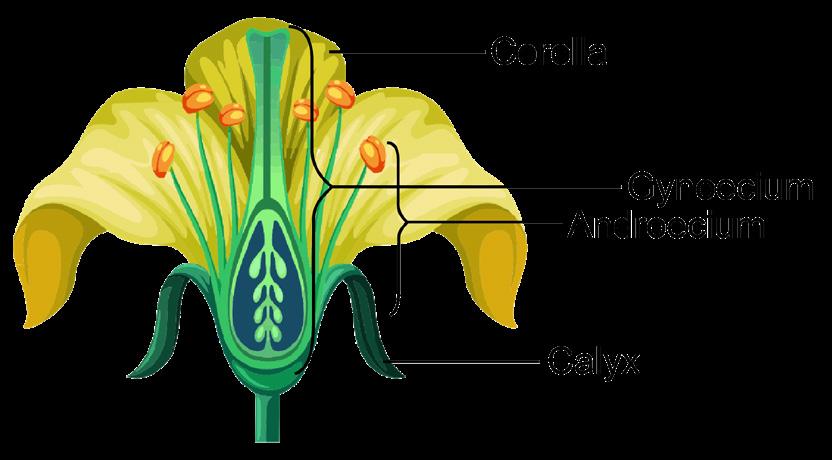
To a biologist, flowers are morphological and embryological marvels. We have already read in the chapter “Morphology of Flowering Plants” about the various parts of a typical flower (Fig 1.1). The outermost whorl is the calyx, followed by the corolla. These are accessory whorls as they are not directly involved in the process of sexual reproduction. The essential whorls of the flower include the androecium and the gynoecium, the most important units of sexual reproduction.
TEST YOURSELF
1. What are the end products of sexual reproduction in flowering plants?
(1) Calyx and corolla
(2) Androecium and gynoecium
(3) Flowers
(4) Fruits and seeds
Answer Key
(1) 4
1.2 PRE-FERTILISATION: STRUCTURES AND EVENTS
Much before the actual flower is seen on a plant, the decision that the plant is going to
flower has taken place. Several hormonal and structural changes are initiated, leading to the floral primordium’s differentiation and further development. Inflorescences, which bear the floral buds and then the flowers, are formed. In the flower, the male and female reproductive structures, the androecium and the gynoecium, differentiate and develop. The androecium represents the male reproductive organ and the gynoecium represents the female reproductive organ.
1.2.1 Stamen, Microsporangium, and Pollen Grain
The male reproductive organ, the androecium, consists of a whorl of stamens. Stamen is equivalent to microsporophyll . A typical stamen is differentiated into two parts: a long, thin stalk called the filament and the terminal, generally bilobed structure called the anther (Fig 1.2(a)). The proximal end of the filament is attached to the thalamus or the petal of the flower. The number and length of stamens are variable in flowers of different species.
A typical angiospermic anther is bilobed (dithecous). Each lobe has two microsporangia or pollen sacs. The connective connects the two lobes. The anther is a four-sided (tetragonal) structure consisting of four microsporangia located at the corners, two in each lobe. Thus, there are four microsporangia in a dithecous anther. The microsporangia develop further and become pollen sacs (Fig. 1.2(b)). At maturity, two microsporangia of an anther lobe get united by the dissolution of the partition tissue between them. Mature dithecous anthers are tetrasporangiate bilocular (Fig 1.3). Microsporangia (pollen sacs) extend longitudinally all through the length of an anther and are packed with pollen grains.
In plants, e.g., China rose, lady’s finger, etc. (Malvaceae), anther has only a single anther lobe and two microsporangia
Fig. 1.1 Parts of a typical flower
instead of four. Such anthers are called monothecous anthers or one-lobed anthers. Mature monothecous anthers are bisporangiate
Anther

Filament (stalk)
Pollen grains
Pollen sacs
Filament (stalk)
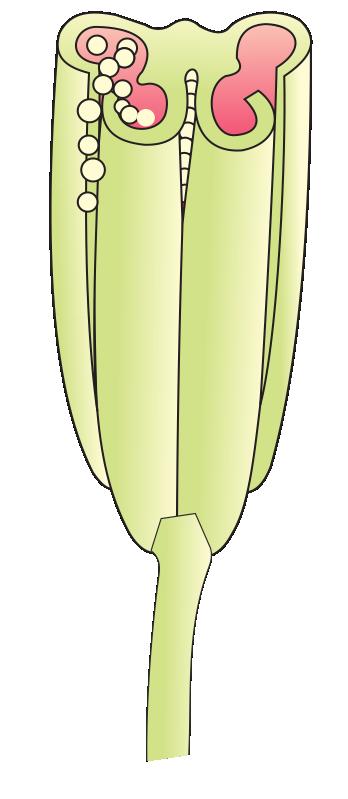
Line of dehiscence
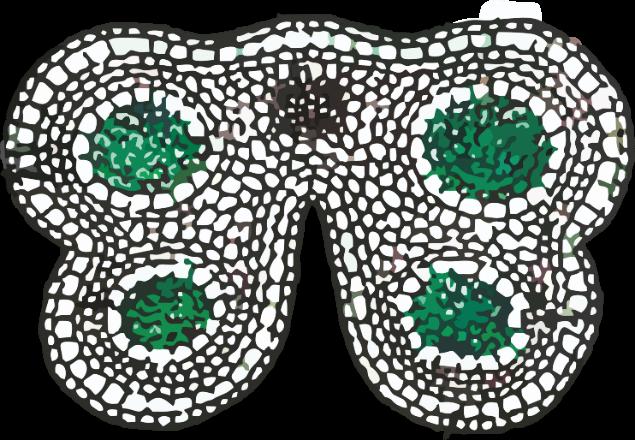
Sporogenous tissue
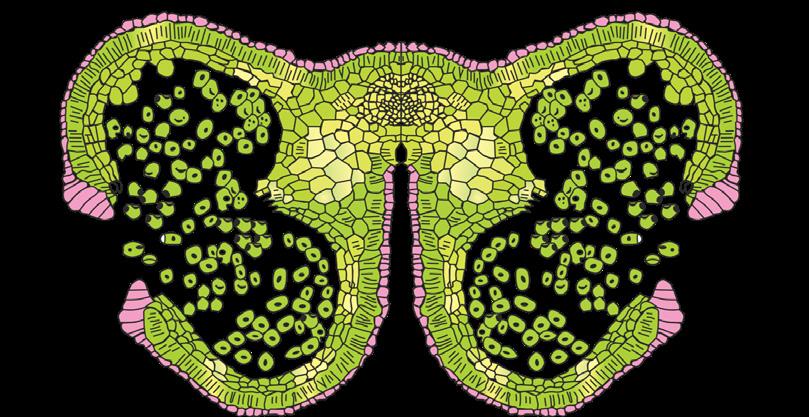
1. 3 A young anther changing into mature dehisced anther
Structure of Microsporangium
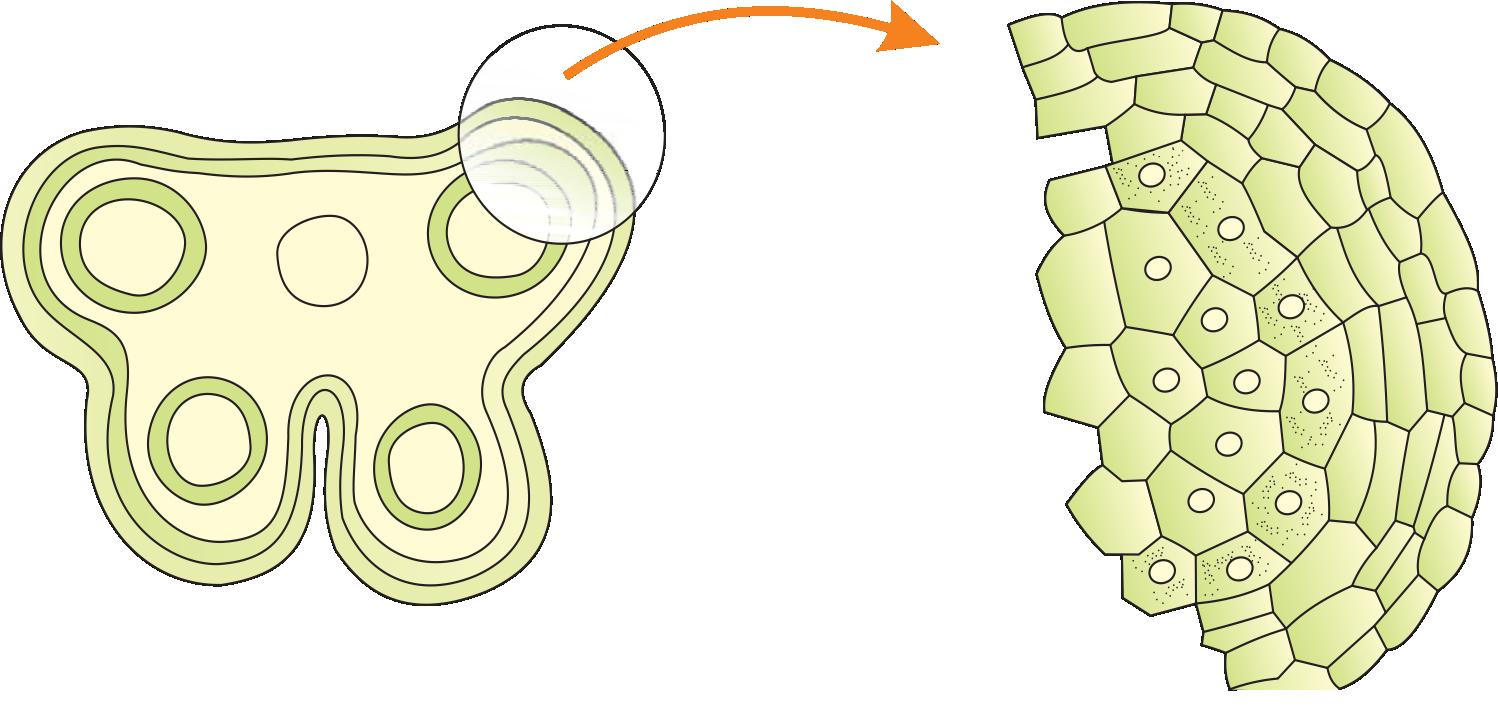
In a transverse section, a typical microsporangium appears near circular in outline. It is generally surrounded by four types of wall layers. The epidermis, endothecium, middle layers, and the tapetum (Fig. 1.4). The outer three wall layers perform the function of protection and help in the dehiscence of anther to release the pollen.
1.2 (b) Three-dimensional cut section of an anther
Middle layers
Connective
Epidermis
Endothecium
Sporogenous tissue (a) (b)
Tapetum
Epidermis
Endothecium
Middle layers
Microspore mother cells
Tapetum
Fig. 1.4 (a) Transverse section of a young anther; (b)Enlarged view of one microsporangium showing wall layers
Fig. 1.2 (a) A typical stamen
Fig.
Pollen grains
Fig
■ The epidermis is single-layered and helps in protection.
■ Endothecium is the single-layered hypodermis of the anther wall with hygroscopic thickenings of α-cellulosic fibrous bands arising from the inner tangential wall, which help in the dehiscence of the anther.
■ Middle layers consist of 1 to 5 layers. These are consumed by developing microspores.
■ The tapetum is the innermost wall layer providing nourishment to the developing pollen grains. Its cells have dense cytoplasm and more than one nucleus.
Tapetum secretes callase enzyme, which dissolves callose substances and helps in the separation of pollen from tetrads. Tapetum secretes pro-ubisch bodies, which get covered with sporopollenin and increase the thickness of exine. These are called ubisch granules.
Microsporogenesis
When anther is young, a group of compactly arranged homogenous cells, called the sporogenous tissue, occupies the centre of each microsporangium. The formation of microspores or pollen from pollen mother cell is called microsporogenesis. The cells of sporogenous tissue undergo meiotic divisions to form microspore tetrads (Fig. 1.6(a)). As the anthers mature and dehydrate, the microspores dissociate from each other and develop into pollen grains. Inside each microsporangium, several thousands of microspores or pollen grains are formed that are released with the dehiscence of anther.
Pollen Grain
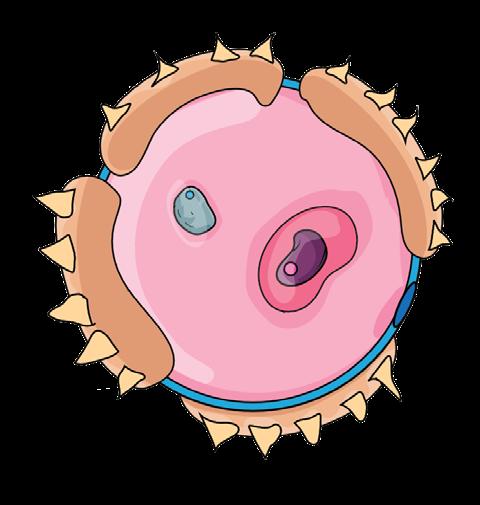
Pollen grain represents the male gametophyte. Each pollen grain or microspore is a unicellular, haploid, oval, or rounded structure. Pollen grains are generally spherical, measuring about
25–50 micrometres in diameter. It has two layered walls, exine and intine (Fig. 1.5) . The outer layer, called exine, is thick, tough, and composed of sporopollenin. Sporopollenin is one of the most resistant organic materials known. It can withstand high temperatures and strong acids and alkalis. No enzyme that degrades sporopollenin is known so far. Pollen grain exine has prominent apertures called germ pores, where sporopollenin is absent. Pollen grains are well preserved as fossils because of the presence of sporopollenin. The exine exhibits a fascinating array of patterns and designs.
The inner layer, called intine, is thin and smooth and is composed of pectocellulose.
Development of Male Gametophyte
The development of the male gametophyte is more or less uniform in all flowering plants. The microspore, or the pollen grain, is the first cell of the male gametophyte. The size of the nucleus increases, and it divides periclinally and mitotically to produce a bigger vegetative cell (tube cell) and a smaller generative cell (Fig. 1.6(b)). The vegetative cell has abundant reserve food and a large irregular-shaped nucleus. The generative cell is spindle-shaped with dense cytoplasm and haploid nucleus. The generative cell floats in the cytoplasm of the vegetative cell. At this stage, the dehiscence of the anther takes place and two-celled pollen grains are released. Pollen grains are shed at two-celled stage in more than 60 per
Germ pore
Generative cell
Tube cell
Nucleus Nucleus
Cytoplasm
Cytoplasm
Fig. 1.5 Structure of pollen grain
cent of angiosperms and in the remaining at three-celled stage (one vegetative cell and two male gametes). After reaching the stigma, the intine grows out through a germ pore into a slender pollen tube. The generative cell divides into two male gametes. The lifespan of male gametophytes is very short as compared to that of the sporophyte.
which came into India as a seed contaminant with imported wheat, has become ubiquitous in occurrence and causes pollen allergy.
Asymmetric spindle
Vegetative cell
Generative cell
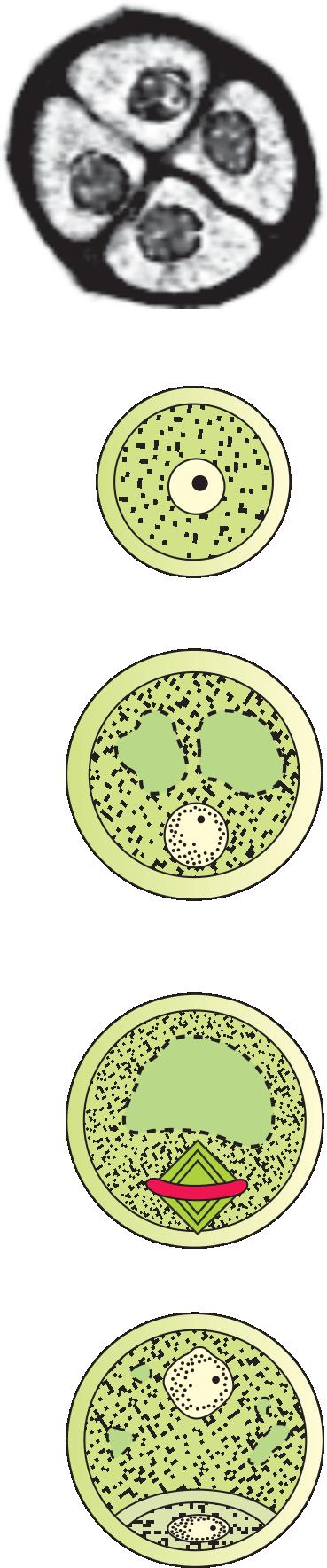
Fig. 1.6 (a) Enlarged view of a pollen grain tetrad; (b) stages of a microspore maturing into a pollen grain
Pollen grains of many species cause severe allergies and bronchial afflictions in some people, often leading to chronic respiratory disorders, asthma, bronchitis, etc. It may be mentioned that Parthenium or carrot grass,
Pollen grains are rich in nutrients. It has become a fashion in recent years to use pollen tablets as food supplements. In Western countries, many pollen products in the form of tablets and syrups are available in the market. Pollen consumption has been claimed to increase the performance of athletes and race horses.
The period for which pollen grains remain viable is highly variable and, to some extent, depends on the prevailing temperature and humidity. In some cereals, such as rice and wheat, pollen grains lose viability within 30 minutes of their release. In some members of Rosaceae, Leguminosae, and Solanaceae, they maintain viability for months. It is possible to store pollen grains of many species for years in liquid nitrogen (–196°C). Such stored pollen can be used as pollen banks, similar to seed banks, in crop breeding programmes.
Checkpoint
Q. Which substance is responsible for the sticky nature of the pollen grains in entomophilous plants? Answer:
The outermost oily, thick coating of pollen grains, known as the pollen kitt, is responsible for the sticky nature of pollen grains. It is mainly composed of lipids and carotenoids, which are present, particularly in pollen of entomophilous flowers.
1.2.2 The Pistil, Megasporangium (Ovule), and Embryo Sac
The gynoecium represents the female reproductive part of the flower. The gynoecium may consist of a single pistil (monocarpellary) or more than one pistil (multicarpellary). When there is more than one pistil, the pistils
Vacuoles (a)
1: Sexual Reproduction in Flowering Plants
may be fused (syncarpous, e.g., Hibiscus , Papaver) or free (apocarpous, e.g., Annona, Michelia) (Fig. 1.7). Carpels Stigma Apocarpous in Michelia
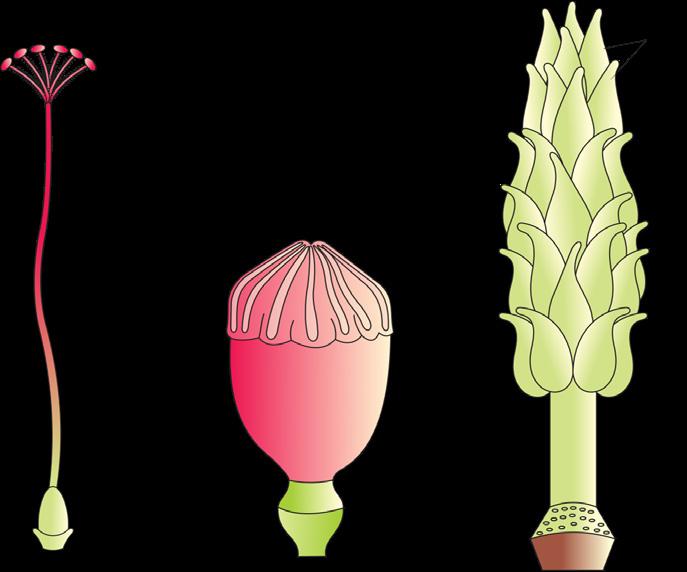
Fig. 1.7 (a) A dissected flower of Hibiscus showing pistil (other floral parts have been removed); (b) Multicarpellary, syncarpous pistil of Papaver; (c) A multicarpellary, apocarpous gynoecium of Michelia
Each carpel consists of three parts (Fig. 1.7(a)):
■ Stigma – It i s the terminal end of the style, recipient (landing platform) of the pollen grains, and is generally knob-like and sticky.
■ Style – It is the slender projection of the ovary and it bears the stigma at its terminal end.
■ Ovary – It is the swollen basal part of the pistil, which is single or many-chambered (Fig. 1.7). The ovary contains one (e.g., wheat, paddy, mango, sunflower) or more ovules (e.g., papaya, watermelon, orchid) attached to the placenta. Each ovule contains a large embryo sac at maturity. The ovary develops into a fruit, and ovule develops into a seed after fertilisation.
Structure of Megasporangium
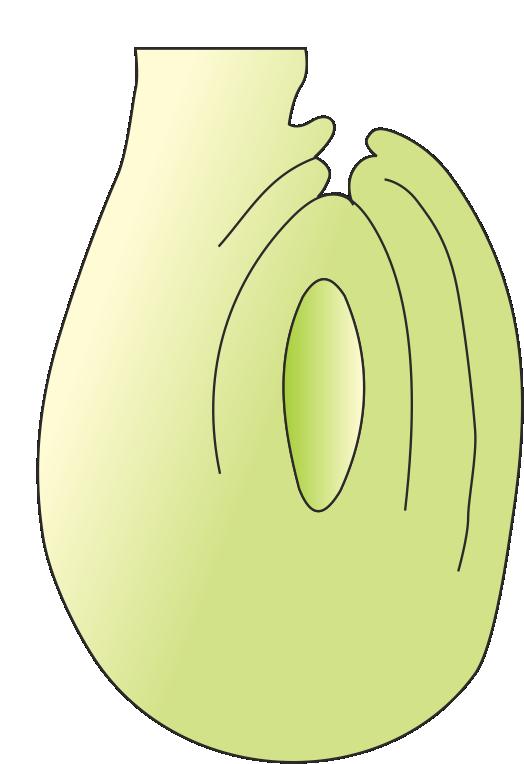
An ovule or megasporangium develops from the placenta in the ovary. It is small, generally has an oval structure, and it consists chiefly of a
central body of tissue, the nucellus, surrounded by one o r two protective envelops called integuments . Each ovule is attached to the placenta by a small stalk called the funiculus. The place of attachment of the stalk with the main body of the ovule is called the hilum (which represents the junction between the ovule and funicle). In an inverted ovule, the funicle fuses with the main body of the ovule, forming a sort of ridge, known as raphe.
The nucellus makes up the main part of the ovule, which is the megasporangium proper. A small opening left at the apex of the integuments is called the micropyle. The cells of nucellus have abundant reserve food material. The posterior end of the ovule, where nucellus, integuments, and funiculus fuse together, is called chalaza (representing the basal part of the ovule).
A large oval structure lying embedded in the nucellus towards the micropylar end is the embryo sac or female gametophyte (Fig. 1.8). This makes the most important part of the mature ovule. It is the site of fertilisation, and later on, it bears the embryo. An ovule generally has one embryo sac formed from a megaspore.
Hilum
Funicle
Micropyle
Micropylar pole
Outer integument
Inner integument
Nucellus
Embryo sac
Chalazal pole
Fig. 1.8 A diagrammatic view of a typical anatropous ovule
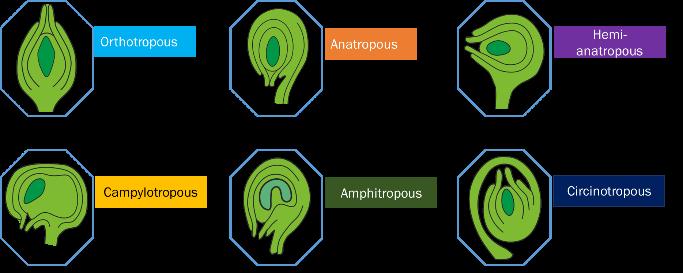
Type of ovule
Unique character
1. Orthotropous Erect ovule with micropyle, chalaza, and funiculus lying on a straight line
2. Anatropous Inverted ovule in which micropyle is close to funiculus; raphe is formed between funiculus and ovular body, it is found in 82% angiosperms
3. Hemianatropous Ovular body is at right angles to funiculus (T-shaped).
4. Campylotropous The micropyle is directed towards funiculus.
5. Amphitropous Both ovular body and embryo sac are curved (horse-shoe shaped embryo sac). Micropyle is close to chalaza and nearer to funiculus.
6. Circinotropous The funiculus takes a complete turn around the body of ovule.
Megasporogenesis
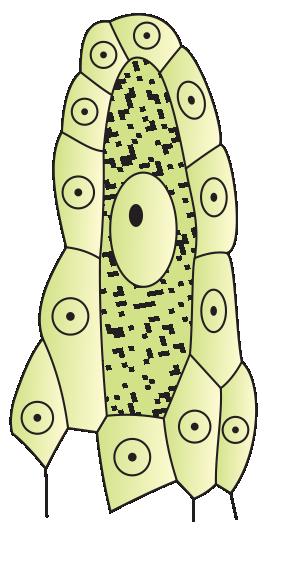
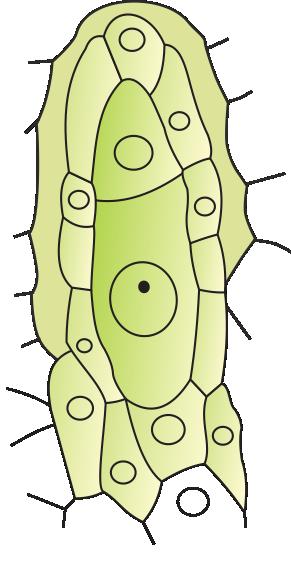
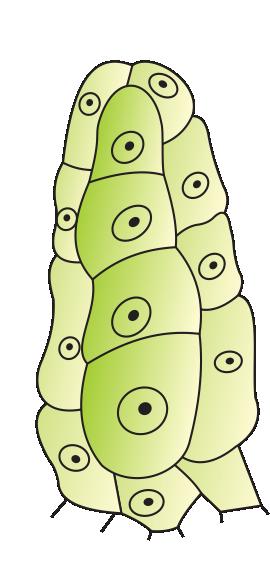
The formation of megaspores from the megaspore mother cell (2n) inside the ovule is called megasporogenesis. Ovules (one of the cells of nucellus) generally differentiate into a single megaspore mother cell (MMC) in the micropylar region of the nucellus. It is a large cell containing dense cytoplasm and a prominent nucleus. The MMC undergoes meiotic division, which results in the production of four megaspores (Fig. 1.9(a))
Development of Female Gametophyte
Usually, chalazal megaspore alone remains functional, and the other three degenerate. The functional megaspore develops into the female gametophyte. Formation of a female gametophyte from a single megaspore is termed monosporic type (Fig. 1.9(b), (c)).
Megaspore is the initial cell of the female gametophyte or embryo sac. The nucleus of the functional megaspore divides mitotically to form two nuclei, which move to the opposite
poles. Two more sequential mitotic nuclear divisions result in the formation of the four nucleate and, later, the eight nucleate stages.
These mitotic divisions are free nuclear and are not followed immediately by cell wall formation. After the 8-nucleate stage, cell walls are laid down, leading to the organisation of the typical female gametophyte or embryo sac. Six of the eight nuclei are surrounded by cell walls and organised into cells; the remaining two nuclei, called polar nuclei, are situated below the egg apparatus in the large central cell.
There is a characteristic distribution of the cells within the embryo sac. Three cells are grouped at the micropylar end and constitute the egg apparatus
The egg apparatus, in turn, consists of two synergids and one egg cell. Three cells are at the chalazal end and are called the antipodals. The large central cell has two polar nuclei.
Micropylar end
Nucellus
Micropylar end
Nucellus
Micropylar end
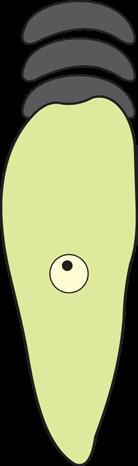
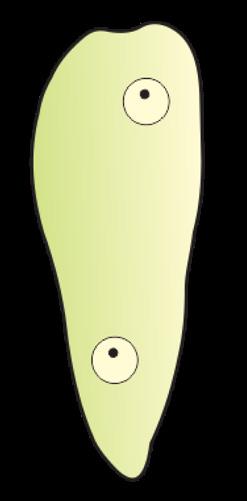
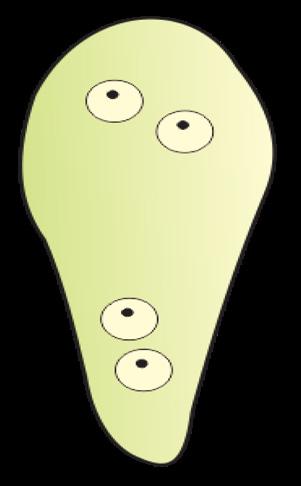
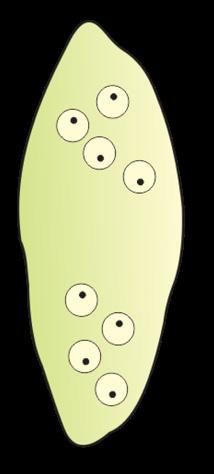
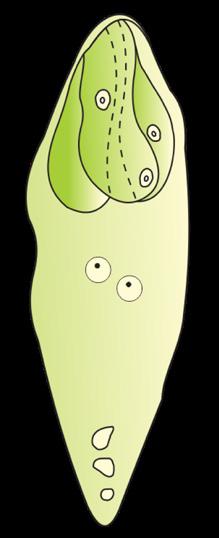
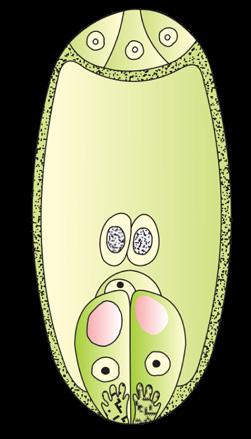
1.9 (a) Parts of the ovule showing a large megaspore mother cell, a dyad and a tetrad of megaspores; (b) 2, 4 and 8 nucleate stages of embryo sac and a mature embryo sac; (c) A diagrammatic representation of the mature embryo sac
Thus, a typical angiospermic embryo sac at maturity is 8-nucleate and 7-celled. It is also called monosporic or Polygonum type, which is the most common type of embryo sac.
Structure of Embryo Sac
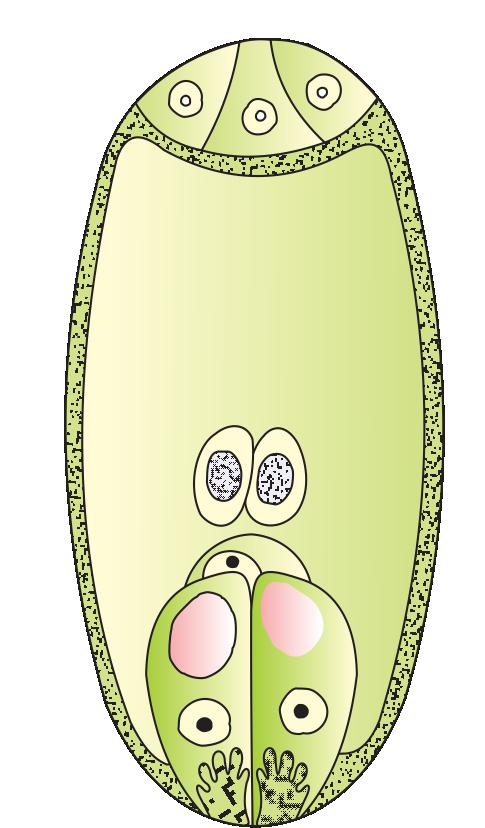
A typical embryo sac (Polygonum type) consists of three parts. They are egg apparatus, central cell, and antipodals (Fig. 1.10)
The egg apparatus consists of the larger egg cell or female gamete, and the two lateral ones are called synergids. Synergids are shortlived (one of them degenerates at the time of
the entry of the pollen tube and the second, after the entry of the pollen tube into the embryo sac). The egg cell contains the basal nucleus and upper vacuole, while synergids contain a basal vacuole and an upper nucleus. The synergids have special cellular fingerlike thickenings at the micropylar tip, called filiform apparatus.
The synergids help in the following ways: i) Synergids help in growth of pollen tube towards egg apparatus by secreting chemotropically active substances by filiform apparatus.
Megaspore mother cell
Megaspore dyad
Megaspore tetrad
Chalazal
Fig.
ii) Degenerating synergids provide a seat for the pollen tube discharge in the embryo sac.
The largest central cell consists of two polar nuclei, which fuse to form a single diploid secondary nucleus.
Antipodals are the smallest cells of all and are the vegetative cells of the embryo sac. They degenerate before or after fertilisation.
Chalazal end
Micropylar end
Fig. 1.10 A mature embryo sac
Checkpoint
In a flowering plant, the male and the female gametes are non-motile and brought together for fertilisation by pollination. Flowering plants have evolved an amazing array of adaptations to achieve pollination. They make use of external agents to achieve pollination.
Pollination
Antipodals
Polar nuclei Central cell Egg
Synergids Filiform apparatus
Q. Are there any structures in the human life cycle analogous to plant gametophytes?
Provide an explanation to support your answer.
No, in plants, the haploid (gametophyte) generation is multicellular and originates from spores. However, in the animal life cycle, the haploid phase consists of single-celled gametes (sperm or egg) directly resulting from meiosis, without the involvement of spores.
Answer:
1.2.3 Pollination
Pollination is defined as the process of transfer of pollen grains from anther to the stigma of a flower.
Direct pollination Indirect pollination
In gymnosperms, the pollen grains are transferred to the micropyle of the ovule directly. In angiosperms, the ovules are enclosed in the ovary. The pollination is called indirect pollination because the pollen grains have to first reach the stigma.
Kinds of Pollination
Depending on the source of pollen, pollination can be divided into three types (Fig. 1.11) , as explained below.
Autogamy (Self-pollination)
If the pollen grains are transferred from an anther to the stigma of the same flower, then it is called self-pollination or autogamy.
Complete autogamy is rare in a normal flower that opens and exposes the anthers and stigma. Autogamy in such flowers requires synchrony in pollen release and stigma receptivity. Also, the anther and the stigma should lie close to each other so that self-pollination can occur. Continued selfpollination results in inbreeding depression.
Contrivances or adaptations for selfpollination:
Monocliny (bisexuality) – It means that the flowers are bisexual, e.g., pea.
Homogamy – In homogamy, both the sex organs of a flower mature at the same time (synchrony in pollen release and stigma receptivity). It increases the chances for selfpollination, e.g., pea.
Cleistogamy – In some plants, bisexual flowers are formed, which never open throughout life. These are called cleistogamous flowers, such as Commelina , Viola (common pansy), and Oxalis. All the above plants have two types of flowers. One type of flower is cleistogamous, and the other type is chasmogamous flowers, which are similar to flowers of other species with exposed anthers and stigma. Cleistogamous flowers produce assured seed set even in the absence of pollinators.
In cleistogamous flowers, the anthers and stigma lie close to each other. When anthers dehisce in the flower buds, pollen grains come in contact with the stigma to bring about pollination. Thus, cleistogamous flowers are invariably autogamous, as there is no chance of cross-pollen landing on the stigma.
Bud pollination – This pollination occurs in the bud stage before the opening of flowers e.g., wheat, rice.
Geitonogamy
Geitonogamy is the transfer of pollen grains from the anther to the stigma of another flower of the same plant. Although geitonogamy is functionally cross-pollination involving a pollinating agent, genetically, it is similar to autogamy since the pollen grains come from the same plant.
Xenogamy
In xenogamy, pollen grains are transferred from anther to the stigma of a different plant.
This is the only type of pollination that brings genetically different types of pollen grains to the stigma.
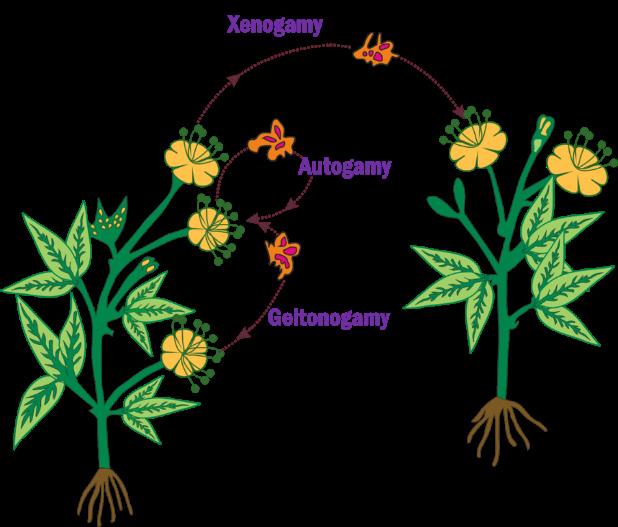
Fig. 1.11 Different kinds of pollination
Agents of Pollination
Plants use abiotic (wind and water) and biotic (animals) agents to achieve pollination. Majority of plants use biotic agents for pollination.
Abiotic Agents
Only a small proportion of plants use abiotic agents. Pollen grains coming in contact with stigma are a chance factor in wind and water pollination. To compensate for this uncertainty and associated loss of pollen grains, the flowers produce enormous amounts of pollen grains compared to the number of ovules available for pollination. Both wind and water-pollinated flowers are not very colourful and do not produce nectar.
Wind pollination (anemophily): Pollination by wind (anemophily) is more common amongst abiotic pollinations. It is nondirectional and the pollen reaching the right stigma is a chance process. Wind pollination is quite common in grasses.
By wind (Anemophily)
Agents of pollination
Abiotic Biotic
By water (Hydrophily)
Characteristics of anemophilous flowers:
■ Flowers are small, inconspicuous, and generally packed in inflorescence. A familiar example is the corn cob – the tassels (bunch of silky hairs) are nothing but stigmas and styles (longest) that wave in the wind to trap pollen grains.
■ Non-essential parts are either absent or reduced.
■ The flowers are colourless, odourless, and nectarless.
■ Pollen grains are small, light, dry, and nonsticky. Winged pollen grains are present in Pinus
■ They often possess well-exposed stamens (so the pollens are easily dispersed into wind currents) (Fig. 1.12).
■ There is a single ovule inside the ovary.
■ Stigma is hairy, feathery, or branched to catch the wind-borne pollen grains.
■ In the case of unisexual flowers, the male flowers are more abundant. In bisexual flowers, the stamens are generally numerous.
By animals (Zoophily)
l By insects (Entomophily)
l By birds (Ornithophily)
l By bats (Chiropterophily)
l By ants and termites (Myrmecophily)
l By snail (Malacophily)
l By snake (Ophiophily)
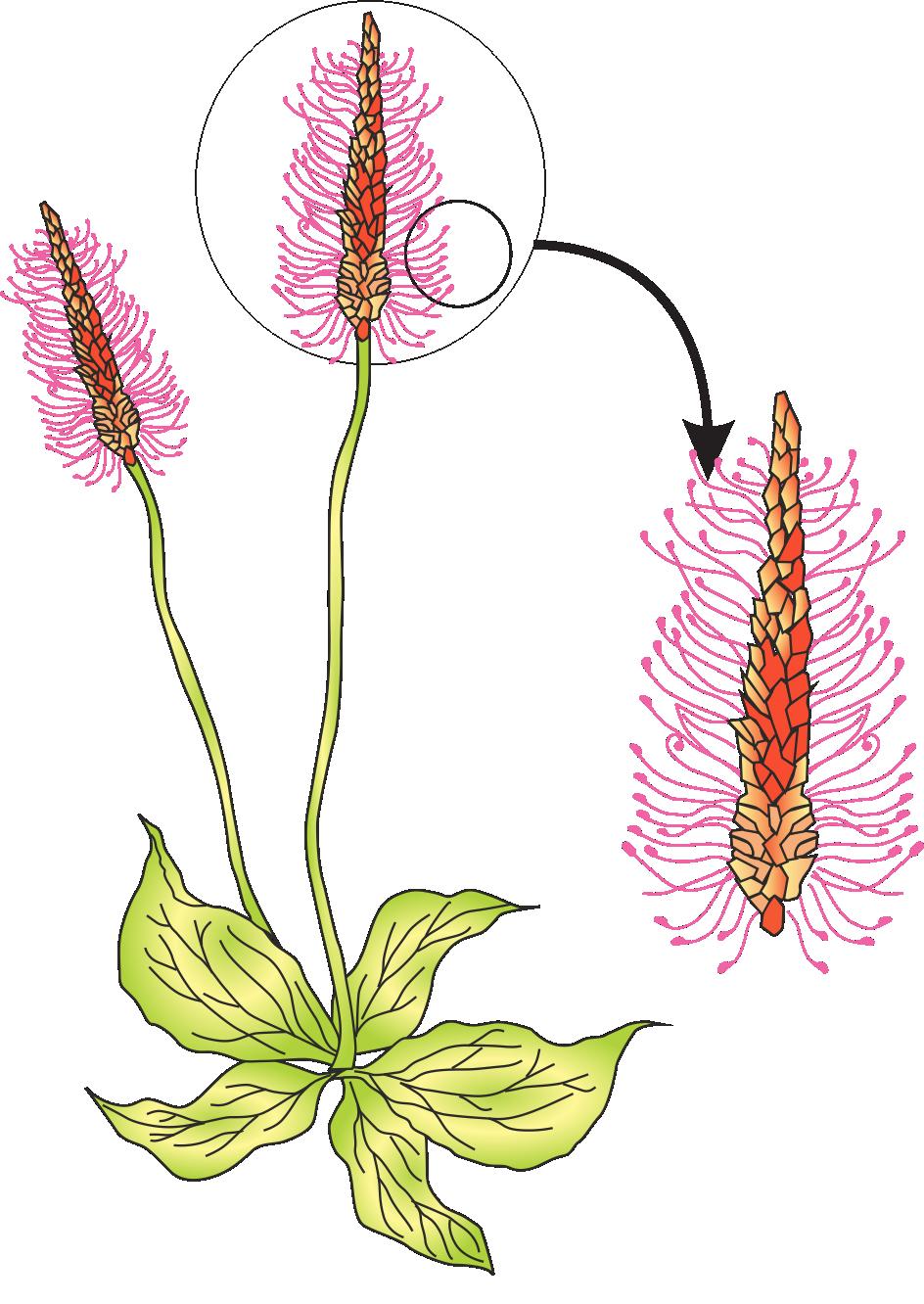
Fig. 1.12 A wind-pollinated plant showing compact inflorescence and well-exposed stamens
Water pollination (hydrophily): Pollination by water is quite rare in flowering plants and is limited to about 30 genera, mostly monocotyledons. As against this, you would recall that water is a regular mode of transport
1: Sexual Reproduction in Flowering Plants
for the male gametes among the lower plant groups, such as algae, bryophytes, and pteridophytes. It is believed, particularly for some bryophytes and pteridophytes, that their distribution is limited because of the need for water for the transport of male gametes and fertilisation. Some examples of waterpollinated plants are Vallisneria and Hydrilla, which grow in fresh water, and several marine sea grasses such as Zostera . Not all aquatic plants use water for pollination. In a majority of aquatic plants, such as water hyacinth and water lily, the flowers emerge above the level of water and are pollinated by insects or wind, as in most land plants.
Characteristics of hydrophilous plants:
■ Flowers are small and not very colourful.
■ Nectar and odour are absent.
■ Stigma is long and sticky but unwettable.
■ In most water-pollinated species, pollen grains are protected from wetting by a mucilaginous covering.
It is of two types — epihydrophily and hypohydrophily.
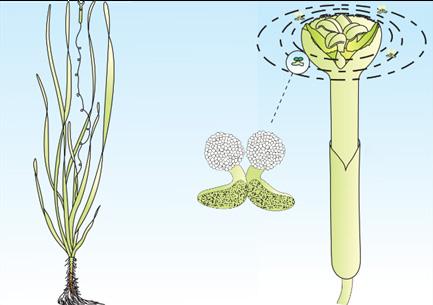
Vallisneria exhibits epihydrophily, where pollination will take place on the surface of water. In Vallisneria, the female flower reaches the surface of water by the long stalk and the male flowers or pollen grains are released on to the surface of water. They are carried passively by water currents (Fig 1.13) ; some eventually reach the female flowers and the stigma.
In another group of water-pollinated plants, such as seagrasses, female flowers remain submerged in water, and the pollen grains are released inside the water, i.e., they exhibit hypohydrophily. Pollen grains in many such species are long and ribbon-like. They are carried passively inside the water; some of them reach the stigma and achieve pollination.
Biotic Agents
When animals bring about pollination, it is called zoophily.
The majority of flowering plants use a range of animals as pollinating agents. Bees, butterflies, beetles, wasps, ants, moths, birds, and bats are common pollinating agents.
Among the animals, insects, particularly bees, are the dominant biotic pollinating agents. Larger animals, such as some primates (lemurs), arboreal (tree-dwelling) rodents, or even reptiles (gecko lizard and garden lizard), have also been reported as pollinators in some species.
Generally, in zoophilous plants, flowers are large and attractive, and nectar glands are present. Often, flowers of animal-pollinated plants are specifically adapted for a particular species of animals.
Entomophily: It refers to insect pollination. Insects are the most common pollinators. The most common insect pollinators are moths, flies, butterflies, wasps, bees, and beetles.
Characteristics of entomophilous plants:
■ The majority of insect-pollinated flowers are large, colourful, fragrant, and rich in nectar.
■ When the flowers are small, several flowers are clustered into an inflorescence to make them conspicuous.
Female flower
Male flower Stigma
Fig 1.13 Pollination by water in Vallisneria
■ Animals are attracted to flowers by colour and/or fragrance.
■ The flowers pollinated by flies and beetles secrete foul odours to attract these animals.
■ To sustain animal visits, the flowers have to reward the animals. Nectar and pollen grains are the usual floral rewards. For harvesting the reward(s) from the flower, the animal visitor comes in contact with the anthers and the stigma. The animal’s body gets a coating of pollen grains, which are generally sticky in animal-pollinated flowers. When the animal carrying pollen on its body comes in contact with the stigma, it brings about pollination.
In some species, floral rewards provide safe places to lay eggs; an example is that of the tallest flower of Amorphophallus (the flower itself is about 6 feet in height). A similar relationship exists between a species of moth and the plant Yucca , where both species –moth and the plant – cannot complete their life cycles without each other. The moth deposits its eggs in the locule of the ovary, and the flower, in turn, gets pollinated by the moth. The larvae of the moth come out of the eggs as the seeds start developing.
Many insects may consume pollen or nectar without bringing about pollination. Such floral visitors are referred to as pollen or nectar robbers.
Outbreeding Device (Contrivances for Cross-pollination)
Flowering plants have developed many devices to discourage self-pollination and encourage cross-pollination. Some outbreeding devices are described below.
Dichogamy: In some species, pollen release and stigma receptivity are not synchronised in a bisexual flower.
■ Protandry: Anthers mature earlier than stigma, e.g., sunflower.
■ Protogyny: Gynoecium matures earlier than the anthers, e.g., Datura, Solanum.
Herkogamy: In some species, the anther and stigma are placed at different positions (Hibiscus) or in different directions (Gloriosa) so that the pollen cannot come in contact with the stigma of the same flower. Hence, self-pollination is prevented due to structural barrier.
Heterostyly: In some plants, flowers have two (dimorphic) or three (trimorphic) forms of anthers and stigmas at different levels.
Self-incompatibility: This genetic mechanism prevents self-pollen from fertilising the ovules by inhibiting pollen germination or pollen tube growth in the pistil, e.g., Passiflora, orchids.
Dicliny/unisexuality: The production of unisexual flowers is called dicliny. The plants with unisexual flowers may be monoecious or dioecious. A monoecious plant is one in which male and female organs are found on the same plant but in different flowers (maize, castor). It can prevent autogamy but not geitonogamy.
A dioecious plant is one in which male and female flowers appear on separate plants, e.g., Morus alba (mulberry), Piper betel, Vallisneria, and papaya (Carica). This condition prevents both autogamy and geitonogamy.
Checkpoint
1. Are all offspring of a self-pollinating plant identical?
2. What might account for the evolutionary prevalence of long styles in the majority of flowering plants, considering that shorter styles would facilitate easier access for pollen tubes to reach the embryo sac?
2. Long styles selectively filter out genetically inferior pollen grains incapable of effectively growing long pollen tubes, thereby promoting successful fertilisation with genetically superior pollen.
1. Not necessarily; while self-pollination can lead to offspring that are genetically similar to the parent plant, they may not be completely identical. Self-pollination can result in some genetic variation due to processes such as mutation or genetic recombination during the formation of gametes (sex cells).
Answers:
1.2.4 Pollen–Pistil Interaction
Pollination does not guarantee the transfer of the right type of pollen (compatible pollen of the same species as the stigma). Often, pollen of the wrong type, either from other species or the same plant (if it is self-incompatible), also lands on the stigma. The pistil has the ability to recognise the pollen; whether it is of the right type (compatible) or the wrong type (incompatible). If it is the right type, the pistil accepts the pollen and promotes postpollination events that lead to fertilisation. If the pollen is of the wrong type, the pistil rejects the pollen by preventing pollen germination on the stigma or the pollen tube growth in the style. The ability of the pistil to recognise the pollen, followed by its acceptance or rejection, is the result of a continuous dialogue between the pollen grain and the pistil. This dialogue is mediated by chemical components of the pollen interacting with those of the pistil. It is only in recent years that botanists have identified some of the pollen and pistil components and the interactions leading to the recognition, followed by acceptance or rejection.
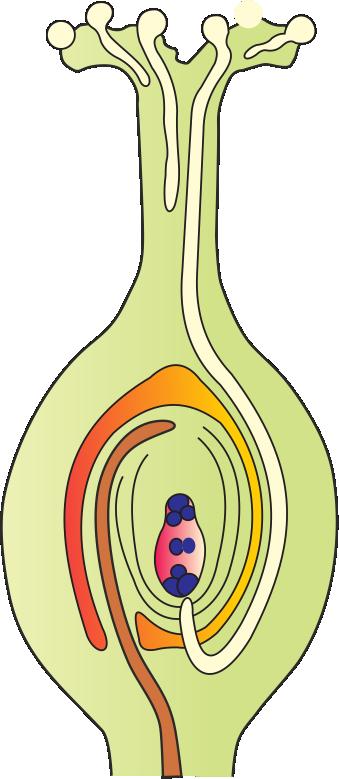
As mentioned earlier, following compatible pollination, the pollen grain germinates on the stigma to produce a pollen tube through one of the germ pores. The contents of the pollen
grain move into the pollen tube. The pollen tube grows through the tissues of the stigma and style and reaches the ovary (Fig. 1.14(a)) . You would recall that in some plants, pollen grains are shed at two-celled condition (a vegetative cell and a generative cell). In such plants, the generative cell divides and forms the two male gametes during the growth of pollen tube in the stigma.
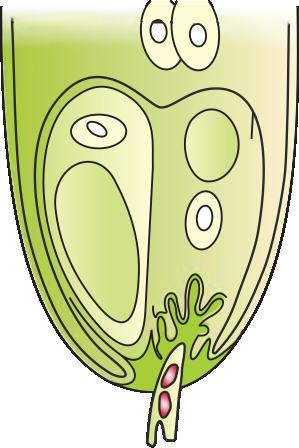
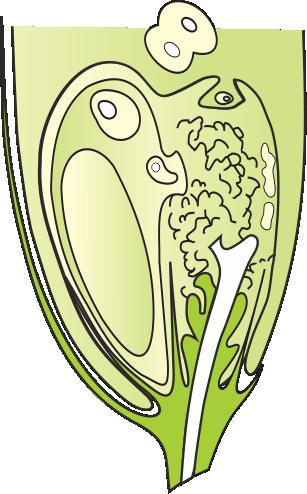
In plants that shed pollen in the three-celled condition, pollen tubes carry the two male gametes from the beginning. Pollen tube, after reaching the ovary, enters the ovule through the micropyle and then enters one of the synergids through the filiform apparatus (Fig. 1.14 (b), (c)). Many recent studies have shown that filiform apparatus present at the micropylar part of the synergids guides the entry of pollen tube. All these events — from pollen deposition on the stigma until pollen tubes enter the ovule — are called pollen–pistil interaction. As pointed out earlier, pollen–pistil interaction is a dynamic process involving pollen recognition followed by promotion or inhibition of the pollen. The knowledge gained in this area would help the plant breeder manipulate pollen–pistil interaction, even in incompatible pollinations, to get desired hybrids. The pollen of pea, chickpea, Crotalaria, balsam, and Vinca germinate in 15–30 minutes, if placed in a drop of sugar solution (of about 10%).
Pollen tube
Antipodal
Polar nuclei
Egg cell
Synergid
Fig. 1.14 (a) Longitudinal section of pistil showing path of pollen tube growth
Central cell
Egg nucleus
Plasma membrane
Synergid
Filiform apparatus
Male gametes
Vegetative nucleus
Fig. 1.14 (b) Enlarged view of an egg apparatus showing entry of pollen tube into a synergid
Polar nuclei
Male gametes
Checkpoint
Q. Why does the pollen tube enter the embryo sac only through the micropylar end?
Answer: The synergids containing the filiform apparatus are located at the micropylar end. This filiform apparatus provides chemical signals that are responsible for the exclusive entry of the pollen tube through the micropylar end.
1.2.5 Artificial Hybridisation
Artificial hybridisation is one of the major approaches to crop improvement programme. In such crossing experiments, it is important to ensure that only the desired pollen grains are used for pollination and the stigma is protected from contamination (from unwanted pollen). This is achieved by emasculation and bagging techniques.
Fig. 1.14 (c) Discharge of male gametes into a synergid and the movement of the sperms, one into the egg and the other into the central cell
Entry of Pollen Tube Inside the Ovule
Porogamy: The most common process of entry of pollen tube into the ovule through micropyle is called porogamy.
Chalazogamy: The process of entry of pollen tube into the ovule through chalaza is called chalazogamy.
Mesogamy: The process of entry of pollen tube into the ovule through integuments or funiculus is called mesogamy.
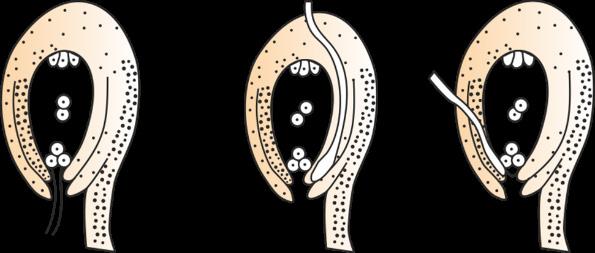
The pollen tube always enters the embryo sac through micropylar end.
If the female parent bears bisexual flowers, the removal of anthers from the flower bud, using a pair of forceps, is referred to as emasculation. Emasculated flowers have to be covered with a bag of suitable size, generally made up of butter paper, to prevent contamination of its stigma with unwanted pollen. This process is called bagging. When the pollen grains collected from the anthers of the male parent are dusted on the stigma, the flowers are rebagged, and the fruits are allowed to develop.
If the female parent produces unisexual flowers, there is no need for emasculation. In that case, the female flower buds are bagged before the flowers open. When the stigma becomes receptive, pollination is carried out using the desired pollen and the flower is rebagged.
TEST YOURSELF
1. Nutritive tissue in anther is (1) perisperm (2) endosperm (3) tapetum (4) nucellus
2. Viability of pollen grains depends on (1) exine
(2) structure of intine
(3) temperature and humidity
(4) pressure and gravity
3. What is the thick walled layer of anther helpful in its dehiscence on its dehydration and subsequent release of pollen?
(1) Epidermis (2) Endothecium
(3) Middle layers (4) Tapetum
4. Number of microspore tetrads formed from 10 pollen mother cells is (1) 40 (2) 40 (3) 30 (4) 10
5. A typical angiospermic anther is where each lobe contains microsporangia.
(1) bilobed, two (2) bilobed, four
(3) monothecous, two (4) single lobed, four
6. What is the ploidy of polar nucleus at the time of embryo sac development?
(1) n (2) 2n
(3) 3n (4) 8n
7. A typical female gametophyte develops from (1) 4 megaspores (2) 3 megaspores (3) 2 megaspores (4) single megaspore
8. Identify the terms associated with the gynoecium.
(1) Stigma, ovule, embryo sac, and placenta
(2) Thalamus, pistil, style, and ovule
(3) Ovule, ovary, embryo sac, and tapetum
(4) Ovule, stamen, ovary, and embryo sac
9. Which of the following pairs is apocarpous?
(1) Anona and Papaver
(2) Hibiscus and Papaver
(3) Anona and Michelia
(4) Hibiscus and Michelia
10. Filiform apparatus is observed in (1) egg (2) antipodals
(3) synergids (4) sperm
11. In which group of plants, water is a regular mode of transport for the male gametes?
(1) Gymnosperms and angiosperms
(2) Bryophytes, pteridophytes, and spermatophytes
(3) Bryophytes, pteridophytes, and gymnosperms
(4) Algae, bryophytes, and pteridophytes
12. Inbreeding depression is due to (1) absence of sexual reproduction
(2) absence of asexual reproduction
(3) continuous cross pollination
(4) continuous self pollination
13. Among the following, the long ribbon-like pollen grains are seen in (1) Zostera
(2) Vallisneria
(3) Water lily
(4) Grasses
14. Which of the following events is not a part of pollen–pistil interaction?
(1) Germination of pollen grain
(2) Growth of pollen tube through style
(3) Entry of pollen tube into the ovule
(4) Fertilisation
15. In pollen–pistil interaction, (1) pollen recognises whether it has fallen on the right stigma or not
(2) ovary of the pistil has the ability to recognise the pollen
(3) pollen is recognised by only style
(4) pollen is recognised by both stigma and style
16. Pollen tube generally enters the ovule through (1) chalaza (2) integument
(3) funicle (4) micropyle
17. In artificial hybridisation, bagging is done (1) prior to emasculation
(2) to prevent the contamination of stigma of female parent with unwanted pollen
(3) to the flowers of male parent to collect pollen
(4) to flowers of both male and female parents to prevent them from microbial infection
18. In the process of artificial hybridisation, removal of anthers from bisexual flowers of female parent is called (1) bagging
(2) emasculation
(3) rebagging
(4) artificial cross pollination
19. Emasculation is not required in flowers having (1) only pistil (unisexual) (2) both pistil and anthers (bisexual)
(3) both pollen and egg (4) homogamy
Answer Key
(1) 3 (2) 3 (3) 2 (4) 4
(5) 1 (6) 1 (7) 4 (8) 1
(9) 3 (10) 3 (11) 4 (12) 4
(13) 1 (14) 4 (15) 4 (16) 4 (17) 2 (18) 2 (19) 1
1.3 DOUBLE FERTILISATION
After entering one of the synergids, the pollen tube releases the two male gametes into the cytoplasm of the synergid.
Syngamy: The fusion of one male gamete with the egg to form a zygote (2n) is called syngamy or generative fertilisation. It was discovered by Strasburger.
Triple fusion: The fusion of the second male gamete with two polar nuclei or secondary nucleus to form a triploid primary endosperm
nucleus (PEN) is known as triple fusion or vegetative fertilisation. The central cell with PEN is called primary endosperm cell (PEC) and develops into endosperm, while zygote develops into embryo.
The simultaneous occurrence of syngamy and triple fusion in the embryo sac of angiosperms is called double fertilisation (Fig. 1.15). Double fertilisation and triple fusion were first reported by S.G. Nawaschin (1898) in Fritillaria and Lilium. It is unique to angiosperms.
Degenerating synergids
Zygote (2n)
Primary endosperm cell (PEC)
Primary endosperm nucleus (3n) (PEN)
Degenerating antipodal cells
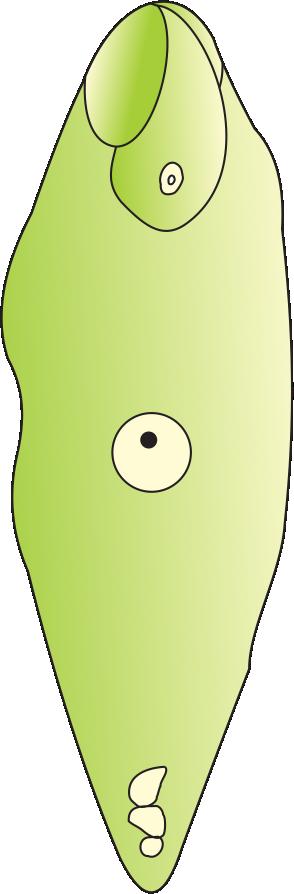
Fig. 1.15 Fertilised embryo sac showing zygote and Primary Endosperm Nucleus (PEN)
TEST YOURSELF
1. At which location in the embryo sac is the zygote generally formed?
(1) Chalazal end
(2) Near the hilum
(3) Micropylar end
(4) Funicle
2. Identify the odd one based on ploidy level.
(1) Megaspore mother cell
(2) Nucellus
(3) PEN (angiosperms)
(4) Pollen mother cell
3. What is the product of triple fusion?
(1) Primary endosperm nucleus
(2) Zygote
(3) Embryo
(4) Perisperm
Answer Key
(1) 3 (2) 3 (3) 1
1.4 POST-FERTILISATION: STRUCTURES AND EVENTS
Following double fertilisation, events of endosperm and embryo development and the maturation of ovule(s) into seed(s) and ovary into fruit are collectively termed postfertilisation events.
1.4.1 Endosperm
Endosperm development precedes embryo development. As a product of triple fusion, a triploid structure called primary endosperm nucleus (PEN) is formed, which divides mitotically and forms a mass of nutritive cells called the endosperm. Endosperm accumulates food reserves and functions as the nutritive tissue for the developing embryo. Hence, endosperm development precedes embryo development.
In gymnosperms, the endosperm (female gametophyte) is haploid as it develops from a megaspore. It is a pre-fertilisation tissue.
Types of Endosperm
Depending upon the mode of its formation, angiospermic endosperm can be nuclear endosperm or cellular endosperm.
Nuclear Endosperm
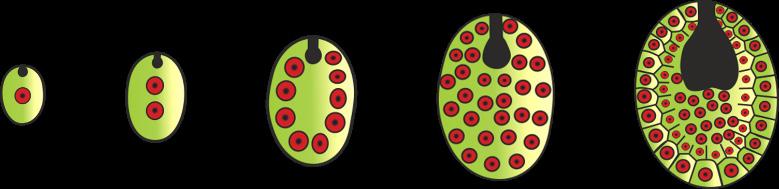
It is the most common type of endosperm found in angiosperms. The primary endosperm nucleus divides repeatedly without wall formation to produce many
free nuclei. The multinucleated cytoplasm undergoes cytokinesis and gives rise to a multicellular tissue (Fig. 1.16), e.g., maize, wheat, rice, sunflower, and Capsella . The number of free nuclei formed before cellularisation varies greatly. In several cases, at maturity, the centripetal wall formation may occur to make the tissue partly cellular. For example, in coconut, the surrounding white kernel, called coconut meat, is the cellular endosperm and the coconut water in the centre is free nuclear endosperm made up of thousands of nuclei.
Cellular Endosperm
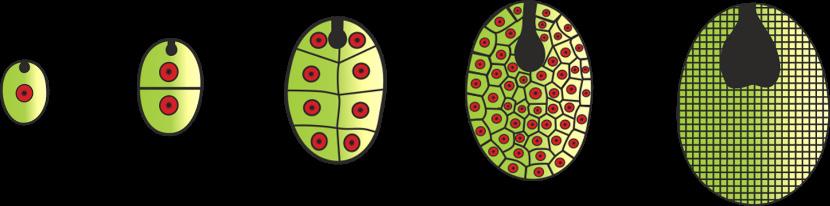
Every division of the primary endosperm nucleus is followed by cytokinesis. Therefore, endosperm becomes cellular from the very beginning (Fig. 1.17), e.g., Balsamia, Datura, and Petunia. It is reported in about 72 families of angiosperms (mostly dicots).
Fate of Endosperm
During embryogenesis, the developing embryo draws nutrition from the food stored in the endosperm.
Exalbuminous or non-endospermic seeds: If the developing embryo completely consumes the endosperm, the seed becomes nonendospermic, e.g., gram, pea, groundnut, and bean.
Albuminous or endospermic seeds: If the endosperm is partly consumed by the developing embryo, then the matured seed contains endosperm, e.g., Datura, Castor , coconut, cereals (wheat, maize, barley).
Fig. 1.16 Embryo sac showing the formation of nuclear endosperm
Fig. 1.17 Development of cellular endosperm
1.4.2 Embryo
The embryo develops at the micropylar end of the embryo sac where the zygote is situated. Most zygotes divide only after a certain amount of endosperm is formed. This is an adaptation to provide assured nutrition to the developing embryo. Though the seeds differ greatly, the early stages of embryo development (embryogeny) are similar in both monocotyledons and dicotyledons. The process of development of embryo from the zygote is called embryogenesis or embryogeny.
Embryogeny in Dicots
Let us discuss embryogenesis in dicots (Fig. 1.18)
The first division of the zygote is transverse, resulting in two cells being formed. One cell that lies towards the micropyle is called the basal or suspensor cell. The other cell that lies towards the chalaza is the apical or embryonal cell.
The basal cell (suspensor cell) and embryonal cell divide simultaneously. The embryonal cell is divided by mitotic divisions to give rise to the proembryo and the globular, heart-shaped, and mature embryo.
The suspensor cell is divided by transverse divisions, forming a 6–10 celled long filamentlike structure, which is termed a suspensor.
The main function of the suspensor is to push the developing embryo into a foodladen endosperm to provide nutrition. The micropylar cell of the suspensor swells up. This cell of suspensor is known as haustorial cell.
In Capsella, due to the curved position of the body of the ovule, the embryo becomes curved. This curved position of the embryo is called torpedo (mature embryo). A typical dicot embryo consists of an embryonal axis and two cotyledons.
The axis present between the plumule and the radicle is called the embryonal axis. It is also called tigellum (main embryonal axis). The portion of the embryonal axis above the level of cotyledons is known as epicotyl, which terminates with the plumule or stem tip. The cylindrical portion of the embryonal axis below the level of cotyledons is known as hypocotyl. Hypocotyl terminates in the radicle or root tip. The root cap covers the root tip or radicle (Fig. 1.19).
Both the cotyledons are present at the lateral position of the embryonal axis and the plumule is formed in the terminal position in dicotyledon embryo. This type of development of embryo is known as Crucifer type or onagrad type of development. It is the most common type of embryo development in dicots.
Crucifer type of embryo development is found in Capsella.
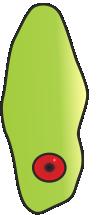
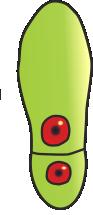
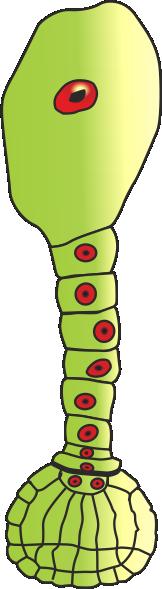
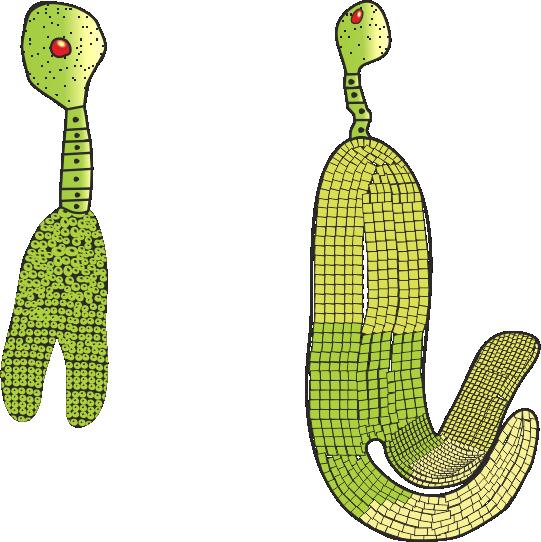
Fig. 1.18 Stages in embryo development in a dicot
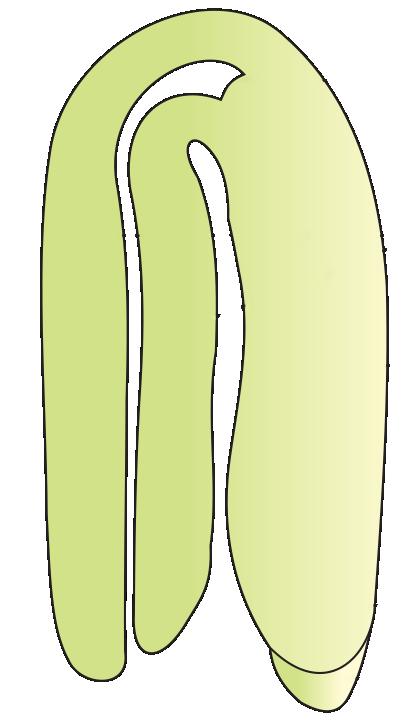
Fig. 1.19 A typical dicot embryo
Hypocotyl Radicle
Root cap
Embryos of monocotyledons (Fig. 1.20) possess only one cotyledon. In the grass family, the cotyledon is called scutellum, which is situated towards one side (lateral) of the embryonal axis. At its lower end, the embryonal axis has the radical and root cap enclosed in an undifferentiated sheath, called coleorrhiza
The portion of the embryonal axis above the level of attachment of scutellum is the epicotyl. Epicotyl has a shoot apex and a few leaf primordia enclosed in a hollow foliar structure, called the coleoptile (Fig. 1.20).
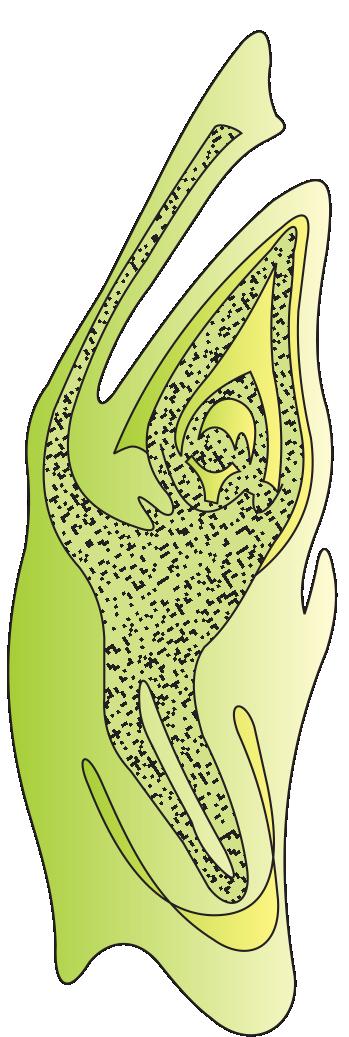
Scutellum
Coleoptile Shoot apex
Fig. 1.20 Longitudinal section of embryo of grass
1.4.3 Seed
In angiosperms, the seed is the final product of sexual reproduction. It is often described
as a fertilised ovule. Seeds are formed inside fruits. A seed typically consists of seed coat(s), cotyledon(s), and an embryo axis. The cotyledons of the embryo are simple structures, generally thick and swollen due to storage of food reserves (as in legumes).
As already discussed, mature seeds may be albuminous or exalbuminous. Occasionally, in some seeds, such as black pepper and beet, remnants of nucellus are also persistent. This residual, persistent nucellus is the perisperm.
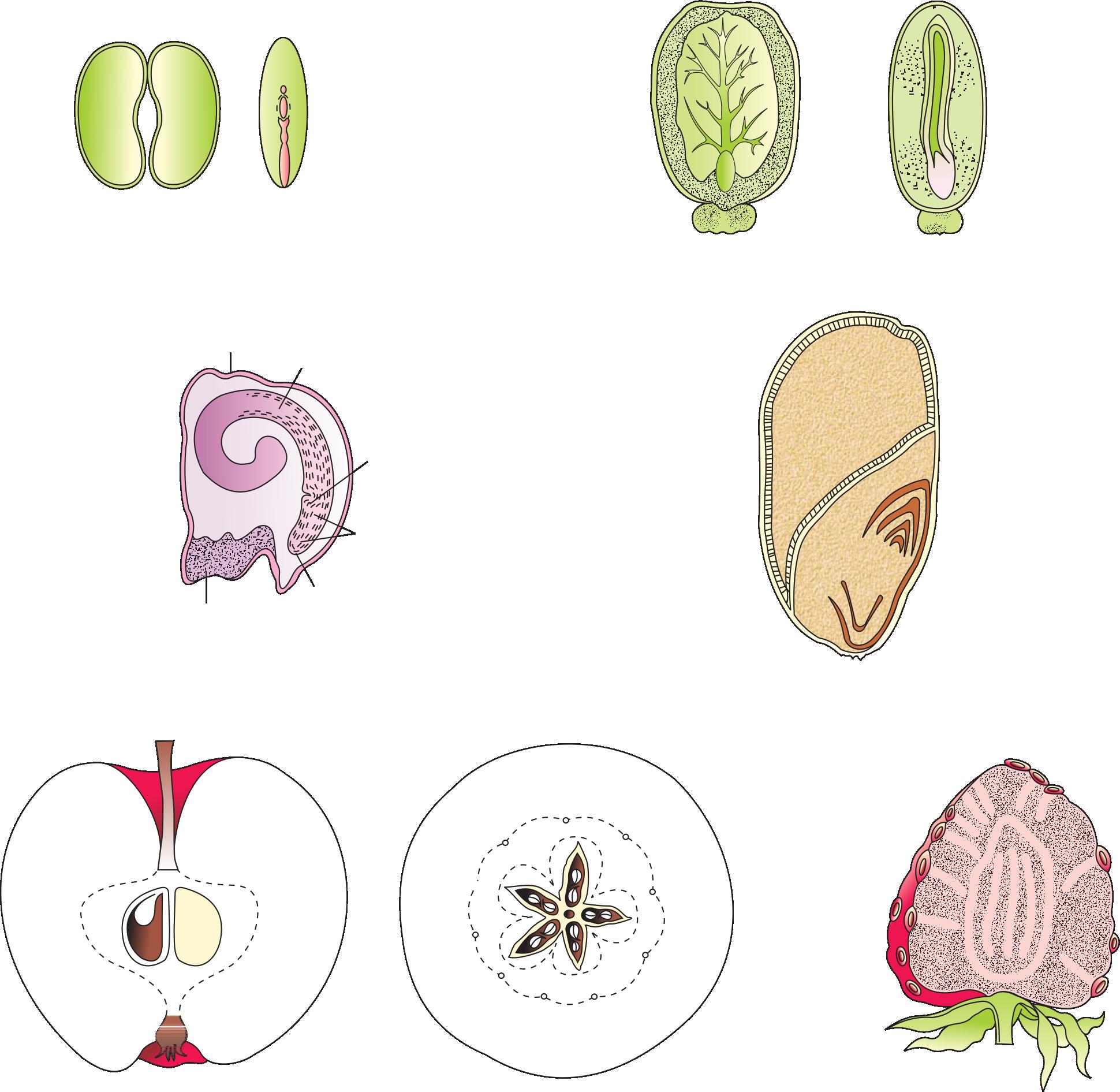
Integuments of ovules harden to form tough protective seed coats (Fig. 1.21(a)) . The micropyle remains as a small pore in the seed coat. This facilitates the entry of oxygen and water into the seed during germination. As the seed matures, its water content is reduced, and seeds become relatively dry (10–15 per cent moisture by mass). The general metabolic activity of the embryo slows down. The embryo may enter a state of inactivity, called dormancy , or, if favourable conditions are available (adequate moisture, oxygen, and suitable temperature), they germinate.
As ovules mature into seeds, the ovary develops into a fruit, i.e., the transformation of ovules into seeds and ovary into fruit proceeds simultaneously. The wall of the ovary develops into the wall of fruit, called pericarp. The fruits may be fleshy, as in guava, orange, mango, etc., or dry, as in groundnut, mustard, etc. Many fruits have evolved mechanisms for dispersal of seeds.
In most plants, by the time the fruit develops from the ovary, other floral parts degenerate and fall off. However, in a few species, such as apple, strawberry, cashew, etc., the thalamus also contributes to fruit formation. Such fruits are called false fruits (Fig. 1.21(b)). Most fruits, however, develop only from the ovary and are called true fruits . Although, in most of the species, fruits are the result of fertilisation, there are a few species
Plumule Cotyledons
Cotyledons
Seed coat
Shoot apical meristem
Hypocotyl root axis
Root tip
Seed coat
Endosperm
Cotyledon
Hypocotyl root axis
Shoot apical meristem
Root tip
Endocarp Mesocarp
in which fruits develop without fertilisation. Such fruits are called parthenocarpic fruits. Banana is one such example. Parthenocarpy can be induced by applying growth hormones. Parthenocarpic fruits are seedless.
Seeds offer several advantages to angiosperms. Some advantages are listed below.
■ Since reproductive processes such as pollination and fertilisation are independent of water, seed formation is more dependable.
■ Seeds have better adaptive strategies for dispersal to new habitats and help the species to colonise in other areas.
■ They have sufficient food reserves; young seedlings are nourished until they are capable of photosynthesis on their own.
■ The hard seed coat protects the young embryo.
Micropyle
Cotyledon
Endosperm
Endosperm
Pericarp
Scutellum
Coleoptile Plumule
Radicle
Coleorrhiza
Thalamus
Thalamus
Achene
Fig. 1.21 (a) Structure of some seeds (b) False fruits of apple and strawberry
■ Being products of sexual reproduction, they generate new genetic combinations, leading to variations.
Seed is the basis of our agriculture. Dehydration and dormancy of mature seeds are crucial for the storage of seeds, which can be used as food throughout the year and also to raise crops in the next season.
Seed Viability
The ability of seeds to retain the power of germination over a period of time is called the viability of seeds. This period varies greatly. In a few species, the seeds lose viability within a few months. Seeds of a large number of species live for several years. There are several records of very old yet viable seeds. The oldest is that of a lupine, Lupinus arcticus, excavated from Arctic Tundra. The seed germinated and flowered after an estimated recorded 10,000 years of dormancy. A recent record of a 2000-year-old viable seed is of the date palm, Phoenix dactylifera , discovered during the archaeological excavation at King Herod’s palace near the Dead Sea. Seed viability is influenced by conditions during storage and non-germination. Excessive dry or damp weather and high temperatures are known to reduce viability of all seeds.
TEST YOURSELF
1. A dicot genus with oily endosperm in its mature seed is
(1) wheat (2) castor
(3) groundnut (4) coconut
2. Number of seeds is equal to the number of fertilised
(1) ovules
(2) ovaries
(3) carpels
(4) antipodals
3. Identify the hollow foliar structure that encloses the shoot apex and a few leaf primordia of epicotyl.
(1) Coleorhiza
(2) Scutellum
(3) Coleoptile
(4) Epiblast
4. The most common type of endosperm development is
(1) helobial type
(2) free nuclear type
(3) cellular type
(4) indirect type
5. Arrange the following stages of embryogeny of dicots in correct progressive sequence.
A. Proembryo
B. Heart-shaped embryo
C. Globular embryo
D. Mature embryo
(1) A → C → B → D
(2) A → B → C → D
(3) C → B → A → D
(4) B → C → A → D
6. As the seed matures, its water content is reduced to
(1) 80–0% moisture by mass
(2) 10–15% moisture by mass
(3) 25–35% moisture by mass
(4) 35–50% moisture by mass
7. Seed viability of date palm is
(1) 2000 years
(2) 1000 years
(3) 5000 years
(4) 100 years
8. If the number of chromosomes in egg cell is 8, then what is the number of chromosomes in endosperm?
(1) 24 (2) 8
(3) 16 (4) 12
9. What is ploidy of perisperm?
(1) n (2) 2n
(3) 3n (4) 4n
10. Micropyle exists in
(1) ovule and ovary
(2) seed and embryo
(3) seed and ovule
(4) fruit and inflorescence
Answer Key
(1) 2 (2) 1 (3) 3 (4) 2
(5) 1 (6) 2 (7) 1 (8) 1
(9) 2 (10) 3
1.5 APOMIXIS AND POLYEMBRYONY
Although seeds, in general, are the products of fertilisation, a few flowering plants, such as some species of Asteraceae and grasses, have evolved a special mechanism to produce seeds without fertilisation, called apomixis
Apomixis is a form of asexual reproduction that mimics sexual reproduction. There are several ways of development of apomictic seeds. In some species, the diploid egg cell is formed without reduction division and develops into the embryo without fertilisation. More often, as in many Citrus and mango varieties, some of the nucellar cells surrounding the embryo sac start dividing, protruding into the embryo sac, and developing into the embryos. In such species, each ovule contains many embryos. The occurrence of more than one embryo in a seed is referred to as polyembryony.
Hybrid varieties of several of our food and vegetable crops are being extensively cultivated. The cultivation of hybrids has tremendously increased productivity. One of the problems of hybrids is that hybrid seeds have to be produced every year. If the seeds collected from hybrids are sown, the plants in the progeny will segregate and do not maintain
hybrid characters. Production of hybrid seeds is costly, and hence, the cost of hybrid seeds becomess too expensive for the farmers. If these hybrids are made into apomicts, there is no segregation of characters in the hybrid progeny. Then, the farmers can keep on using the hybrid seeds to raise new crops year after year, and he does not have to buy hybrid seeds every year. Because of the importance of apomixis in the hybrid seed industry, active research is going on in many laboratories around the world to understand the genetics of apomixis and to transfer apomictic genes into hybrid varieties.
Checkpoint
Q. What is the genetic composition of embryos produced through apomixis? Answer: The genetic composition of embryos produced through apomixis is same as maternal parent.
TEST YOURSELF
1. Nucellar polyembryony is commonly seen in which of these plants?
(1) Apple and mango
(2) Pepper and citrus
(3) Mango and citrus
(4) Apple and sugarbeet
2. Occurrence of more than one embryo is called
(1) polyembryony
(2) embryony
(3) parthenogenesis
(4) fertilisation
3. Seed production without fertilisation is called
(1) parthenocarpy
(2) apospory
(3) apomixis
(4) polyembryony
4. Which of the following can be expected if scientists succeed in introducing apomictic gene into hybrid varieties of crops?
(1) Polyembryony will be seen and each seed will produce many plantlets.
(2) Seeds of hybrid plants will show longer dormancy.
(3) Farmers can keep on using the seeds produced by the hybrids to raise new crop year after year.
(4) There will be segregation of the desired characters only in the progeny.
CHAPTER REVIEW
Pre-Fertilisation: Structures and Events
Stamen, Microsporangium, and Pollen Grain
■ A typical stamen consists of two parts: the slender stalk, known as the filament, and the terminal bilobed structure called the anther.
■ The proximal end of the filament is attached to either the thalamus or the petal of the flower.
■ The transverse section of an anther shows a distinct bilobed structure, with each lobe consisting of two microsporangia located at the corners, totalling four microsporangia in the entire anther.
■ The microsporangia develop into pollen sacs, extending longitudinally along the length of the anther, and are packed with pollen grains.
■ The structure of a microsporangium is typically near-circular in outline when viewed in a transverse section.
■ It is surrounded by four layers of walls: the epidermis, endothecium, middle layers, and tapetum.
■ The epidermis, endothecium, and middle layers primarily provide protection and aid in the dehiscence of the anther for pollen release.
5. What is common between vegetative reproduction and apomixis?
(1) Both are applicable to only dicot plants.
(2) Both bypass the flowering phase.
(3) Both occur round the year.
(4) Both produce progeny identical to the parent.
Answer Key
(1) 3 (2) 1 (3) 3 (4) 3
(5) 4
■ The innermost layer, the tapetum, nourishes the developing pollen grains. It is characterised by dense cytoplasm and usually more than one nucleus per cell.
■ Tapetal cells can become binucleate through various mechanisms, such as endomitosis or karyokinesis without cytokinesis.
■ In young anthers, a group of compactly arranged homogenous cells, called sporogenous tissue, occupies the centre of each microsporangium.
■ Microsporogenesis is the process through which microspores are formed from a pollen mother cell (PMC) via meiosis. Microspores are arranged in clusters of four cells known as microspore tetrads.
■ As anthers mature and dehydrate, microspores dissociate from each other and develop into pollen grains. Several thousand pollen grains are formed within each microsporangium and are released upon anther dehiscence.
■ Pollen grains serve as male gametophytes.
■ Pollen grains typically have a spherical shape with a diameter ranging from 25 to 50 micrometres and a prominent twolayered wall.
■ The outer layer, called the exine, is composed of sporopollenin, a highly resistant organic material that protects pollen grains and makes them as wellpreserved as fossils. Germ pores in the exine facilitate pollen tube formation during pollination.
■ The inner wall of the pollen grain, called the intine, is a thin layer made of cellulose and pectin.
■ Mature pollen grains contain two cells: the vegetative cell, which is larger and contains abundant food reserves, and the generative cell, which is smaller and floats within the cytoplasm of the vegetative cell.
■ In some angiosperms, pollen grains are shed with two cells (2-celled stage), while in others, the generative cell divides mitotically to produce two male gametes before shedding (3-celled stage).
■ Pollen grains of many species can cause allergies and respiratory disorders in susceptible individuals.
■ Pollen grains are rich in nutrients and are used as food supplements in some cultures, with claims of enhancing athletic performance and health.
■ The viability of pollen grains varies widely, depending on factors such as temperature and humidity. While some grains lose viability within minutes of release, others can remain viable for months.
■ Pollen grains can be stored for extended periods in seed banks by cryopreservation in liquid nitrogen (–196°C), enabling their use in crop breeding programs.
The Pistil, Megasporangium (Ovule), and Embryo Sac
■ The gynoecium, or female reproductive part of the flower, may consist of a single pistil (monocarpellary) or more than one pistil (multicarpellary), which can be fused (syncarpous) or free (apocarpous).
■ Each pistil comprises three parts: the stigma, style, and ovary. The stigma serves as a landing platform for pollen grains, the style is an elongated slender part beneath the stigma, and the basal bulged part is the ovary, which contains the ovarian cavity (locule) and the placenta.
■ The ovule is a small structure attached to the placenta by a stalk called the funicle, with the hilum representing the junction between the ovule and the funicle. Each ovule has one or two protective envelopes called integuments, encircling the nucellus, except at the tip, where the micropyle is located.
■ Enclosed within the integuments is the nucellus, containing abundant reserve food materials, and the embryo sac or female gametophyte, typically formed from a single megaspore.
■ Megasporogenesis involves the formation of megaspores from the megaspore mother cell (MMC) through meiotic division, resulting in the production of four megaspores.
■ In most flowering plants, only one megaspore remains functional, developing into the female gametophyte (embryo sac) through monosporic development.
■ The nucleus of the functional megaspore undergoes three rounds of mitosis (freenuclear divisions) followed by nuclear rearrangement and cell wall formation.
■ This results in formation of a typical female gametophyte or embryo sac, which is a 7-celled and 8-nucleated structure.
■ The embryo sac has a characteristic distribution of cells, with three cells grouped at the micropylar end, forming the egg apparatus (two synergids and one egg cell), three cells at the chalazal end, called the antipodals, and the large central cell containing two polar nuclei.
Pollination
■ Pollination is the mechanism by which non-motile male and female gametes in flowering plants are brought together for fertilisation.
■ There are three types of pollination:
• Autogamy: Pollination occurs when pollen grains are transferred from the anther to the stigma of the same flower.
• Geitonogamy: Pollination involves the transfer of pollen grains from the anther to the stigma of another flower on the same plant.
• Xenogamy: Pollination occurs when pollen grains from the anther of one plant are transferred to the stigma of a different plant.
■ Plants utilise various agents for pollination, including abiotic agents, such as wind and water, and biotic agents, such as animals.
■ Wind-pollinated flowers typically have light, non-sticky pollen grains and wellexposed stamens, while water-pollination is found in a limited number of genera, mostly monocotyledons.
■ Animal-pollinated flowers are often large, colourful, and fragrant, attracting animals such as bees, butterflies, flies, beetles, birds, and bats. These flowers provide rewards like nectar and pollen grains to attract pollinators.
■ Flowers have evolved various mechanisms to prevent self-pollination and encourage cross-pollination, including asynchronous pollen release and stigma receptivity, physical separation of anther and stigma, self-incompatibility mechanisms, and the production of unisexual flowers.
■ Following compatible pollination, the pollen grain germinates on the stigma to produce a pollen tube, facilitating the
transfer of male gametes to the ovule for fertilisation.
■ Pollen–pistil interaction is a dynamic process of pollen recognition by the pistil, leading to either acceptance or rejection of the pollen grain based on its compatibility.
■ Plant breeders use techniques such as emasculation and bagging to control pollination and prevent contamination in artificial hybridisation experiments, ensuring desired crosses for crop improvement.
Double Fertilisation
■ After the pollen tube enters a synergid, it releases two male gametes.
■ One male gamete fuses with the egg cell, forming a diploid zygote (syngamy).
■ The other male gamete fuses with two polar nuclei, forming a triploid primary endosperm nucleus (triple fusion).
■ Fusion with two polar nuclei with the male gamete is termed triple fusion, involving three haploid nuclei.
■ Double fertilisation refers to syngamy and triple fusion that occur within the embryo sac.
■ The central cell becomes the primary endosperm cell (PEC), developing into the endosperm. The zygote develops into an embryo.
Post-Fertilisation: Structures and Events
■ Endosperm development precedes embryo development to provide nutrition to the developing embryo.
■ The primary endosperm cell undergoes repeated divisions to form a triploid endosperm tissue filled with reserve food materials.
■ In free-nuclear endosperm development, the PEN gives rise to free nuclei before cellularisation.
■ The embryo may completely consume the endosperm before seed maturation, or the endosperm can persist in the mature seed.
■ Embryo development begins at the micropylar end of the embryo sac, where the zygote is located.
■ Zygotes typically divide only after a certain amount of endosperm is formed to ensure nutrition.
■ Embryogeny starts with the formation of the proembryo, followed by the globular, heart-shaped, and mature embryo stages.
■ A typical dicotyledonous embryo consists of an embryonal axis and two cotyledons.
■ Monocotyledonous embryos possess an embryonal axis and a single cotyledon. In the grass family the cotyledons called scutellum.
■ Seeds in angiosperms are the final products of sexual reproduction, formed inside fruits.
■ A seed typically consists of seed coat(s), cotyledon(s), and an embryo axis.
■ Cotyledons are simple structures, often thick and swollen due to the storage of food reserves.
■ Seeds may be non-albuminous (completely consumed endosperm) or albuminous (retain part of endosperm).
■ Integuments of ovules harden into tough protective seed coats, with the micropyle remaining as a seed pore. It facilitates entry of water and oxygen during seed germination.
■ As the seed matures its water content is reduced and becomes relatively dry. The seed enters a state of dormancy until the on set of favourable conditions.
■ Ovary develops into a fruit simultaneously with ovules maturing into seeds.
■ Fruits may be fleshy or dry, and many fruits have mechanisms for seed dispersal.
■ Some fruits develop from structures other than the ovary and are called false fruits,
while those developing solely from the ovary are true fruits.
■ Fruits developed without fertilisation are parthenocarpic, e.g., banana. Parthenocarpy can be induced by growth hormones.
■ Seeds offer advantages like independence from water for reproductive processes, adaptive strategies for dispersal, nourishment of seedlings, and genetic variation. They are crucial for agriculture.
■ Dehydration and dormancy of mature seeds enable their storage and use as food or for raising crops in subsequent seasons.
■ The viability of seeds varies greatly, with some species remaining alive for several years or even hundreds of years, as evidenced by records of very old yet viable seeds like Lupinus arcticus and Phoenix dactylifera
Apomixis and Polyembryony
■ Apomixis in flowering plants is a form of asexual reproduction mimicking sexual reproduction.
■ Apomictic seeds develop without fertilisation, often through mechanisms like the formation of diploid egg cells without reduction division or the division of nucellar cells.
■ Apomictic embryos are genetically identical and can be considered clones.
■ Apomixis is particularly advantageous in agriculture for maintaining hybrid characteristics without the need to develop hybrid seeds every year.
■ Active research is ongoing globally to understand the genetics of apomixis and transfer apomictic genes into hybrid varieties.
■ In some species, multiple embryos develop within each ovule. This condition is known as polyembryony.
Exercises
NEET DRILL
Flower – A Fascinating Organ of Angiosperms
1. Choose the features of flowers that aid in sexual reproduction.
A. Scent
B. Bright colours
C. Floral rewards
D. Nectaries
(1) A and B only (2) A, B and C only
(3) A, B, C and D (4) C and D only
2. Choose the correct statement.
(1) All the flowers are brightly coloured and attractive.
(2) Flowers are usually involved in asexual or vegetative reproduction.
(3) Every flower has androecium and gynoecium.
(4) Some flowers are complete flowers and some are incomplete.
3. Floriculture refers to
(1) study of flowers
(2) study of flowering plants
(3) study of cultivation of ornamental flowering plants
(4) study of development of flowers
Pre-fertilisation: Structures and Events
Stamen, Microsporangium and Pollen Grain
4. Pollen stored in
(1) liquid oxygen at –196°C
(2) liquid nitrogen at –196°C
(3) liquid oxygen at 196°C
(4) liquid nitrogen at 196°C
5. Arrange the following layers of anther wall from outside to inside.
I. Tapetum
II. Endothecium
III. Epidermis
IV. Middle layers
(1) IV, III, II, I (2) III, II, IV, I
(3) II, IV, III, I (4) II, III, I, IV
6. Dehiscence of anther is facilitated by A. epidermis
B. endothecium
C. middle layer
(1) A and B only (2) B and C only
(3) A and C only (4) A, B and C
7. Ploidy of cells of tetrad of microspores is
(1) 4n (2) 3n
(3) n (4) 2n
8. Which of the following process is shown by the anther of a stamen?
(1) Development of embryo sac
(2) Formation of megaspores
(3) Formation of microspores
(4) Development of embryo
9. Pollen grain represents (1) female gametophyte
(2) male gametophyte
(3) male gamete
(4) female gamete
10. A mature pollen grain
a) contains a bigger generative cell and smaller vegetative cell
b) contains exine and intine
c) lacks germ pores
Choose the incorrect one(s) w.r.t a typical angiospermic plant.
(1) a and b (2) b only
(3) a and c (4) c only
11. Carrot grass (Parthenium) came into India as a contaminant along with imported (1) paddy (2) maize
(3) barley (4) wheat
12. Identify the correct statement.
(1) In over 70 percent of angiosperms, pollen grains all shed at 2-celled stage.
(2) In 50% species of angiosperms, pollination occurs at 3-celled stage of pollen grain.
(3) Intine of pollen grain is made up of cellulose and lignin.
(4) Pollen grains of a many species cause severe allergies and bronchial afflictions in some people.
13. In young anther, central region of microsporangium is occupied by
(1) pollen grains
(2) archesporium
(3) sporogenous tissue
(4) microspores
14. A typical angiospermic anther is (1) monothecous (2) tetrathecous
(3) dithecous (4) trithecous
The Pistil, Megasporangium (ovule) and Embryo sac
15. Bulged basal part of pistil is (1) stigma (2) style
(3) ovary (4) stamen
16. The number of ovules in an ovary may be many in which of the following pair of plants?
(1) Mango and wheat
(2) Paddy and wheat
(3) Papaya and watermelon
(4) Orchids and mango
17. The number of ovules in an ovary may be variable. It can be one ovule in a ovary, in which of the following pair of plants?
(1) Mango and wheat
(2) Papaya and orchids
(3) Watermelon and orchids
(4) Paddy and papaya
18. What is the three celled structure with gamete as one of the cell in female gametophyte of flowering plant?
(1) Antipodals
(2) Primary endosperm cell
(3) Egg apparatus
(4) Tapetum
19. Monosporic embryo sac
(1) is formed after 1 mitosis and 3 meiosis
(2) develops from single megaspore
(3) is seven nucleate and eight celled (4) has 3 egg cells
Pollination, Pollen-Pistil Interaction, and Artificial Hybridisation
20. A dioecious flowering plant prevents both (1) autogamy and xenogamy
(2) autogamy and geitonogamy
(3) geitonogamy and xenogamy
(4) cleistogamy and xenogamy
21. Plants which produce two types of flowers are
(a) Viola
(b) Oxalis
(c) Commelina
(1) a only
(2) a and c only
(3) b and c only
(4) a, b and c
22. What type of pollination is primarily prevented in castor plant, which is monoecious ? (unisexual male and female flowers on the same plant)
(1) Autogamy and geitonogamy
(2) Only geitonogamy
(3) Only xenogamy
(4) Only autogamy
23. The type of pollination involving the transfer of pollen grains from anther to the stigma of the same flower is known as
(1) geitonogamy (2) xenogamy
(3) autogamy (4) apogamy
24. What is the function of tassels in the corn cob?
(1) To protect seeds
(2) To attract insects
(3) To trap pollen grains
(4) To disperse pollen grains
25. Water pollination
A. is rare in flowering plants
B. is limited to 30 genera
C. takes place mostly in monocotyledons
(1) A and B only
(2) B and C only
(3) A and C only
(4) A,B and C
26. Which of the following is correct with reference to animal pollinated plants?
(a) Butterflies, flies, beetles, wasps, ants, moths and bats are common pollinating agents.
(b) Rodents, lizards and primates are also pollinators in some species.
(c) Animal pollinated plants are specifically adapted for particular species.
(1) a only (2) a and c only
(3) b and c only (4) a, b and c
27. Read the following statements and pick the incorrect one.
(1) The pollinating agent in the majority of hydrophytes are insects, as flowers are aerial in most of them.
(2) Numerous ovules inside an ovary and sticky pollen are the characters observed in wind pollinated flowers.
(3) Vallisneria is a fresh water plant with epihydrophylly, whereas Hydrilla is a fresh water plant with hypohydrophylly.
(4) Zostera (sea grass)is a marine plant with ribbon like pollen and exhibits hypohydrophylly.
28. In an artificial hybridisation programme in date palm, which of the following steps would not be relevant?
(1) Emasculation
(2) Bagging of female flower
(3) Collection of pollen
(4) Dusting of pollen on stigma
29. To overcome incompatible pollination so as to get desired hybrids, a plant breeder must have the knowledge of ______
(1) pollen-nucellar interaction
(2) pollen-egg interaction
(3) pollen-pistil interaction
(4) pollen-embryo sac interaction
Double Fertilisation
30. Female plant is octaploid and male plant is tetraploid. Identify the ploidy of zygote.
(1) hexaploid
(2) tetraploid
(3) octaploid
(4) pentaploid
31. How many nuclei participate in syngamy, triple fusion and double fertilisation respectively?
(1) 2, 3 and 5
(2) 3, 2 and 5
(3) 1, 2 and 5
(4) 2, 2 and 5
Post-Fertilisation: Structures and Events
32. The seeds of rice and wheat are
(a) endospermic
(b) non-endospermic
(c) perispermic
(1) a only (2) b only
(3) a and b (4) c only
33. The morphological nature of the edible part of coconut is
(1) cotyledon (2) endosperm
(3) pericarp (4) perisperm
34. What is true about parthenocarpic fruit?
(a) They are seedless fruits.
(b) Banana is an example of parthenocarpic fruit.
(c) It can be induced by growth hormones.
(1) a only (2) a and b only
(3) a and c only (4) a, b and c
FURTHER EXPLORATION
1. Horse shoe shaped embryosac/nucellus is characteristic of (1) orthotropous ovule
(2) anatropous ovule
(3) amphitropous ovule
(4) campylotropous ovule
2. Pollination by snakes is referred to as (1) anemophily (2) entomophily
(3) malacophily (4) ophiophily
3. In which one of the following, achene fruits are formed?
(1) Apple (2) Mango
MATCHING TYPE QUESTIONS
1. Match Column-I with Column-II.
Column-I Column-II
(A) Cleistogamy (I) Inter-plant pollination
(B) Chasmogamy (II) Intraplant but interflower pollination
(C) Geitonogamy (III) Pollination in opened flowers
Apomixis and Polyembryony
35. Apomixis and cleistogamy are similar in A) mode of reproduction B) showing assured seed set C) not showing the requirement of a pollinator
(1) A, B and C
(2) A and B only
(3) B and C only
(4) A and C only
(3) Strawberry (4) Coconut
4. The anther in Capsella is (1) monolobed and monosporangiate (2) bilobed and bisporangiate (3) bilobed and tetrasporangiate (4) monolobed and bisporangiate
5. Apomixis term was coined by (1) Wrinkler
(2) Kary Mullis
(3) Leeuwenhoek (4) Strasburger
(D) Xenogamy (IV) Pollination in closed flowers
Select the correct option.
(A) (B) (C) (D)
(1) IV III II I
(2) III IV I II
(3) IV III I II
(4) IV I II III
2. Match Column-I with Column-II.
Column-I Column-II
(A) Dry fruit (I) Banana
(B) Fleshy fruit (II) Mustard
(C) False fruit (III) Orange
(D) Parthenocarpic fruit (IV) Strawberry
Select the correct option.
(A) (B) (C) (D)
(1) II III IV I
(2) II IV I III
(3) III II IV I
(4) II I III IV
3. Match Column-I with Column-II.
Column-I Column-II
(A) Pollen viability of rice (I) 10,000 years
(B) Pollen viability of some members of Solanaceae family (II) 2000 years
(C) Seed viability of Lupinus arcticus (III) 30 minutes
(D) Seed viability of Phoenix dactylifera (IV) Few months
Select the correct option.
(A) (B) (C) (D)
(1) II IV I III
(2) III IV I II
(3) III I IV II
(4) III II I IV
4. Match Column-I with Column-II.
Column-I Column-II
(A) Germ pore (I) Organic material
(B) Sporopollenin (II) Food supplement
(C) Pollen tablet (III) Emergence of pollen tube
(D) Pollen bank (IV) Crop breeding programmes
Select the correct option.
(A) (B) (C) (D)
(1) IV II I III
(2) III I II IV
(3) III II I IV
(4) IV I II III
5. Match Column-I with Column-II.
Column-I Column-II
(A) Yucca (I) Perispermic seeds
(B) Water hyacinth (II) More than 100 years of seed dormancy
(C) Lupin (III) Symbiotic pollination
(D) Beet (IV) Pollinated by insects
Select the correct option.
(A) (B) (C) (D)
(1) I II IV III
(2) III IV II I
(3) II III I IV
(4) IV III I II
6. Match Column-I with Column-II.
Column-I
Column-II
(A) Bilobed anther (I) Tapetum
(B) Single lobed anther (II) Four microsporangia
(C) Innermost wall layer of anther (III) Two microsporangia
(D) Central region of young anther (IV) Sporogenous tissue
Select the correct option.
(A) (B) (C) (D)
(1) IV III I II
(2) I II IV III
(3) II III I IV
(4) I IV III II
7. Match Column-I with Column-II.
Column-I
Column-II
(A) Egg apparatus (I) Two nuclei
(B) Single antipodal cell (II) Single nucleus
(C) Central cell before fertilisation (III) Three nuclei
(D) Tapetum (IV) Multi nucleate
Select the correct option.
(A) (B) (C) (D)
(1) I III II IV
(2) II I III IV
(3) IV III I II
(4) III II I IV
8. Match Column-I with Column-II.
Column-I
Column-II
(A) Wind pollination (I) Beetles
(B) Water pollination (II) Packed inflorescence
(C) Foul odoured flowers (III) Floral rewards
(D) Nectar and pollen (IV) Very few lower plants
Select the correct option.
(A) (B) (C) (D)
(1) I III II IV
(2) II I III IV
(3) IV I III II
(4) II IV I III
9. Match Column-I with Column-II.
Column-I Column-II
(A) Apple fruit (I) Spindle shaped
(B) Generative cell (II) Thalamus
(C) Typical anther (III) Nearly circular
(D) Microsporangia (IV) Tetragonal
Select the correct option.
(A) (B) (C) (D)
(1) I III II IV
(2) IV I III II
(3) II I IV III
(4) III II I IV
10. Match Column-I with Column-II.
Column-I Column-II
(A) Yucca (I) Water pollination
(B) Sunflower (II) Wind pollination
(C) Miaze (III) Apomixis
(D) Zostera (IV) Moth
Select the correct option.
(A) (B) (C) (D)
(1) I III IV II
(2) IV III II I
(3) III I II IV
(4) II IV III I
STATEMENT TYPE QUESTIONS
Each question has two statements: statement I (S-I) and statement II (S-II). Mark the correct answer as
(1) if both statement I and statement II are correct,
(2) if both statement I and statement II are incorrect,
(3) if statement I is correct but statement II is incorrect,
(4) if statement I is incorrect but statement II is correct.
1. S-I : During the formation of the embryo sac, cell wall is formed immediately at two nucleated stage before further nuclear division.
S-II : Four cells are grouped together at the chalazal end during the embryo sac formation.
2. S-I : In most water pollinated species, pollen grains are not covered by a mucilaginous covering.
S-II : Wind and water pollinated flowers do not produce nectar.
3. S-I : Flowering plants have developed many outbreeding devices to discourage self pollination and to encourage crosspollination.
S-II : Continued self-pollination result in inbreeding depression.
4. S-I : Several hormonal and structural changes take place for further development of the floral primordium.
ASSERTION AND REASON QUESTIONS
In each of the following questions, a statement of Assertion (A) is given, followed by a corresponding statement of Reason (R). Mark the correct answer as
(1) if both (A) and (R) are true and (R) is the correct explanation of (A),
S-II : Inflorescence bear flowers and then flower buds are formed.
5. S-I : The number of free nuclei formed before cellularisation during endosperm formation is fixed among various species.
S-II : Endosperm is completely consumed before seed maturation in castor.
6. S-I : The early stages of embryo development is different in monocots and dicots.
S-II : The zygote first gives rise to proembryo and then globular embryo.
7. S-I : Micropyle facilitates the entry of oxygen and water into the seed during germination.
S-II : During unfavourable conditions, seed may enter into inactive state called dormancy.
8. S-I : Seeds have better adaptive strategies for dispersal to new habitats.
S-II : Orobanche and Striga are parasitic plants.
9. S-I : Seed is the basis of our agriculture.
S-II : Dehydration and dormancy of mature seeds promotes the usage of seeds in agriculture for next season.
10. S-I : Pollen sacs extend horizontally all along the length of a typical anther.
S-II : The microsporangia develop further and become pollen sacs.
(2) if both (A) and (R) are true but (R) is not the correct explanation of (A),
(3) if (A) is true but (R) is false,
(4) if both (A) and (R) are false.
1. (A) : An angiospermous flower represents
the modified condensed shoot which performs the function of sexual reproduction.
(R) : Flowers contain reproductive structures called petals and sepals which participate in sexual reproduction.
2. (A) : Pollen grains can withstand the influence of high temperatures, strong acids and alkalies.
(R) : Pollen grains have an inner wall layer made of cellulose and pectin.
3. (A) : Cleistogamous flowers are invariably autogamous.
(R) : Cleistogamous flowers do not open at all, and anthers and stigma lie close to each other in them.
4. (A) : In some flowers male and female sex organs mature at different times.
(R) : This is a safeguard mechanism against cross-pollination.
5. (A) : Insect-pollinated plants produce less pollen when compared to windpollinated plants.
BRAIN TEASERS
1. Arrange the following structures from largest to smallest, assuming that they belong to two generations of the same angiosperm.
(1) Ovary
(2) Ovule
(3) Egg
(4) Gynoecium
(5) Embryo sac
(1) 4 → 2 → 1 → 5 → 3
(2) 5 → 4 → 3 → 1 → 2
(3) 5 → 1 → 4 → 2 → 3
(4) 4 → 1 → 2 → 5 → 3
2. What does the practice of detasseling corn in the corn belt states, where unwanted male flowers are removed to ensure pollination of female flowers by desired pollen for hybrid
(R) : The wastage of pollen grain is reduced to the minimum in insect-pollinated plants because of directional pollination.
6. (A) : Double fertilisation involves two nuclear fusions in angiosperms.
(R) : Sygamy and triple fusion occur simultaneously in angiosperms.
7. (A) : In maize, autogamy is prevented but not geitonogamy.
(R) : In maize, bisexual flowers are present.
8. (A) : Apomictic embryos are diploid.
(R) : Meiotic division does not take place during the formation of apomictic embryos.
9. (A) : In apomixis, plants of new genetic variations are not produced.
(R) : In apomixis, reductional division takes place.
10. (A) : Active research is going on in many laboratories around the world to understand the genetics of apomixis.
(R) : There is an importance of apomixis in the hybrid seed industry.
corn, indicate about the flowers of corn?
(1) Perfect and the plant is dioecious
(2) Perfect, and the plant is monoecious
(3) Imperfect and the plant is dioecious
(4) Imperfect and the plant is monoecious
3. What would happen if a researcher exposes pollen grains to two stains developed for seed plants, one staining sporophyte tissue blue and the other staining gametophyte tissue red, and then removes the excess stain?
(1) The pollen grains will be pure red.
(2) The pollen grains will be pure blue.
(3) The pollen grains will have red interiors and blue exteriors.
(4) The pollen grains will have blue interiors and red exteriors.
4. What is the minimum number of pollen grains needed to form 50 mature seeds if an ovary contains 50 ovules?
(1) 25 (2) 50
(3) 100 (4) 500
5. What do the beige, petal-less flowers that emerge before the leaves in spring and the dioecious nature of cottonwood, aspen, and willow trees suggest about these trees?
(1) Their insect pollinators are specialists.
(2) Early emerging insects are probably the pollinators.
FLASHBACK (Previous NEET Questions)
1. Identify the correct description about the given figure. (2024–I)
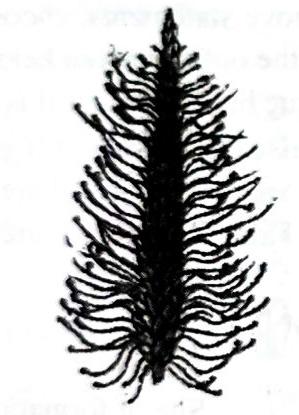
(1) C le is togamous flowers showing autogamy
(2) Compact inflorescence showing complete autogamy
(3) Wind-pollinated plant inflorescence showing flowers with well exposed stamens
(4) Water pollinated flowers showing stamens with mucilaginous covering
2. In angiosperm, the haploid, diploid and triploid structures of fertilised embryo sac sequentially are (2023)
(1) synergids, antipodals and polar nuclei
(2) synergids, primary endosperm nucleus and zygote
(3) antipodals, synergids, and primary endosperm nucleus
(3) Their pollen is dispersed by wind.
(4) The trees are self-pollinating.
6. While observing a flower in your garden, you notice carpels with exceptionally long styles and stamens with notably short filaments. This plant is most likely to reproduce by ________.
(1) cross-pollination
(2) selfing
(3) asexual reproduction
(4) vegetative reproduction
(4) synergids, zygote and primary endosperm nucleus
3. Given below are two statements. (2022) Statement I : Cleistogamous flowers are invariably autogamous
Statement II : Cleistogamy is disadvantageous as there is no chance for cross pollination
In the light of the above statements, choose the correct answer from the options given below.
(1) Both statement I and statement II are incorrect
(2) Statement I is correct but statement II is incorrect
(3) Statement I is incorrect but statement II is correct
(4) Both statement I and statement II are correct
4. In some member of which of the following pairs of families, pollen grains retain their viability for months after release? (2021)
(1) Rosaceae; leguminosae
(2) Poaceae; rosaceae
(3) Poaceae; leguminosae
(4) Poaceae; solanaceae
5. In some plants thalamus contributes to fruit formation. Such fruits are termed as (2020-II)
(1) parthenocarpic fruit
(2) false fruits
(3) aggregate fruits
(4) true fruits
6. What is the fate of the male gametes discharged in the synergid? (2019)
(1) One fuses with the egg and other fuses with central cell nuclei.
(2) One fuses with the egg, other(s) degenerates in the synergid.
(3) All fuse with the egg.
(4) One fuses with the egg, other(s) fuse(s) with synergid nucleus.
7. Which of the following has proved helpful in preserving pollen as fossils? (2018)
(1) Pollen kitt (2) Cellulosic intine
(3) Oil content (4) Sporopollenin
8. Functional megaspore in an angiosperm develops into an (2017)
(1) endosperm (2) embryo sac
(3) embryo (4) ovule
9. Seed formation without fertilisation in flowering plants involves the process of (2016-I)
CHAPTER TEST
1. Vegetative cell of pollen grain differs from generative cells in terms of
A. size
B. extent of food reserves
C. shape of nucleus
(1) A only
(2) B only
(3) C only
(4) A, B and C
(1) somatic hybridisation
(2) apomixis
(3) sporulation
(4) budding
10. Coconut water from a tender coconut is (2015-R)
(1) innermost layers of the seed coat
(2) degenerated nucellus
(3) immature embryo
(4) free nuclear endosperm
11. Geitonogamy involves (2014)
(1) fertilisation of a flower by the pollen from another flower of the same plant
(2) fertilisation of a flower by the pollen from the same flower
(3) fertilisation of a flower by the pollen from a flower of another plant in the same population
(4) fertilisation of a flower by the pollen from a flower of another plant belonging to a distant population
12. Which one of the following statements is correct? (2013)
(1) Endothecium produces the microspores
(2) Tapetum nourishes the developing pollen
(3) Hard outer layer of pollen is called intine
(4) Sporogenous tissue is haploid
2. Pollen tablets are used for/as
(1) fossilisation
(2) germplasm collection
(3) food supplement
(4) food for insect
3. How many mitotic divisions are required to produce mature male gametophyte from microspore?
(1) 1 (2) 2
(3) 3 (4) 4
4. Given below are two statements. One is labelled Assertion (A) and the other is labelled Reason (R).
Assertion (A) : During embryo sac formation, initial mitotic divisions are strictly free nuclear.
Reason (R) : During embryo sac development, nuclear divisions are not followed immediately by cell wall formation.
In light of the above statements, choose the correct answer from the options given below.
(1) Both (A) and (R) are true and (R) is the correct explanation of (A).
(2) Both (A) and (R) are true but (R) is not the correct explanation of (A).
(3) (A) is true but (R) is false.
(4) Both (A) and (R) are false.
5. Multicarpellary syncarpous gynoecium is present in
(1) Nelumbo (2) Papaver
(3) Michelia (4) Rosa
6. Given below are two statements.
Statement I : The process of formation of megaspores from the megaspore mother cell is called megasporogenesis.
Statement II : The process of development of the embryo sac from the functional megaspore, where the egg cell is also formed, is termed as gametogenesis.
In light of the above statements, choose the correct answer from the options given below.
(1) Both statements I and II are correct.
(2) Both statement I and statement II are incorrect.
(3) Statement I is correct but statement II is incorrect.
(4) Statement I is incorrect but statement II is correct.
7. In which stage of embryo sac development, there is movement of nuclei towards opposite poles?
(1) 2 nucleated stage (2) 4 nucleated stage
(3) 6 nucleated stage (4) 7 celled stage
8. Given below are two statements.
Statement I : In a mature pollen grain, two male gametes are formed.
Statement II : An embryo sac has only one female gamete.
In light of the above statements, choose the correct answer from theoptions given below.
(1) Both statement I and statement II are correct.
(2) Both statement I and statement II are incorrect.
(3) Statement I is correct but statement II is incorrect.
(4) Statement I is incorrect but statement II is correct.
9. Embryo sac is best described as (1) progenitor of next generation
(2) mitotic product from zygote
(3) female gametophyte
(4) megasporangium
10. In angiosperms, the functional megaspore in the linear tetrad is generally____ from micropylar end.
(1) first
(2) second
(3) third
(4) fourth
11. In a ovary with 100 ovules ready for fertilisation, how many megaspores fail to form embryo sacs?
(1) 200 (2) 100
(3) 300 (4) 75
12. The type of pollination that brings genetically different types of pollen grains to the stigma of a plant is
(1) xenogamy (2) geitonogamy
(3) chasmogamy (4) autogamy
13. Foul smelled flowers are pollinated by
(1) bees and bats
(2) birds and snakes
(3) bats and snails
(4) flies and beetles
14. Given below are two statements. One is labelled Assertion (A) and the other is labelled Reason (R).
Assertion (A) : Wind is the pollinating agent in corn.
Reason (R) : Corn plant has hidden stamens.
In light of the above statements, choose the correct answer from the options given below.
(1) Both (A) and (R) are true and (R) is the correct explanation of (A).
(2) Both (A) and (R) are true but (R) is not the correct explanation of (A).
(3) (A) is true but (R) is false.
(4) Both (A) and (R) are false.
15. Which one is not an outbreeding device?
(1) Self incompatibility
(2) Dioecy
(3) Close positioning of anther and stigma in a bisexual flower
(4) Occurrence of stigma receptivity and pollen release of a bisexual flower at different times.
16. Flowers are not colourful and do not emit smell, when they are
(1) wind pollinated
(2) insect pollinated
(3) bird pollinated
(4) animal pollinated
17. Total cells involved in double fertilisation of an angiosperm are
(1) two male gametes, one synergid and one egg cell
(2) vegetative cell, one male gamete, egg cell and central cell
(3) two male gametes, egg cell and an antipodal cell
(4) two male gametes, egg cell and central cell
18. Cob is the name given to the inflorescence of (1) Sorghum (2) corn
(3) paddy (4) wheat
19. Given below are two statements.
Statement I : Geitonogamy is genetically similar to autogamy.
Statement II : Geitonogamy occurs between flowers of different plants of the same species.
In the light of given statements, choose the correct answer from the options given below.
(1) Both statement I and statement II are correct.
(2) Both statement I and statement II are incorrect.
(3) Statement I is correct but statement II is incorrect.
(4) Statement I is incorrect but statement II is correct.
20. Flowers of which of the following plant provide safer places for laying eggs by a moth?
(1) Mustard (2) Chillies
(3) China rose (4) Yucca
21. Given below are two statements. One is labelled Assertion (A) and the other is labelled Reason (R).
Assertion (A) : Synergids play an important role in directing pollen tube growth.
Reason (R) : Synergids secrete some chemotropically active substance.
In light of the above statements, choose the correct answer from the options given below.
(1) Both (A) and (R) are true and (R) is the correct explanation of (A).
(2) Both (A) and (R) are true but (R) is not the correct explanation of (A).
(3) (A) is true but (R) is false.
(4) Both (A) and (R) are false.
22. In angiosperms, female flower is called as (1) staminate flower (2) pistillate flower
(3) oogonium (4) bisexual flower
23. A diploid (2n) female plant is crossed with a tetraploid (4n) male plant. What would be the ploidy of embryo and endosperm respectively in the resulting seeds?
(1) Diploid and triploid
(2) Diploid and pentaploid
(3) Triploid and tetraploid
(4) Triploid and hexaploid
24. How many meiotic divisions are required for the formation of 80 zygotes in an angiospermic plant?
(1) 40 (2) 100
(3) 80 (4) 160
25. Zygote is always (1) haploid
(2) diploid
(3) triploid
(4) tetraploid
26. Identify the most common abiotic pollinator.
(1) Water
(2) Temperature
(3) Soil
(4) Wind
27. In which of the following pair of plants, endosperm not only nourishes the embryo but also the seedling to form plantlet during seed germination.
(1) Bean and groundnut
(2) Coconut and groundnut
(3) Coconut and castor
(4) Castor and pea
28. Given below are two statements. One is labelled Assertion (A) and the other is labelled Reason (R).
Assertion (A) : Endosperm in angiosperms is triploid.
Reason (R) : It is formed due to the fusion of three triploid nuclei.
In light of the above statements, choose the correct answer from the options given below.
(1) Both (A) and (R) are true and (R) is the correct explanation of (A).
(2) Both (A) and (R) are true but (R) is not the correct explanation of (A).
(3) (A) is true but (R) is false.
(4) Both (A) and (R) are false.
29. Given below are two statements. One is labelled Assertion (A) and the other is labelled Reason (R).
Assertion (A) : Endosperm formation precedes division in zygote and subsequent development of embryo.
Reason (R) : Endosperm ensures assured nutrition to developing embryo.
In light of the above statements, choose the correct answer from the options given below.
(1) Both (A) and (R) are true and (R) is the correct explanation of (A).
(2) Both (A) and (R) are true but (R) is not the correct explanation of (A).
(3) (A) is true but (R) is false.
(4) Both (A) and (R) are false.
30. A feature of sexual reproduction found only in angiosperms is
(1) a chemical attractant guides the sperm towards the egg
(2) non-motile gametes
(3) one male gamete fuses with egg cell and other fuses with polar nuclei
(4) male gametes are carried by pollen tube.
31. Rearrange the following events of sexual reproduction in the sequence in which they occur in majority of angiospermic plants.
(a) Fertilization
(b) Pollination
(c) Embryogenesis
(d) Gametogenesis
(1) d, b, a, c
(2) b, a, c, d
(3) d, b, c, a
(4) d, a, b, c
32. Each cell of sporogenous tissue in anther is
(1) microspore
(2) pollen
(3) potential pollen mother cell
(4) megaspore mother cell
33. Which oldest seed is excavated from Arctic Tundra?
(1) Lupin arcticus
(2) Phoenix dactylifera
(3) Solanum nigrum
(4) Raphanus sativus
34. Identify the set of fleshy fruits.
(1) Groundnut, cashewnut and mustard
(2) Mango, guava and orange
(3) Wheat, groundnut and rice
(4) Guava, groundnut and wheat
35. Apomixis can lead to formation of a haploid embryo. The cell involved in such case is
(1) nucellar cell without fertilisation
(2) an egg cell without fertilisation
(3) an egg cell by fertilisation
(4) a megaspore mother cell without fertilisation
36. Match Column-I with Column-II.
Column-I Column-II
(A) A whorl of stamens (I) Corolla
(B) A whorl of sepals (II) Calyx
(C) A whorl of carpels (III) Androecium
(D) A whorl of petals (IV) Gynoecium
Select the correct option.
(A) (B) (C) (D)
(1) III II IV I
(2) II III IV I
(3) III IV I II
(4) III I II IV
37. How many male gametes and female gametes are produced by each male and female gametophytes respectively in flowering plants?
(1) One and one
(2) Two and two
(3) One and two
(4) Two and one
38. Match Column-I with Column-II.
Column-I Column-II
(A) Endothecium (I) Cotyledon in cereal grain
(B) Hilum (II) Anther wall layer
(C) Perisperm (III) Persistent nucellus
(D) Scutellum (IV) Region of attachment of funicle with ovular body
Select the correct option.
(A) (B) (C) (D)
(1) II IV III I
(2) I III IV II
(3) III II I IV
(4) IV I II III
39. Match Column-I with Column-II.
Column-I Column-II
(A) Selfincompatibility (I) Grass embryo
(B) Monoecious (II) Perispermic
(C) Epiblast (III) Genetic mechanism
(D) Black pepper (IV) Castor
Select the correct option.
(A) (B) (C) (D)
(1) IV III II I
(2) III IV I II
(3) IV I II III
(4) III I II IV
40. Match Column-I with Column-II.
Column-I Column-II
(A) Vegetative cell (I) Sporopollenin
(B) Generative cell (II) Spindle shaped cell
(C) Exine (III) Large sized and has abundant food reserve
(D) Intine (IV) Cellulose and pectin
Select the correct option.
(A) (B) (C) (D)
(1) I II III IV
(2) IV II III I
(3) III II I IV
(4) II I IV III
41. Choose the correct set of structures with respect to essential units of sexual reproduction of a flower.
A. Calyx
B. Corolla
C. Androecium
D. Gynoecium
(1) A and B only
(2) C and D only
(3) A and C only
(4) B and D only
42. Match Column-I with Column-II.
Column-I (Parts of embryo) Column-II (Features)
(A) Cotyledon (I) Portion below the cotyledon
(B) Epicotyl (II) Portion above the cotyledon
(C) Plumule (III) Tip of epicotyl
(D) Hypocotyl (IV) Embryonic leaf
Select the correct option.
(A) (B) (C) (D)
(1) I II III IV
(2) I III II IV
(3) IV II III I
(4) I II IV III
43. Which of the following statements is correct?
(a) Each ovule/megasporangium has one or two protective envelopes called integuments that encircle the nucellus except at the micropyle.
(b) The chalaza represents the basal part of the ovule.
(c) The central mass of cells called the nucellus has abundant reserve food materials.
(d) In general, a single cell of nucellus in the micropylar region differentiates into a megaspore mother cell (MMC).
(e) The megaspore mother cell divides by meiosis to form four megaspores.
(f) All the four megaspores further undergo mitosis to form the female gametophyte.
(1) a, b, c, d and f only
(2) b, c, d, e and f only
(3) a, b, c, d and e only
(4) a, c, d, e and f only
44. Read the following statements
(A) All the changes from pollen deposition on the stigma until the pollen tube enter the ovule are collectively called pollen pistil interactions.
(B) Chemical dialogue between male gametes and antipodals is a prerequisite for postpollination events.
(C) Pollen tube enters into the ovule from the micropylar end.
(D) Pollen tube directly enters the egg cell to release male gametes.
Pick the correct statement.
(1) A and B only (2) B and C only
(3) A and C only (4) B and D only
45. Read the following statements and pick the correct pair of statements.
(A) True fruits are always associated with false fruits.
(B) False fruits do not possess any seeds.
(C) Thalamus contributes to true fruit formation in apple, cashew and strawberry.
(D) True fruits can have fleshy pericarp as seen in orange and guava, or can be dry as seen in groundnut and mustard.
(1) A and B only (2) B and C only
(3) A and C only (4) B and D only
ANSWER KEY
NEET Drill
Further Exploration
Matching Type
and Reason
Brain Teasers
Chapter Test