BASIC MATHEMATICS CHAPTER 1
Chapter Outline
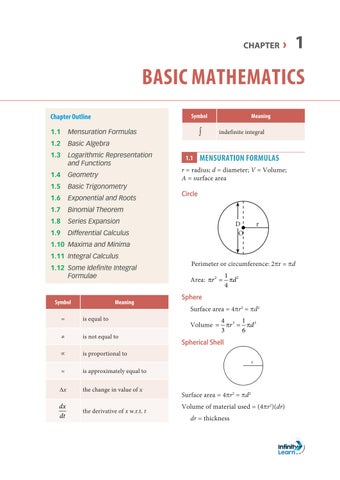
1.1 Mensuration Formulas
1.2 Basic Algebra
1.3 Logarithmic Representation and Functions
1.4 Geometry
1.5 Basic Trigonometry
1.6 Exponential and Roots
1.7 Binomial Theorem
1.8 Series Expansion
1.9 Differential Calculus
1.10 Maxima and Minima
1.11 Integral Calculus
1.12 Some Idefinite Integral Formulae Symbol Meaning
is equal to
is not equal to
is proportional to
is approximately equal to
x the change in value of x
the derivative of x
Meaning
indefinite integral
1.1 MENSURATION FORMULAS
r = radius; d = diameter; V = Volume; A = surface area Circle
= thickness
Hollow Sphere
Volume: 4 3 4 3 2 3 1 3 RR where R2 and R1 are outer and inner radii.
Cylinder h r
Lateral surface area = 2πrh
Volume = πr2h
Total area = 2πrh+2πr2 =2πr(h+r)
Cone r h
Lateral surface area rrh22 h = height
Total area rrhr 22
Volume 1 3 2 rh
Ellipse a b
a = Semi major axis b = Semi minor axis
Circumference 2 2 22ab
Area = πab
Parallelogram a b θ h
A = bh = absin θ
a = side; h = height; b = base θ = angle between sides a and b
Trapezium a h b
Area = hab 2 () +
a and b are parallel sides. h = Height
Triangle a b h γβ α c
a, b, and c sides are opposite to angles α, β, and γ.
b = Base; h = Height
Area = ah 2 ab
ssasbsc 2 sin ()()()
sabc 1 2 ()
Rectangular Container b l h
Lateral area = 2(lb + bh + lh)
V = lbh
l, b, and h are sides of the container.
1.2 BASIC ALGEBRA
Factorisation
1. x(a ± b) = ax ± bx
2. (x ± y ) 2= x2 + y2 ± 2xy
3. x2 – y2 = (x + y)(x – y)
4. x3 + y3 = (x + y)(x2 + y2 – xy)
5. x3 – y3 = (x – y)(x2 + y2 + xy)
Quadratic Equation and Roots
If an algebraic expression has 2 as the power of x, then it contains a quadratic nature. If ax 2 + bx + c = 0 ( a ≠ 0) is the required expression, then
(a) this expression possesses no real roots if b2 – 4ac < 0
(b) this expression possesses identical roots if b2 – 4ac = 0 and that root is b a2
(c) this expression possesses two distinct roots if b 2 – 4 ac > 0 and the roots are bbac a 2 4 2 .
Factorial Representation
1. Factorial is always defined for positive integers, including zero.
2. It is written as n ! or n and is read as n factorial.
3. Mathematically, nnnnnn nnn !( )( )( ) 12 34 32 1 1
4. Examples: 66 543 21 720 5 120 01 11 (Must remember)
Determinant
Arithmetic Progression (AP):
■ nth term of the series a, a+b,a+ 2b, . . . is given by t n =a + ( n – 1) b and sum of the n terms is given by n anb 2 21
Geometric Progression (GP):
■ If a series is given by a, ar,ar2 , ar3 , . . . nth term is given by t n = arn – 1 .
■ s n = a + ar + ar 2 + . . . upto n terms = 1 1 r r n
■ If r < 1 and n is large, then S a r n 1 .
1.3 LOGARITHMIC REPRESENTATION AND FUNCTIONS
1. ln = Logarithm to the base e , where e = 2.718 (also called natural logarithm)
2. log10 = Logarithm to the base 10
3. logex = ln x
4. logex = 2.303 log10x
5. loge(ex) = x
6. loglog log eee x y xy
7. loge(xy) = logex + logey
8. loge(xn) = nlogex
9. loglog ee x x 1
10. If logax = α
⇒ x = a α
Similarly, if loge x = α ,
⇒ x = e α
Important
1. Logex or log10x are always defined for x > 0 and so, sometimes, we do write them as loge |x| or log10|x|.
2. Consider y = logax.
This function is only defined for x > 0. and a > 0 and a ≠ 1.
1.4 GEOMETRY
1. The distance d between two points P1 and P2 with coordinates (x1, y1) and (x2, y2) is dxxyy 21 2 21 2
This formula is popularly known as distance formula.
2. The distance between two points P1 and P2 with polar coordinates (r1, θ 1) and (r2, θ 2)
If (x1, y1) are Cartesian coordinates of P 1, then x1 = r1 cos θ 1, y1 = r1 sin θ 1
3. A linear equation has the general form given by y = mx + c, where m and c are constants called the slope of the line and the intercept of the line on y -axis, respectively (see the figure).
1) ∆ x = (x2 – x1) (x1, y1) (x2 ,y2 ) x y O (0,0) (0,c) c θ θ
(
–
Slope of the line (m) is also equal to tan θ where θ is the angle that the line makes with the positive x-axis.
slopem y x yy xx 21 21 tan
m and c can have either positive or negative values.
(a) If m > 0, the straight line has a positive slope and θ is acute.
(b) If m < 0, the straight line has a negative slope and θ is abtuse.
(c) If m = 0, then we have straight line parallel to x-axis.
Three other possible situations are further shown in figure.
(1) m > 0 c < 0 y x O (3) m < 0 c < 0 (2) m < 0 c > 0
4. Equation of a circle of radius a centered at origin is x2 + y2 = a2 x y O a
5. Equation of an ellipse with origin as its centre is x a y b a b 2 2 2 2 1. = semi-major axis = semi-minor axis (0, 0) b x a
6. Equation of parabola with vertex at (0, b) y = ax2 + b (0, b) y x
7. Equation of rectangular hyperbola is xy = constant. x y
1.5 BASIC TRIGONOMETRY
1. 1 180 180 rad = degree = 57.3 1 = radian = 0.0174 rad.
2. Basic functions of trigonometry are sine, cosine, and tangent functions defined in terms of the ratio of the sides of the right angled triangle. These functions are defined as follows. h p 90 – θ θ b
(a) sin Perpendicular Hypotenuse p h
(b) cos Base Hypotenuse b h
(c) tan Perpendicular Base p b
3. The cosecant (cosec), secant (sec) and cotangent (cot) functions are defined as cosec sec cot = 1 1 1 sin cos tan
4. Quadrant I has all of sin, cos, tan, etc. as positive.
Quadrant II has sine and cosec as positive and all others as negative.
Quadrant III has tan and cot as positive and all others as negative.
Quadrant IV has cosine and secant as positive and all others as negative.
Quadrant II
Quadrant III
6. Trigonometric ratios:
Quadrant I (90° – θ )
Quadrant I (360° + θ )
sin (90° – θ ) = cos θ sin (360° + θ ) = sin θ
cos (90° – θ ) = sin θ cos (360° + θ ) = cos θ
tan (90° – θ ) = cot θ tan (360° + θ ) = tan θ
Quadrant II (90° + θ )
Quadrant II (180° – θ )
sin (90° + θ ) = cos θ sin (180° – θ ) = sin θ
cos (90° + θ ) = –sin θ cos (180° – θ ) = –cos θ
tan (90° + θ ) = –cot θ tan (180° – θ ) = –tan θ
Quadrant III
(180° + θ )
Quadrant III (270° – θ )
sin (180° + θ ) = –sin θ sin (270° – θ ) = –cos θ
cos (180° + θ ) = –cos θ cos (270° – θ ) = –sin θ
tan (180° + θ ) = tan θ tan (270° – θ ) = cot θ
Quadrant IV (270° + θ )
Quadrant IV (360° – θ )
sin (270° + θ ) = –cos θ sin (360° – θ ) = –sin θ
cos (270° + θ ) = sin θ cos (360° – θ ) = cos θ
tan (270° + θ ) = –cot θ tan (360° – θ ) = –tan θ
CAUTION
Quadrant I
Quadrant IV All positive Sine and cosec positive positive positive Coffee
90° To Sugar Tan and cot Cos and sec Add
(360°)
5. sin (– θ ) = –sin θ (ODD Function) cos (– θ ) = cos θ (EVEN Function) tan (– θ ) = –tan θ (ODD Function)
(i) While wr iting the above formulae, we must see the quadrant in which the angle lies, e.g., (90° – θ ) lies in quadrant I, (90° + θ ) and (180° – θ ) lie in quadrant II, (180° + θ) and (270° – θ) lie in quadrant III, (270° + θ) and (360° – θ ) lie in quadrant IV. Finally (360° + θ ) lies back in quadrant I. According to location of the angle in a Quadrant, the values of sine, cosine, and tangent have to be assigned a sign.
(ii) Further, if the principle value of an angle is odd multiple of 90°, like (90° – θ ), (90° + θ ), (270° + θ ), then sine has to be changed to cosine, cosine to
sine, tangent to cotangent, and so on. Similarly, no changes are done when principal value is an even multiple of 90°, like (180° – θ), (180° + θ), (360° –θ ), (360° + θ ).
7. Law of cosines for a triangle: ab c βα γ
a2 = b2 + c2 – 2bc cos α
b2 = a2 + c2 – 2ac cos β
c2 = a2 + b2 – 2ab cos γ
8. Law of sines (Lami’s theorem): sinsin sin abc
9. Some useful trigonometric identities:
1. sin2 θ + cos2 θ = 1
2. sec2 θ = 1 + tan2 θ
3. cosec2 θ = 1 + cot2 θ
4. sin (2 θ ) = 2sin θ cos θ
5. sinsin cos 2 22
6. coscos sin 2 22
7. coscos sin 22 22
8. sin cos 2 12 2
9. 12 2 2cossin
10. 12 2 2 coscos
11. sinsin AB A cosB cosA sinB
12. coscos AB A cosB sinA sinB
13. sincos A + sinB = 2si n AB AB 22
14. sinsin AsinB = 2cos AB AB 22
15. coscos AcosB = 2cos AB AB 22
16. coscos sinsin AB AB AB 2 22 17. tan tan tan 2 2
AND ROOTS
1.7 BINOMIAL THEOREM () () ! () () ! 11 1 2 11 1 2 2 2 xnx nnx xnx nn x n n
If x << 1, then (1 ± x)n = 1 ± nx (neglecting higher terms) (1 ± x)–n = 1 ± (– n)x = 1 nx
Key Insights:
■ When n is a positive integer, then expansion will have (n + 1) terms.
■ When n is a negative integer, expansion will have infinite terms.
■ When n is a fraction, expansion will have infinite terms.
1.8 SERIES EXPANSION
1. () () ! ()() ! 11 1 2 12 3 2 3 xnx nn x nnn x n
2. ex xxx 1 23 23 !!
3. log( ).. e xx xxxx 1 23 45 23 45
4. sin !! , xx xx 35 35 x is in radian
5. cos !! , x xx 1 24 24 x is in radian
For x << 1 (1 + x)n ≅ 1 + nx sin x ≅ x ex ≅ 1 + x cos x ≅ 1
ln (1 ± x) ≅ + x tan x ≅ x
1.9 DIFFERENTIAL CALCULUS
1. d dx constant 0
2. d dx xnx nn 1 3. d dxKyKdy dx where K is a constant
4. d dx KxKnx nn 1
5. d dx uvw du dx dv dx dw dx
6. d dx uv udv dx vdu dx
7. d dx u v v du dx u du dx v 2
8. dy dx dy du du dx . Chain rule
9. d dx axaax sin cos
10. d dx axaax cos sin
11. d dx eae axax
12. d dx axa axx e log( ) 11
13. d dx x xa a e log log 1
14. d dx dy dx dy dx 2 2 [Read as ‘dee square y by dee x square’] [also written as y']
Geometrical Significance of dy dx
dy dx is ac tually the rate measurer, which measures the change in value of y, a dependent variable, according to the change in the value of x, an independent variable.
Geometrically, it gives us the instantaneous slope of a curve.
So, for the maximum or minimum value of y dy dx , = 0 .
Just before the minimum point, the slope is negative. At the minimum point, it is zero, and just after the minimum point, it is positive. Thus, dy dx increases at the minimum point, i.e., the rate of change of dy dx is positive at the minimum point. So, d dx dy dx dy dx 0 0 2 2 or,
Hence, condition for the minimum value of y is dy dx dy dx 00 2 2 and
1.10 MAXIMA AND MINIMA
In Physics, we usually deal with those functions that have a continuous and smooth graph.
Let us suppose that a quantity y depends upon another quantity x in a manner shown in the figure below. It becomes minimum at x 1 and maximum at x 2. At these points, the tangent to the curve is parallel to the x-axis and its slope is tan θ = 0. x x1 x2 O y
The slope of the curve = dy dx
Similarly, the condition for the maximum value of y is dy dx dy dx 00 2 2 and
Remark: While doing physics problems, when we are asked to find the condition of either maxima or of minima, we just have to equate the derivative (of the function to be minimised or maximised) to zero; rest can be visualised physically.
1.11 INTEGRAL CALCULUS
Consider a function y = f(x)
If d dxfxgx [( )] () = , then gxdxfx () ()
Integration is just the reverse process of differentiation.
Geometrical significance of a b ∫ g(x)dx
We have already studied that dy dx gives us the instantaneous slope of the curve. x ab g(x) y
Similarly, a b gxdxfbfa () () () = area of shaded portion
This gives the area under the curve g ( x ) between the lower limit ‘a’ to the upper limit ‘b’.
1.12 SOME INDEFINITE INTEGRAL FORMULAE
1. xdx x n n n n 1 1 1 ()
2. dx x xx e logln
3. dx abxb abx e 1 log| |
4. ()axbdx axbx 2 2 5. dx xaa xa xa e 22 1 2 log
6. ∫ sin xdx = – cos x 7. ∫ cos xdx = sin x
JEE MAIN
1. If a + b = 15 and ab = 30, then the value of a2 + b2 is (1) 195 (2) 225 (3) 165 (4) 123
2. If 1 5 x x += , then 2 2 1 x x +=
(1) 25 (2) 27 (3) 23 (4) 1/25
3. The positive real root of the equation 81x2 –1 = 0 is (1) 1/3 (2) 1/9 (3) 1/18 (4) 1/27
4. If the roots of the quadratic equation x 2 + px + 16 = 0 are equal, then the value of p is
(1) ±9 (2) ±6 (3) ±7 (4) ±8
5. Find 2 1 h R + if h << R
(1) zxy = (2) 2 1 h R + (3) 2 1 h R (4) 1 h R
6. What will be the binomial approximation of () 1 1 x when x << = 1?
(1) 1 2 x (2) 1 2 x +
(3) 1 – x (4) 1 + x
7. Find the 13 th term of the following series: 1, 3, 5, 7, 9, 11.......
(1) 21 (2) 28 (3) 25 (4) 29
8. The value of 111 1 .... 41664 ++++ up to 3 n is ∞ Find the value of n.
(1) 4 (2) 2 (3) 5 (4) 7
9. Find the 10th term of the given series: 2, 4, 8, 16, 32, 64, …… (1) 512 (2) 1024
(3) 2048 (4) 128
10. In GP 4, 8, 16, 32, …………, find the sum up to 5th term.
(1) 16 (2) 64 (3) 124 (4) 128
11. The value of the sum of first hundred natural numbers 1 + 2 + 3 + .... + 100 is
(1) 4950 (2) 5050
(3) 5150 (4) 52050
12. If log2 a = 5, then the value of a is (where a > 0)
(1) 64 (2) 32
(3) 25 (4) e5
13. The distance of the point (9, –12) from the origin will be (1) 13 units (2) 14 units
(3) 15 units (4) 16 units
14. The distance between (p, –q) and (q, –p) is (p > q)
(1) p – q (2) p + q
(3) () 2 pq (4) () 2 pq +
15. The equation of the line having inclination 45° and y–intercept –2 is
(1) x+y + 2 = 0 (2) x–y + 2 = 0
(3) x–y – 2 = 0 (4) x+y – 2 = 0
16. The equation of the line having slope a / b and passing through the origin is
(1) b yx a = (2) bx – ay = 0
(3) ax + by = 0 (4) ax – by = 0
17. Find the sum of the following series: 12 + 22 + 32 + .... + 102.
(1) 285 (2) 385 (3) 429 (4) 324
18. Find the value of x in the equation 10x2 – 27 + 5 = 0.
(1) 1/5 (2) 1/6 (3) 1/8 (4) 1/9
19. The slope of the graph, as shown in the figure, at points 1, 2 and 3 is m1, m2 and m3, respectively. Then, x y 1 2 3
(1) m1 >m2 >m3 (2) m1 < m2 < m3 (3) m1 = m2 = m3 (4) m1 = m2 > m3
20. Find the sum of the series 1 3 + 23 + 33 + 43 + ... + n3 .
(1) ()2 2 1 4 nn +
(2) 22 (1) 6 nn + (3) () ()121 6 nnn++
(4) () ()123 6 nnn++
21. If the surface area of a sphere is (144π) m 2 , find its volume.
(1) 288π m3 (2) 188π m3 (3) 300π m3 (4) 316π m3
22. Find the volume of right circular cone having base diameter 16 cm and height 15 cm.
(1) 60π cm3 (2) 68π cm3 (3) 149π cm3 (4) 320π cm3
23. If the curved surface area of a cylinder of height 21 cm is 660 cm2, find its radius.
(1) 4 cm (2) 6 cm (3) 5 cm (4) 7 cm
24. Total surface area of a hemisphere of radius r is
(1) 2πr2 (2) 4πr2 (3) 3πr2 (4) πr2
25. If 1 sin 3 θ= , then cos2 θ=
(1) 1/2 (2) 1/3
(3) 1/5 (4) 1/8
26. sin(x + y) + sin(x – y) =
(1) 2sinx cosy
(2) 2cosx siny (3) 2sinx siny (4) 2cosx cosy
27. tan (180° + θ )= (1) tan θ (2) cot θ (3) –tan θ (4) –cot θ
28. If A and B are acute angles such that sinA = cosB, then A + B = (1) π/2 (2) π/4 (3) π (4) π/3
29. If 3 tan 4 θ= then () () 1cos 1cos −θ = +θ
(1) 9 (2) 1/9 (3) 4 (4) 1/4
30. sin15°.cos30°+cos15°.sin30°=
(1) 1 (2) 1 2
(3) 3 2 (4) 0
31. For the equation y = –2x2 + 3, find the nature of the graph.
(1) Parabola passing through origin
(2) Parabola not passing through origin
(3) Parabola passing through (2, 1)
(4) Hyperbola passing through origin
32. Graph of the function y = 4 + x2 is shown in figure. What is the value of a? y x
(0, 0) (0,a)
(1) 2 (2) 4 (3) 0 (4) 22
33. The slope of straight line AB is
(0, 0) (1, 0) (3, 3) x y B A (1) 3 2 + (2) 3 2 (3) 2 3 + (4) 2 3
34. The equation of shown straight line is
(0, 5) x y
(0, 0) (4, 0)
(1) 1 45 xy+= (2) 1 54 xy+=
(3) 4x + 5y = 1 (4) 5x + 4y = 1
35. A metallic sphere of radius 4.2 cm is melted and recast into the shape of a cylinder of radius 6 cm. Then, the height of the cylinder is
(1) 2.744 cm (2) 2.743 cm (3) 3.744 cm (4) 4.474 cm
36. The area of a trapezium is 24 cm2 and the distance between its parallel sides is 4 cm. If one of the parallel sides is 7 cm, then the other parallel side is (1) 5 cm (2) 8 cm (3) 12 cm (4) 7 cm
37. Find the value of cos120°.
(1) 1 2 (2) 1 5 (3) 1 2 (4) 1
38. If y = x3 + 2x2 + 7x + 8, then dy dx will be
(1) 3x2 + 2x + 15 (2) 3x2+ 4x + 7 (3) x3+ 2x2 + 15 (4) x3+ 4x + 7
39. If y = sinx, then 2 2 dy dx will be (1) cosx (2) sinx (3) –sinx (4) sinx + c
40. Given below are two statements.
S-I : Slope of horizontal line is zero and slope of vertical line is undefined.
S-II : Two lines whose slopes are m1 and m2 are perpendicular if and only if m1m2 = –1
In light of the given statements, choose the correct answer from the options given below.
(1) Both S-I and S-II are correct.
(2) Both S-I and S-II are incorrect.
(3) S-I is correct but S-II is incorrect.
(4) S-I is incorrect but S-II is correct.
41. If y = sin x and x = 3t, then dy dt will be (1) 3 cos (x) (2) cos x (3) cos (3t) (4) –cos x
42. The area A of a blot of ink is growing such that, after t seconds, its area is given by A = 5t2 + 9 cm2. Calculate the rate of increase of area at t = 5 sec.
(1) 30 cm2/s (2) 134 cm2/s (3) 50 cm2/s (4) 40 cm2/s
43. A particle is moving on the x -axis. Its position x at time t is given by x = 4t – t2 . Find its position at the time when its velocity is zero. Velocity = dx dt
(1) 1 m (2) 2 m (3) 3 m (4) 4 m
44. Differentiate the following functions with respect to x, (2x + 3)6
(1) 12(2x + 3)6 (2) 6(2x + 3)5
(3) 6(2x + 3)6 (4) 12(2x + 3)5
45. A particle is moving along the x -axis. At any instant, its x -coordinate is x = 4 + 3 t + 5 t 2 . W hat is the value of dx dt at t = 1?
(1) 12 (2) 13 (3) 7 (4) 8
46. Find the derivative of 3 x2+2x+5 at x = 2 (1) 12 (2) 16 (3) 8 (4) 14
47. 2 3 11 yxx xx =+++ . Find dy dx
(1) 24 13 12 x xx +−− (2) 24 12 12 x xx +−+ (3) 24 13 12 x xx −−+ (4) 23 13 12 x xx +−−
48. Find derivative of sin22x. (1) 2 sin2x cos2x (2) 2 sin4x
(3) 2 cos2x (4) –2 sin2x cos2x
49. The point for the curve y = xex (1) x = –1 is minimum (2) x = 0 is minimum (3) x = 0 is maximum (4) x = –1 is maximum
50. Find the derivative of log 10 x2
(1) 1 x (2) 2x logex
(3) 2 10 1 log e x (4) 1 log10 e x
51. If y = tanx, find dy dx .
(1) sin2x (2) cosec2x
(3) sec2x (4) cot2x
52. The derivative of f(x)=esinx w.r.t g (x) = sinx is
(1) e2sinx (2) esinx
(3) ecosx (4) 1
53. Find 2 ,wheresec dy dxyx =
(1) 2 secx tanx (2) 2 sec2x tanx
(3) secx tanx (4) sec2x tanx
54. The function f(x) = 2x3−3x2−12x+4 has (1) No maxima and minima
(2) One maximum
(3) One minima (4) Two minima
55. The function x5–5x4+5x3–10 has a maxima, when x =
(1) 3 (2) 2
(3) 1 (4) 0
56. If sin x y x = , then dy dx =
(1) 2 cossinxx x (2) 2 sincos xxx x
(3) 2 cossin xxx x (4) 3 cossin xxx x
57. x = 3cosθ, y = 3sinθ, then dy dx =
(1) −cotθ
(2) −sinθ
(3) −tanθ
(4) −secθ
58. Find () 2 ,where345 dy dxyxx=++
(1) 2 32 345 x xx++
(2) 2 32 345 x xx + ++
(3) 2 32 345 x xx++
(4) 2 32 345 x xx + ++
59. Differentiate the following with respect to x, 1 x x
(1) 11 1 2 xx +
(2) 11 1 2 xx
(3) 11 1 xx + (4) 11 1 2 2 xx +
60. Find the integration of 5 x + 7.
(1) 2 7 7 2 xx + (2) 2 5 7 2 xx + (3) 5 2 x (4) 2 3 7 2 xx +
61. The value of 2 RGMm r ∫∞ dr is equal to:
(1) R GMm (2) R GMm
(3) 2 R GM (4) 2 R GM
62. Find the value of () 3 2 axbdx∫+
(1) () 5 2 2 3 axbC a ++
(2) () 5 2 2 5 axbC a ++
(3) () 5 2 5 2 axbC a ++
(4) () 3 2 3 5 aaxbC ++
63. axb edx∫+ (1) axb ek ++ (2) 1 axb ek a ++ (3) axb aek ++ (4) axbak e + +
64. The integral 5 2 1 xdx ∫ is equal to (1) 125 3 (2) 124 3 (3) 1 3 (4) 45
65. Integrate the following functions with respect to x (62)3xdx∫+
(1) 4 2 (62) c 24 x + + (2) 4 2 (62) c 25 x + +
(3) 2 2 (62) c 24 x + + (4) 4 2 (32) c 24 x + +
66. Integrate the following functions with respect to x 45 dx x ∫ +
(1) () 2 1 ln45c 5 x ++
(2) () 2 1 ln45c 4 x ++
(3) ln(4x+5)+c2
(4) () 1 ln45c 4 x ++
67. If f(x) = 5x2 + 3x – 2, find the antiderivative of f(x).
(1) 5332 c 32 xx x +−+
(2) 5332 32 xx +
(3) 5332 2 42 xx xc+−+
(4) 5332 2 32 xx xc+−+
68. If 1 0 1 23 ldx x = ∫+ , then the value of l is
(1) 5 ln 3 (2) ln 3
(3) 1 ln5 2 (4) 15 ln 23
69. Evaluate 0 sin t Atdt∫ω where A and ω are constants.
(1) () 1sin A t+ω ω (2) () 1sin A t−ω ω
(3) () 1cos A t+ω ω (4) () 1cos A t−ω ω
70. Determine the average value of y = 2x+3 in the interval 0 ≤ x ≤ 1.
(1) 1 (2) 5 (3) 3 (4) 4
71. () 1 1/2 2 sin1 2 dxnx a axxa ∫=− , the value of n is
(1) 0 (2) 1
(3) 2 (4) 1/2
72. sin cos sin sin x exxxxdx x ∫++
(1) 2 2 cos 2 xx eecxc −++
(2) 2 2 cos 2 xx eecxc +++
(3) 2 1 cos1ecxc x −++
(4) 2 logsin 2 xx exc −++
73. The instan t aneous velocity of a particle moving in a straight line is given as v = α t + β t 2, where α and β are constants. The distance travelled by the particle between 1 s and 2 s is (where distance = vdt t t 1 2 ∫ )
(1) 3α + 7β (2) 37 23α+β
(3) 23 αβ + (4) 37 22α+β
74. An object, moving with a speed of 6.25 m/s, is decelerated at a rate given by 2.5v dv dt =− , where v is the instantaneous speed. The time taken by the object to come to rest would be
(1) 2 s
(2) 4 s
(3) 8 s
(4) 1 s
75. The v el o city of a particle is v = v 0 + gt + ft2. If its position is x = 0 at t = 0, then its displacement after unit time (t = 1) is (where displacement = vdt t t 1 2 ∫ )
(1) v0 + 2g + 3f
(2) v0 + g/2 + f/3
(3) v0 + g + f
(4) v0 + g/2 + f
ANSWER KEY
Numerical Value Questions
76. If 43 5 429yxx x =−++ then find slope of curve at x = 1
77. Calculate the area enclosed under the curve f(x)=x2 between the limits x=2 and x=3 0 1 2 3 x y
78. Find value of 2 0 cos____ xdx π