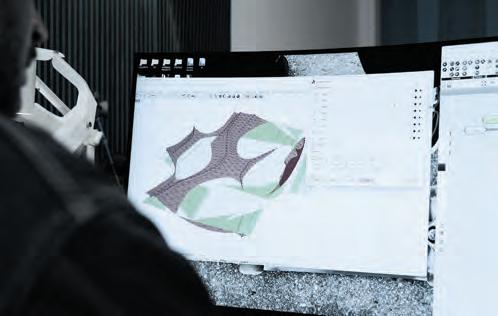
Analyse virtual prototypes and develop a physical prototype only from the best design.
Innovate with multi physics simulation.
Baseyour design decisions on accurate results with software that lets you study unlimited multiple physical effects on one model.
Contents
03 Welcome
Interim chief executive
Jo Passingham sets out IMechE’s three priorities
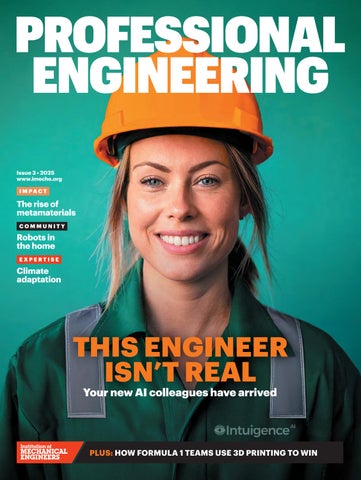
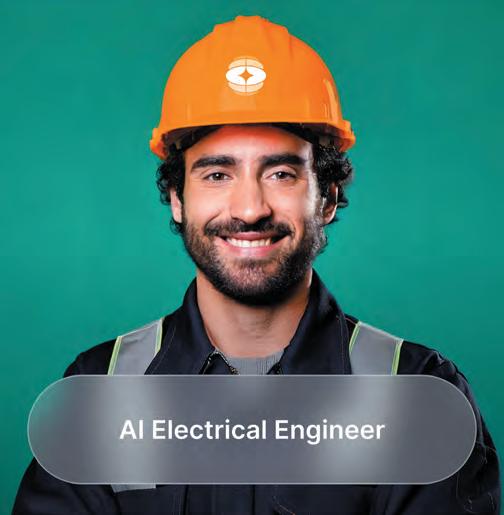
46 Your new AI colleagues
Could synthetic engineers boost productivity and even help to tackle the industry skills gap?
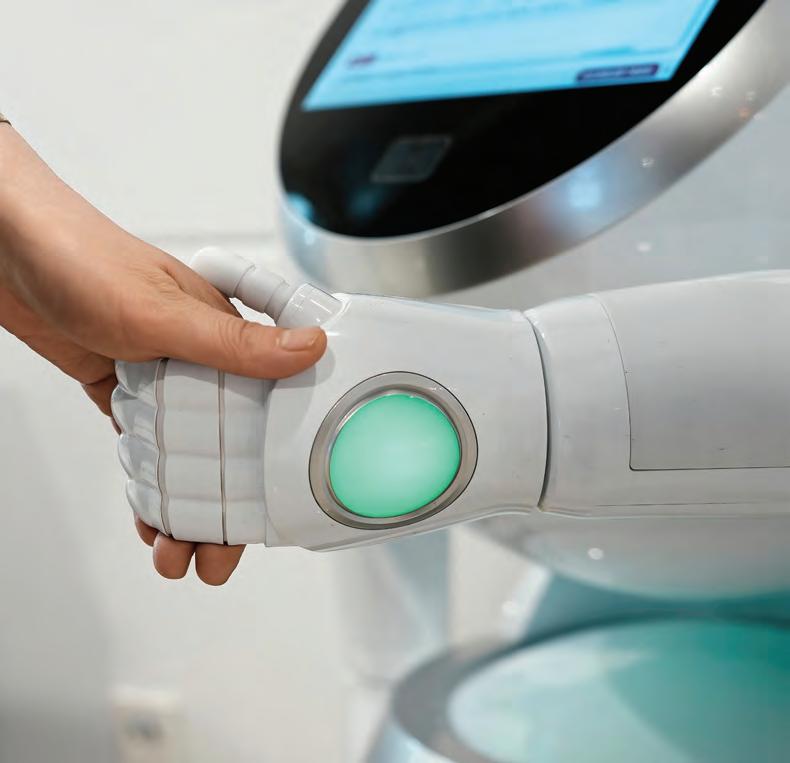
52 The doctorbot will see you now Robots in the home could be the answer to the UK’s healthcare crisis – but robust risk assessment is needed first
58 The future of metamaterials
They might sound like the stuff of science fiction, but metamaterials are having a moment
64 Weird engineering
This omni-bodied brain allows its robot host to adapt to damage – even after losing a limb
05 Opener
How origami-inspired metal folding could cut waste and reduce emissions
08 Workplace revolution
The industrial humanoid robot designed to address staff shortages in the manufacturing sector
11 Five for the future
Meet the engineers and researchers who are coming up with groundbreaking innovations
13 Blueprint
A recent IMechE report looks at what engineering can do to make flying more sustainable
15 In the spotlight
Our series on IMechE members who are having a big impact profiles
Nicole Pellizzon
18 IMechE and me
What the Institution means to its members
21 Institution update
President Matt Garside on the latest IMechE news
22 Your voice
Readers have their say on key issues of the day
25 Institution news
An update on IMechE HQ
27 Heritage
The Titan Crane is a striking industrial monument
31 Climate change
Key takeaways from IMechE’s conference on climate change adaptation and resilience
35 Marketing
Why engineers need to take a methodical approach to getting their ideas out there
37 Intellectual property
The law can be complex, but knowing how to protect your IP is crucial
39 3D printing
How F1 teams use 3D printing to win the race between races
43 Derailments
The new tools keeping trains on the track
Built for the Al era1
As creators and developers redefine the limits of what's possible in high performance computing, they need systems that keep pace.
Passing the baton
As manyofyou know, DrAlice Bunn OBE stepped down as chief executive of the Institution of Mechanical Engineers at the end of September, afterleadingwithvision and energysince July 2021. Iwant to thankAlice forherlasting impact.
Underherleadership,we gained a clearerstrategy, strongerfinances and a greaterexternal profile. Shewas a tireless champion of diversityand inclusion, ensuring our Institution and thewiderengineering communityremain welcoming to all talents and perspectives. Hercontributions will resonate foryears to come.
As of 1 October, I have stepped into the role of interim chief executive, and I’m both excited and mindful of the responsibilitythis brings. Myfocuswill be on continuing the momentumAlice has created,while also looking ahead to newopportunities to make ourInstitution even stronger and more relevant to theworld of engineering.
Looking ahead
Ourstrategic planwill guide thiswork, shaped around three keypriorities:
l Strong financial foundations, sowe can invest in our futurewith confidence. In recentyears,we have operated beyond ourmeans, butwe are taking decisive action in 2025 to change that.We have streamlined ourfinancial structures and reorganised to focus on efficiencyand effectiveness.The pension buy-in has been another important step in creating stabilityforthe future.
l Ahealthyand inclusive culture,where collaboration and trust drive both performance and reputation.We are embedding ourrefreshed diversityand inclusion strategyinto the Institution’swiderstrategy.We’ve also
PROFESSIONAL ENGINEERING
is published by Think on behalf of the Institution of Mechanical Engineers.
PE, 65 Riding House Street, London W1W 7EH 020 3771 7200
EDITORIAL profeng@thinkpublishing.co.uk
Editor: Amit Katwala
Deputy editor: Joseph Flaig
Sub-editor: Rebecca Dyer
Group art director: Jes Stanfield
Executive director: Jackie Scully
Client engagement director: Kieran Paul
launched a culture reviewto provide an independent and objective perspective onwhat isworkingwell and wherewe can improve.
l Awillingness to embrace change, sowe continue to evolve and remain relevant in a rapidlychangingworld. Ouroperating model is evolving to challenge oldways ofworking and find more effectiveways to deliver lasting impact.
Headquarters update
Following theTrustee Board’s decision in Septemberand a robust reviewbyCouncil in October, a Special Meeting has been scheduled for12pm GMTon Friday5 December 2025.This important milestone marks the opening of the ballot on the proposed resolution regarding the future of the Institution’s headquarters.We have an opportunityto reimagine ourfuture and howwe serve members and the engineering profession.We need to create a headquarters that is accessible, sustainable and inspiring – a placewhere today’s and tomorrow’s engineers feel at home.
TheTrustee Board has made a balanced, forward-looking recommendation alignedwith the Institution’s strategy, sustainabilityand charitable purpose.You can find out how to registerforthe Special Meeting and secureyourvote on the future of the Institution’s headquarters on page 25.
This is a moment of continuityand renewal. Passing the baton doesn’t mean starting over– it means building on whatworks, learning fromwhatwe’ve achieved and moving forward together. I’m looking forward toworkingwith all ofyou – ourmembers, partners and community– aswe take the next steps in ourshared mission of improving the world through engineering.
ADVERTISING 020 3771 7232
Commercial director: Michael Coulsey
michael.coulsey@thinkpublishing.co.uk
Senior commercial partnerships manager: Chris Barnard chris.barnard@thinkpublishing.co.uk
For address changes, phone 01952 214050 or email subscriptions@imeche.org
ABOUT IMECHE
The Institution of Mechanical Engineers is the professional body overseeing the qualification and development of mechanical engineers. It has 115,000 members in 140 countries.
Visit imeche.org for more information about membership and its benefits, or email membership@imeche.org.uk
@ProfEng tinyurl.com/PEmagazine
Views expressed in Professional Engineering are not necessarily those of the Institution or its publishers.
Interim chief executive: Jo Passingham
President: Matt Garside CEng FIMechE MIET
IMechE is a registered charity in England and Wales number 206882
Interim CEO Jo Passingham on the three key priorities for making the Institution stronger and more relevant
Printed by: Acorn Web, Yorkshire
Take
IMPACT
The forces shaping engineering
Stilfold’s origami-inspired metal folding could slim down cars and drones
F BENDING THE RULES
or the uninitiated, origami can look like magic. Even if you try to follow along with every step, the graceful transformation of a flat piece of paper into a crane, a butterfly or a flower still has the power to amaze as the final fold is made.
What if that same grace could be brought to manufacturing?
That is the aim of Stilfold, a Swedish company that has developed an industrial origami manufacturing technology. Using bespoke software and a novel combination of hardware, the technique creates simple, smooth metal components
that are much less ornate than their paper equivalents, but which offer manufacturers several advantages. Chief among these is the chance to cut waste from manufacturing. By folding along curved lines, the process – which has received patents in Europe and the US –is designed to make the most of simple starting materials.
The result, according to Stilfold, is weight reductions of up to 40%, an up to 70% reduction in required components and up to 20% lower material costs. By lowering the energy required, the process could also enable a
massive 75% reduction in carbon dioxide emissions.
While those figures represent the best possible scenario, savings of any kind could appeal to a wide range of industries. Based near Stockholm, Stilfold says its technology could be well-suited for automotive applications, aerospace, energy and sustainable construction. Recent projects have included a research collaboration with Volvo exploring the Stilfold technique as an alternative to stamping and welding, an AIenhanced lightweight drone design and a scooter concept.
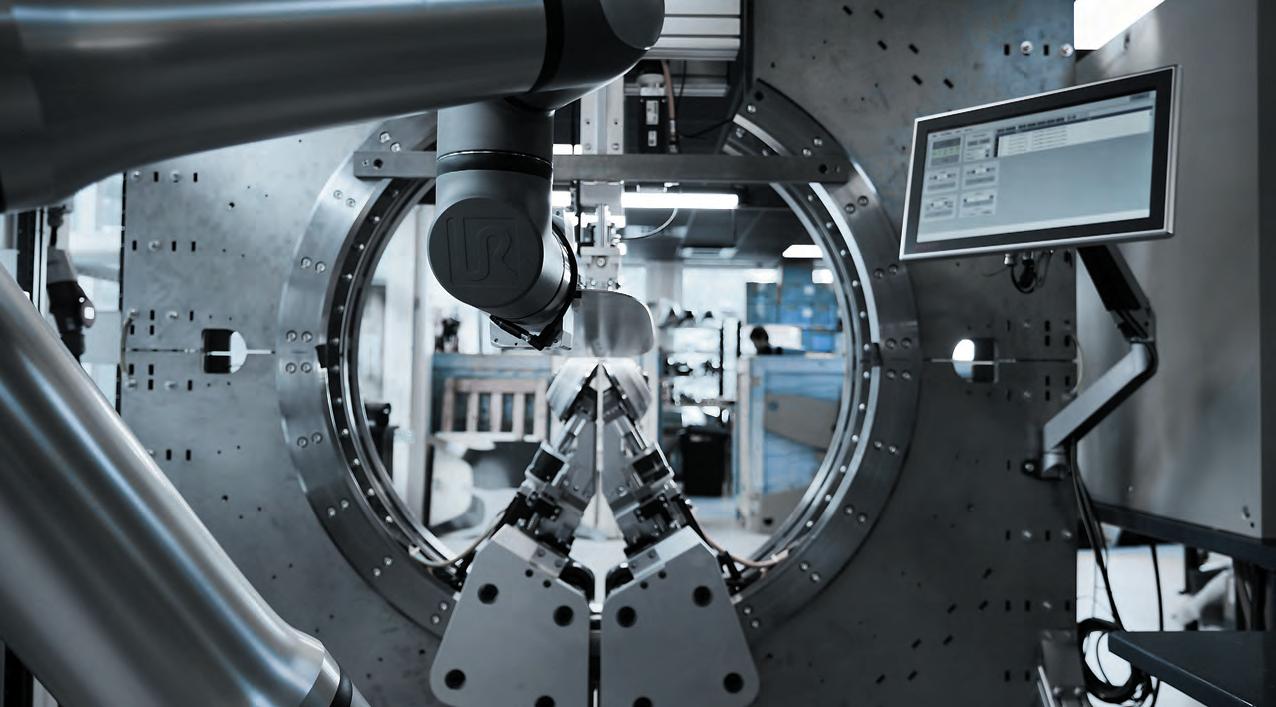
The Stilfold technique involves a combination of robotic tools
Stilfold uses curved fold origami to bring more complexity
The idea has been around since at least the 1980s, says Dr Mark Schenk, who did his PhD on origami and now works on morphing deployable structures at the University of Bristol, but “the challenge was actually doing the folding”.
One of the main constraints is the dexterity of the tools. The computer process needed to design the fold has been another challenge, especially working with curved lines. “If you take a flat piece of paper or sheet metal, you draw a single fold on it, you’ve got almost an infinity of solutions, infinity of options,” Schenk said.
By creating 3D shapes that fold along curved lines, Stilfold says its Stilware software can allow designers to optimise designs for strength, material use and sustainability. That design is then handed to a system of robotically controlled rollers and tools.
Into the fold
Schenk says the new technique would be best suited for smallscale production as the cost of tooling becomes less important when there are tens of thousands of parts to make. Automotive manufacturing could nonetheless be one of the most promising sectors for adoption, he said. While it is unlikely to replace manufacturing of the body work, it could be suited for individual components, bumpers or crash boxes that absorb energy.
The technique requires a complete ground-up design process, Schenk continued, which adds some constraints but also new options. Companies might choose to press a shape, for example,
75% is the predicted reduction in carbon dioxide emissions made possible via this technique
before doing final touches with the Stilfold technique. “It doesn’t replace existing manufacturing –it offers an alternative – but you have to design with that process in mind… that’s the trade-off.”
Complex creativity
Dozens of research projects have investigated the use of origami in everything from DNA nanotechnology to biomedical sensors, while origami-like techniques are being used in the design of deployable structures for satellites and spacecraft.
“Origami unlocks two basic aspects of mechanical and engineering research. One of them is shape and the other is mechanics,” says Dr Marcelo Dias, reader at the University of Edinburgh.
“One of the reasons why origami is so fascinating is that you take a material which is a flat sheet, and by locally manipulating the folds you can generate a three-dimensional shape that is extremely complex, and the level of complexity is down to how creative you can be with the arrangements of folds.
“But it’s known to be a very interesting mathematical problem for computation as well, because
40% is the potential weight reduction achieved by applying origami within manufacturing
how many shapes can you get given certain constraints and the rules of folding? It turns out that this is a computationally very challenging problem.”
The “secret” for Stilfold is more than the idea, he said, but it is the ability to tell a robot how to fold the designs, with curved lines bringing more complexity and creating shapes that are not possible with straight lines, including ones that can approximate smooth surfaces with fewer folds.
“The mechanics that you impart from this curved fold origami allows you to have structures that are very simple but extremely rigid,” said Dias, who received his PhD in curved fold origami and problems related to the elasticity of thin sheets. One well-known example is the boxes used to serve chips at McDonald’s, he said, which use folding tabs for shape and rigidity.
The durability of folded parts will need to be monitored, he added. “These structures are going to be out in the market, subjected to whatever environmental stress conditions that they have to [face]. And every time you add a fold, you add a weak point in the material.”
Such a bold new technique might bring new considerations – but as tariffs, net zero goals, electricity prices and other factors put pressure on companies around the world, many businesses might be keen to explore it.
WORKPLACE REVOLUTION
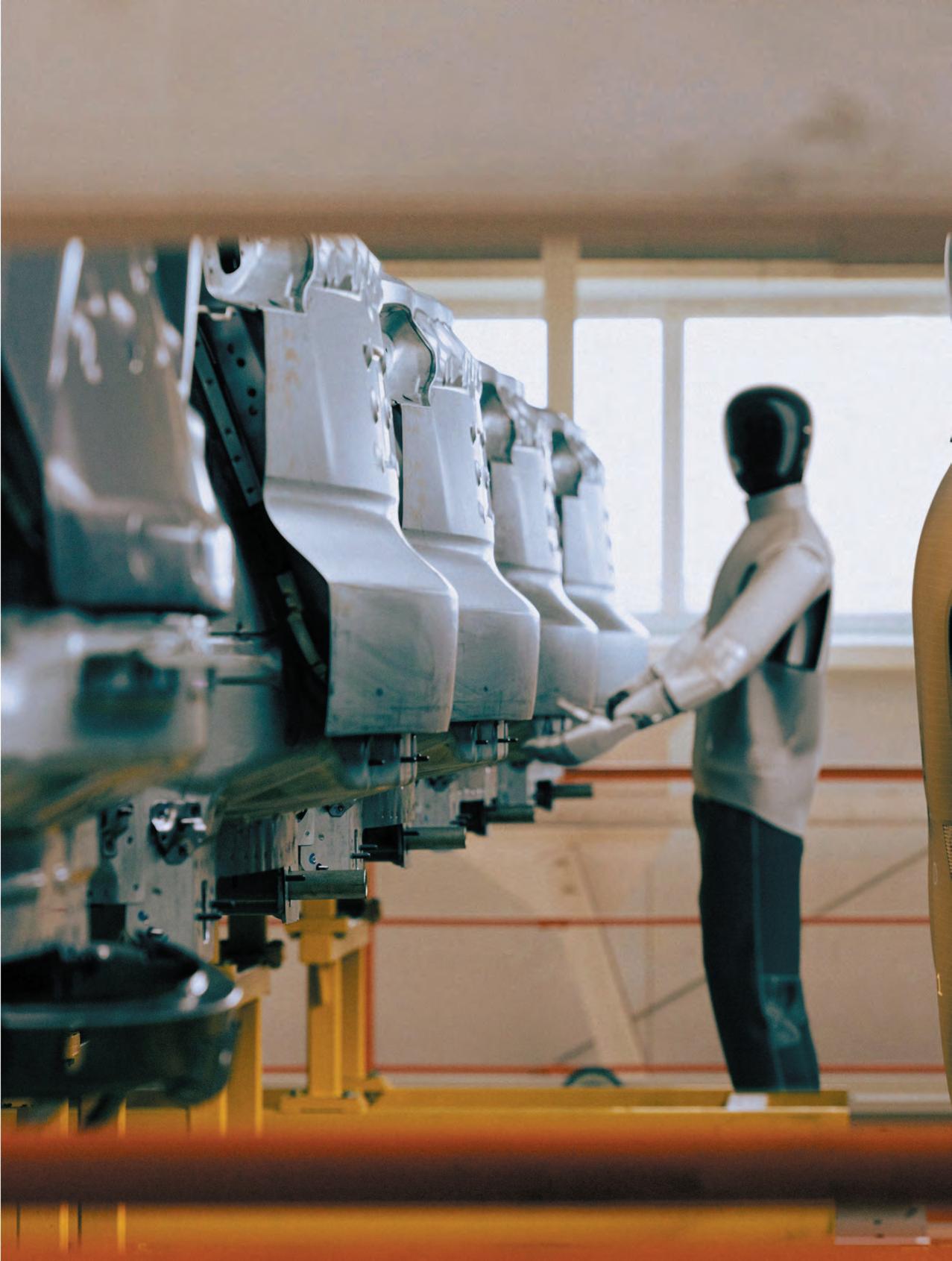
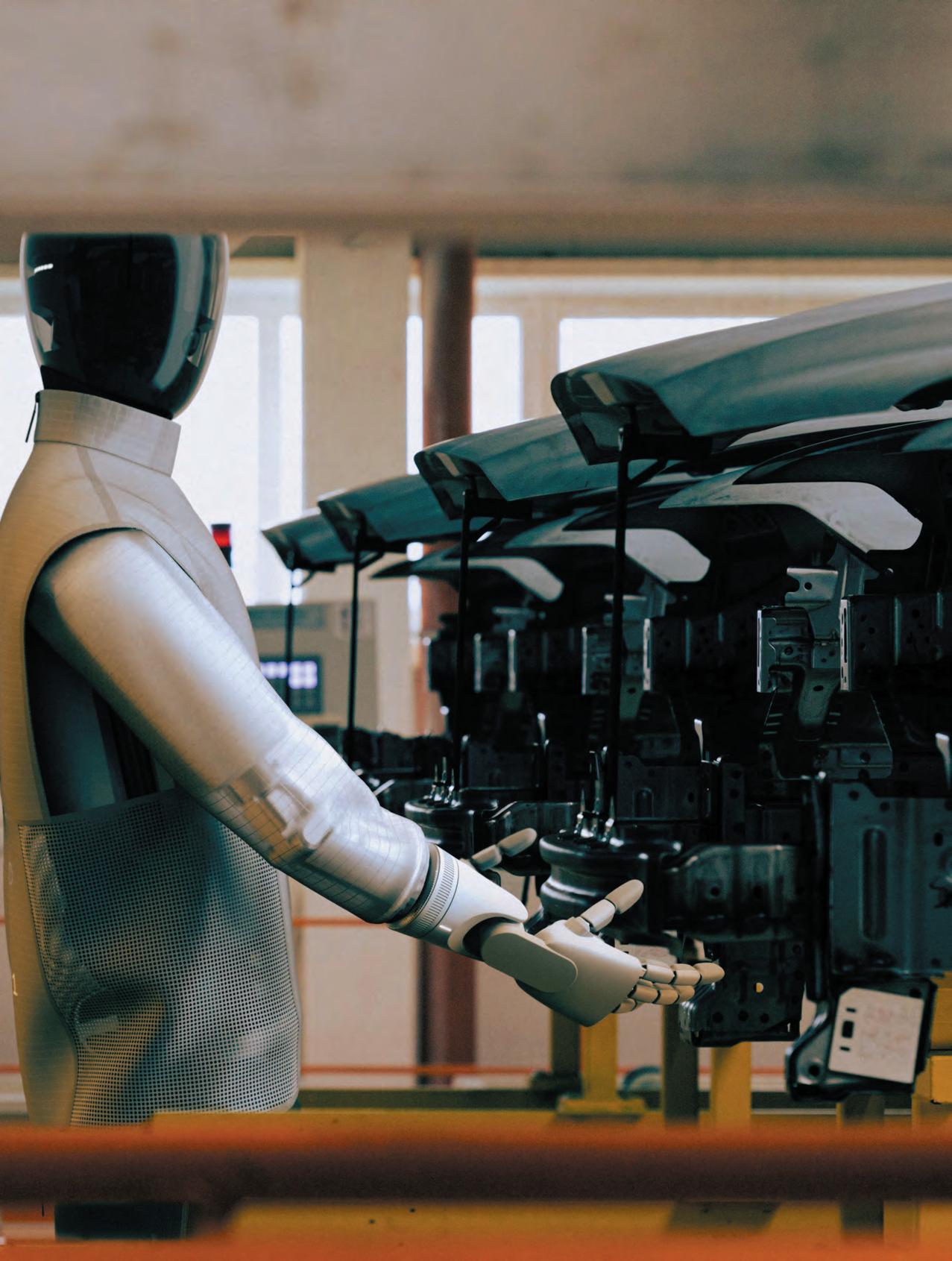
Our cover story (page 46) looks at how AI engineers are coming to a workplace near you, but they’re not the only way the technology is changing industry. This is the HMND 01 Alpha, the UK’s first humanoid robot designed for industrial use. Built by robotics and AI start-up Humanoid, it’s designed to address the manufacturing industry’s staffing crisis, with more than 58,000 unfilled vacancies in the UK alone. “Robots shouldn’t replace people; they should support them,” says Artem Sokolov, Humanoid’s founder. “After scaling my family’s manufacturing business, I saw firsthand the toll repetitive work took on employees, including my own grandparents. HMND 01 is built to fill the labour gaps, letting people focus on more meaningful work.”
The only company that does IT ALL and does IT globally
Astheonlymanufacturer of everyretainingring style(circlip,snapringandspiral),RotorClip ensuresyouhavethebestringsolutionforyour application.Standardorcustom,coiledorstamped, wearecommittedto producingthehighestquality ringswithunparalleledengineeringsupport.
FIVE FOR THE FUTURE
Meet the scientists and researchers improving the world through engineering. For more, head to imeche.org/news
AN EYE FOR AN EYE
01
Reading-based start-up Occuity has developed a handheld device to measure corneal thickness –a key step in diagnosing glaucoma – that works without touching the eye, removing the need for ultrasound and anaesthetising eye drops. The company won a 2025 award from the Royal Academy of Engineering.
IF THE SHOE FITS
04
Korean scientists have developed a method for making stretchable, conductive nanocomposites using vat photopolymerisation 3D printing. The team at Seoul National University of Science and Technology tested the method by creating a highly sensitive insole for a shoe to monitor pressure distribution in real time.
WATER WARNING
02
Engineers at the University of Chicago have developed a portable, handheld device that can quickly detect small traces of polyfluoroalkyl substances (PFAS) – also known as forever chemicals –in water. The device, which uses a unique sensor embedded on a chip, can detect PFAS at 250 parts per quadrillion.
IRON MADE
03
Researchers at the University of Minnesota Twin Cities have developed a greener method of making iron that can be performed at room temperature. It uses hydrogen gas plasma, which strips the oxygen atoms from iron ore, leaving pure iron and water vapour.
BATTERY REVOLUTION
05
A battery without cells could improve the range of electric vehicles by 50%, according to 24M Technologies. The MIT spinout uses sealed electrodes sandwiched together in a stack, instead of the traditional cell design in which they are housed inside metal cylinders.
TOWARDS SUSTAINABLE FLIGHT
A recent IMechE report assesses the future of aerospace, and how the industry can make flying greener and cleaner. Here are the key points
There’s more awareness than ever about the environmental impact of flying. Aviation accounts for just 2.5% of global CO2 emissions, but demand is set to increase, driven by economic growth and population trends.
A recent IMechE green paper, Aero 2050: Flying More Sustainably, explores the routes towards decarbonisation and challenges on the way to net zero. It builds on a 2011 report, Aero 2075: Flying into a Bright Future?, and is intended as a living document, to be updated as technology and regulation develop.
Greener alternatives
The report predicts a future where aircraft are powered by a mix of fuels and propulsion systems, optimised for size, range and capacity. Urban air mobility vehicles are likely to be battery-electric, with hydrogen fuel cells providing alternatives. Small commuter aircraft carrying fewer than 19 passengers may combine batteryelectric and hydrogen fuel cell systems. A switch to high-speed rail, encouraged by policymakers, would have minimal impact on overall emissions, accounting for less than 5% of aviation CO2.
Regional aircraft, with 20 to 80 seats, are expected to operate on hydrogen or sustainable aviation fuel (SAF)-powered turboprops and turbofans, with a small subset using battery-electric systems. Short-
range aircraft with 81 to 165 seats will be predominantly powered by advanced turbofans fuelled by high-blend ratio SAF or hydrogen. Medium-range aircraft, flying distances up to nearly 3,800 nautical miles, are a priority for emissions reduction, accounting for around 45% of aviation’s carbon footprint. Long-haul, high-capacity aircraft will predominantly use advanced turbofans running on SAF.
45% of aviation’s carbon footprint originates from medium-range aircraft
Each propulsion technology comes with challenges. Batteryelectric aircraft need major energy density improvements, alongside sustainable sourcing of materials and responsible disposal. Hydrogen systems need careful tank design, high-performance fuel cells and reliable gas turbine operation. SAF must overcome technical limitations, while production must scale to meet demand, supported by sustainably generated electricity.
Industry adaptation
Certification and workforce development are equally crucial. New systems and fuels require intensive testing and certification programmes. Engineers will need updated academic and technical training for aircraft with different architectures and energy systems.
Aircraft design itself will undergo a transformation. Future airframes will be conceived around the fuel
and propulsion system rather than simply accommodating kerosene in the wings. Hydrogen storage may be integrated within the fuselage or external pods, while distributed propulsion units, thinner highaspect-ratio wings and smart electrical systems will manage power distribution for hybrid or fully electric flight. Maintenance processes will need to adapt to these new architectures, balancing safety, performance and operational cost.
Funding challenge
This will all require substantial investment. The complexity, long timescales and technological risks may limit private capital, making government support vital. The UK aerospace sector, with a turnover of £34bn in 2019, is a global leader. Recent government investments in green technologies, combined with development strategies, can help maintain the UK’s position at the forefront of sustainable aviation while signalling against climate change.
FURTHER READING
Head to imeche.org/policy-andpress to read the full report, entitled Aero2050:Flying MoreSustainably
Connecting engineers, recognising success
To another dimension
In our next article showing the tremendous impact made by IMechE members, we speak to Nicole Pellizzon, an engineer exploring a pioneering new 3D-printing technique and the latest winner of the Speak Out for Engineering competition
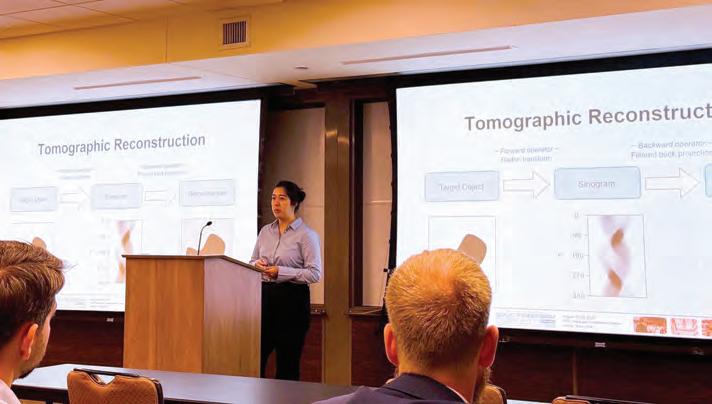
When Nicole Pellizzon first encountered tomographic volumetric additive manufacturing (AM), she Googled some words and watched some YouTube videos. Moments later, she knew she had found something special. The objects being 3D-printed looked as though they were “appearing from nowhere”. Pellizzon’s mind went to StarTrek and its iconic replicator machine, a box that could bring objects into existence – from a martini with two olives to a medical bandage – as if by magic.
By the time she flew to Denmark to witness a live demonstration, her mind was blown. Pellizzon knew exactly what her PhD would focus on, and decided to move from London to Copenhagen.
That was three years ago. In September 2025, she was crowned winner of IMechE’s Speak Out for Engineering competition after sharing the manufacturing method with engineers around the globe.
Lights, hologram, action
Pellizzon, 26, uses dental fillings to explain what she is studying at the Technical University of Denmark. First, a cavity is filled with a liquid resin. Then the dentist uses ultraviolet light to deliver energy that, in turn, solidifies the filling.
Unlike conventional AM, which builds up objects layer by layer,
ENGINEERS INTHE SPOTLIGHT
‘Imagine using this technology in hospitals. Instead of waiting for donors, you could print parts using stem cells’
tomographic volumetric AM relies on light to solidify objects inside a spinning test tube filled with liquid. So, if you were building a Lego castle, the entire building would appear at once, rather than rows of pieces rising up from the floor.
Pellizzon says this method of 3D printing can be exceptionally fast, creating objects within minutes or even seconds. It’s also compact, allowing it to be used when and where needed. A good example would be an audiologist printing a custom hearing aid
while a patient waits to try it out. Or an orthodontist printing aligners to straighten teeth, making sure the fit is just right.
To boldly go towards new frontiers
But the biggest potential impact of 3D printing with light, Pellizzon believes, falls within the realm of bioprinting. Although the technique is still speculative, she says printing organs or organ parts could prove doable.
“Imagine using this technology in hospitals. Instead of waiting for
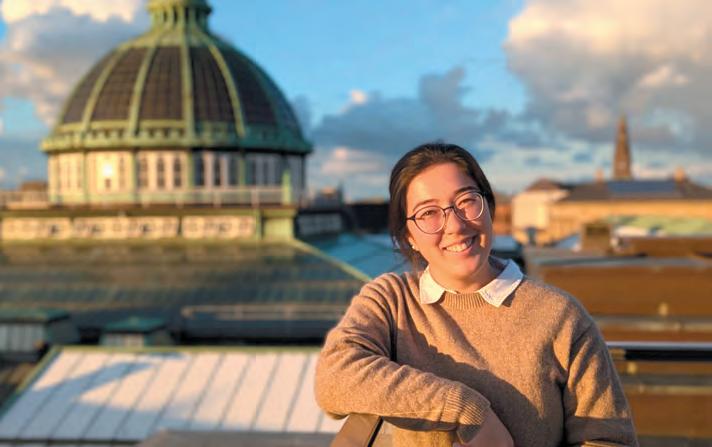
Below: Pellizzon enjoying a sunset from the Glyptotek museum rooftop in Copenhagen
WHY TRAIN ANYWHERE ELSE?
llllr
• • •• 15,000
•'" delegates attend events a year
IRf 75,000 onlineresources 'f + available to members 91% satisfaction on courses
Over 10,000 'ti,! engineers trained each year
by over 800 companies
e + /
Over 110,000 members across the globe Average customer rating:
Over 30 years of experience in delivering training.
donors and transplants, you could print parts using stem cells,” she explains. “Then you can let the cells grow further. Maybe one day it could be an entire organ.”
Without layer-by-layer construction, the cells experience fewer stresses during printing and ultimately have higher survival rates. If successful, printed organs might lead to less organ rejection.
However, there is a daunting list of challenges for engineers to solve before volumetric printing becomes viable. These range from limited light resolution to resin blurring, and from optical distortions (a spoon appearing to break in a glass of water) to scattering (an ice cube reflecting light in different patterns as it changes from liquid to solid). Then there is the complicated chemistry of the resins themselves.
“There are still a lot of problems for engineers to solve,” Pellizzon admits. “But that’s what makes it exciting. There’s always something to do.”
Series of serendipitous events
Pellizzon has always loved a challenge. She remembers a particular primary school lesson in which she figured out how to use a sheet of paper to build a bridge capable of carrying the weight of a hundred pennies*.
As a teenager, together with her dad, she experimented with a cheap 3D printer, which never delivered the drone she’d set her heart on. Years later, at Imperial College London, Pellizzon entered and won a drone society competition, finally managing to print a working one.
But her path to engineering was by no means as straight as
the drone flies. At the age of 14, she received a scholarship to study music at the Wells Cathedral School. If you’d asked her then what she wanted to be when she grew up, she would have said a concert pianist.
Engineering won out in the end, but even then, Pellizzon picked aeronautical engineering because it kept popping up in her research, largely thanks to university websites arranging their degrees in alphabetical order.
The drone competition she won happened to be sponsored by Autodesk, which opened the door to her spending a few years at the company, exploring various manufacturing methods, before pursuing her doctoral studies.
A curiosity that burns bright Pellizzon’s advice to young engineers is to keep an open mind and join organisations like IMechE. She has been a member since her student days and aims to become a chartered engineer. For her, every event offers a chance to meet engineers who are working on fascinating projects.
‘There are still a lot of problems for engineers to solve. But that’s what makes it exciting. There’s always something to do’
Since moving to Denmark, Pellizzon has learned to knit and cook with unfamiliar ingredients. She’s finding inspiration in exploring a new country and its culture – a refreshing way, she says, to reassess what she’s always considered “normal”. From a tax form written in Danish to visiting a tourist site, she’s learning more about the world – and about herself.
“Always be open to new opportunities,” she concludes. “They’ll come from the weirdest of places.”
* The answer, in case you’re still thinking about it, is to corrugate the paper by folding it up repeatedly.
NOMINATE
To nominate an IMechE member making a difference, email profeng@ thinkpublishing.co.uk
Below: Pellizzon presenting at Solid Freeform Fabrication 2025 in Austin, Texas Inset: A sample print of Auguste Rodin’s TheThinker
IMECHE AND ME
IMechE members reflect on how the Institution has helped them thrive
“An honour, a career milestone and a morale boost”
“It began with a career talk at a year 12 school career-planning event from an experienced engineer alumni,” says Marcus Tse CEng, a product risk manager at Siemens Healthineers. “His career journey, ambition and dedicated careers advice with me encouraged me to become a globally recognised, competent engineer. Throughout my university and career, I have always valued becoming a chartered engineer as a career milestone that I wanted to achieve since high school. My direct manager, who is a fellow of IMechE, had been supporting me by giving me advice and sponsored my application. Being a chartered engineer is an honour, a career milestone and a morale boost for me. Ever since I became chartered, my increased confidence has enabled me to communicate my opinions with subject matter experts effectively, and my credentials are recognised by colleagues across the globe, as well as external government authorities recognising that my outputs are trustworthy.”
“It has helped me stay ahead”
“Being an active part of the Institution allows me to stay informed about industry advancements and align my career with the highest professional standards,” says Chipo Madzikwah, associate member and an asset engineer lineside at Network Rail. “My associate membership has been invaluable in expanding my professional network and providing access to cutting-edge industry knowledge, training and development opportunities. It has helped me stay ahead of best practices and innovative solutions, allowing me to grow as a professional and contribute more effectively to my role and the wider engineering community. The top benefits of my membership include access to a vast library of technical resources, professional development programmes, networking opportunities with experts in the field, and events that keep me connected to the latest trends and innovations in engineering. Additionally, being part of a community that supports and recognises professional growth is incredibly rewarding.”
“It reinforces my professional branding”
“In the company I started with, it was an expectation that engineers would seek chartership, and in a lot of companies this is tied into progression opportunities,” says
Farzana Hampshire, an IMechE fellow and operations lead for AtkinsRéalis. “I was thankful that I went down this route as it provided me with the evidence to show that I was fully qualified, not just from an educational standpoint, but also from a professional and experience
“A significant milestone in my career”
“I was fascinated by how things worked from an early age,” says Karey Farmer IEng, an engineer at Mount Gay Distilleries in Barbados. “I enjoyed dismantling machines just to see how they were built. That curiosity eventually evolved into a passion for solving problems and improving systems, and engineering felt like the perfect path to turn that curiosity into practical solutions. I joined IMechE to benchmark my skills and experience against internationally recognised professional standards and connect with a global network of engineers committed to excellence. Achieving incorporated engineer status in August 2025 has been a significant milestone in my career, validating the knowledge, leadership and professional judgement I’ve developed through years of handson experience in the industry.”
point of view. It also highlighted the importance of non-technical skills such as people management and network development. I am now a fellow of the IMechE and feel really proud that I attained this level. It gives a real sense of kudos and reinforces my professional branding.”
“It’s
given me structure, guidance and opportunities”
“I first joined as a student member while studying aeromechanical engineering at university,” says Cara Morrison CEng, a project manager at the National Manufacturing Institute Scotland. “It was a bit of a no-brainer –the membership was free, and it gave me access to an incredible range of resources including training, webinars and careers events. When I joined the graduate scheme at Meggitt, I became an associate member and enrolled on their monitored professional development scheme (MPDS). The structure of the scheme helped me set clear goals and track my progress, with valuable feedback from my mentor along the way. Just over five years after graduating I achieved chartered engineer status –something I’m very proud of. It’s been a great way to demonstrate my professional competence and commitment. Being part of the IMechE has given me structure, guidance and opportunities. MPDS was especially valuable at the beginning of my career; the structure helped me plan my development and set objectives to work towards. I’ve also made the most of IMechE’s professional training, taking courses like Failure Modes and Effects Analysis and Management of Risk – both incredibly useful.”
“There’s a huge amount of support available”
“I’d always intended to join an institution,” says David McCallum CEng, a principal engineer for BAE Systems. “The graduate scheme at Babcock was accredited by the IMechE so I was into that and gained IEng status in 2020. Since then, I worked through the career learning assessment (CLA) process as I only had a bachelor’s degree and successfully interviewed for CEng in July. The Institution has a wealth of experience, support and resources available for engineers of all levels so it’s been great to be a member. There’s a huge amount of support available, which I was able to utilise when navigating the CLA process and eventually to CEng. It’s opened the door for me getting chartered, which I didn’t think was possible without going back to university. The Institution has allowed me to develop a lot over the last two to five years. The resources are really extensive – the seminars, workshops and support available from mentors and engineers is really unmatched.”
RENEW YOUR MEMBERSHIP FOR 2026
STAY INFORMED WITH ENGINEERING INSIGHT
Access the latest trends, innovations and expert analysis through Professional Engineering, PE Weekly and our sector-specific updates.
GROW YOUR CAREER
Benefit from tailored support for professional registration and choose from more than 200 training courses, including new content in AI, hydrogen and thermodynamics. Enjoy up to 20% off events and training, plus £200 off IMechE training each year*.
CONNECT WITH A GLOBAL NETWORK
Join a vibrant community of more than 110,000 members worldwide, with opportunities to mentor, collaborate and learn from others through local events and international initiatives.
ACCESS SUPPORT WHEN YOU NEED IT
Our Support Network offers confidential help in difficult times, from financial assistance to practical and emotional support.
TAP INTO UNRIVALLED RESOURCES
Use the world’s largest engineering library, with 75,000+ online resources, 35,000 print items and expert librarian support, accessed more than 350,000 times in 2024 alone.
CELEBRATE ACHIEVEMENT AND RECOGNITION
Gain visibility through our awards, which showcase innovation, research, professional excellence and the impact of dedicated volunteers.
RENEW BY 1 JANUARY 2026 TO AVOID A BREAK IN YOUR BENEFITS
Renew now at imeche.org/renew or scan the QR code below.
*T&Cs at imeche. org/mem200
Clean + lean cable system:
INSTITUTION UPDATE
By IMechE president Matt Garside
This autumn marks an important moment of transition and renewal for the Institution. We begin by offering our sincere thanks to Alice Bunn for her leadership and dedication during her time as CEO. Her commitment to our mission and her tireless work on behalf of members has left a lasting mark. As Alice moves on, we are pleased to welcome Jo Passingham as our interim CEO. Jo brings a wealth of experience and a steady hand to guide the Institution through the months ahead.
Leadership changes often provide a moment to reflect, but they are also a time to look forward. Across the Institution, we are pressing ahead with several key initiatives that will shape our direction and strengthen the way we serve our members.
Headquarters update
A Special Meeting has been scheduled for 12pm GMT on Friday 5 December 2025, an important milestone that will open the member ballot on the future of the Institution's headquarters. The Trustee Board has made a balanced, forward-looking recommendation that reflects our strategy, commitment to sustainability and charitable purpose. Trustees and Council are united in recommending that members vote for the resolution set out in the Special Meeting Notice. You can find out more about the meeting and how to vote on page 25.
We have a proud heritage spanning more than 175 years, and it would be remiss of me
Volunteers are at the heart of everything we do, and this code sets out the standards and behaviours we all commit to, in order to work together effectively and inclusively
not to acknowledge the deep affection many members feel for our Birdcage Walk headquarters – it has been our home for generations. However, this decision is about looking forward: ensuring we have a headquarters that is fit for purpose and serves generations of engineers to come. Another milestone reached recently is the approval of a new Volunteer Code of Conduct by the Trustee Board. Volunteers are at the heart of everything we do, and this code sets out the standards and behaviours we all commit to, in order to work together effectively and inclusively. All volunteers must sign up to the code as part of our ongoing commitment to professionalism and mutual respect.
Integrity and collaboration
We have also commissioned an independent culture review. This is a key step in strengthening our culture and ensuring our
day-to-day practices reflect the Institution’s values and behaviours. With practical recommendations to make a real impact, we can build an Institution that achieves its goals while reflecting integrity and collaboration.
We are also excited to introduce Project K, a strategic initiative that focuses on better outcomes for members and society. We’re looking to deliver:
l clearer accountabilities that simplify how we work;
l stronger links between strategy and delivery;
l better decisions shaped by diverse expertise;
l and greater external focus.
Together, these developments point to an ambitious future, grounded in the values that unite us as an Institution. With strong leadership, clear priorities and an engaged membership, we are confident in our ability to navigate change and embrace the opportunities ahead.
YOUR VOICE
Got something to share with the IMechE community? Write to us at profeng@thinkpublishing.co.uk, using the subject line ‘Your Voice’
Global cooling
Not many readers might agree with me that, regardless of achieving zero carbon, we are already past the tipping point to climate disaster. I therefore urge this and other engineering institutions to campaign for urgent engineering efforts to actively cool the Earth. Several methods are already known or under review. A recent contributor to ‘Your voice’ stated that if every house erected just one square metre of upward-facing aluminium foil, this would be enough to significantly reduce the Sun’s heating effect. I urge going much further and actively cooling the Earth by the use of highly reflective roof surfaces. These would need to be of a textured nature so as not to dazzle pilots. They could be compulsory on new roofs while existing roofs could be treated with a reflective spray-on paint.
Back in the 1970s, I was involved in a roof insulation
Heavy metals
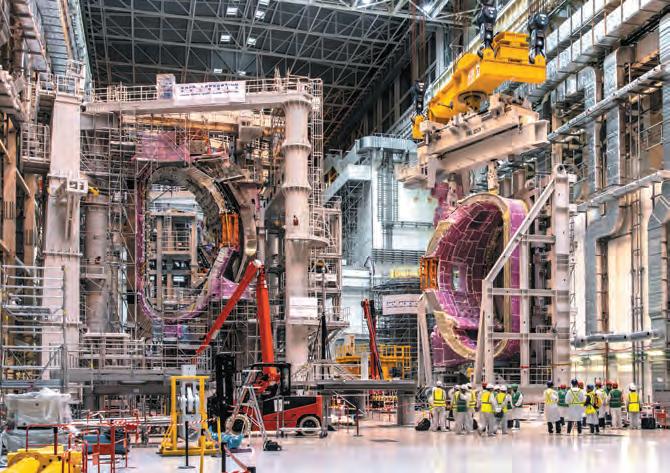
I must congratulate you all on your excellent article on nuclear fusion (issue two of 2025). However, the author should be picked up on his units of weight. While the weights of an aircraft carrier or fully loaded jumbo jet are highly descriptive, they are meaningless unless accompanied by the weight in tonnes. Only designers of those gigantic beasts would know what they weigh. We are all engineers and should be told in units we can all understand.
David Bruton, FIMechE
project that finished with a brushed-on aluminium paint that would have had the required effect, so better should be easily available these days.
Money spent on such a project would be the best way of compensating low-income countries suffering from the warming generated by richer nations. International disputes might result from the possibility of a cooling Earth creating its own freak weather conditions. Success could allow a partial return to the oil-powered lifestyles so many of us have enjoyed in the past!
Denis W Oglesby, associate member
Student survey
‘Engineering needs everyone’ in issue one of 2025 was the latest in a long line of articles highlighting the importance of diversity in our profession. However, nothing
seems to substantially change the balance of the workforce. With the ideas for improvement so often being sought from those already in the industry, might there be a recurring issue with survivorship bias?
The article highlights that engineering is the second most popular future profession for 13to 16-year-olds. As a start, perhaps as a profession we could find a way to survey those at university about why they did not pursue engineering and react accordingly to address the issues we find.
Ben Ravenscroft, CEng
Affordable net zero
Further to my letter suggesting a means of collecting feed stock for large-scale biofuel production (issue two of 2024), correspondence with various government ministries seems to me to show that they all confine themselves strictly within the limits of their subject, with numerous individual initiatives but no attempt to predict the overall effects of large-scale adoption of each within financial and timescale limitations and market forces.
STAR LETTER
It seems to me that something on the lines of the attached [see figure 1, right] should be produced and published for road transport, using the best available numbers for the shape of the curves. It would illustrate where we are now with road transport and the effect of various policies in the future. The horizontal top line of the chart represents 100% of the estimated total road mileage for all relevant vehicles in each year and the suggested types of curve would show the share of this mileage between fossil fuel and carbonneutral energy usage.
The financial constraints shaping the curves would include the direct additional infrastructure costs, etc. necessary for an increasing proportion of battery electric vehicles and/or the cost of developing a large-scale liquid fuel manufacturing plant, and the necessary extra renewable electricity generation, although the use of surplus renewable power in periods of low demand would reduce this requirement.
It seems to me that, however the curves are drawn, the largest
1. Showing the shape of likely progress towards net zero in road transport
Taking into account the likely 20-year service life of existing liquid fuel vehicles and the potential for increasing the proportions of carbon neutral fuel. Suggest that this type of chart should be reproduced with the best available numbers for the shape of the curves. This would then provide a basis for assessment of all other factors, notably cost and timescale.
E J Hardaker BSc CEng
‘The largest contribution to progress towards net zero would always result from increasing the proportion of carbonneutral liquid fuel replacing fossil fuels’
contribution to progress towards net zero in the next five to 10 years would always result from increasing the proportion of carbon-neutral liquid fuel replacing fossil fuel. This seems to be an inevitable conclusion when you consider the average 20-year life of the existing fossil-fuel vehicles, which will be in the majority of many years.
John Hardaker
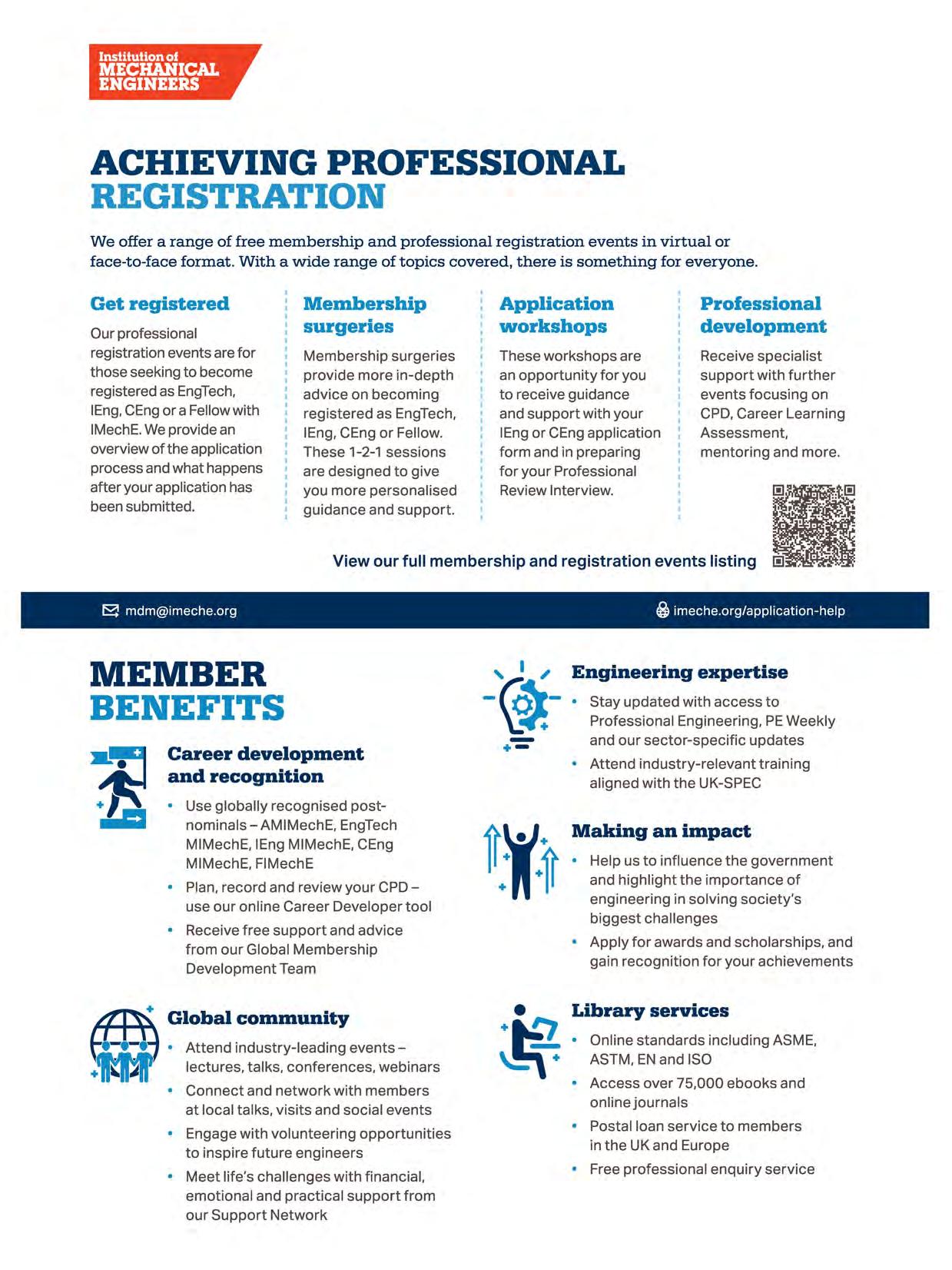
ACHIEVING PROFESSIONAL REGISTRATION
We offer a range of free membership and professional registration events in virtual or face-to-face format. With a wide range of topics covered, there is something for everyone.
Get registered Membership Application Professional
Our professional surgeries workshops development registration events are for Membership surgeries These workshops are Receive specialist those seeking to become provide more in-depth an opportunity for you support with further registered as EngTech, advice on becoming to receive guidance events focusing on IEng, CEng or a Fellow with registered as EngTech, and support with your CPD, Career Learning IMechE.We provide an IEng, CEng or Fellow. IEng or CEng application Assessment, overview of the application These 1-2-1 sessions form and in preparing mentoring and more. process and what happens are designed to give for your Professional after your application has you more personalised Review Interview. been submitted. guidance and support.
View our full membership and registration events listing
• Connect and network with members at local talks, visits and social events
• Engage with volunteering opportunities to inspire future engineers
• Meet life's challenges with financial, emotional and practical support from our Support Network
Engineering expertise
• Stay updated with access to Professional Engineering, PE Weekly and our sector-specific updates
• Attend industry-relevant training aligned with the UK-SPEC
Making an impact
• Help us to influence the government and highlight the importance of engineering in solving society's biggest challenges
• Apply for awards and scholarships, and gain recognition for your achievements
Library services
0
Online standards including ASME, + ASTM, EN and ISO
• Access over 75,000 ebooks and online journals
• Postal loan service to members in the UK and Europe
• Free professional enquiry service
A DEFINING MOMENT FOR OUR INSTITUTION: GET INVOLVED IN THE HQ PROGRAMME
An important update on the Institution’s headquarters
embers are invited to a Special Meeting that will help shape the Institution’s future.
Following the Trustee Board’s decision in September and a robust review by Council in October, the Special Meeting has been scheduled for 12pm GMT, Friday 5 December 2025. This important milestone will open the ballot on the proposed resolution on the Institution’s headquarters.
The
vision
for the future
We have an opportunity to reimagine our future and how we serve members and the engineering profession. We need to create a headquarters that is accessible, sustainable and inspiring – a place where today’s and tomorrow’s engineers feel at home.
The Trustee Board has made a balanced, forward-looking recommendation aligned with the Institution’s strategy, sustainability and charitable purpose.
Trustees reviewed a wide range of evidence, including the Headquarters Sponsor Board’s business case, professional advice, member insight and previous HQ reviews. They carefully considered all risks and opportunities in line with our key success factors and institutional priorities.
Trustees and Council recommend voting FOR the resolution set out in the Special Meeting Notice, which outlines the next steps in delivering the long-term vision for the Institution’s headquarters.
“We have a proud heritage spanning more than 175 years, and it would be remiss of me not to acknowledge the deep affection many members feel for our Birdcage Walk headquarters – it has been our home for generations. However, this decision is about looking forward: ensuring we have a headquarters that is fit for purpose and serves generations of engineers to come,” said Matt Garside, president of the Institution of Mechanical Engineers.
Voting members
Corporate and Associate Members should by now have received their Special Meeting Notice by email, while printed packs have been sent by post to those without an email address. This Notice includes all the information needed to register for the Special Meeting, take part in the discussion and vote in the two-week ballot.
l Ifyou have not receivedyourNotice oryou have anyquestions, please email hqprogramme@imeche.org.
Furtherinformation can be found at imeche.org/ hqprogramme.
Members can also email hqprogramme@imeche.org with anyquestions.
Institution of MECHANICAL ENGINEERS
HydraulicCear Motors use in Industry
Could the Marzocchi ELIKA®Hydraulic Gear Motor Benefit Your Industry?
The EUKA® range of low-noise, high-efficiency gear motors, a technically advanced solution for engineers seeking improved acoustic performance, reduced pulsation, and smoother operation in hydraulic drive systems across a wide range of industries.
Designed with a unique helical-gear tooth profile, EUKA® gear motors achieve up to 15 dBA noise reduction compared with conventional external-gear designs. The innovative geometry ensures continuous tooth overlap, reducing pressure ripple, vibration, and torque fluctuation, benefits that directly enhance component longevity and system reliability.
These characteristics make EUKA® gear motors particularly suitable for industrial machinery, mobile equipment, construction, agricultural, marine, energy, materials handling, and automation systems, as well as process, packaging, and manufacturing applications where quiet operation, smooth motion, and steady torque output are essential.
Smooth performance is maintained even at speeds as low as 200 rpm, while built-in compensation zones and antiextrusion gaskets minimise internal leakage and extend service life, ensuring dependable performance in demanding environments.
Key features include:
» Up to 15 dBA lower noise levels.
» High volumetric and mechanical efficiency.
» Consistent performance across a wide speed range.
» Low pressure ripple to protect associated hydraulic components.
» Robust design for long service life in continuous-duty applications.
jbj Techniques provides full technical support for the selection, configuration, and integration of ELIKA" gear motors within complete drive systems. The company's expertise spans mechanical and fluid-power transmission, enabling engineers to specify efficient, low-noise solutions tailored to their application and operating conditions.
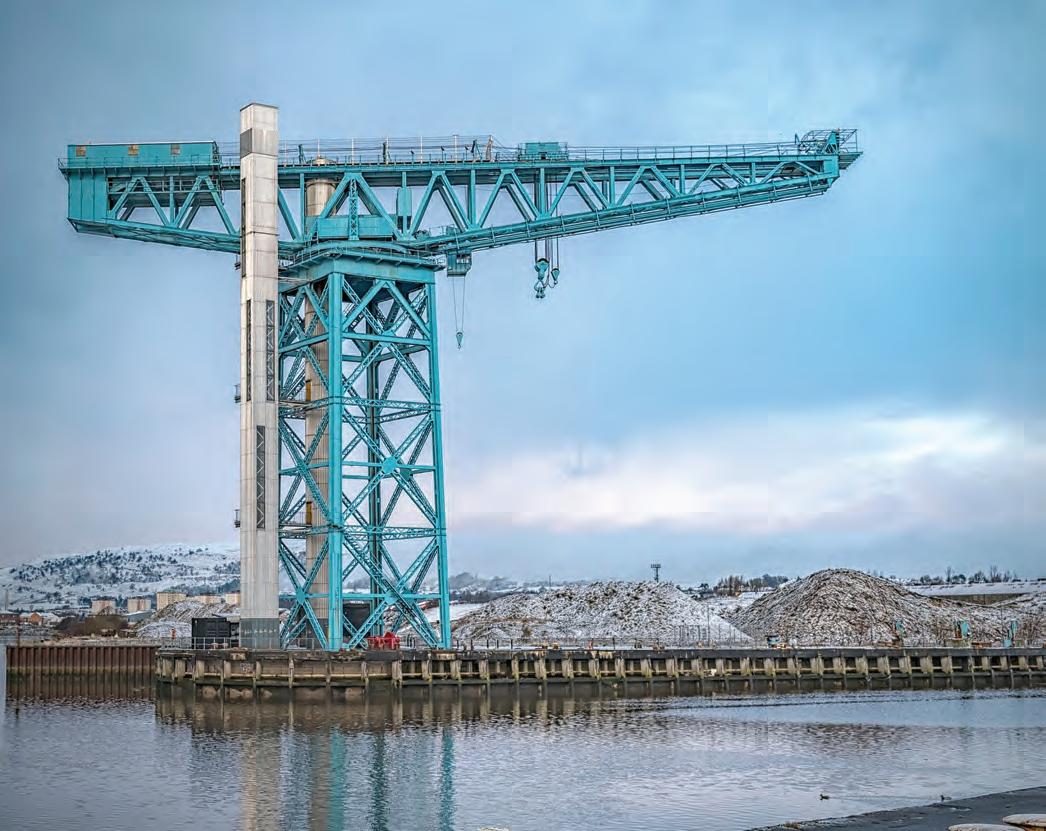
THE TITAN CRANE
A cantilever crane on the River Clyde is an impressive reminder of Scotland’s shipbuilding heritage
Looming over Clydebank, the Titan Crane stands as one of Scotland’s most striking monuments to its industrial heritage. Built in 1907 by Sir William Arrol & Co, the electrically powered cantilever crane was among the first of its kind and became an indispensable tool in the heyday of shipbuilding on the River Clyde. With a lifting capacity of 150 tonnes, it enabled the installation of heavy engines and armaments in the world-famous liners and naval vessels produced at the
John Brown & Company shipyard, including HMS Hood, Queen Mary and Queen Elizabeth. At almost 50 metres high and 800 tonnes in weight, the Titan was the biggest crane of its type ever built at the time of construction and survives as the sole remaining example on the Clyde. It has been preserved as a visitor attraction and a reminder of the skills and innovation that once defined the area. It was awarded an IMechE Engineering Heritage Award in 2012.
FURTHER READING
Find out more about the Institution’s history at imeche.org/engineeringheritage-awards
BRIDGING THE ENGINEERING SKILLS GAP
Addressing the UK’s engineering skills gap is a long-standing challenge that’s becoming increasingly urgent
According to the Institution of Mechanical Engineers, the UK needs around 124,000 new engineers and technicians each year; however, we’re currently falling short by as many as 59,000 and, if trends continue, the deficit could reach a million workers by 2030.
The reasons behind this gap are multifaceted. Our engineering workforce is ageing – almost 15% are over 60, with nearly a fifth expected to retire within five years, according to reports from the Engineering Construction Industry Training Board and Manpower Engineering.
Diversity also remains a key issue, with women and minority groups still underrepresented in the sector. Meanwhile, the rate of technical progress is outpacing training, leaving companies struggling to meet the demand for appropriately skilled personnel. But perhaps the biggest issue – and the greatest opportunity – is that too few people are choosing engineering as a career in the first place.
Nurturing talent
For decades, AWE Nuclear Security Technologies has been working to turn this trend around. At the heart of the UK’s defence capability, AWE’s mission is to design and manufacture warheads and provide nuclear services to meet the needs of defence. Throughout its 75-year history, whether through apprenticeships, undergraduate and graduate programmes or mid-career pathways, AWE has been focused on inspiring the next
generation of scientists, engineers and technicians. AWE is home to a rich community of professionals in science and engineering.
The undergraduate and graduate programmes are where many of those journeys began. AWE supports students through its early-career defence STEM undergraduate sponsorship scheme and penultimateyear industry placement programme.
For graduates, the EVOLVE programme is a two-year journey designed to launch future leaders, innovators and change-makers, providing hands-on experience in their chosen pathway, whether it’s engineering, science, health and safety or project management.
Each participant is supported by a dedicated line manager and mentor throughout the programme, helping them turn their potential into purpose.
Apprenticeship opportunities
Not everyone takes the university route. AWE’s well-established apprenticeship programmes offer an alternative path, providing access to on- and off-the-job training across Levels 3 to 6. Starting in 1952 with just 10 recruits in mechanical trades, the programme has now trained more than 6,000 apprentices from the local and national areas.
The variety of opportunities has also increased, covering areas ranging from electronic and mechanical
maintenance to precision machining and instrumentation. Currently, our 84 new apprentices – 47 of whom are in engineering – are supported by training instructors, pastoral care, workplace assessors and neurodiversity specialists. The programme’s success is evident:
26% of current AWE engineers are ex-AWE apprentices, demonstrating that the skills developed through the programme create lasting careers.
Mid-career conversion
And because careers don’t always follow a straight line, AWE created the Engineering Foundation Scheme, a pathway for people looking to change direction mid-career. It offers full-time roles for those without a formal engineering background while completing an engineering conversion course at Buckinghamshire New University. Previous participants in the 2023/24 scheme included a policeman, a chef, a postal worker, an IT salesperson and an
office administrator who joined the programme to pursue their longstanding interests in engineering.
The engineering skills gap won’t close overnight. But through targeted investment in people, partnerships and education, AWE is helping build the future workforce through the right mix of opportunity, mentorship and ambition.
l If you want to play your part in delivering a secure future for all, learn more about AWE by visiting awe.co.uk
At I\/~ NUCLEAR SECURITY V VI~ TECHNOLOGIES
Sharing knowledge and experience
ENGINEERING RESILIENCE: FROM AMBITION TO ACTION EXPERTISE
Tom Austin-Morgan reports on an urgent gathering of experts trying to tackle humanity’s biggest challenge
The first day of IMechE’s Second International Conference on Climate Change Adaptation and Resilience set out a stark message: the time for planning has passed, and implementation must now take centre stage. Opening the conference, Toby Perkins MP, chair of the House of Commons Environmental Audit Committee, warned that the UK’s infrastructure remains dangerously exposed to climate risks. He urged government and industry to treat adaptation as a national priority equal to emissions reduction, arguing that resilience “should be built into every investment decision”. Perkins
emphasised that cross-departmental coordination, independent scrutiny and private-sector engagement are essential if the UK is to move beyond piecemeal responses to extreme weather and environmental stress.
Roberta Boscolo, head of climate and energy at the World Meteorological Organization, underscored the pace of planetary change. She confirmed that 2024 was the hottest year on record, with temperatures exceeding 1.5°C above pre-industrial levels. Ocean heat and sea-level rise are accelerating sharply, undermining food security and progress on the UN Sustainable Development Goals. Boscolo called for all adaptation planning to be guided by forwardlooking climate data rather than historical trends: “The risks of the future are not the risks of the past.”
Baroness Brown of Cambridge, chair of the UK Climate Change Committee’s Adaptation Committee, reinforced the urgency of delivery. Despite a robust legal framework, she warned heat-related deaths could exceed 10,000 a year by mid-century.
Cross-sector approach
Adaptation, she argued, must be mainstreamed across all sectors, from planning and health to infrastructure, with clear targets, measurable outcomes and improved monitoring. Carlos Ruiz-Garvia of the UN Framework Convention on Climate Change Adaptation Committee added that the world is heading for 2.8 to 3.3°C of warming by the end of the century. He called for engineers to play a stronger role in implementing national adaptation plans. “We are
zOliilP
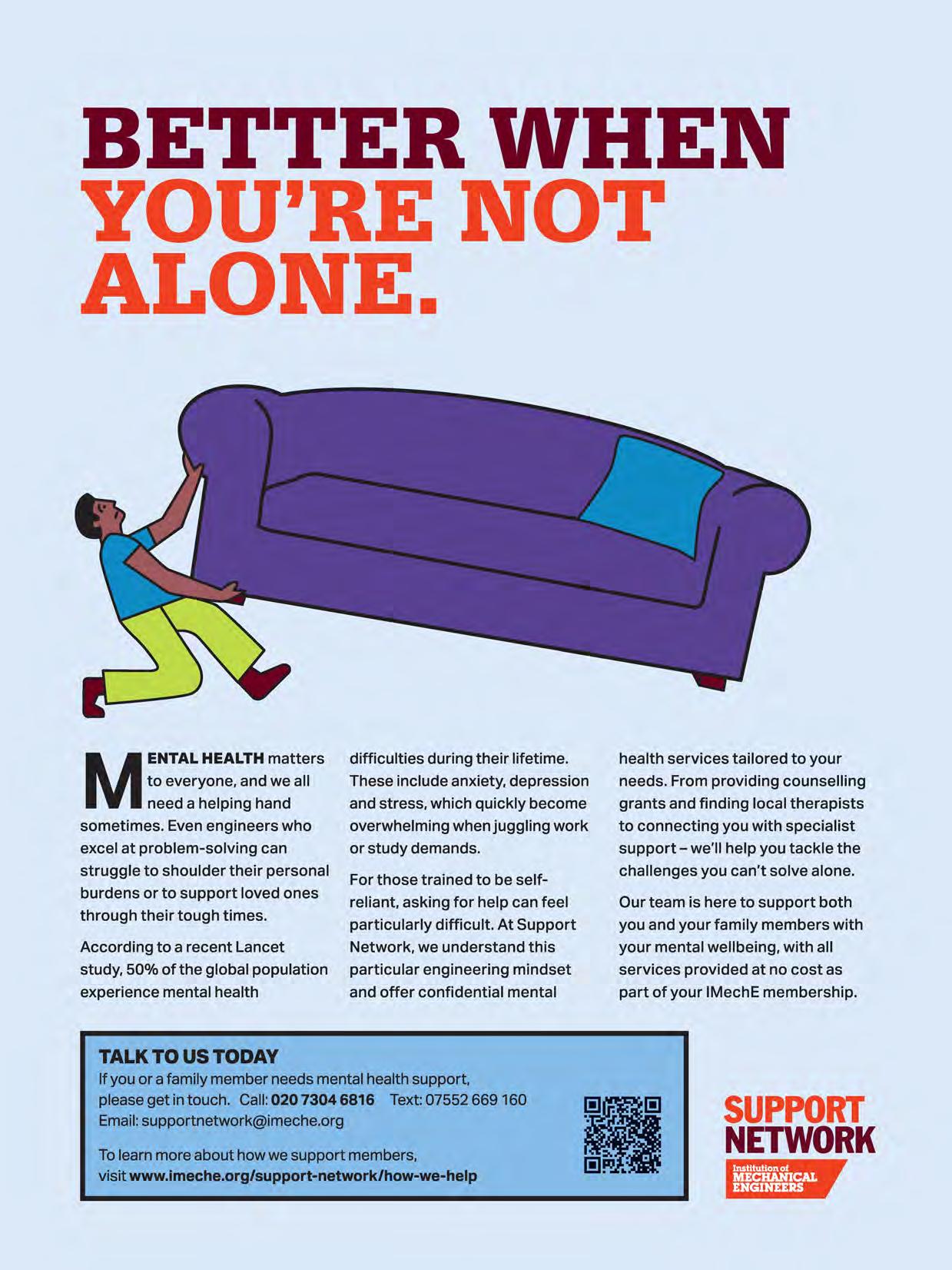
BETTER WHEN YOU'RE NOT ALONE.
MENTAL HEALTH matters to everyone, and we all need a helping hand sometimes. Even engineers who excel at problem-solving can struggle to shoulder their personal burdens or to support loved ones through their tough times.
According to a recent Lancet study, 50% of the global population experience mental health
difficulties during their lifetime. These include anxiety, depression and stress, which quickly become overwhelming when juggling work or study demands.
For those trained to be selfreliant, asking for help can feel particularly difficult. At Support Network, we understand this particular engineering mindset and offer confidential mental
health services tailored to your needs. From providing counselling grants and finding local therapists to connecting you with specialist support-we'll help you tackle the challenges you can't solve alone.
Our team is here to support both you and your family members with your mental wellbeing, with all services provided at no cost as part of your IMechE membership.
TALK TO US TODAY
If you or a family member needs mental health support. please get in touch. Call: 020 7304 6816 Text: 07552 669160 Email:supportnetwork@imeche.org
To learn more about how we support members, visit www.imeche.org/support-network/how-we-help
now moving from the what to the how,” he said, highlighting the need for innovation and private finance.
From Japan’s Ministry of Economy, Trade and Industry, Norihiro Kimura talked about bridging the adaptation finance gap. He said only 5% of the $387bn needed annually by 2030 has been financed, urging greater private sector involvement and citing Japan’s Subaru Initiative as an example.
Politics of uncertainty
Professor Lyla Mehta of the Institute of Development Studies challenged the engineering community to confront the “politics of uncertainty”. Drawing on research in India and Bangladesh, she argued that top-down adaptation often marginalises the communities it aims to protect. “Uncertainty cannot be managed like risk,” she said. “It must be lived with. And it can open opportunities for transformation.” She called for alliances between technical experts, social scientists and local actors for socially just adaptation.
Across the day, six themes emerged: the need for joined-up governance; investment in climate-resilient infrastructure; forward-looking data and science; fairer financing; locally led adaptation; and deeper integration between technical and social fields.
The second day shifted focus from policy to practice, from designing frameworks to delivering resilience. Speakers from government, academia, industry and the energy sector examined how technical assessments, regulation and finance can turn ambition into measurable outcomes.
Dr Regina Asariotis, chief of policy and legislation at the UN Conference on Trade and Development, warned
‘Uncertainty cannot be managed like risk. It must be lived with. And it can open opportunities for transformation’
that climate adaptation remains “chronically underfunded and structurally underprioritised”. She urged engineers to play a greater role in shaping standards, arguing that “we cannot afford to treat resilience as an optional add-on to development”. She called for international policy alignment between infrastructure planning, trade and climate resilience.
Infrastructure resilience specialist Dr Guy Félio highlighted the role of local governments. “Cities are on the front line of climate impacts,” he said. Félio outlined how Canadian municipalities are adopting a risk-based asset management framework to integrate adaptation into investment cycles, to “plan for uncertainty without paralysis”.
Need for consistency
Céline Phillips, coordinator at the Multilateral Initiatives Unit, Europe and International at the French Agency for Ecological Transition (Ademe), argued that resilience policy must move beyond asset-by-asset approaches towards integrated network planning, supported by accessible data.
“We need consistency in the way we define, measure and report adaptation,” she said. Phillips called for a national standard for resilience performance, mirroring the success of net-zero benchmarking.
EDF Energy demonstrated how a major operator is embedding adaptation within one of the UK’s
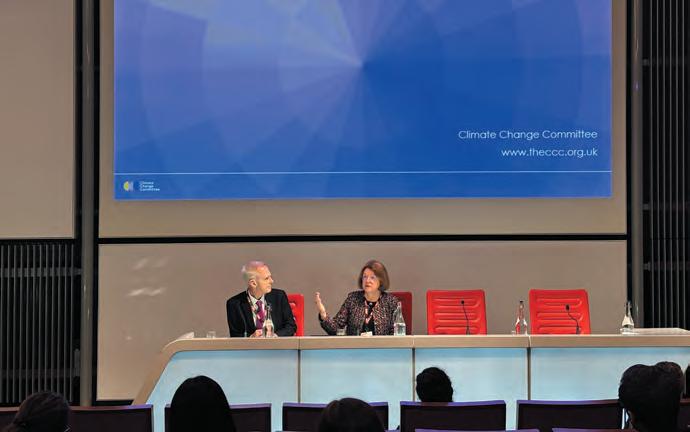
Dr Tim Fox and Baroness Brown of Cambridge on stage at the event
most regulated industries. Katie Fish, climate change adaptation engineer, outlined the company’s framework for ensuring its nuclear assets remain resilient into the 22nd century.
Her colleague Jack Bauchop, natural hazards research engineer, detailed EDF’s use of ‘extreme value analysis’ to model meteorological and hydrological hazards. “We want to add value beyond numbers,” he said. Martin Donohue, also an EDF climate change engineer, discussed how these assessments feed into site-level risk frameworks. Using Sizewell B as a pilot, EDF has integrated climate risk assessment into its long-term strategy.
Jonny Krzyzosiak, climate resilience lead at Mott MacDonald, presented PCRAM 2.0, a methodology for quantifying the financial value of resilience. “Resilience delivers value,” he said, “but unless we can measure it, those benefits are invisible to decision-makers.” He argued that policy should encourage investors to recognise resilience as a source of long-term return, not just a cost.
A consensus emerged: adaptation must become more data-driven, standardised and financially integrated, moving beyond rhetoric towards measurable, funded action. Engineers will be central to that transition, speakers agreed, translating science and policy intent into infrastructure that can endure the uncertainties of a changing planet.
Looking ahead, an industry-focused workshop following up on themes from the conference will take place at Brunel University on 26 March 2026, followed by an adaptation seminar in Japan from 6-8 September 2026 focusing on nuclear industry resilience.
FIND OUT MORE
For more information and to register for future conferences, visit imeche.org/events
Start your year in 2026 at Southern Manufacturing & Electronics -the nation's favourite industrial event and the essential meeting point for the South's manufacturing and electronics communities.Bringing together over 550 suppliers, from global giants to agile SM Es, the UK's leading trade show offers a complete view of the supply chain in one dynamic marketplace.
ASK FORA DEMO ORFREESAMPLE
As the first major industrial event of the year, Southern Manufacturing & Electronics is your opportunity to stay ahead of the curve, connect with key partners, and drive projects forward, for a successful year of innovation and growth .
WHY MARKETING MATTERS
Ros Conkie, engineer and author of The Marketing Machine, explains that yes, marketing does matter –even to mechanical engineers
As an engineer, you’re trained to solve problems with logic, data and precision. But when it comes to marketing – whether that’s promoting a new product, building your consultancy or winning investment for a project – it can feel like stepping into unfamiliar territory.
Marketing is often presented as a creative exercise, full of slogans, campaigns and trends. For people used to tolerances, test data and structured processes, that can feel vague, unmeasurable and frustrating. But the danger in ignoring marketing is that your best ideas might not get the attention they deserve.
When marketing doesn’t make sense
It’s not that you can’t do marketing – far from it. The problem is that marketing is rarely explained in a way that fits how you think and work.
If you’ve ever sat in a meeting where a marketing budget was signed off with no clear way to measure return, you’ll know how uncomfortable that feels. For someone who spends their career building systems that deliver predictable results, that kind of guesswork simply doesn’t sit right.
This isn’t just a mild irritation. Poor marketing can hold you and your business back. A competitor with a weaker product but a stronger message can easily overtake you in the market.
And as you progress in your career, being able to articulate commercial value becomes just as important as technical excellence. If you can explain why a project matters in a way that directors, investors or clients understand, you’ll find it far easier to gain influence and win support.
Here’s the good news: marketing doesn’t have to be vague. Like any process, it can be broken down into stages, measured and improved.
As you progress in
your
career, being able to articulate commercial value becomes just as important as
technical excellence
Start by mapping your customer journey:
l Awareness – how do people first encounter you?
l Engagement – what convinces them you are credible?
l Conversion – how do you make it easy for them to choose you?
l Retention – how do you keep them coming back and recommending you to others?
If you treat each stage as a component in a larger system – with clear inputs, outputs and measures of performance – marketing stops being a gamble. It becomes something you can design, refine and run, just like any other process.
One manufacturing company I worked with had excellent products but relied heavily on word of mouth. Leads trickled in, but growth stalled. By introducing a structured system to generate and nurture leads, they doubled their order pipeline in 18 months – without changing the product itself. However, customers
didn’t buy because of a flashy campaign. They bought because the company finally had a process that connected technical excellence to customer needs.
An empowering tool
Once you start to see marketing as a system, you’ll find it less intimidating and far more empowering. You’ll gain confidence to engage in board-level conversations, explain the commercial impact of your work and ensure that your best ideas don’t stay on the drawing board, but reach the people who need them.
This isn’t about diluting your technical expertise. It’s about adding another professional tool to your kit: the ability to communicate value in a structured, measurable way.
You don’t need to fear marketing – you just need to treat it like engineering. If you can design a machine, you can design your growth. And when you do, your ideas don’t just stay in the workshop. They make a real impact in the world.
l Ros Conkie (MEng) is a chartered marketer and fellow of the Chartered Institute of Marketing. Originally trained as a mechanical engineer, she specialises in helping technical professionals apply systems thinking to marketing. She is the author of The Marketing Machine: How to Engineer a System That Drives Sales and Growth
LEARN MORE
IMechE offers a range of training courses on business and commercial skills. Find out more and book at imeche.org/trainingqualifications
‘SOME COMPANIES TREAT NDAS LIKE CONFETTI’: HOW TO PROTECT YOUR IDEAS
o you’ve done the hard work –you’ve developed a new design that could make your company a lot of money. But how should you protect your intellectual property (IP)?
Find out at Understanding Intellectual Property for Engineers, an IMechE training course running in London on 19 May. Aimed at engineers and non-engineers of all levels, the session will cover essential rules for protecting your IP, the dangers of infringing third-party IP and guidance on what to say in negotiations. The course will be led by IP expert Donal O’Connell. Here are his five practical tips to start protecting your ideas.
Take IP seriously
Research shows that companies who take IP seriously – and who think about how they use IP to protect their innovation and creativity – outperform companies who don’t. This doesn’t guarantee success, but it’ll give you a higher chance.
Prepare for a challenge
Unfortunately, IP is complex. It has oddities and idiosyncrasies, which can be a hurdle, and is made up of different forms: patents, trademarks, copyright, designs – you name it. There are 20 to 30 forms, so first figure out which will apply in your case. Some of this complexity is because we are dealing with a branch of law that has been around for many years: patents and copyright from the Middle Ages, and trademarks from the end of the 18th century.
S 02 01 03 04 05
You’ve got to allocate time and energy to understanding it. There’s no shortcut, which makes it challenging. If you’re an entrepreneur, time is one of the things you lack – and you’ve also got to think about your finances, your suppliers, your marketing. Just make sure that when you’re juggling, one of the balls you’re juggling is IP.
Be smart with your spending IP can be expensive. Budgets are tight at a lot of start-up companies, so you’ve got to be smart with how you spend your money. In the early stage, can you rely more on unregistered forms of IP such as trade secrets, knowhow, unregistered trademarks or unregistered designs?
You’ve got to be really clever, using limited funds to protect your work. Unregistered forms of IP can’t do everything, but they certainly can help your business get through that early stage. Then, when your company grows and you have more funds, you can start thinking about allocating more money to this area.
Don’t forget your partners
No company is an island: you are connected to others, including key suppliers and key collaboration parties. You might be collaborating with your local university. You may have distributors and customers.
These days, almost all agreements with partners will have a section on IP. These agreements, and the IP
provisions in these agreements, are defining your relationship with others in your ecosystem.
We see some early-stage companies treating some agreements, including NDAs (non-disclosure agreements), like confetti. No, no, no – that’s a legal agreement.
Treat IP as valuable property
We often think about IP as being a legal issue, but it’s actually an asset class. It has some of the characteristics of other asset classes, including real estate and stock, with associated costs and value. I can license and sell my IP to you, for example.
With tangible assets, companies know they need to prevent people taking them and walking out the door. We need to think the same way about our IP.
LEARN MORE
IMechE’s Understanding Intellectual Property for Engineers course runs in London on 19 May 2026. Find out more and book at imeche.org/training-qualifications
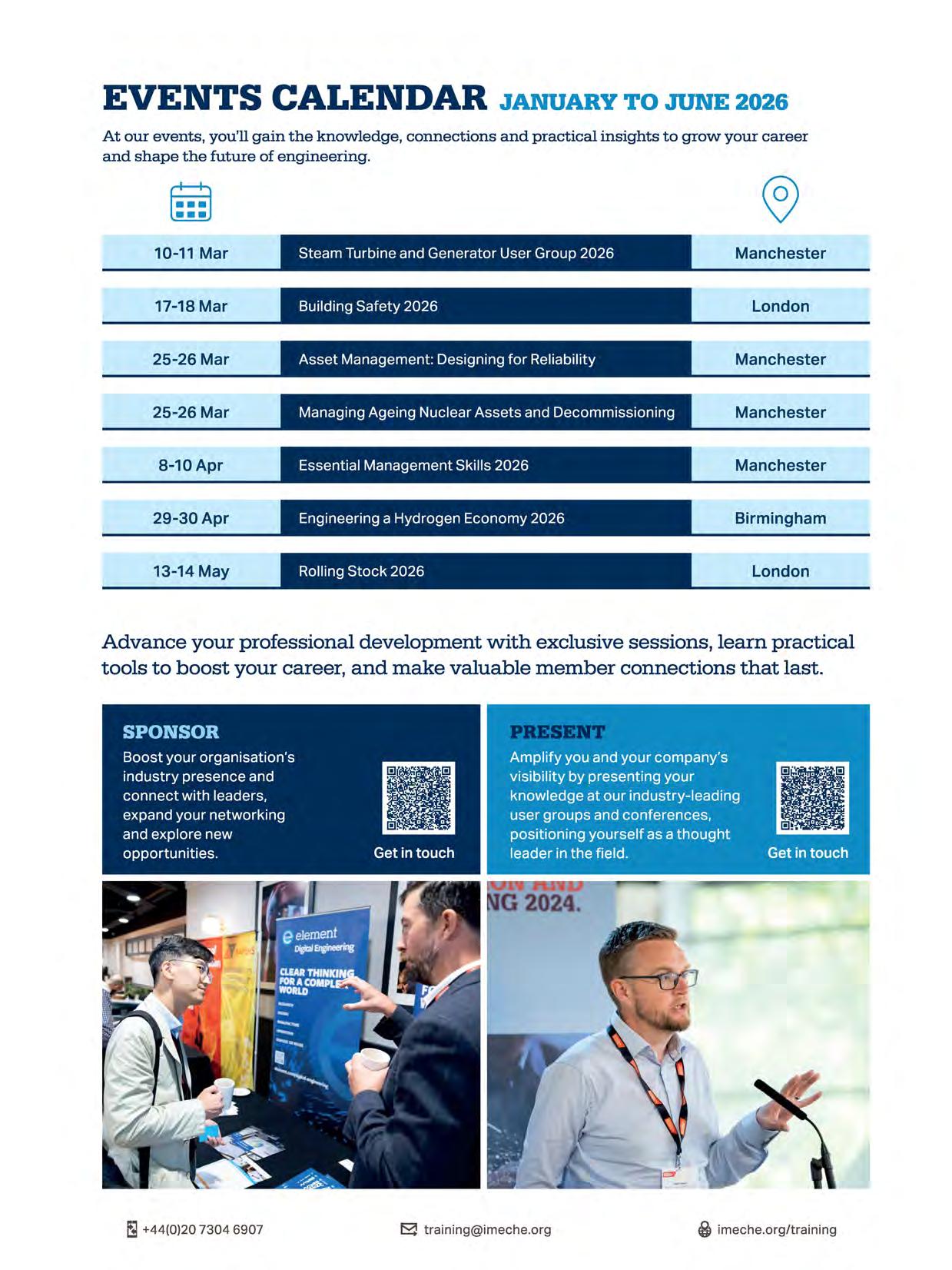
EVENTS CALENDAR JANUARY
TO JUNE 2026
At our events, you'll gain the knowledge, connections and practical insights to grow your career and shape the future of engineering.
Advance your professional development with exclusive sessions, learn practical tools to boost your career, and make valuable member connections that last.
PRINTED
FOR SPEED
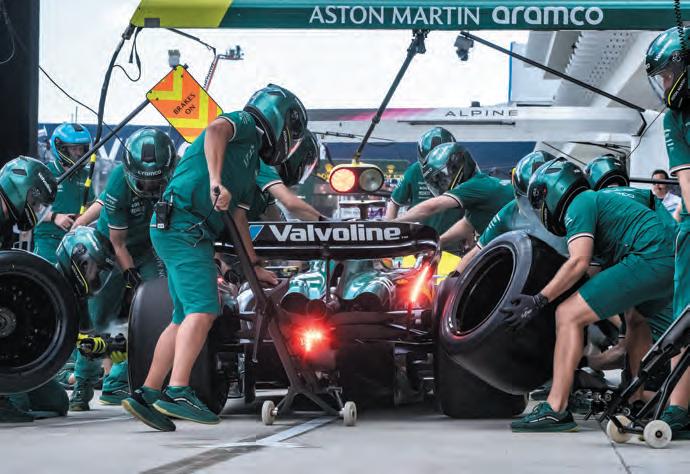
Why Formula One teams are using 3D printing to win the ‘race between races’
For Formula One drivers, the race finishes as they pass the chequered flag. But for engineers, another race starts as soon as a Grand Prix ends. The ‘race between races’ to design, test and install incremental improvements is as fast-paced and competitive as the events themselves, with teams using cutting-edge technology to get ahead of the pack.
Today, additive manufacturing is a key part of that arsenal. Wind tunnel testing of 3D-printed components was the first main application, says James Short, application engineer for industrial 3D printing specialist Stratasys, which works with F1 teams including Aston Martin Aramco and McLaren.
“The wind tunnel testing is to check all the aerodynamics for new designs, to make sure they‘re performing as they need them,” says Short, who spoke at a recent IMechE webinar on the topic alongside Aston Martin Aramco engineers.
“Traditionally, manufacturing wind tunnel test models can be very expensive and very slow. But in order to achieve extremely high surface finish, so you don‘t impact the way the air travels across your surface, that‘s where additive manufacturing – and specifically stereolithography (SLA) – lends its value because of its extremely high surface finish. What they require from an additive manufacturing tool is that it‘s very smooth and very rigid.”
That capability has been provided by “quite basic” photopolymer materials, Short says, but new composite materials such as Somos PerFORM – also printed by the company’s Neo printers – can provide better rigidity and surface smoothness.
“They‘re able to produce these very large, very smooth wind tunnel test models, so it cuts down the cost and the labour involved,” Short says. “With F1, they’re iterating so quickly that they need to have these tools produce as quickly as possible.”
Whether it is between races or between seasons, F1 teams are “always iterating”, adds Stratasys F1 account manager Shaun Cooper. “Time is quite short for these guys…
EURO-BEARINGS LTD
being able to turn around iterations as quickly as possible helps with that.”
That need for speed means teams always want “the best and the newest” technologies, he adds. More recent uses include fused deposition modelling printers and thermoplastic materials for advanced tooling applications, such as producing mandrels for complex pipe work.
The wide range of applications has seen significant uptake of 3D printing technologies, Short says, with McLaren F1 using SLA technology to produce more than 9,000 components each year. “It’s integral to the entire start-to-finish design production workflow,” he says.
Some aerodynamics teams have sped up projects by 25-30% using advanced new printers, Cooper adds.
Getting on track
As with the wider automotive sector and other industries such as aerospace and defence, the Stratasys engineers say they are seeing a push for ‘end-use’ parts in the vehicles themselves. Made of polymers or elastomers, additively manufactured components can offer high-performance alternatives for low-volume parts.
Although Short is unable to mention specific parts being used in F1 due to competition between teams, he highlights 3D-printed air-intake manifolds used in Nascar. The parts are suited for additive manufacturing because metal tooling would be “extremely costly” for a run of just 30 to 40 parts, he says.
“On the face of it, additive can appear to be quite expensive. We’re talking about very expensive systems and materials that are high cost. But the savings that these teams make in the turnaround of their production –being able to test parts in the wind tunnel far faster than they previously would have done – there’s an inherent cost saving there.
“And then by having the access to this – to a more advanced form of production where you don’t have to consider the constraints of traditional
‘By having access to a more advanced form of production, you’re able to produce more complex, more organic designs’
tooling or moulding – you’re really able to produce more complex, more organic designs. That then opens up weight savings, so you can produce parts that are lighter for the vehicle, and therefore your performance on the track goes up.”
The pace of the ‘race between races’ also spurs Stratasys to improve its technology, with introduction of new materials a major area of interest at F1 teams. “They’re constantly throwing us feedback, asking for new kinds of requirements that they want the materials to give them,” Cooper says. “Really high level, we will have a touch on all the teams.”
New materials
Short looks to a different industry for an example of how F1 might evolve. Airbus now uses more than 4,000 parts made with Stratasys 3D printers per aircraft, he says.
“I see the same thing happening in the future with F1,” he says. “I can see a world where a significant percentage of the components on a vehicle are additively manufactured,
especially when we look at new materials that we bring into the market, like our silicone material, which allows people to produce O-rings and gaskets in very complex geometries.
“We have electronic housing materials that have ESD [electrostatic discharge] properties that mean you would then be able to produce extremely lightweight, bespoke component brackets, and that’s what we’ve seen Airbus really focus on, larger numbers of bespoke components. That’s where I think we’ll see F1 pushing in the future.
“Then really the limitation is the technology itself, and who knows where we’ll be in 10 years? There’s a world where we might be seeing printers that are hybrid models, where you’re able to produce an additive part and then combine it with a composite within the process. There’s a lot that could happen down the road.”
LEARN MORE
Whatever your industry, you can find in-depth IMechE webinars on a range of topics at imeche.org/webinar-hub
HOW ENGINEERS HELP TRAINS STAY ON THE TRACKS
New technology identifies high-risk areas for derailment. By Chris Stokel-Walker
The partial derailment of a highspeed Avanti West Coast service in Cumbria in November was a shocking incident. Thankfully, however, none of the 86 passengers or crew members suffered serious injuries, with only four treated for minor injuries after the train collided with a landslide on the track at 80 miles per hour (129km/h).
Although the number of potentially high-risk train accidents (PHRTAs) has increased in the last three years, according to data released by the Office of Rail and Road just days before the incident, the numbers are decreasing over a longer trendline. And of the 23 PHRTAs last year, only five were derailments, two of which involved passengers.
“We should not forget that rail is a very safe form of transport in comparison with most other modes, especially private cars,” says William Powrie, professor of geotechnical engineering at the University of Southampton.
Still, five derailments is more than none, and the rail industry and its engineers want to prevent all incidents. “It does need acting upon,” says Paul Allen, assistant director of the Institute of Railway Research at the University of Huddersfield. “If people had died as a consequence of that train fouling the adjacent running line, it might be a slightly different conversation.”
Climate change impact
It is broadly accepted that the likelihood of this type of derailment is going up because of climate change-related weather making embankments unstable, Allen says.
One solution to that issue, he continues, is to “identify high-risk locations across the network and put mitigation in place at those specific locations”. Doing so is the ALAMY
most cost-effective way of reducing the overall risk of a derailment due to a landslip, he says.
“We’re not going to be able to stop landslips,” Allen says, so mitigation is important. That can include better preparation of the area around tracks that are prone to landslips to stop anything getting on the track.
“Derailment prevention guards alongside the running rails on the track, and also guides on the bogies to prevent excessive lateral movement on the train” are two technologies that the UK could deploy more frequently,
‘It would come down to a balance of cost and risk. Derailments are rare and the crashworthiness of modern trains is excellent’
Powrie says, learning from Japan. Other systems that could be adopted include fibreoptic early warning systems, which send automatic alerts if objects or mud falls on to the rails.
A similar technology is already in use on parts of the UK rail network, says Nick Koiza of Smart Component Technologies, which deploys sensors on the bearer and sleeper next to the rail.
“Every time a train goes over that particular area of track, what we do is we take measurements that provide an indication of the extent to which the track is moving,” he explains.
The scale of the movement
allows Koiza’s system to determine when things need to be assessed by humans, freeing up time and staying more proactive across the whole network. “What we’re doing is we’re replacing some of the on-track workers with these devices that are the ‘eyes’ on the track.”
The key question is the extent to which those in authority believe action is needed, versus the outlay of doing so. “It would come down to a balance of cost and risk,” says Powrie. “Derailments on the UK network are fortunately rare, and as we saw [this week] and in earlier incidents such as the Lambrigg West Coast derailment, the crashworthiness of modern trains is excellent.”
Targeted interventions
It’s for that reason he believes more work should be done on trains than on the tracks themselves. “Infrastructure modifications are expensive if applied over many kilometres, hence it is usually better to make improvements on the vehicles,” he says.
Powrie points out that British trains have already made major strides in crashworthiness in the last half-century, moving away from the slam-door stock. More targeted interventions where incidents have occurred – and are likely to occur – are the best way to spend while staying safe, he reckons. “We learn from these incidents and design new infrastructure and vehicles to be safer – but blanket, network-wide retrofit is often not feasible.”
LEARN MORE
Get the latest updates and news from the rail industry and many other sectors at imeche.org/news
Optimising Compressed Gas Tanker Loading A Seamless Process for Efficient Operations
When it comes to the safe and efficient loading of compressed gases, attention to detail in planning and infrastructure is key. From understanding gas properties to selecting the right equipment, here's a closer look at the essentials for setting up a successful compressed gas tanker loading station.
Gas State and Transfer Conditions:
The majority of compressed gas transfers occur in a liquid state, typically at -20°C and 20 barG. These standard conditions help streamline the design and functionality of the system, ensuring smooth operation from start to finish. It's also important to note that in Europe, all transfers are conducted at ground level, providing additional consistency across regions.
Configurations for Tanker Loading:
European compressed gas tankers typically utilise a B-Type rig configuration, with flexibility in connection points. Tanker connections can be positioned on the side, rear, or both, depending on specific operational needs. This adaptability allows for smooth integration into various facilities.
Typical Compressed Gas European B-Type Rig
Loading Bay Design:
The design of the loading bay plays a crucial role in facilitating safe and efficient operations.
• Rear-loading bays should position the tanker 400-S00mm from the kerb, with a bay width of 3500mm.
• Side-loading bays, on the other hand, require the tanker to be placed 1500mm from the kerb, with a wider bay of 5630mm to ensure easy operator access.
Standard Station Layout:
Many loading stations utilize a double-sided meter skid, with loading arms positioned on both sides for maximum versatility. This setup ensures that the arms remain parked safely when not in use and minimizes any potential design-related issues during installation.
Essential Design Features:
Loading arms are critical components in the process, mounted on a sturdy galvanised steel standpost. These arms feature:
• A spring balance cylinder for easy handling
• A manual ball valve for flow control
• Emergency release couplers to ensure safety during disconnection
• Tanker connections (e.g., Weco screw coupling)
For additional safety, Dry-Disconnect couplers can be used to eliminate the need for manual venting during disconnection, particularly in more specialised systems.
Loading Station Design Features
The Role of the Meter Skid:
The meter skid is the heart of the loading system, ensuring precise measurement and preventing overfilling. Key components include:
• Mass meters for accurate measurement
• Control and emergency valves for safe operation
• Pressure and temperature instruments, along with relief valves to manage system pressure
• Batch controllers and electrical distribution panels for seamless operation
The dimensions of the meter skid can vary, typically ranging from 5000mm to 12000mm, depending on the specifics of the facility and operational needs.
the tanker connections. It could be side or rear or both.
Rear Loading Bay Width
Side Loading Bay Width
Innovationsin LNG Road Tanker Loading
Efficiency & Safety in LNG Road Tanker Stations
The transition to cleaner energy sources has driven a significant increase in the demand for Liquefied Natural Gas (LNG). As a result, the efficient and safe loading of LNG road tankers is a critical consideration for energy companies and logistics operators worldwide. This overview highlights the essential factors involved in setting up an LNG road tanker loading station, addressing key design and operational features that optimise efficiency and safety.
Optimising Space and Layout
One of the first considerations when planning an LNG road tanker loading station is the amount of space required. A typical articulated LNG road tanker is approximately 2.4 metres wide and 16 metres long, including the tractor cab. However, variations exist depending on the type of tank and the location of the loading connections, whether they are at the rear or the side.
Rear Loading Bay Width
For maximum space efficiency, rear connections allow for double-sided loading islands, reducing the overall footprint of the station. In contrast, side-loaded tankers typically require singlesided connections, potentially increasing space requirements. Additionally, an important factor in the layout is the handling of Boil-off Gas (B.O.G.). If the B.O.G. is to be recompressed and returned to storage or used for energy generation, metering skids must include an extra metre to track mass usage.
Key Features of a Loading Station
A modern LNG loading station is designed with both operationalefficiency and safety in mind. A standard station features loading arms mounted on a galvanisedsteel standpcst with earthing provisions.
These arms facilitatethe seamless transfer of LNG and vapour return using specialised hardware, including:
• Spring balance cylinders for controlled movement
• Cold-resistant handles for safe operation in extreme conditions
• Swivel joints with nitrogen (N2) purge systems to prevent freezing and ensure operational integrity
• Breakaway couplers to prevent damage in case of accidental drive-away incidents
The nitrogen purge system plays a crucial role in maintaining the reliability of the loading arms. This system distributes N2 flow to each swivel joint and can be enhanced with monitoring sensors that detect inconsistencies, ensuring predictive maintenance.
Testing and Quality Assurance:
A robust Factory Acceptance Test (FAT)ensures the station meets performance expectations before deployment. The standard FAT includes an ambient pressure test, with the option to simulate real-world conditions using liquid nitrogen testing. This additional step provides an extra layer of assurance that the system will operate reliably in actual LNG loading scenarios
Metering and Flow Control:
Efficient LNG transfer depends on precise metering and flow control systems. Depending on the specific requirements of the facility, loading stations may include:
• Flow control skids, which integrate seamlessly with weighscale software to manage valve operations
• Meter skids, ranging in length from 5,000mm to 12,000mm, depending on the facility's needs
For stations where tankers are loaded on weighscales, a separate meter package may not be necessary. In such cases, the weighscale software communicates directly with the control skid to manage the loading process.
Side Loading Bay Width
YOUR NEW AI COLLEAGUES
The first generation of AI assistants is entering the engineering workplace. Developers say the tools will accelerate productivity and innovation, and even play a role in tackling the skills gap – but will the profession ever be the same again?
By Joseph Flaig
nax is a mechanical engineer. Analysing technical information and industrial data to accelerate workflows, Max shares recommendations with colleagues via video call. Those hoping to bump into Max at the Christmas party will be disappointed, however, because – despite a knack for analysis and a realistic profile picture – Max isn’t real.
MCreated by Californian engineering software firm IntuigenceAI, Max is a ‘synthetic engineer’. The virtual assistant is part of a growing wave of AI agents that exist solely within software, but which could rapidly change the nature of work in many industries and even challenge notions of what it means to be an engineer.
Aimed at streamlining operations and boosting innovation, the new generation of workflow-focused tools joins the chatbots, machine-learning programs and generative design applications already used by engineering firms around the world. Designed to integrate with existing software from leading companies such as Microsoft, Autodesk and Siemens, the tools will liberate engineers from mundane and repetitive tasks, allowing them to focus on creative
and exciting work, developers claim. But as the programs become more widespread – and capable – workers might have concerns about becoming mere ‘humans in the loop’. And with the skills gap continuing to put pressure on recruiters in the UK and around the world, companies might see these programs as a way to reduce staff. How will the profession evolve –and what will be its end point?
First-class education
“First AI engineer launches July 15; tackles global workforce shortage” – that was the bold claim when IntuigenceAI announced its arrival on the world stage earlier this year.
Founded by former Microsoft global vice-president Moe Tanabian (below), the Berkeley company describes its software (home to Max, chemical engineer Aice and other upcoming virtual colleagues) as “the world’s first superintelligent AI-based engineer platform… designed as a multiplier for time-strapped human engineers”.
Californian firm IntuigenceAI has created workflow-focused synthetic engineers, aimed at streamlining operations and boosting innovation
Like ChatGPT, the company’s synthetic engineers – also known as Intuigents – are trained on vast amounts of data, allowing them to understand and answer queries. But unlike OpenAI’s wide-
ranging training data, covering everything from architecture to zoology, IntuigenceAI just uses engineering data. The company partnered with the University of California, Berkeley, for what Tanabian calls a “very focused” education to PhD level.
Given NCEES Professional Engineering exams in mechanical
The synthetic engineers –known as Intuigents –are trained on vast amounts of engineering data, allowing them to understand and answer queries
and chemical engineering (the US route to qualification), IntuigenceAI agents reportedly achieved a firsttime pass rate of 81%, which the company claims is eight times better than ChatGPT-4o and DeepSeek.
Designed for industrial environments, factories, refineries, and drilling and mining sites, Intuigents are aimed at addressing two main challenges. The first, Tanabian tells Professional Engineering, is that physical engineering sectors have been “historically underserved” by software, with operations at many companies relying on decadesold programs with outdated user interfaces. The second, he continues, is the convoluted systems of records found at many of those companies.
“Working with software is really challenging for engineers in these environments,” he says. “We wanted to change that – and the new advances in AI gave us that opportunity.”
Answering the call
Using expertise in both software and industrial operations, the company developed a platform that combines a large language model, reasoning and agentic AI, working as both an ‘interactive AI whiteboard’ and a data assistant. Human engineers upload technical drawings and equipment manuals, while the system automatically pulls live data from industrial monitoring systems. The software breaks problems down into manageable tasks, assigns analysis to the synthetic engineers, then provides recommendations with ‘approval checkpoints’ for human verification.
In a demonstration shown by Tanabian, that person is Emily, an energy company process engineer tackling an efficiency issue with a heat exchanger. After signing in to the platform, she starts by uploading
The software breaks problems down into tasks, assigns analysis to synthetic engineers, then recommends ‘approval checkpoints’
relevant documents, including diagrams, manuals and maintenance records. The platform processes the files and connects with external systems for real-time sensor data.
After receiving a notification about a 20% efficiency drop from the heat exchanger, Emily explores the issue in the now-annotated diagrams before consulting Max and Aice in a video call. While the synthetic engineers’ windows just show static profile pictures for now, the dialogue – relevant and concise responses to specific questions – sounds natural, if a little flat, and it is easy to see how it could be matched up to real-time animated avatars.
Quick and easy consultations with human engineers in the field is a key selling point, Tanabian says. The company, backed by more than $10m in seed funding, has not publicised how much its software costs.
Along with the price, another question for prospective clients will be whether their in-house data is sufficiently mature. This could be an issue for UK businesses, many of which lag behind on digitalisation (see box, right).
his software, with integrated multimodels, can now provide a “data foundation” in minutes.
“That said, your factory, your plant or your construction site has to be instrumented with sensors. We rely on data coming in – the temperature for this heat exchanger, pressure for this compressor, flow rate for this pump,” he says. “Thankfully, most Fortune 1,000 companies that are in industrial operations have already instrumented with IoT [Internet of Things] sensors.”
Layering up
While IntuigenceAI’s synthetic engineers grab the attention, they are far from the only AI assistants entering the industry. Email inboxes and tech websites are awash with new releases, with varied levels of sophistication and human-like interaction coded in. Other products include PTC’s Arena AI Assistant and engineering ‘copilots’ from Leo AI and Ansys.
CAM Assist from London manufacturing software firm CloudNC is another example. Used at more than 1,000 machine shops around the world, the tool is an AI ‘layer’ added to CAM (computer-aided manufacturing) platforms such as Autodesk Fusion, Mastercam and Siemens NX. The software is designed to accelerate the CAM programming journey from CAD models to finished parts, providing machinists with strategies, workflows and machineready cutting toolpaths.
But AI can actually accelerate this process, Tanabian claims. Where human data engineers once spent months cleaning and inputting operational data, engineering diagrams and other documentation into digital models, the CEO says
‘We wanted to do for precision manufacturing – CNC machining, subtractive manufacturing –what can be done for 3D printing’
CloudNC’s bosses came from a metal 3D-printing background and were “frustrated” by the complexity of programming CNC (computer numerical control) machines, says chief technology officer Andy Cheadle (above). “The founders wanted to do for precision manufacturing – CNC machining, subtractive manufacturing – what can be done for 3D printing, which was that you upload the model and then it’s much simpler, with a number of simple operations, to actually get a manufactured part.”
The technology is mainly used for medium-batch and medium-
‘AI research can help to improve the effectiveness of robotics/automation and reduce energy costs’
A winning strategy?
ublished in June this year, the Modern Industrial Strategy sets out the UK government’s vision for AI. “The superstar firms of 2035 will leverage AI,” the document says. “The government is preparing for the prospect of transformative AI: business must do too.”
Making the most of its potential could be easier said than done, however. UK manufacturing persistently lags behind the global competition on digitalisation, a key enabler for AI deployment, while other sectors face their own challenges. “There’s a whole systems issue,” says IMechE education and skills policy lead Lydia Amarquaye, referring to aspects such as the high cost of electricity. “Some companies are not considering using the UK as a main manufacturing centre, and therefore the skill system isn’t
churning to bring the skills that are required because investment is low.”
AI could nonetheless play a big part in the Industrial Strategy’s research and development goals, she adds, depending on sufficient investment.
Advanced materials and battery development is likely to be dominated by generative AI, says the Alan Turing Institute’s ProfessorAdam Sobey.
He adds: “AI research can help to improve the effectiveness of robotics/ automation and reduce energy costs. Management of large supply chains is already being shown to be an effective use of AI. We are also extremely strong in design, an area where we have been able to extract value even if we don’t manufacture the final products, and more investment should probably be made by government to explicitly support smart design. This is an area where AI has already seen success.”
‘People aren’t coming into the industry as fast as we need. If you’ve offshored it, trying to stand up a skilled workforce is quite challenging’
complexity parts at UK aerospace, defence and automotive firms. The AI is designed to get programs 60-80% ready, Cheadle says, before a human takes over and adds their expertise.
Setting the standard
Unlike some purely software-based companies, Cheadle says CloudNC is proud to “dog food” its own products, testing them in-house at its facility in Chelmsford, Essex. This approach ensures the AI is solving real problems that customers face, he says. The tool is designed to tackle two wider challenges. “There’s a scarcity in the workforce. People aren’t coming into the industry as fast as we need,” he says. “If you’ve offshored it, suddenly trying to stand up a skilled workforce is quite challenging.” Accelerating workflows could reduce the need for human engineers. CloudNC says its software has also helped untrained staff get to grips with CAM programming by showing the process needed to generate toolpaths.
AI systems can also standardise techniques. “There are so many different ways CAM programming can be done,” Cheadle says, from the chosen material to the complexity of the model, the available cutting tools and the toolpaths. “Everyone brings their own approach – which is great, except in an environment where margins matter, throughput and deadlines etc. Being able to hand off work to other members of
CloudNC’s CAM Assist tool works as an AI ‘layer’ added to CAM platforms
the workforce, team members and colleagues, is difficult if people are bringing different approaches. So the AI system brings a standardisation that allows people to collaborate more effectively.”
From pencils to AutoCAD
Developers are keen to stress the ongoing importance of human judgement. The new 2.0 version of CAM Assist, for example, introduces more opportunities for human input throughout the process, rather than just at the end. Now users can provide feedback throughout the strategy generation process and review everything before the lengthy toolpath generation phase.
“What we tried to do is involve the human more in the understanding of the strategy, rather than just dumping a toolpath on them at the end of the process and saying, ‘There you go’,” Cheadle says. The aim is for a more nuanced relationship between human and AI, allowing engineers to focus on more complex tasks.
At IntuigenceAI, Tanabian claims the company’s platform could make every human engineer “at least an order of magnitude more productive”. “At some point, we used to use a pencil and a drawing table and T rulers to draw diagrams. Now everyone uses AutoCAD. It’s impossible to not think of using AutoCAD for drawings – it’s the same thing. There were engineers who did not transition from pencil to AutoCAD. Don’t be one of those.”
A new skillset
While CEOs at companies introducing AI assistants will inevitably project ever-increasing efficiencies and record-breaking profits, engineers might be forgiven for wondering about job security. For years, bosses have claimed that increased automation and the hypothetical introduction of AI tools would not lead to smaller workforces. Now those tools are here, many of those same businesses are frustrated by a lack of available talent, raising the possibility that AI agents
might be used to plug the skills gap. There is no consensus on such a contentious topic.
“It’s pretty clear that these machines are going to replace an awful lot of people,” says John R Williams, professor of information engineering at MIT. “Workflows will be the first thing to do, but it’s going to change business models.”
On the other hand, says Ben Hicks, professor of mechanical engineering at the University of Bristol, AI uptake is driving the recruitment of data scientists and other multidisciplinary experts. “Whether the headcount will reduce as a consequence of these tools, I don’t know,” he says.
“Most companies, I would suspect, imagine that the total headcount might well increase, but the nature of the roles will change.”
Pivot point
AI is unlikely to solve all of the issues caused by the skills gap, says IMechE education and skills policy lead Lydia Amarquaye. “Where I think skills need to be developed is actually the understanding of the information being given from these AI tools, to then help make informed decisions. We’re in a bit of a pivot point, so we need to understand what those skills are and what the tools are able to do.”
Those topics are at the forefront of discussions at the Alan Turing Institute, the national institute for data science and AI, based at the British Library in London. Turing’s data-centric engineering specialist Professor Adam Sobey says AI tools could reduce the need for engineers to do repetitive and simple tasks, making roles more attractive in the short term. Beyond that, they could augment the knowledge of young engineers, reducing some of the need for support from senior colleagues.
In the long term, however, Sobey says widespread deployment of AI software could “open up a new skills gap”. The institute hopes this could be filled by a new set of data-centric engineering skills for higher education.
better answer,” Williams says. Critical thinking ability is another trait being sought out by firms, Amarquaye says. “AI tools will give you so much information. But how does one use that information to make key decisions?”
A world with a billion engineers
‘I see more reliance on CPD and the need to upskill through life. Technology is only going to move faster’
“We will need more engineers who have a better understanding of AI/machine learning and data science. We already have a crammed syllabus and it is difficult to see how we add these skills,” Sobey says.
“I see a lot more reliance for engineers on CPD and the need to upskill through life. Technology is only going to move faster now.”
Prompt engineering
That rapid pace of change could make it difficult for students and trainees to know what to focus on as they plan to enter the world of engineering. Thankfully, the experts say, there are several areas to prioritise for future success in an AI-augmented industry.
“Most engineers would benefit from an increased understanding of statistics,” Sobey says. “It’s important that most engineers understand the limitations of AI/machine learning, and that they can see when it might be most beneficial to their workflow, rather than being experts in implementing it.”
‘Prompt engineering’, the ability to coax the best results out of AI tools by fine-tuning requests, is another key area of focus.
“If you prompt in three sentences, you’ll get one answer. If you prompt in 20 pages, you’re going to get a much
It is still early days in the AI revolution, and commentators are wary of committing to definite predictions of how far it will go. Along with data maturity, challenges for companies will include the price of investment and the technology’s high energy use.
New capabilities will undoubtedly emerge as technologies mature, bringing their own challenges and opportunities. AI agents could be used to interview retiring engineers, for example, capturing that knowledge for the next generations. Other opportunities for wider integration will arise as industrial robots become more capable. However else the profession evolves, there is clear potential for increasingly advanced AI tools to multiply the capacity of human engineers to create a much larger hybrid workforce. “Imagine a world that has 1 billion engineers,” Tanabian suggests. “It’s going to be a much better world – in terms of building much more energyefficient machinery, dealing with the climate, dealing with easier and safer cities, roads, buildings.”
It is a tantalising prospect – and one that could soon be within reach.
FIND OUT MORE
Want more expert insight into AI and the future of engineering? Sign up for the ProfessionalEngineering weekly newsletter for onlineonly interviews with industry leaders at imeche.org/news/ pe-magazine
Left to right: John R Williams, Ben Hicks, Adam Sobey
The doctorbot will see you now
Can AI-enhanced robots solve the UK’s healthcare crisis? What role do engineers play? And what digital dangers lurk? A recent IMechE report takes a close look at regulating assistive robotics
By Alex Eliseev
While writing a report on robots in healthcare, Professor Helen Meese’s thoughts time-travelled – speeding ahead to her retirement and shooting back to her days as a young engineer. “I’d like to think,” she says, “that if I make it to 70 or 80, I’ll have some machine that will help me stay in my home without becoming a burden to the NHS.”
While contemplating the decades ahead, she also feels a tinge of sadness that she’s not just starting her career, facing the “incredible” challenge of “bringing machines together in ways we haven’t seen before”.
With the explosion of generative artificial intelligence (AI), along with engineering entering a new, multidisciplinary phase, Meese (right) believes this generation has the opportunity to redesign and reinvent the way robots help older adults live more independently, while relieving some of the pressure building up in the UK’s healthcare service.
When the professor’s thoughts settle back into the present, she is concerned with balancing the immense benefits of assistive robotics against the very real risks surrounding privacy, security and over-reliance on technology.
“There is an urgent need for comprehensive and adaptive regulations that balance innovation
with user protection,” states a recent IMechE report, Automating the Home, which cites Meese as its lead author.
The report delivers nine firm recommendations, but perhaps the most critical one is also the simplest: “Focus on patientcentred care”. In other words, design solutions for the people who need them –not for the sci-fi spectacle, but for the human.
Preventing a fall
To make matters worse, says Meese, the UK, like many other countries, has a rapidly aging population, with older adults developing multiple long-term health conditions. This puts further strain on the NHS, which itself is aging as it treats more than a million patients each day.
Most experts working in healthcare robotics didn’t need Lord Darzi to tell them the NHS was struggling. But in November 2024, he released a report concluding that “the NHS is in critical condition”, albeit with strong vital signs.
The report explored everything from cancer treatment to GP visits, but caring for the elderly has always been an important piece of the puzzle. Falls and fractures account for more than 4 million bed days a year, costing the NHS some £2bn. According to the NHS, 30% of people aged 65 and above will fall at least once a year, rising to half of people aged 80 and above.
To address this, the NHS is leaning into robotics. The health service has an AI lab and, earlier this year, rolled out an AI tool designed to prevent up to 2,000 falls and hospital admissions each day.
The tool, an app that can predict falls with a claimed accuracy of 97%, is being used in more than 2 million patient home care visits a month. It checks things like blood pressure, heart rate and temperature, flagging signs of general health deterioration or illness. The NHS says the app is saving £1m a day.
Rise of the robots
Robotics merged with manufacturing a long time ago, and few people at airports panic now when they see a Star Wars-looking droid cleaning
‘There is an urgent need for comprehensive and adaptive regulations that balance innovation with user protection’
! 1/
the floor autonomously. Self-driving cars are advancing and, although you may not see them, porter robots are quietly moving through some hospitals, relieving nursing staff from having to deliver medical samples or dirty bed linen. Because hospitals are unpredictable, such robots typically use back corridors and elevators.
Automated assistants
Google “Tombot labrador” and you’ll meet an astonishingly realistic robotic dog, which can help older people manage stress, anxiety or loneliness. Non-human companions – such as robotic toy seals – have proven successful in therapeutic settings, with research ongoing into their ability to support dementia patients. For the elderly, knowing that the worst thing that can happen to your companion is a flat battery takes away the stress of owning a “pet”. Meanwhile, Intuition Robotics’ “chatty” ElliQ robot (a tabletop device) is already using AI to help combat loneliness and isolation.
A few more clicks and you’ll find Chinese company Unitree, which will sell you a humanoid robot for under £6,000. Universities around the world are exploring what robots are capable of and how they can be used as “team mates” around the home or at care facilities. Meese points to projects like JuBot, or the work of the Fraunhofer Institute as examples of “clever and interesting” research in assistive robotics, with a strong focus on physiotherapy and helping the elderly stay mobile.
“Technology can absolutely help bring the NHS out of the trauma ward,” says Meese, returning to Lord Darzi’s report. “But we must have guard rails in place.”
AI changes the game
Dr Ronnie Smith, a senior engineer at The National Robotarium, agrees – although he’d say we need to think carefully about how to “match care needs with robotic capability”.
Smith is an expert in assisted robotics for older adults, which was the subject of his PhD studies. He
‘Technology shouldn’t be forced on people. We need to regulate for the AI we have today, which will set the foundation for robotics in healthcare’
says the arrival of generative AI and large language models has changed assistive robotics in two key ways: it’s given them perceptual powers like never before, and it’s turbo-charged their ability to communicate.
In the past, teaching a robot to understand its physical environment or enabling it to speak to humans meant creating data sets or language models from scratch. Today’s tech has opened the door to more capable models available “off the shelf”.
This, Smith explains, leads to a tension. To learn, the systems need data, which is often private and sensitive. The more data they have,
the better they can help. But the more data they hoover up, the more they intrude into the realms Meese’s report warns us about: privacy and security.
“People, or the end users, must have control over where their data goes,” says Smith. “Technology shouldn’t be forced on people. We need to regulate for the AI we have today, which will set the foundation for robotics in healthcare.”
Helping older adults make decisions about their privacy and digital dignity is important to the “network of care”, a term Smith uses that includes relatives, carers and health services. Managing data, as
through powerful data-gathering when a human needs help getting something from the fridge. By that point, assuming robotics will advance to a point where machines are trusted to physically interact with humans, a solid foundation, as Smith puts it, of standards and regulations will be crucial.
people talking to people, or by having people talking to fake people? I go with people talking to people.”
Walker, who is also a director at EuRobotics and has helped Innovate UK with policy, is an advocate for approaching a problem from the right angle. “Don’t just say: ‘Let’s start a giant programme to build robots!’ As much as I’d love that, it would be a giant programme to build robots, not how we practically, effectively and efficiently solve a healthcare problem.”
we do with mobile phones and similar devices, is a pressing issue for where robotics is today, he adds. Telepresence robots (like ElliQ or the range from Temi) can be incredibly efficient at checking in on patients, relieving human carers from having to travel. They can navigate, gather information through cameras and microphones, and do some basic physical tasks. The catch is how to make these robots as useful as possible without forcing people to surrender their privacy.
Smith has experimented with solutions such as using motion sensors or Wi-Fi signals instead of intrusive cameras. But, he says, this is something engineers will have to wrestle with as robots become more capable. In future, companion humanoid robots could become the “interface for the smart home”, controlling the lights and predicting
“I’m yet to see a realistic, off-the-shelf companion robot I’d want to buy and put into my home,” he says. “We need to understand what the technology is. Regulation should follow standards, which should follow user cases.”
Magic solution or marketing hype?
Sometimes, Walker explains, a simple tabletop dishwasher, which means no bending down for its owner, is the “magic solution” that’s needed to help an elderly person live comfortably at home. “Wearable robots” like exoskeletons, he adds, are not often thought of as robotics, but can help older adults climb stairs or lift objects. He maintains that “often, the problems aren’t where you think they are”. A healthcare worker in Yorkshire may need help to shrink distances they cannot cover without a car, while their colleagues in London can cycle to visit patients.
Rich Walker, a director at Shadow Robot (above), puts it bluntly: we must protect our brains from being hacked.
The idea of humanoid robots and their capabilities, he says, comes with a lot of hype and not enough understanding at the senior levels of companies investing or developing these technologies.
“I often think we’re automating the wrong problem,” Walker says. “Do we want to stem loneliness by having
To those who argue that there aren’t enough healthcare workers, Walker says: “Why do we never have a problem with there not being enough bankers?” His solutions require us to zoom out, to explore salaries and state budgets or ask whether houses are built in a way that supports mobility in later life. “There are unique challenges and systemic problems,” he says. “The system is brittle in parts. There’s sand in the wheels. And just looking at robots misses some of the big issues.”
Rules written in blood
The IMechE report talks about collaboration between policymakers, healthcare professionals and the
‘There are unique challenges and systemic problems. The system is brittle in parts. Just looking at robots misses some of the big issues’
Left: Robotic hands made by Shadow Robot assist with mobility issues; right: Paro the seal was designed to help dementia patients
robotics industry as a key part of creating a robust regulatory framework. A way to see the bigger picture. Or, as Walker puts it: “How do we improve the quality of lives by making sure that the naked forces of capitalism aren’t spamming our planet with things that could kill us accidentally, just because they’d make more money that way?”
For inspiration, Walker points to the UK’s MOT system of checking whether vehicles are roadworthy every year they are on the roads. Getting this right takes building a regulatory system, a culture and a process, he explains. And, of course, a clear understanding of which standards must be achieved for a vehicle to pass its MOT test.
Whether we are dealing with catastrophic mechanical failure on motorways or robots in people’s homes, Walker says that we should follow the approach of the railway industry, where accidents lead to iron-clad rules to avoid future accidents – we don’t want the rulebook to be “written in blood”.
Robots could one day be common in our homes, but experts stress the need for robust regulation
60 years of the Biomedical Division
This year sees the 60th anniversary of the formation of what would become the Biomedical Engineering Division (BmED) of IMechE. The BmED is one of eight divisions in the Institution and represents a growing community of engineers working in healthcare, medical technology and healthassociated industries.
With over 3,000 members of the Institution identifying as working in healthcare and biomedical engineering, it is one of the largest groups of chartered engineers in the sector, second only to our sister institution, the Institute of Physics and Engineering in Medicine (IPEM).
In early 1965, a small working party of engineers met to discuss
their interests in medical engineering and, by autumn of that year, they had engaged with colleagues at the Royal College of Surgeons to identify collaboration opportunities and host a number of lectures on topics including orthopaedics and cryogenics.
Even though their request to form a new division within IMechE was declined in November of 1965, the founding members continued to meet regularly, bringing together experts from across engineering and medicine. They even gained a sum of money from the James Clayton Prize committee for a Medical Engineering Fellowship to support engineers working in the sector. Their dedication paid off and the working party became
a full division in 1976 – something we will celebrate next year. Today, our members work in fields ranging from bioinformatics and robotics to tissue engineering and rehabilitation, from medical imaging to disease diagnostics. There are now more than 45 UK universities offering degrees in biomedical engineering and related fields, and a thriving industry turning over £30bn a year through a 150,000-strong workforce. We are thankful to those pioneers in IMechE, who recognised the importance of engineering in medicine and inspired others to go on to develop life-changing technologies. Helen Meese, immediate past chair, Biomedical Engineering Division, IMechE
“Engineers are taught about ethical and responsible design,” he says. “They create tests that are useful, sensible and regulatable.”
Engineers carry the ethical torch
While today’s risks may relate more to data and privacy, ethical decisionmaking is a thread that runs through the report’s recommendations.
“When you develop this technology,” says Smith. “Know what it will be used for. Focus on driving down the costs and create robots that solve specific problems in the home. Design with privacy in mind. To maximise acceptance, care robots should be provided as a tool under the control of the user, not forced on them.”
Meese agrees, urging transparency,
‘Know what it will be used for. Focus on driving down the costs and create robots that solve specific problems’
more research and vigilant oversight. “I’m passionate about making sure we have access to this technology,” she says. “But I’m also very aware of the risks. We have to mitigate as much as we can. That’s why we have standards and regulations. Engineers must work to these standards and regulations.”
She says companies like Boston Dynamics have cracked a lot of the mechanical engineering in robotics, but there is plenty of work ahead. Hardware, software, electrical and biomechanical aspects are starting to combine in systems engineering, opening up exciting new career paths. And then there’s the challenge of releasing robots into “chaotic”, unpredictable environments such as homes or hospitals.
Safe as houses Key guidelines
“The next 20 years is going to be incredible,” Meese says, her thoughts racing into the future again. “But we carry the responsibility to make sure that anything we do is for the patient.”
MechE’s AutomatingtheHomereport delves deeper into the regulatory framework around robotics in healthcare. Its lead author, Professor Helen Meese, worked closely with her research partners – the Universities of Sheffield, Sheffield Hallam, Loughborough and Nottingham Trent – for six months before publishing her findings. The following are the reports’ key recommendations:
Establish comprehensive safety standards
Create detailed safety rules made especially for robots in home and care settings. Make sure there are laws or regulations that enforce these rules, and that standards are kept up to date.
Promote ethics and transparent use
Make sure robots are used fairly and openly: people should know how their data is used, give consent, not become too dependent on these machines and not be misled.
Focus on patient-centred care
Tailor robots to different needs (physical ability, language, preferences) and get feedback from patients about whether the robots are providing comfort, dignity and safety.
Enhance cybersecurity and data protection
Make sure robots are built and operated with strong protections for data (how it’s collected, stored, shared) and for privacy.
Support research and development
I 01 06 07 08 02 03 04 05 09
Allocate more money and effort into developing these assistive and social robots. Incentives (like grants), partnerships between public organisations and private
firms, and focus on solving current challenges (cost, human-robot interaction, scale) will accelerate progress.
Implement training and education programmes
Equip both healthcare workers and the public with understanding about what robots can and can’t do, how to use them safely and effectively, and what risks exist.
Ensure interoperability and integration
Make sure robots can work smoothly with existing systems (other home devices, healthcare records, etc). Use common standards so robots don’t become isolated tech islands, but instead fit into the broader care ecosystem.
Monitor and evaluate impact
Collect feedback from users and staff, use data to adjust designs and deployment, and require testing across different real-world settings.
Regulatory compliance and oversight
Make sure robots comply with international standards, subject them to certification and testing before they enter homes or care settings, and give oversight bodies real teeth.
The future of metamaterials
Once considered a sci-fi-style phenomenon, metamaterials are now very much on the agenda. But what are they, how can they be used and what is their future?
By Chris Stokel-Walker
Rheon Labs is using soft, flexible metamaterials that stiffen upon impact to create armour and helmets for the sports sector
etamaterials have spent two decades in the nowhere land between physics papers and sci-fi novellas. The technology – imbuing a 3D structure with a response or function that is not possible with conventional materials – seems impractical and its applications impossible. Metamaterials work due to the collective effect of ‘metaatom elements’, which interact with electromagnetic or acoustic waves including thermal and vibration energy in ways they ordinarily would not. Their mind-bending properties have made them sound like tomorrow’s technology for aeons. But now metamaterials are cropping up in products we already use, and in the policy agendas of countries that see strategic value in controlling the next generation of materials engineering. Prior to 2010, fewer than 1,000 patent applications mentioning metamaterials were made each year. But in recent years, that figure has spiked to nearly 4,000.
The meta moment
The reason for this is the increasingly common use of metamaterials in our everyday lives and products. In smartphones, metamaterials engineered with nanoscale patterns can precisely manipulate light waves instead of traditional camera lenses. In speakers, plastic lattices made of metamaterials are stripping away stray sound to make audio clearer. And on rooftops, photonic films made of metamaterials are mirroring unwanted heat from the sun away from the planet.
Metamaterials are having a moment – and their future looks bright. But what exactly are they?
“Metamaterials are materials where the structure does the trick, and the
trick is that it gives you properties you wouldn’t have in nature normally,” says Gianluca Memoli, an acoustics researcher and entrepreneur who straddles academia and industry. Memoli runs Metasonixx, an audiofocused metamaterials firm, while also being associate professor in sound-based interactions at the University of Sussex.
The structures that give metamaterials their trickery are engineered to be shorter than the wavelength relevant to the problem, whether that’s light, sound or vibration, which is why “they require engineering and manufacturing at sub-wavelength level,” he says.
Metamaterials derive their properties not from their chemical composition, but from their internal structure. The way that metamaterials’ meta-atoms are arranged gives the material abilities greater than the sum of its constituent materials.
That engineering challenge –and how to ensure the UK benefits from its prime position to develop metamaterials – is the subject of a
‘Metamaterials are materials where the structure does the trick, and the trick is that it gives you properties you wouldn’t have in nature normally’
new policy report from IMechE and the UK Metamaterials Network (UKMMN). The report sets out five buckets of work – from funding and skills to standards and scale-up – while highlighting examples of best practice already extant in manufacturing, health, sustainability, and the UK space and aviation sectors.
Moving from party tricks to products
In consumer optics, researchers have demonstrated that flat ‘metalenses’ can compress conventional camera modules into hair-thin wafers patterned with nanoscale features. The technology helps focus a range of wavelengths from a source over a large diameter, making images clearer while making lenses smaller.
In hi-fi speakers and other audio products, metamaterial absorption technology is being used to get rid of unwanted sound reflections and reduce distortion, providing better audio quality. Memoli’s Metasonixx builds soundproof panels of the type that can be used in offices as desk dividers, taking advantage of metamaterials’ properties in blocking out sound.
The sports sector has also adopted the tech wholeheartedly. British start-up Rheon Labs has developed shear rate-dependent mechanical metamaterials that are naturally soft and flexible but stiffen rapidly upon impact – qualities that make them useful for flexible body armour and helmets for sports and motorbikes, as well as in clothing for rate-dependent tension control
Osstec is developing knee replacement implants from additively manufactured titanium lattices
such as sports bras, and vibration damping in Padel rackets.
That also extends to the medical sector. Osstec, a spinout from Imperial College London, is developing a new generation of knee replacement implants made from additively manufactured titanium lattices. Osstec uses metamaterials designed to mimic the structure of human bone, leading to more reliable replacement joints to improve patient recovery. Shape-morphing and multi-stable metamaterial implants are also being deployed in cardiac stents, allowing a small device to be implanted and then
‘Metamaterials can make products that exist today smaller, faster, using lower power, and they also breed a whole new generation of new products’
deployed to full size to unblock arteries.
These examples are far from exhaustive. The new IMechE report highlights dozens of academic advances, which has financiers interested in the sector. For investors, metamaterials are no longer a curiosity. “We are investors. We are in the business of making money,” says Conrad Burke, managing partner at MetaVC Partners, a USbased venture capital group that has backed a portfolio of around a dozen companies built on metamaterials.
“We believe that metamaterials is a really remarkable breakthrough area,” he says. “They can make products that exist today smaller, faster, using lower power, and they also breed a whole new generation of new products. We’re excited about metamaterials because it has huge, broad-based applications in so many areas, in multibillion-dollar markets.”
Burke’s engagement with metamaterials is for good reason, and he’s blunt: “It is happening right now.” Some of the companies he’s backing are already generating “millions and millions of revenues,” he says – proof
$10bn
The global market for metamaterials by 2030
$15bn
The global market for metamaterials by 2035
that the technology is already here and no longer hypothetical. But to take advantage of the opportunities requires what he describes as a familiar “cocktail” of risk appetite, access to capital and a support system that links universities to markets.
“That’s the cocktail that works here in Silicon Valley,” he says – and it can work for the UK too.
Championing homegrown talent
The UK has plenty of pedigree in metamaterials. Burke points to Imperial College London’s Sir John Pendry as a field-defining figure – a “Galileo of metamaterials expertise” – and praises the UKMMN for coordinating universities across disciplines, with particular strength in acoustics.
“We see hotspots of metamaterials innovation in the US and in Asia. But the UK, in terms of Europe, is really up there in my mind,” he says. It’s not just single totemic figures that are leading the sector either: from 2018 to 2021, the UK was ranked as world-leading for research impact and quality based on field citation ratio, and fourth worldwide for research output from 2018 to 2022. The UKMMN has more than 1,000 members from different backgrounds. If there’s a limit for progress in metamaterials, it is in manufacturing. Many photonic metasurfaces and mechanical lattices demand feature sizes measured in nanometres to tens of microns. That is doable in university labs, but takes investment to produce at the rate or cost needed by industry. The IMechE report says the UK needs multiscale production facilities and a workforce to meet expected demand.
“It’s not just the material,” says Memoli. “The base material that does the trick is the engineering and the design of it.” The shapes required are “non-trivial” and only recently manufacturable at the required scale. “In my field, it wouldn’t be possible to have metamaterials without 3D printing,” he says. “As 3D printing became more and more easy to have in your lab, then you could do more structures.” Once tested at a small scale, it’s possible to move to mass
production techniques like injection moulding for acoustics, or established lithography flows for optics.”
Dr Tom Allen, a mechanical engineer at Manchester Metropolitan University, connects the technical to the regulatory aspect. Allen, who helped lead the IMechE research, believes that industry–academia partnerships are needed on grants alongside investment that takes designs from idea to scale-up.
“A key thing is embedding manufacturing in from the start,” he says. “So when you’re designing a metamaterial, you’re thinking about how you’re making it.”
The UK’s assets are significant: we have a top-tier research base, a cross-disciplinary UKMMN and early credibility from companies already making waves in this space. And money is beginning to meet the moment. Earlier this year, the Henry Royce Institute announced £1m for metamaterials scale-up projects, and later the MetaHub has recently launched with nearly £20m of funding at the University of Exeter.
Burke’s advice from the investor side is to double down. “Now that you’ve secured funding, go back to Westminster and start shaking people down for even more,” he says. Doing so can turn what he calls the “plethora of innovation” in UK universities into a burgeoning industry.
Putting design first
That industry relies on a simple design philosophy: use geometry alongside chemistry to get the behaviour you need. “What’s really useful about metamaterials isn’t necessarily that, like traditional materials, you say: ‘Steel is really good because it’s strong, or plastic is really good because we can mould it easily’,” says Burke. “We take our base
‘I’ve been working in metamaterials now for 10 years. The UK recognised them first. We started using top-level science first’
1st
UK global ranking for research impact and quality (2018-2021)
4th
UK global ranking for research output (2018-2022)
material, and then we change that into a metamaterial and design it for a very specific application.” That can make things smaller, more compact, lighter or able to expand in a certain way when pushed or pulled.
It’s in large part what makes metamaterials such an exciting innovation. And Memoli thinks the UK can and should own a significant chunk of the future. “I’ve been working in metamaterials now for 10 years,” he says. He believes this is “a UK story” worthy of pride.
“The UK recognised them first,” he explains. “We started using toplevel science first.” But he also worries that the UK risks “losing at the last 100 metres of the run” if the country
Clockwise, from right: Helmet and kneepads created by startup Rheon Labs and one of its helmets undergoing tests
‘We need brave people to start companies to sell the dream in a language that everyone can understand’
fails to bridge the gap between the lab and the market.
Capitalising on the imminent metamaterials boom requires calculated risk-taking, something that makes governments and researchers alike traditionally wary. But they ought not to be, according
to those closest to the industry. “This is actually a great time to start a company,” says investor Burke. However, as the IMechE report makes clear, people must take risks and push the technology forward to capitalise on opportunities.
The stakes are high. The global market value for metamaterials is projected to grow to more than $10bn by 2030 and $15bn by 2035 – and the UK could capitalise on that. Because metamaterials are the building blocks of products, they’re not a big-bang material seen by all and sundry.
“I think it’s going to be quite, quite subtle,” says Allen. “Metamaterials are almost a behind-the-scenes sort of technology.” But this makes them no
less important. “We need brave people to start companies trying to sell the dream in a language that everyone can understand,” says Memoli.
FIND OUT MORE
IMechE and the UKMMN have produced a report to raise the profile of metamaterials and highlight the opportunities they offer in different sectors, including healthcare, energy, aviation and space. The report launch will be hosted at One Birdcage Walk on 1 December. imeche.org
WEIRD ENGINEERING
The omni-bodied robot brain
Chainsaws are no match for this adaptable AI, which can find multiple new ways to keep itself moving
nThe robotwould surely scream if it could. Unable to escape its human tormentor, the plucky quadruped is grabbed byits hind leg. Asnarling chainsawdescends as the machine’s lidarscannerhelplessly whirs. Seconds later, the damage is clear–where once therewere legs, there are nowfourplastic stubs, cut off just beneath the knee. Fora moment, the robot turns in a circle – but then something miraculous happens. It works out howit needs to adapt, using large swings of its thigh joints.After eight seconds, it can scuttle away.
The attack on the dog-like device was a dramatic demonstration of the new‘omni-bodied robot brain’ from Californian robotic intelligence firm SkildAI. Unlike most robotic control systems,which are optimised for specific machineswith set ‘morphologies’ (structures and mechanics), the newbrainwas trained on 100,000 different bodies, spending avirtual millennia learning howto move and control avarietyof devices.
work. “It’s a little bit crazy,” he says. “It’s like having one brain foryou and a bird.”
Withnonerveendings,therobotscannotfeeldamage but learn from failures. “Then it understands that, ‘OK, nowI’m a different robot, and Iwill use a different morphologyfrom mylearned scheme’,” Kanoulas says.
Today, mostAI controllers learn specific locomotion strategies forindividual robots. “This is like memorising the answerto a test – great forpassing, but unhelpful for learning howto arrive at the answer,” a Skild blog post says. “When theAI faces a situation it has neverseen before, like jammed motors, broken limbs ora newbody, the memorised solution is useless and theAI doesn’t knowhowto fix it.”
A bird-brained idea?
Instead of memorising solutions forone body, Skild’s system finds and applies strategies from a “whole multiverse” of virtual robots, allowing it to adapt. Other demonstrations bythe companyinclude a quadruped having one orboth legs disabled, orall of them lengthened. In all cases, the robot appears unstable fora few seconds before turning frantic motions into purposeful movements.
Taking training from 100,000 robots and applying it in one unit is a significant challenge, says Dimitrios Kanoulas, professorof robotics at UniversityCollege London,whowas not involved in the
Mighty
morphing
The Skildwebsite reveals a broad spectrum of potential applications, from securityand inspection quadrupeds fordangerous environments to humanoid robots for in-home assistance and industrialwork.
OTHER WEIRD THINGS WE LEARNED WHILE MAKING THIS ISSUE:
Hydrogen gas plasma has been used to make ironatroomtemps(p11)
Such a system could be used “prettymuch everywhere,” Kanoulas says, as “robots breakveryoften”. Machineswith the omni-bodied brain could respond to damage like humans, quicklyadjusting theiractions to continueworking before seeking repairif it getsworse. “What remains to see nowis if this is scalable, robust and efficient,” he says. “Can I achieve a nice, robust, efficient locomotion, let’s say, with the same policyon 10 robots that have different morphologies?”
3D printing using light paves way to StarTrek replicator tech (p15)
Metamaterials can mimic the structure of human bones (p58)
Control systems trained forspecific robots might perform a bit betterin some situations, but the Skild system could be well-suited to companies that are rapidly developing and deploying newhardware, controlling each newiteration regardless ofwhetherit has six legs,wheels orany othernumberof newmorphologies.