News
Books
Organic Agriculture Food and nutrition Fisheries Agriculture
Documentation Center
Aquaculture
MAIB MAI
Library Library
Newsletter
Documentation Center
Natural resources
Economic
from the LibraryAquaculture Organic Agriculture
Mediterranean Agronomic Institue of Bari
Newsletter
Books
Newsletter
Documentation Center
Food and nutrition Fisheries Agriculture
Documentation Center
Natural resources
Economic
News from the library is a bimonthly newsletter providing timely, lively and informative articles on new releases from CIHEAM Bari Institute, the latest additions to the library's collection of books and articles, focus on the most important scientific journals, news from the world's libraries and international associations' activities.
Mediterranean Agronomic Institue of Bari DOCUMENTATION CENTRE - CIHEAM BARI
www.iamb.it
Newsletter
N° 4 - 2019 - July/August
Contents
The Book of the month
Press Review
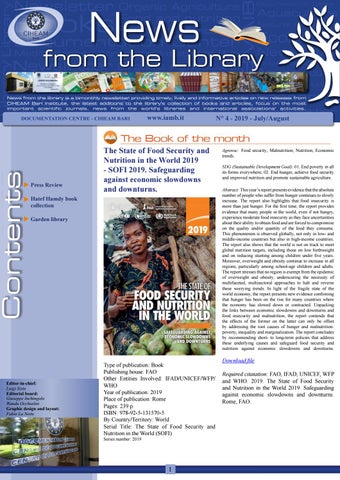
The State of Food Security and Nutrition in the World 2019 - SOFI 2019. Safeguarding against economic slowdowns and downturns.
Hatef Hamdy book collection Garden library
Editor-in-chief: Luigi Sisto Editorial board: Giuseppe Inchingolo Wanda Occhialini Graphic design and layout: Fabio La Notte
Type of publication: Book Publishing house: FAO Other Entities Involved: IFAD/UNICEF/WFP/ WHO Year of publication: 2019 Place of publication: Rome Pages: 239 p. ISBN: 978-92-5-131570-5 By Country/Territory: World Serial Title: The State of Food Security and Nutrition in the World (SOFI) Series number: 2019
1
Agrovoc: Food security; Malnutrition; Nutrition; Economic trends. SDG (Sustainable Development Goal): 01. End poverty in all its forms everywhere; 02. End hunger, achieve food security and improved nutrition and promote sustainable agriculture. Abstract: This year’s report presents evidence that the absolute number of people who suffer from hunger continues to slowly increase. The report also highlights that food insecurity is more than just hunger. For the first time, the report provides evidence that many people in the world, even if not hungry, experience moderate food insecurity as they face uncertainties about their ability to obtain food and are forced to compromise on the quality and/or quantity of the food they consume. This phenomenon is observed globally, not only in low- and middle-income countries but also in high-income countries. The report also shows that the world is not on track to meet global nutrition targets, including those on low birthweight and on reducing stunting among children under five years. Moreover, overweight and obesity continue to increase in all regions, particularly among school-age children and adults. The report stresses that no region is exempt from the epidemic of overweight and obesity, underscoring the necessity of multifaceted, multisectoral approaches to halt and reverse these worrying trends. In light of the fragile state of the world economy, the report presents new evidence confirming that hunger has been on the rise for many countries where the economy has slowed down or contracted. Unpacking the links between economic slowdowns and downturns and food insecurity and malnutrition, the report contends that the effects of the former on the latter can only be offset by addressing the root causes of hunger and malnutrition: poverty, inequality and marginalization. The report concludes by recommending short- to long-term policies that address these underlying causes and safeguard food security and nutrition against economic slowdowns and downturns.
Download file Required citatation: FAO, IFAD, UNICEF, WFP and WHO. 2019. The State of Food Security and Nutrition in the World 2019. Safeguarding against economic slowdowns and downturns. Rome, FAO.
OrganicAgriculture Food and nutrition Fisheries Agriculture
Library
News Books
Documentation Center
Aquaculture
MAI
Newsletter
Natural resources
Economic Documentation Center from the Library
Newsletter Mediterranean Agronomic Institue of Bari DOCUMENTATION CENTRE - CIHEAM BARI
Press Review
back to index
The world of organic agriculture : statistics and emerging trends 2019
(Frick/Nuremberg, February 13, 2019) The year 2017 was another record year for global organic agriculture. According to the latest FiBL survey on organic agriculture worldwide, the organic farmland increased substantially, and the number of organic producers and organic retail sales also continued to grow, reaching another all-time high, as shown by the data from 181 countries (data as of the end 2017). The 20th edition of the study “The World of Organic Agriculture” published by FiBL and IFOAM – Organics International shows a continuation of the positive trend seen in the past years. The annual survey on organic agriculture worldwide is supported by the Swiss State Secretariat for Economic Affairs (SECO), the International Trade Centre (ITC), the Sustainability Fund of Coop Switzerland, and NürnbergMesse, the organizers of the BIOFACH fair. The global organic market continues to grow worldwide and has reached 97 billion US dollars. The market research company Ecovia Intelligence estimates that the global market for organic food reached 97 billion US dollars in 2017 (approx. 90 billion euros). The United States is the leading market with 40 billion euros, followed by Germany (10 billion euros), France (7.9 billion euros), and China (7.6 billion euros). In 2017, many major markets continued to show doubledigit growth rates, and the French organic market grew by 18 percent. The Swiss spent the most on organic food (288 Euros per capita in 2017). Denmark had the highest organic market share (13.3 percent of the total food market).
Type of publication: Book Publishing house: IFOAM & FiBL - Organics International Author(s): Helga Willer, Julia Lernoud Publication date: 2019 Number of pages : 351 p. Language : English ISBN (printed version) 978-3-03736-118-4 ISBN (PDF version) 978-3-03736-119-1 Agrovoc: Certification; Organic farming; Organic foods; Organic markets; Statistical analysis; Statistics. The latest global data on organic farming worldwide will be presented by the Research Institute of Organic Agriculture (FiBL) and IFOAM - Organics International at BIOFACH, the world’s leading trade fair for organic food, in Nuremberg, Germany . The statistical yearbook “ The World of Organic Agriculture” will be launched on Wednesday, February 13, 2019, from 4:00 to 4:45 pm in Hall Shanghai, NCC East.
2
Almost three million producers worldwide In 2017, 2.9 million organic producers were reported, which is 5 percent more than in 2016. India continues to be the country with the highest number of producers (835,200), followed by Uganda (210,352), and Mexico (210,000). Record growth of the organic farmland: 20 percent increase A total of 69.8 million hectares were organically managed at the end of 2017, representing a growth of 20 percent or 11.7 million hectares over 2016, the largest growth ever recorded. Australia has the largest organic agricultural area (35.6 million hectares), followed by Argentina (3.4 million hectares), and China (3 million hectares). Due to the large area increase in Australia, half of the global organic agricultural land is now in Oceania (35.9 million hectares). Europe has the second largest area (21 percent; 14.6 million hectares), followed by Latin America (11.5 percent; 8 million hectares). The organic area increased in all continents. Ten percent or more of the farmland is organic in fourteen countries
Books
OrganicAgriculture Food and nutrition Fisheries Agriculture
Documentation Center
Aquaculture
MAI
Library
Newsletter
Natural resources
Economic Documentation Center www.iamb.it N° 4 - 2019 - July/August
Globally, 1.4 percent of the farmland is organic. However, many countries have far higher shares. The countries with the largest organic share of their total farmland are Liechtenstein (37.9 percent), Samoa (37.6 percent), and Austria (24 percent). In fourteen countries, 10 percent or more of all agricultural land is organic. Global organic statistics show the contribution of organic agriculture to the Sustainable Development Goals According to Dr. Monica Rubiolo from SECO and Joseph Wozniak from ITC “global data on organic production and markets are of high relevance for policy makers and contribute to understanding the importance of organic farming in the different countries.” “This publication shows our ongoing engagement with transparency in the organic sector” say Professor Urs Niggli, FiBL director, and Louise Luttikholt, IFOAM - Organics International Executive Director. And they add “This publication also demonstrates the contribution of organic agriculture to the Sustainable Development Goals. Overall, the yearbook shows the potential organic farming has to contribute to a sustainable future!” Download file Required citation: IFOAM & FiBL - Organics International. 2019. The world of organic agriculture : statistics and emerging trends 2019. Bonn, IFOAM.
THE INTERNATIONAL SUMMIT OF THE BOOK
The International Summit of the Book is a Library of Congress initiative for an annual global meeting of minds to discuss and promote the book as a crucial format for conveying societies’ scholarship and culture. The eighth International Summit of the Book 2019 is organized by Beirut Arab University (BAU), Lebanon. The BAU plans to host the International Summit of the Book during the period of October 28-30, 2019 in Beirut, Lebanon. Beirut Arab University (BAU), located in the heart of Beirut, is a private non-profit institution for higher education that has a relatively long history and a
Newsletter
substantial presence in Lebanon and the Middle East. BAU has, since its foundation in 1960, been committed to deliver and promote quality in education, research and community services. Starting with two faculties only, BAU now has ten and has extended its territory to reach almost all students throughout Lebanon with its four campuses in Beirut, Debbieh, Tripoli and Beqaa. This strategic expansion, together with the quality education offered at BAU, led to obtaining international institutional accreditation from FIBAA which was followed by a series of international accreditations of its various programs from the following international bodies AHPGS, ACCA, RIBA, ABET, CCAPP, ADEE and WCPT. BAU continues to work hard to be among the top universities in the region, with a global perspective that generates multi-cultural leaders equipped with competence and insightfulness for the development and progress of society. BAU will host the International Summit of the Book during the period of October 28-30 2019 in Beirut, Lebanon. The Primary venue for hosting the Summit will be the Conference Hall of the university in the main Beirut campus where many of BAU’s important conferences, seminars and lectures are held. There will be other meeting rooms for concurrent sessions or professional meetings. [Fonte IFLA]
Out Now: October 2019 issue of IFLA Journal IFLA Journal is an international journal publishing peer reviewed articles on library and information services and the social, political and economic issues that impact access to information through libraries. The Journal publishes research, case studies and essays that reflect the broad spectrum of the profession internationally. Volume 45, No. 3 (October 2019) Special issue: Health information transforming lives Guest editor: Maria G. N. Musoke Assistant Editors: Martin Morris and Shane Godbolt
3
back to index
Press Review
Mediterranean Agronomic Institue of Bari
OrganicAgriculture Food and nutrition Fisheries Agriculture
Library
News Books
Documentation Center
Aquaculture
MAI
Newsletter
Natural resources
Economic Documentation Center from the Library
Newsletter Mediterranean Agronomic Institue of Bari DOCUMENTATION CENTRE - CIHEAM BARI
back to index
Contents: Introduction Special issue: Health information transforming lives 185 Maria G. N. Musoke
Press Review
Articles Transforming lives: Combating digital health inequality 187 Bob Gann Towards new ways of assessing the impact of local medical journals: A proposal and call for change 199 Christine Wamunyima Kanyengo, Mercy Wamunyima Monde and Akakandelwa Akakandelwa
of cultural heritage, universal literacy, and access to information and communication technologies (ICT) in the framework. In August 2015, after more than three years of negotiations and intense involvement from many stakeholders, including IFLA, the Member States of the United Nations agreed to a final version of the post-2015 Development Agenda – now known as the 2030 Agenda. This Agenda was adopted by world leaders in September 2015 at a historic UN Summit.
Health information literacy awareness and capacity building: Present and future 207 Terri Ottosen, Nandita S. Mani and Megan N. Fratta
In the UN 2030 Agenda, access to information has been recognised as a target under Sustainable Development Goal 16: Promote peaceful and inclusive societies for sustainable development, provide access to justice for all and build effective, accountable and inclusive institutions at all levels:
The importance of public libraries in education for health literacy: A case study on diabetic patients 216 Hamed Pirialam, Maryam Kazerani, Maryam Shekofteh and Zahra Razzaghi
“Target 16.10: Ensure public access to information and protect fundamental freedoms, in accordance with national legislation and international agreements.” (Transforming our world: the 2030 Agenda for Sustainable Development)
Health information services: Engaging women in cervical cancer screening awareness in Nigeria 224 Ngozi P. Osuchukwu and Ngozi B. Ukachi
Culture (target 11.4) and ICT (targets 5b, 9c, 17.8) have also been included in the SDGs.
Advancing scholarly publishing through open access biomedical repositories: A knowledge management perspective 233 Lisa Kruesi, Kerry Tanner and Frada Burstein The role of the university library in creating inclusive healthcare hackathons: A case study with design-thinking processes 246 Bethany McGowan
Libraries, Development and the United Nations 2030 Agenda The United Nations 2030 Agenda for Sustainable Development is a framework of 17 Sustainable Development Goals (SDGs) with a total of 169 Targets spanning economic, environmental and social development. They lay out a plan for all countries to engage actively in making our world better for its people, with no-one left behind. Libraries are key institutions for achieving the Goals. Over the last few years, IFLA has been actively involved with the creation of the UN 2030 Agenda, advocating for the inclusion of access to information, safeguarding
4
“Half of the world’s population lacks access to information online. In our knowledge society, libraries provide access and opportunity for all.” (Lyon Declaration on Access to Information and Development) And, universal literacy is recognised in the vision for the UN 2030 Agenda. “We envision…a world with universal literacy.” (Transforming our world: the 2030 Agenda for Sustainable Development)
Books
OrganicAgriculture Food and nutrition Fisheries Agriculture
Documentation Center
Aquaculture
MAI
Library
Newsletter
Natural resources
Economic Documentation Center www.iamb.it N° 4 - 2019 - July/August Mediterranean Agronomic Institue of Bari
The International Advocacy Programme (IAP)
Newsletter back to index
Press Review
IFLA’s consistent position is that access to information is essential in achieving the SDGs, and that libraries are not only key partners for governments but are already contributing to progress towards the achievement of the 17 Goals. For this reason, IFLA launched the International Advocacy Programme (IAP) in 2016, a new capacitybuilding programme designed to promote and support the role libraries can play in the planning and implementation of the UN 2030 Agenda and the SDGs. The objectives of the IAP are to: Raise the level of awareness on the SDGs of library workers at community, national and regional levels, and to promote the important role libraries can play in development by contributing to the UN 2030 Agenda and the SDGs; Increase the participation of library associations and public library representatives in advocacy work at national and regional levels to secure sustainable public access to information through library services and programmes. [Fonte IFLA]
5
OrganicAgriculture Food and nutrition Fisheries Agriculture
Library
News Books
Documentation Center
Aquaculture
MAI
Newsletter
Natural resources
Economic Documentation Center from the Library
Newsletter Mediterranean Agronomic Institue of Bari DOCUMENTATION CENTRE - CIHEAM BARI
Hatef Hamdy Book Collection
back to index
Le monografie che costituiscono il “Fondo HAMDY”, esposte nella Biblioteca del CIHEAM Bari, sono disponibili per la consultazione previa autorizzazione della Direzione o dello stesso personale della biblioteca, che comunque non ne può autorizzare la riproduzione anche parziale. The books that make up the “Hatef Hamdy Book Collection”, displayed in the Library of the CIHEAM Bari, are available for consultation subject to the authorization of the CIHEAM Bari Management or of the library staff, who cannot authorize the reproduction, even partial. Techniques for Environmentally Sound Water Resources Development Papers presented to the African regional symposium : held in Alexandria, 17-19 February 1991 Type of publication: Book Editor(s): R. Wooldridge Publisher: Pentech Press London Year of publication: 1991 Place of publication: London Pages: 332 p. ISBN: 0-7273-2107-2 Abstract: This publication contains the papers presented at the African regional symposium : held in Alexandria, 17-19 February 1991. The Symposium provided an international forum for professional and researchers concerned with the development of water resources in the Africa region to exchange ideas and experiences. This book provides, an up-to-date assessment of the practical application of techniques to appraise and monitor water-related environmental changes and, by means of case studies, evaluates environmentally sustainable technologies and techniques to control adverse effects. Specific questions related to: Regional appraisal and monitoring; Regional planning; Health effects, monitoring and contro; Project appraisal and monitoring; Projects planning and design; Environmentally sound technologies. This volume will be of particular interest to civil engineers, environmental scientists, planners, economists, agricultural engineers and health experts who are directly responsible for water resources developments in the African region. Agrovoc: Water resources development; Environmental aspects; NorthAfrica; Irrigation water; Environmental management. Cite this publication as: Wooldridge, R., 1991. Techniques for Environmentally Sound Water Resources Development : Papers presented to the African regional symposium : held in Alexandria, 17-19 February 1991. London, Pentech Press. Treatment and Use of Sewage Effluent for Irrigation Proceedings of the FAO Regional Seminar on the treatment and use of sewage effluent for irrigation, Nicosia, Cyprus 1985 Type of publication: Book Editor(s): M.B. Pescod, A. Arar Publisher: Butterworths Year of publication: 1991 Place of publication: London Pages: 332 p. ISBN: 0-408-00771-0 Abstract: Treatment and Use of Sewage Effluent for Irrigation contains the Proceedings of the FAO Regional Seminar on the treatment and use of sewage effluent for irrigation, held in Nicosia, Cyprus on October 1985. The book reviews available information and experience on the treatment and reuse of sewage effluent
6
Books
OrganicAgriculture Food and nutrition Fisheries Agriculture
Documentation Center
Aquaculture
MAI
Library
Newsletter
Natural resources
Economic Documentation Center www.iamb.it N° 4 - 2019 - July/August
Newsletter
for increased agricultural production. Papers are presented by international experts on health and agricultural guidelines for effluent quality and on the short-term and long-term effects of effluent reuse on public health, soil fertility and crop productivity. Appropriate sewage treatment systems are considered and sewage sludge treatment and agricultural utilization are discussed. Case studies of sewage effluent treatment and reuse in irrigation in the Near East Region and elsewhere are presented as well. Agriculturists, horticulturists, and civil engineers will find the compendium interesting. Agrovoc: Water resources development; Irrigation methods; Wastewater; Irrigation water; Agricultural production; Soil fertility; Crop productivity. Cite this publication as: Pescod, M.B., Arar, A., 1991. Treatment and Use of Sewage Effluent for Irrigation : Proceedings of the FAO Regional Seminar on the treatment and use of sewage effluent for irrigation, Nicosia, Cyprus 1985. London, Butterworths.
Environmental Peacemaking Type of publication: Book Editor(s): Ken Conca, Geoffrey D. Dabelko Publisher: Woodrow Wilson Center Press ; Johns Hopkins University Press Year of publication: 1991 Place of publication: Washington, D.C. ; Baltimore Pages: 244 p. ISBN: 0-8018-7192-1 Abstract: How can environmental cooperation be used to bolster regional peace? A large body of research suggests that environmental degradation may catalyze violent conflict. Environmental cooperation, in contrast, has gone almost unexplored as a means of peacemaking, even though it opens several effective channels: enhancing trust, establishing habits of cooperation, lengthening the time horizons of decisionmakers, forging cooperative trans-societal linkages, and creating shared regional norms and identities. This volume examines the case for environmental peacemaking by comparing progress, prospects, and problems related to environmental peacemaking initiatives in six regions South Asia, Central Asia, the Baltic, Southern Africa, the Caucasus, and the U.S.-Mexico border. The regions vary dramatically in terms of scale, interdependencies, history, and kinds of insecurity. But each is marked by a highly fluid, changing security order, creating a potential for environmental cooperation to have a catalytic effect on peacemaking. Among the volume’s key findings are these: that substantial potential for environmental peacemaking exists in most regions; that significant tensions from narrower efforts to improve the strategic climate among mistrustful governments can impair broader trans-societal efforts to build environmental peace; and that the effects of environmental peacemaking initiatives are highly sensitive to the ways they are institutionalized. Agrovoc: Environmental management; Ecosystems; Environmental control; Natural environment; Environmental degradation. Cite this publication as: Conca, K., Dabelko, G.D., 2002. Environmental Peacemakin. Washington, D.C. : Woodrow Wilson Center Press ; Baltimore : Johns Hopkins University Press.
7
back to index
Hatef Hamdy Book Collection
Mediterranean Agronomic Institue of Bari
OrganicAgriculture Food and nutrition Fisheries Agriculture
Library
News Books
Documentation Center
Aquaculture
MAI
Newsletter
Natural resources
Economic Documentation Center from the Library
Newsletter Mediterranean Agronomic Institue of Bari DOCUMENTATION CENTRE - CIHEAM BARI
back to index
Hatef Hamdy Book Collection
Sustainable Development at Risk: ignoring the past Type of publication: Book Editor(s): Joseph H. Hulse Publisher: Cambridge University Press Year of publication: 2007 Place of publication: Cambridge Pages: 371 p. ISBN: 978-81-7596-521-8 Abstract: Over the past half-century, the idea of sustainable development has drastically evolved and rooted itself in the lexicon of international development. But what is it, really? Are development agencies truly committed to long-term sustainable solutions to development issues? Are we learning from our past successes and failures? This book takes a historical perspective on these questions. The analysis begins with the Atlantic Charter, the creation of the United Nations, its family of agencies, and the international development banks. It reviews recommendations from international commissions and conferences, from World Bank and UNDP Human Development Reports. It comments on governmental policies, human and industrial actions detrimental to the planet’s environment and natural resources. It studies the patterns by which biotechnologies essential to human survival and health have progressed over the past 6000 years, and the consequences of uncontrolled urban growth on food and health security. The author hopes that this book will be “informative and helpful to all who care about human suffering and degradation of the Earth’s environment and resources, in particular to men and women who are newcomers to international, governmental, and nongovernmental aid and assistance programs.” Agrovoc: Sustainability; Environmental management; Ecosystems; Sustainable development; Environmental control; Natural resources; Policies. Cite this publication as: Hulse, J.H., 2007. Sustainable Development at Risk: ignoring the past. Cambridge : Cambridge University Press. The Water, Energy, and Food Security Nexus in the Arab Region Type of publication: Book Editor(s): Kamel Amer, Zafar Adeel, Benno Böer, Walid Saleh Publisher: Springer Year of publication: 2017 Place of publication: Berlin Pages: 252 p. ISBN: 978-3319839356 Serial Title: Water Security in a New World Abstract: This book investigates the need for a more open and interdisciplinary dialogue on the nexus of food, water and energy security in the Arab region. It argues that achieving sustainable economic development is irretrievably tied to the security of the water–energy–food nexus, which is in turn essential for bringing about sustained peace. Further, it discusses various approaches to achieving these lofty objectives, and offers the following take-away messages: The Arab region is currently under considerable water stress, and the situation will continue to get worse with a number of global changes – most notably those related to climate and regional water distribution. Viable solutions are available in the Arab region and can be implemented through innovative policies, judicious use of new technologies, and stimulating public opinion. Integration across water, energy, and food sectors is obviously needed but achieving it in practice is extremely challenging. There are some gaps in the scientific understanding but at the same time there is a wealth of data and synthesized information that can guide decision-making.
8
Books
OrganicAgriculture Food and nutrition Fisheries Agriculture
Documentation Center
Aquaculture
MAI
Library
Newsletter
Natural resources
Economic Documentation Center www.iamb.it N° 4 - 2019 - July/August Mediterranean Agronomic Institue of Bari
Newsletter back to index
Cite this publication as: Amer, K., Adeel, Z., Böer, B., Saleh, W., 2017. The Water, energy, and food security nexus in the arab region. Berlin : Springer.
Water quality and treatment : a handbook of community water supplies Type of publication: Book Editor(s): Frederick W. Pontius ; American Water Works Association Publisher: McGraw-Hill Year of publication: 1990 Place of publication: New York Pages: 1194 p. ISBN: 0-07-001540-6 Abstract: In this new edition of the definitive sourcebook,AWWA experts explain the latest regulations and standards and offer extensive discussion of the health and aesthetic aspects of drinking water quality. Newly revised chapters advise you on selecting the right water treatment process; managing source water quality; handling air stripping and aeration,chemical oxidation,disinfection,and fluoridation; managing water treatment plant waste; controlling microbiological quality in disinfection systems,and more. Distinguished by its all-inclusive coverage of public water supply treatment,the American Water Works Association’s Water Quality and Treatment has stood as the leading international source in the field for over 60 years. With a full 90% of its material new to this edition,this one-of-a-kind reference is more essential than ever. Here,you’ll find all the basics,starting with a rationale for water quality standards and goals,and progressing to discussion of: Methods of performing hydrologic and hydraulic analysis for flood insurance studies. Compliance and enforcement actions. A method of assessing coastal flooding and other hazards. Authoritative,comprehensive,and written by more than 20 highly respected specialists, Water Quality and Treatment brings you 18 illustrated chapters detailing state-of-the-art technologies and methods. It features updated appraisals of everything from aeration and coagulation processes,to chemical oxidation and water plant waste management. Whether the topic is the health and aesthetic aspects of water quality,or the latest details on effective control of microbia,you can’t find a more in-depth-or more critical-guide to water supply treatment than the one you’re holding right now. New in This Edition: Leading-edge membrane technologies; Disinfection processes for prevention of Cryptosporidium and E coli outbreaks; Enhanced removal of total organic carbon; Updates on all processes and treatments; European regulations; U.S. regulatory changes. Agrovoc: Sustainability; Natural resources; Water resources; Water quality; Wastewater; Processing. Cite this publication as: Pontius, F.W., 1990. Water quality and treatment : a handbook of community water supplies. New York : McGraw-Hill.
9
Hatef Hamdy Book Collection
Agrovoc: Sustainability; Natural resources; Water resources; Energy; Food policies; Economic development; Arab countries.
OrganicAgriculture Food and nutrition Fisheries Agriculture
Library
News Books
Documentation Center
Aquaculture
MAI
Newsletter
Natural resources
Economic Documentation Center from the Library
Newsletter Mediterranean Agronomic Institue of Bari DOCUMENTATION CENTRE - CIHEAM BARI Garden Library
back to index
L’Italia e gli Obiettivi di Sviluppo Sostenibile. Rapporto ASviS 2019
Garden library
Type of publication: Book Publisher: Alleanza Italiana per lo Sviluppo Sostenibile (ASviS) Year of publication: 2019 Place of publication: Roma Pages: 167 p. Abstract: Il Rapporto dell’Alleanza Italiana per lo Sviluppo Sostenibile, giunto alla quarta edizione, rappresenta uno strumento unico per analizzare l’avanzamento del nostro Paese verso il raggiungimento dei 17 Obiettivi dell’Agenda 2030 e identificare gli ambiti in cui bisogna intervenire per assicurare la sostenibilità economica, sociale e ambientale del modello di sviluppo. A soli 11 anni dalla scadenza fissata dal piano d’azione delle Nazioni Unite, firmato da 193 Paesi, Italia compresa, è necessario modificare significativamente le politiche pubbliche, nazionali ed europee, le strategie aziendali e i comportamenti individuali. L’urgenza è anche dettata dal fatto che 21 dei 169 Target in cui si articolano gli Obiettivi di sviluppo sostenibile prevedono obblighi riferiti al 2020 e che su buona parte di essi l’Italia è in grave ritardo. Grazie al contributo dei 600 esperti delle oltre 220 organizzazioni aderenti all’ASviS, il Rapporto 2019 fornisce un quadro delle iniziative messe in campo nel mondo, in Europa e in Italia a favore dello sviluppo sostenibile, valuta le politiche realizzate negli ultimi 12 mesi e avanza proposte per accelerare il percorso del nostro Paese verso l’attuazione dell’Agenda 2030. Download file Agrovoc: Sustainability; Sustainable development; Agenda 2030; Natural resources; Agroecosystems; Sustainable land management. Cite this publication as: Alleanza Italiana per lo Sviluppo Sostenibile (ASviS), 2019. L’Italia e gli Obiettivi di Sviluppo Sostenibile. Rapporto ASviS 2019. Rome.
La Legge di Bilancio 2019 e lo sviluppo sostenibile. Esame dei provvedimenti e situazione dell’Italia rispetto ai 17 Obiettivi dell’Agenda 2030.
Type of publication: Book Publisher: Alleanza Italiana per lo Sviluppo Sostenibile (ASviS) Year of publication: 2019 Place of publication: Roma Pages: 58 p. Abstract: Il lavoro degli oltre 300 esperti delle organizzazioni aderenti all’Alleanza coinvolti nella valutazione della Legge di Bilancio evidenzia i provvedimenti che potrebbero consentire all’Italia – se pienamente attuati - di fare passi avanti significativi in alcuni campi, come la lotta alla povertà. D’altra parte, emerge chiaramente la mancanza di una visione integrata degli interventi in campo economico, sociale e ambientale di cui il nostro Paese ha bisogno per accelerare il passo verso lo sviluppo sostenibile. L’assenza di interventi “sistemici” per l’economia circolare, la transizione ecologica dei sistemi produttivi, l’occupazione giovanile e femminile, così come i timidi provvedimenti nel campo della lotta al cambiamento climatico e al degrado ambientale, appaiono preoccupanti. Resta poi molto da fare per rispettare i dieci impegni assunti nei confronti delle oltre 200 organizzazioni aderenti all’ASviS da quasi tutte le forze politiche in occasione dell’ultima campagna elettorale, così come per attuare le iniziative previste dalla Strategia Nazionale per lo Sviluppo Sostenibile, approvata dal Cipe nel dicembre 2017. Il documento, il primo del genere mai realizzato nel nostro Paese, è stato presentato e discusso il 27 febbraio 2019
10
Books
OrganicAgriculture Food and nutrition Fisheries Agriculture
Documentation Center
Aquaculture
MAI
Library
Newsletter
Natural resources
Economic Documentation Center www.iamb.it N° 4 - 2019 - July/August Mediterranean Agronomic Institue of Bari
Newsletter
alla Camera dei deputati. All’incontro hanno partecipato il presidente della Camera Roberto Fico, il presidente del Consiglio dei ministri Giuseppe Conte, l’Amministratore delegato dell’Enel Francesco Starace (unico rappresentante italiano nella multistakeholder platform sullo sviluppo sostenibile creata dalla Commissione europea) e i rappresentanti dei principali partiti e movimenti politici. In questa occasione, l’ASviS ha diffuso anche i risultati di un sondaggio sulla conoscenza dell’Agenda 2030 tra la popolazione residente nel nostro Paese e sulla “domanda” di politiche orientate allo sviluppo sostenibile.
back to index
Download file Agrovoc: Sustainability; Sustainable development; Agenda 2030; Natural resources; Agroecosystems; Sustainable land management.
La tutela della biodiversità nei siti Natura 2000 e nelle aree naturali protette. Opportunità e sfide per lo sviluppo rurale. Type of publication: Book Editor(s): Luigi Servadei, Alessandro Monteleone Author(s): Luigi Servadei, Franco Ferroni, Enrico Calvario, Alessandro Monteleone, Eleonora Bianchi, Laura Pettiti, Graziana Dizonno, Emanuela Perinelli Publisher: CREA-PB Year of publication: 2019 Pages: 34 p. ISBN: 9788833850221 Abstract: Le tematiche presentate nell’opuscolo offrono un’utile panoramica sulle diverse visioni della biodiversità, sul suo valore e sui servizi ecosistemici associati all’agricoltura, sul ruolo della Rete Natura 2000 e delle aree protette, nonché sulle opportunità offerte dalla politica di sviluppo rurale a sostegno degli interventi finalizzati al contrasto ai cambiamenti climatici, alla gestione delle risorse idriche, alla conservazione di habitat e specie selvatiche. Il tutto con l’obiettivo di aumentare la consapevolezza e la volontà di investire su questi temi da parte degli agricoltori, degli attori territoriali e della società civile, che vogliono essere protagonisti delle sfide ambientali. Il documento è stato realizzata dal CREA-PB, nell’ambito delle attività previste dal Programma Rete Rurale Nazionale 2014/2020 del Ministero delle Politiche Agricole, Alimentari, Forestali e del Turismo, in collaborazione con il Ministero dell’Ambiente, della Tutela del Territorio e del Mare e WWF Italia. Download file Agrovoc: Protected areas; Biodiversity; Sustainability; Natural reserves; Natural resources; Agroecosystems; Protected species. Cite this publication as: Luigi Servadei, Franco Ferroni, Enrico Calvario, Alessandro Monteleone, Eleonora Bianchi, Laura Pettiti, Graziana Dizonno, Emanuela Perinelli, 2019. La tutela della biodiversità nei Siti Natura 2000 e nelle aree naturali protette Opportunità e sfide dello sviluppo rurale Rete Rurale Nazionale 2014/2020, Ministero delle Politiche agricole, alimentari, forestali e del turismo.
11
Garden library
Cite this publication as: Alleanza Italiana per lo Sviluppo Sostenibile (ASviS), 2019. La Legge di Bilancio 2019 e lo sviluppo sostenibile. Esame dei provvedimenti e situazione dell’Italia rispetto ai 17 Obiettivi dell’Agenda 2030. Rome.
OrganicAgriculture Food and nutrition Fisheries Agriculture
Library
News Books
Documentation Center
Aquaculture
MAI
Newsletter
Natural resources
Economic Documentation Center from the Library
Newsletter Mediterranean Agronomic Institue of Bari DOCUMENTATION CENTRE - CIHEAM BARI
back to index
Italia Rurale. Paesaggio, patrimonio culturale e turismo. Lezioni e pratiche della Summer School Emilio Sereni. Storia del paesaggio agrario italiano; IX Edizione: 27-31 agosto, 2017
Garden library
Type of publication: Book Editor(s): Gabriella Bonini, Rossano Pazzagli Publisher: Istituto Alcide Cervi - Biblioteca Archivio Emilio Sereni Year of publication: 2018 Pages: 407 p. ISBN : 978-88-941999-7-0 Abstract: I saggi qui raccolti, a carattere storico, geografico, urbanistico, economico e sociale, aiutano la riflessione sulle strategie di governo del territorio e del patrimonio territoriale, dalle quali discende l’obiettivo di un consolidamento di un settore fondamentale dell’economia italiana come il turismo, nel quale il mondo rurale con i suoi valori paesaggistici, gastronomici e ambientali occupa un posto di rilievo. Essi evidenziano il legame tra paesaggio, patrimonio culturale e turismo come asse strategico su cui impostare percorsi di conoscenza, azioni di tutela e progetti di valorizzazione territoriale tramite le varie forme di turismo sostenibile che possono affermarsi in ambito rurale. Partendo dall’articolo 9 della Costituzione, fino all’attuazione del Codice del beni culturali e del paesaggio, sottolineano la centralità del territorio rurale come contenitore di risorse plurali che vanno dalle produzioni agricole agli insediamenti umani, dai caratteri ambientali alle tradizioni culturali, per giungere all’analisi e alla progettazione di forme di turismo integrato che fanno perno sul rapporto fra tradizione e innovazione come elemento forte dell’offerta e della domanda turistica, sempre più orientata verso il turismo esperienziale. Questo volume affronta dunque la tematica del turismo rurale come possibilità di integrazione del reddito, in connessione col ruolo multifunzionale dell’agricoltura e nella prospettiva di una rinascita delle campagne. Il tentativo è quello di rimettere al centro l’identità e le vocazioni autentiche dei territori che il paesaggio riflette nelle sue trame storiche e nella percezione sociale. Il paesaggio, il paesaggio agrario in particolare, diventa così un fattore significativo dell’identità socioculturale di una comunità e della sua evoluzione, il terreno privilegiato su cui connettere coerenti strategie e politiche di valorizzazione e tutela in ambito rurale. Agrovoc: Sustainability; Sustainable development; Rural areas; Rural communities; Ecotourism; Agrotourism; Agricultural landscape. Cite this publication as: Gabriella Bonini, Rossano Pazzagli, 2018. Italia Rurale. Paesaggio, patrimonio culturale e turismo. Gattalico (RE): Edizioni Istituto Alcide Cervi. Benessere e natura: Città verdi a misura di bambino Type of publication: Book Author(s): Gianfranco Bologna, Mariantonietta Quadrelli Coordinamento: Franco Battaglia Publisher: WWF Italia Onlus Year of publication: 2018 Pages: 61 p. Abstract: La natura non è solo un elemento fondamentale per il nostro benessere quotidiano ma rappresenta anche una ‘scuola’ importantissima per i bambini che, purtroppo nei Paesi di più antica industrializzazione, sono costretti a stili di vita sempre più sedentari, costretti ad attività, esperienze e socialità sempre più virtuali. Si tratta di un vero e proprio deficit di natura (espressione coniata dal giornalista americano Richard Louv) che ormai condiziona in modo evidente la crescita e la salute psicofisica delle nuove generazioni. È questo il cuore del report “Benessere e natura: città verdi a misura di bambino” lanciato dal WWF in occasione di Urban Nature (la festa della biodiversità urbana), realizzato in collaborazione con l’Associazione Italiana Studi sulla Qualità della Vita AIQUAV, che riunisce i migliori esperti che si occupano di benessere e qualità della vita e con il contributo
12
Books
OrganicAgriculture Food and nutrition Fisheries Agriculture
Documentation Center
Aquaculture
MAI
Library
Newsletter
Natural resources
Economic Documentation Center www.iamb.it N° 4 - 2019 - July/August Mediterranean Agronomic Institue of Bari
Newsletter
del gruppo di lavoro su Ambiente&Salute dell’Associazione Culturale Pediatri (ACP) e di LABUS, il Laboratorio per la Sussidiarietà.
back to index
Download file Agrovoc: Sustainability; Sustainable development; Urban areas; Urban environment; Rural urban relations; Children. Cite this publication as: Gianfranco Bologna, Mariantonietta Quadrelli, 2018. Benessere e natura: Città versi a misura di bambino. Roma: WWF Italia Onlus.
Italia contadina. Dall’esodo rurale al ritorno alla campagna. Type of publication: Book Editor(s): Gabriella Bonini, Rossano Pazzagli Publisher: Aracne Year of publication: 2018 Pages: 152 p. ISBN : 978-88-255-1604-3 Collana : Storia e territorio ; 7.
Abstract: L’Italia deve molto ai contadini e all’agricoltura: la qualità dell’alimentazione, la bellezza del paesaggio, un diffuso patrimonio territoriale che ha generato valori economici e culturali. Dalla metà del ’900 l’esodo rurale e i cambiamenti del paesaggio sono stati i segni più eloquenti di una grande trasformazione che ha privilegiato l’industria e la città, spezzando i legami con il territorio e marginalizzando il mondo rurale. Specialmente le aree interne, il lavoro e le imprese contadine hanno pagato un prezzo altissimo al boom economico. Oggi, nell’orizzonte della crisi strutturale del modello di sviluppo, è venuto il tempo di riannodare i fili con la storia rurale del Paese, di riprendere la strada della campagna. Il volume propone una sintesi del declino del settore agricolo e apre uno squarcio di luce sulle possibilità di rinascita del mondo rurale, tra abbandoni e ritorni. È l’invito a un nuovo protagonismo e a una ritrovata dignità dell’Italia contadina. Agrovoc: Sustainability; Sustainable development; Rural areas; Rural communities; Ecotourism; Agrotourism; Agricultural landscape. Cite this publication as: Gabriella Bonini, Rossano Pazzagli, 2018. Italia contadina. Dall’esodo rurale al ritorno alla campagna. Canterano (RM): Aracne.
13
Garden library
OrganicAgriculture Food and nutrition Fisheries Agriculture
Library
News Books
Documentation Center
Aquaculture
MAI
Newsletter
Natural resources
Economic Documentation Center from the Library
Newsletter Mediterranean Agronomic Institue of Bari DOCUMENTATION CENTRE - CIHEAM BARI
back to index
LA CULTURA DEL GIARDINO: FIORI NEL PIATTO Fiori & Fiori. Cibi e bevande
Garden library
Type of publication: Book Editor(s): Santina Lamusta - Nunzia Maria Ditonno Publisher: Artebaria Year of publication: 2018 Pages: 248 p. EAN:9788896711729 ISBN:889671172X Abstract: Un volume tutto da gustare. Le ricette rare, storiche, preziose ove i fiori non mancano come base, contorni e decori, non sono formule di sofisti ma precise trascrizioni di provate e riprovate minestre, confetture, bevande usate da sempre nella Regione. Con i fiori, i tanti fiori, belli alla vista, gradevoli all’olfatto, delle nostre terre, Nunzia Maria Ditonno e Santina Lamusta, non nuove alla ricerca sul campo, offrono della loro Puglia solare il serto più bello a vedersi, più gradevole all’olfatto. Agrovoc: Sustainability; Biodiversity; Plants; Flora; Crops; Food consumption. Cite this publication as: Santina Lamusta, Nunzia Maria Ditonno, 2018. Fiori & Fiori. Cibi e bevande. Artebaria.
Editor-in-chief: Editorial board:
Luigi Sisto e-mail: l.sisto@iamb.it Tel. 080/4606265
Giuseppe Inchingolo e-mail: inchingolog@iamb.it Tel. 080/4606269 Wanda Occhialini e-mail: occhialini@iamb.it Tel. 080/4606266
Graphic design and layout:
Fabio La Notte e-mail: lanotte@iamb.it Tel.080/4606221
La presente newsletter non viene considerata una “testata giornalistica” e neppure un “prodotto editoriale” ai sensi della legge n° 62 del 7.03.2001. I testi e le immagini inserite nella sezione “news” sono tratte da siti internet e, pertanto, considerate di pubblico dominio. Tuttavia i curatori della presente si impegnano a citarne le fonti tramite link ai siti web di riferimento non ritenendosi quindi responsabili del loro contenuto che può essere soggetto a variazioni nel tempo. This newsletter is neither deemed to be a “newspaper” nor an “editorial product” under the terms of law no. 62 of 7 March 2001. Texts and images in the “news” section are taken from Internet websites and are thus considered to be in the public domain. However, the editors of this newsletter are committed to quote the sources through links to the reference websites and, therefore, they shall not be held liable for their content that may be subject to possible changes over time.
14