
Course Descriptions: Accounting


Ms. Christina Griffith is Chair of the Department Accounting and Finance, Jefferson-Pilot Professor of the Practice of Accounting, and a Certified Public Accountant in the state of North Carolina. She brings over 20 years of experience in General Ledger Accounting, Treasury, Financial Planning and Analysis, and Internal Controls as former Corporate Controller at Volvo Financial Services and Financial Analytics and Translator at Moody’s Ms. Griffith also works independently and consults with clients helping managers create specific key indicators to drive profitable behaviors and effectively measure company growth.
ACC 2010. Financial Accounting. An introduction to the fundamentals of accounting which is the basic language of business. Journals, ledgers, adjusting entries and closing entries are introduced and utilized in building the financial and operating statements of business entities emphasizing the use of accounting information in making investment and other decisions. Four credits.
ACC 2020. Managerial Accounting. An introduction to internal accounting and reporting of organizations, emphasizing the use of accounting information used by management and other decision makers within the organization emphasizing the ways accounting information helps managers as they plan, develop control procedures and make decisions for their organizations. Prerequisite: ACC 2010. Four credits.
ACC 2050. Governmental and Not-for-Profit Accounting. This course provides an introduction to the professional accounting research process for financial accounting. Experiential learning is accomplished through the use of an online accounting research database to locate authoritative accounting literature. Practice in issue identification, reading and analyzing primary sources, using common secondary sources, and communication of results is provided. Spring. Prerequisite: ACC 2010 Two credits.
ACC 3000. Accounting Information Systems. This course is designed to provide a deeper understanding of the accounting cycle and how it interacts with technology in a business environment. Emphasis is placed on the use and knowledge of Enterprise Resource Planning Systems and their role in the recording and communicating of accounting data. There is a hands-on approach involved where students
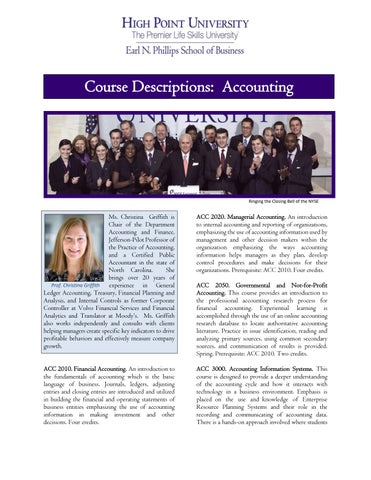
Ringing the Closing Bell of the NYSE
Prof. Christina Griffith
use technology in a simulated business experience. Spring. Prerequisite: ACC 2010. Four credits.
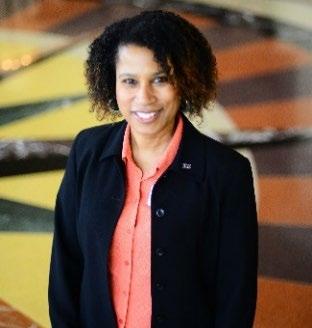
“My teaching style is very collaborative. I believe in giving students the chance to apply the tools they learn in class. Approaching the classroom in this manner allows students to test their knowledge along the way. I bring my experience in public accounting and management consulting to the classroom and allow students to bring their experiences, as well. College is about much more than learning text material. Students need to be able to think critically and communicate to be successful in today’s marketplace. They have plenty of opportunities to challenge themselves and grow in my classroom. As they near graduation, I ask students to describe their best lives ten years from now, and with that in mind, to look behind you and envision the steppingstones that will get you to that destination. I want students to have a plan.”
ACC 3010. Intermediate Accounting I. This course is the gateway for the in-depth study of generally accepted accounting principles and their theoretical basis including the process by which accounting standards are created. Also, students explore the elements and proper presentation of the income statement and the balance sheet. Discussion about and correct application of techniques used in accounting for short term financial assets and inventories is also offered. Fall. Prerequisite: ACC 2010 and ACC 3000. Four credits.
ACC 3020. Intermediate Accounting II. A continuation of the study of intermediate accounting concepts and principles. An understanding of accounting theory and practice which underlies statement preparation is emphasized through analysis and interpretation of financial statements. The practical application of accounting theory to the more difficult areas of proprietorship, partnership and the corporation is also emphasized. Spring. Prerequisite: ACC 3010. Four credits.
ACC 3040. Cost Accounting. Internal accounting and reporting of organizations emphasizing the use of accounting information used by management and their decision makers within the organization. The course focuses on the ways accounting information helps
managers as they plan, develop control procedures, and make decisions for their organizations. Prerequisites: ACC 3000 or co-requisite only. Four credits.
ACC 3060. Accounting Analytics. This course provides an introduction to the use of analytics in accounting. Students will learn how to leverage data analysis and technology tools to improve decisionmaking, financial reporting, and auditing processes in accounting. Prerequisites: ACC 3040 or C or better in ACC 2020; and BUA 1050. Two credits.
3300. VITA Basic. An experiential learning course that will prepare and enable students to participate in the Volunteer Income Tax Assistance (VITA) program sponsored and administered by The City of High Point Department of Community Development in partnership with the Internal Revenue Service (IRS). The VITA program provides free tax return preparation assistance for low to moderate income individuals (as defined by IRS guidelines). Students will receive instruction in the preparation and filing of basic tax returns for individuals and the IRS code of preparer ethics. Successful completion of the IRS’s certification exam for basic returns will qualify a student to work at VITA sites run by The City of High Point Department of Community Development. Spring. Two credits.
ACC 4020. Auditing. A study of the objectives and methods of independent Certified Public Accountants in exercising the attest function. Topics include the meaning and quality of evidence, development of audit programs, statistical sampling, audit reports, and auditor responsibilities. Fall. Prerequisite: ACC 3020. Four credits.

“Toprepareourstudents to become tomorrow’s businessprofessionals” is the mission statement for the Earl N. Phillips School of Business, which I use constantly as a guide for how each of my classes will be delivered as related to technical content and professional conduct. Delivering on the mission should result in each student I have the honor to work with being prepared for a successful transition to a post undergraduate environment in possession of a skill set that empowers them to be the best individual in their cohort on day one of their first job or graduate education.
Dr. Jo Lacy
Prof. Scott Davis
ACC 4030. Taxation. Study of the federal income tax system that emphasizes the theories, procedures and rationale associated with the taxation of individuals. Experiential learning is accomplished through the completion of a comprehensive tax return preparation problem using tax practice software that is commonly used in professional tax practice. Fall. Prerequisite: Junior standing. Four credits.
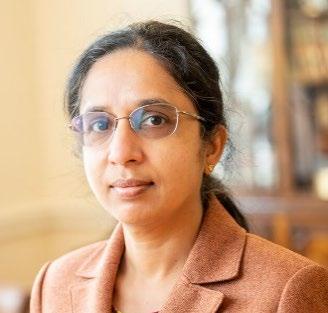
“My core teaching philosophy is to get students to want to learn, and I expect them to be on their toes at all times. Students feel comfortable coming to me for additional assistance outside of class. We sit down and look at the big picture in a pragmatic way. In the end, the students are very receptive to our conversations and leave feeling empowered and accountable. I am student success focused, encouraging my students to push themselves, particularly from a research standpoint. I help my students find the lessons to develop life skills from the course material that I hope will help them think more broadly with their general life planning.”
ACC 4040. Advanced Taxation. Study of the federal income tax system that emphasizes the theories, procedures and rationale associated with the taxation of corporations. Experiential learning is accomplished through the completion of a series of exam questions taken from past professional licensure exams such as the CPA exam and the IRS Enrolled Agent exam. Prerequisite: ACC 4030. Four credits.
ACC 4050. Mergers and Acquisitions. In-depth study of accounting theory, generally accepted accounting principles, and techniques involved in consolidated business entities. Prerequisite: ACC 3020. Four credits.
ACC 4090. Accounting Issues. Capstone course covering current accounting issues, not-for-profit accounting, administrative aspects of the CPA exam and integration of all parts of the accounting and general business curriculum. Prerequisite: ACC 3020 and 4020. Four credits.
ACC4101.LiteracyintheContentArea: AUD. This is an elective course that provides a deeper and more comprehensive study of professional standards in the content area of auditing. Students will use the knowledge gained in prerequisite course work to develop a more robust understanding of all areas associated with current auditing theory and practice. Prerequisite: ACC 4020 or permission of the instructor. One credit.
ACC4102. Literacyinthe Content Area: BEC. This is an elective course that provides a deeper and more comprehensive study of the professional standards in the contentarea of business environment andconcepts. Students will use the knowledge gained in prerequisite course work to develop a more robust understanding of all areas associated with current business environment theory and practice. Prerequisite: ACC 3040 or permission of the instructor. One credit.
ACC/EXP 4300. VITA Advanced. An experiential learningcourse that will prepare andenable students to participate in the Volunteer Income Tax Assistance (VITA) program sponsored and administered by The City of High Point Department of Community Development in partnership with the Internal Revenue Service (IRS). The VITA program provides free tax return preparation assistance for low to moderate income individuals (as defined by IRS guidelines). Students will receive instruction in the preparation and filing of advancedtax returns for individuals and the IRS code of preparer ethics. Successful completion of the IRS’s certification exam for basic returns will qualify a student to work at VITA sites run by The City of High Point-Department of Community Development. Prerequisites: ACC/EXP 3300 or permission of instructor. Spring. Two credits.
ACC 4444. Independent Study. Admission by permission of the Chair of Accounting and Finance to undertake an assignment planned in advance. Oneto fourcredits
ACC 4811. Student Internship. Students can earn between one and twelve credits for approved Accounting internships. However, in order to substitute an accounting internship for ACC 4090 Accounting Issues, students must earn ten or more credits. Every forty hours worked equate to one credit earned.
Dr. Premalata Sundaram