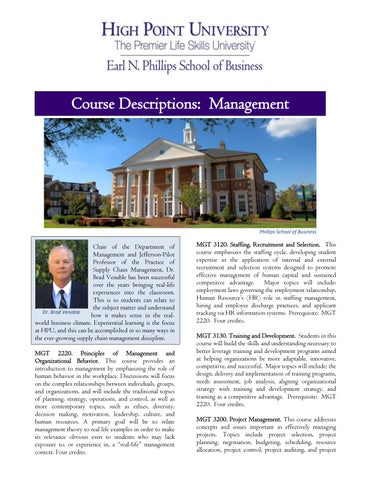

Course Descriptions: Management

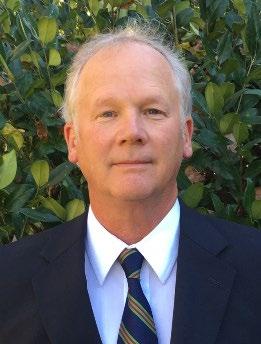
Chair of the Department of Management and Jefferson-Pilot Professor of the Practice of Supply Chain Management, Dr. Brad Venable has been successful over the years bringing real-life experiences into the classroom. This is so students can relate to the subject matter and understand how it makes sense in the realworld business climate. Experiential learning is the focus at HPU, and this can be accomplished in so many ways in the ever-growing supply chain management discipline.
MGT 2220. Principles of Management and Organizational Behavior. This course provides an introduction to management by emphasizing the role of human behavior in the workplace. Discussions will focus on the complex relationships between individuals, groups, and organizations, and will include the traditional topics of planning, strategy, operations, and control, as well as more contemporary topics, such as ethics, diversity, decision making, motivation, leadership, culture, and human resources. A primary goal will be to relate management theory to real life examples in order to make its relevance obvious even to students who may lack exposure to, or experience in, a “real-life” management context. Four credits.
MGT 3120. Staffing, Recruitment and Selection. This course emphasizes the staffing cycle, developing student expertise in the application of internal and external recruitment and selection systems designed to promote effective management of human capital and sustained competitive advantage. Major topics will include: employment laws governing the employment relationship, Human Resource’s (HR) role in staffing management, hiring and employee discharge practices, and applicant tracking via HR information systems. Prerequisite: MGT 2220. Four credits.
MGT 3130. Training and Development. Students in this course will build the skills and understanding necessary to better leverage training and development programs aimed at helping organizations be more adaptable, innovative, competitive, and successful. Major topics will include: the design, delivery and implementation of training programs, needs assessment, job analysis, aligning organizational strategy with training and development strategy, and training as a competitive advantage. Prerequisite: MGT 2220. Four credits.
MGT 3200. Project Management. This course addresses concepts and issues important in effectively managing projects. Topics include project selection, project planning, negotiation, budgeting, scheduling, resource allocation, project control, project auditing, and project
Dr. Brad Venable
Phillips School of Business
termination. Topics are viewed from a managerial perspective. Students completing this course will develop preliminary skills in the use of project management software. Also, successful students will develop the ability to apply learned concepts to real project environments. Prerequisite: MGT 2220. Four credits.

“I strive to be the kind of professor who challenges students, has a sense of humor, and provides a positive and safe classroom space for exploration and learning. I am rigorous but fair, creative but purposeful. My motivation is to help foster a classroom environment filled with collaborative learning, where students are willing to share and emboldened to take risks.”
MGT 3220. Leadership. In this course students will critically examine major theories of leadership/ followership through discussions of relevant research and practice. Emphasis will be given to contemporary theories and their application to the study of business leaders operating in the context of current political and societal issues. Additionally, students will be expected to evaluate their own strengths and weaknesses with respect to leadership and create individualized development plans to improve their leadership skills. Prerequisite: Sophomore standing and MGT 2220. Four credits.
MGT 3250. Inventory Management and Forecasting Analytics. Emphasis on aligning strategy, planning, and execution of forecasting and inventory into demand management, factory scheduling, distribution and supply planning, production capacity planning, sales and operations planning, integrated business planning, and enabling planning technologies. Forecasting topics covered in this course include a review of various forecasting techniques and forecast error measurement. Moreover, the linkage between forecasting and inventory control is discussed. As with inventory control, students will learn how to implement various forecasting techniques in Excel using Forecast X. Prerequisite: MGT 2220. Four credits.
MGT 3260. Supply Chain Process Improvement. The course focuses on the fundamental concepts, techniques, and tools for managing production and improving business processes across the supply chain. Students will gain an understanding of the strategic importance of process improvement, the need for fact-based management, and how to deploy process improvement tools in different parts of the supply chain. The students will be exposed to various approaches and techniques including Continuous Improvement, Kaizen, Total Quality Management, Six Sigma, and the Toyota
Production System (TPS). In addition, students will be given the opportunity to become Six Sigma ASQ Certified. Prerequisites: MGT 2220 and MGT 3280 and sophomore standing. Four credits.
MGT 3280. Operations and Supply Chain Management. This course is an introductory course in the theory and practice of Operations Management (OM) and Supply Chain Management. The course begins by emphasizing OM as an integral part of an organization’s competitive strategy. Next, qualitative and quantitative topics are discussed as they are employed in making both strategic and tactical level OM decisions. Topics include operations strategy, process design, forecasting, capacity planning, facilities location and design, scheduling, inventory control, quality assurance and project management. Students will be exposed to real-time OM decisionmaking events by participating in locally chosen goods or service-producing organizations. This very clear set of experiential learning opportunities will be presented to students in the form of a current case study of an issue with the chosen firm. The students conduct research within an assigned group and formally present it to the organization's representative as part of the capstone part of the course. Using a supply-chain context, topics are addressed in an integrated manner. By the end of this course, students will understand basic terminology, concepts, and techniques of OM and how these relate to supply chain management. This course satisfies the Experiential Learning requirement. Prerequisite: MGT 2220. Four credits. [EXPLN]
MGT 3300. Innovation Management. The focus of this course is the strategic management of innovation. The scope of the course includes the internal development of innovations and the acquisition of innovations through mergers, acquisitions, and alliances. Technical topics covered in both of those domains include planning, implementing, evaluation, and control. Managerial topics covered include personnel considerations, organizational structure, and organizational fit as they relate to managing innovation. This class would also be suitable for students interested in alliances and mergers & acquisitions. Prerequisite: MGT 2220. Four credits.

Prof. Jobe, joined the Phillips School of Business in the Spring of 2023. Prior to joining High Point University, he enjoyed a successful thirty-year healthcare career serving in multiple healthcare settings and working with not-for-profit healthcare systems. Through theses experiences, Professor Jobe is able to bring textbook theory to life by sharing practical real-world experiences.
Dr. Oliver Stoutner
Prof. Scott Jobe
MGT 3400. Work Teams in Organizations. Organizations are increasingly implementing teams as a way of organizing work; hence, the ability to lead and work effectively in teams is a competence that is highly valued in organizations. The purpose of this course is to develop students’ knowledge and skills related to effective teamwork and team leadership. Instruction will include an emphasis on team diagnostics and strategies to improve performance. We will focus on recent workplace trends (e.g., virtual teams, multicultural teams, high performance teams). Prerequisite: MGT 2220. Four credits.
MGT 3500. Service Management. Service firms are far more people-oriented because of their direct employee interaction with customers. The resulting variations in customer expectations present a challenge to the operations manager to effectively use resources in achieving customer satisfaction. The intent of the course is to provide students with the concepts and tools necessary to effectively manage a service operation. The strategic focus also provides entrepreneurially inclined students with the foundation to open their own service business. Topics include overall service strategy, the design of services, management of service operations, and an introduction to quantitative models for service management. Prerequisite: MGT 2220. Four credits.
MGT 3600. Introduction to Healthcare Management. This study-abroad course provides an introduction to the leadership, management, and organization of the healthcare industry. The content is broadly applicable to hospitals, healthcare systems, physician practices, insurers, state and federal government agencies, pharmaceutical/ medical device manufacturers, and public health organizations, whether for-profit or not-for-profit. The course design enables students to make sense of healthcare’s dynamic environment fraught with complex issues. Specifically, this course explores factors including environmental change, regulation, organizational culture, and organizational processes and structures that affect the way a manager carries out his/her role. The course will show students how to utilize key processes such as planning, decision-making, human resource management, and leadership to achieve goals. The course will also examine current and future challenges that healthcare managers face. Prerequisite: MGT 2220 or permission of the instructor. Four credits.
MGT 3620. Leading and Managing in Healthcare Organizations. This course provides the management functions and leadership processes essential in healthcare organizations, including in-depth review of managerial skills and organizational practices for successful performance. The course will emphasize how health managers solve problems, make decisions, and conduct strategic planning. Students will study the roles played by
quality, productivity, and technology in establishing and maintaining a competitive position in the healthcare marketplace and how managers seek to manage the complex human relationships that exist within healthcare organizations and health systems, as well as the influence of other agencies and external stakeholders. Prerequisite: MGT 3600. Four credits.
MGT 3640. Healthcare Delivery: Systems and Policies. This course provides an understanding of the organization, delivery, and financing of healthcare; the business side of healthcare, including workforce issues, payment systems, and cost control; issues in the healthcare industry including the effect of government policies; and the opportunity for students to critically evaluate current changes in healthcare policies in the U.S. and other countries and the effect of such changes on the quality of patient care. Prerequisite: MGT 3600. Four credits.

“Using real-world examples and case studies taken from 25 years of experience at the top tier of the nation’s largest organizations, I place students in the role of decision-maker, allowing them to learn the real-world techniques they will need to make an immediate impact in the business world. I also spend a significant amount of time sharing with students the skills needed to successfully develop their careers. This includes topics such as how to cultivate mentors, honing their communication skills, and successfully navigating organizational cultures. I expose students to the opportunities and teach them the skills needed to be successful whether within hospitals, physician practices, insurers, state/federal government healthcare agencies, or pharma/medical device manufacturers. manufacturers.”
MGT 3660. A Global Perspective of Different National Healthcare Systems. The purpose of this course is to Dr.
MGT 3650. Introduction to the Funding of Healthcare Delivery. This course focuses on introducing the key financial management principles, concepts and decisions that create value for healthcare organizations. The course covers a broad range of topics, including an overview of the healthcare system; reimbursement methodologies; economic value and market value added; billing and collections; and the influences of health status, insurance coverage, and income on healthcare delivery. Special emphasis is placed on the government as a demander of medical care services. Changes in Medicare and regulation of managed care are among the public policy issues to be addressed. Prerequisite: MGT 3600. Four credits.
Dave Tofanelli
enhance the knowledge and understanding of different international healthcare systems. We will compare the healthcare system in the United States to the healthcare systems of several other developed countries around the world, with a focus on the healthcare system of the United Kingdom. This course includes a Maymester studyabroad experience. Four credits. [EXPLN]
MGT 3670. Human Resource Management in Health Service Organizations. This course provides an overview of human resource management, particularly the functions, structure, laws, and principles of effective human resource management in the health services industry. Instruction emphasizes the management of healthcare personnel focusing on the unique nature of healthcare specialization, professional licensure, and employee productivity and satisfaction. Additionally, the course addresses current issues in human resource management, such as managing health labor shortages. Prerequisite: MGT 3600. Four credits.
MGT 3700. Crisis Management and Leadership. Crisis Management is the process by which an organization deals with major unpredictable events that threatens to harm the organization, its stakeholders, or the general public. The elements most common to crises are: a threat to the organization, the element of surprise, and a short decision time. Many business owners and managers feel that crises are limited to natural disasters not realizing that many other types of crises can affect their organization. This course will examine leadership, cooperation, and conflict in times of crisis. Emphasis will be placed on understanding the key dynamics that influence the way that decision makers perceive and respond to crises, as well as the organization and interorganizational dynamics that impact crisis management. Case studies will be used to give students a realistic understanding of the limitations and opportunities that arise in high-pressure crisis management situations. Prerequisite: MGT 2220 or permission of the instructor. Four credits.
“Healthcare Management is a dynamic and rewarding business sector with a wide variety of available employment opportunities for our High Point University students. We are training and preparing the healthcare leaders of the future with the courses and programs we offer here in the Phillips School of Business.”
dent. Students will gain a general overview of the process and effect of globalization in contemporary business, along with an introduction to theories, concepts and skills relevant to managing effectively in today’s global environment. Students will be challenged to integrate knowledge they have gained from other business core courses and apply their accumulated knowledge to the international business landscape. Prerequisite: MGT 2220. Four credits.
MGT 3950. Construction Management. This course is an introductory class in the theory and practice of professional construction management. The course will introduce the industry, the stakeholders, and processes in modern construction management. Topics include the design, bid, and build process, construction manager at risk concept, contracting, project management, and risk management. By the end of this course, students will understand basic terminology, concepts, and techniques of construction management and how these relate to other business disciplines such as business law, project management, and operations/supply chain. Prerequisite: MGT 2220. Four credits.

“The field of Supply Chain Management is dynamic and presents a multitude of global career opportunities. Using real-world case studies, I facilitate an interactive learning environment that encourages open discussions and collaborative problem-solving. In addition, my teaching methods include experiential learning through field trips, simulations, and data-driven decision-making, allowing students to gain practical experience and develop essential skills.”

MGT 3800. Cross-Cultural Management. This course focuses on the challenges and opportunities associated with organizational management in the global environment. Cross-Cultural Management is intended to be a foundational course for the undergraduate business stu-
MGT 4050. Global Logistics. This course addresses the physical supply, in-plant movement and storage, and physical distribution that comprise global logistics systems. Based on readings, class discussions, cases, and practice problems, students will be able to link logistical management decisions with the attainment of competitive priorities. While the primary focus is on handling products in a manufacturing context, the use of logistics in non-profit organizations and service industries will be discussed. Prerequisites: MGT 2220 and MGT 3280. Four credits.
MGT 4060. Sourcing and Procurement Management. This course focuses on the process of analyzing how organizations can most effectively secure outside goods and services. The student will gain an understanding of the overall value chain as well as the mutually beneficial relationship between buyer and supplier. The student will learn the analytical tools necessary to negotiate with
Dr. Greg Page
Dr. Jason Williams
suppliers in a competitive bid or multi-party negotiation. Students will also understand how to track the results of contracts, sustain performance, and mitigate risk. Prerequisite: MGT 3280 and junior standing. Four credits.
MGT 4100. Human Resource Strategy. The purpose of this course is to review and analyze practices, trends, and problems of human resource management (HRM). Research shows that how managers implement and maintain HRM practices can impact organizational productivity, quality of work life, and profits. The goal of this course is to prepare the student to use HRM practices effectively. Topics include, but are not limited to: HRM strategy, employment planning, regulation, job analysis and design, performance assessment, recruitment and selection, training and development, employee relations, and compensation. Prerequisite: MGT 2220 and Junior standing, or permission of the instructor. Four credits.
MGT 4200. Change Management. This course is designed as a foundation course for all students. Students will be exposed to theories and practical examples of management and organizational behavior in the context of change. The focus of this course is on change management and is designed for students regardless of their areas of specialization. The content of this course will meet the needs of those who would benefit from a framework for understanding the relationship between change management, organizational behavior, and organizational effectiveness. Prerequisite: MGT 2220. Four credits.
MGT 4444. Independent Study. Admission by permission of the Management Department Chair to undertake an assignment planned in advance. One to four credits.
MGT 4690. Healthcare Strategic Management. To maintain a competitive advantage in a highly dynamic environment, it is necessary that healthcare managers possess the requisite knowledge, skills, and abilities to favorably position their organizations for success. This requires healthcare leaders to promote strategic thinking, create well-developed strategic plans, and engage in strategic management. This course will enable students to critically examine organizational, strategic business unit,
and functional-level vision, mission, and values statements; analyze and draw meaningful conclusions from internal and external assessments using a variety of established tools and techniques; formulate well-conceived organiza tional goals, objectives, and strategies; and present tactical implementation and monitoring plans. Students will also be exposed to the processes involving data analytics, planning, and implementation designed to favorably position an organization to achieve and sustain a competitive advantage in the market. Prerequisite: Junior standing and MGT 3600 Four credits.

“I particularly enjoy situations when I can work one-on-one or in small groups with students. I incorporate small group work, cases, and simulations into the classroom because small groups increase one-on-one interactions with students, and it helps me to get to know each student better.
High Point University provides a multitude of opportunities for students to learn and practice the skills they will need to be successful in a modern workplace.”
MGT 4811. Internship for Credit. One to twelve credits.
MGT 4990. Strategic Management. The focus of this course is on the competitive strategy of the firm in both domestic and international settings. This course integrates skills and information from specialized business disciplines such as Marketing, Finance, Accounting, and Operations into an integrated decision-making process. Students act in the role of key decision makers by analyzing data from the specialized business disciplines, determining the strategic position of the firm, and solving problems related to the development and maintenance of a firm’s competitive advantage. Students develop an understanding of the key strategic issues through theoretical readings, and case study analysis (and/or simulations). Prerequisites: Senior standing and FIN 3010 or simultaneous enrollment, or permission of instructor. Four credits.
Dr. Paul Forshey

At High Point University, every student receives an extraordinary education in an inspiring environment with caring people.®