
Course Descriptions: Finance

FIN 2010. Personal Financial Planning. This course provides an overview of personal financial planning and covers the following topics: budgeting, saving, tax planning, managing credit, home buying, vehicle purchasing, selecting insurance, investing, retirement planning, and estate planning. The practical application of concepts will be emphasized. Grade Pass/Fail. Four credits.

Dr. Lifland is Director of the Finance Program and Carl Maneval Smith Business Professor of Accounting and Finance. He integrates a 21st century skill set into all classes knowing that technological skills are just as important as finance skills in the workplace. He believes in teaching the pragmatic applications of finance in everyday life, incorporating advanced levels of undergraduate student research into course expectations. Students are exposed to and expected to utilize quantitative investment tools. These include probability distributions, sampling, hypothesis testing, correlation and regression, time series analysis, and portfolio concepts.
FIN 2881, 3881, 4881. Special Topics. Variable credit. May be repeated.
FIN 3001. Financial Certification Preparation. This course is designed to prepare students to obtain industry recognized financial certifications that will help set HPU students apart in their career search. The initial offering would be the Securities Industry Essentials (SIE) exam which is a “gateway” exam for those interested in careers in the Financial Services Industry. Two credits.
FIN 3010. Financial Management. A study of principles of financing a business enterprise, with the emphasis on the modern corporation. Attention is given to the analyses of the major financial statements as a means to determine the present as well as predicting the future financial condition of a corporation. This information is explained in a cash flow framework in order to determine the value of the firm. The ability of the financial manager to measure and evaluate sources of capital is addressed. The process of using an investment banker to access proper markets, bond and/or stock, is reviewed. Attention is also given to the financial manager’s decision-making role in the Capital Budgeting process. Prerequisite: Sophomore standing and ACC 2010. Four credits.
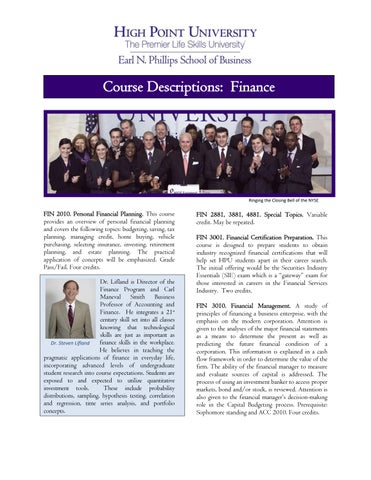
Ringing the Closing Bell of the NYSE
Dr. Steven Lifland
FIN 3015. Corporate Finance. This course serves as an introduction to corporate business finance for finance majors and minors preparing for upper-level course work. The primary objective is to provide the student an in-depth exposure to key elements of corporate finance, notably how corporations manage their balance sheets in the short term in working capital management, and over the long term in maintaining an optimum capital structure. Topics covered include capital budgeting and forecasting cash flows, working capital management, financial leverage, variance analysis, corporate governance, cost of capital, capital structure, dividend and share repurchase policy. Prerequisite: FIN 3010 or ACC 3010 with a grade of C or higher Four credits

Tom James is Professor of the Practice of Finance, who brings over 30 years of experience in corporate finance combined with 10+ years of experience in wealth management. Mr. James worked for major corporations including General Foods Corporation, Bristol-Myers Squibb, and Sealy Inc, where he held senior management positions including Vice President of Planning, Vice President of Business Development, and Vice President –International Administration, Mergers & Acquisitions. Following corporate life, Mr. James began working in wealth management as a Senior Wealth Strategist and holds several securities licenses. He also holds professional designations as CERTIFIED FINANCIAL PLANNER® (CFP®) professional, and a Certified Investment Management Analyst® (CIMA®) advisor. At the same time Mr. James began working in wealth management, he began teaching, first as an adjunct at High Point University and then on a full-time basis in 2016. Since then, he has taught Financial Management, Fixed Income, Real Estate Investment Analysis, and Corporate Finance, providing context and examples of real-world applications of course content to better prepare them for success post-graduation. He also serves as Co-Advisor to the Investment Club and enjoys mentoring his advisees and other students.
FIN 3020. Investment Analysis. This course emphasizes fundamental security analysis as a tool for debt and equity valuation. The essential financial assets of stocks, bonds, and derivatives are analyzed. The student is exposed to what comprises the essential features of the instrument, the possible rewards, risks, and basic determinants of value. Students learn about margin trading and short selling as well as technical
equity analysis. Students participate in a stock market portfolio simulation where they learn how securities are bought and sold, and how security markets operate. Excel is used extensively in the security analysis. Prerequisite: FIN 3010 or FIN 3015 with a grade of C or higher, or permission of the instructor. Four credits.
FIN 3025. Fixed Income Securities. This course will provide an overview of fixed income markets and instruments within those markets. Focus is on the valuation and analysis of fixed income instruments and the roles of different participants within the fixed income markets. The course is focused on the concepts and tools that are useful to managers and investors who want to use these securities, whether for investing, hedging, market-making, or speculating. This course will cover the mathematical foundation for studying fixed income securities and will thus require a moderate level of quantitative skill. Prerequisite: FIN 3010 or FIN 3015 with a grade of C or higher, or permission of the instructor. Four credits.
FIN 3030. Real Estate Investment Analysis. Investing in real estate includes the purchase of property directly as an individual or with other investors in the stock of publicly traded real estate companies. Specifically, students learn about residential properties, income producing properties, Real Estate Investment Trusts (REITs) and Real Estate Exchange Traded Funds (ETFs). Areas of study include market factors, riskreturn tradeoff, valuation techniques, financial leverage, tax considerations, and financing alternatives. Excel is used extensively in the asset and security analysis. Additional software such as Argus will also be introduced and used for several analyses. Prerequisite: FIN 3010 or FIN 3015 with a grade of C or higher, or permission of the instructor Four credits.

Dr. Ken McEwan is Assistant Professor of Finance with over 30 years of experience in the defense and aerospace industry that includes roles such as Director of Finance Business Partnering, Vice President of Finance, Financial Controller, and Business Manager. He is also a published author whose awardwinning article titled “Financial impact of using EUR call options to hedge accounts receivables,” published in the International Journal for Business and Economic Development. Dr. McEwan mixes his business world experience with business theories and research to enhance the classroom experience and improve the student’s career readiness.
Prof. Tom James
Dr. Ken McEwan
FIN 3035. Financial Derivatives. This course will introduce students to the basic theory of financial derivatives and their uses in risk management by corporations and individual investors. Emphasis will be on designing specific risk management strategies using financial derivatives such as options, futures, forward contracts and swaps. Topics covered include the historical development and institutional features of the derivatives market, derivatives’ pricing models, arbitrage conditions and hedging strategies. Prerequisite: FIN 3010 or FIN 3015 with a grade of C or higher, or permission of the instructor. Four credits.
FIN 4030. Financial Modeling. The course emphasizes fundamental business analysis through the utilization of financial models. It incorporates and builds upon the financial concepts that students have learned in their prior course work. The methodology utilized in this course is technology driven to meet real world expectations. The essential techniques related to bond and equity valuation, portfolio management, the pricing of derivatives, capital/cash budgeting, cost of capital, capital structure, financial statement analysis, free cash flows, DuPont Analysis, and the Altman-Z Bankruptcy Score are reviewed. Students will learn to integrate Excel spreadsheets with major financial software found in the current business environment. Examples of the financial software are Monte Carlo Simulation, Compustat, Factset, Black-Sholes Option Pricing, FINVIZ and FINRA. Prerequisite: FIN 3015 with a grade of C or higher, or permission of the instructor. Four credits.
FIN 4444. Independent Study. Admission by permission of the Chair of Accounting and Finance to
undertake an assignment planned in advance. One to four credits.
FIN 4811. Internship for credit. One to twelve credits.

Dr. Jim Wehrley, Associate Professor of Finance, joined HPU in 1994. Over this time period, he has taught finance, marketing, management information systems, and career readiness courses. Currently, his teaching focus is finance, including real estate investments. Whatever the course, Dr. Wehrley is committed to “helping students help themselves.” His strong belief is that students have endless opportunities as long as they execute both inside and outside the classroom.
Ultimately, Dr. Wehrley bases his success on the success of students. Helping students become successful is his focus, which guides his priorities.
As a teacher, he has received multiple teaching awards including the Meredith Clark Slane Distinguished Teaching / Service Award, the Alpha Chi teaching Award, and the Exemplary Teacher Award presented by the General Board of Higher Education and Ministry of the United Methodist Church.
Before pursuing a career in academia, Dr. Wehrley worked in commercial lending and commercial real estate lending at First Florida Bank in Florida and in Finance for Standard & Poor’s in Colorado.
At High Point University, every student receives an extraordinary education in an inspiring environment with caring people.®
Dr. Jim Wehrley