BY KEVIN SINGER*
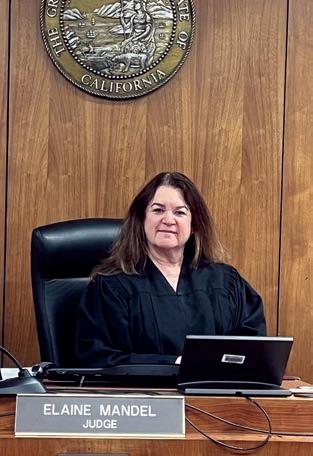
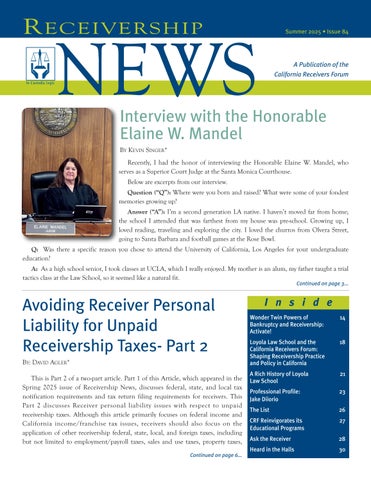
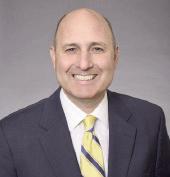
Recently, I had the honor of interviewing the Honorable Elaine W. Mandel, who serves as a Superior Court Judge at the Santa Monica Courthouse.
Below are excerpts from our interview.
Question (“Q”): Where were you born and raised? What were some of your fondest memories growing up?
Answer (“A”): I’m a second generation LA native. I haven’t moved far from home; the school I attended that was farthest from my house was pre-school. Growing up, I loved reading, traveling and exploring the city. I loved the churros from Olvera Street, going to Santa Barbara and football games at the Rose Bowl.
Q: Was there a specific reason you chose to attend the University of California, Los Angeles for your undergraduate education?
A: As a high school senior, I took classes at UCLA, which I really enjoyed. My mother is an alum, my father taught a trial tactics class at the Law School, so it seemed like a natural fit.
Continued on page 3...
BY: DAVID AGLER*
This is Part 2 of a two-part article. Part 1 of this Article, which appeared in the Spring 2025 issue of Receivership News, discusses federal, state, and local tax notification requirements and tax return filing requirements for receivers. This Part 2 discusses Receiver personal liability issues with respect to unpaid receivership taxes. Although this article primarily focuses on federal income and California income/franchise tax issues, receivers should also focus on the application of other receivership federal, state, local, and foreign taxes, including but not limited to employment/payroll taxes, sales and use taxes, property taxes,
Continued on page 6...
BY DOMINIC LOBUGLIO*
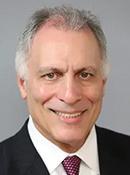
Dominic LoBuglio
*Dominic LoBuglio is a CPA and has provided forensic accounting and taxation services to receivers for 40 years. He has served CRF since its inception as a board member and officer for LA/OC and the State.
We have lots of news to share in this issue as we are halfway through the year. Our Board of Directors and administrative team have been busy with education programs, publishing a new directory, and planning our next symposium.
Program Chair Oren Bitan has provided a summary of our programs to date and programs planned for the remainder of the year followed by our eleventh Loyola symposium in January. Richard Ormond has written two articles related to our relationship with Loyola Law School, one describing our longstanding relationship with the school and one providing a rich history of the school.
David Agler has written Part 2 of Avoiding Receiver Personal Liability for Unpaid Receivership Taxes. It will serve you well to keep both parts close at hand as these articles provide a summarized comprehensive analysis of the topic replete with authoritative support. David will participate in a program panel on taxation on August 20 which will provide you with an opportunity to submit questions on this topic.
Ben King and Mia Blackler attended the annual insolvency conference presented by the California Bankruptcy Forum and describe the two excellent programs presented by CRF at this conference.
We also feature two interesting interviews. Kevin Singer has provided a discussion with the Honorable Elaine W. Mandel, a Superior Court Judge at the Santa Monica Courthouse. Judge Mandel is a second-generation Los Angeles native. She attended UCLA for undergraduate studies (in history and art history) and law school. This month’s member profile features Jake Diiorio, a CRF board member and receiver with J.S. Held. Jake is from New York where he began his career working in audit for Ernst & Young before moving in 2010 for a Southern California position with the Stapleton Group.
As always, Peter Davidson delves into detail addressing several receivership case issues in Ask The Receiver, and Ryan Baker reports what he has Heard in the Halls.
We are proud to distribute our 2025-2026 Membership Directory which all members should have received in the mail, with a digitized version coming soon. Alex Kerstner and Derek Kozaites of Group Concepts provided administrative support, and Regina Altamirano did a beautiful job graphically designing this directory.
On behalf of the CRF Board of Directors, I thank our advertisers who are supporting the 2025-2026 Membership Directory and this issue of Receivership News.
If you missed any issues of Receivership News, downloads for most back issues are available on CRF’s website: crf.memberclicks.net/receivershipnews-articles . Readers are encouraged to cite, copy, and use Ask The Receiver and Receivership News articles and information.
Wishing you a safe and fun-filled summer and continued business success for the remainder of 2025.
Receivership News
Published by California Receivers Forum PO Box 10 Manhattan Beach, CA 90267 714-632-6800 • Receivers.org
Publisher Dominic LoBuglio dominic@lscpa.net
Co-Editors
Blake Alsbrook balsbrook@ecjlaw.com
Michael Muse-Fisher mmusefisher@buchalter.com
Associate Editor
Craig Collins
Associate Publishers
Mia Blackler
Kevin Singer
Contributing Columnists
Ryan Baker Heard in the Halls
Peter Davidson Ask the Receiver
Officers
Benjamin King Chair
Mia Blackler Chair-Elect
Ryan Baker Treasurer
Gary Rudolph Secretary
Oren Bitan
Program Chair
Michael Muse-Fisher Immediate Past Chair
Graphic Design & Layout
R.R. Altamirano, LLC
Production Services
Group Concepts
Web Services
Group Concepts
CRF DIRECTORS
Bay Area
Mia Blackler
Gerard Keena
Los Angeles/
Orange County
Blake Alsbrook
Kyra Andrassy
Ryan Baker
Oren Bitan
Jake Diiorio
Steve Donell
Michael Gomez
Teresa Gorman
Sunny Han-Jeon
Benjamin King
Dominic LoBuglio
Richard Munro
Richard Ormond
Kevin Singer
David Weinberger
Jackson Wyche
Sacramento Valley
Mike Brumbaugh
Michael Muse-Fisher
Scott Sackett
San Diego
Daniel Miggins
Gary Rudolph
Michele Vives
Receivership New s is published by the California Receivers Forum, a not-for-profit association. Articles in this publication express the opinions of their authors and do not necessarily reflect the views of the directors, officers or members of the California Receivers Forum. Articles are intended as a source of general information and should not be construed as specific advice without further inquiry and /or consultation with professional counsel.
© Copyright 2025. California Receivers Forum. All rights reserved.

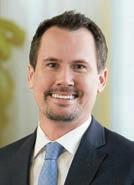
Michael Muse-Fisher
*Michael MuseFisher is a Shareholder at Buchalter, a Professional Corporation. He regularly represents receivers across all receivership types.
BY MICHAEL MUSE-FISHER* AND BLAKE ALSBROOK*
We’re into the dog days now, and nothing makes for better poolside summer reading than Receivership News . Fan of biographies? We have you covered – Kevin Singer ’s interview with Hon. Elaine Mandel is a fascinating look back through the judge’s life, with some helpful tips on receivership practice. And don’t miss our spotlight on Jake Diiorio, one of CRF’s favorite receivers. Are you in the mood for a thriller? David Agler’s article on personal tax liability will have even the most seasoned receivers waking up in a cold sweat.
Prefer historical nonfiction? Mia Blackler and Ben King provide a fascinating look at the events surrounding CRF’s trojan horse strategy to infiltrate and eventually conquer our bitter rival, the California Bankruptcy Forum, at their 2025 Annual Insolvency Conference. And, speaking of history,
Rich Ormond has blessed us with a pair of articles detailing CRF’s favorite law school and partner, Loyola! Are you a planner?
Oren Bitan updates us on all things education for 2025 and gives an exciting look forward to the event of the century –
Loyola XI!!
Last but not least, I know there are plenty of our readers out there – Michael Muse-Fisher included – who like nothing better than a good ole gossip rag. Ryan Baker and Peter Davidson scratch the itch with their always risqué and never dull “Heard In The Halls” and “Ask The Receiver” installments. Who could forget Peter’s last installment, where he addressed the question whether receivers have quasi-judicial immunity for murder? Apparently, yes! No matter which way you cut it, this Summer Edition sizzles.
All publishing and editorial decisions, including the publishing and placement of advertising content, are reserved for Receivership News based upon the Receivership News editors’ and publisher’s exclusive judgment and sole discretion. Such decisions are based on multiple factors, including, but not limited to, the content, style, professionalism, format, nature of material, timeliness, space limitations, and relevance to the Receivership News recipients, taking into consideration the California Receivers Forum’s mission. The mission is to provide a forum for open communication and education concerning all legal, procedural and administrative aspects of judicially appointed receivers and to raise the level of professionalism in this area through education of members and dissemination of information (both for the courts and within the membership).
Judge Mandel...
Continued from page 1.
Q: As an attendee of the University of California, Los Angeles, what areas of study and activities were you most passionate about in your undergraduate studies?
A: I majored in history and art history. I enjoyed learning how the history of the time was reflected in the art produced.
Q: Did you know from an early age that you were going to pursue law?
A: My father was an attorney, and dinnertime conversations often centered on the people he represented and was able to help. I saw how meaningful that was to him, and it made an impression on me. When I was 5 years old, my mother took me to the Stanley Mosk Courthouse to see my father give a closing argument. From then on, it was pretty clear I was going to be an attorney.
Q: I see you continued on at the University of California, Los Angeles to pursue your Juris Doctor. Was
that your top pick and was there a professor who made a lasting impression on you and why?
A: I knew I was going to practice in LA, so I wanted to go to law school here. I applied to UCLA and one other school across town. For a life-long Bruin, the choice was clear.
Q: After graduation, you worked as an attorney at Mudge Rose Guthrie Alexander & Ferdon from 1992 to 1993, and from 1993 to 2000 you were an attorney at Stolpman, Krissman, Elber, Mandel and Katzman. What kind of matters did your practice focus on at each of these law firms?
A: At the time, I thought joining a large NY-based firm would be best for my career. I quickly realized I wanted to work on cases that felt more personally meaningful. Working with my father and his partners at the Stolpman Krissman firm was a wonderful opportunity to help
Continued on page 4...
from page 3.
individuals obtain compensation after they had been terribly injured. It was wonderful to work with and learn from my father on a daily basis for seven years.
Q: After working in private practice for 17 years, what motivated you to serve as a Superior Court Judge? Were there any specific experiences during your time as an attorney that helped prepare you for this position?
A: I was raised in a family where giving back to the community was valued. My friend and mentor the late Justice Paul Boland suggested I consider applying to be a judge, and a lightbulb went off. Though I enjoyed practice, I thought being a judge would enable me to serve the broader community in a meaningful way. As an attorney, I represented individuals and heard how their experiences impacted them directly. I try to apply the empathy I developed during my practice to dealing with many different types of litigants, over many disciplines for the past 17 years as a judge.
Q: I see you are a board member for the Consumer Attorneys Association of Los Angeles and the Women Lawyers of Los Angeles. How did you become involved with these organizations and what notable action or events have you been involved with or supported?
A: As an attorney, I was involved in various legal organizations. I am proud of my work as education chair of the Consumer Attorneys, organizing the annual Las Vegas convention and MCLE programming, as well as serving as an editor of the group’s magazine. I chaired the Dialogues on Freedom program while on the LACBA Board, bringing discussions about civil liberties to local high school classes. As a WLALA board member, I enjoyed working on programs to mentor younger lawyers.
Q: In 2009, Governor Arnold Schwarzenegger appointed you to be a Superior Court Judge. Did you have an opportunity to meet the Governor and what were your impressions of him?
A: Sadly, no. But if I did, I would thank him for his confidence in me.
Q: Since your 2009 appointment, what types of cases have you been primarily handling?
A: I have been assigned to a civil independent calendar court for the past 9 years, first in Van Nuys and now in Santa Monica. Previously, I sat in the mental health court,

handling sexually violent predator cases, writs on involuntary psychological holds (WIC 5150, 5250) and competency matters for 4 years. My first assignment was a misdemeanor trial department at the Metropolitan Court.
Q: What are your general thoughts on appointing Court Receivers?
A: I appoint receivers only when necessary. Sometimes, the parties can agree upon a sale and work out details and logistics amongst themselves. Sometimes, they cannot. If that is the case, I appreciate that a receiver can be a neutral arbiter of disputes amongst the parties and make choices not influenced by the emotions of litigation. Also, an experienced receiver can help maximize a property’s value, which benefits all parties.
Q: What are some of the factors that persuade you to an appointment of Court Receiver or Partition Referees?
A: I am more likely to appoint a receiver if the issues are too complex for the parties to address on their own or if the relationship of the parties is such that it is clear that they need a neutral to step in and take control of a situation.
Q: What qualifications do you like to see in the receivers that you appoint to your cases?
from page 4.
A: Experience, experience and experience. I want receivers who are real estate and business experts. I want to see a well-constructed plan, so I have a level of confidence that the receiver can execute on that plan to preserve (and maximize) the asset’s value. Of course, I also want a receiver who communicates well with the court. Depending on the asset, experience in the field, such as business or real estate, would be helpful.
Q: What are your thoughts on ex parte motions to appoint a receiver?
A: I prefer noticed motions. In my experience, it is rare that a receiver would need to be appointed so quickly that the motion has to be brought on an ex parte basis. The parties, or at least one party, typically know a receiver should be appointed for enough time to bring a noticed motion. However, if there is an urgency, such as a pending foreclosure, ex parte relief might be appropriate.
Q: On motions to appoint receivers, what types of arguments tend to be most persuasive to convince you to appointment a court receiver?
A: I want to know (1) why a receiver should be appointed and (2) why the proposed receiver is the right person for the appointment. Convincing on those issues is what’s required. There are no “magic words” — just answer those questions.
Q: Once you have appointed a receiver, how much communications and updates would you like to receive from your receiver?
A: I typically set return dates with a status report to be filed in advance. I also want to be kept informed if something urgent or unexpected occurs. Under those circumstances, I expect the receiver to ensure the matter is advanced on the court calendar.
Q: What is your position on receivers bringing ex parte motions when there are urgent issues that could impact the receivership estate?
A: Absolutely — if there is an emergency or change of circumstance that needs to be addressed ASAP. The receiver’s job is to manage and maintain assets; if they fail to bring issues before the court quickly, there could be significant losses or other negative consequences.
Q: When do you want to see receivers who are not attorneys retain counsel?
A: When there are specialized issues the receiver can’t
address without counsel. But I generally don’t think it’s necessary.
Q: What is the one piece of advice you’d like to share with anyone that is going to appear before your Department?
A: Be prepared! Know your case.
Q: What do you like to do when you are not working as a Judge?
A: I love traveling with my family, cooking with my daughter, entertaining and playing with our rescue greyhounds.

*Kevin Singer has been a Court Receiver for the last 25 years and served in over 600 cases. He is also the President of Receivership Specialists and serves as a Court Receiver, Trustee, Referee and Provisional Director throughout the United States. Contact: Dennis Gemberling

from page 1.
excise taxes, withholding taxes, transfer taxes, gross receipt taxes and fees, and value added taxes.
As discussed in Part 1, a receiver that is in control or possession of all or substantially all of the assets of the Receivership Entities, steps into the shoes of the receivership estate and the Receivership Entities for federal income and California income/franchise tax purposes. The receiver also assumes the powers, rights, duties, and privileges of such taxpayer Entities with respect to the taxes imposed by the Internal Revenue Code and the California Revenue and Taxation Code. A receiver that is in control or possession of all or substantially all of the assets of the Receivership Entities is generally required to file federal income tax returns under IRC Section 6012(b)(3) and

California income/franchise tax returns and pay applicable federal income and California income/franchise taxes for the Receivership Entities for the receivership period and for pre-receivership periods, although it is not uncommon to see appointment orders that seek to relieve the receiver of such duties.
Section 959(b) of Title 28 of the United States Code (“USC”) requires a trustee, receiver or manager appointed in any case pending in any court of the United States to manage and operate the property in his possession according to the state laws in which such property is situated in the same manner as the owner or possessor of such property. Section 960(a) of Title 28 of the USC provides that officers and agents conducting any business or liquidating a business or its assets under authority of a United States court are subject to all federal, state and local taxes applicable to such business to the same extent as if it were conducted by an individual or corporation.
A receiver is generally not personally liable for unpaid taxes of an insolvent receivership that does not have sufficient assets to pay such taxes. However, depending on the facts and circumstances of the receivership case a receiver can be personally liable for unpaid receivership tax liabilities where: (1) under federal, state, or local tax laws the receiver is obligated to pay such receivership tax liabilities, including as a responsible person, assignee, or transferee successor; (2) the receiver’s failure to pay taxes is attributable to the receiver’s breach of his or her receiver fiduciary duties and obligations to preserve the assets of the receivership estate and to pay such taxes; (3) the failure to pay such taxes by the receiver is due to the receiver’s failure to comply with federal, state, or local tax liability payment priority laws such as when the receiver of an insolvent receivership uses available receivership assets to pay lower priority claims rather than higher priority tax claims; (4) the receiver fails to honor and pay tax with respect to tax levy notices, tax liens, tax claims, or comply with other government tax collection actions; or (5) the receiver fails to comply with court orders or distribution/payment plans requiring the payment of taxes, or agreements with tax authorities to pay taxes.26
In Holywell v Smith, supra , a trustee of a bankruptcy liquidating trust that received the assets of the bankrupt
Continued from page 6.
debtors (4 corporation debtors and an individual debtor) failed to file federal tax returns for the debtors and failed to pay federal tax owed by such debtors. The trustee distributed the trust’s assets to bankruptcy creditors other than the IRS.
The Supreme Court held that the liquidating trustee was an “assignee” of the debtors’ assets within the meaning of IRC Section 6012(b)(3) (which section also applies to receivers and bankruptcy trustees) with respect to the corporate debtors and a fiduciary under IRC Section 6012(b)(4) with respect to the individual debtor, that was required to file federal income tax returns of the transferor debtors. Since the trustee was required to file federal income tax returns for the transferor debtors under IRC Section 6012 (b)(3) and (b)(4), the trustee assignee/fiduciary was required under IRC Section 6151 to pay the transferor debtors’ unpaid federal tax liability.
Section 959(a) of Title 28 of the USC provides trustees, receivers or managers of any property may be sued, without leave of the court appointing them, with respect to any of their acts or transactions in carrying on business connected with such property. In In re Texas Stands, Inc., supra, the Fifth Circuit Court of Appeals held that a Chapter 11 liquidating trustee was personally liable for Texas sales tax liability as a responsible person in control of the debtor’s assets. The trustee attempting to keep the debtor company’s restaurants operating after a plan of reorganization had been confirmed, failed to timely pay Texas sales tax in violation of the provisions of the plan of reorganization and Texas law. The Fifth Circuit held that while Sections 959 and 960 of Title 28 of the USC do not expressly address trustee personal liability, such Sections are “fully consistent with holding trustees personally responsible for their professional conduct to the same extent as any other actors under the law.”
In In re San Juan Corporation, supra, the bankruptcy court granted leave to the United States to file suit on behalf of a Chapter 7 replacement trustee against a previously appointed and dismissed operating Chapter 11 Trustee for unpaid federal taxes accrued during the debtor’s Chapter 11 bankruptcy. The Chapter 11 trustee was found by the court to have breached his fiduciary duty and responsibilities to the debtor’s estate by willfully and deliberately disregarding
the bankruptcy estate’s best interests. The Chapter 11 trustee failed to preserve the assets of the bankruptcy estate by engaging in the willful and deliberate reckless mismanagement of the debtor’s hotel and other assets, resulting in loss and diminution of the value of debtor’s assets, and the inability of the debtor to satisfy certain creditor claims, including but not limited to federal and local tax claims. The Court held:
“Despite having funds on hand to do so, the defendant failed to pay not only the local taxes, but also federal payroll-related taxes which accrued during his tenure as trustee, thereby causing the estate to incur tax deficiencies, penalties, and interest charges. The failure of the defendant to pay taxes to the Government of Puerto Rico and to the United States constitutes a breach of the duties imposed upon the trustee by the United States Bankruptcy Code, 11 U.S.C. secs. 704(7) and 505(b) (1) (1979). In so doing, he failed to conserve and protect the interests and assets of the estate.”
In U.S. v Hemmen, supra, the Ninth Circuit reversed a lower court ruling and held that a Chapter 7 trustee was personally liable for failing to honor an IRS levy notice against the allowed administrative claim of the bankrupt debtor’s president. The Ninth Circuit held the trustee was personally liable for failing to honor the IRS even though the IRS did not object to the payment of the president’s administrative claim.
In Stewart v State, supra, the Court granted California’s request to surcharge a receiver of an insolvent receivership when the receiver paid lower priority general creditor receivership claims rather than the higher priority California tax claims for receivership sales tax and unemployment tax liability. The Court held the receiver failed to discharge his duty and obligation to pay outstanding California sales and unemployment taxes that were first priority administration expenses in the receivership case.
U.S.C. section 3713)
Under the Federal Priority Statute (31 U.S.C. section 3713), the debts of the U.S. government including federal
Continued on page 8...
Continued from page 7.
tax debts, have priority over other unsecured debts of an insolvent debtor with insufficient assets to pay all of its debts, if the debtor outside of bankruptcy: (a) makes a voluntary assignment of property; (b) the debtor allows its asset(s) to be attached; or (c) commits an;“act of bankruptcy is committed.;” For purposes of the Federal Priority Statute, an;“act of bankruptcy;” does not mean a bankruptcy filing. Rather it means a transfer or assignment of possession and control of an insolvent debtor’s assets for the benefit of the debtor’s creditors, including to a fiduciary such as a receiver, trustee, assignee, or to a disbursing agent, escrow, or other person that has control or possession of substantially all of the debtor’s assets and has authority to satisfy the debts of the debtor. “Acts of bankruptcy by a person shall consist of his having . . . (4) made a general assignment for the benefit of his creditors, or, being insolvent, applied for a receiver or trustee for his property
or because of insolvency a receiver or trustee has been put in charge of his property under the laws of a State, of a Territory, or of the United States.”27 The Federal Priority Statute requires the divestment of possession and control of the debtor assets but does not require the technical transfer of title to such assets or the establishment of a formal trust to hold such assets.
A receiver that knows or is chargeable with knowledge of the debtor’s federal tax liability and that pays claims of unsecured creditors or assigns or transfers assets of the debtor in violation of the Federal Priority Statute, is subject to personal liability for the debtor’s unpaid federal tax liability to the extent of the value of the assets distributed to by the receiver to lower priority unsecured creditors/claimants after the receiver’s knowledge of the federal debt.28 As discussed below, the Anti-Injunction Act (IRC section 7421) also prohibits federal and state courts in
Continued on page 9...

Continued from page 8.
receivership cases from relieving a receiver from personal liability incurred under the Federal Priority Statute.29
For the purposes of the Federal Priority Statute, federal taxes are;“debts;” if the tax liability has accrued even though such liability has not been assessed by the IRS such as where the taxpayer debtor, receiver, trustee, assignee, fiduciary or other person acting on behalf of such taxpayer does not file federal tax returns for the taxpayer, or under reports federal income tax liability on filed federal income tax returns. Depending on the facts of the receivership case, federal income tax liability can accrue when income is realized for federal income taxes but not later than the original due date of the taxpayer’s federal tax returns. The federal tax liability/debt does not have to be reported on a federal tax return or evidenced by a formal claim in the receivership so long as it is a liability due to the federal government (i.e., the liability is “fixed”). The federal tax liability/debt can be disputed, contested, or in litigation. The amount of federal tax liability is not required to be determinable at the present time but can be determinable in the future. The Federal Priority Statute applies to federal tax liabilities incurred before and after the debtor becomes insolvent or the receiver is appointed.30
The Federal Priority Statute only provides priority for unsecured federal tax debts over other unsecured debts/claims. The statute does not itself create a tax lien in favor of the federal government. Unsecured federal tax debts/claims do not have priority over claims secured by preexisting liens that are valid and properly perfected under IRC section 6323.31
Although the Federal Priority Statute appears to be absolute, courts have carved out certain exceptions to the federal debt priority and have allowed certain classes of debt claims to be paid before unsecured federal tax debt claims, including certain reasonable receivership administrative expenses. 32 In certain cases, such as Ponzi, theft, embezzlement, fraud or other similar cases, the Department of Justice has indicated that it may subordinate federal tax claims to the claims of injured victims.33
To be held personally liable under the Federal Priority Statute, a receiver must have knowledge of the federal debt claim, which means that the receiver actually knows about a federal debt/tax liability or has sufficient facts to be put on
inquiry notice about a federal debt/tax liability (“Tax Knowledge”) at a time when the receiver had sufficient assets from which to pay this debt. Tax Knowledge can be received from any source. The receiver is charged with Tax Knowledge if the receiver is aware or should be aware of the potential of a federal debt/tax liability even if the amount of the debt is unknown and is determinable in the future. Knowledge of a federal tax debt by the receiver’s attorney or accountant is imputed to the receiver. A receiver can be personally liable if the receiver investigated but failed to ascertain the federal tax liability or if the receiver relies on professional advice that a federal liability is not owed by the receivership estate.34
Under the Federal Priority Statute, the burden of proving the receiver’s Tax Knowledge is on the federal government. In United States v Jung Joo Park, supra , the District Court refused to dismiss a suit by the U.S. under the Federal Priority Statute against the representative (“Charles”) of the decedent taxpayer’s estate for failure by the estate to pay federal tax debts including federal income tax liability and tax penalties arising from the decedent’s (Charles’ father) failure to timely file accurate Report of Foreign Bank Account (“FBAR”) forms. The U.S. alleged in its complaint that the decedent ‘s estate failed to pay federal tax liabilities owed by the estate even though the representative knew that his decedent father: (1) had financial problems and filed Chapter 7 bankruptcy; (2) put assets such as the family home beyond the reach of creditors and that he held assets in foreign bank accounts and had other valuable foreign property; (3) failed to properly report his foreign bank accounts and his foreign bank account interest to the IRS resulting in unpaid federal tax liabilities; and (4) fled the U.S. The Court held that based on the allegations in the federal government’s complaint it was plausible that the representative of the estate was familiar with the decedent’s business and personal affairs to have put him on notice of facts that would lead a reasonably prudent person to inquire as to a potential tax debt or FBAR penalty liability.
“Based on these allegations as well as others (see id. ¶¶ 25, 36-40, 56-62), it is plausible that Charles’s familiarity with Mr. Park’s business and personal affairs might have put him on notice of
Continued on page 10...
Continued from page 9.
facts that would lead a reasonably prudent person to inquire as to a potential tax debt or FBAR penalty arising out of the years following the FTC judgment and prior to the filing of the amended tax forms for those years in 2010. As the Court has already noted, the government need not prove its claim in the complaint; it need only state a plausible claim supported by enough factual detail to create a “reasonable expectation that discovery will yield evidence supporting the allegations.” See Olson v. Champaign Cty., Ill., 784 F.3d 1093, 1103 (7th Cir. 2015) (citing Brooks v. Ross, 578 F.3d 574, 581 (7th Cir. 2009) . The government has done so here. Charles’s motion to dismiss Count III is denied.”
The statute of limitations for collection of unpaid Receivership federal income tax liability from the receiver
for violation of the Federal Priority Statute is the statute of limitations for collecting the underlying federal income tax liability by the IRS (which can exceed 10 years) plus 1 year.35
The Anti-Injunction Act (IRC Section 7421) and the Federal Declaratory Judgement Act (28 U.S.C. Section 2201)
Federal law limits the ability of taxpayers and third persons, including receivers, to sue the IRS and limits the ability of courts to determine the federal tax liability of a taxpayer or to restrict or interfere with the assessment and collection of the taxpayer’s federal tax liability. Depending on the facts of the case, the application of federal laws in a receivership case to limit taxpayer suits or judicial determination of federal taxes can severely prolong the administration and closing of the receivership case, delay distributions to claimants in the receivership case, increase
Continued on page 11...

Continued from page 10.
Taxes... administration costs in the receivership case, increase uncertainty as to federal tax liability, and increase the receivers personal liability exposure for unpaid federal tax liability in the receivership case.36
For example, absent IRS consent to receivership court jurisdiction (waiver of sovereign immunity), federal law does not require the IRS to file a tax claim in a receivership case even though the IRS issues a federal tax liability notice to the receiver or has assessed federal tax liability against a Receivership Entity. Similarly, federal laws do not require the IRS to immediately assess federal income tax liability with respect to unfiled federal income tax returns or under reported federal income tax liability on filed federal income tax returns. If the IRS fails to file a claim in the receivership case or assess federal tax with respect to unfiled tax returns, the receivership remains obligated to file federal tax returns and determine and pay federal income taxes (and other federal taxes) owed by the receivership estate and by Receiver Entities, including federal income tax liability attributable to unfiled federal income tax returns or under reported federal income tax liability on filed federal income tax returns, and the IRS can continue to assess and collect receivership taxes from the receivership within the applicable federal statute of limitations.
The federal Declaratory Judgement Act (28 USC section 2201) allows a federal court to declare the rights and obligations of the parties properly before it in any case of actual controversy within its jurisdiction, except with respect to federal taxes. Although the Declaratory Judgement Act waives the sovereign immunity of the United States with respect to other types of actions, it explicitly excludes from that waiver the power to declare rights or obligations with respect to federal taxes.
Section 2410 of Title 28 of the USC is a limited exception to the Declaratory Judgement Act and allows the U.S. to be sued in a civil action in any federal district court or state court having subject matter jurisdiction to quiet title to real or personal property on which the United States has or claims a mortgage or other tax lien, including a federal tax lien. Depending on the facts in the receivership case, 28 USC Section 2410, can be used by a receiver to determine the relative position of a federal tax lien on receivership property as against other lienors. However, 28
USC Section 2410, cannot be used to challenge the underlying federal tax assessment that resulted in the federal tax lien.
Under the federal Anti-Injunction Act (IRC Section 7421), “no suit for the purpose of restraining the assessment or collection of any tax shall be maintained in any court by any person, whether or not such person is the person against whom such tax was assessed.” The Anti-Injunction Act also prohibits federal and state courts in receivership cases from relieving a receiver from personal liability incurred under the Federal Priority Statute.37
The courts have carved out limited exceptions to the Anti-Injunction Act. The Act does not apply where Congress has not provided an alternative avenue for an aggrieved party to litigate its claim on its own behalf or where it is clear that under no circumstances could the federal government ultimately prevail and the aggrieved party would suffer irreparable injury without the requested relief.38 The exceptions to the Anti-Injunction Act do not apply where a remedy is available to the receiver at some future time to determine receivership federal tax liabilities/debts without incurring personal liability under the Federal Priority Statute even though application of the Act would prolong the administration and closing of the receivership case.
In SEC v Credit Bancorp, Ltd., supra, the District Court granted a motion of the receiver for a declaration that: (1) unsecured customer debts of Credit Bancorp, Ltd. had priority over federal tax liabilities; and (2) the receiver could distribute the estate’s assets to creditors without paying or providing for the payment of accrued but unassessed receivership federal tax liabilities and without incurring personal liability under the Federal Priority Statute. The receiver in the case had not filed certain federal income tax returns for Credit Bancorp and did not pay accrued federal income tax liability with respect to the unfiled federal income tax returns.
The Second Circuit Court of Appeals reversed the District Court Order on the grounds that the Declaratory Judgement Act and the Anti-Injunction Act prohibited the District Court’s declaration because the U.S. government did not waive its sovereign immunity. The Court of Appeals held that the exceptions to the Anti-Injunction Act did not Continued on page 12...
from page 11.
apply in the case because the receiver had other available alternatives to determine the federal income tax liabilities of the receivership without incurring personal liability under the Federal Priority Statute. Alternatives available to the receiver included: (1) filing federal tax returns, paying federal taxes, and filing for a federal tax refund; (2) filing federal tax returns, paying federal taxes, and filing for a prompt determination of the federal tax liability under IRC section 6501(d) (discussed below); (3) filing federal income tax returns, requesting or otherwise obtaining a 90 day tax deficiency letter from the IRS, and litigating the underlying federal tax liability in the U.S. Tax Court; (4) filing tax returns reporting federal tax liability (self-assessed federal tax liability and tax lien) and filing a federal suit under 28 USC Section 2410 to determine the priority of liens on receivership assets, and whether receivership assets can be used to satisfy receivership federal tax liabilities; (5) requesting a tax determination letter or closing agreement from the IRS; and (6) setting up adequate tax reserves to satisfy the receivership’s federal tax liability.
IRC section 6501(d) referenced above allows a qualifying dissolving corporation, or QSF 39 to request a prompt determination of federal income taxes with respect to filed federal income tax returns. The prompt determination request shortens the 3-year IRS assessment period for filed federal income tax returns to 18 months from the filing date of the request.
To avoid receiver personal liability exposure for unpaid receivership taxes, a receiver should be prepared to immediately address and resolve tax issues throughout the administration of the receivership case beginning with the receivership appointment order and to the extent possible ending with a binding court order, closing agreement(s), prompt tax determination or other tax determination letter, or other federal, state, and local agreement(s) determining the amount and priority of the receivership tax liabilities, and relieving the receiver from personal liability in the event of a failure to pay such receivership tax liabilities. The appointment order should broadly authorize the receiver to take all actions the receiver believes are necessary to address and resolve known and unknown tax issues in the receivership case, to comply with federal, state, and local tax


requirements, tax return filing requirements and tax payment requirements, and to take all actions to avoid or at least minimize potential receiver personal liability for the failure to pay receivership taxes.
Aside from authorizing the hiring of professionals, advisors, and accountant/tax preparers, the appointment order should authorize the receiver to take all actions the receiver believes are necessary to: (1) obtain all draft and filed tax returns for the Receivership Entities, and all workpapers, tax records, financial records and other information that were used to prepare such draft or filed tax returns; (2) obtain (or if necessary reconstruct) all tax and financial records, and corresponding documents and correspondence the receiver believes are necessary to prepare receivership tax returns, including delinquent tax returns; (3) prepare and file all required federal, state, and local tax returns and information, disclosure, and notification returns and statements for the receivership period and for pre-receivership periods; (4) pay or establish adequate reserves to pay all outstanding required receivership federal, state, and local taxes for the receivership period and pre-receivership periods; (5) obtain tax information (tax transcripts, tax notices) from tax authorities, and resolve federal, state, and local taxes issues with tax authorities including but not limited to seeking guidance or rulings, negotiating, settling, protesting, appealing, or litigating tax issues with such tax authorities; (6) hold back receivership distributions to claimants of the Continued on page 13...
Continued from page 12.
receivership until federal, state, and local tax issues are resolved, required taxes are paid, or such taxes are adequately reserved for, in the discretion of the receiver; and (7) obtain a binding court order, closing agreement, tax liability relief letter, or other agreement with federal, state, and local tax authorities that relieves and releases the receiver from personal liability for the payment of receivership taxes. The receiver appointment order should also provide for adequate funding to pay for projected costs to be incurred by the receiver to resolve all receivership tax issues.
During the administration of the receivership case, a receiver should obtain, or if required reconstruct all necessary information to timely file all required federal, state, and local tax notifications and tax returns on behalf of the receivership estate and the Receivership Entities and all delinquent tax returns. The receiver should obtain available tax transcripts, tax notices, tax audit reports, tax correspondence, and other tax information for Receivership Entities for all pre-receivership periods. As discussed above in the Credit Bancorp., Ltd. case, the receiver should also attempt to resolve federal, state, and local taxes issues with tax authorities including but not limited to obtaining prompt determination of taxes, resolving distribution priority issues, seeking guidance or rulings, and/or negotiating, settling, protesting, appealing, or litigating tax issues with such tax authorities. Depending on the receivership case, the receiver should pay or adequately reserve for all taxes owed in accordance with tax priorities, prior to making distributions to claimants.
To close the receivership case, if the receiver cannot obtain a court order that binds federal, state, and/or local tax authorities with respect to receivership tax liabilities and relieves the receiver of personal liability for receivership taxes, the receiver should obtain a closing agreement, tax liability relief letter, or other agreement with federal, state, and local tax authorities that relieves and releases the receiver from personal liability for the payment of receivership taxes.
26 See IRC Section 6672; 28 USC Sections 959 and 960; Holywell v Smith, 503 U.S. 47 (1992); King v U.S., 379 U.S. 329 (1964); Mosser v Darrow, 341 U,S. 267 (1951); In re Texas Stands, Inc., 610 F.3d 937 (5th Cir. 2010); In re San Juan Hotel Corp., 71 B.R. 413 (D.P.R. 1987); U.S. v
Hemmen, 51 F.3d 883 (9th Cir. 1995); Jones v U.S., 60 F.3d 584 (9th Cir. 1995); Teel v U.S., 529 F.2d 903 (9th Cir. 1976); RTC Sections 6756, 6829,19253,and 34015.2 ; California Unemployment Code Section 1733; C.C.R. Section 1702.5; Stewart v State, 272 Cal. App. 2d 345 (1996); and Shannon v Superior Court, 217 Cal. App. 3d 986 (1990). The Department of Justice Chapter 11 Trustee Handbook and the Handbook for Chapter 7 Trustees provide that a Chapter 11 Trustee and a Chapter 7 Trustee may be personally liable for: (1) the failure to collect and pay trust fund taxes to the IRS; and (2) “when an estate does not have sufficient funds to pay the taxes due from the sale of estate assets.”
27 See Bramwell v U.S. Fidelity & Guaranty Co., 269 U.S. 483 (1926); see also Price v U.S., 269 U.S. 492 (1926); King v U.S., 379 U.S. 329 (1964); U.S. v Crocker, 313 F.2d 946 (9th Cir. 1963); U.S. v Whitney, see also (9th Cir. 1981); U.S. v Cole, 733 F.2d 651 (9th Cir.1984); and IRS CCA 200210063.
28 See 31 USC 3713; IRC Section 6901(a); Viles v Commissioner, 233 F. 2d 376 (6th Cir. 1956); Want v Commissioner , 280 F.2d 777 (2nd Cir. 1960); U.S. v Renda, 709 F.3d 472 (5th Cir. 20130; U.S. v Marshall, 798 F.3d 296 (5th Cir. 2015); New v Commissioner , 48 T.C. 671 (1967); United States v Jung Joo Park, 389 F. Supp. 3d 561 (ND Illinois 2019).
29 See SEC v Credit Bancorp, Ltd., 297 F. 3d 127 (2nd Cir. 2002) discussed below; and Lehman Bros. Bank, FSB v Beverly Hills Estates Funding, Inc., 456 F. Supp. 2d 1211 (CD Utah 2006).
30 See cases cited above in footnote 28.
31 See U.S. v Estate of Romani, 523 U.S. 517 (1998).
32 See Abrams v U.S., 274 F.2d 8 (8th Cir. 1960) and cases cited therein.
33 See Depart of Justice Tax Division Directive No. 137.
34 See cases cited above in footnote 28.
35 See IRC Section 6901(c).
36 See cases cited above in footnote 29.
37 See cases cited above in footnote 29.
38 See South Carolina v Regan, 465 U.S. 367, 381 (1984); Enochs v Williams Packing & Navigation Co., 370 U.S. 1, 6-7 (1962); SEC v Credit Bancorp, Ltd., supra, discussed below.
39 See Treas. Reg. Section 1.468B-2(m).
*David Agler practices law as a sole practitioner in Sherman Oaks, California. Mr. Agler is a retired Principal of Crowe LLP. Mr. Agler has extensive experience in tax planning for acquisitions, reorganizations, and dispositions of solvent and insolvent businesses, including bankruptcy and receivership reorganizations and liquidations, assignments for the benefit of creditors, and debt workouts.
BY MIA BLACKLER* AND BENJAMIN KING*

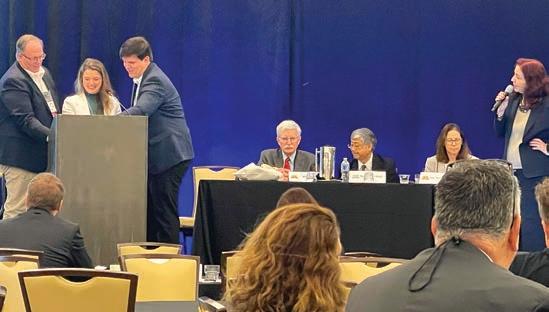
Renewing their annual partnership, the California Receivers Forum presented a pair of receivership programs at the California Bankruptcy Forum’s 2025 Annual Insolvency Conference at the Omni La Costa Resort and Spa in Carlsbad, California.
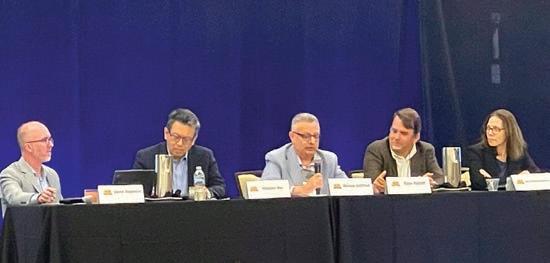
Kicking off the 2025 programming was the session titled “The Enforcement Nexus: Receivers and Law Enforcement.” The panel consisted of Seth Freeman of B. Riley Advisory Services, Aram Ordubegian of ArentFox Schiff, and Aaron Kudla, of Dyversis Group.
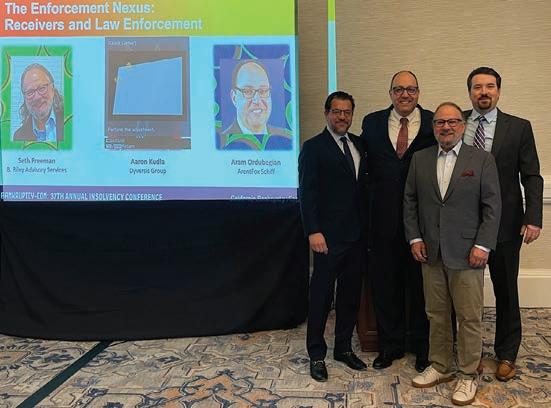
Mr. Freeman, a bankruptcy, insolvency and restructuring consultant, discussed some of the ways that court-appointed receivers are called upon to handle matters with a nexus to criminal investigations and enforcement actions by state and federal agencies. He explained that receivers often are asked to take control of and potentially liquidate (for the benefit of victims of crimes) troubled assets. He explained how these types of receiverships regularly run concurrently with civil litigation and insolvency proceedings, and victims in the criminal matters are often also creditors in civil insolvency or enforcement proceedings.

Critically, Mr. Freeman discussed the difficult “dance” in timing between law enforcement investigations/prosecutions and a receiver’s differing timeline in civil enforcement and insolvency contexts. If law enforcement wants to move too fast, for example, this can prejudice the receiver’s ability to investigate and locate assets, perform forensic accountings, etc., and it may disrupt the willingness of parties and third parties to cooperate with the receiver. In such a situation, the panel explained, receivers often benefit from strongly encouraging the criminal agencies to cooperate in terms of sharing vital information and coordinating timing.
Mr. Ordebegian provided a specific example of a matter on which he worked, involving an automated teller machine
Continued on page 15...
(“ATM”) Ponzi scheme and a regulatory enforcement action brought by the Securities and Exchange Commission (“SEC”) and the U.S. Attorney’s office, which concerned roughly $127 million in misappropriated funds. The scheme, which is fairly common, involved selling ownership interests in ATMs, while managing the ATM’s through a company that promised investors as much as a 20% return on their investments. This particular scheme pulled in many high-level, sophisticated investors.
Mr. Kudla discussed how, in a case like the ATM case, there numerous courts regularly become involved as victims and creditors take different avenues to recovery, and the coordination between a receiver, enforcement agencies, and those courts can become extremely complicated. In this type of case, the panel discussed how critical it is to ensure the order appointing the receiver has the proper powers delineated in order to navigate such complex waters. Specificity in the appointment order anticipating the complexities of this coordination can pay off greatly for the receiver, the parties, and the court as the cases progress.

willing to share a paucity of information with the receiver.
Finally, the panel discussed the advantages that receivers bring over law enforcement when it comes to monetizing receivership estate assets. Receivers generally have significant experience in running a proper sale process. Law enforcement agencies are generally aware of this and thus will often defer to receivers to serve a liquidating role with respect to remaining assets.
Other important issues that the panel touched upon include: (1) the coordination and interplay between criminal restitution and claims administration by a receiver; (2) the difficulty of key players asserting their Fifth Amendment rights against self-incrimination rather than cooperating with the receiver; (3) the difference between law enforcement that has the ability to grant immunity to obtain cooperation (where a receiver cannot); and (4) the disparity between law enforcement’s demands that the receiver share vast amounts of information with them while law enforcement is only
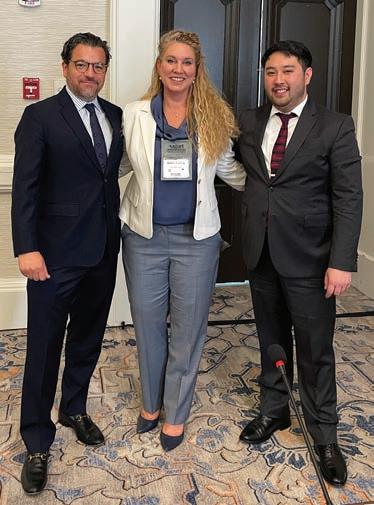
The second panel presented by the California Receiver’s Forum was “Bar Orders in Receiverships versus Bankruptcy after the Sackler Decision. ” Panelists included receiver Krista Freitag with E3 Advisors, and legal experts Oren Bitan of Buchalter PC and Matthew Pham of Allen Matkins Leck Gamble Mallory & Natsis LLP.
This panel discussed the current state of bar orders in receivership proceedings following the Supreme Court’s 2024 decision in Harrington v. Purdue Pharma L.P. (commonly Continued from page 14.
Continued on page 16...
Continued from page 15.
referred to as the Sackler decision). Mr. Bitan began with a summary of the Supreme Court’s opinion, which held that the Bankruptcy Code does not authorize a bankruptcy court to grant a release and injunction that extinguishes direct claims against nondebtor third parties (i.e. bar orders) without the claimants’ consent. This does not necessarily mean the same result in receiverships, however.
Messrs. Bitan and Pham discussed certain receivership opinions which preceded Sackler, highlighting both cases upholding the third party releases which barred claimants from bringing claims against settling nondebtor parties (Zacarias v. Stanford International Bank, Ltd , 945 F.3d 883 (5th Cir. 2019) and SEC v. DeYoung, 850 F.3d 1172 (10th Cir. 2017)), and those that did not (Digital Media Solutions v. South University of Ohio, LLC, 59 F.4th 772 (6th Cir. 2023).
Ms. Freitag then discussed the ANI Development LLC receivership, which involved a $390mm fraud arising from $1.2 billion of real property, restaurant and retail operations. At the request of the SEC, Ms. Freitag was installed as receiver in 2019, and she sought court approval to sue Chicago Title Company (CTC) for potential aiding and abetting claims. As receiver, Ms. Freitag achieved a settlement
Continued on page 17...







with CTC for 100% recovery of the net harm, but not without CTC (and its counsel, Nossaman LLP) requiring bar orders in the context of a global settlement. The settlement was approved but subsequently appealed by parties with ongoing state court litigation against CTC and Nossaman. In February 2025, the Ninth Circuit upheld the CTC settlement and bar orders, and a writ of certiorari is pending before the Supreme Court. SEC v. Peterson, 129 F.4th 599 (9th Cir. 2025).
The panel closed by providing their collective insight into what the future may hold for bar orders in receiverships postSackler, including potential avenues to achieve large-scale settlements through receiverships if they cannot be achieved in bankruptcy.
Buoyed by the success of these panel programs, we invite you to sail to Long Beach with us on January 29-30, 2026 for the California Receivers Forum Loyola XI!
*Mia Blackler is a partner with Lubin Olson in San Francisco and Chair-Elect of the California Receiver’s Forum. She is chair of its Creditor’s Rights, Receiverships, and Insolvency service group with an emphasis in commercial real property and financial institutions receivership litigation.
*Benjamin King is the Chair of the California Receiver’s Forum and a partner of the law firm of Loeb & Loeb LLP. Mr. King serves in Loeb’s Bankruptcy and Creditor’s Rights Practice Group, and specializes in prejudgment remedies including receiverships, writs of attachment, and injunctions Continued from page 16.

King

BY RICHARD P. ORMOND*
Among Loyola Law School’s numerous contributions to the California legal ecosystem is its longstanding relationship with the California Receivers Forum (CRF), a nonprofit organization that unites attorneys, accountants, judges, real estate professionals, and fiduciaries that work in court-appointed receiverships across the state. Loyola’s partnership with the CRF reflects the school’s commitment to supporting specialized and practical areas of law while advancing professional ethics, education, and reform.
Founded in 1995, the California Receivers Forum arose out of a recognized need for structured, ethical guidance and education in the niche field of receivership law, particularly

during California’s wave of real estate and corporate insolvency disputes in the 1990s. Loyola Law School was an institutional partner in helping convene the early leadership that led to the CRF’s creation, with several faculty members and alumni playing key roles in shaping the CRF’s educational mission.
In fact, one of CRF’s founders, Robert Warren, then a Loyola adjunct professor, served as one of the CRF’s first chairs. His advocacy for structured judicial training and practitioner guides helped solidify Loyola’s position as a neutral academic home for California’s developing receivership practices.
Since the early 2000s, Loyola Law School has co-sponsored and hosted the Biennial Loyola/CRF receivers
Continued on page 19...



Continued from page 18. Loyola Law School...
symposium aptly named the “Loyola Symposium.” The Loyola Symposium is a premier educational event that brings together superior court judges, practitioners, law professors, and courtappointed receivers from across California. The symposium addresses:
•Legal developments in Health & Safety Code receiverships
•Insolvency and fraudulent conveyance litigation
•Cannabis business receiverships and regulatory overlays
•Cross-border enforcement and international assets
•Judicial ethics and standards for receiver appointments
•Super-priority financing, lender lien structures, and tax issues
Past keynote speakers have included judges from the Los Angeles and Orange County Superior Courts, as well as federal bankruptcy judges and officials from the California Department of Financial Protection and Innovation (DFPI). Loyola has also used these forums to publish white papers and judicial guides, many of which are now cited in practitioner manuals and local court policies.
Development of Receivership-Focused Curriculum and Clinics
Recognizing the increasing complexity of receivership and fiduciary administration law, Loyola Law School introduced elective courses in Receivership Law and Fiduciary Remedies, believed to be among the first of their kind in the nation. These courses, typically taught by adjuncts who are active members of the CRF, cover:
•Statutory receiverships under California Code of Civil Procedure §§ 564 et seq.
•Federal equity receiverships
•Health & Safety Code nuisance abatement procedures
•Post-judgment enforcement under CCP § 708.620
•Cannabis-related receiverships and licensing transfers
•Interaction with bankruptcy law and abstention doctrines
In 2021, the Business Law Practicum was expanded to allow selected students to shadow receivers appointed in pending cases, particularly those involving distressed commercial real estate or failed cannabis enterprises. Students receive supervised training on forensic accounting, property management, creditor negotiations, and court reporting procedures, offering rare, real-world exposure to this specialized field.
Loyola faculty, in collaboration with the CRF members, have also played a part in shaping public policy around receiverships, particularly in areas with evolving legal norms. Notably:
•Loyola’s Center for Juvenile Law & Policy has consulted on reforms involving receiverships for juvenile detention facilities.
•Faculty white papers helped inform local rule amendments in Los Angeles Superior Court to provide more structure around cannabis business receivership appointments.
•Professors and alumni have testified before the Judicial Council of California to advocate for expanded training for judges overseeing complex civil receivership cases.
These efforts have helped professionalize the role of the receiver and reduce the incidence of abuse or unqualified appointments, particularly in distressed urban real estate and cannabis-related enforcement contexts.
The Loyola–CRF relationship serves as a model for how law schools can collaborate meaningfully with professional organizations to improve real-world outcomes. Through coursework, symposia, clinical partnerships, and alumni engagement, Loyola Law School has helped:
•Elevate the profile of receivership law as an essential tool of equitable justice
•Promote best practices in judicial appointment and fiduciary ethics
•Provide students with direct experience in one of the most complex areas of civil litigation
For practitioners, Loyola continues to be a trusted convener for new guidance and discussion, and for students, it is increasingly seen as the academic home for receivership law in California.
*Richard P. Ormond is a shareholder at Buchalter, APC with a practice specializing in representing receivers, fiduciaries, and creditors. He is also a former professor at Loyola Law School and he is the founder of Stone Blossom Capital, LLC an advisory company that acts as a professional fiduciary, assignee or receiver.

We are proud to produce the Loyola XI Symposium in conjunction with
• JA N U A R Y
Loyola Symposiums provide a robust program of knowledge shaping receivership practice and policy in California
BY RICHARD P. ORMOND*
Founded in 1920, Loyola Law School serves as the law school of what is today, Loyola Marymount University, a Catholic, Jesuit–Marymount institution based in Los Angeles. Within fifteen years of its inception, the school secured accreditation from the American Bar Association (in 1935) and joined the American Association of Law Schools in 1937.
The founding decades focused on establishing core curricula and a strong bar-preparation track. During this era, Loyola also began shaping a reputation for producing service-minded attorneys dedicated to justice—setting the stage for its future emphasis on clinics and public interest law.
Architectural Identity: Frank Gehry’s Vision (1978–1990)
A defining chapter in Loyola’s history was the decision, beginning in 1978, to invite Frank Gehry—then a rising star but not yet famous—to design a law school campus. This was Gehry’s first foray into academic architecture, and the result reflects a postmodern dialogue with classical traditions:
• Plaza-centered design evokes ancient civic forums.
• Deconstructed classical motifs —arched columns, cantilevered canopies—form a vibrant dialogue with Roman architectural precedents.
• Landmark buildings include the Fritz B. Burns Academic Center (bright yellow exterior, stairway atrium), Chapel of the Advocate, Donovan Hall, Hall of the 70s, Merrifield Hall, and the sleek parking garage.
Gehry also reimagined existing structures—Founders Hall and the William M. Rains Library—with minimalist additions, skylights, and enhanced interior spaces. In the early 2000s, the 2002 Girardi Advocacy Center and its Jean Nouvel-designed tower were added, continuing the school’s commitment to thoughtful architectural integration.
(1990s–2010s)
From the 1990s onward, Loyola expanded its academic portfolio:

• From tracking enrollment into the 900–1,300 range, it grew both full-time and part-time programs.
• It launched pioneering experiential education—clinics, externships, simulation courses—with a historically strong focus on trial advocacy. Indeed, in the 2010 U.S. News rankings, Loyola ranked #7 nationally in trial advocacy and #10 in tax law.
• Embracing its Los Angeles context, Loyola developed programs in entertainment, immigration, civil rights, international law, cannabis law and cybersecurity in collaboration with LMU’s other schools.
Drawing from its Jesuit commitment to justice, Loyola has built strong clinical programs:
• 21 live-client clinics—Juvenile Justice, Immigrant Rights, International Human Rights, Workers’ Rights, Conflict Resolution, etc.—serve thousands of clients annually, with students contributing over 30,000 pro bono hours.
• Signature initiatives like the Project for the Innocent have secured reversals in wrongful convictions and advanced post-conviction reform.
• Specialized programs such as the C ybersecurity & Data Privacy Law program, the Entertainment Law Practicum , and the Journalist Law School (for working media professionals) reflect Loyola’s responsiveness to emerging legal fields.
Loyola boasts a distinguished faculty including:
• Laurie Levenson, criminal law expert and commentator
• Justin Levitt, former DOJ civil-rights official
Continued on page 22...
from page 21.
• Cesare P. R. Romano, international law scholar and director of its Human Rights Clinic
• Simona Grossi, civil procedure scholar and founder/conductor of the school’s orchestra
Distinguished Alumni
Graduates over the past century have included highprofile leaders:
Name Field
Johnnie Cochran Defense advocate, O.J. Simpson trial
Gloria Allred Civil rights lawyer
Mark Geragos Defense counsel, media figure
Robert Shapiro
Bob Myers
O.J. Simpson trial, co-founder of LegalZoom
GM of Golden State Warriors
William P. Clark Jr. U.S. Secretary of the Interior, CA Supreme Court Justice
Brietta R. Clark became the 19th Dean—marking Loyola’s first female appointment to the position.
From its founding in 1920 to Gehry’s transformative campus in the 1980s, and onward to recent clinic philanthropies and leadership milestones, Loyola Law School has maintained a unique identity: rooted in tradition, attuned to innovation, and committed to justice. Its alumni have shaped courts, government, law firms, and public discourse, while faculty and students continue to influence cutting-edge legal domains.
*Richard P. Ormond is a shareholder at Buchalter, APC with a practice specializing in representing receivers, fiduciaries, and creditors. He is also a former professor at Loyola Law School and he is the founder of Stone Blossom Capital, LLC an advisory company that acts as a professional fiduciary, assignee or receiver.

BY MARY LEE-WLODEK

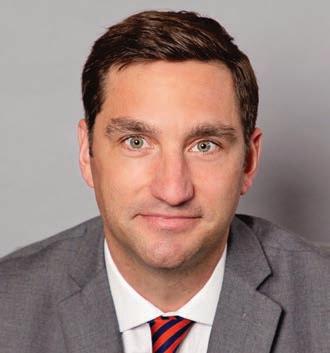
Jake Diiorio, Managing Director of Stapleton Group, a part of J.S. Held, recently shared insights about his career and life for Receivership News.
Q: How did you end up in this business?
A: It’s an age-old story. I was a 20-something year old working in audit for Ernst & Young in New York and was ready for an adventure, so I decided to head West. Southern California is pretty magical, especially in the middle of January when it’s 70° … every day. The endless sunshine and active lifestyle sold me on relocating pretty quickly.
I learned about a job opportunity at Stapleton Group in early 2010 from one of my best friends. He had assisted the firm on a couple of real estate assignments as a contractor. The honest answer is that I don’t do very well sitting still and was just happy to have a job offer!! I knew nothing about receiverships or the broader turnaround and restructuring industry but was intrigued by the idea of solving problems for all types of companies and liked the firm’s entrepreneurial nature. And, David Stapleton and David Kieffer, who had started the firm, were young, smart, and ambitious.
The funny thing is, while I was optimistic about having found a real career and enjoying the lifestyle, I didn’t know how long I would remain in Southern California. I was in a long-distance relationship and unsure that my girlfriend would move West. Fortunately, she came out and was quickly convinced that we were lucky to live here. We got married and truly enjoy raising our son in Southern California.
Q: What were your early career ambitions and how did they change over time?
A: I originally thought I wanted to be an architect, which led me to Syracuse University. After starting college with my major undeclared, I ultimately determined business would be a more practical career choice and pursued an accounting degree. I grew up in New Jersey and had ambitions to work in the Big Apple. However, I was young and had no clue what I wanted to do!
My dad always told me that risk management was en vogue and accounting would be a good foundation for that. As it turns out, he was right on both fronts. Ultimately, I found myself transitioning from accounting into this world of managing distressed situations which obviously incorporates a lot of risk management. I still appreciate architecture and sometimes regret that I didn’t make the riskier choice. Then I reflect on the unique, dynamic, engaging nature of our work and am extremely grateful for essentially falling into the industry so long ago.
Q: You’ve been with Stapleton Group for over 15 years, which is impressive. What has kept you there?
A: It’s been a great journey so far—and it just keeps getting better! The nature and pace of our work means there’s never a dull moment with an abundance of opportunities to grow and learn. My skills have evolved over time as the cases have become increasingly complex and high stakes, allowing me to expand my mind and grow both professionally and personally. And, while it might not seem evident as we’re grinding away on a matter for months on end, it’s extremely rewarding to achieve great outcomes for clients. I really value our firm’s collaborative culture, and that our team always has each other’s backs.
Q: What do you like most about your work as a receiver?
A: In reflecting on my career for this interview, I concluded that, “Change (truly) is the only constant in life,” and I thrive on change.
What I like most about serving as a receiver are solving problems, working collaboratively with others, setting goals, and designing complex processes to achieve the goals –which sometimes take months or years to complete. I like
Continued on page 24...
Continued from page 23.
being an expert in-the-moment on any given case, maximizing value creation, and being the professional presenting issues and topics in front of a judge. I also like coaching and mentoring younger staff who have found their way into this work, especially those on our team.
Q: What are your most memorable receivership experiences?
A: The most stressful ones seem to be the most memorable! One of my first large, dynamic receiverships where I had a significant role in managing the engagement involved a distressed operating company with three divisions—each with its own business plan, customer base, and staff—all in dire financial condition. We worked crazy hours keeping the company operating as a going concern through intensive cash flow management challenges; negotiating discounted A/P payoffs with vendors and suppliers; and repositioning expenditures on the top-selling, highest-margin products. Meanwhile, we identified the weak link among the company’s divisions and implemented a strategic plan to sell it, which was my first experience working with investment bankers on an M&A transaction. Also, we refinanced owneroccupied commercial property. The effort paid off as we achieved a full recovery for the lender and the owners/defendants regained control of the company as a going concern.
I have some funny stories, too, like the time I had to perform an inventory count of frozen squid in a cold storage warehouse in east Los Angeles dressed head to toe in my ski gear; or the time I was sent to document a transaction involving gold bullion and gold bars from a safety deposit box; or the time I collected the daily cash receipts of a bakery chain through the narrow opening of a Bentley’s tinted window. Or much sketchier examples that probably should not be shared!

Q: What attributes do you think contribute to a successful career as a receiver?

My first SEC matter is equally memorable. It was a $200MM+ securities EB-5 fraud matter involving 2,000 mainland Chinese investors. The perpetrators fled before we were appointed, making it extremely difficult to identify assets. I was coached through intensive forensic accounting by my mentors, Neal Gluckman and David Stapleton, and learned a lot about real estate from David Kieffer. A lot of money had been squandered. Fortunately, we achieved a recovery for the investors by identifying and taking control of about 45 real estate properties, which we improved, permitted, and leased before orchestrating a sale process. We also traced funds that had been invested in compromised development projects.
What characteristics do you / Stapleton Group look for in hiring junior / mid-level staff?
I’ve always been impressed by receivers who are natural problem-solvers at heart, detail oriented, visionary about desired outcomes, and pragmatic about the processes to achieve the goals. They dig into a deal to become the expert on the business / situation and dedicate time to read the pleadings and reports, and write reports. They are like carpenters - doing the analysis, re-doing the analysis, etc. to confidently stand up in the court room in front of the judge and speak with conviction. Ultimately, they “see” the exit strategy. A cool head definitely is required to deal with angry victims / creditors who often need someone to blame and find you on the other end of the phone. Honing the craft of knowing what to say and what not to say—embracing the ‘less is more’ mantra that is learned through experience.
In junior / mid-level staff, we look for a strong accounting background with a blend of experience in public and private, when possible. Analytical skills and financial modeling experience are key as we deal with lots of numbers on every deal. The ability to multi-task is a plus. Strong writing skills are essential in order to convey our strategy to lenders and all parties, provide updates to the Court, and manage relationships with all interested parties. Beyond
Continued on page 25...
Continued from page 24.
those measurable attributes, it helps to possess the demeanor to keep creditors calm in heated situations and the professionalism to ultimately face clients and courts.
Q: Stapleton Group was sold to a private equity-backed, New Yorkbased, financial services firm last year. What led to the transaction? How has it changed how you and your colleagues approach your work?
A: Yes, it seems my life has gone full-circle now that we are part of New York-based J.S. Held! Three things led to the transaction:
(1) Recruiting Talent: As we grew organically, we landed bigger and higher-profile deals (always the goal and fun!). Since delivering the best results for clients is our primary focus, we spent a lot of time finding and training new team members. Our new larger platform makes us much more attractive to the talent pool.
experienced in these areas, there is exponentially more opportunity to broaden experiences / skillsets by virtue of being part of a larger organization.


(2) Geographic Reach: We have a strong footprint in the Western U.S. When J.S. Held reached out to us after acquiring East Coast-based Phoenix Management and a Phoenix, AZ-based team, we were intrigued about expanding our receivership and other legacy services nationwide, as well as expanding our service offerings as part of J.S. Held’s new Strategic Advisory Group (SAG). We’re in the process of introducing SAG nationwide with our new colleagues.
(3) Team Member Growth Opportunities: We have built a large team of junior / mid-level staff and want to offer them exceptional growth opportunities. Our staff now is part of a growing, global company of nearly 2,000 people, creating unlimited resources to help them form careers for years to come, like I did.
The opportunities range from sticking to Stapleton Group’s core turnaround and restructuring services, as well as expanding into litigation support / expert witness assignments, etc. While the Stapleton Group legacy team is
That said, a lot of things remain the same, which is a good thing. We continue to serve the same customer base (middle market, etc.) from the same office. Not much has changed in terms of how we approach our work. We still start and end every day striving to provide best-in-class service to our clients, with the benefit of asking “who at J.S. Held has the deepest expertise to deliver the best outcome for the client?”
Q: How do you enjoy your time away from work?
A: I enjoy spending time with my family and taking trips—we just returned from a long-planned trip to Europe. Coaching my young son’s sports teams has been both chaotic and enlightening, teaching me a lot about patience along the way! We spend a lot of time at the beach year-round and ski in the winter.
Q: What are you looking forward to in the near term (professionally and personally)?
A: I am looking forward to continuing to grow our team, build our practice, and spend time training and mentoring our younger team members. I think that is one of my favorite roles at Stapleton Group! I’m excited about working with our new J.S. Held colleagues and continuing to learn about all of firm’s services.
I always look forward to working collaboratively with all the wonderful people – attorneys and beyond – who I am fortunate to have met through this organization and others.
*Mary Lee-Wlodek is President of Proactive Marketing, Inc., a strategic marketing consultant for professional services firms. She applies over 30 years of experience to establish concise brand identities, marketing strategies, communications plans, and business development programs for financial services firms, law firms, consulting businesses, and other elite B-to-B service providers.

W HILE THERE IS NO COURT - APPROVED LIST OF R ECEIVERS , THE FOLLOWING IS A PARTIAL LIST OF R ECEIVERS WHO ARE MEMBERS OF THE C ALIFORNIA R ECEIVERS F ORUM AND HAVE THE INDICATED EDUCATIONAL EXPERIENCE . I NCLUSION ON THIS L IST SHALL NOT BE DEEMED AN ENDORSEMENT OF ANY OF THE NAMES LISTED BELOW BY THE R ECEIVERSHIP N EWS , THE C ALIFORNIA R ECEIVERS F ORUM , OR ANY OF ITS R EGIONAL C OUNCILS . T HIS IS A PAID ADVERTISEMENT .
AREA PHONE
Bay Area
SVl David Bradlow 415-206-0635 bradlow@davidbradlow.com
V
≠▲zvb Dennis Gemberling 800-580-3950 DPG@perrygroup.com
Vl▲zwb; Michael Kasolas 415-992-5806 mike@kasolas.com
S l ▲ w Douglas Wilson 619-641-1141 dwilson@douglaswilson.com
Sacramento Valley
SnVl▲b Michael C. Brumbaugh 916-417-8737 mike@mbi-re.com
Peter Martin 209-470-6221 petermartin@receiver.us.com
nlV▲vwb; Scott Sackett 916-930-9900 scott.sackett@efmt.com
lV▲ Kenneth Weaver 916-812-8090 ken@classicrealtyconsultants.com
Santa Barbara/Ventura
Marcelo Bermudez 213-453-9418 mb@marcelobermudezinc.com
San Diego Area
S
≠l▲wb; Michael Essary 619-886-4116 calsur@aol.com
b Jon Fleming 858-793-6000 jon.fleming@legacyreceiver.com
V
≠▲zvb Dennis Gemberling 800-580-3950 DPG@perrygroup.com
Sl▲wb; Richardson “Red” Griswold 858-481-1300 rgriswold@griswoldlawsandiego.com
b Kristin Howell 858-373-1240 kristinh@meissnercres.com
nV≠lt▲zvb Richard Munro 949-910-6600 richard@invenz.com
▲ v w Michele Vives 619-641-1141 mvives@douglaswilson.com
SnV≠▲zv Joel B. Weinberg 310-385-0006 jweinberg@usisg.com
S l ▲ w Douglas Wilson 619-641-1141 dwilson@douglaswilson.com
Los Angeles/Orange County/Inland Empire
SVl▲zvb; Blake Alsbrook 310-273-6333 balsbrook@ecjlaw.com
SVl▲ Albert Altro 310-809-5064 albertaltro@traversellc.com
SnV≠ Eric Beatty 909-243-7944 epb@epblegal.com
S l ▲ w ; Ryan Baker 949-439-3971 rbaker@veraxinc.com
Snl▲zb Marc Brooks 818-519-5588 marcbrooks2021@outlook.com
Los Angeles/Orange County/Inland Empire
Joe Corcoran 619-641-1141 jcorcoran@douglaswilson.com
James F Davidson 949-417-5708 jdavidson@avantadvisory.com
SnV≠ltb; Peter A. Davidson 310-273-6333 pdavidson@ecjlaw.com ; Jake Diiorio 213-235-0609 jake.diiorio@jsheld.com
nV≠lt▲zb; Stephen Donell 310-689-2175 steve.donell@fedreceiver.com
V≠▲zvb Dennis Gemberling 800-580-3950 DPG@perrygroup.com
Jeffery Golden 714-966-1000 jgolden@wgllp.com
b David Goodrich 714-966-1000 dgoodrich@wgllp.com
Brett Hitchman 949-200-9712 leeann@hitchmanfiduciaries.com
SnV≠lt▲zvb Byron Z. Moldo 310-281-6354 bmoldo@ecjlaw.com
nV≠lt▲zvb Richard Munro 949-910-6600 richard@invenz.com
b Carl Petta 626-966-4049 cgpetta@earthlink.net
Kevin Randolph 909-890-4499 krandolph@fennemorelaw.com
SnV≠lt▲zvb John Rey 562-500-7999 rpmqmp@aol.com vw Eric Sackler 310-979-4990 ericsackler@gmail.com
SV≠l▲z Thomas Seaman 949-265-8403 tom@thomasseaman.com
Vl▲vb Phil Seymour 310-612-9800 phil@swgrp.com
Patrick Sharples 714-293-2792 psharples@kwcommercial.com
Tony Solomon 310 909-5450 tony.solomon@marcusmillichap.com
SVt David Stapleton 213-235-0601 david@stapletoninc.com
▲ v w Michele Vives 619-641-1141 mvives@douglaswilson.com vb Michael Wachtell 213-891-5460 mwachtell@buchalter.com
SnV≠▲b David D. Wald 310-230-3400 dwald@waldrealtyadvisors.com
SVb Robert C. Warren 714-863-1694 robert.warren@investorshq.com
▲zvb David Weinberger 818-970-0915 david@swgrp.com
SnV≠▲zvb Joel B. Weinberg 310-385-0006 jweinberg@usisg.com
S l ▲ w Douglas Wilson 619-641-1141 dwilson@douglaswilson.com
Out of State
Cherubim “Lizzie” Hurdle 980-330-1705 traffic.connect@outlook.com
S This symbol indicates those who completed up to 14 hours of advanced receivership education at the Loyola V, Complex Case Symposium in January 2013.
n This symbol indicates those who facilitated and attended the Loyola V, Complex Case Symposium in January 2013.
V This symbol indicates those who completed 9 hours of education at the Loyola VI Symposium in January 2015.
≠ This symbol indicates those who facilitated and attended the Loyola VI Symposium in January 2015.
l This symbol indicates those who completed 9 hours of education at the Loyola VII Symposium in March 2017.
t This symbol indicates those who facilitated and attended the Loyola VII Symposium in March 2017.
▲ This symbol indicates those who completed 6 hours of education at the Loyola VIII Symposium in January 2020.
z This symbol indicates those who facilitated and attended the Loyola VIII Symposium in January 2020.
w This symbol indicates those who completed 6 hours of education at the Loyola IX Symposium in April 2022.
v This symbol indicates those who facilitated and attended the Loyola IX Symposium in April 2022.
b This symbol indicates those who completed 6 hours of education at the Loyola X Symposium in January 2024.
; This symbol indicates those who facilitated and attended the Loyola X Symposium in January 2024.
Loyola I-IV symbols have been deleted.
BY OREN BITAN*
With a new year brings a new board of directors for the California Receivers Forum, and in this case with an invigorated educational program. When I first joined the CRF (many years ago), the monthly educational lunch meetings were well attended and provided a perfect way for me to meet its esteemed members (not being sarcastic). Now that I am the Program Chair, I hope to rekindle the spark that existed pre-pandemic by bringing back the CRF of old with convivial in-person meetings every month where we can eat, learn, kibbutz, and inspire (with some inevitable wisecracks along the way).
In April, we kicked things off with a well-attended and well-fed event (Langers Pastrami for those that missed it) titled Receivership 101 with Kevin Singer and Jackson Wyche of Receivership Specialists, David Weinberger and Megan Husri of The Seymour/Weinberger/Husri Group, and Oren Bitan (yep, me). Thank you to Kevin Singer for injecting energy into the educational committee!
In May, the CRF produced two panels at the California Bankruptcy Forum, both of which drew large and interested audiences: The Enforcement Nexus: Receivers and Law Enforcement with Receiver Aaron Kudla, Aram Ordubegian of Arent Fox, and Seth Freeman of B Riley filled the room and the panelists shared insights and war stories about the myriad of issues that arise in receivership involving state or federal prosecutions. The second panel, entitled Bar Orders in Receiverships Post-Sackler with Receiver Krista Freitag, Matt Pham of Allen Matkins, and moderated by yours truly Oren Bitan, showcased the amazing work Krista did in securing nearly complete recovery from the Gina Champion Cain Ponzi scheme and the bar order she obtained as part of a settlement with Chicago Title, which was recently upheld by
the Ninth Circuit Court of Appeals. Given the United States Supreme Court decision in the Sackler bankruptcy, receivership now offers a key settlement tool that is unavailable in bankruptcy court.
As this issue of Receivership News was at the printer on July 30, Blake Alsbrook, Steve Donell, Byron Moldo, and Will Miller presented a panel at Ervin Cohen & Jessup entitled The Devil is in the Details –Critical Provisions in Appointment and Discharge Orders.
On August 20, Richard Munro and Dominic LoBuglio will produce a panel on receivership tax issues featuring David Agler that will be sure to educate and entertain.
On September 18, Michael Gomez will produce a panel on family law receiverships in conjunction with LACBA Remedies Section featuring Gerard Keena, Geoff Winkley, Stacy Phillips and David Mark.
In October, Sunny Han-Jeon of East West Bank will produce a panel about Artificial Intelligence and receiverships.
Finally, the CRF board is excited to announce that Loyola XI Conference will be held on January 29-30, 2026 at the Hyatt Regency in Long Beach. This year will feature a judges panel with sitting and retired writs and receivers judges, a ground breaking and first ever CRF appearance of a receivership game show, and many other new surprises. The program committee is in the process of finalizing the topics and speakers, so if you have any ideas, please contact me. We look forward to seeing you then!
*Oren Bitan is a Shareholder and co-chair of the Litigation Department in Buchalter’s Los Angeles office. He also co-chairs the firm’s Fiduciaries, Receivers & Trustees Group and its Cannabis & Hemp Industry Group.
A seasoned trial lawyer, he represents clients in high-stakes real estate, financial services, and receivership matters.
Oren has received multiple honors, including LA Visionary (LA Times B2B Publishing) and Top Litigator and Leader of Influence (Los Angeles Business Journal).
BY PETER A. DAVIDSON*
I know from prior articles that a receiver for a tenant entity has the right to reject a lease, if to do so is beneficial for the estate. Is the reverse true? If a receiver was appointed for a landlord, can he or she reject a tenant lease, in order to retake possession, if doing so would be beneficial to the estate?
No. While a receiver for a tenant can affirm and adopt a lease, or reject it and return the property to the landlord, See, D.H. Roosen Company v. Pacific Radio Publishing Company, 123 Cal. App. 525, 534 (1932), the reverse is not true. While the right to reject a lease flows from the general right of a receiver to reject executory contracts (much like a bankruptcy trustee can reject executory contracts and leases under 11 U.S.C. § 365) the few cases and commentators which discuss the issue agree a tenant can remain in place if its lease is rejected, so long as the rent is paid and the lease terms are complied with. Clark on Receivers, § 445 (3rd Ed.1959). Gibbons v. Wasserman , 244 N.Y.S. 26 (1930) states the general rule that a receiver’s appointment “does not authorize the receiver to ignore defendant’s lease and bring an action for use and occupation against them.” See also, Fidelity Union Trust Co. v. 75 Prospect Coop Apartment, 131 N.J. Eq. 387, 389 (1942) (“does not permit him to dispossess tenants in disregard of their leases.”). There are limited exceptions however. A few cases have held that a lease can be rejected if it was the result of fraud or entered into just prior to the receivership, with the intent to impair the receivership estate. See, Ferguson v. White, 213 Iowa 1053 (1932) where a new lease was entered into days before foreclosure suit was filed to have a receiver appointed and the new lessee was the son of the mortgagor’s family, who remained on the property.
The limitation on a receiver’s right to reject tenant leases is consistent with the Bankruptcy Code provisions on a trustee’s power to reject tenant leases. Under 11 U.S.C. § 365 (h)(1)(A) if a trustee rejects an unexpired lease of real property the tenant can treat the lease as terminated by the rejection or, if the lease has commenced, retain its rights under the lease and remain in possession as lessee. While rejection cannot terminate a lessee’s possessory rights, it can affect a landlord’s other obligations under the lease. In re Flagstaff Realty Associates, 60 F.3d. 1031, 1034 (3rd. Cir. 1995) (“The primary function of rejection is to ‘allow [ ] a debtor-lessor to escape the


burden of providing services to a tenant.’ … rejection ‘reliev[es] the estate from covenants requiring future performance, such as the provision of utilities, repairs, maintenance and janitorial services by the debtor.’ [Citations omitted]”). The lessee’s remedy for the loss of services is its ability to offset any loss against the rent owed under the rejected lease. In re Upland Euclid Ltd., 56 B.R. 250, 252 (9th Cir. BAP 1985) [citing 11 U.S.C. § 365 (h)(2)—Now: 11 U.S.C. § 365 (h)(1)(B)].
There is a dearth of authority on the non-possessory effect of a landlord’s receiver’s rejection of a lease. It is likely that a court facing this issue would follow the Bankruptcy Code’s provisions, as they are an attempt to equitably balance the rights of the estate and the rights of a lessee. This issue rarely comes up in receiverships because receiver’s usually want to lease vacant space, not remove paying tenants.
QYou have previously written about how the ultra vires exception to the Barton Doctrine is extremely narrow, highlighting a Texas case, In re Preferred Ready-Mix, LLC . When last discussed, you mentioned the bankruptcy debtor had appealed the district court’s decision that the debtor was barred from suing the receiver. Has the appeal been resolved?
AYes. In an unpublished decision, issued on New Years Eve, the Fifth Circuit reversed . While the decision was bad for the receiver involved, the result is actually consistent with the legal reasoning in the district court decision. Let’s recap for those viewers who haven’t watched the prior episodes.
The case, In re Preferred Ready-Mix, LLC , 647 B.R. 158 (Bankr. S. D. Tex. 2022) (Amended 2022 WL 1695269), started when a creditor obtained a default judgment in state court and obtained the appointment of a receiver to collect
Continued on page 29...
facts to the law. It stated it is undisputed that “when Preferred Ready-Mix filed for bankruptcy, the property in Berleth’s [the receiver] possession automatically became property of the bankruptcy estate. See 11 U.S.C. §541(a)(1)…(noting that ‘property of the estate’ includes ‘all legal or equitable interests of the debtor in property as of the commencement of the’ bankruptcy.)” *2 (citations omitted). Therefore, it held, the receiver acted ultra vires when he continued to maintain possession of Preferred’s bankruptcy estate’s property, after receiving notice of the bankruptcy and a turnover demand. Hence, leave of the receivership court was not required to sue the receiver. Continued from page 28.
the judgment. The state court ordered the receiver to seize and maintain various assets of Preferred Ready-Mix (“Preferred”) to satisfy the judgment, most of which were cement trucks. Two weeks later, Preferred filed bankruptcy. The receiver learned of the bankruptcy a week later, but took no action. He was eventually served with a written turnover demand. In response, the receiver said there were a number of administrative bills for towing, repairing and maintaining the trucks and he needed $5,565 prior to turnover to pay the costs, but would take $2,500, with the rest being an administrative claim. Preferred paid the demanded $2,500 and the turnover took place. Preferred then sued the receiver in the bankruptcy court for turnover, violation of the automatic stay and to deny the receiver’s $7,000 administrative claim. The bankruptcy court ruled in favor of Preferred. It held the receiver violated the turnover provisions of the bankruptcy code (§§542 and 543), as well as the automatic stay (§ 363 (a)(3)) and entered judgment for $35,000 in damages plus $10,000 in punitive damages and denied the receiver’s $7,000 claim. The receiver appealed.
The district court in In re Preferred Ready-Mix, LLC, 660 B.R. 214 (S.D. Tex. 2024) reversed because Preferred violated the Barton Doctrine, by not obtaining permission from the state receivership court to sue its receiver. Preferred did not dispute that Barton applied, but argued there was an exception (the ultra vires exception), contending the receiver’s actions were ultra vires because he refused to turnover the assets, after he had notice of the bankruptcy and received a written turnover demand. The district court disagreed. It found the ultra vires exception “exceptionally narrow” and that it has been limited only to “the actual wrongful seizure of property”. Supra. at 219; see, In re DMW Marine, LLC, 509 B.R. 497, 507 (Bankr. E.D. Penn. 2014) (“While no court has said as much definitively, it may be no exaggeration to state that the exception applies only in cases in which a receiver wrongfully seizes or controls nonreceivership property.”).
Preferred appealed and the Fifth Circuit reversed. Importantly, the Fifth Circuit agreed Barton generally requires receivership court approval to sue its receiver and that Preferred had not obtained such leave. It did not disagree with the district court that the ultra vires exception to Barton is narrow or that it generally only applies when a receiver seizes or attempts to administer non-receivership property. It, however, disagreed with the district court’s application of the

BY RYAN BAKER*
Welcome to the latest edition of Heard in the Halls. Please provide your snippets of news, questions or comments about receivership issues or the professional community by telephone, mail, fax, or email to: Ryan C. Baker at Verax Business Group, 19200 Von Karman Ave, Suite 400, Irvine, California 92612; Phone (949) 624-7173; Email: rbaker@veraxinc.com.
Here is what we have Heard in the Halls …
• Don’t Call it a Comeback: The Physical Version of the 2025-2026 Membership Directory returns! After trying for years with a digital-only version of the CRF membership directory, we all realized how much we missed the feel of a good 24lb bond, 90gsm paper in our hands, the smell of CIJ inks, and look of a good spiral bound directory. The CRF Board of Directors recognized all our pain – we couldn’t go through another year of “where the heck did I save that dang digital file of the membership directory again?”, we wanted to go back to the good old days. The days when we all knew there was an updated membership directory tossed in the file drawer somewhere in each of our desks. Well our prayers have been answered. The new and improved physical copy of the CRF Member Directory is back and more beautiful than ever! As we go to print, each member should have received their own freshly baked copy of the CRF 2025-2026 membership directory delivered to their mailbox. The digital reign of terror is over. But in the immortal words of LL Cool J, just don’t call it a comeback.
•On the Horizon: Loyola XI – Every two years, it awakes from its hibernation and brings insolvency professionals across California together. It spreads education. It sprouts networking. And, most importantly a good time is had by all. Of course, I’m referring to the magical time known as Loyola. This year’s Loyola XI will be again held at the Hyatt Regency in Long Beach. Break out your calendars and black out the days January 29-30, 2026. Be prepared to get up to date with all of the latest in receivership education, and enjoy seeing friends and

colleagues from around the receivership industry. A new round of amazingly talented panelists and informational and intriguing topics have been promised by our Chair, Ben King. Mr. King is so confident in this promise, he’s volunteered to chug one Michelob Ultra for every dissatisfied Loyola attendee.
• Call for Panelists and Panel Topics — If you have an intriguing panel topic, want to be a panelist, or know someone else who should be a panelist, feel free to reach out to your columnist to share with me your recommendation. All suggestions will be considered!
• Sponsorship Opportunities – The Sponsorship Committee will be gearing up shortly and invites you to become a Sponsor of Loyola XI! Options are being finalized which will allow you to choose from to best get your message in front of members. The distress industry is picking up in activity and the conference will be the perfect spot to spread your firm’s name to the distressed community. Once options have been set, be prepared to select your sponsorship and sponsorship level!
• CRF Infiltrates Partners with CBF (Round 3): This year’s California Bankruptcy Forum was held at the beautiful Omni La Costa in Carlsbad, San Diego. And once again the CRF partnered with CBF to prepare and present three panels focusing on receiverships. One of the most pervasive topics throughout the conference was bankruptcy professionals becoming receivers! I did my part and
Continued from page 30.
spread rumors of how much better bankruptcy was than receiverships *wink, wink*, and they’d be crazy to consider becoming a receiver. Nonetheless, receivers and receiverships were again a topic of intrigue across the CBF. With bankruptcies still at historical lows, many are taking notice of receiverships and freedom it offers – particularly when compared to bankruptcy. That said, receiverships continue to be on the rise and appear to have strong forward inertia bringing a rising tide to all.
• Spread the Word : Know someone thinking about getting started in the receivership industry? Well tell them there’s already enough competition. Ahem, just kidding, instead steer them to www.receivers.org to order a past Loyola program 4-disc DVD set for $75 teaching receivership Basics and including sample pleadings.
*Ryan Baker has been a Receiver for nearly 15-years and is with Verax Business Group. Mr. Baker has overseen receiverships of nearly every flavor including operating companies, rents and profits, construction, environmental contamination, regulatory, post judgment, and many, many others.