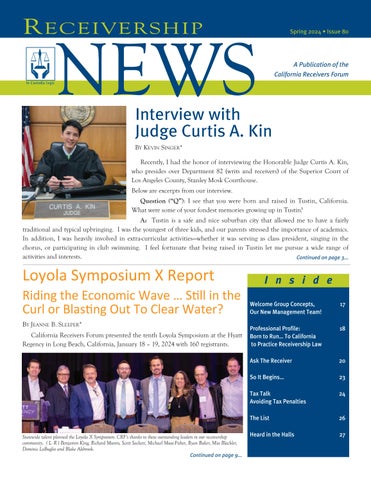
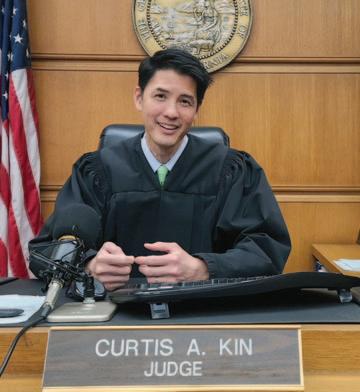
Interview with Judge Curtis A. Kin
BY KEVIN SINGER*
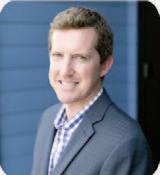
Recently, I had the honor of interviewing the Honorable Judge Curtis A. Kin, who presides over Department 82 (writs and receivers) of the Superior Court of Los Angeles County, Stanley Mosk Courthouse. Below are excerpts from our interview.
Question (“Q” ): I see that you were born and raised in Tustin, California. What were some of your fondest memories growing up in Tustin?
A: Tustin is a safe and nice suburban city that allowed me to have a fairly traditional and typical upbringing. I was the youngest of three kids, and our parents stressed the importance of academics. In addition, I was heavily involved in extra-curricular activities—whether it was serving as class president, singing in the chorus, or participating in club swimming. I feel fortunate that being raised in Tustin let me pursue a wide range of activities and interests.
Loyola Symposium X Report
BY JEANNE B. SLEEPER*
California Receivers Forum presented the tenth Loyola Symposium at the Hyatt Regency in Long Beach, California, January 18 – 19, 2024 with 160 registrants.
3...
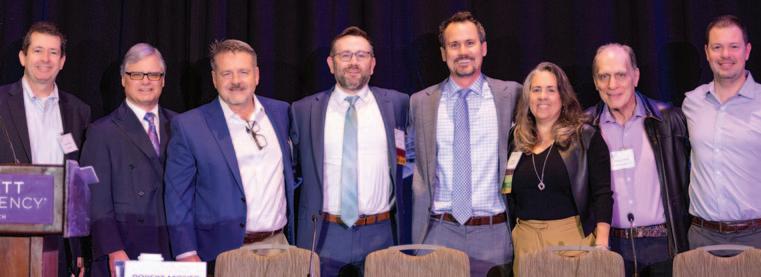
Statewide talent planned the Loyola X Symposium. CRF’s thanks to these outstanding leaders in our receivership community. ( L -R ) Benjamin King, Richard Munro, Scott Sackett, Michael Muse-Fisher, Ryan Baker, Mia Blackler, Dominic LoBuglio and Blake Alsbrook.
Publisher’s Comments
BY DOMINIC LOBUGLIO*
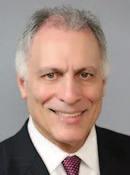
Dominic LoBuglio
*Dominic LoBuglio is a CPA and has provided forensic accounting and taxation services to receivers for 40 years. He has served CRF since its inception as a board member and officer for LA/OC and the State.
This is a special issue. Every two years we get to showcase our Loyola Symposium. This one, held in Long Beach in January, was the tenth anniversary of the biennial symposium. We are very fortunate to have Jeanne Sleeper, our founding administrator who guided us to where we are today, attend the seminar and write our front-page story.
Also sharing the front page we have an interview with Judge Curtis A. Kin who presides over Department 82 (writs and receivers). We thank Kevin Singer who always comes through for us with insightful interview questions.
Michael Muse-Fisher is the CRF Chair for 2024 and presents a snapshot of lots of good things happening this year. As happens each year, all our officers rotate a level.
Michael will have the support of Ben King, Mia Blackler, Ryan Baker, Gary Rudolph, and myself.
As for Gary Rudolph, he is profiled in this issue. Gary volunteered to join our executive ranks as Program Chair but, more importantly, Gary hails from the Tri-State area and continues to cheer for the New York Yankees.
Please meet our new management team from Group Concepts . We became familiar with Group Concepts through our association with the California Bankruptcy Association, whom they also manage. Andrea Casillas, the president of Group Concepts, has written an article in this issue introducing Deb Johnson, Alex Kerstner, and Derek Kozaites. I expect you will be extremely impressed with the depth of their experience.
I want to remind everyone of the huge contributions to the CRF made by our newsletter advertisers continuously for years, and by our sponsors for the Loyola Symposiums. Our advertisers in this issue are Buchalter, Eric Sackler and Susan Lau, Ervin Cohen & Jessup LLP, Fiduciary Real Estate Services, Geffen Real Estate , Lee & Associates , National Franchise Sales , Perry Group, ROI Properties, and Seymour Weinberger. Our Loyola sponsors are too numerous for me to list here, but are presented in Loyola program materials and newsletter issues. Please make a special effort to meet these advertisers and sponsors and to give them your business throughout the year – they are the lifeblood of the CRF and make this publication and the Loyola Symposiums possible.
Please enjoy this issue and have a successful 2024.
All publishing and editorial decisions, including the publishing and placement of advertising content, are reserved for Receivership News based upon the Receivership News editors’ and publisher’s exclusive judgment and sole discretion. Such decisions are based on multiple factors, including, but not limited to, the content, style, professionalism, format, nature of material, timeliness, space limitations, and relevance to the Receivership News recipients, taking into consideration the California Receivers Forum’s mission. The mission is to provide a forum for open communication and education concerning all legal, procedural and administrative aspects of judicially appointed receivers and to raise the level of professionalism in this area through education of members and dissemination of information (both for the courts and within the membership).
Receivership News
Published by California Receivers Forum PO Box 10 Manhattan Beach, CA 90267 714-632-6800 • Receivers.org
Publisher Dominic LoBuglio dominic@lscpa.net
Co-Editors
Blake Alsbrook balsbrook@ecjlaw.com
Michael Muse-Fisher mmusefisher@buchalter.com
Associate Editor
Craig Collins
Associate Publishers
Mia Blackler
Kevin Singer
Contributing Columnists
Ryan Baker
Heard in the Halls
Chad C. Coombs Tax Talk
Peter Davidson Ask the Receiver Officers
Michael Muse-Fisher Chair
Benjamin King Chair-Elect
Mia Blackler
Treasurer
Ryan Baker
Secretary
Gary Rudolph Program Chair
Dominic LoBuglio
Immediate Past Chair
Graphic Design & Layout
R.R. Altamirano, LLC
Production Services
Group Concepts
Web Services
Group Concepts
CRF DIRECTORS
Bay Area
Mia Blackler
Gerard Keena
Joseph Zagajeski
Central California
Christopher Seymour
Los Angeles/
Orange County
Blake Alsbrook
Kyra Andrassy
Ryan Baker
Oren Bitan
Jake Diiorio
Steve Donell
Teresa Gorman
Sunny Han-Jeon
Benjamin King
Dominic LoBuglio
Richard Munro
Richard Ormond
Kevin Singer
Sacramento Valley
Mike Brumbaugh
Michael Muse-Fisher
Scott Sackett
San Diego
Daniel Miggins
Gary Rudolph
Michele Vives
Receivership New s is published by the California Receivers Forum, a not-for-profit association. Articles in this publication express the opinions of their authors and do not necessarily reflect the views of the directors, officers or members of the California Receivers Forum. Articles are intended as a source of general information and should not be construed as specific advice without further inquiry and /or consultation with professional counsel.
© Copyright 2024. California Receivers Forum. All rights reserved
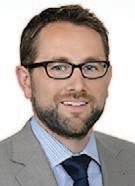
*Michael MuseFisher is a Shareholder at Buchalter, a Professional Corporation. He regularly represents receivers across all receivership types.
Co-Editor’s Comments
BY MICHAEL MUSE-FISHER* AND BLAKE ALSBROOK
“You will have a King! Not evil, but handsome and terrible as the dawn! Treacherous as the sea! Stronger than the foundations of the earth! All shall love me, and despair…”
Sorry, I am letting this new role as Chair of the California Receiver’s Forum go straight to my head. Also, Blake said I need to write the co-editors’ comment since he wrote it for the last issue, so in a way this is his fault (separately, if you get the reference for that quote, know you are a friend). Turning to more important matters than my selfaggrandizement, we are excited to share this issue with you. Really excited.
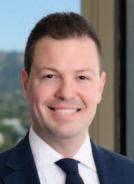
The interview with the Honorable Curtis Kin (LASC Dept. 82) is fantastic. If you have ever had the fortune to appear in front of him, you know how astute a jurist he is and that he makes sure to be wellversed in the issues regardless of their complexities, and ensures that all sides are heard. He is a wonderful addition to the writs and receiverships departments. In his interview, he shares his upbringing, education, and professional career – which is, in a word, impressive. Some highlights - he was a clerk for a current U.S. Supreme Court Judge (you’ll have to read the interview to find out who), he worked for 13 years as a federal prosecutor, and even placed third in a season of Big Brother.
One of our well-known members– and the current Program Chair for the CRF– Gary Rudolph, wrote a wonderful piece which provides us with a glimpse of his past, present, and future. We should all thank Gary’s dad, who directed him away from a possible career as a gas station attendant to the practice of law (for which he has excelled).
I was told I had to write something as the new Chair. You can skip that if you want. But you should not skip Chad Coombs Tax Talk (which sadly may be his last), and Peter Davidson’s Ask the Receiver column. Nor should you skip the remainder of the articles, including Jeanne Sleeper’s write-up of our incredible Loyola X Symposium, which took place in January. We had a great turn out, and it was wonderful to see you all there… I miss you already.
Sit back, enjoy, and if you have a moment, say “hi” to Deb Johnson and the CRF’s new management team from Group Concepts. You may want to read Andrea Casillas’ write up of Group Concepts first. They are an impressive bunch, and we are lucky to have them.
Continued from page 1.
Q: As an attendee of the University of Southern California, what areas of study and activities were you most passionate about in your undergraduate studies?
A: Before arriving at USC, I was pretty sure that I wanted to be a lawyer. So, I followed the advice of counselors and professors who told me that the best preparation for law school would be to choose a major that would help develop critical thinking skills and hone my writing ability. I was told that International Relations (“IR”) would be a great area of study for that. The IR professors were really engaging, and it was a particularly interesting time to be studying IR with the breakup up the Soviet Union, unification of Germany, and Gulf War. I also got a minor in Business Administration. Although I did not enjoy those classes as much, I am grateful for the background those classes provided me when dealing with complex business disputes in litigation.
Q: Was there a specific reason you chose to attend the University of Southern California undergraduate?
A: Perhaps I was a bit sheltered at the time, but I only applied to a few schools in California. USC offered a fairly generous academic scholarship. But, in addition, I grew up as part of the so-called “Trojan Family”—my parents, an aunt, and uncle attended, and my sister was already at SC when I applied. I was fairly well-indoctrinated. I also wanted to attend a school that would provide a fun and energetic collegiate experience with a large student body, robust sports program (including football!), and lots of extracurricular activities to round out my academic studies.
Q: Did you know from early age that you were going to pursue law?
A: Yes. I grew up watching “L.A. Law” on television and thought that being a lawyer would be such an achievement
Continued on page 4...
Michael Muse-Fisher
*Blake Alsbrook is a Partner of Ervin Cohen & Jessup, LLP. He is a receiver and counsel for prominent receivers. Blake Alsbrook
Judge Kin...
and a fulfilling career. I didn’t necessarily think I wanted to be like the lawyers on the show—civil litigators at boutique firm Mackenzie Brackman—but I did know being in the courtroom and in trial was something I wanted to do. At the time, I had very little understanding of what lawyers otherwise did. I had no idea that many lawyers do transactional work, serve as corporate counsel, or may rarely appear in court. But I did know that being in court was something that very much appealed to me.
Q: I see you continued on at Stanford Law School and graduated with distinction. Was that your top pick for schools and was there a professor who made a lasting impact on you and why?
A: I feel very fortunate to have attended Stanford. I remember reading various books that described law schools and how to get in. One book referred to Stanford as Shangri-La. I don’t disagree. The campus is beautiful. The class size was sufficiently small to give students the attention

Court appointed fiduciary,manager, consultant and nationwide specialists for lodging,foodservice, resorts,bars,nightclubs and mixed-use real estate since 1985.
Contact: Dennis Gemberling CHA, CFBE, FMP, FCSI President
and support they needed. The student body was diverse, interesting, and brilliant. Even though the culture was very collegial, I often felt intimidated intellectually, which I think caused me to work very hard and delve deep into my studies. I also made truly great friends there. Some of my closest friends in the world—who have been there for all the important moments in my life—are my friends from Stanford. As for a favorite professor, that would be Professor Hank Greely. I first had him for property as a 1L, and he managed to make it interesting and probably my favorite class that year. Later on, I had him for a seminar on Health Law & Policy, which I only took because it was taught by him. I ended up writing a piece in that class that was published in the Stanford Law Review. He was also quite a foodie. For two years in a row, a couple of friends and I had the winning bid at the public interest law auction for dinner at Professor Greely’s home, which was quite a feast with great conversation. I don’t know if Professor Greely knows the lasting impression he made on me, but I am very grateful for the mentorship and guidance he provided.
Q: I see after law school, in 1996 you had two clerkships. The first was for Hon. Jed S. Rakoff with the U.S. District Court for the Southern District of New York and the second as a clerk for Hon. Sonia Sotomayor on the U.S. Court of Appeals, Second Circuit a few years later. How did you like being a clerk and were there any important lessons you learned from these Judges?
A: I loved being a judicial law clerk. It absolutely convinced me that I would like to be a judge, if that were possible. I think judges see the best part of litigation—when the issues have crystallized and the parties are in court for resolution. I also like the role judges play in our system of justice . . . not beholden to any one side but instead dedicated to access to justice and a fair outcome under the law. Both Judge Rakoff and Justice Sotomayor were terrific mentors, who were interested in their clerks and their development. I learned a great many things from both of them, including the value of hard work and attention to detail. Both of them were incredibly hard working, and to see early on the value and necessity of putting in hard work was an invaluable lesson that has stayed with me throughout my career.
Q: After your clerkship, you worked in private practice for 2 years as an associate at Cravath, Swaine & Moore in New York. Why did you decide to go into private practice
Continued on page
Continued from page 4.
and what were there areas of law you worked in? Was there an area of law that you were drawn to and why?
A: I went to a large firm to get top-notch litigation experience. Cravath had and still has a sterling reputation. In addition, I was really drawn to their “Cravath system” of assigning associates to work only with one partner at a time. It is a good mentorship model that allows an associate to work only on the matters assigned to the partner, which facilitates a more holistic approach to cases, as opposed to being randomly assigned to handle parts of a case here and there. During my years at Cravath, we handled a fair number of matters. The substantive area of the law did not matter to me so much as my gaining experience in litigation generally, such as drafting Complaints and Answers, propounding discovery, responding to discovery, motion practice, taking and defending depositions, making court appearances, etc. Cravath also let me take on various pro bono matters to enhance my experience.
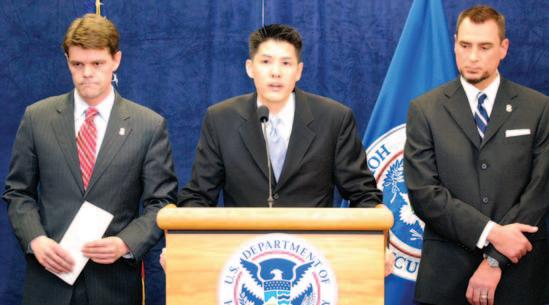
Q: In 2000, you returned to the West Coast to join the U.S. Attorney’s Office for the Central District of California as a prosecutor. You served as a federal prosecutor for the Department of Justice for 13 years. Was there a type of case you specialized in handling and what did you learn while working at the U.S. Attorney’s Office?
Continued on page 6...


























































Press conference during Judge Kim’s time at the U.S. Attorney’s Office.
from page 5.
A: I knew I wanted to be an AUSA during my first clerkship with Judge Rakoff, when I consistently saw that the AUSAs appearing before the court were the most prepared, polished, and effective advocates. After five years in New York, it was time to come back to Los Angeles, and fortunately I secured an offer with the U.S. Attorney’s Office in the Central District. After my initial stint in General Crimes handling the full panoply of federal crimes, I moved to the Major Frauds Section to handle white collar crimes. Eventually, I became a supervisor in the Office and held various positions, including Chief of Complaints (overseeing investigations and charging decisions), Chief of Domestic Security and Immigration Crimes (overseeing complex alien smuggling rings, large-scale immigration fraud, and human trafficking), Chief of General Crimes (training section for new prosecutors), and Chief of the Criminal Appeals Section. What I loved about being an


AUSA was the ability over my career to handle all manner of case types and switch positions to keep things fresh. That said, the most gratifying cases I handled involved human trafficking. It was very satisfying to vindicate the rights of the victims. I also developed expertise in the area of antitrafficking, which provided many opportunities to teach on the subject and train government officials, law enforcement officers and prosecutors, and victims’ rights advocates both domestically and abroad.
Q: In 2000, you were on the very first season of the reality television series, Big Brother, and came in 3rd place. How did you get on this television show and was it a good experience?
A: Like everyone else, I applied, after having seen various ads on the sides of buses blanketing New York City at the time. After several rounds of interviews and casting, I was selected. I thought it would be a fun experience like no other. That is certainly true. At the time, however, I did not fully appreciate that participation on the show could potentially have really harmed my career. Fortunately, I walked off the show, with a little money in my pocket and a career to which I could return. I am glad to have had the incredibly unique experience.
Q: In 2013, Governor Jerry Brown appointed you to be a Superior Court Judge. Did you have an opportunity to meet the Governor and what were your impressions of him?
A: I have never met Governor Brown, but I am grateful for his decision to appoint me. Instead, my final interview was with Governor Brown’s Judicial Appointments Secretary, Josh Groban, who is now a Justice of the California Supreme Court. Justice Groban was very nice but was very hard to read. I had no idea how I did during the interview until he called much later to let me know the Governor was going to appoint me. I can vividly picture that exciting call, which I think will always stay with me.
Q: Since your 2013 appointment, what types of cases have you been primarily handling?


A: My first five years on the bench, I was in a criminal assignment, which felt very comfortable as a former prosecutor. I handled a misdemeanor calendar and trials, but I also was the backup court for conducting preliminary hearings and presided over some interesting felony trials,
including a brutal attempted murder and some robbery and assault cases. I then switched to the Civil Division and oversaw an unlimited jurisdiction, independent calendar court, first in Glendale and then in Mosk. I found the transition to civil very interesting and rewarding due to the breadth of cases and variety of procedures. There is always something new to learn and many opportunities to research and write. I was, however, thrilled when an opportunity opened up in the Writs and Receivers Department. I have very much enjoyed my time since I came here several months ago.
Q: What are your general thoughts on appointing Court Receivers?
A: Under the right circumstances I think a receiver can be tremendously helpful to the Court, providing expertise in subject matters for which the judge may not be as familiar and preserving and managing the business or asset at issue
so that the dispute between the parties can move toward resolution meaningfully. I recognize, however, that appointment of a receiver is a drastic and expensive remedy, and believe that, on a case-by-case basis, I must weigh whether it makes sense to do so under the applicable law and upon consideration of other potentially less extreme remedies.
Q: What are some of the factors that persuade you to appointment of Court Receiver or Partition Referees?
A: Every case is different. So, it’s not possible for me to set forth one or more factors that might persuade me to appoint a receiver or referee in any one case.
Q: What qualifications do you like to see in the receivers that you appoint to your cases?
A: It certainly helps if the parties can agree to narrow the list of potential candidates to just a few. Aside from the parties’ preferences, I look carefully at the candidates’
Continued on page 8...
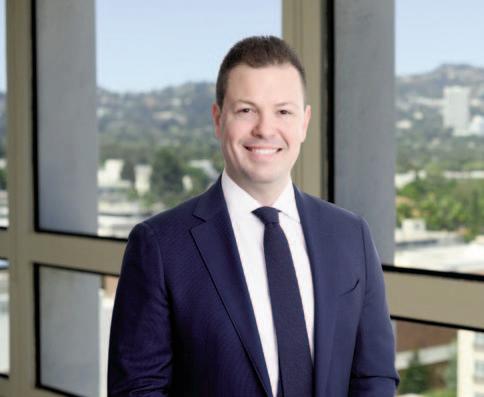
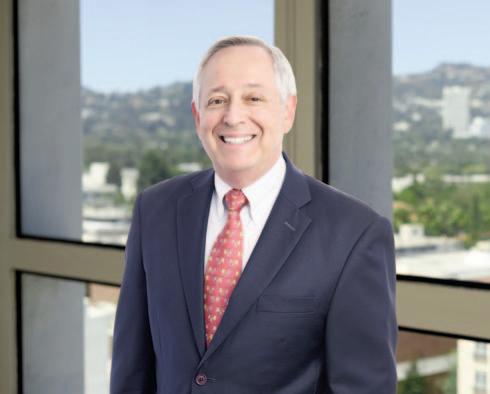
resumes, paying particular attention to whether the proposed candidates have any particular experience or expertise with the type of business or property to be placed in receivership or the type of dispute at issue in the litigation before me. I also pay attention to billing rates, because I am cautious about unduly diminishing the receivership estate in order to pay the receiver whose job is to preserve the assets.
Q: What are your thoughts on ex parte motions to appoint a receiver?
A: I take seriously the standard for bringing a matter on an ex parte basis. If there is no established immediacy, exigency or imminent threat of great or irreparable harm, the request for a receiver should be made by noticed motion, which allows me to more carefully weigh all the considerations before deciding whether to impose such a drastic remedy.
Q: On motions to appoint receivers, what types of arguments tend to be most persuasive to convince you to appointment a court receiver?
A: Again, I make all determinations on a case-by-case basis and can’t point to any particular argument or arguments that might have sway over me in any particular case.
Q: What is the most common mistake you see in motions to appoint a receiver?
A: I see a fair number of requests for appointment of a receiver in situations where one is not necessary. I take seriously the standard that a receiver ought to be appointed only where necessary to preserve the property at issue and protect the rights of the parties.
Q: Once you have appointed a receiver, how much communications and updates would you like to receive from your receiver?
A: Every case is different, and the frequency of communication and updates may largely depend on the nature of the receivership estate. To some extent, I will defer to the receiver’s suggestion about what makes sense for periodic updates to keep the court apprised. I am also sensitive to not requiring the receiver and potentially receiver’s counsel to unnecessarily generate fees for updates, court filings, and attendance at status hearings that are not absolutely necessary.
Q: When do you want to see receivers who are not attorneys retain counsel?
A: Every situation is different. So, I do not have a hard and fast rule. But, I often times find it helpful if the receiver is also a lawyer who understands the litigation process. I am also wary of costs to the receivership property. If a receiver can handle much of the work in a quality manner without hiring outside counsel, that is a good thing.
Q: What is the one piece of advice you’d like to share with anyone that is going to appear before your Department?
A: Come prepared. Know what you want and the extent to which the law allows the Court to give the relief you request, as well as under what circumstances. And be ready to engage in a dialog with the Court about why you are entitled to the requested relief.
Q: What do you like to do when you are not working as a Judge?
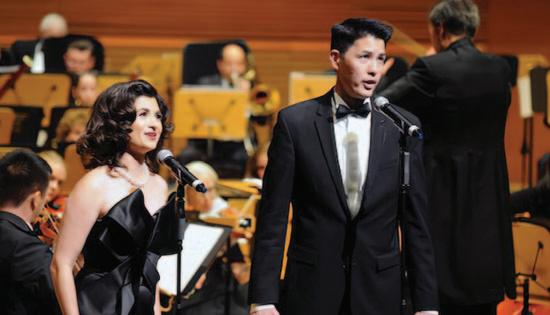
A: I really enjoy my work “extra-curriculars,” which includes involvement in ongoing judicial education throughout the state and teaching law students for the past twenty years. But outside of work, I love spending time with my family—though my wife and I recently became empty nesters. We like to stay active and go hiking, including with our lovable but enormous dog. I love good food and wine and enjoy cooking. We also like to travel and typically ski every winter in Tahoe and the Pacific Northwest. I also enjoy singing and am a member of our church choir and the Los Angeles Lawyers’ Philharmonic and Legal Voices. Kind of like my days in good ol’ Tustin, I just like to keep occupied with a variety of activities at all times.
*Kevin Singer is the President of Receivership Specialists with offices throughout the Southwest. Mr. Singer has been a Court Appointed Officer in over 420 cases in the last 20 years.
Judge Kin performing a solo at the Lawyers’ Philharmonic and Legal Voices Concert in the Walt Disney Concert Hall.
Kevin Singer
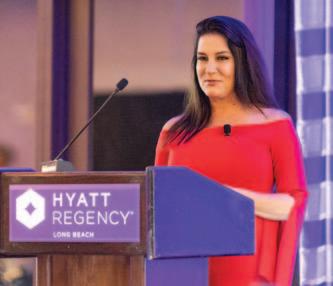
Thursday Keynote
The symposium launched with a highpowered keynote by Danielle DiMartino Booth. She has a deep economic history from Credit Suisse, Donaldson Lufkin & Jenrette to the Federal Reserve Bank of Dallas to her founding of Quill Intelligence LLC. The Quill Intelligence team of investing veterans analyze trends to provide critical understanding and commentary that is data driven. Her remarks in The Daily Feather not only guide portfolio managers, but promote financial literacy.
Danielle’s rapid fire, fact deep, trip through a plethora of graphs to illustrate her points was a challenge to keep up with. Her critical market analysis however, added provability to her comments on what is driving the markets.
Some concerning facts Danielle highlighted include “higher interest rates more prolonged than any time last 40 years,” “US corporate debt not refinanced a year ago is facing non-negotiable higher interest,” “UCC foreclosures will increase,” “Failing stress tests in commercial, multifamily, hotel and industrial paper,” “California high net worth individuals out migration continuing,” “81% of new jobs recently created are in the lowest paying fields of healthcare, education, leisure and hospitality,” “Student loan borrowers not paying as they hold out for more forgiveness and new car buyers can’t make the payments find it hard to give the car back,” “ERDC announced the fraudulent applicant percentage payback schedule required to avoid criminal action,” and “trillions in shadow banks

Fiduciary Real Estate Asset Sales & Leasing



Danielle DiMartino Booth, founder of Quill Intelligence LLC delivered a convincing presentation of why “Credit” is the problem.
that the current government wants to regulate (with the most politically-divided electorate ever).”
In one word, Danielle asserted that CREDIT is the economy’s problem. Aspirational consumers have sustained a blow to their net worth….and commercial building owners have emptying buildings in urban ghost cities and no affordable re-fi options in short term sight.
Friday Receivership Programs
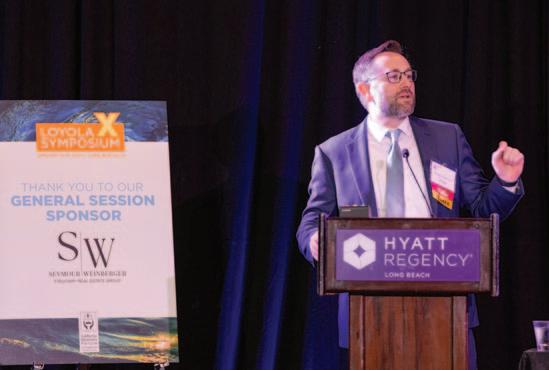
The Symposium Committee delivered an engaging range of receivership programs with high quality education for new-to-the-field and veteran participants from across the state on the stage and in the audience. The program kicked off with many thanks and recognition to the members who volunteer their expertise to the organization and conference.
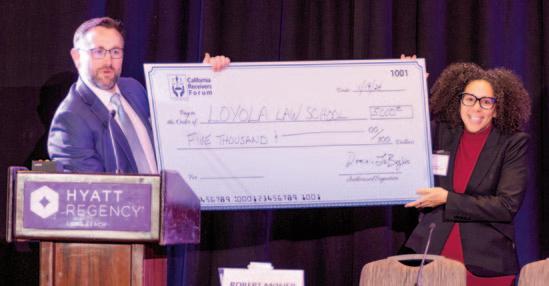
Loyola Law School of Los Angeles was presented with a $5,000 donation to the school’s Juris Fund. The CRF founding Symposium was held at the Girardi Advocacy
Boots on the Ground, for Arizona Real Estate


Center on Loyola’s downtown campus until the program outgrew the Center’s capacity. The law school faculty and dean continue to support the continuing CRF’s use of the school’s name in titling of the CRF educational program.
Receivership Keynote
Robert P. Mosier , known as RPM and Bob, is the founder of Mosier & Company and has been a courtappointed fiduciary for nearly 40 years, with 10 years as a turnaround/dissolution professional before that. He was part of the founding group for the Los Angeles – Orange County Receivers Forum and later the state organization. He led the project to reformat the organization’s newsletter to a magazine format and substantially increase the page count, added advertising and unique ways for receivers to tout their appointments and case closures. He served as publisher from that re-birth to last year.
Continued on page 11... Continued from page 9.
Michael Muse-Fisher, 2024 California Receivers Forum President opened the conference with Thanks, Kudos and Recognition for the many members in leadership across the state.
On behalf of CRF/ Loyola Symposium, Michael Muse-Fisher presented a $5,000 check for the Juris Fund to Interim Dean of Loyola Law School, Briella R Clark.
from page 10
Not mentioned as planned in the live talk due to schedule constraints, were a list of professionals who have contributed to Bob’s career as a receiver including Craig Collins, CPA Retired (who is the quantitative side of Mosier & Company), Mike Walters and Tiffany Cook (Tranzon Asset Strategies/Auction firm), Phil Seymour (the Seymour Group for conventional listings), and counsel including Kirk Rense, Edy Bronston, Nick Morgan, Kathy Phelps and Kyra Andrassy among many others. Bob is also respectful of some giant Receivers from the past including the Davids (David Ray, David Pasternak), Doug Morehead Bob Warren, and Robb Evans who are all now deceased.
Senior statesman, mentor, and consummate business professional, all describe Bob. His keynote walked through his life from youth years living on a farm, playing sports, to inventing or rescuing big name corporate marketing programs, learning to fly, learning big business basics and executing them with thoughtful precision including corporations such as TWA, the Delta Queen Steamboat Company and Executive Jet Aviation. He navigated roles, companies, countries, Harvard mid-career and found that a fiduciary perspective, honest dealing, a kind demeanor and paying attention to trends and details could build a business.
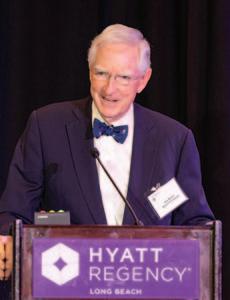
What you do and learn in one position contribute to your varied experiences that grow into new opportunities.
Bob is winding down Mosier & Company and gliding toward retirement. He closed the tour through his professional life presentation with these lessons:
1. Appreciate your current status;
2. The job and joy of raising kids (and grandkids); and 3. Have a Sense of Humor.
General Session
Receiver as Detective – Working with a Receiver to Uncover Fraud and Other Bad Behavior
Panelists: Kyra Andrassy, Raines Feldman LLP; Stephen Donell , Fed Receiver, Inc.; Kyle Everett , Development
Specialists Inc.; and Moderator: Geoff Winkler, American Fiduciary Services
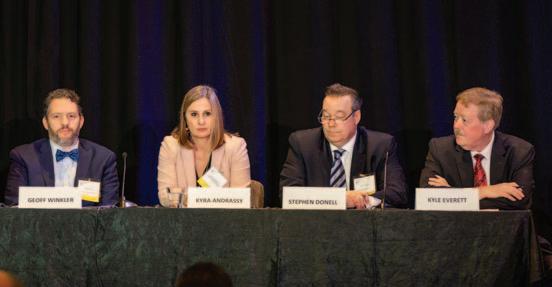
The panelists walked the audience through the importance of finding out everything you need to know, how to use checklists and a few fine points of a swat-style take over. Receivers need to be a bit of “Columbo” detective, a glad-hander, curious about everything, willing to look through trash, ask “why?”, willing to talk to anyone on the periphery of or inside the case, and conversant in social media account review, as well as balance sheets.
There is always something new to learn from programs based on practical experience. Some of the panel’s takeaways included 1) the admonishment to always include in your employment order that the receiver has the right to issue subpoenas to 3rd parties 2) get bank records directly from the banks to avoid falsified bank records and then mine the bank records for potential assets and 3) when doing a surprise take over – work with the alarm company in advance to be sure the office security alarm is turned off just before your takeover team’s arrival.
Concurrent Sessions
Bad Vibrations – Partnership Disputes & Dissolutions
Robert Mosier, senior receivership statesman and role model, shared his circuitous career path from education to nearing retirement illustrating the plethora of business experience and talents that make a receivership company.
Moderator, Geoff Winkler and panelists Kyra Andrassy, Stephen Donell, Kyle Everett shared hard learned lessons on uncovering fraud in receivership cases.
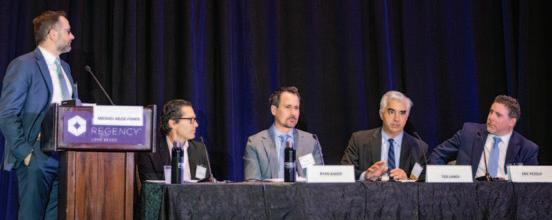
Moderator Michael Muse-Fisher and panelists Kevin Singer, Ryan Baker, Ted Lanes, and Eric Pezold dissected business partnership blow ups and the path through corporate divorce.
Continued from page 11.
Panelists: Ryan Baker, Douglas Wilson Companies; Ted Lanes , Lanes Management Services; Eric Pezold , Snell & Wilmer LLP; Kevin Singer , Receivership Specialists and Moderator: Michael Muse-Fisher, Buchalter
The panel highlighted different formats to resolve partnership disputes which included provisional director, partition referee, receiverships and others. These seasoned receivers reviewed that these cases have a lot of history and emotion, and thus the fiduciary will generally want to have the ability to sell assets – whether initially to a participating party, and if not feasible, to a third party – as a solution to resolve the dispute, and that reasonable professionals are needed to make cost and time effective decisions.
Acknowledging the rights of minority partners, understanding the genesis of the dispute and setting expectations of those involved are all key to success. The “neutral” position of a receiver, partition referee, or other fiduciary being appointed to protect and preserve assets can be reinforced and add calm and acceptance to dispute resolution.
Step into Il-Liquid – Types of Receiverships
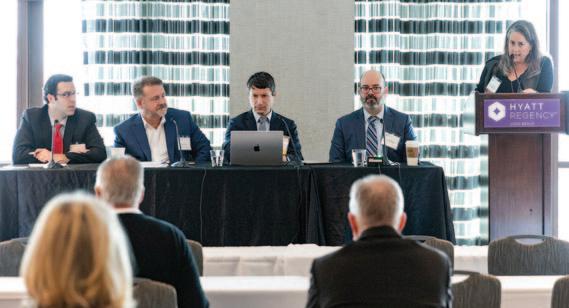
Panelists: Michael Gomez , Frandzel Robins, Bloom & Csato, L.C.,; Ivo Keller , SSL Law Firm; Scott Sackett , Fiduciary Management Technologies and Moderator: Jake E. Rios, Felderstein Fitzgerald Willoughby Pascuzzi & Rios LLP
Rents, issues, and profits receiverships were discussed first with common issues affecting all types of receiverships, as well as best practices when undertaking a new receivership engagement. Construction projects were highlighted next, including whether to keep the existing contractor or bring in a new team. Reminder to refresh your knowledge of Mechanics Lien law on taking a construction
assignment. Health and Safety assignment comments related to how hard it is to know what went on before you became involved and the complexity of due process with tenants. The common difficulty of dealing with utilities, title companies and insurance companies was a thread through the panel’s comments.
The umbrella reminder was that a fiduciary operating a business has to do so lawfully and you may be taking on a company with incomplete or missing payroll records, no insurance policies, delinquent tax payments, unreliable financial records, minimal cash, no business license, environmental or business code negligence… just to name a few common problems.
Chasing Mavericks – Commercial Real Estate Momentum
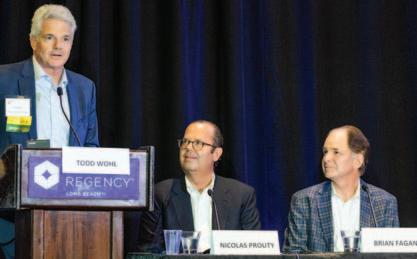

Panelists: Brian Fagan , Selective Real Estate Corp; Daniel Miggins, Hilco Real Estate; Nicolas Prouty, Putnam Bridge and Moderator: Todd Wohl , Braun International Real Estate/Premier Estates International
In line with the wave theme – Mavericks is a surfing location in northern California outside of Pillar Point Harbor. Waves routinely crest at over 25 ft and in strong winters top out at 60 ft. The monster waves are walls of water and adjacency to a harbor does not equal safety. Panelists made a number of points, including the following: as far away as Puerto Rico, private equity firm owners and major real estate restructuring company panelists say this cycle is different. All industries appear to be affected by the current downturn. Interest rates are too high, cap rates are too low, and the spread makes deals impossible. The speakers indicated that the smart move in commercial real
Continued on page 13...
What to do when there is little that’s easy to turn into cash was tackled by Panelists Michael Gomez, Scott Sackett, Jake E. Rios, Ivo Keller, and Moderator Mia Blackler.
Moderator Todd Wohl quizzed Panelists Brian Fagan, Nicolas Prouty and Daniel Miggins about investing their private equity resources in the current commercial real estate market. Response: Money is staying in their pockets.
from page 12.
estate would be to preserve cash and wait more than a year for change sufficient to consider even distressed deals. Retail has gone online or out of business. Urban in-fill may be possible in low-cost, low-regulation states (not CA) if the developer is willing to invest in equipment for the tenant’s business. Valuations are tough when functional structure and useful business life are out of synch. Trophy buildings may only end up with land value in urban cores. Tenant pressure to not renew or rewrite leases is increasing. Lenders are slow to foreclose now, but that can’t go on forever. Neither buyers nor sellers are willing to take the necessary haircut today. Use this pause between economic wave sets to do due diligence now and ready your acquisition target list. The tsunami will recede when the cost of money comes down. Preserve your cash and wait for opportunities. There is a lot of debt coming due in next 2- 3 years and there will be opportunities.
Surf’s Up! – First Day Issues

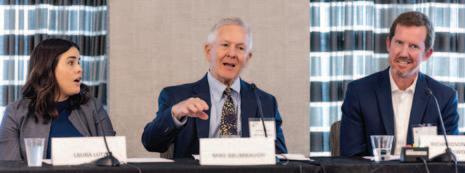
Panelists: Mike Brumbaugh , MBI Consulting Group; Laura Lutz , Lubin Olson& Niewiadomski LLP; Cooper Plyler, Stapleton Group and Moderator: Richardson “Red” Griswold, Griswold Law APC
Three main topics were covered: pre-appointment considerations, the appointment hearing and order, and first day steps. The pre-appointment considerations
Continued on page 14...

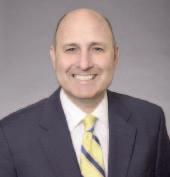
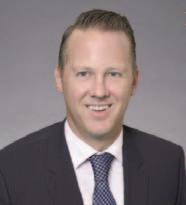
Seasoned Panelists Cooper Plyler, Laura Lutz, Mike Brumbaugh and Moderator Richardson “Red” Griswold shared First Day checklists and cautions to newer receivers.
from page 13.
involved the receiver’s pre-appointment due diligence and planning for the first day. The due diligence can be a complex step and still surprises are likely to surface throughout the assignment. The panel transitioned to the appointment hearing and order, discussing when might a receiver attend the appointment hearing, if the receiver might meet with counsel or parties before or after the hearing, and cases for notice versus no-notice appointments. Appointment orders may start with a template, but are customized to the anticipated unique needs of each case. Finally, the panel discussed first day steps covering re-review of the order, filing the oath and bond, noticing parties, employees, and tenants, the actual takeover, and the assessment of assets.
The preceding list might take days or months once in motion. Administrative tasks include making prearrangements with accountants, banks, bonding company, property managers, consultants and receivers counsel options, so those elements are in place and ready to use with new assignments. Preserving the assets might require immediate actions by the newly appointed receiver.
Avoiding Wipeouts While Selling A Cannabis Business





Panelists: Blake Alsbrook , Ervin Cohen & Jessup, LLP; Drew Mathews , Greenlife Business Group; Adam Nach , Lane & Nach PC; Gina Austin , Austin Legal Group and Moderator: John Rachlin , Receivership Specialists
This panel focused on what a Receiver needs to know, and the pitfalls to look out for when selling a cannabis business and/or cannabis licenses. The panel contained cannabis transactional attorneys, an attorney that specializes in cannabis code compliance, and a business
broker that specializes in the marking and sale of cannabis businesses and licenses.
A host of issues where covered, which included in part why it could be advantageous to have a Receiver appointed to sell a cannabis business; what regulatory and compliance issues a Receiver needs to beware of when taking over and selling a cannabis business; how a broker best values and markets a cannabis business and/or licenses; how to structure the sale; important provisions to include in the Purchase Agreement to protect the Receiver; how to successfully transfer the business and/or licenses to the buyer; and how to windup the case to reduce potential future liability to the Receiver.
Shooting the Tube – Getting Out and Paid


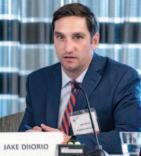
Panelists: Michael Kasolas , Michael Kasolas & Co.; Jarrett Osborne-Revis, Buchalter; Annie Stoops, ArentFox Schiff LLP and Moderator: Jake Diiorio, Stapleton Group
This panel offered useful advice on key final day issues of a receivership, including tactics for ensuring fees are approved in the Final Report and Account. A good starting point is to review the monthly reports and prepare a narrative of the flow and details of the receivership, especially if it went on a long time, or several judges were involved over time, to help the judge see/remember the many tasks thru the flow of the receivership. This the last chance to pay attention to any details that need closure or approval. Completing a thorough Final Report & Account (especially when the case was complex) is a key way to not only summarize the litany of tasks, but to substantiate your fees.
You will need to estimate your “following the final hearing costs” to implement actions that can’t be handled
on page 15...
Marijuana is tough industry no matter how you look at it. Tackling the complex state-federal issues and more are moderator, John Rachlin, with panelists Adam Nach, Blake Alsbrook, Drew Mathews, and Gina Austin.
Converting hourly WIP to approved and paid fees is a tricky process discussed by Panelists Annie Stoops, Michael Kasolas, Jarrett Osborne-Revis and Moderator Jake Diiorio.
Continued from page 14.
until after the Final Report is accepted by the court, such as closing bank accounts, storing and shredding documents or any last noticing of the final order. Be cautious and exacting in your final distributions paying extra attention to priority order. Key advice is to THINK of everything that could go wrong post final hearing, and put language in the final order to cover the potential issues.
Point Break: Stump The Experts
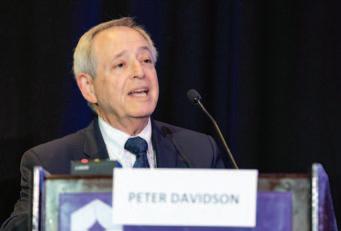
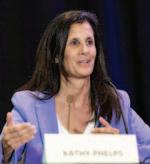
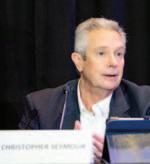


Panelists: Mike Essary, Calsur Property Management; Kathy Phelps , Raines Feldman LLP; Christopher Seymour, Gilmore Magness Janisse; Susan Uecker, Uecker & Associates and Moderator: Peter Davidson , Ervin Cohen & Jessup
Moderator Peter Davidson, author of Ask The Receiver column in Receivership News, saved some of the tricky inquiries to ask the panel of experts.
• Can a receiver avoid the use of arbitration clauses in various contracts of the receivership? Answer: read clause carefully, lots of conditions and may be a yes or no.
• In a UCC filing what does “commercially reasonable” mean? Answer: be sure the assets to be sold at a certain price that is in excess of the properly recorded UCC document’s values of the items sold. Double check that
the UCC was properly named and filed before you sell the named assets.
• Does a sweep account meet the test of “insured cash” when the main account hits $250,000 and the over limit cash is automatically swept into another bank’s account tied to the main account? Answer: yes. These are now called IntraFi (formerly CDARs).
• When should a receiver hire counsel? Answer: If the receiver is not an attorney, whenever legal action or pleadings need to be filed that are more than just filing monthly reports.
The Rogue Wave- Avoiding Liability as a Receiver
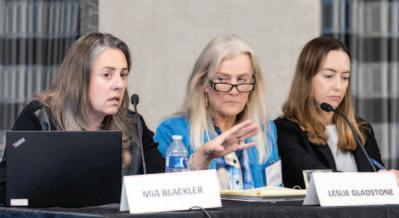
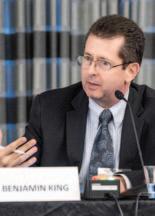
Panelists: Mia Blackler , Lubin Olson Niewiadomski LLP; Leslie Gladstone , Financial Law Group; Anne Redcross-Beehler , Holland & Knight LLP and Moderator: Benjamin King, Loeb & Loeb LLP
This panel covered the basics and authorities supporting receivership immunities, and new case law impacting same. With that foundation, the speakers highlighted the importance of getting involved early in the careful drafting of the receiver’s appointment in order to avoid pitfalls down the receivership road. Other best practices were covered, including funds management, timing and notice issues, having a thorough knowledge of tax and insurance issues impacting receiverships, maintaining neutrality at all times, and the importance of seeking further instructions from the court. Then the panel applied their respective practical approaches and past experiences to the challenges receivers face, and how to surmount them.
on page 16...
Panelists from across the state. Kathy Phelps, Christopher Seymour, Susan Uecker, Mike Essary were up to the challenge.
Ask The Receiver columnist, Peter Davidson, was ready with tricky questions for the experts.
Draft, review, redraft, think it through and re-edit the appointment order was discussed by Panelists Mia Blackler, Leslie Gladstone, and Anne Redcross-Beehler as Moderator Benjamin King pulled the diverse advice together.
Loyola Symposium X ...
Continued from page 15.
Luncheon Table Topics
Friday luncheon tables were each hosted by a facilitator to engage the participants in a discussion about the pre-set topic. The ballroom was a buzz of participation and sharing insights around the table. Thanks to all of the sponsors for their financial support and luncheon table education. Professional services across a broad range of businesses are needed in receivership matters. Thanks to the companies who sponsored and exhibited at Loyola X and provide valuable services to the receivership community.
"#$%&$'!($#)*!
+!"!,-%./'0!12%3!($#!4!5/26)7-&!8-*-)9-'&!:--;!)%!<!12%3=! #6/&!1$%/&!()#!>%!('29-6!
1'2/%
?%.-'%27$%26!
8-26!@&.2.-! AB-% "-66)%C!<&&-.&=!AB2.!?&!,$%&);-'-;!2! ,$DD-'*)2660!8-2&$%2E6-!"26-&!F'$*-&&!
,26F')92.-!12%3!G$H!($!F'$.-*.!I$/'!<&&-.&!)%!<%!@9-'J ,B2%C)%C!K2'3-.! ,26"/'!F'$#-'.0!!
K2%2C-D-%.! ?&&/-&!2%;!>##$'./%)7-&!)%!,$%9-'7%C!2! 8-*-)9-'&B)#!.$!2!12%3'/#.*0!,/&.$;)2%
L$/C62&!A)6&$% ,$D#2%)-&! MN+!".'2;2!O-**B)2JG2;);!K2%&)$%
@2&.!A-&.!12%3!(B-!8-*-)9-'P&!>#7$%&!)%!12%3)%CQ!?%*6/;)%C!
R/660!F'$.-*.-;!R/%;&!$S!.B-!@&.2.-!
@')*!"2*36-'!T!
<&&$*)2.-&! ($;20P&!K2'3-.!,$%;)7$%&!
@'9)%!,$B-%!T!
U-&&/# <##$)%.D-%.!$S!8-*-)9-'&!)%!,')D)%26!,2&-&!
R);/*)2'0!
<;9)&$'0!
"-'9)*-&!
R);/*)2'0!8-26!
@&.2.-!!
"-'9)*-&!
AB2.!V--#&!8-*-)9-'&!W#!<.!:)CB.X!
AB2.!K23-&!R$'!<!Y'-2.!>';-'!<##$)%7%C!
8-*-)9-'!$'!F2'77$%!8-S-'--X!
?%9-%Z!K-;)*26!F'$9);-'!8-*-)9-'&B)#&!
?%C-%)$/&!<&&-.&!,/''-%.!T!W#*$D)%C![2H&!<\-*7%C! K2%2C-D-%.!$S!8-26!@&.2.-!<&&-.&!)% ,26)S$'%)2!
?%9-&.$'&P!
F'$#-'.0! "-'9)*-&!
8-*-)9-'&B)#!+N+!
V,,!8-;/*-!R)'D!@]#-%&-&!2%;!"29-!()D-!
F-''0!Y'$/#!G$.-6!R'2%*B)&-&!^!R')-%;!$S!R$-X!
8-*-)9-'&B)# "#-*)26)&.&! [-.P&!Y-.!G)CB!T!(263!,2%%2E)&!





































B.

is the founding Executive Director of the California Receivers Forum, and CEO of JBS & Associates. She is retired from full time association management and now accepts consulting/field work short term assignments and as many underwater and travel photography projects as possible.
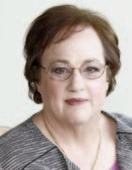
Jeanne Sleeper
*Jeanne
Sleeper
Group Concepts, Our New Management Team!

BY ANDREA CASILLAS*
Founded in 1976, Group Concepts was created on the premise of simply helping organizations provide value to their communities without having to rely on volunteers to manage the day-to-day operations. Today, nearly 50 years later, the company maintains its traditional values of business ethics and professional development. However, we combine ingenuity with the utilization of technology to be as efficient and cost conscious as possible.
Group Concepts is a team of eight diverse individuals with 100 years combined experience in the nonprofit world who work together to make all constituents feel like part of the organization. Our “roll up our sleeves” approach also helps board members get re-energized about their volunteer roles so they can continue to effect change in the organization. We actively strive to deliver exceptional customer experiences that exceed expectations.
Meet the Group Concepts CRF Team
Deb Johnson
Deb Johnson is a high-performance senior leader with over 20 years of experience managing non-profit organizations. She has the ability to drive change to improve organizational performance and management. Deb has a strong track record of success in motivating and developing volunteers while optimizing operational results. She is a selfdirected professional who takes pride in the transformation of a vision into reality while building a sustainable foundation for continued success. Deb takes initiative to learn about the industries of each of our clients and is excited to apply her skills to grow client associations. When not in the office, you can find Deb traveling, dancing, kayaking or gardening.
Alex Kerstner
Alex stumbled into the non-profit association management world nearly 20 years ago and has enjoyed various positions from webmaster to executive director, until becoming an event planner for Group Concepts. Alex enjoys the variety and multitasked environment associations bring to the table, as well as managing events from conception to reality. Events include annual conferences, board retreats, board meetings, educational seminars, webinars, awards luncheons, social activities, golf tournaments, and tradeshows. Born and raised in Germany, Alex’s favorite activities include enjoying the outdoors with partner Jason and dog Gibson, backpacking, camping, as well as photography and attempting to grow a garden.
Derek Kozaites
Derek Kozaites serves as the Communications Manager for Group Concepts. In this role, Derek serves our diverse array of clients and is responsible for their daily communications, website organization, marketing, and database maintenance. His commitment to client satisfaction, ability to multi-task while producing a high-level quality of work, and exacting attention to detail greatly contributes to the overall success of the Group Concepts team. Derek is a self-motivated and results-oriented professional eager to contribute his diverse talents toward collaborating with an organization to achieve targeted goals and establish comprehensive solutions. He graduated from Dominican University with a BA in International Studies and has an Executive Certificate in Marketing Strategy.
*Andrea Casillas is the Owner and President of Group Concepts and serves as an Executive Director for their clients. Her areas of specialty include board structure, policy development, and corporate partnerships.
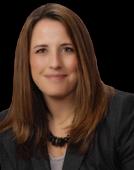
Andrea Casillas
Professional Profile: Gary Rudolph: Born to Run… To California to Practice Receivership Law
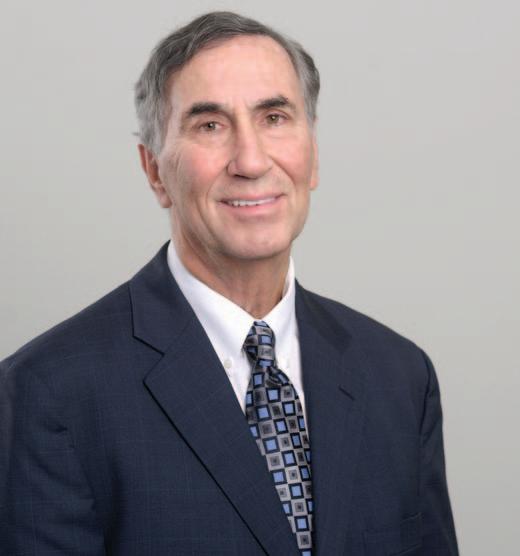
Growing up in North Jersey, a legal career was not front and center for me. In fact, it was probably to the contrary of where I thought I was headed. But I digress. I was not a great student in high school, but I was a decent wrestler. In fact I never had any ambition to go to college. I thought I would stay in North Jersey and probably work in a gas station pumping gas (in New Jersey, only gas station attendants can pump your gas). But my father (true Brooklyn blue collar) had other ideas. He kept a scrapbook of my wrestling accomplishments and set up interviews at colleges, including with respectable collegiate programs in Pennsylvania, Maryland and DC. I wound up at American University in DC on a wrestling scholarship, but the fun of collegiate life took priority over cutting weight and training six months out of the year. It took me two years to tell my parents that I quit the team. I supported myself working odd jobs in the school bookstore, cafeteria, and once worked as a census taker for the census bureau (having done that job, I can tell you with some confidence that you really can’t rely on the accuracy of the census information).
I majored in the Administration of Criminal Justice but I was really just coasting until I figured things out. The turning point for me happened one summer while I was attending a summer study program at the London School of Economics. At the end of the school session, I took a train to southern England but ran out of money to buy a return ticket. So I worked for a week or so selling tickets at the train station, until I earned enough money to travel back to London. At that point, I realized I needed to focus on school and the direction of my life. I completed undergraduate and graduate school in 4.5 years, with a degree in Administration of Criminal Justice and a minor in Psychology.
What next. I worked as a counselor in a group home in Tacoma Park, Maryland, counseling CINS—(children in need of supervision). The “children” were teenage women with family issues, truancy and minor delinquency. I really enjoyed this work, and was considering a PhD. in Psychology. Enter my dad again, who was determined to have a son that was a lawyer. Plus, he said I would make more money as a lawyer. Reflecting back, I am not sure if the grass would not have been greener.
At my dad’s urging, I applied to and was accepted at California Western School of Law in San Diego. I had no idea where San Diego was. But off I went, cross country, in a beat up 1968 Buick La Sabre, with no air conditioning and an eight track tape deck (am I aging myself too much?). Problem was I only had one eight track tape—Who’s Next, by The Who. I knew every word, every guitar riff, every drum snare. I reached San Diego and stayed at the U.S. Grant Hotel downtown, which was much less luxurious than it stands today.
I graduated law school in 1981 and my first job was with a boutique bankruptcy firm. (My plan was to be a criminal defense lawyer… oh well.) I never took a bankruptcy class and at that time the code had just been rewritten in 1978, so I had to understand statutes and case law from both the old Code and the new one.
Continued from page 18.
My first case was with Marty Goldberg, who was the trustee of the bankruptcy estate of Walter Wenke, which was a massive Ponzi scheme. I loved the work. I was hooked on bankruptcy and its receivership cousin.
In the mid 1980’s that little boutique firm was gobbled up by Finley Kumble Wagner, one of the largest law firms of its time with nearly 700 lawyers before its demise in 1987. I had departed from the firm prior to its demise, but I heard that the dissolution was caused by the drawing down on the line of credit to pay holiday bonuses. The lender was not very happy and froze the line. Thus, the end of Finley Kumble. I believe there is a book about Finley Kumble—“The Shark Tank—The Rise and Fall of Finley Kumble.”
My bankruptcy and receivership practice continued with another small firm, Estes & Hoyt. Joel Estes was a prince of a man, a genius and a tremendous mentor. God rest his soul. And Kevin Hoyt was an incredibly gifted lawyer with a lot to teach. After leaving Estes & Hoyt, and practicing on my own for a few years, I wound up at Sullivan Hill, which was the best decision of my professional career. Not only did I learn how to refine my skills as a lawyer, but learning directly from the named partner James Hill, was irreplaceable to my career. There, I expanded my practice to representing Federal Equity Receivers, and busting up more Ponzi operations. There is a picture of me in my suit in the middle of July in Las Vegas, crawling around in a dumpster looking for evidence. Somehow that picture made its way to the Courtroom Deputy who made sure to show it to me when I appeared in court. Sullivan Hill has currently joined association with Fennemore, LLP, where I am an equity director.
When not dumpster diving, I love spending time with my two sons, Zachary and Gabriel. We go wake boarding in Lake Shasta, white water rafting in most of the rivers in California, and of course water parks. One summer we traveled to water parks in Texas, Minnesota and Florida. We also love sports and when there is a lull in any of our conversations, we can talk about anything related to sports. We also love music. Zach and I would always go to the Doheny Blues Festival at Doheny State Park in Orange County before it moved North. The Doheny Blues
was a great venue, with great music. Upcoming, is Billy Joel and Sting at Petco Park in San Diego in April, 2024. Oh yeah, I have seen Bruce Springsteen (another Jersey boy gone good) more times than I can remember.
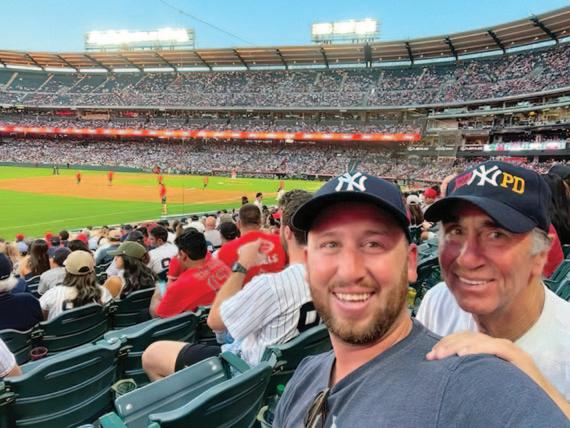
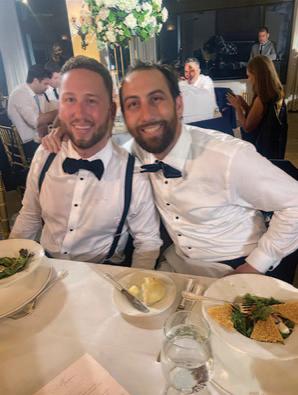
My youngest son Gabe got married in September 2022 and a picture of him and his older brother Zach is part of this expose. There is something magical about watching your child get married. Also is a picture of me and Gabe at a Yankee game. YES we are Yankee fans, but not for the reasons you think. I am one of those rare people who was actually born in Manhattan. My first in-person baseball game was at Yankee Stadium when I was seven or eight, and there is nothing more memorable for a kid than to walk through the tunnel and see the green grass of the stadium and watch Micky Mantle and Roger Maris in the outfield… oh, and my father who is a major cause of my legal career, missed my birth because he was at a night game at Yankee Stadium, where the Yankees lost to the Cleveland Indians.
Festival
Gary and Gabe together enjoying a Yankee game.
Gabe and Zach Rudolph
Ask The Receiver
BY PETER A. DAVIDSON*
I was appointed receiver over a manufacturing facility. I operated it for a short time and then obtained court authority to sell it. I netted $1.4 million from the sale. The landlord agreed I could pay it the rent I owed from the net proceeds and is owed $600,000. All good, except I just learned the IRS is owed $1 million, as a result of an audit of the facility’s owner. I know receivers can incur personal liability if they pay creditors ahead of owed taxes. Do I have to pay the IRS ahead of my cooperative landlord?
No. What is known as the Federal Priority Act (31 U.S.C. §3713) mandates that representatives of insolvent estates, including receivers, who have knowledge of federal government claims have personal liability if they disburse estate assets to anyone ahead of the government. The priority of the government’s claims and this distribution requirement “is almost as old as the Constitution, and its roots reach back even further into the English common law; the Crown exercised a sovereign prerogative to require that debts owed it be paid before the debts owed other creditors.” U.S. v. Moore, 423 U.S. 77, 80 (1975). Despite this centuries old mandate, courts early on ruled that costs of administration take precedence over the government’s priority. Abrams v. U.S., 274 F.2d 8,12 (8th Cir. 1960); Matter of Receivership of Hollingsworth, 386 N.W. 2d 93,97 (Iowa 1986) ( “The government’s priority is subject to proper receivership expenses.”). Indeed, the IRS has conceded this. The Internal Revenue Manual, ¶ 34.4.1.7 (2016), which discusses 31 U.S.C. §3713(a), provides: “Exceptions to 31 U.S.C. § 3713(a) include:…(2) Administrative Expenses. These are expenses incurred to collect and preserve assets…Administrative expenses may be subject to a standard of reasonableness…”
Therefore, you should be safe paying the rent owed to your cooperative landlord (and your fees) ahead of the government’s claim. It would be good practice, however, to tell the IRS what you propose to do and why, to make sure it has no issues and to have the court approve the payment of the administrative expenses, including that the expenses are “reasonable”.
I am a property manager for a receiver who is administering a large apartment complex. The receiver has directed that I make certain repairs,


but not others demanded by some of the tenants. Some of the tenants have threatened to sue me for not making the unauthorized repairs, for what they claim is shoddy work, and for disrupting the quiet enjoyment of their units, because of the authorized work. The receiver has told me not to worry, that I can’t be sued without prior court approval. While that may be true, what happens if the court allows such lawsuits? While I understand the receiver may have immunity, what about me?
AThe receiver is correct, you should not worry. Prior court approval to sue a receiver, known as the Barton doctrine, Barton v. Barbour, 104 U.S. 126 (1881), has been extended to a receiver’s agents, including a receiver’s property manager. Ariel Preferred Retail Group, LLC et. al. v. CW Capital Asset Management, et. al., 883 F. Supp. 2d 797 (E.D. Mo. 2012); see also, Benta v. Christie’s Inc., 2017 WL 1345218 (D. V. I. 2017) (citing cases where Barton was applied to bar lawsuits against a receiver’s attorneys, investigators, auctioneers, real estate professionals, management companies and an antique company). The Supreme Court in Barton actually said leave of court was needed to sue a receiver for the receiver’s actions “or that of his servants.” Barton, supra. at 137.
Similarly, the immunity given to receivers, who act as agents of the court, has been extended to receivers’ agents for the same reasons. Receivers have been given immunity because they act for the court in carrying out its orders. Courts have held such immunity is required, otherwise litigants might try to circumvent court orders by attacking the court’s agent. “It would make the receiver a lightning rod for harassing litigation aimed at judicial orders. In addition to the unfairness of sparing the judge who gives an order while punishing the receiver who obeys it,…” Kermit Const. Corp. Banco Credito Y Ahorro Onceno, 547 F.2d
Continued on page 21...
Continued from page 20.
1,3 ( 1st Cir. 1976). Courts have also pointed out that absent such immunity “such persons will be reluctant to accept court appointments or provide work product for the Court’s use. Additionally, the threat of civil liability may affect the manner in which they perform their jobs.” Howard v. Drapkin, 222 Cal. App. 3d 843, 901 (1990). These grounds for receiver immunity apply equally to a receiver’s agent, who is aiding a receiver in carrying out a court’s orders.
In a recent case a receiver was appointed to manage three nursing homes. The receiver hired a management company to operate the nursing homes. After the receiver sold the nursing homes, the buyer sued the management company for conversion, unjust enrichment and gross negligence related to its management of the nursing homes. The court dismissed the case, finding the management company shared the receiver’s immunity. “As an agent of the Receiver, Benchmark [the management company] is entitled to quasijudicial immunity for actions taken in carrying out the court’s order to operate the nursing homes.” Micha US LLC
v. Benchmark Healthcare Consultants LLC, 2022 WL 2867183 *4 (E.D. Mich. 2022). The court went on to note: “This limitation of liability is consistent with the general rule that receivers and their agents are entitled to quasijudicial immunity for actions taken within the scope of their authority as officers of the court.” Id. See also, Blacktail Mountain Ranch Co., LLC. v. Jones, 611 Fed. App. 430 (9th Cir. 2015) (dismissing case against receiver and “receiver’s agents” based on judicial immunity); Smallwood v. U.S., 358 F. Supp. 398 ( E.D. Mo. 1973) (same). Therefore, to quote Bobby McFerrin, “Don’t worry be happy, in every life we have some trouble, but when you worry you make it double.”
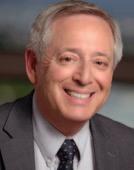






Peter A. Davidson
*Peter A. Davidson is a Partner of Ervin Cohen & Jessup LLP a Beverly Hills Law Firm. His practice includes representing Receivers and acting as a Receiver in State and Federal Court.
STEPHEN J. DONELL
FedReceiver, Inc.
Is pleased to announce the successful sale of an
Industrial Automotive Center in the city of Walnut, CA for $10,680,000
In his capacity as Receiver
Represented by
The Seymour | Weinberger Group
Keller Williams Realty Info@ Swgrp.com
Superior Court of California County of Orange
KEVIN SINGER
Receivership Specialists
Is pleased to announce the successful sale of a
Residential Income Property in Los Angeles, CA for $1,430,000
In his capacity as Receiver
Represented by
The Seymour | Weinberger Group
Keller Williams Realty Info@ Swgrp.com
Superior Court of California County of Los Angeles
RYAN BAKER
Douglas Wilson Companies (213) 550-2242
rbaker@douglaswilson.com
Is pleased to announce the completion of his duties as
Receiver for
Aeon Botanika Los Angeles, Inc., following the sale of cannabis licenses and real property.
RICHARD WEISSMAN
Richard Weissman, Inc., APC
Is pleased to announce the successful sale of a
Single Family Residence in the city of Walnut, CA for $1,205,000
In his capacity as Successor Trustee
Represented by
The Seymour | Weinberger Group Keller Williams Realty Info@ Swgrp.com
Superior Court of California County of Riverside
ROBERT C. WARREN III Investors’ Property Services
Is pleased to announce his appointment as Receiver for
U.S. Bank National Association v. Duck Abbey, DST Rents and Profits Receivership
Oregon Circuit Court County of Lane
DOUGLAS WILSON AND RYAN BAKER
Douglas Wilson Companies (619) 641-1141
dwilson@douglaswilson.com rbaker@douglaswilson.com
Are pleased to announce their appointment as Assignees for
Zulily ABC, LLC to consolidate and manage assets and oversee the liquidation of the online retailer.
BLAKE C. ALSBROOK
Ervin Cohen & Jessup LLP
Is pleased to announce the successful sale of a
17 Unit Multifamily Property in the city of Riverside, CA for $4,725,000
In his capacity as Partition Referee
Represented by The Seymour | Weinberger Group Keller Williams Realty Info@ Swgrp.com
Superior Court of California County of Riverside
DOUGLAS WILSON
Douglas Wilson Companies (619) 641-1141
dwilson@douglaswilson.com
Is pleased to announce his appointment as Receiver for
UMB Bank v. Synrgo, to oversee the orderly liquidation of the business.
Superior Court of California County of Orange
Superior Court of California County of Los Angeles
A California ABC


SO IT BEGINS…
BY MICHAEL MUSE-FISHER
It is the year 2024.
Following the great AI uprising, computers have taken control of the globe. Usher ushers in a new style of men’s sequined jumpsuits with painted-on abs following his Super Bowl Halftime Show. Interest rates are through the roof, and commercial real estate is on the precipice. Oh, and, I am the new Chair for the California Receiver’s Forum. In short, there is cause for concern.
But, there is hope… at least for the CRF. You will all be relieved to learn that surrounding me are a wonderful and extremely competent group of Officers, including Benjamin King (Chair Elect), Mia Blackler (Treasurer), Ryan Baker (Secretary), and Gary Rudolph (Program Chair). Moreover, I took copious notes on the great work accomplished by my predecessor, Dominic LoBuglio, and have his phone number on speed dial, should I need to call in the big guns. Dom, you did an amazing job as the CRF’s Chair in 2023, and I will do my best to continue and build off of all your incredible work.
We are already off to a great start this year, and we have a lot to be excited about as the year unfolds. We just concluded the Loyola X Symposium. It was absolutely phenomenal, with top notch speakers, invaluable sponsors and vendors, and a huge turnout comprised of the best receivership practitioners in the country. Thank you to the team that put it together, including Ryan Baker, Mia Blackler, and Scott Sackett.
Throughout the year, be on the lookout for sensational receivership programs where even the most seasoned practitioners can learn a thing or two. The first program – AI is Here: What You Need to Know – is set for March 12, 2024, where Ash Rangan of Insightful Group and Richard Munro (as moderator) will discuss the benefits and risks of AI and Generative AI. Please visit the CRF website to register for either in person or zoom attendance. Additional programs will be provided regularly throughout the year, and can be found on the CRF’s online event calendar at https://crf.memberclicks.net/meeting-event-calendar.
The CRF has also entered the digital age, with an updated website and online services now provided, which can be found at https://receivers.org/. You will find a searchable database of receivership practitioners (if you have not done so, please update your information to let the world know of your bona fides). Also, the Receiver’s Academy is up and running with a growing catalog of past programs covering a
wide range of receivership topics that can be downloaded and watched in the comfort of your home, and provide an opportunity to earn CLE credits.
Finally, membership is on the rise, and we encourage all those interested in receiverships and fiduciaries to join. For me, the most important aspect of the CRF is the collegiality and professionalism of its members, and I am honored to be a part of such an illustrious group. I consider you all dear friends, in addition to exemplary receivership practitioners, and I look forward to all that is in store for us in the upcoming year.
Michael Muse-Fisher (written by ChatGPT… just kidding).
*Michael Muse-Fisher is a Shareholder at Buchalter, a Professional Corporation. He regularly represents receivers across all receivership types.
Michael Muse-Fisher
Avoiding Tax Penalties
BY CHAD C. COOMBS*
Receivers are responsible for the accuracy and correctness of the income tax returns they sign. When signing federal income tax returns, receivers, like other taxpayers, make the following declaration:
Under penalties of perjury, I declare that I have examined this return, including accompanying schedules and statements, and to the best of my knowledge and belief, it is true, correct, and complete. Declaration of preparer (other than taxpayer) is based on all information of which preparer has any knowledge.
Not only must the receiver review the return and attest that it is accurate and complete to the best of the receiver’s knowledge, but taking a step back, the receiver must provide the tax return preparer - to the extent possible - with all the information the preparer needs for an accurate and complete return.
A wide array of penalties may be assessed for violating tax reporting obligations, such as for failing to properly prepare and timely file all required tax and information returns or timely make all necessary tax payments. Penalties may, however, be waived in some cases. For example, in certain cases:
No penalty shall be imposed under [Internal Revenue Code] section 6662 or 6663 with respect to any portion of an underpayment if it is shown that there was a reasonable cause for such portion and that the taxpayer acted in good faith with respect to such portion.1
One example of reasonable cause is good-faith reliance on a tax return preparer’s advice.2 To apply, the taxpayer must have in fact relied on the tax return preparer’s advice and not contributed to the reason for the underpayment. Thus, the reasonable cause defense will not apply to a
taxpayer who had reason to believe that the tax return was not accurate or complete to the extent possible, did not provide the tax return preparer with accurate and complete information, or used unreasonable factual or legal assumptions.
Even worse, taxpayers who take frivolous tax positions may face criminal prosecution and be convicted of a felony for attempting to evade or defeat a tax3 or willfully making and signing under penalty of perjury a return that the taxpayer did not believe to be true and correct as to every material matter.4
Receivers are, however, often in unique and sometimes very difficult positions. While a receiver may be required to file tax returns for the parties or entities in receivership,5 the receiver might not have adequate or sufficiently reliable information to do so, especially in cases involving fraud.
To address these issues, the receiver should consider the following steps. First, the receiver should assess the tax filing requirements and other potential tax issues at the outset of the case and if necessary, seek tax guidance. This will help determine what information the receiver will need and actions the receiver should take during the receivership.
Second, as soon as practical, the receiver should conduct any due diligence or other actions that may be necessary for tax purposes. This could involve extensive forensic accounting and reconstruction of books and records and analysis of prior year income tax returns and tax transcripts. Promptly and diligently taking such actions could avoid unnecessary delay in the case and constitute reasonable cause to abate any late filing penalties or any penalties for failure to provide required but unavailable information.
Third, the receiver should disclose on any income tax returns the receiver files that the receiver has no personal knowledge of the activities prior to being appointed as receiver. This discloses that even though the returns are
Continued on page 25....
Continued from page 24.
accurate and complete to the best of the receiver’s knowledge, such knowledge is nevertheless limited. Other disclosures also may be warranted to explain unique issues.
Fourth, as required, the receiver should carefully review the prepared returns for accuracy and completeness before signing the returns and bring any issues to the attention of the tax return preparer for resolution. Receivers (and their tax advisors) should not take a tax position based on the likelihood that it will not be discovered in a government audit.6
Fifth, the receiver should have procedures for properly and timely filing returns and any related documents such as prompt assessment requests7 and maintain well organized and easily accessible records to support the information provided and positions taken.
A receiver who relied on what turned out to be bad tax advice may decide to seek reimbursement of any penalties from the tax advisor who provided the incorrect tax advice. However, many accountants have provisions in their engagement letters which limit liability to the fees incurred with respect to the work at issue except in cases of gross negligence or intentional misconduct. Also, while lawyers are prohibited from limiting their prospective liability,8 they may nevertheless make it difficult for their clients to hold them liable for their tax advice, such as by claiming that the client contributed to any negligence and/or assumed the risk. A receiver therefore cannot necessarily count on full reimbursement from tax advisors or tax lawyers should their advice prove faulty.
Receivers should be willing to question tax guidance and remember the adage, “if it seems too good to be true, it probably is.” This especially applies to quick and simple advice to complicated tax issues that does not consider all relevant facts. Failing to keep this in mind could expose the receivership and potentially even the receiver to liability for tax penalties and other amounts that may be assessed.9 A receiver concerned about the propriety of tax guidance should consider getting a second or even third opinion.
The additional cost may be well worth it.
1 Internal Revenue Code Section 6664(c)(1). See also Treas. Reg. Section 1.6664‐4.
2 See Treas. Reg. Section 1.6664‐4(c).
3 Internal Revenue Code Section 7201.
4 Internal Revenue Code Section 7206.
5 See Coombs, Filing Income Tax Returns, Receivership News, Issue 77 at p.26 (Spring 2023).
6 See Treasury Department Circular 230, Section 10.37(a)(2)(vi) (Rev. June 12, 2014).
7 See Coombs, Prompt Assessment, Receivership News, Issue 71 at p.18 (Spring 2021).
8 See Model Rule of Professional Conduct 1.8.8.
9 See Coombs, Tax Closure, Receivership News, Issue 76 at p.22 (Winter 2022).
APRIL 23, 2024, 11:30 AM • 1 PM
HEALTH & SAFETY RECEIVERSHIPS: HOW TD TACKLE NUISANCE PROPERTIES
Presented by: Amanda A. Pope, Senior Counsel & Director of City Receiverships, Jones Mayer and Red Griswold, Receiver, Griswold Law, APC

Location: Fennemore, 600 B St, Ste 1700, San Diego, CA 92101 • Zoom option available. Lunch provided to in person attendees. Cost: $45 for members and $65 for non-members.
California's health & safety receivership remedy addresses the most troublesome properties across the state. This niche receivership remedy is utilized by municipalities to resolve hoarded, abandoned, substandard, or unsafe properties. This presentation will explain how and when the health & safety receivership remedy should be utilized and the specific role of a health & safety receiver. Through discussion of powerful case studies, the presentation will cover the scenarios and types of properties wherein this receivership remedy can effectively create safer communities.
Register now: https://crf.memberclicks.net/april2024education
*Chad Coombs is chief tax counsel at Thomas Seaman Company in Irvine, CA and an expert in insolvency tax law. Chad Coombs
THE LIST
W HILE THERE IS NO COURT - APPROVED LIST OF R ECEIVERS , THE FOLLOWING IS A PARTIAL LIST OF R ECEIVERS WHO ARE MEMBERS OF THE C ALIFORNIA R ECEIVERS F ORUM AND HAVE THE INDICATED EDUCATIONAL EXPERIENCE . I NCLUSION ON THIS L IST SHALL NOT BE DEEMED AN ENDORSEMENT OF ANY OF THE NAMES LISTED BELOW BY THE R ECEIVERSHIP N EWS , THE C ALIFORNIA R ECEIVERS F ORUM , OR ANY OF ITS R EGIONAL C OUNCILS . T HIS IS A PAID ADVERTISEMENT .
Bay Area
SVl David Bradlow 415-206-0635 bradlow@davidbradlow.com
V
≠▲zvb Dennis Gemberling 800-580-3950 DPG@perrygroup.com
Vl▲zwb; Michael Kasolas 415-992-5806 mike@kasolas.com
Sacramento Valley
SnVl▲b Michael C. Brumbaugh 916-417-8737 mike@mbi-re.com
nlV▲vwb; Scott Sackett 916-930-9900 scott.sackett@efmt.com
lV▲ Kenneth Weaver 916-812-8090 ken@classicrealtyconsultants.com
Santa Barbara/Ventura
Marcelo Bermudez 213-453-9418 mb@marcelobermudezinc.com
San Diego Area
S
≠l▲wb; Michael Essary 619-886-4116 calsur@aol.com
b Jon Fleming 858-793-6000 jon.fleming@legacyreceiver.com
V
≠▲zvb Dennis Gemberling 800-580-3950 DPG@perrygroup.com
Sl▲wb; Richardson “Red” Griswold 858-481-1300 rgriswold@griswoldlawsandiego.com
b Kristin Howell 858-373-1240 kristinh@meissnercres.com
nV≠lt▲zvb Richard Munro 949-910-6600 richard@invenz.com
SnV≠▲zv Joel B. Weinberg 310-385-0006 jweinberg@usisg.com
Los Angeles/Orange County/Inland Empire
SVl▲zvb; Blake Alsbrook 310-273-6333 balsbrook@ecjlaw.com
SVl▲ Albert Altro 310-809-5064 albertaltro@traversellc.com
SnV≠ Eric Beatty 909-243-7944 epb@epblegal.com
Los Angeles/Orange County/Inland Empire
Snl▲zb Marc Brooks 818-519-5588 marcbrooks2021@outlook.com
James F Davidson 949-417-5708 jdavidson@avantadvisory.com
SnV≠ltb; Peter A. Davidson 310-273-6333 pdavidson@ecjlaw.com
nV≠lt▲zb; Stephen Donell 310-689-2175 steve.donell@fedreceiver.com
V≠▲zvb Dennis Gemberling 800-580-3950 DPG@perrygroup.com
Jeffery Golden 714-966-1000 jgolden@wgllp.com
b David Goodrich 714-966-1000 dgoodrich@wgllp.com
Brett Hitchman 949-200-9712 leeann@hitchmanfiduciaries.com
SnV≠lt▲zvb Byron Z. Moldo 310-281-6354 bmoldo@ecjlaw.com
nV≠lt▲zvb Richard Munro 949-910-6600 richard@invenz.com
b Carl Petta 626-966-4049 cgpetta@earthlink.net
Kevin Randolph 909-890-4499 krandolph@fennemorelaw.com
SnV≠lt▲zvb John Rey 562-500-7999 rpmqmp@aol.com
vw Eric Sackler 310-979-4990 ericsackler@gmail.com
SV≠l▲z Thomas Seaman 949-265-8403 tom@thomasseaman.com
Vl▲vb Phil Seymour 310-612-9800 phil@swgrp.com
Tony Solomon 310 909-5450 tony.solomon@marcusmillichap.com
SVt David Stapleton 213-235-0601 david@stapletoninc.com vb Michael Wachtell 213-891-5460 mwachtell@buchalter.com
SnV≠▲b David D. Wald 310-230-3400 dwald@waldrealtyadvisors.com
SVb Robert C. Warren 714-863-1694 robert.warren@investorshq.com
▲zvb
David Weinberger 818-970-0915 david@swgrp.com
SnV≠▲zvb Joel B. Weinberg 310-385-0006 jweinberg@usisg.com
S This symbol indicates those who completed up to 14 hours of advanced receivership education at the Loyola V, Complex Case Symposium in January 2013.
n This symbol indicates those who facilitated and attended the Loyola V, Complex Case Symposium in January 2013.
V This symbol indicates those who completed 9 hours of education at the Loyola VI Symposium in January 2015.
≠ This symbol indicates those who facilitated and attended the Loyola VI Symposium in January 2015.
l This symbol indicates those who completed 9 hours of education at the Loyola VII Symposium in March 2017.
t This symbol indicates those who facilitated and attended the Loyola VII Symposium in March 2017.
▲ This symbol indicates those who completed 6 hours of education at the Loyola VIII Symposium in January 2020.
z This symbol indicates those who facilitated and attended the Loyola VIII Symposium in January 2020.
w This symbol indicates those who completed 6 hours of education at the Loyola IX Symposium in April 2022.
v This symbol indicates those who facilitated and attended the Loyola IX Symposium in April 2022.
b This symbol indicates those who completed 6 hours of education at the Loyola X Symposium in January 2024.
; This symbol indicates those who facilitated and attended the Loyola X Symposium in January 2024.
Loyola I-IV symbols have been deleted.
Heard in the Halls: NOTES,
BY RYAN BAKER*
Welcome to the latest edition of Heard in the Halls. Please provide your snippets of news, questions or comments about receivership issues or the professional community by telephone, mail, fax, or email to: Ryan C. Baker at Douglas Wilson Companies, 19200 Von Karman Ave, Suite 400, Irvine, California 92612; Phone (213) 550-2242; Fax: 800757-3668 (800-pls-don’t), Email: rbaker@douglaswilson.com
Here is what we have Heard in the Halls …
• Loyola X Symposium: Riding the Economic Wave – The California Receiver’s Forum (CRF) membership did it again making the Loyola X Symposium an absolute success. Like the swallows of San Juan Capistrano, over 150 receivers, attorneys and service professionals in the insolvency industry flocked from all over California to the Long Beach Hyatt Regency for a 2-day receivership bonanza. The conference – CRF’s largest undertaking that takes place biennially – included a Thursday night dinner headlined by a high-powered keynote from Danielle DiMartino Booth, the CEO and Chief Strategist for Quill Intelligence LLC. Friday’s schedule was kicked off by a keynote speech from none other than Bob Mosier, a titan in the receivership world, and was packed with evocative and educational panels throughout the day. Friday included a dual track in the afternoon allowing attendees to participate in either a Receivership 101 path for newer members, or a secondary track with more advanced and nuanced focused panels for the receivership brainiacs. The Forum’s Board, membership and yours truly want to thank all of Loyola X’s sponsors. Our sponsors are the backbone of not just the Loyola conference, but also of the forum itself, helping this great organization to continue to thrive.
• CRF Board of Directors: Movin’ On Up – with the 2023 term up, each board member graduated to their new positions: Michael Muse-Fisher ascended to the Board’s Chair, Ben King skipped his way to Vice-Chair, Mia Blackler calculated her way to Treasurer, yours truly was recorded on the minutes as the new Secretary, and Gary Rudolph was promoted to the new Program Chair. A very deep thanks is owed to Dominic LoBuglio, who did a fantastic job wrangling us all during his tenure as Chair—he made hard work look easy. Dominic now settles into his new role as the immediate past chair, a position imbued with the power to endlessly critique any shortcomings of the incoming chairperson. I’m further told the office comes with a complimentary Jimmy Buffet Margaritaville margarita maker.
• Passing the Baton from Olsen and Associates to Group Concepts – the CRF extends a deep bow of gratitude to Amy Olsen and her team at Olsen and Associates for all the wonderful work they’ve provided to the CRF organization over the past few years. Thank you Amy for all of your help! We also warmly welcome Deb Johnson and her team at Group Concepts who have stepped in to fill the big shoes that Amy
OBSERVATIONS, AND GOSSIP RELAYED

leaves behind. We are tremendously excited for Deb and her team to continue on the wonderful programming and work of this organization.
• Come See the CRF at… CBF? That’s Right! – Once again the CRF planted a mole within the California Bankruptcy Forum (CBF) ranks and somehow engineered a partial takeover (dare I say, “reorganization”) of the CBF’s Thirty-Sixth Annual Conference. The CBF’s conference theme this year “is Navigating the Wave” and will be held on May 16-19, 2024, at the Ritz Carlton Bacara – sure to feature more than one idyllic Santa Barbara sunset. The CRF will be presenting three receivership related panels during the conference. Our very own Kyra Andrassy is leading the charge in organizing this reorg … I mean, partnership.
• CRF Education Panel – AI is Here: What you Need to Know: The CRF held another one of its famed education panels at Snell & Wilmer’s Orange County offices on March 12. Moderated by Richard Munro of Invenz, Inc., attendees of the program heard from Ashwin (“Ash”) Rangan , a global AI expert, on how to become better prepared to exploit the strategic benefits of AI and understand its risks. In all honesty (as I never lie to our readers) this article went to print prior to the panel actually being held. That being said, I can only hope AI doesn’t learn how to replace receivers before Ash can teach us how to harness the power of AI and steer it to be a tool we can use instead of it becoming our merciless overlord. AI and Generative AI are here and becoming ubiquitous, and yet there is too much that business leaders and professionals do not know about AI. (AI wrote this last sentence).
• Spread the Word: Know someone thinking about getting started in the receivership industry? Well tell them there’s already enough competition. Ahem, just kidding, instead steer them to www.receivers.org to order a past Loyola program 4-disc DVD set for $75 teaching receivership Basics and including sample pleadings.
*Ryan Baker has been a Receiver for nearly 15-years and is with Douglas Wilson Companies. Mr. Baker has overseen receiverships of nearly every flavor including operating companies, rents and profits, construction, environmental contamination, regulatory, post judgment, and many, many others.
Ryan Baker