Torreya and other rare plant conservation cooperation with FNPS
Ginny Stibolt
Building better gateways to Florida’s biodiversity
Larry Weaner
Growing, planting and maintaining native plants: Turning a challenge into an opportunity
For more information: https://fnps.org/conference/2022
Announcing the 41st Annual Conference of the Florida Native Plant Society
We invite you to join us for this year’s virtual conference featuring expert speakers, a plant identification competition, online networking, virtual vendors, online auction, and field trips: May 20-22, 2022.
Additional Expert Speakers
Nancy Bisset, Anne Mackay and Carolyn Schagg –
Florida Wildflower Foundation: The early days. Travel back in time to experience the statewide campaign to gain acceptance for and appreciation of Florida native plants
Jim Draper –Defining radical naturalism
Ellen Honeycutt – Strategies for effective social media outreach
Pete Johnson – Crosby Sanctuary: Progression of a nature preserve
Bruce Means – Biodiversity of the Florida Panhandle
Sean Patton –Aquatic butterfly gardening
Chadd Scott – Engaging native plant advocates through current events in conservation
Renee Stambaugh – Enhance your yard and attract wildlife with native plants
Show your support for native plants!
Conservation and Research Grant Presentations
Jessica Balerna – Evaluating trade-offs among biophysical and cultural ecosystem services in freshwater wetlands impaired by groundwater extraction
Caitlin Bumby – Uncovering the true origins of a rare orchid endemic to Florida
Shelby Krupar – Genetic diversity and spatial genetic structure of Guzmania monostachia (Bromeliaceae) in Florida
Gage LaPierre – Seed mixture strategies in groundcover restoration of pine savannas
Mandy Morgan – Preliminary floristic inventory for the recently-protected Gladys Douglas Preserve in Pinellas County
Conference presentations will be available online to registrants for six months after the conference.
The genus Portulaca is represented in Florida by four native species and one widely naturalized species. Article by Roger L. Hammer.
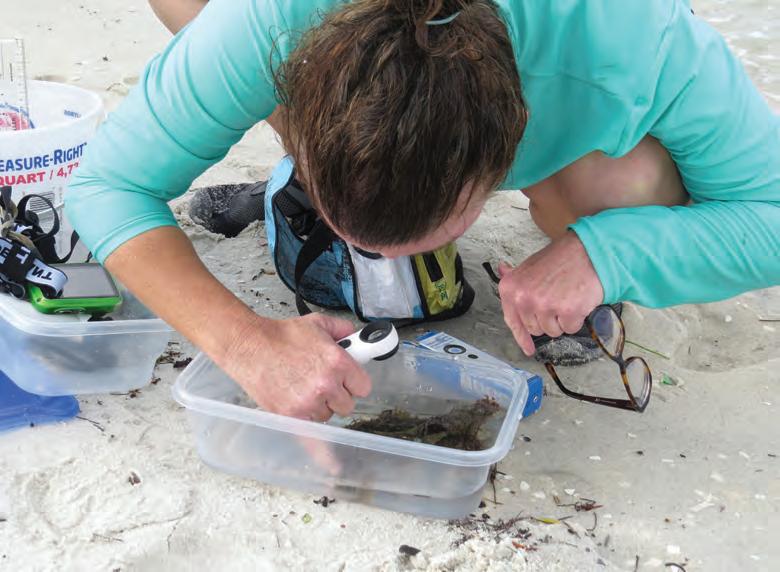
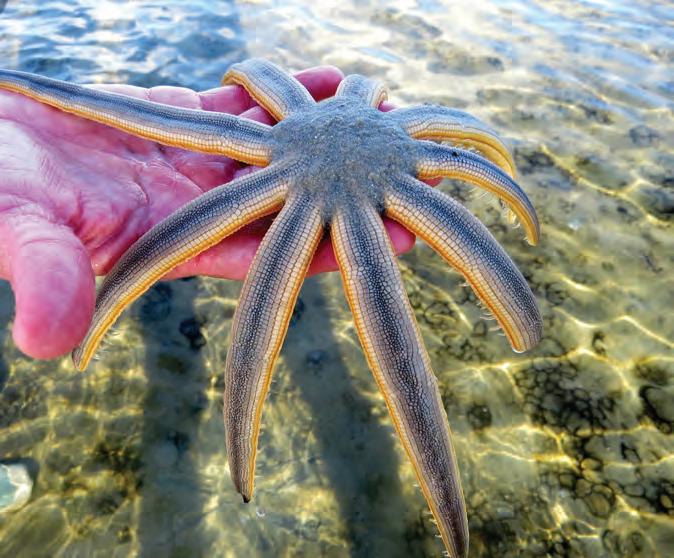
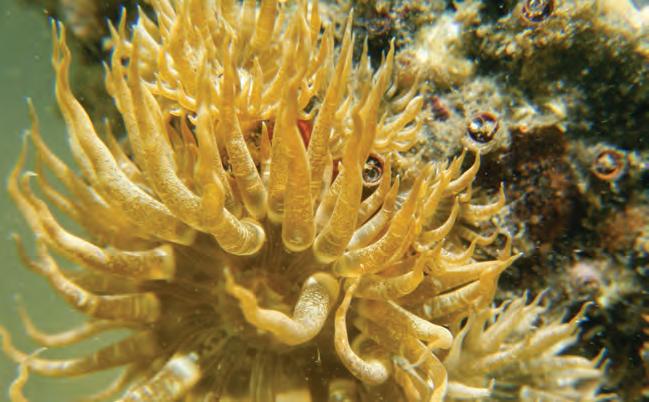
Two eager citizen scientists explore a single red mangrove tree and the organisms that share its space. Article by Linda Eastman and Leigh Goddeau.
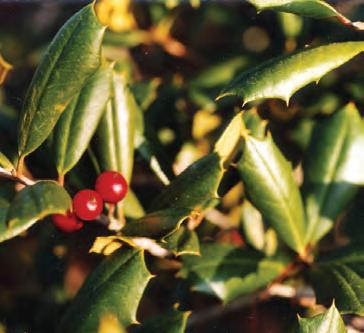
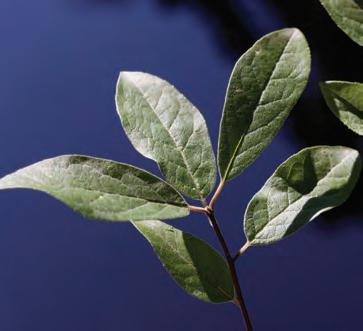
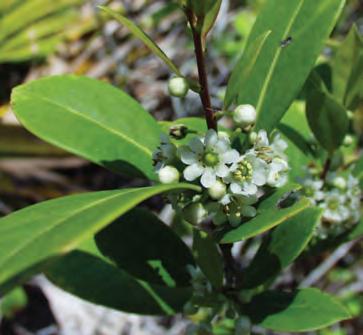
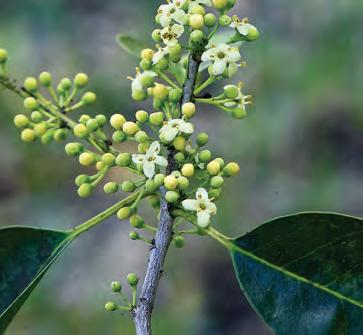
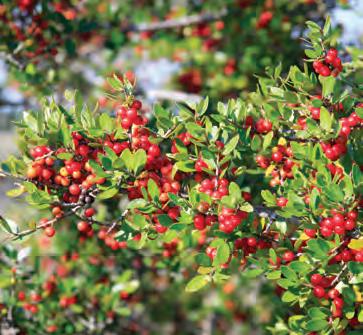
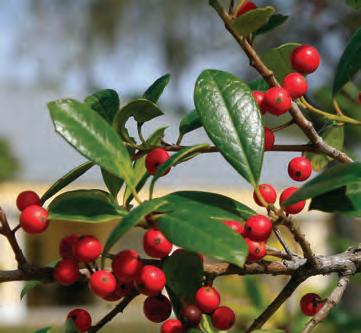
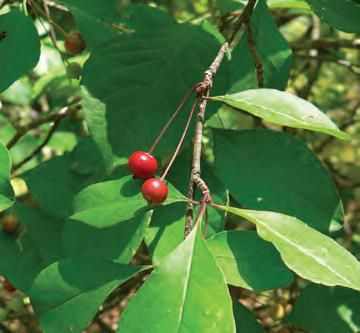
Florida has 14 native holly species in the genus Ilex, which provide seasonal color during fall and winter.
The first complete translation of the journals and letters of André Michaux provide insight into his travels and discoveries. Review by Jim Erwin.
The Purslanes of Florida
Article
and photos
by Roger L. Hammer
The genus Portulaca is represented in Florida by four native species and one widely naturalized species, and are placed in the Portulacaceae, or Purslane Family. The genus Portulaca was created in 1753 by famed Swedish botanist Carolus Linnaeus (1707–1778) and was taken from the Latin portula, meaning “little door.” This alludes to the lid of the capsule that resembles a little door, if you have a vivid imagination.
One cultivated species, Portulaca grandiflora (moss rose), is popular in mainstream garden centers. It is cherished for its large, gaudy flowers in shades of red, orange, yellow, pink, purple, and white, with many named cultivars. One herbarium specimen was collected from a cultivated plant in Polk County, but the species is not known to escape cultivation in Florida.
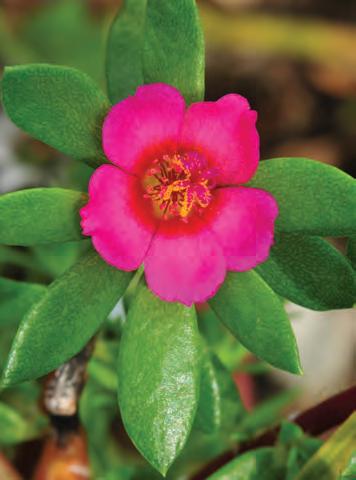
The widespread naturalized species in Florida is Paraguayan purslane (Portulaca amilis), a non-native annual found throughout much of mainland Florida as a weed in lawns, along roadsides, and even in parking lot islands. It may also invade pine flatwoods and other natural habitats. It was introduced from South America and occurs across the southeastern United States. The flattened, succulent leaves are somewhat lance-shaped, averaging 1/2” to 1” long and about 3/8” wide. Bright magenta flowers appear from late spring through fall.
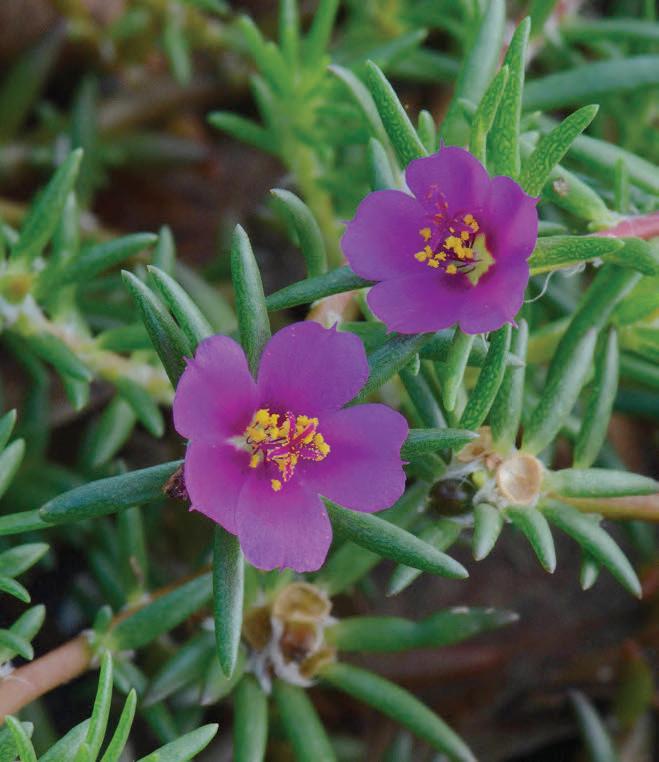
A native species with pinkish-purple flowers that somewhat resemble Portulaca amilis is called kiss-me-quick (Portulaca pilosa), referring to the short-lived flowers. A principal difference between it and Portulaca amilis is its narrowly linear, somewhat cylindrical (hemispheric), pointed leaves. In dry habitats the plants produce long, pilose hairs at the nodes (hence the name pilosa) but will be less hairy in moist habitats. It occurs throughout all of mainland Florida.
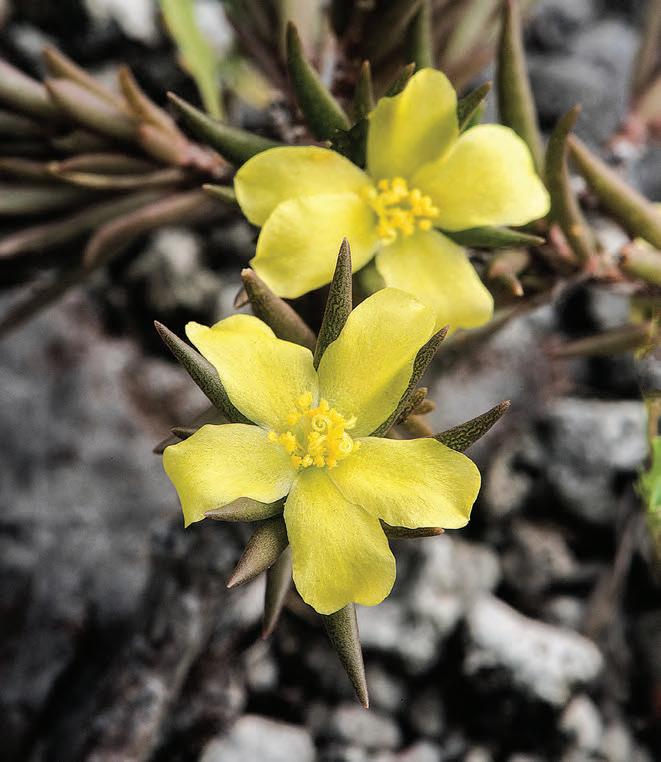
A yellow-flowered native, with leaves that very much resemble Portulaca pilosa, is called Portulaca rubricaulis, or redstem purslane. It is a coastal species found from Pinellas County and Charlotte County south to mainland Monroe and Miami-Dade Counties into the Monroe County Keys. It has red stems with succulent, hemispheric leaves and showy, 1/2” yellow flowers.
Perhaps the most familiar species to most Floridians is Portulaca oleracea, commonly called field purslane or little hogweed. It was once regarded as non-native but evidence of its pre-Columbian occurrence in Florida has changed
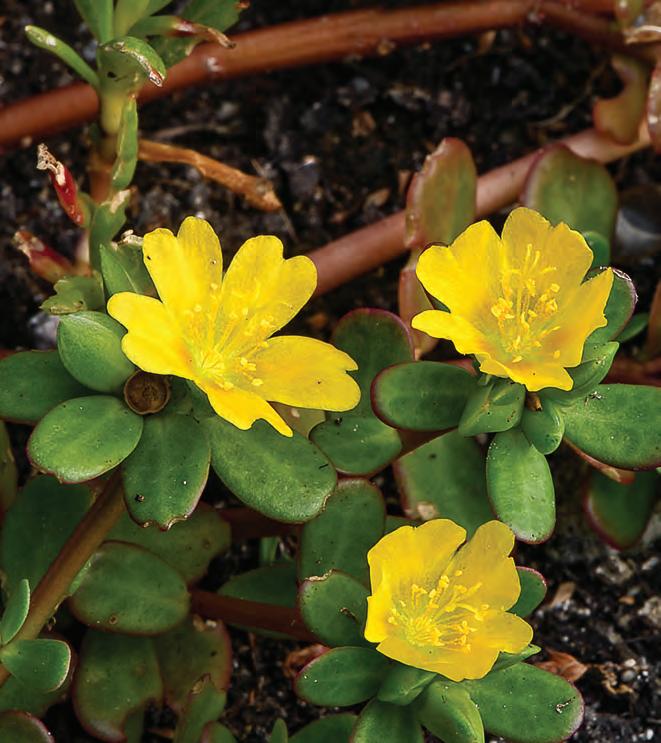
its status to native. This species can be found as a garden and lawn weed but is also found in various natural habitats throughout the state, including coastal rock barrens in the Florida Keys. The leaves contain the richest source of an omega-3 fatty acid called alpha-linolenic acid of any leafy vegetable tested to date. It is used medicinally to treat cardiovascular diseases and is fed to chickens to reduce cholesterol in eggs. It has many culinary uses around the world, and is cooked and eaten as a potherb, sautéed, or added to salads. The plants have red or green, low-spreading stems with rounded leaves and small bright yellow flowers.
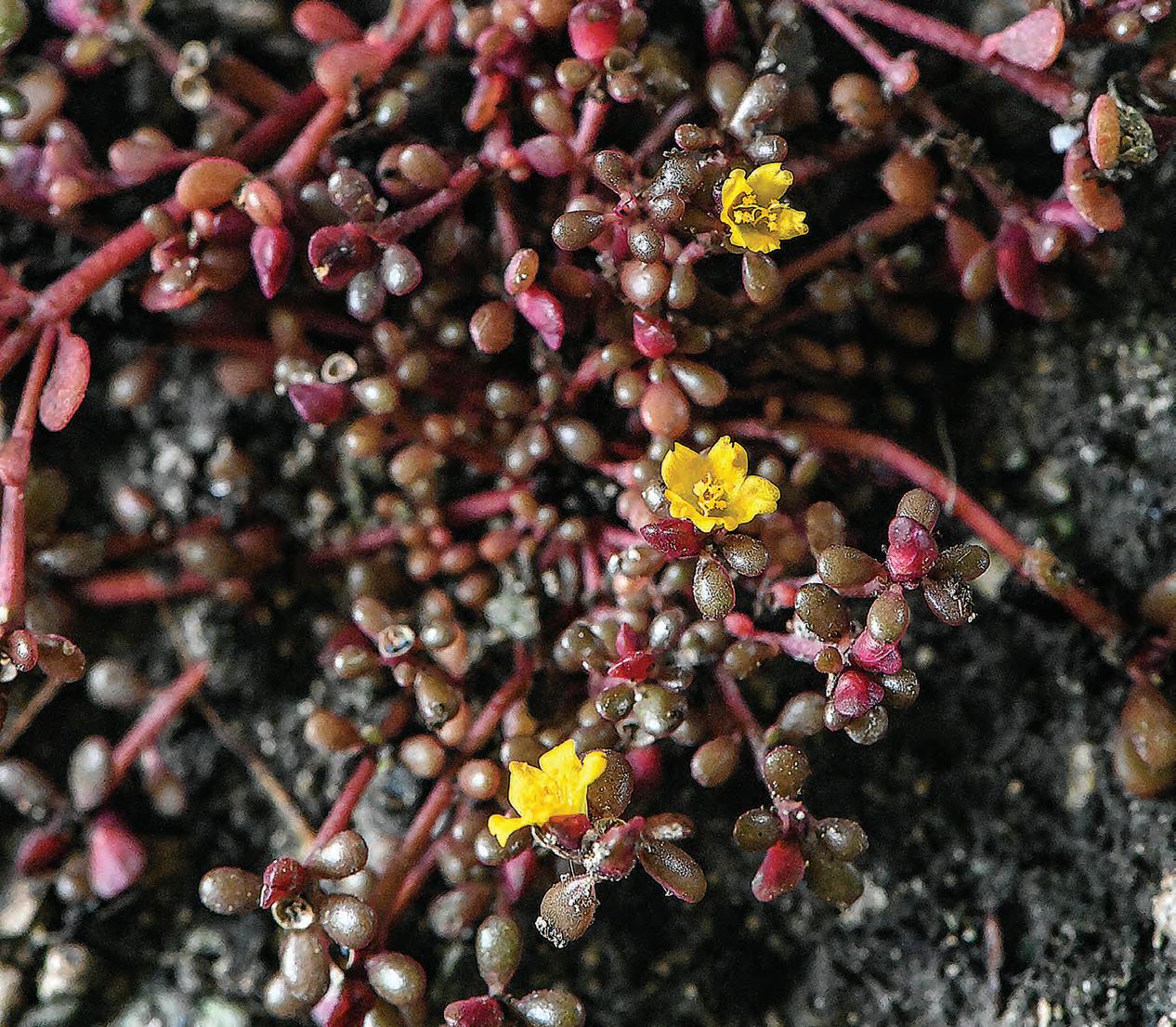
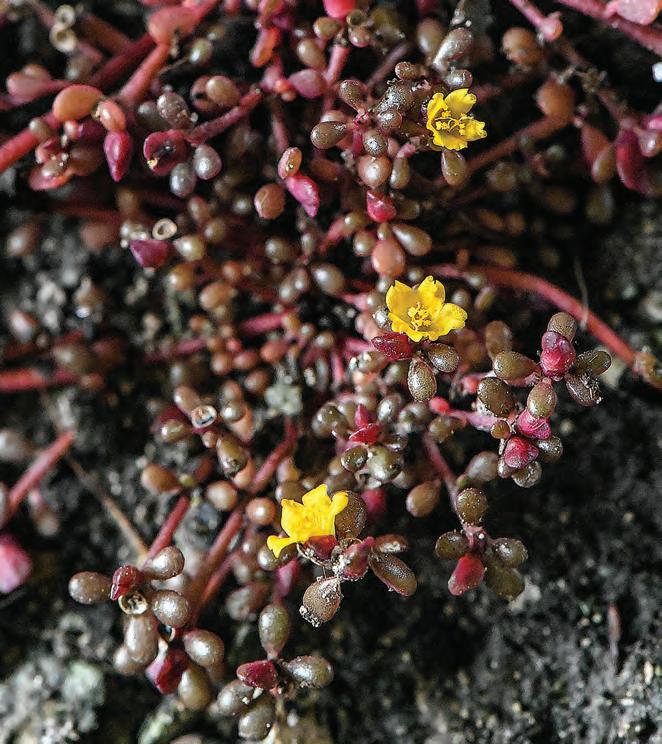
And finally, there is a recent addition to Florida’s flora with the discovery of Portulaca minuta. This species is aptly named tiny purslane, and a small population was discovered in 2013 growing in limestone depressions in pine rockland habitat on Big Pine Key by my friend Keith Bradley. It has since been seen by the author colonizing limestone depressions in cleared firebreaks on Big Pine Key. The plant and flowers are extremely small, with red stems and tiny leaves that vary from red to greenish-brown, and with yellow flowers that measure only ¼” wide. To give readers an idea of its size, a mature plant is only about 2” across. It was first discovered on Great Exuma, Bahamas in 1978 by Dr. Donovan Correll (1908–1983), and described by him in 1979, but it was thought at the time to be endemic to the Bahamas. When, or how, it migrated to Big Pine Key in Florida is unknown. Although it is critically imperiled, it has not yet been listed as endangered.
None of the Florida native species of Portulaca are commonly seen in cultivation but the common species are garden-worthy, either for attractive additions to planters, dish gardens, or in border plantings. The name purslane was taken from a word meaning “marriage,” so perhaps there’s even a love connection for your garden.
Flora of North America. http://www.efloras.org
Wunderlin, R. P., Hansen. B. F, Franck, A. R. & Essig, F. B. (2022). Atlas of Florida Plants. https://florida.plantatlas.usf.edu
Wunderlin, R. P., Hansen. B. F. & Franck, A. R. (2018). Flora of Florida. Vol. 5, Dicotyledons, Gisekiaceae through Boraginaceae. University Press of Florida. Wunderlin, R. P. & Hansen. B. F. (2011). Guide to the vascular plants of Florida. Third edition. University Press of Florida.
Roger L. Hammer is an award-winning professional naturalist, author, botanist and photographer. His most recent book is Complete Guide to Florida Wildflowers Find him online at www.rogerlhammer.com
Red Mangrove: Ecology of a Keystone Species (Part 2)
Article and photos by Linda Eastman and Leigh Goddeau
Part 1 of this article* examined the role of the red mangrove (Rhizophora mangle) as a keystone species supporting a complex ecosystem that benefits an enormous range of other species. The project began as a two-month exploration of a single red mangrove tree. The number of species we found, the fascinating relationships between them, the complexity of the ecosystem, and the constantly changing nature of the site kept us exploring for years.
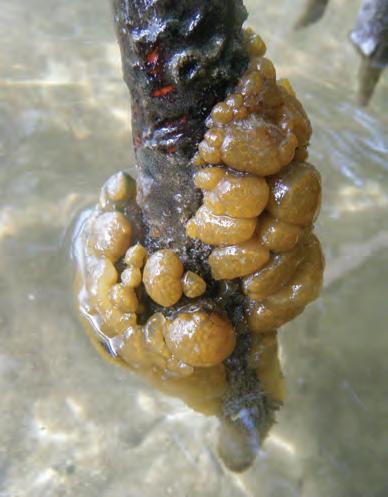
The first species we noticed using the red mangrove tree as habitat were fungi. The tree’s trunk and aerial roots between the canopy and high-water mark were home to pale green and bright yellow crustose lichens, seemingly unbothered by salt spray. The trunk also bore large, bulbous galls formed by the fungus Cylindrocarpon didymum (Barnard & Freeman, 1982). We observed these lichens and galls to be common on other red mangroves in a variety of forest configurations.
Arthropods
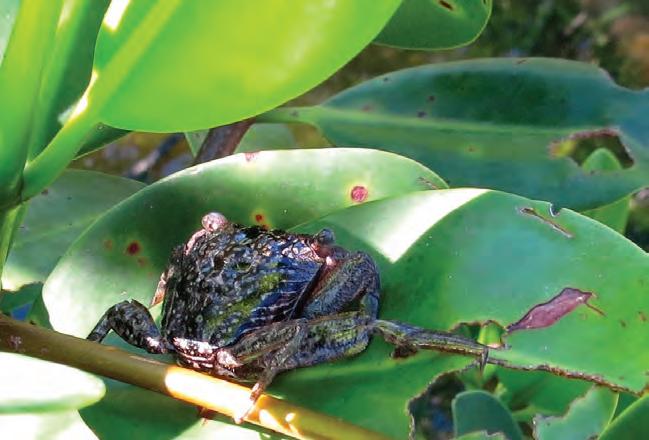
Among the most obvious creatures above the water were arthropods. Reflecting the diversity of this huge phylum, species ranged from butterflies that laid their eggs on the tree’s leaves to barnacles that made a permanent home on the upper intertidal zone of the trunk and prop roots. The most important of these residents is perhaps the mangrove tree crab (Aratus pisonii). This fast-moving crab which scurries between the tree canopy and the water it requires to keep its gills wet is considered a keystone species. Up to 96 percent of mangrove forest herbivory is due to this crustacean feeding on the tree’s leaves, making it a main conduit by which energy moves from mangroves to the rest of the food web (Sweat, 2009). Mangrove tree crabs are prolific producers of larvae, which are eaten by secondary consumers including zooplankton, fish, crabs, and suspension and filter feeders such as barnacles and hydroids. The survival rate for larvae and juveniles of A. pisonii is estimated to be only 68 per million (Sweat, 2009). Even as adults, they continue to contribute to the food web as prey of birds, fish, mammals, and larger crabs.
Signs of another leaf eater, the caterpillar of the mangrove skipper butterfly (Phocides pigmalion), were also seen. The red mangrove is the only host plant for this nocturnally-feeding caterpillar. During daylight hours it constructs hiding places by stitching folded mangrove leaves together with silk.
At low tide during calm water, we commonly saw large groups of tiny (3 mm) floating saltmarsh springtails (Anurida maritima). Using air trapped by its body hairs, this hydrophobic species can breathe even if submerged (Marsh & Bane, 1995). We also saw predatory arthropods including insects and arachnids, primarily dragonflies and orb weaver and wolf spiders using the mangrove canopy as hunting grounds.
The top band of the intertidal zone on prop roots was clearly demarcated by rows of whitish barnacles, sessile species adapted to time spent out of water by a tough calcite shell and the ability to close themselves off to avoid desiccation and predation. Barnacles superficially resemble stationary mollusks but are in fact crustaceans (relatives of the fast-moving mangrove crab). They are dispersed in water in their larval stages and then attach themselves permanently to the tree by their foreheads and use their legs to catch food in the water.
A commonly encountered resident on the tree was Balanus amphitrite, a non-native but now prevalent barnacle identified by Charles Darwin during the eight years he spent studying the crustacean group prior to the publication of his theory of evolution. While the demarcation of species in the upper intertidal zone followed a noticeable pattern, (one that was loosely repeated on nearby seawalls and dock pilings), the area on the prop roots that was exposed only at low tides was quite random. There were clearly stripes of species in the upper zone, while in the mainly underwater zone, chaos seemed to reign.
We observed evidence of another important arthropod species, the wood boring isopod Sphaeroma terebrans. Similar in appearance but not related to terrestrial pillbugs, this crustacean burrows into mangrove aerial roots before they become anchored in the sand. The isopod does not eat wood but lives in the root, filter-feeding on organic particles. While its boring activity injures and weakens the root, it also causes the root to branch into a tripod shape which, when it enters the sand, may provide additional stability to the tree.
Mollusks
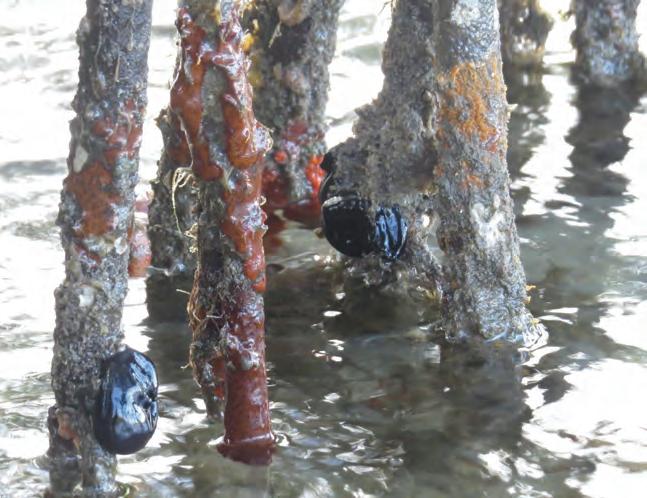
The mangrove periwinkle (Littorina angulifera) is a gastropod which scrapes microscopic algae and fungi from the tree. Like the mangrove tree crab, it moves between the canopy and the water which it requires for breathing. As with other species, this highly variable snail, which ranges in color from pale blue to a pattern of very dark browns, was sometimes difficult to find but at other times was observed in great profusion. Closer to the water and particularly at low tide, we found nerites, rock shells, and other snails typical of South Florida’s rocky shorelines grazing along the upper prop roots. These creatures were explorers from the intertidal zone, the area where we found the largest number of diverse creatures in our study.
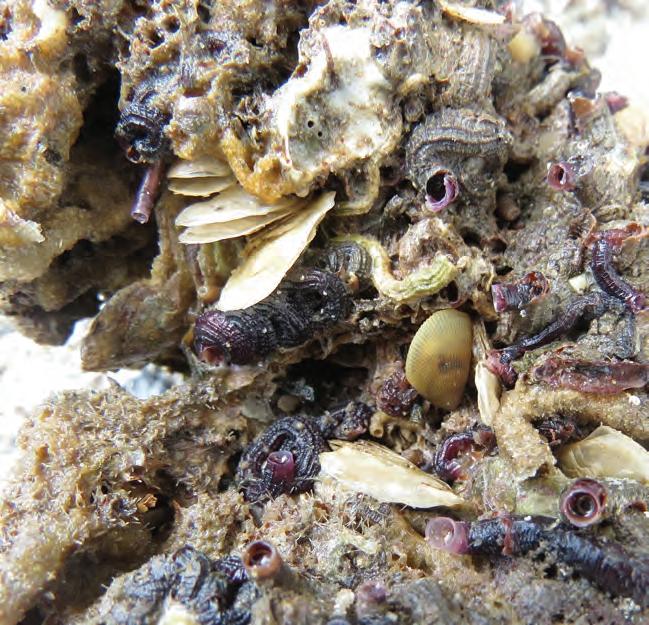
Oysters and other bivalves attach themselves to the tree
with a kind of cement or with thin but very strong byssal threads. Their shells are covered with smaller sessile creatures, tiny coiled worm shells, barnacles, and encrusting bryozoans. Moving over the sessile animals are mobile sea snails. Some are herbivores grazing on algae and some, carnivores that bore into or break open the shells of other mollusks. Prop roots are also home to species of sea slugs or nudibranchs. These animals are sea snails that, through evolution, have discarded their external shells. We found several specimens of lynx nudibranch (Phidiana lynceus) which feed on hydroids and use the undigested nematocysts (stinging
cells) in their own defense. In one bushy bryozoan we found many specimens of a tiny nudibranch species that lives in, feeds on, and lays its eggs on just that single species of bryozoan. We also found several different species of larger sea slugs, called sea hares (genus Aplysia), some of which were lying on the sand inside the tree at low tide. We found their distinctive egg strings higher up on the tree roots several times when we discovered the animals beached on the sand.
Zonation
Because the tree was solitary, it was easy to observe the array of intertidal creatures taking advantage of the hard substrate of its prop roots. While the surrounding area offered only soft sediment and sparse shoal grass (Halodule wrightii) as shelter, the spatially complex prop roots provided a solid surface to which micro- and macroalgae and sessile animals could attach themselves. The result was a small convoluted island teeming with creatures from different phyla.
On the back side of the tree (closest to open water), prop roots were almost three feet deep at high tide, while roots on the front (landward) side were more frequently exposed to air. Zonation of air- and water-tolerant species occurred vertically on the prop roots as well as from back to front. Different parts of the tree also received differing levels of light and shade, with the perimeter being sunnier than the interior.
Even adjacent prop roots hosted different assemblages of animals. Competition for real estate was seemingly fierce on some submerged roots, with later arriving or faster growing species overgrowing earlier established organisms.
Marine worms and “worm rock”
Where the prop roots enter the sediment, two unrelated creatures build up structures around the roots. These two species provide an excellent example of convergent evolution – their structure-building behavior is similar but they
have evolved independently and belong to different phyla. The variable worm snail (Petaloconchus varians) is a gastropod mollusk and suspension feeder that cements its shell to hard surfaces and other worm snail shells. The shells are made of secretions of calcium carbonate massed together to form very hard pipe-like structures around the mangrove roots. Another type of structure is constructed of mucus and sand by the polychaete species Phragmatopoma caudata or honeycomb worm. These bristle worms are able to close a hood and survive periods of exposure to air at low tide. Often found in association with P. caudata is the gray sea cucumber, an unlikely looking relative of starfish and sea urchins. We found many individuals of this species lying over each other in the mud around the tree. These reddish tubular echinoderms closely resemble the tree’s roots and it was sometimes difficult to tell where the roots ended and the sea cucumbers began. Both forms of “worm rock” provide spatially complex living spaces that were home to fan worms, anemones, mussels and other bivalve species, tunicates, sponges, peanut worms, and horseshoe worms.
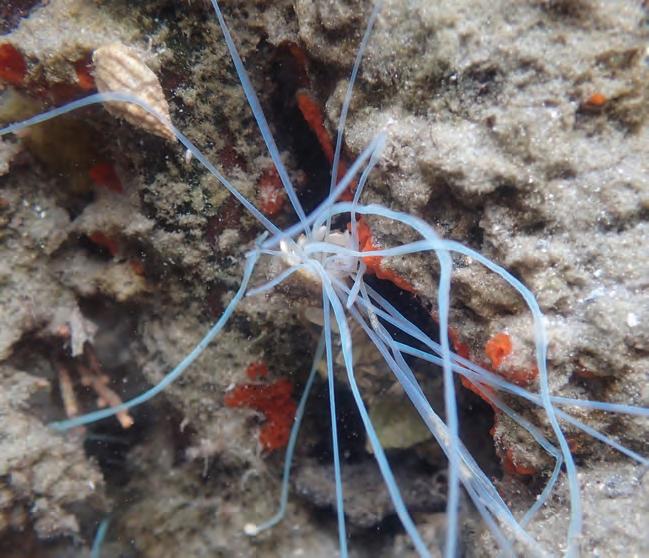
Seen through calm water at low tide, the sand gave tantalizing hints at the rich world of worm species that inhabit the nearby sediment. Two thin white tubes about four inches tall and eight inches apart showed where the parchment worm lives inside its u-shaped burrow, while the long electric blue tentacles of the medusa or spaghetti worm stretch across the sediment and slowly retract if touched. More transient evidence of the life beneath the sand was seen in the form of holes and sand mounds, mysterious leavings of lugworms and acorn worms.
Sponges and tunicates
In contrast to the secretive burrowing worm species, the two predominant groups of encrusting animals on the tree in terms of size and extent are often shockingly bold in their
visibility – the sponges. According to the Smithsonian Marine Station’s Indian River Lagoon Species Inventory, a resource that we relied upon heavily to help identify organisms, the lagoon hosts some 14 species of sponges and 39 species of tunicates. Species of both groups can take similar forms and it was challenging to differentiate them. Although sometimes similar in form and color, they occupy different places in evolution, different phyla, and very different life histories.
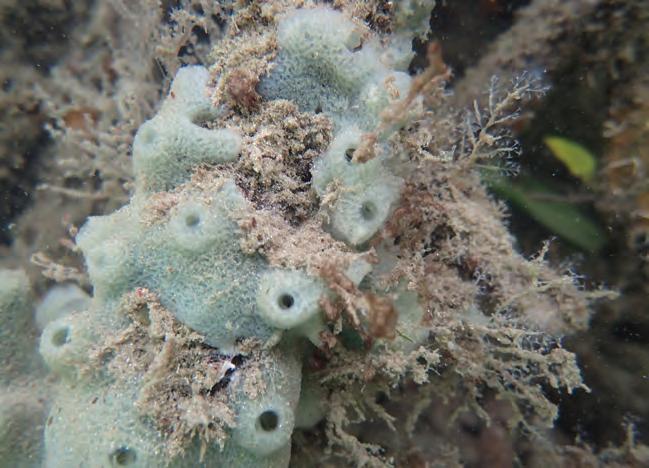
Sponges occurred in a variety of colors – blue, pink or purple, or as yellow spikes on the prop roots and in red masses on the sediment surrounding the roots. Mistakenly classified by Linnaeus as a kind of plant due to their lack of discernible movement, sponges are primitive filter feeding animals which lack a nervous, digestive, and circulatory system. Some species of sponge, such as the fire sponge, are facultative mutualists with red mangroves, providing the trees with nitrogen and protecting the roots from root-boring isopods in exchange for a physically stable habitat (Ellison et al., 1996).
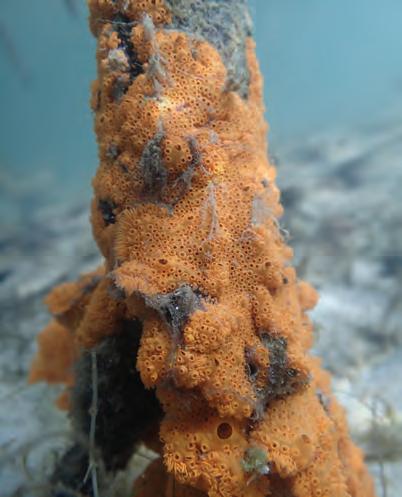
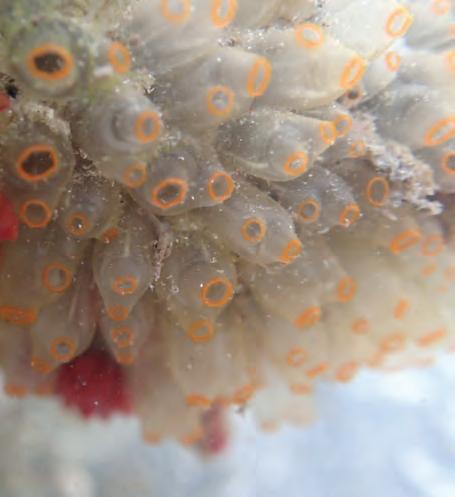
Tunicates are a subphylum of the chordates, the phylum that includes all vertebrates including humans. In their brief larval stage, tunicates are free-swimming tadpole-like creatures with a primitive notochord. Even after they take sessile form, they react to movement, squirting out a stream of saltwater from their excurrent siphon. Also called seasquirts, tunicates can be solitary barrel-like lumps two to three inches high, colonial groups of club-shaped zooids, or encrusting colonies that adhere to the mangrove prop roots like paint. We observed them in colors from inky black to bright white and in geometric patterns of orange and red, black and green. In the larger solitary species, it is possible to observe their two siphons extending and retracting underwater. Mangrove tunicates are a colonial species, growing in
tightly packed clusters around the prop roots. This species is the only food for the zebra flatworm, which could always be found on these tunicates.
Hydroids,
bryozoans and more
Mixed in with the macroalgae growing on the tree were two groups of animals that sometimes closely resemble seaweeds. With the use of a hand lens, we were delighted to see the tiny zooids on fern-like hydroids and bushy bryozoans come to life. The hydroids are relatives of corals, jellyfish, and anemones, and like all members of their phylum they are predators, armed with stinging cells. In one of best recycling acts we witnessed, a decorator crab had attached living branches of hydrozoans to its back and claws, and waved its borrowed defense creatures around as if in warning.
Bryozoans, or “moss animals,” are suspension feeders, extending and retracting a loop of tentacles lined with cilia to capture phytoplankton. Colonies take a variety of forms, from encrusting to arborescent. Like other filter feeders attached to the tree roots, bryozoans are important to the health of the estuary due to their role in filtering and recirculating water.
While most of the creatures we documented were permanent residents of the tree, we also took note of the many fish species that swam through when the tide was in, and the wading birds, including little blue herons, great egrets, night herons, and ibis, that hunted around the tree when the tide was just right. These mobile creatures were part of the daily cycle of life moving through the tree and benefiting from its abundance. After strong eastern winds we might see moon jellyfish, comb jellies, and sargassum weed flowing through the tree’s submerged roots.
For many months in the fall of 2019, we observed that
A Look at Florida's Native Hollies
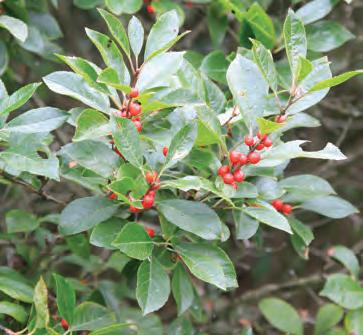
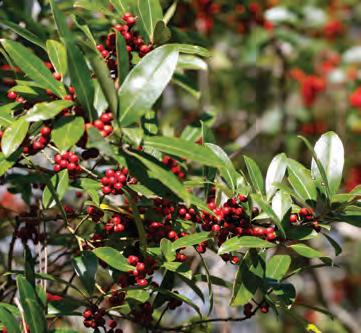
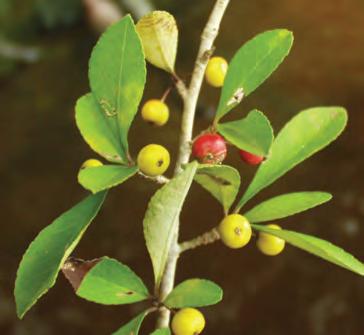
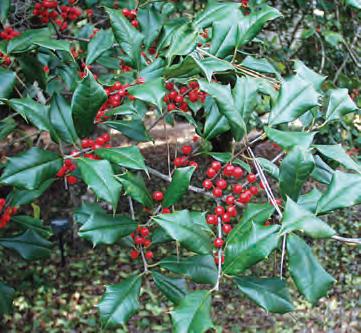
Florida has 14 native holly species in the genus Ilex
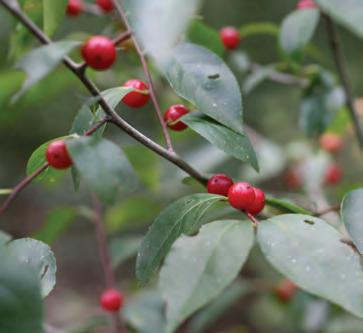
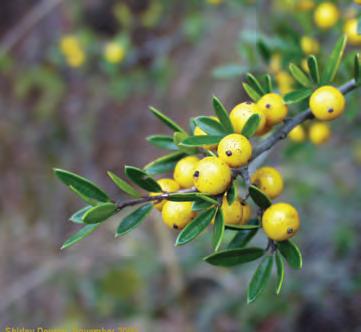
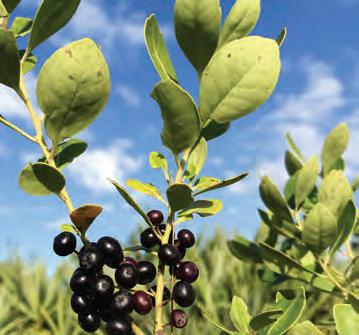
Some of these species are readily available in native plant nurseries and are often used in landscaping, but others are less well known. They provide the home gardener a variety of sizes and shapes to choose from, including shrubs and large trees. They also delight the eye when they produce berries that range in color from red, yellow, or orange to a dark purplish-black.
Hollies are easy to grow once established, and donʼ t require much pruning, so they are at home in both naturalistic and more formal native garden settings. Many are evergreen, sporting glossy leaves long after other trees have gone bare. This adds to their usefulness in home landscapes.
Native hollies provide many benefits to wildlife. Their small flowers attract bees, and the seasonal fruit is eaten by birds and other animals. Since they are dioecious, individual plants have either male or female flowers, and only female trees produce fruit. If no other hollies of the same species are nearby, make sure to plant both male and female trees in the landscape to ensure pollination. Purchasing hollies when they are bearing fruit is the best way to make sure you get a female plant. Hollies are a wonderful addition to the home landscape, and no matter where you live in Florida, there is a native holly species that will grow in your area. Make sure to match the plant’s growing needs to your site location – the list below will help you choose an appropriate species.
Florida's
Native Hollies
Brown, S. P. Hollies at a glance. (2021). https://edis.ifas.ufl.edu/publication/MG021 Coastal plain plants: Ilex ambigua. (2021). http://coastalplainplants.org/wiki/index.php/Ilex_ambigua
Florida Invasive Species Council. 2019 FLEPPC List of invasive plant species (2021). https://floridainvasivespecies. org/plantlist2019.cfm
Florida Native Plant Society. Native plants for your area. (2022) https://www.fnps.org/plants
Gilman, E. F. & Watson, D. G. (2014) Ilex decidua: Possumhaw. https://edis.ifas.ufl.edu/publication/ST302 Holly. (2022). https://en.wikipedia.org/wiki/Holly
Huegel. C. N. (2010). Native plant landscaping for Florida wildlife. University Press of Florida.
Nelson, G. (2003) Florida's best native landscape plants: 200 readily available species for homeowners and professionals. University Press of Florida.
Osorio, R. (2001). A gardener's guide to Florida's native plants. University Press of Florida.
Wunderlin, R. P., Hansen. B. F. & Franck, A. R. & Essig, F. B. (2022).Atlas of Florida Plants. https://florida.plantatlas.usf.edu
Red Mangrove: Ecology of a Keystone Species
CONTINUED FROM PAGE 9
the mangrove prop roots and nearby seagrass beds were coated with green algae or cyanobacteria and were dismayed to find the tapestry of sessile species in the intertidal areas had disappeared. Then in the spring, clusters of sessile creatures hinted at a resurgence prompting new questions.
Over the several years we’ve been visiting the tree, we have witnessed the buildup of sediment around roots spreading outward around the tree. Is this permanent or part of transient sedimentation that periodically buries the surrounding, deeper seagrass beds? The buildup of land and the emergence of shoal grass around the tree seem to hint that the changes might be permanent, part of the mangrove forest succession pioneered by the tree. Now that we are more familiar with its function as a keystone in the ecology of the estuary, we intend to attempt more scientific monitoring. The more we uncover, the more questions we have about the tree and its role in sustaining diverse coastal ecosystems.
Barnard, E. L. & Freeman, T. E. (1982). Cylindrocarpon galls on red mangrove. Plant Pathology Circular, No. 235. https://www.fdacs.gov/content/download/4630/file/ cylindroncarpon_galls_on_red_mangrove.pdf
Ellison, A. M., Farnsworth, E. J., & Twilley, R. R. (1996). Facultative mutualism between red mangroves and root-fouling sponges in Belizean mangal. Ecology, 77(8), 2431–2444. https:// doi.org/10.2307/2265744
Huxham, M., Berger, U., Skov, M. W., & Sousa, W. P. (2019). Kropotkin’s garden: facilitation in mangrove ecosystems. In: Hawkins, S. J., et al. (Eds.). (2019). Interactions in the marine benthos: Global patterns and processes. The Systematics Association Special Volume Series, Vol. 87. Cambridge University Press. Ebook.
Marsh, G. E., & Bane, L. L. (1995). Life along the mangrove shore: A guide to common estuarine plants and animals of Southern Florida. Florida Classics Library.
Sweat, L. H. (2009). Indian River Lagoon species inventory. Smithsonian Marine Station at Fort Pierce. https://naturalhistory2.si.edu/smsfp/irlspec/Aratus_pisoni.htm
Bieler, R. & Mikkelsen, P. M. (2007). Seashells of Southern Florida: Living marine mollusks of the Florida Keys and adjacent regions: Bivalves. Princeton University Press.
Donahue, M. (2020, August). Scientists sleuth out sponge diversity in new initiative. Smithsonian National Museum of Natural History. https://naturalhistory.si.edu/research/ smithsonian-marine-station/news/scientists-sleuth-out-sponge-diversity-new-initiative Greenberg, J. (2000). Mangroves: Trees in the sea. Seahawk Press. Hendler, G., Miller, J. E., Pawson, D. L., & Porter, M. K. (1995). Sea stars, sea urchins, and allies: Echinoderms of Florida and the Caribbean. Smithsonian Institution.
Hogarth, P. (2015). The biology of mangroves and seagrasses. (Biology of Habitats series.) 3 rd ed. Oxford University Press.
Humann, P., DeLoach, N., & Wilk, L. (2013). Reef creature identification: Florida Caribbean Bahamas. (3 rd ed.) New World Publications.
Kaplan, E. H. (1988). A field guide to Southeastern and Caribbean seashores: Cape Hatteras to the Gulf Coast, Florida, and the Caribbean. Peterson Field Guides. Houghton Mifflin Company.
Marsh, G. E., & Bane, L. L. (1995). Life along the mangrove shore: A guide to common estuarine plants and animals of Southern Florida. Florida Classics Library.
Odum, W. C., McIvor, C. C., & Smith, T. J. (1982). The ecology of the mangroves of South Florida: A community profile. United States Bureau of Land Management. [Publication number: FWS/OBS-81.24.]
Odum, W. C., & McIvor, C. C. (1990). Mangroves. In: Myers, R. L., Ewel, J. J., editors. Ecosystems of Florida. University of Central Florida Press. p. 517-548.
Proctor, N. S., & Lynch, P. J. (2011). A field guide to the Southeast Coast & Gulf of Mexico: Coastal habitats, seabirds, marine mammals, fish, & other wildlife. Yale University Press.
Ruppert E. E., & Fox, R. S. (1998). Seashore animals of the Southeast. University of South Carolina Press.
Valdes, A., Hamann, J., Behrens, D. W., & DuPont, A. (2006). Caribbean sea slugs: A field guide to the opisthobranch mollusks from the tropical northwestern Atlantic. Sea Challengers Natural History Books.
Voss, G. L. (1976). Seashore life of Florida and the Caribbean. Miami: E. A. Seemann Publishing, Inc.
Whitney, E., Means, D. B., & Rudloe, A. (2004). Priceless Florida: Natural ecosystems and native species. Pineapple Press, Inc. [Chapter 17 Mangrove swamps. p. 285-298.]
Witherington B., & Witherington, D. (2017). Florida’s living beaches: A guide for the curious beachcomber. (2nd ed.) Pineapple Press.
Linda Eastman is a lifelong nature lover and former teacher from Detroit who retired to Florida in 2011. Eager to embrace her new home, she completed the Florida Master Naturalist Program, the Audubon Field Academy’s Birding Naturalist Program and George Rogers’ online course, Native Plants of South Florida. She is past president of the Martin County Chapter of the Florida Native Plant Society.
Leigh Goddeau is a (mostly) life-long Floridian who has always loved the ocean and its creatures. She enjoys taking classes in the Florida Master Naturalist Program and learning about Florida’s natural systems. She also collects books on natural history and is a member of the Society for the History of Natural History.
André Michaux in North America
Review by Jim Erwin
In 1793, George Washington, Thomas Jefferson, John Adams, Alexander Hamilton, James Madison, and 70 more members of the American Philosophical Society (APS) pledged to finance a two-year expedition to explore North America west of the Mississippi River, all the way to the Pacific Ocean, to gather information about that unknown land. The APS sent detailed instructions not to Lewis and Clark, but to André Michaux, who had broached the subject to Jefferson. How had the country’s leaders come to trust this historic journey to a man whose name is little-known outside the botanical world? The answer is to be found in a beautiful and intriguing book, André Michaux in North America.
Charlie Williams, chairman of the André Michaux International Society (AMIS) along with Florida Native Plant Society members Eliane M. Norman and Walter Kingsley Taylor spent more than ten years researching this first complete translation of Michaux’s journals and letters, which is accompanied by their excellent commentary. Norman and Taylor are well qualified for this project, having been coauthors of the book André Michaux in Florida: An Eighteenth Century Botanical Journey, published in 2002 by the University Press of Florida.
Michaux wanted very much to lead the APS expedition. He had the trust of the United States’ leading citizens who knew of his earlier dangerous and sometimes life-threatening botanical explorations in the Middle East, and who knew first-hand of the great difficulties he had overcome during seven years exploring North America from near Hudson Bay to Cape Canaveral, Florida. His adventures and the plants he was collecting for his native France were winning him respect and admiration on both sides of the Atlantic. As Royal Botanist to Louis XVI, he was sending home thousands of exotic New World cuttings, seeds, plants and young trees to adorn gardens public and private, and to restore the forests of France. This work perfectly suited Michaux who, with cool determination, intended to go on exploring and botanizing and never stop.
The fall of the French monarchy was welcome news to Michaux. Leading the APS expedition would also bring honor and renown to France’s new republican form of
government which Michaux celebrated with uncharacteristic enthusiasm. While botanizing in North Carolina, he wrote in his journal: “We climbed to the summit of the highest [they thought] mountain [Grandfather Mountain] in North America and with my guide, [we] sang the hymn ‘La Marseillaise’ [see the movie ‘Casablanca’] and yelled ‘Long life to America and the French Republic, long life to liberty,’ etc. etc.” Michaux wanted this expedition for France and for himself, but when France’s new republic asked him to undertake a secret mission to Kentucky instead, he accepted, glad to serve the new France, and left the APS hanging.
Michaux in Florida
In the 2002 book André Michaux in Florida, and in a 2004 article, “André Michaux Visits Spanish East Florida, Spring 1788,” Dr. Walter Kingsley Taylor and co-author Dr. Eliane M. Norman attempted to rectify Michaux’s neglect in the early natural history of Florida and eastern North America. Though there is no ‘Michaux Trail,’ Michaux’s botanical discoveries exceed those of either John or William Bartram. He was the first botanical explorer of the higher Allegheny Mountains, and of the Hudson Bay area, and the first naturalist to see the American prairie. His book Flora Boreali-Americana is the first systematic North American flora. Both of these Taylor-Norman publications show us a botanist resolved to make his flora comprehensive by exploring as widely as possible, whatever the obstacles. Florida would test his resolve.
Snakes and alligators, for example, he disliked intensely and found in abundance: “Horrible faces of enormous length and size,” he wrote of the ‘gators. He landed in the St. Augustine area which his map called “the mosquito coast.” Mosquitoes “devoured us and kept us from any sleep.” Today’s storm was “more violent” than yesterday’s. “The water is more disgusting, and salty, than that of the St. Johns River and that of Lake George.” His paddlers had drunk all the rum, but were “among the most sober I have yet seen.” Reaching a kind of gulf six miles wide (the Indian River) the wind was against us, the water so shallow that we had to drag the canoe; in the deep water the “Waves swamped us,” almost submerging
the canoe...all our provisions became wet.” To portage (at the aptly named Haulover) from the gulf to the canal (today’s Mosquito Lagoon) they had to roll the heavy canoe over saw palmettos which cut into their boots and legs.
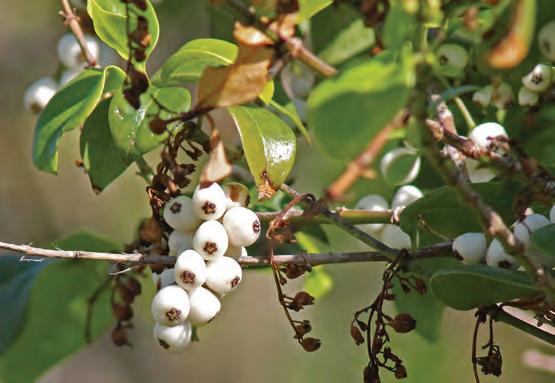
Undeterred, but finally disappointed with the number of new species found, Michaux, five miles short of Lake Monroe, turned back, returning to Charleston, South Carolina to plant several hundred cuttings and seeds from Florida for later shipment back to France. He had found 73 plants not documented by the Bartrams during their Florida expeditions and discovered four new species along the Tomoka River: Prairie wedgescale (Sphenopholis obtusata), marsh fimbry (Fimbristylis spadicea), fringed beaksedge (Rhynchospora ciliaris), and littleleaf buckbrush (Ceanothus microphyllus). He also collected the first known snowberry (Chiococca alba) in Florida.
“His name was André Michaux and we should all remember his name, for he was one of the most remarkable human beings of the 18th century, or of any century.”
– Charles
Kuralt
Michaux’s Legacy
After capsizing in white water south of Hudson Bay, Michaux had written, “These trips are frightening to those who are not used to them, and I would counsel the little dandies from London or Paris – if there be any there – to remain at home.” It was on these dangerous trips he discovered hundreds of new plants described and named in his books Histoire des Chênesde l’Amérique and Flora BorealiAmericana. To America, he introduced both the Camellia and the crepe myrtle, among many other species.
To botanists of the late 18th century, much of the world was, quite literally, a new planet waiting to be explored.
Michaux wanted to see it all. Before North America, he had botanized in Persia and wanted to return there, but instead went as chief botanist on an expedition to Australia, with the stipulation that he be put off in Indonesia or the Philippines – which one didn’t seem to matter. He wanted to go to Chile and Peru. But most of all he wanted to explore the completely unknown flora at the center of Madagascar.
He reached the coast of that most curious island where he began to set up a nursery to prepare plants gathered from the interior for shipment to France, just as he had done in Charleston, South Carolina. In the highlands he would have been safe from insect-borne disease, but before he could leave the coast, having survived every sort of danger for years, he succumbed to a tropical fever.
His son François André Michaux had accompanied him in North America for several years and continued to support his father’s primary mission: to re-forest France, particularly with oaks which had all disappeared into the hulls of France’s sailing ships. François published his own landmark book, Histoire des arbes forestiers de l’Amérique – a standard work with multiple reprintings throughout the 19th century.
Michaux’s journals bring the reader face to face with a very different time. The authors’ excellent notes and chapter introductions work seamlessly with these journals to create a narrative flow that reads like a history. Combining history of science with political and social history, André Michaux in North America is a new perspective on a period of revolutionary change, as the Enlightenment continued to remake Western Civilization.
Jim Erwin is co-editor of the FNPS Tarflower Chapter's newsletter The Tarpaper.He is relatively new to Florida native plants and enjoys learning about them by doing research for newsletter articles. He is a retired database administrator, but says his best job was his first – teaching freshman composition. In his spare time, Jim enjoys hiking, sailing and reading.