The Quarterly Journal of the Florida Native Plant Society
FNPS 2026 Endowment Grant Research Awards, Conservation Grant Awards, and the Dan Austin Award for Ethnobotany
Endowment Research Grants
The Florida Native Plant Society maintains an Endowment Research Grant program for the purpose of funding research on native plants. These are small grants ($2,500 or less), awarded for a 1-year period, and intended to support research that forwards the mission of the Florida Native Plant Society which is “to promote the preservation, conservation, and restoration of the native plants and native plant communities of Florida.”
Conservation Grants
F NPS Conservation Grants support applied native plant conservation projects in Florida. These grants ($5,000 or less) are awarded for a 1-year period. These projects promote the preservation, conservation, or restoration of rare or imperiled native plant taxa and rare or imperiled native plant communities. To qualify for a Conservation Grant, the proposed project must be sponsored by an FNPS Chapter.
Dan Austin Award for Ethnobotany
The Dan Austin Award for Ethnobotany will provide up to $1,500 to graduate or undergraduate students who are studying Florida ethnobotany – i.e., the study of the relationship between peoples or cultures with plants native to Florida or Florida ecosystems. These can be current uses or historic uses.
How to Apply
Application guidelines and details are on the FNPS web site, https://www.fnps.org. Click on ‘What We Do/Awards and Grants’. Questions regarding the grant programs should be sent to info@fnps.org. Application deadline for the 2026 Awards is March 6, 2026. Awards will be announced in May 2026.
From the Editor: A Correction to Palmetto 41-3
Some copies of Palmetto 41-3 were distributed with an error in the article Advocating for Native Plant Conservation Yields Noteworthy Successes (Part 2). We apologize for any confusion this may have caused. The corrected text is reprinted below.
Funding for Endangered and Threatened Native Flora Conservation Grants
Florida created the Endangered and Threatened Native Flora Conservation Grant program in 1997. It is administered by the Division of Plant Industry of the Florida Department of Agriculture and Consumer Services, and is funded contingent on receiving an annual appropriation from the legislature. Every year, FNPS requests and supports an appropriation, and this year we sought an increase to account for the continuing increase in threats to native plant conservation. Common recipients of the grants include Archbold Biological Station, Fairchild Tropical Botanic Garden and Bok Tower Gardens. We initially sought an increase in the funding during a session when the legislature and governor were intent on slashing the budget. The final proposed Florida budget matched the $216,000 allocated for the grant program in 2024. We were pleased the funding survived the governor’s veto pen, bringing a very difficult year for conservation funding to a mixed, but ultimately disappointing, conclusion.
F NPS has faced many challenges to our plant conservation mission over the past year. With the support of our members, we have been able to achieve some meaningful successes. We greatly appreciate your participation in our efforts and assure you that FNPS will continue to remain engaged.
FNPS Team
Executive Director Melissa Fernandez-de Cespedes
Director of Communications and Programming ...................Valerie Anderson
Director of North Florida Programs and TorreyaKeepers
Project Coordinator Lilly Anderson-Messec
Operations Manager ..............Cherice Smithers
Palmetto Editor ..........................Marjorie Shropshire
Board of Directors
President ............................................................Eugene Kelly
Past President .................................................Mark Kateli
President-elect...............................................Ann Redmond
Vice President, Administration .............Athena Phillips
Vice President, Finance ............................Kim Zarillo
Treasurer ............................................................Chris Moran
Secretary ...........................................................Bonnie Basham
Council of Chapters Chair ............................Rebekah Kaufman
Directors at Large:
..................................................................................Adam Arendell
..................................................................................Susan Earley
..................................................................................Richard Hamann
..................................................................................Gage LaPierre ..................................................................................Paul Schmalzer
..................................................................................Melanie Trexler
To contact board members
FNPS Administrative Services: Call (321) 271-6702 or email info@fnps.org
Committee Chairs
Conservation ...................................................John Benton
Council of Chapters .....................................Rebekah Kaufman
Education...........................................................Vacant
Policy and Legislation................................Eugene Kelly
Science................................................................Paul Schmalzer
Society Services
Administrative Services............................Cherice Smithers
Bookkeeping ....................................................Carrie Schulz
Editor, Palmetto ..............................................Marjorie Shropshire
Webmaster........................................................Paul Rebmann
MEMBERSHIP
Make a difference with FNPS
Your membership supports the preservation and restoration of wildlife habitats and biological diversity through the conservation of native plants. It also funds awards for leaders in native plant education, preservation, and research.
Memberships are available in these categories: Individual; Multi-member household; Sustaining; Lifetime; Full-time student; Library (Palmetto subscription only); Business or Non-profit recognition.
To provide funds that will enable us to protect Florida's native plant heritage, please join or renew at the highest level you can afford.
To become a member:
Contact your local chapter, call, write, or e-mail FNPS, or join online at https://www.fnps.org/
The purpose of the Florida Native Plant Society is to preserve, conserve, and restore the native plants and native plant communities of Florida.
Official definition of native plant:
For most purposes, the phrase Florida native plant refers to those species occurring within the state boundaries prior to European contact, according to the best available scientific and historical documentation. More specifically, it includes those species understood as indigenous, occurring in natural associations in habitats that existed prior to significant human impacts and alterations of the landscape
Follow FNPS online:
Blog: http://fnpsblog.blogspot.com/
Bluesky: https://bsky.app/profile/fnps.bsky.social
Facebook: https://www.facebook.com/floridanativeplantsociety
Instagram: https://instagram.com/floridanativeplantsociety/ LinkedIn: https://www.linkedin.com/company/florida native-plant-society-inc-/
TikTok: https://tiktok.com/@floridanativeplants YouTube: https://tinyurl.com/yx7y897d
Features
4 B eyond Milkweed: Host Plants for the Other Butterflies
Article by Leslie Nixon
10 Celebrating the 2025 FNPS Landscape Awards Article by Natalia Manrique
12 Carex of Central Florida Article by Linda W. Curtis
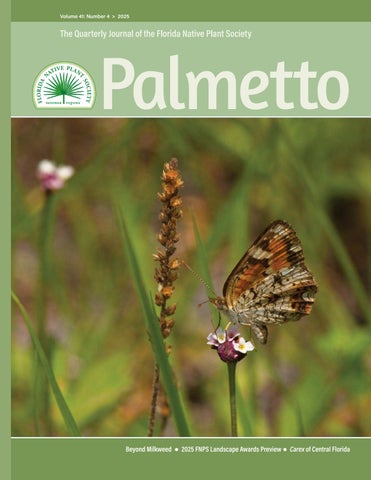
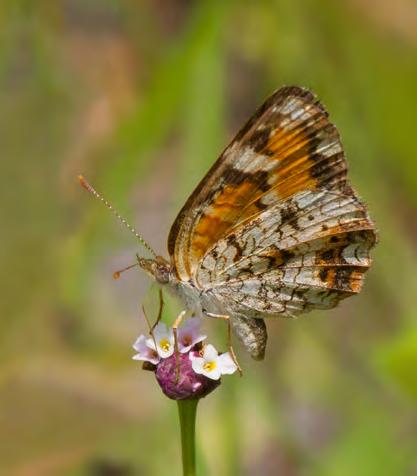
ON THE COVER: Phaon crescent (Phyciodes phaon) on turkey tangle fogfruit (Phyla nodiflora). Photo by Paul Rebmann. See story on page 4.
Palmetto
Editor: Marjorie Shropshire ● Visual Key Creative, Inc. ● palmetto@fnps.org (ISSN 0276-4164) Copyright 2025, Florida Native Plant Society, all rights reserved. No part of the contents of this magazine may be reproduced by any means without written consent of the editor.
Palmetto is published four times a year by the Florida Native Plant Society (FNPS) as a benefit to members. The observations and opinions expressed in attributed columns and articles are those of the respective authors and should not be interpreted as representing the official views of the Florida Native Plant Society or the editor, except where otherwise stated.
Editorial Content
We welcome articles on native plant species and related conservation topics, as well as high-quality botanical illustrations and photographs. Contact the editor for guidelines, deadlines and other information.
Get Palmetto in print, delivered right to your door. Visit the FNPS website to sign up: https://fnps.app.neoncrm.com/forms/palmettoprint-and-ship-form
Beyond Milkweed: Host Plants for the Other Butterflies
Monarch butterflies get all the press. Sure they are beautiful and charismatic. Sure their yearly migration to Mexico is a marvel of nature. And yes, their populations are dropping precipitously and their conservation is complicated (Daniels, 2025). Monarchs in their perilous beauty deserve our attention.
But while monarchs are the stars of the show, there are almost 200 other species of butterflies found in Florida (Daniels, 2022). These are the supporting actors who may not be as recognizable, but who work just as hard in their ecological roles. Shouldn’t we cheer for them too?
The answer is a resounding, yes! Butterflies not called monarchs are also beautiful, fun to watch, and vital to Florida ecosystems. Not only do the adults provide pollination services, their larvae (caterpillars) serve as a critical link in the food chain, feeding baby songbirds and other small animals who
can’t digest plants. Caterpillars transform the energy stored in a plant into plump, soft, nutritious dinners for many hungry animals in the food web.
Unfortunately, like monarchs, Florida’s other butterflies are in decline. A large study recently published found that there was a 22% drop in the total butterfly population in the contiguous U.S. from 2000 to 2020 (Edwards et al., 2025). That’s more than 1 in 5 butterflies lost in just two decades, and Florida’s butterflies are part of this distressing trend (Daniels, 2022). The study suggested three primary reasons for the decrease: habitat loss, climate change, and pesticide use. The good news is that two out of the three inciting causes (habitat loss and pesticide use) can be mitigated by individuals through simple tasks on their own property (Daniels, 2022). Creating a safe and productive place for butterflies in a small space is easy. Even people with only a balcony or patio can join in.
Food for the Other Butterflies
The key to supporting butterflies is to provide appropriate food for both the adult and the larval stages of their lifecycle. Native plant devotees already know the importance of feeding caterpillars, but many newcomers to native plant gardening might not. Read on to discover how to create a buffet for caterpillars in your home landscape.
In grade school we learned that butterflies exhibit complete metamorphosis, cycling from adult to egg to larva (caterpillar) to pupa (chrysalis) and back to adult. The eggs and chrysalids have all the nutrition they need stored in their protective cases, so they do not require food, but adults and caterpillars must eat. Caterpillars especially need to eat a lot. A caterpillar’s main function in the butterfly lifecycle is to grow big and fat so when it forms a chrysalis it has enough stored energy to transform into an adult butterfly.
Butterflies primarily get their nourishment from flower nectar. They tend to be generalists and will drink nectar from any bloom they can stick their proboscis into. Caterpillars, on the other hand, can be choosy. They eat plant leaves, but not just any plant leaf: most caterpillars are confined to a limited palate of plants. Evolutionary pressures created these selective tastes. Plants evolve defenses against herbivory that include spines, hairs, tough leaves, and chemical defenses. Some specialist herbivores evolve capabilities to tolerate, detoxify or even store and use defensive chemicals. In this way, caterpillars are able to consume a particular plant or even certain families of plants
A rticle by Leslie Nixon / Photos by Paul Rebmann
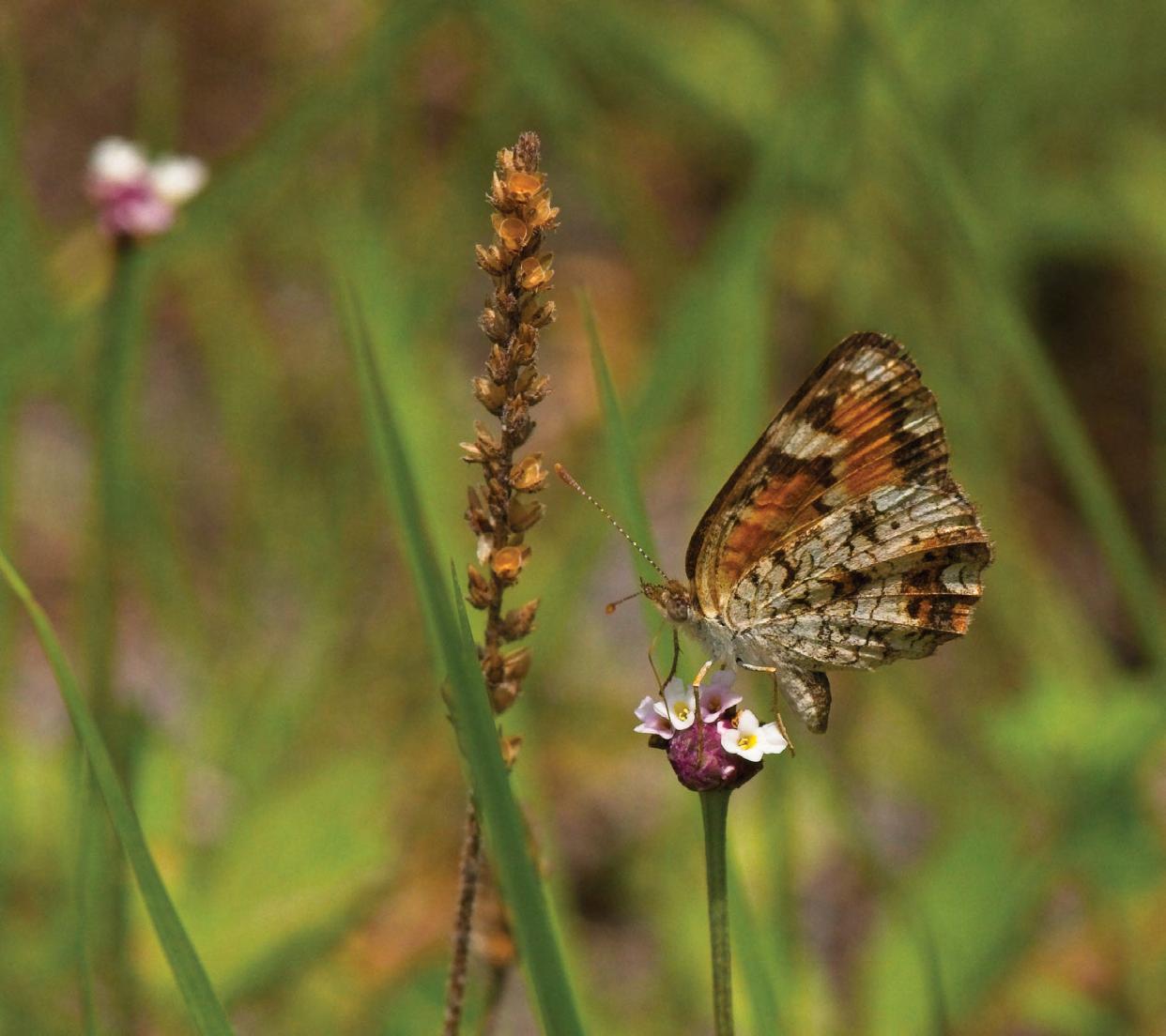
Phaon crescent (Phyciodes phaon) on turkey tangle fogfruit (Phyla nodiflora).
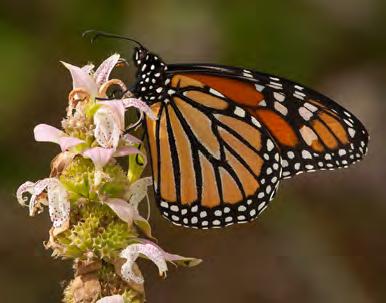
Monarch (Danaus plexippus) butterfly on spotted beebalm (Monarda punctata).
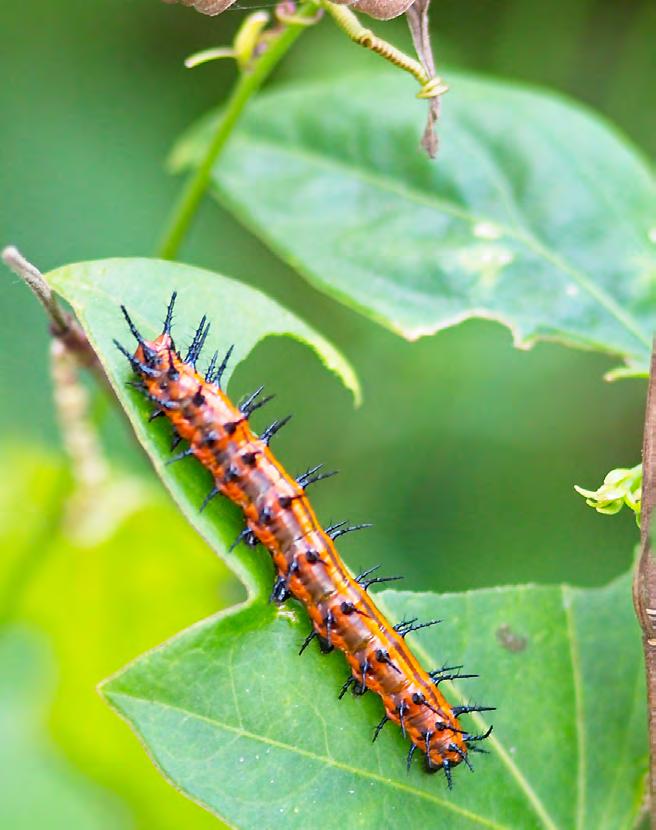
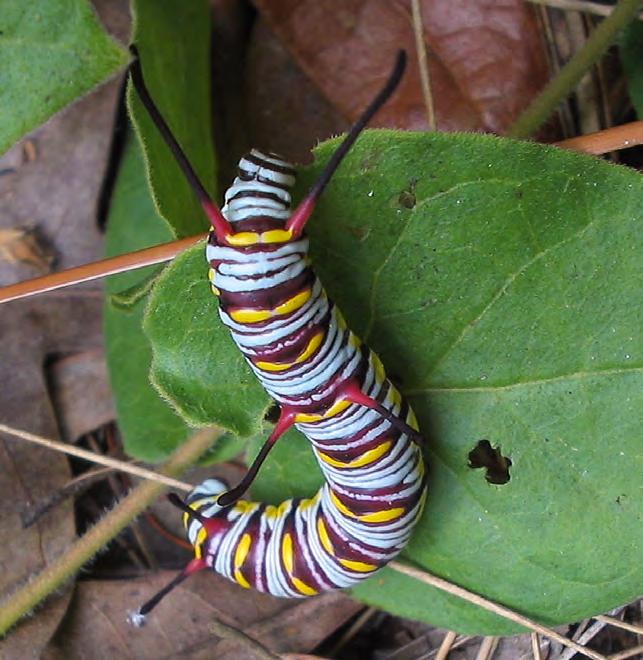
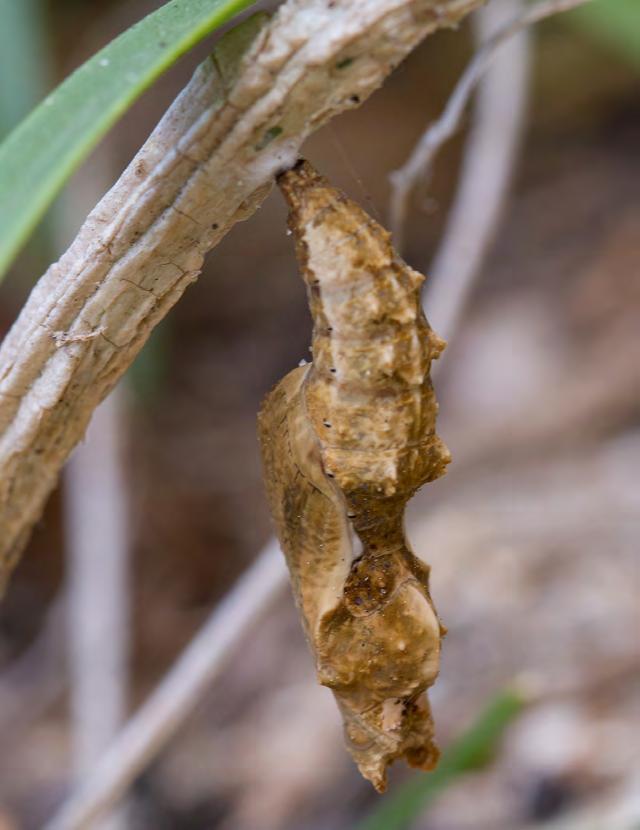
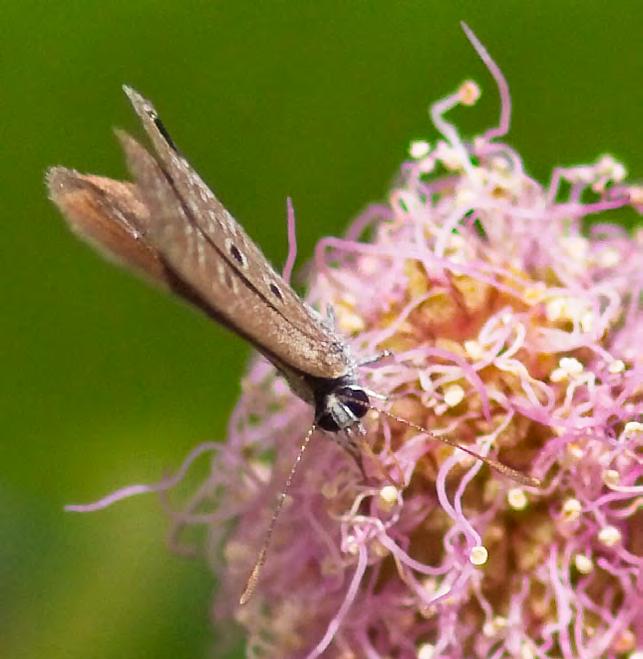
Clockwise from upper left: Gulf fritillary (Agraulis incarnata) caterpillar on corkystem passionflower (Passiflora suberosa). Gulf fritillary chrysalis. Female Ceraunus blue butterfly (Hemiargus ceraunus) on sunshine mimosa (Mimosa strigillosa). Queen (Danaus gilippus) caterpillar on trailing milkvine (Matelea pubiflora).
Table 1. A Selection of Native Host Plants for Florida's Butterflies
Sources: Florida Native Plant Society, 2025; Minno et al., 2005
Species Name Common Name Caterpillars
Wildflowers
Asclepias incarnata Pink swamp milkweed
Asclepias perennis White swamp milkweed
Asclepias tuberosa Butterfly milkweed
Chamaecrista fasciculata Partridge pea
Queen, soldier, monarch
Queen, soldier, monarch
Queen, soldier, monarch
Cloudless and orange sulfur, gray hairstreak, Ceraunus blue, sleepy orange, little yellow
Cirsium horridulum Purple thistle Little metalmark, painted lady
Dyschoriste oblongifolia Oblongleaf twinflower Common buckeye
Dyschoriste humistrata Swamp twinflower Common buckeye
Mimosa strigillosa Sunshine mimosa Little yellow
Phyla nodiflora Turkey tangle fogfruit (frogfruit) Common buckeye, Phaon crescent, white peacock
Ruellia caroliniensis Carolina petunia Common buckeye, white peacock
Grasses
Andropogon virginicus Broomsedge bluestem
Common wood-nymph and 5 skippers
Chasmanthium latifolium Woodoats Gemmed satyr and 4 skippers
Sorghastrum secundum Lopsided Indian grass Swarthy, Delaware, arogos, dusted, Eufala, and twin-spot skippers
Tripsacum dactyloides Fakahatchee grass Byssus, three-spotted, and clouded skippers
Vines
Aristolochia tomentosa Wooly pipevine
Zone Size H' x W' Water Needs Flower Color
White
Purple
Purple
-
-
Yellow
Yellow
Pipevine and Polydamas swallowtails N-C Vine Med Purple
Guilandina bonduc Gray nicker Miami, Ceraunus, and nickerbean blues, martial-scrub hairstreak, C-S Vine Low Yellow
Centrosema virginianum Spurred butterfly pea
Passiflora incarnata Purple passionvine
Longtail skipper, northern cloudywing N-C-S Vine Med Lavender
Zebra longwing, Gulf fritillary, Julia N-C-S Vine Low Purple
Passiflora suberosa Corkystem passionvine Zebra longwing, Gulf fritillary, Julia N-C-S Vine Low Green
Vigna luteola Hairy cowpea Cassius and Ceraunus blues, gray hairstreak, long-tailed and Dorantes longtail skippers N-C-S Vine Low Yellow
Shrubs
Amorpha fruticosa False indigo
Croton linearis Pineland croton
Southern dogface, silver-spotted skipper N-C-S 6-12 x 6-10 Med Purple
Bartram's scrub hairstreak, Florida leafwing N-C-S 1-3 Low White
Morella cerifera Wax myrtle Banded and red-banded hairstreaks N-C-S 10-15 x 8 Med -
Pithecellobium keyense Florida Keys blackbead Miami and Cassius blues, large orange sulfur S up to 8 Low Pink
Senna ligustrina Senna Cloudless and orange-barred sulfurs, sleepy orange C-S 4-8 x 3-6 Low Yellow
Serenoa repens Saw palmetto Monk and palmetto skippers N-C-S 3-8 x 4-6 Low White
Suriana maritima Bay cedar Martial scrub and mallow scrub-hairstreaks C-S 6-10 x 6-10 Low Yellow
Yucca filamentosa Adam's needle
Cofaqui and yucca giant skippers
3-8 x 3-4 Low White
Zamia integrifolia Coontie Atala N-C-S 2-3 x 3-5 Low none
Trees
Amyris elemifera Sea torchwood Schaus', Bahamian, and giant swallowtails C-S 15-20 Low White
Asimina parviflora Small flower pawpaw Zebra swallowtail N-C 15 x 10 Low Purple
Bursera simaruba Gumbo-limbo Dingy purplewing C-S 20-30 x 20-30 Med-Low White
Celtis laevigata Sugarberry, hackberry American snout, question mark, hackberry and tawny emperors, mourning cloak N-C-S 60-80 x 30-50 Med Yellow
Cercis canadensis Eastern redbud Henry's elfin N-C 25-30 x 25-35 Med-Low Pink
Lysiloma latisiliquum False tamarind
Large orange sulphur, mimosa yellow, Cassius blue S 40-60 x 30-50 Low White
Magnolia virginiana Sweet bay magnolia Eastern tiger swallowtail
N-C-S 20-30 x 10-15 Med White
Prunus serotina Black cherry Eastern tiger swallowtail, red-spotted purple N-C <70 Med-Low White
Quercus geminata Sand live oak Oak, red-banded, white-m hairstreaks, Horace's duskywing N-C-S 20-30 x 10-15 Low -
Quercus laevis Turkey oak
Quercus virginiana Live oak
Salix caroliniana Coastal plain willow
Horace's, sleepy, Juvenal's duskywings, red-banded hairstreak
Horace's duskywing, white-m hairstreak
Viceroy, red-spotted purple, mourning cloak
N-C 30-40 x 10-15 Low -
N-C-S 40-80x80-100 Med-Low -
N-C-S 25-60 x 20-40 High-Med Yellow
Sassafras albidum Sassafras Spicebush and Palamedes swallowtails N-C 30-60 x 25-40 Med-Low Yellow
Ulmus alata Winged elm
Question mark, mourning cloak N-C 40-70 x 30-40 Med-Low Green
Zanthoxylum clava-herculis Hercules club Giant swallowtail
Zanthoxylum fagara Wild lime
Weedy Wildflowers
Lepidium virginicum Virginia pepperweed
N-C-S 10-25 x 10-25 Low White
Schaus' and giant swallowtails C-S 5-20 x 3-12 Low Yellow
Checkered, great southern, cabbage whites N-C-S 1.5 Low White
Parietaria floridana Florida pellitory Red admiral N-C-S 1 Med Green
that other herbivores cannot. Over time, the plant-larva relationship solidifies so that caterpillars are completely dependent on their chosen plant(s).
Naturally, Florida’s butterflies co-evolved over eons with Florida’s native plants. Most butterflies need native plants to complete their lifecycles; their caterpillars can’t live off of any old import. In fact, there are very few non-native plants that feed Florida’s butterfly larvae, and some non-natives can actually harm caterpillars (Daniels, 2022). When it comes to feeding caterpillars, think native!
Host Plants
Plants that feed caterpillars are called butterfly host plants, larval host plants, or simply host plants. These plants host (provide a meal for) caterpillars. Through chemical receptors, a female butterfly detects her larval host plant, flies over to it, and lays her eggs on or near that plant. If she makes a mistake and chooses the wrong plant species or one far from the proper host, the egg will hatch, but the caterpillar will starve.
Monarch caterpillars are well-known for their exclusive taste, able to survive only on plants in the genus Ascelpias (milkweeds), but most other Florida caterpillars are not as fastidious about their host plants, being able to live off more than one genus of plants. In addition, while milkweed can sometimes be challenging to grow, most host plants for non-monarchs are easy to cultivate in a home landscape. Many of them host multiple caterpillars and most of them also produce flowers to feed caterpillar parents and other pollinators. It turns out that it is easy to nurture Florida’s other caterpillars – you just need to know which natives to plant.
Choosing Host Plants
Host plants for Florida’s butterflies come in all shapes and sizes. If you search the FNPS website for plants that attract caterpillars
(includes both butterfly and moth caterpillars), you will get a list of over 200 plants! What may come as an additional surprise is the number of trees, shrubs, and grasses that host caterpillars. These are the plants that are the backbone of your yard’s ecosystem, a support system for flowers and vines. Now, here’s another reason to add more dimension and diversity to your yard.
To help you get started choosing host plants for your landscape, Table 1 lists selected butterfly host plants. To reduce the list to a comprehensible size, three criteria were used: 1) plant is a host for more than one butterfly or host for an endangered or unusual butterfly; 2) a few Florida favorites that host only one butterfly caterpillar; and 3) plant is suitable for home landscapes. The chart is arranged by plant type. Find a plant that appeals to you and see which caterpillars feel the same. The list is a starting point; for more comprehensive resources on choosing host plants, see Table 2.
Four Favorite Host Plants
Here are four popular native Florida host plants. All four feed multiple caterpillars and are easy to care for. Most grow throughout the state.
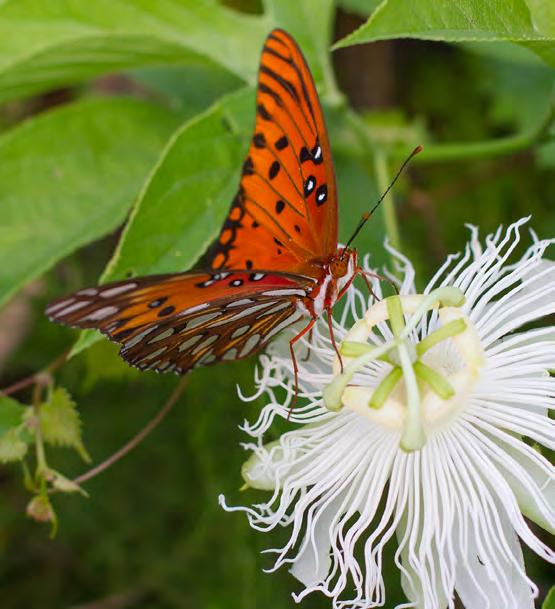
A Gulf fritillary (Agraulis incarnata) on white passionflower (Passiflora incarnata forma alba).
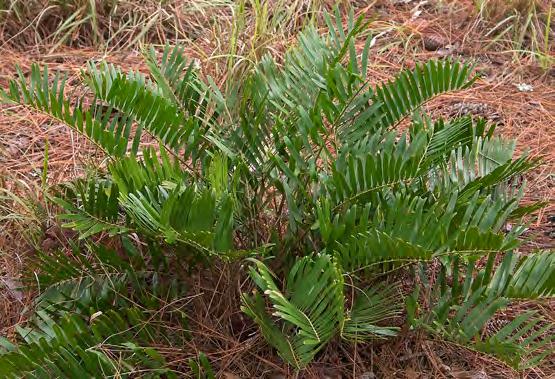
Coontie (Zamia integrifolia) is the host plant for the atala butterfly (Eumaeus atala).
A female Ceraunus blue (Hemiargus ceraunus) butterfly on sunshine mimosa (Mimosa strigillosa). Partridge pea (Chamaecrista fasciculata) is one of the host plants for this butterfly.
Partridge pea (Chamaecrista fasciculata) is a wildflower no Florida garden should be without. A delight for both humans and pollinators, it hosts six caterpillar species – most notably those of the sulphur butterflies that are the same sunny color as the flowers. This unfussy plant can grow on the back of a sand dune or in an average home landscape with part-sun; its only requirement is to live in well-drained soil. As an annual, partridge pea passes on each year, but it is a prolific reseeder so you won’t have to replant it every year like you do non-native annuals.
Our state butterfly, the zebra longwing (Heliconius charithonia), lays her eggs on passionvines (Passiflora spp.). Gulf fritillary and Julia butterflies do the same. Purple passionvine (P. incarnata) is a deciduous vine that develops large elaborate purple flowers from spring to fall. Corkystem passionflower (P. suberosa), another native passionvine, has evergreen leaves, but small, inconspicuous green flowers. Beware of planting non-native passionvines sold at large retail nurseries as some of them can be toxic to caterpillars (Minno et al., 2005). Go native instead!
Fakahatchee grass (Tripsacum dactyloides) is a large, carefree clumping grass growing up to 6' tall and 4' wide. It hosts three grass skippers – those small butterflies with caterpillars whose heads look like tiny doorknobs. This big bold grass takes up a lot of room, so place it where it won’t overpower other plants, but in a location where you can appreciate its long spikes of little dangling flowers. If you look closely, you can find caterpillars hiding in the shelters they make out of folded leaves and silk. Oak trees are famed for feeding all kinds of caterpillars, whether they are the larvae of butterflies or moths (Tallamy, 2019). If you don’t have room in your yard for a magnificent live oak, try a sand live oak (Quercus geminata). This smaller oak, growing up to 30' tall and 15' wide, hosts Horace’s duskywing skipper and three of the gossamer-wing hairstreaks. Since the caterpillars on oaks are high up in the branches (or sometimes hiding out down in the leaf litter), they can be difficult to identify, but once you see the adults on the wing you know your oak tree is doing its job in the ecosystem.
Host Plants in the Garden
It takes a lot of energy to be a butterfly, what with flying, searching for food, eluding predators, and finding a mate. Females also have to locate host plants for their offspring. Help these hard-working pollinators get the job done efficiently by planting their host plants near the nectar sources you already have. Don’t ask the butterfly mother to abandon the nectar buffet to seek a place to lay her eggs. Keep her close to home – your home.
Be aware that caterpillars eat the leaves (and often flowers) of their host plants, chewing unsightly holes and leaving stems bare. A caterpillar’s sole purpose in life is to gain weight by devouring plants. While caterpillars are unlikely to strip your woody trees and shrubs of their foliage, some wildflowers and vines are susceptible to extreme defoliation. For this reason, you should plant at least three herbaceous host plants close together to keep your caterpillars well fed and a few leaves intact. Planting a group of hosts makes it easier for the voracious worms to find their next meal. Most native plants will recover from larval feeding damage – it’s a natural process after all,
Red-banded hairstreak (Calycopis cecrops).
but until you learn from experience which plants tend to get bare from munching caterpillars keep your native plant supplier on speed dial in case of emergency.
Papillon Pots for Small Spaces
For those with limited outdoor space, create a papillon pot. (‘Papillon’ is French for butterfly.) Procure a large clay or ceramic pot, fill it with organic soil, and add three native plants, selecting those that host caterpillars and provide nectar for butterflies. Choosing plants of varying heights makes it more interesting for you and more attractive to diverse butterflies. See Table 3 for examples of papillon pots. For most plants, make sure there are adequate holes in the bottom of the pot to keep the soil well-drained; for wet loving plants place a saucer under the pot to retain water and keep the roots moist. What is more delightful than a papillon pot? Two papillon pots! If you have room, create multiple papillon pots, perhaps with plants
Title Online FNPS.org
Butterfly Gardening in Florida (UF/IFAS Publication WEC 22)
Print
Florida Butterfly Caterpillars and Their Host Plants
Your Florida Guide to Butterfly Gardening
Butterflies of Florida
Author
Florida Native Plant Society
Daniels, Jaret C., Schaefer, Joe, Huegel, Craig N., Mazzotti, Frank J.
Minno, Mark C., Butler, Jerry T., Hall, Donald W.
Daniels, Jaret C.
Daniels, Jaret C.
Comments
Search for caterpillar host plants. Each plant profile lists which caterpillars the plant feeds.
Introduction to butterfly gardening. Includes charts of Florida's butterflies and their host plants.
The Florida caterpillar bible. A very detailed and comprehensive resource. Good photos of caterpillars.
Introduction to butterfly gardening by an expert at the University of Florida. Good photos of butterflies, caterpillars, and host plants.
A field guide for identifying butterflies and finding their host plants.
Table 2. Resources for Choosing Butterfly Host Plants
Type of Pot/Species
All Florida, average–dry soil
Ruellia caroliniensis Carolina petunia Common buckeye, white peacock 1-2' Lavender
Rudbeckia hirta Black-eyed Susan Nectar for adults 2-3' Yellow
Passiflora incarnata Purple passionflower Zebra longwing, Gulf fritillary, Julia Vine Purple
North-Central Florida, average soil
Phyla nodiflora Turkey tangle fogfruit Common buckeye, Phaon crescent, 0.5' White (frogfruit) white peacock
Cirsium horridulum Purple thistle Little metalmark, painted lady 1-4' Purple
Chasmanthium latifolium Woodoats Gemmed satyr and 4 skippers 2-4'
South Florida, dry soil
Zamia integrifolia Coontie Atala 2-3'
Croton linearis Pineland croton Bartram's scrub hairstreak, 1-3' White Florida leafwing
Guilandina bonduc Gray nicker Miami blue, martial-scrub hairstreak, Vine Yellow Ceraunus blue, nickerbean blue
Notes:
l The possibilities for papillon pots are endless – be creative!
l Use a small trellis for vines
l Keep taller plants tidy by trimming regularly (look for caterpillars first)
l Redo your pot in about 3 years when the soil gets depleted. Options for the 'used' plants: trim them and repot with fresh soil, plant them in the ground, donate them, or add them to the compost bin
requiring different growing conditions. Place your pot(s) in a sunny location and wait for the butterflies and their caterpillars. As a bonus, your papillon pot will attract other pollinators, because now you have your very own micro-habitat.
Beware of Pesticides
The use of pesticides is not consistent with gardening for caterpillars or butterflies (May, 2025). Most pesticides are non-selective, meaning they kill any insect that comes in contact with them. If you spray for aphids or mealy bugs, you will harm your caterpillars too. Even organic pesticides can kill caterpillars. If you truly have a pest problem, the safest way to address the issue is by practicing Integrated Pest Management (IFAS Extension), a process that uses minimally toxic methods to treat pests.
It’s not just your actions that are a concern. Be cautious when purchasing plants from nurseries: some of them use pesticides on their plants – in order for them to be bug-free! Imagine buying a host plant that ends up killing the caterpillars you aim to help. Before you buy, ask the nursery if they or their supplier use pesticides on their plants for sale (Daniels et al., 2021).
Curiosity and the Caterpillar
When you start welcoming caterpillars into your yard, you will learn to identify them and match them to their parent butterflies. If you are curious enough, the host plants will teach you to recognize the other two stages in the butterfly lifecycle: their eggs and chrysalids – all as unique and amazing as the caterpillars and adults. Children especially find metamorphosis fascinating. What could be more intriguing to a child than watching a creepy worm transform into a delicate and beautiful winged creature. Host plants are a great way for kids (and childlike adults) to experience the wonders of nature.
Plant Natives for the Other Butterflies
With Florida native plants, it’s easy and fun to nurture caterpillars. Our local flora and butterfly larvae have evolved mutually over millions of years, so if you plant native host plants, the caterpillars will come. Keep planting native Florida milkweed for monarchs, but don’t forget about the other butterflies – they need our help too.
References
Daniels, J. C. (2022). Your Florida Guide to Butterfly Gardening University Press of Florida. G ainesville, Florida
Daniels, J. C. (2025, July 17). Milkweed, Monarchs, and OE in Florida: It's Complicated Florida Wildflower Foundation. https://www.flawildflowers.org/240717-webinar-milkweed-monarchs-and-oe/
Daniels, J. C., Schaefer, J., Huegel, C. N., Mazzotti, F. J. (2021, August 20). Butterfly Gardening i n Florida University of Florida. https://edis.ifas.ufl.edu/publication/UW057
Edwards, B. E. et al. (2025, March). Rapid butterfly declines across the United States during t he 21st century. Science 387, 1090-1094. https://doi.org/10.1126/science.adp4671
Florida Native Plant Society (2025). Native plants for your area. https://www.fnps.org/plants IFAS Extension, University of Florida (ND). Integrated Pest Management (IPM). https://gardeningsolutions.ifas.ufl.edu/care/pests-and-diseases/pests/integrated-pest-management/ May, E. (2025, April 10). 8 common pesticide questions, answered. Xerces Society. https://xerces.org/blog/8-common-pesticide-questions-answered
Minno, M. C., Butler, J. F., Hall, D. W. (2005). Florida Butterfly Caterpillars and Their Host Plants University Press of Florida. Gainesville, Florida
Stibolt, G. and Shropshire, M. (2017). A Step-by-Step Guide to a Florida Native Yard (Page 81). University Press of Florida. Gainesville, Florida
Tallamy, D. W. (2019). Nature's Best Hope Timber Press. Portland, Oregon.
About the Author
Leslie Nixon is a semi-retired feline veterinarian. She spends her free time volunteering w ith the FNPS Pawpaw Chapter and cultivating Florida native plants in her yard. Naturally, h er favorite part of growing natives is observing all the animals they attract.
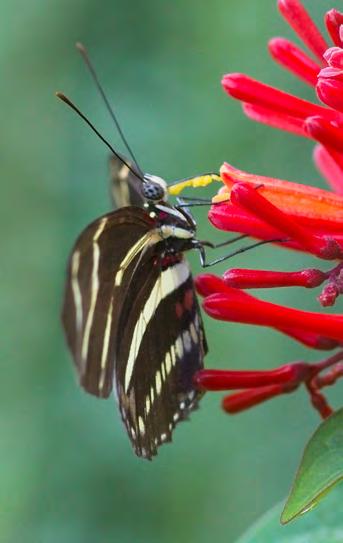
Zebra longwing (Heliconius charithonia) on firebush (Hamelia patens).
Article by Linda W. Curtis
Photos by Linda and James Curtis
Carex of Central Florida
Care x are a genus of grass-like sedges in the Cyperaceae family. There are some 2,000 species worldwide, with 480 listed in the Flora of North America (Ball & Reznik, 2025). In Florida, more than 70 species of Carex can be found in a variety of habitats, including sandhill, mesic flatwoods, wetlands, and along the edges of ponds and rivers.
In nature, sedges provide cover, nesting material, and food for many creatures such as insects, birds and small mammals. Humans have also made use of sedges. Their rhizomes and sharp-edged leaves provided Indigenous Peoples with material for weaving baskets and mats, and one species found in western North America, slough sedge (Carex obnupta), was reportedly used by men for shaving. Tender parts of the plants were eaten, and sedges were also used as fodder for animals (Wilson et al., n.d.).
Taxonomist Carl Linnaeus received many sedges from explorer Pehr Kalm, who was one of his first collecting proteges. Kalm arrived in Philadelphia in 1748, and explored as far north as Canada. He returned to Sweden by ship in 1751, bringing along a collection of seeds and pressed plants. Linnaeus assigned 29 species of sedges to the genus Carex, and included them in his groundbreaking 1753 book Species Plantarum (Robertson, 1979), which included 60 species collected by Kalm. An herbarium specimen of northern long sedge (Carex folliculata) collected by Kalm can be viewed at the Linnean Online repository (Linnean Online, 2025). Since Linnaeus’s time, botanists have identified many more species of Carex, often named after themselves or a colleague, or after locations or specific plant attributes.
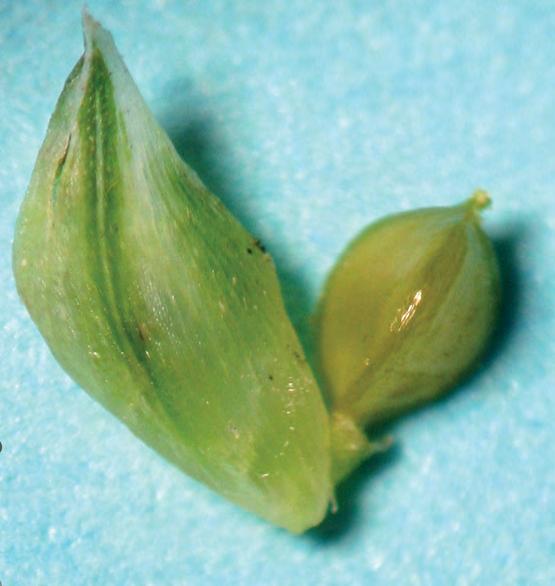
C arex species are grouped by similar traits such as reproductive structures or other characteristics. However, there are numerous species of Carex, and they are difficult to identify because their identifying parts are just below our 20/20 vision, a world only small insects can see. Magnification is needed to see the perigynium (a sac or envelope around the seed-like achene) which is used for identification. As a result, they are often under-reported.
A s a retired college botanist, my Carex collecting and field research in Florida began in Citrus County, and then expanded to Gilchrist, Suwannee, and Hernando counties. During these travels, I was able to locate 45 of the 70
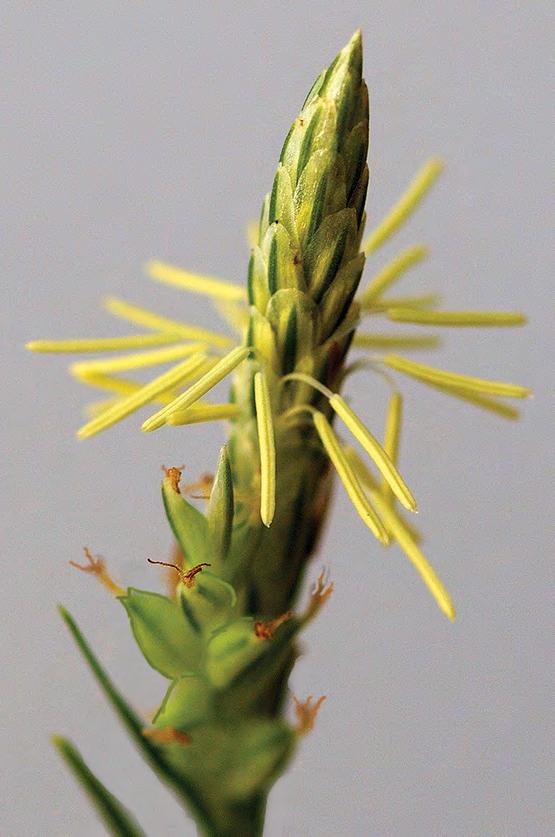
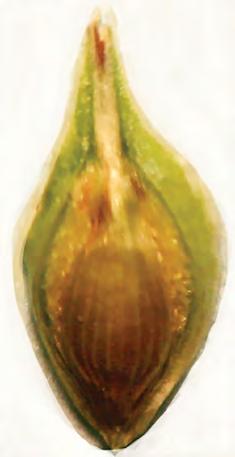
Figure 1. Chapman's sedge (Carex chapmannii). Top: An opened perigynium with trigonous achene. Bottom: A staminate spike with yellow anthers about to release pollen and lower pistillate spikes with red stigmas.
species of Carex found in Central Florida. With permission from the Florida Department of Environmental Protection and the U.S. Fish and Wildlife Service, I collected culms with seed heads. My husband Jim provided assistance by using a GPS-enabled camera to record location information, which was helpful when I needed to return to a site to collect a more mature plant specimen.
To record images of the tiny plant structures, I used a camera with a macro lens and a digital microscope, photographing both fresh and scanned specimens. Close inspection with these methods revealed the veins on Carex seed sacs were mostly raised, but sometimes sunken, impressed, or with no pattern at all. Details such as leaf width, number of leaves per culm, and the number of spikes in the seed heads make each species distinct. Images of these structures can be seen in my book Carex of Central Florida, along with descriptions that aid in identifying species.
One of Florida’s rarest sedges is Chapman’s sedge (Carex chapmannii ), a rhizomatous sedge that grows in rows of small
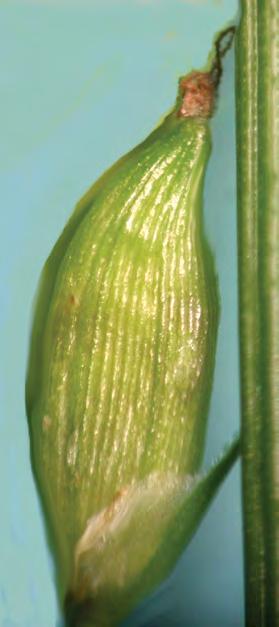
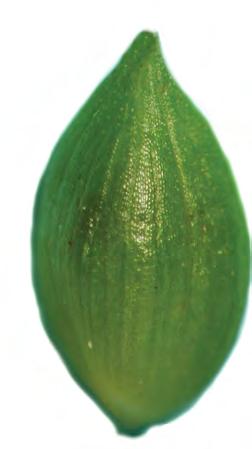
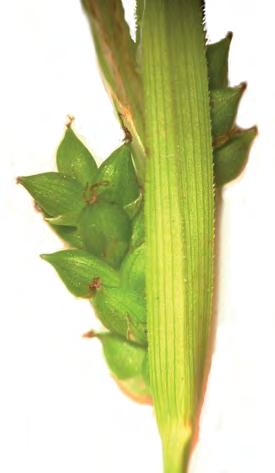
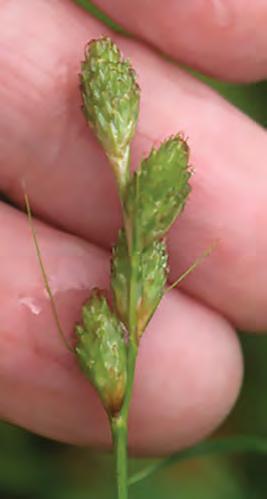
tufts. In March and April, several culms with seed heads arise above the leafy tuft where birds and small mammals snack on them as food. The terminal spike in the seed head has stamens shedding pollen that fall by gravity onto the stigmas of the lower female spikes with perigynia (Figure 1). According to the Atlas of Florida Plants, Chapman’s sedge is listed as a threatened species in Florida, and it is protected in parks and preserves. More common are Godfrey’s sedge (C. godfreyi ) and Gholson’s sedge (C. gholsonii ), which also have a terminal spike with yellow stamens. C. godfreyi has impressed veins on the perigynia while others have raised veins (Figures 2–4).
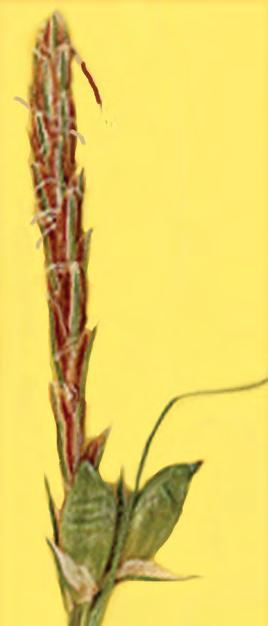
Figure 4. Long's sedge (Carex longii). Left: This common sedge has a seed head of 4 oval spikes and grows in most Florida counties. Right: The seed heads have flat sacs surrounding seed-like achenes with red stigmas.
Figure 2. Godfrey's sedge (Carex godfreyi). Left: A seed head with one remaining stamen in its terminal spike. Right: The perigynia have impressed instead of raised nerves and a subtending scale.
Figure 3. Gholson's sedge (Carex gholsonii). Left: The perigynia are green, maturing to brown, and have a short curved beak with no teeth. Right: A seed head and leaflike bract.
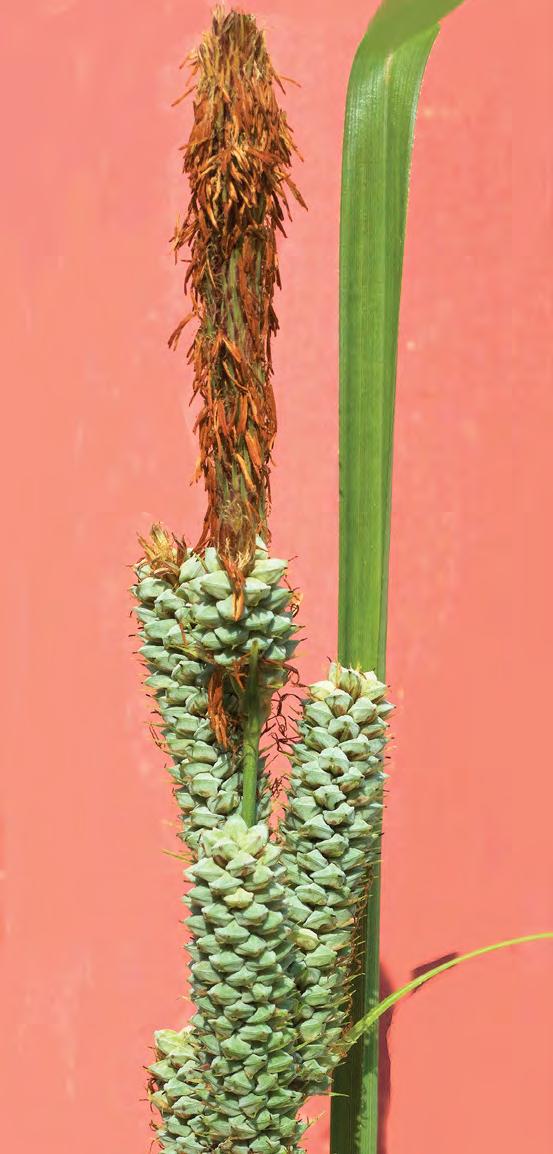
A nother interesting member of the genus is warty sedge (Carex verrucosa), a large sedge up to 4 feet tall (Figure 5). Its terminal male spike has yellow, then reddish stamens, and thicker lower spikes with blue-green perigynia. I collected a specimen of this species in Levy County, Florida, in 2017, and it is vouchered on the Atlas of Florida Plants. More recently, I collected a specimen in Citrus County, which was sent to the University of South Florida Herbarium. Once vouchered, this specimen will be the first occurrence of C. verrucosa for that county, making it a county record.
References
Ball, P.W. and Reznik, A.A. (2025, November 12). Carex Flora of North America. https://floranorthamerica.org/Carex
Carex (2021, July 26). Wikipedia. https://en.wikipedia.org/wiki/Carex
Center for Aquatic and Invasive Plants | University of Florida, IFAS. (2025, November 4). Carex species. UF IFAS Center for Aquatic and Invasive Plants. https://plant-directory.ifas.ufl.edu/plant-directory/carex-species/ Curtis, L. (2022). Carex of Central Florida https://www.amazon.com/Carex-Central-Florida-Linda-Curtis/dp/0971806527# ISB: Atlas of Florida Plants (n.d). https://florida.plantatlas.usf.edu/ Linnean Online. (2025). Carex folliculata (LINN 1100.66) | Linnean Online Preservica.com. https://linnean.access.preservica.com/uncategorized/IO_12567bf4-3e25-4f62-83f1-1dcfccab9113/
Robertson, A. (1979). History of the Classification of the Genus Carex. Taxon, 28(5/6), 5 35–548. https://doi.org/10.2307/1219792
The Linnaean Apostles: Pehr Kalm (2019, May 6). Herbarium World. https://herbariumworld.wordpress.com/2019/05/06/the-linnaean-apostles-pehr-kalm/ Wilson, B., Brainerd, R., Lytjen, D., Newhouse, B., & Otting, N. (2014.). Field Guide to the Sedges of Oregon and Washington Retrieved October 8, 2025, from http://www.carexworkinggroup.com/pages/ethnobotany2014.pdf
Wunderlin, R. P., & Hansen, B. F. (2011). Guide to the Vascular Plants of Florida University Press of Florida.
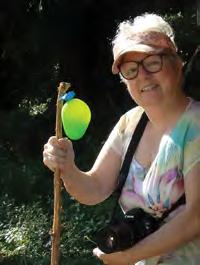
Figure 6. Linda Curtis uses a balloon on a stick to sweep ahead through sedge leaves before bending to collect culms. If the balloon pops, she backs away as snakes may be searching for food such as ants and small animals that eat the sedge's stamens.
About the Author
Botanist Linda W. Curtis is the author of Carex of Central Florida and Bog-Fen Carex of the Upper Midwest, both available on Amazon. She also w rites for science journals and nature magazines. Linda dedicated her book Carex of Central Florida to the Florida Native Plant Society.
Figure 5. Warty sedge (Carex verrucosa)
The Florida Native Plant Society PO Box 5007 Gainesville, FL 32627
FNPS Chapters and Representatives CHAPTER REPRESENTATIVE E-MAIL
1. Broward ...................................................Tiffany Duke tada duke@yahoo.com
2. Citrus ........................................................Ellen McNally ................................................ekmcnally@yahoo.com
3. Coccoloba .............................................Ben Johnson ..................................................bcjohnson0831@gmail.com
4. Conradina ..............................................Martha Steuart ............................................mwsteuart@bellsouth.net
5. Cuplet Fern.............................................Alan Squires ..................................................asquires600@gmail.com
6. Dade ..........................................................Riki Bonnema ...............................................rikibonnema@gmail.com
7 Eugenia ...................................................David L. Martin .............................................cymopterus@icloud.com
8. Heartland ...............................................Gregory L. Thomas ....................................enviroscidad@yahoo.com
9. Hernando ...............................................Janet M Grabowski ....................................jggrenada@aol.com
10. Ixia ..............................................................Cate Hurlbut ..................................................catehurlbutixia@yahoo.com
11. Lake Beautyberry .............................Grace Mertz ...................................................gmer98@yahoo.com
12. Longleaf Pine ........................................K imberly Bremner......................................kimeeb32@gmail.com
13 Magnolia ................................................James Cooper ...............................................james.cooper@fdacs.gov
14. Mangrove ...............................................Linda Wilson .................................................linda wilson.frontierweb@frontier.com
15. Marion Big Scrub ..............................Deborah Lynn Curry..................................marionbigscrub@fnps.org
16. Martin County .....................................Peter Grannis ...............................................pbgrannis@gmail.com
17. Nature Coast ........................................Diane Hayes Caruso .................................dhayescaruso@hotmail.com
18. Naples ......................................................Ben Johnson ..................................................bcjohnson0831@gmail.com
19. Palm Beach County .........................Rebekah Kaufman .....................................rkaufman@fnps.org
20. Passionflower.......................................Marty Proctor................................................likeparty@yahoo.com
21. Pawpaw ..................................................K aren Walter .................................................karenlw72@gmail.com .......................................................................Amy Legare ....................................................amy57vt@gmail.com
22 Paynes Prairie .....................................Sandi Saurers ...............................................sandisaurers@yahoo.com
23. Pine Lily ..................................................Dana Sussmann ..........................................dana.sussmann@fdacs.gov
24. Pinellas ....................................................David Perkey .................................................dnperkey@gmail.com
25. Sarracenia .............................................Lynn Artz lynn artz@hotmail.com
26. Sea Rocket ...........................................Elizabeth Bishop .........................................izbet@aol.com
27. Serenoa ...................................................Trent Berry ......................................................trentberry123@gmail.com
28. Suncoast ...............................................Merrilee Wallbrunn ...................................mwallbrunn@hotmail.com
29. Sweetbay ..............................................Mary Mittiga ..................................................mittiga@aol.com
30. Tarflower ................................................Deborah Ferencak .....................................deborahann200@gmail.com
31. The Villages ...........................................Bob Keyes .......................................................bob.keyes@qcspurchasing.com
BECOME A MEMBER OF FNPS:
It's easy! Simply contact your local Chapter Representative, or call, write, or e-mail FNPS. You can also join online by using the QR code, or visiting https://www.fnps.org/support/membership
Contact the Florida Native Plant Society: PO Box 5007 Gainesville, FL 32627. Phone: (321) 271-6702 Email: info@fnps.org Online: https://fnps.org
Submit materials to PALMETTO: Contact the Editor: Marjorie Shropshire Visual Key Creative, Inc. Email: palmetto@fnps.org