Support Florida's native plant heritage with a bequest or legacy gift to FNPS
A bequest to t he Florida Native Plant Society in your w ill or other element of your estate plan w ill let you contribute to preserving Florida’s native plant heritage for many years into t he f uture. Our programs a nd endowment depend on your support.
Our Vice President for Finance can help you plan the r ight gift in light of your assets, income, family, and other estate or financial obligations. You may be able to be a greater philanthropist than you realize.
Please consider making the gift of a lifetime to the Florida Native Plant Society. Direct your confidential inquiries and notifications about legacy gifts to:
Vice President for Finance
Florida Native Plant Society PO Box 278, Melbourne, FL 32902-0278
Your financial support helps fund:
l Conservation of rare Florida plants
l High-quality management of our natural lands
l Guidance on water-conserving, environmentally sound gardening
l Opportunities to accquire native plants
l Research on Florida native plants
l On-line resources for selecting native plants for your a rea
l Developing model ordinances to encourage use of natives and preserve our heritage
l Supporting legislation to protect our natural lands a nd native plants
l Awards for excellence in research, conservation, land management, a nd restoration
The Florida Native Plant Society is registered as a charitable organization in Florida (Reg No. CH3021).A COPY OF THE OFFICIAL REGISTRATION AND FINANCIAL INFORMATION MAY BE OBTAINED FROM THE DIVISION OF CONSUMER SERVICES BY CALLING TOLL-FREE (800-435-7352) WITHIN THE STATE. REGISTRATION DOES NOT IMPLY ENDORSEMENT, APPROVAL OR RECOMMENDATION BY THE STATE.
Editors note:
The following editorial errors appeared in PALMETTO, Issue 32:1:
On page 7, figure captions did not match the arrangement of photos. The correct captions are:
Figure 7: Set of characteristic species of Florida upland glades (clockwise from upper left) green milkweed (Asclepias viridiflora), rosepink (Sabatia angularis), silver dwarf morning glory (Evolvulus sericeus), prairie coneflower (Ratibida pinnata), Boykin’s milkwort (Polygala boykinii), and diamond flowers (Stenaria nigricans).
Figure 8a: (left) Coreopsis sp. from Jackson County glades. Figure 8b: (right) Barrens silky aster from Gadsden County glades.
On page 14, the last paragraph should read: "Thank you for considering our concerns. We stand ready to assist you in any way possible. Please do not hesitate to contact us if you require additional information or explanation of our position."
Call for Research Papers and Poster Presentations
The 2016 Florida Native Plant Society Annual Conference will be held May 18-22, 2016 in Daytona Beach, Florida
The Research Track of the Conference will include presented papers and a poster session on Friday, May 20, and Saturday, May 21.
Researchers are invited to submit abstracts on research related to native plants and plant communities of Florida including preservation, conservation, and restoration. Presentations are 20 minutes in length (15 minutes is provided for the presentation, followed by a 5-minute question-andanswer period).
Abstracts of not more than 200 words should be submitted via email, as an MS Word file to Paul A. Schmalzer: paul.a.schmalzer@nasa.gov
Include title, affiliation, and address. Indicate whether you will be presenting a paper or poster.
2 l The Palmetto
Deadline for submitting abstracts is February 1, 2016.
The Quarterly Journal of the Florida Native Plant Society
Palmetto
FNPS Board of Directors
Executive Officers
President .............................Anne Cox
President Elect .....................Catherine Bowman
Past President......................Steve Woodmansee
Editor, Sabal minor ...............Stacey Matrazzo
Webmaster ..........................Paul Rebmann
MEMBERSHIP:
Make a difference with FNPS
Your membership supports the preservation and restoration of wildlife habitats and biological diversity through the conservation of native plants. It also funds awards for leaders in native plant education, preservation and research.
l Full-time student ...............$ 15
l Individual ..........................$ 35
l Household .........................$ 50
l Supporting ........................$ 100
l Non-profit or Business ......$ 150
l Patron ...............................$ 250
l Gold ..................................$ 500
l Sustaining .........................$ 10/monthly
To provide funds that will enable us to protect Florida's native plant heritage, please join or renew at the highest level you can afford.
To become a member, contact your local Chapter Representative, call, write, or e-mail FNPS, or join online at www.fnps.org
The purpose of the Florida Native Plant Society is to conserve, preserve, and restore the native plants and native plant communities of Florida.
Official definition of native plant:
For most purposes, the phrase Florida native plant refers to those species occurring within the state boundaries prior to European contact, according to the best available scientific and historical documentation. More specifically, it includes those species understood as indigenous, occurring in natural associations in habitats that existed prior to significant human impacts and alterations of the landscape.
The Palmetto (ISSN 0276-4164) Copyright 2015, Florida Native Plant Society, all rights reserved. No part of the contents of this magazine may be reproduced by any means without written consent of the editor. The Palmetto is published four times a year by the Florida Native Plant Society (FNPS) as a benefit to members. The observations and opinions expressed in attributed columns and articles are those of the respective authors and should not be interpreted as representing the official views of the Florida Native Plant Society or the editor, except where otherwise stated.
Editorial Content
We welcome articles on native plant species and related conservation topics, as well as high-quality botanical illustrations and photographs. Contact the editor for guidelines, deadlines and other information.
Editor: Marjorie Shropshire, Visual Key Creative, Inc. palmetto@fnps.org l (772) 285-4286 l 1876 NW Fork Road, Stuart, FL 34994
Features
4 Remembering Dan Austin
Dan Austin, one of the pioneering members of the Florida Native Plant Society, was a scholar a nd teacher who transcended all educational norms. Although he is no longer with us, Dan’s legacy will live on in the seeds of inspired thought he planted in the minds of his students, colleagues, and others.
Compiled by Winnie Said and Chris Lockhart.
8 2015 FNPS Landscape Awards Institutional Category Part 1 - Archbold Biological Station
At the Annual Conference in Tallahassee, Archbold Biological Station and the Florida International University Nature Preserve received Awards of Excellence in t he Institutional Category of FNPS’ Landscape Awards program. This article, the first of a series, shows how good planning and more than 14,000 plants created an award-winning, 100% native landscape at A rchbold’s Learning Center and Lodge, and the adjoining Expeditions Plaza.
14 What is the REAL Zamia pumila?
Botanists have long disagreed as to the scientific name Coontie should bear. Dr. Dan Ward delves into the history of the name Zamia pumila and explains why it cannot be correctly applied to any Florida native plant.
FLORIDA NATIVE PLANT MONTH October 2015
Join FNPS in celebrating Florida Native Plant Month
Increase public awareness of native plants and the Florida Native Plant Society a Engage and educate people of all ages about the importance of native plants and native plant communities a Share our passion for native plants with others
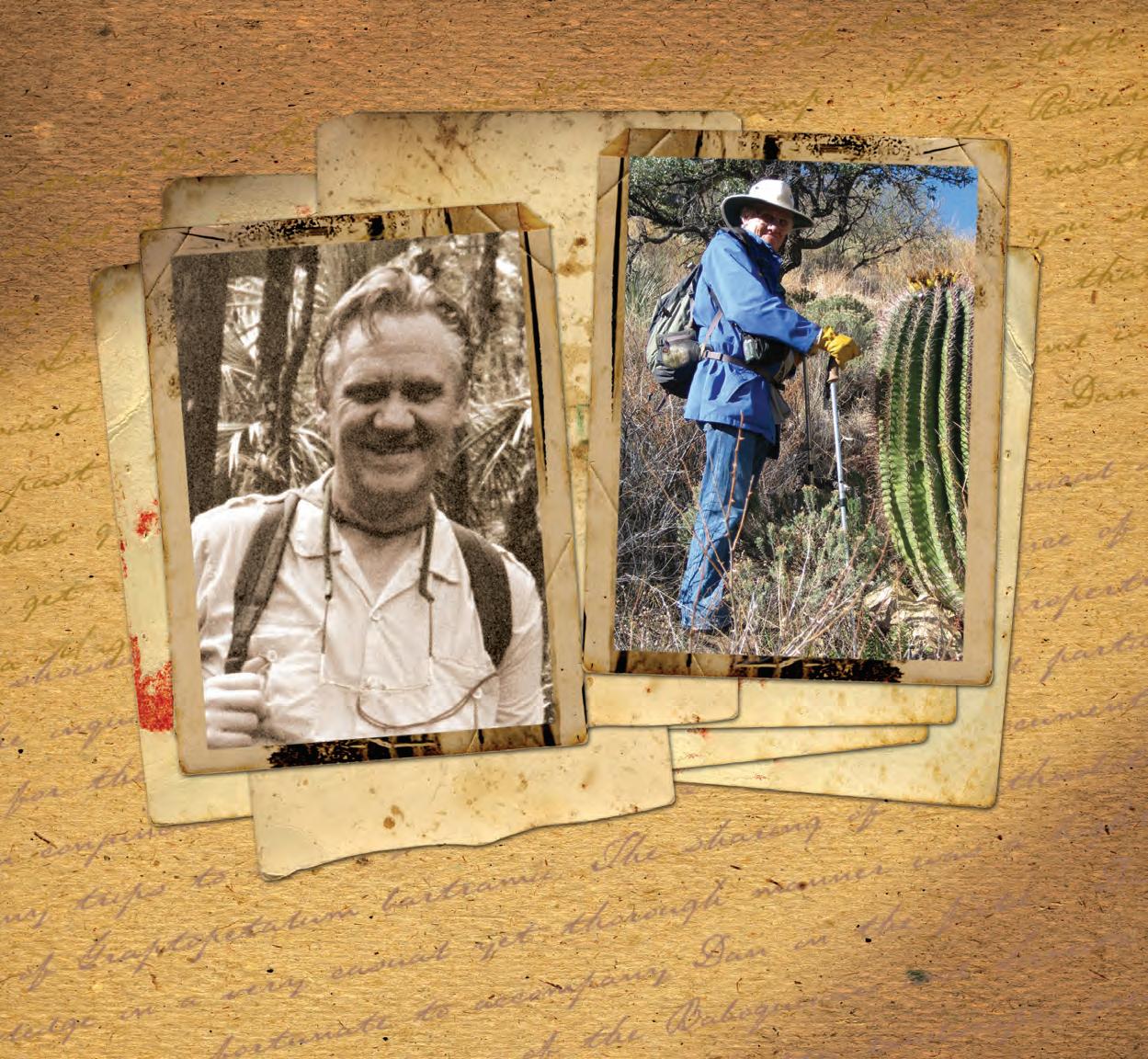
A tribute to Dan Austin. Photos by Winnie Said and Tom Vize.
Remembering Dan Austin
“To understand Dan Austin, you have to go with him to the secret orchid garden in the Fakahatchee Swamp. It’s a little like going along to find the ruby eyes of the idol in Raiders of the Lost Ark . Dan’s part showman, part explorer, mostly enthusiast and wonderfully knowledgeable. And when you slog along past the moccasins, he manages to make you think that all that green is a lot more fascinating than rubies. And when you get to the secret garden, it really is magic - and Dan Austin is a magician!” - Maggy Hurchalla
Article compiled by Winnie Said and Chris Lockhart Palm Beach County Chapter, Florida Native Plant Society
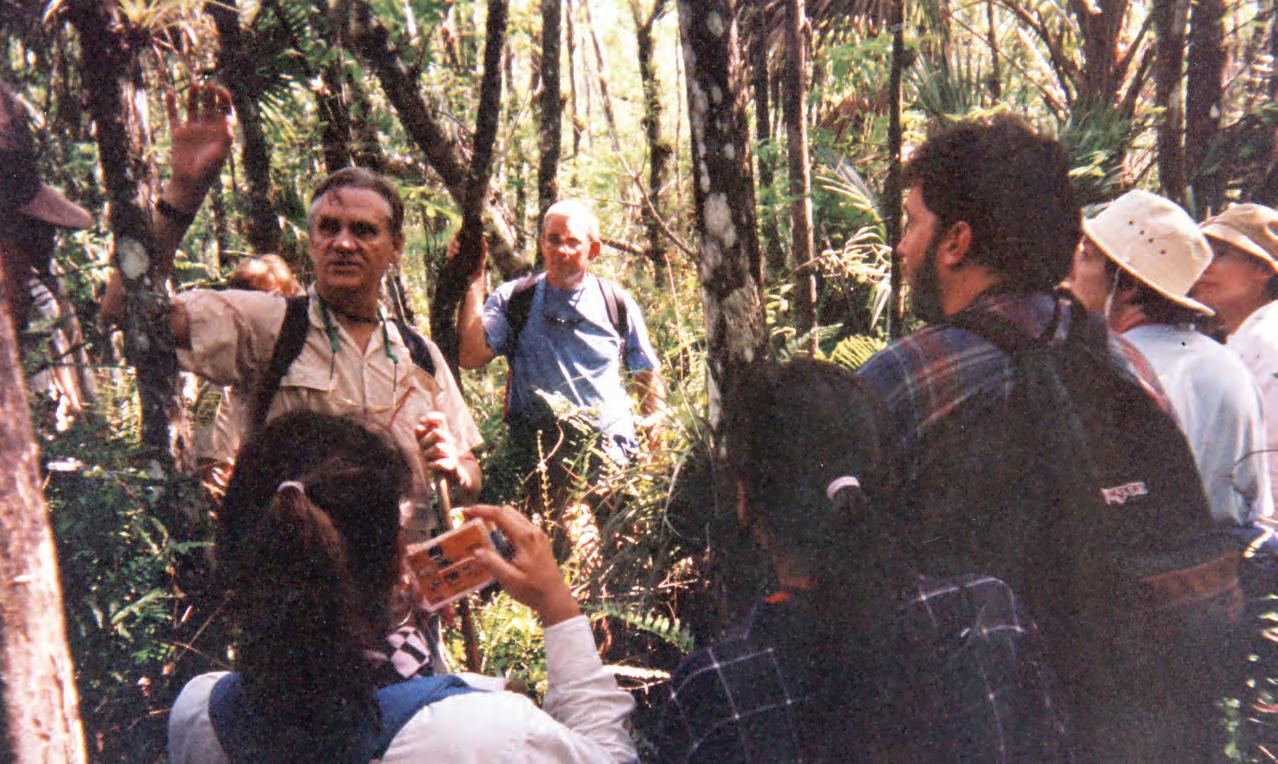
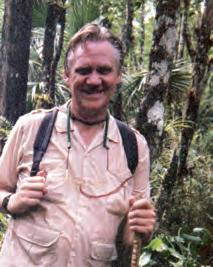
Dan Austin leading a trip into the Fakahatchee Strand. Photo by Winnie Said.
“A teacher affects eternity; he can never tell where his influence stops.” – Henry Adams
Dan Austin, one of the pioneering members of the Florida Native Plant Society (FNPS), was a scholar and teacher who transcended all educational norms. Dan passed away in Tucson, Arizona on January 20, 2015. Although he is no longer with us, his legacy will live on in the many seeds of inspired thought he planted in the minds of his students, colleagues, and others who accompanied him on his botanical journeys through the swamps and scrubs of South Florida and beyond.
In tribute to Dan, we compiled information from various sources to tell the story of his life’s work, and how he influenced us. For background we lead off with an adapted version of FNPS past president Ray Miller’s interview with Dan, previously published in the Spring 2000 issue of Palmetto. Next, we get a glimpse of Dan’s life in “retirement” kindly provided by his colleagues at the Arizona-Sonora Desert Museum. Finally, to complete the picture, we chose excerpts of personal memories of Dan from a video created in his honor.
Interview by Ray Miller, Palm Beach Chapter FNPS
Daniel F Austin, Ph.D., was born May 18, 1943, in Paducah, Kentucky. He went to high school in Paducah and went on to study LAMIACEAE (mints) at Murray State University in western Kentucky, where he obtained a B.A. degree, and met his wife, Sandy.
When a sked how he b ecame i nterested i n environmental i ssues, Dan s aid he w as l ike m any of u s – Peter Pans w ho never g rew up.
We h ave r etained a f ascination a bout t hings a round u s t hat p eople w ho g row up s eem to lose.
While at Murray State University, he attended a s eminar g iven by D r. Walter L ewis, a b otanist f rom Washington University i n St. L ouis, M issouri. After the seminar, Dan had the opportunity to talk with the b otanist, a nd w as encouraged by h im to apply to g raduate s chool at Washington University. Dan applied for t he g raduate program, w here he r eceived b oth h is M.S. a nd Ph.D.
As a n undergraduate, Dan wa s interested in w ildlife biology, but a longer interest of his surfaced a s his g raduate and doctorate course of study progressed – ethnobotany, t he study of human uses of plants. He selected t his discipline partly f rom his long-time irritation w ith people who, when shown a particular plant species would a sk him, “what good i s it a nyway?”
Dan got into his specialty interest, CONVOLVULACEAE (morning-glories), primarily due to his major professor at Washington University. Dan has become a world-renowned expert on CONVOLVULACEAE of the American tropics. He constantly receives specimens from around the world, which are unpacked a nd sorted by his f ree labor pool (undergraduate a ssistants).
Upon receiving his doctorate in 1970, Dan and his wife Sandy, also a botanist, relocated to South Florida and he took a position as Assistant P rofessor at Florida Atlantic University.
Before FNPS was organized, Dan had attempted unsuccessfully to start a plant society in South Florida. A s F NPS wa s getting off t he g round,
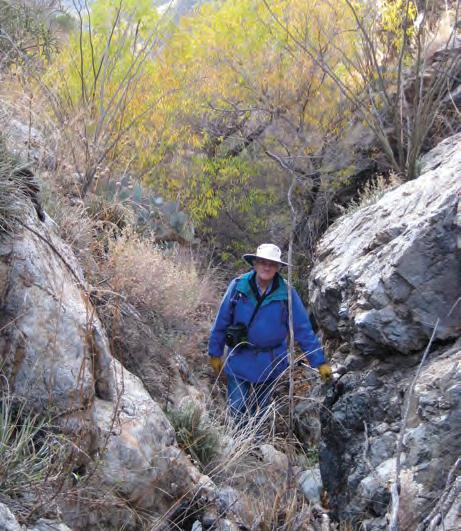
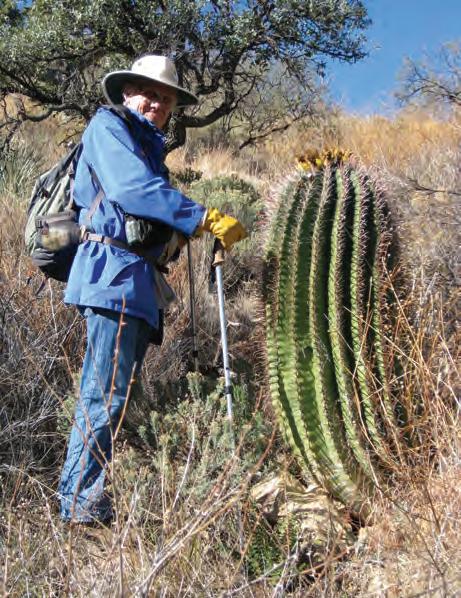
Above, from top: Dan Austin in the Baboquivari Mountains, hiking through Brown Canyon – Salix gooddingii can be seen nearby; Dan with a barrel cactus, Ferocactus wislizenii. Photos by Tom Vize.
Dan Austin (continued from page 5)
he wa s a strong supporter a nd member. A lso, Dan wa s one of three individuals who started the Palm Beach Chapter of FNPS. The other t wo individuals were his w ife, Sandy, and Sara Davis.
When asked why he had joined FNPS, he stated that for a long time he’d been promoting people’s interest in plants (that ethnobotany thing again) and trying to get those w ith similar interests to come together, much like the Audubon Society. However, he hoped they would focus on a bigger picture: plant communities. Such an organization would create another concerned voice for the environment and would allow an exchange of information.
When he a rrived in South Florida, very little printed information about plants a nd t heir communities wa s available. The notes by John Kunkel Small (from his early, brief travels through South Florida) were it, essentially. However, Dan k new t hat other local individuals, mostly non-professionals, had a wealth of information a nd observations to share. Dan wa nted to t ap into t his source by bringing t hese people together.
When Dan wa s a sked about his t houghts on t he f uture of F NPS, he said that things can always be improved. However, he is very pleased with the direction that the organization i s going and feels it has become a positive voice in the state.
Dan’s word of wisdom for FNPS members is “Don’t be afraid to ask questions. Ask everybody and anybody, call up the professors to seek your answers. Also, become involved.”
Dan has received accolades from his peers over the years, i ncluding numerous nominations for Distinguished Teacher Awards and certificates of appreciation from county and local governments. In 1993, he received the FNPS Green Palmetto Award for Science a nd Education. He received a second Green Palmetto in 1995 for outstanding contributions.
Dan has written or collaborated on several books. They include The Florida of John Kunkel Small, Pine Rockland Plant Guide, a series of plant identification g uides for coastal hammocks, coastal dunes, scrub communities; a nd a g uide for pine fl atwoods. He has published a t remendous number of scientific papers –so many, his Curriculum Vitae resembles a book in its length.
In 1985, Dan and Dr. Grace Iverson produced a document entitled Inventory of Native Ecosystems in Palm Beach County which identified a nd described some of t he critical remaining n atural a reas i n Palm B each C ounty. This do cument w as i nstrumental i n providing justification for p assage of t he $100 million bond referendum in 1992. Through t he referendum, Palm Beach County has purchased over 22,000 acres of environmentally sensitive land.
Dan has also been involved in the Society of Economic Botany for a number of years. He i s currently on t he journal’s editorial board as the Book Review Editor. In the past, he has coerced some of his graduate students (myself included) to do book reviews for the journal.
He has been involved with the Florida Exotic Pest Plant Council (FLEPPC) since a round 1991 a nd proudly wears t he
moniker of caretaker of the FLEPPC Pest Plant List, which is reviewed and updated every two years. In 1999, he received t he Outstanding Member Award for his work on developing a nd maintaining the pest plant list.
When asked to cite some accomplishments that FNPS should be proud of, he notes The Palmetto, to which he has been a frequent contributor. He considers it an outstanding communication between the membership.
Dan has a number of other interests, but he mainly likes to v isit different places and get out in the field. He also frequents different libraries to look up rare books or v isits other herbaria to study their collections of plants. Staying in Everglades City and hiking around the Fakahatchee Strand is a holiday for him. In fact, the Fakahatchee Strand and Big Cypress area are his favorite places in South Florida and he has taken many students and others on hikes into these areas. Outside Florida, he likes to v isit and do research in the mountainous regions of southern Arizona. He hopes to retire in this area of Arizona in the next five to six years. He likes its openness and smaller population. He has fond memories of a year-long sabbatical that he and Sandy took to southern Arizona, where they camped out over a hundred nights.
Dan feels that the biggest threat to our natural areas are people, and he fears that encroachment to the edges of these a reas will increase as the population increases. He hopes that F NPS can help change peoples’ view of plants. Dan feels that most people in First World countries think of plants as furniture. This concept is a result of too many people concentrated i n urban areas. Plants are living things and deserving of the same consideration as other creatures.
Note: A pdf of the Palmetto article can be found at: http://www.fnps.org/assets/pdf/palmetto/miller_ray_dan_ austin_and_interview_vol_20_no_1_spring_2000.pdf
Tributes to Dan Austin
Dan Austin in Arizona
Dan a nd Sandy moved to A rizona where he b ecame a n A rizona-Sonora Desert Museum ( ASDM) R esearch A ssociate. Thanks to the following contributions from his A SDM colleagues, we have a good idea of what he was up to during his “retirement”.
Dan had a wealth of k nowledge of Sonoran Desert natural history and, in particular, he was often called upon by museum staff for his botanical expertise. He worked tirelessly to expand the museum’s digital library and, just in the past three years, Dan had single-handedly grown the digital library by more than 5,000 images. His passion a nd energy were both a mazing! He was a prodigious researcher and author. Over the years he published more than 35 book chapters and books, 100 journal papers, a nd 60 popular a rticles, plus numerous book reviews a nd abstracts. He wa s a lso a research a ssociate of t he Drylands Institute, Department of Plant Sciences at the University of Arizona,
Department of Biological Sciences at Florida International University, Fairchild Tropical Garden, and Florida Atlantic University. Not one to let g rass g row u nder h is fe et, he w as a lso a technical advisor of The Nature C onservancy (Office of E ndangered Species), Florida and Caribbean Region Wildflower Society, CESI L andscape Science Advisory Committee (USGS), South Florida Ecosystem Recovery Strategy Team (USFWS), Recovery Team Member for Cereus eriophorus ( USFWS), Sweetpotato C rop G ermplasm C ommittee ( USDA), a nd for t he Florida Natural A reas Inventory (FNAI). One of his most recent and spectacular accomplishments came in 2010 when he published Baboquivari Mountain Plants, an encyclopedic work describing the flora of this unique mountain range a s well a s its human history. One of his favorite areas was Brown Canyon in the Baboquivari Mountains to which he often led museum staff, sharing both his passion for t he flora a nd h is love of t his e xtraordinary pl ace.
As manager of the ASDM digital library, I knew Dan for only the past three years, but I feel very fortunate to have known him at all!
– Kim Franklin, Ph.D., Conservation Research Scientist, Arizona-Sonora Desert Museum
Dan showed his dedication to the understanding of botanical d istribution w ith t he i nquiry f rom private l andowners a s to t he presence of a proposed s pecies for t he Threatened a nd E ndangered l ist on t heir property. W ith t hat, i n conjunction w ith USFWS a nd USFS, he led a nd participated in many t rips to t he sky i slands of southeastern A rizona to document t he r ange of Graptopetalum bartramii (Bartram stonecrop). The sharing of his ethnobotanical knowledge in a very casual yet t horough manner was a highlight for any who were fortunate to accompany Dan in the field. Dan and Sandy were at home i n t he shadow of t he B aboquivari a nd Sierrita Mountains south of Tucson w ith t heir w ildlife-friendly landscape, g uests, t heir mothers, a nd t he quietness of t he Sonoran Desert region. – George Montgomery, Curator, Botany at Arizona-Sonora Desert Museum
How do we remember Dan?
In 2001 one of Dan’s former g raduate students, C hris L ockhart, created a retirement v ideo. She captured comments f rom a couple dozen people at various conferences and workshops that spring, among them members of FNPS, FLEPPC a nd Plant Biologists of South Florida. They were a sked to share some of their memorable field experiences, what they’ll miss most, and “If you were to give Dan a scientific name, what would it be?” The excerpts below reflect those special memories and how Dan impressed his students and colleagues.
Walter Taylor, Emeritus Professor, University of Central Florida, author – “You know you and I graduated from Murray State College in Kentucky and had the same instructors. It’s
amazing how we both ended up in Florida teaching in t he same university system. Your l ittle e xclamation m ark at t he end of e ach identification still e xists; a nd t hat’s your c haracter. I t hought t hat w as pretty cool a nd l ater u sed t he “!” myself. Those t hat l acked t he e xclamation m ark, you would s et me straight.”
Phil Busey, Agronomy Consulting, Inc. – “W hen I c ame here f rom A rizona, h aving met Dan at M issouri B otanical G arden i n 1970, he struck me a s a k ind, considerate, a nd gentle p erson. But he a lso c an b e very forceful. I f t here was a scientific name associated with Dan, I think it would be something about the solidarity with plants. I know how h ard he’s worked to t ry to preserve t he s crub h abitat at Florida Atlantic University in Boca R aton. I think his influence e xtends equally t hroughout t he b otanical community.”
Pat Welch, Florida Atlantic University Pine Jog Environmental Education Center, retired – “There a re 3 t hings we a re going to remember about you: 1. The Environmentally Sensitive Lands I nventory a nd m apping for t he county t hat you d id – t hat was an important piece of work – thanks! 2. Your developing s ome e xcellent professionals i n our field w ith t he g raduate program – those contributions will go on for a long, long time. 3 Thanks for taking a subject like botany and making it fun and interesting. We’re going to miss you and good luck.”
Dan Austin in his element – the Fakahatchee Strand. Photo by Winnie Said.
2015 Landscape Awards
Institutional Category - Part I
A rchbold b iologic A l S t A tion
The Florida Native Plant Society Landscape Awards Program
The use of native plants in restorative and traditional landscapes is recognized through the annual FNPS Landscape Awards program. To qualify for consideration, landscapes must contain a minimum of 75% Florida native plant species and be free of any plants listed as Category I and II invasives by the Florida Exotic Pest Plant Council (FLEPPC). Other criteria for receiving an award include the fulfillment of specific goals, creation or maintenance of species diversity, on-site preservation of existing native plants, relationships to local native plant communities, creative solutions to significant obstacles, and the existence of an educational component that benefits those visiting the landscape.
This year, at the FNPS Annual Conference in Tallahassee, Florida, Archbold Biological Station and the Florida International University Nature Preserve were granted Awards of Excellence in the Institutional Category. We honor both of these institutions for their commitment to Florida's native plants.
Archbold Biological Station: Pre-existing conditions and on-site preservation of existing native plants
Archbold Biological Station, a not-for-profit established in 1941, i s dedicated to r esearch, conservation, a nd e ducation (w ww.archbold-station.org) and is listed as a National Natural L andmark by the U.S. Department of Interior.
The 2.79-acre project site at the Archbold Learning Center a nd Lodge and the adjacent 0.69-acre Archbold Expeditions Plaza parking area are located within the 12-acre campus of A rchbold Biological Station, itself embedded within an 8,840acre nature preserve.
The project site wa s deliberately restricted to land t hat wa s cleared before 1930, to avoid any impacts on the surrounding globally imperiled Florida scrub habitat, or on its many r are plants and animals (including 19 federally listed species). I n 2010, the site was cleared of concrete and asphalt parking, dumpsters, an old tennis court, an abandoned grove, and a stand of non-native bamboo.
Four existing patches of native plants were retained, i ncluding a 0.217-acre area of mixed trees and shrubs, which was prescribe-burned. These palmettos and trees screen the buildings, creating continuous native landscaping v iews a long t he Main Drive entrance. Twenty oaks, pines, a nd palms were
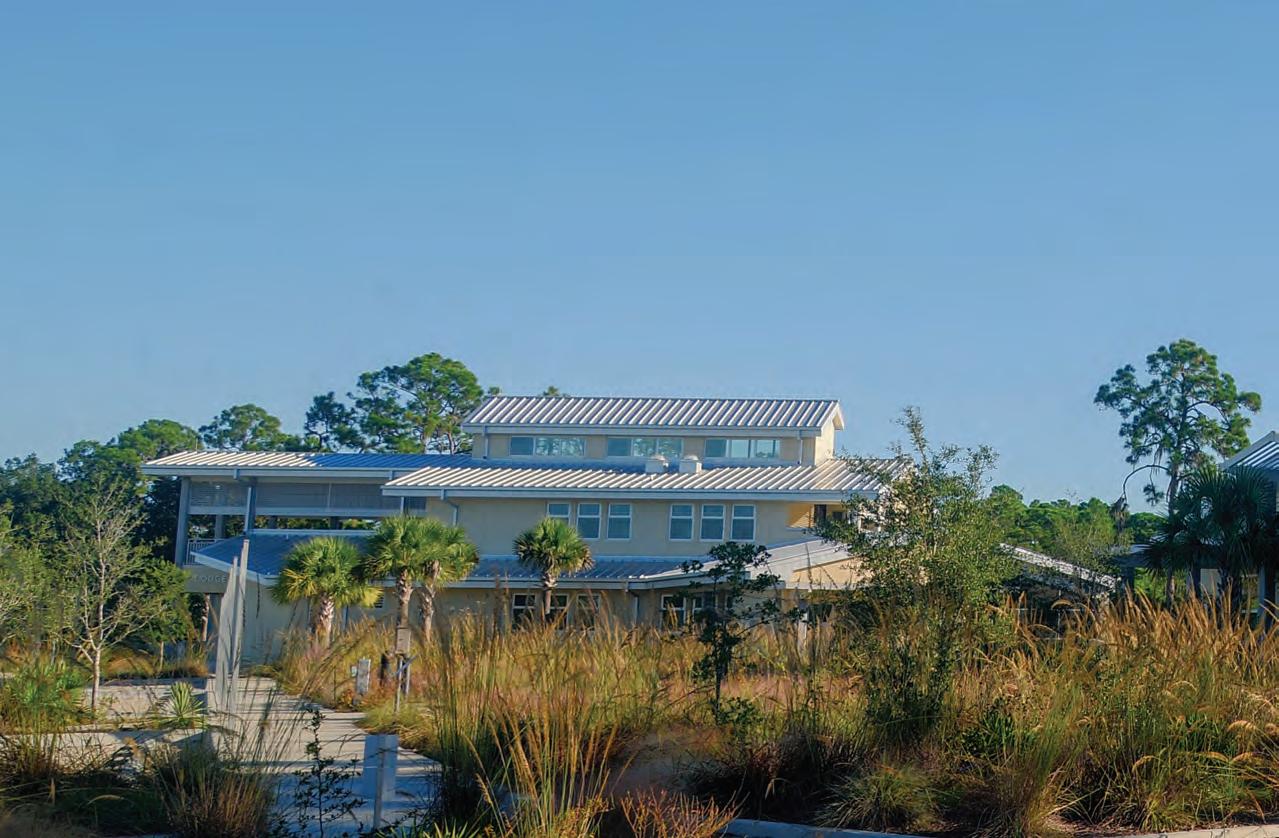
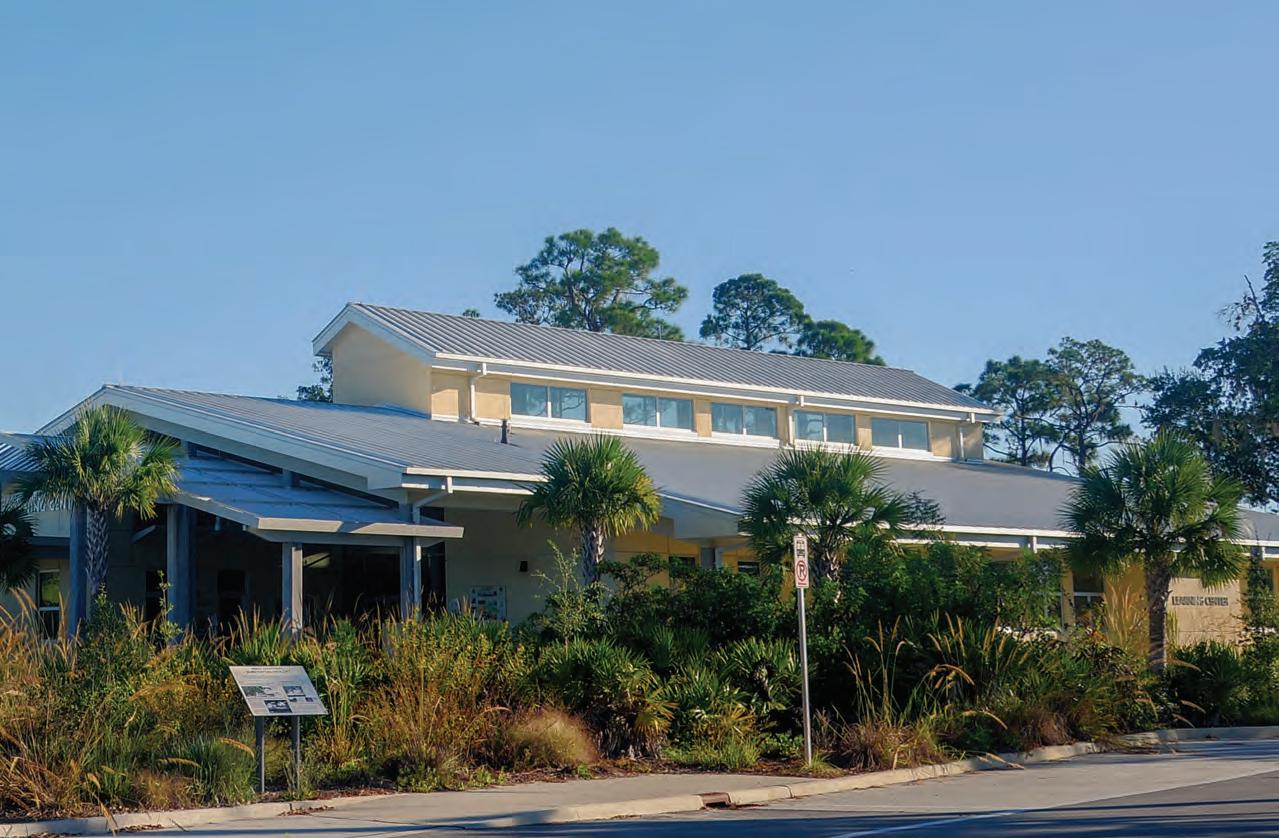
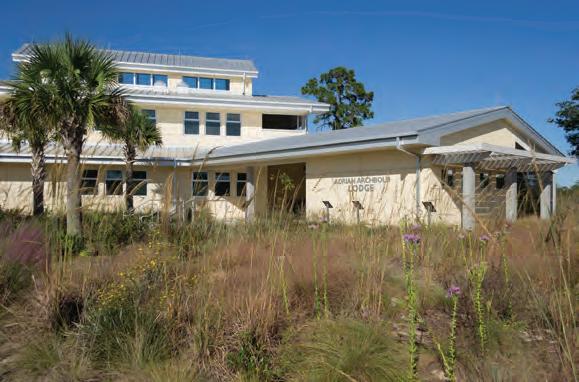
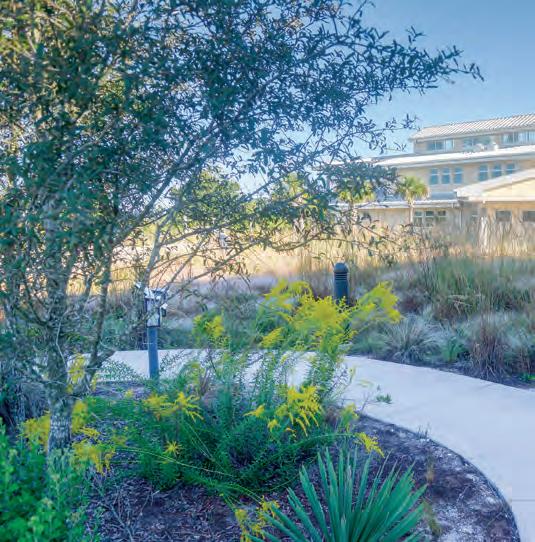
Figure 1: Native landscaping at Archbold Biological Station’s Learning Center and Lodge fulfills goals for natural beauty, conservation, sustainability, and learning opportunities.
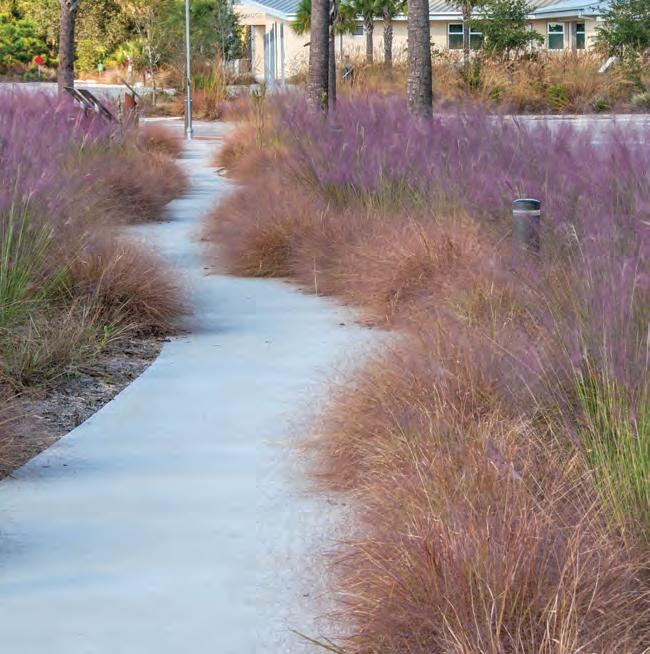
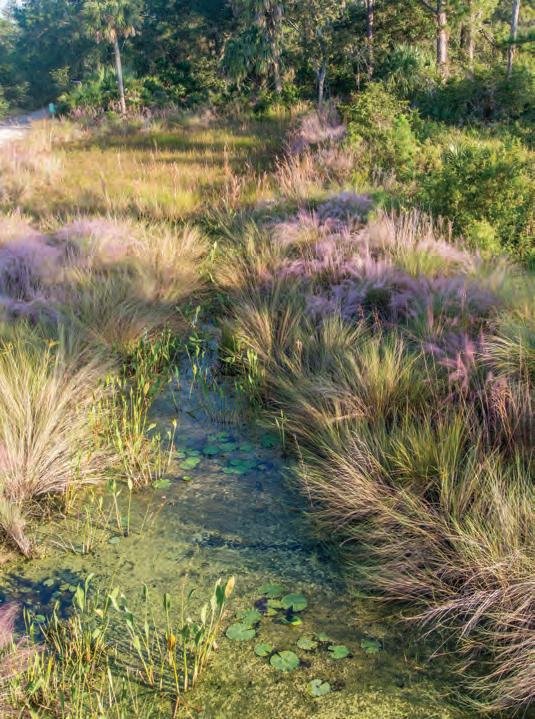
Figure 2: Rain gardens in the Archbold Expeditions Plaza act as seasonal wetlands, holding the first flush of stormwater from surrounding parking and incorporating a winding path and signage for Archbold’s historic “Walk Through Time”.
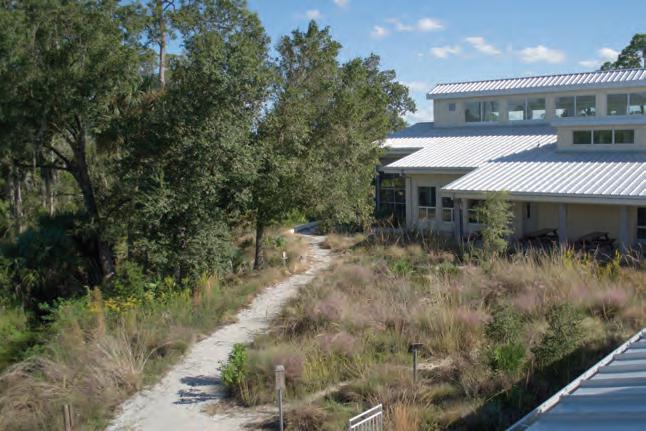
Figure 3: A floristically diverse landscape, inspired by native dry prairie, has been planted on higher elevations.
saved, but 3 laurel oaks and 2 mature pines were harvested, a nd their wood was used for furniture and displays.
Native landscaping design concepts, goals, and species diversity
To achieve 100% native landscaping, 78 species were planted (15 g rass/sedge, 54 forb/shrub, a nd 9 t rees), totalling 14,196 individual plants, all native to south-central Florida. This created a landscape that neither restores nor replicates the original Florida scrub, scrubby flatwoods, or cutthroat wetlands, but derives inspiration and pays homage to these native plant communities found originally on-site. Landscaping i ncludes 1.115-acres of new planting in 2011, surrounding the Learning Center and Lodge, and 0.220-acres planted in the Archbold Plaza in 2012, totalling 1.553-acres.
Using the concept of right plant, right place, five planting communities were designed by Archbold staff and our designer/contractor, The Natives, Inc. (see Plant List). Species were selected, a nd plans customized, to meet t he criteria of fi rewise, elevation, topography, a nd soil t ype (Immokalee sand, Basinger fi ne sand) heavily modified by 3’ of fill (sand), former concrete paving, and construction debris. Species included perennial bunchgrasses and clonal shrubs, designed to hold the ground a nd resist establishment of invasives, interspersed w ith a nnual seeders, to meet the goal of a self-regenerating landscape that w ill endure over time.
Dry Prairie A dry prairie surrounds both buildings in well-drained sandy soils planted with bunchgrasses such as w iregrass and lopsided Indiangrass, and wildflowers native to Florida’s dry prairies that include blazing stars, pineland purple, and bluecurls. Areas with more fill and well-drained sandy soils were a lso planted w ith scrub flowers such a s scrub blazing star, October flower, and manyflowered beardtongue. Soils over septic tanks are shallow and planted with species t hat c an s urvive e ven d rier conditions, i ncluding gopher apple, or t hose t hat a re rhizomatous, s uch a s t winflower a nd g rassleaf goldenaster, s urviving by r ooting i n deeper s oils adjacent to t he t anks.
Shrub Islands are interspersed throughout to welcome w ildlife and provide structural diversity. Species that offer food a nd nesting sites for birds a nd insects were added, using scrub oaks such as sand live oak and myrtle oak as dominants, but also adding tough buckthorn and rusty staggerbush.
Mesic Flatwoods Trees, shrubs, and grasses planted on strips next to the parking area provide a transition to natural vegetation to the west. These plants occur mainly in xeric to d ry mesic Florida scrub, including saw palmetto, tough buckthorn, beautyberry, South Florida slash pine a nd sand live oak.
A n Ecotonal Prairie w as c reated to i nclude a g radient f rom r elatively d ry s oils to a lower a rea t hat i s s easonally flooded, receiving water draining f rom higher elevations. It i s
planted w ith hydrologically appropriate species depending on slope position, reflecting the concept that a little elevation goes a long way. Areas with shade under louvres or retained t rees were planted with shrubs and groundcover adapted to shade such as beaked panicum and Carolina jessamine, the l atter screening a west facing window.
S easonal Wetland R etention p onds were deliberately engineered w ith v ariable topography, a nd pl anted w ith species selected for varying levels of soil moisture and water depths over t ime. The deepest a reas t hat hold w ater nearly year-around were pl anted w ith w hite w aterlily, duck p otato, a nd pickerelweed. The slopes r eceived g rasses a nd f rogfruit t hat g row n aturally on s eepage slopes. A novel engineering fe ature, a l arge, sh allow l ittoral z one, w as pl anted w ith
B aldwin’s s pikerush, (a fi ne s preading s edge), w hitehead b ogbutton, a nd numerous other s pecies t hat c an s urvive moist s oils a nd o ccasional flooding.
Plant establishment and maintenance
More than 14,000 plants were grown during 2010-2012 by The Natives, Inc. in their nurseries in Davenport, Florida. Native Green Cay Nursery donated slash pines. Plant establishment required creative solutions to significant barriers. Before a nd during construction (2009-2011) t he site was disked and repeatedly herbicided to be invasive-free. A fter construction, soils from fill or excavated from the retention pond with pH 6.05 to 7.99, had to be top-dressed with pelletized sulfur to decrease pH closer to the native pH 4.56.0. Planting holes received a small amount of organic fertilizer w ith minor nutrients, and plants were installed at or slightly above the soil line to avoid rot. PAM12 Plus was scattered on erosion-prone slopes. The area was mulched with pine straw shipped from a Georgia plantation and guaranteed to be free f rom invasive plants. After one year of temporary irrigation w ith above-ground pipes for establishment, t he site receives no i rrigation, fertilizer, or mulch, meeting our design criterion of a prairie that needs only sun and rain. A maintenance crew f rom The Natives comes 2-3 times a year to spot-spray weeds a nd to pull weeds by hand. Additional wiregrass plants were added in 2013 and Archbold planted 144 shrubs in 2014 to replace acid-loving rusty staggerbush and Darrow’s blueberry t hat died. In the future, prescribed patch burns may be used for maintenance to mimic nature.
Native landscaping wa s essential for t he project to achieve L EED Platinum® designation, t he h ighest a ward for g reen buildings, a nd only t he 12th s uch a ward for a commercial building in Florida. It contributed to meeting LEED criteria for a sustainable site and for water efficiency, such as using ¾ million gallons less water annually than typical irrigation. Seasonal ponds reduce the area needed for retention, lower nutrient r unoff, and increase groundwater recharge. The site was also
Common Name
Ecotonal Prairie
Wiregrass Aristida stricta var. beyrichiana
Broomsedge Andropogon glomeratus var. glaucopsis and chalky bluestem Andropogon virginicus var. glaucus
Chalky bluestem Andropogon virginicus var. glaucus
Shortspike bluestem Andropogon brachystachyus
spikerush Eleocharis baldwinii and whitehead bogbutton Lachnocaulon anceps 995
Dr y Prairie Wiregrass Aristida stricta var. beyrichiana 3143 Elliott's lovegrass Eragrostis elliottii 785
lovegrass Eragrostis spectabilis 787
Beaked panicum Panicum anceps 1282
Lopsided Indiangrass Sorghastrum secundum 1433 Splitbeard bluestem Andropogon ternarius
paintbrush Carphephorus cor ymbosus
Pineland
awarded Water Star® designation f rom t he Southwest Florida Water Management District a nd Florida Friendly™ Gold f rom t he University of Florida’s Institute for Food a nd Agricultural Sciences (IFAS).
Archbold’s native landscaping provides varied learning opportunities, s erving to i nspire s ociety a bout its m any benefits. A rchbold hosts more t han 10,000 v isitors a nnually who view the native landscaping, ranging from the public a nd conservation g roups (including F NPS) to s cientists, students, professionals, and nearly 2,000 schoolchildren. Many walk the self-guiding “Ridgescaping Trail”, with 6 signs explaining the landscape goals (SWFWMD-funded) a nd 116 pl ants l abeled w ith n ame t ags. A rchbold of fers 4 public landscaping tours a nnually, works w ith t he P ygmy Fr ingetree Festival, and partners with artists such as Mollie Doctrow, who installed 3 beautiful w ildflower shrines inspired by endangered scrub plants, to promote a rts-nature engagement. In conclusion, Archbold’s native landscaping connects t he outside to t he i nside, of fering attractive a nd t ranquil s cenes w ith focal p oints of learning, v isible f rom a ll buildings, paths and driveways, and enhancing the long v iews to the beauty of the surrounding Florida scrub.
2016 FNPS Landscape Awards
We encourage you to participate in the 2016 program. Award winners will be honored at the FNPS Annual Conference in Daytona Beach. An application is available online at http://www.fnps.org/assets/pdf/awards/fnps_landscape_awards_ application_2016.pdf.
To see additional photographs of the award-winning designs, visit www.fnps.org and click on ‘What We Do > Landscaping’.
Figure 4: A blaze of fall flowering grasses greets visitors wandering down the sandy slopes of the ecotonal prairie, on their way to Archbold’s Nature Trail.
Figure 5: This seasonal wetland provides an instructive example for how to create a diverse wetland ecosystem that also serves to hold back and treat stormwater runoff.
Figure 6: Islands of trees and shrubs attract wildlife and serve as focal points of interest when seen from buildings and paths.
Remembering Dan Austin
(continued from page 7)
Charles Roberts, Geography Department, Florida Atlantic University – “Of a ll t he p eople c urrently doing r esearch i n S outh Florida, I h ave found t hat Dan Austin h as done more to f acilitate a d iscussion on t he u niqueness of t he S outh Florida vegetation communities... behaving d ifferently i n t he S outh Florida environment t han i n t he l iterature, w hich i s w ritten mostly either on t he t ropics or t he temperate z one.”
Walt Courtenay, Florida Atlantic University, retired –“O ver the past three decades, you have out-published all of the other faculty members and did an outstanding job heading up the environmental sciences program.”
Kathy Burks, Florida Natural Areas Inventory, deceased –“Dan Austin – the first word that comes to mind is “maestro”. He’s one of Florida’s master botanists. Every time I talk w ith h im I learn something more about plants. I really enjoyed working with him as co-chair of the FLEPPC (Exotic Pest Plant Council) list committee. The list would not be where it is today without him. He is the “father of the list.”
Richard Moyroud, Mesozoic Landscapes, Lake Worth, Florida –“Dan’s been a wealth of information and knowledge and help – from the Exotic Pest Plant Council, to native plants i ssues, and many others. He also has an excellent sense of humor – which is very useful in the field.”
Anne Cox, President, Florida Native Plant Society –“W hen I think of Dan Austin, I think of the time he spent w ith me on my master’s thesis. Any time I’d call during the week, he would always be available and call me back.”
Chris Lockhart, Habitat Specialists, Inc. – “O ne thing I remember about Dan Austin is his contagious enthusiasm for the fascinating world of plants – the good, the bad, and the cool, interesting stuff. He wa s a lso a g reat mentor for my t hesis a nd dealing w ith journal reviewers for publication. In h is flora class, he showed us how to eat cactus fruit – very c arefully. He took us out to Fakahatchee Swamp, sometimes going waist deep in water. He was also very sneaky when field-testing his students.”
Cynthia Plockelman, SFWMD, retired – “I w ill t reasure a ll my memories, including a trip to the Fakahatchee Strand, which scared me w itless but I went a nyway. I survived a nd it was a great time. Thanks for everything you’ve done for Florida!”
Fun scientific names offered for Dan were: Jacquemontia of-all-trades (Suzanne Koptur, FIU) Daniellia morningglory-guy (Roger Hammer, Miami-Dade R ecreation and Parks, retired; author).
Further Tributes to Dan Austin
Dan p assed a way on January 20, 2015, but h is s pirit l ives on in our community. As announced at the 2015 FNPS Conference in Tallahassee, the Dan Austin Scholarship Fund w ill b e c reated to b enefit a student of ethnobotany. A nyone w ishing to contribute to t his f und should s end t heir t axdeductible donation to F NPS a nd s pecify t hat it go toward t his s cholarship f und. The goal i s to h ave enough f unds to of fer a s cholarship for 2016. C hris L ockhart w ill c hair t he s cholarship f und committee.
Efforts led by A lana E dwards, h is l ast g raduate student, a re also under way to petition FAU to name the FAU Preserve i n Dan’s honor. A s a world-renowned s cientist, author a nd significant contributor to t he university, t he value of his efforts i s h ard to c alculate but could e asily e xceed t hat of m any notable fi nancial contributions provided to t he u niversity. M any colleagues, professionals a nd students h ave w ritten letters of s upport. Here i s a n e xcerpt f rom one of t he letters t hat s peaks for a ll h is students:
“Dr. Austin...opened t he door for me to enter into t he rest of my life w ith a sense of accomplishment a nd direction in hand. It wa sn’t just me. He helped so many.... He wa s t he beacon of inspiration in his compassion, his professionalism, his g reat love of his w ife, Sandy, t hat we students could clearly see, his love of plants, of t he Earth, his respect for people, a nd his sincerity to act to improve t he environment a nd students.... The past eight years I have t aught environmental science at G-Star School of the Arts. There is not a day that passes by that I do not t hink of Dan a nd hope t hat somehow my students w ill get some glimpse of his influence in our classes.” – Renee L’Hoste Rasha, environmental analyst, science educator.
Additional Reading
Journal of Economic Botany, 2015, Vol. 69
Daniel F. Austin – The Man Behind the Name by Bradley C. Bennett
For a digital collection of Dr. Austin’s non- Ipomoea publications and other articles of interest compiled by Alana Edwards (Education & Training Coordinator at Florida Atlantic University's Center for Environmental Studies), visit http://tinyurl.com/dan-austin-pubs
A short article about Dan Austin (now in review) will appear in Wildland Weeds, a publication of the Florida and Southeast Exotic Pest Plant Council (FLEPPC), online at www.FLEPPC.org
Dan Austin's book Baboquivari Mountain Plants is available from The University of Arizona Press, http://www.uapress.arizona.edu/Books/bid2208.htm
What is the REAL Zamia pumila?
Daniel B. Ward
Department of Botany, University of Florida Gainesville,
Florida 32611, U.S.A.
Florida botanists are very familiar with Zamia, the plant a ffectionately called “Coontie,” supposedly the name given it by the Seminoles. We know it to be a cycad, an unimaginably a ncient form of plant that flourished long before the dinosaurs a nd still persists, beloved by horticulturists but now often t hreatened or endangered. Florida has two species. One is a foreigner, the “Cardboard Palm” (a ridiculous name!) or Zamia furfuracea The other is a native, variable in different parts of t he state, but apparently all a single species.
But botanists have long disagreed as to the scientific name t he Coontie should bear. Much of the literature, dominated by out-of-state authorities, has long used the name Zamia integrifolia (This is the correct name, by the way, as I'll hope to show.) In t he late 1970s a Canadian botanist, Jim Eckenwalder, working at Fairchild Tropical Garden, undertook a study of the West I ndian Zamia He found them to be variable – as everybody knew – and fi nally just said t he heck w ith it, a nd in 1980 called t hem a ll Zamia pumila (J. Arnold Arbor 61: 701-722). Our Wunderlin & Hansen Guide to the Vascular Plants of Florida (2011) has followed Eckenwalder’s lead. A few lonesome souls used another early name, Zamia floridana.
Your present scribe – not to be different, but w ith a passion to tidy up erroneous scientific names – was one of the few who persisted w ith Zamia floridana He w rote a paper (Phytologia 91: 95-104. 2009) arguing that Zamia integrifolia was invalid and should be replaced by Z. floridana. Simply put, Linnaeus’ son, the author of Z. integrifolia, had included his father’s earlier Z. pumila as a synonym. By doing so his plant name was made superfluous –and the rule-book of this game, the International Code of Botanical Nomenclature, has decreed that superfluous names are invalid.
The Code also provides a pathway whereby an invalid name may be made legitimate; this process is called conservation and requires the aggrieved party to convince the majority of an international committee that the rules of the Code should be set a side a nd t he desired but invalid name be restored. [For a f uller comprehension of t his a rcane i ssue, read t he Phytologia article. You w ill t hen understand why mothers don’t encourage t heir children to grow up to be nomenclaturists.]
The two northern taxonomists who wanted to conserve Z amia integrifolia didn’t refute your scribe’s argument. But t hey pointed out (Taxon 61: 1111.2012) that Z. integrifolia was more often used t han Z . floridana a nd for t hat reason should be
conserved; to lose the more familiar name would be disruptive. A nd t he committee a greed. Thus, Z . floridana h as a gain d isappeared i nto s ynonymy u nder Z . integrifolia
But Linnaeus (the father) had created the name Zamia pumila long before either of these two names were published. A nd the Code gives priority great power. Thus, Eckenwalder (and Wunderlin & Hansen), if they interpreted the West Indian (and Florida) c ycads to be a single species, were w ithin t heir r ights i n using t he earliest name. Thus, Florida botanists could choose between Z . pumila a nd Z . integrifolia, depending upon whether they believed the West Indian complex represented only a single species or whether it was composed of several species one of which reached Florida.
Now, most abruptly, after some years of thinking we had reached at least semi-stability, we find we don’t know what L innaeus meant by his name Zamia pumila! Discussion of variable l iving organisms i s w ithout value unless agreed-upon n ames can be assigned to the different populations. This agreement is achieved by the name being based upon an actual specimen or illustration. Where the original author had only one specimen or cited a single specimen as his basis, that specimen becomes the holotype. Where the original author did not state which of his materials wa s his basis, a later w riter m ay designate one of the author’s materials, including illustrations in his cited references, to become his lectotype. This power, conferred by the Code, is of critical importance in the determination of the correct name for the Florida cycad.
At t his point we must delve into history – where t he name Z amia pumila came from, how it happened to be formed, and what was actually written about Zamia by Linnaeus, the man we acknowledge as founder of plant classification.
Carl Linnaeus as a young man had spent the years 1735 to 1738 in Holland, studying a nd working in t he botanical gardens of A msterdam a nd L eiden. In t he 17th a nd early 18th century, when Dutch colonial power was at its peak, its merchant bankers acquired great wealth. Almost in the spirit of f riendly competition, and stimulated by these powerful men, t he larger cities established magnificent gardens, supplying t hem with exotic plants gathered from wherever the nation’s t rading vessels sailed. The Amsterdam garden, under the g uidance of its leading botanist, Jan Commelijn, had brought together hundreds of species from the West Indies (as well as
South Africa and beyond). In Holland Linnaeus had full access to these botanical r iches. ( Jan Commelijn had died just prior to L innaeus’ arrival, but his nephew Caspar Commelin was still of influence. These names were memorialized by Linnaeus by the name Commelina, the dayflowers.) Linnaeus surely k new and used Commelijn’s illustrated folio of the gardens of L eiden a nd A msterdam, Horti Medici Amstelodamensis, published i n 1697.
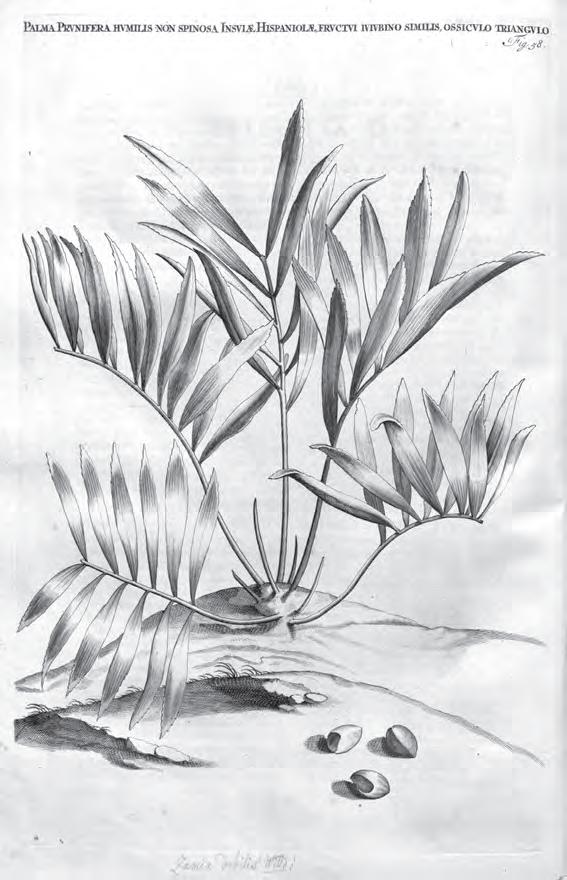
Some years later, after returning to Sweden, Linnaeus, then securely employed at Uppsala University a nd internationally respected t hrough his 1753 landmark Species Plantarum ed. 1 a nd other publications, undertook a n expansion a nd revision of his earlier work. He clearly w ished to be comprehensive, to include a ll t he plants of t he world. But t he i solated, cold a nd biologically inhospitable land of his birth could not approach t he lush gardens of Holland, and many of the plants he had once seen and studied were now inaccessible. His 1762 revision, Species Plantarum ed. 2, where he first published the genus Zamia, is quite cryptic. There is no useful description of his new “pumila,” and its source is only the unhelpful “Habitat in America meridionali.” But he did cite four references he believed of value, one of them Commelijn’s Horti Commelijn’s t reatment w as v astly superior to t hat of L innaeus. He gave more t han a page of description a nd d iscussion – fi rst i n L atin, t hen r epeated i n D utch – of h is “Palma prunifera humilis non spinosa” a nd its origin f rom “ insulae hispaniolae.” H is f ull-page plate i s of a fi ve-leaved plant w ith narrowly ovate to lanceolate, long-tapering leaflets, t he apex acute a nd t he margins bearing w idely spaced small teeth. (See FIGURE.)
More t han t wo centuries later, in 1980, w ith t he requirements of t he International Code fi rmly in place – a nd since no specimen existed – Eckenwalder designated Commelijn’s plate as the lectotype for Zamia pumila
It is unclear whether the plant of 17th century Holland once grew in Hispaniola and has since been lost, or whether t he original source was in error. But Commelijn’s plant, as illustrated by his f ull-page plate, doesn’t resemble a ny Zamia we now know from the West Indies or Florida. The Florida plant with all its variations has linear or narrowly oblong leaves, a blunt apex, and never marginal teeth.
It i s u nfortunate t hat E ckenwalter, a s well a s l ater authors addressing the West Indian cycads, did not realize the significance of this typificaton and the change it must c ause i n t he u nderstanding of Z amia pumila. Though he c ited – a nd surely s aw – t he C ommelijn plate, E ckenwalder m ade no r eference to t he c haracteristics t hat s et it apart; presumably he i nterpreted t hese d ifferences a s acceptably w ithin h is a ll-encompassing s ingle West I ndian s pecies.
So w hat i s t he R EAL Z amia pumila? Truth i s, r ight now we do not know. It has to be a plant that conforms to
Commelijn’s plate – w ith narrowly ovate, long-pointed leaves. Surely something from Mexico or elsewhere in Central America must have been the plant grown in Amsterdam so long ago. A later Dutch botanist, Friedrich Miquel, in 1847, in describing a new species from Mexico ( Zamia fischeri), noted it to be similar to Commelijn’s plant; but he acknowledged he was unsure – he called his name a nomen provisorium Miquel wa s r ight to be cautious, for there are several somewhat similar Central American species. Resolution of the modern identity of Commelijn’s plant – the type of our Zamia pumila – will t ake expertise beyond that of a Florida botanist. Yes, Zamia integrifolia is a name we can use, if we wish. M aybe we can’t say what Linnaeus meant by his earlier name. But we can say, with confidence, that the name Zamia pumila c annot be correctly applied to any native Florida plant!
About the Author
Dr. Dan Ward is Professor Emeritus at the University of Florida.
FIGURE: Commelijn, plate 58, 1697; via Google Scholar.