
Palmetto
2008 FNPS
Discovery Adventures
Mark your calendars for these upcoming trips with the Florida Native Plant Society
Panhandle Adventure Sept. 20–27, 2008
Belize Flora & Mayan Ruins Oct. 25 – Nov. 2, 2008
See www .fnps.org for more information this spring.
FNPSNominating Committee Announces Slate of Officers
Election of new officers for FNPS will take place at the Annual Conference on Saturday,May 17,at 8 a.m. The proposed slate consists of:
President – Eugene Kelly
Secretary – Christina M.Uranowski
Vice President of Finance – Steve Woodmansee
At Large Director,2008 – 2010 –Rick Joyce
At Large Director,2008 – 2010 –Lynne Flannery
At Large Director,2008 – 2010 –Fritz Wettstein
Brief biographical information for each nominee will appear in Sabal Minor.The Nominating Committee was comprised of Kim Zarillo,Ray Miller,Nia Wellendorf and Bob Egolf.
In memoriam – Dr.Mary Ann Bolla
On Sunday, January 20 long time member and supporter Mary Ann Bolla passed away in Miami. Many members will recall Mary Ann’s wonderful book display at our annual conference, as well as her friendly and kind nature.
A memorial fund has been created with the Dade Chapter of the Florida Native Plant Society to support field research for college and graduate students.
Donations in honor of Mary Ann Bolla can be sent to: FNPS, 3245 SW 63rd Avenue, Miami, FL 33155-3050
A Sprig of Gray
By Denny Girard
I’m not much right now, Just a sprig of gray Surrounded by brown leaves And yellowed grass On dull and barren ground.
But come back in a month And see me change.
I’ll sprout new green leaves And push new growth Toward the warming sun.
Better yet, return in May And see me at my very best. My rebirth will be complete. My promised buds will burst Into blooms of bright colors. You’ll like me then, As I paint your world With blazing colors.
I’ll draw you near.
I’ll touch your heart.
So forgive me now if I disappoint, If I am drab and bleak.
I am only dozing, resting, Until the nudge of spring Wakes me once again.
Palmetto is in need of articles on native plant species and related conservation topics,as well as high-quality botanical illustrations and photographs.Contact the editor for guidelines,deadlines and other information at pucpuggy@bellsouth.net,or visit www.fnps.org and follow the links to Publications/Palmetto.
The purpose of the Florida Native Plant Society is to preserve, conserve, and restore the native plants and native plant communities of Florida.
Official definition of native plant: For most purposes, the phrase Florida native plant refers to those species occurring within the state boundaries prior to European contact, according to the best available scientific and historical documentation. More specifically, it includes those species understood as indigenous, occurring in natural associations in habitats that existed prior to significant human impacts and alterations of the landscape.
Organization: Members are organized into regional chapters throughout Florida. Each chapter elects a Chapter Representative who serves as a voting member of the Board of Directors and is responsible for advocating the chapter’s needs and objectives. See www.fnps.org
Board of Directors
Executive Officers
President – Shirley Denton
Past President – Bob Egolf
Vice President,Admin. – Ann Redmond
Vice President,Finance – Candy Weller
Treasurer – Susan Thompson
Secretary – Ameé Bailey Speck
Committee Chairs
Communications – Cindy Liberton
Conference – Ray Wunderlich III
Conservation – Suzanne Kennedy,Eugene Kelly
Development – JoAnne Trebatoski
Education – Judy Gregoire
Finance – Candy Weller
Governmental Policy – Kim Zarillo,Annie Schmidt
Landscape Awards – Jake Ingram,Scott Sager
Membership – Lynka Woodbury
Public Lands Management – Charlie Pedersen
Publications – Eileen Szuchy
Science – Paul Schmalzer
Directors-at-large
Lynne Flannery (2006-2008)
George Kish (2006-2008)
Fritz Wettstein(2006-2008)
Sue Dingwell (2007-2009)
Ray Jarrett (2007-2009) AnneBirch (2007-2009)
To contact board members: Visit www.fnps.org or write care of:
FNPS – PO Box 278
Melbourne FL 32902-0278
To join or for inquiries: Contact your local Chapter Representative,or call,write,or email FNPS,or visit our website.
Florida Native Plant Society PO Box 278
Melbourne FL 32902-0278
Phone:(321) 271-6702 info@fnps.org • www.fnps.org
Webmaster – Paul Rebmann
Contract Services
Executive Director – Karina Veaudry
Accounting Services – Joslin &Hershkowitz
Administrative Services – Cammie Donaldson
Editor,Palmetto – Marjorie Shropshire
Editor,Sabal Minor – Rosalind Rowe
Palmetto
Features
4Sedges – Do We Know Them?
The sedge family has many genera, and they are reported to be nature’s most trying identification puzzle. However, with the use of some botanical tools, everyone can enjoy solving the puzzle. Linda Curtis helps us identify and appreciate sedges.
8Saving Florida’s Most Endangered Plants
Hundreds of Florida’s native plants are imperiled by residential and commercial development, habitat degradation, and the impact of exotic species.Discover how Florida’s Endangered and Threatened Plant Conservation Grants Program is helping to save them.
15Native or Not – Ludwigia peruviana
Since its first discovery late in the nineteenth century Ludwigia peruviana has been assumed to be an introduction to Florida. But a recent appraisal by a regulatory agency has cast doubt on that status. Dr. Dan Ward explores the topic in the third in his continuing series “Native or Not – Studies of Problematic Species.”
ONTHE COVER:
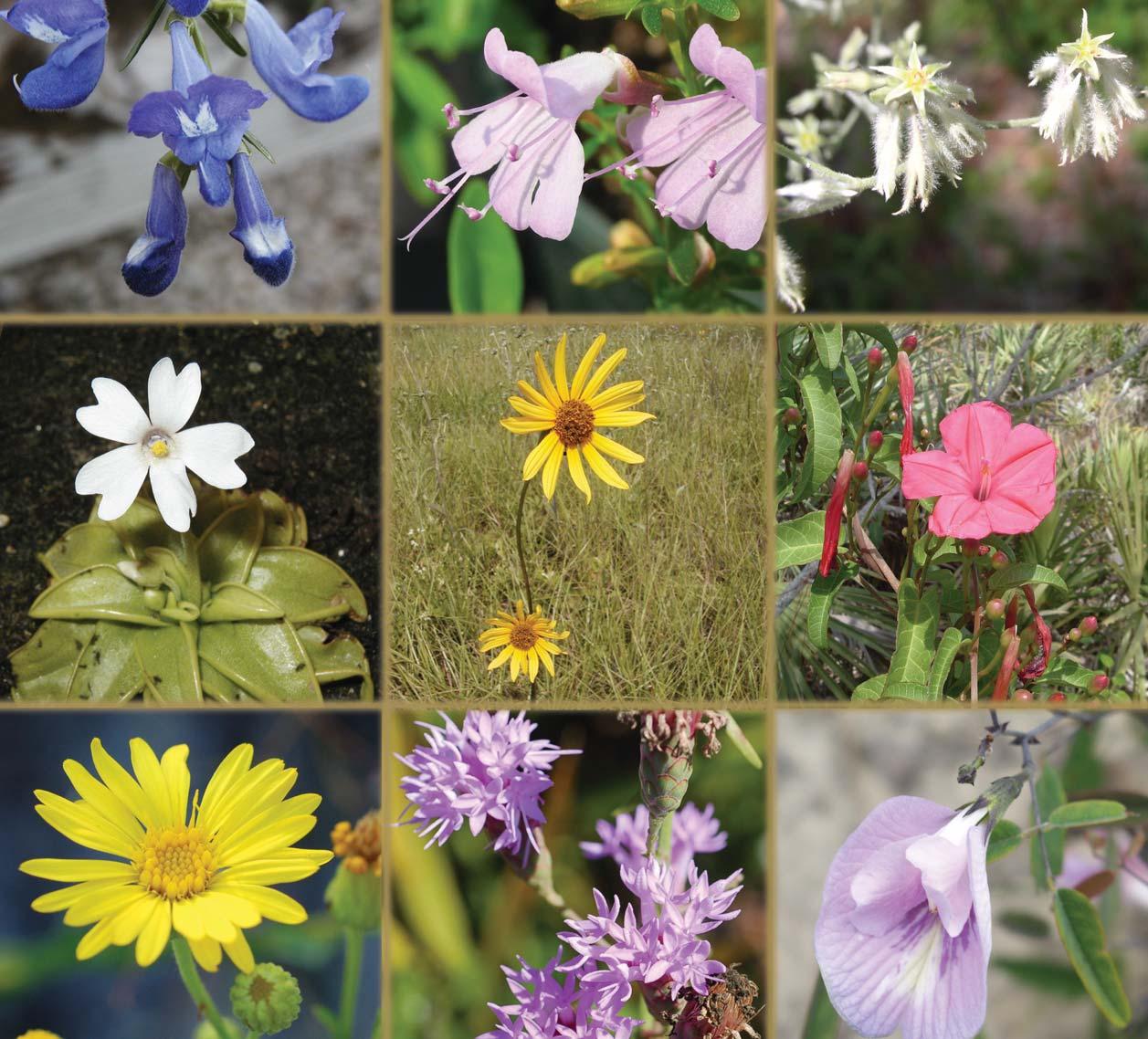
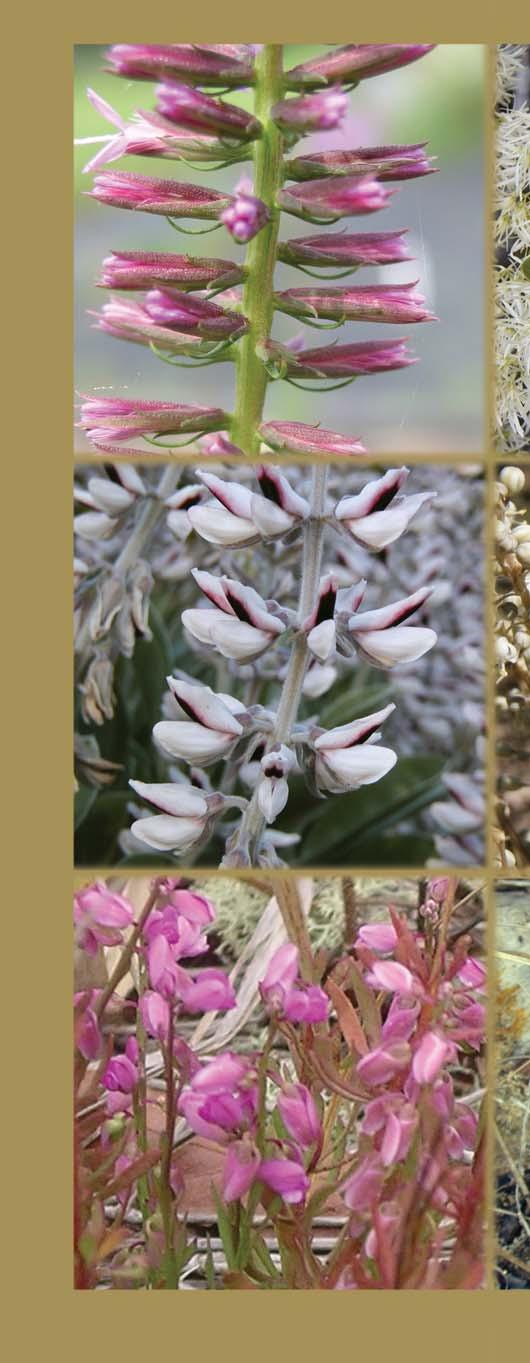
Left to right. First row – Scutellaria floridana (Cindy Campbell); Dicerandra immaculata var. savannarum (Cheryl Peterson); Eriogonum floridanum (Cindy Campbell) Second row – Pinguicula ionantha; Helianthus carnosus (both by Cindy Campbell); Ipomoea microdactyla (Joie Goodman); Third row – Chrysopsis highlandsensis (Monica O’Chaney); Liatris ohlingerae (Carl Weekley); Clitoria fragrans (Cindy Campbell)
Make a difference with FNPS
Your membership supports the preservation and restoration of wildlife habitats and biological diversity through the conservation of native plants.It also funds awards for leaders in native plant education,preservation and research.
Please consider upgrading your membership level when you renew.
● New member/gift membership $25
● Renewing individual $35
● Family or household $50
● Contributing $75 (with $25 going to the Endowment)
● Not-for-profit organization $50
● Business or corporate $125
● Supporting $100
● Donor $250
● Lifetime $1,000
● Full time student $15
● Library subscription $15
The Palmetto (ISSN 0276-4164) Copyright 2008,Florida Native Plant Society,all rights reserved.No part of the contents of this magazine may be reproduced by any means without written consent of the editor. The Palmetto is published four times a year by the Florida Native Plant Society (FNPS) as a benefit to members. The observations and opinions expressed in attributed columns and articles are those of the respective authors and should not be interpreted as representing the official views of the Florida Native Plant Society or the editor,except where otherwise stated.
Editorial Content: We have a continuing interest in articles on specific native plant species and related conservation topics,as well as high-quality botanical illustrations and photographs.Contact the editor for submittal guidelines,deadlines and other information.
Editor: MarjorieShropshire,Visual Key Creative,Inc. ● pucpuggy@bellsouth.net ● Telephone (772) 232-1384 ● 855 NEStokes Terrace,Jensen Beach FL 34957
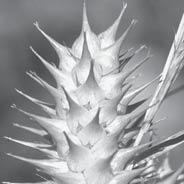
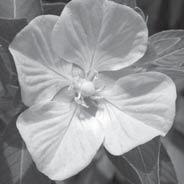
Photos, top to bottom: Hop sedge, Carex lupulina – photo by Linda Curtis.
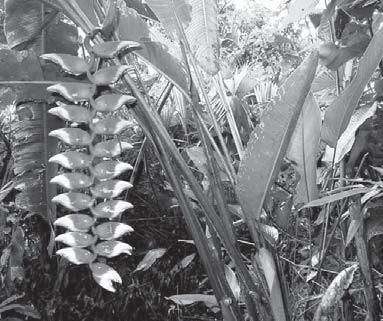
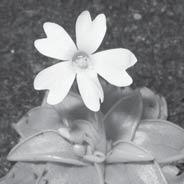
Pinguicula ionantha – photo by Cindy Campbell. Ludwigia peruviana – photo by Shirley Denton.
Sedges Linda Curtis
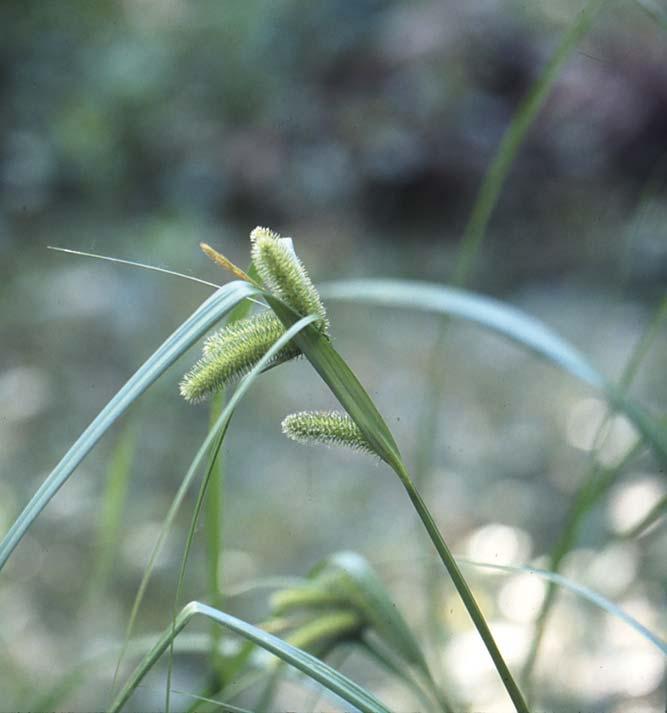
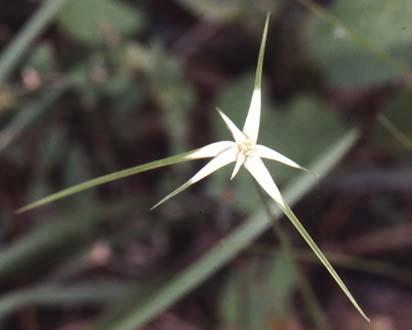
Figure 1: Star sedge, Rhynchospora colorata grows along the lakeshore at Fort Cooper State Park near Inverness, but also in bogs and prairies.
Do we know them?
This long culm of bristly sedge, Carex comosa, has separate male and female spikes in its seed head. This specimen grows in the shady thickets within Emerald Marsh near Lisbon, Florida. Look for bristly sedge also in swamps in the central peninsula and northern counties in March and April. The range is from Ontario through the midwest down to Florida and Texas, and even a few places in Mexico.
The Cyperaceae or sedge family has many genera, including the genus Carex, and they are reported to be nature’s most trying identification puzzle. Usually only the most botanically adept try. However, with the use of a centimeter ruler, a magnifying glass, and an illustrated book, such as the Flora of North America: Cyperaceae (2002) and the keys in Guide to the Vascular plants of Florida, (Wunderlin 2003), then the botanically inept can try as well.
Many sedges grow in marshes, yet they are also understory plants in dry woods, hummocks and floodplain forests. A few conspicuous species, such as star sedge or white top, Rhynchospora colorata, are known by name because of their white bracts that look like petals at first glance. While star sedge is insect pollinated, the other sedges have neither petals or showy bracts, nor sticky pollen that would attract insects. Instead, the stamens split and their fine dust-like pollen wafts on breezes. [Fig.1]
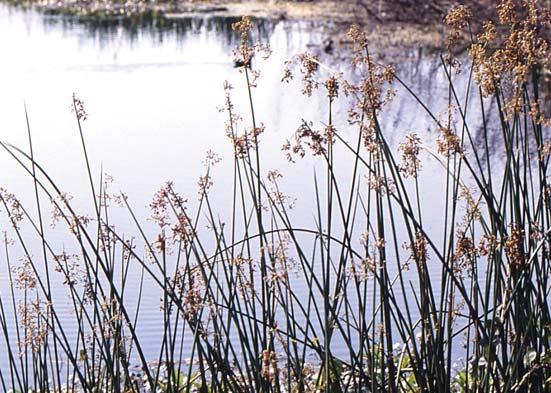
In the large sedge family of Cyperaceae, Carex is not the only genus with triangular culms. Sedge species of genera Scirpus and Cyperus also have triangular culms, at least some of them. The old phrase “sedges have edges” bears true much of the time, but not all of the time. The bulrushes are a good example. Soft-stem bulrush, Schoenoplectus tabernaemontani, has tall tubular culms [Fig. 2], while the shorter threesquare bulrush, S. pungens, has triangular culms. Neither of those sedges have leaves, while species in the Scirpus genus are quite leafy.
Most people are familiar with the vast marshes of saw grass along the coasts. Even though not a grass, its common name might lead you to think so. Sawgrass, Cladium jamaicense, is a sedge and forms large rhizomatous stands such as those seen along the boardwalk at Churchhouse Hammock in Crystal River. [Fig. 3]
A few species of the genus Carex also occur in stands, but most are in tufts, clumps, or tussocks. Although there are 67 species of Carex in Florida, and 35 of those in Central Florida, only a few people recognize them. Many people think they are grasses, which is a different family: Poaceae. Although Carex have long narrow leaves, their culms (stems) that bear the seed heads are triangular in cross section instead of round like the grasses. The edges of those triangular margins are easy to detect by touch. Be careful, though. The edges leaves and margins of culms have serrate teeth similar to Cladium’s, and can give a razor-like cut.Carex means “to cut.”
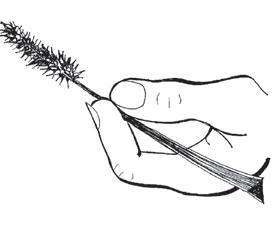
tissue is white and puckered-wrinkly while most other Carex sheaths are smooth. [Fig. 6]
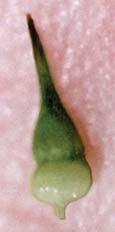
A common sedge in Central and Northern Florida, C. stipata has distinctive perigynia, the sacs that enclose their one seed-like achene. The sacs in the seed head each have a swollen spongy base with a small stalk or stipe at the lower end of attachment. That lends its name stipata which means “with a stipe”. The common names are many, and old-timers once named it sawbeak sedge because it resembled the oldfashioned wood saws irregular teeth on their blades. Another name was awl-fruited sedge because the sacs resembles an
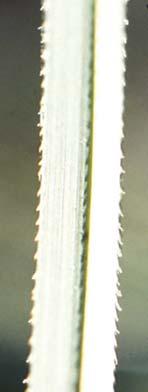
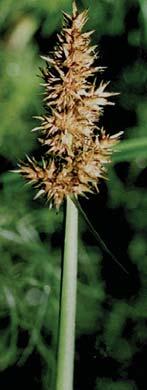
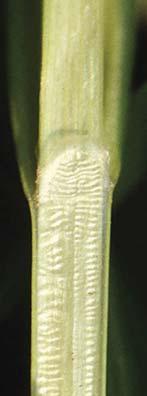
Figure 2: The tall leafless culms of softstem bulrush, Schoenoplectus tabernaemontani, formerly Scirpus validus, grow in dense stands in shallow water.
Figure 3: Enlarged section of a serrate leaf of sawgrass, Cladium jamaicense The harsh teeth are not visible to the unaided eye. Sawgrass is a dominant species in the Everglades.
Figure 4: A seed head of Carex stipata with many small spikes.
Figure 5: Carex stipata’s triangular culms are soft and pinchable.
Figure 6: The whitish puckered front of a leaf sheath of Carex stipata.
Figure 7: An awl-shaped sac from a spike of Carex stipata.
Carex are leafy and very grass-like in appearance. At first glance, the awl-fruited fox sedge, C. stipata, looks like a grass, but a closer look reveals the seed heads are on triangular culms with wing-edged margins. [Fig. 4] These culms are so soft that they compress under a finger-pinch. [Fig. 5] Spongy versus wiry culms is a clue in identifying fox sedge species. Another clue is the thin tissue on the front of the sheath, opposite of where a leaf departs the culm. C. stipata’s thin
awl, a not so common tool today as in the past. The awlfruited sedge’s name has morphed, perhaps by typing error, to owl-fruited sedge, which makes botanists shriek with laugher, since there is nothing about the sedge that suggests an owl, and owls are predators, not herbivores. [Fig. 7]
While the species of Carex have a sac (perigynium) around their seed-like achene, the sedges Scirpus, Cyperus, and others have bristles and scales with their achenes instead.
Fig. 2
Fig. 3
Fig. 4
Fig. 6
Fig. 7
Fig. 5
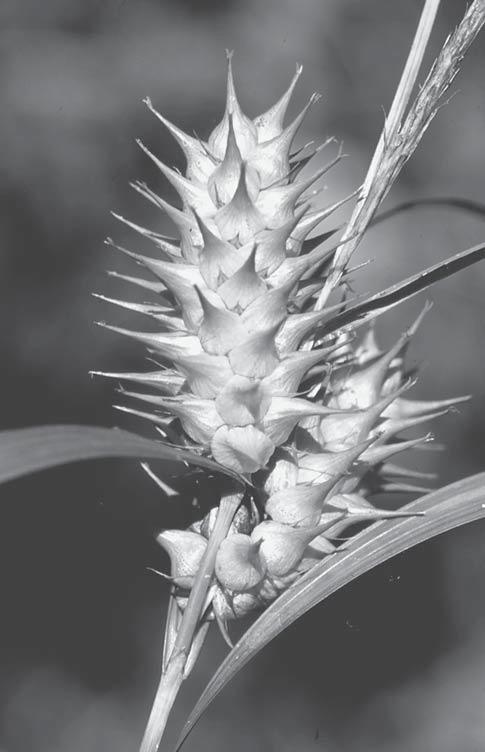
But these parts are small and magnification is necessary to see the differences. The visual reward is great because Carex sacs seem minutely ornate. So distinctive are the vein patterns and textures, they are used in identification since each species has its own design. Many are “artist’s delights” with such unusual shapes, some suggesting a ceramist gone wild.
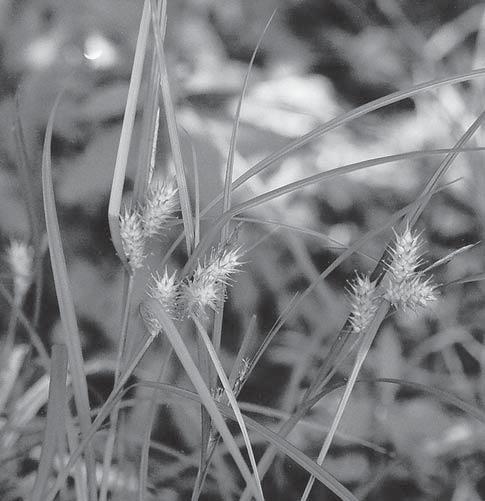
The beauty of small structures can be captured by a camera with a macro lens, or imaged on a computer’s scanner and enlarged. The Carex species with the largest sacs include hop sedge, C. lupulina. [Fig. 8] Its sacs are about an inch (2.5 cm) long. While the plump spikes are females, the terminal narrow spike is a male with stamens and scales. [Fig. 9] The pollen falls by gravity from the stamens in spring onto the lower female spikes with outstretched stigmas. The journey of the pollen grains takes days to finally get to the ovary at the base of the long-traveled style.
Once fertilized, the ovary becomes a one-seeded dry fruit known as an achene. Sometimes, only the shape of an achene is the final clue that separates species. C. lupuliformis appears similar to C. lupulina, but has wider knobbed achenes.
These plants grew in Gainesville’s Split Rock Preserve along with several other species of Carex
Conversely, some Carex species do not have separate male spikes, but have mixed spikes with both stamens and sacs instead. Each sac or pair of

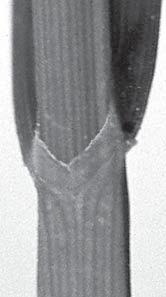
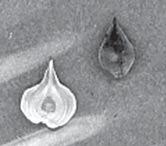
Figure 8 – Carex lupulina has leafy culms and conspicuous spikes with long beaked sacs.
Figure 9 – Hop sedge, Carex lupulina, has large, female spikes and one narrow male.
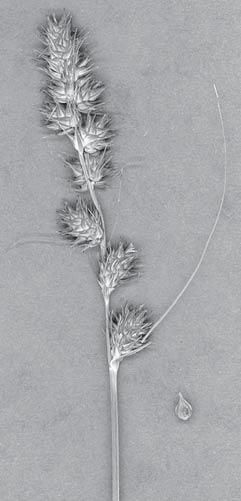
Figure 10 – Carex vexans' seed heads have small mixed spikes on each culm. A common sedge in roadside ponds, this sedge grew along Highway 19 in Homosassa.
Figure 11 – Carex vexans' leaf sheath is closed and tubular around its culm. Conversely, grass sheaths are split and crossed over like a shirt front.
Figure 12 – Carex fissa’s sac, upper right, has ridged margins, while C. vexans' sac, lower left, is slightly larger with winged margins.
Figure 13 – Carex fissa’s seed heads also have mixed culms, but the stamens are at the tips of the small spikes.
All photos by the author
Fig. 11
Fig. 12
Fig. 13
Fig. 9
Fig. 8
Fig. 10
Sedges
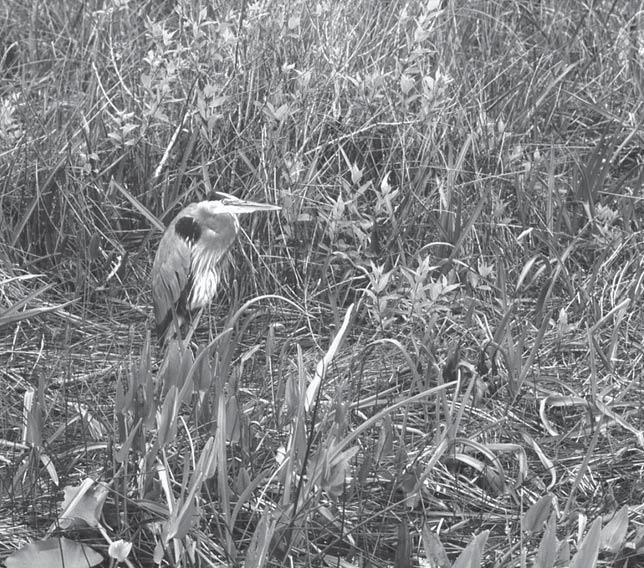
Tired of walking and stalking, a great blue heron rests on backwards-bending knees in a patch of sedges and other wetland plants in Emerald Marsh.
stamens is covered when young by a single protective scale, which have their own shape and design too. The genus Carex has a subgenus Vignea, which includes Ovales, a group named for the many small oval spikes in their seed head. Their flat winged sacs have a rounded achene in the center that also suggests ova as fried eggs. An example is the Florida hammock sedge, C. vexans, found only in Florida. The front of its leaf sheath has a neat white collar at the summit. [Figs. 10,11]
Other groups in subgenus Vignea also have flat or flattish sacs, but the sac shapes and number of veins vary. Also, the stamens in some groups are at the tips of the many small spikes, while the Ovales have stamens in the scales at the base of their spikes. One of the challenges in identifying Carex is to find the tiny withered stamens, when often only their slender stalks or empty scales remain. The common hammock sedge, C. fissa has stamens at the tips of its spikes, but if the evidence of stamens is gone, then the best clues are the small sacs that must be measured both by length and width. Compared to C. vexans' sacs, C. fissa’s are the about the same length but are not as wide, having ridged margins instead of flat winged margins. [Figs. 12, 13]
Sedges are the most under-reported species, yet the genus Carex is one of the world’s top ten genera in numbers of species. Their value to their ecosystems is priceless, and that includes holding soil intact with their perennial roots. The leaves are used in nest building and their seed-like achenes are eaten by birds, small mammals, and insects.Sedgy protective cover is quite important for small ducklings still in the nest, as leafy sedges conceal them as the sand hill cranes stalk by. Young duck is definitely on the crane menu.
Recently, Carex have shown up in wild plant nursery catalogs along with ornamental grasses, although they are usually bought for erosion control and restoration projects. Some nature
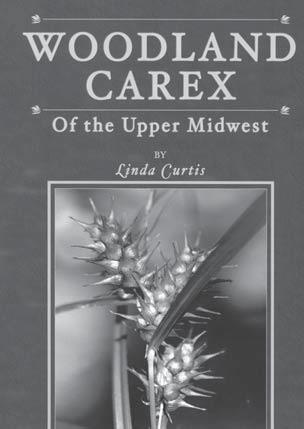
The front cover photo of the book Woodland Carex. The back cover reads, “Do Sedges have Edges? Woodland Carex of the Upper Midwest will be welcomed by nature-lovers and gardeners who waited for a viewer-friendly field guide to Carex, those grass-like sedges. And yes, many, but not all sedges do have sharp edges on their triangular culms, while grasses have round stems. This book has both detailed descriptions and a facing page with never-seen-before enlarged photos and illustrations.”
centers have “smart gardens” planted with Carex and other wild species near their visitor center. The plants have labels near their clumps so children and visitors can learn their names and speak them as they are discovered along the trail. Many adults will find them attractive and want to order sedges to plant in their wild gardens. Although not colorful, sedges offer texture and tranquil leaf movements in soft breezes. They are often featured in urns, or grown to contrast with colorful plants in the background. Eventually, the sedges will become known.
Literature Cited
Flora of North America:Cyperaceae.2002.New York:Oxford University Press. Wunderlin,R.P.and B.F.Hansen.2003.Guide to Vascular Plants of Florida. Gainesville:University of Florida Press.
About the Author
Science writer and author Linda Curtis is also photographer and illustrator of her latest book Woodland Carex of the Upper Midwest,2006.About half of the Carex species in Florida also grow in the Midwest.You can see more photos of Carex species on the Web site www.curtistothethird.com
Florida’s Endangered and Threatened Plant Conservation Grants Program
Saving Florida’s Rarest P
As Florida’s human population continues to grow, so does the threat to some of our most unique and vulnerable residents. Hundreds of Florida’s native plants are imperiled by residential and commercial development, habitat degradation, and the impact of exotic species. The state’s Endangered and Threatened Plant Conservation Grants Program was designed to address the recovery needs of Florida’s unique flora and the habitats that sustain it. In the last seven years, over 20% of the state’s imperiled plant species have benefited from this exemplary funding program.
Florida’s Regulated Plant Index contains 542 plant species, including 421 endangered (E), 113 threatened (T), and eight commercially exploited species. Because only 55 of these plants are also protected by the federal Endangered Species Act (ESA; 1973), almost 90% of Florida’s rarest and most imperiled plants are offered no federal protection. State-listed species not covered by the ESA range from the Keys to the Panhandle and include rare tropical trees, pine rockland herbs, Appalachian Ice Age refugees, and many species narrowly endemic to Florida. Examples include species reduced to single wild populations in the state, such as young palm orchid (Tropidia polystachya), shrub verbena (Lantana canescens), and coral hoary pea (Tephrosia angustissima var. corallicola), and species that fail to recruit seedlings in the wild, such as Florida ziziphus (Ziziphuscelata) and Florida torreya (Torreya taxifolia).
The DPI Grants Program
The Endangered and Threatened Plant Conservation Grants Program is the only funding program in Florida focused on the conservation of statelisted plants. The program is administered by the Florida Department of Agriculture and Consumer Services’ Division of Plant Industry (DPI), which also maintains the Regulated Plant Index. The Endangered Plants Advisory Council (EPAC), made up of seven representatives of academia, industry and environmental groups (including the Florida Native Plant Society), provides expert advice on endangered and threatened native plants, reviews grant applications, and makes recommendations to DPI on Program awards. Funding for the DPI Grants Program began in 2000.
Funding under the DPI Program is restricted to non-profit institutions with a proven record of research, propagation, conservation, and educational activities designed to protect or recover Florida’s imperiled native plants. To date, over 150 of the rarest and most imperiled species have been helped by the program. Funded activities include curation of ex situ populations and seed banks, development of propagation techniques, demographic monitoring, research on reproductive biology, genetics and ecology, rescues
Carl W. Weekley Doria R. Gordon Joe Maguire
Joyce Maschinski
Eric S. Menges Valerie C. Pence
Editor’s note:authors names after the first author are listed alphabetically.
Cheryl L. Peterson
Plants
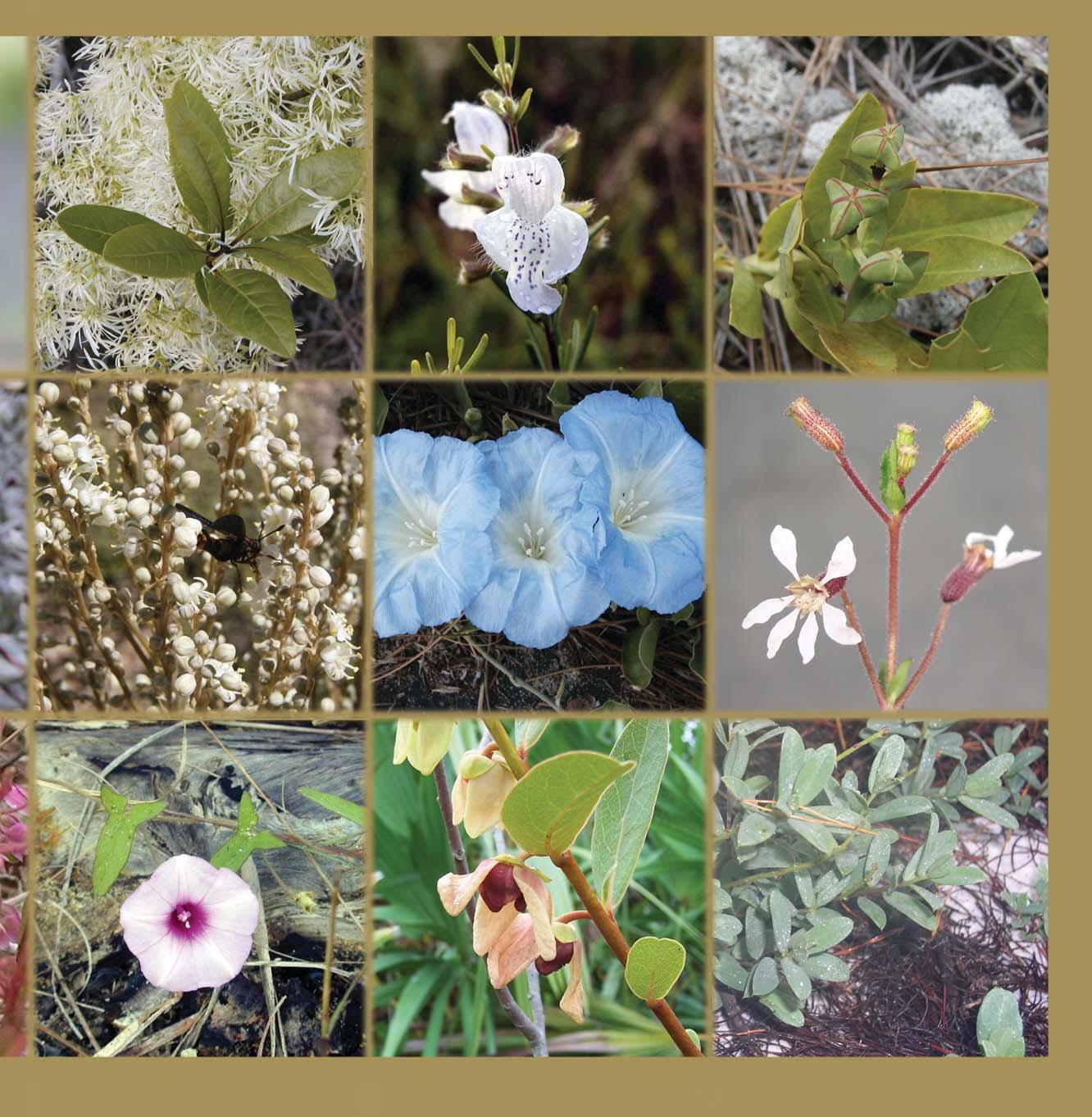
Photos:(left to right).
First row – Liatris provincialis; Chionanthus pygmaeus; Conradina grandiflora; Euphorbia telephioides; (photos by Cindy Campbell)
Second row – Lupinus aridorum; Nolina brittoniana; Bonamia grandiflora; Cuphea aspera; (photos by Cindy Campbell)
Third row – Polygala lewtonii (Carl Weekley); Scutellaria floridana (Cindy Campbell); Asimina tetramera (Anne Cox); Crotalaria avonensis (Eric Menges).
Saving Florida’s Rarest Plants
of rare plants from sites slated for development, and the introduction of species to protected sites. In addition, outreach programs funded by DPI reach a broad spectrum of Florida’s residents, including over 30,000 schoolchildren.
Another stringent requirement of the program is the 1-to-1 matching funds clause, whereby recipients must spend a dollar for every DPI dollar received. For tax-paying citizens, however, this is a 2-for-1 bargain, since they get two dollars-worth of plant conservation for every tax dollar spent.
Ex situ populations and propagation
Because many endangered and threatened species are restricted to few populations, often on unprotected sites, plant conservationists have relied on the creation and maintenance of ex situ (off-site) populations in botanical gardens and long-term seed storage to conserve germplasm. The two major ex situ collections in Florida are maintained by Fairchild Tropical Botanic Garden and Historic Bok Sanctuary, both supported in part by the DPI Grants Program. Altogether, the two gardens maintain off-site populations of 146 state-listed species. Examples include semaphore cactus (Consolea corallicola), crenulate leadplant (Amorpha herbacea var. crenulata), Florida ziziphus, and several rare woody mints (Conradina and Dicerandra spp.).
Another important ex situ activity supported by DPI funding is the development of propagation techniques for imperiled species, including vegetative propagation from cuttings, seed germination, and tissue culture. Grant recipients, often in collaboration with experts from other institutions, have developed propagation methods for over 60 species (e.g., Roncal et al. 2006a, 2006b). Ex situ propagation has been critical in providing plants for the introduction of listed species to protected sites (see below).
Monitoring listed plants
The DPI Grants Program supports the monitoring of over 50 listed species from one end of the state to the other. Supported projects include both population-level and demographic monitoring. Population-level monitoring is based on counts or estimates of population sizes that provide data on whether populations are increasing or decreasing over time. Demographic monitoring involves periodic censusing of individually marked plants to collect data on their survival, growth, and reproduction.
Monitored populations are usually mapped with a global positioning system (GPS) and visited at least annually. Population-level monitoring is also useful for tracking the impact of management activities like prescribed fire on the population dynamics of a species. On the Lake Wales Ridge, for example, DPI-funded research has shown that species such as Lewton’s polygala (Polygala lewtonii), scrub blazing-star (Liatris ohlingerae), and scrub mint (Dicerandra frutescens) respond differently to fire, although all occupy similar pyrogenic communities.
Data produced by demographic monitoring is particularly fruitful in understanding the biology of rare species because it can be used to develop population viability (PVA) models. PVA
models generate testable hypotheses about the habitat and management requirements of listed species, but their usefulness depends on large, long-term data sets. Two of the five models developed for scrub plants by Archbold Biological Station in recent years were supported in part by a DPI Grant (Menges and Quintana-Ascencio 2004, Menges et al. 2006). PVA models can also be used to infer the types of land management most beneficial to rare species. For example, the Archbold PVA model of Dicerandra frutescens led to new recommendations for more frequent prescribed fire in oak-hickory scrub, its primary habitat (Menges et al. 2006). In addition, PVA models are useful for determining whether conservation efforts are reducing extinction risks of our rarest plants. For example, Fairchild researchers determined through PVA modeling that re-introduced Sargent’s cherry palms (Pseudophoenix sargentii) lowered the extinction risk of the species in Florida because they are growing more rapidly than wild germinated individuals (Maschinski and Duquesnel 2006).
Research on reproductive biology,genetics,and ecology
In addition to understanding the demography of listed species, plant conservationists need to understand their reproductive biology, genetic variability, and ecological requirements. The DPI Grants Program has funded research in all these areas. For example, Archbold researchers have shown that Lewton’s polygala has an unusual breeding system characterized by the presence of both above- and belowground flowers (Weekley and Brothers 2006). With funding from DPI, research conducted at Bok and Fairchild has been critical in evaluating genetic diversity in such critically endangered species as beach jacquemontia (Jacquemontia reclinata; Maschinski and Wright 2006), coral hoary pea, and four-petaled pawpaw (Asimina tetramera; Center for Plant Conservation 2007).
The DPI Program has also funded research on the germination ecology of over 60 species including Highlands golden aster (Chrysopsis highlandsensis), scrub blazing-star (Weekley et al. submitted), crenulate lead plant, beach peanut (Okenia hypogaea), and Florida ziziphus. Germination experiments have been carried out in the greenhouse, in controlled environment growth chambers, and in the field.
(Re)-introductions oflisted species and rare plant rescues
Sometimes it is necessary to re-introduce a listed species to a site where it is known to have occurred or to introduce it to a new site containing appropriate habitat. In both cases, the goal is to establish viable populations on protected sites within the historic range of the species. Often introductions are a species’ only hope of avoiding extinction or of being reduced to a handful of captive individuals in a greenhouse or garden.
The DPI Program has contributed to over 50 (re)-introductions involving about 15 species (e.g., Maschinski and Duquesnel 2006, Maschinski and Wright 2006, Possley et al. 2007, Possley et al. in press, Wendelberger et al. in press). For example, Bok
Continued on page 12
28th Annual FNPS Conference
Uplands Estuariesto
Celebrating Florida’s Native Plant Heritage
Hosted by the Mangrove,Pinellas,Serenoa & Suncoast Chapters
See Dr.Walter Kingsley Taylor re-enact the expedition of botanist Andre´ Michaux from the late 1700’s.
Learn how native plants saved the lives of thousands in the Asian tsunami of 2005 with Jim Eagan of the Marine Resources Council.
Meet environmental leaders Jon Thaxton,Sarasota County Commissioner,and Linda Young of the Clean Water Network
Discover landscape design and gardening with native plants,and purchase plants to try out in your yard.
Choose from more than 20 guided field trips to outstanding native Florida sites including Oscar Scherer State Park,Brooker Creek Nature Preserve, and Egmont Key State Park.Or choose a kayak trip in Fort DeSoto State Park, or on Sarasota Bay.
Enjoy nature fun at our Children’s Conference,with nature photography, field trip and owl pellet analysis.
Over 50 speakers,research papers and workshops ● More than 30 vendors ● Plant sale ● Friday night social at the South Florida Museum with “Snooty” the manatee ● And more!
● Renowned speakers ● Plant identification ● Discussions on climate change ● Gardening for butterflies and birds ● The latest scientific research topics ● Children’s programs
Conference Hotel
Holiday Inn Riverfront
100 Riverfront Drive,Bradenton,FL 34205 (941) 747-3727
Mention FNPS for discounted rates (before April 14)
Rates without tax:
(2) Double or (1) King ...............................$91.00
(2) Double Riverfront ................................$109.00
Suite:(2) Double or (1) King plus sleeper sofa ..................................$129.00
To learn more or to register,visit fnps.org and click the “conference”link.
To place an advertisement in the program or for information about a sponsorship, contact Karina Veaudry,executivedirector@fnps.org or 407.895.8446
May 15-18,2008
Manatee Convention Center
Palmetto,Florida
Saving Florida’s Rarest Plants
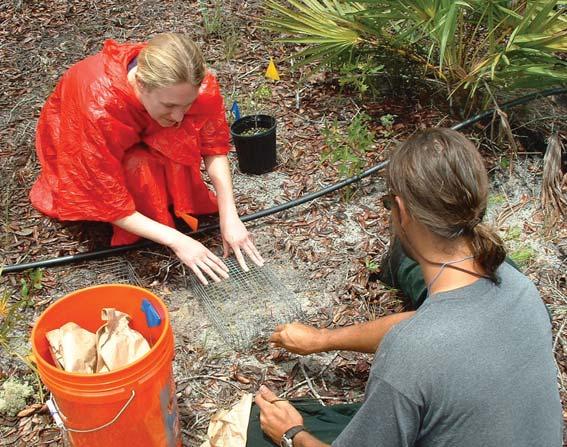
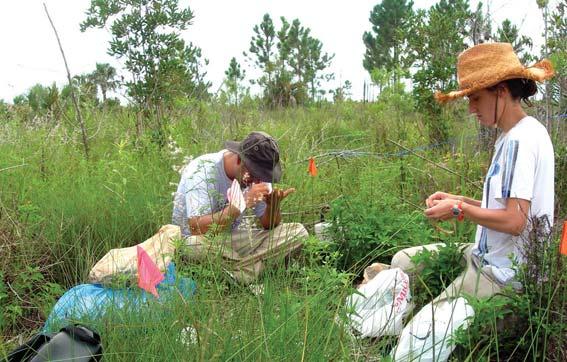
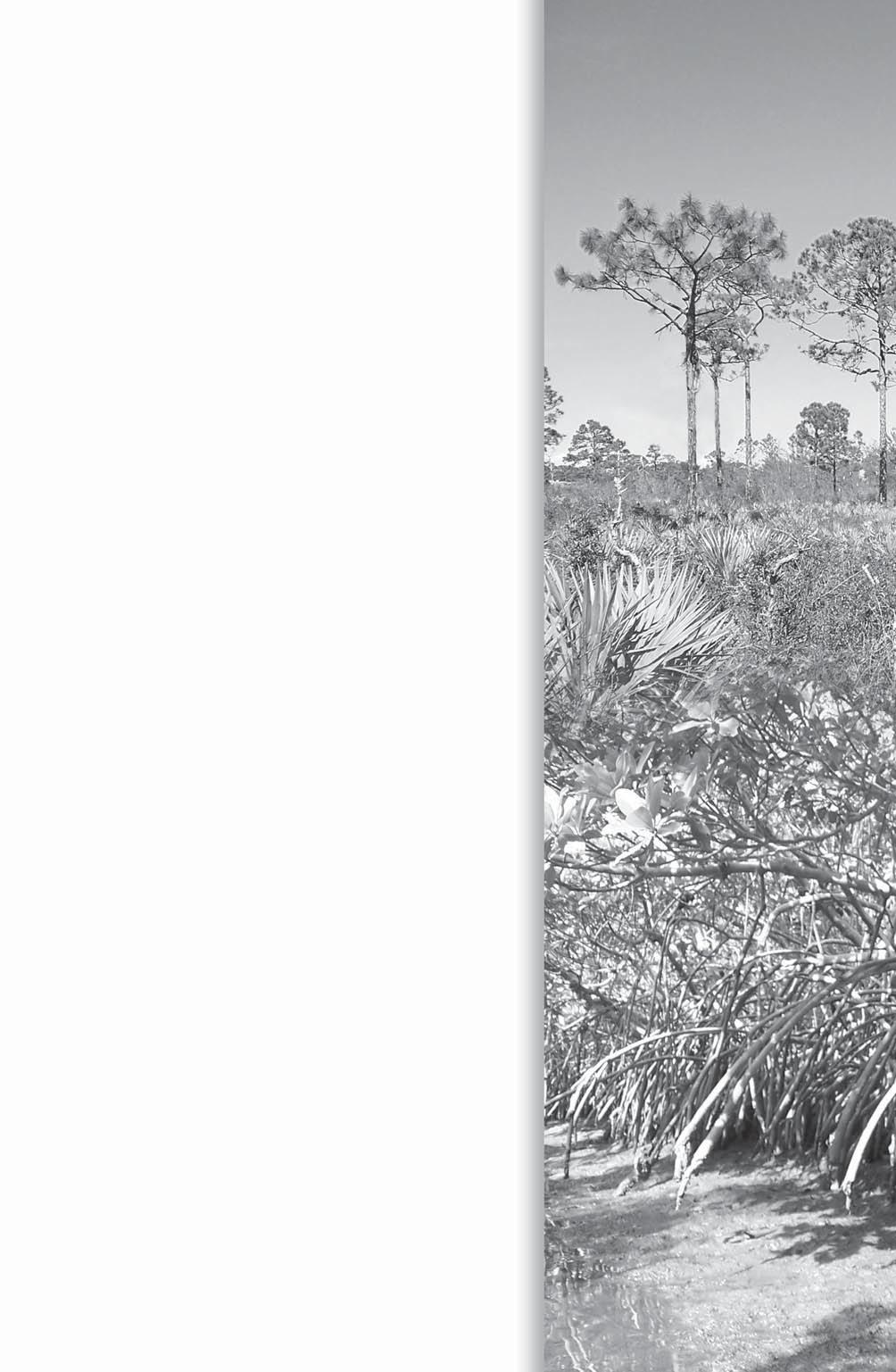
Top: Planting Florida ziziphus seeds – photo courtesy of Archbold Biological Station. Below: Sam Wright and Jennifer Possley install a seed study – photo courtesy of Fairchild Tropical Botanic Garden.
Sanctuary has provided hundreds of potted plants for the introduction of Florida ziziphus to protected sites on the Lake Wales Ridge. Bok has also carried out introductions of both varieties of Dicerandra immaculata (Lakela’s mint, var. immaculata and Savannahs mint, var. savannarum). Similarly, Fairchild conservationists have led or participated in (re)-introductions of such critically imperiled species as the semaphore cactus, shrub verbena, and Biscayne prickly ash (Zanthoxylum coriaceum). Using tissue-cultured plantlets, Archbold recently carried out the first-ever introduction of Avon Park harebells (Crotalaria avonensis), one ofthe most narrowly endemic plants in Florida.
DPI grants have also funded several plant rescues, whereby species occupying sites slated for development are transplanted to protected sites or to ex situ collections. In some cases, (e.g., Florida ziziphus), clonal propagation substitutes for direct transplantation. Plant rescues are important because they help to maintain the genetic diversity of rare species.
Scientific publications and public education
The DPI Grants Program has funded peer-reviewed scientific publications and science-based Conservation Action Plans to advise land managers on how to protect and promote populations of listed species. Annual meetings of the Rare Plant Task Force, which bring together plant conservationists, land managers, and academic botanists from across the state and beyond, are funded in part by DPI grants. As a result of these meetings, Task Force organizers have compiled the best scientific and technical information available on the recovery needs of over 200 state- and federally listed plants.
In addition, funds support ongoing public outreach programs and educational programs specifically targeted to schoolchildren.
The DPI Grants Program:Leading the way
Kathryn Kennedy, Executive Director of the Center for Plant Conservation, a national organization dedicated to the conservation of America’s native plants, characterizes the DPI Grants Program as a “model for the nation”, and has praised the state for its foresight in funding conservation activities for Florida’s unique flora.
However, in response to the state’s 2007 budget shortfall, the DPI Program was briefly considered for elimination. Fortunately, the Program survived and funding has continued. As Kennedy’s remarks indicate, by funding a program specifically focused on conservation of the state’s unique native flora, Florida has proven itself a leader in the national effort to protect biodiversity and save our irreplaceable natural heritage. The DPI Grants Program is one of the most effective funding programs in the US for the protection of native plants and should be the pride of every citizen, as it is the envy of plant conservationists in states with less foresight. The continued support of this Program by the Division of Plant Industry indicates their commitment to conservation of Florida’s rarest plant species. They deserve our thanks for the legacy they are leaving for future generations.
Literature Cited
Center for Plant Conservation.2007.Partnerships help root four-petal pawpaw. Plant Conservation 20:3.
Maschinski,J.and J.Duquesnel.2006.Successful reintroductions of the endangered long-lived Sargent’s cherry palm, Pseudophoenix sargentii,in the Florida Keys.Biological Conservation 134:122-129.
Maschinski,J.and S.Wright.2006.Using ecological theory to plan restorations of the endangered beach jacquemontia in fragmented habitats.Journal for Nature Conservation 14:180-189.
Menges,E.S.and P.F.Quintana-Ascencio.2004.Population viability with fire in Eryngium cuneifolium:deciphering a decade of demographic data.Ecological Monographs 74:79-99.
Menges,E.S.,P.F.Quintana-Ascencio,C.W.Weekley,and O.G.Gaoue.2006. Population viability analysis and fire return intervals for an endemic Florida scrub mint.Biological Conservation 127:115-127.
Possley,J.,K.Hines,J.Maschinski,J.Dozier,and C.Rodriguez.2007.A common passion:multiple agencies and volunteers unite to reintroduce goatsfoot passionflower to rockland hammocks of Miami,Florida.Native Plants Journal 8:252-258.
Possley,J.,J.Maschinski,C.Rodriguez,and J.Dozier.In press.Alternative for reintroducing a rare ecotone species:manually thinned forest edge versus restored habitat remnant.Restoration Ecology.
Roncal,J.,J.Fisher,M.Q.N.Fellows,K.Wendelberger,J.Maschinski,and M.W. Fidelibus.2006a.Propagation protocol for the endangered crenulate lead plant, Amorpha herbacea Walter var. crenulata (Rydberg) Isely.Native Plants Journal 7:89-93.
Roncal,J.,J.Fisher,S.J.Wright,K.Griffin,J.Maschinski,and M.W.Fidelibus.2006b. Propagation protocol for the endangered Jacquemontia reclinata House from South Florida.Native Plants Journal 7:301-306.
Weekley,C.W.and A.Brothers.2006.Failure of reproductive assurance in the chasmogamous flowers of Polygala lewtonii (Polygalaceae),and endangered sandhill herb.American Journal of Botany 93:245-253.
Weekley,C.W.,J.Tucker,S.Valligny,and E.S.Menges.Submitted.Germination ecology of Liatris ohlingerae,an endangered herb endemic to Florida scrub.Castanea. Wendelberger,K.S.,M.Q.N.Fellows and J.Maschinski.In press.Rescue and restoration:Experimental translocation of Amorpha herbacea Walter.var. crenulata (Rybd.) Isley into a novel urban habitat.Restoration Ecology.Available online at http://www.blackwell-synergy.com.7 December 2007,doi:10.1111/j.1526100X.2007.00325.x.
Author’s Affiliations
Carl W.Weekley – Research Assistant V in the Plant Ecology Lab,Archbold Biological Station
Doria R.Gordon – Senior Ecologist and Associate Director of Conservation Science for The Nature Conservancy,and Courtesy Professor of Botany, University of Florida.
Joe Maguire – Manager of Miami-Dade Natural Areas Management
Joyce Maschinski – Conservation Ecologist,Fairchild Tropical Botanic Garden
Eric S.Menges – Senior Research Biologist in the Plant Ecology Lab,Archbold Biological Station
Valerie C.Pence – Director of Plant Research at the Center for Conservation and Research of Endangered Wildlife at the Cincinnati Zoo & Botanical Garden
Cheryl L.Peterson – Conservation Manager at Historic Bok Sanctuary
The authors are plant conservationists centrally involved in the effort to preserve Florida’s unique native flora and its habitats.They represent a broad array of institutions that have benefited directly or indirectly from the Division of Plant Industry’s Endangered andThreatened Plant Conservation Grants Program over the past seven years.
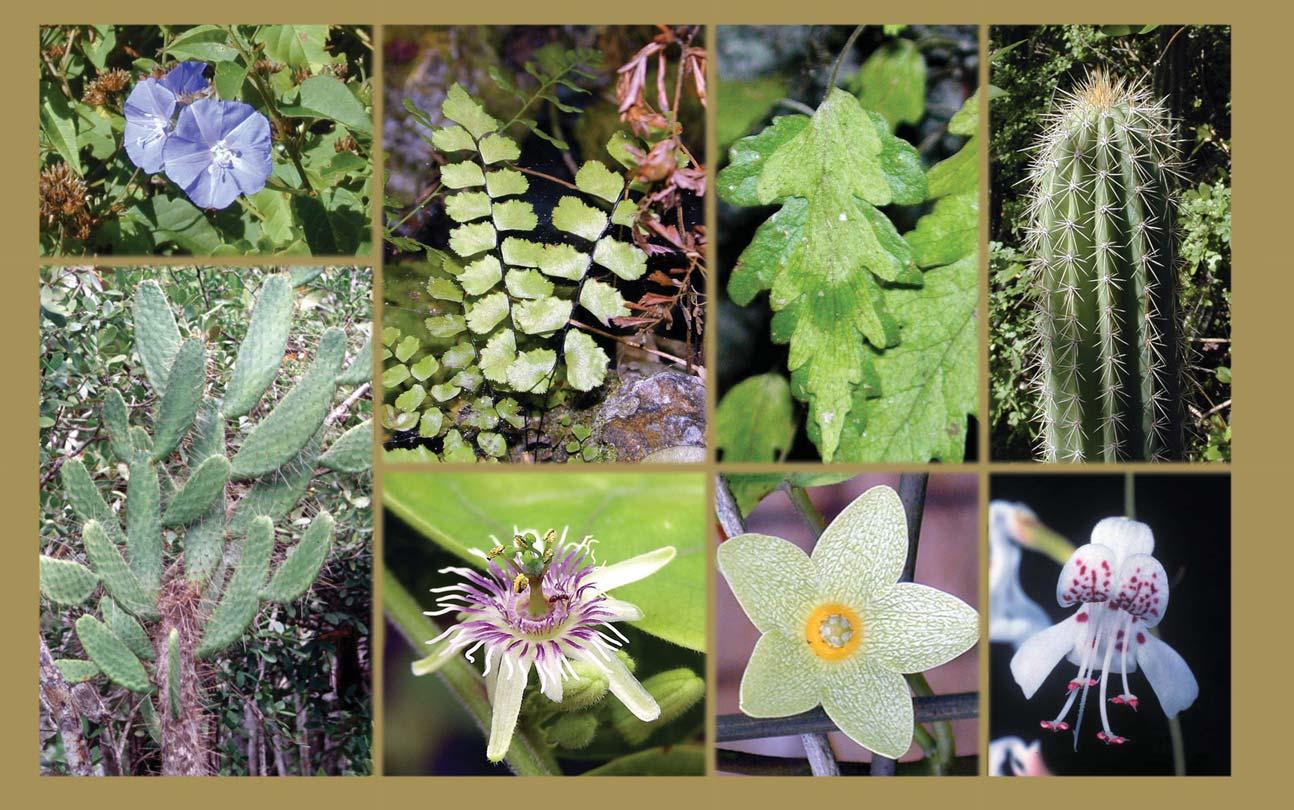
Photos:(Left to right).
First Row – Jacquemontia
Second
by Tom Eisner).
pentanthos; Adiantum melanoleucum; Tectaria fimbriata; Pilosocereus robinii (photos by Jennifer Possley);
Row – Consolea corallicola (photo by Meghan Fellows); Passiflora sexflora; Matelea alabamensis (photos by Jennifer Possley); Dicerandra frutescens (photo
Primrose Willow Ludwigia peruviana (ONAGRACEAE)
by Daniel B. Ward
he primrose willow (Ludwigia peruviana (L.) Hara) is a familiar member of Florida’s flora, frequent to common in wetlands throughout the peninsula though somewhat sporadic in the panhandle. Since its first discovery late in the nineteenth century it has been assumed to be an introduction to the state. But a recent appraisal by a Florida regulatory agency has cast doubt on that status. Whether it should cause concern as an exotic that is perhaps invasive, or whether it should merely be admired as an attractive member of Florida’s native flora, is an issue that needs determination.
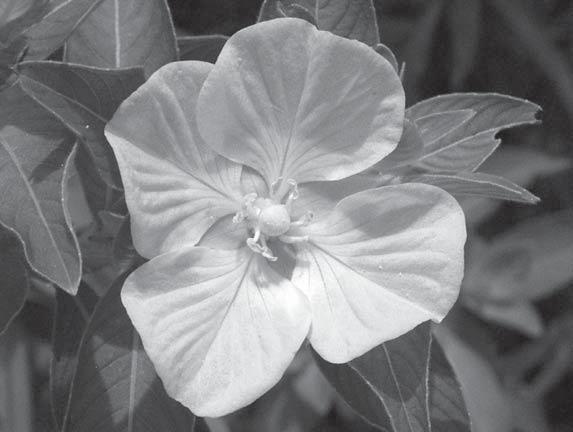
TPrimrose willow is a member of the Onagraceae, the Evening Primrose Family. Its genus, Ludwigia, is well represented in Florida, with twenty-nine species. All have flowers with four yellow petals (though in some the petals are tiny or evanescent). But Ludwigia peruviana stands out. While all other Florida members of the genus are annual or perennial herbs, the primrose willow is a soft-stemmed shrub, often to 3 m. or more in height. And its flowers, to 5 cm. diameter, are impressively larger than those of its congeners.
The common name applied to this species was assigned some decades after its first appearance in the state. As late as 1927 (Harper) and 1933 (Small) the plant was without a vernacular name. But in 1938 Mary Frances Baker, in the first popular Florida “wild flower” book, gave it the name primrose willow. The source of this name is apparent in part; the Onagraceae has long been known as the Evening Primrose Family. The leaves are not appreciably willow-like, but perhaps its wetland habitat was Baker’s inspiration for “willow.” Recently, the name has been agglutinated to “primrosewillow” and has been extended to apply to all species of the genus Ludwigia. [By this logic, southern red oak (Quercus falcata) should be termed “southernredoak,” Key tree cactus (Cephalocereus robinii) should become “Keytreecactus,” etc.]
Always, in the determination of nativity, examination of early publications and of early herbarium collections is important, often essential (Ward, 2003). Here, evidence from early field records seems clear. The first collection seen was by A. P. Garber in November 1878, along the Miami River, Dade County. It was then encountered by P. H. Rolfs in June 1893 at Tavares, Lake County; and seemingly not again until found
by S. C. Hood in September 1913 on the bank of Green Spring, Enterprise, Volusia County, and by A. Cuthbert in October 1916 in Manatee Hammock, Manatee County. (These records are all from FLAS, Gainesville.)
Published reports are equally unambivalent. A.W. Chapman did not know of it in his 1860 Flora of the Southern United States, nor in his first revision in 1889. But in his second revision, in 1897, under the name Jussiaea hirta, he reported it as present on the “muddy banks of rivers, south Florida.” In 1894, Charles Mohr (1901), a resident of southern Alabama, found it “adventive on the banks of Mobile River.” And J.K. Small (1903) knew the plant “on banks of rivers, lakes and in swamps, peninsular Florida.”
But even more important is the “negative” evidence, that is, the records of early observers who did not report the species. No mention of a plant that can be interpreted to be Ludwigia peruviana was made by either John Bartram or his son, William Bartram, in the 1760s and 1770s. Nor did Andre Michaux in the 1780s mention the species in his notes, nor is it represented among his Florida collections now preserved in Paris. And we know, from his correspondence to John Torrey of New York, that prior to his 1860 book, Chapman traveled the length of Florida’s western coast, from Apalachicola to Key West, without finding and reporting the plant.
Ludwigia peruviana – Photo by Shirley Denton
And, of course, a plant with the epithet “peruviana” is on its face a native of South America, presumably Peru. Indeed, Linnaeus (1753) first described it as “Habitat in Lima.”
On the surface, then, there should be no question that Ludwigia peruviana is not native to Florida, and that it first appeared here in the late nineteenth century. Uncertainty of its nativity apparently began with a brief note in the Research Management Notes (Younker, 1995), an informal but much respected publication of the Department of Environmental Protection. The author of the note, Don Younker, had proposed the species to the chairman of the Exotic Pest Plant Council for listing as an invasive species. But it was rejected after an official of the Florida Bureau of Aquatic Plant Management cited a reference (Ramamoorthy & Zardini, 1987) that was interpreted to indicate Florida to be part of the natural range of the species.
Younker’s article was brief but blunt. It was titled with the unequivocal assertion, “Primrose-willow is native!” The text proceeded to claim that “Florida is part of the ‘native’ range for this plant,” and “the fortunate conclusion... that primrosewillow is not exotic.” From the date of Younker’s article, Florida land managers have been tilted toward protecting this plant as a “native” species and, even where it is invading natural habitats, have been reluctant to make any effort to control its spread.
The basis for this claim needs examination. The cited reference (Ramamoorthy & Zardini, 1987) is a well-crafted monograph of a section of the genus Ludwigia. All of its species are native to South America, most to southeastern Brazil and northern Argentina. Only three are known in Florida – in addition to L. peruviana there is L. decurrens Walt. [widespread and common] and L. longifolia (DC.) Hara [a single 1961 collection from Seminole Co.]. Ludwigia decurrens was named in 1788 by Thomas Walter in South Carolina. It was perhaps also introduced, but so far back in time and is now so widespread that we usually think of it as native.
Though their work is the basis for the claim that Ludwigia peruviana is native to Florida, Ramamoorthy & Zardini make no such assertion. To the contrary, they note that “in Florida, L. peruviana may behave as a weed, and become especially common along slow-flowing canals and drainage ditches.” But most significantly, and apparently overlooked by those claiming Florida nativity, Ramamoorthy & Zardini provide a map showing the distribution of the four different chromosome numbers (n=32, 40, 48, and 64) they found in the species. In southeastern Brazil all four numbers were present, as would be expected if that area were the home in which the species evolved and from which it has diffused. Of these numbers, only one (n=40) was found in Central America and the West Indies. And only another number (n=48) was found in Florida. Thus the Florida plants cannot be a range
extension from the nearby West Indies, but are most likely a disjunction from Brazil.
But perhaps the most persuasive evidence that Florida is not the native home of the primrose willow is the visual evidence of its present and ever-growing abundance in the state. The largest contiguous stand may be in the marshes along the Oklawaha River of Marion County, where it covers some 2,000 acres. In the late summer a journey down any highway running the length of the peninsula will reveal the tall shrubby plants with their large attractive yellow flowers along every ditch and in every wetland. Surely these plants could not have been present in such numbers and have been overlooked by the early travelers and collectors. Clearly Ludwigia peruviana is an introduction to Florida.
Thus, if primrose willow is introduced, and if the evidence shows the species to be an active invader of undisturbed Florida habitats, perhaps the Exotic Pest Plant Council will reconsider, and permit this exotic to be ranked as “invasive,” as Don Younker once proposed.
I wish to thank Carol L. Lippincott for her information on the invasive spread of Ludwigia peruviana in the marshes along the Oklawaha River; the late Kathy C. Burks for her research of pertinent references; and Richard Abbott for helpful comments regarding the manuscript.
Addendum
In June 2007, after circulation of this manuscript, the Florida Exotic Pest Plant Council’s Plant List Committee unanimously voted to treat Ludwigia peruviana as non-native to Florida and classified it as “Invasive, Category I.”
References Cited
Baker,M.F.1938.Florida Wild Flowers.Macmillan,N.Y.245 pp. Chapman,A.W.1897.Flora of the Southern United States,ed.3.655 pp. Harper,R.M.1927.Natural resources of southern Florida.Florida State Geological Survey,18th ann.rep’t.Tallahassee.206 pp.
Mohr,C.1901.Plant Life of Alabama.Geological Survey of Alabama, Montgomery.921 pp.
Ramamoorthy,T.P.& E.M.Zardini.1987.The systematics and evolution of Ludwigia sect. Myrtocarpus sensu lato (Onagraceae).Monogr.Syst.Bot., Missouri Bot.Gard.19:1-120.
Small,J.K.1903.Flora of the Southeastern United States.Published by the author,New York.1370 pp.
Small,J.K.1933.Manual of the Southeastern Flora.Published by the author, New York.1554 pp.
Ward,D.B.2003.Native or Not:Studies of problematic species.No.1: Introduction.Palmetto 22(2):7-9.
Wunderlin,R.P.1998.Guide to the vascular plants of Florida.Univ.Presses of Florida,Gainesville.806 pp.
Younker,D.1995.Primrose-willow is native! Resource Management Notes, Florida Dept.Environ.Protection,Tallahassee.Vol.6(6):5-6.
About the Author
Dr.Dan Ward is professor emeritus at the University of Florida.
Chapters & Representatives
For chapter contact information,please visit http://www.fnps.org/pages/chapters/chaptermap.php
1.Citrus ..............................Jim Bierly........................................................................jbierly@tampabay.rr.com
2.Coccoloba ......................Dick Workman................................................................wworkmandick@aol.com
3.Cocoplum .......................Joan Bausch.....................................................................................jclb@gate.net
4.Conradina .......................Renee Shaffer.................................................................shaffer_m@bellsouth.net
5.Coontie ...........................Kirk Scott ...............................................................................kirkel1@yahoo.com
6.Dade ...............................Lynka Woodbury....................................................lwoodbury@fairchildgarden.org
7.Eugenia ..........................Sue Thompson....................................................................sue@pa-services.com
8.Heartland .......................AmeeBailey..............................................................ameebailey@polk-county.net
9.Hernando ........................Jim Clayton......................................................................geoska10@hotmail.com
10.Ixia .................................Jake Ingram................................................................jakeingramla@comcast.net
11.Lake Beautyberry ..........Peg Lindsay..............................................................pegcondor@embarqmail.com
12.Lakelas Mint ..................Royce Sisson.................................................................roycesisson@hotmail.com
13.Live Oak .........................Hal Rhodes................................................................rhodeslesstrav2@yahoo.com
14.Longleaf Pine .................Amy Hines.................................................................amy@sidestreamsports.com Cheryl Jones......................................................................wjonesmd@yahoo.com
15.Lyonia ..............................David Schroeder..................................................evolvinglandscapes@yahoo.com
16.Magnolia ........................Ann Redmond............................................................aredmond@mindspring.com
17.Mangrove .......................Al Squires .................................................................ahsquires@embarqmail.com
18.Naples ............................Ron Echols...................................................................preservecaptains@aol.com
19.Nature Coast ..................Susan Vaughn..........................................................................vaughn_s@firn.edu
20.Palm Beach ....................Ray Miller................................................................................rmillerj@sfwmd.gov
21.Pawpaw .........................Paul Rebmann..................................................................wildflpaul@earthlink.net
22.Paynes Prairie ................Heather Blake................................................................butterflygirlh@yahoo.com
23.Pine Lily .........................Christina Uranowski..............................................................curanowski@aol.com
24.Pinellas Debbie Chayet ........................................................................dchayet@verizon.net
25.Sarracenia Lee Norris .................................................................................lnorris@ectinc.com
26.Sea Rocket ....................Eileen Szuchy......................................................................bidensz1@yahoo.com
27.Serenoa ..........................Wilda Meier..............................................................................WQMeier@aol.com
28.South Ridge ...................Karina Veaudry............................................................executivedirector@fnps.org
29.Sumter ............................Anne M.Lambrecht.............................................................annel@thevillages.net
30.Suncoast .......................James Wheeler............................................................jamesh-wheeler@msn.com
31.Sweet Bay .....................Robert Silverio.................................................................bonsaibob@comcast.net
32.Tarflower ........................Rick Ehle.................................................................................ehle07@yahoo.com

The Florida Native Plant Society PO Box 278 Melbourne FL 32902-0278
Leave a lasting legacy
Participate in the Florida Native Plant Society Estate Giving Program.
Please contact:
Candace L.Weller Vice President,Finance 1515 Country Club Road N St.Petersburg,FL 33710 727-345-4619 canweller@aol.com