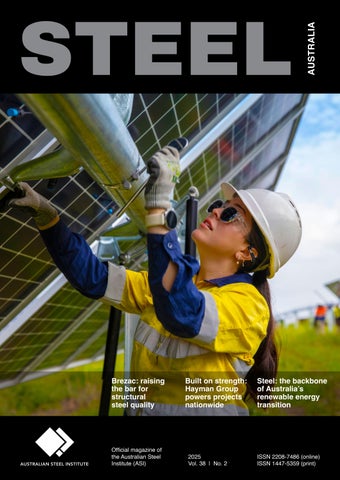
Brezac: raising the bar for structural steel quality
Built on strength: Hayman Group powers projects nationwide
Steel: the backbone of Australia’s renewable energy transition
Suite G1, Ground Floor
25 Ryde Road
Pymble, NSW 2073
T: (02) 8748 0180
E: enquiries@steel.org.au
W: https://www.steel.org.au
ASI STATE OFFICES
New South Wales and ACT
David Varcoe on 0419 136 720
Victoria, Tasmania and South Australia
Sulfianda Soeleiman on 0437 594 571
Western Australia
James England on 0423 614 860
Queensland and Northern Territory
John Gardner on 0418 788 870
ShedSafe
Neil Creek on 0407 107 415
STEEL AUSTRALIA CONTACTS
Managing editor
Steve Andrew on 0473 480 964 or stevena@steel.org.au
Editor
Sally Wood on sally@wordly.com.au
Advertising asimarketing@steel.org.au
+61 2 8748 0180
DISCLAIMER
While every effort has been made and all reasonable care taken to ensure the accuracy of the material contained herein, the Publisher does not assume any responsibility or liability for any loss or damage which may result from any inaccuracy or omission in this publication, or from the use of the information contained herein, and the Publisher makes no warranties, express or implied, with respect to any of the material contained herein.
COPYRIGHT
Reproduction of the material is permitted only with the express permission of the Publisher and due acknowledgment of Steel Australia
ABOUT THE ASI
Steel Australia is published by the Australian Steel Institute (ASI)—the peak national body of the steel industry.
The ASI works to increase the awareness of the benefits of steel and promote Australian made steel as the material of choice. Increasing the competitiveness of the Australian steel industry and its member companies is central to that vision. The organisation conducts engineering seminars and disseminates relevant, timely and detailed information. Expert technical advice, a library and a resource centre are available to all members, along with a range of other member benefits. For information, visit: steel.org.au
Cover image
Aldoga solar farm, ACCIONA Energia.
Taken from the feature, Steel: the backbone of Australia’s renewable energy transition Story starts on page 16.
The ASI is committed to sustainability At the ASI, we are committed to publishing responsibly and promoting a sustainable future. Therefore, we are dedicated to reducing our environmental footprint by printing this publication using paper made with a mixture of responsibly sourced materials.
FROM THE CHAIR
Influencing Australian Standards committees to reflect industry needs
Driving policy discussions including local content policy across federal and state levels to elevate industry priorities
After a challenging 12 months, 2025-2026 is shaping as a transformative year for the local steel industry and the ASI. A resilient and competitive industry is the ASI’s key focus.
The following roadmap has been developed by ASI chief executive Mark Cain and his team in consultation with the Board to achieve these goals:
Industry advocacy
• Trade measures to shield local fabricators from artificially low-priced imports
Monitoring contract compliance for local steel content, both public and private
• Backing export restrictions on unprocessed scrap to retain value within Australia
Inputting to government policy to transition industry to lower emissions
Certification and compliance
Expanding the SCA scheme with dual certifications (AS/NZS ISO 3834 and AS/NZS 5131)
Introducing a traceability system to ensure transparency and accountability in steel products
Sustainability and innovation
Promoting the Steel Sustainability Australia (SSA) scheme, a key tool to align with net-zero and ESG goals
Advocating steel as a preferred sustainable building material, emphasising recyclability and lifecycle strength
Strategic government engagement
• Collaborating on renewable energy projects, positioning steel as central to infrastructure
This roadmap suggests the ASI isn’t just trying to protect the industry; it’s reimagining its foundation to secure long-term growth and prosperity for all facets of the steel supply chain. If you’re part of the sector, or even just following it closely, these initiatives will ripple into areas like manufacturing, construction, and sustainability, and benefit all.
The initiatives follow a challenging year for the local industry marked by a surge in imported fabricated steel entering Australia, the Whyalla Steelworks going into administration, and US Government’s tariffs impacting local producers.
The ASI was highly visible on ministerial bodies and in the media championing the local steel industry in these difficult times. It provided advice to federal and state governments on local content, renewables, green steel and sustainability, and in the media promoting Australian steel as the product of choice.
Nationally, the ASI monitored and responded to the surge in imports by working with the Federal Government on trade measures. It’s briefing paper was directed to the Federal Government’s Department of Foreign Affairs and Trade, and the Department of Industry Science and Resources. It is now commissioning expert legal advice to support a Safeguard action. These next steps are critical to ensuring the viability of local fabricators in a market under pressure from very low-priced offshore supply.
ASI was engaged by Federal Assistant Minister for Trade and Future Made in Australia Tim Ayres (now Minister for Industry and Innovation and Minister for Science) in 2024-2025 to advise on increasing local steel content in the renewable energy sector. The institute continues to believe renewable energy offers enormous potential for the local steel sector—provided local content is embedded in policy and project delivery.
It is also working hard to improve regulator and government understanding of how well steel is positioned to support Australia’s economic development in a lower carbon future; and highlight the benefits of steel.
The year ahead promises to be a challenging one but with your support, the ASI is well positioned to champion the interests of the Australian steel industry. Together, we are building a stronger, safer and more sustainable future.
Tony Schreiber Chair, ASI
TIPS TO PROTECT YOUR SUPER FROM SCAMS
Protecting your super from scammers
Scams are on the rise in Australia and as one of your biggest investments, your super can be an attractive target for scammers. Recently they’ve been targeting individuals with clever techniques which aim to steal personal details, identity or hard-earned retirement savings.
Scammers who target super are skilled at sending messages where they impersonate super funds, government agencies or financial advisers. Often their goal is to trick you into giving away important information like your super member number, login credentials or bank account details. If they can gain access to your super account they can also withdraw your money. Some scammers may even try to convince you to access your super early due to hardship or for investment opportunities.
They may also pose as self-managed super fund (SMSF) advisers and promise very high returns to trick you into transferring your super funds into an SMSF, which is actually the scammer’s own account.
How to spot a super scam email, SMS or phone call
Emails: Look out for emails with poor grammar and spelling errors, urgent requests and language like ‘Act now!’, and unfamiliar or unusual sender address. Hover over links to check if they lead to legitimate websites before clicking them. Don’t enter super login details directly into an email –always use your trusted login page to access your account.
SMS messages: Scammers can make texts look genuine. Be cautious of messages claiming to be from your super fund, especially ones that have suspicious looking links or ask you to provide your personal information.
Phone calls: If someone calls you and claims to be from a super fund, a financial adviser, bank or a government agency and asks for sensitive information like your login details, it’s almost certainly a scammer. Always question unexpected requests for personal or financial details from callers you don’t know, especially if you feel pressure to act quickly or if they promise you early access to your super.
How to protect your super from scammers
Never share your super account information, identification documents or password unless you’re certain the recipient is legitimate. Create a strong password and update it regularly. Make it easy to remember but hard to guess and include a variety of letters, numbers and symbols.
• Check your super account and statements regularly. If you see a change to your personal details that you didn’t make or a suspicious-looking transaction, report it to your fund immediately.
If you suspect you’ve been targeted by a scam, contact your super fund and report the incident to the Australian Government’s Scamwatch webpage.
Sponsored by AustralianSuper Pty Ltd, ABN 94 006 457 987, AFSL 233788, Trustee of AustralianSuper ABN 65 714 394 898.
Any general advice provided in this article is provided under the AFSL held by AustralianSuper, it does not take into account your personal objectives, financial situation or needs. Before making a decision, consider if the information is right for you and refer to the relevant Product Disclosure Statement, available at australiansuper.com/PDS or by calling 1300 300 273. A Target Market Determination (TMD) is a document that outlines the target market a product has been designed for. Find the TMDs at australiansuper.com/TMD.
FROM THE CHIEF EXECUTIVE
Advocating for a level playing field for Australian steel
The Australian Steel Institute (ASI) continues to stand firmly with our international counterparts in the fight against unfair trading practices impacting the global steel industry. At the recent Organisation for Economic Co-operation and Development (OECD) Steel Committee meeting in Paris, it was made clear that excess capacity, particularly from China, poses a significant threat to even the most competitive steelmakers worldwide.
Australia is not immune. Over the past three years, we have seen a sharp rise in low-priced imported fabricated steel, undermining local industry and reducing opportunities for Australian fabricators.
ASI research revealed a rapid increase in fabricated steelwork imports in Australia over the past three years, with the 2024 volume representing an increase of nearly 50% on the 2016 to 2021 period. This had led to a large reduction in the availability of work for local fabricators.
At the same time, we are working closely with the Federal Government to secure an exemption from the United States’ global steel tariffs, recently increased from 25% to 50%. While the decision is disappointing, ASI remains committed to advocating for fairer trading conditions and protecting our industry from further disruption and potential steel dumping.
Australia’s steel sector has always demonstrated resilience and capability. ASI will continue to push for the trade measures and policy settings necessary to ensure our industry’s long-term viability and to secure a fair and level playing field for our members.
SCA adds AS/NZS ISO 3834 to its JAS-ANZ accredited certification service for steel fabricators
Helping steel fabricators meet specific standards or criteria for quality, safety, and sustainability has never been more important in an increasingly regulated market.
With this in mind, Steelwork Compliance Australia (SCA) is now certifying fabricators to both AS/ANZ 5131 and AS/NZS ISO 3834, optimising efficiency, and cost effectiveness, whilst reducing administrative workload.
Opening the SCA scheme to both is a logical step as welding compliance is a critical component to compliant supply, fabrication and erection of structural steelwork under the National Structural Steelwork Compliance Scheme (NSSCS).
The requirements of AS/NZS ISO 3834 as referenced in AS/NZS 5131 are already mandatory, so the efficiencies realised in the auditing and certification process will result in substantive cost and time effectiveness for SCA clients. Certification for both standards will satisfy the requirements of a range of procurement specifications and benefit the industry in general.
The ASI created the NSSCS and has had significant input into development of AS/NZS 5131 and AS 4100. We welcome SCA’s ability to certify fabricators to both AS/NZS 5131 and AS/NZS ISO 3834.
2025 Australian Steel Convention
Planning is well underway for the 2025 Australian Steel Convention. With the theme of Participate Innovate Evolve, the convention will be held from 15 to 17 September at the Manly Pacific Sydney. The convention will offer a comprehensive view of pivotal areas such as sustainability, technological advancement, global market dynamics, and infrastructure development—each critical to driving long-term resilience and growth in the sector. Register via steel.org.au or scan the QR code opposite.
ASI Year in Review 2024-2025
We recently released our Year in Review 2024-2025. The ASI enjoyed strong activity and membership growth over the last 12 months, in what was a challenging year for the local steel industry.
ASI membership rose to a record 6,920 members (700 of those corporate members), with our certification schemes Steelwork Compliance Australia (SCA) and Steel Sustainability Australia (SSA) enjoying continued strong growth.
ASI was highly visible on ministerial bodies providing advice to federal and state governments on local content, renewables, green steel and sustainability, and in the media promoting Australian steel as the product of choice. To read more, scan the QR Code opposite.
As always, we thank you—our members—for your commitment to quality and for being champions of the Australian steel industry.
Mark Cain Chief executive, ASI
READ THE ASI YEAR IN REVIEW 2024-2025
REGISTER FOR THE 2025 STEEL CONVENTION
NEACH: BUILDING A FUTURE IN COMPLEX INFRASTRUCTURE
For nearly five decades, NEACH has been a constant in Queensland’s structural steel landscape. Founded in 1975, the business has evolved from modest beginnings into a respected name in complex infrastructure delivery. Today, under the leadership of managing director Ryza Garbacz, NEACH continues to raise the bar in engineering excellence, delivering critical projects across the defence, mining, transport, and government sectors.
NEACH managing director Ryza Garbacz stepped into the business in 2011, bringing with him a background in civil engineering and corporate project management. His technical expertise and structured approach gave NEACH a renewed focus, transforming it from a generalist steel fabricator into a specialist in high-risk, mission-critical developments.
“When I first joined, the market we operated in wasn’t very rational. It was crowded with small players undercutting each other, often at the expense of quality,” Garbacz explained. “We decided to move in a different direction, building our accreditations, investing in better equipment, and committing to complex infrastructure projects where trust and precision matter.”
NEACH’s journey has been one of constant capabilitybuilding. Extensive upgrades to its Noosaville facility have expanded its manufacturing footprint and workflow efficiency. The company’s factory now boasts advanced processing equipment, including a newly commissioned Peddinghaus laser cutter and a continuous investment philosophy that sees the latest advancements adopted quickly.
“Being regional doesn’t mean being behind,” Garbacz said. “We’ve proven we can partner with large multinational clients and deliver to the highest standards. Whether it’s a rail corridor or a major defence installation, our clients rely on us for certainty and execution under pressure.”
The company’s project portfolio includes key SouthEast Queensland infrastructure, such as the Exhibition Showgrounds Train Station, a critical node for major events like the Brisbane Ekka; the Hope Island Train Station; the
“ South-East Queensland’s population growth is fuelling demand for transport, utilities, and defence infrastructure. We’ve positioned NEACH to support the next wave of complex builds the region needs.”
Sunshine Plaza redevelopment; and involvement in large-scale projects, including Cross River Rail and the Fitzroy to Gladstone Pipeline.
Looking ahead, Garbacz sees major opportunities driven by regional growth and upcoming developments linked to the Brisbane 2032 Olympics. “South-East Queensland’s population growth is fuelling demand for transport, utilities, and defence infrastructure. We’ve positioned NEACH to support the next wave of complex builds the region needs.”
Investing in the industry
Beyond delivering projects, NEACH is also investing in the future of the industry itself. In response to an ongoing shortage of skilled welders and fabricators, NEACH has doubled its apprenticeship intake in recent years. Structured programs expose apprentices to every aspect of fabrication, preparing them for the technical demands of highcomplexity projects.
“There’s been a real shift in the talent pipeline,” Garbacz noted. “We realised early on that simply offering higher wages wouldn’t solve the skills shortage. Instead, we’ve built a strong training program, and it’s changed the culture here. Our apprentices are competitive, motivated, and proud of what they’re achieving.”
Sustainability is a core priority at NEACH, embedded in both operational practice and long-term planning. The workshop roof is fitted with solar panels to reduce reliance on traditional energy sources and support lower-carbon manufacturing. This is also used to charge their fleet of Tesla vehicles, which enables safer, cleaner travel for employees working across regional project sites. These efforts reflect NEACH’s commitment to reducing environmental impact while supporting smarter, future-focused project delivery.
With a 50-year legacy behind them and a future defined by major infrastructure projects, NEACH stands ready: a regional company with national impact, setting a benchmark for precision, resilience, and innovation in Australian steel.
READ THE ARTICLE ONLINE
BUILT ON STRENGTH
From rural beginnings in the 1950s to a trusted national supplier for major infrastructure projects, the Hayman Group has built a reputation on quality, reliability and innovation. With a focus on Australian manufacturing and engineering excellence, the business continues to evolve—investing in cutting-edge technology and nurturing the next generation of skilled workers.
With a legacy that stretches back to 1953, the Hayman Group is one of Australia’s most trusted names in engineered steel products and fabricated structures. What began as a small business supplying horseshoes and fence fittings to rural New South Wales has grown into a multi-division manufacturing enterprise serving critical infrastructure, utilities, transport and power generation industries across the nation.
“Our roots are humble, but the mission has always been the same—serve customers with integrity and deliver quality products that stand the test of time,” said Eric Durbin, managing director of the Hayman Group.
Today, the Hayman Group comprises two major divisions: Hayman Industries, which focuses on locally manufactured steel components for power authorities, traffic and road infrastructure; and Hayman Engineered Structures, a specialist division established in 2023 to meet rising demand for complex steel pole solutions in renewables, lighting, and transmission projects.
A legacy reforged for the future Durbin took over the business with his partners 13 years
ago. Their vision? Expand geographically and diversify into new markets. “At that time, Hayman was still very NSW-centric,” he explained. “We’ve grown steadily into Victoria and Queensland— we’ve had an Energex contract now for close to a decade—and we’ve strengthened our wholesale capabilities.”
Hayman Industries manufactures a wide range of precision steel products— from cross arms and pole top brackets to specialised fittings for transmission lines, roads, and power networks. The company holds long-standing contracts with major utilities and road authorities, thanks in part to its AS/NZS 5131 CC3 accreditation, and its proven ability to meet the rigorous compliance and quality standards required for public infrastructure.
“We’re in a niche space. Entering this market isn’t easy—it takes time and commitment to earn and maintain those certifications,” said Durbin. “But it’s what keeps the quality up and the fly-bynighters out.”
Engineering innovation
The creation of Hayman
“We’ve worked on some significant lighting and power projects across Australia and New Zealand. Having the right team on the ground here— people who understand local compliance and engineering—is a huge advantage.”
Engineered Structures marked the group’s move into more advanced structural solutions. This division offers fully engineered steel pole systems for floodlighting, transmission lines, telecommunications and more—backed by decades of collective experience and supported by cutting-edge design tools such as PLS Pole, Multiframe 3D and Inventor.
With access to one of the world’s largest pole manufacturers for offshore supply and local project management and quality assurance, Hayman Engineered Structures can deliver end-to-end solutions that meet Australian design standards without compromise.
“We’ve worked on some significant lighting and power projects across Australia and New Zealand,” Durbin noted. “Having the right team on the ground here—people who understand local compliance and engineering—is a huge advantage.”
Investing in technology and capability
A hallmark of the Hayman Group’s recent success is its forward-thinking investment in both leading-
edge manufacturing and non-destructive testing technology, as well as mobile contracting services.
The company has established an innovative on-site pole testing service, capable of mapping an entire steel pole, including below ground, to rapidly produce an accurate corrosion map and structural report, allowing ongoing evaluation and management of infield assets.
Most notably, Hayman Industries has installed a state-of-the-art tube laser cutting machine—a major upgrade from its ageing drill line and a leap forward in efficiency and output.
“We’ve recently invested in a tube laser cutting machine, which represents a significant upgrade from the older drill line technology we had when we first acquired the business,” explained Durbin.
“The previous system was becoming increasingly costly and time-consuming to maintain. So, we asked ourselves—if we’re going to invest, what’s the right piece of equipment that not only meets our current needs but also opens the door to new opportunities?”
After exploring various technologies, including plasma drill lines and flatbed lasers, the team identified tube laser cutting as the next logical step. “We looked closely at the quality of output and the versatility of the machines available,” said Durbin. “The key for us was also having local support— someone we could rely on for quick maintenance or breakdown service if needed.”
Hayman selected a machine with a 550mm diameter cutting capacity and 12m infeed and outfeed, allowing for much larger and more varied materials than standard 6m or 8m bed lasers. “We deliberately went bigger. Not only does it cover everything we currently do, but it gives us the capacity to branch into new areas,” he added.
The benefits have been immediate. “The machine does everything the old line could, but it’s faster, more efficient, and produces a
far higher quality finish,” Durbin noted. “We also invested in automated feed-in and feed-out tables, which means we can now talk to major players like Southern Steel about highvolume processing work— something we just couldn’t have done before.”
With the extra capacity, Hayman is now providing processing services for other fabricators and steel suppliers. “It’s been a quantum leap forward in technology for us,” Durbin said. “It’s not just about improving what we already do—it’s about creating new opportunities.”
The machine has already proved its worth on several recent projects, including a lattice tower assembly job where Hayman was able to fabricate additional or damaged components inhouse, without delay. “Being able to respond quickly and keep the project moving— our customers did not experience any time delays. That’s the value we bring.”
Escarpment Boardwalk in New South Wales
Port Adelaide Football Club, Alberton Oval, South Australia
A people-first culture
While technology plays a vital role in the business, Durbin is quick to point out that people remain its greatest asset.
“We’ve got team members who started here straight out of school and have been with us 40 years,” he said.
“We’ve created a really strong working environment with low turnover—and that’s rare in manufacturing today.”
This commitment to people extends to the future workforce, too. The Hayman Group actively invests in apprenticeships to address the skills shortage in Australian manufacturing.
“We’re doing our part to bring new talent into the industry,” said Durbin.
“I came from a trade background myself, and there’s nothing better than seeing young apprentices grow their skills and become part of the team.”
A call for local recognition
Despite its success, Durbin is candid about the challenges facing Australia’s steel industry—particularly the lack of recognition for businesses like his that are investing locally but often overlooked for large-scale projects.
“We hear a lot of talk from the federal government about bringing manufacturing back
onshore, but we’re still seeing the big jobs—and the money—go overseas,” he said. “We’ve never taken a handout. We’ve built a sustainable, competitive business, and yet we’re not given a fair crack.”
Durbin believes real change will only happen if government agencies prioritise local capability over lowest-cost bids from offshore suppliers. “We’re ready to contribute to major infrastructure like the upcoming Brisbane Olympics,” he said. “But we need decision-makers at all levels to back businesses like ours—those that employ Australians, pay taxes, and invest in the next generation.”
The road ahead
With decades of experience, a skilled workforce, and a renewed focus on automation and engineering design, the Hayman Group is well-positioned to support Australia’s infrastructure boom—particularly in renewables, utilities, and transport.
“We’ve built this business on hard work, integrity, and a customer-first mindset,” Durbin said. “Whether it’s a transformer bracket or a fully engineered lighting pole, our customers know they can rely on us to deliver—on time, to spec, and with quality that lasts.”
“We’ve built this business on hard work, integrity, and a customer-first mindset. Whether it’s a transformer bracket or a fully engineered lighting pole, our customers know they can rely on us to deliver—on time, to spec, and with quality that lasts.”
Lighting poles in Coober Pedy, South Australia
Mt Gunson South, South Australia
BREZAC CONSTRUCTIONS: RAISING THE BAR FOR STRUCTURAL STEEL QUALITY
Founded in 1986, Brezac Constructions is a proudly family-owned structural steel fabrication business based in Crestmead, south of Brisbane. For nearly four decades, Brezac has delivered high-quality steel solutions across infrastructure, mining, gas, commercial and government projects—earning a reputation for reliability, capability and integrity. The company was established by Gus Brezac, whose early work fabricating and installing handrails and staircases on weekends quickly grew into a thriving enterprise. “My father Gus started out in 1965 doing fabrication after hours and on weekends. By 1986, he and my mum Daphne had launched Brezac Constructions. I joined the company in 1994, and in 2007 became the managing director, alongside my brother Peter. Together, we’ve continued to grow the business,” explained director Andrew Brezac.
Brezac Constructions operates out of a purpose-built 3,000m2²facility equipped with more than 20 fabrication workstations, multiple overhead cranes, and a monthly output of over 12,000 labour hours. The company provides comprehensive services including drafting, protective coatings, galvanising, and onsite installation, managing everything from one-off projects to large-scale, high-volume fabrication packages.
Brezac’s project portfolio is diverse and high-profile. “We’re working on the Gold Coast Light Rail, Cross River Rail train stations and stabling yards, the Cunninghams Gap disaster recovery reconstruction, and the Indooroopilly Roundabout throw screens,” said director Andrew Brezac. “Our team supports tier one builders, government bodies and local contractors.”
Pioneering compliance: first to certify to AS/NZS 5131
In 2015, Brezac Constructions became the first company in Australia to be certified by the Steelwork Compliance Australia (SCA) to the AS/NZS 5131 standard for structural steelwork fabrication and erection— achieving Construction Category 3 (CC3) status. This early adoption reflected the company’s commitment to supporting a compliant, transparent and high-quality Australian steel industry. “We’ve always had a robust quality management system, and we saw certification as a way to not only reinforce our internal processes, but to help level the playing field across the industry,” Andrew said.
The benefits have been significant. “Certification gives us the ability to demonstrate compliance through third-party audits and documented systems. It gives our customers confidence in our processes and outputs.”
Brezac’s advice to other businesses considering certification is straightforward. “You need to be familiar with the standard and understand what’s required—not just on paper, but in practice. For us, certification is a critical foundation. It’s about integrating quality into every part of your operation.”
Supporting the industry, building the future
As a second-generation family business, Brezac Constructions has seen the steel industry evolve through cycles of growth and challenge. Today, Brezac sees opportunities ahead—but stresses that real barriers remain. “There’s enormous potential in the industry—especially for businesses willing to invest in capability and people. But we need more support to grow that confidence,” he said.
“One of the biggest challenges is dealing with non-compliant imported steel, particularly when it’s being used in iconic local projects that should be an opportunity for Australian fabricators. The Australian Steel Institute and others have been strong voices on this issue. We need to keep pushing to ensure public and private procurement that supports local, compliant supply.”
A passion for people and quality
Brezac’s people are at the heart of its success. The company fosters a strong workplace culture based on respect, loyalty and continual improvement. “We’re proud of our team. We have a third generation of the Brezac family that has been with the company for nearly 10 years and is currently managing day to day projects. We’ve had an admin trainee win Trainee of the Year, and we’re passionate about supporting apprenticeships and skills development. It’s part of how we build local capacity. The key is to stay focused on quality, look after your people, and be ready when the upswing comes.”
As the market turns toward more stringent quality expectations and project complexity continues to rise, Brezac Constructions remains one step ahead—committed to delivering certainty, capability and compliance for the long haul.
STEEL: THE BACKBONE OF AUSTRALIA’S RENEWABLE ENERGY
TRANSITION
Australia’s steel industry stands at the threshold of a generational opportunity, as the nation’s ambitious renewable energy targets fuel an unprecedented demand for steel-intensive infrastructure. With the Federal Government aiming for 82% of electricity to come from renewables by 2030, the scale of new wind, solar, hydro, and transmission projects is immense. Steel is the backbone of this transformation.
Every major renewable energy project relies on steel. An onshore wind farm with more than 200 turbines can require around 20,000 tonnes of reinforcing steel just for the turbine bases. Across Australia, more than 140 wind farm projects are in development, each demanding hundreds of tonnes of steel per turbine. The solar sector is equally steel-hungry, with estimates suggesting a need for 100,000 tonnes of structural steel and 100,000 tonnes of tube annually — figures set to rise as Australia expands its renewable footprint.
More than 400,000 tonnes of steel will be required each year through 2030 to service over 28 GW of renewable energy generation projects. Each megawatt of onshore wind requires 124 tonnes of steel, while solar installations need about 45 tonnes per MW. Transmission infrastructure, essential for connecting renewable projects to the grid, will also drive up demand, with every 1,000km of transmission line requiring 2,500 towers, each made from 30 tonnes of steel.
Economic and employment opportunities
Australia’s steel industry already employs more than 100,000 people and produces around 5.7 million tonnes of steel annually. The energy transition promises to supercharge the sector, creating new jobs and revitalising manufacturing regions. If Australia captures just 6.5% of the global steel market, it could generate 25,000 ongoing manufacturing jobs and $65 billion in annual export revenue, particularly in Queensland and New South Wales.
The policy imperative
Seizing this opportunity hinges on the right policy settings. The Federal Government has recognised the strategic importance of local steel, investing $500 million through the Future Made in Australia Innovation Fund to expand fabrication capacity and support onshore manufacturing for wind towers and other clean energy components. Further, up to $3 billion from the National Reconstruction Fund is earmarked for renewables and lowemissions technologies, including green steel.
However, without continued government support and strong local content requirements, Australia risks missing out on the full economic value, as renewable projects could remain reliant on established overseas supply chains. Policy must drive investment in advanced manufacturing, technology and skills to ensure Australia’s steel industry remains globally competitive and sustainable.
Australia’s steel industry has the capacity, capability and willingness to make the renewable energy transition a reality. This is clearly demonstrated by Orrcon Steel’s work with Nextracker on torque tubes—the critical steel structures that enable solar panels to track the sun (see page 20); collaborations between companies like InfraBuild, Austube Mills, Whyalla Steelworks One Steel Manufacturing and Array Technologies on solar farms (see page 26); and the high-performance anchor cages and hold-down bolts that Allthreads and Precision Oxycut produce for wind turbines (see page 22).
The renewable energy boom is a once-in-a-generation chance to cement Australia’s steel industry as a powerhouse of jobs, innovation, and exports. With the right government policy, Australia can not only meet its climate targets but also build a sovereign, sustainable steel sector at the heart of the nation’s clean energy future.
FROM MILL TO MEGAWATT:
ORRCON STEEL MANUFACTURING
HELPS BUILD AUSTRALIA’S SOLAR INFRASTRUCTURE
In an industrial landscape shaped by the need for cost-effective clean energy, one name is quietly changing the game: Orrcon Steel Manufacturing. With deep roots in Australian manufacturing and a vision sharpened by the realities of energy transition, Orrcon Steel Manufacturing is not only embracing the renewables revolution; it’s helping to drive it.
At the heart of Orrcon Steel Manufacturing’s transformation is a strategic commitment to sovereign capability — a concept that has never been more important as Australia seeks to build a resilient, self-reliant renewable energy supply chain. The recent commissioning of the state-of-theart pipe and tube mill at Unanderra, in the Illawarra region of New South Wales, is proof of Orrcon Steel Manufacturing’s long-term commitment to the nation’s future.
Investing big on sovereign capability
The $70 million investment in the Unanderra mill was not a reaction to market demand but a strategic move years in the making and one supported by parent company BlueScope. Orrcon Steel Manufacturing had the foresight to anticipate the growth of the renewables sector.
“Strategically, we decided to invest in tooling so that when international players approached us, we could say we were ready,” said Tony Schreiber, general manager Orrcon Steel
Orrcon Steel Manufacturing Unanderra
Manufacturing. “That was a bold decision at the time along with the major investment in the Unanderra large tubular mill. Still, it’s how we position ourselves — ready with local content and products when they’re needed, not saying we need two years to tool up.”
The investment wasn’t limited to NSW. Orrcon Steel Manufacturing also bolstered its capacity at its O’Sullivan Beach facility in Adelaide providing expanded capabilities across its three manufacturing sites to provide flexible production that meets the needs of the renewables sector.
It’s a bold strategy, with a further $2 million invested in tooling, by Schreiber’s own estimate. But one that will pay returns, as Australia’s commitment to the clean energy transition gathers pace and more largescale solar farms commence construction.
Working in partnership with Orrcon Steel Distribution: local capability on display
Orrcon Steel Manufacturing ’s strategic foresight has more recently come into sharp focus through working in partnership with Orrcon Distribution.
The structural tube produced at Orrcon Steel Manufacturing’s Salisbury site in Brisbane from Australian BlueScope steel coil, is then finished at the Orrcon Distribution’s Northgate facility by Baojia, one of Nextracker’s global manufacturing partners. From there, the wholly Australian made components are trucked to sites like Aldoga, demonstrating a fully capable Australian supply chain that supports local jobs and industry capability.
“This collaboration with Orrcon Steel Distribution, Baojia and Nextracker is another example of how we’re making a difference in the utilityscale solar industry with an Australian-made, high-quality product,” said Schreiber.
The numbers are impressive: there is potential capability to supply up to 50,000 tonnes of torque tubes to support more than 2.5 gigawatts of solar energy generation — enough to power hundreds of thousands of homes. Jobs have been created at Orrcon Steel Manufacturing’s Salisbury
Orrcon Distribution’s Northgate facility
site, with plans to add more resources over the next 12 to 24 months as the volumes grow.
Nextracker’s general manager for Australia, Southeast Asia, and New Zealand, Peter Whealer, sees the collaboration as a win-win. “We are reducing our carbon footprint by manufacturing solar torque tubes in Australia. This will give us the added advantage of accelerating the delivery of our utility-scale solar projects and making clean energy more affordable and accessible.”
Building for the future
While demonstrating this capability to deliver an end-toend Australian manufactured solar torque tube component is a significant milestone, it’s one part of a larger ambition. Through Orrcon Steel Manufacturing’s approach to partner with customers, solar industry OEM’s and large-scale solar farm developers, there is the aim to further build scale and manufacture a range of tubular steel products for Australia’s burgeoning clean energy sector.
But it’s not without its challenges. “We’re committed to local manufacturing, but there’s a real need for government clarity on renewable policy,” said Schreiber. “All we want is a level playing field that helps build and maintain a viable local industry.”
“We’ve invested significantly, with the support of our parent company BlueScope. We just need the right policies that enable domestic manufacturing of torque tube to be competitive and viable”.
It’s this kind of strategic commitment that positions Orrcon Steel Manufacturing as more than just a supplier. They are a partner in the energy transition. With a robust local supply chain, cutting-edge facilities, and a commitment to quality, Orrcon Steel Manufacturing is setting itself up not just for
today’s projects but for the next generation of renewable energy development.
Orrcon Steel Manufacturing’s commitment is aligned with broader policy goals. The Queensland Government’s aims is to drive the state toward achievable renewable targets encouraging investment in local manufacturing along the way.
For Orrcon Steel Manufacturing, the future is clear. “With our parentage through BlueScope, we have the support and strength for many years ahead,” said Schreiber. “We’re planning up for the next five to 10 years. The renewables revolution is inevitable. We want to ensure that when it comes, Australia has the capability it needs—here, and ready.”
In a world hungry for clean energy and resilient supply chains, Orrcon Steel Manufacturing is showing what it means to be ready.
READ THE ARTICLE ONLINE
Orrcon Steel Manufacturing Unanderra
Aldoga Solar Farm: the first large-scale solar project in Queensland to incorporate Australian-made steel torque tube
The 380MW Acciona Energia Aldoga Solar Farm project is located approximately 20 km north-west of Gladstone on the central Queensland coast. It requires highquality steel torque tube components that meet the precise standards needed for solar panels to be efficiently installed. This called for a seamless integration of raw materials, advanced manufacturing, and precision engineering.
The solution
Entrusted with manufacturing tube for supply into the Aldoga project, Orrcon Steel Manufacturing leveraged its manufacturing capability and partnerships:
1. Sourcing Australian-made materials. The journey began with Australian-mined iron ore, processed into steel coil at BlueScope’s Port Kembla Steelworks.
2. Advanced manufacturing. Orrcon Steel Manufacturing, at its Salisbury, Brisbanebased mill, shaped the steel coil into high quality structural tube, one key raw material for solar farm components.
3. Post processing. Then at Orrcon Steel Distribution’s Northgate facility, through its partnership with Baojia Engineering, these structural tubes underwent further processing which combined to meet the exacting standards to enable accurate solar panel mounting.
4. Local delivery. These Australian-made steel tubes are delivered to the Aldoga Solar Farm, where they are mounted onto brackets, ready for the solar panels to be installed by the Acciona Energia team.
5. Cutting-edge integration. With an efficient local supply chain, Nextracker seamlessly incorporated the Australian manufactured torque tubes into its advanced tracking systems.
With most large-scale solar farm’s exclusively using imported torque tube and other steel components from Asia, the collaborative approach of the partners in the Aldoga Solar Farm to seek a local supply alternative clearly demonstrates the Australia steel industries willingness and capability to provide locally milled and manufactured steel tubular components for large-scale solar projects.
Completed seven months ahead of schedule in April 2025, Aldoga’s Queensland project is a significant step for Orrcon Steel Manufacturing, showcasing its commitment to the multi-decade journey, as a partner in local manufacturing, sovereign capability and Australia’s renewable energy transition.
Aldoga Solar Farm. Image credit: Acciona
Aldoga Solar Farm prior to construction
ANCHORING AUSTRALIA’S ENERGY TRANSITION
As Australia accelerates toward a renewable energy future, the demand for reliable, local manufacturing partners has never been greater. Meeting this challenge head-on are Allthreads and Precision Oxycut, two companies quietly becoming essential cogs in the machinery of the country’s wind and solar energy boom.
Under the same parent company, Allthreads and Precision Oxycut have carved out a niche as critical suppliers to the growing renewables sector. Their specialty? High-performance anchor cages and hold-down bolts: the backbone components that literally hold wind turbines in place against the forces of nature.
“Our anchor cages are at the core of turbine stability,” said Simon Preston, group general manager. “Each one consists of 224 bolts, between 3.5 to 4 metres long, weighing around 50 kilograms each. These bolts sit inside two steel rings, or ‘donuts’, six metres in diameter — the same as the turbine base. It’s about 20 tonnes of Australian-made, fabricated steel.”
Once assembled, these cages are encased in around 70 to 80 tonnes of reinforced concrete and 1,000 to 2,000 tonnes of poured concrete in a dome shape, creating what’s known as a gravity anchor. With 2,000 to 3,000 tonnes of earth heaped on top, it’s a feat of engineering designed to hold fast against the immense loads and stresses of rotating turbine blades, often soaring hundreds of metres above the ground.
“People focus on the towers and blades, but without solid foundations, none of it works,” said Preston. “Our bolts and plates are critical to the structural integrity of the entire system.”
Local strength, global competition
Allthreads produces the bolts, while Precision Oxycut (which sources exclusively from BlueScope) fabricates the heavy steel plates. This local supply chain is not only about quality, but about maintaining sovereign capability in a sector often dominated by low-cost imports.
“In China, manufacturers can be producing for thousands of turbines at a time. They have economies of scale we simply don’t,” Preston explained. “Each Australian project is bespoke, and yet we’re able to compete by being nimble, innovative, and by offering higher quality.”
One example of this innovation is a grout pocket forming ring designed in-house. “Previously, grout pockets used expensive foam ingots that would be thrown away after a single use. We invented a reusable steel ring that acts as both a forming mold and a setting template, cutting anchor assembly time from two days down to 90 minutes. It’s a huge improvement, not just in cost but in efficiency and sustainability.”
The Newcastle advantage: next-gen coating technology
Allthreads and Precision Oxycut have also invested heavily in overcoming technical barriers associated with renewable infrastructure. High-strength bolts, particularly Grade 10.9 and 12.9, can’t be hot-dip galvanized because the process risks hydrogen embrittlement — tiny fractures that can lead to catastrophic failures.
To meet the harsh environmental demands of wind farms, especially those near the coast, a new solution was needed. “We couldn’t rely on traditional coatings,” said Preston. “We invested $500,000 in R&D and developed a hot metal spray coating system.”
Initially located at Regents Park, the coating operation has since been relocated to Newcastle to expand its capabilities. The facility now offers a full suite of high-end, industrial-grade coating solutions, designed to extend the
MacIntyre Wind Farm
life of bolts and plates exposed to corrosive environments like groundwater with a pH as low as two.
“This kind of investment is critical,” Preston said. “You can’t cut corners when you’re dealing with infrastructure that needs to last 30 years under extreme conditions.”
Recent projects: from mines to megawatts
Their track record speaks volumes. Over the past three years, Allthreads and Precision Oxycut have supplied anchor cages and bolts for some of Australia’s largest renewable projects, including MacIntyre Wind Farm, Coopers Gap Wind Farm and Clarke Creek Stage 1 both in Queensland, Goyder Wind Farm in South Australia, and St Ives Mine in Western Australia.
Allthreads is supplying Jundee Mine Renewable Retrofit in Western Australia. This is a hybrid energy system led by Zenith Energy and Northern Star Resources, combining 24MW of wind energy, 17MW of solar, and 12MW of battery storage, providing 56% renewable energy to the gold mine. They’re also involved in the Uungula Wind Farm in New South Wales, which is set to have 69 turbines that will generate 414MW, supplying 220,000 homes.
In addition, Allthreads and Precision Oxycut are expanding into the solar market, finalising a supply contract with a major solar tracker OEM for motor brackets and torque tube joining splices.
Challenges and the case for sovereign capability
Despite their success, Preston said there are significant challenges facing Australian manufacturers. “The biggest issue isn’t capability. It’s convincing the market that we can do it here,” he says. “We need government mandates for local content. Not guidelines, but hard, enforceable mandates.”
Preston pointed to existing policies like New South Wales’ 10% local content requirement for wind farms. However, without proper auditing and penalties, these targets are often bypassed.
“The reality is, unless there are real consequences, developers will keep sourcing from overseas where the costs are subsidised by foreign governments. We’re not talking about marginal savings — we’re talking about cutting corners at the expense of Australian jobs and industries.”
According to Preston, fully embracing local manufacturing could be transformative.
“If everything needed for the energy transition — all the steel, all the fabrication — was done here, the increase in electricity bills would be around 75 cents a year. But the benefit would be $2.9 billion worth of GDP growth.”
In his view, grants and incentives help, but what’s really needed is a guaranteed pipeline of work. “Give us the opportunity, and Australian manufacturers will compete on quality, on innovation, and on reliability.”
READ THE ARTICLE ONLINE
“We’re ready,” Preston said. “We have the capability. We have the people. All we need now is the commitment from government and industry to back Australian-made.”
MacIntyre Wind Farm
Anchor cage at Goyder Wind Farm
Coopers Gap Wind Farm
POWERING RENEWABLES
PROGRESS: INFRABUILD’S AUSTRALIAN-MADE SOLUTIONS
Australia’s energy landscape is undergoing a seismic shift. The federal government’s target of sourcing 82% of the nation’s electricity from renewables by 2030 is setting an ambitious pace. Meeting this target will demand unprecedented volumes of infrastructure, at the core of which is steel. InfraBuild, one of Australia’s largest integrated manufacturers and distributors of steel long products and solutions, is poised to help meet this demand.
Through a strategic, coordinated approach to the renewables sector, and ambitious projects like their partnership with Array Technologies and Whyalla Steelworks, InfraBuild is proving that local industry can deliver the scale, quality, and innovation Australia needs for its energy transition.
A strategic commitment to renewables
InfraBuild’s interest in the renewables sector is not new, but recent years have seen a step-change in the way the company is approaching it. Recognising the sheer scale of the coming demand, InfraBuild has established a dedicated renewables working group, bringing together leaders from across the business to identify growth opportunities and build the capabilities needed to serve them.
“We can currently supply some of the products to some of the segments,” said Mark Lewin, InfraBuild Reinforcing’s general manager. “But what we are looking at is how can we
holistically build a suite of products and services that will allow us to participate in the renewables segment much more fully.”
For example, InfraBuild Reinforcing is looking into developing smarter designs for wind tower bases. This includes the potential to move from octagonal to circular bases, integrate their high-strength SENSE 600 reinforcing bar to reduce mass and potentially transport costs, and simplified bar shapes that could make them easier to manufacture.
Logistics and geography are another major focus. Much of Australia’s renewables pipeline lies outside major cities, and in regional areas where existing supply chains are thinner.
According to David Zorzi, manager of business development for Power Generation, “InfraBuild’s reinforcing business is very capital city focused servicing the big infrastructure projects plus high-rise developments, hospitals and
other social infrastructure mainly in the capital cities. So, the challenge for us is that the substantial pipeline of work coming in the renewables space is all regionally based. Part of what the working group is understanding is how we ensure we are ‘match fit’ to be able to service some quite substantial regional projects.”
On top of this many of the transmission lines and in turn wind farms slated to be built in Eastern Australia will be located at the very tops of the Great Dividing Range. “Having to physically deliver to the ridge lines of the Great Dividing Range is going to be challenging, to say the least,” said Zorzi.
In the steel and tube space, the team is primarily focused on large-scale solar and transmission towers, while also investigating how InfraBuild can play a part in the wind tower segment, given that plate is not a part of their integrated supply chain.
InfraBuild’s national business
development manager, Duane Cornish, explained that another area that could be a game changer and being monitored by the working group is the local content policies of the various state governments.
“The Victorian Government has mandated 95 per cent of the steel used in solar farms constructed in that state must be Australian-produced steel. Rules around local content will play a critical part in where, how and how much InfraBuild will invest in different locations. There are inconsistencies with the state’s local content policies. We’re advocating for some sort of federal-level policy, similar to what America has done,” said Cornish.
Cornish also highlighted that using Australian-made steel in the burgeoning renewables market, and not having to rely on other countries, was of importance to our country’s sovereign capability and that this is something all levels of government appear mindful of and will act in favour of Australian steel.
The road ahead
Cornish noted that the renewables market is fiercely competitive; with project returns currently quite low, there is intense pressure on margins. Overseas competitors benefit from lower costs and subsidies, while local manufacturers must operate in a high-cost economy.
Additionally, regulatory loopholes, like the ability for imported steel products to be lightly fabricated offshore and classified to avoid duties, undermine the level playing field Australian manufacturers need.
“We need strong, enforceable local content policies at a federal level,” said Cornish. “State policies like Victoria’s 95% local content requirement for solar farms are a good start, but without consistent enforcement and federal coordination, it’s hard to build the certainty needed for long-term investment.”
Still, the outlook is bright. “With the scale of the opportunity in front of us—solar, wind, green hydrogen—there’s never been a more important time to back Australian steel,” said Cornish. “We’re ready to help power Australia’s clean energy future.”
“What we are looking at is how can we holistically build a suite of products and services that will allow us to participate in the renewables segment much more fully.”
FROM SLEEPER PLANT TO SOLAR FARM
How InfraBuild, Austube Mills, OneSteel Manufacturing Whyalla Steelworks and Array Technologies are reinventing local manufacturing
One of the steel industry’s recent success stories highlights how local capabilities are being leveraged to meet the growing needs of the renewables market. InfraBuild, Austube Mills and OneSteel Manufacturing Whyalla Steelworks have worked together to deliver a local manufacturing solution for Array Technologies, a global leader in solar tracking systems.
Array Technologies is one of the world’s leading suppliers of solar tracking systems. According to Michael Corio, director of Asia Pacific for Array, “We supply all of the steel beneath the modules that actually tilt the solar panels to track the sun, increasing production and generating an overall lower levelised cost of energy. We had a requirement to produce a high level of our components here in Australia, and this enabled us to work with our trusted partners like the Whyalla Steelworks, InfraBuild and Austube Mills.”
Array’s solar trackers require precision-engineered torque tubes and piling, driven into the ground to support solar panels. While the modules themselves were originally sourced overseas, InfraBuild, Austube Mills and the Whyalla Steelworks worked together to deliver a high-quality, locally produced solution, deploying their extensive branch network to supply from mill to site.
For the Horsham Solar Farm, InfraBuild supplied around 2,000 tonnes of tube to Array Technologies—produced at Austube Mills—completing the project’s manufacturing requirements smoothly and ahead of schedule. “The capacity is absolutely there,” said Duane Cornish, InfraBuild’s national business development manager. “When you compare apples to apples, we are very competitive. There’s a perception that Australian industry can’t meet demand, but projects like the Horsham and Glenrowan solar farms prove otherwise.”
The work wasn’t without challenges. Array’s design called for a highly specific octagonal tube, protected by intellectual property. InfraBuild acquired specialised tooling and machinery from Germany, undertook six to nine months of trial production, and rigorously tested quality to meet Array’s exacting standards.
“The Array team noted that our quality and supply were among the best globally,” said Cornish. “It was a real validation of what Australian manufacturing can deliver when given the chance. We now have multiple projects on the horizon with Array Technologies. They are very keen to work with us, even on projects without local content mandates on the tube.”
Innovation at Whyalla Steelworks: repurposing for renewables
In parallel, the Whyalla Steelworks found a unique way to contribute, repurposing existing infrastructure at its Whyalla ‘Trak-Lok’ facility— originally designed for manufacturing steel sleepers for railways—to produce solar farm piling.
“The facility was designed for one purpose: to efficiently mass-produce steel rail sleepers,” said Mark Bubicich, manager technical sales at the Whyalla Steelworks and the project manager. Long steel bars—13 metres long—would move down the line, get sheared, punched with precision holes, formed into shape, and neatly stacked for delivery. The process was highly efficient, tailored to create two to three metre-long sleepers at rapid pace, ideal for the repetitive, high-volume needs of railway construction.”
“However, the plant was under-utilised. Rather than letting it sit idle, we undertook an initiative to retool it for locally value-added solar piles for Australian solar farm projects.”
“Solar farms, it turns out, require a similarly repetitive, high-volume product: solar farm piles. These are steel posts, typically 2.5 to 4 metres long (sometimes longer, depending on ground conditions), with precisely positioned holes to allow for assembly. About 90% of the
Solar post guiding
L to R: Danie Jacobs (Operations Superintendent), Stephen Bence (Team Leader), and Mark Bubicich (Manager Technical Sales).
Pile stack.
posts used in solar farms are identical, making them ideal candidates for mass production using the sleeper plant’s existing capabilities.”
A brownfield retrofit with big potential
Recognising the opportunity, the team embarked on a brownfield retrofit, aligning the plant’s original purpose with the new demand for solar piling.
“We had an idle asset with a lot of inherent capability, and a highly capable team,” Bubicich explained. “It just wasn’t being utilised and waiting for a unique opportunity.”
The conversion wasn’t simple. Solar farm piles are made from 180UB universal beams — a different specification from rail sleepers. To adapt, the team reengineered the roller lines and developed simple ways to flip the beams to present the correct surface for punching then stacking.
One of the most significant engineering challenges was the punching process itself. Rail sleepers only required holes in one flange; solar farm piles needed holes in both. Designing a punching block to achieve this simultaneously took multiple design iterations and extensive testing, including 3D printing prototypes to understand and prove the dynamics including safe removal and flow of the punched slugs.
Maintaining the flexibility to switch back to sleeper production was essential. The roller line changes and the punching press upgrades were designed so that the plant could revert to its original purpose if market demands shifted again.
“We did it all largely in-house, using our own engineers and tradespeople,” Bubicich said. “From operators to boilermakers to fitters to young engineers, everyone contributed to the redesign and development – a true team effort.”
The result? A production line capable of turning out several piles per minute — far faster than traditional beamline drilling and cutting operations, which typically produce a pile in minutes. This production speed means the plant can efficiently meet the high-volume, repetitive demands of large solar farms.
Quality at every step
High production volumes mean nothing without quality. The team installed a new quality assurance station, drawing on expertise from engineers who had previously overseen quality assurance in rolled product mills. “Our check systems and gauges are tightly controlled,” Bubicich explained. “Every pile is part of the quality control regime before it’s stacked, strapped, and dispatched.”
After production, the piles are sent to galvanizers in Adelaide, ready to withstand decades of harsh Australian weather conditions.
A blueprint for sustainable manufacturing
This story is more than just a clever repurposing of machinery; it’s a powerful example of how Australian manufacturing can adapt to meet new challenges. By redeploying existing assets, investing in innovation, and harnessing local skills, the team has created a production capability that supports the transition to renewable energy, all while keeping manufacturing jobs and expertise onshore.
“It’s a real example of brownfield innovation,” said Bubicich. “We’ve been able to pivot existing assets to meet new market needs without massive external investment. It’s sustainable, efficient, and keeps jobs and skills here in Australia.”
New roller line guiding with bar.
After galavnising
BACKING AUSTRALIAN CAPABILITY
BlueScope powers local renewable energy supply chains
As Australia pushes towards an ambitious renewable energy future, increasingly, the question is not whether the country can meet its energy targets—it’s whether the economic benefits of the transition will stay onshore. In the race to build the next generation of energy infrastructure, BlueScope is playing a pivotal role, not just as a steel supplier, but as an enabler of Australian manufacturing capability.
Working hand-in-hand with a wide network of local partners, BlueScope is focusing its efforts on empowering its customers to deliver the infrastructure Australia needs. From wind towers and solar farms to the transmission lines that link them to the grid, BlueScope’s customers are ready to scale up — but long-term certainty from developers and governments is critical to unlocking their full potential.
Waubra wind farm Victoria, ACCIONA Energia
“The industry is ready. The skills, the experience, the innovation — it’s all here. We just need the demand certainty to turn that potential into reality.”
A strategy to strengthen local supply chains
Over the past two years, BlueScope has developed a deliberate strategy to support the renewable energy sector across four key areas: onshore and offshore wind, solar, and transmission infrastructure.
“We’ve been working closely with customers across the country to identify where the opportunities lie and how we can best support them,” said Antony Schillaci, manager marketing and market development at BlueScope Australian Steel Markets. “The reality is, the supply chain capability is there. Our customers have the skills, the facilities, and the readiness to deliver — but to invest and scale, they need consistent demand.”
Critically, BlueScope’s strategy also incorporates a government relations component aimed at securing policy settings that will underpin the sector’s growth.
“We realised early on that strong order books and demand certainty are essential if Australia is going to build the capabilities needed in renewables manufacturing,” Schillaci said. “We’ve been actively engaging with our customers, developers, and government to make that clear.”
BlueScope also has watching briefs on emerging technologies like hydrogen, hydro, and battery storage, maintaining flexibility to support future developments across the clean energy spectrum.
By connecting its steel production capabilities with fabricators, processors, and engineering firms across Australia, BlueScope is helping to create a robust ecosystem designed to meet the technical demands of renewable infrastructure projects.
The company’s role extends beyond simply supplying material. It involves aligning project timelines, supporting technical specifications, providing certification and traceability, and helping customers meet the increasingly complex requirements of largescale energy projects.
Proven capability in solar infrastructure
Nowhere is the readiness of Australian industry more visible than in the solar sector. BlueScope, in collaboration with its customers, has supported the delivery of locally fabricated solar infrastructure across Queensland and Victoria.
Projects like the 130MW Glenrowan Solar Farm, the 118MW Horsham Solar Farm, and the 380MW Aldoga Solar Farm have all benefited from local steel and fabrication efforts. The Aldoga project, in particular, involved local processing and trial fabrication of torque tubes (a critical component in solar tracking systems) through BlueScope’s steel tube and pipe manufacturing business Orrcon Steel in partnership with NextTracker.
“The trial was a major milestone. It demonstrated that local suppliers can meet the high standards required
Aldoga solar farm, ACCIONA Energia
Solar torque production, Orrcon Steel | Metalcorp
by global solar tracker OEMs,” said Luis Goncalves, business development manager - renewable energy, BlueScope Australian Steel Markets. “The quality was signed off, the supply chain proved itself. We’re ready to take that capability to a larger scale.”
Suppliers like Orrcon, Austube Mills, Harrington Industries, and others have delivered solar farm components that meet international quality benchmarks.
“Our customers have proven they can do the work,” Goncalves said. “They have the expertise and the infrastructure. What’s needed now is the market certainty to give them the confidence to invest for the long haul.”
Wind and transmission potential
While solar has helped demonstrate the strength of Australian manufacturing, significant opportunities lie ahead in wind energy and transmission infrastructure. Wind towers are large, high-volume steel structures, and while most are currently imported, local industry is ready to step up.
Anchor cages, wind tower sections, foundation components — these are all areas where Australian suppliers, working in partnership with BlueScope, could deliver. Transmission towers, too, represent a huge market. Today, virtually all transmission infrastructure is imported, but with the right support, this could change.
“Our customers are exploring diversification into wind tower fabrication and transmission components,” Schillaci explained. “The key to unlocking this potential is demand certainty. It’s a big investment. You can’t expect businesses to invest in tooling and capability for just one project. We need to build a visible, credible, sustainable pipeline of work and create the confidence to invest.”
This message is echoed across the sector: Australia’s manufacturers are ready. They just need the demand certainty that comes with long-term government policy and developer commitment.
The role of policy and advocacy Policy support is essential to unlocking Australia’s renewable manufacturing potential. While some state-based local content policies exist, such as those in New South Wales and Victoria, industry leaders agree that they need to be more detailed, enforceable, and backed by a clear national framework.
“There’s strong interest from developers and communities to support local supply chains,” said Schillaci . “But without policy settings that level the playing field, Australian suppliers are forced to compete with heavily subsidised imports. Effective trade measures will also be needed to ensure the viability of Australian manufacturers is not undermined by dumped and subsidised imports.”
In the United States and Europe, significant government intervention has helped domestic industries grow alongside their renewable sectors. Australia, Schillaci believes, has the opportunity to follow suit, but time is of the essence.
“A strong signal from government, a clear policy pathway, would unlock a wave of investment. It’s not just about shortterm projects; it’s about building a long-term, sustainable industry,” said Schillaci.
“The industry is ready. The skills, the experience, the innovation — it’s all here. We just need the demand certainty to turn that potential into reality.”
With a clear strategy, deep customer relationships, and a firm belief in Australia’s industrial capability, BlueScope is helping to build the foundations for a renewable energy future — one where Australian steel and Australian workers are at the centre of the solution.
Wind tower fabrication, Prince Engineering Pty Ltd