NEWSLETTER
Edited by Claudine Borg
European Society for Translation Studies EST Newsletter (Vienna)
Dear
It is with fresh and fond memories of the fantastic 11th EST Congress in Leeds that we have drafted this new edition of the Newsletter. The days in Leeds were a true testament to the buzzling liveliness of the field of Translation and Interpreting Studies, and a refreshing reminder that in an age where AI seems to have taken over the conversation, our field keeps exploring many other equally relevant avenues in research and training. Now we look forward to the 12th EST Congress, which will be organised in Kraków in 2028.
In the 67th edition of the EST Newsletter, we read about the Society’s Executive Board for 2025–2028 and the reshuffling of the Newsletter editorial team. The editors would like to warmly thank Raphael Sannholm for his work on the Newsletter for the last three years and wish him all the best as a Marie Curie post-doctoral grantee at Tampere University. More information about Raphael’s project can be found in the Research Incubator section of this Newsletter. We also warmly welcome three new members to our editorial team: Edin, Patrizia and Javier!
This edition features a full report of the 2025 congress and introduces the next congress. It also includes reports by the 2025 Summer/Winter School Scholarship recipient and two Conference and Training Grants recipients, as well as five excellent contributions to the Emerging Voices column from the winner, runner-ups, and shortlisted candidates for the 2025 EST Young Scholar Prize.
As always, we are grateful to the EST members and colleagues who have contributed to this Newsletter. We are looking forward to receiving your ideas, suggestions, comments, and contributions for the May 2026 Newsletter via secretarygeneral@est-translationstudies.org
All the best!
Claudine,María,Edin, Esther,Patrizia and Javier
Nov e mber 202 5 No. 6 7 ISSN 3079 - 7535
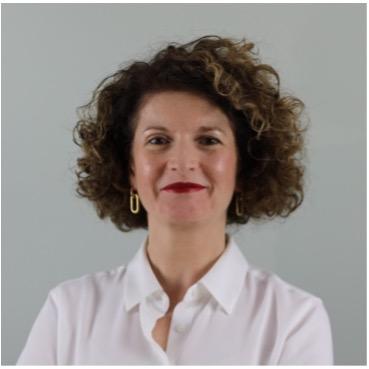

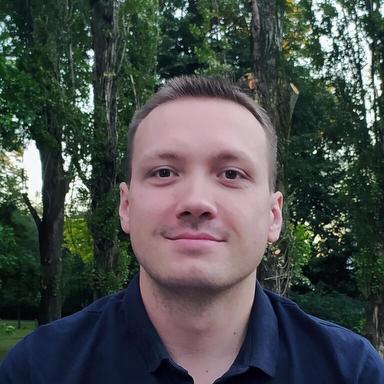
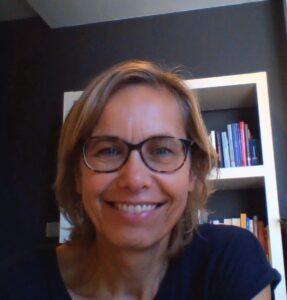
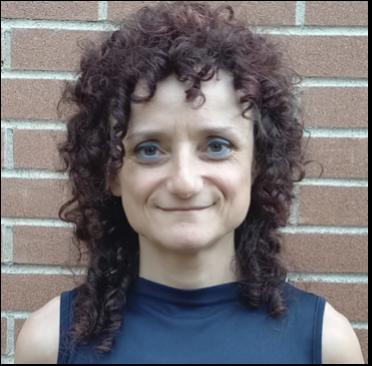
(Malta), María Abad Colom (Oslo), Esther de Boe (Antwerp), Patrizia Giampieri (Mercatorum), Javier Moreno Rivero (Madrid/New York) and Edin Badić (Independent)
Claudine Borg
University of Malta Lead Editor
María Abad Colom OsloMet University Lead Co-Editor
Edin Badić Independent Scholar
Esther de Boe University of Antwerp
Patrizia Giampieri Universitas Mercatorum
Universidad Complutense de Madrid/City University of New York
Word from the President
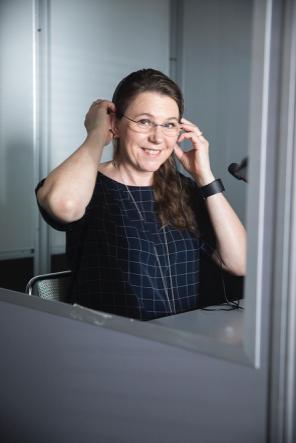
Dear EST members,
The EST Congress this summer in Leeds was indeed a huge success. As always, it was a display of the state of the art in Translation Studies, and it was the largest Congress in EST history and possibly the largest translation studies conference ever. Once again, I would like to thank Sara Ramos Pinto, Callum Walker and their team for the tremendous work they put into our Congress.
As usual, board elections were held at the General Meeting at the Congress, and we said goodbye to three long-standing members who had decided to step down: Isabelle Robert, Luc van Doorslaer and Ilse Feinauer. Isabelle served as the EST treasurer for twelve years (since the Germersheim Congress) with diligence, discretion, patience and cheerfulness, and has been crucial to the smooth functioning of EST throughout. Luc joined the board as vice-president at the Aarhus Congress nine years ago. When I took over as president in 2022, he was my wise sounding board, ensuring the institutional memory of our association. Ilse joined the board in 2019, first serving ex-officio as a representative for the Stellenbosch Congress and then staying on as a regular board member. Ilse has been our liaison beyond the realms of Europe. On behalf of the board, and the EST, I would like to once again express our deepest gratitude for their work in the board. I am happy to welcome Olha Lehka-Paul as our new treasurer and Patrizia Giampieri and Zofia Zieman as new board members. Sara Ramos Pinto, who served ex-officio during the last term, remains on the board and has taken up the position of vicepresident. I am grateful that Maureen Ehrensberger-Dow, Claudine Borg, Jonathan Downie and Paola Gentile were reelected. We had our first online board meeting on October 31st, and I look forward to collaborating with all of my colleagues on the board during the current mandate.
We have had some reshuffling of the editors of the Newsletter. As from the next Newsletter, Claudine is stepping down as lead editor and being replaced by María Abad-Colom. Thank you, Claudine, for staying on as advisory editor and steering the Newsletter into its new ISSN-era and thank you, María, for stepping up. Raphael Sannholm has left the Newsletter as he has taken up a Marie Curie post-doctoral grant, but he continues to contribute to the EST as a member of the Conference and Training Grant committee. Congratulations Raphael and thank you for your work on the Newsletter. The Newsletter team has also recruited three new members: Edin Badić, Patrizia Giampieri and Javier Moreno Rivero. Thank you all for joining the Newsletter!
In September, it was brought to our attention that Middlebury had decided to close its in-person programs at the Institute of International Studies at Monterey, including the only operating conference interpreting program in the whole of the US. In an open letter to the Middlebury President, the Board expressed the Society’s grave concern about the closure and its effect on the profession.
With the Congress in Leeds still fresh in our minds, we are now starting to look forward to our next Congress, in Kraków in 2028. We will continue our work on promoting research on translation and interpreting in all its forms in the meantime. The call for our Conference and Training Grants for 2026 just opened, so help us spread the word to our younger colleagues. Participating in conferences is one of the best ways to grow as a scholar.
I wish you peaceful holidays and all the best for 2026.
Tiselius EST President November 2025
Elisabet
NewsfromthePastCongress
Presentation of the Executive Board 2025–2028

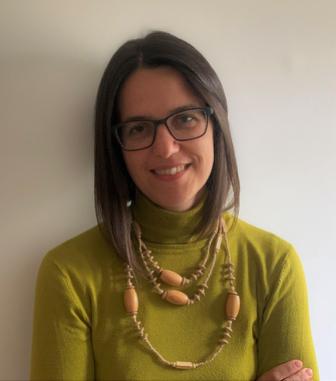
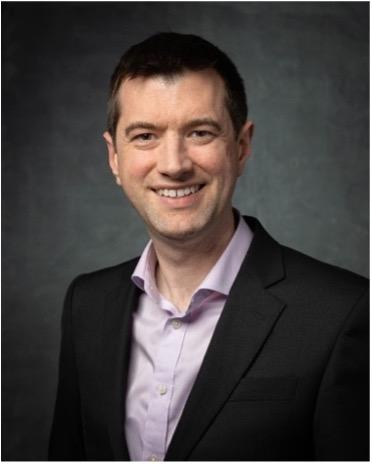
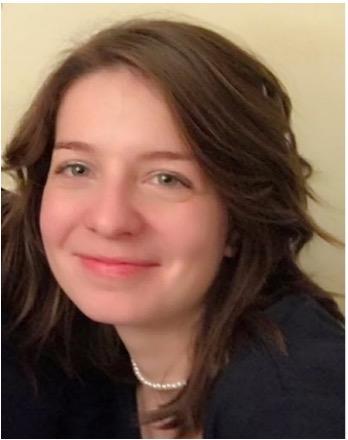
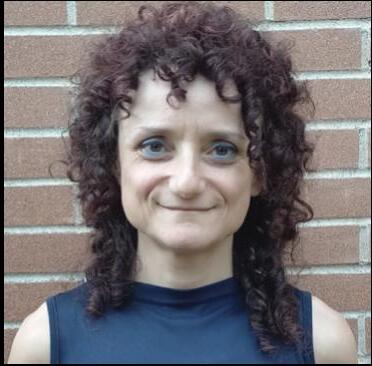
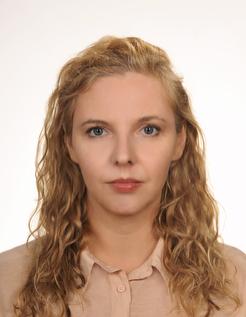
Elisabet Tiselius
President
BEd English/French (Stockholm), MA in Conference Interpreting (Mons), PhD on Expertise in Interpreting (Bergen). Professor at the Institute for Interpreting and Translation Studies, Stockholm University. Member of AIIC and Swedish state-authorized public service interpreter
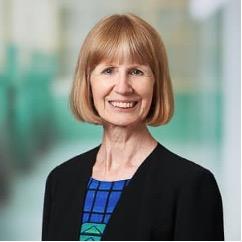
Sara Ramos Pinto
Vice-President
PhD in Translation Studies. Associate Professor in Translation Studies, Centre for Translation Studies, University of Leeds. Board member of ESIST, international board member of CETRA (KU Leuven), research collaborator of CEAUL (University of Lisbon).
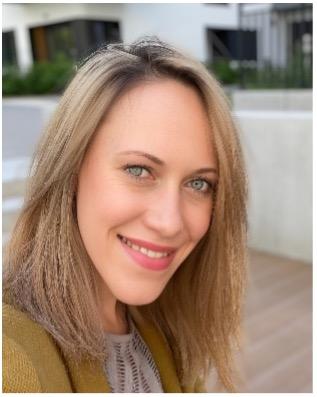
Maureen Ehrensberger-Dow
Secretary General
BA Hons Psychology (Queen’s University, Canada), MSc Psycholinguistics and PhD Linguistics (University of Alberta). Retired Professor of Translation Studies, Zurich University of Applied Sciences (ZHAW). Member of Target editorial team
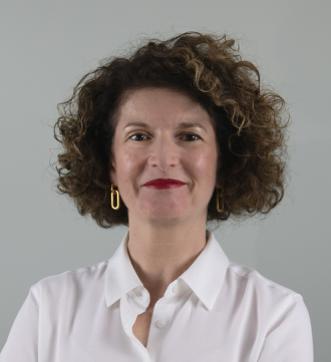
Olha Lehka-Paul
Treasurer
BA English and MA English and Translation Studies (Ivan Franko National University), PhD English Linguistics (Adam Mickiewicz University). Assistant Professor at the Department of Psycholinguistic Studies, Faculty of English, Adam Mickiewicz University. Certified translator and interpreter of Ukrainian.
Claudine Borg
BA in French and International Relations (University of Malta), MA in Translation and Interpreting (University of Malta), PhD in Translation Studies (Aston University, Birmingham). Lecturer at the Department of Translation, Terminology & Interpreting Studies, University of Malta. Literary translator.
Jonathan Downie
BA Hons English and French (Strathclyde University), MSc Conference Interpreting and Translation and PhD Interpreting (Heriot-Watt University). Consultant church and conference interpreter, independent researcher, author, and founder of the Inside Interpreting channel.
Paola Gentile
MA and PhD Interpreting Studies (University of Trieste). Associate Professor of Dutch Studies at the University of Trieste, research fellow at Stellenbosch University and Leiden University, staff member of the CETRA Summer School, review editor of Translation in Society
Patrizia Giampieri
BSc and MSc Economics and Commerce (University of Ancona), MA Applied Linguistics (Aston University), PhD Translation Studies (Università ta’ Malta). Associate Professor of English language, linguistics and translation at Universitas Mercatorum (Italy). Court interpreter and translator
Zofia Ziemann
Congress 2028 representative
BA Cultural Studies, MA English (University of Gdańsk), MA Translation Studies, PhD Literary Studies (Jagiellonian University). Assistant Professor at the Faculty of Polish Studies (Department of International Polish Studies and Centre for Translation Studies), Jagiellonian University. Translator and interpreter (PolishEnglish).
Minutes of the EST 2025 General Meeting
on 1 July 2025, 17.45-19.30 (on site in Leeds and streamed via MS Teams)
Agenda
17:45-18:00
18:00-18:45
18:45-19:15
19.15-19:30
Ascertaining the presence of a quorum (Elisabet Tiselius)
Presentation of the venue for the EST 2028 Congress
1. Report by the EST President (Elisabet Tiselius)
2. Report by the EST Treasurer (Isabelle Robert)
3. Report by the auditors
4. Questions about any of the reports or EST activities
5. Announcements about grants and prizes
• Conference and Travel Grants (Jonathan Downie)
• Summer/Winter Scholarship (Ilse Feinauer)
• Open Access Prize (Luc van Doorslaer)
• Young Scholar Prize (Maureen Ehrensberger)
6. Candidates for the EST Executive Board 2025-2028
7. Elections for the EST Executive Board
• President
• Vice-President
• Secretary General
• Treasurer
• Up to four other members plus a representative of the next Congress, who is elected ex officio. Election of the auditors
9. Questions from the floor
10. Any other business
The President (Elisabet Tiselius) started at 17.45, as scheduled, and ascertained via the VeVox results that the members present on site (81) and online (14) constituted a quorum (i.e., at least 10% of the 699 current members), so the business part of the General Meeting began at just after 17.45.

A presentation was given by Zofia Ziemann to introduce the venue of the 12th EST Congress planned from 27-30 June 2028 at the Jagiellonian University in Kraków.
1. Report by the EST President (Elisabet Tiselius)
• The main activities of the Board included bi-annual meetings (one on-site in Malta); the review, revision and approval of the statutes; the review of the EST endorsement policy; discontinuation of the Book Purchase prize; institutionalization of the ad-hoc grants in the form of Conference and Travel Grants; issuing expressions of concern to Routledge and other publishing houses about making publication data available without contacting authors and to the University of Cardiff about closing their language and translation programs; and preparation for the General Meeting.
• On behalf of the Board and the EST members, the 11th Congress co-chairs (Sara Ramos Pinto and Callum Walker) and their team were thanked with a warm round of applause.
• EST website (est-translationstudies.org). Appreciation was expressed to those responsible for the maintenance and appearance of the website. Members should send any information they want to have posted to the Secretary General.
• The bi-weeklydigest. The Secretary General (Maureen Ehrensberger) was thanked for the email digests, which provide members biweekly with information about current calls for contributions to publications or conferences as well as other time-sensitive notices.
• The EST Newsletter. The editors (Claudine Borg, Raphael Sannholm, María Abad Colom, Esther de Boe) were thanked for the professional newsletters they have produced each May and November. Congratulations on being officially registered with ISSN 30797535.
• Social media. The team (Paola Gentile and Matilde Soliani) were given credit for all the EST followers on Facebook, X (Twitter), and soon LinkedIn.
• WikipediaCommittee. Many thanks to Esther Torres-Simón, who stepped in to organize the pre-conference edit-a-thon workshop. Members are encouraged to promote TS online and to let the committee know if they or anyone they know contributes to TS in Wikipedia.
• Translation Prize. In 2022, three prizes were awarded (to Oleksandr Kalnychenko & Brian James Baer; Terje Loogus; Chiara Bucaria) and in 2024 one prize (to Olaf Immanuel Seel & Charkleia Alatza).
2. Report by the EST Treasurer (Isabelle Robert)
• General overview of assets. The balance of assets as of the GM 2025 is EUR 78,253, which is much higher than that reported at GM 2022 (EUR 56,990) and GM 2019 (EUR 49,552). This increase is primarily due to the large number of new members.
• Membershipsandmethodsofpayments. Membership payments are made via Paypal or (preferably, because no transaction fee) bank transfer to our Belfius account. NB: if the email address or name is missing or different from the details in our membership database, please notify the Treasurer. EST currently has four accounts for payments and/or savings (Paypal; Belfius current; Belfius savings; BAWAG administration).
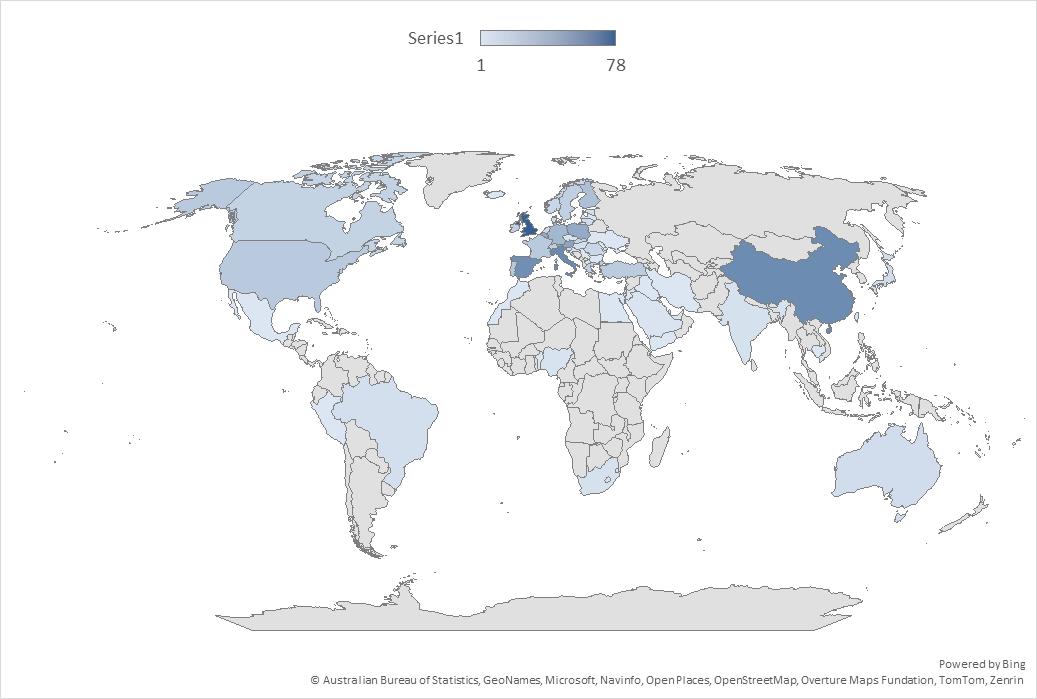
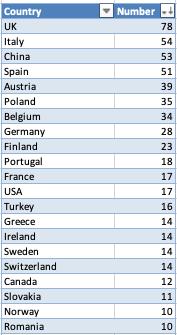
• Over 120 more members belong to EST than in 2022, and many take advantage of the reduction for a 3-year membership and have already paid for the next year or two (i.e., 2026: 335; 2027: 157). The map below indicates countries with at least 10 EST members.
• Expenses. All expenses in the reporting period were booked via the Belfius current account, as summarized below. In addition to the various prizes, the major items were the costs associated with the on-site Board meetings and the 10th EST Congress. The outstanding costs associated with the 11th Congress will be included in the accounts at the 2028 GM.
Sum of Bedrag Column Labels


• Income. The income comprised membership fees (EUR 18,261.54 from the Belfius account plus EUR 25,000 transferred from the Paypal account).
• Budgetforecastfor2025-2028.
Remaining expenses 2025: 2022 Congress EB costs (approx. EUR 6k) plus outstanding 2025 Conference and Training grants (EUR 5k).
Foreseen expenses 2026-2028: Conference and Training grants (EUR 20k); Summer/Winter School scholarships (EUR 3k); Translation Prizes (EUR 4k); Young Scholar Prize (6k); miscellaneous expenses (6k)
Predicted income from membership renewals: 2026 EUR 8,365; 2027 EUR 14,595; 2028 EUR 20,090. NB: these figures are based on the number of members in 2022 rather than the much larger number this year.
Predicted balance: even a conservative prediction of ca. EUR 43k against expenses of approx. EUR 50k would result in a negative result (EUR 6,950) of less than 10% of current assets.
• Conclusion. There are sufficient reserves, with a healthy financial situation foreseen throughout the next term. New initiatives from the Board and members are encouraged.
3. Report by the auditors
The auditors (Lucja Biel and Iris Schrijver) recommended that the GM approve the EST financial statements and budget as presented by the Treasurer.
4. Questions about any of the reports or EST activities and approval
- A member queried how and whether the publishers responded to the Board’s letter about selling access to publications without notifying authors. Elisabet replied that not all the publishers bothered to respond and that EST does not have the mandate or means to pursue a legal challenge. Maureen pointed out that by signing a contract with the respective publisher, authors migh t have inadvertently already given permission.
- A follow-up suggestion was that EST might consider establishing its own journal. The response was to encourage members to consider submitting to the EST Newsletter, which now has an ISSN.
- Another member asked whether there would be a change in the membership fee. The response from the Board was no. Approvalofthefinancialstatementsandbudget: from the members voting “yes”, “no” or “abstain” online via the VeVox poll, the approval for the Treasurer’s work was overwhelming (financial accounts 100%; proposed budget 99%).
5. Announcements about grants and prizes
• Conference and Travel Grants (Jonathan Downie)
Over 40 applications were assessed. Congratulations were extended to the 18 recipients, in alphabetical order by last name: Edin Badić, Andrea Bergantino, Elena Buttignol, Leandra Cukur (Sitte), Rui Du, Marzieh Izadi, Magdalena Kampert, Gurgen Karapetyan, Madiha Kassawat, Letizia Leonardi, Georgine Leung, Sandra Ljubas, Julia Rieser, Kanja Susan van der Merwe, Hanyu Wang, Lili Xia, Xinyao Zhang, Fuqiang Zhao
• Summer/Winter SchoolScholarship (Ilse Feinauer)
Five excellent applications were assessed, and the scholarship was awarded to Shiyi Tan (University of Surrey) to attend the 3rd International Summer School on Cognitive Translation and Interpreting Studies at the Adam Mickiewicz University.
• OpenAccessPrize (Luc van Doorslaer)
As already announced on the website, the two winning submissions were:
Benjamins: Bucaria, Chiara. 2023. The audience strikes back: agency and accountability in audiovisual translation and distribution. Target 35 (3): 331–353. https://doi.org/10.1075/target.00016.buc?locatt=mode:legacy
Routledge: Zeng, Weixin, and Dechao Li. 2023. Exploring an interdisciplinary interface between journalistic translation and journalism studies: insights from discursive news values analysis. Perspectives 33(4): 674–690. https://doi.org/10.1080/0907676X.2023.2215935
The recipients were presented with a certificate. The committee expressed their appreciation to Benjamins and Routledge for making this prize possible.
• YoungScholarPrize (Maureen Ehrensberger-Dow)
The committee evaluated submissions from 32 candidates from almost as many universities and on a wide range of topics. Three finalists were chosen:
1. Zoe Moores (University of Roehampton) for TrainingprofessionalrespeakerstosubtitleliveeventsintheUK:Aparticipativemodelfor access and inclusion
2. Javier Moreno Rivero (University of Cambridge) for Translationpoliciesofminoritisedlanguagesthroughorganisedactivism:A comparativestudyofCatalanandWelsh
3. Senne M. Van Hoecke (University of Antwerp & Macquairie University) for Subtitlesforaccesstoeducation.Theimpactofsubtitles, subtitlelanguageandlinguisticproficiencyoncognitiveload,comprehension,readingandprocessingindifferentstylesofasynchronous, onlineuniversitylectures.
The other shortlisted candidates were Paolo Canavese and Francesca Fritella. Congratulations were extended on behalf of the committee to all of the early-stage researchers who submitted their PhDs for evaluation and especially to the winners and other finalists.
6. Candidates for the EST Executive Board 2025-28
The outgoing Vice-President (Luc van Doorslaer) moderated the presentation of the candidates for the Board and asked if there were any nominations from the floor (none were declared). One of the candidates (Kilian Seeber) announced that he was withdrawing from the election for personal reasons and expressed his confidence in the candidates who were running.
7. Elections for the EST Executive Board
The members could vote “yes”, “no” or “abstain” for each of the candidates by using the VeVox poll that the local organizing committee had set up for the members attending in person and online. The election proceeded smoothly, with no problems reported.
The “yes” results for the executive positions were:
- President: Elisabet Tiselius (98%)
- Vice-President: Sara Ramos Pinto (98%)
- Treasurer: Olha Lehka-Paul (90%)
- Secretary General: Maureen Ehrensberger-Dow (96%)
The four general members were elected with the following results:
- Claudine Borg (96%)
- Paola Gentile (81%)
- Jonathan Downie (92%)
- Patrizia Giampieri (73%)
8. Election of the auditors
Iris Schrijver and Mary Nurminen were elected as auditors for the 2025-28 term (with 94% and 93% “yes” votes, respectively).
8. Questions from the floor
- Heartfelt thanks were expressed to Sara and Callum by Elisabet, who presented a token gift for their team in the form of 1 kg of Swiss miniature chocolates.
- Congratulations were reported from the online participants for the new EST Board.
9. Any other business
• Zofia Ziemann was declared an ex officio Board Member as the representative from the local organizing committee of the next Congress.
• The departing members of the 2022-25 Board (Luc, Isabelle, and Ilse) were thanked for their many years of service to EST and presented with a Swedish-authored book in translation, Swiss chocolates, and warm applause from the Members.
The GM was closed by the newly re-elected President at 19:05.
For the minutes: Maureen Ehrensberger-Dow, Secretary General
11th EST Congress in Leeds, United Kingdom, 30 June – 3 July 2025
Short
Report from the Local Organisers: Thank you and goodbye
After three years of Newsletter updates, it is now time to say goodbye. A little more than four months have passed since the Congress, but the memories of those fabulous days at the University of Leeds still make us smile. What a joy it was for us, the organising team , to welcome you all for the 11th EST Congress, TheChangingFacesofTranslationandInterpretingStudies. Having colleagues from all over the world gathered on our campus was truly special, and we thoroughly enjoyed hosting you here in Leeds.
We want to take this opportunity to thank the EST Board for trusting us with the organisation of such an important event in our discipline, our colleagues and students without whom none of this would have been possible, and all of you who brought four days of learning, sharing, and collegiality to life. We are also very grateful to our sponsors, whose support made the Congress possible: Nimdzi Insights (Diamond Sponsor), Zoo Digital (Gold Sponsor) MultiLingual (Media Partner), and Visit Britain/Visit England (Workshop Sponsor).
From start to finish, the atmosphere was warm, lively, and inspiring. Participants praised the diverse and fascinating programme, with presentations and panels sparking conversations that carried on well beyond the sessions. We were especially proud to host such a truly international gathering. With 95 thematic panel proposals, 50 accepted panels, four general panel categories, 998 paper submissions, 82 online person presentations, and a total of 711 attendees, the Congress was a true celebration of the richness of our ongress received a rating of 4.32/5 in our feedback survey
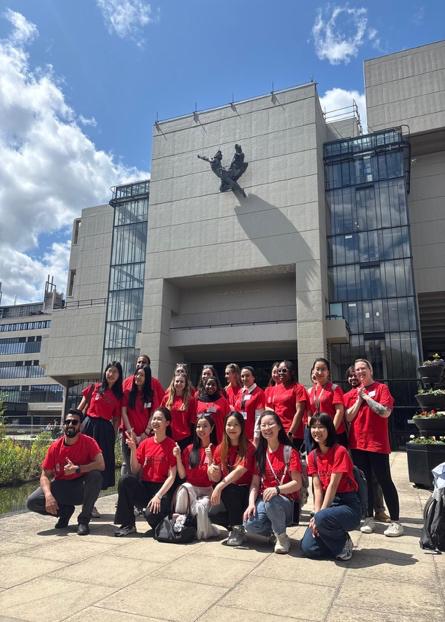
We were deeply touched by your kind words about the pre-congress organisation, with many noting how smooth the process was - from clear communication and well-timed calls, to the user-friendly Oxford Abstracts platform. But what we are most proud of, and thank you wholeheartedly for, are the warm words reserved for our student volunteers and conference team, who were repeatedly singled out for their professionalism, kindness, and helpfulness.
It was wonderful to see colleagues enjoying not just the academic content, but also the small touches: reliable Wi-Fi, easy water refills, and an eco-friendly approach. Many of you commented positively on our little innovations, such as QR-coded name tags linking to the programme and abstracts. The lunches and refreshments were also well received, particularly the vegetarian options and fresh fruit. And of course, our dear Roger Stevens building – perhaps not loved by everyone – was still appreciated for its striking architecture. One thing is certain: it gave us all plenty to talk about!
Above all, what we will remember most is the spirit of community. So many participants spoke about the friendly atmosphere, the chance to reconnect with old friends and meet new ones, and the feeling of being part of a vibrant academic family. To all of you who joined us: thank you for bringing your energy, your research, and your good humour to Leeds. You made EST 2025 truly memorable, and we are grateful to have shared these days with you.

We now pass the baton to the Kraków team, who have already begun preparations. We will send boxes of Yorkshire tea to keep them going through the difficult moments and we will share what we learned – both what went well and what could be improved – to help them put on an even better congress in 2028. Thank you… and see you there!
Sara and Callum
12th EST Congress in Kraków, Poland, 27–30 June 2028
The 12th EST Congress will take place at the Jagiellonian University in Kraków, Poland, between 27th and 30th June 2028, with the theme Diversity andUnityinTranslationandInterpretingStudies. The very format of our EST get-togethers invites meta-reflection on the vastness of the field: a vastness that signifies richness but also, inevitably, compartmentalisation. If translation is ubiquitous as a linguistic, cultural, social, epistemic etc. phenomenon, how do we delimit our (inter)discipline? Are the increasingly sophisticated concepts and methodologies applied in various strands of Translation and Interpreting Studies mutually relevant or, indeed, translatable? How do we navigate between specialisation and general concerns –in research, teaching, in our interrelations with other fields of knowledge and with the industry? In our dramatically polarised world, the notions of diversity and unity of course carry huge socio-cultural, ethical, ideological, and political significance as well, and translation is instrumental in representing, (de)constructing, and/or enforcing them; it is at the heart of the tug-of-war between globalisation and vernacularity. While showcasing top-tier research on diverse topics in various subfields of Translation and Interpreting Studies, we hope to keep the perspective of intellectual and personal togetherness: to connect, converse, and contemplate.
Speaking of unity, the Congress will be jointly hosted by the Jagiellonian University’s Faculty of Polish Studies and the Faculty of Philology, where research on translation has been carried out across various departments. Established in 1364, our university is the oldest higher education institution in Poland and one of the oldest in Europe. With its own museum and a number of historical buildings, the university itself is among the city’s many important sights and symbols. Today, it is a leading research and education institution with almost 5,000 faculty, more than 4,000 nonacademic staff, and 35,000 students.
The Congress sessions will take place in modern buildings on the edge of Kraków’s UNESCO-listed Old Town. First mentioned by chroniclers in the late 10th century and officially established as an urban centre in the mid 13th-century, Kraków used to be the seat of Polish monarchs and one of the most important cities in early modern Europe. It enjoys the reputation of Poland’s cultural capital to this day. Its multicultural heritage and strong ties with literature – it is a UNESCO City of Literature, and its famous citizens include the Nobel Prize laureates Czesław Miłosz and Wisława Szymborska – make Kraków the perfect venue for a celebration of all things translational.
The region of Małopolska (or Lesser Poland, whichever appellation you prefer) boasts six major UNESCO World Heritage sites and will satisfy both culture and nature lovers. With picturesque Jurassic limestone landscapes in the north-west and the imposing Tatra Mountains in the south, it invites you to add at least a few leisure days to your Congress trip. And not to be so Kraków-centric, we acknowledge that the capital city of Warsaw is just a 2.5-hour train ride away.
Following the announcement of the next Congress host in Leeds last June (while we are at it – hats off to Sara and Callum for setting the bar so high!), the Kraków team have been receiving warm messages from colleagues looking forward to visiting our city. Indeed, we can provide an attractive setting, but it is up to Congress participants to fill it with meaningful content. We are very much looking forward to receiving your panel and paper proposals in due course; please stay tuned for upcoming details and do start thinking about your contributions while we get down to work here!
Zofia Ziemann
Gabriel Borowski
Local Organising Committee
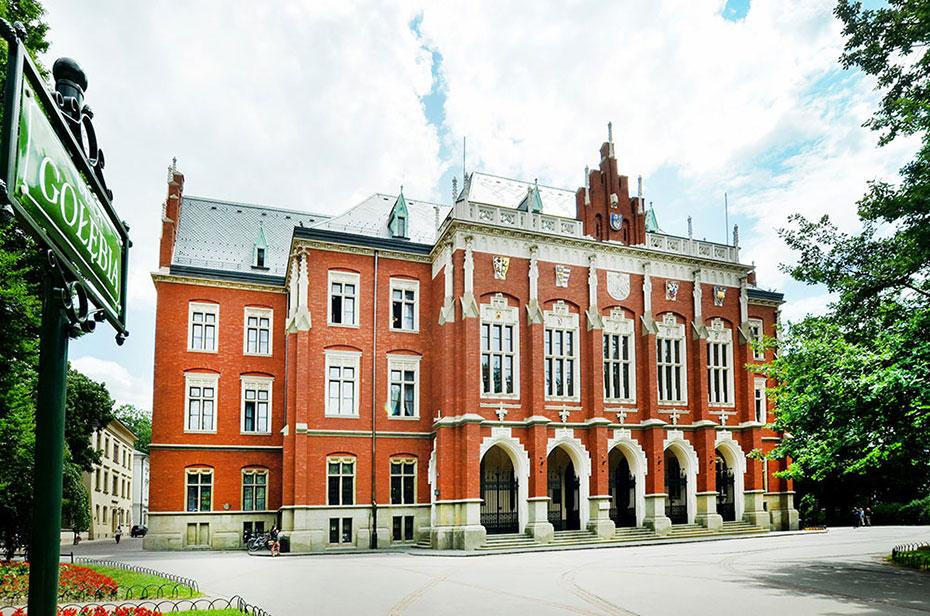

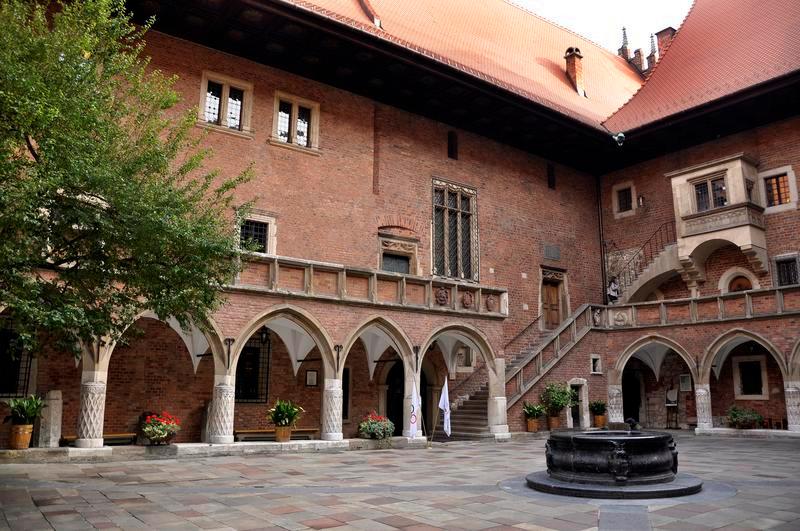
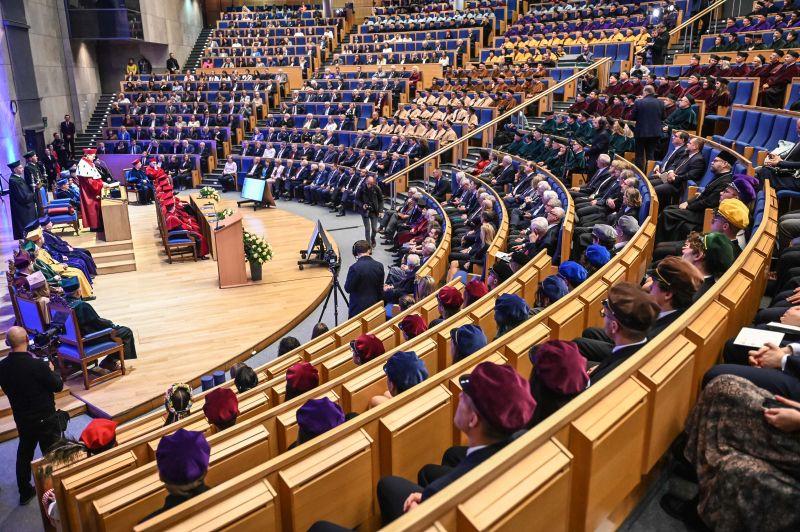
JU Collegium Novum building
JU Collegium Novum building
JU Collegium Maius building
JU Auditorium Maximum building
Photo credit: JU Centre for Communication and Marketing
InitiativesbytheBoard
Call for Contributions to the Emerging Voices Column
The Emerging Voices in Translation Studies column is dedicated to research by PhD students or recent PhD graduates. We would like to invite members to encourage current or recent students to contribute. We usually welcome a maximum of three contributions in each issue. Contributions about a PhD dissertation or current project can be accepted from current PhD students or recent PhD graduates who finished their studies within the previous 12 months.
Texts should be no longer than 900 words each (incl. bibliography) and follow the guidelines here for the ‘Emerging Voices Column’ section in the EST NL, available when you are logged in at the members section of our website.
Call for Contributions to the EST Research Incubator
Write to us if you would like to share information about a planned or new project and benefit from contacts with other researchers in the EST community. Contributions should be around 200–500 words and are to be sent to secretary-general@est-translationstudies.org. More information here
List of Book Series
As members know, EST keeps track of translation journals. We now also have a list of book series in T&I, which can be viewed on our website in the same online form as the journals. You can find the list here. If you would like a book series to be included, please send an e-mail to secretarygeneral@est-translationstudies.org
Publications from EST Congresses
If you know of any publications that originated in EST Congresses and are not yet listed on our website here, please let us know by sending the details to secretary-general@est-translationstudies.org
The 2025 Directory of Members
The updated directory of members has been posted on our Intranet. It includes details of members who paid their fees for 2025 and have requested that their names be listed in the directory. If you want to update your details, please send an e-mail to secretary-general@esttranslationstudies.org
Reminder: Discounts from Publishers for EST members
The Society has arranged for members to receive discounts on books from John Benjamins (30%), Bloomsbury (30%), Multilingual Matters (25%), and Brill (30%). In addition, Routledge offers a 30% discount on the most recent titles in their AdvancesinTranslationandInterpreting Studies series. Refer to the 'Discounts' page of the password-protected 'Members area' of the EST Intranet for more details.
EST-endorsed events
You are welcome to get in touch with us if you are planning an event which you would like us to endorse: secretary-general@esttranslationstudies.org
Communication Channels and Policies
New publications in Translation Studies come to our attention in various ways (e.g., publishers' websites, information from members through channels such as our online forms and e-mail). Notices about new books that our volunteers manage to scan appear in the biannual Newsletter and most also appear in our social media streams. Notices about new publications do not appear in the biweekly email digest, which for reasons of space focuses on time-sensitive information such as calls for conference submissions, calls for papers, and job opportunities. We have recently streamlined our system for requests for postings to our social medial channels. Please see the section below for more details.
Announcements of Events, New Books and Other TS-Related News Items
If you have information relevant to Translation Studies that you would like to have distributed via our channels, kindly use the relevant channel as indicated below:
• Let our community know about any new publications (first edition books and journal special issues only) relevant to Translation Studies: https://forms.gle/bLEu7vHQczgz2nRD6
• Contact us directly about conferences, calls for papers (for conferences, edited volumes, and special issues), new journals, T&I events, and other news on: socialmedia@est-translationstudies.org
Submissions will be actioned as soon as possible.
EST is on LinkedIN
We are now also on LinkedIN. Follow us for updates in between Newsletters.
EST denounces closing of MIIS programmes
The EST Board has denounced the closing of graduate programs at the Middlebury Institute of International Studies (MIIS) at Monterey, in particular the Conference Interpreting programme. The Board pointed out that closing the MA in conference interpreting could be severely detrimental to the international reputation of Middlebury and have grave consequences for the viability of maintaining communication in languages other than English in times where international relations are crucial.
The EST statement can be read here
EST Activities
EST Committees
Young Scholar Prize Committee

MaureenEhrensberger-Dow ChairoftheYoungScholarPrizeCommittee
As reported in the section on the General Meeting, the EST Young Scholar Prize was awarded to three early-stage researchers at the 11th EST Congress in Leeds in recognition of their excellent PhD work. The YSP Committee had the pleasure of evaluating 32 applications that fit the criteria (posted on the EST website) on a wide range of topics within Translation Studies, which was understood by the committee, as in the EST statutes, “in its broad sense of mediation practices in oral, written and other modalities”. Of the five shortlisted PhDs that were evaluated in full, Zoe Moores, Javier Moreno-Rivero, and Senne Van Hoecke emerged as the first, second, and third prize winners, respectively. Congratulations are due to all of the applicants and especially to the other two scholars on the shortlist (Paolo Canavese and Francesca Fritella) for their fascinating research in our constantly changing field.
I would like to take this opportunity to express my gratitude to Agniezska Chmiel, Antonio J. Martínez Pleguezuelos, David Orrego-Carmona, and Anastasia Parianou for their enthusiasm and cooperation during the last three years and for agreeing to stay on another term. We are delighted to welcome Duncan Large to the committee and look forward to the next round of applications in 2028. Please encourage promising young scholars who will have completed their PhD in translation studies by the end of January 2028 to consider submitting an application for the prize. More information about the YSP can be found here
Open Access Prize Committee
Luc van Doorslaer
ChairoftheOpenAccessPrizeCommittee
The new iteration of the Open Access Prize will take place in 2028 and the prizes awarded during the 2028 EST Congress The call for submissions will be issued in 2027.
Summer/Winter School Scholarship Committee

Ilse Feinauer
ChairoftheSummer/WinterSchool ScholarshipCommittee
For 2025 we received five excellent applications, and the members of the Committee, Franz Pöchhacker, Müge Isklar and Maria Piotrowska and I, had our work cut out to decide between them. In the end the grant of EUR 1,000 was awarded to Shiyi Tan who scored a high 25.5 out of 30. Shiyi Tan is a PhD student at the Centre for Translation Studies of the University of Surrey, UK. She has used the scholarship for her participation in the MC2 Lab’s 3rd International Summer School on Cognitive Translation & Interpreting Studies (CTIS) from 7-18 July 2025 at Adam Mickiewicz University. You can read more about Shiyi Tan, her research, and what the grant meant to her elsewhere in the Newsletter. Applications for the EST Summer/Winter School Scholarship will open again next year with the deadline 5 June 2026. Please visit the EST website for more information and the application form.
Translation Prize Committee
Isabelle Robert Chair of the Translation Prize Committee
The EST Translation Prize (EUR 2,000) is awarded biannually for the most deserving project to translate key texts in Translation Studies (including research on interpreting and localisation). The deadline for the next round of applications is 1 October 2026.
Information about past winners of the EST Translation Prize and their resulting publications can be found here
Conference and Training Grant Committee

Jonathan Downie Chair of the Conference and Training Grant Committee
The Conference and Training Grant reopened for applications in early November and will close on 30th January. This time, up to five grants of EUR 500 each will be available to enable people who do not otherwise have access to financial support to attend conferences and training. The Conference and Training Grant Committee look forward to receiving your applications
Wikicommittee

KyriakiKourouni
Chair of the EST Wikicommittee
Quite a few things have happened and/or involved the Wikicommittee.
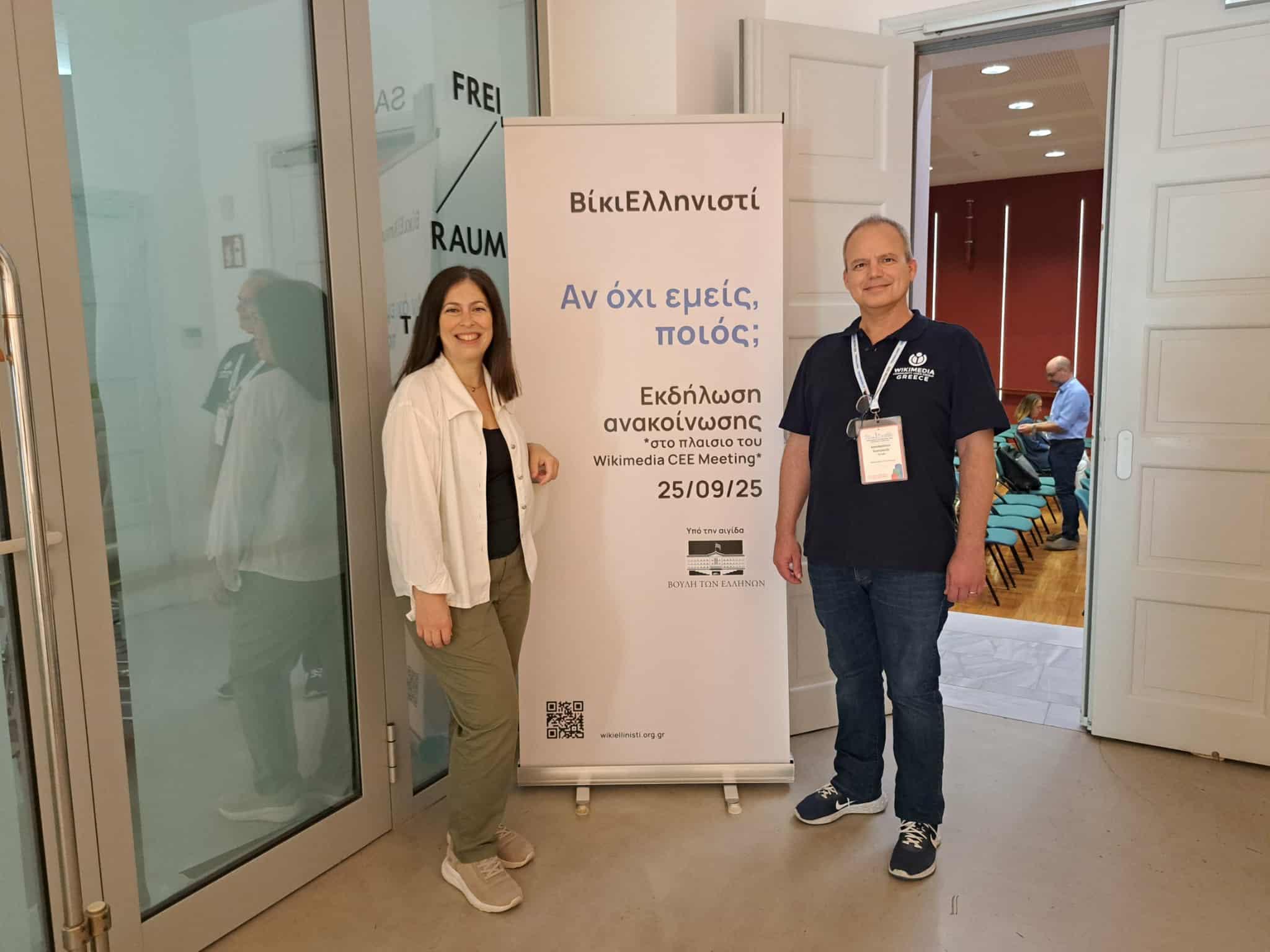
Kyriaki Kourouni was invited to attend the event introducing ΒίκιΕλληνιστί, an initiative under the auspices of the Hellenic Parliament aiming to promote Greek presence in Wikipedia, taking place as an independent event on September 25, concurrently with the Wikimedia CEE
Meeting 2025 (#WMCEE) (the annual conference centered on Wikimedia projects (Wikipedia and other related projects) in countries of Central and Eastern Europe (more recently, also in Central Asia) held in Thessaloniki, Greece, in September and organized by Wikimedia UG Greece. She had talks about joining forces regarding the field of Translation Studies. Another event on the way: Stockholm University will hold its annual Wikipedia event on November 27.
Do stay tuned for the chapter "Between translator education and translation studies: Wikipedia as meta-translation?" by Teresa Musacchio and Kyriaki Kourouni, an outcome of our activities with the EST Wikicommittee, including a flexible roadmap for use in tertiary education [Shuttleworth, Mark & Jun Pan (eds) (in preparation) TranslationandMultilingual PracticeintheWorld'sLargest Encyclopedia:UnderstandingWikipedia's
Dark Matter. New York & Abington: Routledge)].
Following discussions within the committee and taking into consideration current developments concerning translator education and training, we would like to go a step further and introduce the EST Wikipedia resource network. The EST Wikipedia resource network consists of EST scholars ready to support members for their Wikipedia events. We are all experienced in writing Wikipedia articles, arranging editathons, and using Wikipedia as a tool in our teaching. Wikipedia, contrary to AI, has human involvement in all fact-checking and quality assurance steps. Wikipedia is also truly multilingual and thus we strive for translation studies to be an active part of Wikipedia. If you are planning to use Wikipedia in your translation or interpreting classes or if you are arranging an event –do not hesitate to contact one of us.
Kyriaki Kourouni, Konstantinos Stampoulis (Secretary, Wikimedia User Group Greece)
Emerging Voices in Translation Studies
Training professional respeakers to subtitle live events in the UK: A participative model for access and inclusion

Zoe Moores Independentresearcher
The past eighteen years has seen respeaking, where a person uses speech recognition to produce live subtitles, become a common technique for providing access for d/Deaf, deafened and hard of hearing people (DH) on television. Whilst in many countries its use had expanded into other areas, when I began my PhD, this trend had not been seen anywhere near as widely in the UK. The aim of my doctoral research was therefore to explore whether respeaking could be introduced into the live event sector to complement the existing access options. My focus was on unscripted/partially scripted cultural talks, tours and Q&A, where the audience attended in person.
I initially posed two research questions:
1. What training and technical setup is needed to allow experienced television respeakers to transfer their skills to the live event setting?
2. How can high quality respeaking and access be ensured?
Both were very practical in their nature and necessitated that the process and product of respeaking be examined. To do this, I needed to understand what experiences and expectations various stakeholders had of the access options currently available on television and at live events. I adopted an action research methodology that naturally incorporated periods of observation, action and reflection (for example, Koshy et al 2010: 7), so that I would have multiple opportunities to consult these stakeholders, incorporate their feedback, and respond to any new questions that arose. I initially spoke to four different stakeholder groups: two were user groups - DH users, and, to understand how a wider audience group might perceive live subtitling, non-native speakers of English; two were service providers – respeakers, and venues that hosted events. I then developed a training programme for professional television respeakers, and two rounds of research
events followed where respeaking could be tested in action. After each event, feedback from the different stakeholders was collected, leading to the ongoing refinement of the techniques and technical set-up, and the accuracy of the respeaking was analysed using the industry standard NER model (Romero-Fresco and Martínez 2015).
The theoretical underpinning of the study which framed this practical research was embedded within three core notions: intersectionality, which recognises the complex internal and external identities we all have (e.g., Collins and Bilge 2016; de Vries 2015), socialandepistemicjustice, where consideration is given to both equitable access (Rawls 1999) and how different groups are valued and respected within society (Fricker 2007), and the Social ModelofAccessibility (Greco 2019a; 2019b), through which we understand that a single form of access provision may be used in different ways by different groups of people, and that knowledge and planning is needed to embed access. This dimension was captured in a third research question:
3. Can the findings from this UK study be applied to the provision of access across borders and in society more broadly?
On a quantitative level, the technical analysis revealed that the live-event respeaking met expected industry standards and was fit-for-purpose for use in this new setting. Training resources and guidelines were produced, and the NER analysis tool was adapted into the NERLE for use at Live Events (Moores 2024). More broadly, awareness and discussions about access and inclusion among new audiences were sparked during the research events, and a framework for supporting organisations to embed access into processes and events was proposed (Moores 2023: 108-111). Respeaking has continued to evolve and enter new territories; the findings of this study have contributed directly to wider academic research (Szczygielska et al 2020; Davitti et al 2023) and to its increased use in the live event setting
References
Collins, Patricia H. and Silma Bilge. 2016. Intersectionality. Cambridge: Polity Press. Davitti, Elena, Annalisa Sandrelli, Pablo Romero-Fresco, Tomasz Korybski, Zoe Moores and Anna-Stiina Wallinheimo. 2023. ShapingMultilingualAccess through RespeakingTechnology(2020-2023, ES/T002530/1).
https://doi.org/10.13140/RG.2.2.30610.124 81
de Vries, Kylan M. 2015 “Transgender people of color at the center: Conceptualizing a new intersectional model”. Ethnicities 15(1): 3-27.
https://doi:10.1177/1468796814547058
Fricker, Miranda. 2007. EpistemicInjustice: Power and the Ethics ofKnowing. Oxford: Oxford University Press.
Greco, Gian Maria. 2019a. “Accessibility studies: Abuses, misuses and the method of poietic design”. In HCI International 2019 – LateBreakingPapers, edited by C. Stephanidis, 15-27. Cham: Springer International Publishing (Lecture Notes in Computer Science).
https://doi:10.1007/978-3-030-30033-3_2
Greco, Gian Maria. 2019b. “Towards a pedagogy of accessibility. The need for critical learning spaces”. Linguistica AntverpiensiaNewSeries:Themes in Translation Studies 18: 23-46.
Koshy, Elizabeth, Valsa Koshy and Heather Waterman. 2010. Action Research in Healthcare. London: SAGE.
Moores, Zoe. 2023 “What does it take to integrate access at live events?” JoSTrans 39: 99-116.
Moores, Zoe. 2024 “The NERLE model–a tool for assessing the quality of intralingual subtitles at live events”. Universal Access in theInformationSociety 23: 589-607. https://doi.org/10.1007/s10209-02301050-6.
Rawls, John. 1999. ATheory of Justice. Revised Edition. Cambridge, MA: Harvard University Press.
Romero-Fresco, Pablo and Juan Martínez. 2015. “Accuracy rate in live subtitling: The NER model”. In Audiovisual Translation in a GlobalContext:Mapping an Ever-Changing Landscape, edited by J. Díaz Cintas and R. B. Piñero, 28-50. London and New York: Palgrave Macmillan.
Szczygielska, Monika, Łukasz Dutka, Agnieszka Szarkowska, Pablo RomeroFresco, Franz Pöchhacker, Martina Tampir, Wojciech Figiel, Zoe Moores, Isabelle Robert, Iris Schrijver and Veerle Haverhals. 2020. How toImplementSpeech-to-Text Interpreting(LiveSubtitling) in Live Events. Guidelines onMakingLiveEvents Accessible. ILSA Project.
Translation, advocacy, and the struggle for linguistic equality: Translation policies for minoritised languages through organised activism
Rivero,Universidad ComplutensedeMadrid& CityUniversityofNewYork
This project investigates how translation policies shape the revitalisation and normalisation of minoritised languages, focusing on the cases of Catalan and Welsh. While translation and interpreting (T&I) are commonly understood as mechanisms to overcome communication barriers, their potential to foster or hinder linguistic equality and rights has received limited attention. This study addresses this gap by examining how translation policies, conceived as practices, ideologies, and management strategies (González Núñez & Meylaerts 2017), emerge through the interaction of top-down legislative frameworks and bottom-up activist and non-governmental initiatives.
The project is grounded in the idea that translation plays a crucial sociolinguistic role in contexts marked by historical minoritisation. Catalan and Welsh illustrate this dynamic particularly well. Although both languages have followed distinct political and cultural trajectories, their revitalisation has relied on sustained grassroots activism and the expansion of translation rights across key public domains. The research thus asks how translation policies can move beyond their communicative function to contribute to linguistic justice, social cohesion, and equal access to services.
The project combines multi-sectoral policy analysis with ethnographic enquiry: the legislative analysis examines international, supranational, national, and regional frameworks governing translation rights, tracing their reach across broadcasting, public administrations, healthcare, and legal settings. This broad scope is complemented by a qualitative ethnography involving institutional observations and semi-structured interviews with activist organisations.
The findings reveal a persistent misalignment between institutional frameworks and activist-driven expectations in several translation domains. In broadcasting, public channels such as TV3 and S4C have been instrumental in
enhancing the visibility of Catalan and Welsh, respectively, yet activists continue to pressure emerging audiovisual platforms to incorporate minoritised languages more consistently. In public administrations, translation flows overwhelmingly from dominant to minoritised languages, reinforcing linguistic hierarchies and limiting the normative development of Catalan and Welsh as institutional languages. Healthcare settings expose disparities even more starkly: despite the critical role of T&I in patient care, both states lack comprehensive legal frameworks that guarantee access to services in minoritised languages. Legal contexts similarly reveal inconsistencies, particularly in court and police settings where effective interpreting is essential.
The ethnographic data highlight the significance of activism in these developments. Activist organisations do more than advocate for linguistic rights: they actively reshape translation ideologies and influence policy debates at meso- and macro-levels. Their work demonstrates that translation activism is a related yet distinct phenomenon within the broader field of language advocacy. Interviewees consistently articulated a vision of translation as a tool for empowerment, equality, and revitalisation, an approach that challenges narrow, administrative conceptions of translation policy.
From a theoretical perspective, the study introduces the concept of translation equality, which calls for policies ensuring that speakers of minoritised languages have equal access to T&I across all societal domains. This principle resonates with broader movements for linguistic justice and offers a framework for analysing tensions in bilingual and diglossic societies. The project also contributes methodologically by integrating legal and political science approaches into translation policy research, expanding the analytical tools available for examining how rights, governance structures, and institutional practices shape translation provision.
In sum, I argue that translation is not merely a communicative act but a sociopolitical force capable of shaping linguistic futures. By examining the interplay between institutional policies and activist-driven initiatives, the study demonstrates how translation can serve as a catalyst for linguistic justice, minority language revitalisation, and more equitable policy design
Reference
González Núñez, Gabriel and Reine Meylaerts, eds. 2017. Translation and PublicPolicy:InterdisciplinaryPerspectives and Case Studies. New York and London: Routledge.
Subtitles in online lectures: To support, to distract or to be ignored?
Senne M. Van Hoecke OpenUniversiteit
Today’s higher education is faced with increasingly multicultural and multilingual classrooms. While this diversity enriches the learning experience, it introduces a clear challenge: How can higher education institutions cater to these diverse audiences without compromising educational quality? The rapid shift to online and asynchronous (recorded) lectures during the COVID-19 pandemic intensified this challenge, creating a distance between lecturers and their students, while simultaneously increasing the global reach of education. This is not the only opportunity online teaching offers, since certain accessibility features are easier to introduce with digital media. One such feature is subtitling.
Research on subtitles started in the 1970s, but only after the turn of the millennium did cognitive and empirical studies start to emerge (Díaz Cintas 2020). These studies have largely focused on the viewer: how they read, perceive and process subtitles (e.g., Díaz Cintas & Szarkowska 2020). While many studies have shown the benefits of subtitles for accessibility and language learning, results are far less conclusive when it comes to the effects of subtitles on comprehension and cognitive load, the mental load that performing a task imposes on the learner (Paas & van Merriënboer 1994). The large variety of factors that influence subtitle reading and processing and the heterogeneity of research methodologies make it difficult to draw general conclusions. This highlights the need for transparency, more unified approaches and further research.
The Subtitles for Access to Education project set out to examine how the presence and language of subtitles affect comprehension and cognitive load across multiple asynchronous, English-taught philosophy lectures with different design formats. To encourage transparency and consistency in the field, a speciallydesigned ten-step approach to preparing videos and subtitles for experimental subtitling studies was proposed and implemented. After careful preparation, a series of large-scale experiments were conducted with L2 and L1 English speakers.
These experiments confirmed prior research findings showing that subtitles do
not affect cognitive load or comprehension (e.g., Chan 2020; Liao et al. 2020; van der Zee et al. 2017). They also revealed that when subtitles matched the language of the source and the test (English), retention improved significantly, aligning with earlier work from Kruger et al. (2014) and Vulchanova et al. (2015), for example. Furthermore, the large majority of hearing students expressed a strong preference for having subtitles in all their online lectures, perceiving them as beneficial to comprehension, despite no measurable effects, and using them as a backup for when they lost focus. While this would suggest subtitles should just be added to all lectures, the project highlighted some important nuances.
Firstly, interlingual Dutch subtitles were perceived as distracting by proficient L2 English speakers in English-taught lectures and led to a slight, non-significant increase their cognitive load. Secondly, the key aspect of recorded lectures was revealed to be the use of a slide presentation or PowerPoint. When slides were used, comprehension and retention improved, and subtitles were perceived to be less useful. When there were no slides, subtitles were perceived as their replacement. Lastly, students reported they did not watch recorded lectures as they were generally intended. Many reported watching them while cooking, cleaning or playing videogames, treating them more like podcasts than lectures A significant number also watched them at higher playback speeds, in some cases even four times faster than the original speed. Knowing that subtitle speed has a significant effect on reading (e.g., Kruger et al. 2022), this may strongly impact the translation of these findings from an experimental setting to real-world settings.
To conclude, while the project clearly supports the implementation of subtitles in online lectures, more research using transparent methods is required to ensure subtitles have no unintended negative effects when used in authentic environments
References
Chan, Wing Shan. 2020. “An investigation of subtitles as learning support in university education” PhD diss., Macquarie University.
Díaz Cintas, Jorge. 2020. “Audiovisual translation”. In TheBloomsburyCompanion toLanguageIndustryStudies, edited by E. Angelone, M. Ehrensberger-Dow, & G. Massey, 209-230. London: Bloomsbury.
Díaz Cintas, Jorge and Agnieszka Szarkowska. 2020. “Introduction: Experimental research in audiovisual translation - Cognition, reception, production”. TheJournalofSpecialised Translation 33: 3-16.
Kruger, Jan-Louis, Esté Hefer, and Gordon Matthew. 2014. “Attention distribution and
cognitive load in a subtitled academic lecture: L1 vs. L2”. JournalofEye Movement Research 7, no. 5: 1-15.
Kruger, Jan-Louis, Natalia Wisniewska, and Sixin Liao. 2022. “Why subtitle speed matters: Evidence from word skipping and rereading”. AppliedPsycholinguistics 43: 211-236.
Liao, Sixin, Jan-Louis Kruger, and Stephen Doherty. 2020. “The impact of monolingual and bilingual subtitles on visual attention, cognitive load, and comprehension”. The JournalofSpecialisedTranslation 33: 7098.
Paas, Fred G. W. C. and Jeroen J. G. van Merriënboer. 1994. “Variability of worked examples and transfer of geometrical problem-solving skills: A cognitive-load approach”. Journal of Educational Psychology 86, no. 1: 122-133.
van der Zee, Tim, Wilfried Admiraal, Fred G. W. C. Paas, Nadira Saab, and Bas Giesbers. 2017. “Effects of subtitles, complexity, and language proficiency on learning from education videos”. Journal of MediaPsychology 29, no. 1: 18-30.
Vulchanova, Mila, Lisa M. G. Aurstad, Ingrid E. N. Kvitnes, and Hendrik Eshuis. 2015. “As naturalistic as it gets: Subtitles in the English classroom in Norway” Frontiers in Psychology 5, no. 1510
Multilingual legislation, translation and clarity: Insights from Swiss federal Italian
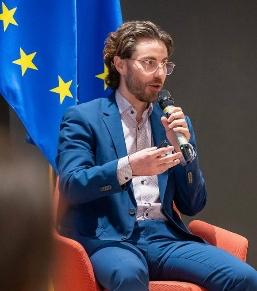
Paolo Canavese UniversityofGeneva
As a multilingual country, Switzerland relies heavily on translation in its law-making process. Federal acts are almost always drafted in German, and to a lesser extent in French – or co-drafted in these two languages – before being translated into Italian (Zwicky and Kübler 2018: 17–21). Although Swiss federal Italian has increasingly attracted scholarly attention, mainly from a qualitative, monolingual perspective (Egger 2019; Ferrari et al. 2025), there is a need for further research that combines quantitative methods and explores the role of translation in this context more deeply.
In my doctoral thesis, I set out to contribute to filling this gap by adopting a diachronic lens and analysing Swiss federal legislation in Italian from the perspective of linguistic clarity. Drawing on LEX.CH.IT, an ad hoc corpus comprising all Swiss federal acts adopted during the thirdlinguistic regime (1974–2018), I conducted a series of empirical analyses to assess clarity and the impact of translation on clarity. These analyses included an NLP-informed linguistic profiling (Montemagni 2013), which allows a wide range of lexical and syntactic complexity variables to be monitored Manual annotation of a trilingual sample provided insights into textuality, focusing on coherence, cohesion, and information structure (Höfler 2019), as well as on translation shifts (Chesterman 2016; Pym 2016). The analyses were informed by guidelines on clear institutional communication (e.g., Cortelazzo and Pellegrino 2003) and complemented by targeted comparisons with other corpora of Italian legislative texts (notably Mori 2018).
The findings show that Swiss Italian language legislation is characterised by a high degree of clarity. This provides empirical support for the idea that Swiss legislation is shaped by the long-standing principle of popularlegislation, introduced by the father of the Swiss Civil Code at the beginning of the twentieth century (Huber 1914).
From a diachronic perspective, two opposing trends emerged. On the one hand, the language has gradually shed
certain superfluous, bureaucratic and archaic features. This simplification reflects the enhanced status of Italian as an official language, largely achieved through political initiatives, the gradual professionalisation of federal translators and a growing concern for clarity in institutional writing in recent decades (Pini 2017). On the other hand, some features point to increasing complexity, such as higher information density, reflecting broader extralinguistic developments, particularly the growing technicality of legal matters (Flückiger 2006).
Translation has proven to be a catalyst for linguistic clarity. At the drafting stage, different language versions of the same legal provision often undergo reformulation using a variety of techniques. The most common include changing the perspective (e.g., from the authority to the addressee), expanding or compressing information to enhance comprehension or streamline the provision, and transposing complex syntactic structures into more readable forms, without altering the legal content. These benefits offset the occasional drawbacks of translated texts, such as calques and unnatural phrasing resulting from interlinguistic influence.
Overall, this study underscores the autonomy of Swiss Italian as an official language, despite its minority status, highlighting its potential as a model of linguistic clarity in other institutional settings. This carries a powerful political message, given that translation is sometimes viewed as a burden at the managerial level due to the time and costs involved, even more since the advent of new translation technologies and the potential savings they offer (Canavese and Cadwell 2024). As the research done for this thesis demonstrates, high-quality translation, in fact, provides a valuable opportunity to enhance the clarity of legislation.
This doctoral thesis received the CIUTI Award 2023 and the Premio Nencioni 2024, and was shortlisted for the EST Young Scholar Prize. It is planned for publication as a monograph in the Easy – Plain –Accessible series (Frank & Timme) in 2026.
References
Canavese, Paolo and Patrick Cadwell. 2024. “Translators’ perspectives on machine translation uses and impacts in the Swiss Confederation: Navigating technological change in an institutional setting”. In Proceedingsofthe25thAnnualConference oftheEuropeanAssociationforMachine Translation(Volume1), 347-359. Sheffield, UK. European Association for Machine Translation (EAMT). https://aclanthology.org/2024.eamt-1.30
Chesterman, Andrew. 2016. Memes of Translation: The Spreadof Ideas in Translation Theory. Revised edition Amsterdam: John Benjamins.
Cortelazzo, Michele A., and Federica Pellegrino. 2003. Guida alla scrittura istituzionale. Rome and Bari: Laterza.
Egger, Jean-Luc. 2019. Anormadi(chi) legge.Peculiaritàdell’italianofederale. Milan: Giuffrè.
Ferrari, Angela, Letizia Lala and Filippo Pecorari, eds. 2025. Dal centro alla periferiadell’italianoistituzionalesvizzero. Nuove ricerche. Alessandria: Edizioni dell’Orso.
Flückiger, Alexandre. 2006. “Le principe de clarté de la loi ou l’ambiguïté d’un idéal”. Cahiers du Conseil constitutionnel 21: 7478. https://archiveouverte.unige.ch/unige:42290
Höfler, Stefan. 2019. “Making the law more transparent: Text linguistics for legislative drafting”. In Legal linguisticsbeyond borders.Languageand Law in a World of Media, Globalisation and Social Conflicts. RelaunchingtheInternationalLanguage andLawAssociation(ILLA), edited by Friedemann Vogel, 229-252. Berlin: Duncker & Humblot. https://doi.org/10.3790/978-3-428-554232
Huber, Eugen. 1914. Erläuterungenzum VorentwurfdesEidgenössischenJustiz- und Polizeidepartements.Zweite,durch VerweisungenaufdasZivilgesetzbuchund etlicheBeilagenergänzteAusgabe. Bern: Buchdruckerei Büchler & Co.
Montemagni, Simonetta. 2013. “Tecnologie linguistico-computazionali e monitoraggio della lingua italiana”. Studi Italiani di LinguisticaTeoricaeApplicata XLII (1): 145-172.
Mori, Laura, ed. 2018. ObservingEurolects: Corpus Analysisof LinguisticVariation Amsterdam: John Benjamins.
Pini, Verio. 2017. Anche in italiano! 100 annidilinguaitaliananellaculturapolitica svizzera Bellinzona: Casagrande.
Pym, Anthony. 2016. Translation Solutions for ManyLanguages: Histories of a Flawed Dream London: Bloomsbury.
Zwicky, Roman, and Daniel Kübler. 2018. TopkaderundMehrsprachigkeitinder Bundesverwaltung. Aarau: ZDA.
Educational Design research on computerassisted interpreting
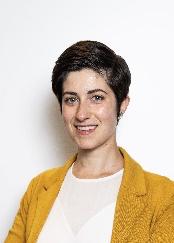
Francesca Maria Frittella UniversityofSurrey
The rapid evolution of technology presents both opportunities and challenges for the interpreting profession. Among these developments, computer-assisted interpreting (CAI) tools - powered by automatic speech recognition (ASR) and artificial intelligence (AI) - hold the promise of enhancing interpreters’ productivity and output quality, particularly in the simultaneous interpretation (SI) of problem triggers (Fantinuoli 2018). However, the integration of CAI tools into interpreter training remains limited (Prandi 2020), constrained by a lack of empirical research and of established educational frameworks for CAI training.
In my PhD thesis, I adopted an Educational Design Research (EDR) approach (McKenney and Reeves 2019) to address this gap. I collected primary data from practising conference interpreters, analysed the knowledge, skills, and attitudes required for effective CAI use, and developed evidence-informed recommendations for CAI training. By translating empirical findings into actionable training design principles, this project bridges the gap between technological innovation and interpreters’ training needs. More broadly, it may offer a methodology adaptable for creating evidence-based educational solutions for other emerging technologies in translation and interpreting.
The research consisted of three phases: (1) Datacollectionandanalysis was conducted across two empirical cycles to iteratively refine the understanding of CAI and its inherent challenges. In this phase, 23 practising conference interpreters performed an SI test using the CAI tool SmarTerp (Rodríguez et al. 2021). I observed their behaviour during the test, collected their performance data for subsequent analysis, and conducted a onehour interview with each participant
afterwards. (2) CognitiveTaskAnalysis (CTA) involved interpreting the data to model CAI skills by applying the FourComponent Instructional Design (4C/ID) model (Van Merriënboer 1997) and Cognitive Task Analysis (Clark and Estes 1996). Using these frameworks, I interpreted phenomena such as CAI errors and perceived challenges as evidence of the underlying knowledge, skills, and attitudes required for CAI, classifying them according to their cognitive characteristics. (3) Educational Design drew on the CTA findings and 4C/ID principles to develop evidence-informed recommendations for CAI training.
The contribution of this work to T&I and its innovative elements can be seen in three key areas: CAI research, CAI training, and, more broadly, educational research in T&I. This thesis advances CAI research by providing a deeper and more nuanced understanding of CAI, for example through the holistic analysis of interpreters’ performance beyond isolated problem triggers, and the exploration of interpreters’ strategy use and task reasoning. It is also the first study to examine CAI with an explicitly educational focus. The results and methodology offer both immediate applications and a foundation for future research on CAI training. Its outputs can support the formulation of evidenceinformed learning objectives, guide educators through the decision-making processes needed to design CAI training tailored to specific educational contexts, and inform future educationally-oriented CAI research.
The novelty of CAI exemplifies a broader methodological challenge common to educational responses to new technological innovations: how can training for a newly emerging skill be systematically designed when both practical expertise and empirical data are scarce? As T&I education continues to evolve alongside technological advancements, the methodology used in this study may serve as a blueprint for developing evidence-informed training solutions for T&I technologies beyond CAI, helping to address current challenges and contributing to the ongoing discussion on reshaping T&I education for the future
References
Clark, Richard and Fred Estes. 1996. “Cognitive task analysis.” International Journal of Educational Research 25: 403–417. https://doi.org/10.1016/S08830355(97)81235-9.
Fantinuoli, Claudio. 2018. “Computerassisted interpreting: Challenges and future perspectives.” In Trends in E-Tools and ResourcesforTranslatorsandInterpreters,
edited by G. Corpas-Pastor and I. DuránMuñoz, 153–174. Leiden: Brill.
McKenney, Susan and Thomas C. Reeves. 2019. ConductingEducationalDesign Research. 2nd ed. London: Routledge. https://www.routledge.com/ConductingEducational-Design-Research/McKenneyReeves/p/book/9781138095564.
Prandi, Bianca. 2020. “The use of CAI tools in interpreter training: Where are we now and where do we go from here?”
inTRAlineaSpecialIssue:Technologyin InterpreterEducationandPractice 2512: 1–10.
https://www.intralinea.org/specials/article/ 2512
Rodríguez, Susana, Roberto Gretter, Matteo Matassoni, Daniele Falavigna, Álvaro Alonso, Oscar Corcho, and Miriam Rico. 2021. “SmarTerp: A CAI system to support simultaneous interpreters in real time.” In ProceedingsoftheTranslationand InterpretingTechnologyOnlineConference (TRITON2021), 102–109.
https://doi.org/10.26615/978-954-452-0717_012.
Van Merriënboer, Jeroen J. G. 1997. TrainingComplexCognitiveSkills:AFourComponentInstructionalDesignModelfor TechnicalTraining. Englewood Cliffs, NJ: Educational Technology Publications.
Research Incubator
Translating Institutional Systems (TRAILS)

Funded by Horizon Europe/Marie Skłodowska-Curie Actions (MSCA) 2025–2027, Grant agreement ID: 101205545.
The nature of cognition in real-life work settings has attracted the interest of scholars from different academic disciplines in the past decades, including Translation Studies. Within Cognitive Translation Studies, there has been an increase in workplace research applying situated cognitive theoretical perspectives, which has brought about a stronger focus on naturally occurring interactions in the translation workplace. The study of translatorial cognition in situ has also led to the introduction of methodological approaches such as (micro)ethnography, multimodal interaction analysis, and conversation analysis.
The MSCA research project TranslatingInstitutionalSystems (TRAILS), which is being carried out at Tampere University in Finland, sets out to further develop this research path by seeking to explore and model distributed cognition in institutional translation settings, such as national governmental agencies and the European Union institutions. Specifically, TRAILS uses cognitive ethnography and multimodal interaction analysis to collect and analyse data on team interactions in institutional translation work. Characterised by the ubiquitous use of technology and workplace cooperation, institutional translation is particularly well-suited for advancing current knowledge on how translatorial cognitive processes, such as meaning formation, problem solving, remembering, and decision making, are distributed across actors, environments, and time.
More information:
https://www.tuni.fi/en/research/translating-institutional-systems-trails https://cordis.europa.eu/project/id/101205545
RaphaelSannholm Marie Curie Research Fellow TampereUniversity
International Doctorate in Translation Studies (ID-TS)
Report from the ID-TS Board
The ID-TS network held a General Assembly at the EST Congress. The hybrid meeting (University of Leeds & Zoom) took place on 30 June, 10.00-12:00 UK Time. As proof of the network’s dynamism, contact persons from all but one of the 21 doctoral programs attended the meeting. This included representatives from the three institutions that had recently successfully applied for ID-TS membership, namely the University of Alcalá, Guangdong University of Foreign Studies, and the University of Warwick. One of the most important tasks of the General Assembly was the election of the ID-TS Board of Management for 2025-2028. All of the four members of the 2022-2025 Board had expressed an interest in standing for election, and at the General Assembly Iris Schrijver (U. Antwerp) declared her candidacy, with a particular interest in taking on the role of treasurer, given her experience as the auditor of the EST accounts. In the election, all candidates received 20/20 votes. In the autumn of 2025, the Board of Management, strengthened by the addition of one member, has held frequent meetings and planned future activities.
In December, the Board will continue the ID-TS Talk Series, launched last year, in response to the request for events of this kind that emerged from the questionnaire for PhD students that was sent out in October 2023. The third on-line lecture, "Doing Translation Research Ethnographically: Insights from Fieldwork and Research Practice", will be given by Claudine Borg (University of Malta) on Tuesday, 9 December, at 4.00 PM CET. The talk will be accessible for ID-TS members through Zoom. The previous talks were delivered last year by Joss Moorkens (Dublin City University) and Julie McDonough Dolmaya (York University (Canada).
Based on the feedback obtained from the contact persons at the General Assembly, the ID-TS Board has further developed the network’s two funding schemes, the purpose of which has been to promote networking among PhD students and international co-operation. While the ID-TS Doctoral Training Support Scheme (targeted at academic and training events that are hosted by ID-TS affiliates and open to participation by members of the network) will stay the same, the ID-TS Mobility Grant Scheme will now be open to both PhD students and PhD co-supervisors. The PhD mobility grant aims to enable students of the network to spend time researching at another member institution. Financial assistance will be provided to a limited number of doctoral students, and the maximum grant available to any one student is EUR 1,000. The co-supervisor mobility grant is intended to support the implementation of co-supervised doctoral projects. The Mobility Grant Scheme is open to colleagues at IDTS-affiliated institutions who are officially serving as co-supervisors of doctoral candidates at other programs within the network. Successful applicants will be able to use their funding to visit the partner institution and participate in on-site activities related to the doctoral project, such as fieldwork, an experiment, or the final defense/viva as well as engaging in other teaching, research, and networking activities. A limited number of grants will be available, with the maximum grant awarded to any applicant being EUR 700. When assessing applications to the Mobility Grant Scheme, the Board of Management will prioritise doctoral students and first-time applicants. For both schemes, the deadline for the current round of applications is 31 January 2026. Should funds remain from this round, a second call will be made, with a deadline of 31 August 2026.
Finally, please remember that all the information you may require about the ID-TS, including the funding schemes, can be accessed through our website (https://idts.pro/), our X/Twitter account (@IDTSEST), and our brand-new LinkedIn account (https://www.linkedin.com/in/id-tsinternational-doctorate-in-translation-studies-549a0b355). However, should you have any other queries or suggestions concerning the network, feel free to contact us at idts.board@gmail.com
FernandoPrietoRamos(UniversityofGeneva)andKristiinaTaivalkoski-Shilov(UniversityofTurku),Co-directors of ID-TS
Jonathan Ross(BoğaziçiUniversity),SecretaryofID-TS
IrisSchrijver(UniversityofAntwerp),TreasurerofID-TS NuneAyvazyan(UniversityofRoviraiVirgili),SocialmediarelationsofficerofID-TS
Recent TS Events
Report by the EST 2025 Summer/Winter School Scholarship 2025 Recipient on the 3rd International Summer School on Cognitive Translation & Interpreting Studies
I received the EST Summer/Winter School Scholarship 2025 to attend the 3rd International Summer School on Cognitive Translation and Interpreting Studies (CTIS), organised by the Laboratory for Multilectal Mediated Communication and Cognition (MC2 Lab) of the Department of Interpreting and Translation, University of Bologna (Italy), and by the Faculty of English, Adam Mickiewicz University (Poland).
The summer school was held at Adam Mickiewicz University in Poznań from 7 to 18 July 2025. This year, 24 participants from over 12 universities around the world attended the CTIS summer school. We were at various stages of our academic journeys and were working on a wide range of research topics, such as audio description, computer-assisted interpreting, pre-editing, post-editing, second language learning, subtitling and translation reception. The teaching faculty consisted of six instructors (Prof. Ricardo Muñoz Martín, Prof. Ana María Rojo López, Prof. Christopher Mellinger, Prof. Joss Moorkens, Prof. Bogusława Whyatt and Prof. Agnieszka Chmiel) and three tutors (Dr. Antonio Morata, Dr. Olga Witczak and Dr. Olha Lehka-Paul). Each day, we had three lectures in the morning, followed by a group discussion session in the afternoon. In addition, each student had two individual tutoring sessions per week with different professors.
Attending this summer school had been on my to-do list since its first iteration. I first came across it during my master’s studies, but I was not able to take part at the time due to timing and location constraints. This year, as a second-year PhD student based in the UK, I finally had the opportunity to participate.
The summer school offered a comprehensive programme, covering topics ranging from theoretical foundations and research methods to statistical analysis and publishing in the field of CTIS. In the first week, Prof. Ricardo Muñoz Martín walked us through the evolution of CTIS, along with thought-provoking discussions on competence and expertise, language and meaning, and much more. Prof. Ana María Rojo López gave us a clear and engaging overview of the methodologies, methods and tools employed in CTIS, sharing examples from studies conducted by herself and her team. Prof. Christopher Mellinger introduced us to the statistical side of research, discussing topics such as how to choose appropriate statistical tests and interpret results. In the second week, Prof. Joss Moorkens presented emerging topics and studies pertaining to translation technology, such as translator-computer interaction, job satisfaction, technology and ethics, and AI-powered translation quality evaluation. Prof. Bogusława Whyatt’s lectures viewed translation and interpreting through the lens of cognitive psychology and psycholinguistics, while Prof. Agnieszka Chmiel showed us the whole research process from designing an experiment and writing a paper to presenting findings in public. I have attempted to summarise what each professor taught us at the summer school, but this brief overview could never capture all the ‘aha’ moments they sparked for us. All in all, these lectures gave me a more systematic understanding of CTIS, and I believe they will continue to shape my thinking well beyond the summer school.
During the individual tutorials, I had the pleasure of discussing my current research with several professors, from whom I received constructive suggestions on research design, data collection methods, interface design and statistical analysis. As my project is moving into the main study stage, their feedback could not have come at a better time. The group discussion sessions brought us closer to our tutors and peers. We discussed questions and takeaways from the lectures and learned about each other’s research projects. I was often inspired by my peers during these conversations and found myself able to relate to them when they shared their concerns and challenges in research. Moreover, our tutors and local students kindly gave us a tour of the university’s eye-tracking and EEG labs, where research design moves from paper to practice.
Apart from the academic programme, the summer school also organised a cultural day in Poznań, guided by Dr. Tomasz Skirecki from the host university. We visited the Enigma Museum, explored the city and learned about its history. I also enjoyed our daily lunch breaks, when I chatted with participants from around the world and got to know their academic journeys and cultures.
Overall, the summer school was thought-provoking and well-organised. It enabled me to deepen my understanding of a research field I am passionate about, to reflect on my own project through external feedback, and to connect with scholars and peers who share similar research interests. I would like to thank the organising team, the teaching faculty and all the participants. You made this experience especially enriching and unforgettable.
I would also like to extend my heartfelt thanks to EST and the Summer/Winter School Scholarship Committee. Your support not only helped me tick off a key goal on my academic to-do list but, more importantly, gave me the opportunity to engage with the field of CTIS in a meaningful way.
ShiyiTan PhD candidate UniversityofSurrey
Reports by EST Conference and Training Grants Recipients
Conference Report: Fifth International Conference on Translation, Interpreting and Cognition (ICTIC 5)
Earlier this year I was awarded an EST travel grant to attend the Fifth International Conference on Translation, Interpreting and Cognition (ICTIC 5), which took place in Kristiansand, Norway, from 2 to 4 June 2025. The conference was hosted by the Agder Forum for Translation Studies and the University of Agder, under the auspices of the TREC network. The roughly 150 presenters, mostly attending in person, included researchers as well as translation and localisation professionals, who shared the latest knowledge and insights on cognition in translation and interpreting on the ground.
The conference featured multiple parallel panels, which allowed participants to attend sessions most closely aligned with their specific research interests. Panel topics included: training and assessment; perceptions of literary translation; emotions; simultaneous interpreting; audiovisual translation (AVT); post-editing; and GenAI in translator training.
The first day of the conference concluded with a speed-mingling event, designed to facilitate networking and mutual introductions among participants. This was immediately followed by a welcome reception. The second day concluded with the TREC meeting and a formal conference dinner, while the final day ended with a roundtable discussion. Prior to the conference, participants were invited to join a recreational hike to Vaffelbua in Kristiansand, offering an opportunity to experience the natural landscape surrounding the university campus. In my view, the informal activities held outside of the panel sessions - such as the hike and speed-mingling - contributed significantly to fostering a friendly and inclusive atmosphere in which all participants felt welcome and encouraged to share their perspectives. These moments ultimately supported the broader goal of collaborative knowledge exchange.
At ICTIC 5, I had the opportunity to present a significant component of my doctoral research project, which broadly focused on the poetry of the major nineteenth-century Italian author Giacomo Leopardi. My work examined his poetry through the lens of translation, with particular emphasis on how it has been received by contemporary anglophone readers. My presentation centred on an empirical investigation into readers’ reception of translated poetry. Specifically, I explored the impact of subjectivity and individual cognitive associations on the interpretation of poetry in translation. Following the presentation, I received constructive feedback that proved instrumental in refining my research and preparing it for publication.
Throughout the conference, particularly during the panels focusing on translated literature, I engaged in stimulating discussions with fellow scholars, including both early-career researchers and more established academics. Their insights helped me further develop my methodological framework and prompted critical reflection on my qualitative analysis. These interactions also inspired preliminary ideas for a future postdoctoral project, which I envisage will have readers’ reception at its core.
Upon returning home from the conference, I felt encouraged, intellectually stimulated, and full of new ideas. The feedback and scholarly exchanges I experienced during ICTIC 5 played a pivotal role in initiating the writing process for the publication based on the work I had presented. Moving forward, I intend to deepen my exploration of the interplay between cognition and translation. My goal is to develop a postdoctoral project focusing on cognitive dynamics underlying readers’ engagement with translated literature. I am grateful to EST for making my participation in ICTIC 5 possible.
Letizia Leonardi UniversityofAberdeen
Conference Report: 11th EST Congress in Leeds
A week after returning from the EST Congress, my heart was still brimming with excitement. It was the first in-person conference I have attended for many years, and my debut into the world of Translation Studies. As an overseas researcher based in Hong Kong, I was deeply grateful to receive a conference and training grant, which enabled me to travel to Leeds and immerse myself in the vibrant campus environment.
I was thrilled to learn so much about translation, from theory to practice, interpreted in its broadest sense. I presented a paper titled Translating between worlds: Understandingsofthebody,foodandnutritionthroughpostpartumcareworkinHongKong as part of Panel 21 with the theme “From Local to Global: Interdisciplinary and Transnational Perspectives to Global Food Translation”. Although my research is not traditionally situated in Translation Studies, focusing instead on food, families and health, I now have a deeper appreciation for the vital role of translation in everyday human communication. It shapes not only my research, but also the construction of meaning, identity and cultural understanding.
Attending the Congress - the largest of its kind in Translation Studies on UK soil - was absolutely energising. It was inspiring to listen to and connect with other scholars from around the world, learning more about their journeys into academic research. The feedback I received was invaluable, prompting me to reflect more deeply on my research questions and helping to shape the empirical chapters of my thesis.
GeorgineLeung PhD candidate UniversityCollegeLondon
TS Initiatives
EST-endorsed events
We are pleased to endorse these two conferences:
TrIPS 2026: International Conference on Translation and Interpreting Process Studies: Multimodality, Cognition and Applicatio n to be held from 6-8 May 2026 in Mons, Belgium.
More information: https://www.tripsconference2026.com
InDialog 5: The Technological Turn and Public Service Translation and Interpreting: Challenges and Opportunities to be held from 10-11 December 2026 at Oslo Met University, Norway.

More information: https://www.oslomet.no/en/about/events/indialog-5
Other TS initiatives
AI for Translation and Interpreting. A Roadmap for Users and Policy Makers
The Special Interest Group on AI in translation and interpreting of the European Language Council just published a reflection paper titled "AI for Translation and Interpreting. A Roadmap for Users and Policy Makers".
A Cultural History of Translation: A Six-Volume Publication
This six-volume anthology is the result of several years of work and includes contributions by many EST members.
UpcomingTS Conferences
The list below is based on the EST list of conferences on the website. Thanks to David Orrego-Carmona for regularly compiling the list for us.
Date Name
21/11/2025
1/12/2025
10/12/2025
15/12/25
9/02/26
26/02/26
27/02/26
11/03/26
12/03/26
12/03/26
19/03/26
10/04/26
16/04/26
21/04/26
23/04/26
23/04/26
24/04/26
06/05/26
12/05/26
14/05/26
21/05/26
18/06/26
18/06/26
27/06/26
09/09/26
01/10/26
10/12/26
Country Link
Professional Translation and Language Services in the AI Era: Opportunities and Challenges Hong Kong link
Graduate conference on Fragments in the present time: an interdisciplinary reflection on linguistics, literature, identity, and narratives of modernity Italy link
8th IATIS International Conference: Translation and Intercultural Studies in the Age of Artificial Intelligence: Opportunities and Challenges Oman link
Translation Studies and Digital Humanities II: On Method Hong Kong link
Reimagining Translation and Literary Studies in the Age of Digital Humanities, AI, and Gamified Narratives. United Arab Emirates link
Why Creative Translation Matters seminar as part of the American Comparative Literature Association annual general meeting USA link
SubComm Symposium: AVT Research for Practice Online link
9th International Conference on Public Service Interpreting and Translation: Experience and transformation in PSIT Spain link
10th edition of the travelling conference Traductologiedepleinchamp on Who are We Translating for? Who is Translating? Poland link
3rd International Conference on PhD Research about Translation
III Simposio Internacional de Traducción e Interpretación especializadas
Spain link
Poland (Hybrid) link
ATISA XII: Translation and Interpreting as Unequal Exchange: A Return to Power? USA link
10th edition of the travelling conference Traductologiedepleinchamp on Who are We Translating for? Who is Translating? Canada link
Cultural Diversity and Funded Translations: Between Institutional Gatekeeping and the Market, Past and Present Spain link
4th Language Policy Forum: Benefits and Challenges of Language Policy in the 21st Century Spain link
International Translation Conference: Artificial Intelligence and Audiovisual Translation: Challenges and New Horizons Italy link
Translation Networks in the Decolonising World, 1950s–1970s
UK link
TrIPS International conference 2026 on Translation and Interpreting Process Studies: Multimodality, Cognition and Application Belgium link
10th edition of the travelling conference Traductologiedepleinchamp on Who are We Translating for? Who is Translating? Belgium link
7th International Conference on Non-Professional Interpreting and Translation (NPIT7) Austria link
The Politics of Small Scales. Digital, Economic, Social, and Aesthetic Transformations of Contemporary Presses
Life Writing and Translation
Translation at the Crossroads of Ideologies and Cultures
New Research in Translation and Interpreting Studies
Belgium link
Switzerland link
Lithuania link
Spain link
Translation in Transition Conference 8 Germany link
4th International Conference on Community Translation Canada link
InDialog 5: The technological turn and public service interpreting and translation: Challenges and opportunities Norway link
New Publications
Books
TranslationMultiples: From Global Culture toPostcommunistDemocracy
By: Kasia Szymanska
TranslatingHumanInnerLife in and between the Arts
By: Malgorzata Gamrat (ed.)
InterpretingattheFirstFrankfurt Auschwitz Trial. How is a Witness Heard? By: Peter Davies
Positionalities of Translation Studies. On the Situatedness of Translation Research By: Garda Elsherif & Joanna Sobesto (eds.)

MigrationLiteratureinTranslation From Latin Texts to Transnational Readers By: Mattea Cussel
TheTranslator’sVisibility New Debates andEpistemologies
By: Larisa Cercel & Alice Leal (eds.)
TranslationonDisplay. MultilingualTextsin MultimodalMuseumSpace By: Min-Hsiu Liao
CultureSpecificItemsinChinesetoEnglish Video Game Translation. Transmediality andInteractivityintheLocalisation of a Wuxia RPG By: Dariush Robertson
TheRoutledgeHandbookofInterpreting, TechnologyandAI
By: Elena Davitti, Tomasz Korybski & Sabine Braun (eds.)
TranslatingNationalIdentities between China and the West. DiplomaticPolitical Discourse 1792-1867
By: Xinnian Zheng
Chinese Political Discourse in Translation. A Corpus-BasedDiscourseAnalysis By: Lijuan Du
MultilingualPracticesandMonolingual Mindsets CriticalSociolinguistic PerspectivesonHealthcareInterpreting
By: Jinhyun Cho
Mahasweta Devi in Defence of the Human ThePoeticsofTranslatingResistance By: Anuradha Ghosh & Mahmoud Al-Zayed (eds.)
TranslationStudiesintheAgeofArtificial Intelligence
By: Sanjun Sun, Kanglong Liu & Riccardo Moratto (eds.)
Field Research on Translation and Interpreting
By: Regina Rogl, Daniela Schlager & Hanna Risku (eds.)
Wandernde Theorien in translationswissenschaftlichen Diskursen By: Anastasia Schachoff
LatraducciónliterariayaudiovisualdeJane AustenenEspaña. Análisisyestadode cuestión
By: Nieves Jiménez Carra

Tecnologíaeinterpretación. Nuevos horizontesdidácticosyprófesinonales By: Gloria Corpas Pastor & Miriam Seghiri (eds.)
Terminologíaeninstitucionesacadémicas Modelosdegestión en un contexto internacional
By: Silvia Montero Martínez

Translating ModernJapanese Literatureby Female Authors
By: Richard Donovan
Issues in Arabic Legal Translation New Insightsintothe Field By: Sonia A. Halimi & Djamel Goui (eds.)
Linguistic Policies and Practices of Translation and Interpreting Services with Public Institutions
By: Alexandru Praisler
Comparative Legal Terminologyfor TranslatorswithEnglish-Slovak Case Studies By: Slávka Janigová
TranslatingUSUndergroundComixinItaly. ASemioticPerspectiveonSatireand Subversion By: Chiara Polli
WritingForwardTranslation,Performance, Creativity By: Susan Bassnett & Piotr Blumczynski (eds.)
CriticalDiscourseAnalysisinTranslation Studies AnIntroductoryTextbook By: Kyung Hye Kim
TranslatingandReceivingKoreanMedia FromSquidGametoLifeonMars By: Jonathan Evans, Jinsil Choi & Kyung Hye Kim (eds.)
TranslatingSpanglishinUSLatinx Audiovisual Stories
By: Remy Attig & Roshawnda A. Derrick (eds.)
HispanicPopCultureinTranslation By: María Antonia Anderson de la Torre
On Translation By: Xu Jun
GeteilteÜbersetzungen.Literarische Übersetzungs- undVerlagskulturinder DDR und der BRD By: Jekatherina Lebedewa & Viktoriya Stukalenko (eds.)
ProtocoloInternacionalparaTraductores e Intérpretes. Saber Ser y Saber Estar By: Carmen M.a Cedillo Corrochano
ElTraductorImporta. Perfiles de TraductoresEspañolesdelaEdaddePlata. By: Cesáreo Calvo Rigual (ed.)

MachineTranslationandTranslationTheory By: Omri Asscher
ConferenceInterpretingExplained By: Elisabet Tiselius
TheRoutledgeHandbookoftheTranslation Industry By: Callum Walker & Joseph Lambert (eds.)
HumanisingCriticalJournalisticTranslation Studies. InsightsfromtheChineseContext
By: Ali Jalalian Daghigh & Pei Soo Ang
RetourInterpreting TheArtofInterpreting into B
By: Riccardo Moratto & Irene A. Zhang (eds.)
MetaphorsinAudiovisualTranslation
By: Jan Pedersen
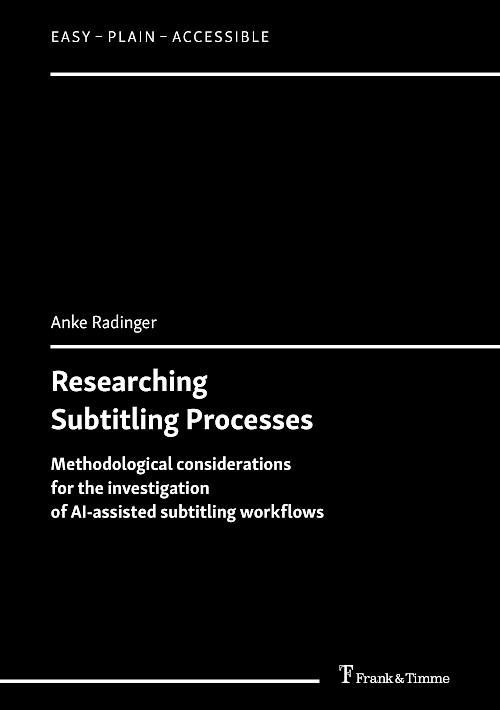
ResearchingSubtitlingProcesses
Methodological Considerations for the InvestigationofAI-assisted Subtitling Workflows
By: Anke Radinger
Ein deutsch-russisches Leben
By: Lola Debüser & Jekatherina Lebedewa

TheRoutledgeHandbookofTranslation TechnologyandSociety
By: Stefan Baumgarten & Michael Tieber (eds.)
TeachingtheTranslationofCulturalItems. PedagogicalTheoryandPractice By: Klaus Mundt
Translation as Event Performingand StagingTranslations
By: Brian O’Keefem, Larisa Cercel & Marco Agnetta (eds.)
ForschenundÜbersetzen. Translation im (früh)modernenWissenschaftssystemam BeispielFrankreichs(1600–1815)
By: Garda Elsherif
Grammaticacontrastivaperitraduttoridal francese.LetrappoledellaLingua
By: Alberto Bramati
Writing betweenLanguages Translation andMultilingualisminIndianFrancophone Writing
By: Sheela Mahadevan
TerminologyManagementforTranslators
By: María Fernández-Parra
TranslationSolutionsforLegalDocuments
By: Nataliia Pavliuk & Anna Kurashyna
MinorityLanguagesandCulturesin Audiovisual Translation
By: Eleonora Sasso (ed.)
MultimodalAffordancesinDiplomatic Interpreting An SF-MDAApproach
By: Xinqiao Cen & Derek Irwin
TheExperienceofTranslation MaterialityandPlayinExperiential Translation
By: Madeleine Campbell & Ricarda Vidal (eds.)
ApplicationsofRelevanceTheoryto TranslationandInterpreting PerspectivesonTheory,Researchand Practice
By: Fabio Alves & Fabrizio Gallai (eds.)
NewOrientationsinInterpretingStudies andInterpreterEducation Information Processing,MeaningMediationand Language-pairSpecificity By: Binhua Wang
TranslatingSilentCinema FilmHistory,NationalCulture,and the RoaringTwenties
By: Dror Abend-David
TechnologyandInterpreting Navigating theDigitalAge
By: Andrew K.F Cheung, Dechao Li, Kanglong Liu & Riccardo Moratto (eds.)
TranslatingTourism
By: Stefania M. Maci & Cinzia G. Spinzi

LiteraryandArtisticJapanbehindtheIron Curtain
By: Irina Holca & George T. Sipos (eds.)
ConstructiveNewsAcrossLanguagesand Cultures
By: Ashley Riggs & Lucile Davier (eds.)
InterpretinginAsylumProcedures: DialogistInterpretation
By: Hassan Mizori
Erwartungen,Einstellungen,Erfahrungen: Zur Interaktion zwischen hörenden Gebärdensprachdolmetschendenundihrer tauben Kundschaft
By: Laura Marie Maaß
Aproximaciónalatraduccióndereferentes culturalesenelámbitoaudiovisualy literario/Approachtothe Translation of Cultural References in the Audiovisual and Literary Fields
By: Pedro Mogorrón Huerta, Lucía NavarroBrotons & Iván Martínez-Blasco (eds.)
Bild – Ton – Sprachtransfer.Neue PerspektivenaufAudiovisuelleTranslation undMediaAccessibility
By: Marco Agnetta, Astrid Schmidhofer & Alena Petrova (eds.)
OnQianZhongshu’sConceptualizationof Translation. BridgingWorldsbetweenthe East and the West
By: Chang, Chung-An
Text,Diskurs,Pragmatikkontrastiv Romanisch-deutsche und innerromanische Streifzüge
By: Eva Lavric, Paul Mayr, Cornelia Feyrer, Christine Konecny & Wolfgang Pöckl (eds.)
TheRoutledgeGuidetoTeachingForeign LanguagesforTranslationandInterpreting
By: Enrique Cerezo Herrero
ConfrontingDigitalDilemmasinTranslator andInterpreterTraining
By: Pavol Šveda, Martin Djovčoš & Emília Perez (eds.)
Accesibilidad en la Comunicación
By: María-José Varela Salinas, Cristina Plaza Lara & Iulia Mihalache (eds.)
RenderingChineseClassicsintoEnglishI ANewTheory
By: Pan Wenguo
RenderingChineseClassicsintoEnglishII AHistoryofTranslationStudies
By: Pan Wenguo
RenderingChineseClassicsintoEnglishIII TranslationandCommentaryofAncient Chinese Maxims
By: Pan Wenguo
Lexikologie,Phraseologie,Semantik kontrastiv. Romanisch-deutsche und innerromanische Streifzüge
By: Eva Lavric, Paul Mayr, Cornelia Feyrer, Christine Konecny & Wolfgang Pöckl (eds.)
LanguageHorizons Perspectiveand ChallengesofTraslationandLanguage TeachinginUkraine
By: Yuliia Vasik, Inna Stoyanova & Teresa Fuentes Morán (eds.)
The Arab Translator’s Manual of Semantic Difficulties By: Amr M. El-Zawawy
Parmenides & Translation. FiguresofMotion,FiguresofBeing By: D.M. Spitzer

Translation Essence from Husserlian PhenomenologicalPerspective. TheFerryingofMeaning By: Lin Zhang
The Stories of Heinrich von Kleist ACriticalBilingualEdition By: Johannes Contag
AdaptingtheNovelfortheStage Translation in Intermedial Circulation By: Naciye Sağlam
By: Anjali Duhan-Gulia
ResearchingTranslator'sFunctionalStyle ACorpus-AssistedApproach By: Kan Wu & Defeng Li
LegalEnglishthroughtheAges. ACorpusBasedInvestigationofChangeand Continuity By: Vanessa Leonardi & Patrizia Giampieri
The Dvādas Bhāv AMughal Version of a Sanskrit Story
AudioDescriptionLearningandAssessment inInterpretingClasses
By: Jackie Xiu Yan & Kangte Luo
Perspectives
Russiaintranslation:Nordicperspectives
Edited by: Marja Sorvari, Nina Havumetsä & Erja Vottonen Volume 33, no. 3 (2025)
TS Journals Special Issues
Cadernos EspecialJapão
Edited by: Kyoko Sekino & Neide Hissae Nagae Volume 29 (2025)
Translation Review
WalterBenjamin.Thetaskofthe Translator
Edited by: Stephen Dougherty & Susan Erdmann Volume 121, no. 1 (2025)
The Translator RelationalApproachesandTranslation Studies
Edited by: Nasrin Ashrafi, Diana Roig Sanz & Reine Meylaerts Volume 31, no. 1 (2025)
Mutatis Mutandis
Traduccióny Humanidades Médicas: Narrativa Gráficay Humanización en Salud
Edited by: Isidoro Ramírez-Almansa Volume 18, no. 1 (2025)
MonTI
Theatretranslation.Performabilityand receptionfrominterculturalperspectives
Edited by: Susan Bassnett & Catalina Iliescu-Gheorghiu Volume 17 (2025)
Poznan Studies in Contemporary Linguistics
A Festschrift for Professor Jacek Witkoś on his 60th Birthday
Edited by: Przemysław Tajsner & Bartosz Wiland Volume 59, no. 4 (2025)

trans-kom
KünstlicheIntelligenzinderSprachmittlung undimFremdsprachenerwerb.Ausbildung und Arbeitsmarkt im Wandel
Edited by: Marco Agnetta & Katharina
Walter Volume 18, no 1 (2025)
Translating and Translanguaging in Multilingual Contexts
FromDisruptionstoNewBeginnings:The Evolution of Translation(Studies)through Technologies
Edited by: Federico Gaspari & Silvia Bernardini
Volume 11, no. 3 (2025)
Perspectives
Journalistic Translation Research Twentyfive Years on
Edited by: Roberto A. Valdeón
Volume 33, no. 4 (2025)
Des mots aux actes
Nouvelles Didactiquesdela Traduction Spécialiséeetdel’Interprétation
Edited by: Olivier Dorlin, Fayza El Qasem & Freddie Plassard
Volume 14 (2025)
Translation Studies (De)constructingTrustinHigh-Stakes InterculturalCommunication:Theoretical, MethodologicalandPracticalChallenges.
Edited by: BeiHu,SusanaValdez & ValentinaRagni
Volume 18, no. 2 (2025)

Mutatis Mutandis
Traducción e Interpretacióny/como Compromiso Social
Edited by: Paula Andrea Montoya-Arango, Kelly Washbourne & Juan Guillermo Ramírez Giraldo
Volume 18, no. 2 (2025)

Translation & Interpreting
Audiovisual Translation and Media Accessibilityinthe Ageof Streaming Platforms
Edited by: Sofía Sánchez-Mompeán & Serenella Zanotti
Volume 17, no. 2 (2025)
Across Languages and Cultures
Fit-for-MarketDirectionsinLanguage Mediation – Training, Research, Practice
Edited by: Réka Eszenyi & Edina Robin Volume 26, no. S (2025)

InTRAlinea
Translating InTRAlinea, MediaAccessibility for Deaf and Blind Audiences
Edited by: Carlo Eugeni & María J. Valero Gisbert
Volume 2025
Traduire
Maux à mots
Edited by: Anne Boudrot & Carine Bouillery Volume 252 (2025)
MappingSynergiesinCognitiveResearch on Multilectal Mediated Communication
Edited by: Laura Babcock, Raphael Sannholm & Elisabet Tiselius Volume 37, no. 2 (2025)
InContext: Studies in Translation and Interculturalism
Human-centeredness in Translation: AdvancingTranslationStudiesina HumanCentered AI Era
Edited by: Miguel A. Jiménez-Crespo Volume 5, no. 1 (2025)
MonTI. Monografías de Traducción e Interpretación
La Traducción del Discurso Turístico: Desafíos Actualesy Emergentes
Edited by: Manuela Álvarez Jurado & Francisco Luque Janodet No. Especial 8 (2025)
Cadernos de Tradução TraduçãoeInterculturalidadeChinêsPortuguês
Edited by: Xiang Zhang & Li Ye Volume 45, no. 3 (2025)
JUST
Language Rightsandthe Teachingof Minoritised Languages
Edited by: Anna Marzà & Joaquim Dolz Volume 4, no. 1 (2025)
Cadernos de Tradução SubjectivityandMaterialityinAudiovisual TranslationandMediaAccessibility
Edited by: Willian Moura & Iván VillanuevaJordán Volume 45, no. 2 (2025)
Translation in Society InSearchofRoundTrips.Travelling Conceptsin Translation Studies and Beyond
Edited by: Cornelia Zwischenberger Volume 4, no. 1 (2025)
FITISPos
Public Service Interpretingand Translation (PSIT)and Languagesof Lesser Diffusion (LLD)acrossEurope. New Challengesin Practice and Education
Edited by: Soňa Hodáková & Carmen Valero Garcés Volume 12, no. 1 (2025)
MembershipInformation
The membership fee is EUR 35 per year for full members and EUR 80 for a threeyear period. It is EUR 75 for supporting members (sponsors). It is due by 31 March each year, but late payments are always welcome.
To renew yourmembership, please follow our instructions on the EST website .
About the EST Newsletter
We’re on the Web! Check us out at: www.est-translationstudies.org
TheESTNewsletteris published twice a year, in May and November. It serves primarily as a vehicle for communication between EST members and a catalyst for action, rather than being a traditional academic journal. It provides information on EST activities and summarises some of the information available on the EST website, the EST X (Twitter) account, Facebook group and LinkedIn – you are invited to go to those sites for information that is more specific and upto-date.
The Newsletterreports on recent research and presents information on EST matters, events and research issues. Comments and suggestions from readers are always welcome. All correspondence relating to the Newsletter should be sent to: secretary-general@esttranslationstudies.org